Archive | rock RSS feed for this section

October 2013 – live reviews – autumn light, part 2: Daylight Music presents Annie Dressner/Buriers/We Are Children (We Make Sound) @ Union Chapel, Islington, London, 12th October 2013 (“the Daylight mixture of low-key quirk and put-you-at-yer-ease continues to work its magic”)

17 Oct
The Uke of Doom.

The Uke of Doom.

A fortnight on from our last visit to Daylight Music, my family and I are back again. Blame the warmth of the welcome, blame the homemade cake; blame my little son Oscar’s hopes of grabbing a set of hand-bells again. Blame a rare opportunity for us all to like the same kind of thing, but I think we’re hooked. If not hooked, we’re already used to that Daylight Music atmosphere: the occasional sound of a baby’s coo echoing through the cavernous vault of the Union Chapel, the slightly sleepy post-lunchtime ambience, the arts’n’crafts feel to proceedings; that gentle, polite undercurrent of London community ambience that’s getting more and more difficult to find in this time of mounting rents and bugger-my-neighbour.
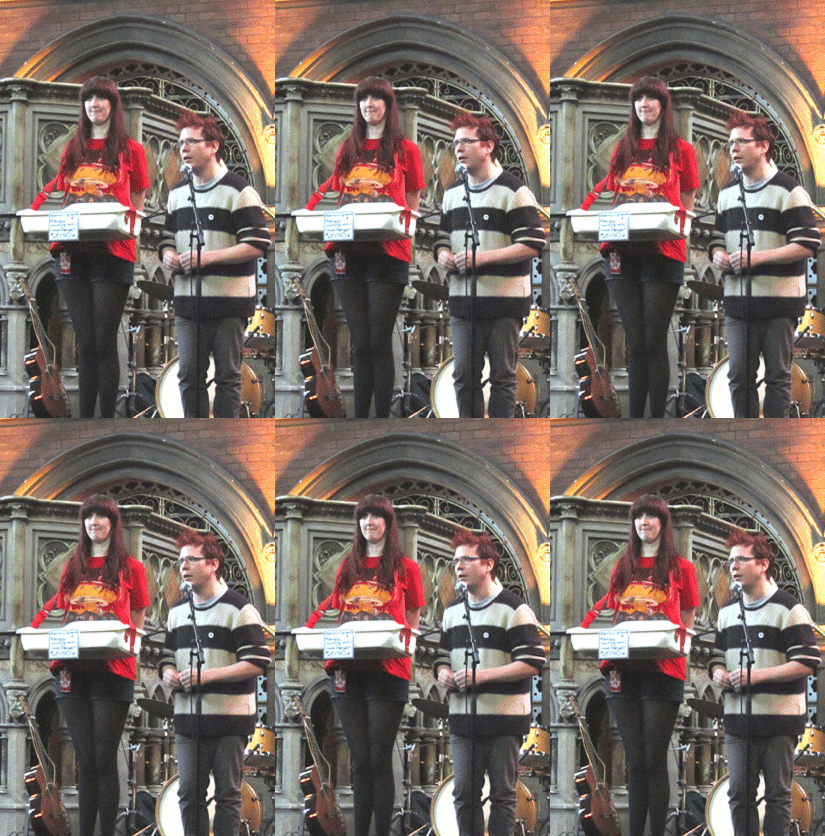
Daylight family matters - Caitlin and Ben.

Daylight family matters – Caitlin and Ben.

A full-family, free-or-whatever event at a major London junction, Daylight remains something to treasure. Things do change here, of course. The autumn wears on and there’s less and less sun to slip in and kiss the Gothic brickwork, less physical warmth to rouge the stone. The lowering October light dims the room rather than illuminates it, so that everyone onstage seems to be performing inside an unrestored oil painting, beneath a filmy pall of soot and years – but the Daylight mixture of low-key quirk and put-you-at-yer-ease continues to work its magic. Compering the event with his usual pin-point fuzziness, Ben Eshmade seems more and more like a gentle young cousin slowly evolving into a beloved uncle. Caitlin Hogan (Daylight’s beaming, leggy factotum-and-mascot) not only plays the church organ but frisks cheerfully around at the interval with an usherette’s tray. We’re warmed – and when we aren’t, we just pull our clothes around ourselves a little tighter and wait to see who’s come to the show this time.

A short time ago, New York singer-songwriter Annie Dressner crossed the Atlantic to England, swapping the brashness of her hometown for the more reticent self-assurance of Cambridge. As part of the deal, gridlocks were traded for grass commons, skyscrapers for Gothic spires, the swarming of yellow cabs for the purr of passing bicycles. New York isn’t entirely left behind, though: Annie’s very first song today is called Brooklyn. Her soft strum sketches out an altogether quieter place than the ever-rising hipster centre we’d expect: more sideslip Bohemian ’50s than rattling, overcrowded Noughties. The art-life, though, remains at the core of the story in the passing images of painter’s hats and “whiskey in a broken glass”, in the sketch of flawed new lives, the talk of friends, the passing spectre of discouragement.

Annie Dresser - softness is deceptive.

Annie Dresser – softness is deceptive.

Annie herself seems winsome, demure, even folk-soprano cute at the start (Oscar, who’s something of a two-year-old ladykiller, is certainly intrigued). Her dialogue, as she chats to us in between songs, is a halting soft-voiced take on that scatting New York curl of rapid ideas and the slipping between subjects. She claims not to be used to holding a crowd on her own (“Usually my husband plays with me. He tells jokes about cheese,”) but she gives it her best shot: giving us North London travel advice, or revealing which of her songs is her grandmother’s favourite. I’m not sure that she’s quite as much the shy ingénue as she implies. For all her easy-going, soft-cheeked charm, and for all the hushed and humble tones to her singing, she’s got a subtle self-assurance as she stands up there: for all the world like a Modigliani model who got the joke.

I’m not sure how much difference Annie’s Cambridge relocation is likely to make to her songwriting. Her songs don’t need backdrops of big cities or the hungers of creativity in order to work or to find focus: they can work anywhere. In fact, her quiet songs seem better suited to quieter rooms in quieter towns, or just to moments in which people’s reactions are contained in reflection – delicately muted regrets, a steady and accepting love.

Annie seems to write songs like other people read books – pulling in her attention, quietening; becoming stiller, gently illuminated. She’s mastered small, telling, understated images and the knack of placing them, lightly, in the best passing places. Something innocuous like a picture of a turtle becomes tinted with significance, as if caught by a stray beam of light at just the right moment.

Dressner in detail.

Dressner in detail.

Rather than being dramas, Annie’s songs are filled, unobtrusively, with little details of life’s motions. When the blows fall, as they must, they fall softly but decisively, like the moment in Lost In A Car where she sings “the wind was high / and your candle blew out.” When she sings about death, she sings about it in a series of aftershocks or in that slow repetitive rub of mingled grief, guilt and simple wishes that silently burnishes the pain: “if I had come / out in the cold dark night… / I can’t forget, even if I tried: / I can’t forget the night you died… / If I had come a minute sooner…”

Heartbreaker (which, like Lost In A Car, is from this year’s spring EP, ‘East Twenties’) picks over the memory of love lost by running over domestic details, slowly working around and creating the sketch of a man (“your father was a painter and your mother was a teacher – I remember all the things in your house”) but never obsessing over the man himself. Instead the song becomes a gentle, telling rebuke: the testament of someone who cared enough to notice all of the small building blocks of a loved one’s life; the account of someone who cared enough to remember. Annie doesn’t wreak obvious and horrible revenges in song. She’ll just tack you to the scene of your crime – once, with one expertly- and regretfully-placed pin – and what’s worse, she’ll stay sympathetic.

A band of Buriers.

A band of Buriers.

For the most part, this kind of subtlety is the sort of things Buriers just trip over – or more likely, stride over – while their eyes stay fixed on a savage, lowering horizon full of stormclouds and junk. A thunder-tommed, string-heavy vehicle for the splintered, semi-apocalyptic ramblings of poet-songwriter James P. Honey, superficially they seem to be snapping at the heels of Godspeed! You Black Emperor; intent on seizing the title of house-band for the Grand Collapse. Despite eschewing electric instruments (this time out, at least), they’ve certainly got most of the necessary ingredients. Cello and viola, droning menacingly or carving the air with dark, bitten post-romantic melodies; a smoggy aura of passive-aggressive ferocity with a hint of tragic, tender despair leaching through; war-drum rumbles and a close relationship with the dystopian spoken word.

Their first piece sets the scene and nails it – an unsettled English almost-rap layering slashes of scene over lowering, growling string drones. Hollow wood, full of heavy weather. Looking beyond those easy Godspeed comparisons, though, Buriers have a voice of their own – one with a distinct purple tint. Post–rock parsimonies be damned: chivvied on by James’ welter of words, Buriers continually thump up against their disciplined constraints in search of something which sprawls or potentially brawls. They smudge and crumple the lines between booze-spattered vignettes of romance (emerging wearily from behind nicotine stains and inertia) and violent Ginsbergdelaireian flowerings of collaged, surreal imagery.

Laura Mallows of Buriers strings us along.

Laura Mallows of Buriers strings us along.


On Slides By, for instance, James and the band spin out loose-jointed low-rent vignettes. Passion that accumulates itself from tawdry scraps and spontaneous moments of visual poetry, hungrily seized upon. “Glass of bourbon, a poorly rolled smoke, / then it’s time to go home. / Spend my whole night chasing your eyes – two flakes of burning coal… / And so I say to you, I swear / nowhere could ever seem so dreary. / Within your palm a lock of hair is smouldering and rising up, oh so lightly. / Snaking upwards, coiling along the ceiling. / Rebuild our cynicism there, / abreast to all my mighty, misty, misplaced feelings.”

On Stuffing A Chest (led by Jamie Romain’s ominous cello figure) James blurts out a kaleidoscope chant of cut-up impressions and intimations – “A skin like flung paint on a window… / Head on to the edge of the night / residing in a western crockery plantation… / Material plenitude, / seraphim skin, / sexually potent media and humour hanged and left silhouetted through a dazzling stained-glass window to wither.” As his portents pile up, the song seems no more than a few loose images away from disemboweling itself. The anchoring string growl of Jamie (and of violinist Laura Mallon) holds it together, like coarse sail-thread.

It’s a shame to deny the atmospheric power of the Buriers ensemble as a whole, but the attention is constantly caught and held by the febrile James. No slouch as a guitarist (he contributes a beautiful, rippled nylon-string finger-picking part to Dim Half Light, and intermittently wrings delicate sprawls out of a ukelele) it’s as voice and emoter that he shines; or, rather, smoulders with a dark discomfort. His vocal is crisp and doomy, brooding and fastidious. He doesn’t mince his words: he snaps them off, shifting agitatedly between politics and abstractions (a snarled “well-heeled” is rapidly rhymed with a distracted “old film reel”), but snipping each phrase clean.

By nature James sounds fey, even effete, but voice and song are transformed by the ferocity of his words and convictions as they slide over each other. In attitude, if not in tone, his performance carries with it a labyrinth of echoes – Cohen, Reed and Patti Smith among them – but there’s a stubborn Englishness in there as well. Not just in the way that his verbal flashes of fang, whisker and dissent recall modern English songs’ own crepuscular, compelling rank of anti-heroes (Curtis, Hammill, Mark E. Smith). There’s also that porcelain gnash of thwarted, inward-turned privilege that hangs around him. Sometimes he could be a harried, half-deranged young schoolmaster, trapped in a staid public school while dreaming of freedom in the slums; one binge of words and absinthe away from fomenting revolt.

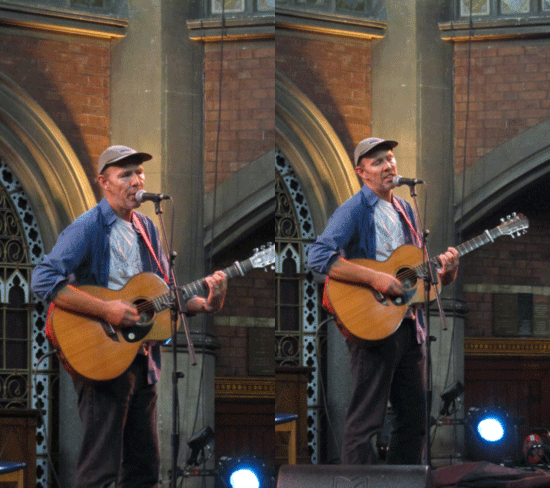
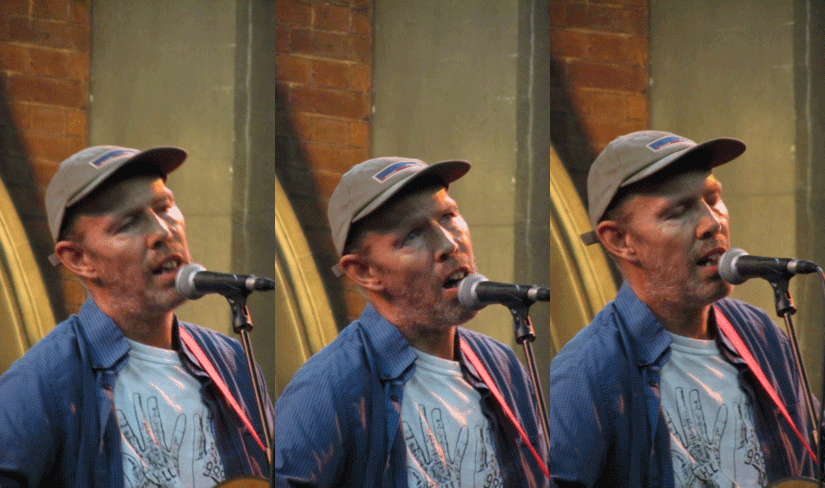
James P. Honey in flow and frenzy...

James P. Honey in flow and frenzy…

Then there’s his physical presence. Trapped in position by his microphone, James squirms and chafes against the necessity like a bug stuck on a pin, while haranguing us with hellfire intensity. His head rocks and bobs; his eyes and teeth lock; his feet sway and twitch in tiny shuffles and anxious hops. When not constrained by guitar or uke his elbows flail, as his forearms move in frantic twists and swivels. While he declaims his words, his hands accent them in frantic conduction, clasp in desperate spasms, or pluck savagely at his T-shirt as if trying to scrape their way through to his vitals.

Set against his rolling, literary imagery and precise, mannered diction, James’ tortured physicality almost looks comical – less Cave or Iggy than a Rowan Atkinson vicar possessed by the spirit of a rabid weasel. What sells it to us is his naked fervour. Maybe it’s a willing possession: James’ surrender to his bursts of words suggest that poetic discipline will always be less important to him than channeling (or reviving) an epileptic torrent of meaning.

Not everyone is sold on this (including the scattering of toddlers in the Daylight audience – Oscar toddles determinedly off to the colouring-in table during Buriers’ set, and stays there) but there’s no denying the commitment onstage and the band’s sustained grind of shimmering intensity. By the time Lynch Mob Hero rolls around, facing off against a time “when the city kills off the poets”), James is increasingly wracked; stumbling to the front of the drum-kit to hammer at the cymbals with a pair of beaters. Wriggling in a fury of words, he lets them shake him out as they will. On Buriers’ final song, he pleads for a kind of mercy – “God be kind – my ship is small.”

* * *

A change of act and a change of mood. I retrieve Oscar from the crayons and felt tips. There’s another short break. Let’s go back a bit…

In November 1973 (when I was barely three years old, and missing most of the significance at the time), Mike Oldfield’s ‘Tubular Bells’ was nowhere near as ubiquitous as it is today. While there was a growing buzz about its fusion of rock technology, ’60s conservatoire minimalism and folk textures, its all-conquering grip on record players, planetaria, whistling hippy milkmen and (by degrees) pop culture in general was still some way off. Nonetheless, at that point it had enough momentum for a reluctant Oldfield to be cajoled into playing a version on television. To reproduce what had previously been a mass of overdubs, Oldfield was joined by an diverse dream-team.

For those who are interested, here’s that original telly performance (courtesy of YouTube). A sizeable chunk of Oldfield’s broadcast band came from Henry Cow, touchstone avant-rockers inspired by Mao, blues, free-jazz, performance poetry and fearsome contemporary composition, who’d been organising their own cross-genre Explorers’ Club events. (The Cow’s work is worth a whole article in itself: their questioning collective spirit led them to challenges which still lurk in the musical undergrowth to this day, still challenging any halfway-political art musician prepared to kick at the wheels of the applecart). With remaining spaces to fill, Oldfield pulled in musicians drawn from a wide but sympathetic spectrum – from Gong; from Soft Machine; from The Rolling Stones; from folk and classical woodwind-playing.

To put it mildly, it was a crowded podium that evening, pregnant with cross-genre possibilities and implicit predictions. Karl Jenkins blew oboe – a Soft Machine member at the time, it was twenty-two long years before he himself would grow grand on his own wave of chart-storming cross-genre malarkey, via ‘Adiemus’. A few years before that one of the Gongsters – Steve Hillage – would stage his own later-life transformation, returning with System 7’s ambient techno to woo and wow a 1990s generation of dance freaks. Even the most obscure contributor, Ted Speight, was a musical journeyman: his own career would map from Lol Coxhill’s avant-garde fusion jazz to the artful punkified pub-rock of Kilburn & The High Road (at the side of Ian Dury) and, by the millennium, back again to London jazz.

That one-off broadcast wasn’t the end of the story, either. By the following year David Bedford (Oldfield’s friend, and a burgeoning crossover composer) had written up an orchestral version of Tubular Bells to perform and record with the Royal Philharmonic Orchestra. In doing so he joined further significant British culture dots to the puzzle. The Royal Albert Hall – where the concert was recorded, and where high art meets broad public a stone’s throw from London’s royal palaces. Thomas Beecham, the RPO’s belligerent founder, conductor and impresario – eight years dead by the time his orchestra was playing Oldfield, but with his own legacy of revitalising English concert music still very much intact. Lastly, Worcester Cathedral, where Oldfield eventually re-recorded some of his Tubular Bells guitar parts under the soar and shadow of five hundred years worth of evolving English architecture.

The reason that I’m bringing all of these things up is that the Tubular Bells events were, in their way, high-water marks in post-war British music. In terms of that era’s art-music fusion they might have been at the easy-listening end, but their tunefulness and canny textural appeal allowed them to poke their heads right up into the mainstream. For a brief moment, they trespassed over those stubborn cultural divides which separated music into sullen and defensive camps muttering stale arguments about high versus low, fossilized versus spontaneous, conservative versus radical. It wasn’t a moment which lasted. With a few honourable exceptions (most obviously in jazz, such as Mike Gibbs and Keith Tippett) few musicians maintained those crossing points.

Many British musicians (Henry Cow among them) ultimately had to look to Europe or America if they wanted to cross-fertilise, at that level or a higher one. Back at home, most of the genres subsided back into their cramped little stockades to percolate and evolve separately. It was as if, as a musical nation, the British had given up on inclusiveness in favour of more miserly joys. They swapped the possibilities of crosstalk for more limited experiences of belonging – being in on an exclusive clique, the petty rivalries of defining your own group against another; the footie-fan logic and competing crunch of pop tribes. A proud Mod might argue that this was a good thing; another reviewer might argue that the friction between scenes and identities provided sparks of its own, and they’d have a point. For me, though, disappointments came with the choice. It’s not that all the opportunities vanished, but for a long time it was as if many of us had gone into our houses and shut the doors.

We Are Children (We Make Sound).

We Are Children (We Make Sound).

This is turning into a rant. Let’s get back to 2013, to the considered, warm inclusivity of Daylight Music, and to where a ten-to-fifteen strong We Are Children (We Make Sound) are onstage, picking their way through a note-perfect version of Tubular Bells, revelling gently in their own tender, communal sound; and gently blowing away not just the years, but the resistances. I can’t call them revolutionary, especially in the light of what I’ve just written about memories of early-’70s icebreaking. I can’t even claim that they’re the only barrier-crossing ensemble around. But it’s great to be able to peg them as an indicator of how Western music culture – and, narrowing the scope, British music culture – has softened its adolescent stiffness, relaxed its intolerant bark.

Born from after-hours jams between students and staff from the Institute of Contemporary Music Performance, over in Kilburn, We Are Children come from a fresh generation of musicians (most, but by no means all of them, are still in their twenties). Within the lineup, I spot some half-familiar faces from various London gigs and cellar-jams. Here’s the sensual feline pout and mussed-blond curls of Chinese Missy rocker Richard Bond, today dividing his time between guitar and clarinet. Here’s dreadlocked guitarist Niels Bax from groove-players What?!. Here are singer Gyongyi Salla and flautist Abi Murray, both of whom hover around the capital as songwriters (Ziaflow and ABI, respectively). As individuals, as part of smaller groups, as gigging and communicating musicians, these and other We Are Children members continually work and learn across a wide range of music throughout London, and they don’t thinking twice about doing so. That genre permeability which was ground-breaking in 1973 (and which was subsequently scorned as a betrayal of the tribe) is reestabished within a broader perspective; a healthy, heterogeneous fabric taken for granted, and casually encouraged.

Assorted Children...

Assorted Children…

Having said all that, We Are Children are playing a little bit safe today, perhaps in friendly deference to Daylight’s sleepy early-afternoon babies. Happy to work with both driving rock pulses and dance-and-dubstep mixology experiments, they bring neither to this afternoon’s live party. While they’re nominally a composing and arranging collective, this afternoon’s showcase is a little more conservative, focussing on a couple of familiar classics of melodious minimalism plus a solid pair of pieces from the leadership. For now, though, this gentler, more doctrinal taste is fine. The ensemble sets up a cool October glow, breathing a loving life back into the familiar and working up some new tunes of their own. As they carefully, unfussily work their way around what were once crusted old encampments, We Are Children have a tender communal feel to them. Nominal leaders Dan Gaylard and Alastair Beveridge both look as if butter wouldn’t melt in their mouths. Meanwhile, Audrey Riley – the veteran strings sessioneer and the band’s tutor-cum-guiding-light – oversees proceedings and provides some silent backbone. She glares protectively from behind her cello, a determined mother-hen with a steely glint.

Audrey might provide the anchor, but it’s Alistair who’s responsible for today’s Tubular Bells treatment, leading from the grand piano and providing a remarkably faithful arrangement for We Have Children’s smaller forces (centred predominantly round a quintet of clean electric guitars, bass and a string duo of Audrey and violinist Richard Jones). Imperceptibly, and with great skill, he shaves down Oldfield’s ringing repetitions and multiple layers to fit a ten-minute piece and a thirteen-person ensemble (the core bolstered by glockenspiel, by Abi’s flute and by the voices of both Gyongyi and fellow London songwriter Jo Kelsey. The piano anchors with that familiar dancing, pulse, and somehow all of the missing textures are masked. If anything, the original piece emerges refreshed, especially after two decades of intermittent and questionable reworking by Oldfield himself. Earlier on, a somewhat reshuffled We Are Children (flute, glock and voices out; drumkit and a second bass guitar in) have already taken us on an immaculate trip through Steve Reich’s Electric Counterpoint – less trippy-disciplined than the original, with the opened-up instrumentation and acoustic-electric sound bringing out intimations of both folk-round and disco pulse. The music is replete with examples of the mutual sympathy and interaction which We Are Children have built up over three years of jamming and unlikely pub gigs – violin and flute blend for a second, then cycle smoothly apart: guitars ravel into a delicate thirty-string mechanism.

Cell-out...

Cell-out…

The ensemble’s original material fits in seamlessly with the regroomed, revitalised Reich and Oldfield warhorses. Circles (written by Alistair) slims down We Are Children to the string duo, a quartet of guitars and a single bass. It manages to be many things – a neo-minimalist declaration, smooth and detailed. Riding on a Satie-esque continuo, the melody line passes in a ripple through the players: an oscillated hocketed sway with a tingling, conversational counterpoint. A fourth piece (for which I don’t catch the name) has a murkier quality. They’ve shuffled the lineup again – the electric guitar quartet against the string duo; a return of bass, piano, drums and female voices; a returning flute this time joined by clarinet. What emerges from this configuration journeys through a set of moods, interlocked like a meshwork of paper rings. A Scottish/English border folk air filters through string duo and piano, dissolving into string noise. Drums and piano pick up and point a beat in three-time. A dawdling sensual theme passes from violin to clarinet; as flute is worked in, the drums become jazzier, stretching and moulding the rhythm around the weaving melody instruments.

Viewed as a whole, We Are Children’s pieces (whether adopted or originated) build up a utopian sound-picture, part rural and part urban – they’re both verdant woodlands and immaculate ductwork; warm sunsets on glass; the patter and pulse of working cities overlaid with their parks, borders and spaces to dream. Sitting on my lap, Oscar listens quietly and thoughtfully, his attention held. I was ten before I first heard ‘Tubular Bells’; sixteen before I heard Reich. In this band’s inclusive space- itself enveloped by Daylight Music’s easy welcome – my son’s getting an earlier and much more natural introduction than I did, untroubled by tribal antipathies. When Ben Eshmade first brought We Are Children into Daylight Music – much earlier in their concert series – he described them as “what I imagined a Daylight band might sound like.” He’s righter than he knows, and it’s a credit to both ensemble and event.

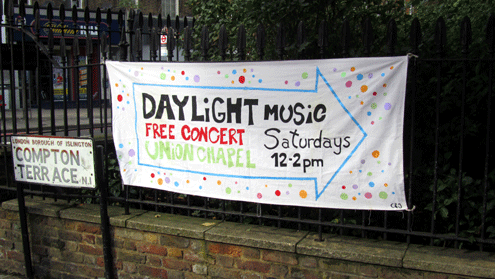
Arrow of welcome...

Arrow of welcome…

Annie Dressner online:

Homepage Facebook Twitter MySpace Soundcloud Tumblr Bandcamp YouTube

Buriers online:

Homepage Facebook Twitter Soundcloud Tumblr Bandcamp YouTube

We Are Children (We Make Sound) online:

Homepage Facebook Twitter Soundcloud YouTube

Daylight Music online:
Homepage Facebook Twitter Soundcloud

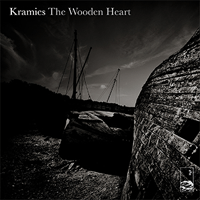
REVIEW – Knifeworld: ‘Don’t Land On Me’ single & Kramies: ‘The Wooden Heart’ single, both 2013 (“dancing at the end-of-the-world party”)

2 Oct

Knifeworld: 'Don't Land On Me'

Knifeworld: ‘Don’t Land On Me’

So what’s it to be, then? Stubborn elbows or secret soft centre? For Knifeworld, as ever, it’s both and neither. Kavus Torabi runs on this kind of contradiction. It’s what enables (or maybe forces) him to roll out singles like this – the kind which always seem to promise him the attention he deserves but never quite get him enough. Generally his songs teeter like dazed cats trying to scramble over the fence dividing open fields of sunny pop from that intricately entangled tesseract-space of what Kavus calls “funny music” (and which the rest of us drain our adjective-and-hyphen stores over, vainly trying to pin down a workable term).

‘Don’t Land On Me’ finally kicks down the fence. In its swirl and pounces, in its tiny bluffs and blind corners, in each acoustic guitar rope-trick and each Halloween feint of Emmett Elvin’s keyboards, it brings in the usual juicy psychedelic Knifeworld kinks. I suspect that Kavus can’t look at a nice fresh acid blotter without seeing a potential origami crocodile in there, waiting to be made. Yet this time, for every formidable bit of bassoon-pretzeling that Kavus offers up to the memory of his beloved Henry Cow there are two shots of pop. For every bit of elastic Shudder To Think limbo-dancing, there’s a flash of Marc Bolan coltishly tossing his curls and foot-stomping with Led Zeppelin.

Having unexpectedly ballooned into an octet (with a three-line battery of reeds and saxophones), Knifeworld are starting to sound bizarrely like a 1970s soul revue, albeit one that’s lurching out of line. ‘Don’t Land On Me’ has gilded harmony stabs and sugar-wraps of acoustic guitar; it has gratuitous campy explosions; it has stirring gospel-mama “yeahhh!”s from Chantal Brown (bringing a Loa or two from Vōdūn). Most surprisingly, it seems to have gobbled up that swashbuckling vamp from Live And Let Die, hiccupped it out again and gotten away with it – regularly, the band throw their hip intricacies to the wind and just romp up and down a ladder of soft-rock pizazz. Threaded through all of this sturdy bravado, though, is sadness and fear – a hollowing of the heart.

Half of the lyrics are Kavus’ usual ribbons of third-eye babble: tales of dying suns and mysterious cities of the mind, as much bragging as illumination. Yet all of a sudden he’ll turn out a belter: “In that treacherous slippery no-man’s land / between bolt-upright and dead-to-the-world in sleep, / I was dreaming that you were in my arms. / Dreams will only give promises they cannot keep.” Later on he’s hiding behind his own tune, chanting “falling down, unravelling”, and it’s up to his vocal foil Mel Woods to step up and deliver the drop – “Broken, unfound, there is only one thing I find – / we ran aground, and I wouldn’t make up my mind. / Hide it behind your hands, my eyes no longer see / Heavens above, stars explode, but don’t land on me.”

Kramies: 'The Wooden Heart'

Kramies: ‘The Wooden Heart’

As the band charge off into the vamp again, they sound as if they’re dancing at the end-of-the-world party in mirror-strewn top hats: I’m guessing that Kavus will be trying not to meet the gaze of any of his own reflections. Kramies Windt, meanwhile, will be standing several good paces away, waving goodbye to everything with full acceptance.

While Knifeworld fret about doom and ward it off with their showbiz, Kramies gets by on faith. Not for him Knifeworld’s tussle of John Barry and John Adams, nor their trick-cycling. With Todd Tobias keeping a gentle producer’s eye on things, ‘The Wooden Heart’ rolls along on that familiar drowsy acoustic-guitar trudge that’s served forty years of green-tinted psychedelia from Camel to Mercury Rev to Porcupine Tree. A spectral moonlit fungus of vaporous keyboards grow on and around everything: a high-altitude electric wash of sparks, smoothness and textural drag spreads out at telescope height, snowploughing the Milky Way. As for the song, it’s less involved and intricate than much of the material which Kramies has sung up for us since his 2008 emergence. A dream-pop caroller with a lucid organic twist to his songs, he once came across as a mellower Paddy McAloon with a hint of pixie. Now he’s closer to visionary Neil Young territory, the point where American folk-song blurs without a jolt into slumbering subconscious. He’s singing softly and with understanding beyond his sleepy burr, like a wise newborn already dusted from the road.

This is a love song, of a different kind. Kramies is pulling up memories: treasuring them, but also acknowledging how memory and memorabilia gently cheat and distort the truths which they’re set up to hold onto – “Forged from the photograph when the tides they rode you down; / smudged from the perfect lens, so I brought you back to ground.” Despite the dreamy, distant atmospheres Kramies isn’t dwelling on someone gone. He’s celebrating someone never lost, someone coming into clearer focus as present merges with memory: “We fell in love with wind, sun and movies, / no need to stay. / Countdowns and journeys, conversations, fell through our day.”

In the middle, the song holds its breath for half a moment, then rises into a blissful dream-pop threshing; a massed quilt of hammering Slowdive-ian guitars joyfully plunging down onto each beat. “Spill out the haven, throw my maths chart away, ‘cos you’re the one,” Kramies sings, in an exultant sigh. “Throw my maps, a castaway.” It’s rare to find dream-pop that resolves with such assured optimism, in which you can sense experience shifting into its proper place. While Kavus and Knifeworld constantly quest for resolution – and spin some dazzling pirouettes along the way – Kramies seems to have mastered the talent of simply breathing it into shape.

Knifeworld: ‘Don’t Land On Me’
Believer’s Roast (no catalogue number or barcode)
Download-only single
Released: 9th September 2013

Kramies: ‘The Wooden Heart’ single
Hidden Shoals Recordings (no catalogue number or barcode)
Download-only single
Released: 5th September 2013

Get them from:
Knifeworld: ‘Don’t Land On Me’ – Bandcamp
Kramies: ‘The Wooden Heart’ – Hidden Shoals online store

Knifeworld online:
Homepage Facebook Twitter MySpace Bandcamp

Kramies online:
Homepage Facebook Twitter MySpace

September 2013 – live reviews – autumn light, part 1: Daylight Music presents Directorsound/Candythief/Jack Hayter @ Union Chapel, Islington, London, 28th September 2013 (“decency, enthusiasm, a place to gather and music’s qualities of balm and binding”)

30 Sep

This way in...

This way in…

In some respects, when you’re chasing music, being broke is easy. Almost everyone sympathises with it (not least the musicians themselves). A bigger challenge is to keep up with both music and a young family: neglect either, and you feel sick at heart. Chances fly past and it sometimes seems as if, whatever you do, someone’s going to get disappointed.

My own, fairly recent family is typical in this. Getting us all together behind one piece of music, at one time, can be tricky. Regular readers will already know that I like music in all its forms – from scream to coo; from four-square pop craftsmanship to impulsive tangle-ups; from stroke to slap, from massed strings to static. In the face of this indiscriminate barrage, my wife prefers her music to be more ordered and comfortable. (We did enjoy a freak one-off bonding over some Belgian avant-jazz six years ago – marriage always has its surprises). As for Oscar, at two-and-a-half years old he hasn’t settled on absolute likes yet; but as he hones his toddler free-improv skills and makes up scrambled songs about the Gruffalo, making musical noises with any convenient object (or watching other people do it) fascinates him.

Well, if you’re broke, you track down free gigs – as for the other challenge, go looking for something family-friendly. Hiding in plain sight in the middle of north London, Daylight Music offers both, hosting fortnightly pay-what-you-like triple bills beneath the piling, bounding Victorian-Gothic rooftops of Union Chapel. Persuading Clare and Oscar to go is easy. It’s a single bus ride away; it’s in the early afternoon; it’s mostly acoustic. Apparently, there’s cake. I think that’s the clincher. We go.

Inside, we find something like a church fête. The merchandise stall nuzzles up against Christian Aid posters; and yes, there’s cake – people volunteer to bake and bring it in. Beneath the Chapel’s bold and cavernous octagon of elevated brickwork, a gentle, meandering throng of people criss-cross the aisles like drowsy autumn bees, settling gradually into the wooden pews. Children’s faces are dotted around the audience – happy or distracted toddlers, anxious infants who’ll be smiling at the thumps and arpeggios later. During breaks in performance, a strikingly tall and kind-looking lady called Caitlin cat-steps over to the grand pipe organ and plays us a weave of half-melted pop hits and memory-songs. Despite the Chapel’s imposing scale, this is all remarkably cosy.

In recent years, unfriendly rumbles have rattled round the woodwork of the more family-friendly, acousti-folky end of music. Certain commentators have been drawing ominous conclusions about a resurgent conservatism, the rejection of multiculturalism and the stealthy rehabilitation of a rigid and stratified Britain strapped into place by ersatz traditions. It’s an uneasy picture, not least because the distaste drives so many things before it – farmer’s markets, bespoke festivals, the parodification and commodification of working-class folk culture, even the innocuous folk-rock of Mumford & Sons are all rolled up into a looming kipple-spectre of incipient English fascism. You could imagine the same questionable bile being aimed at Daylight Music – at the grand church setting, the tea-and-cakes, the shortage of outright punk and smoke, the Mothercare cups, even the efforts to make people comfortable.

Look a little more closely, and the cheap shots are belied. There’s a faint fray of urbanism to Daylight Music and to the Chapel – a slight scuffing and engriming in the Victorian iron and woodwork; a dash of non-conformism (both with and without the capitals) to the gathering and its setting. There are glimpses of more lived-in faces punctuating the young professionals, yummy mummies and cultured grandparents (hard-bitten elderly hippies, tattooed ex-bruisers; that nervy look which struggling musicians get, two decades into lean times). There’s that mingling of quiet anxiety with generosity which hangs around the trestle-table food counter, raising money for the homeless. Indeed, there’s even something of the trade union fund-raiser to Daylight Music.You sling your voluntary contribution into a plastic bucket at the door; you’re smiled at; you feel like part of something bigger and more inclusive, and a little more generous.

Daylight Music's Ben Eshmade - making us an offer we won't refuse.

Daylight Music’s Ben Eshmade – making us an offer we won’t refuse.

Although plenty of people are involved, Daylight Music is primarily another outcropping of enthusiasm from Ben Eshmade: broadcaster, promoter, occasional French horn blower and the man behind Arctic Circle, Chiller Cabinet and other warm-spirited musical things with cold names. Ambling onstage to introduce acts and deliver Daylight parish notices, Ben’s the gentler kind of presiding presence. Despite his amiable, bumbling manner (part distracted curate, part Sunday scholar and part walk-leader) it’s clear that there’s expertise and resolve hidden beneath those layers of fuzz and softness. I suspect that he knows everything that’s ticking over throughout the afternoon. Ever so slightly, there’s a sense that Daylight Music are holding off the darkness of ignorance in a matter-of-fact way and with the simplest of tools – decency, enthusiasm, a place to gather and music’s qualities of balm and binding. If London was flattened by meteorites or missiles tomorrow, you get the impression that Ben and the rest of the Daylighters would be dusting themselves down and going around afterwards – knocking at the fragments of doors; rigging tarpaulins and mending guitars; ensuring that everyone was given a flapjack while we put society back together.

Jack Hayter, at work.

Jack Hayter, at work.

Today’s first act seems as if he’s already been through a little war or two. Looking like a man carved out of driftwood (and dwarfed by the Chapel’s glowing rose window) a slightly battered Jack Hayter is suffering, though not on our account. He’s got toothache, and he might have managed to give himself organophosphate poisoning this week from accidentally squirting dog-flea killer in his eye. He’s taking it well, though: downbeat afflictions and mishaps seem to suit him. Later on, he’ll be singing “I’ve got teeth like tombstones, skin like clay – / well, it could be the scurvy, but anyway.. / The symptoms will fade if you come around / tomorrow – well, I was thinking, I’ll impress you somehow…”

Despite twelve years of on/off solo work (plus bandwork with Spongefinger and Dollboy) Jack seems perpetually fated to be known from his Jack-of-all-trades period with Hefner – when he was Darren Hayman’s handy sidekick, the have-a-go guy playing pedal steel and anything else which the others couldn’t manage. Watching him up there by himself with just his acoustic guitar (and a voice that’s not so much husky as husk), I can’t think of him as anything else but his own man. Both he and his songs are of a part: stubbed and illuminated by poverty and handiwork, scraped down to the bumpy grain and crafted to the true.

His Devon-gone-Estuary accent rattling against his throat, he sings movingly – even elegaically – about the come-and-go of Margate seafront, capturing in fingernail sketches hints of dereliction, the sweep of world currents, and the ongoing business of life: “Seahorse eggs, bladder wrack, / starfish in the sand, / and the Balkan girls on the West Beach with their prams.” With wryness and fellow feeling, he sings about being short of money (“it just sits in my wallet / rehearsing its final goodbye…/ Every letter that hits the welcome mat / is a fancy shade of brown,”) and shifts seamlessly between the metaphysical and the bare-boned personal. (“Trust is just belief without evidence. / Faith is a river that leads to the light. / So I’ll write songs… / so we can sleep better tonight.”)

Jack Hayter - songs of tall ships, peeling paint, old aircraft and weathered people.

Jack Hayter – songs of tall ships, peeling paint, old aircraft and weathered people.

While there’s a soft centre to his songs, Jack’s a long way from that breed of walking-pullover songwriters who fluff up the average acoustic night. I mentioned driftwood earlier, but perhaps weathered garden sheds are better comparisons: those unintentional brittle monuments to ordinary men’s lives and their fumbled, uncompleted dreams. Gaps and splinters in the planking; fugs of memories of hard work and shaping, of small private failings and imaginary wickedness.

There are snags in these songs. In one rippled, helpless brooding on love and mistakes Jack casts wildering, dissonant chords in amongst the slash and finger-picking. He passionately rasps fragments of revealing (“your freckled arms wrapped around to drag me under or set me free… / She puts her trust in lucky charms… / Every time we go to pieces, every time we go to war,”) with his bleached, crumpled vocals making them sound like damaged photographs held fearfully at fingertips, their significance lingering even as their colours and clarity parch.

Where Jack truly comes into his own, though, is when he blends these roughened surfaces and threadbare textures with a broader scope: the hauntings of memory, perhaps, or a drunken fantasy. I Stole The Cutty Sark is the latter, a boozy-dream-come-lover’s-bet in which Jack’s decrepit old soak of a narrator imagines commandeering the famous old Greenwich clipper and sailing it (topgallants filled with drunkard’s breath) across south London parkland and streets to serenade his girl at Lee (“I bet she’d sleep with a man who’s got a tall ship…”). It snatches romance from the brink of the ludicrous – even restores a little dignity and life to its own shipwrecked subject.

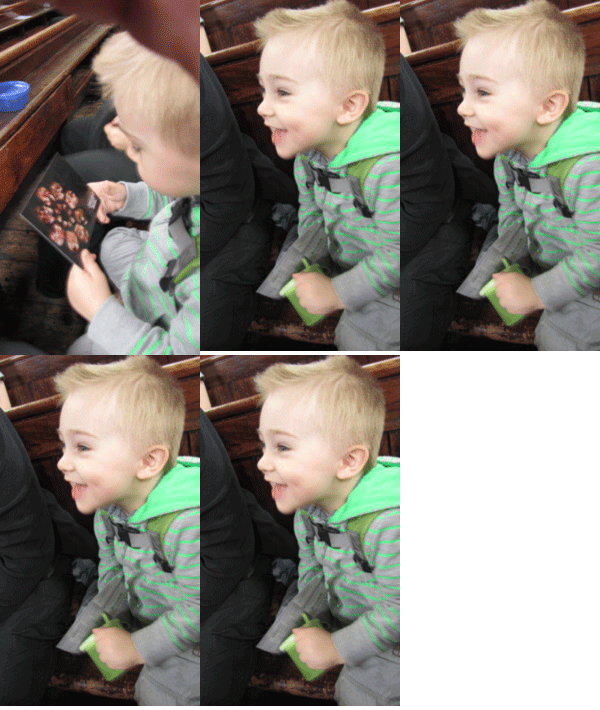
'Misfit City' Jr. at play - Oscar enjoys the show.

‘Misfit City’ Jr. at play – Oscar enjoys the show.

Another antique vessel – this time a plane – haunts The Shackleton: a post-war sub-hunter haunting the north-eastern coast in the 1960s, droning overhead while lonely Cold War teenagers pursue the wrong people, go through pregnancy scares and flinch from dreams of the mushroom cloud. From these elements, and from two tales of shredded correspondence in sorry little boxes, Jack spins out an aching kitchen-sink ballad of how people repeat their mistakes, neglect their cues, fail to be protected; in the end, how they come to miss what they feared and learn (too late) to love what they once only took for granted. He calls all of this time-travel. Oscar, too young to understand any of it, is still fascinated by the plaintive bony man onstage with his exhausted face and his air of dessicated kindness; the songs lolling from his guitar.

A few things about Candythief take me back to that wrangle which I mentioned earlier – the one about the politics of folk music. Superficially, they seem worlds (and perhaps a property band or two) away from Jack Hayter. As driving force and songwriter, Diana de Cabarrus has learned to be flexible while leading a Lego-flexible band lineup which clicks and pops available members into place as and when possible. This afternoon they’re a duo – Diana fronting on lipstick-red guitar, with Jason Dickinson’s vigorous fiddle playing and vocal harmonies adding some friendly sinew to her songs.

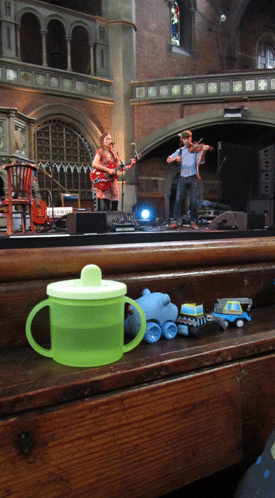
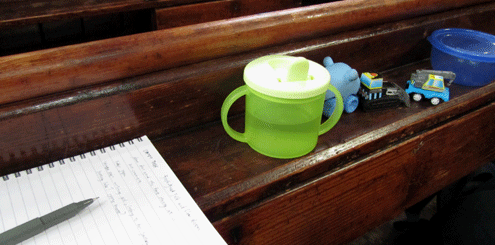
Part of a Daylight Music experience - baby cups, toys, Victorian woodwork, and Candythief in the background.

Part of a Daylight Music experience – baby cups, toys, Victorian woodwork, and Candythief in the background.

There’s nothing wrong with Candythief’s craft – it’s their cleanliness that jolts a little, after Jack’s scuff and scrape. Diana’s taste for adding a little crunch to her guitar is offset by her occasional dashes of loopage – choir-lady codas, little ziggurats of arpeggios – while Jason’s all-around virtuosity is further buffered by his beaming, ready-to-please showmanship. Their cheerful confidence extends to each other and to the audience; they deliver updates and clear intros at every opportunity, they’re nicely turned-out… They could hardly be more iconic of the modern, middle-class, tech’ed-up professional folkie if they tried.

Still, it’s churlish to snap at them for their impeccable diction, or for the fresh-faced, well-brushed aspect which they bring to their music and manner – after all, no-one snaps at Kate Rusby for making the effort. A songwriter’s voice finds itself while working through all manner of factors – family, shoes, regions, songs caught up from records or by ear, the day-jobs cadged on and survived, the places traveled and the things seen in passing. Diana’s own background (taking in a desert childhood and links with King Creosote and lo-fi Fence Records folk) suggests that there’s more to her than the assured, well-groomed perpetual-debutante which she presents as. Listening past the image doesn’t necessarily reveal all of this, but it does reveal a songwriter of thoughtfulness and impact behind the cool tones and bright sounds.

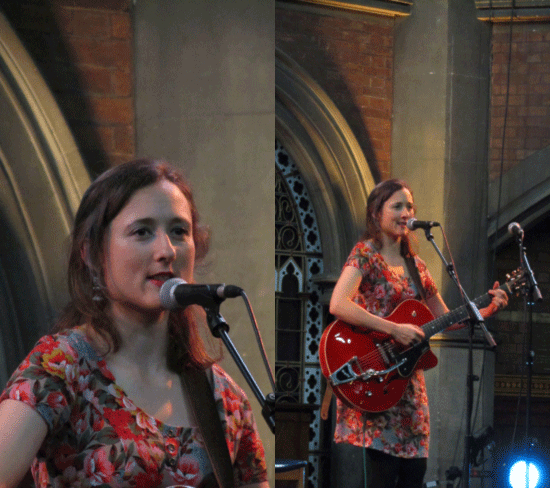
Candythief-in-chief - Diana de Cabarrus

Candythief-in-chief – Diana de Cabarrus

Not just that, but Diana proves to have a taste for mournful reflection which parallels those scrappier, plangent Hayter regrets. Her songs are windows onto other lives, onto which her own feelings overlap to etch away the politeness with a soft, stubborn acid. Many of the subjects are other women; such as the young girl at the centre of one particular time-blurred song, in which you can’t be sure whether Diana is looking at a daughter or niece, at a stranger, or at herself. Whoever it is, Diana appears to be both looking towards future journeys and looking back on them from that future, her responses a mixture of concern, solidarity and trepidation. (“Your face was so smooth – / you had no idea.”)

In the sleeve-plucking Time In The Tin Diana protests at how everyday lives are pecked away and blurred by the waste and distraction of marketing: “Please don’t spend the hours staring at the distant shrines in shopping malls, / the speechless saints in magazines and city walls… /With our minds thus occupied / we didn’t see our hands get tied… / Who dares tell you good enough / means buying into all this stuff / while the thoughts inside your head / are dismissed, remain unsaid?” As with the best political songs, the polemic is tempered by the personal, reflecting “summer was discovery – now the slightest wind chills me, / and I’ve set nothing aside. / I’ve only scattered thoughts to hide / from quicker clock face hands, from rain that turns it all to sand. / A bit more life is in the can: with hands outstretched we try to cram / every last taste and scent and breath / that rings of life, but every pledge / holds its promise and the line / towards home is hard to find.”

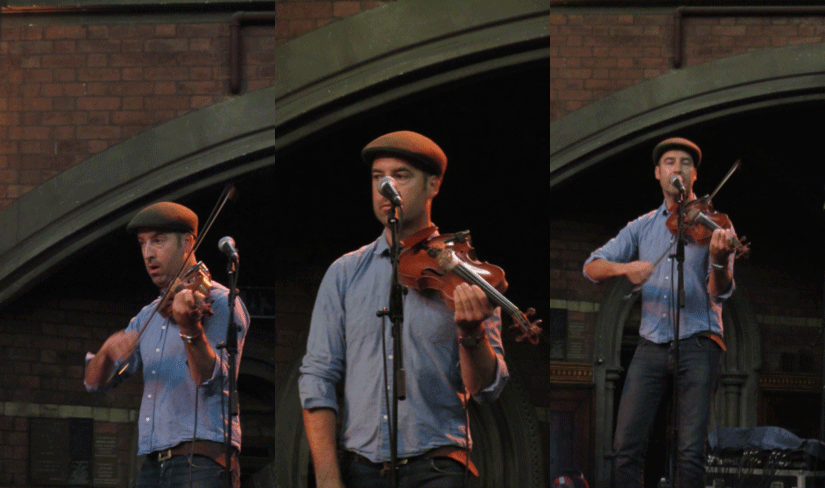
Jason Dickinson (Candythief's fiddler).

Jason Dickinson (Candythief’s fiddler).

Also buried beneath that clean surface and Diana’s own still, bright-eyed presence (like a guitar-toting reedbird) is Candythief’s taste for the cunning disarrangements of psychedelia and of folk – the flicks in the beat, the wrong-footing rhythms which inspire thought and dance together. Several Candythief songs skip between multiple paces, stirring up the barbs and challenges in the narratives. “We thought we were walking, making our own path… /You can’t close your grip ‘cos your hands are cold… / You ate up the insults, described them as fate. / Rattling the cage, / rewriting the same page – / footprints on your skin / where the robbers all crept in.”

They end – joyfully – on a new single, The Starting Gun, which takes this practically to prog levels. Leaping from a scrum of guitar and violin up to a stepped and spiky arrangement, it’s a stirring wake-up shout. “Your heart’s a roaring furnace underneath the evening news, / a mighty engine longing for the chance to be the fuse… / Draw the curtain back, join what was once apart, / scrape the grease from your beating heart. / We are bullets of pure light unraveling in time / through damage, loss, theft; the darkest of each other’s crimes.” Jason and Diana end on a confident crash, grinning at each other – clean sparks.

The soft armoury - Directorsound in action.

The soft armoury – Directorsound in action.

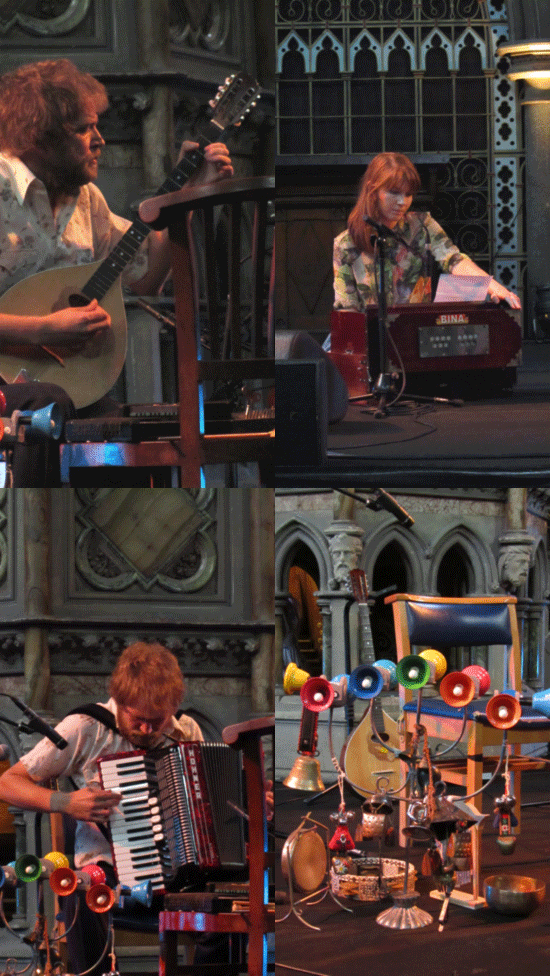
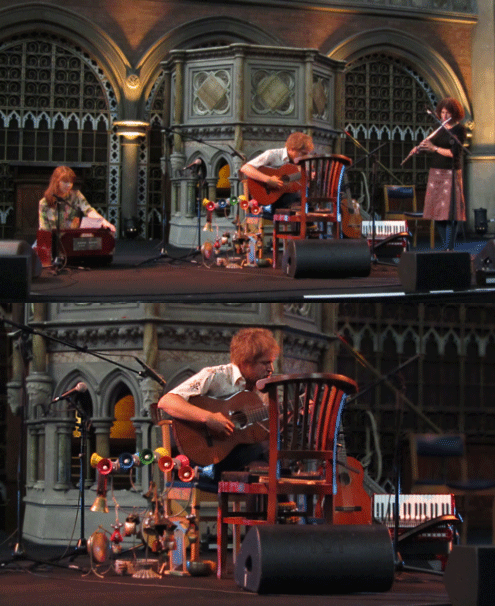
It takes a while for Directorsound‘s pool of mostly acoustic instruments to be assembled onstage. A nylon-strung guitar and a bouzouki, an autoharp and an accordion, a Tibetan singing bowl; dangling hammers, sticks and strikeables; sundry pedals; a miniature gong the breadth of a hand. Most vividly, there’s a compact and jutting array of hand-bells painted in bright toy-like colours, pointing outwards like clown-car klaxons. Apparently, this last item is a belldalabra.

If you’re still determined to think about things politically, there are a few options. Should we be expecting an admirable, inclusive world-music approach, or just the spoilt, self-indulgent tourism of an inveterate instrument collector? Is all of this wood, brass and hollow space about a love of open sound, or is it simple acoustic puritanism? I have to admit that I’m musing on something completely different – Daylight Music’s family atmosphere and the band name mingle lazily into a daydream of Thomas the Tank Engine, the Fat Controller hiding himself away from squabbling trains in order to piece together steampunk tunes in his bedroom. (Of course, it turns out that someone’s already beaten me to this…)

Idle speculation is rendered moot by the ambling arrival of Directorsound himself, Nick Palmer. Far from being any kind of poser – or any kind of prover – he’s a sweet skinny haystack of a man for whom any hints of ego or preciousness dissolve into the air with his music. He communicates with us via friendly mutters and the occasional warm, shy peer-out from between tousled fringe and beard. From the off, he engrosses himself in the business of stroking sound out of bells and strings and drum-skins, beginning with a ruminative solo on Spanish guitar but soon progressing to a smooth shuttling between instruments (an assured, hands-on craftsman, moving between tools).

Accompanying Nick on his explorations are two ghostly, gentle-faced women: one on harmonium, one on flute. Standing on either side of him, like handmaidens or like muses, they mingle an air of the slightly worn with one of peaceful contentment. Neither of them speak: instead, both softly watch Nick as they play, possibly picking up cues, most of which are invisible if they exist at all. While it’s Nick who initiates most of the patterns and melodies (and who rides swap-shot on the reliable single-instrument drones and figures his companions provide), no-one onstage appears to be in absolute charge. Instead, music happens as a mutual pass-around, shifting its focus equably between woodwind, soundbox, reed-buzz, string and chime. Three pieces along, Nick is picking up his piano accordion, playing his own take on a café reel and punctuating it with horn-honks and stomps of foot-tambourine, until the trio are summoning up strolling, bobbing images of fairground and French sidewalk.

Directorsound spread out...

Directorsound spread out…

The belldalabra (which has been sitting tantalisingly in plain sight throughout the set) finally comes to the fore on the fourth piece. “It even sounds good when you move it,” Nick chuckles in passing, bringing it in closer even as he’s strapping on a pair of leg-bells. What follows is a stirring, flurrying one-man duet. Nick’s autoharp lies flat on a chair, his beaters ringing softly off its strings when they’re not rapping and fluttering across the belldalabra in exquisite slithers and chimes, a full flow of musical counterpoint from harmonium and flute turning the ringing into glints on the tide. In time, Nick sets the beaters aside in favour of the bouzouki; but his strumming hand still makes regular, hawk-talon lunges back at the autoharp as the piece blossoms into a Celto-Grecian tapestry of stamps and zings. When it’s going at full tilt, Nick is racking belldalabra, tambourine, leg-bells, gong and even a set of box-hinges in a continuous weaving sweep.

If this prolonged and frequently ecstatic dream-folk reminds me of anything in particular, it’s The Incredible String Band, though that’s a tenuous connection at best. Nick’s sunlit tunefulness and his enthusiasm for quilting diverse and divergent instruments into the mix certainly recalls the ISB’s “grab-anything” psychedelic enthusiasm. Yet he has no pretensions towards following their wildly cluttered and creative songcraft, nor any interest in emulating their engaging cracked-crow vocals. Directorsound’s music stays all-instrumental, and comparatively edgeless. Rather than being the product of quirky scattershot individualism, it’s both evasive and welcoming. Nick and his fellow players seem content to summon up broad, bright, impressionistic blurs of scene and culture (a ripple across a wheatfield, a Mistral gust, or holiday memories of a drift of indigenous evening music winding down a warm street) rather than dig into their roots or to challenge them.

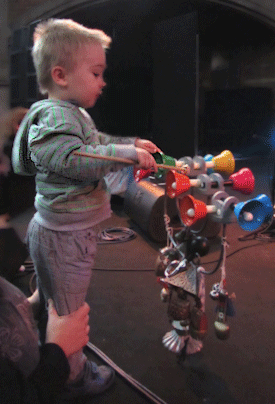
Oscar explores the belldalabra.

Oscar explores the belldalabra.

In spite of this, Directorsound remain honest – and, frankly, loveable. Simultaneously introverted and inclusive, the music absorbs musical ideas and feelings like a sponge, but breathes them all back out without a hint of selfishness or self-consciousness. The other Incredible String Band component that’s missing is the alpha-male jockeying for position which both fired up and benighted the latter group. With Nick as the lone (and unchallenged) Directorsound member in the studio, the project was never going to be anyone’s wrestling ground, but even with this in mind, the courtesy, the mutual kindness and the shy, unassuming generosity of the band is palpable from the moment they set foot onstage to the moment that they finally wander off, instruments in hand, into the Chapel’s shadows.

Before that, while Directorsound are still packing up. I bring Oscar up for a closer look at the instruments. Those previously silent women are now happily animated, smiling broadly, chatting to people from the stage. With an open smile, Nick shoves the belldalabra and a beater over towards us. Encouraged, Oscar taps out some ringing notes of his own, briefly making himself part of the band and part of the afternoon. It’s very much a Daylight Music moment.

(To be continued. We went back again two weeks later..)

Someday all 'Misfit City' reviews will be written like this.

Someday all ‘Misfit City’ reviews will be written like this.

Jack Hayter online:
Homepage Facebook Twitter Bandcamp

Candythief online:
Homepage Facebook MySpace Bandcamp

Directorsound online:
Facebook MySpace Bandcamp

Daylight Music online:

Homepage Facebook Twitter Soundcloud

June 2013 – live reviews – Liam Singer/Foxout!/Sealionwoman (with Laura Moody) @ The Dentist (33 Chatsworth Road), Homerton, London, 26th June 2013 (“a gig in a bottle”)

30 Jun

As I get off the bus in Clapton, the midsummer evening sun is giving the neighbourhood a lingering kiss. It brushes across the Clapton Portico (a bewildered, disinherited classical remnant, grafted onto a school at the end of an abbreviated road), takes away its sadness and helps it in its lonely loom. It limns the shopfronts of convenience stores and barbers and closed-down shops, and perks them up. It lends soft glows and sends little licks of shadow chasing around the stonework of the Round Chapel, and it brings out the last sleepy cheeps of the day from the local sparrows as I head down Glenarm Road towards Homerton.

Waiting for someone to sing..

Waiting for someone to sing..

Thirteen years ago – when I was living a lengthy stone’s-throw to the west, over in Stoke Newington – this part of east London was a soured inner suburb with a brooding, bullet-ridden reputation. The length of Clapton Road was tagged as Murder Mile – an edgy and angry place beset by resentments, drive-by shootings and unprovoked beatings. Flickers of anger sometimes still plague it. Almost two years ago, the second night of the 2011 London riots kicked off just a few minutes walk from here: a churn of flames, looting and outright war between police and estate kids. Barely a block away in Clarence Road, Pauline Pearce delivered the impassioned harangue which would establish her as a Hackney heroine. Now though, all is peaceful: and it gives me the chance to reflect that, as with people, the hair-raising reputations of many places come only from their occasional spasms.

The biggest fuck-you I get tonight comes from a house painted in a shocking purple and gesturing out from an otherwise cream-and-beige Victorian terrace, like some kind of bolshy architectural remix. As I’ve come to know in recent years, this part of London is a place where a very diverse set of people get on with living: it’s also the kind of area where people get out of doors not to go hunting but to break that pesky London reserve and meet their neighbours. Pubs become sitting rooms; sitting rooms and armchairs spill onto streets – another embedded global village. While people are a little thin on the ground tonight, this late-June evening (just beginning to show the mottlings of dusk) is suffused with an easy warmth. Later in the evening, Liam Singer will chuckle from behind his keyboard and gift the neighbourhood with a more welcome tag than it’s had in years. “It’s like Brooklyn, but if everyone was really friendly.”

Lampshading.

Lampshading.

Sitting on the border of Clapton and Homerton, The Dentist is nothing if not hopeful. A former drop-in surgery a little north of the hospital, it’s a genial wreck of a building. Crumbled, scarified and grime-smeared, it stands like a worn, chewed tooth in a shopping parade halfway between old London main drag and international souk. An enterprising guy called Phil calls the upstairs home, while using the downstairs for pop-up gigs, shoestring theatre, and scratch-and-strike art gallery exhibits. The back garden is full of splintered wood and earth hummocks, plus a makeshift tabletop bar. The wine is rolled up from the cellar via a scary ravine. The whole place thrums with friendliness.

Inside, crowded into the front room and sharing its atmosphere of ravage and reclaim, we’re part of a show. In a place this small, within breathing or patting range of the musicians, it’s hard not to feel that way. Behind the players, the curving plate-glass façade of the old shopfront runs across and around: over their shoulders, we look out at the street life. It looks right back at us, sometimes with suspicious flicks of the eyes (a man in a shalwar kameez, hurrying past to the makeshift mosque next door), sometimes with a bemused acceptance (a local geezer ambling along to the chippy) and sometimes with outright delight (younger locals on a stroll, pointing and celebrating on their way to and from the Hackney bars further into town).

Sealionwoman - Tye and Kitty as the daylight fades.

Sealionwoman – Tye and Kitty as the daylight fades.

To them, this must look like a gig in a bottle – the audience in full view, the musicians upfront but backs turned, the music bleeding out in faint enticing vapours. Speaking of which… cue musicians.

Tye McGivern slumps over a double bass, plucking, bowing and sometimes wrenching his notes: a man with strong, thoughtful butchers hands and the face of a weary rabbi. To his right, Kitty Whitelaw sways barefoot – grubby toes, blue nails, a jazz pulse, a little black dress and a feel for the taut sinews of a song. There’s no-one else. About five years ago Tye and Kitty were two-thirds of Kitty & The Drowning Bag, were a lot noisier, and had a drummer. For the couple of years that they’ve been Sealionwoman they’ve been drummer-less and bring their own extra noise in their pockets.

Sealionwoman deal in blurred versions of jazz and torch, and they’re perfectly suited to the smear of dusk that’s coming on as they begin to play. As influences, they’ll cite the crepuscular – Nick Cave and Morphine – but also cite the vivid, iconoclastic enactments and reinterpretations of jazz songs as carried off by Mina Agossi. There’s something in that. While they deal with plenty of old jazz standards – passed from hand to hand, worn smooth like wooden heirlooms – Sealionwoman share a trace of that Agossi rebellion against jazz performance manners and form, preferring to draw out song essence and perhaps a thread of history along with it.

Sealionwoman - Kitty Whitelaw possesses another standard.

Sealionwoman – Kitty Whitelaw possesses another standard.

However, what I’m hearing is something which shades Peggy Lee with Patti Smith. It’s partially that everything they do sounds a little bit like Fever – songs carried entirely and by necessity on the honk, creak and slide of Tye’s bass and the teasing dance-around of Kitty’s voice. It’s partly the lazily assured flutter of Kitty’s demeanour, and the way that it can quickly shift and escalate to an incantatory yell.

What they do has little to do with straightforward theatrics, and still less to do with diva drama. In his hands and on her lips, the songs turn as wayward as blown smoke: dip in and out of ritual; become stretched-out, yammering versions of themselves; go from breezy cool to swimming, waking dream. Sometimes Tye leans over to prod at a laptop or a fuzz pedal, furring up those woody bass notes to turn them into air-horns, or a sweep across concrete. Sometimes he drums with a pair of brushes on boxes and chairs. At other times his hands drum vigorously on the wood of the bass, booming out ritual and conversation, a vigorous and physical lover teetering on the border of tenderness and violence. Kitty sways, stands on tiptoe; brushes against the songs as if stretching for a passing kiss. Her voice folds around the melody line and uses it as a jumping off point, springing into the air, hanging, returning. Every so often a familiar tune and lyric slides through the circling murk. I spot Night And Day.

Mostly, though, it’s all about mood. Strangely blissful, narcoleptic – although by the end of the set and the dip of the late sunset they’ve risen in a slow heat, culminating in a Dionysiac frenzy of bass-drumming and banshee wails. It’s probably enough to put the wind up the Muslim congregation next door, praying their way through Asr. If they’re as Hackneyfied as everyone else around here, though, they’ll just shrug it off.

Foxout! 's Daniel Merrill, bowing against the dusk.

Foxout! ‘s Daniel Merrill, bowing against the dusk.

The gloaming has well and truly arrived as Foxout! settle down and begin. Perched opposite each other on a couple of stools, Daniel Merrill and Jeremy Young hunch over a network of effects pedals and rummage through what looks like a box of yellowed prehistoric teeth: these they mouth and mumble, blowing into a microphone to build up a warm, rambling noisescape of notes, feedback and harmonic buzz before they even pick up an instrument.

In fact, the teeth are reed tubes gutted from an old harmonium. Foxout! enjoy rejigging bits and pieces of antique musicality, and they’re extraordinarily good at it. Some more history might be useful, before we go any further. Essex-raised but with feet made for journeying, Daniel is the fiddler in Dead Rat Orchestra. Despite his youthful looks, he already has a decade of improvised folk music behind him, plus tours all over the globe (some of which were in the company of Godspeed You! Black Emperor (from whom he may have filched Foxout!’s abrupt exclamation mark). Another young veteran, Jeremy’s from Brooklyn music – he once played bleakly beautiful post-Godspeed chamber music with [the] slowest runner [in all the world] and limpid post-rock atmospherics with Sontag Shogun before moving on to solo experimental tonescapes and spoken word as szilárd. Both men wander; both men curate the work of others. Both men mingle.

Foxout! - Jeremy Young.

Foxout! – Jeremy Young.

Right now, both men are studying here in London. As their orbits have converged, Foxout! has emerged – immersed in the tributaries of Celtic folk but flowing through some crafty filters as it contributes to the journey. Certainly the prime stamp and weft of the music is Celtic – reels and pibrochs; plangent, sad melodies. Yet it’s Celtic music folded back over itself, cross-cut with experimental sounds and processing, and by strands of improvisation from elsewhere.

Daniel is one of those musicians who looks extraordinarily sad while he plays. Concentration renders his long, bearded face into a subtle mask of tragedy until you expect lock-gates to burst and for three hundred years of folk laments to come pouring out of him. His fiddle is the main melodic phrasing voice, with Jeremy’s acoustic guitar serving as a taut, bounding dodging rhythm source. Jeremy himself is constantly watchful and supportive, his eyes fixed on Daniel, holding up his partner’s passionate forays.

Speaker.

Speaker.

What emerges is remarkable, not least for the way in which it shape-shifts between different disciplines, experiments and sound-art tricks with neither seam nor strain. At times Foxout! broil with a heated minimalism or take on a grain of compulsive, systematic Futurist patterning. At others, a flexing bough or current of history catches at them and pulls them back to direct expression. One piece is a sensitive plucked-and-bowed air-ballad played (for half its length), over the sound of a draining straw, but with neither bathos nor disruption. Strips of noise sometimes bluster through the wood and strings, like another conversation passing through. Another gorgeous ballad tune sounds as if it could have be minted yesterday, simultaneously fresh and ancient. In the latter, there’s a moment of perfect meshing as Daniel and Jeremy briefly sweep into lockstep, rolling out a near-telepathic unison of notes before dancing away from each other again.

Night begins to settle in properly. Shades of indigo, of dulled London brick and of gaudy shop-front neon sift in through the window. The Dentist’s front room starts to take on something of the air of an Irish lock-in – nothing rowdy, but with the same sense of deep involvement in the music. As Daniel announces “a new ditty”, a couple of guests step up. Usually, Laura Moody’s a mischievous classical renegade or an acrobatic singer-songwriter when she’s not a fizzing cocktail of both. Right now, though, she and her cello are demure and thoughtful – the sober and quiet accompanist providing deep, cloudy strings while Liam Singer (just a few minutes away from his headlining set), sits in to sing.

Foxout! - strings against the dying light.

Foxout! – strings against the dying light.

The song all four share with us in semi-darkness- which may or may not be called As The Wind Turns Away – is a perfect closer. Sombre and gripping, there may not be too much too it (certainly Liam’s softly yearning tenor seem to be making much with fragmentary, cycling sentences) but they make a virtue of that.The song builds softly and inexorably with the dying of the light: a folky threnody for something a little out of focus, something over your shoulder, waiting to be picked up on. Listening to Foxout! gives you the dreamy and welcome impression that if you didn’t have roots before, you’re growing some now.

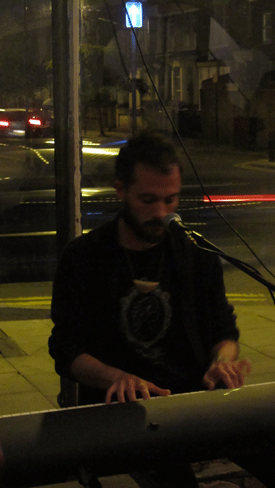
Liam Singer - songs against the sirens.

Liam Singer – songs against the sirens.

Sat behind a borrowed piano, and minus the sophisticated ornamentations that colour his chamber pop and detailed modern-classical minatures on record (those strings, mandolins and marimbas; those sundry twists and shifts of sound), Liam Singer runs his own set on a shoestring, and runs it well. As the delicate instrumental fantasia of On Earth A Wandering Stranger Was I Born unspools itself, it’s tenebrous but increasingly shot with hopeful illumination. While Liam performs, police cars occasionally sail up Chatworth Road in search of trouble, passing behind him in a quick welter of blue-and-red lights and siren-wail. They rock his soft resilient bubble of song, but don’t burst it.

Easygoing and enthusiastic in person, Liam ripples his own depths when he sits down to sing. Even when stripped down to piano-and-voice, his songs grow their own bosky Edenic atmosphere, filling out his excursions into classical minimalism with deeper shadings. I’ve noticed, previously, how he dips into American antiquity and draws it up up like well-water. His high, open tenor brings freshness and a glow of innocence, but older things lie in wait in the shade to snatch that away. At times, Liam’s like a young scholar running assured, fascinated fingers over the scuffed and scraped covers of ancient leather-bound books; but when the mood deepens and takes him, he sings like the man who’s been spat back out of the faery mound – fully aware and alive, but displaced, crucially out-of-joint with his times.

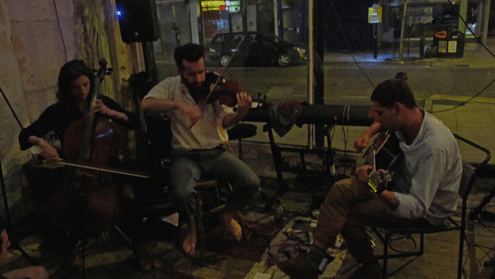
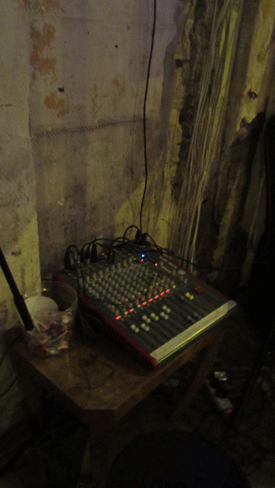
Still life at The Dentist - mixing desk, lollipops and scarification.

Still life at The Dentist – mixing desk, lollipops and scarification.

This is not just down to the tinge of Edwardian parlour song within Liam’s work, nor yet the occasional antiquarian “thou” or “thee” in his lyrics. There’s a mildly febrile quality to his songwriting, a flicker of Blakeian hallucination to add to the forays into classical piano and the Tennyson tint of mediaeval inflections. His song world is notable for its permeability – the mythic or the supernatural soak through into it, adding piquancy to his sharply edged portraits of involvement and solitude. On The Brief Encounter, Liam can bump into swarms of gentle slacker ghosts, massing there to comfort him as he heads up the coastal road. In the middle of Oh Endless Storm he can cite a rock-chained Andromeda, looming spectrally above him and disdaining rescue as he veers towards a break-up.

Liam immerses himself in the story-swirls, homing in on the core as he sings, “Love is a wind, rips through our hearts, that takes control / We long for a language to lose ourselves, / or for a way to let go.” Later on – as his piano notes spiral in a stately, panicking dance on One Breath Out – he’ll clutch after disappearing chances. “Never could I know as each one passed, / that the last would be the last… / Just one breath out and the world grows colder; / fight the war, but not the soldier. / And one hand moves to protect the other now – / but we’re falling anyhow.” Yet none of this is mawkish or precious – in between songs, Liam is relaxed, gently self-mocking and friendly. Two songs played with Laura Moody on cello (a snatched opportunity before she catches the train back to West London) become affectionate tickles and tussles, ranging from childlike warmth to a rousing gamelan jig.

Liam Singer

Liam Singer

Even his solo piano miniatures, potentially an excuse for indulgence, carefully balance their romantic invention with a pucker of thoughtful modesty. The Dance of Cupid and Psyche pays subtle passing visits to Chopin, Satie and Air On The G-String, flushing its economy with a dash of vigour. On Hannah’s Dance (a lone flash from his decade-old debut, ‘The Empty Heart Of The Chameleon’) Liam displays a Tori Amos drive and fluidity but rounds it off within a single minute. The sweet cascading single, Stranger I Know, slips out of its crafty Shaker-gamelan arrangement and breathes easier, now less of a revelation than a relaxed celebration: “suckers, speeches, they can keep ’em all.”

In one week’s time, Liam’s new album – ‘Arc Iris‘ – is released, yet already he’s moving on from it. Half of the set is songs so new that they’re not on any record, and at least one of them – Three Songs – is fresh out of the notebook. “I’ll fuck it up tastefully,” promises Liam, shuffling his sheet music into place.

What emerges suggests that the drift away from Liam’s earlier experimentalism into fully-fledged romance (as promised by much of ‘Arc Iris’) is accelerating. Here is a beautiful but unnerving love-song, holding strong on the edge of wreck; swimming with gas-masks and cruelty and an unsettling Saint Sebastian gasp. “Someday I’ll see you sideways, / your pretty words are opening like arrows in the middle of my chest / ’til petals fall from my mouth / and I, I gasp for air / ‘cos something inside is pressurized… / When you feel it, you will know / that I was not crazy when I had to let it go.” Running through the words are hints of fairytale transmogrifications; always restlessness. Liam’s heading east after this concert, travelling over to play more gigs in France and Belgium. In another new song, with a vocal line like a perilous descent down crags and scree, he muses “from one skin to another we slide endlessly.” Perhaps he’d like to keep wandering on, heading to the edge of the world.

Ceiling.

Ceiling.

Sitting beside the mixing desk is a jar of lollipops. By now, the contents are making the rounds among the audience and consequently Liam’s playing is being punctuated by furtive, respectful cellophane rustles, which he takes in good heart. Someone else is passing around a copy of ‘Paradise Lost’, which seems more appropriate, as the prowling monsters name-checked back in Oh Endless Storm are resurfacing in Love Me Today (“”There are dark things in the earth / soon they’ll be twisted / up for air /… as the ground gives way.”) Maybe I’m a being little suggestible, but it seems to me that there are also shadings of the twenty-first century ghosts which haunt Liam’s adopted hometown of New York. For over a decade the city’s romantic signifiers, once brash and confident, have been haunted by the shock of sudden and brutal dissolution. While Liam’s not one for hammer-blow songcraft, much of what he sings enfolds an onset of loss, from the counting to (ominously) the banking aircraft. “In the shadow of the moon, as our planes spin away / You know my eyes may tell you lies, but love me today.”

Under the cheerful coloured bulbs strung across The Dentist’s battered ceiling, he offers us a last dance. This’ll be to Unhand Me (You Horrid Thing), from ‘Arc Iris’, a brief, deliciously rueful song which sketches out the mixture of hope, awkward embarrassment and careful blundering steps that make up an ordinary, flakey relationship – prickles and all. “They’re playing our favourite song, the one that makes us both dance for a dare / ’til our feet turn to air / and our hands come apart, / as the guitar solo starts. / And that is the part / that breaks my heart.” It’s a different, generous note to end on, for a gig that’s felt like a cosy but inspiring house party. As I say my goodbyes and slip out of The Dentist, it looks as if the party will be going on for a while longer. Not only sound carries. Warmth does, too.

Sealionwoman online:
Facebook Soundcloud Tumblr YouTube

Foxout! online:
Homepage Soundcloud

Liam Singer online:
Homepage MySpace Bandcamp

Laura Moody online:
Homepage Facebook Twitter MySpace

The Dentist (33 Chatsworth Road) online:
Facebook

REVIEW – Fletcher|Fletcher|Reuter: ‘Islands’ single, 2013 (“setting things right as well as respecting the source”)

11 Jun

Fletcher/Fletcher/Reuter: 'Islands'

Fletcher|Fletcher|Reuter: ‘Islands’

Ironically, we often record cover versions to find out – or to show – who we are.

Markus Reuter, for instance, would prefer it if other people could stop telling him who he is. Too many of them are telling him that he’s obliged to be the twenty-first century’s Robert Fripp. They can’t get past his Frippic virtuosity on touch guitar, his past as a Fripp student, or his work with the man’s former King Crimson colleagues (in Stick Men and Tuner). They can’t even get over the fact that these days he plays all of the Fripp parts in the Crimson ProjeKCt…

Ah. Well, all right, but Markus’ vivid success in the sprawling latterday Crimson family shouldn’t have to box in a musician as stubbornly wide-ranging as he is. Yet it does, even though you don’t have to scratch him too deeply to discover that he’s not as enFrippened as he seems. When it comes to willful and wayward yet methodical 1970s virtuosi, Mike Oldfield is kernelled deeper in Markus’ heart than Fripp is. Hence this unexpected and open-armed cover of a long-forgotten Oldfield song, recorded by Markus in cahoots with long-term collaborators Lee and Lisa Fletcher, and demonstrating that Markus deals with more musical colours than just ‘Red’ ones.

A few sketchy parallels can be drawn here. When Oldfield released the original Islands single (back in 1987, towards the uglier end of his Virgin Records contract), he wasn’t entirely sure who he was. Though he’d made his name via intricate, acclaimed confections of multi-instrumental experimental rock, spatial Celtic folk and classical minimalism, by the mid-’80s Virgin had talked him into writing hit-and-miss pop songs dressed up with fat blobs of Fairlight, gated reverb and arena grease. The ‘Islands’ album floundered to cover both poles – a side of lengthy neoclassical fare (heavily spiced with chants, electric flourishes and whirring jazz flute) counterweighted a side of echoing pomp-rock (with straining guest singers and drums like torpid cannons). Even back then, this didn’t age well, despite spawning a vapid video album in which Bonnie Tyler and Kevin Ayers (in ‘Miami Vice’ regalia and power-frosted hairdos) sang and jostled their way through pastel-misted virtual realities and through corny CGI blizzards of New Age totems, ducking flying Tutankhamuns as they went.

At that point Mike Oldfield was pretty lost. Though he’d only stick the situation out for one more album (before rebelling and revitalizing himself via the inspired slice-and-dice music of ‘Amarok’) in 1987 he seemed beached. Islands – the song – ended up a little lost as well. Uniting strands of John Donne, Celtic Big Music and Dream Academy oboe, it could have triumphed over the crash of reverb: with its lyric of loneliness unclenching it could have become one of the decade’s all-join-hands power ballads. It even had Bonnie Tyler singing it, all sandpaper and yodels. What actually happened is that it floated round the middle of various European charts for a while and then sank.

In contrast to the lacquered, divided and ultimately stranded figure that Oldfield cut in the late ’80s, Lee Fletcher comes to Islands knowing himself and knowing what he’s doing. After a decade of quiet self-apprenticeship and networking, the Fletcher sound has blossomed into a rich pool of talented instrumentalists and instrumentation – digital blips to rattling jazz, frosty-fanged art-rock guitars to keening folk and glowing chamber music, choreographed with a mixture of precise delicacy and expansive flair. His auteur-producer take on Islands doesn’t just restore the song’s appeal. As a string quartet jumps from scratchy shellac recording to full live presence alongside uillean pipes and whistle – and as Markus rides happily at the centre of the song, his touch guitar chords and slithers fanning out like a nerve map – it restores the song’s lost Oldfield-ness. This could be as much rebuke as tribute. Either way, there’s the feel of setting things right as well as respecting the source.

There’s a little of the undulant Saharan patter of a Peter Gabriel song (reinforced by Tony Levin’s prowling spring of a bass part). There’s the spirit of an Irish pub session, too (Alan Burton’s pipework recalls other Oldfield moments, such as the haunted morning chills of ‘Ommadawn’ or Paddy Moloney’s warmer dip-ins on ‘Five Miles Out’ and ‘Amarok’). Finally, there’s the third side of the Fletcher|Fletcher|Reuter team – Lisa Fletcher. Compared to Lee or to Markus, it’s less clear whether she knows who she is, musically. More to the point, it’s not even clear whether she thinks its important. She’s the only member of the F|F|R trio who’s got form for actual impersonation (if you don’t believe me, check out her startling Sinead O’Connor impression from an old series of ‘Stars In Their Eyes’) and for now, she’s keeping up that sensuous and welcoming vocal persona with which she helmed Lee’s ‘Faith In Worthless Things‘ last year – a flushed, de-gushed and beautifully controlled Kate Bush mezzo which slips supple invisible fingers round the lyrics, caresses them, and passes on by.

It’s a low-key take compared to Bonnie’s hearts-and-guts original. What matters, though, is that it works: a vocal and a sentiment that’s a welling rather than a sobbing, and far better at catching the quickening thaw that’s being voiced in Oldfield’s lyrics. Beyond the beautiful sound, Lisa remains something of an enigma as a singer and as an adept interpreter – still playing a game of veils in which flashes of other singers, other sentiments distract our curiosity, and behind which she’s drawing out other people’s words and launching them with the subtlest of spins. It makes me wonder what she’ll sound like when she’s singing her own songs. For now, she’s transformed Islands into a shimmering welcome rather than an emotive wrack, and has kept her own mystery as she does it. No easy trick.

Fletcher|Fletcher|Reuter: ‘Islands’
Unsung Records (no catalogue number or barcode)
Download-only single
Released: 10th June 2013

Get it from:
Bandcamp

Fletcher|Fletcher|Reuter online:
Bandcamp

Lee Fletcher online:
Homepage Facebook Twitter Soundcloud Bandcamp

Lisa Fletcher online:
Facebook

Markus Reuter online:
Homepage Facebook Twitter MySpace Soundcloud Bandcamp Last FM YouTube

May 2013 – live reviews – Chaos Theory presents ‘Jazz Market’ @ The Luxe, Spitalfields, London, 29th May 2013 (featuring A Sweet Niche, Macchina del Tempo, What?! – with guests Yasmyn Hendrix, Moo Clef, Chloe Herington) (“tunes and stutters and babels”)

30 May

Walking into the Luxe, I feel even shabbier than usual. I fear those spotless white napkins and wooden counters; I look sidelong at the pricey menu; I sidle off to the side door as soon as possible. Like most of the rest of Spitalfields, this place has gone upmarket and left me behind. Until about a decade ago, it was the Spitz – another restaurant, another bar, another venue. Much loved, and more boho-genteel: I’d come here for electronica, for rock of the post- and mathy variety, and for the occasional off-centre songwriter.

Occasionally I’d come for jazz – something which, as a language, still sits oddly in London’s mouth. It’s not that the city spurns jazz – enough London musicians, venues and festivals give the lie to that. But I feel that sometime it seems a little deracinated here, even in a town where more recent arrivals like reggae and salsa now seem like part of tradition. Supper jazz might be healthy, foyer spaces still welcoming, but outside of grants or outright corporate sponsorship, it’s mostly a tribute to the tenacity and dedication of London’s jazzers that the music keeps its personal, inventive foothold here. The old Spitz was a place which welcomed jazz in plenty of its diverse strands and split-tongued digressions. When you were at a Spitz jazz event, you could feel the music striving, feel its life; and when all of that ended London jazz was diminished.

This picture’s a little too gloomy. There were – and are – other venues, and for those who still want it, the displaced spirit of the Spitz lives on elsewhere as a jazz collective. But it’s heartening that Chaos Theory Promotions (that mobile feast of wide-spanning musical interest, springing from place to place across London) seem to be paying a little homage to old times when they drop their Jazz Market night into the Luxe. Some things stay changed, sadly. I’ve not been here in years, but in Spitz days the music owned the top floor (and a Shoreditch panorama, such as it was). Now it’s down in the basement bar, sharing with the comedy and competing with the toilets: sidelined. Never mind. The Chaos brokers themselves are brimful of enthusiasm, and three jazz trios have come to chat.

What?! sway and chop through something (photo by Magda Wrzeszcz @ http://magdawrzeszcz.com)

What?! sway and chop through something (photo by Magda Wrzeszcz @ http://magdawrzeszcz.com)

If jazz is a language, What?! keep it as handfuls of sentences plunged into a deep baggy pocket, mixed up with anything else they’ve found during the week. Everything in the pocket is regularly hauled up for inspection, to be chucked and scattered casually across a table, just to see how it will fall. The boys certainly aren’t purists, although their taste for locating comfortable licks and riffs in whichever genre they’re toying with does keep you guessing as to how much of what they do is serious. In keeping with this, they’re acting as class clowns tonight. In fetching scarlet dressing-gown and shades, his white-man dreads spilling from a Rasta cap, guitarist Niels Bakx is part-Trustafarian and part-trannie. Bass guitarist Ago Collura, his back turned to the audience, is Reverse Man – a white mask strapped to the back of his head beneath his Tyrolean stovepipe hat, a collar and tie sprouting from the nape of his neck. Having apparently lost a bet, sparky drummer Raphael Lanthaler performs stripped to the waist and down to his underpants (though he’s been allowed to keep his hatful of bright rainbow-dyed feathers as well as his delighted grin).

On record, What?! strut and step like a cool-jazz function band about to be warmed-up and overcome by a sly sense of mischief. Both of their recent singles make a showing tonight – the Brubeck reggae of Tikka Masala (now with extra curlicues from Ago’s bass and curves of wah on the rhythm guitar); a spiked-up, rockier version of Schwaffelen, passing a swaying cats-cradle of jazz and ska touches over and over the tune. This kind of music is what they’re most at home with. It’s not, however, what they’re most drawn to doing. What?! like to stray – prancing into diced-up, chequered rock patterns dominated by the thwack of Raphael’s tom; laying out a sun-stroked Caribbean hiccup for a minute; or suddenly picking up and pelting through some driving motorbike music. Still very young (at an age where anything and everything can be hysterically funny), and still drunk on the musical options that surround them as busy session players and broad listeners, What?! can certainly groove: but they won’t settle.

What?! - unexpectedly naked drummer... (photo by Magda Wrzeszcz @ http://magdawrzeszcz.com)

What?! – unexpectedly naked drummer… (photo by Magda Wrzeszcz @ http://magdawrzeszcz.com)

It’s unclear how many of the band’s disruptions, false halts and oblique quotes are written rather than improvised, but their sense of fun constantly overpowers their artfulness, and every so often their humour dips towards novelty territory. When they slip into a quick strum through Happy Birthday for a friend, it’s warm but a touch too crowd-pleasing. I doubt that What?! wouldn’t care if anyone told them that. An easy-going and sociable band, they’ve invited buddies up to play and clearly thrive on it.

Like a dayglo Tom Waits in his checkered-tablecloth bowler and green tints, the jazz-prankster Moo Clef sits in for a couple of songs. One he plays straight, blowing a fiesta trumpet over a reggae section, fluent and cool-fired. For the other, he adds various sung, rapped and chanted interjections that he tweaks and filters into cartoon oddities via effects pedals. At one point, a chipmunk-voiced cover of Smells Like Teen Spirit takes over, the band smoothly slipping into light-touch Nirvana riffage. The joke wobbles somewhere between Battles and Zappa: disarming romp, or sarcastic cheese. (Or lounge act. Ha.)

It’s a different story when Yasmyn Hendrix and her flower-child headscarf step up to front the trio for Stay With Me. Usually she’s found in unlikely venues, crafting herself castles out of her own vocal loops. Here she plays it straight and soulful, her light but bluesy vocals lounging and skittering over What?!’s skein of tango-funk and Come Together dub-shimmer. For a while, the band sit back and enjoy playing as accompanists. For a while, they stay rooted. They’re good at it. Those quick-cut style shifts and the metafoolery are just part of their choices, not their only option.

Still, in between clear individual pieces the band improvise loosely, and as much with genre as with anything else. They’ll roll out a strolling lunar echo (Raphael sighing and gusting on the drums with near-silent brushstrokes while Niels caresses out wide chords), or crawl through a fragmented, broken-backed jazz ballad that they’ve deconstructed to the point of disintegration. Once they spit out a talking-blues bossa (with Niels on vivid slide guitar), only to refit it midway and produce a tumbling complex skeleton of arpeggiated notes, traveling from Elmore James to Gilberto to Robert Fripp’s League of Gentlemen in a matter of minutes. Towards the end, they throw in a grunge-rock climb complete with punk screaming. Raphael (tonight’s head joker) continually tosses in triggers: false stops and starts, or stalking who-blinks-first contests with Ago.

Again, how much of this is quick coin whipped out of a trick-bag is unclear. What is clear is What?!’s breadth of reference, be it a midsection of shoegazing-summer guitar-echo, a little reggae chip or a mass-less bridging passage of math-rock brewing like a disappearing wreath of mercury fumes. Sometimes their work is a puzzle; sometimes it’s cut-and-shunt. Sometimes, though, it seems as if they’ve scattered themselves out a bit too far, becoming a set of waggling jazz-hands where they should be a breathing, scatting jazz lung. They could do with a little time to breathe in and rethink, maybe.

On first sighting, Macchina del Tempo are raw-boned, hard-faced men. They look like the kind of band that shows up at remote and friendless small-town gigs, purely to prey on other bands. You could imagine them cornering some other, more hapless group in order to swipe and swig their beer in front of them, shake them down for their gig money and then steal their van, all without cracking those stony expressions.

Stocky guitarist Walter Fazio, glowering above his inverted Slayer goatee, looks particularly fearsome, purposeful and frowning – the kind of man who’d grunt one word and unleash hell. Then you see him play. As he smiles, broad and unguarded, while one of his liquid runs of notes hits the spot, then you understand what Macchina del Tempo are really about. Jazz Market regulars, this fusion trio made common cause a few years ago. Two Brits and an Italian, forged in and scarred by the grim working heat of innumerable cover bands, they made a leap to somewhere they could flower.

Macchina del Tempo heading towards fusion temperature (photo by Magda Wrzeszcz @ http://magdawrzeszcz.com)

Macchina del Tempo heading towards fusion temperature (photo by Magda Wrzeszcz @ http://magdawrzeszcz.com)

What Macchina del Tempo provide tonight is a strong contrast to What?!’s permanent state of playful. Effortlessly inventive but tightly-drilled, they roll out four long and muscular pieces of driving jazz-rock ,each with a gritty core which suggests that there might be something to that initial hard-man appearance. If you’re imagining the kind of shrill sterile tech-wank that afflicted jazz-fusion when it gulped down the wrong bits of synthpop and heavy metal at the end of the ‘70s, think again – and think further back. There’s certainly plenty of rock in here, but from the organic end, in which sweat and texture add body and warmth as well as disrupting any shop-fresh sheen.

Certainly Macchina are as much Motorhead as they are Mahavishnu or Metheny (and, given the choice, they appear to be more Rush than Yellowjackets). One of their offerings blends a long-throw fusion funk with creamy jazz metal, a tight seethe of musicality with a laddering, gibbon swing to it. Another starts as a swinging Jimmy Page-meets-Sonny Sharrock hydra – tremendously fluent, ribbed with dissonant slashes but full of tight prog-rock pounces of unison guitar and bass, with a strong rumbling taste of Ace Of Spades (and a final united scurry like La Villa Strangiato).

However, Walter’s persistently inventive guitar playing ensures that the band’s music never boils dry. There might be a bit of Hendrix in his floating horn-wail of lead line, continually playing a push, stroke’n’stretch game with its envelope. There’s probably a pinch of Allan Holdsworth ripple, some dirty Mike Stern blues or Foley McCrearey whumph, an occasional trilling coil of fretboard tapping… whatever there is, it’s subsumed into Walter’s own voice. For the forty minutes he’s onstage, he’s playing almost continually and never once puts a foot wrong. For the full set, he wraps you in the ins and outs of his conversation, his pauses for thought, his gently brooding reflections, frowns and unspoken implications. Guitarists this compelling and fertile are rare – and they’re a pleasure to encounter.

Macchina del Tempo - Jamie McKenzie nails a scale (photo by Magda Wrzeszcz @ http://magdawrzeszcz.com)

Macchina del Tempo – Jamie McKenzie nails a scale (photo by Magda Wrzeszcz @ http://magdawrzeszcz.com)

From the start, it’s also been clear that Macchina have an utter mastery of the flexible groove. While drummer Mick Claridge can certainly swing, it’s only part of his vocabulary as the band drive and chivvy through their smooth shifts of time and tempo. On bass guitar, Jamie McKenzie plays neither the great soloist nor the staid, conservative backliner. Instead he firmly unzips the chords in all their glory, then fingers his way around and across the scales in a continous springy roam. A dextrous fretted fingerstylist, he knows where every note needs to go. His playing creates a webbing of involved, swung-baroque bass-line, over which Walter’s guitar can flicker like a sly chameleon whenever it needs to. Mick subtly supports the arc; swirls under it, drums cruising and lifting like a river-rise.

A prolix music blogger lurks in the shadows... (photo by Magda Wrzeszcz @ http://magdawrzeszcz.com)

A prolix music blogger lurks in the shadows… (photo by Magda Wrzeszcz @ http://magdawrzeszcz.com)


They’re certainly making an impact – around me, bodies rapidly lose their reluctance, peeling up from the Luxe’s dark faux-leather sofas to sway and wave to the Macchina percolations. A third piece, though it starts with a crabby rock sidle strangely similar to You Really Got Me, soon turns into electric-chicken jazz funk. Mick slides greasy rhythms from hand to hand even as he pins the piece to the floor, a human nail-gun. For the last in their foursome of amplified groove, the band’s funk turns a little Mahavishnu: full of tensing stops, bullish balance and hot scraps sliding unregarding from that smouldering guitar. Even now, deep into their set, the three Macchina men seem transformed by their playing. Seeing those tough faces softened and gentled into something resembling reverence – it does the heart good.

What?! have the playful end of things covered tonight. Macchina del Tempo have so convincingly laid claim to solidity and substance that they’d be tough to follow with something similar. It falls to A Sweet Niche, then, to stagger splay-armed along the edge; to rake their nails down the rough wall of art and shout the appropriate odds.

A Sweet Niche drive forward (photo by Magda Wrzeszcz @ http://magdawrzeszcz.com)

A Sweet Niche drive forward (photo by Magda Wrzeszcz @ http://magdawrzeszcz.com)

Ben Handysides drums with dainty motions but powerful strikes. He looks like a handsome public-school rugger star who’s thinking about becoming a poet; he can play jazz, folk, progressive rock, kletzmer and sundry permutations of all of those and more. This makes him a shoo-in for A Sweet Niche when they play live. While they’ve already got an established drummer for composing and recording, he lives, rather disobligingly, far off in Cornwall (where he can presumably maintain the freshness required for their studio sessions). Everyone else in the band besides Ben seems to have intense sidelines in film, or theatre, or the spiky world of contemporary classical. Perhaps this explains the open-marriage, flyaway feel of the band; and why Ben currently seems like a blond bridge linking the two remaining poles of A Sweet Niche together.

A Sweet Niche - Oliver Sellwood's baritone lecture (photo by Magda Wrzeszcz @ http://magdawrzeszcz.com)

A Sweet Niche – Oliver Sellwood’s baritone lecture (photo by Magda Wrzeszcz @ http://magdawrzeszcz.com)

One of these two poles is Oliver Sellwood, on baritone sax. He’s a fluid rippling player (with plenty of bassy skronk in him whenever he needs it) and he’s as well turned out as his playing: neat haircut, neat glasses, unflappable demeanour. He can blow like a demon, but he delivers these storms coolly and professorial, as if chatting from a podium. The other pole is on the other side of Ben and looks as if he’ll rattle himself to bits at any moment. In his agony-scarlet sweat top, Keir Cooper is spindly and driven; bristle-bearded, and playing a guitar as if someone will nail him to it at set’s end. Everything about him screams “art lifer”. He’s the filmmaker. He probably sleeps once or twice every five years, if someone else talks him into it.

A Sweet Niche cast off with a clutch of snaking instrumental wiggles. Oliver’s baritone sax tattoo soon settles into a blaring drone, around which Ben casts up a ticking construction set before the band blaze up into distortion. Keir is clearly going to be the splinter in the jam – his face crumples into walnut creases as he drives shattered howls out of his guitar. Ben looks loose in comparison, his drumsticks dangling like plucked lilies. Oliver disregards them both, ripping off a sax solo as if he was wrenching a seam from a jacket: it’s a little Arabian in tone, a reproving and arrogant ripple of grace above the chaos, of which there’s plenty more to come.

A Sweet Niche - Keir Cooper, about to bounce off another wall (photo by Magda Wrzeszcz @ http://magdawrzeszcz.com)

A Sweet Niche – Keir Cooper, about to bounce off another wall (photo by Magda Wrzeszcz @ http://magdawrzeszcz.com)

Their second salvo, Eye Music II is crash noise from the off. Their third begins as a kind of minimalist ska, then becomes Yaketty-Yak re-imagined for math-rockers. After Ben delivers a burst of horse-clopping rimshots, they break for another swirl of Arabian saxophone, heavy on the romance, before heading back towards the ska armed with hammer-swipes of noise. To top it off, the coda is a lullaby pop tune.

As a band – or, perhaps, as a spasm – A Sweet Niche seem to crouch somewhere between John Zorn (in his more impish Naked City moods) and the wracked, Maoist judders of English free jazz. Moments where a passage of brittle swing mutates into a kind of thrash samba could be put down to dark humour, but it’s difficult to calculate the shape of the band’s intent when a cheerful passage of saxophone sleaze is overtaken by screeching guitar alarm and then a taut, distant game of musical tag as Keir and Oliver dot each other with single notes and with silence.

It’s tricky to pin down whether what they do is political, or disruptive for its own sake, or just a natural expression of brain hiccups; or whether all of these options are equally valued or dismissed. Besides their wary body language – which could be a deceptive feint anyway – they give little away personally. There are no arcane jokes at the microphone, and few wacky titles (although the choppy ta-ta-ta and carousel echos of Bananagirl inspire even more confusion, as if Bagpuss had joined Slayer).

A Sweet Niche - Keir Cooper plays another agonizing chord (photo by Magda Wrzeszcz @ http://magdawrzeszcz.com)

A Sweet Niche – Keir Cooper plays another agonizing chord (photo by Magda Wrzeszcz @ http://magdawrzeszcz.com)

Ultimately A Sweet Niche’s aim seems to be to blow their education out of their minds, like a bolus of brain-snot. Chunks of structure regularly whiz past our ears (Oliver, in particular, has a knack for hurling fervent and compressed musical dialogue) while Keir is ceaseless in shaking off his thoughts as an urgent, committed racket. At one point, following a particularly intense bit of guitar wringing, he blinks with astonishment. For a few seconds, he looks relieved, with a surprised smile and the hint of shy laughter fluttering round his chops, and a “where did that come from?” shrug lifting his arms. As they head towards the end of their set, though, their disruptive peace-destroying turns into a dotted bounce. Bit by bit, they’re turning to a dance even if at the next song they’ll be trying to squash us against the wall with ripped slices of metallic thrash-hop.

They end with a thunderous, purging blast through Duodecimal. Then, bizarrely, they’re back for an encore, augmented by Chloe Herington (the unflappable reedswoman from Chrome Hoof, VALVE and Knifeworld) who suddenly pops up to moonlight and to add a new factor to the band’s unruly chemistry. There’s plenty of muttering, subtle stares and subliminal eyebrow gestures before they get started. It’s unclear whether they’re cueing each other, playing chicken or attempting some kind of disguised wink-murder.

A Sweet Niche with a pensive Chloe Herington (photo by Magda Wrzeszcz @ http://magdawrzeszcz.com)

A Sweet Niche with a pensive Chloe Herington (photo by Magda Wrzeszcz @ http://magdawrzeszcz.com)

Just as I’m losing interest, they reel out a tremendous length of jazz-thrash-turned-sludge-metal. Her alto sax hovering, Chloe stays silent for most of it before jerking into place right at the pell-mell coda. She blows ten or fifteen seconds of twisting Coltrane overblowing over the roar, and then everything crashes to a halt. The night’s over, and so is A Sweet Niche’s psychological shell game. The strains and strange focusses slough away like last month’s bandages: with the instruments down, they’re suddenly warm with each other.

Chloe Herington waits for a cue which only she knows about (photo by Magda Wrzeszcz @ http://magdawrzeszcz.com)

Chloe Herington waits for a cue which only she knows about (photo by Magda Wrzeszcz @ http://magdawrzeszcz.com)

Ten minutes later, sleepy and stumbling, I’m making my way south-west of Spitalfields and I’m ever so slightly lost. Trying to find the tube, I’m wandering past the cluster of City skyscrapers by Bishopsgate – pushy assertions, half-formed nubbins and works-in-progress, garlanded by lights: and the finished statements, shoved heavenwards. Appropriate really.

Around my midnight bleariness (and as I’m passing the arrested concrete stump of the Pinnacle building, humiliated and frozen by market forces) I’m thinking dimly about language again, about tunes and stutters and babels and temporary silences. I don’t come to a conclusion, but as the last echoes of the gig swirl away in my mind I’m feeling glad that this part of town’s got some of its more unusual dialogues back.

What?! online:
FacebookTwitter Bandcamp SoundcloudYouTube

Macchina del Tempo online:
Facebook MySpace Soundcloud Last FM

A Sweet Niche online:
Homepage Facebook MySpace

Chaos Theory Promotions online:
Homepage FacebookTwitter Soundcloud

REVIEW – Kiran Leonard: ‘Dear Lincoln’ single, 2013 (“a joyride through the Day of the Dead”)

18 May

Kiran Leonard: 'Dear Lincoln'

Kiran Leonard: ‘Dear Lincoln’

Now here’s something.

Kiran Leonard’s already an established teenage wunderkind – a bedroom-industry frenzy act who’s rapidly gummed together a string of homemade albums and slung them out, via Soundcloud and Bandcamp, to a surprised and unsuspecting world. When he’s not doing that, he’s charging round his family’s Oldham house waving a caiman head, or shooting his own scratch videos on a budget of tuppence. He plays most of the instruments he needs, wrestling tunes out of pianos, drums and guitars; ukuleles, laptops, screwdrivers and radiators. While his music’s just about ramshackle -raw enough to avoid trouble with the indie-rock police, his ambitions and application have leaned closer to prog and to a grandiose psychedelia. In 2012, for instance, he cooked up a rambling, apocalyptic single about the Mayan doomsday prophecy. It topped out at around 24 minutes long and tied together the wilder bits of ‘Cloud Atlas’ and the paranoid, grinding Pink Floyd of 1977.

It’ll still be three years before Kiran turns twenty. I could wonder what he’s going to do when he grows up, but I almost hope that he doesn’t.

Dear Lincoln is something different for Kiran – much lighter and more immediate. Traveling backwards as he goes forwards, Kiran seems to have suddenly discovered pop in all of its concise hooks, blind momentum and smart throwaway logic. Actually, he’s rediscovered it – Dear Lincoln was written some time ago, while he was a ripe 14 – but now seems to be the perfect time to unveil it. Its a bust-out. It sounds like a joyride through the Day of the Dead. Kiran, hammering away at a tack piano and squawking like a glammed-up crow, drives the gauges into the red and embraces Bolan swagger, a swaying Robyn Hitchcock playfulness, some of the wild euphoria of Guillemots and even a needling tinge of Kevin Coyne. Earlier in 2013, there was the ‘Oakland Highball’ EP, which showed that he was getting interested in snappier, noisier forms. Dear Lincoln nails it. If we could work out what he was singing, it’d even be singalong.

What’s it about? God knows. The words are a babbling wodge of mondegreens-in-waiting about suit-crevices and moonlight, thrown out at us as Kiran carries out his lyrical handbrake turns. “Murderous plain,” he protests, in passing, but it certainly isn’t. Not unless he’s talking about death again. The song could be about gunned-down Presidents, it could just be about missing the family cat, but one thing Dear Lincoln does do is blur the lines between the living and the dead – a rollicking Halloween dance, or a resurrection day stomp. Even that long-croaked, ranting old herald of the Übermensch, Friedrich Nietzche, has a ghostly cameo; prowling the English parishes as a witness before succumbing to anxiety, melting away and vanishing. In the chopped froth of the lyrics, Kiran playfully juggles around ideas of resurrection, rousing, and where he’ll be standing when it all comes to pass; but constantly swats away any navel-gazing with onomatopoeic streams of Little Richard-isms. “Praying for the bodies to assemble and wake… / Come back today, bou-la-ray / oh, ta-hoo-lay.”

Don’t get the idea that this is all a casual throw-together. Anyone keeping half an eye on how Kiran thinks will know that he’s meticulous; that he worries like crazy about getting things right. But Dear Lincoln’s explosive delivery – its immediacy, its ability to swing round the story without stopping to count the words – suggest that he’s finally able to harness his particular genius and to let it live in the moment. This is by no means the first we’ve seen of Kiran Leonard, but it feels like the start of him.

Kiran Leonard: ‘Dear Lincoln’
Hand of Glory Records (catalogue number & barcode t.b.c.)
Vinyl/streamed single
Released: 16th May 2013 (streamed), 2nd September 2013 (vinyl)

Get it from:
Hand of Glory store (vinyl), or Soundcloud (stream)

Kiran Leonard online:
Homepage Facebook Soundcloud Bandcamp Last FM YouTube

May 2013 – album reviews – Terry Gomes’ ‘Shh.’ (“the kind of gentle musical wit that’s been out of fashion for too long”)

18 May

Terry Gomes: 'Shh.'

Terry Gomes: ‘Shh.’

There are no shocks on ‘Shh.’ In certain respects, it could hardly be cosier – Canadian guitarist and arranger Terry Gomes isn’t the spikiest of artists. Three previous self-released albums of countrified folk-pop, with a clean and amiable early-’60s sonic sensibility, have seen him develop into a promising singer-songwriter. Yet even though 2009’s ‘Loose Ends’ (with subtler reflections on loss and orphanhood starting to ripple his songcraft) saw Terry beginning to sound something like a junior Richard Hawley, he’s always risked a headlong disappearance into the kind of consummate professionalism that swallows musicians without a trace.

While it’s a dumb, lazy rock canard that you’re automatically more genuine the more sprawling and trashy you are, it’s still true that the kind of sober musical strengths Terry favours could dip him straight into into the polished, preppy and staid. The clean-cut approach and old-school session-player clarity; the background of university studies, music teaching and classical guitar; the history of working dues paid at the modest end of rock bands and chamber ensembles. Then again, Terry’s also a Zappa fan with a taste for tongue-in-cheek, and a man who entertains himself by playing Dick Dale-flavoured prog-rock tributes to Toronto hockey teams on a pink-paisley Telecaster. There’s straight, and there’s not-so-straight.

Changing tack for his fourth album, Terry has set aside lyrics, singing and songwriting for the moment in order to reinvent himself through a different vintage lens. For ‘Shh.’, he’s exploring his skills as an instrumental jazz guitarist, albeit one who keeps his pop knack close to hand. Don’t expect much in the way of wild exploration or improvised threshing – Terry’s fluent, trim playing stays hand-in-glove with his upfront melodies, and most of the music sits nicely somewhere between 1950s-inflected cool jazz territory and clipped slap-back pop. Harkening after the bright tunefulness of Wes Montgomery and Kenny Burrell, it also keeps that Ventures/Shadows mix of twang and tune-dotting, while easing off into a relaxed George Benson accessibility.

There’s enough heart in the music to pull in some top Ottowan musical talent, all of whom play with warmth. Sharing drum duties with Jeff Asselin, Ouzo Power’s Ross Murray also co-produces. Jazz festival mainstay John Geggie provides most of the bass, while his fellow jazz veterans Dave Renaud and Peter Hum (plus Pulse Mondiale guitarist René Gely) make passing drop-ins as Terry’s front-line foils. Show-band stalwart Gino Scaffidi bolsters the rhythm guitar on half of the tracks, and there are further contributions from Afro-pop players Stu Watkins and Rob Graves, from Back-Talk Organ Trio’s Don Cumming and from classical percussionist Jonathan Wade. All of this gives ‘Shh.’ a diverse but easygoing small-group sound, an ability for quick shifts in style and the feeling of a happy gathering.

Terry’s prime concern, though, seems to be with keeping a friendly eye on the audience. In West Coast tradition, composition consistently trumps improvisation. Rather than brooding and brewing over a standard, Terry presents original engaging pieces of his own with clear straightforward hooks to hum along with and meticulous, perky arrangements. The album fires off short, tidy bursts of tunefulness like a musical espresso machine, all craft and polish. Every lick and fill is nicely honed, with the scope, rhythms and harmonic sophistication of jazz predominantly used as tools to gently buff and expand the melodies.

At its simplest, this emerges as breezy affectionate pastiche. On a couple of straightforward walking-jazz pieces, Terry strolls in loping step with Dave Renaud (who offers soft cartoonish clarinet on If It Walks Like A Duck and airy alto sax on Velvet Wings), and the two strut like two old buddies kidding each other over memories of smooth moves. Left to front the band by himself on Cool Cats, Terry switches between crisp finger-snapping swing and mellow reflection in an eyeblink, before blasting out a brief big-band roar via his fuzz pedal. Closing the record, Shake Shop Shenanigans abandons jazz altogether for snappy surf-rock, in which Terry’s early-’60s outlaw tone is offset both by its own fairground vigour and by Don Cummings’ background swipes of vaporous ghost-train organ.

Other pieces are less obvious, but stay unruffled. The ticking, steady pop instrumental Forever in a Day (on which Peter Hum offers an understated piano counterpart to Terry’s distorted, honeyed lead) breezes easily through its gentle, rhapsodic tune and its Latin undercurrents. René Gely adds nylon-string counterpoint to BG Bound’s driving song, conversing with Terry’s sleepy electric tones over the undulating bossa feel and the bobbing rhythms of Rob Graves’ congas and vibraslap. The three work together again on the velvety, Frisell-icana-styled duet of Gone; René adding occasional dreamy furls of steel guitar as well as nylon-string as Terry paints a happy lonesome sound full of gentle swells and breathy changes of mood.

No shocks, then – but that doesn’t mean that ‘Shh.’ is devoid of pleasing surprises. It’s easy to tag Terry for paying tribute to West Coast comfort and rock’n’roll twang, not to mention hopscotching gently in the footsteps of Hoagy Carmichael. But I suspect that, like Zappa, he’s well aware of the pastiche element. He’s open about ‘Shh.’ being influenced more by television and film soundtracks than by pure tradition, and he clearly loves the pop currency that he’s reshuffling in his own tunes. If he occasionally slinks along the cheese margin, he’s doing it deliberately and with enjoyment.

I’m also guessing that as well as the subliminal Zappa in Terry’s musical DNA, there’s a tiny touch of Spike Jones. ‘Shh.’ has no outright parody, no screams or gargling noises, but its good humour regularly spills over into outright winks and friendly stunts. Some of these are more vigorous than others (the fleeting music-hall flourishes of old-style melodrama, Queen-style) while others are inclusive chuckles embedded in the tunes themselves. Da Bug’s brush-drum shuffle toys with sly little shifts of metre, and with droll rolls and clucks of guitar picking. The tootling swing of Welcome cheerfully indulges a classical guitar-inspired section with bowed bass before nipping happily back into jazz (sparking some neat unison lines between Terry and Gino Scaffadi as it does).

All of this is too lighthearted, too integrated to be particularly postmodern or self-consciously stylised. It’s more the kind of gentle musical wit that’s been out of fashion for too long. At its broadest, it offers They Went That-a-Way, a theme for an imaginary helter-skelter Western that’s one-third ‘Bonanza’, one-third Eight Miles High and one-third Chuck Jones. Stuffed with galloping melodies and sudden switches in direction, this leads the band hither and yon in a hall-of mirrors scuttle; bursting in and out of cowboy orchestration, runaway fretboard zips and Jonathan Wade’s trick-bag rattle of orchestral percussion.

At the other end of the scale from the horse-laughs is The Skater. With the illustrative flair of a silent movie, a trio of Terrys etch out a musical impression of a day on the ice: a little cloudy, a little classical, it takes a Satie-via-Carmichael journey of long lines and pointed details. Beginning with initial lazy strokes across the rink, it builds through ambitious strumming to straining arabesques, only to career downwards in a windmilling slither of muted flamencoid chords as the skater heads out of control; finally picking up and reviving that cruising, swanlike dignity. There’s an art to this kind of light entertainment. Part of Terry’s own subtle artistry is to make it seem lighter than it really is.

Terry Gomes: ‘Shh.’
Bleeding Heart Recordings, BH01
CD/download album
Released: 15th May 2013

Get it from:
Terry Gomes’ online store, CDBaby or Amazon.

Terry Gomes online:
Homepage YouTube

REVIEW – What?!: ‘Schwaffelen’ single, 2013 (“it’s still not clear when they’re going to stop fencing and start carving”)

9 May
What?!: 'Schwaffelen'

What?!: ‘Schwaffelen’

All right, they suckered me. I thought that What?! were starting a gimmick tradition of rolling out cute singles named after foodstuffs. A natural suspicion – their debut single had the crowd-pleasing title of Tikka Masala. Actually, it turns out that “schwaffelen” is Dutch slang, and refers to a man repeatedly bouncing his semi-erect penis off assorted objects (ranging from someone else’s cheekbone to the side of the Taj Mahal). Handy phrase – consider me educated. I’ve been saved some embarrassment the next time I’m snacking in Amsterdam, but have been left with a delightful image of waffles-and-cream that I now need to bleach from my mind. Thanks for that.

What?! remain the kind of supple instrumental trio that gives slick a good name – guitar, bass guitar, drums and a thorough versing in everything out there which grooves. They also own a not-so-secret knowledge of plenty of things which don’t groove but which do lurk, puzzle over things and then jump out at you. But they’ve yet to really show their other teeth: those rougher, odder inspirations they claim to get from Zappa, Dub Trio and Mr Bungle. So far, they’ve been more about delicate sunlit jazzy chords and walks, clean deft swing, and plenty of space. You get the feeling that they could do anything with their material – as soon as they wanted to – and that they’re fencing with expectations. It’s just that it’s still not clear when they’re going to stop fencing and start carving.

As much as you might want them to get nastier, Schwaffelen doesn’t show What?! chucking away any of their finesse in favour of skronk or sludge. If they’re stepping towards a spikier direction, they’re starting subtle – taking some sour art-rock patterns and passing them back and forth through the smooth-jazz filter. As with Tikka Masala, there’s a hint of Take 5 in the gently precise stops and feints as a bossa nova is displaced and reshuffled into math-rock spikes. But the truth is that, in spite of the cock-bouncing title, What?! keep their all-things-to-all-men decorum throughout – even when hitting the distortion pedals.

If you’re hoping for some upheaval – something like the obsessive rhythmic knotting of Battles, say, or the disruptive slice-and-dice of Naked City – you’re in the wrong place. Schwaffelen’s flexing sections do include a flawless switch into driving rock as guitarist Niels Bakx starts blasting away and Agostino Collura’s nimble bass drops its funky slither and locks down into root-note pummeling. But this is more an exercise in clever distraction. Even as Raphael Lanthaler drums along at motorway-punk velocity, the whole band are keeping an eye on the little loping twists of the original rhythm: as it ghosts on underneath, they’ll lock seamlessly back into it whenever they choose. Even the texture phase (in which Niels seems to be channeling the sparse echo-spangled touch of Andy Summers) adds some extra breadth but no questioning depth or disruption.

Perhaps it doesn’t matter – whatever else they might or might not do, What?! remain supremely elegant puzzlers. But it still feels as if there’s much more to them. The Key Ness remix of Schwaffelen is barely half the length of the original, but during its stay it chops, rewinds and pans the original riffs around a gastric roller-coaster of sub-bass and boiling P-Funk synth. Along the way, it twirls past Alice Coltrane harp cascades, brief bursts of classical soul orchestras, wind-tossed shouts from hip-hop MCs and gutsy flowerings of Spanish guitar. It sounds more like what must go on in the trio’s heads – what they must listen to on iPods, gulp down from session to session, or coast by on the bus.

One last thing, going back to the original track… As it snaps to a halt and telescopes away, with a quick twist-and-growl, those push-pulling rhythms leave you in a state of expectation. There’s a moment of hover. Then there’s several messy, prolonged seconds of the most horrendous splurging musical spoff-noise you can imagine. Maybe it’s a surprise, a pancaked blast-beat hurled out by Raphael to be crushed flat in the mix. Whatever it is, it’s a Zappa-style kiss-off. Perhaps I’ve been unfair to What?!. They did finally deliver that dirty splatter.

What?!: ‘Schwaffelen’
What?! (self-released) (no catalogue number or barcode)
Download-only single
Released: 1st April 2013

Get it from:
Bandcamp.

What?! online:
FacebookTwitter Bandcamp SoundcloudYouTube

May 2013 – album reviews – John Ellis’ ‘Sly Guitar’ (“a playful magpie interest”)

8 May

John Ellis: 'Sly Guitar'

John Ellis: ‘Sly Guitar’

A skilled and flexible working guitarist since the early 1970s (travelling through punk, post-punk, pub rock, rhythm-and-blues and progressive rock in no particular order), John Ellis has never curdled as a musician. What he’s avoided doing up to now is making a player’s album. Generally he’s been content to tweak a song’s architecture as a team member (in The Vibrators and the mark two Stranglers) or as a flexible, innovative sideman (delivering fanged electric churn for Peters Hammill and Gabriel, or airship noises and roaring-Twenties fanfares for Judge Smith). Even when left to his own devices, he’s stayed away from guitar heroics – often, away from the guitar itself. He’s fermented semi-ambient hubbub for art galleries, filtered Victorian Japonisms through electronica, and taken strides into multimedia, but left the protracted strutting and soloing alone.

On ‘Sly Guitar’, however he returns to (and lays into) his main instrument with a sharp-clawed and swaggering stylishness. It’s the kind of performance that suggests he’s ripped the tail-fin off a 1950s Cadillac and carved a new guitar from it. Things are different this time. In some respects, the key to appreciating ‘Sly Guitar’ is knowing about John’s participation in a 2007 art prank, when he helped to fake a lost Hendrix rendition of the Welsh national anthem. While this particular stunt got his playing onto ‘Newsnight‘ – and was originally a joke about co-opting celebrities into random causes – viewed from here, it’s as much about the puckish and gleeful enjoyment which John gets out of playing guitar. Aspects of Ellis wit might show up on the records he’s worked on (qv. the intuitive bite of those Hammill albums, his thoughtful tricks with Smith, or the raw horse-laughs in his own rare solo songs), but a sense of liberated fun doesn’t always make it across. On ‘Sly Guitar’ it does.

I said “player’s album” – I’m also suggesting that this is the record on which John Ellis finally lets it all hang out. That’s a little misleading. Discreetly virtuosic yet always understated, John’s technique is marked out by the lean, sharp economy he’s learned from years of punk and art-rock. There are also plenty of examples of his taste for bouncing around inside delay units, and for the blocky synthwork and drum loops explored on 2008’s ‘Map of Limbo’. The music’s also liberally slathered with John’s beloved EBow sustainer, transforming notes into assorted hoots and stuttering violin chugs, or pulling them out into taffee-lengths.

These in turn blend in with ideas from all over the place. Fun notwithstanding, John’s art-school training consistently underlies his current approach (one track, with all irony intact, is called I Remember Futurism). He picks up odds-and-ends from the fashions and fads he’s seen pass by and reinterprets them with a playful magpie interest. The results blend an edgy and brittle flair with fastidious design, offset with a mischievous, practical form of musical adapt-and-reclaim.

Many of the tunes on ‘Sly Guitar’ have much in common with old pop-instrumental albums. There are tinges of Joe Meek and of perky surf-guitar capsules from the ’60s; and of those meticulous prog-tinged jingles from the ’70s. But this is just part of an overall collage effect which plucks inspiration from Hendrix, Hank Marvin and John Williams, from Robert Fripp and John Martyn; even from the likes of Fred Frith and Henry Kaiser. It also suggests that over the years John has copped a listen to everything from ‘No Pussyfooting’ and ‘Temple Head’ to On-U Sound and Moby. At the least, he’s caught their echoes as they’ve seeped through airwaves or were circulated alongside technology.

Certainly John’s thinking hard about latterday pop and accessibility; insistent club beats and nods to old crowd-pleasers drive much of the album. Pieces like Levitation and the eleven-minute title track sit on funk grooves with sleek flicks of rhythm guitar and curved, humming chromium lead lines. Snappily and space-ily rendered, the latter are recorded close enough to hear the speaker cones jumping and flattening while wellings of EBow sustain stack up behind like a pile of moonlit clouds. In the chop’n’chat of Farud Gets Electricity, John mixes a Latin loop and a dash of Stray Cats rockabilly into the recipe. Futuro’s leisurely boom-bat, wood-clack beat and clipped industrial framing recall a slimline version of Tackhead’s industrial hip-hop. Making the most of the album’s pop-up digital production sheen, it’s fleshed out by jawharp synth boings and fake horn stabs; its smoulder-point guitar lines hanging in the middle distance like burning ropes.

The beats may be familiar, but the tweaked and ruffled electrophonic timbres which John uses to build up the tunes are less so. Pedalo is as rhythmic as anything else on the record (gliding atop a cavernous trip-hop loop and cracking dub snare) but its body is made up of a mongrel set of slotted-in guitar voices – fanfare tones of firefly and conch; power-growls of distorted fuzz; a pitch-shifted shrill of parade melody teetering on top. All of these come together in spite of themselves, an ill-matched platoon who’ve learned to march in step. Under a skywriting blast of EBow sustain, I Remember Futurism interweaves a rippling set of arpeggios, passing them between a calm sky-blue organ and a guitar which sounds like a harp made of iron girders.

Embedded deep in the mix of the latter are the tinkling, caught-up accents of Brazilian cymbals and bells, and other pieces probe even deeper into worldbeat. Walking in the footsteps of Jon Hassell’s Fourth World Music, and of Transglobal Underground, John brews up vividly staged polycultural blends in which the frowning lines between ethnology and fraudulence, sympathy and exploitation might perhaps blur into irrelevance. His cyborg guitar tones counterpoint the eerie ornamented leaps of the Middle Eastern music he sources, undercutting its spiritual passion with impressionist sound-builds recalling insect swarms, oppressive heat, or the spine-crawling sense of secret surveillance. Hollowing out a Nile processional (on Don’t Be Misled By Your Eyes), he repacks it with drilling mosquito sounds, duetting Arabian slide lines and choral synths. The leisurely Levantine trip-hop of Flies elevates a souk-call vocal sample like a dreamy kite, but then subtly pollutes it with hovering swarms of static guitar buzz.

These last are much like the withering drones employed by Robert Fripp on ‘Exposure’ back in 1979, painting threatening sonic portraits of decaying industrial landscapes. You could only speculate as to whether John’s applying these same ominous atmospherics to the torn cities of the Arab spring; the idea hangs heavy. Initially The Bowl Maker of Lhasa (framed by temple bells and further baleful Frippish insect buzzes and pitch-collapses) sounds as if it’s going to do something similarly politicized for Tibet. However, it rapidly returns to clear hip-hop and funk sources – the sleek dancing duel between stinging clean guitar and EBow whistle, the playful way it lifts and reshapes a sly quote from ‘Freddie’s Dead’ in the middle of its drum-machine swing. While there are a few left-field touches (such as a timbral shift which refracts the familiar street beats into something with a twist of copper and stained glass), perhaps it’s better just to enjoy the imaginative, enthusiastic sound-painting; and not to over-freight the pieces with too much extra meaning.

The remaining tracks, though, bypass the club beats for a deeper exploration of John’s textural art-rock side. The brief roundabout of Echoplexing presents a bone-and-wood clatter of choppily-strummed flamenco guitar: echoing off to the sides of the soundfield, it joins stinging treble guitar lines and zipping insect sounds, stitched together by a child-chant organ part. The loop-and-splay Infanta shows John at his purest both as player and as music processor. Dialling up a sparkling silvery electric guitar tone, he begins the tune with Spanish classical inflections nestled in a sharp snappy reverb before abruptly leaving them to pulse and circle inside a loop-hang while he gets on with other business. He goes on to juggle a section of Hendrix jinks and transfigured rock’n’roll quotes; a countrified oud tone; elegant touches of shading, slurring and EBow elisions; a razor buzz bouncing in the background.

Elsewhere, March Of The Kitchen Taps floats a cluster of hovering, uneasy guitar parts (floats, wails and squeals) against swishing electronics like ventilation fan-blades, and against massed samples of metallic taps and bangs which flutter, slice and nail the pulse down. Cue jokes about everything-and-the-kitchen-sink: Crow On A Dying Dog eggs these on further, blending even more twiddling kitchen metals with a bagful of plastic electronics – bass twangs, burbling random-pitched vocalise, synthesized big-band swing and blaring horn-guitar parts. As a flight of sampled rooks flap past, it sounds like a weird and wilful collision between suitcase synth-pop and bleak mediaeval soundtracks.

It’s these particular pieces, in fact, that seal both the fate and triumph of ‘Sly Guitar’. Forks and taps aside, it is a kitchen-sink album: one which flea-jumps enthusiastically between slick beats and toy noises, easy funk and experimental chop-suey, clippable music and idiosyncratic personal sketches. John may have finally turned in his “player’s” album, but even this far along in the game he refuses to play it straight. Dipping in and out of formalism and fooling around, coursing around plug-ins and unravellings, he’s turned in an album which celebrates and fans out his plurality as a musician. Having mastered a humble, low-key chameleonic wilfulness – in which the appropriate art and the immediate idea directly shapes the method – he’s let it become part of him, even when he’s flexing free.

John Ellis: ‘Sly Guitar’
Chanoyu Records, CHA002
CD/download album
Released: 6th May 2013

Get it from:
Chanoyu Records.

John Ellis online:
Homepage Facebook Twitter MySpace Soundcloud

April 2013 – mini-album reviews – Alex’s Hand’s ‘This Cat is a Genius (A B-Sides Compilation)’ (“mostly tarry, and it sticks to things”)

17 Apr
Alex's Hand: 'This Cat Is A Genius'

Alex’s Hand: ‘This Cat Is A Genius’

Sometimes barrel scrapings are as much part of the meal as anything else from the barrel. In the brewing industry, that’s how you get sludgy yeast spreads like Marmite. Yum. Or not.

Meanwhile… we’ve met Alex’s Hand before. They’re yomping Seattle-ites from the scruffiest, carney-est end of American Gothic; something like a junior Primus, Zappa and Residents rolled into one, abruptly zombified, and crammed into the fustiest old suit in Abraham Lincoln’s trunk of hand-me-downs. This EP of B-sides (so they call them – they’ve only ever put out one EP) certainly seems like barrel scrapings. It’s mostly tarry, and it sticks to things. It’s shapeless, it’s distinctly umami, and you might not like it.

That, of course, is the point. Alex’s Hand tend to revel in everything they do, both their moments of genuine artistry and their dumbest chunks of musical blubber. ‘This Cat Is A Genius’ is a pre-release teaser of off-cuts from their debut album (‘Albatross Around The Neck’). It shows off (if that’s the right word) their sludgier leanings; their most precipitous rants; their Melvins side. It sounds as if while the goofy fuckers were messing around in rehearsal, some vicious bastard poisoned their coffee – but they enjoyed it so much that they sent out for more and left the tape running.

What the band’s actually doing is dealing with the departure of Slurrp, their ontime lead guitarist and horn-razzler. Drummer Nic Barnes and bass-bothering microphone pest Kellen Mills drop their stage-names, pick up the pieces and tumble onwards; various buddies help Kellen out with the guitar parts; but it’s clearly been a blow. You can all but hear Alex’s Hand bouncing off the ropes. However, they’re not ones to miss out on a dark chortle, even at their own expense. Nor are they scared of turning a setback into a challenge. If they have to have a period of floundering, they’re damn well going to get something out of it, even if they have to milk it ’til it bleeds. Rolling away from a relatively tight rock stance towards something doomier (or at least more rubbery), they’re taking the opportunity to map the underside of their development as they go.

One of the last two tracks from Slurrp’s last stand – ConserveNow! – is six-and-a-half near-atonal minutes of Melvins-style strain: a lurch-along instrumental of fuzzed grunge bass and wobbly guitar, like a sick freight train careening along a lost stretch of railway. The other, Ants, is a collapsing shack-load of wreckage-guitar and free-form word association. While Slurrp sifts through sluggish, raging clumps of feedback in the background, Kellen’s schizophrenic basslines jump and ebb between laid-back mooch and irritated attack. He also mutters beady-eyed, half-cut stuff into your ear – mostly about giants and UFOs, although at one point he does complain “words are stale, empty – they lack a certain sensuality.” Much of the ‘This Cat Is A Genius’ shares this playful pissed-off stance – a complaining laughter; clever-dumb; slumming in drunken despondency and enjoying a grump. Kellen plays the role of educated-and-unravelling to the hilt, offering flashes of self-mockery through the filter of booze vapours and the pinch of bad shoes.

Dear Me’s clench of lumbering punk disgruntlement mingles King Crimson feedback skitters with a collapsing, anti-play perversity. Inside itself, the song’s at war – halfway through, Kellen grabs a guitar and launches doggedly down a different tunnel and into a different tune. On the headache blunder of Train, he’s scouting for empty bars in order to avoid conversation, moping about insincerity like a touchy teenager: “wish I was happy listening to people with nothing to say. / Lying assholes with so much money / really are dead inside – / they pick my brains as they lie.” Longtime ally Ben Reece (of Step Daddy) drops in again to add wracked, protesting electric guitar and some needling ‘Marquee Moon’ edge as Kellen’s drunken soliloquy heads ever further downhill and then kinks back up shit creek, screaming about “blackest diamonds” and falling into the sea.

While the odd glancing zinger falls out of this kind of lyrical mess, Kellen’s verbal squalls and cracked mumbling are generally just another bit of colour. What he says is less important than how he says it; or just how the words hit the wall. Impression (featuring another temporary guitarist, Shadough Williams) sounds like a lobotomized David Byrne tripping over Black Sabbath. Nic drums on bottles while the music flinches between runaway bursts of samba and foot-dragging sludge-metal. Kellen dismisses another waster in smudges of sardonic detail: “he smokes his cigarettes, douses them with side-effects… / Stand to deliver, his parents used to say – / started out rich and pissed it all away.”

On Penticide, the band paddle around in a splatter of sprained, detuned instruments – piano, melodicas, glockenspiels – while Kellen’s rambling narration casts a cockeyed look downtown. Scribbling a vicious political cartoon of a “crack-whore free-market” full of hapless fools pushing “shit-stained zombie shopping carts”, he also rips himself and his peers ragged. “Welcome to the half-baked bistro… / conspiracy countdown coffee-shop collective,” he husks, before tagging himself as “a dying maverick with a bad attitude… / like Merce Cunningham took a shit in a wine glass.” Mocking his trashed, anti-heroic slide from high culture to garbage, the band break into sarcastic applause.

Confounding all this sarcasm, the final moments come close to delicacy. Sad Little Skeletons is slender, thoughtful and melancholy; initially, it’s not much more than distant birdsong and overheard chat, accompanied by lonely bass melody and shavings of rhythm guitar. For once, Kellen sings gently, setting aside the drunken howls and the scatter-shot smartarsery. Clarity renders his conclusions even bleaker. “Thoughts will come / then fly away. / These emotions are so thick, / like this life just makes me sick. / These piddly little humans, driving their cars / on the freeway… / Sad little skeletons; broken, but don’t realize they’re lost.” The rise towards a tangled noisy fanfare and the drowning of the words in yell and distortion initially comes as a relief. Then you go back and listen to it again, hearing the weary breathing and the tiredness that smacks of reality.

Part-broken, smeared, and devilled by little gouts of waspishness, this isn’t the easiest collection of songs and slurs to get along with. But there’s plenty to scoop out anyway, especially if you like hearing the wilful awkwardness of a band who enjoy stretching themselves out of shape and balance, and who can fit that in with the big boots and barfly lunges. If you enjoy feeling as if you’ve been dipped in an uncomfortable goo, that’s a bonus.

Alex’s Hand: ‘This Cat Is A Genius’
Alex’s Hand (no catalogue number or barcode)
Download-only mini-album
Released: 15th April 2013

Get it from:
Bandcamp.

Alex’s Hand online:
Facebook Twitter Bandcamp LastFM

REVIEW – Robert White: ‘Everything Is Free’ video single, 2013 (“blown up with a wondrous inner light”)

12 Apr

“Everything is free now, / that’s what they say. / Everything I ever done, / gonna give it away.”

Innocence blisters. Sometimes you have to take it – and yourself – away for a while, to cradle it and let it heal.

In spite of over thirty years in the songwriting business (he started young, with anything that he could get his hands on), Robert White still has that quality of innocence. If he’s got scars, he bears them calmly and with acceptance, but he must have suffered some psychic sunburn along the way. There were those early ’80s swirls around no-budget London psychedelia, keeping up a fit of giggles and avoiding becoming a casualty. Then there was the bristling musical tensions of Levitation, continually blowing their own heat-shield and ending up as five men biting each others ankles. Finally, there was the pearly, patchy career of his own Milk & Honey Band.

It’s not as if the Milks were the only people in the last couple of decades who smoked and breathed that Beatles mix of singalong wit, music hall parp and peacock splendor (Karl Wallinger and Roland Orzabal, to name but two, made a decent fist of it). But for my money, if you want that luminous Lennon/McCartney glow picked up and rolled out like a quilt, then Bob’s yer avuncular. He and the Milks should have been treasured by everyone. You; your granny; ‘Mojo’ Man; that painfully hip little boy down the road who secretly yearns for pure pop and papers his bedroom wall with old Byrds and Teenage Fanclub sleeves. Instead, you probably never got to hear them. Shame. And for three years, Bob has been hiding up and keeping quiet: skulking in Fulking, on the South Downs chalkhills. Those gifts which he used to apply to music, he’s been spending on photography instead – pictures of local landscapes blown up with a wondrous inner light; an illumination rendering sweeping Sussex hillsides alive with warm energies.

Here, though, is Bob alone; drawn back to instruments, woodshedding again. Now he’s pulling the dustcloth off a beautiful brand new Gillian Welch cover for us to have a listen to. Welch seems to be something of a go-to girl for art-rockers; at least, for those of them who are thirsty for a wellspring of country without the taste of cattle and spurs (see also A Marble Calm’s glorious Frisell-meets-Eno roll through I Dream A Highway) and Bob’s version honours her original simplicity. He could have festooned it in harmonies and ringing guitars, but instead it’s mostly just him, a light-as-moonbeams piano, and the kind of reverb that turns slapback into caress. Everything else there has blossomed onto the song like dew. There are touches of synth cello, a glockenspiel or two; maybe a celesta towards the end. As things travel onwards, water-drop swells of backward sound are delicately varnished onto the keystrokes.

That’s the sound: now listen to the song, and the singer. Bob’s voice is lower than it was, perhaps tempered with a couple of hairline cracks of resignation, as he slips inside Welch’s words and makes them his own. The business bruises; the thoughts of escape, and of dignity – “I can get a tip jar, gas up the car, / try to make a little change down at the bar. / Or I can get a straight job – I’ve done it before. / Never minded working hard, it’s who I’m working for.” Disaffection, though, doesn’t entirely clog up the world. The compulsion of songs is sometimes sung about as if it were a curse: here, it’s more about music coming regardless. It’s hard not to feel that Bob’s singing for himself when he murmurs out lines of guarded, flowing creation (“every day I wake up humming a song / but I don’t need to run around, I just stay home,”) and, finally, resolution. (“I’m going to do it anyway / even if it doesn’t pay.”) I think he’s back. Please don’t miss him this time, will you?

Robert White: ‘Everything Is Free’
Robert White (no catalogue number or barcode)
Video-only single
Released: 13th February 2013

Get it from:
Currently only viewable as video – no wider release announced yet. Video by Nick Power @ iseetigers.

Robert White online:
Homepage Facebook

REVIEW – What?!: ‘Tikka Masala’ single, 2012 (“a sweet-natured hall-of-mirrors groove”)

19 Mar
What?!: 'Tikka Masala' single

What?!: ‘Tikka Masala’ single

Sometimes you can come across simple treasures hiding in the backroom. Dutch guitarist Niels Bakx, Sicilian drummer Raphael Lanthaler and Tyrolean bass player Agostino Collura are part of that under-appreciated swirl of humble, talented international musicians who fly in, settle down and quietly underpin bands in London, as in many big cities. People like these plug away behind the people with the big ideas and the knack for fronting. They’re the ones who finesse the roughness, who add the musical depth and the polish which brings shine and sophistication to performance. And sometimes, they secretly bring more.

Individually, each of these three have clearly got the chops and the temperament to keep themselves in demand with songwriters (Agostino plays with Anna Waldmann’s band The Cry Baby, Niels and Raphael back Charlotte Eriksson in The Glass Child), embedded in soul collectives (Agostino’s work with Retrospective For Love) and driving mixed groove-band (Raphael’s Snail Trail). Together, though, Niels, Raphael and Agostino are something else.

As What?!, they’re an assured and formidable unit; an airy, confident groove-trio audibly revelling in their flexibility and their knack for carefully-sprung timing. On spec, there’s nothing particularly unusual in what they do. Enough years spent plugging away at sessions and keeping punters happy with funk, soul, jazz and reggae tunes have made them experts in warm, sunny, foot-moving musicality: but it’s what’s beyond the blueprint that’s interesting.

Their debut single Tikka Masala (named, consciously or not, after a meal made up on the spot to keep British customers happy) is a sweet-natured hall-of-mirrors groove, light and slinky. There’s reggae in it, thanks to Raphael’s displaced bass drum taps, his tight-tuned tom rattles and Niel’s skinny-supple rhythm guitar. There’s funk in the warm spaces between strokes and beats. There’s jazz in everything, from the little golden runs of licks to the turnarounds to the feel that the rhythms are to be flung from hand to hand, danced over, teased and tag-teamed around. There are subtle refractions, interruptions of rhythm and key, that make you think briefly of progressive rock at its least bombastic and most aware. There are also flares of hard rock when all three musicians line up under a suddenly roaring guitar and suddenly start jabbing together ahead of the beat.

What’s really special about it is their complete control over the music. Their discipline is absolute but relaxed, with the feel that at any time they could shift rhythm, speed, genre back and forth in a moment, and yet not drop a single thing along the way. There are no self-conscious cut-ups in What?!’s music – no need to deconstruct. Why should there be when they’re masters of structure? – so much that if you flipped Tikka Masala around and spun it backwards it would keep every bit of its symmetry and bounce. For a demonstration of this, play the bonus track Alasam Akkit as that’s exactly what that is – a backwards-play of the A-side which sounds almost as good as the forwards version. A backwards-play which you can still dance to. Remarkable.

Exactly what this leads to, I’m not sure. Perhaps the outcome is that What?! set themselves up as a twenty-first century Sly and Robbie-plus-one. Perhaps they remain a supremely-accomplished hobby band, something which the trio engage in when they’re not otherwise employed keeping other people happy. Or do they push ahead as self-sufficient instrumentalists, seeing how far they can push, stretch and double-feint their masterful musicality? The only thing I can be sure of is that, whenever they do get together, all ways – for those moments – are open; and it’s tremendously refreshing.

What?!: ‘Tikka Masala’
What?! (self-released) (no catalogue number or barcode)
Download-only single
Released: 11th October 2012

Get it from:
Bandcamp.

What?! online:
FacebookTwitter Bandcamp SoundcloudYouTube

March 2013 – EP reviews – Henry Fool: ‘The Free Henry Fool Download EP’ (“picking carefully through detailed instrumental weaves”)

19 Mar
Henry Fool: 'The Free Henry Fool Download EP'

Henry Fool: ‘The Free Henry Fool Download EP’

Something old, something new, something borrowed, something blue; and all in one package. Henry Fool (resurgent with the ‘Men Singing‘ album after over a decade of woodshedding) are offering a free look at what they do and what they’ve done. A four-minute edit of a rolling juggernaut from the new album; an exclusive, keyboard-led instrumental; two tracks lifted from the band’s 2001 debut album.

While the older tracks (touted via their expansive Steven Wilson mix) might pull in some attention, Henry Fool offer plenty on their own account. Like a number of their contemporaries (such as Sanguine Hum, with whom they currently share drummer Andrew Booker) the band pick carefully through the detailed instrumental weaves of progressive rock left behind by the likes of Soft Machine and Genesis during the early ’70s. Admittedly, they’ve also got the odd thing in common with the sometimes inspired, sometimes benighted neo-proggers of the 1980s. Keyboard whiz Stephen Bennett was one; while guitar puzzler and sometime singer Tim Bowness (better known for no-man) had his own mid-’80s brush with the genre via a bellowing one-night stand with Hertfordshire pompsters Gothique. However, the Fool’s music is churned and tinted by connections and cross-talk with jazz, Brian Eno, Cambridge, avant-garde texture loops and post-rock, making it a subtler and more diverse stew.

For the most part Henry Fool are reappraising that old-school prog fabric, re-cutting it via thinking shaped by four more decades of musical developments, step-backs and parallels. At no point does it feel that they’re simply replicating the old vintage – still less watering it down. It’s more as if they’re inhabiting it; as if they’d moved into an old house, given the interiors a fresh coat of paint, and are now at the stage where they’re hanging bright new pictures and squinting at them, trying to see if they fit with the lines of the beams. Plucked from ‘Men Singing’, the four-minute edit of Everyone In Sweden (trimmed down from its original fourteen) keeps much of its vigour and its cunning ancestry: slow-motion Soft Machine keyboard cascades married to the rapid aggressive wobble of a 1976 Genesis groove, layered with scribbling synth lines which scurry over the structure like a gang of weasels. While clipped, wrangling guitars (part-post-punk, part-post-rock) hack against the smoothness, the edit brings out aspects less evident in the long version – the chippy funk in Peter Chilvers’ fretless bass, or the ghost-train lean of the chords.

As you might expect from the punning title, the Bennett-led A Canterbury Scene (exclusive to the EP) reveals more Soft Machine elements. Centred around the brittle tones of electric piano – wah-ed and echoed in the style of late ’60s Miles Davis bands – it gradually shifts to more Egg-like territories collided with grand Yes string parts. Lurking in the shadows of pomp, it edges its way around the outside, never setting a foot in the brasher spotlight. Written in a dicey 25/8, Poppy Q (its counterpart from those 2001 tracks) is a careful pick-through of electric piano, like a tiptoe through a prog minefield. One minimal keyboard figure arches over odd chords and a faux-Mellotron counterpoint, before the whole band step up into a stately twitching rhythm, keyboards interplaying with a bass part which pulls its shape from the original piano line.

Heartattack (also from the 2001 album) is the only track on which Tim Bowness unleashes his whispered, impeccably English spring-water croon. It’s also the song that best shows how Henry Fool differ from the standard prog approaches. While so many bands in the genre expand everything from ballad to suite into a mass of crammed lyrics and grand significance, Tim opts for a quick peep-show look into a life more ordinary, with a jolt of inner panic. “Stone-in-love and lost again, / you’re walking through the fields. / Summer fresh, your life’s a mess, / you’re wearing down your heels. / Don’t look back, / you’ll have a heart attack.” Thirty-five syllables of narrative, and that’s it. The rest is your own guess, to be worked out against a backdrop of clover-burst keyboard chords, discreet-but-urgent guitar peals and clenching rhythms. Prog balladry from the leanest side, in which the musical scenery is as much the story as the words are, but in which the delicacy asserts a refusal to hammer home the meaning.

Henry Fool: ‘The Free Henry Fool Download EP’
Burning Shed (no catalogue number or barcode)
Download-only EP
Released: 8th March 2013

Get it from:
Free download from Burning Shed

Henry Fool online:
Homepage Facebook

March 2013 – album reviews – Henry Fool’s ‘Men Singing’ (“the friendly grapple between wide-eyed fluency and beady, quizzical interference”)

13 Mar
Henry Fool: 'Men Singing'

Henry Fool: ‘Men Singing’

Perhaps it’s his own fault for perpetually playing the faded-lily crooner, the songwriter victim of ever-blasted hopes, the sigher in lonely cafes. At any rate, Tim Bowness doesn’t get nearly enough credit for his mischievous sense of humour. For instance: in his understated and perfectly burnished way, he’s one of the most stylish and distinctive vocalists in British rock, whether he’s refining and wrangling art-pop with Steven Wilson in no-man or lending his silky melancholy tenor to assorted projects from OSI to centrozoon, Rajna to White Willow. Yet for the whole of this second Henry Fool record – for which the involvement of him and his voice might have been the biggest selling points – he shuts up altogether and plays guitar instead. Inevitably, the album’s called ‘Men Singing’.

Tim also contributes the track titles – enigmatic, silly, sometimes both simultaneously – and, I’m guessing, the sleevenotes. In the latter, his Henry Fool partner-in-chief Stephen Bennett is credited with impressions of Miles Davis and Terry Riley, but also with an impression of Mavis Riley from ‘Coronation Street’. It’s an intriguing glance into their working relationship. Presumably, this means Tim gets to be Rita Tanner. Not inconceivable. Following a phase of relatively sober hairstyles, he is looking more bouffant these days.

Of course, Henry Fool have a history of not quite doing what’s expected of them. While they’re nominally a progressive rock band, you might better describe them as highly-accomplished prog fans on a weekend trip to their influences, who get bored with the direct route and carry out chance diversions to their other interests as they go. Their 2001 debut album certainly drew echoes and ripples from Soft Machine, from mid-’70s Genesis or Pink Floyd, or the more ruminative moments of King Crimson. Yet there were post-punk spikes in the road, stopping the music from becoming grand and flowery; and stubborn, counter-intuitive post-rock kinks (reminiscent of Slint, Fridge or Tortoise) that reigned in or derailed the pastoral draperies.

In addition, rather than grand drama or ill-advised theories-of-everything, Tim’s songwriting (sparse and bloodsqueezed, honed for understatement) offered flashes of human fragility, thumbnail sketches of love and loneliness, and brief twilight peeks into inconclusive lives. It made for an uneasy listen, and maybe the prog world as a while wasn’t ready for a band more Raymond Carver than William Gibson or Siddharta. Henry Fool made a couple of slightly disjointed festival appearances and then went to sleep for a decade under a haystack of perfectionism, studio wrangling and sundry distractions.

Cue, much later, this re-emergence – in which the entire band sounds utterly invigorated. There might be no words this time, (and the music’s smooth flow belies its long gestation) but the intent is clear.

As of the moment, Henry Fool’s a seven-piece collective: part-time players and guest players (many from the no-man orbit) fluttering in and out of place to pulse out fluent streams of music, like happy quasars. Most of the original collaborators are back – multi-instrumental Eno collaborator Peter Chilvers returns on fretless bass, Cambridge jazz veteran Myke Clifford provides reeds and woodwind, and Michael Bearpark continues to commit a variety of guitar solos and interferences from skittering textural glissandi to raw, probing melodies. Of the newer recruits, Andrew Booker (from the no-man live band and, more recently, Sanguine Hum) draws, drives and hauls the drum patterns. The latest player to be pulled into the talent pool is I Monster’s Jarrod Gosling, who brings further prog- and post-rock ingredients along with him as well as sounds from the world of organic electronica – mixing, Mellotrons, a touch of Moog bass and a tinkling glockenspiel.

Most of the out-and-out proggery still comes courtesy of Stephen Bennett, whose keyboard skills and theatrical instincts (thanks to some solid neo-prog history via his 1980s band LaHost) adds most of the harmony and decoration to the project. The Tim Bowness stamp on the project is in the ideas and the overall compass. Never an instrumental virtuoso himself, he leaves the spotlight to others and provides the music’s spine rather than its face – sitting in the background, he rolls out a variety of low-key but crucial guitar lines. These generate the music’s understated art-rock elements of challenge and upset; and it’s still the friendly grapple between Stephen’s wide-eyed fluency and Tim’s beady, quizzical interference that brings the music to life.

The four lengthy, semi-improvised tracks on ‘Men Singing’ manage to be steeped in English prog and psychedelic reference points without becoming waterlogged by any of them. Even the guest appearance of a genuine ’70s art-rock guest star – Phil Manzanera, invited in to channel Quiet Sun on two tracks – fails to upset the balance. Instead, he slots smoothly into the work, engaging in an equal-terms quadrille of unorthodox lead and rhythmic noises with Michael Bearpark. It’s due to the band’s thinking patterns. Rather than going for an unfolding narrative or for linear doodling, Henry Fool works as a kind of coasting, vertical jam; with layer upon layer of subtle music thoughts playing out and exploring over their rolling instrumentals. Throughout, Peter Chilvers restrains himself to spare, crunching, authoritative rumbles and wahs on bass, like a giant turning over in bed – pinning and shaping each long measure with the minimum of showmanship.

The fourteen minutes of Everyone In Sweden are those which most strongly suggest mid-’70s British jazz-rock, carried as they are on upfront and ever-fluid Booker drumming, and woven through by high-buzzing analogue synths. At points it could sound like Soft Machine taking a crack at Los Endos, although a variety of knotty guitar approaches from Manzanera, Bearpark and Bowness and the airy punch of Myke Clifford’s soprano sax spin the music through further territories and changes. At half the length, Man Singing sounds like a lost jam between Miles Davis and the journeying Pink Floyd of ‘Ummagumma’ – elusive funk with bursts of Herbie Mann-ish flute from Myke Clifford, irritated-elephant interjections from Manzanera, and juicy elusive funk-slurs and pings from Chilvers. Bowness, meanwhile, hovers on a tremulous Bark Psychosis guitar; glimpsed occasionally through gaps in the rest of the music, and keeping the questions raised.

The lumbering two-note fuzz bass anchoring and stippling My Favourite Zombie Dream suggests something less gracious. On this one the band plays cruder even as it holds and manipulates tension. Toms bob uneasily, synthesizers string out warped buzzes and trumpeting tonal tumbles. A backdrop of Mellotron gauzes, crash-spring guitar and wrenched organ tones add further disruptive edges. Increasing layers of Stephen Bennett parts pay tribute to a variety of keyboard players from prog to Krautrock – all simultaneously.

Thirteen-and-a-half minutes of Chic Hippo round everything off. This one’s a game of two halves. The first is a leisurely, arena-friendly stroll – the boom-bat drums and the pecking bass, the brace of real violins (courtesy of Steve Bingham) flying alongside the pop-up musings of the Mellotron. There are trumpet lines, moving in jabbing boxer shuffles; and melting electric piano dreams. There are flown-in swerves of parachute-collapse guitar distortion, or bulges like the revving of temperamental guitars. For the second half, a steamy mid-tempo pulse decorated with stern doubled saxophone honks and Wurlitzer piano arpeggios picks everything else up and runs with it. Guitars hang off the sides of the tune, peeling in strips: Bowness offers serene minor arpeggios, Bearpark a scything fuzzed slide line.

Yet while the album is drenched in detail and in finely-worked passing salutes to the creative hum of the early ’70s, that’s not what’s important about it. What matters is the lifting and the liberation; those layers of floated space stacked up above the rhythms and the tickalongs, and the way in which they’re filled. Henry Fool’s biggest achievement is the way in which they’ve freed themselves. It could be a decade of clever editing – something given back from those years of doubt and wrangling – but that doesn’t explain the spirit of fluency here.

While the band have kept some of that beady edge and economy which set them apart on their original arrival, every second of this album is packed with the kind of music that seems to have arrived without agenda or awkwardness. In between the shifts in tone, the mood colourings and the instrumental dialogs, Henry Fool have found a way to travel in a state of easy grace. From the opening cymbal twists to the final harmonious thin-out, every single sound on here (collectively hovering in position like an immaculate air display) feels like the sound of a musician playing through their instruments in the right voice for the right moment… and that’s a rare achievement anywhere. For nearly forty sustained minutes, everyone’s attuned; all in chorus.

Men singing. What do you know? – perhaps it wasn’t a joke after all.

Henry Fool: ‘Men Singing’
KScope Music, KSCOPE244 / 802644824420 or KSCOPE836 / 802644583617
CD/vinyl/download album
Released: 11th March 2013

Buy it from:
Burning Shed

Henry Fool online:
Homepage Facebook Twitter

February 2013 – mini-album reviews – Lee Fletcher’s ‘The Cracks Within: FiWT Remixes’ (“unstitched, re-embroidered, re-folded”)

9 Feb
Lee Fletcher: 'The Cracks Within: FiWT Remixes'

Lee Fletcher: ‘The Cracks Within: FiWT Remixes’

‘Faith In Worthless Things’ was one of 2012’s surprise pleasures. Lee Fletcher’s debut album was the late-blossoming distillation of years of work as engineer and confidant to assorted art-rock musicians, and of even more years absorbing influences and refining them in a budding songwriter’s heart.

What emerged was a sleek, assured and finely-honed planned-patchwork of an album. It pulled in sounds from touch guitars, Uillean pipes, crunchy rhythm loops, ukeleles, powdered trumpets and silky synthesizers; it mused on betrayals, work, bewitchment and people in general; and it drew on a wide but surprising coherent blend of string-quartet chamber pop, soul and trip hop, 1970s Scott Walker, King Crimson-flavoured progressive rock, electronica and Anglo-folk.

While Lee’s firm and expansive vision gave the album both shape and finish, it was also very much a group effort, achieved hand in hand with his singer wife Lisa plus the chameleonic touch guitarist/soundscaper Markus Reuter and a small battalion of interested musicians from around the world. This short album of follow-up remixes keeps that spirit, with a couple of returning collaborators and new reinventors let loose on the tracks.

Only two songs from ‘Faith In Worthless Things’ make it to this particular phase. There’s the title track – originally a humble state-of-the-world address sung by Lisa but dispatched by Lee, people-watching at the railway station in his Devon hometown, and sampling a picture of humanity from its wandering fragments on an ordinary morning. There’s also The Inner Voice, in which Lisa soars on a rich carpet of soul-inspired smoothness; delicately and beadily picking apart matters of confidence and collaboration, while unhitching – scuffed, but quietly determined – from a dragging entanglement. The latter was the album’s obvious single, so it’s interesting to see three different remixers work three different shades of pop out of it.

Of these, Brazilian proggers-turned-clubbers Worldengine offer perhaps the most satisfying reinvention – a slink-and-roll electronica take full of whispering creep, voice fuzz and closed-eye pulse beats. The smooth soul of the original is pared back in favour of odd, gently challenging chording and textures: as if Lisa’s vocal line has been gently unwound from its original branch and wrapped carefully around a new one. Imagine what might happen if David Torn had as much pop clout as Madonna does, and you’ll have some idea of where Worldengine take this.

Two other remixers take The Inner Voice further out, but perhaps with less originality. The mix from German DJ Ingo Vogelmann battles and switches restlessly between its whispering electronic-ambient chamber intro, heavily synthesized cyberpop and a naked acoustic strum. The onetime 4hero cohort Branwen Somatik offers a similarly morphing dance switchback – initially a slightly dubby hip-hop take with an eerie twist, then a transformation to minimally-sheathed soul-pop, finally melting away in a dubby whisper of liquefying beats.

There are no fewer than six versions of Faith In Worthless Things, including a return for Ingo Vogelmann who offers a mix replete with Orb/Jean Michel Jarre-flavoured electronica (strong on the breezy minimalism, and dappled with bits of dub and techno). Adrian Benavides has honed himself an industrial pop version full of collapsing sheet metal and drill bits. Fabio Trentini provides an ambient pop take with an art-pop tweak – part Japan (if the ‘Gentlemen Take Polaroids’ era took precedence) and part Crafty Guitarist. Lee’s words and Lisa’s sweet-but-stately vocals sit, unfazed, in these new cradles.

Having said that, this particular song is less suited to being strapped into dance, and other approaches are preferable. Under his Hollowcreature alias, David Picking seems to realise this; he keeps and highlights the train-swish from the intro, brings Lee’s own warm and pleasant guide vocals to the forefront for half of the time, and comes up with a subtly dubby version of the song’s English pastoral feel. The latter quality is something which Tim Motzer appears to have picked up on too, as he moves Faith In Worthless Things into a more British progressive rock area. This he does via a number of changes – jazz vibraphone, the ghost of a hard-rock riff and eventually a build up into a Pink Floyd blaze replete with Gilmourian guitar. It seems obvious, but there’s some clever sleight-of-hand here: Lisa is metamorphosed cunningly by the new arrangement into a leathered-up rock goddess, all without a change to her vocal part.

Tobias Reber, on the other hand, manages to be both daring and successful in his own mix, taking an unexpected creative risk and pulling it off. He contributes the best of the remixes on offer, as well as the most original. His reconstructive take on the songs sees it unstitched and re-embroidered, re-folded. The song is re-imagined over an uneasy sea-roll of structure. New chording, constructed from the components of the original piece, produces a striking new perspective; a different place from which Lee, through Lisa, can watch the world and see its unsettling currents ripple past and under him.

Each remix, though, gently unbuttons ‘Faith In Worthless Things’ again and reminds us of that collaborative feeling which suffused it. The rolling and friction between Lee’s ideas and where his accomplished collaborators took them – a journey in motion.

Lee Fletcher: ‘The Cracks Within: FiWT Remixes’
Unsung Records (no catalogue number or barcode)
Download-only mini-album
Released: 5th February 2013

Get it from:
Bandcamp

Lee Fletcher online:
Homepage Facebook TwitterBandcamp

REVIEW – Apricot Rail: ‘Basket Press’ single, 2013 (“a five-minute garland”)

22 Jan
Apricot Rail: 'Basket Press'

Apricot Rail: ‘Basket Press’

Damn, but latter-day post-rock bands can be dour. Something renders so many of them dry, or scrunched up into a kind of passive-aggressive melodrama. Too many of them belong to the post-Mogwai/Explosions In The Sky faction – increasingly hackneyed building blocks of minimal, stilted guitar arpeggios, building to a fuzzed-up tumble of noise via a gradual crescendo. I’ve heard it too often now. It’s like watching the same slow-motion fireworks every night – every time, the same chilly histrionics.

Perth sextet Apricot Rail, trailing this new single for their second album ‘Quarrels’, manage to avoid that disappointment. As ever, they bring some of the original post-rock enchantment back as well as plenty of enchantment of their own. Admittedly, on a first hearing Basket Press is more conventionally post-rocky than their previous outing (2011’s ‘Surry Hills’ EP, in which whirring warmth and a sun-dappled shuffling of approaches gave their music the vivid craft of a beautiful set of handmade holiday postcards). The band have even returned to those pluck/build/fuzz/hallucinate ingredients I’ve just been savaging, and there’s less of the generous instrument-swapping that’s freshened their approach in the past.

In spite of this, Apricot Rail manage to avoid drabness and predictability. Basket Press is a five-minute garland of distinct and graceful stages. Part summery harvest-time music, part rippling classical suite, part affectionate conversation, it’s bound together with a palpable friendliness. First there’s a lone guitar sketching out slow American-folk arpeggios with a touch of echo (the chords, save for one crucial falling note, reworking the floating Pink Floyd melancholia of Us And Them). Then, as woodwind player Mayuka airs a fuzzy flute trail of sustained notes, there are three. Guitarists Ambrose, Jack and Justin strum, curl and gently chisel out firmer chords over a cosy fuss of drums, as if they were rounding off a carved scroll. From this, a move to that on-the-one post-rock downstrum – then, as two guitars mix a light picking of melody with pinging counter harmonics, Mayuka’s flute wakes into a twining, rising counterpoint. Bass and drums move in via a low dotting – a patter, and a dialogue.

All along, the feeling is of a mutual binding, of teamwork, all six musicians facing inwards to share the exchange. The music slips through phases like breathing, like the momentum of thoughts; like assured working hands shifting their grip on a gardening hoe. A rare and understated joy wells through it, passing hints. In many respects, all of this is moving to a similar pulse as that mid-’70s sweep of world-folk and chamber-jazz melanged into being by Paul McCandless, Ralph Towner and their colleagues in Oregon. As the lowest-pitched guitar stirs a new folkier rhythm into the band circle, Mayuka responds with sweet McCandless-esque clarinet curves. Upping the ante, a detailed guitar study – a Mediterranean sparkle – works its way in over rising supportive drums. Another guitar, sitting in the mid-register, embroiders sweet minimal rosettes of lazy cycling notes.

Eventually the band builds through a mass of roaring pedalwork and noise into the kind of land-sliding, sleeting mass of guitar-descend which we’re used to as that conclusive Mogwai-tradition flourish. This time, though: it’s been prepared for. Rather than the expected ragged glory of a ruined Sysiphus-bound downwards into gravity’s clutches, it’s a payoff – a burst of energy from what the musicians have put into the song and stored there.

For the curious – a basket press is a wine-making device, one used for over a thousand years. I can see the connection. Harvest arrives.

Apricot Rail: ‘Basket Press’
Hidden Shoals Recordings (no catalogue number or barcode)
Download-only single
Released: 10th January 2013

Buy it from:
Bandcamp

Apricot Rail online:
Homepage Facebook MySpace Bandcamp LastFM

November 2012 – mini-album reviews – Sterbus’ ‘Smash the Sun Alight’ (“like a prog-dusted bumblebee”)

20 Nov
Sterbus: ‘Smash The Sun Alight’

Sterbus: ‘Smash The Sun Alight’

After six years of making off-kilter indie rock, Sterbus seems ready to make the jump from cult to cute. His previous albums and EPs have shuffled between serious tunes, determined explorations and playful jokes. ‘Smash The Sun Alight’ concentrates firmly on his most accessible side – fuzzy, funny-angled guitar pop launched into a chunky meander through the air, like a prog-dusted bumblebee.

If these seven songs and instrumentals had a colour, it would be orange-gold – blurry and amiable. Sterbus injects sunshine and smog from his native Rome straight into the heart of his rampant, time-travelling pop. One of his feet might be jammed happily into a big bucket of prog and psychedelia; the other’s rooted deeply in power pop and eclectic 1990s indie, with driving earworm-bursts of chorus. In his twists of tunefulness and humour and his love of scruffy noise, you can see traces of Blur, Small Faces and XTC (or, looking further west, Weezer, Steve Malkmus and Guided By Voices). Sterbus also has an ear for those drowsy, medicated-modal melodies that served Nirvana so well; and the dogged musical extravagance of Cardiacs infests his work like a glittering spiral, turning every tune into a hopeful steeplechase of extra chords and whole-tone hops.

It’s hardly straightforward; yet somehow Sterbus doesn’t overdo it and lose you along the way. It’s rare to hear so much bounding complexity tied up so neatly into buzzing firecrackers of song. The saturated bounce of Gay Cruise is typical of what’s on offer, kitting out a tuneful, sludgy Dinosaur Jr. fuzz-growl with some dissonant King Crimson pitches before hammering in a break of piled-up chords to grab us by the ear and take us mountaineering. The eccentric Welsh popster Curig Pongle is along for the ride, playing organ like a swerving Mini: the song also sideswipes a random Andy Partridge sample in which the great man is gurning on about Arthur Askey.

As for Sterbus’ lyrics, they’re a vegetable stew of soft little fragments. The occasional clear phrase bubbles up out of the gentle mumble and hum – uneasy (“troubles in the pool / making me cold”), tender (“My dear baby, what can I do? / You make me feel like I’ve been over-ruled,”) or whimsical (“Unboyfriendable girlies show no love”). Occasionally a skewed aphoristic image surfaces, like something cast up by a young Peter Blegvad (“Birds and second wives, / trying to be polite.”). Much of the time, though, the stew remains a stew, the language dissolved into flavours rather than shapes.

In some songs, such as the ukele-driven A Sigh of Relief, it’s not so much English as an impression of English; just as Sterbus’ breezy mouth-trombone solo and music-hall-McCartney bassline is a sepia impression of holidays in fading seaside resorts. Maybe he knows that songs of life, love and feeling can work just as well as gauzy murmurs. Perhaps it’s just a chewing-over of words to blend into an earnest, reassuring blur – a swirl of cream to smooth the mongrel clamberings of the music.

Oh well, perhaps innocence can be complicated too. That’s why those Irish fiddle parts are there to usher in Otorinolaringoiatria, unless they’re there to soothe us after the tongue-twister (and to stop us wondering why the only distinct word in the song is “sauerkraut”). That’s why You Can’t Be Sirius is tied up like a Sunday roast – its laddering chords held together by tight power-pop drumming, lashing those goosed leaps of organ into position, securing those shivering tremolo-blocks and speaker-fizzes of guitar.

That’s also why Wooden Spheres + Heartquakes plays its pass-the-parcel game. A pelting punk-pop three-chord wonder abruptly switches to Curtis Mayfield funk with sunny popcore punk choruses; then, after changing gear for the tiniest of organ solos, ends up jammed and droning like a stuck tide of Scandinavian prog. Similar in its out-and-out playfulness is The Amazing Frozen Yogurt: setting power chords against breezy mellowness, it sounds like a summery merge of Caravan and The Wildhearts. Lonnie Shetter’s sheets-of-sound sax scribble is flown in for a jolt, offsetting that mid-song switch into Zappa kitsch complete with vibraphone. Sterbus flutters around both parody and self-parody here, but his freshness steers him clear.

The near-seven minutes of Flatworms (Eggs Of Joy) tie together not just Sterbus’ musical agility and bevy of influences, but also his sense of connection. Away from the sung sections, it owes something to the severe angles of King Crimson’s Red; yet it’s also the most Cardiacs-styled piece on offer: a self-confessed attempt to write a sequel to that band’s Dirty Boy (which Sterbus has already covered) and its massive parade of chords. Sterbus’ drowsy vocals soften the cavalcade; the brief flashes of conga draw a little nourishing groove into it. While the lyrics are as obscure as anything else in this clutch of songs, they get the message of impermanence and humbling across. “Running away – far from heaven, / diggin’ the grave, the sun. / Crying away – all your glory; / useless and vain, in time.” It might be an oblique gesture of fellow feeling towards Tim Smith, Cardiacs stricken leader. Certainly, the song’s payoff line casts aside any artifice in favour of the purest sympathy ( “I see you, / I feel you. /You heal me. / Uncomplicated ways.”) and brings the inclusive generosity at the heart of Sterbus’ music to a natural home.

Nothing to be afraid of. Sun’s out. Come and warm yourself.

Sterbus: ‘Smash The Sun Alight’
Sterbus (no catalogue number or barcode)
Download-only mini-album
Released: 16th November 2012

Get it from:
Bandcamp.

Sterbus online:
Facebook MySpace Bandcamp Last FM YouTube

October 2012 – album reviews – Jorge Arana Trio’s ‘Mapache’ (“a lean, strutting pirouette along a jagged line”)

28 Oct
Jorge Arana Trio: 'Mapache'

Jorge Arana Trio: ‘Mapache’

Until fairly recently, Jorge Arana played guitar and hit keys in Pixel Panda; a precocious, musically omnivorous bunch of Kansas City skronk-punkers. Local heroes, hotly-tipped for the best part of a decade, they quietly called it a day in 2011 but wasted little time in moving on. Jorge’s bass-playing brother Luis stepped up a commercial notch via rising alt.rockers Beautiful Bodies, while other former Pandas can be found mingling psychedelia and hip-hop in Spidermums. As for Jorge, he’s pulled in the final Pandas drummer, Josh Enyart, added bass guitarist Jason Nash to make up a brotherhood of “J”s and stepped over into jazz. Someone in the band had to do it. This is Kansas City, after all – they’ve been shipping jazzmen out and up the river for nearly a century.

Punk roots or not, the Jorge Arana Trio’s serious jazz intent stretches beyond leaving behind quirky band names. Not that this apparent sobriety is absolute. Their debut album title, ‘Mapache’, is Spanish for raccoon, suggesting that the Trio see themselves as determined and adaptable omnivores, thriving on trash where necessary, and prepared to spread mischief around the suburbs if they have to. Some of the immigrant-son, take-no-prisoners fierceness of Pixel Panda has made its way into the new band. The glam racket might have disappeared, but not the stop-start emphasis or the punky crunch. Lester Bangs would have been proud of them.

That said, despite the band’s fierce electric energy there’s less outright skronk here than you might have expected. In fact, there’s less than there was in the Pandas. Instead, the Trio lead a lean, strutting pirouette along a jagged line between lean discipline and a scrawl of energised chaos. If there’s any self-indulgence here, it’s the kind you’d find in freerunning; a rebellious athletic liveliness, bodies pitted against the push-back from concrete mass and city obstacles.

There’s also something of the static, wound-up aura of the very early jazz-fusion bands, huddling among the fragments of busted rules as the ’70s arrived. Free like knife-fighters, trying to save their energies and moments for the right move at the right time but seething with excitement over the open field of opportunities. This latter is mainly in terms of musical tension. Skilled as the Trio are, they retain (for the most part) a clipped-back tyro technique closer to bullish avant-rock playing than to the broader subtler dynamic of jazz. However, their taste for driving syncopations and their bodily hunger for explosions of rhythm make it plain where their musical hearts lie now. Occasional bursts of wordless vocalising – combative, gladiatorial, almost like gang chants – break up or complement the instrumentals. Most of their pieces are short, interrupted, to the point – a quick flare of ideas followed by a watchful silence.

The places which the Trio explore are generally shaped by Jorge’s choice of instrument. Working with Jason’s cement-mixer bass churn and Joshua’s vigorous, spattering drumming, he alternates between electric guitar and electric piano (occasionally swapping mid-tune). Those pieces driven by his hardened, stony chimes of electric piano are more staccato, more turreted. On Bitter Era, Jason devises a ferocious distracted wrap of bass around Jorge – in broken unisons, the Trio thrash out a harsh and excited tattoo around the keyboard clunk. In contrast, I’m An Omnivore could almost be lounge jazz, tootling along happily even as all three musicians wrong-foot us. Each follows a slightly different rhythm, de-synchronising with each other and buckling the sidewalk under the strut.

When the compositions are driven by Jorge’s snaggled-up guitar, the trio work in a looser style: more elasticity, more smudging. Ether gradually whittles a brain-damaged marching riff out of Jorge’s demented squiggles. Peanut Butter works around a tight loop-and-discharge impetus, finally tottering into a wounded wind-down, bleeding off its abandoned velocity as if it were dumping fuel. Thieves Among Us sounds like the aftermath of a car chase. Stuttering away, the band could be clambering out of a canyon, away from the burning wreck of a car, to the accompaniment of headache pulses, dissonant auto-spring sounds and abrupt scrabbles as dazed opponents grab at their feet.

Some of the best moments come when Jorge is juggling instruments. Short & Evil, for example, in which he begins by spotting out ringing, sullen shapes on piano while the bass prowls: later, he’ll rub in crashing cascades of guitar like dislocated banjo-frails. Similarly, Baptize Your Dinner (by some distance the softest song on the record) begins as a passing, minimal sketch on piano, a pail of air and autumnal chordings. Purring like a forest, the drums work around this and transform it to a tolling crescendo, as Jorge steps back in with dabbing slides of tongue-like guitar.

Josh Enyart’s contribution to the Trio shouldn’t be undervalued. While his bandmates’ repertoire of rumble, scramble and tone-slur provide plenty of vocabulary, it’s his drums that give the Trio the fullness of its jazz spirit. He paces the brushes around his snare; adds brief powerful steam-hisses of concerted cymbal; hides polyrhythms in air-pockets for when they’ll be needed, and keeps one hand on the clutch for those quick surges of collective intensity. On Death Mask, he even leads the band: while the bass circles in locked math-rock arpeggios, and the guitar wanders off to dab at colouring chords, Josh’s drums talk in an insistent, assertive jazz language, eventually pulling the other instruments along with them.

Echoes of earlier bands flit distractedly through the music. There are hints of Prime Time and Naked City (in the blaring spirit, at least) while on Nightly Stroll, it’s the junior John McLaughlin of ‘Extrapolation’ (thanks to the dense fierceness of Jorge’s splinter-rough guitar chording and the rock-tattoo drumming, while Jason’s bass slithers after the guitar in search of unisons to stamp down on). Confrontation! briefly offers something of the discomfiting volcanic grooves of the electric Miles Davis band, when Chick Corea ring-modulated his Rhodes piano into dissonant smudges. For Snake In The Grass or Catching Bullets With Your Teeth, it’s the Teutonic jazz-rock of Magma as the trio roar out harsh choral parts over the swinging shifts and over the stuck, angry riffs of the instruments.

In the end, though, the Jorge Arana Trio are very much themselves: tightly wound but loose enough to splatter, viewing their hometown’s jazz through punkish eyes and casting a cartoon mottling across it.

Jorge Arana Trio: ‘Mapache’
Jorge Arana Trio (self-released, no catalogue number or barcode)
Cassette/download album
Released: 26th October 2012

Buy it from:
Bandcamp

Jorge Arana Trio online:
Homepage Facebook Bandcamp Soundcloud

REVIEW – Dutch Uncles: ‘Fester’ single, 2012 (“a butter-toffee in a world of cheap smokes”)

26 Oct

Dutch Uncles: 'Fester'

Dutch Uncles: ‘Fester’


That’s a repulsive title for a single. Then again, Dutch Uncles have always been something of an irritant. I mean that in a good way, as it happens. Some of my favourite bands are irritants. Too many bands just want to be stimulants – crude and obvious, they roar in with a snort and a thump, hammering hard on the most obvious buttons. After a while, you just need more and more of it to elicit even a small buzz, and you end up bored and bloated.

An irritant, on the other hand – that does its job of stirring up a reaction in a different way. You can’t ignore it. It focuses the attention, often by making you aware of sensitivities that you didn’t even know you had. Dutch Uncles have always been happy to spike the necessary nerve and keep feeding a pulse into it. If you’re familiar with those dancing, sidestepping cycles of guitar riff which festooned and hiccuped all over their earlier singles (Fragrant, The Ink, Face In) then Fester will sound halfway familiar. If you persuaded Steve Reich to write around eleven Disco Phases, then stacked them up on top of each other, you’d have the basic bones already. It rotates like a carousel full of drunk mathematicians, with Duncan Wallis’ warm alto hoot (still a butter-toffee in a world of cheap smokes) muttering and musing atop the pile.

What’s new for Dutch Uncles is a delightful infusion of art-rock colourings – that bass guitar which thunks like a piano; that bony clink of marimba hook; the guitar which blows and bloozes like a sleepy horn solo. There’s a delicious feeling of confusion and clothes-swapping wrapped into the song: it’s reminiscent of early Roxy Music and their upsetting of texture, of the otherworldly kink of Associates. With Duncan’s tone of repressed and airy hysteria, there’s also got something of the closeted wildness of Sparks (albeit in one of their mellower moods). Dutch Uncles have that nervy theatrical cleverness to them, as if they’re delicately stepping along a rail with ideas dropping out of their pockets and with tell-tales twitching at the corners of their eyes.

I mentioned a song, didn’t I? It’s built into the jittery mosaic of instruments; and it’s a protest, of sorts. “There’s a time to hide everything – the way that you are; where you’ve been. / And the feeling I’ve tried to fight, / pieces I’m left in inside.” In a genteel way, Duncan’s pissed off; chanting “takes me to the bone” as he swats, distractedly, at a lingering pain. Fractured syntax dribbling in his wake, he argues his position and tells his story like a hungover man struggling with a jigsaw. “And the times you cry at everything / for reasons we don’t mean anything. / And the times I hide behind a smile / that says you were right, you were always right.” By the end of his efforts, he’s trying to strip-mine his way into sense by plunging headlong into tongue-twisters (“The worst is hardly, hardly known, / I trust the worst is hard to know. / The worst is hardly, hardly known, / I know the worst is hard to know,”) as the band pound delicately around him. Irritation confuses, scatters against structure: but few things are better at making you feel.

Dutch Uncles: ‘Fester’
Memphis Industries, MI0250D/MI0250S
vinyl 7″/download single
released: 20th September (download) & 12th November (vinyl) 2012

Buy it from:
Memphis Industries (vinyl); Dutch Uncles homepage
or Memphis Industries news page (download)

Dutch Uncles online:
Homepage Facebook Twitter MySpace

October 2012 – album reviews – Lee Fletcher’s ‘Faith in Worthless Things’ (“rich and delicate”)

7 Oct
Lee Fletcher: 'Faith In Worthless Things'

Lee Fletcher: ‘Faith In Worthless Things’

And he came out from behind the console, and he spread out his dreams.

If you know Lee Fletcher already, it’s probably only in passing: maybe for the handful of mannered electro-pop tracks he and his wife Lisa have put out over the past decade as [halo]. More likely, you’ll know him for his extensive work as producer/engineer with centrozoon, Markus Reuter and with assorted King Crimson spin-offs including Tuner and Stick Men: well-established as a producer and engineer out at the more technical end of art-rock, you’d expect his own current music to be stark, or detached, or both.

It’s not just the question of his choice of colleague: it’s more that people in his position are generally there to get a job done, massaging and harassing slack musicians or their work into proper performance. If they’re of the more creative ilk, they might get to tweak their charges’ output into more original shapes. If they get around to putting out albums, these are likely to be back-to-basics vanity projects or all-star galleries of guest singers and studio flair – bought by fans for the tricks and the rarities, but then left to gather dust. Generally speaking, producers’ own records aren’t supposed to be romantic, aren’t supposed to be involved. Most especially, they’re not supposed to be revealing.

Lee Fletcher clearly has other ideas, and he won’t be doing quite what you expect of him.

Starting with the surface and working in… ‘Faith In Worthless Things’ certainly has the striking richness of sound you’d expect from someone of Lee’s experience. Live strings, wind instruments and solo cameos merge seamlessly with his own intricate programming and panoramic instrumentation in a fine blend of console wizardry and warm acoustic work. Rich and delicate arrangements encompass stirring contributions by guest players from right across the musical spectrum. Among others making their marks, the album boasts broad strokes and fine detail from art-rock guitarists Tim Motzer and Robert Fripp, jazz drift (from trumpeter Luca Calabrese, double bass player Oliver Klemp and drummer Matthias Macht), and sky-curve pedal steel playing from B. J. Cole. Equally memorable moments come when Uillean pipes (courtesy of Baka Beyond’s Alan Burton) and, to particular moving effect, Jacqueline Kershaw’s French horn are woven subtly into the mix, set against sonic glitch and pillowy atmospherics.

If any of this orchestrated, cross-disciplinary lushness suggests other precedents to you, you’re right. Anyone familiar with David Sylvian’s electro-acoustic songscapes in the 1980s (or who subsequently took on the likes of Jane Siberry, Caroline Lavelle or no-man, whose violinist Steve Bingham plays a prominent role here) will recognise the wellsprings and traditions from which ‘Faith In Worthless Things’ draws. Miracles On Trees (a nimble quiltwork canon of touch-guitar, pipes and vocal harmonies suggesting Kate Bush fronting King Crimson) brings in additional strands of clean New Age-y folktronica, while more neurotic, Crimsonic arpeggios are stitched through A Life On Loan. Elsewhere, you’ll find fleeting, delicately organised touches from industrial electronica and dancehall reggae (as if bled in from a wobbling radio dial) and ingredients from Lee’s recent forays into torch song (via David Lynch’s protégée Christa Bell).  There’s certainly a strong debt to Scott Walker’s luxuriant orchestral pop work, made explicit via an enthusiastically dreamy cover of Long About Now.

However, much of the sonic recipe is Lee’s own spin on things – a developing and broadening sonic signature which began to unveil itself earlier in the year on GRICE’s Fletcher-produced  ‘Propeller’ (which featured many of the same players and a similar production ethos). ‘Faith In Worthless Things’ is also shaped by two featured players in particular – historically, the other two beats of Lee’s musical heart. On touch guitar, Markus Reuter adds a broad catalogue of supporting instrumental parts: textured or clean, rhythmic or melodic, banked-up or solo. While integral to the album’s fabric, his playing  also fades skilfully out of the foreground – although he’s constantly present, it’s as if he’s seen only in brief flashes, running through the trees, keeping pace with the sound. Meanwhile, Lisa Fletcher takes centre-stage (as she did with [halo]) to provide almost all of the album’s vocals as well as acting as Lee’s muse and interpreter. She sings even the most painstaking lyric with the cool, classical, adult sensuality of a pop diva who might at any moment slide off her long black concert dress and walk, naked and magnificent, out into the sea.

In spite of all of this sterling support, if you drill down through the music (past all of the tasteful production stylings, the guest players and the ornamentation) you’ll find a songwriter’s album underneath. While his physical voice is present only as a few murmured harmonies-cum-guide vocals dropped across a handful of tracks, Lee Fletcher’s songwriting voice entirely dominates the album. It even has its own particular hallmarks – a sophisticated way with compositional patterns which takes as much from chanson and European music as it does from Anglo-American pop; plus a yen for long, looping melodic journeys across an extended succession of chords. Lyrically he follows the earnest, philosophical musings of prog song-poets such as Peter Hammill; immersing himself in concepts or thoughts and writing his way through them with shades of classic verse, occasionally knocking frictional sparks against the constraints of the surrounding pop music.

There’s an interesting pull-and-push between this ever-so-slightly awkward lyrical grain and Lisa’s glossy-smooth vocals, just enough of a catch and grind to put a polish on the one and a depth on the other. When both Fletchers team up as writers on The Inner Voice, there’s an extra lift, bringing in the kind of hi-concept soul soar you’d have expected from Minnie Riperton or Commodores, or indeed from Janelle Monáe (if the latter’s leant over from a soul background to look into art-pop, the Fletchers seem to be leaning the other way.) The cruising, creamy melody hides some sharp barbs : the song’s partly an elegant kiss-off to a past lover or collaborator, partly a “won’t-get-fooled-again” statement of intent and new faith and intent. “You did me a great favour, in a melancholic way,” sings Lisa, in cool and assured tones. “The lesson learned and actioned for today / is to listen to the inner voice and serve that impulse well./ Have courage in conviction, break the shell.” Gracious in retreat, but along the way a polite yet lethal line of stilettos are being inserted into a turned and oblivious back (like some kind of vengeful acupuncture).

While Lee’s other lyrical concerns occasionally stretch to brooding worksong (“marching up the hill all day, fetching pails of water for the crown / Until the playtime whistle sounds, and blows your hallowed dreams away”) and wide-eyed nature worship (“the seasons are aligning/ Shedding Mother Nature’s silver skin /bringing balance to the timing”) he’s at his best when he’s drifting into the hazy realm of the personal. Part of this touches on the mutability and contradictions of love – its ability, in any given moment, to contain frailty and fears alongside strength, devotion and enrapturement. On The Number, he and collaborator SiRenée set up a picture of the start of intimacy as a phone call into the unknown: “Hello, you’ve reached the number of my secret voice / And though I asked you not to call / Your instinct made the choice… / I knew you’d call, I knew you’d love me… Stranger on the line, I’ve known you always.” Dusted by Luca Calabrese’s  sprays of muted Jon Hassell-ish trumpet, SiRenée sings the words in a misty bank of close and teasing harmonies – an enigmatic telephone nymph, she spins a spell of reflected longing as if at any moment she could either become flesh or simply vanish.

At the other end of the scale, where love is sealed and secure (with spouse, friends, family or perhaps all together), there is Life’s A Long Time Short; a Markus Reuter co-write in which an encroaching chill of the knowledge of ageing and death begins to gnaw at that security. “Our time is fleeting – / a love so true is truly painful. / A hurt that’s so divine – / at once the symptom and remedy.” Against a mournful ominous French horn line and a decaying fall of twinkling, dying Reuter touch-guitar chords, the song gradually passes from innocence (“there is no end, all time descends – / the trick is not to care”) to a warning (“there is an end. / Make all amends”) while Lisa sings with a subtle and breathless sense of disquiet, like a flickering ghost. All along, Lee watches with a poignantly shifting mixture of love, devotion and horror. Caught up within the current of time, all he can do is celebrate and confirm the life and value he shares in the now, while watching the inevitable washing-away and mourning coming closer and closer: “And as you grow, /  I watch in rhapsody / the miracle you are…/Inside I’m screaming.” 

On other occasions, Lee looks further outside, though it’s not always a comfort. Peering at the rapacious dazzle of television and pop media on Is It Me (Or Is It You?) he gets burned for his pains, then frets and growls out a proggy sermon about the callousness of the wider world: “Such a passion for freedom and brutality… / we pillage the living, ever seeking, kiss and telling morality / besieging all senses with apathy.” It’s the album’s title track that provides him with the still point which he needs. Out at the railway station café from dawn till dusk, notepad in hand, he’s watching the universe go about its business. Rails lead away to both possibility and obscurity; travellers move from place to place, passing through crowds while wrapping themselves in solitude; and Lee is “dreaming of the perfect future /  tall on tales, and short on truth.”

Here, out in the flow, he plays observer to small, everyday aggravations and hints at family disappointments spawning both small aches and broken-up little personal worlds: “children crying, mothers braying / Fathers absent once again.” Here, too, he finds his sympathy renewed, his understanding broadened: “all at one with situation – / Circumstance breeds condemnation / of our fellow man.” Encompassed by the lives and voyages of others,  surrounded by the signs and signifiers of both possibility and stagnation, he comes to a quiet acceptance of human fallibility and connection – “we’re bound by time, though here alone – / many rivers run as one. / Faith to heal the cracks within, / praying for life’s worthless things.” A small and modest epiphany, it’s the heart of the album and the song that binds everything together – including Lee’s divided impulses as skilled producer, exploring songwriter and man with a heart. Affection and anger, dislocation and commonality, families and strangers, nature and the grind, all linked under a lovingly gilded arch of strings, soft voices and soundscapes.

Lee Fletcher: ‘Faith In Worthless Things’
Unsung Records, UR019CD (4260139121021)
CD/download album
Released: 1st October 2012

Buy it from:
Bandcamp

Lee Fletcher online:
Homepage Facebook TwitterBandcamp

October 2012 – EP reviews – Alex’s Hand’s ‘Madame Psychosis’ (“art-rockers deliberately braining themselves with a tin tray”)

5 Oct
Alex's Hand: 'Madame Psychosis' EP

Alex’s Hand: ‘Madame Psychosis’ EP

As they totter and lurch through the four songs on their debut EP, Alex’s Hand are almost pure Halloween. It’s not just their affinity for macabre subjects, but their larger-than-life, cartoonish demeanour. They don’t just bring weird to the table – they slap it down on top, like an oversized pair of dirty boots, and then stare you out until you say something about it.

Underneath their gurning and silly pseudonyms there’s some fine musicianship – you’d expect no less from Seattle art-rockers who revere Zappa, The Melvins and The Residents. Yet the band’s prime fuel is atavistic spasms of prehistoric zombie jazz; trainwreck rock-and-roll; jarring faux-boondocks punk. They sound like a wrecked stovepipe hat, or an outgrown tuxedo with the elbows worn shiny: or like a quick rimshot played off the jutting, grimy wrist of a backwoods murderer. The tensions between their darkness, their outright goonery and their twists of clever, carny campery give them their particular flavour. Often, Alex’s Hand come across like a leering, anarchic ‘Muppet Show’ parody of Nick Cave: telling tales of blood and chaos, crawling on all fours, but winking hard as they do so.

As the band roll their parodic, chaotic, travelling-show style along, geek bones sometimes gleam through. On Laura (a spooky, corny ‘Twin Peaks’ tribute) they jog and jerk through a whistle-stop tour of the show’s soap-noir tropes (“stop-light flashing on and off – / ‘there’s a darkness in the woods!’ / A town with so many secrets – / what lies beyond?”). A double-jointed ‘South Park’ scratchalong full of silly voices and 1950s slapback, it chucks the lush narcotic memories of Angelo Badalamenti’s soundtracking unceremoniously out of the side door in favour of a more pointed strangeness. Feedback scrunches around the drum-clatter. Horn-playing guitarist Slurrp blurts out wrecked soul riffs with mottled old bloodstains dried onto the edges. Meanwhile, frontman Doctor Shark stumbles through the song like a disturbed conscience. When he isn’t looning along with the melodrama he’s pulling curtains off the rail, moaning with a barely-tranquillized despair as the tune plays tug-of-war between rock’n’roll perkiness and a wandering moping tonality (all lynchpinned by Slurrp’s startling, randomised guitar solo).

Similarly, the two-and-a-half crash-punk minutes of Robot ply a drunken line between cartwheel, pratfall and purposeful brain damage. Trapped in a tiny shack, the band charge their foreshortened Jesus Lizard riffs back and forth like sore-headed bears. Smacking into walls and roaring out resentful scatterbrained lyrics, they never get further than a ball of confusion. Eventually they crouch and sulk in the middle, smouldering like a burning trashcan and emitting a bastardized King Crimson growl of muttering bass and smeared, squealing guitar.

On the surface this is awkward lunkheadery, but the frustration and dismay is deliberate, self-inflicted – and clearly staged. Imagine an art-rock trio deliberately braining themselves with a tin tray to keep their audience happy. Whether this is all about avoiding straightforward expressiveness or whether Alex’s Hand are on some kind of echt-Brecht trip… that’s less clear. The theatricality certainly allows them to skim some pretty sordid areas, while hiding their sharper songwriting brains in their shoes.

With Stalker, Shark and co. rewrite a ugly tale of abduction and sex-murder as a lachrymose tragedy… but from the murderer’s corner. Drummer Tub skitters away on skeleton percussion; a campfire guitar limps through the chords. While his bass yawps away like cardboard thunder on a travelling-show wagon, Shark blurts out his words like a strangulated Nick Cave. The melody is sweet, lovelorn and memorable, but the jet-black humour is borderline repulsive – “stabbed alone in a room / Crying out, no-one hears you. / You look so lost and afeared – / to him, it’s been a really good year.” Yet a sombre, Lynchian aura of romance hangs over the song. During that moment before the horrible twist, everything seems so much more vivid and alive. “Exit the car, but you look back / and see those trees in the cul-de-sac, / and feel safe on those tracks – / but love has come for you…” The song doesn’t survive its own story either. Disturbing scraping noises and a brief twisted guest guitar solo (from Step Daddy’s Ben Reece) build to a sudden crushing derailment as the dream of love and death violently collapses.

Jaunty and gloomy, Reception picks over homelier horrors – a mire of despondency and addictions – but with Steve Barnes’s beautiful ripples of piano and organ soothing the murk, it’s also the band’s finest hour. With its spectrally pulsing bass and its nighthawk atmosphere, the song comes across like a wrecked and blasted take on Morphine. “Hauling yourself from the reception, / blame it all on depression,” moans Shark, still mooching around mournfully in a shabby coat with his hair in a Robert Smith tousle, clutching a suspicious bottle. “Carted off and then forgotten. / The others refuse that we have a problem. / Drink up – / drugs, self medicate…/ small twist of fate.” A superbly mock-melodramatic, fall-down-drunk guitar solo follows, as if someone had slurred out its name. This is one of those songs that realise that defeat doesn’t usually just drop to rock-bottom and fizzle out, but bumps along on a plateau halfway there, fuelled mostly by bathos. “Like a snail trying to build a home, / the roots don’t last and they end up all alone…” There’s more to Alex’s Hand than big boots, geek jokes and horse-laughs.

Alex’s Hand: ‘Madame Psychosis’ EP
Alex’s Hand (self-released), (no catalogue number)
CD/download EP
Released: 1st October 2012

Buy it from:
CD Baby, iTunes or Bandcamp

Alex’s Hand online:
Facebook Twitter Bandcamp LastFM

REVIEW – Atona: ‘Disabling The NHS’ single, 2012 (“talk about rude health”)

1 Oct
Atona: 'Disabling The NHS'

Atona: ‘Disabling The NHS’

First MC NxtGen’s Andrew Lansley Rap, and now this – the oncoming carve-up of the NHS is certainly pulling the British protest song out of its ghetto. Talk about rude health…

Everyone in Britain needs healthcare, but who is healthcare for? Is it for the people who need it in order to stay alive, mobile or relatively sane on a day to day basis? Or is it for private concerns who use it as an avenue for extending business plans and for pulling in another income stream – and who are now circling the choice plum of public healthcare? Keith Lindsay-Cameron (a.k.a. “Keith Ordinary Guy”, retired youth worker turned protest-letter writer) has needed healthcare more than most. By his own admission, Keith has had a long-term struggle with mental health issues. His are of that particular kind which leave you eminently sane, but also painfully shorn of the thicker skin required to make headway in an increasingly brutal and predatory society.

This sensitivity might have driven the superbly dignified orator’s vitriol of Keith’s “A Letter a Day to Number 10” campaign (a one-sided public correspondence with David Cameron, holding him and his government to account for the increasing wreck of social support). It’s also left him profoundly grateful to a National Health Service for keeping him intact when his own problems were just too much. While few of us in Britain actively share Keith’s dogged social commitment and sharp sense of a general justice – and fewer still either share or are brave enough to admit to sharing his medical difficulties), most of us have various reason to thank the NHS (regardless of snarl-ups and corner-cutting) in its rickety benevolence. Certainly few issues seem as good for pulling us together and waking us up a little.

Hence Atona, a rapid coalescing of musicians, poets and general protesters around Keith’s ire-tipped missives. Disabling The NHS is their first salvo, a blend of tried-and-tested agit-prop methods slung out into the world for free. There’s a list of government ministers recited over a Gothic toll; a stolen-and-pasted-in sample of one of Cameron’s egregious, deceptive pronouncements on the NHS; a drive into plank-battering punk accusations and warnings – and at the heart of it, Keith himself reading his own cool and scathing denunciations (a stern people’s judge with a soft West Country accent).

With its gruff bang-and-shout, the anvil drumbeat, the framings of text and the clear love of plunderphonic razzing, this is all very much in the spirit of Crass, albeit pulled into the gentler, politer mainstream. Not a bad thing at all. After all, Keith doesn’t just channel crusty old memories of affronted people writing to the Times. He also channels those of seventeenth-century pamphleteers, who (much as Crass did) strived to nail down moral and workable verities for the future while the world turned upside-down around them. In any age, some people have got to work to keep the rest of us awake, and to keep twitching the clothes away from the naked emperors and pirates.

Atona: ‘Disabling The NHS’
Atona (self-released)
Download-only single
Released: 1st October 2012

Buy it from:
Free download from Soundcloud.

Atona online:
Facebook Sooundcloud

Keith Ordinary Guy online:
Homepage Facebook Twitter Youtube

REVIEW – Elephant: ‘Golden’ single, 2012 (“playing in the sunshine”)

8 Sep
Elephant: 'Golden'

Elephant: ‘Golden’

Hmm. It’s only taken Elephant a year and a half to journey from being walkers in the gloaming (singing out their queasy, dissolved surrealism) to playing in the sunshine. There were some clues on their previous EP, ‘Assembly‘, which embraced mainstream pop while twirling mournfully like a mascara-ed panda; yet this is a firm step outwards from the obsessive feel of their early singles. Or is it?

Whether it’s Amelia Rivas’ French ancestry coming through, or just a shared and surfacing taste for classy Europop, Golden sees Elephant strip away their cavernous post-punk layers of dream-pop guitars and blood-throb synths in favour of gently bobbing acoustic strums, shimmering organ string pads, a touch of swing and bell-like keyboard smears. Actually, come to think of it, they’ve been here before on Actors, the surprising B-side to their second single Allured. This is altogether more sedate, though – a leisurely boat trip as compared to Actors’ chic bike ride, or perhaps a gentle merry-go-round bump’n’whirl. Compared to the hallucinatory greyness of their earlier work, it’s full-colour. French-tinged pop, for certain: an antique kind, filtered through Goffin and King and through Elephant’s subtle and invisible technical skills.

The link to what’s come before remains Amelia’s voice (still mournful and carrying a dry-eyed narcotic timbre, whatever she’s singing about) and her baffling way with a lyric, in which she dabs loosely associated words and phrases into a line like painted highlights and hopes that you’ll focus on her own scattered picture. With this kind of tune – this lightness, this air of sated contentment – I’m assuming that Golden is a love song. It certainly starts as intimate (“speaking in codes to you / in a drowned-out room. / Chandelier shelters us – / only space for two,”) but a chorus that gives equal weight to the words “escapade” and “hate” suggests something a little more complex.

Certainly by the second verse – “gazing from this altitude, / trapeze transforms to new. / The old was there all along. / Telescope straight to you,” – we’re in lyrical warpspace. Though Elephant have never sounded so cosy, so lovewrapped on the outside, the usual hallucinations are bleeding up from the inside. By the third verse, the summertime and the sunlight are taking on a shadow-etched ‘Twin Peaks’ hue – “The trees they whisper too, / as I glare from a bird’s eye view. / The grass entwines my feet and hands – / they hold me like you do.”

If you look at something too closely, cracks appear, and that’s true both when looking at songs and looking at love. Love and rage: the cuddle that ebbs away into a stifle… I’m backing off. Today I was promised sunshine, and a dank draught from the basement wasn’t part of the plan.

Perhaps if I don’t look too hard, I’ll be able to glide along on the surface, hold hands and enjoy the golden light. Perhaps it will all be OK. Will it?

Elephant: ‘Golden’
Elephant (self-released)
Download-only single
Released: 6th June 2012

Buy it from:
Soundcloud

Elephant online:
Facebook Twitter MySpace Tumblr Bandcamp

REVIEW – Preludes: ‘The Moth’ & ‘The Swan’ EPs, 2011 & 2012 (“the shadow of a melody”)

6 Sep
Preludes: 'The Moth'

Preludes: ‘The Moth’

There’s the shadow of a melody in the house, floating in the dusty air. It’s coming from just around the corner, or maybe from up by the crumbling moulding.

Preludes is Matt Gasda (the sotto-voce poet who did most of the singing and keyboards in the ghostly riverbank psychedelics Bears in America) and his sister Emily. The Bears were a group so reticent and self-involved that listening to them was like spying on a set of old footprints, long-abandoned and filling with water. Some Preludes songs began life as Bears pieces before falling into this new form and flavour, so you can expect something of a family resemblance. Yet in their hypnotic and looping way, with their camp-fire canons and travelling-man guitars, Bears in America fitted (just) into the Americana bracket. In contrast, Preludes looks wistfully eastward, back towards Europe.

More specifically, Preludes capture a lost and fading atmosphere of East Coast grandeur: one which jealously guards its Old World connections, its cultural loftiness, its yellowing old money in a deadened and dreamy grip. While Matt may have relocated to New York City and settled in Brooklyn, Preludes seems to have set its heart further uptown. These songs emerge like a sigh haunting a shabby brownstone mansion on the Upper East Side, clinging to the scuffed books in its neglected library, or fluttering with a swirl of yellow leaves in its deep walled garden. It’s not that these are wordy songs of privilege; instead, they’re leisurely blurs of decaying luxury, drunk on elevated sensation and cut right back to free-drifting images of moons, flowers, loss and water, their stories dissolved. An encroaching darkness hovers around them, like time and chemistry eroding sepia photographs. At the same time, there’s a rapturous quality to the music: the thrill of the last gasp, the final pirouette of memory.

‘The Moth’ EP, and its title track in particular, set up the Preludes recipe from the start – pianos (drowned in a flat and musty reverb), blurry-edged keyboard layers (in this case, a wavering swoon of fake strings), and a faint and faded rag of vocal yearning after something it can’t quite describe, catching on whatever surrounds the moment. There’s a touch of Goth in the mix, and more than a suspicion of Nico or Anthony Hegarty; but the obliqueness and the gauzy obscurity are all Matt’s. Moonstruck, he murmurs soft, semi-operatic vocals in the backgrounds, muttering about cicadas and strange, longing transformations. Halfway along, a cheap drum machine begins to tap out a stately dance rhythm and Matt steps up to a new level of obscure, gently-impassioned reverie. (“And we’ll walk along the opening geraniums… /The light of the moon. / Open your milk-white eyes… We will never grow so old.”) It doesn’t mean so much when you pin it down. Just a handful of fleeting images, lighter than anything. Open your hand and let it drift on this sigh of breath, however, and it flushes gently with life.

It’s Emily Gasda who sings the out-of-focus waltz of The Moon And The Bonfires – sings in a small and distracted way over a softened skirl of goth keyboards; a spiralling distant dream of a barrel organ melody. Here’s more obscurity (nightswimming and natural lights; the sense of a particular, autumnal time of year). Here’s more plucking at floating, flowery images (“The violets of memory are growing in the water… / It’s like a debt you share…”) She sounds like a more peaceful version of Cranes’ Alison Shaw. The Goth tambourine and the bass drum thud behind her sound like a lull in a noisy evening. Perhaps these songs are some kind of refuge.

As goosefeather-soft as the rest, the last song – Nightlight Child – begins as a ghostly lullaby. A muffled drum and music box playout becomes a throb while Matt and Emily sing together, and for a while they’re Victorian in their magic and ruffles, their willingness to slip away into dream logic and wordplay and into ornamental fantasy. “Like water drawn from the well – moon drawn like a fish. / Nightlight child, it’s all right. / Nightlight child come to life / and from the shell alight. /A starry, starry night.” Gradually the lullaby play fades seamlessly into surreal and transforming fable: images turn macabre (moth eyes, floods rising from the throat to drown) and innocence and horror overlap. Unwinding ourselves from this particular gauze is less easy.

Preludes: 'The Swan'

Preludes: ‘The Swan’

Five-and-a-half months later (swimming back into view with a second EP, ‘The Swan’) Preludes are just as enclosed and enrapt in their consumptive old-world decay. “Snow falls in Central Park, / and for a day your fever drops,” sings Emily on a song which also coos “love is so cold” and reminisces – with a quiet, absorbed bliss – about kissing frozen hands. There’s never a suggestion that there’s any danger involved here, or a direct flicker of death. That particular disquiet just seeps into the gap that’s left for it.

In general the themes of sleep, death, illness and wasting-dream simply blush gently through the EP’s songs, each of them thinning the walls between experiences. The strangest of these is the title track, wrought with a chilly expressionism and drifting symbols. “I love the sorrow of your voice / and the wreckage of the old days” Matt muses, beneath a cloudy Blue Nile synth pad (a mirage of traffic in the evening sky) and a funerary piano line (a shard of dusty porcelain from a lost urn). Death and revival blur together (“you’re enclosed in the petals / made of snow, / born up into the clouds like ash”) in a way that’s as much phoenix as swan. “I’ll wait by the river / for the ice to tear itself up,” promises Matt, as the ritual works its way to conclusion. “Your blood will germinate the spring.” Over a minute of silence at the end of the song eases the point home.

On Sleepy Eye’d (backed by an enthusiastic music-box twinkle and lambent synth), Emily enjoys a much more innocent dream – “We’ll tear up the feathers of the stars / and make our bedding on the moon… / Take my hand, we’ll go skating on the glass, / catch fireflies with our hands.” For a while, Preludes sound as if they’ve slipped into ‘Little Nemo in Slumberland‘ and the air of rapt surrender lightens a little.

It’s only on The Well that brother and sister find out what happens when they write and sing together. Here, Emily sounds eerily like Mama Cass (moving almost imperceptibly from her previous ghostly solipsism to a kind of centred passion) while Matt murmurs an ashy, barely-there harmony. Somewhere in there is an ancient Scottish air, missing its drone but making do with a broken-limbed piano line and rising string-synth bleeds. “And the love you held in your hands like a bird / is waking up again.” sings Emily, cupping revival in her voice. “I will go down to the well / draw up water in my hands. / Tell all, all the dead / the world is now beautiful – / stop the clocks and open the windows. / We can’t understand.”

By the end of the song, it seems as if those strange arrested Preludes atmospheres might finally be breaking down, offering release. “Now I feel time as it flows / like the melting snow.” sings Emily. Somewhere out of earshot a gate is opening, a clock starting, a breath deepening.

Preludes: ‘The Moth’ & ‘The Swan’
Preludes (self-released)
Download-only EPs
Released: 21st August 2011 (‘The Moth’) & 8th February 2012 (‘The Swan’)

Get them from:
Bandcamp – ‘The Moth’; ‘The Swan’

Preludes online:
Bandcamp

SWOONAGE

Swoon. /swo͞on/ A verb. To be emotionally affected by someone or something that one admires; become ecstatic. Here are some people and things that make me swoon. #swoon #swoonage

Post-Punk Monk

Searching for divinity in records from '78-'85 or so…

theartyassassin

...wandering through music...

Get In Her Ears

Promoting and Supporting Women in Music

Die or D.I.Y.?

...wandering through music...

Music Aficionado

Quality articles about the golden age of music

THE ACTIVE LISTENER

...wandering through music...

Planet Hugill

...wandering through music...

Listening to Ladies

...wandering through music...

ATTN:Magazine

Not from concentrate.

Xposed Club

improvised/experimental/music

The Quietus

...wandering through music...

I Quite Like Gigs

Music Reviews, music thoughts and musical wonderings

furia log

...wandering through music...

The Recoup

SINCE 2013: Books and books and books and books and occasionally other things

A jumped-up pantry boy

To say the least, oh truly disappointed

PROOF POSITIVE

A new semi-regular gig in London

Gapplegate Classical-Modern Music Review

...wandering through music...

When The Horn Blows

...wandering through music...

:::::::::::: Ekho :::::::::::: Women in Sonic Art

Celebrating the Work of Women within Sonic Art: an expanding archive promoting equality in the sonic field

Ned Raggett Ponders It All

Just another WordPress.com weblog

FLIPSIDE REVIEWS

...wandering through music...

Headphone Commute

honest words on honest music

The One-Liner Miner

...wandering through music...

Yeah I Know It Sucks

an absurdist review blog

Obat Kanker Payudara Ginseng RH 2

...wandering through music...

poplifer.wordpress.com/

Waiting for the gift of sound and vision

Good Music Speaks

A music blog written by Rich Brown

Do The Math

...wandering through music...

Archived Music Press

Scans from the Melody Maker and N.M.E. circa 1987-1996

The World's Worst Records

...wandering through music...

Soundscapes

...wandering through music...

OLD SCHOOL RECORD REVIEW

Where You Are Always Wrong

FRIDAY NIGHT BOYS

...wandering through music...

Fragile or Possibly Extinct

Life Outside the Womb

a closer listen

a home for instrumental and experimental music

...wandering through music...

Life Just Bounces

...wandering through music...

Lucid Culture

JAZZ, CLASSICAL MUSIC AND THE ARTS IN NEW YORK CITY

Aquarium Drunkard

...wandering through music...

eyesplinters

Just another WordPress.com site

NewFrontEars

...wandering through music...

FormerConformer

Striving for Difference