So they’re trying on some sparkle, now? The last time I heard Matt Steven’s improv-rock trio they were lurking and cruising somewhere in the loose territory between bluesy prog, smoky space music and easygoing math-rock. They were promising, but they weren’t upsetting much: their initial statement was more of a drawl than a grand pronouncement. However, having shambled forward and established themselves, The Fierce & The Dead are getting down to more serious play. Ideas that were only hinted at last time, down in the small details, now wriggle forward.
For starters, 10×10 itself scrunches up and throws away the idea that this band is just Matt Stevens and pals. Bass player Kev Feazey, a solemn support musician on the band’s opening shot, steps up and all-but-leads the band on their second. His slithering springy bass line, full of New Wave funk, recalls both turn-of-the-’80s Talking Heads and long-lost London math/surf rockers Kenny Process Team: gentle arty neurosis, pinned to a love of groove. A spluttering, stuttering synth break adds a raw danceable edge.
Meanwhile, Matt is quietly at work all over the background – catching a surf of noise in the distance, opening out the landscape beyond with torch-beams of sustain guitar. Some looping, arpeggiating guitars dragged along after the bassline draw their drive from a long-gone, edgier New York: skitchers grabbing velocity from a speeding car, or Robert Fripp’s cyclic proto-‘Discipline’ Manhattan patterns. There’s even a dash of rave dynamics as a delicate, dewdrop-fine piano break spins us around for a look at the dawn. In the cloud of “post”-widget names that swarm around art-rock music these days, pick “post-glum”.
The second track, Foreign Languages is even livelier. A blues-rock grind on bass over mechanical drums; spankingly sharp fingerpicked guitar and a bubbling, ground-shimmying feel of dub.An old ‘Galaxian’ game in the corner of the studio seems to have joined in too, adding zips and lassoos of gurgling analogue sparkle. There’s a tremendous sense of free play – old familiar elements reshuffled and re-zested, and looked at afresh. Since ‘Part 1’, The Fierce and the Dead have recharged their time machine, and now skip merrily between the dreamy psychedelia of the ’70s and the boggling pluralism of the post-punk ’80s with ease and a yen for reinvention. Where next?
The Fierce & The Dead: ’10×10′ Bandcamp
Download-only single
Released: 4th April 2011
A self-styled “pretty young Belgian band” with a penchant for wearing carnival heads, Kabul Golf Club aren’t quite your standard hardcore punk outfit. It’s not just the occasional headgear – even on their debut EP, they butt against the limitations of the form, just as any free-thinking punk should, but not enough do. With Shellac in their lineage of long term influences (and with Lightning Bolt and Blood Brothers in the more recent set) we should expect no less.
Admittedly, they’re not reinventing everything. Singer Floky is still restricted to three degrees of the same top-of-the-lungs hardcore screech. To give him credit, he does manage to inject a little more character into it than most: mastering a tinge of despairing vertigo or the horrified yell of a man falling off the sun. But in many respects his voice is just another rhythmic instrument, its verbal interjections of frustration, resistance and bellowing introspection functioning like an additional cymbal hit or another blind-corner snarl of snaggy bass. The rhythm section of Mattes and Sweeckhoorn pin down the rest of the hardcore content – the jumps and sallies of rhythm, the brutal flying bricks of riffage.
This leaves Floky and the band’s other guitarist, Jeandana, free to charge into a wallowing thresh of disjointed, expressive guitars. It’s here that Kabul Golf Club excel, flinging around a series of wails, roars and hardware noises reminiscent of a lusty scuffle between Hendrix and Tom Morello (or between Sonic Youth and Adrian Belew). While bass and drums hold the band together, the guitars stretch it like taffy, and it’s this that provides the interest. Over the machine-gun riff and buzz-bass of Bits of Freedom they squeal and nose into places they shouldn’t go, shaking the song ever more feverishly as the pace becomes more and more frenetic.
Fast Moving Consumer Goods is a King Crimson-ish march along an atonal scale, minimal in conception, maximal in juddering aggression. Occasionally a Floky vocal becomes intelligible – “just let it go… rats on a sinking ship… wasteground… love has left, love has left.” Beyond his jerky codes the whole story is in the guitars as they scream and fold, balanced precariously on the jouncing riff like surfers in an earthquake. Floky may screech “no sense of urgency” in Minus 45; but everything in the song belies this, from the precision bounce of the ever-changing, ever-dodging rhythms to the warping screeches of the instrumental lines. Somewhere in the middle there’s even a robotic burst of Autotune, before the final collapse into chaos: a grumbling sagging bass drone, plus jingles and swerves of broken-down guitar. Even after the song’s tumbled off its own pulse to lie twisted and sprawled on the ground, an inventive fury continues to twitch the corpse.
If anything, the music gets even more frantic as the EP progresses. 5 Minutes 2 Midnight sprains its own time count, loses itself in a grinding, spasming bounce and inflammatory sprays of noise. By the time we arrive at Demon Days, it’s as if the guitars are sprawling in sheer resistance: Jeandana and Floky yank them violently off-pitch to hit the mood. The resulting trapped riff screams across the soundfield like a gutted tin can, wrapped around the ear.
Assuming that you can take noise rock, ‘Le Bal Du Rat Mort’ is full of rewarding, jagged surprises, and becomes more and more intriguing every time you replay it.
Kabul Golf Club: ‘Le Bal Du Rat Mort’ Uproar for Veneration, UVF007 (5419999105439)
CD/download EP
Released: 10th February 2012
It’s a bit like coming home. My first venture out into gigworld for a while, and I’m walking into a rough-looking rock pub out on the elbow of Tufnell Park. Not so many years ago, the Unicorn was a genuine trouble dive in the industrial frownage north of Kings Cross – just a spit away from the troubled estates around Caledonian Park. Reinventing itself as a part-time heavy metal venue a few years ago turned out to be its salvation. Now it’s been turned around to become a friendly local. The only blood’n’guts making an appearance is on the death-metal flyers by the door.
Today The Unicorn is packed out with a warm crowd of allsorts-people whom you could never easily pin down as a clear scene. Arcane T-shirts stretch around comfy bodies; hairstyles range from metallic red to casually balding, The people here are as likely to be agricultural workers or car-hire operators as hipsters or metalheads, and they’re almost as likely to have flown in from Italy or Poland as have driven or walked in from Worcester or Camden Town. In between acts, the PA spits out recordings as diverse and potentially divisive as John Adams, The Melvins, King Crimson or early ’90s agit-samplers Disco Inferno. Nobody seems in the least bit disorientated, nor do they pester the DJ for Kasabian. In any stylistic sense, confusion reigns. In an emotional sense there’s the warm, scruffy feeling of a tribe who coalesce only occasionally, but always feel very much at home when they do so.
I’ve been here before. This is the Cardiacs flavour. Although Cardiacs as a band are now several years gone-to-ground, as a culture their rampaging jigsaw of unorthodox sensibilities and connections survives – even thrives – through a network of enthusiasts and musical heirs. Uber-fan and hitchhiking hero Adrian Bell is bouncing around the Unicorn swapping stories, spilling his beer and enthusiastically flogging his Cardiacs book. Snooker star-turned-prog champion Steve Davis is here, proving once again that his enthusiasm stretches much further than simply supporting ’70s legends over at the Queen Elizabeth Hall. That silver-tongued James-Bond figure also doing the rounds (plugging a dedicated Cardiacs disco at “battle volume” for next January) turns out to be Dominic Luckman: he’s evidently taken plenty of lessons in suave since his gurning, flour-covered years behind the Cardiacs drumkit. Other former Cardiacs will be performing in various permutations throughout the day: although to be honest this is less to do with tributes or fan-service than it is to do with the tendency of certain musicalities to continue beyond the brand name.
The whole kit and caboodle of Roast Fest itself has been put together by Kavus Torabi. Recently a Cardiac (and before that, in The Monsoon Bassoon) he’s currently heading up both his own band – Knifeworld – and the Believers Roast label that’s hosting the event. This also means that he’s today’s overburdened one-man juggling act. When I first catch sight of him, he’s boggle-eyed with worry, stapling a merchandise board together and hoping that everything will stay together. A self-styled (or self-slandered) psychedelic flake, Kavus seems to half-expect chaos round the corner and for all of this to come tumbling down around his ears. As ever, he’s doing himself down. While he’s relatively new to the full weight of carrying a cottage industry (let alone two, plus the bottled randomness of a mini-festival), his instincts are true and his audience sound. This feels as if it’s going to go well.
It also starts quietly as Craig Fortnam makes his first appearance of the day in Arch Garrison, a solo project which has a tendency to flit between one man-band and acoustic trio. On this occasion it’s a duo, with Craig joined by James Larcombe (today’s man-of-many-bands) on a variety of reedy little keyboards. Initially their sound is ornate and a little introverted, with James drawing angular pipelines of awkward tune across the artful spinning cogs and involved strums of Craig’s acoustic guitar. Together they build up a succession of gangling, summery blueprints; intricate and skeletal folk-baroque miniatures which scroll across time and pitch like attenuated Heath Robinson gizmos.
Some of the wedding-cake decorativeness of Craig’s main project (the retrofitted chamber ensemble North Sea Radio Orchestra) is present and correct, as is a taste of the baroque side of Michael Nyman. Yet Arch Garrison is less formal than either of these, and although seemingly delicate and fey to the point of flimsiness, the music is actually underlaid by an assured, precise musicality. Craig’s acoustic guitar-playing, in particular, is tremendously strong: part Renaissance lutenist, part gutsy Nick Drake fingerpickery, and part atomic clock. Sometimes he also sings – in an easy and distracted murmur, as if daydreaming in his front room.
In spite of this air of detachment (and with the help of an audience that’s warm and receptive from the start), musicians and crowd move closer together as the set progresses, and as the songs take on life from their elegantly quilled and tapestried beginnings and shamble out into the room. Arch Garrison’s music clambers off the Unicorn’s shabby stage like a hung-over peacock emerging from a cardboard box – bedraggled but with flashes of finery. Wreathed in compassion and energetic flourishes, a sweet-natured, gently chiding call to art and arms called Six Feet Under Yeah comes across especially well. Borderline precious they may be, but by the end of the set this band’s earned the kind of affection you’d give to a battered family heirloom.
I’ve heard plenty of loop musicians in my time. Once you’ve seen one they’re like gateway drugs to hundreds of others. (I’m sorry – I’ve battled my addiction for years, but it keeps coming back…) Most of them are sit-down sound brewers: reserved in aspect, slowly adding detail to their patterns, absorbed in their banks of effects pedals.
Matt Stevens cooking up a loopstorm, RoastFest 2011 (photo by Ashley Jones @ Chaos Engineers)
Matt Stevens isn’t like that. A hulking figure – wild of hair and beard and with the imposing build of a rugby forward – he’s also afire with nervous energy, hailing his audience with a delighted sportsman’s roar. As regards potential gear-fiddling, he looks more likely to hurl himself onto his pedals and roll across the stage, wrestling with lashing cables and flying components, rather than indulge in prissy fondling. In the event, he settles for stabbing owlishly at his pedalboard as he hacks into his set with furious enthusiasm, attacking a battered acoustic guitar with the energy of a born-again busker.
Even if Matt is an extroverted bear in a loopers’ community of aloofness, he’s still obliged to spend some onstage time engrossed in loop-science. This he does both with earnestness and the air of a smouldering volcano. Bashing aggressively-strummed chords into the loop in order to build up his layered compositions, he crams in his extra details later, subverting his acoustic noises with wah-wah or strange compressions which bring out new instrumental parts like falls of slate or torn hunks of burnished copper. Throughout, a powerful rhythmic momentum is key (whether it’s expressed via out-and-out rockiness, a stuttered systemic pulse or a slither of percussive noise) as is Matt’s total involvement in what he’s doing. If he couldn’t squeeze the next loop idea out, you feel that he’d burst. His joy when things fall into place is palpable.
That said, Matt’s seasoned enough not to dissolve into petulance when things don’t go right. There’s not an error that can’t be turned into an opportunity, not a glitch that can’t be an excuse for a new bit of fun. Even when a string snaps with a whip-like crack, its echoed ghost is built so assertively into Matt’s wall of sound that the piece would ultimately have been less without it. Plenty of loopers reference the more academic touchstones of the genre – Shaeffer and Stockhausen, Fripp and Eno. Matt Stevens has some of that too, but he most definitely grabs us by the scruff of our collective neck to drag us back to the roughneck folk days of John Martyn and his rattling Echoplex (now there was a man who knew something about chance and hazard…) And as he tears us off a Moebius strip, we love him for it.
Fighting an unsympathetic sound mix, Stars in Battledress aren’t having it easy. Of course, life isn’t generally easy for massively over-educated brothers who form art-rock duos, mix up rolling minimalism with genteel English folk and a jigsaw of elaborate lyrical conceits, and then act as if they’ve teleported in from a 1930s gentleman’s club.
If Stars in Battledress were, in fact, playing all of these factors up for laughs (as if they were some kind of parody lounge act), they might be quids-in for a while. The problem is that while they’re flushed with a vein of dense and playful humour, they’re also entirely sincere. Almost everything that makes them remarkable – even wonderful – also makes them hard to sell in England. It’s probably one of the reasons why their gigs are rare these days.They’re willfully out of time; hothouse blooms in a climate that doesn’t favour greenhouses. Even the reviews they inspire turn artful and drip sepia.
The precision brotherhood: Stars In Battledress, RoastFest 2011 (photo by Ashley Jones @ Chaos Engineers)
As ever, Richard Larcombe cuts an intriguing figure – a pocket-sized handsome devil, part scholarly fop, part English pop eccentric (as if the two have never been known to overlap). Occasionally, you feel that his air of genteel amusement will slip away and he’ll suddenly go for your neck. Until then, he plays master-of-ceremonies with mixed breeziness and nerves, darting his head like a kestrel, picking fastidiously at his big jazzman’s guitar. His wicked grin and arched eyebrow seep into his vocal tone – a well-spoken tenor, moving between rich warm folk-drone and spooked falsetto. Smiling kindly behind his keyboard, James Larcombe is the obliging laid-back Swann to his brother’s sardonic Flanders: playing fluidly, bringing the solidity to support Richard’s genial spikiness.
With the audience on their side despite the sound flutters, Stars In Battledress treat us to a five-song set, forging a path through shellac-scented easy listening, deep English folk music and Canterbury-esque whimsy, all laced together with strands of Chicago art-rock, cycling piano lines and a dab or two of prog-rock glue. On spec, this sounds like a pile-up. In fact, every song is carefully thought through: lovingly hand-crafted and loaded with the kind of shrewd, floridly verbose lyrical wit that plays a circling game with its listeners. A blowsy chunk of psychedelic antiquarianism, Come Write Me Down references both copperplate and the Copper Family. If Morrissey had been forcibly cut-and-pasted into an Ealing comedy, he’d probably have riposted with something like Fluent English (in which Richard spirals defiantly through levels and levels of social awkwardness, a passive-aggressive cad-seeking missile).
More touchingly, Richard dedicates the brand-new Matchless Bride to his own wife (clambering over and dismissing both Cleopatra and Helen of Troy en route) and behind the dry theatrical wit, the Larcombes occasionally demonstrate a more elusive side. Pinocchio Falls In Love takes Disney and pulls it somewhere towards Syd Barrett in chapel, losing itself in hypnotic circles. The roaring distorted guitar fanfare of Remind Me Of The Thames Or Else, meanwhile, reminds us that this is a band that listens to Battles and Voivod as eagerly as it does to Northumbrian bagpipe reels.
Though it’s been nearly thirty years since Mark Cawthra was a Cardiac, you could still describe him as the band’s second severed head. In early lineups he’d hop around between keyboards, drums and singing, egging Tim Smith on to greater and greater heights of manic invention. These days, he’s still multi-instrumental, but the jibber and twitch of the early years has been replaced by something more relaxed and thoughtful.
Mark Cawthra of Redbus Noface plays a wry and mournful chord, RoastFest 2011 (photo by Ashley Jones @ Chaos Engineers)
On record, Mark’s Redbus Noface project stretches slightly askew of classic English mainstream pop, ending up like a slightly more psychedelic Chris Difford. Live (with a pickup band of assorted Cardiacs and other friends) Redbus Noface are considerably chunkier. They present a drenched crash of solid rock musicianship, run through with a soft vein of melancholy – and, on this occasion, substantial technical hitches. Mark, fronting the band on guitar, deals with his setbacks with patience; which is something that could also be said for the majestically glum music.
It’s not that the band are miserable, per se. It’s more that they’re operating under a glimmering halo of resignation; of acceptance, of carrying on. Hard to put your finger on, though if you’re carrying a few more years it becomes easier. Compared to the jumping-jack of the Cardiacs years, the current Mark is soberer, but if the energy is reduced, the wisdom is broader. The Redbus cover of an early Cardiacs song, Let Alone My Plastic Doll, takes the stubborn heels-dug-in-tone of the original and fills it with grime, sand and saturated weight. In the process, it makes it weightier, more substantial. Mark Cawthra is not what he was. He’s more – and it’s neither show nor tell. It’s feel.
Usually Thumpermonkey can rely on various supports. On record, it’s the studio playground in which Michael Woodman can shore up his ambitious musical constructions with assorted sound trickery. Out live (and minus the gracings of harmonies, samplers, mandolins or keyboards) it’s at least helpful to have a bass player to pin down the foundations of their brooding new-prog grind. (Think Killing Joke meets Van Der Graaf Generator meets Tool, and then get frustrated at how poorly that captures their music’s sly muscularity and brainpower.)
Tonight they have neither of these things. Instead, Thumpermonkey are appearing as a two-guitarred power trio with the basslines covered by octave pedals and a Rush-like determination to dance their way over the personnel gaps by sheer skill and musical ingenuity. Fortunately Michael and his main foil, Rael Jones, have this in spades. They also have a batch of complex, restless songs which roar out from the stage: a slowly swirling mass of ever-altering metallic riffs in shades of grunge-baroque, hardcore punk and ermine cape, all staked into shape by Ben Wren’s needle-sharp drumming and topped off by Michael’s rich baronial voice.
Thumpermonkey get mean, RoastFest 2011 (photo by Ashley Jones @ Chaos Engineers)
The latter’s a sound which demands attention. Scorning both sterile heavy-metal strutting or the self-righteous monotone screech of hardcore (though he can roar and scream with the best of them) Michael unleashes a vocal ever bit as striking and expressive as his Escher-knot of instrumental patterns. As he and Rael crash and chisel out the guitar lines, Michael treats us to a series of hard-rock soliloquies: heady declamation, musings, ominous mutters and runaway wails adding the muscle to his intricate lyrics.
In turn, this fits neatly into the undulating, stuttering landscape of Thumpermonkey’s music. Even when the band’s stripped down, the music thrives – catching at your ears, presenting tantalising gaps of rhythm and tension. Thumpermonkey know that if there are enough good ingredients in the stew, then there’s no such thing as overcooking. They may have always been a band with too many ideas, but they’ve become brilliant at blending and poising them all. They also visibly enjoy their arch humour, a witty blend of pastiches from cyberpunk to Gothic melodrama to art cinema oddity.
It’s got to be said that as metallers (even of the brainiac kind), they don’t quite look or act the part. Few obvious tattoos are in evidence; and they could shed their roles as easily as their T-shirts. Rael – part bespectacled boffin, part spindly golden eagle – prowls the stage with the barely-suppressed excitement of a toddler at Christmas, while Michael – even in full yell – has the cuddly softness of a plush-doll Paul McCartney, complete with smile and shaggy moptop. Look them in the eye, though, and see the twinkling confidence of men with total self-belief and the humour to enjoy it all the way to the end of the set and home. Ultimately it’s the music which sets Thumpermonkey’s ranking, and on every bit of evidence here, that’s pretty high.
William D. Drake comes complete with a throng of “So-Called Friends”, including the Larcombe brothers, Mark Cawthra (back behind the drumkit) and the Trudy’s Jon Bastable on bass. With singer Dug Parker and clarinetist Nicola Baigent also squeezed in, there are almost too many people to fit onstage. Richard Larcombe has to comically mountaineer his way back and forth between songs, a guitar swivelling around his body like a slapstick plank – you’d almost expect a Spike Jones soundtrack of thwacks, boings and yelps.
Such is the geniality onstage, however, that any clouts from a straying instrument would be taken in good heart. Squeezed they might be, but the seven-piece band do some sprawling justice to the clutch of Drakesongs on offer tonight. Each of them spring gently open when played, an overstuffed old trunk full of homemade melodies and worn-down reeds. Another onetime Cardiac, Bill Drake used to exude jollity and warmth around a chubby smile even when he was slathered in smeary slap and rolling out a convulsed fugal organ line. Two decades on, the freak trappings have long since washed off but the warmth has blossomed.
William D. Drake (and the Larcombes throwing shapes), RoastFest 2011 (photo by Ashley Jones @ Chaos Engineers)
Upfront at his piano, Bill’s like the avuncular monk in charge of the brewery. For a while, the November evening turns to a leaf-strewn end-of-summer afternoon as he sings in his split, woody voice – a kind of innocence in itself, straining heartily against its natural restrictions to break out into a flattened earnest roar or into a conversational softness. His songs thrive on ripples of piano and clarinet, on the hoppity bounce of half-forgotten novelty records; on hushed moments of old English reverie. It’s as if they’ve sprung up from a snowed-in village, put together by a group of people enjoying the warmth of companionship. One of the newer songs – Homesweet Homestead Hideaway – travels sedately from happy plonk to sea music, and from chamber music to music hall, all in a single unrolling skein.
The So-Called Friends nearly overwhelm the stage: Knifeworld transcend it. Tonight, they’re the only band that really do. Maybe it’s because they’re Kavus’ own band, briefly releasing him from organiser’s headaches, letting him take up his white Gretsch guitar and fire off a little compositional lightning. At any rate, Knifeworld take their set at full-tilt, as if they’re playing on excited tiptoe prior to leaping through the ceiling. Even the sonic missteps or rough patches don’t slow them down – any occasional keyboard plunk or fluffed vocal note is scooped up and along to fuel their energy.
In more than one respect, the band bristle. Grown to a six-piece (and swallowing up a couple of Chrome Hoof members along the way), they now have electric pianos and bassoons poking out of them like crazy hairpins. Kavus’ veering and breathless songs need no less these days. Crammed with escapologist riffs, abrupt time-changes and flagrant decorations, they’re like manically accelerated conversations complete with excited table-bangings. They’re also like mashed-up city traffic – dozens of different ideas like wandering cars, edging into narrow streets, getting squeezed into a bigger and more diverse picture, but somehow managing to manoeuvre and thrive.
Knifeworld roar into action, RoastFest 2011 (photo by Ashley Jones @ Chaos Engineers)
Up at the front Kavus’ gruff and friendly bark of voice mingles with that of his vocal foil Mel Woods. They sing with a chatty roughness which almost, but not quite, disarms the furious musical mechanisms churning away behind them: part prog, part Rock-In-Opposition, part surreal shanty. Chloe Herrington’s steely bassoon playing is the newest Knifeworld ingredient, as tart as molasses and threading a new dark vein through the songs, most of which are newer work, including the benign lurches of In A Foreign Way and the chittering pump-riffage of Pilot Her.
The best comes last. Fully warmed up, Knifeworld lock in a few more gears, summon up a few more notches of the power and launch into The Prime Of Our Decline, a piece so new that it’s still glistening. It rampages past our ears and through our brains in a blizzard of lights and joy. It’s a streaking Mediterranean storm of flamencoid prog pulse and haul song, flashing out memories of John McLaughlin, Yes and Fred Frith (each at the peak of their communicative powers), but it also sustains along its entire length, the heart-racing punch of a top pop hook. I feel my jaw drop. For five minutes, the entire band seem to be leaning into an ecstatic curve; or levitating an inch above the Unicorn’s scruffy stage carpet. It’s not often that I see a band suddenly move up a level, right in front of me. It takes my breath away when it actually happens.
It does strike me that, were most of these bands American, they’d be getting proper respect. All credit to them for coming together to light up this obscure little corner of North London, but they’re still running along in a distant neglected parallel, some way out of the club of the British musicians who are properly celebrated, who are held up as the exemplars of what we ought to be doing as a musical nation. Some of them have been at it for years in one form or another, and to see their clear talent unrewarded is hard.
It’s something to do with a pop aesthetic worn down to a neurotic sliver, I suppose. An idea is always easier to sell if it’s been pre-formed and pre-warmed; and not only does the emphasis on the shape of the British pop song often end up as a straitjacket, British musical jingoism has a flipside of fawning insecurity. From a British perspective, it often seems as if it’s only Americans who are allowed to experiment, to embrace their own whimsy to the hilt, to draw in something less urban and less in cahoots with fashion; and in Britain it’s only American musicians who are allowed to be celebrated for this. The Roastfest roster – profoundly British, without a pop art flag in sight – flip a cheerful collective finger at this notion.
Still, I have to admit that coping with Roastfest’s rich stew of acts in relentless succession does eventually take it out of you. I’m flagging by the time Sanguine Hum arrive onstage. Not too long ago, they were called The Joff Winks Band, and they used to lie to people. Travelling under a classic-pop flag to mislead people, they played beautifully, wrote intricate Canterbury-mellow prog-rock songs while pretending not to, and made the kind of tasteful support-band ripples you’d expect if you spent your time opening for people like Joseph Arthur and Regina Spektor.
Prog of a more delicate stripe… Joff Winks of Sanguine Hum, RoastFest 2011 (photo by Ashley Jones @ Chaos Engineers)
In parallel, Joff and his bandmates also had alter-egos. They explored a lighthearted, Anglicised post-rock as Antique Seeking Nuns, and pegged out some spacey textural music as Nunbient. Maybe proving themselves in these fields has given them the confidence of finally making themselves over as an overt prog band. Hurray for that.
During the course of their set I drift around the pub, a little dazed by standing and by keeping myself fuelled on bar snacks. Consequently Sanguine Hum’s airy prog blend – in which Rhodes-propelled Camel mellowness blends with occasional Zappa seizures – doesn’t grab enough of my wandering attention. By the end of the evening my impression of the band is hazy, and my notes too vague to be of much use. Sanguine Hum seem cleaner and more polite than anyone else on offer – they’ve kept the classic ’70s pop sheen, for certain – and I have to nod to both Matt Baber’s bright, dazzling keyboard touch and Joff’s sweet-natured frontman work. The rest of what they are will have to wait until we next cross paths. Sorry, Joff. Not your fault. I just wasn’t quite up to it this time.
The evening ends with a big, scrappy folk noise. Admirals Hard don’t pretend to be anything other than what they are – émigré Plymouth art-rockers gone acoustic (plus a few London friends), indulging hometown roots with a string of traditional sea-shanties. The affable Andy Carne fronts this busman’s holiday, but both of the Larcombe brothers are back onstage too, along with chunks of The Monsoon Bassoon (Dan Chudley on bass and fur cap, while Kavus, letting his hair down at the end of the night, jangles a mandolin). Onetime Foe drummer Paul Westwood plays harmonium and hammered dulcimer; Tungg! singer Becky Jacobs joins in too.
In fact, everyone sings – not just the whole band (with the affable Carne performing as much as an MC as lead vocalist) but the audience. While Admirals Hard have been known to fling in shipworm-friendly covers of Cardiacs and Iron Maiden (their take on Stranger In A Strange Land is surprisingly convincing as well as funny), these aren’t needed tonight. At the end of a day of invention, the trad songs cheerfully mop up. An international audience of music obsessives let down hair and inhibitions, drink the last of the bar dry and sing along to All For Me Grog, Eddystone Light and Thou Hast Drunk Well Man; the roaming Janners and honorary Janners onstage let their accents broaden, strum out a sound like a skinny Pogues and imagine a rolling deck. With the bar drunk dry, that’s probably not too much of a stretch by now.
Finally we disperse into the November night, trailing bright scraps of music as we go. I head for Archway, humming something complicated, or something simple. Something warm. Something welcome.
Buy a memento:
Various Artists: ‘The Central Element’ (compilation album with one track from each Roastfest band) – available from Genepool.
Firstly: three years after Kavus Torabi’s old employers Cardiacs were forced to drop their torch (leaving their compulsive, convulsive music scattered on the ground), he finally seems to have acknowledged that he’s the person to pick it up what remains and to run on with it. Secondly: the transformation of Kavus’ Knifeworld project into a full band with fresh blood and new sounds (Craig Fortnam’s burnished-copper basslines, Chloe Herington’s fierce battery of reeds, Emmett Elvin’s assured way with harpsichord and Rhodes) give it some of the sturdy anchors it’s lacked and has hankered for. And thirdly: if a boy grows up near the sea, you can take him away from it but he’ll wash back in on his own tide.
Possibly inspired by Kavus’s native Plymouth, ‘Dear Lord, No Deal’ has turned out decidedly maritime. Oceanic and naval metaphors wash gently through it and open it up with watery fingers. At the very least, Kavus is pushing the boat out. While Knifeworld’s previous single ‘Pissed Up on Brake Fluid’ was a catchy straight-ahead rock belter (belying the band’s complex and wandering spirit) their follow-up EP places an expansive musical imagination upfront.
Pilot Her is the opener: an unreliably cheerful tugboat jolting along as triple-jointed power pop (both nicking from and nodding to Cardiacs, via the choppy beat-slipping riff from Too Many Irons in the Fire). As the band judder out the chorus, Kavus plays fretful figurehead. “Plans that give themselves away,” he muses. “All of the things she did for me… she’s all I hear, she’s all I see.” Lyrically it’s something more than boy-meets-girl, something less than happy-ever-after. Musically, it could be some kind of corps anthem (when the band aren’t spasming away at thrash-metal in the breaks) until a squad of sway-backed woodwinds amble past in a completely different rhythm.
Elsewhere, Dear Lord No Deal itself is lost somewhere in the hull, tinkering around and looking out for a hatchway. A raw acoustic strum, clambering over ever-changing Zappa-esque strata of rhythm or mood, it bumps into harpsichord and tootling organ as it goes. Its queasy narrative avoids looking too closely at anything, perhaps for good reason, as shapeless guilts, confusing awakenings and dawn-flits are all seeping into the picture. “I got a bad feeling about last week and now it’s time to split the scene – / I kept my part of the bargain, kept myself unseen.”
Furthest out there is HMS Washout, in which Knifeworld reveal just how far they’ve cut loose. Foreboding, despair, elation, and vivid whisper-to-wallop dynamics unfold over fourteen rich minutes of compelling maritime mindscape. Little is explicit, though the song hints at a landscape of betrayal and abandonment (“Touch them, the bridges that can’t take the load… it always seems like it’s someone you know…”). Much of it is cryptic, including the gently washing centre section in which a thick-tongued Kavus, becalmed like the Ancient Mariner, whispers murmurs of disillusion (“Cut loose and with scurvy, / crew sent me seaworthy / and all that I could say / was ‘Saw their arms away’…”) only to be answered by an eerie choir of drowned sailors.
Throughout, the music breathes and turns like a treacherous sea. Sometimes it’s an ominous ambient lull full of waterline clunks and creaking timbers; sometimes a fragmented shanty; sometimes a blaze of unhinged trumpet-mouthpiece riffle and thunderous drum pummel (part Mahavishnu spray, part Pharoah’s Dance burnt up in a rush of St Elmo’s Fire). Laden with psychedelic paranoia and stranded at a midpoint of grief, the song finally bursts out into a defiant apotheosis. A looping math-rock guitar reels; violins, saxes and woodwind at full joyous stomp; and the song’s own troubled lyrics snatched back up again, this time as a battle cry.
It might be lonely out there, but they’ve dragged up exultation with their very fingernails. From some angles, it’s all much like a post-punk re-imagining of A Plague of Lighthouse Keepers; the sea-bound, expressionistic Van der Graff Generator nightmare epic of isolation, regret and madness. While Knifeworld ultimately offer something less explicit (and maybe, more accepting), they’re tapping into the same wild ambition. Torch grabbed. Hurtle on.
Knifeworld: ‘Dear Lord, No Deal’ Believer’s Roast, BR004
CD/download EP
Released: 4th July 2011
Buy it from: (updated, May 2015) Original EP now deleted: all tracks are now available on the compilation album ‘Home Of The Newly Departed’.
Various Artists: ‘Leader Of The Starry Skies – A Tribute To Tim Smith – Songbook 1’
Listen. They’re singing at his bedside.
In June 2008, en route back from a My Bloody Valentine concert, the world fell in for Tim Smith. A sudden heart attack (and in immediate cruel succession, a pair of devastating strokes) failed to kill him, but only just. Now he’s in long-term recuperation, condemned to that long wait in the margins. With his damaged body now his enemy, his brain’s left to flick over the days until something – anything – gets better and his luck turns. This is a sad story. Even sadder, given that many similar stories must shuffle out of hospitals every month.
There’s an extra layer of pain here in that for over four decades Tim Smith was a dedicated, compulsive fount and facilitator of music. As the singer, composer and main player of some of the most eerily intense, unique and cryptic songs ever recorded, he sat at an unmapped musical crossroads where apparently incompatible musics met. In turn, his songs were hymnal, punky and part-classical; shot through with crashing guitars, keyboard trills and mediaeval reeds; festooned with swings and changes. They were sometimes choral, or full of martial pomp or playground squabble. They were sometimes ghostly. They were a damned ecstatic racket, or a parched and meditative whisper. With what’s now become a brutal irony they also frequently fluttered, quizzically, across the distinctions of life and death; sometimes seeing little separation between the two states, sometimes hovering somewhere in between; sometimes seeing as much meaning in the wingbeat of a stray insect as in the scrambling for human significance.
Tim’s rich and puzzled perspective on life and the weave of the world travelled out to a fervent cult following via a sprouting tree of projects – the quaking mind-mash rock of Cardiacs; the psychedelic folk of Sea Nymphs, the tumbledown explorations of Oceanland World or Spratleys Japs. In addition (and belying the manic, infantile mood-swings of his onstage persona) the man was generous of himself. Via sound production, video art or simple encouragement, his influence and peculiar energy spread from feisty indie rock bands right across to New Music performers and bedroom-studio zealots. It spread far wider than his nominally marginal status would suggest. For all of this, Smith never received adequate reward or overground recognition for these years of effort – another sting in the situation (though, having always been a stubborn goat, he’s probably dismissed it).
Yet if he’s been slender of pocket, he’s proved to be rich in love. His praises may not have been sung by the loudest of voices, but they are sung by a scrappy and vigorous mongrel choir, scattered around the houses. The Smith influence haunts cramped edit suites and backwater studios. It lingers in the scuffed shells of old ballrooms, and in the intimate acoustics of a handful of cramped Wren churches in London: it’s soaked into the battered ash-and-beer-stained sound desks of rock pubs. Most particularly, it lives in the memories of thirty years of backroom gigs where people baffled at, laughed at and finally yelled along with the giddy psychological pantomime of a Cardiacs concert; and where they lost their self-consciousness and finally stumbled away with their armour discarded.
And now, all silenced?
No.
In many cases, these same people who yelled and sang from the audience (or, onstage, from beside Tim) would go on to form bands which demonstrated that three chords and a crude truth was far too blunt a brush with which to paint a picture of the world. All of this outgoing wave of energy comes rolling back with a vengeance on ‘Leader Of The Starry Skies’. Put together by Bic Hayes (best known for galactic guitar in Levitation and Dark Star, but in his time a Cardiac) and Jo Spratley (Tim’s former foil in Spratleys Japs), it’s an album of Smith cover versions in which every penny of profit going back to raise money for Tim’s care. In effect, it’s swept up many of those people who sang along with Tim Smith over the years (all grown up now, and numbering characters as diverse as The Magic Numbers, Julianne Regan and Max Tundra) and brought them back for visiting hours.
And they sang outside his window, and they sang in the corridors; and from the ponds and rivers, from the windows of tower blocks and from lonely cottages…
Given Tim Smith’s own eclecticism, it’s hardly surprising that ‘Leader Of The Starry Skies’ is one of the most diverse tribute albums imaginable. Despite the familial feel, the musical treatments on here vary enormously. Lost broadcasts, festooned in unsettling noise, rub up against stately electric folk. Psychedelic grunge balances out colourful playschool techno. Unaccompanied Early Music recreations drift one way, while centipedal Rock-in-Opposition shapes charge off in another. None of this would work if Tim’s songs – seemingly so resistant – didn’t readily adapt. Anyone can get around the shape of a Neil Young song, a Paul McCartney song or even a Morrissey song for a tribute: but these rampant compositions with their peculiar twists are of a different, wilder order. However, every contributor has managed to embrace not only the unorthodox Smith way with a Jacob’s Ladder tumble of chords but also his dense lyrical babble, which grafts nonsense onto insight and the ancient onto the baby-raw. Everyone involved has striven to gently (or vigorously) tease the songs out of cult corner and bring them to light.
Take, for instance, what The Magic Numbers have done with A Little Man and a House. This anguished Cardiacs ode to the 9-to-5 misfit has never seemed quite so universal, slowly pulling out from one man’s chafing frustration for a panoramic view of a worldful of human cogs. (“And there’s voices inside me, they’re screaming and telling me ‘that’s the way we all go.’ / There’s thousands of people just like me all over, but that’s the way we all go.”) The original’s pained South London squawk and huffing machinery noises are replaced by Romeo Stodart’s soft American lilt, while massed weeping clouds of piano and drums summon up an exhausted twilight in the Monday suburbs. Likewise, when Steven Wilson (stepping out of Porcupine Tree for a moment) sighs his way through a marvelously intuitive and wounded solo version of Stoneage Dinosaurs, he takes Tim’s hazy memories of childhood fairgrounds and incipient loss and makes them glisten like rain on a car mirror while sounding like the saddest thing in the world. Even with Wilson’s own formidable reputation behind him, this is immediately one of the finest things he’s ever done – an eerie ripple through innocence; a sudden, stricken look of grief flitting for a moment across a child’s face.
Three of the covers have added poignancy from being connected to ends, to new beginnings, or to particular paybacks. When Oceansize abruptly split up at the peak of their powers, their final word as a band turned out to be Fear (this album’s loving cover of an obscure Spratleys Japs track). Rather than their usual muscular and careening psychedelic brain-metal, they render this song as a soft-hued exit, a fuzzed-up tangle of fairy lights which wanders hopefully down pathways as they gently peter out. Conversely, glammy Britpop anti-heroes Ultrasound set an acrimonious decade-old split behind them and reformed especially to record for this project. Their whirling clockwork version of the Cardiacs anthem Big Ship is all boxed-in and wide-eyed. It bobs along like a toy theatre while the band fire off first pain (“the tool, the tool, forever falling down / planes against the grain of the wood / for the box, for my soul / and my aching heart,”) and ultimately burst into the kind of incoherent, hymnal inclusiveness which was always a Cardiacs trademark – “All of the noise / takes me to the outside where there’s all /creations, joining in / celebrating happiness and joy; /all around the world, / on land and in the sea.” It seems to have worked for them – they sound truly renewed.
Some of Tim Smith’s songs have a strangely mediaeval tone or texture to them, and some have a twist of eerie folk music. These attract different interpretations. Foundling was once a particularly bereft and fragile Cardiacs moment: an orphaned, seasick love-song trawled up onto the beach. Accompanied by elegant touches of piano and guitar, the genteel art-rockers Stars in Battledress transform it into a heartfelt, change-ringing English bell-round. North Sea Radio Orchestra travel even further down this particular line – their bright tinkling chamber music sweeps up the hammering rock parade of March and turns it into a sprightly, blossoming cortege. Packing the tune with bells, bassoon and string quartet, they dab it with minimalism and a flourishing Purcell verve: Sharron Fortnam’s frank and childlike soprano clambers over the darker lyrics and spins them round the maypole.
Deeper into folk, Katherine Blake (of Mediaeval Baebes) and Julianne Regan (the shape-shifting frontwoman for All About Eve and Mice) each take an eerie acoustic Sea Nymphs fragment and rework it on their own. Julianne’s version of the children’s dam-building song Shaping the River adds rattling tambourine, drowsy slide guitar and a warm murmur of voice: it’s as if the faded lines of the song had washed up like a dead leaf at her feet, ready to be reconstructed at folk club. (“Pile some sticks and pile some mud and some sand. / Leave the ends wide, / three against the side, / plug the heart of flow.”) Katherine’s narcotic a-cappella version of Up in Annie’s Room might have shown up at the same concert. A world away from the pealing cathedral organ of the original, it slips away into empty space in between its gusts of eerie deadened harmonizing and Tim’s sleepy, suggestive cats-cradle of words (“Fleets catch your hair on fire. / The fleet’s all lit up – flags, flame on fire…”)
Max Tundra, in contrast, sounds very much alive and fizzing. His pranktronica version of the brutal Will Bleed Amen re-invents it as delightfully warm and loopy Zappa-tinted techno. Its abrupt air-pocketed melody opens out like a sped-up clown car: when a convoluted cone of lyrics punches his voice up and sticks it helpless to the ceiling, former Monsooon Bassoon-er Sarah Measures is on hand to provide a cool clear vocal balance, as well as to build a little open cage of woodwind at the heart of the rush. It’s a terrific reinvention, but perhaps not the album’s oddest turnaround. That would be courtesy of Rose Kemp and Rarg – one a striving indie-rock singer and blood-heir to the Steeleye Span legacy, the other the laptop-abusing keyboard player with Smokehand. Rose is a Cardiacs interpreter with previous form: this time she’s fronting a forbidding glitch-electronica version of Wind And Rains Is Cold with all of the cute reggae bounce and innocence pummeled out of it. While Rarg flattens and moves the scenery around in baleful planes, Rose delivers the nursery-rhyme lyric with a mixture of English folk stridency and icy Germanic hauteur, uncorking its elliptical menace as she does – “Now you remember, children, how blessed are the pure in heart – / want me to take ’em up and wash ’em good?… / Hide your hair, it’s waving all lazy and soft, / like meadow grass under the flood.”
While most of the musicians on ‘Leader…’ could cite Tim Smith as an influence, Andy Partridge was a influence on Tim himself, way back in his XTC days. Three-and-a-half decades later he repays the appreciation by guesting on the dusky autumnal spin which The Milk & Honey Band‘s Robert White gives to a Sea Nymphs song, Lilly White’s Party. Redolent with regret (for more innocent times, before a fall), it covers its eyes and turns away from the shadows falling across the hillside. Partridge’s deep backing vocals add an extra thrum of sympathy: “Let’s not reinvent the wheel, let’s not open that can of worms, / Let’s not say what we did, and play by ear. / Back to square one…”
The backbone of ‘Leader Of The Starry Skies’ however, comes from the contributions of former Cardiacs players reconnecting with the family songbook. As with any family over time, they’re scattered. One of the earliest members, Pete Tagg, now drums for The Trudy, who take the bucketing psychedelic charge of Day is Gone and offer a more down-to-earth spin on it for the indie disco, keeping that heady chromatic slide of chorus but adding a suspiciously blues-rock guitar solo and Melissa Jo Heathcote’s honeyed vocals. One of the more recent Cardiacs additions, Kavus Torabi, brings his band Knifeworld to the party. He hauls a particularly involved and proggy Cardiacs epic – The Stench of Honey – back through a 1970s Henry Cow filter of humpbacked rhythms, woodwind honks, baby squeaks and rattletrap percussion. Double-strength art rock, it could have been a precious step too far. Instead, it’s triumphant, its skeletal circular chamber music salad-tossed by stomping bursts and twitches of joy.
Onetime Cardiacs keyboard player William D. Drake offers a gentler, kinder tribute, taking the shanty-rhythms of Savour and spinning them out into soft Edwardiana with harmonium, ukulele and a gently bobbing piano finale. Drake’s predecessor Mark Cawthra brings an eerie sense of pain to his own cover version: back in the earliest days, he was Tim Smith’s main foil, playing lively keyboards and drums as well as sharing the bumper-car vocals. Now he sounds like the head mourner, taking on the heavy tread of Let Alone My Plastic Doll and sousing it with Vanilla Fudge-slow organ, doubled guitar solos and sigh-to-wail vocals. The twitchy, baby-logic lyrics are slowly overwhelmed by an undercurrent of grief, but the kind of grief that can only come from a older, wiser man.
Under his Mikrokosmos alias, Bic Hayes takes on Cardiacs’ biggest near-hit (Is This The Life) and subjects it to startling psychedelic noise-storms and industrial drum twirling. In the process, he shakes out and enhances its original pathos. Blown splay-limbed into a corner by a tornado of white noise, plug-in spatters and buzzing malfunctions, Bic’s voice is nasal, lost and forlorn. It sings of split and rootless identity against a wall of forbidding harmonium: “Looking so hard for a cause, and it don’t care what it is; / and never really ever seeing eye to eye / though it doesn’t really mind. / Perhaps that’s why / it never really saw.” Although Jo Spratley coos reassurance under ululations of alto feedback, Bic still ends up cowering like a damaged crane-fly under showers of distorted harpsichords and Gothic synths. Bewitchingly damaged.
The last word goes to The Scaramanga Six, the swaggering Yorkshire theatricalists who were the main beneficiaries of Smith production work before the accident. By their usual meaty standards, the Six’s take on The Alphabet Business Concern (Cardiacs’ tongue-in-cheek corporate anthem, packed to the gunwales with flowery salutes) initially seems cowed, as if flattened by dismay and sympathy at Tim’s misfortune. But it doesn’t end there. Starting tremulous and hushed, with nothing but the embers of faith to keep it up, it builds gradually from tentative acoustic guitars and hiding vocals up through a gradual build of electric instruments, feeding in and gaining strength: “and now the night of weeping shall be / the morn of song…” Over the course of the anthem the Six go from crumpled to straightened to proud cheat-beating life. By the end, the recording can hardly contain their vigorous Peter Hammill bellows, as they sweep out in a grand procession with rolling guitars, pianos and extended Cardiacs choirs. It’s a stirring, defiant finale to an album that’s done everything it could to blow away the ghosts of helplessness and to charge up not just an armful of Smith songs but, in its way, a vivid sense of Smith. He might have taken a bad, bad fall; but the humming and rustling vitality of the music, the way that it’s become a spray of vivid lively tendrils reaching far and wide, is an enormous reassurance.
Listen. He’s alive. He’s alive.
Various Artists: ‘Leader Of The Starry Skies – A Tribute To Tim Smith – Songbook 1’ Believer’s Roast, BR003 (5060243820372)
CD/vinyl/download album
Released: 13th December 2010
On his own, Matt Stevens is a contemporary guitar virtuoso and solo looper. Buzzing and rebounding (in the space he’s carved out somewhere between Graham Coxon, John Martyn and Robert Fripp), he shreds his way through dramatic, heavily rhythmic acoustic improvs and echo-pedal tickling. He’s not generally the kind of person who needs to beef himself up as part of a trio – for players of his kind, they’re often restrictive – but for The Fierce & The Dead he does just that, accepting those restrictions along with anything else that comes along.
For their first statement (and for nearly nineteen minutes) Stevens, Kev Feazey and Stuart Marshall pour out a continuous stream of low-key improvised space-rock – all pared down to a sparse math-rock or post-rock aesthetic, but peering backward to earlier times when it was OK to showboat a little more. The general feel is of musicians keeping a careful foot in both camps while trying to surreptitiously rub their ankles together and fray a few escape tunnels. For instance, Matt’s impressive guitar skills are still present, but slowed down and judicious. They make themselves felt in a shimmying ring against the strings; in curled and rising fragments of blues like scraps of burning paper; or in retrenchments of tempestuous noise leashed back to a distant roar.
The rhythm section, meanwhile, provides the bulk of the band’s math-rocking. Kev’s grumbling, economical bass sits close up against Stuart’s discreet, spacious drum patterns. Avoiding outright grooves in favour of careful pulses, they soften the mathematical edges, leave rhythms as suggestions. Left free to explore, Matt plays against the mechanisms. His own melodies, textures and double-backs add the human element – questioning, pushing back, and wandering loosely into various styles from minimal clanging to careful soloing to low-key jazz chording.
Over those nineteen minutes, the band takes a long lowering drive through close-linked moods. Sometimes they’re meditating, sometimes decorating; sometimes they’re passing into drones of steel-wool guitar, synthesizer-scour or glowering bass-pedal. It’s part indie-rock jam-band; and part David Gilmour cruise, filtered through Slint. It’s also by no means complete. This is just a dip in the water, a thoughtful flexing of instruments. It noodles along thoughtfully, slyly upturning post-rock aims along the way, implying and wheedling that there’s room for a old-school guitar-slinging power-trio in that strict church of ego-melt and anti-rock-posturing. Some purists are probably going to consider that reactionary treason, or at least a backward step too far. I suspect that with the prog-fanciers who’ve always migrated into post-rock zones, this is a battle well lost long ago.
Yet there are hints that The Fierce & The Dead may have more to offer than being a cautious Groundhogs for post-rock brainiacs. For example, there’s Stuart’s digression into breakbeat crunch at the halfway point, or the unsettling final minute: a coda of skirling and looping up the scale via feedback, microtones and cheap electronics, ending with an abrupt slam into silence. I’m guessing that they’re not intending to stay on cruise control forever: Part 1 is, after all, just the start of any story… But more proof and less scribbling next time, please.
The Fierce & The Dead: ‘Part 1’ EP
The Fierce & The Dead (no catalogue number or barcode)
Download-only EP
Released: 3rd January 2010
Knifeworld: ‘Buried Alone (Tales of Crushing Defeat)’
Barely two tracks in, and (against a backdrop of spidery chords and distant whistling bird-noise) you can hear Kavus Torabi sigh “way to go – a scream fanfares the notion / that fortune and art don’t make good bedfellows.” He ought to know. Since the early 1990s, he’s fought plenty of tough uphill battles in order to fuel strange, intoxicating and awkward music: eight years of startling psychedelic math-rock with The Monsoon Bassoon and six of dogged multi-jointed expressionism with Cardiacs (plus digressions into latterday Zeuhl, madrigal, folk and chamber rock).
You could have forgiven Kavus if he’d played safe on this first, pseudonymous solo album. As one of those people who knows just how ecstatic and luminous music can become if you have the determination to push and ride it all the way, he’s also learned the hard way about how ambition and application don’t necessarily open the ears of the public – or stop the wheels coming off your band in a shower of sparks. Then again, musicians of his omnivorous and kaleidoscopic nature will never be truly happy rolling around the same well-trodden streets as everyone else.
True to past Torabi form, ‘Buried Alone…’ is a dense and complicated thicket of an album, infested with a riot of ideas: an explosion of technicolour shagginess to set against a rank of forward-sweep Britrock haircuts. Anyone who remember the cyclic romps and the full-tilt joyful roar of The Monsoon Bassoon will find some recognizable DNA in here. Yet if that former band was bottled lightning, then Knifeworld is a far more scattered beast. Standard rock instrumentation clusters, interlocks and spins apart in a glorious swirl of noise: an additional palette of clarinets, toy xylophones, violins and santoors adds wood, spit and rattle to proceedings. Crowded and impossibly animated (with multiple styles rubbing up against each other), the album sounds as if Kavus has ripped off the top of his head and let a decade’s worth of listening and imagination just spill out. Yet everything finds its own step in the dance.
Singled Out for Battery exemplifies the intricate wildness on offer, as shivering walls of electric distortion set off a dancing chorus and fairy-ring reels on recorder, guitar and piano. Hollered psychedelic tabloid headlines cartwheel through the verses and everything builds to the kind of exultant boiling guitar solo that suggests King Crimson and Hendrix dancing together around a ‘Wicker Man’ maypole. Large swathes of the album resemble an unstoppable pile-up in Toytown. Propulsive alt.rock riffery worthy of Pixies, Buzzcocks or Shudder to Think is sandwiched by bursts of staccato chamber music or thorny-backed melodic wanderings reminiscent of Henry Cow. Spindly Syd Barrett mumblings sprawl into unresolved mantras, while multi-angled web-work phrases on acoustic guitar are mown down by breaks of crushing thrash-metal.
In one corner, soft voices lilt mysteriously across a barren heathscape; ecstatic and sinister. In another, a dayglo Latin chant flirts with crunching power riffs, hammer dulcimers and fluting see-saw Mellotron before tangling with a crash’n’burn burst of Nancarrow player-piano. In the middle of it all there’s even a delirious single, Pissed Up On Brake Fluid. Horn-heavy and stuffed full of chart-pleasing hookery, it rampages happily towards indie rock radio entirely on its own terms. It’s about a deal with the devil going embarrassingly wrong; or it’s about failing to beat your own devil; or it’s about pranging your car as a metaphor for life. Kavus fires it straight through the center of the record, like a jaguar through a hoop. It soars past – waving the same catchy, compulsive freak flag as The Monsoon Bassoon’s Wise Guy – and then it’s gone, leaving fiery paw-prints on the swarming musical landscapes which surround it.
Despite all of this wildness and waywardness, you can’t simply write the album off as pure self-indulgence. Although Kavus shuffles all of his elements with the free inspiration, impulsiveness and rough edges of a true experimentalist, he also has the structural suss of a prog-rocker to back it up. His wrestling scatter of ingredients ultimately fall into patterns that make sense, however eccentric. On The Wretched Fathoms, jazzy woodwind slashes force themselves onto a lurching tune and drag on the beat like grappling-hooks. Open childlike melodies are mounted atop Corpses Feuding Underground: but underneath it’s restlessly shucking its way through shifting ground and moods, fitting in rockabilly guitar grumbles and brass parps as it does so.
As you might have guessed by now, ‘Buried Alone…’ isn’t an easy listen. Nor, despite the ambition and diversity of its strong medicine, is it all that it could be. Towards the end the album bellies out into a string of uneasy warped dirges which don’t quite match the inventiveness of earlier tracks. Yet this is also the most genuinely psychedelic rock album in ages, and one of the very few psychedelic albums which genuinely deserve the title. Rather than losing himself in noodling out aural wallpaper for stoners, Torabi offers up a succession of yawing mind-flickers which weave between thought, dream and reality as much as they do between styles.
The battered, urban feel of the album – suggesting stretches of blasted fox-ridden scrub ground between Hackney tower blocks, untended bomb-sites and smog-smeared children’s playgrounds – only adds to this. In the gaps between (and within) songs, ominous sounds filter through: the caw of a raven, leaking water, booms of collapse, and distant sirens from hunting police cars. Then there are the lyrics: on first hearing, an obscure word salad sung in earnest, artless tones by Torabi and guest singer Mel Woods (from Sidi Bou Said). Picking deeper into them – past the twirl and bounce of the music and the witty, tongue-in-cheek dips into outright bafflegab – and you find the corpse in the bathtub, a raw web of terrors and regrets rising to the surface.
That hammy album title isn’t just there for a joke. Across the record, there are seeded references to “broken hands”, friends who “hide real agendas in the sidings”, or the terrible phone call that tells you “there’s been an accident.” Corpses Feuding Underground jitters over the fragility of relationships, with unresolved threats looming from both above and below ground, from both the living and the dead. Kavus frets about the return of claustrophobic “clammy horror”, mutters “I’ve buffer-zoned my friends, shut the family out” and wonders aloud “is it vibrations what make us tick over, / or is shrugging doubt, death pulling hard at your cuff?” On No More Dying, over a panicked rotisserie of New York minimalism (computerized piano edge and pulsing Philip Glass clarinets) he wails “all my friends, one by one, sever their correspondence.” The same energy that fires up the album has its flipside in the paranoia which shakes things to pieces. On the swaybacked Severed Of Horsehoof, an exhausted Mel seems almost to have given up. “Just go to sleep,” she sighs, resignedly. “I wish I could…”
Throughout ‘Buried Alone…’, there seems to be a recurrence of the same “be-he-alive-or-be-he-dead” uncertainty that’s also soaked its way, from the beginning, through the work of Cardiacs. A visceral confusion, which ends up rendering Knifeworld’s patchwork of song more vital. Perhaps it’s due to a conviction that whatever life there is – with all of its nightmares, random churnings and visits from the dark side – it is (or has been) precious. “Oh, we dazzled when we were alive” muse Kavus and Mel together on Torch. On the final champing swirl of Me To The Future Of You, Knifeworld’s vision of Armageddon is suffused with acceptance and love. “When oceans earn the right to dry up / and stars have fallen earthward by the score. / Ah the end reeks of familiar, of ever after me to you… / Lips and lids are closing, it’s alright.”
It’s peace, of a kind: an admission and demonstration that our peculiar battles do have meaning in the end.
Knifeworld: ‘Buried Alone: Tales of Crushing Defeat’ Believer’s Roast, BRR 002 (5060078526074)
CD/download album
Released: 17th August 2009
Less than a week ago, the House of Stairs label put on their Camden launch gig at the Underworld: Max Tundra DJ-ed, filling the gaps with a spicy and witty mix of art-rock, prank techno and pop buzz. But tonight we’re out east in the pizza, pine and paintings environment of the Arts Café for the second, “quiet” gig – and Richard Larcombe is de-facto man-on-the-muzak, even as he bustles about setting up for his turns in two of tonight’s bands. Eerie shapes and twists of music waft through the busy air: the chatter at the bar is underscored by the filtering eeriness of Messiaen and the swooping rattling studio gulps of Boulez. East End might mean left-field tonight.
Miss Helsinki, bless them, display more pop bones in their body. Popping up from the wreck of the much-lamented Monsoon Bassoon, they feature both of the Bassoon’s singing guitarists (Dan Chudley and Kavus Torabi) plus the increasingly ubiquitous Larcombe on bass and harmonies. But they’ve lost both a drummer and Kavus’s keyboard-playing brother Bobak in the last month: and so it’s a stripped-down-and-unplugged Helsinki trio playing for us tonight, both aided and hindered by a backing tape. It’s only their third live appearance.
Frustratingly, they’re still lolling like a tall layer cake whipped out of the oven too soon. There’s something to be said for a bit of engaging pop roughness; and for Torabi’s endearing habit of boggling like Tom Baker at the end of a tricky lick. But although Miss Helsinki’s ambitions are clear, they’re still struggling to reach them. They have a tough act to follow, of course. One of the few bands to unite the approval of both London proggies and the NME, The Monsoon Bassoon wrapped a broad spectrum of ingredients (including Naked City, King Crimson and Shudder to Think) into their explosive, racing psychedelic rock.
Though Miss Helsinki retain some of those flavours, they’ve pastoralised them: the bursts of unusual chording and rampant arpeggiating are still there, but the thrashing intensity has been replaced by a sunny warmth and they’ve obviously settled on Andy Partridge as their guardian angel. But Helsinki music is a good deal more complex and demanding than XTC’s, straining the abilities of Chudley and Torabi’s affable, unvirtuosic boy-next-door voices as they hop over the cheerfully convoluted melodies like tap-dancing cats on a hot tin roof.
Despite this – and despite the fluffed notes and stumbles over the over-detailed backing tapes – ‘I Felt Your Arms Around Me’ is a bright little gem of spiky-haired art-pop, powered by the same giddy celebration of the best Monsoon Bassoon songs. Kavus (air-punching and doing triumphant kicks from his guitar stool) obviously knows it. ‘Surf’s Up’ – featuring a repeated chant of “silhouettes you know from fire” – takes them to places last touched by the psychedelic folk-science of Gastr del Sol; and the romping cowboy-pop of ‘Rodeo’ (“the world seems drunk, with a stetson in place”) ensures that they finish on a note of charm and enthusiasm. Miss Helsinki are a long way from filling the Bassoon’s busy shoes, but the signs are good.
With Miss Helsinki, Richard Larcombe is a deft, understated bass player. With his own band Defeat the Young – backed up by brother James – he steps up to become a witty, elegant frontman with tales of social absurdity and romantic scrapes. But tonight, for Stars in Battledress (an equal-partnership duo of both Larcombe brothers), he takes a step sideways. Up onstage, he cuts a quieter, more sober figure than he does with Defeat the Young. His sophisticated social-jester persona is mostly absent. His ready wit is intact, but here it’s diffused – more musing in its nature, leaning on subtle insinuations and surreal impressions rather than crackling wordplay. It’s also tinted with a peculiar, guarded English melancholy, and there’s an unsettling sense of loss and submission behind Richard’s refined and aristocratic drawl. “Blessed are all with vision unswerving. / Don’t watch me weep – go back to sleep…”
On Richard’s guitar – round about where people usually paste their dude-rock logos or political slogans – there’s a beautifully executed painting of a mallard duck, apparently snipped from a spotter’s guide. It’s appropriate. Stars in Battledress’ drifting tapestries of songscape take place in a watery never-land England of ponds and rivers and thin blue children, posh academies and school gymnasiums, the rituals of government offices and the embarrassments of public speaking; Cambridge water-meadows distorted by a lysergic autumnal haze. Someone in the audience mutters that Stars in Battledress are the best argument he’s ever witnessed against a public school education. I think he’s failing to press past the immaculate antique sheen of their surface. Theirs is a ghostly watercolour world of ruefully suppressed emotions with a tidal tendency to seep back up. Part Evelyn Waugh, part Syd Barrett and part Sea Nymphs.
James – strumming and fondling snowfall arpeggios from his piano and contributing apple-bright harmonies – provides most of Stars in Battledress’ colours, picking up on his brother’s words and extending them outwards in rippling classically-inspired musical inventions. Richard plays some understated, skeletal guitar and trundles a harmonium through the queasy distress signal of ‘Haunted Hotel’, but mostly he stays out at the front, clasping the mike stand like a sad, dapper figurehead. There’s a break from this in the roaring-’40s guitar-waltz of ‘Hollywood Says So’, as Richard delves hilariously into ludicrous showbiz gaudiness (“drive fast cars, play guitars, win prizes / – girls in every port, in all five sizes”) but ends up spat out in a wad of comic bitterness. (“I’ve been over-directed, I’ve been cut in one take. / I’m a dated two-reeler that no-one will make.”) Their cryptic finale – the hummed, valedictory ‘Women from the Ministry’ – hovers in the mind like the flicker of antique cinema light, images of lost houses, withered photographs.
Cheval de Frise are… plain remarkable. Bare to the waist and sporting Trotsky glasses, Vincent Beysselance studies his drumkit with a jazz warrior’s eye, his lean expression and sculpted moustachios lending him the air of a razor-sharp beatnik. Guitarist Thomas Bonvalent looks as if the Taliban have booted him out for excessive zeal. Sporting an enormous bushy chest-length beard, battered clothes and an expression of sincerely crazed intensity, he’s twitching visibly even before he plays a note. His nylon-string acoustic guitar has been modified – or de-modified, with both the sound-hole and the pre-amp controls crudely and defiantly smothered with duct tape. As he plays, biting on a pick, his face seethes beneath his beard.
“Pastoral acoustic mathcore” was what someone wrote on the Cheval de Frise packet. Ah ha, ha, ha – I don’t think so. Pastoral acoustic mathcore would be very nice – perhaps a Guitar Craft picking exercise, pared down by post-punk minimalism and softened by visions of green fields. Are Cheval de Frise like that? No. For the first seven minutes or so, Cheval de Frise seem absolutely demented. After that – and once the broken seizures of drumming and the intricate splatterwork of guitar has had time to get to work on your brain and your reflexes – you start to understand. Although your body will make the connection before your mind does.
Right from the off, Bonvalent’s playing is disturbingly wild; slamming down obsessively on a single note or isolated interval, or spasming music up, down or across the neck of the guitar. Beysselance’s drumming is a boiling whirl of ideas and instincts, acted out with a brinksman’s forcefulness, with enough breakneck substance both to keep the duo’s momentum and to craze it with brilliant stress fractures. People cram to the edge of the Arts Café’s tiny stage, swaying like a wheatfield in a whirlwind, and yelping approval.
Behind the apparent free-scene chaos, Cheval de Frise have serious intentions. The drums have their melodies as well as their upheavals, and although Bonvalent’s open-mouthed drooling visage suggests a man in terminal acid psychosis, he frequently rips into hyperspeed, hypertonal spirals of intense picking which John McLaughlin would be proud of. Every now and again, in the midst of a free section, the two Friseurs exchange a quick cue-ing glance and then slam into perfect alignment, calling a rigorous Zappa-style composed music module up out of memory. Bonvalent’s playing might often parallels the spewing, disjointed clicking noises of the post-Derek Bailey improv school, but the musician he’s really closest to is the iconoclastic lo-fi jazz rebel Billy Jenkins. Deliberately or not, Cheval de Frise ‘s music is a hyperactive flamencoid strain of Jenkins’ “spass” approach – a slew of intense musicality in which ugly sounds, wrong notes, anti-technique and smash-ups in timing and phrasing are as part of the great spontaneous inspiration as skill, structure, complex ambition or the beautiful moment.
It is, also, an intensely devotional music, as burningly thrilling as Nusrat Fateh Ali Khan’s qu’waali shriek, a gospel choir tearing the roof off the sucker, or the closer-to-God whirling of a Sufi dervish. Bonvalent’s physical abandonment (at points close to ecstatic convulsions) is religious in its intensity. As pieces skid to a halt, he bobs his head thankfully to the audience, smiling and almost moved to tears. If it’s like that onstage, it’s not that much less intense down here. Being up close to music this inspirationally driven raises the hairs on the back of the neck. When Cheval de Frise finally peel off their instruments and stumble into the crowd, the feel of the audience unclipping themselves from their joyful tenterhooks is like a dam bursting.
I don’t envy William D. Drake – a onetime Cardiac songwriter with a joyous genteel-gone-berserk keyboard style – for having to follow that. But I’m going to have to leave him to it, as I’m double-booked for gigs this evening; and so I have to slip out of the Arts Café to stride the Spitalfields half-mile or so over to 93 Feet East, to see Delicate AWOL on a rare London visit. I’ll just have to promise to catch up with the Drakey magic next time he plays… I will, really…
93 Feet East turns out to be an over-pleased-with-itself Brick Lane bar, milking the wobbly momentum of trendy Shoreditch Twattery while it still lasts. It also has the rudest security staff I’ve ever met. Not five minutes after the music stops, they’re in your face; all but digging their chins into your shoulders, dangling heavy barrier chains in one hand with the bored and arrogant stance of animal stockmen, yelling at you to move out. Regular punters must really want to come back to this place.
It’s a sorry way to end an evening, especially after Delicate AWOL have been exercising their luminous charm on you. Walking in on the band mid-flow, the first thing I see is Caroline Ross joyfully bouncing tiny beaters off the keys of her little glockenspiel. Its fairy tingles resound in the air as the rest of the band keep up a stiff-swung groove behind her. Delicate AWOL have been drawing connections between Latinate ’70s fusion and limpid Tortoise-school indie art-rock for a few years now. These days – extended from a guitar-rock indie four-piece to a more ambitious sextet featuring Ben Page’s swishing textural synths, Jo Wright’s Chet Baker-ish trumpet commentary and Ross’ own multi-instrumental enthusiasm – they’re in a much better position to cook up their jazzified stew.
Inevitably, the enchantingly gamine Ross is the focus, smiling beatifically from beneath her shaggy russet bob and swapping between percussion, flute and thoughtful slide guitar. There’s also her soft spring-thaw of a voice: a gentle but commanding stroke to soothe the ruffling from the craggier guitar of husband Jim Version and the dogged Can-ish rhythm-section circling of Michael Donelly and Tom Page. Rising above the hum and the wind-rattle of ‘That Terminal’s Down’, brushing against the reedy melancholia of a melodica, drawling through a sleepy-lidded chant of “your breath goes slow”, she’s hypnotic, bringing a hint of Scottish lullaby into Delicate AWOL’s sleepy mix. Alongside the Pram-like tinkles and kitchen-table craftsmanship, the woozy instrumental Americana of ‘The China-Green Prairie Tribunal’, the southern-border dance-steps of ‘Broken Window in a Mexican Bank’ and the doughnut-bulging space-groove they hop into for ‘The Rolling Year’.
One of Delicate AWOL’s greatest strengths is their ability to wander open-armed between these varied inspirations without ever inducing the suspicion that they’re simply trying to fill their basket with crowd-pleasing nuggets. Their intelligence is of the gentle kind – simply enjoying their explorations rather than ticking them off on a list and practising their traveller’s poses afterwards. Surprising, this takes them further than a ruthless musical ambition would – as does the way they flit disarmingly between other-worldliness and neighbourly charm, most evident in Version’s professorial enthusiasm and Ross’ affectionate, amused handling of fans and hecklers alike.
Even in the grubby concrete shell of an average indie-circuit venue, Delicate AWOL can get a campfire atmosphere going. A rewarding thing on a cold February night, especially with the impatient rattle of a chain behind you. If I ended up being treated like cattle, at least I got to spend half-an-hour home on the range beforehand.
Well-worn jokes about “first steps” line up at my door, to be kicked aside. Let’s not goof about. As the House of Stairs label throws its musical launch party, the Underworld fills with familiar London pronk and math-rock faces, fans and musicians grinning at each other as if it was the first day of a school trip. The still-friendly fragments of The Monsoon Bassoon, the occasional Cardiac, plus those particular paying punters who materialise like the genie of the lamp at the faintest hint of a twitchy rhythm or a whole-tone scale blasted out of a loud guitar.
For once, the records being played between the bands nudge and tickle the audience’s mind rather than simply provide aural cud to chew in the interval. When you’re lucky enough to have avant-prog, lo-fi techno wunderkind Max Tundra on hand to do your DJ-ing for you, you get more than the usual jukebox package – Peter Gabriel songs mingle with prank cut-ups of Tony Blair speeches, hilarious jungle-electronica renditions of ’80s pop hits, and ear-opening art-rock oddities whipped from rare vinyl. Priceless from any perspective.
Defeat the Young are the most literate – or literary – members of the House of Stairs stable by a country mile. They’re also the most demanding listen. Richard Larcombe‘s wit is complex and arch; his melodies are crenellated and mediaevalesque, pumped out of harmoniums, sharp-fingered guitars and hurdy-gurdies. Also, while there’s a distinctly proggy kink to his music (like Kevin Ayers cuddling up with Gentle Giant or William D. Drake), he’s drawn more to Havelock Ellis and Groucho Marx than to Tolkien or Carlos Castenada. Thank God for that. A faux-Edwardian English Zappa with highbrow kinks might not be to everyone’s taste. But it’s infinitely better than being subjected to another charlatan wrapped in suspect mysticism and stale denim.
Like a skilful card-trick, Larcombe’s wicked sense of humour also works best up close. In the cavernous rock cellar of The Underworld, he seems out of place – squinting against dim lighting in a venue more accustomed to thrash-metal and ska-punk than to his own rampantly sophisticated English stylings. I always seem to come up with flower metaphors whenever I try reviewing Defeat the Young. Tonight, the phrase is “hothouse flowers”. With two nouveau-metal bands roaring up from behind them, I’m worrying over whether the rarified and sophisticated humour in DTY’s music will wilt in this blunter setting. But they try hard, displaying a determined refusal to compromise. A long, scene-setting introduction (involving virtually the entire plot of The Marx Brothers’ ‘Duck Soup’) sprinkles conceptual theatrics back into the agenda, while (at the other end of preciousness) Jodie Scott’s feedback-heavy guitar adds some belligerent beef to the sound.
Still, it’s not until ‘Nothing from Something’ that things really get moving, as Larcombe gets to grips with his maze-y rake’s progress, bringing some deceptively drawling wit to bear. By ‘Natural Cash’ he’s in ebullient form, punching the air while his feet cycle his pedal harmonium and his lime-tinted vocal quicksteps adroitly through the tricky pitches. Propelled by his perverse and wayward imagination, he guides us through a risque world of sepia photos, elegant penmanship, social theorising and sexual quirks, all couched in a shower of beautiful golden language. Tonight wasn’t really quite his night, but Richard Larcombe is undoubtedly a major talent. He’s already way out there in that field where the erudite spectre of Oscar Wilde grabs the twisty bones of art-rock for a feverish waltz (and for a good snog, if it’s lucky).
The gap between Defeat the Young and the harder-rocking shapes of the rest of the evening should have been bridged by the violent, mordantly comical dada-metal of Lapsus Linguae, but for reasons unknown, they’ve had to stay in Glasgow. The evil smirks and the transmogrified Iron Maiden t-shirts remain north of the border tonight, to infest the queasy nightmares of pub-rockers who’d rather be dreaming of Joe Elliott. So it’s straight on to Foe – whose drummer Paul Westwood hardly gets a break from his turn on the drums and hammer dulcimer for Defeat the Young before he’s clambering back behind the kit for his main band.
If a change really is as good as a rest, he doesn’t need the break – the light percussive touch he uses for Defeat the Young has no place in Foe. Pop-eyed, Westwood lashes his way through this set like an escaped convict desperately hurdling fences. Jason Carty and Crawford Blair thread the gaps in his drumming with rapid intricacies of guitar and bass – a constantly shifting and jerking formation, pouncing in multiple directions. They’re not so much a power trio as a pared-down swarm. One part Don Caballero, one part double-duo King Crimson, and one part higher mathematics, Foe’s music sounds as if it’s been threshed out in cold areas of the brain until it finally lost its temper and exploded. Yet – Westwood’s controlled, wide-eyed intensity aside – Foe themselves are calm, observing their music and keeping it ticking busily until the time comes to dive in with all six feet for a burst of sudden violence.
Sounds familiar? Consciously or otherwise, the all-instrumental Foe parallel the current Crimson’s cerebral-metal approach, apart from refusing to sweeten it with the occasional pop tune. Blair’s grinding bass is as brutal and pitiless as a giant clock ticking, but also carries their complex whole-tone melodies up and down the scale and across the contorting tempi. Carty’s metallic creative/disruptive guitar acts as dissector and illustrator – raiding the harmony and timing of each piece and asking the tricky questions before rocking out into triumphant predatory riffs, pulling the whole band into line with it. Sometimes Foe hurtle like speed-metal Rock in Opposition; sometimes they spend a couple of seconds pinging and pulsing like free-jazzers; sometimes they slam into unyielding hardcore for a few bars.
“How do I play this again?”, yells a mock-baffled Carty, during a break in the action. He’s chuckling – he does remember it, but it’d be easy to get lost in the wanton folds and traps of this music. It’s a real lark’s tongue-twister; more Cuneiform than uniform. In spite of that, there’s a woman dancing in the front row. Incredibly, she’s performing a delighted bump and grind to Foe’s music – her pelvis and body twirls and undulates in perfect time to their constantly altering rhythms. So much for this being brain-only music.
She turns out to be the girlfriend of Nøught‘s drummer. Which explains a lot. Nøught themselves emerge onstage shadowed by conflicting reputations. They’re not actually a House of Stairs band at the moment, but they could be so easily. For evolutionary rockers, grumbling hopefully over their CD players, Nøught are a beacon band – assimilating the instrumental ideas of King Crimson, John McLaughlin and R.I.O., then marrying them to the urgency and directness of punk, grunge and hardcore. But their constant line-up and instrumentation changes (perhaps driven by James Sedwards’ need to bring a variety of tools and voices to his music) have tended to scupper the band and dip it into inactivity rather then renew its energy. Today’s Nøught are a conventional rock power trio plus keyboards, dispending with the second guitarists or Theremins of past live outings. They could be an octet with triangles, euphoniums and bagpipes next week and it wouldn’t surprise me too much. I’d just be happy so long as they kept playing, and stopped disappearing.
Sedwards himself is surrounded by guitars. Two of them are impeccably-finished Les Pauls mounted on flat racks, their strings prepared with objects and blocks (as if John Cage had infiltrated Yes ‘ road crew.) But his guitar of choice is the trashy, rhomboid Fender Jaguar: a Kurt Cobain favourite. It tells you a lot about his approach. Yes, Nøught do like to make a lot of noise. Sedwards’ reticent, un-rocking look (like a young Rowan Atkinson) belie his talents as a fierce, assertive guitarist. And then some. Nøught’s music leaps out of his guitar in a series of bucketing, challenging jumps: a boggling harmonic steeplechase, leaving few notes untouched. Imagine quickfire origami, performed with steel sheets, and you get some idea of how Nøught work.
Their raciness also brings to mind King Crimson’s ‘Red’ gone mutant mariachi. There’s constructive dissonance a-plenty – Sedwards revels in throwing flamboyant, startling chords into his majestic grand designs, catching us off guard. On record, Sedwards revels in the use of choppy strings and blazing big-band brass, and though there’s nothing of that here, there’s been a renaissance in the keyboards department. That muscular undercurrent of organ (triumphant chords supporting the widening paths of guitar and wiry, driven bass) brings an unexpected rhythm’n’blues feel back to the music. Touches of Hendrix or Muddy Waters roots to blend in with the Fripp roars, the John McLaughlin jumps and the Sonic Youth smashes, bringing a different grittiness to Nøught’s aggressive playing. The band has never sounded so human, so assured – and it’s a good balance to those industrial moments when Sedwards assaults his flat-mounted guitars with drumsticks or runs the screams of whirling power-drill chucks through the pickups. Whatever else Nøught’s downtime has provided, it’s brought them a sense of roots and placement that was so lacking in the wall-of-noise incarnation that rattled the walls of venues a year or so ago.
This is an undersung gig, to be sure – a half-full (though comfortable) Underworld suggests that half of the art-rock community in London haven’t even heard about the concert – but there’s a definite sense of homecoming heroes to this one. Good foundations for a strong new house of deserving players, I hope.
Various Artists: ‘House of Stairs Vol. 1 – Useless in Bed’
Placing yourself on faultlines, rather than easily marketable turf, brings risks but inspiration – ask a San Franciscan. That the three London art-rock bands who originally set up the House of Stairs label (The Monsoon Bassoon, Geiger Counter, and Ursa) have all now split or mutated into something else is perhaps proof of both.
Regardless, ‘Useless In Bed’ – the first House of Stairs release – is a declaration of brotherhood. Compiling the work of musicians dwelling on various faultlines (though still mostly centred on London art-rock, it also takes in music from Chicago, Atlanta and Bordeaux), it both defines the edges of prog, jazz, art-rock, hardcore, electronica, folk, improv and noise rock, or encourages people to spill across them.
Hard-rocking math-proggers Foe – sprung from the wreckage of Geiger Counter – offer the most urgent track. ‘Triangulator’ is full of furious refracting guitar lines over Crawford Blair’s piano-growl of bass. For six minutes it swings, chops, drops down trapdoors, executes perverse King Crimson leaps between mordantly grim chords, and savages minor keys like The 5uu’s on far too much coffee. Geiger Counter’s posthumous statement is ‘Drink Your Milk’ – less obviously wired than ‘Triangulator’, it still carves up its grunge-y math riffs with heavy enthusiasm, embracing sweeter interludes of short-lived luminous peace as it does so. Nouveau Metal is spreading…
The Monsoon Bassoon‘s own posthumous offering is a explosive and complicated song from when their mingling of Henry Cow and gamelan-Crimson art-rock ran full tilt into their love of American alt.rockers like Shudder To Think. The psychedelic squeal of guitars on ‘Stag’ marches from plateau to jagged plateau in a skirl of trippy flute and meshing riffs, held together by the band’s tight discipline.
These days various Bassooners have regrouped in Miss Helsinki, who deliver a sparkling piece of progressive pop called ‘I Felt Your Arms Around Me’. Less surreal than most Bassoon confections, it’s still an acid-flavoured love song whose rattling good XTC jangle and tootling clarinets don’t stop it hurtling delightedly into a complex, storm-tossed middle section in which they see just how much you can rock the train without slinging it off the rails.
If you’d prefer to stick with the Bassoon’s skronkier legacy, Chicago’s Sweep the Leg Johnny are still juggling that torch. With the superb ‘Only in a Rerun’, they’re obviously on a roll – it’s a rich mixture of harsh Schizoid Man tones and flamboyant jazz-metal attack from the raw husky wail of Steve Sostak’s alto sax and Chris Daly’s bloodthirsty roar of guitar, tossing Sostak’s airy vocal like a bull tossing a skinny matador. Slewing between dEUS busyness and violent post-Slint minimalism, this is a rough bareback ride to put a wicked smile on your face.
Manic Glaswegian pranksters Lapsus Linguae provide ‘Olestra (There’s Only One Drinking Fountain in Heaven)’. A stab of theatrical art-metal somewhere between Faith No More and Beck (with a Resident eyeballing it from the director’s chair) it has all you need to storm the castle of pomp. There’s a man called Penelope Collegefriend singing in a rampant bellow like a punk Freddie Mercury; there’s an inexplicable strings break and a rolling piano line continually chopped off with guillotine precision; there are namechecks for Hermann Hesse and Charlton Heston, and choicely bizarre lyrics like “More I eat, the hungrier I feel – / I lick menus, ignore the meals.”
Holding up the genteel-er proggie end are the whimsical and witty projects of the Larcombe brothers. With ‘Sand (Blowing About)’, Stars in Battledress provide a beautiful dance of fluent piano and autoharp: but beyond the divertimento prettiness, James Larcombe leads the duo through eddies of suggestive Debussyan chords.
Richard Larcombe goes on to turn in a conceptual tease on Defeat the Young‘s wonderful ‘I’m Ruining Something’ – an absurdist essay on the corruptions of power which blends Gentle Giant with Lewis Carroll and Stravinsky. Larcombe greets his ensemble of actors, trombone, and full-blown operatic chorus as a lounge-lizard lord of misrule, sighing a manifesto of playful destruction in his arch, refined tones. “I’m recognised as your one sovereign Lord Protector / Trust me – I’ve learned of your country by tape and slide projector. / Each day I’ll go out of my way to spoil, deface and tarnish, / like he who ruins carpentry by swapping glue for varnish.” Oboe, piano and hammer dulcimer float in a dreamy arrangement like an August haze. Apparently there’s a whole album’s worth of this story in the Larcombe shed – ‘The Golden Spike’ – and it’s only one of their dastardly plans.
Both of House Of Stairs’ lo-fi electronica boffins seem to grab inspiration from bargain-bucket electrical goods. Desmotabs create an appealing Stylophone fanfare buzz on ‘Gaseous Exchange at the Alveoli’, let their drum machine go nuts and assault a heart monitor, and squiggle some demented Mini-Moog solos before the entire track melts like a Dali model. Max Tundra (the Frank Zappa of the techno world) continues his marvellous and bizarre mission to fuse hardcore dance music with prog rock. ‘Life in a Lift Shaft’ equals Desmotabs buzz-for-buzz while festooning tough and hilariously uptight Tundra beats with jittery robot piano and fat sub-bass from the tar-pits. Alarm-clocks fly past on tiny wings trying to take bites out of the zany, sunny tune.
The free-er bands – as usual – have a harder time. Gnarly bass-and-drums duo Guapo can be the missing link between ‘Red’ and Ruins when they want to be. However, their grinding ‘Pharoah’ – despite Dave Smith’s excellent Brufordian snarework – is mostly as subtle as a flying breezeblock. Dragging large chunks of pyramid across the desert and insisting that you appreciate each tortuous step, they occasionally snap, shoot off the flywheel and go ape with some fearsome tattoo riffs. Hardcore acoustic fusioneers Cheval de Frise hop up and down with impatience on ‘Chiendents’, banging their heads against their own lo-fi envelope, manically coiling up tighter and tighter acoustic guitar scrabbles against the tussling drums. Compression to destruction, breaking out in wild slashes.
And finally there’s the hardcore department, with the recently defunct Ursa demonstrating why they’ll be a sad loss to the British heavy scene. Avoiding hardcore’s usual fixed, deafening riffage and reductive howling, ‘The Blooding’ begins with a studied ponderousness and heaviness which gives way to an inspiring controlled demolition. Galloping punked-up Iron Maiden guitar runs charge under giant toppling riffs, the band dodging falling masonry via nifty turn-on-a-dime spins while losing none of their brute power. American Heritage, likewise, execute proggie timeswitches with rapid and brutal thrash flair, their sound a bleak, bare cliff of thick guitar noise. It’s anyone’s guess as to why they’ve called their track ‘Phil Collins’ – it’s an unlikely tribute, whether it’s aimed square at the Genesis drumstool or at the white-soul crowdpleaser.
Anyhow… here’s a house of many doors, happily balanced on the rougher brinks and fringes and demonstrating the breadth of personalities camped out in even one small part of today’s art-rock community. Admirable.
Various Artists: ‘House of Stairs Volume 1: Useless in Bed’
House of Stairs, HOS001 (5030094077829)
CD-only compilation album
Released: 2nd December 2002
Get it from: (2020 update) best obtained second-hand
Watching from a sparsely attended moshpit, it strikes me that Foe are an uncommonly serene rock band, especially for a metalfest like this one. It’s partly the demeanour. Stage right, Jason Carty with guitar, looking like a slightly-built Viking who’s opted for books and meditation instead of battleaxe. Stage left, the looming ox-powerful figure of bassist Crawford Blair, with the blank, heavy-lidded poise of the expert craftsman at work on his five-hundredth perfect replica. Only Paul Westwood – lashing at the drums with pop-eyed concentration – seems to have read the metal-frenzy rulebook, expressing enough frantic urgency to cover for all of his bandmates’ apparent dispassion.
To be fair, it’s a dispassion that’s illusory. Foe care profoundly about what they do, sending long clean jags of rippling twelve-tone math-metal out into the air. Each Foe piece seems to have been built out of a spasming DNA helix, infallibly convulsing and tearing off in a new direction every fifteen seconds. Time signatures and pitches leap about like fleas. In half a minute alone, King Crimson, Naked City, Henry Cow and Dillinger Escape Plan appear in the music, tip a hat, and disappear again. The overall impression, though, is of the passionate serenity (that word again) and protracted seriousness of a Frank Zappa guitar solo, mapped out on graph paper and rearranged for post-punk power-metal trio. Crawford reluctantly delivers comments between songs, as if his arm’s being lightly twisted by an offstage manager. One song’s apparently called Pick On God for a Good Laugh.
Dolled up to the nines, the London metal crowd line the Underground’s upper terrace and look on. Black clothing which creaks; carefully-selected offensive t-shirts. Cleavage and translucence for the girls, studs and sculptured hair for almost everyone; black-and-white goth paint here and there. Puzzled looks almost everywhere, as Foe continue their intricate, tone-carving wranglings. All of the metal regalia, though, is outshone by a single Foe fan in a homemade melange of furry lite-pastel artificial fabrics, a choker made of luminous toys, trousers made from railwaymen’s safety vests, and (the crowning glory) a Hello Kitty rucksack. It’s as boldly twisted as any of Foe’s shape-shattering melodies. A couple of new converts scuttle into the moshpit, as the numbers click into place and joyful grins break across faces. It’s tough getting this kind of rocket science across to an audience.. but there are always more free agents to pick up.
Click. Next.
“All right, fuckers, we’re Needleye!” bawls a hefty bloke with mascara, a shoulder-length sweep of black Silkience hair and a mysteriously off-white jutting broom of Catweazle beard. Unlike Foe, Needleye have no intention of letting the music do all the talking. Four stretched-out men do their best to look roof-scrapingly tall while decked out in swarms of tattoos, PVC, scalplocks, leather and the kind of satanic Pharoah beards you suspect they’ve swiped from Slayer’s make-up cupboard. Plus there’s one wraith-thin possible-ladyboy in black-metal corset, pancake and black lippy, scowling down at a stack of technology while jabbing and tweaking it with the sadistic, nipping fingers of a bully at a girl’s school.
The boxes respond with a counter-barrage of ripping samples, clamorous plane-crash textures, and Uzi drumbeats. There’s no actual drummer. Drummers just aren’t lean and scary enough any more. There are some green “alien” lights, though. And some angular guitars that have to be played with a convulsive whole-body flick, like grain bending in the wind while in the throes of an epileptic fit.
The music? Fear Factory-style cyber-thrash, if you hadn’t guessed already. Head Needler Duncan Wilkinson vomits up phlegm-wads of incomprehensible words from his pancreas, presumably before Cannibal Corpse can go in after them with their nice new bonesaw. Two guitarists make noises like sheet-metal presses on nasty speed, while a space station goes berserk in the background. There is much lunging up and down.
The next half-hour is filled by relentless music that hogs the air like a swarm of flies. As yet another identical piece lifts off from the stage and barrel-rolls over the bouncing audience, I suddenly realise what’s been nagging me about the unvarying tempos, the constant machine-gun beat spray, the static web of guitar thunder. Those frozen and unyielding dynamics, the way nothing whatsoever changes throughout Needleye’s set… For all of the tortured rage and costume drama being acted out in the electro-terrorism onstage, this is actually about reassurance. This is ambient music for headbangers.
(At some point during Needleye’s ranting, I get introduced to a woman who makes sculptures of toilets out of chocolate. Somehow this makes sense. It’s that kind of an evening.)
After the theatrics, watching returning metal veterans Prong is almost like watching B.B. King. Actually, that’s not too far off. Underneath their muscular, knowing thrash assault is more healthy hot space than you’d expect. I keep having R’n’B flashbacks: like Aerosmith before them, Prong have a healthy sprinkling of the other black music to them. There’s swing and swagger behind their raucous noise (more than a few moments are closer to Cameo than to Metallica), which leaves some healthy breathing room in the music between their crushing riffs.
And compared to Needleye’s painstaking obsession with image, this band pay no more than basic-black, sufficiently shaggy attention to the metal uniform. With sixteen years of changes behind him, singer/guitarist Tommy Victor is the only remaining original Prong member: and with the band’s links to darker musicians like Killing Joke and Swans now consigned to the past (guitarist Monte Pittman’s most recent gig was with Madonna), they’re able to bathe a little more in mainstream American metal. If it rocks, don’t glitz it.
If there’s a little more compromise to Prong’s music than there was back in the days when they were thrash-metal spearheads, it’s a compromise made entirely with their fans and no-one else. As the atmosphere of the now-packed Underworld begins to build up to New-Year’s-Party level, Tommy makes no attempt to conceal how much he’s enjoying himself. He’s the first man I’ve ever seen deliver those crypt-rattling hardcore/death metal vocals with a broad grin (instead of gurning in agony as if undergoing brutal rectal surgery), and he revels in bringing his Cockneyfied punk singing-accent back to its hometown.
Sweeping through a long set that draws on pin-sharp vintage thrash, bridge-girder hardcore tunes and even a couple of sandpaper-throated singalongs, Prong are as comfortable as they are tight. A band with enough history, and enough of a grasp of history, to relax into the flow and enjoy their snug place in the pulse of tradition. There’s more than one route to serenity.
“Driesh” sounds like one of those arcane words which early-Noughties art-rockers festoon their work with. It’s actually the name of one of Delicate AWOL‘s favourite mountains. When not hiding out in Stockwell recording increasingly soulful post-rock melodies, they’ve got a taste for scrambling cheerfully up the heights of the Scottish highlands, all fleeces and crampons.
On the subject of mountain climbing (sort of), Delicate AWOL are still ascending. ‘Driesh’ is their finest EP to date. It’s not a question of ambition, more one of balance. Delicate AWOL have never sounded more balanced, more aware of music as an expression of what is instead of what you force it to be.
The magnificent ‘Dust’ – a majestic, footsore sway of poignant, lead-heavy guitars – demonstrates this principle. The first time you hear it you have no idea what it is: you’re just caught up in Caroline Ross’ powerful and moving, yet surrendering, vocal. The second time, you realize where the surrender comes from. This is a paean to pollutants, no less: small things which change our immediate world with neither our volition nor our involvement. And this is a song that finds, without a hint of irony, beauty in these changes; honing that balance with acceptance and a fine-art vision. “Dust from satellites fills the skies, / lends an orange hue to buildings they designed in grey /… Dirt from satellites coats the meteorites, / shares its redder touch with rocks that are mostly dust. / And I give thanks for dust.”
Off to one side, ‘Evergreen China Prairie Tribunal’ is one of the band’s affectionate amblings into mutant country/Hawaiian instrumentals. Short guitar notes are stretched lazily and luxuriantly during their brief lifespans; slide guitar, flown behind like a kite, does some happy yawning. The drums and bass patter on, chattering like a pair of old mule drivers on a slow road.
On the other side, the quietly swarming clang of ‘Moggie’ is one of Delicate AWOL’s periodic nods to Mogwai’s crowded fuzz-riffing. However, it’s more homespun, imbued with a positive energy rather than Mogwai’s rampant insecurity. Where Mogwai are tight and tense, Delicate AWOL are endearingly woolly: they’re unconcerned with occasional sloppy accents, and lessen the weight on the guitars to let light sliding curls of notes unravel from the ends of the song. Caroline’s soft, half-buried wail drifts in like a cat singing in the hallway.
Only one song on the EP goes against this serene and meditative stasis. In the languid, perturbed awakening of ‘What in the World to Do Ingrid’, Caroline serenades a woman whose stasis is a matter of routine, and an unwelcome routine at that. “Had enough of breaking bread, / had enough of freaking out. / What in the world to do, Ingrid? / Summer will be here sooner now.” As faintly ominous guitars stir against Caroline’s questioning, they hint that Ingrid’s own nature, under stress, is beginning to crack both her routine and her normality. “Rising inside her – / another, more beautiful woman. / Caught another glimpse of her, hiding in the mirror frame. / What in the world to do, Ingrid? / she’ll be taking over sooner than…”
Just when you think this is going to turn into another tale of a woman slipping into madness, there’s a happier transformation. A joyous hand-clapping lift and gurgles of Hammond organ (the latter straight out of old Memphis R’n’B), and the song becomes a story about stripping off the safety of a firm uniform in favour of striding off naked but unburdened. Caroline sings out another question – “Could it be worse?” – but with the brightening quizzical tones of someone who knows that it won’t be.
Delicate AWOL: ‘Driesh’
day Release Records Ltd., DR401 (no barcode)
CD-only EP
Released: 20th November 2000
Buy it from:
Long-deleted – try to find this second-hand.
Delicate AWOL vs. Forty Shades Of Black: ‘Random Blinking Lights’
“Accept that you cannot find your friend – / accept defeat and step inside.”
Welcome to the Crumbler. It’s what Guns’n’Roses might have warned you about had they been singing about an older, more tired city than L.A., minus even the toxic smoggy sunshine. Delicate AWOL capture the worn-down feel of London’s scrag-end districts pretty well: the blinded indifference of railway arches, the crumbling cliffs of Victorian brick, and the washed-up bewildered old communities herded aside by no-stopping rat-runs. Their restless, borderline-sinister art-rock could’ve been made for the King’s Cross snarl-up.
There are a few touches of The Fall and Throwing Muses here; a bit of disaffected Banshees too, perhaps. But with its hard-bitten lyrics of frustration (and the spurts of noise-guitar, like aural graffiti tags, on the corrugated-iron lines of the riffs) this music is most clearly the heir to the sounds Margaret Fiedler and Dave Callahan violently worried out of the original Moonshake: eyeball to eyeball and teeth in meat. ‘Random Blinking Lights’ is a sour but arresting low-life bar vignette, with a bleak tune that cuts like glass on a lip. Underneath a low ceiling, guitars clank like homicidal vacuum cleaners busting a gasket. Meanwhile a cast made up of embittered barmaids, and of sundry people who’ve come in to duck out of the light, continue to cadge and haggle with each other – all of them out for whatever relief they can get.
A rancid dissatisfaction bleeds through the song. “Cosy cashmere wives sitting at home are unaware / that their husbands visit here / when they say there’s extra paperwork…” No mention of what the men are after. Whores? Gambling? The sharp anaesthetic tang of a coveted drink, or just the chance to pull themselves in and away from the tugging hands? Caroline Ross (sliding and seesawing her voice around the spilled ashtrays, stale air and puddles) brings all of this to life. Now she’s as strident as a bingo caller; now hovering behind people’s shoulders and murmuring drips of frustration into their ears (“When are you gonna see two feet in front of you?”); now closing her eyes and drifting off – all objective – for a second. She catches the tedium and pressure of trapped lives and brings their nagging internal questions up close: like the first venomous rumble of steam, fifteen minutes before the machine blows.
As you’d guess from this – and from song titles like ‘Unreleasable Fear’ – Delicate AWOL seem fascinated by feelings of trappedness. Only an unhindered Mogwai-ish instrumental called ‘Belisha’ (and recorded under their side-project name, 40 Shades of Black) provides relief. They generally observe the whole trap from the side rather than – as hardcore heroes might – howling from the centre of the condemned cell. ‘Unreleasable Fear’ itself caps compressed, Slint-y dot music with a keening chorus; wary gentleness skirting the surges of a panic attack. For ‘Plateau’, a vertiginous organ hangs queasily in mid-air while Jim Version’s pointy, serrated guitars jump like startled cats and peer suspiciously round corners. The whole thing sways back and forth on the edge of a forbidding brink as Caroline rasps “it’s not what you wanted it to be, / and never will be… / I’ve come to the end of my wisdom… I’ve come to the end of my plateau.” Compelling.
Delicate AWOL vs. Forty Shades of Black: ‘Random Blinking Lights’
day Release Records Ltd., DR101CD (no barcode)
CD-only EP
Released: 1st November 1999
Buy it from:
Long-deleted – try to find this second-hand.
Forty Shades Of Black rear up with the dirty, sticky, galumphing riffs of Belisha – an elephantine math-rock construction with stubble somewhere that’s annoying it. It lumbers around, red-eyed and furious, tearing a few trees up in fits of fiery rage. It also provides a way for the spiky London post-rockers Delicate AWOL to let off steam (Forty Shades Of Black is basically a handy alter-ego for them when they don’t want to sing).
We’ve met Belisha before, on Delicate AWOL’s ‘Random Blinking Lights‘ EP. Put centre-stage, its grind’n’chop, Mogwai-meets-Ruins sardine-can shapes bang aggressively against your eardrums, and look set to dominate. That is, until the band unveil the smudged and ever-so-slightly stifling sound-painted dreams of the other tracks. These reveal themselves gradually, like disintegrating lacework peeling off an old dressmaker’s dummy.
The soft explorations of Sidings are a post-rocker’s picture of a shunting yard being swallowed by the encroaching dark. Intermittent bass throbs mutter alongside shivering guitar. Caroline’s quiet moans float past alongside feathery passes of brushes on drumskins. Notes slide by, softly massive and indifferent – red lanterns looming out of the darkness. Much less of a reverie, Advanced Formula is as fragile and awkwardly stretched as a crane fly. Spidery math-rock chording scratches out a place to sit: an E-Bowed solo paints a long wavering strip of electric-blue Bill Nelson light across the cloud cover, while the shapes give way to a relaxed out-of-synch swing.
I’ve mentioned before how Delicate AWOL seem hung up on disintegration. This time, watching things decay and fall apart seems somehow satisfying – the return of something to its disassociated elements, instead of the fraying of desires. Whichever is your favourite collapse, inside or out, this band can orchestrate both.
Forty Shades Of Black: ‘Belisha’
day Release Records Ltd., DR102 (no barcode)
7-inch vinyl-only single
Released: 1999
Buy it from:
Long-deleted – try to find this second-hand.
You could say that The Monsoon Bassoon are like three train-tracks converging on a single set of points. Going full-tilt on the first is a savage, grinning, tuneful thing from that edgy end of indie-rock that spawned Pixies or Shudder To Think – one eye a gimlet, the other a Catherine wheel. Riding the second, there’s a rigorous interlocking mechanism poised like a mantis: its lifeblood a nerve-pumping mix of math-rock mesh and prog rock verve. Careening along the third track is a thrashing shotgun wedding of baroque black metal and head-fuck psychedelia, steam spurting out of every joint. High speed. Impact imminent. This could be messy.
In fact, it ends up as something wonderful. Where there should’ve been mangled smoking fragments strewn across the neighbourhood, an ornate and brand-new beast is racing ahead. Gleaming gears whirling, showering fat sparks – taking on the stodgy, mulchy, rotted-down state of guitar rock and carving an intricate furrow through it, smashing exuberantly through fences en route. Ten tracks of delirious celebratory intricacies, and explosive rock detonations, ‘I Dig Your Voodoo’ rejoices unashamed in the sheer excitement of motion. If you could fix it so that a tropical rainstorm blasted through a double reed, you’d probably end up with this kind of melodious shrapnel.
The very thought of latterday psychedelic rock can prompt a checklist: druggy sonic syrup, honeybee harmonies, static songs, ad-infinitum wobbly jamming… Forget that. Instead, and for starters, imagine a roller-coasting XTC arguing their way down the corkscrew. Imagine Gorky’s Zygotic Mynci if they’d been shorn of their Brian Wilson fixation, off their heads on chaos theory and frantically shagging a stapling machine. In The Monsoon Bassoon two duelling slashing guitars, a fat-geared-but-light-footed rhythm section and three urchin-meets-starchild singers (Sarah Measures, Dan Chudley and Kavus Torabi) fractalise their songs into manic battling melodies. There are pop hooks aplenty, generally on the verge of turning into egg-whisks and grappling irons: there’s an alphabet soup of puzzling riffs, quirks and blissful deranged woodwind. If the band are clearly enthralled by their own avid craftmanship, they’re also firing up their gloriously twisted tunes with gritty, testifying zeal, running the shoe-leather off the soul-punk poseurs.
Even so, managing to bag an NME Single of the Week with each of their three singles so far must have been as vividly strange for the Bassooners as their songs are to everyone else. At a time when artier British tastemakers generally save their praise for musicians across the Atlantic – Flaming Lips and Pavement, Jim O’Rourke, Godspeed, Dave Pajo and his ever-unwinding adventures – left-field rockers over here are rarely given many sniffs of approval. While there are some exceptions, the Bassoon doesn’t fit the gaps in the sorter. They lack the 1960s classic-pop castellations of the aforementioned Gorky’s, or Super Furry Animals; nor do they have the latter’s comfortable indie pounding and canny dilution of experimental juices: nor do they ever resort to those sullen, reductive punk-gang posturings with which Mogwai feel they need to justify their own rugged sound-paintings. Operating right off the critical and commercial radar, driven by a stubborn and guileless enthusiasm, the Monsoon Bassoon give off the impression of a band mounting an unexpected coup which is as much of a surprise to them as it is to everyone else.
That said, a shortage of ambition – or of sheer bloody cheek – is the last thing that this band need to worry about. With joyous, inspirational disregard for their own dignity, The Monsoon Bassoon blow the lid off the whole shebang in a well-overdue explosion – and the last that I heard, it was still heading skywards. When ‘The King of Evil’ kicks in at Mach 3 (with its interweaving jitterbug melodies and Sarah purring her foxy way along the switch-backing melody) and when it closes in a welter of rough’n’ready choral excitement, giant celebratory chords and the sound of Kavus and Dan’s guitars utterly losing it, screaming in delight… you can hear liberation. This is rock music flowering into shape without the usual restrictions on decreed shape, or on fashion manifesto; and it’s all the better for it, yelling “fuck you, get out of my way!” while in the same breath flashing a brilliant grin and adding “but you can come too.”
There are left-field forebears to spot, for sure. Beyond the Naked City reed-punk and the manic gearshifting, there’s a chainmail of intent and disciplined guitar patterns (equal parts Television and Henry Cow) while their zeal for distressed chords and textures would do Sonic Youth proud. Blue Junction – in which meticulous chamber-minimalism suddenly explodes into New Wave thrash – anchors them to Steve Reich, as does their ‘Magic Roundabout’ way with a circling riff. Sometimes the band resemble a younger, more hyperactive King Crimson (those revolving guitars, Sarah’s daredevil flutes and reeds, the way the music booms back and forth between celestial minimalism and bellowing, screaming blasts of red-hot air) yet they have more of a sense of sheer fun and active dynamism. The lunatic shadow of Cardiacs walks alongside them too – unsurprisingly, as it’s Tim Smith’s jaggedy production that’s trimming off any of the album’s residual cuteness, feathering the guitars with a swarming shiver, and turning the music into a multi-coloured paintbomb blowing up in a garage.
But The Monsoon Bassoon are very much their own people – sporting their irrepressible pop edge; spin-drying their surreal, prismatic lyrics into motion-blurs; bouncing melodies off a riot-ballet of pummelling rhythms. The band’s collective readiness to go from ragged pop coo to thrash to heavy prog to freak-noise – all at the flick of a wrist – ensures that nothing has time to go stale. They could be strafing and racing, relentlessly hammering a metallic riff to death until it haemorrhages rainbows, as they do on The Constrictor and Commando. Or (as on ‘Soda Pop and Ash’) they could be fattening a snakey wisp of wistful melody on those knotty guitars and skewering your attention through your third eye. Or – as on the fragmentary, wonder-struck ‘Volcano’ – they could be sliding off the edge of the world, pupils dilated, as a lone glissando guitar scribbles hazy colour across the sky. Whichever way they go, a brainstorm of invention is guaranteed to hit you in the ears at just the right moment, spinning the music into a fascinating new course.
‘Wise Guy’ was the first of their singles to wear a bizarre groove in London indie-radio playlists and has lost none of its ability to set your head dancing. Six minutes of choppy pop (as if they’d collided the best bits of ‘Red’, ‘Fear of Music’, ‘Living in the Past’ and ‘Paranoid Android’ to audaciously tuneful effect), it periodically explodes like axe-heads coming through hotel-room doors, twirls pirouettes, and leaps up to a trumpeting, triumphant, speaker-melting fanfare. Kavus, Dan and Sarah babble about uncut diamonds and flashbulbs and gravity gone bored; about digging (perhaps into trouble, probably into revelation), and about “three silver sixes” (which might be about dice, and might be about something more occult). Both wild and meticulous, the music races away into a game of pouncing, quick swap grooves and joshing body-slams. Through the flashes, the song’s actual meaning is more elusive, more felt than voiced; it flirts around you and threads its way into your instincts, dancing on giddy splinters as it does.
Yet in spite of the tangled, giddy innocence their enthusiasm suggests, there’s more to the Monsoon Bassoon than just adrenalin art or an agreeably scrambled psychedelic circus. As their leaf-storm of lyrics tumbles by, it leaves scratches of faith, fear, things seen from the corners of eyes and in the corners of souls. Flashes of purgatory, intimations of danger – “lovely tornado, / who is such a fucking laugh, / turns up on my turf… Like glass I may crack. / Unlike glass I’ll not be replaced.” The menace lurking in the places where a glittering chord can’t hurl illumination. It’s all of a piece with the band’s fizzing, open spirit of inquiry: it’s the other side of the receiver. Their journey offers fractured glimpses of disturbing places – a kaleidoscopic stream of raw life-jolts, bad comedowns, metaphysical jitters and naked feelings all fusing together.
It takes guts and risk to walk the Bassoon’s kind of wayward line, to let yourself be carried along in the impulses of creating this music’s headlong rush. Towards the end of the gloriously-titled Fuck You Fuck Your Telescope, there’s a panicked, repeating wail of “wake up teetering everyday.” On Blue Junction the music bursts from serenity into pulsing frenzy as soon as Kavus blurts “he was out of the country and down on his luck / when you came out laughing and I came unstuck.” Among the chopping riffs and lofting spirals of ‘Best of Badluck 97’, Kavus is seething and licking wounds. “I broke my neck to kiss her / The year this mother went up to 11. / Saddle-sore and still there’s more… / No sword of iron ever struck such blows. / Such a swarm of death, self-centred I… / Inside I’m six foot deep.” Shortly afterwards, the whole group carols “and I can’t catch up, / and I can’t wake up, / and I won’t grow up, / and I can’t stand up” as if their collective backs are against the wall, and all that they can do is sing the threat away: a harmony of defiance.
The forbidding tones of ‘In the Iceman’s Back Garden’ (slow, pagan, cathedralline), closes the album like a shower of luminous earth hitting a coffin lid. It’s the sort of epic you’d expect from a band stuck into their fourth album, grown-up, newly spiritual and eager to wrestle with the indifferent savagery of the universe. A world away from the vivacious peekaboo of ‘Wise Guy’, it’s no less impressive. If the former was a firework display, ‘…Iceman’ is the glow on the lip of a volcano, showing that The Monsoon Bassoon are just as effective when rooted to the planet and letting something dark and troubling seep through them to the surface. It starts off as dark embers, slowly fanned and building up to destroying flame: an enormous iron clang, then a foreboding clarinet, intoning over the top of a massive, bells-of-doom guitar lattice that’s enough to send most of the Goth bands of the world running home to mother. And this time there’s an almost religious terror in the vocals – a fierce song commemorating the end of something as it has been known before, and tinged with fear as to what will happen next.
The voices and lyrics are murky, mysterious, entranced. Faces, dirt, hair, stars, cries and eyes creep out of the word-darkness – little clues. In one of the few clear moments, they’re keening “He won’t dare…” There are a few moments of tumbling vocals, slashing guitars and urgent reeds during which the whole thing seems to whirl: then the guitars flail and the clarinet screams as a fierce, beautiful, terrible light pours down from above. A final, desperately beautiful chant, then they beat our hearts to death with a riff the size of the sky before bursting into a stream of starry feedback that sweeps all before it. If the apocalypse is going to be this beautiful, roll on Doomsday.
Stubborn, ludicrous, gloriously eccentric; ‘I Dig Your Voodoo’ is all these things: but it’s also one of the bravest, most exciting British rock albums of its time… by a long twisty neck. Jumping the tracks with style and a vengeance.
The Monsoon Bassoon: ‘I Dig Your Voodoo’
Weird Neighbourhood Records, WNRS4 (5 024545 078428)
CD-only album
Released: 7th June 1999 Buy it from: Best obtained second-hand. (Note, April 2013 – Believers Roast plan to reissue this along with the rest of the Monsoon Bassoon catalogue at some point in the next few years.) The Monsoon Bassoon online:
A bizarre, triple-jointed noise, ‘Brain Ep’ is twenty-two minutes worth of sixteen razor-honed two-minute songs. Any band of indie stoners could copy this note for note, slow it down by two-thirds and still end up with enough music for three years of releases. Bunty Chunks slam it all out at once. They’re probably one of the only groups who could deliver you a full concept album using only a split 7-inch with Napalm Death. And the Ep is short for Epilepsy.
So what kind of band would name themselves after a dismembered issue of a long-defunct girl’s comic? Well, theirs is a sound of seriously intense stunt guitar, twitchy hardcore tub-bashing and voice-of-doom Valkyrie vocals from Lisa Bailey. It’s as if Steve Vai (during his Zappa tenure, not his metal stardom) had skidded on the soap during bathtime, crashed through the window dripping and naked as a newborn, and finally fallen splat through next door’s roof, straigh into the middle of a women-only workshop of opera lessons. (Yeah, well, things like that happen to me most weeks…) I could also suggest L7 doing a jigsaw with Wire, Slapp Happy being forced to speak after being shut away and mainlining espresso for a solid month, or a Public Image Ltd. lineup with a Zappa complexity fetish. Otherwise there don’t seem to be many precedents for Bunty Chunks’ music. Which is a shame, because then life would be a lot more interesting than it actually is.
‘Brain Ep’ delivers a fruit salad stunt-punk, where the guitar weaves ridiculously complicated loops as Lisa vomits up hairball blasts of surrealist rhetoric. These in turn are decorated with scattered ad-slogans, one-liners and dismembered moments of sharp poetry. Seemingly taking as much influence from random cartoons and Rorschach blots as from real life, Bunty Chunks lean heavily into a disturbed world of childlike imagination and often topple into ludicrous playroom weirdness. Songs sport titles like Dog Made of Foam, Kojak Ring of Confidence or Fly Away Sausage Boy. Lisa’s lyrics are full of sinister, comical transformations: feet turn into chickens, stirrup pumps hurl abuse, and even Pavarotti reveals a hideous alter-ego. Yet there are stories in there too (embedded in the word-rashes) even if they do seem to have been tied in knots by a Turkish masseur and forced through a shattered kaleidoscope.
Lisa’s unstoppable voice – iron-hard and utterly committed, with a car-alarm urgency – is key to this. Taking what could otherwise be colourful whimsy, she pushes it out sounding like no-nonsense observation. She can navigate the paranoid mutterings and memories of a vagrant (in Hobo) or hurl out chattering expressions of rage at the demands of scrounging friends and partners (in Pay Up Ape). Similarly, she can also handle the put-upon fretting that sizzles in The Cat Tooth; the feverish dreams of mortality and aging in We Grow Up With Bones; and all of the bizarre characters that these songs suggest are marching in and out of her memory and life like a plague of amorphous, opportunistic aliens. (“Years later I would say I realise then, the only thing you can sell and still own… he was not a cripple, but he could pretend to be like no other.”)
While there’s little variety in her arresting, confrontational tone, its sheer conviction nails Bunty Chunks’ apparent flights of fancy down hard to the tarmac, rendering them as gritty as life in a rotting tower block. Despite the hallucinatory feel of the band’s songs, her edge gives them a visionary clarity. Lisa’s simultaneously the person who urgently buttonholes you for attention in the wasteland, and the woman who’s guarding and watching at the door, keeping a hard eye on the inside and the outside. Balanced between violent eccentricity and an atmosphere of coded warning, ‘Brain Ep’ comes across like a lifetime of very tricky parallel-dimension social work, carried out in a city of grotesques.
Considering that they’re the ones who got us into this, Bunty Chunks make pretty good guides to get us through. This in spite of the fact that they’ve junked verse-chorus-verse, and you’d better come in strapped up for a relentless (sometimes irritating) barrage of storm-tossed notes. But it’s worth the visit. At the very least you get to see Lisa and the other ‘Chunks playing with giddy intent: within sight of a million tunes yet never settling on any particular one, with eyes and ears stretched far too wide open to settle for anything as simple as boy-meets-girl. “Brain ep convulsions.” You said it, Lisa. Fits for a queen. So where’s the sixty-minute triple album, then?
Just across the road, the great decaying wheel of the Roundhouse is housing Cirque Surreal and Wakeman with Wakeman. Over here, in the less salubrious surroundings of the Monarch, a collection of various punks, proggies and other wonderful low-lifers (including myself) are cramped together to check out some rather lower-profile musicians. Somehow, I think we’ve got the better deal.
This is ‘Organ’ Night, so we’re guaranteed a rich feast of music from all directions, as exemplified by opening act Fear of Fear, whose Metallica-meets-PJ-Harvey take on the punk/funk thing is tight and excellent. But judging by the overwhelming number of Alphabet Business Concern T-shirts filling the room, plus Bic Hayes hanging around near the bar, it’s a pretty safe bet that tonight is going to have a strong Cardiacs flavour. And yes, those unjustifiably obscure prog/punk/music-hall eccentrics do have a lot to answer for as regards the shape of this evening. Some of the seeds they’ve sown during their lunatic nine-album career are springing up with a vengeance in this little Camden pub.
The Monsoon Bassoon are a real brain-skewing treat, and a demanding one. Their music has those Cardiacs components of mind-boggling tempo changes, raucous crashing melodies and cheerful gibberish in Cockney/Estuarine English (although they’re originally from Plymouth, so my ear must be out of tune). The War Between Banality and Interest is a fine example, a Cardiacs-type tossed rhythmic salad so perkily crazed that it makes ‘Larks’-period King Crimson sound like James Last. Aside from Cardiacs and King Crimson, The Monsoon Bassoon show an affinity with the wilder American side of things: the “anything goes” spirit of Captain Beefheart and (to pick a more recent example) Mercury Rev. The double voice-and-guitar team of Kavus and Dan, Sarah’s voice, flute and clarinet, and the rhythm section of Laurie and Jim offer us song titles to die for and music to spin the brain like a top.
How is it that they can play songs so insanely complex yet so insanely catchy? Five hundred hooks and time changes in each four-minute burst, it seems. And how can they play it with such unflappable cheerfulness, Kavus in particular finding the time for some Who-style scissor jumps? Forget it… just stand back and have your mind tickled… Oh, comparisons? well, if I must…
Some simplified examples: Bullfight in a China Shop is a stretchy boogie in 5/4 with Mercury Rev flute, Leyline PLA is like a crunchy thrashy Schizoid Man played by an unholy alliance of The Buzzcocks and Ian Anderson with the odd lick of harmonised Queen guitar. Bright Lucifer goes from a cataclysmic snare-roll opening to Cardiacs-meets-‘Thrak’ mayhem, while Aladdin mates Frame by Frame with Living in the Past. Tokmeh has elements of that wandering Frippy gamelan sound of the ’80s, but ends up as the sound of five instruments dancing separate dances to a common end – a freaky fugue. And that’s where The Monsoon Bassoon are at. A pure, wild, Dionysiac musicality with a roguish five-fold intelligence kicking it into gear: hung up on no scene, naturally sparking and kinking. Let them into your life and watch your world take on brighter, loopier colours.
Headlines Lake of Puppies have a more direct link to Cardiacs – they’re led by William D. Drake, who was formerly Cardiacs’ keyboard player, And yes, it does show – although the anarchic musical mayhem which is one of the central Cardiacs characteristics is absent here, Drake’s new band share that specifically English eccentricity. In fact, they take it down a few notches and on a few steps. If Cardiacs’ Tim Smith is the intense, slightly scary motormouth maniac on the rural bus, Bill is his refined elder cousin who restricts his own lunacy to deranged sessions on the tennis court. Lake of Puppies are like Cardiacs exhuming the ghost of Noel Coward for tea on the lawn: all summery waltzes, genteel harmonies from Bill and from singing bassist Sharron, easy-going nylon-string guitar (from Craig) and the cosy burr of baritone sax and clarinet. Kevin Ayers could get a mention on the influences list, as could the Kate Bush of Coffee Homeground.
All of this is not as harmlessly cuddly as it sounds. Although the lyrics are difficult to make out amidst the weaving melodies, I get the impression that Lake of Puppies are singing about trickier subjects than crustless sandwiches. There’s the occasional burst of noise when Bill abandons his piano for fuzzy organ and the band launch into gutsy cyclonic roaring, and the music is just too complex and cerebral to be entirely cosy. But in the prog environment of today – where bands tend to be either sickly, prissy and pompous or thrashily confrontational and noisy – Lake of Puppies stick out as a sunnily listenable and enjoyable alternative. And I wouldn’t be surprised if all of that gentility was a Trojan horse for something gloriously warped… definitely one to check out again.
Keep it up, ‘Organ’!
Lake of Puppies online:
The Monsoon Bassoon online:
Fear of Fear online: (no online presence)
Additional notes:(2020 update) Lake of Puppies didn’t last very long, with various bandmembers going on to The Shrubbies, North Sea Radio Orchestra and Quickspace while William D. Drake eventually started a solo career. There have been a couple of Lake of Puppies concert reunions over the years, with the latest one being at 2018’s ‘Spring Symposium‘. The Monsoon Bassoon lasted until 2001, with Kavus Torabi moving on to a multitude of projects including Knifeworld, Guapo, Cardiacs, Gong, The Utopia Strong and a solo career, while Laurie Osborne moved into dubstep with Appleblim. Daniel Chudley Le Corre also has an intermittent solo career. Several former Monsoon Bassoon members occasionally reunite in sea-shanty band Admirals Hard. I have no idea what happened to Fear of Fear.
Currently sparking off in the recesses of the British underground, thriving with the punks and the noiseniks and far away from the picturesque lands of the boutique prog record labels, are a clutch of bands who are causing a highly enjoyable confusion amongst a growing number of people via a combination of odd rhythmic and tonal complexities, a taste for exotic textures, a yen for close-packed melodies and a knowledge of more than three chords. Worried by this, the Genre Police have attempted to flag them down, caution them and pigeonhole them in a little index, but when they attempt to slap labels onto them they find that the labels have a tendency to fit poorly and to lose their shape.
The milieu of these bands is the contemporary equivalent of the late ’60s seeding ground for progressive rock, and one of the best of them is The Monsoon Bassoon, which grew up like a little seed of bewildered hope out of the ashes of Plymouth death-metal band Die Laughing to mutate into this far more nutritious form (as heard on this tasty little four-tracker). Aside from the mathematical skill of some of the guitar playing, and an occasional tendency to knock you flat with a wallop of ferocious lawnmower riffing, there’s little of the directly metallic about the band now. There is, however, a good deal more of that underground breed of progressive guitar music that owes little to ‘Supper’s Ready’ and more to the convoluted dystopian vistas of British and American art rock – strict minimalism packed with dense little tunes; peculiar Fred Frith froth; XTC edge; smidgins of concentrated Beefheart alternative folky weirdness; Mercury Rev’s fluting, blissfully twisted noodling-from-another-planet.
To these ears, though, the strongest influences are some of the most inspired moments of King Crimson – the ‘Discipline’ years in the tendency of Dan and Kavus’ guitars to jangle into gamelan patterns at the drop of a hat, and the sour-jazz mayhem of ’21st Century Schizoid Man’ in Sarah’s wild-and-lofty Ian-McDonald-meets-John-Zorn woodwinds (no-one in this band seems to use surnames…)
Certainly ‘Bullfight in a China Shop’ and ‘Tokhmeh’ have that ‘Discipline’-ary ‘Frame by Frame’/’Neal and Jack and Me’ chime to them. The former’s tight, cheerfully lopsided instrumental webwork comes over like Steve Reich through Guitar Craft, with a weird pop sugaring and a Brufordian snare twitch: there are verbally-coleslawed lyrics about dry-cleaning and shellfish, and a tootling flute to scatter bright sunshine everywhere. ‘Tokhmeh’ is similar but sedater; Sarah’s flute pealing up and down a fistful of weird tuttis and fugues, a bit closer to the ‘I Advance Masked’ projects. More light-hearted than Crimson-ics, maybe not as forceful either; but just as inventive, and with an inquisitiveness which we haven’t heard over this side of the fence for many years.
One gets the feeling that the Fripp himself would approve. For years he’s been caustic in his dismissal of the time-locked prog scene and its ever-hopeful copies of the monster ’70s acts. This band are much closer to being the heirs of his mind. Influenced by Crimson they may be, but they aren’t to be found in a drawer marked “Epitaph Retreads”, or helping Peter Sinfield restore a Gothic tapestry. Despite their chirpier aspects, The Monsoon Bassoon have their feet planted firmly in the harder, scuzzier, post-punk ’90s underground, and play accordingly. The grinding, throbbing, bottom-heavy ‘Digger’ starts out like a grunge version of ‘Twist and Shout’ before the rasp of clarinet and increasingly eccentric guitar turn it into a rolling, roiling hybrid of ‘Red’ and early Cardiacs. ‘Café Bazaa’ churns up the previous gamelan chameleonics with a nastier thrash-monster edge held over from Die Laughing days but leavened by a mutinous pop-urchin bounce and yammering text overload from their barking voices, spattering non-sequiturs all over the place.
The Monsoon Bassoon: ‘Redoubtable’
Org Records, ORGAN 013 (no barcode)
Cassette-only EP
Released: 1995 Get it from:(2020 update) Rare, and best obtained second-hand. The Monsoon Bassoon online:
The first new music from King Crimson in a whole decade rolls in with a yawn… or the sound of a hitman’s car tyres slithering quietly past your house. I don’t know. Whatever it is, it’s subliminal – a dark, stretching, barely audible ambient sound. Reverbed and resting right on the edge of the listener’s attention, it’s something which creeps in and cases the joint, maybe clears it of distractions. The last set of King Crimson albums, back in the ’80s, went straight in with clean, pealing, bell-like guitar patterns. Perhaps there’s a big clue to current Crimsonizing in that this one doesn’t.
Although the band’s known for its high turnover of disparate personnel and fresh starts, ‘VROOOM’ unexpectedly reunites that stable-against-the-odds 1980s Crimson lineup (Robert Fripp, Adrian Belew, Tony Levin and Bill Bruford) but augments them with two new members: Trey Gunn (a graduate of Fripp’s Guitar Craft course, doubling Levin’s 10-string Chapman Stick) and Pat Mastelotto (a jobbing, dextrous rock drummer best known for being part of American AOR act Mr Mister). Historically, when Crimson’s added members it’s been for as much for specific sonorities as much as personal approach. Perhaps a jazz or military saxophonist to break up a beat group, or a violinist to bring in classical textures. Maybe a Stick player to replace, fan out and reshape the bass chair; maybe, to upset the whole applecart and reboot the other players’ brains, an avant-garde improv percussionist with a thousand-yard stare and a junkyard armoury, or a master of cartoonish sound-effect guitar. Conversely, this is the first time Fripp’s apparently hired people mostly to thicken out the existing sound. This might be another clue.
What emerges – after that scouting roll – does and doesn’t sound like King Crimson. The New York brightnesses of the ’80s lineup (those circular Steve Reich and Talking Heads echoes which so thoroughly rebooted Crimson’s former Anglo-prog approach) have been banished. The title track is a descending, angry staircase of screech – simultaneously in synch and slightly ragged, like a gigantic work-worn machine developing a telling fault. If there’s a template for it, it’s the sound and structure of key ’70s Crimson track Red (the frowning, minimalist/totalitarian march which announced that Fripp had honed his once-florid instincts to a fine metallic economy).
The difference is that the big bare bones of this follow-up are fletched with additional details; disruptive flams and spurs, heavy digital processing resulting in analogue splurge, gears splintering but carrying on. A second huge instrumental track – THRaK – lurches forward in angry displacements, a blind giant hammering at a wall. In both tracks there are breathers which aren’t breathers – sighing passages where instruments fall back and Fripp’s misty ambient drones come in; or where a clambering bittersweet arpeggio makes a bed for a solo passage of wracked and pearly beauty before the hammers come down again. Throughout, there’s the sense of highly-stressed engineering precision just one slip away from disastrously throwing a rod, or a kind of hellish chamber music electrified to breaking point.
The band’s nervously sunny human face during the ’80s, Adrian Belew has been sucked backwards into this bigger, blurrier ensemble (predominantly providing a battery of guitar shrieks, leftfield lunges and rubbery solo lines). He still sings; is still the go-to song guy; but it’s clear that the songs have been almost entirely subverted by the new approach. On Sex Sleep Eat Drink Dream, King Crimson rattles through a bluesy lurch; Adrian sounding like an animatronic waiter covering John Lee Hooker, delivering sub-Dada wordplay in murmur-to-scream builds before the band explodes into barely contained passages of full-on percussive chaos.
A little of the ’80s Crimson is allowed into Cage, with Fripp’s cackling speed-arpeggios making it a close cousin to ‘Discipline’s breakneck Thela Hun Ginjeet. Like Thela, it’s a neurotic street cry, but what was once simply threatening has now turned actively murderous as Belew’s prissy paranoia is taken up to international level (“walking down the street, do you stare at your feet / and never do you let your eyes meet the freaks, / the deadbeat addicts, social fanatics, / they’re a dime a dozen and they carry guns. / Halloween every other day of the week… Holy smoke! somebody blew up the Pope!”) while didgeridoos yelp and Fripp provides a barrage of his most jarring, churning guitar disruptions.
A third instrumental – When I Say Stop, Continue – mingles both King Crimson’s old knack for doomy improvised sound-pictures and the band’s puckishly dry sense of humour. Over an ambient creeping horror of a Fripp Soundscape, the band knock, shrill, drill and build up a swelling industrial noiseuntil Belew yells “Ok, come to a dead stop. One, two, three, four!…” only for the band to wilfully drift on without him, trailing ghostly shrouds of presence, until the drummers slam and nail the doors shut.
Only with One Time do both King Crimson and Belew emerge from this deliberately uneasy fug. Here, the sextet drop delicately into perfect synch and sweet restraint, a softly-mutated post-bossa pulse and Levin’s springy bassline coaxing along Belew’s lapping reverse-rhythm guitar and gentle vocal melancholia. It’s a reminder that King Crimson also have a knack for the beautiful offbeat ballad alongside the harsh upheaval. This is no exception, grasping wistfully and tenderly after a fleeting sense of centredness, throwing what’s come before into a more human-scaled relief.
King Crimson: ‘VROOOM’
Discipline Global Mobile, DGM 0004 (5 028676 900016)
CD-only mini-album
Released: 31st October 1994 Get it from:(2020 update) some original copies still available from Burning Shed – also reissued, along with the material from its companion volume ‘The VROOOM Sessions’, as part of 2015’s 16-disc ‘THRAK BOX (King Crimson Live and Studio Recordings 1994-1997)’, also available from Burning Shed King Crimson online:
Swoon. /swo͞on/ A verb. To be emotionally affected by someone or something that one admires; become ecstatic. Here are some people and things that make me swoon. #swoon #swoonage



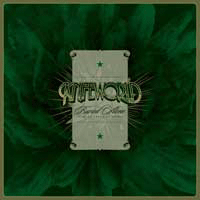




 Misfit City