Archive | jazz rock RSS feed for this section

September 2016 – upcoming jazz-ish gigs – Mike Outram Trio in London (7th); Steve Lawson album launch in Birmingham (11th)

29 Aug

A couple of imminent shows in or around jazz (and in or around London and Birmingham)…

* * * * * * * *

Way Out West presents:
The Mike Outram Trio
The Bull’s Head, 373 Lonsdale Road, Barnes, London, SW13 9PY, England
Wednesday 7th September 2016, 8.30pm
information

Possessed of a boisterously convivial and adventurous set of guitar tones (as well as a spontaneous but eminently accessible creativity), Mike Outram is one of a number of contemporary electric guitarists who define themselves via the act of music rather than the reinforcement of genre. Although jazz enthusiasts will rightly admire him for his work with Nikki Iles, Tim Garland, Theo Travis’s Double Talk and Billy Bottle & The Multiple, Mike learns from and adds to whichever situation or artist he works with outside of jazz, be it soul pop with Carleen Anderson, latterday prog fusion with Steven Wilson or the classical/soundtrack work of composer Laura Rossi. As well as pursuing a serious, thoughtful sideline in bass guitar playing – something which he’s come to take as seriously as his guitar work – Mike’s a teaching professor at several eminent colleges, and the instigator of Electric Campfire, an online music course which has rapidly billowed into a musical community in its own right.

Though this gig is billed as being Mike’s trio, it actually stems from a partnership of equals, and predominantly from a 2010 album called ‘Invenzioni’, a set of improvised duets between Mike and eclectic alt.fusion bassist Steve Lawson. A committed solo performer since 2000, dedicated to presenting bass guitar as a standalone instrument, Steve has also been an enthusiastic and garrulous collaborator. His conversational fretless bass tones, Kaoss Pad rhythmic experiments and panoramic swathing loopscapes have meshed with a wide variety of partners from pianists, saxophonists, singers and drummers to electric kora players and a range of other amenable solo bassists. His own relaxed attitude to genre has resulted in a musical voice which strolls from place to place, touching on points from smooth-hipped jazz to art-rock, slick pop to noisy improv, dance electronica to ambient-aquatic sound painting, but never being tied down to any of them.

The final member of the trio is Emre Ramazanoglu, a multi-genre drummer, programmer, writer and producer who generally works (semi-invisibly) behind the scenes in the music industry, at the points where high-level musical chops, cunning production ideas and rapidly-evolving technology mesh with contemporary pop music production and bespoke event soundtracks. In between the demands of catwalk and chart, he fits in more esoteric, less overtly commercial work such as writing and shaping new records for reggae stalwarts Trojan, playing the Adrian Sherwood/remixological role on Martin France’s Spin Marvel jazztronica project, and co-running quirky sound design outfit Rattly’n’Raw. However, Emre originally came to London as a highly skilled jobbing drummer, and this gig gives him the opportunity to work with his original talents (although you can also expect him to blend in something of what he’s learned since that time, and probably to come armed to the teeth with portable rhythm and sound-shaping technology).


You can hear the basis of this particular strand of music – albeit minus Emre’s drumming – on the five tracks of ‘Invenzione’, in which Mike and Steve float thoughtfully down a stream of jazz-tinted ambient invention (echoing at points David Torn, John McLaughlin, Jeff Beck and perhaps a little Sonny Sharrock or Bill Frisell, but most often themselves) carrying out a loose, gently shaped conversation like two old buddies. I’m guessing that throwing Emre into the mix will probably pick up the relaxed rhythmic threads of this project, jerk them taut, and reign them back towards a purer jazz pulse; or something more along the lines of Mike’s skitter post-jazz-rock improv trio Snow Giants. The trio promise “an evening of world-class improvised music”: judging by the personalities involved, it’ll probably be laced with bonhomie, humour, informality and a general sense of being off the leash while not being too precious about it.

* * * * * * * *

A few nights later, Steve Lawson will be throwing an album launch show in his adopted hometown of Birmingham (and his adopted home venue Tower Of Song), and everyone’s invited.

Steve Lawson & guests
Tower of Song, 107 Pershore Road South, Kings Norton, Birmingham B30 3EL, England
Sunday 11th September 2016, 8.00pm
information

The album in question is ‘The Surrender Of Time’ – Steve’s fifteenth work of bass, loops and effects, and his second of 2016 (following this summer’s defiant, sometimes heartbroken album of instrumental reflections on the EU referendum). Out on September 5th, early copies of ‘The Surrender Of Time’ will come with a download of a side project, a single twenty-two minute track called Colony Collapse Disorder, Judging by the ‘Surrender Of Time’ excerpt below, Steve’s music is getting ever more unclassifiable at the edges: in this case glitchier, his bass shrouded and layered with drum effects and hard-rock distortions, with elements of experimental techno pulled apart and deliquesced by his jazz instincts.


You could read various things into this, including Steve’s increasing and frequently voiced disquiet at the fissile, wasteful and irrational state of the world (away from his bass, and frequently while still holding it, he’s a broad and assertive social media commentator, a vocal soapboxer and an outspoken humanitarian). Given that Colony Collapse Disorder is named after an inexplicable disintegration of bee colonies (and is variously and speculatively blamed on various causes including long-term pesticide effects, habitat destruction or ill-advised changes in beekeeping practises) you could see some of this recent work as moving into angrier, more sorrowful metaphors. But I’m speculating – and you certainly shouldn’t attend the gig expecting to see a man collapsed and sobbing over his pedalboard. Judging by the tone of most Lawson gigs, this will be puckish, celebratory, familial and musically immersive: and, at root, based around shareable melodies.

 
Steve promises “a fun night, plenty of hang time, maybe a special guest or two.” I reckon that it’s a pretty safe bet that his singer-songwriter wife Lobelia Lawson will be among the latter, but since Steve’s address book and musical dance-partner card stretches across a wide range of people from Michael Manring to Kristin Hersh via Cleveland Watkiss, Jon Thorne, Theo Travis and Daniel Berkman (and since he’s generally happy to play alongside whichever instrument and musician comes onstage with sufficient skill plus an open mind), expect anything.


August 2016 – upcoming gigs – London goes prog-happy at the Lexington – The Gift + We Are Kin + Tiger Moth Tales’ Macmillan fundraiser (7th); the David Cross Band with David Jackson and Richard Palmer-James (9th)

5 Aug

I think I’ve previously described the Boston Music Room – one of my own local venues – as London’s current home of prog. If so, the Lexington, down in the hinterlands between Kings Cross and Angel, is making a good showing as a second home. Two imminent shows reinforce that reputation, making next week a good one for London’s prog village.

* * * * * * * *

The Gift/We Are Kin/Tiger Moth Tales @ The Lexington, 7th August 2016

Resonance, in association with Prog Magazine and Orange Amplification present
The Gift + We Are Kin + Tiger Moth Tales
The Lexington, 96-98 Pentonville Road, Islington, London, N1 9JB, England
Sunday 7th August 2016, 6.30pm
– information here and here

The name that’s missing from the promoters’ line-up above is Bad Elephant Music: London’s ever-industrious cottage label for various types of prog, and home for two of the acts on the bill. In some respects, this is a shuffled and re-run of a similar gig back in February, in which The Gift’s mix of symph/prog/folk grandeur plus flashy AOR (and We Are Kin’s exploration of art rock shapes and northern English socialism) lined up with a pair of one-man bands in the shape of steampunk balladeer Tom Slatter and troubadour rocker jh. Now The Gift are back, and so are We Are Kin, with only the choice of one-man-band changed. Here’s the official blurb from the Elephant:

The Gift, fresh from their triumphant performance at An Evening Of Bad Elephant Music, will be headlining the event, bringing their own particular brand of symphonic progressive rock on stage. The band is currently working on the followup to 2014’s ‘Land of Shadows’, and may well be previewing a song or two here.


“Making the journey down to ‘that London’ all the way from Manchester, We Are Kin will be playing a selection of songs from their new album, ‘The Waiting Room’, as well as from their acclaimed debut, ‘Pandora’. Their twin vocal lineup wowed the audience at Abel Ganz’s Christmas party last year, and is sure to be a highlight of this event.


Tiger Moth Tales is the brainchild of Pete Jones, who will be performing solo for this event. His live shows have been widely acclaimed for their virtuosity, emotion and huge sense of fun. Pete’s two album releases ‘Cocoon’ and ‘Storytellers Part One’ will both be represented in his performance, and he may well throw in one or two cover versions of the prog classics!”


Just one final note – the gig’s a fundraiser for Macmillan Cancer Trust, emphasising a community that’s broader than just the prog one.

* * * * * * * *

David Cross Band @ The Lexington, 9th August 2016

The David Cross Band (with special guest David Jackson) + Richard Palmer-James
The Lexington, 96-98 Pentonville Road, Islington, London, N1 9JB, England
Tuesday 9th August 2016, 7:30 pm
– information here and here

Despite nearly five decades in music, David Cross is still best known for his contributions to three albums at the start of his career. During a two-year early-‘70s stint with King Crimson (incorporating ‘Starless And Bible Black’, ‘Larks’ Tongues In Aspic’ and ‘Red’) David added “delicacy, and wood” to what some consider to be the band’s finest incarnation – part proto-punk-Mahavishu Orchestra, part stately electric-classical chamber group, and part droning/clattering/blaring building site. In its relatively brief and always restless lifespan, this particular Crimson lineup lay athwart the path of progressive rock, heavy metal and European improvisation like a splinter-ridden sleeper across the tracks: innovative, stern and ornery.

David’s amplified violin was a key part of the band’s powerful Euronoise, bringing in evocative melodies and moods which varied between Roma scurries, fall-of-Rome dramatics, foggy drones and angry squeals. As was the case with many of the departures from Crimson, David’s was passionate, painful and galling: progressively swamped by the band’s incremental climb towards avant-rock brutality, he was eventually forced out by its bruising, bristling volume and the implacable battering of its rhythm section. It took a few decades for him to salvage a more cordial relationship with Crimson leader Robert Fripp: nonetheless, the reconciliation has led to a return to the large extended Crimson family including guest spots and latterday Soundscape duets as well as recent electric chamber music with Crim-connected composer Andrew Keeling.)

Immediately after Crimson, though, David had to follow a different winding path of his own. From mid-‘70s work with trans-Manche psych/prog/fusioneers Clearlight (and experiments with big-band improv whilst leading the sadly undocumented Ascend) he went on to a long learning process during which, by his own admission, he failed at jazz. On the other hand, he successfully honed an affinity with alternative improvisation and with other forms. Theatre, in particular, proved to be a natural home, with David working up on stage and behind the scenes as well as in the pit band or composer’s slot. Theatricality also bled through into his other musical work. A trio he formed with keyboard player Sheila Maloney and saxophonist Pete McPhail took to the arts centres to perform musical interpretations of Samuel Beckett plays, while from the turn of the 1980s David was carrying out interdisciplinary performances with dancers, painters and the like (something he’s continued up until the present day).

After a decade away, a return to fusion and avant-rock in the late 1980s saw David becoming a keystone of Geoff Serle’s Radius band; an interesting, if airlessly pastoral, British answer to Material’s electro-funk. He was also a quarter of one-shot project Low Flying Aircraft, in which he joined forces with Crimson-orbit jazz pianist Keith Tippett, drummer Dan Maurer and budding teenaged guitar whiz Jim Juhn in a leaf-storm of nervy electroacoustic frenzy and scattered early sampler sputters. (For my money, it’s probably his most interesting post-Crimson bandwork to date.). He’s stayed busy ever since – this year, for instance, saw the release of violin-and-electronica duo album with Sean Quinn of Tiny Magnetic Pets, plus a live album from Japanese dates in which he guested with Crimson spinoff trio Stick Men.


All of this suggests the work of a musician whose reputation should be broader and better respected. It’s probably only the taint of grand prog – and of the “wrong kind” of fusion – which keeps him from it. In experimental rock (or, more accurately, in the media commentary which covers it, particularly on the British side) there still seem to be very clear, if dubious and snobbish, rules about who’s allowed credibility, and why. It’s not easy to escape from those fencings; and without this side of his history, David might have had his due.


For better or for worse, David’s most enduring project has been his own David Cross Band. Anchored since the mid-’90s by cohorts and co-composers Mick Paul (bass) and Paul Clark (guitars), it displays his electric violin – by turns stately, romantic, gnarled or locustlike – coursing fluently over a grandiose, detailed bed of prog pomp, deep metal, and flaring jazz-rock gestures. This year, however, the band’s taken an intriguing and strategic left-turn. With their latest album ‘Sign Of The Crow’ barely out of the gate, they’ve unexpectedly replaced keyboard player Alex Hall with veteran avant-prog sax hero David Jackson, once of Van Der Graaf Generator.

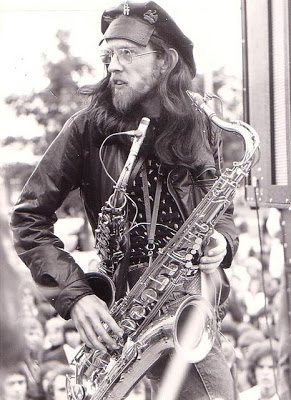
David Jackson in full 1970s effect (photographer unknown)

David Jackson in full 1970s effect (photographer unknown)

Musically adventurous and visually iconic, Jackson spent his Van Der Graaf years festooned with multiple instruments, blowing double-horn brass sections through brain-buggering electronics and being described as “a Third Reich bus conductor”. Since then, he’s spent much of his time working on the gesture-to-MIDI Soundbeam electronic project (bringing out the musicality of disabled children) while sometimes venturing out for gigs on the strength of his experimental rock reputation. Since crossing paths with David Cross at one such gig in Verona years ago, Jackson has been one of his frequent improvisation partners, making him an overdue natural fit for something like this. Regarding their chemistry, here’s a lengthy fly-on-the-wall video of the two of them playing (alongside Yumi Hara and Tony Lowe) at a release show for the Cross/Fripp ‘Starless Starlight’ album of Crimson-inspired Soundscape duets. Covering the show from rehearsal to performance, it hints at some of what the Cross/Jackson duo might be bringing to bear on the band shows; something which might well be transformational, pulling the band up and out of its shiny prog-metal box and perhaps delivering David Cross some of the broader respect he deserves.


The new Cross Band lineup, completed by Space Cowboys singer Jinian Wilde and by poly-disciplinary drummer Craig Blundell (who displays a heartening taste for post-dubstep playing when people let him off the prog leash), made their live debut in Wolverhampton last month. While no videos have emerged from this, there have been enthusiastic reports; and as King Crimson tours as a grand septet with a long-denied, fervently-delivered battery of archived ’70s classics, the Cross band are studding their own set with live deliveries of 21st Century Schizoid Man and Starless.

The London gig’s also intriguing in that it features a rare-as-rocking-horse-shit British solo slot from Richard Palmer-James. Originally the embattled first guitarist and wordsmith for Supertramp (a long time before they hit big at the American breakfast bar), Richard was the long-distance lyricist for King Crimson during David’s tenure and has subsequently carried out the same favour for twenty years of various Cross bands. Based in Bavaria for forty-odd years, he’s spent most of it embedded in production and writing work for German pop: since the turn of the century, however, he’s revived his original love for playing blues and country guitar. Most likely it will be this side of him that we’ll see at the Lexington on Tuesday. Still, who knows what the sense of occasion might bring out?
 

June/July/October 2016 – upcoming gigs – Billy Bottle & The Multiple tour ‘The Other Place – a Vox-Popera’ across the English South-West and South Coast

22 Jun

Whatever happens in the wake of this week’s Britain-in-Europe referendum, there are going to be plenty of questions asked about democracy, accountability and connection. Personally, I’m expecting most of them to be shouted or sworn rather than asked, so I’m not looking forward to it… especially if I’m going to be one of the people doing the swearing.

Last year, Billy Bottle & The Multiple were asking a few of those questions themselves. Since they’re heirs to the spirit of Daevid Allen rather than that of Jeremy Paxman, they were asking them in their own unorthodox way. This month, as part of an ongoing follow-up roadshow stretching into autumn (and perhaps beyond), they’re beginning to show us what they discovered.

* * * * * * * *

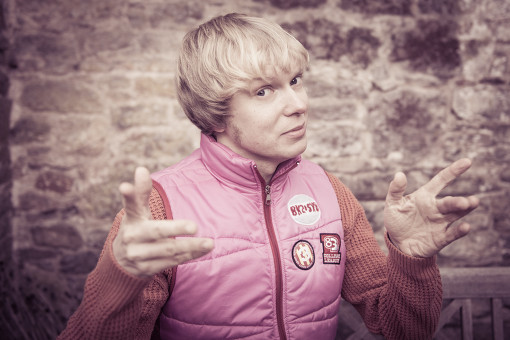
Billy Bottle, 2016

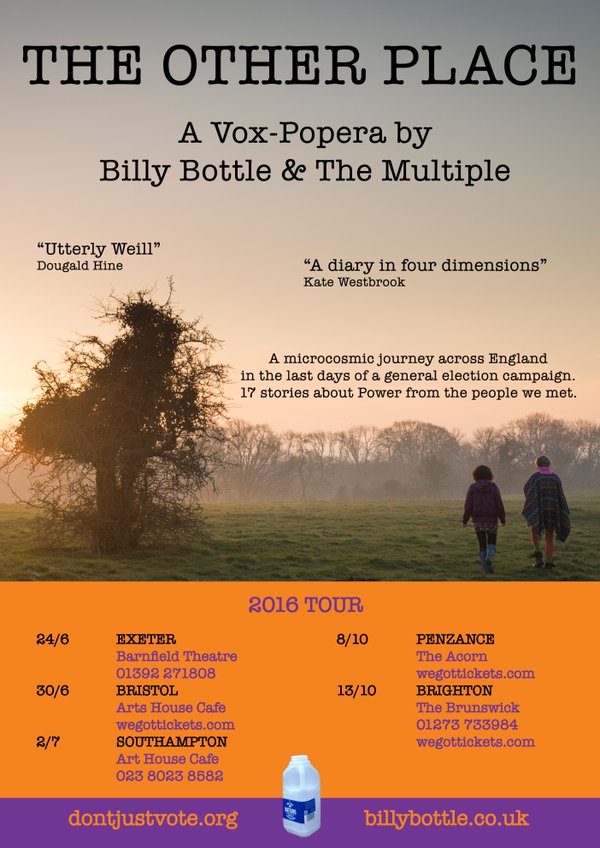
‘The Other Place – A Vox-Popera’

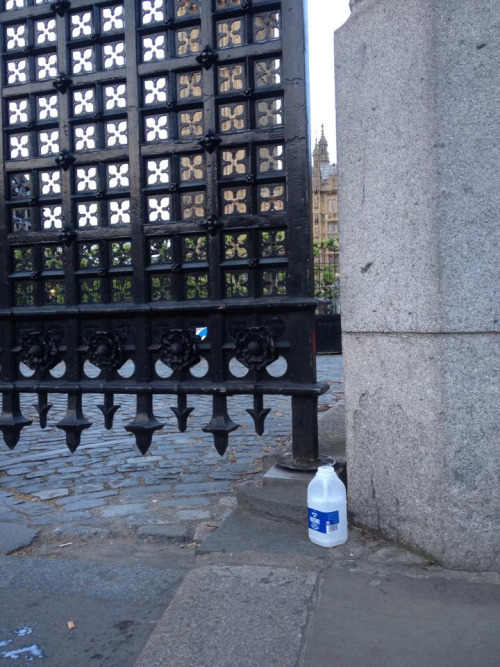
“On the evening of 7th May, 2015, a pint of milk mysteriously appears at the gates of Parliament.

Special delivery...

Special delivery…

“Set in the week running up to a UK general election, The Other Place tells the true story of two musicians from Devon as they make their way slowly to Westminster. On high streets, market squares and seafront promenades, they perform the same song, forty-nine times over, and at each stop they start conversations with whoever they meet, asking them ‘Who’s got the Power?’

At the end of a long and winding journey, they arrive at Parliament Square on a milk float to make their delivery: a symbolic reminder that the power doesn’t belong to the inhabitants of Westminster, it is given to them by the rest of us.

“This journey through the foundations of British democracy inspired a sequence of songs whose lyrics come from the words of the voters (and non-voters) that Billy and Martine met on their journey. It is a celebration of gentler kinds of power and an invitation to the audience to make their voices heard.

Billy Bottle & The Multiple - 'The Other Place' - on tour, 2016“The Multiple currently features Martine Waltier (voice, violin, guitar, percussion), Roz Harding (alto saxophone, recorder, percussion) and Billy Bottle (voice, keyboards, guitar), all of whom are mainstays of Mike Westbrook’s Uncommon Orchestra; plus flautist/singer/percussionist Vivien Goodwin-Darke (from the psychedelic rock band Magic Bus) and recording artist and producer Lee Fletcher (of Unsung Productions) on synths, soundscapes and percussion. Like the best art rock, they combine folk, jazz, pop and minimalism in an engaging and meaningful way.

Complete with wobbly camera footage and the sounds of the streets, this performance is a real democratic party in action!”

* * * * * * * *

As regards the delivery of the Power… it all began as a stunt, of sorts. In January 2015, a peak-time British TV audience was treated to the sight of Billy and Martine ripping into an acoustic busker-cover of Snap!’s old Eurodance chestnut as they competed in ‘The Voice’. Wrapped in pink quilting, flower-child swirl prints and a sunshine glow, chatty about their south Devon rural idyll (and their taste for naturism), they gave the impression of being only a couple of brow-stars away from the Age of Aquarius. They delighted the judges (and went down a storm with a supposedly-hippy-proof public) but their faces and demeanour didn’t fit the reality TV narrative, and they didn’t get any further in the contest. By popular demand the single was out that summer via Bandcamp and cottage industry: it sold nicely behind the scenes and away from the charts; and that might have been that.


However, painting the Bottle squad as talented, bright-eyed novelty hippies is to get no further than the colourful wrapping; to miss the bright, enquiring intelligence under the apparent sunny simplicity; and to mistake constructive, conscious choices for naivety and innocence. Before they’d even thought of stepping onto ‘The Voice’s stage, Billy and Martine had been longstanding Westbrook Band and Dave Sinclair associates, with urban roots in Darlington and London supplemented by dues paid in neo-progressive rock, indie, music teaching and circuses. Already able to tap and hold serious British musical talent, their 2013 album ‘Unrecorded Beam’ had been a triumph of pastoral ensemble jazz; scooping up the poetry of Thoreau and blowing new leaf-green life through it, zig-zagging through the soundfields like a tripping honeybee. ‘The Voice’ was a diversion – a game they were coaxed into. In turn it triggered another experiment in play, taking something apparently trivial and fluffy but using it to tap into a more serious undercurrent.

The busk pilgrimage that would eventually become ‘The Other Place’ started as an attempt at a “rolling conversational democratic jam session.” With no more than the violin, acoustic guitar, costumes and voices from the ‘Voice’ session, Billy and Martine flipped their brief brush with celebrity into an engagement with recognition and a much more down-to-earth version of meet’n’greet. They rode on the back of their ‘Voice’ platform not in order to achieve celebrity, but to set up a chat: a little conversation at the feet of the Big Society, where the bunions and the broken toes are. What they found and heard – and recorded en route – would eventually weave itself into the sonic fabric of ‘The Other Place’, fleshed out by jazz reeds and woodwind, and aided and abetted by production wizard Lee Fletcher (who’d done so much for the encompassing feel of ‘Unrecorded Beam’ and was co-opted into the Multiple once they’d realised the multimedia nature of the emerging new project).

In lieu of any sonic or visual teasers for the show (the Multiple are keeping their cards close to their chests on that one) here are some clipped’n’mixed reflections from the original voyage, all taken from their blog of the original roadtrip:

“We’re not pretending we’ve got any answers. We’re definitely not pretending that wearing fluorescent tights and playing a song in the street is a way to change things. But it’s a way in, a way to start meeting people, catching little snatches of a tune that this country is humming under its breath, that nobody’s quite remembered the words to yet…

“When you travel slower, the country gets larger. Stopping off at so many places along the way, Exeter is a really long way from Newton Abbot, Bristol is a really long way from Exeter. You realise that each of these places is a world, the world of the people who live here and do their best to make life work in the conditions in which they find themselves. Seeing news clips of the party leaders climbing out of helicopters or stepping off intercity trains, it feels like they are whizzing up and down a different country, a smaller country, a country where most of the places we are visiting don’t matter very much…

“Each time we get off the train at a new place, we find ourselves sniffing the air, sensing for clues as to what it is like to be getting on with your life in a place like this. And the clothes, the music, the harmless foolishness of our little gang seems to open up a line of contact, so that within twenty seconds people are talking to us about their lives….

“People start off curious and cautious. They see us coming a mile off, the technicolour outfits, the huge #dontjustvote stickers on our instrument cases. Sometimes they recognise us off ‘The Voice’. They want to know what we’re doing, why we’re doing it, and that means we have to keep asking ourselves those questions, figuring out the answers as we go along. They want to know what we’re selling, what we’re trying to persuade them of, and we tell them really we just want to start conversations, to meet people, to find out what’s going on in this country now, what this election actually means.

“When they start talking to us, they usually start with a flat statement, something definitive. ‘I never vote.’ ‘They’re all the same.’ ‘There’s no point, is there?’ But as they realise we’re actually interested, the way they talk changes, something else comes out. You can hear how much they care. Everyone we meet feels disillusioned, disengaged, disenfranchised. They all feel like they’re not being heard. A lot of them aren’t voting. Yet they also believe that we as people do have power, they just can’t see a route to change that goes through the ballot box…

“In Trowbridge, we started playing and police came running round the corner. There had been a theft of a piece of meat from a shop. A shopkeeper came running towards us, she thought we were just shouting in the street, shouting like a thief. Well, we were shouting in the street. A few minutes later, Bill was listening to the story of a man who had been homeless for twelve years as he talked about his father’s addiction and how he died. At the end, there would have been no point in words. The two of them stood there in the street, holding each other, crying.

“In Brighton and Lewes, the air smells green, and then we cross some unmarked threshold and in the next few towns another reality takes over. Listening to the way people talk, we find ourselves starting to understand why they are drawn to UKIP, not because the facts or the arguments add up, but because in this reality it could sound like they make sense.

“The song is the same in every place, but something changes, grows, deepens. Maybe what we’re doing is charging up the song, like we have to keep charging our phones whenever we get a few minutes near a socket. All of these encounters, conversations, stories are charging up this song we started out with and the song is carrying them.

“All along this journey, we’ve been feeling an aching gap between the cold anger, disillusionment, exhaustion that nearly everyone we talk to has when they talk about the political system and something else, something that doesn’t come so easily into words, but is a kind of faith in people, in people’s ability to muddle through, to somehow go on making life work, finding opportunities for kindness in the middle of all its absurdities.

“Maybe this all has something to do with what we mean by power? A friend of ours, Anthony McCann, talks about the idea of a ‘politics of gentleness’. Watching the news about this election, gentleness and politics don’t really seem like words that belong together. But what he says is that when we think about power, we usually think of it as the ability to manipulate, control or dominate other people. And since those are all pretty nasty ways of treating people, and since most of us don’t actually want to treat people in nasty ways, that way of thinking about power makes it something we wouldn’t want to have, which makes us powerless.


“So what if there were other ways of thinking about power? What if there were other kinds of power that exist, all the time, so much part of our everyday lives that we take them for granted? Anthony talks about power as ‘the ability to vary the experience of oneself or others’. As an example of this gentle power, he talks about what it’s like to be a parent holding a small child… And maybe it’s this kind of power that people feel, that they have some kind of trust in, even if it’s not easy to give it words?…”

We’re going to deliver The Power to Westminster.

“When we started saying that, it was a joke, but as we kept joking about it, the thought deepened on us. We’re still figuring all of this out as we go along, finding out what we’re doing by doing it, but it’s starting to seem like this journey culminates in an ironic ritual: the delivering of The Power to Westminster, to remind the politicians that The Power doesn’t belong to them, not really, not on polling day, or even on any other day.

“The Power is loaned to them by the people, and they can hardly dare to acknowledge how grudgingly that loan is made, how overdue the repayments have become. This is the other deficit, the one that no one is making pledges about, and someday the people may call in the loan.”
 
* * * * * * * *

Or, to put it another way (as another beloved couple did, in another time and another place):

“Are you serious?”
“About what I do, yes. Not necessarily the way I do it.”

Don't Just Vote
 

June 2016 – upcoming London jazz – Entropi & Mike Chillingworth Trio at the Vortex, The Tommy Remon Quartet at Map (both on the 5th), and nearly ten hours of international LUME festival at the end of the month (26th)

31 May

There’s an imminent weekend of jazz coming up, plus an all-dayer at the end of the month…

* * * * * * * *

LUME presents:
Entropi & Mike Chillingworth Trio
Vortex Jazz Club, 11 Gillett Street, N16 8JH.
Sunday 5th June 2016, 7.30pm
more information

“To round off this season of LUME at The Vortex, we’ve got an exciting double bill of new and improvised music.

Entropi (photo by Carl Hyde)

Entropi (photo by Carl Hyde)

Entropi is a vehicle for Dee Byrne‘s ‘space-jazz’ compositions, exploring a narrative of life-pondering, stargazing and risk-taking. Juggling order and chaos, composition and improvisation, the group takes listeners on a journey with compelling group interplay, strong themes, open-ended improvisation, dark grooves and interweaving melodic textures. The ensemble comprises Dee (on alto saxophone), trumpeter Andre Canniere, keyboardist Rebecca Nash, drummer Matt Fisher and bassist Olie Brice. Having performed live together for some time, the band has achieved a striking empathy and freedom to take risks. Their debut album ‘New Era’ was released on the F-IRE Presents label in June 2015, with their second album to come on Whirlwind Recordings in 2017.

Mike Chillingworth

Mike Chillingworth

“We are really looking forward to welcoming alto saxophonist and composer Mike Chillingworth and his trio. In his own words:

“‘I formed this trio last year as a means to play music with an emphasis on spontaneity and improvisation. I have another project, a septet, which is all about detailed written compositions. This trio is the antidote to that. I will be performing with two fantastic improvisers: US drum legend Jeff Williams (who has played with everybody, including two of my favourite saxophonists Joe Lovano and Stan Getz) and Conor Chaplin on bass (who plays in many of the most exciting new UK bands at of the moment).

“I often deliberately avoid choosing repertoire for a gig until the last moment, often writing new tunes in the days leading up to a performance, or taking ideas from whatever I happen to be listening to at the time. Whatever we choose to play on this occasion the emphasis will be on improvising, communicating, listening and exploring together.'”

* * * * * * * *

On the same night, you’ve also got the chance to check out some new start-of-career talent at one of London’s nicest small venues – the Map Studio Café, tucked away in the Kentish Town side-streets. I’ve wanted to talk about this place since discovering it on a random stroll after a swimming session at the Prince of Wales Baths, when its easygoing atmosphere and hopeful spirit provided an ideal wind-down opportunity: the compact performance space upstairs and the talk of a built-in recording studio piqued my interest, and this week’s gig gives me something solid to plug…

Map Studio Café presents:
The Tommy Remon Quartet
Map Studio Café, 46 Grafton Road, Kentish Town, London, NW5 3DU, England
Sunday 5th June 2016, 8.00pm
more information

Tommy Remon, 2016

Tommy Remon, 2016

Led by up-and-coming guitarist Tommy Remon, this quartet has emerged from the Tomorrow’s Warriors Organisation, which encourages young British jazz talent (focussing on people from the African diaspora, with an additional focus on encouraging girls and women into the form). Currently playing hard bop and modal tunes from the jazz canon, as well as their own original compositions, the band are at a self-confessed early stage despite their collective musical strength, and are hungry to develop further insight and breadth. Now, however, is the ideal time to catch them while they’re young, hungry and open, and about to start on their first significant expansion.

The other members of the band are double bass player Rio Kai (who’s played with Jason Yarde and Alex Garnett), drummer Patrick Boyle (Tomorrow’s Warriors Big Band, Nathaniel Facey) – both of whom previously worked with Tommy in a trio – and trumpeter Dylan Jones, who’s still an undergraduate at Trinity Laban, but is already a member of EZRA Collective. Between them, the band members have also worked with Tomorrow’s Warriors founder Gary Crosby, Nérija, Binker Golding and Kokoroko.

* * * * * * * *

Three weeks later we’ll be back with LUME, who are summarising their current state of play via their first festival, which they successfully crowdfunded following an appeal earlier in the year (with backup from Arts Council England, and the Austrian Cultural Forum). It looks as if it’s going to be both a broad and a familial occasion, with many LUME regulars reappearing in a variety of bands and contexts, with strong playing contributions from the LUME organisers themselves, and with a substantial presence as regards the female jazz musicians which LUME in part encourages (just over a quarter of the twenty-seven players involved are women, most of them also being group leaders, co-leaders and composers). Tickets are limited and are going on sale at the start of June.

LUME Festival 2016

LUME presents:
LUME Festival: Word Of Moth + Ant Traditions + Hot Beef Three + Little Church + Kjær/Musson/Marshall + Blueblut + Article XI
IKLECTIK, Old Paradise Yard, 20 Carlisle Lane, Waterloo, London, SE1 7LG, England
Sunday 26th June 2016, 1.00pm-10.30pm
more information

  • The day’s headliners are Word Of Moth, the London-based collaborative quartet which includes the two LUME founders on saxophones (Dee Byrne on alto, Cath Roberts on baritone) alongside Seth Bennett (bass) and Tom Greenhalgh (drums).
  • Article XI is a freewheeling large ensemble led by guitarist Anton Hunter, originally put together for the 2014 Manchester Jazz Festival but deemed too good not to continue with. Mingling free improvisation with tightly-composed contrapuntal writing, it also features Oliver Dover (alto sax, also of Saxoctopus and many others), Tom Ward (tenor sax), Cath Roberts (baritone sax), Johnny Hunter (drums), Seth Bennett (bass), Graham South and Nick Walters (trumpets), and Tullis Rennie and Richard Foote (trombones).
  • Vienna-based Blueblut was founded by three musical powerhouses, famous in their respective spheres of jazz, electronic and avant-rock music. The band have the intensity of rock, the space and openness of electronica and the razor-sharp precision and wild improvisation of jazz. Featuring Led Bib’s Mark Holub on drums, Pamela Stickney on theremin and Chris Janka (flying machine maker, sound engineer, automata creator and Viennese Caractacus Potts figure) on guitar and overall production.
  • Musson/Kjær/Marshall are a fantastic London trio of committed European-scene improvisers and extended-technique instrumentalists, all of whom happen to be female: Rachel Musson (tenor sax), Julie Kjær (alto sax) and Hannah Marshall (cello).
  • Little Church are a Birmingham-based fusion quartet, playing compositions both from and inspired by Miles Davis’ electric period. Led by keyboard player David Austin Grey, the rest of the band is made up from Aaron Diaz (trumpet), Rachael Cohen (alto sax), Chris Mapp (double bass, bass guitar and electronics) and Tymek Joswiak (drums). Little Church fuses live acoustic instruments with synthesizers and electronics to produce a wonderfully ambient soundscape, which moves from meditative and hypnotising through to driving and funky with a seamless fluidity.
  • Hot Beef Three brings some of Leeds’ finest improvisers together: saxophonist Oliver Dover (see above),  guitarist Craig Scott (Ikestra, Craig Scott’s Lobotomy) and drummer Andrew Lisle. (All three already play together as part of Leeds’ notorious eclecti-chaos band Shatner’s Bassoon.)
  • Ant Traditions are a top-notch Manchester improv duo featuring Adam Fairhall (toy pianos) and Dave Birchall (electric guitar).

There’s a sonic buffet provided below to keep you happy until the end of June:


April 2016 – upcoming gigs – London rock entanglements this week: mystery superstar(s) sneak into Deptford, supported by Nøught, First and The Kill Raimi’s; Knifeworld go acoustic in Shoreditch; The Display Team, Thumpermonkey and A Formal Horse twist some metres in Bethnal Green.

18 Apr

The folk running the Birds’ Nest in deepest Deptford are wildly, inordinately excited about whom they’ve got to fill their postage-stamp-sized stage at the start of this week, but they won’t tell us who it is

Nøught + First + The Kill Raimi’s  + mystery guests, 19th April 2016Birds Nest TV presents:
(extra special guest band) + Nøught + First + The Kill Raimis
The Birds Nest, 32 Church Street, Deptford, London, SE8 4RZ, England
Tuesday 19th April 2016, 8.00pm
– free entry – more information

“A marvellous occasion is about to happen at the Birds Nest pub, Deptford. We cannot express the sheer excitement at being able to host a night of great local bands and international legends: music conceptualists that have inspired countless bands and still continue to inspire generations of new talent. This is the event we have been waiting for. Get down early to this one as once the venue is full we won’t be letting any more people in.”

We do know that Nøught are playing. After years of being mostly out of the picture while leader James Sedwards ran around playing with everyone bar his main band – including work with shapeshifting prog confounders Guapo, improv blaster Alex Ward, Country Teasers spin-off The Devil, and Thurston Moore (…hmmm?…) – Nøught plunged back into action earlier this year with a Café Oto headliner and a Lydia Lunch support slot, continuing to demonstrate their one-band-fits-all approach of wedding classically precise John McLaughlin/King Crimson-esque jazzprog riffage to blocks of Sonic Youth/Big Black/post-hardcore noise, and how it bridges a stylistic credibility gap which others founder at or don’t even dare to take on.

Filling out the bill are two Deptfordian power trios. First are a third-decade third crack at warm, crunchy Bolanesque grunge-pop by former Stony Sleep/Serafin singer-songwriter Ben Fox Smith (a.k.a. “Young Sawbones”), while The Kill Raimi’s last showed up in here as part of a Thumpermonkey support in December. First’s drummer Jim Devese also happens to play guitar for The Display Team, which ties nicely into events later in the week… read on…


* * * * * * * *

Knifeworld (acoustic set)
Flashback Records, 131 Bethnal Green Road, Shoreditch, London, E2 7DG, England
Friday 22nd April 2016, 7.00pm
more information

Knifeworld: 'Bottled Out Of Eden'

Knifeworld: ‘Bottled Out Of Eden’

I hardly need to introduce Knifeworld these days. They’ve never been strangers to this blog (ever since their first releases, and further back if you’re counting coverage of head Knifer Kavus Torabi’s 1990s work as half of the mainspring of The Monsoon Bassoon), but an ever-building profile is beginning to make them, if not a household name, at least not the kind of name which you end up repeating to a succession of nonplussed faces. The world seems to be waking up to the cartwheels and streamers of their music, their meticulous complexity and at least some of the elusive substance lurking behind Kavus’ daffy freak-flag charm.

To celebrate this week’s release of ‘Bottled Out Of Eden’ – their third album proper, and the first to be group-composed – Knifeworld are playing a special acoustic gig at the Shoreditch branch of Flashback Records: perhaps a nod, in part, to Flashback’s role in nurturing that effusive London psychedelic rock tradition in which Knifeworld swim (and which they themselves have a strong role in promoting and sustaining). For plenty of bands, an acoustic session is an excuse to steal a little bit of Proms respectability – some string quartet garnishing, a dig at some previously scorned rootsiness. For Knifeworld, it’s simply a matter of bringing forward what’s integral to the group already. Effectively an electrified chamber octet transfixed by a flaming psychedelic spear, they’re already half-acoustic with their three-line, reeds’n-air whip of saxophones, clarinet and bassoon, with Ben Woolacott’s spacious airy drumming and with their chatty, ever-expanding cloud of harmony vocals. It’ll be interesting to see how full acoustica works on recent tracks like High Aflame, but I can already imagine how it might add a new glint to older songs like The Prime Of Our Decline…

* * * * * * * *

For the fleet-footed, there might be a chance to catch both the Knifeworld show and part of this next one, which is just in the next neighbourhood over on the same night. Knifeworld finish at 8pm, so the chances are high (as are the chances that you’ll be racing the band – fans themselves – along Bethnal Green Road and Squirries Street to get to the second gig).

The Display Team + Thumpermonkey + A Formal Horse, 22nd April 2016

Chaos Theory presents:
The Display Team + Thumpermonkey + A Formal Horse
The Sebright Arms, 33-35 Coate Street, Bethnal Green, London, E2 9AG, England, Friday 22nd April 2016, 7.30pm
more information

Over to the Chaos Theory publicity factory:

“A frenzied night of prog, punk, ska and rock madness, with bands hiding immense technical prowess under gloriously unhinged music,

Local heroes The Display Team are a band we’ve loved for years but found really hard to place on a lineup! Sounding like a cross between The Specials and Mr Bungle, this prog-punk orchestra create a heavy assault of surprisingly upbeat, melodic nonsense. They’ve impressed DIY audiences all over the UK and beyond with their riotous live shows and their last album ‘Drones’, so after seven years it’s high time for their latest sounds to be captured on another album – ‘Shifts’, which they’re launching this evening.


Thumpermonkey are a hugely-acclaimed band who’ve spent years arguing between themselves about whether to play prog, punk or art-rock, and never seem to have quite settled. This creative process somehow produces music that is heavy, delicate, classically and dramatically influenced, sardonic and divisive.


Nominated for a Progressive Music Award, A Formal Horse are a progressive quartet hailing from Southampton with a thoroughly uplifting rock sound, playing dense instrumental passages inspired by the sonic worlds created by Mahavishnu Orchestra and Queens Of The Stone Age, whilst still taking cues and colours from twentieth-century art music.”


* * * * * * * *

Next time, some latecoming news on various folk-related tours in England which kick off this week…
 

March 2016 – upcoming gigs – Kiran Leonard tours Britain again (March into April) and reveals new single; London gigs from Whispers & Hurricanes (with Madam, Kat May and RobinPlaysChords) and a guitar double from Dean McPhee and Seabuckthorn

23 Mar

Details on two London shows from a packed upcoming weekend: but first, an extended British tour from a major talent…

* * * * * * * *

Tomorrow, explosively gifted singer-songwriter Kiran Leonard charges off on another British tour with his all-star quartet of Manchester art rock luminaries (completed by Dan Bridgwood Hill, Dave Rowe, and Andrew Cheetham – see the note on his previous tour for their credentials). Support on most of the tour comes from dark-glam Manchester pop act Irma Vep, although some dates feature folk musicians Richard Dawson and Salvation Bill (in Newcastle and Oxford respectively) and Bristolian “jazz/rock/post-op pop” quartet The Evil Usses (who fill the bill in Bath), with other acts to be confirmed (though they might have been added to the individual gig pages by now…)


Meanwhile, here’s Kiran’s brand-new nine-and-a-half-minute single – a terrific and spontaneous-sounding interweaving of otherworldly folk baroque, chamber prog, post-hardcore racket and kitchen-warrior percussion. The parent album, ‘Grapefruit’, is out on Moshi Moshi on Friday.


* * * * * * * *
In London, at the weekend, there’s a third-outing triple bill for Whispers & Hurricanes (the quieter wing of Chaos Theory Promotions, for when they fancy putting on an act that doesn’t sound like a giant metallic jazz centipede in manga boots)…

Whispers & Hurricanes, 26th March 2016

Chaos Theory presents:
Whispers & Hurricanes: Madam + Kat May + RobinPlaysChords
The Sebright Arms, 33-35 Coate Street, Bethnal Green, London, E2 9AG, England
Saturday 26th March 2016, 7.30pm
more information

“A five-piece London based band, fronted by charismatic singer-songwriter and composer Sukie Smith, Madam create nocturnal, intricate-yet-cinematic soundscapes showcasing songs that are at once confessional and a call to arms, and have been compared to both Mazzy Star and Cat Power. The band has amassed a loyal legion of fans at home and abroad, showcasing their smoky sound at intimate gigs and packed venues across Europe. Tonight they will launch their haunting single When I Met You, taken from their upcoming album ‘Back To The Sea’.” (Meanwhile, here’s an earlier track from their previous album, ‘Gone Before Morning’; plus their darned slinky cover of Oscar Brown’s tale of treachery, ‘The Snake’ – a welcome antidote to the song’s recent co-opting by Donald Trump.)


Whispers & Hurricanes, 26th March 2016“After many years we are reunited with the extraordinary singer-songwriter Kat May, who is inspired by the melancholy of Scandinavia, the urban textures of her base in London and the literary song-writing of her native France. Her atmospheric indie folk-pop has been hailed by France’s biggest music magazine, ‘Les InRocks’, as “cathartic and elegant”, and by ‘Lomography’ as “visually dreamy, melancholic and emotionally arresting all at the same time.” We caught the launch of her debut album ‘Beyond The North Wind’ at St Pancras Old Church back in 2014, and it’s still a regular feature on our playlists. Tonight she will perform her music on piano and voice, with violin and cello accompaniments.


Robin Jax’s exploits as RobinPlaysChords have been built on a slow but steady sonic development. Hailing from his remote country abode near Leamington Spa, the solitary songwriter uses his guitar and loopstation to create percussion, shimmering ambience and distorted hooks for him to place his honest lyrics over. Garnering comparisons to David Bowie and Patrick Wolf, RobinPlaysChords has previously won over audiences when opening for The Irrepressibles, Larsen, Thomas Truax and others, as well as undertaking his first shows in continental Europe in 2015.”


* * * * * * * *

Finally for now, a doubled gig of textured, looped and echoed guitar, but with a pastoral edge…

Dean McPhee + Seabuckthorn
The Slaughtered Lamb, 34-35 Great Sutton Street, Clerkenwell, London, EC1V 0DX, England
Saturday 26th March 2016, 8.30pm
more information

“West Yorkshire based solo electric guitarist Dean McPhee plays a Fender Telecaster through a valve amp and effects pedals, combining clean, chiming melodic lines with deep layers of decaying delay and cavernous echo. Over years of improvisation and experimentation he has developed a unique style of playing which draws together influences from British folk, dub, kosmische, post-rock, Mali blues and modal jazz. His releases on the Blast First Petite, Hood Faire and World in Winter labels have been critically acclaimed by ‘The Wire’, ‘Uncut’, ‘Record Collector’, ‘Music OMH’, ‘Dusted’, ‘Brainwashed’, ‘The Out Door’, ‘Drowned in Sound’ and ‘The Quietus’ amongst others. He has supported artists/bands including Thurston Moore (as UK tour support), Acid Mothers Temple, Wolf People, James Blackshaw, Emeralds, Josh T Pearson, The Magic Band, Sharon Van Etten, Michael Hurley, Josephine Foster, Meg Baird, Bohren and der Club of Gore and Charalambides. Dean is currently working on a new album which uses a kick drum pedal to introduce a pulsing, percussive undercurrent to his most recent compositions,


Seabuckthorn is the solo project of UK acoustic guitarist Andy Cartwright. Releasing 6 albums since 2008 he explores alternative terrains on six to twelve strings, often with minimal layered accompaniments to form musical landscapes. Cartwright uses the techniques of finger picking & bowing combined with various open tunings to create a well curated mixture of approaches. Falling into the cinematic and soundtrack genres, his music is evident of influences ranging from the traditional styles of Robbie Basho and Jack Rose, to more modern players like Ben Chasny, Zak Riles, and Gustavo Santaolalla with whom Cartwright shares an emphasis on atmospheric and multi-instrumental compositions. Sometimes quietly ambient, often powerfully expressive. As well as live performances around the UK, Cartwright has performed in numerous shows & festivals all over France & the southern deserts of Tunisia.


Dean McPhee and Seabuckthorn are recording a split 7″ single to be released later this year.”

* * * * * * * *

News on more London weekend shows are coming up next time…
 

March 2016 – upcoming gigs – London murk and sarcasm – an industry-baiting evening of 30-second songs by the Pocket Gods and mystery buddies; plus noise rock from Arabrot, Shitwife and Godzilla Black at Corsica Studios

15 Mar

Two London gigs for Thursday…

* * * * * * * *

Pocket Gods @ Zigfrid von Underbelly, 17th March 2016

The Pocket Gods (’30 Second Song Set’) + tbc
Zigfrid von Underbelly, 11 Hoxton Square, Hoxton, London, N1 6NU, England
Thursday 17th March 2016, 7.00pm
– free event – more information

Here’s the chirp – ”London lo-fi indie popsters The Pocket Gods play a free St Patrick’s Day gig in Hoxton, London to promote their groundbreaking album ‘100×30’ – which features one hundred songs, all of which are thirty seconds long and some of which will be featured. Free entry and some great support bands!“

Sweet, isn’t it?

Here’s the rest of the story.

‘100×30’ was released last December. It’s a sharp, timely yet self-mocking broadside aimed at the music industry as a whole, and also at the amorphous greed’n’gratification culture that’s gulping down what remains of it. Masterminding this collection of half-minute jabs are The Pocket Gods – shabby knowing masters of multiple styles, mix’n’matching shreds of chart pop, punk, synth-blurb, soggy psych and outright pisstakes (including Blur, and Dappy from N-Dubz). Sometimes they sound like a back-bedroom Zappa Band operating on cheapjack equipment from a small-town branch of Argos, and sometimes like a more eclectic Half Man Half Biscuit aiming more of their jokes at the towers of power.

Threaded through the whole album is a sense of indignation at the implosion of music as a workable career (“my royalty statement is a thing of wonder, and keeps me in a state of permanent hunger”) and the dismissal of artists who can no longer be counted as fresh and malleable meat. One lyric points out, with sardonic but righteous indignation, “I can write songs about anything, because I’ve lived a little longer”; and there’s quite a bit of moping about the prospect of a future which involves little more than making unwanted music on a laptop. Across the tracks, the subject matter paints a scathing, resolutely unimpressed picture of vulgarity and short-termisms. Songs attack the rent hikes which force music venue closures; lampoon the encroachment of multinational corporate interests into independent business (the entwinement of Orchard and Sony takes a pounding, which – since Orchard is releasing the album – is a particularly fanged move); and pour sarcasm onto side topics like the sorry parade of boss-pleasing reality-TV contestants, the cluelessness of A&R men and the ludicrous table prices at the Brits (apparent sideshows which point towards the bigger problem). The Gods even slag off laptop music and mount a harpsichord-driven assault on the memory of Steve Jobs. So much for the individual being independently empowered by technology.

With the proven flexibility of the Pocket Gods, it’s tempting to assume that the brace of performers elsewhere on the album are just pseudonyms. Not a bit of it. Some – including oddball pop mutterer Michael Panasuk and fuzz-guitar flourisher Brian Heywood – appear to be rogue film, television and library music composers. Two more are former chart stars (Owen Paul and Mungo Jerry’s Ray Dorset, each damn near unrecognisable).Some veer towards cabaret (the semi-genteel, character-vocalled acoustipop of The Low Countries) or sarky contrarian Scottish dolour (Bill Aitken). Others even sound like glossy successes in waiting, including power-popper Katy Thorn, gobby R&B-er Tricey R, immaculate faux-Californian rockers Dead Crow Road, countrified Elvis-alike Osborne Jones, twinkling white-boy hip hoppers Foxgrease and full-bore electropop drama queens Hands Of Industry. The burnished countrified chart-pop of Heywood Moore even sounds as if it could make a killing in the American Bible Belt (sweeping out of the same CCM radio playlists as the likes of Lexi Elisha – not bad for a band that’s actually from Dunstable). None of this seems to stop any of them from joining in. Some of them may be taking a long-delayed, heartfelt chomp at the hand that feeds so grudgingly, or refuses to feed at all; or which they see starving others, from audience to artist, both fiscally and spiritually.

Despite all of this justifiable resentment, it could all turn precious and self-righteous were it not for the jabs of anti-pomposity which the Gods and their friends turn in on themselves (the musician-skewering of ‘Small Town Musos’ and ‘Mac Book Ho’ made me laugh out loud, as did a song about the natural progression from ambitious Radio 1 listener to experienced Radio 2 couch-fogey). There are also the other moments – the flip side to the flipness – in which the half-minute song limit becomes a lesson in how much can be achieved in a short time. John Rowland’s plunderphonics and piano instrumentals; upROAR’s quick echo-laden harp passage, Orb collaborator Another Fine Day’s gorgeous burst of echo-soused kalimba; or when writer and narrator Michael Hingston (who’s already spent two tracks guesting with the Pocket Gods, bidding goodbye to the swelling ranks of closed-down London music venues in a hardbitten wise-barfly drawl) gently blows thirty seconds of tentative, unaccompanied saxophone.

Finally, there’s the persistent realist-absurdist wit of The Pocket Gods themselves – party hosts, project backbone and the only act formally confirmed as performing at the Hoxton gig on Thursday (yes, I was going to get back to that…) Come along to see who else makes it. Meanwhile, you can play through the whole album below; and even buy it (if you feel that that won’t somehow spoil either the joke or the protest).

https://soundcloud.com/thejacula/sets/100×30
 

* * * * * * * *

Baba Yaga’s Hut presents:
Arabrot + Shitwife + Godzilla Black
Corsica Studios, 4-5 Elephant Road, Elephant & Castle, London, SE17 1LB, England
Thursday 17th March 2016, 8.00pm
more information

Arabrot + Shitwife +Godzilla Black @ Baba Yaga's Hut, 17th March 2016Norwegian noise-rockers Arabrot have spent a decade and a half feeding classical, Biblical, existential and surreal tropes through a grand and gothic avant-rock mangle. As you can imagine from this, both their gigs and records have had an immediate raw-lifed, raw-liver feel to them, despite what ‘The Quietus’ describes as the band’s “velveteen grace”. More recently, group leader Kjetil Nernes spent two years recovering from throat cancer, during which he’s fought off and defeated encroaching death not just via hospital treatment and homestay but by hurling himself back into Arabrot recording and touring. Having admitted that the experience was “as close to real physical and psychological hell as you can go”, Kjetil has spun his reactions into Arabrot’s latest album, ‘The Gospel’, which is suffused with spectres of death, illness and his own defiance.

Shitwife have possibly the most discouraging band name in history – an evil grunt of a handle, a surly trucker’s growl of a monicker. We last encountered them in the listings for a Christmas gig, in which they were described as an “astonishingly brutal drums/laptop/electronics juggernaut fusing rave, death metal, noise and post-hardcore.” As far as I know, they’ve had no reason to mess with that formula in the intervening three months. Here’s a clip of them in action at a different gig last September (just a short walk away from ‘Misfit City’ HQ, not that I knew it) plus a more recent video showing laptop/keyscruncher Wayne Adams engaged in a painting session (and looking far sweeter than he ought to, given that his other band’s called Ladyscraper).

As I’ve said before, Godzilla Black seem to have made themselves into London noise-rock favourites while not actually having much to do with noise-rock at all. Most of the latter’s in the brawling muscle which they apply to their John-Barry-writes-for-Ruins-or-King-Crimson tunes; and in the garnish of hiss and fry lying on top of that muscle, adding a pitch and pinch of disintegration to their drums-and-horns pimp-roll. Otherwise what I’m hearing is spy-movie glamour all the way, albeit gone slightly weird: extra panicky descends and clangings, sax stranglebursts and sampler squeals. Brand new single ‘First Class Flesh’ sounds as if its about some kind of disassociative disorder: singer John McKenzie boggling, all glazed and juicy, about body parts but not actually about bodies (ending up neither sexy nor creepy, but away in a skewed and disfocussed branch-off of both).


* * * * * * * *

More March gig previews shortly…
 

March 2016 – upcoming gigs – a polymusical London Wednesday and weekend – young Royal Academy of Music composers invade the Forge; King Capisce, Jam Tarts Choir and Grace Lightman mellow out at Daylight Music; and Nøught, Golden Oriole and Dead Days Beyond Help (with Alan Wilkinson) tear up Café Oto

9 Mar

Some gig previews for what remains of the week…

* * * * * * * *

The first of the three gigs I’m posting about here features music that’s mostly new enough not to have any videos or soundclips available… If I’m wrong about this, I’ll post a few up later, but since I’m putting the original post up on the day of the gig, if you’re going you’ll just have to go on faith…

Academy Composers at The Forge: a concert of new works by composers from the Royal Academy of Music
The Forge, 3-7 Delancey Street, Camden Town, London, NW1 7NL, England
Wednesday 9th March 2016, 7.30pm
– more information here and here

“Join us for an exciting evening of new music and film! The concert will showcase a selection of new works by young composers, performed by the Royal Academy of Music‘s talented student ensembles and soloists. The evening will also feature a screening of new animation shorts, created during the annual collaborative project between the Royal Academy of Music and the Bristol School of Animation.”

Programme:

Short films from the Bristol School of Animation
Thomas Gibbs – Etudes Tableaux
Yuanfan Yang – Silhouettes
Maya Hishida – Three pieces for flute and piano
William ColeHer face was full of woe (for solo harp)
Matthew Olyver – Miranda’s Lesson (for mezzo soprano & accordion)
William Marsey – Three piano pieces about food
Tim Tate – Endless Present

* * * * * * * *

Daylight Music’s offering for this coming Saturday shows their knack for promoting and harbouring music which walks a line between the intriguingly arty and the lunchtime cosy. This week, they’re putting on a young singer-songwriter who melds the sex-kitten rasp of Eartha Kitt with the sinous, sensuous spiritual dissolve of a latterday Kate Bush piano ballads; plus one of those energetic pop choirs which specializes in indie hits; and finally, a band which merges indie-rock and jazz (falling somewhere between Duke Ellington, South African township jazz, the easygoing Anglo-romanticism of Perfect Houseplants and string-shredding Mogwai-ish post rock).

Daylight Music 219

Daylight Music presents:
Daylight Music 219 – King Capisce + Jam Tarts Choir + Grace Lightman
Union Chapel, Compton Terrace, Islington, London, N1 2UN, England
Saturday 12th March 2016, 12.00pm
– free/pay-what-you-want event (suggested donation: £5.00) – more information

Over to the Daylight word-of-mouth machine…

King Capisce is a five-piece from Sheffield have been moving from strength to strength in recent years, gathering praise from ‘The Guardian’ and ‘Drowned in Sound’. Tom Robinson at BBC 6Music, claims they’re “an exciting cross-genre talent, fusing jazz with other influences to create a sound that is unmistakably their own”.

The current set for 60-piece Brighton indie choir Jam Tarts Choir includes barnstorming interpretations of songs by artists as diverse as The Cure, Goldfrapp, Arcade Fire and Lambchop.

There’s something timeless about Grace Lightman. Maybe it’s that honeyed voice that ever so gently tugs at your heartstrings. Perhaps it’s those careful and considered nods to the iconic moments, faces and places of musical history….”

https://www.youtube.com/watch?v=Jzy9XwuKDWs

* * * * * * * *

The third gig rounds up jazz, prog, noise, grandeur and chaos and flings them all at the wall…

Nøught @ Cafe Oto, 13th March 2016

Nøught + Golden Oriole + Dead Days Beyond Help (with Alan Wilkinson)
Cafe Oto, 18-22 Ashwin Street, Dalston, London, E8 3DL, England
Sunday 13th March 2016, 7.00pm
more information

“A killer, high-voltage line-up…

Nøught is a synthesis of the experimental, avant-punk, jazz-prog and noise-rock credos, distilled into the paradoxical confines of a musically volatile, instrumental power-quartet. Originally formed in Oxford in the late 90’s by eminent guitarist James Sedwards (also of Thurston Moore Group, Guapo ,The Devil), the current line-up has been based in London since 2002. Their music is profoundly exhilarating when encountered and often provokes an hypnotic sensation from an audience as their incendiary live performances can easily entice and captivate a listener, due to the highly artful, polished and demanding compositions. Pieces span the extremes of short, catchy, three minute eruptions to long, dense and evolving half-hour incantations. Nøught’s music provides an uncommonly refreshing, non-derivative sensibility and approach, and they continually astound as they develop, invoke and deliver their singularly potent blend of sonic diabolism.

“Featuring members of Norwegian noise-rock bands Staer and of Tralten Eller Utpult, skull-twisting face-melters Golden Oriole produce abstract and minimal music – musique pommes frites meets funky concrète.


Dead Days Beyond Help (Alex Ward and Jem Doulton) take the physical assault of rock and the free-wheeling exploration of post-idiomatic improvisation to new levels of power and density, while Alan Wilkinson comes blazing out of a saxophone tradition that includes the likes of Albert Ayler, Roscoe Mitchell, Mike Osborne, Evan Parker and Casper Brötzmann with a highly vocalized and personal style. DDBH’s most recent album (2014’s “Severance Pay” on Believers Roast Records), was described by ‘The Wire’ as “a reminder that there are still thrills aplenty to be gained from the pursuit of complexity”; and Stewart Lee has called Alan Wilkinson’s trio with John Edwards and Steve Noble “as powerful as The Stooges and as fluid as John Coltrane”. Given their collective pedigree of collaborations with such luminaries of free music and avant-rock as Derek Bailey, Thurston Moore, Tatsuya Yoshida, Talibam!, Weasel Walter and Chris Corsano, it is no surprise that when the three musicians join forces the results are brutally intense, deliriously virtuosic, and utterly untrammelled by stylistic constraints.”

* * * * * * * *

More March gigs to follow…
 

March 2016 – upcoming gigs – Schnellertollermeier on tour in Ireland and England (with guest showings by ReDiviDEr, Taupe, Tasmin A, Lambhorn, Shatner’s Bassoon and Motherese); bassfest in Southampton (with Steve Lawson, BassDbler, Grant Sharkey, A Ninja Slob Drew Me); Steve Lawson and Poppy Porter’s synaesthesic show in Guildford.

6 Mar


In a few days time, Swiss avant-rock trio Schnellertollermeier begin a tour of Ireland and England. The group’s mellifluous name cutely overlaps and portmanteaus those of each of its members – bass guitarist Andi Schnellmann, guitar player Manuel Troller and drummer David Meier – but also mirrors their working method. Their music, too, is an overlap – a mosaic of small obsessive note-figures either written or improvised, which all three pick up on and play with almost neurologically tight collective timing. They’re also masters of dynamics, able to play each fragment at clean moth-wing softness or biting punk fuzz-roar at will and in sync as the moment demands.

They’re not quite rock, despite the electric power-team lineup and the locked, riffing minimalism. They’re not quite jazz, although they function on a similar level of technical assurance, small-group telepathy and potentially mutative rhythm. They describe themselves as “a little about quiet, and a lot about anger, silliness and precision,” which is one way of drawing a loose line around their bag of impetus.If they’re anything, Schnellertollermeir are an unconstrained cellular dance – fizzing on what’s initially a fixed grid of possibilities, then working around it at ever-smaller, ever-more-complex levels of detail and option; using slivers of math-rock, post-hardcore and free-jazz idiom to get themselves there.

The other quote they toss out is that the group “sounds like classic literature, where you have to keep on re-reading a sentence until you understand. But when you have finally understood, you understand a lot more.” Listening to them myself, they’re more like a tremendously extended Peter Blegvad palindrome – clever, obscurely arch, coasting on the brink of tumbledown nonsense but staying in place and in grace by a touch of sheer skill and a hinting at a good deep-level joke to share.

Dates:


While most of the tour appears to be one-act concerts for Schnellertollermeir alone, at points it sweeps up interesting local bands as well. Unfortunately I can’t find out much about the Darwen support act Tasmin A – apart from the fact that she’s a tourmate and backing singer for JD Meatyard (a.k.a. John Donaldson of Levellers 5) – but the Dublin gig features ReDiviDeR, an anagram-fixated two-horns-no-chords quartet led by drummer/composer Matt Jacobson with Derek Whyte (bass) and Nick Roth (alto sax) and Colm O’Hara (trombone), playing “downtown grooves , catchy melodies and collective improves” and taking inspiration from Charles Mingus, Steve Coleman, Deerhoof and Phil Ivey. In support at the Bristol gig are the “instrumental surf prog” band Lambhorn, while the London gig features Taupe (the hip hop and heavy metal-quoting “power-jazz commando team” who first showed up on my radar at last year’s Manchester Jazz Festival).


Surprisingly for a Manchester show, the gig at the Dulcimer Bar doesn’t feature any of the masses of experimental projects which throng the city. Instead, “six-piece madcap surrealists” Shatner’s Bassoon (a double-drum pile-on of jazz and wayward electronics barely containing Michael Bardon, Ollie Dover, Joost Hendrickx, Andrew Lisle, Johnny Richards and Craig Scott) hop across the Pennines from Leeds. The Leeds gig itself features Motherese – a teamup of vocalist/violist Aby Vulliamy, pianist/singer Laura Cole (of Metamorphic) and improvising singer Maria Jardardottir. Motherese aren’t even playing their first gig for a couple of days yet, so I’ll feature more about them in the next post.


* * * * * * * *

Steve Lawson (bass guitar virtuoso, loop musician, occasional avant-garde teddy bear and unstoppable Twittergob) can generally be relied upon to conceive, or latch onto, interesting gigs. With his own work spanning from textural ambience and tasteful but outgoing songwriter accompaniment to New Age, multi-collaborator jazz fusion and even political death metal (and since he’s a man who’s perpetually enthused by new contexts to explore) he’s naturally going to be drawn to more unorthodox events… and, generally speaking, not the standard type of unorthodox events either. This month he has two of them in southern England.

Innovate Guildford Festival of Science and the Arts presents:
Poppy Porter & Steve Lawson
G Live, London Road, Guildford, GU1 2AA, England,
Saturday 12th March 2016, at some point between 10.00am and 4.00pm
– free event – more information

“As a synaesthetic, abstract artist/jeweller Poppy Porter has a visual response to sound – she specialises in making jewellery inspired by the abstract shapes and colours of her synaesthetic inner landscape, and her art is mostly object-centred (as she puts it, “sound goes into my ears and art comes out of my hands”). Steve Lawson is a solo bassist who is best known for his improvised music and whose art is almost solely performed.

The duo perform in a collaboration that follows the evolving process of the work between them. Steve plays, building a layered, improvised sonic landscape to which Poppy responds by drawing what she “sees” synaesthesically (shape, colour, movement). Steve then reacts to what has been drawn, using the fresh drawings as a visual score and improvises further. A feedback loop is created between them. Although Poppy and Steve’s individual art forms are different, there is a meeting of minds that pushes beyond the physical object or sonic creation giving rise to a visual, musical, aural and performance element in the work.

Following the performance, the audience will have an opportunity to have a go at drawing the music themselves. The idea of this workshop is to get the audience to try looking at the world in a different way. Rather than drawing an object, Poppy and Steve ask the audience to have a go at expressing how the music affects them. Paper and pencils will be provided and the audience can then listen to Steve play and express what the music is telling them in whatever way they choose with the art materials. We hope that the audience will be inspired to look at creating art in unusual ways and become aware of how we all think and express ourselves differently.”

For the precise performance time, it’s probably best to check on Steve’s Facebook or Twitter accounts closer to the time. This event is part of a larger one-day festival of imagination and practical application taking place in Guildford over the course of a day. Further details and a promo video are below:

“Innovate Guildford will ignite the imaginations of young and old through a stunning showcase of innovation taking place in Guildford – from cutting-edge research to a sneak preview into the future. Our free festival is for everyone and will particularly appeal to young people – to inspire and nurture the scientists, engineers, artists and innovators of tomorrow.”


* * * * * * * *

Steve’s second March event is more familiar territory for him, since it’s what’s described as “a night of genre-defying solo bass performances from some of the most innovative bass players around.” Pretty much a plural version of the day-job, then.

'Sorry To Hear You're A Bass Player', 17th March 2016

Gigs In The Gallery presents:
“Sorry To Hear You’re a Bassist!” – Steve Lawson + BassDbler + Grant Sharkey + A Ninja Slob Drew Me + Greyum May (DJ sets)
The Art House, 178 Above Bar Street, Southampton, SO14 7DW, England
Thursday 17th March 2016, 7.30pm
more information

J.D. Short, a.k.a. BassDbler, grew up playing alternative rock and hardcore in Chicago, Nashville, Indianapolis, and Louisville before studying music formally and moving on to build guitars for Rickenbacker. It was only on his relocation to New Zealand that he developed an affinity for electronic music and realised that it held a similar DIY ethic to the music of his youth. The resulting approach also partially inspired by science fiction (specifically Frank Herbert’s ‘Dune’ saga) described by Aquarius Records as “bass-heavy dubstep electro-prog ambience” has been revealed on a pair of albums: ‘Slow Blade Penetrates The Shield’ and its slightly-more-acoustic follow-up ‘Machine & Ghola’. When not working on BassDbler projects J.D. creates film scores and works as music director for the Giant Fire Breathing Robot website and podcasts.

In 2013 singing/songwriting/double-bass-playing Grant Sharkey (previously a member of Southampton drum-and-two-basses absurdists Toupé) pledged to independently record and release an album every six months over a period of twenty years. Now it’s 2016 and he’s up to six albums – one of which is a single forty-five-minute song (dealing with “how amazing live music is compared to a life of television”), while another he wrote while recovering from Carpal Tunnel Syndrome surgery on both wrists.Usually the albums are recorded around Grant’s bass and voice with drums and assorted guest vocals added later, although ukelele and other sounds aren’t unknown.

Grant’s most recent effort is the combined album/political concept ‘Ignoramus’, which was released into the wild last November and which is (depending on how you look at it) either a set of double-bass-plus-voice songs or a philosophical/political manifesto for a new nation based on questioning our current course as a species, or probably both. It follows up and inverts some of the portrayals in his previous, nationalism-inspired album ‘Goon’ – “the five-part life-cycle of someone that doesn’t ask any questions about their situation.”

Another Southampton act – A Ninja Slob Drew Me – is extended-range seven-string bass player Daniel James, who since 2007 has created “moody, mostly instrumental albums” of finger-tapped ambience and distortion, citing post-rock, film soundtracks and trip hop as influences. After four albums as a solo act, Daniel introduced violinist and vocalist Jo Stevens into the project last year as a full partner, with their first album as a duo due to arrive later this year.

Former Ozric Tentacles/Firebird bass player Greyum May (more recently occupied with his own psychedelic/progressive project Keepers Brew) will be playing host but (as far as I know) will be staying off the bass himself in favour of playing a DJ set of “the best in bass-heavy tunes.”

Headlining, Steve Lawson will presumably be offering what he usually offers – deftly melodic bass playing which he’ll simultaneously loop, layer, warp, e-bow and KAOSS-Pad into semi-improvised minimal-maximal solo orchestrations which mingle jazz tunefulness, crowd-pleasing rock directness, and the textured rhythmic detail of prime electronica. Half of the time it won’t sound like a bass, and a third of the time it’ll sound like nothing on earth; with the added bonus being that you won’t necessarily need to be a hardened avant-gardener to appreciate it.

* * * * * * * *

More gig news shortly…
 

March 2016 – upcoming gigs – Laura Cannell & Phil Mill in Colchester; in London, Prescott, Charles Hayward and Kavus Torabi at Servant Jazz Quarters and Clara Sanabras’ musical spin on ‘The Tempest’ at the Barbican

28 Feb

As some of you may have guessed already, I’m treating this blog – including the long stretches during which I’m only posting up about live dates – as an ongoing education. Plenty of the musicians I’m covering I’ve only learned about shortly before covering them; in other cases, in pursuing their tour dates around Britain or elsewhere in the world, I’m learning about places, projects and initiatives which I might otherwise have been ignorant about.

I’ve posted plenty about Laura Cannell since the start of the year. Her slightly psychedelic yet deeply-rooted improvisations on early, mediaeval and imagined tunes and ideas (played on standard or overbowed fiddle or on double recorder) span and spark across several of my musical interests. As she makes her way across Britain this year in a meandering voyage from high-profile festival to half-hidden venue to multi-genre bill, I’m following along behind (at least with the gig news). Here’s where she is this week:

Laura Cannell, 2015

Laura Cannell + Phil Mill
Colchester Arts Centre, Church Street, Colchester, CO1 1NF, England
Tuesday 1st March 2016, 7.30pm
more information

Playing in support is the Colchester experimental musician and sound artist Phil Mill, whose work “focuses on the use of field recordings and digital DIY softwares made for processing sound. He has recently been recording in a variety of locations in Europe, often associated with or identifiable as a territory or boundary between places and their sonic signatures. Phil’s music is often improvised, and he is currently developing software that reflects on this process – enabling the process of composition to reflect on the nature of the sound environment and the unpredictability of the soundscape.”

Below are videos of Laura in concert and one of ‘The Drifters’, a film soundtrack by Phil using only sounds from sea/environmental field recordings, which was commissioned for Colchester’s Lightbulb Festival in 2015.


* * * * * * * * *

In London, there’s another gig by one of the finest, most rubbery (and recently augmented) instrumental bands out there at the moment, playing hand-in-hand with some special guests in one of the city’s snuggest venues…

Prescott/Charles Hayward @ Servant Jazz Quarters, 1st March 2016

Prescott + Charles Hayward “begin anywhere” + Kavus Torabi (DJ)
Servant Jazz Quarters, 10a Bradbury Street, Dalston, London, N16 8JN, England
Tuesday 2nd March 2016, 8.00pm
more information

“It’s the North London debut of a new-look, four-piece Prescott, featuring Keith Moliné (Pere Ubu, Two Pale Boys) alongside Kev Hopper (Stump), Rhodri Marsden (Scritti Politti) and Frank Byng (Snorkel, Crackle, many others). A mesmerising collection of new tunes featuring soaring melodies, nagging riffs and explosive sounds. Also, the legendary Charles Hayward (of This Heat and many other endeavours, including the recently resurgent This Is Not This Heat) will be at the piano with his (begin anywhere) project: “A solo song cycle sequence of betrayal, paranoia, subterfuge, as well as sound events, spoken word and percussion pieces, stark, minimal arrangements; an unexpected departure.” And binding the whole thing together from the safety of the DJ booth will be Kavus Torabi (Knifeworld, Gong, Cardiacs).”

I’ll just add this quote of my own here, from the last time Prescott played London:

“ a percolating musical alliance… According to The Harrison’s blurb, the band deliver “a curious mix of the melodic and discordant with syncopated funky, skewed beats and lopsided, sometimes jabbing riffs that emerge from a complex web of musical interactions and expand or contract like sections of a stuck record.”< The band themselves talk about "jabbing heteroclite riffs, circular rhythmic patterns, vibrating harmonic clashes, irregular note intervals, all contrasted with pockets of beautiful melody" and their trick of "microriffing" – repeating the same tiny melodic segment for “as long as they can hold their nerve” (out of a sense of persistence, a zest for irritancy or a desire to pay homage to loop culture) . I’ll add that while these descriptions make Prescott sound like a set of ticks on a battered art-music bingo card, they’re actually one of the most entertaining and even danceable bands I’ve seen in recent years; pumping out a surprisingly melodious batch of hiccups, peculiar grooves and inventive colours, and sometimes seeming to plug into a monstrous late-Miles Davis synth-fusion groove (entirely by mistake).”

There, that should do it – but here’s some video of the new-look Prescott quartet…

* * * * * * * * *

Lastly for now, something mixing classical drama, classical music and folk work…

A Hum About Mine Ears

Shakespeare400 presents:
Barbican Shakespeare Weekender – Play On…
‘A Hum About Mine Ears’: Clara Sanabras/Chorus Of Dissent/Vox Holloway/Britten Sinfonia, conducted by Harvey Brough
Barbican Hall @ Barbican Arts Centre, Silk Street, City of London, London, EC2Y 8DS, England
Sunday 6th March 2016, 6.00pm
– more information here and here

“Shakespeare’s ‘The Tempest’ is set in new surroundings in this performance of vocalist and composer Clara Sanabras’s new album ‘A Hum About Mine Ears’. More than a simple soundtrack to the play, ‘A Hum About Mine Ears’ takes some of the ideas and themes in ‘The Tempest’ – loss and retrieval, exile and reunion – and relates them to Sanabras’s own experiences as an emigrant.

While some songs lift direct passages from the play, surrounding these in Britten Sinfonia’s soaring strings and the swirling vocals of choirs Chorus of Dissent and Vox Holloway, conducted by Harvey Brough, others place the characters in more modern settings – Sanabras’s powerful soprano solos casting Ariel as a festival-crazed free-loving spirit, or Miranda as a free and independent woman, emancipated from Prospero. Drawing on elements of everything from blues and jazz to European folk, see one of Shakespeare’s most famous works unravelled in a performance as deep, mysterious and expansive as ‘The Tempest’ itself.

This concert takes place as a part of Shakespeare400 – a year of celebrations in 2016 to mark the 400th anniversary of Shakespeare’s death.”

* * * * * * * *

Plenty, plenty more March gig news is on the way…

February 2016 – upcoming gigs – an evening of post-prog rumbles with O.R.k., Thumpermonkey, Landskap, The Earls of Mars and Komara; goodbye to Forks & Corks in Archway with a Pike/Daniels Quartet gig

19 Feb

Coming up on Sunday, there’s an evening of rumbling post-prog and post-metal:

Nightshift Promotions and Rock-A-Rolla Magazine present:
O.R.k. + Thumpermonkey + Landskap + The Earls Of Mars + Komara
The Underworld, 174 Camden High Street, Camden Town, London, NW1 0NE, England
Sunday 21st February 2016, 7.00pm
more information

O.R.k. @ The Underworld, 21st February 2016O.R.k. are an intercontinental quartet of prog, post-prog and art-rock stars: two Italians, one Anglo-Australian, one American. Colin Edwin provides bass bedrock, Carmelo Pipitone adds an impressive assortment of guitar tones, Pat Mastelotto sets up his usual whirl of drums and electronic triggers, and Lorenzo Esposito “Lef” Fornasari sings and handles the odd drapes and strikes of keyboard and synthesizer. Their debut album, ‘Inflamed Rides’, has been attracting quite a bit of attention since its release last year.

They’ve certainly got the credentials, but to my ears O.R.k. remains a band searching for an identity of their own, still trying on various mix-and-match suits beneath which to flex their impressive collective muscle. There’s certainly a strong flavour of other projects which the various members have been involved with (including the clunk-and-cigarette art-rock croon of David Sylvian and Robert Fripp’s ‘The First Day’, which Pat toured around the world, prior to getting the drum slot in King Crimson, and the interim soundscapes of Colin’s work with Porcupine Tree and latterday Ex-Wise Heads). Lef sings and emotes in a variety of familiar tones recalling Sylvian, Maynard James Keenan and Opeth’s Mikael Åkerfeldt, as well as Mike Patton (with whom he shares extreme flexibility and a sense of skewed drama).

Having said that, O.R.k. are accomplished setters of mood and tone, transforming gracefully from folk-prog delicacy to death-metal rasp and ambient billows. Carmelo in particular is emerging as a superb and chameleonic rock polystylist (incorporating but transcending the punk-edged folk guitar webwork he shows with his main band Marta sui Tubi via electric drones, sheet-lightning riffage, and stress-damage lead lines).

All in all, the band are possibly closest to Lef’s work with Fourth World polyfusion project Berserk! a few years ago, but restrained by a thicker wall of progressive metal and possessing less of the jazz, lightness of touch or overall flexibility, as if it were being grappled around the knees by the arty sludge-rock of Lef’s other main recent project, Obake. There’s plenty of latent promise, especially since Lef’s a genuine musical polymath whose other collaborations span work with Bill Laswell, Nils Petter Molvaer, Italian post-hardcore heroes Ephel Duath and even singing in Nino Rota operas.

If there’s a problem, it’s just that O.R.k. are still groping in the dark for the elusive, necessary spark to shock them into fully being themselves. Come along and perhaps you’ll get to see the moment when they catch it. Meanwhile, here’s a chop-and-change video of live snippets from Milan earlier in the month, plus a few more album tracks:

Assuming that my mixed reactions to O.R.k. haven’t put you off, I should add that the support bands are at least as much of a draw.

Pat Mastelotto makes another appearance in the opening act, Komara – a heady and ferocious live-fusion trio which draw equally on the steely tendons of Crimson/Tool art rock, scintillating sheens of club electronica, and the balance of supple inventiveness fiery plasticity in Scandinavian nu-jazz acts such as Jaga Jazzist. Always one of the most inventive yet undervalued drummers of latterday prog, Pat is on particularly stirring form in this collaboration, which hooks him up with Italian electrophonic trumpeter Paolo Raineri (a collaborator with Stefano Battaglia, Junkfood and Blessed Beat, and with LEF in Berserk!) and Slovakian everything-guitarist David Kollar (an audacious polydisciplinary musician, playing his homemade instrument through an unusual array of pedals, effects and electronics).

Described disarmingly by David as “punky, ambient, electronic and avant-garde stuff”, Komara is actually much less of a spass-jazz kickaround than that would suggest. Informed by David’s work in film and dance projects . Paolo’s love for rock and free improv, and Pat’s knack for surging heavy polyrhythms, it has a sense of dark flamboyant drama: filled with kaleidoscopic brass and guitar textures and burning electrical energy, it flows and seethes more along the lines of David Torn’s still-arresting ‘Cloud About Mercury’ or of Andy Diagram’s work with Spaceheads.

The three London bands that make up the rest of the bill are all headliner-worthy, too. I’ve written plenty already about the mordant, tricksy brilliance of Thumpermonkey, whose melodious heavy-progressive songs are packed with mood and texture changes, rich vocals, gruff punk-and-metal-sourced energy and sly, literate lyric puzzles. They’re a band whose work you can stomp and head-bang to, yet spend a happy age unpicking.

The Earls of Mars plough a similarly playful furrow, though in a skinnier and more oblique vein. A morbidly humorous alliance between Harry Armstrong (once of early Noughties prog-metal stoners End Of Level Boss, and ‘90s doom metallers Decomposed and Hangnail) and Dan Hardingham (from horrorscape project Onethirtyeight), plus stand-up bassist Si McCarthy and drummer Dave Newman, they offer curdled cabaret dramatics and Tom Waits-ian/Mike Patton-esque takes on heavy metal, weird fiction and burlesque. The jokes swim under the surface of the music, like lurking alligators.

Landskap are a more sober and slow-welling affair altogether. If you’ve ever felt that Elbow are what happens when a band steeped in pastoral prog hits the mainstream, you might feel that Landskap is what might happen if it were coaxed back again. Although they cite late ‘60s and early ‘70s psychedelic rock as key influences, I’m more inclined to hear Isaac Hayes, Portishead or No-Man in their sound.

With that funk swing to the drumming, the bluesy smears, the clusters of electric piano and the solidity in the whole package, they sound more like a prog band who dream of being a soul or rhythm-and-blues band (as many of them did, back then, at the start). There’s also an authoritative, earthy ache in Jake Harding’s stern singing tones – a little of Jim Morrison, a little of Ian McCulloch – making him an earthbound anchor to the band’s flights. In an evening which has more than its fair share of cosmic jazz blurs, Gothic artifice and mischievous humour, Landskap are likely to add a little human depth and straightforwardness.


* * * * * * * *

Something good ending too soon? Only a few posts ago I was urging you all towards my neighbourhood venue Forks & Corks, the deli venue at the foot of Archway Tower, and its developing series of jazz gigs: I even took my own advice and made it to to the Jonny Gee quartet show the other Friday, bringing along a group of friends to have their feelings soothed in the wake of a funeral. In a swirl of Parker, Ellington and Porter interpretations, plus the quartet’s own originals, the job was done, buoyed up by the warmth of a Forks & Corks full house drawn from around the community and friends, plus the feeling that something was being built up in this unprepossessing but lovingly inhabited, carefully decorated space.

Now I hear that the latest gig there is likely to be the last Forks & Corks jazz show for a while. Quiet and ominous rumours suggest that it will be the last jazz show there ever, and that the venue itself (which was always sitting on a questionable future in the heart of an Archway redevelopment that’s increasingly out of control) is going to quietly close. I’ve no idea what will crop up in its place: presumably it will be yet another coffee shop to go with the newly-announced Coffee Republic a few doors down and the eight or ten other coffee joints scattered around the junction. Part of the scenario for a regenerated Archway appears to be encouraging us Archway residents to circulate, grinning, from well-furnished caffeine pump to well-furnished caffeine pump, pretending we’re in a ceaseless round of ‘Friends’ re-runs.

Anyway, here’s the information for that last gig.

Pike/Daniels Quartet, Forks & Corks, 20th February 2016


Jazz in Archway presents:
The Pike/Daniels Quartet
Forks & Corks, 2 Archway Mall, Junction Road, Archway, London, N19 5PH, England
Saturday 20th February 2016, 8.00pm
more information

A quick scuffle around the search engines turned up a bit of information on the band. It’s co-led by London jazz-noir singer Kate Daniels. and composer/multi-instrumentalist Graham Pike (who can play chromatic harmonica, trumpet, flugelhorn, trombone and keyboards); guitarist Phil Danter leads the jazz-pop octet Straight On Red and generally seems to live the dream, while bass player Kevin Dunford’s been a London fusion mainstay for years and plays with The Incredibly Strange Film Band. There’s not much news on the quartet as a whole, but that shouldn’t count against them. London jazz is full of obscurities, word-of-mouth and ad-hoc teamups: this may well be the start of another one.

As for Forks & Corks, if anything replaces its original spirit and its jazz initiative, I’ll post up that news whenever I get to hear about it. Whatever the future for the venue itself, its manager’s passion for jazz is heartfelt, so I wouldn’t write him off yet… Meanwhile, if you’re passing the deli, drop in for a snack while you still can.

October 2015 – upcoming London gigs (12th to 18th) – new classical music with Darragh Morgan & Mary Dullea; William D. Drake, Bill Pritchard and Bill Botting make a trio of songwriting Bills for Daylight Music; Laura Moody and a host of others play at Match&Fuse

8 Oct

During the middle of next week, there’s a set of new or rare contemporary classical pieces being performed in Camden Town.

Darragh Morgan and Mary Dullea, 2015

Picking Up The Pieces: Darragh Morgan & Mary Dullea (The Forge, 3-7 Delancey Street, Camden Town, London, NW1 7NL, UK, Wednesday 14th October 2015, 7.30pm) – £10.00/£12.00

Here’s what the Forge has to say about it:

Described by BBC Music Magazine as ‘agile, incisive and impassioned’ violinist Darragh Morgan and pianist Mary Dullea are renowned soloists of new music as well as members of The Fidelio Trio, one of the UK’s leading chamber ensembles. ‘Picking up the Pieces’ explores new and recent repertoire, much of it written for this duo, by a diverse selection of composers. Among the program items, Richard Causton’s ‘Seven States of Rain’ (dedicated to Mary and Darragh) won the first ever British Composers’ Award; while Gerald Barry’s ‘Midday’ receives its world premiere alongside other London premieres from Camden Reeves and Benedict Schlepper-Connolly.

Programme:

Richard Causton – Seven States of Rain
Gerald Barry – Midday (world premiere)
Benedict Schlepper-Connolly – Ekstase I (UK premiere)
Dobrinka Tabakova – Through the Cold Smoke
Kate Whitley – Three Pieces for violin and piano
Sam Hayden – Picking up the Pieces
Camden Reeves – Gorgon’s Head (London premiere)

Here’s the original premiere recording of Darragh and Mary playing ‘Seven States of Rain’.

Tickets and up-to-date information are here. This concert is being recorded by BBC Radio for future transmission on Hear & Now.

* * * * * * * *

On the Saturday following, there’s a triple bill of Bills at Daylight Music. Now that’s cute, even for them. Here are the words, direct from the top…

Daylight Music 203, 17th October 2015

Daylight Music 203: William D. Drake + Bill Pritchard + Bill Botting (Union Chapel, Compton Terrace, Islington, London, N1 2UN, UK – Saturday 17th October 2015, 12.00pm-2.00pm) – free entry, suggested donation £5.00

For his fifth solo excursion, former Cardiacs keysmith William D Drake takes us on a serpentine path through the inner regions of ‘Revere Reach’, a part-imagined landscape composed of memory and fantasy. At once heart-felt, hearty and absurd, its heady reveries blend ancient-seeming modal folk melody with an obliquely-slanted rock thrust.

Bill Pritchard is a beloved cult British-born singer/songwriter. You may remember. You may not. He started writing songs for various bands at school but it wasn’t until he spent time in Bordeaux as part of a college degree that his style flourished. He did a weekly show with two friends on the radio station La Vie au Grand Hertz (part of the burgeoning ‘radio libre’ movement) and was introduced to a lot of French artists from Antoine to Taxi Girl. In 2014 Bill released – Trip to the Coast (Tapeste Records). He’s recently resurfaced with a cracking new album, the songs of which are classic Bill Pritchard. Guitar pop, hooky chorus’, melodic ballads and personal everyday lyrics about love, loss, and Stoke-On-Trent.

Our final Bill is Bill Botting – best known as the bass player from Allo Darlin with the encouraging face, or as one half of indie electro wierdos Moustache of Insanity. Bill returned to playing his own music sometime in 2014. What started as a solo act has now grown into a complete band featuring members of Owl and Mouse, Allo Darlin and The Wave Pictures. A 7-inch single out later in the year on the wiaiwya label has a country slant but an indie heart.

https://youtu.be/tROCvuxnke4

Up-to-date info on this particular Daylight Music afternoon is here.

* * * * * * * *

Laura Moody’s captivating cello-and-voice songcraft (which edges along the boundary lines of avant-garde classical, art pop and heart-on-sleeve folk music, while demonstrating a daunting mastery of both vocal and instrument) has been a favourite of mine for a while. On this particular week, she’s performing as part of the Match&Fuse Festival in London on 17th October, which I’d have made more of a noise about had I cottoned on to it earlier. She’ll be following up her London show with a date on 20th October at Leeds College of Music: unfortunately, this concert (which also features a talk) is only for LCM students/staff, but if you happen to be attending the college, grab the chance to go along.

There’ll be more on Laura shortly, as she’s embarking on a brief British tour next month which dovetails quite neatly with some other brief tours I’d like to tie together in a post. Watch this space.

Meanwhile, I might as well provide a quick rundown of the Match&Fuse events. This will be a short and scrappy cut’n’paste’n’link, since I’m honouring my own last-minute pickup (and, to be honest, because I exhausted myself listing out all the details of the Manchester Jazz Festival events earlier in the year).

By the sound of it, though, the festival deserves more attention than I’m providing. Even just on spec, it’s a delightful bursting suitcase of British and European music; much of which consists of various forms of jazz and improvisation, but which also takes in electronica, math rock, accordion-driven Tyrolean folk-rap, vocalese, glam punk, the aforementioned Ms. Moody and what appears to be a huge scratch ensemble closing the events each night. It’s spread over three days including a wild triple event on the Saturday. Tickets are starting to sell out; so if you want to attend, be quick.

Match&Fuse Festival, London, 2015

Committed to the composers and bands who propel, compel and challenge, Match&Fuse turns it on and ignites the 4th London festival in October. Dissolving barriers between genres and countries, it’s a rare chance to hear a spectrum of sounds from underground European and UK artists. On Saturday 17th October our popular wristband event will give you access to three Dalston venues and about thirteen artists and bands. Strike a match…

The Vortex Jazz Club, 11 Gillett Square, London, N16 8AZ, UK, Thursday 15th October 2015, 7.30pm – £9.90

Rich Mix, 35-47 Bethnal Green Road, Shoreditch, London E1 6LA, UK, Friday 16th October 2015, 7.30pm – £13.20

The Vortex/Café Oto/Oto Project Space/ Servant Jazz Quarters simultaneous event, Saturday 17th October 2015, 8.00pm – £11.00/£16.50

Café Oto/Oto Project Space, 18-22 Ashwin Street, Dalston, London, E8 3DL, UK

Servant Jazz Quarters, 10a Bradbury Street, Dalston, London, N16 8JN, UK

The Vortex Jazz Club/Vortex Downstairs, 11 Gillett Square, London, N16 8AZ, UK

Full details of Match&Fuse London 2015 are here and here, with tickets (including wristbands) available here. There’s also a playlist available – see below.

* * * * * * * *

More October gig previews coming up shortly, plus some more for November…

October 2015 – upcoming London gigs (12th to 18th) – Baba Yaga’s Hut – an art rock blitz with Sax Ruins and Richard Pinhas; Sex Swing, Early Mammal and Casual Sect make a racket

7 Oct

And October rushes on, with a couple of Baba Yaga’s Hut shows…

Sax Ruins + Richard Pinhas @ Baba Yaga's Hut, 12th October 2015Sax Ruins + Richard Pinhas (Baba Yaga’s Hut @ Corsica Studios, 4-5 Elephant Road, London, SE17 1LB, UK, Monday 12th October 2015, 7.30pm) – £11.00

Ruins (in both their original configuration and their various spinoffs) are among the best-known and most influential of Japanese experimental rock bands, with their complex rhythmic ideas and expression stretching across progressive rock, Rock in Opposition, jazz and punk. Founded in 1985, their stretchy, power-flurried drums-and-voice/bass guitar/nothing else approach has been described as “a palace revolt against the established role of the rhythm section” and set the initial format for any number of loud-bastard bass-and-drums duos.

Since 1994 they’ve also run assorted noise-rock and improv collaborations including Ronruins (a romping trio alliance with multi-instrumentalist Ron Anderson) and longstanding hook-ups with Derek Bailey, Kazuhisa Uchihashi and Keiji Haino. Post-2004, Ruins has given way to Ruins-alone: a solo project in both practical and actual terms, with Tatsuya Yoshida (Ruins’ drummer, jabberer, main composer and only consistent member) opting to tour and record solo as a drums-and-tapes act.

Active since 2006, Sax Ruins is yet another iteration of the Ruins concept – a musical tag team in which Yoshida spars happily with Nagoya-based saxophonist Ryoko Ono of Ryorchestra (an all-round improviser steeped in jazz, rock, funk, rhythm & blues classical and hip hop. Their recordings are “extremely complex with irregular beats, frequent excessive overdubbing, and restructured orchestration. The result sounds like a big band playing progressive jazz hardcore. For live performance of Sax Ruins they make hardcore sound like a huge band by full use of effects, also incorporating improvisation. Their shows unfold as a vehement drama.” For further evidence, see below.

Composer, guitarist and synthesizer player Richard Pinhas has often laboured under the reductive tag of “the French Robert Fripp”. This is unfair to him; he may have begun as an admirer of both Fripp and Brian Eno, but whatever he’s learned from them he took in his own direction. Starting out in the early ‘70s with a Sorbonne philosophy doctorate, a keen interest in speculative science fiction and a brief stint heading the post-Hawkwind psych outfit Schizo, Pinhas went on to lead the second-generation progressive rock band Heldon for four years between 1974 and 1978.

Geographically and conceptually, Heldon sat bang in the ‘70s midpoint between the artier end of British prog, the proggier end of British art-pop and the chilly sequenced robo-mantras of German electronics. Initially inspired by King Crimson, Eno and Tangerine Dream, they also shared both musicians and ideas with Magma, and at times squinted over the Atlantic towards Zappa and Utopia: no passive followers, they always brought their own assertive, inquiring spin to the party. (A late ‘90s revival version of the band brought in the psychedelic punk and techno imperatives of the dance movement).

Since Heldon, Pinhas has pursued an ongoing and diverse solo career. It’s taken in collaborations with Scanner, Peter Frohmader, Merzbow, Råd Kjetil Senza Testa, Wolf Eyes and Pascal Fromade, plus assorted words-and music projects involving speculative writers and philosophers such as Maurice Dantec, Philip K. Dick, Gilles Deleuze, Norman Spinrad and Chloe Delaume (these include the cyberpunk-inspired Schizotrope). When performing solo, Pinhas uses a loops-layers-and-textures guitar approach which parallels (and to some ears, surpasses) the densely processed and layered Soundscapes work of his original inspiration Fripp. I guess it’s most likely that he’ll employ this at Corsica Studios on the 12th (although as Tatsuya Yoshida has been another of Pinhas’ collaborators over the years, perhaps you might expect another spontaneous team-up…)

Up-to-date info on the concert is here, with tickets available here.

* * * * * * * *

On the Saturday evening, Baba Yaga’s Hut is running another gig, much of it apparently based around the noise-and-sludge projects which record at south London’s Dropout Studio in Camberwell. I’ve got to admit that I’m quite ambivalent about the hit-and-miss nature of noise-rock – I suspect that it’s too much of a haven for charlatans, and if I can’t drag out anything interesting to say about the noise they produce bar a slew of reference points, then what am I doing if not reviewing my own boredom? – but I like BYH’s omnivorous, ambitious and sharing attitude as promoters, so I’m happy to boost the signal on this one.

Sex Swing + Early Mammal + Casual Sect (Baba Yaga’s HutThe Lexington, 96-98 Pentonville Road, Islington, London, N1 9JB, UK, Saturday 17th October 2015, 8.00pm) – £7.00

Sex Swing + Early Mammal + Casual Sect @ Baba Yaga's Hut, 17th October 2015
Sex Swing are “a drone supergroup” featuring South London noisenik Tim Cedar (one of Dropout Studio’s owner/producers, previously a member of both Ligament and Part Chimp), Dethscalator’s Dan Chandler and Stuart Bell, Jason Stoll (bass player with Liverpool kraut-psych band Mugstar) and skronkophonist Colin Webster. On aural evidence, they inhabit a post-Can, post-Suicide hinterland of hell, spring-echoed and tannoy-vocaled – a sinister quotidian landscape of blank anomie and oppression; a Los Alamos penal colony haunted by uranium ghosts, ancient Morse telegraphs, metal fatigue and the zombie husks of Albert Ayler and Ian Curtis. (Well, that’s certainly someone’s perfect birthday present.)

Described variously as raw power, psych-blues, primitive lysergia and threatening backwoods jams, Early Mammal are another Dropout-affiliated Camberwell band. They’re a stoner rock three-piece who’ve drawn further comparisons not just to latterday stoner crews like White Hills or Uncle Acid & The Deadbeats, or to predictable perennial touchstones like Captain Beefheart and Hawkwind parallels; but also to broody Harvest Records psych (Edgar Broughton and the ‘Obscured by Clouds’ Pink Floyd), Irmin Schmidt and (a rare and welcome cite, this) the grand dramatics of Aphrodite’s Child (the late-‘60s Greek prog band which skirted the 1966 Paris riots and served as an unlikely launch pad for both Vangelis and Demis Roussos).

Past incarnations have seen Early Mammal stir in some “Turkish-flavoured synth”, but the current lineup is a power trio of ex-Elks guitarist Rob Herian and 85bear’s Ben Tat and Ben Davis, adding baritone guitar and drone box to the usual guitar/bass/drums array.

I’m less sure about the south London/Dropout associations as regards Casual Sect, who seem to be north-of-the-river people; but, armed with their own hardcore noise-punk, they’ll either clatter away like wind-up toys or belly-sprawl on great bluffs of surly noise. They seem to love both citing and mocking conspiracy theory, so I’ll let them yell away on their own behalf – see below…

Up-to-date info on this gig is here, and tickets are available from here.

August 2015 – upcoming gigs – the Manchester Jazz Festival (31st July to 9th August)

31 Jul

One of the reasons that I’ve been posting so many concert previews recently is simply that (being mostly homebound at the moment) I miss going to gigs. Looking at the lineup and scope of the 2015 Manchester Jazz Festival (which starts today and runs rampant for ten days through until 9th August) reminds me that not only do I regret not attending the wealth of music that takes place here in London, but that I miss more freewheeling days of music elsewhere. Discovering unexpected, treasurable bands at random while on holiday in Brugge, for instance; or immersing myself in a week of concerts and more in Edinburgh or Leeds (such as the one I reviewed here, over a decade ago.)

We know that, as a British pop and dance city, Manchester punches well above its weight. Despite a bubbling undercurrent of improvised music, its reputation as a jazz town is hazier…. or, more probably, I’m just ignorant. The Festival’s been going for twenty years, long enough to gain enough gravity to generate its own traditions. (One such is ‘Surroundings’,  a longer-form ensemble piece by Salford composer Neil Yates. Commissioned for the festival in 2010, it seems to have become the event’s unofficial signature – this year, it’s being revisited as a quartet performance in the Central Library Reading Room.)

Even a quick sift through this year’s programme reveals a jazz party that any city would be proud of – diverse, inclusive, inviting and multi-levelled, an exciting noise ranging from the stately to the vividly scraggled and all the better for it.  With many tickets going at only four pounds, (with a ten-pound all-events daily ticket and free-entry deals if you stump up as a low-level event sponsor), they could hardly have made it any more inviting to the casual walker-upper. Excuse me for a moment while I strip-mine press releases and YouTube, and check Soundcloud pages and Bandcamp links.

Starting with the higher-end, bigger name events…  Acclaimed Blue Note pianist Robert Glasper slips away from his experimentations with latterday R’n’B to get back to basics with an acoustic trio;  John Surman re-teams with the Trans4mation String Quartet to revive the thoughtful, tidally-deep music from his ‘Coruscating’ and ‘The Spaces in Between’ albums. Norma Winstone, Klaus Gesing and Glauco Venier bring along their trans-European project DistancesPartisans bring their transatlantic swing storm; Christine Tobin  her ‘Thousand Kisses Deep’ jazzification of Leonard Cohen songs. French Jazz Musician of the Year Airelle Besson makes an appearance with her Quartet for a set of “gently experimental songs animated by heartfelt lyrics, plaintive melodies and rolling harmonies.” backed with pinballing rhythms and punchy countersyncopations.

There are heavyweight two-headed summit performances by acclaimed British jazz talents – one by frequent quartet buddies Mike Walker and Gwilym Simcock, another by the more recent pairing of Tori Freestone and Alcyona Mick.  Two further British scene fast risers – Stuart McCallum and Alice Zawadzki – bring string-enhanced performances of ongoing projects (the former offering contemporary soul jazz and bass-heavy electronica with surprise guest singers, the latter a fantastical Mancunian song cycle influenced by various shades of love and fairytale).

There are also several of those gentler, more literate projects which seem to blossom best in a festival atmosphere away from a hot core of gutsy brass.  Andrew Woodhead and Holly Thomas’ Snapdragon trio specialize in chilled, ethereal song-settings of literature and poetry (Larkin and Bukowski-inspired) and bursts of vocalese. Mark Pringle‘s A Moveable Feast mates orchestral strings with a bold horn and rhythm section to explore “themes of wildlife, literature and city chaos.”  The “fractured Anglicana” of Hugh Nankivell’s multi-instrumental/four-part vocal quartet Natural Causes means that they perform “curious compositions with  improbable but poignant texts” including “psychedelic lullabies, pinprick-precise ballads, unpredictable group improvisation and brotherly harmony across the board”, and music which draws on classic and contemporary art pop (Robert Wyatt, XTC and Björk) as much as it does on jazz sources.

Elsewhere, much of the polyglot diversity of jazz today is celebrated. The Cuban tradition is represented by the Pepe Rivero Trio and Orquesta Timbala; the Congolese by Eddy Tshepe Tshepela‘s Afrika Jazz. Central and South American ideas are brought along by Agua Pasa (who, with  Dudley Nesbit’s steel pan project Pan Jumby,  also touch on the Caribbean).  The Quarry Hillbillies (a teaming of Ulrich Elbracht, Ed Jones, Jamil Sheriff) from European contemporary jazz, while the frenetic whirl of Eastern European folk elements are covered by Makanitza.  The Gorka Benítez Trio move between Basque-flavoured small group jazz and compelling free-form impressionism. David Austin Grey’s Hansu-Tori ensemble is inspired by natural, elemental and cinematic” ideas, as well as a fascination with Eastern world culture.  Percussionist Felix Higginbottom’s Hans Prya  provides genre-hopping jazz-dance and Jim Molyneux’s Glowrogues favour funk and hip-hop flavoured pieces. Trumpeter Lily Carassik‘s fusion group Yesa Sikyi take ideas from the ’50s and blend them with popular standards and soul arrangements; while The Stretch Trio include glossier elements from ’70s jazz rock, progressive rock and ’80s pop along with sinuous gusts of wind synth.

Those who prefer classic jazz – more traditional by-the-book American styles – might prefer Russell Henderson and Jamie Taylor’s Ellington-and-Strayhorn tribute ‘The Intimacy Of The Blues’, or the Dan Whieldon Trio‘s salute to Gershwin. The Dave Kane Quartet take inspiration from the knottier ambitions of Charles Mingus, John Zorn and Eric Dolphy. Two groups of students from the Royal Northern College of Music provide live celebrations of the history which they’ve been learning – the James Girling Quintet  spans jazz, blues and funk from New Orleans roots through to the 1960s, while the Nick Conn Octet (a self-described “trombone choir”) interweaves re-arranged jazz classics with original material.

Fans of New Orleans jazz can check out genuine New Orleaners The Session (who offer a past-present take on their hometown’s music), or look out for the street sounds of the New York Brass Band (actually from old York, the cheeky buggers) or see how the Riot Jazz Brass Band dust up old New Orleans sounds with dancefloor, dubstep and drum-and-bass incursions. Hot jazz/Gypsy/jazz manouche aficionados can go for the loving recreations of 52 Skidoo (who promise you prohibition speakeasies, rent parties and Tin Pan Alley) or for Gypsies Of Bohemia, who manouche-ify latterday pop songs such as Heart Of Glass, Toxic and Hot In Herre. (Being Mancunian, they also do This Charming Man – I’ll bet that that high-life opening riff translates pretty well).

Of course, much of the fun of a jazz festival involves catching a lesser-known, or even unknown, band carving away at the edge, furiously discovering – and there are plenty of those here. Since they drew me into covering the festival in the first place, I’m going to put a particular word in for Jon Thorne’s Sunshine Brothers (playing at Matt & Phreds on 4th August) in which the double bass/laptop-wielding Jon teams up with drummer Rob Turner (of Blue Note-signed breakbeat jazz electronicists GoGo Penguin) and looping poly-genre bass guitarist Steve Lawson (a ‘Misfit City’ regular) for “a cutting-edge trio of genre-defying musicians mixing jazz, improvisation, electronic and filmic soundscapes to euphoric effect, evoking sounds far removed from their bass origins.”

However, you could just as easily catch a full performance by GoGo Penguin themselves; or by Lauren Kinsella’s Blue-Eyed Hawk, who offer “art-rock, jazz and electronic soundworlds: imaginative and emotive, from pindrop to powerhouse.” The Madwort Saxophone Quartet play intricate four-part math-jazz. “Power-jazz commando team” Taupe (a triple-city trio from Manchester, Newcastle and Edinburgh) punch around themes from jazz, hip hop and heavy metal. Craig Scott’s Lobotomy seem determined to take the cake for upfront experimental exhilaration this time around, delivering shout-outs to John Cage, Captain Beefheart and Frank Zappa, proclaiming a performance in which “experimental jazz rubs shoulders with electronica and DIY alternative rock in a bubbling cauldron of live and recorded sounds” and promising to sample and reconstruction their own improvisations live on stage.  There’ll also be a improvised summit involving bands associated with Manchester’s Efpi Records and Paris’ Onze Heures Onze collective.

One way into discovery is to take advantage of the free showcases for emerging bands. Care of the BBC’s ‘Jazz On 3’, London offers three bands – Nérija ( the all-female creative septet from the Tomorrow’s Warriors jazz school), the award-winning piano jazz of the Ashley Henry Trio and the decidedly psychedelic Phaze Theory (a quartet of drums, tuba, voice and guitar dedicated to “exploring the vastness of the musical cosmos”).

But perhaps it’s Jazz North’s Northern Line series that you should be checking out, showcasing bands from the north and the Midlands. Manchester offers the Iain Dixon/Les Chisnall Duo (whose repertoire of self-defined standards stretches from Messaien to Gracie Fields) and the John Bailey Quintet  (guitar-led, and similarly inspired by twentieth century classical music). Newcastle provides barrel-house blues and ballads from The Lindsay Hannon Plus and the tricky free jazz/folk/rock/dancefloor entwinings of the Graeme Wilson Quartet. Lancaster and Liverpool provide one act apiece – Andrew Grew’s “total improvisers” The Grew Quartet and the “gothic bebop” of Blind Monk Trio, who claim to fuse the spirit of Thelonius Monk with Persian traditional music and the heavy-rock attitude of Led Zeppelin and Nirvana’s heavy-rock attitude.

However, it’s Leeds (still underrated as a musical powerhouse despite the world-class output of its music college and the vigorous inventiveness of its bands) which dominates the Northern Line. As well as providing the previously-mentioned Pan Jumby, Leeds brings the Portuguese/African/Latin  and Indian song-fusions of Manjula, the Django Reinhardt swing of the Matt Holborn Quartet, Cameron Vale‘s ferociously energetic melange of jazz, metal, electronica, Afrobeat and Klezmer and the semi-electric “extreme, eerie to comic” improvisations of Tipping Point (featuring perpetual bad-boy pianist Matthew Bourne).  Friendly rivalry aside, there’s also co-operation: Leeds, Manchester and Liverpool all join forces in The Bugalu Foundation for a Latin barrio take on northern soul.

Around all of this jazz there’s the usual happy agglomeration of related music – not quite jazz in itself, but possibly sharing a drink or a roll-up somewhere along the way. The festival covers various popular outcropping such as soul (in assorted Northern, jazz and diva forms courtesy of The Juggernaut Love Band, Terry Shaltiel & The Soultroopers, Charlie Cooper & The CCs) but also ’60s/‘70s funk (Buffalo Brothers), ’70s Afrobeat and Ethiopian pop (Kalakuta), ska (Baked à la Ska) and mbalax (Mamadou & The Super Libidor Band). There’s even an alt-country act (Stevie Williams & The Most Wanted Band) sneaking in at the back door. As for rock’n’roll/folk/reggae/swing scavengers The Flat Cap 3… well, for starters, there’s only two of them, so you can be dubious about anything else you might read, but don’t let that put you off.

Three female songwriters are also bringing their bands, coming from a folk or world music zone and overlapping into jazz. Kirsty McGee leads her Hobopop Collective through a “joyful, dirty” sound drawing from gospel, blues and a collection of found instruments (including musical saw, waterphone, Humber hubcaps and metal buckets). The constantly shifting song landscapes of the Zoe Kyoti Trio draw from their leader’s Armenian and Greek heritage (as well as Cajun, European and Indian ideas). Saluting home-brewed British polyculture, Shama Rahman‘s ensemble explore her London home, her Bangladeshi roots, and her childhood memories of Middle Eastern desert landscapes in a “sitar,stories and song” melange of  jazz-inspired improvisation, classically-inspired melodies and folk-inspired storytelling accompanied by energetic rhythms of swing, funk, hip hop, bossa nova and drum’n’bass.

For parents of very young children, needing to balance a jazz fix with family responsibilities, there are a couple of fully interactive kids’ events with activities, storytelling and improvisations.  The Living Story Music Ensemble and illustrator Ann Gilligan collaborate on ‘I Have A Duck Who Can Roar’; the blues-and-roots-tinged Hillary Step Quartet work with storyteller Ursula Holden Gill and dancers from The Dalcroze Society for ‘How Monkey Found His Swing’. Once the kids are attended to, there are still interactive events for the grown-ups, whether you’re talking about the all-in jazz vinyl night, the mixed-genre dj sets by Mr Scruff, Franny Eubanks‘ open-door blues jam or (for the more technologically inquisitive)  Rodrigo Constanzo‘s showcasing of his dfscore software. The latter’s a creative music tool, cueing improvisers via graphical, visual and written clues: on this occasion, anyone with an instrument and a connectible smartphone/tablet/pad should be able to roll up and join in with the roar, joining some leading improvisers in performing music in tandem with the system.

For those remaining soundclips which I’ve not already snatched and pasted, visit the MJF Soundcloud page here … but better yet, if you’re anywhere near Manchester over the next few weeks, drop in at the festival (it’s hard to miss, considering that it’s not just hiding behind club doors but has effectively taken over the town’s main square for a fortnight). Seeing something this impressive light up and roll on fills me with delight – even if on this occasion I’m also filled with rue at not being able to go myself.  But never mind me…

July/August 2015 – upcoming gigs – Thumpermonkey/The Earls Of Mars/Ham Legion in London; Holly Penfield’s Judy Garland show hits the Hippodrome; The Luck Of Eden Hall tour the UK

25 Jul

Next week sees the first gig (for some time) for one of the most interesting of current British rock bands; some high-gloss cabaret; and the start of a psychedelic pop roadshow travelling around the UK. Read on…

Thumpermonkey @ The Islington, 30th July 2015

Thumpermonkey + The Earls Of Mars + Ham Legion (Guided Missile Special People Club, The Islington, 1 Tolpuddle Street, N1 0XT, London, UK, Thursday 30th July, 8.00pm) – £7.00/£6.00

Thumpermonkey don’t get as much attention as they deserve. It’s possible that this is because they don’t seem to take things seriously, addressing almost everything with a skewed and multi-levelled sense of cryptic grand-baroque geek humour. Just to illustrate this – a current work-in-progress Thumpermonkey song is “something which we’re calling Giraffes, which includes some vague narrative about doing a conga during an asteroid-based extinction-level event.” One of their older albums is called ‘Chap With The Wings, Five Rounds Rapid’ – a wry kill-the-monsters line filched from ‘Doctor Who”s laconic and unflappable Brigadier. In the same spirit as that reference, I’d suggest that while they are serious about what they do, they’re not necessarily serious about the way they do it – like many of my favourite things.

If what I’ve written so far leads you to expect strained, fey, sub-Zappa wackiness, then think again. Both in the flesh and on record, Thumpermonkey are a brooding and atmospheric proposition – seriously musical, travelling from blitzingly heavy quasi-metal riffs to spidery post-rock, from threshing post-hardcore to theatrical mane-tossing prog at a moment’s notice while Michael Woodman’s grand edgy vocals and complex multi-levelled lyrics ride on top like an arcane mahout with an arched eyebrow. They’ve been called “a sustained victory for intuitive cross-pollination” by ‘Prog’ magazine and every gig they play confirms this particular accolade. Here they are playing 419 (a song which at first appears to be one of their more delicate offerings, revealing its intensities later).

The other two bands on the bill are less well known to me, but aren’t short of blurb:

The Earls Of Mars are probably the most original thing you’ll hear all year. At their heart, the band are a ’70s-influenced rock band bringing together jazz, prog, space rock, doom and blues and forming it into a barking mad noise that you’ll either get or you won’t. If you don’t get it then close the door on your way out of the spaceship, as those of us who want to stay are off on a fantastical journey to who-knows-where, with The Earls Of Mars steering the ship. Enjoy the trip, ladies and gentlemen, as it’s going to be a fun ride.

Ham Legion‘s noisy lo-fi pop is punctuated with proggy outbursts, psychedelic breakdowns and passages of cod-metal joy. Tangy and tart guitar, egg noddle bass lines and light crispy drums are smothered in gooey boy/girl harmonies. Eat in or take away. For fans of Cardiacs, Deerhoof, They Might Be Giants, Split Enz, Heavy Vegetable.

Judge for yourselves – here are the videos for the Earls’ ‘Astronomer Pig’ single from last year, followed by some footage of a Ham Legion gig in Brighton a couple of years ago. As for tickets, they’re available here.

http://www.youtube.com/watch?v=Qx6qFZ_V8d4


* * * * *

The day after the Thumpermonkey gig, Holly Penfield plays one of her biggest gigs of the year…

Holly Penfield as Judy Garland

Holly Penfield sings Judy Garland, The Hippodrome Casino, Cranbourn Street, Leicester Square, London, WC2H 7JH, UK, Friday 31st July 2015, 8.00pm) – £15.00 and upwards

Following a triumphant debut last year, Holly returns to the London Hippodrome, singing the songs of the legendary Judy Garland in her own inimitable style. Holly will be joined by her musical director Sam Watts and his magnificent seven-piece band. An unmissable evening for Holly and Judy fans alike, set in the glorious Matcham Room, located inside the Hippodrome Casino – formerly known as The Talk Of The Town, this is the venue of legends and home to Judy’s final London concerts.

Longer-term readers will know that I got to know Holly years ago via her own original ‘Fragile Human Monster Show‘ and the ‘Parts Of My Privacy’ album (which I wrote about ages ago – that review’s due a revamp and remount, I think). Both of those, though original songwriter pop, had their own theatrical and psychodynamic aspects which pointed towards Holly’s current work in vivid cabaret (and, latterly, as half of swing revivalists The Cricklewood Cats). As for Holly’s interpretations, she can and does cover cute showbiz camp and heart-tugging pathos within the same performance – you can see a couple of examples below.

Up-to-date information on the Judy concert is here and here, while tickets are available here. A mischievous part of me fancies swapping the audience from Holly’s show with the one from the Thumpermonkey/Earls/Ham Legion gig, and vice versa. I suspect that they all might enjoy it more than they’d expect to…

* * * * *

The Luck Of Eden Hall, 2015

On the same night that Thumpermonkey and co. play, The Luck Of Eden Hall are over from Chicago to play the first of two London gigs, launching a Kickstarter-funded UK tour which will take them to a wide array of venues and mini-festivals around England, Scotland and Wales, accompanied by a shifting cast of local psych heroes, left-field blues artists and quirky alt.pop shoegazers.

As for the headliners, you can expect clear-voiced, well-made classic pop beset by sudden gusts of psychedelic blizzarding. The Luck Of Eden Hall remind me of the drawn-out trucker-and-motorist tussle in ‘Duel’ – they come across like a more sombre Neil Finn or Andy Sturmer being stalked, dogged and sideswiped by Hawkwind, Ride or ‘Saucerful’-era Pink Floyd. Here’s a little evidence:


Full tour dates below:

The Luck Of Eden Hall UK tour


March 2000 – album reissue reviews – King Crimson’s ‘Lizard’ & ‘Islands’ 30th anniversary reissues (“some of their most surprising – yet most neglected – music”)

6 Mar

From 1970 to 1972, King Crimson existed as a kind of fragile invalid’s-cat’s-cradle between its two ideas men (guitarist/composer Robert Fripp and lyricist/lights man/presentation polymath Peter Sinfield), with one faithful and exceptionally talented sax’n’flute player (Mel Collins) hanging on philosophically to the bouncing threads.

Perhaps it was a comedown for the band who, only a couple of years previously, had single-handedly redefined British rock music and almost stolen Hyde Park from the Rolling Stones in concert. However, this was still a time when they produced prolifically. Matters weren’t helped by internal conflict and a regular turnover of personnel (lead singers in particular). But despite having already lost key members to ELP (magisterial manchild singer Greg Lake), the sessions world (dazzling but personally wayward drummer Michael Giles) and Foreigner (composer and jack-of-all-instruments Ian McDonald, though strictly speaking he wouldn’t help form the AOR collossi for another few years yet), Crimson soldiered on. And, in the process, came up with some of their most surprising – yet most neglected – music.

King Crimson: 'Lizard'

King Crimson: ‘Lizard’

Psychologically, ‘Lizard’ has always felt like the oddest King Crimson album. Hurtling out at the tail-end of 1970 (less than a year after ‘In the Wake of Poseidon‘) and with a shroud of silence surrounding its making, it’s like a black hole in King Crimson’s history. No-one involved in the making of ‘Lizard’ seems to talk about it much. The fact that the band started recordings with a brand new vocal/rhythm section (singing bassist Gordon Haskell from Fleur De Lys and ex-Manfred Mann drummer Andy McCulloch), and ended the sessions with both men shot out of the saddle and vanishing before even playing a note onstage, has given the album’s reputation more than a tinge of sulphur and daggers drawn. Haskell still doesn’t talk to Fripp, and his contributions have been ostentatiously removed from Crimson compilations ever since. Silent prickles. Ooh, nasty.

The new remaster provides few clues to the musical politics behind ‘Lizard’, but does throw its obsessive ambition into sharp relief. It’s a remarkable record – the most panoramic thing Robert Fripp ever attempted until he blew up ambient music with his Soundscapes twenty years later. And it’s also the most anti-rock record he’s released to this day; as far from being a “band” album as this particular Crimson were from being a live band.

The music comes in floods of cryptic decoration, riding on the back of Fripp’s dark and abrasive chordal imagination. Both leaders are on intriguingly different form: Fripp mostly leaving his Les Paul untouched and playing devilishly tricky acoustic guitar, Sinfield throwing away most of his clotted Gothic lyric totems in favour of shifting psychedelic parlour tricks. But pride of place goes to semi-detached piano player Keith Tippett, a jazz guerilla who constantly refused Fripp’s offers of joint musical leadership of King Crimson but (for ‘Lizard’, anyhow) seems to have taken it on anyway.

Fripp had produced and played with Tippett’s band Centipede; and the jazzer returns the favour in full measure here, bringing along oboe player Robin Millar, trombonist Nick Evans and cornet player Mark Charig (all reknowned for Soft Machine contributions) to join Mel Collins and himself in expanding King Crimson’s musical voicings. Consequently ‘Lizard’ jangles and loons with a bright, big-band free-jazz sound as the horn section and Tippett’s fulsomely unpredictable pianos joust with Fripp’s gargantuan Mellotron sounds and the blooping cartoon synthesizers. Certain songs – Happy Family in particular, seem to abandon the rigorous Crimson discipline altogether and worry themselves to bits, with Tippett keeping a relaxed but steady grip on the anarchic play.

Peter Sinfield, for his part, stays in an almost domestic realm for the first half of the album. His lyric for the perky Indoor Games is a bizarre Bunuel-meets-Doctor-Seuss poke at the pretentions of bourgeois bohemians, his protagonist barely keeping himself afloat in the showy menagerie of his household. The Cirkus which opens the album is reached in a dream-voyage, a gaudy cruel entertainment which immediately succumbs to stampede and peril. Happy Family is one of the acts which could’ve been performed there – an impossibly tortuous metaphorical tribute to the sorry end of The Beatles. Throughout, Tippett tops every surreal word-twist with another kink in his piano playing.

Tippett, in fact, is far more at home than half of the official Crimsons. Gordon Haskell’s a great bluesy singer; but while sunk in this whirling confection of oboes and exploding pianos, drowning in Sinfield’s crossword puzzle wordplay, he struggles even to be heard (let alone draw meaning out of the songs). Andy McCulloch copes better with music that requires him to jump between drum approaches from jazz hiss to orchestral percussion and military rattle. Still, you can almost hear him furrowing his brow and wondering what the hell all this has got to do with headlining the Marquee Club.

Poor old Haskell – a good guy in a bad position – gets some respite on Lady of the Dancing Waters where they give him a wistful tune with a trombone and a little English clearing to serenade in… only for him to be upstaged by the beautifully husky choirboy vocals of Yes singer Jon Anderson for the next song. At the conclusion of Indoor Games he unleashes one of the most fascinating laughs in rock history – a demented, yelping hiccup of crazed, fearful mirth which the engineer picks up and slaps back and forth across the speakers. It’s all in keeping with the chamber-jazz-on-laughing-gas feel of ‘Lizard’. But it also sounds like a helplessly honest reaction to the horribly sinister undercurrent beneath the playfulness – the oily black saw of Mellotron, the thousand little knives in Fripp’s clean cross-picking and Tippett’s electric piano jabs.

The second half – the Lizard suite itself – is King Crimson’s most ambitious conception up until that point, in which chamber symphonics and iconic mediaeval imagery return to the band’s music again. Prince Rupert Awakes opens the suite with a tragic cryptic ballad: a heraldic Anderson singing over Tippett’s rippling piano, tension intruding from the wind-chimes which ripple the surface of the beauty and from the deliberately discordant Mellotron which flicks ghastly shadows across the daylight.

Although Sinfield’s overcooked poetry is almost impenetrable, there’s substance here. Near-suffocated beneath rococo imagery of temple wax, peacocks and “tarnished devil’s spoons” is a small saga of civilisations clashing in a profitless war. Rather than a tale of heroism, it represents the fear, frenzied mood swings and devastation that war visits on human beings. Bolero (anchored on McCulloch’s half-march/half-dance drumming) starts with a long, lyrically sad oboe line bidding farewell to peace, but soon moves into a jagged desperate revelry, the partying before the fight. Slurring, drunken trombone and sax grab the oboe theme and o roaring off with it as Tippett’s piano becomes steadily more impressionistic and jumpy and Fripp’s Mellotron infuses an uneasy, compromised warmth.

Dawn Song is the morning after: Haskell sings softly and haltingly, to sparse piano and oboe, of broken ploughs and spokeless wheels, and of soldiers “burnt with dream and taut with fear” waiting for the inevitable reckoning of spears and armour. Which duly arrives in Last Skirmish with brutally knotted jazz snare and more typically Frippish minor key riffs, stately and dark – initially on Mellotron, then taken up by harsh baritone sax with a petrified overblown flute dipping and waving above. As battle commences in earnest, bluesier saxes and an enraged elephantine trombone wail alongside a resurgent Fripp guitar and Tippett’s increasingly shattered piano attack.

In the background, Fripp jacks up an initially sweet and civilised Mellotron string part until the pitch is tortured beyond endurance. Then there’s a brief respite (glimmering lucid guitar and distant rills of piano) before the sound of a hue and cry, galloping brass and hunting horn clamour in the most frantic moment yet. Finally, Prince Rupert’s Lament, the wreckage of bodies and hopes on the battlefield afterwards. A tolling bass ostinato, exhausted kettle drum rolls and a distant bagpipe shriek of Fripp guitar, utterly bereft and angry. ‘Lizard’ is over.

Abstract, absurdist and oblique it may be, but if you avoid involving yourself too literally in Sinfield’s wordplay and just allow the music to speak into you, ‘Lizard’ is an album which has plenty to offer. The game-playing cast of its music only adds to its power, puncturing prog pomposity and adding new dimensions of conceptual menace which the band had never previously achieved. At times, it’s like observing a particularly venomous orgy.

As the last part of ‘Lizard’ fades away, Big Top careens out of the silence – a quease-inducing carousel of circus music in which the pitch spirals further up and out of control than ever before, snagging the ensemble players like a Kansas tornado and dragging them off into the unknown skies, still squiggling out treacherous silvery worms of music.

King Crimson: 'Islands'

King Crimson: ‘Islands’

Although the ever-underrated ‘Lizard’ now jumps out of the speakers with renewed animation and significance, the real rediscovery from King Crimson’s current reissue phase is 1971’s ‘Islands’.
Long-unavailable on CD, this album was recorded by those Crimsoneers who’d survived the latest falling out (Sinfield, Collins and Fripp) with two new full-time recruits – Boz Burrell and Ian Wallace.

The new boys were grounded in rootsy jazz and rhythm’n’blues. Boz, in particular, seems antithetical to the perceived Way Of Crimson – a brash and commanding singer with scatting tendencies, and perhaps suspicious of Crimson’s grand designs as hatched on prog touchstone ‘In the Court of the Crimson King’ and further honed on ‘In the Wake of Poseidon’ and the formal dementia of ‘Lizard’.

In spite of this, ‘Islands’ is the King Crimson album that’s furthest from the roots heartlands. There is one exception – Ladies of the Road, in which Sinfield turns in a salacious lyric of international groupie action that allows the band to engage in their dirtiest and most gleeful playing ever. Collins roars boozily on dick-grabbing tenor sax; Fripp plays as if his guitar’s strung with Mississippi baling wire and slams down some gloriously sloppy, sleazy little solos; and Boz revels in the rampant bluesy shouting. Even the flute and the fragrant Paul McCartney harmonies in the chorus can’t shake the sweat off this one.

It’s certainly a sharp contrast to The Letters. This is the album’s main sticking point, with aggressively stilted music rescued from Crimson’s early days and a lyric of pure antiquated Jacobean melodrama (poison pens, adultery, madness and suicide) in which sex is the engine of betrayal and degradation.

However, neither of these pieces fairly represent the unprecedented warmth and clarity of intent on ‘Islands’. If the preceding ‘Lizard’ was perhaps Tippett and Sinfield’s album – liberally dusted with the excitement and lawlessness of free jazz and untrammeled purple poetry – ‘Islands’ is most definitely Fripp’s, its scope narrowed down with superb clarity. It’s King Crimson’s simplest album by far, one in which the tunes and the placing of changes and instruments are far more important than complexity or the thrill of clash.

Several ‘Lizard’ buddies – jazz pianist Keith Tippett, Marc Charig on cornet and Robin Millar on oboe – are all along for the album sessions, and ‘Islands’ is also suffused with the warmth, light and mesmeric relaxing qualities of the Mediterranean and Aegean seas, inspired by Sinfield’s travelling. After the demented rush of ‘Lizard’ it’s a much more contemplative work, with Tippett returning to a reflective supporting role and with that Crimson intensity redirected towards knowledge and timing instead of flamboyant theatre. Formentera Lady (introduced by fluttering flute, romantic swirls of piano and the deep bowed chording of Harry Miller’s double bass) sees Sinfield “shadowed by a dragon fig tree’s fan, /rRinged by ants and musing over man”, and that’s to be the central flavour of the album.

Ian Wallace was the perfect drummer for this music – well aware of the jazz and rock heat needed for the Crimson repertoire, but equally capable of the delicate timekeeping needed for the gentler pace of the new material. Formentera Lady ticks along on his hushed bass drum and cymbals, his trickles of wind chime and seed-pod percussion, and Boz’s gentle two-note bass riff. And whatever Boz’s feelings for the material might have been (he’s the prime suspect for having described much of ‘Islands’ as “airy-fairy shit”) he sings Sinfield’s contented landlocked reveries in a nostalgic, light tenor with a surprisingly humble and innocent charm. The gentle pulse of Fripp’s supportive acoustic guitar arrives four-and-a-half minutes in. Greek strings hum in trapezoidal shapes, and when King Crimson’s first familiar slip into the texture of legend arrives it happens seamlessly, cued by “here Odysseus charmed for dark Circe fell”, when guest soprano Paulina Lucas opens her throat for prolonged eerie siren singing, merging with Collins’s explorations on tenor sax.

Equally seamlessly, it gives way – on the rising heat of Wallace’s ride cymbal – to Sailor’s Tale, Fripp’s musical portrait of Odysseus’ doomed navigation between the parallel forces of destruction, Scylla and Charybdis. If Formentera Lady is King Crimson entranced in siesta time, Sailor’s Tale is a slow awakening to peril. Not the Gothic nightmares that the band used to specialise in. This time, what’s central to the piece’s power is the sheer excitement it generates.

Fripp and Collins (the former back on his rich drone of overdriven guitar) play prolonged horn notes off each other above Wallace’s rapid triple-time jazz pulse, reaching a peak at which they split off and howl their own paths – Collins squalling like Ayler or Coltrane, while Fripp prepares to deliver the most colossally dirty solo of his career. Played on a shattering echo like a deranged banjo, it passes through a maelstrom crescendo of hellish Mellotron and frantic cymballing out into free space, disintegrates spectacularly and falls into nothingness. Only the dark primeval bass of Sinfield’s prolonged oceanic synthesizer chords to witness its passing. The hairs don’t settle on the back of the neck for a good few minutes.

The rest of the album returns to the sun- and sea-warmed peace of Formentera Lady. The Song of the Gulls prelude is a small Fripp-written study for Robin Millar’s oboe and polite strings: no more than a serene intro to the album’s title-track finale, bridging the huge stylistic gap between Ladies of the Road and the final resolution of Sinfield’s escape. Islands itself is a subtle compositional triumph: King Crimson’s own miniature ‘Sketches of Spain’, finally proving that they can sustain a gentle and nourishing rhapsody without tweeness or needing to pounce back into violence. Wallace is almost invisible but for a few lightly brushed cymbals, letting Collins’s miraculously tender bass flute and Tippett’s delicately shaded Bill Evans-ish piano set the atmosphere. Fripp abandons guitar altogether to quietly pump a small harmonium (you can hear his feet patiently working the pedals).

Boz sings alone and unaffected, again displaying a surprising empathy for Sinfield’s lyric of separateness yielding to inclusion over time – “grain after grain love erodes / the high weathered walls which fend off the tide… / Equal in love, bound in circles. / Earth stream and tree return to the sea. / Waves sweep the sand from my island, / from me.” Mark Charig’s jazzy, sleepy cornet plays a crucial part, taking up the melody and soaking it in acceptance and the weary joy of homecoming, before a softly swelling finale where sedate and harmonious Mellotron strings lift the ensemble to resolution. “Beneath the wind turned wave, / infinite peace. / Islands join hands / ‘neath heaven’s sea.”

But for a brief hidden track (in which we hear a burst of studio tune-ups and Fripp’s soft Dorset burr patiently instructing the oboe and string players) that’s the end. Incidentally, it was also the end of King Crimson’s “grand design” phase. The core five-piece would briefly tour and squabble (with Peter Sinfield’s departure forever closing the early Crimson songbook) and the rootsy bar-band which lurked in the ‘Islands’ line-up would then honk its way across the States, jettisoning all the Debussy and fragrance of the album as it went.

It would all end in tooth-sucking enmity and anger, with everyone but Fripp abandoning King Crimson in favour of rhythm’n’blues. Boz would even end up thumping bass for Bad Company, which evidently pleased him musically and financially but seems a sorry waste of talent after his showing on ‘Islands’. The next time that Fripp surfaced, he’d be leading a far louder, far more cryptic improvisatory band, which would immediately overshadow his work here. This period of King Crimson’s existence is always outshone by the horns and flurries of the band’s debut years, by the bold and bitter brute minimalism of ‘Red’, by the stalking menace of the European improv years or the poppy art-rock of their New Wave era.

But both ‘Islands’ and its companion ‘Lizard’ – two of the most unusual to emerge from the body of rock – contain some of King Crimson’s best-planned, best executed and most intricately beautiful work, with a unified conceptual scope the bands would never really match again. These reissues bring that buried treasure back to light, revealing an exciting early ’70s meeting point between musical forms that’s been poorly served by an increasing suspect official history. It’s time to put it back on the chart. If more of today’s bands had the same open-minded determination – stumbles and all – that King Crimson exhibit here, we’d be better served ourselves.

King Crimson: ‘Lizard’
Virgin Records Ltd., CDVKCX3 (7243 8 48947 2 6)
King Crimson: ‘Islands’
Virgin Records Ltd., CDVKCX4 (7243 8 48949 2 4 )
CD-only reissue albums
Released:
6th March 2000
Get them from: (2020 update) Both records have now been superseded by 40th Anniversary Editions with new remastering and additional tracks. Current or former versions can be obtained from the King Crimson stores at Burning Shed and the Schizoid Shop.
King Crimson online:
Homepage Facebook Twitter MySpace Soundcloud Tumblr Last FM Apple Music YouTube Vimeo Deezer Google Play Pandora Spotify Tidal Instagram Amazon Music

September 1999 – album reissue reviews – King Crimson’s ‘In the Court of the Crimson King’ & ‘In the Wake of Poseidon’ 30th anniversary reissues (“an indisputable classic, but one which sits uncomfortably in the role: forever pulling at the seamless stylistic joins that hold it together, as if to test them to destruction”)

17 Sep

What can one say about a legendary record? Well, just have a look at the magazine racks in any record store and you’ll find that everyone’s got something to say about ‘Astral Weeks’, ‘Sergeant Pepper’, ‘Marquee Moon’, ‘Innervisions’… Dealing with the legend of King Crimson‘s debut is different, though. Partly because its impact is perpetually obscured by the revisionism of punk and current Americana; and partly because overtly literary qualities of legend are already there, squatting in the barbs of the flamboyant lyrics and present in every razz of saxophone.

King Crimson: 'In the Court of the Crimson King'

King Crimson: ‘In the Court of the Crimson King’

There are various legends about the making of ‘In the Court of the Crimson King’. Collapsing producers. Good fairies with a taste for evil-sounding music, marching out of the astral plane to guide the compositions and performances. Even painter Barry Godber’s sudden death shortly after creating the distorted face that yells, horrified, from the cover. But then, few albums have engaged so flagrantly with the mythic straight from the first moment.

For better or for worse, ‘…Court…’ is the prog wellspring, responsible for all the dark castles, capering grotesques and mediaeval garments that’ve festooned its followers ever since. Whatever your expectations, you’ll find that it still sounds amazing. Remastering gives more savour to the feast, of course, but ‘…Court…’ has always been a record that jumps out and grabs you by the scruff of the ears.

No surprise here: that feverish pitch of attention has just been made a few inches larger all round, a bigger take on a picture that was big to begin with. It took, as its frame, a strongly European perspective – mediaeval-to-modern cities rubbed in the blood, flags and dirt of history and repeating cruelties, in which all that Tennysonian mooning around sundials and gardens is an integral, complementary part of that world. Later proggies fell in love with the idyll alone. Few besides Crimson had the capacity to engage with the violence that maintained that idyll, to relate it to modern-day realities so effectively, or to represent in music the confusing threads of history that made up that picture.

In the band’s sound you can hear the haughty, ghostly artificiality of Mellotron orchestras, the angry saxophone protest of Civil Rights jazz, and the squall of avant-garde chaos. However, it draws equally on hotel dance-bands from the wilderness of ’50s England and from the stormy wildness of Stravinsky, Bartok and the troubled classicism of the Eastern Frontier, with all the elements bound together by the expansive rock sensibility ruling the revolutionary roost at the time. And although Peter Sinfield‘s words are chock-a-block with excessively mannered Gothic metaphor and allusion, at their best they evoke plenty of the monstrosities that hung over the late ’60s. Spectres of Vietnam war trauma, twisted agriculture, political manipulation and malignant science all dance alongside his tarot-card shuffles of yellow jesters and purple pipers.

Although it’s guitar strategist Robert Fripp who’s forever seen as the boss of King Crimson, it was Ian McDonald who was the major player at this point. He’s the only musician listed on every single song credit, and he who left the band within a year because he felt (amongst other things) that Fripp was butchering his music. Standing between classical formality and jazz passion, he could leap readily into either with the intelligence to know just what to use. His fiery saxophones, elegant flutes and assured keyboards shaped King Crimson into the full-soundtrack monster they were, even now putting the lie to the idea that prog’s ornamentations were a flabby irrelevance. Michael Giles’s jazzy drumming is a masterclass in compressed percussive thinking: and as for Fripp, even this early glimpse of his playing displays a unique balance between cerebral focus and emotional demands – at least as intent as it is intense, from the humming wail of his electric solos to the spidery precision of his hooded acoustics.

 
The music itself has sustained pretty well across the album and across history. Perhaps its claws seem fussily manicured compared to the raw filth’n’fury The Stooges would unleash a few years later, and which would ultimately leave a stronger mark on today’s underground. But then again, the Stooges never flung their ideas as wide as Crimson did. 21st Century Schizoid Man remains among the most accurate and nasty rock pieces ever laid down on tape, as ferocious as any punk body-blow. McDonald’s brass-knuckled horn attack and the ugly strands of distortion add a raucous streetfighter’s edge, Sinfield contributes a tearing sketch of distress and conflict, and the entire band roar off across a delicious violent staccato charge like a murderous hunt closing in on the prey.

In contrast, Epitaph is a theatrical, lushly orchestrated anthem of doubt and foreboding – mannered by the standards of the bombast that’s followed (from Yes to Oasis), but universal enough for any era of coming trouble. Mellotron strings and kettle drums lumber into the darkness like the Flying Dutchman. While the young Greg Lake’s impeccably enunciated singing (still a year or two away from his ringmaster swagger with Emerson, Lake & Palmer) might’ve always been too formal, too educated to make him a real rock’n’roller, the apprehensive angst of his delivery here is perfect – “If we make it we can all sit back and laugh / But I fear tomorrow I’ll be crying…”

 
Perhaps it was inevitable that ‘…Court…’ would be touched by the flower-strewn, Anglo-Celtic folk impressions that were also sweeping through pop music at the time – and this is possibly the album’s Achilles’ heel. I Talk to the Wind (midway between McCartney and Donovan, dominated by McDonald’s dusky flutes) ultimately proved universal enough to be reinvented for the ’90s dance crowd by Opus III, and the original still sounds as lovely today, a more melancholy existential take on Fool On The Hill. But Moonchild risks sending new Crimson initiates away snarling. Only Fripp’s eldritch vacuum-draining howl of guitar raises any question of a world outside this bubble of mediaeval English hippydom, winsomely sucking in its cheeks and playing at courtly love; its talk of silver wands and milk-white gowns only a whisker away from a simper.

 
And the excessively muted free improv that follows – broken whispers, pings and shuffles between guitar, drums and vibraphone – is guaranteed to piss off anyone who was fired up by Schizoid Man’s driven nerve or Epitaph’s towering romantic majesty. If you listen hard, though, the remaster reveals in full the telepathy of the Fripp/Giles/McDonald interplay, allowing you almost to hear the thoughts that kick out each nimble, abbreviated scurry of sub-audible notes… But you’ll need to listen. Even then, King Crimson could be uncompromising about the value of all of their music; and however much perspective thirty-odd years may have given us on their intentions, the consequent imbalances on their debut remain as frustrating to the floating musical voter as they ever did.

 
The title track of ‘In the Court of the Crimson King’ – also the finale – sets the seal on the album. For good or ill, it leaves us with another slab of McDonald/Sinfield orchestral folk balladry, closing the record with a mediaeval flavour (tootling pipe organs, choirs of monks, thunderheads of Early Music strings) and without a hint of the alchemical rock momentum to counterweight Sinfield’s Gothic metaphors of palaces and fire-witches.

 
‘In the Court of the Crimson King’ is an indisputable classic, but one which sits uncomfortably in the role: forever pulling at the seamless stylistic joins that hold it together, as if to test them to destruction. It’s one that forever splits the voters. As they watch the music pounce from peak to dissimilar peak, many realise that it suffers from the way it never entirely resolves the band’s magnificent talents for more than nine minutes at any one time.

King Crimson: 'In the Wake of Poseidon'

King Crimson: ‘In the Wake of Poseidon’

It’s odd to find that King Crimson’s second album ‘In The Wake Of Poseidon’ – recorded with a depleted band and a floating pool of guests, and usually seen as the debut’s feebler brother – should solve many of these problems. But solve them it does. Remastering, like the cleaning of an oil painting, has restored plenty of the innate presence of an album which always seemed to suffer from the whispers in between the shouts. It’s subdued compared to the brazen ambition of ‘…Court…’, with the recurring acoustic Peace theme sounding apologetic compared to former roarings.

 
There is, admittedly, a sense of people arranging things tidily before they leave. Ian McDonald – then seen as King Crimson’s heart – had already vanished by that point, off to fashion a lighter, more summery pastoral prog elsewhere. Mike Giles would shortly be off to join him, but – drumming on ‘…Poseidon…’ as a goodbye favour – he turns in a tremendously sympathetic farewell performance of subtlety and fire, far outshining his work on ‘…Court…’. Greg Lake, too, has his own hand on the doorknob, waiting to depart to the ‘Top Gun’ frolics of ELP (meaning that Gordon Haskell‘s soft bumblebee tones take over lead vocals for ‘Cadence And Cascade’). Only Fripp and Sinfield – guitar and lyrics’n’lights respectively – would still be travelling in Crimson once the tape reels stopped moving.

 
Whatever the weaknesses of a splitting band, though, they are countered by the strengths of the guest players. Peter Giles (the remaining part of the pre-Crimson Giles, Giles & Fripp trio) provides rich, intuitive bass playing. Mel Collins‘ saxophones and flutes are bold and assured in interpretation; and while most of the expansive ensemble keyboards on ‘…Court…’ departed with McDonald, the inspired British jazz pianist Keith Tippett provides perfect contributions wherever needed (with Fripp picking gamely up on Mellotron and celeste).

Ironically, King Crimson as enforced studio project recorded more convincingly on album than King Crimson as gigging band. The textures are fuller, the dynamics subtler and more secretive (check out Fripp’s near-inaudible fretboard sighs on the midsection of Pictures of a City). And although McDonald’s absence is felt, and his musical imprint haunts ‘…Poseidon…’ from beginning to end, King Crimson were learning more about consistent balance.

 
They were also learning about how to reconcile their taste for baroque fantasy with a closer reflection of reality. Pictures of a City, rejoicing in a delectably nasty jazz-horn vamp and razor-wire Fripp guitar, reinvents New York as an overground circle of Dante’s Inferno in which Sinfield runs wild with information overload (“bright light, scream, beam, brake and squeal / Red, white, green, white, neon wheel”). Cadence and Cascade’s sleepy song of groupie courtship sees Tippett and Fripp trading glimmers of piano and celeste beyond an atypically gentle acoustic guitar, anticipating Nick Drake’s riverside reveries by several years. And even if the huge title song’s laden with yet more layers of Mellotron and Edgar Allen Poe imagery (harlequins, hags, midnight queens, chains and madmen all jostled together), Greg Lake – in a last burst of empathy – cuts right through to the heart of Sinfield’s overwrought symbolism, and delivers it as a magnificently poignant galactic swan song.

 
The first half of ‘…Poseidon…’ might mirror that of the previous album (matching the violent/pastoral/symphonic alternation of Schizoid Man, I Talk to the Wind and Epitaph) but the second half is a very different story. There’s Cat Food, for instance – one of the few Crimson singles, and as tuneful and as cheeky as anything on ‘The White Album’. This pulls out all the stops so far left untouched. In one lateral-thinker’s spring, Tippett advances from sensitive accompanist to aggressive frontline collaborator, hammering out explosive scrambles of piano notes and barrelhouse staccato. Lake hollers an absurdist Sinfield supermarket tale, Fripp toots and yelps jazzily and the Giles brothers jump in and out of each others’ syncopated footprints. It winds down in an animated mixture of excited jazz stutter and beautiful Debussian piano flourish, having blown apart King Crimson’s po-faced reputation for a few minutes. At the same time, it’s given them access to pop’s wonderful holy-fool zone, where playful silliness cracks open a reservoir of sheer joyous inspiration.

 
Matters turn far more serious when Fripp – whose musical responsibilities were doubled and weighed heavy on him after McDonald’s departure – takes over the remainder of the album. For The Devil’s Triangle he’s left pretty much to his own devices, putting his guitar aside to lean heavily on occult Mellotron and keyboard textures. Although the initial results draw heavily on Crimson’s infamous live interpretation of Gustav Holst’s ‘Mars’, they go far beyond it and into the dark shadows of avant-garde sound-sculpting and musique concrète.

Dark, trapped minor-key harmonies hover on the edge of terrifying dissonance, a constantly pitched battle march is suddenly hideously yanked up in pitch as Fripp assaults the tape speed, and found sounds (bits of orchestra, samples from the previous album) glint in the fog. Tippett contributes butcher’s piano, like a sledgehammer through glassware. At one point, hot wind scours the studio of all other sounds save that of an interrupted metronome. The full band return for an unresolved finale, surrounded by shrieks, whistles and a baroque circus melody on a tinny keyboard playing scratchily over the top of them, before Mel Collins’ cloud of flutes cast down the tension and bring it to a close as the Peace theme returns for a hushed (if ultimately unresolved) finale.

 
If the mark of a classic is tight conceptual continuity, then ‘In the Wake of Poseidon’ fares little better than ‘In the Court of the Crimson King’. But in a quieter way, it achieves its ambitions with greater consistency, taking on King Crimson’s multi-levelled world view and presenting it with less arriviste flash and a more mature grip on its latent chaos – something which Fripp and Sinfield would pursue further on the next album.

Beyond that, both albums still remain as another high-water mark (flaws notwithstanding) in rock’s assimilation of other musical forms. Held together, they’re a fascinating (if frequently stiff) European counterpart to the multi-media explorations of The Velvet Underground or Miles Davis’ polychromatic meltdown music on ‘Bitches’ Brew’. This music still sounds mythic, enrobed, and somehow atavistic; as if it was made for Old English giants to knock down the world’s cities to.

King Crimson: ‘In the Court of the Crimson King”
Virgin Records Ltd., CDVKCX1 (7243 8 48099 2 8)
King Crimson: ‘In the Wake of Poseidon”
Virgin Records Ltd., CDVKCX2 (7243 8 48948 2 5)
CD-only reissue albums
Released:
14th September 1999
Get them from: (2020 update) Both records have now been superseded by 40th Anniversary Editions with new remastering and additional tracks. Current or former versions can be obtained from the King Crimson stores at Burning Shed and the Schizoid Shop.
King Crimson online:
Homepage Facebook Twitter MySpace Soundcloud Tumblr Last FM Apple Music YouTube Vimeo Deezer Google Play Pandora Spotify Tidal Instagram Amazon Music
 

August 1999 – EP reviews – The Rob Beadle Triangle Band’s ‘A Different Kettle of Fish’ (“embarrassment, misadventures and eccentric desires “)

2 Aug

The Rob Beadle Triangle Band: 'A Different Kettle of Fish'

The Rob Beadle Triangle Band: ‘A Different Kettle of Fish’

Duck past the appalling name and the two obvious sub-Goodies joke tracks on here, and you’ll find there’s more to The Rob Beadle Triangle Band than their comedy-schtick image.

Yes, they’re student types from the University of Bath, laden down with flash gear and a taste for laddish zaniness that’s very British, very ’70s. No, that’s not all. Like Barenaked Ladies, the Bonzos and Frank Zappa (or Prince, if he’d had slapstick leanings), they’re musically skilled and canny enough to leap seamlessly between pop styles and come up with songs which can exist both as piss-takes and as serious efforts; regardless of the goofy laughter which comes with them.

 
If you picked key comparisons, they’d be the “belly-laughs, angst-quirks, ‘n’ serious playing” ethic of the long-lost 64 Spoons, or 10cc’s keen and unerring collective ear for tunes and parody filtered through studiedly cheesy wit – hence the near-perfect Bee Gees disco pastiche on The Face. Embarrassment, misadventures and eccentric desires are the Beadle boys’ main obsession. Nude gardening, suddenly finding your mum’s the star player in the porn film your friends are watching – that sort of thing.

 
The Bitch Grated My Thumb jumps between Jeff Lynne wussiness and panicky thrash; a tale of picking up a deranged bag-lady (“come to me, picture of beauty – lying in the gutter’s no place to be”) and of subsequently suffering assault by kitchenware. She Had No Teeth kicks off with ‘Mission Impossible’ kettledrums and rampaging funk-wah guitar, and deals with the horror of waking up next to the woman you’ve pulled and discovering her gums are as bare as Patrick Stewart’s scalp. As the band clatter on, whooping away on their Theremin synths, glassy jazz-funk organ riffs and Funkadelic party racket, a girl-group chorus airily sings “Things were different last night – she looked like a siren, he had his beer-goggles on” – while an anguished muffled voice yelps “Why me? Why me?”.

 
It’s all delivered with crisp production and flashes of superb musicianship (Hendrix/Hazel/Isleys-styled guitar, expert polyrhythmic drumming and keyboard swirls, Kristian Wood’s crucially light touch on voice and bass), and taking care not to let the silliness derail the winning flutter of pop. Thankfully, they’re closer to Space or Poisoned Electrick Head than to Barron Knights. The wiggly You Are Confusing Me sounds like the young Julian Cope spouting gibberish Gong lyrics, giggling his socks off in front of OMD synth overload.

 
And something better is hinted at by the quite lovely Strawberries and Cream. With flowing Spanish guitar, dancing flute lines and puffs of tremulous falsetto harmonies, it sounds like pastoral-period XTC and – in mischievous Andy Partridge tradition – is a lyrical love-song for food-fetishists, Kristian delicately murmuring “you, you’re the sweetest thing I’ve seen – / let me cover you with cream (and strawberries). / We could find new ways of keeping clean, / let me lick you til you gleam (and sparkle).”

A pocket 10cc, then, with an even more warped sense of humour, writing songs for a cleaned-up ‘Viz’.

The Rob Beadle Triangle Band; ‘A Different Kettle of Fish’
Teeth Records, RBTB 9901 (Barcode)
CD-only EP
Released:
2nd August 1999
Get it from: (2020 update) Original EP best obtained second-hand; stream via Spotify
The Rob Beadle Triangle Band online:
Last FM YouTube Spotify Amazon Music
 

July 1999 – EP reviews – Cardiacs/Camp Blackfoot’s ‘Cardiacs Meet Camp Blackfoot’ EP (“an explosion in a fairground repair shop… a belting mixture of howling-for-vengeance free-jazz saxes, prog-from-hell and hardcore trash-blues”)

12 Jul
Cardiacs/Camp Blackfoot: 'Cardiacs Meet Camp Blackfoot' EP

Cardiacs/Camp Blackfoot: ‘Cardiacs Meet Camp Blackfoot’ EP

You already know Cardiacs, or you ought to. They’re that gang of besuited gentlemen from Chessington, Kingston and Milton Keynes – upsetters of pop rules known for busting out of tight waistcoats, with a sound like an explosion in a fairground repair shop. And who specialise in hatefully brilliant singles midway between masochism and ecstacy, as pleasurable as scratching a really luxurious, pestilential itch.

‘Sleep All Eyes Open’ doesn’t let that line of guilty pleasures down, tying knots in Super Furry Animals and The Glitter Band to make a glammy mess of noisy guitars and monkey-gland logic. Here’s something that really enjoys how gloriously dumb-to-the-max it is – listen to those handclaps, and that dum-dum riff bouncing its knuckles along the ground. Yet it evolves fast, ideas yomping around, running off into ever-more crowded angles and arguments while Tim Smith yelps like a circusful of trampolining dogs. Cardiacs always cram their songs to bursting point but never lose any of it to blind alleys or prog meandering. And if I still haven’t a clue what they’re singing about, I think there’s something in the back of my head which does, whooping and waving a flag whenever I hear them let something like this out of the box.

The five-year-old bonus tracks (from the mind-boggling ‘Sing to God’ album) haven’t worn badly either. ‘Dirty Boy’ hammers and claws through seven minutes of huge black-metal guitars and ends up flailing against the wall in an ecstatic stuck groove of wailing choir and electric-shock organ. Foundling is a mediaeval creak of sleep, death and aching men’s feet, worthy of Robert Wyatt. Finally, there’s a celebratory, singalongaTim instrumental mix of ‘Insect Hooves on Lassie’ – and that’s so tuneful it could get a corpse up and idiot-dancing within seconds. These guys are old enough to be Blur’s granddads, for God’s sake – how come they still make almost any other British rock group sound half-hearted and half-asleep?

Camp Blackfoot, hanging onto the other half of this EP, grab the challenge with both hands and a ravening mouthful of teeth. It says here that they’ve chewed their way out of the corpse of Thirteen Ghosts (Oxford’s finest in thrash-improv… hmmm), and they don’t bother with all that business of the dichotomy between social discipline and chaotic emotions. They just hit the record button and scream. A belting mixture of howling-for-vengeance free-jazz saxes, prog-from- hell and hardcore trash-blues comes tumbling out onto the carpet and burns a huge hole in it. Somewhere, Lester Bangs is laughing his head off.

If you wanted to hear serious avant-garde psychobilly locked into a no-holds-barred deathmatch with art-noise, you’ve come to the right place. Ruins forcibly manhandling the Blues Explosion into a blender wouldn’t even come close to the shredding monster-movie music of ‘The Blue Hood’; while ‘The Other Giaconda’ is what might’ve happened had King Crimson ever really exploded onstage in squalling Stooges style, neurotic precision blowing the safety valve a foot deep into the ceiling. And ‘The Red Mist’ tops the lot- squiggly Morricone noises that burst into enormous barbed- wire riffing and an epically hallucinating murder song, a weird doomed narrative which sees a desperate man’s mutter rising to a horrified scream: “The street melts under my feet… I’m drowning in a boiling sea of salt,/ faces are ugly / I – Mother of God!”

Songs to crash your car to, and the soundtrack to strutting away from the blaze looking cooler than ever. Not really something that works with Coldplay, I think.

Cardiacs/Camp Blackfoot: ‘Cardiacs Meet Camp Blackfoot’
Org Records, ORG 056CD (5 028151 010568)
CD-only EP
Released: 12th July 1999

Get it from: (2020 update) Limited edition of 1,000 – best obtained second-hand.
Cardiacs online:
Homepage Facebook MySpace Soundcloud Bandcamp Last FM Apple Music YouTube Google Play Pandora Amazon Music
Camp Blackfoot online:
Homepage MySpace Last FM YouTube Amazon Music

October 1998 – album reviews – Michael Manring’s ‘The Book of Flame’ (“to get on the good foot while booting great clusters of noise about with the other”)

15 Oct

Michael Manring: 'The Book of Flame'

Michael Manring: ‘The Book of Flame’

If you’re already at the top of the tree, technique-wise – as Michael Manring is – you risk losing yourself in the skill, reheating old ideas with the energy you should be using to take yourself somewhere new. Thankfully, Manring’s smarter than that.

The meticulous, mellifluous bass guitarist who flowed his way through graceful jazz/New Age composites a decade ago has evolved into a much broader musician. His central playing style (a clean blend of Jaco Pastorius’ near-vocal virtuosity and the late Michael Hedges’ percussive contrapuntal bounce) remains intact, as do his harmonically dense tapping skills and fondness for stretching things out with the EBow sustainer. But having evolved a wider arsenal of bass noises – giant distorted trunks of feedback, fretboard noise, infinite-sustain drones, occasional On-U-Sound-a-like dub effects – he’s put them to compositional use, pushing out the envelope that way.

‘The Book of Flame’ continues the process begun on 1994’s ‘Thonk’: despite its good points, essentially a reaction record jumping vigorously into noisy heavy-metal fusion to ensure Manring wasn’t tagged with the “dextrous-wimp” label. Subsequent band work – dystopian prog-funk with Sadhappy, jazz-metal with Attention Deficit, more spacious experimental improv with Cloud Chamber – has seen Manring developing the side of his playing that looks towards “why” rather than “how”.

Though ‘The Book of Flame’ uses familiar colleagues (Michael Masley; Tim Alexander; Oregon reedsman Paul McCandless) as well as a few unfamiliar ones, it’s emphatically a solo album, with two-thirds of the tracks exclusively Manring-performed. And it’s his timeliest album to date, the one best attuned to its contemporary contexts. Although he hasn’t abandoned playing for computers and pure beat-science, Manring has discovered samplers, dance methodology and loop-culture with a vengeance, and battened onto them ravenously.

 
Having said that, there are enough real-time bass solos to satisfy technique-junkies: as usual with Manring, extending the instrument’s parameters. The Fire Sermon – executed on Manring’s ten-string bass, each string individually tuned – sounds like a squad of Terminators tap-dancing down a Busby Berkeley stairway, red eyes twinkling, chromium top hats waggling aloft. La Sagrada Familia hangs slippery fretless shapes in tuneful, trapeze-act harmonics patterns; and blurs from sustained notes to clusters of aggressive tapping (similar to Red Right Returning from 1992’s ‘Drastic Measures’). And there’s an echo of Stanley Clarke’s pluck’n’pop on No Wontons for Elvis, mingling athletic bluesiness with impossible tangles of contrapuntal squeaks.

Best of all is The Book of Living and Dying, a beautiful memorial and tribute to the late Hedges in the shape of a mournful lilting tune which shoots off to Hedges’ aspirant, meteor-popping celestial heights but then pulls itself back with a lump in its throat. But these are pretty much a sideline to the real business of ‘The Book of Flame’, which is to get on the good foot while booting great clusters of noise about with the other.

 
While there’s a lot of sonic experimentation on hand, this is also Manring’s most danceable record yet, with a set of busy tunes that shake their booties over cheeky, compressed, Prince-flavoured funk grooves with that tight, offhanded boom-blat rhythm. Adult Content/Brief Nudity has that, when it’s not breaking step into narcotic stumble-shuffling trip-hop ambience. Manring’s gang of basses converse with each other and McCandless’s bass clarinet, which explores and comments like Johnny Hodges taking the air in Paisley Park. Theseus in the Rains never entirely loses its hand-clappy purple groove-chat, even when Manring brings in skirling EBowed whines, percussive string bangs like abused filing-cabinets, and an assemblage of scrapes, pops and whines like an ailing flying saucer.

 
The approach goes furthest on Your Ad Here, which sets out like Adhan from ‘Thonk’ (high and low EBow drones like pipes and ney-flutes), but soon develops the legs of a tinny hip-hop beat. Manring exchanges singing Prince-y riffettes (descending from high plucked bass) and sharp, contrasting beat-science breakdowns – earthquake-wobbles, psychedelic space-echoes, drum shadows and computer noise. Closer to Tackhead than to Stu Hamm, anyhow, and with a similar dystopian flavour to its irresistible dance impulses.

 
‘The Book of Flame’ also sees Manring’s compositional and arranging diversity at its peak. Most misleading track award goes to The Adamski Photographs, both straight and twisted. Dave Tweedie’s violent heavy-Cobham drumming and the belligerent Allan Holdsworth-ish choruses could’ve tied it down to mainstream fusion, but Manring’s bass attacks (sputtering, clattering, playing a solo like someone molding tarmac) and the jarring groove (centred on Barry Gurley’s lurching, Thelonious Monk piano) ensure otherwise. In contrast, Ephemeris is a clean, almost inhumanly perfect two-minute phase of cyclical process music. A duo of basses playing in rolling, cascading minimalist harmony: each moving in and out, in-step, in a build-and-fade composition like a jazzed-up take on Philip Glass.

 
Booming swells of sustained cosmos-bass open The Book of Lies: an undulating atmospheric weave of drillbit melodies, tight clusters of clipped Jaco harmonics and thrumming prayer-like vocal groans before Alexander’s thunderous upfront drumming drags in Manring’s distorted heavy-metal lead bass, spluttering into all kinds of squealing feedback. And eventually it falls to Dromedary to bridge all the previous directions together: a framework of heavy funk and kitchen-sink-contents percussion regularly kicked in by distorted noisecore riffs and outer-space sample weirdness, around which Manring darts bubbling, talkative solo lines.

 
Accessible, yet challenging – and far too open-ended/minded to settle into the role of self-conscious masterpiece – ‘The Book of Flame’ is the best evidence yet of Michael Manring’s importance. Juggling high art and down-to-earth fun, he’s evolved from a rarified treasure into a broader pleasure, and seems set on the road to continue that way for a long time.

Michael Manring: ‘The Book of Flame’
Alchemy Records Ltd., ALCD 1015 (607387101520)
CD-only album
Released:
13th October 1998
Get it from: (2020 update) CD best obtained from large online dealers or second-hand.
Michael Manring online:
Homepage Facebook Twitter MySpace Bandcamp Last FM Apple Music YouTube Vimeo Deezer Google Play Pandora Spotify Instagram Amazon Music
 

October 1998 – live reviews – ‘The Sound Of Satellite’ (featuring Sand, Lucha Libre, Yossarian, Karamazov, Heavy Q) @ Notre Dame Hall, London, Friday 9th October (“The Young Gods meet ‘Rugrats’…”)

13 Oct

This time, I’ve done it.

For once, I’ve arrived on time… and Notre Dame Hall is so empty that I reckon I’m going to be outnumbered by the bands. Above me, a glitterball spins very, very slowly. Off to stage-right, a slide is projected onto the wall back-to-front. Smoke drifts across from the other side of the stage, as if one of the boxes of gear has quietly caught fire. Horace Andy plays over the sound system. I’ve never noticed that squirmy edge to the sweetness of his voice; or how well it suits embarrassment.

No. It doesn’t go on like that. In fact, and independently of tonight’s acts, it ends up as one of the friendliest concerts I’ve been to in ages. But that first half-hour – of me as the lone non-label person in the house – gives me an idea of the risk which labels like Satellite take on whenever they put a night like this together. If you’re a mainstream label with a nice little crop of pushable guitar pop bands, and you want to hire out some dedicated pub for a concert party: well, fine, you’re probably onto a winner. If, alternatively, you’re a small label best known for fringe electronica such as Fridge, Rothko, and Add N To X (one of whom is DJ-ing tonight) and you’re hiring this big cinematic ballroom… then you must be trying not to sneak nervous, sidelong glances into the looming face of failure.

When I befriend Pete, the Satellite house photographer, he tells me that as soon as tonight is finished they’re taking the whole thing – lock, stock and barrel – over to Paris, to repeat the concert. Within the day. Gluttons for punishment. Or people who believe in what they have to offer.

* * * * * * * *

What they offer (or unleash) first is Heavy Q, whom I know from a single truly bizarre piece of experimental vinyl. He/she/it/they?… He. One Japanese guy, Lee Young Sin, in a glitterscaled wrestlers mask, hunched over a pair of samplers as if preparing to split them in half by sheer willpower (one of them, appropriately, is labelled “Quasimidi”). We’ll see him later as part of Lucha Libre, the other members of whom are tracing his every move with Handycams.

What he’s up to right now is squeezing out slice’n’dice anti-dance music as the hall begins to fill up; a scary dead-funk cyborg strop interspersed with cut-ups of Japanese telly chatter and cheering. At one point a sampled announcer burbles a bit of plain English – “breaking the earth for us tonight” – with the cheesy enthusiasm of someone who knows the next bit of hype which they can stick in their arm will be along in another few minutes. That same hysterically enthusiastic announcer will be weaving in and out of Lee’s music like a persistent hiccup; a glassy, untrustable ringmaster to his sonic circus.

Heavy Q’s second piece is a randomised assault of backbreaking drum sounds; drum’n’bass minus the calming balance of the bass. His third is a children’s chant, slapped up against a deathly brutal industrial tom rattle. As he moves over to rummage on his table of electronic debris, the sound runs on without him, mutating into Bollywood singsong, strangled by tortured electronics. By the end of it, Lee has turned himself into a vast, vulgar techno-god statue on top of the table. Arching back and moaning a deep thick bass vocal into his microphone, he’s almost at one with his sampler. He drinks from a sparkle ray-gun; he adjusts his electronics like he’s tying his shoelaces. Throwing a sarcastic cock-rock pose, he waves a theremin aerial around at phallus height.

Is this the answer to the problem of the personality void in electronica? Living up to the gigantic sonics by taking onto yourself the aspects of a monster movie?

* * * * * * * *

Talking of the personality void… things are working out contrary to expectations. At any given unpretentious, good-time indie gig, I’ll be out in the cold, a blip on the doorlist among self-satisfied strangers. Here, on a night that ought to smack of exclusive club, a night which you’d expect to exclude, I’m making ceaseless cheerful conversation. Buoyed by camaraderie, I and my new friends agree that, in contrast to Heavy Q’s theatrics, Karamasov have the slightly bored, stiff look of too many art-scene bands.

Perhaps it’s that old cliche of Teutonic cool: half of the band is genuinely German (guitarist/cellist Johannes von Weizsacker and stately blonde percussionist Berit Immig), while the London half (bassist Harry Rambaut and synth player Adam Stewart) aren’t exactly Essex ravers. Certainly their music’s lodged in European post-rock cool rather than Pacific rim commercial frenzy, their set opener wheeling along on Harry’s sproingy pre-jazz bass, Jonathan’s phased guitar scrub, and a lonely, farting-Dalek riff on Moogbass. They look at each other as if they’re setting up lab equipment; or preparing John Cage’s piano, like good little acolytes. Their second piece is something from the chillier end of Stereolab‘s science school, albeit with a few sniffs of quiet humanity appended. Echo-slapping cello effects, and skinny Moog squirts something like Philly soul strings, sketched and autopsied. The cello scrapes like a worn wheel; Berit’s oddly heavy-metal drumming is rookie-tense, but snaps tight regardless. On the beady-eyed Roadsnack, she switches to spiky organ against Jonathan’s piano-ping guitar.

Out on the floor, meanwhile, we’re waiting for them to enjoy themselves. I know, I know; there’s a certain credibility to that kind of icily unmoved, Euro-scientific music creation. But… Karamasov come across so much better when they drop it, hang out, and just play. It’s probably not intentional, but Uneven Surface sounds something like Genesis’ Watcher Of The Skies filtered through Faust. Hmmm. ‘The Wire’ would have a fit; but the bass stabs and drum riffs are received with joy by the Satellite audience. Happy Hour ain’t the Housemartins (which would’ve been interesting, come to think of it), but sounds more like Neu! reinventing lounge music, as Berit tinkles out melodies on the vibraphone. Most welcome of all is a piece I didn’t catch the name of, in which the increasingly impressive Berit sings in a detached Nico murmur (not unlike Elizabeth K.’s interjections for Eyeless In Gaza) over a tune not unlike a relaxed cross between Levitation and A.R. Kane (with a bit of the brisk arty hoppiness of a warmer German band, F.S.K).

During the next interval, the DJ plays Egg and Soft Machine rather than some fearsome tranche of blunt improv. A definite feeling of thaw is in the air.

* * * * * * * *

Yossarian turns out to be both a band (two keyboardists out of a ’50s B-movie and a drummer) and a bald mad-scientist character, looking not unlike Alan McGee. This is Tim London – Yossarian’s prime human body. In a previous life, he was the slightly warped pop brains behind Soho (if you remember the Smiths-sampling ‘Hippychick’, not that there was much else).
These days he’s wrapping his cortex round far artier pop shapes. One piece – all drones, cymballine drums and organ – sounds like Mark Hollis knitting together Labradford and Spiritualized; a chorus of “I will call, and you will come” and an unexpected blaze of harmonica. Other pieces sound like late ‘60s Scott Walker sitting down hard on late ‘80s Pet Shop Boys, and others…

Vocoders, yet! Those pained machine voices are back, along with Air-style pretty melodies served with an avant-garde hiss and a cheesy Bontempi beat under the flagrant detail. What is this nut trying to morph into and sell to us now? E.L.P.? The Glitter Band? By the time I’ve decided that it’s a sort of electronica ‘Parklife’ with car-crash keyboards, he’s exploring bleak Bowie ‘Low’-ies and hitching them up onto Prodigy-style wall-of-fire beatoramas like an erupting Las Vegas volcano.

All of a sudden, I see Tim London revealed as electronic art’s own John Shuttleworth, and relax a bit. It’s an impression carried in his archness, in his taste for a classically creaky lounge-pop tune, his self- conscious anti-cool (“I’ve never played in that time signature before”, he drawls), his total deadpan approach to the ridiculous or to any intimations of hubris, and most of all in the way that, having thrown electronics at us all evening, he encores by – get this – playing the spoons. Respect is due. My old man’s a Cyberman an’ all that.

* * * * * * * *

Osakan noisefreak-fusioneers Lucha Libre have bigger hats than anyone else. They also have bigger presence, taking the stage like EMF used to do. They possess a double-brass frontline – one capering trombonist leader (Teruhiko Heima) in a Kiss ‘Destroyer’ T-shirt; one surreally dignified sax player (Akifumi Minamimoto). There’s also a transplanted heavy metal core in the shape of Takashi Sakuma, a sampler-wielding guitarist with long tartan shorts, a serious Van Halen fixation, and one of those hilariously literal Japanese sweatshirts. This one reads “Pretty Tough Sport”. Finally, they have a digital heart on frantic overdrive – everyone except drummer Jun Tsutusui seems to be doubling on synth.

By their seventh number their bassist (Lee Young Sin, back in a different guise) is walking on his hands and playing the synth with his head amidst a hurricane of Coltrane-meets-Black-Sabbath saxophone. Before that, we’ve been privy to a Donington’s-worth of heavy-metal axe abuse; a swelter of industrial goofing and salsa horns; and a stage act best described as The Young Gods meet ‘Rugrats’. We’ve also, as a responsible audience, totally turned around received notions about arty label nights by absolutely loving it to bits and yelling for more, as the twit from ‘Melody Maker’ shakes his head and frets about missing ‘Friends’. Lucha Libre continue their delightful murder of cool regardless.

Now they sound like ships coming into a drunken docking on Mars – big trombone blurts, the rattle and squiggle of electronic timepieces, and phenomenal yowls and divebombs from the metal kid. Now they’re on a big, spacious, tricky funk beat: Akifumi an oasis of reedy calm as a funky harpsichord riff pops up from keyboardist Soichi Murota and the band head into the slabby, tottering, Theremin-ized jazz-funk of the ‘We Have No Our Groove’ single. Next, they pull out in order to plait Led Zeppelin into the ‘Mission Impossible’ theme.

By the encore, Teruhiko is hammering out a torn tom tattoo on a commandeered chunk of Jun’s drumkit. Stuck horn drones giggle at him; the sax thrashes – squalling and wailing – in a cauldron of frenzied bop, and Takahashi fires Heavy Q’s abandoned raygun into his guitar pickups. It’s like seeing a particularly extrovert software virus trash your screen, in blazes of grinning colour. As they settle into a long final lope, razzing trombone carrying the melody over the clipped sax and Durutti guitar picking, the air inexplicably fills with a powdery scent of flowers. This is some sort of Lucha Libre Japanese magic, I guess: the sort of thing which that passionately confused nation throws up so well.

* * * * * * * *

With a massive wall of dry-ice fog and a sound like Satan belching (it’s some sort of conch, in fact), Sand prepare to close the evening. A massive mound of frizzy dreadlocks hoves into view and starts growling Andean death-metal at us. Crops wither within a three-mile radius.

This thing is – to stretch the Trades Description Act a little – Sand’s singer. Whether it’s possible to declare a force of nature part of your band is a matter for Sand and their lawyers. They used to be called Germ, which is an understatement and a half. They should have been Epidemic. To put Sand into perspective, they are something of a return to normality after Lucha Libre’s mad playground display, even if they do both feature upfront trombone. Sand are also, by far, the most assured band on tonight – elastic harmonic bass from John Edwards, the precise touches on Rowan Oliver’s looping drums, the wash of ravishing electro-gale off Tim Wright’s keyboards: a bit like Rain Tree Crow with a trombone, but only if they’d been fronted by David Sylvian’s monster-from-the-Id. This is something which the Sonic Youth-style drumsticked drone guitar and the ‘Bitches Brew’ mute on Hilary Jeffery’s trombone only accentuates.

The monster on vocals – whose name is, apparently, George – evidently knows harmonic overtone chanting. His reverberating rasp blends in with the trombone’s blare, the slipping geological sample and the Bruford threes which Rowan is now shooting off the top of his kit. The mike slips deeper into that mane of dreads. From the unseen mouth the Devil pukes noise, sprawling and rolling: echoes of Diamanda Galas, balled’n’bassed up, or of Magma. If many of the smooth dream-rock tones of Sand suggest a vigorous muscle-flexing tone-up, that voice feels like being rolled hard in the gravel afterwards. Among other things, Sand offer a crushing world-music for the ever-so-slightly masochistic.

“You can dance to the next one,” comments band spokesman Hilary, draining the spit from his trombone as John brings on a double bass to play… well, some salsa from hell; the guitar and keyboard filling up the spaces in the music with an inspired patina of drone-trash. As another Sand piece forms (a reedy melodica, skullclick percussion, a lost wail from Mr Mountain as the band traverses a flat, disturning plain of atonal movement) you wonder whether this band would ever really make you want to dance. Why should you want them to, when instead you can suffer the perverse enjoyment of feeling Sand twitch the crust of the earth from under your feet?

* * * * * * * *

I don’t care. The liberating, socialising force of dance was the one aspect of electronic music that was ignored tonight; possibly because it was redundant. In between writing my notes I’ve filled my ears, had a doughnut, leafed through vinyl stalls, and spent an evening in the belly of the art-beast, chatting away to some of the nicest people I’ve met in ten years of making up gig numbers.

I finally let my tired eyelids swell, and turn my weary ankles homewards. Satellite are packing up, engrimed with cigarette smoke and fired up on the warmth of the evening, making ready to ship it all across the Channel to the City of Light.

This time, I don’t fear for them.

Sand online:
Homepage

Lucha Libre online:
Homepage

Yossarian online:
Homepage

Karamazov online:
Homepage

Heavy Q Connection online:
Homepage

Satellite Records online:
Homepage

(2018 update – after twenty years, it’s no surprise that most of those bands and projects have long since ended. Post-2001, Satellite Records was mostly reabsorbed into its ongoing parent label, Soul Jazz; and the Satellite, Yossarian, Lucha Libre and Heavy Q links above connect only to discographies. Yossarian’s Tim London (a.k.a. Tim Brinkhurst) now works as a film-maker, as a music lecturer at the British & Irish Modern Music Institute in Birmingham, and as producer, most notably with Young Fathers. The members of Karamazov are still friends and collaborators, working together in various combinations in The Chap and Omo. Sand also continues in various forms and names, generally helmed by Tim Wright and Hilary Jeffery. It’s unclear what’s become of the members of Lucha Libre, although saxophonist Akifumi Minamimoto did also put some time in with “jazz/R.I.O. progsters” Djamra. Meanwhile, Notre Dame Hall ended four decades of musical history covering beat pop to punk to avant-gardery in 2001, when it became first the Venue theatre and then the Leicester Square Theatre.

Oh – and sorry about the lack of pictures. When I got friendly with Satellite’s photographer, it clearly didn’t include me blagging post-concert photos out of him.)

SWOONAGE

Swoon. /swo͞on/ A verb. To be emotionally affected by someone or something that one admires; become ecstatic. Here are some people and things that make me swoon. #swoon #swoonage

Post-Punk Monk

Searching for divinity in records from '78-'85 or so…

theartyassassin

...wandering through music...

Get In Her Ears

Promoting and Supporting Women in Music

Die or D.I.Y.?

...wandering through music...

Music Aficionado

Quality articles about the golden age of music

THE ACTIVE LISTENER

...wandering through music...

Planet Hugill

...wandering through music...

Listening to Ladies

...wandering through music...

ATTN:Magazine

Not from concentrate.

Xposed Club

improvised/experimental/music

The Quietus

...wandering through music...

I Quite Like Gigs

Music Reviews, music thoughts and musical wonderings

furia log

...wandering through music...

The Recoup

SINCE 2013: Books and books and books and books and occasionally other things

A jumped-up pantry boy

To say the least, oh truly disappointed

PROOF POSITIVE

A new semi-regular gig in London

Gapplegate Classical-Modern Music Review

...wandering through music...

When The Horn Blows

...wandering through music...

:::::::::::: Ekho :::::::::::: Women in Sonic Art

Celebrating the Work of Women within Sonic Art: an expanding archive promoting equality in the sonic field

Ned Raggett Ponders It All

Just another WordPress.com weblog

FLIPSIDE REVIEWS

...wandering through music...

Headphone Commute

honest words on honest music

The One-Liner Miner

...wandering through music...

Yeah I Know It Sucks

an absurdist review blog

Obat Kanker Payudara Ginseng RH 2

...wandering through music...

poplifer.wordpress.com/

Waiting for the gift of sound and vision

Good Music Speaks

A music blog written by Rich Brown

Do The Math

...wandering through music...

Archived Music Press

Scans from the Melody Maker and N.M.E. circa 1987-1996

The World's Worst Records

...wandering through music...

Soundscapes

...wandering through music...

OLD SCHOOL RECORD REVIEW

Where You Are Always Wrong

FRIDAY NIGHT BOYS

...wandering through music...

Fragile or Possibly Extinct

Life Outside the Womb

a closer listen

a home for instrumental and experimental music

...wandering through music...

Life Just Bounces

...wandering through music...

Lucid Culture

JAZZ, CLASSICAL MUSIC AND THE ARTS IN NEW YORK CITY

Aquarium Drunkard

...wandering through music...

eyesplinters

Just another WordPress.com site

NewFrontEars

...wandering through music...

FormerConformer

Striving for Difference