I wasn’t sure whether I’d be getting some straightforward nature music, or an EP celebrating stocky gay men in the Appalachians. A part of me is a little disappointed that it wasn’t the latter.
Bears In America are elusive and oblique enough to be called just about anything – but the name fits. They sound like large, vague furry things; as if they’re moving past in secret, just out of eyeshot, grazing on the debris left behind towns and people. You hear their rustles and mumbles; you turn around; but they’re too difficult to spot clearly unless they want to be seen. They make small, gentle noises; generally much smaller and gentler than they are.
Matt Gasda (previously of Electioneers) and Daniel Emmett Creahan (instigator of various quixotic tape-music labels such as Prison Art and O, Morning) make up the band. They’re based in Syracuse, New York: a university town which, once upon a time, was a swamp. It sounds as if Matt and Daniel spend quite a lot of time dreaming about what it was like back in the Syracuse swamp days, and whether some of that time still soaks into today. The three tracks on here (allegedly recorded in basements and closets, and possibly while half-asleep) even feel waterlogged. While the songs themselves are light – barely sticking to the eardrum – the instruments are heavy; from the rumbling, staggering piano to the guitar which sounds like the wet, wind-spun spokes of an abandoned bicycle, half-buried in the mud.
At times, it’s like listening to an ancient, rural version of No Wave or a Steve Reich process chant – its back turned, its hat pulled down over its eyes, caught up by the waterline and engrossed in an endless pulse which it’s found and has tuned into. Wrapped in repetition, Rain King rumbles like a prayer, Matt singing “Put your trust in the rain king, / who’s going to move the mountain?” in a piping murmur while dark thunderheads of piano notes build up in the background. The Beta Band used to tap into sketched sounds and feelings like these back at the beginning, when they were still a well-kept secret. Bears in America sing and play as if they always want to remain that kind of secret, piping in music from a ghostly, gentler country.
Ratsbones spreads out the minimalism over six minutes. There’s a limping, leaning piano fragment; a drape of organ texture; a set of delicate vocal canons. Later on, there’s the sound of oyster-shells crunching. Melting together reticence, frail reedy singing and hypnotic structure, this is part Robert Wyatt reverie, part mournful Gavin Bryars ritual. The incantations themselves begin as no more than shack-mutterings (“Rat bone, the windows of the night”) but build to soft earnest cries (“The soul is leading me out, bleeding me out… / to the lamp-light, to the lamp-light and the soul…”) All feeling, no clarity. Clearer that way.
For Slipstream, Bears In America get up out of their huddle and turn around. You can almost hear them crack a gentle smile as they deliver a shimmering fragment of folk song based around a hushed and ebbing guitar figure, a jingle of ornament, a blanket of blurred marimbas bobbing like light-flecks on the skin of a river. It’s also a love-song of sorts, Matt singing “You are the lovely oak tree’s daughter / I’m just the lonely secret water” while immensely quiet passing sounds ruffle the air around him. At at one point the guitar starts to toy with a harder Velvet Underground pulse but the song is too liquid, too giving, to retain that kind of edge. It reaches one reedy arm back towards Nick Drake and River Man. The other stretches forwards towards something more forthrightly psychedelic, wrapped in echoes and various backwardnesses.
The song ends with a hooded country-folk flourish. So too does the EP, amid a soft cloud of hoots and murmurs as the band amble away. They vanish into the wilderness again in a rustle of battered hats and lowered eyes, as if they’d never been here. It’s not clear whether we’ll ever see them again. More than a little magical.
Bears In America: ‘Bear Tracks’ EP
Bears In America, no catalogue number
download-only EP
Released: 20th January 2011
Disciplines become traps: beautiful sounds become honey-traps. This can be more obvious along certain musical paths than others. Two particularly susceptible paths are ambient-synth playing and the underground swell of Robert Fripp’s Guitar Craft. The former can drift towards being a proliferating mass of lonely cells; each of them seeking an individual voice but often, obliviously, stuck in identical textures, wallowing in parallel. The latter follows a rigorous playing method and lifestyle which borders on benevolent culthood. While this banishes the shapeless flab which often devils ambient music, it can err in the other direction. At its best, the Craft births and burnishes exceptional players: at its worst, it produces musicians who devote themselves to obsessively burnishing a constant reiteration of stern, generic Fripp stylings.
When touch-guitarist Markus Reuter (an accomplished Crafty, and part of the Crafty-dominated Europa String Choir) encountered former Subsonic Experience electronics-coaxer Bernhard Wöstheinrich and formed centrozoon, the team-up had conceptual and practical lineage from both the Crafty discipline and the ambient flood. On top of that, by the time they released their debut album ‘Blast’ in 2000, there wasn’t anything especially unusual in what (on paper) they offered – an alliance of mutant fretboard work and left-field synth-noise, stretched and softened into a minimal ambience. In chasing that direction, centrozoon were following a path which had been trodden since the mid-’70s and the days of… well, Fripp & Eno.
Their peculiar triumph (which is clear even eight years later, with this expanded reissue) was that ‘Blast’ escaped all of the expected pitfalls and mudbanks. It’s not that Markus and Bernhard simply brazened it all out; nor did they overwhelm their listeners by assuming wracked and exaggerated musical personalities. Instead, they opted to simply get out of the way. With minimal shepherding, they let the music fall inwards of its own accord. This sounds like abandoning responsibility, but it’s not. Ultimately, and with the right kind of awareness and attitude, it’s a very effective way of letting the music take its own shape.
On a superficial listen, ‘Blast’ isn’t an obvious leap into the unknown; nor is it immediately shocking, then or now. Each of the four pieces on the original release could conceivably see the same use as other ambient experiments – a gloss for cosmic afternoons; sonic wrappings for art installations; chemical soundtracks for intellectual stoners on introverted afternoons. As for immediate originality, let’s say that Fripp fans enthralled by the oceanic, ambient-improvised textures of Soundscaping will find plenty of pleasure here. In particular, the widening ice-vapour agglomerations of Markus’ Warr Guitar textures in Empire are an immediate homecoming. As they stretch near-subliminal fingers out into the void, they’re subtly transformed by Bernhard’s lullaby synth-pulse; moving from austerity into something like the hopeful whistling of a small boy in the rain, safe in a shapeless optimism.
Transformation is a key process here. Markus’ extreme processing and honing of his Warr Guitar touch-playing into textural drifts and folds, all sounds of strings and fingers worn away; Bernhard’s unschooled musical impulses becoming constructive. Most significantly, their effect upon each other – formalist liberated by upsetter, randomiser cradled by knower.
Markus might dominate Empire – however passively – but it’s Bernhard (the part-time abstract painter) who leads the more baleful Sign. Here, the low buzzes and wah-swells of synth gradually open up into a mournful piece of grand European ambience. For Crafty guitarists and King Crimson fans alike, this is the most Frippertronical piece on the album. That said, Markus eschews any of those intensely compressed Frippish emotions in his playing. Instead, his touch-guitar yields little more than a distant, echoing subway-tunnel ambience. It pulls the listening ear after it, as if co-opting it into the pursuit of an invisible stranger who’s only just out of reach; or a far-off footfall which must be caught up with.
Even this early in their career, it’s the ability to trigger that kind of unsettling mood and engagement in the listener that set centrozoon apart, and eased them out of those Crafty/ambient straitjackets. Their eerie approach to layered tonality may have had its similarities to the Fripp approach, but it’s been taken a few steps further along. Blank and unsettling, it feels like a kind of purposeful decay, a deliberate whittling-away of what underpins expectations and security: hollowing it out only slightly, just enough to make a change that’s sensed. As a listener, you venture out onto it, but the sound of the settling structure disturbs you.
In many respects, time has left ‘Blast’ strangely untouched, and for all the right reasons. The Fripp & Eno analogy still holds, not so much over sound and mood, but over how Markus’ discipline and rigorous self-schooling and Bernhard’s iconoclastic instincts meet and envelop each other. Even at this stage, they’re astonishingly well integrated. It’s difficult to look at their work looking for cracks in the method. Unified and unruffled, it stares back at you, and it’s you that blinks first.
More self-conscious (or perverse) than the other tracks on the record, the hooded, atmospheric Sense cops a few tricks directly from 1980s art-pop. Sparse lines and pared-down chords of electric piano recall the pairing of Richard Barbieri and David Sylvian. A upfront electro-pulse (OMD meets ’90s techno) is carved up into a jazz shimmy, while Bernhard’s bloopy electronic punctuation sounds like nothing so much as a Simmons drum set catching the cheesy hiccups. All of these are eventually upended when Markus sets aside his Invisible Man approach in favour of a growing grind of slow-motion garage-static. In parallel, Bernhard’s underlay of sound gradually becomes more and more unstable and less and less comforting; eventually it hones itself into a subtly disturbing sheath of noise.
On the original ‘Blast’, Sense was the disruptive moment. Power – a held-back track from the album sessions, now restored to the reissue – demonstrates that it wasn’t as much of a one-off as it seemed. Post-‘Blast’, centrozoon would begin several years of thorough engagement with dance music (actually, a kind of wilful grappling) which would flower in 2003 with the thumping techno-prog drive of their ‘Cult Of: Bibiboo’ album. Three years earlier, Power anticipates this and delivers an early take. Its rocking knock of rhythm and Bernhard’s dirty twangs of synth are a shift towards the dance-floor, away from icy dreams. Markus’ misty blurs of Warr playing are more direct and sharpened than they are elsewhere on the album, roaming purposefully behind the electronics like a searching headlight. The musical layers climb eerily, growing into an alarming constellation of eyes as Bernhard works in a march-rhythm built from a racheting percussion pulse. Nine minutes along, the beat courses away and the music planes on into ambience and a slow fade of atonal spirals.
Placed at the end of the reissue, Power supplants the title track of ‘Blast’ as its grand finale. Drawing attention to the band’s drive onwards to its dance phase makes some historic sense, but it also displace the album’s original emotional core. After the disruptions of Sense, Blast doesn’t immediately seem disturbing. For a long time it remains as beautifully eerie but conventional textural ambience. It hovers around the same close, elongated and barely-there notes like steam in a cathedral aisle, coiling itself backwards in the winking lights from the synths.
Over seventeen minutes Markus and Bernhard gradually, imperceptibly marshal the potential of horrific awe that’s within the music until it’s staring you in the face. Its intensity is subliminal, its aghast tone somehow removed from imminent peril. The horror here is backwards-looking, specifically European and instinctive, reeking of a darker history without ever clarifying what that is. This could be just soundtracking; but if so centrozoon have found silent films of overwhelming cataclysm to channel the music for. At a pinch, it could be cathedral music – if so, the building’s traumatised ghosts have crept out for a whirling pageant of blood and fire. It could be a troubled, unanswerable requiem; if so, this one’s for a calamity that’s overtaken even God, even memory. There’s something about it that emphasises the absence of words, of the shapes that make sense. It’s less the blast, and more the invisible and unexpected shockwave – like a glimpse over the shoulder at the terrible beauty of impelled destruction.
In the coming years, centrozoon would prove themselves far more mercurial and direct than the music on ‘Blast’ suggests. Compared to the hammering pulse of ‘…Bibiboo’ or the leaping, detailed art-pop of ‘Never Trust The Way You Are’, ‘Blast’ now sounds like hidden music, or perhaps hiding music: Bernhard and Markus remote almost to the point of vanishing, keeping their skills on a low bleed. Even here, though, there’s a determined stamp that set them apart from the noodlers and set them on course – but that’s not all. There’s still something special about ‘Blast’ and its ability to etch such hauntings out of such hushed musicality.
centrozoon: ‘Blast’ Unsung Records/Inner Knot Records, UR004CD (4260139120307)
CD/download album reissue
Released: 9th May 2008 (originally released 2000)
Less than a week ago, the House of Stairs label put on their Camden launch gig at the Underworld: Max Tundra DJ-ed, filling the gaps with a spicy and witty mix of art-rock, prank techno and pop buzz. But tonight we’re out east in the pizza, pine and paintings environment of the Arts Café for the second, “quiet” gig – and Richard Larcombe is de-facto man-on-the-muzak, even as he bustles about setting up for his turns in two of tonight’s bands. Eerie shapes and twists of music waft through the busy air: the chatter at the bar is underscored by the filtering eeriness of Messiaen and the swooping rattling studio gulps of Boulez. East End might mean left-field tonight.
Miss Helsinki, bless them, display more pop bones in their body. Popping up from the wreck of the much-lamented Monsoon Bassoon, they feature both of the Bassoon’s singing guitarists (Dan Chudley and Kavus Torabi) plus the increasingly ubiquitous Larcombe on bass and harmonies. But they’ve lost both a drummer and Kavus’s keyboard-playing brother Bobak in the last month: and so it’s a stripped-down-and-unplugged Helsinki trio playing for us tonight, both aided and hindered by a backing tape. It’s only their third live appearance.
Frustratingly, they’re still lolling like a tall layer cake whipped out of the oven too soon. There’s something to be said for a bit of engaging pop roughness; and for Torabi’s endearing habit of boggling like Tom Baker at the end of a tricky lick. But although Miss Helsinki’s ambitions are clear, they’re still struggling to reach them. They have a tough act to follow, of course. One of the few bands to unite the approval of both London proggies and the NME, The Monsoon Bassoon wrapped a broad spectrum of ingredients (including Naked City, King Crimson and Shudder to Think) into their explosive, racing psychedelic rock.
Though Miss Helsinki retain some of those flavours, they’ve pastoralised them: the bursts of unusual chording and rampant arpeggiating are still there, but the thrashing intensity has been replaced by a sunny warmth and they’ve obviously settled on Andy Partridge as their guardian angel. But Helsinki music is a good deal more complex and demanding than XTC’s, straining the abilities of Chudley and Torabi’s affable, unvirtuosic boy-next-door voices as they hop over the cheerfully convoluted melodies like tap-dancing cats on a hot tin roof.
Despite this – and despite the fluffed notes and stumbles over the over-detailed backing tapes – ‘I Felt Your Arms Around Me’ is a bright little gem of spiky-haired art-pop, powered by the same giddy celebration of the best Monsoon Bassoon songs. Kavus (air-punching and doing triumphant kicks from his guitar stool) obviously knows it. ‘Surf’s Up’ – featuring a repeated chant of “silhouettes you know from fire” – takes them to places last touched by the psychedelic folk-science of Gastr del Sol; and the romping cowboy-pop of ‘Rodeo’ (“the world seems drunk, with a stetson in place”) ensures that they finish on a note of charm and enthusiasm. Miss Helsinki are a long way from filling the Bassoon’s busy shoes, but the signs are good.
With Miss Helsinki, Richard Larcombe is a deft, understated bass player. With his own band Defeat the Young – backed up by brother James – he steps up to become a witty, elegant frontman with tales of social absurdity and romantic scrapes. But tonight, for Stars in Battledress (an equal-partnership duo of both Larcombe brothers), he takes a step sideways. Up onstage, he cuts a quieter, more sober figure than he does with Defeat the Young. His sophisticated social-jester persona is mostly absent. His ready wit is intact, but here it’s diffused – more musing in its nature, leaning on subtle insinuations and surreal impressions rather than crackling wordplay. It’s also tinted with a peculiar, guarded English melancholy, and there’s an unsettling sense of loss and submission behind Richard’s refined and aristocratic drawl. “Blessed are all with vision unswerving. / Don’t watch me weep – go back to sleep…”
On Richard’s guitar – round about where people usually paste their dude-rock logos or political slogans – there’s a beautifully executed painting of a mallard duck, apparently snipped from a spotter’s guide. It’s appropriate. Stars in Battledress’ drifting tapestries of songscape take place in a watery never-land England of ponds and rivers and thin blue children, posh academies and school gymnasiums, the rituals of government offices and the embarrassments of public speaking; Cambridge water-meadows distorted by a lysergic autumnal haze. Someone in the audience mutters that Stars in Battledress are the best argument he’s ever witnessed against a public school education. I think he’s failing to press past the immaculate antique sheen of their surface. Theirs is a ghostly watercolour world of ruefully suppressed emotions with a tidal tendency to seep back up. Part Evelyn Waugh, part Syd Barrett and part Sea Nymphs.
James – strumming and fondling snowfall arpeggios from his piano and contributing apple-bright harmonies – provides most of Stars in Battledress’ colours, picking up on his brother’s words and extending them outwards in rippling classically-inspired musical inventions. Richard plays some understated, skeletal guitar and trundles a harmonium through the queasy distress signal of ‘Haunted Hotel’, but mostly he stays out at the front, clasping the mike stand like a sad, dapper figurehead. There’s a break from this in the roaring-’40s guitar-waltz of ‘Hollywood Says So’, as Richard delves hilariously into ludicrous showbiz gaudiness (“drive fast cars, play guitars, win prizes / – girls in every port, in all five sizes”) but ends up spat out in a wad of comic bitterness. (“I’ve been over-directed, I’ve been cut in one take. / I’m a dated two-reeler that no-one will make.”) Their cryptic finale – the hummed, valedictory ‘Women from the Ministry’ – hovers in the mind like the flicker of antique cinema light, images of lost houses, withered photographs.
Cheval de Frise are… plain remarkable. Bare to the waist and sporting Trotsky glasses, Vincent Beysselance studies his drumkit with a jazz warrior’s eye, his lean expression and sculpted moustachios lending him the air of a razor-sharp beatnik. Guitarist Thomas Bonvalent looks as if the Taliban have booted him out for excessive zeal. Sporting an enormous bushy chest-length beard, battered clothes and an expression of sincerely crazed intensity, he’s twitching visibly even before he plays a note. His nylon-string acoustic guitar has been modified – or de-modified, with both the sound-hole and the pre-amp controls crudely and defiantly smothered with duct tape. As he plays, biting on a pick, his face seethes beneath his beard.
“Pastoral acoustic mathcore” was what someone wrote on the Cheval de Frise packet. Ah ha, ha, ha – I don’t think so. Pastoral acoustic mathcore would be very nice – perhaps a Guitar Craft picking exercise, pared down by post-punk minimalism and softened by visions of green fields. Are Cheval de Frise like that? No. For the first seven minutes or so, Cheval de Frise seem absolutely demented. After that – and once the broken seizures of drumming and the intricate splatterwork of guitar has had time to get to work on your brain and your reflexes – you start to understand. Although your body will make the connection before your mind does.
Right from the off, Bonvalent’s playing is disturbingly wild; slamming down obsessively on a single note or isolated interval, or spasming music up, down or across the neck of the guitar. Beysselance’s drumming is a boiling whirl of ideas and instincts, acted out with a brinksman’s forcefulness, with enough breakneck substance both to keep the duo’s momentum and to craze it with brilliant stress fractures. People cram to the edge of the Arts Café’s tiny stage, swaying like a wheatfield in a whirlwind, and yelping approval.
Behind the apparent free-scene chaos, Cheval de Frise have serious intentions. The drums have their melodies as well as their upheavals, and although Bonvalent’s open-mouthed drooling visage suggests a man in terminal acid psychosis, he frequently rips into hyperspeed, hypertonal spirals of intense picking which John McLaughlin would be proud of. Every now and again, in the midst of a free section, the two Friseurs exchange a quick cue-ing glance and then slam into perfect alignment, calling a rigorous Zappa-style composed music module up out of memory. Bonvalent’s playing might often parallels the spewing, disjointed clicking noises of the post-Derek Bailey improv school, but the musician he’s really closest to is the iconoclastic lo-fi jazz rebel Billy Jenkins. Deliberately or not, Cheval de Frise ‘s music is a hyperactive flamencoid strain of Jenkins’ “spass” approach – a slew of intense musicality in which ugly sounds, wrong notes, anti-technique and smash-ups in timing and phrasing are as part of the great spontaneous inspiration as skill, structure, complex ambition or the beautiful moment.
It is, also, an intensely devotional music, as burningly thrilling as Nusrat Fateh Ali Khan’s qu’waali shriek, a gospel choir tearing the roof off the sucker, or the closer-to-God whirling of a Sufi dervish. Bonvalent’s physical abandonment (at points close to ecstatic convulsions) is religious in its intensity. As pieces skid to a halt, he bobs his head thankfully to the audience, smiling and almost moved to tears. If it’s like that onstage, it’s not that much less intense down here. Being up close to music this inspirationally driven raises the hairs on the back of the neck. When Cheval de Frise finally peel off their instruments and stumble into the crowd, the feel of the audience unclipping themselves from their joyful tenterhooks is like a dam bursting.
I don’t envy William D. Drake – a onetime Cardiac songwriter with a joyous genteel-gone-berserk keyboard style – for having to follow that. But I’m going to have to leave him to it, as I’m double-booked for gigs this evening; and so I have to slip out of the Arts Café to stride the Spitalfields half-mile or so over to 93 Feet East, to see Delicate AWOL on a rare London visit. I’ll just have to promise to catch up with the Drakey magic next time he plays… I will, really…
93 Feet East turns out to be an over-pleased-with-itself Brick Lane bar, milking the wobbly momentum of trendy Shoreditch Twattery while it still lasts. It also has the rudest security staff I’ve ever met. Not five minutes after the music stops, they’re in your face; all but digging their chins into your shoulders, dangling heavy barrier chains in one hand with the bored and arrogant stance of animal stockmen, yelling at you to move out. Regular punters must really want to come back to this place.
It’s a sorry way to end an evening, especially after Delicate AWOL have been exercising their luminous charm on you. Walking in on the band mid-flow, the first thing I see is Caroline Ross joyfully bouncing tiny beaters off the keys of her little glockenspiel. Its fairy tingles resound in the air as the rest of the band keep up a stiff-swung groove behind her. Delicate AWOL have been drawing connections between Latinate ’70s fusion and limpid Tortoise-school indie art-rock for a few years now. These days – extended from a guitar-rock indie four-piece to a more ambitious sextet featuring Ben Page’s swishing textural synths, Jo Wright’s Chet Baker-ish trumpet commentary and Ross’ own multi-instrumental enthusiasm – they’re in a much better position to cook up their jazzified stew.
Inevitably, the enchantingly gamine Ross is the focus, smiling beatifically from beneath her shaggy russet bob and swapping between percussion, flute and thoughtful slide guitar. There’s also her soft spring-thaw of a voice: a gentle but commanding stroke to soothe the ruffling from the craggier guitar of husband Jim Version and the dogged Can-ish rhythm-section circling of Michael Donelly and Tom Page. Rising above the hum and the wind-rattle of ‘That Terminal’s Down’, brushing against the reedy melancholia of a melodica, drawling through a sleepy-lidded chant of “your breath goes slow”, she’s hypnotic, bringing a hint of Scottish lullaby into Delicate AWOL’s sleepy mix. Alongside the Pram-like tinkles and kitchen-table craftsmanship, the woozy instrumental Americana of ‘The China-Green Prairie Tribunal’, the southern-border dance-steps of ‘Broken Window in a Mexican Bank’ and the doughnut-bulging space-groove they hop into for ‘The Rolling Year’.
One of Delicate AWOL’s greatest strengths is their ability to wander open-armed between these varied inspirations without ever inducing the suspicion that they’re simply trying to fill their basket with crowd-pleasing nuggets. Their intelligence is of the gentle kind – simply enjoying their explorations rather than ticking them off on a list and practising their traveller’s poses afterwards. Surprising, this takes them further than a ruthless musical ambition would – as does the way they flit disarmingly between other-worldliness and neighbourly charm, most evident in Version’s professorial enthusiasm and Ross’ affectionate, amused handling of fans and hecklers alike.
Even in the grubby concrete shell of an average indie-circuit venue, Delicate AWOL can get a campfire atmosphere going. A rewarding thing on a cold February night, especially with the impatient rattle of a chain behind you. If I ended up being treated like cattle, at least I got to spend half-an-hour home on the range beforehand.
Well-worn jokes about “first steps” line up at my door, to be kicked aside. Let’s not goof about. As the House of Stairs label throws its musical launch party, the Underworld fills with familiar London pronk and math-rock faces, fans and musicians grinning at each other as if it was the first day of a school trip. The still-friendly fragments of The Monsoon Bassoon, the occasional Cardiac, plus those particular paying punters who materialise like the genie of the lamp at the faintest hint of a twitchy rhythm or a whole-tone scale blasted out of a loud guitar.
For once, the records being played between the bands nudge and tickle the audience’s mind rather than simply provide aural cud to chew in the interval. When you’re lucky enough to have avant-prog, lo-fi techno wunderkind Max Tundra on hand to do your DJ-ing for you, you get more than the usual jukebox package – Peter Gabriel songs mingle with prank cut-ups of Tony Blair speeches, hilarious jungle-electronica renditions of ’80s pop hits, and ear-opening art-rock oddities whipped from rare vinyl. Priceless from any perspective.
Defeat the Young are the most literate – or literary – members of the House of Stairs stable by a country mile. They’re also the most demanding listen. Richard Larcombe‘s wit is complex and arch; his melodies are crenellated and mediaevalesque, pumped out of harmoniums, sharp-fingered guitars and hurdy-gurdies. Also, while there’s a distinctly proggy kink to his music (like Kevin Ayers cuddling up with Gentle Giant or William D. Drake), he’s drawn more to Havelock Ellis and Groucho Marx than to Tolkien or Carlos Castenada. Thank God for that. A faux-Edwardian English Zappa with highbrow kinks might not be to everyone’s taste. But it’s infinitely better than being subjected to another charlatan wrapped in suspect mysticism and stale denim.
Like a skilful card-trick, Larcombe’s wicked sense of humour also works best up close. In the cavernous rock cellar of The Underworld, he seems out of place – squinting against dim lighting in a venue more accustomed to thrash-metal and ska-punk than to his own rampantly sophisticated English stylings. I always seem to come up with flower metaphors whenever I try reviewing Defeat the Young. Tonight, the phrase is “hothouse flowers”. With two nouveau-metal bands roaring up from behind them, I’m worrying over whether the rarified and sophisticated humour in DTY’s music will wilt in this blunter setting. But they try hard, displaying a determined refusal to compromise. A long, scene-setting introduction (involving virtually the entire plot of The Marx Brothers’ ‘Duck Soup’) sprinkles conceptual theatrics back into the agenda, while (at the other end of preciousness) Jodie Scott’s feedback-heavy guitar adds some belligerent beef to the sound.
Still, it’s not until ‘Nothing from Something’ that things really get moving, as Larcombe gets to grips with his maze-y rake’s progress, bringing some deceptively drawling wit to bear. By ‘Natural Cash’ he’s in ebullient form, punching the air while his feet cycle his pedal harmonium and his lime-tinted vocal quicksteps adroitly through the tricky pitches. Propelled by his perverse and wayward imagination, he guides us through a risque world of sepia photos, elegant penmanship, social theorising and sexual quirks, all couched in a shower of beautiful golden language. Tonight wasn’t really quite his night, but Richard Larcombe is undoubtedly a major talent. He’s already way out there in that field where the erudite spectre of Oscar Wilde grabs the twisty bones of art-rock for a feverish waltz (and for a good snog, if it’s lucky).
The gap between Defeat the Young and the harder-rocking shapes of the rest of the evening should have been bridged by the violent, mordantly comical dada-metal of Lapsus Linguae, but for reasons unknown, they’ve had to stay in Glasgow. The evil smirks and the transmogrified Iron Maiden t-shirts remain north of the border tonight, to infest the queasy nightmares of pub-rockers who’d rather be dreaming of Joe Elliott. So it’s straight on to Foe – whose drummer Paul Westwood hardly gets a break from his turn on the drums and hammer dulcimer for Defeat the Young before he’s clambering back behind the kit for his main band.
If a change really is as good as a rest, he doesn’t need the break – the light percussive touch he uses for Defeat the Young has no place in Foe. Pop-eyed, Westwood lashes his way through this set like an escaped convict desperately hurdling fences. Jason Carty and Crawford Blair thread the gaps in his drumming with rapid intricacies of guitar and bass – a constantly shifting and jerking formation, pouncing in multiple directions. They’re not so much a power trio as a pared-down swarm. One part Don Caballero, one part double-duo King Crimson, and one part higher mathematics, Foe’s music sounds as if it’s been threshed out in cold areas of the brain until it finally lost its temper and exploded. Yet – Westwood’s controlled, wide-eyed intensity aside – Foe themselves are calm, observing their music and keeping it ticking busily until the time comes to dive in with all six feet for a burst of sudden violence.
Sounds familiar? Consciously or otherwise, the all-instrumental Foe parallel the current Crimson’s cerebral-metal approach, apart from refusing to sweeten it with the occasional pop tune. Blair’s grinding bass is as brutal and pitiless as a giant clock ticking, but also carries their complex whole-tone melodies up and down the scale and across the contorting tempi. Carty’s metallic creative/disruptive guitar acts as dissector and illustrator – raiding the harmony and timing of each piece and asking the tricky questions before rocking out into triumphant predatory riffs, pulling the whole band into line with it. Sometimes Foe hurtle like speed-metal Rock in Opposition; sometimes they spend a couple of seconds pinging and pulsing like free-jazzers; sometimes they slam into unyielding hardcore for a few bars.
“How do I play this again?”, yells a mock-baffled Carty, during a break in the action. He’s chuckling – he does remember it, but it’d be easy to get lost in the wanton folds and traps of this music. It’s a real lark’s tongue-twister; more Cuneiform than uniform. In spite of that, there’s a woman dancing in the front row. Incredibly, she’s performing a delighted bump and grind to Foe’s music – her pelvis and body twirls and undulates in perfect time to their constantly altering rhythms. So much for this being brain-only music.
She turns out to be the girlfriend of Nøught‘s drummer. Which explains a lot. Nøught themselves emerge onstage shadowed by conflicting reputations. They’re not actually a House of Stairs band at the moment, but they could be so easily. For evolutionary rockers, grumbling hopefully over their CD players, Nøught are a beacon band – assimilating the instrumental ideas of King Crimson, John McLaughlin and R.I.O., then marrying them to the urgency and directness of punk, grunge and hardcore. But their constant line-up and instrumentation changes (perhaps driven by James Sedwards’ need to bring a variety of tools and voices to his music) have tended to scupper the band and dip it into inactivity rather then renew its energy. Today’s Nøught are a conventional rock power trio plus keyboards, dispending with the second guitarists or Theremins of past live outings. They could be an octet with triangles, euphoniums and bagpipes next week and it wouldn’t surprise me too much. I’d just be happy so long as they kept playing, and stopped disappearing.
Sedwards himself is surrounded by guitars. Two of them are impeccably-finished Les Pauls mounted on flat racks, their strings prepared with objects and blocks (as if John Cage had infiltrated Yes ‘ road crew.) But his guitar of choice is the trashy, rhomboid Fender Jaguar: a Kurt Cobain favourite. It tells you a lot about his approach. Yes, Nøught do like to make a lot of noise. Sedwards’ reticent, un-rocking look (like a young Rowan Atkinson) belie his talents as a fierce, assertive guitarist. And then some. Nøught’s music leaps out of his guitar in a series of bucketing, challenging jumps: a boggling harmonic steeplechase, leaving few notes untouched. Imagine quickfire origami, performed with steel sheets, and you get some idea of how Nøught work.
Their raciness also brings to mind King Crimson’s ‘Red’ gone mutant mariachi. There’s constructive dissonance a-plenty – Sedwards revels in throwing flamboyant, startling chords into his majestic grand designs, catching us off guard. On record, Sedwards revels in the use of choppy strings and blazing big-band brass, and though there’s nothing of that here, there’s been a renaissance in the keyboards department. That muscular undercurrent of organ (triumphant chords supporting the widening paths of guitar and wiry, driven bass) brings an unexpected rhythm’n’blues feel back to the music. Touches of Hendrix or Muddy Waters roots to blend in with the Fripp roars, the John McLaughlin jumps and the Sonic Youth smashes, bringing a different grittiness to Nøught’s aggressive playing. The band has never sounded so human, so assured – and it’s a good balance to those industrial moments when Sedwards assaults his flat-mounted guitars with drumsticks or runs the screams of whirling power-drill chucks through the pickups. Whatever else Nøught’s downtime has provided, it’s brought them a sense of roots and placement that was so lacking in the wall-of-noise incarnation that rattled the walls of venues a year or so ago.
This is an undersung gig, to be sure – a half-full (though comfortable) Underworld suggests that half of the art-rock community in London haven’t even heard about the concert – but there’s a definite sense of homecoming heroes to this one. Good foundations for a strong new house of deserving players, I hope.
Various Artists: ‘House of Stairs Vol. 1 – Useless in Bed’
Placing yourself on faultlines, rather than easily marketable turf, brings risks but inspiration – ask a San Franciscan. That the three London art-rock bands who originally set up the House of Stairs label (The Monsoon Bassoon, Geiger Counter, and Ursa) have all now split or mutated into something else is perhaps proof of both.
Regardless, ‘Useless In Bed’ – the first House of Stairs release – is a declaration of brotherhood. Compiling the work of musicians dwelling on various faultlines (though still mostly centred on London art-rock, it also takes in music from Chicago, Atlanta and Bordeaux), it both defines the edges of prog, jazz, art-rock, hardcore, electronica, folk, improv and noise rock, or encourages people to spill across them.
Hard-rocking math-proggers Foe – sprung from the wreckage of Geiger Counter – offer the most urgent track. ‘Triangulator’ is full of furious refracting guitar lines over Crawford Blair’s piano-growl of bass. For six minutes it swings, chops, drops down trapdoors, executes perverse King Crimson leaps between mordantly grim chords, and savages minor keys like The 5uu’s on far too much coffee. Geiger Counter’s posthumous statement is ‘Drink Your Milk’ – less obviously wired than ‘Triangulator’, it still carves up its grunge-y math riffs with heavy enthusiasm, embracing sweeter interludes of short-lived luminous peace as it does so. Nouveau Metal is spreading…
The Monsoon Bassoon‘s own posthumous offering is a explosive and complicated song from when their mingling of Henry Cow and gamelan-Crimson art-rock ran full tilt into their love of American alt.rockers like Shudder To Think. The psychedelic squeal of guitars on ‘Stag’ marches from plateau to jagged plateau in a skirl of trippy flute and meshing riffs, held together by the band’s tight discipline.
These days various Bassooners have regrouped in Miss Helsinki, who deliver a sparkling piece of progressive pop called ‘I Felt Your Arms Around Me’. Less surreal than most Bassoon confections, it’s still an acid-flavoured love song whose rattling good XTC jangle and tootling clarinets don’t stop it hurtling delightedly into a complex, storm-tossed middle section in which they see just how much you can rock the train without slinging it off the rails.
If you’d prefer to stick with the Bassoon’s skronkier legacy, Chicago’s Sweep the Leg Johnny are still juggling that torch. With the superb ‘Only in a Rerun’, they’re obviously on a roll – it’s a rich mixture of harsh Schizoid Man tones and flamboyant jazz-metal attack from the raw husky wail of Steve Sostak’s alto sax and Chris Daly’s bloodthirsty roar of guitar, tossing Sostak’s airy vocal like a bull tossing a skinny matador. Slewing between dEUS busyness and violent post-Slint minimalism, this is a rough bareback ride to put a wicked smile on your face.
Manic Glaswegian pranksters Lapsus Linguae provide ‘Olestra (There’s Only One Drinking Fountain in Heaven)’. A stab of theatrical art-metal somewhere between Faith No More and Beck (with a Resident eyeballing it from the director’s chair) it has all you need to storm the castle of pomp. There’s a man called Penelope Collegefriend singing in a rampant bellow like a punk Freddie Mercury; there’s an inexplicable strings break and a rolling piano line continually chopped off with guillotine precision; there are namechecks for Hermann Hesse and Charlton Heston, and choicely bizarre lyrics like “More I eat, the hungrier I feel – / I lick menus, ignore the meals.”
Holding up the genteel-er proggie end are the whimsical and witty projects of the Larcombe brothers. With ‘Sand (Blowing About)’, Stars in Battledress provide a beautiful dance of fluent piano and autoharp: but beyond the divertimento prettiness, James Larcombe leads the duo through eddies of suggestive Debussyan chords.
Richard Larcombe goes on to turn in a conceptual tease on Defeat the Young‘s wonderful ‘I’m Ruining Something’ – an absurdist essay on the corruptions of power which blends Gentle Giant with Lewis Carroll and Stravinsky. Larcombe greets his ensemble of actors, trombone, and full-blown operatic chorus as a lounge-lizard lord of misrule, sighing a manifesto of playful destruction in his arch, refined tones. “I’m recognised as your one sovereign Lord Protector / Trust me – I’ve learned of your country by tape and slide projector. / Each day I’ll go out of my way to spoil, deface and tarnish, / like he who ruins carpentry by swapping glue for varnish.” Oboe, piano and hammer dulcimer float in a dreamy arrangement like an August haze. Apparently there’s a whole album’s worth of this story in the Larcombe shed – ‘The Golden Spike’ – and it’s only one of their dastardly plans.
Both of House Of Stairs’ lo-fi electronica boffins seem to grab inspiration from bargain-bucket electrical goods. Desmotabs create an appealing Stylophone fanfare buzz on ‘Gaseous Exchange at the Alveoli’, let their drum machine go nuts and assault a heart monitor, and squiggle some demented Mini-Moog solos before the entire track melts like a Dali model. Max Tundra (the Frank Zappa of the techno world) continues his marvellous and bizarre mission to fuse hardcore dance music with prog rock. ‘Life in a Lift Shaft’ equals Desmotabs buzz-for-buzz while festooning tough and hilariously uptight Tundra beats with jittery robot piano and fat sub-bass from the tar-pits. Alarm-clocks fly past on tiny wings trying to take bites out of the zany, sunny tune.
The free-er bands – as usual – have a harder time. Gnarly bass-and-drums duo Guapo can be the missing link between ‘Red’ and Ruins when they want to be. However, their grinding ‘Pharoah’ – despite Dave Smith’s excellent Brufordian snarework – is mostly as subtle as a flying breezeblock. Dragging large chunks of pyramid across the desert and insisting that you appreciate each tortuous step, they occasionally snap, shoot off the flywheel and go ape with some fearsome tattoo riffs. Hardcore acoustic fusioneers Cheval de Frise hop up and down with impatience on ‘Chiendents’, banging their heads against their own lo-fi envelope, manically coiling up tighter and tighter acoustic guitar scrabbles against the tussling drums. Compression to destruction, breaking out in wild slashes.
And finally there’s the hardcore department, with the recently defunct Ursa demonstrating why they’ll be a sad loss to the British heavy scene. Avoiding hardcore’s usual fixed, deafening riffage and reductive howling, ‘The Blooding’ begins with a studied ponderousness and heaviness which gives way to an inspiring controlled demolition. Galloping punked-up Iron Maiden guitar runs charge under giant toppling riffs, the band dodging falling masonry via nifty turn-on-a-dime spins while losing none of their brute power. American Heritage, likewise, execute proggie timeswitches with rapid and brutal thrash flair, their sound a bleak, bare cliff of thick guitar noise. It’s anyone’s guess as to why they’ve called their track ‘Phil Collins’ – it’s an unlikely tribute, whether it’s aimed square at the Genesis drumstool or at the white-soul crowdpleaser.
Anyhow… here’s a house of many doors, happily balanced on the rougher brinks and fringes and demonstrating the breadth of personalities camped out in even one small part of today’s art-rock community. Admirable.
Various Artists: ‘House of Stairs Volume 1: Useless in Bed’
House of Stairs, HOS001 (5030094077829)
CD-only compilation album
Released: 2nd December 2002
Get it from: (2020 update) best obtained second-hand
Let’s imagine that somewhere within British art-music, there’s a recovery zone, and that that’s where we find the two Resindust blokes trying to help each other out. On the one hand, there’s Lewis Gill – part of the North-West English avant-garde via guitar improv with The Psychiatric Challenge, full-on death-drone noisescaping with Sebastian, and rolling about in the electronica toybox with Vivahead. And on the other hand, there’s Tony Harn – the dedicated solo instrumental craftsman, happily out-of-step with time and trends. Usually, Tony purveys appealing guitar heroics blending jazz-fusion, ’70s rock beef and ’80s echo-box chitter somewhere between Durutti Column, Brian May and John Scofield.
Shape-shifter, meet Trusty.
Now… let’s say that perhaps Trusty’s seeking a way to become less clever and mannered. And perhaps Shape-shifter is experimenting with how to be less sprawling and bizarre. And let’s also consider that while most new projects are intended to be springboards, Resindust might well be intended as a set of emergency dampers. But that’s far too glib. Rather than chaperoning or circumscribing each other, the Resindusters thrive on creative, positive dilution. Ignoring the arm-wrestling of most jazz-rock and avant-garde stand-up fights, they melt into each other’s music at each meeting.
Thriving on the opposing poles of their drives and talents, they make the most of previous chemistry (having briefly played fusion-rock together in Lifebox) and of the interesting DIY sonic and instrumental layers they use to augment their odd-couple guitar work. Vocal hums, artlessly sweet woodwind, veering masses of low-key electronica, wind-chimes and flapping hoods of bass combine in a melange of scattered art rock, post-rock, guru-guitar serenity and air-sculpture. Recalling Fred Frith, Mike Oldfield, This Heat and AR Kane in equal parts, ‘Resindust’ contains some of the most thought-provoking music that either Tony or Lewis have produced to date.
For the guitar-led pieces, they opt for a disciplined approach: collective cycles of electric counterpoint, urged gently towards the panoramic. In Wireweave, Lewis’ earnest neurotic parts intersect Tony’s majestically burnished clockwork patterns in a cat’s-cradle of multiple guitar lines: but Tony also delivers a fat Queen-gone-space-rock solo, nudging through the delicacy like a gold-plated airship. When Tony’s in the driving seat, the duo incline towards ornate and looping structures with a definite prog taste. Suzanna weaves precisely-etched pastoral guitars into repeating, mellifluous Fabergé glitter. On Resindust itself, dogged multi-tracked guitars burrow up out of the same kind of minimalist shards and sketches as Bark Psychosis’ Pendulum Man. As these mesh together in a slow, precise pile-up, Tony’s bowed guitar and fretless bass offer bleak and slanting commentary amidst the hovering ambient string talk.
Lewis generally plays rogue element to Tony’s jewelled approach. He lets the guitars hang everywhere – polluting the atmospherics and hovering around their miasmic impressions of mosquitoes, sirens and beast growls. On Vorpmix, his slow-brewed sleet of industrial noise sharpens Tony’s beefy moans and scrapes of guitar ambience. The baleful, semi-ambient Critical is a trapdoor-land of sour and haunting guitar swells, with bent and wind-blown chords dropping from above like sheets of corroded tinfoil, scattering over the crematorium organ and thirsty windchimes. Yet it’s Lewis’ naïve murmurs of song-vapour which anchor Suzanna to earth, and for the softness of ‘Cotlife’ his guitars tease out tiny, waltzing, bluesy curlicues (beautifully judged and deliciously expressive; trimmed back to the size of comforting ghosts).
But although graceful or abused guitars dominate Resindust’s music, there’s no drop in interest when they’re laid aside in favour of Lewis and Tony’s remaining noisemakers. Windscream sets itself down in draughty chills of ambient keyboard and lamenting, clay-fluting recorder notes. A lone fretless bass mouths like a shipwrecked plesiosaur while vocal keens and burrs, chings and echoes chew gently at what remains of the structure. And for Artism, Lewis’ looped and layered a-cappella vocals wobble precariously over collapsing dub drum-spasms. Multiple descending harmonies skip down over nasal, throbbing madrigal jollity. Lapping slices of conversation toss words onto the shoreline beyond: phrases like “jigsaw puzzle” wash up from the background, and for a moment you wonder what it’d be like if Alan Bennett had ever muscled in on a Henry Cow chorale.
‘Resindust’ is an album of solace and reconciliation. It’s not just because of the gentle beauty and bewitching chaos that peek through its music from time to time, but because of the affectionate wit in the way it reconciles studied, precise musicality with the chance factors and absurdity of raw art instincts… all without so much as a stepped-on toe. Harn and Gill never really needed to use each other as a cure. They just needed that mutual hand-up to where they could bridge the nagging gaps together.
Resindust: ‘Resindust’
Resindust (no catalogue number or barcode)
CD-only album
Released: 2002
Buy it from:
Very rare – best obtained second-hand.
Watching from a sparsely attended moshpit, it strikes me that Foe are an uncommonly serene rock band, especially for a metalfest like this one. It’s partly the demeanour. Stage right, Jason Carty with guitar, looking like a slightly-built Viking who’s opted for books and meditation instead of battleaxe. Stage left, the looming ox-powerful figure of bassist Crawford Blair, with the blank, heavy-lidded poise of the expert craftsman at work on his five-hundredth perfect replica. Only Paul Westwood – lashing at the drums with pop-eyed concentration – seems to have read the metal-frenzy rulebook, expressing enough frantic urgency to cover for all of his bandmates’ apparent dispassion.
To be fair, it’s a dispassion that’s illusory. Foe care profoundly about what they do, sending long clean jags of rippling twelve-tone math-metal out into the air. Each Foe piece seems to have been built out of a spasming DNA helix, infallibly convulsing and tearing off in a new direction every fifteen seconds. Time signatures and pitches leap about like fleas. In half a minute alone, King Crimson, Naked City, Henry Cow and Dillinger Escape Plan appear in the music, tip a hat, and disappear again. The overall impression, though, is of the passionate serenity (that word again) and protracted seriousness of a Frank Zappa guitar solo, mapped out on graph paper and rearranged for post-punk power-metal trio. Crawford reluctantly delivers comments between songs, as if his arm’s being lightly twisted by an offstage manager. One song’s apparently called Pick On God for a Good Laugh.
Dolled up to the nines, the London metal crowd line the Underground’s upper terrace and look on. Black clothing which creaks; carefully-selected offensive t-shirts. Cleavage and translucence for the girls, studs and sculptured hair for almost everyone; black-and-white goth paint here and there. Puzzled looks almost everywhere, as Foe continue their intricate, tone-carving wranglings. All of the metal regalia, though, is outshone by a single Foe fan in a homemade melange of furry lite-pastel artificial fabrics, a choker made of luminous toys, trousers made from railwaymen’s safety vests, and (the crowning glory) a Hello Kitty rucksack. It’s as boldly twisted as any of Foe’s shape-shattering melodies. A couple of new converts scuttle into the moshpit, as the numbers click into place and joyful grins break across faces. It’s tough getting this kind of rocket science across to an audience.. but there are always more free agents to pick up.
Click. Next.
“All right, fuckers, we’re Needleye!” bawls a hefty bloke with mascara, a shoulder-length sweep of black Silkience hair and a mysteriously off-white jutting broom of Catweazle beard. Unlike Foe, Needleye have no intention of letting the music do all the talking. Four stretched-out men do their best to look roof-scrapingly tall while decked out in swarms of tattoos, PVC, scalplocks, leather and the kind of satanic Pharoah beards you suspect they’ve swiped from Slayer’s make-up cupboard. Plus there’s one wraith-thin possible-ladyboy in black-metal corset, pancake and black lippy, scowling down at a stack of technology while jabbing and tweaking it with the sadistic, nipping fingers of a bully at a girl’s school.
The boxes respond with a counter-barrage of ripping samples, clamorous plane-crash textures, and Uzi drumbeats. There’s no actual drummer. Drummers just aren’t lean and scary enough any more. There are some green “alien” lights, though. And some angular guitars that have to be played with a convulsive whole-body flick, like grain bending in the wind while in the throes of an epileptic fit.
The music? Fear Factory-style cyber-thrash, if you hadn’t guessed already. Head Needler Duncan Wilkinson vomits up phlegm-wads of incomprehensible words from his pancreas, presumably before Cannibal Corpse can go in after them with their nice new bonesaw. Two guitarists make noises like sheet-metal presses on nasty speed, while a space station goes berserk in the background. There is much lunging up and down.
The next half-hour is filled by relentless music that hogs the air like a swarm of flies. As yet another identical piece lifts off from the stage and barrel-rolls over the bouncing audience, I suddenly realise what’s been nagging me about the unvarying tempos, the constant machine-gun beat spray, the static web of guitar thunder. Those frozen and unyielding dynamics, the way nothing whatsoever changes throughout Needleye’s set… For all of the tortured rage and costume drama being acted out in the electro-terrorism onstage, this is actually about reassurance. This is ambient music for headbangers.
(At some point during Needleye’s ranting, I get introduced to a woman who makes sculptures of toilets out of chocolate. Somehow this makes sense. It’s that kind of an evening.)
After the theatrics, watching returning metal veterans Prong is almost like watching B.B. King. Actually, that’s not too far off. Underneath their muscular, knowing thrash assault is more healthy hot space than you’d expect. I keep having R’n’B flashbacks: like Aerosmith before them, Prong have a healthy sprinkling of the other black music to them. There’s swing and swagger behind their raucous noise (more than a few moments are closer to Cameo than to Metallica), which leaves some healthy breathing room in the music between their crushing riffs.
And compared to Needleye’s painstaking obsession with image, this band pay no more than basic-black, sufficiently shaggy attention to the metal uniform. With sixteen years of changes behind him, singer/guitarist Tommy Victor is the only remaining original Prong member: and with the band’s links to darker musicians like Killing Joke and Swans now consigned to the past (guitarist Monte Pittman’s most recent gig was with Madonna), they’re able to bathe a little more in mainstream American metal. If it rocks, don’t glitz it.
If there’s a little more compromise to Prong’s music than there was back in the days when they were thrash-metal spearheads, it’s a compromise made entirely with their fans and no-one else. As the atmosphere of the now-packed Underworld begins to build up to New-Year’s-Party level, Tommy makes no attempt to conceal how much he’s enjoying himself. He’s the first man I’ve ever seen deliver those crypt-rattling hardcore/death metal vocals with a broad grin (instead of gurning in agony as if undergoing brutal rectal surgery), and he revels in bringing his Cockneyfied punk singing-accent back to its hometown.
Sweeping through a long set that draws on pin-sharp vintage thrash, bridge-girder hardcore tunes and even a couple of sandpaper-throated singalongs, Prong are as comfortable as they are tight. A band with enough history, and enough of a grasp of history, to relax into the flow and enjoy their snug place in the pulse of tradition. There’s more than one route to serenity.
Deprived of their singer Chris Joyce (apparently drawn away by some cryptic act of God), Norwich genre-malcontents Ovahead have rethought their music since “A Perfect View of Everybody Else”. The mixed flavours of their follow-up suggest that perhaps they’re enjoying the process more than the conclusions.
A good third of ‘Sound Venture’ suggests that, rather than replacing Joyce outright, Ovahead are sidling away from the constrictive demands of indie songwriting in order to tackle the other options offered by their taste for eclectic musicianship. Although keyboard player Mark Jennings now contributes have-a-go (albeit uninspiringly mumbled) vocals, it’s rarely with the conviction of a committed singer. And although half the songs are still thick with guitars, ‘Sound Venture’ eventually owes more to the layered pop sound-building of music like mid-period Beastie Boys or Disco Inferno as it does to guitar-whacking moments from Ovahead’s Norfolk contemporaries like Magoo (although the latter’s Owen Taylor presided over the album mix).
There’s not much bad news for trad-indie fans, who’ll be appeased by the chunks of the album which fall back on reliable indie-pub staples. Ovahead can still churn out the wind-tunnel rock of ‘Timely Strike’, the acoustic dreampop mumble of ‘Comfy’ (decidedly more woolly jumper than crystal cathedral) or the scruffy Creation Records psychedelia of ‘The Sky is Lowering’, and they can still sing through a scuffed lens of memory about clouds and summer days, companionship and unspoken change. They can also grease up for the Hawkwind biker-art grind of ‘dy/dx’; which cops some disturbed moods from the ghost of Slint, jiggling in disoriented fashion between math-rock and faith-rock on top of its urgent, pummelling single-note riff.
But given the choice between lazy psychedelic mutterings like “the little boy with golden hair turned out to be the enemy” on one hand, or Ovahead’s friend/occasional sound provider Claire S. caught on voicemail enthusing “I blasted a bit of steel – now that is a wicked noise!” on the other, I’m more tempted to go for the one which sounds Powerbook instead of by-the-book. And I suspect that the band share the same temptations, given that even the most predictable of their “new Ovahead” excursions (the pleasant, rustically organic rare-groove-trip-hop of ‘Palmist on Bronco’, complete with well-aged cinema organ and sweet cascades of Bittersweet Symphony string pomp) seems far fresher than anything they’ve cooked up for ‘Sound Venture’ with two guitars in a room.
Ovahead are, if anything, more comfortable in their new terrain of eclectic groove and friendly soundclashes than they are with guitar rock. Quiet yet animated snatches of studio chat swim in the mix, apparently fascinated with instruction manuals and the drop-in/drop-out possibilities of DJ culture. ‘Me and My Headphones’ has them embracing the world of laptop-pop, cranking some rich moodies and techno leanings out of their technology like a shyer Super Furry Animals, with some sweet naive strums of acoustic guitar frisking along in its wake.
On ‘Ill Descent’, they’ve discovered how to feed their psychedelic leanings through a squash of mix’n’match processes. Another would-be trip hop groove blends with a sampleadelic intro of blurred, folded brass straight from Jon Hassell’s Fourth World. A booming twist of noise (either extreme guitar or a massively-amplified turntable scratch) haunts the background like a malformed Moebius strip or like ice scoring the Titanic’s hull; while swimming incursions of out-of-phase clocks and double-speed jungle loops tease and stretch at Ovahead’s portrayal of time.
Some of this is pulled back with them whenever the tides of their motivation return them to guitar rock. The powerfully atmospheric ‘Shadow of the Sun’ might owe a few conceptual dues to New Order for its verses, Husker Du for its choruses, and Mogwai for its ferocious gloom. But the fluttering soprano and G-funk whine are all Ovahead, as is the way all these ingredients pull together to feed the bad-acid intensity (“I wanna pay you back for all I couldn’t say. / The simple facts so hard to explain / a momentary lapse in a chemist’s brain.”).
‘Analogue vs. Digital’ is steeped from title to root in their new awareness of dance manoeuvres, but deliberately undercut, its uneasy and drunken guitar distortion and queasy unbalanced funk somehow lending it a powerful homesickness. “These instruments fight because they can’t decide” puzzles Mark as the band for a moment resemble Bark Psychosis arm-wrestling Ray Manzarek, though the Numan-esque analogue synths buzzing over the blue beats at the end sign the song off in a strangely perky and faux-confident manner.
Decisiveness – between tracks at least – isn’t the best quality of ‘Sound Venture’. But the widening loop of Ovahead’s thinking certainly is.
Ovahead: ‘Sound Venture’ Fire Records, FIRECD075 (8 092361 007523)
CD-only album
Released: 18th March 2002 Get it from:(2020 update) Best obtained second-hand, or streamed via Spotify. Ovahead online: Additional notes:(2020 update) Ovahead’s Mark Jennings is now half of Broads.
There are some musicians who claim to consider themselves aerials, with their feet lightly arched off the ground and their heads inclined into some kind of ether, through which they conduct the music and songs which are looking for a means to get to earth. Robert Fripp is one of these claimants, but whether his occasional disciples centrozoon think the same way is questionable.
centrozoon’s touch-guitarist Markus Reuter is a graduate of Fripp’s school of Guitar Craft, and previously played with the Craft-inspired Europa String Choir, but an enquiring look at the Centrozoon website reveals little in the way of earnest, wintry Frippian mystique (though much in the way of dry German humour). If centrozoon (of whom the other half is synth-and-beats man Bernhard Wöstheinrich) are channelling music, it’s of a much more liberating and less clotted variety than Fripp has been downloading into King Crimson over the past few years.
There’s certainly a latter-day Crimsonic element to their work – the rich swathes of Soundscapes-style ambient tone colour, the wild electronic percussion, and the brassy or droning sounds that Markus employs while soloing on his Warr Guitar. But there’s less of the tightness that makes and sometimes mars King Crimson’s music; and a more thoroughly integrated use of the clubland elements of trance, techno and garage that have recently been informing Crimsonic offshoots like BPM&M and ProjeKCts Three and X.
Thúsgg (Skinny and Crazed Mix) possesses that analogue-synth gastric twist that regularly seeps up into club music. Bernhard launches a rapid, broken-beat squirt-funk-and-dripping-water cave ambience, through which Markus flies big wheeling paths of Frippian improvisation in unearthly arpeggios. But barely halfway through, most of the beats quietly fall away: Markus’s chilly howl of overdriven Warr briefly rises, saxophone-like, into free-time jazz questioning, before both centrozooners dissolve into a duet of shifting ambient lambency.
The sixteen-minute extract from ‘The Cult of: Bibiboo’ shows an even broader example of centrozoon’s fusion of club culture and evolutionary rock textures. The duo engage in a kind of relay race across trance territory, whipping up a tautly disciplined psychedelic frenzy. It flowers from auroral ambience through thunder-drum percussion and what sounds like nods to the ‘X-Files’ theme, to warm and constellatory ambient drifts, cut by flares of harmonised Warr and quizzical harmonies.
Five-and-a-half minutes in, it’s become a glittering chillout zone covered in singing glassy loops. By nine minutes, Markus’s weaving Soundscapes are rubbing up against clipped artillery shell boom-beats, and by eleven minutes he’s razoring the starry sky with saw-toothed shapes and snarls. By the thirteen-minute marker Bernhard’s thundering distorted beats have forced Markus back into the angelic role, and they finally coast onto a home stretch of firework bangs and prismatic orchestration.
Tagging all this rich invention as “Fripp on Ecstasy” seems cheap, but it’ll do for now as we start to tune in to the powerful, thrilling hybrid music centrozoon have to offer.
centrozoon: ‘The Divine Beast’
self-released, CZCD01 (no barcode)
CD-only EP
Released: September 2001 Get it from: download from Bandcamp or Amazon Music centrozoon online:
Little has changed in Tony Harn’s approach, but the Warrington fusion-rock guitarist has never sounded happier. His lyrical, tightly-controlled hard-rock drive is still set off against tumbling, multi-faceted art-rock arpeggios, plus enquiring shapes and vocalised textures drawn in from the world of modern jazz guitar. But the lightness of touch on ‘Moving Moons’ – and its renewed breadth of expression – makes it his most assured work to date.
This third album seems to be about simply enjoying the flow. Its gently sparkling mood is that of a well-pleased man, leaning sensually into his work. As ever, Harn (playing or programming all the instruments) blends his music without cynicism or self-consciousness about his comfortable sound. The bright, guileless weave of cyclic minimalism, gleaming Factory Records economy and judiciously-employed jazz-prog flamboyance retains Harn in a small, well-kept territory of his own.
You can trace a Pat Metheny legacy in some of those friendly guitar percolations, and that of Vini Reilly in the glittering, spindly-but-intricate echo-box patterns. But the overdriven keens of his lead lines have the affable, comfy edge of a ’70s geezer rocker – good-natured, puppy-rough and serenely blissful. At root, ‘Headstart’ is a Satriani-style rocker, growling from the pit of its sulky, dirty wah-rhythm and attempting to swagger. Yet Harn focuses and soothes it, opening the music outwards and festooning it with reflective pointillistic arpeggios; finally leading it towards inclusiveness and away from posturing.
Compared to the pastoral English flavour of Harn’s previous album ‘Lifebox‘, ‘Moving Moons’ is built on a summery Mediterranean warmth – hot nights of brilliant stars, or energising washes of daylight and bright stucco walls. Although Harn sometimes lets his airy keyboards dominate (especially on the pocket-funk throb of Pulsecode, synth riffs chuckling like contented babies), the pervading sound of the album is acoustic, or near-acoustic. Despite of the squadron of stratospheric rock wails and the sheath of Andy Summers textural swells, what really informs Jackal is Spanish guitar, all tangy attack and tremolo. Anger And Empathy provides a dynamic demonstration of Harn’s experimental side – a slow-motion volcano-burst of bent whammy-bar swells, scrapes and tortured violin-bow noises, all fed through outer-space distortions and echoes. But this too flows forward into another Spanish-styled guitar progression, clean and sweet: and ‘Safe Again’ is full of perky acoustic strumming as Harn takes flight, deliciously chasing his own echo.
Although this strays closer to driving music for the Algarve than it does to Paco Peña, Harn invariably saves the day with his ear for tunes, his knack for beautifully refracted arrangements, or his mastery of unabashed constructive naivety. The marriage of technology and innocence – a rare quality in guitarists – is Harn’s ace card, and a surprisingly effective one.
Moving Moons itself is a fragrant nightscape – tootling synths kissing up to arpeggio guitar and the sound of floats bobbing in reflective water. Sweet meteor trails of guitar-wail arc across the air for a rendezvous with moving cross-rhythms; and more spare, sweet paths of feedback show up on the deliciously lazy study of Standing In The Doorway To Your World. Here, they play over the gently assured structures built up by Harn’s synths and organs, or ease breathlessly across a classical-minimal duo of Reilly-esque clean guitars. Lake Song has Harn orchestrating a duet of twinkling post-punk guitar and hooting ’70s overdrive, the drumbox teased by reggae-tinted bass beneath those double-stopped minimalist patterns.
Generally avoiding the temptation to rampage incessantly across his fretboard, Harn’s drawn instead towards finding and sitting on pretty patterns. Sometimes this gets dangerously close to cuteness – the breezy Bubbleburst, for example, like a chance meeting between Alphonso Johnson and Brian May in the kids’ end of the jazz-rock pool. User One (Moon Two) also lives in the bright-eyed zone, bouncing its swirly jangle of notes against the night sky, keeping them up and moving via its pumping, lightly-whipped funk bass-line.
As a counterweight, Harn addresses his jazz leanings more substantially in a couple of loose fusion ballads. Time For Answers merges swing rhythms, prog assertions and a Django Reinhardt gypsy wriggle, leading them all through to a celebratory duet of guitar and tootling synth. Sixlowdown aims at the jazz pocket through the gaps of another reggae-styled bassline: a bubbling, tripping sway like a mid-’80s Miles Davis ballad, emphasized by the growl of bluesy distortion Harn employs for terse comments from the sidelines, flexing a few John McLaughlin sensibilities.
‘Moving Moons’ sometimes seems a little becalmed within its coasting motions – a touch too happy in its light’n’easy beauty – but with such lovely scenery to glide through, it’s little wonder that Harn’s opting to cruise easily. Ultimately, this time he’s offering beautiful liquid-gold guitar with its shoes kicked off, and whether you choose to join him on the sundeck is your own affair. But he couldn’t be any more welcoming if he tried.
Tony Harn: ‘Moving Moons’
Tony Harn, THCD2 (no barcode)
CD-only album
Released: 2001
More songs brought out of the woods in a bloody enormous bucket, then? A bucket that’s small enough and big enough to hold the moon and all the stars in the night sky, in one drink of water…
‘Hazel’ is a single, of sorts. It’s a little taste of Spratleys Japs, the youngest bud on the twisty family tree of Cardiacs. If you believe some of the yarns being spun about them, then they’re a cunning trans-Atlantic bud, gene-splicing Cardiacs’ abrasive brand of psychedelia (in which punk squawk and London brick-ends collide with a particularly rowdy mediaeval minstrels gallery) with singing urchin Jo Spratley and a gaggle of American high-desert rockers called the Rev-Ups. If you believe some of the other rumours, the hybrid songs that resulted were recorded in a spooky little shack deep in damp, spidery New Forest darkness: head Cardiac Tim Smith going outlaw as he pulled them all together with an audience of rats and a tenuous umbilical of dodgy power lines. Hence my strange intro back there. Hence the babbling.
(Anyway, Cardiacs lie. It’s best to remember that.)
Regardless of rats or forests, Hazel sounds neither young nor American. It’s a stately, ghostly, mouldering-castle fanfare – tear-blown strings, brass, kettle-drums and harps. It wheels massively in the sky like a planetarium show, or booms out low and ponderous like a ritual march. Just as it seems to have settled into its dinosaur vastness, it’s halted by the tiniest thing… Jo’s child-size voice, squished and distorted to a ghost-broadcast tinniness. She sounds seasick, she sounds strained and flattened as wallpaper; and she’s keening out a desperate minimal anti-tune from some dusty corner, words smeared beyond recognition. Everything (bar a shimmering, failing wall of high Mellotron) just stops – dead. Then the Jo-ghost fades, nervous guitars stir the air, and the orchestra pours in again. It’s the same tune, but transmuted somehow from its original pomp into something overwhelmingly compassionate. Then it all happens again. Then it happens no more. What they’re getting at defies the workings of my brain; but it digs up my emotions, as if it’s forking up mulch.
Two other songs – Curfew and the sleepy, knotted Secret, both voiced scratchily by Tim – are closer to the usual Cardiacs bashes. They clamber, jagged and monkey-like, around the whole-tone scale. They’re like folk songs forgotten in the womb, carrying a scolding kind of order in their baroque keyboard structures and the little child-choir voices. Perhaps they deal with more complete stories, on a more human scale: one of the Gothic scenarios which bubbles up is about a woman desperately trying to muffle a pealing bell, using her own body to hold off her husband’s execution. But it’s elsewhere that Spratleys Japs are really active on the borders of instinct: where they’re at their most stimulating. No answers. Exposure. A little fear. Good medicine?
A jarring change of gear after the spooky grandeur of Hazel, Home is just upsetting. There’s not much to it – just some captured seconds of studio chatter during which Jo breaks down into a panic attack, whimpering and gulping like a scalded child. Tim and sundry other SpratJaps leave the tape rolling, heartlessly, as they prepare for the next song. It’s intrusive, it’s claustrophobic, it’s horribly naked. It could well be a prank. But along with Hazel, it does get to the back-ways of the heart. Sometimes Spratleys Japs do this with a soothe, sometimes with a jolt, but they do it as if they’re twitching a curtain aside to reveal something outside the normal angle of view: something beautiful, terrifying or wondrous, but unquestionably there. Something which changes you just by being seen.
Spratleys Japs: ‘Hazel’
All My Eye And Betty Martin Music, AME CD002 (502127203848)
CD-only EP
Released: 2001
Interbreeding the subliminal and the upfront, German ambient duo centrozoon first showed up in 2000 with the self-camouflaging, superbly effective ‘Blast‘. Icy and transformative (an album of elusive, subtle yet uncompromising music for a dissolving world), it was a deliberate hollow grail; an eerily crafted emptiness masking or bypassing outright emotion. The occasional fragmentary synth-pop hiccup broke this rule and humanised the duo (like a brief giggle or fart in the meditation), but ‘Blast’ was mostly all hints and invisible statements – a ghost-impression of grandiosity, a sumptuous erasing.
The six tracks of the follow-up, ‘Sun Lounge Debris’ (put out on the quick-release art-rock label Burning Shed rather than, like ‘Blast’, on the more impassively arty DiN) turn out to be the product of a single day’s recording. With ambient groups being what they are, and the rapidly diminishing returns of minimal textures, it’d be fair to expect a series of belated out-takes. Markus Reuter and Bernhard Wöstheinrich could have exposed themselves as blanded-out or hopelessly jumbled: at best re-treading the magnificent, displaced atmospherics of ‘Blast’. Fortunately, centrozoon’s taste and inspiration are very much intact, and they’ve added some healthy lust and humour to the mix.
Admittedly, ‘Sun Lounge Debris’ doesn’t have the quiet and eerie impact of ‘Blast’. The disordered-lifestyle title makes that implicit, whether the centrozooners are suggesting a J.G. Ballard dystopia or simply admitting that they, too, sometimes like to lie around in a mess of crisps, magazines and tanning lotion. The music – disparate and different in its swatch of moods – also indicates that centrozoon aren’t prepared to plough that same impeccable furrow as they did on their debut. In certain respects, ‘Sun Lounge Debris’ resembles a collection of miscellaneous objects picked up on a bright afternoon. However, any randomness is rapidly offset by the connective, collective intelligence which centrozoon exhibit, and by their clear eagerness to develop from their previous wintry and self-absenting perfection and move towards questions and delicate musical quirks.
‘Sun Lounge Debris’ pieces come, roughly speaking, in pairs. Two of the tracks, ‘Tales of Children in Trees’ and ‘Harvest Girls’, reveal depths (or, more accurately, widths) to centrozoon which have previously gone unnoticed. More on those later. The two remaining pairs take inspiration from the texture-based constructions of ‘Blast’ but move the ideas elsewhere.
From the throwaway ironic/pedantic titles, one of these ambient pairs suggests game-playing at work; toying with expectations. ‘This One Will Please You’ could’ve been a ‘Blast’ outtake, were it not for its warmth – it’s a cosmic Mistral, entirely composed of atmosphere, thoroughly sunny and swimmy. The second – the displeaser – is darker, but where ‘Blast’ suggested urban dissolution (chilliness, shapes of buildings yielding to vapour) ‘This One Won’t Please You’ implies some more rural outlines. More forbidding than its brother, it possesses a similar softness: perhaps a musical impression of the darkness hollowed out beneath the forest roof. The sinister side is provided in a sense of waiting for something unknown, something as yet unshaped in the mind’s eye.
Less cohesive – but bolder – than the ‘Please’ tracks, another pair of centrozoon experiments jolts the project into more radical dynamics. ‘In Sable Orbit’ is the most immediately striking of the two. As mushroom clouds of pipe-organ sounds are put through the MIDI wringer, pitches are set afloat in choppy spasms so that they billow in a vast and giddy skyward swell: a scrap of Messaien nightmare trapped in a Zeppelin. ‘Several Chilled Wives’ follows the same approach with a little less alarm. Beyond its lazy, inexorable and monstrous lurches a circular harmony reveals itself, like the boundary of a horizon.
In almost all of these it’s unclear as to which noises are coming off Markus’ heavily processed and looped Warr Guitar and which emanate from the voice-banks of Bernhard ‘s synthesizers. In spite of their very different musical motivations – Bernhard spontaneous and iconoclastic, Markus scholarly and studied – both centrozooners are able to morph together without an evident join, as they did for much of the frosted blend of ‘Blast’. ‘Harvest Girls’ – one of the two serious centrozoon digressions on the album, and the one that gives ‘Sun Lounge Debris’ its explosive, bliss-struck opening – is very different, and shows us what happens when centrozoon let themselves fall open into those two halves.
It’s revealing. While Bernhard blots an immense, swirling, stained-glass flange noise from his keyboard onto the sky, Markus lets rip with a richly melodic overdriven buzz of solo – an ecstatic Robert Fripp whoop. This is the polar opposite to his usual textural playing, with its concealing nature – this is a lusty, ascending and liberated firework spray of rock tensions, as healthy and randy as a summer party. The nasal-toned scurries and wails are closer to the excitement of Vaughan Williams’ ‘Lark Ascending’ or to Joe Satriani’s triumphal histrionics then they are to more expected influences like Fripp or of Trey Gunn, with their devotional dissonance. The joy is unfeigned, but unashamedly synthetic in its plastic textures: you can hear centrozoon revelling in the fact. In response to Markus’ blaze of guileless prog-rock romanticism, Bernhard sends a cheesy synth-pad of concerto strings rebounding off the clouds. Apparently intent on mutilating any of the dodgy presets which he can entice out of his gear, he also offers up an undulating bass synth boom plus a taffy-stretched swathe of electronica which sounds like an evaporating glass harmonica.
‘Harvest Girls’ could be centrozoon trying on the bristly mantle of rock piggery and loving it; but ‘Tales of Children in Trees’ propels them forward into the world of dance. Those smooth swirls of ambience and the synth chuckles could have come from anywhere else in their ambient past and present, but they’re all tossed on a hustle of jazz breakbeats: a thinking pummel, assured and dominant. As an album closer, it suggests that centrozoon are already off their loungers and in fervid motion. If you came by to relax and slob out, you’re already too late. Next chapter engaging…
centrozoon: ‘Sun Lounge Debris’
Iapetus Records/Burning Shed (no catalogue number or barcode)
CD-R/download album
Released: 21st February 2001
On last year’s ‘Mathematics’, Dan Black (the voice, face and most of the limbs of The Servant) lifted the lid on a peculiar pop world, fascinated by the chasms between reality and imagination and between formal order and animal madness. ‘Mathematics’ was a dance of numbers, monkeys and peculiar people-watching, jamming in suspicions of murder, deranged Bunuel-ish aristocrats and shopping mall alienation. Unusually, its sonic palette was just as wild as its subject matter. It was as chopped-up and mercurial as it was catchy and danceable, emphasising Dan’s omnivorous sampler as much as his peculiar sneer (thin and venomous, but in its way the wildest and most devil-may-care British pop vocal this side of Billy Mackenzie).
With Chris Burrows now recruited to the project to beef up the guitars, ‘With the Invisible’ hints at being a more conventional follow-up to ‘Mathematics’. In many ways, it is. It’s less extreme, more aligned towards the needs of a guitar band: the sounds are much less wild and varied, with less cunningness required to ensure the gelling of the musical ingredients. Hell, it could almost be Britpop; albeit at the Pulp end as opposed to the Shed Seven end. But I’m not convinced that this means Dan Black has shot his artistic wad. In fact, I’ve a suspicion that where ‘Mathematics’ rattled the cage of the fantastical, ‘With the Invisible’ (right down to the title) documents Dan’s interaction with the everyday – the office jobs, adverts, commuter rushes, conspicuous consumption and car ownership that most of us take on continually and take for granted.
Certainly ‘Biro’ is about sulking in an office, your mind scrabbling desperately for escape either in desk-based sculpture, the limited options of the office party (“wet-look in my hair?”) or violent fantasies – “I just killed my new boss / shut that cock up, with a rock, / non-stop in his face, / and what a smug face.” Inevitably, it concludes “it’s plain to you and it’s plain to me, / there’s nothing for you and there’s nothing for me,” but it has a colourful time getting there.
With that admitted, the next question is how to live under those circumstances, if at all. The brass-pumping ‘Milk Chocolate’ is a rebellion, which finds Dan capering under the motorway next to a blazing bonfire. Systematically, he’s burning all of his possessions from hi-fi to furniture right down to his clothes, trying to shake off the packaging of the modern world. But with “milk chocolate pumping through my heart” the contamination of consumption has already reached to the core of him, leaving him with the logical conclusion of joining his own trash on the fire.
Or not. The bodypopping, Prince-like, bubblegum funk of ‘In a Public Place’ suggests an accommodation, even a brainwave to slake that thirst for stimulation. Art gets made, covertly, in rush-hour. “Among stumbling commuters / I think about each step, / not where I’m trying to get.. / In a limited space, / I try to find a cube for me. / With suble changes of pace, / I move through various densities.” There’s even peace to be found – “watching people move, / they appear to groove / with the invisible.”
For a while, our man seems happy in a formal suit and in step with this world. By the time the White Town-ish synth pop of ‘Driving at Night’ shows up – deliberately tidy – he’s possibly taken it too far. “I try hard to be like I’m in an advert / as we descend upon upon the M1.” Before long, though, The Servant are back to poking holes in the fabric of the world again, trying to expose the workings. In the Jam-versus-hip-hop bust of ‘The Entire Universe’, this happens via rampant, tongue-in-cheek paranoia. “How can I trust my own memory? / Did what I thought I saw before occur?” yammers Dan, almost with relief, as flute shrieks and silvery Indian strings zing off the barking guitars. “How can I trust my own family? / Maybe they’ve lied for years to me.”
By the finale, ‘She Cursed Me’, the music is heading back towards the heady mix of sounds that characterised ‘Mathematics’: ironic tinges mixing with intimate pastiche, music box interludes, bright dreamy shifts of mood and texture with a sharp mind manipulating them. And Dan’s narration has moved well clear of city rules, looking backwards to villagey beginnings, the first stirrings of curiosity (“she cursed me with impatience / and I need to follow clouds,”) and the repercussions of actions (“our conversations by the pond / I wonder if they’re still going on – / swimming on the gluey pool, / around the church and up to the school.”)
The Servant are still marching to their own inner promptings; still bouncing on the shock of impulse. Still the colourful alien probe that’s embedded in the mundane. Keep watching.
The Servant: ‘With the Invisible’
Splinter Recordings, SP003CD (5 038622 102326)
CD-only mini-album
Released: 22nd January 2001 Get it from:(2020 update) CD best obtained second-hand; stream from last.fm. The Servant online: Additional notes:(2020 update) The Servant split up in 2007. Dan Black moved on to a solo career; Trevor Sharpe has played in Deadcuts.
“Driesh” sounds like one of those arcane words which early-Noughties art-rockers festoon their work with. It’s actually the name of one of Delicate AWOL‘s favourite mountains. When not hiding out in Stockwell recording increasingly soulful post-rock melodies, they’ve got a taste for scrambling cheerfully up the heights of the Scottish highlands, all fleeces and crampons.
On the subject of mountain climbing (sort of), Delicate AWOL are still ascending. ‘Driesh’ is their finest EP to date. It’s not a question of ambition, more one of balance. Delicate AWOL have never sounded more balanced, more aware of music as an expression of what is instead of what you force it to be.
The magnificent ‘Dust’ – a majestic, footsore sway of poignant, lead-heavy guitars – demonstrates this principle. The first time you hear it you have no idea what it is: you’re just caught up in Caroline Ross’ powerful and moving, yet surrendering, vocal. The second time, you realize where the surrender comes from. This is a paean to pollutants, no less: small things which change our immediate world with neither our volition nor our involvement. And this is a song that finds, without a hint of irony, beauty in these changes; honing that balance with acceptance and a fine-art vision. “Dust from satellites fills the skies, / lends an orange hue to buildings they designed in grey /… Dirt from satellites coats the meteorites, / shares its redder touch with rocks that are mostly dust. / And I give thanks for dust.”
Off to one side, ‘Evergreen China Prairie Tribunal’ is one of the band’s affectionate amblings into mutant country/Hawaiian instrumentals. Short guitar notes are stretched lazily and luxuriantly during their brief lifespans; slide guitar, flown behind like a kite, does some happy yawning. The drums and bass patter on, chattering like a pair of old mule drivers on a slow road.
On the other side, the quietly swarming clang of ‘Moggie’ is one of Delicate AWOL’s periodic nods to Mogwai’s crowded fuzz-riffing. However, it’s more homespun, imbued with a positive energy rather than Mogwai’s rampant insecurity. Where Mogwai are tight and tense, Delicate AWOL are endearingly woolly: they’re unconcerned with occasional sloppy accents, and lessen the weight on the guitars to let light sliding curls of notes unravel from the ends of the song. Caroline’s soft, half-buried wail drifts in like a cat singing in the hallway.
Only one song on the EP goes against this serene and meditative stasis. In the languid, perturbed awakening of ‘What in the World to Do Ingrid’, Caroline serenades a woman whose stasis is a matter of routine, and an unwelcome routine at that. “Had enough of breaking bread, / had enough of freaking out. / What in the world to do, Ingrid? / Summer will be here sooner now.” As faintly ominous guitars stir against Caroline’s questioning, they hint that Ingrid’s own nature, under stress, is beginning to crack both her routine and her normality. “Rising inside her – / another, more beautiful woman. / Caught another glimpse of her, hiding in the mirror frame. / What in the world to do, Ingrid? / she’ll be taking over sooner than…”
Just when you think this is going to turn into another tale of a woman slipping into madness, there’s a happier transformation. A joyous hand-clapping lift and gurgles of Hammond organ (the latter straight out of old Memphis R’n’B), and the song becomes a story about stripping off the safety of a firm uniform in favour of striding off naked but unburdened. Caroline sings out another question – “Could it be worse?” – but with the brightening quizzical tones of someone who knows that it won’t be.
Delicate AWOL: ‘Driesh’
day Release Records Ltd., DR401 (no barcode)
CD-only EP
Released: 20th November 2000
Buy it from:
Long-deleted – try to find this second-hand.
Radiohead are history. And they know they are: elevated into a pantheon of great expectations and rock landmarks a mere three albums into their career, and somewhat against their own wishes. Like a latterday Pink Floyd crossed with Nirvana (with the universality of both) they’ve had the rock world at their feet. But they’re also fully aware that, like Miles Davis before them, they need to let go of an expected history before they congeal. Embracing the difficult development of their own history by allowing – or forcibly inducing – change to come through.
So it’s goodbye to Old Radiohead’s upfront army of rock guitars, Thom Yorke’s frenzied in-yer-face angst, and those singles scooping at the soul like the hook in the fish’s mouth. And all the talk of the band making a record that mostly junks standard concepts of guitars, lyrics and pure song in favour of Warp Records-style electronica and muttering left-field oddness has turned out to be true.
‘Kid A’ does indeed have no singles and no singalongs – lovesick, punch-drunk or otherwise. It has a bleary, fractalized, impersonal mountain-scape etched out on computer for a cover; a lyrical agenda which is plainest in its absence. And its diverse pieces are deliberately disassociated from each other. Sometimes chill, sometimes as mechanistic as automata moving in a warehouse; all strung-out and scrambled by filters, Pro-Tools or anti-technique. Trusted “recorder” Nigel Godrich plays an odd mixture of Eno and Albini roles, squeezed alongside the band in the producer’s chair. Sometimes you can hear a band member at work, untweaked. More often you can’t. It’s like a set of glass cases enclosing specimens, puzzling specimens of music pulled up and laid out with a firm “that’s what you’re getting – goodbye” sense to it. Anti-pop, not pleasing anyone’s appetite for a snackable chorus.
And already (to filch another Yorke line) the knives are out. Radiohead are busily having their seams ripped open and their functioning organs speared, teased out and compared scrupulously against charts; a list of names marking off the components of ‘Kid A’ track by track. And, increasingly, marking it down. “Charles Mingus, Autechre, Alice Coltrane, Boards of Canada, Aphex Twin…” goes the chant. “Rip-off. Buy the originals. Who the hell do Radiohead think they are?” And yes, none of ‘Kid A’ is as groundbreaking as any of those recorded texts, which Yorke and co readily cite as influences. There’s no element that a student of improv, post-rock, serious electronica or revolution jazz won’t have heard already. But this also means that one of the world’s biggest rock bands have admitted they’re at least as much learners as teachers. Sounds like cause for celebration to me.
In fact it’s other legendary records – the likes of Robert Wyatt’s ‘Rock Bottom’, Scott Walker’s ‘Tilt’ and Robert Fripp‘s ‘Exposure’ – which ‘Kid A’ is most genuinely akin to. Each of these records strives to meet its ends by a mixture of instinct, cold science flushed hot again with consuming passion, and their own secretive internalised logic. It’s a big step going from ‘OK Computer’ (one of the most explicit and upfront records of the ’90s, in which Thom Yorke was a incandescent clench of ego; stubborn, scarred, and railing against the draining fear and indifference of the adult world we’re trained for) to a twenty-first century record which is as weirdly egoless as this one is. An inarticulate speech of the heart via samplers, hazard and evasion.
Significantly, the most memorable and accessible song on ‘Kid A’ (the tear-blown strum and shivering strings of How To Disappear Completely, echoing both King Crimson‘s desperately vulnerable Waiting Man and Walker’s cryptic Patriot) sees Yorke singing softly and acceptingly of the ultimate relinquishment. Drifting away from himself in Dublin, becoming insubstantial, not as a surrender, but as some kind of transcendence. “I’m not here… this isn’t happening,” he sings, a tired relief (and, almost, a kind of love) suffusing his voice as the quivering violins flutter down, snow-like, obscuring the signposts.
It’s the emotional rightness in ‘Kid A’ that finally pulls it clear of the dissectory attacks people are aiming at it. As if the cry of rage that dominated ‘OK Computer’ is now diffused in a temporarily helpless scatter of images and impulses. As if the echo, coming back, has impacted on a band whose foes and fears are now nested in the fabric of the world, who can no longer respond with a simple song.
The fabulously grotesque artwork (a booklet of nightmare kid’s drawings) that lurks, hidden, in the back of the CD tray, gives a little glance into this world. Stick men boot each other in the balls; small mice squeaking copyright signs wander into the maw of a toothy beast growling a trademark; frightened eyes stare out of threatened houses, and Tony Blair’s PR grin is distorted into empty-eyed predatory lust. A nation of grinning little bears end up on the end of people’s forks or balaclava-clad and tooled up with Kalashnikovs, and a screaming parade of vitriolically surreal words march across the pages like circus handbills. Like the doomsday rhetoric of Godspeed You Black Emperor, it’s almost comical… yet it jolts, like the sound of a chisel stealthily tapping at your wall.
And perhaps ‘Kid A’, rather than being the rebel songbook for this world, is the recovery notes for those as cracked by it as ‘OK Computer’ predicted they would be. There’s a terrible surrender and relief about Everything in Its Right Place, freewheeling along on tranquillised electric piano chording with a slipstream of sliced up, gossamer-keening Yorke vocals tangled in its tail. In which two of the few comprehensible lines are “yesterday I woke up sucking on a lemon – yesterday I woke up soaking,” and “what is that you tried to say?” This is disarrangement, dysfunctionality – not order. Yet Yorke seems to realise that this too has its place in a person’s history; and the sheer beauty of his singing throughout implies there’s hope waiting up beyond the dissolution.
About half of ‘Kid A’ ties in with this dissolve. The clinking music-box-meets-hip-hop narcosis of the title track, a nursery lullaby as rendered by an uptight and drier Massive Attack. Yorke’s bass-warped, filtered and generally fucked voice wavers, croons and ties little musical bows in and out of the pernickety beats, while words about “heads on sticks”, “ventriloquists” and “a little white lie” work their way through the dirty pink clouds. Who blinks first? The gaudily humming electro-disco on Idioteque reveals an empty dancefloor grooving away to itself as catastrophe looms. Yorke, in a slurred keen, is spilling out surreal sub-sense like David Byrne on sodium pentothal (“laugh until my head falls off / I swallow ’til I burst… / Women and children first, and children first…”) but sounds ecstatically happy (“here I’m alive, everything all of the time”), and the last sounds on the track aren’t death-booms but an aviary of feverish guitar loops.
The breakdown’s in the motorik groove of The National Anthem, adhesive thumbstains of bass underpinning a brawling rabble of brass that sound fresh from a vigorous drunken debate at Mingus’ Jazz Workshop or the Art Ensemble of Chicago. Yorke’s voice winds out of the airshaft with a lobotomised “everyone around here… everyone is so clear”: later quavering “everyone has got the fear” as the horns become restive, but affirming “it’s holding on… it’s holding on.”
The other half? Anyone’s guess. The smears and rumbles, the webbing of indistinct voices, the gusts of emotion hurtling up towards invisible targets, all blur the picture. The ghostly tundra ring of Treefingers gives away nothing but a deathly peace. The unravelling trip-hop of In Limbo, full of unhitched folk guitar and stutters of echoed organ, is lost somewhere in the subconscious: grumbling “you’re living in a fantasy world” while itself threatened by nightmares of loss and disappearance (“I’m on your side, / nowhere to hide, / trapdoors that open, / I spiral down”), and finally swirling away in a rush of killing reverb as if down an enormous storm drain.
There are a few dud or ill-fitting moments while Radiohead grope in the fog. Morning Bell, for one, where they knock out a scratchy, swamping, insect-buzzing song which sounds like nothing so much as Echo & The Bunnymen shaking with the D.T.s. Or the tribal tom booms, wiry laceration of rhythm guitars and guilt-ridden lyric on Optimistic, harkening back too much to ‘The Bends’ (or the out-of-focus U2 of ‘The Unforgettable Fire’). But the starved boniness renders these hauntingly hollow-eyed stuff, compared to the previous fire. “If you try the best you can / the best you can is good enough,” sings Yorke, with a scratched, dented demeanour belying his words.
The final act is Motion Picture Soundtrack, journeying on an exultant wheeze of harmonium, celestially riffling harps and gusting bass wind as Thom Yorke settles back into love as if he’s settling back into a wrecked old armchair. And it’s love among the trashed – “red wine and sleeping pills / help me get back to your arms. / Cheap sex and sad films / Help me get where I belong.” Querulous (as he protests “Stop sending letters, / letters always get burned. / It’s not like the movies,”), but there’s happy-sad commitment here as he murmurs “I think you’re crazy, maybe… / I will see you in the next life.” Then one last delayed pink gush of electrophonic orchestration, and out.
But it’s in its totality that ‘Kid A’ sinks into your mind. There’s no way it could ever be counted as a flawless record – in fact, it revels in its flagrant imperfection with such a fierce joy (and one born of abstract willpower) that it’s hard to condemn it for that. But it’s a vitally important record for Radiohead; and a rewarding one for the listener.
The peculiar triumph of ‘Kid A’ is the way that it transcends both its own wanton abstractions and Radiohead’s past explicitness to resonate beyond each of them, in the way that an impact on a random strand can shake the whole web. To hear it is to be haunted by the emotional husks of messages long lost and made irrelevant, or by the impressions left by intentions deflected and displaced into half-formed actions and events. To have your mind rippled by the last exhausted breeze from a shockwave far, far away. To be moved by the vibration of history – Radiohead’s history, at any rate – as it passes.
Radiohead: ‘Kid A’
Parlophone, CDKIDA 1 (72435 2959020)/7243 5 27753 4 7 (72435 27753 47)/LPKIDA 1 (724352 959013)
CD/cassette/10-inch double vinyl album
Released: 2nd October 2000 Get it from:(2020 update) buy/download from W.A.S.T.E. Store, Google Play or Amazon Music; stream via Soundcloud, Deezer, YouTube, Apple Music or Spotify Radiohead online:
Perhaps I was spoilt by the absolute flamboyance of David Devant And His Spirit Wife (a band of music-hall performance artists in Britpop camouflage, fronted by another Vessel) but I initially found Empty Vessels a bit underwhelming. Billing themselves as a “breakbeat/guitar soundclash”, I was expecting to be walloped around the head with seething snare cracks, to have my arse booted by kick-drum hits and my ears burned by electric wailings (all in a comfortable metaphorical way, mind). I was expecting festival style-ee-ee expansiveness. A sort of Asian Dub Foundation that had been gutted and stripped out, but were still rustling defiantly.
But Empty Vessels are less of a soundclash than a crowded minibus jammed with noises. They sound as if they do their recording in one of those tiny closets in Islington that estate agents try to flog to people as homes… or maybe in the cupboard of one of those closets. The usual claustrophobia of sped-up drum’n’bass-style breakbeats could only be amplified by these cramped, super lo-fi recordings; all skinny and vertical, never laying out when they can tense up. The sort of music inspired by hunching up and listening to hoarded CDs rather than by losing oneself on a sweaty, body-heavy dancefloor. Beat-science with a home chemistry set…
Nicotine is an unfortunate starter: neurotically trapped rushes of synth bass, shrill Killing An Arab-style guitar licks through budget fuzztones, and some pug-dog yelping courtesy of a bloke who sounds like Steve Harley forcibly bundled into a filing cabinet. Skip it for Chew-Up, a smarter shot in which all the beats are turned up and a careening sub-bass runs away with the foundations. Here the fuzzy shoulderings of guitar are a relief from the needling drums. The voice runs like a mumbling rat, complaining but flicking from rhythm to rhythm, and you find yourself wanting to catch on to what it’s ranting about. Empathising too much with your own sampler, it seems. “Chewing up experience, and chewing up experience… / It’s mine! It’s mine! / I acquire.”
Empty Vessels sound best when they don’t sound in control, when they’re running after their technology like it’s the last bus out of town. Sneering Face is one of those intriguing accidents that happen when you have white guys playing gladiatorial black dance music, desperately and unsuccessfully trying to get around their own whiteness, and ending up somewhere else entirely when they fail, sounding pretty liberated for it. While it starts as a wayward attempt at speed rapping (invaded by psychedelic space guitar echo), Empty Vessels have decided to fuck it all off about two-thirds of the way in and go for the ridiculous. Creaky vocal interjections that belong in Jim Henson’s Creature Workshop (“I – ought to teach them a leh-sson!”), seasick bloots of guitar, falsetto operatics wobbling in the background. The sort of vandalism that suggests they meant to do it from the start.
Uptight urban fuck-up music. Tower-block friendly. Angry summer sounds for days when none of your clothes seem to fit. I can’t say I like this, but it’s successfully sneaked into my curiosity field.
Empty Vessels: ‘Empty Vessels’ demo cassette
self-released (no catalogue number or barcode)
Cassette-only demo
Released: 11th June 2012
Buy it from:
The original cassette is long gone, although it was possibly reissued as a Peoplesound CD single which might be available second-hand. These three tracks have since been resurrected on ‘Empty Vessels 1‘, available from Bandcamp
To realise just how good The Servant are, you have to look back a few years and see just how bad they could have been. Back to 1990s Swinging London and the age of the Young British Artists: paint, press and garbage flying everywhere while Damien Hirst, Tracy Emin and co. latched onto the multi-media cow and deliriously milked it for all it was worth. Restaurant tie-ins, TV shows, crappy crazy-golf designs… Anything which took the piss, got attention, built the empire.
British pop – siamese-twinned to art-school anyway – didn’t escape this cross-media surge. A slew of appalling artist/band tie-ins tumbled into the world. Big Bottom, Fat Les (or anything else in which Alex James cosied up to fellow Goldsmiths’ alumni). Various one-of/fuck-offs with conceptual artists barging onstage, messing around or just singing badly in the name of deconstruction or situationism. The original spark for this was Minty, the performance-art-cum-pop band assembled by the late Leigh Bowery – a genius costumier, an infamous artist’s model, an indispensable link between conceptual art and gay clubbing, portraiture and pop trash.
Minty, though, was his one ignominious failure, remaining better known for Nicola Chapman’s transparent dresses (and for Bowery literally shitting on his audience at one fateful concert) than for music or vision. Noisomely cheesy in their calculated obscenity, their attention-grabbing stunts and their sherbety gargling squeak-pop, they left a couple of singles (the childish shock-pop stream of sneering abuse on Useless Man and the paper-thin, bored-with-it-all drone of That’s Nice) which still sometimes pop up in arty DJ sets to remind us all of what was putrid even before it was dead and buried. Two fatal errors doomed Minty. One was their assumption that calling themselves “artists” ensured that art (rather than amplified fads) would come through them; and the other was attempting to plaster conceptual art’s whims onto the surface of pop, like cheap multicoloured cladding.
Servant leader Dan Black – who, like his bandmates Matt Fisher and Trevor Sharpe, was once part of the Minty circus – has obviously learnt from this. With The Servant, Black is smart enough to work from the other way around this time: writing scratchy, catchy songs which actually work, and then twisting their vision from within. Certainly The Servant avoids Minty’s sub-Wildean, cripplingly trashy desire to celebrate the trivial and superficial. Instead of sloppy art-to-pop, ‘Mathematics’ is full of shrewd Bowie’n’Devo-esque pop-to-art. Cleverly constructed songs which nonetheless loll open like burgled cupboards, disarranged and pried into.
It’s constructive criminality, though. Vandalising pop with creative intent, layering it with pop-up samples, buggering about with the implications, enjoying the theatrical interplay of sounds. It’s also the truest British parallel to Beck yet. Dan slithers in and out of sketchy transparent personas; paralleling Beck’s American easiness with his own Home Counties fussiness, Beck’s quirky patchwork of ideas and soul-revue showmanship with a violent jarring of public and private universes and with arch music-hall wit.
Dan himself seems to be constantly hovering, saturnine, above the songs. He’s just that little bit smarter than the music – involved in it but not quite of it. Although his thin nasal sneer of a voice recalls his previous band, this time he’s made sure that his irony has something substantial to grip onto. Teased for his eccentric dancing skills (“an orang-outan body-popping… a monkey who is rocking”), he gleefully makes himself the butt of an old Darwinian joke. “Look darling, it’s our cousins. / Come in and meet the family. / We are eating. / Well, you must join us. / Come on dear, lay another place for the apes and the chimpanzees,” he sings, to the accompaniment of brittle white soul-funk as monkeys cackle feverishly behind him, and broken pianos spin into the breaks.
It’s not just the supercilious servility of the band’s name that’s suspicious. Messing around with perceptions is The Servant’s stock-in-trade. Tuneful and catchy the songs may be, but each one is a mass of elaborately layered confusion in sound and text. Instruments and sounds appear in the wrong places, or squeezed into unusual forms by hip-hop-era sonic tinkering; and airy lyrics are jostled by intrusive sounds. It seems right that Dripping On Your Maths (popper-fuelled disco rhythms mixed up with a particularly wilful string quartet) makes jumpy little attacks on correctness and rationality. “Hunched up poring over graphs – / don’t blink, / just think / of all things and their link,” sings Dan sardonically, like a rebel maths tutor watching his sweating pupil’s tidy equations succumb to chaos. “Is this what you studied for? / A kind of mime, from nought to nine…”
The Servant’s music is a colourful, disturbingly surreal puppet show, in Dan plays the role of head marionette as well as that of chief string- puller. At the same time, he’s violently shaking the scenery with whichever limb is free, in order to reveal the workings of this enclosed world. The masterstroke in this approach is Conversation. It rips off and flips over the infamous Kashmir riff as a starter, but that isn’t all that it flips over. Initially, a kitchen-sink drama (illicit love, a girl making secret trips to a payphone, the delaying of a promised call) promises to develop into a classic little story. Then Dan starts to dismantle it with a cool, sadistic science. “The girl from verse one / Does not exist / Sure, you can feel her hands, but she’s just an idea.”
Toying with both our impatience and that of the luckless, fictional heroine (“Don’t you find the waiting tough / Even when occupied by love / and all that kind of stuff?”), he’s also dropping heavy hints to us that he’s not only the narrator, but the feckless love interest. “The tragedy is that Gary’s me / and it’s 7.40…” When he brazenly admits “If you feel any pain, / well, I’m to blame,” it’s a multiple confession. It’s also a superbly heartless one, with the air of a man pushing models around on a strategy board, or an author invading his own story for reasons of control or revenge. Yet it also pokes hard at our own complicity in the tale, as readers; while helping everything along via a smashing, seductively slithery tune.
More authorial meddling comes free with the supermarket voyeurism of Tangled Up in Headphone Lead. Lazily people-watching from a mall cafe, Dan attempts to divine the personalities of strangers from disconnected clues and cues (rubber marks left by hot shoes, hands running pinlike across tins, peculiar walks). The result’s a distracted, disassociated love song in which the lovers never even meet, and in which affection, confusion and atmospherics become hopelessly intermingled. There’s romantic, summery acoustic guitar, yes; but there’s also alien booms of Scuba breath. Heavenly swells of synth jab jaggedly as Dan’s latest persona meanders from thought to dysfunctional thought: “I wonder how you feel. / I struggle with complex food.” Obviously, he’s a stranger here himself.
The other thrust in ‘Mathematics’ is the creation of artfully sinister images of England. This makes Dan Black the evil quad to the three other recent self-conscious bards of Blighty: Neil Hannon, Richard Larcombe and (the pre-’13’) Damon Albarn. Too Late is an effete-yet-violent English nightmare. It drowses in cello sounds and summery meanders, but it’s also encircled by thunderstorms and by Miranda Sex Garden’s gently menacing backing vocals. “I imported horses from Dubai,” drones the aristocratic narrator. “Like great white sharks, we rode around the local park.. / Like spraying paint we flew across pedestrians…” It’s a decorous rampage with a sticky end; a final fall that’s heralded by a genteel waltz.
If that’s macabre, Walking Through Gardens is positively disturbing. Any song that claims “when my wife died I was happy” (and which talks about a corpse buried in the backyard with the same concern that it shows regarding the installation of a barbeque) is never going to make it onto Our Tune. Blending with echoes of Fred West’s psychotic house-proud callousness and with the pomp of English gardening culture, chaos and horror break through the herbaceous borders. “We’re finally going to get a patio!” announces our hero. Triumphally sweet orchestras and brave trumpet greet the joyful news, but other music is also worming up to meet it: violent surges of drum’n’bass, claustrophobically oppressive bass synths, metallic dripping noises and a meat-mincer of a mix. It’s ‘Ground Force’ versus ‘Blue Velvet’, with Foetus as referee. Guess who’s winning.
Life’s what you make it, and The Servant make it decidedly strange. But it’s been a long time since we’ve had anyone in British pop toying with the paper moons, mining the flutters and lunges of the subconscious, with such wit and danger or with such cunning artfulness.
The Servant: ‘Mathematics’
Splinter Recordings, SP001CD (5 038622 101626)
CD-only mini-album
Released: 24th April 2000 Get it from:(2020 update) CD best obtained second-hand; stream from last.fm. The Servant online: Additional notes:(2020 update) The Servant split up in 2007. Dan Black moved on to a solo career; Trevor Sharpe has played in Deadcuts.
From 1970 to 1972, King Crimson existed as a kind of fragile invalid’s-cat’s-cradle between its two ideas men (guitarist/composer Robert Fripp and lyricist/lights man/presentation polymath Peter Sinfield), with one faithful and exceptionally talented sax’n’flute player (Mel Collins) hanging on philosophically to the bouncing threads.
Perhaps it was a comedown for the band who, only a couple of years previously, had single-handedly redefined British rock music and almost stolen Hyde Park from the Rolling Stones in concert. However, this was still a time when they produced prolifically. Matters weren’t helped by internal conflict and a regular turnover of personnel (lead singers in particular). But despite having already lost key members to ELP (magisterial manchild singer Greg Lake), the sessions world (dazzling but personally wayward drummer Michael Giles) and Foreigner (composer and jack-of-all-instruments Ian McDonald, though strictly speaking he wouldn’t help form the AOR collossi for another few years yet), Crimson soldiered on. And, in the process, came up with some of their most surprising – yet most neglected – music.
King Crimson: ‘Lizard’
Psychologically, ‘Lizard’ has always felt like the oddest King Crimson album. Hurtling out at the tail-end of 1970 (less than a year after ‘In the Wake of Poseidon‘) and with a shroud of silence surrounding its making, it’s like a black hole in King Crimson’s history. No-one involved in the making of ‘Lizard’ seems to talk about it much. The fact that the band started recordings with a brand new vocal/rhythm section (singing bassist Gordon Haskell from Fleur De Lys and ex-Manfred Mann drummer Andy McCulloch), and ended the sessions with both men shot out of the saddle and vanishing before even playing a note onstage, has given the album’s reputation more than a tinge of sulphur and daggers drawn. Haskell still doesn’t talk to Fripp, and his contributions have been ostentatiously removed from Crimson compilations ever since. Silent prickles. Ooh, nasty.
The new remaster provides few clues to the musical politics behind ‘Lizard’, but does throw its obsessive ambition into sharp relief. It’s a remarkable record – the most panoramic thing Robert Fripp ever attempted until he blew up ambient music with his Soundscapes twenty years later. And it’s also the most anti-rock record he’s released to this day; as far from being a “band” album as this particular Crimson were from being a live band.
The music comes in floods of cryptic decoration, riding on the back of Fripp’s dark and abrasive chordal imagination. Both leaders are on intriguingly different form: Fripp mostly leaving his Les Paul untouched and playing devilishly tricky acoustic guitar, Sinfield throwing away most of his clotted Gothic lyric totems in favour of shifting psychedelic parlour tricks. But pride of place goes to semi-detached piano player Keith Tippett, a jazz guerilla who constantly refused Fripp’s offers of joint musical leadership of King Crimson but (for ‘Lizard’, anyhow) seems to have taken it on anyway.
Fripp had produced and played with Tippett’s band Centipede; and the jazzer returns the favour in full measure here, bringing along oboe player Robin Millar, trombonist Nick Evans and cornet player Mark Charig (all reknowned for Soft Machine contributions) to join Mel Collins and himself in expanding King Crimson’s musical voicings. Consequently ‘Lizard’ jangles and loons with a bright, big-band free-jazz sound as the horn section and Tippett’s fulsomely unpredictable pianos joust with Fripp’s gargantuan Mellotron sounds and the blooping cartoon synthesizers. Certain songs – Happy Family in particular, seem to abandon the rigorous Crimson discipline altogether and worry themselves to bits, with Tippett keeping a relaxed but steady grip on the anarchic play.
Peter Sinfield, for his part, stays in an almost domestic realm for the first half of the album. His lyric for the perky Indoor Games is a bizarre Bunuel-meets-Doctor-Seuss poke at the pretentions of bourgeois bohemians, his protagonist barely keeping himself afloat in the showy menagerie of his household. The Cirkus which opens the album is reached in a dream-voyage, a gaudy cruel entertainment which immediately succumbs to stampede and peril. Happy Family is one of the acts which could’ve been performed there – an impossibly tortuous metaphorical tribute to the sorry end of The Beatles. Throughout, Tippett tops every surreal word-twist with another kink in his piano playing.
Tippett, in fact, is far more at home than half of the official Crimsons. Gordon Haskell’s a great bluesy singer; but while sunk in this whirling confection of oboes and exploding pianos, drowning in Sinfield’s crossword puzzle wordplay, he struggles even to be heard (let alone draw meaning out of the songs). Andy McCulloch copes better with music that requires him to jump between drum approaches from jazz hiss to orchestral percussion and military rattle. Still, you can almost hear him furrowing his brow and wondering what the hell all this has got to do with headlining the Marquee Club.
Poor old Haskell – a good guy in a bad position – gets some respite on Lady of the Dancing Waters where they give him a wistful tune with a trombone and a little English clearing to serenade in… only for him to be upstaged by the beautifully husky choirboy vocals of Yes singer Jon Anderson for the next song. At the conclusion of Indoor Games he unleashes one of the most fascinating laughs in rock history – a demented, yelping hiccup of crazed, fearful mirth which the engineer picks up and slaps back and forth across the speakers. It’s all in keeping with the chamber-jazz-on-laughing-gas feel of ‘Lizard’. But it also sounds like a helplessly honest reaction to the horribly sinister undercurrent beneath the playfulness – the oily black saw of Mellotron, the thousand little knives in Fripp’s clean cross-picking and Tippett’s electric piano jabs.
The second half – the Lizard suite itself – is King Crimson’s most ambitious conception up until that point, in which chamber symphonics and iconic mediaeval imagery return to the band’s music again. Prince Rupert Awakes opens the suite with a tragic cryptic ballad: a heraldic Anderson singing over Tippett’s rippling piano, tension intruding from the wind-chimes which ripple the surface of the beauty and from the deliberately discordant Mellotron which flicks ghastly shadows across the daylight.
Although Sinfield’s overcooked poetry is almost impenetrable, there’s substance here. Near-suffocated beneath rococo imagery of temple wax, peacocks and “tarnished devil’s spoons” is a small saga of civilisations clashing in a profitless war. Rather than a tale of heroism, it represents the fear, frenzied mood swings and devastation that war visits on human beings. Bolero (anchored on McCulloch’s half-march/half-dance drumming) starts with a long, lyrically sad oboe line bidding farewell to peace, but soon moves into a jagged desperate revelry, the partying before the fight. Slurring, drunken trombone and sax grab the oboe theme and o roaring off with it as Tippett’s piano becomes steadily more impressionistic and jumpy and Fripp’s Mellotron infuses an uneasy, compromised warmth.
Dawn Song is the morning after: Haskell sings softly and haltingly, to sparse piano and oboe, of broken ploughs and spokeless wheels, and of soldiers “burnt with dream and taut with fear” waiting for the inevitable reckoning of spears and armour. Which duly arrives in Last Skirmish with brutally knotted jazz snare and more typically Frippish minor key riffs, stately and dark – initially on Mellotron, then taken up by harsh baritone sax with a petrified overblown flute dipping and waving above. As battle commences in earnest, bluesier saxes and an enraged elephantine trombone wail alongside a resurgent Fripp guitar and Tippett’s increasingly shattered piano attack.
In the background, Fripp jacks up an initially sweet and civilised Mellotron string part until the pitch is tortured beyond endurance. Then there’s a brief respite (glimmering lucid guitar and distant rills of piano) before the sound of a hue and cry, galloping brass and hunting horn clamour in the most frantic moment yet. Finally, Prince Rupert’s Lament, the wreckage of bodies and hopes on the battlefield afterwards. A tolling bass ostinato, exhausted kettle drum rolls and a distant bagpipe shriek of Fripp guitar, utterly bereft and angry. ‘Lizard’ is over.
Abstract, absurdist and oblique it may be, but if you avoid involving yourself too literally in Sinfield’s wordplay and just allow the music to speak into you, ‘Lizard’ is an album which has plenty to offer. The game-playing cast of its music only adds to its power, puncturing prog pomposity and adding new dimensions of conceptual menace which the band had never previously achieved. At times, it’s like observing a particularly venomous orgy.
As the last part of ‘Lizard’ fades away, Big Top careens out of the silence – a quease-inducing carousel of circus music in which the pitch spirals further up and out of control than ever before, snagging the ensemble players like a Kansas tornado and dragging them off into the unknown skies, still squiggling out treacherous silvery worms of music.
King Crimson: ‘Islands’
Although the ever-underrated ‘Lizard’ now jumps out of the speakers with renewed animation and significance, the real rediscovery from King Crimson’s current reissue phase is 1971’s ‘Islands’.
Long-unavailable on CD, this album was recorded by those Crimsoneers who’d survived the latest falling out (Sinfield, Collins and Fripp) with two new full-time recruits – Boz Burrell and Ian Wallace.
The new boys were grounded in rootsy jazz and rhythm’n’blues. Boz, in particular, seems antithetical to the perceived Way Of Crimson – a brash and commanding singer with scatting tendencies, and perhaps suspicious of Crimson’s grand designs as hatched on prog touchstone ‘In the Court of the Crimson King’ and further honed on ‘In the Wake of Poseidon’ and the formal dementia of ‘Lizard’.
In spite of this, ‘Islands’ is the King Crimson album that’s furthest from the roots heartlands. There is one exception – Ladies of the Road, in which Sinfield turns in a salacious lyric of international groupie action that allows the band to engage in their dirtiest and most gleeful playing ever. Collins roars boozily on dick-grabbing tenor sax; Fripp plays as if his guitar’s strung with Mississippi baling wire and slams down some gloriously sloppy, sleazy little solos; and Boz revels in the rampant bluesy shouting. Even the flute and the fragrant Paul McCartney harmonies in the chorus can’t shake the sweat off this one.
It’s certainly a sharp contrast to The Letters. This is the album’s main sticking point, with aggressively stilted music rescued from Crimson’s early days and a lyric of pure antiquated Jacobean melodrama (poison pens, adultery, madness and suicide) in which sex is the engine of betrayal and degradation.
However, neither of these pieces fairly represent the unprecedented warmth and clarity of intent on ‘Islands’. If the preceding ‘Lizard’ was perhaps Tippett and Sinfield’s album – liberally dusted with the excitement and lawlessness of free jazz and untrammeled purple poetry – ‘Islands’ is most definitely Fripp’s, its scope narrowed down with superb clarity. It’s King Crimson’s simplest album by far, one in which the tunes and the placing of changes and instruments are far more important than complexity or the thrill of clash.
Several ‘Lizard’ buddies – jazz pianist Keith Tippett, Marc Charig on cornet and Robin Millar on oboe – are all along for the album sessions, and ‘Islands’ is also suffused with the warmth, light and mesmeric relaxing qualities of the Mediterranean and Aegean seas, inspired by Sinfield’s travelling. After the demented rush of ‘Lizard’ it’s a much more contemplative work, with Tippett returning to a reflective supporting role and with that Crimson intensity redirected towards knowledge and timing instead of flamboyant theatre. Formentera Lady (introduced by fluttering flute, romantic swirls of piano and the deep bowed chording of Harry Miller’s double bass) sees Sinfield “shadowed by a dragon fig tree’s fan, /rRinged by ants and musing over man”, and that’s to be the central flavour of the album.
Ian Wallace was the perfect drummer for this music – well aware of the jazz and rock heat needed for the Crimson repertoire, but equally capable of the delicate timekeeping needed for the gentler pace of the new material. Formentera Lady ticks along on his hushed bass drum and cymbals, his trickles of wind chime and seed-pod percussion, and Boz’s gentle two-note bass riff. And whatever Boz’s feelings for the material might have been (he’s the prime suspect for having described much of ‘Islands’ as “airy-fairy shit”) he sings Sinfield’s contented landlocked reveries in a nostalgic, light tenor with a surprisingly humble and innocent charm. The gentle pulse of Fripp’s supportive acoustic guitar arrives four-and-a-half minutes in. Greek strings hum in trapezoidal shapes, and when King Crimson’s first familiar slip into the texture of legend arrives it happens seamlessly, cued by “here Odysseus charmed for dark Circe fell”, when guest soprano Paulina Lucas opens her throat for prolonged eerie siren singing, merging with Collins’s explorations on tenor sax.
Equally seamlessly, it gives way – on the rising heat of Wallace’s ride cymbal – to Sailor’s Tale, Fripp’s musical portrait of Odysseus’ doomed navigation between the parallel forces of destruction, Scylla and Charybdis. If Formentera Lady is King Crimson entranced in siesta time, Sailor’s Tale is a slow awakening to peril. Not the Gothic nightmares that the band used to specialise in. This time, what’s central to the piece’s power is the sheer excitement it generates.
Fripp and Collins (the former back on his rich drone of overdriven guitar) play prolonged horn notes off each other above Wallace’s rapid triple-time jazz pulse, reaching a peak at which they split off and howl their own paths – Collins squalling like Ayler or Coltrane, while Fripp prepares to deliver the most colossally dirty solo of his career. Played on a shattering echo like a deranged banjo, it passes through a maelstrom crescendo of hellish Mellotron and frantic cymballing out into free space, disintegrates spectacularly and falls into nothingness. Only the dark primeval bass of Sinfield’s prolonged oceanic synthesizer chords to witness its passing. The hairs don’t settle on the back of the neck for a good few minutes.
The rest of the album returns to the sun- and sea-warmed peace of Formentera Lady. The Song of the Gulls prelude is a small Fripp-written study for Robin Millar’s oboe and polite strings: no more than a serene intro to the album’s title-track finale, bridging the huge stylistic gap between Ladies of the Road and the final resolution of Sinfield’s escape. Islands itself is a subtle compositional triumph: King Crimson’s own miniature ‘Sketches of Spain’, finally proving that they can sustain a gentle and nourishing rhapsody without tweeness or needing to pounce back into violence. Wallace is almost invisible but for a few lightly brushed cymbals, letting Collins’s miraculously tender bass flute and Tippett’s delicately shaded Bill Evans-ish piano set the atmosphere. Fripp abandons guitar altogether to quietly pump a small harmonium (you can hear his feet patiently working the pedals).
Boz sings alone and unaffected, again displaying a surprising empathy for Sinfield’s lyric of separateness yielding to inclusion over time – “grain after grain love erodes / the high weathered walls which fend off the tide… / Equal in love, bound in circles. / Earth stream and tree return to the sea. / Waves sweep the sand from my island, / from me.” Mark Charig’s jazzy, sleepy cornet plays a crucial part, taking up the melody and soaking it in acceptance and the weary joy of homecoming, before a softly swelling finale where sedate and harmonious Mellotron strings lift the ensemble to resolution. “Beneath the wind turned wave, / infinite peace. / Islands join hands / ‘neath heaven’s sea.”
But for a brief hidden track (in which we hear a burst of studio tune-ups and Fripp’s soft Dorset burr patiently instructing the oboe and string players) that’s the end. Incidentally, it was also the end of King Crimson’s “grand design” phase. The core five-piece would briefly tour and squabble (with Peter Sinfield’s departure forever closing the early Crimson songbook) and the rootsy bar-band which lurked in the ‘Islands’ line-up would then honk its way across the States, jettisoning all the Debussy and fragrance of the album as it went.
It would all end in tooth-sucking enmity and anger, with everyone but Fripp abandoning King Crimson in favour of rhythm’n’blues. Boz would even end up thumping bass for Bad Company, which evidently pleased him musically and financially but seems a sorry waste of talent after his showing on ‘Islands’. The next time that Fripp surfaced, he’d be leading a far louder, far more cryptic improvisatory band, which would immediately overshadow his work here. This period of King Crimson’s existence is always outshone by the horns and flurries of the band’s debut years, by the bold and bitter brute minimalism of ‘Red’, by the stalking menace of the European improv years or the poppy art-rock of their New Wave era.
But both ‘Islands’ and its companion ‘Lizard’ – two of the most unusual to emerge from the body of rock – contain some of King Crimson’s best-planned, best executed and most intricately beautiful work, with a unified conceptual scope the bands would never really match again. These reissues bring that buried treasure back to light, revealing an exciting early ’70s meeting point between musical forms that’s been poorly served by an increasing suspect official history. It’s time to put it back on the chart. If more of today’s bands had the same open-minded determination – stumbles and all – that King Crimson exhibit here, we’d be better served ourselves.
King Crimson: ‘Lizard’
Virgin Records Ltd., CDVKCX3 (7243 8 48947 2 6)
King Crimson: ‘Islands’
Virgin Records Ltd., CDVKCX4 (7243 8 48949 2 4 )
CD-only reissue albums
Released: 6th March 2000 Get them from:(2020 update) Both records have now been superseded by 40th Anniversary Editions with new remastering and additional tracks. Current or former versions can be obtained from the King Crimson stores at Burning Shed and the Schizoid Shop. King Crimson online:
Forty Shades Of Black rear up with the dirty, sticky, galumphing riffs of Belisha – an elephantine math-rock construction with stubble somewhere that’s annoying it. It lumbers around, red-eyed and furious, tearing a few trees up in fits of fiery rage. It also provides a way for the spiky London post-rockers Delicate AWOL to let off steam (Forty Shades Of Black is basically a handy alter-ego for them when they don’t want to sing).
We’ve met Belisha before, on Delicate AWOL’s ‘Random Blinking Lights‘ EP. Put centre-stage, its grind’n’chop, Mogwai-meets-Ruins sardine-can shapes bang aggressively against your eardrums, and look set to dominate. That is, until the band unveil the smudged and ever-so-slightly stifling sound-painted dreams of the other tracks. These reveal themselves gradually, like disintegrating lacework peeling off an old dressmaker’s dummy.
The soft explorations of Sidings are a post-rocker’s picture of a shunting yard being swallowed by the encroaching dark. Intermittent bass throbs mutter alongside shivering guitar. Caroline’s quiet moans float past alongside feathery passes of brushes on drumskins. Notes slide by, softly massive and indifferent – red lanterns looming out of the darkness. Much less of a reverie, Advanced Formula is as fragile and awkwardly stretched as a crane fly. Spidery math-rock chording scratches out a place to sit: an E-Bowed solo paints a long wavering strip of electric-blue Bill Nelson light across the cloud cover, while the shapes give way to a relaxed out-of-synch swing.
I’ve mentioned before how Delicate AWOL seem hung up on disintegration. This time, watching things decay and fall apart seems somehow satisfying – the return of something to its disassociated elements, instead of the fraying of desires. Whichever is your favourite collapse, inside or out, this band can orchestrate both.
Forty Shades Of Black: ‘Belisha’
day Release Records Ltd., DR102 (no barcode)
7-inch vinyl-only single
Released: 1999
Buy it from:
Long-deleted – try to find this second-hand.
What can one say about a legendary record? Well, just have a look at the magazine racks in any record store and you’ll find that everyone’s got something to say about ‘Astral Weeks’, ‘Sergeant Pepper’, ‘Marquee Moon’, ‘Innervisions’… Dealing with the legend of King Crimson‘s debut is different, though. Partly because its impact is perpetually obscured by the revisionism of punk and current Americana; and partly because overtly literary qualities of legend are already there, squatting in the barbs of the flamboyant lyrics and present in every razz of saxophone.
King Crimson: ‘In the Court of the Crimson King’
There are various legends about the making of ‘In the Court of the Crimson King’. Collapsing producers. Good fairies with a taste for evil-sounding music, marching out of the astral plane to guide the compositions and performances. Even painter Barry Godber’s sudden death shortly after creating the distorted face that yells, horrified, from the cover. But then, few albums have engaged so flagrantly with the mythic straight from the first moment.
For better or for worse, ‘…Court…’ is the prog wellspring, responsible for all the dark castles, capering grotesques and mediaeval garments that’ve festooned its followers ever since. Whatever your expectations, you’ll find that it still sounds amazing. Remastering gives more savour to the feast, of course, but ‘…Court…’ has always been a record that jumps out and grabs you by the scruff of the ears.
No surprise here: that feverish pitch of attention has just been made a few inches larger all round, a bigger take on a picture that was big to begin with. It took, as its frame, a strongly European perspective – mediaeval-to-modern cities rubbed in the blood, flags and dirt of history and repeating cruelties, in which all that Tennysonian mooning around sundials and gardens is an integral, complementary part of that world. Later proggies fell in love with the idyll alone. Few besides Crimson had the capacity to engage with the violence that maintained that idyll, to relate it to modern-day realities so effectively, or to represent in music the confusing threads of history that made up that picture.
In the band’s sound you can hear the haughty, ghostly artificiality of Mellotron orchestras, the angry saxophone protest of Civil Rights jazz, and the squall of avant-garde chaos. However, it draws equally on hotel dance-bands from the wilderness of ’50s England and from the stormy wildness of Stravinsky, Bartok and the troubled classicism of the Eastern Frontier, with all the elements bound together by the expansive rock sensibility ruling the revolutionary roost at the time. And although Peter Sinfield‘s words are chock-a-block with excessively mannered Gothic metaphor and allusion, at their best they evoke plenty of the monstrosities that hung over the late ’60s. Spectres of Vietnam war trauma, twisted agriculture, political manipulation and malignant science all dance alongside his tarot-card shuffles of yellow jesters and purple pipers.
Although it’s guitar strategist Robert Fripp who’s forever seen as the boss of King Crimson, it was Ian McDonald who was the major player at this point. He’s the only musician listed on every single song credit, and he who left the band within a year because he felt (amongst other things) that Fripp was butchering his music. Standing between classical formality and jazz passion, he could leap readily into either with the intelligence to know just what to use. His fiery saxophones, elegant flutes and assured keyboards shaped King Crimson into the full-soundtrack monster they were, even now putting the lie to the idea that prog’s ornamentations were a flabby irrelevance. Michael Giles’s jazzy drumming is a masterclass in compressed percussive thinking: and as for Fripp, even this early glimpse of his playing displays a unique balance between cerebral focus and emotional demands – at least as intent as it is intense, from the humming wail of his electric solos to the spidery precision of his hooded acoustics.
The music itself has sustained pretty well across the album and across history. Perhaps its claws seem fussily manicured compared to the raw filth’n’fury The Stooges would unleash a few years later, and which would ultimately leave a stronger mark on today’s underground. But then again, the Stooges never flung their ideas as wide as Crimson did. 21st Century Schizoid Man remains among the most accurate and nasty rock pieces ever laid down on tape, as ferocious as any punk body-blow. McDonald’s brass-knuckled horn attack and the ugly strands of distortion add a raucous streetfighter’s edge, Sinfield contributes a tearing sketch of distress and conflict, and the entire band roar off across a delicious violent staccato charge like a murderous hunt closing in on the prey.
In contrast, Epitaph is a theatrical, lushly orchestrated anthem of doubt and foreboding – mannered by the standards of the bombast that’s followed (from Yes to Oasis), but universal enough for any era of coming trouble. Mellotron strings and kettle drums lumber into the darkness like the Flying Dutchman. While the young Greg Lake’s impeccably enunciated singing (still a year or two away from his ringmaster swagger with Emerson, Lake & Palmer) might’ve always been too formal, too educated to make him a real rock’n’roller, the apprehensive angst of his delivery here is perfect – “If we make it we can all sit back and laugh / But I fear tomorrow I’ll be crying…”
Perhaps it was inevitable that ‘…Court…’ would be touched by the flower-strewn, Anglo-Celtic folk impressions that were also sweeping through pop music at the time – and this is possibly the album’s Achilles’ heel. I Talk to the Wind (midway between McCartney and Donovan, dominated by McDonald’s dusky flutes) ultimately proved universal enough to be reinvented for the ’90s dance crowd by Opus III, and the original still sounds as lovely today, a more melancholy existential take on Fool On The Hill. But Moonchild risks sending new Crimson initiates away snarling. Only Fripp’s eldritch vacuum-draining howl of guitar raises any question of a world outside this bubble of mediaeval English hippydom, winsomely sucking in its cheeks and playing at courtly love; its talk of silver wands and milk-white gowns only a whisker away from a simper.
And the excessively muted free improv that follows – broken whispers, pings and shuffles between guitar, drums and vibraphone – is guaranteed to piss off anyone who was fired up by Schizoid Man’s driven nerve or Epitaph’s towering romantic majesty. If you listen hard, though, the remaster reveals in full the telepathy of the Fripp/Giles/McDonald interplay, allowing you almost to hear the thoughts that kick out each nimble, abbreviated scurry of sub-audible notes… But you’ll need to listen. Even then, King Crimson could be uncompromising about the value of all of their music; and however much perspective thirty-odd years may have given us on their intentions, the consequent imbalances on their debut remain as frustrating to the floating musical voter as they ever did.
The title track of ‘In the Court of the Crimson King’ – also the finale – sets the seal on the album. For good or ill, it leaves us with another slab of McDonald/Sinfield orchestral folk balladry, closing the record with a mediaeval flavour (tootling pipe organs, choirs of monks, thunderheads of Early Music strings) and without a hint of the alchemical rock momentum to counterweight Sinfield’s Gothic metaphors of palaces and fire-witches.
‘In the Court of the Crimson King’ is an indisputable classic, but one which sits uncomfortably in the role: forever pulling at the seamless stylistic joins that hold it together, as if to test them to destruction. It’s one that forever splits the voters. As they watch the music pounce from peak to dissimilar peak, many realise that it suffers from the way it never entirely resolves the band’s magnificent talents for more than nine minutes at any one time.
King Crimson: ‘In the Wake of Poseidon’
It’s odd to find that King Crimson’s second album ‘In The Wake Of Poseidon’ – recorded with a depleted band and a floating pool of guests, and usually seen as the debut’s feebler brother – should solve many of these problems. But solve them it does. Remastering, like the cleaning of an oil painting, has restored plenty of the innate presence of an album which always seemed to suffer from the whispers in between the shouts. It’s subdued compared to the brazen ambition of ‘…Court…’, with the recurring acoustic Peace theme sounding apologetic compared to former roarings.
There is, admittedly, a sense of people arranging things tidily before they leave. Ian McDonald – then seen as King Crimson’s heart – had already vanished by that point, off to fashion a lighter, more summery pastoral prog elsewhere. Mike Giles would shortly be off to join him, but – drumming on ‘…Poseidon…’ as a goodbye favour – he turns in a tremendously sympathetic farewell performance of subtlety and fire, far outshining his work on ‘…Court…’. Greg Lake, too, has his own hand on the doorknob, waiting to depart to the ‘Top Gun’ frolics of ELP (meaning that Gordon Haskell‘s soft bumblebee tones take over lead vocals for ‘Cadence And Cascade’). Only Fripp and Sinfield – guitar and lyrics’n’lights respectively – would still be travelling in Crimson once the tape reels stopped moving.
Whatever the weaknesses of a splitting band, though, they are countered by the strengths of the guest players. Peter Giles (the remaining part of the pre-Crimson Giles, Giles & Fripp trio) provides rich, intuitive bass playing. Mel Collins‘ saxophones and flutes are bold and assured in interpretation; and while most of the expansive ensemble keyboards on ‘…Court…’ departed with McDonald, the inspired British jazz pianist Keith Tippett provides perfect contributions wherever needed (with Fripp picking gamely up on Mellotron and celeste).
Ironically, King Crimson as enforced studio project recorded more convincingly on album than King Crimson as gigging band. The textures are fuller, the dynamics subtler and more secretive (check out Fripp’s near-inaudible fretboard sighs on the midsection of Pictures of a City). And although McDonald’s absence is felt, and his musical imprint haunts ‘…Poseidon…’ from beginning to end, King Crimson were learning more about consistent balance.
They were also learning about how to reconcile their taste for baroque fantasy with a closer reflection of reality. Pictures of a City, rejoicing in a delectably nasty jazz-horn vamp and razor-wire Fripp guitar, reinvents New York as an overground circle of Dante’s Inferno in which Sinfield runs wild with information overload (“bright light, scream, beam, brake and squeal / Red, white, green, white, neon wheel”). Cadence and Cascade’s sleepy song of groupie courtship sees Tippett and Fripp trading glimmers of piano and celeste beyond an atypically gentle acoustic guitar, anticipating Nick Drake’s riverside reveries by several years. And even if the huge title song’s laden with yet more layers of Mellotron and Edgar Allen Poe imagery (harlequins, hags, midnight queens, chains and madmen all jostled together), Greg Lake – in a last burst of empathy – cuts right through to the heart of Sinfield’s overwrought symbolism, and delivers it as a magnificently poignant galactic swan song.
The first half of ‘…Poseidon…’ might mirror that of the previous album (matching the violent/pastoral/symphonic alternation of Schizoid Man, I Talk to the Wind and Epitaph) but the second half is a very different story. There’s Cat Food, for instance – one of the few Crimson singles, and as tuneful and as cheeky as anything on ‘The White Album’. This pulls out all the stops so far left untouched. In one lateral-thinker’s spring, Tippett advances from sensitive accompanist to aggressive frontline collaborator, hammering out explosive scrambles of piano notes and barrelhouse staccato. Lake hollers an absurdist Sinfield supermarket tale, Fripp toots and yelps jazzily and the Giles brothers jump in and out of each others’ syncopated footprints. It winds down in an animated mixture of excited jazz stutter and beautiful Debussian piano flourish, having blown apart King Crimson’s po-faced reputation for a few minutes. At the same time, it’s given them access to pop’s wonderful holy-fool zone, where playful silliness cracks open a reservoir of sheer joyous inspiration.
Matters turn far more serious when Fripp – whose musical responsibilities were doubled and weighed heavy on him after McDonald’s departure – takes over the remainder of the album. For The Devil’s Triangle he’s left pretty much to his own devices, putting his guitar aside to lean heavily on occult Mellotron and keyboard textures. Although the initial results draw heavily on Crimson’s infamous live interpretation of Gustav Holst’s ‘Mars’, they go far beyond it and into the dark shadows of avant-garde sound-sculpting and musique concrète.
Dark, trapped minor-key harmonies hover on the edge of terrifying dissonance, a constantly pitched battle march is suddenly hideously yanked up in pitch as Fripp assaults the tape speed, and found sounds (bits of orchestra, samples from the previous album) glint in the fog. Tippett contributes butcher’s piano, like a sledgehammer through glassware. At one point, hot wind scours the studio of all other sounds save that of an interrupted metronome. The full band return for an unresolved finale, surrounded by shrieks, whistles and a baroque circus melody on a tinny keyboard playing scratchily over the top of them, before Mel Collins’ cloud of flutes cast down the tension and bring it to a close as the Peace theme returns for a hushed (if ultimately unresolved) finale.
If the mark of a classic is tight conceptual continuity, then ‘In the Wake of Poseidon’ fares little better than ‘In the Court of the Crimson King’. But in a quieter way, it achieves its ambitions with greater consistency, taking on King Crimson’s multi-levelled world view and presenting it with less arriviste flash and a more mature grip on its latent chaos – something which Fripp and Sinfield would pursue further on the next album.
Beyond that, both albums still remain as another high-water mark (flaws notwithstanding) in rock’s assimilation of other musical forms. Held together, they’re a fascinating (if frequently stiff) European counterpart to the multi-media explorations of The Velvet Underground or Miles Davis’ polychromatic meltdown music on ‘Bitches’ Brew’. This music still sounds mythic, enrobed, and somehow atavistic; as if it was made for Old English giants to knock down the world’s cities to.
King Crimson: ‘In the Court of the Crimson King”
Virgin Records Ltd., CDVKCX1 (7243 8 48099 2 8)
King Crimson: ‘In the Wake of Poseidon”
Virgin Records Ltd., CDVKCX2 (7243 8 48948 2 5)
CD-only reissue albums
Released: 14th September 1999 Get them from:(2020 update) Both records have now been superseded by 40th Anniversary Editions with new remastering and additional tracks. Current or former versions can be obtained from the King Crimson stores at Burning Shed and the Schizoid Shop. King Crimson online:
For almost fourteen years now, Cindytalk have been forging a lonely path through the ever-changing styles of modern music. Despite the soft pink flush of their name, Cindytalk’s music has always been so out-there, so much a music of violent extremes, that they have (more or less by default – how much could you change when you touch both ends of the spectrum?) stayed the same – no bad thing – while refining their sound on each album.
Gordon Sharp, the mainstay of Cindytalk’s many line-ups, is perhaps best known as the voice of three haunting tracks on the first album by 4AD art-collective This Mortal Coil, which also spawned Elizabeth Fraser’s honey-drenched version of Tim Buckley’s Song To The Siren in 1983. Yet 4AD-ethereal was never really Sharp’s bag. Cindytalk operate in the same dark areas that Michael Gira and Swans did before they transformed into doom-laden acoustic hippies (no more titles like Raping A Slave, then, Michael? cheers, love!), or The Birthday Party before Nick Cave mellowed out into Satan’s crooner.
They’ve wilfully, awkwardly, pursued music of extremes. Their first album, ‘Camouflage Heart’, must rank somewhere alongside Lou Reed’s ‘Metal Machine Music’ for sheer unlistenable music for (dis)pleasure, that has to be owned simply to piss people off. And the mammoth ‘In This World’ was a double album of contradictions – one record of near-industrial rock with razor-sharp guitar sounds (varying between tooth- extraction by electric power drill or sheet-metal white noise), and one record of near-ambient instrumentals and songs, mostly played on very soft piano like Erik Satie on Mogadon.
But it’s been a long time since any new Cindytalk material; perhaps because of artistic reclusiveness, perhaps through being a true cult act. Having already had a protracted recording between 1990 and 1992, this album took a further two years to emerge on a record label in 1994. A lone concert aside, we’ve heard nothing from them since (that’s what y-o-u think.. – ED.). Hence this five-years-after-the-event review: cults can always do with getting bigger while they wait for the resurrection.
So, ‘Wappinschaw’; one of 1994’s most intense, perverse and unusual lost albums…
It opens deceptively simply, with an a-capella reworking of Ewan MacColl’s The First Time Ever I Saw Your Face, reflecting Gordon Sharp’s interest in folk idioms (especially his own native Scots). He’s singing solo, without echo or reverb, up close, right there in your darkened room. His voice – one of the most expressive at conveying rage, pain, fear – displays power here yet, somehow, also insecurity. A Song Of Changes is leaden-paced at first, but David Ros’ guitars are more blurry and hazed than previous industrial strength Cindytalk noise. Suddenly the guitars hit an almost bright riff around which Sharp fluctuates and soars. A song of changes, indeed – light is breaking into Cindytalk’s dark world: “Within the heart of everything, there is you…”
It doesn’t last, though. Return To Pain (hah!) lurches in on a mix of barely-scrubbed electric and slide guitars, creating an empty and menacing atmosphere as Sharp emotes through wordless high vocals. It’s nightmare swamp music, midnight in the Mississippi plains accompanied by the scariest of companions, before the tension explodes into a barrage of noise. Drums, shotgun guitars, and Sharp wailing that “everybody is Christ.” Y-e-e-es; whatever you say, Gordon.
Whichever expectations are set for them, Cindytalk trump them on this record. Wheesht is introduced by a tape of Alisdair Gray reading an extract from his mammoth Scottish psycho-epic ‘Lanark’: a story of a young boy dreaming about what lies beyond the clouds. Recorded over the sound of a ticking clock and a ghostly musical box, this exercise in unsettling atmospherics chills the spine and sets us up for Wheesht itself: a brutally short, non- musical violent collage of bass drones, sonic interferences, sampled voices, blood-curdling screams and other genuinely unnerving sounds.
To the looping, echoed scrapings of a low-tuned violin, Snowkiss restores some sense of calm with more of Cindytalk’s music for winter nights – Gordon’s vocals imploding out of their rage into delicate lines and wordless harmonies sung over the gentlest of chiming, raindrop pianos. The lyrics of Disappear evoke a painfully trapped life: “You’re in heaven now, / Inside your head. / No thoughts of flight, / Your wings are clipped…”, while a strongly martial beat provides the tracks only propulsion as guitars and sampled interference compete with each other in a swirling eddy of sound. The lively, echoing trumpet on Traumlose Nacht, mingled with delicate piano and evocative waves of rolling drums, provide some relief and a different sonic vocabulary – it sounds like incidental music for the dark magic and oppressive heat of ‘Angel Heart’.
The final track, Hush, starts as an guitar-and-solo-vocal acoustic lament (back to the folk singing of the opening track) but then gives way to influential voices from the heavens (including samples of Orson Welles and Joseph Beuys) before everything fades to leave a long passage of bagpipe music that is, after the tumult of Cindytalk in action, strangely beguiling and soothing… but wait. After a long pause, a final hidden track, Muster. An incendiary, veritably Napalm-Death’s- worth battery of hideous thrash-noise, over which Sharp’s passionate ragged voice issues forth evocations to notable spirits: “The Wappinschaw is an invocation of the spirits of Shiva: Rise, William Wallace, rise! Rise, Arthur Rimbaud, rise!” He goes on to summon the spirits of Pasolini, Sitting Bull, Che Guevara and Ho Chi Minh, amongst others. So unearthly does Sharp sound, so compelling, that I have no doubt that the spirits responded. Quite the most disturbing sound heard on CD for some time.
I wouldn’t like to hazard too close a guess at what kind of emotional traumas Gordon Sharp purges from himself to make this music; all razor blades, blizzards and crow feathers. It’s enough to say that, after fourteen years on the extremes, Cindytalk demand your rapt attention, your horrified fascination…
It’s an inviting idea. Anna Schulte and Lisa Eriksson sit around in a room in Liverpool with a couple of detuned guitars and some basic looping gear (plus a pair of rhythm-section men borrowed from Mersey psychedelics The Living Brain) to see what happens. They hum out songs and snatches of conversation in a way that’s always on the verge of crumbling to bits, but still holds together, like the immortality of crudded-up cobwebs – lots of interesting little fragments bound up in a tenuous snaggle.
Listening to the bits and pieces of lo-fi invention which they’ve kept on tape shows that Schulte/Eriksson have something in their music like the wobbly stagger of Captain Beefheart’s bloodshot jamming. Or like the scratchier bits of German science-rock that get played at you during music parties (the ones where the competitive art-freak boys are trying to uber-weird each other). But Anna and Lisa seem totally unconcerned with any of these fixations on pointers and signifiers. They’re an offbeat double act, sounding simultaneously bizarre and totally natural. It’s not just their German and Swedish accents as they bounce off English ears. When one of them asks the other “if I say the word ‘sexuality?’ to you, what do you think about that?” she’s met with an incredulous giggle (as if she’d asked “what sound does bread make?”) and neither of them come up with anything.
There’s something warm and alien about these women. Likeable but unreachable – like the futile task of trying to make a cat explain itself, trying to get beyond that affectionate and satisfied manner that displays nothing you can recognise and use for leverage. Interviews have (so far) revealed a pair of women totally detached from earnestness, preciousness or any other self-conscious qualities, and with a simple and unconcerned desire to just let music come.
The music, scribbling and swerving across the grooves of their single like a loose cluster of stoned bees, seems happy to oblige. The straightest that Schulte/Eriksson ever get is the bizarre jazz-train lurch of For The Sake Of Clarity. Their guitar (tuned with a kind of hummingbird logic) hop and pump ahead of the beat; their voices play up and down in stretchy harmonies. “Henry Kaiser playing a samba” is one possible description. I’m also wondering whether Sonic Youth might have produced something shaped like this, in the sweet muzziness after a Brazilian bender.
In Answering Machine the blokes from the Brain bash and stumble away manfully to give the song a bone structure, but in vain. All of the attention goes to the way Lisa and Anna’s voices tug up at their dismal otherworldly sag of guitar chords and take it to somewhere else. For the queasy First Ear Reset/Schaller/Riff, they sound like they’ve turned their guitars upside down: more perturbing jazz-punk chords and steam-whistle tweets yanked off the strings. A violent riff smashes in from another tape and shuts everything down. Their serene smiles probably didn’t drop a notch. But they were obviously laughing when they stuck a phony dance-pop title onto Bassline Loop/No. 1 Hit – it’s about a minute of drunken, tarry slide guitar and murmuring voices which are suddenly exposed as the instruments fall silent and intersect in lovely arcs like a tiny choir of mediaeval nuns… just as the tape runs out.
Scratching cheerfully at the join of subconscious and curiosity, Schulte/Eriksson might use a disorienting private language to run the dig – but you still feel invited to perch nearby. If you’ve ever felt like sitting in on the beginnings of music, here’s a chance to do it.
Schulte/Eriksson: ‘For the Sake of Clarity/Answering Machine’ Org Records, ORG 054
7-inch vinyl-only single
Released: 1999
Buy it from: Org Records, or look for it second-hand.
Since striking out on his own with ‘From The Inside‘ in 1997, Warringtonian guitarist Tony Harn has gone from strength to strength. It’s not that ‘Lifebox’ is all that different from its predecessor. It’s the same recipe of glittering, admirably economical rock guitar arrangements backed up by simple keyboard sounds and lightly-cymballed percussion programming – the sort of thing that would have made Harn a hero of British instrumental rock in the 1970s, or even the ’80s. In the late ’90s, it makes him more of a finely-tuned curio. A guilty pleasure.
Still, being out-of-step with the times has little to do with your innate value; and Tony Harn’s got plenty of that. His concept of melodic rock moving towards a jazz vocabulary has had to pass through a Manchester filter first. There’s a lot of meticulousness and post-industrial reserve here, an underlying balance of sounds and patterns that’s got more to do with Factory-style Futurism than feet-on-monitors and flailing hair. Not that Harn’s cover photo – the purposefully-shaven skull and meaningful gaze – shows hair to flail anyway.
In a nutshell, Tony Harn is what Joe Satriani might have been if he’d had Durutti Column’s sensibilities. His full-blooded melody-metal tone, his tunefulness and his sweet tooth for rock romanticism is reined in by Northern English economies on gesture and gush. Except for a solitary Van Halen moment – a short-lived explosion of devil fingers called Reaction:Release (In One Motion) – all is controlled and thoughtful. Layers of staccato echoed phrasing and delicate flat-picked motifs interplay with tuneful, assured lead lines. Harn’s guitars can chatter and circle busily, or pine away in expressive overdriven wails, all without letting the music lose its well-suspended balance. It can be as dignified as fine civic architecture, or it can roll like a landscape of green English hills. Pastoral, but never pastel; surprisingly serene, but not soporific with it.
And (if all of this isn’t starting to sound too cute) proggy without being boggy. Since the sometimes-perfunctory tunes of ‘From The Inside’, Harn’s developed a well-deserved confidence in taking on longer-form compositions. The fifteen-minute, multi-phase Reaction:Repeat (In Six Motions) bubbles with understated invention – it’s a drawn-out, trance-y rockscape of shifting heroic tunes and dance pulses, bouncing off the same constellations as Porcupine Tree did on ‘Voyage 34’. Split The Sketch jumps from sleepy church music (cavernous swells, sweet-dream melody and the chink and whisper of string noise) into the sort of split-metred riffing and racing arpeggios that Steve Hackett would’ve been happy to set his name to. Blue Blazes doesn’t go for length, but for shimmering detail, weaving tiny repetitive phrases into sky-written spirals around an airborne ripple of synth.
Even if his silvery jazz-inflected chording doesn’t quite qualify these efforts as fusion, Harn’s push towards jazz is becoming easier to distinguish. You can hear him trying out conversations with the themes in Eve Of Obligation; and if you listen beyond the diamante guitars on Pseudotalk, you’ll hear a pretty, melting tune that wants to sit down with a jazz quintet and make friends. But if Harn does move into that world, it shouldn’t be at the expense of the straightforward and joyful way he expresses his melodies – the folkiness of Last Town, the wedding bell tumble of Twelve Years, or how his romantic heart sits self-evidently on his sleeve for Forgotten Summer as his guitars and bass court each other. It shouldn’t be at the expense of digressions into haunting soundscaping such as Dark Age; in which, through organ drift and dreaming guitar sculptures, a girl’s guilt-stricken voice murmurs “I never used to think about it before.”
This, after all, is that rare breed of rock guitar album – one which you play not to worship at the Church of Guitar but to settle into the music’s bright and rapid embrace, and to lean back into it. ‘Lifebox’. A good name for such an unassuming package, spilling out such fertile enthusiasm.
Tony Harn: ‘Lifebox’
Tony Harn, THCD2 (no barcode)
CD-only album
Released: 1999
Buy it from:
Limited availability – contact Tony Harn for information.
Cardiacs/Camp Blackfoot: ‘Cardiacs Meet Camp Blackfoot’ EP
You already know Cardiacs, or you ought to. They’re that gang of besuited gentlemen from Chessington, Kingston and Milton Keynes – upsetters of pop rules known for busting out of tight waistcoats, with a sound like an explosion in a fairground repair shop. And who specialise in hatefully brilliant singles midway between masochism and ecstacy, as pleasurable as scratching a really luxurious, pestilential itch.
‘Sleep All Eyes Open’ doesn’t let that line of guilty pleasures down, tying knots in Super Furry Animals and The Glitter Band to make a glammy mess of noisy guitars and monkey-gland logic. Here’s something that really enjoys how gloriously dumb-to-the-max it is – listen to those handclaps, and that dum-dum riff bouncing its knuckles along the ground. Yet it evolves fast, ideas yomping around, running off into ever-more crowded angles and arguments while Tim Smith yelps like a circusful of trampolining dogs. Cardiacs always cram their songs to bursting point but never lose any of it to blind alleys or prog meandering. And if I still haven’t a clue what they’re singing about, I think there’s something in the back of my head which does, whooping and waving a flag whenever I hear them let something like this out of the box.
The five-year-old bonus tracks (from the mind-boggling ‘Sing to God’ album) haven’t worn badly either. ‘Dirty Boy’ hammers and claws through seven minutes of huge black-metal guitars and ends up flailing against the wall in an ecstatic stuck groove of wailing choir and electric-shock organ. Foundling is a mediaeval creak of sleep, death and aching men’s feet, worthy of Robert Wyatt. Finally, there’s a celebratory, singalongaTim instrumental mix of ‘Insect Hooves on Lassie’ – and that’s so tuneful it could get a corpse up and idiot-dancing within seconds. These guys are old enough to be Blur’s granddads, for God’s sake – how come they still make almost any other British rock group sound half-hearted and half-asleep?
Camp Blackfoot, hanging onto the other half of this EP, grab the challenge with both hands and a ravening mouthful of teeth. It says here that they’ve chewed their way out of the corpse of Thirteen Ghosts (Oxford’s finest in thrash-improv… hmmm), and they don’t bother with all that business of the dichotomy between social discipline and chaotic emotions. They just hit the record button and scream. A belting mixture of howling-for-vengeance free-jazz saxes, prog-from- hell and hardcore trash-blues comes tumbling out onto the carpet and burns a huge hole in it. Somewhere, Lester Bangs is laughing his head off.
If you wanted to hear serious avant-garde psychobilly locked into a no-holds-barred deathmatch with art-noise, you’ve come to the right place. Ruins forcibly manhandling the Blues Explosion into a blender wouldn’t even come close to the shredding monster-movie music of ‘The Blue Hood’; while ‘The Other Giaconda’ is what might’ve happened had King Crimson ever really exploded onstage in squalling Stooges style, neurotic precision blowing the safety valve a foot deep into the ceiling. And ‘The Red Mist’ tops the lot- squiggly Morricone noises that burst into enormous barbed- wire riffing and an epically hallucinating murder song, a weird doomed narrative which sees a desperate man’s mutter rising to a horrified scream: “The street melts under my feet… I’m drowning in a boiling sea of salt,/ faces are ugly / I – Mother of God!”
Songs to crash your car to, and the soundtrack to strutting away from the blaze looking cooler than ever. Not really something that works with Coldplay, I think.
Cardiacs/Camp Blackfoot: ‘Cardiacs Meet Camp Blackfoot’
Org Records, ORG 056CD (5 028151 010568)
CD-only EP
Released: 12th July 1999 Get it from:(2020 update) Limited edition of 1,000 – best obtained second-hand. Cardiacs online: Camp Blackfoot online:
You could say that The Monsoon Bassoon are like three train-tracks converging on a single set of points. Going full-tilt on the first is a savage, grinning, tuneful thing from that edgy end of indie-rock that spawned Pixies or Shudder To Think – one eye a gimlet, the other a Catherine wheel. Riding the second, there’s a rigorous interlocking mechanism poised like a mantis: its lifeblood a nerve-pumping mix of math-rock mesh and prog rock verve. Careening along the third track is a thrashing shotgun wedding of baroque black metal and head-fuck psychedelia, steam spurting out of every joint. High speed. Impact imminent. This could be messy.
In fact, it ends up as something wonderful. Where there should’ve been mangled smoking fragments strewn across the neighbourhood, an ornate and brand-new beast is racing ahead. Gleaming gears whirling, showering fat sparks – taking on the stodgy, mulchy, rotted-down state of guitar rock and carving an intricate furrow through it, smashing exuberantly through fences en route. Ten tracks of delirious celebratory intricacies, and explosive rock detonations, ‘I Dig Your Voodoo’ rejoices unashamed in the sheer excitement of motion. If you could fix it so that a tropical rainstorm blasted through a double reed, you’d probably end up with this kind of melodious shrapnel.
The very thought of latterday psychedelic rock can prompt a checklist: druggy sonic syrup, honeybee harmonies, static songs, ad-infinitum wobbly jamming… Forget that. Instead, and for starters, imagine a roller-coasting XTC arguing their way down the corkscrew. Imagine Gorky’s Zygotic Mynci if they’d been shorn of their Brian Wilson fixation, off their heads on chaos theory and frantically shagging a stapling machine. In The Monsoon Bassoon two duelling slashing guitars, a fat-geared-but-light-footed rhythm section and three urchin-meets-starchild singers (Sarah Measures, Dan Chudley and Kavus Torabi) fractalise their songs into manic battling melodies. There are pop hooks aplenty, generally on the verge of turning into egg-whisks and grappling irons: there’s an alphabet soup of puzzling riffs, quirks and blissful deranged woodwind. If the band are clearly enthralled by their own avid craftmanship, they’re also firing up their gloriously twisted tunes with gritty, testifying zeal, running the shoe-leather off the soul-punk poseurs.
Even so, managing to bag an NME Single of the Week with each of their three singles so far must have been as vividly strange for the Bassooners as their songs are to everyone else. At a time when artier British tastemakers generally save their praise for musicians across the Atlantic – Flaming Lips and Pavement, Jim O’Rourke, Godspeed, Dave Pajo and his ever-unwinding adventures – left-field rockers over here are rarely given many sniffs of approval. While there are some exceptions, the Bassoon doesn’t fit the gaps in the sorter. They lack the 1960s classic-pop castellations of the aforementioned Gorky’s, or Super Furry Animals; nor do they have the latter’s comfortable indie pounding and canny dilution of experimental juices: nor do they ever resort to those sullen, reductive punk-gang posturings with which Mogwai feel they need to justify their own rugged sound-paintings. Operating right off the critical and commercial radar, driven by a stubborn and guileless enthusiasm, the Monsoon Bassoon give off the impression of a band mounting an unexpected coup which is as much of a surprise to them as it is to everyone else.
That said, a shortage of ambition – or of sheer bloody cheek – is the last thing that this band need to worry about. With joyous, inspirational disregard for their own dignity, The Monsoon Bassoon blow the lid off the whole shebang in a well-overdue explosion – and the last that I heard, it was still heading skywards. When ‘The King of Evil’ kicks in at Mach 3 (with its interweaving jitterbug melodies and Sarah purring her foxy way along the switch-backing melody) and when it closes in a welter of rough’n’ready choral excitement, giant celebratory chords and the sound of Kavus and Dan’s guitars utterly losing it, screaming in delight… you can hear liberation. This is rock music flowering into shape without the usual restrictions on decreed shape, or on fashion manifesto; and it’s all the better for it, yelling “fuck you, get out of my way!” while in the same breath flashing a brilliant grin and adding “but you can come too.”
There are left-field forebears to spot, for sure. Beyond the Naked City reed-punk and the manic gearshifting, there’s a chainmail of intent and disciplined guitar patterns (equal parts Television and Henry Cow) while their zeal for distressed chords and textures would do Sonic Youth proud. Blue Junction – in which meticulous chamber-minimalism suddenly explodes into New Wave thrash – anchors them to Steve Reich, as does their ‘Magic Roundabout’ way with a circling riff. Sometimes the band resemble a younger, more hyperactive King Crimson (those revolving guitars, Sarah’s daredevil flutes and reeds, the way the music booms back and forth between celestial minimalism and bellowing, screaming blasts of red-hot air) yet they have more of a sense of sheer fun and active dynamism. The lunatic shadow of Cardiacs walks alongside them too – unsurprisingly, as it’s Tim Smith’s jaggedy production that’s trimming off any of the album’s residual cuteness, feathering the guitars with a swarming shiver, and turning the music into a multi-coloured paintbomb blowing up in a garage.
But The Monsoon Bassoon are very much their own people – sporting their irrepressible pop edge; spin-drying their surreal, prismatic lyrics into motion-blurs; bouncing melodies off a riot-ballet of pummelling rhythms. The band’s collective readiness to go from ragged pop coo to thrash to heavy prog to freak-noise – all at the flick of a wrist – ensures that nothing has time to go stale. They could be strafing and racing, relentlessly hammering a metallic riff to death until it haemorrhages rainbows, as they do on The Constrictor and Commando. Or (as on ‘Soda Pop and Ash’) they could be fattening a snakey wisp of wistful melody on those knotty guitars and skewering your attention through your third eye. Or – as on the fragmentary, wonder-struck ‘Volcano’ – they could be sliding off the edge of the world, pupils dilated, as a lone glissando guitar scribbles hazy colour across the sky. Whichever way they go, a brainstorm of invention is guaranteed to hit you in the ears at just the right moment, spinning the music into a fascinating new course.
‘Wise Guy’ was the first of their singles to wear a bizarre groove in London indie-radio playlists and has lost none of its ability to set your head dancing. Six minutes of choppy pop (as if they’d collided the best bits of ‘Red’, ‘Fear of Music’, ‘Living in the Past’ and ‘Paranoid Android’ to audaciously tuneful effect), it periodically explodes like axe-heads coming through hotel-room doors, twirls pirouettes, and leaps up to a trumpeting, triumphant, speaker-melting fanfare. Kavus, Dan and Sarah babble about uncut diamonds and flashbulbs and gravity gone bored; about digging (perhaps into trouble, probably into revelation), and about “three silver sixes” (which might be about dice, and might be about something more occult). Both wild and meticulous, the music races away into a game of pouncing, quick swap grooves and joshing body-slams. Through the flashes, the song’s actual meaning is more elusive, more felt than voiced; it flirts around you and threads its way into your instincts, dancing on giddy splinters as it does.
Yet in spite of the tangled, giddy innocence their enthusiasm suggests, there’s more to the Monsoon Bassoon than just adrenalin art or an agreeably scrambled psychedelic circus. As their leaf-storm of lyrics tumbles by, it leaves scratches of faith, fear, things seen from the corners of eyes and in the corners of souls. Flashes of purgatory, intimations of danger – “lovely tornado, / who is such a fucking laugh, / turns up on my turf… Like glass I may crack. / Unlike glass I’ll not be replaced.” The menace lurking in the places where a glittering chord can’t hurl illumination. It’s all of a piece with the band’s fizzing, open spirit of inquiry: it’s the other side of the receiver. Their journey offers fractured glimpses of disturbing places – a kaleidoscopic stream of raw life-jolts, bad comedowns, metaphysical jitters and naked feelings all fusing together.
It takes guts and risk to walk the Bassoon’s kind of wayward line, to let yourself be carried along in the impulses of creating this music’s headlong rush. Towards the end of the gloriously-titled Fuck You Fuck Your Telescope, there’s a panicked, repeating wail of “wake up teetering everyday.” On Blue Junction the music bursts from serenity into pulsing frenzy as soon as Kavus blurts “he was out of the country and down on his luck / when you came out laughing and I came unstuck.” Among the chopping riffs and lofting spirals of ‘Best of Badluck 97’, Kavus is seething and licking wounds. “I broke my neck to kiss her / The year this mother went up to 11. / Saddle-sore and still there’s more… / No sword of iron ever struck such blows. / Such a swarm of death, self-centred I… / Inside I’m six foot deep.” Shortly afterwards, the whole group carols “and I can’t catch up, / and I can’t wake up, / and I won’t grow up, / and I can’t stand up” as if their collective backs are against the wall, and all that they can do is sing the threat away: a harmony of defiance.
The forbidding tones of ‘In the Iceman’s Back Garden’ (slow, pagan, cathedralline), closes the album like a shower of luminous earth hitting a coffin lid. It’s the sort of epic you’d expect from a band stuck into their fourth album, grown-up, newly spiritual and eager to wrestle with the indifferent savagery of the universe. A world away from the vivacious peekaboo of ‘Wise Guy’, it’s no less impressive. If the former was a firework display, ‘…Iceman’ is the glow on the lip of a volcano, showing that The Monsoon Bassoon are just as effective when rooted to the planet and letting something dark and troubling seep through them to the surface. It starts off as dark embers, slowly fanned and building up to destroying flame: an enormous iron clang, then a foreboding clarinet, intoning over the top of a massive, bells-of-doom guitar lattice that’s enough to send most of the Goth bands of the world running home to mother. And this time there’s an almost religious terror in the vocals – a fierce song commemorating the end of something as it has been known before, and tinged with fear as to what will happen next.
The voices and lyrics are murky, mysterious, entranced. Faces, dirt, hair, stars, cries and eyes creep out of the word-darkness – little clues. In one of the few clear moments, they’re keening “He won’t dare…” There are a few moments of tumbling vocals, slashing guitars and urgent reeds during which the whole thing seems to whirl: then the guitars flail and the clarinet screams as a fierce, beautiful, terrible light pours down from above. A final, desperately beautiful chant, then they beat our hearts to death with a riff the size of the sky before bursting into a stream of starry feedback that sweeps all before it. If the apocalypse is going to be this beautiful, roll on Doomsday.
Stubborn, ludicrous, gloriously eccentric; ‘I Dig Your Voodoo’ is all these things: but it’s also one of the bravest, most exciting British rock albums of its time… by a long twisty neck. Jumping the tracks with style and a vengeance.
The Monsoon Bassoon: ‘I Dig Your Voodoo’
Weird Neighbourhood Records, WNRS4 (5 024545 078428)
CD-only album
Released: 7th June 1999 Buy it from: Best obtained second-hand. (Note, April 2013 – Believers Roast plan to reissue this along with the rest of the Monsoon Bassoon catalogue at some point in the next few years.) The Monsoon Bassoon online:
Swoon. /swo͞on/ A verb. To be emotionally affected by someone or something that one admires; become ecstatic. Here are some people and things that make me swoon. #swoon #swoonage







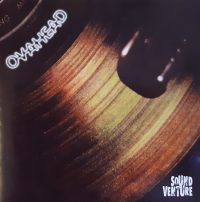


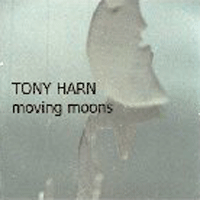







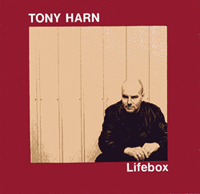
 Misfit City