Often it’s as simple as this – for true treasure, let go of the precious.
Michael Jon Fink (operating within New Music but sidestepping much of its systematic, lab-dulled pretensions) proves it on this album of close-up and subtle music, aided by remarkably sympathetic collaborators – textural guitarist Rick Cox, percussionist Dan Morris, Bryan Pezzone on piano and celesta, and bass clarinetist Marty Walker. There’s something of Gavin Bryars’ evanescent emotional skill to Fink’s music; something of the soft spatial blur of the Evanses (both Bill and Gil); but little of the chart-plotting dryness of a composer after cleverness points. Although Fink’s composing seems to be romantic at heart, he’s well aware of what modernism lets him draw by implication. ‘I Hear It In The Rain’ has feeling in plenty, but doesn’t lay out its secrets that easily.
During Five Pieces For Piano, Bryan Pezzone’s soft playing presses oh-so-gently on our ears. Fink’s music emerges from Pezzone’s piano so delicately that it hardly disturbs the air, as silent as night-travelling stealth ships, yet it sets reactions moving. The musical voicings are widely spaced, just dissonant enough for a shadow of doubt. The melodies are simple – songs from a sleepy child on the road – and it’s Pezzone’s exquisite touch on both keys and pedals that brings out Fink’s intentions.
The sparse sketch of Passing sounds like Debussy, but also like worksong. Its tentative descending melodies touch down in firm but unsettled chords – displaced, jazz-shadowed. Constrained by its skeletal melodic discipline, Mode uses space instead to ask its wordless questions, which remain unanswered by the rising minor-key bass arpeggio of Fragment and the two-note treble alternation which rings on and on – absently, a long-ignored alarm that’s forgotten both urgency and reason and instead beats out its worn, relaxing ritual. For Echo, two cycles of elegantly picked-out notes overlap each other, engaging not like machine parts but like two people caught unwittingly in a loose parallel. The fifth and final piece, Epitaph, draws the harmony together. The sustained, rising rumble of each decaying bass note holds the attention, while a melody in the mid-range takes up the implications of a death song.
This is not about feelings being directly manipulated. Fink’s music induces them, drawing into the gaps and implications between the notes. A lot of it is timing: the attuned sensibilities of a performer and a composer both inspired by the subtle, near-telepathic interreactions of small-group jazz. More of the slender, yet involving, same can be found within Two Preludes For Piano. The first of these, Image, keeps that same poise between amnesia and raptness as the Five Pieces do, tiny details slipping past the pared-back structure of Fink’s notes. The second, Wordless, heads further into the tundra of forgetfulness: the tenor- and soprano-range parts thoughtful and reassuring, but set just far enough apart from each other for disturbance, fading unresolved into the deep evening.
When Fink and Pezzone leave the piano’s subtle, powerful dynamism, they favour the celesta – an instrument which demands (and produces) an exquisite clarity, but with soap-bubble fragility. While the instrument is chillier and less robust than the timbrally similar Rhodes piano (the jazzer’s usual choice for the otherworldly), Fink turns this into a virtue. Initially, For Celesta seems as physically ephemeral as a frost-painting – bright points glimmering on a window – but grows by degrees as Pezzone brings out the full resonance of the instrument’s range. A beautifully sleepy melody grows, reflection by reflection. It’s precise, yet weighted oddly by its slow ebb and return of acceleration; and by the sudden unexpected welling-up of emotional and physical volume midway through, before returning to its soft contemplation.
Elsewhere, Fink’s moods are less compressed and matter-of-fact titles are left behind for more poetic names. On Living To Be Hunted By The Moon (which could be a nod to Gurdijieff’s mythology of soul-eating moons, or to even older fears) Fink builds a landscape of powerful but distant sampler drones. These slant across the sky like angled, endless, featureless walls, each one eerily bisecting the former with a disquieting geometry. Underneath this beautiful and subtly oppressive canopy the marvellously expressive Marty Walker purrs and throbs all-but-subliminal lines on his bass clarinet. It comes across as a supernatural play of light represented in sound, but once again Fink’s near-narcotic sense of subtle disassociation comes into play. His soundscapes hover overhead like a deferred threat, or like a beautiful, cruel and thoughtless god – something to be crept past; something of predatory attentions, carefully evaded.
No such emotional deferral happens on the album’s title track, which is also it’s haunting and lovely finale. Everything that has been promised (or hidden) elsewhere on the album settles home like final snow, or final tears. Where all else has been sparse and minimal, I Hear It In The Rain is luxuriant and gently cathartic. Dreamily slow, founded on Fink’s pedal-point of bass guitar and the gentle rocking motion of his bell-like keyboards, it’s shot through with fluttering orchestra-sized samples of tremulous cellos, blending with the soft rushes of Morris’ gongs and bell trees. Rick Cox’s electric guitars (teased into hallucinatory smears by sponge or glass implements) buoy up the spectral and blissfully desolate melodies, dissolving the emotional suspense in one long resolution; dissolving you too and easing you out through your opening window up into another warm and solitary Los Angeles night.
Words aplenty… I could go on and on to you about the restraint and wisdom in Michael Jon Fink’s work, but what gets me every time is its sheer and honest beauty. There’s a disciplined mind at work here: it’s also one which is in touch with such universality of feelings that praising his deft economy and musical grammar seems reductive. I could pin him down further for you, but what matters might be beyond by reach – though, even as I finish this, it’s come filtering through the air to reach back to me again. Simple. Special. Indispensable.
Michael Jon Fink: ‘I Hear It In The Rain’ Cold Blue Music, CB0004 (800413000426)
CD/download album
Released: 18th June 2001
Buy it from: Cold Blue Music (CD) – various downloads available from Amazon and similar.
More songs brought out of the woods in a bloody enormous bucket, then? A bucket that’s small enough and big enough to hold the moon and all the stars in the night sky, in one drink of water…
‘Hazel’ is a single, of sorts. It’s a little taste of Spratleys Japs, the youngest bud on the twisty family tree of Cardiacs. If you believe some of the yarns being spun about them, then they’re a cunning trans-Atlantic bud, gene-splicing Cardiacs’ abrasive brand of psychedelia (in which punk squawk and London brick-ends collide with a particularly rowdy mediaeval minstrels gallery) with singing urchin Jo Spratley and a gaggle of American high-desert rockers called the Rev-Ups. If you believe some of the other rumours, the hybrid songs that resulted were recorded in a spooky little shack deep in damp, spidery New Forest darkness: head Cardiac Tim Smith going outlaw as he pulled them all together with an audience of rats and a tenuous umbilical of dodgy power lines. Hence my strange intro back there. Hence the babbling.
(Anyway, Cardiacs lie. It’s best to remember that.)
Regardless of rats or forests, Hazel sounds neither young nor American. It’s a stately, ghostly, mouldering-castle fanfare – tear-blown strings, brass, kettle-drums and harps. It wheels massively in the sky like a planetarium show, or booms out low and ponderous like a ritual march. Just as it seems to have settled into its dinosaur vastness, it’s halted by the tiniest thing… Jo’s child-size voice, squished and distorted to a ghost-broadcast tinniness. She sounds seasick, she sounds strained and flattened as wallpaper; and she’s keening out a desperate minimal anti-tune from some dusty corner, words smeared beyond recognition. Everything (bar a shimmering, failing wall of high Mellotron) just stops – dead. Then the Jo-ghost fades, nervous guitars stir the air, and the orchestra pours in again. It’s the same tune, but transmuted somehow from its original pomp into something overwhelmingly compassionate. Then it all happens again. Then it happens no more. What they’re getting at defies the workings of my brain; but it digs up my emotions, as if it’s forking up mulch.
Two other songs – Curfew and the sleepy, knotted Secret, both voiced scratchily by Tim – are closer to the usual Cardiacs bashes. They clamber, jagged and monkey-like, around the whole-tone scale. They’re like folk songs forgotten in the womb, carrying a scolding kind of order in their baroque keyboard structures and the little child-choir voices. Perhaps they deal with more complete stories, on a more human scale: one of the Gothic scenarios which bubbles up is about a woman desperately trying to muffle a pealing bell, using her own body to hold off her husband’s execution. But it’s elsewhere that Spratleys Japs are really active on the borders of instinct: where they’re at their most stimulating. No answers. Exposure. A little fear. Good medicine?
A jarring change of gear after the spooky grandeur of Hazel, Home is just upsetting. There’s not much to it – just some captured seconds of studio chatter during which Jo breaks down into a panic attack, whimpering and gulping like a scalded child. Tim and sundry other SpratJaps leave the tape rolling, heartlessly, as they prepare for the next song. It’s intrusive, it’s claustrophobic, it’s horribly naked. It could well be a prank. But along with Hazel, it does get to the back-ways of the heart. Sometimes Spratleys Japs do this with a soothe, sometimes with a jolt, but they do it as if they’re twitching a curtain aside to reveal something outside the normal angle of view: something beautiful, terrifying or wondrous, but unquestionably there. Something which changes you just by being seen.
Spratleys Japs: ‘Hazel’
All My Eye And Betty Martin Music, AME CD002 (502127203848)
CD-only EP
Released: 2001
One of my small daydreams of alternate pop history involves Clare Torry. Having raised the hairs on the back of my neck with her ecstatic singing on Pink Floyd’s ‘Great Gig in the Sky’, she wouldn’t have slipped away anonymously. She’d’ve gone into the studio with songs for herself and produced at least one album with that voice, that understanding set free. When (on Francis Dunnery‘s ‘Close My Door‘) I first heard Eddy Moran’s arresting wordless vocal soaring skywards – twisting, keening, cracking and surging – I felt that same hair-raising chill. Flashed straight back to the same daydream.
I’m luckier in my dreaming sometimes. Although, for her debut EP as A Girl Called Eddy, she’s not repeating the magnificent Torry-esque splendour that turned my head the first time, Eddy has found other ways to chill me. Her songs could’ve waltzed out of the ’30s, or the ’60s: torch songs set to low glow, fanned into sudden flares by a crack in control. Cool heartbreak in her voice, she’s like a more ambiguous Tracey Thorn. Not someone who’ll glut her despair centre stage: she’s more like someone who you might catch staring at you piercingly from beside the bar, quiet, wise and intent.
‘Fading’ does its bit to draw back the curtains of sorrow. A fragment of Blue Nile lushness, slurs and fake orchestra, it revolves like a ferris wheel trailed by a puff of New Orleans trumpet. Cinematic, but less so than ‘Soundtrack of Your Life’; which – set on capturing the swinging ’60s side of Eddy’s imagination with its bossa lilt and breezy “bah-bah” chorus – doesn’t follow the torch course so closely. But beyond its cigarettes, its memories from film and old photos, its gushes of grand Mellotron and sitars, it has its centre of bereftness. “If ignorance is bliss, then seal it with a kiss, / but it was never supposed to end like this.”
‘Heartache’ – eased along with upright bass, a mascara-slur of brush drums and soft dips of weary piano – brings out the real phantoms of loss. “You’ve seen his face somewhere before. / Now you know for sure / that you can call him heartache – yeah, you can call him that,” Eddy breathes. “Yeah, you can call him heartache – you’ll never get it back.” Ragged memories and the force of erotic imagination are where these particular ghosts live, and Eddy’s well aware of it.
A ghost of another kind haunts ‘Girls Can Really Tear You Up Inside’ – the spectre of a vanished, never-known father. Like the bewildered girl in the song, Eddy simply pieces together scraps. Yet the result is a reverie carrying its own kind of romantic longing – “she’s heard you sing / and that your eyes are very, very, very blue…” In this web of connections and betrayal, there’s as much lurking passion, fear and anticipation as there is in any straight love song. Eddy reveals this, trace by trace, as she rides an elliptical path to its frightened heart, addressing the vanished man as she does so. “Why do you run, / why do you hide / from all you are?” Eddy muses, a dreamy voice of conscience and excitement amongst the traffic noise and the strums of an almost blues-y harpsichord. “You’re just a man, but she could tear you up inside.”
The greatest crack in the cool comes with her take on Stephen Bishop’s ‘The Same Old Tears’, recorded in her Greenwich Village kitchen in a flash of inspiration, with just an acoustic guitar and a divine echo. “Seeing you as an old photograph, it hurts too much to laugh,” Eddy sings, midway between croon, tears and laughter, before soaring off into a beautiful blue plate-cracking keen – “But I’m all right, I’m all right…”
Just for a flash, you see to the knot of the problem, and need know no more. Wanting more is different, of course. Eddy knows this – and, listening to this EP, so do I, now.
Of course, no American musicians ever bear grudges about the demand for fake country bands to fill America’s bars. Nor about the rules of economics and averages, which mean that most professional rock or jazz musicians have to spend a significant part of their career biting their lips while propelling a Formica hoe-down tune towards a beer-splattered dance floor.
William Maxwell’s composition, Bass-ically Country, has nothing to do with this. Nope. It must be a coincidence: the way he keeps pulling his multi-tracked bass guitar out from the cage of those diddly riffs and hilariously plodding walking-blues lines and firing it up into more interesting concepts (a snappy little Stanley Clarke line; a crashing feedback-drenched heavy-metal solo; a dawnlit ambient moment) only to have it yanked back into line and back into the walk.
For about four tongue-in-cheek minutes, you’re getting a portrait of Dreamy Bassist with Ideas locked in combat with Insensitive Band, losing most of the battles but not giving up on the war. Maxwell (generally found playing bass for pan-European/Celtic proggies Tempest) has obviously been there and done that, and is able to laugh at it. Inevitably, Bass-ically Country brings back memories of the late-’80s bass showman Stuart Hamm and his rollicking banjo-slap pisstakes. Some of the aforementioned Dreamy Bassist’s little lines are quite silly, after all, though the naiveté is charming.
In reality, Maxwell’s a much more thoughtful musician than this jokey sketch of bassline frustration suggests. As for dreaming… Well, while the sonic ambitions of his ‘Cardinal Points’ album are sometimes held back by budget (and by too much reliance on predictable synth presets), they’re still very much audible. Deploying his armoury of four-, five-, six- and eight-stringed basses (and backing himself up with some cosy keyboards and percussion), William sets out to explore a typically Western American breadth of music. Melodic electric jazz, New Age, funk-rock, Celtic and light prog influences all gel together. Even the dreaded country music is welcomed into the stew.
Though Maxwell shares Hamm’s taste for transposing classical music onto electric bass, he has a far greater understanding of his source material. His version of Scarlatti’s Sonata In D – baroque harpsichord music arranged for a choir of multi-tracked basses – is particularly impressive. It demonstrates a real understanding of both Scarlatti’s ecstatic mathematics and of that fussy enthusiasm that’s part of the harpsichord sound; while cunningly adding a smidgen of American swing (straight out of Chet Atkins’ Classical Gas). The gently blossoming study of Sweet Dreams (drawing on his early classical guitar training) sees Maxwell pluck a six-string bass with a delicacy and poise John Williams would admire.
Still, technique is a secondary matter on ‘Cardinal Points’. Despite Maxwell’s dexterity, he isn’t offering us a player’s album. He’s as happy when playing a child’s melody or chord wash on synth as he is executing twiddly turnarounds on bass. His true interest is in composition and arranging – his basses are dragooned into illustrating his musical ideas, not flying along on top of them. Rather than pursuing The Great Solo, he spends his time on constructing latticeworks of harmonic chimes, or on an agreeable rumble of conversing fretless and fretted instruments.
The Gold Rush is one of the only moments where Maxwell gives in to any boy-racer super-soloist desires. Fortunately, he does this with jollity instead of arrogance; building himself a piece of music full of skipping strums and curvy chromed planes of distorted EBow sustain, which bounces like an off-road vehicle. Rich Bradley injects a shot of serious jazz, providing a burst of antsy soprano sax (Dave Liebman style) to explode over Maxwell’s heavy popcorn slap. More frequently, ‘Cardinal Points’ sits happily in that comfortably idealised pastoral-prog idiom inspired by bands like Happy The Man or Montreux. Although Carol From An Irish Cabin (its watercolour synths dampening a politely romantic fretless bass) is a step too far towards Windham Hill wallpaper, both The Big Bird and Early Morning Rising follow the path more fruitfully; working in folk melodies and pinches of fuzzy overdriven jazz-fusion to their relaxed, innocent arrangements.
It’s sweet, but not as interesting as the experiments in sparseness, space and counterpoint elsewhere. On Not Tonight I Have A Headache, delicate layers of bass harmonics, thumb pianos and gongs inter-balance each other in a chime of mechanisms; while more basses brew up a blurred but rather beautiful dialogue of growls and stoned-cat noises to rise up behind it. Every Time takes the same kind of chiming bell effects and applies it to a gentrified jazz ballad (with an elastically expressive fretless melody to the fore).
Best of all, there’s the stately (and ever-so-slightly-psychedelic) jazz-rock march of Cardinal Points itself, demonstrating just how much Maxwell prioritizes composing and realizing music over spotlight hogging. Few bass soloists would share their best piece with another top-drawer bassist, let alone two (Harmony Grisman’s sidekick Tami Pallington and the increasingly legendary Michael Manring). Even fewer would make the piece dependent on the subtle collective interaction of all three musicians, rather than on lick-trading.
But that’s exactly what happens here. Pallington builds a silvery canopy of deftly clanging harmonics over Maxwell’s rich twilight orchestration, clarinet-style EBow lines and trick-stepping rhythm. Manring’s own response to Maxwell’s musical hospitality is to turn out one of his finest ever signature melodies – a musing solo slithering luxuriously around the fretboard like a stretching cat in a sunbeam, extending notes into passionate vapour trails via his own EBow. A generous response, it’s one of the high points of a generous album.
William Maxwell: ‘Cardinal Points’
Maxtrix (no catalogue number or barcode)
CD-R only album
Released: 2001
Buy it from:
Best obtained second-hand, or enquire via William Maxwell homepage.
The carefree voice sails back: “Too fast to live, but too young to die. / Undertaking, in overdrive.”
Pushuan used to be the model-gorgeous frontman for glam-punks Vago, but apparently all that time he wanted to be a glamorous hybrid of James Hunt and Steve Harley; all gleaming teeth, waggling eyebrows and go-faster stripes. If not, the title track on his debut solo EP is one of the most enjoyable piss-takes I’ve heard in a long time – a perky paean to motoring excess that ought to be on perpetual repeat on Jeremy Clarkson’s Discman.
With the talents of fellow Vago-ist (and onetime Cay member) Ed Sonsino bolstering the music, ‘Va Va Voom!’ has all the bonkers retro thrill of a fat-motored dragster rally: firing pistons every which-way as it wobbles along, and pushing every cheap disco-rocker button in sight with its cheapo drum machine and raunchy guitar. Pushuan adds to the fun by singing half of it like a grease-monkey and the other half in ludicrous, free-associating posh-Biggles rapping – “hot pant, ball-bearing, gasoline, strip-tease, / party here, party there, posh glad rags; / Martini, Pina Baeur, suntan, October flower, / pedal to the metal on booze and fags…” It’s got the same “fuck you, we’re rich” playboy attitude as champagne and charlie served off a hot engine cowling. If it wasn’t so roaringly camp and you weren’t laughing so hard, you’d be firing grenades at it.
Pushuan is, in fact, ‘Absolutely Fabulous’ on wheels and guitars. As much in love with wriggling his way into the in-crowd as he is with reducing the same scene through parody. The wacky agri-punk blast of ‘Cow’ aside (a goodbye kiss to Vago), this well-crammed EP is steeped in gossip-hungry pop and sardonic whispers. Beyond its hilarious analogue-disco gurgle, ‘The Boy with the Best Disco Tits in Town’ (“looking good, and he knows he’s it… / He puts the F.U. back into fun,”) paints a gleeful picture of the heartlessness of tastemakers. “He’s rolling with the homies and he’s got you in sight, / and you’ve got to be fit to keep pace. / But you’ll get nowhere near the sybarites, try as you might, / if he doesn’t like the look of your face.”
In his more rocking guitar-heavy moments, Pushuan picks at the disaffections and discontentments that fester further from the centre. ‘Clothed Coition’ sarcastically breaks down the horrible jaded slither from sex-thrill to sex-chill. “When a blue eye no longer suffices, / when all that comes to mind are a list of vices, / is it something we can use to slide? / Or is your saddle so high you won’t let me ride?” In particular, Pushuan’s advice for the dumped in ‘Specialise’ is fashionista culture par excellence: a “go, girlfriend” moment where the secret weapon turns out to be shoes to kill for. “You want to make him bleat? The answer’s at your feet… / So you lost your stud, went to your best bud, want to drink her blood… / There’s no need to blush: yeah, you’re looking lush. / You can rely upon what you’re standing on… / Taunting like a tart, make a brand new start. / Baby, must be art – when you specialise.”
Maximum bitchy glam magic.
Pushuan: ‘Va Va Voom!’ Bluefire Records, BLU18 (no barcode number)
CD-only EP
Released: April 2001
Get it from:(2022 update) Best obtained second-hand. No download re-release to date.
Blowing thick darkness, cheery reed-chatter and diva moans with equal facility, Marty Walker has earned himself a New Music name as a leading light in bass clarinet. Over eighty pieces by diverse composers have been written specifically for his particular gifts, and he’s effectively the in-house reedsman for many of the “California school” cadre of composers. For ‘Dancing On Water’ – his first release under his own name on Cold Blue Music – the California school returns the favours. Works from five of its members – the blissful voice-music of Daniel Lentz, the plotted-out ellipses of Michael Byron, Jim Fox’s expansive impressionism, Michael Jon Fink’s lonely, romantic grace-of-few-words and Peter Garland’s percussion-slanted Native American leanings – all juxtapose in different ways with different aspects of Marty’s interpretative approach.
On several of these pieces, Marty gets to stow away his bass clarinet (along with all of its invites to the New Music party) and bring his B-flat clarinet out from under its cousin’s shadow. The close-up duets of Peter Garland’s two-part Dancing On Water sets Walker down next to William Winant and David Johnson’s four-handed marimba. The music neatly folds Mexican folk melodies into minimalist discipline: the marimba clinks with sharp solemnity, both childlike and gamelan-esque. It’s a wily dance of toys, slicing the simple cadences up with unpredictable yet precise spaces. While the clarinet traces similar curves up through the arpeggios, Marty invests it with warmth plus infinitesmal bluesy slides and fades from small-group jazz: a wink in the midst of discipline. Moonlight is the meditation afterwards – a tremolo marimba twinkling like water underneath a much sleepier, dreamier clarinet, Marty coaxing utter expressiveness out of Garland’s clipped material.
On Daniel Lentz’s efflorescent Song(s) Of The Sirens, Marty’s ten overdubbed clarinets are matched by ten overdubbed pianos (played by Bryan Pezzone, another Cold Blue loyalist). But rather than being slaved to a rigid percussive regimentation, all twenty instruments are worked into Lentz’s familiar fascination with overlaid, overlapping vocal fragments. A sensuous undulation of slightly disfocussed pitches are linked by Pezzone’s summery, waterfalling spirals of virtuoso piano; a squadron of tiny icicles falling on the ear.
Amy Knoles’ sighing, narcotised voice (doppelgangered and folded into blurry harmonies and elisions, stacked like sated bodies) provides the siren’s role. This reaches us as a meandering stream of single spoken words – “lips”, “let”, “love”, “air”, “sweet”; “to”, “our”, “listen”, “touch”, “voices”, “you” – all of which are lifted and displaced from their sentences, suggesting an erotic, subliminal hypnosis. As digital manipulation slowly brings the intent into focus, full sentences and melodies coalesce from the haze. Marty’s role here, though, is simply as one (or ten) of the ensemble dreamers, voicing Lenz’s drowsy vision via the clarinet’s sleepy yawning tones. By the time of the stirring, ecstatic finale of piano rolls rumbling out of the trance, he’s not even there anymore.
In the end, it remains the bass clarinet that provides the best bridge between Marty Walker and the composers who seek him out. It’s on that instrument that his expressiveness achieves its most fascinating levels. Certainly it’s fascinated Michael Byron, whose composition Elegant Detours has the most obsessive interest in Marty’s abilities. Byron, however, seems more interested in Marty Walker as a performance mechanism rather than as an emoter. Trapped inside an implied run up a three-octave whole-tone scale, Elegant Detours scurries in super-compressed bursts to explore the possible patterns available. A workout of bass clarinet extremes (from tiny puffs of air to sweeps across its whole range) it ends in lung-bustingly sustained wails knifing the attention to the wall, almost physically painful to listen to. Marty rises superbly to the technical challenge, but it’s frantically clinical. The music seems to feast on itself; like competitive weightlifting, or like laying bets on the frantic mice attempting to escape from a lab maze.
Using far fewer games of structure, Jim Fox demonstrates that he understands the empathy in Marty’s playing. Fox usually works with quiet, beautifully ominous nightscapes and slow-creeping tonalities, and his piece – Among Simple Shadows – is no exception. Trumpeter Wadada Leo Smith blows a transparent and hushed last-post of a tune, which Marty shadows like the last hum resonating from the throat of a gospel bass. Bryan Pezzone’s piano flaps weightlessly in the wind, and casts anxious repeating clots of melody after the mingled brass and woodwind as they move through a dark-blue spectrum of emotions from quiet grief to undefinable hope.
Of all the composers, Rick Cox might have the most fellow feeling for Marty Walker. After all, throughout On Tuesday that’s his own contra-alto clarinet playing in counterpoint to Marty’s bass model. This chokingly slow four-movement duet has more than a tinge of swamp-blues to it – like the last notes restlessly clinging onto the grass tussocks after the funeral procession is long gone and the coffin rests in its mausoleum, floating above the bayou. With both instruments burring and smearing towards the bottom of their ranges, there’s a sense of exhaustion. As with much to do with the blues, there’s also a feeling of unfinished business.
David Johnson (on vibraphone this time) returns to help Marty tackle Michael Jon Fink’s micro-concerto As Is Thought/Aurora. This time, they make a trio with orchestral harpist Susan Allen. A tense set of precise unison arpeggios, venturing warily out into space, are connected and soothed by Marty, whose jazz-inflected way with the shaping of his bridging phrases counters the music-box abruptness of the other instruments. As the piece’s initial trepidation melts, like the dissolution of fear, Allen’s harp comes more to the fore. Each instrument softens, progressively handing the others a tiny cadence of notes to repeat – a canon which clambers on like hands swapping grip-space on a rope, continuing to move outwards.
Overall, ‘Dancing On Water’ reaffirms Marty Walker’s excellence as an interpretative musician, providing a set of multiple masques – or masks – for him to excel in. Still, I’m left uncomfortably whetted and slightly unsatisfied. His generous illumination of the music of others draws me into hankering after other aspects of his musicality – the creator, the improviser; the Marty Walker who’s drawn on his own music to provide that illumination. Hints of this are dotted all over ‘Dancing On Water’ in every cunningly bent note, in every hint of intelligence drawn from outside – even in the times when he steps back into the ensemble, upstaged on his own record.
There’s power in a name. Perhaps Marty Walker’s name, and his musical identity, has become too powerful to let him play second fiddle on his recordings. ‘Dancing On Water’ certainly showcases his talents, but in comparison to other Cold Blue albums – each firmly stamped with a composer’s identity – it feels like a picture of a man grown just a bit too big to comfortably wear other people’s handed-over suits in his own house.
Marty Walker: ‘Dancing On Water’
Cold Blue Music, CB0005 (800413000525)
CD-only album
Released: 5th June 2001
“Well, you got so down you went to town and bought a brand-new top. / They can take your will to live but not your will to shop. / Try to eat more ‘cos you’re hungry, and less because you’re lonely, / and don’t let that feeling fade away…”
Oxford pop pixies Holy Roman Empire seem cheerful to sell themselves as being crap. Their press-kit is full of reviews slating their appalling clothes, their mimed performances, their (allegedly) pitiful singing and their clunky tape recorders hidden inexpertly under keyboard stands. Yet they don’t half shoot themselves in the foot by coming up with such good songs.
Bloody hell – if this had shown up in 1989 it would have swept all before it. Not every song blends – so successfully – lyrics like a playful junior Morrissey with mock-pomp Carter USM Casio orchestrations and rounds it off with the cruising freeway feel of Chris Isaak’s Wicked Game. Back then this would have been a small Holy Grail for student radio, ghosting through every university bar across the land. Here and now it can only settle for being classic, timeless pop – whatever the clothing.
In case I’ve not made my point yet – Dante’s Inferno is marvellous. It’s one of those rare songs which fey critics, hung-up on the sublime disposability of pop, always whiffle on about. Well aware of the ludicrousness that lies at the heart of obsessive passion – and of the dramatic pretensions of pop music – it still goes at it full-tilt because it knows that that’s all that matters. (As a bonus, I can still believe in the song even as I reel off this kind of posturing shite… that’s high camp for you.)
Holy Roman Empire ‘s Ste Fleming and his two foils sigh as milkily as Prefab Sprout and deftly nail the paradox of all-consuming unrequited love. “You go to the doctor, and the doctor feeds you pills. / You know you need them, but you need the pain they kill. / All because you lost somebody, but never lost the feeling, / and daren’t let that feeling fade away.” Inevitably the other two songs are anticlimactic after this glorious Moulin Rouge gesture. After all, how do you follow up a song which has a ringmaster on the chorus?
Still, Holy Roman Empire can quick-march a long way on what they’ve got. What they’ve got happens to be a batch of cheesy keyboard puffs, an upbeat chirp of melody, a vocal style best compared to a pomp version of Rod, Jane & Freddy, and some of the sharpest lyrics this side of Paddy McAloon’s teenage-fluff drawer. I Bleed Petrol (punctuated by cute car-crash sound effects) could almost be a children’s singalong. Then again, there are lines like “city kids with sicknesses, and flowers placed by roads, / melting polar icecaps and the flooded southern coasts”, suggesting that the trio have made a noose out of a skipping rope and are trotting out in search of a symbolic motorist to lynch.
No Tomorrow is a bizarrely happy-sounding love song about… yes… everything turning out shit in the end. It’s a fiddling-about with goodbye ribbons as the city burns. “I was sort of wishing – yeah, I was kind of hoping, / as the ground got closer, that my parachute would open (but no…) / ‘You have to be strong now: you have to let me go,’ / so it’s off with my head and it’s on with the show.”
You have to reckon that as long as that tinselly backcloth is still there, Ste Fleming will stay happy. Supercheese wins out, then – and mighty tasty it is too.
Holy Roman Empire: ‘Dante’s Inferno’
Bluefire Records, BLU017
CD single
Released: 2001
Sidle into the world of The Scaramanga Six carefully. When it’s not simmering in darkness or in the threat of chucking-out time aggro, it’s shrouded in threatening, paranoid twilight or caught in the jaws of mean streets. There’s a jagged, brutally slashing organ; guitars that bludgeon and swipe; heavy beat-downs of choruses; and voices that crack and fray nastily with the surge of the music. This is hard-centred pop music, made by five tough-looking guys in suit-and-ties and a woman who looks like the gang boss’ daughter, taking her own team out to batter the husbands of her schoolday rivals.
Or maybe it’s in the mind. Though the Scaramangas seem steeped in a very English, Godfathers-style violence of petty brawls, drink-fuelled action (“give me some courage, and make it Dutch”) and frustration penned-up in hometown limits, they aren’t numbed by it. Instead, they use it as the spur for a fierce, dramatic rock with the fierce intensity of Pixies, Cardiacs or – most precisely – Six By Seven. There’s an explosive force to Paul and Steve Morricone’s band that equals that of Nottingham’s hard poets of anti-glamour. And if they’re not as sophisticated as Pulp (another ready comparison) they’ve got bigger claws.
The jerking brutality of Are You One of the Family, in which Paul’s grim vocal balances on shards of gasping organ, sets up this EP’s general atmosphere of dirty surrealism. It’s a nightmare of social claustrophobia in which “everything is family – / the cars that pass, the crazy gas that’s surrounding me” and where “everything you see and do / comes back to someone who you are related to.” A place in which there’s no escape from surveillance: “a man will stop and ask my name / I needn’t answer – our names are the same. / I have cousins in the trees; / and, in the bushes, uncles watching over me.”
Ladies and Gentlemen is also family business – ostensibly, it’s a sentimental song, but Paul sings it with a battleship-grey clang which suggests that someone at the party will be going home in a box. “We are gathered here today, in a room sitting comfortably. / Let me shake your hands. / You want to be entertained, you want to be out for fun / and there is someone amongst us here / who I can never forget.” Beyond the funereal organ and the leaden-weight crash of guitars, nothing actually happens… but the Yorkshire Mafiosi atmosphere soaks the air.
Relief from this tension is briefly found in the pop-eyed psychobilly of Grasp the Candle, in which Steve Morricone is let off the leash to trade screams with guitarist Julia Arnez, going for the debaser vote in a shambles of scuzzy drums, Birthday Party crashes and throbbing veins. “I’ve been sharing my bed with the drones from the hive, / I think I’d rather be buried alive… I hear you moaning and groaning – / my love is ripe for the dethroning.”
For Disenchanted Melody, the tension is back – although this time it’s in the even-more implicit shape of a hushed, mantric Slint-meets-Velvets thrum; a hauntingly sour psychedelic vocal drone, filled with foreboding. A guitar sets up a ceaseless metallic shiver behind the murmuring, harshly lovely harmonies and the gathering darkness of the words. “Night collapses suddenly… disenchanted melody / gently washes over me – / the sound is there, / the sound of air…” Even before the final burst of clanging guitar racket and hellish chorale, the air’s been sucked away around the song, whipped off down the streets where the family prowls.
This is a dark and powerful band, who hang around like a threatening cloud even after the music stops.
The Scaramanga Six: ‘Are You One of the Family?’ Wrath Records, WRATHCD01 (barcode unavailable)
CD-only EP
Released: April 2001 Get it from:(2020 update) buy CD from The Scaramanga Six Shop; download from Google Play; stream via Deezer, Apple Music or Spotify The Scaramanga Six online:
Renewing his Cold Blue Music label for the millennium, Californian composer Jim Fox has set himself up as its figurehead, although not in a triumphal manner. Pomp and flamboyance wouldn’t sit well with Cold Blue’s explorations in New Music, and this first new release out of the Cold Blue bag doesn’t need to grab attention, anyway. The two Fox compositions on this album (slow-moving, implicatory, atmospheric and deliciously disturbing) surround you instead, like floodwater in the night.
With distractedly moving electronic traces making up the bulk of the music, ‘The Copy of the Drawing’ is rooted in chopped, diced and rearranged texts from letters sent to Mount Wilson Observatory between 1915 and 1955 while Los Angeles swelled from backwater to metropolis. These fragments are recited by Janyce Collins in an ice-queen whisper. Her cold lips brush your ear with a beautifully cool eroticism, its detachment only increasing its power. Often phrases are followed by glassy, ratcheting harmonic sound: as if a telescope, smoothly rotating on gimbals, is trying to take a fix on the target the words imply.
Slithering passes of moth-soft electronics slide around the words as if they’re unimportant, part of the ambient backchat in any place of science. Occasionally almost-vocal smudges of transparent noise ring up in (and fall away from) the foreground: although in some respects there is no foreground, just a slow sub-zero swirl of ambient hints, briefly smeared, like time-exposure photographs. Scrapes and subliminal swarms, jump-starting drifting thoughts in the narration; quick-drowning sounds like disturbances in ice-water or the imprints of decaying viola counterpoint and dying Gregorian chant.
Allegedly, ‘The Copy of the Drawing’ is non-dramatic. But Fox’s placement of these words, the stop/start fragments and interrupted clauses (“a jumbled mess – enough to give you an idea”) suggest otherwise. The phenomena of observed and notated science are often invoked with the reverence with which scientists replace religious awe, but sometimes as a kind of anchor (“light is always the same – water is H2O…”) against the misgivings whispered in brief passes elsewhere. “Self-deficient – diffused self – applied phenomena – name – danger lies in the abstract…” Before long we’ve heard statements of meticulous preparations (“I have put it in three different envelopes – airproof, fireproof, waterproof”) and chilly accounts of emotional hallucinations. “I still heard talking – I have heard babies crying and screaming – like in a photo – babies can hear me writing this – the pictures can talk to me – they’re not lonely – and it won’t stop…”
Explicit disturbance is rare, and Collins’ voice remains uniformly glacial whatever the content of her script. Nonetheless, anxiety and revelation are blended throughout, with the prismatic narrative musing on thoughts such as “No-one may ever have the same knowledge – everything running up and in and out.” Certainly there’s disintegration here – a loss of assurance, causality dissolving into “a possibility – there was such a thing – invisibility… before that – all history – it doesn’t seem possible… / it’s closer if you draw a line – on that line – all depends.” At one point, Collins recites a list which explicitly fails to reduce events, phenomena and states of existence to anything tidy. “Stuff – factors – motion – the perpendicularity – the process – the parts of things – the female principles of nature – etcetera – quite incomprehensible due to its invisibility – something that is true – close by – far…”
Covertly, Fox seems to be attempting to reconcile the cosmological with the personal. Collins’ narration of astronomers’ notes seem to take on revealingly intimate suggestions (“thousands of small pushes a second – inertia is very great”) and equates the paths of cosmic debris with those of people (“one of the incoming pieces of matter – there may be more – they may travel together…”) Maybe it’s a reflection of the gravity of cities like Los Angeles – pulling in immigrants, the lost and wandering, accreting mass as it does so. Maybe it’s an idea about scientists allowing the unsettling parallels of poetry and metaphor to sneak into their notebooks and resound in those working lives which they’ve obediently sealed away from personal concerns. This is observatory music, for certain. But the question of exactly what is being observed here is an open question. It’s one which ultimately leaves you without an answer; although perhaps it does leave you with a cold, indifferently sensuous kiss.
With ‘Last Things’ itself, the sky is lowering. An ominous drop, as Fox conjures up not so much a drone of bass synth as a faraway envelope of it (massed over our heads like apocalyptic cloud) and then rings us round with a distant thunderous fence of bass-register piano, rumbling tectonically and eerily, like the harbinger of the great Californian earthquake. Trapped between stooping sky and unquiet ground, we bear witness to a passionate, wordless pieta in which the dominant instrumental voice (Marty Walker‘s brilliantly tortuous bass clarinet) sounds famished, and as oppressed as we are by the press of sound. Walker’s control is remarkable – he travels between delicate, near-inaudible quivers of notes; great wide splits of sound that crack with emotion; and magnificent mournful coyote calls, summoning up visions of friendless desert vistas.
Relief, of a sort, comes from Chas Smith‘s pedal steel guitar. Almost choral in its breadth, it’s the one truly calming element in Fox’s musical painting. It’s a Pacific palliative which voices itself as distant balm to Walker’s painful questioning, or as a glimmer of light on the crack of the horizon. At around the eight-and-a-half minute mark, sounds like distant foghorns appear in the murk to add their own skein of warning and disquiet. More ethereal, less hungry, but hardly less of a disturbing portent are the rubbing glass rods on Rick Cox‘s treated guitar, hanging dying trails of luminescence in the middle distance.
When ‘Last Things’ fades out, the hope of things resolved has given way to a kind of acceptance. We’ve come to terms with the fearsome displacement and anxiety in Fox’s California soundscapes to such a degree that we’ve probably failed to notice that he’s finally resolved the music with a chordal and dynamic shift so subtle as to almost escape notice – like life settling itself in, a warm beast, around the jags, harshnesses and daily warnings of a threatening environment.
Jim Fox: ‘Last Things’ Cold Blue Music, CB0001 (800413000129)
CD/download album
Released: 19th March 2001
Buy it from: Cold Blue Music (CD) – various downloads available from Amazon and similar.
Interbreeding the subliminal and the upfront, German ambient duo centrozoon first showed up in 2000 with the self-camouflaging, superbly effective ‘Blast‘. Icy and transformative (an album of elusive, subtle yet uncompromising music for a dissolving world), it was a deliberate hollow grail; an eerily crafted emptiness masking or bypassing outright emotion. The occasional fragmentary synth-pop hiccup broke this rule and humanised the duo (like a brief giggle or fart in the meditation), but ‘Blast’ was mostly all hints and invisible statements – a ghost-impression of grandiosity, a sumptuous erasing.
The six tracks of the follow-up, ‘Sun Lounge Debris’ (put out on the quick-release art-rock label Burning Shed rather than, like ‘Blast’, on the more impassively arty DiN) turn out to be the product of a single day’s recording. With ambient groups being what they are, and the rapidly diminishing returns of minimal textures, it’d be fair to expect a series of belated out-takes. Markus Reuter and Bernhard Wöstheinrich could have exposed themselves as blanded-out or hopelessly jumbled: at best re-treading the magnificent, displaced atmospherics of ‘Blast’. Fortunately, centrozoon’s taste and inspiration are very much intact, and they’ve added some healthy lust and humour to the mix.
Admittedly, ‘Sun Lounge Debris’ doesn’t have the quiet and eerie impact of ‘Blast’. The disordered-lifestyle title makes that implicit, whether the centrozooners are suggesting a J.G. Ballard dystopia or simply admitting that they, too, sometimes like to lie around in a mess of crisps, magazines and tanning lotion. The music – disparate and different in its swatch of moods – also indicates that centrozoon aren’t prepared to plough that same impeccable furrow as they did on their debut. In certain respects, ‘Sun Lounge Debris’ resembles a collection of miscellaneous objects picked up on a bright afternoon. However, any randomness is rapidly offset by the connective, collective intelligence which centrozoon exhibit, and by their clear eagerness to develop from their previous wintry and self-absenting perfection and move towards questions and delicate musical quirks.
‘Sun Lounge Debris’ pieces come, roughly speaking, in pairs. Two of the tracks, ‘Tales of Children in Trees’ and ‘Harvest Girls’, reveal depths (or, more accurately, widths) to centrozoon which have previously gone unnoticed. More on those later. The two remaining pairs take inspiration from the texture-based constructions of ‘Blast’ but move the ideas elsewhere.
From the throwaway ironic/pedantic titles, one of these ambient pairs suggests game-playing at work; toying with expectations. ‘This One Will Please You’ could’ve been a ‘Blast’ outtake, were it not for its warmth – it’s a cosmic Mistral, entirely composed of atmosphere, thoroughly sunny and swimmy. The second – the displeaser – is darker, but where ‘Blast’ suggested urban dissolution (chilliness, shapes of buildings yielding to vapour) ‘This One Won’t Please You’ implies some more rural outlines. More forbidding than its brother, it possesses a similar softness: perhaps a musical impression of the darkness hollowed out beneath the forest roof. The sinister side is provided in a sense of waiting for something unknown, something as yet unshaped in the mind’s eye.
Less cohesive – but bolder – than the ‘Please’ tracks, another pair of centrozoon experiments jolts the project into more radical dynamics. ‘In Sable Orbit’ is the most immediately striking of the two. As mushroom clouds of pipe-organ sounds are put through the MIDI wringer, pitches are set afloat in choppy spasms so that they billow in a vast and giddy skyward swell: a scrap of Messaien nightmare trapped in a Zeppelin. ‘Several Chilled Wives’ follows the same approach with a little less alarm. Beyond its lazy, inexorable and monstrous lurches a circular harmony reveals itself, like the boundary of a horizon.
In almost all of these it’s unclear as to which noises are coming off Markus’ heavily processed and looped Warr Guitar and which emanate from the voice-banks of Bernhard ‘s synthesizers. In spite of their very different musical motivations – Bernhard spontaneous and iconoclastic, Markus scholarly and studied – both centrozooners are able to morph together without an evident join, as they did for much of the frosted blend of ‘Blast’. ‘Harvest Girls’ – one of the two serious centrozoon digressions on the album, and the one that gives ‘Sun Lounge Debris’ its explosive, bliss-struck opening – is very different, and shows us what happens when centrozoon let themselves fall open into those two halves.
It’s revealing. While Bernhard blots an immense, swirling, stained-glass flange noise from his keyboard onto the sky, Markus lets rip with a richly melodic overdriven buzz of solo – an ecstatic Robert Fripp whoop. This is the polar opposite to his usual textural playing, with its concealing nature – this is a lusty, ascending and liberated firework spray of rock tensions, as healthy and randy as a summer party. The nasal-toned scurries and wails are closer to the excitement of Vaughan Williams’ ‘Lark Ascending’ or to Joe Satriani’s triumphal histrionics then they are to more expected influences like Fripp or of Trey Gunn, with their devotional dissonance. The joy is unfeigned, but unashamedly synthetic in its plastic textures: you can hear centrozoon revelling in the fact. In response to Markus’ blaze of guileless prog-rock romanticism, Bernhard sends a cheesy synth-pad of concerto strings rebounding off the clouds. Apparently intent on mutilating any of the dodgy presets which he can entice out of his gear, he also offers up an undulating bass synth boom plus a taffy-stretched swathe of electronica which sounds like an evaporating glass harmonica.
‘Harvest Girls’ could be centrozoon trying on the bristly mantle of rock piggery and loving it; but ‘Tales of Children in Trees’ propels them forward into the world of dance. Those smooth swirls of ambience and the synth chuckles could have come from anywhere else in their ambient past and present, but they’re all tossed on a hustle of jazz breakbeats: a thinking pummel, assured and dominant. As an album closer, it suggests that centrozoon are already off their loungers and in fervid motion. If you came by to relax and slob out, you’re already too late. Next chapter engaging…
centrozoon: ‘Sun Lounge Debris’
Iapetus Records/Burning Shed (no catalogue number or barcode)
CD-R/download album
Released: 21st February 2001
On last year’s ‘Mathematics’, Dan Black (the voice, face and most of the limbs of The Servant) lifted the lid on a peculiar pop world, fascinated by the chasms between reality and imagination and between formal order and animal madness. ‘Mathematics’ was a dance of numbers, monkeys and peculiar people-watching, jamming in suspicions of murder, deranged Bunuel-ish aristocrats and shopping mall alienation. Unusually, its sonic palette was just as wild as its subject matter. It was as chopped-up and mercurial as it was catchy and danceable, emphasising Dan’s omnivorous sampler as much as his peculiar sneer (thin and venomous, but in its way the wildest and most devil-may-care British pop vocal this side of Billy Mackenzie).
With Chris Burrows now recruited to the project to beef up the guitars, ‘With the Invisible’ hints at being a more conventional follow-up to ‘Mathematics’. In many ways, it is. It’s less extreme, more aligned towards the needs of a guitar band: the sounds are much less wild and varied, with less cunningness required to ensure the gelling of the musical ingredients. Hell, it could almost be Britpop; albeit at the Pulp end as opposed to the Shed Seven end. But I’m not convinced that this means Dan Black has shot his artistic wad. In fact, I’ve a suspicion that where ‘Mathematics’ rattled the cage of the fantastical, ‘With the Invisible’ (right down to the title) documents Dan’s interaction with the everyday – the office jobs, adverts, commuter rushes, conspicuous consumption and car ownership that most of us take on continually and take for granted.
Certainly ‘Biro’ is about sulking in an office, your mind scrabbling desperately for escape either in desk-based sculpture, the limited options of the office party (“wet-look in my hair?”) or violent fantasies – “I just killed my new boss / shut that cock up, with a rock, / non-stop in his face, / and what a smug face.” Inevitably, it concludes “it’s plain to you and it’s plain to me, / there’s nothing for you and there’s nothing for me,” but it has a colourful time getting there.
With that admitted, the next question is how to live under those circumstances, if at all. The brass-pumping ‘Milk Chocolate’ is a rebellion, which finds Dan capering under the motorway next to a blazing bonfire. Systematically, he’s burning all of his possessions from hi-fi to furniture right down to his clothes, trying to shake off the packaging of the modern world. But with “milk chocolate pumping through my heart” the contamination of consumption has already reached to the core of him, leaving him with the logical conclusion of joining his own trash on the fire.
Or not. The bodypopping, Prince-like, bubblegum funk of ‘In a Public Place’ suggests an accommodation, even a brainwave to slake that thirst for stimulation. Art gets made, covertly, in rush-hour. “Among stumbling commuters / I think about each step, / not where I’m trying to get.. / In a limited space, / I try to find a cube for me. / With suble changes of pace, / I move through various densities.” There’s even peace to be found – “watching people move, / they appear to groove / with the invisible.”
For a while, our man seems happy in a formal suit and in step with this world. By the time the White Town-ish synth pop of ‘Driving at Night’ shows up – deliberately tidy – he’s possibly taken it too far. “I try hard to be like I’m in an advert / as we descend upon upon the M1.” Before long, though, The Servant are back to poking holes in the fabric of the world again, trying to expose the workings. In the Jam-versus-hip-hop bust of ‘The Entire Universe’, this happens via rampant, tongue-in-cheek paranoia. “How can I trust my own memory? / Did what I thought I saw before occur?” yammers Dan, almost with relief, as flute shrieks and silvery Indian strings zing off the barking guitars. “How can I trust my own family? / Maybe they’ve lied for years to me.”
By the finale, ‘She Cursed Me’, the music is heading back towards the heady mix of sounds that characterised ‘Mathematics’: ironic tinges mixing with intimate pastiche, music box interludes, bright dreamy shifts of mood and texture with a sharp mind manipulating them. And Dan’s narration has moved well clear of city rules, looking backwards to villagey beginnings, the first stirrings of curiosity (“she cursed me with impatience / and I need to follow clouds,”) and the repercussions of actions (“our conversations by the pond / I wonder if they’re still going on – / swimming on the gluey pool, / around the church and up to the school.”)
The Servant are still marching to their own inner promptings; still bouncing on the shock of impulse. Still the colourful alien probe that’s embedded in the mundane. Keep watching.
The Servant: ‘With the Invisible’
Splinter Recordings, SP003CD (5 038622 102326)
CD-only mini-album
Released: 22nd January 2001 Get it from:(2020 update) CD best obtained second-hand; stream from last.fm. The Servant online: Additional notes:(2020 update) The Servant split up in 2007. Dan Black moved on to a solo career; Trevor Sharpe has played in Deadcuts.
Picture Center: ‘The Wonders Of God’s Heaven And Earth’
A beautifully understated fatalism hangs, both heavy and light, over the music on Picture Center’s first album. It reminds me of the last time I was – God knows why – wandering on one of the muddy pebble beaches along the Thames Estuary, heart carried like a windsock, fumbled at by a half-hearted drizzle; and when I saw a lonely seagull poised like a pinned crucifixion in the air, almost motionless. Every now and again there was a single convulsion of wings, but the bird always seemed on the brink of a slow, agonised slide down the bank of the air. I remember thinking that it must have been moving forwards once, but something had paralysed it in the middle of a wing-beat…
The words “together” and “forever” haunt ‘The Wonders Of God’s Heaven And Earth’. Persistently returning – sometimes as statements of peeling faith, sometimes as a grim acknowledgement of being stuck. Sometimes a question, hopeful or semi-resigned; the gamble of a last lottery card; the last sarcastic murmur which is the sound an illusion makes as it leaves the body. Another word that returns is “whatever” – breathed out as a throwaway, or embraced with no complaint beyond a drop in the volume and a withdrawal into the kind of shrug that says “here’s as uncertain as anywhere.”
This is familiar. Picture Center have a connection with the late lamented Field Mice… well, more of a fumbled kissing connection, really (they shared some people once, but not any more). Consequently, they’re part of that downbeat English indie bloodline that winds through Sarah Records and its Shinkansen successor – the one that carries the heart-lorn and introverted folk music from the lonely post-war estates – while the countrified, Celtified melancholia of songs like Useless ties in with the romantic resignation of Belle & Sebastian or The Blue Nile.
So, as you’d expect, the pace is wistfully dragging, almost funereal. Girls’ and boys’ voices whisper, tears are long-dry but faces stay crooked. The guitars sigh out the emotions, a mist of greyed-out pearls hanging in the atmosphere. A particular poignant English gloom prevails – wan air; not enough daylight saving; and little towns that aren’t so much sleepy as catatonic on tranquilisers, smack and inertia (“around in circles, but nothing comes of it”). The washed-out-but-beautiful album cover could be a stony beach, or a hill of puffy blossoms… oh, or the soggy styrofoam’n’plastic debris left behind in the fields after the festival closes. Distilling an unusual beauty from such unpromising ingredients is Picture Center’s particular talent.
You can think of psychedelia as colourful, but there’s another strand of it that’s a billion shades of grey and merely half of a painful, ghostly heartbeat away from reality. And that’s where Picture Center live; acknowledging it in their gliding, spectral cover of West Coast Pop Art Experimental Band’s Smell Of Incense. It’s heightened by the other elements they allow to soak into the mix – the occasional country curve of a lonely guitar, the fretful Sigur Ros falsetto and drum-machine bubble on Dreams, the pressed-out Julee Cruise sigh of Forever. The tired glimmers of Cocteau Twins moondust or the hinted imprint of hip-hop’s loops and scratchy gusts behind the music-box delicacy in Never. You know they’ve been there – that place where sorrow floats, suspended in its own little bubble while reality freezes your face into something that’s calm but drained…
Ten pictures of fading dreams, drawn-out disappearances, fateful accomodations (“without my darkness your star wouldn’t shine / You need me like I need you…”) and stories of nothing-going-on, in which despair and beauty still manage to sit hand-in-hand on the same worn-down furniture, and achieve a kind of peace together.
Picture Center: ‘The Wonders Of God’s Heaven And Earth’
North American Recordings, 5 030820 012704
CD album
Released: 27th November 2000
“Driesh” sounds like one of those arcane words which early-Noughties art-rockers festoon their work with. It’s actually the name of one of Delicate AWOL‘s favourite mountains. When not hiding out in Stockwell recording increasingly soulful post-rock melodies, they’ve got a taste for scrambling cheerfully up the heights of the Scottish highlands, all fleeces and crampons.
On the subject of mountain climbing (sort of), Delicate AWOL are still ascending. ‘Driesh’ is their finest EP to date. It’s not a question of ambition, more one of balance. Delicate AWOL have never sounded more balanced, more aware of music as an expression of what is instead of what you force it to be.
The magnificent ‘Dust’ – a majestic, footsore sway of poignant, lead-heavy guitars – demonstrates this principle. The first time you hear it you have no idea what it is: you’re just caught up in Caroline Ross’ powerful and moving, yet surrendering, vocal. The second time, you realize where the surrender comes from. This is a paean to pollutants, no less: small things which change our immediate world with neither our volition nor our involvement. And this is a song that finds, without a hint of irony, beauty in these changes; honing that balance with acceptance and a fine-art vision. “Dust from satellites fills the skies, / lends an orange hue to buildings they designed in grey /… Dirt from satellites coats the meteorites, / shares its redder touch with rocks that are mostly dust. / And I give thanks for dust.”
Off to one side, ‘Evergreen China Prairie Tribunal’ is one of the band’s affectionate amblings into mutant country/Hawaiian instrumentals. Short guitar notes are stretched lazily and luxuriantly during their brief lifespans; slide guitar, flown behind like a kite, does some happy yawning. The drums and bass patter on, chattering like a pair of old mule drivers on a slow road.
On the other side, the quietly swarming clang of ‘Moggie’ is one of Delicate AWOL’s periodic nods to Mogwai’s crowded fuzz-riffing. However, it’s more homespun, imbued with a positive energy rather than Mogwai’s rampant insecurity. Where Mogwai are tight and tense, Delicate AWOL are endearingly woolly: they’re unconcerned with occasional sloppy accents, and lessen the weight on the guitars to let light sliding curls of notes unravel from the ends of the song. Caroline’s soft, half-buried wail drifts in like a cat singing in the hallway.
Only one song on the EP goes against this serene and meditative stasis. In the languid, perturbed awakening of ‘What in the World to Do Ingrid’, Caroline serenades a woman whose stasis is a matter of routine, and an unwelcome routine at that. “Had enough of breaking bread, / had enough of freaking out. / What in the world to do, Ingrid? / Summer will be here sooner now.” As faintly ominous guitars stir against Caroline’s questioning, they hint that Ingrid’s own nature, under stress, is beginning to crack both her routine and her normality. “Rising inside her – / another, more beautiful woman. / Caught another glimpse of her, hiding in the mirror frame. / What in the world to do, Ingrid? / she’ll be taking over sooner than…”
Just when you think this is going to turn into another tale of a woman slipping into madness, there’s a happier transformation. A joyous hand-clapping lift and gurgles of Hammond organ (the latter straight out of old Memphis R’n’B), and the song becomes a story about stripping off the safety of a firm uniform in favour of striding off naked but unburdened. Caroline sings out another question – “Could it be worse?” – but with the brightening quizzical tones of someone who knows that it won’t be.
Delicate AWOL: ‘Driesh’
day Release Records Ltd., DR401 (no barcode)
CD-only EP
Released: 20th November 2000
Buy it from:
Long-deleted – try to find this second-hand.
Radiohead are history. And they know they are: elevated into a pantheon of great expectations and rock landmarks a mere three albums into their career, and somewhat against their own wishes. Like a latterday Pink Floyd crossed with Nirvana (with the universality of both) they’ve had the rock world at their feet. But they’re also fully aware that, like Miles Davis before them, they need to let go of an expected history before they congeal. Embracing the difficult development of their own history by allowing – or forcibly inducing – change to come through.
So it’s goodbye to Old Radiohead’s upfront army of rock guitars, Thom Yorke’s frenzied in-yer-face angst, and those singles scooping at the soul like the hook in the fish’s mouth. And all the talk of the band making a record that mostly junks standard concepts of guitars, lyrics and pure song in favour of Warp Records-style electronica and muttering left-field oddness has turned out to be true.
‘Kid A’ does indeed have no singles and no singalongs – lovesick, punch-drunk or otherwise. It has a bleary, fractalized, impersonal mountain-scape etched out on computer for a cover; a lyrical agenda which is plainest in its absence. And its diverse pieces are deliberately disassociated from each other. Sometimes chill, sometimes as mechanistic as automata moving in a warehouse; all strung-out and scrambled by filters, Pro-Tools or anti-technique. Trusted “recorder” Nigel Godrich plays an odd mixture of Eno and Albini roles, squeezed alongside the band in the producer’s chair. Sometimes you can hear a band member at work, untweaked. More often you can’t. It’s like a set of glass cases enclosing specimens, puzzling specimens of music pulled up and laid out with a firm “that’s what you’re getting – goodbye” sense to it. Anti-pop, not pleasing anyone’s appetite for a snackable chorus.
And already (to filch another Yorke line) the knives are out. Radiohead are busily having their seams ripped open and their functioning organs speared, teased out and compared scrupulously against charts; a list of names marking off the components of ‘Kid A’ track by track. And, increasingly, marking it down. “Charles Mingus, Autechre, Alice Coltrane, Boards of Canada, Aphex Twin…” goes the chant. “Rip-off. Buy the originals. Who the hell do Radiohead think they are?” And yes, none of ‘Kid A’ is as groundbreaking as any of those recorded texts, which Yorke and co readily cite as influences. There’s no element that a student of improv, post-rock, serious electronica or revolution jazz won’t have heard already. But this also means that one of the world’s biggest rock bands have admitted they’re at least as much learners as teachers. Sounds like cause for celebration to me.
In fact it’s other legendary records – the likes of Robert Wyatt’s ‘Rock Bottom’, Scott Walker’s ‘Tilt’ and Robert Fripp‘s ‘Exposure’ – which ‘Kid A’ is most genuinely akin to. Each of these records strives to meet its ends by a mixture of instinct, cold science flushed hot again with consuming passion, and their own secretive internalised logic. It’s a big step going from ‘OK Computer’ (one of the most explicit and upfront records of the ’90s, in which Thom Yorke was a incandescent clench of ego; stubborn, scarred, and railing against the draining fear and indifference of the adult world we’re trained for) to a twenty-first century record which is as weirdly egoless as this one is. An inarticulate speech of the heart via samplers, hazard and evasion.
Significantly, the most memorable and accessible song on ‘Kid A’ (the tear-blown strum and shivering strings of How To Disappear Completely, echoing both King Crimson‘s desperately vulnerable Waiting Man and Walker’s cryptic Patriot) sees Yorke singing softly and acceptingly of the ultimate relinquishment. Drifting away from himself in Dublin, becoming insubstantial, not as a surrender, but as some kind of transcendence. “I’m not here… this isn’t happening,” he sings, a tired relief (and, almost, a kind of love) suffusing his voice as the quivering violins flutter down, snow-like, obscuring the signposts.
It’s the emotional rightness in ‘Kid A’ that finally pulls it clear of the dissectory attacks people are aiming at it. As if the cry of rage that dominated ‘OK Computer’ is now diffused in a temporarily helpless scatter of images and impulses. As if the echo, coming back, has impacted on a band whose foes and fears are now nested in the fabric of the world, who can no longer respond with a simple song.
The fabulously grotesque artwork (a booklet of nightmare kid’s drawings) that lurks, hidden, in the back of the CD tray, gives a little glance into this world. Stick men boot each other in the balls; small mice squeaking copyright signs wander into the maw of a toothy beast growling a trademark; frightened eyes stare out of threatened houses, and Tony Blair’s PR grin is distorted into empty-eyed predatory lust. A nation of grinning little bears end up on the end of people’s forks or balaclava-clad and tooled up with Kalashnikovs, and a screaming parade of vitriolically surreal words march across the pages like circus handbills. Like the doomsday rhetoric of Godspeed You Black Emperor, it’s almost comical… yet it jolts, like the sound of a chisel stealthily tapping at your wall.
And perhaps ‘Kid A’, rather than being the rebel songbook for this world, is the recovery notes for those as cracked by it as ‘OK Computer’ predicted they would be. There’s a terrible surrender and relief about Everything in Its Right Place, freewheeling along on tranquillised electric piano chording with a slipstream of sliced up, gossamer-keening Yorke vocals tangled in its tail. In which two of the few comprehensible lines are “yesterday I woke up sucking on a lemon – yesterday I woke up soaking,” and “what is that you tried to say?” This is disarrangement, dysfunctionality – not order. Yet Yorke seems to realise that this too has its place in a person’s history; and the sheer beauty of his singing throughout implies there’s hope waiting up beyond the dissolution.
About half of ‘Kid A’ ties in with this dissolve. The clinking music-box-meets-hip-hop narcosis of the title track, a nursery lullaby as rendered by an uptight and drier Massive Attack. Yorke’s bass-warped, filtered and generally fucked voice wavers, croons and ties little musical bows in and out of the pernickety beats, while words about “heads on sticks”, “ventriloquists” and “a little white lie” work their way through the dirty pink clouds. Who blinks first? The gaudily humming electro-disco on Idioteque reveals an empty dancefloor grooving away to itself as catastrophe looms. Yorke, in a slurred keen, is spilling out surreal sub-sense like David Byrne on sodium pentothal (“laugh until my head falls off / I swallow ’til I burst… / Women and children first, and children first…”) but sounds ecstatically happy (“here I’m alive, everything all of the time”), and the last sounds on the track aren’t death-booms but an aviary of feverish guitar loops.
The breakdown’s in the motorik groove of The National Anthem, adhesive thumbstains of bass underpinning a brawling rabble of brass that sound fresh from a vigorous drunken debate at Mingus’ Jazz Workshop or the Art Ensemble of Chicago. Yorke’s voice winds out of the airshaft with a lobotomised “everyone around here… everyone is so clear”: later quavering “everyone has got the fear” as the horns become restive, but affirming “it’s holding on… it’s holding on.”
The other half? Anyone’s guess. The smears and rumbles, the webbing of indistinct voices, the gusts of emotion hurtling up towards invisible targets, all blur the picture. The ghostly tundra ring of Treefingers gives away nothing but a deathly peace. The unravelling trip-hop of In Limbo, full of unhitched folk guitar and stutters of echoed organ, is lost somewhere in the subconscious: grumbling “you’re living in a fantasy world” while itself threatened by nightmares of loss and disappearance (“I’m on your side, / nowhere to hide, / trapdoors that open, / I spiral down”), and finally swirling away in a rush of killing reverb as if down an enormous storm drain.
There are a few dud or ill-fitting moments while Radiohead grope in the fog. Morning Bell, for one, where they knock out a scratchy, swamping, insect-buzzing song which sounds like nothing so much as Echo & The Bunnymen shaking with the D.T.s. Or the tribal tom booms, wiry laceration of rhythm guitars and guilt-ridden lyric on Optimistic, harkening back too much to ‘The Bends’ (or the out-of-focus U2 of ‘The Unforgettable Fire’). But the starved boniness renders these hauntingly hollow-eyed stuff, compared to the previous fire. “If you try the best you can / the best you can is good enough,” sings Yorke, with a scratched, dented demeanour belying his words.
The final act is Motion Picture Soundtrack, journeying on an exultant wheeze of harmonium, celestially riffling harps and gusting bass wind as Thom Yorke settles back into love as if he’s settling back into a wrecked old armchair. And it’s love among the trashed – “red wine and sleeping pills / help me get back to your arms. / Cheap sex and sad films / Help me get where I belong.” Querulous (as he protests “Stop sending letters, / letters always get burned. / It’s not like the movies,”), but there’s happy-sad commitment here as he murmurs “I think you’re crazy, maybe… / I will see you in the next life.” Then one last delayed pink gush of electrophonic orchestration, and out.
But it’s in its totality that ‘Kid A’ sinks into your mind. There’s no way it could ever be counted as a flawless record – in fact, it revels in its flagrant imperfection with such a fierce joy (and one born of abstract willpower) that it’s hard to condemn it for that. But it’s a vitally important record for Radiohead; and a rewarding one for the listener.
The peculiar triumph of ‘Kid A’ is the way that it transcends both its own wanton abstractions and Radiohead’s past explicitness to resonate beyond each of them, in the way that an impact on a random strand can shake the whole web. To hear it is to be haunted by the emotional husks of messages long lost and made irrelevant, or by the impressions left by intentions deflected and displaced into half-formed actions and events. To have your mind rippled by the last exhausted breeze from a shockwave far, far away. To be moved by the vibration of history – Radiohead’s history, at any rate – as it passes.
Radiohead: ‘Kid A’
Parlophone, CDKIDA 1 (72435 2959020)/7243 5 27753 4 7 (72435 27753 47)/LPKIDA 1 (724352 959013)
CD/cassette/10-inch double vinyl album
Released: 2nd October 2000 Get it from:(2020 update) buy/download from W.A.S.T.E. Store, Google Play or Amazon Music; stream via Soundcloud, Deezer, YouTube, Apple Music or Spotify Radiohead online:
Steve Lawson: ‘And Nothing But the Bass – Live @ The Troubadour’
Apparently, this music is what Steve Lawson makes to entertain friends – who make themself known as such simply by showing up to one of his intimate gigs. These could be in London, Lincoln, or Watford; in France or California; or wherever else Lawson and his little bundle of bass guitars, EBow sustainers and looping devices pitch camp for an evening of playing. Having asserted your friendship by wandering in and sitting down, you can smile to yourself about the way his lush, demonstrative instrumental music manages to cross-reference Frippertronics, Pete Seeger, Jaco Pastorius and Joe Satriani (for starters) without them crashing into each other or crowding him off his own playing stool.
You can also smile – with genuine enjoyment – at the sheer guilelessness of his music. The gauche jokiness of the album title is completely accurate. With one exception, this really is all One Man And His Loops live in front of a small, polite and audibly happy audience. But it shouldn’t be dismissed as cutesy novelty, or as circus tricks with effects pedals. That isn’t the half of it. In London, we’re used to anxiety. Self-exposure from tortured musical artists. Cool-by-numbers checklists. Spotlight-grabbing attitude flexers. Obvious-state-of-minders stapling themselves to credible trends, and sinking with them. Hearing Steve Lawson duck all of this (instead, he quietly focusses on the way music connects across generations, and between person and person) is a sweet shock.
On technical terms alone (if not in finger-thrashing stunt display), Lawson respectably holds his end up alongside American stars of the lyrical bass such as Victor Wooten or Michael Manring. But his work showcases not only prodigious playing talent but also a thorough lack of self-consciousness about engaging with his listeners. Maybe it’s from his previous work, playing with the equally guileless and elfin pop veteran Howard Jones. When you hear Lawson duetting with himself on sprightly children’s-song tunes like The Inner Game and The New Country (wrapping joyously squishy melodies around his looped, nodding, double-stopped riffs) you know you’re not hearing someone who’s concerned about his agenda fitting anyone’s T-shirt, or with the solemn rules at jazz school.
All right – perhaps an over-mellow conflation of two lovable old chestnuts (Chopsticks and Blue Moon) on Blue Sticks is a step too far in this direction. All taste and no meat; too close to a musical life that’s one long function room. Lawson dispatches it with impeccable skill – which is all very nice, but a little worrying in terms of complacency. Far better to hear him feeding twanging threads of Celtic-American folk song and bluegrass, Flecktones-style, into The Virtue Of The Small; and to then observe him splitting off to layer on some luxuriously glutinous improvisations (via serenely wandering fretless and classic-metal distortion). Listening carefully, you might spot momentary nods to other bass players – Chris Squire, Steve Swallow, Alphonso Johnson, Stuart Hamm – who’ve let melodies rumble up from the basement.
Of course, you could just put the notebook down and enjoy tunes like Bittersweet, a fretless-bass-and-piano duet owing a little to Pachelbel’s Canon and as much to Weather Report’s A Remark You Made. Jez Carr’s strums of high, cautiously sweet piano haze this one lightly with blue. Perhaps it’s over-aligned with the fastidious, earnestly white end of New Age jazz, but Lawson’s head-bowed cadences are beautifully poised – natural and regretful.
So far, so immaculate… so ‘Bassist Magazine’. What really opens doors are three pieces in which Lawson ventures into process music, chance-and-hazard and ambient music. Thankfully, it’s closer to Fripp Soundscapes and to post-rock than to the freeze-dried fusion on (for example), those slick early albums by John Patitucci.
On Drifting, the original moonlit ostinato foundations and skirling skybound melodies give way to smears of trembling Frippertronical treble passes – like wheelmarks on cloud – and to trance-techno bubble echoes Lawson somehow wrings out of his bass. The lapping sounds and shimmering harmonic nudges of the gorgeous Pillow Mountain (with its sub-aqua heartbeat) are closer to Mouse On Mars than to any bass guitarring this side of Rothko’s post-rocking odysseys. Here, Lawson EBows strange Chinese string calls out of the beautiful murk. A third piece, Chance, clings on (just) to the right side of disassembly. The sharp attack, or mother-beast rumble, of Lawson’s varied approaches on fretless step in and around the frigidly emotional ECM-inspired bass figure at the heart of it, ghosted with minimal traceries.
It’s with these pieces that we hear Steve Lawson’s audience returning a favour. Moving away from simply bobbing their heads to the happy melodies, they concentrate on listening instead. And all without the man breaking much of a sweat, either. For any instrumentalist, this album would be charming. For Steve Lawson, it’s a showcase punched open at one end. His friends are watching him grow – I suggest that you join them.
Steve Lawson: ‘And Nothing But The Bass – Live @ the Troubadour’
Pillow Mountain Records/Bandcamp, PMR 0011 (no barcode)
CD/download album
Released: 28th August 2000
Shot through with aftershocks of abandonment, dispossession, self-doubt and the battle to stay afloat, Rudy Simone’s debut album doesn’t resolve the questions she’s raised before. It doesn’t round off those battleworn displays of uneasy heart from the previous year’s ‘Personal Cloud‘ EP, nor does it offer clear clues about where she’ll be travelling in the future.
Fresh as she sounds, Rudy already has plenty of past. Originally from Buffalo, New York State (where, as Rita Seitz, she sang in various obscure bands during the early 1980s) she turned emotional refugee later in life and crossed the Atlantic to Liverpool, where her own songs emerged amid a landscape of acoustic sessions and nightclub rushes. Most debut albums are a statement, however crude. This one’s a scrambling steeplechase across Rudy’s emotions and her spiritual restlessness. It stays true to the disruptive collisions between the life singing in the head and the life that lurks outside. What ‘To Put The Sun Back In The Sky’ resembles most is an attempt to wrap up Rudy’s fraught baggage in a big, unwieldy brown paper package; to tie it together with guitar strings and beats, to spray it with disco glitter and then set it free somewhere down the Mersey. Drifting seawards, it comes unstuck and reveals itself.
Attempting to cram in all her gushes of inspiration, Rudy ends up with a confusing whole. Seemingly at random, songs appear in alternate acoustic and instrumental alternate versions; there are two takes on the eerie Kill The Cult Of Cool single, and a trancier reworking of Personal Cloud. ‘To Put The Sun Back In The Sky’ ends up as an anxious, fractured goodie-bag, unsure about whether floaty beats are better than strumming, and telling repeated stories in different tones. Don’t expect track-by-track coherence – but do expect plenty of understated feeling, a maverick DIY pop sense in full effect, and some determined songcraft. This album is a necklace-worth of interesting, often touching episodes.
In some respects, Rudy fits in with that rough wave of confessional women emerging in the 1990s via trip-hop and indie rock, including the two Beths (Gibbons and Orton) and Juliana Hatfield. There are some similarities to Jane Siberry; though Rudy is more loosely strung, she shares elliptical, Siberryesque feminine perspectives, blown about by impressions and finding solid little truths in the midst of abstraction. But for my money the artist whom she’s closest to is Lida Husik. Both Rudy and Lida resist committing themselves to any one musical approach or way of looking; both seem suspicious of tradition or sturdy craftsmanship. As with Husik, Rudy’s wispily sweet vocal belies her determination to discover and envision things her own way, learning from time and from chance. Both, too, are peripatetic and intuitive to a fault: they’re both quite prepared to walk into mires of embarrassing self-conscious fluff if that’s where an idea takes them (in Rudy’s case, a misplaced James Brown tribute called Bony Little, giddy and apologetic, in which she bangs on forever about her skinny white ass).
For this album, the club dance elements have triumphed in Rudy’s big bag of sounds – as they did on Husik’s ‘Green Blue Fire’ album four years previously. Techno producer Sheldon Southworth, a.k.a Diffusion, is a vital collaborator for half the album. He’s the Beaumont Hannant to Rudy’s Husik, adding his own club-friendly trance sparkle to hers and replacing guitars with the zing of electronics. For The Secret Sayings Of Jesus, Rudy whispers god-inside Gnostic philosophy, floating it like evangelical thistledown over Diffusion’s bright trance beats and aquatic keyboard textures. Despite her trippy tones, hypnotically soft, the chant is a desperate prayer rather than navel-gazing. It’s a counterpoint to the other songs, which make up a travelogue of delusions to be overcome in oneself or endured from others.
Vanity’s Car perks its way through cheerful Euro-trance and Soft Cell gurgles, but Rudy’s lyrics dwell on how the wrong kind of excitement can lessen a person’s grasp on reality – “amazing how far you’ll go when you lose control – / I’ve got to get out on my feet / and be the things I always wanted to be.” The fallout is clear: “I might be sitting in your living room / but I might as well be in another country,” Rudy protests on Can’t Go There. “You can drive if you wanna, but I prefer to stay on my feet… / ‘cos you’re so blind, you can’t see that it’s right across the street.” Warm swelling synths, glinting funk-wah guitar, and house piano echo that communal gospel glory which Primal Scream tapped on Come Together. Rudy’s own hopes of connection, though, are dissolving.
While Diffusion’s contributions are valuable, there’s no question that Rudy remains convincing on her own. The brief pure-dance diversion of Mentallium hurls rapid drum’n’bass kitfire headlong into chilly trance electronica: to wild things up a little, Rudy mixes twitchy diva calls, jazzy double bass and kettle drums into the instrumental. Out on the other edge of her music, she abandons beats and boxes. A blues-y acoustic guitar version of Vanity’s Car brings its warnings closer to the surface, no longer masked by shiny bodywork. Part pop-plaint, but mostly blues rant, the all-acoustic Water’s Edge sees the banalities of love (“Sometimes I’d like to kill him, / but I always gotta thrill him”) splinter in a glare of rage. Wailing like a cross between PJ Harvey and Etta James, Rudy walks the shoreline, grappling with a moment of agonising choice. Violence is poised within her, ready to strike inwards or outwards, and only the lone conscious voice of the song cries out against it. “Don’t go, you’ll only make your mama cry / Don’t go, you’ll only fuck your baby’s mind.”
As a single, Kill The Cult Of Cool got lost in the no-budget wilds which sank so many others; yet its emotional hop-skip-and-jump was a remarkable coming-together of ideas and instinct. It still is. Broody horror synths, laceworks of folk guitar and a patchwork of voice snippets quilt together into something haunted, defiant and transformative. In keeping with the rest of the album’s repetitions and revisitings, the song gets a double outing (the Derision Mix transforms it into radiophonic electro-funk replete with glitchy scratching and whooshing, frothing Vangelis synth splurge) but it’s the original that really matters. Something of a signature song for Rudy ever since it first showed up on ‘Personal Cloud‘, its cohesive spirit remains clear as its splintered voices ask for compassion, pray for guidance, plant down stubborn feet. “I was the quiet one in school, never made any trouble,” stammers a sampled man; “I don’t care what you say, I’m not crazy,” Rudy adds quietly. It’s full of struggle, though never precisely clear what that struggle is – the claw back to sanity out of the creeping horrors? a defense of alternative thinkers and scapegoats? – yet it’s also affecting in a way in which few things that I hear are.
The spine of the album, though, is the title track and Personal Cloud. The former’s a grieving white-girl rap about a marriage snapped violently in half: here, Rudy sounds as soft-spoken but as wide-awake’n’dreaming as Margaret Fiedler does while puzzling out dreams in Laika. Almost cushioned by the pain, she lets moments of heartbreaking reproach crest over it and into the words: when she murmurs “you say you’re following your heart / I say fear has played a much bigger part”, real agony glints. In a new take on Personal Cloud (remixed by M@2K into radar blips, ambient funk and blue-light electronics) more displaced degrees of mourning are added to Rudy’s grapple with addictions, love and loneliness (“I wrap my lips around a cigarette instead of you…”). Her voice flutters, weightless and bereft: a hydrogen balloon un-anchored by faithless hands.
Maybe ‘To Put The Sun Back In The Sky’ is not the album Rudy Simone’s capable of. It’s more like several different shots at an album: all crowded into the kitchen together, taking anxious and uncomfortable refuge. No clear clues; a spinning signpost; but indications of an effective, if scattered, talent – one worth investing some love in.
Rudy Simone: ‘To Put The Sun Back In The Sky’
Phat Lady Records (no catalogue number or barcode)
CD-R-only album
Released: 2000
Buy it from:
Extremely rare – best found second-hand.
Perhaps I was spoilt by the absolute flamboyance of David Devant And His Spirit Wife (a band of music-hall performance artists in Britpop camouflage, fronted by another Vessel) but I initially found Empty Vessels a bit underwhelming. Billing themselves as a “breakbeat/guitar soundclash”, I was expecting to be walloped around the head with seething snare cracks, to have my arse booted by kick-drum hits and my ears burned by electric wailings (all in a comfortable metaphorical way, mind). I was expecting festival style-ee-ee expansiveness. A sort of Asian Dub Foundation that had been gutted and stripped out, but were still rustling defiantly.
But Empty Vessels are less of a soundclash than a crowded minibus jammed with noises. They sound as if they do their recording in one of those tiny closets in Islington that estate agents try to flog to people as homes… or maybe in the cupboard of one of those closets. The usual claustrophobia of sped-up drum’n’bass-style breakbeats could only be amplified by these cramped, super lo-fi recordings; all skinny and vertical, never laying out when they can tense up. The sort of music inspired by hunching up and listening to hoarded CDs rather than by losing oneself on a sweaty, body-heavy dancefloor. Beat-science with a home chemistry set…
Nicotine is an unfortunate starter: neurotically trapped rushes of synth bass, shrill Killing An Arab-style guitar licks through budget fuzztones, and some pug-dog yelping courtesy of a bloke who sounds like Steve Harley forcibly bundled into a filing cabinet. Skip it for Chew-Up, a smarter shot in which all the beats are turned up and a careening sub-bass runs away with the foundations. Here the fuzzy shoulderings of guitar are a relief from the needling drums. The voice runs like a mumbling rat, complaining but flicking from rhythm to rhythm, and you find yourself wanting to catch on to what it’s ranting about. Empathising too much with your own sampler, it seems. “Chewing up experience, and chewing up experience… / It’s mine! It’s mine! / I acquire.”
Empty Vessels sound best when they don’t sound in control, when they’re running after their technology like it’s the last bus out of town. Sneering Face is one of those intriguing accidents that happen when you have white guys playing gladiatorial black dance music, desperately and unsuccessfully trying to get around their own whiteness, and ending up somewhere else entirely when they fail, sounding pretty liberated for it. While it starts as a wayward attempt at speed rapping (invaded by psychedelic space guitar echo), Empty Vessels have decided to fuck it all off about two-thirds of the way in and go for the ridiculous. Creaky vocal interjections that belong in Jim Henson’s Creature Workshop (“I – ought to teach them a leh-sson!”), seasick bloots of guitar, falsetto operatics wobbling in the background. The sort of vandalism that suggests they meant to do it from the start.
Uptight urban fuck-up music. Tower-block friendly. Angry summer sounds for days when none of your clothes seem to fit. I can’t say I like this, but it’s successfully sneaked into my curiosity field.
Empty Vessels: ‘Empty Vessels’ demo cassette
self-released (no catalogue number or barcode)
Cassette-only demo
Released: 11th June 2012
Buy it from:
The original cassette is long gone, although it was possibly reissued as a Peoplesound CD single which might be available second-hand. These three tracks have since been resurrected on ‘Empty Vessels 1‘, available from Bandcamp
This sticks with me. Unusual. Hardcore punk’s generally a thing of the moment; bringing you alive in the feverish moshpit (or while you’re skulking at the back, trying to listen through to whatever the core of the ‘core is). All that power, that typhoon of ire, just goes through you in a one-dimensional spasm. But under the volume, The Judas Factor (various refugees from Resurrection, Floorpunch, and Indecision) write about souls tender as eyeballs, bared hearts turned to stricken leather, and the struggle for emotional truth within a world drugging and veiling itself into brutal indifference.
When Robert Fish – the remarkable split-hearted voice of the band – isn’t roaring his lyrics flat against the ceiling, he murmurs in a cracked bleed of compassion, full of winded pain and the anger that wings across despair. Or he’ll burn up in a cathartic gesture, the distress flare bringing the message home. “Tongue-tied purist, rich in regret, sometimes it’s all I have… / kiss suicide, that look has found life in my eyes… / sad songs never felt so real / tears never felt so good” – although the descending metal storm of Kiss Suicide itself roots Robert’s identity in pure pain, he’s streets ahead of most punk noise-sulkers.
He could’ve chosen to stew in self-obsessed frustration. Instead, he’ll take things further, picking over the hope that sets us up (“we all want to be victims of happiness”). Or throwing himself unflinchingly into the loser’s diary of One Fine Day, where the job’s finally done by the bluntest possible tool. “Gun in hand, purpose, clear intentions… / All I ever wanted was control… / Now it’s in my hand… / Never should be, but for one sad second I felt control.” In Safety Net he’s sign-painting, putting up warnings for Bukowski’s camp-followers with the ruefulness of someone who’s been there already. “Human wrecks seem so romantic. / Play out that fall from grace one more time… / all we wanted was to find comfort with each other… / comfort for ourselves.”
The rest of The Judas Factor respond with music that fills rooms with rage and loss, led by a thrumming, thunderous bass hanging like a helicopter gunship while guitars paint alarms around it in every shade. And though they can do utterly bone-crushing, heart-wringing power – from the weird grandeur of the mourning thrash that clusters Music Without Person, from foreboding whisper right through to all-too-late nuclear alert – they can still play quiet like a child’s breath. And blend in little glowing samples; little graces of trumpet and heavenly pings swimming up out of nowhere, tiny opalescent Bark Psychosis moments before the mood breaks and jackhammers the heart open again. Even though Robert’s words are torn up in the screaming, clamouring emo-core peaks of anguish, it’s spellbinding.
What genuinely makes ‘Kiss Suicide’ a thing of wonder, though, is November 20, 1999, where everything about The Judas Factor falls into perfect place; from the frantic, muted, blizzarding rub of the instruments to Robert’s trembling delivery. A spoken story of lesbian awakening, aching with empathy and foreboding, it takes you (word by passionate word) to the delicious shock at the centre of that long-awaited first love. The one that draws you out of loneliness. And then, standing horrified, we see it forbidden: shattered in a sudden rush of violent bigotry. “You heard their footsteps and you told her to run. You turned around for the fight of your life. You never stood a chance in the world… In our names another life is taken. All because she loved another woman.” Up until then Robert’s kept his compassionate, anguished fury leashed, but finally it lashes out in a woodsplitting scream – “It’s not just words when we speak the same language / It’s not just words when some live life in fear” – as the band roar down like God’s gavel. Indelible force of heart.
Imagine working at something for the best part of twenty years. Perfecting it to your best ability, gaining a reputation and respect; making a decent living as well as finding a way to make it speak for you, give you another voice to communicate with. And then, all at once, having it taken away from you.
This is what happened to Peggy Green. Up until the point when repetitive strain injury gripped her working hands in 1990, she was one of the most respected pedal steel guitarists in New England; not to mention also crafting her way in private as a six-string player and songwriter. Subsequent neuromuscular complications during the ’90s robbed her, at various times, of the ability to use the blocking and rapid picking techniques which are the staple of pedal steel playing; to work the crucial left pedal of her instrument; to walk anything further than short distances without crippling swelling of the hands; or even to play for more than ten seconds. It’s the kind of situation which unites musicians – via both the heart and the pocket – in a cold sweat. The cut-off, seemingly irrevocable.
No, there isn’t a glitzy TV movie outcome. Peggy has recovered partially since then, but not completely. These days, you won’t find her duelling onstage with Buddy Emmons and Bruce Kaphan; or burning up Nashville pedal steel playoffs with a revitalised, zippier technique; or wearing Dolly Parton hats while having her hand shaken by the President. Life often doesn’t let us wallow in such easy tears and such feel-good endings. But what life can be is dignified.
Constrained by the cold facts of injury, Peggy could have retreated into honourable retirement, taking another job and accepting her loss as some kind of act of God. What she’s done instead does involve acceptance. But humble defeat? Not so. ‘Songs Of Naka Peida’ is a defiantly post-RSI album of pedal steel guitar music, played on a couple of custom built acoustic instruments built by legendary pedal steel maker Paul Franklin Sr. Dubbed “ped-a-bro”s, they merge the penetrating “jump-at’cha” sound of dobro resonator guitars with the flexible bends and glides of conventional steels.
As you can imagine, these are naked instruments – the kind which won’t hide a players errors behind a comforting wall of amplified smoothing. They’d be a challenge for a player in prime fitness, let alone one with hand problems, but Peggy’s chosen to make her way on them. Having accepted the limitations imposed by RSI, she’s dispensed with the flash and trickiness she could previously deploy for showboating country musicianship. Now she’s concentrating on a slow, considered, delicately melodic way of playing – clipped in approach; tailored to avoid the spasms, locks and numbness of the condition: a way in which she can, as she puts it “achieve that old connection between my soul and my hands.” She’s also elected to record in a way which makes every creak of the ped-a-bro mechanism and every shift of the player’s stool discreetly audible, so that you can hear her at work.
It works wonderfully. Peggy offers sparse, slowhand, bluesy playing nourished by lonesome American roots; at the same time she offers short, shallowly-picked notes with an exquisite attention to placement that’s associated more with East Asian music (with the yang ch’ins of China, the kotos of Japan and the assorted zithers of Carnatic music). These precise patterns can – at the right moment – be lifted off the map and up into the air, with just a push on a pedal. All of this is achieved with a patient grace and melodicism, the kind which wouldn’t shame Bill Frisell or Martin Taylor. Not that there isn’t some therapeutic wrestling with demons here. Titles like Achin’ Deep Down In My Bones and Fair Affliction assure us of that. But most of ‘Songs Of Naka Peida’ is – while never transcendently happy – remarkable in its serenity.
There’s also a background concept here. The album has a speculative yarn attached: a self-referential creation with strong flavours of Ursula K. LeGuin. In the stricken, disaster-oppressed Continuum society of the future, Naka Peida is the name of a character – the Continuum’s Chief Archivist. Each song on the album is linked to a story of the rediscovery of Peggy’s music, and its connection and implications to both Naka Peida and the Continuum. Evidently Peggy’s not interested solely in her own healing.
The music travels on, learning from places as it goes. There’s the graceful glissandi of Koroen; the tart, sparkling Indian cascades of Love’s Last Chance; the welcoming Japanese formality of Nakahama (named after the location where most of the album was both written and recorded) or the curving Hawaiian warmth of The Pedalist or Wrong Stop Blue. If the music doesn’t necessarily draw from a sense of place, it can draw from time instead. One of the approaches Peggy uses is to place herself in a particular moment. Goodbye To The Twentieth Century was recorded in Osaka on Millennium Eve, and comes out as the most hopeful piece on the entire album. Affected by its Japanese setting, it also revels in its vertiginous, playfully lovely slides and swoops, in the celebratory birdsong harmonics. For a moment, Peggy even lets the ped-a-bro sing with the jazzy bends of Billie Holiday.
The three-part Improvisations In The Moonlit Dawn (billed by Peggy as being “the closest you can come to sitting with me while musical ideas are being born and tried out”) comes from a February morning, closer to home in New York. It’s more sober (Five Note Blues is positively respectful) and more American (you could even expect Robert Johnson to be moaning over Evening Turns). Finally, it’s brasher when the punchy, multiple stop-and-slide slowhanding of Make Way For Dawn makes its presence felt. Assertive, muscular and far more assured than you’d have expected, it still loses none of the delicate melodicism of the rest of the album.
“My struggle against the adversity of my injury makes me the player I am today,” notes Peggy. Whatever she may have been before the axe fell, she’s a pretty remarkable player now. Without much of a big sound, without banner-waving, this album is quietly inspiring and humbling: even profoundly moving.
Peggy Green: ‘Songs Of Naka Peida’
Peggy Green (self-released), MHG737 (no barcode)
CD/download album
Released: 27th June 2000
Porcupine Tree have had a funny time of it in their decade of existence. Maybe they asked for it: psych-rock underground heroes with a pipeline to rave, then prog hopefuls loudly damning the prog scene, then heading determinedly towards an indie sector that’s unprepared (to put it mildly) for music and musicians of their ilk. But their journey’s maintained its upward curve free of busts and inner bust-ups; and the sidelines and brother projects thronging round them – No-Man and Jansen Barbieri Karn’s art-pop, Bass Communion‘s ambient electronic gubbins, Ex-Wise-Heads’ world music, even IEM’s scraggly Krautrock and plunderphonic cut-ups – show that Porcupine Tree are no stick-in-the-mud rockers, and that between them they’ve got a mind that flies far and wide across the musical landscape.
I reckon, though, that were you to cut the Porkies’ headman Steve Wilson open right down to the core and take a look at his heart, you’d find “songs” written on it in flowing, joined-up writing. And for ‘Lightbulb Sun’ (as with its equally song-heavy predecessor ‘Stupid Dream’), Wilson’s made a pronounced effort to finally yank his band clear of that neo-Pink Floyd, instrumental tag that’s dogged them for years. The extended melodic jams of old have taken a back seat to sharply-wrought melodic pop songs; and the rackety Hillage/Khan riffery of that abrasive 4 Chords That Made a Million single sits oddly on an album that’s as distinctively English as cucumber sandwiches. By the river. In Winchester. Plus with Dave Gregory welcomed into the production proceedings (mostly for string arrangements but, one suspects, in general spirit as well) large parts of ‘Lightbulb Sun’ harken towards XTC’s English pastoralism.
Although any XTC guile which might’ve adhered to these wistful songs of love and lost summers has been filtered out en route. Last Chance To Evacuate Planet Earth Before It Is Recycled plays at mixing the first stirrings of adolescent love with the grandiose deathwish of the Heaven’s Gate cult, but it gets no more ambitious than that. Directness is the hallmark of ‘Lightbulb Sun’ – perhaps the title track (about a sick schoolboy coddled and recuperating in bed, enthralled with the unreality of fever vision) has a drug subtext with lines like “I’ll only take medicine if it’s followed by sweets”, but it’s just as likely to be no more than it seems.
Episodes of childhood that stick in the memory are as much part of the thoughtful nostalgia anchoring the album as the retrospective daydreaming of Where We Would Be (ending on a bewildered-but-wiser note of “strange how you never become / the person you see when you’re young”). Or the lover’s angst in songs like Feel So Low; in which our Steven, playing that “who breaks the wounded silence first?” game, loses outright (although it was probably worth it to hear that string quartet cry with you, Steve).
And though it has its dark side, ‘Lightbulb Sun’ is a record that welcomes little gushes of warmth. The sound’s warmer than anything Porcupine Tree have tried before: with a big fresh drum sound plus acoustic guitars, banjos and hammer dulcimers to change the previous clean space-rock to something more homespun. Wilson’s electric guitar heroism’s not as overwhelming as before, though reaching new expressive peaks. There’s room for Turkish and African lutes from bassist Colin Edwin‘s collection, and the infamous Richard Barbieri spends more time on classic keyboards like the Rhodes, Hammond and Mellotron than he does on cooking up his unearthly synth textures. Also, with Wilson’s urges towards futurism and post-rock held back this time, the band concentrate on banging out songs that’ll move people instead of just critics (ahem).
The late flowering of Steve Wilson’s pure songwriting (in strong evidence on ‘Stupid Dream’, a hard fact on this follow-up) is producing gentle gems. Like the immaculate acceptance of love’s end on Shesmovedon, an acoustics-driven sigher with a chorus harmony (over which any of our neo-classic British rock bands would bite their fingers off rather than admit they couldn’t do it themselves – hello Ocean Colour Scene! hello Noel!) Or the majestic yet soft-sung healing touch of The Rest Will Flow, sweeping along on a flood of heart-gladdening strings. At the other end, the snakey and resentful undertones of Hatesong (a polite pissed-off English hiss, evil fretless bass and eardrum punches being swung nearby) and the eerie, let’s-pretend-things-are-better fairground tune of How Is Your Life Today?, rotating on carousels of piano and Barbieri calliope effects. On these, Wilson sounds spooked and heartsick – deserted in the yawning void of an empty house and too stricken to even pick up the mail.
Songs like these seem far more rewarding than backsliders like the lengthy Russia On Ice, which risks catapulting the band straight back into the “baby Floyd” box: being a bit of a ‘Mope On You Sulky Diamond’, long prog touches and all. Porcupine Tree are beyond this wielding of obvious weightiness now. Singing about houses and failing handholds instead of stars and corrupted sermons often means the songs go deeper, and if this means Wilson and co are domesticated and lost to the cosmic fraternity, so be it. I prefer them like this, under the changing sun rather than swirling in inner space chasing a dubious light up their own navels.
Porcupine Tree: ‘Lightbulb Sun’
Snapper Music/K-Scope, SMASCD827 (6 36551 28272 7)
CD-only album
Released: 22nd May 2000 Get it from:Burning Shed Porcupine Tree online:
For someone with such a reputation for being ramshackle, unpredictable, accidental, awkward (insert your favourite anti-star adjective here) and so on, that there Badly Drawn Boy doesn’t half make polished pop records when he wants to.
The Boy – Darren Gough, when he’s out of uniform – positively thrives on that kind of early Beck slacker/random “just rolled out of bed and made this record” image that wins over the crowds of reluctant punka-monkeys, for whom professionalism’s a suspicious word at best. Doesn’t change the fact that his last single (Once Around the Block) sounded suspiciously like that Latino swing that used to punctuate ‘Sesame Street’ and made you want to check if he had an Astrid Gilberto LP hidden under his battered old mixing desk underneath all the crumpled tape and cigarette butts. Most of the similarly-touted Manc alt-rockers Doves back him up on this one, and guess what? it does sound like a slightly crumpled take on mid-’70s soul-pop. Sort of like Hall & Oates refried for that crate-digger’s Latin funk angle plus a New York thrift-shop feel.
I like it – it’s hard not to enjoy all those vintage sounds bouncing up and down together like a smiling, sweaty block party – but it’s becoming a little difficult not to see Badly Drawn Boy as a lovable cottage-industry faker of slightly worn urban folk. Or as someone who likes smudging his own messy fingerprints on the records in a ‘Mojo’ buried-treasure box. OK, perhaps I’m being a little unfair. Bottle of Tears seems to restore your faith in the boy Gough’s image – a slightly Beta Band-style stoned skiffle, loaded up with boo-bams and other things that go clonk and with all the recording levels cheekily whacked up to a crunchily chewable wall of treble. There’s a bit of hoodlum science on the menu too. Wrecking the Stage is a yobbish rockabilly riff slamming headfirst into some sampler boffin’s cut-up experiment, so you get to hear big stoopid guitar and drums duking it out with primitive electronic froth and a colossal roll of psychedelic bell tones.
There is some kind of split genius here – on the one hand, for postmodern pop pastiche; on the other, for mating cheery tunes with outrageously back-to-front “who gives a fuck?” production. But as regards that carefully-constructed image of the lovable neighbourhood eccentric stumbling brilliantly into music, the game’s well and truly up. There’s a mainstream pop talent here dressing down for effect; and if he’s trying to disguise that with silly hats and goofy chuckles, methinks the Boy doth protest too much.
Inter: ‘Radio Finland’
It’s been a long time since Inter‘s ‘National Paranoia’ showed up (with its coltish Wonder Stuff-y bite), but here comes the follow-up single, straight down the turnpike. ‘Radio Finland’ is slyly anthemic: smoother, laced with chimey Celt-rock chords, stronger on the skat hooks and harmonies, but it’s another “we’ve already discovered that rock delusions suck” songs, worldly-wise behind the “da doo da da dit”s. As lines like “every hour of every day / I’ve got a direct line into your brain” lock horns with self-referential gibes like “what a show, but you’re nothing new”, Inter seem to be deconstructing and sending themselves up before they’re even under scrutiny.
The venomous sideswipe of You Lose shows they can still muster simple brat bile when they want to: perhaps when they hit the big time they’ll’ve gone full circle and gotten all naive and sellably arrogant again. But You Can Always Depend On Me, brazening out the confessions of a self-aware blunderer, suggests there’s fat chance of that – “I’ve wasted my potential trying hard to sound too sincere / and I don’t wanna get myself in deeper saying things you don’t want to hear / …I’m way too shameless to ever get it right.” In Inter’s songs, pop bursts out in tuneful flash-flowers of ballsy resistance. The good new is that even if they have rooted their sound in The Wonder Stuff, they’ve also matched the Stuffies’ tuneful urchin aggression and cracklingly sharp lyrics too. Nice to see a set of heirs that don’t let the old firm down for once.
Porcupine Tree: ‘4 Chords That Made a Million’
A side effect of Porcupine Tree‘s inexorable rise to the forefront of British psych-rock has been the consensus that’s set into their previously unbounded music. But they can still surprise us. Last year it was the dry wit of the ‘Piano Lessons’ single: this year it’s something less subtle, but still a jump away from the strummed ’70s friendly psych-anthems which Steven Wilson comes up with on an average day.
At the root, ‘4 Chords That Made A Million’ still stomps along with big mainstream boots on. But the sound is something new for them: aggressive raga-rock riffs with guitar wails like huge bloodstained battle-axes and a brutally cynical adventurist swagger to it that’s more ‘Definitely Maybe’ than ‘Wish You Were Here’. The effect’s a sort of explosive post-Anokha heavy metal: laden with tabla lines and drones, and with Richard Barbieri spurting out dirty synth lines like someone spunking up into a pot of orchids. The subject matter’s the one thing that unites arena-rock and punk lurkers – that standard disaffection with the biz. “Another moron with a chequebook / will take you out to lunch, who knows? / He will tell you you’re the saviour / and then he’ll drop you like a stone.” Mind you, what does it mean when you’re writing lyrics about the futility and emptiness of arena-rock and you then do your level best to set them in a full-on mosher of an arena-rock crowd pleaser? Has Wilson gone all Manic Street Preachers “we’ll have our cake but claim we’re dieting” on us, all of a sudden?
The B-sides are more familiar Tree twiglets. Disappear is almost unplugged, Wilson’s lazy swirl of flyaway harmonies, licks of luscious sombre wah and the blissful final surge of organ, Mellotron and drums notwithstanding. And it’s another fame story, this time the tale of someone wilfully giving up on the threshold: “I gatecrashed parties and just stood and stared / I moved to London and stayed in all year… / You’ll be famous and I’ll disappear. / I erase myself again.”
In Formaldehyde sounds like one of Radiohead’s disintegrating nearly-ballads fed through Camel: a lovely, helpless, descending Wilson melody to match the boring, frustrating pain of a decaying love. The sonic decorations, an enchanting swirl of dulcimer scratches and NASA blips, enhance a prime piece of trademark Porcupine Tree gliss-guitaring sky-glide. But while back in the ’70s this kind of psychedelic lament would’ve accompanied spliffed-out stargazing, here it’s soundtracking the miserable chill that settles into comfy middle-class apartments as they crumble into broken homes and even the drugs become unsatisfying toys. “Dust in the kitchen – coffee pot, microdot. / Now we are constant: / talking less, breeding stress.”
Perhaps it shows just how everyday the psychedelic has become today (with an acid trip in every other advert), but it also shows that, whatever spaceman noises and Big Rock Issues Porcupine Tree want to play with, they can still bring themselves off the spangly podium and home to the heart when they need to.
Badly Drawn Boy: ‘Disillusion’
XL Recordings/Twisted Nerve, TNXL005CD (6 34904 10052 0)
CD/10″ vinyl single
Released: 3rd May 2000 Get it from:(2020 update) Original single best obtained second-hand; Disillusion appears on the debut Badly Drawn Boy album ‘The Hour of Bewilderbeast’. Badly Drawn Boy online:
Inter: ‘Radio Finland’
Yoshiko Records, YR 002 CDS002
CD/7-inch vinyl single
Released: 8th May 2000 Get it from:(2020 update) Original single best obtained second-hand; Radio Finland appears on the lone Inter album ‘Got My Nine’. Inter online:
Porcupine Tree: ‘4 Chords That Made A Million’
Snapper Music/K-Scope, SMASCD111/SMAXCD111/SMAS7111 (6 36551 21112 3)
CD/7-inch vinyl single
Released: 2nd May 2000 Get it from:(2020 update) Original single best obtained second-hand: ‘4 Chords That Made a Million’ is included on Porcupine Tree’s ‘Lightbulb Sun’ album, while the others made it onto the ‘Recordings’ compilation. Porcupine Tree online:
Apparently what fires Seth Geltman up is Astor Piazolla – fiery, complex, challenging music, stirring feet into instinctive dance. But it’s a stiller, smaller flame that Piazolla has lit in Geltman’s heart. His own songwriting is a more reserved thing altogether. You could compare what Seth Geltman and Thomas Blomster do with Pale Boy to what Stephen Merritt does with Magnetic Fields: “from the brain straight through the heart – the shortest distance”, as Geltman puts it.
Although not as accessible (or Broadway-bound) as Merritt’s, Geltman’s songwriting is similarly sophisticated. It’s cerebral, and sometimes difficult for ears attuned to pure pop. Dark closeted harmonies abound; melodies fade into shadowy doubts rather than aspiring. An air of introversion and dry, wounded carefulness is always present. If Spice Girls had Geltman’s number, they wouldn’t call it. If Stephen Sondheim had it, he might.
Pale Boy’s delicate and mannered debut is loaded with thought and detail. Life is constantly being breathed in by Blomster’s exquisite arrangements: a chamber-orchestra palette of fluttering jazz and flamenco guitars, violins, reeds and brass plus Blomster’s own piano, ever-crisp drumming and knack for tuned percussion. Drawing on latter-day classical, jazz, and the area where the two blend together, this is music fleshed out with the same kind of light, miniaturist detail as Penguin Cafe Orchestra. Seth handles most of the singing himself – his light bloodless voice as untouchable and inflection-free as Leonard Cohen’s and as transparent as blown newsprint.
Although Pale Boy are Denver-based, their spiritual home is European – either an autumnal and imaginary Paris of skating rinks, cafe culture and falling leaves, or the ascerbic Germany that Brecht and Weil knew. Or, perhaps, a hundred points between Moscow and San Francisco where dispossessed Old Worlders with shabby coats and battered instrument cases laid down their baggage and played for a while… Think that. Then factor in a touch of Smog, with trailer parks, shitty hotels and bad teeth replaced by faded, once-grand apartments and battered books. That nails the Pale Boy world as closely as anything.
The other occasional touchstone is Love’s ‘Forever Changes’ – intricate folk strumming, surging orchestras, and dreamy heads running up against barriers. Just A Thought (in which Seth, up to his knees in toil, casts his mind free over slinking brass and woodwind) hints at Aloneagainor in its mingled innocence and frustration – “There’s so much more than the grind every day – / there’s the blue, and the cats, and the letter K. / Far from the chatter and the money hunt, / there’s a thought of an autumn afternoon.”
A darker taste of Love, mingled with twelve-tone operetta, enters Promise Me, shading into a moody resignation: “Promise me obscurity / Turn out the spotlight… / Come and go but never leave. / Let me make my best guess how to ride your slippery lines, / you fleeting joking prayer.” Best of all are the sweet express-train violins, budding trumpets and John Adams throb of It’s Good, the point where Pale Boy succumb to instinct (“Over all this sprawling mess, / rising slow in the abdomen, / taking hold of what we know. / Is this another fine mess / or an opulent waltz in the wrong direction?”) and where a new note of assurance enters Seth’s voice: “Yes, it’s good. / Just sit tight, / wait for light…”
Here and everywhere in this painstakingly adult music you can sense the presence of those cracks and draughts which betray us each time we succumb to the unexpected currents and shamings that toy with stable lives and clean ambitions. “Facts march all over an ordinary day / Paper’s got nothing to say except scandals, sports, atrocities… / Scattered friction everywhere.” The understated title track might bury itself under a forgettable melody, but its vivid lyric (of lost directions, of a hectoring young man engulfed by a stifling fence) penetrates deeper. Acrobat is cutting and unforgiving, a bored audience turning away from a “gaudy little crackpot showing off with all his might” and ignoring him as he heads into his fatal fall. Bossa-nova and muted brass line the music of October Hat, a surreal ballet of a song in which one scribbled sonnet, lost to the sea, signifies one man’s misdirected attempt to capture and circumscribe the sense of his own life.
“Well, you made your point, / and the only audience that mattered never showed up” Geltman murmurs pointedly on Hum In The Clouds. Storm-tossed lounge jazz rolls around him, wrestling with a Reich-ian xylophone, and the debris of divorce bangs into both. “What did you think would happen? Why did you leave so soon? / Do you know how much was missed and lost on those Saturday afternoons?” Throughout the record, mixed feelings and shifting views struggle for dominance; as in Wearing Your Time Out, when patient drudgery gives way to “the corner of your eye / going suddenly awry / after getting lost on lines of reason.”
This ambiguity is best caught in the trio of songs sung by Jeana Dodge. Her restrained classical soprano lends them an affectingly uptight and anxious yearning. The light, mournful marriage waltz of Almost illustrates profoundly thankful love, yet ever-so-slightly sullied by restlessness and defensiveness – “Almost a connection that couldn’t exist. / Almost all I need to subsist.” On Underside Of A Terrible Thought, an unspecified angst is picked apart with determination, disgust and fascination – “Hold it high in the muddy light… / Hold your nose and hold it very tight… / It warms your brain and quickens your blood… / this twisted tangled orphan.” The polite cadences and lullaby-vibraphone of All We’re Left With show compressed resentment seeping from the civilised rubble of a relationship – “Kept my patience, bought the flowers, went to college, put out fires… / brought home bacon, / scrubbed the windows… / and I followed the rules.”
Less successful are attempts at straightforward anger, which only sap Pale Boy of both spirit and tunes. I Hate You greys out into dull minimalism (in spite of precise, venomous lyrics (and Blomster’s poignant arrangement of funeral reeds), and while Ton Of Blue gropes at the lovelorn existential dread of the deepest blues, it only ends up sulking, morose and snappish, in its conservatoire setting. No – Pale Boy’s understated emotions fare better with subtler, yet more complex bonds and empathies. An endearing, awkward eroticism nibbles at the floating, detached spring-dream of Shy Beast. The wistful, tear-jerking strings and muffled brass of I Know What You’re Thinking make it a Scott Walker fall-apart thing. Here, Seth singing at his gentlest. “I know you’ve been drinking / from the oldest hope that ever was. Rising up through your spine, / flowing through the brain and through the heart, the part glowing… / And I know what you’re thinking – / ‘Get me through this jagged night’.”
At the end, Stay Hidden makes a quiet and wary bid for intimacy, with Seth pursuing truth with all the extra senses of the once-bitten. “It leaks its news through unsuspecting clues, / it lies in wait for all of us.” By this time, those cracks and gaps have been assuaged by something. Perhaps it was the still, small sound of a hopeful trumpet. This album’s not for everyone; but if you’ve silently burned, quietly frayed or seen something dear to you stretch out of your gentle grasp, it’ll strike up a little chord in you.
Pale Boy: ‘Pale Boy’
Kale Music, ERG82299 (no barcode)
CD-only album
Released: 18th April 2000
To realise just how good The Servant are, you have to look back a few years and see just how bad they could have been. Back to 1990s Swinging London and the age of the Young British Artists: paint, press and garbage flying everywhere while Damien Hirst, Tracy Emin and co. latched onto the multi-media cow and deliriously milked it for all it was worth. Restaurant tie-ins, TV shows, crappy crazy-golf designs… Anything which took the piss, got attention, built the empire.
British pop – siamese-twinned to art-school anyway – didn’t escape this cross-media surge. A slew of appalling artist/band tie-ins tumbled into the world. Big Bottom, Fat Les (or anything else in which Alex James cosied up to fellow Goldsmiths’ alumni). Various one-of/fuck-offs with conceptual artists barging onstage, messing around or just singing badly in the name of deconstruction or situationism. The original spark for this was Minty, the performance-art-cum-pop band assembled by the late Leigh Bowery – a genius costumier, an infamous artist’s model, an indispensable link between conceptual art and gay clubbing, portraiture and pop trash.
Minty, though, was his one ignominious failure, remaining better known for Nicola Chapman’s transparent dresses (and for Bowery literally shitting on his audience at one fateful concert) than for music or vision. Noisomely cheesy in their calculated obscenity, their attention-grabbing stunts and their sherbety gargling squeak-pop, they left a couple of singles (the childish shock-pop stream of sneering abuse on Useless Man and the paper-thin, bored-with-it-all drone of That’s Nice) which still sometimes pop up in arty DJ sets to remind us all of what was putrid even before it was dead and buried. Two fatal errors doomed Minty. One was their assumption that calling themselves “artists” ensured that art (rather than amplified fads) would come through them; and the other was attempting to plaster conceptual art’s whims onto the surface of pop, like cheap multicoloured cladding.
Servant leader Dan Black – who, like his bandmates Matt Fisher and Trevor Sharpe, was once part of the Minty circus – has obviously learnt from this. With The Servant, Black is smart enough to work from the other way around this time: writing scratchy, catchy songs which actually work, and then twisting their vision from within. Certainly The Servant avoids Minty’s sub-Wildean, cripplingly trashy desire to celebrate the trivial and superficial. Instead of sloppy art-to-pop, ‘Mathematics’ is full of shrewd Bowie’n’Devo-esque pop-to-art. Cleverly constructed songs which nonetheless loll open like burgled cupboards, disarranged and pried into.
It’s constructive criminality, though. Vandalising pop with creative intent, layering it with pop-up samples, buggering about with the implications, enjoying the theatrical interplay of sounds. It’s also the truest British parallel to Beck yet. Dan slithers in and out of sketchy transparent personas; paralleling Beck’s American easiness with his own Home Counties fussiness, Beck’s quirky patchwork of ideas and soul-revue showmanship with a violent jarring of public and private universes and with arch music-hall wit.
Dan himself seems to be constantly hovering, saturnine, above the songs. He’s just that little bit smarter than the music – involved in it but not quite of it. Although his thin nasal sneer of a voice recalls his previous band, this time he’s made sure that his irony has something substantial to grip onto. Teased for his eccentric dancing skills (“an orang-outan body-popping… a monkey who is rocking”), he gleefully makes himself the butt of an old Darwinian joke. “Look darling, it’s our cousins. / Come in and meet the family. / We are eating. / Well, you must join us. / Come on dear, lay another place for the apes and the chimpanzees,” he sings, to the accompaniment of brittle white soul-funk as monkeys cackle feverishly behind him, and broken pianos spin into the breaks.
It’s not just the supercilious servility of the band’s name that’s suspicious. Messing around with perceptions is The Servant’s stock-in-trade. Tuneful and catchy the songs may be, but each one is a mass of elaborately layered confusion in sound and text. Instruments and sounds appear in the wrong places, or squeezed into unusual forms by hip-hop-era sonic tinkering; and airy lyrics are jostled by intrusive sounds. It seems right that Dripping On Your Maths (popper-fuelled disco rhythms mixed up with a particularly wilful string quartet) makes jumpy little attacks on correctness and rationality. “Hunched up poring over graphs – / don’t blink, / just think / of all things and their link,” sings Dan sardonically, like a rebel maths tutor watching his sweating pupil’s tidy equations succumb to chaos. “Is this what you studied for? / A kind of mime, from nought to nine…”
The Servant’s music is a colourful, disturbingly surreal puppet show, in Dan plays the role of head marionette as well as that of chief string- puller. At the same time, he’s violently shaking the scenery with whichever limb is free, in order to reveal the workings of this enclosed world. The masterstroke in this approach is Conversation. It rips off and flips over the infamous Kashmir riff as a starter, but that isn’t all that it flips over. Initially, a kitchen-sink drama (illicit love, a girl making secret trips to a payphone, the delaying of a promised call) promises to develop into a classic little story. Then Dan starts to dismantle it with a cool, sadistic science. “The girl from verse one / Does not exist / Sure, you can feel her hands, but she’s just an idea.”
Toying with both our impatience and that of the luckless, fictional heroine (“Don’t you find the waiting tough / Even when occupied by love / and all that kind of stuff?”), he’s also dropping heavy hints to us that he’s not only the narrator, but the feckless love interest. “The tragedy is that Gary’s me / and it’s 7.40…” When he brazenly admits “If you feel any pain, / well, I’m to blame,” it’s a multiple confession. It’s also a superbly heartless one, with the air of a man pushing models around on a strategy board, or an author invading his own story for reasons of control or revenge. Yet it also pokes hard at our own complicity in the tale, as readers; while helping everything along via a smashing, seductively slithery tune.
More authorial meddling comes free with the supermarket voyeurism of Tangled Up in Headphone Lead. Lazily people-watching from a mall cafe, Dan attempts to divine the personalities of strangers from disconnected clues and cues (rubber marks left by hot shoes, hands running pinlike across tins, peculiar walks). The result’s a distracted, disassociated love song in which the lovers never even meet, and in which affection, confusion and atmospherics become hopelessly intermingled. There’s romantic, summery acoustic guitar, yes; but there’s also alien booms of Scuba breath. Heavenly swells of synth jab jaggedly as Dan’s latest persona meanders from thought to dysfunctional thought: “I wonder how you feel. / I struggle with complex food.” Obviously, he’s a stranger here himself.
The other thrust in ‘Mathematics’ is the creation of artfully sinister images of England. This makes Dan Black the evil quad to the three other recent self-conscious bards of Blighty: Neil Hannon, Richard Larcombe and (the pre-’13’) Damon Albarn. Too Late is an effete-yet-violent English nightmare. It drowses in cello sounds and summery meanders, but it’s also encircled by thunderstorms and by Miranda Sex Garden’s gently menacing backing vocals. “I imported horses from Dubai,” drones the aristocratic narrator. “Like great white sharks, we rode around the local park.. / Like spraying paint we flew across pedestrians…” It’s a decorous rampage with a sticky end; a final fall that’s heralded by a genteel waltz.
If that’s macabre, Walking Through Gardens is positively disturbing. Any song that claims “when my wife died I was happy” (and which talks about a corpse buried in the backyard with the same concern that it shows regarding the installation of a barbeque) is never going to make it onto Our Tune. Blending with echoes of Fred West’s psychotic house-proud callousness and with the pomp of English gardening culture, chaos and horror break through the herbaceous borders. “We’re finally going to get a patio!” announces our hero. Triumphally sweet orchestras and brave trumpet greet the joyful news, but other music is also worming up to meet it: violent surges of drum’n’bass, claustrophobically oppressive bass synths, metallic dripping noises and a meat-mincer of a mix. It’s ‘Ground Force’ versus ‘Blue Velvet’, with Foetus as referee. Guess who’s winning.
Life’s what you make it, and The Servant make it decidedly strange. But it’s been a long time since we’ve had anyone in British pop toying with the paper moons, mining the flutters and lunges of the subconscious, with such wit and danger or with such cunning artfulness.
The Servant: ‘Mathematics’
Splinter Recordings, SP001CD (5 038622 101626)
CD-only mini-album
Released: 24th April 2000 Get it from:(2020 update) CD best obtained second-hand; stream from last.fm. The Servant online: Additional notes:(2020 update) The Servant split up in 2007. Dan Black moved on to a solo career; Trevor Sharpe has played in Deadcuts.
From 1970 to 1972, King Crimson existed as a kind of fragile invalid’s-cat’s-cradle between its two ideas men (guitarist/composer Robert Fripp and lyricist/lights man/presentation polymath Peter Sinfield), with one faithful and exceptionally talented sax’n’flute player (Mel Collins) hanging on philosophically to the bouncing threads.
Perhaps it was a comedown for the band who, only a couple of years previously, had single-handedly redefined British rock music and almost stolen Hyde Park from the Rolling Stones in concert. However, this was still a time when they produced prolifically. Matters weren’t helped by internal conflict and a regular turnover of personnel (lead singers in particular). But despite having already lost key members to ELP (magisterial manchild singer Greg Lake), the sessions world (dazzling but personally wayward drummer Michael Giles) and Foreigner (composer and jack-of-all-instruments Ian McDonald, though strictly speaking he wouldn’t help form the AOR collossi for another few years yet), Crimson soldiered on. And, in the process, came up with some of their most surprising – yet most neglected – music.
King Crimson: ‘Lizard’
Psychologically, ‘Lizard’ has always felt like the oddest King Crimson album. Hurtling out at the tail-end of 1970 (less than a year after ‘In the Wake of Poseidon‘) and with a shroud of silence surrounding its making, it’s like a black hole in King Crimson’s history. No-one involved in the making of ‘Lizard’ seems to talk about it much. The fact that the band started recordings with a brand new vocal/rhythm section (singing bassist Gordon Haskell from Fleur De Lys and ex-Manfred Mann drummer Andy McCulloch), and ended the sessions with both men shot out of the saddle and vanishing before even playing a note onstage, has given the album’s reputation more than a tinge of sulphur and daggers drawn. Haskell still doesn’t talk to Fripp, and his contributions have been ostentatiously removed from Crimson compilations ever since. Silent prickles. Ooh, nasty.
The new remaster provides few clues to the musical politics behind ‘Lizard’, but does throw its obsessive ambition into sharp relief. It’s a remarkable record – the most panoramic thing Robert Fripp ever attempted until he blew up ambient music with his Soundscapes twenty years later. And it’s also the most anti-rock record he’s released to this day; as far from being a “band” album as this particular Crimson were from being a live band.
The music comes in floods of cryptic decoration, riding on the back of Fripp’s dark and abrasive chordal imagination. Both leaders are on intriguingly different form: Fripp mostly leaving his Les Paul untouched and playing devilishly tricky acoustic guitar, Sinfield throwing away most of his clotted Gothic lyric totems in favour of shifting psychedelic parlour tricks. But pride of place goes to semi-detached piano player Keith Tippett, a jazz guerilla who constantly refused Fripp’s offers of joint musical leadership of King Crimson but (for ‘Lizard’, anyhow) seems to have taken it on anyway.
Fripp had produced and played with Tippett’s band Centipede; and the jazzer returns the favour in full measure here, bringing along oboe player Robin Millar, trombonist Nick Evans and cornet player Mark Charig (all reknowned for Soft Machine contributions) to join Mel Collins and himself in expanding King Crimson’s musical voicings. Consequently ‘Lizard’ jangles and loons with a bright, big-band free-jazz sound as the horn section and Tippett’s fulsomely unpredictable pianos joust with Fripp’s gargantuan Mellotron sounds and the blooping cartoon synthesizers. Certain songs – Happy Family in particular, seem to abandon the rigorous Crimson discipline altogether and worry themselves to bits, with Tippett keeping a relaxed but steady grip on the anarchic play.
Peter Sinfield, for his part, stays in an almost domestic realm for the first half of the album. His lyric for the perky Indoor Games is a bizarre Bunuel-meets-Doctor-Seuss poke at the pretentions of bourgeois bohemians, his protagonist barely keeping himself afloat in the showy menagerie of his household. The Cirkus which opens the album is reached in a dream-voyage, a gaudy cruel entertainment which immediately succumbs to stampede and peril. Happy Family is one of the acts which could’ve been performed there – an impossibly tortuous metaphorical tribute to the sorry end of The Beatles. Throughout, Tippett tops every surreal word-twist with another kink in his piano playing.
Tippett, in fact, is far more at home than half of the official Crimsons. Gordon Haskell’s a great bluesy singer; but while sunk in this whirling confection of oboes and exploding pianos, drowning in Sinfield’s crossword puzzle wordplay, he struggles even to be heard (let alone draw meaning out of the songs). Andy McCulloch copes better with music that requires him to jump between drum approaches from jazz hiss to orchestral percussion and military rattle. Still, you can almost hear him furrowing his brow and wondering what the hell all this has got to do with headlining the Marquee Club.
Poor old Haskell – a good guy in a bad position – gets some respite on Lady of the Dancing Waters where they give him a wistful tune with a trombone and a little English clearing to serenade in… only for him to be upstaged by the beautifully husky choirboy vocals of Yes singer Jon Anderson for the next song. At the conclusion of Indoor Games he unleashes one of the most fascinating laughs in rock history – a demented, yelping hiccup of crazed, fearful mirth which the engineer picks up and slaps back and forth across the speakers. It’s all in keeping with the chamber-jazz-on-laughing-gas feel of ‘Lizard’. But it also sounds like a helplessly honest reaction to the horribly sinister undercurrent beneath the playfulness – the oily black saw of Mellotron, the thousand little knives in Fripp’s clean cross-picking and Tippett’s electric piano jabs.
The second half – the Lizard suite itself – is King Crimson’s most ambitious conception up until that point, in which chamber symphonics and iconic mediaeval imagery return to the band’s music again. Prince Rupert Awakes opens the suite with a tragic cryptic ballad: a heraldic Anderson singing over Tippett’s rippling piano, tension intruding from the wind-chimes which ripple the surface of the beauty and from the deliberately discordant Mellotron which flicks ghastly shadows across the daylight.
Although Sinfield’s overcooked poetry is almost impenetrable, there’s substance here. Near-suffocated beneath rococo imagery of temple wax, peacocks and “tarnished devil’s spoons” is a small saga of civilisations clashing in a profitless war. Rather than a tale of heroism, it represents the fear, frenzied mood swings and devastation that war visits on human beings. Bolero (anchored on McCulloch’s half-march/half-dance drumming) starts with a long, lyrically sad oboe line bidding farewell to peace, but soon moves into a jagged desperate revelry, the partying before the fight. Slurring, drunken trombone and sax grab the oboe theme and o roaring off with it as Tippett’s piano becomes steadily more impressionistic and jumpy and Fripp’s Mellotron infuses an uneasy, compromised warmth.
Dawn Song is the morning after: Haskell sings softly and haltingly, to sparse piano and oboe, of broken ploughs and spokeless wheels, and of soldiers “burnt with dream and taut with fear” waiting for the inevitable reckoning of spears and armour. Which duly arrives in Last Skirmish with brutally knotted jazz snare and more typically Frippish minor key riffs, stately and dark – initially on Mellotron, then taken up by harsh baritone sax with a petrified overblown flute dipping and waving above. As battle commences in earnest, bluesier saxes and an enraged elephantine trombone wail alongside a resurgent Fripp guitar and Tippett’s increasingly shattered piano attack.
In the background, Fripp jacks up an initially sweet and civilised Mellotron string part until the pitch is tortured beyond endurance. Then there’s a brief respite (glimmering lucid guitar and distant rills of piano) before the sound of a hue and cry, galloping brass and hunting horn clamour in the most frantic moment yet. Finally, Prince Rupert’s Lament, the wreckage of bodies and hopes on the battlefield afterwards. A tolling bass ostinato, exhausted kettle drum rolls and a distant bagpipe shriek of Fripp guitar, utterly bereft and angry. ‘Lizard’ is over.
Abstract, absurdist and oblique it may be, but if you avoid involving yourself too literally in Sinfield’s wordplay and just allow the music to speak into you, ‘Lizard’ is an album which has plenty to offer. The game-playing cast of its music only adds to its power, puncturing prog pomposity and adding new dimensions of conceptual menace which the band had never previously achieved. At times, it’s like observing a particularly venomous orgy.
As the last part of ‘Lizard’ fades away, Big Top careens out of the silence – a quease-inducing carousel of circus music in which the pitch spirals further up and out of control than ever before, snagging the ensemble players like a Kansas tornado and dragging them off into the unknown skies, still squiggling out treacherous silvery worms of music.
King Crimson: ‘Islands’
Although the ever-underrated ‘Lizard’ now jumps out of the speakers with renewed animation and significance, the real rediscovery from King Crimson’s current reissue phase is 1971’s ‘Islands’.
Long-unavailable on CD, this album was recorded by those Crimsoneers who’d survived the latest falling out (Sinfield, Collins and Fripp) with two new full-time recruits – Boz Burrell and Ian Wallace.
The new boys were grounded in rootsy jazz and rhythm’n’blues. Boz, in particular, seems antithetical to the perceived Way Of Crimson – a brash and commanding singer with scatting tendencies, and perhaps suspicious of Crimson’s grand designs as hatched on prog touchstone ‘In the Court of the Crimson King’ and further honed on ‘In the Wake of Poseidon’ and the formal dementia of ‘Lizard’.
In spite of this, ‘Islands’ is the King Crimson album that’s furthest from the roots heartlands. There is one exception – Ladies of the Road, in which Sinfield turns in a salacious lyric of international groupie action that allows the band to engage in their dirtiest and most gleeful playing ever. Collins roars boozily on dick-grabbing tenor sax; Fripp plays as if his guitar’s strung with Mississippi baling wire and slams down some gloriously sloppy, sleazy little solos; and Boz revels in the rampant bluesy shouting. Even the flute and the fragrant Paul McCartney harmonies in the chorus can’t shake the sweat off this one.
It’s certainly a sharp contrast to The Letters. This is the album’s main sticking point, with aggressively stilted music rescued from Crimson’s early days and a lyric of pure antiquated Jacobean melodrama (poison pens, adultery, madness and suicide) in which sex is the engine of betrayal and degradation.
However, neither of these pieces fairly represent the unprecedented warmth and clarity of intent on ‘Islands’. If the preceding ‘Lizard’ was perhaps Tippett and Sinfield’s album – liberally dusted with the excitement and lawlessness of free jazz and untrammeled purple poetry – ‘Islands’ is most definitely Fripp’s, its scope narrowed down with superb clarity. It’s King Crimson’s simplest album by far, one in which the tunes and the placing of changes and instruments are far more important than complexity or the thrill of clash.
Several ‘Lizard’ buddies – jazz pianist Keith Tippett, Marc Charig on cornet and Robin Millar on oboe – are all along for the album sessions, and ‘Islands’ is also suffused with the warmth, light and mesmeric relaxing qualities of the Mediterranean and Aegean seas, inspired by Sinfield’s travelling. After the demented rush of ‘Lizard’ it’s a much more contemplative work, with Tippett returning to a reflective supporting role and with that Crimson intensity redirected towards knowledge and timing instead of flamboyant theatre. Formentera Lady (introduced by fluttering flute, romantic swirls of piano and the deep bowed chording of Harry Miller’s double bass) sees Sinfield “shadowed by a dragon fig tree’s fan, /rRinged by ants and musing over man”, and that’s to be the central flavour of the album.
Ian Wallace was the perfect drummer for this music – well aware of the jazz and rock heat needed for the Crimson repertoire, but equally capable of the delicate timekeeping needed for the gentler pace of the new material. Formentera Lady ticks along on his hushed bass drum and cymbals, his trickles of wind chime and seed-pod percussion, and Boz’s gentle two-note bass riff. And whatever Boz’s feelings for the material might have been (he’s the prime suspect for having described much of ‘Islands’ as “airy-fairy shit”) he sings Sinfield’s contented landlocked reveries in a nostalgic, light tenor with a surprisingly humble and innocent charm. The gentle pulse of Fripp’s supportive acoustic guitar arrives four-and-a-half minutes in. Greek strings hum in trapezoidal shapes, and when King Crimson’s first familiar slip into the texture of legend arrives it happens seamlessly, cued by “here Odysseus charmed for dark Circe fell”, when guest soprano Paulina Lucas opens her throat for prolonged eerie siren singing, merging with Collins’s explorations on tenor sax.
Equally seamlessly, it gives way – on the rising heat of Wallace’s ride cymbal – to Sailor’s Tale, Fripp’s musical portrait of Odysseus’ doomed navigation between the parallel forces of destruction, Scylla and Charybdis. If Formentera Lady is King Crimson entranced in siesta time, Sailor’s Tale is a slow awakening to peril. Not the Gothic nightmares that the band used to specialise in. This time, what’s central to the piece’s power is the sheer excitement it generates.
Fripp and Collins (the former back on his rich drone of overdriven guitar) play prolonged horn notes off each other above Wallace’s rapid triple-time jazz pulse, reaching a peak at which they split off and howl their own paths – Collins squalling like Ayler or Coltrane, while Fripp prepares to deliver the most colossally dirty solo of his career. Played on a shattering echo like a deranged banjo, it passes through a maelstrom crescendo of hellish Mellotron and frantic cymballing out into free space, disintegrates spectacularly and falls into nothingness. Only the dark primeval bass of Sinfield’s prolonged oceanic synthesizer chords to witness its passing. The hairs don’t settle on the back of the neck for a good few minutes.
The rest of the album returns to the sun- and sea-warmed peace of Formentera Lady. The Song of the Gulls prelude is a small Fripp-written study for Robin Millar’s oboe and polite strings: no more than a serene intro to the album’s title-track finale, bridging the huge stylistic gap between Ladies of the Road and the final resolution of Sinfield’s escape. Islands itself is a subtle compositional triumph: King Crimson’s own miniature ‘Sketches of Spain’, finally proving that they can sustain a gentle and nourishing rhapsody without tweeness or needing to pounce back into violence. Wallace is almost invisible but for a few lightly brushed cymbals, letting Collins’s miraculously tender bass flute and Tippett’s delicately shaded Bill Evans-ish piano set the atmosphere. Fripp abandons guitar altogether to quietly pump a small harmonium (you can hear his feet patiently working the pedals).
Boz sings alone and unaffected, again displaying a surprising empathy for Sinfield’s lyric of separateness yielding to inclusion over time – “grain after grain love erodes / the high weathered walls which fend off the tide… / Equal in love, bound in circles. / Earth stream and tree return to the sea. / Waves sweep the sand from my island, / from me.” Mark Charig’s jazzy, sleepy cornet plays a crucial part, taking up the melody and soaking it in acceptance and the weary joy of homecoming, before a softly swelling finale where sedate and harmonious Mellotron strings lift the ensemble to resolution. “Beneath the wind turned wave, / infinite peace. / Islands join hands / ‘neath heaven’s sea.”
But for a brief hidden track (in which we hear a burst of studio tune-ups and Fripp’s soft Dorset burr patiently instructing the oboe and string players) that’s the end. Incidentally, it was also the end of King Crimson’s “grand design” phase. The core five-piece would briefly tour and squabble (with Peter Sinfield’s departure forever closing the early Crimson songbook) and the rootsy bar-band which lurked in the ‘Islands’ line-up would then honk its way across the States, jettisoning all the Debussy and fragrance of the album as it went.
It would all end in tooth-sucking enmity and anger, with everyone but Fripp abandoning King Crimson in favour of rhythm’n’blues. Boz would even end up thumping bass for Bad Company, which evidently pleased him musically and financially but seems a sorry waste of talent after his showing on ‘Islands’. The next time that Fripp surfaced, he’d be leading a far louder, far more cryptic improvisatory band, which would immediately overshadow his work here. This period of King Crimson’s existence is always outshone by the horns and flurries of the band’s debut years, by the bold and bitter brute minimalism of ‘Red’, by the stalking menace of the European improv years or the poppy art-rock of their New Wave era.
But both ‘Islands’ and its companion ‘Lizard’ – two of the most unusual to emerge from the body of rock – contain some of King Crimson’s best-planned, best executed and most intricately beautiful work, with a unified conceptual scope the bands would never really match again. These reissues bring that buried treasure back to light, revealing an exciting early ’70s meeting point between musical forms that’s been poorly served by an increasing suspect official history. It’s time to put it back on the chart. If more of today’s bands had the same open-minded determination – stumbles and all – that King Crimson exhibit here, we’d be better served ourselves.
King Crimson: ‘Lizard’
Virgin Records Ltd., CDVKCX3 (7243 8 48947 2 6)
King Crimson: ‘Islands’
Virgin Records Ltd., CDVKCX4 (7243 8 48949 2 4 )
CD-only reissue albums
Released: 6th March 2000 Get them from:(2020 update) Both records have now been superseded by 40th Anniversary Editions with new remastering and additional tracks. Current or former versions can be obtained from the King Crimson stores at Burning Shed and the Schizoid Shop. King Crimson online:
Delicate AWOL vs. Forty Shades Of Black: ‘Random Blinking Lights’
“Accept that you cannot find your friend – / accept defeat and step inside.”
Welcome to the Crumbler. It’s what Guns’n’Roses might have warned you about had they been singing about an older, more tired city than L.A., minus even the toxic smoggy sunshine. Delicate AWOL capture the worn-down feel of London’s scrag-end districts pretty well: the blinded indifference of railway arches, the crumbling cliffs of Victorian brick, and the washed-up bewildered old communities herded aside by no-stopping rat-runs. Their restless, borderline-sinister art-rock could’ve been made for the King’s Cross snarl-up.
There are a few touches of The Fall and Throwing Muses here; a bit of disaffected Banshees too, perhaps. But with its hard-bitten lyrics of frustration (and the spurts of noise-guitar, like aural graffiti tags, on the corrugated-iron lines of the riffs) this music is most clearly the heir to the sounds Margaret Fiedler and Dave Callahan violently worried out of the original Moonshake: eyeball to eyeball and teeth in meat. ‘Random Blinking Lights’ is a sour but arresting low-life bar vignette, with a bleak tune that cuts like glass on a lip. Underneath a low ceiling, guitars clank like homicidal vacuum cleaners busting a gasket. Meanwhile a cast made up of embittered barmaids, and of sundry people who’ve come in to duck out of the light, continue to cadge and haggle with each other – all of them out for whatever relief they can get.
A rancid dissatisfaction bleeds through the song. “Cosy cashmere wives sitting at home are unaware / that their husbands visit here / when they say there’s extra paperwork…” No mention of what the men are after. Whores? Gambling? The sharp anaesthetic tang of a coveted drink, or just the chance to pull themselves in and away from the tugging hands? Caroline Ross (sliding and seesawing her voice around the spilled ashtrays, stale air and puddles) brings all of this to life. Now she’s as strident as a bingo caller; now hovering behind people’s shoulders and murmuring drips of frustration into their ears (“When are you gonna see two feet in front of you?”); now closing her eyes and drifting off – all objective – for a second. She catches the tedium and pressure of trapped lives and brings their nagging internal questions up close: like the first venomous rumble of steam, fifteen minutes before the machine blows.
As you’d guess from this – and from song titles like ‘Unreleasable Fear’ – Delicate AWOL seem fascinated by feelings of trappedness. Only an unhindered Mogwai-ish instrumental called ‘Belisha’ (and recorded under their side-project name, 40 Shades of Black) provides relief. They generally observe the whole trap from the side rather than – as hardcore heroes might – howling from the centre of the condemned cell. ‘Unreleasable Fear’ itself caps compressed, Slint-y dot music with a keening chorus; wary gentleness skirting the surges of a panic attack. For ‘Plateau’, a vertiginous organ hangs queasily in mid-air while Jim Version’s pointy, serrated guitars jump like startled cats and peer suspiciously round corners. The whole thing sways back and forth on the edge of a forbidding brink as Caroline rasps “it’s not what you wanted it to be, / and never will be… / I’ve come to the end of my wisdom… I’ve come to the end of my plateau.” Compelling.
Delicate AWOL vs. Forty Shades of Black: ‘Random Blinking Lights’
day Release Records Ltd., DR101CD (no barcode)
CD-only EP
Released: 1st November 1999
Buy it from:
Long-deleted – try to find this second-hand.
Swoon. /swo͞on/ A verb. To be emotionally affected by someone or something that one admires; become ecstatic. Here are some people and things that make me swoon. #swoon #swoonage

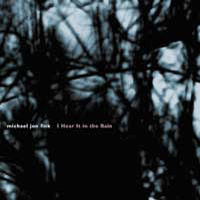





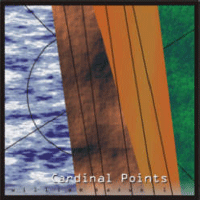





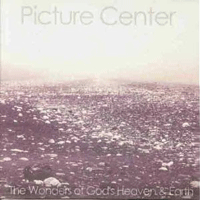

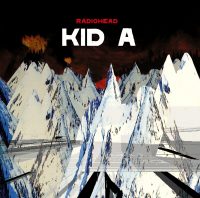


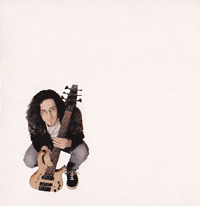






 Misfit City