Archive | reviews RSS feed for this section

June 1995 – EP reviews – The Monsoon Bassoon’s ‘Redoubtable’ (“inventive, and with an inquisitiveness which we haven’t heard over this side of the fence for many years”)

14 Jun
The Monsoon Bassoon: 'Redoubtable' EP

The Monsoon Bassoon: ‘Redoubtable’ EP

Currently sparking off in the recesses of the British underground, thriving with the punks and the noiseniks and far away from the picturesque lands of the boutique prog record labels, are a clutch of bands who are causing a highly enjoyable confusion amongst a growing number of people via a combination of odd rhythmic and tonal complexities, a taste for exotic textures, a yen for close-packed melodies and a knowledge of more than three chords. Worried by this, the Genre Police have attempted to flag them down, caution them and pigeonhole them in a little index, but when they attempt to slap labels onto them they find that the labels have a tendency to fit poorly and to lose their shape.

The milieu of these bands is the contemporary equivalent of the late ’60s seeding ground for progressive rock, and one of the best of them is The Monsoon Bassoon, which grew up like a little seed of bewildered hope out of the ashes of Plymouth death-metal band Die Laughing to mutate into this far more nutritious form (as heard on this tasty little four-tracker). Aside from the mathematical skill of some of the guitar playing, and an occasional tendency to knock you flat with a wallop of ferocious lawnmower riffing, there’s little of the directly metallic about the band now. There is, however, a good deal more of that underground breed of progressive guitar music that owes little to ‘Supper’s Ready’ and more to the convoluted dystopian vistas of British and American art rock – strict minimalism packed with dense little tunes; peculiar Fred Frith froth; XTC edge; smidgins of concentrated Beefheart alternative folky weirdness; Mercury Rev’s fluting, blissfully twisted noodling-from-another-planet.

To these ears, though, the strongest influences are some of the most inspired moments of King Crimson – the ‘Discipline’ years in the tendency of Dan and Kavus’ guitars to jangle into gamelan patterns at the drop of a hat, and the sour-jazz mayhem of ’21st Century Schizoid Man’ in Sarah’s wild-and-lofty Ian-McDonald-meets-John-Zorn woodwinds (no-one in this band seems to use surnames…)

Certainly ‘Bullfight in a China Shop’ and ‘Tokhmeh’ have that ‘Discipline’-ary ‘Frame by Frame’/’Neal and Jack and Me’ chime to them. The former’s tight, cheerfully lopsided instrumental webwork comes over like Steve Reich through Guitar Craft, with a weird pop sugaring and a Brufordian snare twitch: there are verbally-coleslawed lyrics about dry-cleaning and shellfish, and a tootling flute to scatter bright sunshine everywhere. ‘Tokhmeh’ is similar but sedater; Sarah’s flute pealing up and down a fistful of weird tuttis and fugues, a bit closer to the ‘I Advance Masked’ projects. More light-hearted than Crimson-ics, maybe not as forceful either; but just as inventive, and with an inquisitiveness which we haven’t heard over this side of the fence for many years.

One gets the feeling that the Fripp himself would approve. For years he’s been caustic in his dismissal of the time-locked prog scene and its ever-hopeful copies of the monster ’70s acts. This band are much closer to being the heirs of his mind. Influenced by Crimson they may be, but they aren’t to be found in a drawer marked “Epitaph Retreads”, or helping Peter Sinfield restore a Gothic tapestry. Despite their chirpier aspects, The Monsoon Bassoon have their feet planted firmly in the harder, scuzzier, post-punk ’90s underground, and play accordingly. The grinding, throbbing, bottom-heavy ‘Digger’ starts out like a grunge version of ‘Twist and Shout’ before the rasp of clarinet and increasingly eccentric guitar turn it into a rolling, roiling hybrid of ‘Red’ and early Cardiacs. ‘Café Bazaa’ churns up the previous gamelan chameleonics with a nastier thrash-monster edge held over from Die Laughing days but leavened by a mutinous pop-urchin bounce and yammering text overload from their barking voices, spattering non-sequiturs all over the place.

One to add to Cardiacs, Gorky’s Zygotic Mynci and Poisoned Electrick Head as current dispensers of refurbished progressive medicine. Get yourself a dose.

The Monsoon Bassoon: ‘Redoubtable’
Org Records, ORGAN 013 (no barcode)
Cassette-only EP
Released:
1995
Get it from: (2020 update) Rare, and best obtained second-hand.
The Monsoon Bassoon online:
MySpace Soundcloud Last FM YouTube Spotify Amazon Music

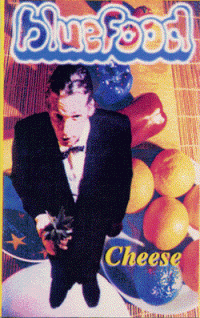
April 1995 – EP reviews – Bluefood’s ‘Cheese’ (“n elegantly tired, worn, damask’n’dust croon as loose as a blanket thrown over a sagging sofa…”

30 Apr
Bluefood: 'Cheese'

Bluefood: ‘Cheese’

“Given half the chance you would take the time / to have all the things you ever wanted to find / and, maybe, make sure that everything was always fine. / Just clear your head, look through the window, see the world knocking at your door. / There’s a cure – just close the curtains, / that’s what they’re there for…”

Bluefood are brilliant. No two ways about it. Think Tindersticks gone sampleadelic but with better tunes; think of the much-missed white-knuckle Bohemianism of Furniture; think Morrissey’s wit unencumbered by the petulant tantrums and waving sleeves. Think a down-at-heel, seedier young Scott Walker slumped in a corner after losing five too many bar brawls; but still carrying a ironic smirk across that smart mouth, behind the bruises. Think of the way that London can pull you down into a swamp of despondency during the days, sucking the energy out of your nerves in a succession of crummy jobs and rented rooms: then think of the way you decide to make the same tatty old city yours at night.

You don’t need to think any more: Bluefood have nailed it. It’s all here. In Duncan Morris’ voice, there’s the memory of a whole world of opportunities missed by a whisker – an elegantly tired, worn, damask’n’dust croon as loose as a blanket thrown over a sagging sofa. And while he plucks at the faded fruits of a haphazard existence, Paul Gilbert, Alun Lane and onetime Pigbag drummer Chip Carpenter wrap them up in a raffish, rumpled package of manically swinging pianos, swirling sardonic jazz-horn samples and sweeping Cocteau-ed dream-pop guitar like a swathe of tattered velvet curtain: all stitched together in mordant, sparkling hooky pop that, timeless as it is, could only pop up out of the ’90s.

It’s Burt Bacharach and Randy Newman playing poker with Moonshake and Portishead in The Smiths’ old bedsits, perhaps; but it’s all “wall-to-wall hardcorn melodrama” to Bluefood. As glimpsed through the oscillating spaces between the loops, their world is one where hapless boys lose their girlfriends to other women; where you can know precisely how cheap you are while still enjoying your ability to place hairstyles; where you’re no more than your last wisecrack or trophy date (like the dumped lover on ‘Who’s Who?’, knocked out of his place and freefalling through the gaps of casual engagements and social cyphers); but where the world still lurches on in a spirit of optimism that’s half cunning, and half plastered.

Duncan and co. take you on a tour of this world and its shifty corners, armed with the sort of impeccable wit, comic timing, and sense of self-awareness (“Boy meets girl, / girl finds herself, / boy loses mind and takes to getting drunk and writing morbid songs”) which the hopelessly pompous likes of Jack will never touch. “I found perfection, didn’t know what to do with perfection. / I caught a falling star – it burnt a hole in my pocket.” They might be boho to the core; but they’re not so langorously in love with the lifestyle’s tatty glamour that they’re oblivious to its ridiculous side.

‘Send in the Clowns’ (no, not the Sondheim one) sketches the ups-and-downs of the wastrel’s life, swaying between complacent despondency (“when you sleep and dream away the truth, nature’s on the roof / stealing all the lead”) and the wild clutchings of helpless inspiration “when your head’s confused, like you’ve blown a fuse, / when you just don’t know what you’re supposed to do, / when the circus runs away with you…” Down in the depths, on ‘Girlfriend’, the marshmallow bloat of the loungecore string loops which cushion and smother Duncan’s teary love-lorn drunkenness are suddenly invaded by a wandering mariachi band… right at the point when he’s sure that things can’t get any worse.

‘Merry-Go-Round (She Said)’ is, in a way, a rewrite of ‘Drive My Car’: still for the young and hopeful, but with the knowledge that they’re a little more sardonic these days. “‘Hello, do you want a boyfriend?’ / She laughed, ‘I’ve already got one’. / ‘Well, anyway, a girl like you should have two, / In case one gets broken.’ / So that was how they met.” It captures the rapid swirl and the first thrill of the heat coming on, while simultaneously puncturing the pretentions of born-again lovers. “‘Life’s a merry go round’, he said. / ‘Oh, how bloody profound,’she said. ‘Lah-de-da-de-dah – just drive…” On the tale of a quarrelsome, burnt-out affair on ‘Eyes of Bethnal Green’, love kicks hard even as it’s going downhill: “She was the kind of girl if she broke your heart / it would ruin her life for the whole weekend… / ‘Tell me you’re not just another boy-man with two big eyes in his sockets. / Got the world in his hands, when his hands are in his pockets.'”

If the course of true love ain’t running exactly smoothly here, it’s not lost altogether. ‘Funny Face’ sounds exactly like an older, wiser, more guarded Blue Nile – an after-hours torch ambience half-inched from Sinatra; smoky ripples of synth; sparse, sharp, romantic piano. All topped off with finger-snaps, jazz bass, a soulful Tony Bennett sample returning in a snatch of song, and Duncan’s meditation on the girl who’s reawakened his lazy, world-weary interest. It’s romance of a sort, as he extricates himself from the swamp of insincerity: “I love your politics, / I admire your hair, I like your style / and the clothes you wear: but you can change your views, / you can change your taste…/ Well, I’ll always like you.”

Somewhere out in the city tonight, Bluefood are sprawled gracefully in the corner of a bar, leaning on a pile of chipped hearts in the failing crimson light, and trying to trace the erratic currents of life in the swirl of a martini. Battered, smudged stars-in-waiting. Toast the cheese.

Bluefood: ‘Cheese’
self-released (no catalogue number or barcode)
Cassette EP
Released:
April 1995
Get it from: (2022 update) Very rare and never reissued; best obtained second-hand. There were soundfiles from the EP on the internet at some point, but I can’t find them anymore.
Bluefood online:
(no websites available)

Video

March 1995 – album reviews – Eskimo’s ‘The Further Adventures of Der Shrimpkin’ (“a sort of comedic musical lucky dip”)

24 Mar
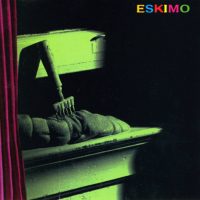
Eskimo; 'The Further Adventures of Der Shrimpkin'

Eskimo; ‘The Further Adventures of Der Shrimpkin’

San Francisco’s Bay Area still seems to be a hotbed for particularly off-the-wall musical artistry. The headquarters of hippydom in the ’60s is now the place where players’ players (Joe Satriani, Fred Frith, Michael Manring) make their homes, and bands like Primus and Faith No More forged their scrambled mongrel funk/punk/metal in the same neighbourhoods. It’s also the place from which a secrecy-shrouded band called The Residents sent out a series of sharply clever and mischievous recordings during the ’70s, analysing, deconstructing and parodying popular music in all of its manifestations. One of these was a concept album called ‘Eskimo’, a fanciful reconstruction of Inuit life and lifestyles. Even now, no-one’s absolutely sure whether it was a joke or not.

You’d guess that a band taking their name from that Residents album is gonna be just as difficult to pin down. Apparently Eskimo did start off as a joke band, set up by a collection of shaggy undergraduates from UC Berkeley with a penchant for party dresses. They’d hang out on campus corners busking frenetic, eccentric acoustic sets – stabs at TV theme tunes; Springsteen parodies; Who medleys. To an extent, you could say that they’ve never really grown out of those days of unbridled silliness. Eskimo still have wacky and zany written all over them in giant red fifty-foot letters, and anyone who finds the absurdist lunacy of the current Californian freak-muso scene unbearable would be advised to steer well clear.

Those not put off by that rubbery sense of humour will probably have a field day. Adding Tom Yoder’s trombone and David Cooper’s marimba and vibraphone to the standard guitar, bass and drums, Eskimo have a lounge-jazz element to their sound that’s got a lot in common with that other late, great, wise Californian eccentric Frank Zappa. A lot of ‘…Der Shrimpkin’ could have come from the same barn as Montana and One Size Fits All. That said, there’s at least as much of Primus slap-bass Muppet silliness in Eskimo as there is of the Mother of Freaks.

But like both Zappa and Les Claypool, the band have a love of American popular culture with all of its attendant and hugely enjoyable junk music. Their masterful playing (switching styles, moods, and tempos at the drop of a dime, and as happy with modal jazz charts as with playtime funk) is offset by their complete lack of concern about serious subject matter or, indeed, sense. With most of the twenty-four tracks on ‘…Der Shrimpkin’ clocking in at under two minutes, the album’s a tossed salad of circus music, playground chants, nursery rhymes, gibberish gospel, scuzz-metal and drunken jazz trombone exuberance, all mixed up in a freak-rock pudding. A sort of comedic musical lucky dip.

It could all be unbridled silliness but for the fact that ‘…Der Shrimpkin’ never quite loses the aura of anarchic menace that hangs around each of its ingredients. One of the few remaining covers on here – a faithful version of Snakefinger’s Residents collaboration ‘Kill the Great Raven’ – is (despite its kiddie vocals and campy haunted-house bellowing) a bloody ceremony of ritual murder and resurrection. ‘Babykins’ flavours a police siege with infantile fears. ‘The You’re So Slender’ is a Disney cartoon from Dali-Hell, while the jolly slap-funking ‘Bughead’ (sung in musing tones by guitarist John Shiurba) babbles about the sadistic rituals kids develop for the playground. ‘Oops’ (once you can decipher it) seems to be about the divine right of extermination; and ‘Ribbit’ sounds like Mark Twain taking on the princess-and-frog legends, complete with yelling hick farmer and squirming vocals.


What with many of the other tracks being short snippets of surreally twisty, dark-toned vibe-jazz (the sort that accompanies swaying cameras creeping around the Bates Motel) Eskimo may initially come across as a comedy band, but they re definitely no joke. A child’s nightmare with a big red pasted-on grin, perhaps. Coco the Clown fingering a cleaver. A set of practical jokes for the damned.

Eskimo seem intent on nailing jokey voices and songs onto the menacing shadows of the subconscious, as they do in the exuberant nonsense words of ‘Dado Peru’s hop-skip-and-jumping Dada/Beefheart-jazz, or in the restaurant full of freaks in ‘Electric Acid Pancake House’, all happily hallucinating about Elvis’ return as a serial killer. What with that, plus a cheerful stab at Duke Ellington’s ‘Blue Pepper’ and the odd spiritual song about tacos, they re probably perfect for the enjoyably warped. Give Eskimo a try next time you re having one of those gratuitously loony, twisted days… but watch out for the backwards messages.

Eskimo: ‘The Further Adventures of Der Shrimpkin’
Mammoth Records/Prawn Song Records, MR0102-2 (0 35498-0102-2 4)
CD/download album)
Released:
21st March 1995
Get it from: (2020 update) Original CD best obtained second-hand; or download album from Bandcamp.
Eskimo online:
Homepage MySpace Bandcamp Last FM Pandora

February 1995 – album reviews – Laundry’s ‘Blacktongue’ (“a scuffed, brooding black-iron hybrid”)

20 Feb
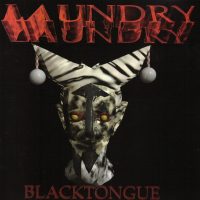
Laundry: 'Blacktongue'

Laundry: ‘Blacktongue’

Pity the aging hardcore punk purists. They’ll talk about the punk wars they fought in order to kill off prog rock, but they forgot that little pockets on each side of a war have a tendency to learn each others’ languages and swap cigarettes during lulls in the battle. Or that invaders tend to crossbreed with the invaded. In Britain at the beginning of the ’80s, the likes of Magazine and Cardiacs drew prog rock ambition back into punk energy. Over in the States in the ’90s, the second coming of punk was spearheaded by Kurt Cobain – a Robert Fripp fan. You can shout and proclaim your Year Zeroes all you like, but you can’t kill knowledge or the desire to grow.

Hence, in the here and now, the appearance of bands such as Laundry. Like the lunatic punk/prog/funk/freak metal band Primus (with whom they share their astonishing drummer Herb Alexander), they hail from the fertile Bay Area scene in northern California and have roots in art punk bands Grotus and Sordid Humor. But they’ll just as readily admit to drawing from European prog and art rock such as Can and King Crimson as from the usual suspects; the terrifying electro negativism of the likes of Nine Inch Nails, plus strange post-punk/psych experimentalists like Butthole Surfers. Laundry’s deep black, forbidding music (using similar instrumentation to the later, stripped down versions of King Crimson) plants itself in that dark and hellish area in which “alternative” and “prog” seem must suited to meet and surprise each other.

Musically at least, it’s an unselfconscious blend – a scuffed, brooding black-iron hybrid of ‘Discipline’ rock gamelan, gruff Nomeansno hardcore force, and Pearl Jam histrionics. The latter comes courtesy of former Sordid Humor drummer Toby Hawkins’ snarling Vedder esque baritone, while guitarist Tom Butler chops out minimal metal riffs or a Fripp-like mixture of metallic rending noises and compellingly ugly solos. The real strength, though, is in the rhythm section: Herb swaggering around his drums like a funkier, fluider Bill Bruford and the remarkable Ian Varriale playing phenomenally dirty, polyphonically funky basslines on the Chapman Stick (which has so long been considered an instrument for jazz technicians and art rock eggheads that it’s a revelation to hear it sounding as raw as it does here).

Despite the strong musicality of the players, this is far from an airy prog trip. This Laundry seems to be where the darkest, dirtiest stains on the soul are scoured out, or are wrung out by the mangle. The oppressed, threatening, dissatisfied feel of grunge, which forced a seething dysfunctional contemporary rage into the mainstream, still casts a long shadow over contemporary American rock; and Laundry are very much part of that.

And how. Toby Hawkins (although he seems to have escaped Trent Reznor’s pathological need to actively shock or destroy the sensibilities of his audience) is consumed by the sort of fuck-up negativity that even the most confrontational of hardcore bellowers or the darkest of grungers would find difficult to relate to. Recurrent images of disgust, physical and mental sickness pervade ‘Blacktongue’: Alice in Chains were a barrel of laughs by comparison. The harsh, paranoid sexual fable of the title track and the grinding depression/sedation rant of ‘Misery Alarm’ are just two examples: the fantastical psychosis of ‘Monarch Man’ (prefaced by colossal distorted cat purring) lays colourful musings of twisted beauty over a tortuously funked up Crimson-ic march, while the angel messenger in ‘Skin’ brings only word of freezing, disease, and sexual loathing.

Not light-hearted stuff by any means, and the unremitting bleakness of the album does tell against it. While the music draws on fury and darkness to swell its compulsive strength, the lyrical content – reading like notes from an agonised, hopeless therapy session – displays an unrelenting despair, misery and withdrawal from human life, without the leavening of humour and compassion that make such thoughts palatable. Consequently, many a ferocious burst of taut musical excitement is dragged down by the millstone of Hawkins’ suicidal roar.

There are some moments of relief, however. If you’re into the pattern side of Laundry’s music, there’s the disconnected Stick geometries of ‘Monkey’s Wrench’. If you’re looking for redemption in song, there’s ‘Canvas’, in which Hawkins (backed by Butler’s lilting arpeggios) breaks out of his doomy caterwauling to discover the possibilities of art therapy and achieve a measure of peace. “Try to make sense of your shadow, paint a picture of the way it should be, colours arranged carefully…/ Inside the frame on the wall, paint your heart under a waterfall / paint your world the way it should be, so you can understand what you see.”

Generally, though, Laundry are more interested in dysfunction than healing. And despite Hawkins’ self-flagellating attempts to build significance out of the topic, it takes the wit of a guest to really get things moving. “I can’t stand it for anyone to be more awkward, self hateful, stupid, or inappropriate than I am” crackles the sardonic, telephone relayed voice of Bay Area artist Don Bajema on ’19’. Over a marvellous brooding thudding riff (a slower, darker ‘Thela Hun Ginjeet’), Bajema unwinds his cynical but concerned ideas: deliberate awkwardness, withdrawal and self humiliation may be his only logical response to and defence against a sick and ridiculous world, but it’s simultaneously an unwanted mask against those he truly loves, “the last people I would want to see me like this…” A disturbing confession, but one that rings so true that it’s easily the moment that makes the album.

Will Laundry clean up? Dubious – even deep-dyed grungers will have trouble with their uncompromising grimness and suspicion of anything approaching a tune; and Toby Hawkins’s obsession with depression and psychosis comes across all too often as self-indulgent droning and ranting, without the redemptive melodies of Nirvana or Pearl Jam. What draws the band out of this trough of misery is their brutal power, their brooding energy and the masterly rhythmatism of Varriale and Herb: the powerful spine of the music which tugs them towards the darker, unforgiving end of progressive rock, towards Hammill-esque heart-crushing and 21st century schizophrenia. Flawed and muddied by defeatism it might be, but ‘Blacktongue’ is still a potent (if still no more than potential) statement from a band in waiting.

Laundry: ‘Blacktongue’
Mammoth Records/Prawn Song Records, MR0098 2 (35498009822)
CD-only album
Released:
20th February 1995
Get it from: (2020 update) Best obtained second-hand.
Laundry online:
MySpace Last FM YouTube Spotify Amazon Music

January 1995 – live reviews – Francis Dunnery @ Jongleurs, Camden Town, London, 26th January (“a fair dose of confessional, thankfully laced with warm, wry humour”)

28 Jan

“My name is Francis, and I’m an alcoholic.”

The former frontman of It Bites stands before a packed house, nervous and naked. In musical and personal terms, at least – this is a stripped-down gig, just Francis Dunnery and accomplice Ashley Reaks on acoustic guitars in an ‘Unplugged’-style attempt to relaunch Dunnery in the UK after a four-year absence. It’s also an opportunity for Dunnery, without the constraints or comforts of a band, to confront his British audience with utter honesty about who he is.

We get his new songs, but we also get a fair dose of confessional, thankfully laced with warm, wry humour. At times, the atmosphere is like that of a stand-up comedy performance; Dunnery regaling a warm, welcoming and adoring audience with tales of his drunken days, the horrors of becoming one of the “rock arseholes” whom he detests, the pros and cons of sobriety and how it relates to the choosing of curtains, and the ups and downs of romance. (He also claims, implausibly, to have a werewolf’s cock, but probably the less said about that the better…)

So he’s back. It’s an intimate homecoming, really, with none of the posturing one associates with a rock gig. I mean, when was the last time you saw someone opening their show, as Dunnery does, by making a cup of tea? Then again, he never had the self-importance of the average proggie, even when he was twisting out great looping spirals of glossy pin-sharp progressive pop with It Bites in their heyday; and when he seemed to be trying to reconcile his own friendly Cumbrian bluntness and plainspeaking with the musical tightrope act he was pursuing at that time. The present-day Dunnery is a troubadour, a man who’s returned to the basic portable song that can still enchant even when cut down to the most skeletal arrangements.

He’s older, wiser and a touch more cynical (as evidenced on the wry precis of the music industry that is American Life in the Summertime, blessed with a compulsive tune plus satirical lyrics about the Californian stardom dream, and dedicated tonight to the record company girls), but his sense of compassion and honesty sees him through. Much of tonight’s set comes from his recent second solo album ‘Fearless’, in which he moves into smooth (but indisputably off-beat) pop-rock, much of which is quite suited to tonight’s format. The beautifully poignant Good Life, executed solo, is a perfect goodbye song. Painful, celebratory, tantalisingly unresolved, and making the most of Dunnery’s high soul-grained vocal tone, it gets one of the biggest cheers of the night, leaves wistful echoes in the heart, and ranks with the best of any of his past work.

Recent, neglected single What’s He Gonna Say certainly gains added sleepy poignance of its own by being stripped down. It’s spoilt, however, by Dunnery throwing in a twiddly accelerating solo line in an inappropriate bit of technical flash: a rare lapse of taste meaningless to the song and to the evening. Fade Away and Heartache Reborn fare better; sad in a joyous kind of way, filled with rue, warmth and self-realisation, little chronicles of the interweaving of life and love.

A superb electric player, Frank has yet to find his own voice on acoustic guitar. He solos throughout the evening in a bizarre, terse, hybrid style of blues and Spanish classical with a heavy attack. Sometimes the results are striking, occasionally they’re just pointless. But then, he has recently reinvented himself from being a guitar hero who sings to a singer who plays guitar. On this tour, his songs mean infinitely more than his guitar playing.

The mournfully jaunty Homegrown and the resurrected It Bites strutter Underneath Your Pillow both work surprisingly well, surviving the loss of their skilful arrangements on record and given a more intimate tinge by the simple interplay of guitars. Feel Like Kissing You Again, now revealed as a tribute to Dunnery’s late father, is a vertiginous blanket of strumming; unsettling and bleak, Frank delivering a heartfelt, keening vocal and pulling off a harsh, minimal and twangingly abstract solo with impossible note-bends shooting off like snapping heartstrings.

To close, there are a few more lookbacks at It Bites. A quick nugget of the acoustic flourish The Big Lad in the Windmill, and a final acoustic benediction of wonky-lyric’d rock ballad Still Too Young to Remember (roared back at him by a clubful of joyous voices); and then Dunnery’s gone. No encores, despite the roaringly enthusiastic calls that carry on long after the club plays loud funk music at us in an effort to cue us into getting the hell out of there. Still, we can but hope that we won’t have to wait four years until the next gig. And we can marvel at the fact that even when all of the gloriously flashy musical settings of the It Bites era are removed, we’re still left with a fine songwriter.

Welcome back, Mr Dunnery. We missed you, fella.

Francis Dunnery online:
Homepage Facebook Twitter MySpace Soundcloud Bandcamp Last FM Apple Music YouTube Vimeo Deezer Google Play Pandora Spotify Tidal Instagram Amazon Music
 

October 1994 – mini-album reviews – King Crimson’s ‘VROOOM’ (“like a gigantic work-worn machine developing a telling fault”)

31 Oct

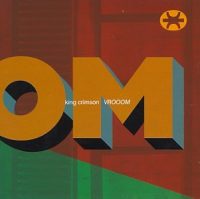
King Crimson: 'VROOOM'

King Crimson: ‘VROOOM’

The first new music from King Crimson in a whole decade rolls in with a yawn… or the sound of a hitman’s car tyres slithering quietly past your house. I don’t know. Whatever it is, it’s subliminal – a dark, stretching, barely audible ambient sound. Reverbed and resting right on the edge of the listener’s attention, it’s something which creeps in and cases the joint, maybe clears it of distractions. The last set of King Crimson albums, back in the ’80s, went straight in with clean, pealing, bell-like guitar patterns. Perhaps there’s a big clue to current Crimsonizing in that this one doesn’t.

Although the band’s known for its high turnover of disparate personnel and fresh starts, ‘VROOOM’ unexpectedly reunites that stable-against-the-odds 1980s Crimson lineup (Robert Fripp, Adrian Belew, Tony Levin and Bill Bruford) but augments them with two new members: Trey Gunn (a graduate of Fripp’s Guitar Craft course, doubling Levin’s 10-string Chapman Stick) and Pat Mastelotto (a jobbing, dextrous rock drummer best known for being part of American AOR act Mr Mister). Historically, when Crimson’s added members it’s been for as much for specific sonorities as much as personal approach. Perhaps a jazz or military saxophonist to break up a beat group, or a violinist to bring in classical textures. Maybe a Stick player to replace, fan out and reshape the bass chair; maybe, to upset the whole applecart and reboot the other players’ brains, an avant-garde improv percussionist with a thousand-yard stare and a junkyard armoury, or a master of cartoonish sound-effect guitar. Conversely, this is the first time Fripp’s apparently hired people mostly to thicken out the existing sound. This might be another clue.

What emerges – after that scouting roll – does and doesn’t sound like King Crimson. The New York brightnesses of the ’80s lineup (those circular Steve Reich and Talking Heads echoes which so thoroughly rebooted Crimson’s former Anglo-prog approach) have been banished. The title track is a descending, angry staircase of screech – simultaneously in synch and slightly ragged, like a gigantic work-worn machine developing a telling fault. If there’s a template for it, it’s the sound and structure of key ’70s Crimson track Red (the frowning, minimalist/totalitarian march which announced that Fripp had honed his once-florid instincts to a fine metallic economy).

The difference is that the big bare bones of this follow-up are fletched with additional details; disruptive flams and spurs, heavy digital processing resulting in analogue splurge, gears splintering but carrying on. A second huge instrumental track – THRaK – lurches forward in angry displacements, a blind giant hammering at a wall. In both tracks there are breathers which aren’t breathers – sighing passages where instruments fall back and Fripp’s misty ambient drones come in; or where a clambering bittersweet arpeggio makes a bed for a solo passage of wracked and pearly beauty before the hammers come down again. Throughout, there’s the sense of highly-stressed engineering precision just one slip away from disastrously throwing a rod, or a kind of hellish chamber music electrified to breaking point.

The band’s nervously sunny human face during the ’80s, Adrian Belew has been sucked backwards into this bigger, blurrier ensemble (predominantly providing a battery of guitar shrieks, leftfield lunges and rubbery solo lines). He still sings; is still the go-to song guy; but it’s clear that the songs have been almost entirely subverted by the new approach. On Sex Sleep Eat Drink Dream, King Crimson rattles through a bluesy lurch; Adrian sounding like an animatronic waiter covering John Lee Hooker, delivering sub-Dada wordplay in murmur-to-scream builds before the band explodes into barely contained passages of full-on percussive chaos.

A little of the ’80s Crimson is allowed into Cage, with Fripp’s cackling speed-arpeggios making it a close cousin to ‘Discipline’s breakneck Thela Hun Ginjeet. Like Thela, it’s a neurotic street cry, but what was once simply threatening has now turned actively murderous as Belew’s prissy paranoia is taken up to international level (“walking down the street, do you stare at your feet / and never do you let your eyes meet the freaks, / the deadbeat addicts, social fanatics, / they’re a dime a dozen and they carry guns. / Halloween every other day of the week… Holy smoke! somebody blew up the Pope!”) while didgeridoos yelp and Fripp provides a barrage of his most jarring, churning guitar disruptions.


A third instrumental – When I Say Stop, Continue – mingles both King Crimson’s old knack for doomy improvised sound-pictures and the band’s puckishly dry sense of humour. Over an ambient creeping horror of a Fripp Soundscape, the band knock, shrill, drill and build up a swelling industrial noiseuntil Belew yells “Ok, come to a dead stop. One, two, three, four!…” only for the band to wilfully drift on without him, trailing ghostly shrouds of presence, until the drummers slam and nail the doors shut.


Only with One Time do both King Crimson and Belew emerge from this deliberately uneasy fug. Here, the sextet drop delicately into perfect synch and sweet restraint, a softly-mutated post-bossa pulse and Levin’s springy bassline coaxing along Belew’s lapping reverse-rhythm guitar and gentle vocal melancholia. It’s a reminder that King Crimson also have a knack for the beautiful offbeat ballad alongside the harsh upheaval. This is no exception, grasping wistfully and tenderly after a fleeting sense of centredness, throwing what’s come before into a more human-scaled relief.

King Crimson: ‘VROOOM’
Discipline Global Mobile, DGM 0004 (5 028676 900016)
CD-only mini-album
Released:
31st October 1994
Get it from: (2020 update) some original copies still available from Burning Shed – also reissued, along with the material from its companion volume ‘The VROOOM Sessions’, as part of 2015’s 16-disc ‘THRAK BOX (King Crimson Live and Studio Recordings 1994-1997)’, also available from Burning Shed
King Crimson online:
Homepage Facebook Twitter MySpace Soundcloud Last FM Apple Music YouTube Vimeo Deezer Google Play Pandora Spotify Tidal Instagram Amazon Music
 

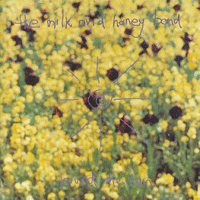
September 1994 – album reviews – The Milk & Honey Band’s ‘Round the Sun’ (“pollen-soaked brightness”)

30 Sep
The Milk & Honey Band: 'Round The Sun'

The Milk & Honey Band: ‘Round The Sun’

Life in Levitation appears to have been pretty intense. It wasn’t just the careening violence of that band’s supercharged stew of indie-metal and psychedelia (which usually brought to mind eerie and sickly dawn comedowns, or bloated nebulae savaging each other in a chilly night-sky) but the personal cost as well. Five equally creative underground rock musicians – each with hungry histories behind them – yoked together into a single band and choosing an open-ended approach, then unexpectedly exploding into semi-celebrity across the British indie-rock circuit.

Excesses of talent and volatility (and too much “too much” in general) inspired Levitation, but also wore it down. In particular, the sudden and very public departure of the band’s doggedly wayward frontman Terry Bickers in summer ’93 seemed acrimonious enough to raise blisters. Perhaps this is why whenever Levitation’s keyboard player Bob White stepped away from the band for a breather of his own, the music that he produced had such pollen-soaked brightness to it. Compared to Levitation’s soaring, guttering galactic frenzies, The Milk & Honey Band feels more like waking up in a warm barn in the woozy heat of an August afternoon, knowing that there’s just enough of the summer left for you to relax into.

Collected together as a full album, these songs float together gracefully and lazily. Despite the communal, homespun suggestions of the name, Bob is on his own here – producing and playing absolutely everything from the shakers to the luscious layered guitars. He seems more than happy to be carrying all the weight. Of course, he’s made it easier for himself by making Milk & Honey Band music so softly buoyant: an easygoing psychedelia with a nostalgic undertow. ‘Round The Sun’ is pervaded by a sunny West Coast feel, with banks of multi-tracked Bobs murmuring in cloudy harmonies.

There’s an illuminated sting to Not Heaven’s punchy rhythm, but listen to that glorious coda as the guitars slide deliciously over each other – a sensual Moebius strip of sound. A trio of pastoral guitars in Raining, set against a gentle downpour, recall Peter Green. Mandolins ring tenderly on Out Of Nowhere. The slow, sleepy, rumple of the title track builds on rich and majestic layers of spliffed-up guitars and harmonium; Bob lovingly croons “feels like life has put the world in your arms” amidst touches of melodica and tingling vibraphone. Even a digression into pelting distorted rock-out for Another Perfect Day (which sounds like an agreeably tranquillized Bob Mould) is haloed with positivity.

West Coast syrup and sunshine aside, the Milk & Honey Band is also as English as chips in newspaper. Often it could be a never-was memory of imaginary childhood holidays. Something remembered by a happier Syd Barrett, perhaps – saved from drowning, and lost in a contented swirl of dope smoke as he hangs out with an equally relaxed Andy Partridge.

Two rogue Milk & Honey Band instrumentals also anchor themselves to an endearing shabby gentility, like fading Edwardian seaside pavilions going quietly to seed in the dying sunlight. The first of these, Tea (sweetened with organ, glockenspiel and fake clarinet), summons up sepia memories of elderly swinging dance-bands. The snatch of elegant minimalism on Pier View (shifting interlocking waltzes of piano and synth oboe) isn’t a million miles away from the  more mannered moments of  Penguin Café Orchestra’s chamber-music joys.

Still… beyond the simple humming pleasures, there’s a subtle tinge of melancholy. It’s intangible, like a barely-there sense of the mistakes you’ve not yet realised that you’ve made. On Puerto, hazy recollections from family holidays – train journeys, shapes made by a father’s hands – are just flakes of memory, snapshots of times that are gone. Only the cavernous darkness of Light – slow drums booming, guitars like giant creaking girders; a smudgy, apprehensive fog of vocals – points back towards Levitation’s broiling stress.

Yet there are hints that the warmth in which The Milk & Honey Band sits is a resting place which must be eventually left behind; or a long-ago photograph in which the colours will eventually turn wan and wear away. Listening past the folky, bluesy cats-cradle of clean-picked guitars (recalling the Stones in wasted lament on Wild Horses) you’ll hear Bob singing softly about blood on his hands that won’t wash away. Elsewhere, he gently pleads “Take a lot of stupid noise / and try to understand the words that I say.”

It’s as if he’s aware that the time available for understanding is short: circumscribed by circumstance, and with far too much human frailty getting in its way. Presumably, fraught energies will be beckoning again sometime soon. In the meantime this album is here, as floaty and comforting as a hammock-ride – and as vulnerable.

The Milk & Honey Band: ‘Round the Sun’
Rough Trade Records, R3572 (5022781203574)
CD/vinyl/download album
Released:
29th September 1994
Get it from: (2012 update) Download from Burning Shed; CD is long-deleted and best looked for second-hand.
The Milk & Honey Band online:
Facebook Twitter MySpace Bandcamp Last FM YouTube Vimeo Pandora Spotify Amazon Music
 

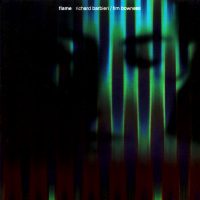
August 1994 – album reviews – Richard Barbieri/Tim Bowness’ ‘Flame’ (“the internal landscapes of the restless emotional mind… the indistinct visions of dreams and the hallucinatory moments of being in love”)

31 Aug

Richard Barbieri/Tim Bowness: 'Flame'

Richard Barbieri/Tim Bowness: ‘Flame’

There’s a common misconception going around which says that in order to be “experimental” you have to be noisy (viz. the many grinding guitar-noise bands clogging up many a Camden basement or American college-kid bar) – or, conversely, that you have to be utterly ambient, all empty space filled with electronic pulses, “ironic” hoover noises and nothing so anti-deconstructionist as the hint of a song. Theoretically a great idea, but in the end it produces little more than a big heap of CDs which you only play once plus another big heap of empty pseud criticism.

Alternatively, you could join that group of musicians whom Tim Bowness calls “the radical conservatives”; those people who take a long, wise look at both what’s going on and what’s worth retaining from the past, and then combine it with their own particular art of the possible, in the process creating memorable, lasting and demanding records (if not always incredibly famous ones – but so it goes, eh?) These people are also collaborators par excellence, linking up with a free-floating pool of like-minded musical allies to produce something greater.


In this context, the teaming of Bowness (the outspoken, intellectual No-Man singer) and synthesist Richard Barbieri (the quiet one in Japan) makes perfect sense. Both are associated with progressive synth-pop groups that stretch yearningly towards art and sensation; both fairly drip with musical and contextual knowledge; they’ve worked closely together in the past; and now they’ve produced an album as a duo which draws on considerable collaborative talent, including regular mates (fellow ex-Japan-ers Steve Jansen and Mick Karn, No-Man instrumental maverick Steven Wilson) and highly individual guns-for-hire (double bassist Danny Thompson, world-jazz drummer Gavin Harrison, textural guitarist Michael Bearpark). ‘Flame’ has emerged out of a mutual desire to create what Bowness calls “ambient torch songs”; moody late-night music with words summoning up the memories of love and heartwreck, sheathed in drapes and washes of unearthly sound. (There are, of course, precedents: Scott Walker, The Blue Nile, Julee Cruise and both men’s respective groups – Japan’s Ghosts being a particular blueprint.)


This objective is best realised on standout song Brightest Blue – Chris Maitland‘s delicate pattering drums wander around Danny Thompson’s deep woody jazz bass and Barbieri’s gentle piano chordings as Bowness unfolds the beautifully rapt love song of someone so engrossed in another person that they are virtually oblivious to the war going on outside their very windows. Distant swathes of Frippian textural guitar and blankets of electronic sound from Barbieri’s keyboards that settle on the listener like banks of soft snow add to the withdrawn, dreamlike theme of the song: a theme which becomes dominant over the course of an album which deals with the internal landscapes of the restless emotional mind, with the indistinct visions of dreams and the hallucinatory moments of being in love.


Bowness’ words touch on images of dying light and candles, sleeping and waking, hunger and falling, vegetation and rivers; and above all on memory, vision and communication obscured, whether this is beneficial or otherwise. Brightest Blue urges “forget the facts… I have to trust my own truth”; Song of Love and Everything cuts through its vague atmosphere of betrayal with “jump in the water / …swim in the dark to keep myself alive / …to shake myself awake”; the closing Feel rages quietly “I don’t know what it means / I try to surrender / I only know what I feel.”


This murky emotional obscurity means that ‘Flame’ tends to drift away from its initial premise into a hinterland of dimly-lit emotional set-pieces. Songs like A Night in Heaven and Trash Talk come across as expressionistic heart-sketches; their rains and rivers, their words of betrayal, stagnation and disaffection mingling to put across a particular mood. As such, ‘Flame’ fails as an ambient torch album. The title song is one of the few that emerges from the mists of imagination, with its portrait of a suffocating lover (“I will hear your calls, I will break your falls / …build your walls / because our love is strong / …I will share your life, / I will blind your sight…/ I will cover you / I will smother you”) and Bowness often seems to be providing tantalising clues rather than telling a story. (Unfortunately, the ambient-torch label is better applied to the work of David Sylvian, Barbieri’s former bandmate, whose own highly literate take on the form will be inevitably and somewhat unfairly compared to this album.)


Where ‘Flame’ does succeed, however, is as a marvellous dream album. A lot of this is down to Barbieri’s magnificent settings. Always a sculptor in sound rather than a keyboardist per se, he envelopes Bowness’ hallowed, reverent croon and enigmatic word-clues in delicate electronics – scouring sounds, breathy walls of soft noise, alien cellos and Chinese chimes, resonant aquatic flutters and twitters. On the solitary instrumental track, Torch Dance, he wraps undulating didgeridoo sounds with waves of flanged burbles and an unearthly guitar.

Throughout ‘Flame’, Barbieri creates an ocean of sound, always beautiful, never inflated by the self-important pomp that can sink keyboard-based albums. Other musicians float and mesh their own contributions into this sweet tapestry – Jansen’s featherlight percussive touch, Karn’s elastic bass and smears of treated sax, Steven Wilson’s guitars charting a course between psychedelia and spaghetti-western in contrast to Michael Bearpark’s distant blocks of Howe-cum-Frippian textures… all anchor the music to further dimensions of dreaming and organic emotion.


All of which adds up to a rich, seductive experience. Yes, ‘Flame’ can err too much on the side of obscurity a little too often, but it does so with such a consummate shadowy beauty that this becomes a positive virtue. Gorgeous, lazy, flowing melodies; a ghostly hint of melancholia; a rattle at the spirit cage… this is one flicker in the darkness that is well worth tracking down. Come catch the fire.

Richard Barbieri/Tim Bowness: ‘Flame’
One Little Indian Records, TPLP58CD (5 016958 023720)
CD/cassette album
Released:
29th August 1994
Get it from: (2020 update) Best obtained second-hand.
Richard Barbieri online:
Homepage Facebook Twitter MySpace Soundcloud Bandcamp Last FM Apple Music YouTube Deezer Google Play Pandora Spotify Tidal Amazon Music
Tim Bowness online:
Homepage Facebook Twitter Soundcloud Bandcamp Last FM Apple Music YouTube Vimeo Deezer Google Play Pandora Spotify Tidal Amazon Music
 

June 1994 – EP reviews – Jakko’s ‘Kingdom of Dust’ (“the sort of might-have-been that’ll get ’80s pop-heads sighing”

8 Jun

Jakko: 'Kingdom of Dust'

Jakko: ‘Kingdom of Dust’

This is a quick glimpse at the sort of might-have-been that’ll get ’80s pop-heads sighing. Although it’s been put out under the name of cult songwriter/smart-popper Jakko Jakszyk, ‘Kingdom Of Dust’ was salvaged from his collaboration with ex-Japan characters Jansen, Barbieri and Karn (an attempt at an album, regretfully abandoned due to a lack of space in schedules).

For all of the exploratory excellence of the Rain Tree Crow era that’s informed JBK’s current work, making them a progressive instrumental dream team for the likes of No-Man, didn’t some of you miss the pop glint of the old Japan? ‘Kingdom of Dust’ might be an answer to those particular prayers, as it draws the trio away from their current ambient-world influences to revisit the ’80s. In the process, it coaxes out some of JBK’s most memorable, poppy and immediate post-Japan work. The trio’s moody and textured music, and the precise yet vulnerable preoccupations of the songwriting which Jakko has grafted onto it, lock together as smoothly and silkily as if the four of them had been a band for years.

The outcome is something like Japan’s own ‘Visions of China’ meeting an idealistic Steely Dan, with (a whisper of) Stax strut and (whisper it) the impeccable pop craftsmanship from the peak-period of Jakko’s old employers Level 42. In other words, literate adult pop with more than a sprinkle of luscious art-rock atmosphere, and graced with some cracking tunes as well. Four blasts, then, of “Jakkopan”, in which Jakko’s passionate earnestness gets a enigmatic art-gloss makeover.


The Hands of Che Guevara’s foray into prog-soul is a tale of romance, suspicion and sabotage explored over brassy, precisely-pointed keyboard blasts, sinously solid Karn bass, and Jansen’s rotating curves of drumming: like Rain Tree Crow’s Big Wheels in Shanty Town rubbing up against the more energetic moments of ‘Innervisions’. Jakko sings sharply about deception and delivers stinging protesting guitar lines, continually blurring personal interaction with zooming metaphysics and political shadow-game metaphors. “She had a face from memory, I wore a disguise. / She lived the burning questions while I ran out of replies. / I fumbled for safety in an empty box of lies – / she stole the map of all the places I could hide.” On The Judas Kiss the JBK stylings are more muted: it all comes together as frozen mourning and angry grief, coiling feelings wrapped in an icy light. “Next time it comes to this, / the frozen lips of the Judas kiss, I’ll be gone. / Next time it won’t exist, / the bleeding hearts of another twist in my tongue.” A slow, wounded but determined walk away from disappointment.

Pop is the trigger here, and pop is the result. Drowning in My Sleep steals the crisp, spacious rhythms of swingbeat away from rent-a-beat R&B and mixes them with Barbieri’s electronic buzz-sawing and celestial swooshes. Jakko sings nightmares of failed communication – “Drowning in my sleep, every time I try to speak / words go overboard and silence drags me down. / Another dream admits defeat, leaves its wreckage on the reef. / Who wants survivors without language run aground?” – and lets rip with full-throated lyrical guitar. Best of all, there’s a lush but quietly heartbreaking ballad, It’s Only the Moon – a delicate, intimate story of a neglected and suppressed child driven ever-deeper into himself. “No one dared slay the silence with laughter… / Each trace of memory gagged and bound / and left to drown… / In the absence of words I would whisper away to myself / saying prayers for an end, or just simply pretend / to be sleeping. / And the palms of my hands read stranger than fiction.” A slow journey into silence, cool and distant as starlight, with Karn and Jansen’s rhythms whispering past like a late-night train.

Four tracks on which Jakko’s teaming with JBK is fertile, graceful and inspired. A shame that time and fate didn’t allow any more of it, since what there is is marvellous, but at least we have this.

Jakko: ‘Kingdom of Dust’
Resurgence, RESCD101 (5 020522 398329)
CD-only EP
Released:
6th June 1994
Get it from: (2020 update) Best obtained second-hand. A download version was made available by Burning Shed in 2010, featuring the bonus track Fly.
Jakko online:
Homepage Facebook Twitter MySpace Last FM YouTube Deezer Google Play Spotify Instagram Amazon Music
 

May 1994 – live reviews – Django Bates’ Delightful Precipice at London Jazz Festival @ The Bloomsbury Theatre, Bloomsbury, London, 17th May 1994 (“behind the whimsy lies the mind of a genius, or a sadist. Probably both.”)

19 May

Time to open your eyes a little wider, ‘cos something strange is stirring in the home counties…

Those of you familiar with Bill Bruford’s Earthworks will be aware of the contribution made by one Django Bates on keyboards, tenor horn and compositional skills. If you’ve done your homework, you’ll also know that he and Earthworks’ brilliant saxophonist Iain Ballamy originally worked together in the anarchic and thoroughly enjoyable Loose Tubes, a jazz big band who sounded like a joyous drunken party in a brass instrument factory.

If you’re really keeping up with Bates’ freewheeling progress, you might also know that he has his own big band in the form of the seventeen-piece Delightful Precipice, featuring Ballamy and several other Loose Tubes-ers such as flautist Eddie Parker, clarinettist Dai Pritchard, saxophonists Julian Arguelles and Steve Buckley… well, a large chunk of the current British jazz scene, when it comes down to it. Certainly half of the musical population of London, clutching various brass and woodwind implements, seems to have ambled amiably onstage along with the flamboyant Bates. While this lot might not have the profiles of the Courtney Pines of this world, they’re probably doing more to extend the boundaries of innovative music. With Earthworks, Bates breaks new ground and moves the landscape around; with Delightful Precipice, he teeters teasingly on a thrilling new brink (as suggested by the title of tonight’s opener, ‘Tightrope’).

It’s certainly brinksmanship of a high order. From the first notes, I’m transfixed by the music Bates and co. are producing: all of you who speak knowledgeably of the complexities of prog bands should lend an ear to Delightful Precipice, and get an earful of Django Bates’ muse. It’s a rich, densely textured experience; this is music so complex and ferociously intelligent that I feel as if it’s forcing entry to my skull. Pressed back in my seat as the music powers on, rushing through my mind like irresistible floodwaters, I’m firstly overwhelmed by the sheer substance of it. Later, as it shows no sign of letting up, I feel my reluctant slow little brain being gently forced into activity; it’s like slowly being woken up, given a massage and a pep talk. This is music so cerebral that it even brings your mind up to speed.

‘Tightrope’ opens the show in slamming clusters of notes like being punched to death by brass, before the band gently finger-snap their way into ‘Armchair March’, a melancholy Bates-y stomp with long peals of English brass band sound (a Loose Tubes trademark). The following ‘Fox Across the Road’ is a menacing, darkly harmonic undulation, sliced up by samples of screeching car brakes, speech, beeps and horn toots, and savaged by Mike Mondesir’s slap-bass breaks.

Bates cuts an eccentric figure onstage – curly-headed, immaculately stylish and handsome, spinning around behind his keyboard or pulling out a hunting horn for a quick blast. His ironic smile, plus the reams of music manuscript spilling over the keyboard and the musing, other-worldly humour of his between-song comments give him the air of some elegantly mad professor, a Lewis Carroll of the jazz scene. He dedicates the handclappy lunacy of ‘Ice is Slippery’ to his sporting heroine, Tonya Harding. ‘The Loneliness of Being Right’ features a lengthy chunk of free-association gibberish (“Bud Freeman Hardy Willis… do not forsake me, oh my Darjeeling tea…”)

But don’t be fooled. Behind the whimsy lies the mind of a genius, or a sadist. Probably both. His music manages to balance both an astounding inventiveness and enough humour to keep us listening to it. There is the considerable problem that a poor sound mix renders his keyboard all but inaudible, but the guy still seems to be everywhere – dancing and conducting his ferociously complicated arrangements, playing behind his back, waltzing through ‘Queen of Puddings’, generally having a good time.

The second half of the show is more accessible than the dense and demanding first, opening with Eddie Parker’s breezy big-band rush ‘Exeter – King of Cities’, a carefree musical evocation of the Devon summer. We also get ‘Glad Afrika’, a revamp of Bates’ Loose Tubes standard ‘Sad Afrika’ translated into “happy stylee” in celebration of the end of apartheid. It’s a glorious burst of happy-sad brass, a cartwheeling piece rolling through chorale to cacophony and ending up in a great soft resolution.

Almost impossible to top; but Bates manages it when he straps on his tenor horn and walks out from behind his keyboard to deliver a reading of Earthworks’ ‘Candles Still Flicker in Romania’s Dark’ which reduces the original to a pale, ineffectual shadow. His horn playing is phenomenal, sputtering and spiralling, clutching at heaven and breaking hearts, devastatingly sad and angry. The band – as previously noted, a sterling group of musicians and no mere wallpaper backing – also excel themselves in their sudden subtlety on the wispy pulses of the chordal background.

For closers we get the hyper-percussive artillery of ‘Martin France at Seven-and-Three-Quarters’ (with the aforementioned drummer going to town on his rig electronics) and the wry musing on disappointment, ‘You Can’t Have Everything’, in which Bates and his horn break up the glumness by invading the audience. Plus, as an encore, there’s another of Bates’ grabs at incorporating different musical forms into his art – this time, it’s the noble English football chant, fused alongside some heavy rock wallop into the raucous ‘Discovering Metal’. I’m treating to the spectacle of the arty Bloomsbury audience gleefully yelling along to “woah-oh, oh oh oh!” like a bunch of benevolent hooligans.

Bates comments, as he shuffles the music for ‘You Can’t Have Everything’, that the fate of the modern British jazzer is to be famous for two weeks and then to be dropped by the record company. “Only joking,” he goes on. “The fact is that there is a British jazz scene, as long as we all make it happen.” Well, Delightful Precipice can provide us with a whole evening’s worth of reasons why we should.; and I’d urge you to become familiar with their arguments. Wit, technique, complexity and another jump forward in the universe of jazz. To think that this is happening in England!

Django Bates online:
Homepage, Facebook, Twitter, MySpace, Bandcamp, Last.fm, Apple Music, YouTube, Vimeo, Deezer, Spotify, Tidal, Amazon Music

The Bloomsbury Theatre online:
Homepage, Facebook, Twitter

August 1993 – live reviews – Martin Taylor @ Ferens Live Art Space, Kingston-upon-Hull, England, 5th August (“like hearing crystallised music”)

8 Aug

It’s nice, for a change, not to have to do anything except sit back and listen.

Listening to Martin Taylor is like a breath of fresh air after a particularly sticky storm. He stands alone on a little white block of a stage with only his guitar and gently tapping foot, and gently unravels a long flowing river of melody to soothe the heart and to excite the brain. Pure and simple music. After a surfeit of analysis, a slew of post-modern criticism, a stew of eclecticism and image, it’s nice to get back to that once in a while.

Listening to Martin Taylor allows you to rediscover a love of the old tunes. He’s not a composer; his strength lies in the re-interpretation of classic standards, but rather than murdering them by pouring on strings and pallid flutes to make them ripe for serving up in the air conditioning, he offers you the chance to hear him dust down an oldie, hold it up to the light and then skilfully polish it, smiling as he shows it to you again and points out a hundred little details which you never saw before, a source of fresh wonder.

Because listening to Martin Taylor is like hearing crystallised music. You can distinguish the original tune somewhere in the glittering web of notes which his fingers are drawing out of the guitar – maybe it’s a ballad from ‘West Side Story’, maybe Duke Ellington’s Just Squeeze Me or a Hoagy Carmichael piece – but it’s been reflected and amplified through so many harmonies, echoes and byways along the way that what finally emerges bears as much resemblance to the original as a cut diamond does to glass. Old tunes turned corny and worn down by their own familiarity re-emerge as multi-faceted gems, cut and refined by a master’s technique, multi-layered and ornate.

If you stop listening to Martin Taylor for a moment, you might be able to hear the sharp clicks as the jaws of the guitarists in the audience drop smartly onto the floor. This crystalline music – richly syncopated melody and harmony played together, simultaneously with swooping basslines – is, after all, being played by one man without even the whiff of an effects pedal. During the interval, people are overheard wondering if there are four other guitarists concealed under the stage or behind the curtains. But there’s no denying that this music is being played by a human being; no pristine technician, Taylor’s impeccable skill is shaped as much by punchy string snaps and fretboard noise as it is by his carefully considered polyphony and his vertical, dense approach to arrangement. He’s as likely to use a violent slide up the bass strings as he is to tease out a gentle classic jazz chord in the treble; and, as the most exciting musicians do, he lets you hear him stretching towards his objective rather than simply delivering it ready-packed and icily perfect.

Listening to Martin Taylor when he stops playing and talks for a while is, in its way, no less of a joyful experience. Here we have one of the world’s greatest and most underrated jazz guitarists and he turns out to be a warm, humble and self-effacing guy with a nice line in gentle humour and a shy manner, as if tonight was his first gig. Taylor is possibly also one of the world’s first motherable jazzmen. No guitar god here: even when he speaks of his sessions with the legendary likes of Joe Pass and Chet Atkins, he makes it sound like a comfy jam session after an evening at the pub. Very British. I’m not sure if these isles can produce a legend of their own these days – we’re just no good at mystical PR…

No matter. Who needs a legend or the cartoon padding of a star, anyway? Taylor’s music is possessed of enough to soothe, stun, stimulate, delight and relax without recourse to tortured artistry, space-cadet communion or outlaw chic. And if he prefers to continue playing gorgeously low-key and intimate gigs, just one man and a warm-toned guitar, then I for one will continue to turn up to listen to Martin Taylor.

Because listening to Martin Taylor makes you remember just how wonderful listening can be.

Martin Taylor online:
Homepage Facebook Twitter Last FM YouTube Deezer Google Play Spotify Tidal Amazon Music
 

SWOONAGE

Swoon. /swo͞on/ A verb. To be emotionally affected by someone or something that one admires; become ecstatic. Here are some people and things that make me swoon. #swoon #swoonage

Post-Punk Monk

Searching for divinity in records from '78-'85 or so…

theartyassassin

...wandering through music...

Get In Her Ears

Promoting and Supporting Women in Music

Die or D.I.Y.?

...wandering through music...

Music Aficionado

Quality articles about the golden age of music

THE ACTIVE LISTENER

...wandering through music...

Planet Hugill

...wandering through music...

Listening to Ladies

...wandering through music...

ATTN:Magazine

Not from concentrate.

Xposed Club

improvised/experimental/music

The Quietus

...wandering through music...

I Quite Like Gigs

Music Reviews, music thoughts and musical wonderings

furia log

...wandering through music...

The Recoup

SINCE 2013: Books and books and books and books and occasionally other things

A jumped-up pantry boy

To say the least, oh truly disappointed

PROOF POSITIVE

A new semi-regular gig in London

Gapplegate Classical-Modern Music Review

...wandering through music...

When The Horn Blows

...wandering through music...

:::::::::::: Ekho :::::::::::: Women in Sonic Art

Celebrating the Work of Women within Sonic Art: an expanding archive promoting equality in the sonic field

Ned Raggett Ponders It All

Just another WordPress.com weblog

FLIPSIDE REVIEWS

...wandering through music...

Headphone Commute

honest words on honest music

The One-Liner Miner

...wandering through music...

Yeah I Know It Sucks

an absurdist review blog

Obat Kanker Payudara Ginseng RH 2

...wandering through music...

poplifer.wordpress.com/

Waiting for the gift of sound and vision

Good Music Speaks

A music blog written by Rich Brown

Do The Math

...wandering through music...

Archived Music Press

Scans from the Melody Maker and N.M.E. circa 1987-1996

The World's Worst Records

...wandering through music...

Soundscapes

...wandering through music...

OLD SCHOOL RECORD REVIEW

Where You Are Always Wrong

FRIDAY NIGHT BOYS

...wandering through music...

Fragile or Possibly Extinct

Life Outside the Womb

a closer listen

a home for instrumental and experimental music

...wandering through music...

Life Just Bounces

...wandering through music...

Lucid Culture

JAZZ, CLASSICAL MUSIC AND THE ARTS IN NEW YORK CITY

Aquarium Drunkard

...wandering through music...

eyesplinters

Just another WordPress.com site

NewFrontEars

...wandering through music...

FormerConformer

Striving for Difference