Archive | EP reviews RSS feed for this section

August 2009 – EP reviews – Matthieu Jacquot’s ‘Plucked String Instrument Recital’ (“a thoughtful, analytical performer”)

29 Aug
Matthieu Jacquot: 'Plucked String Instrument Recital'

Matthieu Jacquot: ‘Plucked String Instrument Recital’

Matthieu Jacquot – a Parisian classical guitarist and lutenist – is not yet an established name. On the basic of this EP he’s not only worth a listen, but worth some serious consideration.

‘Plucked String Instrument Recital’ may have been recorded, primarily, as a pitch for performance work. However, its unromantic (and borderline deconstructed) name and its discreet pushes at performance form reveals not just a skilled player but a thoughtful, analytical performer. Four different repertoire pieces, each by a different composer and arranged in chronological order (two Baroque, two on the cusp of Romanticism and modernism) allow Matthieu not to demonstrate his instrumental mastery of various eras, but also to investigate or imply connections between them.


The first of these, John Dowland’s Preludium (for Renaissance lute but performed here on archlute), is played straight. As a solo lutenist, Matthieu is graceful and expressive, but he’s also played blues, and some of that elastic stretch of time and expression seems to have made it into his classical playing style too, mingling with his sense of rubato. Tackling a second and subsequent Baroque piece (Gaspar Sanz’s Folias, one of the first iterations of one of the most lasting chord progressions of classical music), Matthieu swaps his archlute for classical guitar. Recorded a little more intimately – close enough to hear Matthieu’s breathing – it balances folky earnestness and a strong unhurried classical technique, with fine switches between fingerpicking and rasgueado strums,


It’s during the second half that things stay beautiful, but become a little more interesting. Take – as Matthieu has – Erik Satie’s Gymnopédie #1. Initially composed as a rebellion against Romanticism, it’s been transformed over the years (partially due to the curse of its pretty tune) into a mild-mannered and amiable carthorse. Innumerable interpretations bob across relaxation records. There are pop – or pop-tinged – covers by Sky, Blood Sweat & Tears and Gary Numan. It’s even become a concert apéritif for performances of the Romantic works it was supposed to be kicking against. Matthieu’s own version is ambivalent, but refreshing.


Classical guitar arrangements of the Gymnopédie are commonplace, but Matthieu has avoided standardisation by scoring it as a subtly overdubbed quartet version for himself – a bassline played on one guitar, melody on another, two more to handle the arcs of arpeggio and a second pass at the melody in deft harmonics. He also has no fear of stressing the incipient awkwardness which hovers behind the precise rhythms. In this version, you can hear the work of playing involved, without that taking anything away from his skill. In other hands, the additional swells of overdubbed gong he’s added would be a joke: a superficial New Age attempt to link Satie’s elegant economy of notes to a spurious Oriental tranquility. To be honest, Matthieu may have had a similar idea. However, he uses the gong as part of the ensemble: a piece of punctuation linked to the structuring of the music, a marker of key points. Instead of scenery, it links process and rituals: the musician’s shaping of phrases, the precise physical routines of Asian exercise and centering.

The last piece is the most ambitious. Le Gibet is the second of three demanding narrative pieces Maurice Ravel wrote as a suite for solo piano and called ‘Gaspard de la nuit’. In its original form, it’s bookended by two demanding and vigorous pieces of musical storytelling (both supernaturally themed, both cascading with notes and rhythms. By comparison, Le Gibet is a slice of static narrative, more of an illustration in music, complete with implications. The original scene, as set out by Ravel, is a desert view, a distant gallows in centre view, an equally distant city with the sound of a tolling bell rising from over the walls (the latter carried by an ominous pedal point ostinato).


Matthieu has arranged this as a duet between two guitars, making the most of both the music and the interplay between loss and gain due to the shift in instrumentation. Certainly, something is lost – the effects of the soft felt and pedal dynamics of the piano (so vital in adding the different colours, timbres and volume shifts of Romantic music) can’t be replicated on guitar, and some details fade. Instead, Matthieu’s approach dessicates the music into an additional desert toughness. The creaks of string noise and of shifting posture, the dry attack of the guitars and Matthieu’s plentiful use of harmonics – all of this takes away Ravel’s detailed coloration and turns his narrative into a sharp, leathery etching; a musical concentrate of the scene. It’s like someone reshooting a film along less forgiving, more minimal lines; or curing Ravel’s desert fantasy down to biltong.

Throughout, Matthieu draws implicit connections via his playing style; his sparse economy drawing a line between Satie’s proto-minimalism, Downland’s perfect miniature, the precise structure of the Folias and the concentration of his own arrangement of Ravel. Among the plucking, some enquiring tweaks.

Matthieu Jacquot: ‘Plucked String Instrument Recital’
Matthieu Jacquot (self-released)
Download-only EP
Released: 21st August 2009

Buy it from:
Bandcamp

Matthieu Jacquot online:
Homepage Facebook Twitter Bandcamp

December 2002 – EP reviews – North Sea Radio Orchestra’s ‘North Sea Radio Orchestra’ demo EP (“the bluffness and friendly beauty of English music – all clotted cream and cider”)

5 Dec

North Sea Radio Orchestra: 'North Sea Radio Orchestra' demo EP

North Sea Radio Orchestra: ‘North Sea Radio Orchestra’ demo EP

Though it isn’t a patch on their ornately gilded live performances, there’s still much on the North Sea Radio Orchestra’s debut recording to give you an idea of their fledgling fragility and freshness.

Making strikingly pretty voyages into English chamber music, the NSRO are a vehicle for the Frank-Zappa-meets-Benjamin-Britten compositions of the former Shrubbies/Lake Of Puppies guitarist Craig Fortnam. They feature a cross section of classical musicians and serious moonlighters from latter-day London art-rock bands like Cardiacs and Stars In Battledress; and they mingle a palpable innocence of intent with a taste for engagingly convoluted melodic decoration. All this plus eminent Victorian poetry too. At this rate, Craig will wake up one day to find out that the National Trust has staked him out.

He could use some backup, to tell the truth. This time, budget constraints mean that the NSRO’s flexible little company of clarinets, piano, violin, organ, cello and harmonium (plus Craig’s own nylon-strung electric guitar) gets squeezed into a recording vessel too small to give them justice. It’s a measure of the music’s innate charm that it transcends these cramped conditions, aided in part by the loving assistance of head Cardiac Tim Smith at the console.

Music For Two Clarinets And Piano, in particular, strides out in delicious pulsating ripples as it evolves from a folky plainness to an increasingly brinksman-like disconnection. The clarinets hang off the frame of the music like stunt-riders, chuckling and babbling cheerfully at each other, held up by bubbling piano. The keyboard trio of Nest Of Tables also overcomes the plinking tones of the necessarily-synthesized vibraphone and harp to embark on a long, waltzing journey over a stack of tricky chords: leaning on the piano, the benevolent spectres of Tim Smith and Kerry Minnear nod approval in the background like a pair of proud godfathers. Organ Miniature No. 1 (written and delivered by Stars In Battledress’ James Larcombe) manages to find a convincing meeting point for relaxed Messiaen, strict chapel and the better-groomed end of Zappa.

For many it’ll be the three Alfred Lord Tennyson settings which encapsulate the heart of the North Sea Radio Orchestra’s appeal. Featuring the soprano vocals of Sharron Saddington (Craig’s longtime musical and romantic partner), they’re as tart and sweet as freshly pressed apple juice. Somehow they manage to dress the poems up in artful, beautifully-arranged chamber flounces and frills without swamping them in too much chintz. It’s a fine line, which the NSRO tread by matching Tennyson’s blend of mellifluous personal introspection and cosmological scenery with similarly perfumed and illuminated music. Soft but increasingly detailed puffs of chamber organ gently rock Sharron’s summertime lament on The Lintwhite, from where it’s cradled in its bed of harmonium. Perhaps it’s no coincidence that Craig chooses to orchestrate The Flower (a fable of beauty, nurture and prejudice which conceals a sharp judgmental barb) with a muted brass arrangement reminiscent of another sharp musical fabulist, Kurt Weill.

The crowning glory is Move Eastward Happy Earth, where Sharron sings a hymnal wedding waltz over joyfully welling piano. Refusing to sing in either classical bel canto or pure pop, Sharron comes up with her own tones in a full sweep of approaches between urchin, candyfloss and diva: here, she carols in a kind of beautifully-mannered choirboy ecstasy. She’s backed up by an exuberant miniature chamber choir who sweep between yo-ho-ho-ing madrigal accompaniment and full-throated burst festive celebration via a set of boldly harmonised canons. It’s a little trek through the bluffness and friendly beauty of English music – all clotted cream and cider.

Perhaps that last idea is as fancifully romantic of me as is Tennyson’s own image of the spinning planet, racing him on towards his marriage day. Or perhaps underneath it all I’m being as phoney as John Major, last decade, waxing corny about a vintage Albion of cycling spinsters and cricket whites on the village green. Dreams of English innocence and cleanliness can end up trailing their roots through some pretty murky places unless you’re careful. Nonetheless, for three-and-a-half minutes North Sea Radio Orchestra could restore your faith in its well-meaningness – all without a trace of embarrassment, or recourse to snobbery. They earn their right to their genuine dreamy innocence, and (for all of their blatant nostalgia) to their sincerity too.

Shoebox recording or not, here’s a little piece of wood-panelled chamber magic for you.

North Sea Radio Orchestra: ‘North Sea Radio Orchestra’ demo EP
North Sea Radio Orchestra (no catalogue number or barcode)
CD-only EP
Released: late November 2002

Buy it from:
(Updated, 2016) Best obtained second-hand – although it’s as rare as hen’s teeth.

North Sea Radio Orchestra online:
Homepage Facebook MySpace

October 2002 – EP reviews – Galitza’s ‘Laugh Like a Horse’ (“a sweet and sometimes raucous noise”)

27 Oct
Galitza: 'Laugh Like A Horse'

Galitza: ‘Laugh Like A Horse’

Galitza make a sweet and sometimes raucous noise. A Leeds alliance of self-styled “evil pop-bitch” Emma Bob III (formerly of Chest) with most of the mortal remains of sharp-witted popsters Landspeed Loungers, they’ve combined as a pop trifle of guitar chunks, lemony organ and various voices, laced with something heady and mischievous. Sometimes they sound like a Sarah Records band, but if so they’re one that decided to ditch emotional fragility for being naughty and happy, for adopting really stupid nicknames (Dr Strikto, anyone?), and for storming pubs and cheating at cocktail-drinking competitions. They’re also a Siamese twin act fronted by a husband and wife (Stevie and Emma) who only occasionally pull the Sonny and Cher trick; and only with a sly quirk, at that.

The two sides of Galitza share certain reflexes (the touch of rumbling funk in the basement, the attractive tangle of tangy guitars), but alternate faces. When it’s Stevie’s turn at the biggest mic, Galitza are sharp-tinged indie pop with a post-Loungers taste for sardonic wit. Empty Hands races and jangles along like a perkier Furniture, putting the boot into self-serving mediocrity (“a year or two, to and fro, nothing new – / you’re just passing through / and just OK”) and to bogus management (“now they talk, now you’re in, now you’re hot. / Tomorrow comes – they forgot.”) When a bucketing chorus arrives, yelling “you wouldn’t know what to do – you wouldn’t know if it jumped up and bit you,” you realise that you could wrap this up and post it to the next train company that makes you late, the next board member to fuck you around in the office… in fact any timeserver who blows out their duties.

Closer to home (and despite the meaty guitars), You Must Be The Devil could almost be The Beautiful South – rich and delicate male and female falsettos, and a song with a broken glass in one hand. Fingernails pry apart the more welcome, teasing tortures of love… you know, the kind remembered with a twisted pleasure once it’s all dried up. “There was a time you had me hooked, you had me hooked all helplessly. / You’d reel me in, then cast me out – lucky me.” Covering Jackie Lee’s dreamy White Horses, Galitza pull it off with a mixture of mischief and affection. Emma’s inclinations to succumb to the melody’s rich sway are continually undercut by Stevie’s blissfully distorted harmony vocals.

When Emma takes the full lead, Galitza are seduced into rich and subtle melodrama – frustrated love songs, well aware of their unhealthy obsessions yet determined to ride them through. Or, unable to escape them, to cherish them instead. “You’re right, you know you are; but it still feels wrong,” Emma sings on the plaintive Stalker (in which her voice lolls luxuriantly like a stoned jazz diva across the melody and the mosaic of guitars). “It’s a stupid streak, these fits of pique, / but it’s mine, this hopeless desire – / I confide, I feel like a liar.”

For Rattle In Me, she’s much more direct. A Massive Attack-styled lust-blues, with a seismic throb of Bristol bass and a swelling thorn-bush of rising guitar mass, it’s swarming with torch tension and growing anger. “You put this rattle in me; you pull me to you: then it’s ‘just-good-friends’,” Emma murmurs, a warning vibrating just beyond her controlled cool. Add another thoroughly compelling Leeds band to the list.

Galitza: ‘Laugh Like A Horse’
Wrath Records, WRATHCD05
CD/download-only EP
Released: October 2002

Buy it from:
Bandcamp, CD from Wrath Records; download from iTunes.

Galitza online:
Bandcamp, Last.fm

June 2002 – EP reviews – David Hurn’s ‘No Love’ (“a shadowed smile”)

24 Jun
David Hurn: 'No Love'

David Hurn: ‘No Love’

The stained bedsitter velvet has been slung out of the window. One of David Hurn’s hands has grabbed a palmful of chicken grease; the other’s holding that classic rock’n’roll cigarette he’s just taken a big drag on. A blue train runs through his music now, threading into the lyrics and sounds of No Love (smoke-puffs, whistles and all), carrying honky-tonk piano and a bucketing Scotty Moore guitar along with it. And David’s voice, which once murmured behind doors and into fringes, now croons with that peculiar blend of pain and relief which you hear in the voices of those who’ve cast away a beloved burden. He sounds positively frisky for someone who’s fallen off the love-boat.

But then, there’s often relief in shucking a responsibility which you knew you never had the stomach for. “A child’s morning prayer couldn’t save my soul / or deliver you the miracle that I know you’re waiting for. / Oh, where is the good in anything, / when there’s no love in your heart any more?” This is less David Hurn Unplugged than David Hurn Unshaven – as if he’s woken up to find that much in the world still sucks, but has met the day with a wry grimace and is simply getting on with it, having learned the protective value of the shrug. Even when delivering a line like “the little piece of hope that I had – well, it just turned bad, / and it’s hiding in my flesh but it’s never coming back”, his lugubrious voice has a shadowed smile to it that it’s never possessed before: even a hint of flirtation.

Despite the soakings of Americana, ‘No Love’ is a change from David’s previous leanings towards the moodiness of American Music Club and Ryan Adams. As is his Elvis tribute in covering ‘Is It So Strange’ – faithful to every nuance of slapback, shake’n’tremble and deep-fried ham, it’s full-fat Presley rendered with unconditional love, rather than the cartoon camp that usually strangles that Memphis hiccup. But the familiar Hurn sadcore isn’t far away: the gorgeous alternative “slow version” of ‘No Love’ (drowning in Low murmur and narcotic steel guitar) could’ve sat proudly on AMC’s ‘Engine’ or ‘United Kingdom’.

David Hurn: ‘No Love (slow version)’

Both ‘Books Etc.’ and ‘Ballad for a Lost Cause’ – the latter recorded live at Moriarty’s, with police sirens howling past and bleeding through the walls – are quiet acoustic-driven breaths fogging the cold mirror of hope, struggling with self-determination (“I don’t need to know if anything’s above me, watching me cry my tears. / Don’t need a light showing me my fears,”) and delivering harsh truths (“the lesson is hard only if you’re stupid /and didn’t know what you threw away, / or what you could have saved…”). ‘Ballad for a Lost Cause’ in particular – with its Nick Drake mixture of deceptively soft textures and oblique, meditative lyrics – sees David keeping a firm grip on his lonesome songwriter laurels as he picks apart another story from a mishandled life. “Failure to the end, you didn’t know how to win favours from impossible dreams. / So you should hold something back, but you’ll never see…”

He hasn’t thrown away the key to his bedsit yet, whatever the pull of that train-whistle.

David Hurn: ‘No Love’
Fire Records, PUFF 003
CD/download EP
Released: 24th June 2002

Buy it from:
Fire Records or Bandcamp (CD only).

David Hurn online:
Homepage Facebook MySpace Bandcamp

January 2002 – EP reviews – The Scaramanga Six’s ‘The Continuing Saga of The Scaramanga Six’ (“full walking-heart-attack mode”)

27 Jan

The Scaramanga Six: 'The Continuing Saga of The Scaramanga Six'

The Scaramanga Six: ‘The Continuing Saga of The Scaramanga Six’

“Horsepower – horseplay!” As The Scaramanga Six plunge down into Pressure Cage with a ferocious blurt of punched-out amplifiers, they show they’ve evolved into a much more direct band than the psychedelic gangland chroniclers they’ve been before. Now less haunted by intimations – and more stirred by actual events – their Birthday Party/Six By Seven dirty-rock assault is more bloodshot eyes than shifty gazes.

Pressure Cage, in particular, is a blazing reaction to all manner of stress – fantastically blunt and brutal. In a mottled fury, Paul Morricone seethes against ram-raiders, bad business deals and the nine-to-five in full walking-heart-attack mode, as the guitars vent gallons of spleen in a whirl of booze-induced bludgeoning. “I love being a suit-and-tie, / my face is red and I’m gonna die. / Don’t force me or you’ll tip the scales – / I’m just a workhorse in your pressure cage.”

 
The frightening violence of small men oozes across this EP: Scaramanga territory, for sure. While Pressure Cage’s narrator restricts his own petty tyrannies to domestic violence and to intimidating waitresses, the protagonist of Big in a Small Town haunts the scenes of past humilations and (to a backing clang of pulsating guitars and death-metal screeches) ferments savage bile as fuel. “This was a schoolyard: / the boys, they used to play hard. / I swore revenge at the things they would do – / I’d make them eat the shit from my shoes!”. He may or may not be the hard-nut and big-shot he claims to be (“round these parts, know my voice – / know my roles, know my Royce!”) but he’s obviously bonded himself to his hometown with vicious sentiment – “ring me up and I’ll show you round…/ This is the place I was born – / I swore I would take it, I swore I’d do more,” – and with a kind of predatory benevolence (“they are good people, / I know they’re grateful.”)


But Scaramanga songs are ultimately less about power than they are about damage. Steve Morricone delivers The Stupidest Man in the World in hollow, flinty, brittle tones (like Nick Cave with a punctured lung) while drums, guitars and whining Moog fold up melodramatically around him like a collapsing shack. “His path is paved with such bitter regrets / as he ponders on the sweet lips, all the work he did neglect… / You kids, with your hearts so young and so free, / take some advice from this broken man you see.”

 
The stunning Singer of Songs staggers from the horror of burnout and loss, and of seeing your own swollen hands break what’s precious. “I don’t know my strength – did I brush you away / when all I wanted to was keep you in place?” laments Paul over seasick organ. Still there’s that helpless clutching after vindication, after control (“I’m the singer, the singer of songs / I can’t help but speak the truth and do no wrong,”) even though the song ends in a roar of sirens, churning guitars and a confessional howl of “I can’t help myself… I mean it…”

 
And as for the hope of breaking old habits… well, resignation drenches the final song alongside the weary old cinema organ. “Is there a chapter where the man loses heart?” Paul ponders aloud. “Is this the beginning of a new avenue? / Will your replacement just repeat after you?” Having broken the scabs on the psychic wounds of the dark Yorkshire streets their songs inhabit, The Scaramanga Six don’t bring any balm. What they do bring, though, is a devastating observation of the cycles of violence and desperation that breed there. This band gets ever more powerful, ever more essential.

 
The Scaramanga Six: ‘The Continuing Saga of The Scaramanga Six’
Wrath Records, WRATHCD02 (Barcode)
CD-only EP
Released:
January 2002
Get it from: (2020 update) buy CD from The Scaramanga Six Shop; download from Google Play; stream via Deezer, Apple Music or Spotify
The Scaramanga Six online:
Homepage Facebook Twitter MySpace Soundcloud Bandcamp Last FM Apple Music YouTube Vimeo Deezer Google Play Spotify Amazon Music
 

September 2001 – EP reviews – centrozoon’s ‘The Divine Beast’ (“a kind of relay race across trance territory, whipping up a tautly disciplined psychedelic frenzy”)

27 Sep

centrozoon: 'The Divine Beast'

centrozoon: ‘The Divine Beast’

There are some musicians who claim to consider themselves aerials, with their feet lightly arched off the ground and their heads inclined into some kind of ether, through which they conduct the music and songs which are looking for a means to get to earth. Robert Fripp is one of these claimants, but whether his occasional disciples centrozoon think the same way is questionable.

centrozoon’s touch-guitarist Markus Reuter is a graduate of Fripp’s school of Guitar Craft, and previously played with the Craft-inspired Europa String Choir, but an enquiring look at the Centrozoon website reveals little in the way of earnest, wintry Frippian mystique (though much in the way of dry German humour). If centrozoon (of whom the other half is synth-and-beats man Bernhard Wöstheinrich) are channelling music, it’s of a much more liberating and less clotted variety than Fripp has been downloading into King Crimson over the past few years.

There’s certainly a latter-day Crimsonic element to their work – the rich swathes of Soundscapes-style ambient tone colour, the wild electronic percussion, and the brassy or droning sounds that Markus employs while soloing on his Warr Guitar. But there’s less of the tightness that makes and sometimes mars King Crimson’s music; and a more thoroughly integrated use of the clubland elements of trance, techno and garage that have recently been informing Crimsonic offshoots like BPM&M and ProjeKCts Three and X.


Thúsgg (Skinny and Crazed Mix) possesses that analogue-synth gastric twist that regularly seeps up into club music. Bernhard launches a rapid, broken-beat squirt-funk-and-dripping-water cave ambience, through which Markus flies big wheeling paths of Frippian improvisation in unearthly arpeggios. But barely halfway through, most of the beats quietly fall away: Markus’s chilly howl of overdriven Warr briefly rises, saxophone-like, into free-time jazz questioning, before both centrozooners dissolve into a duet of shifting ambient lambency.


The sixteen-minute extract from ‘The Cult of: Bibiboo’ shows an even broader example of centrozoon’s fusion of club culture and evolutionary rock textures. The duo engage in a kind of relay race across trance territory, whipping up a tautly disciplined psychedelic frenzy. It flowers from auroral ambience through thunder-drum percussion and what sounds like nods to the ‘X-Files’ theme, to warm and constellatory ambient drifts, cut by flares of harmonised Warr and quizzical harmonies.

Five-and-a-half minutes in, it’s become a glittering chillout zone covered in singing glassy loops. By nine minutes, Markus’s weaving Soundscapes are rubbing up against clipped artillery shell boom-beats, and by eleven minutes he’s razoring the starry sky with saw-toothed shapes and snarls. By the thirteen-minute marker Bernhard’s thundering distorted beats have forced Markus back into the angelic role, and they finally coast onto a home stretch of firework bangs and prismatic orchestration.

Tagging all this rich invention as “Fripp on Ecstasy” seems cheap, but it’ll do for now as we start to tune in to the powerful, thrilling hybrid music centrozoon have to offer.

centrozoon: ‘The Divine Beast’
self-released, CZCD01 (no barcode)
CD-only EP
Released:
September 2001
Get it from: download from Bandcamp or Amazon Music
centrozoon online:
Homepage Facebook Twitter MySpace Bandcamp Last FM YouTube Vimeo Google Play Pandora Spotify Amazon Music
 

August 2001 – EP reviews – Spratleys Japs’ ‘Hazel’ (“halted by the tiniest thing”)

10 Aug
Spratleys Japs: 'Hazel'

Spratleys Japs: ‘Hazel’

More songs brought out of the woods in a bloody enormous bucket, then? A bucket that’s small enough and big enough to hold the moon and all the stars in the night sky, in one drink of water…

‘Hazel’ is a single, of sorts. It’s a little taste of Spratleys Japs, the youngest bud on the twisty family tree of Cardiacs. If you believe some of the yarns being spun about them, then they’re a cunning trans-Atlantic bud, gene-splicing Cardiacs’ abrasive brand of psychedelia (in which punk squawk and London brick-ends collide with a particularly rowdy mediaeval minstrels gallery) with singing urchin Jo Spratley and a gaggle of American high-desert rockers called the Rev-Ups. If you believe some of the other rumours, the hybrid songs that resulted were recorded in a spooky little shack deep in damp, spidery New Forest darkness: head Cardiac Tim Smith going outlaw as he pulled them all together with an audience of rats and a tenuous umbilical of dodgy power lines. Hence my strange intro back there. Hence the babbling.

(Anyway, Cardiacs lie. It’s best to remember that.)

Regardless of rats or forests, Hazel sounds neither young nor American. It’s a stately, ghostly, mouldering-castle fanfare – tear-blown strings, brass, kettle-drums and harps. It wheels massively in the sky like a planetarium show, or booms out low and ponderous like a ritual march. Just as it seems to have settled into its dinosaur vastness, it’s halted by the tiniest thing… Jo’s child-size voice, squished and distorted to a ghost-broadcast tinniness. She sounds seasick, she sounds strained and flattened as wallpaper; and she’s keening out a desperate minimal anti-tune from some dusty corner, words smeared beyond recognition. Everything (bar a shimmering, failing wall of high Mellotron) just stops – dead. Then the Jo-ghost fades, nervous guitars stir the air, and the orchestra pours in again. It’s the same tune, but transmuted somehow from its original pomp into something overwhelmingly compassionate. Then it all happens again. Then it happens no more. What they’re getting at defies the workings of my brain; but it digs up my emotions, as if it’s forking up mulch.

Two other songs – Curfew and the sleepy, knotted Secret, both voiced scratchily by Tim – are closer to the usual Cardiacs bashes. They clamber, jagged and monkey-like, around the whole-tone scale. They’re like folk songs forgotten in the womb, carrying a scolding kind of order in their baroque keyboard structures and the little child-choir voices. Perhaps they deal with more complete stories, on a more human scale: one of the Gothic scenarios which bubbles up is about a woman desperately trying to muffle a pealing bell, using her own body to hold off her husband’s execution. But it’s elsewhere that Spratleys Japs are really active on the borders of instinct: where they’re at their most stimulating. No answers. Exposure. A little fear. Good medicine?

A jarring change of gear after the spooky grandeur of Hazel, Home is just upsetting. There’s not much to it – just some captured seconds of studio chatter during which Jo breaks down into a panic attack, whimpering and gulping like a scalded child. Tim and sundry other SpratJaps leave the tape rolling, heartlessly, as they prepare for the next song. It’s intrusive, it’s claustrophobic, it’s horribly naked. It could well be a prank. But along with Hazel, it does get to the back-ways of the heart. Sometimes Spratleys Japs do this with a soothe, sometimes with a jolt, but they do it as if they’re twitching a curtain aside to reveal something outside the normal angle of view: something beautiful, terrifying or wondrous, but unquestionably there. Something which changes you just by being seen.

Spratleys Japs: ‘Hazel’
All My Eye And Betty Martin Music, AME CD002 (502127203848)
CD-only EP
Released: 2001

Get it from:
Cardiacs official store or second-hand.

Spratleys Japs online:
Homepage MySpace Last FM

July 2001 – EP reviews – A Girl Called Eddy’s ‘Tears All Over Town’ (“torch songs set to low glow, fanned into sudden flares by a crack in control”)

31 Jul
A Girl Called Eddy: 'Tears All Over Town' EP

A Girl Called Eddy: ‘Tears All Over Town’ EP

One of my small daydreams of alternate pop history involves Clare Torry. Having raised the hairs on the back of my neck with her ecstatic singing on Pink Floyd’s ‘Great Gig in the Sky’, she wouldn’t have slipped away anonymously. She’d’ve gone into the studio with songs for herself and produced at least one album with that voice, that understanding set free. When (on Francis Dunnery‘s ‘Close My Door‘) I first heard Eddy Moran’s arresting wordless vocal soaring skywards – twisting, keening, cracking and surging – I felt that same hair-raising chill. Flashed straight back to the same daydream.

I’m luckier in my dreaming sometimes. Although, for her debut EP as A Girl Called Eddy, she’s not repeating the magnificent Torry-esque splendour that turned my head the first time, Eddy has found other ways to chill me. Her songs could’ve waltzed out of the ’30s, or the ’60s: torch songs set to low glow, fanned into sudden flares by a crack in control. Cool heartbreak in her voice, she’s like a more ambiguous Tracey Thorn. Not someone who’ll glut her despair centre stage: she’s more like someone who you might catch staring at you piercingly from beside the bar, quiet, wise and intent.

‘Fading’ does its bit to draw back the curtains of sorrow. A fragment of Blue Nile lushness, slurs and fake orchestra, it revolves like a ferris wheel trailed by a puff of New Orleans trumpet. Cinematic, but less so than ‘Soundtrack of Your Life’; which – set on capturing the swinging ’60s side of Eddy’s imagination with its bossa lilt and breezy “bah-bah” chorus – doesn’t follow the torch course so closely. But beyond its cigarettes, its memories from film and old photos, its gushes of grand Mellotron and sitars, it has its centre of bereftness. “If ignorance is bliss, then seal it with a kiss, / but it was never supposed to end like this.”

‘Heartache’ – eased along with upright bass, a mascara-slur of brush drums and soft dips of weary piano – brings out the real phantoms of loss. “You’ve seen his face somewhere before. / Now you know for sure / that you can call him heartache – yeah, you can call him that,” Eddy breathes. “Yeah, you can call him heartache – you’ll never get it back.” Ragged memories and the force of erotic imagination are where these particular ghosts live, and Eddy’s well aware of it.

A ghost of another kind haunts ‘Girls Can Really Tear You Up Inside’ – the spectre of a vanished, never-known father. Like the bewildered girl in the song, Eddy simply pieces together scraps. Yet the result is a reverie carrying its own kind of romantic longing – “she’s heard you sing / and that your eyes are very, very, very blue…” In this web of connections and betrayal, there’s as much lurking passion, fear and anticipation as there is in any straight love song. Eddy reveals this, trace by trace, as she rides an elliptical path to its frightened heart, addressing the vanished man as she does so. “Why do you run, / why do you hide / from all you are?” Eddy muses, a dreamy voice of conscience and excitement amongst the traffic noise and the strums of an almost blues-y harpsichord. “You’re just a man, but she could tear you up inside.”

The greatest crack in the cool comes with her take on Stephen Bishop’s ‘The Same Old Tears’, recorded in her Greenwich Village kitchen in a flash of inspiration, with just an acoustic guitar and a divine echo. “Seeing you as an old photograph, it hurts too much to laugh,” Eddy sings, midway between croon, tears and laughter, before soaring off into a beautiful blue plate-cracking keen – “But I’m all right, I’m all right…”

Just for a flash, you see to the knot of the problem, and need know no more. Wanting more is different, of course. Eddy knows this – and, listening to this EP, so do I, now.

A Girl Called Eddy: ‘Tears All Over Town’
Le Grand Magistery, HRH-021 (6 16656 00212 3)
CD-only EP
Released:
31st July 2001
Get it from: (2020 update) Le Grand Magistery; or stream via Deezer, Apple Music or Spotify. Different versions of Heartache and Girls Can Really Tear You Up Inside appear on the eponymous debut album by A Girl Called Eddy.
A Girl Called Eddy online:
Homepage, Facebook, Myspace, Soundcloud, Bandcamp, Last.fm, Apple Music, YouTube, Deezer, Spotify, Tidal, Instagram, Amazon Music

April 2001 – EP reviews – Pushuan’s ‘Va Va Voom!’ (“gleaming teeth, waggling eyebrows and go-faster stripes”)

30 Jun

The carefree voice sails back: “Too fast to live, but too young to die. / Undertaking, in overdrive.”

Pushuan used to be the model-gorgeous frontman for glam-punks Vago, but apparently all that time he wanted to be a glamorous hybrid of James Hunt and Steve Harley; all gleaming teeth, waggling eyebrows and go-faster stripes. If not, the title track on his debut solo EP is one of the most enjoyable piss-takes I’ve heard in a long time – a perky paean to motoring excess that ought to be on perpetual repeat on Jeremy Clarkson’s Discman.

With the talents of fellow Vago-ist (and onetime Cay member) Ed Sonsino bolstering the music, ‘Va Va Voom!’ has all the bonkers retro thrill of a fat-motored dragster rally: firing pistons every which-way as it wobbles along, and pushing every cheap disco-rocker button in sight with its cheapo drum machine and raunchy guitar. Pushuan adds to the fun by singing half of it like a grease-monkey and the other half in ludicrous, free-associating posh-Biggles rapping – “hot pant, ball-bearing, gasoline, strip-tease, / party here, party there, posh glad rags; / Martini, Pina Baeur, suntan, October flower, / pedal to the metal on booze and fags…” It’s got the same “fuck you, we’re rich” playboy attitude as champagne and charlie served off a hot engine cowling. If it wasn’t so roaringly camp and you weren’t laughing so hard, you’d be firing grenades at it.

Pushuan is, in fact, ‘Absolutely Fabulous’ on wheels and guitars. As much in love with wriggling his way into the in-crowd as he is with reducing the same scene through parody. The wacky agri-punk blast of ‘Cow’ aside (a goodbye kiss to Vago), this well-crammed EP is steeped in gossip-hungry pop and sardonic whispers. Beyond its hilarious analogue-disco gurgle, ‘The Boy with the Best Disco Tits in Town’ (“looking good, and he knows he’s it… / He puts the F.U. back into fun,”) paints a gleeful picture of the heartlessness of tastemakers. “He’s rolling with the homies and he’s got you in sight, / and you’ve got to be fit to keep pace. / But you’ll get nowhere near the sybarites, try as you might, / if he doesn’t like the look of your face.”

In his more rocking guitar-heavy moments, Pushuan picks at the disaffections and discontentments that fester further from the centre. ‘Clothed Coition’ sarcastically breaks down the horrible jaded slither from sex-thrill to sex-chill. “When a blue eye no longer suffices, / when all that comes to mind are a list of vices, / is it something we can use to slide? / Or is your saddle so high you won’t let me ride?” In particular, Pushuan’s advice for the dumped in ‘Specialise’ is fashionista culture par excellence: a “go, girlfriend” moment where the secret weapon turns out to be shoes to kill for. “You want to make him bleat? The answer’s at your feet… / So you lost your stud, went to your best bud, want to drink her blood… / There’s no need to blush: yeah, you’re looking lush. / You can rely upon what you’re standing on… / Taunting like a tart, make a brand new start. / Baby, must be art – when you specialise.”

Maximum bitchy glam magic.

Pushuan: ‘Va Va Voom!’
Bluefire Records, BLU18 (no barcode number)
CD-only EP
Released:
April 2001
Get it from:
(2022 update) Best obtained second-hand. No download re-release to date.

Pushuan online:
Homepage

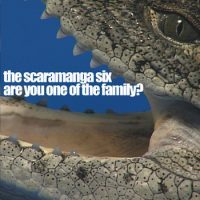
April 2001 – EP reviews – The Scaramanga Six’s ‘Are You One of the Family?’ (“shrouded in threatening, paranoid twilight or caught in the jaws of mean streets”)

27 Apr

The Scaramanga Six: 'Are You One of the Family?'

The Scaramanga Six: ‘Are You One of the Family?’

Sidle into the world of The Scaramanga Six carefully. When it’s not simmering in darkness or in the threat of chucking-out time aggro, it’s shrouded in threatening, paranoid twilight or caught in the jaws of mean streets. There’s a jagged, brutally slashing organ; guitars that bludgeon and swipe; heavy beat-downs of choruses; and voices that crack and fray nastily with the surge of the music. This is hard-centred pop music, made by five tough-looking guys in suit-and-ties and a woman who looks like the gang boss’ daughter, taking her own team out to batter the husbands of her schoolday rivals.

Or maybe it’s in the mind. Though the Scaramangas seem steeped in a very English, Godfathers-style violence of petty brawls, drink-fuelled action (“give me some courage, and make it Dutch”) and frustration penned-up in hometown limits, they aren’t numbed by it. Instead, they use it as the spur for a fierce, dramatic rock with the fierce intensity of Pixies, Cardiacs or – most precisely – Six By Seven. There’s an explosive force to Paul and Steve Morricone’s band that equals that of Nottingham’s hard poets of anti-glamour. And if they’re not as sophisticated as Pulp (another ready comparison) they’ve got bigger claws.

 
The jerking brutality of Are You One of the Family, in which Paul’s grim vocal balances on shards of gasping organ, sets up this EP’s general atmosphere of dirty surrealism. It’s a nightmare of social claustrophobia in which “everything is family – / the cars that pass, the crazy gas that’s surrounding me” and where “everything you see and do / comes back to someone who you are related to.” A place in which there’s no escape from surveillance: “a man will stop and ask my name / I needn’t answer – our names are the same. / I have cousins in the trees; / and, in the bushes, uncles watching over me.”

 
Ladies and Gentlemen is also family business – ostensibly, it’s a sentimental song, but Paul sings it with a battleship-grey clang which suggests that someone at the party will be going home in a box. “We are gathered here today, in a room sitting comfortably. / Let me shake your hands. / You want to be entertained, you want to be out for fun / and there is someone amongst us here / who I can never forget.” Beyond the funereal organ and the leaden-weight crash of guitars, nothing actually happens… but the Yorkshire Mafiosi atmosphere soaks the air.

Relief from this tension is briefly found in the pop-eyed psychobilly of Grasp the Candle, in which Steve Morricone is let off the leash to trade screams with guitarist Julia Arnez, going for the debaser vote in a shambles of scuzzy drums, Birthday Party crashes and throbbing veins. “I’ve been sharing my bed with the drones from the hive, / I think I’d rather be buried alive… I hear you moaning and groaning – / my love is ripe for the dethroning.”

 
For Disenchanted Melody, the tension is back – although this time it’s in the even-more implicit shape of a hushed, mantric Slint-meets-Velvets thrum; a hauntingly sour psychedelic vocal drone, filled with foreboding. A guitar sets up a ceaseless metallic shiver behind the murmuring, harshly lovely harmonies and the gathering darkness of the words. “Night collapses suddenly… disenchanted melody / gently washes over me – / the sound is there, / the sound of air…” Even before the final burst of clanging guitar racket and hellish chorale, the air’s been sucked away around the song, whipped off down the streets where the family prowls.

 
This is a dark and powerful band, who hang around like a threatening cloud even after the music stops.

The Scaramanga Six: ‘Are You One of the Family?’
Wrath Records, WRATHCD01 (barcode unavailable)
CD-only EP
Released:
April 2001
Get it from: (2020 update) buy CD from The Scaramanga Six Shop; download from Google Play; stream via Deezer, Apple Music or Spotify
The Scaramanga Six online:
Homepage Facebook Twitter MySpace Soundcloud Bandcamp Last FM Apple Music YouTube Vimeo Deezer Google Play Spotify Amazon Music
 

November 2000 – EP reviews – Delicate AWOL’s ‘Driesh’ (“a majestic, footsore sway of poignant, lead-heavy guitars”)

20 Nov
Delicate AWOL: 'Driesh'

Delicate AWOL: ‘Driesh’

“Driesh” sounds like one of those arcane words which early-Noughties art-rockers festoon their work with. It’s actually the name of one of Delicate AWOL‘s favourite mountains. When not hiding out in Stockwell recording increasingly soulful post-rock melodies, they’ve got a taste for scrambling cheerfully up the heights of the Scottish highlands, all fleeces and crampons.

On the subject of mountain climbing (sort of), Delicate AWOL are still ascending. ‘Driesh’ is their finest EP to date. It’s not a question of ambition, more one of balance. Delicate AWOL have never sounded more balanced, more aware of music as an expression of what is instead of what you force it to be.

The magnificent ‘Dust’ – a majestic, footsore sway of poignant, lead-heavy guitars – demonstrates this principle. The first time you hear it you have no idea what it is: you’re just caught up in Caroline Ross’ powerful and moving, yet surrendering, vocal. The second time, you realize where the surrender comes from. This is a paean to pollutants, no less: small things which change our immediate world with neither our volition nor our involvement. And this is a song that finds, without a hint of irony, beauty in these changes; honing that balance with acceptance and a fine-art vision. “Dust from satellites fills the skies, / lends an orange hue to buildings they designed in grey /… Dirt from satellites coats the meteorites, / shares its redder touch with rocks that are mostly dust. / And I give thanks for dust.”

Off to one side, ‘Evergreen China Prairie Tribunal’ is one of the band’s affectionate amblings into mutant country/Hawaiian instrumentals. Short guitar notes are stretched lazily and luxuriantly during their brief lifespans; slide guitar, flown behind like a kite, does some happy yawning. The drums and bass patter on, chattering like a pair of old mule drivers on a slow road.

On the other side, the quietly swarming clang of ‘Moggie’ is one of Delicate AWOL’s periodic nods to Mogwai’s crowded fuzz-riffing. However, it’s more homespun, imbued with a positive energy rather than Mogwai’s rampant insecurity. Where Mogwai are tight and tense, Delicate AWOL are endearingly woolly: they’re unconcerned with occasional sloppy accents, and lessen the weight on the guitars to let light sliding curls of notes unravel from the ends of the song. Caroline’s soft, half-buried wail drifts in like a cat singing in the hallway.

Only one song on the EP goes against this serene and meditative stasis. In the languid, perturbed awakening of ‘What in the World to Do Ingrid’, Caroline serenades a woman whose stasis is a matter of routine, and an unwelcome routine at that. “Had enough of breaking bread, / had enough of freaking out. / What in the world to do, Ingrid? / Summer will be here sooner now.” As faintly ominous guitars stir against Caroline’s questioning, they hint that Ingrid’s own nature, under stress, is beginning to crack both her routine and her normality. “Rising inside her – / another, more beautiful woman. / Caught another glimpse of her, hiding in the mirror frame. / What in the world to do, Ingrid? / she’ll be taking over sooner than…”

Just when you think this is going to turn into another tale of a woman slipping into madness, there’s a happier transformation. A joyous hand-clapping lift and gurgles of Hammond organ (the latter straight out of old Memphis R’n’B), and the song becomes a story about stripping off the safety of a firm uniform in favour of striding off naked but unburdened. Caroline sings out another question – “Could it be worse?” – but with the brightening quizzical tones of someone who knows that it won’t be.

Delicate AWOL: ‘Driesh’
day Release Records Ltd., DR401 (no barcode)
CD-only EP
Released: 20th November 2000

Buy it from:
Long-deleted – try to find this second-hand.

Delicate AWOL online:
MySpace,Last.fm, YouTube, Spotify, Amazon Music, Wikipedia entry

July 2000 – EP reviews – The Judas Factor’s ‘Kiss Suicide’ (“a cracked bleed of compassion”)

14 Jul

The Judas Factor: 'Kiss Suicide'

The Judas Factor: ‘Kiss Suicide’

This sticks with me. Unusual. Hardcore punk’s generally a thing of the moment; bringing you alive in the feverish moshpit (or while you’re skulking at the back, trying to listen through to whatever the core of the ‘core is). All that power, that typhoon of ire, just goes through you in a one-dimensional spasm. But under the volume, The Judas Factor (various refugees from Resurrection, Floorpunch, and Indecision) write about souls tender as eyeballs, bared hearts turned to stricken leather, and the struggle for emotional truth within a world drugging and veiling itself into brutal indifference.

 
When Robert Fish – the remarkable split-hearted voice of the band – isn’t roaring his lyrics flat against the ceiling, he murmurs in a cracked bleed of compassion, full of winded pain and the anger that wings across despair. Or he’ll burn up in a cathartic gesture, the distress flare bringing the message home. “Tongue-tied purist, rich in regret, sometimes it’s all I have… / kiss suicide, that look has found life in my eyes… / sad songs never felt so real / tears never felt so good” – although the descending metal storm of Kiss Suicide itself roots Robert’s identity in pure pain, he’s streets ahead of most punk noise-sulkers.

 
He could’ve chosen to stew in self-obsessed frustration. Instead, he’ll take things further, picking over the hope that sets us up (“we all want to be victims of happiness”). Or throwing himself unflinchingly into the loser’s diary of One Fine Day, where the job’s finally done by the bluntest possible tool. “Gun in hand, purpose, clear intentions… / All I ever wanted was control… / Now it’s in my hand… / Never should be, but for one sad second I felt control.” In Safety Net he’s sign-painting, putting up warnings for Bukowski’s camp-followers with the ruefulness of someone who’s been there already. “Human wrecks seem so romantic. / Play out that fall from grace one more time… / all we wanted was to find comfort with each other… / comfort for ourselves.”

 
The rest of The Judas Factor respond with music that fills rooms with rage and loss, led by a thrumming, thunderous bass hanging like a helicopter gunship while guitars paint alarms around it in every shade. And though they can do utterly bone-crushing, heart-wringing power – from the weird grandeur of the mourning thrash that clusters Music Without Person, from foreboding whisper right through to all-too-late nuclear alert – they can still play quiet like a child’s breath. And blend in little glowing samples; little graces of trumpet and heavenly pings swimming up out of nowhere, tiny opalescent Bark Psychosis moments before the mood breaks and jackhammers the heart open again. Even though Robert’s words are torn up in the screaming, clamouring emo-core peaks of anguish, it’s spellbinding.

 
What genuinely makes ‘Kiss Suicide’ a thing of wonder, though, is November 20, 1999, where everything about The Judas Factor falls into perfect place; from the frantic, muted, blizzarding rub of the instruments to Robert’s trembling delivery. A spoken story of lesbian awakening, aching with empathy and foreboding, it takes you (word by passionate word) to the delicious shock at the centre of that long-awaited first love. The one that draws you out of loneliness. And then, standing horrified, we see it forbidden: shattered in a sudden rush of violent bigotry. “You heard their footsteps and you told her to run. You turned around for the fight of your life. You never stood a chance in the world… In our names another life is taken. All because she loved another woman.” Up until then Robert’s kept his compassionate, anguished fury leashed, but finally it lashes out in a woodsplitting scream – “It’s not just words when we speak the same language / It’s not just words when some live life in fear” – as the band roar down like God’s gavel. Indelible force of heart.

 
The Judas Factor: ‘Kiss Suicide’
Revelation Records , REVELATION 92 (098796009222)
CD/vinyl EP
Released:
13th July 2000
Get it from: buy from Revelation Records store or Amazon; download from Google Play; stream via Deezer, Apple Music or Spotify
The Judas Factor online:
Facebook MySpace Last FM Apple Music YouTube Deezer Google Play Spotify Amazon Music
 

November 1999 – EP reviews – Delicate AWOL vs. Forty Shades of Black’s ‘Random Blinking Lights’ EP (“fifteen minutes before the machine blows”)

1 Nov
Delicate AWOL vs. Forty Shades Of Black: 'Random Blinking Lights'

Delicate AWOL vs. Forty Shades Of Black: ‘Random Blinking Lights’

“Accept that you cannot find your friend – / accept defeat and step inside.”

Welcome to the Crumbler. It’s what Guns’n’Roses might have warned you about had they been singing about an older, more tired city than L.A., minus even the toxic smoggy sunshine. Delicate AWOL capture the worn-down feel of London’s scrag-end districts pretty well: the blinded indifference of railway arches, the crumbling cliffs of Victorian brick, and the washed-up bewildered old communities herded aside by no-stopping rat-runs. Their restless, borderline-sinister art-rock could’ve been made for the King’s Cross snarl-up.

There are a few touches of The Fall and Throwing Muses here; a bit of disaffected Banshees too, perhaps. But with its hard-bitten lyrics of frustration (and the spurts of noise-guitar, like aural graffiti tags, on the corrugated-iron lines of the riffs) this music is most clearly the heir to the sounds Margaret Fiedler and Dave Callahan violently worried out of the original Moonshake: eyeball to eyeball and teeth in meat. ‘Random Blinking Lights’ is a sour but arresting low-life bar vignette, with a bleak tune that cuts like glass on a lip. Underneath a low ceiling, guitars clank like homicidal vacuum cleaners busting a gasket. Meanwhile a cast made up of embittered barmaids, and of sundry people who’ve come in to duck out of the light, continue to cadge and haggle with each other – all of them out for whatever relief they can get.

A rancid dissatisfaction bleeds through the song. “Cosy cashmere wives sitting at home are unaware / that their husbands visit here / when they say there’s extra paperwork…” No mention of what the men are after. Whores? Gambling? The sharp anaesthetic tang of a coveted drink, or just the chance to pull themselves in and away from the tugging hands? Caroline Ross (sliding and seesawing her voice around the spilled ashtrays, stale air and puddles) brings all of this to life. Now she’s as strident as a bingo caller; now hovering behind people’s shoulders and murmuring drips of frustration into their ears (“When are you gonna see two feet in front of you?”); now closing her eyes and drifting off – all objective – for a second. She catches the tedium and pressure of trapped lives and brings their nagging internal questions up close: like the first venomous rumble of steam, fifteen minutes before the machine blows.

As you’d guess from this – and from song titles like ‘Unreleasable Fear’ – Delicate AWOL seem fascinated by feelings of trappedness. Only an unhindered Mogwai-ish instrumental called ‘Belisha’ (and recorded under their side-project name, 40 Shades of Black) provides relief. They generally observe the whole trap from the side rather than – as hardcore heroes might – howling from the centre of the condemned cell. ‘Unreleasable Fear’ itself caps compressed, Slint-y dot music with a keening chorus; wary gentleness skirting the surges of a panic attack. For ‘Plateau’, a vertiginous organ hangs queasily in mid-air while Jim Version’s pointy, serrated guitars jump like startled cats and peer suspiciously round corners. The whole thing sways back and forth on the edge of a forbidding brink as Caroline rasps “it’s not what you wanted it to be, / and never will be… / I’ve come to the end of my wisdom… I’ve come to the end of my plateau.” Compelling.

Delicate AWOL vs. Forty Shades of Black: ‘Random Blinking Lights’
day Release Records Ltd., DR101CD (no barcode)
CD-only EP
Released: 1st November 1999

Buy it from:
Long-deleted – try to find this second-hand.

Delicate AWOL online:
MySpace, Last.fm, YouTube, Spotify, Amazon Music, Wikipedia entry

August 1999 – EP reviews – The Rob Beadle Triangle Band’s ‘A Different Kettle of Fish’ (“embarrassment, misadventures and eccentric desires “)

2 Aug

The Rob Beadle Triangle Band: 'A Different Kettle of Fish'

The Rob Beadle Triangle Band: ‘A Different Kettle of Fish’

Duck past the appalling name and the two obvious sub-Goodies joke tracks on here, and you’ll find there’s more to The Rob Beadle Triangle Band than their comedy-schtick image.

Yes, they’re student types from the University of Bath, laden down with flash gear and a taste for laddish zaniness that’s very British, very ’70s. No, that’s not all. Like Barenaked Ladies, the Bonzos and Frank Zappa (or Prince, if he’d had slapstick leanings), they’re musically skilled and canny enough to leap seamlessly between pop styles and come up with songs which can exist both as piss-takes and as serious efforts; regardless of the goofy laughter which comes with them.

 
If you picked key comparisons, they’d be the “belly-laughs, angst-quirks, ‘n’ serious playing” ethic of the long-lost 64 Spoons, or 10cc’s keen and unerring collective ear for tunes and parody filtered through studiedly cheesy wit – hence the near-perfect Bee Gees disco pastiche on The Face. Embarrassment, misadventures and eccentric desires are the Beadle boys’ main obsession. Nude gardening, suddenly finding your mum’s the star player in the porn film your friends are watching – that sort of thing.

 
The Bitch Grated My Thumb jumps between Jeff Lynne wussiness and panicky thrash; a tale of picking up a deranged bag-lady (“come to me, picture of beauty – lying in the gutter’s no place to be”) and of subsequently suffering assault by kitchenware. She Had No Teeth kicks off with ‘Mission Impossible’ kettledrums and rampaging funk-wah guitar, and deals with the horror of waking up next to the woman you’ve pulled and discovering her gums are as bare as Patrick Stewart’s scalp. As the band clatter on, whooping away on their Theremin synths, glassy jazz-funk organ riffs and Funkadelic party racket, a girl-group chorus airily sings “Things were different last night – she looked like a siren, he had his beer-goggles on” – while an anguished muffled voice yelps “Why me? Why me?”.

 
It’s all delivered with crisp production and flashes of superb musicianship (Hendrix/Hazel/Isleys-styled guitar, expert polyrhythmic drumming and keyboard swirls, Kristian Wood’s crucially light touch on voice and bass), and taking care not to let the silliness derail the winning flutter of pop. Thankfully, they’re closer to Space or Poisoned Electrick Head than to Barron Knights. The wiggly You Are Confusing Me sounds like the young Julian Cope spouting gibberish Gong lyrics, giggling his socks off in front of OMD synth overload.

 
And something better is hinted at by the quite lovely Strawberries and Cream. With flowing Spanish guitar, dancing flute lines and puffs of tremulous falsetto harmonies, it sounds like pastoral-period XTC and – in mischievous Andy Partridge tradition – is a lyrical love-song for food-fetishists, Kristian delicately murmuring “you, you’re the sweetest thing I’ve seen – / let me cover you with cream (and strawberries). / We could find new ways of keeping clean, / let me lick you til you gleam (and sparkle).”

A pocket 10cc, then, with an even more warped sense of humour, writing songs for a cleaned-up ‘Viz’.

The Rob Beadle Triangle Band; ‘A Different Kettle of Fish’
Teeth Records, RBTB 9901 (Barcode)
CD-only EP
Released:
2nd August 1999
Get it from: (2020 update) Original EP best obtained second-hand; stream via Spotify
The Rob Beadle Triangle Band online:
Last FM YouTube Spotify Amazon Music
 

July 1999 – EP reviews – Cardiacs/Camp Blackfoot’s ‘Cardiacs Meet Camp Blackfoot’ EP (“an explosion in a fairground repair shop… a belting mixture of howling-for-vengeance free-jazz saxes, prog-from-hell and hardcore trash-blues”)

12 Jul
Cardiacs/Camp Blackfoot: 'Cardiacs Meet Camp Blackfoot' EP

Cardiacs/Camp Blackfoot: ‘Cardiacs Meet Camp Blackfoot’ EP

You already know Cardiacs, or you ought to. They’re that gang of besuited gentlemen from Chessington, Kingston and Milton Keynes – upsetters of pop rules known for busting out of tight waistcoats, with a sound like an explosion in a fairground repair shop. And who specialise in hatefully brilliant singles midway between masochism and ecstacy, as pleasurable as scratching a really luxurious, pestilential itch.

‘Sleep All Eyes Open’ doesn’t let that line of guilty pleasures down, tying knots in Super Furry Animals and The Glitter Band to make a glammy mess of noisy guitars and monkey-gland logic. Here’s something that really enjoys how gloriously dumb-to-the-max it is – listen to those handclaps, and that dum-dum riff bouncing its knuckles along the ground. Yet it evolves fast, ideas yomping around, running off into ever-more crowded angles and arguments while Tim Smith yelps like a circusful of trampolining dogs. Cardiacs always cram their songs to bursting point but never lose any of it to blind alleys or prog meandering. And if I still haven’t a clue what they’re singing about, I think there’s something in the back of my head which does, whooping and waving a flag whenever I hear them let something like this out of the box.

The five-year-old bonus tracks (from the mind-boggling ‘Sing to God’ album) haven’t worn badly either. ‘Dirty Boy’ hammers and claws through seven minutes of huge black-metal guitars and ends up flailing against the wall in an ecstatic stuck groove of wailing choir and electric-shock organ. Foundling is a mediaeval creak of sleep, death and aching men’s feet, worthy of Robert Wyatt. Finally, there’s a celebratory, singalongaTim instrumental mix of ‘Insect Hooves on Lassie’ – and that’s so tuneful it could get a corpse up and idiot-dancing within seconds. These guys are old enough to be Blur’s granddads, for God’s sake – how come they still make almost any other British rock group sound half-hearted and half-asleep?

Camp Blackfoot, hanging onto the other half of this EP, grab the challenge with both hands and a ravening mouthful of teeth. It says here that they’ve chewed their way out of the corpse of Thirteen Ghosts (Oxford’s finest in thrash-improv… hmmm), and they don’t bother with all that business of the dichotomy between social discipline and chaotic emotions. They just hit the record button and scream. A belting mixture of howling-for-vengeance free-jazz saxes, prog-from- hell and hardcore trash-blues comes tumbling out onto the carpet and burns a huge hole in it. Somewhere, Lester Bangs is laughing his head off.

If you wanted to hear serious avant-garde psychobilly locked into a no-holds-barred deathmatch with art-noise, you’ve come to the right place. Ruins forcibly manhandling the Blues Explosion into a blender wouldn’t even come close to the shredding monster-movie music of ‘The Blue Hood’; while ‘The Other Giaconda’ is what might’ve happened had King Crimson ever really exploded onstage in squalling Stooges style, neurotic precision blowing the safety valve a foot deep into the ceiling. And ‘The Red Mist’ tops the lot- squiggly Morricone noises that burst into enormous barbed- wire riffing and an epically hallucinating murder song, a weird doomed narrative which sees a desperate man’s mutter rising to a horrified scream: “The street melts under my feet… I’m drowning in a boiling sea of salt,/ faces are ugly / I – Mother of God!”

Songs to crash your car to, and the soundtrack to strutting away from the blaze looking cooler than ever. Not really something that works with Coldplay, I think.

Cardiacs/Camp Blackfoot: ‘Cardiacs Meet Camp Blackfoot’
Org Records, ORG 056CD (5 028151 010568)
CD-only EP
Released: 12th July 1999

Get it from: (2020 update) Limited edition of 1,000 – best obtained second-hand.
Cardiacs online:
Homepage Facebook MySpace Soundcloud Bandcamp Last FM Apple Music YouTube Google Play Pandora Amazon Music
Camp Blackfoot online:
Homepage MySpace Last FM YouTube Amazon Music

October 1998 – EP reviews – The Isolationist’s ‘Hydrogen Slush’ (“this bleak, rolling, night-time piece of vinyl”)

27 Oct

The Isolationist: 'Hydrogen Slush'

The Isolationist: ‘Hydrogen Slush’

Beats go postal these days. Released by a small British label, The Isolationist is a project uniting American rappers (New York’s elusive Anti Pop Consortium) with producers from London (DJ Primecuts) and London-via-Russia (DJ Vadim); a company of strangers rather than a posse. Perhaps this explains why, by hip-hop standards, it carries a strange chill with it. The rappers fire off into clear, chiming, deathly voids as if they’re carving out the insides of giant floating ice-cubes with the warmth of their breath and the crackle of their thoughts.

There isn’t a comforting funk loop to be found anywhere on this bleak, rolling, night-time piece of vinyl: just the thinnest iciest slivers of the coolest, most spartan jazz, the sidewalk-pounding beats, and the feel of sound slipping back off chrome and concrete. The nod to electronica’s near-autistic Isolationism movement ain’t a hollow one, either. The DJs scratch in their snatches of old-school records and kung-fu soundtracks with the efficiency and flair of unsmiling master butchers. Their beats are audibly frosted; their backdrops are an unfriendly cliff of minimal tonal touches that seems to gaze down at the rappers as if to say “Show me…”. Collaboration may be challenge, but this one’s more of a staring match.

 
Held up against R’n’B’s e-e-easiness or the violent tag-team dynamics of Wu-Tang-style hardcore, The Isolationist’s modus operandi strikes an intriguingly perverse note – an implied, introverted refusal of cooperation, of support or brotherhood; an alliance of denial. Set against this is the feverishly lyrical excellence of the Anti Pop Consortium: criminally absent from hip-hop’s compilation industry, and perhaps best known in Britain for linkups with Vernon Reid, with Moa and with Attica Blues.

We only get two of them here – Beans and Priest (M. Sayid’s opted to sit this round out) – but for guys spirited out of the city that never sleeps and into Vadim’s glacial dream-darkness, they’re coping well; reeling out cunning, multi-levelled raps like levitating, metaphysical Last Poets on fast-forward, lit by flashes of black science and prophecy, and more likely to namedrop Stephen Hawking than Stagger Lee. And they make their position in hip-hop culture clear, boasting “bombs like voluptuous brown big breasts” and chucking their word-games of empowerment and enlightenment into the silence at the gangsta rap funerals, apparently in the hopes of shaking up a lasting, blooming, conscious golden age.

 
Pitted against cultural sickness, the A.P.C. are powerful antibodies. On B-side Timeless Void, Priest scorns the inadequacy of “MCs’ band-aids for bullet-holes / under an umbrella for nuclear fallout from toxic water-balloons… / Your flatness and one-dimensional portrayal / is a betrayal / of my legacy” Urging us to “feel free to escape your entrapment: rapwards! / Over your head, hard to catch, like a bouquet made of thorns on a course for the laws of sentiment” he hits prophetic highs with “build and destroy again, restart civilisation from an amoeba / firm believer in perceiving extra-sensory signals, / my insignia the inscription in the clouds at dusk / – the fall of man…”

 
For Hydrogen Slush itself, Beans slams down the gauntlet with a staggering set of rhymes to scatter light across the wounds on black America’s soul. Some are metaphysical (“your ears are my punching-bag”); some earthy (“a hustla turned horsemeat / befitted the amoeba in a spit-puddle”). Some are poetically ominous – “sunbathing without an ozone layer / the sense you’re burning ants under glass. / UV suffering – no reason to go on, a desire to be by the beating wings but their arms are tired” – and some are consumed by a rage against the breakdown of the spirit: “these things sink deep into the flesh of the tormented: / unity of the ego is shattered, / indiscriminate sensibility debilitated by the winners of impending emptiness”. His words land righteous hyper-literate blows on the nihilistic greed of playa-culture. As cultural champions, they obviously feel there’s more to success than just buying it. Behind them, though, the cold cityscape rolls on.

This EP is like a graffiti artist rolling up his sleeves in front of a cold, stark-white wall, and launching an explosive artistic assault with a bagful of sharp colours. Motormouth MCs versus stonewaller DJs; quick tongues versus clenched teeth; involved dialogue up against cold silences The Isolationist is a bizarre marriage which looks like it’ll lead to some compelling arguments. You’ll find me next door, eavesdropping.

 
The Isolationist: ‘Hydrogen Slush’
Jazz Fudge Recordings, JFR012 (5030433001263)
10-inch vinyl-only EP
Released:
26th October 1998
Get it from: (2020 update) original vinyl EP best obtained second-hand. Some tracks are downloadable or streamable from Bandcamp and Spotify
The Isolationist online:
MySpace Bandcamp Last FM YouTube Spotify Amazon Music

Anti Pop Consortium online:
Facebook Twitter MySpace Soundcloud Last FM Apple Music YouTube Vimeo Deezer Google Play Pandora Spotify Amazon Music

DJ Vadim online:
Homepage Facebook Twitter MySpace Soundcloud Bandcamp Last FM Apple Music YouTube Vimeo Deezer Google Play Pandora Spotify Tidal Instagram Amazon Music

DJ Primecuts online:
Facebook MySpace Soundcloud Last FM YouTube Deezer Pandora Spotify Instagram Amazon Music
 

September 1998 – EP reviews – Blowholy’s ‘Psalm 666’ (“a very young Trent Reznor chasing Tony Iommi down an endless cobbled alley”)

11 Sep
Blowholy: 'Psalm 666'

Blowholy: ‘Psalm 666’

For all the wild promo bluff (foaming descriptions of “’70s hell-riffing axe-gods having lo-fi nervous breakdowns whilst being sodomised by Satan’s own sampler under a layer of time-warped filth and modulated interference waves”) it’s easy to pin this one down. It was only a matter of time before someone copped on to the possibilities of fusing the rhythmical extremity of drum’n’bass junglism with the punch and theatrical flair of heavy metal. Strangely Brown (Blowholy’s one-man noise army) aims to be at the front of the queue to mate two musics more obsessed than most with extremity and big bangs.

If you can imagine a very young Trent Reznor chasing Tony Iommi down a narrow, endless cobbled alley, you’re halfway to imagining Blowholy. Knife-life guitar-riffs – pure Deep Purple and Black Sabbath, cored from their early ’70s pomp – ride on glittering junglist axles with a witchy, wiry vocal wound over the top. Electro-rattle meets bludgeon riffola – simple as that. Ministry did something similar with industrial techno at the start of the ’90s, and it’s fair to say that Blowholy owe them something. However, much of this EP springs from a distinctly British brand of humour and resentment.

Some of this is pulled from punk, some from the anarchic spirit of resistance in the free festivals, and some from the brutal rained-on sarcasm of the English cynic. Riding way back in the mix, crushed and distorted to a thin buzz, Strangely’s tones have a lip-smacking relish to them. He’s a rebellious and gleefully smart-arsed underdog, spitting out slap after slap to familiar targets, but with a engaging vigour. On the titular Psalm 666, he tears straight into consumerism (“Just buy what you’re told, / you are what you own. / Just do what you’re told and you’ll never be alone,”) and its pernicious work at frightening individuals into conformism. As with the metallic riffing, the song’s righteous punk disdain is tinged with Sabbath-style heavy-metal demonics (“Strip away the inane and just one voice remains. / It’s so subliminal, the devil’s own marching call: / ‘Come on, come on, come on, come on now, / fit in, fit in, fit in with the crowd’…”).

While Do As You’re Done By initially sounds more like personal revenge (“God, it gets me high to see the realisation dawn. / At last you’re facing someone you should really not have scorned!”) it’s more of a general roasting of the brainwashed – “I’ve had you here a year but you just never seem to learn. / So now it’s time to find out just what makes your flywheel turn. / If I open up your head I’ll see your tiny poisoned mind / I’m not expecting much, but I will see what I can find.” Beneath the occasional dungeon lyrics, it isn’t schoolboy sadism that drives Strangely: it’s ire at the smug, or the sheeplike, or the pretentious. ‘Dig Your Own’ (which mixes in some Mike Patton-style brat-rapping and a fistful of psychotically wiggling sax samples from Naked City) rips enthusiastic holes in some swell’s ballooning ego. “Claiming to bring the ultimate coup, / only to say what we already knew. / You’re going on so fast that you bring your own disaster. / En route from god to bastard, / so big; could not be vaster. / You’re going on so fast that it could never, ever last you…”

Scene & Herd charges back to the big unison Black Sabbath riffs, taking a sniff at speed-garage while it’s there. The dance elements are better integrated, wrapped in a grinning, glistening embrace with the guitars. This time, Strangely takes his knife to bandwagon-jumpers whose opportunism outstrips their knowledge or sincerity. “In all you do, it’s only you that you want to please… / There is no credence to the so-called words of wisdom that you sell. / But who can tell?” With great pleasure, he pronounces sentence: “It’s your fate to emulate / the world you think you have escaped / but merely aped.”

All well and good, but once the trick of drum’n’bass/metal fusion has become familiar, you do start hankering after some new tricks. Luckily, there’s Iconoplastic (Tzawai), in which Blowholy take a step on from the initial hybrid and produce something much more interesting. The power-riffing electric guitars are gone this time (occasionally replaced by scrabbles across a dislocated acoustic) and the stripes of waiting vacuum and rushing, balefully-textured noise stretched across the shuddering beat are more along the unrelenting sampledelic lines of Moonshake, Muslimgauze or The Young Gods than anything that finds its natural home in ‘Kerrang!’. The ominous Arabic samples (courtesy of Chalf Hassan) merge with the lo-fi percussive impulse, a jihad strike-force speeding across the sands. Meanwhile, the sardonic word-dancing has reached new levels of acidity. “Here we go again, with your self-important jive / about how you made a difference filling empty lives… / Well, it’s such a bed of roses with your collection of pet psychoses. / So tormented, like you meant it. / Oh, such a sensitive man!”

Blowholy are halfway there – they’re on the right track, but if they’re to become as musically interesting as the Naked City and Mr Bungle tracks they sample, they need the courage to consistently extend their own envelope. In other words, more Iconoplastics. But at least the drum’n’bass/metal crossover floodgates have been thrown open. That shaggy, long-in-the tooth rock monster has grown itself a new skeleton and is about to road-test it.

Blowholy: ‘Psalm 666’
Ketamine Leper Music, KETCDS 01 (no barcode)
CD-only EP
Released: 1998

Buy it from:
Best looked for second-hand, although CD versions will be extremely rare. Some tracks can be downloaded from Soundcloud as part of the ‘Church Bizarre’ album.

Blowholy online:
Homepage Facebook Soundcloud

August 1998 – EP reviews – No-Man’s ‘Carolina Skeletons’ (“loaded with meaning, swollen thick with suppressed tears”)

29 Aug

They claim it as “a totally new approach” for the band, but thankfully, this time they’re wrong. After the diverse experimentation of the ‘Wild Opera’ and ‘Dry Cleaning Ray’ albums, it’s more of a look back to their roots in the deceptively simple, poignant flush of ambiguous romance. No-Man are going home. And as they do, this falls – as if from a worn-out pocket – into our hands.

Carolina Skeletons could just be the finest single No-Man have ever released. A rhythm track like a weary hubcap rolling its way home; Steve Wilson’s lovelorn, restrained piano and sleepy, teary guitar touches. A simple, unchanging dynamic evoking both a state of grace and a state of stagnation. A set of chords that fall, question and resolve – heartbreakingly – around Tim Bowness’ quietly yearning vocal. A distant almost inaudible organ, hovering like a night scent. And a short glimpse of a few moments of a trapped life.

It’s a snapshot of a lonely woman paralysed by inertia, watching as time “strips the tinsel from her hair” and the mingled forces of gravity and grief tug her down. It has the same sketch-like quality of American Music Club or The Blue Nile – a few lines loaded with meaning, swollen thick with the suppressed tears – and breathes out, with its eyes closed, the same ineffably bruised air as Mark Hollis’ melancholy reveries. You get a feeling that for its solitary anti-heroine, Cowboy Kate, time is slowing but history has already halted.

So much for the lead track. But the whole EP shivers with an underlying, understated tension; the sort of slight ache that nags and means that at best only a flawed and brittle peace is possible. Caught up in the acoustic guitar webbing of Something Falls, Tim’s words are entangled and shivering in the anticipation of a shock to come: “You’re far too near it to feel it… / You’re far too near it to fear it…”

In Close Your Eyes (a swoonier, more grace-inspired take on their old Desert Heart epic) Mellotron strings hover near or retreat over rolling slot-drums: elegant stalkers on the uppers of their nerves. Twinkles and illuminations come and go like soft offshore lights – halfway through a guitar screams alone in the middle distance. Caressed, Tim sings a beatific, burnished chorus while the verses hint at love, violence and dependency: “His hands were hard, your face was soft. / He kissed your heavy head – and then you lost your strength…” It ends on a poised and prolonged outbreath, with Tim wailing passionately into the void up ahead: “You break, you swim alone, like a child…”

To close – a reverberant, distant, Budd-like reprise of the Carolina piano line in all of its beautiful worn-down dignity. The dust blows forward and the dust blows back. Sometimes all there is to do is to carry on, face set to the wind and tears stroked back towards where you’ve come from. Beautiful.

No-Man: ‘Carolina Skeletons’
3rd Stone Ltd., STONE037CD (5023693003757)
CD-only EP
Released: August 1998

Get it from: (2022 update) Original CD EP best obtained second-hand. The title track (and a different version of ‘Close Your Eyes’) ended up on No-Man’s ‘Returning Jesus’ album in 2001: all of the EP tracks were reissued on the triple-vinyl release of ‘Returning Jesus (The Complete Sessions)’ in 2006.

No-Man online:
Homepage, Facebook, Twitter, Soundcloud, Last.fm, YouTube, Instagram, online store, Apple Music, Deezer, Spotify, Amazon Music

August 1998 – EP reviews – Magnilda’s ‘Clocks Are Like People’ demo EP (“slightly more mad cow-ards than Noel Cowards”)

20 Aug

Magnilda: 'Clocks Are Like People' EP

Magnilda: ‘Clocks Are Like People’ EP

Sing ho! for British beef!

This pops into my head because (a) Magnilda are so proudly chunky, beefy and muscular, especially Connon MacRae’s assured and dextrous lead guitar; and because (b) they’re ever-so-slightly deranged, weaving together pop that merges the wistful and the sly, the romantic and the easily distracted via a series of songs which build up like houses of cards, complex and always teetering on the edge of a tumble. Which leads us to (c) – the fact that their nutty drawing-room demeanour warrants a suitably Olde English exclamation. As with The Divine Comedy, these are songs best listened to while wearing a monocle and attempting to playfully clobber someone with a croquet mallet. In the library. With Miss Scarlet to hold your gloves for you.

Magnilda’s music has a particularly British ancestry. A strong flavour of XTC’s mischievous kaleidoscopic power-pop. Some of Blur’s Britpop-era mix of cheeriness over melancholy. More than a smidgin of Cardiacs’ preoccupation with Victorian and Edwardian imagery, plus their taste for an itchy riff. A love of metaphysical metaphors. And, perhaps somewhere, a bit of Freddie Mercury’s taste for cabaret pop? Or perhaps not: although Richard Larcombe’s amused, mellow drawl certainly suggests smoking jackets, cigarette holders and launching shafts of wit like paper darts across panelled rooms. But this is getting far too Merchant Ivory. Time to stop and take a look at the three songs ‘Clocks Are Like People’ offers us.

There’s She’s The Queen. A love song that’s Squeeze through finishing school, constantly undermining itself with sly bathos: rocketing guitars, handclaps, and a Poet Laureate lyrical approach that’s more ‘Blackadder II’ than Clapham bedsit. “And so, my Camden monarch, my defender / in true ultramarine. / Your manner and your aromatic splendour / live in me now, my Queen.” More and more courtly compliments slip over the top. It’s like being assaulted by garlands. Yet with all the playfulness there’s a pointed seducer’s agenda, however politely turned. “Your Highness, I stand humbled at your beauty. / Admit me, if you please.”

But at the other end of the flirtation you’ll find Loving The Way, in which Magnilda’s cleverness crumbles before their genuine pangs of heartache. However sophisticated Larcombe’s narrator is (“I’m posh, discreet, / I hate to compete. / Such stuff offends me greatly”), he’s still snagged on love’s rich, hard-to-swallow leftovers. And he spends the whole song trying to come to terms with that, without success. “To kiss her neck, her hands, / and stand where she stands: / I can’t see how it’s stealing…” Smart enough to be wise to himself – “Although the passion was strong, there, / I didn’t belong there,” – he’s only smart enough to be wise after the event, and is only capable now that it’s impossible to be so. “I’d have to die to forget her: I know when I met her / I was much too young, and I wasted her. / And now I can’t stop, can’t stop loving the way we were…” It dawdles reluctantly along, with a sour burr to MacRae’s guitars; hoping to delay the imploding, anticlimactic inevitable two years too late. The eccentric, well-dressed smoothie’s already showing crumples and the odd tearstain.

Somewhere in between, What’ll We Do In The Winter? fidgets with anticipation, halfway through the affair and already dreading the challenges to come. “Late September / finds me living with a reason. / But tell me, / will your eyes not be my guide / as we move into another season?” Panicky choruses struggle with angular guitars and paranoia over the fact that even nature seems to be dropping heavy hints that it’s all over: “Now I’m curtain-drawing early, / the light is fading fast, / my spirit fading too / The lamps have started burning / – they’re not the only ones. / I can’t live without you.” By the end it’s become the John Donne hit parade; metaphysics, quaint metaphors and all, as they carol “Oh, leaves are falling.. / the ladybird to her grave crawling. / Oh, tell me what’ll we do in the winter?”

Magnilda are dark horses: slightly more mad cow-ards than Noel Cowards, but only slightly. However much Richard Larcombe delivers his elegant lyrics off a frayed cuff with an arch wink, there’s something compulsively wrong here, something tragically composed and brittle in Magnilda’s poise. Like the guy with immaculate clothes and quips, living out of the unloved flat filled with dust and old tins. Why does Larcombe reckon clocks are like people? Too much studied marking of time, without ever being able to claim it, to live it?

For all the easy jokes, the recent history of British beef has been a tragedy inextricably mingled with pungent, helpless farce. Magnilda – rolling their eyes with exaggerated abandon – would probably appreciate that better than most.

Magnilda: ‘Clocks Are Like People’
Magnilda (no catalogue number or barcode)
Cassette-only demo EP
Released: summer 1998

Magnilda online:
(2018 update – there never was a Magnilda web presence, but visit the following links for ongoing Richard Larcombe projects)

Lost Crowns online:
Facebook Bandcamp

Stars In Battledress online:
Homepage Facebook Twitter MySpace Bandcamp LastFM

July 1998 – EP reviews – Darkroom’s ‘Carpetworld’ (“swathed in contradiction… one long, haunting slab of sonic terrorism”)

15 Jul

Darkroom: 'Carpetworld' EP

Darkroom: ‘Carpetworld’ EP

Darkroom come swathed in contradiction: daytime shoppers on the sleeve, savage nightlife in the music. And no credits, though apparently it’s another one of those confounded No-Man offshoots ‑ don’t these bloody people ever sleep or anything? Evidently not, if the tracks on this single serve as an example of the sounds pulsating through their brains.

Carpetworld itself breaks all the rules ‑ the rules that say you can’t put vocals and lyrics recalling Soft Cell‑era Marc Almond over churning, vicious Frippish guitar ambience and hard‑as‑nails mechanoid beats falling somewhere between jungle and hardcore techno. A knife in the side of the rave generation’s blissout, it’s elegant in its brutality (“taking a twirl with your best friend’s girl, while the rest of the gang torch Carpetworld”), hovering in tatty clubs and observing the rituals of nihilism unfold as the backwash of bad E and the not-so-gentle ’90s poison the clubbers’ dreams.

Dance darkhorse it might be (it doesn’t run with any obvious scene, and fuck knows which playlist it’ll fit on in the increasingly segregated world of dance radio) but this is still cutting‑edge contemporary, with absolutely no fluffiness and Tim Bowness spitting out lyrics the likes of which we’ve never heard fall from his previously poetic mouth ‑ “Have useless sex with your ugly ex… / You velvet‑sneakered chancer, you broken-fist romancer…” as the beats flutter like a death’s head moth trapped in the throat. I’ll stay well out of the disturbing urban nightmare Darkroom are living in, but I’ll happily live it vicariously through their warped imaginings. Dante’s disco inferno.

After that, the Carpetwarehouse reworking does lacks a certain spontaneity. The original sounds like it’s literally fallen together in a paranoid improv session after a thoroughly unpleasant experience: This – apart from simply not being different enough – simply sounds like Darkroom have tried too hard at the atmospherics. OK, the beats are even more frenetic and Bowness achieves something he’s previously never managed in previous recordings: i.e., sounding fucking terrifying as his distorted voice rasps out the repeated mantra “I’m coming after you!” If you ever thought, from listening to No-Man’s work, that you could have that Bowness chap in a fight ‑ think again… Nonetheless, one does yearn for a battering, bloody remix from the diseased mind of Jim ‘Foetus’ Thirlwell, or Aphex Twin.

But, hell, Darkroom’s maverick genius still encompasses enough space for much more roaming, ambient trips. Daylight, in particular. Tim Bowness (like Martyn Bates) has always had one of those voices that are perfect to use as an instrument integral to a piece such as this, weaving magical wordless nothings in and around underwater tones and splashes of electronica. Anchoring this thoughtful pause from drifting off into inconsequentiality, a beautifully melodic bass riff and eerily clattering percussion ‑ like the echoing sound of camera shutters ‑ keep proceedings somewhere near planet Earth.

Ardri, though (nonsensical title ‑ always a bad sign), reeks too much of late ’70s/early ’80s ambient ‑ the kind of stuff the BBC would choose to soundtrack beautiful nature footage. Look, it’s a personal thing ‑ until someone out there finds even a slightly new direction with ambient (and I would certainly not rule Darkroom out of this), then the only sounds that interest me are the ones that either completely chill me out, or those that make the hairs on the back of my neck rise. This final track (like too much else in the field) gets my mind wandering after the first minute and thinking “So? What’s next?”

So, a downbeat end to a marvellous debut from Darkroom. Buy it for the title track and (whatever my gripes) for the remix, and just treat them as one long, haunting slab of sonic terrorism. Brilliant.

(review by Col Ainsley)

Darkroom: ‘Carpetworld’
3rd Stone Ltd./The Halloween Society, HAL 8001CD (5023693800158)
CD-only EP
Released: 6th July 1998

Buy it from:
(2018 update) This is now one of the rarest Darkroom releases – best obtained second-hand or from iTunes.

Darkroom online:
Homepage Facebook Twitter MySpace Soundcloud BandcampLastFM

June 1998 – EP reviews – Mogwai’s ‘No Education=No Future (Fuck the Curfew)’ (“the politics are in the sound”)

30 Jun

Mogwai: 'No Education=No Future (Fuck the Curfew)' EP

Mogwai: ‘No Education=No Future (Fuck the Curfew)’ EP

Mogwai – Glasgow’s “young team” of guitar noise-puppies – are just drawing out of their teens, but they’re already two-and-a-half albums old, and tour veterans. The name’s appropriate – in the sleeve photos they may look a little cute and fresh-faced to an twenty-seven-year-old codger like me, but if ‘No Education…’ is any indication, they do change into something far scarier at night. (They beat Hanson’s burbling Ewoks, anyway).

The punch-card stabs of guitar are pure Slint, but whereas Slint would lay muttered, emotional stories over their six-stringed dots and dashes, Mogwai are vocal-free and rely on pure, bullish emotion as walloped out by plectrum and drumstick. The explicit political rage of the EP’s title isn’t spat out in teen-punk slogan songs, nor in Prodigy chants. It’s carried in the rushing up against the front of the beat: it’s in their surges against the decay of sound. It’s in the faith (which they share with Sonic Youth and My Bloody Valentine) in big dirty noise over a mediocre world. The politics are in the sound.

Perhaps it’s because of the sparse, distant, classical-in-rebellion melodies from Luke Sutherland’s guesting violin, but Xmas Steps carries an odd resemblance to King Crimson‘s Larks Tongues In Aspic. It emerges from a soft interlocking hush of irregular rolls of bass and barely-there guitars (similar to the tension-gatherings of Bark Psychosis) then rises – nerves preparing for the clench – to a building, slashing crescendo and an eventual scrubbing, screeching roar of amp-shredding overdrive and machine-gun spurts of snare, before unclenching its fists and subsiding down into peace again, calmed by the mothering voice of the violin. It nods to Neu!’s jerky rhythms of robot-thrash as much as to Slint or Crimson, but, crucially, it’s warmer than any of them. You can hear the exact moment when strummed guitars, under growing pressure, begin to rebel and distort. Towards the end there’s a papery bang of noise; perhaps an amp blowing up from suppressed rage and cutting across the quiet wind-down.

 
After Xmas Steps the other two tracks seem like little brothers, but maintain the interest. Rollerball’s a sort of classical Krautrock etude. Soft guitar figures, sub-audible tinkles of piano off on the fringes, rough points of drum decoration: the final sound is of the lads downing instruments and strolling out of the studio, and it’s as much a part of the piece as any of the notes were. Small Children in the Background lays its sleepy guitar glints over a glassy fuzz-trail. It rises, almost orchestral, to an emotional peak, then cuts out to small and precious ensemble playing as sensitive as an eyelash. Whispers of voice lap back and forth at the front of the mix.

 
Without words, without direct vocals, without even an individual signature to each player, Mogwai’s music is oddly impersonal… but still, somehow, powerfully emotional. As they glower out from behind their clanking guitars, they might place themselves among the Glasgow arties, but in fact they’re in another place altogether. They’ll hate me for mentioning the “prog” word, but – in the best sense – it’s there in the music already. They’re already far closer to the intensely shaped, angular expressionism of Rothko, Henry Cow or The Monsoon Bassoon than they are to The Delgados’ Velvet Undergound impressions or to Bis’ synthesised pogo-sticking.

At the moment, they’ve got all the dynamics, all the expressive intensity they need – all they need now is the technique, and they’ll break through to that level their music is yearning towards. Expect great things from them by the time they hit twenty-five. ‘Til then, the least we can do is to lift the curfew on them.

Mogwai: ‘No Education=No Future (Fuck the Curfew)’
Chemikal Underground Ltd., CHEM026CD (5 020667 342652)
CD-only EP
Released:
29th June 1998
Get it from: (2020 update) Original EP best obtained second-hand; download available from Chemikal Underground
Mogwai online:
Homepage Facebook Twitter MySpace Soundcloud Bandcamp Last FM Apple Music YouTube Vimeo Deezer Google Play Pandora Spotify Tidal Instagram Amazon Music
 

June 1998 – EP reviews – The Sea Nymphs’ ‘Appealing to Venus’ (“quivering, shipwrecked dreams and prayers”)

3 Jun
The Sea Nymphs: 'Appealing to Venus' EP

The Sea Nymphs: ‘Appealing to Venus’ EP

There’s something about the ‘Appealing to Venus’ EP which sounds incredibly ancient. Not dated, as such – for all its leanings towards progginess, it’s nothing passe or stilted, and any awkwardness is an integral part of the charm. No, it’s the murky timelessness and pre-tech fragility of the songs. It’s music in the trembling, bewildered nude; emerging from its shell of strength to blink in the light. To voice, in a halting manner, its own concerns, as the bright lights and brash neon of the pop scene whirl around it, uncomprehending.

Not that it’s come from nowhere. The Sea Nymphs are an (almost) acoustic alter-ego for the manically electric and intense Cardiacs: a mass of scrawny acoustic guitars, ‘Rock Bottom’ harmoniums, mellotrons and melodicas, baroque Black Death keyboards, crumhorn saxes and touchingly scratchy singing. Cardiacs’ convoluted songs have always had threads of Early Music woven into them. With The Sea Nymphs, we get to wind back along those threads and see where they lead.

 
These four tracks (salvaged from the Nymphs’ criminally ignored debut album) exorcise, or exercise, Cardiacs’ curiosity about pre-pop. You can hear old folk melodies seeping into Low Church music, shreds of sea-shanties and work-song, ramshackle European fragments existing independently of the blues or classical traditions… the bits that pop forgot, in other words. Though compared to, say, Dead Can Dance’s lordly, haughty take on Early Music, The Sea Nymphs sound as if they’ve crawled their ungainly way out of a Vincent Ward peasant odyssey of quivering, shipwrecked dreams and prayers.

 
Listening to the reedy, march-y slog of careening organs, plodding piano and parping synth on the title track, you hear a heartbreakingly wistful devotion. In the giant cathedral boom of Up in Annie’s Room, string synths smear the shuddering air around Tim’s cracked, lost, voice, swallowing it up in a churchy swamp of sound. He sounds as if he’s trying to outshout a God who’s cold and indifference to his vulnerable defiance. The mediaeval shawm-sneeze of God’s Box – fifty people on comb, paper and bells – seems lighter, The Sea Nymphs – flotsam and jetsam but its skipping ward against evil (“God’s good, the Devil is bad – he always gives me money,”) sounds ambiguous in Sarah’s blank, gauzy, little-girl vocals. “Never Setting Things on Fire, / never bad,” she sings, as if considering her options.

 
It’s left to the exquisite Shaping the River (in which a lilting falsetto choir sways, shanty-like, behind watery spangles of piano) to bring us something to warm our bared hearts. A work-song, something shared; a relationship with nature even as you alter it: “River in the middle of / Nowhere / Three of us suck on its heart, / and its head. / …Plant the heart, all from the heart / … only in the heart.”

 
The skeletal bonus tracks – lifted from even older tapes by Mr & Mrs Smith & Mr Drake (the prototype Nymphs) – pull us further into blurry pasts. There’s Bill’s gentle, bemused Camouflage, a twelve-tone sprig on Syd Barrett’s nursery-rhyme legacy. The meandering but intensely purposeful tone poem Little Creations clambers like a drunken squirrel from branch to branch, complete with manuscript rustling and equipment fumbling. Hymn rounds everything off; a live bootleg of Tim blinking over an austere organ sound, a pagan taking his first faltering steps into the chapel. These songs, too, have that unnervingly ancient-but-ageless quality; the same indefinable, painful, yet suspect innocence that haunts the songs of Robert Wyatt or Elizabeth Fraser.

 
Which all means that The Sea Nymphs are both as frail and damp as a newborn, and as old as the hills. Just listening to them pulls you back that much closer to the original greenwood, little shoots cracking their way out of your hidden memories.

The Sea Nymphs: ‘Appealing to Venus’
Org Records Ltd., ORGAN 044CD (5 028151 010445)
CD-only EP
Released:
1st June 1998
Get it from: (2020 update) Original EP best obtained second-hand. Appealing to Venus, God’s Box, Up in Annie’sRoom and Shaping the River all appear on the eponymous debut album by The Sea Nymphs (available as a download from The Alphabet Business Concern), while Little Creations and Camouflage appear on the lone eponymous album by Mr & Mrs Smith and Mr Drake. Hymn is in fact a Cardiacs song used as an early 1980s set closer: the version here was recorded at the 1984 Stonehenge Free Festival and appears nowhere else apart from on bootlegs.
The Sea Nymphs (Cardiacs) online:
Homepage Facebook MySpace Soundcloud Bandcamp Last FM Apple Music YouTube Amazon Music
 

September 1997 – EP reviews – The Shrubbies’ ‘The Shrubbies’ (“bouncing up and down on a deep springy pile of autumn leaves”)

24 Sep

The Shrubbies: 'The Shrubbies' EP

The Shrubbies: ‘The Shrubbies’ EP

Should I name a shrub? Probably a blackberry bush on this occasion. Convoluted, stubborn, furnished with tricky little thorns so that you have to be careful how you approach it… but also blessed with tangy little knots of piquant fruit which make the effort and the odd scratch worthwhile.

The Shrubbies are yet another branch of the Cardiacs family tree. Here, Sharron Saddington and Craig Fortnam (both of whom have done time in Lake of Puppies, William D. Drake‘s genteel “acoustiCardiacs” band) are joined by two bona fide ex-Cardiacs, Dominic Luckman and Sarah Smith. Unsurprisingly, the influence of Cardiacs (or their original acoustic Sea Nymphs alter-ego) has left its mark on the music. Here are four complex and leaping songs, swinging through an adventure playground of sophisticated eccentric harmony based around Craig’s dextrous gut-strung acoustic guitars and Sharron’s fluffy chirrup – although it’s Sarah’s sax and keyboard riffs, as fat and jolly as laughing Buddhas, that you tend to remember.

 
But Cardiacs music is clenched, neurotic, compulsively driven. Listening to the Shrubbies is much more of a relaxing activity: more like bouncing up and down on a deep springy pile of autumn leaves. This is sort of like The Sundays might sound if Kevin Ayers was in the driving seat: innocent but wise as a tuned-in child listening to the wind, with a dollop of Caravan/Canterbury breeziness stirred in alongside a seasoning of Early Music and kitchen-folk singalong. It reminds me of nothing so much, though, as great lost London hopes The Wise Wound, some of whose visionary acoustic/psychedelic outlook they share.


Excepting the surreal, Barrett-ised Sabled Fur, these songs tap directly into nature, caught up in the passage of seasons (Carefree Clothes) while mainlining jumpy sap for hormones, and fascinated by the moment (Perfect Present, with its mariachi keyboards and sax). Most of all, they’re driven by the sheer animal spark of life, in particular on the intricate spiny Body Cried Alive with its dark stretchy Mellotron riffs and epiphany of survival: “spiral down to the ground / like a seed that flies through the air / and affix myself to the ground / crying I am alive! alive!


Small and marvellous; like the delicious shudder in the daylight when the sun and the clouds do their dance-of-the-seven-veils thing.

The Shrubbies: ‘The Shrubbies’
Merlin Audio, MER97028CD (no barcode)
CD-only EP
Released: 20th September 1997

Get it from: (2020 update – original EP is best picked up second-hand; all tracks reappeared on The Shrubbies’ lone 1999 album ‘Memphis in Texas’, from which all of the soundclips here are taken and which you can still download or order from Bandcamp).
The Shrubbies online:
MySpace Bandcamp Last FM YouTube Amazon Music
 

November 1996 – EP reviews – Pram’s ‘Music for Your Movies’ (“profundity stretched over that soap-bubble surface”)

18 Nov

Pram: 'Music for Your Movies'

Pram: ‘Music for Your Movies’

A tangible relief. You know when you treasure a band whose very awkwardness is their spur to genius? And you dread the day when they inevitably develop, move on, make that breakthrough? How you torture yourself with wondering exactly how they’re going to sell out, which part of their off-the-wall wonder is going to be sloughed off like an old coat or an outgrown friend? And how wonderful (and how rare) it is, when they make that leap while still swinging all of that weird and precious baggage.

Over four albums and assorted spring showers of invention, Pram have made music which sounds like daydreams captured in rented rooms and played on dolls-house instruments. Tinkly, tiny and exquisite: beautifully fragile songs, with profundity stretched over that soap-bubble surface. Music recorded in the kitchen sink during those sparkling times an hour or so before noon or dusk sets in; dusted by trumpets and cobwebs, and licked by ebbtides of slide guitar. They’ve got only the flakiest of reference points – tranquillised ’50s lounge-music echoes, say; or the ferment of polycultural Birmingham nightclubs; or Can’s immersive and unlikely groove; or the deliquescing pop of Syd Barrett’s Pink Floyd on See Emily Play (it’s that sustained, wobbly organ, and that obstinate un-rock twitchiness to Daren Garratt’s drumming: free-jazz leanings, or dodgy-but-compelling technique?). They’ve none of the portentousness of yer Sylvians or Cures, and none of the slackitudes of post-rockers: nor the inhumanity of those ambient characters who sound as if they’re wearing their eyeballs back-to-front. Pram’s music has always been winningly human: frail, sensual, intimate, and very lovely.

 
The last time we heard from them (on ‘Sargasso Sea’), Pram had drifted aground and drew wonder even from that, rattling like a wind-harp as they moulded music out of disappointment, sleep and stranded hearts. On ‘Music for Your Movies’, they’ve kept their home-made clatter and every scrap of their inventiveness, but have tightened up their pop. Everything falls into place now instead of merely stumbling together, weaving in delicate threads of dub, drum’n’bass, cinema organ. Rosie’s voice, though still weary conversationalist rather than acrobatic diva, has a new bounce and a lilt to it. And her lyrics (while still existing in the reverie that the white page lends so many poems, crucially detaching them from registering as real life) have a new zest.

 
There’s something celebratory about these songs. The Sargasso that trapped is now a playground for her to transform with enchantment in Sea Jungle’s free-floating love song, while Silver Nitrate celebrates the transforming imaginative power of film as a feminist liberation: “The woman who discovered light / was dazzled by her ingenuity /…With silver nitrate she could make time wait / she could gather all of her hopes and her dreams and make them her destiny / …and spun her thoughts like spiders webs / and with these delicate chains was set free.” On Eggshells it might be Rosie who suffers, locked out from her lover by his own absorption in his past wounds, but she’s the stronger, the more loyal, despite her exposure. Only Carnival of Souls sees Rosie failing to escape the net of her own entrapments, with figures from her past parading through her sleeping head (“feels like I’m living / in a zombie movie”).

https://youtu.be/XsDhRwwhBJE
 
Pram have already made stagnation seductive. Now, wheels oiled, they’re rolling forward to explore the waking world. Lucky world.

Pram: ‘Music for Your Movies’
Duophonic Super 45s, DS45-CD15 (5024545032727)
CD/vinyl EP
Released:
18th November 1996
Get it from: (2020 update) Best obtained second-hand.
Pram online:
Homepage Facebook Twitter MySpace Bandcamp Last FM Apple Music YouTube Deezer Google Play Spotify Tidal Amazon Music
 

August 1996 – EP reviews – Andrea Parker’s ‘The Rocking Chair’ (“sounds like the dark shadow of club culture”)

5 Aug

Andrea Parker: 'The Rocking Chair'

Andrea Parker: ‘The Rocking Chair’

The club’s gone cold and the dancing has come to a halt. Something’s lurking in the chill-out room, and the chill’s gone down several notches.

The word was that Andrea Parker‘s ‘The Rocking Chair’ was the missing link between Goldie, Mahler and Kate Bush. It’s not quite like that. You could think of Cranes at their most ornate and ambitious (and a couple of merciful octaves lower), you could think of a decidedly deeper Portishead or, at a pinch, Bjork’s Play Dead, but you’d have to add the loomingness of prime Dead Can Dance, or Gorecki’s weight of suffering. There’s no dance beat whatsoever, though the seismic bassiness sounds like the dark shadow of club culture. No trancey twinkles, even. Just that bleak blood-smudged thread of vocal. And the slow-motion-nightmare modern-classical strings, strings, strings, all swallowed up in a huge cavern of electronic space and suffocatingly close reverb.

Bloody moody. Bloody scary. Try playing this sucker to a crowd of E’d-up ravers at Heaven. Shivering wrecks four-deep on the floor, I think.

 
The Rocking Chair has an overwhelming horror-bound beauty. Like a swelling, building mushroom cloud, or the spume of the avalanche as it blots out your sun for good. But what’s it all about? Andrea is singing as if she was stretched flat on her back in a coffin, with an eerily drained and colourless calmness to her voice. It sounds like a paean to nothing; to a kind of amnesia where memories stay and it’s the present that’s blanked out. And only flashes of coherence seep from those lips: “so far in the distance, yet so close to my heart.” All I know is that what I can hear – quiet, and far off in the distance – are what sound like blades being sharpened. And Andrea’s singing “Behind you…”

I suppose I should tell you that you get a thirty-five-minute suite for your money. There are two remixes. Attica Blues‘ DR55 Mix drapes Andrea in drivelling pianos over runaway tango-tinsel techno and human-beatboxing. The Major Force West one adds twangs, sitars and ‘Doctor Who’ radiophonic burbles to take her off to one of those space-age batchelor pads. There’s a little spinback track to give another nod to the clubbers. There’s a strings-only version for the Michael Nyman fans. Quality control is at an all-time high, but none of them really alter the impact of the original.

 
If this is the reputed great club-generation comedown, I want to be watching from the other side of the room. The terrible beauty of something ending, and a genuine frightener. Who is this Ms. Parker? What huge, hungry night skies hang in her mind’s eye? Well, until I find out…

I want more. Now.

I demand my terminal tape loop.

 
Andrea Parker: ‘The Rocking Chair’
Mo’Wax Recordings/A&M Records. MW045CD/S (7 31458 15692 5)
CD/12-inch vinyl EP
Released:
5th August 1996
Get it from: (2020 update) Best obtained second-hand.
Andrea Parker online:
Homepage Facebook Twitter MySpace Soundcloud Bandcamp Last FM Apple Music YouTube Deezer Google Play Pandora Spotify Amazon Music
 

SWOONAGE

Swoon. /swo͞on/ A verb. To be emotionally affected by someone or something that one admires; become ecstatic. Here are some people and things that make me swoon. #swoon #swoonage

Post-Punk Monk

Searching for divinity in records from '78-'85 or so…

theartyassassin

...wandering through music...

Get In Her Ears

Promoting and Supporting Women in Music

Die or D.I.Y.?

...wandering through music...

Music Aficionado

Quality articles about the golden age of music

THE ACTIVE LISTENER

...wandering through music...

Planet Hugill

...wandering through music...

Listening to Ladies

...wandering through music...

ATTN:Magazine

Not from concentrate.

Xposed Club

improvised/experimental/music

The Quietus

...wandering through music...

I Quite Like Gigs

Music Reviews, music thoughts and musical wonderings

furia log

...wandering through music...

The Recoup

SINCE 2013: Books and books and books and books and occasionally other things

A jumped-up pantry boy

To say the least, oh truly disappointed

PROOF POSITIVE

A new semi-regular gig in London

Gapplegate Classical-Modern Music Review

...wandering through music...

When The Horn Blows

...wandering through music...

:::::::::::: Ekho :::::::::::: Women in Sonic Art

Celebrating the Work of Women within Sonic Art: an expanding archive promoting equality in the sonic field

Ned Raggett Ponders It All

Just another WordPress.com weblog

FLIPSIDE REVIEWS

...wandering through music...

Headphone Commute

honest words on honest music

The One-Liner Miner

...wandering through music...

Yeah I Know It Sucks

an absurdist review blog

Obat Kanker Payudara Ginseng RH 2

...wandering through music...

poplifer.wordpress.com/

Waiting for the gift of sound and vision

Good Music Speaks

A music blog written by Rich Brown

Do The Math

...wandering through music...

Archived Music Press

Scans from the Melody Maker and N.M.E. circa 1987-1996

The World's Worst Records

...wandering through music...

Soundscapes

...wandering through music...

OLD SCHOOL RECORD REVIEW

Where You Are Always Wrong

FRIDAY NIGHT BOYS

...wandering through music...

Fragile or Possibly Extinct

Life Outside the Womb

a closer listen

a home for instrumental and experimental music

...wandering through music...

Life Just Bounces

...wandering through music...

Lucid Culture

JAZZ, CLASSICAL MUSIC AND THE ARTS IN NEW YORK CITY

Aquarium Drunkard

...wandering through music...

eyesplinters

Just another WordPress.com site

NewFrontEars

...wandering through music...

FormerConformer

Striving for Difference