Archive | album reviews RSS feed for this section

February 2001 – album reviews – centrozoon’s ‘Sun Lounge Debris’ (“miscellaneous objects picked up on a bright afternoon”)

21 Feb
centrozoon: 'Sun Lounge Debris'

centrozoon: ‘Sun Lounge Debris’

Interbreeding the subliminal and the upfront, German ambient duo centrozoon first showed up in 2000 with the self-camouflaging, superbly effective ‘Blast‘. Icy and transformative (an album of elusive, subtle yet uncompromising music for a dissolving world), it was a deliberate hollow grail; an eerily crafted emptiness masking or bypassing outright emotion. The occasional fragmentary synth-pop hiccup broke this rule and humanised the duo (like a brief giggle or fart in the meditation), but ‘Blast’ was mostly all hints and invisible statements – a ghost-impression of grandiosity, a sumptuous erasing.

The six tracks of the follow-up, ‘Sun Lounge Debris’ (put out on the quick-release art-rock label Burning Shed rather than, like ‘Blast’, on the more impassively arty DiN) turn out to be the product of a single day’s recording. With ambient groups being what they are, and the rapidly diminishing returns of minimal textures, it’d be fair to expect a series of belated out-takes. Markus Reuter and Bernhard Wöstheinrich could have exposed themselves as blanded-out or hopelessly jumbled: at best re-treading the magnificent, displaced atmospherics of ‘Blast’. Fortunately, centrozoon’s taste and inspiration are very much intact, and they’ve added some healthy lust and humour to the mix.

Admittedly, ‘Sun Lounge Debris’ doesn’t have the quiet and eerie impact of ‘Blast’. The disordered-lifestyle title makes that implicit, whether the centrozooners are suggesting a J.G. Ballard dystopia or simply admitting that they, too, sometimes like to lie around in a mess of crisps, magazines and tanning lotion. The music – disparate and different in its swatch of moods – also indicates that centrozoon aren’t prepared to plough that same impeccable furrow as they did on their debut. In certain respects, ‘Sun Lounge Debris’ resembles a collection of miscellaneous objects picked up on a bright afternoon. However, any randomness is rapidly offset by the connective, collective intelligence which centrozoon exhibit, and by their clear eagerness to develop from their previous wintry and self-absenting perfection and move towards questions and delicate musical quirks.

‘Sun Lounge Debris’ pieces come, roughly speaking, in pairs. Two of the tracks, ‘Tales of Children in Trees’ and ‘Harvest Girls’, reveal depths (or, more accurately, widths) to centrozoon which have previously gone unnoticed. More on those later. The two remaining pairs take inspiration from the texture-based constructions of ‘Blast’ but move the ideas elsewhere.

From the throwaway ironic/pedantic titles, one of these ambient pairs suggests game-playing at work; toying with expectations. ‘This One Will Please You’ could’ve been a ‘Blast’ outtake, were it not for its warmth – it’s a cosmic Mistral, entirely composed of atmosphere, thoroughly sunny and swimmy. The second – the displeaser – is darker, but where ‘Blast’ suggested urban dissolution (chilliness, shapes of buildings yielding to vapour) ‘This One Won’t Please You’ implies some more rural outlines. More forbidding than its brother, it possesses a similar softness: perhaps a musical impression of the darkness hollowed out beneath the forest roof. The sinister side is provided in a sense of waiting for something unknown, something as yet unshaped in the mind’s eye.

Less cohesive – but bolder – than the ‘Please’ tracks, another pair of centrozoon experiments jolts the project into more radical dynamics. ‘In Sable Orbit’ is the most immediately striking of the two. As mushroom clouds of pipe-organ sounds are put through the MIDI wringer, pitches are set afloat in choppy spasms so that they billow in a vast and giddy skyward swell: a scrap of Messaien nightmare trapped in a Zeppelin. ‘Several Chilled Wives’ follows the same approach with a little less alarm. Beyond its lazy, inexorable and monstrous lurches a circular harmony reveals itself, like the boundary of a horizon.

In almost all of these it’s unclear as to which noises are coming off Markus’ heavily processed and looped Warr Guitar and which emanate from the voice-banks of Bernhard ‘s synthesizers. In spite of their very different musical motivations – Bernhard spontaneous and iconoclastic, Markus scholarly and studied – both centrozooners are able to morph together without an evident join, as they did for much of the frosted blend of ‘Blast’. ‘Harvest Girls’ – one of the two serious centrozoon digressions on the album, and the one that gives ‘Sun Lounge Debris’ its explosive, bliss-struck opening – is very different, and shows us what happens when centrozoon let themselves fall open into those two halves.

It’s revealing. While Bernhard blots an immense, swirling, stained-glass flange noise from his keyboard onto the sky, Markus lets rip with a richly melodic overdriven buzz of solo – an ecstatic Robert Fripp whoop. This is the polar opposite to his usual textural playing, with its concealing nature – this is a lusty, ascending and liberated firework spray of rock tensions, as healthy and randy as a summer party. The nasal-toned scurries and wails are closer to the excitement of Vaughan Williams’ ‘Lark Ascending’ or to Joe Satriani’s triumphal histrionics then they are to more expected influences like Fripp or of Trey Gunn, with their devotional dissonance. The joy is unfeigned, but unashamedly synthetic in its plastic textures: you can hear centrozoon revelling in the fact. In response to Markus’ blaze of guileless prog-rock romanticism, Bernhard sends a cheesy synth-pad of concerto strings rebounding off the clouds. Apparently intent on mutilating any of the dodgy presets which he can entice out of his gear, he also offers up an undulating bass synth boom plus a taffy-stretched swathe of electronica which sounds like an evaporating glass harmonica.

‘Harvest Girls’ could be centrozoon trying on the bristly mantle of rock piggery and loving it; but ‘Tales of Children in Trees’ propels them forward into the world of dance. Those smooth swirls of ambience and the synth chuckles could have come from anywhere else in their ambient past and present, but they’re all tossed on a hustle of jazz breakbeats: a thinking pummel, assured and dominant. As an album closer, it suggests that centrozoon are already off their loungers and in fervid motion. If you came by to relax and slob out, you’re already too late. Next chapter engaging…

centrozoon: ‘Sun Lounge Debris’
Iapetus Records/Burning Shed (no catalogue number or barcode)
CD-R/download album
Released: 21st February 2001

  • Preceded by: Blast.
  • Followed by: ‘The Divine Beast’.

Buy it from:
Free download from Iapetus Records or Bandcamp. Originally released by Burning Shed as a CD-R album.

centrozoon online:
Homepage Facebook Twitter MySpace Bandcamp Last FM

January 2001 – mini-album reviews – The Servant’s ‘With the Invisible’ (“art gets made, covertly, in rush-hour”)

22 Jan
The Servant: 'With the Invisible'

The Servant: ‘With the Invisible’

On last year’s ‘Mathematics’, Dan Black (the voice, face and most of the limbs of The Servant) lifted the lid on a peculiar pop world, fascinated by the chasms between reality and imagination and between formal order and animal madness. ‘Mathematics’ was a dance of numbers, monkeys and peculiar people-watching, jamming in suspicions of murder, deranged Bunuel-ish aristocrats and shopping mall alienation. Unusually, its sonic palette was just as wild as its subject matter. It was as chopped-up and mercurial as it was catchy and danceable, emphasising Dan’s omnivorous sampler as much as his peculiar sneer (thin and venomous, but in its way the wildest and most devil-may-care British pop vocal this side of Billy Mackenzie).

With Chris Burrows now recruited to the project to beef up the guitars, ‘With the Invisible’ hints at being a more conventional follow-up to ‘Mathematics’. In many ways, it is. It’s less extreme, more aligned towards the needs of a guitar band: the sounds are much less wild and varied, with less cunningness required to ensure the gelling of the musical ingredients. Hell, it could almost be Britpop; albeit at the Pulp end as opposed to the Shed Seven end. But I’m not convinced that this means Dan Black has shot his artistic wad. In fact, I’ve a suspicion that where ‘Mathematics’ rattled the cage of the fantastical, ‘With the Invisible’ (right down to the title) documents Dan’s interaction with the everyday – the office jobs, adverts, commuter rushes, conspicuous consumption and car ownership that most of us take on continually and take for granted.

Certainly ‘Biro’ is about sulking in an office, your mind scrabbling desperately for escape either in desk-based sculpture, the limited options of the office party (“wet-look in my hair?”) or violent fantasies – “I just killed my new boss / shut that cock up, with a rock, / non-stop in his face, / and what a smug face.” Inevitably, it concludes “it’s plain to you and it’s plain to me, / there’s nothing for you and there’s nothing for me,” but it has a colourful time getting there.

With that admitted, the next question is how to live under those circumstances, if at all. The brass-pumping ‘Milk Chocolate’ is a rebellion, which finds Dan capering under the motorway next to a blazing bonfire. Systematically, he’s burning all of his possessions from hi-fi to furniture right down to his clothes, trying to shake off the packaging of the modern world. But with “milk chocolate pumping through my heart” the contamination of consumption has already reached to the core of him, leaving him with the logical conclusion of joining his own trash on the fire.

Or not. The bodypopping, Prince-like, bubblegum funk of ‘In a Public Place’ suggests an accommodation, even a brainwave to slake that thirst for stimulation. Art gets made, covertly, in rush-hour. “Among stumbling commuters / I think about each step, / not where I’m trying to get.. / In a limited space, / I try to find a cube for me. / With suble changes of pace, / I move through various densities.” There’s even peace to be found – “watching people move, / they appear to groove / with the invisible.”

For a while, our man seems happy in a formal suit and in step with this world. By the time the White Town-ish synth pop of ‘Driving at Night’ shows up – deliberately tidy – he’s possibly taken it too far. “I try hard to be like I’m in an advert / as we descend upon upon the M1.” Before long, though, The Servant are back to poking holes in the fabric of the world again, trying to expose the workings. In the Jam-versus-hip-hop bust of ‘The Entire Universe’, this happens via rampant, tongue-in-cheek paranoia. “How can I trust my own memory? / Did what I thought I saw before occur?” yammers Dan, almost with relief, as flute shrieks and silvery Indian strings zing off the barking guitars. “How can I trust my own family? / Maybe they’ve lied for years to me.”

By the finale, ‘She Cursed Me’, the music is heading back towards the heady mix of sounds that characterised ‘Mathematics’: ironic tinges mixing with intimate pastiche, music box interludes, bright dreamy shifts of mood and texture with a sharp mind manipulating them. And Dan’s narration has moved well clear of city rules, looking backwards to villagey beginnings, the first stirrings of curiosity (“she cursed me with impatience / and I need to follow clouds,”) and the repercussions of actions (“our conversations by the pond / I wonder if they’re still going on – / swimming on the gluey pool, / around the church and up to the school.”)

The Servant are still marching to their own inner promptings; still bouncing on the shock of impulse. Still the colourful alien probe that’s embedded in the mundane. Keep watching.

The Servant: ‘With the Invisible’
Splinter Recordings, SP003CD (5 038622 102326)
CD-only mini-album
Released:
22nd January 2001
Get it from: (2020 update) CD best obtained second-hand; stream from last.fm.
The Servant online:
Homepage Last FM Apple Music YouTube Deezer Google Play Pandora Spotify Amazon Music
Additional notes: (2020 update) The Servant split up in 2007. Dan Black moved on to a solo career; Trevor Sharpe has played in Deadcuts.

December 2000 – album reviews – Picture Center’s ‘The Wonders of God’s Heaven and Earth’ (“the sound an illusion makes as it leaves the body”)

1 Dec

Picture Center: 'The Wonders Of God's Heaven And Earth'

Picture Center: ‘The Wonders Of God’s Heaven And Earth’

A beautifully understated fatalism hangs, both heavy and light, over the music on Picture Center’s first album. It reminds me of the last time I was – God knows why – wandering on one of the muddy pebble beaches along the Thames Estuary, heart carried like a windsock, fumbled at by a half-hearted drizzle; and when I saw a lonely seagull poised like a pinned crucifixion in the air, almost motionless. Every now and again there was a single convulsion of wings, but the bird always seemed on the brink of a slow, agonised slide down the bank of the air. I remember thinking that it must have been moving forwards once, but something had paralysed it in the middle of a wing-beat…


The words “together” and “forever” haunt ‘The Wonders Of God’s Heaven And Earth’. Persistently returning – sometimes as statements of peeling faith, sometimes as a grim acknowledgement of being stuck. Sometimes a question, hopeful or semi-resigned; the gamble of a last lottery card; the last sarcastic murmur which is the sound an illusion makes as it leaves the body. Another word that returns is “whatever” – breathed out as a throwaway, or embraced with no complaint beyond a drop in the volume and a withdrawal into the kind of shrug that says “here’s as uncertain as anywhere.”

This is familiar. Picture Center have a connection with the late lamented Field Mice… well, more of a fumbled kissing connection, really (they shared some people once, but not any more). Consequently, they’re part of that downbeat English indie bloodline that winds through Sarah Records and its Shinkansen successor – the one that carries the heart-lorn and introverted folk music from the lonely post-war estates – while the countrified, Celtified melancholia of songs like Useless ties in with the romantic resignation of Belle & Sebastian or The Blue Nile.


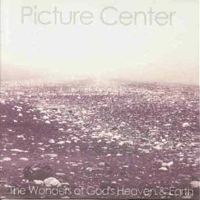
So, as you’d expect, the pace is wistfully dragging, almost funereal. Girls’ and boys’ voices whisper, tears are long-dry but faces stay crooked. The guitars sigh out the emotions, a mist of greyed-out pearls hanging in the atmosphere. A particular poignant English gloom prevails – wan air; not enough daylight saving; and little towns that aren’t so much sleepy as catatonic on tranquilisers, smack and inertia (“around in circles, but nothing comes of it”). The washed-out-but-beautiful album cover could be a stony beach, or a hill of puffy blossoms… oh, or the soggy styrofoam’n’plastic debris left behind in the fields after the festival closes. Distilling an unusual beauty from such unpromising ingredients is Picture Center’s particular talent.

You can think of psychedelia as colourful, but there’s another strand of it that’s a billion shades of grey and merely half of a painful, ghostly heartbeat away from reality. And that’s where Picture Center live; acknowledging it in their gliding, spectral cover of West Coast Pop Art Experimental Band’s Smell Of Incense. It’s heightened by the other elements they allow to soak into the mix – the occasional country curve of a lonely guitar, the fretful Sigur Ros falsetto and drum-machine bubble on Dreams, the pressed-out Julee Cruise sigh of Forever. The tired glimmers of Cocteau Twins moondust or the hinted imprint of hip-hop’s loops and scratchy gusts behind the music-box delicacy in Never. You know they’ve been there – that place where sorrow floats, suspended in its own little bubble while reality freezes your face into something that’s calm but drained…


Ten pictures of fading dreams, drawn-out disappearances, fateful accomodations (“without my darkness your star wouldn’t shine / You need me like I need you…”) and stories of nothing-going-on, in which despair and beauty still manage to sit hand-in-hand on the same worn-down furniture, and achieve a kind of peace together.

Picture Center: ‘The Wonders Of God’s Heaven And Earth’
North American Recordings, 5 030820 012704
CD album
Released: 27th November 2000

Buy it from:
Best looked for second-hand.

Picture Center online:
MySpace Last FM

October 2000 – album reviews – Radiohead’s ‘Kid A’ (“allowing – or forcibly inducing – change to come through”)

2 Oct
Radiohead: 'Kid A'

Radiohead: ‘Kid A’

Radiohead are history. And they know they are: elevated into a pantheon of great expectations and rock landmarks a mere three albums into their career, and somewhat against their own wishes. Like a latterday Pink Floyd crossed with Nirvana (with the universality of both) they’ve had the rock world at their feet. But they’re also fully aware that, like Miles Davis before them, they need to let go of an expected history before they congeal. Embracing the difficult development of their own history by allowing – or forcibly inducing – change to come through.

So it’s goodbye to Old Radiohead’s upfront army of rock guitars, Thom Yorke’s frenzied in-yer-face angst, and those singles scooping at the soul like the hook in the fish’s mouth. And all the talk of the band making a record that mostly junks standard concepts of guitars, lyrics and pure song in favour of Warp Records-style electronica and muttering left-field oddness has turned out to be true.

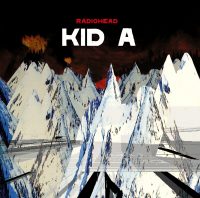
‘Kid A’ does indeed have no singles and no singalongs – lovesick, punch-drunk or otherwise. It has a bleary, fractalized, impersonal mountain-scape etched out on computer for a cover; a lyrical agenda which is plainest in its absence. And its diverse pieces are deliberately disassociated from each other. Sometimes chill, sometimes as mechanistic as automata moving in a warehouse; all strung-out and scrambled by filters, Pro-Tools or anti-technique. Trusted “recorder” Nigel Godrich plays an odd mixture of Eno and Albini roles, squeezed alongside the band in the producer’s chair. Sometimes you can hear a band member at work, untweaked. More often you can’t. It’s like a set of glass cases enclosing specimens, puzzling specimens of music pulled up and laid out with a firm “that’s what you’re getting – goodbye” sense to it. Anti-pop, not pleasing anyone’s appetite for a snackable chorus.

And already (to filch another Yorke line) the knives are out. Radiohead are busily having their seams ripped open and their functioning organs speared, teased out and compared scrupulously against charts; a list of names marking off the components of ‘Kid A’ track by track. And, increasingly, marking it down. “Charles Mingus, Autechre, Alice Coltrane, Boards of Canada, Aphex Twin…” goes the chant. “Rip-off. Buy the originals. Who the hell do Radiohead think they are?” And yes, none of ‘Kid A’ is as groundbreaking as any of those recorded texts, which Yorke and co readily cite as influences. There’s no element that a student of improv, post-rock, serious electronica or revolution jazz won’t have heard already. But this also means that one of the world’s biggest rock bands have admitted they’re at least as much learners as teachers. Sounds like cause for celebration to me.

In fact it’s other legendary records – the likes of Robert Wyatt’s ‘Rock Bottom’, Scott Walker’s ‘Tilt’ and Robert Fripp‘s ‘Exposure’ – which ‘Kid A’ is most genuinely akin to. Each of these records strives to meet its ends by a mixture of instinct, cold science flushed hot again with consuming passion, and their own secretive internalised logic. It’s a big step going from ‘OK Computer’ (one of the most explicit and upfront records of the ’90s, in which Thom Yorke was a incandescent clench of ego; stubborn, scarred, and railing against the draining fear and indifference of the adult world we’re trained for) to a twenty-first century record which is as weirdly egoless as this one is. An inarticulate speech of the heart via samplers, hazard and evasion.


Significantly, the most memorable and accessible song on ‘Kid A’ (the tear-blown strum and shivering strings of How To Disappear Completely, echoing both King Crimson‘s desperately vulnerable Waiting Man and Walker’s cryptic Patriot) sees Yorke singing softly and acceptingly of the ultimate relinquishment. Drifting away from himself in Dublin, becoming insubstantial, not as a surrender, but as some kind of transcendence. “I’m not here… this isn’t happening,” he sings, a tired relief (and, almost, a kind of love) suffusing his voice as the quivering violins flutter down, snow-like, obscuring the signposts.

It’s the emotional rightness in ‘Kid A’ that finally pulls it clear of the dissectory attacks people are aiming at it. As if the cry of rage that dominated ‘OK Computer’ is now diffused in a temporarily helpless scatter of images and impulses. As if the echo, coming back, has impacted on a band whose foes and fears are now nested in the fabric of the world, who can no longer respond with a simple song.

The fabulously grotesque artwork (a booklet of nightmare kid’s drawings) that lurks, hidden, in the back of the CD tray, gives a little glance into this world. Stick men boot each other in the balls; small mice squeaking copyright signs wander into the maw of a toothy beast growling a trademark; frightened eyes stare out of threatened houses, and Tony Blair’s PR grin is distorted into empty-eyed predatory lust. A nation of grinning little bears end up on the end of people’s forks or balaclava-clad and tooled up with Kalashnikovs, and a screaming parade of vitriolically surreal words march across the pages like circus handbills. Like the doomsday rhetoric of Godspeed You Black Emperor, it’s almost comical… yet it jolts, like the sound of a chisel stealthily tapping at your wall.


And perhaps ‘Kid A’, rather than being the rebel songbook for this world, is the recovery notes for those as cracked by it as ‘OK Computer’ predicted they would be. There’s a terrible surrender and relief about Everything in Its Right Place, freewheeling along on tranquillised electric piano chording with a slipstream of sliced up, gossamer-keening Yorke vocals tangled in its tail. In which two of the few comprehensible lines are “yesterday I woke up sucking on a lemon – yesterday I woke up soaking,” and “what is that you tried to say?” This is disarrangement, dysfunctionality – not order. Yet Yorke seems to realise that this too has its place in a person’s history; and the sheer beauty of his singing throughout implies there’s hope waiting up beyond the dissolution.


About half of ‘Kid A’ ties in with this dissolve. The clinking music-box-meets-hip-hop narcosis of the title track, a nursery lullaby as rendered by an uptight and drier Massive Attack. Yorke’s bass-warped, filtered and generally fucked voice wavers, croons and ties little musical bows in and out of the pernickety beats, while words about “heads on sticks”, “ventriloquists” and “a little white lie” work their way through the dirty pink clouds. Who blinks first? The gaudily humming electro-disco on Idioteque reveals an empty dancefloor grooving away to itself as catastrophe looms. Yorke, in a slurred keen, is spilling out surreal sub-sense like David Byrne on sodium pentothal (“laugh until my head falls off / I swallow ’til I burst… / Women and children first, and children first…”) but sounds ecstatically happy (“here I’m alive, everything all of the time”), and the last sounds on the track aren’t death-booms but an aviary of feverish guitar loops.


The breakdown’s in the motorik groove of The National Anthem, adhesive thumbstains of bass underpinning a brawling rabble of brass that sound fresh from a vigorous drunken debate at Mingus’ Jazz Workshop or the Art Ensemble of Chicago. Yorke’s voice winds out of the airshaft with a lobotomised “everyone around here… everyone is so clear”: later quavering “everyone has got the fear” as the horns become restive, but affirming “it’s holding on… it’s holding on.”


The other half? Anyone’s guess. The smears and rumbles, the webbing of indistinct voices, the gusts of emotion hurtling up towards invisible targets, all blur the picture. The ghostly tundra ring of Treefingers gives away nothing but a deathly peace. The unravelling trip-hop of In Limbo, full of unhitched folk guitar and stutters of echoed organ, is lost somewhere in the subconscious: grumbling “you’re living in a fantasy world” while itself threatened by nightmares of loss and disappearance (“I’m on your side, / nowhere to hide, / trapdoors that open, / I spiral down”), and finally swirling away in a rush of killing reverb as if down an enormous storm drain.


There are a few dud or ill-fitting moments while Radiohead grope in the fog. Morning Bell, for one, where they knock out a scratchy, swamping, insect-buzzing song which sounds like nothing so much as Echo & The Bunnymen shaking with the D.T.s. Or the tribal tom booms, wiry laceration of rhythm guitars and guilt-ridden lyric on Optimistic, harkening back too much to ‘The Bends’ (or the out-of-focus U2 of ‘The Unforgettable Fire’). But the starved boniness renders these hauntingly hollow-eyed stuff, compared to the previous fire. “If you try the best you can / the best you can is good enough,” sings Yorke, with a scratched, dented demeanour belying his words.


The final act is Motion Picture Soundtrack, journeying on an exultant wheeze of harmonium, celestially riffling harps and gusting bass wind as Thom Yorke settles back into love as if he’s settling back into a wrecked old armchair. And it’s love among the trashed – “red wine and sleeping pills / help me get back to your arms. / Cheap sex and sad films / Help me get where I belong.” Querulous (as he protests “Stop sending letters, / letters always get burned. / It’s not like the movies,”), but there’s happy-sad commitment here as he murmurs “I think you’re crazy, maybe… / I will see you in the next life.” Then one last delayed pink gush of electrophonic orchestration, and out.


But it’s in its totality that ‘Kid A’ sinks into your mind. There’s no way it could ever be counted as a flawless record – in fact, it revels in its flagrant imperfection with such a fierce joy (and one born of abstract willpower) that it’s hard to condemn it for that. But it’s a vitally important record for Radiohead; and a rewarding one for the listener.

The peculiar triumph of ‘Kid A’ is the way that it transcends both its own wanton abstractions and Radiohead’s past explicitness to resonate beyond each of them, in the way that an impact on a random strand can shake the whole web. To hear it is to be haunted by the emotional husks of messages long lost and made irrelevant, or by the impressions left by intentions deflected and displaced into half-formed actions and events. To have your mind rippled by the last exhausted breeze from a shockwave far, far away. To be moved by the vibration of history – Radiohead’s history, at any rate – as it passes.

Radiohead: ‘Kid A’
Parlophone, CDKIDA 1 (72435 2959020)/7243 5 27753 4 7 (72435 27753 47)/LPKIDA 1 (724352 959013)
CD/cassette/10-inch double vinyl album
Released:
2nd October 2000
Get it from: (2020 update) buy/download from W.A.S.T.E. Store, Google Play or Amazon Music; stream via Soundcloud, Deezer, YouTube, Apple Music or Spotify
Radiohead online:
Homepage Facebook Twitter MySpace Soundcloud Bandcamp Last FM Apple Music YouTube Vimeo Deezer Google Play Pandora Spotify Tidal Instagram Amazon Music
 

September 2000 – album reviews – Steve Lawson’s ‘And Nothing But the Bass – Live @ the Troubadour’ (“sheer guilelessness”)

10 Sep
Steve Lawson: 'And Nothing But the Bass - Live @ The Troubadour'

Steve Lawson: ‘And Nothing But the Bass – Live @ The Troubadour’

Apparently, this music is what Steve Lawson makes to entertain friends – who make themself known as such simply by showing up to one of his intimate gigs. These could be in London, Lincoln, or Watford; in France or California; or wherever else Lawson and his little bundle of bass guitars, EBow sustainers and looping devices pitch camp for an evening of playing. Having asserted your friendship by wandering in and sitting down, you can smile to yourself about the way his lush, demonstrative instrumental music manages to cross-reference Frippertronics, Pete Seeger, Jaco Pastorius and Joe Satriani (for starters) without them crashing into each other or crowding him off his own playing stool.

You can also smile – with genuine enjoyment – at the sheer guilelessness of his music. The gauche jokiness of the album title is completely accurate. With one exception, this really is all One Man And His Loops live in front of a small, polite and audibly happy audience. But it shouldn’t be dismissed as cutesy novelty, or as circus tricks with effects pedals. That isn’t the half of it. In London, we’re used to anxiety. Self-exposure from tortured musical artists. Cool-by-numbers checklists. Spotlight-grabbing attitude flexers. Obvious-state-of-minders stapling themselves to credible trends, and sinking with them. Hearing Steve Lawson duck all of this (instead, he quietly focusses on the way music connects across generations, and between person and person) is a sweet shock.

On technical terms alone (if not in finger-thrashing stunt display), Lawson respectably holds his end up alongside American stars of the lyrical bass such as Victor Wooten or Michael Manring. But his work showcases not only prodigious playing talent but also a thorough lack of self-consciousness about engaging with his listeners. Maybe it’s from his previous work, playing with the equally guileless and elfin pop veteran Howard Jones. When you hear Lawson duetting with himself on sprightly children’s-song tunes like The Inner Game and The New Country (wrapping joyously squishy melodies around his looped, nodding, double-stopped riffs) you know you’re not hearing someone who’s concerned about his agenda fitting anyone’s T-shirt, or with the solemn rules at jazz school.

All right – perhaps an over-mellow conflation of two lovable old chestnuts (Chopsticks and Blue Moon) on Blue Sticks is a step too far in this direction. All taste and no meat; too close to a musical life that’s one long function room. Lawson dispatches it with impeccable skill – which is all very nice, but a little worrying in terms of complacency. Far better to hear him feeding twanging threads of Celtic-American folk song and bluegrass, Flecktones-style, into The Virtue Of The Small; and to then observe him splitting off to layer on some luxuriously glutinous improvisations (via serenely wandering fretless and classic-metal distortion). Listening carefully, you might spot momentary nods to other bass players – Chris Squire, Steve Swallow, Alphonso Johnson, Stuart Hamm – who’ve let melodies rumble up from the basement.

Of course, you could just put the notebook down and enjoy tunes like Bittersweet, a fretless-bass-and-piano duet owing a little to Pachelbel’s Canon and as much to Weather Report’s A Remark You Made. Jez Carr’s strums of high, cautiously sweet piano haze this one lightly with blue. Perhaps it’s over-aligned with the fastidious, earnestly white end of New Age jazz, but Lawson’s head-bowed cadences are beautifully poised – natural and regretful.

So far, so immaculate… so ‘Bassist Magazine’. What really opens doors are three pieces in which Lawson ventures into process music, chance-and-hazard and ambient music. Thankfully, it’s closer to Fripp Soundscapes and to post-rock than to the freeze-dried fusion on (for example), those slick early albums by John Patitucci.

On Drifting, the original moonlit ostinato foundations and skirling skybound melodies give way to smears of trembling Frippertronical treble passes – like wheelmarks on cloud – and to trance-techno bubble echoes Lawson somehow wrings out of his bass.  The lapping sounds and shimmering harmonic nudges of the gorgeous Pillow Mountain (with its sub-aqua heartbeat) are closer to Mouse On Mars than to any bass guitarring this side of Rothko’s post-rocking odysseys. Here, Lawson EBows strange Chinese string calls out of the beautiful murk. A third piece, Chance, clings on (just) to the right side of disassembly. The sharp attack, or mother-beast rumble, of Lawson’s varied approaches on fretless step in and around the frigidly emotional ECM-inspired bass figure at the heart of it, ghosted with minimal traceries.

It’s with these pieces that we hear Steve Lawson’s audience returning a favour. Moving away from simply bobbing their heads to the happy melodies, they concentrate on  listening instead. And all without the man breaking much of a sweat, either.  For any instrumentalist, this album would be charming. For Steve Lawson, it’s a showcase punched open at one end. His friends are watching him grow – I suggest that you join them.

Steve Lawson: ‘And Nothing But The Bass – Live @ the Troubadour’
Pillow Mountain Records/Bandcamp, PMR 0011 (no barcode)
CD/download album
Released: 28th August 2000

Get it from:
Bandcamp

Steve Lawson online:
Homepage Facebook Twitter Bandcamp Soundcloud

August 2000 – album reviews – Rudy Simone’s ‘To Put the Sun Back in the Sky’ (“shot through with aftershocks of abandonment, dispossession, self-doubt and the battle to stay afloat”)

19 Aug

record-rudysimone-putthesun

Shot through with aftershocks of abandonment, dispossession, self-doubt and the battle to stay afloat, Rudy Simone’s debut album doesn’t resolve the questions she’s raised before. It doesn’t round off those battleworn displays of uneasy heart from the previous year’s ‘Personal Cloud‘ EP, nor does it offer clear clues about where she’ll be travelling in the future.

Fresh as she sounds, Rudy already has plenty of past. Originally from Buffalo, New York State (where, as Rita Seitz, she sang in various obscure bands during the early 1980s) she turned emotional refugee later in life and crossed the Atlantic to Liverpool, where her own songs emerged amid a landscape of acoustic sessions and nightclub rushes. Most debut albums are a statement, however crude. This one’s a scrambling steeplechase across Rudy’s emotions and her spiritual restlessness. It stays true to the disruptive collisions between the life singing in the head and the life that lurks outside. What ‘To Put The Sun Back In The Sky’ resembles most is an attempt to wrap up Rudy’s fraught baggage in a big, unwieldy brown paper package; to tie it together with guitar strings and beats, to spray it with disco glitter and then set it free somewhere down the Mersey. Drifting seawards, it comes unstuck and reveals itself.

Attempting to cram in all her gushes of inspiration, Rudy ends up with a confusing whole. Seemingly at random, songs appear in alternate acoustic and instrumental alternate versions; there are two takes on the eerie Kill The Cult Of Cool single, and a trancier reworking of Personal Cloud. ‘To Put The Sun Back In The Sky’ ends up as an anxious, fractured goodie-bag, unsure about whether floaty beats are better than strumming, and telling repeated stories in different tones. Don’t expect track-by-track coherence – but do expect plenty of understated feeling, a maverick DIY pop sense in full effect, and some determined songcraft. This album is a necklace-worth of interesting, often touching episodes.

In some respects, Rudy fits in with that rough wave of confessional women emerging in the 1990s via trip-hop and indie rock, including the two Beths (Gibbons and Orton) and Juliana Hatfield. There are some similarities to Jane Siberry; though Rudy is more loosely strung, she shares elliptical, Siberryesque feminine perspectives, blown about by impressions and finding solid little truths in the midst of abstraction. But for my money the artist whom she’s closest to is Lida Husik. Both Rudy and Lida resist committing themselves to any one musical approach or way of looking; both seem suspicious of tradition or sturdy craftsmanship. As with Husik, Rudy’s wispily sweet vocal belies her determination to discover and envision things her own way, learning from time and from chance. Both, too, are peripatetic and intuitive to a fault: they’re both quite prepared to walk into mires of embarrassing self-conscious fluff if that’s where an idea takes them (in Rudy’s case, a misplaced James Brown tribute called Bony Little, giddy and apologetic, in which she bangs on forever about her skinny white ass).

For this album, the club dance elements have triumphed in Rudy’s big bag of sounds – as they did on Husik’s ‘Green Blue Fire’ album four years previously. Techno producer Sheldon Southworth, a.k.a Diffusion, is a vital collaborator for half the album. He’s the Beaumont Hannant to Rudy’s Husik, adding his own club-friendly trance sparkle to hers and replacing guitars with the zing of electronics. For The Secret Sayings Of Jesus, Rudy whispers god-inside Gnostic philosophy, floating it like evangelical thistledown over Diffusion’s bright trance beats and aquatic keyboard textures. Despite her trippy tones, hypnotically soft, the chant is a desperate prayer rather than navel-gazing. It’s a counterpoint to the other songs, which make up a travelogue of delusions to be overcome in oneself or endured from others.

Vanity’s Car perks its way through cheerful Euro-trance and Soft Cell gurgles, but Rudy’s lyrics dwell on how the wrong kind of excitement can lessen a person’s grasp on reality – “amazing how far you’ll go when you lose control – / I’ve got to get out on my feet / and be the things I always wanted to be.” The fallout is clear: “I might be sitting in your living room / but I might as well be in another country,” Rudy protests on Can’t Go There. “You can drive if you wanna, but I prefer to stay on my feet… / ‘cos you’re so blind, you can’t see that it’s right across the street.” Warm swelling synths, glinting funk-wah guitar, and house piano echo that communal gospel glory which Primal Scream tapped on Come Together. Rudy’s own hopes of connection, though, are dissolving.

While Diffusion’s contributions are valuable, there’s no question that Rudy remains convincing on her own. The brief pure-dance diversion of Mentallium hurls rapid drum’n’bass kitfire headlong into chilly trance electronica: to wild things up a little, Rudy mixes twitchy diva calls, jazzy double bass and kettle drums into the instrumental. Out on the other edge of her music, she abandons beats and boxes. A blues-y acoustic guitar version of Vanity’s Car brings its warnings closer to the surface, no longer masked by shiny bodywork. Part pop-plaint, but mostly blues rant, the all-acoustic Water’s Edge sees the banalities of love (“Sometimes I’d like to kill him, / but I always gotta thrill him”) splinter in a glare of rage. Wailing like a cross between PJ Harvey and Etta James, Rudy walks the shoreline, grappling with a moment of agonising choice. Violence is poised within her, ready to strike inwards or outwards, and only the lone conscious voice of the song cries out against it. “Don’t go, you’ll only make your mama cry / Don’t go, you’ll only fuck your baby’s mind.”

As a single, Kill The Cult Of Cool got lost in the no-budget wilds which sank so many others; yet its emotional hop-skip-and-jump was a remarkable coming-together of ideas and instinct. It still is. Broody horror synths, laceworks of folk guitar and a patchwork of voice snippets quilt together into something haunted, defiant and transformative. In keeping with the rest of the album’s repetitions and revisitings, the song gets a double outing (the Derision Mix transforms it into radiophonic electro-funk replete with glitchy scratching and whooshing, frothing Vangelis synth splurge) but it’s the original that really matters. Something of a signature song for Rudy ever since it first showed up on ‘Personal Cloud‘, its cohesive spirit remains clear as its splintered voices ask for compassion, pray for guidance, plant down stubborn feet. “I was the quiet one in school, never made any trouble,” stammers a sampled man; “I don’t care what you say, I’m not crazy,” Rudy adds quietly. It’s full of struggle, though never precisely clear what that struggle is – the claw back to sanity out of the creeping horrors? a defense of alternative thinkers and scapegoats? – yet it’s also affecting in a way in which few things that I hear are.

The spine of the album, though, is the title track and Personal Cloud. The former’s a grieving white-girl rap about a marriage snapped violently in half: here, Rudy sounds as soft-spoken but as wide-awake’n’dreaming as Margaret Fiedler does while puzzling out dreams in Laika. Almost cushioned by the pain, she lets moments of heartbreaking reproach crest over it and into the words: when she murmurs “you say you’re following your heart / I say fear has played a much bigger part”, real agony glints. In a new take on Personal Cloud (remixed by M@2K into radar blips, ambient funk and blue-light electronics) more displaced degrees of mourning are added to Rudy’s grapple with addictions, love and loneliness (“I wrap my lips around a cigarette instead of you…”). Her voice flutters, weightless and bereft: a hydrogen balloon un-anchored by faithless hands.

Maybe ‘To Put The Sun Back In The Sky’ is not the album Rudy Simone’s capable of. It’s more like several different shots at an album: all crowded into the kitchen together, taking anxious and uncomfortable refuge. No clear clues; a spinning signpost; but indications of an effective, if scattered, talent – one worth investing some love in.

Rudy Simone: ‘To Put The Sun Back In The Sky’
Phat Lady Records (no catalogue number or barcode)
CD-R-only album
Released: 2000

Buy it from:
Extremely rare – best found second-hand.

Rudy Simone online:
Homepage Facebook Twitter Bandcamp Last FM YouTube

July 2000 – album reviews – Peggy Green’s ‘Songs of Naka Peida’ (“defiantly post-RSI pedal steel guitar music”)

6 Jul

Peggy Green: 'Songs Of Naka Peida'

Peggy Green: ‘Songs Of Naka Peida’

Imagine working at something for the best part of twenty years. Perfecting it to your best ability, gaining a reputation and respect; making a decent living as well as finding a way to make it speak for you, give you another voice to communicate with. And then, all at once, having it taken away from you.

This is what happened to Peggy Green. Up until the point when repetitive strain injury gripped her working hands in 1990, she was one of the most respected pedal steel guitarists in New England; not to mention also crafting her way in private as a six-string player and songwriter. Subsequent neuromuscular complications during the ’90s robbed her, at various times, of the ability to use the blocking and rapid picking techniques which are the staple of pedal steel playing; to work the crucial left pedal of her instrument; to walk anything further than short distances without crippling swelling of the hands; or even to play for more than ten seconds. It’s the kind of situation which unites musicians – via both the heart and the pocket – in a cold sweat. The cut-off, seemingly irrevocable.

No, there isn’t a glitzy TV movie outcome. Peggy has recovered partially since then, but not completely. These days, you won’t find her duelling onstage with Buddy Emmons and Bruce Kaphan; or burning up Nashville pedal steel playoffs with a revitalised, zippier technique; or wearing Dolly Parton hats while having her hand shaken by the President. Life often doesn’t let us wallow in such easy tears and such feel-good endings. But what life can be is dignified.

Constrained by the cold facts of injury, Peggy could have retreated into honourable retirement, taking another job and accepting her loss as some kind of act of God. What she’s done instead does involve acceptance. But humble defeat? Not so. ‘Songs Of Naka Peida’ is a defiantly post-RSI album of pedal steel guitar music, played on a couple of custom built acoustic instruments built by legendary pedal steel maker Paul Franklin Sr. Dubbed “ped-a-bro”s, they merge the penetrating “jump-at’cha” sound of dobro resonator guitars with the flexible bends and glides of conventional steels.

As you can imagine, these are naked instruments – the kind which won’t hide a players errors behind a comforting wall of amplified smoothing. They’d be a challenge for a player in prime fitness, let alone one with hand problems, but Peggy’s chosen to make her way on them. Having accepted the limitations imposed by RSI, she’s dispensed with the flash and trickiness she could previously deploy for showboating country musicianship. Now she’s concentrating on a slow, considered, delicately melodic way of playing – clipped in approach; tailored to avoid the spasms, locks and numbness of the condition: a way in which she can, as she puts it “achieve that old connection between my soul and my hands.” She’s also elected to record in a way which makes every creak of the ped-a-bro mechanism and every shift of the player’s stool discreetly audible, so that you can hear her at work.

It works wonderfully. Peggy offers sparse, slowhand, bluesy playing nourished by lonesome American roots; at the same time she offers short, shallowly-picked notes with an exquisite attention to placement that’s associated more with East Asian music (with the yang ch’ins of China, the kotos of Japan and the assorted zithers of Carnatic music). These precise patterns can – at the right moment – be lifted off the map and up into the air, with just a push on a pedal. All of this is achieved with a patient grace and melodicism, the kind which wouldn’t shame Bill Frisell or Martin Taylor. Not that there isn’t some therapeutic wrestling with demons here. Titles like Achin’ Deep Down In My Bones and Fair Affliction assure us of that. But most of ‘Songs Of Naka Peida’ is – while never transcendently happy – remarkable in its serenity.

There’s also a background concept here. The album has a speculative yarn attached: a self-referential creation with strong flavours of Ursula K. LeGuin. In the stricken, disaster-oppressed Continuum society of the future, Naka Peida is the name of a character – the Continuum’s Chief Archivist. Each song on the album is linked to a story of the rediscovery of Peggy’s music, and its connection and implications to both Naka Peida and the Continuum. Evidently Peggy’s not interested solely in her own healing.

The music travels on, learning from places as it goes. There’s the graceful glissandi of Koroen; the tart, sparkling Indian cascades of Love’s Last Chance; the welcoming Japanese formality of Nakahama (named after the location where most of the album was both written and recorded) or the curving Hawaiian warmth of The Pedalist or Wrong Stop Blue. If the music doesn’t necessarily draw from a sense of place, it can draw from time instead. One of the approaches Peggy uses is to place herself in a particular moment. Goodbye To The Twentieth Century was recorded in Osaka on Millennium Eve, and comes out as the most hopeful piece on the entire album. Affected by its Japanese setting, it also revels in its vertiginous, playfully lovely slides and swoops, in the celebratory birdsong harmonics. For a moment, Peggy even lets the ped-a-bro sing with the jazzy bends of Billie Holiday.

The three-part Improvisations In The Moonlit Dawn (billed by Peggy as being “the closest you can come to sitting with me while musical ideas are being born and tried out”) comes from a February morning, closer to home in New York. It’s more sober (Five Note Blues is positively respectful) and more American (you could even expect Robert Johnson to be moaning over Evening Turns). Finally, it’s brasher when the punchy, multiple stop-and-slide slowhanding of Make Way For Dawn makes its presence felt. Assertive, muscular and far more assured than you’d have expected, it still loses none of the delicate melodicism of the rest of the album.

“My struggle against the adversity of my injury makes me the player I am today,” notes Peggy. Whatever she may have been before the axe fell, she’s a pretty remarkable player now. Without much of a big sound, without banner-waving, this album is quietly inspiring and humbling: even profoundly moving.

Peggy Green: ‘Songs Of Naka Peida’
Peggy Green (self-released),  MHG737 (no barcode)
CD/download album
Released: 27th June 2000

Buy it from:
CDBaby, CD Universe or iTunes or Amazon MP3 Store.

Peggy Green online:
Homepage

May 2000 – album reviews – Porcupine Tree’s ‘Lightbulb Sun’ (“the late flowering of Steve Wilson’s pure songwriting”)

24 May

Porcupine Tree: 'Lightbulb Sun'

Porcupine Tree: ‘Lightbulb Sun’

Porcupine Tree have had a funny time of it in their decade of existence. Maybe they asked for it: psych-rock underground heroes with a pipeline to rave, then prog hopefuls loudly damning the prog scene, then heading determinedly towards an indie sector that’s unprepared (to put it mildly) for music and musicians of their ilk. But their journey’s maintained its upward curve free of busts and inner bust-ups; and the sidelines and brother projects thronging round them – No-Man and Jansen Barbieri Karn’s art-pop, Bass Communion‘s ambient electronic gubbins, Ex-Wise-Heads’ world music, even IEM’s scraggly Krautrock and plunderphonic cut-ups – show that Porcupine Tree are no stick-in-the-mud rockers, and that between them they’ve got a mind that flies far and wide across the musical landscape.

 
I reckon, though, that were you to cut the Porkies’ headman Steve Wilson open right down to the core and take a look at his heart, you’d find “songs” written on it in flowing, joined-up writing. And for ‘Lightbulb Sun’ (as with its equally song-heavy predecessor ‘Stupid Dream’), Wilson’s made a pronounced effort to finally yank his band clear of that neo-Pink Floyd, instrumental tag that’s dogged them for years. The extended melodic jams of old have taken a back seat to sharply-wrought melodic pop songs; and the rackety Hillage/Khan riffery of that abrasive 4 Chords That Made a Million single sits oddly on an album that’s as distinctively English as cucumber sandwiches. By the river. In Winchester. Plus with Dave Gregory welcomed into the production proceedings (mostly for string arrangements but, one suspects, in general spirit as well) large parts of ‘Lightbulb Sun’ harken towards XTC’s English pastoralism.

 
Although any XTC guile which might’ve adhered to these wistful songs of love and lost summers has been filtered out en route. Last Chance To Evacuate Planet Earth Before It Is Recycled plays at mixing the first stirrings of adolescent love with the grandiose deathwish of the Heaven’s Gate cult, but it gets no more ambitious than that. Directness is the hallmark of ‘Lightbulb Sun’ – perhaps the title track (about a sick schoolboy coddled and recuperating in bed, enthralled with the unreality of fever vision) has a drug subtext with lines like “I’ll only take medicine if it’s followed by sweets”, but it’s just as likely to be no more than it seems.

 
Episodes of childhood that stick in the memory are as much part of the thoughtful nostalgia anchoring the album as the retrospective daydreaming of Where We Would Be (ending on a bewildered-but-wiser note of “strange how you never become / the person you see when you’re young”). Or the lover’s angst in songs like Feel So Low; in which our Steven, playing that “who breaks the wounded silence first?” game, loses outright (although it was probably worth it to hear that string quartet cry with you, Steve).

 
And though it has its dark side, ‘Lightbulb Sun’ is a record that welcomes little gushes of warmth. The sound’s warmer than anything Porcupine Tree have tried before: with a big fresh drum sound plus acoustic guitars, banjos and hammer dulcimers to change the previous clean space-rock to something more homespun. Wilson’s electric guitar heroism’s not as overwhelming as before, though reaching new expressive peaks. There’s room for Turkish and African lutes from bassist Colin Edwin‘s collection, and the infamous Richard Barbieri spends more time on classic keyboards like the Rhodes, Hammond and Mellotron than he does on cooking up his unearthly synth textures. Also, with Wilson’s urges towards futurism and post-rock held back this time, the band concentrate on banging out songs that’ll move people instead of just critics (ahem).

 
The late flowering of Steve Wilson’s pure songwriting (in strong evidence on ‘Stupid Dream’, a hard fact on this follow-up) is producing gentle gems. Like the immaculate acceptance of love’s end on Shesmovedon, an acoustics-driven sigher with a chorus harmony (over which any of our neo-classic British rock bands would bite their fingers off rather than admit they couldn’t do it themselves – hello Ocean Colour Scene! hello Noel!) Or the majestic yet soft-sung healing touch of The Rest Will Flow, sweeping along on a flood of heart-gladdening strings. At the other end, the snakey and resentful undertones of Hatesong (a polite pissed-off English hiss, evil fretless bass and eardrum punches being swung nearby) and the eerie, let’s-pretend-things-are-better fairground tune of How Is Your Life Today?, rotating on carousels of piano and Barbieri calliope effects. On these, Wilson sounds spooked and heartsick – deserted in the yawning void of an empty house and too stricken to even pick up the mail.

 
Songs like these seem far more rewarding than backsliders like the lengthy Russia On Ice, which risks catapulting the band straight back into the “baby Floyd” box: being a bit of a ‘Mope On You Sulky Diamond’, long prog touches and all. Porcupine Tree are beyond this wielding of obvious weightiness now. Singing about houses and failing handholds instead of stars and corrupted sermons often means the songs go deeper, and if this means Wilson and co are domesticated and lost to the cosmic fraternity, so be it. I prefer them like this, under the changing sun rather than swirling in inner space chasing a dubious light up their own navels.

 
Porcupine Tree: ‘Lightbulb Sun’
Snapper Music/K-Scope, SMASCD827 (6 36551 28272 7)
CD-only album
Released:
22nd May 2000
Get it from: Burning Shed
Porcupine Tree online:
Homepage Facebook Twitter MySpace Soundcloud Bandcamp Last FM Apple Music YouTube Vimeo Deezer Google Play Pandora Spotify Tidal Instagram Amazon Music
 

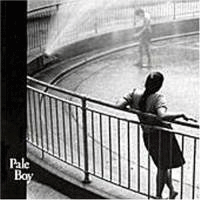
April 2000 – album reviews – Pale Boy’s ‘Pale Boy’ (“transparent as blown newsprint”)

26 Apr
Pale Boy: 'Pale Boy'

Pale Boy: ‘Pale Boy’

Apparently what fires Seth Geltman up is Astor Piazolla – fiery, complex, challenging music, stirring feet into instinctive dance. But it’s a stiller, smaller flame that Piazolla has lit in Geltman’s heart. His own songwriting is a more reserved thing altogether. You could compare what Seth Geltman and Thomas Blomster do with Pale Boy to what Stephen Merritt does with Magnetic Fields: “from the brain straight through the heart – the shortest distance”, as Geltman puts it.

Although not as accessible (or Broadway-bound) as Merritt’s, Geltman’s songwriting is similarly sophisticated. It’s cerebral, and sometimes difficult for ears attuned to pure pop. Dark closeted harmonies abound; melodies fade into shadowy doubts rather than aspiring. An air of introversion and dry, wounded carefulness is always present. If Spice Girls had Geltman’s number, they wouldn’t call it. If Stephen Sondheim had it, he might.

Pale Boy’s delicate and mannered debut is loaded with thought and detail. Life is constantly being breathed in by Blomster’s exquisite arrangements: a chamber-orchestra palette of fluttering jazz and flamenco guitars, violins, reeds and brass plus Blomster’s own piano, ever-crisp drumming and knack for tuned percussion. Drawing on latter-day classical, jazz, and the area where the two blend together, this is music fleshed out with the same kind of light, miniaturist detail as Penguin Cafe Orchestra. Seth handles most of the singing himself – his light bloodless voice as untouchable and inflection-free as Leonard Cohen’s and as transparent as blown newsprint.

Although Pale Boy are Denver-based, their spiritual home is European – either an autumnal and imaginary Paris of skating rinks, cafe culture and falling leaves, or the ascerbic Germany that Brecht and Weil knew. Or, perhaps, a hundred points between Moscow and San Francisco where dispossessed Old Worlders with shabby coats and battered instrument cases laid down their baggage and played for a while… Think that. Then factor in a touch of Smog, with trailer parks, shitty hotels and bad teeth replaced by faded, once-grand apartments and battered books. That nails the Pale Boy world as closely as anything.

The other occasional touchstone is Love’s ‘Forever Changes’ – intricate folk strumming, surging orchestras, and dreamy heads running up against barriers. Just A Thought (in which Seth, up to his knees in toil, casts his mind free over slinking brass and woodwind) hints at Aloneagainor in its mingled innocence and frustration – “There’s so much more than the grind every day – / there’s the blue, and the cats, and the letter K. / Far from the chatter and the money hunt, / there’s a thought of an autumn afternoon.”

A darker taste of Love, mingled with twelve-tone operetta, enters Promise Me, shading into a moody resignation: “Promise me obscurity / Turn out the spotlight… / Come and go but never leave. / Let me make my best guess how to ride your slippery lines, / you fleeting joking prayer.” Best of all are the sweet express-train violins, budding trumpets and John Adams throb of It’s Good, the point where Pale Boy succumb to instinct (“Over all this sprawling mess, / rising slow in the abdomen, / taking hold of what we know. / Is this another fine mess / or an opulent waltz in the wrong direction?”) and where a new note of assurance enters Seth’s voice: “Yes, it’s good. / Just sit tight, / wait for light…”

Here and everywhere in this painstakingly adult music you can sense the presence of those cracks and draughts which betray us each time we succumb to the unexpected currents and shamings that toy with stable lives and clean ambitions. “Facts march all over an ordinary day / Paper’s got nothing to say except scandals, sports, atrocities… / Scattered friction everywhere.” The understated title track might bury itself under a forgettable melody, but its vivid lyric (of lost directions, of a hectoring young man engulfed by a stifling fence) penetrates deeper. Acrobat is cutting and unforgiving, a bored audience turning away from a “gaudy little crackpot showing off with all his might” and ignoring him as he heads into his fatal fall. Bossa-nova and muted brass line the music of October Hat, a surreal ballet of a song in which one scribbled sonnet, lost to the sea, signifies one man’s misdirected attempt to capture and circumscribe the sense of his own life.

“Well, you made your point, / and the only audience that mattered never showed up” Geltman murmurs pointedly on Hum In The Clouds. Storm-tossed lounge jazz rolls around him, wrestling with a Reich-ian xylophone, and the debris of divorce bangs into both. “What did you think would happen? Why did you leave so soon? / Do you know how much was missed and lost on those Saturday afternoons?” Throughout the record, mixed feelings and shifting views struggle for dominance; as in Wearing Your Time Out, when patient drudgery gives way to “the corner of your eye / going suddenly awry / after getting lost on lines of reason.”

This ambiguity is best caught in the trio of songs sung by Jeana Dodge. Her restrained classical soprano lends them an affectingly uptight and anxious yearning. The light, mournful marriage waltz of Almost illustrates profoundly thankful love, yet ever-so-slightly sullied by restlessness and defensiveness – “Almost a connection that couldn’t exist. / Almost all I need to subsist.” On Underside Of A Terrible Thought, an unspecified angst is picked apart with determination, disgust and fascination – “Hold it high in the muddy light… / Hold your nose and hold it very tight… / It warms your brain and quickens your blood… / this twisted tangled orphan.” The polite cadences and lullaby-vibraphone of All We’re Left With show compressed resentment seeping from the civilised rubble of a relationship – “Kept my patience, bought the flowers, went to college, put out fires… / brought home bacon, / scrubbed the windows… / and I followed the rules.”

Less successful are attempts at straightforward anger, which only sap Pale Boy of both spirit and tunes. I Hate You greys out into dull minimalism (in spite of precise, venomous lyrics (and Blomster’s poignant arrangement of funeral reeds), and while Ton Of Blue gropes at the lovelorn existential dread of the deepest blues, it only ends up sulking, morose and snappish, in its conservatoire setting. No – Pale Boy’s understated emotions fare better with  subtler, yet more complex  bonds and empathies. An endearing, awkward eroticism nibbles at the floating, detached spring-dream of Shy Beast. The wistful, tear-jerking strings and muffled brass of I Know What You’re Thinking make it a Scott Walker fall-apart thing. Here, Seth singing at his gentlest. “I know you’ve been drinking / from the oldest hope that ever was. Rising up through your spine, / flowing through the brain and through the heart, the part glowing… / And I know what you’re thinking – / ‘Get me through this jagged night’.”

At the end, Stay Hidden makes a quiet and wary bid for intimacy, with Seth pursuing truth with all the extra senses of the once-bitten. “It leaks its news through unsuspecting clues, / it lies in wait for all of us.” By this time, those cracks and gaps have been assuaged by something. Perhaps it was the still, small sound of a hopeful trumpet. This album’s not for everyone; but if you’ve silently burned, quietly frayed or seen something dear to you stretch out of your gentle grasp, it’ll strike up a little chord in you.

Pale Boy: ‘Pale Boy’
Kale Music, ERG82299 (no barcode)
CD-only album
Released: 18th April 2000

Buy it from:
CD Baby

Pale Boy (Seth Geltman) online:
Homepage

April 2000 – mini-album reviews – The Servant’s ‘Mathematics’ (“cleverly constructed songs which nonetheless loll open like burgled cupboards, disarranged and pried into”)

24 Apr
The Servant: 'Mathematics'

The Servant: ‘Mathematics’

To realise just how good The Servant are, you have to look back a few years and see just how bad they could have been. Back to 1990s Swinging London and the age of the Young British Artists: paint, press and garbage flying everywhere while Damien Hirst, Tracy Emin and co. latched onto the multi-media cow and deliriously milked it for all it was worth. Restaurant tie-ins, TV shows, crappy crazy-golf designs… Anything which took the piss, got attention, built the empire.

British pop – siamese-twinned to art-school anyway – didn’t escape this cross-media surge. A slew of appalling artist/band tie-ins tumbled into the world. Big Bottom, Fat Les (or anything else in which Alex James cosied up to fellow Goldsmiths’ alumni). Various one-of/fuck-offs with conceptual artists barging onstage, messing around or just singing badly in the name of deconstruction or situationism. The original spark for this was Minty, the performance-art-cum-pop band assembled by the late Leigh Bowery – a genius costumier, an infamous artist’s model, an indispensable link between conceptual art and gay clubbing, portraiture and pop trash.

Minty, though, was his one ignominious failure, remaining better known for Nicola Chapman’s transparent dresses (and for Bowery literally shitting on his audience at one fateful concert) than for music or vision. Noisomely cheesy in their calculated obscenity, their attention-grabbing stunts and their sherbety gargling squeak-pop, they left a couple of singles (the childish shock-pop stream of sneering abuse on Useless Man and the paper-thin, bored-with-it-all drone of That’s Nice) which still sometimes pop up in arty DJ sets to remind us all of what was putrid even before it was dead and buried. Two fatal errors doomed Minty. One was their assumption that calling themselves “artists” ensured that art (rather than amplified fads) would come through them; and the other was attempting to plaster conceptual art’s whims onto the surface of pop, like cheap multicoloured cladding.

Servant leader Dan Black – who, like his bandmates Matt Fisher and Trevor Sharpe, was once part of the Minty circus – has obviously learnt from this. With The Servant, Black is smart enough to work from the other way around this time: writing scratchy, catchy songs which actually work, and then twisting their vision from within. Certainly The Servant avoids Minty’s sub-Wildean, cripplingly trashy desire to celebrate the trivial and superficial. Instead of sloppy art-to-pop, ‘Mathematics’ is full of shrewd Bowie’n’Devo-esque pop-to-art. Cleverly constructed songs which nonetheless loll open like burgled cupboards, disarranged and pried into.

It’s constructive criminality, though. Vandalising pop with creative intent, layering it with pop-up samples, buggering about with the implications, enjoying the theatrical interplay of sounds. It’s also the truest British parallel to Beck yet. Dan slithers in and out of sketchy transparent personas; paralleling Beck’s American easiness with his own Home Counties fussiness, Beck’s quirky patchwork of ideas and soul-revue showmanship with a violent jarring of public and private universes and with arch music-hall wit.

Dan himself seems to be constantly hovering, saturnine, above the songs. He’s just that little bit smarter than the music – involved in it but not quite of it. Although his thin nasal sneer of a voice recalls his previous band, this time he’s made sure that his irony has something substantial to grip onto. Teased for his eccentric dancing skills (“an orang-outan body-popping… a monkey who is rocking”), he gleefully makes himself the butt of an old Darwinian joke. “Look darling, it’s our cousins. / Come in and meet the family. / We are eating. / Well, you must join us. / Come on dear, lay another place for the apes and the chimpanzees,” he sings, to the accompaniment of brittle white soul-funk as monkeys cackle feverishly behind him, and broken pianos spin into the breaks.

It’s not just the supercilious servility of the band’s name that’s suspicious. Messing around with perceptions is The Servant’s stock-in-trade. Tuneful and catchy the songs may be, but each one is a mass of elaborately layered confusion in sound and text. Instruments and sounds appear in the wrong places, or squeezed into unusual forms by hip-hop-era sonic tinkering; and airy lyrics are jostled by intrusive sounds. It seems right that Dripping On Your Maths (popper-fuelled disco rhythms mixed up with a particularly wilful string quartet) makes jumpy little attacks on correctness and rationality. “Hunched up poring over graphs – / don’t blink, / just think / of all things and their link,” sings Dan sardonically, like a rebel maths tutor watching his sweating pupil’s tidy equations succumb to chaos. “Is this what you studied for? / A kind of mime, from nought to nine…”

The Servant’s music is a colourful, disturbingly surreal puppet show, in Dan plays the role of head marionette as well as that of chief string- puller. At the same time, he’s violently shaking the scenery with whichever limb is free, in order to reveal the workings of this enclosed world. The masterstroke in this approach is Conversation. It rips off and flips over the infamous Kashmir riff as a starter, but that isn’t all that it flips over. Initially, a kitchen-sink drama (illicit love, a girl making secret trips to a payphone, the delaying of a promised call) promises to develop into a classic little story. Then Dan starts to dismantle it with a cool, sadistic science. “The girl from verse one / Does not exist / Sure, you can feel her hands, but she’s just an idea.”

Toying with both our impatience and that of the luckless, fictional heroine (“Don’t you find the waiting tough / Even when occupied by love / and all that kind of stuff?”), he’s also dropping heavy hints to us that he’s not only the narrator, but the feckless love interest. “The tragedy is that Gary’s me / and it’s 7.40…” When he brazenly admits “If you feel any pain, / well, I’m to blame,” it’s a multiple confession. It’s also a superbly heartless one, with the air of a man pushing models around on a strategy board, or an author invading his own story for reasons of control or revenge. Yet it also pokes hard at our own complicity in the tale, as readers; while helping everything along via a smashing, seductively slithery tune.

More authorial meddling comes free with the supermarket voyeurism of Tangled Up in Headphone Lead. Lazily people-watching from a mall cafe, Dan attempts to divine the personalities of strangers from disconnected clues and cues (rubber marks left by hot shoes, hands running pinlike across tins, peculiar walks). The result’s a distracted, disassociated love song in which the lovers never even meet, and in which affection, confusion and atmospherics become hopelessly intermingled. There’s romantic, summery acoustic guitar, yes; but there’s also alien booms of Scuba breath. Heavenly swells of synth jab jaggedly as Dan’s latest persona meanders from thought to dysfunctional thought: “I wonder how you feel. / I struggle with complex food.” Obviously, he’s a stranger here himself.

The other thrust in ‘Mathematics’ is the creation of artfully sinister images of England. This makes Dan Black the evil quad to the three other recent self-conscious bards of Blighty: Neil Hannon, Richard Larcombe and (the pre-’13’) Damon Albarn. Too Late is an effete-yet-violent English nightmare. It drowses in cello sounds and summery meanders, but it’s also encircled by thunderstorms and by Miranda Sex Garden’s gently menacing backing vocals. “I imported horses from Dubai,” drones the aristocratic narrator. “Like great white sharks, we rode around the local park.. / Like spraying paint we flew across pedestrians…” It’s a decorous rampage with a sticky end; a final fall that’s heralded by a genteel waltz.

If that’s macabre, Walking Through Gardens is positively disturbing. Any song that claims “when my wife died I was happy” (and which talks about a corpse buried in the backyard with the same concern that it shows regarding the installation of a barbeque) is never going to make it onto Our Tune. Blending with echoes of Fred West’s psychotic house-proud callousness and with the pomp of English gardening culture, chaos and horror break through the herbaceous borders. “We’re finally going to get a patio!” announces our hero. Triumphally sweet orchestras and brave trumpet greet the joyful news, but other music is also worming up to meet it: violent surges of drum’n’bass, claustrophobically oppressive bass synths, metallic dripping noises and a meat-mincer of a mix. It’s ‘Ground Force’ versus ‘Blue Velvet’, with Foetus as referee. Guess who’s winning.

Life’s what you make it, and The Servant make it decidedly strange. But it’s been a long time since we’ve had anyone in British pop toying with the paper moons, mining the flutters and lunges of the subconscious, with such wit and danger or with such cunning artfulness.

The Servant: ‘Mathematics’
Splinter Recordings, SP001CD (5 038622 101626)
CD-only mini-album
Released:
24th April 2000
Get it from: (2020 update) CD best obtained second-hand; stream from last.fm.
The Servant online:
Homepage Last FM Apple Music YouTube Deezer Google Play Pandora Spotify Amazon Music
Additional notes: (2020 update) The Servant split up in 2007. Dan Black moved on to a solo career; Trevor Sharpe has played in Deadcuts.

October 1999 – album reviews – Sneaker Pimps’ ‘Splinter’ (“half in love with the idea of beautiful corpses and wanton failures”)

29 Oct
Sneaker Pimps: 'Splinter'

Sneaker Pimps: ‘Splinter’

Smack.

Its presence ghosts off this record like chill off the sea. The more you listen, the more obvious it gets; the more appropriate it seems. Twelve songs about different levels of letdown – alienation and betrayal; shortfall and disgust, “high fives and corporate anthems” – but always, always possessing an ability to be lifted above it; to float in a strange and tragic euphoria in which pain and torment are overwhelmed. A rush of transcendent languorous bliss while the mind hovers above, intact and unmarked.

Even if Sneaker Pimps weren’t so candid about backstage recreation (or didn’t drop lyrical hints like “my aim’s so weak that I’d fail to get into my arm”), you can’t escape the fact that their second album is a heroin album par excellence. Admittedly, a smarter and more professional brand of smack music – no William Burroughs squalor, no Needle Park lowlife. The spike goes in beside a penthouse window, lying on a sleek leather couch; no dust on the floor. But then, as a pop group, Sneaker Pimps always seemed far too smart for the daytime shows and MTV gladhandings.

Well, some of them did. I saw an Sneaker Pimps interview in which Kelli Dayton – their original Goth pixie-ette singer – sat flirting and babbling on a sofa, flanked by Chris Corner and Liam Howe. When not answering their own questions, with a cool intelligence, they observed her with the bored and slightly amazed looks of gentleman experts faced with a posturing child. The hapless Kelli isn’t part of Sneaker Pimps any more. She’s been dropped out – as if via hidden trapdoor – or simply excised.

For ‘Splinter’, Chris Corner glides forward like Dracula to take over the mic. His slackly sensual looks (young Johnny Thunders and Ronnie Wood, with a wild crow’s nest of dyed-black hair) lounge all over the artwork of ‘Splinter’, much as his lisping, artfully-forlorn whisper floats ahead of the music’s tide. Perhaps it’s just extra clarity – with Kelli no longer an oblivious mouthpiece – but ‘Splinter’ feels like cresting a roller-coaster. A swelling build of dawning clarity, darker- toned, which sets you up for the plunge.

‘Splinter’ is also the most seductive pop record I’ve heard in a long time. Not coy winks or overblown soul-boy mating calls, not even on the acid-coated, Suede-stinging-Cameo-to-death stamp of ‘Ten to Twenty’. This is a more abstract seduction, the lure of rich fabric, sweet smoke or smouldering looks. It’s born not just from the unveiling of secrets but from Liam Howe’s shockingly opulent backdrop. Creamy, orchestrated synths and samplers traced with beautifully disturbing sound. Pianos echo, fretful in the cavernous dark. ‘Omen’ choirs or wailing-wall chants lunge out at Chris, trying to lassoo him. Small slivers of Oriental melody glitter in the fabric, and beyond the luscious trip-hop grooves eerie Bernard Hermann strings are trembling, bursting, warning. Female singers, disturbingly blank, shadow Chris’ pinched tones.

The whole album’s in a state of sensual motion, like restless waters or billowing tapestries. As for mood and motif, it’s always ominous – always half in love with the idea of beautiful corpses and wanton failures; with sultry sicknesses and the bloody romance of despair. Kelli or no Kelli, there’s always been a Goth undercurrent to Sneaker Pimps (and not just because the industrial-tinged, reverberant rock of Superbug also has a distinct tang of The Mission). When Chris sings “strike me down, give me everything you’ve got. / Strike me down, I’ll be everything I’m not,” on ‘Lightning Field’, he sounds bright-eyed, waiting for the lash.

On ‘Half Life’, accompanied by the liquid, trembling swirl of pianos and ghost orchestras, Chris muses at the syringe or at the lover he’s failing with – “half life wastes before it goes – / it’s funny how your bee-sting touch never leaves me whole. / It’s not enough to stay here, almost trying. / You kept your last laugh, watch this dying.” On the magnificently disdainful, disgusted ‘Low Five’ he delicately spits back corporate language and schmooze-talk with savage grace – “Kite-marked for true low standards / where more wants all and no less. / Just change with no real progress… / I’m a low five downsize no-one else. / Do you love yourself?”

Bad relationships. With the biz, with the needle or with girlfriends – all three bleed together in Sneaker Pimps’ crafted disaffection. Only on ‘Cute Sushi Lunches’ does this seem brattish, as Chris sneers “nineteen steps out from under your feet. / Can’t eat, won’t eat… / Hate like a child hates his hair cut,” and the instruments obstruct each other, stubbornly refusing to gel… but not quite enough to derail the song.

It’s a suspect confessional, a cunning blind to absorb attack while Sneaker Pimps slip the rest of the album past your resistance. The worm-turning cruelty of ‘Curl’, popping with funk under its lustrous ballad verses, stung by zithers and pulsating psychedelic grind – “I curl to break consent… / and I curl now to help me find you out.” And the little thrusts and revelations like “never compromise – you’re just always weak”; “it takes too much to please me – / attached but no real feeling,”; and (most killingly) “failure was on me, / but your ideals bore me.” All of it wrapped in that dark and dreamy music.

Beyond the sensual overkill – that luxuriant death-by-soundtrack – the rich nightlife sounds are sometimes folded away in favour of small rooms dominated by Chris’ spider-legged acoustic guitar. ‘Flowers and Silence’ is the most explicit trip to the shooting gallery. Skeletal slow jazz waltzing among the radar blips somewhere between Scott Walker and John Lydon, moth-wing vibrations of synth, and a dry-mouthed Chris murmuring “she’s nowhere, she mainlines, / helps me out – now I can speak… / So nothing’s free. / Ghost-drunk, out of reach.”

Behind the dogged strum and distant alarms of ‘Destroying Angel’, strings slither down – blood trickling across a window – while Chris turns in the most sinister performance on the record. “The stones beneath the water that you walk on to be taller, / the hands you stuck together ‘cos you prayed you’d wait forever,”, he whispers, picking apart a dying affair full of desperate power games and scams, and ruthlessly stripping it away from himself, right down to the tattoos (“the words beneath my skin / the ink that you put in, / destroying all the things you left around.”). There’s torch music on ‘Empathy Low’ – as well as a rich sleazy purr of double bass – but if so it’s torch reduced to clammy ashes, as Chris stares into the recesses of his soul and finds them disturbingly bare. “Proves herself to be closer, / but not me forever, not me… / My memory’s so / empathy low.”

And there’s ‘Splinter’ itself, the guitar zinging and slapping while things prowl in the shadows – growling, creaking double bass, moaning and scraping; boiling, ghostly noises from Liam Howe’s black boxes. Then there’s Chris, flint-eyed and flint- voiced – “Does it take the fireworks to make you look in wonder? / Would you give reaction to the cause I’m under? / So coloured by you, but your monkey messed it up – / surrounded by you, your monkey’s long-while had enough.” If David Sylvian had stayed in London, corrupted by the smoke and cynicism, he might have ended up this sleekly poisonous: enveloped in beautiful, cultured ambient sound and existential melancholy, but honing a small silvery sleeve-dagger for the right moment.

The final song – ‘Wife by Two Thousand’ – could be a subway busk, with one of Chris’ faceless women singing back at him from further down the tunnel. A draught sucks at it, pulling Liam’s subliminal buzzes and celesta clinks away into the oblivious sounds of a crowd. While Chris strings phrases from ‘I Can Sing a Rainbow’ into the chorus (as if trying to get back to childhood assurance), the song’s an attempted seduction, in spite of everything that’s gone before. Chris is playing the vulnerable card this time, with a cynical, pleading desperation. “Never so complete, just failing on its feet… / I think that I need working on, so work on me / I feel that nothing’s getting though, so get to me.”

But the last we hear of him is a nonchalant nothing-can- hurt-me whistle. He’s disappearing into the city with his bag of secrets closed up again, leaving you to make your guesses. The kind of doomed, fascinating bastard whom your eyes still follow, and whom your hands reach out to in spite of yourself. Damn.

Trust a junkie? Never. But they can be as compelling as their habits.

Sneaker Pimps: ‘Splinter’
Clean Up Records Ltd., CUP 040CD (5029271004024)
CD/download album
Released: 29th October 1999

Buy it from:
Available from most sources.

Sneaker Pimps online:
Homepage FacebookMySpace Last FM

October 1999 – album reviews – Cipher’s ‘No Ordinary Man’ (“its own burning chill, changing the air around it”)

10 Oct
Cipher: 'No Ordinary Man'

Cipher: ‘No Ordinary Man’

Coldness and the lack of feeling – an odd association to make, if you can remember the feel of a fragment of ice held in the intimacy of your mouth or your hand. Something not lacking but, rather, almost too intense; shocking the flesh so that you can only touch it by degrees. Something that slowly changes as it becomes closer to what you are, and is consumed by the process.

By these standards, as well as by immediate impressions, Cipher’s ‘No Ordinary Man’ is a very cold album – it’s something intimate, but in an unusual way. Unquestionably this is beautiful music, but it’s the kind of music which would play in your mind while you lay immobilized on an Arctic snowbank, watching, with a hypnotized joy, the glow of the Northern Lights even as you slipped deeper and deeper into exposure and a chilly coma. Cipher’s music is unadorned, passive, slow and sparse in resolution (if it ever resolves at all) and it’s quiet: but it also has its own burning chill, changing the air around it. Former Jade Warrior Dave Sturt’s minimal, expressive forays on fretless bass float upfront or squash deep valleys into the music. Theo Travis‘ pale and lovely lines on soprano sax and flute hang like solitary albatrosses, beyond the programmed loops and sounds which both men come up with together.

There’s a lot of Nordic-style ECM clarity and mournfulness here: Jan Garbarek is certainly a constant touchstone for listeners, if not necessarily for the players. The slow, measured bleeding-in of Theo’s psychedelic influences (along with Dave’s leaning towards both electronic ambience and Celtic airs) means that there’s more to Cipher’s music than you could find from simply haunting Garbarek’s footsteps from fjord to fjord. However, these additional elements end up tinting the music rather than colouring it. It retains its own arresting static integrity while remaining entirely open to the outside; so that even when such superbly individual guest texturalists as Steven Wilson and Richard Barbieri are linked to the Cipher core they blend in perfectly, adding another layer of ever-so-slightly disturbing atmosphere.

Cipher’s particular skill is to balance lightly and enigmatically on the cusp between that obvious ECM-flavoured tastefulness and the more psychoactive disturbances of dark electronica. As such they constantly, subtly, put the listener on the wrong foot with a delightful unease. Given that it’s a contemporary soundtrack not just to an early Jack the Ripper film but to one by the young Alfred Hitchcock, The Lodger is appropriately creepy. Theo haunts the upper air past the smokily building, menacing wind patterns: Dave offers glassy, melodic spindles of rotating bass.

A Far Cry deliberately undermines associations. The trapped gaiety of a looped-and-buried fairground calliope contradicts the sad, syncopated stagger of backwards tones that makes up the body of the track and underlays Dave and Theo’s unusually intense, bloodshot calling. Dank electronic drips and shades from Richard Barbieri form the environment of Canyon, beneath the dreamy electronic ripples and the drifts of sax and bass. The foreboding swells of Dusk suggest a disturbance just out of memory range, probed in shifting tones.

It’s the panorama of landscapes, both material and psychological, which predominates. Listening to Bodhidharma, with its little glitters of distant guitar, is like watching vapour ascend slowly out of a crater; while it shares something with Robert Fripp’s diaphanous Soundscapes, it’s also the point where unconnected post-rock bands like Labradford and Bark Psychosis suddenly meet, blink away tears and touch. Desert Song, in contrast, dips more obviously towards New Age. In its flamboyance, it recalls the underrated mystic-Mexicana of Alquimia with its extended slow-motion boom of synth and its garnish of throat-singing samples: however, the passionate tug of Rabbi Gaddy Zerbib’s devotional Hebrew vocals pulls it forcefully back into the real world. White Cloud, Blue Sky sees Theo playing bleakly over disintegrating tones somewhere between disturbed wind-chime and the expansive empty-gallery guitar Bill Frisell uses to paint his pictures of America.

The Waiting, though, is pure dreamscape. A simple shaker and cymbal rhythm is joined by Theo’s moody searching sax gliding in the sky. Dave’s tingling gulp of bass swallows at the ground, and a growing textural bristle of ringing tones and alien electronics builds in some blurry area between birdcall and gauze. Eventually all is submerged in a hallucinatory backwards dissolve.

It’s left to the title track (the straightest piece on the album, and also the finale) to bridge the ever-shifting gap between Cipher’s abstraction and their empathy. Essentially a free-floating blue-haze trio of bass, piano and ravishing alto flute, it hearkens back to a clutch of comparisons: Bill Evans, Miroslav Vitous, the spacey world-jazz of Dizrhythmia and – finally – Rain Tree Crow’s pattering, mysterious finale, Cries And Whispers (enclosed as it is both in sensous brushes of electronic air and a distant-walled cavern echo of Eastern-sounding percussion). Far from ordinary, and far from freeze-dried. Cold fingers can stimulate too.

Cipher: ‘No Ordinary Man’
Voiceprint/Hidden Art (HI-ART 5, 60438845732)
CD/download album
Released: 1st October 1999

Buy it from:
Burning Shed

Cipher online:
Homepage MySpace YouTube

October 1999 – album reviews – Des de Moor’s ‘Water of Europe’ (“a cherubic smart bomb of chanson”)

1 Oct
Des de Moor: 'Water Of Europe'

Des de Moor: ‘Water Of Europe’

Like a cherubic smart bomb, Des de Moor has popped up whenever London needs a sniff of wicked European song. In his time, he’s helmed the Pirate Jenny’s cabaret club, fought for chanson and acidic cabaret old and new, or made a public case for tying together songwriters as diverse as Boris Vian, Georges Brassens, Martin Jacques of The Tigerlillies, David Bowie and The Magnetic Fields maestro of puckish gloom, Stephen Merritt.

When Des can fit in an album of his own, it’s recorded in bursts of enthusiasm in between all these other burst of enthusiasm. As with everything else he does, it bears the stamp of that sweep of songcraft and resistance he’s devoted himself to, as he elbows his way into his own niche and into the history of chanson. When “fuck you, I won’t do what you tell me” has become our most famous protest lyric, and our concept of resistance-in-song is measured by the PC-baiting and broody solipsism of Eminem, Marilyn Manson or Wu-Tang Clan, it’s good to hear a dash of genuinely sharp social writing – even if it comes couched in a musical language nearly a century old (which in turn suggests that we might have been missing a lot since we cut those particular stylings out of the popular consciousness).

‘Water Of Europe’ must’ve been recorded for tuppence, and sometimes sounds as if it was lashed together with parcel string. No Dagmar Krause big-budget political cabaret job this, all respectably outrageous and state-concert-hall friendly. It’s sealed and sold on the vigorous punky pocket-orchestra enthusiasm of the players – bumped guitars, cellos, pianos, snapping percussion, Daniel “Boum!” Teper’s accordion.

Des’ voice is the common key – a florid, unusual mixture of madrigal tenor and soapbox preacher; or a grown-up, apostate choirboy in the political thick of a pub argument. It sits at the heart of the de Moor way of working, and is as pugnacious and theatrical as his barbed lyrics. Each word is bitten into shape and flung out with flair. Although most of his music could’ve easily have strolled straight out of the 1930s (Des might have drawn on punk’s assertive spirit of questioning, but he clearly finds more verve and expressiveness in a mix of jazz, folk and cafe singalong), his lyrics are less time-locked. They dig into the dirt and humanity of yesterday, today and tomorrow, exploring themes of exploitation and injustice, politics and deception, war and its wounds, gay life and its hauntings.

Des de Moor: ‘Dirty Pictures’ (preview)

Skidding and acerbic, the punchy accordion tango of Dirty Pictures tears into public figures embroiled in the noisy scams of censorship and social decency, taking forthright aim at their implicit hypocrisy, their encroaching voyeurism and their lust for personal exhibition (“You’ve seen the camera, it’s seen you… / you’ve wanked in front of mirrors too.”) With a sarcastic zest, Des savages the double standard of class and education – “Let middle classes get their kicks: / subtitled sex in foreign flicks / can’t cause infection. / The masses, couch potatoes all, / whose dishes sprout from every wall: / they need protection.” He also spotlights broader horrors for which there’s less willpower for banning (“Pot-bellied children / rooting in rubbish / as food mountains rot; / The obscene, often-seen, / ultimate snuff scene / between have and have-not.”)

Des de Moor: ‘Heart Of A Heartless World’ (preview)

On a more mythological scale, Heart Of A Heartless World (which sounds something like a state-of-the-world take on Fairytale Of New York) takes on the compromised cultures of colonialism, famine relief and the points where they intertwine. Retelling a sweep of human history as a journey from a lost African paradise into a famine filled by suspicious prophets and priests (“vultures that pick at the corpse of the poor”), Des suggests that the journey has bequeathed us a present-day of false hearts, superstition and moralistic humbug where “priests and prime ministers pray for our sins / and mystics on telly guess lottery wins.”

Des de Moor: ‘Margins’ (preview)

Des’ words spit and crackle even when – Germanically – they cluster, fight and split the envelope of the tune. The magnificent Margins (just waspish accordion, Des in marvellously stroppy voice and the bitter backdrop of the Bosnian conflict) jumps out at you, laying waste to the complicity of media and state interests in the parceling-up and selective suppressions of a world in conflict. “Believe what you hear and believe what you’re willing: / a severed head here, and there a mass killing. / We’ll print it provided / it’s clearly one-sided / and something is left to the margins, / at the bottom of the page in the margins.” In this song, little escapes the de Moor tonguelashing – not the journalists who “roam far and wide collecting tales of atrocities / from regular soldiers and mercenaries” and not the conferences that re-order things, ratifying the mess the way the biggest powers want it. Certainly not the scapegoating stories that thrive “so long as they’re hearsay, undated, / uncorroborated / and blame the right side… / We’ve forgot the Ustashe and found the new Nazis / in Belgrade this time.”

A debt to the history of chanson and folk is paid via a handful of gutsy covers and interpretations. Terry Callier’s Ordinary Joe is one, boasting gloriously hooded trombone from Dave Keech and a guarded, evasive street philosophy – “Down here on the ground, / when you find folks are giving you the runaround, / keep your game uptight / – and if you must, just take your secrets underground.” A rough’n’ready, guitar’n’free-verse declamation of Brecht and Eisler’s To Those Born After (An Die Nachtboren) is another, exploring the crummier details of toiling in the revolution. “I ate my dinners between the battles, / I lay down to sleep among the murderers, / I didn’t care for much for love / and for nature’s beauties I had little patience… / Oh we, who wished to lay for the foundations for peace and friendliness, / could never be friendly ourselves… / In the future, when no longer / do human beings still treat themselves as animals, / look back on us with indulgence.”

Des de Moor: ‘To Those Born After’ (preview)

Most impressively, a new translation of Jacques Brel’s My Father Said polishes Des’ claim to be the best English-speaking Brel interpreter – in either sense of the word. The song explicitly links Britain and Europe: a legend of kinship, of severance by high North winds and high water (both brought to musical life by Kev Hopper’s magnificent solo on musical saw), and of humanity blown before the rough and beautiful forces of nature. “The earth was rent / between Zeebrugge and the cliffs of Kent: / and London’s left cut loose and free, / with the Bruges headland taunting the sea. / And London’s left to forever be / a suburb of Bruges, lost in the sea.”

Des de Moor: ‘My Father Said’ (preview)

My Father Said stands as a counterweight to Des’ own Water Of Europe itself – another exploration of kinship. Here, Des places himself on a fantastical odyssey of his own, sending his thoughts out from Britain and around Europe. He finds first an island, and then a continent, locked in a common defensiveness and an ugly sense of purity. Each exploits “the Other” but denies them harbourage – “If they desire a water of Europe / it is the cold grey sea that divides. / Or the deep and inviolable water / taking and making sides.” Against this he calls on the forces and floods of history, hoping for the day when “truth decontaminates water supplies”, and “the fracturing chains of the workers of Europe / have strangled the boy with his thumb in the dijk.” Whips snap, castanets rattle, accordions and guitars throw punches. There’s going to be a party out there when the storm breaks.

Des de Moor: ‘Water Of Europe’ (preview)

Some of Des’ gestures aren’t carried nearly so well. However musical he is, he’s a man of words first and foremost, and this can mean that in his forthright sincerity the songs scramble across an imbalance of text and melody, like a flapping banner dragged by the wind. In the squabbling, tricky surveillance satire of Big Sister, for instance, his voice drowns in his densely-packed lyric: “More cameras than Hollywood, more tape than Scotch, / more logs than Canada, much more to watch… /I am your friend in the fight against crime. / Won’t you be safe when I’m there all the time – / minding your kitchen and minding your bed, / and, for extra security, / minding your head?”

Des de Moor: ‘Big Sister’

The Fairground Attraction swing of Grandmother Was A Hero, with its perceptive picture of human flaws, also should have been better as a standalone song. Over-pressured by words, it lacks smoothness and poise. Yet if you can accept that Des’ prime aim is to get his tales across, it has a lot to offer. Weighing up his monstrous grandmother’s peacetime behaviour, Des offsets it against her tireless protection and concealment of refugee Jews during wartime. “She didn’t have much wit or grace, / nor brains in large amounts. / But Grandmother was a human / and being human counts.” In telling her story, in a voice and lyric that build, ebb and resurge through a complex knot of anger, admiration and pity, Des finally arrives at solidarity, and presents his memorial:

“Just think how it must have been / as a hausfrau in poor Holland when the Wehrmacht goose-stepped in / With a husband that you hate, but there is nothing you can do: / It’s an emergency situation, and your man’s your comrade too. / In that fearful hunger winter when all your two kids have to eat / is potato peelings, pea pods and the snow from off the street – / and they’re handing out the yellow stars that one by one blink out, / and you know you have to help them, and there is no time for doubt. / Until the Gestapo knock on your door, and you find yourself alone / and in the settled dust you’re just a German widow / far from home.”

Des de Moor: ‘Grandmother Was A Hero’

Elsewhere, a loose trilogy about workers in London merges a realist’s acceptance with the strong protest of an angry survivor. In Avocado, Des examines the gritty detail of the kitchen worker’s desperate struggle between hopes and exhaustion – memories crumpled in the heat and hubbub, but not yet devoid of the sting of style. In doing so, he etches a picture of life of triumphs and traps. “Choose a plump, ripe avocado, just like on your first exam / at a college back in Glasgow. Stop the memories if you can. / Take that plump, ripe avocado, slice it with the sharpest knife, / Smile and summon your bravado: it’s a cold, raw kind of life.”

Des de Moor: ‘Avocado’

In Joey’s Dreams, Des delivers a rock song turned back into seething left-wing folk ballad, the story of a gentle working bloke who’s gradually ground into resentment by hard times and defeat – “a beast that’s pacing in a pen / at the edge of a feast for rather richer men.” He goes on to trace how resentment leads to poison, and frustration to an ugly fall, shading it into a larger picture of a caste crushed down from honour into malevolence. “Joey’s cramped contractor’s terms, / that force his crawl among the worms, / create a breeding ground for germs: / opinions that the world confirms… The clots of rot clog up each bend, / the queues for casualty don’t end. / You can’t believe in your MP – now Joey’s voting BNP.”

Des de Moor: ‘Joey’s Dreams’ (preview)

Beyond these small fierce sketches, there’s the fractured battlement of Sleaze City. Des takes an uneasy stroll through his beloved south-east London, past strangled docks and thriving bailiffs, sniffing and frowning at the muggy wind of corruption shrouding Westminster even as homeless beggars huddle in sleeping bags, a stone’s throw away over in the Strand. Throughout, a sweep of history – compromise, an age-old London scrabble and a sense of loss – provides depth. “At Surrey Quays, saluting the seas / sets flags bobbing. Along the shores ex-stevedores / watch gulls mobbing… /The last leaking hulks have long furled their sheets / at Woodpecker, Evelyn, Crossfields and Pepys…. / There’s whole careers / in chasing arrears, still shivers / though shirts are soaking. / Sleaze City’s choking / in the ozone.”

Des de Moor: ‘Sleaze City’ (preview)

For more personal struggles, there’s Sharp Contradictions and Last Orders Please. On the former, Julia Doyle’s double bass and David Harrod’s needling piano pick out itchy broken harmonies like the stab of toothache. Des anatomises the terrifying wonder of a fall into love, like an attacking scalpel or virus winding to the very centre of a person. “Alive and kicking, awake, aware / with a billion lights that sparkle and flare / in the brain above. / But put in the knife and start to twist – / the lizard hisses and lashes a fist. / The world goes runny when you get pissed. / And then there’s love.” Surreal spiraling rhymes paint the upheaval, with a dark coda of sombre feeling – “And it is the time I spend sinking / that sharpens and tempers my thinking. / And it is this feeling you give / that reminds me just how much I live.”

Des de Moor:’Sharp Contradictions’ (preview)

In contrast, Last Orders Please is a death song of the kind you get only in cabaret, filled with defiance and fear. It’s also the only outright gay song which Des has allowed himself for the record; overshadowed by the horrific harvest of AIDS, the hollowing, slithering sense of time passing too fast and too hard, and of youth becoming a strange, sinister and heartless territory. “Now I’m older, Death is a young man, not the skull-faced spook from ‘The Seventh Seal’ / but a bronze Adonis with eyes as blank / as a half-filled diary’s empty pages.”

Des de Moor: ‘Last Orders Please’

Yet although the song starts in a rumble of melodrama, it bursts into a fiery salsa – “At close of day, there’s burning rages / for a hundred loose ends, / for the lovers and friends, / for the wind into which we were pissing / when we never knew what we were missing, / for the might-have-been, could-have-been, never-was life we’ve been living.” Des has the energy – and more – to spit out a last rallying call for the scared and threatened: “We’ve nothing to lose in the trying. / If life is a bitch unless you’re fucking rich, / no wonder we’re frightened of dying.”

The bloodstream of folk music also harbours germs of resistance. Des de Moor’s very much part of that particular flow, provocatively pumping heart and all.

Des de Moor: ‘Water Of Europe’
Irregular Records, IRR038 (5036265000078)
CD-only album
Released: 22nd September 1999

Buy it from:
Irregular Records (or Amazon).

Des de Moor online:
HomepageFacebookTwitterMySpaceLast FM

September 1999 – album reviews – Edwige’s ‘Keep the Change’ (“nebulous, pine-forest cleanliness”)

30 Sep

Edwige: 'Keep The Change'

Edwige: ‘Keep The Change’

Edwige is a true original and determined with it, outspoken in her contemplative pantheism and in reaching towards the divine spirit that binds her universe together. It’s difficult to pin her down to any songwriter school – even within the eccentric fringes of spiritual folk, French chamber-chanson and psychedelic New Age she seems to incline to, she’s an odd customer and obviously wants it no other way.

You’ll either love or hate her unorthodox and uneasily captivating voice as it zooms and dodges (like a brilliantly coloured, elusive dragonfly) over her baroque and mystical songs. It’s more unpredictable now than ever – zigzagging through melodies, it’s never quite where you expect it to be. She’ll carol, coo, stick you with a sharp note. She’ll shiver herself into blocks of eerie harmonies flickering between celestial and dischordant. She’ll double back on herself, frustrate you, salve you; and finally dissolve into a lovely swarm of voice-clouds.

The voice remains the same, but the music has moved on since her jaunty, budget-recorded debut album. Faithful keyboardist Joe Evans is still on board, but admitting Alexander Zuchrow (guitarist, engineer and, most crucially, arranger) to the heart of the music means that Edwige’s songs have been framed and fleshed out in richer textures. Harpsichord and dream-pad sounds replace the previous tinny synth presets. Gentle bluesy guitars add new body; cellos, Appalachian fiddles and soft saxophones peep out of the corners. ‘Keep The Change’ possesses the nebulous, pine-forest cleanliness of Narada Records, or of Windham Hill folk.

If the first album was postcards from Edwige’s imagination, ‘Keep The Change’ brings you a breath of countryside as well as further maps of her spiritual landscape. Edwige’s themes of continuance and connection, of inner illumination and the dispelling of fear, sit in leaf-green settings. A puff of baby-Clannad folk in Water; tinkling Vivaldi pop for Reflection. The lyrics (and the rootsier atmospheres) are permeated by rain-mists and mermaids, wind and light. Via perky fiddles and banjo, the gracious Joy Song (both a letdown and a thank-you to a luckless admirer) threads country and Irish airs around Edwige’s serenity. The bizarre falsetto-waltz melody of No Two Ways bobs balloon-like over strings and harpsichord (which could’ve come from ‘Five Leaves Left’) and a clink of lounge vibraphone (which definitely didn’t).
Sometimes Edwige brushes up against the exquisite. On the contemplative ethereal anthem, Something Deep she mixes her “everywhere god” faith with a touch of Duke Ellington gospel shapes plus lemon-flavoured jazz cello. On He Only Knows (over yielding beds of keyboards, clarinets, luscious classical guitar ripples and soprano sax) she sings of journeying – “an arm coming from nowhere / far away has taken him. / Now he changes his road again,” – and then sets the seal on it with her own signature swim of voices. On I’m Out she sings of passing through peril to attain faith. A tapestry of Enya-esque chanting and the urgent wire-tang of a Jantsch-y folk guitar finally dissolves down into another magnificently luscious voicescape, though it basks a little too contentedly in the warmth of fuzzy piano and sax along the way.

Equally, sometimes she misses the mark. Her tendency to overbalance into tweeness is one thing (the popcorn cafe-jazz of Leave Your Mind At The Gate being the worst offender). It’s worse when the same determination that stretches Edwige’s songs towards dizzy heights sometimes leads her to stretch them out of shape. Eager to illustrate, she pushes too hard, letting her lyrics crowd out the melody and garble the song. At such times, she bustles against the delicate arrangements instead of nestling in them. For example, amongst the chirruping violins and Spanish guitars of So They Say, her message of opting for instinct (over demands for hard facts, or superstitions) is smothered by the tangled, forced and fussy words.

It’s all far better when Edwige relinquishes the strict and portentous hippy lectures and just lets her songs breathe; when she stops banging against aspirational truths and taps into the grace she sings about. This happens on Wherever It Is (a sparkling ballad of devotion) and on Light Energy Love, where a sweet, open melody (reminiscent of Bryan Maclean’s gossamer hums on Love’s ‘Forever Changes’) merges with a champagne tingle of fiddles, guitars and harmoniums and with Zuchrow’s gently gurgling psychedelic streams. It’s in songs like this that her determination pays off and her quest progresses.

On the final song, Something Deep, she sings with an equal measure of frustration, patience and commitment. “You keep plugging your ears so you won’t hear my song… / Something deep inside of me knows / I still sing for you.” Going down fighting, or transcending closed minds? The little soul warrior with the effervescing voice isn’t going to give up.

Edwige: ‘Keep The Change’
Quasar Music, EDW2CD (634479464935)
CD/download/cassette album
Released: 1999

Buy it from:
Quasar Music or CD Baby.

Edwige online:
Homepage YouTube

September 1999 – album reviews – John Ellis’ ‘Spic’n’Span’ (“a minor treasury of passing ideas”)

24 Sep
John Ellis: 'Spic'N'Span'

John Ellis: ‘Spic’N’Span’

The lifespans of pop musicians are usually measured in five-year units – generally just one each before they’re inserted into the “where are they now?” file. But for every ten who went into hostelry, college lecturing or millinery, one adapted and carried on the journey as best they could and perhaps saw how their talents and ideas could fit into the next stage.

As guitarist, songwriter and sound-shaper John Ellis is hardly a household name, but his work and adaptability have both been consistent. He’s already discreetly chameleoned his way through three decades of music. A founder member of The Vibrators during the punk era, he went on to play an integral role in the Peter Hammill and Peter Gabriel bands over the cusp of the ’70s and ’80s. Links with Jean-Jacques Burnel eventually led him (along with Paul Roberts) into the post-Hugh-Cornwell Stranglers line-up; he developed an electronica sideline via his digressions into gallery music, There’s even a touch of prog beyond Gabriel and Hammill: John also plays guitar for Judge Smith’s ongoing “song-story” projects.

John’s journeyman credentials are unquestionable, and to each position he’s brought his own supporting voice and particular marks. However, always being the lieutenant means some of your ideas bounce off the boss (or the inflexibility of circumstances) and get stashed away. ‘Spic’N’Span’ corralls together unheard odds’n’sods from John’s curvy journey through music, and consequently it’s a musical scrapbook rather than an album.

A third of the tunes are the kind of thing that many working musicians knock out for TV music library discs – bright jingles and “we’re going somewhere” music, executed on cupboard synth orchestras. The synthetic Euro-funk/perky testcard tunes of Wild Talent and Tune-O-Matic fall into this category; as do the flying-over- mountains melody of Early Riding Daddy, the New Age-y pop march of The Needs Of The Soul and the rather more ambitious baroque-jazz stylings of Running Through The Trees. Still… behind many of these you can hear little pop chicks trying to hatch out of the multi-track demos, hoping to drop into the collective lap of an ’80s boy band, to do that five-year round; and to then cheat death by popping up in a nostalgia DJs record box, taking a ride on a revival. It might not have actually happened, but then the business of selling songs has always been a bit of a lottery.

Another third of ‘Spic’N’Span’ is a set of genuine ’80s pop songs. All of these are produced in the squeaky-clean studio fashion of the time; but all are executed with the restraint, intelligence and puritanical zeal of post-punk. The pin-sharp shimmy of John’s guitar is the linking factor – wailing away on E-bow sustain, sparking off claw-hand finger-picking, or adroitly yanked from note to note.

Three of these songs are sung by Alex Legg – his spooky vocal resemblance to Peter Gabriel shows us how things might have been had Gabriel and Ellis joined forces and run off together into the showy pop territory eventually colonised by Tears For Fears instead. The Space Between Us (a soulful, regretful R’n’B lament of hostility, injustice and enmity) could easily have fitted onto an album like ‘So’. Similarly, Joe Jackson would have been proud to have written the pumping Monopoly (the biting list song of an abusive marriage, a woman’s increasingly desperate attempts to escape it, and the grim consequences). Off on its own, the John Greaves-ish piano song Mumble Jumble (pointing up the Ellis art-school/art-rock background) ponders the confusions and blocks of language.

Two more songs are sung by John himself. Giving Up The Ghost, with its airbrushed console-blues sound and phantom horn section, strives after the authenticity of roots Americana only to arrive as a Eurythmics B-side instead. But the glinty, polished Elevator Man (which sounds more like Steve Harley doing J-pop) works better, capturing the arch giddiness of stardom from a slight but crucial degree of separation. “I went from rags to riches, from riches to rags. / I was an overnight sensation.”

Then there’s a third section: a couple of tunes which seem to be trying for the early ’80s link between electro, hip-hop, and primitive British synth pop. Such is the buzz and piping of Stutter Gun with its earnest, uptight vocal samples and its synaesthesic theme: “it’s beautiful… the colours will flash… the sounds will embrace you.” Jimi Jam studs its gurgling electro with little sampled Hendrix asides – “Hey, what’s happening?… Oh no, I think I’m out of tune.” Discreetly decorated with wobbling wails of clean sustained feedback, it’s so cheerfully plastic when compared to Hendrix’s controlled brinksmanship that it has to be a piss-take.

There are also a couple of genuine, delightful misfit chunks in the stew. The panoramic zither chug of One Way Street walks in step with Trans-Global Underground in its mess of world beats, the spine-shivering harmonies of crowd hums from old Lomax recordings, and the Republic serial dialogue snippets (“All the streets are one way!”; “What better way to commemorate the dead?”). John performs a solo joke on The Best Part Of The Cabbage: woozy slide guitar and sleepy voice shambling out a ramshackle joke-blues on cannibalism. (“Looking at you, I lick my lips…”) The sensuous laziness of the tune offsets the wonderfully appalling humour: “If you ain’t got a fridge yet, there’s not much on a midget – / a mouthful, or two.”

A minor treasury of passing ideas, ‘Spic’N’Span’ will never be more than a curio, but one that remains open and friendly throughout.

John Ellis: ‘Spic’N’Span’
Furious Productions (no catalogue number or barcode)
CD-only album
Released: September 1999

Get it from:
Best obtained second-hand: this was released as a very-limited-edition run of 50 copies, so it’s extremely rare.

John Ellis online:
Homepage Facebook MySpace Soundcloud

LOOKBACKS – album reviews – Cindytalk’s ‘Wappinschaw’, 1994 (“one of 1994’s most intense, perverse and unusual lost albums”)

30 Aug

Cindytalk: 'Wappinschaw'

Cindytalk: ‘Wappinschaw’

For almost fourteen years now, Cindytalk have been forging a lonely path through the ever-changing styles of modern music. Despite the soft pink flush of their name, Cindytalk’s music has always been so out-there, so much a music of violent extremes, that they have (more or less by default – how much could you change when you touch both ends of the spectrum?) stayed the same – no bad thing – while refining their sound on each album.

Gordon Sharp, the mainstay of Cindytalk’s many line-ups, is perhaps best known as the voice of three haunting tracks on the first album by 4AD art-collective This Mortal Coil, which also spawned Elizabeth Fraser’s honey-drenched version of Tim Buckley’s Song To The Siren in 1983. Yet 4AD-ethereal was never really Sharp’s bag. Cindytalk operate in the same dark areas that Michael Gira and Swans did before they transformed into doom-laden acoustic hippies (no more titles like Raping A Slave, then, Michael? cheers, love!), or The Birthday Party before Nick Cave mellowed out into Satan’s crooner.

They’ve wilfully, awkwardly, pursued music of extremes. Their first album, ‘Camouflage Heart’, must rank somewhere alongside Lou Reed’s ‘Metal Machine Music’ for sheer unlistenable music for (dis)pleasure, that has to be owned simply to piss people off. And the mammoth ‘In This World’ was a double album of contradictions – one record of near-industrial rock with razor-sharp guitar sounds (varying between tooth- extraction by electric power drill or sheet-metal white noise), and one record of near-ambient instrumentals and songs, mostly played on very soft piano like Erik Satie on Mogadon.

But it’s been a long time since any new Cindytalk material; perhaps because of artistic reclusiveness, perhaps through being a true cult act. Having already had a protracted recording between 1990 and 1992, this album took a further two years to emerge on a record label in 1994. A lone concert aside, we’ve heard nothing from them since (that’s what y-o-u think.. – ED.). Hence this five-years-after-the-event review: cults can always do with getting bigger while they wait for the resurrection.

So, ‘Wappinschaw’; one of 1994’s most intense, perverse and unusual lost albums…


It opens deceptively simply, with an a-capella reworking of Ewan MacColl’s The First Time Ever I Saw Your Face, reflecting Gordon Sharp’s interest in folk idioms (especially his own native Scots). He’s singing solo, without echo or reverb, up close, right there in your darkened room. His voice – one of the most expressive at conveying rage, pain, fear – displays power here yet, somehow, also insecurity. A Song Of Changes is leaden-paced at first, but David Ros’ guitars are more blurry and hazed than previous industrial strength Cindytalk noise. Suddenly the guitars hit an almost bright riff around which Sharp fluctuates and soars. A song of changes, indeed – light is breaking into Cindytalk’s dark world: “Within the heart of everything, there is you…”


It doesn’t last, though. Return To Pain (hah!) lurches in on a mix of barely-scrubbed electric and slide guitars, creating an empty and menacing atmosphere as Sharp emotes through wordless high vocals. It’s nightmare swamp music, midnight in the Mississippi plains accompanied by the scariest of companions, before the tension explodes into a barrage of noise. Drums, shotgun guitars, and Sharp wailing that “everybody is Christ.” Y-e-e-es; whatever you say, Gordon.


Whichever expectations are set for them, Cindytalk trump them on this record. Wheesht is introduced by a tape of Alisdair Gray reading an extract from his mammoth Scottish psycho-epic ‘Lanark’: a story of a young boy dreaming about what lies beyond the clouds. Recorded over the sound of a ticking clock and a ghostly musical box, this exercise in unsettling atmospherics chills the spine and sets us up for Wheesht itself: a brutally short, non- musical violent collage of bass drones, sonic interferences, sampled voices, blood-curdling screams and other genuinely unnerving sounds.


To the looping, echoed scrapings of a low-tuned violin, Snowkiss restores some sense of calm with more of Cindytalk’s music for winter nights – Gordon’s vocals imploding out of their rage into delicate lines and wordless harmonies sung over the gentlest of chiming, raindrop pianos. The lyrics of Disappear evoke a painfully trapped life: “You’re in heaven now, / Inside your head. / No thoughts of flight, / Your wings are clipped…”, while a strongly martial beat provides the tracks only propulsion as guitars and sampled interference compete with each other in a swirling eddy of sound. The lively, echoing trumpet on Traumlose Nacht, mingled with delicate piano and evocative waves of rolling drums, provide some relief and a different sonic vocabulary – it sounds like incidental music for the dark magic and oppressive heat of ‘Angel Heart’.


The final track, Hush, starts as an guitar-and-solo-vocal acoustic lament (back to the folk singing of the opening track) but then gives way to influential voices from the heavens (including samples of Orson Welles and Joseph Beuys) before everything fades to leave a long passage of bagpipe music that is, after the tumult of Cindytalk in action, strangely beguiling and soothing… but wait. After a long pause, a final hidden track, Muster. An incendiary, veritably Napalm-Death’s- worth battery of hideous thrash-noise, over which Sharp’s passionate ragged voice issues forth evocations to notable spirits: “The Wappinschaw is an invocation of the spirits of Shiva: Rise, William Wallace, rise! Rise, Arthur Rimbaud, rise!” He goes on to summon the spirits of Pasolini, Sitting Bull, Che Guevara and Ho Chi Minh, amongst others. So unearthly does Sharp sound, so compelling, that I have no doubt that the spirits responded. Quite the most disturbing sound heard on CD for some time.


I wouldn’t like to hazard too close a guess at what kind of emotional traumas Gordon Sharp purges from himself to make this music; all razor blades, blizzards and crow feathers. It’s enough to say that, after fourteen years on the extremes, Cindytalk demand your rapt attention, your horrified fascination…

(review by Col Ainsley)

Cindytalk: ‘Wappinschaw’
Touched Recordings, TOUCH 1 (5 021958 432021)
CD-only album
Released: 1994

Get it from:
(2018 update) best obtained second-hand

Cindytalk online:
Homepage Homepage Facebook Twitter MySpace Soundcloud Bandcamp Last FM

July 1999 – album reviews – Tony Harn’s ‘Lifebox’ (“settle into the music’s bright and rapid embrace”)

24 Jul
Tony Harn: 'Lifebox'

Tony Harn: ‘Lifebox’

Since striking out on his own with ‘From The Inside‘ in 1997, Warringtonian guitarist Tony Harn has gone from strength to strength. It’s not that ‘Lifebox’ is all that different from its predecessor. It’s the same recipe of glittering, admirably economical rock guitar arrangements backed up by simple keyboard sounds and lightly-cymballed percussion programming – the sort of thing that would have made Harn a hero of British instrumental rock in the 1970s, or even the ’80s. In the late ’90s, it makes him more of a finely-tuned curio. A guilty pleasure.

Still, being out-of-step with the times has little to do with your innate value; and Tony Harn’s got plenty of that. His concept of melodic rock moving towards a jazz vocabulary has had to pass through a Manchester filter first. There’s a lot of meticulousness and post-industrial reserve here, an underlying balance of sounds and patterns that’s got more to do with Factory-style Futurism than feet-on-monitors and flailing hair. Not that Harn’s cover photo – the purposefully-shaven skull and meaningful gaze – shows hair to flail anyway.

In a nutshell, Tony Harn is what Joe Satriani might have been if he’d had Durutti Column’s sensibilities. His full-blooded melody-metal tone, his tunefulness and his sweet tooth for rock romanticism is reined in by Northern English economies on gesture and gush. Except for a solitary Van Halen moment – a short-lived explosion of devil fingers called Reaction:Release (In One Motion) – all is controlled and thoughtful. Layers of staccato echoed phrasing and delicate flat-picked motifs interplay with tuneful, assured lead lines. Harn’s guitars can chatter and circle busily, or pine away in expressive overdriven wails, all without letting the music lose its well-suspended balance. It can be as dignified as fine civic architecture, or it can roll like a landscape of green English hills. Pastoral, but never pastel; surprisingly serene, but not soporific with it.

And (if all of this isn’t starting to sound too cute) proggy without being boggy. Since the sometimes-perfunctory tunes of ‘From The Inside’, Harn’s developed a well-deserved confidence in taking on longer-form compositions. The fifteen-minute, multi-phase Reaction:Repeat (In Six Motions) bubbles with understated invention – it’s a drawn-out, trance-y rockscape of shifting heroic tunes and dance pulses, bouncing off the same constellations as Porcupine Tree did on ‘Voyage 34’. Split The Sketch jumps from sleepy church music (cavernous swells, sweet-dream melody and the chink and whisper of string noise) into the sort of split-metred riffing and racing arpeggios that Steve Hackett would’ve been happy to set his name to. Blue Blazes doesn’t go for length, but for shimmering detail, weaving tiny repetitive phrases into sky-written spirals around an airborne ripple of synth.

Even if his silvery jazz-inflected chording doesn’t quite qualify these efforts as fusion, Harn’s push towards jazz is becoming easier to distinguish. You can hear him trying out conversations with the themes in Eve Of Obligation; and if you listen beyond the diamante guitars on Pseudotalk, you’ll hear a pretty, melting tune that wants to sit down with a jazz quintet and make friends. But if Harn does move into that world, it shouldn’t be at the expense of the straightforward and joyful way he expresses his melodies – the folkiness of Last Town, the wedding bell tumble of Twelve Years, or how his romantic heart sits self-evidently on his sleeve for Forgotten Summer as his guitars and bass court each other. It shouldn’t be at the expense of digressions into haunting soundscaping such as Dark Age; in which, through organ drift and dreaming guitar sculptures, a girl’s guilt-stricken voice murmurs “I never used to think about it before.”

This, after all, is that rare breed of rock guitar album – one which you play not to worship at the Church of Guitar but to settle into the music’s bright and rapid embrace, and to lean back into it. ‘Lifebox’. A good name for such an unassuming package, spilling out such fertile enthusiasm.

Tony Harn: ‘Lifebox’
Tony Harn, THCD2 (no barcode)
CD-only album
Released: 1999

Buy it from:
Limited availability – contact Tony Harn for information.

Tony Harn online:
Facebook MySpace YouTube

July 1999 – album reviews – Darkroom’s ‘Seethrough’ (“dropping casual, vinegar-dry references while somehow maintaining a ghostly mystique”)

22 Jul
Darkroom: 'Seethrough'

Darkroom: ‘Seethrough’

Transparent neither in style nor intent, Darkroom’s second album is demanding, mysterious; trickily opaque. This is not an unfamiliar position for this most obscure, obscured and inexplicable of ambient/illbient groups. The billowing instrumentals of Darkroom’s first album, ‘Daylight‘, made their points obliquely through a spray of trip-hop grace, thick detail and industrial derangement. About half of ‘Seethrough’ follows a similar path – baleful/beautiful semi-improvised noisescapes of layered electronics, angrily-stewing loop guitar and naked caress-through-to-howl vocals.

Resident synth necromancer Os fires off ratlike background rattles and spectral drum’n’bass rhythm triggers on the glutinous and dubbed-up Galaxy Craze, a threatening arrhythmic undulation in which Tim Bowness’ minimal, wraith-like subway singing is menaced by a fretless bass guitar part which probes like a giant animal’s tongue. On Charisma Carpenter, old-school ’80s synthpop riffs underpin the dense aviary heat of Michael Bearpark’s textured guitar. These OMD-styled tinklings make an unexpectedly cheerful counterpart to Tim’s lustrous and vaporous vocal chanting, which remains the most bizarre aspect of Darkroom’s music. Singing mere tumbling vowels, or sounds on the edge of becoming words, Tim delivers them with an eerily precise and chilly diction: like droplets of love-song which freeze to alien sleet as soon as they leave his mouth.

In spite of the textural invention and intelligence at work, only Kaylenz hints at the shocking intensity of Darkroom at full, live, improvising intensity. It takes up fourteen sprawling, disorientating minutes of the album, during which the tension between the celestial and the pestilential growing ever more violent. Electronica loops shade upwards into alarm, distorted hospital bells shrill. Mike’s country-toned guitar tang gives way to sharp buzz-edged swarming, while Tim’s vocals travel from weary, loving sorrow to a hysterical pitch of recriminations and a dash of lyrical perversity. Just before Kaylenz steps up – or breaks down – into a chaotic torrent of frighteningly emotional randomness, we hear Tim singing in a lost corner of the studio: a bored, beautiful, detached whisper of “you again, you again – / who’s to blame, if it’s all the same?”


This brings us to the wild card of ‘Seethrough’ – the presentation of Darkroom’s songwriting side, in which they sketch withering surreal portraits of disenchantment and alienation helped along by spacey glissandos of electric slide guitar. They’ve dabbled in words before (on the drum’n’bass/Fripp & Eno soundclash of the Carpetworld single) but here it’s more leisurely, more controlled; more disturbing. In some ways it’s an extension of Tim’s work on the cryptic dark-city musings of No-Man’s ‘Wild Opera’. In others it reflects the burnt-out, amoral contemplations of Tricky’s surreal, spliff-fuelled ‘Maxinquaye’.

If so, this is Tricky as played by Alec Guinness, dropping casual, vinegar-dry references to both Def Leppard and Janet Frame while somehow maintaining a ghostly mystique unhindered by the flapping of library cards. On the bobbing Morricone-meets-Orb dub of King Of The Cowboy Singers, Tim’s guarded, musical speaking voice recites both nonsense and significance to the beat – “trying to find a new life in an old boot, / walking to the new place in your old suit – / the king of the cowboy singers, / the toast of the Old School dinners…” The roiling, improvised star-stuff that usually pools out of Darkroom’s speakers is swapped for Dada-tinged narratives of shifting identities and habits; of introverted, stiffly English insanity and implosions of a starchy order.

Having said that, although Darkroom no longer quite sound as if they’re playing live from the surface of the sun, they’ve only retreated as far as a ski-lodge on Mercury. The glimpses of sky are always a bright merciless glare, the ground always dry dust; the scenery just a few steps away from white-out. Surly and blinded, Bludgeon Riffola surfaces through a swimming of harness bells as a filthy punk-blues fed through post-rock processing and glowing tracer-paths of needling synth-noise, Tim’s petulant vocals rope-swung and curdled with distortion.

The album’s masterpiece – the ten-minute stretch of Bottleneck – is blindingly white and exposed; a sinister mixture of Aphex Twin and Bill Frisell. Sparse, desolate slide guitar is chewed at by Os’ echoing dead-sea-surf static and smeared brass textures. Tim’s lonesome vocal (once it finally arrives) rides a stately dance of plucked orchestra strings, drawing out the shapes of a puzzle of betrayal and disgust. The charges are clear – “You never really loved your wife… / you never really knew your boys… / you never even liked the girl you said had claimed your heart – restart, restart.” But the story’s obscured: gaps between snapshots swallow it up. The figure of a man is reduced to a hat, a cigarette; an unfinished meal; an absence.

Then again, Darkroom aren’t here to provide clarity. Seethrough itself seals the album in a light and feverish running pulse, frosted by far-off gilded sprays of reserved prog-rock guitar. It’s tremulously sweet and frantic – trance-techno that’s neurotic rather than narcotic – and with a blurred, vocoder-ed vocal that queries the giddy transcendence of the music. “Too much misunderstanding; too much, too little love. / Too much to keep your hand in, too much to float above.” Dancing lightly on its feet, it moves with the crowd only to slip away quietly as the dreams evaporate. “Too much deliberation, too much you want to be. / Too much anticipation, too much you’ll never see – see through, seethrough.”

Blink, and it’s gone. Darkroom tease us with clarity, but lead us to a vanishing in the end.

Darkroom: ‘Seethrough’
Peoplesound, ART 4249-CD01
CD-only album
Released: 1999

Buy it from:
Original release deleted. 2003 remastered CD-R version available from Burning Shed; download version from Bandcamp.

Darkroom online:
Homepage Facebook Twitter MySpace BandcampLastFM

July 1999 – mini-album reviews – Philip Sheppard’s ‘The Glass Cathedral’ (“a whole chamber of cellos swimming off in a new direction”)

7 Jul
Philip Sheppard: 'The Glass Cathedral'

Philip Sheppard: ‘The Glass Cathedral’

Reluctantly, as the music finally dissipates into quiet, I surface for facts – and here they are.

Philip Sheppard is cellist with the Composers’ Ensemble and with The Smith Quartet (a London answer to New Music ensembles like Kronos Quartet). He’s taken on the knotty work of Michael Tippett and Oliver Knussen: his list of close collaborators outside the classical world have included Abdullah Ibrahim and Jeff Buckley. Freed from the demands of repertoire and support roles, his own music for solo cello leads into meditative, overlapping multi-tracked soundscapes.

That’s the definition, the bare bones of it. A modern-classical musician, as composer-performer, looping or patterning processed sounds in the path followed by Terry Riley, Steve Reich and Gavin Bryars, and by Robert Fripp and Brian Eno.

This doesn’t convey how far beyond the plain facts of the process Philip Sheppard gets – how he’s boiled down the structure of classical expression to small and beautiful hints in a sustained electrophonic atmosphere. The captivating and wonderfully played music on ‘The Glass Cathedral’ is close, in its way, to the devotional reachings of Fripp’s ‘A Blessing of Tears’: but it’s more abstract, a music of suggestions and amnesia. Philip manages to suggest vistas of embracing vastness with simple and delicately executed elements gradually mixed into an ever-expanding palette of cello textures, running from a discordant plumbing-scrape to an overwhelming snatch of piercing, striving melody. There are only two pieces on here, both vastly different, both extraordinary.

‘Harrison’s Chronometer’ uses Philip’s electric cello – a custom-built five-string cyborg which readily sinks itself into an evanescent minor-chord drone, gradually resolving and passing through moods; a Mahler trance in multi-track. The name’s taken from the 18th century timepiece designed to revolutionise navigation and safety at sea; providing a fixed, reliable timekeeping process, aiding judgement of distance, mapping and location. Inspired by this, the music sounds like a steady, resolute voyage through half- known climes, as Philip fills the air with the sounds of beasts and uncertainties. String snarls slide and slink away, high harmonics keen and shiver. Low, rumbling deep sea monsters scrape away in the bass registers.

Living but impersonal detail builds up, as gorgeously and inhumanly hostile as a crystal jungle; and into this comes tentative tracings of order. There’s a high pulse; a sawing Greek riff of chorused cellos; snap-and-lock ostinatos in the bass recalling the clipped Mediterranean funk of Mick Karn. A melody materialises in the alto range, cleanly distorted – to the point where it finds a rough perfection – but it tails out. Nothing is resolved; eventually the music fades away into the dark, although its recognisable touches are still isolated within the surrounding chaos. Expressive to the last, they sit like lonely markers; or like humans in a small, fragile boat on brutally indifferent seas that have hardly even begun to yield their perilous secrets.

Compared to ‘Harrison’s Chronometer’, the title track of The Glass Cathedral is sublimely peaceful: though in its own way it’s just as deliquescent, just as much part of that territory where post- classical meets post-rock and where both begin to blend with the subtle dissolutional anarchy that is drift. It’s played on a vintage cello with a history implied rather than certain: a mid- 8th century instrument possessed of a rich verdant tone and traced back to an anonymous London craftsman. Whether its ambiguous story is true or false, I’d like to think it informs the piece, which has hints of more intimate John Taverner compositions but links back to the past via a quote from Monteverdi’s ‘Orfeo’ which coalesces and dissolves throughout the composition.

Here, the music seems to wake itself in sensual, melodic stretches of cello, in exquisite glass-harmonica deviations of sound. It is like drowsing inside a translucent sacred building, allowing a whole day to become a time-exposure. Overdubbed drones and harmonies acting like light beams, branching off at odd angles, allowing the corners of the church to be lit gently and briefly before the source slides off somewhere else. A solo cello establishes itself in centre with a contemplative, yearning changing theme. It gives dominance over to the light angles and the Monteverdi fragment… then, as if shot through a prism, a whole chamber of cellos are swimming off in a new direction, embarking on a related theme, only to dissolve out gently in loosely woven trios.

I’d say more, but I’m already spewing too many abstractions. It’s enough to say that if it’s true that architecture is frozen music, then this is (just as equally) a beautiful, dissolving architecture.

Philip Sheppard: ‘The Glass Cathedral’
Blue Snow, BSNCD1 (no barcode)
CD/download mini-album
Released: 5th July 1999

Get it from:
CD version best obtained second-hand: download available via Bandcamp.

Philip Sheppard online:
Homepage Homepage Twitter Bandcamp

July 1999 – album reviews – Cay’s ‘Nature Creates Freaks’ (“red-hot gravelly tones”)

6 Jul
Cay: 'Nature Creates Freaks'

Cay: ‘Nature Creates Freaks’

On a quick listen you might be tempted to put Cay straight into the femme-noise box, however much you thrill to them. There’s the loose-wired slangy racket of the two guitars, the American-styled punk roars of instruments and voice, the general “let-off-the-leash”-ness of this album. Not least, there’s the striking vocal and visual presence of Anet Mook up front; defiantly anti-glam but compelling the attention anyway, ripping the frets out of her guitar and scorching her vocal chords with her flammable yell.

There’s also the album’s clutch of rackety singles. The mixture of pattering, jangling drag-racer suspension and blazing gasoline riffola in ‘Better Than Myself’; the pure punk venom of ‘Princes and Princesses’ which all but drags a friend out of the comfort of collusion, spitting and chiding (“perverted decent little thing, I hate your guts cos they don’t exist”) prior to burning away with her down the road as if trying to rewrite ‘Thelma & Louise’ as guitar flare. The violence of ‘Neurons Like Brandy’, which feeds off a familiar Nirvana-ish alternation of quiet and loud, but sped up to a unnerving back’n’forth flick between stroke and punch; all to display the swerving of a love shot through with pills and booze, bonds and walls, focus and absence… of contradictions that won’t hold, but won’t break easily enough.

Not that the album tracks give much away to the singles, either. ‘Reasonable Ease in Chilled Out Conditions’ leaps around its cage with enough aggression to punch out my speakers, and possibly my lights too. Cay attack the song as if they’re trying to singlehandedly relaunch punk in a shower of crunching bass and Uzi drum slams. Here, Anet sings like a suave skinning knife: her harsh, vicious slurs crack like a whip, and she chews words like gum. “And all the snow will melt away, / another week’ll come to stay, / to help you pull your little scam… / ‘Cos in the end you’re leaving like a sound! To be honest, I don’t know what the fuck she’s on about (cocaine madness, perhaps) but when Cay can fire it fifty miles up into the air via ten million volts of guitar I don’t particularly care.

There’s enough unleashed rage here to satisfy the grrlpunk board, though the fact that the other three Caypeople are men might brand them, to anyone drawing up the passports, as more Blondie than Bikini Kill. Yet… there sounds as if there’s more to Cay than just a femme-fronted burst of punk power which’ll burn itself out in a sorry gulp of lost fuel in a year or two. The truly compulsive thing about Anet’s voice isn’t the anger; it’s the permanent note of astonishment that cuts through those red-hot gravelly tones. It’s a yelp of instant reaction to anything (whether it’s introspection or copping an insult). It makes her someone who’s always on, always with the nerve to jump back or jump in.

In counterpart, there’s the detail work performed by Nicky Oloffson, Cay’s deceptively quiet-mannered guitarist and lateral thinker. He brings the odd noises, the jazz-chords that slip questions in; the art-textures that clink and keen in the mix, the sweet strums and battered song-sighs that break up the heat-blasts. Cay might have more of a chance of a commercial breakthrough than most – there’s an arresting hookiness balancing their controlled chaos – but there’s clearly an art-rock band evolving inside this tight, powerful metalcore package.

As well as the usual punky suspects, Cay’s love-list includes the evolving, protean King Crimson. This is a good sign, and explains how they can pull off such a wondrous effort as the album’s title track – a beautiful mix of punk power-chords, an ecstatically bruised and revelatory vocal from Anet, and a long moment when the rock rolls aside to reveal a heartfelt swathe of inner-space guitar melodies. On the rougher end, it also explains the parade of tempo-chopping riffs on Senseless – skirting points from ‘Purple Haze’ and ‘Larks Tongues in Aspic’ through to Nomeansno and fully enraged hardcore punk, with a slam of alarm bells.

And then there are Anet’s lyrics, which dodge gesture politics or party rhetoric (of either kind). Most of the time they’re both simple and opaque. There’s some ragged individualism, some slippage between connections and independence. More often, though, they’re a discombobulated and shifting matrix of ideas, truths and motivations (with a hefty sprinkling of drug talk and quarrelling). They show life as it tends to appear to the over-curious – suspect; tenuously woven together. Something blurred by the changing loyalties and dependencies of unsettled lives where there are more questions and rejections than there are answers.

On the country-ish billow and scrub of ‘Come Out’, Anet is certainly questioning, though she’s questioning no-one in particular unless she’s trying to put a face onto the forces of chance. Cay seem to accept the unreliability and conflict in human flux… and unusually, they even accept their own. In the middle of the colossally aggressive guitar screams and sardonic vocal squalls in ‘Reasonable Ease in Chilled Out Conditions’, Cay slip gently into a embracing strum while Anet sighs “when we both come down, when we’re both worn out, / that’s where we should meet…”

A moment of unlikely grace, but then Cay are a band with unexpected depths.

Cay: ‘Nature Creates Freaks’
EastWest Records, 3984277462 / 3984277461
CD/vinyl album
Released: 5th July 1999

Get it from:
Bandcamp (CD or vinyl best obtained second-hand)

Cay online:
Facebook Bandcamp Last FM

June 1999 – album reviews – The Monsoon Bassoon’s ‘I Dig Your Voodoo’ (“gloriously twisted tunes with gritty, testifying zeal”)

7 Jun
The Monsoon Bassoon: 'I Dig Your Voodoo'

The Monsoon Bassoon: ‘I Dig Your Voodoo’

You could say that The Monsoon Bassoon are like three train-tracks converging on a single set of points. Going full-tilt on the first is a savage, grinning, tuneful thing from that edgy end of indie-rock that spawned Pixies or Shudder To Think – one eye a gimlet, the other a Catherine wheel. Riding the second, there’s a rigorous interlocking mechanism poised like a mantis: its lifeblood a nerve-pumping mix of math-rock mesh and prog rock verve. Careening along the third track is a thrashing shotgun wedding of baroque black metal and head-fuck psychedelia, steam spurting out of every joint. High speed. Impact imminent. This could be messy.

In fact, it ends up as something wonderful. Where there should’ve been mangled smoking fragments strewn across the neighbourhood, an ornate and brand-new beast is racing ahead. Gleaming gears whirling, showering fat sparks – taking on the stodgy, mulchy, rotted-down state of guitar rock and carving an intricate furrow through it, smashing exuberantly through fences en route. Ten tracks of delirious celebratory intricacies, and explosive rock detonations, ‘I Dig Your Voodoo’ rejoices unashamed in the sheer excitement of motion. If you could fix it so that a tropical rainstorm blasted through a double reed, you’d probably end up with this kind of melodious shrapnel.

The very thought of latterday psychedelic rock can prompt a checklist: druggy sonic syrup, honeybee harmonies, static songs, ad-infinitum wobbly jamming… Forget that. Instead, and for starters, imagine a roller-coasting XTC arguing their way down the corkscrew. Imagine Gorky’s Zygotic Mynci if they’d been shorn of their Brian Wilson fixation, off their heads on chaos theory and frantically shagging a stapling machine. In The Monsoon Bassoon two duelling slashing guitars, a fat-geared-but-light-footed rhythm section and three urchin-meets-starchild singers (Sarah Measures, Dan Chudley and Kavus Torabi) fractalise their songs into manic battling melodies. There are pop hooks aplenty, generally on the verge of turning into egg-whisks and grappling irons: there’s an alphabet soup of puzzling riffs, quirks and blissful deranged woodwind. If the band are clearly enthralled by their own avid craftmanship, they’re also firing up their gloriously twisted tunes with gritty, testifying zeal, running the shoe-leather off the soul-punk poseurs.

Even so, managing to bag an NME Single of the Week with each of their three singles so far must have been as vividly strange for the Bassooners as their songs are to everyone else. At a time when artier British tastemakers generally save their praise for musicians across the Atlantic – Flaming Lips and Pavement, Jim O’Rourke, Godspeed, Dave Pajo and his ever-unwinding adventures – left-field rockers over here are rarely given many sniffs of approval. While there are some exceptions, the Bassoon doesn’t fit the gaps in the sorter. They lack the 1960s classic-pop castellations of the aforementioned Gorky’s, or Super Furry Animals; nor do they have the latter’s comfortable indie pounding and canny dilution of experimental juices: nor do they ever resort to those sullen, reductive punk-gang posturings with which Mogwai feel they need to justify their own rugged sound-paintings. Operating right off the critical and commercial radar, driven by a stubborn and guileless enthusiasm, the Monsoon Bassoon give off the impression of a band mounting an unexpected coup which is as much of a surprise to them as it is to everyone else.

That said, a shortage of ambition – or of sheer bloody cheek – is the last thing that this band need to worry about. With joyous, inspirational disregard for their own dignity, The Monsoon Bassoon blow the lid off the whole shebang in a well-overdue explosion – and the last that I heard, it was still heading skywards. When ‘The King of Evil’ kicks in at Mach 3 (with its interweaving jitterbug melodies and Sarah purring her foxy way along the switch-backing melody) and when it closes in a welter of rough’n’ready choral excitement, giant celebratory chords and the sound of Kavus and Dan’s guitars utterly losing it, screaming in delight… you can hear liberation. This is rock music flowering into shape without the usual restrictions on decreed shape, or on fashion manifesto; and it’s all the better for it, yelling “fuck you, get out of my way!” while in the same breath flashing a brilliant grin and adding “but you can come too.”

There are left-field forebears to spot, for sure. Beyond the Naked City reed-punk and the manic gearshifting, there’s a chainmail of intent and disciplined guitar patterns (equal parts Television and Henry Cow) while their zeal for distressed chords and textures would do Sonic Youth proud. Blue Junction – in which meticulous chamber-minimalism suddenly explodes into New Wave thrash – anchors them to Steve Reich, as does their ‘Magic Roundabout’ way with a circling riff. Sometimes the band resemble a younger, more hyperactive King Crimson (those revolving guitars, Sarah’s daredevil flutes and reeds, the way the music booms back and forth between celestial minimalism and bellowing, screaming blasts of red-hot air) yet they have more of a sense of sheer fun and active dynamism. The lunatic shadow of Cardiacs walks alongside them too – unsurprisingly, as it’s Tim Smith’s jaggedy production that’s trimming off any of the album’s residual cuteness, feathering the guitars with a swarming shiver, and turning the music into a multi-coloured paintbomb blowing up in a garage.

But The Monsoon Bassoon are very much their own people – sporting their irrepressible pop edge; spin-drying their surreal, prismatic lyrics into motion-blurs; bouncing melodies off a riot-ballet of pummelling rhythms. The band’s collective readiness to go from ragged pop coo to thrash to heavy prog to freak-noise – all at the flick of a wrist – ensures that nothing has time to go stale. They could be strafing and racing, relentlessly hammering a metallic riff to death until it haemorrhages rainbows, as they do on The Constrictor and Commando. Or (as on ‘Soda Pop and Ash’) they could be fattening a snakey wisp of wistful melody on those knotty guitars and skewering your attention through your third eye. Or – as on the fragmentary, wonder-struck ‘Volcano’ – they could be sliding off the edge of the world, pupils dilated, as a lone glissando guitar scribbles hazy colour across the sky. Whichever way they go, a brainstorm of invention is guaranteed to hit you in the ears at just the right moment, spinning the music into a fascinating new course.

‘Wise Guy’ was the first of their singles to wear a bizarre groove in London indie-radio playlists and has lost none of its ability to set your head dancing. Six minutes of choppy pop (as if they’d collided the best bits of ‘Red’, ‘Fear of Music’, ‘Living in the Past’ and ‘Paranoid Android’ to audaciously tuneful effect), it periodically explodes like axe-heads coming through hotel-room doors, twirls pirouettes, and leaps up to a trumpeting, triumphant, speaker-melting fanfare. Kavus, Dan and Sarah babble about uncut diamonds and flashbulbs and gravity gone bored; about digging (perhaps into trouble, probably into revelation), and about “three silver sixes” (which might be about dice, and might be about something more occult). Both wild and meticulous, the music races away into a game of pouncing, quick swap grooves and joshing body-slams. Through the flashes, the song’s actual meaning is more elusive, more felt than voiced; it flirts around you and threads its way into your instincts, dancing on giddy splinters as it does.

Yet in spite of the tangled, giddy innocence their enthusiasm suggests, there’s more to the Monsoon Bassoon than just adrenalin art or an agreeably scrambled psychedelic circus. As their leaf-storm of lyrics tumbles by, it leaves scratches of faith, fear, things seen from the corners of eyes and in the corners of souls. Flashes of purgatory, intimations of danger – “lovely tornado, / who is such a fucking laugh, / turns up on my turf… Like glass I may crack. / Unlike glass I’ll not be replaced.” The menace lurking in the places where a glittering chord can’t hurl illumination. It’s all of a piece with the band’s fizzing, open spirit of inquiry: it’s the other side of the receiver. Their journey offers fractured glimpses of disturbing places – a kaleidoscopic stream of raw life-jolts, bad comedowns, metaphysical jitters and naked feelings all fusing together.

It takes guts and risk to walk the Bassoon’s kind of wayward line, to let yourself be carried along in the impulses of creating this music’s headlong rush. Towards the end of the gloriously-titled Fuck You Fuck Your Telescope, there’s a panicked, repeating wail of “wake up teetering everyday.” On Blue Junction the music bursts from serenity into pulsing frenzy as soon as Kavus blurts “he was out of the country and down on his luck / when you came out laughing and I came unstuck.” Among the chopping riffs and lofting spirals of ‘Best of Badluck 97’, Kavus is seething and licking wounds. “I broke my neck to kiss her / The year this mother went up to 11. / Saddle-sore and still there’s more… / No sword of iron ever struck such blows. / Such a swarm of death, self-centred I… / Inside I’m six foot deep.” Shortly afterwards, the whole group carols “and I can’t catch up, / and I can’t wake up, / and I won’t grow up, / and I can’t stand up” as if their collective backs are against the wall, and all that they can do is sing the threat away: a harmony of defiance.

The forbidding tones of ‘In the Iceman’s Back Garden’ (slow, pagan, cathedralline), closes the album like a shower of luminous earth hitting a coffin lid. It’s the sort of epic you’d expect from a band stuck into their fourth album, grown-up, newly spiritual and eager to wrestle with the indifferent savagery of the universe. A world away from the vivacious peekaboo of ‘Wise Guy’, it’s no less impressive. If the former was a firework display, ‘…Iceman’ is the glow on the lip of a volcano, showing that The Monsoon Bassoon are just as effective when rooted to the planet and letting something dark and troubling seep through them to the surface. It starts off as dark embers, slowly fanned and building up to destroying flame: an enormous iron clang, then a foreboding clarinet, intoning over the top of a massive, bells-of-doom guitar lattice that’s enough to send most of the Goth bands of the world running home to mother. And this time there’s an almost religious terror in the vocals – a fierce song commemorating the end of something as it has been known before, and tinged with fear as to what will happen next.

The voices and lyrics are murky, mysterious, entranced. Faces, dirt, hair, stars, cries and eyes creep out of the word-darkness – little clues. In one of the few clear moments, they’re keening “He won’t dare…” There are a few moments of tumbling vocals, slashing guitars and urgent reeds during which the whole thing seems to whirl: then the guitars flail and the clarinet screams as a fierce, beautiful, terrible light pours down from above. A final, desperately beautiful chant, then they beat our hearts to death with a riff the size of the sky before bursting into a stream of starry feedback that sweeps all before it. If the apocalypse is going to be this beautiful, roll on Doomsday.

Stubborn, ludicrous, gloriously eccentric; ‘I Dig Your Voodoo’ is all these things: but it’s also one of the bravest, most exciting British rock albums of its time… by a long twisty neck. Jumping the tracks with style and a vengeance.

The Monsoon Bassoon: ‘I Dig Your Voodoo’
Weird Neighbourhood Records, WNRS4 (5 024545 078428)
CD-only album
Released:
7th June 1999
Buy it from: Best obtained second-hand. (Note, April 2013 – Believers Roast plan to reissue this along with the rest of the Monsoon Bassoon catalogue at some point in the next few years.)
The Monsoon Bassoon online:
MySpace Soundcloud Last FM YouTube Spotify Amazon Music

May 1999 – mini-album reviews – Rudy Simone’s ‘Personal Cloud’ (“contradictory shards and half-formed knots of feeling”)

14 May

Rudy Simone: 'Personal Cloud'

Rudy Simone: ‘Personal Cloud’

“I wrap my lips around a cigarette / instead of you,” mourns Rudy Simone on the title track of ‘Personal Cloud’. Her voice pipes and teeters on a precipice of reproach. It’s gently, perpetually, pulled back by beautiful harp-like guitars and throaty bass synth. Here’s a lullaby for the betrayed, somewhere between the sweet hyper-conscious dissolve of a Jane Siberry ballad and a Rose Royce disco symphony. Clasping heartbreak to itself, like an addict in recovery, and gently rocking to soothe; while allowing all of the contradictory shards and half-formed knots of feeling to swim free for a moment, a float of voices and words knocking against each other.

“I thought I was drowning, it was only rain./ Thought I felt fire, it was only smoke. / Never leave me… / Oh, will this world take you from me? / I tried, I tried to leave it alone…”

‘Personal Cloud’ is all about this kind of mixed, eddying feeling. Intensities and unravellings. Throwing vitriol and clinging to loyalty. The need to stab the same person you might be begging to pick you up off the floor two hours later. And if it wavers dramatically – both in its musicality and in its consistency – that’s only in keeping with what it’s about, as Rudy explores her emotional devastation using various forms of music. Club elements invade baggily-hanging acoustic confessionals. Wobbly jazz singing gatecrashes trance-dance. Free association yanks a tune bloodily from its roots. Throughout, moods swing like road-signs in a gale, confusing direction.

 “I swear sometimes I wish an alien will take you from this planet / then I turn around, y’know, / I never meant it,” frets Rudy on Velvet, an all-over-the place straggle of guitar, cello and drums where jealousy, need and pride disrupt each other. At one moment, she’s showing the lover her boot and the door  (“Go on out / take your place and find the one who does it all for you,”). At the next, she’s turned the full blowtorch of greedy sexuality onto him to melt him back down again (“It don’t fit into your plans to be so selfish / when all that velvet is waiting for your kiss…”).

Puppet strings yank themselves; kissing lips bruise on gritted teeth. A foot slides, caressing, up a lover’s calf. The same foot turns and hammers a heel, hard, into his instep.

This kind of tense no-man’s land is a stressful place to be. Sometimes there’s a wordless protest, as expressed in Galactica – cosmic trance-techno, where the lonely cry of a star-burned keening synth is cheered up by a flamboyant crash of bells and bucked up by a roguish, tarry bubble of club bassline. Alternatively, Stronger Than You Know meanders along on its skinny guitar and string synths, changing its shape, like a girl dancing drunkenly across treacherous ground, knowing where to put her feet but lurching dangerously close to disaster. It seems fey, but only because it’s discovered a different kind of resistance, dissolving again to escape damage – “Oh, you’re kicking light, / you’re punching air.”

The militaristic Bjork-ish beat of Glimmer Of Hope, the tension of guitar and listing punchdrunk voice, belies its positivity – “I see a glimmer of hope in the clouds / and it’s all I need to see my way out of this.”  On Feel Like I Belong, the club electronics bang and bubble under one of Rudy’s sweetest bluesiest sighs, and bloody experience is weighed up – “memories can drown if you let them – / just because you can it doesn’t mean that you should.” Only the drunken brooding of surly fuzz-guitar suggests there’s something wrong behind this particular attempt at finding peace.

record-rudysimone-ktcocFar more satisfying (in terms of comfort, anyway) is the spooky guitar and spiralling trip-hop of the haunted single Kill The Cult Of Cool – remarkable in any context, particularly moving here, it sounds like a night’s spiritual battle committed to tape. On the single cover Rudy, visibly haunted, stared down fear out of a circle of tall, slender flames, and the song’s occult, speaking-in-tongues feel is still immediate. Over Gothic movie keyboards, Rudy delivers a Buffy-esque putdown in a cool, girl-with-a-mission voice – “I’ve got nothing but derision for your apocalyptic vision. / Anti-amorous, not glamorous. / Time to kill the cult of cool,” – before rolling off into a weird, syncopated mixture of American indie, sampledelia and trip-hop in which everything seems to slide gracefully in and out of time. Ruminative, sandpapery hip-hop beats do the slippery shuffle-and-collapse in the basement. Frail raga-trance vocal melodies drape themselves in irregular folds over the roof. White noise, static radio fizz and heart-monitor bleeps struggle in and out of the mix: a dreamy staircase of guitars (including a spaghetti-Western dobro) twangs at the heart of the chorus.

The rest is a weave of lost-girl chant and coos, a multiplicity of voices flipping backwards and forwards, a narcotic nuzzle towards solace. “Help up, I shall bless,” keens one line. “Ooh yes, honour – there’s no-one there…” murmurs another. Rudy duels weightlessly with other wounded voices (“I was the quiet one in school, never made any trouble…”) and absentee gods before declaring with quiet assurance, “I don’t care what you say, I’m not crazy.” The fact that this happens at the beginning of ‘Personal Cloud’ – and not as a tidy resolution at the end – suggests that this isn’t the first time she’s had to take up arms against her own crowded inner sea of troubles.

Uneven, unsettling, and mixing awkward un-coordination with gliding grace, ‘Personal Cloud’ reveals the wayward talent of a potential cult heroine – unafraid to grasp at the chaos and trash of the battered heart.

Rudy Simone: ‘Personal Cloud’
Phat Lady Records (no catalogue number or barcode)
CD-R-only mini-album
Released: 1999

Buy it from:
Extremely rare – best found second-hand.

Rudy Simone online:
Homepage Facebook Twitter Bandcamp Last FM YouTube

April 1999 – album reviews – Michael Bearpark/Peter Chilvers’ ‘Thin Air’ (“scraping waves and langorous tides”)

10 Apr
Michael Bearpark/Peter Chilvers: 'Thin Air'

Michael Bearpark/Peter Chilvers: ‘Thin Air’

I could take the easy route first and say that if you’ve heard ‘No Pussyfooting’, you’ve more or less heard ‘Thin Air’. But that’d be a weaselling statement: technically correct but still untrue, and also of neither use nor value to you. As if I said that the most important defining characteristic of an apple was that it was round and green, and thought that that was all there was to it.

Yes – it is true that the Bearpark/Chilvers album is very Fripp & Eno (or a close musical cousin to Richard Pinhas). Its five tracks (titled, without fuss, One to Five) make up a little under an hour of droning, buzzing, looped Les Paul guitar textures and minimal synth. It comes in scraping waves and langorous tides, sometimes broken by a tightly-controlled welling of overdriven melody. The Frippertronics comparison is more than appropriate: it’s exact. Here is the same methodology, and similar equipment – although Peter Chilvers’ digital keyboards and hard-drive recording are far removed from Eno’s primitive VCS3 and Revoxes back in 1972.

But with that said, we can move on to the distinctions. It’s the same methodology, yes – but with a different intent. Fripp & Eno were taking a vacation from disciplined, cunningly constructed early ’70s art-rock when they made ‘No Pussyfooting’. While they’ll have absorbed the same influences second-hand (not least through Fripp and Eno themselves), Bearpark and Chilvers’ active roots lie in the lusher ambient fields of the ’80s, the small home thoughts of the ’90s, and elsewhere. For feeding grounds there’s been the avant-garde songwriter croon of Samuel Smiles (of which, together, they make up half the line); the ethereal, tranquillised nu-folk of Chilver’s Alias Grace project; and the remarkable extended electrophonic improvising of Darkroom in which Michael coaxes and abuses guitar, and in which Peter occasionally guests on subliminal bass noises.

Consequently, ‘Thin Air’ simply doesn’t have the same flavour as ‘No Pussyfooting’ – although there’s a case to be made for its relationship with the subsequent ‘Evening Star’ centerpiece Wind On Water, or indeed with David Sylvian’s Fripp-starring Gone To Earth. The music here is more accepting of meditative flows and of fallings-into-place than Fripp & Eno’s passive-aggressive merger of science and chance, where the tones bristled like affronted scholars even as they delivered their assertions. New Age it’s not, though; finding a rich and revealing depth as it surrenders to the floating moment. As One progresses, Peter’s keyboards become more predominant as well as more sacramental in tone; swelling in sermon-ish washes or setting out tiny, meditative piano lines like an English Roedelius. Three sees him levitate a celestial synth in a bathe of high, light sounds over a sawing, working guitar loop, ending in what feels oddly like a High Church benediction.

Michael Bearpark – though he’s a Fripp-ish soundpainter for sure – has a very different musical personality. Dirtier, more repressed and seething than Fripp’s near-religious passion and pilgrim’s drive to grace, his slow-hand playing is actually more bloody-handed; sometimes leaning on notes as if he was trying to crush them, or to push their heads underwater and drown them. And there’s a strong element of filtered, chemically refined blues welling through the music; an ultra-distilled moan of frustration and clenched force, adding an extra human bite to the industrial friction sounds that gnaw gently in the background. All of the above makes his ultimate surrender to the trance more affecting.

What’s most revealing is what the two musicians give to each other in this context. Michael’s drawn-out, demanding focus draws Peter away from his tendencies to sober prettiness. In turn, Peter’s thoughtful but assertive calm (the pastor to the guitarist’s restless congregation) helps Michael to allay his own wayward illbient tendencies. And fortunately the result’s a compound of the two, rather than a dilution. If Two has the tightest discipline (a deep comforting growl of a bass loop, a starlit synth chord journeying from space to space in the stretched weave of guitar patterns), Four is a fall-apart – a dissolving narcosis of disintegrating guitar arpeggios over the looping waft of a nearly-was organ. Five is an absent farewell, looped up and down like a slow-motion roller coaster at midnight. The attention is elsewhere, but it’s gently captivating.

Yes, in terms of equipment lists and step-by-step instructions, this is something you’ve heard before. But one thing Michael Bearpark and Peter Chilvers prove on ‘Thin Air’ is that, whatever the gear and gizmos, this kind of process music is formed first and foremost by personalities – not by equations, function maps or manuals.

Michael Bearpark/Peter Chilvers: ‘Thin Air’
PeopleSound, 270370 (no barcode)
CD-R-only album
Released: 1999

Get it from:
The original PeopleSound CD-R is now long-deleted and best obtained second-hand. The album has been reissued as a CD-R by Burning Shed.

Michael Bearpark online:
Homepage Facebook Last FM

Peter Chilvers online:
Homepage Facebook Soundcloud Last FM YouTube

February 1999 – album reviews – Sebadoh’s ‘The Sebadoh’ (“their greatest strength (is) their talent for presenting us with soft-bodied, delicate songs of couplehood and everyday agony”)

22 Feb
Sebadoh: 'The Sebadoh'

Sebadoh: ‘The Sebadoh’

Among the awkward indie sods, few come with more of a reputation than long-serving Sebadoh. Lo-fi with a vengeance, prone to self-destruction and fucking up at festivals whenever they’ve got a hope of TV exposure. Painstakingly democratic instrument-swapping anti-stars, given to blasting themselves and their beloved audience with wilful destructive sarcasm to sabotage the climb. Glued to the underground as fervently as a cult-wedded couple, and rumoured to take umbrage at the slightest suggestion that they’ve taken a chart-friendly direction. And still A Success, with main Sebah-dude Lou Barlow scoring (bing!) a massive chart hit as Folk Implosion and the band recently joining him there with Flame, the single that heralded this new album.

“Herald” being the right word. All over the presskit, all over the media, you’ll find people trumpeting about the rebirth of Sebadoh. They’re using samples! They did ‘Top Of the Pops’! They sacked their old drummer because – wait for it – he wasn’t playing well enough (so much for punk values). They’ve gotten a serious case of polished songs, where once they only had Lou Barlow shambling knee-deep through uncut gems. They’re the underground gone overground (what? again? what’s new?). And you think “OK, cult-hero indie sloggers go for the cash, get in good producer and just become slightly better at what they do”, and you brace yourself for college rock.

But the big surprise is that ‘The Sebadoh’ is really much better than that. Never mind Flame. That was never much more than a Motown sample grafted onto a serviceable indie-Stones bash: Satisfaction with a topping of contemporary irony. Fine as far as it goes for student disco fodder, but nothing magical. It’s the rest of the album that makes you sit up and take notice. Thank God: the anointed indie underground isn’t all Silverchair and Jon Spencer’s Sluice Incursion. Barlow, Jason Loewenstein and new boy Russ Pollard do have good songs, and they didn’t have to bland down or muckrake to prove it.

They might kick off the album with a mighty feedback buzz for reassurance, but hiding behind dodgy sound is a mug’s game: Sebadoh have been in this game long enough to learn how to ride the gremlins. Their recipe randomly spices up the rough-honed American indie ingredients adding bits of Stax, a smidgin or two of classic British guitar pop, a helping of grunge stubble, occasional flinty piano and backroom electronics, a pinch of (hey!) classic rock, some barbed twists of good old middle-class revolt, and the odd joke.

And they still play like horny fifteen-year-olds. The slithery lo-fi synths, wild “whoop whoop” backing vocals and pronky guitar racket of It’s All You is like Supergrass on extra monkey glands; even if, at the core, it’s Lou fretting about love again. Pissed off because he can’t get her off his mind while she’s away; pissed off because he’s found something special that cuts him off from everything else. You can’t win in Sebadoh land.

Which is odd, given Sebadoh’s particular gifts; their greatest strength being their talent for presenting us with soft-bodied, delicate songs of couplehood and everyday agony, providing honesty without preciousness. Like Tree’s exquisite, subtly psychedelic sweetness, tapping into the same folk vein REM drank from for ‘Out of Time’: a lightfooted dance of acoustic guitars and lapping textures, gardening representing couplehood, and talk of earth and growing things that never makes you think “hippy”.

The heart-breaking Love is Stronger is another orchards-worth of tremulous guitars and murmuring noises, as Lou pleads “please give me back my life / if you plan to let this die” while trying to brave it out: “I said I don’t mind, when I do – ‘cos I’d do anything for you, / and watch us waste away, if you smile – / and if we lose it all in style.” The final, hardest irony is the song’s gloriously optimistic title; when Lou’s discovery is that the only thing love overpowers is his ability to deal with the truth and the falling apart of things.

Between the soft bits, there’s still enough fuzz’n’grime on ‘The Sebadoh’ to satisfy that have-a-go-indie fetish. Sebadoh can probably do this in their sleep now, though it’s to their credit that when they do chuck up a hairball of noise it’s uncontrived. Drag Down fits the bill nicely – dirty big riff pieces, sloppy tunings, wayward vocals lurching into hardcore screeches when the tension jacks up a notch, and foaming-mouthed jaded-boyfriend words. Or Bird in the Hand’s yells, berserk-spin-dryer feedback noises and noisy crashing; or Nick of Time with its disconnected drumming fitting onto the song like a back-to-front coat.

The mopey cave of sullen pop noise in So Long is the only thing that sounds like it made it on as a lazy bet. Skip it for the horror-movie insults in Decide’s wracked, speedhappy swat of psychedelic garage: “love, hate; expression of your dead weight… / You give faith to deadly snakes… / I made a mistake, trusting you with what I make.” Or for the highpoints of Sebadoh’s slap-happier side: Cuban’s smashed, smudged crash into salsa – worthy of dEUS – and the hangdog Sugar gripe of Sorry. The latter’s impatient and unrepentant anti-hero is at least honest enough to admit that, for him, American manners are no more than cheap lubrication (“working for a sex life, climbing a mountain – and I think I’m losing my grip. / Once I’m falling (and I think I’m falling), there’s no getting back on it”) and humiliating embarrassment: “when my face makes that sorry shape, I know what I am but I lost my grace… / I want you to know that the more that I say it, the less it means in the end…”

Certainly part of Sebadoh involves spitting back some of the pieties of the America they’re living in. Not punk shock tactics, but an espousal of the inner revolution – maybe half-hearted, half-cocked, but at least a halfway step. On one song Lou advises “you’re threatened by this little town. / So lock your door, and break free.” The angry edge of Colourblind (another kickback to the Stones, but this time to their psychotic end-of-the-’60s buzz) has him seething at the turn things have taken, sampled crunches of protest songs rolling under his guitar: “black and white and beautiful – why’d they make it ugly? / Crackers in their camouflage, headed for the hills… / Wish we were colourblind, we could heal ourselves. / Wish I was invisible – I’d sink into myself.”

Sebadoh might be cradled in the heart of the nation of success; yet they’re holding hands, in resigned solidarity, with its deadbeats and disaffected. It takes Thrive – with its bristly guitars like sardonic eyelids – to fully express Sebadoh’s touchy, ungracious honesty. Their acceptance of failings (“pick a habit you can trust, we all need the reassurance”), and their knowledge that living with the partial failure of life isn’t such a disaster. “Back when I was young and clever and traced a pattern in the world / I thought I’d get my shit together – now I know I never could… / But we still thrive.” Indeed, knowing that that’s increasingly the way we live. And that we no longer have to justify it.

All together now: follow the Lou in one last comfortable bird-flip as we supplant our parents in those scruffy armchairs. “We’re too old to apologise” Awkward buggers rule.

Sebadoh: ‘The Sebadoh’
Domino Recording Co. Ltd , WIGCD 57 (5034202005728) / WIGLP 57 (5034202005711)
CD/vinyl album
Released:
22nd February 1999
Get it from: Domino Recordings store, Amazon Music or Google Play; stream via Soundcloud, Deezer, Apple Music or Spotify
Sebadoh online:
Homepage Facebook Twitter MySpace Soundcloud Bandcamp Bandcamp Last FM Apple Music YouTube Vimeo Deezer Google Play Pandora Spotify Tidal Instagram Amazon Music

December 1998 – album reviews – Porcupine Tree’s ‘Metanoia’ (“the possibilities which the band’s music has while it’s still at the point of wide-eyed, newborn naivety”)

27 Dec

Porcupine Tree: 'Metanoia'

Porcupine Tree: ‘Metanoia’

As Porcupine Tree straighten out their more obviously exploratory aspects and firm up into a more solid rock configuration, Steven Wilson seems concerned to show us that although his psychedelic prog band is solidifying, it’s not becoming rigid. After last year’s live album ‘Coma Divine‘, here’s ‘Metanoia’: a collector’s set of band improvisations from the rehearsal studio during the making of ‘Signify’.

Obviously intended to illustrate the possibilities which the band’s music has while it’s still at the point of wide-eyed, newborn naivety, it’s also a window into the band’s uncensored enjoyment of music-making. At the beginning of Mesmer III you can hear drummer Chris Maitland enthusing like a schoolboy – “Brilliant, Richard… That’s really evil!” – while Richard Barbieri unwraps a particularly ominous electronic texture from his mysterious lash-up of analogue synths. Compared to the carefully-honed concert expansions of ‘Coma Divine’ (allowing the band to play out loud without ever getting too self-indulgent), ‘Metanoia’ takes Porcupine Tree’s live freedom off in a different direction, where the only limitations (or necessary brakes) are the musicians’ awareness of those specific moments in time.

Mesmer II is the most confident (and consequently least yielding) of the improvs. It begins as a Frippish guitar fanfare over Prince-style boom-bat drums; it gradually psyches itself up into more familar Porcupine Tree planetarium music, with orrery twinkles and rolls from Barbieri. But it’s an exploration in which the influences seem to have blended naturally into the moment – a good sign.


Of most obvious interest to regular Porcupine Tree followers will be the Metanoia I/Intermediate Jesus medley, featuring a first draft of the Intermediate Jesus instrumental from ‘Signify’. This version emerges out of a typical raw Porkies atmospheric. Dreamy, swampy psych-rock fragments flicker in and out of a quiet power-station ambience: Colin Edwin‘s small, arching bass hook becomes the keel over which Wilson decorates the distance with echo-guitar details. The music eventually settles down into a dark-tinged, broody, space-psych flavour with a backwash of drowsy sonic fabric: reminiscent of the beautiful golden haze which U2’s Eno-assisted ‘Unforgettable Fire’ revelled in, in between the rock hits. At this point, still uncertain of itself, the music of Porcupine Tree has an uncontrived innocence to it; something that’s rare anywhere in the current prog canon, let alone in their own history.


Mesmer I builds from minimal, grudging soundscapes of cymbal tones, electrosculpture and flanged guitar effects. Eventually, it’s been shaped into a disjointed groove (a gawkier, rockier take on ‘In A Silent Way’, maybe) up to the point where it’s hit U2 funk and a dance-groove recalling Porcupine Tree’s own ‘Voyage 34’. Here, Barbieri’s inventiveness plays foil to the brasher edge of Wilson’s stadium-rock guitar flourishes, brushing in and out of the mix with scratchily tender gusts of electronics like the wet coronas around streetlights. Metanoia II, like its predecessor, is anchored by a little Edwin bass hook around which Maitland lays haphazardly tremorous drumming, Wilson a fragmentary glissando, and Barbieri abuses his wibbling VCS3 in full On the Run tradition. This piece will subsequently (a) blossom lyrically and (b) accelerate into a kind of soft-edged speed-metal, with the same sort of instinctive flow as Porcupine Tree’s own ‘Moonloop’.


It’s Mesmer III/Coma Divine, though, that allows Porcupine Tree to insinuate themselves into the improvising tradition. “Do something completely different” suggests a restless Wilson. Time out for meditation – and already Steven is bored… Someone fiddles with a shortwave radio but, ending up with dull afternoon cut-ups, abandons it. Behind tiny touches from a dormant rhythm section, the band start to induce shifting planes of sound. A Barbieri noise (an orchestra haunting a train tunnel) ebbing in and out; hardly there, like kettle steam. A suspicion of an introverted ’70s jazz-rock, melted down in ’90s solvent, draining out in a Barbieri wing-flutter. A section which has the lonely looping meander of Bark Psychosis‘ Bloodrush. At last, a return to a very soft take on the band’s psych-rock drift, Wilson’s guitar trailing over rocking-chair drum and bass, transparent synth swathing a shroud of narcosis around it. A band usually lumped in with Marillion and Gong has just paid visits to the post-rock haunts of Tortoise, Labradford and beyond, without contrivance, drawing up natural sound from the source. When they finish, it’s like the shift in reality at the end of a sleepwalk.


As an afterthought, there’s Milan – Porcupine Tree out of the studio and captured in conversation during one of those bleached, interminable spare moments on tour. They’re uncomfortable, travel-blurred, in unfamiliar suits and ineptly trying to organise their Italian meal. In the “gastronomic capital of the world… known for its joi-de-vivre,” they’re ill-at-ease, messed around, trying to cope, teasing each other. “I just feel stupid,” is the final aggrieved statement of the album – a moment of Spinal Tap bathos to counter the explorations elsewhere. Displaced from normal patterns, they’re forced to improvise again, in the way we all have to. They’re surviving.

Porcupine Tree: ‘Metanoia’
Delerium Records/Chromatic Records, CHRM 003 (no barcode)
10-inch vinyl-only double album
Released:
December 1998
Get it from: (2020 update) Original vinyl version best obtained second-hand; album was later reissued on CD.
Porcupine Tree online:
Homepage Facebook Twitter MySpace Soundcloud Bandcamp Last FM Apple Music YouTube Vimeo Deezer Google Play Pandora Spotify Tidal Instagram Amazon Music