If you’re free tonight – and are in France in the vicinity of Lyons – here’s something for you which I wish that I’d known about earlier. Les Nuits de Fourvière (a seven-decade old French arts festival currently running its sixty-eighth programme) is presenting ‘The World of Robert Wyatt‘ tonight, featuring a full tribute performance of Wyatt’s 1974 classic ‘Rock Bottom’. Also on the menu is a selection of other Wyatt classics such as Moon in June, Shipbuilding and O Caroline.
Wyatt himself won’t be performing – instead, the honours will be done by a group of musicians led by Craig Fortnam (of North Sea Radio Orchestra, and whose second album as Arch Garrison I’m currently striving to finish a review of). Apparently some iteration of North Sea Orchestra will be the backbone of the ensemble – sadly minus lead singer Sharron Fortnam, but including Craig and William D. Drake amongst others. The ranks will be swelled by several outstanding French musicians – pianist Pascal Comelade and singers Silvain Vanot and Élise Caron (the latter of Groupe de Recherche et d’Improvisation Musicale and Orchestre National de Jazz. In addition, John Greaves (Wyatt’s longstanding Canterbury scene friend and collaborator, who played on his 1975 album ‘Ruth Is Stranger Than Richard’ as well as alongside him in one of the varied lineups of Henry Cow) will be contributing.
From the programme:
“Thank you for bringing a breath of fresh air to my music. To hear it played by other musicians makes me feel like a grandfather. It’s now leading a life of its own – but we, the grandparents, we also see ourselves in it somehow. It’s a wonderful feeling.” These were the words of Robert Wyatt when he welcomed the idea of creating a show around his work at Fourvière. Showing great modesty, these words shouldn’t minimize his essential contribution to the history of pop music. Because in his collaborative projects (Soft Machine, Matching Mole and more) as well as in his solo career, the Englishman is indeed a model: hasn’t he been a source of inspiration for personalities as well-known as Elvis Costello, Alain Bashung, Mark Hollis (Talk Talk), Björk and PJ Harvey? Fed on classical music and bebop songs as much as songs by Ray Charles and Burt Bacharach, Wyatt was swept by a never-ending desire to escape – perhaps this was reinforced by the accident that nailed him to a wheelchair for life in 1973. An eternal wanderer, he struts his imagination and his high-pitched voice, playing with the barriers between pop, jazz, Latin sounds and electronic music. An art of fugue brought to its poetic peak in the album Rock Bottom (1974), a “song of love and curiosity” intended for his wife and muse Alfie: here, as others put boats into bottles, Robert Wyatt has managed to fit an entire world, his personal world, into his songs. The fortieth anniversary of the release of this unparalleled album is the perfect opportunity to celebrate its maker.”
Hopefully there’ll be enough life in the tribute to float it over the channel to Britain in the near future. In a year when Henry Cow are reuniting for concerts in London and Huddersfield (to pay tribute to their late former member and comrade Lindsay Cooper), the time is ripe for more reflowerings from various Canterbury buds. Surely there’s a slot at the Purcell Room, The Ballroom, even Conway Hall if they’re feeling more modest and left-leaning… Suggestions are welcome (although they’re better off going to Craig Fortnam or to anyone who can help him fund it).
Meanwhile, if anyone out there can make it to the concert, please do tell us what it was like. Comments below…
News in on The Cricklewood Cats, a new band formed by a couple whom I’ve been following on and off since the early ’90s. Holly Penfield sings, Ian Ritchie plays everything else. (I like bands in which one member plays “everything else”. Associates, Elephant, no-man – the tradition’s a good one.)
For those of you who don’t know them, both Holly and Ian have long pedigrees. Starting out as a teenaged Glaswegian jazzer with rock leanings, Ian began his career in the mid-’70s playing saxophone for Deaf School, the theatrical Liverpudlian art-rockers who also gave us Madness/Elvis Costello producer Clive Langer. In the ’80s Ian took a left turn into programming, becoming an early exponent of that decade’s techno-pop via his own project Miro Miroe. From there, he moved on to sleek, glossy electronic productions for Pete Wylie (‘Sinful’), Laurie Anderson (‘Strange Angels’) and Roger Waters (‘Radio K.A.O.S’). Amongst other unlikely adventures, he helped to pioneer digital home recording, flung together the ‘Lonely Planet’ theme after a two-hour crash course in ambient downtempo, and played the sax on Wham’s ‘Club Tropicana’. By the early ’90s, he’d also met and married Holly as a result of working on her second album, ‘Parts Of My Privacy’.
A striking singer, Holly had been part of the flash and swill of the 1980s Los Angeles pop scene, into which she’d delivered ‘Full Grown Child‘ (a fairly average, commercially obscure album of New Wave pop-rock featuring, among others, future King Crimsoneer Pat Mastelotto). ‘Parts Of My Privacy’ was a much more psychologically involved work – a thematic dark-night-of-the-soul electronic ballad record, showcasing her passionate vocals, pulsating synths and Ian’s jazz-noir saxophone. It was based on Holly’s live ‘Fragile Human Monster‘ show – part rock torch-song revue, part performance art – which she performed in L.A and around the UK and Europe. Exploring her fractured psyche and pursuing human connection, while putting a contradictory twist on pop star roles, the show was a shamanic exploration of trauma and angst; persistently breaking the wall between performer and audience, and unafraid to fall on its face if it had to.
In some respects, Holly’s development at the time anticipated that of Tori Amos. Both travelled from brash hairsprayed Angeleno rock (‘Full Grown Child’, ‘Y Can’t Tori Read’) onto more eccentric, higher-achieving confessional efforts. Only one of them had hits and a grand piano; but then, only one of them regularly beat up an inflatable Edvard Munch ‘Scream’ doll onstage. The latter was one of the show’s regular features when I encountered Holly and Ian for the first time, one random night in Edinburgh in a year when they’d taken the Fragile Human Monster to the Fringe.
This in turn led to me becoming a regular at FHM gigs back in London at which Holly would deliver her naked-hearted synth ballads, display scars, converse with the audience and deliver climactic primal screams while Ian prowled the stage behind her, playing multiple saxophones and serving both as musical foil and wary backbone. Over the years, a diverse handful of support performers included Tim Bowness (with his occasional ambient folk band Samuel Smiles), Mark Bandola (ex-Lucy Show), psychedelic London songwriters Susan Chewter (Wise Wound) and Dean Carter, and Chapman Stick ace Jim Lampi. With varying degrees of buy-in, reluctance and affection, each were pulled into the culture of the show in one way or another. It was an intense cabaret of madness, compassion, stress relief and ongoing healing. Depending on how you felt on any given evening, it could be touching, ludicrous, therapeutic, alarming… you certainly had to leave embarrassment at the door. It was all too much for one show to contain for too long, and after several memorable years it finally burnt out.
For the last few decades, Ian’s continued his own explorations – early live techno and Big Chill electronica with Shen and Chance Element, ecstatic dance with Urubu, recreating the sax solos from ‘Dark Side of the Moon’ with the Roger Waters band, and innumerable jazz projects. Holly, meanwhile, has made a bigger name for herself in jazz cabaret in London and elsewhere, shaking down familiar standards with her own particular mixture of sass and kook: beyond the wigs and the campery, however, there’s always been a remarkable singer and performer. Over the years, Ian’s been a frequent contributor to Holly’s jazz bands, but they’ve not formed anything together until now.
In some respects – and on the evidence of their first single – The Cricklewood Cats doesn’t fall too far from what Holly and Ian have been up to in recent years. Rather than a return to the synth-pop balladry of ‘Parts Of My Privacy’, it’s a kind of virtual rockabilly with a strong flavour of jump blues and jumping jive. Ian’s “everything else” consists of plenty of saxophones, plenty of programming, bass, backing vocals and the ubiquitous ukelele; Holly’s collaborator on the lyrics is Tanya Chantier, who’s previously contributed to her jazz songs. Shake Your Skeleton’ is a life-affirming rattle-along on lusty, mocking baritone sax, with Holly setting the lighter and more vulnerable aspects of her balladry and cabaret aside in favour of delivering one of her gutsiest alto-range vocals to date. See above for the video cut (by Ian) from footage in ‘The Skeleton Dance’, a Walt Disney short from 1929.
The song pulls off the neat trick of simultaneously sounding faithful, sounding like a revival, and celebrating the art of the virtual band. As a consequence, there’s not much room for originality. All of the life here is in the happy, immediate unity of performance and production; and Ian cheerfully cites Louis Prima, Brian Setzer and The Cure’s 1983 swing diversion ‘The Love Cats’ rather than making any claims for breaking new ground. Still, The Cricklewood Cats seems to have brought out some of that same sense of fun and expression which Ian and Holly brought to the lighter side of the ‘Fragile Human Monster’ shows (yes, there was some of that too). I’m hope that as they grow into the project it becomes more of a channel for some of that era’s breadth of perspective and for Holly’s songwriting voice. Certainly their sheer musicality is intact.
In the meantime, you can download ‘Shake Your Skeleton’ from here. Incidentally, as far as I know there’s no connection with this.
Assuming that you’ve not heard about this yet (I still have the sneaking suspicion that the majority of my readers are ahead of me as regards news)…
…that prolific, poly-instrumental singer-songwriter/critical darling Sufjan Stevens is reissuing one of his earliest and oddest albums. Originally released by Asthmatic Kitty back in 2001, ‘Enjoy Your Rabbit’ was reissued a couple of days ago (June 24th) on limited-edition deluxe vinyl and as a download.
On initial hearing, ‘Enjoy Your Rabbit’ doesn’t sound much like the work with which Sufjan later made his name. Despite the man’s reputation for assured eclectism, it seems out-of-place and unexpected – very different from the concept albums in which he codified his life and thoughts into the hopes, dreams and terrains of American states; or from his baroque-ified folk-Americana (in which you were as likely to hear a cor anglais as a banjo or harmonium); or from his combining of original film and symphony music for ‘The BQE’; or even his battery of Christmas albums.
Recorded during Sufjan’s first stint in New York, it’s almost entirely electronic – a fizzing post-modern cut-up built from digital work station noises, samples and tweaks of live sounds (including stray guitars, organs, the brassy lather of Tom Eaton’s trumpet and prelingual vocals from Liz Janes and Sufjan himself). There’s a running theme via the Chinese zodiac and its twelve-year cycle, each year of which lends its name to a track (Year Of The Dragon, Year Of The Rat and so on), although Sufjan muddies the waters with two extra pieces – the title track and The Year Of Our Lord. (Given his professed Christianity, the latter is as likely to be sincere as it is to be a tongue-in-cheek gag: given the nature of the album, it’s probably both.)
Over to his label, Asthmatic Kitty, for a fuller explanation (as Asthmatic Kitty appears to have a staff of two, one of whom is Sufjan, you can be pretty sure that this is a definitive statement):
“Departing from the singer-songwriter format of his first Asthmatic Kitty album, ‘A Sun Came’, this collection of fourteen colourful instrumental compositions combines Sufjan’s noted gift for melody with electronic sounds to create an unusually playful and human – not to mention humane – electronic experience. First released in 2001 on CD, 2014 — the Year of the Horse — brings the original recording back as a double-LP set, the first disc clear and the other left to fortune. And no one can foresee who will receive one of two very special boxes of fortune cookies, containing fortunes penned especially for this occasion by Sufjan himself.
‘Enjoy Your Rabbit’ is the most underrated and overlooked album in Sufjan’s discography. It contains in capsule form what he would later unpack into more palatable music. There are flashes of ‘Michigan’ and ‘Illinois’ in Year Of Our Lord, Year Of The Ox and Year Of The Dog, and shadows of ‘Age Of Adz’ in the darkest moments of Year Of The Boar, Year Of The Snake or Year Of The Dragon. ‘Enjoy Your Rabbit’ is a harbinger. A precursor. A wink in the eye before the slight. You should have listened in the first place. We’ll forgive you though, because when an album is only available in wasteful jewel-case CD, how cool can it be? Jewel-cases are so 1998. But now that it’s in multi-colored limited-edition gimmick-ridden vinyl, you have no excuse. ‘Enjoy Your Rabbit’, which Sufjan wrote and recorded in the innocence of a pre-9/11 2001, is Sufjan’s best work because it is Sufjan at his least self-aware.
In an alternate reality, Sufjan never made ‘Michigan’ or ‘Seven Swans’ or ‘Illinois’; he kept making electronic freakout albums like ‘Enjoy Your Rabbit’ in obscurity, until perhaps he just gave up and stayed in graphic design and some pitying barely-afloat label re-released ‘Enjoy Your Rabbit’ and sold a few dozen copies to a few scattered part-time record store employees. But here we are in this reality, where ‘Michigan’ is slated for an energy drink commercial, ‘Illinois’ is a backdrop to a pensive montage in a kickstarted blockbuster movie, and ‘Enjoy Your Rabbit’ is relegated to a drunken purchase at Amazon.com.
Here at Asthmatic Kitty, where we often ignore reality as it’s presented, ‘Enjoy Your Rabbit’ is one of our most played records. We find ourselves in the small company of ballet choreographers, quartets, and occasional internet reviewers, but there should be more of us. So, as if we were in that alternate universe where “Sufjan” is more likely the name of a ‘Game of Thrones’ character than an indie star, we hope you’ll give this record a chance now that it’s available as vinyl. It is just as genius as anything Sufjan has released since. Everything’s been downhill since.”
To my own cranky ears, ‘Enjoy Your Rabbit’ is a fascinating, skillful blip in Sufjan’s career – a rare chance to see his singular talent from a specific angle. It’s a little similar to your first encounter with Frank Zappa’s cascading Synclavier cut-ups if all you’d previously heard was his catalogue of hairy, horse-laugh rock cabaret numbers about groupie misdemeanours and middle-America caught napping and dribbling. Another comparison is Adrian Belew’s 1986 one-off ‘Desire Caught By The Tail‘ – a snarling, abstract career swerve from a musician who’d previously satisfied his avant-garde leaning by blowing spacey textures and barnyard/traffic sound effects through art-rock songs, but was now sitting down with a crude guitar synth (plus a jumble of pedals and assorted things to hit with a stick) in order to create uncompromising Picasso-Hendrix shapes at heavy-metal volume. Did someone say ‘Metal Machine Music’? Not quite, although there are moments of crushing noise on ‘Enjoy Your Rabbit’ which recall Lou Reed’s own Marmite effort.
One thing which can be said for certain is that ‘Enjoy Your Rabbit’ is a breathtakingly playful record which nonetheless exhibits Sufjan’s extraordinary breadth of influences and compositional skills. If you listen closely, his subsequent ways of building a song are all already present and correct. Though they’re sheathed and blurred within the blip-glitching video-Pong noises, Tibetan bells and drunken brass band textures of Year Of The Monkey, they’re definitely there: it’s a song, voiced with all the oddness of a Charles Ives let loose on a sampler.
Speaking of Zappa, some prime bogus pomp shows up on Year Of The Snake and Year Of The Boar. Amongst the larking bass-harmonium reed drone and the razzing fizz of Sufjan’s electronics, some weighty blimpery waddles and patters. I could have sworn that Year Of The Boar even quotes ‘The Phantom Of The Opera’ at one point. Sufjan’s certainly not slow to drop in a ‘Mission Impossible’ quote on the album’s title track, which is otherwise the odd song out – an angular, dissonant line of Rock-In-Opposition guitar fuzz joined by a cavalcade of pushy racket and chiptune burble.
As for the Chinese component, it’s not clear whether this is a gimmick (like Sufjan’s subsequent tall tales of a “50 States” concept project) or another little metajoke which he’s balled up and sent sailing over our heads. Scattered sparingly across the record, Mannar Wong adds some genuine spoken Chinese. In and around certain pieces, trilled Chinese melodies bump up against European string quartet tunes or (as on Year of the Tiger) flute around cabaret vocalese and bells over thudding shadow-tones. But at least as much is drawn through and worked in from other sources: Sufjan’s first years in the thick of New York’s cosmopolitanism must have been a greedy feast for his ears. Steam-organ and No Wave whomp, carefully orchestrated, collide with early-Genesis prog flourishes. Sewer-pulsations meet Bontempi organs and sample-heavy vocal murmurs, folded into Latin pop melodies. Silvery Krautrock turns into dinky, glitch-mauled castle music on Year Of The Rat. For Year of the Sheep, Sufjan turns the music into a battle between pulp and celestial. Against the birth-of-the-world vocalise which he and Liz Janes knit together, animal sounds yawp and rampage – angry pregnant elephants, excited pterodactyls.
Rat
The thirteen-minute Year Of The Horse – the piece on which Sufjan could really have come unstuck – instead shows him in full control: sustaining and mutating schools of ideas at greater length, like a post-techno Mike Oldfield. Despite its mongrel elements and its sense of hazard sources, over the course of its journey (minimalist piano figure in trio with vibrating mechanical sounds and out-of-focus kettledrums; panpipe-riffles marshalling around industrial squashing-tones; a finale of glitched/phased/near-atonal signal twitches), it’s not so dissimilar to those carefully-structured stretches of ‘Tubular Bells’ or ‘Ommadawn’ back in the 1970s. Not that Sufjan would necessarily agree: his time at New York’s New School (which he was attending while he wrote this album) would have exposed him to any number of inspirations from chance heroes to masters of structure. What’s clear is that under the capering and restless sonics, great swathes of ‘Enjoy Your Rabbit’ display Sufjan’s bedrock talent and the solidity of his musical placings. It’s a cliché that a single work by one artist can hold as many ideas as another artist’s entire career, but this is one of those cases where the old saw is true. I’ve heard plenty of electrophonic records eking out a single concept or a sparse few, albeit successfully. ‘Enjoy Your Rabbit’ makes most of them sound like lazy sketches.
You should judge for yourselves, though – this wasn’t supposed to be a review. You can get your copy of the album from Asthmatic Kitty or Bandcamp (both fixed-price vinyl or download) or from Noisetrade (pay-what-you-like download-only). For the possibility of fortune cookies, I’m guessing that you should pester Asthmatic Kitty directly. If you want the additional option of ordering a vinyl twosome of ‘Enjoy Your Rabbit’ and Osso String Quartet’s ‘Run Rabbit Run’ as a thirty-dollar special offer… well, that’s another thing to talk to Asthmatic Kitty about.
Lucy Claire, dishing it out (photo courtesy of This Is It Forever Records)
Lucy Claire Thornton – currently better known as “Lucy Claire” – is a contemporary classical/ambient electronic crossover composer who counts Erik Satie, Peter Broderick and Bjork as influences, and whose work has been hailed as “brilliant, delicately-wrought sketches” by ‘The Quietus‘ and as “immersive and slightly disorienting” by New Music webcast station ‘Amazing Radio‘. She’s releasing her newest release ‘Collaborations EP No 1’ on This Is It Forever Records on June 15th: the same week features a launch concert in London promoted by Chaos Theory (the inspired crew who put on that Sweet Niche/Macchiana del Tiempo/What?! triple bill of fusion jazz which I reviewed last summer). Here’s what they have to say about this gig:
“(We are) excited to host this launch party for the first in a series of collaborations EPs from Lucy Claire, along with many guest performers. ‘Collaborations EP No 1’ will be available with unique handmade packaging at a reduced price at this event only, along with two download codes for remixes by worriedaboutsatan and Message To Bears…. This evening we will see Lucy perform works from ‘Collaborations No 1’, featuring (contributions from German singer/songwriter/producer) Alev Lenz and producer Bruised Skies.
Support will come from electronic classical composers Leah Kardos and Jim Perkins. Almost three years after we worked with Leah on the launch of her debut album ‘Feather Hammer’, we’re delighted to be back together. Tonight we will see bigo & twigetti label-mates Leah and Jim performing new collaborative material… as well as selected works from Leah’s second album ‘Machines’, a concept album with lyrics made up from cut up spam emails, which will feature singer Laura Wolk-Lewanowicz. We will also hear them perform new material by Jim (which will be released later in the year on bigo & twigetti) and re-workings of material from ‘Feather Hammer’.”
All three acts will be basing their performance around piano, electronics, and string quartet. The concert takes place on Thursday 19th June at 7.30pm, at Servant Jazz Quarters in Dalston, and advance tickets can be bought here for under a tenner. For various frustrating reasons, I suspect that I won’t be able to attend this gig myself. Perhaps someone who’s reading this could go, and then tell me what it was like? (Not that I want to make you feel like interns…)
* * *
Considering that he’s still cruelly immobilised by the after-effects of the strokes that felled him six years ago (see ‘Misfit City’ posts passim, here and here), the voice of Tim Smith has rarely been heard in the land so loudly. The profile of his band Cardiacs has been stealthily growing (albeit through YouTube and nostalgic webchat rather than their much-missed live shows) and we’ve recently had or will have new or imminent releases from self-confessed Smith acolytes Arch Garrison, Knifeworld and Stars In Battledress.
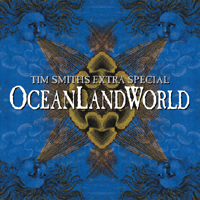
Tim Smith: ‘Tim Smith’s Extra Special OceanLandWorld’
Meanwhile, the core Smith-eries just keep on coming – this year’s already seen reissues of relatively rare Smithwork (Mr & Mrs Smith & Mr Drake or Spratleys Japs) and a deluxe double vinyl reissue of key Cardiacs album ‘Sing To God’ is due for July). At the end of last month, Tim’s mysterious label The Alphabet Business Concern also sneaked out a CD re-release of his obscure 1995 solo album ‘Tim Smith’s Extra-Special OceanLand World’. A typically arch and sinister ABC press release reveals all (well, not really… and all capitals are deliberate, or at least deliberately annoying):
“AN ANNOUNCEMENT! PLUCKY? PERHAPS. GIFTED? PERHAPS NOT. Nonetheless Tim Smith, in an unforeseen spat of hubris, took it upon himself to exclude his so-called friends (acquaintances at best) to perform a collection of songs in isolation. Foolhardily believeing it may raise enough capital to barter his way from the labyrinthine clutches of obligation to which HE had previously agreed and to which, thankfully, he is bound to this day, in 1995 this solo album was release. Circumstance , of both design and fate have since rendered this ‘offering’ unavailable. UNTIL NOW. As if to mock his feeble attempt at emancipation THE ALPHABET BUSINESS CONCERN once again make available ‘OceanLandWorld’ with the proviso that the covenant can never be broken.”
Ducking under Alphabet’s theatre-of-cruelty bombast, the following actual facts can be dug up. The OceanLandWorld album was recorded by Tim on his own between 1989 and 1990, during a time of upheaval in the entangled world of Cardiacs. Three of the band’s key instrumentalists – Sarah Smith, William D. Drake and Tim Quy – had all either left or were about to leave, and at the same time Tim’s marriage to Sarah had ended. Next to nothing’s been said about this last event, and the other departures have always been described in a matter-of-fact way. In the long term, it seems that the baggy, unlikely, familial mass of Cardiacs-people (with their collective love of music and their sense of common adversity and purpose) managed to accommodate and contain the various splits and departures without lasting bitterness.
Still, although the suggestion in the sleeve-notes that Tim recorded and performed the ‘OceanLandWorld’ songs alone “by way of a penance” is a typically Alphabettian joke, there’s a certain rue to the tone of the album (not least when, behind a bouncy pop march, Tim sings cryptically about tears and about worms chewing on wooden people). Previously wrung happily through the efforts of other people, Tim’s songs are now being filtered through machines: check out those cascading sequencers and springy synth-bass whacks behind his reedy squawk and bustling guitars. Hardly surprisingly, there’s a slight pre-fab feel to the album. If previous Cardiacs albums sometimes felt like the scruffy, well-lived-in old houses in the band’s south-west London suburbs, then ‘OceanLandWorld’ feels like a race around a new satellite town: thin slivers of post-war history, new bricks and formica, a Toytown street plan.
That sense of uneasy rootlessness plays a part in this picture. Tim stutters out an album of faux-jaunty pop songs, without his musical family to push against and to be held by (even if Sarah does briefly return on one song for a gracing of saxophone). The familiar staggering, stumbling embrace of Cardiacs songs is replaced by a Scalextric skid. It’s to Tim’s credit that he somehow turns this into an asset: to these ears, ‘OceanlandWorld’ captures the giddy weightless of post-traumatic sensation, the impression that everything you are has been tossed up into the air like streamers and comes down spread-out and thinned-out, but still recognisably you. In the same way, familiar Cardiacs tics and inspirations work their way through the fabric of the album, with epic punky chorales and proggy vistas opening up like a junkyard requiem.
The album also features one of Tim’s most breathtakingly beautiful songs, Swimming With The Snake. The man rarely, if ever, even starts to explain what his songs are about, but this particular song communicates mysterious undercurrents of pain, loss and love with a rare and stunning magic.
If what you’ve seen, heard, and read here intrigues you, you can order the reissued ‘OceanLandWorld’ from here.
Fresh from his successful European spring tour with The Crimson ProjeKct (in which three veteran members of the 1990s King Crimson teamed up with three younger musicians in order to revisit and revitalise Crimson music of the ’80s and ’90s in concert mode), Markus Reuter has released an album called ‘Sultry Kissing Lounge’. This is a selection of the opening live improvisations/ instant compositions which Markus performed as curtain-raisers on the TCP tour.
Markus was filling some particularly big shoes for that particular tour. In King Crimson terms alone, he was taking on, developing, reinventing and re-personalising the live role once taken by the band’s prime mover/form-dictator Robert Fripp. In doing so, he played a key role in providing a window onto an alternative King Crimson – one minus Fripp’s key presence. By all accounts that I’ve heard, the results were no less potent than the original band was. (Sadly I had to miss the shows, so can’t bear witness myself).
Markus Reuter, 2014 (photo by Danil Golovkin)
Among other things, Markus was responsible for replacing those droning, skirling, semi-abstract soundscapes (sometimes celestial, sometimes nightmarish) which Fripp used to deepen Crimson textures, to uproot rigid Crimson structures and to express the band’s contradictory undercurrents of formal futurism, chance risks and frustrated romanticism. Historically, soundscapes have often been used as intros to Crimson concerts, gelling a mood and a context out of simple but deepening ingredients. Markus continued this tradition, playing his U8 Touch Guitar through extensive laptop processing and looping, and it’s this particular work that you’ll be listening to here. These pieces set the tone for each concert, and provided a launch-pad for TCP drummers Pat Mastellotto and Tobias Ralph to begin their own regular opening duet.
Markus brought his own tones and personality to the role. For those who are familiar with King Crimson, it’s interesting to contrast his soundscapes to those of Fripp. To my ears, Markus’ soundscapes tend to be more oblique: simultaneously more rational and more abstract than Fripp’s. They ask different questions, and in many respects give less away, seemingly more interested in opening up the audience’s minds rather than jogging their hearts or jogging their complacency. A Reuterscape demands a little more audience involvement, presenting a different vista in which to think rather than performing Fripp’s process of reeling in the listener by expressing wonder and those more tender, contradictory sensibilities that his more aggressive straight guitar playing didn’t allow. I may be wrong. Judge for yourselves – here are two of Markus’ soundscapes, recorded in the Czech Republic and in Switzerland respectively, and each named after a different woman (no doubt Markus can explain why.)
If these tempt you, ‘Sultry Kissing Lounge’ is available as a CD or download (featuring artwork by another TCP band-mate, bass guitarist Julie Slick) and can be ordered from here.
* * *
Later this month, Markus releases another long-cherished project – the full orchestral recording of his generative concerto ‘Todmorden 513’. I’ve touched on this in a previous bit of crowdfunder news. Originally a electro-acoustic ensemble work based mostly around Markus’ own touch guitar tracks, the composition has already been compared to those of Messiaen, Feldman and Debussy. It was re-arranged for full orchestra by Thomas A. Blomster (who, long ago, was half of Pale Boy) and then debuted and recorded by the Colorado Chamber Orchestra, conducted by Thomas.
Markus Reuter: ‘Todmorden 513 (Concerto for Orchestra)’
The documentary ‘Breaking 513‘ provides more information on how the project was conceived and developed. Here’s some interim compositional notes for those interested, taken from combined sources (including the original electro-acoustic version liner notes by Henry Warwick, plus comments by Joshua Meggitt of Cyclic Defrost):
“A continuous movement and sequence of five hundred and thirteen harmonies and triads generated by a combinatorial compositional technique of Reuter’s own design. The notes of each harmony or triad is then fed back into the same algorithm, resulting in a progression of chords and note clusters of highly varied density, ranging from simple two note harmonies to dense twelve note chords spread across several octaves. Starting on an A flat, the sequences of pitches form a kind of melodic or thematic line throughout… Each of the 50 string, woodwind, brass, and percussion musicians performing an individual solo part. These solo parts are in turn each a part of a trio or quartet, all joining together to form the orchestra… The rhythms (were) derived from the chord sequences themselves, which were looped across the whole piece, mapped to the notes of each chord, then mixed together. From there it was split into three or four independent voices respectively. The result is a shifting set of harmonic densities… Instruments mesh together, in ensembles of varying size, creating a kind of gauzy web through which development takes place.”
If you want to know what that might sound like (or if you’re just baffled by the description), there’s a video excerpt below:
The recording of the CCO performance is being released on 17 June 2014 on the 7D Media label, as a CD/DVD double pack with both stereo and surround sound mixes, plus an alternate 2.0 stereo mix by ambient music pioneer Robert Rich (see the embedded stream below). More info is here and the album can be pre-ordered from here.
* * *
Meanwhile, husband-and-wife team Ruth and Kane Powers – better known as virtuosic drama-pop duo Death In Texas – have also gotten in touch. Since the pair moved from New Zealand and started tearing up small venues in London five years ago, their self-confessed “grandiose, over the top and cinematic” music and performances – full of guts and gear-changes – has seen them compared to Lana Del Rey, The Dresden Dolls, Tori Amos and ‘The Phantom Of The Opera’ (I’d suggest that they’ve also got a judicious dash of Emerson, Lake & Palmer in gleeful entertainer mode and perhaps a hint of Suzi Quatro). More recently they’ve been in flux, solidifying recent changes in tone, personnel and approach and preparing to get it all recorded. Over to them:
“Last time we wrote it was for the release of (the video for) Sonic Switchblade, so much has happened since then behind the scenes. We have been crazily writing songs, then rewriting them, arranging and recording them in our home studio and trying to make a good guide for what will eventually be our debut full-length record. We have been listening to a whole lot of new music, taking in new influences and have shaped a new sound for Death In Texas which we are excited to show you. In July we will be heading into the studio to begin recording an album we’ve spent the last seven months preparing for. This is the best music we’ve made yet; it’s ethereal, powerful and more refined. We’ll be excited to share it with you once it’s ripened.”
Death In Texas: ‘Pluck’ EP
To fund the album, Ruth and Kane set up a crowdfunding deal a short time ago. As it happens, they’re already hit their target (and sold out of the initial run of the forthcoming DiT album) but in order to clear space and merchandise and to ensure that there’s enough in the album fund to cover eventualities, they’re currently offering an additional deal for T-shirts plus a free download of last year’s ‘Pluck‘ EP. If you’re interested, click here.
If you’re curious as to what you’d be getting, there are videos for two ‘Pluck tracks below, the music for which was recorded back when Death In Texas was a piano/ bass/drums trio. Assuming that they’ve built on their music for the forthcoming album, rather than utterly reformatting themselves, expect to hear more of Ruth’s arresting vocal and piano and of Kane’s dense-but-nimble drumming.
* * *
Finally – here’s a quick word about the London folk trio Vespers. I only really discovered them yesterday when I saw them play at Daylight Music (although they’ve been nice enough to follow the ‘Misfit City’ Twitter feed for a while). This definitely won’t be the last time I write about them – their generous blend of voices, their acoustic delicacy and their combined songwriting skills promise plenty, and their approach wells with compassion.
So far as I know, they have no album ready, and are still working to finesse a new demo which they’re happy with, but they do have three tracks up on Soundcloud in the meantime. I’ll save more comments for the live review later. Have a listen for yourselves.
The second Knifeworld album, ‘The Unravelling’ is due out on 21st July on Inside Out Music. Featuring the full-on, brassed-up octet version of the band which made their debut on the Stabbing A Dead Horse tour and the ‘Don’t Land On Me‘ single, the album should bring Knifeworld’s intricate psychedelic pop splatter (with its rotating riffs, clambering harmonies and hyperactive ornamentation) to the bigger audience that it deserves. Three British live dates to support the album follow in September – more details here. (UPDATE, August 2014 – since writing this preview I’ve reviewed the album.)
Knifeworld: ‘The Unravelling’
It sounds as if it’s been a tough journey to get the album in place. Knifeworld frontman and prime mover Kavus Torabi often comes across as an irrepressible freak puppydog, effervescent with a universal enthusiasm, but anyone who’s taken note of the title to Knifeworld’s debut ‘Buried Alone (Tales Of Crushing Defeat)’ and dipped deeper into the album (or read the ‘Misfit City’ review from a few years ago) will know that all of that fizz, Frith and apparent freakery mask thoughtfulness, vulnerability and a man who sometimes struggles to fit all of life’s fragments into place. ‘The Unravelling’ is inspired by a catalogue of what Kavus describes as “hopelessly grim, sad and heartbreaking events seemed to unfold all around me. Friends were diagnosed with incurable diseases, sectioned and imprisoned. Or worse. My once happy, enlightened, beautiful circle of radical, free-thinking freaks seemed to be collapsing and falling apart. I didn’t think the joy or craziness would come to an end. My previous experience of tragedy and bad luck seemed marginal in the light of what seemed to be occurring. Yet, somehow, in spite of it all everyone just gets through it.”
Kavus goes on to comment “I’d never channelled ‘real stuff’ so overtly into my music before. Although previously most of my lyrics had been autobiographical, I had always put in enough obfuscation and ambiguity to render them a little more abstract. I suppose I took a dim view of being so blatant, it felt a bit like crying in public.This time round the words seemed to write themselves and I felt loath to change them regardless of how uncomfortable they made me feel. I felt like it would be a disservice to what was happening and what I was trying to achieve. ‘The Unravelling’ has been, by a long way, the most difficult album I’ve yet made.”
If this makes the album sound as if it will be a dispiriting slog to listen to, don’t believe it. Take a look at the video for ‘Don’t Land On Me’, above; also note that Kavus promises an even greater commitment to the exhilarating, omnivorous rock music approach which he brought to the previous Knifeworld releases and to his earlier work (in the 1990s) with The Monsoon Bassoon. As he puts it: “When music can be about everything, can be whatever glorious, fucked up, kaleidoscopic, fantastical, bizarre shape you want, can sound like anything you’re able to think up and bully people into playing; when it can steal from everywhere and still sound unique, can be mysterious, unexplainable; when it can sound like the subconsciousness left to run wild, like the sky has cracked open and the very cogs of the Universe have been revealed… why would anyone choose to make it about so little?” Amen to that.
Key to the grim events that inspired ‘The Unravelling’ mournful undertow was the 2008 felling (by heart attack and stroke) of Kavus’ friend, inspiration and onetime employer Tim Smith, the leader of Cardiacs. Much of Kavus’s impassioned rant about music’s potential could cite Tim’s work as a model, and over the years plenty has been written about Tim and Cardiacs in various versions of ‘Misfit City. Plenty more will be written – for the moment check out the review of the ‘Leader Of The Starry Skies‘ tribute album, in which a dazzling variety of musicians from all over the place poke around inside Tim’s back catalogue, reinvent it and illuminate it (all to raise funds for Tim’s ongoing rehabilitation – he survived his ordeal, but it will be a long road back).
Cardiacs: ‘Sing To God’
Also, if you’re a vinyl buyer, you could consider picking up the upcoming heavy vinyl reissue of Cardiacs’ ‘Sing To God’ album, out on July 14th. Originally released in 1995, it’s often been hailed as Cardiacs’ finest work. That’s up for debate. What’s not up for debate is the album’s joyous variety, its tremendous dynamic sweep, and its tooth-rattling tunefulness. If you want the ‘Mojo’ metaphor, ‘Sing To God’ is Cardiacs’ ‘White Album’ – a double effort, bursting with ideas and playfulness, with little sign of any anxiety that the group might burst their bag or lose their identity in broadening out as far as they could go. Songs could reference unusual heartbreaks, the trenches of the Somme, the world-views of dogs and children, football sirens, even being shat on by a bird. Across the album the music crash-zoomed into and over Beatles, Tallis, scissors, Faust, thrash-metal, Zappa, egg-beaters, Mellotronics, Gong even a kind of punk-Mahler guitarchestra while still remaining true to Cardiacs’ urchin-squawk, love of crashing noise and heaving, fractured pop-sense. (By all accounts, it was also much more fun to make than ‘The White Album’ was.)
The press release gets it right:
“Whatever superlatives previously applied to Cardiacs music: psychedelic, epic, strange, otherworldly, terrifying, magnificent, spectral, progressive, weird; were expanded into technicolour, re-imagined in four dimensions and attached to the tail of a rocket with the release of this magnum opus. ‘Sing To God’ was the realisation of everything that had been inside Tim Smith’s head since birth. And what a realisation. ‘Sing To God’ was devastating. Nearly 20 years since this CD was originally released it is time to realise this beauty on double gatefold heavy vinyl. And so it has been done.”
Go find out for yourself – the vinyl reissue should be available from here before too much longer. (UPDATE, August 2014 – the reissue is now into a second pressing.) For tasters, consider the three ‘Sing To God’ tracks below.
(Actually, one of the earliest and best-known reviews in the original ‘Misfit City’ covered this album. I’ve been meaning to post it back up for a while, but it probably needs some rewriting first. I suspect that the entire Cardiacs back catalogue warrants piece-by piece reviewing. Right, that’s now on the to-do list…)
I keep a regular eye on the ‘Organ’ blog. In the good old, grim old days of print, paste, photocopy and crude HTML, ‘Organ’ was a big inspiration for ‘Misfit City’. While there’s been a lot of turbulent water under the bridge since then, and though Sean Worrall – he who is ‘Organ’ – claims his days of animated gonzo reviewing are long past, the current blog is still a great source of news and rapid-fire information/reaction regarding music, the London art scene, occasional politics and whatever other related thoughts are passing through Sean’s head. Some time (when I’m feeling even more solipsistic than usual) I might write some more about ‘Organ’ and ‘Misfit City’ and the 1990s, although I suspect that few people can pronounce better on Sean and his singular range of experiences than he can himself. (I’m hoping that he writes a proper memoir one of these days.)
Right now, here’s something I picked up from ‘Organ’ late last week and am sharing now: it triggers a different kind of nostalgia.
Johnny Parry Orchestra: ‘An Anthology Of All Things’
Today, the Johnny Parry Orchestra release their second album ‘An Anthology Of All Things’. I first became aware of Johnny in 2002 when, as a solo act, he sent his debut album ‘Break Your Little Heart’ to the original incarnation of ‘Misfit City’. At the time ‘Misfit City’ was going down with all hands (ie, me) and so despite all best intentions and protestations, the album just sat on my shelf. I think it’s still there. I owe it to Johnny to revisit it properly sometime.
Fortunately (for my conscience, anyway), being neglected by me hasn’t hurt Johnny in the slightest. In the intervening twelve years he’s continued to work on and release music from his base in Bedford, steadily building himself up from solo dream-popster to trio leader, then becoming a small-ensemble boss and eventually expanding to the role of orchestral maestro. Now moving with assurance within the world of substantial arts grants, community music and event concerts, the latter-day Johnny Parry composes, arranges and conducts on a large scale and has worked with musical names as diverse as Talvin Singh, Michael Nyman, Seb Rochford and Beth Orton as well as Turner Prize-winning artist Martin Creed. Not bad for someone whom in 2002 was wandering Toronto amidst the wreckage of a record contract, seeking solace and inspiration from the city’s buskers. If life handed him a lemon, he certainly went on to grow lemon groves.
‘An Anthology Of All Things’ is Johnny’s second orchestral/choral album – funded by Bedford Creative Arts, it features (in addition to the JPO) the Bedford Arts Choir and soprano Donna Lennard. Already gaining comparisons to Benjamin Britten – albeit a Britten with a strong pop leaning – it’s very much community-shaped, with Johnny drawing his settable texts from lyrics donated (consciously or otherwise) by the Bedford public. The video excerpts below should demonstrate how this works. The first of these (for the sixth movement) is the result of Johnny soliciting and assembling original romantic testaments from friends, including couples, about their own feelings:
The second video is for the fifth movement, which gleans its text from the dedications on park benches in and around Bedford:
Some of the remaining movements are inspired by reflections on Bedford historical figures and childhood heroes, plus the town’s memories of the Second World War: others draw on more general or abstracted themes such as the human body, the elements of narrative, the components of travel and “youthful boundary defiance”. Here are a few more snippings from the press release:
“A captivating small town experience that has a far wider resonance… magnificent, masterful and sweepingly heart-warming, and performs a velvety emotional cut and paste approach. It dares to be huge and expansive but retains a deeply personal core which carries the intimate, often evocative thoughts and statements that are at times uncomfortable, innocent, whimsical and on occasions playfully risqué.”
The album can be ordered directly from here (though you’ll need to use PayPal)
While I’m beating myself up a little for not keeping up with obligations, here’s something from someone else whose work I need to keep up with more regularly. Matt Stevens is no stranger to ‘Misfit City’ – see this review of him threshing up a lively storm at Roastfest a few years ago with just an acoustic guitar, loops, a pedalboard and plenty of bearish enthusiasm. Likewise, there are a couple of reviews of his early work with the collaborative band The Fierce & The Dead (here and here), an outfit which has grown from a trio of interesting polystylistic rock dabblers into a roaring garage-prog quartet with a shaggy, behemoth sound to it.
Matt Stevens: ‘Lucid’
First and foremost, though, Matt is a ceaselessly enthusiastic solo artist, and in March he released his fourth solo album ‘Lucid’. Compared to his earlier solo work, it’s more of a band record, predominantly based around Matt’s friends and contemporaries in British art-rock (Stuart Marshall from The Fierce & The Dead and Charlie Cawood from Knifeworld are the rhythm section for most of the record, while sundry other Fiercies, Knifeworlders, Trojan Horses, Guapo-sians and Chrome Hoofers also make a showing – hello Emmett Elvin, Nick Duke and Kev Feazey). However, it also draws from latterday prog via Jem Godfrey (of Frost*), dark ambience from Helicopter Quartet‘s violinist Chrissie Caulfield, and cosmic jazz in the shape of Lorenzo Feliciati of Naked Truth, who may or may not be responsible for the presence on the album of his NT bandmate Pat Mastelloto, the increasingly ubiquitous and inventive King Crimson drummer who’s become something of a touchstone for art-rock crossovers. (Mysterious vibraphone player Jon Hart is also on board but, as always, wherever he’s coming from is anyone’s guess.)
Matt himself describes ‘Lucid’ as:
“a significant step up from the previous albums. It’s inspired by a bit of a dark time, but hopefully it’s an uplifting record… all the players really were outstanding. It’s a record that reflects my love of Jesu and Celtic Frost as much as the Mahavishnu Orchestra and King Crimson or even Peter Gabriel and I’m really proud of it. If you’re not going to take risks and try and do something interesting what’s the point?”
The preview video below (which has been out for a few months now) should give you some idea of what Matt’s aiming for. If you like what you hear, the album’s out on Esoteric Antenna Records and you can get it either from Burning Shed or Cherry Red.
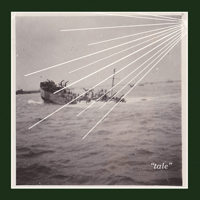
Multi-disciplinary New York trio Sontag Shogun (including Jeremy Young, whom I reviewed playing live in London last year as Foxout!’s guitarist) sent me some news about the recent release of their debut album ‘Tale’. Ostensibly post-rockers, Sontag Shogun don’t conform much to the genre’s more insular tendencies, being made up of three restless multi-media artists moving from craft to craft and from continent to continent. Jeremy, for instance, also co-runs the band’s not-just-a-record-label Palaver Press, which unifies sound publication with assorted texts and fine-art bookbinding.
‘Tale’ was recorded in carefully-hoarded scraps created around the world while Jeremy (sound sources and contact miking) was studying in London, Jesse Perlstein (laptop, tweaked voice and kleptomaniac microphone) was traveling in Korea, and Ian Temple (the grand piano) was back at home in Brooklyn. Field recordings were gleaned from diverse adventures including “a trek through a Columbian jungle, a piano tuner testing the ivory at the Southbank Centre and a South Korean traditional singer hitting a buk (or leather folk drum).” Back in New York, the results were looped, layered and mixed with planned performance (both final takes and rehearsal scrapings) to create a tender collage and a trans-genre which Sontag Shogun call “lullanoise”.
For a taste of what this sounds like, here’s the simple and beautiful but implicatory video for one of the album’s piano-led tracks, The Musk Ox (directed by Isabel Nao):
and here’s a video of Sontag Shogun performing another album track, Let The Flies In, live in France in 2013:
‘Tale’ is available as either CD and download and can be ordered from here.
News on two long-awaited second albums, both now available for pre-order.
(Brief rant first. Up until now ‘Misfit City’ has avoided reproducing or paraphrasing current news releases, apart from the odd crowdfunding mention. Too many music blogs are rolling shills, just throwing out links and one or two lines of PR blurb – fine if you only want a quick squirt of info, but I prefer to provide something to read and reflect on. Now I’m relaxing my stance: partly because release schedules are moving too fast for me to keep up with them properly, and also because ‘Misfit City’ readers probably appreciate the opportunity to pursue a few things on their own. Hence this first “through the feed” post, passing on and personalising info on promising upcoming releases or events which I’ve heard about. This will flesh out the City’s posting schedules and also allow me to indulge myself as pure enthusiast, minus the more sober and serious responsibilities that come with in-depth reviewing. Having unbent myself a little, I’ve found I’m enjoying it. Wheedling rant over. Now…)
Tim Bowness: ‘Abandoned Dancehall Dreams’
On 23rd June, Tim Bowness releases ‘Abandoned Dancehall Dreams’ on Inside Out Music. I know I wasn’t alone in hoping for Tim to release a new no-man album this year, but thanks to bandmate Steven Wilson’s ongoing commitments to his own solo career, we get this as an alternative: a might-have-been no-man album reworked as a Bowness solo effort. The album features contributions from the no-man live band (including Darkroom‘s Mike Bearpark and Henry Fool‘s Stephen Bennett) plus a scatter of interesting guest players (King Crimson’s Pat Mastelotto, Porcupine Tree’s Colin Edwin, Anna Phoebe from Trans-Siberian Orchestra, composer/string arranger Andrew Keeling).
Those who’ll still miss the presence of Steven Wilson can console themselves by the fact that he’s done the album mix, but it’s always worth pointing out that no-man is an equal partnership for a very good reason – and that Tim’s work outside no-man during the band’s lengthy absences over the past decade has flowered into much broader areas and accomplishments. For ‘Abandoned Dancehall Dreams’, expect plenty of violins, choirs, an edgy croon and some immediate art-rock songs which should effortlessly combine the wracked, the sleek and a very English blend of wryness and longing. One song, The Warm-Up Man Forever, was premiered as a highlight of the no-man tour back in 2012.
A download version comes later, but as regards the solid options the usual Burning Shed boutique format options apply for the pre-order. For turntable worshippers, there’s not only a vinyl version but also a very limited white vinyl edition, both of which come with a free CD version. For musical completists and sleeve-note fans, the double CD version comes with alternate/outtake versions plus remixes by Richard Barbieri, UXB and Grasscut, as well as a nice fat 16-page essay booklet (of the kind I used to write, once upon a time). Sweet. Some live dates follow in July, featuring members of the erstwhile Bowness band, the no-man live band, and Henry Fool (all of whom appear to have morphed together into an overlapping art-rock amoeba). Loop-guitar thresher Matt Stevens and silky Italian art-rockers Nosound appear as support at some dates.
Stars In Battledress: ‘In Droplet Form’
The week before that, on June 16th, sibling duo James and Richard Larcombe – a.k.a Stars In Battledress – release their own second album ‘In Droplet Form’ on Believers Roast. Their debut album was one of 2003’s hidden, intricate gems – a marvellous multi-levelled faux-antique toybox of sepia-ed wit, sophisticated arrangements, sly poetry and clambering harmony. Fans of Neil Hannon, Robert Wyatt, Stephen Merritt and Cyril Tawney should all have had a field day with it, but for a variety of reasons, it remained hidden. (I’m sure that my own wretched inability to complete a review at the time didn’t help…)
Since then Stars In Battledress have only reappeared sporadically, although the brothers have kept busy both separately and together. Both have worked as ensemble members of North Sea Radio Orchestra and of William D. Drake & Friends: James has played keyboards in Arch Garrison and Zag & The Coloured Beads; Richard has kept himself busy with his Sparkysongs project for children, no less of a challenge than keeping cranky art-rock fans happy. Yet absolutely nothing else that the Larcombes do can top the particular magic they cook up when they’re together and completely in control of their own songs.
With an eleven year gap between albums, some of these songs have been around for quite a while. The romping wit of Hollywood Says So, the rambling melodic spikes of Fluent English (an oblique essay on rebellion, Empire, personal misplacement and embarrassment) and the haunting cadences of The Women From The Ministry – all of these were highlights of Battledress sets back in the early Noughties, so it’s lovely to finally have them arriving in recorded form. If you want some idea of what Stars In Battledress are like live, here’s a review of them at Roastfest in 2011. As a taster for the new album, here’s their video for the opening track A Winning Decree (directed by Ashley Jones of Chaos Engineers).
‘In Droplet Form’ is a CD-only release for now, and can be pre-ordered here, with a London album launch (also featuring Arch Garrison and Prescott) downstairs at the Roundhouse on April 13th.
Also in June, the Laura Moody debut album should be appearing. I’m really looking forward to that one too.
Swoon. /swo͞on/ A verb. To be emotionally affected by someone or something that one admires; become ecstatic. Here are some people and things that make me swoon. #swoon #swoonage









 Misfit City