Archive | psychedelic pop RSS feed for this section

November 2015 – upcoming London gigs – The End Festival 2015 in Crouch End, part 1

11 Nov

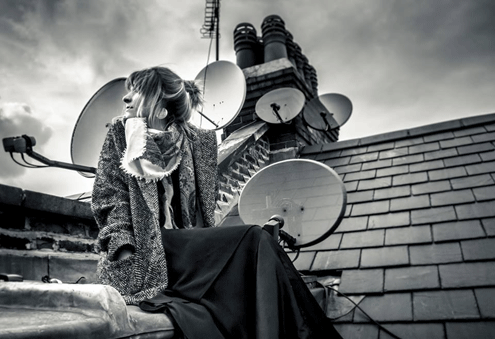
The End Festival, 2015

When I was growing up in north London, Crouch End was the “next village over”. It was the place where I went to primary school and first heard song by Neil Young, Steve Winwood and The Kinks (strummed out and sung in assemblies alongside battling hymns from the civil rights movement) and where I began sharpening my hunger for musical knowledge on the rich ranks of vinyl LPs in Hornsey Library. Over the years, I’ve continued to associate the neighbourhood with music – other people’s memories of old art-rock and punk gigs at the Hornsey College of Art; the star traffic through the Church Studio at the bottom of Crouch Hill (owned in turn by Eurythmics and Paul Epsworth), where you might find Erasure or Sisters of Mercy catching a mid-session coffee in the local café; and the Gareth Malone wet-dream of the Crouch End Festival Chorus, a local choir with a national reputation.

That said, Crouch End’s day-to-day music scene has always struck me as lacking. There have been exceptions to the rule – the steady reservoir of blues and roots playing at the Kalamazoo Club; the string of house concerts that Jenni Roditi ran at her loft between 2002 and 2009; more recently, a flowering of rootsy events at the Earl Haig Hall. But generally speaking, Crouch End has always seemed to me to export or traffick in music rather than play it, becoming an increasingly upmarket and bijou neighbourhood where shoppers vastly outnumber giggers; easily eclipsed by the musicality of other London neighbourhoods like Camden Town, Dalston, Shoreditch, even Tooting.

Well, more fool me. It turns out that I’ve regularly been overlooking and missing The End – an annual, musically expansive Crouch End festival that turns all of my gloomy observations about the neighbourhood’s gig shortcomings to dust – at least, for two weeks. As my penance, here’s the first half of an overview of everyone playing at this year’s festival, which starts tomorrow (all ticket details are to be found via the info links or at the festival website).

* * * * * * * *

Lowpines + Forced Random + Ylja (Earl Haig Hall, 18 Elder Avenue, Crouch End, London, N8 9TH, UK, Thursday 12th November, 7:30pm) – £8.80 – information

The festival kicks off with a concert navigating the blurry margins of folk and lo-fi alternative rock, with headliners good enough to warrant a post all of their own. The crepuscular but lovely Lowpines have been racking up an unending stream of plaudits for their Anglo-Americana atmospherics, which recall old phonographs playing whispered, heartspilling songs in dusty basements, laced with judicious drums, intricate campfire fingerpicking and stargazing whistles of feedback like psychedelic pedal steel lines. Support comes from Oliver Girdler’s one-man lo-fi project Forced Random (which drifts ghostlike from instrument to instrument and from one slow soft-edged song to another) and from Reykjavík folk-rock trio Ylja (initially based around female harmonies and lap-style slide guitar but expanding into a broader palette that encompasses and recalls not just Fairport Convention, early Clannad and Pentangle but also the glowing starfield details of Sigur Rós and 1972 Pink Floyd).


* * * * * * * *

The Fierce & The Dead + a.P.A.t.T + Markers (Downstairs @ The Kings Head, 2 Crouch End Hill, Crouch End, London, N8 8AA, UK, Friday 13th November 2015, 7.00pm) – £8.80 – information

The first of several events at The Kings Head hosts assorted sprigs from the thornier of British art-rock. Headlining are prog-punk quartet The Fierce & The Dead (no strangers to this blog) who bring the rumbling immediacy of their quick-flaring complicated avant-garage instrumentals to the valley for the evening. In support, hazmat-suited Liverpudlian performance art troupe a.P.A.t.T, play “progressive pop that owes as much to Kurt Schwitters and the Chapman Brothers as it does to ABBA and Zappa”, drawing on a shifting tag-team of ‘Pool talent and bring strong flavours of the absurd, the deceptive and the cunning to whatever they do.


Opening the evening, Markers reunites two old friends from the omnivorous ferment of the 1990s London math rock scene – Jodie Cox (Ursa, Narrows, Exes, Rohame and Earth) and Jason Carty (Geiger Counter, Foe, Art Of Burning Water) as two electric guitarists without a singer, a rhythm section, any other instruments or much in the way of signal processing. Expect carefully poised, bare-branching instrumentals somewhere between Slintian maths, precise Fripp and Summers interplay, and the minimum-lines/maximum-impact approach of a Japanese ink painting or minimalist film.


* * * * * * * *

Kate Jackson & The Wrong Moves + Oh800 + YLJA (The Crypt Studio, 145a Crouch Hill, Crouch End, London, N8 9QH, UK, Friday 13th November 2015, 9.30pm) – £8.50 – information

Kate Jackson (the former Long Blondes singer (and sometime British Electric Foundation/Heaven 17 collaborator) brings her current band The Wrong Moves to The End. She’ll be playing music from the upcoming “mysterious” album she’s been writing and recording with Bernard Butler over the past six years (though from what I’ve heard of it it’s more assured than mysterious – a muscular, classic pop rock mix with Kate’s big vocals and Bernard’s bright, sometimes startling guitar work).

Also on the bill are Oh800, a currently secretive new supergroup featuring Eoin “Oh Ruin” O’Ruainigh plus members of The Duke Spirit and F.U.R.S. The project is still enough under wraps not to have any tracks available to share, so you’ll just have to guess what they sound like, though it’s possible that the old Oh Ruin ingredients of blues, campfire tunes, Irish folk and fingerpicking will get a look-in. In addition, Ylja will be playing their second support slot of the festival, following the previous day’s appearance with Longpines.


* * * * * * *

Joseph & Maia + Charlotte Carpenter + Annalie Wilson + Storme (Rileys The Ice Cream Café, 32 The Broadway, Crouch End, London, N8 9SU, UK, Friday 13th November 2015, 7.00pm) – £5.50 – information

An intimate gig of classic pop styles in one of Crouch End’s favourite drop-in cafes. New Zealand duo Joseph & Maia headline, playing songs from their debut album ‘Sorrento’ (a record which shows both their indebtedness to American songbook player-writers both old and new – Buckingham and Nicks, Ryan Adams, Paul Simon, Patsy Cline, Noah Gundersen – and their absolute assurance in working the same seams). Armed with a deeper and more ambiguous folk-blues approach, Northamptonshire-born Charlotte Carpenter sings songs of doubt and connection, softly, but with great emotional power held in check (like a surge pushing at a levee).


Rounding out the bill, acoustic festival favourite and all-round performer Annalie Wilson brings straight-ahead conversational, coffee-house songs on piano and guitar: while concert opener Storme (a Swedish singer-songwriter who’s come over to London to develop her songs, reversing the usual trend) is bold and dramatic enough to be a headliner, since her heavy-weather synth-pop aims for the same stadium-friendly altitudes as Florence + The Machine, Chvrches or even the more crowdpleasing moments of Björk .


* * * * * * * *

Becky Arundel + Nora Grefstad + Kloak (Kiss The Sky, 18-20 Park Road, Crouch End, London, N8 8TD, UK, Saturday 14th November 2015, 3.00pm) – free

The first of the Saturday gigs is a celebration of young female songwriters. Becky Arundel writes and delivers muscled, determined folk-rock in the Melissa Etheridge vein, moving from unplugged strum to bursting electric explosions. Norwegian singer Nora Grefstad , who generally trades as Noraslittleworld, slides her path midway between Elkie Brooks and Beth Gibbons (offering slightly wonky, jazzy trip-hopped pop or full-diva piano balladry – in each case with a hint of smeared-lipstick, morning-after feeling). While there seem to be plenty of people contributing to Kloak, in essence they’re two sassy-wise white girls – Georgia Meek and Gabrielle Mallett – putting together R&B-tinged electropop with a strong flavour of Eartha Kitt (those bent notes and divan stretches; that conversational yawp in the voice).


* * * * * * *

Cortes + Bea Munro + Orfan (ThisIsWIRED @ Rileys The Ice Cream Café, 32 The Broadway, Crouch End, London, N8 9SU, UK, Saturday 14th November 2015, 7.00pm) – £7.70 – information

Showcase night ThisIsWIRED (which, since its initiation in Shoreditch seven years ago has incubated the early budding careers of musicians including Ellie Goulding, Raleigh Ritchie and Michael Kiwanuka) rolls up to a Crouch End ice cream parlour for a north London jaunt. Tonight’s players include crisp power-poppers Cortes and belting 22-year-old ‘60s-rock-siren revivalist Bea Munro; but for my money the likely star in the pack is gig opener Orfan, who uses his multi-instrumental skills to hone captivating yearning songs which touch bases with such odd-bedfellow influences as Nico, Prince and Boo Hewerdine.


* * * * * * * *

Farrago + Ylja + Frida Wallin + YLJA (Before the Gold Rush @ The Haberdashery, 22 Middle Lane, Crouch End, London, N8 8PL, UK, Saturday 14th November 2015, 7.00pm) – £5.50 – information

In keeping with The End’s origins, peripatetic roots night Before The Gold Rush curate an outright folk & Americana evening. A truly enchanting set looks likely from Farrago, the psychedelic folk vehicle for the lucid, highly literate work of London songwriter Ian Bennett – vivid short stories couched in rich, longing arrangements and with colourful, falling poetic imagery. There’ll be a third appearance by Ylja, perhaps opening up to their lusher dream-folk tendencies. With flavours of honky-tonk and Grand Ol’ Opry, rising festival favourite Frida Wallin brings us the End’s most straightforward country music set to date. (She’s actually Swedish. Don’t let on or anything…)


* * * * * * *

The Battles of Winter + Metro Verlaine + MOSES (The Crypt Studio, 145a Crouch Hill, Crouch End, London, N8 9QH, UK, Saturday 14th November 2015, 7.30pm) – £5.50 – information

While Before The Gold Rush keeps the Americana and folk covered for the evening, the people at the Crypt hold down the indie and punk rock side of things. The Battles Of Winter embrace a driving post-punk indie sound compared to Echo & The Bunnymen, Interpol and The Doors. French “pop sauvage” trio Metro Verlaine are noisy electric romanticists inspired by the rush of Patti Smith/Richard Hell punk and the latterday spark of The Kills, as well as drawing on the original poète maudit fury of their namesake. The evening is opened by guttural punky rock’n’roll noise from M O S E S, who draw a London parallel to Wolf Mother and The Subways.


* * * * * * * *

The Wave Pictures + The Oreilles + Victor Lovlorne + Beverly + Pony & Trap + Nadine Khouri + Kindling + Annie Rew Shaw + Ryder Havdale + Kloak + Aphty Khea + Hudson Scott + Esther Joy Lane + others tbc (Hornsey Town Hall Arts Centre, The Broadway, N8 9JJ, London, UK, Saturday 14th November 2015, 7.00pm) – £16.50 – information

The big one. For this concert, at least thirteen performers will be taking up temporary residence in the battered but still beautiful Art Deco rooms of the former Town Hall, running quick-changeover mini-sets in the Supper Room, Committee Room and Council Chambers. Like a spontaneous party, the actual participants and their playing order seem to be in constant flux – as I quickly put this post together, the following seems to be the current setup.


Two bands are down from Yorkshire – The Wave Pictures (rattling Byrds-and-Motown garage-indie from Wymeswold) and teenaged Halifax trio The Orielles (a surf pop band from a landlocked town, teetering on the balance of their love of Riot Grrrl and the la-la-la). From America, buzz-pop Brooklyneers Beverly can’t quite make up their minds over whether to stick with Slowdive or Lush or to hit the accelerator pedal towards Surfin’ USA; pellmell Massachusetts indie-punks Kindling provide some rocket-powered shoegaze pop of their own. From Canada via Berlin, Ryder Havdale of The Mohawk Lodge might or might not come good on his promise to salt the lonesome indie-country rock of his main band with some Berlin-inspired electronics.


Several performers bring in captivating moods and stories. The blend of murmur, smouldering torch and cool eyed-vision in the work of Lebanese-British songcrafter Nadine Khouri has drawn comparisons with Patti Smith, PJ Harvey and Mazzy Star. Athenian-in-London singer Aphty Khea (a.k.a. MantRah) deals in self-produced slow-drag abstract soul and hip hop ideas; Texan gospel choir escapee and human love-wreck Victor Lovlorne in unsettling lo-fi basement ballads in a Will Oldham, Sparklehorse, Beefheart or Redbone vein. Piano singer Annie Rew Shaw mingles Christine McVie melodicism and wit with an eerie ghost-haunted songwriting style.


Of the rest, Kloak make a repeat appearance (this time unplugged) following their slot at Kiss The Sky earlier in the afternoon; Pony & Trap mix crisp girl-about-town rhythm-box funk with buzzy post-punk guitar hooks); and Oxford electropop diva Esther Joy Lane puts in an appearance, as does the elusive and underplugged Hudson Scott (at the moment, just a name on a wobbling list…)


* * * * * * * *

Emma Pollock + Ylja (Earl Haig Hall, 18 Elder Avenue, Crouch End, London, N8 9TH, UK, Sunday 15th November 2015, 8.00pm) – £8.50 – information

The last gig of the week features Scottish alternative rock heroine and onetime Delgados songwriter Emma Pollock, now three records into a solo career as well as being branched out into poly-genre supergroups (The Burns Unit) and socially-minded collective projects (The Fruit Tree Foundation), with her varied collaborations stretching well beyond her bright indie-pop beginnings to involve folk music, theatre work and string quartets. If you’re good, she might play you some songs from her upcoming album ‘In Search Of Harperfield’. Ylja, who by now are starting to look like the End’s house band, will play their fourth and final support slot of the festival at this gig.


* * * * * * * *

That’s all for this week, but I’ll try to put together a rundown of next week’s End gigs over the weekend…


November 2015 – upcoming gigs – a London rocktronica double from Baba Yaga’s Hut (Tropic of Cancer, Shift Work and Telefon Tel Aviv down south; Teeth of the Sea and Charles Hayward’s Anonymous Bash out east)

7 Nov

On the 12th November, Baba Yaga’s Hut are presenting a double event in London: simultaneous gigs in the east and the south, each blending rock and electronica in different ways and at different intensities.

event-20151109-tropicofcancTropic of Cancer + Shift Work + Telefon Tel Aviv (DJ) (Baba Yaga’s Hut @ Corsica Studios, 4-5 Elephant Road, London, SE17 1LB, UK, Thursday 12th November 2015, 8.00pm) – £10.00 – informationtickets

Gauzy, morbid-romantic LA dream pop project Tropic of Cancer (comprising murmurer and instrumentalist Camella Lobo plus collaborators) return to London for another set of blurred lyrics and slow-burner Gothic psychedelic-tinged tunes. Expect lapping echoes, grey-draped music and a numbed atmosphere with concealed drama: self-confessed romantic and “hyperbolic dramatist” Camella admits that the driving concept behind most of her songs is “a love so supernatural it lasts beyond death, but also a love that is sometimes not strong enough to conquer human weakness in the living.” 

The live Tropic of Cancer band now includes Joshua Eustis of Telefon Tel Aviv (and also Sons of Magdalene, Puscifer and the Nine Inch Nails tour band) who’ll apparently be playing a DJ set under his TTA moniker.  Further support comes from London dance-electronica minimalists Shift Work.

event-20151112-teethoftheseTeeth of the Sea + Anonymous Bash (Baba Yaga’s Hut @ The Brewhouse, London Fields Brewery, 369-370 Helmsley Place, South Hackney, London, E8 3SB, UK, Thursday 12th November 2015, 8.00pm) – £9.00 – informationtickets

At this gig, the increasingly acclaimed Teeth of the Sea launch their fourth album – the subtly-titled ‘Highly Deadly Black Tarantula’.

The London band’s assured and stormy concoction of spacey psychedelic guitar rock  dramatics, heavily-processed Fourth World trumpet, counter-culture festival techno,  electronica and drone music – plus their assured-to-arrogant stage presence and mastery of performance – has been winning them a wide range of fans from across the board. The clips below should give you an idea of what to expect both on record and onstage.

Support comes from Anonymous Bash, featuring veteran experimental drummer Charles Hayward (of This Heat, Camberwell Now, Massacre and the myriad collaborations of Accidents + Emergencies). Based on the music springing from last year’s four-week Hayward residency at Salford’s Islington Mill (during which Charles collaborated with over twenty musicians from the Manchester regions), the project features a taut, dubby experimental sound centred around the sonic marriage of his own percussion, melodica and vocals with shifting, abrasive rock aspects brought in by his collaborators.  The Salford-based Gnod ensemble (a mixture of  kosmiche and cult-spoofery) played a substantial role in the Anonymous Bash album, and join Charles in the ongoing live line-up.

November 2015 – upcoming gigs – Olga Stezhko takes her Lucid Dream piano concert to the Wigmore & Bridgewater Halls; Haiku Salut, Camden Voices and Emilie Levienaise-Farrouch bring post-folk, soundtrack classical and community chorale to Daylight Music

7 Nov

Increasingly a ‘Misfit City’ regular, the Belarusian classical pianist Olga Stezhko (whose superb technique is equalled by her audacious, densely intellectual approach to programming her repertoire) chalks up two landmark concerts at two British classical music institutions this week as she makes her debut at both the Wigmore Hall and the Bridgewater Hall. To each venue, Olga is bringing her ‘Lucid Dreams’ programme – a selection of pieces exploring ideas of childhood and children’s music.

Olga comments “this programme is deeply personal to me. It is a conscious attempt to rediscover those things that were central to the development of my musical identity. Inevitably this can appear to be a sort of light musical psychoanalysis, but as I recall my childhood I remember vividly being surrounded by magic, with all its signs and symbols, which greatly affected how I felt towards the world around me at the time. To some extent, I have never lost touch with my younger self thanks to my extensive teaching work with children. Their distinctive personalities are an endless source for artistic inspiration; I wish therefore to dedicate my concert to those boys and girls.

http://www.youtube.com/watch?v=JxvP57t7Ojg

“The narrative of the programme reflects the development of our perception of reality during different stages of life. It moves from the magical realism of a child’s worldview in the first half (Toys & Dances) to the broader metaphysical questions we all face at some point in life in the second part (Images & Visions).”

Olga Stezhko: ‘Lucid Dreams’ piano recital (Kirckman Concert Society @ Wigmore Hall, 36 Wigmore Street, London, W1U 2BP, UK, Tuesday 10th November 2015, 7:30pm) information & tickets

Programme:

Part One: Toys & Dances

Sergei Prokofiev – Old Grandmother’s Tales Op. 31
Sofia Gubaidulina – Musical Toys
Dmitri Shostakovich – Three Fantastic Dances Op. 5
Claude Debussy – Suite Bergamasque: Menuet
Lev Abeliovich – Tarantella
Aleksandr Skriabin – Deux Danses Op. 73

Part Two: Images & Visions

Claude Debussy – Images, Series 1
Aleksandr Skriabin – Cinq préludes Op. 74
Claude Debussy – Images, Series 2
Aleksandr Skriabin – Vers la flamme, poème Op. 72

Olga Stezhko (The Manchester Mid-day Concerts Society  @ Bridgewater Hall, Lower Mosley Street, Manchester, M2 3WS, UK, Thursday 12th November 2015, 1:10pm) – £7.00-£11.50 – informationtickets

Programme:

Sergei Prokofiev – Old Grandmother’s Tales Op. 31
Sofia Gubaidulina – Musical Toys
Claude Debussy – Images, Series 1
Aleksandr Skriabin – Vers la flamme, poème Op. 72

(Note that the Manchester concert features a much shorter version of the ‘Lucid Dreams’ programme.)

Throughout the programme, Olga explores the further deeper brought up in her music choices, investigating Debussy’s complex psyche and relationship with his daughter, the cognitive differences between children and adults (including the former’s belief, often shared with adult musicians, that they shape the world by thought and action), her own childhood impulses as a pre-teen musician, and the roles of parent figures in successive generations of composers. She also challenges the subordinate role that children’s music seems forced to play, arguing “what is the definition of children’s music anyway? I believe when these works emerge as an innermost urge from a mature master, it epitomizes their most sincere and unpretentious artistic output.

“Such music as Gubaidulina’s Musical Toys (part of my future recording project ‘Toys & Tales’) or, for example, Debussy’s Children’s Corner (to be included into my next all-Debussy album) is as rich with imagery, colour, trepidation, emotion and symbolism as any symphonic masterpiece. Moreover, it is perhaps the most accurate musical description of any composer and their inner worlds. Both performers and listeners can relate to this kind of music precisely because there is something universal about it as we all were children once, authentic and genuine in our relationship with the world.”

Olga’s full thoughts behind ‘Lucid Dreams’ (from which the above notes and quotes are taken) can be found here, and are well worth reading.

http://www.youtube.com/watch?v=WHQy9F_U21U

* * * * * * *

On the Saturday there’s another Daylight Music – a typically involved crossover gig of post-rock, soundtrack classical and communal musical spirit. Details and promo blurb below…

Haiku Salut, 2015

Daylight Music 206 – Haiku Salut + Camden Voices & Emilie Levienaise-Farrouch (Union Chapel, Compton Terrace, Islington, London, N1 2UN, UK, Saturday 14th November 2015, 12.00pm–2.00pm) – free (£3.50 donation suggested) – information

The wonderful Haiku Salut are best described as an instrumental dream-pop-post-folk-neo-everything trio from the Derbyshire Dales, and their talent for combining joyous folk, intricate electronica and spellbinding neo-classical has seen them compared to everyone from Beirut and múm to Sigur Ros and Aphex Twin. Their second album ‘Etch And Etch Deep’ has received acclaim from ‘Uncut’ (who called it “both warmly familiar and completely, fearlessly new”) and ‘Popmatters’ (“vividly coloured sonic canvas”), while ‘The Line Of Best Fit’ described the opening track and recent single, Bleak And Beautiful (All Things), as “uniquely stunning… isn’t afraid to tear up the rulebook and begin fresh.”

Formed in 2013, Camden Voices is a choir of thirty passionate singers, instrumentalists and teachers, as well as those working outside of the music world. Rehearsing weekly in the heart of Camden Town, they aim for high musical standards whilst keeping a friendly and fun sense of community at our heart. With groove and harmony as their foundation, they develop new approaches to ensemble singing; using new arranging talent, they dust off neglected gems from the worlds of jazz, soul, gospel, and a cappella with a vibrant contemporary twist.

http://www.youtube.com/watch?v=os-LkECwlAA

You can also hear the elegant, beautiful music of Emilie Levienaise-Farrouch, an award-winning French pianist/composer currently living in London. Spanning film score, bespoke composition and art installations, her work is connected by both its high quality and evocative, meticulous craft – a common sensibility of elegant, instinctual composition. In 2015, she created a sound-walk for London’s Queen Elizabeth Olympic Park, and her debut album ‘Like Water Through The Sand’ is set for a November release on FatCat’s post-classical imprint 130701.

* * * * * * *

If ‘ve got a moment over the next few days, I’ll post up something on the London Jazz Festival and on The End – failing that, more November gig news to follow.

August 2015 – tonight in Brooklyn – Michael Chinworth & The Rudder Group perform Trevor Wilson (with Will Stratton and Jonah Parzen-Johnson)

21 Aug

I’m sorry that this is another last-minute posting, but if you’re reading this in or around New York, there might be some tickets left for this concert.

Michael Chinworth, 2015

Michael Chinworth & The Rudder Band + Will Stratton + Jonah Parzen-Johnson (Union Hall, 702 Union Street, Brooklyn, New York, NY, USA, Friday August 21st 2015, 7.30pm) – $10.00

Part of the generation from the liberal arts Bennington College which also fostered Trevor Wilson (Anawan, Vocal Ensemble), Tavo Carbone (Horse’s Mouth) and J.J. Beck, Michael Chinworth maintains that group’s indifference to musical boundaries, keeping up a New York tradition of playing (like latterday Arthur Russells) across genres. Exploring his Bandcamp page throws up assorted experiments in cut’n’paste electro-acoustic collages and vocalese plus assorted various college-classical chamber pieces in various contemporary Romantic, minimalist or post-Ligeti forms. On this occasion, he’s following his well-established alternative pop side, performing his own lustrously tuneful take on a Trevor Wilson song cycle – 2013’s ‘Rudder Songs’ – which he’s due to release on album the following day.

‘Rudder Songs’ is in keeping with much of Trevor’s work – simultaneously vague and pointed, obscure and lovely, and often subtly provocative. While never being so obvious as to make a straightforward point, it suggests a unsettled fluidity of sexual identity and choices of vision; providing off-kilter, stream-of-consciousness hymns to unorthodox friendships and the possibilities of city life that nonetheless wilfully and regularly flees to open countryside or the solitary road life. Familiar elements from folk, torch song, soul jazz and psychedelia float alongside each other, recombining at odd intoxicated angles; or explode from straightforward beginnings into thought patterns too complicated for a simple frame to contain.

If you want to compare the Chinworth versions to the Wilson originals (sung and recorded solo at Meredith Monk’s piano, no less) you can find the latter above. Michael’s smooth, Wurlitzer-tickled blue-eyed soul approach might initially seem miles away from Trevor’s wayward and uninhibited performances and whisper-to-caterwaul vocalising (in some respects, it’s like Frank Ocean covering Kevin Coyne or John Cale at their most frothing). Still, if you’re familiar with Michael’s work on Trevor’s songs elsewhere, both the link and the sympathy are clearly intact; and it’s clear that their work together in Anawan (in which both Michael’s voice and Wurlitzer play a key role) paves a way towards Michael’s slant on the Rudder material. Check out his performance in the video for Anawan’s ‘Breaded Me’, below, and then compare it to his versions of a pair of Rudder Songs underneath (one exploring an unusual fissile threesome, the other obliquely fishing in a friend’s thoughts).

In addition to Michael the Rudder Band lineup includes guitar visionary Ben Seretan and fellow Benningtonians J.J. Beck and Matt Scott, plus Trevor Wilson himself on additional keyboards. Re the collaboration, Trevor comments “In many more ways than one, this is a repeat of a much-admired album from 1970, ‘Nilsson Sings Newman’. Harry Nilsson, inspired by the odd, rude composition style of Randy Newman, wanted to take the songs and re-imagine them with his signature vocal layering and general studio beautifying. These two songwriters, equal but so different in their contribution to musical history, united to create this album together without ego, without agenda. (Maybe. I hope.) As I will do (at the concert), Newman plays and sings on Nilsson’s adaptation of his own songs… with another bandleader.

“I think everyone should have the opportunity to do this with their form of expression. Not to get too 3rd-grade-after-school-assignment-y, but seriously, try it out. Ask one of your contemporaries, friends, colleagues if you can ‘cover’ their thing, and have them sit in the passenger seat somewhere during the process. Or the other way around. You’ll both learn a thousand things. Michael has a rare gift of seeing music on its own terms- terms that don’t exist within human realities- and he has certainly shown me things about my compositions that has changed my whole process. The band is sounding great, and I am so happy to be a part of it.”

There are two support acts. Folk songwriter Will Stratton will be playing songs drawn from his five full-length albums; while Jonah Parzen-Johnson (frequently seen as part of New York afrobeat ensemble Zongo Junction) will be bringing his lo-fi music for solo circular-breathing saxophone and analogue synthesizer, described as follows – “Imagine the raw energy of an Appalachian Folk choir, tempered by a lofi, minimal aesthetic inspired by the music of Bill Callahan… (Jonah) has meticulously constructed a world of warm memories remembered in a cold present, as he melds the evocative nature of folk music with the chilling power of experimentalism.” Judge for yourselves at the gig, or via the previews below.


Up-to-date information and tickets for the gig are available here – and if you can’t make it, you can view in on video stream here.

July/August 2015 – upcoming gigs – Thumpermonkey/The Earls Of Mars/Ham Legion in London; Holly Penfield’s Judy Garland show hits the Hippodrome; The Luck Of Eden Hall tour the UK

25 Jul

Next week sees the first gig (for some time) for one of the most interesting of current British rock bands; some high-gloss cabaret; and the start of a psychedelic pop roadshow travelling around the UK. Read on…

Thumpermonkey @ The Islington, 30th July 2015

Thumpermonkey + The Earls Of Mars + Ham Legion (Guided Missile Special People Club, The Islington, 1 Tolpuddle Street, N1 0XT, London, UK, Thursday 30th July, 8.00pm) – £7.00/£6.00

Thumpermonkey don’t get as much attention as they deserve. It’s possible that this is because they don’t seem to take things seriously, addressing almost everything with a skewed and multi-levelled sense of cryptic grand-baroque geek humour. Just to illustrate this – a current work-in-progress Thumpermonkey song is “something which we’re calling Giraffes, which includes some vague narrative about doing a conga during an asteroid-based extinction-level event.” One of their older albums is called ‘Chap With The Wings, Five Rounds Rapid’ – a wry kill-the-monsters line filched from ‘Doctor Who”s laconic and unflappable Brigadier. In the same spirit as that reference, I’d suggest that while they are serious about what they do, they’re not necessarily serious about the way they do it – like many of my favourite things.

If what I’ve written so far leads you to expect strained, fey, sub-Zappa wackiness, then think again. Both in the flesh and on record, Thumpermonkey are a brooding and atmospheric proposition – seriously musical, travelling from blitzingly heavy quasi-metal riffs to spidery post-rock, from threshing post-hardcore to theatrical mane-tossing prog at a moment’s notice while Michael Woodman’s grand edgy vocals and complex multi-levelled lyrics ride on top like an arcane mahout with an arched eyebrow. They’ve been called “a sustained victory for intuitive cross-pollination” by ‘Prog’ magazine and every gig they play confirms this particular accolade. Here they are playing 419 (a song which at first appears to be one of their more delicate offerings, revealing its intensities later).

The other two bands on the bill are less well known to me, but aren’t short of blurb:

The Earls Of Mars are probably the most original thing you’ll hear all year. At their heart, the band are a ’70s-influenced rock band bringing together jazz, prog, space rock, doom and blues and forming it into a barking mad noise that you’ll either get or you won’t. If you don’t get it then close the door on your way out of the spaceship, as those of us who want to stay are off on a fantastical journey to who-knows-where, with The Earls Of Mars steering the ship. Enjoy the trip, ladies and gentlemen, as it’s going to be a fun ride.

Ham Legion‘s noisy lo-fi pop is punctuated with proggy outbursts, psychedelic breakdowns and passages of cod-metal joy. Tangy and tart guitar, egg noddle bass lines and light crispy drums are smothered in gooey boy/girl harmonies. Eat in or take away. For fans of Cardiacs, Deerhoof, They Might Be Giants, Split Enz, Heavy Vegetable.

Judge for yourselves – here are the videos for the Earls’ ‘Astronomer Pig’ single from last year, followed by some footage of a Ham Legion gig in Brighton a couple of years ago. As for tickets, they’re available here.

http://www.youtube.com/watch?v=Qx6qFZ_V8d4


* * * * *

The day after the Thumpermonkey gig, Holly Penfield plays one of her biggest gigs of the year…

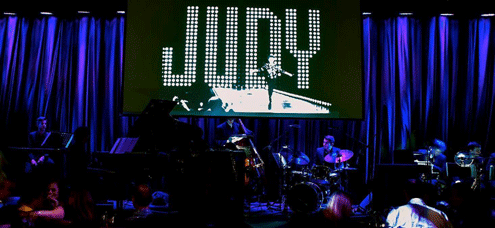
Holly Penfield as Judy Garland

Holly Penfield sings Judy Garland, The Hippodrome Casino, Cranbourn Street, Leicester Square, London, WC2H 7JH, UK, Friday 31st July 2015, 8.00pm) – £15.00 and upwards

Following a triumphant debut last year, Holly returns to the London Hippodrome, singing the songs of the legendary Judy Garland in her own inimitable style. Holly will be joined by her musical director Sam Watts and his magnificent seven-piece band. An unmissable evening for Holly and Judy fans alike, set in the glorious Matcham Room, located inside the Hippodrome Casino – formerly known as The Talk Of The Town, this is the venue of legends and home to Judy’s final London concerts.

Longer-term readers will know that I got to know Holly years ago via her own original ‘Fragile Human Monster Show‘ and the ‘Parts Of My Privacy’ album (which I wrote about ages ago – that review’s due a revamp and remount, I think). Both of those, though original songwriter pop, had their own theatrical and psychodynamic aspects which pointed towards Holly’s current work in vivid cabaret (and, latterly, as half of swing revivalists The Cricklewood Cats). As for Holly’s interpretations, she can and does cover cute showbiz camp and heart-tugging pathos within the same performance – you can see a couple of examples below.

Up-to-date information on the Judy concert is here and here, while tickets are available here. A mischievous part of me fancies swapping the audience from Holly’s show with the one from the Thumpermonkey/Earls/Ham Legion gig, and vice versa. I suspect that they all might enjoy it more than they’d expect to…

* * * * *

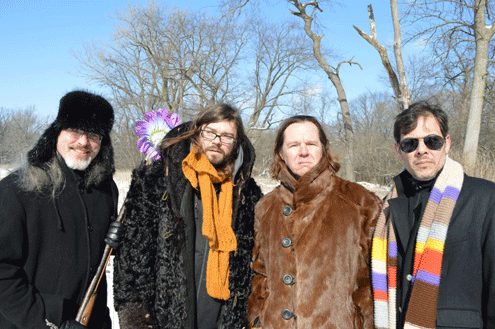
The Luck Of Eden Hall, 2015

On the same night that Thumpermonkey and co. play, The Luck Of Eden Hall are over from Chicago to play the first of two London gigs, launching a Kickstarter-funded UK tour which will take them to a wide array of venues and mini-festivals around England, Scotland and Wales, accompanied by a shifting cast of local psych heroes, left-field blues artists and quirky alt.pop shoegazers.

As for the headliners, you can expect clear-voiced, well-made classic pop beset by sudden gusts of psychedelic blizzarding. The Luck Of Eden Hall remind me of the drawn-out trucker-and-motorist tussle in ‘Duel’ – they come across like a more sombre Neil Finn or Andy Sturmer being stalked, dogged and sideswiped by Hawkwind, Ride or ‘Saucerful’-era Pink Floyd. Here’s a little evidence:


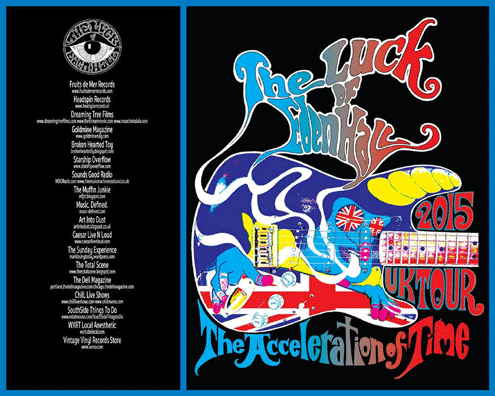
Full tour dates below:

The Luck Of Eden Hall UK tour


June 2015 – some videos – Tim Bowness, William D. Drake, Thumpermonkey

2 Jun

A few videos to pass the time.

Firstly, here’s the newest video from Tim Bowness, promoting the lead single from next month’s ‘Stupid Things That Mean The World’ album. The Great Electric Teenage Dream features a cut’n’paste scratch effort built up from fragments from the Prelinger archive.

While I’m limbering up for a big William D. Drake catchup (reviews of this month’s ‘Revere Reach’ album and its predecessor ‘The Rising Of The Lights’), here’s the uproarious Chaos Engineers video from the former’s lead single. ‘Distant Buzzing’ features appearances, on- or off-video, from assorted Drake associates – the Larcombe Brothers (from Stars In Battledress), Dug Parker (from North Sea Radio Orchestra), Stuffy Gilchrist and many others…including a certain sordid, waxy tyrant from the 1980s. And a donkey.

Finally, do you ever hear anyone complaining bitterly that all of the artistry has gone out of rock vocals? If so, play them this video of Thumpermonkey‘s Woody recording voicework for the band’s upcoming album, and watch a grin breaking like sunrise across their face. (I don’t cover Thumpermonkey enough in this blog. That’s going to change.)

June 2014 – through the feed – Lucy Claire ‘Collaborations No 1’ EP and London launch gig, plus ‘Tim Smith’s Extra-Special OceanLand World’ reissue

3 Jun

Lucy Claire, dishing it out (photo courtesy of This Is It Forever Records)

Lucy Claire, dishing it out
(photo courtesy of This Is It Forever Records)

Lucy Claire Thornton – currently better known as “Lucy Claire” – is a contemporary classical/ambient electronic crossover composer who counts Erik Satie, Peter Broderick and Bjork as influences, and whose work has been hailed as “brilliant, delicately-wrought sketches” by ‘The Quietus‘ and as “immersive and slightly disorienting” by New Music webcast station ‘Amazing Radio‘. She’s releasing her newest release ‘Collaborations EP No 1’ on This Is It Forever Records on June 15th: the same week features a launch concert in London promoted by Chaos Theory (the inspired crew who put on that Sweet Niche/Macchiana del Tiempo/What?! triple bill of fusion jazz which I reviewed last summer). Here’s what they have to say about this gig:

“(We are) excited to host this launch party for the first in a series of collaborations EPs from Lucy Claire, along with many guest performers. ‘Collaborations EP No 1’ will be available with unique handmade packaging at a reduced price at this event only, along with two download codes for remixes by worriedaboutsatan and Message To Bears…. This evening we will see Lucy perform works from ‘Collaborations No 1’, featuring (contributions from German singer/songwriter/producer) Alev Lenz and producer Bruised Skies.

Support will come from electronic classical composers Leah Kardos and Jim Perkins. Almost three years after we worked with Leah on the launch of her debut album ‘Feather Hammer’, we’re delighted to be back together. Tonight we will see bigo & twigetti label-mates Leah and Jim performing new collaborative material… as well as selected works from Leah’s second album ‘Machines’, a concept album with lyrics made up from cut up spam emails, which will feature singer Laura Wolk-Lewanowicz. We will also hear them perform new material by Jim (which will be released later in the year on bigo & twigetti) and re-workings of material from ‘Feather Hammer’.”

All three acts will be basing their performance around piano, electronics, and string quartet. The concert takes place on Thursday 19th June at 7.30pm, at Servant Jazz Quarters in Dalston, and advance tickets can be bought here for under a tenner. For various frustrating reasons, I suspect that I won’t be able to attend this gig myself. Perhaps someone who’s reading this could go, and then tell me what it was like? (Not that I want to make you feel like interns…)

* * *

Considering that he’s still cruelly immobilised by the after-effects of the strokes that felled him six years ago (see ‘Misfit City’ posts passim, here and here), the voice of Tim Smith has rarely been heard in the land so loudly. The profile of his band Cardiacs has been stealthily growing (albeit through YouTube and nostalgic webchat rather than their much-missed live shows) and we’ve recently had or will have new or imminent releases from self-confessed Smith acolytes Arch Garrison, Knifeworld and Stars In Battledress.

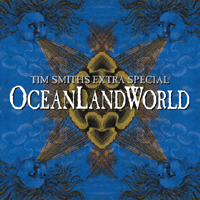
Tim Smith: 'Tim Smith's Extra Special OceanLandWorld'

Tim Smith: ‘Tim Smith’s Extra Special OceanLandWorld’

Meanwhile, the core Smith-eries just keep on coming – this year’s already seen reissues of relatively rare Smithwork (Mr & Mrs Smith & Mr Drake or Spratleys Japs) and a deluxe double vinyl reissue of key Cardiacs album ‘Sing To God’ is due for July). At the end of last month, Tim’s mysterious label The Alphabet Business Concern also sneaked out a CD re-release of his obscure 1995 solo album ‘Tim Smith’s Extra-Special OceanLand World’. A typically arch and sinister ABC press release reveals all (well, not really… and all capitals are deliberate, or at least deliberately annoying):

“AN ANNOUNCEMENT! PLUCKY? PERHAPS. GIFTED? PERHAPS NOT. Nonetheless Tim Smith, in an unforeseen spat of hubris, took it upon himself to exclude his so-called friends (acquaintances at best) to perform a collection of songs in isolation. Foolhardily believeing it may raise enough capital to barter his way from the labyrinthine clutches of obligation to which HE had previously agreed and to which, thankfully, he is bound to this day, in 1995 this solo album was release. Circumstance , of both design and fate have since rendered this ‘offering’ unavailable. UNTIL NOW. As if to mock his feeble attempt at emancipation THE ALPHABET BUSINESS CONCERN once again make available ‘OceanLandWorld’ with the proviso that the covenant can never be broken.”

Ducking under Alphabet’s theatre-of-cruelty bombast, the following actual facts can be dug up. The OceanLandWorld album was recorded by Tim on his own between 1989 and 1990, during a time of upheaval in the entangled world of Cardiacs. Three of the band’s key instrumentalists – Sarah Smith, William D. Drake and Tim Quy – had all either left or were about to leave, and at the same time Tim’s marriage to Sarah had ended. Next to nothing’s been said about this last event, and the other departures have always been described in a matter-of-fact way. In the long term, it seems that the baggy, unlikely, familial mass of Cardiacs-people (with their collective love of music and their sense of common adversity and purpose) managed to accommodate and contain the various splits and departures without lasting bitterness.

Still, although the suggestion in the sleeve-notes that Tim recorded and performed the ‘OceanLandWorld’ songs alone “by way of a penance” is a typically Alphabettian joke, there’s a certain rue to the tone of the album (not least when, behind a bouncy pop march, Tim sings cryptically about tears and about worms chewing on wooden people). Previously wrung happily through the efforts of other people, Tim’s songs are now being filtered through machines: check out those cascading sequencers and springy synth-bass whacks behind his reedy squawk and bustling guitars. Hardly surprisingly, there’s a slight pre-fab feel to the album. If previous Cardiacs albums sometimes felt like the scruffy, well-lived-in old houses in the band’s south-west London suburbs, then ‘OceanLandWorld’ feels like a race around a new satellite town: thin slivers of post-war history, new bricks and formica, a Toytown street plan.

That sense of uneasy rootlessness plays a part in this picture. Tim stutters out an album of faux-jaunty pop songs, without his musical family to push against and to be held by (even if Sarah does briefly return on one song for a gracing of saxophone). The familiar staggering, stumbling embrace of Cardiacs songs is replaced by a Scalextric skid. It’s to Tim’s credit that he somehow turns this into an asset: to these ears, ‘OceanlandWorld’ captures the giddy weightless of post-traumatic sensation, the impression that everything you are has been tossed up into the air like streamers and comes down spread-out and thinned-out, but still recognisably you. In the same way, familiar Cardiacs tics and inspirations work their way through the fabric of the album, with epic punky chorales and proggy vistas opening up like a junkyard requiem.

The album also features one of Tim’s most breathtakingly beautiful songs, Swimming With The Snake. The man rarely, if ever, even starts to explain what his songs are about, but this particular song communicates mysterious undercurrents of pain, loss and love with a rare and stunning magic.

If what you’ve seen, heard, and read here intrigues you, you can order the reissued ‘OceanLandWorld’ from here.

Lucy Claire online:
Homepage Facebook Twitter Soundcloud Bandcamp Vimeo

Tim Smith online:
Facebook

Leah Kardos online:
Homepage Facebook Twitter Soundcloud Bandcamp YouTube

Jim Perkins online:
Homepage Facebook Twitter Last FM

Alev Lenz online:
Homepage Facebook Twitter Soundcloud Tumblr YouTube

Chaos Theory Promotions online:
Homepage FacebookTwitter Soundcloud

REVIEW – Kiran Leonard: ‘Dear Lincoln’ single, 2013 (“a joyride through the Day of the Dead”)

18 May

Kiran Leonard: 'Dear Lincoln'

Kiran Leonard: ‘Dear Lincoln’

Now here’s something.

Kiran Leonard’s already an established teenage wunderkind – a bedroom-industry frenzy act who’s rapidly gummed together a string of homemade albums and slung them out, via Soundcloud and Bandcamp, to a surprised and unsuspecting world. When he’s not doing that, he’s charging round his family’s Oldham house waving a caiman head, or shooting his own scratch videos on a budget of tuppence. He plays most of the instruments he needs, wrestling tunes out of pianos, drums and guitars; ukuleles, laptops, screwdrivers and radiators. While his music’s just about ramshackle -raw enough to avoid trouble with the indie-rock police, his ambitions and application have leaned closer to prog and to a grandiose psychedelia. In 2012, for instance, he cooked up a rambling, apocalyptic single about the Mayan doomsday prophecy. It topped out at around 24 minutes long and tied together the wilder bits of ‘Cloud Atlas’ and the paranoid, grinding Pink Floyd of 1977.

It’ll still be three years before Kiran turns twenty. I could wonder what he’s going to do when he grows up, but I almost hope that he doesn’t.

Dear Lincoln is something different for Kiran – much lighter and more immediate. Traveling backwards as he goes forwards, Kiran seems to have suddenly discovered pop in all of its concise hooks, blind momentum and smart throwaway logic. Actually, he’s rediscovered it – Dear Lincoln was written some time ago, while he was a ripe 14 – but now seems to be the perfect time to unveil it. Its a bust-out. It sounds like a joyride through the Day of the Dead. Kiran, hammering away at a tack piano and squawking like a glammed-up crow, drives the gauges into the red and embraces Bolan swagger, a swaying Robyn Hitchcock playfulness, some of the wild euphoria of Guillemots and even a needling tinge of Kevin Coyne. Earlier in 2013, there was the ‘Oakland Highball’ EP, which showed that he was getting interested in snappier, noisier forms. Dear Lincoln nails it. If we could work out what he was singing, it’d even be singalong.

What’s it about? God knows. The words are a babbling wodge of mondegreens-in-waiting about suit-crevices and moonlight, thrown out at us as Kiran carries out his lyrical handbrake turns. “Murderous plain,” he protests, in passing, but it certainly isn’t. Not unless he’s talking about death again. The song could be about gunned-down Presidents, it could just be about missing the family cat, but one thing Dear Lincoln does do is blur the lines between the living and the dead – a rollicking Halloween dance, or a resurrection day stomp. Even that long-croaked, ranting old herald of the Übermensch, Friedrich Nietzche, has a ghostly cameo; prowling the English parishes as a witness before succumbing to anxiety, melting away and vanishing. In the chopped froth of the lyrics, Kiran playfully juggles around ideas of resurrection, rousing, and where he’ll be standing when it all comes to pass; but constantly swats away any navel-gazing with onomatopoeic streams of Little Richard-isms. “Praying for the bodies to assemble and wake… / Come back today, bou-la-ray / oh, ta-hoo-lay.”

Don’t get the idea that this is all a casual throw-together. Anyone keeping half an eye on how Kiran thinks will know that he’s meticulous; that he worries like crazy about getting things right. But Dear Lincoln’s explosive delivery – its immediacy, its ability to swing round the story without stopping to count the words – suggest that he’s finally able to harness his particular genius and to let it live in the moment. This is by no means the first we’ve seen of Kiran Leonard, but it feels like the start of him.

Kiran Leonard: ‘Dear Lincoln’
Hand of Glory Records (catalogue number & barcode t.b.c.)
Vinyl/streamed single
Released: 16th May 2013 (streamed), 2nd September 2013 (vinyl)

Get it from:
Hand of Glory store (vinyl), or Soundcloud (stream)

Kiran Leonard online:
Homepage Facebook Soundcloud Bandcamp Last FM YouTube

March 2004 – album reviews – Edwige’s ‘Rise and Sing’ (“while she’s not yet citing chapter and verse, the sacred aspect is clearer now”)

22 Mar
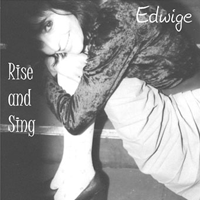
Edwige: 'Rise And Sing'

Edwige: ‘Rise And Sing’

Having made her initial mark with a couple of quirky, tricky-to-pigeonhole folk-pop albums, Edwige has made one on which she intends to celebrate “God’s beautiful gift of singing.” This could mean a lot of things. Perhaps she’s taking that unorthodox, archly beautiful voice of hers on an exploration of experimental a-capella songs, or a pure set of vocal rounds. Perhaps she’s made an album of devotional folk; or an unexpected gospel record.

As it happens, none of these are exactly the case. Edwige’s embrace of the joy of singing may be heartfelt, but it’s also comfortable. The key tone of ‘Rise and Sing’ is relaxation, and of Edwige’s assurance in her own work and her own methods. In many respects, it remains a familiar Edwige album. Many familiar tastes certainly remain intact. She still favours upfront lyrical messages, and continues to steer a course placing her somewhere between cabaret entertainer (especially on the oompah-pop of Bad Hair Day) and announcing angel.

She’s also continuing to develop her tendencies towards baroque pop arrangements. I Just Can’t Resist That Love is given lift by a suspended chorus of trilling voices and sunny passages of oboe; Into View is threaded with reeds, harpsichord, and tuba; while a harp adds sparkle to the simple, open love song After The Rain. The perky swing of New Mexico – with its elasticated guitars and psychedelic pedal-steel keyboards in tow – shows another side of her tastes, this time a dash of country music for the road.

The most surprising aspect of ‘Rise And Sing’ is a new affection for noisy guitar pop. Edwige’s latest producer (former Homer/Robyn Hitchcock sideman Andrew Claridge) sploshes some crashing electric guitars around several songs here, beefing up the acoustic strumming with touches of indie-pop, swamp-rock and grunge. The unplugged directness of previous Edwige albums, with their ornate bursts of cuteness and their denser musical surprises, sounded as if they’d come from odd-shaped rooms in an apartment piled high with spiritual books and knick-knacks. This album suggests that Edwige has recently knocked through a wall or two, and built a nice scruffy garage to play in. Her voice, as ever, is peppered with odd pitch-swoops, vibrato and declamatory theatrical inflections, and is still French-accented even after years of living in London. It’s an odd match for this bristly rock clanging – yet she thrives on the cruder energy that the extra noise provides.

With her perpetual good humour intact, Edwige uses the extra force to help her to drive home a few righteous stilettos. Straddling a catchy swaggering hook on Ears On Fire, she takes dry pot-shots at questionable cults with unreliable gurus – “I heard he was unfaithful to his wife, / I promptly took his words, and boiled them with my rice.” On Elegy For You, she skewers another bad-news, would-be Mephistopheles, decorating her lines with layered falsetto shimmers of vocalese while using the main lyric to sketch his cunning in song – “You’re so good at enchanting – / you lure with hopes and dreams / held through your spindly fingers, / and have them crushed like a crumply paper ball.” She also draws on this energy on Time For The Glorious: switching between midvoice and falsetto, rising serenely over the fuzzy rock backing to declaim “the leaf wouldn’t be but for the tree, / the wave wouldn’t roll but for the sea, / your heart wouldn’t be / but for a love much greater than one can ever conceive.”

Ah, yes. There are God-songs on ‘Rise and Sing’. Previously Edwige has only alluded to her personal, devotional brand of Christianity through cryptic clues, but now she’s beginning to become more direct. While she’s not yet citing chapter and verse, or names, the sacred aspect is clearer now, and this in turn reveals the true nature of many of her previous songs. As for the new ones, I Just Can’t Resist That Love pulls off the old soul-music trick of blurring across the boundaries of love song and devotional hymn. Opting for generosity rather than hectoring, Edwige’s revealed evangelism takes a variety of forms over a broad range of experience and musical method.

We get our gospel song after all – I May Have, in which Edwige testifies doubts and faith over a soft bed of electric chapel organ and little electric guitar agreements. Behind the pretty arrangement, Into View reveals itself as a waltzing tale of a Damascene conversion. For the jazz-tinged acoustica of Tea Light Sympathy Edwige turns teacher, with a gentle (but stern) offer to share her path. On Fusion, she becomes an ecstatic celebrant, kicking off a startling, delirious cocktail of techno pulse, hard-rocking fuzzpunk and hoedown. Choppy cello and guitars meet up with a stomping dance-floor beat and speaker-trashing bassline, and are in turn covered in festoons of Edwige as she chants, lets rip again with the vocalese and sends up fireworks of singing.

The thing about devotion, though, is that it involves letting go. Edwige is such a determined performer – so enthralled with the message, the observations, the little dialogues of life – that little of this (bar the rampaging delight of Fusion) rips through into the ecstatic. The message is always already decided, never discovered, and so the sense of actual revelation is lost. That’s a shame – for believer and unbeliever alike, observing or sharing a revelation of faith is often a fuse for crucial sympathy, and on her songs Edwige seems to miss out on this transformatory moment.

There’s one significant exception, in which Edwige’s wayward journey takes her up into a place she’s never visited before in song. Do I is that music-of-the-moment that’s missing elsewhere. An unexpected (and welcome) bit of psychedelic noise-folk, it’s set on Nico organ drones and on a cloudy screech of guitars so overdriven that they sound like English brass bands scattered by gales. The lyric is the simplest of declarations – no angles, no patter, just a naked, assured statement of devotion. “Do I come? – I do. / Will I follow? – I will. / In the light or darkness, pray for strength, / ah my love, … / Give me the warmth of your love. / Safe with you forever, ever, ever, ever.” Stepping up from the chapel drone, rising above this massing, crashing confusion of tangled feedback, Edwige is making her leap of faith for us; all cabaret cuteness falling away.

It’s the kind of inspiring moment which that unearthly voice was made for. I wish she’d do more like this.

Edwige: ‘Keep The Change’
Quasar Music, EDW3CD
CD album
Released: 2004

Buy it from:
Quasar Music or CD Baby.

Edwige online:
Homepage YouTube

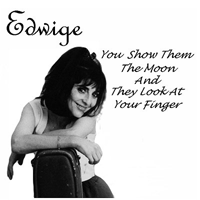
July 2003 – album reviews – Edwige’s ‘You Show Them the Moon and They Look At Your Finger’ reissue (“opera singer, cat purr, wise seductress, vocal trapeze”)

27 Jul
Edwige: 'You Show Them The Moon And They Look At Your Finger'

Edwige: ‘You Show Them The Moon And They Look At Your Finger’

I seem to remember that that title is a Chinese proverb about fools missing the point: presumably this is a warning that Edwige is pointing to somewhere interesting, and that if you pay too much attention to the way she does it then you’ll miss the why. Certainly you can get sidetracked by trying to pigeonhole her music. Like any city-smart pigeon, it struggles and flits away from capture.

So what is this? It’s folky, but with at least one eye trained above the treetops. It’s French but it isn’t (despite the accent and the chanson/cabaret flutter, Edwige is London-based and Anglophone, aligned to the world in general, and open to angels). It’s poppy, but salted with the ascerbic willpower of a woman who’s lived long enough to have her own individual way of doing things. And while she’ll welcome fellow travellers, she’s confident enough not to be too worried about whether you go along with it or not. I think I like that.

It brings back a memory, too. When I was about fourteen, one of the key albums for my raging, hormonal inner life was Kate Bush’s ‘Never For Ever’. I used to have an odd relationship with that record. I’d play it all the time, never sure whether I actually wanted to or not. I remember it felt like a wayward friend on a perpetual mood swing: it was poised on a wobbly adolescent axis of feyness, promise and wisdom, and put me through bouts of frustration and love. How could one album zoom so unpredictably between cutesy kiddie fairy tales and vaginal vamping, between stardust fantasy and nuke-generation fears, vengefulness and nurture? And how could it tangle them all up in such a wayward, compelling way, but still make me want to smack the naivety out of it? No wonder I eventually ended up shoving it in the cupboard and heading for the more straightforward push and bump of indie-pop to soundtrack my later teens.

Many years of The Smiths, The Fall and My Bloody Valentine later, ‘You Show Them The Moon…’ reminds me of that early shamanic Kate Bush girl-pop. It’s not just because those arch, slanting vocals constantly recall ‘Never For Ever’s Coffee Homeground; or because I Am A Temple, from its Nile guitar twang to its waft of desert synth and the aerial-bending vocals, is a ringer for the storybook mystique Bush brought into play on Egypt. OK, Edwige’s music doesn’t carry the same weight of sensual bewitchment. It betrays its budget origins via keyboards that sometimes dip into tweeness and rinky-dink; and by a no-frills recording that sonically cramps her cosmic-tinged imaginings, cramming the cornucopia into a garden shed. But ‘You Show Them The Moon…’ does show the same fascination with the free-flowing mind that’s one of hippydom’s more useful legacies, and it can carry its eccentricity convincingly as well.

A lot of this is to do with Edwige’s voice: a wonderful, peculiar, obliquely beautiful thing. It curves itself round the tones of opera singer, cat purr, wise seductress, vocal trapeze… all with glass-etching clarity and weird ricochets. It’s like a combination of Liz Fraser from Cocteau Twins and a French Eddi Reader without the gawkiness or the broadsheet approval. Actually, don’t stop there: look towards the Strange And Flamboyant Women In Pop section. In spite of the two-dimensional production, Edwige also pulls off the trick of sounding a bit like Bjork’s long-lost boho auntie. She doesn’t possess Bjork’s genius spark of child-vision, or her way with a contemporary sound (it’s French cafe culture round here, not club culture: you’ll find no beats, samples or Trickies). But she does have that same bungee-elastic vocal yaw – admittedly delivered with Edith Piaf’s brand of declamation, and with the sort of melodies and poised guitar strums that go with ten-foot silk scarfs swirled round swan-necks.

The songs themselves fizz just on the right side of easy listening. They’re frequently soft and fluffy, but with deceptive bends. Each is a moment, polished and expansively lit, in a life that’s become a quest in which there’s no goal but an understanding – an ordinary life illuminated by extraordinary lights. Downtrodden and downbeat on No Shape For Love, Edwige can be revived enough to put on a spiritual throb of benediction for Be Blessed. She’ll caress you with a dedication of warm, supportive love on Serve You Well. She’ll also slap you down with a moment’s notice, scolding and instructing in slightly fractured English. “If I open up my heart, it’s not to please your fantasy… / You think you are my king, you’re just a slave of your own enemy.”

Throughout the album, Edwige slings assorted moods and styles around herself like hula-hoops, keeping a core of determination but remaining free-floating. She will go all Jane Siberry and produce fluffy-edged clouds of electric guitar for The Dearest – a fragile love song where the unselfconscious fairytale imagery teases out a winning pathos. If pushed, she’ll become flamboyant, defiant and unreachable, as she is on I Am A Temple (“don’t you dare pry into my life!”). Yet she’s happy – on If You Were The One – to suddenly ditch the eerie and mystical to trill away on the kind of cosy tap-dancing tearoom jazz that you’d have thought long-lost on 1950s lounge records, or to toss out a dash of Celtic sounds with ‘The Omen’ (Clannad harps and tricky jig-in-a-box/jump-into-the-sea rhythms).

Back in 1999, the original version of this album was also noisier. Edwige occasionally dabbled in a kind of accidental techno, or flew in some famished rock guitars to add roar. For this 2003 reissue, she’s ditched these particular quirks and re-recorded a couple of songs as acoustic versions. Something’s lost when Tune Up All Your Violins has its bull-in-a-china-shop clatter removed, but Edwige, strumming away solo and singing forcefully, still uses it to plunge through cosmic arcana like a costumed hero on her own cryptic spiritual mission. They Won’t Make Me Nervous is shorn of its crashing electric guitars and bendy orchestral fogs of synth, but keeps everything else, including the super-soaring choruses on which Edwige zips and kinks like a skidding comet.

The two songs at each end of the album unfurl Edwige’s searching musical and spiritual ambitions to the full, the instruments coming alive out of their budget politeness and warming the air. To Discover lounges in rich, luxurious music – lazy acoustic guitars, damask curtains of synth – but Edwige’s voice cuts through the slumber like a little silver knife. In the middle of comfort (“thinking love is here forever to remain… / and life has no more to offer than what you already knew”) there are breakdowns and hard lessons ahead: “you still have to discover.” And the climatic grandeur of Stillness suggests that she’s reached some sort of peace, looking back over the terrain of the life-quest with a sympathetic eye.

“You need to be loved, and you need to be told, but there’s no reassurance… / You feed yourself with books and beliefs / and stick on your windshield / pictures and maps / so you won’t see your direction… / And try to get peace rearranging confusion… / Still looking for Eden, El Dorado, still looking for a search / when in the stillness…is home.”

Then The Voice shoots up to ecstatic heights, hits the stars, ignites them in a wave of flame, and sees out the album with an ascending, aspirant note. Edwige is smiling and pirouetting somewhere on the pavement where Parisian cafe music (accordions and sparklers) meets the sussed cosmic chick (tarot, tai-chi and her own flat). Someone get her a decent producer and the space to fling a few more scarves around, and she’ll take us off to a brighter night, where a giant moon is untroubled by idiots pointing and where cats somersault over the chimney pots.

Edwige: ‘You Show Them The Moon And They Look At Your Finger’
Quasar Music, EDW1CD/KCA (634479459061)
CD/cassette/download album
Released: 2003 (originally released 1996)

Buy it from:
Quasar Music or CD Baby.

Edwige online:
Homepage YouTube

February 2003 – live reviews – House of Stairs label launch concert (evening 2) featuring William D. Drake, Cheval de Frise, Stars in Battledress and Miss Helsinki @ The Arts Cafe, Toynbee Hall, Aldgate, London; plus Delicate AWOL @ 93 Feet East, Shoreditch, London, both 17th February 2003 (“East End might mean left-field tonight…”)

19 Feb

Less than a week ago, the House of Stairs label put on their Camden launch gig at the Underworld: Max Tundra DJ-ed, filling the gaps with a spicy and witty mix of art-rock, prank techno and pop buzz. But tonight we’re out east in the pizza, pine and paintings environment of the Arts Café for the second, “quiet” gig – and Richard Larcombe is de-facto man-on-the-muzak, even as he bustles about setting up for his turns in two of tonight’s bands. Eerie shapes and twists of music waft through the busy air: the chatter at the bar is underscored by the filtering eeriness of Messiaen and the swooping rattling studio gulps of Boulez. East End might mean left-field tonight.

Miss Helsinki, bless them, display more pop bones in their body. Popping up from the wreck of the much-lamented Monsoon Bassoon, they feature both of the Bassoon’s singing guitarists (Dan Chudley and Kavus Torabi) plus the increasingly ubiquitous Larcombe on bass and harmonies. But they’ve lost both a drummer and Kavus’s keyboard-playing brother Bobak in the last month: and so it’s a stripped-down-and-unplugged Helsinki trio playing for us tonight, both aided and hindered by a backing tape. It’s only their third live appearance.

Frustratingly, they’re still lolling like a tall layer cake whipped out of the oven too soon. There’s something to be said for a bit of engaging pop roughness; and for Torabi’s endearing habit of boggling like Tom Baker at the end of a tricky lick. But although Miss Helsinki’s ambitions are clear, they’re still struggling to reach them. They have a tough act to follow, of course. One of the few bands to unite the approval of both London proggies and the NME, The Monsoon Bassoon wrapped a broad spectrum of ingredients (including Naked City, King Crimson and Shudder to Think) into their explosive, racing psychedelic rock.

Though Miss Helsinki retain some of those flavours, they’ve pastoralised them: the bursts of unusual chording and rampant arpeggiating are still there, but the thrashing intensity has been replaced by a sunny warmth and they’ve obviously settled on Andy Partridge as their guardian angel. But Helsinki music is a good deal more complex and demanding than XTC’s, straining the abilities of Chudley and Torabi’s affable, unvirtuosic boy-next-door voices as they hop over the cheerfully convoluted melodies like tap-dancing cats on a hot tin roof.

Despite this – and despite the fluffed notes and stumbles over the over-detailed backing tapes – ‘I Felt Your Arms Around Me’ is a bright little gem of spiky-haired art-pop, powered by the same giddy celebration of the best Monsoon Bassoon songs. Kavus (air-punching and doing triumphant kicks from his guitar stool) obviously knows it. ‘Surf’s Up’ – featuring a repeated chant of “silhouettes you know from fire” – takes them to places last touched by the psychedelic folk-science of Gastr del Sol; and the romping cowboy-pop of ‘Rodeo’ (“the world seems drunk, with a stetson in place”) ensures that they finish on a note of charm and enthusiasm. Miss Helsinki are a long way from filling the Bassoon’s busy shoes, but the signs are good.

With Miss Helsinki, Richard Larcombe is a deft, understated bass player. With his own band Defeat the Young – backed up by brother James – he steps up to become a witty, elegant frontman with tales of social absurdity and romantic scrapes. But tonight, for Stars in Battledress (an equal-partnership duo of both Larcombe brothers), he takes a step sideways. Up onstage, he cuts a quieter, more sober figure than he does with Defeat the Young. His sophisticated social-jester persona is mostly absent. His ready wit is intact, but here it’s diffused – more musing in its nature, leaning on subtle insinuations and surreal impressions rather than crackling wordplay. It’s also tinted with a peculiar, guarded English melancholy, and there’s an unsettling sense of loss and submission behind Richard’s refined and aristocratic drawl. “Blessed are all with vision unswerving. / Don’t watch me weep – go back to sleep…”

On Richard’s guitar – round about where people usually paste their dude-rock logos or political slogans – there’s a beautifully executed painting of a mallard duck, apparently snipped from a spotter’s guide. It’s appropriate. Stars in Battledress’ drifting tapestries of songscape take place in a watery never-land England of ponds and rivers and thin blue children, posh academies and school gymnasiums, the rituals of government offices and the embarrassments of public speaking; Cambridge water-meadows distorted by a lysergic autumnal haze. Someone in the audience mutters that Stars in Battledress are the best argument he’s ever witnessed against a public school education. I think he’s failing to press past the immaculate antique sheen of their surface. Theirs is a ghostly watercolour world of ruefully suppressed emotions with a tidal tendency to seep back up. Part Evelyn Waugh, part Syd Barrett and part Sea Nymphs.

James – strumming and fondling snowfall arpeggios from his piano and contributing apple-bright harmonies – provides most of Stars in Battledress’ colours, picking up on his brother’s words and extending them outwards in rippling classically-inspired musical inventions. Richard plays some understated, skeletal guitar and trundles a harmonium through the queasy distress signal of ‘Haunted Hotel’, but mostly he stays out at the front, clasping the mike stand like a sad, dapper figurehead. There’s a break from this in the roaring-’40s guitar-waltz of ‘Hollywood Says So’, as Richard delves hilariously into ludicrous showbiz gaudiness (“drive fast cars, play guitars, win prizes / – girls in every port, in all five sizes”) but ends up spat out in a wad of comic bitterness. (“I’ve been over-directed, I’ve been cut in one take. / I’m a dated two-reeler that no-one will make.”) Their cryptic finale – the hummed, valedictory ‘Women from the Ministry’ – hovers in the mind like the flicker of antique cinema light, images of lost houses, withered photographs.

Cheval de Frise are… plain remarkable. Bare to the waist and sporting Trotsky glasses, Vincent Beysselance studies his drumkit with a jazz warrior’s eye, his lean expression and sculpted moustachios lending him the air of a razor-sharp beatnik. Guitarist Thomas Bonvalent looks as if the Taliban have booted him out for excessive zeal. Sporting an enormous bushy chest-length beard, battered clothes and an expression of sincerely crazed intensity, he’s twitching visibly even before he plays a note. His nylon-string acoustic guitar has been modified – or de-modified, with both the sound-hole and the pre-amp controls crudely and defiantly smothered with duct tape. As he plays, biting on a pick, his face seethes beneath his beard.

“Pastoral acoustic mathcore” was what someone wrote on the Cheval de Frise packet. Ah ha, ha, ha – I don’t think so. Pastoral acoustic mathcore would be very nice – perhaps a Guitar Craft picking exercise, pared down by post-punk minimalism and softened by visions of green fields. Are Cheval de Frise like that? No. For the first seven minutes or so, Cheval de Frise seem absolutely demented. After that – and once the broken seizures of drumming and the intricate splatterwork of guitar has had time to get to work on your brain and your reflexes – you start to understand. Although your body will make the connection before your mind does.

Right from the off, Bonvalent’s playing is disturbingly wild; slamming down obsessively on a single note or isolated interval, or spasming music up, down or across the neck of the guitar. Beysselance’s drumming is a boiling whirl of ideas and instincts, acted out with a brinksman’s forcefulness, with enough breakneck substance both to keep the duo’s momentum and to craze it with brilliant stress fractures. People cram to the edge of the Arts Café’s tiny stage, swaying like a wheatfield in a whirlwind, and yelping approval.

Behind the apparent free-scene chaos, Cheval de Frise have serious intentions. The drums have their melodies as well as their upheavals, and although Bonvalent’s open-mouthed drooling visage suggests a man in terminal acid psychosis, he frequently rips into hyperspeed, hypertonal spirals of intense picking which John McLaughlin would be proud of. Every now and again, in the midst of a free section, the two Friseurs exchange a quick cue-ing glance and then slam into perfect alignment, calling a rigorous Zappa-style composed music module up out of memory. Bonvalent’s playing might often parallels the spewing, disjointed clicking noises of the post-Derek Bailey improv school, but the musician he’s really closest to is the iconoclastic lo-fi jazz rebel Billy Jenkins. Deliberately or not, Cheval de Frise ‘s music is a hyperactive flamencoid strain of Jenkins’ “spass” approach – a slew of intense musicality in which ugly sounds, wrong notes, anti-technique and smash-ups in timing and phrasing are as part of the great spontaneous inspiration as skill, structure, complex ambition or the beautiful moment.

It is, also, an intensely devotional music, as burningly thrilling as Nusrat Fateh Ali Khan’s qu’waali shriek, a gospel choir tearing the roof off the sucker, or the closer-to-God whirling of a Sufi dervish. Bonvalent’s physical abandonment (at points close to ecstatic convulsions) is religious in its intensity. As pieces skid to a halt, he bobs his head thankfully to the audience, smiling and almost moved to tears. If it’s like that onstage, it’s not that much less intense down here. Being up close to music this inspirationally driven raises the hairs on the back of the neck. When Cheval de Frise finally peel off their instruments and stumble into the crowd, the feel of the audience unclipping themselves from their joyful tenterhooks is like a dam bursting.

I don’t envy William D. Drake – a onetime Cardiac songwriter with a joyous genteel-gone-berserk keyboard style – for having to follow that. But I’m going to have to leave him to it, as I’m double-booked for gigs this evening; and so I have to slip out of the Arts Café to stride the Spitalfields half-mile or so over to 93 Feet East, to see Delicate AWOL on a rare London visit. I’ll just have to promise to catch up with the Drakey magic next time he plays… I will, really…

93 Feet East turns out to be an over-pleased-with-itself Brick Lane bar, milking the wobbly momentum of trendy Shoreditch Twattery while it still lasts. It also has the rudest security staff I’ve ever met. Not five minutes after the music stops, they’re in your face; all but digging their chins into your shoulders, dangling heavy barrier chains in one hand with the bored and arrogant stance of animal stockmen, yelling at you to move out. Regular punters must really want to come back to this place.

It’s a sorry way to end an evening, especially after Delicate AWOL have been exercising their luminous charm on you. Walking in on the band mid-flow, the first thing I see is Caroline Ross joyfully bouncing tiny beaters off the keys of her little glockenspiel. Its fairy tingles resound in the air as the rest of the band keep up a stiff-swung groove behind her. Delicate AWOL have been drawing connections between Latinate ’70s fusion and limpid Tortoise-school indie art-rock for a few years now. These days – extended from a guitar-rock indie four-piece to a more ambitious sextet featuring Ben Page’s swishing textural synths, Jo Wright’s Chet Baker-ish trumpet commentary and Ross’ own multi-instrumental enthusiasm – they’re in a much better position to cook up their jazzified stew.

Inevitably, the enchantingly gamine Ross is the focus, smiling beatifically from beneath her shaggy russet bob and swapping between percussion, flute and thoughtful slide guitar. There’s also her soft spring-thaw of a voice: a gentle but commanding stroke to soothe the ruffling from the craggier guitar of husband Jim Version and the dogged Can-ish rhythm-section circling of Michael Donelly and Tom Page. Rising above the hum and the wind-rattle of ‘That Terminal’s Down’, brushing against the reedy melancholia of a melodica, drawling through a sleepy-lidded chant of “your breath goes slow”, she’s hypnotic, bringing a hint of Scottish lullaby into Delicate AWOL’s sleepy mix. Alongside the Pram-like tinkles and kitchen-table craftsmanship, the woozy instrumental Americana of ‘The China-Green Prairie Tribunal’, the southern-border dance-steps of ‘Broken Window in a Mexican Bank’ and the doughnut-bulging space-groove they hop into for ‘The Rolling Year’.

One of Delicate AWOL’s greatest strengths is their ability to wander open-armed between these varied inspirations without ever inducing the suspicion that they’re simply trying to fill their basket with crowd-pleasing nuggets. Their intelligence is of the gentle kind – simply enjoying their explorations rather than ticking them off on a list and practising their traveller’s poses afterwards. Surprising, this takes them further than a ruthless musical ambition would – as does the way they flit disarmingly between other-worldliness and neighbourly charm, most evident in Version’s professorial enthusiasm and Ross’ affectionate, amused handling of fans and hecklers alike.

Even in the grubby concrete shell of an average indie-circuit venue, Delicate AWOL can get a campfire atmosphere going. A rewarding thing on a cold February night, especially with the impatient rattle of a chain behind you. If I ended up being treated like cattle, at least I got to spend half-an-hour home on the range beforehand.

Cheval de Frise online:
Homepage, Facebook, Soundcloud, online store, Last.fm, Apple Music, YouTube, Deezer, Spotify, Amazon Music

Stars in Battledress online:
Homepage, Facebook, Twitter, MySpace, Soundcloud, Bandcamp, Last.fm, Apple Music, YouTube, Deezer, Tidal, Spotify, Amazon Music

Miss Helsinki online:
(2022 update – no links available. See Kavus Torabi and Daniel Chudley Le Corre)

Delicate AWOL online:
MySpace,Last.fm, YouTube, Spotify, Amazon Music, Wikipedia entry

House of Stairs online:
(2022 update – there are no longer any web pages for the House of Stairs label, although there is a discogs.com page)

February 2003 – live reviews – House of Stairs label launch concert (evening 1) featuring Nøught, Foe and Defeat the Young, The Underworld, Camden Town, London, 12th February 2003 (“the Underworld fills with familiar London pronk and math-rock faces”)

13 Feb

Well-worn jokes about “first steps” line up at my door, to be kicked aside. Let’s not goof about. As the House of Stairs label throws its musical launch party, the Underworld fills with familiar London pronk and math-rock faces, fans and musicians grinning at each other as if it was the first day of a school trip. The still-friendly fragments of The Monsoon Bassoon, the occasional Cardiac, plus those particular paying punters who materialise like the genie of the lamp at the faintest hint of a twitchy rhythm or a whole-tone scale blasted out of a loud guitar.

For once, the records being played between the bands nudge and tickle the audience’s mind rather than simply provide aural cud to chew in the interval. When you’re lucky enough to have avant-prog, lo-fi techno wunderkind Max Tundra on hand to do your DJ-ing for you, you get more than the usual jukebox package – Peter Gabriel songs mingle with prank cut-ups of Tony Blair speeches, hilarious jungle-electronica renditions of ’80s pop hits, and ear-opening art-rock oddities whipped from rare vinyl. Priceless from any perspective.

Defeat the Young are the most literate – or literary – members of the House of Stairs stable by a country mile. They’re also the most demanding listen. Richard Larcombe‘s wit is complex and arch; his melodies are crenellated and mediaevalesque, pumped out of harmoniums, sharp-fingered guitars and hurdy-gurdies. Also, while there’s a distinctly proggy kink to his music (like Kevin Ayers cuddling up with Gentle Giant or William D. Drake), he’s drawn more to Havelock Ellis and Groucho Marx than to Tolkien or Carlos Castenada. Thank God for that. A faux-Edwardian English Zappa with highbrow kinks might not be to everyone’s taste. But it’s infinitely better than being subjected to another charlatan wrapped in suspect mysticism and stale denim.

Like a skilful card-trick, Larcombe’s wicked sense of humour also works best up close. In the cavernous rock cellar of The Underworld, he seems out of place – squinting against dim lighting in a venue more accustomed to thrash-metal and ska-punk than to his own rampantly sophisticated English stylings. I always seem to come up with flower metaphors whenever I try reviewing Defeat the Young. Tonight, the phrase is “hothouse flowers”. With two nouveau-metal bands roaring up from behind them, I’m worrying over whether the rarified and sophisticated humour in DTY’s music will wilt in this blunter setting. But they try hard, displaying a determined refusal to compromise. A long, scene-setting introduction (involving virtually the entire plot of The Marx Brothers’ ‘Duck Soup’) sprinkles conceptual theatrics back into the agenda, while (at the other end of preciousness) Jodie Scott’s feedback-heavy guitar adds some belligerent beef to the sound.

Still, it’s not until ‘Nothing from Something’ that things really get moving, as Larcombe gets to grips with his maze-y rake’s progress, bringing some deceptively drawling wit to bear. By ‘Natural Cash’ he’s in ebullient form, punching the air while his feet cycle his pedal harmonium and his lime-tinted vocal quicksteps adroitly through the tricky pitches. Propelled by his perverse and wayward imagination, he guides us through a risque world of sepia photos, elegant penmanship, social theorising and sexual quirks, all couched in a shower of beautiful golden language. Tonight wasn’t really quite his night, but Richard Larcombe is undoubtedly a major talent. He’s already way out there in that field where the erudite spectre of Oscar Wilde grabs the twisty bones of art-rock for a feverish waltz (and for a good snog, if it’s lucky).

The gap between Defeat the Young and the harder-rocking shapes of the rest of the evening should have been bridged by the violent, mordantly comical dada-metal of Lapsus Linguae, but for reasons unknown, they’ve had to stay in Glasgow. The evil smirks and the transmogrified Iron Maiden t-shirts remain north of the border tonight, to infest the queasy nightmares of pub-rockers who’d rather be dreaming of Joe Elliott. So it’s straight on to Foe – whose drummer Paul Westwood hardly gets a break from his turn on the drums and hammer dulcimer for Defeat the Young before he’s clambering back behind the kit for his main band.

If a change really is as good as a rest, he doesn’t need the break – the light percussive touch he uses for Defeat the Young has no place in Foe. Pop-eyed, Westwood lashes his way through this set like an escaped convict desperately hurdling fences. Jason Carty and Crawford Blair thread the gaps in his drumming with rapid intricacies of guitar and bass – a constantly shifting and jerking formation, pouncing in multiple directions. They’re not so much a power trio as a pared-down swarm. One part Don Caballero, one part double-duo King Crimson, and one part higher mathematics, Foe’s music sounds as if it’s been threshed out in cold areas of the brain until it finally lost its temper and exploded. Yet – Westwood’s controlled, wide-eyed intensity aside – Foe themselves are calm, observing their music and keeping it ticking busily until the time comes to dive in with all six feet for a burst of sudden violence.

Sounds familiar? Consciously or otherwise, the all-instrumental Foe parallel the current Crimson’s cerebral-metal approach, apart from refusing to sweeten it with the occasional pop tune. Blair’s grinding bass is as brutal and pitiless as a giant clock ticking, but also carries their complex whole-tone melodies up and down the scale and across the contorting tempi. Carty’s metallic creative/disruptive guitar acts as dissector and illustrator – raiding the harmony and timing of each piece and asking the tricky questions before rocking out into triumphant predatory riffs, pulling the whole band into line with it. Sometimes Foe hurtle like speed-metal Rock in Opposition; sometimes they spend a couple of seconds pinging and pulsing like free-jazzers; sometimes they slam into unyielding hardcore for a few bars.

“How do I play this again?”, yells a mock-baffled Carty, during a break in the action. He’s chuckling – he does remember it, but it’d be easy to get lost in the wanton folds and traps of this music. It’s a real lark’s tongue-twister; more Cuneiform than uniform. In spite of that, there’s a woman dancing in the front row. Incredibly, she’s performing a delighted bump and grind to Foe’s music – her pelvis and body twirls and undulates in perfect time to their constantly altering rhythms. So much for this being brain-only music.

She turns out to be the girlfriend of Nøught‘s drummer. Which explains a lot. Nøught themselves emerge onstage shadowed by conflicting reputations. They’re not actually a House of Stairs band at the moment, but they could be so easily. For evolutionary rockers, grumbling hopefully over their CD players, Nøught are a beacon band – assimilating the instrumental ideas of King Crimson, John McLaughlin and R.I.O., then marrying them to the urgency and directness of punk, grunge and hardcore. But their constant line-up and instrumentation changes (perhaps driven by James Sedwards’ need to bring a variety of tools and voices to his music) have tended to scupper the band and dip it into inactivity rather then renew its energy. Today’s Nøught are a conventional rock power trio plus keyboards, dispending with the second guitarists or Theremins of past live outings. They could be an octet with triangles, euphoniums and bagpipes next week and it wouldn’t surprise me too much. I’d just be happy so long as they kept playing, and stopped disappearing.

Sedwards himself is surrounded by guitars. Two of them are impeccably-finished Les Pauls mounted on flat racks, their strings prepared with objects and blocks (as if John Cage had infiltrated Yes ‘ road crew.) But his guitar of choice is the trashy, rhomboid Fender Jaguar: a Kurt Cobain favourite. It tells you a lot about his approach. Yes, Nøught do like to make a lot of noise. Sedwards’ reticent, un-rocking look (like a young Rowan Atkinson) belie his talents as a fierce, assertive guitarist. And then some. Nøught’s music leaps out of his guitar in a series of bucketing, challenging jumps: a boggling harmonic steeplechase, leaving few notes untouched. Imagine quickfire origami, performed with steel sheets, and you get some idea of how Nøught work.

Their raciness also brings to mind King Crimson’s ‘Red’ gone mutant mariachi. There’s constructive dissonance a-plenty – Sedwards revels in throwing flamboyant, startling chords into his majestic grand designs, catching us off guard. On record, Sedwards revels in the use of choppy strings and blazing big-band brass, and though there’s nothing of that here, there’s been a renaissance in the keyboards department. That muscular undercurrent of organ (triumphant chords supporting the widening paths of guitar and wiry, driven bass) brings an unexpected rhythm’n’blues feel back to the music. Touches of Hendrix or Muddy Waters roots to blend in with the Fripp roars, the John McLaughlin jumps and the Sonic Youth smashes, bringing a different grittiness to Nøught’s aggressive playing. The band has never sounded so human, so assured – and it’s a good balance to those industrial moments when Sedwards assaults his flat-mounted guitars with drumsticks or runs the screams of whirling power-drill chucks through the pickups. Whatever else Nøught’s downtime has provided, it’s brought them a sense of roots and placement that was so lacking in the wall-of-noise incarnation that rattled the walls of venues a year or so ago.

This is an undersung gig, to be sure – a half-full (though comfortable) Underworld suggests that half of the art-rock community in London haven’t even heard about the concert – but there’s a definite sense of homecoming heroes to this one. Good foundations for a strong new house of deserving players, I hope.

Nøught online:
Homepage, Facebook, MySpace, Soundcloud, Last.fm, Apple Music, YouTube, Deezer, Qobuz, Tidal, Spotify, Amazon Music

Foe online:
MySpace, Bandcamp, Last.fm, Amazon Music

Defeat the Young online:
(2022 update – no links available. See Lost Crowns.)

Max Tundra online:
Homepage, Facebook, Twitter, Soundcloud, Instagram, Mixcloud, Bandcamp, Last.fm, Apple Music, YouTube, Deezer, Tidal, Spotify, Amazon Music

House of Stairs online:
(2022 update – there are no longer any web pages for the House of Stairs label, although there is a discogs.com page)

December 2002 – album reviews – Various Artists: ‘House of Stairs Volume 1: Useless in Bed’ compilation (“happily balanced on the rougher brinks and fringes”)

4 Dec

Various Artists: 'House of Stairs Vol. 1 - Useless in Bed'

Various Artists: ‘House of Stairs Vol. 1 – Useless in Bed’

Placing yourself on faultlines, rather than easily marketable turf, brings risks but inspiration – ask a San Franciscan. That the three London art-rock bands who originally set up the House of Stairs label (The Monsoon Bassoon, Geiger Counter, and Ursa) have all now split or mutated into something else is perhaps proof of both.

Regardless, ‘Useless In Bed’ – the first House of Stairs release – is a declaration of brotherhood. Compiling the work of musicians dwelling on various faultlines (though still mostly centred on London art-rock, it also takes in music from Chicago, Atlanta and Bordeaux), it both defines the edges of prog, jazz, art-rock, hardcore, electronica, folk, improv and noise rock, or encourages people to spill across them.

 
Hard-rocking math-proggers Foe – sprung from the wreckage of Geiger Counter – offer the most urgent track. ‘Triangulator’ is full of furious refracting guitar lines over Crawford Blair’s piano-growl of bass. For six minutes it swings, chops, drops down trapdoors, executes perverse King Crimson leaps between mordantly grim chords, and savages minor keys like The 5uu’s on far too much coffee. Geiger Counter’s posthumous statement is ‘Drink Your Milk’ – less obviously wired than ‘Triangulator’, it still carves up its grunge-y math riffs with heavy enthusiasm, embracing sweeter interludes of short-lived luminous peace as it does so. Nouveau Metal is spreading…

The Monsoon Bassoon‘s own posthumous offering is a explosive and complicated song from when their mingling of Henry Cow and gamelan-Crimson art-rock ran full tilt into their love of American alt.rockers like Shudder To Think. The psychedelic squeal of guitars on ‘Stag’ marches from plateau to jagged plateau in a skirl of trippy flute and meshing riffs, held together by the band’s tight discipline.

 
These days various Bassooners have regrouped in Miss Helsinki, who deliver a sparkling piece of progressive pop called ‘I Felt Your Arms Around Me’. Less surreal than most Bassoon confections, it’s still an acid-flavoured love song whose rattling good XTC jangle and tootling clarinets don’t stop it hurtling delightedly into a complex, storm-tossed middle section in which they see just how much you can rock the train without slinging it off the rails.

 
If you’d prefer to stick with the Bassoon’s skronkier legacy, Chicago’s Sweep the Leg Johnny are still juggling that torch. With the superb ‘Only in a Rerun’, they’re obviously on a roll – it’s a rich mixture of harsh Schizoid Man tones and flamboyant jazz-metal attack from the raw husky wail of Steve Sostak’s alto sax and Chris Daly’s bloodthirsty roar of guitar, tossing Sostak’s airy vocal like a bull tossing a skinny matador. Slewing between dEUS busyness and violent post-Slint minimalism, this is a rough bareback ride to put a wicked smile on your face.

 
Manic Glaswegian pranksters Lapsus Linguae provide ‘Olestra (There’s Only One Drinking Fountain in Heaven)’. A stab of theatrical art-metal somewhere between Faith No More and Beck (with a Resident eyeballing it from the director’s chair) it has all you need to storm the castle of pomp. There’s a man called Penelope Collegefriend singing in a rampant bellow like a punk Freddie Mercury; there’s an inexplicable strings break and a rolling piano line continually chopped off with guillotine precision; there are namechecks for Hermann Hesse and Charlton Heston, and choicely bizarre lyrics like “More I eat, the hungrier I feel – / I lick menus, ignore the meals.”

 
Holding up the genteel-er proggie end are the whimsical and witty projects of the Larcombe brothers. With ‘Sand (Blowing About)’, Stars in Battledress provide a beautiful dance of fluent piano and autoharp: but beyond the divertimento prettiness, James Larcombe leads the duo through eddies of suggestive Debussyan chords.

Richard Larcombe goes on to turn in a conceptual tease on Defeat the Young‘s wonderful ‘I’m Ruining Something’ – an absurdist essay on the corruptions of power which blends Gentle Giant with Lewis Carroll and Stravinsky. Larcombe greets his ensemble of actors, trombone, and full-blown operatic chorus as a lounge-lizard lord of misrule, sighing a manifesto of playful destruction in his arch, refined tones. “I’m recognised as your one sovereign Lord Protector / Trust me – I’ve learned of your country by tape and slide projector. / Each day I’ll go out of my way to spoil, deface and tarnish, / like he who ruins carpentry by swapping glue for varnish.” Oboe, piano and hammer dulcimer float in a dreamy arrangement like an August haze. Apparently there’s a whole album’s worth of this story in the Larcombe shed – ‘The Golden Spike’ – and it’s only one of their dastardly plans.

Both of House Of Stairs’ lo-fi electronica boffins seem to grab inspiration from bargain-bucket electrical goods. Desmotabs create an appealing Stylophone fanfare buzz on ‘Gaseous Exchange at the Alveoli’, let their drum machine go nuts and assault a heart monitor, and squiggle some demented Mini-Moog solos before the entire track melts like a Dali model. Max Tundra (the Frank Zappa of the techno world) continues his marvellous and bizarre mission to fuse hardcore dance music with prog rock. ‘Life in a Lift Shaft’ equals Desmotabs buzz-for-buzz while festooning tough and hilariously uptight Tundra beats with jittery robot piano and fat sub-bass from the tar-pits. Alarm-clocks fly past on tiny wings trying to take bites out of the zany, sunny tune.

The free-er bands – as usual – have a harder time. Gnarly bass-and-drums duo Guapo can be the missing link between ‘Red’ and Ruins when they want to be. However, their grinding ‘Pharoah’ – despite Dave Smith’s excellent Brufordian snarework – is mostly as subtle as a flying breezeblock. Dragging large chunks of pyramid across the desert and insisting that you appreciate each tortuous step, they occasionally snap, shoot off the flywheel and go ape with some fearsome tattoo riffs. Hardcore acoustic fusioneers Cheval de Frise hop up and down with impatience on ‘Chiendents’, banging their heads against their own lo-fi envelope, manically coiling up tighter and tighter acoustic guitar scrabbles against the tussling drums. Compression to destruction, breaking out in wild slashes.

 
And finally there’s the hardcore department, with the recently defunct Ursa demonstrating why they’ll be a sad loss to the British heavy scene. Avoiding hardcore’s usual fixed, deafening riffage and reductive howling, ‘The Blooding’ begins with a studied ponderousness and heaviness which gives way to an inspiring controlled demolition. Galloping punked-up Iron Maiden guitar runs charge under giant toppling riffs, the band dodging falling masonry via nifty turn-on-a-dime spins while losing none of their brute power. American Heritage, likewise, execute proggie timeswitches with rapid and brutal thrash flair, their sound a bleak, bare cliff of thick guitar noise. It’s anyone’s guess as to why they’ve called their track ‘Phil Collins’ – it’s an unlikely tribute, whether it’s aimed square at the Genesis drumstool or at the white-soul crowdpleaser.

 
Anyhow… here’s a house of many doors, happily balanced on the rougher brinks and fringes and demonstrating the breadth of personalities camped out in even one small part of today’s art-rock community. Admirable.

Various Artists: ‘House of Stairs Volume 1: Useless in Bed’
House of Stairs, HOS001 (5030094077829)
CD-only compilation album
Released: 2nd December 2002
Get it from:
(2020 update) best obtained second-hand
 

December 2000 – album reviews – Picture Center’s ‘The Wonders of God’s Heaven and Earth’ (“the sound an illusion makes as it leaves the body”)

1 Dec

Picture Center: 'The Wonders Of God's Heaven And Earth'

Picture Center: ‘The Wonders Of God’s Heaven And Earth’

A beautifully understated fatalism hangs, both heavy and light, over the music on Picture Center’s first album. It reminds me of the last time I was – God knows why – wandering on one of the muddy pebble beaches along the Thames Estuary, heart carried like a windsock, fumbled at by a half-hearted drizzle; and when I saw a lonely seagull poised like a pinned crucifixion in the air, almost motionless. Every now and again there was a single convulsion of wings, but the bird always seemed on the brink of a slow, agonised slide down the bank of the air. I remember thinking that it must have been moving forwards once, but something had paralysed it in the middle of a wing-beat…


The words “together” and “forever” haunt ‘The Wonders Of God’s Heaven And Earth’. Persistently returning – sometimes as statements of peeling faith, sometimes as a grim acknowledgement of being stuck. Sometimes a question, hopeful or semi-resigned; the gamble of a last lottery card; the last sarcastic murmur which is the sound an illusion makes as it leaves the body. Another word that returns is “whatever” – breathed out as a throwaway, or embraced with no complaint beyond a drop in the volume and a withdrawal into the kind of shrug that says “here’s as uncertain as anywhere.”

This is familiar. Picture Center have a connection with the late lamented Field Mice… well, more of a fumbled kissing connection, really (they shared some people once, but not any more). Consequently, they’re part of that downbeat English indie bloodline that winds through Sarah Records and its Shinkansen successor – the one that carries the heart-lorn and introverted folk music from the lonely post-war estates – while the countrified, Celtified melancholia of songs like Useless ties in with the romantic resignation of Belle & Sebastian or The Blue Nile.

 
So, as you’d expect, the pace is wistfully dragging, almost funereal. Girls’ and boys’ voices whisper, tears are long-dry but faces stay crooked. The guitars sigh out the emotions, a mist of greyed-out pearls hanging in the atmosphere. A particular poignant English gloom prevails – wan air; not enough daylight saving; and little towns that aren’t so much sleepy as catatonic on tranquilisers, smack and inertia (“around in circles, but nothing comes of it”). The washed-out-but-beautiful album cover could be a stony beach, or a hill of puffy blossoms… oh, or the soggy styrofoam’n’plastic debris left behind in the fields after the festival closes. Distilling an unusual beauty from such unpromising ingredients is Picture Center’s particular talent.

You can think of psychedelia as colourful, but there’s another strand of it that’s a billion shades of grey and merely half of a painful, ghostly heartbeat away from reality. And that’s where Picture Center live; acknowledging it in their gliding, spectral cover of West Coast Pop Art Experimental Band’s Smell Of Incense. It’s heightened by the other elements they allow to soak into the mix – the occasional country curve of a lonely guitar, the fretful Sigur Ros falsetto and drum-machine bubble on Dreams, the pressed-out Julee Cruise sigh of Forever. The tired glimmers of Cocteau Twins moondust or the hinted imprint of hip-hop’s loops and scratchy gusts behind the music-box delicacy in Never. You know they’ve been there – that place where sorrow floats, suspended in its own little bubble while reality freezes your face into something that’s calm but drained…

 
Ten pictures of fading dreams, drawn-out disappearances, fateful accomodations (“without my darkness your star wouldn’t shine / You need me like I need you…”) and stories of nothing-going-on, in which despair and beauty still manage to sit hand-in-hand on the same worn-down furniture, and achieve a kind of peace together.

Picture Center: ‘The Wonders Of God’s Heaven And Earth’
North American Recordings, 5 030820 012704
CD album
Released: 27th November 2000

Buy it from:
Best looked for second-hand.

Picture Center online:
MySpace Last FM

May 2000 – album reviews – Porcupine Tree’s ‘Lightbulb Sun’ (“the late flowering of Steve Wilson’s pure songwriting”)

24 May

Porcupine Tree: 'Lightbulb Sun'

Porcupine Tree: ‘Lightbulb Sun’

Porcupine Tree have had a funny time of it in their decade of existence. Maybe they asked for it: psych-rock underground heroes with a pipeline to rave, then prog hopefuls loudly damning the prog scene, then heading determinedly towards an indie sector that’s unprepared (to put it mildly) for music and musicians of their ilk. But their journey’s maintained its upward curve free of busts and inner bust-ups; and the sidelines and brother projects thronging round them – No-Man and Jansen Barbieri Karn’s art-pop, Bass Communion‘s ambient electronic gubbins, Ex-Wise-Heads’ world music, even IEM’s scraggly Krautrock and plunderphonic cut-ups – show that Porcupine Tree are no stick-in-the-mud rockers, and that between them they’ve got a mind that flies far and wide across the musical landscape.

 
I reckon, though, that were you to cut the Porkies’ headman Steve Wilson open right down to the core and take a look at his heart, you’d find “songs” written on it in flowing, joined-up writing. And for ‘Lightbulb Sun’ (as with its equally song-heavy predecessor ‘Stupid Dream’), Wilson’s made a pronounced effort to finally yank his band clear of that neo-Pink Floyd, instrumental tag that’s dogged them for years. The extended melodic jams of old have taken a back seat to sharply-wrought melodic pop songs; and the rackety Hillage/Khan riffery of that abrasive 4 Chords That Made a Million single sits oddly on an album that’s as distinctively English as cucumber sandwiches. By the river. In Winchester. Plus with Dave Gregory welcomed into the production proceedings (mostly for string arrangements but, one suspects, in general spirit as well) large parts of ‘Lightbulb Sun’ harken towards XTC’s English pastoralism.

 
Although any XTC guile which might’ve adhered to these wistful songs of love and lost summers has been filtered out en route. Last Chance To Evacuate Planet Earth Before It Is Recycled plays at mixing the first stirrings of adolescent love with the grandiose deathwish of the Heaven’s Gate cult, but it gets no more ambitious than that. Directness is the hallmark of ‘Lightbulb Sun’ – perhaps the title track (about a sick schoolboy coddled and recuperating in bed, enthralled with the unreality of fever vision) has a drug subtext with lines like “I’ll only take medicine if it’s followed by sweets”, but it’s just as likely to be no more than it seems.

 
Episodes of childhood that stick in the memory are as much part of the thoughtful nostalgia anchoring the album as the retrospective daydreaming of Where We Would Be (ending on a bewildered-but-wiser note of “strange how you never become / the person you see when you’re young”). Or the lover’s angst in songs like Feel So Low; in which our Steven, playing that “who breaks the wounded silence first?” game, loses outright (although it was probably worth it to hear that string quartet cry with you, Steve).

 
And though it has its dark side, ‘Lightbulb Sun’ is a record that welcomes little gushes of warmth. The sound’s warmer than anything Porcupine Tree have tried before: with a big fresh drum sound plus acoustic guitars, banjos and hammer dulcimers to change the previous clean space-rock to something more homespun. Wilson’s electric guitar heroism’s not as overwhelming as before, though reaching new expressive peaks. There’s room for Turkish and African lutes from bassist Colin Edwin‘s collection, and the infamous Richard Barbieri spends more time on classic keyboards like the Rhodes, Hammond and Mellotron than he does on cooking up his unearthly synth textures. Also, with Wilson’s urges towards futurism and post-rock held back this time, the band concentrate on banging out songs that’ll move people instead of just critics (ahem).

 
The late flowering of Steve Wilson’s pure songwriting (in strong evidence on ‘Stupid Dream’, a hard fact on this follow-up) is producing gentle gems. Like the immaculate acceptance of love’s end on Shesmovedon, an acoustics-driven sigher with a chorus harmony (over which any of our neo-classic British rock bands would bite their fingers off rather than admit they couldn’t do it themselves – hello Ocean Colour Scene! hello Noel!) Or the majestic yet soft-sung healing touch of The Rest Will Flow, sweeping along on a flood of heart-gladdening strings. At the other end, the snakey and resentful undertones of Hatesong (a polite pissed-off English hiss, evil fretless bass and eardrum punches being swung nearby) and the eerie, let’s-pretend-things-are-better fairground tune of How Is Your Life Today?, rotating on carousels of piano and Barbieri calliope effects. On these, Wilson sounds spooked and heartsick – deserted in the yawning void of an empty house and too stricken to even pick up the mail.

 
Songs like these seem far more rewarding than backsliders like the lengthy Russia On Ice, which risks catapulting the band straight back into the “baby Floyd” box: being a bit of a ‘Mope On You Sulky Diamond’, long prog touches and all. Porcupine Tree are beyond this wielding of obvious weightiness now. Singing about houses and failing handholds instead of stars and corrupted sermons often means the songs go deeper, and if this means Wilson and co are domesticated and lost to the cosmic fraternity, so be it. I prefer them like this, under the changing sun rather than swirling in inner space chasing a dubious light up their own navels.

 
Porcupine Tree: ‘Lightbulb Sun’
Snapper Music/K-Scope, SMASCD827 (6 36551 28272 7)
CD-only album
Released:
22nd May 2000
Get it from: Burning Shed
Porcupine Tree online:
Homepage Facebook Twitter MySpace Soundcloud Bandcamp Last FM Apple Music YouTube Vimeo Deezer Google Play Pandora Spotify Tidal Instagram Amazon Music
 

March 2000 – album reissue reviews – King Crimson’s ‘Lizard’ & ‘Islands’ 30th anniversary reissues (“some of their most surprising – yet most neglected – music”)

6 Mar

From 1970 to 1972, King Crimson existed as a kind of fragile invalid’s-cat’s-cradle between its two ideas men (guitarist/composer Robert Fripp and lyricist/lights man/presentation polymath Peter Sinfield), with one faithful and exceptionally talented sax’n’flute player (Mel Collins) hanging on philosophically to the bouncing threads.

Perhaps it was a comedown for the band who, only a couple of years previously, had single-handedly redefined British rock music and almost stolen Hyde Park from the Rolling Stones in concert. However, this was still a time when they produced prolifically. Matters weren’t helped by internal conflict and a regular turnover of personnel (lead singers in particular). But despite having already lost key members to ELP (magisterial manchild singer Greg Lake), the sessions world (dazzling but personally wayward drummer Michael Giles) and Foreigner (composer and jack-of-all-instruments Ian McDonald, though strictly speaking he wouldn’t help form the AOR collossi for another few years yet), Crimson soldiered on. And, in the process, came up with some of their most surprising – yet most neglected – music.

King Crimson: 'Lizard'

King Crimson: ‘Lizard’

Psychologically, ‘Lizard’ has always felt like the oddest King Crimson album. Hurtling out at the tail-end of 1970 (less than a year after ‘In the Wake of Poseidon‘) and with a shroud of silence surrounding its making, it’s like a black hole in King Crimson’s history. No-one involved in the making of ‘Lizard’ seems to talk about it much. The fact that the band started recordings with a brand new vocal/rhythm section (singing bassist Gordon Haskell from Fleur De Lys and ex-Manfred Mann drummer Andy McCulloch), and ended the sessions with both men shot out of the saddle and vanishing before even playing a note onstage, has given the album’s reputation more than a tinge of sulphur and daggers drawn. Haskell still doesn’t talk to Fripp, and his contributions have been ostentatiously removed from Crimson compilations ever since. Silent prickles. Ooh, nasty.

The new remaster provides few clues to the musical politics behind ‘Lizard’, but does throw its obsessive ambition into sharp relief. It’s a remarkable record – the most panoramic thing Robert Fripp ever attempted until he blew up ambient music with his Soundscapes twenty years later. And it’s also the most anti-rock record he’s released to this day; as far from being a “band” album as this particular Crimson were from being a live band.

The music comes in floods of cryptic decoration, riding on the back of Fripp’s dark and abrasive chordal imagination. Both leaders are on intriguingly different form: Fripp mostly leaving his Les Paul untouched and playing devilishly tricky acoustic guitar, Sinfield throwing away most of his clotted Gothic lyric totems in favour of shifting psychedelic parlour tricks. But pride of place goes to semi-detached piano player Keith Tippett, a jazz guerilla who constantly refused Fripp’s offers of joint musical leadership of King Crimson but (for ‘Lizard’, anyhow) seems to have taken it on anyway.

Fripp had produced and played with Tippett’s band Centipede; and the jazzer returns the favour in full measure here, bringing along oboe player Robin Millar, trombonist Nick Evans and cornet player Mark Charig (all reknowned for Soft Machine contributions) to join Mel Collins and himself in expanding King Crimson’s musical voicings. Consequently ‘Lizard’ jangles and loons with a bright, big-band free-jazz sound as the horn section and Tippett’s fulsomely unpredictable pianos joust with Fripp’s gargantuan Mellotron sounds and the blooping cartoon synthesizers. Certain songs – Happy Family in particular, seem to abandon the rigorous Crimson discipline altogether and worry themselves to bits, with Tippett keeping a relaxed but steady grip on the anarchic play.

Peter Sinfield, for his part, stays in an almost domestic realm for the first half of the album. His lyric for the perky Indoor Games is a bizarre Bunuel-meets-Doctor-Seuss poke at the pretentions of bourgeois bohemians, his protagonist barely keeping himself afloat in the showy menagerie of his household. The Cirkus which opens the album is reached in a dream-voyage, a gaudy cruel entertainment which immediately succumbs to stampede and peril. Happy Family is one of the acts which could’ve been performed there – an impossibly tortuous metaphorical tribute to the sorry end of The Beatles. Throughout, Tippett tops every surreal word-twist with another kink in his piano playing.

Tippett, in fact, is far more at home than half of the official Crimsons. Gordon Haskell’s a great bluesy singer; but while sunk in this whirling confection of oboes and exploding pianos, drowning in Sinfield’s crossword puzzle wordplay, he struggles even to be heard (let alone draw meaning out of the songs). Andy McCulloch copes better with music that requires him to jump between drum approaches from jazz hiss to orchestral percussion and military rattle. Still, you can almost hear him furrowing his brow and wondering what the hell all this has got to do with headlining the Marquee Club.

Poor old Haskell – a good guy in a bad position – gets some respite on Lady of the Dancing Waters where they give him a wistful tune with a trombone and a little English clearing to serenade in… only for him to be upstaged by the beautifully husky choirboy vocals of Yes singer Jon Anderson for the next song. At the conclusion of Indoor Games he unleashes one of the most fascinating laughs in rock history – a demented, yelping hiccup of crazed, fearful mirth which the engineer picks up and slaps back and forth across the speakers. It’s all in keeping with the chamber-jazz-on-laughing-gas feel of ‘Lizard’. But it also sounds like a helplessly honest reaction to the horribly sinister undercurrent beneath the playfulness – the oily black saw of Mellotron, the thousand little knives in Fripp’s clean cross-picking and Tippett’s electric piano jabs.

The second half – the Lizard suite itself – is King Crimson’s most ambitious conception up until that point, in which chamber symphonics and iconic mediaeval imagery return to the band’s music again. Prince Rupert Awakes opens the suite with a tragic cryptic ballad: a heraldic Anderson singing over Tippett’s rippling piano, tension intruding from the wind-chimes which ripple the surface of the beauty and from the deliberately discordant Mellotron which flicks ghastly shadows across the daylight.

Although Sinfield’s overcooked poetry is almost impenetrable, there’s substance here. Near-suffocated beneath rococo imagery of temple wax, peacocks and “tarnished devil’s spoons” is a small saga of civilisations clashing in a profitless war. Rather than a tale of heroism, it represents the fear, frenzied mood swings and devastation that war visits on human beings. Bolero (anchored on McCulloch’s half-march/half-dance drumming) starts with a long, lyrically sad oboe line bidding farewell to peace, but soon moves into a jagged desperate revelry, the partying before the fight. Slurring, drunken trombone and sax grab the oboe theme and o roaring off with it as Tippett’s piano becomes steadily more impressionistic and jumpy and Fripp’s Mellotron infuses an uneasy, compromised warmth.

Dawn Song is the morning after: Haskell sings softly and haltingly, to sparse piano and oboe, of broken ploughs and spokeless wheels, and of soldiers “burnt with dream and taut with fear” waiting for the inevitable reckoning of spears and armour. Which duly arrives in Last Skirmish with brutally knotted jazz snare and more typically Frippish minor key riffs, stately and dark – initially on Mellotron, then taken up by harsh baritone sax with a petrified overblown flute dipping and waving above. As battle commences in earnest, bluesier saxes and an enraged elephantine trombone wail alongside a resurgent Fripp guitar and Tippett’s increasingly shattered piano attack.

In the background, Fripp jacks up an initially sweet and civilised Mellotron string part until the pitch is tortured beyond endurance. Then there’s a brief respite (glimmering lucid guitar and distant rills of piano) before the sound of a hue and cry, galloping brass and hunting horn clamour in the most frantic moment yet. Finally, Prince Rupert’s Lament, the wreckage of bodies and hopes on the battlefield afterwards. A tolling bass ostinato, exhausted kettle drum rolls and a distant bagpipe shriek of Fripp guitar, utterly bereft and angry. ‘Lizard’ is over.

Abstract, absurdist and oblique it may be, but if you avoid involving yourself too literally in Sinfield’s wordplay and just allow the music to speak into you, ‘Lizard’ is an album which has plenty to offer. The game-playing cast of its music only adds to its power, puncturing prog pomposity and adding new dimensions of conceptual menace which the band had never previously achieved. At times, it’s like observing a particularly venomous orgy.

As the last part of ‘Lizard’ fades away, Big Top careens out of the silence – a quease-inducing carousel of circus music in which the pitch spirals further up and out of control than ever before, snagging the ensemble players like a Kansas tornado and dragging them off into the unknown skies, still squiggling out treacherous silvery worms of music.

King Crimson: 'Islands'

King Crimson: ‘Islands’

Although the ever-underrated ‘Lizard’ now jumps out of the speakers with renewed animation and significance, the real rediscovery from King Crimson’s current reissue phase is 1971’s ‘Islands’.
Long-unavailable on CD, this album was recorded by those Crimsoneers who’d survived the latest falling out (Sinfield, Collins and Fripp) with two new full-time recruits – Boz Burrell and Ian Wallace.

The new boys were grounded in rootsy jazz and rhythm’n’blues. Boz, in particular, seems antithetical to the perceived Way Of Crimson – a brash and commanding singer with scatting tendencies, and perhaps suspicious of Crimson’s grand designs as hatched on prog touchstone ‘In the Court of the Crimson King’ and further honed on ‘In the Wake of Poseidon’ and the formal dementia of ‘Lizard’.

In spite of this, ‘Islands’ is the King Crimson album that’s furthest from the roots heartlands. There is one exception – Ladies of the Road, in which Sinfield turns in a salacious lyric of international groupie action that allows the band to engage in their dirtiest and most gleeful playing ever. Collins roars boozily on dick-grabbing tenor sax; Fripp plays as if his guitar’s strung with Mississippi baling wire and slams down some gloriously sloppy, sleazy little solos; and Boz revels in the rampant bluesy shouting. Even the flute and the fragrant Paul McCartney harmonies in the chorus can’t shake the sweat off this one.

It’s certainly a sharp contrast to The Letters. This is the album’s main sticking point, with aggressively stilted music rescued from Crimson’s early days and a lyric of pure antiquated Jacobean melodrama (poison pens, adultery, madness and suicide) in which sex is the engine of betrayal and degradation.

However, neither of these pieces fairly represent the unprecedented warmth and clarity of intent on ‘Islands’. If the preceding ‘Lizard’ was perhaps Tippett and Sinfield’s album – liberally dusted with the excitement and lawlessness of free jazz and untrammeled purple poetry – ‘Islands’ is most definitely Fripp’s, its scope narrowed down with superb clarity. It’s King Crimson’s simplest album by far, one in which the tunes and the placing of changes and instruments are far more important than complexity or the thrill of clash.

Several ‘Lizard’ buddies – jazz pianist Keith Tippett, Marc Charig on cornet and Robin Millar on oboe – are all along for the album sessions, and ‘Islands’ is also suffused with the warmth, light and mesmeric relaxing qualities of the Mediterranean and Aegean seas, inspired by Sinfield’s travelling. After the demented rush of ‘Lizard’ it’s a much more contemplative work, with Tippett returning to a reflective supporting role and with that Crimson intensity redirected towards knowledge and timing instead of flamboyant theatre. Formentera Lady (introduced by fluttering flute, romantic swirls of piano and the deep bowed chording of Harry Miller’s double bass) sees Sinfield “shadowed by a dragon fig tree’s fan, /rRinged by ants and musing over man”, and that’s to be the central flavour of the album.

Ian Wallace was the perfect drummer for this music – well aware of the jazz and rock heat needed for the Crimson repertoire, but equally capable of the delicate timekeeping needed for the gentler pace of the new material. Formentera Lady ticks along on his hushed bass drum and cymbals, his trickles of wind chime and seed-pod percussion, and Boz’s gentle two-note bass riff. And whatever Boz’s feelings for the material might have been (he’s the prime suspect for having described much of ‘Islands’ as “airy-fairy shit”) he sings Sinfield’s contented landlocked reveries in a nostalgic, light tenor with a surprisingly humble and innocent charm. The gentle pulse of Fripp’s supportive acoustic guitar arrives four-and-a-half minutes in. Greek strings hum in trapezoidal shapes, and when King Crimson’s first familiar slip into the texture of legend arrives it happens seamlessly, cued by “here Odysseus charmed for dark Circe fell”, when guest soprano Paulina Lucas opens her throat for prolonged eerie siren singing, merging with Collins’s explorations on tenor sax.

Equally seamlessly, it gives way – on the rising heat of Wallace’s ride cymbal – to Sailor’s Tale, Fripp’s musical portrait of Odysseus’ doomed navigation between the parallel forces of destruction, Scylla and Charybdis. If Formentera Lady is King Crimson entranced in siesta time, Sailor’s Tale is a slow awakening to peril. Not the Gothic nightmares that the band used to specialise in. This time, what’s central to the piece’s power is the sheer excitement it generates.

Fripp and Collins (the former back on his rich drone of overdriven guitar) play prolonged horn notes off each other above Wallace’s rapid triple-time jazz pulse, reaching a peak at which they split off and howl their own paths – Collins squalling like Ayler or Coltrane, while Fripp prepares to deliver the most colossally dirty solo of his career. Played on a shattering echo like a deranged banjo, it passes through a maelstrom crescendo of hellish Mellotron and frantic cymballing out into free space, disintegrates spectacularly and falls into nothingness. Only the dark primeval bass of Sinfield’s prolonged oceanic synthesizer chords to witness its passing. The hairs don’t settle on the back of the neck for a good few minutes.

The rest of the album returns to the sun- and sea-warmed peace of Formentera Lady. The Song of the Gulls prelude is a small Fripp-written study for Robin Millar’s oboe and polite strings: no more than a serene intro to the album’s title-track finale, bridging the huge stylistic gap between Ladies of the Road and the final resolution of Sinfield’s escape. Islands itself is a subtle compositional triumph: King Crimson’s own miniature ‘Sketches of Spain’, finally proving that they can sustain a gentle and nourishing rhapsody without tweeness or needing to pounce back into violence. Wallace is almost invisible but for a few lightly brushed cymbals, letting Collins’s miraculously tender bass flute and Tippett’s delicately shaded Bill Evans-ish piano set the atmosphere. Fripp abandons guitar altogether to quietly pump a small harmonium (you can hear his feet patiently working the pedals).

Boz sings alone and unaffected, again displaying a surprising empathy for Sinfield’s lyric of separateness yielding to inclusion over time – “grain after grain love erodes / the high weathered walls which fend off the tide… / Equal in love, bound in circles. / Earth stream and tree return to the sea. / Waves sweep the sand from my island, / from me.” Mark Charig’s jazzy, sleepy cornet plays a crucial part, taking up the melody and soaking it in acceptance and the weary joy of homecoming, before a softly swelling finale where sedate and harmonious Mellotron strings lift the ensemble to resolution. “Beneath the wind turned wave, / infinite peace. / Islands join hands / ‘neath heaven’s sea.”

But for a brief hidden track (in which we hear a burst of studio tune-ups and Fripp’s soft Dorset burr patiently instructing the oboe and string players) that’s the end. Incidentally, it was also the end of King Crimson’s “grand design” phase. The core five-piece would briefly tour and squabble (with Peter Sinfield’s departure forever closing the early Crimson songbook) and the rootsy bar-band which lurked in the ‘Islands’ line-up would then honk its way across the States, jettisoning all the Debussy and fragrance of the album as it went.

It would all end in tooth-sucking enmity and anger, with everyone but Fripp abandoning King Crimson in favour of rhythm’n’blues. Boz would even end up thumping bass for Bad Company, which evidently pleased him musically and financially but seems a sorry waste of talent after his showing on ‘Islands’. The next time that Fripp surfaced, he’d be leading a far louder, far more cryptic improvisatory band, which would immediately overshadow his work here. This period of King Crimson’s existence is always outshone by the horns and flurries of the band’s debut years, by the bold and bitter brute minimalism of ‘Red’, by the stalking menace of the European improv years or the poppy art-rock of their New Wave era.

But both ‘Islands’ and its companion ‘Lizard’ – two of the most unusual to emerge from the body of rock – contain some of King Crimson’s best-planned, best executed and most intricately beautiful work, with a unified conceptual scope the bands would never really match again. These reissues bring that buried treasure back to light, revealing an exciting early ’70s meeting point between musical forms that’s been poorly served by an increasing suspect official history. It’s time to put it back on the chart. If more of today’s bands had the same open-minded determination – stumbles and all – that King Crimson exhibit here, we’d be better served ourselves.

King Crimson: ‘Lizard’
Virgin Records Ltd., CDVKCX3 (7243 8 48947 2 6)
King Crimson: ‘Islands’
Virgin Records Ltd., CDVKCX4 (7243 8 48949 2 4 )
CD-only reissue albums
Released:
6th March 2000
Get them from: (2020 update) Both records have now been superseded by 40th Anniversary Editions with new remastering and additional tracks. Current or former versions can be obtained from the King Crimson stores at Burning Shed and the Schizoid Shop.
King Crimson online:
Homepage Facebook Twitter MySpace Soundcloud Tumblr Last FM Apple Music YouTube Vimeo Deezer Google Play Pandora Spotify Tidal Instagram Amazon Music

September 1999 – album reviews – Edwige’s ‘Keep the Change’ (“nebulous, pine-forest cleanliness”)

30 Sep

Edwige: 'Keep The Change'

Edwige: ‘Keep The Change’

Edwige is a true original and determined with it, outspoken in her contemplative pantheism and in reaching towards the divine spirit that binds her universe together. It’s difficult to pin her down to any songwriter school – even within the eccentric fringes of spiritual folk, French chamber-chanson and psychedelic New Age she seems to incline to, she’s an odd customer and obviously wants it no other way.

You’ll either love or hate her unorthodox and uneasily captivating voice as it zooms and dodges (like a brilliantly coloured, elusive dragonfly) over her baroque and mystical songs. It’s more unpredictable now than ever – zigzagging through melodies, it’s never quite where you expect it to be. She’ll carol, coo, stick you with a sharp note. She’ll shiver herself into blocks of eerie harmonies flickering between celestial and dischordant. She’ll double back on herself, frustrate you, salve you; and finally dissolve into a lovely swarm of voice-clouds.

The voice remains the same, but the music has moved on since her jaunty, budget-recorded debut album. Faithful keyboardist Joe Evans is still on board, but admitting Alexander Zuchrow (guitarist, engineer and, most crucially, arranger) to the heart of the music means that Edwige’s songs have been framed and fleshed out in richer textures. Harpsichord and dream-pad sounds replace the previous tinny synth presets. Gentle bluesy guitars add new body; cellos, Appalachian fiddles and soft saxophones peep out of the corners. ‘Keep The Change’ possesses the nebulous, pine-forest cleanliness of Narada Records, or of Windham Hill folk.

If the first album was postcards from Edwige’s imagination, ‘Keep The Change’ brings you a breath of countryside as well as further maps of her spiritual landscape. Edwige’s themes of continuance and connection, of inner illumination and the dispelling of fear, sit in leaf-green settings. A puff of baby-Clannad folk in Water; tinkling Vivaldi pop for Reflection. The lyrics (and the rootsier atmospheres) are permeated by rain-mists and mermaids, wind and light. Via perky fiddles and banjo, the gracious Joy Song (both a letdown and a thank-you to a luckless admirer) threads country and Irish airs around Edwige’s serenity. The bizarre falsetto-waltz melody of No Two Ways bobs balloon-like over strings and harpsichord (which could’ve come from ‘Five Leaves Left’) and a clink of lounge vibraphone (which definitely didn’t).

Sometimes Edwige brushes up against the exquisite. On the contemplative ethereal anthem, Something Deep she mixes her “everywhere god” faith with a touch of Duke Ellington gospel shapes plus lemon-flavoured jazz cello. On He Only Knows (over yielding beds of keyboards, clarinets, luscious classical guitar ripples and soprano sax) she sings of journeying – “an arm coming from nowhere / far away has taken him. / Now he changes his road again,” – and then sets the seal on it with her own signature swim of voices. On I’m Out she sings of passing through peril to attain faith. A tapestry of Enya-esque chanting and the urgent wire-tang of a Jantsch-y folk guitar finally dissolves down into another magnificently luscious voicescape, though it basks a little too contentedly in the warmth of fuzzy piano and sax along the way.

Equally, sometimes she misses the mark. Her tendency to overbalance into tweeness is one thing (the popcorn cafe-jazz of Leave Your Mind At The Gate being the worst offender). It’s worse when the same determination that stretches Edwige’s songs towards dizzy heights sometimes leads her to stretch them out of shape. Eager to illustrate, she pushes too hard, letting her lyrics crowd out the melody and garble the song. At such times, she bustles against the delicate arrangements instead of nestling in them. For example, amongst the chirruping violins and Spanish guitars of So They Say, her message of opting for instinct (over demands for hard facts, or superstitions) is smothered by the tangled, forced and fussy words.

It’s all far better when Edwige relinquishes the strict and portentous hippy lectures and just lets her songs breathe; when she stops banging against aspirational truths and taps into the grace she sings about. This happens on Wherever It Is (a sparkling ballad of devotion) and on Light Energy Love, where a sweet, open melody (reminiscent of Bryan Maclean’s gossamer hums on Love’s ‘Forever Changes’) merges with a champagne tingle of fiddles, guitars and harmoniums and with Zuchrow’s gently gurgling psychedelic streams. It’s in songs like this that her determination pays off and her quest progresses.

On the final song, Something Deep, she sings with an equal measure of frustration, patience and commitment. “You keep plugging your ears so you won’t hear my song… / Something deep inside of me knows / I still sing for you.” Going down fighting, or transcending closed minds? The little soul warrior with the effervescing voice isn’t going to give up.

Edwige: ‘Keep The Change’
Quasar Music, EDW2CD (634479464935)
CD/download/cassette album
Released: 1999

Buy it from:
Quasar Music or CD Baby.

Edwige online:
Homepage YouTube

July 1999 – EP reviews – Cardiacs/Camp Blackfoot’s ‘Cardiacs Meet Camp Blackfoot’ EP (“an explosion in a fairground repair shop… a belting mixture of howling-for-vengeance free-jazz saxes, prog-from-hell and hardcore trash-blues”)

12 Jul
Cardiacs/Camp Blackfoot: 'Cardiacs Meet Camp Blackfoot' EP

Cardiacs/Camp Blackfoot: ‘Cardiacs Meet Camp Blackfoot’ EP

You already know Cardiacs, or you ought to. They’re that gang of besuited gentlemen from Chessington, Kingston and Milton Keynes – upsetters of pop rules known for busting out of tight waistcoats, with a sound like an explosion in a fairground repair shop. And who specialise in hatefully brilliant singles midway between masochism and ecstacy, as pleasurable as scratching a really luxurious, pestilential itch.

‘Sleep All Eyes Open’ doesn’t let that line of guilty pleasures down, tying knots in Super Furry Animals and The Glitter Band to make a glammy mess of noisy guitars and monkey-gland logic. Here’s something that really enjoys how gloriously dumb-to-the-max it is – listen to those handclaps, and that dum-dum riff bouncing its knuckles along the ground. Yet it evolves fast, ideas yomping around, running off into ever-more crowded angles and arguments while Tim Smith yelps like a circusful of trampolining dogs. Cardiacs always cram their songs to bursting point but never lose any of it to blind alleys or prog meandering. And if I still haven’t a clue what they’re singing about, I think there’s something in the back of my head which does, whooping and waving a flag whenever I hear them let something like this out of the box.

The five-year-old bonus tracks (from the mind-boggling ‘Sing to God’ album) haven’t worn badly either. ‘Dirty Boy’ hammers and claws through seven minutes of huge black-metal guitars and ends up flailing against the wall in an ecstatic stuck groove of wailing choir and electric-shock organ. Foundling is a mediaeval creak of sleep, death and aching men’s feet, worthy of Robert Wyatt. Finally, there’s a celebratory, singalongaTim instrumental mix of ‘Insect Hooves on Lassie’ – and that’s so tuneful it could get a corpse up and idiot-dancing within seconds. These guys are old enough to be Blur’s granddads, for God’s sake – how come they still make almost any other British rock group sound half-hearted and half-asleep?

Camp Blackfoot, hanging onto the other half of this EP, grab the challenge with both hands and a ravening mouthful of teeth. It says here that they’ve chewed their way out of the corpse of Thirteen Ghosts (Oxford’s finest in thrash-improv… hmmm), and they don’t bother with all that business of the dichotomy between social discipline and chaotic emotions. They just hit the record button and scream. A belting mixture of howling-for-vengeance free-jazz saxes, prog-from- hell and hardcore trash-blues comes tumbling out onto the carpet and burns a huge hole in it. Somewhere, Lester Bangs is laughing his head off.

If you wanted to hear serious avant-garde psychobilly locked into a no-holds-barred deathmatch with art-noise, you’ve come to the right place. Ruins forcibly manhandling the Blues Explosion into a blender wouldn’t even come close to the shredding monster-movie music of ‘The Blue Hood’; while ‘The Other Giaconda’ is what might’ve happened had King Crimson ever really exploded onstage in squalling Stooges style, neurotic precision blowing the safety valve a foot deep into the ceiling. And ‘The Red Mist’ tops the lot- squiggly Morricone noises that burst into enormous barbed- wire riffing and an epically hallucinating murder song, a weird doomed narrative which sees a desperate man’s mutter rising to a horrified scream: “The street melts under my feet… I’m drowning in a boiling sea of salt,/ faces are ugly / I – Mother of God!”

Songs to crash your car to, and the soundtrack to strutting away from the blaze looking cooler than ever. Not really something that works with Coldplay, I think.

Cardiacs/Camp Blackfoot: ‘Cardiacs Meet Camp Blackfoot’
Org Records, ORG 056CD (5 028151 010568)
CD-only EP
Released: 12th July 1999

Get it from: (2020 update) Limited edition of 1,000 – best obtained second-hand.
Cardiacs online:
Homepage Facebook MySpace Soundcloud Bandcamp Last FM Apple Music YouTube Google Play Pandora Amazon Music
Camp Blackfoot online:
Homepage MySpace Last FM YouTube Amazon Music

September 1997 – EP reviews – The Shrubbies’ ‘The Shrubbies’ (“bouncing up and down on a deep springy pile of autumn leaves”)

24 Sep

The Shrubbies: 'The Shrubbies' EP

The Shrubbies: ‘The Shrubbies’ EP

Should I name a shrub? Probably a blackberry bush on this occasion. Convoluted, stubborn, furnished with tricky little thorns so that you have to be careful how you approach it… but also blessed with tangy little knots of piquant fruit which make the effort and the odd scratch worthwhile.

The Shrubbies are yet another branch of the Cardiacs family tree. Here, Sharron Saddington and Craig Fortnam (both of whom have done time in Lake of Puppies, William D. Drake‘s genteel “acoustiCardiacs” band) are joined by two bona fide ex-Cardiacs, Dominic Luckman and Sarah Smith. Unsurprisingly, the influence of Cardiacs (or their original acoustic Sea Nymphs alter-ego) has left its mark on the music. Here are four complex and leaping songs, swinging through an adventure playground of sophisticated eccentric harmony based around Craig’s dextrous gut-strung acoustic guitars and Sharron’s fluffy chirrup – although it’s Sarah’s sax and keyboard riffs, as fat and jolly as laughing Buddhas, that you tend to remember.

 
But Cardiacs music is clenched, neurotic, compulsively driven. Listening to the Shrubbies is much more of a relaxing activity: more like bouncing up and down on a deep springy pile of autumn leaves. This is sort of like The Sundays might sound if Kevin Ayers was in the driving seat: innocent but wise as a tuned-in child listening to the wind, with a dollop of Caravan/Canterbury breeziness stirred in alongside a seasoning of Early Music and kitchen-folk singalong. It reminds me of nothing so much, though, as great lost London hopes The Wise Wound, some of whose visionary acoustic/psychedelic outlook they share.


Excepting the surreal, Barrett-ised Sabled Fur, these songs tap directly into nature, caught up in the passage of seasons (Carefree Clothes) while mainlining jumpy sap for hormones, and fascinated by the moment (Perfect Present, with its mariachi keyboards and sax). Most of all, they’re driven by the sheer animal spark of life, in particular on the intricate spiny Body Cried Alive with its dark stretchy Mellotron riffs and epiphany of survival: “spiral down to the ground / like a seed that flies through the air / and affix myself to the ground / crying I am alive! alive!


Small and marvellous; like the delicious shudder in the daylight when the sun and the clouds do their dance-of-the-seven-veils thing.

The Shrubbies: ‘The Shrubbies’
Merlin Audio, MER97028CD (no barcode)
CD-only EP
Released: 20th September 1997

Get it from: (2020 update – original EP is best picked up second-hand; all tracks reappeared on The Shrubbies’ lone 1999 album ‘Memphis in Texas’, from which all of the soundclips here are taken and which you can still download or order from Bandcamp).
The Shrubbies online:
MySpace Bandcamp Last FM YouTube Amazon Music
 

November 1996 – EP reviews – Pram’s ‘Music for Your Movies’ (“profundity stretched over that soap-bubble surface”)

18 Nov

Pram: 'Music for Your Movies'

Pram: ‘Music for Your Movies’

A tangible relief. You know when you treasure a band whose very awkwardness is their spur to genius? And you dread the day when they inevitably develop, move on, make that breakthrough? How you torture yourself with wondering exactly how they’re going to sell out, which part of their off-the-wall wonder is going to be sloughed off like an old coat or an outgrown friend? And how wonderful (and how rare) it is, when they make that leap while still swinging all of that weird and precious baggage.

Over four albums and assorted spring showers of invention, Pram have made music which sounds like daydreams captured in rented rooms and played on dolls-house instruments. Tinkly, tiny and exquisite: beautifully fragile songs, with profundity stretched over that soap-bubble surface. Music recorded in the kitchen sink during those sparkling times an hour or so before noon or dusk sets in; dusted by trumpets and cobwebs, and licked by ebbtides of slide guitar. They’ve got only the flakiest of reference points – tranquillised ’50s lounge-music echoes, say; or the ferment of polycultural Birmingham nightclubs; or Can’s immersive and unlikely groove; or the deliquescing pop of Syd Barrett’s Pink Floyd on See Emily Play (it’s that sustained, wobbly organ, and that obstinate un-rock twitchiness to Daren Garratt’s drumming: free-jazz leanings, or dodgy-but-compelling technique?). They’ve none of the portentousness of yer Sylvians or Cures, and none of the slackitudes of post-rockers: nor the inhumanity of those ambient characters who sound as if they’re wearing their eyeballs back-to-front. Pram’s music has always been winningly human: frail, sensual, intimate, and very lovely.

 
The last time we heard from them (on ‘Sargasso Sea’), Pram had drifted aground and drew wonder even from that, rattling like a wind-harp as they moulded music out of disappointment, sleep and stranded hearts. On ‘Music for Your Movies’, they’ve kept their home-made clatter and every scrap of their inventiveness, but have tightened up their pop. Everything falls into place now instead of merely stumbling together, weaving in delicate threads of dub, drum’n’bass, cinema organ. Rosie’s voice, though still weary conversationalist rather than acrobatic diva, has a new bounce and a lilt to it. And her lyrics (while still existing in the reverie that the white page lends so many poems, crucially detaching them from registering as real life) have a new zest.

 
There’s something celebratory about these songs. The Sargasso that trapped is now a playground for her to transform with enchantment in Sea Jungle’s free-floating love song, while Silver Nitrate celebrates the transforming imaginative power of film as a feminist liberation: “The woman who discovered light / was dazzled by her ingenuity /…With silver nitrate she could make time wait / she could gather all of her hopes and her dreams and make them her destiny / …and spun her thoughts like spiders webs / and with these delicate chains was set free.” On Eggshells it might be Rosie who suffers, locked out from her lover by his own absorption in his past wounds, but she’s the stronger, the more loyal, despite her exposure. Only Carnival of Souls sees Rosie failing to escape the net of her own entrapments, with figures from her past parading through her sleeping head (“feels like I’m living / in a zombie movie”).

https://youtu.be/XsDhRwwhBJE
 
Pram have already made stagnation seductive. Now, wheels oiled, they’re rolling forward to explore the waking world. Lucky world.

Pram: ‘Music for Your Movies’
Duophonic Super 45s, DS45-CD15 (5024545032727)
CD/vinyl EP
Released:
18th November 1996
Get it from: (2020 update) Best obtained second-hand.
Pram online:
Homepage Facebook Twitter MySpace Bandcamp Last FM Apple Music YouTube Deezer Google Play Spotify Tidal Amazon Music
 

July 1996 – album reviews – Cradle’s ‘Baba Yaga’ (“infinite shades of smoke rather than supernovae”)

1 Jul
Cradle: 'Baba Yaga'

Cradle: ‘Baba Yaga’

Three years ago, towards the end of an especially fraught Levitation concert, singer/guitarist Terry Bickers finally gave vent to his dissatisfaction, announcing to an astonished audience “oh dear, we’ve really lost it, haven’t we?” He bailed out of the band immediately afterwards, effectively scuppering two years of new progressive explorations, and disappeared to God knows where. Some said hermitages, some said a reclusive existence in Brighton. Rumours began to circulate about name changes, new ways of approaching music, and finally a new band called Cradle, which surfaced with an obscure one-off single called Earth Belly, played with Canterbury-techno act Ultramarine and disappeared again before we’d had time to blink, off to spend two years incubating and recording this debut.

According to Bickers, Cradle is not so much a band as a way of doing things, a loose musical collective of shifting personnel which changes depending on what the music needs. Perhaps this is just his way of saying that, following the tensions of Levitation, he doesn’t want to work within a formal band structure. Although Cradle does centre around Bickers – he’s the only person who plays throughout – you can never quite pin him down as the leader of the other five contributors, the most prominent of whom is singer Caroline Tree. It helps that while most of the music retains a Bickers flavour, it’s entirely the same as before. Compared to the eerie guitar attack of his days in The House of Love, or the head-expanding maximal space-prog of Levitation, Cradle is a definite retreat – music coming from a distant dusk-lit field or a big shadowy attic. There’s still some of the same eerie Bickers guitar textures, there’s still the Levitation fixation on hypnotic minimalist riff cycles and a childlike sense of wonder, but Cradle is introverted, quiet; infinite shades of smoke rather than supernovae.

The songs are slower, more influenced by the threads of Early and mediaeval music, perhaps; the turbulent anxiety of previous years is now leashed. It enables the beauty previously swathed in alarm to emerge. The ethereal Gifts of Unknown Things is the loveliest thing Bickers has ever done – Clannad meets ‘Ummagumma’ in a sort of Gregorian trance-rock, layers of harp-like guitars, the noise of birdsong and a distant helicopter, the swooning voices of Terry and Caroline delicately harmonising and overlapping. Baby Heart is a ravishing, rambling love ballad, relaxed to the point of disjointedness; sleepy Hammonds, piano and woozy acoustic guitars. The Clangers and the Moomins has the same slo-mo aquamarine instrumental grace as Fleetwood Mac’s Albatross or Adrian Belew‘s underwater instrumental Ballet for a Blue Whale. Consequences echoes George Harrison’s Indian-inflected mantra pop, while Immortal goes for jumpier prog rhythms, although its amoeboid atmosphere soon boils them down to a psychedelic jam with Tree hoots and mumbles over the top.

Although a darker sense of damage occasionally rears its head (most obviously on the spooky, funereal Home, where Bickers turns his book on the world and burrows into his own soul), for the most part ‘Baba Yaga’ is meditative, reflective and – in a deserted-city kind of a way – pastoral. A healing record, although as with all healing records it has its undercurrents of pain and wrongness; ambient-ish; sometimes lovely… not mellow.

Still, the album’s got its flaws, and all too often the sticking point is Caroline Tree. She rocks the Cradle boat for half of the record: where other Cradle-ers would pull together, she obstinately pulls away, and those songs with her firm stamp on them tug the group in a none-too-successful alternative direction. The clanging New Wave/psychedelic cross of Second Nature sounds like Elastica gone hippy; while In the Forest may celebrate flower-children running naked in the woods, but Caroline comes across more as Siouxsie Sioux than Sally Oldfield or Melanie. Then there’s Goodnight Eloise’s gooey fantasy of jellyflowers, trees of dreams, gingerbread men and paddling in stardust, set to a cobwebby space-blues chug. The sound of Caroline’s icy, unyielding voice declaiming childlike verses about cloud, trees, bread and peaches over Hammond organs and fizzing Bickers guitars is disorientating in the extreme – you feel as if you’re being set up for a sarcastic sucker punch which never arrives. Black Tea is no more than a slavish imitation of PJ Harvey’s granite-y swamp-blues, down to the last raddled moan.

Despite the hippy lyrics, Tree seems iron-willed and probably thinks that her wilful contrary hold on Cradle steers the project towards diversity; but instead she tends to run it aground, chasing ideas and idols without any genuine understanding of how to achieve her ideas, and scattering laboured spiritual references everywhere to no great effect. Bickers, meanwhile, seems to exude wide-eyed otherworldly mysticism as part of his everyday life. The result is an uneven and misshapen album lurching between churchy minimalist proggiedelia and whichever heroine or bit of aggressive New Agery that Tree’s decided to emulate that week. It has its brilliant moments, but this Cradle is far from balanced yet.

For now, there’s a happy ending. Chloe’s Room, the album’s final sixteen-minute epic, unifies the Tree and Bickers strand and works. Guitars, Mellotrons, organs and drums make a luminous fog around Tree’s gentle whispers – a ghostly two-chord thrum, a dream-mist of psychedelic textures, part Set the Controls for the Heart of the Sun, part The End, and a fair part Lewis Carroll (since they’ve raided his ‘Hunting of the Snark’ as lyrical fuel for the journey. Space-rock me to sleep.

Cradle: ‘Baba Yaga’
Ultimate Records, TOPPCD 042 (5018791600564)
CD/double vinyl album
Released:
1st July 1996
Get it from: (2020 update) Best obtained second-hand.
Cradle (Terry Bickers) online:
Homepage Facebook YouTube
Additional notes: (2020 update) Cradle was a short-lived band and didn’t survive for long. Terry Bickers remains musically active with a variety of projects, most visibly a reformed House of Love, Americana band Montana Rain and an ongoing collaboration with ex-Adorable frontman Pete Fij.

October 1995 – live reviews – Organ presents Poisoned Electrick Head + Sleepy People @ The Monarch, Chalk Farm, London, 17th October (“another little banquet of progressive strangeness”)

20 Oct

Another little banquet of progressive strangeness is being laid on for us by those fine people at ‘Organ’ – unusual nourishment, as usual.

Newcastle’s Sleepy People are another from the expanding pool of bands under the giddy influence of Cardiacs. Those beloved warning signs are present: bizarre stares, a manic focus on the sort of music that ransacks your brain while it entertains you, frantic stop-start rhythms, and an obsessive love of cramming: cramming enough melodics for forty songs into the space of one, squeezing a whole orchestra’s-worth of sound into the kitchen-sinker of a rock band’s line-up. They don’t exactly look like your average clutch of prog-rockers, either. Two sane-looking people handling the rhythm section, some unholy cross between Bernard Cribbins and Sparks’ Ron Mael on synth, two impassive women doubling-up flutes and backing vocals, a singer who looks like the monster under Suede’s bed and a dead ringer for Uncle Fester Addams chopping away on guitar. More tea, Vicar?

The music itself starts out as Hammer Horror prog-punk and veers off to uncharted places: foggy treated flutes, yelping digressions, hallucinated carousel tunes, folk-classical suites composed by crazed cartoonists. I try and fail to write down coherent descriptions. The closest analogy to Sleepy People’s music is the glorious noise which you get when you knock over the music cupboard and everything falls out. If you can imagine that full-tilt chaos with intent and lunatic melodies, you’re halfway there. They announce songs with cheery, cosy titles like Home is Where Your Telly Is and Mr Marconi and His Unusual Theory, and they could write about paint drying and make it sound like the most fantastically surreal thing in the world. A band to cure the terminally bored.

We’re not out of Hammer Horror territory yet. Accompanied by hymnal keyboard invocations, a trio of fearsome skeletal masks take the stage and grin out at us. Poisoned Electrick Head have materialised. The singer (whom, for reasons best known to himself, chooses to travel under the name of Pee) comes skipping up through the audience in a devil mask, a sprightly little Old Scratch in a business suit. But although the masks may be other-worldly, the music is less so.

In contrast to Sleepy People’s cut’n’paste barrage of demented chops, Poisoned Electrick Head stick to a more familiar recipe of chunky geometric hard rock (not too far from prog metal, but light on the flashy virtuoso posing and stronger on the roughneck oil and grime), flavoured with a spicing of Hawkwind space rock and topped off with the kind of hooky, brassy keyboard spurts favoured by Devo (or by Asia, if they’d ever had a sense of humour). It’s diesel-powered music, sometimes close to biker territory, but always with wild colour and imagination spinning it clear of grease-pit stodgery and into far more delightful zones. The odd thrash-cello sound, thundering piano ostinato or blazing Marillion-style keyboard lick doesn’t hurt, either.

Just ask the people romping away down at the front. Poisoned Electrick Head are sturdily and definitely rock: but they’re also marvellously, bewilderingly poppy and absurdly danceable. Pee’s manic, acrobatic presence and cunning, theatrical vocals are a major part of the appeal. Even with the devil mask off, he may look a little Satanic; but this is a sly friendly off-duty Mephistopheles, here to give us a conspiratorial wink in a bar after working hours, and to tell us exactly how much we’ll be swindled in the end when we sell our souls.

Some such diabolical bargain might have gotten PEH their excellent songbook, though; packed with raucous intelligent liveliness and sardonic strangeness. Angular stalks through Amsterdam nightlife, songs about doublespeak or the infiltrations of technology. Crowd hysteria is reserved for the scathing Snobs, an urban class-driven savaging of privilege and pretention along the cartwheeling lines of Marillion’s Garden Party, complete with an assortment of silly noises of the patent Zappa kind.

As a genre, contemporary prog can get so humourless sometimes that it’s a rare delight to discover a band that can be funny, smart, sexy and a bit prog. If Poisoned Electrick Head were a motorbike, they’d be one of those sinister James Bond practical joke-machines – faster, brighter and gleamier than the competition, yet full of all sorts of deadly surprises; capable of dealing out mayhem with impeccable comic timing. Unmissable stuff.

Poisoned Electrick Head online:
Homepage Facebook MySpace Soundcloud Last FM YouTube Vimeo Spotify Amazon Music

Sleepy People online:
Facebook Bandcamp Last FM YouTube Amazon Music
 

September 1995 – live reviews – Organ Night: Lake of Puppies + The Monsoon Bassoon + Fear of Fear @ The Monarch, Chalk Farm, London, 19th September (“music to spin the brain like a top”)

24 Sep

Just across the road, the great decaying wheel of the Roundhouse is housing Cirque Surreal and Wakeman with Wakeman. Over here, in the less salubrious surroundings of the Monarch, a collection of various punks, proggies and other wonderful low-lifers (including myself) are cramped together to check out some rather lower-profile musicians. Somehow, I think we’ve got the better deal.

This is ‘Organ’ Night, so we’re guaranteed a rich feast of music from all directions, as exemplified by opening act Fear of Fear, whose Metallica-meets-PJ-Harvey take on the punk/funk thing is tight and excellent. But judging by the overwhelming number of Alphabet Business Concern T-shirts filling the room, plus Bic Hayes hanging around near the bar, it’s a pretty safe bet that tonight is going to have a strong Cardiacs flavour. And yes, those unjustifiably obscure prog/punk/music-hall eccentrics do have a lot to answer for as regards the shape of this evening. Some of the seeds they’ve sown during their lunatic nine-album career are springing up with a vengeance in this little Camden pub.

The Monsoon Bassoon are a real brain-skewing treat, and a demanding one. Their music has those Cardiacs components of mind-boggling tempo changes, raucous crashing melodies and cheerful gibberish in Cockney/Estuarine English (although they’re originally from Plymouth, so my ear must be out of tune). The War Between Banality and Interest is a fine example, a Cardiacs-type tossed rhythmic salad so perkily crazed that it makes ‘Larks’-period King Crimson sound like James Last. Aside from Cardiacs and King Crimson, The Monsoon Bassoon show an affinity with the wilder American side of things: the “anything goes” spirit of Captain Beefheart and (to pick a more recent example) Mercury Rev. The double voice-and-guitar team of Kavus and Dan, Sarah’s voice, flute and clarinet, and the rhythm section of Laurie and Jim offer us song titles to die for and music to spin the brain like a top.

How is it that they can play songs so insanely complex yet so insanely catchy? Five hundred hooks and time changes in each four-minute burst, it seems. And how can they play it with such unflappable cheerfulness, Kavus in particular finding the time for some Who-style scissor jumps? Forget it… just stand back and have your mind tickled… Oh, comparisons? well, if I must…

Some simplified examples: Bullfight in a China Shop is a stretchy boogie in 5/4 with Mercury Rev flute, Leyline PLA is like a crunchy thrashy Schizoid Man played by an unholy alliance of The Buzzcocks and Ian Anderson with the odd lick of harmonised Queen guitar. Bright Lucifer goes from a cataclysmic snare-roll opening to Cardiacs-meets-‘Thrak’ mayhem, while Aladdin mates Frame by Frame with Living in the Past. Tokmeh has elements of that wandering Frippy gamelan sound of the ’80s, but ends up as the sound of five instruments dancing separate dances to a common end – a freaky fugue. And that’s where The Monsoon Bassoon are at. A pure, wild, Dionysiac musicality with a roguish five-fold intelligence kicking it into gear: hung up on no scene, naturally sparking and kinking. Let them into your life and watch your world take on brighter, loopier colours.

Headlines Lake of Puppies have a more direct link to Cardiacs – they’re led by William D. Drake, who was formerly Cardiacs’ keyboard player, And yes, it does show – although the anarchic musical mayhem which is one of the central Cardiacs characteristics is absent here, Drake’s new band share that specifically English eccentricity. In fact, they take it down a few notches and on a few steps. If Cardiacs’ Tim Smith is the intense, slightly scary motormouth maniac on the rural bus, Bill is his refined elder cousin who restricts his own lunacy to deranged sessions on the tennis court. Lake of Puppies are like Cardiacs exhuming the ghost of Noel Coward for tea on the lawn: all summery waltzes, genteel harmonies from Bill and from singing bassist Sharron, easy-going nylon-string guitar (from Craig) and the cosy burr of baritone sax and clarinet. Kevin Ayers could get a mention on the influences list, as could the Kate Bush of Coffee Homeground.

All of this is not as harmlessly cuddly as it sounds. Although the lyrics are difficult to make out amidst the weaving melodies, I get the impression that Lake of Puppies are singing about trickier subjects than crustless sandwiches. There’s the occasional burst of noise when Bill abandons his piano for fuzzy organ and the band launch into gutsy cyclonic roaring, and the music is just too complex and cerebral to be entirely cosy. But in the prog environment of today – where bands tend to be either sickly, prissy and pompous or thrashily confrontational and noisy – Lake of Puppies stick out as a sunnily listenable and enjoyable alternative. And I wouldn’t be surprised if all of that gentility was a Trojan horse for something gloriously warped… definitely one to check out again.

Keep it up, ‘Organ’!

Lake of Puppies online:
Homepage Facebook Last FM

The Monsoon Bassoon online:
MySpace Soundcloud Last FM YouTube Spotify Amazon Music

Fear of Fear online:
(no online presence)

Additional notes: (2020 update) Lake of Puppies didn’t last very long, with various bandmembers going on to The Shrubbies, North Sea Radio Orchestra and Quickspace while William D. Drake eventually started a solo career. There have been a couple of Lake of Puppies concert reunions over the years, with the latest one being at 2018’s ‘Spring Symposium‘. The Monsoon Bassoon lasted until 2001, with Kavus Torabi moving on to a multitude of projects including Knifeworld, Guapo, Cardiacs, Gong, The Utopia Strong and a solo career, while Laurie Osborne moved into dubstep with Appleblim. Daniel Chudley Le Corre also has an intermittent solo career. Several former Monsoon Bassoon members occasionally reunite in sea-shanty band Admirals Hard. I have no idea what happened to Fear of Fear.
 

SWOONAGE

Swoon. /swo͞on/ A verb. To be emotionally affected by someone or something that one admires; become ecstatic. Here are some people and things that make me swoon. #swoon #swoonage

Post-Punk Monk

Searching for divinity in records from '78-'85 or so…

theartyassassin

...wandering through music...

Get In Her Ears

Promoting and Supporting Women in Music

Die or D.I.Y.?

...wandering through music...

Music Aficionado

Quality articles about the golden age of music

THE ACTIVE LISTENER

...wandering through music...

Planet Hugill

...wandering through music...

Listening to Ladies

...wandering through music...

ATTN:Magazine

Not from concentrate.

Xposed Club

improvised/experimental/music

The Quietus

...wandering through music...

I Quite Like Gigs

Music Reviews, music thoughts and musical wonderings

furia log

...wandering through music...

The Recoup

SINCE 2013: Books and books and books and books and occasionally other things

A jumped-up pantry boy

To say the least, oh truly disappointed

PROOF POSITIVE

A new semi-regular gig in London

Gapplegate Classical-Modern Music Review

...wandering through music...

When The Horn Blows

...wandering through music...

:::::::::::: Ekho :::::::::::: Women in Sonic Art

Celebrating the Work of Women within Sonic Art: an expanding archive promoting equality in the sonic field

Ned Raggett Ponders It All

Just another WordPress.com weblog

FLIPSIDE REVIEWS

...wandering through music...

Headphone Commute

honest words on honest music

The One-Liner Miner

...wandering through music...

Yeah I Know It Sucks

an absurdist review blog

Obat Kanker Payudara Ginseng RH 2

...wandering through music...

poplifer.wordpress.com/

Waiting for the gift of sound and vision

Good Music Speaks

A music blog written by Rich Brown

Do The Math

...wandering through music...

Archived Music Press

Scans from the Melody Maker and N.M.E. circa 1987-1996

The World's Worst Records

...wandering through music...

Soundscapes

...wandering through music...

OLD SCHOOL RECORD REVIEW

Where You Are Always Wrong

FRIDAY NIGHT BOYS

...wandering through music...

Fragile or Possibly Extinct

Life Outside the Womb

a closer listen

a home for instrumental and experimental music

Bird is the Worm

New Jazz: We Search. We Recommend. You Listen.

...wandering through music...

Life Just Bounces

...wandering through music...

Lucid Culture

JAZZ, CLASSICAL MUSIC AND THE ARTS IN NEW YORK CITY

Aquarium Drunkard

...wandering through music...

eyesplinters

Just another WordPress.com site

NewFrontEars

...wandering through music...

FormerConformer

Striving for Difference