Archive | acoustic pop RSS feed for this section

June 2015 – some videos – Tim Bowness, William D. Drake, Thumpermonkey

2 Jun

A few videos to pass the time.

Firstly, here’s the newest video from Tim Bowness, promoting the lead single from next month’s ‘Stupid Things That Mean The World’ album. The Great Electric Teenage Dream features a cut’n’paste scratch effort built up from fragments from the Prelinger archive.

While I’m limbering up for a big William D. Drake catchup (reviews of this month’s ‘Revere Reach’ album and its predecessor ‘The Rising Of The Lights’), here’s the uproarious Chaos Engineers video from the former’s lead single. ‘Distant Buzzing’ features appearances, on- or off-video, from assorted Drake associates – the Larcombe Brothers (from Stars In Battledress), Dug Parker (from North Sea Radio Orchestra), Stuffy Gilchrist and many others…including a certain sordid, waxy tyrant from the 1980s. And a donkey.

Finally, do you ever hear anyone complaining bitterly that all of the artistry has gone out of rock vocals? If so, play them this video of Thumpermonkey‘s Woody recording voicework for the band’s upcoming album, and watch a grin breaking like sunrise across their face. (I don’t cover Thumpermonkey enough in this blog. That’s going to change.)

March 2012 – EP reviews – StillWife’s ‘StillWife EP’ (“in love with the slow, subtly adult pains that they sing about”)

16 Mar
StillWife: 'StillWife' EP

StillWife: ‘StillWife’ EP

Be wary of barristas, especially in airy little cafés in quiet back-streets. They feed you your coffee, they bring you your cake and cookies – in return, you ignore them and any of their own dreams. While you’re unwinding with the brew, relaxing or kvetching, gossiping or confessing, they’re stuck there with the crunch of the grinder, at a loose end. On quiet days, you’re probably the entertainment. If they happen to be writers of some kind, one day one of your stories might come bubbling back up.

As it happens, two members of StillWife still put in time as coffee-shucking barristas back in the band’s Melbourne hometown. Have any washed-up conversations washed up into their songs? I’m just saying. Or is it the coffee talking?…

There’s little that’s caffeinated about StillWife’s debut EP. Apart from those moments when one of the guitarists drives in a power-chord, a pointed solo or a burst of white noise (generally with the reluctance of a man drilling a necessary hole in the porch) it’s primarily about detailed acoustic fingerpicking and sleepy man-and-woman harmonies. There’s a soft, dusty touch of country music here. There’s something of Grandpappy in those guileless dollops of antique synth tone, like bubbles in the sun. There’s a little of Low in the semi-hush, as if they’d recorded it all on a distant Australian veranda. The drums are played by someone who’s so good, so subtle and egoless, he becomes the invisible springs that hold in place the band’s buoyant way with disillusionment.


Of the two primary singers, Dylan has the stoic country clarity of a youthful Willie Nelson while Moat’s she-panther tones capture the langourous, wounded and incurably passionate feel of both Stevie Nicks and Briana Corrigan. As for the songs, they’re about awkwardnesses and aches rather than grand passions. Their stock-in-trade is the ambiguities you don’t grow out of; the kind that make you mumble (as StillWife do in Olympia) “I know it’s wrong but I can’t bring myself to say I’m sorry. / You’re all I want, but I can’t say that I’m not feeling worried.” Both Moat and Dylan sound as if they’re in love with the slow, subtly adult pains that they sing about. Each of their voices comes twined around with the murmuring sounds of various bandmates singing along: as close as lovers, and sounding like straying echoes.

 
The EP’s centrepiece, Out To Sea, begins life as a duet of unraveling and entwining love and goes somewhere more apocalyptic. Moat sings cryptically about fire, about names and letting go, while from the second verse, Dylan’s muttering a grim counterpoint – “searching for the meaning in closing fires – / I’m calling on awful writers – / I’m taking pleasure in my own undoing.” As the song winds on, Moat launches meaningful non-sequiturs to wash up on the beach (“The youngest child, it don’t feel right, / it never will – he’s lost his light,”) while Dylan circles in despair (“and there is no me and there is no you; / and if there is no us, then there is no love; / and if there is no love then there’s nothing that’s true.”) The longer it continues, the more hallucinatory it becomes: even as they sing of separation, the two singers drift closer together. By the end, they’re not so much duetting as singing different parts of the same mind, chanting out “it’s in the way that winter’s coming around; / it’s in the snow-like stain, blood on the ground; / it’s in the wave descending, pulling me out to sea…”


Olympia – simpler – could just be about being too shy to ask someone out, its hotel setting a place of missed connections and missed handshakes. Or it could be about a failure of nerve in general – not having the pluck or energy to ask for what you want, even if it’s just a question of knocking on a door and speaking. In comparison, Haven’t You Heard is fairly lightweight: but perhaps its whimsy and gentler touch is needed to counterbalance the deeper aches elsewhere. Slung in a hammock of wry country picking, Dylan muses on unthinking aggression and ambition (“When I was a kid I had a lot to prove, / I was young and angry, with an overactive muse”), and touches – ever-so-lightly – on human cruelty. When not singing about warning off unwary aliens, he gently salutes the time when he finally “opened up my eyes and saw the view. / Saw the world for what it was – unfolding and askew.” A wonky electric solo ambles in like a sheepish grin. A second one opens out into a concluding cobweb of pulsating guitar noise, like a countrified version of Heroes.


With its Bo Diddley beats and stutters, its sudden embrace of dirty noise and its chopped-up minimal lyrics, So Sued turns StillWife’s usual working methods on their heads. Yet it still ties in with the band’s exploration of heartbreaks and awkwardnesses. A barbed kiss-off from girl-left-behind to boy-off-to-find-himself, it’s sung by Moat in a sardonic hiccup like a raised eyebrow. “You’re going solo, into the night… / You’re going solo / so get it right.” she jabs, before mocking with a chorus of “On the road, uh-huh; / on the road, ah-hah; / on the road, eh-heh… / We get it.” It’s bitter honey, powering on into pileups of screeching guitar as Moat wails – blue and biting – like a sarcastic banshee.

Creatures, though, might be the key to it all – the kind of beautifully wracked, subtle-heartbreak song that any lovelorn person needs to hear at least once. Licked around by misty synthesizers like weeping foghorns, it offers more of a Blue Nile approach to heartbreak – an intangible moment or event which nonetheless means everything, stretched in time as it soaks into the soul. Across a room, a soft-singing Dylan watches his lover dance; and at that moment realizes that it’s over, that what they’ve had has somehow been lost. “Through the crowd I see your face – content and undirected gaze. / Barefooted you begin to sway; I dance under the twilight’s haze, / and though it hurts I hold my tongue – some things can never be undone.”


Exactly what’s gone wrong, or what’s happened, is never revealed. An unthinking betrayal; or maybe simply the moment when common cause slips away, leaving just two separate bodies moving in an ever-growing space. There’s a tremendously sad dignity to this song, but that’s not all. A desperate hope-against-hope breaks through in a final pleading chorus: a sudden flare of forgiveness stretched out like a shaking hand – “Tell me you make mistakes – mistakes can always be unmade. / Tell me I’ve faith and I will pray – / just don’t leave me here this way…”

Utter quality. More of this, please.

StillWife: ‘StillWife EP’, 2012
Bandcamp
Download-only EP
Released: 8th March 2012

Buy it from:
Bandcamp

StillWife online:
Homepage Facebook Twitter Bandcamp

June 2004 – live reviews – The Cox Cruise @ MV King Arthur, floating along the River Severn, Gloucestershire, early summer 2004 (featuring Earnest Cox, Ghosting, Charlie Says, Michael J. Sheehy & Paddy McCarthy of St Silas Intercession, Datapuddle) (“a self-propelled music bash”)

30 Jun

All we can see outside in the dark are moving, ghostly fronds – foliage bleached by the passing light spilling from our boat, nodding in the gusting winds above the lap of water. We’re on the river at night. We can’t see where we’re going, and we’ve entrusted our safety to a group of people with the seedy, ingratiating collective name of Earnest Cox. Things look bleak.

“It’s ‘Nam, man!” some joker screams suddenly. “Charlie’s out there, and he don’t surf! We’re all gonna die, man!”

He’s greeted by laughter. It’s all far, far too English for any of that: those nodding leaves we’re passing are in quiet Gloucestershire, and the River Severn isn’t winding us towards the heart of darkness… not unless Bristol’s having a really bad Saturday night. The double-decker boat we’re riding – the MV King Arthur – has been hired from the National Waterways Museum, and in under four hours we’ll have looped back to its safe berth in Gloucester. On the way, we’ll be enjoying a self-propelled music bash featuring the aforementioned Coxers and a little circle of related bands from Gloucester and London. There’s even a raffle. Cosy.

Had we set out a little earlier in the summer, and during the day, it would have been picnics and beer all round by now. As the red and gold lights of a jolly riverside pub bob past like a luminous Johnny Walker bottle, it’s clear that any actual weirdness will need to be handled by the bands. Crammed onto chairs on the makeshift band stage wedged into the top deck, Datapuddle do what they can. Alex Vald (who once played filthy guitar for Dream City Film Club) cradles an electric mandolin across his chest like a sulking cat. When not distractedly plucking and strumming at it as if he were plucking a chicken, his hands dart restlessly towards a litter of electronic gizmos on a table: a virtual theremin, a cheap sequencer, a plastic voice-changer and other bits of toy-box guts. Stephen Huddle plays sketchy acoustic guitar and pushes broken murmurs and mumbles of song up into Alex’s cobwebs of sound.
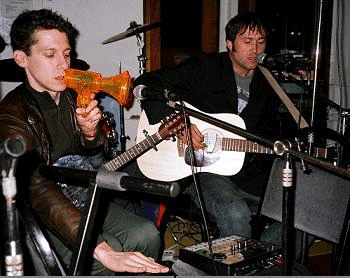
Datapuddle at The Cox Cruise

Datapuddle at The Cox Cruise

What ultimately emerges is a lo-fi cat’s-cradle of strung-together and slightly strung-out elements. Tidal dub; debris and dusty notes swept out of an Irish-American bar; bits of memory and reaction scattered like dandruff – all glued by static electricity and misfiring synapse energy to the guitar strings of a long-fried singer-songwriter. “Here’s a little sea shanty,” says Stephen brightly. A water-blip of electronics merges with a Lloyd Cole chug of guitar, rocking it on its rhythmic base. Alex buzzes a harmonica into an overlapping backwards loop, transforming it into a reversed melodica.

On the next song, trip-hop snare-drum smoke merges with psychedelic space whisper like the first skunked-out collision between Portishead and Hawkwind. Alex’s mandolin maintains a relentless, disappearing clang like a freight train bell, while Stephen mutters like Tom Waits ruffled from deep sleep. Peril – another shaggy-dog shanty written especially for tonight – namechecks the Severn amidst its steam-train chunter of knocks, old-school electro breaks, and harmonica rasps. “Don’t buy the brown acid,” Stephen sings, channelling up the confusion of a different party as ours sways cheerfully along the river.

Datapuddle come to a purring end with lashings of electric theremin wibble and a lengthy musical chew on a genuine melodica which has surfaced from their box of battered goodies. Watching them was like watching someone scrabble a shack together out of estuary trash and flotsam. In its way, it was just as raw and triumphant.
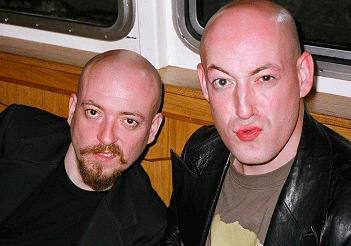
Paddy McCarthy & Michael J. Sheehy at The Cox Cruise.

Paddy McCarthy & Michael J. Sheehy at The Cox Cruise.

While the upstairs audience return to conversation and shore-spotting, Michael J. Sheehy and Paddy McCarthy are down below decks mopping up the leftovers (along with any beer that’s available). Cuddling a pair of honey-blonde acoustic guitars, the brothers from St Silas Intercession (and, previously, Dream City Film Club) have wedged themselves into a corner to hammer out rough’n’ready London-Irish punk blues as brutal as paving stones and hard-luck sneers. Eventually they’re joined by a wandering harmonica player and by a growing crowd of boozy party stragglers. Before too long, the corner turns into an enthusiastic trash-music shebeen (staggered over the changeover times between the acts upstairs) during which everyone’s treated to rattling, spat-out’n’spattered takes of the songs from the debut St Silas EP, starting with the vicious roar of You Don’t Live Here Anymore.

St Silas Intercession’s music is a London echo of the brutally direct and bluesy garage noise still spilling out of Detroit (and all of the little Detroits that have sprung up in the wake of Jack White or The Dirtbombs). Venomous as a dirty flick-knife and as blunt as masonry nails, it’s some way down the evolutionary tree from the corrupted sophistication of Sheehy’s recent songwriter albums, or even from the trawling sleaze of his old work with Dream City Film Club. Obviously the man himself couldn’t give a shit about all that: judging by the twinkle in his eyes and in Paddy’s, as they face each other off over sprawling riffs and hollers, they’ve rarely been happier with their music than now.
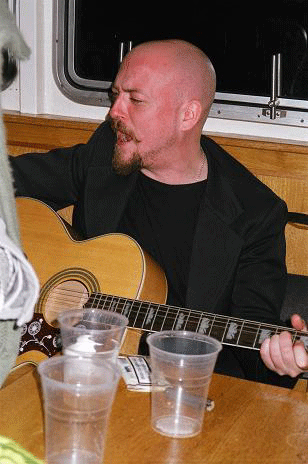
Paddy McCarthy at The Cox Cruise.

Paddy McCarthy at The Cox Cruise.

The brute-blues meanness of Get My Share has a good hard whiskey sting to it; as does the defiance of Caravan Rock (“me and my kids and their mum, / living in a caravan, moving on, moving on…”). A lacerating spurt through All About The Money sets people bobbing, scrambling and bouncing as well as a seven-and-a-half foot deck ceiling will allow. But as Paddy’s permanent goofy cartoon grin indicates, the St Silas brothers never take themselves too seriously. “It’s always about the money!” Michael protests, through a cheap megaphone. His voice suddenly jumps tracks from Louisiana bawl back through his London grit to an ‘EastEnders’ stage-Cockney. “You sla-a-a-g!”

Back upstairs, a dirty blonde in a cute plush cap is hammering a comradely nail into Mr Sheehy’s coffin. “Michael slags me off in his songs, and I slag him off in my songs,” explains Charlie Beddoes. Then she bowls us the rapaciously scornful putdowns of Vitriolic Alcoholic which kerb-kicks a snarling addict with a series of offhanded verbal wallops, culminating in “do I look like I give a toss? / It’s not my problem, not my loss.” It’s good to have friends.

The determined, diminutive Charlie is both the figurehead and the core of the shifting cult-of-personality that calls itself Charlie Says. Tonight, they’re three boot-babes and a moll-boy. Backed up by sidekick Ben Fisher’s car-crash guitar and by Lian and Kim Warmington’s ice-diva backing vocals and cool basilisk stares, Charlie plucks a remarkably articulate bass, sings like a breezeblock with lipstick and thuds out middle-weight girlpunk. Not short of charisma, Charlie holds the audience in the palm of her hand. The trouble is, she then rolls them around as if she doesn’t quite know what to do with them.

There’s a big difference between true punk and mere punk-ertainment, and Charlie Says wander a bit too close to the latter end of the scale. While Charlie’s former background in hip-hop art-rockers Rub Ultra is promising, discovering that both she and Ben are recent refugees from the touring band of tech-rocker Martin Grech pokes some suspicious holes in their lo-fi rebel stance. It just makes their music seem a little contrived. Not that the songs always help: It’s All About The Music is just another me-and-my guitar anthem, and Hey Leadfinger, Why You Gotta Keep Putting Me Down? is a foray into garage-blues which is far less interesting than its title is.

What pulls the band up out of fun-punk poseur-world are Charlie’s bright flickers of blunt humour and determination. The girlpower swagger of Venus Envy suddenly flings out “if the balls are in our court, then at least we have some,” while This Is Not My Story claims “whichever way it lands, my heart will keep on beating.” Little gems of lead-pipe wit and guts like this are what will make Charlie Says special; not desperate attempts to hitch onto whichever punk or garage soul flits past next. For the rest of the evening, I see Charlie perched here and there around the boat – beaming with life, always as if on the verge of delivering another breezy wisecrack. Let’s have more of that.

For all their efforts, Charlie Says don’t make me want to riot. Ghosting do… but I’d be rioting on their behalf. Five more minutes of hearing boozy party blabber drown out their beautiful, beautiful songs and I’d be flinging bottles around myself. Ghosting are heartbreakingly soft – as vulnerable and resilient as fresh grass bending underfoot. Unlike any other band this evening, they create little pockets of pure songcraft which you need to crane your head into to find out what’s going on.

Upfront, Dan Pierce picks out gentle acoustic guitar arpeggios which ride up into the atmosphere like thermals, and lets his voice follow suit. In the corner, wedged into a little cage of half-drumkit, laptop and miniature keyboard, George Moorey handles the rest. Intent and anxious-looking, he peers at his screen like a nervy microbiologist watching a virus proliferate. In fact, he’s just making sure that the sounds arrive on time – making tiny triggering adjustments to a mouse, reaching out one hand to roll off a gentle peal of Blue Nile piano, or swivelling to make precise soft taps on cymbal and snare with the single drumstick he holds in his other hand. It’s like watching someone play a one-man-band suit and conduct an orchestra at the same time. Yet even more impressive than this deft and diffident juggling act are the way Ghosting’s songs pool in the atmosphere – gradually, quietly filling up the space.

Dan’s big genial frame contains a songwriter’s spirit of rare and seductive delicacy. Faced with a chattering crowd, he simply shifts his guitar in his hands and sings soft, warm and open… and slowly the chatter drains away as the spell begins to work. Gently, Ghosting explore topics spanning all the way from frayed love songs (Your Love Don’t Make Sense) through thoughtful disillusion all the way to ending up being fingered as a murder suspect (Someone At The Door). Hopefully not as a natural progression – but if it was, you’d suspect that they’d’ve illustrated even that story with colossal and convincing sensitivity.

By the time Ghosting are midway through the exquisite, naked plea of I Want You To See Me, the crowd is hushed and half of them are hooked. Dan’s flexible and heartfelt singing – mostly a feather on tremulous breath, but rising to a swoony peak of intensity – sometimes recalls Mike Scott or Robert Forster at their very softest. In a fey, English, breathy way, he even has flashes of the fluttering abandonment of a Van Morrison or an Aaron Neville. Like them, he’s singing songs of real people grasping out at the intangible – unsure of what to believe on Anything That Might Be True, or “waiting for the one thing which really might have been some help,” on Good Year, only to wait in vain. Intangible desires, tangible heartaches. They’ll probably rise like damp rather than rockets, but I suspect that within a few years Ghosting will be very important to a lot of people.

Having put the whole cruise together in the first place, Earnest Cox get a well-deserved heroes’ welcome once they arrive onstage. They respond with perhaps their most energetic and assured set to date. It’s the third or fourth time I’ve caught the Cox, over a time when I’ve watched their sturdy intelligence getting to grips with lacing together their multiple influences. It’s taken a while for their mixture of old Memphis R’n’B, ’60s lad-rock, ’80s indie textures and prowling street poetry to gel.

Tonight it does with a vengeance. Hello Stranger sweeps out of the gate with a swagger of rogue testosterone coupled with a smart and beady eye, as Cox singer La Windo immediately takes on the audience with his particular blend of strut and twice-burned wariness. Perhaps it’s recent honeymoon rejuvenations or perhaps it’s the side effects of squabbling over their current recordings, but Earnest Cox are smouldering tonight. Still looking like a disparate houseful of mature students (the band’s a bewildering range of types from motherly to mysterious, from rogue to stockbroker) they continue to draw on what’s in them already rather than trying to squeeze themselves into an image.

The rhythm section used to be little more than agreeably white’n’slightly-funky: now it’s moving towards a lubricious slippery groove, with bass player/occasional MC Simon abandoning cheese and cheeriness to join drummer Shane in seriously flexing the pocket. Nicola parachutes in flights of piano, springs of Booker T. Hammond organ or splurges of synth when she needs to, while Marc buries himself in the middle of the band, cooking up lightly-textured mats of funky guitar texture to fly blurs across the gaps.

Up front, where you’d expect to find a preening Rod Stewart lookalike, La continues to prowl like a Gloucester merging of Shaun Ryder and Lou Reed, delivering his narratives of edgy small-town life like the most restless man in the pub and shaking his percussion as if testing the heft of a throwing knife. He looks pretty handy: yet the Cox don’t exactly trade on casual violence, even when La hurls out scathing fighting talk on You’re Not Fit To Lick (The Shit From My Shoes).

Rather, they seize on restlessness in general, whether it’s randiness, boredom, the unease as your parents age towards death, or the bumps in love’s road. There’s swagger, vengeance and one-upmanship aplenty in songs like Two Can Play At That Game, Baby and Scratching The Same Old Itch: yet in spite of this Earnest Cox’s songs are about survival if they’re about anything. No More Happy Endings treads the ashes of hopes and securities with the dogged, battered trudge of someone who’s had the knocks, has sagged, but won’t go down yet.

The Cox’s musical cockiness almost makes them part of that line of lad’s bands dipping in and out of pubs, taverns and speakeasys (and finally Royal Command performances). Yet the way the bruises on the songs never entirely fade (and the way that La quietly retreats into himself, gaze distracted, mid-song) hints at a band who’ve accepted, even embraced, the dragging baggage of personal history rather than saturating themselves in adolescent posing. Marc’s refusal to play the role of the strutting guitar stud (keeping his back almost entirely turned to La and the audience as he brews up his noises) confirms it and heightens the internal dignity beyond the Cox’s miscellaneous looks.

Perhaps it’s this mixture of getting by, getting on and getting on with it even within limited horizons that makes Earnest Cox local heroes on the Gloucester scene. The familiar tastes of that stew of pop ingredients they serve it up with, plus their band’s anti-glorious English universality and their bumpy everyman charisma should win them friends around the country, whether or not they bring their boat with them.

As the Cox set hits its climax, we look up and find ourselves back in the Gloucester lock. Hometime, Charlie.

Datapuddle online:
Homepage TwitterMySpace Bandcamp LastFM

Michael J. Sheehy online:
Facebook MySpace LastFM

Miraculous Mule (what Sheehy/McCarthy/St Silas Intercession did next) online:
Homepage Facebook Twitter MySpace Soundcloud LastFM

Charlie Says online:
Homepage

Ghosting online:
Homepage MySpace Bandcamp

Earnest Cox online:
MySpace

MV King Arthur online:
Homepage

March 2003 – live reviews – North Sea Radio Orchestra @ St Clement Eastcheap, City of London, England, 15th March (“a polished Victorian never-never land of intricate miniatures and toymaker’s details”)

18 Mar

Once you’ve found it (tucked away in the cramped, confusing whorls of buildings and alleyways near the Monument) the diminutive Christopher Wren church of St Clement Eastcheap is like an old-fashioned kid’s treasure-box, hidden in a chest-of-drawers. Small but perfectly-formed (and bearing the decorous marks of its mid-Victorian refurbishment), it perches pertly between two well-known architectural schools – “enchanting” and “cute”. Tidy pillars spring up hopefully at the sides of its nave. That creamy yellow tint in the immaculate plasterwork of the walls sets off the lovingly-worn mahogany of choir stalls, pews and the massive pulpit. It’s tiny enough for a smallish art-rock audience to squeeze into and feel cosy: and there’s a nursery-rhyme connection too, if you know your oranges and your lemons.

Really, the North Sea Radio Orchestra couldn’t have picked a more appropriate venue. For the music of this retrofitted, romantic-progressive chamber ensemble, St Clements fits like a glove. It shares those hints of modestly-mingled English eras of scaled-down splendour, the atmosphere of nostalgic time travel and aan affectionate polish of traditional heritage. Once you’re inside, both of them also tempt you to blissfully engulf yourself in a luxurious dream of old England – open fields, spinneys, bright stars, sunlight and green thoughts – while all around you the ruthlessness, frenetic urban pace and concrete encroachment looms and sprawls. This may all be an imaginary, selective stance. On a superficial level, you could also get suspicious of well-spoken contemporary white musicians in London warding off angst by cooking up a hand-crafted pre-industrial daydream. But this does the NSRO a disservice. You could accuse them of forcing their innocence – and maybe yours as well – but whatever else they’re doing here is done entirely without malice.

Twenty people settle onstage and get a grip on their violas, cellos, trombones, bass clarinets or whatever. Familiar London art-rock faces abound. Conductor-composer Craig Fortnam and the ensemble’s soprano singer Sharron Saddington used to bob up and down on the fringes of the Cardiacs scene, first in the psychedelic tea-party of William D. Drake’s short-lived Lake Of Puppies and then in the bumptiously charming folk-pronk of The Shrubbies. James Larcombe (Stars In Battledress’ elegantly-tailored smoothie of a keyboard player) is soberly fingering a chamber organ. His brother and bandmate Richard is boosting the numbers in the eight-strong choir, right next to the wild Persian afro of onetime Monsoon Bassoon-er (and current Cardiac) Kavus Torabi. Out in the audience, the aforementioned Mr Drake sits next to Tim Smith, his old friend and former boss in Cardiacs. Across from them, there are various Foes and Ursas and Sidi Bou Saids. There’s a sense of occasion. We get a beautifully designed arts-and-crafts-styled programme to take home. It’s a long way from Camden pub gigs.

This isn’t solely because of the surroundings. North Sea Radio Orchestra might carry their assorted historical splinters of psychedelic rock, folk, and even punk along with them, but they are unabashedly classical in intent. Even the twistiest and most abrasive of the art-rockers in the lineup are sporting the sober concentration of churchgoers, and Sharron has traded her former outfit of cosy specs and jumpers (though not her artlessly warm smile) for a modest diva gown. Craig, his back turned, conscientiously conducts the ensemble. When he sits aside to strum a little polite guitar, he has to crane his neck round anxiously, making sure that the music is still running smoothly.

He needn’t worry. Despite the shades of complex tonality which inform the NSRO’s compositions (Frank Zappa, Benjamin Britten and Tim Smith have all left their mark on Craig’s inspiration), the music flows readily. Sometimes it’s a simple organ drone as a base for Dan Hewson’s trombone expositions. At the other end of the measure, there’s the rollicking Occasional Tables: a dancing interplay between clarinets with a gloriously drunken, attention-switching Frank Zappa/Henry Cow approach. With its mediaeval echoes, and an additional infusion of the peculiar darkness of post-Morton Feldman Californian conservatoire music, it’s given an edge by the astringent, atonal vibraphone shiver (and by Craig’s strict, almost military turn on bongos).

Intriguing as these are, it’s the NSRO’s orchestration of poems which connect deepest with the audience. Mostly these are Tennyson settings (with a sprinkling of Thomas Hardy and other contemporaries) but even Daniel Dundas Maitland’s modern Sonnet looks back to ornate Victoriana. So does Craig’s music, swirling its Early Music and contemporary classical influences together to meet halfway in a polished Victorian never-never land of intricate miniatures and toymaker’s details. Sharron’s vocals – sometimes piping, sometimes emoting in keen, theatrical wails – make for exquisitely brittle sugar-sculpture shapes, while rivulets of strings and woodwind launch themselves from the melody.

The heavenly sway of Move Eastward Happy Earth sets Sharron’s winsome soprano against the lazy, streaming clarinet of Nick Hayes and against Ben Davies’ slow waltz of trimmed-down piano. The choir (with a hearty, clever enthusiasm that reminds me of nothing so much as Gentle Giant) leaps in for stepped, skipping choruses and glorious vocal resolutions. For The Flower, drifts of strings slip from the vocal line and weave busily like something out of Schubert’s Trout Quintet. Onstage, everyone who isn’t smiling looks happily dazed, as if drunk on the sunny harmonies.

And so it continues, with parts of the NSRO dropping in and out to suit the music. For Thumb Piano, Craig trims it down to a revolving arpeggio of guitar harmonics in trio with the blues-tinged fluting of Hayes’ sweet’n’wild clarinet and Katja Mervola’s pizzicato viola. Harry Escott provides a cello improvisation, impressively-voiced chordal melodies sliding on top of a slithering bass drone. James Larcombe sketches out a collage of beady, kaleidoscopic chord progressions in his studious organ solo. The chorus, for their part, sing lustily in a London melting-pot of diverse accents. For the canon setting of Yeats’ He Wishes For The Cloths Of Heaven, the whole orchestra sings its way through Craig’s pop-folk melodies.

When the whole ensemble is running at full strength, St Clement brightens with music. Shelley’s Skylark, in particular, is profoundly ambitious – semi-connected cello lines swing like foghorns, thick Michael Byron-ish string parts disgorge dominant melodies, and the chorus is a rich blur of voices, pumping resolution into Hardy’s words. But best of all is a generous Fortnam orchestration of a piece by his former bandleader William D. Drake – a setting of William Johnson Cory’s Mimnermus In Church. With Richard Larcombe stepping out from the chorus to duet with Sharron, and the North Sea Radio Orchestra performing at its fullest stretch, the results are captivating. The voices of Sharron and Richard move around each other in dusty, reedy, yearning harmonies (he floating up to countertenor) while strings, piano, clarinets and brass open out like a delicate night-bloomer, fragrantly illustrating Cory’s salute to flawed and transient life in the face of a perfect yet chilly heaven. “All beauteous things for which we live by laws of time and space decay. / But O, the very reason why I clasp them is because they die.”

Yes, in pop culture terms it is music for an ivory tower, or for a detached oasis where you can secrete yourself away from the world. Only a mile or two to the west, I’m sure that electric guitars are roaring out rock, garage clubs are spinning off beats and bling, and someone’s delivering tonight’s definitive urban hymn. But emerging into the City of London – all higgledy-piggledy with glass skyscrapers, Renaissance guildhalls and mediaeval street names, a ragbag of congealed history in parallels – I couldn’t care less.

Like the best musicians, North Sea Radio Orchestra tap into timeless things (beauty, transient joys, the shift of seasons). But like the stubbornest, they also know the colours and shades of the times which they’ll want to employ, finding a way to make them mean something whenever and wherever they’re played. And though an antique church and a Victorian altar cloth made a beautiful frame tonight, this music – at its peak – would’ve sounded good even if the whole ensemble had been balanced atop a Docklands trash-heap.

North Sea Radio Orchestra online:
Homepage Facebook MySpace

St Clement Eastcheap online:
Homepage

February 2003 – live reviews – House of Stairs label launch concert (evening 2) featuring William D. Drake, Cheval de Frise, Stars in Battledress and Miss Helsinki @ The Arts Cafe, Toynbee Hall, Aldgate, London; plus Delicate AWOL @ 93 Feet East, Shoreditch, London, both 17th February 2003 (“East End might mean left-field tonight…”)

19 Feb

Less than a week ago, the House of Stairs label put on their Camden launch gig at the Underworld: Max Tundra DJ-ed, filling the gaps with a spicy and witty mix of art-rock, prank techno and pop buzz. But tonight we’re out east in the pizza, pine and paintings environment of the Arts Café for the second, “quiet” gig – and Richard Larcombe is de-facto man-on-the-muzak, even as he bustles about setting up for his turns in two of tonight’s bands. Eerie shapes and twists of music waft through the busy air: the chatter at the bar is underscored by the filtering eeriness of Messiaen and the swooping rattling studio gulps of Boulez. East End might mean left-field tonight.

Miss Helsinki, bless them, display more pop bones in their body. Popping up from the wreck of the much-lamented Monsoon Bassoon, they feature both of the Bassoon’s singing guitarists (Dan Chudley and Kavus Torabi) plus the increasingly ubiquitous Larcombe on bass and harmonies. But they’ve lost both a drummer and Kavus’s keyboard-playing brother Bobak in the last month: and so it’s a stripped-down-and-unplugged Helsinki trio playing for us tonight, both aided and hindered by a backing tape. It’s only their third live appearance.

Frustratingly, they’re still lolling like a tall layer cake whipped out of the oven too soon. There’s something to be said for a bit of engaging pop roughness; and for Torabi’s endearing habit of boggling like Tom Baker at the end of a tricky lick. But although Miss Helsinki’s ambitions are clear, they’re still struggling to reach them. They have a tough act to follow, of course. One of the few bands to unite the approval of both London proggies and the NME, The Monsoon Bassoon wrapped a broad spectrum of ingredients (including Naked City, King Crimson and Shudder to Think) into their explosive, racing psychedelic rock.

Though Miss Helsinki retain some of those flavours, they’ve pastoralised them: the bursts of unusual chording and rampant arpeggiating are still there, but the thrashing intensity has been replaced by a sunny warmth and they’ve obviously settled on Andy Partridge as their guardian angel. But Helsinki music is a good deal more complex and demanding than XTC’s, straining the abilities of Chudley and Torabi’s affable, unvirtuosic boy-next-door voices as they hop over the cheerfully convoluted melodies like tap-dancing cats on a hot tin roof.

Despite this – and despite the fluffed notes and stumbles over the over-detailed backing tapes – ‘I Felt Your Arms Around Me’ is a bright little gem of spiky-haired art-pop, powered by the same giddy celebration of the best Monsoon Bassoon songs. Kavus (air-punching and doing triumphant kicks from his guitar stool) obviously knows it. ‘Surf’s Up’ – featuring a repeated chant of “silhouettes you know from fire” – takes them to places last touched by the psychedelic folk-science of Gastr del Sol; and the romping cowboy-pop of ‘Rodeo’ (“the world seems drunk, with a stetson in place”) ensures that they finish on a note of charm and enthusiasm. Miss Helsinki are a long way from filling the Bassoon’s busy shoes, but the signs are good.

With Miss Helsinki, Richard Larcombe is a deft, understated bass player. With his own band Defeat the Young – backed up by brother James – he steps up to become a witty, elegant frontman with tales of social absurdity and romantic scrapes. But tonight, for Stars in Battledress (an equal-partnership duo of both Larcombe brothers), he takes a step sideways. Up onstage, he cuts a quieter, more sober figure than he does with Defeat the Young. His sophisticated social-jester persona is mostly absent. His ready wit is intact, but here it’s diffused – more musing in its nature, leaning on subtle insinuations and surreal impressions rather than crackling wordplay. It’s also tinted with a peculiar, guarded English melancholy, and there’s an unsettling sense of loss and submission behind Richard’s refined and aristocratic drawl. “Blessed are all with vision unswerving. / Don’t watch me weep – go back to sleep…”

On Richard’s guitar – round about where people usually paste their dude-rock logos or political slogans – there’s a beautifully executed painting of a mallard duck, apparently snipped from a spotter’s guide. It’s appropriate. Stars in Battledress’ drifting tapestries of songscape take place in a watery never-land England of ponds and rivers and thin blue children, posh academies and school gymnasiums, the rituals of government offices and the embarrassments of public speaking; Cambridge water-meadows distorted by a lysergic autumnal haze. Someone in the audience mutters that Stars in Battledress are the best argument he’s ever witnessed against a public school education. I think he’s failing to press past the immaculate antique sheen of their surface. Theirs is a ghostly watercolour world of ruefully suppressed emotions with a tidal tendency to seep back up. Part Evelyn Waugh, part Syd Barrett and part Sea Nymphs.

James – strumming and fondling snowfall arpeggios from his piano and contributing apple-bright harmonies – provides most of Stars in Battledress’ colours, picking up on his brother’s words and extending them outwards in rippling classically-inspired musical inventions. Richard plays some understated, skeletal guitar and trundles a harmonium through the queasy distress signal of ‘Haunted Hotel’, but mostly he stays out at the front, clasping the mike stand like a sad, dapper figurehead. There’s a break from this in the roaring-’40s guitar-waltz of ‘Hollywood Says So’, as Richard delves hilariously into ludicrous showbiz gaudiness (“drive fast cars, play guitars, win prizes / – girls in every port, in all five sizes”) but ends up spat out in a wad of comic bitterness. (“I’ve been over-directed, I’ve been cut in one take. / I’m a dated two-reeler that no-one will make.”) Their cryptic finale – the hummed, valedictory ‘Women from the Ministry’ – hovers in the mind like the flicker of antique cinema light, images of lost houses, withered photographs.

Cheval de Frise are… plain remarkable. Bare to the waist and sporting Trotsky glasses, Vincent Beysselance studies his drumkit with a jazz warrior’s eye, his lean expression and sculpted moustachios lending him the air of a razor-sharp beatnik. Guitarist Thomas Bonvalent looks as if the Taliban have booted him out for excessive zeal. Sporting an enormous bushy chest-length beard, battered clothes and an expression of sincerely crazed intensity, he’s twitching visibly even before he plays a note. His nylon-string acoustic guitar has been modified – or de-modified, with both the sound-hole and the pre-amp controls crudely and defiantly smothered with duct tape. As he plays, biting on a pick, his face seethes beneath his beard.

“Pastoral acoustic mathcore” was what someone wrote on the Cheval de Frise packet. Ah ha, ha, ha – I don’t think so. Pastoral acoustic mathcore would be very nice – perhaps a Guitar Craft picking exercise, pared down by post-punk minimalism and softened by visions of green fields. Are Cheval de Frise like that? No. For the first seven minutes or so, Cheval de Frise seem absolutely demented. After that – and once the broken seizures of drumming and the intricate splatterwork of guitar has had time to get to work on your brain and your reflexes – you start to understand. Although your body will make the connection before your mind does.

Right from the off, Bonvalent’s playing is disturbingly wild; slamming down obsessively on a single note or isolated interval, or spasming music up, down or across the neck of the guitar. Beysselance’s drumming is a boiling whirl of ideas and instincts, acted out with a brinksman’s forcefulness, with enough breakneck substance both to keep the duo’s momentum and to craze it with brilliant stress fractures. People cram to the edge of the Arts Café’s tiny stage, swaying like a wheatfield in a whirlwind, and yelping approval.

Behind the apparent free-scene chaos, Cheval de Frise have serious intentions. The drums have their melodies as well as their upheavals, and although Bonvalent’s open-mouthed drooling visage suggests a man in terminal acid psychosis, he frequently rips into hyperspeed, hypertonal spirals of intense picking which John McLaughlin would be proud of. Every now and again, in the midst of a free section, the two Friseurs exchange a quick cue-ing glance and then slam into perfect alignment, calling a rigorous Zappa-style composed music module up out of memory. Bonvalent’s playing might often parallels the spewing, disjointed clicking noises of the post-Derek Bailey improv school, but the musician he’s really closest to is the iconoclastic lo-fi jazz rebel Billy Jenkins. Deliberately or not, Cheval de Frise ‘s music is a hyperactive flamencoid strain of Jenkins’ “spass” approach – a slew of intense musicality in which ugly sounds, wrong notes, anti-technique and smash-ups in timing and phrasing are as part of the great spontaneous inspiration as skill, structure, complex ambition or the beautiful moment.

It is, also, an intensely devotional music, as burningly thrilling as Nusrat Fateh Ali Khan’s qu’waali shriek, a gospel choir tearing the roof off the sucker, or the closer-to-God whirling of a Sufi dervish. Bonvalent’s physical abandonment (at points close to ecstatic convulsions) is religious in its intensity. As pieces skid to a halt, he bobs his head thankfully to the audience, smiling and almost moved to tears. If it’s like that onstage, it’s not that much less intense down here. Being up close to music this inspirationally driven raises the hairs on the back of the neck. When Cheval de Frise finally peel off their instruments and stumble into the crowd, the feel of the audience unclipping themselves from their joyful tenterhooks is like a dam bursting.

I don’t envy William D. Drake – a onetime Cardiac songwriter with a joyous genteel-gone-berserk keyboard style – for having to follow that. But I’m going to have to leave him to it, as I’m double-booked for gigs this evening; and so I have to slip out of the Arts Café to stride the Spitalfields half-mile or so over to 93 Feet East, to see Delicate AWOL on a rare London visit. I’ll just have to promise to catch up with the Drakey magic next time he plays… I will, really…

93 Feet East turns out to be an over-pleased-with-itself Brick Lane bar, milking the wobbly momentum of trendy Shoreditch Twattery while it still lasts. It also has the rudest security staff I’ve ever met. Not five minutes after the music stops, they’re in your face; all but digging their chins into your shoulders, dangling heavy barrier chains in one hand with the bored and arrogant stance of animal stockmen, yelling at you to move out. Regular punters must really want to come back to this place.

It’s a sorry way to end an evening, especially after Delicate AWOL have been exercising their luminous charm on you. Walking in on the band mid-flow, the first thing I see is Caroline Ross joyfully bouncing tiny beaters off the keys of her little glockenspiel. Its fairy tingles resound in the air as the rest of the band keep up a stiff-swung groove behind her. Delicate AWOL have been drawing connections between Latinate ’70s fusion and limpid Tortoise-school indie art-rock for a few years now. These days – extended from a guitar-rock indie four-piece to a more ambitious sextet featuring Ben Page’s swishing textural synths, Jo Wright’s Chet Baker-ish trumpet commentary and Ross’ own multi-instrumental enthusiasm – they’re in a much better position to cook up their jazzified stew.

Inevitably, the enchantingly gamine Ross is the focus, smiling beatifically from beneath her shaggy russet bob and swapping between percussion, flute and thoughtful slide guitar. There’s also her soft spring-thaw of a voice: a gentle but commanding stroke to soothe the ruffling from the craggier guitar of husband Jim Version and the dogged Can-ish rhythm-section circling of Michael Donelly and Tom Page. Rising above the hum and the wind-rattle of ‘That Terminal’s Down’, brushing against the reedy melancholia of a melodica, drawling through a sleepy-lidded chant of “your breath goes slow”, she’s hypnotic, bringing a hint of Scottish lullaby into Delicate AWOL’s sleepy mix. Alongside the Pram-like tinkles and kitchen-table craftsmanship, the woozy instrumental Americana of ‘The China-Green Prairie Tribunal’, the southern-border dance-steps of ‘Broken Window in a Mexican Bank’ and the doughnut-bulging space-groove they hop into for ‘The Rolling Year’.

One of Delicate AWOL’s greatest strengths is their ability to wander open-armed between these varied inspirations without ever inducing the suspicion that they’re simply trying to fill their basket with crowd-pleasing nuggets. Their intelligence is of the gentle kind – simply enjoying their explorations rather than ticking them off on a list and practising their traveller’s poses afterwards. Surprising, this takes them further than a ruthless musical ambition would – as does the way they flit disarmingly between other-worldliness and neighbourly charm, most evident in Version’s professorial enthusiasm and Ross’ affectionate, amused handling of fans and hecklers alike.

Even in the grubby concrete shell of an average indie-circuit venue, Delicate AWOL can get a campfire atmosphere going. A rewarding thing on a cold February night, especially with the impatient rattle of a chain behind you. If I ended up being treated like cattle, at least I got to spend half-an-hour home on the range beforehand.

Cheval de Frise online:
Homepage, Facebook, Soundcloud, online store, Last.fm, Apple Music, YouTube, Deezer, Spotify, Amazon Music

Stars in Battledress online:
Homepage, Facebook, Twitter, MySpace, Soundcloud, Bandcamp, Last.fm, Apple Music, YouTube, Deezer, Tidal, Spotify, Amazon Music

Miss Helsinki online:
(2022 update – no links available. See Kavus Torabi and Daniel Chudley Le Corre)

Delicate AWOL online:
MySpace,Last.fm, YouTube, Spotify, Amazon Music, Wikipedia entry

House of Stairs online:
(2022 update – there are no longer any web pages for the House of Stairs label, although there is a discogs.com page)

February 2003 – live reviews – House of Stairs label launch concert (evening 1) featuring Nøught, Foe and Defeat the Young, The Underworld, Camden Town, London, 12th February 2003 (“the Underworld fills with familiar London pronk and math-rock faces”)

13 Feb

Well-worn jokes about “first steps” line up at my door, to be kicked aside. Let’s not goof about. As the House of Stairs label throws its musical launch party, the Underworld fills with familiar London pronk and math-rock faces, fans and musicians grinning at each other as if it was the first day of a school trip. The still-friendly fragments of The Monsoon Bassoon, the occasional Cardiac, plus those particular paying punters who materialise like the genie of the lamp at the faintest hint of a twitchy rhythm or a whole-tone scale blasted out of a loud guitar.

For once, the records being played between the bands nudge and tickle the audience’s mind rather than simply provide aural cud to chew in the interval. When you’re lucky enough to have avant-prog, lo-fi techno wunderkind Max Tundra on hand to do your DJ-ing for you, you get more than the usual jukebox package – Peter Gabriel songs mingle with prank cut-ups of Tony Blair speeches, hilarious jungle-electronica renditions of ’80s pop hits, and ear-opening art-rock oddities whipped from rare vinyl. Priceless from any perspective.

Defeat the Young are the most literate – or literary – members of the House of Stairs stable by a country mile. They’re also the most demanding listen. Richard Larcombe‘s wit is complex and arch; his melodies are crenellated and mediaevalesque, pumped out of harmoniums, sharp-fingered guitars and hurdy-gurdies. Also, while there’s a distinctly proggy kink to his music (like Kevin Ayers cuddling up with Gentle Giant or William D. Drake), he’s drawn more to Havelock Ellis and Groucho Marx than to Tolkien or Carlos Castenada. Thank God for that. A faux-Edwardian English Zappa with highbrow kinks might not be to everyone’s taste. But it’s infinitely better than being subjected to another charlatan wrapped in suspect mysticism and stale denim.

Like a skilful card-trick, Larcombe’s wicked sense of humour also works best up close. In the cavernous rock cellar of The Underworld, he seems out of place – squinting against dim lighting in a venue more accustomed to thrash-metal and ska-punk than to his own rampantly sophisticated English stylings. I always seem to come up with flower metaphors whenever I try reviewing Defeat the Young. Tonight, the phrase is “hothouse flowers”. With two nouveau-metal bands roaring up from behind them, I’m worrying over whether the rarified and sophisticated humour in DTY’s music will wilt in this blunter setting. But they try hard, displaying a determined refusal to compromise. A long, scene-setting introduction (involving virtually the entire plot of The Marx Brothers’ ‘Duck Soup’) sprinkles conceptual theatrics back into the agenda, while (at the other end of preciousness) Jodie Scott’s feedback-heavy guitar adds some belligerent beef to the sound.

Still, it’s not until ‘Nothing from Something’ that things really get moving, as Larcombe gets to grips with his maze-y rake’s progress, bringing some deceptively drawling wit to bear. By ‘Natural Cash’ he’s in ebullient form, punching the air while his feet cycle his pedal harmonium and his lime-tinted vocal quicksteps adroitly through the tricky pitches. Propelled by his perverse and wayward imagination, he guides us through a risque world of sepia photos, elegant penmanship, social theorising and sexual quirks, all couched in a shower of beautiful golden language. Tonight wasn’t really quite his night, but Richard Larcombe is undoubtedly a major talent. He’s already way out there in that field where the erudite spectre of Oscar Wilde grabs the twisty bones of art-rock for a feverish waltz (and for a good snog, if it’s lucky).

The gap between Defeat the Young and the harder-rocking shapes of the rest of the evening should have been bridged by the violent, mordantly comical dada-metal of Lapsus Linguae, but for reasons unknown, they’ve had to stay in Glasgow. The evil smirks and the transmogrified Iron Maiden t-shirts remain north of the border tonight, to infest the queasy nightmares of pub-rockers who’d rather be dreaming of Joe Elliott. So it’s straight on to Foe – whose drummer Paul Westwood hardly gets a break from his turn on the drums and hammer dulcimer for Defeat the Young before he’s clambering back behind the kit for his main band.

If a change really is as good as a rest, he doesn’t need the break – the light percussive touch he uses for Defeat the Young has no place in Foe. Pop-eyed, Westwood lashes his way through this set like an escaped convict desperately hurdling fences. Jason Carty and Crawford Blair thread the gaps in his drumming with rapid intricacies of guitar and bass – a constantly shifting and jerking formation, pouncing in multiple directions. They’re not so much a power trio as a pared-down swarm. One part Don Caballero, one part double-duo King Crimson, and one part higher mathematics, Foe’s music sounds as if it’s been threshed out in cold areas of the brain until it finally lost its temper and exploded. Yet – Westwood’s controlled, wide-eyed intensity aside – Foe themselves are calm, observing their music and keeping it ticking busily until the time comes to dive in with all six feet for a burst of sudden violence.

Sounds familiar? Consciously or otherwise, the all-instrumental Foe parallel the current Crimson’s cerebral-metal approach, apart from refusing to sweeten it with the occasional pop tune. Blair’s grinding bass is as brutal and pitiless as a giant clock ticking, but also carries their complex whole-tone melodies up and down the scale and across the contorting tempi. Carty’s metallic creative/disruptive guitar acts as dissector and illustrator – raiding the harmony and timing of each piece and asking the tricky questions before rocking out into triumphant predatory riffs, pulling the whole band into line with it. Sometimes Foe hurtle like speed-metal Rock in Opposition; sometimes they spend a couple of seconds pinging and pulsing like free-jazzers; sometimes they slam into unyielding hardcore for a few bars.

“How do I play this again?”, yells a mock-baffled Carty, during a break in the action. He’s chuckling – he does remember it, but it’d be easy to get lost in the wanton folds and traps of this music. It’s a real lark’s tongue-twister; more Cuneiform than uniform. In spite of that, there’s a woman dancing in the front row. Incredibly, she’s performing a delighted bump and grind to Foe’s music – her pelvis and body twirls and undulates in perfect time to their constantly altering rhythms. So much for this being brain-only music.

She turns out to be the girlfriend of Nøught‘s drummer. Which explains a lot. Nøught themselves emerge onstage shadowed by conflicting reputations. They’re not actually a House of Stairs band at the moment, but they could be so easily. For evolutionary rockers, grumbling hopefully over their CD players, Nøught are a beacon band – assimilating the instrumental ideas of King Crimson, John McLaughlin and R.I.O., then marrying them to the urgency and directness of punk, grunge and hardcore. But their constant line-up and instrumentation changes (perhaps driven by James Sedwards’ need to bring a variety of tools and voices to his music) have tended to scupper the band and dip it into inactivity rather then renew its energy. Today’s Nøught are a conventional rock power trio plus keyboards, dispending with the second guitarists or Theremins of past live outings. They could be an octet with triangles, euphoniums and bagpipes next week and it wouldn’t surprise me too much. I’d just be happy so long as they kept playing, and stopped disappearing.

Sedwards himself is surrounded by guitars. Two of them are impeccably-finished Les Pauls mounted on flat racks, their strings prepared with objects and blocks (as if John Cage had infiltrated Yes ‘ road crew.) But his guitar of choice is the trashy, rhomboid Fender Jaguar: a Kurt Cobain favourite. It tells you a lot about his approach. Yes, Nøught do like to make a lot of noise. Sedwards’ reticent, un-rocking look (like a young Rowan Atkinson) belie his talents as a fierce, assertive guitarist. And then some. Nøught’s music leaps out of his guitar in a series of bucketing, challenging jumps: a boggling harmonic steeplechase, leaving few notes untouched. Imagine quickfire origami, performed with steel sheets, and you get some idea of how Nøught work.

Their raciness also brings to mind King Crimson’s ‘Red’ gone mutant mariachi. There’s constructive dissonance a-plenty – Sedwards revels in throwing flamboyant, startling chords into his majestic grand designs, catching us off guard. On record, Sedwards revels in the use of choppy strings and blazing big-band brass, and though there’s nothing of that here, there’s been a renaissance in the keyboards department. That muscular undercurrent of organ (triumphant chords supporting the widening paths of guitar and wiry, driven bass) brings an unexpected rhythm’n’blues feel back to the music. Touches of Hendrix or Muddy Waters roots to blend in with the Fripp roars, the John McLaughlin jumps and the Sonic Youth smashes, bringing a different grittiness to Nøught’s aggressive playing. The band has never sounded so human, so assured – and it’s a good balance to those industrial moments when Sedwards assaults his flat-mounted guitars with drumsticks or runs the screams of whirling power-drill chucks through the pickups. Whatever else Nøught’s downtime has provided, it’s brought them a sense of roots and placement that was so lacking in the wall-of-noise incarnation that rattled the walls of venues a year or so ago.

This is an undersung gig, to be sure – a half-full (though comfortable) Underworld suggests that half of the art-rock community in London haven’t even heard about the concert – but there’s a definite sense of homecoming heroes to this one. Good foundations for a strong new house of deserving players, I hope.

Nøught online:
Homepage, Facebook, MySpace, Soundcloud, Last.fm, Apple Music, YouTube, Deezer, Qobuz, Tidal, Spotify, Amazon Music

Foe online:
MySpace, Bandcamp, Last.fm, Amazon Music

Defeat the Young online:
(2022 update – no links available. See Lost Crowns.)

Max Tundra online:
Homepage, Facebook, Twitter, Soundcloud, Instagram, Mixcloud, Bandcamp, Last.fm, Apple Music, YouTube, Deezer, Tidal, Spotify, Amazon Music

House of Stairs online:
(2022 update – there are no longer any web pages for the House of Stairs label, although there is a discogs.com page)

December 2002 – album reviews – Various Artists: ‘House of Stairs Volume 1: Useless in Bed’ compilation (“happily balanced on the rougher brinks and fringes”)

4 Dec

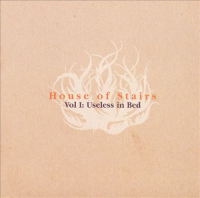
Various Artists: 'House of Stairs Vol. 1 - Useless in Bed'

Various Artists: ‘House of Stairs Vol. 1 – Useless in Bed’

Placing yourself on faultlines, rather than easily marketable turf, brings risks but inspiration – ask a San Franciscan. That the three London art-rock bands who originally set up the House of Stairs label (The Monsoon Bassoon, Geiger Counter, and Ursa) have all now split or mutated into something else is perhaps proof of both.

Regardless, ‘Useless In Bed’ – the first House of Stairs release – is a declaration of brotherhood. Compiling the work of musicians dwelling on various faultlines (though still mostly centred on London art-rock, it also takes in music from Chicago, Atlanta and Bordeaux), it both defines the edges of prog, jazz, art-rock, hardcore, electronica, folk, improv and noise rock, or encourages people to spill across them.


Hard-rocking math-proggers Foe – sprung from the wreckage of Geiger Counter – offer the most urgent track. ‘Triangulator’ is full of furious refracting guitar lines over Crawford Blair’s piano-growl of bass. For six minutes it swings, chops, drops down trapdoors, executes perverse King Crimson leaps between mordantly grim chords, and savages minor keys like The 5uu’s on far too much coffee. Geiger Counter’s posthumous statement is ‘Drink Your Milk’ – less obviously wired than ‘Triangulator’, it still carves up its grunge-y math riffs with heavy enthusiasm, embracing sweeter interludes of short-lived luminous peace as it does so. Nouveau Metal is spreading…

The Monsoon Bassoon‘s own posthumous offering is a explosive and complicated song from when their mingling of Henry Cow and gamelan-Crimson art-rock ran full tilt into their love of American alt.rockers like Shudder To Think. The psychedelic squeal of guitars on ‘Stag’ marches from plateau to jagged plateau in a skirl of trippy flute and meshing riffs, held together by the band’s tight discipline.


These days various Bassooners have regrouped in Miss Helsinki, who deliver a sparkling piece of progressive pop called ‘I Felt Your Arms Around Me’. Less surreal than most Bassoon confections, it’s still an acid-flavoured love song whose rattling good XTC jangle and tootling clarinets don’t stop it hurtling delightedly into a complex, storm-tossed middle section in which they see just how much you can rock the train without slinging it off the rails.

 
If you’d prefer to stick with the Bassoon’s skronkier legacy, Chicago’s Sweep the Leg Johnny are still juggling that torch. With the superb ‘Only in a Rerun’, they’re obviously on a roll – it’s a rich mixture of harsh Schizoid Man tones and flamboyant jazz-metal attack from the raw husky wail of Steve Sostak’s alto sax and Chris Daly’s bloodthirsty roar of guitar, tossing Sostak’s airy vocal like a bull tossing a skinny matador. Slewing between dEUS busyness and violent post-Slint minimalism, this is a rough bareback ride to put a wicked smile on your face.


Manic Glaswegian pranksters Lapsus Linguae provide ‘Olestra (There’s Only One Drinking Fountain in Heaven)’. A stab of theatrical art-metal somewhere between Faith No More and Beck (with a Resident eyeballing it from the director’s chair) it has all you need to storm the castle of pomp. There’s a man called Penelope Collegefriend singing in a rampant bellow like a punk Freddie Mercury; there’s an inexplicable strings break and a rolling piano line continually chopped off with guillotine precision; there are namechecks for Hermann Hesse and Charlton Heston, and choicely bizarre lyrics like “More I eat, the hungrier I feel – / I lick menus, ignore the meals.”


Holding up the genteel-er proggie end are the whimsical and witty projects of the Larcombe brothers. With ‘Sand (Blowing About)’, Stars in Battledress provide a beautiful dance of fluent piano and autoharp: but beyond the divertimento prettiness, James Larcombe leads the duo through eddies of suggestive Debussyan chords.

Richard Larcombe goes on to turn in a conceptual tease on Defeat the Young‘s wonderful ‘I’m Ruining Something’ – an absurdist essay on the corruptions of power which blends Gentle Giant with Lewis Carroll and Stravinsky. Larcombe greets his ensemble of actors, trombone, and full-blown operatic chorus as a lounge-lizard lord of misrule, sighing a manifesto of playful destruction in his arch, refined tones. “I’m recognised as your one sovereign Lord Protector / Trust me – I’ve learned of your country by tape and slide projector. / Each day I’ll go out of my way to spoil, deface and tarnish, / like he who ruins carpentry by swapping glue for varnish.” Oboe, piano and hammer dulcimer float in a dreamy arrangement like an August haze. Apparently there’s a whole album’s worth of this story in the Larcombe shed – ‘The Golden Spike’ – and it’s only one of their dastardly plans.

Both of House Of Stairs’ lo-fi electronica boffins seem to grab inspiration from bargain-bucket electrical goods. Desmotabs create an appealing Stylophone fanfare buzz on ‘Gaseous Exchange at the Alveoli’, let their drum machine go nuts and assault a heart monitor, and squiggle some demented Mini-Moog solos before the entire track melts like a Dali model. Max Tundra (the Frank Zappa of the techno world) continues his marvellous and bizarre mission to fuse hardcore dance music with prog rock. ‘Life in a Lift Shaft’ equals Desmotabs buzz-for-buzz while festooning tough and hilariously uptight Tundra beats with jittery robot piano and fat sub-bass from the tar-pits. Alarm-clocks fly past on tiny wings trying to take bites out of the zany, sunny tune.

The free-er bands – as usual – have a harder time. Gnarly bass-and-drums duo Guapo can be the missing link between ‘Red’ and Ruins when they want to be. However, their grinding ‘Pharoah’ – despite Dave Smith’s excellent Brufordian snarework – is mostly as subtle as a flying breezeblock. Dragging large chunks of pyramid across the desert and insisting that you appreciate each tortuous step, they occasionally snap, shoot off the flywheel and go ape with some fearsome tattoo riffs. Hardcore acoustic fusioneers Cheval de Frise hop up and down with impatience on ‘Chiendents’, banging their heads against their own lo-fi envelope, manically coiling up tighter and tighter acoustic guitar scrabbles against the tussling drums. Compression to destruction, breaking out in wild slashes.


And finally there’s the hardcore department, with the recently defunct Ursa demonstrating why they’ll be a sad loss to the British heavy scene. Avoiding hardcore’s usual fixed, deafening riffage and reductive howling, ‘The Blooding’ begins with a studied ponderousness and heaviness which gives way to an inspiring controlled demolition. Galloping punked-up Iron Maiden guitar runs charge under giant toppling riffs, the band dodging falling masonry via nifty turn-on-a-dime spins while losing none of their brute power. American Heritage, likewise, execute proggie timeswitches with rapid and brutal thrash flair, their sound a bleak, bare cliff of thick guitar noise. It’s anyone’s guess as to why they’ve called their track ‘Phil Collins’ – it’s an unlikely tribute, whether it’s aimed square at the Genesis drumstool or at the white-soul crowdpleaser.


Anyhow… here’s a house of many doors, happily balanced on the rougher brinks and fringes and demonstrating the breadth of personalities camped out in even one small part of today’s art-rock community. Admirable.

Various Artists: ‘House of Stairs Volume 1: Useless in Bed’
House of Stairs, HOS001 (5030094077829)
CD-only compilation album
Released: 2nd December 2002
Get it from:
(2020 update) best obtained second-hand
 

July 2001 – EP reviews – A Girl Called Eddy’s ‘Tears All Over Town’ (“torch songs set to low glow, fanned into sudden flares by a crack in control”)

31 Jul
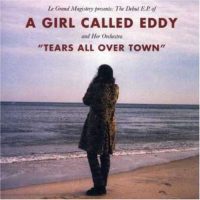
A Girl Called Eddy: 'Tears All Over Town' EP

A Girl Called Eddy: ‘Tears All Over Town’ EP

One of my small daydreams of alternate pop history involves Clare Torry. Having raised the hairs on the back of my neck with her ecstatic singing on Pink Floyd’s ‘Great Gig in the Sky’, she wouldn’t have slipped away anonymously. She’d’ve gone into the studio with songs for herself and produced at least one album with that voice, that understanding set free. When (on Francis Dunnery‘s ‘Close My Door‘) I first heard Eddy Moran’s arresting wordless vocal soaring skywards – twisting, keening, cracking and surging – I felt that same hair-raising chill. Flashed straight back to the same daydream.

I’m luckier in my dreaming sometimes. Although, for her debut EP as A Girl Called Eddy, she’s not repeating the magnificent Torry-esque splendour that turned my head the first time, Eddy has found other ways to chill me. Her songs could’ve waltzed out of the ’30s, or the ’60s: torch songs set to low glow, fanned into sudden flares by a crack in control. Cool heartbreak in her voice, she’s like a more ambiguous Tracey Thorn. Not someone who’ll glut her despair centre stage: she’s more like someone who you might catch staring at you piercingly from beside the bar, quiet, wise and intent.

‘Fading’ does its bit to draw back the curtains of sorrow. A fragment of Blue Nile lushness, slurs and fake orchestra, it revolves like a ferris wheel trailed by a puff of New Orleans trumpet. Cinematic, but less so than ‘Soundtrack of Your Life’; which – set on capturing the swinging ’60s side of Eddy’s imagination with its bossa lilt and breezy “bah-bah” chorus – doesn’t follow the torch course so closely. But beyond its cigarettes, its memories from film and old photos, its gushes of grand Mellotron and sitars, it has its centre of bereftness. “If ignorance is bliss, then seal it with a kiss, / but it was never supposed to end like this.”

‘Heartache’ – eased along with upright bass, a mascara-slur of brush drums and soft dips of weary piano – brings out the real phantoms of loss. “You’ve seen his face somewhere before. / Now you know for sure / that you can call him heartache – yeah, you can call him that,” Eddy breathes. “Yeah, you can call him heartache – you’ll never get it back.” Ragged memories and the force of erotic imagination are where these particular ghosts live, and Eddy’s well aware of it.

A ghost of another kind haunts ‘Girls Can Really Tear You Up Inside’ – the spectre of a vanished, never-known father. Like the bewildered girl in the song, Eddy simply pieces together scraps. Yet the result is a reverie carrying its own kind of romantic longing – “she’s heard you sing / and that your eyes are very, very, very blue…” In this web of connections and betrayal, there’s as much lurking passion, fear and anticipation as there is in any straight love song. Eddy reveals this, trace by trace, as she rides an elliptical path to its frightened heart, addressing the vanished man as she does so. “Why do you run, / why do you hide / from all you are?” Eddy muses, a dreamy voice of conscience and excitement amongst the traffic noise and the strums of an almost blues-y harpsichord. “You’re just a man, but she could tear you up inside.”

The greatest crack in the cool comes with her take on Stephen Bishop’s ‘The Same Old Tears’, recorded in her Greenwich Village kitchen in a flash of inspiration, with just an acoustic guitar and a divine echo. “Seeing you as an old photograph, it hurts too much to laugh,” Eddy sings, midway between croon, tears and laughter, before soaring off into a beautiful blue plate-cracking keen – “But I’m all right, I’m all right…”

Just for a flash, you see to the knot of the problem, and need know no more. Wanting more is different, of course. Eddy knows this – and, listening to this EP, so do I, now.

A Girl Called Eddy: ‘Tears All Over Town’
Le Grand Magistery, HRH-021 (6 16656 00212 3)
CD-only EP
Released:
31st July 2001
Get it from: (2020 update) Le Grand Magistery; or stream via Deezer, Apple Music or Spotify. Different versions of Heartache and Girls Can Really Tear You Up Inside appear on the eponymous debut album by A Girl Called Eddy.
A Girl Called Eddy online:
Homepage, Facebook, Myspace, Soundcloud, Bandcamp, Last.fm, Apple Music, YouTube, Deezer, Spotify, Tidal, Instagram, Amazon Music

May 2000 – single & track reviews – Badly Drawn Boy’s ‘Disillusion’; Inter’s ‘Radio Finland’; Porcupine Tree’s ‘4 Chords That Made a Million’

8 May

Badly Drawn Boy: 'Disillusion'

Badly Drawn Boy: ‘Disillusion’

For someone with such a reputation for being ramshackle, unpredictable, accidental, awkward (insert your favourite anti-star adjective here) and so on, that there Badly Drawn Boy doesn’t half make polished pop records when he wants to.

The Boy – Darren Gough, when he’s out of uniform – positively thrives on that kind of early Beck slacker/random “just rolled out of bed and made this record” image that wins over the crowds of reluctant punka-monkeys, for whom professionalism’s a suspicious word at best. Doesn’t change the fact that his last single (Once Around the Block) sounded suspiciously like that Latino swing that used to punctuate ‘Sesame Street’ and made you want to check if he had an Astrid Gilberto LP hidden under his battered old mixing desk underneath all the crumpled tape and cigarette butts. Most of the similarly-touted Manc alt-rockers Doves back him up on this one, and guess what? it does sound like a slightly crumpled take on mid-’70s soul-pop. Sort of like Hall & Oates refried for that crate-digger’s Latin funk angle plus a New York thrift-shop feel.


I like it – it’s hard not to enjoy all those vintage sounds bouncing up and down together like a smiling, sweaty block party – but it’s becoming a little difficult not to see Badly Drawn Boy as a lovable cottage-industry faker of slightly worn urban folk. Or as someone who likes smudging his own messy fingerprints on the records in a ‘Mojo’ buried-treasure box. OK, perhaps I’m being a little unfair. Bottle of Tears seems to restore your faith in the boy Gough’s image – a slightly Beta Band-style stoned skiffle, loaded up with boo-bams and other things that go clonk and with all the recording levels cheekily whacked up to a crunchily chewable wall of treble. There’s a bit of hoodlum science on the menu too. Wrecking the Stage is a yobbish rockabilly riff slamming headfirst into some sampler boffin’s cut-up experiment, so you get to hear big stoopid guitar and drums duking it out with primitive electronic froth and a colossal roll of psychedelic bell tones.


There is some kind of split genius here – on the one hand, for postmodern pop pastiche; on the other, for mating cheery tunes with outrageously back-to-front “who gives a fuck?” production. But as regards that carefully-constructed image of the lovable neighbourhood eccentric stumbling brilliantly into music, the game’s well and truly up. There’s a mainstream pop talent here dressing down for effect; and if he’s trying to disguise that with silly hats and goofy chuckles, methinks the Boy doth protest too much.

Inter: 'Radio Finland'

Inter: ‘Radio Finland’

It’s been a long time since Inter‘s ‘National Paranoia’ showed up (with its coltish Wonder Stuff-y bite), but here comes the follow-up single, straight down the turnpike. ‘Radio Finland’ is slyly anthemic: smoother, laced with chimey Celt-rock chords, stronger on the skat hooks and harmonies, but it’s another “we’ve already discovered that rock delusions suck” songs, worldly-wise behind the “da doo da da dit”s. As lines like “every hour of every day / I’ve got a direct line into your brain” lock horns with self-referential gibes like “what a show, but you’re nothing new”, Inter seem to be deconstructing and sending themselves up before they’re even under scrutiny.


The venomous sideswipe of You Lose shows they can still muster simple brat bile when they want to: perhaps when they hit the big time they’ll’ve gone full circle and gotten all naive and sellably arrogant again. But You Can Always Depend On Me, brazening out the confessions of a self-aware blunderer, suggests there’s fat chance of that – “I’ve wasted my potential trying hard to sound too sincere / and I don’t wanna get myself in deeper saying things you don’t want to hear / …I’m way too shameless to ever get it right.” In Inter’s songs, pop bursts out in tuneful flash-flowers of ballsy resistance. The good new is that even if they have rooted their sound in The Wonder Stuff, they’ve also matched the Stuffies’ tuneful urchin aggression and cracklingly sharp lyrics too. Nice to see a set of heirs that don’t let the old firm down for once.

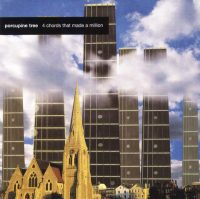
Porcupine Tree: '4 Chords That Made a Million'

Porcupine Tree: ‘4 Chords That Made a Million’

A side effect of Porcupine Tree‘s inexorable rise to the forefront of British psych-rock has been the consensus that’s set into their previously unbounded music. But they can still surprise us. Last year it was the dry wit of the ‘Piano Lessons’ single: this year it’s something less subtle, but still a jump away from the strummed ’70s friendly psych-anthems which Steven Wilson comes up with on an average day.

At the root, ‘4 Chords That Made A Million’ still stomps along with big mainstream boots on. But the sound is something new for them: aggressive raga-rock riffs with guitar wails like huge bloodstained battle-axes and a brutally cynical adventurist swagger to it that’s more ‘Definitely Maybe’ than ‘Wish You Were Here’. The effect’s a sort of explosive post-Anokha heavy metal: laden with tabla lines and drones, and with Richard Barbieri spurting out dirty synth lines like someone spunking up into a pot of orchids. The subject matter’s the one thing that unites arena-rock and punk lurkers – that standard disaffection with the biz. “Another moron with a chequebook / will take you out to lunch, who knows? / He will tell you you’re the saviour / and then he’ll drop you like a stone.” Mind you, what does it mean when you’re writing lyrics about the futility and emptiness of arena-rock and you then do your level best to set them in a full-on mosher of an arena-rock crowd pleaser? Has Wilson gone all Manic Street Preachers “we’ll have our cake but claim we’re dieting” on us, all of a sudden?

 
The B-sides are more familiar Tree twiglets. Disappear is almost unplugged, Wilson’s lazy swirl of flyaway harmonies, licks of luscious sombre wah and the blissful final surge of organ, Mellotron and drums notwithstanding. And it’s another fame story, this time the tale of someone wilfully giving up on the threshold: “I gatecrashed parties and just stood and stared / I moved to London and stayed in all year… / You’ll be famous and I’ll disappear. / I erase myself again.”


In Formaldehyde sounds like one of Radiohead’s disintegrating nearly-ballads fed through Camel: a lovely, helpless, descending Wilson melody to match the boring, frustrating pain of a decaying love. The sonic decorations, an enchanting swirl of dulcimer scratches and NASA blips, enhance a prime piece of trademark Porcupine Tree gliss-guitaring sky-glide. But while back in the ’70s this kind of psychedelic lament would’ve accompanied spliffed-out stargazing, here it’s soundtracking the miserable chill that settles into comfy middle-class apartments as they crumble into broken homes and even the drugs become unsatisfying toys. “Dust in the kitchen – coffee pot, microdot. / Now we are constant: / talking less, breeding stress.”


Perhaps it shows just how everyday the psychedelic has become today (with an acid trip in every other advert), but it also shows that, whatever spaceman noises and Big Rock Issues Porcupine Tree want to play with, they can still bring themselves off the spangly podium and home to the heart when they need to.

Badly Drawn Boy: ‘Disillusion’
XL Recordings/Twisted Nerve, TNXL005CD (6 34904 10052 0)
CD/10″ vinyl single
Released:
3rd May 2000
Get it from: (2020 update) Original single best obtained second-hand; Disillusion appears on the debut Badly Drawn Boy album ‘The Hour of Bewilderbeast’.
Badly Drawn Boy online:
Homepage Facebook Twitter MySpace Soundcloud Last FM Apple Music YouTube Vimeo Deezer Google Play Pandora Spotify Tidal Instagram Amazon Music

Inter: ‘Radio Finland’
Yoshiko Records, YR 002 CDS002
CD/7-inch vinyl single
Released:
8th May 2000
Get it from: (2020 update) Original single best obtained second-hand; Radio Finland appears on the lone Inter album ‘Got My Nine’.
Inter online:
Facebook MySpace Amazon Music

Porcupine Tree: ‘4 Chords That Made A Million’
Snapper Music/K-Scope, SMASCD111/SMAXCD111/SMAS7111 (6 36551 21112 3)
CD/7-inch vinyl single
Released:
2nd May 2000
Get it from: (2020 update) Original single best obtained second-hand: ‘4 Chords That Made a Million’ is included on Porcupine Tree’s ‘Lightbulb Sun’ album, while the others made it onto the ‘Recordings’ compilation.
Porcupine Tree online:
Homepage Facebook Twitter MySpace Soundcloud Bandcamp Last FM Apple Music YouTube Vimeo Deezer Google Play Pandora Spotify Tidal Instagram Amazon Music
 

September 1997 – EP reviews – The Shrubbies’ ‘The Shrubbies’ (“bouncing up and down on a deep springy pile of autumn leaves”)

24 Sep

The Shrubbies: 'The Shrubbies' EP

The Shrubbies: ‘The Shrubbies’ EP

Should I name a shrub? Probably a blackberry bush on this occasion. Convoluted, stubborn, furnished with tricky little thorns so that you have to be careful how you approach it… but also blessed with tangy little knots of piquant fruit which make the effort and the odd scratch worthwhile.

The Shrubbies are yet another branch of the Cardiacs family tree. Here, Sharron Saddington and Craig Fortnam (both of whom have done time in Lake of Puppies, William D. Drake‘s genteel “acoustiCardiacs” band) are joined by two bona fide ex-Cardiacs, Dominic Luckman and Sarah Smith. Unsurprisingly, the influence of Cardiacs (or their original acoustic Sea Nymphs alter-ego) has left its mark on the music. Here are four complex and leaping songs, swinging through an adventure playground of sophisticated eccentric harmony based around Craig’s dextrous gut-strung acoustic guitars and Sharron’s fluffy chirrup – although it’s Sarah’s sax and keyboard riffs, as fat and jolly as laughing Buddhas, that you tend to remember.


But Cardiacs music is clenched, neurotic, compulsively driven. Listening to the Shrubbies is much more of a relaxing activity: more like bouncing up and down on a deep springy pile of autumn leaves. This is sort of like The Sundays might sound if Kevin Ayers was in the driving seat: innocent but wise as a tuned-in child listening to the wind, with a dollop of Caravan/Canterbury breeziness stirred in alongside a seasoning of Early Music and kitchen-folk singalong. It reminds me of nothing so much, though, as great lost London hopes The Wise Wound, some of whose visionary acoustic/psychedelic outlook they share.


Excepting the surreal, Barrett-ised Sabled Fur, these songs tap directly into nature, caught up in the passage of seasons (Carefree Clothes) while mainlining jumpy sap for hormones, and fascinated by the moment (Perfect Present, with its mariachi keyboards and sax). Most of all, they’re driven by the sheer animal spark of life, in particular on the intricate spiny Body Cried Alive with its dark stretchy Mellotron riffs and epiphany of survival: “spiral down to the ground / like a seed that flies through the air / and affix myself to the ground / crying I am alive! alive!


Small and marvellous; like the delicious shudder in the daylight when the sun and the clouds do their dance-of-the-seven-veils thing.

The Shrubbies: ‘The Shrubbies’
Merlin Audio, MER97028CD (no barcode)
CD-only EP
Released: 20th September 1997

Get it from: (2020 update – original EP is best picked up second-hand; all tracks reappeared on The Shrubbies’ lone 1999 album ‘Memphis in Texas’, from which all of the soundclips here are taken and which you can still download or order from Bandcamp).
The Shrubbies online:
MySpace Bandcamp Last FM YouTube Amazon Music
 

October 1996 – live reviews – The Blue Nile + Sinéad Lohan @ The Palladium, London, 8th October

10 Oct

Wait in any given place for a long time and reckon up the odds. Which are you more likely to see passing by – Bigfoot, Lord Lucan, or a member of The Blue Nile? The chances are about equal each way.

In a business that thrives and surfeits on over-exposure, The Blue Nile only sidle into view when they absolutely have to. In fourteen years of tenuous existence, this reclusive biz-shy Glaswegian trio has offered up no more than three short albums of exquisite ambient Celtic soul; stripping away the armour of the heart with cheap drum machines, breathing synths and skeletal guitars, and the scalded, mournful grace of Paul Buchanan’s desperately romantic deep-tenor voice, leaving us flat on the floor and then departing so quietly we don’t hear the door shut.

While they’ve had stiff competition from Kate Bush and Scott Walker in the stakes for lying quietly in the long grass, sometimes The Blue Nile are out of view for so long that they seem no more than the shadows of our own heartbreaks. Three phantoms whom we can fill with the overflow of our ruined, hopeless good intentions and the agonising rush of a love with nothing and nowhere to ground itself on. Every now and then, though, they surface – as they have tonight – put out a record, and those shadows take on flesh.

But first we have Sinéad Lohan; a Cork lass with beaded hair, a salving murmur of a voice, and the composure of a marble Madonna figurine. From out of nowhere to the grandiosity of the Palladium, and still she’s not batting an eyelid as she delivers her soft thrumming folky songs to a warm reception. She even invites questions, and gets them. She has that atmosphere that some quietly private people have, the stillness that invites fascination.

From up here her eyes seem sleepy, focussed inwards, and her songs are the same, ripples of feeling reflected in still pools that make you feel like a privileged eavesdropper. All of this and the quietness makes her seem like an Irish Tanita Tikaram without the air of lazy resentment. After she’s left the stage, I realise I can’t actually remember what any of the songs were about, but the impressions of the emotions involved remain etched lightly on my imagination. She’s as subtle and strong a carver as smooth river water.

After seven years out of the public eye, most bands would return to the stage in a blaze of glory. The Blue Nile don’t even turn the lights out properly first as they slope onstage like reluctant supply teachers. I mistake them for roadies until I recognise Paul Buchanan’s pained, elegant features among the men fumbling to pick up the instruments, all but flinching at the applause and the eyes trained on them. But it’s something they’ll have to deal with.

For all of their heart-stricken loneliness, The Blue Nile carry a very special feeling of empathy and homecoming around with them. Literally, in some respects: tonight’s audience ripples with the voices of Glaswegian emigres. And when one Scots voice, brought to a pitch of excitement, calls out “Glasgow Celtic!” it’s followed as fast as a counterpunch by a Rangers fan’s disgusted “fuck off!” Rather than a slit face, this results in a ripple of laughter and recognition around the auditorium. There are wry, self-conscious chuckles from the band as they finally launch into the Van Morrison-gone-synth-pop chug’n’whoop of Body and Soul.

All of this civility (and this nod to a respectable musical touchstone) prompts the question. Have The Blue Nile, for all their cult status, ended up as another branch of hoary pop tradition for the impeccably adult? Certainly they shy away from sarky pop irony, and they’ve a sheepish but determined commitment to presenting their songs unvarnished by gimmicks. Don’t even try looking for Pet Shop Boys cleverness here.

And then there’s the impeccable cleanliness of their sound – the clipped white-gold ring of it, the slow stretch of the falling-evening keyboards, even the live drums compressed to stiff Linn thuds… Or, on the other hand, the occasional hints of country in the songs from the new ‘Peace At Last’ album and how Stay’s heartbroken synth pointillism develops from a Scottish electro-pop lament to a finale with suspicious hints of rockabilly or hoedown. And, of course, there’s the way Paul’s huge voice draws from Frank Sinatra’s warm cocooning sound, rather than any from any obvious rock source.

Sinatra, though, never sounded this touched; this blown through by overpowering feelings. Even behind the theatrics of his saddest songs there was a man preening in his power; the guy who was laughing now; the honorary Mob capo whose very tone was a muscle. Behind these songs are a man who winces; who knows the scuffed concrete in the buildings he walks past will outlive him. Who’s haunted by the moments where decisions rest before they fall into becoming facts, and who’s never short of melody but is often stripped of words. And who, on this occasion, is swigging Lemsip by the gallon to beat off a vicious cold. It brings the vulnerability of The Blue Nile’s songs into sharper focus.

But then they’ve never suggested that the business of being adult is supposed to be easy, or even make much sense. ‘Peace At Last’ made that as explicit as anything ever is in the Blue Nile universe – a middle-aged album (Paul Buchanan turned forty while recording it) which showed youthful, domestic and spiritual certainties past their flush and breaking down into a unflattering mirror of doubts and shaky illusions. A new testing ground after their landscapes of young men’s fears had slipped away back into the years. While The Blue Nile don’t go so far as to drag middle-aged trappings – such as chipped crucifixes or well-dusted-yet-unloved three-piece suites – onstage with them, they wouldn’t need them. The words to these songs swim to the surface in flashes; brief snatches and sketches of anguished images that settle into the heart’s eye as if their places had been waiting for them forever.

A couple of songs from 1989’s peerlessly lovelorn ‘Hats’ album illustrate this – Over The Hillside fumbles through the burden of day-to-day failure and the pull away from home; Headlights On The Parade sees Paul lose himself in night-haunted reverie, borne on by the serpentine romantic curve of the melody over the mechanistic drumming. Tonight’s rendition of Happiness, a song already riven by doubt (“Now that I’ve found peace at last, / tell me, Jesus, / will it last?”) has to replace the soaring black gospel chorus that boosts it on record with three uneasy white men murmuring into shared mikes. You wouldn’t have thought that it could reach the same hymnal level, but it does, albeit becoming more of a private prayer.

Another ‘Hats’ classic, The Downtown Lights, has the transcending, unresolved journey-feel of a crying fit; heart-stricken keyboard swells giving way to beautifully sad reflection and back again, rising to a frantic crescendo of loss. The atmospheric abstractions of A Walk Across The Rooftops don’t give away much in the way of clues, but they do give a night-time stroll a tint of darkest foreboding.

And Family Life just overwhelms – a mid-life crisis set to song. Echoes of Tom Waits, Randy Newman and crumbling Hollywood Christmases coming together in the heartbroken drunken pleas of a man whose marriage is unravelling, whose boyhood innocence is rising to ask bewildered questions. Paul, singing like a man suddenly and shockingly shrunken, plays the role to the hilt. But there’s no storytelling, no plot; just feelings and the alcohol dissolving reasoning down to more questions and a blurred, blundering comprehension. “Say, you know, / no honeymoons, / just separate chairs in separate rooms. / Jesus, please, / make us happy sometime – / no more shout, / no more fight…” As the last scraps of piano dissolve in the hush, the frenzied applause seems to spray tears of recognition and relief.

It’s still as un-showbiz as you can get. All of these emotions are being let off on a very tight leash. The magisterial Robert Bell doesn’t crack his stern kirkman’s expression all evening, whether he’s forcing compelling crabbed funk lines out of a bass, keening his rare backing vocals into Buchanan’s mike, or crouched cross-legged onstage beating out patterns from the tiny synth in his lap. Over on stage right, P.J. Moore plays with an abstracted serenity as the Blue Nile’s bare, effective colorations flood out from his keyboards. The supplemental three on drums, guitar and synths play with their heads slightly bowed – more quiet men. So it’s the hunched, embarrassed Buchanan that’s the reluctant centre of attention; muttering wry Glasgow “let’s-get-this-over-with” asides between the songs, but singing his heart out of his chest and punching it up at the sky every time the music rises.

I guess that even with embarrassment weighing at his coat-tails, he can’t help it. There’s often a desperate strand of hope-against-hope in The Blue Nile. The near-delirious Sentimental Man ascends out of a jumble of chippy funk facets to hit gospelly heights; the intently energised strum of Tomorrow Morning rushes towards the light as if Buchanan was trying to beat the pain off by hurtling towards hope. Tinseltown in the Rain – which belts along as if it was the peak of some uncompleted Glaswegian street-opera – bursts up to a plateau of emotion, aggressive certainty struggling with a sense of doom. (“do I love you? Yes, I love you! / Will we always be happy-go- lucky?… / But it’s easy come, and it’s easy go. / All this talking – / talking is only bravado”) before exploding in a carillon of stammering, tear-jerking guitar.

And on Saturday Night you can feel the blessed surge of relief at a simple romance – “an ordinary girl” hymned with a incredulous delight, an everyday date turned into a haven from the wracked, exhausting, damn-near-religious romantic angst of the Nile songbook – turning out right for once. As the last swooning joyous chimes mount the air, I hear a ecstatic voice screaming “Yes!”. It’s my own. I can’t help it either.

Later, Bell and Moore take up positions at the synths on each side of the stage, waiting to play Easter Parade. White-clad, calmly watching each other for the cue, they have the assured and tranquil air of surgeons waiting to lay on the hands and bring out the pain. Then the song comes – plangent clutchings of piano, gushes of night-breeze synth and Buchanan singing of being alone in a rapt crowd, carried along like a solitary bubble in their exhilaration. And the empathy is summoned up and floods through us like medicine.

They can still touch the pressure points of the soul like no-one else. In another few months they’ll be hiding from us again, but that touch is going to stay with us until they feel able to venture out into the world again, blinking with trepidation at the looming feelings waiting to catch them.

The Blue Nile online:
Homepage Facebook Twitter MySpace Soundcloud Last FM Apple Music YouTube Deezer Google Play Pandora Spotify Tidal Amazon Music

Sinéad Lohan online:
Facebook MySpace Last FM Apple Music YouTube Deezer Google Play Pandora Spotify Amazon Music
 

June 1996 – live reviews – Francis Dunnery @ The Borderline, Soho, London, 1st June (“bursting at the seams with music”)

4 Jun

From the moment he first strides gawkily on stage, grinning from ear to ear, Francis Dunnery radiates joyful energy. On last year’s low-profile British acoustic tours he was cautiously sticking his head up over the parapet to find out, to his surprise and delight, that he hadn’t been forgotten. This year it’s different. Perhaps it’s the success he’s finally been garnering in other corners of the world, or perhaps the reasons are closer to the heart, but Frank’s gotten a second wind and new fire. With a vengeance.

There’s less of the jokes this time around. Now, he’s bursting at the seams with music, so much that there’s less time for chat. As before, he’s armed with just an acoustic guitar (plus a cheap fuzzbox for those moments when only a dirty burst of distortion will do) but he makes both of them deliver as much as any full band would as he blasts straight into the positivity avalanche of I Believe I Can Change My World to kick off an evening drawing mostly from the new ‘Tall Blonde Helicopter’ album, his simplest and most joyous work to date.

Although he’s started playing fluent solos again – with a newly haphazard glee – the irrepressible energy with which he once drove It Bites is now harnessed to less cosmic, more essential ends and powered by faith rather than amplifier wattage. So are the songs. The raucous, overdriven joy-and-salvation of The Way Things Are; Grateful and Thankful’s humble confessional folk; the breezy Latin-flavoured pop of Rain or Shine; and the brand new Crazy Little Heart of Mine which has everyone yelping along to the scatting chorus like a pack of blissed-out Muppets.

True, there’s one moment of comparative darkness: Frank’s raw, stormy lament for his father, Feel Like Kissing You Again. As he dives into a wrenching, angry acoustic solo, shredding savagely at his own technique, he parades through trademark Dunnery riffs and those infamous looping fretboard licks, but now with a scalding discontent. It’s as if he’s saying “all of this skill… but still I couldn’t do anything to save him.” For a moment, some of the old pain comes through, and I find myself holding my breath…

For the most part, though, the concert is given over to the positivity spilling from Frank’s mouth in the “universal laws” which he’s declaiming from the stage – part Californian New Age-ery, but several more parts blunt northern-English honesty. Somehow he manages to restore faith in those old positive-thinking clichés; perhaps this is because, in this little subterranean music club, they don’t come across as corny arena-rock “put-cha-hands-tu-getha” sentiment, but as the testament of a man who’s won the war against his own dark side, making the pinwheeling, euphoric In My Dreams and the fragile unconditional devotion of Sunshine ring all the truer.

But it’s not just the smaller venues that are making Dunnery shows more intimate. It’s three-hundred-odd people packing the floor and clogging the stairs, still singing along to the anthemic moments like Everyone’s a Star and Still Too Young to Remember… but as if they were at a front-room party rather than a football stadium. It’s smaller things, like people filling in missing vocal harmonies. Or Frank extending his guitar audience-ward to let a fan strum a final chord; asking our opinion on a new riff; or bringing a child onstage (his nephew Charlie) to help out with singing Little Snake. It’s the wistful generosity of Good Life. It’s the people who, to Frank’s astonishment, already know the brand-new single B-side Just a Man and can sing along with its family-of-man message, joining him in flicking the finger at the bigots.

Most of all, though, it’s the new feeling that Francis Dunnery exudes: the feeling that he and all of us no longer have to be imprisoned in guilt and sin, that we can all be forgiven. Homegrown has somehow lost its sourness and emphasises freedom. He delivers the sly have-your-cake-and-eat-it self-portrait of The Johnny Podell Song with such a disarming mix of laddish swagger and rueful self-awareness that its roguishness is more irresistible, more forgivable then before. Conversely, its savagely witty and acerbic flipside Too Much Saturn is played much more gently than expected.

Perhaps it’s this same sense of redemption which induces Frank to perform a sparkling, beautifully appropriate cover of Peter Gabriel‘s Solsbury Hill – one of the several moments tonight that suggests a rapprochement with his proggie days. More It Bites material is being woven back into his setlist, too. Here’s a snatch of the old Tapboard extravaganza Reprise popping up in American Life in the Summertime; there’s a brief snippet of I’ll Meet You in the Spring sneaking into Still Too Young to Remember. More obvious and touching is a complete version of the acoustic version of Yellow Christian, which surfaced on a couple of dates last year; although the biggest surprise of the evening is Frank’s brief resurrection, out of the blue, of Once Around the World. Even if, in the end, he goes no further than the pastoral intro… to gleeful yells of “chicken!” from an audience that still remembers all the words. He grins. No problem – it’s all his music now, and if it feels right, why not play it?

And it does feel right. Francis Dunnery’s stubborn sticking to his guns, through right and wrong, is finally beginning to pay off both inside and out. He’s practically glowing up there. “Absolutely fuckin’ refuse to go under,” he exhorts from the stage, “and you can do absolutely anything you want to.” Another simple message. And – tonight at least – worth much more than a fifteen-minute suite.

Francis Dunnery online:
Homepage Facebook Twitter MySpace Soundcloud Bandcamp Last FM Apple Music YouTube Vimeo Deezer Google Play Pandora Spotify Tidal Instagram Amazon Music
 

December 1995 – live reviews – Anna Palm + Mandalay @ Upstairs at The Garage, Highbury, London, 20th December (“as full of explosive energy as a pan of popping corn… / …stately, kaleidoscopic and coolly hallucinatory”)

22 Dec

Oops. I’ve come to what I thought was a serious, arty gig to find exotic scarves hanging from the ceiling and a little green-nylon Christmas tree sitting in the corner. What with this, the candle-lit tables and the cheerful little greetings flyers under said tree, I get the feeling that I’ve crashed someone else’s Christmas party.

This particular party’s being thrown by violinist-turned-singer-songwriter Anna Palm, known for a journey that started with busking in Covent Garden and Chelsea and went on to a stint with acoustic punk-folkers Nyah Fearties, a handful of albums and singles on One Little Indian, and support contributions to a variety of artists from YesSteve Howe to New Wave synth poet Anne Clark, ascerbic dream-pop realists Kitchens of Distinction and avant-Goth experimentalist Danielle Dax. It’s an interesting resume. Well, I hate to bad-mouth my hostess, and maybe it’s unfair to judge an artist from an event coming across very much as a fun gig, but I’m decidedly underwhelmed. Despite an indie all-star band (with various members of The Farm, Loop Guru and Kitchens of Distinction taking time out to back her up) she fails to shine.

It’s not as if she doesn’t try: a Violet Elizabeth figure in a frilly little-girl party dress, she’s as full of explosive energy as a pan of popping corn, exhorting people onto the floor to dance, singing with verve (if not always great pitch) and sawing acrobatically at her violin. But the band is under-rehearsed and scrappy, falling apart much too often. Anna’s songs, too, lack individuality and the delivery to make them memorable. A shame, as when she sets bow to strings some spirited and slyly lovable playing emerges.

Anna’s obviously a good player, but as far as being a singer-songwriter goes she still doesn’t seem to know what to do with herself. File under “needs work” and leave it at that for now. However, the mess does yield up one unexpected delight – a dance-groove version of Kites, compelling and grin-inducing, with Anna’s riotous violin scurrying over an early-’90s style baggy beat and the whole thing carrying a strong hint of I Will Survive. A novelty, perhaps, but it’s good to see Simon Dupree’s old hippy hit hopping onto a modern groove and feeling right at home. These particular Kites really fly. I wonder if the Shulman brothers (who notoriously hated their early Dupree-ism despite its success) might ease up and grin and bop along if they were here to hear this.

The real reason why I’m here is a duo called Mandalay, hiding further down the bill: it’s the new project by multi-instrumentalist and electronica aceSaul Freeman, who used to perform a similar role as half of the band Thieves alongside stratospheric singer David McAlmont. Thieves are long (and acrimoniously) split now, with what would have been their debut album a little uncomfortably repackaged as the stunning McAlmont debut (and if you haven’t heard that, you missed one of the most vitally progressive pop records of 1994).

Now Saul is quietly rematerializing, in partnership with singer Nicola Hitchcock, to reclaim some of his lost thunder. But although it shares the glittering crystalline texture of Thieves’ songs, Mandalay’s music is nowhere near as easy. As with Thieves, Cocteau Twins should be mentioned (especially when listening to the effects-swallowed guitars of Enough Love); so too should the frozen sadness of Portishead (especially on the chilly trilling of Enough Love). but Mandalay is more involved and intricate than either. These are multi-dimensional songs, Nicola’s frail but enthralling vocal melodies elevated from the ground on staggeringly complex musical architecture courtesy of interlocking blurry sequencers, obsessively repeating samples and eerie guitar treatments. Saul stands impassively amongst his host of computers and effects racks, gazing absently down at his guitar and its network of pedals. Every now and again he’ll tap and flick at the strings and a second later a whole web of music will swell from the speakers.

Mandalay’s style – stately, kaleidoscopic and coolly hallucinatory – is best exemplified by the silvery net of sampled vocals, the stabbing kick drum and the harmonica-skank guitar of More Than Venus: Nicola’s whispering Bush-y enunciation gives the perky melody an awkward, appealing sensuality. Walk By the Sea rumbles by on an ominous 3/4 riff, double-looped spiral claustrophobia and panic-pitch piano plinking. The Waiting gives full reign to Saul’s subtle space-age guitar work: cunningly-placed “brang”s and attenuated bell-notes amongst the fabric of a languorous techno-warble.

There’s plenty of pop in this (and, despite the duo’s clear and ineluctable whiteness of manner as well as appearance, more than a helping of trip-hop) but Mandalay are also decidedly post-rock. They’re part of the astonishing movement which also includes Moonshake, Laika and the late-lamented Disco Inferno, and which junks the conventional hierarchies of rock instrumentation in favour of the uncanny textures of digital sampling and electronic ensemble processing. This might not sound appealing to the traditionalists out there, but believe me, Mandalay are much more than noodling experimentalists. Try to think of their songs as angst-under-amber, refracted into confusing multiples by an unearthly light. Unsettling but beautiful pop for an uncertain info-saturated future. You want progression? It’s happening here.

Anna Palm online:
Homepage Facebook MySpace Last FM YouTube Spotify Tidal Amazon Music

Mandalay online:
Last FM Apple Music YouTube Deezer Google Play Spotify Amazon Music

Additional notes: (2020 update) Anna Palm now lives and occasionally performs in Stroud. Mandalay recorded two albums for V2 Music before splitting in 2002: both Nicola Hitchcock and Saul Freeman have continued intermittent solo careers.

December 1995 – live reviews – Gordon Haskell @ The Unplugged Club, Bloomsbury, London, 7th December (“one mockingly rolled eye peering out to capture the madness and to look out for an escape route”)

9 Dec

Not even a minute into the show, and we hear it. He looks thoughtfully out at the mixed crowd and speaks. “I can usually tell whether an audience is going to be good or bad.” A pause. “Good night!” And then he lets it rip. That laugh – an untrammelled, hiccupping whoop of unbalanced joy, teetering on the edge of losing it. You may have heard in on King Crimson‘s ‘Lizard’, twitched into hysteria by studio electronics, a lone human voice in the sick, surreal circus. Twenty-five years on, in this intimate little acoustic club, it sounds like the redemptive, rueful peal of a free man, acknowledging the potholes of disaster that dog our footsteps in this world and cause some of us to drop into madness.

Strange to think that this grizzled and animated figure, eyes twinkling benevolently beneath a battered hat that’s the last word in Bohemian chic, is Gordon Haskell – singer with King Crimson for nine studio-bound months back in 1970. At an age where most ex-proggies are still squeezing themselves into the glad-rags and going through ever-more lifeless motions in small theatres, Haskell is donning comfortable clothes, picking up his acoustic guitar, playing tiny little places anywhere and enjoying himself. To tell the truth, the Crimson connection is misleading. All of that was a long time ago now. Gordon’s profile may have been lower than a bug’s belly since then, but now he’s swinging back into action with a vengeance… and he’s in better artistic shape than most of his more financially successful contemporaries.

Not only does he possess a brilliantly gutsy guitar style and a voice so rich and earthy that you could grow potatoes on it. but he has a bagful of excellent songs to offer. He now writes and plays like a combination of John Martyn and Leon Redbone, with a huge measure of the rawer joys of John Lee Hooker and Richard Thompson. He takes the vibrancy and gleeful survivor’s power of deep blues and blends it with an irreverent, eccentric, classically English strain of absurdism. Like the young Peter Gabriel, he takes his stand against the hostility of the world with a disarming, cunning humour, one mockingly rolled eye peering out to capture the madness and to look out for an escape route. It’s all as warm as a closely-held candle on a winter’s night… and as liable to suddenly scorch your fingers.

Thinking back to ‘Lizard’, one wonders what kind of more lively, organic record would have emerged had Robert Fripp and Peter Sinfield given Gordon a crack at the songwriting rather than just dovetailing his voice into their meisterwerk. There’s a vague hint of Sinfield’s verbal adventurousness in Haskell’s songs, although thankfully none of the attendant pretensions. The Hooker-like Wang Bang World captures life’s grim tendency to overrun us, but revels in a tumble of savagery and joking; conversely, Pelican Pie could be just a blur of absurdist imagery were it not for the beady-eyed thread of social critique running through it.

Haskell’s between-song banter may be a mixture of oddball wisdom and Eddie Izzard goofiness (“may you be blessed with many goats!”) but the humour in the songs is by no means pointless, pretentious silliness. Rather, Haskell’s a knowing jester holding his own and laughing in the face of life’s terrifying chaos. Hanging By a Thread (dedicated, tonight, to Fred West) is a mordantly hilarious parade of murderous, fatalistic comedy: “Gentle Jim got life for chopping up his wife / – said he needed warmth for the winter.”

The lack of preciousness is what really makes him great, though – he’s not out to prove to us what a clever musician he is. Sure, each song has enough teeth and gold to make us think about it, but it’s Gordon’s sheeer verve and ecstatic gutsiness that wins the audience over, captured in the luxuriant salaciousness of Chilli Chilli, the throbbing jungly blues of Test-Drive or the voodoo swamp-stomp of Alligator Man, a roaring clapalong portrait of the ruthless predatory wheeler-dealer, the sheepskin-coated hoodlum-salesman who’s becoming a spectre of the times.

Like those old bluesmen, Haskell knows how life and death, humour and horror walk side-by-side and share the same streets, and his work is not short of tenderness as well as carnality. The love song All My Life rasps like Louis Armstrong, and I Don’t Remember It Like This shows an Ian Anderson verve as it examines the misleading, misframed photos in the history of love: “whatever love is, it’s in the thrill of your kiss / and I don’t remember it like this.” There’s a real feel to the soulful sorrow of Tortured Heart and in the wry shrug of Mail Order Love, which mixes an organic bluesy swing with a handful of dissatisfied plastic metaphors, romance gone synthetic. The philosophical break-up song Go Tell Sarah is part goodbye, part lie, part promise.

In a dash of sheer music-hall, he tips his hat and beams at us with real pleasure, inviting us in to share both the fear and the laughter on his perspective on life. The return of Gordon Haskell is going to offer the scene a welcome dose of warmth, and 1996 could well be his year. A lost star is returning to dispense a special kind of mischievous twinkle.

Gordon Haskell online:
Homepage Facebook Twitter MySpace Soundcloud Last FM Apple Music YouTube Deezer Google Play Pandora Spotify Tidal Amazon Music
 

November 1995 – live reviews – David Sylvian’s ‘Slow Fire – A Personal Retrospective’ @ Royal Festival Hall, Southbank, London, 4th November (“self-effacing chameleonics”)

6 Nov

David Sylvian: 'Slow Fire - A Personal Retrospective' 4th November 1995

David Sylvian: ‘Slow Fire – A Personal Retrospective’ 4th November 1995

With former Japan leader David Sylvian, a show or an album is rarely as simple as being just a show or an album. Since 1983 he’s swum in and out of focus on a collection of artistic cross-fertilisations (sombrely beautiful songs albums, collaborative ambient vaguenesses, art installations): a shadowed, near-invisible chameleon with an enigmatic past ranging from over-exposed greasepaint-and-trash glamour to composer-effacing sound-sculpture. Tonight’s show – given extra weight by its ponderous title of ‘Slow Fire’ – is billed as a solo retrospective plus work in progress. Given Sylvian’s occasional tendency to enmire himself in inconsequential sound-tapestries, this could be grim. But the reality of ‘Slow Fire’ is more straightforward. Since we last saw him, touring with Robert Fripp, David Sylvian (like so many progressive artists) has decided to re-examine himself, unplugged.

With any contemporary electric musician, this is a risk: for Sylvian, much more so. The man now best known, post-Japan, for wall-to-wall electronic shrouding spends most of tonight perched on a stool behind a classical guitar. It’s the old rebirth scenario: once a travelling encrypter of decadent European and subtle Oriental sensibilities, Sylvian’s currently settled down into domestic bliss in America with a new wife (Prince protégé Ingrid Chavez), a new accent (decidedly transatlantic) and – judging by the credits on the appallingly pretentious programme – a guru. This would explain the brilliant white kaftan (has Jon Anderson missed any clothes recently?) and the four-cornered bowing as he takes the stage.

Though he’s dropped a few clues about an acoustic direction on recent recordings (on the Sylvian/Fripp B-side Endgame, for example), accepting Sylvian as an acoustic musician is not so easy. That marvellous voice, deep and rich as fortified honey, is still there, but over the years he’s made so much mileage out of his electrophonic atmospheres that his actual songs have been able to camouflage any flaws within the soundcraft.

The often disappointing collaboration with Fripp laid bare the aridity that Sylvian songs can often shrink into – tonight, Jean the Birdman is tricky and interesting but (even with a ludicrous attempt at scat singing) ultimately uninvolving, and there’s nothing like an acoustic performance for exposing juicelessness. Unsurprisingly, material from Sylvian’s song-centric 1987 album ‘Secrets of the Beehive’ fare well (the lilting menace in the folk-premonitions of The Boy with the Gun, a magnificent Orpheus and a hushed Waterfront) as do the few treasured songs from the Rain Tree Crow project: a reverberant Every Colour You Are, and a version of Blackwater which releases the song’s submerged country elements.

There are even one or two surprises during the guitar set, such as a rich rendition of Before the Bullfight and the shocking reinvention of keystone Japan hit Ghosts. From the beatless, icy original, Sylvian turns it into a wry Latin pop-inflected shrug of acknowledged doubt, Gilberto Gil meets Scott Walker. Even more shockingly, it works. But material from the schizophrenic ‘Brilliant Trees’ era has a tougher time making the jump to simple gut strings. Twitchy artiness such as Red Guitar and a limp Pulling Punches stumble out as embarrassing feynesses. Weathered Wall becomes a dull drone when denied the support of Jon Hassell‘s vaporous trumpet. With his shamanic atmospheric arrangements missing, too much of Sylvian’s once-epochal material is revealed as mere spectral verbiage, irresistibly crooned but superficially moodist. “Words with the charlatan,” mutters someone next to me, sarcastically.

It’s when he’s at the keyboard, with renewed access to a broader range of textures, that Sylvian delivers real magic – the rueful piano balladry in September and Earthbound Starblind, or the swathes of synth around the frozen pain and stone tears of Damage. When he allows himself the luxury of backing tapes, the dream deepens. A medley of Maria and Rain Tree Crow sees him keening over a wafting mist of chilling ambience punctuated by a ghostly chuckle. The First Day (graced with a wisp of taped Fripp skysaw) is as lushly majestic as ever. The deep dark indigo melancholy of Let the Happiness In acquires a meditative drum loop along with the shadowy orchestras of synth: it becomes hymnal, filling the great yearning emptiness at its heart with a sense of renewal, of return and redemption. It’s at moments like these that faith returns, and we can remember the subtle yet profound impact that Sylvian’s music has made in the past.

The trouble is that that was the past; and that the present is looking decidedly lumpen. The keyboard is also where Sylvian unveils his new material. For work in progress, it seems suspiciously complete… and already possesses a distinct form. A piano version of Tim Hardin’s It’ll Never Happen Again is the touchstone, with the interminable Ingrid’s Wheels and the rambling I Do Nothing (the latter most notable for its repeated, listless “alleluia”s) sketching Sylvian’s way forwards. Dusky, Americanised ballads with a strong element of that empty piano-bar pomposity that’s invariably damned with the kiss-of-death tag “quality songwriting”. Superficial sheen generating superficial applause. It’s difficult to escape the thought that David Sylvian’s self-effacing chameleonics have finally led him into a trap, a territory where he can no longer find his own face, where he will blur into a line of indistinguishable piano-song hacks whose albums will receive polite plaudits and gather dust on the lower shelves, where the fire will slow to a flicker.

The old Japan acolytes queue up tonight to touch the hem of King David’s gown. He smiles and bows like a bashful messiah. I can appreciate his showman’s smoothness… but I’ve lost my faith. I have a horrible suspicion that despite the handful of wonderful moments held to the light this evening, the shaman has swapped his books and his wisdom for a Cadillac, and the tin drum which once sounded out a musical challenge has just stopped beating.

David Sylvian online:
Homepage Facebook Twitter Soundcloud Last FM Apple Music YouTube Vimeo Deezer Google Play Pandora Spotify Tidal Amazon Music
Additional notes: While there’s no footage available for the London ‘Slow Fire’ show, you can get an approximation of it from footage of the Bari show from the same tour, in Italy, which is compiled here.
 

September 1995 – live reviews – Shriekback + Holly Penfield @ Upstairs at the Garage, Highbury, London, 6th September (“a few degrees different… / …madly danceable but bursting with wild and intriguing approaches”)

9 Sep

Holly Penfield, delayed by technical problems, is not having a great night. For those who haven’t previously seen the Diva of Dysfunction, this is maybe not an ideal introduction to her unnerving songbook of emotional explorations, cramped as it is into a shortened set-time opening for Shriekback.

Nonetheless, as she sings out her heart and wrings the notes out of her synth, her quality shines through as she leans on the more conventional songs of her standard set – the vulnerable unwindings of ‘Parts of My Privacy’; the clarion-blast of ‘Calling All Hearts’; the stormy tribute to city derelicts in ‘Over the Edge’. The long frozen yearn of ‘Stay with Me’ is as potent as over; the climactic anthem and disintegration of Misfit still jolting and captivating. Tonight she may seem only a few degrees different from most mainstream songwriting women; but they’re important degrees.

Shriekback may be familiar to those of you who’ve followed the career of XTC. Lubricious singer and frontman Barry Andrews was once part of that band, although now (shaven-headed and muscular in black singlet and leather trousers) he looks more like an escapee from Right Said Fred. Watchers of the ’80s alternative scene might also remember the band as being artily plastic white funkers – during the time when Dave Allen and Carl Marsh made up a fierce creative triumvirate alongside Andrews – but they’ve changed quite a bit since then. Thronging the stage like a post-civilisation white road tribe from ‘Mad Max’ or Circus Archaos (and always seeming to be twice as numerous as they actually are) Shriekback still play what could be described as funk, but it’s a mutated progressive variant: still madly danceable but bursting with wild and intriguing approaches.

The instrumentation has something to do with it. A vast array of percussion instruments played by the entire band, like a mongrelised salsa troupe, include – in addition to the standard kit, congas and bongos – giant mutant tambourines, Arabian dumbeks, Irish bodhrans, cymbal-clappers and what looks like an array of motor springs on a huge chunk of wood. Guitarist Lu Edmonds has dumped his six-string in favour of a couple of electrified Turkish instruments – the cümbüs (apparent bastard child of a banjo and a twelve-string guitar) and the saz (like a bouzouki with moveable frets) – chopping and rolling out subtly different parts. The bassist loops and taps on a full-toned fretless. Courtesy of Mark Raudva, didgeridoo and mandolin both make appearances during the evening. Barry himself plays accordion as if he’s wrestling with a giant python, and somehow manages to extract an eerie sound for a wired-up tree root.

Funky it may be, but “get down y’all” is not on the agenda. Shriekback are progressive funk barbarians with a cunning primitivist edge, as happy with a sort of savage pagan sea shanty or primal drum throb as with a Prince-ly groove. Stately, it isn’t. The wild percussive stomp that opens proceedings is as far from po-faced art seriousness as you can get, and they possess the super-greasy compulsive rhythms of the dirty end of prime funk. Their sheer enjoyment and eclectiveness in the ingredients they brew into their music marks them down as yet another oddball manifestation of the progressive spirit…. and who said barbarians had to be dumb? There’s a roiling intelligence in evidence throughout their set. Barry Andrews has always played the hooligan-intellectual card really well, and he’s not stopping now.

Shriekback follow a different and ever-so-slightly alien logic in the way that they look at the world. You can see this in the list of “un”-things in ‘Un-Sound’ (“unacceptable, unreliable, unheard”) or in the semiotic question/percussion barrage of ‘Signs’, in which traffic signs, car logos and football graffiti are all part of one great rush of urban information which you need to understand and to decode for survival. All of it comes to the fore on the didgeridoo-led nightmare parable ‘Captain Cook Said’, in which Barry narrates the story of Cook’s omen-ridden first meeting with indigenous Australians back in the eighteenth century and of the destructive force of the civilisation which he trailed behind him – “we’re here to transmit the virus called the future…” Some XTC cleverness emerges, too, in the wryly cynical ‘Pond Life’ and in the hard rhythm’n’blues/country-inspired wallop ‘Seething’, with its fierce accordion.

All of this plus the fact that you can dance to this band without having to leave your brain at home. On all counts, Shriekback deliver. If you occasionally need to let the smart barbarian out of yourself, there are few better bands available to help you do it.

Shriekback online:
Homepage Facebook MySpace Soundcloud Tumblr Last FM Apple Music YouTube Vimeo Deezer Google Play Pandora Spotify Tidal Instagram Amazon Music

Holly Penfield online:
Homepage Facebook Twitter Last FM Apple Music YouTube Deezer Google Play Spotify Tidal Instagram Amazon Music

January 1995 – live reviews – Francis Dunnery @ Jongleurs, Camden Town, London, 26th January (“a fair dose of confessional, thankfully laced with warm, wry humour”)

28 Jan

“My name is Francis, and I’m an alcoholic.”

The former frontman of It Bites stands before a packed house, nervous and naked. In musical and personal terms, at least – this is a stripped-down gig, just Francis Dunnery and accomplice Ashley Reaks on acoustic guitars in an ‘Unplugged’-style attempt to relaunch Dunnery in the UK after a four-year absence. It’s also an opportunity for Dunnery, without the constraints or comforts of a band, to confront his British audience with utter honesty about who he is.

We get his new songs, but we also get a fair dose of confessional, thankfully laced with warm, wry humour. At times, the atmosphere is like that of a stand-up comedy performance; Dunnery regaling a warm, welcoming and adoring audience with tales of his drunken days, the horrors of becoming one of the “rock arseholes” whom he detests, the pros and cons of sobriety and how it relates to the choosing of curtains, and the ups and downs of romance. (He also claims, implausibly, to have a werewolf’s cock, but probably the less said about that the better…)

So he’s back. It’s an intimate homecoming, really, with none of the posturing one associates with a rock gig. I mean, when was the last time you saw someone opening their show, as Dunnery does, by making a cup of tea? Then again, he never had the self-importance of the average proggie, even when he was twisting out great looping spirals of glossy pin-sharp progressive pop with It Bites in their heyday; and when he seemed to be trying to reconcile his own friendly Cumbrian bluntness and plainspeaking with the musical tightrope act he was pursuing at that time. The present-day Dunnery is a troubadour, a man who’s returned to the basic portable song that can still enchant even when cut down to the most skeletal arrangements.

He’s older, wiser and a touch more cynical (as evidenced on the wry precis of the music industry that is American Life in the Summertime, blessed with a compulsive tune plus satirical lyrics about the Californian stardom dream, and dedicated tonight to the record company girls), but his sense of compassion and honesty sees him through. Much of tonight’s set comes from his recent second solo album ‘Fearless’, in which he moves into smooth (but indisputably off-beat) pop-rock, much of which is quite suited to tonight’s format. The beautifully poignant Good Life, executed solo, is a perfect goodbye song. Painful, celebratory, tantalisingly unresolved, and making the most of Dunnery’s high soul-grained vocal tone, it gets one of the biggest cheers of the night, leaves wistful echoes in the heart, and ranks with the best of any of his past work.

Recent, neglected single What’s He Gonna Say certainly gains added sleepy poignance of its own by being stripped down. It’s spoilt, however, by Dunnery throwing in a twiddly accelerating solo line in an inappropriate bit of technical flash: a rare lapse of taste meaningless to the song and to the evening. Fade Away and Heartache Reborn fare better; sad in a joyous kind of way, filled with rue, warmth and self-realisation, little chronicles of the interweaving of life and love.

A superb electric player, Frank has yet to find his own voice on acoustic guitar. He solos throughout the evening in a bizarre, terse, hybrid style of blues and Spanish classical with a heavy attack. Sometimes the results are striking, occasionally they’re just pointless. But then, he has recently reinvented himself from being a guitar hero who sings to a singer who plays guitar. On this tour, his songs mean infinitely more than his guitar playing.

The mournfully jaunty Homegrown and the resurrected It Bites strutter Underneath Your Pillow both work surprisingly well, surviving the loss of their skilful arrangements on record and given a more intimate tinge by the simple interplay of guitars. Feel Like Kissing You Again, now revealed as a tribute to Dunnery’s late father, is a vertiginous blanket of strumming; unsettling and bleak, Frank delivering a heartfelt, keening vocal and pulling off a harsh, minimal and twangingly abstract solo with impossible note-bends shooting off like snapping heartstrings.

To close, there are a few more lookbacks at It Bites. A quick nugget of the acoustic flourish The Big Lad in the Windmill, and a final acoustic benediction of wonky-lyric’d rock ballad Still Too Young to Remember (roared back at him by a clubful of joyous voices); and then Dunnery’s gone. No encores, despite the roaringly enthusiastic calls that carry on long after the club plays loud funk music at us in an effort to cue us into getting the hell out of there. Still, we can but hope that we won’t have to wait four years until the next gig. And we can marvel at the fact that even when all of the gloriously flashy musical settings of the It Bites era are removed, we’re still left with a fine songwriter.

Welcome back, Mr Dunnery. We missed you, fella.

Francis Dunnery online:
Homepage Facebook Twitter MySpace Soundcloud Bandcamp Last FM Apple Music YouTube Vimeo Deezer Google Play Pandora Spotify Tidal Instagram Amazon Music
 

SWOONAGE

Swoon. /swo͞on/ A verb. To be emotionally affected by someone or something that one admires; become ecstatic. Here are some people and things that make me swoon. #swoon #swoonage

Post-Punk Monk

Searching for divinity in records from '78-'85 or so…

theartyassassin

...wandering through music...

Get In Her Ears

Promoting and Supporting Women in Music

Die or D.I.Y.?

...wandering through music...

Music Aficionado

Quality articles about the golden age of music

THE ACTIVE LISTENER

...wandering through music...

Planet Hugill

...wandering through music...

Listening to Ladies

...wandering through music...

ATTN:Magazine

Not from concentrate.

Xposed Club

improvised/experimental/music

The Quietus

...wandering through music...

I Quite Like Gigs

Music Reviews, music thoughts and musical wonderings

furia log

...wandering through music...

The Recoup

SINCE 2013: Books and books and books and books and occasionally other things

A jumped-up pantry boy

To say the least, oh truly disappointed

PROOF POSITIVE

A new semi-regular gig in London

Gapplegate Classical-Modern Music Review

...wandering through music...

When The Horn Blows

...wandering through music...

:::::::::::: Ekho :::::::::::: Women in Sonic Art

Celebrating the Work of Women within Sonic Art: an expanding archive promoting equality in the sonic field

Ned Raggett Ponders It All

Just another WordPress.com weblog

FLIPSIDE REVIEWS

...wandering through music...

Headphone Commute

honest words on honest music

The One-Liner Miner

...wandering through music...

Yeah I Know It Sucks

an absurdist review blog

Obat Kanker Payudara Ginseng RH 2

...wandering through music...

poplifer.wordpress.com/

Waiting for the gift of sound and vision

Good Music Speaks

A music blog written by Rich Brown

Do The Math

...wandering through music...

Archived Music Press

Scans from the Melody Maker and N.M.E. circa 1987-1996

The World's Worst Records

...wandering through music...

Soundscapes

...wandering through music...

OLD SCHOOL RECORD REVIEW

Where You Are Always Wrong

FRIDAY NIGHT BOYS

...wandering through music...

Fragile or Possibly Extinct

Life Outside the Womb

a closer listen

a home for instrumental and experimental music

...wandering through music...

Life Just Bounces

...wandering through music...

Lucid Culture

JAZZ, CLASSICAL MUSIC AND THE ARTS IN NEW YORK CITY

Aquarium Drunkard

...wandering through music...

eyesplinters

Just another WordPress.com site

NewFrontEars

...wandering through music...

FormerConformer

Striving for Difference