Archive | political music RSS feed for this section

March 2016 – upcoming gigs – heavy Norway via London By Norse (with Enslaved, Wardruna, Vulture Industries, Helheim and a special ambient Nordic-folk event at the Forge)

13 Mar

A couple of posts ago, I mentioned that I’d got a couple of upcoming and nationalistically-inclined gigs to consider. The first of these, a Cornish music celebration, was an easygoing patriot’s-cream-tea of an afternoon, opting to put fun ahead of political confrontation. The second of the events – the Norwegian three-day London music festival By Norse – raises tougher questions almost from the start. Buying into the idea of “harder music’s position as Norway`s most important cultural export” isn’t a problem, as long as your idea of culture embraces extreme varieties of heavy metal. (For plenty of us, it does.) Outside of the Scandinavian peninsula, however, it’s a little more challenging to be asked to buy into the concept of old Nordic traditions of pure native paganism, standing firm against the corruption of an imported and state-imposed Christianity.

The two main artists behind By Norse – both of whom do buy into all of the above – are Ivar Bjørnson (of extreme metallers Enslaved) and Einar Selvik (of dark-folk project Wardruna, who blend their post-heavy-metal ethos with the use of ancient Scandinavian historical instruments – including deer-hide frame drums, tail-hair lyres, and goat and lur horns – as well as sourcing sound from trees, rocks, water and pitch torches). Most of Ivar and Einar’s shared beliefs and preoccupations have come together in ‘Skuggsjá’, the conceptual song-suite which they’ve written together and which they’re performing as part of By Norse this week with a united Wardruna/Enslaved ensemble. As they themselves describe it, the work is “commissioned to commemorate – and castigate – the 200th anniversary of Norway’s constitution, which took place last year, the suite is a furious journey into the dark reaches of Norwegian history. A counterweight to the enshrining of Christianity as the national religion and a harsh light on the atrocities committed in its name, its white-knuckle journey through innumerable musical moods is also a reminder of the rich pagan culture that was lost as a result…. ‘Skuggsjá’ translates into ‘mirror’ or ‘reflection’ in the Norse language, and the piece not only contextualizes harder music’s role in Norwegian democracy, but also joins threads from the country’s ancient musical history…”

There’ll be more on ‘Skuggsjá’ a little further down, but the following Einar-and-Ivar event at Camden’s Forge is the By Norse aspect which first drew my own attention and interest (and which, as I post this, is down to the last few tickets):

London By Norse/Metal Hammer present:
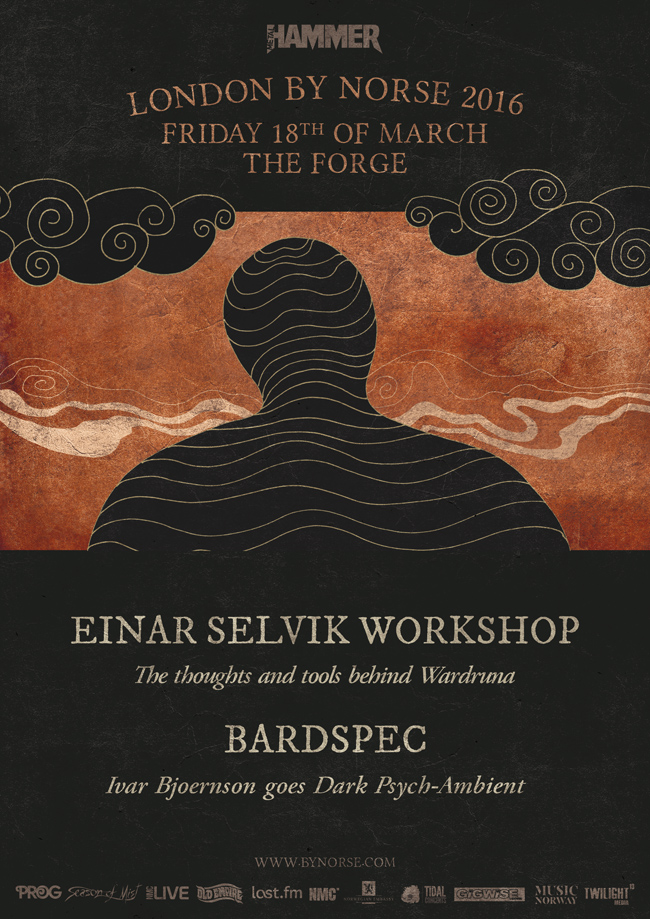
Einar Selvik workshop (‘The Thoughts and Tools Behind Wardruna’) + Ivar Bjørnson’s BardSpec
The Forge, 3-7 Delancey Street, Camden Town, London, NW1 7NL, England
Friday 18th March 2016, 6.00pm
more information

Einar Selvik/BardSpec Workshop, 18th March 2016“At this Forge event, Einar Selvik will speak about his approach to Norse historical music and the extensive creative concept behind Wardruna’s ongoing ‘Runaljod’ trilogy as well as his approach and study of the runes and other Norse esoteric arts. He will demonstrate a selection of the oldest Nordic instruments, play fully acoustic Warduna music and there will be opportunities for questions from the audience.

“Ivar Bjørnson will also be performing as his immersive electro-ambient project The BardSpec, which features the set-up of Ivar, his computer, a few strings, plus a pedal or two (and sometimes a trapeze artist). The direction is dark, surprisingly rhythmic and hypnotic. Thematically, in both sound and concept, The BardSpec is about minimising – cutting away, subtracting and meditating upon the simplest essence of ‘things’; the single points, bones and salt particles, the basic elements and building blocks that make up the whole.”

* * * * * * * *

There’s some historical truth – not to mention dignity – in the neo-pagan position and in some of these neo-Viking rumblings. In times when more and more people are querying the long-standing cultural reflexes they live under – and becoming sceptical about the alleged benevolence of world-spanning systems – this is a local, specifically Norwegian example of pursuing a less industrialised identity. In Britain, music followers who’ve kept a long-term faith with the transformative cultural odyssey of Julian Cope (from beat pop to shamanism) are used to him rattling off tracts of anti-Christian Odinist rhetoric, exploring pagan ideas in song, and using them to raise questions about what British culture might be. In Norway, however, these matters are closer to their original home and bite a little deeper.

If you want to treat these ideas with proper respect, you need to unhook them from some of the more shadowy, ominous attitudes associated with Norwegian black metal during the 1990s, when (in spates of ferocious misanthropy and rejection of contemporary society) some of its adherents travelled from politically-motivated Christian church burnings to anti-outlander racism, death-cult derangements, hate-prejudice and even murders. Under certain conditions, this culture – with its core of masculine romanticism – can succumb to the erosive lapping of a vicious and half-disguised nihilism. This isn’t something unique to Norway or even to black metal culture. It’s something held in common with plenty of dissatisfied movements with cores of action-seeking males who overturn common laws in favour of a different, structured and self-empowering ethos regardless of a negative impact on others. Something which it also holds in common with belligerent nationalism.

As you’ve guessed by now, I’m sceptical… but I’m also inclined to give Einar and Ivar the benefit of the doubt. Despite their suggestions that unfavourable reviews or practical frustrations of their projects are the machinations of “Christian monks” (which might just be deadpan heavy-metal humour), their work seems to be rooted in an earnest, honourable and artistically committed place. Their dedication to their music (and their interest in how it evolves and how it draws on an interesting past, rather than continuously warming over a sterile present) is clear and evident, and they don’t appear to be motivated by smouldering surliness. Certainly there’s warrior rhetoric, and some battle lines declared; but all of it has been subsumed into music, engagement and open debate rather than hooded, ugly social violence. They might be interested in unravelling some aspects of the world as we know it, but constructively: not as a wanton teardown.

You could also, of course, argue that Einar and Ivar’s philosophical stances and their co-opting of history are mostly about building a brand: that the paganism and protest primarily constitute an art project and a commercial push. Approximately two-thirds of the music in the By Norse gigs features Ivar, and most of that is with Enslaved; suggesting in turn that perhaps (fanbase notwithstanding) this scene, its impetus and its artistic adherents are smaller in number than might be desired, especially when presenting a festival. Perhaps that’s true as well: but all art movements start relatively small, at which point enthusiasm and dedication matters, and integrity is measured by the consistency of the work.

With that in mind, I’m going to stop musing and just post details on the other By Norse concert dates – the ‘Skuggsjá’ performance and the three-night celebration of Enslaved’s career, from black metal beginnings to their current psych-eclectic form.

London By Norse/Metal Hammer present:

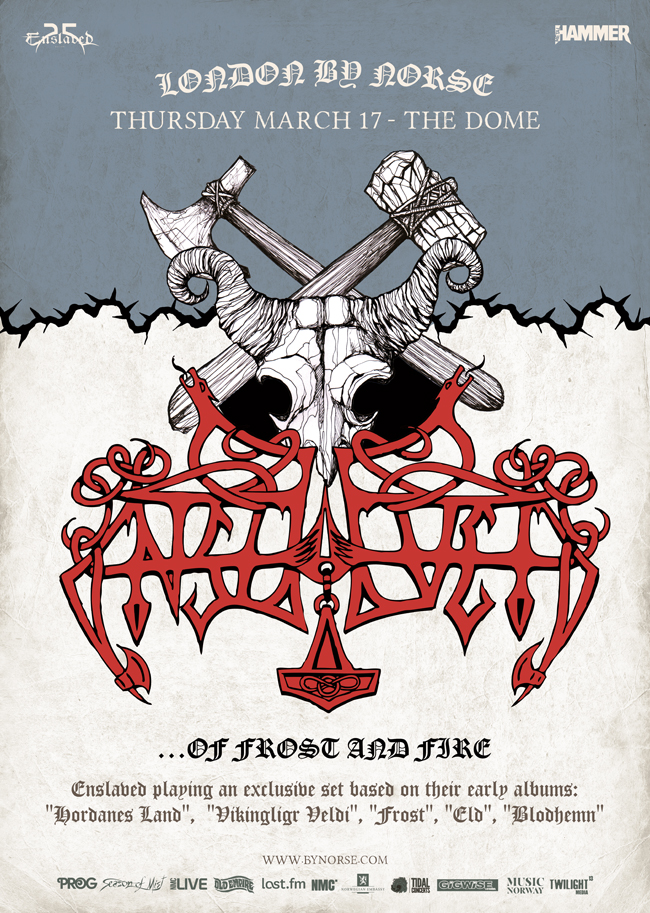
  • Enslaved 25 Night 1 – ‘…Of Frost And Fire’: Enslaved + Vulture Industries, The Dome, 2A Dartmouth Park Hill, Tufnell Park, London, N19 5QQ, England, Thursday 17th March 2016, 8.30pmmore information
  • Enslaved 25 Night 2 – ‘From The Runic Depths’: Enslaved + Helheim, The Underworld, 174 Camden High Street, Camden Town, London, NW1 0NE, England, Friday 18th March 2016, 8.30pmmore information
  • Enslaved 25 Night 3 – ‘Spinning Wheel Ritual’ show – Skuggsjá + Enslaved + Wardruna + Kristian “Gaahl” Espedal (art exhibition), The Coronet, 28 New Kent Road, Elephant & Castle, London, SE1 6TJ, England, Saturday 19th March 2016, 6.00pmmore information

Enslaved 25, night 1, 17th March 2016Regarding each night of Enslaved music, Ivar Bjørnson says “’…Of Frost And Fire’ represents the quintessence of Enslaved roots. From the legendary ‘Hordanes Land’ with its soundtrack-esque musical long players, via the vast geomythological canvases painted on ‘Vikingligr Veldi’; the revolutionary ‘Frost’ that lifted us out of the strict underground; and finally the odd pair – ‘Eld’, which pointed forward to a progressive future, and ‘Blodhemn’, where we had a last blowout of black metal tempos and inspiration. For anyone curious about where such an eclectic band like Enslaved came from, this will be a first-hand guided tour through the primeval landscapes that shaped us.
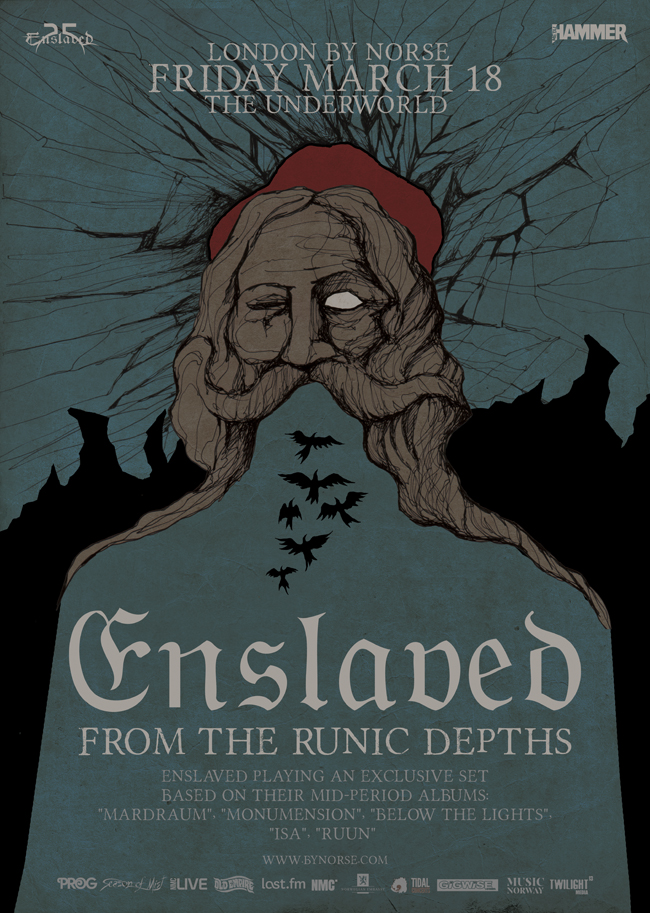
Enslaved 25, night 2, 18th March 2016“‘From The Runic Depths’ will explain the unlikely yet logical transition from then until now. From the nightmarish flirt with death and black on ‘Mardraum – Beyond The Within’; the spaced-out balancing act that is ‘Monumension’; the milestone and futuristic beacon ‘Below The Lights’; ‘Isa’, the second break for the band; and finally the refined prog-vs-extreme monument ‘Ruun’.

“‘Spinning Wheel Ritual’ is where the band wields together the dark roots with the psychedelic fabrics of the newer days – bringing to the surface the true potential of our songwriting and musical abilities. The focus is the same as it has always been – to bring to life our personal vision of whatever ‘good and meaningful music’ means to us, to create a vessel for atmosphere, deep association and simple enjoyment of music.”

Support on Night 1 comes from introspective Bergen progressive black metal band Vulture Industries, who describe their work as “dark, heavy rock vistas bent and twisted into living entities embodying the width and breadth of human emotion.” Support on the second date is by Helheim whose Viking black metal draws heavily on Norse mythology. On the third night, Wardruna will be performing a set of their own, making their second-ever appearance in the UK following an acclaimed Southbank Centre gig back in autumn 2013.
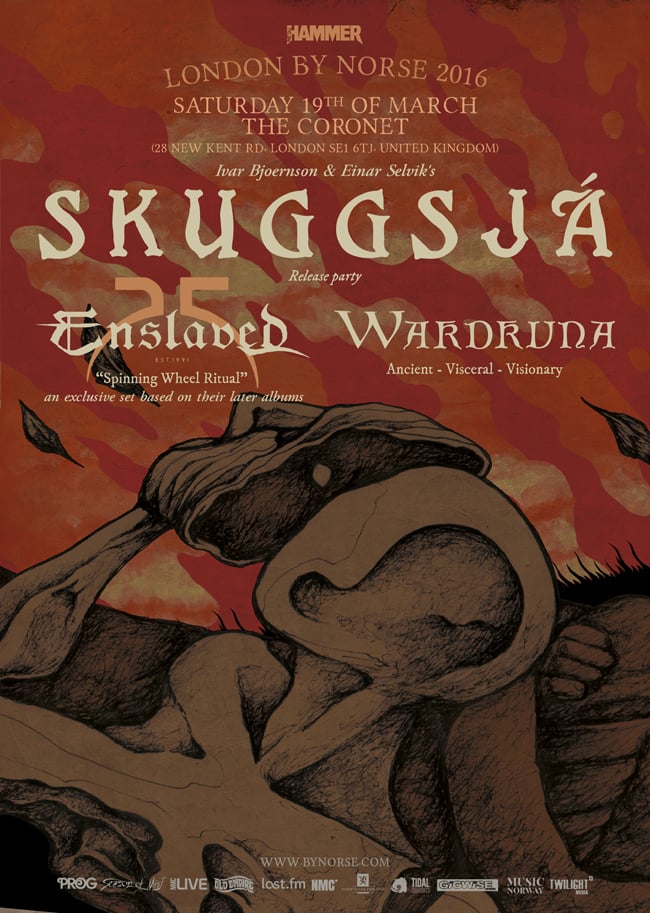
Enslaved 25, night 3, 19th March 2016The last part of the third-night show will be a performance of ‘Skuggsjá’ featuring all members of both Enslaved and Wardruna, plus visuals by reknowned extreme metal artist Costin Chioreanu (who’s previously collaborated with At The Gates, Mayhem, Darkthrone, Arcturus among others). This will be only the third performance of the piece to date, following its September 2014 premiere at the Eidsivablot festival at Eidsvoll (where the constitution was originally written) and its subsequent performance at the Roadburn Festival earlier this year.

It will also be a release celebration for the release of the ‘Skuggsjá’ album on Season Of Mist Records, which came out the previous week (on 11th March).

* * * * * * * *

One more thing. As you’ve read, another aspect of that final show will be an exhibition of artwork by Kristian “Gaahl” Espedal, the former Gorgoroth/current God Seed frontman who’s also a Wardruna studio member. Historically, Gaahl has been one of the more controversial figures in Scandinavian extreme metal: when at home, he’s even transcended the public anonymity of the metal scene to become an occasional tabloid bogeyman. It’s certainly true that he’s come on an interesting, turbulent and confrontational journey.

For part of the picture, you’re advised to check out some of his more unpleasant mid-‘90s pronouncements on race (here and here) – you don’t have to be a Christian, or even particularly staid and self-righteous, to find this stuff alarming. Set against this is the much more easygoing way in which Gaahl revealed his own homosexuality a decade later. While it would be a little crass to suggest that Gaahl was Scandi-metal’s Malcolm X, there’s certainly a suggestion that, like Malcolm, he’s learning as he goes: making a journey from rage into something more sophisticated: staying true to his history and mistakes while not letting them constrict him, or peg him to blunt anger and inhumanity.

It seems to be that the truth of all of this – the conflux of paganism and nationalism, the engagement of anger and art – is likely to be a tricky knot to unwind, and one which I’ll leave there for now. Perhaps these gigs are worth attending for the thrilling roar alone, with the complexities to be worked out later, Go and discover, if you’re interested, but I’m sure that Einar and Ivar – and Gaahl too – would want you to go in with your eyes and ears fully open.

* * * * * * * *

More March gig news is on the way…
 

March/April 2016 – upcoming gigs – Motherese (Aby Vulliamy, Laura Cole, Maria Jardardottir and more) in a mothers-in-arms jazz tour

6 Mar

I briefly mentioned the Motherese project in passing during the previous post (having found out about them as one of the several support bands in the Schnellertollermeir tour). For various reasons – not least that they seemed to be bringing a specific and structured practical ethos to their live experience, one which voyaged above and beyond the music – I wanted to follow that up…

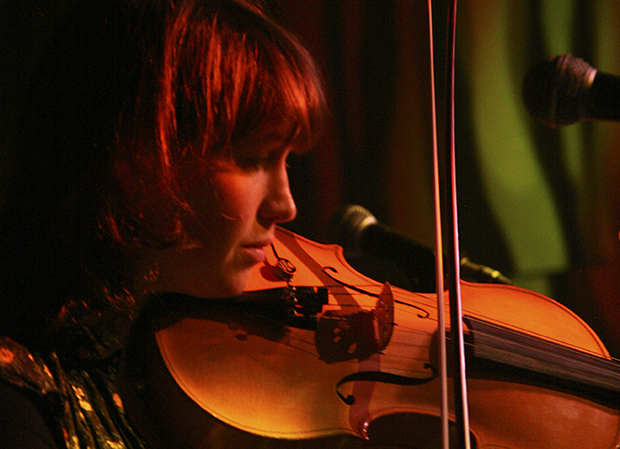
Aby Vuillamy, 2016

From what they themselves say, Motherese is/are “a band of mothers brought together especially for this year’s Women In Music Festival in Newcastle run by Jazz North East. The collaboration involves a core trio of composers and improvisers, using an exciting combination of pre-composed music, structured improvisation and free improvisation, loosely exploring the theme of parenthood. The core trio have several dates booked in various cities, and in each place, they will be joined by local musician mothers, whose impromptu contributions will be incorporated with flexibility, sensitivity and creativity; all necessary attributes for parents adapting and responding to their families’ ever-changing needs.

“The organic and spontaneous nature of the whole process, in terms of writing, developing and performing the work, reflects our experience of motherhood; we’ve felt very inspired and excited and energised, as well as a little lost and overwhelmed at times. We’re confident that the music will be interesting and challenging and exciting and beautiful and moving at times, and we hope folk will want to come and experience it.”

Sounds good…

The group is led by Aby Vulliamy, a multi-instrumentalist, composer and constant collaborator across multiple disciplines. In addition to ongoing work with Stevie Jones’s brain-rattling acoustic music project Sound of Yell and Bill Well’s National Jazz Trio of Scotland, this includes experimental rock (via a teaming with Faust’s Hans Joachim Irmler), indie rock (Norman Blake, Aidan Moffat, assorted Belle & Sebastian spin-offs), old and new folk strains (via work with Bridget St John, Mary Hampton, Ali Roberts, Lucy Farrell, The Trembling Bells and Mike Heron) , orchestral music (Scottish Chamber Orchestra, BBC Scottish Symphony Orchestra) and the jazz/improv field (Evan Parker, Matt Bourne, Maggie Nichols, Karen Mantler, John Tchicai and many others).

Though she can also play piano and musical saw, Aby concentrates on singing and playing viola for Motherese as well as handling the bulk of the composing, which is based around her recent musical explorations of the theme of motherhood. Aby also works as a music therapist, something which profoundly affects the working ethos of this new project. In addition to sharing the experience and challenges of motherhood, the two other core members of Motherese share sympathies or practical parallels (or both) with this latter strand of Aby’s work.

Singer/pianist Laura Cole has won plaudits as an established leader or co-leader of multiple bands in her own right. These include the Leeds-based Bennett Cole Orchestra and the London jazz-folk sextet Metamorphic (for which she’s also the main composer/arranger) and she also plays in Martin Archer’s percussion-heavy twelvetet Engine Room Favourites. However, she’s a past sufferer of both depression and Repetitive Strain Injury. Though recovered, she speak openly about both of these conditions and about their impact on her and (by extension) on other people, instead of submerging this part of her history under a brittle faux-professionalism.

The third member of the trio is Norwegian improvising singer Maria Jardardottir, who keeps herself busy with a frightening number of jazz and contemporary music projects. Performing as electro-acoustic solo project Melatonin, with singer-songwriter duo Caer Caradoc and with free improvisation trio Endenor, she’s also a member of the voice ensembles Røyst Trio and Curious Voice Duo (plus the former’s cross-arts collaboration project WoCalling) as well as a composer for the all-female nine-piece chamber ensemble evamigra. On top of this, Maria’s an Iyengar Yoga teacher interested in “the voice and body as one organic instrument for a natural, playful and raw expression of inner processes… serving the moment with openness, curiosity and a wish to share what is unspoken…”

All of these shared preoccupations throw up further questions and potential answers. Musicality and its wider implications, including its impact on health and wellbeing. The intricately interspersed and interstitial nature of how one simultaneously makes one’s way as striver and as parent. Interest in what a maternal perspective might add to the business of making music; and ideas of mutual support extending beyond simple musical gangs and artistic movements and into the fabric of a broader life. There’s nothing new about these ideas, but they’re often blurred into the background, If feminism, at its roots, is about shaping a better world by bringing constructive female perspectives into play, improving life for everyone, here – in the often oblivious, self-indulgent world of high-art music making – is an example of it in action.

It’s also true that similar initiatives exist up and down the country – I’ve seen similar things at the odd Ladyfest, and there’s probably one anywhere where there’s a community of inquisitive women whose explorations overlap health and music – but it’s rare and refreshing to see musicality of this strength brought to bear on one of them. Hopefully it might become less rare.

* * * * * * * *

So far, Motherese have three shows lined up:

Jazz North East present: “Women Make Music”:
Motherese + Jennifer Parry + Zoe Gilby Trio
Literary and Philosophical Society, 23 Westgate Road, Newcastle-upon-Tyne, NE1 1SE, England
Tuesday 8th March 2016, 8.00pm
more information

This debut gig feature Motherese in its core trio format, with Tynesider and experimental folk-jazz singer Zoë Gilby in support. Zoë blends a scat-bebop singing style drawn from voice pioneer Sheila Jordan with the 1970s art-pop and songwriter-folk methods of Kate Bush, Joni Mitchell and Pink Floyd, brings a clutch of original songs with her and also has a taste for transforming classic and challenging jazz compositions by the likes of Thelonious Monk into new songs by adding her own carefully thought-out lyrics. A musician who thrives on restlessness and change, Zoë’s albums and live shows have constantly seen her revise her approach, whether it’s by using loop technology to deliver a textured tribute to the versatility of the human voice, making herself part of a free-improv trio of relative strangers, or simply rejigging interpretations of the Great American songbook. For her WMM set, Zoe will be accompanied by her own Trio (featuring regular musical partners Mark Williams and Andy Champion).

Between the two groups, and adding yet another dimension to the evening, local artist Jennifer Parry will present a multimedia performance, manipulating pre-recorded vocals and projections to create a unique and shape-shifting environment.

Given the Motherese setup and working methods, it’s not impossible that Zoë and Jennifer may also augment the headliners for an expanded performance…

Fusebox presents:
Schnellertollermeir + Motherese
The Fox & Newt, 9 Burley Street, Leeds, LS3 1LD, England, Friday 18th March 2016, 8.00pm
more information

Supporting Swiss avant-rockers Schnellertollermeir on the Leeds leg of their Anglo-Irish tour, this gig sees Motherese augmented by Yorkshire-based guest vocalists Kari Bleivik (Maria’s Norwegian compatriot and colleague in Røyst Trio and WoCalling, as well as singer with Vehere and The Tommy Evans Orchestra, among others) and Stephanie Hladowski (who shuttles fluidly between pop, folk and reggae with a wide number of bands and projects – time allowing). A late addition to the bill is singer Cath Campbell, who’ll also be joining the Motherese huddle.

The Glasgow show – part of April’s Counterflows Festival – is a much less constrained event. Not simply a straightforward gig, it lets us see (and interact with) Motherese within the project’s full potential.

Counterflows Festival presents:
Motherese: Aby Vulliamy + Maria Jardardottir + Laura Cole + Nerea Bello
Glad Café Foundation & Bar, 1006A Pollokshaws Road, Glasgow, G41 2HG, Scotland
Sunday 10th April 2016, 11.00am
– free event – more information

At this gig, the group promise “a fun and accessible music workshop, with support from music therapist and trombonist George Murray plus some local guest musicians including Basque singer Nerea Bello (from post-punk folk improvisers Tattie Toes). Inviting volunteers from children and adults of all ages and abilities to ‘conduct’ the ensemble in whatever manner they like (anything from minimal eye movements to free-style dance), we will create a thrilling and intimate experience of interactive music-making, using instruments, body percussion and vocalisations.

The workshop explores concepts of ‘attunement’ (mirroring and tuning into the feelings behind actions and facial expressions) and cross-modal communication (eg translation from movement to sound and vice versa), both of which are powerful aspects of the instinctive relationship between a pre-verbal baby and parent. Activities will culminate in a ‘musical group self-portrait’, a vibrant and dynamic experience of spontaneous group expression, proving that whatever our age or ability, we are all inherently musical.”

If you’re interested in pursuing this deeper aspect of the project, three half-hour workshop sessions take place during the morning (the first one being at 11.30am) with the formal performance happening at 2.00pm.

March 2016 – upcoming gigs – Cornish music celebrated via Daylight Music’s ‘Kernow In The Chapel’ (with Colin Leggo, The Wreckers Singers and Hanterhir)

4 Mar

Perhaps it’s down to living in a more-or-less successfully multicultural city, or perhaps my own bi-cultural roots (which, in spite of being mostly Anglo do at least span an ocean, a revolution and two different ways of pronouncing “tomato”), but I’ve always been suspicious of nationalism. To me it’s reductive and harsh: a way of simplifying and pruning identity, of promoting exclusion and narrow interests. Set against this is the fact that providing space for the voicing of different, even dissonant cultural identities makes for a wider, more inclusive broader culture. Music can be one of the easiest ways of doing this (although it can also be one of the first cultural tokens to be hijacked) and as part of the process of keeping myself interested and this blog more interesting, I’m trying to pick up on some of the more specifically nation-oriented music events that show up in London. (having covered Korean and Balinese-tinged events in the past), even if they might shade into more complicated or compromised political areas.

Despite my vague and wooly reticence above, I’m happy to say that the first of the two such events this month is as cute as chips (in keeping with the benevolent air surrounding Daylight Music, who are hosting it). This Saturday sees a performance of unrivalled Cornwall-ality as various people either from, or with roots in, or possessing some musical sympathy with the most westerly end of the British mainland show up to the usual Daylight corner of north London…

Kernow In The Chapel, 5th March 2016

Daylight Music presents:
Daylight Music 218 – Kernow In The Chapel: A Cornish Celebration (with Colin Leggo + The Wreckers Singers + Hanterhir + others t.b.c.
Union Chapel, Compton Terrace, Islington, London, N1 2UN, England
Saturday 5th March 2016, 12.00pm
– free/pay-what-you-like event (suggested donation – £5.00) – more information

“Saturday 5th March is St. Piran’s Day – Kernow (Cornwall)’s national day. To celebrate, we’re bringing a taste of Cornish culture, music, comedy and food to Daylight with ‘Kernow In The Chapel’, a sister event to the long-running Kernow In The City – London St.Piran’s celebration. There will be songs and comedy from Colin Leggo; a traditional Cornish ‘shout’ with songs in English and Kernewek (the Cornish language) from The Wreckers Singers; and Redruth-based Cornish-language psych-rockers Hanterhir playing an acoustic set. There will also be poetry, a soundscape of Cornwall sounds, proper pasties and a Cornish ‘cakey tea’. Tis gonna be ansum!”

Here are some ideas of what you’re going to get:


Sadly, the planned performance of Cornish classical music to round out the show has had to be abandoned due to musicians becoming unavailable, although some of the scheduled pieces may have been moved into the choral performance. Speaking of which, I can’t find a homepage or any embeddable audio/visual material for The Wreckers Singers. I suspect that they’re an illegal flashmob choir who issue forth from the Cornish underground whenever there’s a chance of enticing an audience over to a concert. They probably use some kind of sonic beacon, drawing hapless punters in with their roistering close-harmonies. (Oh, I don’t know. If you know who they are, send me a link, but don’t risk your life in doing so…)

* * * * * * * *

The second of this month’s events is a little more challenging. More on that shortly. It might have made for a more interesting juxtaposition with the Cornish event, but time is tight right now…

February 2016 – upcoming gigs – London noises, slurs and smears, continued – Baba Yaga’s Hut presents Roger Robinson & disrupt with School House; an evening of art/prog/math rock with Theo, Battleship Grey and Olympians

22 Feb

The third and last of a stream of Baba Yaga gigs this week dips us into dub, dub poetry and eerie electronica stews…

Baba Yaga’s Hut presents:
Roger Robinson & disrupt + School House
Cafe Oto, 18-22 Ashwin Street, Dalston, London, E8 3DL, England
Saturday 27th February 2016, 8.00pm
more information

Roger Robinson, 2015

In recent years, Hackney-born/Trinidad-raised poet and vocalist Roger Robinson has probably been best known for his work as one-third of King Midas Sound (in which he works with eclectic dub/jazzcore/dancehall/grime producer Kevin Martin and Japanese artist/singer Kiki Hitomi). However, he’s led a peripatetic solo career since the early ‘90s: starting out as a spoken-word performer, he’s written and performed a number of acclaimed one-man shows, toured the world on behalf of the British Council and released books of poetry. Since 2004 there have been solo musical releases and mixtapes including the spoken-folk album ‘Illclectica’ and collaborations with or reworkings of music by Oneohtrix Point Never, Ryuichi Sakamoto, William Basinski and Alva Noto.

Roger’s most recent work (set in 2011 at the time of the London riots, and partially achieved by lone walks around his sometime base of Brixton, improvising dub poetry into a dictaphone) is last year’s ‘Dis Side ah Town’ album – a detailed work of study and reportage on the impact, distortions and erasures of change and gentrification, with Brixton observed both in its own right and as a signifier for similar distortions in London and the rest of the world (read Neil Kulkarni’s recent ‘Quietus’ interview with Roger for more background on this).

Production work on the album was handled by disrupt – a.k.a. Jan Gleichmar, an East German computer-music whizz who grew up on the Soviet side of the Berlin Wall and progressed through assorted home-made dance stylings (variously Detroit techno, digital hardcore, gabba and electronica) before settling on digital dub as his expression of choice. Co-boss of the Leipzig-based dub/reggae netlabel Jahtari for over a decade, Jan started off on a cheap laptop but currently achieves his sound with homemade electronic gear, being interested in the textural and process effects of antique microchips and manual voltage control.

Tonight, Jan and Roger will be performing together in London for the first time, delivering live material from or informed by ‘Dis Side ah Town’ and bringing Roger’s observations and warnings back home.

The support act is School House, a solo project by Manchester composer Peter James Taylor (once the baritone guitar player for Bletchley noise-rock project Action Beat, now known for his distortion-rich, Branca-esque massed-guitar works exploring custom tunings, extended techniques and graphic notation).

School House provides Peter with opportunities to explore other areas. Although the project’s first release, ‘Soft Focus’, explored a spooky, textured minimalism using customised Yuri Landman guitars, last year’s ‘Herd’ album moved into electronic instrumentation, concentrating on glitch-rhythms and software drones while keeping some of the layers of guitar texture for what Peter describes as “roiling, gaseous and slow-moving nocturnal dread.” It’s this latter side of School House which will be on display tonight, accompanied by suitable visuals.

* * * * * * * *

Here’s news from east London on “an eclectic night of math rock, experimental rock and progressive rock”

The Game is Rigged presents:
Theo + Battleship Grey + Olympians
The Sebright Arms, 33-35 Coate Street, Bethnal Green, London, E2 9AG, England
Saturday 27th February 2016, 7.15pm
more information

Theo + Battleship Grey + Olympians, 27th February 2016

Most of the text below is by the promoter or other people, so links are provided where they’re due:

Theo is Sam Knight, a one-man-band from London who puts on an astonishing performance. His Soundcloud bio says “taut, chugging guitar loops layer up with frenetic tapping patterns that interweave in spiralling complexity before near sub-atomically precise, powerhouse drumming clatters and builds each song into juggernaut of riffs and rhythms. To achieve something like this recorded is one thing, but to see Theo perform live is quite another as each song blurs into the next and the dazzling guitar and drum acrobatics leave jaws sagging on the faces of all who bear witness to the talent on offer.”

Battleship Grey are an experimental rock four-piece from London who combine highly melodic, powerful vocal melodies with innovative, forward-thinking rhythms and sounds. Drama-rock threesome Ex Libras(who’ve shared a bill with them) have commented “they toy with experimental ideas in a way that is the opposite of pretentious because they always seem to be about the groove or the way the music pulsates. It is music after all right? It isn’t an equation, it isn’t a painting, yet they are math and art-rock and dance-y all at the same time. Head. Explode.”

Olympians describe themselves as “a band that lives half in Norwich and half in London. We have two guitars, a bass, some drums, a glockenspiel, two keyboards and a trumpet. The next instrument we plan to buy is a vibraphone. We hope you like our songs.” A few years ago, multimedia obscure-music platform ‘Rightchordmusic‘ said “their sound is hard to pin down, with math rock roots, fused with barber-shop ‘Spring Offensive’ esque harmonies and plenty of instrumentation and experimentation. It’s a soaring piece of harmonious yet downbeat melancholic pop that gets better with ever listen. We’re smitten.”


Sounds and visions provided above. Draw your own conclusions.

* * * * * * * *

More shortly – Eddie Parker, Project Instrumental, and an even-more-typically-loose-than-usual Daylight Music show…

February 2016 – upcoming gigs – London noises, slurs and smears – More News from Nowhere presents Simon Bookish, Sharon Gal and Deathcount in Silicon Valley); Baba Yaga’s Hut presents Joe Gideon (featuring Jim Sclavunos) with John J. Presley, and Mugstar with Henge and Cavalier Song

21 Feb

From where I’m standing, it’s looking like a mostly noisy and left-field week. Here’s the first bit of it…

* * * * * * * *

More News from Nowhere presents:
More News from Nowhere #4 – Simon Bookish + Sharon Gal + Deathcount in Silicon Valley
The Victoria, 186 Hoe Street, Walthamstow, London, E17 4QH, England
Wednesday 24th February 2016, 8.00pm
more information

More News from Nowhere #4 , 24th February 2016

From the organizers:

“More News From Nowhere – Walthamstow’s regular night of new and interesting music – returns with a double headline performance.

“Experimental vocalist Sharon Gal is a widely respected figure on London’s improvised and avant-garde music scene – she’s worked with Steve Noble, David Toop. Steve Beresford and Thurston Moore amongst others, and is a founder of Resonance FM.

Simon Bookish, the alter-ego of performer/composer Leo Chadburn, fuses his classical training and experimental leanings with electronic instrumentation and a pronounced pop sensibility. He’ll be performing his latest release – ‘Red And Blue’, released this January (“a collision between digitally-processed brass and distorted synthesizer drones; atonal electronic pop and drifting field recordings; spoken word and unearthly vocalisations” inspired by the ‘special relationship’ between the US and UK governments during the Cold War) as well as a new version of his ‘Trainwreck’ project from 2007.

“Support comes from Walthamstow’s own Deathcount in Silicon Valley aka MNFN friend and co-conspirator Andi Nixon, who makes “ominous frazzled sci-fi scores” and will be performing his tribute to the film ‘Scanners’.”

* * * * * * * *

For the following three nights, there are three Baba Yaga’s Hut events in a row. Here’s notes on the first two, with the first one being something for lovers of scuzzed-up song…

Baba Yaga’s Hut presents:
Joe Gideon + John J. Presley
Corsica Studios, 5 Elephant Lane, London, SE17 1LB, England,
Thursday 25 February 2016, 8.00pm
more information

Joe Gideon, 2015

This week sees the return to live action of Joe Gideon, who first came to attention in 2002 as leader of Americana-tinged post-rockers Bikini Atoll (which also featured his sister Viva on keyboards). Joe and Viva went on to form the critically acclaimed brother/sister avant-blues duo Joe Gideon & The Shark, in which Joe clanked trash guitar and drawled absurd, witty tales in Beatnik slang while Viva drummed, mixed in keyboards and beats, and layered a spooky background of looped vocals.

Two acclaimed albums later – 2009’s ‘Harum Scarum’ and 2013’s ‘Freakish’ – Joe and Viva have parted ways. While Viva busies herself with different musical work (including an appearance with Loose Meat for ‘Inside The Sun‘) and acting in video games (having won an award for her work in reconstructive crime tale ‘Her Story‘ last year), Joe’s continued his own work with a solo album – ‘Vice Versa’, recorded and released in 2015 with an all-star squad of Jim Sclavunos (Bad Seeds) on drums, Ed Harcourt on keyboards and Duke Garwood on horns. Jim’s stayed in the live band: following a London debut back in November and a guest spot at a Lee Hazelwood tribute, they’re back for a second full live show at Corsica Studios.

Support comes from John J. Presley, the Walsall-born songwriter and guitar who feeds his own take on freeform storytelling blues through a mess of noisy downtuned guitar, alternate tunings and drones (backed up with drums, Rhodes piano and harmonium.)

The second show features more outright noisiness; it’s a more typically Baba Yaga-esque soup of psychedelic noise, sludge and hints of prog…

Mugstar, 2015

Baba Yaga’s Hut presents:
Mugstar + Henge + Cavalier Song
Electrowerkz @ Islington Metal Works, 5 Torrens Street, Islington, London, EC1V 1NQ, England
Friday 26th February 2016, 8.00pm
more information

With a new record poised for launch at the start of March, long-established Liverpudlian psykraut space-rockers Mugstar are headlining the show. Their dour-dark mantra instrumentals wed lugubrious organ drones and Morricone/Labradford-ian guitar parts with guttering smears of noise, while occasional distant snatches of speech or song flicker into hearing like tiny, frayed, long-ago rags impaled on endless wire fences.

Originally, Steve Gullick’s flinty moodists Tenebrous Liar were scheduled as the first support band. Their decision to split up last November has cleared the way for some gig-sullying from Henge. These London psych-sludgers belch out hanging, polluted, noise clouds through which singer Loz Chalk delivers his scratched, timorous, and fearful yells, his ankles enmired in dragging pace and guitar fry.

For my money, the most interesting band of the night is the one that’s opening the show. Elusive Liverpudlians Cavalier Song are Henge friends and tourmates (having played with them in Nottingham and London earlier in this month), have occasionally rolled out tracks on Soundcloud over the past five years, and released their debut album ‘Blezards’ only last month, delivering “soundtracks to earth, man and machine, the outdoors, the indoors and constant shift.” Sitting on a cusp between Swans and King Crimson (both of whom they claim are influences), they sound like a prog band in which the brain hemispheres are falling away from each other. Some pieces clench and raise the tension in their dissonances, their rapid rhythmic and dynamic transformations, while others engage in tearing, shifting Frippish drones. Panic, chaos and a liberated excitement loom as possibilities among the brutal rips of guitar, the resonating overtones and the low-hanging atmospherics; yet the band lean on – and sustain – that moment when form and skills of structure and rapid response still remain.

Other noise bands simply plod and accumulate: Cavalier Song sway and shift; light-footed knife-fighters, their eyes and attention flicking this way and that while keeping a deadly focus. Sod it. Make sure you turn up early. This is how it’s meant to be done.

More on the third Baba Yaga night, and a little more, shortly…

December 2015 – the last of the Christmas gigs, part 3 – a Yuletide math rock growler with Axes, Shitwife, Vasa and Wot Gorilla); Kavus Torabi rides with mummers in Deptford; and Café Oto sees in the New Year with Hieroglyphic Being

17 Dec

Back to the centre of London for some no-nonsense math rock, post-hardcore and brainwork with knuckles… and what could be more festive and seasonal than a band called Shitwife?

TINJR Xmas Party with Axes, Shitwife, Vasa & Wot Gorilla (This is Not Revolution Rock/Jebs Presents @ The Borderline, Orange Yard, off Manette Street, London, W1D 4JB, England, Saturday 19th December 2015, 7.00pm) – £8.50-£9.60 – informationtickets

“Absolutely buzzing for this show. Not only will this be the Xmas party for This Is Not Revolution Rock / Jebs Presents, it marks Del’s 30th birthday and 200th show as a promoter. So we’re really pushing the boat out and there might be some free mince pies. Please spread the word and let’s pack the venue out from start to finish for this, the last show we’re putting on in 2015!”

(They’re so carried away by the occasion that they didn’t really introduce the bands… or assumed that everyone reading would know them. I’m in a hurry, so here’s the one-line version.

Axes – brash and playful mathrockers with a Foo Fighter pop vigour.
Shitwife – astonishingly brutal drums/laptop/electronics juggernaut fusing rave, death metal, noise and post-hardcore. Side project of musicians in bands with equally tasteful names.
Vasa – noisy synesthesic post-rock package.
Wot Gorilla? – how to noodle away at prog-inspired math rock and not alienate people.


* * * * * * * *

Here’s Knifeworld’s frontman (and eccentric broadcaster, in every sense) heading over to Deptford to dig up something old for the end of the year…

Dear Boss, 20th December 2015

Dear Boss: Kavus Torabi and others (The Bird’s Nest, 32 Church Street, Deptford, London, SE8 4RZ, England, Sunday 20th December 2015, 4.00pm) – free entry – information

It’s Chri-i-i-i-i-i-i-i-i-istma-a-a-a-as! Join us as we are joined by avant-psych-rock multi-instrumentalist and all round Interesting Alternative guy Kavus Torabi (Knifeworld/Guapo)…(Mr. Steve Davis sadly can’t join us, as he’s gone skiing). And… come early to witness one of England’s strangest and most resilient midwinter traditions – ‘The Christmas Champions’ (a.k.a ‘The Mummers Play’). Our team of Jolly Boys and Guisers will offer up some seasonal shambols – preparing to entertain you with a short performance featuring William the Great, St George, Bull Slasher, The Doctor and old Beelzebub himself – with original music from James Larcombe (Stars in Battledress/North Sea Radio Orchestra). We’ll be doing it around 7-ish, I expect.

Boss. Wassail!

Beyond all of the throaty bombast I think that most of what’s beyond the mummery is DJ sets, although anyone who’s tuned in to Kavus on the Interesting Alternative Show will know that he can slap together some of the most extraordinarily eclectic sets you could ever hope to hear, featuring plenty of names you’d never heard, while telling cheerful lies about other cult artists who don’t actually exist. Fun to catch, in other words.

* * * * * * * *
On the subject of DJ sets, here’s one last one…

Hieroglyphic Being

Café Oto NYE Party with Hieroglyphic Being 6-hour DJ set) (Café Oto, 18-22 Ashwin Street, Dalston, London, E8 3DL, UK, 31st December 2015, 10.00pm) – £20.00-£30.00 – informationtickets

We’re ecstatic to be welcoming in the New Year with Jamal Moss (a.k.a. Hieroglyphic Being), who will be flying in especially to Café Oto for a bumper 6 hour DJ set.

Jamal is one of the most unhinged and adventurous artists working in electronic music today; born in Chicago and raised in the heyday of the city’s house music scene, he has gone on to blur the lines between various forms of dance music, free jazz and industrial music, releasing countless singles and LPs, and even recently collaborating with the likes of Marshall Allen and Daniel Carter. His infamously unpredictable DJ sets have gardened considerable praise over the years, so we’re delighted to have him here for this very special occasion.

* * * * * * * *

And that’s it – although there’ll be a ramble through 2015 sometime between now and the end of January, and I may sneakily shuffle a few previously-incompleted posts back into the dates when I intended to publish them.

See you later.

December 2015 – the last of the Christmas gigs, part 2 – in London, a Momentum Arts Xmas Fundraiser (with The Marzec Group, Mariela of Venus on the Radio, Maz O’Connor and Keith Burstein); a spill of art-punk-psych-rock bands and a shamisen at the Firstivus; and a Christmas Cabareilidh in Stoke Newington

17 Dec

Back in London, Momentum Arts are setting themselves going with a Christmas gig tomorrow. They’ve got roots in, and are closely associated with, the Jeremy Corbyn movement, so the politically averse/committed should expect speeches and some familiar political faces to be included in the package along with the music. You can find out exactly who’s speaking, and in some cases what about) by following the information link). Personally, I share quite a few of their sympathies; but here’s what they have to say:

Momentum Arts Xmas Fundraiser with The Marzec Group + Mariela of Venus on the Radio + Maz O’Connor + Keith Burstein + others (Momentum Arts @ POW/The Prince of Wales, 467-469 Brixton Road, Brixton, London, SW9 8HH, England, Friday 18th December 2015, 7.00pm) – £6.00-£7.00 – informationtickets

Momentum Arts is an open network where creative people from all walks of life and lovers of the arts can unite through a shared passion for contemporary progressive, socially democratic politics. We are very proud of this and always aim (as far as possible) to create organising spaces which are safe for all. For this reason we’ll be operating on a zero tolerance policy for homophobia, racism, classism, transphobia and misogyny. We’re excited to present the first Momentum Arts event upstairs at the Prince Of Wales in Brixton! Get down to hear our excellent speakers, some inspiring music or just have a bit of a dance.

Performing:

The Marzec Group‘s appreciation for the club culture and electronic music genres brings back a reality to jazz; a grit long forgotten. Channelling these influences through a fresh and sophisticated combination of jazz, soul, blues and electronic music, their intense and improvisatory grooves are tailor made for the dancefloor.

Mariela is a girl of many hats; a musician and published author influenced by the likes of Jeff Buckley, Nina Simone, Jack White, Sergio Moroder and many others. With longtime collaborator Anthony she formed Venus on the Radio, a band which after recording in Abbey Road studios, was featured in BBC Introducing.

Maz O’Connor is a gifted singer of traditional and self-penned songs. Influenced by the folk songwriters of the 1960s; Bob Dylan, Joni Mitchell, Nick Drake, Neil Young along with her literary leanings make for a varied and intriguing body of work.


Keith Burstein is a composer whose work includes controversial operas which have provoked much comment and indignation from the right-wing press for daring to question the political establishment. Most notable among these is ‘Manifest Destiny’ (co-written with Dic Edwards) which portrays would-be suicide bombers who renounce violence and trigger a peace movement across the world. Keith will be performing two songs on piano, with a guest singer.

DJs Dr Punkenstein and Calvin De Kline will also be playing sets.

* * * * * * * *

In Deptford, something a little more straightforwardly musical:

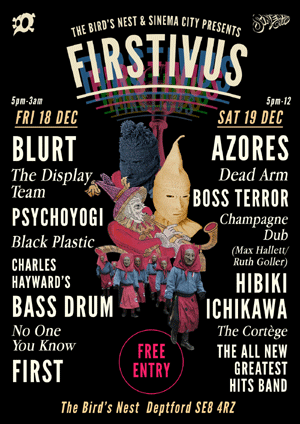
Firstivus (The Bird’s Nest, 32 Church Street, Deptford, London, SE8 4RZ, England, Friday 18th December to Sunday 20th December 2015, 5.00pm onwards) – free – information & tickets

Firstivus 2015

Two Deptford gig-scene lynchpins, Sinema City and Tom Moody –join forces for this year’s Firstivus – “a fun-filled weekend that will likely proved to be just a little too rhythmically-challenging for the whole family.”

Friday 18th opens, appropriately, with First (about whom no-one seems to know anything), followed by a pair of noisy drum-and-guitar duos (Charles Hayward‘s Bass Drum project with his son Riley Hayward, then the more secretive No One You Know). The music continues with garage-grungers Black Plastic Cardiacs/Bungle/Zappa-inspired progressive punk tanglers The Display Team, Gong-esque jazz-rock collisionists Psychoyogi, and finally by Ted Milton’s veteran schizo-disco art-punks Blurt (who are informed by poetry and puppeteering as much as by rock and roll).


Saturday 19th sports another diverse roster – stoner rockers The Cortège, the ”post-punk/alt-pop/awkward friendliness” of Dead Arm, The All New Greatest Hits Band (in which event organiser Tom Moody fronts the rhythm section of The Display Team), an acoustic Japanese interlude with shamisen player Hibiki Ichikawa and Champagne Dub, a new teaming of established friends: polydiscipline drummer Max Hallett (of A Scandal In Bohemia/Super Best Friends’ Club) and bassist Ruth Goller (Acoustic Ladyland, Oriole, Bug Prentice, many others), who’ve previously worked together in the encym trio. The evening rounds off with Afrobeat-ing Leeds post-punk trio Azores and headliners Boss Terror (who bring “drone, punk, spaced-and-motorway funk” as well as “Cockney tropical surf”).


* * * * * * * *

To be honest, I’ve got little idea of what’s going to happen with this next one, especially since it’s at The Others – but all of the clues point to a fusion of music, theatre and audience, and what time of year is better for that?

The Christmas Cabareilidh 2015

The Christmas Cabareilidh (Troupe @ The Others, 6-8 Manor Road, Stoke Newington, London, N16 5SA, UK, Saturday 19th December 2015, 8.00pm) – £8.00 – information & tickets

A brand new night out that fuses the fabulous fun of cabaret with the gaiety of a good old fashioned ceilidh. Fresh from the success of our last sell-out event, Troupe presents another Christmas Cabareilidh that promises to be even more delightful than the evening’s portmanteau. You’re invited to sit under the glowing haze of fairy lights, as our hilarious cabaret performers fill you with festive cheer. Dance with giddy abandon to the live folk music of our Cabareildih band and fill your stomachs and hearts with mulled wine, minced pies and cheery Christmas carols. Join us at The Others for an evening of irreverent yuletide song and dance- because nothing says Christmas quite like a Cabareilidh!

* * * * * * * *

More shortly…

December 2015 – last gigs before Christmas, London & elsewhere – Phantom Chips and Matt Loveridge’s MXLX play More News From Nowhere; mix’n’match improvising at The Hat Speaks; and the rest of the London Contemporary Music Festival 2015.

13 Dec

Well, actually this is the first of the next-to-last gigs post of the year (I’ve still got to do the second round of Christmas parties). Apologies for terseness and excessive recycling of press-release blurb, but there’s a lot to pack in both here and elsewhere this month.

About half of these gigs are seriously avant-garde concerts for the London Contemporary Music Festival, with even more of a blizzard of links and odd video clips than usual. I’m also starting with a couple of full-on jazz or electronic improvising gigs.

* * * * * * * *

More News From Nowhere #2

MXLX/Phantom Chips (More News From Nowhere @ The Victoria, 188 Hoe Street, Walthamstow, London, E17 4QH, UK, Wednesday 16th December 2015, 8.00pm) – £5.50-£7.00 – informationtickets

Walthamstow’s newest (and only?) regular night of experimental/noisy/generally interesting music, returns with sets of bracing electronic experimentation from Phantom Chips and MXLX(the amazingly prolific Matt Loveridge, aka Fairhorns, Team Brick, and one third of BEAK>, among others), as well as the MNFN DJs playing ’til late.


* * * * * * * *

The Hat Speaks, 17th December 2015

The Hat Speaks (LUME @ Hundred Years Gallery, 13 Pearson Street, Hoxton, London, E2 8JD, England, Thursday 17th December 2015, 7.30pm) – pay-what-you-want (£5.00 minimum) – information – tickets on the door

For our last gig of 2015 we return to Hundred Years Gallery in Hoxton, for the second edition of our dice-and-hat improvised music night. We held the first one in July to celebrate our second birthday, and it was so much fun we decided to do it again. As before, a nebulous ensemble of UK improvisers will gather to make spontaneous music together. This time the list looks like this:

Alison Blunt (violin, voice, assorted instruments) – Alex Bonney (trumpet) – Dee Byrne (saxophone) – Tim Fairhall (double bass) – Tom Greenhalgh (guitar, voice) – Anton Hunter (guitar) – Andrew Lisle (drums) – Percy Pursglove (trumpet, double bass) – Martin Pyne (percussion) – Tullis Rennie (trombone and possibly field recordings) – Ed Riches (guitar) – Cath Roberts (saxophone) – Tom Ward (saxophone, bass clarinet) – Colin Webster (saxophone) plus a couple more to be confirmed.

Taking inspiration from long-running Manchester night The Noise Upstairs (founded by Anton Hunter and Tullis Rennie, no less), we will put all the players’ names into a hat, throw the dice to determine how many musicians will play, and then draw out the names. The result is lots of mini- sets from often completely new combinations of people! (Some groups from last time have decided to carry on playing together too: Tom Ward and Adam Fairhall are now collaborating on a new quartet for 2016 after their hat encounter in the summer).

Do join us for this last gig of the year – it’s been a blast, so let’s see it off in style! Entry, as usual, is one Bank of England note of your choice.

* * * * * * * *

And to close, here’s that run-down through the remaining London Contemporary Music Festival concerts.

LCMF 2015 - Chris Watson's ‘Okeanos’

LCMF 2015: Chris Watson premiere (London Contemporary Music Festival 2015 @ Ambika P3, University of Westminster, 35 Marylebone Road, London, NW1 5LS, England, Monday 14th December 2015, 7.30pm) – (probably) £11.75 – information – advance tickets sold out: limited tickets available on the door.

We present the world premiere of a monumental new work by sound artist and recordist Chris Watson. Drawing on extensive underwater recordings gathered by the artist from oceans around the world, ‘Okeanos’ – a multi-channel sound installation that will play in complete darkness – celebrates the songs, rhythms and music of the oceanic depths.

LCMF 2015 - To A New Definition Of Opera II

LCMF 2015: ‘To A New Definition Of Opera II ‘ (London Contemporary Music Festival 2015 @ Ambika P3, University of Westminster, 35 Marylebone Road, London, NW1 5LS, England, Tuesday 15th December 2015, 6.30pm) – £11.75 – informationtickets

In an attempt to shift our perception of what opera can do and be, we present a second instalment of ‘To A New Definition of Opera’, in which performance, video art and neglected modernist opera rub shoulders. Alongside a new commission from British performance artist Sue Tompkins, the night will include composer Tim Parkinson’s apocalyptic anti-opera ‘Time With People’ (performed by the University of Huddersfield’s edges ensemble) and Los Angeles-based artist Ryan Trecartin‘s dystopian film ‘CENTER JENNY’.

The centrepiece of the evening will be the UK premiere of Karlheinz Stockhausen’s celebrated ‘Pieta’ from ‘Dienstag aus Licht’, with the voice of Lore Lixenberg and flugelhorn of Marco Blaauw. Interlaced throughout the evening will be an extremely rare performance of excerpts from Ezra Pound’s troubadour opera about medieval ne’er-do-wells, ‘Le Testament de Villon‘, which critic Richard Taruskin called “a modernist triumph.”

Programme:

Ezra Pound – excerpts from ‘Le Testament de Villon’ 1926 version (UK premiere) – performed by Lore Lixenberg (voice), Aisha Orazbayeva (violin), Lucy Railton (cello), Ian Sankey (trombone), Serge Vuille (percussion) Christopher Stark (conductor)
Karlheinz Stockhausen – Pieta from ‘Dienstag aus Licht'(UK premiere) – performed by Marco Blaauw (flugelhorn) and Lore Lixenberg (voice)
Ryan Trecartin – CENTER JENNY
Tim Parkinson – Opus 1, 2, 3 and 4 from ‘Time With People’ – performed by edges ensemble: John Aulich, Mira Benjamin, Jorge Boehringer, Eleanor Cully, Beavan Flanagan, Stephen Harvey, Dorothy Lee, Asher Leverton, David Pocknee and James Woods
Sue Tompkins – Like Sake (world premiere, LCMF commission) – performed by Sue Tompkins

LCMF 2015 - A Martian Sends A Postcard Home

LCMF 2015: ‘A Martian Sends A Postcard Home’ (London Contemporary Music Festival 2015 @ Ambika P3, University of Westminster, 35 Marylebone Road, London, NW1 5LS, England, Wednesday 16th December 2015, 6.30pm) – £11.75 – informationtickets

‘A Martian Sends A Postcard Home’ takes its name from a poem by Craig Raine that sought to re-see the world through bold acts of defamiliarisation. This night celebrates the Martianist turn in music, with an exploration of composers who have made the familiar fresh.

The night will include the European premiere of Norwegian composer Øyvind Torvund‘s lawless chamber work ‘Untitled School/Mud Jam/Campfire Tunes’, performed by the Plus Minus Ensemble, and Andrew Hamilton‘s electrifying ‘music for people who like art’. In ‘Mezcal No. 8’ Swedish composer/performer Hanna Hartman transforms a copse of steel rods and washers into a sounding presence.

We honour two standard bearers of “making strange” in composition: Helmut Lachenmann and Dieter Schnebel. Aisha Orazbayeva performs Lachenmann’s ‘Toccatina’ alongside a recital of Russian poems by Mayakovsky and Yesenin that live and breathe the idea of estrangement or ostranenie. Meanwhile, composer and musician Christian Kesten‎ presents Schnebel’s celebrated ‘Maulwerke’ where vocal technique is pulled apart into its constituent parts, alongside his own ‘Zunge Lösen’ that seeks to stage the tongues of three performers.

Artist Tino Sehgal takes on the body, intellectual property and materiality itself. ‘Instead of allowing some thing to rise up to your face dancing bruce and dan and other things’ is his earliest “livework”. It sees performer Louise Höjer transformed into, in the words of ‘Frieze Magazine’, a “hydraulic android”.

The night ends with a visit from Cairo’s E.E.K. Under the fingers of Islam Chipsy (accompanied by drummers Khaled Mando and Islam Tata), a digital keyboard is wrenched into explosive new sonic territory, articulating the sound of post-Tahrir electro-chaabi.

http://www.youtube.com/watch?v=AQOoGSB-Nos

Programme:

Tino Sehgal – Instead of allowing some thing to rise up to your face dancing bruce and dan and other things – performed by Louise Höjer
Selected poems by Vladimir Mayakovsky and Sergei Yesenin – performed by Aisha Orazbayeva (voice)
Helmut Lachenmann – Toccatina – performed by Aisha Orazbayeva (violin)
Christian Kesten – Zunge Lösen (Releasing the Tongue) – performed by Christian Kesten (voice)
Andrew Hamilton – music for people who like art – performed by Becca Carson (piccolo), Ausiàs Garrigos Mórant (bass clarinet), Ian Sankey (trombone), Sam Wilson (percussion), Jack Ross (electric guitar), Siwan Rhys (piano), Joanne Evans (voice), Eloisa Fleur-Thom (violin), Valerie Albrecht (viola), Oliver Coates (cello), Martin Ludenbach (bass guitar), James Weeks (conductor)
Dieter Schnebel – Maulwerke (2015 solo version) – performed by Christian Kesten
Hanna Hartman – Mezcal No. 8 (UK premiere) – performed by Hanna Hartman
Øyvind Torvund – Untitled School/Mud Jam/Campfire Tunes (European premiere) – performed by Plus Minus Ensemble: Mark Knoop (piano), Roderick Chadwick (piano), Serge Vuille (percussion), Elsa Bradley (percussion
Islam Chipsy & EEK – live set

LCMF 2015 - Requiem for Reality

LCMF 2015: ‘Requiem for Reality’ (London Contemporary Music Festival 2015 @ Ambika P3, University of Westminster, 35 Marylebone Road, London, NW1 5LS, England, Thursday 17th December 2015, 6.30pm) – £11.75 – informationtickets

Some call it post-internet art: others “the New Aesthetic”. Whatever the name, there’s no doubt that the internet has scrambled the way we think, see and listen. Yet if art has placed this new paradigm at its heart, we are only now beginning to distil what it means for musical composition.

One pioneer of musical attempts to understand how things are changing in the digital shadow is Jennifer Walshe. The final night of LCMF 2015 will see the UK premiere of her latest, major one-woman work ‘Total Mountain’. Two further UK premieres arrive from Germany. Berlin-based Neele Hülcker investigates (as does Claire Tolan) the online phenomenon of autonomous sensory meridian response – or ASMR – in her work ‘Copy!’, while Brigitta Muntendorf explores the YouTubed bedroom in ‘Public Privacy No 2’.

https://vimeo.com/140623887

The flight from reality captured by this post-internet music is not new. Serialist trailblazers like Milton Babbitt got there first with works such as ‘Reflections for piano & synthesized tape’. The hyperactive, networked aesthetic of Walshe and others, meanwhile, was foreshadowed by Jacob TV in ‘Grab It! Both are performed tonight.

As an occasional collaborator with London-based collective PC Music, Felicita‘s music is one in which the tropes of pop’s most commercial statements are accelerated, amplified and brought riotously together into a language that, if satirical, is also wildly inventive in its own right.

We conclude and project into the future with the long-awaited UK return of James Ferraro, whose 2011 album ‘Far Side Virtual’ is an essential post-internet text. For his forthcoming release ‘Skid Row’, Ferraro turns his attention to contemporary Los Angeles, a kind of “hyper-America” where violent realities are obsessively mediated and reproduced.

Programme:
Milton Babbitt – Reflections – performed by Mark Knoop (piano) with original tape recording
Jacob TV – Grab It! – performed by Nick Goodwin (electric guitar)
Brigitta Muntendorf – Public Privacy #2 (UK premiere) – performed by Brigitta Muntendorf with Mark Knoop (piano)
Neele Hülcker – Copy! (UK premiere) – performed by Neele Hülcker
Jennifer Walshe – Total Mountain (UK premiere) – performed by Jennifer Walshe
Felicita – live set
James Ferraro – new work

December 2015 – some more musical Christmas parties, London – Memphis Industries’ Lost Christmas (with Dutch Uncles, The Go! Team, Menace Beach, Outfit, NZCA/Lines & slug); Gare Du Nord’s Arrivée/Départ II (a Viennese whirl with Martin Klein, Bon Bon Beast, Hefner escapees and many others)

10 Dec

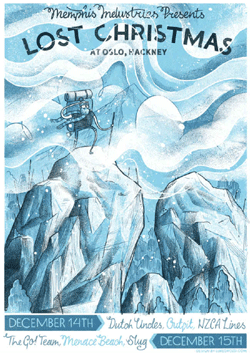
Carrying on with the London Christmas gig previews – next week, there’s a pair of simultaneous double-evening multi-band events happening within a mile of each other. The first of these is the Memphis Industries shindig – “two nights of festive fun” from one of the smartest small British pop labels at work today, with six bands and a host of present giveaways including limited edition art prints.

Lost Christmas @ Oslo, 14th & 15th December 2015

Lost Christmas – A Memphis Industries Christmas Special with Dutch Uncles, Outfit and NZCA LINES, The Go! Team, Menace Beach and Slug (Oslo, 1A Amhurst Road, Hackney, London, E8 1LL, England, Monday 14th and Tuesday 15th December 2015, 7.00pm) – £16.50 for each night / £30 for both nights – information & ticketsmore information

Monday night kicks things off with three of the label’s bands “art-rocking till they drop”. The striking prog-pop babble of Dutch Uncles headlines; doom-toned Liverpudlian tech-pop band Outfit play the middle set; and (following a brace of high-concept singles over the course of the year) one-man white-pop/R&B hybrid NZCA/Lines opens the show.


Tuesday promises “unparalleled noisy fun, and possibly sailor outfits”. Flipzoid Brighton pop crew The Go! Team headline, their lineup a little different from that of recent years but their magpie polymusical energies still intact. Leeds indie supergroup Menace Beach are in the middle; while reformed noiseniks and north-eastern eclecti-pop upsetters Slug open things up with a live band including Peter and David Brewis of Field Music.


* * * * * * * *

The second of the double-night events is the one run by Gare du Nord Records, a pair of concerts which have an almost familial feel, revolving around certain hub projects (Hefner, Death In Vegas), certain locations (Walthamstow, Canterbury, Vienna), certain other sympathetic labels (Fortuna Pop, Audio Antihero) and a smart, sometimes wordy aesthetic.

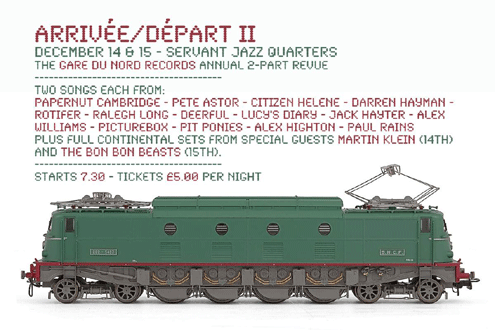
Arrivée/Départ II @ Servant Jazz Quarters, 14th & 15th December 2015

Arrivée/Départ II – Gare Du Nord Records 2-Night Revue (Servant Jazz Quarters, 10A Bradbury Street, Dalston, London, N16 8JN, England, Monday 14th December & Tuesday 15th December 2015, 7.30pm) – £5.00 each night – information – tickets on the door

Both nights are revues – a long main set from each of the two special Austrian guests, bolstered by short mini-sets from the other bands. There’s a lot of personnel crossover. Expect the same faces to keep popping up, reshuffled.

The Monday gig’s main set comes from Martin Klein, the Viennese singer-songwriter whose piano songs albums of and witty, deadpan performances are making him a rising star in Austria and Germany, and whose questioning, sometimes undercut romanticism should translate across further borders. Among the short sets are appearances by two former Hefner members: their frontman and prime creative force Darren Hayman and their multi-instrumentalist Jack Hayter, both now established as significant and highly individual solo songwriters (and while Darren might be the better known of the two, don’t underestimate Jack – I was enchanted by a battered set he played at Union Chapel last year).


Other players on the Monday bill are Cockney surf-punks Pit Ponies, Allo Darlin’ guitarist Paul Rains (taking a solo step-out from his main band’s classic indie-pop styles) and the “prim and improper” antifolk punksters Lucy’s Diary. There are also two acts who specialise in the soft-and-sharp – Cambridge’s Alex Highton (whose folk-, pop- and jazz-smattered songs conceal quick jabs of wit beneath their light and luscious surfaces) and Vienna-via-Canterbury trio Rotifer (creators of pitch-perfect country-tinged indie pop songs, sallies and snarks, and who also serve as a kind of scattered house band since various members play in six of the acts on offer during the night).


The Tuesday gig’s Viennese treat headliner is Bon Bon Beast – two multi-instrumental singer/producers, one of them Austrian (Ernst Tiefenthaler) and the other Swiss (Eloui), filtering their diverse past experiences into a straightforward acoustic jolly. Among the support acts, former Weather Prophets/Ellis Island Sound man Pete Astor continues his low-key live renaissance, and former Death In Vegas guitarist Ian Button brings along one of the various lineups of his psych-dusted pop project Papernut Cambridge. Since many of the people who play in the band are appearing in (or as) other acts during the evening, it’ll have been an easy roundup: Papernut Cambridge backing singer Helene Bradley, for instance, is performing a solo set as Citizen Helene (showcasing the soulful delivery and wistful irony which places her somewhere between Mama Cass and Kirsty MacColl).


Also playing are baroque orchestral pop songwriter Ralegh Long (presumably detached from the small orchestra which tends to follow him around) and Emma Winston’s one-woman Deerful project (miniature synths and brittle stories). Two Kentish acts round out the evening: lo-fi Canterbury pop band Picturebox and Whitstable’s Alex Williams (whose swerving career so far has encompassed indie rock with Fleeting Things, folk music with New Old World and lo-fi outsider clatter-pop with The Psychotic Reaction, as well as the odd ABC cover).


* * * * * * * * *
More Christmas gigs shortly, including some events elsewhere in Britain…

December 2015 – some musical Christmas parties in London – Fire Records (with the Jazz Butcher Quartet); The Glass Child’s online Christmas show; Arctic Circle’s Santas in Space (with Camden Voices, Left with Pictures, Laish and Boy and a Balloon); Baba Yaga’s Hut (with Bad Guys, Melting Hand, Wren)

9 Dec

I’ve been posting mostly shout-outs for gigs this year, so I might just as well submit to becoming Santa’s little shill as regards this month’s sprouting of Christmas/Hannukah/seasonal parties. From the flood on my Facebook account to the rumours and snippets I hear, this is a selection of what’s on for the next week or so (just London this time, though I’ve got some gigs elsewhere ready for the follow-up…)

* * * * * * * *

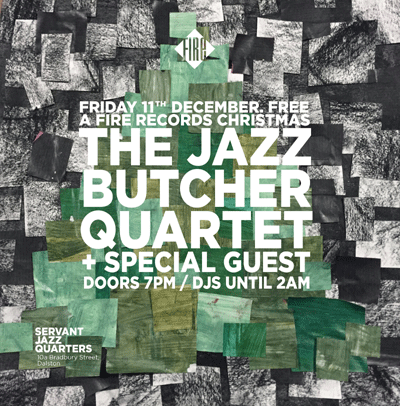
Fire Records Christmas gig 2015

Fire Records Xmas Party with The Jazz Butcher Quartet + very special guest + Fire Records DJs (Servant Jazz Quarters, 10A Bradbury Street, Dalston, London, N16 8JN, England, Friday 11th December 2015, 8.00pm) – free – information here and here

The first of several gigs in this post taking place at the Servant Jazz Quarters amongst the bottles, foxes and curios. Fire Records DJs will be playing from their typically wide-ranging hoard of music, and there’ll be two sets of live music. One guest is as-yet unnamed (it’s a surprise) and the other is the latest iteration of the three working decades of absurdist Northampton-based singer-songwriter Pat Fish as The Jazz Butcher.

The Jazz Butcher Quartet sees Pat take a sideways step away from the cunningly meandering rock’n’strum that he’s generally known for, and tease the ever-present jazziness out of his songs and into full focus via a collaboration with three dedicated jazz musicians The Jazz Butcher – drummer Steve Garofalo, trumpeter Simon Taylor and double bass player Steve New. The Steves and Pat were already old buddies from their time in the Northampton music scene, in particular due to their mutual work with the magnificently strange and wise alternative folk singer Tom Hall. The result’s a refreshed acoustic take on Jazz Butcher staples, wrapping itself round the old and new tunes and the playful wandering lyrics with utter flexibility.

The evening is absolutely free, apart from the drinks, but the Servant Jazz Quarters is a small place – so show up early if you want to be able to get in. Some footage of the JBQ is below.

* * * * * * * *

Swedish singer-songwriter Charlotte Eriksson, a.k.a. The Glass Child is hosting her own Christmas gig online. It sort of fits with her itinerant nature – having left her Gothenburg home at the age of eighteen, she built up both a label and a career while sofa-surfing through London, England and Berlin. You can’t fault the girl for thrift, for ambition and for investigating the art of the possible while living out of a suitcase. Playing a big interactive gig, but from nowhere in particular, certainly suits her style so far.

The Glass Child Christmas StageIt Show (online, Sunday 13th December 2015, 7.00pm CET) – pay-what-you-can – information & tickets

Charlotte’s own message:

Christmas, my children, is not a date. It’s a state of mind. December 13th is the day that Swedes celebrate “Lucia”, which basically means Swedish Christmas songs, gingerbread, tons and tons of candles, mulled wine (Swedish Glögg) and cosiness all around. Basically all of my favourite things!

Lucia is an ancient mythical figure with an abiding role as a bearer of light in the dark Swedish winters. The many Lucia songs all have the same theme: “The night treads heavily around yards and dwellings / In places unreached by sun, the shadows brood. / Into our dark house she comes, bearing lighted candles, / Saint Lucia, Saint Lucia.” All Swedes know the standard Lucia song by heart, and everyone can sing it, in or out of tune. On the morning of Lucia Day, the radio plays some rather more expert renderings, by school choirs or the like. The Lucia celebrations also include ginger snaps and sweet, saffron-flavoured buns (lussekatter) shaped like curled-up cats and with raisin eyes. You eat them with glögg or coffee. (Do you guys understand why this is my favourite Swedish tradition?)

So I thought, what better way to celebrate this little Swedish Lucia day than with you! A cosy acoustic Christmas show with music, candles and maybe my first ever performance of a Swedish song. Like always: some new songs, some old songs, questions, chat and some insights behind my new album that I’m currently working on. Please join me for this evening show and we’ll create a memory worth remembering.

Some examples of Glass Child work so far are below.

* * * * * * * *

I’ve been covering Daylight Music gigs for several years now, but anyone who spends much time around those will know that parent organisation Arctic Circle spreads its activities a lot wider than those Saturday afternoons at Union Chapel – and in this case, a lot higher. Over to them:

'Santas In Space' 2015

Santas in Space’ featuring Camden Voices + Left With Pictures + Laish + boy and a balloon (Arctic Circle @ ArcelorMittal Orbit, 3 Thornton Street, Queen Elizabeth Olympic Park, Stratford, London, E20 2AD, UK, Wednesday 16th December 2015, 6.30pm) – £15.00 – informationtickets

We return to the most spectacular venue in London to bringing our unique brand of Fuzzy Feeling to the 376 feet high platform of the Arcelormittal Orbit. With the sparkling lights of London as a spectacular backdrop, watch as the sculpture becomes an astronomic live music space celebrating the Christmas season! Camden Voices will start the night off with their thirty-strong choir proclaiming yuletide glee followed by a series of the finest fuzziest musicians from our Daylight Music series – from the chamber indie of Left with Pictures to the luscious folk of Laish and the lo-fi pop of Alex Hall’s boy and a balloon. Finish the evening by wrapping your ear around a winter-warming set from DJ Ben Eshmade (Arctic Circle Radio/Chill) with a festive drink or cocktail in hand. Please note this event is for over-18s only.

http://www.youtube.com/watch?v=os-LkECwlAA

* * * * * * * *

If that last one seems to be bordering on the twee for you, another ‘Misfit City’ regular event is offering something typically noisier and rucked-up around the edges:

Bad Guys/Melting Hand/Wren @ Baba Yaga's Hut, 16th December 2015

Baba Yaga’s Hut Xmas Bash with Bad Guys, Melting Hand, Wren (Baba Yaga’s Hut @ Corsica Studios, 5 Elephant Lane, Newington, London, SE17 1LB, England, Wednesday 16th December 2015, 7.30pm) – £5.00 – informationtickets

Again, over to them:

Come down to the Baba Yaga’s Hut Xmas party. Three very heavy acts for you, mulled wine. Xmas hats. Getting drunk, the usual. London’s best classic metal band Bad Guys headline; plus the first ever London show for new heavy-psych/improvising jam supergroup Melting Hand (featuring Gordon & Russell of Terminal Cheesecake, Mike Vest of Bong/Drunk in Hell etc etc and Tom Fug of Gum Takes Tooth); and a Baba Yaga’s debut for London post-metal/sludge four piece Wren.

To be continued…

November 2015 – upcoming gigs – Illuminations London present Holly Herndon, Jam City and Claire Tolan in Bethnal Green and Josh T. Pearson, Richard Dawson, Briana Marela and Let’s Eat Grandma in Hackney; Laura Moody plays solo in Cardiff and Sheffield; Jenny Hval and Briana Marela tour the UK

2 Nov

Some more concert dates for the current week. If you’re thinking that these have a definite female slant to them, you’re right. I’m indulging my latent X as well as stretching my perspective.

Holly Herndon expanded A/V show (featuring Mat Dryhurst and Colin Self) + Jam City + Claire Tolan (Barbican & Rockfeedback present Illuminations  @ Oval Space, 29-32 The Oval, Bethnal Green, London, E2 9DT, UK, Wednesday 4th November 2015, 7:30pm) – £15.00

Having already made a showing at Liverpool and Bristol during October, peripatetic techno-pop/IDM composer Holly Herndon brings her expanded show to London. This is a full multi-media experience including the usual music, visuals and dance elements but with an interactive component that goes far beyond Holly’s onstage collaborations with programmer/life partner Mat Dryhurst and with interpretative dancer/additional singer Colin Self. In particular, Mat’s adaptive and conceptual SAGA software reaches out beyond the stage to work – consensually – with the audience members’ own browser histories and Facebook content; mixing it all into the visuals (and, potentially, the sounds) as a communal mashup, both representational and communicatory.

Intriguing as this factor is, it’s an adjunct to Holly’s music; which remains the core material of the show. Continually glitched, tweaked and deconstructed, her compositions are a cool, complex, thoughtful and exhilarating mixture. They’re informed by post-classical forms, dance techno, and anthemic synth pop; they utilize experimental textures and broad vocal stylings (from standard singing to semi-voluntary sounds) and they bury philosophical queries deep within their tunes. Holly’s soundwork is as immersive as her stagings, full of implied questions and reflections regarding our access to and immersion in technology and how this affects the way in which we think and express ourselves, leaving comet-trails of information, interaction and yearnings.

All of these additional subtexts and pointers are there if you want them, but Holly is first and foremost a communicating musician, and her pieces are as melodious and accessible as they are multi-layered. Drawing on her ongoing music studies (doctorate level at Stanford) , her time as a precocious and enquiring teenager steeped in the heat and fun of the Berlin club scene, and her work with everything from choirs to customised laptop software, they sometimes sound like particularly complicated pop songs, stuttering their way through myriad changes of attention and focus. Sometimes they sound like accelerated dream-state dances; sometimes like madrigals sung during earthquakes (see Unequal, below). At other times, they’re like the chatter of path-switching in a circuit; or like carefully-directed cultural channel-surfings which quick-step deftly back and forth across a breadth of urban art and experience (from grand opera house to downloads in cramped bedsits). Brain food which encourages you to wander.

http://www.youtube.com/watch?v=YdcUBRa47as

Also on the bill are Jam City and Claire Tolan, both of whom share Holly’s interest in interactions and in the results of our being embedded within a dense informational culture, although each has their own way of approaching the situation.

Jam City is the alias of dance-electronica producer and deconstructionist Jack Latham. Though Jack’s background in fashion and “corporate espionage” sounds almost too good to be true, as if it’s been dream-tailored for counter-cultural media discussions and for high-end elitist posing, he doesn’t use it that way. As a musician, he’s evolved from collaging various dubstep tropes towards using his work to develop and express questioning, outright political critiques of neoliberal capitalism (such as the Unhappy single, which explores the dulled angst of online porn consumers while juxtaposing it with riot footage). In the process, Jack’s also developed as a performer – backgrounding the laptops and the passive role of the standard electronica performer in order to retake the stage as guitarist and singer, and delivering a new phase of material described as sounding like a Prince record constructed from cold, chunky industrial sounds”.

Claire Tolan is an artist, programmer, sampler, writer and soundscaper specializing in autonomous sensory meridian r – a psychological process in which carefully-arranged sound and speech – usually a blend of themed, targeted whispers and quiet diegetic noises (scratches, scuffs, intimate room sounds) – triggers euphoric physical and mental reactions in the listener. With sharp wit, Claire links all of this to new developments in programming and acoustic surveillance technologies, exploring the question of how it might be applied: from simple mood enhancements and healing systems through to neurolinguistics and perception and to the potential manipulation and control of people. Her recent Holly Herndon collaboration Lonely At The Top (see below) might give some clues as to her concert performance. A cosseting monologue, coffee-pot dribbles and the close-up noises of small rooms are interspersed with the rubs and slaps of massage, fingernails ticking on keyboards and screens, and increasingly intimate sounds of hand and mouth: the language, desires and end results of relaxation tapes, executive relief, socially-reinforced senses of entitlement and prostitution blend and overlap to sardonic, disturbing effect.

http://www.youtube.com/watch?v=XdtCzPrx-JE

Information and tickets for the concert are here  while the Facebook event page is here. At the end of the month, Holly will also be appearing at All Tomorrow’s Parties at Prestatyn.

* * * * * * * *

There are some similarities between Holly Herndon and Laura Moody  – not least an overlap with classical music and a sense of being on the outcrops of songcraft, delving up malleable truths and questions. Yet whereas Holly’s a post-classical theoretician (reconciling her education with her human instincts, and with life outside the college bubble) and works primarily on computer, Laura comes from older and more familiar traditions, and is almost exclusively an acoustic performer. Possessing outstanding talent both as a singer and as a cellist – and able to cover both fields simultaneously, as well as beatboxing and cello-drumming – she pounces into her own music with the terrifying, exhilarating technical skills of a top-drawer classical soloist.

Laura’s songwriting instinct, meanwhile, seem to come from multiple directions at once. Tense twentieth-century string figures (from her earlier years playing avant-garde pieces with the Meredith Monk Ensemble, and her current work with the Elysian Quartet); ancient, eerie folk airs; expressionist opera; P.J. Harvey’s cleaver intensity; the clever, idiosyncratic and individual art pop of a Kate Bush, a Tom Waits or a Bjork. Everything that she delivers sounds immediate, whether it’s the savagely equivocal hormonal take-down of an older man on Creeping Alopecia, the raindrop attenuations of Call This Time Love, or the stormy dissections of love-gone-wrong and betrayal on Turn Away and We Are Waiting.

The live gigs are enthralling wonders: supple switchings between Laura’s own welcoming personality and the performance persona which handles the songs, blurring the line of physicality which separates woman and cello. She’s out on a brief tour now, playing outside London for a few events. Go see for yourselves.

Laura Moody:

* * * * * * * *

For many female pop musicians, an increasingly outright or explicit public sexuality is both a marketing point and the prime hook. To an extent, this is also true of Jenny Hval. Many people will have initially heard about her thanks to what seemed to be a head-turningly saucy lyric:“I arrived in town with an electric toothbrush pressed against my clitoris.” Curious (and possibly a little numbed by Rihanna, plus memories of lubricious Prince party-funk), many of us will have followed this expecting a licentious slow jam, only to find something very different – the opening line of a mirror-calm songscape of hovering bells, limpid murmurs and breathed-on acoustic guitars which dealt with the secret worlds of strangers within cities and, in particular, their self-reliance.

A polymath whose methods blur as artfully as her perspectives, Jenny doesn’t write songs so much as drop carefully-charged texts and pointers, and then explore and adorn these recitatives with chantlike melodies and poised minimal instrumental textures, pulling them apart and working in and out of the word-rhythms. Her guitars, keyboards and samplers (as well as her heavy-lashed, light-tongued vocals) work like soft-edged sculpting tools. Her lyrics are the lines of resistance.

For both new listeners and previous converts, sexuality remains a prime Hval hook. It’s what we expect to hear from her, although we’ve quickly learnt to appreciate that she turns the expected approaches on their heads and back-to-front. She revels in the unfixed: in the course of a single song, lovers will pass fluidly from mysterious passion to friendship to absence, and between gender, ages, species or state. Even when singing of cupping her own cunt (while cupping the blunt, unadorned and troublesome word itself, delivered throughout her songbook without a hint of shame, taboo or aggression and with a succinct matter-of-fact poise) she’ll let the action lead her somewhere that doesn’t fit the usual expectations and commodities – appreciating its centrality at her body’s core; being inspired to cup in turn a lover’s “soft dick… accepting restlessness, accepting no direction, accepting this fearful wanting that isn’t desire… can we just lie here being?”; or imagining a world of peaceful masturbators (“a million bedrooms with hands softly lulling… without telling anyone, a million ships come alone out on the calmest seas”) while asking, with a sense of disquiet “are we loving ourselves now? Are we mothering ourselves?”

Also running through Jenny’s work (whether entwined with or separate from the sexual themes), are ambiguous accounts of bodily disintegration. Opening her second album ‘Innocence Is Kinky’ with an account of watching online porn, she moves from commodified enervation into an eerie and exultant dream of escape, relinquishing her own body and its passive needs, and finally symbolically destroying the eyes with which she consumes the images. Yet this song and its sisters aren’t quite nightmares. Sometimes they’re triumphs – disassociative fantasies of freedom in which the wrack and ruin seem to be the natural rites of passage of a cool mind walking free, unconcerned, its passions become processes.

Jenny’s writing casts a wide net – violent upsets echoing classic French surrealism; deep-running strands of myth both classical and original (from the “Oslo Oedipus” of Innocence Is Kinky to the dark, quasi-pagan tree-figure in Amphibious, Androgynous that stands as lover, doppelganger and the next phase of self); and musings on the ambiguous trap of language (“the tongue is upon for the restless /An indecipherable alphabet / Each word an island less… And we speak in tongues from part to parts, broke all to parts / From invisible state, to invisible state…”). Most recently, on her latest album ‘Apocalypse, Girl’ the political subtexts have broken cover to become direct challenges (“You say I’m free now, that battle is over, / and feminism is over and socialism’s over. / Yeah, I say, I can consume what I want now..”). So too have preoccupations with ageing and survival (in the breathless narrative of Heaven, surrounded by loops and fractures of cemeteries and childhood choirs, Jenny wrestles with the pull of memory and the drag of mortality) and a increasingly solid approach to identity. “What is it to take care of yourself? Getting paid? Getting laid? Getting married? Getting pregnant? Fighting for visibility in your market? Realizing your potential? Being healthy, being clean, not making a fool of yourself, not hurting yourself? Shaving in all the right places?”

All of the above – the obliqueness and the rapier hits – makes listening to Jenny’s records akin to haunting her apartment at 2am (or some similar time  when manners and manneredness come unstuck and the shapes of other truths come walking). I’ve not been fortunate enough to see what her music is like live – though I know that past concert showings have seen her play bolstered with  guests or simply alone, surrounded by laptops, devices and ideas. On the five quick dates of her current UK tour, you’ll be able to see for yourselves.

Jenny Hval:

* * * * * * * * *

On the Glasgow, Manchester and Bristol dates, Jenny will be joined by her on-off tourmate Briana Marela, a singer-songwriter from the Pacific North-West who’s currently working a string of European tour dates in support of her second album ‘All Around Us’. As you might expect from something recorded in Iceland and co-produced with Sigur Rós associate Alex Somers, ‘All Around Us’ is ghosted and garnished with touches of Hopelandic enchantment (with beautiful smeared, paper-thin sounds intruding on the edge of the mix, like lost amnesiac ghosts or distant pipes), but it’s very much Briana’s inspiration – a luminous, thoughtful work blending layered melodic sample-patches and banking her petal-delicate vocals into choirs and a capella counterpoint.

Though Briana cites Björk, Laura Veirs, Vashti Bunyan and Meredith Monk as influences (she has something in common with Laura Moody, then), I can also hear the same kind of all-round sound-mastery that’s on display and working away in the songs of Imogen Heap; deep-level sonic exploration and sound curation tied to the urge to tell you a story and sing you a straight earworm. In the album’s lead single Surrender I can even hear something of the pure pop of ABBA, while the midnight lushness of the follow-up, Dani, recalls a Julee Cruise ‘Twin Peaks’ ballad.

Though Briana’s voice is soft, it’s never wispy – never insubstantial. If there’s a hint of girl-next-door to what she does, she’s the quiet, observant girl full of thoughts, going her own way but ready to let you walk alongside.  Like Jenny, though less explicitly, she explores possibilities of intimacy. Her songs hover carefully on the borderline between selfhood and loneliness, a delicate staking out of possible togetherness, subtly resisting the pressures to put out or submit, to be deformed by needs and expectations (“What does love mean in this day and age? /  To me it’s a moment where we resonate at two frequencies close in phase… /  It’s not a competition /  Everyone has music within them.” ). Meanwhile, the perfectly-pitched American-visionary tone of the album (its hallucinatory fairy-tale sonics, leaflike piano falls and misty country swells) suggests that there’s common ground between Briana’s dream pop and the ostensibly cleaner work of breakthrough CCM-pop singers like Lexi Elisha, which in turn suggests that there’ll be a lot of people who’ll end up liking this.

* * * * * * * *

In between dates with Jenny Hval, Briana Marela will also be joining the bill at another Illuminations concert in London, this one a stew of assorted flavours which also includes the battered Americana of Lift To Experience frontman Josh T. Pearson  and the skewed Tyneside noise-troubadour work of Richard Dawson.

Probably because of the female orientation of this particular post, I’ve got to admit that I’m more intrigued by the youngest act on the bill, and the only other female one. It’s difficult to work out just how tongue-in-cheek the psychedelic rag-doll sludge-pop” duo Let’s Eat Grandma are, assuming that they’re joking at all. Eyes down, singing from beneath and behind tumbling pre-Raphaelite locks, and tucked into stolen Stevie Nicks dresses, Rosa and Jenny rummage with various instruments like toybox-divers and play songs as if it’s only occurred to them to do so. Two Norwich teenagers who’ve known each other since childhood, they’ve sustained, into near adulthood, that mysterious blankness of two little girls who are ignoring your interruptions to their game. The songs themselves are tangled musical fairy stories, or (as with ‘Eat Shiitake Mushrooms Into Chocolate Sludge Cake’) extended wooden-legged instrumental mantras owing more to Faust or Beefheart: spontaneous-seeming, utterly absorbed in themselves. The band feels like a musical chrysalis twitching what might become an astounding breadth of wing. It’s all to discover.

Josh T. Pearson/Richard Dawson/Briana Marela/Let’s Eat Grandma (Rockfeedback present Illuminations @ St. John Church at Hackney, Lower Clapton Road, Hackney, London, E5 0PD, UK, Saturday 7th November 2015, 6.00pm) – £20.00 –  informationtickets

http://www.youtube.com/watch?v=4Nk8p-PiJJM

http://www.youtube.com/watch?v=R0mqRc0kaF0

* * * * * * * *

More concert previews coming shortly for November…

October 2015 – upcoming London gigs – gamelan/dance fusion with My Tricksy Spirit, Wax Wings and Segara Madu; Nordic pop at Ja Ja Ja (Kill J, Loveless and Maasai); anarchistwood’s Samhain/NYE party (with Rude Mechanicals, Jane Ruby and more)

23 Oct

More concerts for the end of October…

* * * * * * * *

As the opening concert of the South East Asian Festival 2015, there’s a performance at the Forge by My Tricksy Spirit, a new musical project which fuses the shimmering sounds of gendér wayang – Balinese gamelan instruments – with dub, electronic, ambient, trip-hop, and psychedelic rock. The Forge’s writeup is below (tweaked a little by me).

My Tricksy Spirit @ The Forge, 28th October 2015

My Tricksy Spirit (The Forge , 3-7 Delancey Street, Camden Town, London, NW1 7NL, UK, Monday 26th October 2015, ) – £10.00 

Performed on the bronze-and-bamboo “gendér” metallophones which gives the music its name – and featuring intricate, interlocking melodies played with mallets and damped with the wrists – gendér wayang is a subset of Balinese gamelan music. Involving between two and four players (a small number for a gamelan ensemble) it is used in the island’s Hindu rituals including life-cycle ceremonies, temple festivals, purification rituals and cremations (as well as in the sacred wayang kulit shadow-puppet dramas, based on ancient Indian epics).

The My Tricksy Spirit project was started by Nick Gray, who teaches south-east Asian music at the School of Oriental and African Studies at University of London, and who runs the gendér group that forms the basis of the band. Using Ableton Live, several synths and effects, guitar, bass and drums, the music is played through a mixing desk – much like dub – to create an intense psychedelic journey through sound.

Tonight’s band features Nick Gray (violin and vocal), Paula Friar and Rachel Wilcox (gendérs) and four other musicians: Tomoya Forster of Pumarosa (bass guitar, effects, mixing desk), Julian Vickary of General Skank (synthesizer and effects), Charlie Cawood of Knifeworld (bass guitar, sitar, guitar) and Rob Shipster of Buttress Root Drumming (electronics, drums), who also produced My Tricksy Spirit’s upcoming album.

Support comes from electronica/world-house act Wax Wings and from another of Nick Gray’s SOAS gendér wayang ensembles, Segara Madu (who mostly play repertoire pieces from the Balinese village of Sukawati, as taught by the late I Wayan Loceng). More information and gig tickets are here, with the Facebook event page here.

* * * * * * * *

Arguably, there’s not been enough pop or R&B in here recently. Let’s set that straight.

Ja Ja Ja, 29th October 2015

Kill J + Loveless + Maasai (Ja Ja Ja @ The Lexington, 96-98 Pentonville Road, Islington, London, N1 9JB, UK, Thursday 29th October 2015,) – £5.00/£7.00

Straight from the publicity:

Founded in 2009, Ja Ja Ja is the definitive Nordic website and club night celebrating the very best new music emerging from Sweden, Finland, Iceland, Norway and Denmark. Each month at London’s The Lexington, Ja Ja Ja hand-picks the finest emerging talent from the Nordic countries, making sure that only the best music is filtered through to your ears.

KIll J (a.k.a. Julie Aagaard) has been turning heads the past two years with her signature blend of dark experimental pop. A devastating one-two-punch with debut singles Phoenix and Bullet set the blogosphere buzzing, also catching the keen eye of ‘The Guardian’, ‘Indie ‘, ‘Stereogum’, ‘Pigeons and Planes’ and landing airplay on BBC Radio 1 and BBC Radio 6music. Deliciously diverse, the sugary sweet Cold Stone revealed a more innocent and naive side of KIll J, whilst Propaganda burst forth as “a bombastic, fangs-bared snarl at sexism” (‘Stereogum’). There’s more to come too, with an EP promised this fall.

Prominent identities in their own right, Eirik Tillerli and Filip Kollsete teamed up late 2013 to form Norwegian beat crooners Loveless. Following back-to-back remixes, debut single How To Love You was instantly added to national radio. Clocking in excess of 500K streams last year, their music has picked up attention from blogs, magazines and DJs all over the world; also landing them on some of the biggest festivals in Norway, not to mention their own club night in Oslo, Klubb Loveless (where guests include Artful/Artful Dodger and NVOY). New single They Don’t Know was recently hailed Record of the Week on BBC Radio 1xtra, serving the first taste of upcoming project ‘Relationships’.

Maasai is a Stockholm-based duo consisting of Dominique Teymouri and Zackarias Ekelund. Together they create soulful sound landscapes with a cinematic touch and lyrical depths. The pair broke on to the scene with debut single Memories, pulling inspiration from varied and abstract constructs – places, people, surroundings and everywhere in between. Follow-up tracks The Healer and Forgive Me have since held a captive audience; also hinting to the fearless, fragile and all-the-while dreamy atmosphere inhabited by MAASAI’s upcoming debut album – set for release later this year.

Resident DJs Project Fresh Socks are along for the ride in October; having also spun up a storm at Ja Ja Ja’s first club night of the season last week at The Lexington with CHINAH (Denmark), The Fjords (Norway) and Axel Flovent (Iceland).

Up to date information for this particular Ja Ja Ja night is here and tickets are here.

* * * * * * * *
Flapping-in-the-wind time… here’s what looks like a very interesting gig, but the colourful cloud of information around it keeps changing shape. Here we go..

Subterfuge presents Samhain Special/Labiatory New Year’s Eve Party with Rude Mechanicals + NiMBUL + Bad Suburban Nightmare + We Are A Communist + Jane Ruby + Milky Sugar (Subterfuge @ The Others, 6-8 Manor Road, Stoke Newington, London, N16 5SA, UK, Friday 30th October 2015, 7.00pm) – £3.00 to £6.00 and upwards

Samhain Subterfuge, 30th October 2015

Run by arch, arty but heartful prank-rockers anarchistwood (whose own ingredients span post-punk cantatas, skeletal lo-fi garage pop, silly voices and quickfire sampler collages), this is the last Subterfuge club night of the year (hence the split between a Halloween/Samhain night and a New Year’s Eve shindig) and promises a fabulous musical sprawl – a right old grab-bag of this and that, in the best way. anarchistwood themselves are playing, though at the moment it’s unclear whether or not they’re teaming up with dysfunctional Chatham polymath and Stuckist art brute Sexton Ming (as the anti-supergroup called Nimbul), or playing as themselves. I guess that whichever way it goes you could expect a roughly equal mix of distracted behaviour, political protest, self-absorbed memory jigsaws and détournements with echoes of Beefheart, Crass, The Raincoats and the high point of a Pride parade. But that’s all it is – a guess.

Compared to Earth and Neil Young at their most dogged and noisy, Dan Hrekow – a.k.a Bad Suburban Nightmare – plays “impossibly slow and melancholic” grunge-drone instrumentals on a minimal setup of distorted guitar and pedals. In violent contrast, Rude Mechanicals play party music for paranoid schizophrenics, fronted by the peroxide-beehive rantings of Miss Roberts (who looks like a doubled-back-drag-queen version of Patsy Stone, and speak-sings like a collision between Dagmar Krause and Holly Penfield), Their songs are rattling hallucinatory-jam sandwiches about sinister neighbours, stand-up arguments and alien mice on the Tube, mixing jazz, punk and cabaret together in equal measures and played with both needle-sharp precision and full glamour oomph.

Of the rest, We Are A Communist provide “trashy guitar-laden sci-fi surf music, with stylophones to boot – a must for Man or Astroman? fans”; onetime Naked Ruby frontwoman (and current Deptford Beach Babes member) Jane Ruby turns up to sing her solo mixture of torch, garage rock’n’roll, flamenco and blues songs with twists of Spanish & Arabic flavours; and Milky Sugar performs “punk go go”… but that’s where I run out of information.

I’ve no actual idea about the order in which everyone’s going on, as the various info and flyers seem to contradict each other: either that or the whole event is morphing too fast for me to keep up with it. Presumably they’re working to some functional anarchist or I Ching method to establish it, or you just turn up and see what happens. Perhaps that’s what they’re doing. Either/and/or DJ Sugarlump SS, DJ KG Lumphead and MC Sadogasm provide some extra noises, punkvertery & Kodek provide visuals, and they’ve got a proactive but generous door price policy – three quid if you’re unwaged, four quid if you’re a student with an NUS card, and six quid if you’re neither but have shown enough commitment to arrive before 9pm. After that, they charge more. More information is here; keep track of developments as best you can on Facebook here; and there’s the usual array of tasters below.

* * * * * * * *

More shortly…

October/November 2015 – upcoming London gigs – intercontinental psych & noise with Baba Yaga (Bitchin’ Bajas, Tomaga and Demian Castellanos, Acid Mothers Temple and Zeni Geva); and more LUME jazz with Tom Taylor/Rob Luft and Cath Roberts/Seth Bennett/Andrew Lisle

23 Oct

Pausing only to remind you that the last week of October includes two of the Pierre Bensusan acoustic gigs at the Half Moon in Putney (which I mentioned in the previous post), here come the last of my selected London gigs for the month, and the first for the start of November. As ever, it’s just a small sampling of what’s on in town, but it’s what’s caught my attention.

* * * * * * * *

Bitchin’ Bajas + Tomaga + Demian Castellanos (Baba Yaga’s Hut & Hands in the Dark @ Cafe Oto, 18-22 Ashwin Street, Dalston, London, E8 3DL, UK, Monday 26th October 2015, 8.00pm) – £9.00

Baba Yaga's Hut, 26th October 2015I’ve heard Chicago trio Bitchin’ Bajas described as “psychedelic easy listening” – presumably by someone who insists on being shouted at in conversation. Despite that swaggering faux-dumb name (the one that makes them sound as if they play manic Tejano to be drowned out by fist-fighting oil workers) they’re more ‘Bitches Brew’ than cathouse. They spin out protracted rhapsodic instrumentals drawing on a variety of introspective, mindful influences and parallels, looking back to the hallowed bucolic trance of Harmonia and Cluster, the ecstatic modular pulses of Terry Riley, the breezy but depthless Pacific cool of West Coast jazz, and perhaps the dissolving pastoralism of Talk Talk. Though they’re multi-instrumentalists, they wear their skills lightly, working wind instruments and mallet percussion into their mists of keyboard and workhorse organ and their landscape of lively rolling, rilling glissandi and drone chords. Sometimes overlapping into ambient electronica, they’re never quite dilute enough to fit into it: even at their most vaporous and transparent, they’re the smoke that never quite fades, the tang that holds your attention. As the clip below shows, they’re perhaps a little too diffuse to work at an open air festival: embraced by the Oto space, they should do just fine.

Synth/sounds looper Tom Relleen and drummer Valentina Magaletti keep in step – just about – as Tomaga, an impressionistic improvising duo drawing on drone music, free jazz and modular synth work hanging off the edge of rock. Simple oscillating melodies percolate loosely over a syncopated jazz lope with hanging coffee-can taps and rattles and shortwave radio whines; sometimes a synth organ hangs by itself, burbling, while the percussion sways and alarms like an approaching freight train. It’s music of preoccupation, with brief flashes of bright sunlight through the pressing focus.

Best known as the figure behind London psychedelic/kosmische projects The Orichalc Phase and The Oscillation, Cornish-born loop guitarist Demian Castellanos steps out under his own name for his most personal work so far. Like Fred Frith or G.P. Hall, Demian’s had a history of playing guitar with implements – paper, cutlery or whatever else came to hand – and feeding the sounds through volume swells and sundry pedals: like Hall, he’s also possessed of a nature-inspired, painterly view of music. For this current work, he’s going back to his formative years of woodshedding as a cottage-bound teenager at the isolated southernmost tip of the British coast; creating rich, portentous and melodious sound layers drawing on early-‘90s shoegaze, on raga and drone, and on echoing, guttering British, Indian, American and German psychedelic influences.


More gig info is here, and tickets are available here.

* * * * * * * *

On the first day of November, there’s a double bill of Japanese heaviness at Corsica Studios.

Acid Mothers Temple & The Melting Paraiso UFO + Zeni Geva (Baba Yaga’s Hut @ Corsica Studios, 4-5 Elephant Road, London, SE17 1LB, UK, Sunday 1st November 2015, 7.30pm) – £14.00

Zeni Geva (or Zeni Gaiva, depending on how you translate the phonetics – conceptually, it translates as “money violence”) have been around since 1987. Led by guitarist/singer/noise-chopper KK Null, and currently backed up solely by drummer Tatsuya Yoshida to make a quake-strength power duo, they have initial links to legendary noise-Dadaists The Boredoms (and even the venue-destroying pre-Boredoms chaos act Hanatarash, which featured Mitsuru Tabata, until relatively recently Zeni Geva’s second guitarist). You’d expect them to have an abrasive side, and you’d be right. Their default musical setting is one of boiling, barking aggression, with tight and furious knots of threshing machine guitar; their records have savage, sadistic titles like ‘Total Castration’ and ‘Desire For Agony’; their progressive hardcore approach takes assorted forms hostage (aside from the obvious, there’s math and noise rock, psychedelia and death metal in the tangle) and makes them jump like puppets.

And yet, in spite of this, there’s a world of difference between Zeni Geva and your average long-lived heavy-thunderfuck band. It’s mostly in the way they use calm – little, perfectly-formed lacunae of space in between the blurs and blows, bringing their bursts of frenzy into focus (Steve Albini is both fan and sometime collaborator, and you can see why). It’s a terrible cliché to compare Japanese musicians to martial artists, but in this case there’s some substance to it. The brutality is sheer craft rather than an end in itself, every movement seems considered and purely executed; and live, in between each flurry of songblows and each ugly song name, they seem enormously humble, friendly and pleased to be there.

Acid Mothers Temple have taken twenty years to set themselves up as a revered psychedelic institution, but it seems as if they’ve been doing it for much longer, such is leader Makoto Kawabata’s talent for back-engineering himself into the culture. Part of this is down to the way he and his cohorts have mastered the ingredients, including the tearing metallic squalls, mellow blues tracery and starry smears of Hendrixian guitar, the whispering lapping Gong synths, the Pink Floyd mantra riffs and Zappa-esque air sculpture solos, and the zoned-out post-James Brown grooves (with the addition of Japanese chanting and noise-squalls). Much of the rest of it is to do with AMT’s open, overlapping community approach. Their musical impetus has utilised multiple faces and names, from their own simpler reconfigurations (the heavier trippier playing of Acid Mothers Temple & the Cosmic Inferno, the Sabbath-y sludge of Acid Mothers Temple & Space Paranoid) to the friendly absorption or co-opting of contemporaries (Acid Mothers Temple SWR, with Ruins, and Acid Mothers Afrirampo) and of heroes from the original psychedelic generation (the team-up with Daevid Allen and Gilli Smyth as Acid Mothers Gong, and with Mani Neumeier as Acid Mothers Guru Guru). If old heroes are unavailable or disinclined to pool resources, AMT have simply shrugged and continued anyway (such as when they took up hurdy-gurdys and acid folk and briefly became Acid Mothers Temple & the Incredible Strange Band).

If this makes Kawabata and co sound like slick chancers (and even if AMT album titles like ‘Starless and Bible Black Sabbath’ do suggest both avid, nerdy fandom and piss-taking on a Julian Cope level), I’m selling them short. Acid Mothers Temple might be a brand as much as an ethos, but that hasn‘t stopped their project and record-releasing ethics being continually dedicated to possibilities and continuance,rather than simply banking a following (or colonizing someone else’s). Their communal origins may have been two decades behind those of their inspiration but were hardly any less sincere; and their exploration of less obvious musical areas en route (including opera, Terry Riley minimalism, Nepalese folk and southern European Occitan culture) have led them into interesting places and opened further doors to anyone following them.

First and foremost, anyone who’s seen AMT play will vouch to their talent of both mastering their sources and creating music which lives, thrills and involves in the moment. This week’s London concert features the more space-rock inclined Acid Mothers Temple & the Melting Paraiso U.F.O. lineup – probably the easiest entry point to an increasingly rewarding musical world. See below for a full-length concert clip of the band in action.

More gig info is here, and tickets are available here.

* * * * * * * *

Also on the Sunday, it’s time for the monthly LUME gig: more jazz in Dalston…

LUME logo

Tom Taylor/Rob Luft and Cath Roberts/Seth Bennett/Andrew Lisle (LUME @ The Vortex Jazz Club, 11 Gillett Square, Dalston, London, N16 8JH, UK, Sunday 1st November 2015, 7.30pm) – £10.00

For our November Vortex gig, we welcome a duo and a trio to the stage, for a night of improvised music.

Tonight sees the first meeting of a new improvising trio featuring LUME’s co-director Cath Roberts (baritone saxophone), Seth Bennett (double bass) and Andrew Lisle (drums). Andrew is known for being one of the drummers in heavyweight Leeds anarcho-sextet Shatner’s Bassoon, and as a prolific improviser working with a multitude of musicians on the free scene (Colin Webster, Alex Ward, Daniel Thompson, Tom Wheatley and more). Seth leads his own ensembles Nut Club and En Bas Quartet, as well as being involved in many other projects across musical styles including Fragments Trio, Metamorphic and The Horse Loom. He and Cath play together as a duo, as well as in Word of Moth and Cath’s quintet Sloth Racket. In addition to this and her LUME work, Cath also leads Quadraceratops (a septet) and has a duo with guitarist Anton Hunter, Ripsaw Catfish.

Seth Bennett, Cath Roberts, Andrew Lisle

The new duo featuring Tom Taylor and Rob Luft is a recent collaboration borne out of a mutual love of improvised music. The music draws attention to the many common features of the two instruments, and mixes high-intensity improvisation with more tender and reflective textures.

A former award-winning classical piano graduate at the Royal Northern College of Music in Manchester, Tom is now a rising British jazz star, having transferred to London in 2009 to pursue a Masters in jazz piano at Trinity College of Music (studying with Simon Purcell, Liam Noble and Nick Weldon). Since then he’s played the main jazz festivals in Manchester and London and Kongsberg Jazz Festival in Norway. He’s a member of the Jack Davies Big Band and of Southbound (both of whom have recorded for V&V Records) and also plays in the collaborative electro-acoustic trio duck-rabbit with saxophonist Joe Wright and double bass player James Opstad. Rob began his career as a jazz guitarist in Sevenoaks, where he took lessons from Mike Outram and turned professional at 15. He has been a mainstay of the National Youth Jazz Orchestra for many years, having been its guitarist since 2010 and having played in the associated NYJO Nonet. He currently co-leads the band Organism and plays with various groups on the London jazz circuit; including positions with Nigel Hitchcock, Gareth Lockrane and the Callum Au Big Band.

Rob Luft, Tom Taylor

More information here, and tickets here.

* * * * * * * *

More imminent gig previews shortly…

June 2015 – upcoming gigs – Imminent shows at the Hope & Ruin in Brighton (Liebezeit & Irmler, Prolapse & Slum of Legs), plus the tours they belong to

11 Jun

If I was a Brightonian, I suspect that I’d be spending quite a lot of evenings at the Hope & Ruin. Not only does it host some of the town’s most interesting gigs, its interior décor – patched together in a pack-rat/caddis-fly jumble of enthusiasm – makes it feel like the vessel   of some spacegoing carny out of ‘Firefly’ or ‘Doctor Who’.

I’m guessing that most people who’ve read the post title will already know all about these – since cult art, Brighton and a gossip grapevine make a happy mash – but two upcoming Hope & Ruin gigs have caught my attention. One features two leading lights of the original Krautrock/kosmische/German experimental rock scene (something else that’s become as Brightonian as the Pavilion). The other one sees the return of one of Britain’s more interesting wrangle-rock rackets from the 1990s: on this occasion, backed up by a more than worthy heir from the current decade. Both are stops on longer UK tours – I’ll include details on those as well.

Jaki Liebezeit & Hans Joachim Irmler @ The Hope & Ruin, 11-12 Queens Road, Brighton, BN1 3WA, UK, Thursday 17th June (doors 8.00pm)

The former Can drummer Jaki Liebezeit is one of the great beat stylists of experimental rock. Described as “a master of the pause and the stop”, he plays cutting, lean and propulsive rhythms from a small kit: alongside Neu!’s Klaus Dinger, he pioneered the mechanistic motorik beat which you’ll hear behind half a hundred nouveau-Krautrock bands. Hans Joachim Irmler () has had various multi-instrumental and production role in and around Faust over the years, but predominantly plays organ (a highly customisable transistor model which he built himself over forty years ago) and boxes-of-tricks (having created or co-created most of Faust’s unusual noise processors). Longstanding collaborators, Irmler and Liebezeit released the ‘FLUT’ album in 2014 featuring a “hypnotic maelstrom” of organ and drum improvisations. I’ve not reviewed it, but the ever-reliable ‘Quietus’ did – and it’s this vein of music which they’ll be performing.

More details here – although if you’re a fan, all of this will be old news and you’ll already have your tickets. If the Krautrock galaxy is still relatively new and obscure to you – and you’re within grabbing distance of Brighton – this sounds like the perfect opportunity to immerse yourself in the cult. (If recent rumblings about Liebezeit’s retirement are true, it might also be one of your last opportunities to taste the original flavour). If you’re not in Brighton, note that there are also tour dates in London, Fife and Glasgow (beginning on Friday) as listed below:

    Sunday 14th June 2015 – Platform, The Bridge, 1000 Westerhouse Road, Glasgow, G34 9JW, UK – details here.
    Tuesday 16th June – Cafe OTO, 18-22 Ashwin Street, Dalston, London E8 3DL, UK – details here.

Prolapse + Slum Of Legs @ The Hope & Ruin, 11-12 Queens Road, Brighton, BN1 3WA, UK, Tuesday 23rd June (doors 8.00pm)

Art-punks who emerged in the 1990s, Prolapse came up with a much more assured and individual take on the form than most, apparently by accident. The dual vocal frontline of Linda Steelyard and Mick Derrick (the former singing and the latter ranting,) often came across as disruptive theatre, a performance partnership which veered dramatically between combative duologues, utter disjunction or play-fights. Meanwhile the band behind them pegged brutally away on Krautrockian/Fall-esque rhythms, riffs and noises, like a Dada Hummvee worn down to its wheel-rims. The members have tended to claim that it all happened spontaneously and in general was a muckaround, but this was a band that was smart enough to work out when not to think – if you dug deep enough into them you found Master’s degrees, archaeologists, ceramicists and future journalists.

In 1999, after three albums and enough touring to wear them down, Prolapse very sensibly split up just before the point when it all became too frustrating. This year, having been enticed back from various locations and interesting jobs by Mogwai (who’ve invited them to play support at the latter’s 20th anniversary shows) they’ve opted to play a six-date UK tour, for which the other remaining dates are:

    Friday 19th June – The Maze, 257 Mansfield Road, City Centre, Nottingham, NG1 3FT, UK, 19th June (supported by Grey Hairs and Hot Shorts) – buy tickets here.

Playing support at the Brighton gig are Slum of Legs – an inspirational, instrument-swapping, all-female travelling brainstorm of a band. Although they have roots in Raincoats-style post-punk and Riot Grrl (and more than a few similarities to the spontaneous inventiveness of Prolapse) Slum Of Legs have a particular approach to lyric writing which is all their own – intricate, irreverent, literate and broad-ranging. So even if the musical style doesn’t altogether appeal to you, go for the sake of the words and see what else falls into place. (Again, I’m late to the table for this one, so I’ll refer you to this spray of enthusiasm from ‘Collapse Board’, which sets out a view of the Slum Of Legs stall in a way that’s far better, and probably far closer to their pulse, than I could right now.) More info on the gig is here.

Stumbling through 2014 – a year in flashes and in review (part 2 – the undercurrents)

28 Jan

I’m setting up for 2015 now. Part one of the review of 2014, the musical side, has been written and posted and is being read (if you’ve not seen it yourself, it’s back here). New singles reviews have been drafted and mostly written; blog navigation has been improved (look over to the right and down to see the reworked category and tag clouds); and the thorny matter of scheduling has been addressed. I’m looking into a Soundcloud page as well, for playlists and occasional sound postings. Technically, ‘Misfit City’ should be better this year.

But before that… I’ve got a confession to make.

Recently, I’ve been visualising this blog as a cartoon beachcomber – something gawky and distractable which blends its enthusiasm with pathos. Blundering along the foreshore to see what’s washed up this week, it jams its head into little rockpools to take notes about the small details, and loses track of time. Overhead, the real events roar and rumble in storms which are mostly ignored. Sooner or later, there’s going to be hail; and I’m going to be caught napping.

I’m not talking about me missing coverage on big releases, or failing to ride Twitter trends effectively. Both of these come with the territory of preferring more out-of-the-way artists with less immediate recognition; and also with intermittent blogging around real-life demands of family, work and life outside of music culture. Independent solo bloggers – unless they’ve caught a wave of interest or are particularly good self-marketers – are ultimately small creatures. We’re talented amateurs, in the most positive sense; people whom, if we’re fortunate or persistent, can make our little marks and (as in my case) maybe help a musician to be known and understood and moved a little closer to a potential audience. Small stone markers; pricked-up ears; a little bridge built for people to cross. Those kind of achievements.

What concerns me at the moment is culture-bunker syndrome – when a person hides within a habit of art, closing off the parts of the world which they don’t like (or wish to be disinterested about) by developing an obsessive focus on small creations. This could be external: an account or summary of someone else’s performance or crafted object. It could as easily be internal. Becoming obsessed with one’s own lively, assertive prose or photography, for instance; or with one’s ability to get the word out quickly – to be, for a brief and flashing moment, the medium, as well as simply making use of it. For music writers, some form of this syndrome often becomes habitual and unavoidable. It’s part of the excitement, to the point that you don’t recognise your writing as being a flash-bang which ultimately only explodes inside a very small box.

At the end of the first part of my 2014 review I mentioned that in spite of my initial feelings of having gone through a “shrunken” year, in retrospect 2014 seemed to have had remarkable musical richnesses; also, that the only thing that really seemed to be missing was me. What I meant by that was that however involved with the music I was (and even when I managed to turn out a decent, or even acclaimed, review), I had a parallel feeling of disengagement. None of this was the fault of what I was listening to. None of it related to what eventually emerged and was posted on the blog. Neither did it reflect the many things which I wanted to cover on time but didn’t (or still haven’t).

What it was like… well, imagine that, while you’re working away on a project, there’s something just over your shoulder, not quite peering and not quite looming. Something that’s… there. Perhaps it’s not actually over your shoulder: it’s just that that’s where you expect it to be. The half-recognised key or clue. The bit which you’ve missed. The missing chunks of the puzzle; the provider of the voice which carries the rest of the answer. You feel, sometimes, that you could turn around and take hold of it; slot it in, make a completeness. You don’t really understand what you’ll actually have once you’ve done it. There’s just an itch. An urge to include it.

I concluded, eventually, that there wasn’t actually anything there. What was actually preying on my mind was a gap – something which I myself had allowed to grow, wilfully ducking the significance of why I’d let it happen in the first place. What I was missing was the rest of the world – and the reason why this was important was that the world was violently changing. Plugging my headphones in and looking away, I’d ostentatiously pondered music – going through recordings and concert track-by-track and song by song, meticulously tracing the emotional responses and the drawn-out meanings, and catching and writing down sparks triggered off in me by the listening. Meanwhile, the landscape which I was ignoring was darkening. Almost everyone whom we, as citizens, had put in place or allowed to prosper had at best failed us. At worst, they’d betrayed us or were predating on us.

To many people (including many bloggers and commentators) this is an old, old story, and doesn’t even exist as a dilemma. Protests and counter-action against the iniquities and inequalities of the modern world are already part of their long-standing, lifetime’s battle; and plenty of commentators on music who draw it into their perspective. At the very least, it becomes an integral part of their involvement with the world. In my case, this hadn’t happened for too long, and 2014 was the year when my avoidance of this fact finally cracked.

For me, perhaps, the evasions had been natural and habitual. I tend to feel that hitching music, on principle, to a particular political agenda (and dismissing that which falls outside it (or which fails to fit a particular set of value signifiers) blinkers the vision and creates an urge to provide answers first and then distort the art to fit them. I don’t join political parties for much the same reason that I don’t join churches. For a doubter like myself, the creeds are always too hard to swallow; too often an excuse to comfort and close the mind. There are other reasons. I was too young for the first wave of punk, and too disassociated (also, perhaps, too personally comfortable and accommodating) for the following waves. Also, when I started to explore beyond basic popular music as a teenager I found my way into weird mid-‘70s Vangelis albums, assorted textural boilings, bounding prog epics and post-punk blurrings rather than grinding riffs and blunter challenges. What I mean is that when I dealt with art, generally it didn’t look or sound much like a hammer. In retrospect, perhaps I should have schooled myself in delivering some more telling blows.

I can’t say that I don’t recommend the softer, more textured path which I took; but it was often short on the kind of immediate sociological content that spurs a person into asking certain questions. Having said that, a detailed reading of ‘Misfit City’ will reveal that I’m not exactly apolitical. There’s been coverage of LGBT artists and some outspokenly political musicians such as Ian Crause, Atona and Des de Moor, as well as certain sharper asides in other reviews. That “listening to women” tag which crops up in numerous reviews is also an example of the blog’s political grain – a quiet attempt to redress the male domination and thoughtlessness within the music industry by acknowledging and drawing attention to the women who strive within it as well (be they singers, writers, architects of sound, all three or more).

However, rather than being a good soap-boxer, I’m a good reflector… or an immersionist. Most of the time when I’m engaging with music I choose to gently unzip it and to clamber inside – to experience it through its innards and associations. As an excuse for other disengagements, I don’t know how well this works, but it’s how I’ve tended to operate. The problem is that – in its way – this approach is just as solipsistic or reductive as if I’d tied all of my tastes and my statements to a political stance, and it’s just as reductive. Blinding yourself to the world by hiding away in prettiness (or, indeed, fetishised ugliness) is ultimately not an answer. If you’re not careful, it can become no more significant than slopping some extra gloss onto the decorations.

I should also confess that another reason for my lack of fuller engagement with the world came from the conviction that an over-complex, diverse and dissenting world was impossible to summarise or act upon. Over the weekend, I was reading an interview with the documentary film-maker and audio-visual collagist Adam Curtis which refutes this. Among other things, he comments “I believe that it’s possible to make the world intelligible – however complex and chaotic it is. That is the progressive job of journalism. The other reaction – which is to say, ‘Things are just so complex and unpredictable that you can never make sense of them’ – is, I think, one of the main motors that supports the conservatism of our time.”

Though this statement briskly upends my own comfort zone, I’ve got to agree with Adam. In a national and global environment in which governments, businesses, the powerful and the assertive have rarely seemed so nakedly wicked and corrupt – at least during my own lifetime – my values (and, in many respects, my family) are increasingly threatened, and my stances are changing. Tipping point? Perhaps. All I know is that I feel that keeping silent on these matters leaves a hollow space at the heart of this blog, and that I need to do something about that.

If I am going to head in a more engaged and more political direction, it’s important that I don’t do so under the pretense of heroically filling any yawning gaps in musical and political writing. Even a cursory wander around the blogosphere will reveal the seethe and ferment of existing discourse, all of it surviving quite happily without me. During 2014, many of the hard questions and righteous ragings were already being covered by music-related writers much better suited to the task than I am – among them Neil Kulkarni, Lucy Cage and Taylor Parkes. Alongside the excellent, animated and eclectic criticism which has seen it rise to preeminence in the last few years, The Quietus’ has continued to provide broader reflections on the world. The vigorously argumentative, assertive and punk-spirited ‘Collapse Board’ seeks out debate on just about everything it covers or discovers. Forums blaze everywhere.

Steve Lawson

Steve Lawson

(As an aside, though – it’s debatable that punk culture should always claim the high ground in political and social debate. For several years now, Anil Prasad – the superb ‘Innerviews’ interviewer best known for conversations with prog, jazz and country musicians – has been delivering blistering critiques of the warped and exploitative practices within the record industry, and while he might not have the sheer acid bite of Steve Albini, he’s not that far short of it. Arguably the most continually politicised and socially articulate musician whom I heard from this year was Steve Lawson, best known for family-friendly spacey instrumental loop-jazz and eccentric fashion choices (plus the playful sense of humour that makes him the Ross Noble of virtuoso bass playing). In between releasing three albums, he kept up a stream of online posts and tweets this year which eviscerated inequalities, business hypocrisies both in and out of the music industry, Offline and onstage, wherever appropriate, he’d also put up rather than shut up.

Steve’s role as unlikely advocate (coming from a musical quarter from which few people are expected to have or to express streetfighting social opinions) was also a reminder that this year we lost Charlie Haden, the inspirational jazz bassist – a fearless musical advocate of human rights since the 1960s, and and from a current perspective as square-looking a gent as you could hope to meet. Self-satisfied pop theory be damned. Sometimes style and substance just don’t match up, and the former shouldn’t automatically take pre-eminence.)

End of aside.)

So, where does this leave me? This post could be a blip – just a lumpy expression of personal doubt and responsibility qualms before I pick up the usual threads and carry on as before – or it could be the start of something more involved. 2015 may see a darker blog, or I might simply continue to whistle against the darkness. The outcome partially depends on whether people keep sending me slabs of contextually blank noise music or self-entitled “look-at-me-and-make-me famous” rock gobbets. Speaking for myself, I’d prefer to have something to write about and around, rather than simply write on.

Yet ultimately I’m responsible for carrying out any kind of constructive re-engagement between the world and myself. I suspect that my 2015 is going to be full of missteps and stubbed toes, some of them self-inflicted in public. So it goes. It ought to be worth it. If I’m going to do this, it will have to come from personal effort and personal learning, something which leads towards writing which is more deeply grounded and more expansive than it has been before.

Statement of intent. Let’s see where it goes.

Meanwhile, the ‘Misfit City’ show continues. I’ve got some single reviews to be posted up in the next day or so. I’ve already had some other interesting reviewables come through. Some of them are suggesting questions and ideas which I might like to pursue – not necessarily the questions and ideas which you might expect from reading my musings above, but the kind of questions which at least put a shot of adrenalin into my weary mind and keep me going.

And – to end on a completely self-indulgent note – this is a fantastic-looking piano.
 

The Bogányi piano (photo © Támas Bujnovszky)

The Bogányi piano (photo © Támas Bujnovszky)


REVIEW – Ian Crause: ‘The Song Of Phaethon’ & ‘Suns May Rise’ singles, 2012 & 2013 (“sample-punk turned foley-bard”)

30 Oct

Ian Crause: 'The Song Of Phaethon'

Ian Crause: ‘The Song Of Phaethon’

“Well, I know, I know the story – / the fall of the sun and the vengeance of glory revoked. / So well, I know how the seas turned to dust, / and how the known earth choked. / So well, I know, I know the ending: / the carriage from its zenith bending, / a comet slung through ashen skies / and burst against the banks.”

Cinematic. Epic. These are words which have been whored out far too often, especially when it comes to describing and defining music. Froth and PR corrode their meanings, reducing them to fancy synonyms for nothing more than crude scale, and we forget that other qualities are wrapped into them. These words shouldn’t just be cheap and glittery tags for charlatans – the kind who steep their tunes in giant vats of reverb, or who substitute eye-watering grandiosity for sincerity. There are more crucial meanings. There’s storytelling, and the churn of history. There’s the play of images, the triggering of senses. Eventually, there should be some kind of understanding.

Ian Crause knows all of this. Back in the 1990s – when he was barely out of his teens, and the driving force behind the startling expressionist pop band Disco Inferno – he was struggling with it himself. Even then, though, he wasn’t stumbling to understand: he was striving to perfect. Disco Inferno had come from limited beginnings but grown fast. Originally a dour post-punk power trio, they’d seized the opportunities presented by technology and imagination and transformed themselves into a whole-world window. Hot-wiring their way into the disruptions and illuminations of found-sound and musique concrète, they plugged guitar, bass and drums into digital samplers and grew themselves an ever-expanding sheath of noises: a startling collage of jarring sound effects, layered into composition and twisted into context.

Disco Inferno’s swarm of noise was never there simply to overwhelm. Instead, it refracted and illuminated the poignant dissatisfied pop songwriting which stood, steadfast, at the band’s core. They were doggedly political, but owed nothing to dogma. Caught within ominous social currents and inside treacherous personal eddies, their songs bore witness to cruelties, both intended and impersonal. Those tearing rivulets of sound-montage were flashes of further illumination, put there to side-swipe and snag the attention, and to up-end complacency. The fragments of birdsong and clattering glassware; the careful punctuation of trains and screams and distant firework-pops; the sound of feet jogging grimly away through a numbing snowfall – all of it bore witness to the swerving cacophony of the world, smearing past our ears and battering our psyche, carrying its deeper meanings and significances into us via a pummeling swirl.

At the heart of this unsettling barrage were Ian’s lyrics, which were wise, stark and bleak beyond his years. He sang about the crumbling of vulnerable individuals; about the fraying of the social contract and distortion of social forces. He sang about the stifling, stunting pressures callously imposed from above. He sang about all of this in a still, small, stubborn voice which sounded like the next-to-last exhalation; as if he was a few crucial steps and dogged heel-digs away from giving up and bleeding out. He sounded brave, bitter and doomed – snarling his scorn at the boot-tread even as it rolled over him. For a while, it was a self-fulfilling prophecy. Bands who refuse to comfort us (or refuse to stroke our sundry petty vanities) rarely get rewarded, and Disco Inferno were no exception – the strains of dealing with commercial indifference and inner despair finally tore them to bits in 1997. A couple of barely-noticed Ian Crause solo EPs hiccupped out in the band’s wake over the next few years, and then he too seemed to drop out of the story.

In fact, he’d only dropped out of the cheaper kind of mythology. That’s the one in which ducking out of music becomes death or disappearance by another name. His own story – the real story – moved on regardless. There were years of growing up and grim jobs to come, and years of being chewed over by the same callous forces he once sang about. In amongst the drudgery, there were other factors. There was fatherhood, and family. Surprisingly (for a lyricist already so accomplished and intelligent) Ian made his first adult engagement with literacy. Curiosity, plus a determination to pursue the roots of song and storytelling, led him to the themes and voices of classical literature. His developing interest in the telling parallels with contemporary society kept him immersed in it. Crucially, Ian discovered the works of Ovid – Roman epic poet and exile – via dedicated translations by Ted Hughes and David R. Slavitt.

Like Ovid, Ian would eventually become an exile himself (a self-determined one, abandoning Britain for Bolivia) and enter into a new swell of creativity. Via his ‘Metamorphoses’, Ovid eventually inspired The Song Of Phaethon – Ian Crause’s formal return to music, transformed and developed. It might not be the first new note he’s delivered after eleven years of radio silence. That would be More Earthly Concerns, which welled out via Mixcloud and blogclick in March 2012, and which I’ll talk about elsewhere. But (as Ian begins to dole out his work, in handfuls, onto Bandcamp) The Song Of Phaethon is the first of Ian’s songs to be let out into the marketplace. It’s also probably more crucial in understanding his evolution since his Disco Inferno days.

The protagonist, Phaethon, is and was one of those half-divine children who pepper Greek mythology – he’s the bastard of the sun god Apollo Helios, a malcontent boy strutting up to his sun-father’s palace to claim his ancestry and birthright before he has the wisdom to use it. Greeted, given the acknowledgment he craves, and granted the gift of driving the sun’s chariot for a day, Phaethon is warned of the terrible risks involved. Swallowed up by his grand moment, and too conceited to listen, he takes all of his opportunities to their ruinous conclusions. Losing control of the chariot, he transforms a triumphal fly-past into a joyride and then into a catastrophe. Before the high god Zeus restores order by striking him down, Phaethon scorches a gigantic swathe across the world and casts the seasons into chaos.

Like most figures woven into the complex psychological map of Greek myth, Phaethon still has his role to play. He’s a metaphor for arrogance and a sense of entitlement; he also stands for the destructive potential which both of these follies possess. It’s deep literary currency, and maybe not the first thing which you’d think of as a match for the Crause songcrafting method – so direct and personal in Disco Inferno days. Yet Ian’s battering splay of noises and disaffection opens itself up readily to the mythology, which sinks in grain-for-grain. Explosive futurism meets stern and ancient legend, and both are renewed.

Some of Disco Inferno’s post-punk grit remains at the spine of the music (listen to those dogged dot-trails of frowning bass, or to the occasional flares of wire-wool guitar), but the song falls far away from rock into something older. Myths lend themselves to being channeled into new courses by any means available – Phaethon, for instance, worked his way into a Patricia Barber jazz epic six years previously. Ian rises to his own challenge superbly. In any worthwhile sense, what he comes up for The Song Of Phaethon is a new take on a bardic chant. Its melody is minimal and hypnotic; its rhythms walking, changing pulses constantly driven by the restless words. With vivid artistic appetite, Ian also mines the story’s depths for any resonances which he can transmogrify and feed into his own samples-as-narrative approach.

In this he’s served well – the mythic structure and detail inspire and transform his lyrics, which in turn take on the layered build of classical imagery. Various whispers of fateful moira and foreshadowing rise up to nourish the sounds. From early on, Phaethon’s life is marked by the celestial – right down to the transformation of his familiar landscapes by the passage of the sun and moon each day, continual reminders of his thwarted birthright. Ian reflects this in the woven detail of the narrative: “Every day their shadows ran / down Asia like a lyre, strumming / past his village, swinging down at perihelion / to touch upon his mother’s house / then over dark and quiet woods – / their distant hawks and watching deer / oblivious in bending shade – / descending into seacloud mist, / and down towards the gull-cloud cliffs / to pour their jewels and precious metals / out along the sea.”

Just as he did with Disco Inferno, Ian juxtaposes sound effects with the lyrics to create telling sonic scenery. Though he generally wields these with the skills of a master ironist, he slam them into place with forthright punk brutality whenever he needs to. Throughout, the Greek horns and lyres are a pointed racket: ritual blares, ancient continuo lines. Signatures of antiquity and origin stand solid against the thrumming synths and Ian’s tidal electrophonic swirl of throbbing samples. In prophetic flashes, the clip-clop of horse’s hooves and the slam of violent collisions clatter and blur in and out of the mix, while Phaethon’s more innocent youth is illustrated by the clank of herd bells and goats. In time, his dogged journey through Asia and towards Apollo is dappled and smeared by a souksworth of Asian instruments and chatter, careering past the listener in a flickering travelogue: “Levantine cities raised themselves, then hazed away in dreams of sand, where sand subsumes / the earth itself and still ahead his path led on. But falling always out of reach, the rising sun. / Into the dawn, alone he walked.”).

The effect is of a kind of illuminated text – a cinematic compression of time and location into a vivid illustrative story. That story remains paramount: even while we, as listeners, are being drawn inside those blood-in-the-head thunders and are surrounded by a glorious noise, as if we’ve been trapped under the encircling lip of a vast bronze bell. Beyond the story, though, other dimensions to the tale are coming into play. The song is also a loose parable of another gatecrashing of grand power. “He knew, he knew – / his place was beyond.”

Superimposed – a ghostly transparency – over Phaethon’s story is the tale of Tony Blair’s entry into the Second Gulf War. As this emerges through the song, it’s clear that Ian sees this as another disastrous snatch at high significance and public destiny. Something which flew high and upwards towards glory, only to destroy any achievement of its own, wreaking havoc on the ground and people below. Cunningly, occasional Blairisms are woven both into the narrative and into Phaethon’s thoughts and speech. At one point, he even blathers, Blair-like, “look, you know,” before sliding into advocate pomp and hubristic heroics. For a moment, the pleading voices of the two men overlap within Ian’s narration, making a contradictory cats-cradle out of public morality, power-grabs and a preening Promethean sense of mission. “It was not just God but also man / who clearly needs some representing – / A case I’ll take for free… / Evidentially it takes / a half-divinity to raise / the flag of man aloft for man…”

It follows – with a harsh and unforgiving logic – that the noises of modern warfare should persistently break through the song’s tapestry of ancient sounds. As Ian goes beyond everyday sound effects and begins to violently splice present-day horrors into the textures of the mythical plot and signifiers, the song is slashed up into a jittery palimpsest. Almost from the start, those bleating goats on the ancient Greek hillsides are blindsided by gunshots and by the crash of heavy munitions. With booms, crunches and clatters the shattered, warped shards of twenty-first century concrete and metal scrape and shoulder their own way into the past.

Even specific events from the myth draw across, from recent times, their own crooked parallels. The bursting, clattering crowd-sound of Phaethon’s entry into Apollo’s hall is lifted and twisted from the peak of Blair’s 2003 address to the US Congress. It becomes a Dionysiac smear of fanatical applause and whistles: something turned into a nightmare puppet show, or a rainstorm ripped horribly out of kilter. At the coda, Phaethon is poised unwitting on the brink of disaster. The ascension of the Sun’s chariot merges, indistinguishably, into the noise of a jet fighter launch. Backed by the white-hot screech of the afterburners, the lyrics weave both tales, both times and a set of terrible implications – “the steeds were armed: a blinding shock; / a ferrous scream; a rubber stamp; / and up,” – into final, irrevocable process.

By anyone’s standard, The Song Of Phaethon is a major achievement – a jump-up into fiercely intelligent, confident high art, it stakes new claims and transfigures old ground. It even manages to both stay true to and transcend the moral and political commitments Ian held with Disco Inferno. And yet… it raises a tremulous question of what might have happened to the other side of Ian Crause. Between the immersion in classical tradition (and the dense time-folding focus of the samplers) what’s left of the fervent young New Order fan who always saw himself as fronting a pop band? What, in other words, became of Crause the unlikely pop singer?

Ian Crause: 'Suns May Rise'

Ian Crause: ‘Suns May Rise’

For the answer, look to Suns May Rise, released three months after The Song Of Phaethon. Ian’s mining of Greek mythology is still in place (as are his detailed tapestries of sound-effect) but they’re now wrapped around an out-and-out pop song and a lustrous, dancing melody that Bernard Sumner would give his eye-teeth for. Those Greek lyres and zithers are back, as are the layers of sound effects (sea-spray and thunderous surf crash billow through Suns May Rise from start to finish); but they’re bolstered by massed stadium synth and guttering pop guitar; by angelic powder-puffs of fake-choir; and by warbling rococo flourishes of electronics. Even Ian’s voice – usually so dry, and pointed – is flushed with the balmy blue of a Mediterranean summer. Scritti Politti and Cocteau Twins, each at their flounciest, could find common ground with this song’s feverish, chattering opulence. So, come to that, could latterday Marillion.

I suspect that all of this ’80 ornamentation is deliberate. After all, it skips hand-in-hand with other ’80s excesses, and that’s not too far from where Ian’s caustic, righteous attention is focused. Beneath this gleeful and gorgeous bluster, he’s unraveling a story from the Odyssey: a warning bell for avaricious times. As the story has it, Odysseus (while returning from the Trojan Wars) visited the generous Keeper of the Winds, who gave him a bag of sea-gales to ensure that the sails of his ships would be filled and his voyage home would be swift. En route, Odysseus slept; and his friends sneaked up to rifle the bag, in search of treasure which they were sure he’d hidden from them. All they succeeded in doing was to unleash the winds, which blew the ships hither and yon and – eventually – blew them back to where they had started. Reckless avarice, bringing down calamity, provides the keystone of the song. “There will always be some fool / to pull the strings apart. /And suns may set and moons may wax, / and moons may wane and suns may rise – / the gold within his eyes will weigh / Man down a stumbling fool.”

When Ian starts singing about this, though, it’s from the point of view of that corrupted, consensual chorus of friends – the “brothers bound in bronze.” Their coy, self-congratulatory rapaciousness soak his tones like a stain on the teeth. Flushed and greedy with loot already, all they can see is the chance to grab some more. From his own place at the reins of the narrative, Ian reveals their mythic echo in today’s freebooting boy-club of bankers and stockbrokers. Men of unfettered appetite goad each other on. People who simply don’t know when to stop – and who wouldn’t want to even after being handed a sobering, sickening lesson – would still pick perilous holes in opportunity. “You had enjoyed a peace of sorts / The winds had been re-tamed and so / of course the bag was bursting fat: / It fell to men to see to that. / Again so sure the bag would hold / either wine or gold, / Necessity appeared, demanding ‘Open this’.”

It’s here (with a careering inflative screech on “bursting fat”) that Ian himself deliberately unleashes the hidden forces within Suns May Rise, to overwhelm it. From here on in, sounds rise and cyclone – seaspray, radio chatter and winnowing churns of air; a lash of strained rope which morphs from background effect to edgy kick-drum. Amongst all of this the thread of pop song holds fast, stretched taut over an ever-burgeoning epic. In a parading weave of rapid soundbites, assorted newscasters and pundits and politicians roll past in a potted history of the last generation of monetarism. At its tail-end, George W. Bush (waving through a banker’s rescue programme of the kind he’d never have brooked for any other group of people) chokes, gargles and drowns amongst the becalmed wreckage of Odysseus’ ships. Throughout, that teasing pop melody ensures that we’ll remember what happened this time around.

So… the forces eventually sink the meddlers, but there always seem to be more of the latter. Ian conjures up further mythic winds, more specters bringing in ruin from the other far-flung breeding grounds of a destructive capitalist carnival. “Through solids, countries, paper bonds; / The world again reveals itself / in entrails; in open wounds. / The priests and seers shed tears of glee / and privately amuse on how / it still can be that after so long… / there will always be some chance / to pull the threads apart.” Again, the bones of legend rear up inside the flesh of current affairs. Again, this unlikely sample-punk turned foley-bard turns up to show us where those bones are poking through – his words a layered and subtle scourge; even an education. For Ian Crause, it’s been a long and often stony road from transformative teenage angst to his current role of reveal-and-illuminate, but it’s also been a journey of integrity and hard-won vision. The results are even a story in themselves.

Ian Crause: ‘The Song Of Phaethon’ & ‘Suns May Rise’
Ian Crause (self-released, no catalogue number or barcode)
Download-only singles
Released: 20th November 2012 (‘The Song of Phaethon’), 18th February 2013 (‘Suns May Rise’)

Buy it from:
‘The Song Of Phaethon’ – Bandcamp (the original version reviewed here has now been replaced by this mini-album)
‘Suns May Rise’ – Bandcamp (the single version reviewed here has now been replaced by this version from ‘The Vertical Axis’ album)

Ian Crause online:
Facebook Bandcamp LastFm

REVIEW – Atona: ‘Disabling The NHS’ single, 2012 (“talk about rude health”)

1 Oct
Atona: 'Disabling The NHS'

Atona: ‘Disabling The NHS’

First MC NxtGen’s Andrew Lansley Rap, and now this – the oncoming carve-up of the NHS is certainly pulling the British protest song out of its ghetto. Talk about rude health…

Everyone in Britain needs healthcare, but who is healthcare for? Is it for the people who need it in order to stay alive, mobile or relatively sane on a day to day basis? Or is it for private concerns who use it as an avenue for extending business plans and for pulling in another income stream – and who are now circling the choice plum of public healthcare? Keith Lindsay-Cameron (a.k.a. “Keith Ordinary Guy”, retired youth worker turned protest-letter writer) has needed healthcare more than most. By his own admission, Keith has had a long-term struggle with mental health issues. His are of that particular kind which leave you eminently sane, but also painfully shorn of the thicker skin required to make headway in an increasingly brutal and predatory society.

This sensitivity might have driven the superbly dignified orator’s vitriol of Keith’s “A Letter a Day to Number 10” campaign (a one-sided public correspondence with David Cameron, holding him and his government to account for the increasing wreck of social support). It’s also left him profoundly grateful to a National Health Service for keeping him intact when his own problems were just too much. While few of us in Britain actively share Keith’s dogged social commitment and sharp sense of a general justice – and fewer still either share or are brave enough to admit to sharing his medical difficulties), most of us have various reason to thank the NHS (regardless of snarl-ups and corner-cutting) in its rickety benevolence. Certainly few issues seem as good for pulling us together and waking us up a little.

Hence Atona, a rapid coalescing of musicians, poets and general protesters around Keith’s ire-tipped missives. Disabling The NHS is their first salvo, a blend of tried-and-tested agit-prop methods slung out into the world for free. There’s a list of government ministers recited over a Gothic toll; a stolen-and-pasted-in sample of one of Cameron’s egregious, deceptive pronouncements on the NHS; a drive into plank-battering punk accusations and warnings – and at the heart of it, Keith himself reading his own cool and scathing denunciations (a stern people’s judge with a soft West Country accent).

With its gruff bang-and-shout, the anvil drumbeat, the framings of text and the clear love of plunderphonic razzing, this is all very much in the spirit of Crass, albeit pulled into the gentler, politer mainstream. Not a bad thing at all. After all, Keith doesn’t just channel crusty old memories of affronted people writing to the Times. He also channels those of seventeenth-century pamphleteers, who (much as Crass did) strived to nail down moral and workable verities for the future while the world turned upside-down around them. In any age, some people have got to work to keep the rest of us awake, and to keep twitching the clothes away from the naked emperors and pirates.

Atona: ‘Disabling The NHS’
Atona (self-released)
Download-only single
Released: 1st October 2012

Buy it from:
Free download from Soundcloud.

Atona online:
Facebook Sooundcloud

Keith Ordinary Guy online:
Homepage Facebook Twitter Youtube

October 1999 – album reviews – Des de Moor’s ‘Water of Europe’ (“a cherubic smart bomb of chanson”)

1 Oct
Des de Moor: 'Water Of Europe'

Des de Moor: ‘Water Of Europe’

Like a cherubic smart bomb, Des de Moor has popped up whenever London needs a sniff of wicked European song. In his time, he’s helmed the Pirate Jenny’s cabaret club, fought for chanson and acidic cabaret old and new, or made a public case for tying together songwriters as diverse as Boris Vian, Georges Brassens, Martin Jacques of The Tigerlillies, David Bowie and The Magnetic Fields maestro of puckish gloom, Stephen Merritt.

When Des can fit in an album of his own, it’s recorded in bursts of enthusiasm in between all these other burst of enthusiasm. As with everything else he does, it bears the stamp of that sweep of songcraft and resistance he’s devoted himself to, as he elbows his way into his own niche and into the history of chanson. When “fuck you, I won’t do what you tell me” has become our most famous protest lyric, and our concept of resistance-in-song is measured by the PC-baiting and broody solipsism of Eminem, Marilyn Manson or Wu-Tang Clan, it’s good to hear a dash of genuinely sharp social writing – even if it comes couched in a musical language nearly a century old (which in turn suggests that we might have been missing a lot since we cut those particular stylings out of the popular consciousness).

‘Water Of Europe’ must’ve been recorded for tuppence, and sometimes sounds as if it was lashed together with parcel string. No Dagmar Krause big-budget political cabaret job this, all respectably outrageous and state-concert-hall friendly. It’s sealed and sold on the vigorous punky pocket-orchestra enthusiasm of the players – bumped guitars, cellos, pianos, snapping percussion, Daniel “Boum!” Teper’s accordion.

Des’ voice is the common key – a florid, unusual mixture of madrigal tenor and soapbox preacher; or a grown-up, apostate choirboy in the political thick of a pub argument. It sits at the heart of the de Moor way of working, and is as pugnacious and theatrical as his barbed lyrics. Each word is bitten into shape and flung out with flair. Although most of his music could’ve easily have strolled straight out of the 1930s (Des might have drawn on punk’s assertive spirit of questioning, but he clearly finds more verve and expressiveness in a mix of jazz, folk and cafe singalong), his lyrics are less time-locked. They dig into the dirt and humanity of yesterday, today and tomorrow, exploring themes of exploitation and injustice, politics and deception, war and its wounds, gay life and its hauntings.

Des de Moor: ‘Dirty Pictures’ (preview)

Skidding and acerbic, the punchy accordion tango of Dirty Pictures tears into public figures embroiled in the noisy scams of censorship and social decency, taking forthright aim at their implicit hypocrisy, their encroaching voyeurism and their lust for personal exhibition (“You’ve seen the camera, it’s seen you… / you’ve wanked in front of mirrors too.”) With a sarcastic zest, Des savages the double standard of class and education – “Let middle classes get their kicks: / subtitled sex in foreign flicks / can’t cause infection. / The masses, couch potatoes all, / whose dishes sprout from every wall: / they need protection.” He also spotlights broader horrors for which there’s less willpower for banning (“Pot-bellied children / rooting in rubbish / as food mountains rot; / The obscene, often-seen, / ultimate snuff scene / between have and have-not.”)

Des de Moor: ‘Heart Of A Heartless World’ (preview)

On a more mythological scale, Heart Of A Heartless World (which sounds something like a state-of-the-world take on Fairytale Of New York) takes on the compromised cultures of colonialism, famine relief and the points where they intertwine. Retelling a sweep of human history as a journey from a lost African paradise into a famine filled by suspicious prophets and priests (“vultures that pick at the corpse of the poor”), Des suggests that the journey has bequeathed us a present-day of false hearts, superstition and moralistic humbug where “priests and prime ministers pray for our sins / and mystics on telly guess lottery wins.”

Des de Moor: ‘Margins’ (preview)

Des’ words spit and crackle even when – Germanically – they cluster, fight and split the envelope of the tune. The magnificent Margins (just waspish accordion, Des in marvellously stroppy voice and the bitter backdrop of the Bosnian conflict) jumps out at you, laying waste to the complicity of media and state interests in the parceling-up and selective suppressions of a world in conflict. “Believe what you hear and believe what you’re willing: / a severed head here, and there a mass killing. / We’ll print it provided / it’s clearly one-sided / and something is left to the margins, / at the bottom of the page in the margins.” In this song, little escapes the de Moor tonguelashing – not the journalists who “roam far and wide collecting tales of atrocities / from regular soldiers and mercenaries” and not the conferences that re-order things, ratifying the mess the way the biggest powers want it. Certainly not the scapegoating stories that thrive “so long as they’re hearsay, undated, / uncorroborated / and blame the right side… / We’ve forgot the Ustashe and found the new Nazis / in Belgrade this time.”

A debt to the history of chanson and folk is paid via a handful of gutsy covers and interpretations. Terry Callier’s Ordinary Joe is one, boasting gloriously hooded trombone from Dave Keech and a guarded, evasive street philosophy – “Down here on the ground, / when you find folks are giving you the runaround, / keep your game uptight / – and if you must, just take your secrets underground.” A rough’n’ready, guitar’n’free-verse declamation of Brecht and Eisler’s To Those Born After (An Die Nachtboren) is another, exploring the crummier details of toiling in the revolution. “I ate my dinners between the battles, / I lay down to sleep among the murderers, / I didn’t care for much for love / and for nature’s beauties I had little patience… / Oh we, who wished to lay for the foundations for peace and friendliness, / could never be friendly ourselves… / In the future, when no longer / do human beings still treat themselves as animals, / look back on us with indulgence.”

Des de Moor: ‘To Those Born After’ (preview)

Most impressively, a new translation of Jacques Brel’s My Father Said polishes Des’ claim to be the best English-speaking Brel interpreter – in either sense of the word. The song explicitly links Britain and Europe: a legend of kinship, of severance by high North winds and high water (both brought to musical life by Kev Hopper’s magnificent solo on musical saw), and of humanity blown before the rough and beautiful forces of nature. “The earth was rent / between Zeebrugge and the cliffs of Kent: / and London’s left cut loose and free, / with the Bruges headland taunting the sea. / And London’s left to forever be / a suburb of Bruges, lost in the sea.”

Des de Moor: ‘My Father Said’ (preview)

My Father Said stands as a counterweight to Des’ own Water Of Europe itself – another exploration of kinship. Here, Des places himself on a fantastical odyssey of his own, sending his thoughts out from Britain and around Europe. He finds first an island, and then a continent, locked in a common defensiveness and an ugly sense of purity. Each exploits “the Other” but denies them harbourage – “If they desire a water of Europe / it is the cold grey sea that divides. / Or the deep and inviolable water / taking and making sides.” Against this he calls on the forces and floods of history, hoping for the day when “truth decontaminates water supplies”, and “the fracturing chains of the workers of Europe / have strangled the boy with his thumb in the dijk.” Whips snap, castanets rattle, accordions and guitars throw punches. There’s going to be a party out there when the storm breaks.

Des de Moor: ‘Water Of Europe’ (preview)

Some of Des’ gestures aren’t carried nearly so well. However musical he is, he’s a man of words first and foremost, and this can mean that in his forthright sincerity the songs scramble across an imbalance of text and melody, like a flapping banner dragged by the wind. In the squabbling, tricky surveillance satire of Big Sister, for instance, his voice drowns in his densely-packed lyric: “More cameras than Hollywood, more tape than Scotch, / more logs than Canada, much more to watch… /I am your friend in the fight against crime. / Won’t you be safe when I’m there all the time – / minding your kitchen and minding your bed, / and, for extra security, / minding your head?”

Des de Moor: ‘Big Sister’

The Fairground Attraction swing of Grandmother Was A Hero, with its perceptive picture of human flaws, also should have been better as a standalone song. Over-pressured by words, it lacks smoothness and poise. Yet if you can accept that Des’ prime aim is to get his tales across, it has a lot to offer. Weighing up his monstrous grandmother’s peacetime behaviour, Des offsets it against her tireless protection and concealment of refugee Jews during wartime. “She didn’t have much wit or grace, / nor brains in large amounts. / But Grandmother was a human / and being human counts.” In telling her story, in a voice and lyric that build, ebb and resurge through a complex knot of anger, admiration and pity, Des finally arrives at solidarity, and presents his memorial:

“Just think how it must have been / as a hausfrau in poor Holland when the Wehrmacht goose-stepped in / With a husband that you hate, but there is nothing you can do: / It’s an emergency situation, and your man’s your comrade too. / In that fearful hunger winter when all your two kids have to eat / is potato peelings, pea pods and the snow from off the street – / and they’re handing out the yellow stars that one by one blink out, / and you know you have to help them, and there is no time for doubt. / Until the Gestapo knock on your door, and you find yourself alone / and in the settled dust you’re just a German widow / far from home.”

Des de Moor: ‘Grandmother Was A Hero’

Elsewhere, a loose trilogy about workers in London merges a realist’s acceptance with the strong protest of an angry survivor. In Avocado, Des examines the gritty detail of the kitchen worker’s desperate struggle between hopes and exhaustion – memories crumpled in the heat and hubbub, but not yet devoid of the sting of style. In doing so, he etches a picture of life of triumphs and traps. “Choose a plump, ripe avocado, just like on your first exam / at a college back in Glasgow. Stop the memories if you can. / Take that plump, ripe avocado, slice it with the sharpest knife, / Smile and summon your bravado: it’s a cold, raw kind of life.”

Des de Moor: ‘Avocado’

In Joey’s Dreams, Des delivers a rock song turned back into seething left-wing folk ballad, the story of a gentle working bloke who’s gradually ground into resentment by hard times and defeat – “a beast that’s pacing in a pen / at the edge of a feast for rather richer men.” He goes on to trace how resentment leads to poison, and frustration to an ugly fall, shading it into a larger picture of a caste crushed down from honour into malevolence. “Joey’s cramped contractor’s terms, / that force his crawl among the worms, / create a breeding ground for germs: / opinions that the world confirms… The clots of rot clog up each bend, / the queues for casualty don’t end. / You can’t believe in your MP – now Joey’s voting BNP.”

Des de Moor: ‘Joey’s Dreams’ (preview)

Beyond these small fierce sketches, there’s the fractured battlement of Sleaze City. Des takes an uneasy stroll through his beloved south-east London, past strangled docks and thriving bailiffs, sniffing and frowning at the muggy wind of corruption shrouding Westminster even as homeless beggars huddle in sleeping bags, a stone’s throw away over in the Strand. Throughout, a sweep of history – compromise, an age-old London scrabble and a sense of loss – provides depth. “At Surrey Quays, saluting the seas / sets flags bobbing. Along the shores ex-stevedores / watch gulls mobbing… /The last leaking hulks have long furled their sheets / at Woodpecker, Evelyn, Crossfields and Pepys…. / There’s whole careers / in chasing arrears, still shivers / though shirts are soaking. / Sleaze City’s choking / in the ozone.”

Des de Moor: ‘Sleaze City’ (preview)

For more personal struggles, there’s Sharp Contradictions and Last Orders Please. On the former, Julia Doyle’s double bass and David Harrod’s needling piano pick out itchy broken harmonies like the stab of toothache. Des anatomises the terrifying wonder of a fall into love, like an attacking scalpel or virus winding to the very centre of a person. “Alive and kicking, awake, aware / with a billion lights that sparkle and flare / in the brain above. / But put in the knife and start to twist – / the lizard hisses and lashes a fist. / The world goes runny when you get pissed. / And then there’s love.” Surreal spiraling rhymes paint the upheaval, with a dark coda of sombre feeling – “And it is the time I spend sinking / that sharpens and tempers my thinking. / And it is this feeling you give / that reminds me just how much I live.”

Des de Moor:’Sharp Contradictions’ (preview)

In contrast, Last Orders Please is a death song of the kind you get only in cabaret, filled with defiance and fear. It’s also the only outright gay song which Des has allowed himself for the record; overshadowed by the horrific harvest of AIDS, the hollowing, slithering sense of time passing too fast and too hard, and of youth becoming a strange, sinister and heartless territory. “Now I’m older, Death is a young man, not the skull-faced spook from ‘The Seventh Seal’ / but a bronze Adonis with eyes as blank / as a half-filled diary’s empty pages.”

Des de Moor: ‘Last Orders Please’

Yet although the song starts in a rumble of melodrama, it bursts into a fiery salsa – “At close of day, there’s burning rages / for a hundred loose ends, / for the lovers and friends, / for the wind into which we were pissing / when we never knew what we were missing, / for the might-have-been, could-have-been, never-was life we’ve been living.” Des has the energy – and more – to spit out a last rallying call for the scared and threatened: “We’ve nothing to lose in the trying. / If life is a bitch unless you’re fucking rich, / no wonder we’re frightened of dying.”

The bloodstream of folk music also harbours germs of resistance. Des de Moor’s very much part of that particular flow, provocatively pumping heart and all.

Des de Moor: ‘Water Of Europe’
Irregular Records, IRR038 (5036265000078)
CD-only album
Released: 22nd September 1999

Buy it from:
Irregular Records (or Amazon).

Des de Moor online:
HomepageFacebookTwitterMySpaceLast FM

August 1996 – album reviews – Disco Inferno’s ‘Technicolour’ (“a poignant, if a touch unsatisfactory, monument to a band who did a most remarkable thing”)

5 Aug

Disco Inferno: 'Technicolour'

Disco Inferno: ‘Technicolour’

They were going to change the world with their world‑weary lyrics, noisy guitars and random artillery of samples.

As the USA brings us an ever more inventive and experimental range of post‑rock bands, it is sobering to reflect that, whether you like that all‑embracing genre‑heading or not, the UK could not sustain such a futuristic leap in pop music for long. Disco Inferno, Bark Psychosis, Seefeel, Insides and their ilk were just a temporary blip in the inexorable rise of ’60s revivalism.

Disco Inferno, in particular, had the cruellest of brief careers. Picked up and lauded by the likes of ‘The Wire’ and ‘Mixing It’, and used as a constant token of their superior musical taste by ‘NME’ and ‘Melody Maker’ journalists (a secret for them to keep and drop into reviews as an esoteric influence) Disco Inferno didn’t stand a chance of taking their unique vision to where they wanted it to be: the pop world.

 
This album nearly became the great “lost” work ‑ curtailed by the demise of the band, publishing difficulties made it uncertain if ‘Technicolour’ would ever see the light of day. Finally released months later, it stands as a poignant, if a touch unsatisfactory, monument to a band who did a most remarkable thing. Whilst producing truly “experimental” music, they didn’t forget the need for (well, it’s almost heresy to some chin‑stroking musical aesthetes) emotionally‑involving lyrics and a damn good melody.

So, for a sampladelic band, the opening two tracks scare the sheep with noisy guitar abandon. The title track, blasts in with a none‑more‑guitar‑and‑distortion start, but the unique invention soon creeps in ‑ a shuddering rhythm supplied by car horns, dog barks, shouts and breaking glass. A collision between The Art Of Noise and the glycerine melodies of The Lightning Seeds, with an end result comparable to late‑’80s Wire. Things Move Fast lives up to the title, and is a delirious noise‑guitar and beat‑fuelled rush through modern society. It ends with a sample of rapturous crowd noise. Truly, these guys lived in hope ’til the last.

 
I’m Still In Love reasserts DI’s passionate belief that a tender love song and futuristic sound could be combined: Ian Crause devoting himself to someone as they seal themselves away from the harsh iniquities of the world outside, with fireworks exploding and crackling during the exhilarating noise‑upon‑noise of the chorus. Lovely.

Sleight Of Hand is another hymn to the jaded view of the world as seen through Crause’s eyes ‑ “and once you see the sleight of hand / it’s never the same. / Once you see the cards are marked / it’s all in the game.” It’s the adult version of realising Santa Claus is actually your father dressed up in a red coat and cotton wool, pissed on cheap sherry. We’ve all been there. The feather cushion is provided by the swirling, tumbling harps, heavenly harmonies and chiming synth‑drums ‑ straight out of the ’70s ‑ in the chorus.

 
Don’t You Know is a sample sequel to Footprints In Snow from the band’s stunning 1994 album, ‘DI Go Pop’. This tine the rhythm is provided by the sound of heels on pavement, surrounded by the ethereal and enveloping electronica that features on so many of DI’s utterly entrancing slower tracks ‑ it really is best described by the contradictory term “acoustic sampledelia”. It’s a truly indefinable sound that I have only heard once before: in the unforgettable work of AR Kane in the late ’80s, another band who sounded like they were piecing together from the music and sound elements of a nuclear event. That is the spirit of Disco Inferno.


It’s A Kid’s World was the “big” single. That’s irony, by the way. It’s based on that Lust For Life drum intro. Kids’ TV themes ‑ ‘Doctor Who’, ‘Playschool’ ‑ are plundered for samples. There are even self‑referential samples from earlier DI tracks. It’s a veritable junkshop of found sounds. By any other standards, a triumph. By Ian Crause’s standards, this sounds like an attempt to produce what people expect post‑modern sampledelia to sound like ‑ knowingly ironic, dischordant brain music for ‘Wire’ readers and other musical eggheads.

But it lacks the tangible human emotions of most of the group’s material, unlike When The Story Breaks, which is perhaps the closest DI get to pop music for the twenty‑second century. The clattering synthetic drum breaks, harsh electronic ambience and (of all things) a sequence played on a touch‑tone telephone shows that some attention had undoubtedly been paid to the ten‑fledgling sound of drum’n’bass but applied to their melodic song‑based outlook.

 
Similarly, Can’t See Through It is almost a Blue Nile sound for the ’90s, a beautifully hushed marriage of natural acoustics and electronics. But more than anything, it is a song that sounds broken and exhausted. The lyrics state Crause’s dilemma at Disco Inferno’s situation: utter belief in the musical path they are following (“nothing can touch us / ‘cos everything in us / is digital cold”), but clear frustration that they’re not getting their vision across (“I can’t see through it / There’s no way back / I can’t get home…”).

 
It’s a lyrical concern that is developed in the final track. Devastating emotion soaked into its words, Over And Over is by far the most simply-recorded track Disco Inferno ever did ‑ just Crause’s voice, a guitar and a haunting drone in the background (more acoustic sampledelia…) It’s pure assumption, but it sounds like it was performed solo, after the split. The lyrics are undeniably concerned with the band’s demise ‑ “So many plans, so little time, / I can’t shake the feeling I’ve watched it all back from the end / Every missed chance and mistake / I hear when we’re playing / Forever in my head.” The man obviously lived for this project. It’s our loss that we didn’t sign up to it in droves.

I, for one, sincerely hope that Ian Crause and Disco Inferno soon find that they can’t bear not to present their music to the world, whether in a reformed group or a new set‑up (rumours abound of a new Crause band called Floorshow…). Perhaps the musical environment will be right this time ‑ more open minds, more adventurous listeners. Well, you live in hope. But it would be a tragedy for Disco Inferno to enter the files of Great Lost Hopes populated by Furniture, Kevin Rowlands, Bark Psychosis and… insert your own choice here.

 
Ian Crause’s last words on Over And Over are “it’s always, it’s always the same. / It’s never the way that you dream, / it’s never complete…” Disco Inferno, RIP.

(review by Vaughan Simons)

Disco Inferno: ‘Technicolour’
Rough Trade Records, R4102 (5022781204106)
CD‑only album
Released: 22nd July 1996

Get it from: (updated 2018) pick up the reissue (on vinyl and CD) from One Little Indian.

Disco Inferno online:
Homepage Facebook MySpace Last FM