Friday this week sees the start of the London Contemporary Music Festival, which (as if it were part of a conspiracy theory) is lurking in a giant underground bunker near Baker Street…
London takes centre stage in our opening night, as we celebrate the exploratory fringes of the city’s music scene and the collective imperative that has been a spur to some of the capital’s greatest experiments. The proliferation of collectives among young musician-composers is reflected in new commissions from some of the most adventurous of these musical laboratories. The night will include premieres from Charlie Hope and Jamie Hamilton (a.k.a. Topophobia), Neil Luck (performing with his Squib Box ensemble) and John Wall & Tom Mudd (Utterpsalm and Contingent Events). We hear recent work by composers Edward Henderson (Bastard Assignments), Shelley Parker and the artist duo Claudia Hunte. We welcome an iconic figure and chronicler of London’s musical edgelands, David Toop, and offer a live improvisation from Poulomi Desai (Usurp), who started the Hounslow Arts Co-op at the age of 14.
We also offer a world premiere from artists Richard Wilson and Anne Bean. In the 1980s, Anne, Richard and Paul Burwell formed the legendary Bow Gamelan Ensemble, enthralled by the aural poetry and parallel visions of the Thames. Now, Wilson and Bean enter the territory as W0B. Theirs is a world that cracks and splinters and grinds into being as it races backwards and forwards through friendships of forty years. ‘NALEMAG’ becomes the totemic incarnation of their endless scrabbling around boat-yards, scrap-yards, gas depots, pyrotechnic munitions, voyages on many rivers in countless vessels and a frenzy of carrying, welding, investigating and making across the planet. The trajectory culminates with a landmark new AV performance from south London’s Visionist, whose singular language emerges from the fragmentation of dubstep and grime.
Programme:
David Toop – Many Private Concerts
Anne Bean/Richard Wilson – NALEMAG (world premiere)
Poulomi Desai – Vermillion Sands (world premiere)
Neil Luck – Via Gut (world premiere – LCMF commission)
Jamie Hamilton/Charlie Hope – New work (world premiere)
Edward Henderson – Tape Piece
Claudia Hunte – The Elephant In The Room Is Afraid Of Dying
Shelley Parker – Live set
John Wall – Live set
Tom Mudd – Live set
Visionist – Live set (AV)
* * * * * * * *
The second LCMF night, on Saturday, sees the series take a broad stylistic and historical sweep across twentieth and twenty-first century California (with one digression to Alaska, so it’s not all sun.)
The second night of LCMF 2015 is dedicated to the music of the American West Coast, an exploration of 100 years of musical non-conformism, from the piano insurrections of Henry Cowell to the deep listening of Pauline Oliveros (performing her own music on v-accordion). Oliveros is joined by another founding legend of the pioneering San Francisco Tape Music Center, Morton Subotnick, who presents a solo Buchla set and the UK premiere of a 1960s Tape Center composition with a film by Tony Martin. Another composer associated with the Tape Center was Terry Riley, whose ‘Keyboard Study No. 2’ gets a rare outing.
Alongside this we zig-zag through the experimental landscape, calling on John Cage‘s concussive ‘First Construction (In Metal)’, which premiered in Seattle in 1939, John Luther Adams‘s monumental ‘Among Red Mountains’ and Catherine Lamb‘s subterranean ‘Frames’. We excavate two gems from California’s 1980s computer music scene, Maggi Payne‘s ‘Flights Of Fancy’ and Carl Stone‘s ‘Wall Me Do’. On the fiftieth anniversary of the Watts Uprising we present an extremely rare performance from Otis O’Solomon, whose collective The Watts Prophets emerged from the rubble of that uprising and helped lay the foundations for hip-hop.
Programme:
Henry Cowell – The Banshee (for piano) – performed by Gwenaëlle Rouger
John Cage – First Construction (in Metal) (for percussion ensemble) – performed by PERC’M and Serge Vuille
Morton Subotnick/Tony Martin – PLAY! No. 3 (1965) (UK premiere)
Terry Riley – Keyboard Study No. 2
Maggi Payne – Flights of Fancy
Carl Stone – Wall Me Do
John Luther Adams – Among Red Mountains (for piano) – performed by Gwenaëlle Rouger
Catherine Lamb – Frames for cello & bass recorder (UK premiere) – performed by Anton Lukoszevieze/Lucia Mense
Otis O’Solomon – Selected poems
Pauline Oliveros – Pauline’s Solo (1992)
Morton Subotnick – solo Buchla set
* * * * * * * *
On Sunday, the third LCMF event has a polycultural and temporal feel:
LCMF 2015: ‘Five Ways To Kill Time’(London Contemporary Music Festival 2015 @ Ambika P3, University of Westminster, 35 Marylebone Road, London, NW1 5LS, England,Sunday 13th December 2015, 6.30pm) – £11.75 – information – tickets
Time is stretched, bent and finally dissolved in ‘Five Ways To Kill Time’. Sound artist Ellen Fullman opens the night with a UK premiere of The Watch Reprise, which will be performed on her 50-foot Long String instrument that one writer compared to “standing inside a giant grand piano.” Ethiopian composer, pianist and nun Emahoy Tsegué-Maryam Guèbrou makes her first visit to the UK to perform a selection of her intimate piano miniatures that seem to drift through space. Plus Minus Ensemble, meanwhile, offers up the intricate and disorientating world of Bryn Harrison‘s ‘Repetitions In Extended Time’ (conducted by Mark Knoop and featuring strings, organs, piano, guitar and clarinet). Mixing spoken text and music, theatre maker Tim Etchells (Forced Entertainment) and violinist Aisha Orazbayeva offer a set of fragmentary improvisations in ‘Seeping Through’, a work fresh from a critically acclaimed run at the Edinburgh Fringe. We end with a time-obliterating live set from doom pioneer Stephen O’Malley, whose work within and beyond his seminal group Sunn O))) exists in a kind of transcendent stasis.
Programme:
Emahoy Tsegué-Maryam Guèbrou – selected piano works
Bryn Harrison – Repetitions in Extended Time
Tim Etchells/Aisha Orazbayeva – Seeping Through
Ellen Fullman – The Watch Reprise (world premiere)
Stephen O’Malley – live set
The end of the month, and the year, is nigh – so what are we looking forward to this week?
Mark Mulholland, Craig Ward, Yacouba Sissoko & Hannes D’Hoine (Ford Village Hall, Ford, Argyll, Scotland, Tuesday 8th December 2015, 7.30pm) – £5.00 minimum – information – tickets on the door
Back in 2012, two wandering Scottish singer-songwriter-guitarists – Mark Mulholland (ex-Two Dollar Bash) and onetime dEUS member Craig Ward – quietly released one of the finest records of the year. A compelling murmur of acoustic guitar folk, ‘Waiting for the Storm’ was soaked in the Scottish and British folk-baroque of Davey Graham, Pentangle and John Martyn but, in its settings of moist heat, tin roofs, typhoons and dark forces, it was also informed by the Haitian setting of Port-au-Prince, Mark’s home for the previous two years. Some of you may remember that I liked it.
With Mark now relocated to Mali and Craig settled in the little Argyll village of Ford, the duo are collaborating on a follow-up (provisionally called ‘The Darkness Between the Leaves’) on which they’ll be joined by Flemish double bass player Hannes D’Hoine – who played the Danny Thompson anchor-cable role on ‘Waiting for the Storm’ – and by Mark’s newest collaborator, the Malian djely and multi-instrumentalist Yacouba Sissoko, a master kora and ngoni player. The quartet have been preparing and recording in a number of different countries, and the end of the Scottish sessions will be marked by a Ford performance both taking place in and raising funds for Ford Village Hall, with prices set on a pay-what-you-like basis starting from five pounds.
In its quiet way this should be one of the gigs of the year, so if you’re in western Scotland and have a free Tuesday evening, consider heading over to Ford (at the south-western end of Loch Awe, north-west of Glasgow, with the nearest substantial town being Kilmartin.) If you miss this one, they’re playing again in Glasgow at 7.00pm on Wednesday 9th; a low-key gig at the Hidden Lane Gallery in Finnieston.
* * * * * * * *
After that – for me – the week doesn’t pick up until a very busy Friday and weekend. Too subjective, probably. Here we go, anyway.
Serafina Steer & Bas Jan (Hall Two @ (Kings Place, 90 York Way, Kings Cross, London, N1 9AG, England, Friday 11th December 2015, 8.00pm) – £9.50-£12.50 – information & tickets
The hitherto independent worlds of contemporary harp music and experimental kraut-pop will collide – or at least bump each other – in this concert of two halves by harpist/songwriter Serafina Steer and her new band Bas Jan.
After a few years of mainly only using the harp for her own writings, Serafina went on a roadtrip around Eastern Europe busking, discovering and rediscovering pieces along the way. The result of this experience will form the first half of the programme, which will feature compositions by Richard Barratt (‘tendril’), Benjamin Britten (‘Suite for Harp’), Stephen Dodgson (‘Fantasy’), Rhodri Davies (‘Aqcua Alta’) and Serafina’s own father Michael Maxwell Steer (‘Grovelly Wood’)
The second half of the show will be a performance by Bas Jan, Serafina’s latest collaborative project in which she plays bass guitar and keyboards and writes minimally arranged songs about the Essex coast, the Anglo-Saxons, sex, part-time work and love; with sound artist Sarah Anderson playing violin and OP1 mini-synthesizer and performance visual artist Jenny Moore playing drums (all three women also sing). Bas Jan’s first gig was to six thousand people at Brixton Academy and since then they have gone on – via support slots for Xylouris White and The Decemberists – to entertain smaller and smaller audiences.
On the same night, one of ‘Misfit City’s favourite classical musicians is spreading her own particular musical gospel up in Staffordshire:
Olga Stezhko (Abbotsholme Arts Society @ Abbotsholme School Chapel, Rocester, Uttoxeter, Staffordshire, ST14 5BS, England, Friday 11th December 2015, 8.00pm) – information – limited number of tickets available, phone 01543 263 304 for details
Following up her recent debut performances at both the Wigmore and Bridgewater Halls (at which she performed full or partial versions of her ‘Lucid Dreams‘ assemblage, a programme of music exploring people’s changing perception of reality from childhood through to adulthood), classical pianist and multi-disciplinary thinker Olga Stezhko is bringing her sophisticated, metaphysical perspective and repertoire to the audience at Abbotsholme.
On this occasion, her choice of music is a little more conventional (leaning on well-established favourites by Mozart, Bach and Prokofiev rather then stretching to the Sophia Gubaidulina pieces she was playing last month). However, there’s still room in the programme for work by one of her compositional touchstones, Alexandr Scriabin; and you can be assured that whichever pieces Olga plays will have been carefully thought out and put into context as part of a programme intended to inspire thought and broader conceptual connections as well as straightforward musical enjoyment.
Programme:
Wolfgang Amadeus Mozart – Sonata in B flat major, K.570
Johannes Brahms – Six Pieces, Op.118
Alexandr Scriabin – Two Dances Op.73; Five Preludes Op.74; Vers la flamme Op.72,
John Adams – China Gates
Sergei Prokofiev – Sonata no.4 in C minor, Op.29
* * * * * * * *
Back in London, meanwhile, there’s cabaret afoot, plus breathless press releases.
The Bohemianauts + Bad Fractals (Bohemiocracy @ The Others, 6-8 Manor Road, Stoke Newington, London, N16 5SA, England, Friday 11th December 2015, 8.00pm) – £8.00-£10.00 – information & tickets here and here
An epic face-off between two amazing, unique and bizarre bands.
Bad Fractals are shaman gangsters shooting bullets of love, tearing their way through acid punk, malevolent music hall and trailer-trash blues in a world gone mad. Join us at the crossroads, in a theatre of the absurd: hear story and song shift with the wild wonder of fractals! Watch psychedelic punks get drunk with clown kings! Glare at artificial angels dancing with deadbeat demons! Gasp as astral travellers gather in galactic taverns!
The Bohemianauts are decadent divas of demi-monde carnivalism, playing weird waltzes, pithy polkas and rollicking rhumbas: they will take you on a theatrical musical journey through strange landscapes with absurd humour, exquisite noise and songs of unrequited dread. Tonight they will unleash their female alter-egos, as they parade in their geezer-bird finery, performing for your pleasure as the rarely-seen Bohemianauts – Drag-ed on Stage. (Trigger warning: Bearded Drag.)
PLUS – Visuals and projections from Jaime Rory Lucy‘s Rucksack Cinema and half-time performance interventions from Oleg the Mystic.
Increasingly, Sunday night in these listings seems to be the night for jazz – or near-jazz. Something accessible’s going on in Crouch End, just down the road from ‘Misfit City’; something spikier’s in preparation at the Vortex over in Dalston; and a thousand miles away in Warsaw, an old favourite’s taking a new step.
In order of proximity, then..
The Chris Laurence Quartet with guest Henry Lowther (Sunday Night Jazz @ The Supper Room, Hornsey Town Hall Arts Centre, The Broadway, Crouch End, London, N8 9JJ, UK, Sunday 6th December 2015, 8.00pm) – £11.00 – information – tickets
For several decades, Chris Laurence has skilfully straddled the worlds of British jazz, British classical and British popular music without compromising his artistry in any of them. He’s played double bass on tracks by Elton John, Sting or David Gilmour and spent many years as principal double bassist with the Academy of St. Martin in the Fields and the London Bach Orchestra; but the prime outlet for his melodic, propulsive playing has always been jazz, whether he’s been working in controlled explosions with free-jazz drummer Tony Oxley or in more measured compositional jazz space with Kenny Wheeler, John Taylor or John Surman.
His own Chris Laurence Quartet has been active since the mid-2000s, with the other three members being vibraphonist Frank Ricotti (a longtime Laurence collaborator and bandleader in his own right, as well as being a British percussion-session legend) and past/present Loose Tubes players John Parricelli (guitar) and Martin France (drums). Their lone album to date – 2007’s ‘New View’ – includes Laurencian takes on compositions by Wheeler, Surman, Taylor, Stan Sulzmann, Joni Mitchell and Andy Laverne. As well as featuring guest appearances from Norma Winstone, it also showcases the interplay of Chris’ vigorous bass playing and the subtle implicatory musicianship of his cohorts.
For this particular concert, Henry Lowther (whose five-decades-plus career of playing has seen him grace work by Mike Westerbrook, Gil Evans, Talk Talk, John Dankworth and many others including various jazz orchestras) will be guesting on trumpet. The Quartet is playing as part of a brief Three Sundays of Inspirational Music season at Hornsey Town Hall, which concludes on the 6th and features various jazz, baroque and classical performances.
Deemer + Survival Skills (LUME @ The Vortex Jazz Club, 11 Gillett Square, Dalston, London, N16 8AZ, UK, Sunday 6th December 2015, 7.30pm) – £11.00 – information – tickets
The next concert’s billed as “a special evening of improvised music with electronics” and hangs onto whatever jazziness it has by its fingertips alone: but if you’re interested in creative spontaneous music, don’t let that put you off in the slightest.
Deemer is the brain-child of Merijn Royaards and Dee Byrne. Deemer started life in 2006 as a weekly improvisation/electronics session in a warehouse in Hackney Wick. The project has since evolved into an installation/performance based electro-acoustic two-piece orchestra, whose aural narratives are created within fluid frameworks that map a trajectory in time, but leave the sonic textures and compositions entirely free and undetermined. Deemer employ, among other things, alto saxophone, analogue electronics, tape, transducer microphones/speakers to instantly compose, activate space, and blur the boundaries between free jazz and sound installation. They are releasing their debut album ‘Interference Patterns’ on Monday 7th December on the new LUME record label, Luminous.
Survival Skills is the solo project of Chris Sharkey (trioVD, Acoustic Ladyland, Shiver). It has no fixed instrumentation but the music is often comprised of various processed layers created in real time by hardware including synths, sequencers, cassette recordings, vocals and guitar – the results have been described as “a lo-fi vision of mangled techno, where beats cluster and stumble in their fight for dominance; a highly intriguing piece of noise art…” (‘Data Transmission‘).
Noise of Wings (Staromiejski Dom Kultury, Rynek Starego Miasta 2, 00-272 Warsaw, Poland, Sunday 6th December 2015, 7.00pm) – 20 zł – information – tickets on the door, one hour before concert
Saxophonist Ray Dickaty has travelled a long way in twenty-odd years – both geographically (Liverpool and London, via assorted world tours, to Warsaw) and musically (British avant/alt-rock with Spiritualized, Moonshake and Gallon Drunk, then the brutal jazzpunk of Solar Fire Trio, and his current work as an improviser). Now embedded deep in experimental jazz (plus a host of projects around the Warszawa Improvisers Orchestra) he’s stepping out as a frontline composer. For Noise Of Wings, Ray twins his tenor sax with that of Maciej Rodakowski, adding avant-garde double bass player Wojtek Traczyk and polygenre drummer Hubert Zemler to form a quartet playing “inside and outside” Ray’s own written pieces.
Though the project’s influences and ingredients come from Terry Riley, Ornette Coleman, “mediaeval darkness”, drone culture and Albert Ayler free-forming, Ray claims that the final results“are not free jazz blowout music; this is a carefully considered sonic palette… It may be considered dark ambient jazz, with a hint of contemporary classical: melodic and yet full of interesting twists and turns… The saxes are pushed to their limits sonically and all the time the volume is kept down.” The project is still too young for me to be able to provide any sonic evidence, but this December gig at Warsaw’s Staromiejski Dom Kultury is being pitched as “a very special concert in a very special sounding room” and will be recorded live for rapid release.
* * * * * * * *
Bringing up that last Warsaw gig reminds me that I’ve been trying to look further afield than London for news on interesting concerts, in attempts to escape the complacent gravity of the capital and my own complacence as a born-and-bred Londoner. The results can be rewarding, and although I don’t want to spend all my time as a gig-advertising service, there’s definitely some satisfaction involved in supporting people’s efforts to foster and promote interesting music away from the biggest cities and media hubs. The flipside, though, is an occasional feeling that I’ve started doing this too late.
Take this Was Ist Das? concert, for instance – the latest effort by an enthusiastic promoter and instigator of rare noise in West Yorkshire, but also the final effort. The story might not have quite such a sad ending – this thing’s coming to an end not due to disillusionment but because of the promoter emigrating – but it’s still a shame to see a gig series wink out of existence in a place where it will be missed. All the more reason to catch this particular concert before the end…
Skullflower + Tor Invocation Band (Was Ist Das? @ Inkfolk @ Machpelah Mill, Station Road, Hebden Bridge, HX7 8AU, UK, Sunday 6th December 2015, 8.00pm) – price t.b.c – information – tickets on the door
The final Was Ist Das? gig before I emigrate to America and there’s only one way to go out….with a bang.
Formed in 1987, Skullflower emerged from the Broken Flag noise scene but with a sound far more guitar-driven than most of their peers. Their intense sonic assaults have been influential on such bands as Bardo Pond and Godflesh. Band leader Matthew Bower has worked with many of the leading lights of the UK underground such as Vibracathedral Orchestra, Richard Youngs, Ramleh and Colin Potter.
Tor Invocation Band is a nebulous, international unit of seasoned improvisers. As given to the light as to the dark, their exploration of space, sound, noise and sacred spaces. The exact line-up is yet to be completely confirmed but if it is what I hear it is… Well, don’t turn up late. It seems like the perfect way to end it all, with our ears ringing!
Further information – this gig’s part of the Inkfolk December gathering, sprawling from 3rd 6th December. I think that the Tor Invocation Band may have something to do with the group of improvising musicians associated with Tor Press (who run various psychedelic.drone.folk.metal.noise Tor Bookings events in Todmorden Unitarian Church a few miles from Hebden Bridge, but I can’t be sure. Meanwhile, Skullflower have the following comment on the whole affair – “On the Sixth of December we will descend on Hebden Bridge to evoke the Dakshini Force and build altars of Set/Guedhe in the Werewolf Universe with that shadow stuff that their bible calls ‘the Darkness of Aegypt’. Driving over the moors to the Calder Valley, I have seen, the world cloaked in mist below me, and only a few plateaus, like islands, left, as if the world were drowned, cleansed.” With the minimum of tweaking, that’s the band’s Christmas card written too.
Glib jokes apart, publicizing this last gig has made me feel both sad and inspired. I’m increasingly feeling that this kind of concert (not in terms of genre, but in terms of hope and pluck – small and hopeful endeavours) is what I should be plugging more. So – best of luck to the mysterious Was Is Das person as he sets up again in America, and an open and obvious invitation to everyone else: if any of you are reading this and trying to run small, committed gigs of interesting music somewhere, please get in touch.
There were too many gigs this week to fit into the last post – go back there for details on assorted chamber music, folk, sample pop and the Anawan gigs in New York (one of which spills over into the weekend). For my usual erratic pick of what’s on over this coming weekend, keep reading.
* * * * * * * *
Daylight Music 209 – James McVinnie, Mara Carlyle, Liam Byrne + HART (Union Chapel, Compton Terrace, Islington, London, N1 2UN, UK,12.00pm) – free (suggested donation £5.00) – information
World famous organist James McVinnie makes the perfect partner for the Union Chapel’s 200-year-old Henry Willis organ. In the spirit of Christmas, James has invited his closest musical chums to share the stage with him: Mara Carlyle, Liam Byrne and HART. Together, they’ll be presenting some of their own music and doing arrangements of hidden gems and forgotten carols.
Organist James McVinnie was Assistant Organist at Westminster Abbey between 2008 and 2011 (playing for both regular and special services as well as directing the Abbey’s world-famous choir) and has held similar positions at St Paul’s and St Albans Cathedral. He appears on numerous recordings of vocal and choral music and, as a continuo player, he has appeared at most European early music festivals. In parallel to this, he is internationally renowned both as a soloist and a collaborator in new music whose boundless approach to music has lead him to collaborations with some of the world’s leading composers and performers. David Lang (winner of the 2008 Pulitzer Prize in music), Martin Creed (winner of the 2001 Turner Prize), Richard Reed Parry (Arcade Fire), Shara Worden (My Brightest Diamond), Pee Wee Ellis, Max de Wardener, Mara Carlyle and Bryce Dessner (The National) have all written works for him. He is a member of Bedroom Community, the Icelandic record label and close-knit collective comprising like-minded, yet diverse musicians from different corners of the globe. ‘Cycles’, his debut release of music written for him by Nico Muhly was released on this label in 2013 to widespread critical acclaim. 2016 will see releases of music for organ by J S Bach and Philip Glass.
Originally from Shropshire and now living in London, Mara Carlyle is a singer-songwriter, an arranger and electronic orchestrator, and a player of both ukelele and musical saw. The child of musical parents (with whom she played in assorted folk projects from childhood) and the product of classical training, she’s also the possessor of an eclectic taste as much enthused by A-Ha and Amerie as by Henry Purcell.Initially known as a guest singer on a succession of Plaid albums between 1997 and 2001, she released her first solo album in 2004. Mara’s own work blends her operatic voice with classical structures, torch jazz and electronic flourishes. In addition to her own original material, she specialises in interpretations and adaptations from the classical, baroque, Romantic and modern-classical canon including works by Handel, Purcell (Dido’s Lament), Robert Schumann (whose Ich Grolle Nicht was the basis of her single I Blame You Not), Walford Davies and Jacques Offenbach. Since 2014 she’s been part of the presenting team on Late Junction. Mara is currently in the process of recording her third album.
Liam Byrne divides his time between playing very old and very new music on the viol. With the firm belief that baroque music can be vibrant and expressive on its own terms, Liam’s solo work regularly explores lesser known corners of the 16th and 17th century repertoire. For several years he was a member of Fretwork, and has also toured and recorded with the Dunedin Consort, The Sixteen, Le Concert d’Astrée, i Fagiolini, Concerto Caledonia, and the viol consorts Phantasm and Concordia, among many others. Liam’s interpretative curiosity has also led him to work increasingly with living composers, and he has had new solo works written for him by Edmund Finnis, Nico Muhly, Valgeir Sigurðsson and others. Beyond the realm of classical music, he has worked with a wide variety of artists including Nils Frahm, Matthew Herbert, Martin Parker and The Hidden Cameras. He has played a significant musical role in the creation of several large-scale operatic works: Damon Albarn’s ‘Dr Dee’, Shara Worden’s ‘You Us We All’ , and Valgeir Sigurðsson’s ‘Wide Slumber’ . In 2015 he will undertake a new project with Belgian ensemble Baroque Orchestration X and Icelandic musician Mugison. Liam plays a 7-string bass viol by John Pringle, a 6-string bass by Marc Soubeyran, and a treble viol by Dietrich Kessler, which is graciously on loan from Marc Soubeyran.
Described as possessing “one of the most noteworthy male voices of the last twenty years,” (‘For Folk’s Sake‘), singer/songwriter Daniel Pattison trades under the project name of HART. Featuring elements of dream-pop, folk, avant-garde psychedelic rock, electronica and contemporary classical songcraft, his debut EP ‘Songs Of The Summer’ (featuring string arrangements from Nico Muhly) was released in October this year).
Playing in-between on this weeks festive edition will be singer songwriter Harry Strange, a singer-songwriter from London currently working on his first EP.
If all of that sounds too genteel, the same evening brings this triple-legend concert of experimental and industrial music heroes (also in a church). Putting this one on is a real point of pride for the organisers, who describe it as “a dream line up for us as we are all very heavily influenced by each of these artists. It will be an amazing show and the last one of 2015 from us.” I’ve just seen that tickets for the concert are selling out even as I post this – so move fast.
Roadmaking equipment onstage, self-invented instruments, performers who refuse to conform even to standard roles of getting onstage and playing…if any or all of this sounds familiar (or even the kind of thing that’s mentioned in ‘Misfit City’ every other week) it’s because Faust set the blueprints at the start of the 1970s, or at least brought them into the world of popular music. An inspiration for innumerable questioning music-makers for over forty years, the band (or, more accurately, the collective event which calls itself Faust) have maintained the same sense of spontaneity, constructive pranking, rude assertion and open-ended possibilities throughout an erratic and frequently interrupted existence.
Initially assembled and pitched (by record producer/journalist-philosopher Uwe Nettelbeck) as a counter-cultural boy band for the lucrative but conservative German record market in 1970 – as if they were a Hamburg take on The Monkees – Faust showed their true avant-garde colours immediately and deliberately. Only a rock band in the very loosest sense of the word (perhaps only their electric instrumentation, amplification, time of emergence and love of rough immediacy really plugs them into the genre), their music has combined free improvisation, garage-band jamming, a pre-punk inspiration-over-technique aesthetic and a distinctly Dada perspective. Stories about perverse, inspired experimentation and behaviour in the face of an increasingly bewildered and irritated music industry have passed into legend: rebellions which seem, for once, to have been essential and genuinely inseparable from the band’s music creation (even from their very existence). Today’s Faust may be mining a tradition rather than breaking new ground, but even as the original members pass through their sixties and into their seventies they retain their commitment to the methodology they unearthed.
To be honest with you, I’ve got only the faintest idea about which of the parallel current incarnations of Faust (each featuring various different original members) is playing in London this coming week, although the evidence is pointing towards a grouping of Zappi W. Diermaier/Jean Herve Péron/Maxime Manac’h/Uwe Bastiansen). The members themselves seem particularly unconcerned: Péron has never much concerned himself with rules and (in an eminently readable interview with ‘The Quietus’) founding organist/noise-marshaller Hans Joachim Irmler from the other main faction has confessed “our idea was that all six original members could be Faust but there should never be two Fausts at the same time. It was an agreement but the version of Faust based around Diermaier, Péron and [Amaury] Cambuzat broke the rules, in a way. It took a little while for me to get used to it but now I think… ‘Why not?!'” If they don’t mind, maybe we shouldn’t either. Increasingly, Faust is of more an idea than a band, per se – or perhaps it’s best to call them a travelling opportunity, an open mind; a self-contained performance space.
For three decades and over fifty releases, sonic collage project and “purveyor of sinister whim to the wretched” Nurse With Wound (predominantly the work of Steven Stapleton) has been drawing directly on nearly every musical genre imaginable, mixing them up via tape loops, samples and whichever methods work to illustrate Stapleton’s curiosity and sense of humour, itself influenced by surrealism, Dada and absurdism (which explains why John Cage, filched easy-listening and snatches of kosmiche could be rubbing shoulders on any given NWW track). The project’s music is also informed by Stapleton’s keen visual and fine-art sensibilities, reflecting his other work as painter and sculptor.
Originally the key figure in transgressive 1980s power electronics band Whitehouse, William Bennett has been exploring “Afro-noise” under the Cut Hands moniker since 2008. The project is heavily inspired by William’s fascination with Haitian vaudou, deploying Central African percussion in radical new ways and generating an intense sound unrivalled in its physical and emotional intensity. In a recent interview with ‘Self Titled‘, William has commented “with Cut Hands, one of the original intents was to try and achieve the same kinds of emotional transformation through polyrhythmic percussion where once words were used… I confess there is a bit of a crazy, beardy New Age composer trying desperately to break free.”
* * * * * * * *
If you’re in Winchester that night, rather than in London, and you fancy a bit of budget-imaginarium fun, I can point you towards this…
Tom Slatter (Heart Of Saturday Night @ The Art Café, 2 De Lunn Buildings, Jewry Street, Winchester, Hampshire, SO23 8SA, UK, Saturday 5th December 2015, 7.30pm) – free (donations encouraged) – information
This is Tom’s last gig of the year (although he’s got a few lined up for both London and Brighton in early 2016) and it’s free entry, though a hat might be passed around at some point for donations – possibly the topper which Tom is famous for wearing while he delivers his Victoriana prog songs.
I might as well requote my quick description of Tom from a few months ago, since he’s cheerfully seized on at least part of it for himself – “Tom describes his work as “the sort of music you’d get if Genesis started writing songs with Nick Cave after watching too much ‘Doctor Who'”, while one of his occasional collaborators, Jordan Brown of airy London prog-poppers The Rube Goldberg Machine, calls him “a sci-fi storyteller with a penchant for odd time signatures and soundscapes.” Both descriptions ring true but fail to pinpoint the cheerfully pulpy weird-fiction exuberance of Tom’s work as a one-man band. He’s a man not just happily out of his time, but making a virtue of it – a latter-day Victorian street-theatre barker with a guitar promising tales of mystery, imagination, ‘orrible murders and bloody great waving tentacles.”
For a second opinion, try this from ‘The Progressive Aspect‘ – “Tom is an engaging singer with a resonant voice and an unorthodox songwriter whose songs push the boundaries of what can be expected from the solo acoustic guitar troubadour, straying into the darkest of corners. There is a strange mind at work here but one that makes for a compelling and fascinating listen.”
Recorded and live tasters below…
* * * * * * * *
Meanwhile, over in Brighton, there’s something for the psychedelic crew:
The Real Music Club is delighted to present an intimate night of highly eclectic music.
Within Inspiral Trio, three current members of Gong explore their harmonious musical synergy. Dave Sturt (bass guitarist and composer) has worked with Gong, Bill Nelson, Steve Hillage, Jade Warrior and Cipher. His solo album ‘Dreams & Absurdities’ will be released on Esoteric Antenna on October 30th. Ian East (sax/woodwinds player and composer) has worked in multiple genres, from Gong to Balkanatics. Ian is currently producing a solo album to be released in 2016. Kavus Torabi (guitarist, singer and composer) has worked with Cardiacs, Gong, Knifeworld, Guapo and Mediavel Baebes – much of his work can be found on his own label, Believers Roast. Solo sets from each man (with Kavus promising some acoustic renditions of tunes from the forthcoming Knifeworld album in his one) will be followed by an improvised set from all three players together. Come and enjoy a tasteful melange of solo and triadic creations from these unique musicians.
The Fibroid Nebulae was formed by Damned/Sumerian Kyngs keyboardist Monty Oxymoron after opening the Real Music Club’s ‘Drones4Daevid’ gig in February 2015. The band consists of Monty (keyboards and vocals), Francesca Burrow (vocals, sax, clarinet and keyboards), Dave Berk (of Jonny Moped) on drums and vocals, Andy Power (Sumerian Kyngs) on bass and the Real Music Club’s own Gregg McKella (Paradise 9/Glissando Guitar Orchestra/Peyote Guru/Gregg & Kev) on synthy bits, vocals, guitar and glissando guitar. The Fibroid Nebulae play offbeat tracks and fuse their own styles and quirks with some lo-fi groove psychedelia, ambient sounds and Krautrock – taking in Soft Machine, Gong, Neu! and Pink Floyd along the way!
A few months ago, I briefly covered folk/classical/pop fusion night Whispers & Hurricanes (the latest arm of the Chaos Theory Promotions mini-empire) and they’re back this week.
Raf & O + ArHai + Lucy Claire + guests (Whispers & Hurricanes @ The Sebright Arms, 33-35 Coate Street, Bethnal Green London, E2 9AG, UK, Friday November 20th 2015, 7:30pm) – £6.00 – information – tickets
After a wonderful launch in September, our newest night is back with inspired musicians who fuse traditional sounds with groundbreaking techniques in an evening of mesmeric triphop, folktronica, avant pop and contemporary classical electronics. Fans of Portishead, Bowie, Lamb, Bjork and Eric Satie will enjoy.
Raf & O are a duo from south-east London who are garnering widespread acclaim in the UK and Europe, creating a buzz via exciting performances of their uniquely detailed avant-pop and its vortex of live electronics, acoustic instruments and fragile, magnetic, strange lullabies. After supporting artists such as Faust and Little Annie Bandez, they were special guests in Richard Strange’s production for William S. Burroughs’ centenary at Queen Elizabeth Hall, and recently composed for the theatre play ‘That Woman’s Voice’ (a tribute to Jean Cocteau). Raf and O’s second album ‘Time Machine’ was named as one of ‘FACT Magazine’s Top 10 albums of 2014, with their “avant-bizarre” interpretation of David Bowie’s Lady Grinning Soul pricking the ear of Bowie’s pianist, Mike Garson (who praised their minimalist approach) and leading to appearances at two Memory Of A Free Festival concerts (re-stagings of the legendary Beckenham Free Festival organised by David Bowie and The Beckenham Arts Lab back in 1969). Tonight we’ll hear them perform music from their first two albums, as well as unheard music from their upcoming third album.
ArHai is an electronic Balkan folk duo, consisting of Serbian-born composer and singer Jovana Backovic and British multi-instrumentalist Adrian Lever. Their music is a fusion of electronic music and folk with medieval influences from both the Gaelic and Balkan traditions. Underlined with breathtaking visuals, Arhai breathes new life into the sounds of the Bulgarian 8-string tambura lute and hammered dulcimer (played by Adrian), blending them with Jovana’s ethereal vocals and electronic production. Their previous album ‘Eastern Roads’ is a must have. Tonight’s show celebrates the launch of their new website and the upcoming release of their single.
We also welcome back the brilliant composer Lucy Claire, who launched her beautiful ‘Collaborations’ EP with us last year. A soundscape artist and a contemporary classical composer with influences from the likes of Satie, Peter Broderick and Björk, Lucy composes music with a very organic heart to it and in a style so unique and diverse that it has resulted in her performing to classical, electronic, acoustic and post-rock audiences, as well as live performances on BBC London’s breakfast show and BBC6 Music. Her sound initially seems soft and ambient, but reveals a defiant spirit and gentle force breaking its way through. This evening we will see her perform new collaborative works with some special guests, some of whom you may know already.
* * * * * * * *
It’s always nice to hail a new music night, especially one that’s only a short stroll from your own front door. In the Archway cutting, just up the road from the current Misfit City HQ, Songs from the Cellar have begun to fill a café basement with sound: next week it’s an investigation of antique popular songs, but this week it’s guitar instrumentals…
Guitar Journey Duet (Songs from fhe Cellar @ Zelas Cafe, 216 Archway Road, London, N6 5AX, UK, Friday 20th November 2015, 8.00pm) – £8.00 – information – tickets on the door
Guitar Journey Duet is a team-up between two leading London cross-disciplinary guitarists – British player Jonny Phillips (a member of Oriole and F-ire Collective) and Sardinian-born Giorgio Serci (whose twenty years of recordings, collaborations and performance has included work with Antonio Forcione, Eduardo Niebla, Denys Baptiste and Shirley Bassey).
Between them Jonny and Giorgio cover jazz, classical, flamenco, samba, art rock, British folk and African jazz. They might be off to play Verdi at the Albert Hall barely a week after this concert, but what they get up to in this small Highgate basement might well be something completely different. The only clue as to what they’re playing is that they’re favouring Spanish guitars tonight, as they are in the video below.
* * * * * * * *
The last gig I’m listing for the week is another Daylight Music effort, bridging the acoustic and the electronic, the pastoral and the urban.
Daylight Music 207 – 20 Years Of Lo Recordings: Grasscut + Astronauts + Lilith Ai (Union Chapel, Saturday 21st November 2015, 12.00pm–2.00pm) – free (£3.50 donation suggested) – information
Renowned for quality esoteric music, Shoreditch’s Lo Recordings has released music by Thurston Moore, Four Tet, Aphex Twin and others. Now the label is celebrating its 20th birthday with a special showcase at Daylight Music featuring label artists Grasscut, Astronauts and Lilith Ai.
Many accolades have been heaped on Grasscut, the teaming of Andrew Phillips (voice, keyboards, guitar) and Marcus O’Dair (keyboards, double bass) in a wide-thinking Brighton-based duo which encompasses electronica, classical minimalism and multi-media, and which draws inspiration from landscapes and history. Andrew, who writes and produces all Grasscut music, is also known for his soundtrack work for HBO, BBC Films and Channel 4: he has been nominated for an Emmy and shortlisted for an Ivor Novello. Marcus (who manages the band in addition to his instrumental contributions) also occupies himself with journalism for the Guardian and Financial, lecturing in Popular Music at Middlesex University and work as a broadcaster in particular on Stuart Maconie’s ‘Freakzone’: he is also the author of ‘Different Every Time: The Authorised Biography Of Robert Wyatt’. At this concert Grasscut will be playing music from their new album (and first for Lo Recordings), ‘Everyone Was A Bird’.
Astronauts is the solo project from Dan Carney (formerly of Dark Captain). Described by Sputnik Music as “often bleak and highly contemplative indie-folk”, according to Facebook, the project is mainly in the business of creating “ham-fisted bleep-folk neoliberal takedowns”. As with Grasscut, Dan’s interests and influences extend beyond making music: he is a qualified developmental psychologist with an interest in short-term memory development and in Williams and Down’s syndromes.
Lilith Ai is a new signing to Lo Recordings. A member of the Fight Like a Girl collective, she performs poignant tales of modern city living. Drawing from blues, folk and acoustic R’n’B, and dusted by subtle electronic shades and beats, Lilith’s songs show urban life through a clear lens which does not hesitate to reveal her own dark life experience.
As promised, here’s the second rundown of people playing Crouch End’s The End Festival here in London this month (in fact, this week). It’s serving as my self-imposed penance for having been stupid enough to have missed the festival’s existence for so many years, especially as it’s been only a fairly short walk from where I live.
In case you’re interested at who’s already played this year, last week’s rundown is here (from math-rock heroes to underground pop hopefuls to assorted folk noises), but here’s who’s performing from tomorrow until the end of next Sunday…
* * * * * * *
The Mae Trio + Patch & The Giant + Elephants & Castles (Downstairs @ The Kings Head,2 Crouch End Hill, Crouch End, London, N8 8AA, UK, Monday 16th November 2015, 7.00pm) – £10.75 – information
Much-garlanded Melbourne chamber-folksters The Mae Trio are a great example of can-do Australian vivacity – three women who juggle multiple instruments (banjo, ukulele, guitar, marimba, violin, cello and bass). While delivering spring-fresh, sparkling three-part harmonies and witty stage banter, they also volley songs at us which merge the whip-smart compassionate edge of Indigo Girls, and the dizzy chatter of The Bush The Tree And Me. Londoners aim plenty of jokes at Aussie visitors, but if they will keep on coming here and showing us up like this… Well, the city’s home-grown alt.folk scene is at least holding its own, since it can produce bands like Patch & The Giant, another gang of multi-instrumentalists (throwing cello, accordion, flugelhorn and violin in with the usual mix) who come up with a ‘Fisherman’s Blues’-era Waterboys mingling of Irish, Balkan and American country influences plus New Orleans funeral-band razz, rolling off heady spirit-in-the-everyday songs for a potential singalong everywhere they go.
The second of the two London bands, Elephants & Castles, might not share the direct folkiness of the rest of the night’s bill (being more of a brash and perky power-pop idea at root, with fat synth and chatty peals of electric guitar) but the band does have an acoustic side (which they might be bringing along on this occasion). Also, a closer look at their songs reveals a strand of outrightly folky protest and character witness, with songs about gentrification, the lot of manufacturing workers and the ordeals and victimhood of Justin Fashanu showing up in their setlist.
* * * * * * *
Howe Gelb (The Crypt Studio,145a Crouch Hill, Crouch End, London, N8 9QH, UK, Monday 16th & Tuesday 17th November 2015, 7.00pm) – £22.00 – information
Tireless alt.country legend and multi-project workaholic Howe Gelb (the frontman for Giant Sand, Sno Angel and Arizon Amp & Alternator) takes in two dates in Crouch End as part of his ongoing tour. The first of Howe’s dates will be solo, but Nadine Khouri (fresh from her Hornsey Town Hall megagig appearance on the preceding Saturday) will be playing support on the 16th, with an extra surprise guest promised at some point in the proceedings.
Romeo Stodart (half of the frontline for familial, Mercury-nominated, cuddly-bear band The Magic Numbers) has been taking time out from his main group to write and sing with Salford soul-pop singer Ren Harvieu as R N R. This performance gives both singers a chance to show us what they’ve come up with. Expect a full-potential set: reinterpretations of both Ren songs and Magic Numbers numbers, reworkings of standards (as defined and chosen by the duo) and the full song fruits of their new partnership. One or two examples of the latter have sneaked out into the public eye previously, so here’s a taste – via YouTube – of what’s on offer.
* * * * * * *
Before the Goldrush presents Green Diesel + Tom Hyatt + Horatio James (The Haberdashery, 22 Middle Lane, Crouch End, London, N8 8PL, UK, Friday 20th November 2015, 8.00pm) – £5.00 – information
Kentish folk-rock sextet Green Diesel happily embrace a spiritual descent from an earlier ‘70s wave of English folk-rockers – Fairport Convention, Mr Fox, The Albion Band, Steeleye Span). As those bands did, they conflate dazzling electric guitar, a mass of acoustic folk instrumentation and a sheaf of traditional tunes mixed in with new songs (“old-fashioned, new-fangled”). In the same spirit, they’re enthusiasts and honourers of the old forms, but are never shy of splicing in others (“a reggae twist into an old sea shanty… spicing up a jig with a touch of jazz funk”) in order to communicate the songs to a fresher and perhaps less reverent audience during one of the frenetic and joyous live gigs which they’re becoming increasingly famous for.
If you’re a bunch of Londoners going for that country-flavoured Neil Young lonesomeness, then you’ll need the conviction, you need a certain selflessness and freedom from posing, and you’ll need the songs. Horatio James have all of this, carrying it off without slipping either into pastiche or into a faux-Laurel Canyon slickness, offering “songs of estrangement, heartbreak and malevolence” floating like dust off a pair of snakeskin boots. A cut-down version of the band charmed me at a Smile Acoustic live session in Shoreditch: the full band ought to be even better.
Tom Hyatt tends to work solo, delivering his clarion tenor voice and songs from behind a propulsive, percussive acoustic guitar or from the stool of a fluid, contemplative piano. There are strains of Tim Buckley and John Martyn in what he does, perhaps a little of the young Van Morrison (and, judging by his taste in covers, a dash of ABBA as well) but with their boozy, visionary slurs and blurs replaced by a clear-headed, clear-witted take on matters. Some might reckon that this was missing the point: if you don’t, Tom – heart and mind engaged – is certainly your man:. At this gig, he’ll be playing with a regular collaborator, cellist Maya McCourt (also of Euro-American folk collision Various Guises and bluegrass belle Dana Immanuel’s Stolen Band).
* * * * * * *
The Apple Of My Eye + Michael Garrett + The August List(SoftlySoftly @ Kiss The Sky, 18-20 Park Road, Crouch End, London, N8 8TD, UK, Sunday 22nd November 2015, 3.00pm) – £4.40/£5.00 – information
Of course SoftlySoftly – who present regular unplugged folky gigs in Crouch End – fit perfectly into the festival, and present one of their acoustic afternoons (which are adults only, for reasons of booze rather than scabrousness) with barely a blip in their stride Offering “folk music for the drunk, the drowned and the lost at sea”, Bristolian-via-London sextet Apple Of My Eye write thoughtful, contemplative alt.folk songs tinged with country harmonies and displacement (mellow but slightly homesick, in the manner of the itinerant and accepting). Michael Garrett is another rising star on the London acoustic scene, usually performing with a backing band of Chums to back up his voice and guitar with viola, cello and cajon although this occasion looks as if it may well be a solo gig. There’s not much of Michael’s open, unaffected songcraft online, although I did find a video of him taking on Paul Simon’s Still Crazy After All These Years, as well as a brief homemade clip of one of his own songs. Husband-and-wife duo The August List belt out a take on Carter-classic stripped country with honey-and-bitter-molasses vocals, shading into occasional rock clangour and odd instrumentation stylophones – hardbitten songs of hardbitten ordinary folk, sometimes driven into cruel situations.
* * * * * * * *
The Feast of St Cecilia: The Memory Band + The Lords Of Thyme + Elliott Morris + The Mae Trio + You Are Wolf + Collectress + Spectral Chorus + DJ Jeanette Leech (Earl Haig Hall, 18 Elder Avenue, Crouch End, London, N8 9TH, UK, Sunday 22nd November 2015, 1.00pm) – £11.00 – information
The second and last of The End’s big gigs is also the festival closer. Apart from The Mae Trio (making a mid-bill return after their Monday performance) it’s a once-only grouping of End talent – “a fitting folk finale, a weird folk all dayer” with a wealth of bands tapping into or springing out of folk forms across the spectrum, plus DJ-ing by Jeanette Leech (scene authority and writer of ‘The Seasons They Change – The Story of Acid and Psychedelic Folk’).
The Memory Band is a folktronica project with a difference. Rather than clothing old or new folk songs in electronic textures, Stephen Cracknell builds new folk pieces up from scratch, assembling them via computer and a virtual “imaginary band” succession of guest players, Instead of smoothing the gaps, though, he makes the most of the eerie collage effect of digital sampling and patchwork. Some Memory Band pieces are familiar guitar and slap hollers with a folk baroque smoky swirl – hard-drive recordings with a trad air. Others are tapescape instrumentals, like an English-folk translation of Bomb Squad hip hop techniques: old-sounding folk airs carried on acoustic instruments against drones and percussion snippets like jingling reins, while backing tracks are made entirely out of ancient tune snatches and Sussex field recordings (hedgerow birds and bleating sheep, tractors, skyborne seagulls, landscape echoes; the tracery of air, wind and sky over downs). The live arrangements may lean more towards the acoustic and traditional style, but if they capture any of the vivid reimaginings of the recorded efforts they’ll still be well worth seeing.
The Lords Of Thyme are what you get when musicians from the wild psychedelic folk cyclone of Circulus decide that they want to slow down a little but go deeper. Joe Woolley, Tali Trow and Pat Kenneally (three Circulus players, former or current – it’s always hard to tell which) bonded with singer Michelle Griffiths over shared musical loves and have gone on to play and record songs which draw and build on the quartet’s steepings in both psychedelic esoterica and better known touchstones: Wizz Jones and Nick Drake, Sandy Denny’s Fotheringay, Nico, Davy Graham, early ’70s prog (Soft Machine and Yes) and even New York post-punk (Television). The results are a shimmering but solid acid-folk songbook, perfect for recapturing the tail-end of a half-imagined, cider-golden summer in these dank November days.
Celtic Connections award-winner Elliott Morris is the kind of young folk musician who makes both his peers and older musicians wince ruefully into their beers. Not only does he play fingerstyle guitar with the dazzling, percussive, ping-pong-match-in-a-belfry attack of Michael Hedges, Antonio Forcione or Jon Gomm, but he simultaneously sings with the controlled passion of a teenaged Martin Furey and writes like a youthful John Martyn. There’s something quite magical here.
Like The Memory Band, Kerry Andrew – who works as You Are Wolf – is a folk reinventor, taking ideas from current technology, leftfield pop, contemporary classical music and spoken word recording and then applying them to folk music. Her current album, ‘Hawk To The Hunting Gone’ is an invigorating cut-up of melodies and Kerry’s extensive vocal and production techniques, sounding like lost ethnology tapes of Anglo-American folk strands from a parallel history.
To call Collectress an alternative string quartet sells them too short – it suggests that the London-Brighton foursome can be summarised as an English take on Kronos. Aside from the fact that that any such position has already been taken (and reinvented, flipped and superseded) by the Smith and Elysian Quartets, Collectress just don’t play the same pattern as regards repertoire or instruments. They’re more of a quartet-plus, with musical saw, keyboards, woodwind, guitar, software, field recordings and singing as much in their armoury as their strings. Citing the Necks, Rachels, Bach and John Adams in their puzzlebox of influences, the group offer four very individual women musicians, a knack for full improvisation, and a sense of narrative that imbues everything from their songs to their suggestive spontaneous pieces.
Finally, Merseyside trio Spectral Chorus seem to have emerged from a post-dole background of disintegration, drifting and life lived one long ominous step away from the black. Their tale of sharing one hovel and a single bed as they honed their craft, living off pawn money from putting their instruments in and out of hock, and of nourishing themselves solely with spare hotel breakfasts from one member’s work as a caterer sounds like a grim joke: in these unsparing days, of course, it could well be true. Now homed at Skeleton Key Records (the Liverpool-based label-of-love set up by The Coral), they’re releasing their spooky semi-hymnal urban folk songs – part Shack and part Brendan Perry – to a waiting world, and there’s evidently enough in the kitty for live appearances too.
* * * * * * * *
And that’s it. More on the End Festival next year, when I’ll know what to expect.
Increasingly a ‘Misfit City’ regular, the Belarusian classical pianist Olga Stezhko (whose superb technique is equalled by her audacious, densely intellectual approach to programming her repertoire) chalks up two landmark concerts at two British classical music institutions this week as she makes her debut at both the Wigmore Hall and the Bridgewater Hall. To each venue, Olga is bringing her ‘Lucid Dreams’ programme – a selection of pieces exploring ideas of childhood and children’s music.
Olga comments “this programme is deeply personal to me. It is a conscious attempt to rediscover those things that were central to the development of my musical identity. Inevitably this can appear to be a sort of light musical psychoanalysis, but as I recall my childhood I remember vividly being surrounded by magic, with all its signs and symbols, which greatly affected how I felt towards the world around me at the time. To some extent, I have never lost touch with my younger self thanks to my extensive teaching work with children. Their distinctive personalities are an endless source for artistic inspiration; I wish therefore to dedicate my concert to those boys and girls.
“The narrative of the programme reflects the development of our perception of reality during different stages of life. It moves from the magical realism of a child’s worldview in the first half (Toys & Dances) to the broader metaphysical questions we all face at some point in life in the second part (Images & Visions).”
Sergei Prokofiev – Old Grandmother’s Tales Op. 31
Sofia Gubaidulina – Musical Toys
Dmitri Shostakovich – Three Fantastic Dances Op. 5
Claude Debussy – Suite Bergamasque: Menuet
Lev Abeliovich – Tarantella
Aleksandr Skriabin – Deux Danses Op. 73
Part Two: Images & Visions
Claude Debussy – Images, Series 1
Aleksandr Skriabin – Cinq préludes Op. 74
Claude Debussy – Images, Series 2
Aleksandr Skriabin – Vers la flamme, poème Op. 72
Sergei Prokofiev – Old Grandmother’s Tales Op. 31
Sofia Gubaidulina – Musical Toys
Claude Debussy – Images, Series 1
Aleksandr Skriabin – Vers la flamme, poème Op. 72
(Note that the Manchester concert features a much shorter version of the ‘Lucid Dreams’ programme.)
Throughout the programme, Olga explores the further deeper brought up in her music choices, investigating Debussy’s complex psyche and relationship with his daughter, the cognitive differences between children and adults (including the former’s belief, often shared with adult musicians, that they shape the world by thought and action), her own childhood impulses as a pre-teen musician, and the roles of parent figures in successive generations of composers. She also challenges the subordinate role that children’s music seems forced to play, arguing “what is the definition of children’s music anyway? I believe when these works emerge as an innermost urge from a mature master, it epitomizes their most sincere and unpretentious artistic output.
“Such music as Gubaidulina’s Musical Toys (part of my future recording project ‘Toys & Tales’) or, for example, Debussy’s Children’s Corner (to be included into my next all-Debussy album) is as rich with imagery, colour, trepidation, emotion and symbolism as any symphonic masterpiece. Moreover, it is perhaps the most accurate musical description of any composer and their inner worlds. Both performers and listeners can relate to this kind of music precisely because there is something universal about it as we all were children once, authentic and genuine in our relationship with the world.”
Olga’s full thoughts behind ‘Lucid Dreams’ (from which the above notes and quotes are taken) can be found here, and are well worth reading.
* * * * * * *
On the Saturday there’s another Daylight Music – a typically involved crossover gig of post-rock, soundtrack classical and communal musical spirit. Details and promo blurb below…
The wonderful Haiku Salut are best described as an instrumental dream-pop-post-folk-neo-everything trio from the Derbyshire Dales, and their talent for combining joyous folk, intricate electronica and spellbinding neo-classical has seen them compared to everyone from Beirut and múm to Sigur Ros and Aphex Twin. Their second album ‘Etch And Etch Deep’ has received acclaim from ‘Uncut’ (who called it “both warmly familiar and completely, fearlessly new”) and ‘Popmatters’ (“vividly coloured sonic canvas”), while ‘The Line Of Best Fit’ described the opening track and recent single, Bleak And Beautiful (All Things), as “uniquely stunning… isn’t afraid to tear up the rulebook and begin fresh.”
Formed in 2013, Camden Voices is a choir of thirty passionate singers, instrumentalists and teachers, as well as those working outside of the music world. Rehearsing weekly in the heart of Camden Town, they aim for high musical standards whilst keeping a friendly and fun sense of community at our heart. With groove and harmony as their foundation, they develop new approaches to ensemble singing; using new arranging talent, they dust off neglected gems from the worlds of jazz, soul, gospel, and a cappella with a vibrant contemporary twist.
You can also hear the elegant, beautiful music of Emilie Levienaise-Farrouch, an award-winning French pianist/composer currently living in London. Spanning film score, bespoke composition and art installations, her work is connected by both its high quality and evocative, meticulous craft – a common sensibility of elegant, instinctual composition. In 2015, she created a sound-walk for London’s Queen Elizabeth Olympic Park, and her debut album ‘Like Water Through The Sand’ is set for a November release on FatCat’s post-classical imprint 130701.
* * * * * * *
If ‘ve got a moment over the next few days, I’ll post up something on the London Jazz Festival and on The End – failing that, more November gig news to follow.
Since when did November become so generous? There’s plenty to see and hear this coming week, including the continuing Jenny Hval/Briana Marela tour (with Bristol and London dates), Laura Moody following up recent shows in Cardiff and Sheffield with a house concert in Edinburgh on the 12th (email her directly in case tickets are still available) and, in London, the opening dates of the London Jazz Festival and the End Festival. Plus the following:
* * * * * * *
With Briana Marela, Jenny Hval and Holly Herndon all touring or playing in Britain this month – and with Joanna Newsom having already sold out her lone British date at the Eventim Apollo on Monday – it’s a good month for seeing art-pop with a distinctly female hue or ethos (although to be honest there’s always a wealth of such things around, if you look hard enough and dip under the radar).
To the above, add Julia Holter, who’s working a short British tour over the course of the week. It’s an opportunity to see how rapidly Julia’s exploratory, highly literary work has evolved and altered over a decade of recording time: from the Debussy-an glistenings of 2006’s ‘Eating the Stars’ to the oblique sonic and textual puzzles of 2011’s ‘Tragedy’ (mixing transfigured Greek drama, disorientating found sound and transparent barely-there parings of songcraft) and the impressionistic jazz-novel assemblage of ‘Loud City Song’ in 2013 (which drew on Collette, MGM musicals and belle-epoque).
Julia’s newest album, this year’s ‘Have You in My Wilderness’, is something of a step into the known. Her once-baffling minimal musical stylings – which, on ‘Tragedy’ in particular, hung precariously on the edge of what might be described as “song” – have by now transformed themselves into what sounds like dreamy, distracted takes on late-‘60s/early-‘70s Brill Building songwriter pop. That said, the album’s meditations on solitude and companionship (real, imagined, rejected or deconstructed) retain Julia’s distinctive tone of lateral thinking and musing, and if the songs seem more conservative on the outside they soon reveal themselves as different, more fluid creations, if Carole King had been enticed into French surrealism (note the nods to Dali, Bunuel, Germaine Dulac and Gérard de Nerval in the video for ‘The Sea Calls Me Home’, above). It’s also clear that if ‘Have You In My Wilderness’ does invite a broader audience by way of its more comfortable textures, it’s not a sell-out: keeping firmly in touch with her earlier impulses and schemas, Julia has included a re-recording of Betsy On The Roof (a pre-‘Tragedy’ song best known from her rare 2010 live tapes).
Julia Holter:
Komedia, 44-47 Gardner St, Brighton, East Sussex BN1 1UN Monday 9th November 2015) – information – tickets
There are two chamber music concerts coming up at The Forge in London:
Ensemble Perpetuo presents: Heavenly Sights (The Forge, 3-7 Delancey Street, Camden Town, London, NW1 7NL, UK, Monday 9th November 2015, 7.30pm) – £10.00 to £12.00 – information & tickets – more information
Founded in 2013 by English oboist James Turnbull, Ensemble Perpetuois a dynamic and versatile collective of musicians who perform a wide variety of traditional and contemporary chamber music in new settings; bringing it to new audiences through exciting collaborations and innovative repertoire choices; and seeking new pathways in which to experiment and augment the concert experience through multi-art form collaborations. Perpetuo has embarked on a number of exciting mini-residences throughout the UK and is taking music to new venues including concerts in theatres, museums, cafes, found spaces and other unexpected locations.
Join Perpetuo for the final event in their groundbreaking series of chamber music concerts for 2015 – an evening of incredible music that takes you on a journey to the furthest reaches of the galaxy. ‘Heavenly Sights’ is an evening of music inspired by space, flight and motion. Featuring music from Beethoven and Piazzolla to Weir and Muhly, experience over two hundred years of chamber music in one evening.
Programme:
Robert Schumann – Mondnacht (arr. Colin Matthews)
George Benjamin – Flight
Nico Muhly – Motion
Judith Weir – Airs From Another Planet
Anthony Powers – In Sunlight
Charlotte Bray – Trail Of Light
Astor Piazzolla – Milonga del Angel
Ludwig van Beethoven – Moonlight Sonata
Cheryl Frances-Hoad – My Fleeting Angel
CHROMA: Gorton, Scheuregger and British Music (The Forge, 3-7 Delancey Street, Camden Town, London, NW1 7NL, UK,Wednesday 11th November 2015, 7.30pm) – £10.00-£12.00 – information & tickets – more information
Founded in 1997, the critically acclaimed CHROMAis an acclaimed, London-based, flexible chamber ensemble dedicated both to new music and to revisiting classic repertoire in fresh and exciting contexts; mentoring the next generation of composers, and involving audiences in compelling, inspirational experiences.
Closely associated with the performance of contemporary music the ensemble has forged close links with many prominent British composers through many commissioned premières and collaborations (including work with Luke Bedford, Michael Nyman, David Bruce, Tarik O’Regan, Michael Zev Gordon, Raymond Yiu, Claudia Molitor, Julian Grant, Arlene Sierra, and Marcus Barcham-Stevens) .
CHROMA has a lively strand of intimate chamber concerts combining music and storytelling, which has resulted both in its first own-label album ‘Folk Tales’ and in various opera stagings in association with the opera festival Tête à Tête, the Linbury Studio Theatre and others. The ensemble’s mentoring programme includes ongoing work with student composers at the Royal Academy of Music, Royal Holloway University of London and Oxford University.
This concert (featuring Roderick Chadwick on piano) is the culmination of composer Martin Scheuregger’s residency at the British Music Collection. Martin’s new work, ‘Harlequin’, and ‘Burgh Castle’ by David Gorton form the centre of the programme. Harlequin engages with and reflects on the themes and ideas Martin has been exploring through the music of The Collection, whilst ‘Burgh Castle’ – a CHROMA aural-visual commission for piano and ensemble – is inspired by the landscape of the East Anglian Fens. Pieces from the BMC – from both lesser-known and established composers – place these new works in the context of Martin’s residency and the music with which he has surrounded himself for the last 18 months.
Programme:
Philip Cashian – Horn Trio
Helen Grime – Snow and Snow
Martin Scheuregger – Harlequin (world premiere)
David Gorton – Burgh Castle (world premiere)
Anthony Powers – In Sunlight
Sadie Harrison – The Bride’s Journey in Three Songs and a Memory
Some more concert dates for the current week. If you’re thinking that these have a definite female slant to them, you’re right. I’m indulging my latent X as well as stretching my perspective.
Holly Herndon expanded A/V show (featuring Mat Dryhurst and Colin Self)+ Jam City + Claire Tolan (Barbican & Rockfeedback present Illuminations @ Oval Space,29-32 The Oval, Bethnal Green, London, E2 9DT, UK, Wednesday 4th November 2015, 7:30pm) – £15.00
Having already made a showing at Liverpool and Bristol during October, peripatetic techno-pop/IDM composer Holly Herndon brings her expanded show to London. This is a full multi-media experience including the usual music, visuals and dance elements but with an interactive component that goes far beyond Holly’s onstage collaborations with programmer/life partner Mat Dryhurst and with interpretative dancer/additional singer Colin Self. In particular, Mat’s adaptive and conceptual SAGA software reaches out beyond the stage to work – consensually – with the audience members’ own browser histories and Facebook content; mixing it all into the visuals (and, potentially, the sounds) as a communal mashup, both representational and communicatory.
Intriguing as this factor is, it’s an adjunct to Holly’s music; which remains the core material of the show. Continually glitched, tweaked and deconstructed, her compositions are a cool, complex, thoughtful and exhilarating mixture. They’re informed by post-classical forms, dance techno, and anthemic synth pop; they utilize experimental textures and broad vocal stylings (from standard singing to semi-voluntary sounds) and they bury philosophical queries deep within their tunes. Holly’s soundwork is as immersive as her stagings, full of implied questions and reflections regarding our access to and immersion in technology and how this affects the way in which we think and express ourselves, leaving comet-trails of information, interaction and yearnings.
All of these additional subtexts and pointers are there if you want them, but Holly is first and foremost a communicating musician, and her pieces are as melodious and accessible as they are multi-layered. Drawing on her ongoing music studies (doctorate level at Stanford) , her time as a precocious and enquiring teenager steeped in the heat and fun of the Berlin club scene, and her work with everything from choirs to customised laptop software, they sometimes sound like particularly complicated pop songs, stuttering their way through myriad changes of attention and focus. Sometimes they sound like accelerated dream-state dances; sometimes like madrigals sung during earthquakes (see Unequal, below). At other times, they’re like the chatter of path-switching in a circuit; or like carefully-directed cultural channel-surfings which quick-step deftly back and forth across a breadth of urban art and experience (from grand opera house to downloads in cramped bedsits). Brain food which encourages you to wander.
Also on the bill are Jam City and Claire Tolan, both of whom share Holly’s interest in interactions and in the results of our being embedded within a dense informational culture, although each has their own way of approaching the situation.
Jam City is the alias of dance-electronica producer and deconstructionist Jack Latham. Though Jack’s background in fashion and “corporate espionage” sounds almost too good to be true, as if it’s been dream-tailored for counter-cultural media discussions and for high-end elitist posing, he doesn’t use it that way. As a musician, he’s evolved from collaging various dubstep tropes towards using his work to develop and express questioning, outright political critiques of neoliberal capitalism (such as the Unhappy single, which explores the dulled angst of online porn consumers while juxtaposing it with riot footage). In the process, Jack’s also developed as a performer – backgrounding the laptops and the passive role of the standard electronica performer in order to retake the stage as guitarist and singer, and delivering a new phase of material described as sounding like “a Prince record constructed from cold, chunky industrial sounds”.
Claire Tolan is an artist, programmer, sampler, writer and soundscaper specializing in autonomous sensory meridian r – a psychological process in which carefully-arranged sound and speech – usually a blend of themed, targeted whispers and quiet diegetic noises (scratches, scuffs, intimate room sounds) – triggers euphoric physical and mental reactions in the listener. With sharp wit, Claire links all of this to new developments in programming and acoustic surveillance technologies, exploring the question of how it might be applied: from simple mood enhancements and healing systems through to neurolinguistics and perception and to the potential manipulation and control of people. Her recent Holly Herndon collaboration Lonely At The Top (see below) might give some clues as to her concert performance. A cosseting monologue, coffee-pot dribbles and the close-up noises of small rooms are interspersed with the rubs and slaps of massage, fingernails ticking on keyboards and screens, and increasingly intimate sounds of hand and mouth: the language, desires and end results of relaxation tapes, executive relief, socially-reinforced senses of entitlement and prostitution blend and overlap to sardonic, disturbing effect.
Information and tickets for the concert are here while the Facebook event page is here. At the end of the month, Holly will also be appearing at All Tomorrow’s Parties at Prestatyn.
* * * * * * * *
There are some similarities between Holly Herndon and Laura Moody – not least an overlap with classical music and a sense of being on the outcrops of songcraft, delving up malleable truths and questions. Yet whereas Holly’s a post-classical theoretician (reconciling her education with her human instincts, and with life outside the college bubble) and works primarily on computer, Laura comes from older and more familiar traditions, and is almost exclusively an acoustic performer. Possessing outstanding talent both as a singer and as a cellist – and able to cover both fields simultaneously, as well as beatboxing and cello-drumming – she pounces into her own music with the terrifying, exhilarating technical skills of a top-drawer classical soloist.
Laura’s songwriting instinct, meanwhile, seem to come from multiple directions at once. Tense twentieth-century string figures (from her earlier years playing avant-garde pieces with the Meredith Monk Ensemble, and her current work with the Elysian Quartet); ancient, eerie folk airs; expressionist opera; P.J. Harvey’s cleaver intensity; the clever, idiosyncratic and individual art pop of a Kate Bush, a Tom Waits or a Bjork. Everything that she delivers sounds immediate, whether it’s the savagely equivocal hormonal take-down of an older man on Creeping Alopecia, the raindrop attenuations of Call This Time Love, or the stormy dissections of love-gone-wrong and betrayal on Turn Away and We Are Waiting.
The live gigs are enthralling wonders: supple switchings between Laura’s own welcoming personality and the performance persona which handles the songs, blurring the line of physicality which separates woman and cello. She’s out on a brief tour now, playing outside London for a few events. Go see for yourselves.
Laura Moody:
The Four Bars, 15 Castle Street, Cardiff, CF10 1BS Wales, UK, Friday 6th November 2015, 8.30pm) – £5.50 –information – tickets
99 Mary Street, Hawk Works, 99 Mary Street, Sheffield, England, UK, Saturday 7th November 2015, 7.30pm) – £4.00-£6.00 – information – tickets
* * * * * * * *
For many female pop musicians, an increasingly outright or explicit public sexuality is both a marketing point and the prime hook. To an extent, this is also true of Jenny Hval. Many people will have initially heard about her thanks to what seemed to be a head-turningly saucy lyric:“I arrived in town with an electric toothbrush pressed against my clitoris.” Curious (and possibly a little numbed by Rihanna, plus memories of lubricious Prince party-funk), many of us will have followed this expecting a licentious slow jam, only to find something very different – the opening line of a mirror-calm songscape of hovering bells, limpid murmurs and breathed-on acoustic guitars which dealt with the secret worlds of strangers within cities and, in particular, their self-reliance.
A polymath whose methods blur as artfully as her perspectives, Jenny doesn’t write songs so much as drop carefully-charged texts and pointers, and then explore and adorn these recitatives with chantlike melodies and poised minimal instrumental textures, pulling them apart and working in and out of the word-rhythms. Her guitars, keyboards and samplers (as well as her heavy-lashed, light-tongued vocals) work like soft-edged sculpting tools. Her lyrics are the lines of resistance.
For both new listeners and previous converts, sexuality remains a prime Hval hook. It’s what we expect to hear from her, although we’ve quickly learnt to appreciate that she turns the expected approaches on their heads and back-to-front. She revels in the unfixed: in the course of a single song, lovers will pass fluidly from mysterious passion to friendship to absence, and between gender, ages, species or state. Even when singing of cupping her own cunt (while cupping the blunt, unadorned and troublesome word itself, delivered throughout her songbook without a hint of shame, taboo or aggression and with a succinct matter-of-fact poise) she’ll let the action lead her somewhere that doesn’t fit the usual expectations and commodities – appreciating its centrality at her body’s core; being inspired to cup in turn a lover’s “soft dick… accepting restlessness, accepting no direction, accepting this fearful wanting that isn’t desire… can we just lie here being?”; or imagining a world of peaceful masturbators (“a million bedrooms with hands softly lulling… without telling anyone, a million ships come alone out on the calmest seas”) while asking, with a sense of disquiet “are we loving ourselves now? Are we mothering ourselves?”
Also running through Jenny’s work (whether entwined with or separate from the sexual themes), are ambiguous accounts of bodily disintegration. Opening her second album ‘Innocence Is Kinky’ with an account of watching online porn, she moves from commodified enervation into an eerie and exultant dream of escape, relinquishing her own body and its passive needs, and finally symbolically destroying the eyes with which she consumes the images. Yet this song and its sisters aren’t quite nightmares. Sometimes they’re triumphs – disassociative fantasies of freedom in which the wrack and ruin seem to be the natural rites of passage of a cool mind walking free, unconcerned, its passions become processes.
Jenny’s writing casts a wide net – violent upsets echoing classic French surrealism; deep-running strands of myth both classical and original (from the “Oslo Oedipus” of Innocence Is Kinky to the dark, quasi-pagan tree-figure in Amphibious, Androgynous that stands as lover, doppelganger and the next phase of self); and musings on the ambiguous trap of language (“the tongue is upon for the restless /An indecipherable alphabet / Each word an island less… And we speak in tongues from part to parts, broke all to parts / From invisible state, to invisible state…”). Most recently, on her latest album ‘Apocalypse, Girl’ the political subtexts have broken cover to become direct challenges (“You say I’m free now, that battle is over, / and feminism is over and socialism’s over. / Yeah, I say, I can consume what I want now..”). So too have preoccupations with ageing and survival (in the breathless narrative of Heaven, surrounded by loops and fractures of cemeteries and childhood choirs, Jenny wrestles with the pull of memory and the drag of mortality) and a increasingly solid approach to identity. “What is it to take care of yourself? Getting paid? Getting laid? Getting married? Getting pregnant? Fighting for visibility in your market? Realizing your potential? Being healthy, being clean, not making a fool of yourself, not hurting yourself? Shaving in all the right places?”
All of the above – the obliqueness and the rapier hits – makes listening to Jenny’s records akin to haunting her apartment at 2am (or some similar time when manners and manneredness come unstuck and the shapes of other truths come walking). I’ve not been fortunate enough to see what her music is like live – though I know that past concert showings have seen her play bolstered with guests or simply alone, surrounded by laptops, devices and ideas. On the five quick dates of her current UK tour, you’ll be able to see for yourselves.
On the Glasgow, Manchester and Bristol dates, Jenny will be joined by her on-off tourmate Briana Marela, a singer-songwriter from the Pacific North-West who’s currently working a string of European tour dates in support of her second album ‘All Around Us’. As you might expect from something recorded in Iceland and co-produced with Sigur Rós associate Alex Somers, ‘All Around Us’ is ghosted and garnished with touches of Hopelandic enchantment (with beautiful smeared, paper-thin sounds intruding on the edge of the mix, like lost amnesiac ghosts or distant pipes), but it’s very much Briana’s inspiration – a luminous, thoughtful work blending layered melodic sample-patches and banking her petal-delicate vocals into choirs and a capella counterpoint.
Though Briana cites Björk, Laura Veirs, Vashti Bunyan and Meredith Monk as influences (she has something in common with Laura Moody, then), I can also hear the same kind of all-round sound-mastery that’s on display and working away in the songs of Imogen Heap; deep-level sonic exploration and sound curation tied to the urge to tell you a story and sing you a straight earworm. In the album’s lead single Surrender I can even hear something of the pure pop of ABBA, while the midnight lushness of the follow-up, Dani, recalls a Julee Cruise ‘Twin Peaks’ ballad.
Though Briana’s voice is soft, it’s never wispy – never insubstantial. If there’s a hint of girl-next-door to what she does, she’s the quiet, observant girl full of thoughts, going her own way but ready to let you walk alongside. Like Jenny, though less explicitly, she explores possibilities of intimacy. Her songs hover carefully on the borderline between selfhood and loneliness, a delicate staking out of possible togetherness, subtly resisting the pressures to put out or submit, to be deformed by needs and expectations (“What does love mean in this day and age? / To me it’s a moment where we resonate at two frequencies close in phase… / It’s not a competition / Everyone has music within them.” ). Meanwhile, the perfectly-pitched American-visionary tone of the album (its hallucinatory fairy-tale sonics, leaflike piano falls and misty country swells) suggests that there’s common ground between Briana’s dream pop and the ostensibly cleaner work of breakthrough CCM-pop singers like Lexi Elisha, which in turn suggests that there’ll be a lot of people who’ll end up liking this.
* * * * * * * *
In between dates with Jenny Hval, Briana Marela will also be joining the bill at another Illuminations concert in London, this one a stew of assorted flavours which also includes the battered Americana of Lift To Experience frontman Josh T. Pearsonand the skewed Tyneside noise-troubadour work of Richard Dawson.
Probably because of the female orientation of this particular post, I’ve got to admit that I’m more intrigued by the youngest act on the bill, and the only other female one. It’s difficult to work out just how tongue-in-cheek the “psychedelic rag-doll sludge-pop” duo Let’s Eat Grandma are, assuming that they’re joking at all. Eyes down, singing from beneath and behind tumbling pre-Raphaelite locks, and tucked into stolen Stevie Nicks dresses, Rosa and Jenny rummage with various instruments like toybox-divers and play songs as if it’s only occurred to them to do so. Two Norwich teenagers who’ve known each other since childhood, they’ve sustained, into near adulthood, that mysterious blankness of two little girls who are ignoring your interruptions to their game. The songs themselves are tangled musical fairy stories, or (as with ‘Eat Shiitake Mushrooms Into Chocolate Sludge Cake’) extended wooden-legged instrumental mantras owing more to Faust or Beefheart: spontaneous-seeming, utterly absorbed in themselves. The band feels like a musical chrysalis twitching what might become an astounding breadth of wing. It’s all to discover.
Yesterday it was upcoming classical concerts; today it’s close relations of various kinds…
I’ve previously covered, in passing, the Labyrinths series of international live music events (presented by Thirtythree Thirtythree – the team behind St John Sessions – and Nawa Recordings) which are taking place throughout 2015 across Beirut, Cairo and London. Here’s another one, featuring music spanning Palestine, France, the Ukraine and Sussex and mingling Western and Eastern classical, jazz, folk baroque and Arabic forms.
Lubomyr Melnyk + Kamilya Jubran & Sarah Murcia + James Blackshaw (St John Sessions @ St John at Hackney Church, Lower Clapton Road, Clapton, London, E5 0PD, UK, Tuesday 3rd November 2015, 6.30pm) – £16.50
Lubomyr Melnyk is a Ukrainian composer and pianist who has pioneered ‘Continuous Piano Music’. Classically trained and greatly affected by the minimalist movement in the early 1970s, he has developed his own unique language for the piano, named after the principle of maintaining a continuous, unbroken stream of sound. The rapid sequences, coupled with Melnyk’s awe-inspiring ability of playing up to 19 notes per second with each hand simultaneously create a tapestry of sound that transcends sonic waves into a very tangible, physical experience. Having spent much of his artistic life in obscurity, Lubomyr Melnyk’s work was recently rediscovered by a whole new generation of music lovers, offering the piano virtuoso a well-deserved renaissance with world-wide tours.
Kamilya Jubran (Palestinian singer and oud player) and Sarah Murcia (French jazz double bassist and composer) will present the UK debut of their ‘Nhaoul’ project as a quintet also featuring Régis Huby (violin), Guillaume Roy (viola) and Atsushi Sakai (cello). Kamilya and Sarah’s first meeting dates back to 1998, when Sarah joined Sabreen – an innovative Palestinian group whose lead singer was Kamilya – for an album and concert tour of Europe and the Middle East. ‘Nhaoul’ (Arabic for “loom”) was first created together as a duo as a result of a profound exchange around their respective musical interests.
The basis of their duet rests on an amazing musical and aesthetic convergence which has solidified through delving deeper into several compositions by Kamilya based on prose poems, so as to give to the oud a total rhythmic and melodic freedom. Sarah has approached them in a vertical way in adding her harmonies. Her string arrangements, cast against Arabic music, deal with the economy, colours, matter. Kamilya Jurban, on the other hand, comes from a highly melodic and modal culture and thinks her music horizontally.
Over several years of reflection and mutual learning, the two musicians worked to create a common language: Sarah made a point of learning to play the quarter-tones of oriental scales and memorize long labyrinthine sentences – of the oral tradition – which are the rule in Arab music. Kamilya Jubran, in turn, began to internalise the methods of limited transposition and complex rhythmic structures (asymmetry, polyrhythm), following Sarah’s suggestions. The texts selected for setting are chosen from the work of contemporary poets; or are, for ‘Suite Nomade’, excerpts from Bedouin poems from the deserts of the Sinai and Negev published by Clinton Bailey in his collection ‘Bedouin Poetry’ (Saqi Books, reissued in 2002). Kamilya Jubran sings them in dialect remembering the Bedouin women she came across in her childhood.
Hastings-based guitarist and pianist James Blackshaw primarily plays an acoustic 12-string guitar in fingerstyle fashion (for which he has grown long pick-like fingernails on his right hand). A musician blending ideas from assorted folk cultures around the world and from the classical concert hall, James has been compared to cross-genre guitar explorers such as Bert Jansch, Robbie Basho, John Fahey, Jack Rose and Leo Kottke. He has released albums on the labels Celebrate Psi Phenomenon, Static, Digitalis Industries, Important Records, Tompkins Square, and Young God Records.
James has previously collaborated with Lubomyr Melnyk on ‘The Watchers’, a 2013 collection of improvised duets recorded at the Vortex Jazz Club. It’s possible that they might repeat the engagement at this gig.
Several things have drawn me toward central and south American music recently. One of these things is Alex Ross’ fascinating history (in ‘Listen To This’) of the journey of the chaconne from Africa to south America, and from there to Spain, moving on through Europe and feeding into Monteverdi, the emerging baroque music atmosphere at Versailles, and Bach (there’s a version the whole story at Alex’ blog, here).
The other is the Harp Consort’s wonderful 2002 album, ‘Missa Mexicana‘, which carefully constructs an impression of a Spanish colonial church service in Baroque-era Puebla City, threading secular dances through a Juan Gutiiérez de Padilla mass, with African, traditional Spanish and fresh Mexican musical ideas intertwined.
With both of these in my mind, it was intriguing to see this advertised…
London Philharmonic Orchestra/Jaime Martín/Arturo Chacón-Cruz perform Mexican Magic (Royal Festival Hall @ Southbank Centre, Belvedere Road, Waterloo, London, SE1 8XX, UK, Friday 6th November 2015, 7.30pm) – £9.00 to £65.00
Experience a dazzling programme of Mexican classical music as we celebrate The Year of Mexico in the UK. Mexican classical music is about more than folklore and colour. Eclectic and sophisticated, it spans a broad spectrum of musical possibilities and embodies the spirit of Mexico in all its richness and diversity. Join London Philharmonic Orchestra and conductor Jaime Martín for the slithering sounds of Revueltas’ ‘Sensemayá’, Ibarra’s ear-teasing ‘Sinfonía No. 2 ‘and Márquez’ toe-tapping ‘Danzón No.2’ alongside a selection of popular songs from Mexico (sung by tenor Arturo Chacón-Cruz).
Programme:
Ricardo Castro – Intermezzo from ‘Atzimba’
Charles Gounod – L’amour… Ah! lève-toi, soleil (from ‘Roméo et Juliette’)
Federico Ibarra – Sinfonía No.2 (Las Antesalas des sueño)
Various – Mexican Songs
Leonard Bernstein – Symphonic Dances from ‘West Side Story’
Silvestre Revueltas – Sensemayá
Arturo Márquez – Danzón No.2
Two upcoming classical concerts here, both at the Forge…
* * * * * * * *
Fenella Humphreys: Bach to the Future Part 3 (The Forge, 3-7 Delancey Street, Camden Town, London, NW1 7NL, UK, Tuesday 3rd November 2015, 7.30pm) – £10.00-£12.00
Fenella Humphries (photo by Gary Barton)
Violinist Fenella Humphreys presents the third of her Bach to the Future projects at The Forge, featuring commissions of new works by Britain’s leading composers to accompany Bach’s glorious Sonatas and Partitas for unaccompanied violin. The third concert includes new works by Sir Peter Maxwell Davies and Adrian Sutton alongside extraordinary music by Bach, Sibelius, Biber and Ysaye.
Programme:
Jean Sibelius – En Glad Musikant
Sir Peter Maxwell Davies – new work (2015)
J.S. Bach – Sonata no. 3 in C major BWV 1005
Heinrich Biber – Passacaglia in G minor
Adrian Sutton – new work (2015)
Eugene Ysaye – Solo Sonata no. 3 ‘Ballade’ op. 27
Fenella is also making studio recordings of the project for Champs Hill Records over two CDs – ‘Volume One’ was released in August 2015.
The Arensky Chamber Orchestra presents: Rachmaninoff Symphony No. 2 (The Forge, 3-7 Delancey Street, Camden Town, London, NW1 7NL, UK, Wednesday 4th November 2015, 8.00pm) – £12.00
Led by international prize-winning conductor William Kunhardt, The Arensky Chamber Orchestra has established itself as one of London’s most exciting young ensembles since its debut in 2009 – dedicated to revitalising the concert experience with theatrical and brilliant productions of classical music. Described as “deeply moving” by ‘The Independent’ in 2014, the ACO has produced numerous broadcast recordings on national radio and regularly performs in the country’s leading venues, including Cadogan Hall, Queen Elizabeth Hall, and the Southbank Centre’s Purcell Room.
The orchestra’s performances fuse electric performance with lighting design, “live” programme notes delivered from the stage and unusual venue use. Past collaborators have included leading soloists such as Jennifer Pike and Benjamin Grosvenor, guest directors including the leaders of the Philharmonia, the Orchestra of the Royal Opera House and the Orchestra of the Age of Enlightenment and institutions and festivals ranging from the Royal College of Art to the Greenwich and Docklands Festival. The ACO also regularly combine their performances with specially created food and drink menus and commissioned work from other artists, including video DJs, artists, actors and dancers.
The ACO return to The Forge with Sergei Rachmaninoff’s opulent Second Symphony, arranged for chamber orchestra. Revered as the greatest pianist of his time, yet scorned as an out-of-date and sentimental composer, Rachmaninoff’s music is an oasis of drama, colour and feeling in the increasingly rational and cold 20th Century musical world. Whilst all Rachmaninoff’s music sings with a heart-wrenching honesty, his Second Symphony is perhaps the most personal piece he ever wrote. Rachmaninoff’s First Symphony – a huge failure – had led to three years in the musical wilderness, to crushing self-doubt and writers block. He published his Second only after intense courses of hypnotherapy and years of reworking the manuscript.
As a result, it is a true autobiography of his soul: it speaks of fierce patriotism, exile and of a yearning to return to a home that was now lost to him. It tells of his worldwide triumphs, yet also of his failings and self doubt. The “dies irae” chant lurks in the shadows, a morbid reminder of Rachmaninoff’s preoccupation with death. But above all it sings with extraordinary beauty, sumptuous colour and unending, impossible-to-forget melodies. Join the ACO as they unravel the luxurious sound-world of this symphony with excerpts, short performances and stories from Rachmaninoff’s life. Then sit back and enjoy perhaps the ultimate Romantic symphony, and the world premiere performance of its new arrangement.
“Music is a calm moonlit night, the rustle of leaves in Summer. Music is the far off peal of bells at dusk! Music comes straight from the heart and talks only to the heart: it is Love! Music is the Sister of Poetry and her Mother is sorrow.” – Sergei Rachmaninoff
Here are details on some more interesting concerts coming up later this month. These run the gamut from soft psychedelic world-folk atmospherics to jabbering electric art-punk noise and sprechtstimme via dream-folk, caustic love songs and extended-technique art-rock instrumentals. (It was a shame to hear about the cancellation of the Charles Hayward gig in London on the 23rd – taking its ANTA, Gnob and Kavus Torabi support slots with it – but I’m sure that something similar will be rescheduled for anyone in need of their art-mash/stoner/prog/psych/metal salad…)
Dave Sturt presents An Evening of Dreams & Absurdities (Upstairs @ The Red Lion, Market Place, Wirksworth, Matlock, Derbyshire, DE4 4ET, UK, 23rd September 2015, 8.00pm) – £8.00
As part of the Wirksworth Festival Fringe, Dave Sturt (bass guitarist with Gong, Bill Nelson, Steve Hillage and Jade Warrior, as well as being half of Cipher) showcases tracks from his forthcoming solo album ‘Dreams & Absurdities’ in an evening of world-class all-instrumental musicianship featuring beautiful eclectic music, soundscapes and various field recordings from Gong tours and elsewhere. The music is “mostly mellow and ambient – somewhere between melancholy and elation.”
For the performance, Dave will be accompanied by three guests. Chris Ellis (guitar and piano) is a multi-instrumentalist/singer-songwriter/actor, an ex-member of Anglesey band Ghostriders, and an award-winning soundtrack composer – he’s also a collaborator with Dave on the Past Lives Project (which recreates the recent ancestral histories of British communities by resurrecting their old cinefilm recordings and setting them to new music). Brian Boothby (low whistle, djembe) is an acclaimed folk musician, dramatist and writer and a member of the Derbyshire mixed-arts collective Genius Loci. Jeff Davenport (drums, percussion, HandSonic pad) has worked with jazz musicians Andy Sheppard and Phil Robson, pop artists James Morrison and Laura Mayne, and currently collaborates regularly with “Silent Pianist” Neil Brand providing soundracks to silent films, as well as working in Europe and the Far East on various projects with all manner of musicians.
On the last post, I plugged a London double event on the 19th – a day with a Daylight Music concert at midday and a noisier rock gig in the evening (both events which are still about to happen as I post this). In another week’s time, history’s repeating (fortunately not as farce, though anyone familiar with the bands in the evening show can expect some twists and jabs of humour) so here’s what’s coming up on September 26th…
Daylight Music 200: Ex-Easter Island Head + French For Rabbits + Louis Barabbas, plus a photo exhibition (Union Chapel, Compton Terrace, Islington, London, N1 2UN, UK – Saturday 26th September 2015, 12.00pm-2.00pm) – free entry, suggested donation £5.00
An extra special event to celebrate the 200th Daylight Music, featuring some of the most popular acts from the last six years (643 performances by 530 different acts; 15,254 cups of tea or coffee drunk; 9,863 slices of cake scoffed; 5,003 pieces of quiche devoured) and during which we’ll be raising funds for Daylight Music in 2016.
Ex-Easter Island Head are a Liverpool based musical collective composing and performing music for solid-body electric guitar, percussion and other instruments. They have performed their original compositions solo, as a duo, trio, quartet and as a large ensemble across a wide variety of events from site-specific installation works to live film scores. They create a sensation whenever they play. If you’ve never seen musicians hitting electric guitars with mallets before, then cancel all other plans for the day and head down.
French For Rabbits hail from the remote natural setting of Waikuku Beach, in New Zealand’s South Island. Vocalist Brooke Singer expresses intimate narratives against the cast of the damp colonial cold; her voice delicately steeled against winsome guitar lines and the eerie instrumentation of her bandmates. It’s a weather-beaten dreamscape, nostalgic for warmth and hopefully lilting towards sunnier climes.
Louis Barabbas is a writer, performer and label director, best known for caustic love songs and energetic stage shows that leave you pumped up and breathless.
The icing on the cake this week is an instrumental soundscape provided by Irish singer-songwriter and multi-instrumentalist Adrian Crowley, who (over his six-album career) has been described by the Independent as “a master of understatement” and cited by Ryan Adams as the answer to the question “who’s the best songwriter that no one’s heard of?”
To celebrate the fantastic photography taken throughout the lifespan of Daylight Music by a very talented bunch of volunteer photographers, there will be a lo-fi photo exhibition consisting of 200 postcards on the pews of the chapel for people to take away; plus there will be a limited numbers of brochures to buy featuring all of the photographs.
In the evening, there’s a change of pace and milieu over in Hackney as post-hardcore rubs up against a bit of playful English Dada. I’ve got a liking for those occasions when rock music drives itself up against persistent, wayward speech and stubs its toes on it; and this gig will offer plenty of opportunities for that…
Blacklisters + Joeyfat + Himself (Pink Mist @ The Shacklewell Arms, 71 Shacklewell Lane, London, E8 2EB, UK, Saturday 26th September 2015, 8.00pm) – £8.00
Blacklisters’ aggressive, confrontational and darkly humorous performances have earned them a reputation as one of the best acts on the UK underground, drawing comparisons to the likes of The Jesus Lizard and Pissed Jeans. Their debut album ‘BLKLSTRS’ was released in 2012 to critical acclaim, landing them supports with Scratch Acid, Pig Destroyer, Future of the Left and Big Business, as well as a live session at Maida Vale studios for the Radio 1 Rock Show. Tonight’s special show is in support of their fearsome new record ‘Adult’ on Smalltown America. Produced by Matt Johnson (aka MJ of Hookworms) the album is a clear progression for the band and sees them fuse abstract art-noise with the brutally minimalist riffs that first put them on the radar.
Also playing are amorphous cult stalwarts Joeyfat, a band who’ve been defying conventions of “band logic” longer than most of us have been able to get into shows at all. Their sinewy math-inspired spoken-word has seen them share stages with the likes of Bilge Pump, S*M*A*S*H, Clearlake, Lords, Dartz, Art Brut, Trencher and Green Day, obviously. Catch them at this rare London show.
Direct from Leeds (unless they stopped off some place on the way), Himself’s shouty/talky interactive noise rock has been winning them plaudits up and down the company, including from Radio’s Daniel P. Carter who invited them to record a live session for the Radio 1 Rock Show earlier this year.
Tickets for the Shacklewell Arms gig are available here and here. Note that this is an 18+ event.
Just quickly plugging this event, as I unintentionally left it off the early-September preview from Tuesday. While I was initially drawn to it by the musical involvement of textural loop duo )and longtime ‘Misfit City’ favourites) Darkroom, there’s plenty here to interest anyone with curiosity about the workings of the mind. It’s free, although the scheduled talks and some larger activities are ticketed (you’ll need to get tickets for those from the Wellcome Collection on the night, from 6.30pm onwards).
Hubbub Late Spectacular @ The Hub, The Wellcome Collection, 183 Euston Road, London NW1 2BE, UK, Friday 4th September 2015, 7.00pm) – free entry
A night to explore rest… and its opposites. What does “rest” mean to you? Join the Hubbub team to investigate rest and its opposites: from daydreaming and doodling, to fidgeting and lullabies. Catch a talk on the latest discoveries about what your brain’s up to when you’re doing nothing, or experience a live stream of sound from around Heathrow airport. From a documentary about an ape retirement home, to a workshop where you can try out historical relaxation techniques, this is an evening that will transform how you understand rest.
Activities – hear contemporary lullabies and add to a collaborative collection; learn about mapping alertness and environment through self-tracking; experience variations of relaxation and cacophony with a brand new audio piece from radio collective In The Dark; put rest to the test as you investigate some of the methods used by scientists to measure rest and its opposites; join the debate on “what’s wrong with work?”
Talks – “Fantasy and Fiction” with social scientist Felicity Callard and poet James Wilkes; “Free Time and Mindwandering” with psychologists and authors Claudia Hammond and Charles Fernyhough; “Mapping Rest” with neuroscientist Daniel Margulies and anthropologist Josh Berson.
Some comments from Hubbub investigator Charles Ferneyhough (the whole blog post is here):
The research project in Hubbub is investigating topics such the relation between the shifting periodicities of ambient music and the changing rhythms of conscious experience, and how and in what contexts these can have restful and restorative effects. We plan to extend these investigations into studies of neural connectivity in the “resting state”: the dynamic, fearsomely complex and increasingly well-studied patterns of activation shown by a brain that is not performing any specific task. We are employing new methodologies for assessing these nuances of subjective experience (both for audience and performers) in a scientifically rigorous manner, as well as exploring implications for clinical interventions… Darkroom are interrupting a tour promoting their new album ‘The Rest is Noise’ to perform with me in a sequence of three extended sets at the Hubbub Late Spectacular. Come and hear the sounds of improvised ambient music, and get a chance to give your feedback on the psychological and emotional effects of listening to this kind of music.
…plus some from Darkroom themselves:
Darkroom will play three sets, with unpredictably different shades and contrasts. It’s a free event (apart from the drinks) at this spectacular venue, and there’s an opportunity to take part in the experiment, as well as take in other talks and exhibitions on the night, and meet some of the other investigators and our collaborators.
Reposted here is a Soundcloud recording of Darkroom and Charles Fernyhough collaborating on a half-hour long track recorded at The Hub earlier this year.
More upcoming London gigs this week. Firstly, various kinds of jazz on Thursday…
Nick Costley-White & Bleep Test (LUME @ Long White Cloud, 151 Hackney Road, Hoxton, London, E2 8JL, UK, Thursday 16th July, 8.00pm
This week at LUME… original and improvised music. We’ve got a tasty double bill for you this Thursday with solo guitar explorations and an exciting new electronic jazz ensemble mixing beats and tunes. Should be a great evening of cutting edge new sounds. Entry is one Bank of England note of your choice. (£5, £10, £20… £50???!)
Bleep Test (Fraser Smith – tenor sax/effects; Joe Webb – synths; Lloyd Haines – drums; Matthew Read – bass) combine house, breaks, drum & bass and jazz. Analog synths, electric drums and a screaming saxophone tie this band to the growing scene of exciting, genre defying music groups emerging from London’s creative underground. Fiery grooves and memorable melodies push these musicians out of the traditional jazz improvisation realm and into another soundscape that hits hard.
Nick Costley-White is fast becoming one of the most in demand young guitarists in the London jazz scene. With a developed sound and individual voice on his instrument, Nick has had the opportunity to perform professionally with some of the country’s finest musicians including Stan Sulzmann, Jeff Williams, Gareth Lockrane, Tom Challenger, Martin Speake, Ivo Neame, Tommy Andrews, Jon Scott, Dave Hamblet and Josh Arcoleo.
Nick studied jazz and classical guitar at the Guildhall School of Music and Drama with Phil Robson, Colin Oxley and John Parricelli, graduating with first class honours and awarded the 2011 Yamaha Jazz Scholarship for Outstanding Musicians.
See you there!
On Saturday, there’s the last Daylight Music concert of the season, with definite sacred and classical tinges to it…
Daylight Music 197: The UCC Handbell Ringers + Ryan Teague + Ellie Lovegrove (Union Chapel, Compton Terrace, Islington, London, N1 2UN – Saturday 18th July, 12pm to 2pm)
A Bells and Bronze afternoon will ring out this season of Daylight in style.
The UCC Handbell Ringers are a select group of nineteen young people, ages fourteen to eighteen, from the University Christian Church in Fort Worth, Texas. This Church is situated across the street from the Texas Christian University School of Music and since its founding in 1873, the music ministry has been an integral part in the life of the church. The UCC Ringers ring one of the church’s two five-octave sets of English handbells cast by the Whitechapel Bell Foundry in London. The bell choirs have a long tradition of musical excellence and have been an integral part of the life of the church for many years. They have toured regularly. In addition to being the first bell choir to perform at Westminster Abbey, they have played in worship services and in concert at the Royal Festival Hall, York Minster, St. Mary Redcliffe Church in Bristol and the Collegiate Church of St. Mary in Warwick; and at Exeter, Bristol, Gloucester, Canterbury, Winchester, Salisbury, Christ Church Oxford and Coventry Cathedrals.
Ryan Teague is a composer, producer and multi-instrumentalist based in Bristol. His music combines acoustic instrumentation and arrangements with electronic and processed material, the results of which incorporate minimalist, ambient and electro-acoustic music. Ryan has released numerous albums and EPs on labels including Village Green, Sonic Pieces and Type Records. He also produces music and sound design for various film & TV productions and has spent an extended period of time in Indonesia studying Javanese gamelan music. This afternoon’s music will also feature a new and exclusive composition premiere ‘Storm Or Tempest May Stop Play’ by Ryan Teague with Gamelan Ensemble.
From a musical family in Ware, Hertfordshire, Ellie Lovegrove began learning the trumpet at school aged seven. She later played principal trumpet with the Hertfordshire County Youth Orchestra, joined the National Youth Orchestra at the Proms, and went on to study at the Royal College of Music, London. Here she received tuition from Paul Beniston, Neil Brough and Michael Laird, winning the Brass Ensemble Prize and the Brass Concerto Competition. Ellie continued her studies with Kristian Steenstrup and Mark David. Professionally, Ellie enjoys a varied freelance career. Her work as an orchestral player includes concerts and broadcasts with the BBC National Orchestra of Wales, BBC Scottish Symphony Orchestra, Orchestra of the Age of Enlightenment, RTÉ Concert Orchestra, Royal Ballet Sinfonia and the Britten Sinfonia. She has also deputised for the the Royal Shakespeare Company as the onstage trumpeter in their production of ‘The Roaring Girl’ and in their recent production of ‘Henry IV’ at the Barbican. As a chamber musician, Ellie has performed at The London Handel Festival on period instruments, and has enjoyed working with Chaconne Brass, including a commercial recording of a new work by Bob Chilcott with Wells Cathedral Choir. Her trumpet and organ duo Illumina have performed recitals at St Paul’s Cathedral, Fairfield Halls and Alexandra Palace, and have recently commissioned a new work from composer Paul Burke.
If that wasn’t enough magic then Angèle David-Guillou will plays some chiming melodies on the piano. Angèle is best known for a brace of critically acclaimed electro-acoustic dream-pop albums under the alias Klima, for her signature contributions to cult Anglo-French ensemble Piano Magic and for cameos on albums by the likes of The Go! Team, Peter Astor and Ginger Ale. In contrast to much of her oeuvre to date, Angèle’s debut album under her given name is a largely, if not exclusively, instrumental work, predominantly consisting of melodically opulent, emotionally compelling compositions for the grand piano (and, on three songs, a Wurlitzer electric piano), many of them emblazoned with vivid arrangements for strings, woodwind, musical saw and percussion.
Free entry, but donations are (as ever) encouraged.
Daylight Music 195: Lucy Claire & Imogen Bland + HART + Thomas Stone, with Laish (Union Chapel, Compton Terrace, Islington, London, N1 2UN – Saturday 27th June, 12pm to 2pm)
A Daylight Music exclusive, with the premier performance of musician Lucy Claire and dancer/choreographer Imogen Bland’s ‘Moon/Yew‘. The pair present a stark and beautiful music-and-movement exploration of Sylvia Plath’s ‘The Moon and the Yew Tree’. The music is a mix of classical ambience, field recordings and glitchy electronics. An ethereal atmospheric sound, warm and comforting yet strange and haunting with choreography telling a tale of isolation, ritualistic acts and unclear paths ahead. It’s the first time that Daylight has welcomed a dancer to the stage, making this an even more special occasion.*
HART is the ethereal shoe-gazing dream-pop/folk project of singer/songwriter Daniel Pattison. His debut EP is out in May 2015 and features string arrangements from the acclaimed American composer Nico Muhly.
Thomas Stone creates his immersive music using contrabassoon, samplers and activated percussion, exploring themes of ritual and presence while blurring the boundaries of electronic and acoustic sound production. An enforced simplicity runs throughout the compositions – long tones underpinning slowly evolving motifs punctuated by cyclic rhythms, and gentle dissonances breaking to moments of fragile beauty.
In between the main performances this week will be shorter ones from Daniel Green, a.k.a. Laish. A member of Brighton-based acoustic revivalists The Willkommen Collective, he’s made a name for himself as a writer and deliverer of captivating stories in song: on this occasion, however, he’ll be treating us to improvised guitar sets.
* Actually, it’s not the first time – they had a flamenco dancer onstage last year with Ida y Vuelta. It says a lot about just how much happens at Daylight Music that they can actually forget things like that while writing their own blurb.
******
In spite of fairly frequent visits to Daylight Music, so far I’ve not made it down the road to visit the affiliated Hangover Lounge (part distant cousin, part slightly-more-rumpled neighbour). If they’re going to put on more free bills like the one on this Sunday, I’ll have to make more of an effort.
David Callahan + The Left Outsides (The Hangover Lounge @ The Lexington, 96-98 Pentonville Road, London, N1 9JB, Sunday 28th June 2015, 3.00pm – free)
David Callahan is best known as the frontman – or co-frontman – of two bands. The first of these, The Wolfhounds, was a mid-’80s post-punk band associated (for good or ill) with NME’s infamous C86 cassette to which they contributed alongside The Wedding Present, a young Primal Scream, The Pastels and others. While C86 set up and juxtaposed what were to become British indie archetypes (on the one side a parochial pop of jangling guitars and under-achievement, on the other an abrasive noisiness and surreal tendencies), The Wolfhounds were always a cut above, aided by a jagged garage-noisy way with a melody and their broader conceptual focus, plus David’ smart pointed way with a lyric and his arresting vocal (a precise, razoring punk sneer a few shades away from bitter blues – imagine a less theatrical Matt Johnson, if that helps). ‘If You Know What I Mean’ has described them as “the Stooges tempered by Big Star poetics” – read some more about that here.
Much of this carried over into David’s next project, Moonshake: one of a number of diverse but loosely-affiliated East London post-rock and indietronica bands (also including Stereolab, Disco Inferno, Bark Psychosis and A.R. Kane) who, for a few years, vigorously stripped out and rebooted pop and rock forms with experimental techniques. For the first few Moonshake albums (an exciting mangle of dub bass, guitar-noise and sample barrages owing equal amounts to hip hop and musique concrete), David worked in an exciting, two-headed arrangement with an equally distinctive singer-songwriter, Margaret Fiedler. When this ended in acrimony (and after Margaret wheeled away with half of the band to form Laika), David led Moonshake on his own for two further albums, adopting an increasingly cinematic and introspective approach (I’ve got a review of the last one here).
Since reuniting with a reinvigorated Wolfhounds in 2005 (a belated reunion album, ‘Middle Aged Freaks’, arrived nine years later), David has reverted to a more guitar-based sound but continued to write and record, with his broad and trenchant perspective intact. This Sunday’s solo appearance looks as if it’s going to be a rare acoustic set from him – featuring “all-new songs, sometimes in funny tunings” – but as he recently dug out his old Moonshake sampler for work with Manyfingers, he might surprise us with something a little more torrential and noisy.
I know less about the opening act, The Left Outsides, so the following is stolen straight from their Facebook page:
The Left Outsides are Mark Nicholas and Alison Cotton, a duo from Walthamstow, London who have been playing together since the winter of 2003. Both are former members of The Eighteenth Day of May and Mark is a former member of acid expressionists Of Arrowe Hill. Alison’s considerable viola skills have been put to good use in numerous bands including Saloon and Mathew Sawyer & The Ghosts. Their debut EP ‘Leaving The Frozen Butterflies Behind’ was released on the I Wish I Was Unpopular label in January 2006 and their album (titled ‘And Colours In Between’) was released in May 2007 on Transistor Records. A live album titled ‘Live At The Drop Out’ was self-released in January 2008. A 7″ single ‘The Third Light’ was released on the Hi-Beat Records label in July 2008. The Left Outsides are currently awaiting the release of their most recent album.
Up-to-date information on the Hangover Lounge gig is here.
If you’re in central London, there’ll be assorted noises in Fitzrovia this Friday evening… and so, over to the Orchestra Pit’s blurb-roll…
Gagarin + Hamilton Yarns + Gold Vox + Lisa Jayne + Bobby Barry + Bad Moth @ The Orchestra Pit‘s “ Scaledown #110” (The King & Queen, 1 Foley Street, London, W1W 6DL, UK, Friday 26th June 2015, 7.00pm – free)
Mrs June Sunshine rises and climbs majestically up the wooden staircase, gliding along the corridor until Mrs June Sunshine rests and shines her golden spotlight in the scaledown room. She shines upon each scaledown invited artist in no particular order:
Gagarin – also known for his work with Ludus, Nico, John Cale and Pere Ubu, but best loved around these parts for being one half of both Roshi (featuring Pars Radio and Low Bias), and the whole of Gagarin; Graham ‘Dids’ Dowdall is a masterful musician, whose latest album ‘AOTICP’ continues to mine and define “that sonic interface when nature comes back into the city”.
Hamilton Yarns come from Brighton and they create beautifully hand-crafted musical packages on their own hark! recordings imprint. They are Hamilton Yarns, and we are delighted to welcome them back after a five year absence.
Gold Vox are an elegant exciting recorder duo. Close undulating harmonies, mediaeval, modern, trilling and thrilling. Be blown into another dimension.
Lisa Jayne is a poet, artist, life model and one half of Map 71 (the words/drums + noise combo).
Gregarious loop bassist Steve Lawson has announced (at pretty short notice) three gigs in England over the coming week. As ever, they’ll be a tuneful/melodic/noisy hybrid of jazz, pop, electronic and ambient influences squeezed through Steve’s battery of sound treatments, and salted by the usual mixture of stand-up comedy, general gabby friendliness and opinionation; the last of which isn’t a word, but is a pretty good definition of what Steve does when he’s not playing, and sometimes when he is playing. At a Lawson gig you get the whole brand, and then some. You can take your family; you can take your friends; you can take a donkey whose legs are in need of a bit of honing…
Steve Lawson + Echo Engine + others (SoundCellar @ The Blue Boar, 29 Market Close, Poole, Dorset, BH15 1NE, UK, Thursday June 25th – 8.30pm, £8.50 )
This is the one which counts as a full gig – a solo Steve Lawson set, after which he’ll be joined by the Echo Engine trio (Daniel Biro on keyboards, ) plus ex Bjork/D’Influence drummer Pascal Consoli and the ECM-inspired saxophonist Jon Lloyd. Up-to-date info is here and here, and you can reserve your ticket via email here.
Scott Pellegrom + Andy Edwards + Adam Gammage (Birmingham Dream Cymbals Day @ Glee Club, Birmingham, B5 4TD, UK – Sunday June 28th, 6.00pm – £10.00/£15.00)
This is actually a drum clinic appearance, at which Steve will be playing with drummer and regular collaborator Andy Edwards. Up-to-date info is here and tickets are here. Also performing are Adam Gammage (Baxter Dury band) and Scott Pellegrom.
Ian Smith’s 50th Birthday Event @ The Vortex Jazz Club, 11 Gillett Square, London, N16 8AZ, UK, Monday June 29th, 6.00pm – £13.20
Steve will be performing at this expansive celebratory gig for London Improvisers Orchestra founder Ian Smith – an event so substantial that it needs its own section further down this post. Steve will be playing in the 10pm slot alongside drummer Jason Cooper and guitarist Reeves Gabrels (both currently members of The Cure). Tickets here: more on the event in a moment.
As usual, Steve has plenty of other things going on, not least an appearance at The One Dayer: Independent Music, Money & Tech conference at Cecil Sharp House in London on July 1st, where (as a longstanding advocate of independent artist-run music careers) he’ll be one of the speakers. He’s also planning further collaborations with loop vocalist/beatboxer Beardyman (having previously played with him in a “dream team” improvising quartet alongside drummer Andy Gangadeen and guitar journeyman Gary Lucas), with fellow bass guitarists Divinity Roxx and Jonas Hellborg (the latter for an October tour) and with Jon Thorne’s semi-experimental Sunshine Brothers trio (for an August appearance at the Manchester Jazz Festival. If you want to read about what he did earlier in his career, here are links to the ‘Misfit City’ archive reviews of ‘And Nothing But The Bass‘, ‘Not Dancing For Chicken‘, ‘Conversations‘ and the first in the ‘Lessons Learned From An Ancient Feline‘ series, early steps on a path of explorations and musical hook-ups.
*****
And now, some more on the Ian Smith birthday event at the Vortex at the end of the month, which sees a remarkable lineup of British jazz players and other improvisers swarm into Dalston to pay tribute to one of their own living heroes. (Hopefully the timings I’ve cited here are right, as the layouts in the original postings are a little confusing…)
Ian Smith’s 50th Birthday Event @ The Vortex Jazz Club, 11 Gillett Square, London, N16 8AZ, UK, Monday June 29th, 6.00pm – £13.20
Ian MacGowan (aka Smith) arrived in London in 1990 from Dublin with two phone numbers in his hand: John Stevens and Derek Bailey. Those were the only two numbers he wanted at the time, but as the months went on he got to know and play with many amazing musicians – he founded The Gathering with Maggie Nichols, and the London Improvisers Orchestra with Steve Beresford and Evan Parker. He ended up playing and recording with John and Derek, and plays with anybody who wants to start from nothing. Most of tonight’s cast are old friends; some new; all are beautifully personal voices. He’ll be playing with most of them.
For anyone who’s interested in contemporary classical song, here are details on two London afternoon concerts taking place this week and next week…
Voiceworks Song Recitals:
Concert 1 – St Olave Hart Street, 8 Hart Street, London, EC3R 7NB, UK, Thursday 25th June, 1.05pm
Concert 2 – St Stephen Walbrook, 39 Walbrook, London, EC4N 8BN, UK, Tuesday 30th June, 1.05pm
Senior Guildhall School of Music musicians are giving free lunchtime concerts in churches across the City as part of the City of London Festival 2015. In the Voiceworks concerts, postgraduate singers and pianists perform in two programmes of twentieth & twenty-first century repertoire curated by soprano Jane Manning (in conjunction with ‘New Vocal Repertory For The 21st Century’, her forthcoming book for Oxford University Press).
Having only just played at the last-for-now Tuesdays Post concert this past Sunday, loop duo Darkroom are performing at two more London gigs this month, both of them at typically interesting events.
Hubbub @ The Hub, The Wellcome Collection, 183 Euston Road, London NW1 2BE, UK, Thursday 11th June (time t.b.c.)
The Hubbub group (based at the Wellcome Trust) is a project with a brief to explore work, rest and play; past, present and future. The two members of Darkroom will be participating in a closed session, being “wired up and investigated” as part of the research. Details are still a little unclear (although I do know that the work will be live-streamed) so keep an eye on the Darkroom Twitter account. For an early taste of the project, here’s psychologist, writer and Hubbub investigator Charles Fernyhough guesting on a half-hour long Darkroom track, a late-night atmospheric piece recorded in The Hub earlier this year.
And on the upcoming Sunday, there’s this:
Listening Club @ The Peckham Pelican, 92 Peckham Road, London, SE15 5PY, UK – 4.00pm to 9.00pm – free entry
This is an events series in association with St John Sessions ( showcasing new experimental music. In addition to Darkroom, the gig also features sound artists Kostis Kilymis (from Thessaloniki via London), Franz Rosati (from Rome) and Memorial Bench (from London, I think). More chat about this over on Twitter.
Shortly after I posted news on voicelooper Georgina Brett’s Tuesdays Post concert on Sunday (which, incidentally, will be the last one for a while) she got in touch with news of two more gigs she’s playing tomorrow and on Saturday, so here’s the information on those (more or less in her own words).
Chant Live! featuring Dave Barbarossa/Youth/Georgina Brett/Regina Martin/Dan Morrell/Jon Moss/Tom Nettlemouth/Jamie Grashion & very special guests, (Unit 5, Mirage Centre, First Way, Wembley, London, HA9 0J, Friday 5th June, 7.30pm)
The return of the legendary open source band! A showcase gig in a hidden private club venue in Wembley, ten minutes walk from Wembley Park tube – a bit of magic brought to the perimeter of the stadium itself. On stage will be myself, Dave Barbarossa (Adam & the Ants, Bow, Wow, Wow), Youth (Killing Joke, The Orb), Jon Moss (Culture Club) and Cosmic Trigger(Jamie Grashion and Tom Nettlemouth). There’s also pre gig talks about all things cosmic, the fractal universe and drumming with Gina Martin and the Queenswood Drummers. Great club sound system. An adventure!! Two drum kits, two bass guitars, djembe drum circle. Give voice, give hands, be the band: bring a drum or a shaker, percussion, chants, on-the-fly recordings, loops, mixes, mashes. Free event – for more info, call Guy on 07947 061257.
Silencio Sessions, 6th June 2015
Silencio presents ‘Surfing On Sine Waves’ featuring Georgina Brett/Cos Chapman/James Conway/Tom Fox (LP Cafe, 173 The Parade, Watford, Hertfordshire WD17, Saturday 6th June, 6.30pm)
A night of looping, experimental and electronic improvised music. As well as me there’s:
Cos Chapman, former oceanographer turned solo improvised electronics performer and member of both I Am Meat and Rude Mechanicals (there will be a fascinating video of how he creates his instruments from recycled materials).
James Conway, a Brighton based musician usually seen with electronic outfit Not These Tones: this time it’s an eclectic solo show on mixer, sampler and synth duties. No two performances by James are the same; it’s method in the moment, thrill in the risk.
Tom Fox, an experimental instrument builder who focuses on using reclaimed materials to create new and unique sounds and textures from common items, and will be presenting a film on his methods.
Also just in, news on this weekend’s Daylight Music event…
Daylight Music 191: School of Noise + Sarah Angliss + Astra Forward (Union Chapel, Compton Terrace, Islington, London, N1 2UN – Saturday 6th June, 12pm to 2pm)
School of Noise are a collective of artists who run workshops for children, enabling them to make their own weird and wonderful instruments and experiment with sound art. They’re appearing live on stage for the first time performing their own pieces of experimental and electronic music. The group, made up of children ages 7-13, met at the School of Noise workshops where they explored a variety of approaches to creating, sculpting and listening to sound. The project, started by London musician Dan Mayfield, has been influenced by the works of Brian Dennis who ran the Shoreditch Experimental Music School in the late 1960’s.
Sarah Angliss is an award winning composer and performer whose music reflects her fascination with European folklore, faded variety acts and long-forgotten machines. Sarah is known for her highly unusual stage set which mixes theremin, saw and ancient instruments with the ensemble of musical robots she’s designed and built to work with her on stage.
Astra Forward is a Brighton based singer-songwriter and multi-instrumentalist. A raw vocal talent, she combines acapella, synth organ drones, ethereal harmonies and alternate guitar tunings into her performances. As a singer and keyboardist in The Robot Heart and Diagrams, Astra has toured throughout Europe and the U.K, supporting the likes of Gomez, Ben Ottewell, Athlete and St. Vincent. At this concert, she will play a solo set of her intricate and beautifully vulnerable electronica.
Alex Hall/Elephant returns to create an improvised guitar soundscape in between acts this week.
Free entry, but donations are (as ever) encouraged.
This just in from all-round Mancunian multi-media bloke (poet, songwriter, saxophonist, theatre-and-film collaborator) Alabaster DePlume. He’s on a tour of off-the-beaten track venues in the south of England this week with experimental Edinburgh improvisers SiNK, having started off in Aberystywyth over the weekend (sorry, I heard about that gig too late). It’s not entirely clear what they’re doing, but it’s safe to assume that there’ll be a spirit of discovery.
About SiNK, Alabaster says:
The tour celebrates their new album, ‘Ossicles’… Last time I played with them they created a ‘sound mirror’ – a bass drum on its side filled with water, with a speaker underneath. They played their music through the speaker and projected a light onto the water which was reflected onto the ceiling, where it displayed the geometrical shapes created by the sounds. They then played in response to the shapes (and each other) which changed in response to their playing.
Tour dates:
The Prince Albert, Rodborough Hill, Stroud, Gloucestershire, GL5 3SS, Tuesday 2nd June, 8.00 pm – free event.
Some more early June gig previews for London – these would have been in the previous post if I’d picked up on them earlier.
Firstly, a Facemelter promotion (from the experimental rock/post-hardcore wing of the Chaos Theory organisation whose jazz gigs I’ve also enjoyed)…
Alright The Captain + Iran Iran + Porshyne @ The Facemelter (The Black Heart, 2-3 Greenland Place, Camden, London, NW1 0AP, Friday 5th June , 7.30pm
Three heroes of math rock, alternative and post-rock travel from different corners of the UK to unite and form this amazing lineup.
Derby-based trio Alright The Captain masterfully combine virtuosic instrumentalism with unabashed musical experimentation and have effortlessly established themselves as a sonic force to be reckoned with, thanks to their increasingly inimitable, uniquely imaginative brand of math-rock. Their sprawling and varied career has seen them sharing stages with post-rock luminaries including Mono, toe, 65daysofstatic, Pelican, Tera Melos, ASIWYFA, Maybeshewill, Adebisi Shank (RIP), This Will Destroy You, ZU and many more. Their new album ‘Contact Fix’ (which ‘Musical Mathematics’ describes as “div(ing) in and out of math rock, prog and post rock – but, at its heart, it’s different”) has gone down a storm.
Iran Iran are another supremely talented bunch of musicians who stunned and impressed all who saw them at ArcTanGent last year. With insanely complex rhythms and thunderously heavy riffs, the four-piece from Bristol have evolved since their excellent first EP ‘Crystal Math’ and are packing a punch. They’ve played with Future Of The Left, Cleft, Alright The Captain, This Town Needs Guns, You Slut!, Alpha Male Tea Party, Death Pedals and many others. Fans of complex musical wizardry or heavy riffs will love their new EP ‘Milk Time For Spiders’.
Brightoners Porshyne dance between ambient intervals and melodic vocals to intensely intricate, fantastically crunchy prog rock riffs. With just a few single releases and a session filmed by Small Pond Recordings, they already sold out their first headline show in Brighton. This is your chance to catch the band before their career takes off.
More info here and here, and tickets here (£5.00 advance, £7.00 on the door).
At the end of the same week, Georgina Brett’s Tuesdays Post event returns to Stoke Newington with another evening of ambient/progressive live music, including ‘Misfit City’ favourites Darkroom…
Minny Pops/Spaceheads/Darkroom/Georgina Brett & Hems @ Tuesdays Post, (The Others, 6 Manor Rd, London, N16 5SA, Friday 7th June, 7.00pm)
Formed by vocalist/band leader Wally van Middendorp in Amsterdam in 1978, Dutch electro pioneers Minny Pops took their name from a primitive Korg drum machine. The band released several singles and a debut album, Drastic Measures, Drastic Movement, on independent Dutch label Plurex before joining the legendary Manchester label Factory Records in 1980 (which resulted in them being produced by Martin Hannett, touring with both Joy Division and New Order, and becoming the first Dutch group to record a Peel Session). Singles including Dolphin’s Spurt, Secret Story and Time were followed by the acclaimed album ‘Sparks In A Dark Room’ in 1982. The band released two further albums (‘Poste Restante’ and ‘Fourth Floor’) before splitting in 1985. In 2012, the band reunited for a series of gigs in the UK, the Netherlands and Belgium and recorded a 7-inch single for Tim Burgess’ O Genesis label. After a pause to draw breath, 2014 has seen Minny Pops performing live once again.
Spaceheads are a cosmic duo of trumpet electronics and drums. Formed in 1990, they have developed a blend of electronics and sunshine fanfares over the course of ten albums, three EPs and much touring across Europe and the USA. Andy Diagram (also of James) plays trumpet with a mobile phone stuck to the top with a fish slice and Richard Harrison plays drums with big bendy metal sheets stuck to the top. They create live looped layers of brass driven by flurries of free flowing funky drums. Andy and Richard have achieved an intuition of what each is about to do next which makes their semi-improvised gigs a joy to behold. They release their first studio album in ten years – ‘A Short Ride On The Arrow of Time’ – this Autumn.
Darkroom – the UK-based duo of Michael Bearpark (guitars) and Andrew Ostler (synths)- expertly ride the line between luscious, old-school progressive rock and modern ambient electronics. At times reminiscent of early Tangerine Dream with hints of Fripp and Eno, they create clouds of sequenced synths, chewy grooves, and looped phrases to support a variety of acoustic and electric guitar melodies that twist and turn in surprising, occasionally aggressive, ways.
Hems Aka Henrique Matias will be playing live with Georgina Brett. Henrique is a multi-talented composer, programmer and DJ. He specialises in Multimedia programming (from internet things to Max/MSP and similars), although not all his live music and performances sounds like computer music (sometimes he takes his drum machines and crazy things out of the house). Georgina Brett’s music is created using her voice and effects pedals, creating instant choirs of sound, often in an hypnotic style. The point of this music is not only to captivate with extraordinary timing and melodic style but also to help the listener to relax in our ever-increasingly fast world.
Interactive visuals and multimedia projections are by Hanzo and Rucksack Cinema.
More information here – tickets £7.00 on the door.
By all accounts The Forge (in Camden Town) has spent the last few years becoming one of north London’s most interesting small venues for mixed music. I’ve yet to go there and see for myself: but in its full June calendar (also featuring funk, jazz, classical and Cuban music as well as assorted poetry) the following four concerts caught my interest:
Notus Winds & Eliza McCarthy (Wednesday 3nd June, 7.30pm)
Part of the classical monthly series Wednesdays at The Forge, this time featuring award-winning chamber ensemble Notus Winds and solo pianist Eliza McCarthy with a program of contemporary compositions (more information here). Tickets £10.00 to £12.00.
Programme:
Harrison Birtwistle – 5 Distances
György Ligeti – Ten Pieces
Arvo Pärt – Quintettino
Anders Hillborg – Six Pieces for Wind Quintet
Fenella Humphreys: Bach to the Future Part 1 (Tuesday 9th June, 7.30pm)
The first of three concerts presented by violinist Fenella Humphreys, featuring commissions of six new works by six of Britain’s leading composers to accompany Bach’s glorious 6 Sonatas and Partitas for unaccompanied violin. This first concert includes new works by Cheryl Frances-Hoad and Gordon Crosse alongside extraordinary music by Bach, Scott, Westhoff, Hindemith. Tickets £10.00 to £12.00.
Programme:
Cyril Scott – Bumble-Bees (1928)
Johann Paul von Westhoff – Suite no. 5 in D minor (1682)
Gordon Crosse – Orkney Dreaming (2014)
Fritz Kreisler – Recitativo and Scherzo-Caprice op. 6 (1911)
Paul Hindemith – Sonata op. 31 no. 2 ‘Es ist so schönes Wetter draussen’ (1924)
Johann Sebastian Bach – Partita no. 3 in E major BWV 1006 (c. 1720)
Cheryl Frances-Hoad – Suite no. 1 (2014)
Eugene Ysaye – 2nd Sonata op. 27 (1923)
Reciprocity: a new work by Daniel Patrick Cohen (Wednesday 10th June, 7.00pm)
Reciprocity is a 28 minute work for voice, taped narration, eight celli, piano, and percussion. The piece was composed by Daniel Patrick Cohen from six poems by the late Darya Farha, a Canadian poet, therapist, filmmaker and clothing designer. Darya was an extraordinary woman whose sharp intelligence, dry wit, distaste for orthodoxies and boundless empathy fuelled restless journey through her unfinished life. Darya died of breast cancer in 2011 when she was 46, and Reciprocity was commissioned by her sister Juliana Farha, who lives in London. Reciprocity is not about cancer, however. Instead, its human and universal themes of joy, pleasure, fear and anger, along with its intriguing instrumentation are sure to engage a broad audience. You can read more on the project here, and here. Tickets £6.00.
She’Koyokh & Veda Slovena Bulgarian Choir (Thursday 11th June, 8.00pm)
In a unique collaboration, She’Koyokh & Veda Slovena Bulgarian Choir combine the fiery panache of klezmer and Balkan music with the timeless beauty of Bulgarian voices, weaving Jewish, Turkish and Balkan music into the rich tapestry of the Bulgarian choral tradition. Read She’Koyokh’s piece on their Veda Slovena collaboration here. Tickets £10.00 to £12.00.
(All events taking place at The Forge, 3-7 Delancey Street, London, NW1 7NL)
History can catch at things and mess them around. Take the theremin – a serious instrument, reduced to a circus trick, with a story that reads like a map of twentieth-century aspirations and follies. Early days were heady: born from Russian security research, Léon Theremin’s electronic instrument was quickly diverted to more high-minded classical music uses: mostly summoning up the sounds of the ethereal spheres for mystically-minded intellectuals. Now? The gimmick tray. Its “woo-woo” glissandi are used to evoke gimcrack spookiness, or as a quick and flashy shorthand for psychedelic derangement.
Worse – on half of those occasions when you’re assured that you’re actually hearing a theremin (Good Vibrations, the original ‘Star Trek’ theme, early Portishead) what you’re actually hearing is a forgery. Based on motion detectors and on hands that aren’t allowed to touch anything, the genuine instrument is tougher to play than a greased fiddle. Hence (for those who want a quick route to the theremin sound without the sweat, physicality and sheer involvement of playing one) the slew of knock-off devices and plug-ins available for faking the flitter.
It’s all a little sad. Despite the efforts of a distinguished handful of composers (not least Shostakovich and Miklós Rózsa) the theremin passed quickly from being the sound-of-the-future to becoming a sonic trinket and a source of freaky icing – all via pop culture, counterfeitery and the Cold War. You could scarcely blame Léon Theremin if he were spinning in his grave (sounding a heavenly wavering burble of rage as he did so). Hearing a theremin played in a way that’s even slightly close to the original intent is something of a rarity these days. While he’s not exactly a purist, Cihan Gülbudak (better known as Meczûp) clearly takes his own theremin seriously enough to steer it back to roots-level.
On ‘Hanging From The Purgatory’s Pendulum’, Meczûp’s theremin is accompanied only by its own looped signals, and sometimes by a gauzy, delicate brushing of fuzz-noise shrouding the pure tone in a gentle, finely-milled distortion. Mostly, though, Meczûp suspends the instrument in wide space, sending its sliding, sustained tones out as a majestic keen. His control is exemplary, mastering the air-shaping swoops and pinches necessary to pull away from plain electronic tone and towards intimations of strings, pipes and carefully torn air. Where a little more flex is required there’s a whammy-pedal available, heaving the pitches up and down in tidal zooms, and giving the music the apocalyptic boom of a Messaien organ-blast.
Besides the skill of Meczûp’s fingertips, the other key ingredient in his work is locale. Based in Istanbul, he sits at the historic conceptual crossroads of East and West. Seemingly setting aside contemporary blendings of globalization and cyberculture, his music taps into older frictions and fertilizations. There’s an old-fashioned sense of discovery here. Geographies slide across each other and voices strain to mingle, from the earnestly mangled English of the song titles to the cross-sifting of the musical impulses. Throughout the album, echoes of the classical European yearn-to-order meet intimations of Eastern devotional. Despite Meczûp’s classic theremin technique his musical lines don’t have the chilly ethereality of the original approach. They sound more like ney flutes, duduks or zurnas – Middle Eastern wind instruments with their own connection to Sufi, shamanism and oral histories; to the angelic and diabolic aspects of spiritual experience; or the difficult memories of the region’s blood-mottled sway between the heights of civilization and the depths of brutality and pain. There are notes of beauty and agony here, calling up more than a few old ghosts.
Meczûp: ‘Hanging From The Purgatory’s Pendulum’ (previous cover)
At its most basic, Meczûp’s music sounds predominantly Eastern (the brief Arabic piping of Shadow: A Parable) but the musical crossings-over are far more interesting. Beneath the long whining melodies that cap and guide A Tale For Lancinant Screws, a kind of slender and abbreviated suggestion of Renaissance counterpoint emerges. It’s less an outright structure than a kind of haunting, like the image of a face flattened out across an endless carpet. A similar device haunts The Ribald Genie, ghosting underneath a lonely melody which gradually alters from pure keen to distorted scream and finally to a melancholy sarangi moan. For the brief but wide-ranging Garoun A, more of these suggestions blur into whalesong glissandi: a succession of theremin voices from teetering soprano to slithering sub-bass chase each other before tailing off into echoes.
Meczûp’s sharp appreciation of lines of beauty dominates the record, although at points this is deliberately overstretch to the point of breakdown. On Puriest Morning of All Times, baroque intimation destroys its own bounds: a vaulting lead melody (first soprano, then alto) strides downwards into echo-space before more parts build into a looping, uneasy fugue. As it moves on, the theremin sound begins to rip and degrade, eventually becoming a mass of gargling sharp-edged rattles like a rockslide or a Geiger counter. Blossoming in Cemetery sits between Bach liturgy and Armenian lament, maintaining an ache and yearn for six minutes before the theremin’s translucent cloak of distortion cracks and dissolves, and the melody starts to reiterate as a scabrous insect buzz.
In spite of his austere tendencies, Meczûp allows a little fantasy into the mix for a couple of pieces, drawing on and transforming pinches of popular culture. The first of these is Kwaidan, rooted in Japanese ghost tales via Lafcadio Hearn and cinema. Relinquishing the counterpoint which informs the rest of the record, it brings out more of the Eastern melodies while walls of looped theremin churn in the background, fluttering and stuttering on a grand scale.
The second is The Bridge of Khazad-dûm – an etiolated isolationist drone which becomes perhaps the most powerful work on an album already full of grand-scale intimations. It takes its inspiration from Tolkien: specifically, that chasm-spanning subterranean stone bridge which (at a key point in ‘Lord of the Rings’) becomes a locus for death, despair and ruin. Meczûp interprets another aspect, capturing something of Tolkien usually drowned under torrents of merchandising: his valedictory quality, the way his stories shuffle and re-deal the racked old bones of history, romance and inevitable decay for one final mournful hurrah. Meczûp’s vision of the bridge is of an ancient, significant place deserted. Plangent teary layers of theremin fuse together, cold spaces emerge in the music, and entwined senses of antiquity and abandonment are caught in broad view.
In fact, this sense of stricken grandeur applies equally to the rest of the album. Meczûp’s eerie, assertive picking-over and teasing-out of elements within of his music feels like a week spent immersed in history. It has the same tasting of triumphs and fleeting beauty; the same dawning feeling that one somehow fits into something so much broader and complicated. Through it all, the theremin rises triumphant. Survival and vindication.
Meczûp: ‘Hanging From The Purgatory’s Pendulum’ BFW Recordings, BFW038 (no barcode)
Download-only album
Released: 1st March 2010
We’re all consenting adults tonight, in for an evening of potential torment at the hands of four extremely accomplished Dutch experts. As we wait, we’re eyeing an ominous device. Rearing up from the floor, it initially resembles a homemade shower cabinet, adapted to work as an electrocution chamber.
Any second thoughts?
The towering gizmo is the Octachord. It’s a nine-foot sound-sculpture (to be precise, an electrophonic harp) doing double duty as accompaniment for Mondriaan Kwartet – but that’s for later. Right now, its main role is to focus our attention. Eight metal extrusions like park-fence railings (actually tubes holding the Octachord’s strings and movable bridges) jut up from a chipboard sound-box, sitting on a set of squat castors. Hugged by a tracery of control wires and delicate devices, the tubes ascend to a cross-brace like an oversized hash sign.
Like many sound-sculptures, the Formica surfaces of the Octachord and its festoonings of light-industrial debris give it a frail, domesticated Heath Robinson structural logic, offsetting its intimations of menace and tortured electricity. You could imagine it sitting in the corner of your spare room, exchanging polite machine-conversation with the boiler. But you wouldn’t want to imagine it roaming the house in the dead of night: looming towards the bedroom door, exuding fat blue sparks…
I was mentioning torment? That’ll be courtesy of John Zorn. For as long as he’s been blowing frenetically over jazz and hardcore art-rock, this viciously intelligent post-modern saxophone maven has doubled as a modern classical composer. His waspish chamber music dominates the Mondriaan’s repertoire tonight – and when I say “torment”, I mean it literally.
By Zorn’s own admission, the splintered suite music of ‘The Dead Man’ is a detailed representation of a sadomasochism session in progress. Violins, viola and cello conjure the impact of blows and the rests of anticipation; the distortion of twists and cruel stretches; the shocks and the sensuality. If this sounds like sensationalism or game-playing, then bear in mind that Zorn apparently practices what he’s preaching here. If he’s setting up as an ambassador for the joys of S&M he makes a compelling job of it, by writing music that’s as eerily seductive as it is violent.
As for the performers, Mondriaan Kwartet are a New Music string quartet par excellence – an effortless collective embodiment of Dutch cool and elegance – but they’re clearly brimming over with the enjoyment of physical and audience challenge. They dive passionately into Zorn’s music with its hornet squeals; its sudden pops of ordnance; its super-pianissimo glass-pane skitterings of bow on strings. The Dead Man itself sounds like nothing so much as music for duelling crabs – perilous music, with its structure continually threatened by tensile collapse. The concerted classical discipline and harmonies are beset by savage scrapes, and by drifting descending tones and atmospheres that alter the air like eerie lighting effects. When they’re not slithering their bows over the strings, the players rattle them against the fingerboards; or swat at the air with them, making muted whip swooshes. Over the top of her viola, Annette Bergman’s eyes flick from colleague to colleague for cues. On the execution of a particularly tricky Zornism, a broad grin flashes across her face – guileless, yet mischievous.
Setting Zorn for a while, the Mondriaan move to ‘Stringtones for String Quartet’ by Dutch composer Toek Numan. Reflecting his work in dance theatre and film soundtracks, Numan’s piece is presented in highly visual terms – performed in near-darkness accompanied by film projections, a rotor of light passing across gelid red tiles and flickering and fractionating into restless patterns. The music itself is a shudder of anticipation, broken by staccato plucks before it’s allowed to go far in sustaining itself: a drone undermined by quick strikes and harmonies, eroding backbone even as they provide an intriguing sour extension. Revealed in parallel, Numan’s work embodies and illustrates a dividing line between continuity and the disturbances arising in its wake.Throughout, its value seems to lie in the challenge of balance which it sets its players.
There’s a problem with this at first, as it seems that (beyond the admiration we can offer to the Mondriaan’s brinksmanship and precision) there’s little for us to grip out here in the audience. But then there are the flashes of small reward. A shared line of falling/rising harmonic keen from the violins. There’s a brief, bright glimpse of harmony as the Mondriaan power through a sudden and unexpected mosaic of notes (like The Kronos Quartet on full Manhattan throttle), only for it to disappear just as rapidly. These moments materialize more and more frequently as the piece progresses and finally ‘Stringtones…’ is revealed for what it is : a modernist’s veil dance – thoroughly orchestrated, but with its component parts almost always left entirely masked, or extracted and scattered across its length.
Throughout all of this, the Octachord broods onstage like a threatening science fiction prop. Appropriately, it’s finally brought into play for John de Simone‘s ‘Deus ex Machina’ – a compositional nod to the primal thrills of science fiction B-movies, in which the Octachord plays the Alien Menace to the string quartet’s Earthlings. At the Octachord’s controls, its creator Robert Pravda gets to play the obligatory mad scientist, but only up to a point. Unshaven, and sporting long warrior’s hair, he provides an air both of frizzy chaos and of gentle politeness. This sets off the Mondriaan’s collective neatness and precision before a single note is played.
The Mondriaan go to work around Pravda in a sawn-up staccato, one violin off on a gull-flight glissando above the dense, intense, angrily compressed structure. As bows swoop up and down to precise point on instrument necks, Pravda totes a seven-foot button-studded control stick with an air of mild trepidation. Finally, cued in by a two-note violin ostinato, the Octachord activates with a brutal transformer hum before swelling out to a factory bray like a clutch of singing drill-bits. Under Pravda’s gaze, flashing green lights crawl up and down the rods like slow abseilers, riding the bridges as they set the pitch. The sound is terrific – vast, oppressive and urgent harmonic waves.
Unfortunately, it’s immediately a fatal distraction from the quartet music. This vanishes into indifference as the Octachord rides balefully along within its own entirely separate space. Given a long solo passage, with many of its dancing lights alight, it renders us a wonderful unearthly noise like a glass harmonica being ravished by ravenous microscopic metal worms. Watching it chunter along like a psychedelic cathedral clock (or a captivating ‘Doctor Who’ relic), we forget all about the strings, and the composer.
With ‘Deus Ex Machina’ over and the interval in progress, I sidle up to the Octachord (alongside other nosy audients) and sneak a peek at Pravda’s copy of the score. Our explosive giggles prove that curiosity has finally cracked up the cat. The instructions from de Simone are simply to turn the Octachord on, to let the Mondriaan phase in with the string drones and come to a halt; and to then “do your thing for 2-3 minutes, or until audience is bored…” It’s a good joke. Still, it’s not enough to make up for the feeling that a marvellous sound-sculpture roar has been wasted – that it’s been bolted onto a halfway-interesting chunk of aggressive minimalism in a cavalier and casual fashion, only for both to fall flat. Yoked together, to death.
Another new work – the two-part ‘No.38 for String Quartet’ by Cornish composer Richard Ayres – begins with bouzouki-style picking. Armed with plectra, the Mondriaan members claw gently at the strings of cello, viola and violin for Part 1. Jan Erik van Regteren Altena’s first violin, is the exception: ejecting a thin strand of stressed melody, hurtling helplessly off the side of the instrument. Part 2 has the full quartet engaged in a hopping dance full of skidding harmonics. Dispatched with zest and vigour, it sounds like children’s skipping songs being enticed into a motorcycle formation, and then run violently off the road. Later on, other vivacious dances are sliced and diced in Ayres’ conceptual grinder. It seems that John Zorn doesn’t claim the monopoly on cheerful sadism.
However, Zorn does claim composer’s laurels for the evening, as the Mondriaan close the concert with his ‘Cat O Nine Tails’ – a masterfully disruptive witty soundtrack to an imaginary cartoon. Ripe with cunning flirtations with chaos – and peppered with a wealth of Americana – it offers the Mondriaan another opportunity to stretch out and relish. Scourging turbulence and shimmers cross over with jaws and saws; fragments of hoedown reels start up and are swallowed by silence, jump-cut with passages of rich serenity or sly threat. Inside its parade of styles and suggestions, Eduard van Regteren Altena gets to quote jazz bass on his cello, and Zorn also throws in a brief shuffled history of the fiddle’s musical journey across Europe and America via kletzmer, Appalachia and Hollywood. Certainly, there are gimmicks a-plenty – but here, as in cartoons, the architecture of gag and message combine, part of a bigger picture.
Mondriaan Kwartet online:
John Zorn online:
Toek Numan online:
John de Simone online:
Richard Ayres online:
Robert Pravda & the Octachord online: and also this article.
Once you’ve found it (tucked away in the cramped, confusing whorls of buildings and alleyways near the Monument) the diminutive Christopher Wren church of St Clement Eastcheap is like an old-fashioned kid’s treasure-box, hidden in a chest-of-drawers. Small but perfectly-formed (and bearing the decorous marks of its mid-Victorian refurbishment), it perches pertly between two well-known architectural schools – “enchanting” and “cute”. Tidy pillars spring up hopefully at the sides of its nave. That creamy yellow tint in the immaculate plasterwork of the walls sets off the lovingly-worn mahogany of choir stalls, pews and the massive pulpit. It’s tiny enough for a smallish art-rock audience to squeeze into and feel cosy: and there’s a nursery-rhyme connection too, if you know your oranges and your lemons.
Really, the North Sea Radio Orchestra couldn’t have picked a more appropriate venue. For the music of this retrofitted, romantic-progressive chamber ensemble, St Clements fits like a glove. It shares those hints of modestly-mingled English eras of scaled-down splendour, the atmosphere of nostalgic time travel and aan affectionate polish of traditional heritage. Once you’re inside, both of them also tempt you to blissfully engulf yourself in a luxurious dream of old England – open fields, spinneys, bright stars, sunlight and green thoughts – while all around you the ruthlessness, frenetic urban pace and concrete encroachment looms and sprawls. This may all be an imaginary, selective stance. On a superficial level, you could also get suspicious of well-spoken contemporary white musicians in London warding off angst by cooking up a hand-crafted pre-industrial daydream. But this does the NSRO a disservice. You could accuse them of forcing their innocence – and maybe yours as well – but whatever else they’re doing here is done entirely without malice.
Twenty people settle onstage and get a grip on their violas, cellos, trombones, bass clarinets or whatever. Familiar London art-rock faces abound. Conductor-composer Craig Fortnam and the ensemble’s soprano singer Sharron Saddington used to bob up and down on the fringes of the Cardiacs scene, first in the psychedelic tea-party of William D. Drake’s short-lived Lake Of Puppies and then in the bumptiously charming folk-pronk of The Shrubbies. James Larcombe (Stars In Battledress’ elegantly-tailored smoothie of a keyboard player) is soberly fingering a chamber organ. His brother and bandmate Richard is boosting the numbers in the eight-strong choir, right next to the wild Persian afro of onetime Monsoon Bassoon-er (and current Cardiac) Kavus Torabi. Out in the audience, the aforementioned Mr Drake sits next to Tim Smith, his old friend and former boss in Cardiacs. Across from them, there are various Foes and Ursas and Sidi Bou Saids. There’s a sense of occasion. We get a beautifully designed arts-and-crafts-styled programme to take home. It’s a long way from Camden pub gigs.
This isn’t solely because of the surroundings. North Sea Radio Orchestra might carry their assorted historical splinters of psychedelic rock, folk, and even punk along with them, but they are unabashedly classical in intent. Even the twistiest and most abrasive of the art-rockers in the lineup are sporting the sober concentration of churchgoers, and Sharron has traded her former outfit of cosy specs and jumpers (though not her artlessly warm smile) for a modest diva gown. Craig, his back turned, conscientiously conducts the ensemble. When he sits aside to strum a little polite guitar, he has to crane his neck round anxiously, making sure that the music is still running smoothly.
He needn’t worry. Despite the shades of complex tonality which inform the NSRO’s compositions (Frank Zappa, Benjamin Britten and Tim Smith have all left their mark on Craig’s inspiration), the music flows readily. Sometimes it’s a simple organ drone as a base for Dan Hewson’s trombone expositions. At the other end of the measure, there’s the rollicking Occasional Tables: a dancing interplay between clarinets with a gloriously drunken, attention-switching Frank Zappa/Henry Cow approach. With its mediaeval echoes, and an additional infusion of the peculiar darkness of post-Morton Feldman Californian conservatoire music, it’s given an edge by the astringent, atonal vibraphone shiver (and by Craig’s strict, almost military turn on bongos).
Intriguing as these are, it’s the NSRO’s orchestration of poems which connect deepest with the audience. Mostly these are Tennyson settings (with a sprinkling of Thomas Hardy and other contemporaries) but even Daniel Dundas Maitland’s modern Sonnet looks back to ornate Victoriana. So does Craig’s music, swirling its Early Music and contemporary classical influences together to meet halfway in a polished Victorian never-never land of intricate miniatures and toymaker’s details. Sharron’s vocals – sometimes piping, sometimes emoting in keen, theatrical wails – make for exquisitely brittle sugar-sculpture shapes, while rivulets of strings and woodwind launch themselves from the melody.
The heavenly sway of Move Eastward Happy Earth sets Sharron’s winsome soprano against the lazy, streaming clarinet of Nick Hayes and against Ben Davies’ slow waltz of trimmed-down piano. The choir (with a hearty, clever enthusiasm that reminds me of nothing so much as Gentle Giant) leaps in for stepped, skipping choruses and glorious vocal resolutions. For The Flower, drifts of strings slip from the vocal line and weave busily like something out of Schubert’s Trout Quintet. Onstage, everyone who isn’t smiling looks happily dazed, as if drunk on the sunny harmonies.
And so it continues, with parts of the NSRO dropping in and out to suit the music. For Thumb Piano, Craig trims it down to a revolving arpeggio of guitar harmonics in trio with the blues-tinged fluting of Hayes’ sweet’n’wild clarinet and Katja Mervola’s pizzicato viola. Harry Escott provides a cello improvisation, impressively-voiced chordal melodies sliding on top of a slithering bass drone. James Larcombe sketches out a collage of beady, kaleidoscopic chord progressions in his studious organ solo. The chorus, for their part, sing lustily in a London melting-pot of diverse accents. For the canon setting of Yeats’ He Wishes For The Cloths Of Heaven, the whole orchestra sings its way through Craig’s pop-folk melodies.
When the whole ensemble is running at full strength, St Clement brightens with music. Shelley’s Skylark, in particular, is profoundly ambitious – semi-connected cello lines swing like foghorns, thick Michael Byron-ish string parts disgorge dominant melodies, and the chorus is a rich blur of voices, pumping resolution into Hardy’s words. But best of all is a generous Fortnam orchestration of a piece by his former bandleader William D. Drake – a setting of William Johnson Cory’s Mimnermus In Church. With Richard Larcombe stepping out from the chorus to duet with Sharron, and the North Sea Radio Orchestra performing at its fullest stretch, the results are captivating. The voices of Sharron and Richard move around each other in dusty, reedy, yearning harmonies (he floating up to countertenor) while strings, piano, clarinets and brass open out like a delicate night-bloomer, fragrantly illustrating Cory’s salute to flawed and transient life in the face of a perfect yet chilly heaven. “All beauteous things for which we live by laws of time and space decay. / But O, the very reason why I clasp them is because they die.”
Yes, in pop culture terms it is music for an ivory tower, or for a detached oasis where you can secrete yourself away from the world. Only a mile or two to the west, I’m sure that electric guitars are roaring out rock, garage clubs are spinning off beats and bling, and someone’s delivering tonight’s definitive urban hymn. But emerging into the City of London – all higgledy-piggledy with glass skyscrapers, Renaissance guildhalls and mediaeval street names, a ragbag of congealed history in parallels – I couldn’t care less.
Like the best musicians, North Sea Radio Orchestra tap into timeless things (beauty, transient joys, the shift of seasons). But like the stubbornest, they also know the colours and shades of the times which they’ll want to employ, finding a way to make them mean something whenever and wherever they’re played. And though an antique church and a Victorian altar cloth made a beautiful frame tonight, this music – at its peak – would’ve sounded good even if the whole ensemble had been balanced atop a Docklands trash-heap.
Swoon. /swo͞on/ A verb. To be emotionally affected by someone or something that one admires; become ecstatic. Here are some people and things that make me swoon. #swoon #swoonage




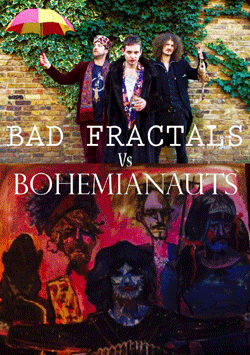
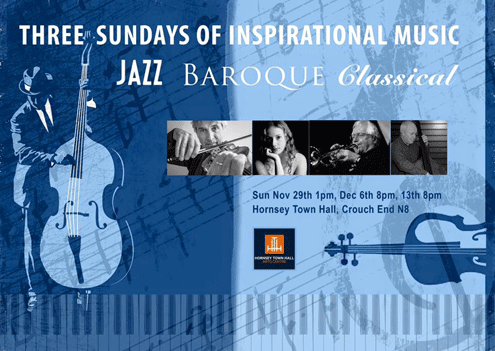
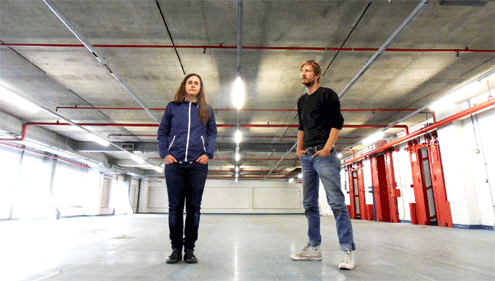


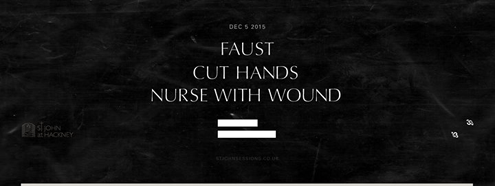




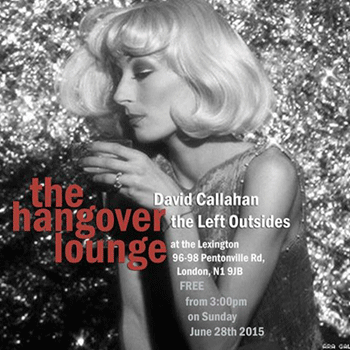


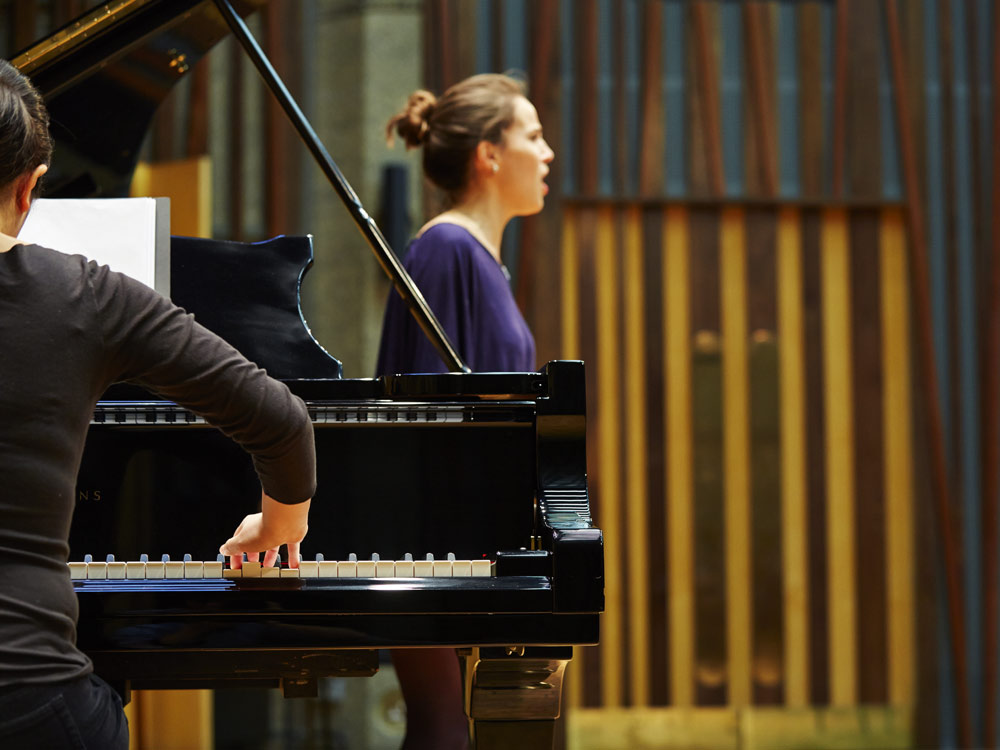


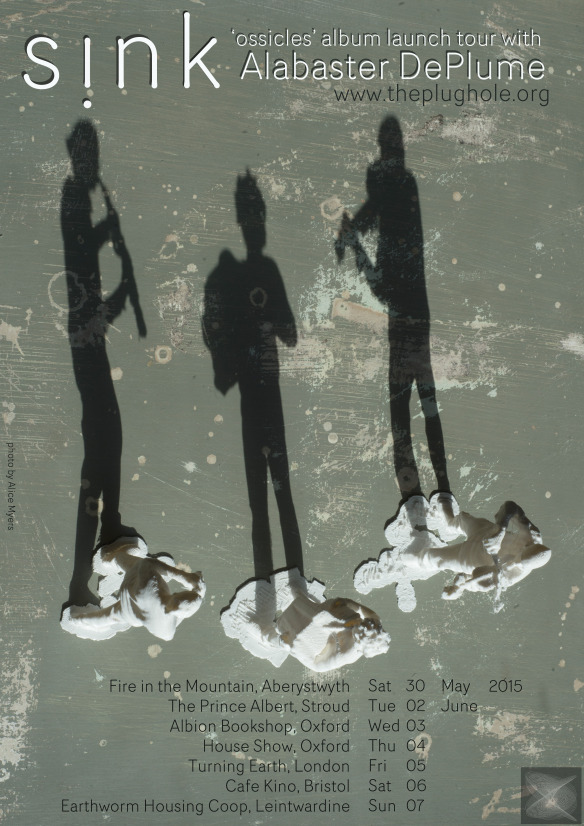
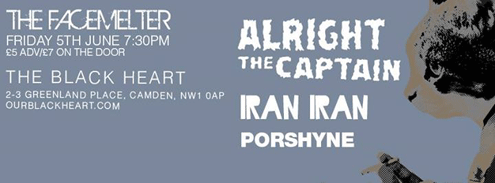
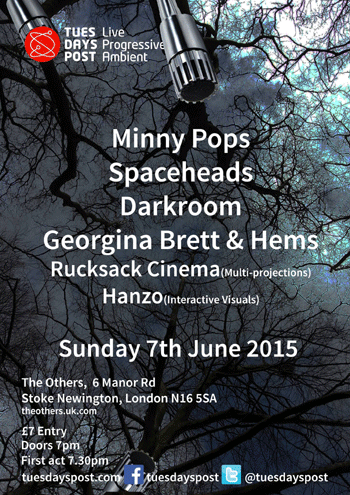


 Misfit City