Archive | jazz RSS feed for this section

October 1997 – live reviews – Django Bates’ Human Chain @ The Vortex Jazz Bar, Stoke Newington, London, sometime in 1997 (“joyous, brilliantly constructed bacchanalia”)

13 Oct

Next time I’ll bring my platforms. As per usual with Django Bates gigs, the Vortex is packed out and it’s standing room only. To enable the bar staff to make the perilous weaving journey between the crowded tables, the only place I can park myself and my aching feet is up against a wall, craning my neck to peer over the obligatory taller person in front. Plenty of other people are in the same boat. No one complains.

Well… apart from the couple I speak to afterwards, with their heads full of Parisian Latin Quarter memories and a taste for acid-jazz, looking in to see what a Jazzpar Prize winner plays like. They’ve decided that they hate Django Bates. Can’t stand him, can’t see what the fuss is about, can’t see the point. In their eyes, something’s wrong with the whole thing.

While I completely disagree with them, I can see their point. If you’re coming from an established jazz perspective (certain moves, a certain closet full of set patterns, a certain desire to be pleased in a traditional way), then what do you make of Django Bates? A man of many hats, most of them odd-shaped (tonight’s being a reasonably modest ski-hat which doesn’t even get to make it onstage). A man who’s wearing a faded T-shirt marked “Nobody Knows I’m A Lesbian”. Someone who reinvents the sacred New York, New York as a volley of bloody-minded bop, assault and battery (via vicious drums and sound effects – fire-engines, road drills and machine guns). Who then insults the memory of Sinatra by singing as if he’s in the shower; and finally throws in a rapturous applause sample during which the entire band punch the air like Motley Crue?

Or how about Hyphen’s forthright Coltrane-isms scratched into a hypermanic bass walk? Django yelps a string of “yeah!”s in parodic hammy Americanese; yet he later delivers a sprightly piano solo as the piece’s main moment of reflection. It’s peculiar but assured – like Victor Borges hosting the Jazz Club on ‘The Fast Show’. It’s not so much Duke Ellington as Frank Zappa hitting the lounge wall. Hard.

“N.Y., N.Y. – nice, yet nihilistic, yobs. That’s us,” says Django, faux-innocently. “Respect.”

It’s this sort of English ridiculousness that puts the originality and oomph into Bates’ muse, yet simultaneously blights his career. However much people are drawn to the joyous, brilliantly constructed bacchanalia of his music, many of them still struggle to accept the humour.  In another life, Django would have been an eccentric Oxford don setting his callow students another brainteaser. But jazz aristocrats are supposed to be enigmatic, not possessed of an absurdist schoolboy imagination. For all of his enthusiastic following, Bates’ refusal to wear a legend’s weighty clothes (or to deny his own genuinely playful nature), has tended to place him out in the cold within the jazz world, as opposed to in at the heart of the cool.

For this reason alone, it’s good to see that he finally seems to be growing up a bit. There’s a feeling of “less is more” tonight. The once-astronomical note count is down, and some of the exuberance has been pared off to let the expression come through more easily. The Human Chain four-piece has always been the purest conduit for Bates music, anyway. Django’s three lieutenants spar dextrously with his carnival of keyboards and the loopy bonhomie of his peck horn. Michael Mondesir expands his crabbed, funk-impossible groove approach on bass guitar, in partnership with Martin France’s ever-fresh polylingual drumming. Iain Ballamy serves as the moral centre and hidden authority for the group, his frowning bulldog visage set firm as he navigates his saxophones through the convoluted maps of Batesworld.

There’s a lot to find along the way, here in Human Chain’s haphazardly hilly country between Weather Report, Mingus, Naked City and Ivor Cutler. For instance,  the intriguingly sprained prog-rock samba of Three Architects Called Gabrielle; or And A Golden Pear’s long mixture of rhetorical questioning and querulous demand (this time given a Carlos Jobim calypso lilt). On Powder Room Collapse, France and Mondesir smack and swat away at the hidden angles of the rhythm. Bates expounds on his wah-wah’ed horn or squeezes electrified duck calls out of the keyboards. Underfelt slips from mode to mode, like a trapeze artiste on an endless series of loop stunts.

Keeping a single mood – other than an amused giddy elation – is next to impossible, especially while Django is continuing to toy with traditions. “We’d like to change the mood now,” he muses, and pauses a second. “And now we’d like to change it back again.” This continual deflation of expectations has got to be deliberate, a way of disarming and confounding our prejudices, freeing us up so that we can react naturally to the great and mischievous “perhaps” of jazz that Bates spends so much of his life illustrating. Thus, Food For Plankton – always an especially joyful party hop, working around a melody of delirious happiness and zipping soprano sax. Tonight it clicks its shoes to exceptionally pointed accents. It gives way,  during Potato Pickers, to a long and glorious slow flood of horn over wintery electronics.

The same players that sing, straight-faced, a frivolous primer for tea-making called The Importance of Boiling Water will also melt into the detached loneliness of Is There Anyone Up There?, Bates chiming the hours beneath Ballamy’s frayed alto saxophone thread. With incredible delicacy, his piano spills into the solo, becoming tiny notes afloat on a cymbal’s breath, so quiet that you can hear the measured hum of the fridge behind the bar as easily as you can Martin France’s brushes. Backed by the comforting yawn of Ballamy’s alto, Bates croons and mumbles bits of melody into the mike, narrates a story of a young man starved to death by TV, before France breaks it up with a colossal bang on the drums, triggering the final electronic runaway.

Best of all, the band can handle the frail beauty of Further Away with a compressed excitement. While focussing on Ballamy’s powdery-soft, open-hearted melody (echoing over itself), you only just notice how the band have sustained the spartan expectant atmosphere while simultaneously playing the hell out of it; whispering and yelling, dogs on the leash around Ballamy’s delicately determined oasis.

But perhaps, in the end, you genuinely just don’t get it. What the hell… your loss. No pork pie hats; showbiz that’s more ‘Call My Bluff’ than ‘The Cotton Club’. Respect, but not submission, to the black saints; a tendency to move the ground instead of the hips. Perhaps none of the above is your idea of jazz. But whatever you think, Django Bates is continuing to blow the dust off jazz’s spirit of adventure and letting it out to run. Whatever the humour here, there’s absolutely no joke in that.

Django Bates online:
Homepage, Facebook, Twitter, MySpace, Bandcamp, Last.fm, Apple Music, YouTube, Vimeo, Deezer, Spotify, Tidal, Amazon Music
The Vortex Jazz Bar online:
Homepage, Facebook, Twitter

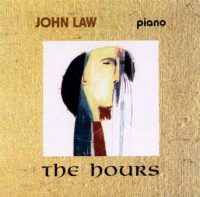
September 1997 – album reviews – John Law’s ‘The Hours’ (“a vision of a musician dissecting an act of faith for its structure alone”)

29 Sep

John Law: 'The Hours'

John Law: ‘The Hours’

“This music is dedicated to the spirit that moved the first humans to speak the unspeakable, and thus to sing”. Thus spake John Law, improvising pianist and British free-scene eminence gris. And the audience did open their ears, with a subtle flip of their hopeful hearts, and did prepare to receive his wisdom.

As Law explains in the liner notes, this is the third of a trio of recordings for which he’s written piano music in the form of plainchant. On this occasion, inspired by the ‘Liber Usualis’ devotional prayer-chants of Benedictine monks, he’s adapted and extrapolated a set of vocal melodies to correspond with the eight hours of prayer the monks observe. So, in effect, he’s set himself the task of portraying a whole community’s profoundest expression in music. Moreover, a community who’ve secluded themselves from the world specifically to perform that expression. Tall order.

‘The Hours’ is split into two eight-section parts. Firstly, an exposition of eight “chants”, all but one under a minute in length, each a single melody line or parallel harmony with minimal chordal support. Secondly, ‘The Hours’ proper: eight extrapolations of the preceding chants in which Law’s freed up to add his own interpretations and textures. So for the first half, we get a lone piano in the middle distance playing (with heavy use of the muting pedal) dutifully uninflected melodies with all the emotion of a canning plant: the beauty of the lines frosted over, clean as an abandoned cloister. For the second, the piano’s intended to take on a life of its own, expounding off the original melodies.

In the first of the improvising pieces, Matins/Vigilae, this doesn’t amount to much more besides the odd syncopated jazz twitch, surprisingly crass after the sterile beauty of the naked themes. For the superior Lauds it’s the decoration of the theme of Chant II by a sprinkle of high treble notes from the top of the piano, a subtly emotive sea-swell of tenor phrasing from below. For Prime, a Keith Jarrett-y stroll during which Law transmutes Chant III into a whirling spiral of shifting arpeggios that tumble somewhere between György Ligeti and Allan Holdsworth. Terce (one of the most successful pieces) staggers echoes of Chant IV – vibraphone-like – with occasional flashes of beauty when Law lets his guard down: then moves into peculiar John Cage mutes as he interferes with the strings in the piano frame, letting buzzes and flutters distort with the fluttering trills.

The problems really start to arise after this, when Sext’s boogie-woogie serialism (which moves into more of those acrobatic arpeggios) sounds a little too comical to take seriously, and the stomp of Nones has taken the feel so far from the original source that you’ll have forgotten you began this recording ostensibly listening to chants in an abbey. Vespers turns its own source, inexplicably, into stammered staccato pseudo-stride piano with spurts of hammering, constrained exploration. None of which would matter were it not for Law’s efforts in the liner notes to link his music to the devotional, whereas what he’s actually done is link it to the architectural. Like it or not, plainchant ain’t gospel, and its beauty doesn’t survive the transition into jazz unless – as Jan Garbarek proved with the Hilliard Ensemble on ‘Officium’ – you allow the jazz to meet it on its own territory and terms.

Compline makes some belated amends by being a gentle Bill Evans-style study of the final chant, but it’s the necessary little coming far too late. ‘The Hours’ is just too academic, too dryly sophisticated, too damn measured in its intent to take to heart. Law’s sophisticated, he avoids corniness, he has discipline. Oh God, does he have discipline. That, in itself, is what sinks this fine but soulless recording. Finally, for all the concentration, seriousness and cleverness of ‘The Hours’ it leaves you with no vision of God, no vision even of devotion; just a vision of a musician dissecting an act of faith for its structure alone. What it also leave you with is the impression that John Law – rather like the monks he’s allegedly saluting with this music – should really get out more often.

John Law: ‘The Hours’
Future Music Records, FMR CD41-V0697 (7 86497 26352 3)
CD-only album
Released:
September 1997
Get it from: (2020 update) Cornucopia Recordings.
John Law online:
Homepage Facebook MySpace Last FM Apple Music YouTube Vimeo Deezer Google Play Spotify Amazon Music
 

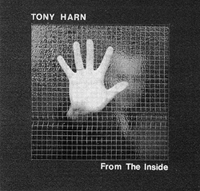
September 1997 – album reviews – Tony Harn’s ‘From the Inside’ (“hard-rock directness with intricate layering”)

18 Sep
Tony Harn: 'From The Inside'

Tony Harn: ‘From The Inside’

Tony Harn used to be in Spacematic, a Warrington duo who – had they survived – might’ve carved out a niche for themselves as music history’s only cross between Morrissey and Jeff Beck. Their 1996 demo was an odd and edgy marriage between Dave Harrison’s bleak bedsit lyrics and mournful vocals and Harn’s fluently melodic guitars (which mingled hard-rock directness with intricate layering). Imagine what their gigs might have been like. Two guys onstage in the throes of song and lost to the world – oblivious to the panicky expressions on the faces of their audience, as the tribal reps for the indie depressives and the rock hogs were forced to eye each other nervously across the clubroom floor, clutching their snakebites and beers for support. Ah, social awkwardness rattles its cage. Fine times. And – if they ever existed – gone times.

Parted from Harrison, Harn spent a year left to his own devices and ‘From The Inside’ is the result – an self-released instrumental guitar album which allows him to explore spaces of playing and composing which Spacematic could never have accommodated. Usually, rock guitar solo records are unparalleled opportunities for musical showing-off. While Harn’s got the necessary technical skill (and enough classic rock in his playing) to go for total guitar-hero blowout, ‘From The Inside’ is remarkably modest, and its musicality is expressed with unusual restraint. For instance, the title track’s Brian May explosion of passionate electric pomp and romance, lasts barely over a minute and fades out in a subdued loop of Vini Reilly arpeggios. Harn’s experiments in five- and seven-time are lilting, accessible and lovingly melodic: his lead lines are concise, memorable and authoritative. Acting as his own support musician, his crisp drum programming and sturdy work on bass and keyboards (as integrated as his guitar playing) lend the album a homely sound.

One of the best things about Harn’s playing is that, for all the skill of his fingers, not one note is superfluous or wasted. He’s more likely to sit comfortably on top of a bold tune than to play stuntman; he knows when to let exploration stop, and when to let silence stand. In a musical zone stuffed with supremely accomplished fret-wankers suffering from fingerboard diarrhoea, that’s a rare and cherishable talent. As far as obvious influences go, the above-mentioned Jeff Beck gets a look in (something in the attack, the indisputably British rock stylings); there’s a little of the ’80s Alex Lifeson in the hard-rock digital jangle; and sweet lyrical solos like Mike Oldfield or even Prince. Harn also has a strong touch of Joe Satriani’s out-and-out lyrical tone and way with a melody (most obviously on the sunny rush of Playsafe and Pseudoseven, or the echoing Room One which recalls Satriani’s Circles).

But what ‘From The Inside’ reminds me of most is the pair of albums Andy Summers and Robert Fripp recorded in the mid-80s – ‘I Advance Masked’ and ‘Bewitched’. Harn’s playing has neither Fripp’s intensity nor his academic sternness. Nor does it have Summers’ taste for textures on the guitar synth. But his fondness for the spangly echoes of the delay pedal, his exuberantly climbing note patterns and ear for counter-arranged, bell-toned rhythm-picking lines comes directly from their legacy. In Turning Time, guitars dodge and somersault cheerfully over the rising drones and evolving multiple rhythms. The cycling riff in Pseudopool recalls Talking Heads and I Zimbra: its long sweet smudge of a solo hearken back to Fripp’s New York years.

‘From The Inside’ does have its flaws, the most obvious one being that it carries the predictable symptoms of a guitarist’s showcase. Some pieces show this more blatantly than others (Beat The Bad, for example – a pretty superfluous bit of guitar-rock reggae style). You could also quibble about some slightly cheesy keyboard tones and parts, which pull some compositions a little too far towards travel-show soundtracks. Yet at least they err on the side of cuteness rather than flabbiness, and are essentially there to support the guitar work. Harn can be forgiven these lapses given that plenty of rock guitar soloists choose sixteen minutes of assorted widdly-widdly as a showcase, while his own offering is a well-worked-out album of tunes and interplaying.

In spite of Harn’s knack for those solid tuneful elements, many of the high points of the album come when he slows down and makes shapes. The eerie scrapings and siren wails which set the scene for the title track, for instance. Or Coloursound, in which ringing slow-swelling chords mingle gorgeously with the whispered sample on the voiceover: “Particularly at night, I have this incredible feeling of intense blackness… I mean, I’ve never experienced such darkness…” It could’ve sat comfortably on David Sylvian’s ‘Gone To Earth’, as could its drowsy vapour-trail of a melody.

I’d really love to hear Tony Harn working in a fuller band situation, or with collaborators who’d really bring out the best in him – but this’ll do for now. One of Britain’s finest undiscovered rock guitarists has left his calling-card, and I’d advise you to get in touch.

Tony Harn: ‘From The Inside’
Tony Harn, THCD1 (no barcode)
CD-only album
Released: 1997

Buy it from:
Limited availability – contact Tony Harn for information.

Tony Harn online:
Facebook MySpace YouTube

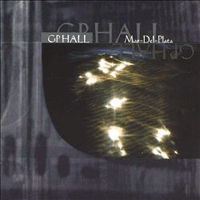
August 1997 – album reviews – G.P. Hall’s ‘Mar-Del-Plata’ (“ranges with restless compassion across a wide field”)

10 Aug
G.P. Hall: 'Mar-Del-Plata'

G.P. Hall: ‘Mar-Del-Plata’

Still clearing out the accumulated tapes of an inexplicably neglected career, Graham Peter Hall is continuing to come up with the goods. He’s been through thirty years of uneasy development on that rocky, unrewarding terrain between the simple sureties of the rock and roots instrumentalist and the often complacent indulgences of the full-on avant-garde blower. Marginalisation and bad luck might have ensured that he’s received little financial reward – nor has he gained the kind of brittle, precious reputation that marks out the darlings of the art-music intelligentsia – but it has resulted in a stock of lovely, emotive music in its own right.

Certainly Hall has managed to remain one of Britain’s most individual and complete guitarists over that time. Mastering a variety of styles from flamenco to rock to folk and blues, he’s also immersed himself in experimentation via technology – multiple speakers and pedal processors; vast, slow delay loops. Additionally, he draws on a repertoire of bizarre playing techniques and plectrum substitutes (involving battery fans, tiny psaltery bows, electric razors, toy cars and velcro, among others) which reflects the reinvention of guitar function explored by Fred Frith or Keith Rowe. With these methods in place, he’s explored sound through the textural suggestions of his “industrial sound sculptures”. Light industry, that is – Hall’s mimicry is closer to handsaws and governor motors rather than, say, Trent Reznor’s car-crushers and stamping presses.

Yet in amongst this, Hall has somehow never lost the ability to embrace expressive tunes; or to weave a handrail of familiarity into his sonic constructions. Perhaps that’s why ‘Wire’ types don’t seem to go for him; why he doesn’t have the kudos that the likes of Rowe, Frith, Eugene Chadbourne or Glenn Branca enjoy. He can get in your face – or wander off the usual path – with the best of them, but it’s generally in order to touch your sympathies. Ironically, in choosing to express his conservative and traditional side as equally important to (and entwined with) his avant-garde side, he’s gone too far for some.

‘Mar-Del-Plata’ is by far the most accessible and diverse of the compiled albums which Hall has been assembling this decade from deleted vinyl and assorted unreleased tapes. It’s a tour across a loose, but affecting, composing and performing imagination which ranges with restless compassion across a wide field. Sometimes you’re listening to a skittering, wilful flamenco performance. Sometimes it sounds like Cocteau Twins doing home improvements in the Mediterranean. Sometimes it’s the sort of individual, humanistic free improv/New Music result which you’d expect from Frith at his more lighthearted and relaxed, or from Simon H. Fell.

But though the record is full of experimentalism, Hall’s sense of melody is at the forefront – and the predominant voice on ‘Mar-Del-Plata’ is his masterfully expressive Spanish guitar playing. This can usually be found angling over long aching stretches of choral electronic humming, plangent violin and eerie ambient sounds called up from the industrial processors. In some ways it’s like a semi-unplugged take on a Robert Fripp Soundscape, in which guitar textures span out into infinity.

At other times, it takes on the simple directness of a folk tune: a dance of sparkling acoustic lights on Ionian Water, or the staccato accented Latin melodies of Mar-Del-Plata itself, underpinned by a geological murmur of bass. On the final hot gusting of Sierra Morena Dust Storm, the gut strings spit and scatter in rich melody, reaching new heights of sinewy passion. Here, Hall also bows some winnowing textures in his electric guitar accompaniment, using serrated steel bars from his box of implements.

Where technology plays a more direct role, Hall’s humanity doesn’t falter or go under. The hymnal swells of billowing electric warmth on Spirit Sky Montana (somewhere between Bill Frisell’s cinematic romance and David Torn’s eccentric string-warps) are the most beautiful and enveloping sound on the record, tapping deeply into church music and Romantic classical composing. The trickle of wind chimes, langorous piano, and enveloping sighs of Humidity Despair provide a gusting, luxurious impression of a sultry night: it’s lush enough to lean right back into.

Some tracks, fleshed out by Hall’s sound-loops and D.I.Y. treatments, are detailed, impressionistic oil-paintings in music and tone. Deep Blue sounds like someone chainsawing up a frozen Alpine lake, its jangling piano chords and thumping bass a mass of irregularities. The smear of bright spring-loaded colourflow on Charmouth Beach rings beautiful alarm bells. The menacing bass growl of Enigmatic is like a cave-bear thumping around in your dreams: squeaks and rattles from fingerboard and autoharp move around in slow disquiet, enclosed by knocking metal.

Plutonium Alert (in which Hall abandons guitar altogether in favour of soprano sax and the ring of auto-harps) treads similar territory to the ominous King Crimson improvisations from the mid-’70s. It goes for an all-out sensory mix of apocalyptic aftertones: angular bell-sounds and aggressive Grappelli violins entangling themselves with a spasmodically awkward funk rhythm. Weirdest (and most satisfying) of all is Fahrenheit 451 – juddering guitar, saw sounds, the shriek of a whistling kettle, and treble scratching all mix like toxic vapours under heavy pressure, pushing your head back against your rising hackles. Horribly enjoyable.

The scattered effects of the attempt to capture all of Hall’s ideas across a single CD does mean that ‘Mar-Del- Plata’ misses out on the cohesion which would render it excellent, but it’s a close-run thing. The centrepiece – a long-form creation called The Estates – pulls all the elements of the album together. A version of a 1975 long-form composition, it blends the chiming, restless clatter of its improv ensemble with Hall’s own quiveringly angry solo acoustic guitar. The brooding theme of The Estates is the crappiness and autocracy of post-war British urban programming. In thrall to modernism without being able to master it, its utopian vision (heartily botched and compromised) laid down a blight on communities, their architecture and their cohesion wrecked by the same tower blocks and support links designed to improve them.

Hall and co. express the disillusion and neurosis which resulted, with pulses of frustration and alienation hurl themselves against the confines of the music. Dulcimers, clarinets, and a huge array of percussion all seethe and pant over twenty-five minutes of desperate musical invocation; all overhung by the forbidding scrapes and alarm-clangs of two adapted metal piano frames (played like harps with assorted chains, wires, and implements). Hall’s panic-stricken guitar playing conjures the nightmare of a new, fatally-flawed sprawl of roads and buildings: swarming locust-like, unchecked and unconsidered, over beloved landscapes.

Incidentally, in the sleevenotes Hall gives a blood’n’guts description of the struggle it took to assemble and perform The Estates. Apparently, some of the manufactured instruments continue to drift through the art world with a life of their own. The piano frames – still counter-invading the architecture – were last seen as part of a “fire sculpture”. Meanwhile, the piece itself has an additional afterlife as a reflection on Hall’s own love/hate relationship with modernism; his own playing and arrangements echoing and championing the sounds of the traditional past even as they break them up in performance and execution.

As a body of work ‘Mar-Del-Plata’ has its faults – yet judged on its parts (and at its undisciplined best), it’s a touching, passionate and diverse album. Throughout, we get the sort of peek at Hall’s open heart (warts, gooey patches and all) which most experimental musicians, hard-wired into intellectual dryness, would never risk expressing.

G.P. Hall: ‘Mar-Del-Plata’
Future Music Records, FMR CD46-V0997 (7 86497 26442 1)
CD-only album
Released: 12 April 1997

Buy it from:
G.P. Hall homepage or Future Music Records

G.P. Hall online:
Homepage Facebook Twitter MySpace Bandcamp YouTube

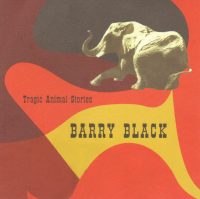
July 1997 – album reviews – Barry Black’s ‘Tragic Animal Stories’ (“playing off an all-American goofiness against a frowning European sternness”)

29 Jul
Barry Black: 'Tragic Animal Stories'

Barry Black: ‘Tragic Animal Stories’

When he’s not fronting the infamously shambolic noise merchants Archers of Loaf, Eric Bachmann is apparently found holed up in the practise rooms at North Carolina School of the Arts claiming he’s actually someone else. If ‘Tragic Animal Stories’ is anything to go by he is, in fact, several other people. But if they all want to call themselves “Barry Black” to save time, that’s fine by me. Hi, Barry. What’s in that box you’re clutching, then?

Originally just a collection of soundboard experiments – the sort of thing that’s invariably going to sprout up if you leave a couple of musicians in a room with a new toy – Barry Black has evolved into an after-hours mess-about-with-intent which has previously been graced by such wilful eccentrics as Ben Folds (another guy who thinks he’s three different people) or the Clodfelter brothers from Geezer Lake. For this second album, though, Eric Bachman’s instrumentation and samples are augmented by the enthusiastic mess of Chris Waibach’s drums and tuned percussion, and by Sebadoh producer Bob Weston’s guitar, trumpet and engineering.


Half of ‘Tragic Animal Stories’ is shambling takes on dark loungecore soundtrack cheese, with the other half a collection of sound-puzzles that seem to have been extracted from the gaps between instruments. Eric’s music leans as precariously like a tumbledown shack – as ramshackle and oddly comforting as the spattered bloops of Morse code keyboard that usher in and wave out the album – and floats in a kind of fluid dusky haze, in which movement in any direction is possible as long as you’re not hung up about how fast you get there.

It doesn’t take long for the cheerful schizophrenia of ‘Tragic Animal Stories’ to make itself felt. The Horrible Truth About Plankton goes from being hypnotic and enwebbed in the suffocating, shuddering dust of an organ straight out of a Czech horror film to being relieved by falling-apart slacker-jazz drums and sweet shambling melodies carried on Waibach’s cheerful vibes, and ends up as easy listening on a slight O.D of random tranquillisers. Chimps sounds like Startled Insects in gigglesome mood: mechanical pings and stringy high life guitar jostling with a cabaret wind band (brass and kazoo) and pushing it into ‘Threepenny Opera’ land, complete with wild skinny tremors of Jamie Muir-style xylophone.


The lovely, brave little tune of Slow Loris Lament clambers out of a shambling toybox orchestration, like a lo-fi Rick Wakeman among the Playpeople. A stylophone plays a fanfare over a radio whine. There are barking noises, ticklish steel drums and a bassoon. Don’t waste any time waiting for a hot guitar solo: Slash couldn’t make the session (and there’s a rumour that they’ve still got Joe Satriani locked up in a cupboard off the control room from the time when they opted to wipe off his lines in favour of a triangle track).


As expected, there’s a definite fuck-around element to all this, but thankfully without that wacky “nothing’s serious” sloppy buffoonery that hangs around many lo-fi groups like the gang joker’s B.O. It sounds as if Eric’s involved in a more serious game of his own, playing off an all-American goofiness against a frowning European sternness, arty soundtrack pretensions against musical jokes, flake against pose.


Duelling Elephants comes out like a darker sketch from ‘Carnival of the Animals’ that refused to take itself too seriously, and made a beeline for a cartoon Munich beerhall, dragging the remains of its menace behind it. The oompah bassline and trembling treble of the piano, mingled with close brass and bassoons has the sadistic comedy of Nickelodeon animation, but it also ripples as ominously as disturbed water. Drowning Spider emerges through an antique shellac crackle: walloped piano like Fats Waller having a nervous breakdown and careening off the edge of the recording reel. Iditarod Sleigh Dogs – a scratched rhythm from detuned banjos and tinkly, twitchy, plonky kiddie piano lines – sounds like Eric composed it with his head on upside-down. Cute.


Even with the playfulness, ‘Tragic Animal Stories’ always has its serious side. On When Sharks Smell Blood, dazed front-crawl piano swims and sways to shore, while rakes of ravenous solo and duo cellos wind around it and a deathly creak (a leaning rocking chair? a wind swing door? a murderer’s step on the verandah?) infiltrates the background. For the big picture, there’s the David Torn spaghetti western of Derelict Vultures, starting life with a harsh guitar scratch and limping Morricone melodies from a splitting, tortured, midrange electric guitar and a filtered swoosh of background, until harsh Russian horns take over the melody and pull it off the badlands onto the steppes.


Tropical Fish Revival sounds like Death approaching a lean-to in a Kingston shantytown. Eric’s mournful, indistinguishable sung words (his only vocal performance on the whole album) flutter above his clang of funereal piano, a shabby, heavy-footed drum loop and a fluting, buzzy keyboard flutter. A shimmer of vibrating steel pan reverbs off into the distance, and the light fades with it.


Snail Trail of Tears closes the album with the lullaby sound of a music-box vibraphone and an overdriven guitar drone melody like a stretchy harmonium. It sounds like Pram or Labradford revamping King Crimson‘s Starless on a heavy summer evening. The bass grumbles like a cello. An out-of-phase air extractor noise adds a layer of feathery sound like a heavenly choir, and then it drops away into those Morse bloops again. Over and out.


Small music from another place. I want to go there.

Barry Black: ‘Tragic Animal Stories’
Alias Records, A122 (0 93716 01222 1)
CD/vinyl album
Released:
29th July 1997
Get it from: Alias Records
Barry Black (Eric Bachmann) online:
Homepage Facebook Twitter Soundcloud Bandcamp Last FM Apple Music YouTube Pandora Spotify Tidal Instagram Amazon Music
 

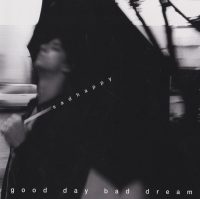
July 1997 – album reviews – Sadhappy’s ‘Good Day Bad Dream’ (“a contemporary progressive group that’s unafraid to mingle technique, horror, street-smarts and a mordant, lethal wit”)

4 Jul

Sadhappy: 'Good Day Bad Dream'

Sadhappy: ‘Good Day Bad Dream’

The voice on the telephone chuckles. “Sure, it all made sense to me. You just burn it out, past the pain. / Sure it’s all toxin: you just work it out of your system.” Somewhere between a Berklee College education, an Olympia punk statement and the world of woodshed ravings you’ll find this – rolling down a quiet highway like a fatal fog-wall.

For their fourth album, the alliance of drummer/sample mangler Evan Schiller and bassist/spoken-word freak Paul Hinklin has convulsed yet again to install a new Sadhappy lineup. Out goes eccentric Critters Buggin/Tuatara sax player Skerik. In comes Michael Manring, ’90s bass guitar genius, for a very different approach to the power trio. Two basses might sound like a recipe for disaster – ‘Jazz Odyssey’ doubled up, or cheesy slap-funk duels. Sadhappy get around this by realising the implicit power in the timbre of the bass guitar: the added resonance, the volcanic rumble it’s impossible to ignore, the sheer booty-shaking body. And they go for it full-bloodedly. In the resulting low-end carnage, saxes and guitars are not missed.


A lot of this is to do with Manring, who’s rivalled only by Tony Levin, Victor Wooten and Doug Wimbish as a contemporary redefiner of bass guitar. Not content with just a jaw-droppingly dextrous technique (whether grooving fingerstyle, slapping, tapping, or picking), he’s as liable to mutate melodies by abrading them with an EBow and/or in-flight retuning. And, as you’d expect, ‘Good Day Bad Dream’ is a treasure box of bass sounds – the levitational noises on Lost in Bass; the chainsaw punk rumble on Maintenance Pissed and Chronic Subsonic Tonic; the multitracked interplay of worming harmonics, chunky strums, and wolf-wails on The Kitchen Sink. But it’s no mere technique-fest.


Yes, for the most part it’s instrumental. And at its most basic (Home Lobotomy Kit, Honeymoon Deathbed) it tugs us through a darker edged and more credible fusion revamp via Hinklin’s brutally precise twanging, growling basslines, Schiller’s clattering, tight as a mantrap drums, and Manring’s distorted, storming, articulate leads. And there’s a strong element of the roaring hybrid of thrash, fusion and left field virtuosics that fuelled Manring’s last album ‘Thonk’, recorded as an attempt to escape his inconvenient reputation as a jazz-leaning New Age muso. But in meeting the streetwise intelligence of Schiller’s drumming and Hinklin’s sardonic New Music/punk’n’sarcasm influences, Manring’s restless and complex musicality has completed its journey away from the New Age racks.


‘Good Day Bad Dream’ emerges from this as an album blending multiple strands of modern electric music with surprising success. It’s an overlapping low end approach of eerie smoggy textures, wrapping up art punk, weird funk, jazz, dark ambience, sampledelia, progressive rock, sound massage, and a dash of psychological sewage. The trio nod to Mingus, the smouldering dark star of modern jazz, with a strutting and dextrous cover of his sarcastic II b.s. With the fifteen minutes of deathly textures and world-swallowing bass oceanics on The Death of Webern, they’ve got that scary isolationist-ambient game sown up too.


Evan Schiller’s light touch throughout ensures that the band are never bogged down. Within The Kitchen Sink’s light-fingered ostinatos, King Crimson riff choirs and E bow calls, his precise percussion approach rings, swooshes, crashes and drops out to leave perilous canyons in the texture of the music. On SBD, he shines with an array of sparse metallic taps and lethally timed buzz-rolls under a lowering cloud of bass, a dark canopy of wails and murmurs through which Manring winds skeletal insect-trails of overdriven bass, twisting and skirling like cyborg bagpipes.
……………………………………..


But the key to Sadhappy’s success in reaching out beyond the fusion ghetto is Paul Hinklin’s acidic humour, which lurks somewhere in the triangle between Tom Waits, Frank Zappa and Bill Hicks. In the recurring, repulsive figure of Oscar (a forty-nine-year-old backwoods Beavis with a voice like a plastics bonfire), he gives Sadhappy their own all-American idiot guide, a lottery sweepstake winner with “money comin’ out of his ass” swaggering over a racket of bellowing grunge-garage art rock riffs. His new rich man’s horizons lead him only as far as the porn racks at the general store, or to the bar; a coarsened American Dreamer content to do nothing more than wallow in his own filth and boast about it (“Yeah, you gotta work for the rest of your life: I own the streets I piss in!”).


On False Information – a sort of post-Laswell take on a ‘Remain in Light’ groove, burrowing through post-rock and hip hop en route – Hinkler offers us a lighter look at the aches and absurdities of the modern human condition. “All the guilt, all the shames, all the blames, / all the payments that you pay for crimes you never even committed, / never even thought of – what’s up with that?”. Schiller’s pin-sharp sample-heavy beats jab and dodge like a lethal flyweight boxer as Hinklin’s sardonic voice chuckles at enlightenment: “You see past everything and you say, this is just me plus garbage. Hell, if I couldn’t see the garbage, then I would be the garbage. Thank God I can tell I’m not the garbage. “‘Scuse me, honey. I have to take myself out to the trash. What is truly me will come back to dinner. It’ll just be me minus garbage.””


Sometimes though, the humour goes darker. In the harsh fable of Hammering Man, the townsfolk turn out to watch the unveiling of a statue: “a testament to the nameless brave, to the unselfish, the holy slaves. The ones who gave their bodies and minds to the army, the ones that gave themselves to the might of the all powerful industrial machine. The ones that had made America strong, the ones that had made America beautiful. The ones that, through no fault of their own, had turned it into a wasteland.” Small wonder that the statue crumbles, toppling to pin the spectators to the earth.


In the brooding dusky groovescape of Oscar Gets Laid, we get to see a younger Oscar, callow and innocent, rubbing up for the first time against the world that’s going to corrupt him. Manring’s mixture of rattling ominous echoes and scritching, coppery industrial harmonics send a shiver down the spine, as Hinklin’s murmured vocals explore paranoia and fascination down the back alleyways of the mean streets – malevolent shadows, and the breath of heroin ghosting out of the skins of hookers. At last: a contemporary progressive group that’s unafraid to mingle technique, horror, street-smarts and a mordant, lethal wit.


It’s also one that’s firmly rooted in the present, soaking up the lessons of grunge, dance, and sampler culture, while still playing the arse off all comers. Even if ‘Good Day Bad Dream’ sometimes strains the limits of its excellence by being just a little too diffuse, too dependent on fusion fallback, Sadhappy move through their music with assurance, imagination, presence and a brutal vigour. And that’s an all too rare combination.

The smile on the face of a charming, constructive killer.

Sadhappy: ‘Good Day Bad Dream’
Periscope Recordings, PERISCOPE RECORDINGS CD04 (7 96873 00042 0)
CD/download album
Released: 2nd July 1997

Get it from: (2020 update) Original CD printed in a run of 1,000 – CD and download best obtained from Bandcamp.
Sadhappy online:
Homepage Bandcamp Last FM YouTube Vimeo
Google Play Spotify Amazon Music
 

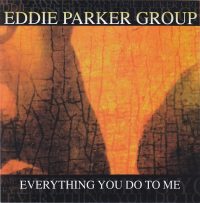
October 1996 – album reviews – Eddie Parker Group’s ‘Everything You Do to Me’ (“while the warmth of Parker’s compositional personality remains consistent, here the group is cat-stepping through traps”)

4 Oct

Eddie Parker Group: 'Everything You Do to Me'

Eddie Parker Group: ‘Everything You Do to Me’

When they’re performing, flute players always look as if they’ve got a small, mysterious smile on their lips. Perhaps it just comes with the technique, but it’s an expression which seems to sit more appropriately on the faces of certain flautists than on others.

On the face of Eddie Parker, for instance: one of Django Bates‘ circle of contemporary British jazzers, and therefore an affable, witty maverick able to call on the services of a whole gang of other affable, witty mavericks. He’s spent time with Bates in the gloriously rowdy Loose Tubes (where he first made his mark as a writer) and in Delightful Precipice, contributing to a wealth of exuberant, contortionistic musical moments. Outside of the Loose Tubes alumni circle he’s blown away hardened New York jazz execs as the secret weapon on Bheki Mseleku’s ‘Celebration’, and has notched up work with Jazz Umbrella and with John Stevens’ Freebop along the way.

His 1994 solo debut, ‘Transformations of the Lamp’, brought his effervescent writing skills and bandleader’s warmth to the fore in a group partnering him with a couple of animated yet unsung heroes of the British new jazz crowd (journeyman pianist Pete Saberton and Perfect Houseplants drummer Mike Pickering) and two of his fellow Loose Tubes (saxophonist Julian Nicholas and double bassist Steve Watts). This follow-up – adding guitarist John Parricelli, a third ex-Tube – takes the celebratory warmth and involvement of Parker’s music even further.

If there’s one image that an Eddie Parker tune (usually blending Latin-American liveliness and township jazz celebration with a gently mischievous, cheeky British disrespectfulness) tends to bring to mind, it’s a picture of the Thames Valley suffused by bright Brazilian light and carnival energy. As perfectly illustrated on Mystery in Three: an opening of swimming, dreamy ringing melting with a airborne swish into Saberton’s animated, bunny-hopping piano and Parricelli’s sliding Larry Carlton guitar swells, while Parker and Nicholas trade off sprightly, interlocking, chatty dialogues of flute and soprano sax.

But with Parker’s background, you can’t expect even music this breezy to stay altogether straight, and part of the group’s skill is to mix up the virtuoso complexity of the tunes with a reckless, teasing sense of ridiculous good humour. Wonky Chorino – an animated, loose limbed Brazilian frolic, ambling back and forth like a seven legged donkey loose in the town square – lurches teasingly towards parody while always, laughingly, pulling itself back on the lifeline of its own breezy wit. It’s paired with Twerp, a bouncing bop disguised as light elevator funk continually landing on the wrong foot: sunny, carefree, fool on the hill flute leads, an alto sax nattering cheerfully to itself, and Parricelli’s soft interjections on wah-wah guitar. Lovably bewildered, like one of those endearingly clumsy guys who survive life by means of their unconscious, innocent charm.

But beyond this bubbling vivacity there’s a new quality to Parker’s work. Much of his previous writing seems to have rushed along with a crowded yet joyful clarity, but half of ‘Everything You Do to Me’ slips off sideways into a much less sturdy, unstable region fraught with deadfalls, pits, tricky space. While the warmth of Parker’s compositional personality remains consistent, here the group is cat-stepping through traps, delighting in their own agility, yet disorientated by the vanishing of landmarks.

Brocken Spectre emerges from a spiky snaggled mass of intersecting bebop melody ettes; mountaineering via long, leaping polyangular flute runs, taking the lead over staggered piano and ride cymbal and Parricelli’s distractedly comping guitar. It’s named after a high-altitude illusion, and sounds like it, with the music breaking down into instrumental doppelganging piano ornaments, crash cymbal swells, eerie flickery unisons of flute, tenor sax and guitar; a battle between abstract spikiness and propulsive swing. A tumble of sax leads to a crash, and then silence. Finally, a bass flute breathing fractured, forgetful waltz patterns, lilting back and forward in mirror images over spurts of confused piano.

It gets odder. Variable Geometry is a perilous quicksand of shifting rhythms, accents and tempos, Parker’s flute cautiously peeping out into a landscape of terse guitar blares and edgy piano. Mike Pickering (an excellent yet strangely self effacing presence throughout the album) works and manipulates the band with subtly sadistic tricks of timing and rogue beats as the band flit between free jazz games of chicken and acerbic electric keyboard workouts (like a cut-up Headhunters or Stevie Wonder in one of his occasional bouts of synth rage).

Auster, named after the Greek god of the south west wind, moves like fresh green leaves in a swirl of gently disturbed, randomised air. A free time feel, a cryptic ‘I Sing the Body Electric’ bass clarinet; Frisell-style yawns of guitar, disconnected piano; Parker drawing out high, shut eye musings over the top. Gradually it gets more involved and intense, finally clenching down to Derek Bailey guitar clicks and high tom skitters.

At last the flirtation with confusion becomes a full-blown affair on Delirium, which you can trace as you listen to it. The initial dazed Wayne Shorter pronouncements of Nicholas’ sax, sitting at the centre of the music, while flutes and arpeggiated guitar reel dizzily around it. The entry of the piano, displacing the drums: Parricelli’s guitar working away with the disorientated determination of John McLaughlin staggering away from a whirling carousel. The tripping melody establishing itself on the wind instruments as piano and guitar take up the reeling duties. A few moments of unified group arpeggios. Then a halt, then delirium transforming into vision as Parker gently soars lark like over Saberton’s floridly romantic piano, eventually joined by Nicholas’ sober tenor, resting from its delirium. A return to the melody, this time led by a forthright, exuberantly overdriven Parricelli. Finally a triumphant and conclusive unified chord, as the haze clears and resolution’s achieved.

After these journeys through chaotic freedom there’s a return to security, solidity, and faith, handled with as much sensitivity and control as all of Parker’s previous brinkmanship. Everything You Do to Me’s title track is a soft, wondering expression of utter love; a John Coltrane ballad refracted through Django Bates at his most delicate, up there with A Remark You Made as a modern classic. The sleepy, post-coital embrace of Parricelli’s guitar and the tender, barely-there burr of Nicholas’ tenor mingle with Parker’s gently lyrical piano lines, like a feathery caress of the fingertips along the back of a sleeping lover.

Music that embraces you, yes… but look out for that small enigmatic smile on its lips.

Eddie Parker Group: ‘Everything You Do to Me’
Future Music Records, FMR CD29 E0496 (7 86497 18202 2)
CD-only album
Released:
1st October 1996
Get it from: (2020 update) CD best obtained second-hand.
Eddie Parker online:
Homepage Facebook Twitter Last FM YouTube Vimeo Google Play Amazon Music
 

December 1995 – live reviews – Gordon Haskell @ The Unplugged Club, Bloomsbury, London, 7th December (“one mockingly rolled eye peering out to capture the madness and to look out for an escape route”)

9 Dec

Not even a minute into the show, and we hear it. He looks thoughtfully out at the mixed crowd and speaks. “I can usually tell whether an audience is going to be good or bad.” A pause. “Good night!” And then he lets it rip. That laugh – an untrammelled, hiccupping whoop of unbalanced joy, teetering on the edge of losing it. You may have heard in on King Crimson‘s ‘Lizard’, twitched into hysteria by studio electronics, a lone human voice in the sick, surreal circus. Twenty-five years on, in this intimate little acoustic club, it sounds like the redemptive, rueful peal of a free man, acknowledging the potholes of disaster that dog our footsteps in this world and cause some of us to drop into madness.

Strange to think that this grizzled and animated figure, eyes twinkling benevolently beneath a battered hat that’s the last word in Bohemian chic, is Gordon Haskell – singer with King Crimson for nine studio-bound months back in 1970. At an age where most ex-proggies are still squeezing themselves into the glad-rags and going through ever-more lifeless motions in small theatres, Haskell is donning comfortable clothes, picking up his acoustic guitar, playing tiny little places anywhere and enjoying himself. To tell the truth, the Crimson connection is misleading. All of that was a long time ago now. Gordon’s profile may have been lower than a bug’s belly since then, but now he’s swinging back into action with a vengeance… and he’s in better artistic shape than most of his more financially successful contemporaries.

Not only does he possess a brilliantly gutsy guitar style and a voice so rich and earthy that you could grow potatoes on it. but he has a bagful of excellent songs to offer. He now writes and plays like a combination of John Martyn and Leon Redbone, with a huge measure of the rawer joys of John Lee Hooker and Richard Thompson. He takes the vibrancy and gleeful survivor’s power of deep blues and blends it with an irreverent, eccentric, classically English strain of absurdism. Like the young Peter Gabriel, he takes his stand against the hostility of the world with a disarming, cunning humour, one mockingly rolled eye peering out to capture the madness and to look out for an escape route. It’s all as warm as a closely-held candle on a winter’s night… and as liable to suddenly scorch your fingers.

Thinking back to ‘Lizard’, one wonders what kind of more lively, organic record would have emerged had Robert Fripp and Peter Sinfield given Gordon a crack at the songwriting rather than just dovetailing his voice into their meisterwerk. There’s a vague hint of Sinfield’s verbal adventurousness in Haskell’s songs, although thankfully none of the attendant pretensions. The Hooker-like Wang Bang World captures life’s grim tendency to overrun us, but revels in a tumble of savagery and joking; conversely, Pelican Pie could be just a blur of absurdist imagery were it not for the beady-eyed thread of social critique running through it.

Haskell’s between-song banter may be a mixture of oddball wisdom and Eddie Izzard goofiness (“may you be blessed with many goats!”) but the humour in the songs is by no means pointless, pretentious silliness. Rather, Haskell’s a knowing jester holding his own and laughing in the face of life’s terrifying chaos. Hanging By a Thread (dedicated, tonight, to Fred West) is a mordantly hilarious parade of murderous, fatalistic comedy: “Gentle Jim got life for chopping up his wife / – said he needed warmth for the winter.”

The lack of preciousness is what really makes him great, though – he’s not out to prove to us what a clever musician he is. Sure, each song has enough teeth and gold to make us think about it, but it’s Gordon’s sheeer verve and ecstatic gutsiness that wins the audience over, captured in the luxuriant salaciousness of Chilli Chilli, the throbbing jungly blues of Test-Drive or the voodoo swamp-stomp of Alligator Man, a roaring clapalong portrait of the ruthless predatory wheeler-dealer, the sheepskin-coated hoodlum-salesman who’s becoming a spectre of the times.

Like those old bluesmen, Haskell knows how life and death, humour and horror walk side-by-side and share the same streets, and his work is not short of tenderness as well as carnality. The love song All My Life rasps like Louis Armstrong, and I Don’t Remember It Like This shows an Ian Anderson verve as it examines the misleading, misframed photos in the history of love: “whatever love is, it’s in the thrill of your kiss / and I don’t remember it like this.” There’s a real feel to the soulful sorrow of Tortured Heart and in the wry shrug of Mail Order Love, which mixes an organic bluesy swing with a handful of dissatisfied plastic metaphors, romance gone synthetic. The philosophical break-up song Go Tell Sarah is part goodbye, part lie, part promise.

In a dash of sheer music-hall, he tips his hat and beams at us with real pleasure, inviting us in to share both the fear and the laughter on his perspective on life. The return of Gordon Haskell is going to offer the scene a welcome dose of warmth, and 1996 could well be his year. A lost star is returning to dispense a special kind of mischievous twinkle.

Gordon Haskell online:
Homepage Facebook Twitter MySpace Soundcloud Last FM Apple Music YouTube Deezer Google Play Pandora Spotify Tidal Amazon Music
 

Sometime in 1995 – album reviews – Dayna Kurtz’s ‘Footprints’ (“venturing into the faultlines between lovers which lurk in the most private places”)

30 Nov
Dayna Kurtz: 'Footprints'

Dayna Kurtz: ‘Footprints’

I’m not a stranger to heartbreak (either my own or that of others), but in all my experience of it, there are many things I haven’t done. I’ve never sat nursing a coffee in an all-night cafe as the dawn breaks, rearranging the cracked facets of my bitter smile. I’ve never composed the ultimate understanding kiss-off, writing the shapes and sentences to slide into a failed lover’s heart, to pat on the shoulder and slap upside the head with the same motion. I’ve never climbed the stairs of a Manhattan walk-up, trying to listen hard enough to trace the voices of memory infiltrating the walls and carrying memories of bitter love affairs, and of angry hearts temporarily exorcised at 3 a.m. But ‘Footprints’ – a collection of songs from Dayna Kurtz, whom I first saw breathing a blue glow of melody in front of a transfixed DreamHouse audience at the Water Rats – gives me an idea of what it might have felt like if I had.

Dayna explores the long deep pain of thwarted love with the same sort of delicious tension between voice and guitar as you get with Tuck & Patti or Jose Feliciano, but more raw, more direct, less decorated. Her voice is an aching, defiant, yearning thing, sharing breath with both Billie Holiday and Joni Mitchell. Her guitar is terse, bluesy, jazzy, but with a stubborn bluntness that refuses to flow smooth and to comfort; choosing instead to smack the hooks of wounded desire further into the heart, to bleed out the regret and anguish or to force the protective badges of scars and knowledge into being. Her songs clap and fold about you like a Coltrane solo bouncing jaggedly off the walls of a tiny club; or slip into you like short stories that sink to the depths of the heart, then rise like surfacing mines, meaning expanding in soft slow explosions.

Pick almost any song on here and you’re drawn into a story of bitter tangles; of embracing arms that end in helplessly clenched fists; of awkward, looming personal baggage that blocks the way into shared rooms. Perhaps the brittle R&B, funk and electricity that amplify the two full-band songs on ‘Footprints’ (‘The Road You’re On’, the title track) blunt the impact of Dayna’s writing. But catch her solo and you’re let in on something personal, painful, profound and beautifully defiant: “I threw my thoughts around, just for you to trip on.” She’s no fool: she’ll see through sentiment to the truth of the immediate (“once in a lifetime, this time – that’s what they sold me. / I don’t believe that, but it’s holy, holy,”) and she’s wise to vainglorious bullshit (“I got your picture at home: / you’re looking kinda cocky, with this wistful undertone, / like some cover has almost blown.”). Still, she seems ultimately to gravitate towards tension and friction in love.

In ‘Lay Me Down’ a relationship starts in a healing calm – “help me remember my liquid heart, and the open mouth of painful parting… / I’m moved, I confess, by a heart that seems calmer than mine.” Yet it swallows its own tail, hung up on the suspicions that both lovers have brought to the bed. “I hover above some something you said, / ’til I can’t feel you at all.”

In ‘Something/Nothing’ she attempts to immerse herself in a clasping at protection: “lost in the dark outside, I took your room to breathe, / and then I sealed all the cracks in me / then choked off my heart so cold and quick / and thought ‘it’s better this way’.” This, too, ends up in an indefinable and unexpected loss. “I lost my faith in something that I couldn’t name. / I thought you left with nothing… but I’m not the same.”

Dayna’s great songwriter’s gift – raising her above the usual horde of self-important dirty-linen washers – is the strength she brings to the table. A sense not of victimhood or self-righteousness, but of a strong woman of heart and mind, venturing into the faultlines between lovers which lurk in the most private places, and reporting back with full, proud honesty. “In my most helpless of hearts, I’ve been tearing up pictures of you,” she flares on Nowhere, made bloody-minded by another partner’s calculating shallowness and cowardice. “I gave my heart, an ocean; / showed you my soul to see. / And you just skimmed along the surface – but you’d swear you’d drowned in me… / When we’re good, we’re very good; / but when we’re bad, you’re nowhere.” On ‘This Side of Eve’ (a live duet with South African singer Tsidii Le Loka, whose shivering, passionate vocals coil round Dayna’s like smoke trails on a winter’s night) she’s set her face forward, to move on: “This place doesn’t know me, so there’s nothing to leave.”

Yet, appropriately, it’s the broken, free-time lick and gentle licking of old wounds on ‘Touchstone’ which I keep coming back to. A lonely, solo memory song (“I think of you, I think of you,”) surging and ebbing with the questions and longings that come too late (“Remember me? / I curve like a question mark. / And I’m lying home alone, / and I can almost hear you calling / like a saxophone…”). All the disappointments, yet couched in tenderness (“Remember me? / I came to you washed clean / and soft as a peach. / I said ‘let’s climb’, / but all you did was reach for me,”) and the frail wisps of old hopes, still held and treasured long after the hope has winked out of them – “I knew you’d be my touchstone, / I could see us getting old.”

Some old ghosts are now sitting with me. I think we’ll wait together, silently, until the sun comes up.

Dayna Kurtz: ‘Footprints’
self-released (no catalogue number or barcode)
Cassette-only album
Released:
1995
Get it from: (2020 update) Best obtained second-hand; this album is never likely to be reissued (since Dayna considers it to be juvenilia, or at the very least material recorded before she’d found her songwriting identity). There’s a live version of ‘Touchstone’ on Dayna’s ‘Otherwise Luscious Life‘ album.
Dayna Kurtz online:
Homepage Twitter MySpace Bandcamp Last FM YouTube Spotify Amazon Music

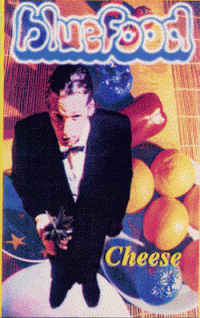
April 1995 – EP reviews – Bluefood’s ‘Cheese’ (“n elegantly tired, worn, damask’n’dust croon as loose as a blanket thrown over a sagging sofa…”

30 Apr
Bluefood: 'Cheese'

Bluefood: ‘Cheese’

“Given half the chance you would take the time / to have all the things you ever wanted to find / and, maybe, make sure that everything was always fine. / Just clear your head, look through the window, see the world knocking at your door. / There’s a cure – just close the curtains, / that’s what they’re there for…”

Bluefood are brilliant. No two ways about it. Think Tindersticks gone sampleadelic but with better tunes; think of the much-missed white-knuckle Bohemianism of Furniture; think Morrissey’s wit unencumbered by the petulant tantrums and waving sleeves. Think a down-at-heel, seedier young Scott Walker slumped in a corner after losing five too many bar brawls; but still carrying a ironic smirk across that smart mouth, behind the bruises. Think of the way that London can pull you down into a swamp of despondency during the days, sucking the energy out of your nerves in a succession of crummy jobs and rented rooms: then think of the way you decide to make the same tatty old city yours at night.

You don’t need to think any more: Bluefood have nailed it. It’s all here. In Duncan Morris’ voice, there’s the memory of a whole world of opportunities missed by a whisker – an elegantly tired, worn, damask’n’dust croon as loose as a blanket thrown over a sagging sofa. And while he plucks at the faded fruits of a haphazard existence, Paul Gilbert, Alun Lane and onetime Pigbag drummer Chip Carpenter wrap them up in a raffish, rumpled package of manically swinging pianos, swirling sardonic jazz-horn samples and sweeping Cocteau-ed dream-pop guitar like a swathe of tattered velvet curtain: all stitched together in mordant, sparkling hooky pop that, timeless as it is, could only pop up out of the ’90s.

It’s Burt Bacharach and Randy Newman playing poker with Moonshake and Portishead in The Smiths’ old bedsits, perhaps; but it’s all “wall-to-wall hardcorn melodrama” to Bluefood. As glimpsed through the oscillating spaces between the loops, their world is one where hapless boys lose their girlfriends to other women; where you can know precisely how cheap you are while still enjoying your ability to place hairstyles; where you’re no more than your last wisecrack or trophy date (like the dumped lover on ‘Who’s Who?’, knocked out of his place and freefalling through the gaps of casual engagements and social cyphers); but where the world still lurches on in a spirit of optimism that’s half cunning, and half plastered.

Duncan and co. take you on a tour of this world and its shifty corners, armed with the sort of impeccable wit, comic timing, and sense of self-awareness (“Boy meets girl, / girl finds herself, / boy loses mind and takes to getting drunk and writing morbid songs”) which the hopelessly pompous likes of Jack will never touch. “I found perfection, didn’t know what to do with perfection. / I caught a falling star – it burnt a hole in my pocket.” They might be boho to the core; but they’re not so langorously in love with the lifestyle’s tatty glamour that they’re oblivious to its ridiculous side.

‘Send in the Clowns’ (no, not the Sondheim one) sketches the ups-and-downs of the wastrel’s life, swaying between complacent despondency (“when you sleep and dream away the truth, nature’s on the roof / stealing all the lead”) and the wild clutchings of helpless inspiration “when your head’s confused, like you’ve blown a fuse, / when you just don’t know what you’re supposed to do, / when the circus runs away with you…” Down in the depths, on ‘Girlfriend’, the marshmallow bloat of the loungecore string loops which cushion and smother Duncan’s teary love-lorn drunkenness are suddenly invaded by a wandering mariachi band… right at the point when he’s sure that things can’t get any worse.

‘Merry-Go-Round (She Said)’ is, in a way, a rewrite of ‘Drive My Car’: still for the young and hopeful, but with the knowledge that they’re a little more sardonic these days. “‘Hello, do you want a boyfriend?’ / She laughed, ‘I’ve already got one’. / ‘Well, anyway, a girl like you should have two, / In case one gets broken.’ / So that was how they met.” It captures the rapid swirl and the first thrill of the heat coming on, while simultaneously puncturing the pretentions of born-again lovers. “‘Life’s a merry go round’, he said. / ‘Oh, how bloody profound,’she said. ‘Lah-de-da-de-dah – just drive…” On the tale of a quarrelsome, burnt-out affair on ‘Eyes of Bethnal Green’, love kicks hard even as it’s going downhill: “She was the kind of girl if she broke your heart / it would ruin her life for the whole weekend… / ‘Tell me you’re not just another boy-man with two big eyes in his sockets. / Got the world in his hands, when his hands are in his pockets.'”

If the course of true love ain’t running exactly smoothly here, it’s not lost altogether. ‘Funny Face’ sounds exactly like an older, wiser, more guarded Blue Nile – an after-hours torch ambience half-inched from Sinatra; smoky ripples of synth; sparse, sharp, romantic piano. All topped off with finger-snaps, jazz bass, a soulful Tony Bennett sample returning in a snatch of song, and Duncan’s meditation on the girl who’s reawakened his lazy, world-weary interest. It’s romance of a sort, as he extricates himself from the swamp of insincerity: “I love your politics, / I admire your hair, I like your style / and the clothes you wear: but you can change your views, / you can change your taste…/ Well, I’ll always like you.”

Somewhere out in the city tonight, Bluefood are sprawled gracefully in the corner of a bar, leaning on a pile of chipped hearts in the failing crimson light, and trying to trace the erratic currents of life in the swirl of a martini. Battered, smudged stars-in-waiting. Toast the cheese.

Bluefood: ‘Cheese’
self-released (no catalogue number or barcode)
Cassette EP
Released:
April 1995
Get it from: (2022 update) Very rare and never reissued; best obtained second-hand. There were soundfiles from the EP on the internet at some point, but I can’t find them anymore.
Bluefood online:
(no websites available)

Video

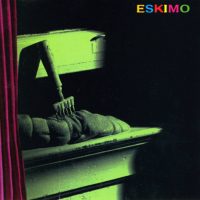
March 1995 – album reviews – Eskimo’s ‘The Further Adventures of Der Shrimpkin’ (“a sort of comedic musical lucky dip”)

24 Mar
Eskimo; 'The Further Adventures of Der Shrimpkin'

Eskimo; ‘The Further Adventures of Der Shrimpkin’

San Francisco’s Bay Area still seems to be a hotbed for particularly off-the-wall musical artistry. The headquarters of hippydom in the ’60s is now the place where players’ players (Joe Satriani, Fred Frith, Michael Manring) make their homes, and bands like Primus and Faith No More forged their scrambled mongrel funk/punk/metal in the same neighbourhoods. It’s also the place from which a secrecy-shrouded band called The Residents sent out a series of sharply clever and mischievous recordings during the ’70s, analysing, deconstructing and parodying popular music in all of its manifestations. One of these was a concept album called ‘Eskimo’, a fanciful reconstruction of Inuit life and lifestyles. Even now, no-one’s absolutely sure whether it was a joke or not.

You’d guess that a band taking their name from that Residents album is gonna be just as difficult to pin down. Apparently Eskimo did start off as a joke band, set up by a collection of shaggy undergraduates from UC Berkeley with a penchant for party dresses. They’d hang out on campus corners busking frenetic, eccentric acoustic sets – stabs at TV theme tunes; Springsteen parodies; Who medleys. To an extent, you could say that they’ve never really grown out of those days of unbridled silliness. Eskimo still have wacky and zany written all over them in giant red fifty-foot letters, and anyone who finds the absurdist lunacy of the current Californian freak-muso scene unbearable would be advised to steer well clear.

Those not put off by that rubbery sense of humour will probably have a field day. Adding Tom Yoder’s trombone and David Cooper’s marimba and vibraphone to the standard guitar, bass and drums, Eskimo have a lounge-jazz element to their sound that’s got a lot in common with that other late, great, wise Californian eccentric Frank Zappa. A lot of ‘…Der Shrimpkin’ could have come from the same barn as Montana and One Size Fits All. That said, there’s at least as much of Primus slap-bass Muppet silliness in Eskimo as there is of the Mother of Freaks.

But like both Zappa and Les Claypool, the band have a love of American popular culture with all of its attendant and hugely enjoyable junk music. Their masterful playing (switching styles, moods, and tempos at the drop of a dime, and as happy with modal jazz charts as with playtime funk) is offset by their complete lack of concern about serious subject matter or, indeed, sense. With most of the twenty-four tracks on ‘…Der Shrimpkin’ clocking in at under two minutes, the album’s a tossed salad of circus music, playground chants, nursery rhymes, gibberish gospel, scuzz-metal and drunken jazz trombone exuberance, all mixed up in a freak-rock pudding. A sort of comedic musical lucky dip.

It could all be unbridled silliness but for the fact that ‘…Der Shrimpkin’ never quite loses the aura of anarchic menace that hangs around each of its ingredients. One of the few remaining covers on here – a faithful version of Snakefinger’s Residents collaboration ‘Kill the Great Raven’ – is (despite its kiddie vocals and campy haunted-house bellowing) a bloody ceremony of ritual murder and resurrection. ‘Babykins’ flavours a police siege with infantile fears. ‘The You’re So Slender’ is a Disney cartoon from Dali-Hell, while the jolly slap-funking ‘Bughead’ (sung in musing tones by guitarist John Shiurba) babbles about the sadistic rituals kids develop for the playground. ‘Oops’ (once you can decipher it) seems to be about the divine right of extermination; and ‘Ribbit’ sounds like Mark Twain taking on the princess-and-frog legends, complete with yelling hick farmer and squirming vocals.


What with many of the other tracks being short snippets of surreally twisty, dark-toned vibe-jazz (the sort that accompanies swaying cameras creeping around the Bates Motel) Eskimo may initially come across as a comedy band, but they re definitely no joke. A child’s nightmare with a big red pasted-on grin, perhaps. Coco the Clown fingering a cleaver. A set of practical jokes for the damned.

Eskimo seem intent on nailing jokey voices and songs onto the menacing shadows of the subconscious, as they do in the exuberant nonsense words of ‘Dado Peru’s hop-skip-and-jumping Dada/Beefheart-jazz, or in the restaurant full of freaks in ‘Electric Acid Pancake House’, all happily hallucinating about Elvis’ return as a serial killer. What with that, plus a cheerful stab at Duke Ellington’s ‘Blue Pepper’ and the odd spiritual song about tacos, they re probably perfect for the enjoyably warped. Give Eskimo a try next time you re having one of those gratuitously loony, twisted days… but watch out for the backwards messages.

Eskimo: ‘The Further Adventures of Der Shrimpkin’
Mammoth Records/Prawn Song Records, MR0102-2 (0 35498-0102-2 4)
CD/download album)
Released:
21st March 1995
Get it from: (2020 update) Original CD best obtained second-hand; or download album from Bandcamp.
Eskimo online:
Homepage MySpace Bandcamp Last FM Pandora

May 1994 – live reviews – Django Bates’ Delightful Precipice at London Jazz Festival @ The Bloomsbury Theatre, Bloomsbury, London, 17th May 1994 (“behind the whimsy lies the mind of a genius, or a sadist. Probably both.”)

19 May

Time to open your eyes a little wider, ‘cos something strange is stirring in the home counties…

Those of you familiar with Bill Bruford’s Earthworks will be aware of the contribution made by one Django Bates on keyboards, tenor horn and compositional skills. If you’ve done your homework, you’ll also know that he and Earthworks’ brilliant saxophonist Iain Ballamy originally worked together in the anarchic and thoroughly enjoyable Loose Tubes, a jazz big band who sounded like a joyous drunken party in a brass instrument factory.

If you’re really keeping up with Bates’ freewheeling progress, you might also know that he has his own big band in the form of the seventeen-piece Delightful Precipice, featuring Ballamy and several other Loose Tubes-ers such as flautist Eddie Parker, clarinettist Dai Pritchard, saxophonists Julian Arguelles and Steve Buckley… well, a large chunk of the current British jazz scene, when it comes down to it. Certainly half of the musical population of London, clutching various brass and woodwind implements, seems to have ambled amiably onstage along with the flamboyant Bates. While this lot might not have the profiles of the Courtney Pines of this world, they’re probably doing more to extend the boundaries of innovative music. With Earthworks, Bates breaks new ground and moves the landscape around; with Delightful Precipice, he teeters teasingly on a thrilling new brink (as suggested by the title of tonight’s opener, ‘Tightrope’).

It’s certainly brinksmanship of a high order. From the first notes, I’m transfixed by the music Bates and co. are producing: all of you who speak knowledgeably of the complexities of prog bands should lend an ear to Delightful Precipice, and get an earful of Django Bates’ muse. It’s a rich, densely textured experience; this is music so complex and ferociously intelligent that I feel as if it’s forcing entry to my skull. Pressed back in my seat as the music powers on, rushing through my mind like irresistible floodwaters, I’m firstly overwhelmed by the sheer substance of it. Later, as it shows no sign of letting up, I feel my reluctant slow little brain being gently forced into activity; it’s like slowly being woken up, given a massage and a pep talk. This is music so cerebral that it even brings your mind up to speed.

‘Tightrope’ opens the show in slamming clusters of notes like being punched to death by brass, before the band gently finger-snap their way into ‘Armchair March’, a melancholy Bates-y stomp with long peals of English brass band sound (a Loose Tubes trademark). The following ‘Fox Across the Road’ is a menacing, darkly harmonic undulation, sliced up by samples of screeching car brakes, speech, beeps and horn toots, and savaged by Mike Mondesir’s slap-bass breaks.

Bates cuts an eccentric figure onstage – curly-headed, immaculately stylish and handsome, spinning around behind his keyboard or pulling out a hunting horn for a quick blast. His ironic smile, plus the reams of music manuscript spilling over the keyboard and the musing, other-worldly humour of his between-song comments give him the air of some elegantly mad professor, a Lewis Carroll of the jazz scene. He dedicates the handclappy lunacy of ‘Ice is Slippery’ to his sporting heroine, Tonya Harding. ‘The Loneliness of Being Right’ features a lengthy chunk of free-association gibberish (“Bud Freeman Hardy Willis… do not forsake me, oh my Darjeeling tea…”)

But don’t be fooled. Behind the whimsy lies the mind of a genius, or a sadist. Probably both. His music manages to balance both an astounding inventiveness and enough humour to keep us listening to it. There is the considerable problem that a poor sound mix renders his keyboard all but inaudible, but the guy still seems to be everywhere – dancing and conducting his ferociously complicated arrangements, playing behind his back, waltzing through ‘Queen of Puddings’, generally having a good time.

The second half of the show is more accessible than the dense and demanding first, opening with Eddie Parker’s breezy big-band rush ‘Exeter – King of Cities’, a carefree musical evocation of the Devon summer. We also get ‘Glad Afrika’, a revamp of Bates’ Loose Tubes standard ‘Sad Afrika’ translated into “happy stylee” in celebration of the end of apartheid. It’s a glorious burst of happy-sad brass, a cartwheeling piece rolling through chorale to cacophony and ending up in a great soft resolution.

Almost impossible to top; but Bates manages it when he straps on his tenor horn and walks out from behind his keyboard to deliver a reading of Earthworks’ ‘Candles Still Flicker in Romania’s Dark’ which reduces the original to a pale, ineffectual shadow. His horn playing is phenomenal, sputtering and spiralling, clutching at heaven and breaking hearts, devastatingly sad and angry. The band – as previously noted, a sterling group of musicians and no mere wallpaper backing – also excel themselves in their sudden subtlety on the wispy pulses of the chordal background.

For closers we get the hyper-percussive artillery of ‘Martin France at Seven-and-Three-Quarters’ (with the aforementioned drummer going to town on his rig electronics) and the wry musing on disappointment, ‘You Can’t Have Everything’, in which Bates and his horn break up the glumness by invading the audience. Plus, as an encore, there’s another of Bates’ grabs at incorporating different musical forms into his art – this time, it’s the noble English football chant, fused alongside some heavy rock wallop into the raucous ‘Discovering Metal’. I’m treating to the spectacle of the arty Bloomsbury audience gleefully yelling along to “woah-oh, oh oh oh!” like a bunch of benevolent hooligans.

Bates comments, as he shuffles the music for ‘You Can’t Have Everything’, that the fate of the modern British jazzer is to be famous for two weeks and then to be dropped by the record company. “Only joking,” he goes on. “The fact is that there is a British jazz scene, as long as we all make it happen.” Well, Delightful Precipice can provide us with a whole evening’s worth of reasons why we should.; and I’d urge you to become familiar with their arguments. Wit, technique, complexity and another jump forward in the universe of jazz. To think that this is happening in England!

Django Bates online:
Homepage, Facebook, Twitter, MySpace, Bandcamp, Last.fm, Apple Music, YouTube, Vimeo, Deezer, Spotify, Tidal, Amazon Music

The Bloomsbury Theatre online:
Homepage, Facebook, Twitter

August 1993 – live reviews – Martin Taylor @ Ferens Live Art Space, Kingston-upon-Hull, England, 5th August (“like hearing crystallised music”)

8 Aug

It’s nice, for a change, not to have to do anything except sit back and listen.

Listening to Martin Taylor is like a breath of fresh air after a particularly sticky storm. He stands alone on a little white block of a stage with only his guitar and gently tapping foot, and gently unravels a long flowing river of melody to soothe the heart and to excite the brain. Pure and simple music. After a surfeit of analysis, a slew of post-modern criticism, a stew of eclecticism and image, it’s nice to get back to that once in a while.

Listening to Martin Taylor allows you to rediscover a love of the old tunes. He’s not a composer; his strength lies in the re-interpretation of classic standards, but rather than murdering them by pouring on strings and pallid flutes to make them ripe for serving up in the air conditioning, he offers you the chance to hear him dust down an oldie, hold it up to the light and then skilfully polish it, smiling as he shows it to you again and points out a hundred little details which you never saw before, a source of fresh wonder.

Because listening to Martin Taylor is like hearing crystallised music. You can distinguish the original tune somewhere in the glittering web of notes which his fingers are drawing out of the guitar – maybe it’s a ballad from ‘West Side Story’, maybe Duke Ellington’s Just Squeeze Me or a Hoagy Carmichael piece – but it’s been reflected and amplified through so many harmonies, echoes and byways along the way that what finally emerges bears as much resemblance to the original as a cut diamond does to glass. Old tunes turned corny and worn down by their own familiarity re-emerge as multi-faceted gems, cut and refined by a master’s technique, multi-layered and ornate.

If you stop listening to Martin Taylor for a moment, you might be able to hear the sharp clicks as the jaws of the guitarists in the audience drop smartly onto the floor. This crystalline music – richly syncopated melody and harmony played together, simultaneously with swooping basslines – is, after all, being played by one man without even the whiff of an effects pedal. During the interval, people are overheard wondering if there are four other guitarists concealed under the stage or behind the curtains. But there’s no denying that this music is being played by a human being; no pristine technician, Taylor’s impeccable skill is shaped as much by punchy string snaps and fretboard noise as it is by his carefully considered polyphony and his vertical, dense approach to arrangement. He’s as likely to use a violent slide up the bass strings as he is to tease out a gentle classic jazz chord in the treble; and, as the most exciting musicians do, he lets you hear him stretching towards his objective rather than simply delivering it ready-packed and icily perfect.

Listening to Martin Taylor when he stops playing and talks for a while is, in its way, no less of a joyful experience. Here we have one of the world’s greatest and most underrated jazz guitarists and he turns out to be a warm, humble and self-effacing guy with a nice line in gentle humour and a shy manner, as if tonight was his first gig. Taylor is possibly also one of the world’s first motherable jazzmen. No guitar god here: even when he speaks of his sessions with the legendary likes of Joe Pass and Chet Atkins, he makes it sound like a comfy jam session after an evening at the pub. Very British. I’m not sure if these isles can produce a legend of their own these days – we’re just no good at mystical PR…

No matter. Who needs a legend or the cartoon padding of a star, anyway? Taylor’s music is possessed of enough to soothe, stun, stimulate, delight and relax without recourse to tortured artistry, space-cadet communion or outlaw chic. And if he prefers to continue playing gorgeously low-key and intimate gigs, just one man and a warm-toned guitar, then I for one will continue to turn up to listen to Martin Taylor.

Because listening to Martin Taylor makes you remember just how wonderful listening can be.

Martin Taylor online:
Homepage Facebook Twitter Last FM YouTube Deezer Google Play Spotify Tidal Amazon Music
 

SWOONAGE

Swoon. /swo͞on/ A verb. To be emotionally affected by someone or something that one admires; become ecstatic. Here are some people and things that make me swoon. #swoon #swoonage

Post-Punk Monk

Searching for divinity in records from '78-'85 or so…

theartyassassin

...wandering through music...

Get In Her Ears

Promoting and Supporting Women in Music

Die or D.I.Y.?

...wandering through music...

Music Aficionado

Quality articles about the golden age of music

THE ACTIVE LISTENER

...wandering through music...

Planet Hugill

...wandering through music...

Listening to Ladies

...wandering through music...

ATTN:Magazine

Not from concentrate.

Xposed Club

improvised/experimental/music

The Quietus

...wandering through music...

I Quite Like Gigs

Music Reviews, music thoughts and musical wonderings

furia log

...wandering through music...

The Recoup

SINCE 2013: Books and books and books and books and occasionally other things

A jumped-up pantry boy

To say the least, oh truly disappointed

PROOF POSITIVE

A new semi-regular gig in London

Gapplegate Classical-Modern Music Review

...wandering through music...

When The Horn Blows

...wandering through music...

:::::::::::: Ekho :::::::::::: Women in Sonic Art

Celebrating the Work of Women within Sonic Art: an expanding archive promoting equality in the sonic field

Ned Raggett Ponders It All

Just another WordPress.com weblog

FLIPSIDE REVIEWS

...wandering through music...

Headphone Commute

honest words on honest music

The One-Liner Miner

...wandering through music...

Yeah I Know It Sucks

an absurdist review blog

Obat Kanker Payudara Ginseng RH 2

...wandering through music...

poplifer.wordpress.com/

Waiting for the gift of sound and vision

Good Music Speaks

A music blog written by Rich Brown

Do The Math

...wandering through music...

Archived Music Press

Scans from the Melody Maker and N.M.E. circa 1987-1996

The World's Worst Records

...wandering through music...

Soundscapes

...wandering through music...

OLD SCHOOL RECORD REVIEW

Where You Are Always Wrong

FRIDAY NIGHT BOYS

...wandering through music...

Fragile or Possibly Extinct

Life Outside the Womb

a closer listen

a home for instrumental and experimental music

...wandering through music...

Life Just Bounces

...wandering through music...

Lucid Culture

JAZZ, CLASSICAL MUSIC AND THE ARTS IN NEW YORK CITY

Aquarium Drunkard

...wandering through music...

eyesplinters

Just another WordPress.com site

NewFrontEars

...wandering through music...

FormerConformer

Striving for Difference