Archive | folk-jazz RSS feed for this section

February 2016 – upcoming gigs – interlocking British tours by Yorkston Thorne Khan, Toby Hay/Jim Ghedi and Laura Moody offer Anglo-Indian crossover folk, fingerstyle guitar, folk baroque and cello bewitchment.

10 Feb

I didn’t catch up with this next tour until a couple of its January dates had gone by, but it’s still worth catching up with the rest of it:
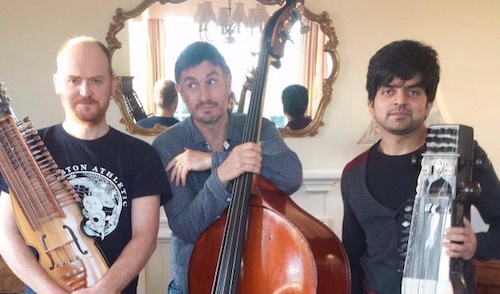
Yorkston Thorne Khan, 2015

Yorkston/Thorne/Khan are an experimental group that includes James Yorkston (hailed as one of the most “influential singer/songwriters on the Scottish folk scene”), Suhail Yusuf Khan (award winning sarangi player and classical singer from New Delhi) and Jon Thorne (best known as jazz double bass player with electro outfit Lamb). The trio are currently touring to support their collaborative debut album ‘Everything Sacred’, which was released in mid-January 2016.

This is Scottish-Irish-Indian-English music in the raw – Yorkston’s familiar steel guitar strings pulled, pushed and bent into more unfamiliar acoustic drones, the bass dropping anchors through the floor. Rather than world music per se, this sounds more idiosyncratic, a temporary structure bivouacking by the side of the indie-folk, art music tradition, while its widening horizons extend back to the Sixties heyday of the Incredible String Band, and forward to this singular album’s satellite orbit over the folk music, Indian classical and indie music of today – all these musical ley lines threaded into a new kind of eclectic, domestic setting.

James: “Playing together as Yorkston/Thorne/Khan, we tackle a wide array of different sounds and songs. Alongside pieces of our own, there’s a fair chunk of improvisation, plus covers of Ivor Cutler’s Little Black Buzzer and Lal Waterson’s Song For Thirza. Jon’s jazz background definitely comes to the fore, as does Suhail’s devotional singing and outstanding sarangi playing. I just do my best to keep up…”


Dates:

January 2016 – upcoming gigs (mostly London) – jazz/Indo/groove/lyrical shapes at Cafe Oto with Emanative & Collocutor Duo, Earl Zinger, Sarathy Korwar and Sealionwoman; Medway garage, film snaps, Paris pop and hauntological folk in Putney with The Senior Service, French Boutik and Of Arrowe Hill. Plus Nerve Toy Trio in Warrington.

23 Jan

And another inevitable January gig update, as expected…

* * * * * * * *

Emanative Collocutor Duo, 2015

(Baba Yaga’s Hut presents)
Emanative & Collocutor Duo featuring Earl Zinger + Sarathy Korwar + Sealionwoman (+ more tbc)
Cafe Oto, 18-22 Ashwin Street, Dalston, London, E8 3DL, England
Friday 29th January 2016, 8.00pm
more information

Baba Yaga’s Hut bring us an evening of cosmic jazz explorations.

Emanative & Collocutor Duo is a teamup between saxophonist/flautist Tamar Osborn and drummer/mixologist Nick Woodmansey. Tamar’s history includes work with Africa Express, Dele Sosimi and The Fontanelles: she currently leads eclectic, hypnotic modal septet Collocutor (with Josephine Davies, Simon Finch, Marco Piccioni, Suman Joshi, Maurizio Ravalico and Afla Sackey) which mixes jazz and minimalism with Afrobeat and Ethiopian ideas, Indian classical and polyphonic choral music. In recent years, Nick’s work as leader of the Emanative project has seen him take the helm for British cosmic jazz. The Duo allows Nick and Tamar to take and blend aspects and ideas from both projects in a slimmer, tighter context. Guesting with the Duo on chants and vocals is Earl Zinger, the reggae-toaster-inspired alter ego of acid-jazz veteran and former Galliano frontman Rob Gallagher (whose post-Galliano work has included jazz band Two Banks Of Four and who’s also currently working as William Adamson).

Three tastes of the project are below – a duo version of Albert Ayler/Mary Maria Parks’ ‘Music Is The Healing Force Of The Universe’;an Emanative remix of a Collocutor track; and an Emanative track from last year with strong Collocutor contributions.


This is (I think) the second gig for the Duo – there’s been at least one other well-received show in July 2015, at The Waiting Room in Stoke Newington). That gig also featured Sealionwoman, the playful, driving voice-and-double-bass duo whose shape-changing jazz and blues songs have enchanted ‘Misfit City’ for several years now. They’re making a return appearance at this gig too. (Here’s my my 2013 eyewitness account of them, again; plus a chunk of video from the very same show.)

In between Sealionwoman and the Duo comes Indian classical/fusion percussionist Sarathy Korwar. Dividing his time between London and Pune, Sarathy trained as both tabla and drum kit player and specialises in applying Indian classical rhythmic ideas to non-Indian percussion instruments, blending in aspects of improvisation and intuition.

More people may be added to the bill at the last moment…

* * * * * * * *

On the following evening, there are shades of garage, mod, Parisiana and spooky folk.

(Retro Man Blog & Damaged Goods Records present)
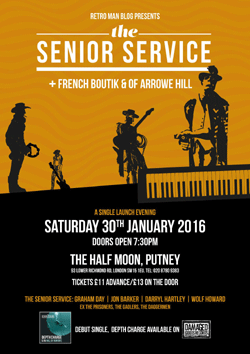
The Senior Service + French Boutik + Of Arrowe Hill
The Half Moon
, 93 Lower Richmond Road, Putney, London SW15 1EU, London, England
Saturday January 30th 2016, 7.30pm)
more information

Playing ‘60s-styled instrumentals, The Senior Service feature four musicians who, between them, have moved through many of the garage bands from the Medway scene – including The Prisoners, The James Taylor Quartet, The Solarflares, The Masonics, and assorted Billy Childish bands. Jon Barker (Hammond organ), Graham Day (guitar), Darryl Hartley (bass guitar) and Wolf Howard (drums) are inspired by John Barry/Ennio Morricone/Barry Gray soundtracks, Stax rhythm’n’blues (Booker T & The MGs) and early Mod (Small Faces). Damaged Goods Records release their debut single, Depth Charge, this month (with a full album to follow).

Senior Service/French Boutik/Of Arrowe Hill @ The Half Moon, Putney, 30th January 2016
In support are French Boutik, who (inspired by their Paris home) blend ideas from 1960s French pop such as Serge Gainsbourg and Yé-yé with classic Motown and Burt Bacharach, all with a modernist pop twist.

Opening the evening are Of Arrowe Hill – Adam Easterbrook’s “hauntological” rock group who are now midway through their second decade of work. Expect their usual mix of country blues and acid folk with lo-fi psychedelia, with Adam backed by ex-Aardvarks rhythm section Ian O’Sullivan and Jason Hobart.

* * * * * * * *

Finally, further north (much further north) there’s this:

(Marpexke Productions presents)
Nerve Toy Trio
The Saracen’s Head, 381 Wilderspool Causeway, Warrington, WA4 6RS, England
Saturday 30th January 2016, 9.00pm

Nerve Toy Trio, 30th January 2016Nerve Toy Trio (guitarist Tony Harn, bass player/pedalist David Jones and drummer Howard Jones) are playing their first gig of the year, back in their hometown.

Although I’ve posted about Tony before (covering his first three albums as a solo player – start here and work backwards) I don’t think I’ve posted about the Trio before. All are veterans of an underrated and overlooked Warrington art-rock scene of the 1980s which (although notable for launching Tim Bowness) was squeezed between and overshadowed by neighbouring ferments in Manchester and Liverpool. They spin out an echoed, textured fusion-rock which spans from delightfully airy to tight-and-bumptious, and which thrives on understated juxtapositions which are always earnest, cheeky or interesting, – setting a pinch of Hendrix squall against Cheshire pastoralism; Pat Metheny harmonic glitter alongside romantic Steve Hackett peals; Rush power riffage in alternation with Robin Guthrie spangle.

With their melodic, rococo flourishes and outright proggy roots, sometimes the Trio come across as uncertain time travellers – hopping and picking across four decades of art rock and fusion while still ultimately homesick for the treasures of their teenage listening – but for me that just adds to their charm. The clip below shows their mellower side and a flash of their muscle: the gig’s in aid of Macmillan Cancer Support if that’s any more of a draw. Nerve Toy Trio still seem like a band who’ve not quite found their audience yet. If you’ve read this far and are still interested, perhaps it’s you they’re looking for.

January 2016 – upcoming gigs (mostly London) – Daylight Music brings classical on the 23rd (Orchestra of the Age of Enlightenment Experience Ensemble, Roger Doyle, Ok Bertie! and Jim Bishop) and pop on the 30th (The Wave Pictures, The Leaf Library and Citizen Helene); plus Martin Creed, William D. Drake and Stephen Evens in Brixton.

22 Jan

This should be the last of the January gig updates, though I always speak too soon… Don’t forget that The Bleeding Hearts Club Winter Escape is still on in Brighton on the 23rd.

* * * * * * * *

Daylight Music 212

(Daylight Music presents)
Daylight Music 212 – Orchestra of the Age of Enlightenment Experience Ensemble + Roger Doyle + Ok Bertie! + Jim Bishop
Union Chapel, Compton Terrace, Islington, London, N1 2UN, England
Saturday 23rd January 2016, 12.00pm
– free entry – more information

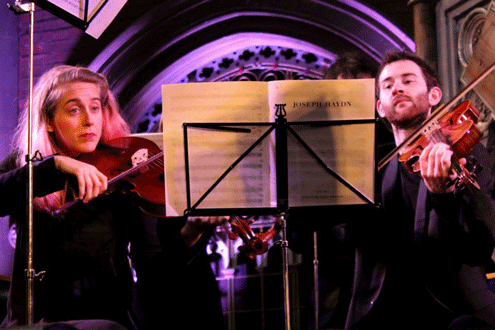
“Three decades ago, a group of London musicians took a good look at that curious institution we call the Orchestra of the Age of Enlightenment, and decided to start again from scratch. The Ann & Peter Law Experience Scheme gives talented young musicians a chance to perform with the Orchestra. In this concert the musicians on the scheme perform together, by themselves, for the first time, just a few weeks after finishing at the OAE Academy. It looks as if we’re going to be treated to some Haydn (Symphony No. 85 ‘La Reine’, the nickname originating because the work was a favorite of Marie Antoinette) plus the Romance written by his original London sponsor, Johann Peter Salomon.

Roger Doyle is known for his pioneering work as composer of electronic music. He has worked extensively in theatre, film and dance, in particular with the music-theatre company Operating Theatre, which he co-founded.

Ok Bertie is the moniker of Robert Szymanek, a singer-songwriter, composer, and visual artist living in London. Bertie’s debut album of songs is called ‘Music From A Crowded Planet’, and is due for release in 2016. It’s accompanied by the ground breaking Crowded Planet iOS app, created in collaboration with developer Matthew Hasler.

https://www.youtube.com/watch?v=mjxN60bdLOE

Sonic Brute mainstay Jim Bishop will also join us to take the Henry Willis organ out for a spin and bring us some time travel themed melodies: it’s time to go Bach to the Future!”

…or in my case, back to the past. Jim Bishop was at University with me long ago, and set some of my words to music for a body-issues revue at the Edinburgh Fringe. Jaunty.

More Daylight news further down…

* * * * * * * *

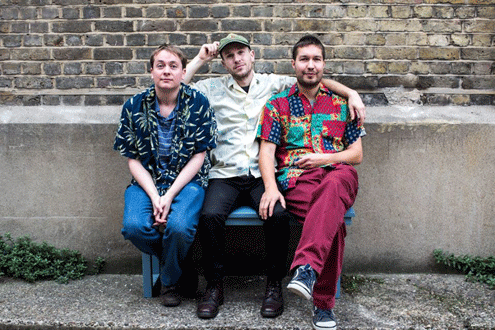
Martin Creed/William D. Drake/Stephen Evens, 26th January 2016

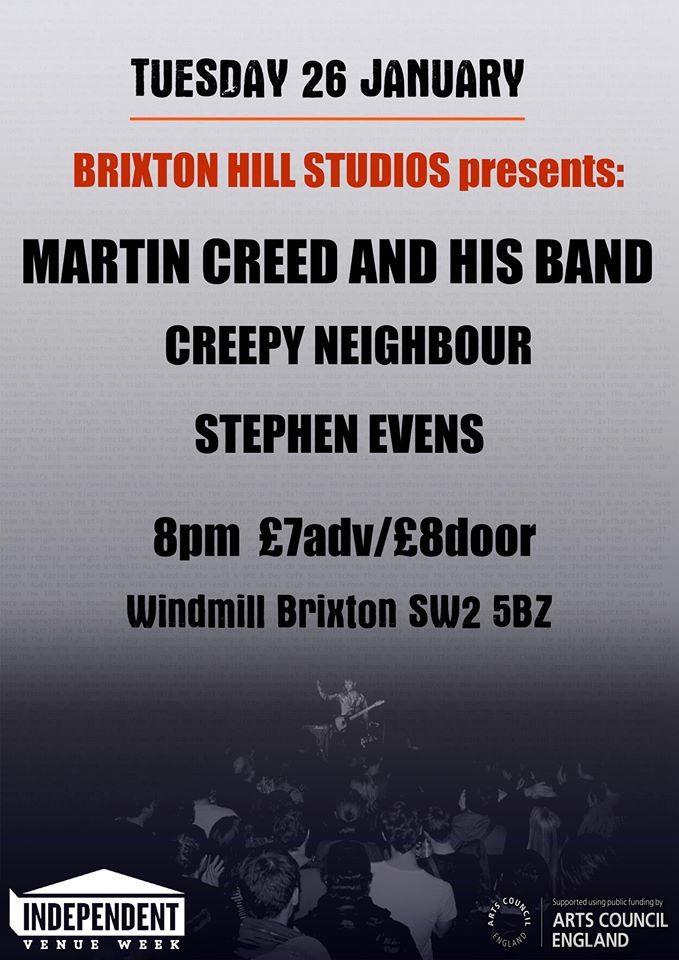
(Brixton Hill Studios presents)
Martin Creed & His Band + William D. Drake + Stephen Evens
The Windmill, 22 Blenheim Gardens, Brixton, London, SW2 5BZ, England
Tuesday 26th January 2016, 8.00pm
more information

“As part of Independent Venue Week, tonight our lovely neighbours Brixton Hill Studios take over the venue with some special guests!

Perhaps best known for winning the Turner Prize back in 2001, Martin Creed has been actively making music since the early ’90s. Creed writes direct, compelling songs with the ability to both perturb and amuse. Think the rhythmic punk of Ian Dury and the wit and pop nous of Glasgow’s Postcard Records. He has released records on both Moshi Moshi and his own Telephone Records label.

William D. Drake is a keyboardist, pianist, composer and singer-songwriter. He is best known as a former member of the cult English rock band Cardiacs, whom he played with for nine years between 1983 and 1992. He has also been a member of The Sea Nymphs, North Sea Radio Orchestra, Nervous, Wood, Lake of Puppies and The Grown-Ups, as well as pursuing a career as a solo artist. His fifth album ‘Revere Reach’ came out in summer 2015.

Armed with a battered guitar, a Casiotone and a few pedals, Stephen Evens (better known as Steve “Stuffy” Gilchrist, erstwhile leader of Stuffy/The Fuses and drummer with Graham Coxon, Cardiacs, Charlotte Hatherley and The Scaramanga Six) presents songs that mix the likes of Yo La Tengo & Ivor Cutler with broken friendships and human error.”

* * * * * * * *

Daylight Music 213

(Daylight Music & The Hangover Lounge present)
Daylight Music 213: The Wave Pictures, The Leaf Library + Citizen Helene
Union Chapel, Compton Terrace, Islington, London, N1 2UN, England
Saturday 30th January 2016, 12.00pm
– free entry – more information

The Wave Pictures will be launching their brand new, vinyl-only album ‘A Season In Hull’ at the Union Chapel on 30th January. The album was recorded on acoustic guitars in one room, with a bunch of their friends, live in to one microphone on singer Dave Tattersall’s birthday, January 28th, 2015. The songs were written as quickly as possible and the recording captures that specific moment in all its spontaneous, thrilling and immediate glory. As Tattersall elaborates: ‘That’s what this is – a one-microphone happy birthday recording.’

London quintet The Leaf Library (who create “droney, two-chord pop that’s stuck halfway between the garage and the bedroom, all topped with lyrical love songs to buildings, stationery and the weather”) have just released their debut full-length album ‘Daylight Versions’. The record is full of wonderfully woozy, drone-pop tunes about meteorology, the seasons and the incoming sea; from songs about the ghostly Suffolk coastline to the slowly rising waters of London marshes.

Citizen Helene is a singer, songwriter and guitarist from London whose blend of sunshine pop, psychedelic folk and jazz has been described as ‘baroque and beautiful’ by Darian Sahanaja (of the Brian Wilson band) and ‘like the love child of Karen Carpenter and Brian Wilson’ by ‘Word’ magazine.”

August 2015 – upcoming gigs – the Manchester Jazz Festival (31st July to 9th August)

31 Jul

One of the reasons that I’ve been posting so many concert previews recently is simply that (being mostly homebound at the moment) I miss going to gigs. Looking at the lineup and scope of the 2015 Manchester Jazz Festival (which starts today and runs rampant for ten days through until 9th August) reminds me that not only do I regret not attending the wealth of music that takes place here in London, but that I miss more freewheeling days of music elsewhere. Discovering unexpected, treasurable bands at random while on holiday in Brugge, for instance; or immersing myself in a week of concerts and more in Edinburgh or Leeds (such as the one I reviewed here, over a decade ago.)

We know that, as a British pop and dance city, Manchester punches well above its weight. Despite a bubbling undercurrent of improvised music, its reputation as a jazz town is hazier…. or, more probably, I’m just ignorant. The Festival’s been going for twenty years, long enough to gain enough gravity to generate its own traditions. (One such is ‘Surroundings’,  a longer-form ensemble piece by Salford composer Neil Yates. Commissioned for the festival in 2010, it seems to have become the event’s unofficial signature – this year, it’s being revisited as a quartet performance in the Central Library Reading Room.)

Even a quick sift through this year’s programme reveals a jazz party that any city would be proud of – diverse, inclusive, inviting and multi-levelled, an exciting noise ranging from the stately to the vividly scraggled and all the better for it.  With many tickets going at only four pounds, (with a ten-pound all-events daily ticket and free-entry deals if you stump up as a low-level event sponsor), they could hardly have made it any more inviting to the casual walker-upper. Excuse me for a moment while I strip-mine press releases and YouTube, and check Soundcloud pages and Bandcamp links.

Starting with the higher-end, bigger name events…  Acclaimed Blue Note pianist Robert Glasper slips away from his experimentations with latterday R’n’B to get back to basics with an acoustic trio;  John Surman re-teams with the Trans4mation String Quartet to revive the thoughtful, tidally-deep music from his ‘Coruscating’ and ‘The Spaces in Between’ albums. Norma Winstone, Klaus Gesing and Glauco Venier bring along their trans-European project DistancesPartisans bring their transatlantic swing storm; Christine Tobin  her ‘Thousand Kisses Deep’ jazzification of Leonard Cohen songs. French Jazz Musician of the Year Airelle Besson makes an appearance with her Quartet for a set of “gently experimental songs animated by heartfelt lyrics, plaintive melodies and rolling harmonies.” backed with pinballing rhythms and punchy countersyncopations.

There are heavyweight two-headed summit performances by acclaimed British jazz talents – one by frequent quartet buddies Mike Walker and Gwilym Simcock, another by the more recent pairing of Tori Freestone and Alcyona Mick.  Two further British scene fast risers – Stuart McCallum and Alice Zawadzki – bring string-enhanced performances of ongoing projects (the former offering contemporary soul jazz and bass-heavy electronica with surprise guest singers, the latter a fantastical Mancunian song cycle influenced by various shades of love and fairytale).

There are also several of those gentler, more literate projects which seem to blossom best in a festival atmosphere away from a hot core of gutsy brass.  Andrew Woodhead and Holly Thomas’ Snapdragon trio specialize in chilled, ethereal song-settings of literature and poetry (Larkin and Bukowski-inspired) and bursts of vocalese. Mark Pringle‘s A Moveable Feast mates orchestral strings with a bold horn and rhythm section to explore “themes of wildlife, literature and city chaos.”  The “fractured Anglicana” of Hugh Nankivell’s multi-instrumental/four-part vocal quartet Natural Causes means that they perform “curious compositions with  improbable but poignant texts” including “psychedelic lullabies, pinprick-precise ballads, unpredictable group improvisation and brotherly harmony across the board”, and music which draws on classic and contemporary art pop (Robert Wyatt, XTC and Björk) as much as it does on jazz sources.

Elsewhere, much of the polyglot diversity of jazz today is celebrated. The Cuban tradition is represented by the Pepe Rivero Trio and Orquesta Timbala; the Congolese by Eddy Tshepe Tshepela‘s Afrika Jazz. Central and South American ideas are brought along by Agua Pasa (who, with  Dudley Nesbit’s steel pan project Pan Jumby,  also touch on the Caribbean).  The Quarry Hillbillies (a teaming of Ulrich Elbracht, Ed Jones, Jamil Sheriff) from European contemporary jazz, while the frenetic whirl of Eastern European folk elements are covered by Makanitza.  The Gorka Benítez Trio move between Basque-flavoured small group jazz and compelling free-form impressionism. David Austin Grey’s Hansu-Tori ensemble is inspired by natural, elemental and cinematic” ideas, as well as a fascination with Eastern world culture.  Percussionist Felix Higginbottom’s Hans Prya  provides genre-hopping jazz-dance and Jim Molyneux’s Glowrogues favour funk and hip-hop flavoured pieces. Trumpeter Lily Carassik‘s fusion group Yesa Sikyi take ideas from the ’50s and blend them with popular standards and soul arrangements; while The Stretch Trio include glossier elements from ’70s jazz rock, progressive rock and ’80s pop along with sinuous gusts of wind synth.

Those who prefer classic jazz – more traditional by-the-book American styles – might prefer Russell Henderson and Jamie Taylor’s Ellington-and-Strayhorn tribute ‘The Intimacy Of The Blues’, or the Dan Whieldon Trio‘s salute to Gershwin. The Dave Kane Quartet take inspiration from the knottier ambitions of Charles Mingus, John Zorn and Eric Dolphy. Two groups of students from the Royal Northern College of Music provide live celebrations of the history which they’ve been learning – the James Girling Quintet  spans jazz, blues and funk from New Orleans roots through to the 1960s, while the Nick Conn Octet (a self-described “trombone choir”) interweaves re-arranged jazz classics with original material.

Fans of New Orleans jazz can check out genuine New Orleaners The Session (who offer a past-present take on their hometown’s music), or look out for the street sounds of the New York Brass Band (actually from old York, the cheeky buggers) or see how the Riot Jazz Brass Band dust up old New Orleans sounds with dancefloor, dubstep and drum-and-bass incursions. Hot jazz/Gypsy/jazz manouche aficionados can go for the loving recreations of 52 Skidoo (who promise you prohibition speakeasies, rent parties and Tin Pan Alley) or for Gypsies Of Bohemia, who manouche-ify latterday pop songs such as Heart Of Glass, Toxic and Hot In Herre. (Being Mancunian, they also do This Charming Man – I’ll bet that that high-life opening riff translates pretty well).

Of course, much of the fun of a jazz festival involves catching a lesser-known, or even unknown, band carving away at the edge, furiously discovering – and there are plenty of those here. Since they drew me into covering the festival in the first place, I’m going to put a particular word in for Jon Thorne’s Sunshine Brothers (playing at Matt & Phreds on 4th August) in which the double bass/laptop-wielding Jon teams up with drummer Rob Turner (of Blue Note-signed breakbeat jazz electronicists GoGo Penguin) and looping poly-genre bass guitarist Steve Lawson (a ‘Misfit City’ regular) for “a cutting-edge trio of genre-defying musicians mixing jazz, improvisation, electronic and filmic soundscapes to euphoric effect, evoking sounds far removed from their bass origins.”

However, you could just as easily catch a full performance by GoGo Penguin themselves; or by Lauren Kinsella’s Blue-Eyed Hawk, who offer “art-rock, jazz and electronic soundworlds: imaginative and emotive, from pindrop to powerhouse.” The Madwort Saxophone Quartet play intricate four-part math-jazz. “Power-jazz commando team” Taupe (a triple-city trio from Manchester, Newcastle and Edinburgh) punch around themes from jazz, hip hop and heavy metal. Craig Scott’s Lobotomy seem determined to take the cake for upfront experimental exhilaration this time around, delivering shout-outs to John Cage, Captain Beefheart and Frank Zappa, proclaiming a performance in which “experimental jazz rubs shoulders with electronica and DIY alternative rock in a bubbling cauldron of live and recorded sounds” and promising to sample and reconstruction their own improvisations live on stage.  There’ll also be a improvised summit involving bands associated with Manchester’s Efpi Records and Paris’ Onze Heures Onze collective.

One way into discovery is to take advantage of the free showcases for emerging bands. Care of the BBC’s ‘Jazz On 3’, London offers three bands – Nérija ( the all-female creative septet from the Tomorrow’s Warriors jazz school), the award-winning piano jazz of the Ashley Henry Trio and the decidedly psychedelic Phaze Theory (a quartet of drums, tuba, voice and guitar dedicated to “exploring the vastness of the musical cosmos”).

But perhaps it’s Jazz North’s Northern Line series that you should be checking out, showcasing bands from the north and the Midlands. Manchester offers the Iain Dixon/Les Chisnall Duo (whose repertoire of self-defined standards stretches from Messaien to Gracie Fields) and the John Bailey Quintet  (guitar-led, and similarly inspired by twentieth century classical music). Newcastle provides barrel-house blues and ballads from The Lindsay Hannon Plus and the tricky free jazz/folk/rock/dancefloor entwinings of the Graeme Wilson Quartet. Lancaster and Liverpool provide one act apiece – Andrew Grew’s “total improvisers” The Grew Quartet and the “gothic bebop” of Blind Monk Trio, who claim to fuse the spirit of Thelonius Monk with Persian traditional music and the heavy-rock attitude of Led Zeppelin and Nirvana’s heavy-rock attitude.

However, it’s Leeds (still underrated as a musical powerhouse despite the world-class output of its music college and the vigorous inventiveness of its bands) which dominates the Northern Line. As well as providing the previously-mentioned Pan Jumby, Leeds brings the Portuguese/African/Latin  and Indian song-fusions of Manjula, the Django Reinhardt swing of the Matt Holborn Quartet, Cameron Vale‘s ferociously energetic melange of jazz, metal, electronica, Afrobeat and Klezmer and the semi-electric “extreme, eerie to comic” improvisations of Tipping Point (featuring perpetual bad-boy pianist Matthew Bourne).  Friendly rivalry aside, there’s also co-operation: Leeds, Manchester and Liverpool all join forces in The Bugalu Foundation for a Latin barrio take on northern soul.

Around all of this jazz there’s the usual happy agglomeration of related music – not quite jazz in itself, but possibly sharing a drink or a roll-up somewhere along the way. The festival covers various popular outcropping such as soul (in assorted Northern, jazz and diva forms courtesy of The Juggernaut Love Band, Terry Shaltiel & The Soultroopers, Charlie Cooper & The CCs) but also ’60s/‘70s funk (Buffalo Brothers), ’70s Afrobeat and Ethiopian pop (Kalakuta), ska (Baked à la Ska) and mbalax (Mamadou & The Super Libidor Band). There’s even an alt-country act (Stevie Williams & The Most Wanted Band) sneaking in at the back door. As for rock’n’roll/folk/reggae/swing scavengers The Flat Cap 3… well, for starters, there’s only two of them, so you can be dubious about anything else you might read, but don’t let that put you off.

Three female songwriters are also bringing their bands, coming from a folk or world music zone and overlapping into jazz. Kirsty McGee leads her Hobopop Collective through a “joyful, dirty” sound drawing from gospel, blues and a collection of found instruments (including musical saw, waterphone, Humber hubcaps and metal buckets). The constantly shifting song landscapes of the Zoe Kyoti Trio draw from their leader’s Armenian and Greek heritage (as well as Cajun, European and Indian ideas). Saluting home-brewed British polyculture, Shama Rahman‘s ensemble explore her London home, her Bangladeshi roots, and her childhood memories of Middle Eastern desert landscapes in a “sitar,stories and song” melange of  jazz-inspired improvisation, classically-inspired melodies and folk-inspired storytelling accompanied by energetic rhythms of swing, funk, hip hop, bossa nova and drum’n’bass.

For parents of very young children, needing to balance a jazz fix with family responsibilities, there are a couple of fully interactive kids’ events with activities, storytelling and improvisations.  The Living Story Music Ensemble and illustrator Ann Gilligan collaborate on ‘I Have A Duck Who Can Roar’; the blues-and-roots-tinged Hillary Step Quartet work with storyteller Ursula Holden Gill and dancers from The Dalcroze Society for ‘How Monkey Found His Swing’. Once the kids are attended to, there are still interactive events for the grown-ups, whether you’re talking about the all-in jazz vinyl night, the mixed-genre dj sets by Mr Scruff, Franny Eubanks‘ open-door blues jam or (for the more technologically inquisitive)  Rodrigo Constanzo‘s showcasing of his dfscore software. The latter’s a creative music tool, cueing improvisers via graphical, visual and written clues: on this occasion, anyone with an instrument and a connectible smartphone/tablet/pad should be able to roll up and join in with the roar, joining some leading improvisers in performing music in tandem with the system.

For those remaining soundclips which I’ve not already snatched and pasted, visit the MJF Soundcloud page here … but better yet, if you’re anywhere near Manchester over the next few weeks, drop in at the festival (it’s hard to miss, considering that it’s not just hiding behind club doors but has effectively taken over the town’s main square for a fortnight). Seeing something this impressive light up and roll on fills me with delight – even if on this occasion I’m also filled with rue at not being able to go myself.  But never mind me…

December 1995 – live reviews – Gordon Haskell @ The Unplugged Club, Bloomsbury, London, 7th December (“one mockingly rolled eye peering out to capture the madness and to look out for an escape route”)

9 Dec

Not even a minute into the show, and we hear it. He looks thoughtfully out at the mixed crowd and speaks. “I can usually tell whether an audience is going to be good or bad.” A pause. “Good night!” And then he lets it rip. That laugh – an untrammelled, hiccupping whoop of unbalanced joy, teetering on the edge of losing it. You may have heard in on King Crimson‘s ‘Lizard’, twitched into hysteria by studio electronics, a lone human voice in the sick, surreal circus. Twenty-five years on, in this intimate little acoustic club, it sounds like the redemptive, rueful peal of a free man, acknowledging the potholes of disaster that dog our footsteps in this world and cause some of us to drop into madness.

Strange to think that this grizzled and animated figure, eyes twinkling benevolently beneath a battered hat that’s the last word in Bohemian chic, is Gordon Haskell – singer with King Crimson for nine studio-bound months back in 1970. At an age where most ex-proggies are still squeezing themselves into the glad-rags and going through ever-more lifeless motions in small theatres, Haskell is donning comfortable clothes, picking up his acoustic guitar, playing tiny little places anywhere and enjoying himself. To tell the truth, the Crimson connection is misleading. All of that was a long time ago now. Gordon’s profile may have been lower than a bug’s belly since then, but now he’s swinging back into action with a vengeance… and he’s in better artistic shape than most of his more financially successful contemporaries.

Not only does he possess a brilliantly gutsy guitar style and a voice so rich and earthy that you could grow potatoes on it. but he has a bagful of excellent songs to offer. He now writes and plays like a combination of John Martyn and Leon Redbone, with a huge measure of the rawer joys of John Lee Hooker and Richard Thompson. He takes the vibrancy and gleeful survivor’s power of deep blues and blends it with an irreverent, eccentric, classically English strain of absurdism. Like the young Peter Gabriel, he takes his stand against the hostility of the world with a disarming, cunning humour, one mockingly rolled eye peering out to capture the madness and to look out for an escape route. It’s all as warm as a closely-held candle on a winter’s night… and as liable to suddenly scorch your fingers.

Thinking back to ‘Lizard’, one wonders what kind of more lively, organic record would have emerged had Robert Fripp and Peter Sinfield given Gordon a crack at the songwriting rather than just dovetailing his voice into their meisterwerk. There’s a vague hint of Sinfield’s verbal adventurousness in Haskell’s songs, although thankfully none of the attendant pretensions. The Hooker-like Wang Bang World captures life’s grim tendency to overrun us, but revels in a tumble of savagery and joking; conversely, Pelican Pie could be just a blur of absurdist imagery were it not for the beady-eyed thread of social critique running through it.

Haskell’s between-song banter may be a mixture of oddball wisdom and Eddie Izzard goofiness (“may you be blessed with many goats!”) but the humour in the songs is by no means pointless, pretentious silliness. Rather, Haskell’s a knowing jester holding his own and laughing in the face of life’s terrifying chaos. Hanging By a Thread (dedicated, tonight, to Fred West) is a mordantly hilarious parade of murderous, fatalistic comedy: “Gentle Jim got life for chopping up his wife / – said he needed warmth for the winter.”

The lack of preciousness is what really makes him great, though – he’s not out to prove to us what a clever musician he is. Sure, each song has enough teeth and gold to make us think about it, but it’s Gordon’s sheeer verve and ecstatic gutsiness that wins the audience over, captured in the luxuriant salaciousness of Chilli Chilli, the throbbing jungly blues of Test-Drive or the voodoo swamp-stomp of Alligator Man, a roaring clapalong portrait of the ruthless predatory wheeler-dealer, the sheepskin-coated hoodlum-salesman who’s becoming a spectre of the times.

Like those old bluesmen, Haskell knows how life and death, humour and horror walk side-by-side and share the same streets, and his work is not short of tenderness as well as carnality. The love song All My Life rasps like Louis Armstrong, and I Don’t Remember It Like This shows an Ian Anderson verve as it examines the misleading, misframed photos in the history of love: “whatever love is, it’s in the thrill of your kiss / and I don’t remember it like this.” There’s a real feel to the soulful sorrow of Tortured Heart and in the wry shrug of Mail Order Love, which mixes an organic bluesy swing with a handful of dissatisfied plastic metaphors, romance gone synthetic. The philosophical break-up song Go Tell Sarah is part goodbye, part lie, part promise.

In a dash of sheer music-hall, he tips his hat and beams at us with real pleasure, inviting us in to share both the fear and the laughter on his perspective on life. The return of Gordon Haskell is going to offer the scene a welcome dose of warmth, and 1996 could well be his year. A lost star is returning to dispense a special kind of mischievous twinkle.

Gordon Haskell online:
Homepage Facebook Twitter MySpace Soundcloud Last FM Apple Music YouTube Deezer Google Play Pandora Spotify Tidal Amazon Music
 

Sometime in 1995 – album reviews – Dayna Kurtz’s ‘Footprints’ (“venturing into the faultlines between lovers which lurk in the most private places”)

30 Nov
Dayna Kurtz: 'Footprints'

Dayna Kurtz: ‘Footprints’

I’m not a stranger to heartbreak (either my own or that of others), but in all my experience of it, there are many things I haven’t done. I’ve never sat nursing a coffee in an all-night cafe as the dawn breaks, rearranging the cracked facets of my bitter smile. I’ve never composed the ultimate understanding kiss-off, writing the shapes and sentences to slide into a failed lover’s heart, to pat on the shoulder and slap upside the head with the same motion. I’ve never climbed the stairs of a Manhattan walk-up, trying to listen hard enough to trace the voices of memory infiltrating the walls and carrying memories of bitter love affairs, and of angry hearts temporarily exorcised at 3 a.m. But ‘Footprints’ – a collection of songs from Dayna Kurtz, whom I first saw breathing a blue glow of melody in front of a transfixed DreamHouse audience at the Water Rats – gives me an idea of what it might have felt like if I had.

Dayna explores the long deep pain of thwarted love with the same sort of delicious tension between voice and guitar as you get with Tuck & Patti or Jose Feliciano, but more raw, more direct, less decorated. Her voice is an aching, defiant, yearning thing, sharing breath with both Billie Holiday and Joni Mitchell. Her guitar is terse, bluesy, jazzy, but with a stubborn bluntness that refuses to flow smooth and to comfort; choosing instead to smack the hooks of wounded desire further into the heart, to bleed out the regret and anguish or to force the protective badges of scars and knowledge into being. Her songs clap and fold about you like a Coltrane solo bouncing jaggedly off the walls of a tiny club; or slip into you like short stories that sink to the depths of the heart, then rise like surfacing mines, meaning expanding in soft slow explosions.

Pick almost any song on here and you’re drawn into a story of bitter tangles; of embracing arms that end in helplessly clenched fists; of awkward, looming personal baggage that blocks the way into shared rooms. Perhaps the brittle R&B, funk and electricity that amplify the two full-band songs on ‘Footprints’ (‘The Road You’re On’, the title track) blunt the impact of Dayna’s writing. But catch her solo and you’re let in on something personal, painful, profound and beautifully defiant: “I threw my thoughts around, just for you to trip on.” She’s no fool: she’ll see through sentiment to the truth of the immediate (“once in a lifetime, this time – that’s what they sold me. / I don’t believe that, but it’s holy, holy,”) and she’s wise to vainglorious bullshit (“I got your picture at home: / you’re looking kinda cocky, with this wistful undertone, / like some cover has almost blown.”). Still, she seems ultimately to gravitate towards tension and friction in love.

In ‘Lay Me Down’ a relationship starts in a healing calm – “help me remember my liquid heart, and the open mouth of painful parting… / I’m moved, I confess, by a heart that seems calmer than mine.” Yet it swallows its own tail, hung up on the suspicions that both lovers have brought to the bed. “I hover above some something you said, / ’til I can’t feel you at all.”

In ‘Something/Nothing’ she attempts to immerse herself in a clasping at protection: “lost in the dark outside, I took your room to breathe, / and then I sealed all the cracks in me / then choked off my heart so cold and quick / and thought ‘it’s better this way’.” This, too, ends up in an indefinable and unexpected loss. “I lost my faith in something that I couldn’t name. / I thought you left with nothing… but I’m not the same.”

Dayna’s great songwriter’s gift – raising her above the usual horde of self-important dirty-linen washers – is the strength she brings to the table. A sense not of victimhood or self-righteousness, but of a strong woman of heart and mind, venturing into the faultlines between lovers which lurk in the most private places, and reporting back with full, proud honesty. “In my most helpless of hearts, I’ve been tearing up pictures of you,” she flares on Nowhere, made bloody-minded by another partner’s calculating shallowness and cowardice. “I gave my heart, an ocean; / showed you my soul to see. / And you just skimmed along the surface – but you’d swear you’d drowned in me… / When we’re good, we’re very good; / but when we’re bad, you’re nowhere.” On ‘This Side of Eve’ (a live duet with South African singer Tsidii Le Loka, whose shivering, passionate vocals coil round Dayna’s like smoke trails on a winter’s night) she’s set her face forward, to move on: “This place doesn’t know me, so there’s nothing to leave.”

Yet, appropriately, it’s the broken, free-time lick and gentle licking of old wounds on ‘Touchstone’ which I keep coming back to. A lonely, solo memory song (“I think of you, I think of you,”) surging and ebbing with the questions and longings that come too late (“Remember me? / I curve like a question mark. / And I’m lying home alone, / and I can almost hear you calling / like a saxophone…”). All the disappointments, yet couched in tenderness (“Remember me? / I came to you washed clean / and soft as a peach. / I said ‘let’s climb’, / but all you did was reach for me,”) and the frail wisps of old hopes, still held and treasured long after the hope has winked out of them – “I knew you’d be my touchstone, / I could see us getting old.”

Some old ghosts are now sitting with me. I think we’ll wait together, silently, until the sun comes up.

Dayna Kurtz: ‘Footprints’
self-released (no catalogue number or barcode)
Cassette-only album
Released:
1995
Get it from: (2020 update) Best obtained second-hand; this album is never likely to be reissued (since Dayna considers it to be juvenilia, or at the very least material recorded before she’d found her songwriting identity). There’s a live version of ‘Touchstone’ on Dayna’s ‘Otherwise Luscious Life‘ album.
Dayna Kurtz online:
Homepage Twitter MySpace Bandcamp Last FM YouTube Spotify Amazon Music

SWOONAGE

Swoon. /swo͞on/ A verb. To be emotionally affected by someone or something that one admires; become ecstatic. Here are some people and things that make me swoon. #swoon #swoonage

Post-Punk Monk

Searching for divinity in records from '78-'85 or so…

theartyassassin

...wandering through music...

Get In Her Ears

Promoting and Supporting Women in Music

Die or D.I.Y.?

...wandering through music...

Music Aficionado

Quality articles about the golden age of music

THE ACTIVE LISTENER

...wandering through music...

Planet Hugill

...wandering through music...

Listening to Ladies

...wandering through music...

ATTN:Magazine

Not from concentrate.

Xposed Club

improvised/experimental/music

The Quietus

...wandering through music...

I Quite Like Gigs

Music Reviews, music thoughts and musical wonderings

furia log

...wandering through music...

The Recoup

SINCE 2013: Books and books and books and books and occasionally other things

A jumped-up pantry boy

To say the least, oh truly disappointed

PROOF POSITIVE

A new semi-regular gig in London

Gapplegate Classical-Modern Music Review

...wandering through music...

When The Horn Blows

...wandering through music...

:::::::::::: Ekho :::::::::::: Women in Sonic Art

Celebrating the Work of Women within Sonic Art: an expanding archive promoting equality in the sonic field

Ned Raggett Ponders It All

Just another WordPress.com weblog

FLIPSIDE REVIEWS

...wandering through music...

Headphone Commute

honest words on honest music

The One-Liner Miner

...wandering through music...

Yeah I Know It Sucks

an absurdist review blog

Obat Kanker Payudara Ginseng RH 2

...wandering through music...

poplifer.wordpress.com/

Waiting for the gift of sound and vision

Good Music Speaks

A music blog written by Rich Brown

Do The Math

...wandering through music...

Archived Music Press

Scans from the Melody Maker and N.M.E. circa 1987-1996

The World's Worst Records

...wandering through music...

Soundscapes

...wandering through music...

OLD SCHOOL RECORD REVIEW

Where You Are Always Wrong

FRIDAY NIGHT BOYS

...wandering through music...

Fragile or Possibly Extinct

Life Outside the Womb

a closer listen

a home for instrumental and experimental music

...wandering through music...

Life Just Bounces

...wandering through music...

Lucid Culture

JAZZ, CLASSICAL MUSIC AND THE ARTS IN NEW YORK CITY

Aquarium Drunkard

...wandering through music...

eyesplinters

Just another WordPress.com site

NewFrontEars

...wandering through music...

FormerConformer

Striving for Difference