Archive | improvisation RSS feed for this section

August 1997 – album reviews – G.P. Hall’s ‘Mar-Del-Plata’ (“ranges with restless compassion across a wide field”)

10 Aug
G.P. Hall: 'Mar-Del-Plata'

G.P. Hall: ‘Mar-Del-Plata’

Still clearing out the accumulated tapes of an inexplicably neglected career, Graham Peter Hall is continuing to come up with the goods. He’s been through thirty years of uneasy development on that rocky, unrewarding terrain between the simple sureties of the rock and roots instrumentalist and the often complacent indulgences of the full-on avant-garde blower. Marginalisation and bad luck might have ensured that he’s received little financial reward – nor has he gained the kind of brittle, precious reputation that marks out the darlings of the art-music intelligentsia – but it has resulted in a stock of lovely, emotive music in its own right.

Certainly Hall has managed to remain one of Britain’s most individual and complete guitarists over that time. Mastering a variety of styles from flamenco to rock to folk and blues, he’s also immersed himself in experimentation via technology – multiple speakers and pedal processors; vast, slow delay loops. Additionally, he draws on a repertoire of bizarre playing techniques and plectrum substitutes (involving battery fans, tiny psaltery bows, electric razors, toy cars and velcro, among others) which reflects the reinvention of guitar function explored by Fred Frith or Keith Rowe. With these methods in place, he’s explored sound through the textural suggestions of his “industrial sound sculptures”. Light industry, that is – Hall’s mimicry is closer to handsaws and governor motors rather than, say, Trent Reznor’s car-crushers and stamping presses.

Yet in amongst this, Hall has somehow never lost the ability to embrace expressive tunes; or to weave a handrail of familiarity into his sonic constructions. Perhaps that’s why ‘Wire’ types don’t seem to go for him; why he doesn’t have the kudos that the likes of Rowe, Frith, Eugene Chadbourne or Glenn Branca enjoy. He can get in your face – or wander off the usual path – with the best of them, but it’s generally in order to touch your sympathies. Ironically, in choosing to express his conservative and traditional side as equally important to (and entwined with) his avant-garde side, he’s gone too far for some.

‘Mar-Del-Plata’ is by far the most accessible and diverse of the compiled albums which Hall has been assembling this decade from deleted vinyl and assorted unreleased tapes. It’s a tour across a loose, but affecting, composing and performing imagination which ranges with restless compassion across a wide field. Sometimes you’re listening to a skittering, wilful flamenco performance. Sometimes it sounds like Cocteau Twins doing home improvements in the Mediterranean. Sometimes it’s the sort of individual, humanistic free improv/New Music result which you’d expect from Frith at his more lighthearted and relaxed, or from Simon H. Fell.

But though the record is full of experimentalism, Hall’s sense of melody is at the forefront – and the predominant voice on ‘Mar-Del-Plata’ is his masterfully expressive Spanish guitar playing. This can usually be found angling over long aching stretches of choral electronic humming, plangent violin and eerie ambient sounds called up from the industrial processors. In some ways it’s like a semi-unplugged take on a Robert Fripp Soundscape, in which guitar textures span out into infinity.

At other times, it takes on the simple directness of a folk tune: a dance of sparkling acoustic lights on Ionian Water, or the staccato accented Latin melodies of Mar-Del-Plata itself, underpinned by a geological murmur of bass. On the final hot gusting of Sierra Morena Dust Storm, the gut strings spit and scatter in rich melody, reaching new heights of sinewy passion. Here, Hall also bows some winnowing textures in his electric guitar accompaniment, using serrated steel bars from his box of implements.

Where technology plays a more direct role, Hall’s humanity doesn’t falter or go under. The hymnal swells of billowing electric warmth on Spirit Sky Montana (somewhere between Bill Frisell’s cinematic romance and David Torn’s eccentric string-warps) are the most beautiful and enveloping sound on the record, tapping deeply into church music and Romantic classical composing. The trickle of wind chimes, langorous piano, and enveloping sighs of Humidity Despair provide a gusting, luxurious impression of a sultry night: it’s lush enough to lean right back into.

Some tracks, fleshed out by Hall’s sound-loops and D.I.Y. treatments, are detailed, impressionistic oil-paintings in music and tone. Deep Blue sounds like someone chainsawing up a frozen Alpine lake, its jangling piano chords and thumping bass a mass of irregularities. The smear of bright spring-loaded colourflow on Charmouth Beach rings beautiful alarm bells. The menacing bass growl of Enigmatic is like a cave-bear thumping around in your dreams: squeaks and rattles from fingerboard and autoharp move around in slow disquiet, enclosed by knocking metal.

Plutonium Alert (in which Hall abandons guitar altogether in favour of soprano sax and the ring of auto-harps) treads similar territory to the ominous King Crimson improvisations from the mid-’70s. It goes for an all-out sensory mix of apocalyptic aftertones: angular bell-sounds and aggressive Grappelli violins entangling themselves with a spasmodically awkward funk rhythm. Weirdest (and most satisfying) of all is Fahrenheit 451 – juddering guitar, saw sounds, the shriek of a whistling kettle, and treble scratching all mix like toxic vapours under heavy pressure, pushing your head back against your rising hackles. Horribly enjoyable.

The scattered effects of the attempt to capture all of Hall’s ideas across a single CD does mean that ‘Mar-Del- Plata’ misses out on the cohesion which would render it excellent, but it’s a close-run thing. The centrepiece – a long-form creation called The Estates – pulls all the elements of the album together. A version of a 1975 long-form composition, it blends the chiming, restless clatter of its improv ensemble with Hall’s own quiveringly angry solo acoustic guitar. The brooding theme of The Estates is the crappiness and autocracy of post-war British urban programming. In thrall to modernism without being able to master it, its utopian vision (heartily botched and compromised) laid down a blight on communities, their architecture and their cohesion wrecked by the same tower blocks and support links designed to improve them.

Hall and co. express the disillusion and neurosis which resulted, with pulses of frustration and alienation hurl themselves against the confines of the music. Dulcimers, clarinets, and a huge array of percussion all seethe and pant over twenty-five minutes of desperate musical invocation; all overhung by the forbidding scrapes and alarm-clangs of two adapted metal piano frames (played like harps with assorted chains, wires, and implements). Hall’s panic-stricken guitar playing conjures the nightmare of a new, fatally-flawed sprawl of roads and buildings: swarming locust-like, unchecked and unconsidered, over beloved landscapes.

Incidentally, in the sleevenotes Hall gives a blood’n’guts description of the struggle it took to assemble and perform The Estates. Apparently, some of the manufactured instruments continue to drift through the art world with a life of their own. The piano frames – still counter-invading the architecture – were last seen as part of a “fire sculpture”. Meanwhile, the piece itself has an additional afterlife as a reflection on Hall’s own love/hate relationship with modernism; his own playing and arrangements echoing and championing the sounds of the traditional past even as they break them up in performance and execution.

As a body of work ‘Mar-Del-Plata’ has its faults – yet judged on its parts (and at its undisciplined best), it’s a touching, passionate and diverse album. Throughout, we get the sort of peek at Hall’s open heart (warts, gooey patches and all) which most experimental musicians, hard-wired into intellectual dryness, would never risk expressing.

G.P. Hall: ‘Mar-Del-Plata’
Future Music Records, FMR CD46-V0997 (7 86497 26442 1)
CD-only album
Released: 12 April 1997

Buy it from:
G.P. Hall homepage or Future Music Records

G.P. Hall online:
Homepage Facebook Twitter MySpace Bandcamp YouTube

May 1997 – live album reviews – King Crimson’s ‘Epitaph: Live in 1969’ (” maybe only rivalled, in their day, by The Doors at their peak”)

10 May

King Crimson: 'Epitaph: Live in 1969'

King Crimson: ‘Epitaph: Live in 1969’

With guitarist Robert Fripp as the only constant factor (he once memorably described himself as not so much the leader as “a kind of glue”), King Crimson have negotiated the peaks and troughs of a three-decade career in rock music and at least six distinct and differing incarnations. In the process, they’ve become one of those bands carrying a distinctly hazy reputation.

Where to place them? Not with the evergreen Beatles, Stones or Byrds; or with the narcotic, perversely cynical tradition of the Velvet Underground. Not in punk’s vigorous righteousness, or New Wave’s beat-smarts; or in the ever-credible European avant-rock field. Not even in old-school retro-rock (you won’t find Oasis ripping off one of their riffs). Outside of the healthy Crimson cult, the 1994 description in an LA newssheet (“prog-rock pond scum, set to bum you out”) seems to sum up the rough consensus. To many, King Crimson are and always will be one of the dinosaurs, if not the rotten egg that spawned the whole prog-rock movement. They’re pretentious, ludicrous, and sexless Mellotron fondlers; or they’re just a little too damn strange and perverse, winning your friendship only to kick you in the shins the next moment. Or they just don’t fit onto your party tape. Whatever.

‘Epitaph’ spearheads the series of archive live recordings which are just starting to sluice down the conduit of Fripp’s self-propelled record company (Discipline Global Mobile), each accompanied by the oft-prickly but ever-passionate guitarist’s commentary on the time, place and ethics of Crimson activity. Fripp’s hopes are obviously set on a fairer deal from history, or at least on providing a chance to reassess King Crimson in all of its painfully evolving forms.

His rogue-academic sleevenotes – witty and painstaking, pedantic and enlightening – might play a big part in reinstating this hidden legacy; but the superb “digital necromancy” of DGM engineer David Singleton is equally vital. On ‘Epitaph’, entrusted with the oldest and most variable Crimson live recordings, Singleton has spliced incomplete recording reels together to recreate concerts; wrestled listenable (even impressive) live sound from crumbling BBC master reels; and coaxed atmosphere and clarity from second-generation sound-desk recordings, unwanted overdubs, even crappy home recordings from interference-dogged radio broadcast.

But beyond the Frippertations, and even with the static and the eccentric degrees of muffling, ‘Epitaph’ is a welcome display of the power of the very first King Crimson. This is the band which bowled over Jimi Hendrix, who once approached Fripp saying “shake my left hand, man: it’s closer to my heart.” This is also the group who recorded 1969’s pivotal ‘In the Court of the Crimson King’, then gouged a magnificent trail of dates across Britain and America before fissioning at the end of the year. A band which original frontman Greg Lake still describes as being “without fear.” Perhaps it was the briefly-potent whiff of Faerie which fluttered around English psychedelia at the time, but King Crimson felt itself pervaded by something extraordinary and supernatural (which the members jokingly referred to as “the good fairy”). Of the five original Crims, only Fripp has subsequently regained the same artistic heights which he did here. Yet even he considers this version of the band to be particularly special, embodying a time when “music leant over and took us into its confidence.”

It’s certainly true that on ‘Epitaph’ King Crimson seems to be drawing from something beyond its members. Those mousy young English boys making shyly urbane stage announcements are also those inspired, demonic note-hammerers who are deforming your speakers by brute force. Racking rock’s power up several notches beyond any previous record, King Crimson swarmed like warrior ants through careering unison choruses and stabbing staccato assaults. Here you’ll hear pastoral flute pieces and folk ballads juxtaposed with brain-curdling electrics, jazz effects that scurry from lounge-y hokeyness to bebop and free-fired whiteouts. You’ll also hear the sound of Wagner and Bartok being wrung dry. Unlike many subsequent prog outings, King Crimson provided the feeling that, rather than being cuddled up to, classical music’s cage was being rattled until it screamed.


Fripp’s guitar playing is the closest thing that King Crimson have ever had to a trademark sound. Here, though, it’s merely part of the ensemble – it was an approach which was applied far more to underpinning the band’s hefty array of textures and sonics than to taking on the guru trappings it would later assume. And it was up against formidable, if beneficial, competition. Yet to become the self-satisfied face of ELP, a pre-pomp Greg Lake was already achieving a career best. Michael Giles was providing an object lesson in how to drum with subtle, taut complexity and economy rather than bombast, yet simultaneously make yourself unmissable.

Seen from the here and now, the overwhelming musicality of Ian McDonald is a particular shock. A few years later he’d be reduced to providing Foreigner with a horribly diluted version of Crimson’s hybrid sounds, but here he’s untouchable. His robotic Mellotron orchestras were a benchmark in violent grandeur – as structurally stressed and queasy as sailing ships, and played with demented intensity. Hearing him stabbing and slamming the ‘Tron into an inferno of junked but coherent string-death noise on Mars is little short of a revelation. As are the moments when he leads the band on a blazing, wailing saxophone that strained towards Albert Ayler’s fierce free jazz rather than British dance-bands or pirated Stax records.

Off in the wings, Peter Sinfield is the silent participant here – only audible in the odd buzz (since his then-revolutionary stage lights also affected the speakers). However, he was also present in the ornamental lyrics which – even at their most floridly Victorian and romantic – got to grips with the contradictions implied in the music and in the civilisation of its time.


The four BBC radio session recordings display a group already far more ambitious than even the ’60s norm – maybe only rivalled, in their day, by The Doors at their peak – and a good deal more haunted in outlook. 21st Century Schizoid Man is still one of the most calculatedly vicious pop songs ever – a ‘Mad Max’ duelling-car of a piece, studded with flails, razor blades and serpentine instrumentation – and one of the notable occasions on which Sinfield’s flamboyant verbosity hit the mark on every line. The inflated stateliness of In the Court of the Crimson King’s title track, soaked in mediaeval imagery (jesters, witches and all), may well have given the green light to every sub-Gothic fantasy that would blight prog during the ’70s. But here it still looms sad, bad, blood-soaked and as steeped in pitiless history as the Tower of London – a heavy, tattered tapestry of the creeping and destructive blights that come with civilisation. Lake delivers it with a wounded and disaffected majesty.


For all their pomp and ceremony, their purple filters, King Crimson were as political as any of their contemporaries. It seems odd to hear a group featuring the notoriously abstemious Fripp singing “let’s all get stoned” on their unexpected, woozy but ballsy cover of Donovan’s Get Thy Bearings. But Crimson – a band with strong working-class roots, despite the bourgeois tag prog-rock was to be lumbered with by punk revisionists – identified themselves far more with the ’60s counter-culture (drugs notwithstanding) than they did with the establishment. On one concert recording, Fripp pointedly dedicates Schizoid Man to Spiro Agnew. The shadows of Altamont’s rude awakening, Vietnam’s ongoing barbarities, and the precarious threat to a future Utopia are all present in the bleak scary screech of the band’s wilder moments and in the epic mourning of their ballads. Of which Epitaph itself takes the crown – ageless, with Fripp’s watchful guitars rolling out acoustic swathes and quietly brimming electric tears, Mellotrons sweeping across like opera house curtains, and Lake singing with trepidation into the face of an uncertain future.


The concert recordings stem from that first, final, fatal American tour, including the ’69 Crimson’s last bow in its entirety (the concerts at San Francisco’s Filmore West just before both McDonald and Giles quit). As expected, magnificent string-drenched versions of Epitaph and a couple of overwhelming breakneck runthroughs of Schizoid Man rear their heads; but you also get earlier, raw versions of evolving new material.


Drop In is a version of The Letters (the Jacobean nightmare from ‘Islands‘) with a different lyric. But the violent emotional sentiments remain the same – the form is lazy bluesy pop, the words are typically detached, sardonic Crimson menace. “Why don’t you just drop in, / and let the game begin? / You wished you’d learned to play, / and lived to die another day. / The rules you pick and you choose. / The odds are stacked for you to lose.” The music has a far nastier focus. Chopped and diced, riff-stamping, the sneer of McDonald’s deadly tenor sax and Giles’ explosive, spasmodic bop drums bring it closer to the level of a Coltrane scream.


A Man, a City would later evolve into Pictures of a City. Here, you can hear King Crimson attempting to blend New York’s pitiless industry with a Hieronymous Bosch nightmare, via a lurching Gothically-proportioned snarl of R’n’B sax riffs and metal-tearing guitar. On the road, their painstakingly written rock texts were transformed by interpretation and improvisation (from McDonald and Giles in particular). Though the results were inescapably lofty and English – and also rigidly stark – they make an interesting parallel to the electrified jazz-scapes Miles Davis and Tony Williams were pursuing on ‘In a Silent Way’ and ‘Lifetime’, or which John McLaughlin had already carved into for ‘Extrapolation’.


At Filmore West, in the home of the hippy movement, King Crimson opened up with In the Court of the Crimson King, lacing English roses into Haight-Ashbury hair. Typically, this was a sly and malevolent seduction to soften them up for the full Schizoid onslaught. Perhaps as an adjunct to this, Crimson also showed more of their softer, more fragrant side. Travel Weary Capricorn was one of their few moments of hippyish peace: a fragment of boppy Traffic-y pop, with Lake almost scatting and McDonald’s blissy jazz flute darting and scurrying like Herbie Mann over the band’s deconstructing, half-melted bluesiness.


Although Mantra shows its age (pleasant kaftan-y stuff with, admittedly, some ravishing flute solos – bits of it would later show up on Exiles), Travel Bleary Capricorn has them accidentally anticipating the post-modern dissections of the ’90s as they turn, briefly, into an improvising lounge act. Spanish guitar wobbles while McDonald pisses about on the Mellotron presets (cheesy piano and lounge rhythms), as King Crimson pay a quizzical visit back to their hideous apprenticeships in hotel dance groups, army bands and cabaret backings. Right from the start, Fripp’s humour was always a tad elliptical, and his glimpses into a future of “chance and hazard” are often surprising in retrospect.

But what you’ll remember most is the head-crunching power and violence in their improv treatments of Gustav Holst’s ‘Mars’. Each version builds from a gentle bass and drum throb, with McDonald unwinding the harmonies out of the dark, bloodied guts of a Mellotron. Growing ever more loud, staccato and harsh, the theme is psychotically smacked against the back wall; and ends up in blistering ray-gun effects over the stabbing, splintering, deafening unison riffs – the first sighting of thrash-classical. You can hear the seeds of math-rock, Mogwai/Slint crunch, and Foetus-style orchestral-industrial here; and The Young Gods clearly owe Crimson everything.


What must those stoned California hippies have made of it, with their storybook pictures of England? It must have been like being stomped into the ground by a full-armour cavalry charge, just when you were expecting Maid Marion to give you an apple. Listen back to Crimson’s second, post-split album ‘In the Wake of Poseidon’, and you can catch a persistent flutter of Frippish hands clutching at the memories of that jaw-dropping tour.

Some music takes years to fade. For all its baroque bloodiness, this still sounds freshly minted. A remarkable rediscovery.

King Crimson: ‘Epitaph: Live in 1969’
Discipline Global Mobile, DGM 9607A (5 028676 900252)
CD-only double live album
Released:
6th May 1997
Get it from: (2020 update) Burning Shed
King Crimson online:
Homepage Facebook Twitter MySpace Soundcloud Tumblr Last FM Apple Music YouTube Vimeo Deezer Google Play Pandora Spotify Tidal Instagram Amazon Music
 

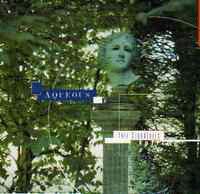
August 1996 – album reviews – Aqueous’ ‘Tall Cloudtrees Falling’ (“ambient emotional blackmail”)

24 Aug
Aqueous: 'Tall Cloudtrees Falling'

Aqueous: ‘Tall Cloudtrees Falling’

One thing ambient music is supposed to do is to be passive and let you play the unlistener. That way, you know where you stand. Put on an ambient record, flood yourself with the pastel light or shadow of your choice, lie back and just relax into it like a big cushion of sound waves. There might or might not be some gentle beats involved, you might get the odd trumpet or whale-song, it might be dark or it might be light… Whatever it is, you’ve got control and it’s tailored to one-size-fits-all. No problems. No thinking necessary.

Aqueous: ‘Catching Sight of Land’

At first hearing, Aqueous’ ‘Tall Cloudtrees Falling’ sounds as if it’s going to be one of those archetypal ambient throw-pillows. Listening to Andrew Heath and Felix Jay gently ping and buzz their way through Catching Sight of Land (whole-tone scale digital abstractions; robotic bass blobbing up in gentle ruminant belches) or Under a Heavy Sky’s dewdrops of Rhodes piano and wowing buzzes, you can settle down, open your book, drift off…

Hang about. Brain message, confused. Surely there should be something here to latch on to? The reassuring melody-ette, the heartbeat to the ambient womb? Either someone’s made off with it, or Aqueous have folded it up like origami – all the expected angles in the wrong place. You can’t read the book; there are gaps in the music which your subconscious is forcing you to listen to. Ambient emotional blackmail.

And eventually you have to respond. You put down the book, and you listen to this wandering, gentle collection of electronic shapes. A third of it makes sense. The remainder refuses to stay in your grasp, melting off into the air like an evasive scent. The ice has melted in your drink.

Back to the book. This time, the music creeps up behind you and gently, insistently – maddeningly – tugs at your shoulder. It demands, ever so gently that you listen to it: but as soon as you turn around, it’s gone again. Sub-audible – in the night-breaths of Antarctica as insubstantial, yet as unmistakeably there, as the shape a leaf-laden branch makes in the breeze. In Les Trois Jours D’Ete, capturing the silence of a sun-washed garden… with the eyes drawn up over the top of the wall in expectation of sudden, silent summer events. You shelter in it. It slowly sags and gives way at unexpected angles beneath you: turning you round, dropping you into Sweet Santoor’s zither of icicles and Stylophonic buzzes (amid snatches of disintegrating Satie).

Aqueous: ‘Within This Dream I Awake’

This carpet-slippered game of cat and mouse could go on for ever, while you attempt to either pursue or ignore Aqueous’ essence. You can draw a few comparisons if you like. The mingling, exchanging, misty patterns in Leaving Alexandria in the Cold Light of Dawn mixes Harold Budd’s still-air vistas with the insidious kind of fluting, droning analogue shapes that Vangelis cooked up during his mid-’70s Nemo peak, during quieter moments. The whole album has echoes of Cluster.

But attempting to pin Aqueous music down to absolutes is as futile as trying to pull that unlistening ambient-consumer’s trick on it. Like the various states of water, this music can both give and refuse to give; and it infiltrates the environment it enters, with the insidiousness of transient vapour or with the unyielding fragility of an ice sheath over a pond.

Aqueous: ‘Tall Cloudtrees Falling’
Hermetic Recordings, HERM 2222
CD album
Released: 19th August 1996

Buy it from:
Aqueous homepage store

Aqueous online:
Homepage

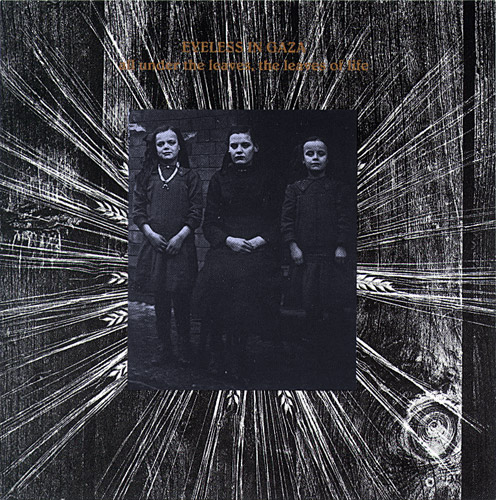
July 1996 – album reviews – Eyeless In Gaza’s ‘All Under The Leaves, The Leaves Of Life’ (“rings the sonic changes track by track”)

25 Jul

Eyeless In Gaza: 'All Under The Leaves, The Leaves Of Life'

Eyeless In Gaza: ‘All Under The Leaves, The Leaves Of Life’

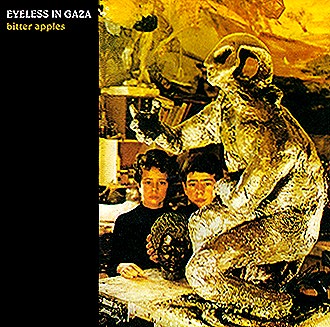
Still undimmed after years of following a winding path from visionary post-punk to surreal pop, and through to a beautiful breed of semi-ambient outsider-folk, Eyeless In Gaza continue to blossom in their triumphant 1990s renaissance. They’re also as restless as ever – following soon after their ‘Bitter Apples‘ album (with its sustained autumnal mood) ‘All Under The Leaves, The Leaves Of Life’ rings the sonic changes track by track.

Indeed, Eyeless seem as happy to draw on their post-punk past as they are to explore the ghostly folk that’s left an impressive stamp on their recent music. Monstrous Joy opens the album and… God help us, it’s 1981 again! Joy Division bass rumbles, spindly single-note synths, buzzingly active electronic drums. Yet despite the timewarp, this is no Xerox copy of those years. Instrumentally, it’s a skilfully layered slice of pop atmospherics: lyrically, emotions are conveyed much more directly. Gone are the allusions to nature, but the atmosphere holds a definite frost in the air – “here is a sorrow that owns me, here is a sorrow that speaks.”


Struck Like Jacob Marley (despite the Dickensian title, a highly contemporary standout) does nothing to ease the chill. Led by rumbling bass guitar and defiantly noisy and distorted electric guitar, the lyrics are upfront advice to a friend consumed by cynicism – “it’s almost as though you have no positive view / and the old warmth is going, even though you don’t wish it to.” Hard words.

Meanwhile, the sonic adventures just keep on coming. Fracture Track is a mesmerising and bloody assault on the Eyeless sound. A violently struck, hypnotic rhythm guitar riff is blasted on all sides by discordant drones and buzzes: there are no drums, yet it sounds huge, and Martyn Bates pushes out a harsh-edged, ferocious vocal. “Blasted and blinded to chaos… / riding an animal hatred… / forcing such a numb and wasting path for you to blithely tread.” The violent and nihilistic imagery only adds towards making this the darkest, most fearsome track Eyeless In Gaza have ever recorded.

The traditional Leaves Of Life, as arranged by Eyeless, sounds like a less wasted Flying Saucer Attack turned on their heads. The vocals and spartan folk acoustics take place up close, whilst the unsettling ambience – provided mainly by startlingly severe treatment and distortion of electric guitars and other electrical interferences – scares the life out of you in the background. Gothic folk at its best. And trip-hop? Well, OK, nearly. Answer Song And Dance definitely possesses a dark, nervous trip-hop undercarriage, with a slow, menacing beat, cool electronic sheen and Martyn’s vocals relayed through digital effects and compression: more experiments in new sound are going on here.


Three Ships, another arrangement of a traditional piece, is perhaps the most reassuringly familiar Eyeless In Gaza track here, comprising a solo vocal over Peter Becker’s long churchy organ notes (“all the black keys”, as they once called it). Even here, though, the second part of the track becomes subject to the unsettling aural sculptures of pervasive otherworldly drones, sonic interferences and sinister electronic pulses. It sounds like a late 90’s version of one of the frankly peculiar little improvised instrumentals that have littered Eyeless B-sides and rarities in the past: but, satisfyingly, it’s an example of technology finally catching up with the duo’s ambitious musical vision, so that they can finally express their experimental sides to the full.


It’s tempting to see this album as the second side of the coin flipped by ‘Bitter Apples’ last year. If the former was the familiar world of acoustic alchemy, natural imagery and the avant-folk song, then ‘All Under The Leaves…’ sees Eyeless In Gaza striking out for new challenges: testing their own musical limits, and casting off the gauze of allusion and allegory to put forward sometimes difficult lyrical statements directly. And while, on ‘Bitter Apples’, vibrant colours were all around and there was a last gasp of summer’s warmth, ‘…Leaves…’ is winter-cold. Challenging, but ultimately beautiful when viewed in the harshest of frosts.

Since unexpectedly bursting back into life in 1993, Eyeless In Gaza have been immensely prolific. But as their continuing string of albums in the comeback sequence show, quality has remained high: and Bates and Becker’s desire to move forward and experiment – while retaining Eyeless’ essential character – remains intact and proud.

(review by Vaughan Simons)

Eyeless In Gaza: ‘All Under The Leaves, The Leaves Of Life’
Ambivalent Scale Recording, A‑SCALE 021 (5 021958 463025)
CD‑only album
Released: 19th July 1996

Get it from:
(2018 update) original CD and 2009 Cherry Red Records reissue best obtained second-hand.

Eyeless In Gaza online:
Homepage Facebook MySpace Soundcloud Tumblr Last FM

March 1996 – live reviews – Robert Fripp’s South Bank Soundscapes @ Queen Elizabeth Hall foyer, South Bank, London, 10th March (“more challenging abstractions than Fripp’s ever attempted before”)

12 Mar

'Now You See It...':  Robert Fripp Soundscapes, 10th March 1996

‘Now You See It…’: Robert Fripp Soundscapes, 10th March 1996

Tucked against a curving concrete wall, under a sweep of plate-glass windows, there’s the familiar stool with a beautiful rock-fetishist’s dream of a Les Paul guitar, flanked by rack-mounted gizmos like a gaggle of worshipful Artoo Detoos and a flat henge of volume pedals and multi-purpose stomp-boxes. Over to the right, David Singleton sits at the mixing desk, quite the portrait of the calm fixer for the artist’s determined leaps. Arranged in a long staggered curve in front of the opposite wall, lining the long walk between the entrance and the Purcell Room, are at least eight tall speaker cabinets. Occasionally in residence is the sleek, compact form of Wimborne’s most formidable musical son.

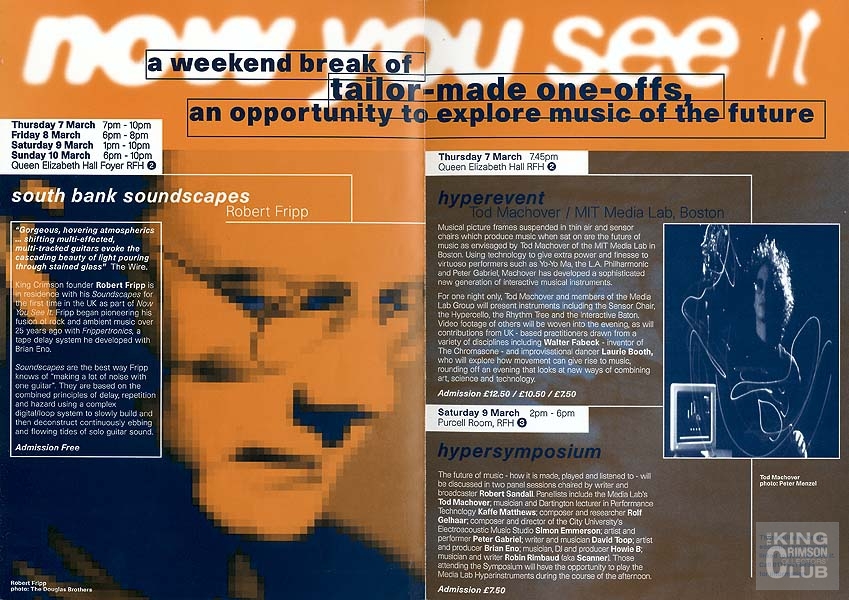
These Soundscapes are part of the ‘Now You See It…’ season of contemporary performance art, sharing the building with the Hypermusic Symposium (in which Peter Gabriel, Brian Eno, David Toop and others debate the future of music, and people nervously finger such unorthodox instruments as literally musical chairs and picture frames or the Interactive Baton) while avant-garde dance groups hijack the Purcell Room and stick the audience on the stage, and (less happily) over at the Lyric Theatre in Hammersmith an appallingly pretentious bunch of Euro-thespians do a vandalistic mixed-media Schubert performance.

In these surroundings, Robert Fripp‘s increasingly out-there journeys in solo sound fit in surprisingly well, both physically and intellectually. When a squadron of incredibly young women in bare feet and little black dresses trot busily past (every quarter of an hour, on the dot) to meet their cues in a back-to-front theatre piece next door, it seems inexplicably appropriate. Tonight – Sunday 10th – is the fourth of Fripp’s residencies, a mere four-hour performance compared to the rear-numbing six- and even ten-hour marathons he’s performed earlier in the week. Some people have returned, regardless. Within that length of time, anything could happen: the music that Fripp claims to channel rather than compose could lead him anywhere.

Soundscapes, the successor to the layered sound-loops of Frippertronics, is a major leap forwards, sideways, anyways from its progenitor: the digital technology stores his patterns and transforms his tones to the point where there isn’t a single recognisable Crimsonic guitar sound to be heard all evening. In effect, Fripp and Singleton are playing a wholly new collective instrument, a community of speakers, desk, guitar and digital cyberspace. The end results are a swathe of overlapping, opposing electrophonic voices, sometimes beautiful and sometimes disturbing – polytextural hums; a sound like a seventy-foot high piece of glass being torn like cloth; wailing, spectral swells like American freight trains blowing a blue whistle into a desert of ghosts; aquatic, gem-faceted calls of a Loch Ness Monster; tingling pianistic or xylophonic ringing; squiggling crystal-bat chitters. It emerges as a sound that’s on the brink of being recognisable, somewhere deep down in the soul… but not quite.

As it rolls on, evolving like strata, burying what’s come before like the march of ages, you may find it impossible to concentrate on (four hours is a long time) but it saturates your mind regardless: you’ll sure as hell be thinking differently. While I’m here, I meet somebody who ascribes near-mystical powers to the first Soundscapes album, ‘A Blessing of Tears’ – “any pain you have, any problem, it will heal it…” Even on the basis of what I’m personally experiencing in the music tonight (the rollers, breakers, capricious tides and immense flickering lulls of an alien sea under a midnight-blue sky, occasionally rent by sheets of violet lightning and mile-wide twists in the current… I think I’m in for a night on the ocean wave) I can believe him. This isn’t New Age pretty-stuff.

And so the Soundscapes are installed, piece by lambent unsettling piece, more challenging abstractions than Fripp’s ever attempted before. But most of the people here seem to have missed the point – sitting deferentially in the arc of chairs facing Robert and his little cliffs of winking lights, watching him silently manipulate his gold-top Les Paul or peer into his effects racks, they pay a silent tribute. This isn’t how to do it. When Fripp calls what he does “Soundscapes”, he means it literally. There’s a fifth element in that communal instrumentation: three-dimensional space. Each of the eight speakers arranged in an arc behind the audience is fed by a slightly different sound source. Walking slowly back and forth across the foyer, one passes in and out of phase with the sounds: a different listening angle provides a different piece, an ability and opportunity to concentrate on a different section of the Fripp orchestra. Music to literally explore.

I feel a bit of a fool, though, pacing up and down the floor to curious glances from the audience; it’s not quite the same as hanging around, in gig-approved fashion, with a drink in your hand and lunging up and down gently to your favourite song. Mind you, the rest of the audience are behaving exactly in the way you’d expect at a Fripp-related gig or an art installation. Here are a couple snogging vigorously, French-kissing amidst the unsettling washes of the music; three rows in from the front, a man appears to have passed out, lolling over the back of his chair with his wide-open mouth pointing wetly at the ceiling. Music to intoxicate? Perhaps: it ignores standard musical dimensions in a way that one only otherwise hears in the most deliriously spaced-out Lee Perry dubscapes, although the notoriously drug-free Fripp looks more composed than I’ve even seen him before.

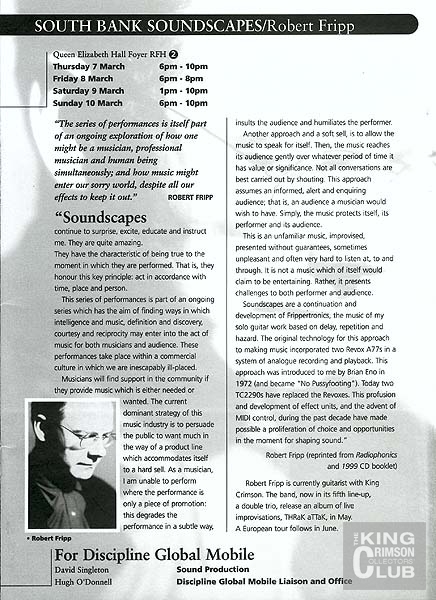
'Now You See It...':  Robert Fripp Soundscapes, 10th March 1996 (programme)

‘Now You See It…’: Robert Fripp Soundscapes, 10th March 1996 (programme)

But then perhaps once the music slips beyond the control of his fretting fingers, flexing feet and console-fondling fingers, it ceases to be his responsibility anyway. The nature of Soundscapes is such that Fripp’s very presence can become little more than a trigger. Turn away at the wrong time and you’ll turn back to find the guitar leaned against the stool and Fripp gone, sipping at a cup of coffee over by the mixing desk as the music wreathes onwards without him, or wandering out through the audience to check a corner of the sound. It’s a little disturbing when, conversing quietly and walking around the circuit of speakers to experience the different sounds, one comes within six inches of Fripp padding lightly in the opposite direction, close enough for you to sense the implacability of his will, pushing at the realms of the possible like a smooth arrowhead.

The element of hazard plays its role too. Sometimes, amongst the layers of harmonic tissue that Fripp is laying down, a mismatch occurs. Or a part decays too soon, or a speaker refuses to cooperate with the vision, and the musical organism is deformed, loses balance, develops cancer. At such times Fripp shrugs in frustration and looks over to Singleton, or out to the audience in the only acknowledgement he ever gives them, lets go of the guitar with palms turned upwards in the universal gesture of helplessness. The music thins out and he begins to build his organism again.

This continues for four hours: time to get several drinks, chat quietly in the background, arrange assignations with other musicians and writers, even formulate whole arguments about what we’re seeing (in other words, make our own contributions to the Soundscape ambience), and still not miss out on the crystallising veils of sound that drift around the foyer, perplexing this evening’s Mozart concertgoers, putting thoughtful expressions on the faces of the cloakroom attendants as it numbs their resistance. At the end, Fripp puts the guitar down, as he’s done so many times before during the evening, and walks slowly away to vanish down the passageway leading to the dressing rooms. The applause that follows his retreating back is sincere, but oddly unfocussed, as if the audience is unsure whether they should be applauding him or the air that’s been buoying up the music and carrying it around like a whispered ritual, I catch the train home, as I usually do; things seem just a touch sharper than normal. Soundscapes don’t so much take you to another world as grant you a shimmering new lens to experience this one through.

Robert Fripp online:
Homepage Facebook Twitter MySpace Soundcloud Bandcamp Last FM Apple Music YouTube Vimeo Deezer Google Play Pandora Spotify Tidal Instagram Amazon Music
 

November 1995 – album reviews – Eyeless In Gaza’s ‘Bitter Apples’ (“an autumnal album in the most inspiring way”)

30 Nov

Eyeless In Gaza: 'Bitter Apples'

Eyeless In Gaza: ‘Bitter Apples’

After seventeen years on the wildest, furthest reaches of contemporary music, Eyeless In Gaza’s time may finally have come. With the British music scene proclaiming itself as boundary-free, cross-pollination of styles is the name of the game. Experimentation is the byword. Ears are open to new sounds.

Eyeless, of course, have been doing it for ages – from industrial electronics through early-80’s sparse electronic punk, bedsit acoustic folk, a stab at a big pop sound and experiments with mechanistic ambience. Then a seven-year abeyance followed by a shock return with the modern dance-pop of ‘Fabulous Library’ and by ‘Saw You In Reminding Pictures’ (an album of improvised, cinematic, ambient songs and atmospheres). Yet all, thanks to Martyn Bates’ distinctive, expressive voice and Peter Becker’s endlessly inventive musical collages, recognisably Eyeless In Gaza.

Much of Europe has been in on their greatness for years. Now that they have returned it is time that Britain listened in; particularly as, since Eyeless reformed, their career has been no nostalgic re-run of past styles, but a body of work that has engaged with the best of them in the camp marked “pre-millennial boundary-breaking zeitgeist experimentation”. Or something.


Following the head-expanding soundscape world of ‘Saw You In Reminding Pictures’, ‘Bitter Apples’ comes announced as a return to song structures and a live folk feel (acoustic guitars, bass, drums). The matured Eyeless In Gaza are now reinventing the brand of avant-folk song first heard on their Drumming The Beating Heart album over a decade ago. Lyrics such as those on Bushes And Briars immediately announce the folk influence – “through bushes and through briars / I lately made my way / all for to hear the young birds sing / and the lambs to skip and play.”

But any hint of preciousness about such a style is dispelled by the ghostly a-capella treatment of Bates’ voice, treated with vocal effects that make him sound like a possessed changeling, wrapped in his own tingling harmonies. Martyn Bates’ voice is unique – expressive in hushing to a sense of menace, or delicate and weary, or surging with the power to hit the rafters. He occasionally retains a slight rasp, an edge, to his voice from the first punk-inflected vocals of early Eyeless. A comparison? Impossible.


Year Dot demonstrates how Eyeless In Gaza can produce powerfully rhythmic, surging music from the basis of harsh acoustic riffs, Martyn letting his voice roam over the melodies with unfettered power. But technology is not anathema to such natural surroundings, though – the track closes in a sharp crescendo of electronic interference. Contemporary experimentation mixes it further with avant-folk on Jump To Glory Jane – zither passages are built upon bursts of white noise, klaxons, and improvised wordless vocal harmonies as just another instrument in the delicate construction. It’s a perfect demonstration of the duo’s implicit feel for building such atmospheres, and sets the tone for much of the rest of the album.

Perhaps the central track, though, is To Listen Across The Sands: powerful and urgent, built upon a crashing electronic drum pattern remorselessly pushing the rhythm forward and echoing the lyrical theme of listening to “all the mad, crashing waves.” The song would seem to be an allegory for a journey through a stormy life – “listen across the sands / to the waves drifting where you stand / and all their voices swallowing your life.” A theme that is returned to, lyrically and musically, on the title track. To an up-tempo soundtrack of syncopated guitar and percussion (plus a star appearance from a keyboard relic in Peter Becker’s armoury of sounds – the Wasp), nature’s imagery is once again summoned to describe the unpleasant aspects of life we sometimes have to wade through. “Such a bitter harvest, such a windfall falling that I can’t move… / all that I taste wastes me away – all that I’m succoured by and living on… / bitter apples…”

This is an autumnal album in the most inspiring way – new invigorating cooler winds provoking the falling leaves and scudding clouds. And Eyeless in Gaza are long-overdue for rediscovery, yet still ripe. Pluck.

(review by Vaughan Simons)

Eyeless In Gaza: ‘Bitter Apples’
Ambivalent Scale Recording, A‑SCALE 020 (5021958453026)
CD‑only album
Released: autumn 1995

Get it from:
(2018 update) original CD best obtained second-hand. There was a 2011 reissue on Hand/Eye Records which might be easier to find.

Eyeless In Gaza online:
Homepage Facebook MySpace Soundcloud Tumblr Last FM

October 1994 – mini-album reviews – King Crimson’s ‘VROOOM’ (“like a gigantic work-worn machine developing a telling fault”)

31 Oct

King Crimson: 'VROOOM'

King Crimson: ‘VROOOM’

The first new music from King Crimson in a whole decade rolls in with a yawn… or the sound of a hitman’s car tyres slithering quietly past your house. I don’t know. Whatever it is, it’s subliminal – a dark, stretching, barely audible ambient sound. Reverbed and resting right on the edge of the listener’s attention, it’s something which creeps in and cases the joint, maybe clears it of distractions. The last set of King Crimson albums, back in the ’80s, went straight in with clean, pealing, bell-like guitar patterns. Perhaps there’s a big clue to current Crimsonizing in that this one doesn’t.

Although the band’s known for its high turnover of disparate personnel and fresh starts, ‘VROOOM’ unexpectedly reunites that stable-against-the-odds 1980s Crimson lineup (Robert Fripp, Adrian Belew, Tony Levin and Bill Bruford) but augments them with two new members: Trey Gunn (a graduate of Fripp’s Guitar Craft course, doubling Levin’s 10-string Chapman Stick) and Pat Mastelotto (a jobbing, dextrous rock drummer best known for being part of American AOR act Mr Mister). Historically, when Crimson’s added members it’s been for as much for specific sonorities as much as personal approach. Perhaps a jazz or military saxophonist to break up a beat group, or a violinist to bring in classical textures. Maybe a Stick player to replace, fan out and reshape the bass chair; maybe, to upset the whole applecart and reboot the other players’ brains, an avant-garde improv percussionist with a thousand-yard stare and a junkyard armoury, or a master of cartoonish sound-effect guitar. Conversely, this is the first time Fripp’s apparently hired people mostly to thicken out the existing sound. This might be another clue.

What emerges – after that scouting roll – does and doesn’t sound like King Crimson. The New York brightnesses of the ’80s lineup (those circular Steve Reich and Talking Heads echoes which so thoroughly rebooted Crimson’s former Anglo-prog approach) have been banished. The title track is a descending, angry staircase of screech – simultaneously in synch and slightly ragged, like a gigantic work-worn machine developing a telling fault. If there’s a template for it, it’s the sound and structure of key ’70s Crimson track Red (the frowning, minimalist/totalitarian march which announced that Fripp had honed his once-florid instincts to a fine metallic economy).

The difference is that the big bare bones of this follow-up are fletched with additional details; disruptive flams and spurs, heavy digital processing resulting in analogue splurge, gears splintering but carrying on. A second huge instrumental track – THRaK – lurches forward in angry displacements, a blind giant hammering at a wall. In both tracks there are breathers which aren’t breathers – sighing passages where instruments fall back and Fripp’s misty ambient drones come in; or where a clambering bittersweet arpeggio makes a bed for a solo passage of wracked and pearly beauty before the hammers come down again. Throughout, there’s the sense of highly-stressed engineering precision just one slip away from disastrously throwing a rod, or a kind of hellish chamber music electrified to breaking point.

The band’s nervously sunny human face during the ’80s, Adrian Belew has been sucked backwards into this bigger, blurrier ensemble (predominantly providing a battery of guitar shrieks, leftfield lunges and rubbery solo lines). He still sings; is still the go-to song guy; but it’s clear that the songs have been almost entirely subverted by the new approach. On Sex Sleep Eat Drink Dream, King Crimson rattles through a bluesy lurch; Adrian sounding like an animatronic waiter covering John Lee Hooker, delivering sub-Dada wordplay in murmur-to-scream builds before the band explodes into barely contained passages of full-on percussive chaos.

A little of the ’80s Crimson is allowed into Cage, with Fripp’s cackling speed-arpeggios making it a close cousin to ‘Discipline’s breakneck Thela Hun Ginjeet. Like Thela, it’s a neurotic street cry, but what was once simply threatening has now turned actively murderous as Belew’s prissy paranoia is taken up to international level (“walking down the street, do you stare at your feet / and never do you let your eyes meet the freaks, / the deadbeat addicts, social fanatics, / they’re a dime a dozen and they carry guns. / Halloween every other day of the week… Holy smoke! somebody blew up the Pope!”) while didgeridoos yelp and Fripp provides a barrage of his most jarring, churning guitar disruptions.


A third instrumental – When I Say Stop, Continue – mingles both King Crimson’s old knack for doomy improvised sound-pictures and the band’s puckishly dry sense of humour. Over an ambient creeping horror of a Fripp Soundscape, the band knock, shrill, drill and build up a swelling industrial noiseuntil Belew yells “Ok, come to a dead stop. One, two, three, four!…” only for the band to wilfully drift on without him, trailing ghostly shrouds of presence, until the drummers slam and nail the doors shut.


Only with One Time do both King Crimson and Belew emerge from this deliberately uneasy fug. Here, the sextet drop delicately into perfect synch and sweet restraint, a softly-mutated post-bossa pulse and Levin’s springy bassline coaxing along Belew’s lapping reverse-rhythm guitar and gentle vocal melancholia. It’s a reminder that King Crimson also have a knack for the beautiful offbeat ballad alongside the harsh upheaval. This is no exception, grasping wistfully and tenderly after a fleeting sense of centredness, throwing what’s come before into a more human-scaled relief.

King Crimson: ‘VROOOM’
Discipline Global Mobile, DGM 0004 (5 028676 900016)
CD-only mini-album
Released:
31st October 1994
Get it from: (2020 update) some original copies still available from Burning Shed – also reissued, along with the material from its companion volume ‘The VROOOM Sessions’, as part of 2015’s 16-disc ‘THRAK BOX (King Crimson Live and Studio Recordings 1994-1997)’, also available from Burning Shed
King Crimson online:
Homepage Facebook Twitter MySpace Soundcloud Last FM Apple Music YouTube Vimeo Deezer Google Play Pandora Spotify Tidal Instagram Amazon Music
 

May 1994 – live reviews – Django Bates’ Delightful Precipice at London Jazz Festival @ The Bloomsbury Theatre, Bloomsbury, London, 17th May 1994 (“behind the whimsy lies the mind of a genius, or a sadist. Probably both.”)

19 May

Time to open your eyes a little wider, ‘cos something strange is stirring in the home counties…

Those of you familiar with Bill Bruford’s Earthworks will be aware of the contribution made by one Django Bates on keyboards, tenor horn and compositional skills. If you’ve done your homework, you’ll also know that he and Earthworks’ brilliant saxophonist Iain Ballamy originally worked together in the anarchic and thoroughly enjoyable Loose Tubes, a jazz big band who sounded like a joyous drunken party in a brass instrument factory.

If you’re really keeping up with Bates’ freewheeling progress, you might also know that he has his own big band in the form of the seventeen-piece Delightful Precipice, featuring Ballamy and several other Loose Tubes-ers such as flautist Eddie Parker, clarinettist Dai Pritchard, saxophonists Julian Arguelles and Steve Buckley… well, a large chunk of the current British jazz scene, when it comes down to it. Certainly half of the musical population of London, clutching various brass and woodwind implements, seems to have ambled amiably onstage along with the flamboyant Bates. While this lot might not have the profiles of the Courtney Pines of this world, they’re probably doing more to extend the boundaries of innovative music. With Earthworks, Bates breaks new ground and moves the landscape around; with Delightful Precipice, he teeters teasingly on a thrilling new brink (as suggested by the title of tonight’s opener, ‘Tightrope’).

It’s certainly brinksmanship of a high order. From the first notes, I’m transfixed by the music Bates and co. are producing: all of you who speak knowledgeably of the complexities of prog bands should lend an ear to Delightful Precipice, and get an earful of Django Bates’ muse. It’s a rich, densely textured experience; this is music so complex and ferociously intelligent that I feel as if it’s forcing entry to my skull. Pressed back in my seat as the music powers on, rushing through my mind like irresistible floodwaters, I’m firstly overwhelmed by the sheer substance of it. Later, as it shows no sign of letting up, I feel my reluctant slow little brain being gently forced into activity; it’s like slowly being woken up, given a massage and a pep talk. This is music so cerebral that it even brings your mind up to speed.

‘Tightrope’ opens the show in slamming clusters of notes like being punched to death by brass, before the band gently finger-snap their way into ‘Armchair March’, a melancholy Bates-y stomp with long peals of English brass band sound (a Loose Tubes trademark). The following ‘Fox Across the Road’ is a menacing, darkly harmonic undulation, sliced up by samples of screeching car brakes, speech, beeps and horn toots, and savaged by Mike Mondesir’s slap-bass breaks.

Bates cuts an eccentric figure onstage – curly-headed, immaculately stylish and handsome, spinning around behind his keyboard or pulling out a hunting horn for a quick blast. His ironic smile, plus the reams of music manuscript spilling over the keyboard and the musing, other-worldly humour of his between-song comments give him the air of some elegantly mad professor, a Lewis Carroll of the jazz scene. He dedicates the handclappy lunacy of ‘Ice is Slippery’ to his sporting heroine, Tonya Harding. ‘The Loneliness of Being Right’ features a lengthy chunk of free-association gibberish (“Bud Freeman Hardy Willis… do not forsake me, oh my Darjeeling tea…”)

But don’t be fooled. Behind the whimsy lies the mind of a genius, or a sadist. Probably both. His music manages to balance both an astounding inventiveness and enough humour to keep us listening to it. There is the considerable problem that a poor sound mix renders his keyboard all but inaudible, but the guy still seems to be everywhere – dancing and conducting his ferociously complicated arrangements, playing behind his back, waltzing through ‘Queen of Puddings’, generally having a good time.

The second half of the show is more accessible than the dense and demanding first, opening with Eddie Parker’s breezy big-band rush ‘Exeter – King of Cities’, a carefree musical evocation of the Devon summer. We also get ‘Glad Afrika’, a revamp of Bates’ Loose Tubes standard ‘Sad Afrika’ translated into “happy stylee” in celebration of the end of apartheid. It’s a glorious burst of happy-sad brass, a cartwheeling piece rolling through chorale to cacophony and ending up in a great soft resolution.

Almost impossible to top; but Bates manages it when he straps on his tenor horn and walks out from behind his keyboard to deliver a reading of Earthworks’ ‘Candles Still Flicker in Romania’s Dark’ which reduces the original to a pale, ineffectual shadow. His horn playing is phenomenal, sputtering and spiralling, clutching at heaven and breaking hearts, devastatingly sad and angry. The band – as previously noted, a sterling group of musicians and no mere wallpaper backing – also excel themselves in their sudden subtlety on the wispy pulses of the chordal background.

For closers we get the hyper-percussive artillery of ‘Martin France at Seven-and-Three-Quarters’ (with the aforementioned drummer going to town on his rig electronics) and the wry musing on disappointment, ‘You Can’t Have Everything’, in which Bates and his horn break up the glumness by invading the audience. Plus, as an encore, there’s another of Bates’ grabs at incorporating different musical forms into his art – this time, it’s the noble English football chant, fused alongside some heavy rock wallop into the raucous ‘Discovering Metal’. I’m treating to the spectacle of the arty Bloomsbury audience gleefully yelling along to “woah-oh, oh oh oh!” like a bunch of benevolent hooligans.

Bates comments, as he shuffles the music for ‘You Can’t Have Everything’, that the fate of the modern British jazzer is to be famous for two weeks and then to be dropped by the record company. “Only joking,” he goes on. “The fact is that there is a British jazz scene, as long as we all make it happen.” Well, Delightful Precipice can provide us with a whole evening’s worth of reasons why we should.; and I’d urge you to become familiar with their arguments. Wit, technique, complexity and another jump forward in the universe of jazz. To think that this is happening in England!

Django Bates online:
Homepage, Facebook, Twitter, MySpace, Bandcamp, Last.fm, Apple Music, YouTube, Vimeo, Deezer, Spotify, Tidal, Amazon Music

The Bloomsbury Theatre online:
Homepage, Facebook, Twitter

August 1993 – live reviews – Martin Taylor @ Ferens Live Art Space, Kingston-upon-Hull, England, 5th August (“like hearing crystallised music”)

8 Aug

It’s nice, for a change, not to have to do anything except sit back and listen.

Listening to Martin Taylor is like a breath of fresh air after a particularly sticky storm. He stands alone on a little white block of a stage with only his guitar and gently tapping foot, and gently unravels a long flowing river of melody to soothe the heart and to excite the brain. Pure and simple music. After a surfeit of analysis, a slew of post-modern criticism, a stew of eclecticism and image, it’s nice to get back to that once in a while.

Listening to Martin Taylor allows you to rediscover a love of the old tunes. He’s not a composer; his strength lies in the re-interpretation of classic standards, but rather than murdering them by pouring on strings and pallid flutes to make them ripe for serving up in the air conditioning, he offers you the chance to hear him dust down an oldie, hold it up to the light and then skilfully polish it, smiling as he shows it to you again and points out a hundred little details which you never saw before, a source of fresh wonder.

Because listening to Martin Taylor is like hearing crystallised music. You can distinguish the original tune somewhere in the glittering web of notes which his fingers are drawing out of the guitar – maybe it’s a ballad from ‘West Side Story’, maybe Duke Ellington’s Just Squeeze Me or a Hoagy Carmichael piece – but it’s been reflected and amplified through so many harmonies, echoes and byways along the way that what finally emerges bears as much resemblance to the original as a cut diamond does to glass. Old tunes turned corny and worn down by their own familiarity re-emerge as multi-faceted gems, cut and refined by a master’s technique, multi-layered and ornate.

If you stop listening to Martin Taylor for a moment, you might be able to hear the sharp clicks as the jaws of the guitarists in the audience drop smartly onto the floor. This crystalline music – richly syncopated melody and harmony played together, simultaneously with swooping basslines – is, after all, being played by one man without even the whiff of an effects pedal. During the interval, people are overheard wondering if there are four other guitarists concealed under the stage or behind the curtains. But there’s no denying that this music is being played by a human being; no pristine technician, Taylor’s impeccable skill is shaped as much by punchy string snaps and fretboard noise as it is by his carefully considered polyphony and his vertical, dense approach to arrangement. He’s as likely to use a violent slide up the bass strings as he is to tease out a gentle classic jazz chord in the treble; and, as the most exciting musicians do, he lets you hear him stretching towards his objective rather than simply delivering it ready-packed and icily perfect.

Listening to Martin Taylor when he stops playing and talks for a while is, in its way, no less of a joyful experience. Here we have one of the world’s greatest and most underrated jazz guitarists and he turns out to be a warm, humble and self-effacing guy with a nice line in gentle humour and a shy manner, as if tonight was his first gig. Taylor is possibly also one of the world’s first motherable jazzmen. No guitar god here: even when he speaks of his sessions with the legendary likes of Joe Pass and Chet Atkins, he makes it sound like a comfy jam session after an evening at the pub. Very British. I’m not sure if these isles can produce a legend of their own these days – we’re just no good at mystical PR…

No matter. Who needs a legend or the cartoon padding of a star, anyway? Taylor’s music is possessed of enough to soothe, stun, stimulate, delight and relax without recourse to tortured artistry, space-cadet communion or outlaw chic. And if he prefers to continue playing gorgeously low-key and intimate gigs, just one man and a warm-toned guitar, then I for one will continue to turn up to listen to Martin Taylor.

Because listening to Martin Taylor makes you remember just how wonderful listening can be.

Martin Taylor online:
Homepage Facebook Twitter Last FM YouTube Deezer Google Play Spotify Tidal Amazon Music
 

SWOONAGE

Swoon. /swo͞on/ A verb. To be emotionally affected by someone or something that one admires; become ecstatic. Here are some people and things that make me swoon. #swoon #swoonage

Post-Punk Monk

Searching for divinity in records from '78-'85 or so…

theartyassassin

...wandering through music...

Get In Her Ears

Promoting and Supporting Women in Music

Die or D.I.Y.?

...wandering through music...

Music Aficionado

Quality articles about the golden age of music

THE ACTIVE LISTENER

...wandering through music...

Planet Hugill

...wandering through music...

Listening to Ladies

...wandering through music...

ATTN:Magazine

Not from concentrate.

Xposed Club

improvised/experimental/music

The Quietus

...wandering through music...

I Quite Like Gigs

Music Reviews, music thoughts and musical wonderings

furia log

...wandering through music...

The Recoup

SINCE 2013: Books and books and books and books and occasionally other things

A jumped-up pantry boy

To say the least, oh truly disappointed

PROOF POSITIVE

A new semi-regular gig in London

Gapplegate Classical-Modern Music Review

...wandering through music...

When The Horn Blows

...wandering through music...

:::::::::::: Ekho :::::::::::: Women in Sonic Art

Celebrating the Work of Women within Sonic Art: an expanding archive promoting equality in the sonic field

Ned Raggett Ponders It All

Just another WordPress.com weblog

FLIPSIDE REVIEWS

...wandering through music...

Headphone Commute

honest words on honest music

The One-Liner Miner

...wandering through music...

Yeah I Know It Sucks

an absurdist review blog

Obat Kanker Payudara Ginseng RH 2

...wandering through music...

poplifer.wordpress.com/

Waiting for the gift of sound and vision

Good Music Speaks

A music blog written by Rich Brown

Do The Math

...wandering through music...

Archived Music Press

Scans from the Melody Maker and N.M.E. circa 1987-1996

The World's Worst Records

...wandering through music...

Soundscapes

...wandering through music...

OLD SCHOOL RECORD REVIEW

Where You Are Always Wrong

FRIDAY NIGHT BOYS

...wandering through music...

Fragile or Possibly Extinct

Life Outside the Womb

a closer listen

a home for instrumental and experimental music

...wandering through music...

Life Just Bounces

...wandering through music...

Lucid Culture

JAZZ, CLASSICAL MUSIC AND THE ARTS IN NEW YORK CITY

Aquarium Drunkard

...wandering through music...

eyesplinters

Just another WordPress.com site

NewFrontEars

...wandering through music...

FormerConformer

Striving for Difference