And he came out from behind the console, and he spread out his dreams.
If you know Lee Fletcher already, it’s probably only in passing: maybe for the handful of mannered electro-pop tracks he and his wife Lisa have put out over the past decade as [halo]. More likely, you’ll know him for his extensive work as producer/engineer with centrozoon, Markus Reuter and with assorted King Crimson spin-offs including Tuner and Stick Men: well-established as a producer and engineer out at the more technical end of art-rock, you’d expect his own current music to be stark, or detached, or both.
It’s not just the question of his choice of colleague: it’s more that people in his position are generally there to get a job done, massaging and harassing slack musicians or their work into proper performance. If they’re of the more creative ilk, they might get to tweak their charges’ output into more original shapes. If they get around to putting out albums, these are likely to be back-to-basics vanity projects or all-star galleries of guest singers and studio flair – bought by fans for the tricks and the rarities, but then left to gather dust. Generally speaking, producers’ own records aren’t supposed to be romantic, aren’t supposed to be involved. Most especially, they’re not supposed to be revealing.
Lee Fletcher clearly has other ideas, and he won’t be doing quite what you expect of him.
Starting with the surface and working in… ‘Faith In Worthless Things’ certainly has the striking richness of sound you’d expect from someone of Lee’s experience. Live strings, wind instruments and solo cameos merge seamlessly with his own intricate programming and panoramic instrumentation in a fine blend of console wizardry and warm acoustic work. Rich and delicate arrangements encompass stirring contributions by guest players from right across the musical spectrum. Among others making their marks, the album boasts broad strokes and fine detail from art-rock guitarists Tim Motzer and Robert Fripp, jazz drift (from trumpeter Luca Calabrese, double bass player Oliver Klemp and drummer Matthias Macht), and sky-curve pedal steel playing from B. J. Cole. Equally memorable moments come when Uillean pipes (courtesy of Baka Beyond’s Alan Burton) and, to particular moving effect, Jacqueline Kershaw’s French horn are woven subtly into the mix, set against sonic glitch and pillowy atmospherics.
If any of this orchestrated, cross-disciplinary lushness suggests other precedents to you, you’re right. Anyone familiar with David Sylvian’s electro-acoustic songscapes in the 1980s (or who subsequently took on the likes of Jane Siberry, Caroline Lavelle or no-man, whose violinist Steve Bingham plays a prominent role here) will recognise the wellsprings and traditions from which ‘Faith In Worthless Things’ draws. Miracles On Trees (a nimble quiltwork canon of touch-guitar, pipes and vocal harmonies suggesting Kate Bush fronting King Crimson) brings in additional strands of clean New Age-y folktronica, while more neurotic, Crimsonic arpeggios are stitched through A Life On Loan. Elsewhere, you’ll find fleeting, delicately organised touches from industrial electronica and dancehall reggae (as if bled in from a wobbling radio dial) and ingredients from Lee’s recent forays into torch song (via David Lynch’s protégée Christa Bell). There’s certainly a strong debt to Scott Walker’s luxuriant orchestral pop work, made explicit via an enthusiastically dreamy cover of Long About Now.
However, much of the sonic recipe is Lee’s own spin on things – a developing and broadening sonic signature which began to unveil itself earlier in the year on GRICE’s Fletcher-produced ‘Propeller’ (which featured many of the same players and a similar production ethos). ‘Faith In Worthless Things’ is also shaped by two featured players in particular – historically, the other two beats of Lee’s musical heart. On touch guitar, Markus Reuter adds a broad catalogue of supporting instrumental parts: textured or clean, rhythmic or melodic, banked-up or solo. While integral to the album’s fabric, his playing also fades skilfully out of the foreground – although he’s constantly present, it’s as if he’s seen only in brief flashes, running through the trees, keeping pace with the sound. Meanwhile, Lisa Fletcher takes centre-stage (as she did with [halo]) to provide almost all of the album’s vocals as well as acting as Lee’s muse and interpreter. She sings even the most painstaking lyric with the cool, classical, adult sensuality of a pop diva who might at any moment slide off her long black concert dress and walk, naked and magnificent, out into the sea.
In spite of all of this sterling support, if you drill down through the music (past all of the tasteful production stylings, the guest players and the ornamentation) you’ll find a songwriter’s album underneath. While his physical voice is present only as a few murmured harmonies-cum-guide vocals dropped across a handful of tracks, Lee Fletcher’s songwriting voice entirely dominates the album. It even has its own particular hallmarks – a sophisticated way with compositional patterns which takes as much from chanson and European music as it does from Anglo-American pop; plus a yen for long, looping melodic journeys across an extended succession of chords. Lyrically he follows the earnest, philosophical musings of prog song-poets such as Peter Hammill; immersing himself in concepts or thoughts and writing his way through them with shades of classic verse, occasionally knocking frictional sparks against the constraints of the surrounding pop music.
There’s an interesting pull-and-push between this ever-so-slightly awkward lyrical grain and Lisa’s glossy-smooth vocals, just enough of a catch and grind to put a polish on the one and a depth on the other. When both Fletchers team up as writers on The Inner Voice, there’s an extra lift, bringing in the kind of hi-concept soul soar you’d have expected from Minnie Riperton or Commodores, or indeed from Janelle Monáe (if the latter’s leant over from a soul background to look into art-pop, the Fletchers seem to be leaning the other way.) The cruising, creamy melody hides some sharp barbs : the song’s partly an elegant kiss-off to a past lover or collaborator, partly a “won’t-get-fooled-again” statement of intent and new faith and intent. “You did me a great favour, in a melancholic way,” sings Lisa, in cool and assured tones. “The lesson learned and actioned for today / is to listen to the inner voice and serve that impulse well./ Have courage in conviction, break the shell.” Gracious in retreat, but along the way a polite yet lethal line of stilettos are being inserted into a turned and oblivious back (like some kind of vengeful acupuncture).
While Lee’s other lyrical concerns occasionally stretch to brooding worksong (“marching up the hill all day, fetching pails of water for the crown / Until the playtime whistle sounds, and blows your hallowed dreams away”) and wide-eyed nature worship (“the seasons are aligning/ Shedding Mother Nature’s silver skin /bringing balance to the timing”) he’s at his best when he’s drifting into the hazy realm of the personal. Part of this touches on the mutability and contradictions of love – its ability, in any given moment, to contain frailty and fears alongside strength, devotion and enrapturement. On The Number, he and collaborator SiRenée set up a picture of the start of intimacy as a phone call into the unknown: “Hello, you’ve reached the number of my secret voice / And though I asked you not to call / Your instinct made the choice… / I knew you’d call, I knew you’d love me… Stranger on the line, I’ve known you always.” Dusted by Luca Calabrese’s sprays of muted Jon Hassell-ish trumpet, SiRenée sings the words in a misty bank of close and teasing harmonies – an enigmatic telephone nymph, she spins a spell of reflected longing as if at any moment she could either become flesh or simply vanish.
At the other end of the scale, where love is sealed and secure (with spouse, friends, family or perhaps all together), there is Life’s A Long Time Short; a Markus Reuter co-write in which an encroaching chill of the knowledge of ageing and death begins to gnaw at that security. “Our time is fleeting – / a love so true is truly painful. / A hurt that’s so divine – / at once the symptom and remedy.” Against a mournful ominous French horn line and a decaying fall of twinkling, dying Reuter touch-guitar chords, the song gradually passes from innocence (“there is no end, all time descends – / the trick is not to care”) to a warning (“there is an end. / Make all amends”) while Lisa sings with a subtle and breathless sense of disquiet, like a flickering ghost. All along, Lee watches with a poignantly shifting mixture of love, devotion and horror. Caught up within the current of time, all he can do is celebrate and confirm the life and value he shares in the now, while watching the inevitable washing-away and mourning coming closer and closer: “And as you grow, / I watch in rhapsody / the miracle you are…/Inside I’m screaming.”
On other occasions, Lee looks further outside, though it’s not always a comfort. Peering at the rapacious dazzle of television and pop media on Is It Me (Or Is It You?) he gets burned for his pains, then frets and growls out a proggy sermon about the callousness of the wider world: “Such a passion for freedom and brutality… / we pillage the living, ever seeking, kiss and telling morality / besieging all senses with apathy.” It’s the album’s title track that provides him with the still point which he needs. Out at the railway station café from dawn till dusk, notepad in hand, he’s watching the universe go about its business. Rails lead away to both possibility and obscurity; travellers move from place to place, passing through crowds while wrapping themselves in solitude; and Lee is “dreaming of the perfect future / tall on tales, and short on truth.”
Here, out in the flow, he plays observer to small, everyday aggravations and hints at family disappointments spawning both small aches and broken-up little personal worlds: “children crying, mothers braying / Fathers absent once again.” Here, too, he finds his sympathy renewed, his understanding broadened: “all at one with situation – / Circumstance breeds condemnation / of our fellow man.” Encompassed by the lives and voyages of others, surrounded by the signs and signifiers of both possibility and stagnation, he comes to a quiet acceptance of human fallibility and connection – “we’re bound by time, though here alone – / many rivers run as one. / Faith to heal the cracks within, / praying for life’s worthless things.” A small and modest epiphany, it’s the heart of the album and the song that binds everything together – including Lee’s divided impulses as skilled producer, exploring songwriter and man with a heart. Affection and anger, dislocation and commonality, families and strangers, nature and the grind, all linked under a lovingly gilded arch of strings, soft voices and soundscapes.
Lee Fletcher: ‘Faith In Worthless Things’
Unsung Records, UR019CD (4260139121021)
CD/download album
Released: 1st October 2012
Mark Mulholland & Craig Ward: ‘Waiting For The Storm’
Two guitars, two hushed voices, a looming double bass and a room that moves. That’s all that’s needed.
Mark Mulholland and Craig Ward go way back. In the 1980s, both were ungrizzled Scottish freshmen; teenaged guitarists coming up through roots music gigs in Glasgow and Edinburgh. Their paths have intersected many a time since then, while both clocked up the years and the experience – Mark with a brace of projects including the Berlin Americana band Two Dollar Bash, Craig most famously with dEUS (and spinoffs like The Love Substitutes), While this fuller collaboration was mooted in 2007, it wasn’t recorded until 2010 and 2011, and then went unreleased for a further year. In the meantime the intent hasn’t gone stale. If anything, it’s aged like a good whisky. This album might have been a while in coming, but it’s happily unstuck from the demands of time – just like any long friendship of the kind where a phone call and a kept date in a bar wipes away the years of separation.
Mark and Craig are upfront about their intentions. They’re reviving that strand of British “folk baroque” as played solo in the ’60s by Davy Graham and Bert Jansch, developed by John Renbourn and Danny Thompson in Pentangle, and performed in a shroud of mystique and withdrawal by Nick Drake. ‘Waiting For The Storm’ utterly recaptures that Witchseason glimmer – timeless, intimate and immediate, with the air listening in and the feeling that the songs are at the forefront of a push of story and message.
As guitarists and as singers, Craig and Mark are perfectly matched. Acoustic fingerpicking styles knit together in a generous skein of give-and-take, with each man providing varied electric textures as and where needed. Their quiet, rough-finished voices blur and separate in sighed harmonies, tinged with weariness, a little foreboding and some scarred-knuckle gentleness. Between them, Hannes d’Hoine plays double bass as if it were a straining mast, conjuring up deep thrums, solid gutsy plucking and ghostly bowed atmospherics. It’s very much a three-cornered exchange – almost telepathic in the players’ instinct to play just what is needed and no more.
As for the roots of the record, they drift – and no wonder. Though Mark and Craig are Scottish by origin, they’re wanderers by nature. The stoic discomfort blues of A Strange Place traces lightly over the angst of this lifestyle; the menacing weightlessness of its temporary, torn-up settlings. “Anyone entering this place they might say, / a strange place in which we belong…/ It’s a strange place we do run to, / a strange place to which we do run.” The slithering folk riffs and Simon & Garfunkel harmonies of Something On The Breeze raise up something more of home, via a Lowlands song of roaming and departure. (“Blowing through the open door that I have just walked through, / blowing me along to something new… / Looking forward to looking back on the things I’ve left behind, / somewhere a little further down the line.”)
Under even the dreamier-sounding songs, there’s a Scottish feel of hard lines: an undercurrent of poverty and menace dealt with stoically (“I see the cops on every corner, / people waiting ready to run. / Blue lights flashing out a warning – / someone’ll get hurt before the morning comes.”) Yet most of the underpinnings of the record come from one particular location: Mark’s current home of Port-au-Prince, in Haiti. Throughout ‘Waiting For The Storm’, Haiti breathes itself steamily into the mood and the music – mountains and stagnant creeks; tin roofs, heat and restlessness. There’s an occult foreboding here too, perhaps brought in by the business of living under the threat of capricious flooding, of drumming rain, or of violent passions swelling out of control. The answers flicker through the songs, half-seen, or viewed full in the face for an uneasy moment.
Some of it’s more relaxed; simply sketches and shadings of place and time. The winding sea currents of All The Doors Are Open (with Hannes’ grasping bass anchoring the surges of meter) invoke summer-struck stupor and an urge for motion. “All the doors are open, cars go past outside. / Won’t you take me with you, take me for a ride?… / I gulp down the icy water, drowning in the heat. / Hills lean over the hazy sea, wheels turning to the beat.” The instrumental Black Sail travels in a wave-roll and a dark minor key, telling a wordless story: moods shift weather-wise like bands of sunset and lowering clouds, the accelerations and slowings of the guitars tracked point-by-point by Hanne’s bowed bass.
With the title track, however, more threatening moods gather. “See the vinyl spinning its strange pattern in my head / and I can’t help thinking about something somebody said…” Like a brooding canvas, Waiting For The Storm uses the old expressionist motif of threatening weather to illustrate roils in the spirit, but leaves us hanging and expectant. “The sky is getting darker and the glass begins to fall. / The flicker of the candle’s throwing shadows on the wall… / Siren in the distance, the evening air is cool. / The bottle’s almost empty and the ashtray’s nearly full. / Waiting for a moment when it all begins to spin – / voices in the darkness, waiting for the storm to begin.”
Although the Haitian setting offers ravaged scenery and wild elements aplenty, Mark and Craig are ultimately too subtle just to use it as an exotic stage. In their lean words, they imply that most of the trouble a nomad might find in places like these might actually have been brought along in his own baggage. Secret Places, certainly, is caught up in its own space – one of obsessive passion, affirming “there’s no after, no before, /each time we pass through this door. / Nothing matters anymore – / each moment burns more fiercely than the last.”
Haiti gets to speak for itself as well. Amid arco bass rumbles and a stew of electric guitar atmospherics and acoustic webbing, Les Belles Promesses sees Mark, Craig and Hanne take a step back so that Haitian laureate Frankétienne can take centre stage. Working in smouldering wreathes of text from his own ‘Voix Marassa’, the old man recites and declaims in an impassioned, mesmeric French Creole like a voudoun Baudelaire, calling out razors and toadstones, sickness and fire, rocks and struck matches. “L’acidite de l’ombre… l’obsession des long voyage impermanences au bout du sexe, la passion du danger dans le sang, la fascination de riske… au-dessus du desastre.” Even at its height it remains honest, clear about the swings of raw fraught instinct.
So it is that the remaining two songs are left to their own devices. Icy Shivers comes from the armpit of a bad night – a circling lick; scribbling, edgy double bass harmonics; and moonlight-drop electric guitar, both ominous and omen-ous. “Things that crawl and things that bite / my thoughts as black as the sky tonight – / oh, it’s a long, long time until the dawn… / Dead of night the city sleeps – / waters still, a bargain deep.” Elsewhere, in Watching You Sleep, the devils are scratching away at a hard-won peace. Mark sings, as soft as anything, the pillow talk of a devoted lover – “you, your head lying on my shoulder, hear you breathing soft and clear. / I don’t care about tomorrow just as long as you are here,” – but hints at darker things abandoned in order to find and keep this haven. Even if they’re not stalking after him, there’s still a haunting. “I put the key in my pocket / and walked away from what came before. / A tune was running through my head / a song I can’t remember anymore. / I heard the sounds that go round the valley / hints of something far behind. / Something I wasn’t aware of losing / now I keep on trying to find.”
As other people’s violence stirs in the street, Mark’s narrator feels the pull of it and with a quiet, heartbreaking determination he asserts his love over rage. “I don’t want to go and get in a fight / I just want to stay with you tonight… / Don’t want to make nobody cry, / I just want to watch you where you lie.” The words are simple or even banal on the surface. The sentiments behind them, as sung, are subtly devastating. A reedy fuzz of electric guitar solo, one of the only ones on the record, seals the deal with hulking, sweating fingers.
There is an eventual respite from this darkness. Full of chuckling mandolins, The Six O’Clock Whistle is a jaunty folk instrumental with a hint of a reel (plus a nod and a wink to the childhood innocence of ‘Chigley‘). Sitting at the end of the record, it lifts the pressing atmosphere of the rest of the songs, drawing you away from the mesmeric night of memories, fancies, booze and shadows. Still, it’s the latter that remains with you: a baroque spell of sketchy lines, disquiet and stirred emotions, with some lines flapping free and others coiled too tight. A magical listen.
Mark Mulholland & Craig Ward: ‘Waiting For The Storm’ Cannery Row Records, CRR 1217(826863121627) Jezus Factory Records JF034 (826863121627)
CD/download album
Released: 3rd September 2012
Out at the helm of Glowing House, Steve Varney is raw, ruffled, hollering and sounds born to run. This is just as well. Trouble is hot on his tail. “I don’t think there is a gauge that will save me – / somehow they overpower gunpowder, like it’s easy…”
The head-up single for the second Glowing House album, Taming Lions is all about the incipient, savage disaster that’s just about to crash down on Steve’s head. The band’s fall-apart folky acoustic noise catches the feeling perfectly. They sound like the kind of band which survives credit crunches, small nuclear wars and the collapse of most of the functional parts of civilization. You can see yawing flashes of light straight through the gaps in the barefoot, wind-tossed rhythms.
Besides the cluck and clunk of Steve’s banjo, the song’s a superb stomping wobble of school piano, Salvation Army brass, foggy rasps of accordion and dirty cello, and someone beating time on a tumbledown shack with a handful of big sticks. (I checked back on this – it’s actually a third of the band playing on church pews. Talk about muscular Christianity…) At the top of his carrying, celebratory bruise of a voice, Steve’s making it quite clear that he’s stuck in a rigged and increasingly dangerous game. “They gave me a ten-minute head start, and they started counting. / I need a top-notch hiding spot I can hide out in. / Don’t be fooled they’ll give you space in the chase for a reason – / they wait for the perfect minute to stop the healing.”
Off he hurtles; firing a cartoon blunderbuss for cover, and to no great effect. They keep coming. As the song bounces on, there are more than a few suggestions that what Steve’s actually fleeing are his own demons, bouncing after him like a tin can tied to his ankle. Not much hope in escaping that way. But the sheer vigor of the band – of the song itself – suggests that they’re people who thrive on this kind of peril and the energy it kicks up. This is enormous fun. Keeping one step ahead of disaster rarely sounded so lively.
Glowing House: ‘Taming Lions’
Bandcamp
download-only single
released: 8th May 2012
Be wary of barristas, especially in airy little cafés in quiet back-streets. They feed you your coffee, they bring you your cake and cookies – in return, you ignore them and any of their own dreams. While you’re unwinding with the brew, relaxing or kvetching, gossiping or confessing, they’re stuck there with the crunch of the grinder, at a loose end. On quiet days, you’re probably the entertainment. If they happen to be writers of some kind, one day one of your stories might come bubbling back up.
As it happens, two members of StillWife still put in time as coffee-shucking barristas back in the band’s Melbourne hometown. Have any washed-up conversations washed up into their songs? I’m just saying. Or is it the coffee talking?…
There’s little that’s caffeinated about StillWife’s debut EP. Apart from those moments when one of the guitarists drives in a power-chord, a pointed solo or a burst of white noise (generally with the reluctance of a man drilling a necessary hole in the porch) it’s primarily about detailed acoustic fingerpicking and sleepy man-and-woman harmonies. There’s a soft, dusty touch of country music here. There’s something of Grandpappy in those guileless dollops of antique synth tone, like bubbles in the sun. There’s a little of Low in the semi-hush, as if they’d recorded it all on a distant Australian veranda. The drums are played by someone who’s so good, so subtle and egoless, he becomes the invisible springs that hold in place the band’s buoyant way with disillusionment.
Of the two primary singers, Dylan has the stoic country clarity of a youthful Willie Nelson while Moat’s she-panther tones capture the langourous, wounded and incurably passionate feel of both Stevie Nicks and Briana Corrigan. As for the songs, they’re about awkwardnesses and aches rather than grand passions. Their stock-in-trade is the ambiguities you don’t grow out of; the kind that make you mumble (as StillWife do in Olympia) “I know it’s wrong but I can’t bring myself to say I’m sorry. / You’re all I want, but I can’t say that I’m not feeling worried.” Both Moat and Dylan sound as if they’re in love with the slow, subtly adult pains that they sing about. Each of their voices comes twined around with the murmuring sounds of various bandmates singing along: as close as lovers, and sounding like straying echoes.
The EP’s centrepiece, Out To Sea, begins life as a duet of unraveling and entwining love and goes somewhere more apocalyptic. Moat sings cryptically about fire, about names and letting go, while from the second verse, Dylan’s muttering a grim counterpoint – “searching for the meaning in closing fires – / I’m calling on awful writers – / I’m taking pleasure in my own undoing.” As the song winds on, Moat launches meaningful non-sequiturs to wash up on the beach (“The youngest child, it don’t feel right, / it never will – he’s lost his light,”) while Dylan circles in despair (“and there is no me and there is no you; / and if there is no us, then there is no love; / and if there is no love then there’s nothing that’s true.”) The longer it continues, the more hallucinatory it becomes: even as they sing of separation, the two singers drift closer together. By the end, they’re not so much duetting as singing different parts of the same mind, chanting out “it’s in the way that winter’s coming around; / it’s in the snow-like stain, blood on the ground; / it’s in the wave descending, pulling me out to sea…”
Olympia – simpler – could just be about being too shy to ask someone out, its hotel setting a place of missed connections and missed handshakes. Or it could be about a failure of nerve in general – not having the pluck or energy to ask for what you want, even if it’s just a question of knocking on a door and speaking. In comparison, Haven’t You Heard is fairly lightweight: but perhaps its whimsy and gentler touch is needed to counterbalance the deeper aches elsewhere. Slung in a hammock of wry country picking, Dylan muses on unthinking aggression and ambition (“When I was a kid I had a lot to prove, / I was young and angry, with an overactive muse”), and touches – ever-so-lightly – on human cruelty. When not singing about warning off unwary aliens, he gently salutes the time when he finally “opened up my eyes and saw the view. / Saw the world for what it was – unfolding and askew.” A wonky electric solo ambles in like a sheepish grin. A second one opens out into a concluding cobweb of pulsating guitar noise, like a countrified version of Heroes.
With its Bo Diddley beats and stutters, its sudden embrace of dirty noise and its chopped-up minimal lyrics, So Sued turns StillWife’s usual working methods on their heads. Yet it still ties in with the band’s exploration of heartbreaks and awkwardnesses. A barbed kiss-off from girl-left-behind to boy-off-to-find-himself, it’s sung by Moat in a sardonic hiccup like a raised eyebrow. “You’re going solo, into the night… / You’re going solo / so get it right.” she jabs, before mocking with a chorus of “On the road, uh-huh; / on the road, ah-hah; / on the road, eh-heh… / We get it.” It’s bitter honey, powering on into pileups of screeching guitar as Moat wails – blue and biting – like a sarcastic banshee.
Creatures, though, might be the key to it all – the kind of beautifully wracked, subtle-heartbreak song that any lovelorn person needs to hear at least once. Licked around by misty synthesizers like weeping foghorns, it offers more of a Blue Nile approach to heartbreak – an intangible moment or event which nonetheless means everything, stretched in time as it soaks into the soul. Across a room, a soft-singing Dylan watches his lover dance; and at that moment realizes that it’s over, that what they’ve had has somehow been lost. “Through the crowd I see your face – content and undirected gaze. / Barefooted you begin to sway; I dance under the twilight’s haze, / and though it hurts I hold my tongue – some things can never be undone.”
Exactly what’s gone wrong, or what’s happened, is never revealed. An unthinking betrayal; or maybe simply the moment when common cause slips away, leaving just two separate bodies moving in an ever-growing space. There’s a tremendously sad dignity to this song, but that’s not all. A desperate hope-against-hope breaks through in a final pleading chorus: a sudden flare of forgiveness stretched out like a shaking hand – “Tell me you make mistakes – mistakes can always be unmade. / Tell me I’ve faith and I will pray – / just don’t leave me here this way…”
Utter quality. More of this, please.
StillWife: ‘StillWife EP’, 2012 Bandcamp
Download-only EP
Released: 8th March 2012
“There are no constants, / even if we want them.” Perhaps it’s the shift of moving around, splitting apart. Chicago chamber pop duo T & The Wonder are Chicago-based no longer. Now based on separate sides of the States (singer Tavis Balkin is on the West Coast, multi-instrumentalist Patrick McCormack in Vermont) they remain a duo by an effort of will, affinity and determination. Sometimes long-distance relationships do work out…
I digress. Perhaps it’s the shift of moving around, splitting apart, but this post-move single (recorded in snatched December sessions around other practical commitments) sees T & The Wonder swapping between hope and despondency as if soberly walking a coin over their knuckles. The live drums and strings which they used to use might have been surrendered to budgeting and lack of opportunity (swapped for synthetic equivalents); but their bookish, light-touch ascerbity remains. Corsage is, in more ways than one, a withering bouquet of sympathy. Over ticking guitar, and a trapped tinkle of piano Tavis addresses a woman’s disappointment as she ages – lonely, stifled and perpetually stranded. “Is the corsage dried out? / the one that was packed away / with the empathetic gestures / and the tired old clichés?”
As to where Tavis himself stands, that’s not so clear. Sometimes he’s attuned to the pain of the woman he’s addressing – “Does the future disturb you / now that all you have left is the sound / of a lot of empty talking / and the legs that keep walking?” At other times, a growing frustration renders him cruel. “Can you depend on people, or are you just a misanthrope? / When all your lost love makes it impossible to cope,” he sings, softly, like wet leaves massing up heartlessly in the driveway. “You are a shell of a person, / a portrait of depression.” Patrick’s surge of guitar solo – a fuzzy taillight – pulls up a little swirl of blackening anger; but it hangs in the air, as if unsure of whom to fall on.
It sometimes feels as if Tavis’ own involvement in the story can be called into question. Is that a hint of guilt in his ashy, passive whisper, as if he himself might take some blame for this disaffection? “You write me, I call you, / what more can I say?” he murmurs, a little lamely. “These goddamn words only fill space.” He waxes and wanes, cold and kind, over the course of the song, without ever settling anywhere. Maybe it’s difficult to leave the scene of the accident. Maybe he doesn’t want to. Old debts, never paid? Old wishes that never resolved, but still ache on a chilly day?
The b-side, Vespa, flips the situation here – youth yearnings rather than fading middle-age, and this time it’s Tavis sitting in the role of the person about to slide down the lip of disappointment. The song itself sounds gently rapturous, both motorik and rain-dappled: a blurry cushioned wobble of electric piano, a plastic drum splat and a subliminal driving pulse. Just for the moment the daydream is blooming and Tavis can bask in it. “If I had a Vespa I would drive up to your house, / and I could kiss you on the cheek, / and we’d then hang out for the weekend – / but I don’t.” The road throws up its first little jolt, but Tavis is already smothering himself in the romance. “I can feel your hands, your hands around my waist / Your hair, your hair – it’s all across your face.”
You could get caught up in the fervent dreaminess, until you realise how evasive it is. “We could talk about how I had / changed my life direction / and just moved out of the city to a / place where things are pretty. / I don’t know…” Then you notice that as American road-movie songs go, it’s a pretty soft-edged one. Patrick’s fey touches of fluting synth and Kraftwerk buzzes: mimsy soft drinks; staying well under the speed limit. It’s not that Vespa lacks grand passion. It’s just that it’s been filtered down and compacted, firing up that diffident teetering hope with quiet fire and aching to make it real. “Living in the moment we would forge a life together – / and we’d send our loved ones letters, / every day a little better than before.” But the letdown is coming a little closer all the time, and that haunts the song. Weaving through the chorus is a second, nagging vocal line. “When I think it’s not a possibility / I want to leave, I want to leave.” Then you start wondering whether it’s less of a grand passion, and more of a grand, shy, unspoken crush. An entire world bubble-blown from a single fancy.
Two songs of apartness. Two men divided by most of a continent; linked by an ongoing sympathy, writing subtle bruised-petal songs about how the world often lacks such mutual feeling. There’s probably something more to draw out of that, but I’m not going to try. I have the feeling that if I try to describe it any more it will burst, softly, under my fingers.
T & The Wonder: ‘Corsage’
T & The Wonder (no catalogue number or barcode)
Download-only single
Released: 28th January 2012
It’s a bit like coming home. My first venture out into gigworld for a while, and I’m walking into a rough-looking rock pub out on the elbow of Tufnell Park. Not so many years ago, the Unicorn was a genuine trouble dive in the industrial frownage north of Kings Cross – just a spit away from the troubled estates around Caledonian Park. Reinventing itself as a part-time heavy metal venue a few years ago turned out to be its salvation. Now it’s been turned around to become a friendly local. The only blood’n’guts making an appearance is on the death-metal flyers by the door.
Today The Unicorn is packed out with a warm crowd of allsorts-people whom you could never easily pin down as a clear scene. Arcane T-shirts stretch around comfy bodies; hairstyles range from metallic red to casually balding, The people here are as likely to be agricultural workers or car-hire operators as hipsters or metalheads, and they’re almost as likely to have flown in from Italy or Poland as have driven or walked in from Worcester or Camden Town. In between acts, the PA spits out recordings as diverse and potentially divisive as John Adams, The Melvins, King Crimson or early ’90s agit-samplers Disco Inferno. Nobody seems in the least bit disorientated, nor do they pester the DJ for Kasabian. In any stylistic sense, confusion reigns. In an emotional sense there’s the warm, scruffy feeling of a tribe who coalesce only occasionally, but always feel very much at home when they do so.
I’ve been here before. This is the Cardiacs flavour. Although Cardiacs as a band are now several years gone-to-ground, as a culture their rampaging jigsaw of unorthodox sensibilities and connections survives – even thrives – through a network of enthusiasts and musical heirs. Uber-fan and hitchhiking hero Adrian Bell is bouncing around the Unicorn swapping stories, spilling his beer and enthusiastically flogging his Cardiacs book. Snooker star-turned-prog champion Steve Davis is here, proving once again that his enthusiasm stretches much further than simply supporting ’70s legends over at the Queen Elizabeth Hall. That silver-tongued James-Bond figure also doing the rounds (plugging a dedicated Cardiacs disco at “battle volume” for next January) turns out to be Dominic Luckman: he’s evidently taken plenty of lessons in suave since his gurning, flour-covered years behind the Cardiacs drumkit. Other former Cardiacs will be performing in various permutations throughout the day: although to be honest this is less to do with tributes or fan-service than it is to do with the tendency of certain musicalities to continue beyond the brand name.
The whole kit and caboodle of Roast Fest itself has been put together by Kavus Torabi. Recently a Cardiac (and before that, in The Monsoon Bassoon) he’s currently heading up both his own band – Knifeworld – and the Believers Roast label that’s hosting the event. This also means that he’s today’s overburdened one-man juggling act. When I first catch sight of him, he’s boggle-eyed with worry, stapling a merchandise board together and hoping that everything will stay together. A self-styled (or self-slandered) psychedelic flake, Kavus seems to half-expect chaos round the corner and for all of this to come tumbling down around his ears. As ever, he’s doing himself down. While he’s relatively new to the full weight of carrying a cottage industry (let alone two, plus the bottled randomness of a mini-festival), his instincts are true and his audience sound. This feels as if it’s going to go well.
It also starts quietly as Craig Fortnam makes his first appearance of the day in Arch Garrison, a solo project which has a tendency to flit between one man-band and acoustic trio. On this occasion it’s a duo, with Craig joined by James Larcombe (today’s man-of-many-bands) on a variety of reedy little keyboards. Initially their sound is ornate and a little introverted, with James drawing angular pipelines of awkward tune across the artful spinning cogs and involved strums of Craig’s acoustic guitar. Together they build up a succession of gangling, summery blueprints; intricate and skeletal folk-baroque miniatures which scroll across time and pitch like attenuated Heath Robinson gizmos.
Some of the wedding-cake decorativeness of Craig’s main project (the retrofitted chamber ensemble North Sea Radio Orchestra) is present and correct, as is a taste of the baroque side of Michael Nyman. Yet Arch Garrison is less formal than either of these, and although seemingly delicate and fey to the point of flimsiness, the music is actually underlaid by an assured, precise musicality. Craig’s acoustic guitar-playing, in particular, is tremendously strong: part Renaissance lutenist, part gutsy Nick Drake fingerpickery, and part atomic clock. Sometimes he also sings – in an easy and distracted murmur, as if daydreaming in his front room.
In spite of this air of detachment (and with the help of an audience that’s warm and receptive from the start), musicians and crowd move closer together as the set progresses, and as the songs take on life from their elegantly quilled and tapestried beginnings and shamble out into the room. Arch Garrison’s music clambers off the Unicorn’s shabby stage like a hung-over peacock emerging from a cardboard box – bedraggled but with flashes of finery. Wreathed in compassion and energetic flourishes, a sweet-natured, gently chiding call to art and arms called Six Feet Under Yeah comes across especially well. Borderline precious they may be, but by the end of the set this band’s earned the kind of affection you’d give to a battered family heirloom.
I’ve heard plenty of loop musicians in my time. Once you’ve seen one they’re like gateway drugs to hundreds of others. (I’m sorry – I’ve battled my addiction for years, but it keeps coming back…) Most of them are sit-down sound brewers: reserved in aspect, slowly adding detail to their patterns, absorbed in their banks of effects pedals.
Matt Stevens cooking up a loopstorm, RoastFest 2011 (photo by Ashley Jones @ Chaos Engineers)
Matt Stevens isn’t like that. A hulking figure – wild of hair and beard and with the imposing build of a rugby forward – he’s also afire with nervous energy, hailing his audience with a delighted sportsman’s roar. As regards potential gear-fiddling, he looks more likely to hurl himself onto his pedals and roll across the stage, wrestling with lashing cables and flying components, rather than indulge in prissy fondling. In the event, he settles for stabbing owlishly at his pedalboard as he hacks into his set with furious enthusiasm, attacking a battered acoustic guitar with the energy of a born-again busker.
Even if Matt is an extroverted bear in a loopers’ community of aloofness, he’s still obliged to spend some onstage time engrossed in loop-science. This he does both with earnestness and the air of a smouldering volcano. Bashing aggressively-strummed chords into the loop in order to build up his layered compositions, he crams in his extra details later, subverting his acoustic noises with wah-wah or strange compressions which bring out new instrumental parts like falls of slate or torn hunks of burnished copper. Throughout, a powerful rhythmic momentum is key (whether it’s expressed via out-and-out rockiness, a stuttered systemic pulse or a slither of percussive noise) as is Matt’s total involvement in what he’s doing. If he couldn’t squeeze the next loop idea out, you feel that he’d burst. His joy when things fall into place is palpable.
That said, Matt’s seasoned enough not to dissolve into petulance when things don’t go right. There’s not an error that can’t be turned into an opportunity, not a glitch that can’t be an excuse for a new bit of fun. Even when a string snaps with a whip-like crack, its echoed ghost is built so assertively into Matt’s wall of sound that the piece would ultimately have been less without it. Plenty of loopers reference the more academic touchstones of the genre – Shaeffer and Stockhausen, Fripp and Eno. Matt Stevens has some of that too, but he most definitely grabs us by the scruff of our collective neck to drag us back to the roughneck folk days of John Martyn and his rattling Echoplex (now there was a man who knew something about chance and hazard…) And as he tears us off a Moebius strip, we love him for it.
Fighting an unsympathetic sound mix, Stars in Battledress aren’t having it easy. Of course, life isn’t generally easy for massively over-educated brothers who form art-rock duos, mix up rolling minimalism with genteel English folk and a jigsaw of elaborate lyrical conceits, and then act as if they’ve teleported in from a 1930s gentleman’s club.
If Stars in Battledress were, in fact, playing all of these factors up for laughs (as if they were some kind of parody lounge act), they might be quids-in for a while. The problem is that while they’re flushed with a vein of dense and playful humour, they’re also entirely sincere. Almost everything that makes them remarkable – even wonderful – also makes them hard to sell in England. It’s probably one of the reasons why their gigs are rare these days.They’re willfully out of time; hothouse blooms in a climate that doesn’t favour greenhouses. Even the reviews they inspire turn artful and drip sepia.
The precision brotherhood: Stars In Battledress, RoastFest 2011 (photo by Ashley Jones @ Chaos Engineers)
As ever, Richard Larcombe cuts an intriguing figure – a pocket-sized handsome devil, part scholarly fop, part English pop eccentric (as if the two have never been known to overlap). Occasionally, you feel that his air of genteel amusement will slip away and he’ll suddenly go for your neck. Until then, he plays master-of-ceremonies with mixed breeziness and nerves, darting his head like a kestrel, picking fastidiously at his big jazzman’s guitar. His wicked grin and arched eyebrow seep into his vocal tone – a well-spoken tenor, moving between rich warm folk-drone and spooked falsetto. Smiling kindly behind his keyboard, James Larcombe is the obliging laid-back Swann to his brother’s sardonic Flanders: playing fluidly, bringing the solidity to support Richard’s genial spikiness.
With the audience on their side despite the sound flutters, Stars In Battledress treat us to a five-song set, forging a path through shellac-scented easy listening, deep English folk music and Canterbury-esque whimsy, all laced together with strands of Chicago art-rock, cycling piano lines and a dab or two of prog-rock glue. On spec, this sounds like a pile-up. In fact, every song is carefully thought through: lovingly hand-crafted and loaded with the kind of shrewd, floridly verbose lyrical wit that plays a circling game with its listeners. A blowsy chunk of psychedelic antiquarianism, Come Write Me Down references both copperplate and the Copper Family. If Morrissey had been forcibly cut-and-pasted into an Ealing comedy, he’d probably have riposted with something like Fluent English (in which Richard spirals defiantly through levels and levels of social awkwardness, a passive-aggressive cad-seeking missile).
More touchingly, Richard dedicates the brand-new Matchless Bride to his own wife (clambering over and dismissing both Cleopatra and Helen of Troy en route) and behind the dry theatrical wit, the Larcombes occasionally demonstrate a more elusive side. Pinocchio Falls In Love takes Disney and pulls it somewhere towards Syd Barrett in chapel, losing itself in hypnotic circles. The roaring distorted guitar fanfare of Remind Me Of The Thames Or Else, meanwhile, reminds us that this is a band that listens to Battles and Voivod as eagerly as it does to Northumbrian bagpipe reels.
Though it’s been nearly thirty years since Mark Cawthra was a Cardiac, you could still describe him as the band’s second severed head. In early lineups he’d hop around between keyboards, drums and singing, egging Tim Smith on to greater and greater heights of manic invention. These days, he’s still multi-instrumental, but the jibber and twitch of the early years has been replaced by something more relaxed and thoughtful.
Mark Cawthra of Redbus Noface plays a wry and mournful chord, RoastFest 2011 (photo by Ashley Jones @ Chaos Engineers)
On record, Mark’s Redbus Noface project stretches slightly askew of classic English mainstream pop, ending up like a slightly more psychedelic Chris Difford. Live (with a pickup band of assorted Cardiacs and other friends) Redbus Noface are considerably chunkier. They present a drenched crash of solid rock musicianship, run through with a soft vein of melancholy – and, on this occasion, substantial technical hitches. Mark, fronting the band on guitar, deals with his setbacks with patience; which is something that could also be said for the majestically glum music.
It’s not that the band are miserable, per se. It’s more that they’re operating under a glimmering halo of resignation; of acceptance, of carrying on. Hard to put your finger on, though if you’re carrying a few more years it becomes easier. Compared to the jumping-jack of the Cardiacs years, the current Mark is soberer, but if the energy is reduced, the wisdom is broader. The Redbus cover of an early Cardiacs song, Let Alone My Plastic Doll, takes the stubborn heels-dug-in-tone of the original and fills it with grime, sand and saturated weight. In the process, it makes it weightier, more substantial. Mark Cawthra is not what he was. He’s more – and it’s neither show nor tell. It’s feel.
Usually Thumpermonkey can rely on various supports. On record, it’s the studio playground in which Michael Woodman can shore up his ambitious musical constructions with assorted sound trickery. Out live (and minus the gracings of harmonies, samplers, mandolins or keyboards) it’s at least helpful to have a bass player to pin down the foundations of their brooding new-prog grind. (Think Killing Joke meets Van Der Graaf Generator meets Tool, and then get frustrated at how poorly that captures their music’s sly muscularity and brainpower.)
Tonight they have neither of these things. Instead, Thumpermonkey are appearing as a two-guitarred power trio with the basslines covered by octave pedals and a Rush-like determination to dance their way over the personnel gaps by sheer skill and musical ingenuity. Fortunately Michael and his main foil, Rael Jones, have this in spades. They also have a batch of complex, restless songs which roar out from the stage: a slowly swirling mass of ever-altering metallic riffs in shades of grunge-baroque, hardcore punk and ermine cape, all staked into shape by Ben Wren’s needle-sharp drumming and topped off by Michael’s rich baronial voice.
Thumpermonkey get mean, RoastFest 2011 (photo by Ashley Jones @ Chaos Engineers)
The latter’s a sound which demands attention. Scorning both sterile heavy-metal strutting or the self-righteous monotone screech of hardcore (though he can roar and scream with the best of them) Michael unleashes a vocal ever bit as striking and expressive as his Escher-knot of instrumental patterns. As he and Rael crash and chisel out the guitar lines, Michael treats us to a series of hard-rock soliloquies: heady declamation, musings, ominous mutters and runaway wails adding the muscle to his intricate lyrics.
In turn, this fits neatly into the undulating, stuttering landscape of Thumpermonkey’s music. Even when the band’s stripped down, the music thrives – catching at your ears, presenting tantalising gaps of rhythm and tension. Thumpermonkey know that if there are enough good ingredients in the stew, then there’s no such thing as overcooking. They may have always been a band with too many ideas, but they’ve become brilliant at blending and poising them all. They also visibly enjoy their arch humour, a witty blend of pastiches from cyberpunk to Gothic melodrama to art cinema oddity.
It’s got to be said that as metallers (even of the brainiac kind), they don’t quite look or act the part. Few obvious tattoos are in evidence; and they could shed their roles as easily as their T-shirts. Rael – part bespectacled boffin, part spindly golden eagle – prowls the stage with the barely-suppressed excitement of a toddler at Christmas, while Michael – even in full yell – has the cuddly softness of a plush-doll Paul McCartney, complete with smile and shaggy moptop. Look them in the eye, though, and see the twinkling confidence of men with total self-belief and the humour to enjoy it all the way to the end of the set and home. Ultimately it’s the music which sets Thumpermonkey’s ranking, and on every bit of evidence here, that’s pretty high.
William D. Drake comes complete with a throng of “So-Called Friends”, including the Larcombe brothers, Mark Cawthra (back behind the drumkit) and the Trudy’s Jon Bastable on bass. With singer Dug Parker and clarinetist Nicola Baigent also squeezed in, there are almost too many people to fit onstage. Richard Larcombe has to comically mountaineer his way back and forth between songs, a guitar swivelling around his body like a slapstick plank – you’d almost expect a Spike Jones soundtrack of thwacks, boings and yelps.
Such is the geniality onstage, however, that any clouts from a straying instrument would be taken in good heart. Squeezed they might be, but the seven-piece band do some sprawling justice to the clutch of Drakesongs on offer tonight. Each of them spring gently open when played, an overstuffed old trunk full of homemade melodies and worn-down reeds. Another onetime Cardiac, Bill Drake used to exude jollity and warmth around a chubby smile even when he was slathered in smeary slap and rolling out a convulsed fugal organ line. Two decades on, the freak trappings have long since washed off but the warmth has blossomed.
William D. Drake (and the Larcombes throwing shapes), RoastFest 2011 (photo by Ashley Jones @ Chaos Engineers)
Upfront at his piano, Bill’s like the avuncular monk in charge of the brewery. For a while, the November evening turns to a leaf-strewn end-of-summer afternoon as he sings in his split, woody voice – a kind of innocence in itself, straining heartily against its natural restrictions to break out into a flattened earnest roar or into a conversational softness. His songs thrive on ripples of piano and clarinet, on the hoppity bounce of half-forgotten novelty records; on hushed moments of old English reverie. It’s as if they’ve sprung up from a snowed-in village, put together by a group of people enjoying the warmth of companionship. One of the newer songs – Homesweet Homestead Hideaway – travels sedately from happy plonk to sea music, and from chamber music to music hall, all in a single unrolling skein.
The So-Called Friends nearly overwhelm the stage: Knifeworld transcend it. Tonight, they’re the only band that really do. Maybe it’s because they’re Kavus’ own band, briefly releasing him from organiser’s headaches, letting him take up his white Gretsch guitar and fire off a little compositional lightning. At any rate, Knifeworld take their set at full-tilt, as if they’re playing on excited tiptoe prior to leaping through the ceiling. Even the sonic missteps or rough patches don’t slow them down – any occasional keyboard plunk or fluffed vocal note is scooped up and along to fuel their energy.
In more than one respect, the band bristle. Grown to a six-piece (and swallowing up a couple of Chrome Hoof members along the way), they now have electric pianos and bassoons poking out of them like crazy hairpins. Kavus’ veering and breathless songs need no less these days. Crammed with escapologist riffs, abrupt time-changes and flagrant decorations, they’re like manically accelerated conversations complete with excited table-bangings. They’re also like mashed-up city traffic – dozens of different ideas like wandering cars, edging into narrow streets, getting squeezed into a bigger and more diverse picture, but somehow managing to manoeuvre and thrive.
Knifeworld roar into action, RoastFest 2011 (photo by Ashley Jones @ Chaos Engineers)
Up at the front Kavus’ gruff and friendly bark of voice mingles with that of his vocal foil Mel Woods. They sing with a chatty roughness which almost, but not quite, disarms the furious musical mechanisms churning away behind them: part prog, part Rock-In-Opposition, part surreal shanty. Chloe Herrington’s steely bassoon playing is the newest Knifeworld ingredient, as tart as molasses and threading a new dark vein through the songs, most of which are newer work, including the benign lurches of In A Foreign Way and the chittering pump-riffage of Pilot Her.
The best comes last. Fully warmed up, Knifeworld lock in a few more gears, summon up a few more notches of the power and launch into The Prime Of Our Decline, a piece so new that it’s still glistening. It rampages past our ears and through our brains in a blizzard of lights and joy. It’s a streaking Mediterranean storm of flamencoid prog pulse and haul song, flashing out memories of John McLaughlin, Yes and Fred Frith (each at the peak of their communicative powers), but it also sustains along its entire length, the heart-racing punch of a top pop hook. I feel my jaw drop. For five minutes, the entire band seem to be leaning into an ecstatic curve; or levitating an inch above the Unicorn’s scruffy stage carpet. It’s not often that I see a band suddenly move up a level, right in front of me. It takes my breath away when it actually happens.
It does strike me that, were most of these bands American, they’d be getting proper respect. All credit to them for coming together to light up this obscure little corner of North London, but they’re still running along in a distant neglected parallel, some way out of the club of the British musicians who are properly celebrated, who are held up as the exemplars of what we ought to be doing as a musical nation. Some of them have been at it for years in one form or another, and to see their clear talent unrewarded is hard.
It’s something to do with a pop aesthetic worn down to a neurotic sliver, I suppose. An idea is always easier to sell if it’s been pre-formed and pre-warmed; and not only does the emphasis on the shape of the British pop song often end up as a straitjacket, British musical jingoism has a flipside of fawning insecurity. From a British perspective, it often seems as if it’s only Americans who are allowed to experiment, to embrace their own whimsy to the hilt, to draw in something less urban and less in cahoots with fashion; and in Britain it’s only American musicians who are allowed to be celebrated for this. The Roastfest roster – profoundly British, without a pop art flag in sight – flip a cheerful collective finger at this notion.
Still, I have to admit that coping with Roastfest’s rich stew of acts in relentless succession does eventually take it out of you. I’m flagging by the time Sanguine Hum arrive onstage. Not too long ago, they were called The Joff Winks Band, and they used to lie to people. Travelling under a classic-pop flag to mislead people, they played beautifully, wrote intricate Canterbury-mellow prog-rock songs while pretending not to, and made the kind of tasteful support-band ripples you’d expect if you spent your time opening for people like Joseph Arthur and Regina Spektor.
Prog of a more delicate stripe… Joff Winks of Sanguine Hum, RoastFest 2011 (photo by Ashley Jones @ Chaos Engineers)
In parallel, Joff and his bandmates also had alter-egos. They explored a lighthearted, Anglicised post-rock as Antique Seeking Nuns, and pegged out some spacey textural music as Nunbient. Maybe proving themselves in these fields has given them the confidence of finally making themselves over as an overt prog band. Hurray for that.
During the course of their set I drift around the pub, a little dazed by standing and by keeping myself fuelled on bar snacks. Consequently Sanguine Hum’s airy prog blend – in which Rhodes-propelled Camel mellowness blends with occasional Zappa seizures – doesn’t grab enough of my wandering attention. By the end of the evening my impression of the band is hazy, and my notes too vague to be of much use. Sanguine Hum seem cleaner and more polite than anyone else on offer – they’ve kept the classic ’70s pop sheen, for certain – and I have to nod to both Matt Baber’s bright, dazzling keyboard touch and Joff’s sweet-natured frontman work. The rest of what they are will have to wait until we next cross paths. Sorry, Joff. Not your fault. I just wasn’t quite up to it this time.
The evening ends with a big, scrappy folk noise. Admirals Hard don’t pretend to be anything other than what they are – émigré Plymouth art-rockers gone acoustic (plus a few London friends), indulging hometown roots with a string of traditional sea-shanties. The affable Andy Carne fronts this busman’s holiday, but both of the Larcombe brothers are back onstage too, along with chunks of The Monsoon Bassoon (Dan Chudley on bass and fur cap, while Kavus, letting his hair down at the end of the night, jangles a mandolin). Onetime Foe drummer Paul Westwood plays harmonium and hammered dulcimer; Tungg! singer Becky Jacobs joins in too.
In fact, everyone sings – not just the whole band (with the affable Carne performing as much as an MC as lead vocalist) but the audience. While Admirals Hard have been known to fling in shipworm-friendly covers of Cardiacs and Iron Maiden (their take on Stranger In A Strange Land is surprisingly convincing as well as funny), these aren’t needed tonight. At the end of a day of invention, the trad songs cheerfully mop up. An international audience of music obsessives let down hair and inhibitions, drink the last of the bar dry and sing along to All For Me Grog, Eddystone Light and Thou Hast Drunk Well Man; the roaming Janners and honorary Janners onstage let their accents broaden, strum out a sound like a skinny Pogues and imagine a rolling deck. With the bar drunk dry, that’s probably not too much of a stretch by now.
Finally we disperse into the November night, trailing bright scraps of music as we go. I head for Archway, humming something complicated, or something simple. Something warm. Something welcome.
Buy a memento:
Various Artists: ‘The Central Element’ (compilation album with one track from each Roastfest band) – available from Genepool.
The Chewers thrust their faces, suddenly, out of the forest. They notice your startled expression, but they just cross their eyes at you. They’re not here to entertain you, let alone impress you. They’re sniffing around music, a couple of junk dogs, seeing what they can make of it. There will be bumps and boings: there will be scraps of sudden, enthusiastic remembering. There will be sudden interjections. There will be rather a lot of hammering.
The Chewers are Travis Caffrey and Michael Sadler, a pair of self-confessed West Virginian freaks. Most of what they do involves rudimentary guitar lines which complain like old suspension springs; drums thumped with a bastardized ritual technique; frowning stump-handed bass playing which is too big for the room but too inert to leave it. They sing, after a fashion – usually in a menacing deadpan creak, sometimes in a gruff lobotomized roar. Melodies are torn off, like unwanted paint: they strip everything down to a trapped and surly chug, then filter it through the sound of collapse. Sometimes they leave an electric organ broiling in the corner, add a layer of picked-out piano, or torment a fiddle with skeleton plucks or sawing skids.
These are the kind of tunes that could make a musician forget how to play. Their goofy, deadpan primitivism sounds like drunken mechanics banging rocks together in a Flintstones cartoon; or a couple of bears who’ve set upon and eaten a guy in a one-man-band outfit, then start fumbling at the crumpled instruments to try and get that interesting noise back. We’ve been here before, of course, with The Residents – and a musky, oppressive Residents reek hangs all over The Chewers’ faux-artless art music. At a root level, both bands work with the same kind of sub-technique – deliberately clumsy, deliberately short-sighted, attempting to sneak up on an idiot-savant approach from behind.
Much of The Chewers’ debut album ‘Every Drop Disorganized’ seems to follows a freak-show blueprint. Stirring a greasy canful of satire and nihilism, Travis and Michael are self-confessed cartographers of tiny personal hells. While what can be discerned of their settings, characters and stylings are unmistakeably American, they’re often fairly timeless. They present stark three-line drawings of insanities and self-inflicted rages, or of situations slewing into enmity or a crude revenge. Their Americana is absurd and brutal, part Faulkner and part ‘Gummo’ – the kind of storyscape in which thick-set dungaree’d inbreds drag their own coffins around on leg-chains and where frowning men, preoccupied with guzzling and paranoia, squat guard outside collapsing shacks, broken-down trailers and mouldering gambrel houses.
In fact (as with The Residents), what The Chewers do behind their Muppet voices and smeary, tarry-black humour is less elaborate and even more savage. With American Gothic, there’s some state of aspiration to fall from and some perverse pleasure in the decay. The Chewers, though, deal with lives apparently blunted by ignorance, obsession, violence and inertia from the start. You’re a brute; or a chump; or the target of someone else’s shills and exploitations – and you’re stuck with it. The misanthropic ranting of Human Scum is couched in brown-dwarf rock-and-roll, compressed to a broken stumble of sour fuzz guitar, splattered twang and thunder-drum. “Get your slime out of this house,” one Chewer growls on Get Out Of Town, while half a blues riff tussles with fragments of Dobro slide. “You left many things behind. / None of them was a friend.”
The Chewers clearly enjoy their grim and guttural journey. During breaks in dragging around those hope-coffins, they indulge in short instrumentals, deliberate guitar bungles and instinctual blobs of pick-up-and-play sound-art. The Scooby Doo caveman vocals and berimbau twanging on Who Ra makes that Residents debt even more explicit (it could easily sit alongside the faked rituals and pop-culture gags on ‘Eskimo’). Don’t Go In The Tent offers three minutes of machine pulse, bat-wing bellows-chords and drill-whistles. The Day The Circus Came To Town fools around with Autotune-whooping, kazoos and fiddle scrawls. The Chewers bring an exultation to this part of the work, delighting in the clash of noises.
Much of the music thumbs its nose at American aspiration while revelling in American orneriness and the palpable debris of American life. This makes absolute sense – the other key Chewers influences are those utterly American musicians and songwriters who stick like bones in the throat of their culture. The three Swamp Drag pieces bear the stamp (or stomp) of Tom Waits hobo-music pieces with their wounded marching drum, their dinosaur gronks and busted-suspension riffage, their broken-off stub of tune and the lost, frothing narrator winding his way inwards. Butterknife – with its deadpan sprechstimme and its indistinct, twisting story of marital discontent, murder and kitchen utensils – owes plenty to Frank Zappa .
Two other songs have a fairly explicit Captain Beefheart tang. The evangelism parody of Savior Pill crumbles like ripe old cheese as it lurches along on jazz cymbals and gnarled-up blues: although the lyrics, using the language of oldtime radio hucksters, are more Zappa. “Shouldn’t you have some relief? Call to see if you qualify… / Legs are restless, souls in strife. / Side effects include everlasting life. / Call in ten minutes and you’ll see the light. / Benefits are many, side effects are few – we’ll even throw in a Second Coming.” Beyond its guitar boings and grits-pan clunks, Fire on the Hill stumbles into trek poetry, painting the simple beauty of the outdoors in disconnected swipes and flashes while entwining it with the occult. “Trouble is following me through the long grass… / Voices beside me as I sit near the flames – the horses make noises, they drop through the dark… / Laughing is loud, / the crickets are chirping. / The sky is a dome.”
On the whole, though, Chewers songs are populated by fuck-ups. Convicts stuff their faces; some people fall down wells (where they wait, somewhat indifferently, for rescue), while others wander permanently off the trail. Damaged men sit alone in rooms, propelled into puzzling hallucinations by ringing telephones. The ambitious aren’t spared either. With the grinding punk-slurry riff and monotone delivery of Hollywood Car, Travis and Michael caustically lay waste to dreams of celebrity, reducing them to empty greed. “Rotten soul don’t get old… / Pledge yourself like all the others. / Step over your mom – skin is glossy like a magazine cover… / Smile through your teeth and ignore the poor. / You got your foot in the door. / You’ve had fifteen and you want some more… / Hollywood isn’t a workplace rat-race – / it’s a high-speed chase. / Cut off your nose to spite your face.”
Perhaps where all of this fails a little is in the way The Chewers allow their absurdism thicken into cynicism. Never really presenting their blundering song-characters as anything other than grim entertainment or easy meat, they don’t leave them the option of dignity. There’s rarely any of punk’s indignation; and not even much of Zappa’s frustrated disdain. On Specimen, they play a crude kazoo-laden cha-cha-cha and deliver a one-way story about a man becoming a test animal in a destructive medical experiment. On the strummed, limping lollop of Charlie Chum, they show even less sympathy for their hapless protagonist. “You should have seen this coming” they grunt, as they drawing a muddled, menacing picture of a man who first deceives and then overreaches himself; who “chews his words like cows chew cud… / believes every word he speaks.” Falling foul of the predators, he eventually pays the price – “Charlie Chum has got two hands – / one swats flies, one deals cards. / Deck is cut, game draws blood, / sharks tear Charlie Chum apart.” Travis and Michael, at least, seem to think he had it coming. Despite the murky flourishes, this never rises above the level of chump cartoon, and that’s a shame.
But perhaps I’m being unfair. Even at the very least ,the album’s cartoon-noir tone is enjoyable once you’ve attuned yourself to its sinister creep; and one track – an acapella ode to the joy of pancakes – offers some relief. As The Chewers sing, hiccup, belch and gargle their way through a gamut of American musical trademarks (a blues-grind, some close-harmony doo-wop, a prison song, a Spike Jones fusillade of comedy noises) they also recite a series of cheerfully dumb Bubba-isms in a thoughtful Jimmy Dean drawl. “Life without pancakes is hell on earth, / and I don’t mind my massive girth… / The only difference between beast and man / is – an animal can’t make a cake in a pan… / When they find me bloated in the gutter, / they can cover my coffin in syrup and butter.”
Though they top it off with a particularly dopey and violent twist (“The only way I’ll have my fill / is when they make one good enough to kill,”) it’s somehow an affectionate moment: one in which they embrace their all-American idiot as well as laugh at him. At The Chewers’ jokiest moment it all comes together – the stubbornness and rebelliousness that’s as much a part of Americana as is romance or beauty; the love of homemade noise and of squeezing music out from the pips; the thick’n’tasty bozo parade.
The Chewers: ‘Every Drop Disorganized’
The Chewers (self-released, no catalogue number or barcode)
Download-only album
Released: 6th February 2011
I wasn’t sure whether I’d be getting some straightforward nature music, or an EP celebrating stocky gay men in the Appalachians. A part of me is a little disappointed that it wasn’t the latter.
Bears In America are elusive and oblique enough to be called just about anything – but the name fits. They sound like large, vague furry things; as if they’re moving past in secret, just out of eyeshot, grazing on the debris left behind towns and people. You hear their rustles and mumbles; you turn around; but they’re too difficult to spot clearly unless they want to be seen. They make small, gentle noises; generally much smaller and gentler than they are.
Matt Gasda (previously of Electioneers) and Daniel Emmett Creahan (instigator of various quixotic tape-music labels such as Prison Art and O, Morning) make up the band. They’re based in Syracuse, New York: a university town which, once upon a time, was a swamp. It sounds as if Matt and Daniel spend quite a lot of time dreaming about what it was like back in the Syracuse swamp days, and whether some of that time still soaks into today. The three tracks on here (allegedly recorded in basements and closets, and possibly while half-asleep) even feel waterlogged. While the songs themselves are light – barely sticking to the eardrum – the instruments are heavy; from the rumbling, staggering piano to the guitar which sounds like the wet, wind-spun spokes of an abandoned bicycle, half-buried in the mud.
At times, it’s like listening to an ancient, rural version of No Wave or a Steve Reich process chant – its back turned, its hat pulled down over its eyes, caught up by the waterline and engrossed in an endless pulse which it’s found and has tuned into. Wrapped in repetition, Rain King rumbles like a prayer, Matt singing “Put your trust in the rain king, / who’s going to move the mountain?” in a piping murmur while dark thunderheads of piano notes build up in the background. The Beta Band used to tap into sketched sounds and feelings like these back at the beginning, when they were still a well-kept secret. Bears in America sing and play as if they always want to remain that kind of secret, piping in music from a ghostly, gentler country.
Ratsbones spreads out the minimalism over six minutes. There’s a limping, leaning piano fragment; a drape of organ texture; a set of delicate vocal canons. Later on, there’s the sound of oyster-shells crunching. Melting together reticence, frail reedy singing and hypnotic structure, this is part Robert Wyatt reverie, part mournful Gavin Bryars ritual. The incantations themselves begin as no more than shack-mutterings (“Rat bone, the windows of the night”) but build to soft earnest cries (“The soul is leading me out, bleeding me out… / to the lamp-light, to the lamp-light and the soul…”) All feeling, no clarity. Clearer that way.
For Slipstream, Bears In America get up out of their huddle and turn around. You can almost hear them crack a gentle smile as they deliver a shimmering fragment of folk song based around a hushed and ebbing guitar figure, a jingle of ornament, a blanket of blurred marimbas bobbing like light-flecks on the skin of a river. It’s also a love-song of sorts, Matt singing “You are the lovely oak tree’s daughter / I’m just the lonely secret water” while immensely quiet passing sounds ruffle the air around him. At at one point the guitar starts to toy with a harder Velvet Underground pulse but the song is too liquid, too giving, to retain that kind of edge. It reaches one reedy arm back towards Nick Drake and River Man. The other stretches forwards towards something more forthrightly psychedelic, wrapped in echoes and various backwardnesses.
The song ends with a hooded country-folk flourish. So too does the EP, amid a soft cloud of hoots and murmurs as the band amble away. They vanish into the wilderness again in a rustle of battered hats and lowered eyes, as if they’d never been here. It’s not clear whether we’ll ever see them again. More than a little magical.
Bears In America: ‘Bear Tracks’ EP
Bears In America, no catalogue number
download-only EP
Released: 20th January 2011
Various Artists: ‘Leader Of The Starry Skies – A Tribute To Tim Smith – Songbook 1’
Listen. They’re singing at his bedside.
In June 2008, en route back from a My Bloody Valentine concert, the world fell in for Tim Smith. A sudden heart attack (and in immediate cruel succession, a pair of devastating strokes) failed to kill him, but only just. Now he’s in long-term recuperation, condemned to that long wait in the margins. With his damaged body now his enemy, his brain’s left to flick over the days until something – anything – gets better and his luck turns. This is a sad story. Even sadder, given that many similar stories must shuffle out of hospitals every month.
There’s an extra layer of pain here in that for over four decades Tim Smith was a dedicated, compulsive fount and facilitator of music. As the singer, composer and main player of some of the most eerily intense, unique and cryptic songs ever recorded, he sat at an unmapped musical crossroads where apparently incompatible musics met. In turn, his songs were hymnal, punky and part-classical; shot through with crashing guitars, keyboard trills and mediaeval reeds; festooned with swings and changes. They were sometimes choral, or full of martial pomp or playground squabble. They were sometimes ghostly. They were a damned ecstatic racket, or a parched and meditative whisper. With what’s now become a brutal irony they also frequently fluttered, quizzically, across the distinctions of life and death; sometimes seeing little separation between the two states, sometimes hovering somewhere in between; sometimes seeing as much meaning in the wingbeat of a stray insect as in the scrambling for human significance.
Tim’s rich and puzzled perspective on life and the weave of the world travelled out to a fervent cult following via a sprouting tree of projects – the quaking mind-mash rock of Cardiacs; the psychedelic folk of Sea Nymphs, the tumbledown explorations of Oceanland World or Spratleys Japs. In addition (and belying the manic, infantile mood-swings of his onstage persona) the man was generous of himself. Via sound production, video art or simple encouragement, his influence and peculiar energy spread from feisty indie rock bands right across to New Music performers and bedroom-studio zealots. It spread far wider than his nominally marginal status would suggest. For all of this, Smith never received adequate reward or overground recognition for these years of effort – another sting in the situation (though, having always been a stubborn goat, he’s probably dismissed it).
Yet if he’s been slender of pocket, he’s proved to be rich in love. His praises may not have been sung by the loudest of voices, but they are sung by a scrappy and vigorous mongrel choir, scattered around the houses. The Smith influence haunts cramped edit suites and backwater studios. It lingers in the scuffed shells of old ballrooms, and in the intimate acoustics of a handful of cramped Wren churches in London: it’s soaked into the battered ash-and-beer-stained sound desks of rock pubs. Most particularly, it lives in the memories of thirty years of backroom gigs where people baffled at, laughed at and finally yelled along with the giddy psychological pantomime of a Cardiacs concert; and where they lost their self-consciousness and finally stumbled away with their armour discarded.
And now, all silenced?
No.
In many cases, these same people who yelled and sang from the audience (or, onstage, from beside Tim) would go on to form bands which demonstrated that three chords and a crude truth was far too blunt a brush with which to paint a picture of the world. All of this outgoing wave of energy comes rolling back with a vengeance on ‘Leader Of The Starry Skies’. Put together by Bic Hayes (best known for galactic guitar in Levitation and Dark Star, but in his time a Cardiac) and Jo Spratley (Tim’s former foil in Spratleys Japs), it’s an album of Smith cover versions in which every penny of profit going back to raise money for Tim’s care. In effect, it’s swept up many of those people who sang along with Tim Smith over the years (all grown up now, and numbering characters as diverse as The Magic Numbers, Julianne Regan and Max Tundra) and brought them back for visiting hours.
And they sang outside his window, and they sang in the corridors; and from the ponds and rivers, from the windows of tower blocks and from lonely cottages…
Given Tim Smith’s own eclecticism, it’s hardly surprising that ‘Leader Of The Starry Skies’ is one of the most diverse tribute albums imaginable. Despite the familial feel, the musical treatments on here vary enormously. Lost broadcasts, festooned in unsettling noise, rub up against stately electric folk. Psychedelic grunge balances out colourful playschool techno. Unaccompanied Early Music recreations drift one way, while centipedal Rock-in-Opposition shapes charge off in another. None of this would work if Tim’s songs – seemingly so resistant – didn’t readily adapt. Anyone can get around the shape of a Neil Young song, a Paul McCartney song or even a Morrissey song for a tribute: but these rampant compositions with their peculiar twists are of a different, wilder order. However, every contributor has managed to embrace not only the unorthodox Smith way with a Jacob’s Ladder tumble of chords but also his dense lyrical babble, which grafts nonsense onto insight and the ancient onto the baby-raw. Everyone involved has striven to gently (or vigorously) tease the songs out of cult corner and bring them to light.
Take, for instance, what The Magic Numbers have done with A Little Man and a House. This anguished Cardiacs ode to the 9-to-5 misfit has never seemed quite so universal, slowly pulling out from one man’s chafing frustration for a panoramic view of a worldful of human cogs. (“And there’s voices inside me, they’re screaming and telling me ‘that’s the way we all go.’ / There’s thousands of people just like me all over, but that’s the way we all go.”) The original’s pained South London squawk and huffing machinery noises are replaced by Romeo Stodart’s soft American lilt, while massed weeping clouds of piano and drums summon up an exhausted twilight in the Monday suburbs. Likewise, when Steven Wilson (stepping out of Porcupine Tree for a moment) sighs his way through a marvelously intuitive and wounded solo version of Stoneage Dinosaurs, he takes Tim’s hazy memories of childhood fairgrounds and incipient loss and makes them glisten like rain on a car mirror while sounding like the saddest thing in the world. Even with Wilson’s own formidable reputation behind him, this is immediately one of the finest things he’s ever done – an eerie ripple through innocence; a sudden, stricken look of grief flitting for a moment across a child’s face.
Three of the covers have added poignancy from being connected to ends, to new beginnings, or to particular paybacks. When Oceansize abruptly split up at the peak of their powers, their final word as a band turned out to be Fear (this album’s loving cover of an obscure Spratleys Japs track). Rather than their usual muscular and careening psychedelic brain-metal, they render this song as a soft-hued exit, a fuzzed-up tangle of fairy lights which wanders hopefully down pathways as they gently peter out. Conversely, glammy Britpop anti-heroes Ultrasound set an acrimonious decade-old split behind them and reformed especially to record for this project. Their whirling clockwork version of the Cardiacs anthem Big Ship is all boxed-in and wide-eyed. It bobs along like a toy theatre while the band fire off first pain (“the tool, the tool, forever falling down / planes against the grain of the wood / for the box, for my soul / and my aching heart,”) and ultimately burst into the kind of incoherent, hymnal inclusiveness which was always a Cardiacs trademark – “All of the noise / takes me to the outside where there’s all /creations, joining in / celebrating happiness and joy; /all around the world, / on land and in the sea.” It seems to have worked for them – they sound truly renewed.
Some of Tim Smith’s songs have a strangely mediaeval tone or texture to them, and some have a twist of eerie folk music. These attract different interpretations. Foundling was once a particularly bereft and fragile Cardiacs moment: an orphaned, seasick love-song trawled up onto the beach. Accompanied by elegant touches of piano and guitar, the genteel art-rockers Stars in Battledress transform it into a heartfelt, change-ringing English bell-round. North Sea Radio Orchestra travel even further down this particular line – their bright tinkling chamber music sweeps up the hammering rock parade of March and turns it into a sprightly, blossoming cortege. Packing the tune with bells, bassoon and string quartet, they dab it with minimalism and a flourishing Purcell verve: Sharron Fortnam’s frank and childlike soprano clambers over the darker lyrics and spins them round the maypole.
Deeper into folk, Katherine Blake (of Mediaeval Baebes) and Julianne Regan (the shape-shifting frontwoman for All About Eve and Mice) each take an eerie acoustic Sea Nymphs fragment and rework it on their own. Julianne’s version of the children’s dam-building song Shaping the River adds rattling tambourine, drowsy slide guitar and a warm murmur of voice: it’s as if the faded lines of the song had washed up like a dead leaf at her feet, ready to be reconstructed at folk club. (“Pile some sticks and pile some mud and some sand. / Leave the ends wide, / three against the side, / plug the heart of flow.”) Katherine’s narcotic a-cappella version of Up in Annie’s Room might have shown up at the same concert. A world away from the pealing cathedral organ of the original, it slips away into empty space in between its gusts of eerie deadened harmonizing and Tim’s sleepy, suggestive cats-cradle of words (“Fleets catch your hair on fire. / The fleet’s all lit up – flags, flame on fire…”)
Max Tundra, in contrast, sounds very much alive and fizzing. His pranktronica version of the brutal Will Bleed Amen re-invents it as delightfully warm and loopy Zappa-tinted techno. Its abrupt air-pocketed melody opens out like a sped-up clown car: when a convoluted cone of lyrics punches his voice up and sticks it helpless to the ceiling, former Monsooon Bassoon-er Sarah Measures is on hand to provide a cool clear vocal balance, as well as to build a little open cage of woodwind at the heart of the rush. It’s a terrific reinvention, but perhaps not the album’s oddest turnaround. That would be courtesy of Rose Kemp and Rarg – one a striving indie-rock singer and blood-heir to the Steeleye Span legacy, the other the laptop-abusing keyboard player with Smokehand. Rose is a Cardiacs interpreter with previous form: this time she’s fronting a forbidding glitch-electronica version of Wind And Rains Is Cold with all of the cute reggae bounce and innocence pummeled out of it. While Rarg flattens and moves the scenery around in baleful planes, Rose delivers the nursery-rhyme lyric with a mixture of English folk stridency and icy Germanic hauteur, uncorking its elliptical menace as she does – “Now you remember, children, how blessed are the pure in heart – / want me to take ’em up and wash ’em good?… / Hide your hair, it’s waving all lazy and soft, / like meadow grass under the flood.”
While most of the musicians on ‘Leader…’ could cite Tim Smith as an influence, Andy Partridge was a influence on Tim himself, way back in his XTC days. Three-and-a-half decades later he repays the appreciation by guesting on the dusky autumnal spin which The Milk & Honey Band‘s Robert White gives to a Sea Nymphs song, Lilly White’s Party. Redolent with regret (for more innocent times, before a fall), it covers its eyes and turns away from the shadows falling across the hillside. Partridge’s deep backing vocals add an extra thrum of sympathy: “Let’s not reinvent the wheel, let’s not open that can of worms, / Let’s not say what we did, and play by ear. / Back to square one…”
The backbone of ‘Leader Of The Starry Skies’ however, comes from the contributions of former Cardiacs players reconnecting with the family songbook. As with any family over time, they’re scattered. One of the earliest members, Pete Tagg, now drums for The Trudy, who take the bucketing psychedelic charge of Day is Gone and offer a more down-to-earth spin on it for the indie disco, keeping that heady chromatic slide of chorus but adding a suspiciously blues-rock guitar solo and Melissa Jo Heathcote’s honeyed vocals. One of the more recent Cardiacs additions, Kavus Torabi, brings his band Knifeworld to the party. He hauls a particularly involved and proggy Cardiacs epic – The Stench of Honey – back through a 1970s Henry Cow filter of humpbacked rhythms, woodwind honks, baby squeaks and rattletrap percussion. Double-strength art rock, it could have been a precious step too far. Instead, it’s triumphant, its skeletal circular chamber music salad-tossed by stomping bursts and twitches of joy.
Onetime Cardiacs keyboard player William D. Drake offers a gentler, kinder tribute, taking the shanty-rhythms of Savour and spinning them out into soft Edwardiana with harmonium, ukulele and a gently bobbing piano finale. Drake’s predecessor Mark Cawthra brings an eerie sense of pain to his own cover version: back in the earliest days, he was Tim Smith’s main foil, playing lively keyboards and drums as well as sharing the bumper-car vocals. Now he sounds like the head mourner, taking on the heavy tread of Let Alone My Plastic Doll and sousing it with Vanilla Fudge-slow organ, doubled guitar solos and sigh-to-wail vocals. The twitchy, baby-logic lyrics are slowly overwhelmed by an undercurrent of grief, but the kind of grief that can only come from a older, wiser man.
Under his Mikrokosmos alias, Bic Hayes takes on Cardiacs’ biggest near-hit (Is This The Life) and subjects it to startling psychedelic noise-storms and industrial drum twirling. In the process, he shakes out and enhances its original pathos. Blown splay-limbed into a corner by a tornado of white noise, plug-in spatters and buzzing malfunctions, Bic’s voice is nasal, lost and forlorn. It sings of split and rootless identity against a wall of forbidding harmonium: “Looking so hard for a cause, and it don’t care what it is; / and never really ever seeing eye to eye / though it doesn’t really mind. / Perhaps that’s why / it never really saw.” Although Jo Spratley coos reassurance under ululations of alto feedback, Bic still ends up cowering like a damaged crane-fly under showers of distorted harpsichords and Gothic synths. Bewitchingly damaged.
The last word goes to The Scaramanga Six, the swaggering Yorkshire theatricalists who were the main beneficiaries of Smith production work before the accident. By their usual meaty standards, the Six’s take on The Alphabet Business Concern (Cardiacs’ tongue-in-cheek corporate anthem, packed to the gunwales with flowery salutes) initially seems cowed, as if flattened by dismay and sympathy at Tim’s misfortune. But it doesn’t end there. Starting tremulous and hushed, with nothing but the embers of faith to keep it up, it builds gradually from tentative acoustic guitars and hiding vocals up through a gradual build of electric instruments, feeding in and gaining strength: “and now the night of weeping shall be / the morn of song…” Over the course of the anthem the Six go from crumpled to straightened to proud cheat-beating life. By the end, the recording can hardly contain their vigorous Peter Hammill bellows, as they sweep out in a grand procession with rolling guitars, pianos and extended Cardiacs choirs. It’s a stirring, defiant finale to an album that’s done everything it could to blow away the ghosts of helplessness and to charge up not just an armful of Smith songs but, in its way, a vivid sense of Smith. He might have taken a bad, bad fall; but the humming and rustling vitality of the music, the way that it’s become a spray of vivid lively tendrils reaching far and wide, is an enormous reassurance.
Listen. He’s alive. He’s alive.
Various Artists: ‘Leader Of The Starry Skies – A Tribute To Tim Smith – Songbook 1’ Believer’s Roast, BR003 (5060243820372)
CD/vinyl/download album
Released: 13th December 2010
All we can see outside in the dark are moving, ghostly fronds – foliage bleached by the passing light spilling from our boat, nodding in the gusting winds above the lap of water. We’re on the river at night. We can’t see where we’re going, and we’ve entrusted our safety to a group of people with the seedy, ingratiating collective name of Earnest Cox. Things look bleak.
“It’s ‘Nam, man!” some joker screams suddenly. “Charlie’s out there, and he don’t surf! We’re all gonna die, man!”
He’s greeted by laughter. It’s all far, far too English for any of that: those nodding leaves we’re passing are in quiet Gloucestershire, and the River Severn isn’t winding us towards the heart of darkness… not unless Bristol’s having a really bad Saturday night. The double-decker boat we’re riding – the MV King Arthur – has been hired from the National Waterways Museum, and in under four hours we’ll have looped back to its safe berth in Gloucester. On the way, we’ll be enjoying a self-propelled music bash featuring the aforementioned Coxers and a little circle of related bands from Gloucester and London. There’s even a raffle. Cosy.
Had we set out a little earlier in the summer, and during the day, it would have been picnics and beer all round by now. As the red and gold lights of a jolly riverside pub bob past like a luminous Johnny Walker bottle, it’s clear that any actual weirdness will need to be handled by the bands. Crammed onto chairs on the makeshift band stage wedged into the top deck, Datapuddle do what they can. Alex Vald (who once played filthy guitar for Dream City Film Club) cradles an electric mandolin across his chest like a sulking cat. When not distractedly plucking and strumming at it as if he were plucking a chicken, his hands dart restlessly towards a litter of electronic gizmos on a table: a virtual theremin, a cheap sequencer, a plastic voice-changer and other bits of toy-box guts. Stephen Huddle plays sketchy acoustic guitar and pushes broken murmurs and mumbles of song up into Alex’s cobwebs of sound.
Datapuddle at The Cox Cruise
What ultimately emerges is a lo-fi cat’s-cradle of strung-together and slightly strung-out elements. Tidal dub; debris and dusty notes swept out of an Irish-American bar; bits of memory and reaction scattered like dandruff – all glued by static electricity and misfiring synapse energy to the guitar strings of a long-fried singer-songwriter. “Here’s a little sea shanty,” says Stephen brightly. A water-blip of electronics merges with a Lloyd Cole chug of guitar, rocking it on its rhythmic base. Alex buzzes a harmonica into an overlapping backwards loop, transforming it into a reversed melodica.
On the next song, trip-hop snare-drum smoke merges with psychedelic space whisper like the first skunked-out collision between Portishead and Hawkwind. Alex’s mandolin maintains a relentless, disappearing clang like a freight train bell, while Stephen mutters like Tom Waits ruffled from deep sleep. Peril – another shaggy-dog shanty written especially for tonight – namechecks the Severn amidst its steam-train chunter of knocks, old-school electro breaks, and harmonica rasps. “Don’t buy the brown acid,” Stephen sings, channelling up the confusion of a different party as ours sways cheerfully along the river.
Datapuddle come to a purring end with lashings of electric theremin wibble and a lengthy musical chew on a genuine melodica which has surfaced from their box of battered goodies. Watching them was like watching someone scrabble a shack together out of estuary trash and flotsam. In its way, it was just as raw and triumphant.
Paddy McCarthy & Michael J. Sheehy at The Cox Cruise.
While the upstairs audience return to conversation and shore-spotting, Michael J. Sheehy and Paddy McCarthy are down below decks mopping up the leftovers (along with any beer that’s available). Cuddling a pair of honey-blonde acoustic guitars, the brothers from St Silas Intercession (and, previously, Dream City Film Club) have wedged themselves into a corner to hammer out rough’n’ready London-Irish punk blues as brutal as paving stones and hard-luck sneers. Eventually they’re joined by a wandering harmonica player and by a growing crowd of boozy party stragglers. Before too long, the corner turns into an enthusiastic trash-music shebeen (staggered over the changeover times between the acts upstairs) during which everyone’s treated to rattling, spat-out’n’spattered takes of the songs from the debut St Silas EP, starting with the vicious roar of You Don’t Live Here Anymore.
St Silas Intercession’s music is a London echo of the brutally direct and bluesy garage noise still spilling out of Detroit (and all of the little Detroits that have sprung up in the wake of Jack White or The Dirtbombs). Venomous as a dirty flick-knife and as blunt as masonry nails, it’s some way down the evolutionary tree from the corrupted sophistication of Sheehy’s recent songwriter albums, or even from the trawling sleaze of his old work with Dream City Film Club. Obviously the man himself couldn’t give a shit about all that: judging by the twinkle in his eyes and in Paddy’s, as they face each other off over sprawling riffs and hollers, they’ve rarely been happier with their music than now.
Paddy McCarthy at The Cox Cruise.
The brute-blues meanness of Get My Share has a good hard whiskey sting to it; as does the defiance of Caravan Rock (“me and my kids and their mum, / living in a caravan, moving on, moving on…”). A lacerating spurt through All About The Money sets people bobbing, scrambling and bouncing as well as a seven-and-a-half foot deck ceiling will allow. But as Paddy’s permanent goofy cartoon grin indicates, the St Silas brothers never take themselves too seriously. “It’s always about the money!” Michael protests, through a cheap megaphone. His voice suddenly jumps tracks from Louisiana bawl back through his London grit to an ‘EastEnders’ stage-Cockney. “You sla-a-a-g!”
Back upstairs, a dirty blonde in a cute plush cap is hammering a comradely nail into Mr Sheehy’s coffin. “Michael slags me off in his songs, and I slag him off in my songs,” explains Charlie Beddoes. Then she bowls us the rapaciously scornful putdowns of Vitriolic Alcoholic which kerb-kicks a snarling addict with a series of offhanded verbal wallops, culminating in “do I look like I give a toss? / It’s not my problem, not my loss.” It’s good to have friends.
The determined, diminutive Charlie is both the figurehead and the core of the shifting cult-of-personality that calls itself Charlie Says. Tonight, they’re three boot-babes and a moll-boy. Backed up by sidekick Ben Fisher’s car-crash guitar and by Lian and Kim Warmington’s ice-diva backing vocals and cool basilisk stares, Charlie plucks a remarkably articulate bass, sings like a breezeblock with lipstick and thuds out middle-weight girlpunk. Not short of charisma, Charlie holds the audience in the palm of her hand. The trouble is, she then rolls them around as if she doesn’t quite know what to do with them.
There’s a big difference between true punk and mere punk-ertainment, and Charlie Says wander a bit too close to the latter end of the scale. While Charlie’s former background in hip-hop art-rockers Rub Ultra is promising, discovering that both she and Ben are recent refugees from the touring band of tech-rocker Martin Grech pokes some suspicious holes in their lo-fi rebel stance. It just makes their music seem a little contrived. Not that the songs always help: It’s All About The Music is just another me-and-my guitar anthem, and Hey Leadfinger, Why You Gotta Keep Putting Me Down? is a foray into garage-blues which is far less interesting than its title is.
What pulls the band up out of fun-punk poseur-world are Charlie’s bright flickers of blunt humour and determination. The girlpower swagger of Venus Envy suddenly flings out “if the balls are in our court, then at least we have some,” while This Is Not My Story claims “whichever way it lands, my heart will keep on beating.” Little gems of lead-pipe wit and guts like this are what will make Charlie Says special; not desperate attempts to hitch onto whichever punk or garage soul flits past next. For the rest of the evening, I see Charlie perched here and there around the boat – beaming with life, always as if on the verge of delivering another breezy wisecrack. Let’s have more of that.
For all their efforts, Charlie Says don’t make me want to riot. Ghosting do… but I’d be rioting on their behalf. Five more minutes of hearing boozy party blabber drown out their beautiful, beautiful songs and I’d be flinging bottles around myself. Ghosting are heartbreakingly soft – as vulnerable and resilient as fresh grass bending underfoot. Unlike any other band this evening, they create little pockets of pure songcraft which you need to crane your head into to find out what’s going on.
Upfront, Dan Pierce picks out gentle acoustic guitar arpeggios which ride up into the atmosphere like thermals, and lets his voice follow suit. In the corner, wedged into a little cage of half-drumkit, laptop and miniature keyboard, George Moorey handles the rest. Intent and anxious-looking, he peers at his screen like a nervy microbiologist watching a virus proliferate. In fact, he’s just making sure that the sounds arrive on time – making tiny triggering adjustments to a mouse, reaching out one hand to roll off a gentle peal of Blue Nile piano, or swivelling to make precise soft taps on cymbal and snare with the single drumstick he holds in his other hand. It’s like watching someone play a one-man-band suit and conduct an orchestra at the same time. Yet even more impressive than this deft and diffident juggling act are the way Ghosting’s songs pool in the atmosphere – gradually, quietly filling up the space.
Dan’s big genial frame contains a songwriter’s spirit of rare and seductive delicacy. Faced with a chattering crowd, he simply shifts his guitar in his hands and sings soft, warm and open… and slowly the chatter drains away as the spell begins to work. Gently, Ghosting explore topics spanning all the way from frayed love songs (Your Love Don’t Make Sense) through thoughtful disillusion all the way to ending up being fingered as a murder suspect (Someone At The Door). Hopefully not as a natural progression – but if it was, you’d suspect that they’d’ve illustrated even that story with colossal and convincing sensitivity.
By the time Ghosting are midway through the exquisite, naked plea of I Want You To See Me, the crowd is hushed and half of them are hooked. Dan’s flexible and heartfelt singing – mostly a feather on tremulous breath, but rising to a swoony peak of intensity – sometimes recalls Mike Scott or Robert Forster at their very softest. In a fey, English, breathy way, he even has flashes of the fluttering abandonment of a Van Morrison or an Aaron Neville. Like them, he’s singing songs of real people grasping out at the intangible – unsure of what to believe on Anything That Might Be True, or “waiting for the one thing which really might have been some help,” on Good Year, only to wait in vain. Intangible desires, tangible heartaches. They’ll probably rise like damp rather than rockets, but I suspect that within a few years Ghosting will be very important to a lot of people.
Having put the whole cruise together in the first place, Earnest Cox get a well-deserved heroes’ welcome once they arrive onstage. They respond with perhaps their most energetic and assured set to date. It’s the third or fourth time I’ve caught the Cox, over a time when I’ve watched their sturdy intelligence getting to grips with lacing together their multiple influences. It’s taken a while for their mixture of old Memphis R’n’B, ’60s lad-rock, ’80s indie textures and prowling street poetry to gel.
Tonight it does with a vengeance. Hello Stranger sweeps out of the gate with a swagger of rogue testosterone coupled with a smart and beady eye, as Cox singer La Windo immediately takes on the audience with his particular blend of strut and twice-burned wariness. Perhaps it’s recent honeymoon rejuvenations or perhaps it’s the side effects of squabbling over their current recordings, but Earnest Cox are smouldering tonight. Still looking like a disparate houseful of mature students (the band’s a bewildering range of types from motherly to mysterious, from rogue to stockbroker) they continue to draw on what’s in them already rather than trying to squeeze themselves into an image.
The rhythm section used to be little more than agreeably white’n’slightly-funky: now it’s moving towards a lubricious slippery groove, with bass player/occasional MC Simon abandoning cheese and cheeriness to join drummer Shane in seriously flexing the pocket. Nicola parachutes in flights of piano, springs of Booker T. Hammond organ or splurges of synth when she needs to, while Marc buries himself in the middle of the band, cooking up lightly-textured mats of funky guitar texture to fly blurs across the gaps.
Up front, where you’d expect to find a preening Rod Stewart lookalike, La continues to prowl like a Gloucester merging of Shaun Ryder and Lou Reed, delivering his narratives of edgy small-town life like the most restless man in the pub and shaking his percussion as if testing the heft of a throwing knife. He looks pretty handy: yet the Cox don’t exactly trade on casual violence, even when La hurls out scathing fighting talk on You’re Not Fit To Lick (The Shit From My Shoes).
Rather, they seize on restlessness in general, whether it’s randiness, boredom, the unease as your parents age towards death, or the bumps in love’s road. There’s swagger, vengeance and one-upmanship aplenty in songs like Two Can Play At That Game, Baby and Scratching The Same Old Itch: yet in spite of this Earnest Cox’s songs are about survival if they’re about anything. No More Happy Endings treads the ashes of hopes and securities with the dogged, battered trudge of someone who’s had the knocks, has sagged, but won’t go down yet.
The Cox’s musical cockiness almost makes them part of that line of lad’s bands dipping in and out of pubs, taverns and speakeasys (and finally Royal Command performances). Yet the way the bruises on the songs never entirely fade (and the way that La quietly retreats into himself, gaze distracted, mid-song) hints at a band who’ve accepted, even embraced, the dragging baggage of personal history rather than saturating themselves in adolescent posing. Marc’s refusal to play the role of the strutting guitar stud (keeping his back almost entirely turned to La and the audience as he brews up his noises) confirms it and heightens the internal dignity beyond the Cox’s miscellaneous looks.
Perhaps it’s this mixture of getting by, getting on and getting on with it even within limited horizons that makes Earnest Cox local heroes on the Gloucester scene. The familiar tastes of that stew of pop ingredients they serve it up with, plus their band’s anti-glorious English universality and their bumpy everyman charisma should win them friends around the country, whether or not they bring their boat with them.
As the Cox set hits its climax, we look up and find ourselves back in the Gloucester lock. Hometime, Charlie.
Datapuddle online:
Michael J. Sheehy online:
Miraculous Mule (what Sheehy/McCarthy/St Silas Intercession did next) online:
Having made her initial mark with a couple of quirky, tricky-to-pigeonhole folk-pop albums, Edwige has made one on which she intends to celebrate “God’s beautiful gift of singing.” This could mean a lot of things. Perhaps she’s taking that unorthodox, archly beautiful voice of hers on an exploration of experimental a-capella songs, or a pure set of vocal rounds. Perhaps she’s made an album of devotional folk; or an unexpected gospel record.
As it happens, none of these are exactly the case. Edwige’s embrace of the joy of singing may be heartfelt, but it’s also comfortable. The key tone of ‘Rise and Sing’ is relaxation, and of Edwige’s assurance in her own work and her own methods. In many respects, it remains a familiar Edwige album. Many familiar tastes certainly remain intact. She still favours upfront lyrical messages, and continues to steer a course placing her somewhere between cabaret entertainer (especially on the oompah-pop of Bad Hair Day) and announcing angel.
She’s also continuing to develop her tendencies towards baroque pop arrangements. I Just Can’t Resist That Love is given lift by a suspended chorus of trilling voices and sunny passages of oboe; Into View is threaded with reeds, harpsichord, and tuba; while a harp adds sparkle to the simple, open love song After The Rain. The perky swing of New Mexico – with its elasticated guitars and psychedelic pedal-steel keyboards in tow – shows another side of her tastes, this time a dash of country music for the road.
The most surprising aspect of ‘Rise And Sing’ is a new affection for noisy guitar pop. Edwige’s latest producer (former Homer/Robyn Hitchcock sideman Andrew Claridge) sploshes some crashing electric guitars around several songs here, beefing up the acoustic strumming with touches of indie-pop, swamp-rock and grunge. The unplugged directness of previous Edwige albums, with their ornate bursts of cuteness and their denser musical surprises, sounded as if they’d come from odd-shaped rooms in an apartment piled high with spiritual books and knick-knacks. This album suggests that Edwige has recently knocked through a wall or two, and built a nice scruffy garage to play in. Her voice, as ever, is peppered with odd pitch-swoops, vibrato and declamatory theatrical inflections, and is still French-accented even after years of living in London. It’s an odd match for this bristly rock clanging – yet she thrives on the cruder energy that the extra noise provides.
With her perpetual good humour intact, Edwige uses the extra force to help her to drive home a few righteous stilettos. Straddling a catchy swaggering hook on Ears On Fire, she takes dry pot-shots at questionable cults with unreliable gurus – “I heard he was unfaithful to his wife, / I promptly took his words, and boiled them with my rice.” On Elegy For You, she skewers another bad-news, would-be Mephistopheles, decorating her lines with layered falsetto shimmers of vocalese while using the main lyric to sketch his cunning in song – “You’re so good at enchanting – / you lure with hopes and dreams / held through your spindly fingers, / and have them crushed like a crumply paper ball.” She also draws on this energy on Time For The Glorious: switching between midvoice and falsetto, rising serenely over the fuzzy rock backing to declaim “the leaf wouldn’t be but for the tree, / the wave wouldn’t roll but for the sea, / your heart wouldn’t be / but for a love much greater than one can ever conceive.”
Ah, yes. There are God-songs on ‘Rise and Sing’. Previously Edwige has only alluded to her personal, devotional brand of Christianity through cryptic clues, but now she’s beginning to become more direct. While she’s not yet citing chapter and verse, or names, the sacred aspect is clearer now, and this in turn reveals the true nature of many of her previous songs. As for the new ones, I Just Can’t Resist That Love pulls off the old soul-music trick of blurring across the boundaries of love song and devotional hymn. Opting for generosity rather than hectoring, Edwige’s revealed evangelism takes a variety of forms over a broad range of experience and musical method.
We get our gospel song after all – I May Have, in which Edwige testifies doubts and faith over a soft bed of electric chapel organ and little electric guitar agreements. Behind the pretty arrangement, Into View reveals itself as a waltzing tale of a Damascene conversion. For the jazz-tinged acoustica of Tea Light Sympathy Edwige turns teacher, with a gentle (but stern) offer to share her path. On Fusion, she becomes an ecstatic celebrant, kicking off a startling, delirious cocktail of techno pulse, hard-rocking fuzzpunk and hoedown. Choppy cello and guitars meet up with a stomping dance-floor beat and speaker-trashing bassline, and are in turn covered in festoons of Edwige as she chants, lets rip again with the vocalese and sends up fireworks of singing.
The thing about devotion, though, is that it involves letting go. Edwige is such a determined performer – so enthralled with the message, the observations, the little dialogues of life – that little of this (bar the rampaging delight of Fusion) rips through into the ecstatic. The message is always already decided, never discovered, and so the sense of actual revelation is lost. That’s a shame – for believer and unbeliever alike, observing or sharing a revelation of faith is often a fuse for crucial sympathy, and on her songs Edwige seems to miss out on this transformatory moment.
There’s one significant exception, in which Edwige’s wayward journey takes her up into a place she’s never visited before in song. Do I is that music-of-the-moment that’s missing elsewhere. An unexpected (and welcome) bit of psychedelic noise-folk, it’s set on Nico organ drones and on a cloudy screech of guitars so overdriven that they sound like English brass bands scattered by gales. The lyric is the simplest of declarations – no angles, no patter, just a naked, assured statement of devotion. “Do I come? – I do. / Will I follow? – I will. / In the light or darkness, pray for strength, / ah my love, … / Give me the warmth of your love. / Safe with you forever, ever, ever, ever.” Stepping up from the chapel drone, rising above this massing, crashing confusion of tangled feedback, Edwige is making her leap of faith for us; all cabaret cuteness falling away.
It’s the kind of inspiring moment which that unearthly voice was made for. I wish she’d do more like this.
Edwige: ‘Keep The Change’
Quasar Music, EDW3CD
CD album
Released: 2004
Edwige: ‘You Show Them The Moon And They Look At Your Finger’
I seem to remember that that title is a Chinese proverb about fools missing the point: presumably this is a warning that Edwige is pointing to somewhere interesting, and that if you pay too much attention to the way she does it then you’ll miss the why. Certainly you can get sidetracked by trying to pigeonhole her music. Like any city-smart pigeon, it struggles and flits away from capture.
So what is this? It’s folky, but with at least one eye trained above the treetops. It’s French but it isn’t (despite the accent and the chanson/cabaret flutter, Edwige is London-based and Anglophone, aligned to the world in general, and open to angels). It’s poppy, but salted with the ascerbic willpower of a woman who’s lived long enough to have her own individual way of doing things. And while she’ll welcome fellow travellers, she’s confident enough not to be too worried about whether you go along with it or not. I think I like that.
It brings back a memory, too. When I was about fourteen, one of the key albums for my raging, hormonal inner life was Kate Bush’s ‘Never For Ever’. I used to have an odd relationship with that record. I’d play it all the time, never sure whether I actually wanted to or not. I remember it felt like a wayward friend on a perpetual mood swing: it was poised on a wobbly adolescent axis of feyness, promise and wisdom, and put me through bouts of frustration and love. How could one album zoom so unpredictably between cutesy kiddie fairy tales and vaginal vamping, between stardust fantasy and nuke-generation fears, vengefulness and nurture? And how could it tangle them all up in such a wayward, compelling way, but still make me want to smack the naivety out of it? No wonder I eventually ended up shoving it in the cupboard and heading for the more straightforward push and bump of indie-pop to soundtrack my later teens.
Many years of The Smiths, The Fall and My Bloody Valentine later, ‘You Show Them The Moon…’ reminds me of that early shamanic Kate Bush girl-pop. It’s not just because those arch, slanting vocals constantly recall ‘Never For Ever’s Coffee Homeground; or because I Am A Temple, from its Nile guitar twang to its waft of desert synth and the aerial-bending vocals, is a ringer for the storybook mystique Bush brought into play on Egypt. OK, Edwige’s music doesn’t carry the same weight of sensual bewitchment. It betrays its budget origins via keyboards that sometimes dip into tweeness and rinky-dink; and by a no-frills recording that sonically cramps her cosmic-tinged imaginings, cramming the cornucopia into a garden shed. But ‘You Show Them The Moon…’ does show the same fascination with the free-flowing mind that’s one of hippydom’s more useful legacies, and it can carry its eccentricity convincingly as well.
A lot of this is to do with Edwige’s voice: a wonderful, peculiar, obliquely beautiful thing. It curves itself round the tones of opera singer, cat purr, wise seductress, vocal trapeze… all with glass-etching clarity and weird ricochets. It’s like a combination of Liz Fraser from Cocteau Twins and a French Eddi Reader without the gawkiness or the broadsheet approval. Actually, don’t stop there: look towards the Strange And Flamboyant Women In Pop section. In spite of the two-dimensional production, Edwige also pulls off the trick of sounding a bit like Bjork’s long-lost boho auntie. She doesn’t possess Bjork’s genius spark of child-vision, or her way with a contemporary sound (it’s French cafe culture round here, not club culture: you’ll find no beats, samples or Trickies). But she does have that same bungee-elastic vocal yaw – admittedly delivered with Edith Piaf’s brand of declamation, and with the sort of melodies and poised guitar strums that go with ten-foot silk scarfs swirled round swan-necks.
The songs themselves fizz just on the right side of easy listening. They’re frequently soft and fluffy, but with deceptive bends. Each is a moment, polished and expansively lit, in a life that’s become a quest in which there’s no goal but an understanding – an ordinary life illuminated by extraordinary lights. Downtrodden and downbeat on No Shape For Love, Edwige can be revived enough to put on a spiritual throb of benediction for Be Blessed. She’ll caress you with a dedication of warm, supportive love on Serve You Well. She’ll also slap you down with a moment’s notice, scolding and instructing in slightly fractured English. “If I open up my heart, it’s not to please your fantasy… / You think you are my king, you’re just a slave of your own enemy.”
Throughout the album, Edwige slings assorted moods and styles around herself like hula-hoops, keeping a core of determination but remaining free-floating. She will go all Jane Siberry and produce fluffy-edged clouds of electric guitar for The Dearest – a fragile love song where the unselfconscious fairytale imagery teases out a winning pathos. If pushed, she’ll become flamboyant, defiant and unreachable, as she is on I Am A Temple (“don’t you dare pry into my life!”). Yet she’s happy – on If You Were The One – to suddenly ditch the eerie and mystical to trill away on the kind of cosy tap-dancing tearoom jazz that you’d have thought long-lost on 1950s lounge records, or to toss out a dash of Celtic sounds with ‘The Omen’ (Clannad harps and tricky jig-in-a-box/jump-into-the-sea rhythms).
Back in 1999, the original version of this album was also noisier. Edwige occasionally dabbled in a kind of accidental techno, or flew in some famished rock guitars to add roar. For this 2003 reissue, she’s ditched these particular quirks and re-recorded a couple of songs as acoustic versions. Something’s lost when Tune Up All Your Violins has its bull-in-a-china-shop clatter removed, but Edwige, strumming away solo and singing forcefully, still uses it to plunge through cosmic arcana like a costumed hero on her own cryptic spiritual mission. They Won’t Make Me Nervous is shorn of its crashing electric guitars and bendy orchestral fogs of synth, but keeps everything else, including the super-soaring choruses on which Edwige zips and kinks like a skidding comet.
The two songs at each end of the album unfurl Edwige’s searching musical and spiritual ambitions to the full, the instruments coming alive out of their budget politeness and warming the air. To Discover lounges in rich, luxurious music – lazy acoustic guitars, damask curtains of synth – but Edwige’s voice cuts through the slumber like a little silver knife. In the middle of comfort (“thinking love is here forever to remain… / and life has no more to offer than what you already knew”) there are breakdowns and hard lessons ahead: “you still have to discover.” And the climatic grandeur of Stillness suggests that she’s reached some sort of peace, looking back over the terrain of the life-quest with a sympathetic eye.
“You need to be loved, and you need to be told, but there’s no reassurance… / You feed yourself with books and beliefs / and stick on your windshield / pictures and maps / so you won’t see your direction… / And try to get peace rearranging confusion… / Still looking for Eden, El Dorado, still looking for a search / when in the stillness…is home.”
Then The Voice shoots up to ecstatic heights, hits the stars, ignites them in a wave of flame, and sees out the album with an ascending, aspirant note. Edwige is smiling and pirouetting somewhere on the pavement where Parisian cafe music (accordions and sparklers) meets the sussed cosmic chick (tarot, tai-chi and her own flat). Someone get her a decent producer and the space to fling a few more scarves around, and she’ll take us off to a brighter night, where a giant moon is untroubled by idiots pointing and where cats somersault over the chimney pots.
Edwige: ‘You Show Them The Moon And They Look At Your Finger’
Quasar Music, EDW1CD/KCA (634479459061)
CD/cassette/download album
Released: 2003 (originally released 1996)
Once you’ve found it (tucked away in the cramped, confusing whorls of buildings and alleyways near the Monument) the diminutive Christopher Wren church of St Clement Eastcheap is like an old-fashioned kid’s treasure-box, hidden in a chest-of-drawers. Small but perfectly-formed (and bearing the decorous marks of its mid-Victorian refurbishment), it perches pertly between two well-known architectural schools – “enchanting” and “cute”. Tidy pillars spring up hopefully at the sides of its nave. That creamy yellow tint in the immaculate plasterwork of the walls sets off the lovingly-worn mahogany of choir stalls, pews and the massive pulpit. It’s tiny enough for a smallish art-rock audience to squeeze into and feel cosy: and there’s a nursery-rhyme connection too, if you know your oranges and your lemons.
Really, the North Sea Radio Orchestra couldn’t have picked a more appropriate venue. For the music of this retrofitted, romantic-progressive chamber ensemble, St Clements fits like a glove. It shares those hints of modestly-mingled English eras of scaled-down splendour, the atmosphere of nostalgic time travel and aan affectionate polish of traditional heritage. Once you’re inside, both of them also tempt you to blissfully engulf yourself in a luxurious dream of old England – open fields, spinneys, bright stars, sunlight and green thoughts – while all around you the ruthlessness, frenetic urban pace and concrete encroachment looms and sprawls. This may all be an imaginary, selective stance. On a superficial level, you could also get suspicious of well-spoken contemporary white musicians in London warding off angst by cooking up a hand-crafted pre-industrial daydream. But this does the NSRO a disservice. You could accuse them of forcing their innocence – and maybe yours as well – but whatever else they’re doing here is done entirely without malice.
Twenty people settle onstage and get a grip on their violas, cellos, trombones, bass clarinets or whatever. Familiar London art-rock faces abound. Conductor-composer Craig Fortnam and the ensemble’s soprano singer Sharron Saddington used to bob up and down on the fringes of the Cardiacs scene, first in the psychedelic tea-party of William D. Drake’s short-lived Lake Of Puppies and then in the bumptiously charming folk-pronk of The Shrubbies. James Larcombe (Stars In Battledress’ elegantly-tailored smoothie of a keyboard player) is soberly fingering a chamber organ. His brother and bandmate Richard is boosting the numbers in the eight-strong choir, right next to the wild Persian afro of onetime Monsoon Bassoon-er (and current Cardiac) Kavus Torabi. Out in the audience, the aforementioned Mr Drake sits next to Tim Smith, his old friend and former boss in Cardiacs. Across from them, there are various Foes and Ursas and Sidi Bou Saids. There’s a sense of occasion. We get a beautifully designed arts-and-crafts-styled programme to take home. It’s a long way from Camden pub gigs.
This isn’t solely because of the surroundings. North Sea Radio Orchestra might carry their assorted historical splinters of psychedelic rock, folk, and even punk along with them, but they are unabashedly classical in intent. Even the twistiest and most abrasive of the art-rockers in the lineup are sporting the sober concentration of churchgoers, and Sharron has traded her former outfit of cosy specs and jumpers (though not her artlessly warm smile) for a modest diva gown. Craig, his back turned, conscientiously conducts the ensemble. When he sits aside to strum a little polite guitar, he has to crane his neck round anxiously, making sure that the music is still running smoothly.
He needn’t worry. Despite the shades of complex tonality which inform the NSRO’s compositions (Frank Zappa, Benjamin Britten and Tim Smith have all left their mark on Craig’s inspiration), the music flows readily. Sometimes it’s a simple organ drone as a base for Dan Hewson’s trombone expositions. At the other end of the measure, there’s the rollicking Occasional Tables: a dancing interplay between clarinets with a gloriously drunken, attention-switching Frank Zappa/Henry Cow approach. With its mediaeval echoes, and an additional infusion of the peculiar darkness of post-Morton Feldman Californian conservatoire music, it’s given an edge by the astringent, atonal vibraphone shiver (and by Craig’s strict, almost military turn on bongos).
Intriguing as these are, it’s the NSRO’s orchestration of poems which connect deepest with the audience. Mostly these are Tennyson settings (with a sprinkling of Thomas Hardy and other contemporaries) but even Daniel Dundas Maitland’s modern Sonnet looks back to ornate Victoriana. So does Craig’s music, swirling its Early Music and contemporary classical influences together to meet halfway in a polished Victorian never-never land of intricate miniatures and toymaker’s details. Sharron’s vocals – sometimes piping, sometimes emoting in keen, theatrical wails – make for exquisitely brittle sugar-sculpture shapes, while rivulets of strings and woodwind launch themselves from the melody.
The heavenly sway of Move Eastward Happy Earth sets Sharron’s winsome soprano against the lazy, streaming clarinet of Nick Hayes and against Ben Davies’ slow waltz of trimmed-down piano. The choir (with a hearty, clever enthusiasm that reminds me of nothing so much as Gentle Giant) leaps in for stepped, skipping choruses and glorious vocal resolutions. For The Flower, drifts of strings slip from the vocal line and weave busily like something out of Schubert’s Trout Quintet. Onstage, everyone who isn’t smiling looks happily dazed, as if drunk on the sunny harmonies.
And so it continues, with parts of the NSRO dropping in and out to suit the music. For Thumb Piano, Craig trims it down to a revolving arpeggio of guitar harmonics in trio with the blues-tinged fluting of Hayes’ sweet’n’wild clarinet and Katja Mervola’s pizzicato viola. Harry Escott provides a cello improvisation, impressively-voiced chordal melodies sliding on top of a slithering bass drone. James Larcombe sketches out a collage of beady, kaleidoscopic chord progressions in his studious organ solo. The chorus, for their part, sing lustily in a London melting-pot of diverse accents. For the canon setting of Yeats’ He Wishes For The Cloths Of Heaven, the whole orchestra sings its way through Craig’s pop-folk melodies.
When the whole ensemble is running at full strength, St Clement brightens with music. Shelley’s Skylark, in particular, is profoundly ambitious – semi-connected cello lines swing like foghorns, thick Michael Byron-ish string parts disgorge dominant melodies, and the chorus is a rich blur of voices, pumping resolution into Hardy’s words. But best of all is a generous Fortnam orchestration of a piece by his former bandleader William D. Drake – a setting of William Johnson Cory’s Mimnermus In Church. With Richard Larcombe stepping out from the chorus to duet with Sharron, and the North Sea Radio Orchestra performing at its fullest stretch, the results are captivating. The voices of Sharron and Richard move around each other in dusty, reedy, yearning harmonies (he floating up to countertenor) while strings, piano, clarinets and brass open out like a delicate night-bloomer, fragrantly illustrating Cory’s salute to flawed and transient life in the face of a perfect yet chilly heaven. “All beauteous things for which we live by laws of time and space decay. / But O, the very reason why I clasp them is because they die.”
Yes, in pop culture terms it is music for an ivory tower, or for a detached oasis where you can secrete yourself away from the world. Only a mile or two to the west, I’m sure that electric guitars are roaring out rock, garage clubs are spinning off beats and bling, and someone’s delivering tonight’s definitive urban hymn. But emerging into the City of London – all higgledy-piggledy with glass skyscrapers, Renaissance guildhalls and mediaeval street names, a ragbag of congealed history in parallels – I couldn’t care less.
Like the best musicians, North Sea Radio Orchestra tap into timeless things (beauty, transient joys, the shift of seasons). But like the stubbornest, they also know the colours and shades of the times which they’ll want to employ, finding a way to make them mean something whenever and wherever they’re played. And though an antique church and a Victorian altar cloth made a beautiful frame tonight, this music – at its peak – would’ve sounded good even if the whole ensemble had been balanced atop a Docklands trash-heap.
Less than a week ago, the House of Stairs label put on their Camden launch gig at the Underworld: Max Tundra DJ-ed, filling the gaps with a spicy and witty mix of art-rock, prank techno and pop buzz. But tonight we’re out east in the pizza, pine and paintings environment of the Arts Café for the second, “quiet” gig – and Richard Larcombe is de-facto man-on-the-muzak, even as he bustles about setting up for his turns in two of tonight’s bands. Eerie shapes and twists of music waft through the busy air: the chatter at the bar is underscored by the filtering eeriness of Messiaen and the swooping rattling studio gulps of Boulez. East End might mean left-field tonight.
Miss Helsinki, bless them, display more pop bones in their body. Popping up from the wreck of the much-lamented Monsoon Bassoon, they feature both of the Bassoon’s singing guitarists (Dan Chudley and Kavus Torabi) plus the increasingly ubiquitous Larcombe on bass and harmonies. But they’ve lost both a drummer and Kavus’s keyboard-playing brother Bobak in the last month: and so it’s a stripped-down-and-unplugged Helsinki trio playing for us tonight, both aided and hindered by a backing tape. It’s only their third live appearance.
Frustratingly, they’re still lolling like a tall layer cake whipped out of the oven too soon. There’s something to be said for a bit of engaging pop roughness; and for Torabi’s endearing habit of boggling like Tom Baker at the end of a tricky lick. But although Miss Helsinki’s ambitions are clear, they’re still struggling to reach them. They have a tough act to follow, of course. One of the few bands to unite the approval of both London proggies and the NME, The Monsoon Bassoon wrapped a broad spectrum of ingredients (including Naked City, King Crimson and Shudder to Think) into their explosive, racing psychedelic rock.
Though Miss Helsinki retain some of those flavours, they’ve pastoralised them: the bursts of unusual chording and rampant arpeggiating are still there, but the thrashing intensity has been replaced by a sunny warmth and they’ve obviously settled on Andy Partridge as their guardian angel. But Helsinki music is a good deal more complex and demanding than XTC’s, straining the abilities of Chudley and Torabi’s affable, unvirtuosic boy-next-door voices as they hop over the cheerfully convoluted melodies like tap-dancing cats on a hot tin roof.
Despite this – and despite the fluffed notes and stumbles over the over-detailed backing tapes – ‘I Felt Your Arms Around Me’ is a bright little gem of spiky-haired art-pop, powered by the same giddy celebration of the best Monsoon Bassoon songs. Kavus (air-punching and doing triumphant kicks from his guitar stool) obviously knows it. ‘Surf’s Up’ – featuring a repeated chant of “silhouettes you know from fire” – takes them to places last touched by the psychedelic folk-science of Gastr del Sol; and the romping cowboy-pop of ‘Rodeo’ (“the world seems drunk, with a stetson in place”) ensures that they finish on a note of charm and enthusiasm. Miss Helsinki are a long way from filling the Bassoon’s busy shoes, but the signs are good.
With Miss Helsinki, Richard Larcombe is a deft, understated bass player. With his own band Defeat the Young – backed up by brother James – he steps up to become a witty, elegant frontman with tales of social absurdity and romantic scrapes. But tonight, for Stars in Battledress (an equal-partnership duo of both Larcombe brothers), he takes a step sideways. Up onstage, he cuts a quieter, more sober figure than he does with Defeat the Young. His sophisticated social-jester persona is mostly absent. His ready wit is intact, but here it’s diffused – more musing in its nature, leaning on subtle insinuations and surreal impressions rather than crackling wordplay. It’s also tinted with a peculiar, guarded English melancholy, and there’s an unsettling sense of loss and submission behind Richard’s refined and aristocratic drawl. “Blessed are all with vision unswerving. / Don’t watch me weep – go back to sleep…”
On Richard’s guitar – round about where people usually paste their dude-rock logos or political slogans – there’s a beautifully executed painting of a mallard duck, apparently snipped from a spotter’s guide. It’s appropriate. Stars in Battledress’ drifting tapestries of songscape take place in a watery never-land England of ponds and rivers and thin blue children, posh academies and school gymnasiums, the rituals of government offices and the embarrassments of public speaking; Cambridge water-meadows distorted by a lysergic autumnal haze. Someone in the audience mutters that Stars in Battledress are the best argument he’s ever witnessed against a public school education. I think he’s failing to press past the immaculate antique sheen of their surface. Theirs is a ghostly watercolour world of ruefully suppressed emotions with a tidal tendency to seep back up. Part Evelyn Waugh, part Syd Barrett and part Sea Nymphs.
James – strumming and fondling snowfall arpeggios from his piano and contributing apple-bright harmonies – provides most of Stars in Battledress’ colours, picking up on his brother’s words and extending them outwards in rippling classically-inspired musical inventions. Richard plays some understated, skeletal guitar and trundles a harmonium through the queasy distress signal of ‘Haunted Hotel’, but mostly he stays out at the front, clasping the mike stand like a sad, dapper figurehead. There’s a break from this in the roaring-’40s guitar-waltz of ‘Hollywood Says So’, as Richard delves hilariously into ludicrous showbiz gaudiness (“drive fast cars, play guitars, win prizes / – girls in every port, in all five sizes”) but ends up spat out in a wad of comic bitterness. (“I’ve been over-directed, I’ve been cut in one take. / I’m a dated two-reeler that no-one will make.”) Their cryptic finale – the hummed, valedictory ‘Women from the Ministry’ – hovers in the mind like the flicker of antique cinema light, images of lost houses, withered photographs.
Cheval de Frise are… plain remarkable. Bare to the waist and sporting Trotsky glasses, Vincent Beysselance studies his drumkit with a jazz warrior’s eye, his lean expression and sculpted moustachios lending him the air of a razor-sharp beatnik. Guitarist Thomas Bonvalent looks as if the Taliban have booted him out for excessive zeal. Sporting an enormous bushy chest-length beard, battered clothes and an expression of sincerely crazed intensity, he’s twitching visibly even before he plays a note. His nylon-string acoustic guitar has been modified – or de-modified, with both the sound-hole and the pre-amp controls crudely and defiantly smothered with duct tape. As he plays, biting on a pick, his face seethes beneath his beard.
“Pastoral acoustic mathcore” was what someone wrote on the Cheval de Frise packet. Ah ha, ha, ha – I don’t think so. Pastoral acoustic mathcore would be very nice – perhaps a Guitar Craft picking exercise, pared down by post-punk minimalism and softened by visions of green fields. Are Cheval de Frise like that? No. For the first seven minutes or so, Cheval de Frise seem absolutely demented. After that – and once the broken seizures of drumming and the intricate splatterwork of guitar has had time to get to work on your brain and your reflexes – you start to understand. Although your body will make the connection before your mind does.
Right from the off, Bonvalent’s playing is disturbingly wild; slamming down obsessively on a single note or isolated interval, or spasming music up, down or across the neck of the guitar. Beysselance’s drumming is a boiling whirl of ideas and instincts, acted out with a brinksman’s forcefulness, with enough breakneck substance both to keep the duo’s momentum and to craze it with brilliant stress fractures. People cram to the edge of the Arts Café’s tiny stage, swaying like a wheatfield in a whirlwind, and yelping approval.
Behind the apparent free-scene chaos, Cheval de Frise have serious intentions. The drums have their melodies as well as their upheavals, and although Bonvalent’s open-mouthed drooling visage suggests a man in terminal acid psychosis, he frequently rips into hyperspeed, hypertonal spirals of intense picking which John McLaughlin would be proud of. Every now and again, in the midst of a free section, the two Friseurs exchange a quick cue-ing glance and then slam into perfect alignment, calling a rigorous Zappa-style composed music module up out of memory. Bonvalent’s playing might often parallels the spewing, disjointed clicking noises of the post-Derek Bailey improv school, but the musician he’s really closest to is the iconoclastic lo-fi jazz rebel Billy Jenkins. Deliberately or not, Cheval de Frise ‘s music is a hyperactive flamencoid strain of Jenkins’ “spass” approach – a slew of intense musicality in which ugly sounds, wrong notes, anti-technique and smash-ups in timing and phrasing are as part of the great spontaneous inspiration as skill, structure, complex ambition or the beautiful moment.
It is, also, an intensely devotional music, as burningly thrilling as Nusrat Fateh Ali Khan’s qu’waali shriek, a gospel choir tearing the roof off the sucker, or the closer-to-God whirling of a Sufi dervish. Bonvalent’s physical abandonment (at points close to ecstatic convulsions) is religious in its intensity. As pieces skid to a halt, he bobs his head thankfully to the audience, smiling and almost moved to tears. If it’s like that onstage, it’s not that much less intense down here. Being up close to music this inspirationally driven raises the hairs on the back of the neck. When Cheval de Frise finally peel off their instruments and stumble into the crowd, the feel of the audience unclipping themselves from their joyful tenterhooks is like a dam bursting.
I don’t envy William D. Drake – a onetime Cardiac songwriter with a joyous genteel-gone-berserk keyboard style – for having to follow that. But I’m going to have to leave him to it, as I’m double-booked for gigs this evening; and so I have to slip out of the Arts Café to stride the Spitalfields half-mile or so over to 93 Feet East, to see Delicate AWOL on a rare London visit. I’ll just have to promise to catch up with the Drakey magic next time he plays… I will, really…
93 Feet East turns out to be an over-pleased-with-itself Brick Lane bar, milking the wobbly momentum of trendy Shoreditch Twattery while it still lasts. It also has the rudest security staff I’ve ever met. Not five minutes after the music stops, they’re in your face; all but digging their chins into your shoulders, dangling heavy barrier chains in one hand with the bored and arrogant stance of animal stockmen, yelling at you to move out. Regular punters must really want to come back to this place.
It’s a sorry way to end an evening, especially after Delicate AWOL have been exercising their luminous charm on you. Walking in on the band mid-flow, the first thing I see is Caroline Ross joyfully bouncing tiny beaters off the keys of her little glockenspiel. Its fairy tingles resound in the air as the rest of the band keep up a stiff-swung groove behind her. Delicate AWOL have been drawing connections between Latinate ’70s fusion and limpid Tortoise-school indie art-rock for a few years now. These days – extended from a guitar-rock indie four-piece to a more ambitious sextet featuring Ben Page’s swishing textural synths, Jo Wright’s Chet Baker-ish trumpet commentary and Ross’ own multi-instrumental enthusiasm – they’re in a much better position to cook up their jazzified stew.
Inevitably, the enchantingly gamine Ross is the focus, smiling beatifically from beneath her shaggy russet bob and swapping between percussion, flute and thoughtful slide guitar. There’s also her soft spring-thaw of a voice: a gentle but commanding stroke to soothe the ruffling from the craggier guitar of husband Jim Version and the dogged Can-ish rhythm-section circling of Michael Donelly and Tom Page. Rising above the hum and the wind-rattle of ‘That Terminal’s Down’, brushing against the reedy melancholia of a melodica, drawling through a sleepy-lidded chant of “your breath goes slow”, she’s hypnotic, bringing a hint of Scottish lullaby into Delicate AWOL’s sleepy mix. Alongside the Pram-like tinkles and kitchen-table craftsmanship, the woozy instrumental Americana of ‘The China-Green Prairie Tribunal’, the southern-border dance-steps of ‘Broken Window in a Mexican Bank’ and the doughnut-bulging space-groove they hop into for ‘The Rolling Year’.
One of Delicate AWOL’s greatest strengths is their ability to wander open-armed between these varied inspirations without ever inducing the suspicion that they’re simply trying to fill their basket with crowd-pleasing nuggets. Their intelligence is of the gentle kind – simply enjoying their explorations rather than ticking them off on a list and practising their traveller’s poses afterwards. Surprising, this takes them further than a ruthless musical ambition would – as does the way they flit disarmingly between other-worldliness and neighbourly charm, most evident in Version’s professorial enthusiasm and Ross’ affectionate, amused handling of fans and hecklers alike.
Even in the grubby concrete shell of an average indie-circuit venue, Delicate AWOL can get a campfire atmosphere going. A rewarding thing on a cold February night, especially with the impatient rattle of a chain behind you. If I ended up being treated like cattle, at least I got to spend half-an-hour home on the range beforehand.
Well-worn jokes about “first steps” line up at my door, to be kicked aside. Let’s not goof about. As the House of Stairs label throws its musical launch party, the Underworld fills with familiar London pronk and math-rock faces, fans and musicians grinning at each other as if it was the first day of a school trip. The still-friendly fragments of The Monsoon Bassoon, the occasional Cardiac, plus those particular paying punters who materialise like the genie of the lamp at the faintest hint of a twitchy rhythm or a whole-tone scale blasted out of a loud guitar.
For once, the records being played between the bands nudge and tickle the audience’s mind rather than simply provide aural cud to chew in the interval. When you’re lucky enough to have avant-prog, lo-fi techno wunderkind Max Tundra on hand to do your DJ-ing for you, you get more than the usual jukebox package – Peter Gabriel songs mingle with prank cut-ups of Tony Blair speeches, hilarious jungle-electronica renditions of ’80s pop hits, and ear-opening art-rock oddities whipped from rare vinyl. Priceless from any perspective.
Defeat the Young are the most literate – or literary – members of the House of Stairs stable by a country mile. They’re also the most demanding listen. Richard Larcombe‘s wit is complex and arch; his melodies are crenellated and mediaevalesque, pumped out of harmoniums, sharp-fingered guitars and hurdy-gurdies. Also, while there’s a distinctly proggy kink to his music (like Kevin Ayers cuddling up with Gentle Giant or William D. Drake), he’s drawn more to Havelock Ellis and Groucho Marx than to Tolkien or Carlos Castenada. Thank God for that. A faux-Edwardian English Zappa with highbrow kinks might not be to everyone’s taste. But it’s infinitely better than being subjected to another charlatan wrapped in suspect mysticism and stale denim.
Like a skilful card-trick, Larcombe’s wicked sense of humour also works best up close. In the cavernous rock cellar of The Underworld, he seems out of place – squinting against dim lighting in a venue more accustomed to thrash-metal and ska-punk than to his own rampantly sophisticated English stylings. I always seem to come up with flower metaphors whenever I try reviewing Defeat the Young. Tonight, the phrase is “hothouse flowers”. With two nouveau-metal bands roaring up from behind them, I’m worrying over whether the rarified and sophisticated humour in DTY’s music will wilt in this blunter setting. But they try hard, displaying a determined refusal to compromise. A long, scene-setting introduction (involving virtually the entire plot of The Marx Brothers’ ‘Duck Soup’) sprinkles conceptual theatrics back into the agenda, while (at the other end of preciousness) Jodie Scott’s feedback-heavy guitar adds some belligerent beef to the sound.
Still, it’s not until ‘Nothing from Something’ that things really get moving, as Larcombe gets to grips with his maze-y rake’s progress, bringing some deceptively drawling wit to bear. By ‘Natural Cash’ he’s in ebullient form, punching the air while his feet cycle his pedal harmonium and his lime-tinted vocal quicksteps adroitly through the tricky pitches. Propelled by his perverse and wayward imagination, he guides us through a risque world of sepia photos, elegant penmanship, social theorising and sexual quirks, all couched in a shower of beautiful golden language. Tonight wasn’t really quite his night, but Richard Larcombe is undoubtedly a major talent. He’s already way out there in that field where the erudite spectre of Oscar Wilde grabs the twisty bones of art-rock for a feverish waltz (and for a good snog, if it’s lucky).
The gap between Defeat the Young and the harder-rocking shapes of the rest of the evening should have been bridged by the violent, mordantly comical dada-metal of Lapsus Linguae, but for reasons unknown, they’ve had to stay in Glasgow. The evil smirks and the transmogrified Iron Maiden t-shirts remain north of the border tonight, to infest the queasy nightmares of pub-rockers who’d rather be dreaming of Joe Elliott. So it’s straight on to Foe – whose drummer Paul Westwood hardly gets a break from his turn on the drums and hammer dulcimer for Defeat the Young before he’s clambering back behind the kit for his main band.
If a change really is as good as a rest, he doesn’t need the break – the light percussive touch he uses for Defeat the Young has no place in Foe. Pop-eyed, Westwood lashes his way through this set like an escaped convict desperately hurdling fences. Jason Carty and Crawford Blair thread the gaps in his drumming with rapid intricacies of guitar and bass – a constantly shifting and jerking formation, pouncing in multiple directions. They’re not so much a power trio as a pared-down swarm. One part Don Caballero, one part double-duo King Crimson, and one part higher mathematics, Foe’s music sounds as if it’s been threshed out in cold areas of the brain until it finally lost its temper and exploded. Yet – Westwood’s controlled, wide-eyed intensity aside – Foe themselves are calm, observing their music and keeping it ticking busily until the time comes to dive in with all six feet for a burst of sudden violence.
Sounds familiar? Consciously or otherwise, the all-instrumental Foe parallel the current Crimson’s cerebral-metal approach, apart from refusing to sweeten it with the occasional pop tune. Blair’s grinding bass is as brutal and pitiless as a giant clock ticking, but also carries their complex whole-tone melodies up and down the scale and across the contorting tempi. Carty’s metallic creative/disruptive guitar acts as dissector and illustrator – raiding the harmony and timing of each piece and asking the tricky questions before rocking out into triumphant predatory riffs, pulling the whole band into line with it. Sometimes Foe hurtle like speed-metal Rock in Opposition; sometimes they spend a couple of seconds pinging and pulsing like free-jazzers; sometimes they slam into unyielding hardcore for a few bars.
“How do I play this again?”, yells a mock-baffled Carty, during a break in the action. He’s chuckling – he does remember it, but it’d be easy to get lost in the wanton folds and traps of this music. It’s a real lark’s tongue-twister; more Cuneiform than uniform. In spite of that, there’s a woman dancing in the front row. Incredibly, she’s performing a delighted bump and grind to Foe’s music – her pelvis and body twirls and undulates in perfect time to their constantly altering rhythms. So much for this being brain-only music.
She turns out to be the girlfriend of Nøught‘s drummer. Which explains a lot. Nøught themselves emerge onstage shadowed by conflicting reputations. They’re not actually a House of Stairs band at the moment, but they could be so easily. For evolutionary rockers, grumbling hopefully over their CD players, Nøught are a beacon band – assimilating the instrumental ideas of King Crimson, John McLaughlin and R.I.O., then marrying them to the urgency and directness of punk, grunge and hardcore. But their constant line-up and instrumentation changes (perhaps driven by James Sedwards’ need to bring a variety of tools and voices to his music) have tended to scupper the band and dip it into inactivity rather then renew its energy. Today’s Nøught are a conventional rock power trio plus keyboards, dispending with the second guitarists or Theremins of past live outings. They could be an octet with triangles, euphoniums and bagpipes next week and it wouldn’t surprise me too much. I’d just be happy so long as they kept playing, and stopped disappearing.
Sedwards himself is surrounded by guitars. Two of them are impeccably-finished Les Pauls mounted on flat racks, their strings prepared with objects and blocks (as if John Cage had infiltrated Yes ‘ road crew.) But his guitar of choice is the trashy, rhomboid Fender Jaguar: a Kurt Cobain favourite. It tells you a lot about his approach. Yes, Nøught do like to make a lot of noise. Sedwards’ reticent, un-rocking look (like a young Rowan Atkinson) belie his talents as a fierce, assertive guitarist. And then some. Nøught’s music leaps out of his guitar in a series of bucketing, challenging jumps: a boggling harmonic steeplechase, leaving few notes untouched. Imagine quickfire origami, performed with steel sheets, and you get some idea of how Nøught work.
Their raciness also brings to mind King Crimson’s ‘Red’ gone mutant mariachi. There’s constructive dissonance a-plenty – Sedwards revels in throwing flamboyant, startling chords into his majestic grand designs, catching us off guard. On record, Sedwards revels in the use of choppy strings and blazing big-band brass, and though there’s nothing of that here, there’s been a renaissance in the keyboards department. That muscular undercurrent of organ (triumphant chords supporting the widening paths of guitar and wiry, driven bass) brings an unexpected rhythm’n’blues feel back to the music. Touches of Hendrix or Muddy Waters roots to blend in with the Fripp roars, the John McLaughlin jumps and the Sonic Youth smashes, bringing a different grittiness to Nøught’s aggressive playing. The band has never sounded so human, so assured – and it’s a good balance to those industrial moments when Sedwards assaults his flat-mounted guitars with drumsticks or runs the screams of whirling power-drill chucks through the pickups. Whatever else Nøught’s downtime has provided, it’s brought them a sense of roots and placement that was so lacking in the wall-of-noise incarnation that rattled the walls of venues a year or so ago.
This is an undersung gig, to be sure – a half-full (though comfortable) Underworld suggests that half of the art-rock community in London haven’t even heard about the concert – but there’s a definite sense of homecoming heroes to this one. Good foundations for a strong new house of deserving players, I hope.
North Sea Radio Orchestra: ‘North Sea Radio Orchestra’ demo EP
Though it isn’t a patch on their ornately gilded live performances, there’s still much on the North Sea Radio Orchestra’s debut recording to give you an idea of their fledgling fragility and freshness.
Making strikingly pretty voyages into English chamber music, the NSRO are a vehicle for the Frank-Zappa-meets-Benjamin-Britten compositions of the former Shrubbies/Lake Of Puppies guitarist Craig Fortnam. They feature a cross section of classical musicians and serious moonlighters from latter-day London art-rock bands like Cardiacs and Stars In Battledress; and they mingle a palpable innocence of intent with a taste for engagingly convoluted melodic decoration. All this plus eminent Victorian poetry too. At this rate, Craig will wake up one day to find out that the National Trust has staked him out.
He could use some backup, to tell the truth. This time, budget constraints mean that the NSRO’s flexible little company of clarinets, piano, violin, organ, cello and harmonium (plus Craig’s own nylon-strung electric guitar) gets squeezed into a recording vessel too small to give them justice. It’s a measure of the music’s innate charm that it transcends these cramped conditions, aided in part by the loving assistance of head Cardiac Tim Smith at the console.
Music For Two Clarinets And Piano, in particular, strides out in delicious pulsating ripples as it evolves from a folky plainness to an increasingly brinksman-like disconnection. The clarinets hang off the frame of the music like stunt-riders, chuckling and babbling cheerfully at each other, held up by bubbling piano. The keyboard trio of Nest Of Tables also overcomes the plinking tones of the necessarily-synthesized vibraphone and harp to embark on a long, waltzing journey over a stack of tricky chords: leaning on the piano, the benevolent spectres of Tim Smith and Kerry Minnear nod approval in the background like a pair of proud godfathers. Organ Miniature No. 1 (written and delivered by Stars In Battledress’ James Larcombe) manages to find a convincing meeting point for relaxed Messiaen, strict chapel and the better-groomed end of Zappa.
For many it’ll be the three Alfred Lord Tennyson settings which encapsulate the heart of the North Sea Radio Orchestra’s appeal. Featuring the soprano vocals of Sharron Saddington (Craig’s longtime musical and romantic partner), they’re as tart and sweet as freshly pressed apple juice. Somehow they manage to dress the poems up in artful, beautifully-arranged chamber flounces and frills without swamping them in too much chintz. It’s a fine line, which the NSRO tread by matching Tennyson’s blend of mellifluous personal introspection and cosmological scenery with similarly perfumed and illuminated music. Soft but increasingly detailed puffs of chamber organ gently rock Sharron’s summertime lament on The Lintwhite, from where it’s cradled in its bed of harmonium. Perhaps it’s no coincidence that Craig chooses to orchestrate The Flower (a fable of beauty, nurture and prejudice which conceals a sharp judgmental barb) with a muted brass arrangement reminiscent of another sharp musical fabulist, Kurt Weill.
The crowning glory is Move Eastward Happy Earth, where Sharron sings a hymnal wedding waltz over joyfully welling piano. Refusing to sing in either classical bel canto or pure pop, Sharron comes up with her own tones in a full sweep of approaches between urchin, candyfloss and diva: here, she carols in a kind of beautifully-mannered choirboy ecstasy. She’s backed up by an exuberant miniature chamber choir who sweep between yo-ho-ho-ing madrigal accompaniment and full-throated burst festive celebration via a set of boldly harmonised canons. It’s a little trek through the bluffness and friendly beauty of English music – all clotted cream and cider.
Perhaps that last idea is as fancifully romantic of me as is Tennyson’s own image of the spinning planet, racing him on towards his marriage day. Or perhaps underneath it all I’m being as phoney as John Major, last decade, waxing corny about a vintage Albion of cycling spinsters and cricket whites on the village green. Dreams of English innocence and cleanliness can end up trailing their roots through some pretty murky places unless you’re careful. Nonetheless, for three-and-a-half minutes North Sea Radio Orchestra could restore your faith in its well-meaningness – all without a trace of embarrassment, or recourse to snobbery. They earn their right to their genuine dreamy innocence, and (for all of their blatant nostalgia) to their sincerity too.
Shoebox recording or not, here’s a little piece of wood-panelled chamber magic for you.
North Sea Radio Orchestra: ‘North Sea Radio Orchestra’ demo EP
North Sea Radio Orchestra (no catalogue number or barcode)
CD-only EP
Released: late November 2002
Buy it from: (Updated, 2016) Best obtained second-hand – although it’s as rare as hen’s teeth.
Various Artists: ‘House of Stairs Vol. 1 – Useless in Bed’
Placing yourself on faultlines, rather than easily marketable turf, brings risks but inspiration – ask a San Franciscan. That the three London art-rock bands who originally set up the House of Stairs label (The Monsoon Bassoon, Geiger Counter, and Ursa) have all now split or mutated into something else is perhaps proof of both.
Regardless, ‘Useless In Bed’ – the first House of Stairs release – is a declaration of brotherhood. Compiling the work of musicians dwelling on various faultlines (though still mostly centred on London art-rock, it also takes in music from Chicago, Atlanta and Bordeaux), it both defines the edges of prog, jazz, art-rock, hardcore, electronica, folk, improv and noise rock, or encourages people to spill across them.
Hard-rocking math-proggers Foe – sprung from the wreckage of Geiger Counter – offer the most urgent track. ‘Triangulator’ is full of furious refracting guitar lines over Crawford Blair’s piano-growl of bass. For six minutes it swings, chops, drops down trapdoors, executes perverse King Crimson leaps between mordantly grim chords, and savages minor keys like The 5uu’s on far too much coffee. Geiger Counter’s posthumous statement is ‘Drink Your Milk’ – less obviously wired than ‘Triangulator’, it still carves up its grunge-y math riffs with heavy enthusiasm, embracing sweeter interludes of short-lived luminous peace as it does so. Nouveau Metal is spreading…
The Monsoon Bassoon‘s own posthumous offering is a explosive and complicated song from when their mingling of Henry Cow and gamelan-Crimson art-rock ran full tilt into their love of American alt.rockers like Shudder To Think. The psychedelic squeal of guitars on ‘Stag’ marches from plateau to jagged plateau in a skirl of trippy flute and meshing riffs, held together by the band’s tight discipline.
These days various Bassooners have regrouped in Miss Helsinki, who deliver a sparkling piece of progressive pop called ‘I Felt Your Arms Around Me’. Less surreal than most Bassoon confections, it’s still an acid-flavoured love song whose rattling good XTC jangle and tootling clarinets don’t stop it hurtling delightedly into a complex, storm-tossed middle section in which they see just how much you can rock the train without slinging it off the rails.
If you’d prefer to stick with the Bassoon’s skronkier legacy, Chicago’s Sweep the Leg Johnny are still juggling that torch. With the superb ‘Only in a Rerun’, they’re obviously on a roll – it’s a rich mixture of harsh Schizoid Man tones and flamboyant jazz-metal attack from the raw husky wail of Steve Sostak’s alto sax and Chris Daly’s bloodthirsty roar of guitar, tossing Sostak’s airy vocal like a bull tossing a skinny matador. Slewing between dEUS busyness and violent post-Slint minimalism, this is a rough bareback ride to put a wicked smile on your face.
Manic Glaswegian pranksters Lapsus Linguae provide ‘Olestra (There’s Only One Drinking Fountain in Heaven)’. A stab of theatrical art-metal somewhere between Faith No More and Beck (with a Resident eyeballing it from the director’s chair) it has all you need to storm the castle of pomp. There’s a man called Penelope Collegefriend singing in a rampant bellow like a punk Freddie Mercury; there’s an inexplicable strings break and a rolling piano line continually chopped off with guillotine precision; there are namechecks for Hermann Hesse and Charlton Heston, and choicely bizarre lyrics like “More I eat, the hungrier I feel – / I lick menus, ignore the meals.”
Holding up the genteel-er proggie end are the whimsical and witty projects of the Larcombe brothers. With ‘Sand (Blowing About)’, Stars in Battledress provide a beautiful dance of fluent piano and autoharp: but beyond the divertimento prettiness, James Larcombe leads the duo through eddies of suggestive Debussyan chords.
Richard Larcombe goes on to turn in a conceptual tease on Defeat the Young‘s wonderful ‘I’m Ruining Something’ – an absurdist essay on the corruptions of power which blends Gentle Giant with Lewis Carroll and Stravinsky. Larcombe greets his ensemble of actors, trombone, and full-blown operatic chorus as a lounge-lizard lord of misrule, sighing a manifesto of playful destruction in his arch, refined tones. “I’m recognised as your one sovereign Lord Protector / Trust me – I’ve learned of your country by tape and slide projector. / Each day I’ll go out of my way to spoil, deface and tarnish, / like he who ruins carpentry by swapping glue for varnish.” Oboe, piano and hammer dulcimer float in a dreamy arrangement like an August haze. Apparently there’s a whole album’s worth of this story in the Larcombe shed – ‘The Golden Spike’ – and it’s only one of their dastardly plans.
Both of House Of Stairs’ lo-fi electronica boffins seem to grab inspiration from bargain-bucket electrical goods. Desmotabs create an appealing Stylophone fanfare buzz on ‘Gaseous Exchange at the Alveoli’, let their drum machine go nuts and assault a heart monitor, and squiggle some demented Mini-Moog solos before the entire track melts like a Dali model. Max Tundra (the Frank Zappa of the techno world) continues his marvellous and bizarre mission to fuse hardcore dance music with prog rock. ‘Life in a Lift Shaft’ equals Desmotabs buzz-for-buzz while festooning tough and hilariously uptight Tundra beats with jittery robot piano and fat sub-bass from the tar-pits. Alarm-clocks fly past on tiny wings trying to take bites out of the zany, sunny tune.
The free-er bands – as usual – have a harder time. Gnarly bass-and-drums duo Guapo can be the missing link between ‘Red’ and Ruins when they want to be. However, their grinding ‘Pharoah’ – despite Dave Smith’s excellent Brufordian snarework – is mostly as subtle as a flying breezeblock. Dragging large chunks of pyramid across the desert and insisting that you appreciate each tortuous step, they occasionally snap, shoot off the flywheel and go ape with some fearsome tattoo riffs. Hardcore acoustic fusioneers Cheval de Frise hop up and down with impatience on ‘Chiendents’, banging their heads against their own lo-fi envelope, manically coiling up tighter and tighter acoustic guitar scrabbles against the tussling drums. Compression to destruction, breaking out in wild slashes.
And finally there’s the hardcore department, with the recently defunct Ursa demonstrating why they’ll be a sad loss to the British heavy scene. Avoiding hardcore’s usual fixed, deafening riffage and reductive howling, ‘The Blooding’ begins with a studied ponderousness and heaviness which gives way to an inspiring controlled demolition. Galloping punked-up Iron Maiden guitar runs charge under giant toppling riffs, the band dodging falling masonry via nifty turn-on-a-dime spins while losing none of their brute power. American Heritage, likewise, execute proggie timeswitches with rapid and brutal thrash flair, their sound a bleak, bare cliff of thick guitar noise. It’s anyone’s guess as to why they’ve called their track ‘Phil Collins’ – it’s an unlikely tribute, whether it’s aimed square at the Genesis drumstool or at the white-soul crowdpleaser.
Anyhow… here’s a house of many doors, happily balanced on the rougher brinks and fringes and demonstrating the breadth of personalities camped out in even one small part of today’s art-rock community. Admirable.
Various Artists: ‘House of Stairs Volume 1: Useless in Bed’
House of Stairs, HOS001 (5030094077829)
CD-only compilation album
Released: 2nd December 2002
Get it from: (2020 update) best obtained second-hand
The stained bedsitter velvet has been slung out of the window. One of David Hurn’s hands has grabbed a palmful of chicken grease; the other’s holding that classic rock’n’roll cigarette he’s just taken a big drag on. A blue train runs through his music now, threading into the lyrics and sounds of No Love (smoke-puffs, whistles and all), carrying honky-tonk piano and a bucketing Scotty Moore guitar along with it. And David’s voice, which once murmured behind doors and into fringes, now croons with that peculiar blend of pain and relief which you hear in the voices of those who’ve cast away a beloved burden. He sounds positively frisky for someone who’s fallen off the love-boat.
But then, there’s often relief in shucking a responsibility which you knew you never had the stomach for. “A child’s morning prayer couldn’t save my soul / or deliver you the miracle that I know you’re waiting for. / Oh, where is the good in anything, / when there’s no love in your heart any more?” This is less David Hurn Unplugged than David Hurn Unshaven – as if he’s woken up to find that much in the world still sucks, but has met the day with a wry grimace and is simply getting on with it, having learned the protective value of the shrug. Even when delivering a line like “the little piece of hope that I had – well, it just turned bad, / and it’s hiding in my flesh but it’s never coming back”, his lugubrious voice has a shadowed smile to it that it’s never possessed before: even a hint of flirtation.
Despite the soakings of Americana, ‘No Love’ is a change from David’s previous leanings towards the moodiness of American Music Club and Ryan Adams. As is his Elvis tribute in covering ‘Is It So Strange’ – faithful to every nuance of slapback, shake’n’tremble and deep-fried ham, it’s full-fat Presley rendered with unconditional love, rather than the cartoon camp that usually strangles that Memphis hiccup. But the familiar Hurn sadcore isn’t far away: the gorgeous alternative “slow version” of ‘No Love’ (drowning in Low murmur and narcotic steel guitar) could’ve sat proudly on AMC’s ‘Engine’ or ‘United Kingdom’.
Both ‘Books Etc.’ and ‘Ballad for a Lost Cause’ – the latter recorded live at Moriarty’s, with police sirens howling past and bleeding through the walls – are quiet acoustic-driven breaths fogging the cold mirror of hope, struggling with self-determination (“I don’t need to know if anything’s above me, watching me cry my tears. / Don’t need a light showing me my fears,”) and delivering harsh truths (“the lesson is hard only if you’re stupid /and didn’t know what you threw away, / or what you could have saved…”). ‘Ballad for a Lost Cause’ in particular – with its Nick Drake mixture of deceptively soft textures and oblique, meditative lyrics – sees David keeping a firm grip on his lonesome songwriter laurels as he picks apart another story from a mishandled life. “Failure to the end, you didn’t know how to win favours from impossible dreams. / So you should hold something back, but you’ll never see…”
He hasn’t thrown away the key to his bedsit yet, whatever the pull of that train-whistle.
David Hurn: ‘No Love’ Fire Records, PUFF 003
CD/download EP
Released: 24th June 2002
Imagine working at something for the best part of twenty years. Perfecting it to your best ability, gaining a reputation and respect; making a decent living as well as finding a way to make it speak for you, give you another voice to communicate with. And then, all at once, having it taken away from you.
This is what happened to Peggy Green. Up until the point when repetitive strain injury gripped her working hands in 1990, she was one of the most respected pedal steel guitarists in New England; not to mention also crafting her way in private as a six-string player and songwriter. Subsequent neuromuscular complications during the ’90s robbed her, at various times, of the ability to use the blocking and rapid picking techniques which are the staple of pedal steel playing; to work the crucial left pedal of her instrument; to walk anything further than short distances without crippling swelling of the hands; or even to play for more than ten seconds. It’s the kind of situation which unites musicians – via both the heart and the pocket – in a cold sweat. The cut-off, seemingly irrevocable.
No, there isn’t a glitzy TV movie outcome. Peggy has recovered partially since then, but not completely. These days, you won’t find her duelling onstage with Buddy Emmons and Bruce Kaphan; or burning up Nashville pedal steel playoffs with a revitalised, zippier technique; or wearing Dolly Parton hats while having her hand shaken by the President. Life often doesn’t let us wallow in such easy tears and such feel-good endings. But what life can be is dignified.
Constrained by the cold facts of injury, Peggy could have retreated into honourable retirement, taking another job and accepting her loss as some kind of act of God. What she’s done instead does involve acceptance. But humble defeat? Not so. ‘Songs Of Naka Peida’ is a defiantly post-RSI album of pedal steel guitar music, played on a couple of custom built acoustic instruments built by legendary pedal steel maker Paul Franklin Sr. Dubbed “ped-a-bro”s, they merge the penetrating “jump-at’cha” sound of dobro resonator guitars with the flexible bends and glides of conventional steels.
As you can imagine, these are naked instruments – the kind which won’t hide a players errors behind a comforting wall of amplified smoothing. They’d be a challenge for a player in prime fitness, let alone one with hand problems, but Peggy’s chosen to make her way on them. Having accepted the limitations imposed by RSI, she’s dispensed with the flash and trickiness she could previously deploy for showboating country musicianship. Now she’s concentrating on a slow, considered, delicately melodic way of playing – clipped in approach; tailored to avoid the spasms, locks and numbness of the condition: a way in which she can, as she puts it “achieve that old connection between my soul and my hands.” She’s also elected to record in a way which makes every creak of the ped-a-bro mechanism and every shift of the player’s stool discreetly audible, so that you can hear her at work.
It works wonderfully. Peggy offers sparse, slowhand, bluesy playing nourished by lonesome American roots; at the same time she offers short, shallowly-picked notes with an exquisite attention to placement that’s associated more with East Asian music (with the yang ch’ins of China, the kotos of Japan and the assorted zithers of Carnatic music). These precise patterns can – at the right moment – be lifted off the map and up into the air, with just a push on a pedal. All of this is achieved with a patient grace and melodicism, the kind which wouldn’t shame Bill Frisell or Martin Taylor. Not that there isn’t some therapeutic wrestling with demons here. Titles like Achin’ Deep Down In My Bones and Fair Affliction assure us of that. But most of ‘Songs Of Naka Peida’ is – while never transcendently happy – remarkable in its serenity.
There’s also a background concept here. The album has a speculative yarn attached: a self-referential creation with strong flavours of Ursula K. LeGuin. In the stricken, disaster-oppressed Continuum society of the future, Naka Peida is the name of a character – the Continuum’s Chief Archivist. Each song on the album is linked to a story of the rediscovery of Peggy’s music, and its connection and implications to both Naka Peida and the Continuum. Evidently Peggy’s not interested solely in her own healing.
The music travels on, learning from places as it goes. There’s the graceful glissandi of Koroen; the tart, sparkling Indian cascades of Love’s Last Chance; the welcoming Japanese formality of Nakahama (named after the location where most of the album was both written and recorded) or the curving Hawaiian warmth of The Pedalist or Wrong Stop Blue. If the music doesn’t necessarily draw from a sense of place, it can draw from time instead. One of the approaches Peggy uses is to place herself in a particular moment. Goodbye To The Twentieth Century was recorded in Osaka on Millennium Eve, and comes out as the most hopeful piece on the entire album. Affected by its Japanese setting, it also revels in its vertiginous, playfully lovely slides and swoops, in the celebratory birdsong harmonics. For a moment, Peggy even lets the ped-a-bro sing with the jazzy bends of Billie Holiday.
The three-part Improvisations In The Moonlit Dawn (billed by Peggy as being “the closest you can come to sitting with me while musical ideas are being born and tried out”) comes from a February morning, closer to home in New York. It’s more sober (Five Note Blues is positively respectful) and more American (you could even expect Robert Johnson to be moaning over Evening Turns). Finally, it’s brasher when the punchy, multiple stop-and-slide slowhanding of Make Way For Dawn makes its presence felt. Assertive, muscular and far more assured than you’d have expected, it still loses none of the delicate melodicism of the rest of the album.
“My struggle against the adversity of my injury makes me the player I am today,” notes Peggy. Whatever she may have been before the axe fell, she’s a pretty remarkable player now. Without much of a big sound, without banner-waving, this album is quietly inspiring and humbling: even profoundly moving.
Peggy Green: ‘Songs Of Naka Peida’
Peggy Green (self-released), MHG737 (no barcode)
CD/download album
Released: 27th June 2000
Apparently what fires Seth Geltman up is Astor Piazolla – fiery, complex, challenging music, stirring feet into instinctive dance. But it’s a stiller, smaller flame that Piazolla has lit in Geltman’s heart. His own songwriting is a more reserved thing altogether. You could compare what Seth Geltman and Thomas Blomster do with Pale Boy to what Stephen Merritt does with Magnetic Fields: “from the brain straight through the heart – the shortest distance”, as Geltman puts it.
Although not as accessible (or Broadway-bound) as Merritt’s, Geltman’s songwriting is similarly sophisticated. It’s cerebral, and sometimes difficult for ears attuned to pure pop. Dark closeted harmonies abound; melodies fade into shadowy doubts rather than aspiring. An air of introversion and dry, wounded carefulness is always present. If Spice Girls had Geltman’s number, they wouldn’t call it. If Stephen Sondheim had it, he might.
Pale Boy’s delicate and mannered debut is loaded with thought and detail. Life is constantly being breathed in by Blomster’s exquisite arrangements: a chamber-orchestra palette of fluttering jazz and flamenco guitars, violins, reeds and brass plus Blomster’s own piano, ever-crisp drumming and knack for tuned percussion. Drawing on latter-day classical, jazz, and the area where the two blend together, this is music fleshed out with the same kind of light, miniaturist detail as Penguin Cafe Orchestra. Seth handles most of the singing himself – his light bloodless voice as untouchable and inflection-free as Leonard Cohen’s and as transparent as blown newsprint.
Although Pale Boy are Denver-based, their spiritual home is European – either an autumnal and imaginary Paris of skating rinks, cafe culture and falling leaves, or the ascerbic Germany that Brecht and Weil knew. Or, perhaps, a hundred points between Moscow and San Francisco where dispossessed Old Worlders with shabby coats and battered instrument cases laid down their baggage and played for a while… Think that. Then factor in a touch of Smog, with trailer parks, shitty hotels and bad teeth replaced by faded, once-grand apartments and battered books. That nails the Pale Boy world as closely as anything.
The other occasional touchstone is Love’s ‘Forever Changes’ – intricate folk strumming, surging orchestras, and dreamy heads running up against barriers. Just A Thought (in which Seth, up to his knees in toil, casts his mind free over slinking brass and woodwind) hints at Aloneagainor in its mingled innocence and frustration – “There’s so much more than the grind every day – / there’s the blue, and the cats, and the letter K. / Far from the chatter and the money hunt, / there’s a thought of an autumn afternoon.”
A darker taste of Love, mingled with twelve-tone operetta, enters Promise Me, shading into a moody resignation: “Promise me obscurity / Turn out the spotlight… / Come and go but never leave. / Let me make my best guess how to ride your slippery lines, / you fleeting joking prayer.” Best of all are the sweet express-train violins, budding trumpets and John Adams throb of It’s Good, the point where Pale Boy succumb to instinct (“Over all this sprawling mess, / rising slow in the abdomen, / taking hold of what we know. / Is this another fine mess / or an opulent waltz in the wrong direction?”) and where a new note of assurance enters Seth’s voice: “Yes, it’s good. / Just sit tight, / wait for light…”
Here and everywhere in this painstakingly adult music you can sense the presence of those cracks and draughts which betray us each time we succumb to the unexpected currents and shamings that toy with stable lives and clean ambitions. “Facts march all over an ordinary day / Paper’s got nothing to say except scandals, sports, atrocities… / Scattered friction everywhere.” The understated title track might bury itself under a forgettable melody, but its vivid lyric (of lost directions, of a hectoring young man engulfed by a stifling fence) penetrates deeper. Acrobat is cutting and unforgiving, a bored audience turning away from a “gaudy little crackpot showing off with all his might” and ignoring him as he heads into his fatal fall. Bossa-nova and muted brass line the music of October Hat, a surreal ballet of a song in which one scribbled sonnet, lost to the sea, signifies one man’s misdirected attempt to capture and circumscribe the sense of his own life.
“Well, you made your point, / and the only audience that mattered never showed up” Geltman murmurs pointedly on Hum In The Clouds. Storm-tossed lounge jazz rolls around him, wrestling with a Reich-ian xylophone, and the debris of divorce bangs into both. “What did you think would happen? Why did you leave so soon? / Do you know how much was missed and lost on those Saturday afternoons?” Throughout the record, mixed feelings and shifting views struggle for dominance; as in Wearing Your Time Out, when patient drudgery gives way to “the corner of your eye / going suddenly awry / after getting lost on lines of reason.”
This ambiguity is best caught in the trio of songs sung by Jeana Dodge. Her restrained classical soprano lends them an affectingly uptight and anxious yearning. The light, mournful marriage waltz of Almost illustrates profoundly thankful love, yet ever-so-slightly sullied by restlessness and defensiveness – “Almost a connection that couldn’t exist. / Almost all I need to subsist.” On Underside Of A Terrible Thought, an unspecified angst is picked apart with determination, disgust and fascination – “Hold it high in the muddy light… / Hold your nose and hold it very tight… / It warms your brain and quickens your blood… / this twisted tangled orphan.” The polite cadences and lullaby-vibraphone of All We’re Left With show compressed resentment seeping from the civilised rubble of a relationship – “Kept my patience, bought the flowers, went to college, put out fires… / brought home bacon, / scrubbed the windows… / and I followed the rules.”
Less successful are attempts at straightforward anger, which only sap Pale Boy of both spirit and tunes. I Hate You greys out into dull minimalism (in spite of precise, venomous lyrics (and Blomster’s poignant arrangement of funeral reeds), and while Ton Of Blue gropes at the lovelorn existential dread of the deepest blues, it only ends up sulking, morose and snappish, in its conservatoire setting. No – Pale Boy’s understated emotions fare better with subtler, yet more complex bonds and empathies. An endearing, awkward eroticism nibbles at the floating, detached spring-dream of Shy Beast. The wistful, tear-jerking strings and muffled brass of I Know What You’re Thinking make it a Scott Walker fall-apart thing. Here, Seth singing at his gentlest. “I know you’ve been drinking / from the oldest hope that ever was. Rising up through your spine, / flowing through the brain and through the heart, the part glowing… / And I know what you’re thinking – / ‘Get me through this jagged night’.”
At the end, Stay Hidden makes a quiet and wary bid for intimacy, with Seth pursuing truth with all the extra senses of the once-bitten. “It leaks its news through unsuspecting clues, / it lies in wait for all of us.” By this time, those cracks and gaps have been assuaged by something. Perhaps it was the still, small sound of a hopeful trumpet. This album’s not for everyone; but if you’ve silently burned, quietly frayed or seen something dear to you stretch out of your gentle grasp, it’ll strike up a little chord in you.
Pale Boy: ‘Pale Boy’
Kale Music, ERG82299 (no barcode)
CD-only album
Released: 18th April 2000
Like a cherubic smart bomb, Des de Moor has popped up whenever London needs a sniff of wicked European song. In his time, he’s helmed the Pirate Jenny’s cabaret club, fought for chanson and acidic cabaret old and new, or made a public case for tying together songwriters as diverse as Boris Vian, Georges Brassens, Martin Jacques of The Tigerlillies, David Bowie and The Magnetic Fields maestro of puckish gloom, Stephen Merritt.
When Des can fit in an album of his own, it’s recorded in bursts of enthusiasm in between all these other burst of enthusiasm. As with everything else he does, it bears the stamp of that sweep of songcraft and resistance he’s devoted himself to, as he elbows his way into his own niche and into the history of chanson. When “fuck you, I won’t do what you tell me” has become our most famous protest lyric, and our concept of resistance-in-song is measured by the PC-baiting and broody solipsism of Eminem, Marilyn Manson or Wu-Tang Clan, it’s good to hear a dash of genuinely sharp social writing – even if it comes couched in a musical language nearly a century old (which in turn suggests that we might have been missing a lot since we cut those particular stylings out of the popular consciousness).
‘Water Of Europe’ must’ve been recorded for tuppence, and sometimes sounds as if it was lashed together with parcel string. No Dagmar Krause big-budget political cabaret job this, all respectably outrageous and state-concert-hall friendly. It’s sealed and sold on the vigorous punky pocket-orchestra enthusiasm of the players – bumped guitars, cellos, pianos, snapping percussion, Daniel “Boum!” Teper’s accordion.
Des’ voice is the common key – a florid, unusual mixture of madrigal tenor and soapbox preacher; or a grown-up, apostate choirboy in the political thick of a pub argument. It sits at the heart of the de Moor way of working, and is as pugnacious and theatrical as his barbed lyrics. Each word is bitten into shape and flung out with flair. Although most of his music could’ve easily have strolled straight out of the 1930s (Des might have drawn on punk’s assertive spirit of questioning, but he clearly finds more verve and expressiveness in a mix of jazz, folk and cafe singalong), his lyrics are less time-locked. They dig into the dirt and humanity of yesterday, today and tomorrow, exploring themes of exploitation and injustice, politics and deception, war and its wounds, gay life and its hauntings.
Skidding and acerbic, the punchy accordion tango of Dirty Pictures tears into public figures embroiled in the noisy scams of censorship and social decency, taking forthright aim at their implicit hypocrisy, their encroaching voyeurism and their lust for personal exhibition (“You’ve seen the camera, it’s seen you… / you’ve wanked in front of mirrors too.”) With a sarcastic zest, Des savages the double standard of class and education – “Let middle classes get their kicks: / subtitled sex in foreign flicks / can’t cause infection. / The masses, couch potatoes all, / whose dishes sprout from every wall: / they need protection.” He also spotlights broader horrors for which there’s less willpower for banning (“Pot-bellied children / rooting in rubbish / as food mountains rot; / The obscene, often-seen, / ultimate snuff scene / between have and have-not.”)
On a more mythological scale, Heart Of A Heartless World (which sounds something like a state-of-the-world take on Fairytale Of New York) takes on the compromised cultures of colonialism, famine relief and the points where they intertwine. Retelling a sweep of human history as a journey from a lost African paradise into a famine filled by suspicious prophets and priests (“vultures that pick at the corpse of the poor”), Des suggests that the journey has bequeathed us a present-day of false hearts, superstition and moralistic humbug where “priests and prime ministers pray for our sins / and mystics on telly guess lottery wins.”
Des’ words spit and crackle even when – Germanically – they cluster, fight and split the envelope of the tune. The magnificent Margins (just waspish accordion, Des in marvellously stroppy voice and the bitter backdrop of the Bosnian conflict) jumps out at you, laying waste to the complicity of media and state interests in the parceling-up and selective suppressions of a world in conflict. “Believe what you hear and believe what you’re willing: / a severed head here, and there a mass killing. / We’ll print it provided / it’s clearly one-sided / and something is left to the margins, / at the bottom of the page in the margins.” In this song, little escapes the de Moor tonguelashing – not the journalists who “roam far and wide collecting tales of atrocities / from regular soldiers and mercenaries” and not the conferences that re-order things, ratifying the mess the way the biggest powers want it. Certainly not the scapegoating stories that thrive “so long as they’re hearsay, undated, / uncorroborated / and blame the right side… / We’ve forgot the Ustashe and found the new Nazis / in Belgrade this time.”
A debt to the history of chanson and folk is paid via a handful of gutsy covers and interpretations. Terry Callier’s Ordinary Joe is one, boasting gloriously hooded trombone from Dave Keech and a guarded, evasive street philosophy – “Down here on the ground, / when you find folks are giving you the runaround, / keep your game uptight / – and if you must, just take your secrets underground.” A rough’n’ready, guitar’n’free-verse declamation of Brecht and Eisler’s To Those Born After (An Die Nachtboren) is another, exploring the crummier details of toiling in the revolution. “I ate my dinners between the battles, / I lay down to sleep among the murderers, / I didn’t care for much for love / and for nature’s beauties I had little patience… / Oh we, who wished to lay for the foundations for peace and friendliness, / could never be friendly ourselves… / In the future, when no longer / do human beings still treat themselves as animals, / look back on us with indulgence.”
Most impressively, a new translation of Jacques Brel’s My Father Said polishes Des’ claim to be the best English-speaking Brel interpreter – in either sense of the word. The song explicitly links Britain and Europe: a legend of kinship, of severance by high North winds and high water (both brought to musical life by Kev Hopper’s magnificent solo on musical saw), and of humanity blown before the rough and beautiful forces of nature. “The earth was rent / between Zeebrugge and the cliffs of Kent: / and London’s left cut loose and free, / with the Bruges headland taunting the sea. / And London’s left to forever be / a suburb of Bruges, lost in the sea.”
My Father Said stands as a counterweight to Des’ own Water Of Europe itself – another exploration of kinship. Here, Des places himself on a fantastical odyssey of his own, sending his thoughts out from Britain and around Europe. He finds first an island, and then a continent, locked in a common defensiveness and an ugly sense of purity. Each exploits “the Other” but denies them harbourage – “If they desire a water of Europe / it is the cold grey sea that divides. / Or the deep and inviolable water / taking and making sides.” Against this he calls on the forces and floods of history, hoping for the day when “truth decontaminates water supplies”, and “the fracturing chains of the workers of Europe / have strangled the boy with his thumb in the dijk.” Whips snap, castanets rattle, accordions and guitars throw punches. There’s going to be a party out there when the storm breaks.
Some of Des’ gestures aren’t carried nearly so well. However musical he is, he’s a man of words first and foremost, and this can mean that in his forthright sincerity the songs scramble across an imbalance of text and melody, like a flapping banner dragged by the wind. In the squabbling, tricky surveillance satire of Big Sister, for instance, his voice drowns in his densely-packed lyric: “More cameras than Hollywood, more tape than Scotch, / more logs than Canada, much more to watch… /I am your friend in the fight against crime. / Won’t you be safe when I’m there all the time – / minding your kitchen and minding your bed, / and, for extra security, / minding your head?”
The Fairground Attraction swing of Grandmother Was A Hero, with its perceptive picture of human flaws, also should have been better as a standalone song. Over-pressured by words, it lacks smoothness and poise. Yet if you can accept that Des’ prime aim is to get his tales across, it has a lot to offer. Weighing up his monstrous grandmother’s peacetime behaviour, Des offsets it against her tireless protection and concealment of refugee Jews during wartime. “She didn’t have much wit or grace, / nor brains in large amounts. / But Grandmother was a human / and being human counts.” In telling her story, in a voice and lyric that build, ebb and resurge through a complex knot of anger, admiration and pity, Des finally arrives at solidarity, and presents his memorial:
“Just think how it must have been / as a hausfrau in poor Holland when the Wehrmacht goose-stepped in / With a husband that you hate, but there is nothing you can do: / It’s an emergency situation, and your man’s your comrade too. / In that fearful hunger winter when all your two kids have to eat / is potato peelings, pea pods and the snow from off the street – / and they’re handing out the yellow stars that one by one blink out, / and you know you have to help them, and there is no time for doubt. / Until the Gestapo knock on your door, and you find yourself alone / and in the settled dust you’re just a German widow / far from home.”
Elsewhere, a loose trilogy about workers in London merges a realist’s acceptance with the strong protest of an angry survivor. In Avocado, Des examines the gritty detail of the kitchen worker’s desperate struggle between hopes and exhaustion – memories crumpled in the heat and hubbub, but not yet devoid of the sting of style. In doing so, he etches a picture of life of triumphs and traps. “Choose a plump, ripe avocado, just like on your first exam / at a college back in Glasgow. Stop the memories if you can. / Take that plump, ripe avocado, slice it with the sharpest knife, / Smile and summon your bravado: it’s a cold, raw kind of life.”
In Joey’s Dreams, Des delivers a rock song turned back into seething left-wing folk ballad, the story of a gentle working bloke who’s gradually ground into resentment by hard times and defeat – “a beast that’s pacing in a pen / at the edge of a feast for rather richer men.” He goes on to trace how resentment leads to poison, and frustration to an ugly fall, shading it into a larger picture of a caste crushed down from honour into malevolence. “Joey’s cramped contractor’s terms, / that force his crawl among the worms, / create a breeding ground for germs: / opinions that the world confirms… The clots of rot clog up each bend, / the queues for casualty don’t end. / You can’t believe in your MP – now Joey’s voting BNP.”
Beyond these small fierce sketches, there’s the fractured battlement of Sleaze City. Des takes an uneasy stroll through his beloved south-east London, past strangled docks and thriving bailiffs, sniffing and frowning at the muggy wind of corruption shrouding Westminster even as homeless beggars huddle in sleeping bags, a stone’s throw away over in the Strand. Throughout, a sweep of history – compromise, an age-old London scrabble and a sense of loss – provides depth. “At Surrey Quays, saluting the seas / sets flags bobbing. Along the shores ex-stevedores / watch gulls mobbing… /The last leaking hulks have long furled their sheets / at Woodpecker, Evelyn, Crossfields and Pepys…. / There’s whole careers / in chasing arrears, still shivers / though shirts are soaking. / Sleaze City’s choking / in the ozone.”
For more personal struggles, there’s Sharp Contradictions and Last Orders Please. On the former, Julia Doyle’s double bass and David Harrod’s needling piano pick out itchy broken harmonies like the stab of toothache. Des anatomises the terrifying wonder of a fall into love, like an attacking scalpel or virus winding to the very centre of a person. “Alive and kicking, awake, aware / with a billion lights that sparkle and flare / in the brain above. / But put in the knife and start to twist – / the lizard hisses and lashes a fist. / The world goes runny when you get pissed. / And then there’s love.” Surreal spiraling rhymes paint the upheaval, with a dark coda of sombre feeling – “And it is the time I spend sinking / that sharpens and tempers my thinking. / And it is this feeling you give / that reminds me just how much I live.”
In contrast, Last Orders Please is a death song of the kind you get only in cabaret, filled with defiance and fear. It’s also the only outright gay song which Des has allowed himself for the record; overshadowed by the horrific harvest of AIDS, the hollowing, slithering sense of time passing too fast and too hard, and of youth becoming a strange, sinister and heartless territory. “Now I’m older, Death is a young man, not the skull-faced spook from ‘The Seventh Seal’ / but a bronze Adonis with eyes as blank / as a half-filled diary’s empty pages.”
Yet although the song starts in a rumble of melodrama, it bursts into a fiery salsa – “At close of day, there’s burning rages / for a hundred loose ends, / for the lovers and friends, / for the wind into which we were pissing / when we never knew what we were missing, / for the might-have-been, could-have-been, never-was life we’ve been living.” Des has the energy – and more – to spit out a last rallying call for the scared and threatened: “We’ve nothing to lose in the trying. / If life is a bitch unless you’re fucking rich, / no wonder we’re frightened of dying.”
The bloodstream of folk music also harbours germs of resistance. Des de Moor’s very much part of that particular flow, provocatively pumping heart and all.
Des de Moor: ‘Water Of Europe’
Irregular Records, IRR038 (5036265000078)
CD-only album
Released: 22nd September 1999
Edwige is a true original and determined with it, outspoken in her contemplative pantheism and in reaching towards the divine spirit that binds her universe together. It’s difficult to pin her down to any songwriter school – even within the eccentric fringes of spiritual folk, French chamber-chanson and psychedelic New Age she seems to incline to, she’s an odd customer and obviously wants it no other way.
You’ll either love or hate her unorthodox and uneasily captivating voice as it zooms and dodges (like a brilliantly coloured, elusive dragonfly) over her baroque and mystical songs. It’s more unpredictable now than ever – zigzagging through melodies, it’s never quite where you expect it to be. She’ll carol, coo, stick you with a sharp note. She’ll shiver herself into blocks of eerie harmonies flickering between celestial and dischordant. She’ll double back on herself, frustrate you, salve you; and finally dissolve into a lovely swarm of voice-clouds.
The voice remains the same, but the music has moved on since her jaunty, budget-recorded debut album. Faithful keyboardist Joe Evans is still on board, but admitting Alexander Zuchrow (guitarist, engineer and, most crucially, arranger) to the heart of the music means that Edwige’s songs have been framed and fleshed out in richer textures. Harpsichord and dream-pad sounds replace the previous tinny synth presets. Gentle bluesy guitars add new body; cellos, Appalachian fiddles and soft saxophones peep out of the corners. ‘Keep The Change’ possesses the nebulous, pine-forest cleanliness of Narada Records, or of Windham Hill folk.
If the first album was postcards from Edwige’s imagination, ‘Keep The Change’ brings you a breath of countryside as well as further maps of her spiritual landscape. Edwige’s themes of continuance and connection, of inner illumination and the dispelling of fear, sit in leaf-green settings. A puff of baby-Clannad folk in Water; tinkling Vivaldi pop for Reflection. The lyrics (and the rootsier atmospheres) are permeated by rain-mists and mermaids, wind and light. Via perky fiddles and banjo, the gracious Joy Song (both a letdown and a thank-you to a luckless admirer) threads country and Irish airs around Edwige’s serenity. The bizarre falsetto-waltz melody of No Two Ways bobs balloon-like over strings and harpsichord (which could’ve come from ‘Five Leaves Left’) and a clink of lounge vibraphone (which definitely didn’t).
Sometimes Edwige brushes up against the exquisite. On the contemplative ethereal anthem, Something Deep she mixes her “everywhere god” faith with a touch of Duke Ellington gospel shapes plus lemon-flavoured jazz cello. On He Only Knows (over yielding beds of keyboards, clarinets, luscious classical guitar ripples and soprano sax) she sings of journeying – “an arm coming from nowhere / far away has taken him. / Now he changes his road again,” – and then sets the seal on it with her own signature swim of voices. On I’m Out she sings of passing through peril to attain faith. A tapestry of Enya-esque chanting and the urgent wire-tang of a Jantsch-y folk guitar finally dissolves down into another magnificently luscious voicescape, though it basks a little too contentedly in the warmth of fuzzy piano and sax along the way.
Equally, sometimes she misses the mark. Her tendency to overbalance into tweeness is one thing (the popcorn cafe-jazz of Leave Your Mind At The Gate being the worst offender). It’s worse when the same determination that stretches Edwige’s songs towards dizzy heights sometimes leads her to stretch them out of shape. Eager to illustrate, she pushes too hard, letting her lyrics crowd out the melody and garble the song. At such times, she bustles against the delicate arrangements instead of nestling in them. For example, amongst the chirruping violins and Spanish guitars of So They Say, her message of opting for instinct (over demands for hard facts, or superstitions) is smothered by the tangled, forced and fussy words.
It’s all far better when Edwige relinquishes the strict and portentous hippy lectures and just lets her songs breathe; when she stops banging against aspirational truths and taps into the grace she sings about. This happens on Wherever It Is (a sparkling ballad of devotion) and on Light Energy Love, where a sweet, open melody (reminiscent of Bryan Maclean’s gossamer hums on Love’s ‘Forever Changes’) merges with a champagne tingle of fiddles, guitars and harmoniums and with Zuchrow’s gently gurgling psychedelic streams. It’s in songs like this that her determination pays off and her quest progresses.
On the final song, Something Deep, she sings with an equal measure of frustration, patience and commitment. “You keep plugging your ears so you won’t hear my song… / Something deep inside of me knows / I still sing for you.” Going down fighting, or transcending closed minds? The little soul warrior with the effervescing voice isn’t going to give up.
Edwige: ‘Keep The Change’
Quasar Music, EDW2CD (634479464935)
CD/download/cassette album
Released: 1999
For better or worse, former Ever-Opening Flower frontman David Hurn left behind a lot when he quit that band’s deep-blue, textured shades and unusual blend of Rain Tree Crow, Rush and Morrissey. It wasn’t just the rock-band muscle and ghostly electronics that Ever-Opening Flower offered, but the aggressiveness of the detail; the assertion and meaty impersonality offered by a pushing bass, rock drumming and high amplification… the way it can obstruct and drown any soft brush of associations which you might want to imply rather than state outright. Pros and cons.
Left to his own devices, Hurn’s songs are hushed, internalized, almost entirely acoustic; and none of them rises much above a whisper. His guitar and the wistfully resigned tones of his low-tenor voice are joined by droplets of detached, forgetful piano and the sorrowful whistle of detuned radios. Sick Of Hate is a spare, isolated, note-picking thing; drained of energy but not of humanity. It’s the soft, tired noise left behind after the London bustle has passed and the frantic energy has ebbed. “I’m sick and tired of hate, / Of rain on the streets./ You and me are far too small to make a difference…” If it fights back, it fights back like the grass – bent back by hostile forces but refusing to be shaped by them.
There are some shades of Red House Painters (and the perennial Nike Drake) in there. It’s the sighing gloom, the mouse-like quiet; the way you have to focus yourself in on the story, to have to want to care before you can get anything out of it. You’re eavesdropping on the final deterioration of a love affair, the lack of conclusion after the arguments become meaningless. David murmurs “The mess that we made needs cleaning up for the last time. / Are you feeling weak and poor, or just tired?” In some ways Sick Of Hate also looks back towards Hurn’s old debt to David Sylvian; but where Sylvian wraps himself in impenetrable mystical robes and perfects the shamanic droop of his eyelids, the other David still cares about the realities ruling the strained existences of everyday people. “The value of our lives, that we would both die for – / but something’s telling me the truth matters more…”
The B-side – (For Missguided) – is Hurn at the ambient guitar sketchpad. He improvises with sombre, spinily picked chords on his acoustic and with moaning soundscapes of experimental string noise: pings, knocks and microtonal whale whispers. It’s like the spookier moments of Pink Floyd’s ‘Meddle’, or like Bill Nelson locked in with Bert Jansch during a rain-swept dusk. In its way, it continues Sick Of Hate’s autumnal atmosphere of regret, inertia and (with its empathic sense of resignation) even a touch of grace. While the bittersweet fog of sadcore usually blows, trapped, around the happysad streets of San Francisco (or wherever Will Oldham or Bill Callaghan might be hanging their battered hats), David Hurn, a prince of rueful shrugs, is establishing a bridgehead for it over here in the tired old brickwork of the Smoke.
David Hurn: ‘Sick Of Hate’
day Release Records Ltd., DR105
7-inch vinyl single
Released: 1999
Buy it from:
original vinyl single was a limited edition of 1,000 copies – buy it secondhand, or download from Bandcamp.
What can one say about a legendary record? Well, just have a look at the magazine racks in any record store and you’ll find that everyone’s got something to say about ‘Astral Weeks’, ‘Sergeant Pepper’, ‘Marquee Moon’, ‘Innervisions’… Dealing with the legend of King Crimson‘s debut is different, though. Partly because its impact is perpetually obscured by the revisionism of punk and current Americana; and partly because overtly literary qualities of legend are already there, squatting in the barbs of the flamboyant lyrics and present in every razz of saxophone.
King Crimson: ‘In the Court of the Crimson King’
There are various legends about the making of ‘In the Court of the Crimson King’. Collapsing producers. Good fairies with a taste for evil-sounding music, marching out of the astral plane to guide the compositions and performances. Even painter Barry Godber’s sudden death shortly after creating the distorted face that yells, horrified, from the cover. But then, few albums have engaged so flagrantly with the mythic straight from the first moment.
For better or for worse, ‘…Court…’ is the prog wellspring, responsible for all the dark castles, capering grotesques and mediaeval garments that’ve festooned its followers ever since. Whatever your expectations, you’ll find that it still sounds amazing. Remastering gives more savour to the feast, of course, but ‘…Court…’ has always been a record that jumps out and grabs you by the scruff of the ears.
No surprise here: that feverish pitch of attention has just been made a few inches larger all round, a bigger take on a picture that was big to begin with. It took, as its frame, a strongly European perspective – mediaeval-to-modern cities rubbed in the blood, flags and dirt of history and repeating cruelties, in which all that Tennysonian mooning around sundials and gardens is an integral, complementary part of that world. Later proggies fell in love with the idyll alone. Few besides Crimson had the capacity to engage with the violence that maintained that idyll, to relate it to modern-day realities so effectively, or to represent in music the confusing threads of history that made up that picture.
In the band’s sound you can hear the haughty, ghostly artificiality of Mellotron orchestras, the angry saxophone protest of Civil Rights jazz, and the squall of avant-garde chaos. However, it draws equally on hotel dance-bands from the wilderness of ’50s England and from the stormy wildness of Stravinsky, Bartok and the troubled classicism of the Eastern Frontier, with all the elements bound together by the expansive rock sensibility ruling the revolutionary roost at the time. And although Peter Sinfield‘s words are chock-a-block with excessively mannered Gothic metaphor and allusion, at their best they evoke plenty of the monstrosities that hung over the late ’60s. Spectres of Vietnam war trauma, twisted agriculture, political manipulation and malignant science all dance alongside his tarot-card shuffles of yellow jesters and purple pipers.
Although it’s guitar strategist Robert Fripp who’s forever seen as the boss of King Crimson, it was Ian McDonald who was the major player at this point. He’s the only musician listed on every single song credit, and he who left the band within a year because he felt (amongst other things) that Fripp was butchering his music. Standing between classical formality and jazz passion, he could leap readily into either with the intelligence to know just what to use. His fiery saxophones, elegant flutes and assured keyboards shaped King Crimson into the full-soundtrack monster they were, even now putting the lie to the idea that prog’s ornamentations were a flabby irrelevance. Michael Giles’s jazzy drumming is a masterclass in compressed percussive thinking: and as for Fripp, even this early glimpse of his playing displays a unique balance between cerebral focus and emotional demands – at least as intent as it is intense, from the humming wail of his electric solos to the spidery precision of his hooded acoustics.
The music itself has sustained pretty well across the album and across history. Perhaps its claws seem fussily manicured compared to the raw filth’n’fury The Stooges would unleash a few years later, and which would ultimately leave a stronger mark on today’s underground. But then again, the Stooges never flung their ideas as wide as Crimson did. 21st Century Schizoid Man remains among the most accurate and nasty rock pieces ever laid down on tape, as ferocious as any punk body-blow. McDonald’s brass-knuckled horn attack and the ugly strands of distortion add a raucous streetfighter’s edge, Sinfield contributes a tearing sketch of distress and conflict, and the entire band roar off across a delicious violent staccato charge like a murderous hunt closing in on the prey.
In contrast, Epitaph is a theatrical, lushly orchestrated anthem of doubt and foreboding – mannered by the standards of the bombast that’s followed (from Yes to Oasis), but universal enough for any era of coming trouble. Mellotron strings and kettle drums lumber into the darkness like the Flying Dutchman. While the young Greg Lake’s impeccably enunciated singing (still a year or two away from his ringmaster swagger with Emerson, Lake & Palmer) might’ve always been too formal, too educated to make him a real rock’n’roller, the apprehensive angst of his delivery here is perfect – “If we make it we can all sit back and laugh / But I fear tomorrow I’ll be crying…”
Perhaps it was inevitable that ‘…Court…’ would be touched by the flower-strewn, Anglo-Celtic folk impressions that were also sweeping through pop music at the time – and this is possibly the album’s Achilles’ heel. I Talk to the Wind (midway between McCartney and Donovan, dominated by McDonald’s dusky flutes) ultimately proved universal enough to be reinvented for the ’90s dance crowd by Opus III, and the original still sounds as lovely today, a more melancholy existential take on Fool On The Hill. But Moonchild risks sending new Crimson initiates away snarling. Only Fripp’s eldritch vacuum-draining howl of guitar raises any question of a world outside this bubble of mediaeval English hippydom, winsomely sucking in its cheeks and playing at courtly love; its talk of silver wands and milk-white gowns only a whisker away from a simper.
And the excessively muted free improv that follows – broken whispers, pings and shuffles between guitar, drums and vibraphone – is guaranteed to piss off anyone who was fired up by Schizoid Man’s driven nerve or Epitaph’s towering romantic majesty. If you listen hard, though, the remaster reveals in full the telepathy of the Fripp/Giles/McDonald interplay, allowing you almost to hear the thoughts that kick out each nimble, abbreviated scurry of sub-audible notes… But you’ll need to listen. Even then, King Crimson could be uncompromising about the value of all of their music; and however much perspective thirty-odd years may have given us on their intentions, the consequent imbalances on their debut remain as frustrating to the floating musical voter as they ever did.
The title track of ‘In the Court of the Crimson King’ – also the finale – sets the seal on the album. For good or ill, it leaves us with another slab of McDonald/Sinfield orchestral folk balladry, closing the record with a mediaeval flavour (tootling pipe organs, choirs of monks, thunderheads of Early Music strings) and without a hint of the alchemical rock momentum to counterweight Sinfield’s Gothic metaphors of palaces and fire-witches.
‘In the Court of the Crimson King’ is an indisputable classic, but one which sits uncomfortably in the role: forever pulling at the seamless stylistic joins that hold it together, as if to test them to destruction. It’s one that forever splits the voters. As they watch the music pounce from peak to dissimilar peak, many realise that it suffers from the way it never entirely resolves the band’s magnificent talents for more than nine minutes at any one time.
King Crimson: ‘In the Wake of Poseidon’
It’s odd to find that King Crimson’s second album ‘In The Wake Of Poseidon’ – recorded with a depleted band and a floating pool of guests, and usually seen as the debut’s feebler brother – should solve many of these problems. But solve them it does. Remastering, like the cleaning of an oil painting, has restored plenty of the innate presence of an album which always seemed to suffer from the whispers in between the shouts. It’s subdued compared to the brazen ambition of ‘…Court…’, with the recurring acoustic Peace theme sounding apologetic compared to former roarings.
There is, admittedly, a sense of people arranging things tidily before they leave. Ian McDonald – then seen as King Crimson’s heart – had already vanished by that point, off to fashion a lighter, more summery pastoral prog elsewhere. Mike Giles would shortly be off to join him, but – drumming on ‘…Poseidon…’ as a goodbye favour – he turns in a tremendously sympathetic farewell performance of subtlety and fire, far outshining his work on ‘…Court…’. Greg Lake, too, has his own hand on the doorknob, waiting to depart to the ‘Top Gun’ frolics of ELP (meaning that Gordon Haskell‘s soft bumblebee tones take over lead vocals for ‘Cadence And Cascade’). Only Fripp and Sinfield – guitar and lyrics’n’lights respectively – would still be travelling in Crimson once the tape reels stopped moving.
Whatever the weaknesses of a splitting band, though, they are countered by the strengths of the guest players. Peter Giles (the remaining part of the pre-Crimson Giles, Giles & Fripp trio) provides rich, intuitive bass playing. Mel Collins‘ saxophones and flutes are bold and assured in interpretation; and while most of the expansive ensemble keyboards on ‘…Court…’ departed with McDonald, the inspired British jazz pianist Keith Tippett provides perfect contributions wherever needed (with Fripp picking gamely up on Mellotron and celeste).
Ironically, King Crimson as enforced studio project recorded more convincingly on album than King Crimson as gigging band. The textures are fuller, the dynamics subtler and more secretive (check out Fripp’s near-inaudible fretboard sighs on the midsection of Pictures of a City). And although McDonald’s absence is felt, and his musical imprint haunts ‘…Poseidon…’ from beginning to end, King Crimson were learning more about consistent balance.
They were also learning about how to reconcile their taste for baroque fantasy with a closer reflection of reality. Pictures of a City, rejoicing in a delectably nasty jazz-horn vamp and razor-wire Fripp guitar, reinvents New York as an overground circle of Dante’s Inferno in which Sinfield runs wild with information overload (“bright light, scream, beam, brake and squeal / Red, white, green, white, neon wheel”). Cadence and Cascade’s sleepy song of groupie courtship sees Tippett and Fripp trading glimmers of piano and celeste beyond an atypically gentle acoustic guitar, anticipating Nick Drake’s riverside reveries by several years. And even if the huge title song’s laden with yet more layers of Mellotron and Edgar Allen Poe imagery (harlequins, hags, midnight queens, chains and madmen all jostled together), Greg Lake – in a last burst of empathy – cuts right through to the heart of Sinfield’s overwrought symbolism, and delivers it as a magnificently poignant galactic swan song.
The first half of ‘…Poseidon…’ might mirror that of the previous album (matching the violent/pastoral/symphonic alternation of Schizoid Man, I Talk to the Wind and Epitaph) but the second half is a very different story. There’s Cat Food, for instance – one of the few Crimson singles, and as tuneful and as cheeky as anything on ‘The White Album’. This pulls out all the stops so far left untouched. In one lateral-thinker’s spring, Tippett advances from sensitive accompanist to aggressive frontline collaborator, hammering out explosive scrambles of piano notes and barrelhouse staccato. Lake hollers an absurdist Sinfield supermarket tale, Fripp toots and yelps jazzily and the Giles brothers jump in and out of each others’ syncopated footprints. It winds down in an animated mixture of excited jazz stutter and beautiful Debussian piano flourish, having blown apart King Crimson’s po-faced reputation for a few minutes. At the same time, it’s given them access to pop’s wonderful holy-fool zone, where playful silliness cracks open a reservoir of sheer joyous inspiration.
Matters turn far more serious when Fripp – whose musical responsibilities were doubled and weighed heavy on him after McDonald’s departure – takes over the remainder of the album. For The Devil’s Triangle he’s left pretty much to his own devices, putting his guitar aside to lean heavily on occult Mellotron and keyboard textures. Although the initial results draw heavily on Crimson’s infamous live interpretation of Gustav Holst’s ‘Mars’, they go far beyond it and into the dark shadows of avant-garde sound-sculpting and musique concrète.
Dark, trapped minor-key harmonies hover on the edge of terrifying dissonance, a constantly pitched battle march is suddenly hideously yanked up in pitch as Fripp assaults the tape speed, and found sounds (bits of orchestra, samples from the previous album) glint in the fog. Tippett contributes butcher’s piano, like a sledgehammer through glassware. At one point, hot wind scours the studio of all other sounds save that of an interrupted metronome. The full band return for an unresolved finale, surrounded by shrieks, whistles and a baroque circus melody on a tinny keyboard playing scratchily over the top of them, before Mel Collins’ cloud of flutes cast down the tension and bring it to a close as the Peace theme returns for a hushed (if ultimately unresolved) finale.
If the mark of a classic is tight conceptual continuity, then ‘In the Wake of Poseidon’ fares little better than ‘In the Court of the Crimson King’. But in a quieter way, it achieves its ambitions with greater consistency, taking on King Crimson’s multi-levelled world view and presenting it with less arriviste flash and a more mature grip on its latent chaos – something which Fripp and Sinfield would pursue further on the next album.
Beyond that, both albums still remain as another high-water mark (flaws notwithstanding) in rock’s assimilation of other musical forms. Held together, they’re a fascinating (if frequently stiff) European counterpart to the multi-media explorations of The Velvet Underground or Miles Davis’ polychromatic meltdown music on ‘Bitches’ Brew’. This music still sounds mythic, enrobed, and somehow atavistic; as if it was made for Old English giants to knock down the world’s cities to.
King Crimson: ‘In the Court of the Crimson King”
Virgin Records Ltd., CDVKCX1 (7243 8 48099 2 8)
King Crimson: ‘In the Wake of Poseidon”
Virgin Records Ltd., CDVKCX2 (7243 8 48948 2 5)
CD-only reissue albums
Released: 14th September 1999 Get them from:(2020 update) Both records have now been superseded by 40th Anniversary Editions with new remastering and additional tracks. Current or former versions can be obtained from the King Crimson stores at Burning Shed and the Schizoid Shop. King Crimson online:
For almost fourteen years now, Cindytalk have been forging a lonely path through the ever-changing styles of modern music. Despite the soft pink flush of their name, Cindytalk’s music has always been so out-there, so much a music of violent extremes, that they have (more or less by default – how much could you change when you touch both ends of the spectrum?) stayed the same – no bad thing – while refining their sound on each album.
Gordon Sharp, the mainstay of Cindytalk’s many line-ups, is perhaps best known as the voice of three haunting tracks on the first album by 4AD art-collective This Mortal Coil, which also spawned Elizabeth Fraser’s honey-drenched version of Tim Buckley’s Song To The Siren in 1983. Yet 4AD-ethereal was never really Sharp’s bag. Cindytalk operate in the same dark areas that Michael Gira and Swans did before they transformed into doom-laden acoustic hippies (no more titles like Raping A Slave, then, Michael? cheers, love!), or The Birthday Party before Nick Cave mellowed out into Satan’s crooner.
They’ve wilfully, awkwardly, pursued music of extremes. Their first album, ‘Camouflage Heart’, must rank somewhere alongside Lou Reed’s ‘Metal Machine Music’ for sheer unlistenable music for (dis)pleasure, that has to be owned simply to piss people off. And the mammoth ‘In This World’ was a double album of contradictions – one record of near-industrial rock with razor-sharp guitar sounds (varying between tooth- extraction by electric power drill or sheet-metal white noise), and one record of near-ambient instrumentals and songs, mostly played on very soft piano like Erik Satie on Mogadon.
But it’s been a long time since any new Cindytalk material; perhaps because of artistic reclusiveness, perhaps through being a true cult act. Having already had a protracted recording between 1990 and 1992, this album took a further two years to emerge on a record label in 1994. A lone concert aside, we’ve heard nothing from them since (that’s what y-o-u think.. – ED.). Hence this five-years-after-the-event review: cults can always do with getting bigger while they wait for the resurrection.
So, ‘Wappinschaw’; one of 1994’s most intense, perverse and unusual lost albums…
It opens deceptively simply, with an a-capella reworking of Ewan MacColl’s The First Time Ever I Saw Your Face, reflecting Gordon Sharp’s interest in folk idioms (especially his own native Scots). He’s singing solo, without echo or reverb, up close, right there in your darkened room. His voice – one of the most expressive at conveying rage, pain, fear – displays power here yet, somehow, also insecurity. A Song Of Changes is leaden-paced at first, but David Ros’ guitars are more blurry and hazed than previous industrial strength Cindytalk noise. Suddenly the guitars hit an almost bright riff around which Sharp fluctuates and soars. A song of changes, indeed – light is breaking into Cindytalk’s dark world: “Within the heart of everything, there is you…”
It doesn’t last, though. Return To Pain (hah!) lurches in on a mix of barely-scrubbed electric and slide guitars, creating an empty and menacing atmosphere as Sharp emotes through wordless high vocals. It’s nightmare swamp music, midnight in the Mississippi plains accompanied by the scariest of companions, before the tension explodes into a barrage of noise. Drums, shotgun guitars, and Sharp wailing that “everybody is Christ.” Y-e-e-es; whatever you say, Gordon.
Whichever expectations are set for them, Cindytalk trump them on this record. Wheesht is introduced by a tape of Alisdair Gray reading an extract from his mammoth Scottish psycho-epic ‘Lanark’: a story of a young boy dreaming about what lies beyond the clouds. Recorded over the sound of a ticking clock and a ghostly musical box, this exercise in unsettling atmospherics chills the spine and sets us up for Wheesht itself: a brutally short, non- musical violent collage of bass drones, sonic interferences, sampled voices, blood-curdling screams and other genuinely unnerving sounds.
To the looping, echoed scrapings of a low-tuned violin, Snowkiss restores some sense of calm with more of Cindytalk’s music for winter nights – Gordon’s vocals imploding out of their rage into delicate lines and wordless harmonies sung over the gentlest of chiming, raindrop pianos. The lyrics of Disappear evoke a painfully trapped life: “You’re in heaven now, / Inside your head. / No thoughts of flight, / Your wings are clipped…”, while a strongly martial beat provides the tracks only propulsion as guitars and sampled interference compete with each other in a swirling eddy of sound. The lively, echoing trumpet on Traumlose Nacht, mingled with delicate piano and evocative waves of rolling drums, provide some relief and a different sonic vocabulary – it sounds like incidental music for the dark magic and oppressive heat of ‘Angel Heart’.
The final track, Hush, starts as an guitar-and-solo-vocal acoustic lament (back to the folk singing of the opening track) but then gives way to influential voices from the heavens (including samples of Orson Welles and Joseph Beuys) before everything fades to leave a long passage of bagpipe music that is, after the tumult of Cindytalk in action, strangely beguiling and soothing… but wait. After a long pause, a final hidden track, Muster. An incendiary, veritably Napalm-Death’s- worth battery of hideous thrash-noise, over which Sharp’s passionate ragged voice issues forth evocations to notable spirits: “The Wappinschaw is an invocation of the spirits of Shiva: Rise, William Wallace, rise! Rise, Arthur Rimbaud, rise!” He goes on to summon the spirits of Pasolini, Sitting Bull, Che Guevara and Ho Chi Minh, amongst others. So unearthly does Sharp sound, so compelling, that I have no doubt that the spirits responded. Quite the most disturbing sound heard on CD for some time.
I wouldn’t like to hazard too close a guess at what kind of emotional traumas Gordon Sharp purges from himself to make this music; all razor blades, blizzards and crow feathers. It’s enough to say that, after fourteen years on the extremes, Cindytalk demand your rapt attention, your horrified fascination…
Swoon. /swo͞on/ A verb. To be emotionally affected by someone or something that one admires; become ecstatic. Here are some people and things that make me swoon. #swoon #swoonage

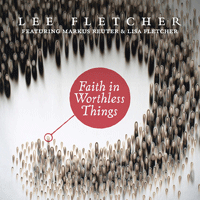





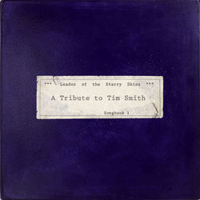
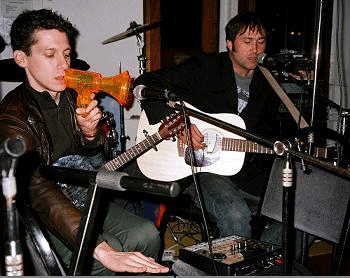

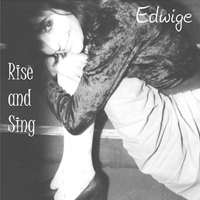


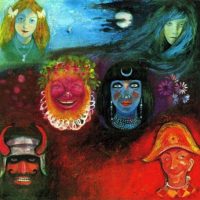


 Misfit City