They might be performing in Bloomsbury , but their heart’s in Soho. You can’t get away from it.
I once started writing a set of time-travelling stories about Soho, and one day I may go back to them. If so, it might be difficult not to write Jeremy Reed into them. Poet locum and unruly novelist, with fifty-odd books behind him, both his work and his person is soused in the atmosphere, possibilities and ramifications of this particularly disobedient district of London. For my lifetime and his, it’s been the haunt of artists, drunks, liars, king-queens, agreeable rascality and disagreeable visionaries. Even in its current state of snarling retreat, slowly losing a civil war against the clammy, sterilizing encroachment of central London gentrification, chain shops and absentee renting, it’s still the part of town where you’re most likely to see an inexplicable marching band or dishevelled unicorn.
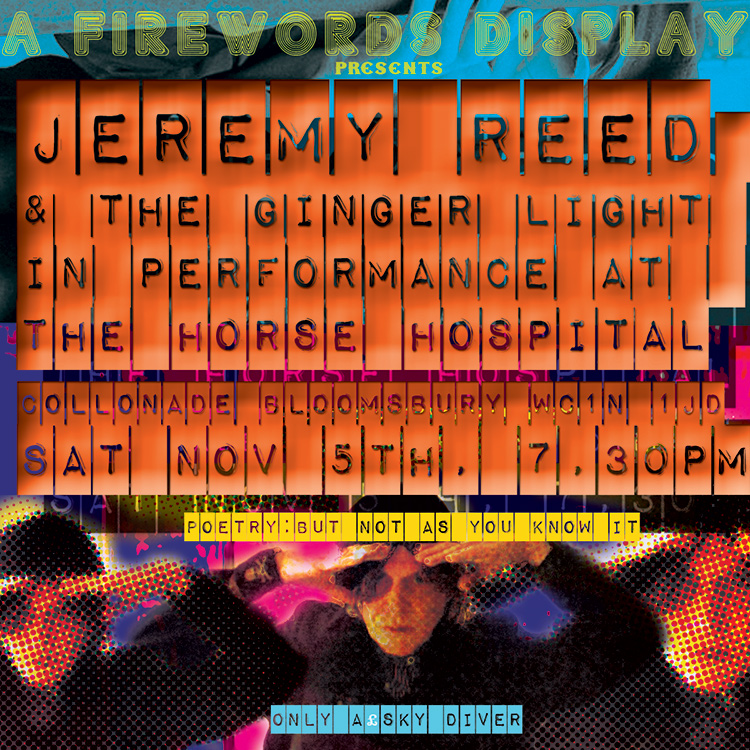
A Firewords Display presents:
Jeremy Reed & The Ginger Light The Horse Hospital, The Colonnade, Bloomsbury, London, WC1N 1JD, England
Saturday 5th November 2016, 7.30pm – information
Dating back to 2012, The Ginger Light is a collaboration between Jeremy and Itchy Ear, a.k.a. Covent Garden loftbird Gerald McGee: an electronic music producer, film buff and keen, self-starting soundtracker who adds spectrally-energised EDM and electronica backings to footage from the likes of brutal nightmare-noir ‘Kiss Me Deadly’, Jean Genet’s steamy men’s-prison reverie ‘Un Chant d’Amour’ and the differently-dreamy 1903 film of ‘Alice In Wonderland’. Working live from a laptop, Gerald complements Jeremy’s word salvos with sound layers too detailed and active to be described as simple backdrops.
Like the poems they lift and wreathe, Gerald’s soundscapes are multilayered time-travel textures: archaeological digs pulling up mongrel music memories from London’s strata of music and broadcast history. Ladbroke grove dub-echoes, Carnaby pop and basement jazz; psychedelic acid-rock distortions from the UFO or Portobello Road. Ominous Throbbing Gristle reverberation and corrosive washes from the old Hackney squats. Floating ghostly sound effects, like snippets of radio drama caught on a forty-year rebound.
As for Jeremy, he plays his own role to the hilt. Blurring confessor and transgressor, impressionist chronicler and flagrant charlatan, he’s a figure of arch and wasted glamour, as if Quentin Crisp had woken up one morning transformed into Jim Morrison. A Soho fixture since the mid-’80s, he’s a onetime protege of Francis Bacon; hailed as the real poetic deal by past literary titans (Seamus Heaney, J.G. Ballard and Edmund White – two of whom compared him to Rimbaud and one to Bowie’s Thomas Newton, the Man Who Fell to Earth) and by living pop-poetry shapers (Bjork, Richard Hell, Pete Docherty).
He delivers his own poems in a voice like London sleet – a heavy-lidded, lead-cadenced drone; lisping and compellingly monotonous, burnished by rich and antiquated RADA tones and by a seething incantatory Peter Hammill flair. In the psychic autopsy of talent’s fragility in ‘Soho Johnny’; you can detect echoes of the Beats and of the exploding perspective of the ‘60s; in his calling-up and collaging of spirits including Derek Jarman and Jack the Ripper, those of cut-up broadsheets and psychogeography; in his accounts of shoplifters and dissidents adrift in the changing junk-raddled backwash of city trade, commerce and exploitation, there are looming narcotic Blakean myths.
A career-long celebrator of the transgressive, ignored and cast-aside, Jeremy’s becoming not only a poet locum for Soho, but something of a genius loci: declaiming the neighbourhood’s crumpled, contemplative, spontaneous amorality like the last pub-bard standing. In consequence, he himself seems to be succumbing to being fixed in time, representing qualities being swept away as Crossrail opportunities and predatory investment force them out. Like the Wood Green soiree happening the previous night, he’s edging towards becoming one of those fragile something to enjoy while you still can. Here he is, rouged and alert, alongside Gerald and delivering a Ginger Light performance earlier this year: keeping the vision breathing.
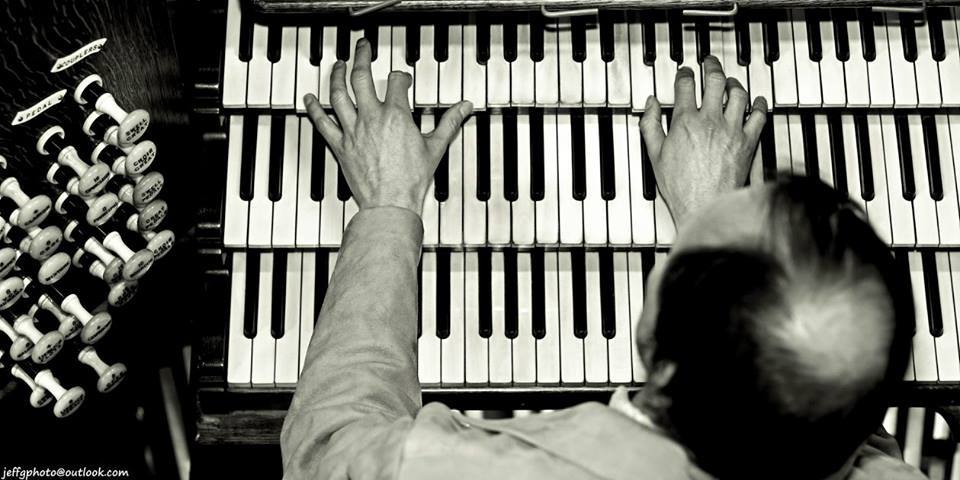
Tomorrow, London’s Union Chapel begins a celebration of a number of things (its performance acoustic, its appeal to a diverse body of musicians and audiences, its innovative cultural spirit, and not least its grand 1877 pipe organ) via the ‘Organ Reframed’ mini-festival. A three-day four-concert occasion, it “release(s the organ) from its traditional roots with a varied programme of film, intimate solo sets, ensemble improvisations and large scale commissions. This festival of experimental music will challenge perceptions and show this extraordinary instrument in a new light.”
* * * * * * * *
Organ Reframed: James McVinnie/Irene Buckley/Robert Ames/Laura Moody perform new live score for ‘Nosferatu’ Union Chapel, 19b Compton Terrace, Islington, London, N1 2UN, England
Friday 7th October 2016, 7.00pm – information
Her latest such commission is for ‘Organ Reframed’ – a new score for F. W. Murnau’s ‘Nosferatu (A Symphony of Horror)‘ – “an iconic film of the German expressionist cinema, and one of the most famous of all silent movies (which) continues to haunt — and, indeed, terrify — modern audiences with the unshakable power of its images. By teasing a host of occult atmospherics out of dilapidated set-pieces and innocuous real-world locations alike, Murnau captured on celluloid the deeply-rooted elements of a waking nightmare, and launched the signature ‘Murnau-style’ that would change cinema history forever.”
The film will be screened with a live performance of the score carried out by a quartet ensemble: leading New Music pipe organist James McVinnie, viola player Robert Ames (co-artistic director and conductor of the LCO), polystylistic cellist Laura Moody (see multiple past ‘Misfit City’ posts for more on her), and Irene herself contributing live electronics. To give you a hint of what it might be like, here’s an excerpt from Irene’s ‘…Joan Of Arc’ score, back in 2012:
* * * * * * * *
Daylight Music 235: Organ Reframed – Lætitia Sadier + Emilie Levienaise-Farrouch + Kieran Brunt + Angèle David-Guillou + Adrian Crowley + Gill Sandell + Ed Dowie + William D. Drake Union Chapel, 19b Compton Terrace, Islington, London, N1 2UN, England
Saturday 8th October 2016, 12.00pm free event (suggested donation: £5.00) – information
The second concert in the series is a free (or donation-based) lunchtime show run in conjunction with Union Chapel regulars Daylight Music, offering “a stripped-down approach… eight sets of artists and accompanists across different genres and styles. These musicians, singers and composers — who are at various stages of their careers — will explore the very physical relationship between voice and pipes: in many cases, for the first time.”
Performers will include three Franco-London women who specialise in avant-pop/dream-pop/classical crossovers of one kind or another – Stereolab/Monade’s Lætitia Sadier (who, four days earlier, will have been part of Miles Cooper Seaton’s ‘Transient Music’ ensemble at Café Oto), Angèle David-Guillou (of Klima and Piano Magic), and electro-acoustic film soundtracker Emilie Levienaise-Farrouch. Also involved is frequent Daylight guester Ed Dowie (usually a purveyor of genteel avant-parlour-pop, having passed through Brothers in Sound, Redarthur and The Paper Cinema).
The Daylighters specialise in late and interstitial additions to already interesting bills. This concert is no exception, with a bumper set of extra guests signing up and recently being unveiled. Joining in alongside the people I’ve already mentioned are Irish singer-songwriter Adrian Crowley (who specializes in what might be described as a baroque-minimal pop style), singer Kieran Brunt (who divides time between classical choral and solo projects and his pop band Strange Boy), multi-instrumental folk singer Gill Sandell (previously of Emily Barker & The Red Clay Halo) and singer-songwriter/general keyboard magician William D. Drake (once a Cardiac, now a baroque-pop solo artist with his own cross-era style – as with Laura Moody, see plenty of previous posts…).
Given the varied pop, folk, rock and classical stylings involved (and some of the signature tones of the musicians involved) it’s not clear whether there are going to be specific collaborations or mashups involved, or whether everyone’s playing solo/bringing their own backup. It’s also unclear as to whether the pop culture/pop music side of things will be honoured by Farfisa, Hammond or even Lowrey organs onstage to share musical space with the grand pipe organ; although given the emphasis on “the very physical relationship between voice and pipes”, I’m guessing perhaps not. (NOTE – since I posted that, I’ve found out that Angèle David-Guillou will be playing a new organ-and-voiceloops composition called ‘Too Much Violence’; that there will be at least one duet from Emilie Levienaise-Farrouch and Kieran Brunt; that Ed Dowie has a couple of covers and one new piece; and that the Daylighters are scouring the Twittersphere looking for a last-minute pump organist. Knowing them, they’ll find one…)
* * * * * * * *
Organ Reframed: ‘Spire’ featuring Charles Matthews + Fennesz + Philip Jeck + Simon Scott + Claire M. Singer + John Beaumont + The Eternal Chord Union Chapel, 19b Compton Terrace, Islington, London, N1 2UN, England
Saturday 8th October 2016, 6.00pm – information
Spire is an ongoing concert series for organ and electronics, curated by Mike Harding (creative producer of the Touch organisation (which covers musician promotions, licensing, mentoring and everything but the business of being a record company association) and by dedicated organist and keyboardist Charles Matthews (one of those exemplary musicians whose work spans everything from church services and teaching to a globetrotting concert schedule and advanced curatorship). Now into its twelfth year, and with sixteen concerts plus four CD recordings behind it, Spire returns to Union Chapel to link up with ‘Organ Reframed’.
Music played at previous Spire events has included the ancient, salvaged fourteenth-century organ manuscript The Robertsbridge Codex (the oldest surving keyboard score in the world) and twentieth-century pieces such as ‘In Nomine Lucis’ (by the pioneering and mystic single-pitch/multiple-approach composer Giacinto Scelsi), Henryk Gorécki’s ‘Kantata’, Liana Alexandra’s ‘Consonances III’ and André Jolivet’s ‘Hymne à l’Universe’. The series has also premiered new works by resident Spire composer Marcus Davidson (such as ‘Opposites Attract’ and ‘Standing Wave’), as well as improvisations and collaborations by its associated musicians.
Spire also takes into account the architectural qualities of the church organ: how our perception and experience of it is coloured by its monolithic size, volume and presence compared to other instruments. As Mike and Charles put it, “the organ has the greatest frequency range of any acoustic instrument, but this is rarely exploited; the unique sound of the mechanical organ has often been limited and controlled and Spire aims to liberate it from its history without denying that history… combining organ works ancient and modern (while) other performers use the organ and organ works as a basis for their own compositions, using piano, voice, record players, samplers and other electronic devices.”
Past Spire performers have included laptop-and-guitar noisescaper Fennesz and turntablist/electronicist Philip Jeck, both of whom are joining Charles Matthews for performances this time round. Also joining in are newer Spire associates – Simon Scott (Slowdive drummer, multi-instrumentalist, sound ecologist and deep listener) and John Beaumont (whose life within Anglican church and choral music has seen him rise from treble chorister at Wakefield to tenor songman at York Minster and continuing work in London’s great cathedrals and abbeys, alongside his current work as a “story tenor” mingling classical repertoire with a bardic sensibility). Also joining in is Union Chapel’s organ director and artistic director of ‘Organ Reframed’, Claire M. Singer – a musician, composer and cross-media artist whose work extends from composition to installation via live performance, mostly based around organ, cello and electronics.
Among other pieces, the programme will feature a performance of Spire mainstay ‘The Eternal Chord‘, a Mike Harding-originated conceptual and improvised organ piece which “can take anything from eight minutes to eternity” and which is open to any number of players from a duo upwards. There have been eleven iterations of the piece so far, of which two can be heard below, including one from last year at the Union Chapel.
* * * * * * * *
Organ Reframed: Five new commissions for James McVinnie & the London Contemporary Orchestra Union Chapel, 19b Compton Terrace, Islington, London, N1 2UN, England
Sunday 9th October 2016, 6.30pm – information
Having already helped to open the festival (via their contribution to the ‘Nosferatu’ live score), James McVinnie and Robert Ames return for the final concert in which James joins forces with the London Contemporary Orchestra (conducted/facilitated by Robert) to premiere five new contemporary classical or classical fusion works.
There’s not much information on the new piece by Mark Fell although it’s likely that it’ll be droning, mathematical and algorithmic (in keeping with his existing work, which is infused with electronica and club music ideas and further informed by his extension into the worlds of moving image, dance, text and son-et-lumiere). Similarly, all I can tell you about acoustic/electronic/theatrical composer Alex Groves‘ piece is that it’s called ‘On Colour’ and is six minutes long. Some pointers towards what to expect might come from Alex’s previous piece ‘Patience’ (for viola da gamba and organ), premièred as part of the Daylight Music series at the Union Chapel back in December 2014. (There’s some footage of that show below. I’m hoping that it’s Alex’s piece…)
There’s no doubt that one composer who’ll have no problems filling the Chapel with grand sound is Craig Armstrong, whose music has been well known to a popular audience since the 1990s thanks to his use of luscious, near-decadent massed strings and club beats (as well as his work on hefty-selling records by Massive Attack. Madonna and U2 plus film soundtracks including ‘Far From The Madding Crowd’, ‘Plunkett & Macleane’ and Baz Luhrman’s ‘Romeo + Juliet’).
Almost at the other end of the spectrum is collagist-composer, cultural commentator and musical wit Caroline Haines, who records (as Chaines) for the small Berlin arts label Slip Imprint and has put out a series of restless, splice-styled, information-packed music packages in which everything from sound sources to manufacturing materials has an integral significance. When she chooses to be, Catherine is also a spirited piss-taker, using her existing methods of collagery and radio broadcast (up to and including the comedy sketch show). For evidence, see ‘WUB’, her quick and merciless takedown of pretentious, dishonest conservatoire slummers who parasitize other more media-friendly musical forms without comprehension, respect or indeed much genuine interest.
Dropped hints suggests that Caroline will be performing alongside the orchestra herself: other hints suggest that her contribution is a version of ‘OST‘ (last years’ hallucinogenic audio portrait of the north-east English industrial imprint). I’m guessing that for her second large-scale premiere with LCO (following August’s Curtain Call concert) her restless mind will have come up with something else.
American-born/Berlin-based composer and violist Catherine Lamb has a taste for adding liminal electronics and an interest in “exploring the interaction of elemental tonal material and the variations in presence between shades and beings in a room.” Her approach is inspired by Hindustani classical music and the just intonation system (with added influences from her studies with James Tenney and Michael Pisaro). Catherine’s ‘Organ Reframed’ piece is ‘Cumulus Totalitas’ – possibly a sister piece to ‘Curvo Totalis’, her “meditation on sound” premiered last month in New York by percussion-and-piano quartet Yarn/Wire.
Although the evening’s billed as five pieces, it seems that there’ll be a bonus from the LCO’s recent repertoire in the shape of the thirteen-minute string orchestra piece ‘Between Rain’. Composed by Edmund Finnis (whose work flows from the luminously minimal to frenetically eerie orchestral jousts) this will be being performed for the first time since the LCO premiered it at Imogen Heap’s 2014 Reverb festival at the Roundhouse, although it’s not clear whether Edmund’s tweaked it since then to include an organ part.
At each event, you’ll also be able to hear sound artist Bill Thompson’s installation ‘A Knowing Space’, which “explores the idea of resonance using durations and timings derived from prime numbers as well as the pitches of organ pipes. The installation is played through seven organ pipes, using transducers that vibrate and fill the space.” Here’s an early taste:
You can also catch ongoing discussion about the whole ‘Organ Reframed’ event at the Facebook page…
In a couple of weeks’ time, Robin Richards (bass guitarist and driving force in Stockport art-poppers Dutch Uncles, and cross-disciplinary composer on the not-so-quiet) unveils the latest in his growing series of film collaborations, via three screenings and live score performances in the Manchester area.
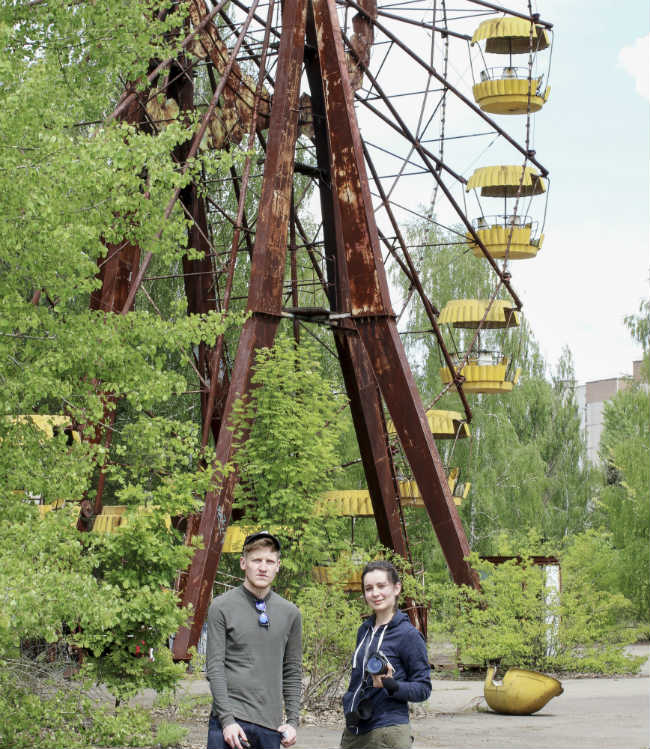
“An amusement park in the Ukrainian city of Pripyat was due to be opened on the 1st May 1986, but the Chernobyl nuclear disaster occurred just a few miles away on 26th April. The park’s owners opened the park for a couple of hours the following day for the people of Pripyat before the city was evacuated. Eerie images of the deserted Pripyat Amusement Park now permeate the visual representation of the city’s desolation.
“Robin Richards: “Since hearing about the trips young evacuees from Pripyat and neighbouring towns made to my hometown Stockport as part of charity programmes over the last twenty-five years, and reading personal accounts of those affected by the catastrophic nuclear disaster I have wanted to create an art piece depicting the stories, whilst also addressing environmental and scientific dimensions. I am fascinated by the gestural vocabulary of film and its relationship to the formal properties of musical composition. I want to push beyond the notion that music should always be in service to visual narrative, and explore the possibilities of music’s power to create and transform meaning.”
Still from ‘Birdsong’ (Pripyat ferris wheel)
“The resulting piece, comprising a forty-minute original film and live score with chamber ensemble will be performed at related venues in North West England in late 2016, coinciding with the 30th anniversary of the disaster. A screening of the film with recorded score is programmed as part of an exhibition in Kiev in late October 2016.
“Combining the immediacy and energy of live musical performance with the visual impact of film, ‘Birdsong: Stories from Pripyat‘ aims to revisit a dramatic and devastating historical event using personal and scientific narratives to draw out the tensions and truths at play in our collective, cultural memories of this unfathomable event. This cross-artform project brings together original contemporary classical composition with film to explore an historic event through storytelling, montage and archival footage.
Robin Richards’ forty-minute score incorporates first-hand testimonies of evacuees and liquidators from Ukraine and Belarus, while Clara Casian’s filmmaking process is underpinned by nuclear research, and incorporates found and archival footage with original material filmed on location in Ukraine. The pair made a four-day research trip to the Chernobyl exclusion zone in May 2016 to meet with local artists, filmmakers and historians, collect original footage and archival material. The narrative arc of the film follows the journey of people with first-hand experience of the disaster, as personal records and testimonies are interwoven with original material. Music enters into a continuous dialogue with film as part of a nuanced artistic process, designed to evoke the experiences of people from Pripyat and their recollections of the evacuation and the cleaning process following the 1986 disaster.”
The piece will premiere as the highlight of HOME’s Artist Film Weekender in Manchester, followed by a second performance in Stockport’s historic art deco cinema The Plaza and a third at the University of Salford. Dates below:
HOME Cinema, The Great Northern Warehouse, 235-253 Deansgate, Manchester M3 4EN, Friday 30th September 2016, 8.30pm – information
Peel Hall, Peel Building @ University of Salford, 43 Crescent, Salford, M5 4WT, England, Friday 7th October 2016, 7.00pm – information
Each night also features another showing, performance or event.
The University of Salford performance will also feature a question and answer session with Robin and Clara (also billed as a music-and-film masterclass with Robin, who’s an alumnus of the University’s Music course, having graduated in 2011 with a first-class honours degree, the Elgar Howarth Composition Shield and the Award for Innovative Audience Engagement).
The Manchester performance will be preceded by the showing of another Robin Richards-scored film, ‘Wizard’. Directed by Nick Middleton, this is “a short film about magic and madness”, which premiered earlier in the month at The Smalls film festival in Shoreditch, London.
The Stockport performance will be accompanied by ‘Celluloid History Songs’, by Anglo-African Mancunian singer-songwriter Josephine Oniyama: a “spellbinding… live multimedia performance against a backdrop of historical footage drawn from the North West Film Archive held at Manchester Metropolitan University, and edited by filmmaker Kim May of Asta Films. The specially-commissioned songs were influenced by scenes of Northerners at leisure, taken from the archive’s many inspiring images of industrial working-class people, young and old, discovering ways to spend their new leisure time.” This work was previously performed at HOME’s 2015 launch event, in tandem with Robin’s own previous soundtrack engagement (a new score for Pal Fejos’s 1928 silent New York romance ‘Lonesome’).
Update, 22nd September 2016 – Robin has just shared a recording of one of the ‘Birdsong’ soundtrack pieces. As he describes it, it’s “inspired by the liquidators working on the Chernobyl nuclear plant after the disaster. The liquidators were civil and military personnel called upon by the Soviet Union in to clean, burn and bury contaminated areas and materials around the power plant. The first part of this section is based on archival footage of the liquidators cleaning and digging in 1986, with the rhythmic jostling of the strings representing the movement of the workers, and the deep synthesisers representing the overriding radiation. The second part is inspired by the testimonies of four liquidators we interviewed in Borispol during our trip to Ukraine in May this year; their memories of the clean up and the years that followed the disaster.”
* * * * * * * *
Scalarama screening of ‘Maresnest’ (poster stencil image by Abe Peachment)
A little earlier in the month – as part of September’s ongoing Scalarama film festival – there’ll be a public showing of the Cardiacs’ concert film ‘Maresnest’ in Glasgow.
Organisers Luminous Monsters call ‘Maresnest’ “the greatest concert movie ever made! Recorded one glorious afternoon at the Salisbury Arts Centre in 1990, ‘Maresnest’ captures all of the manic intensity and joyous delirium of one of the UK’s, nay, the world’s finest bands. Theres nothing quite like Cardiacs at full force. ‘Maresnest’ takes Cardiacs kaleidoscope-prog and ultra-pop impossibility and gives it a fiery hoof up the colon. From the bruising, nigh-industrial intro through the perilous frenzy of To Go Off And Things to the sustained climax of unlikely minor hit Is This The Life?, this is delirious, potent stuff, the sound of wild ideas obsessively woven from flesh and wire and moments.”
While this isn’t exactly a once-in-a-lifetime showing – the film was disinterred from VHS purgatory to be reissued and released on DVD three years ago – there are three extra selling points. The first is that the event is another of those fundraisers for the much-needed medical rehabilitation of Cardiacs’s life-mauled Tim Smith (see plenty of past ‘Misfit City’ posts for more on this particular story). Another is that the event also features a solo set from the band’s onetime guitarist Kavus Torabi (these days better known for Knifeworld, for exuberant radio hosting and for an ongoing role as the post-Daevid Allen frontman for Gong), who’ll be performing “songs of extreme loveliness and brilliance.”
The last is that Luminous Monsters are quite right about the value of ‘Maresnest’. It’s one of the great rock concert films, comfortably up on the same level with the likes of ‘Stop Making Sense’, ‘Tourfilm’, ‘The Last Waltz’ and ‘Sign ‘O’ The Times’. Capturing the band live in 1989 – then, as ever, inhabiting a murky cult status which could nonetheless draw thousand-strong crowds – it also caught them at a particularly turbulent time. The one-off seven-piece version of their close and familial lineup, as featured in the film, featured a guesting recent departee plus a new recruit and a pair of longstanding mainstays who’d both soon be gone from the band. Cardiacs shows were already volcanically energetic events, laced with disturbing performance-art overtones in which the band played at being frightened, stubborn children at odds with the perplexing and fascinating world around them. The fact that the aforementioned recent departee was Tim’s soon-to-be-ex-wife Sarah, and that the show was teetering on the edge of disaster due to equipment breakdowns and raw nerves, added an extra frisson of tension and imminent madness to this particular concert.
Fortunately, the band rose both to and above the occasion – pulling a powerful, massing set out of this chaotic fuel, and it was all caught on tape. Though ‘Maresnest’ is laced with and interrupted by additional faux-found footage from backstage (in which, in nightmarish glimpses, the band continue to act out disturbing dysfunctional and childlike personae; like ‘Blue Remembered Hills’ being wrenched out of shape by David Lynch) it’s ultimately about the music – which is ecstatic, churning, and strangely shamanic, tapping into a distorted British sub-mythology of old war films, children’s television and everyday ritual, and whipping it up into an ambiguous apotheosis for a delighted crowd.
Luminous Monsters present:
Scalarama 2016: ‘Cardiacs – All That Glitters is A Maresnest’ + Kavus Torabi (live set) The Old Hairdressers, 23 Renfield Lane, Glasgow, G2 6PH, Scotland
Thursday 22nd September 2016, 7:30pm – information here, here and here
It’s been a good month for Cardiacs-related news: more of that coming along shortly. Meanwhile, for more info on Scalarama’s ongoing events around the UK (and at the festival’s outpost in Spain), click here.
Here’s news on four upcoming shows in London during early September, two of which are brought to us by flute-centred ensemble rarescale…
* * * * * * * *
Crasmusicas presents:
Julian Elvira presents ‘Blowing’ The Barge House, 46a De Beauvoir Crescent, De Beauvoir Town, London, N1 5RY, England
Thursday 1st September 2016, 7.00pm – information
Spanish musician Julián Elvira is the principal flautist with Banda Sinfónica Municipal de Madrid. He’s also the developer of the Pronomos flute – a carefully considered redesign of the existing orchestral instrument, designed to improve its ability to cope with the microtonal and enhanced timbral demands being brought to bear on it by contemporary music. His solo show, ‘Blowing’, is “a unique performance of improvised music exploring the sonic qualities of different flutes and pipes. The sounds of the traditional instruments are manipulated and transformed, creating a music experience that moves from ancient to ultra modern sonorities.”
* * * * * * * *
rarescale: “Falling Out Of Cars” The Forge, 3-7 Delancey Street, Camden Town, London, NW1 7NL, England
Tuesday 6th September 2016, 7.30pm – information
Direct blurb from the press release:
“In the final concert of its 2016 season, rarescale presents new chamber works for flutes (including low flutes and baroque flute) with piano, guitar and electronics. New works by Steve Kilpatrick, Jonathan Pitkin and Yfat Soul Zisso receive their first performances, and pianist extraordinaire Xenia Pestova presents solo works by Ailis Ni Riain and Ed Bennett. This programme promises a broad range of repertoire, from the simple elegance of Laurence Crane’s ‘Erki Nool’ to the extended techniques of Scott Miller’s ‘The Frost Performs its Secret Ministry’.”
The new Pitkin composition is “a short but wide-ranging piece (which) pushes both instruments in unexpected directions in order to play with conventional expectations of foreground and background, melody and accompaniment, and monody and polyphony.” I couldn’t find any information on the new Daniela Fantechni piece, and rarescale haven’t specified which Ní Ríain item might be on the list, but I’ve made a few educated guesses below (as well as including an Yfat Soul Zisso flute piece which might point the way towards her new one).
IKLECTIK presents:
Scott Miller & Carla Rees with Julian Elvira & Katsuya Nonaka IKLECTIK, Old Paradise Yard, 20 Carlisle Lane, Waterloo, London, SE1 7LG, England
Saturday 10th September, 6.30pm – information
Scott Miller‘s ‘Anterior Exterior’ – see above – is one of the pieces which might be being performed at the Forge show. This particular performance is taken from ‘Devices and Desires‘, the album which he and rarescale partner Carla Rees released in 2012.
This side of their music will be reflected in the week’s second rarescale-related gig, down in Lambeth at IKCLECTIK. A combined sponsor’s sales pitch and evening of spontaneous creation (put together in association with Kingma System Flutes and Kyma Electronics), the show will provide “a demonstration of contemporary and traditional flutes, electronics improvisation systems and their potential for collaboration and innovation”. This will incorporate a “Devices and Desires” set in which Carla and Scott improvise with two special guests.
The first of these guests is Julián Elvira, still around following his solo show earlier in the week. The second guest, Katsuya Nonaka, is a particularly diverse creative character. A traditionally trained player of the shakuhachi flute, he’s also a member of The Seppuku Pistols, whose gimmick (playing alleged “Edo era” punk on traditional Japanese instruments while toying with Japanese ultra-nationalist imagery) might make them a broad-batingly provocative art project… or might not.
Outside of such stunts, Katsuya’s polymathic approach spills over into his other jobs and occupations – rice farming, translation, skateboarding, cartooning and illustrating, and film directing. He has happily combined three of these – the skating, the shakuhachi and the filmwork – in his short ‘Future Is Primitive‘ documentary investigating his view of the connections between and shared pressures brought to bear on both ‘board and bamboo flute (which will be receiving its London premiere the same week, on 9th September at House of Vans, in the tunnels beneath Waterloo station).
* * * * * * * *
IKLECTIK presents:
Katsuya Nonaka & Ute Kanngiesser IKLECTIK, Old Paradise Yard, 20 Carlisle Lane, Waterloo, London, SE1 7LG, England
Sunday 11th September, 8.30pm – information
In fact, it’s a particularly busy week for Katsuya Nonaka. As well as the previous two events of his that I’ve mentioned (plus the follow-up screening of ‘Future is Primitive’ at Dalston’s Doomed Gallery on 13th September) he will be playing another IKLECTIC show on the 11th, this time with London-based German improvising cellist and sometime AMM member Ute Kanngiesser, whose musical approach is devoted to “unscripted” music and who specialises in a “layered” approach.
As far as I know this is a first musical meeting for this particular pairing. I’m not sure that there are that many embeddable samples which I can treat you too as a preview; but here’s a clip of Ute’s eerie prolonged cello harmonics for the curious…
Swoon. /swo͞on/ A verb. To be emotionally affected by someone or something that one admires; become ecstatic. Here are some people and things that make me swoon. #swoon #swoonage

 I once started writing a set of time-travelling stories about Soho, and one day I may go back to them. If so, it might be difficult not to write Jeremy Reed into them. Poet locum and unruly novelist, with fifty-odd books behind him, both his work and his person is soused in the atmosphere, possibilities and ramifications of this particularly disobedient district of London. For my lifetime and his, it’s been the haunt of artists, drunks, liars, king-queens, agreeable rascality and disagreeable visionaries. Even in its current state of snarling retreat, slowly losing a civil war against the clammy, sterilizing encroachment of central London gentrification, chain shops and absentee renting, it’s still the part of town where you’re most likely to see an inexplicable marching band or dishevelled unicorn.




 Misfit City