Archive | soundscapes RSS feed for this section

March 1996 – live reviews – Robert Fripp’s South Bank Soundscapes @ Queen Elizabeth Hall foyer, South Bank, London, 10th March (“more challenging abstractions than Fripp’s ever attempted before”)

12 Mar

'Now You See It...':  Robert Fripp Soundscapes, 10th March 1996

‘Now You See It…’: Robert Fripp Soundscapes, 10th March 1996

Tucked against a curving concrete wall, under a sweep of plate-glass windows, there’s the familiar stool with a beautiful rock-fetishist’s dream of a Les Paul guitar, flanked by rack-mounted gizmos like a gaggle of worshipful Artoo Detoos and a flat henge of volume pedals and multi-purpose stomp-boxes. Over to the right, David Singleton sits at the mixing desk, quite the portrait of the calm fixer for the artist’s determined leaps. Arranged in a long staggered curve in front of the opposite wall, lining the long walk between the entrance and the Purcell Room, are at least eight tall speaker cabinets. Occasionally in residence is the sleek, compact form of Wimborne’s most formidable musical son.

These Soundscapes are part of the ‘Now You See It…’ season of contemporary performance art, sharing the building with the Hypermusic Symposium (in which Peter Gabriel, Brian Eno, David Toop and others debate the future of music, and people nervously finger such unorthodox instruments as literally musical chairs and picture frames or the Interactive Baton) while avant-garde dance groups hijack the Purcell Room and stick the audience on the stage, and (less happily) over at the Lyric Theatre in Hammersmith an appallingly pretentious bunch of Euro-thespians do a vandalistic mixed-media Schubert performance.

In these surroundings, Robert Fripp‘s increasingly out-there journeys in solo sound fit in surprisingly well, both physically and intellectually. When a squadron of incredibly young women in bare feet and little black dresses trot busily past (every quarter of an hour, on the dot) to meet their cues in a back-to-front theatre piece next door, it seems inexplicably appropriate. Tonight – Sunday 10th – is the fourth of Fripp’s residencies, a mere four-hour performance compared to the rear-numbing six- and even ten-hour marathons he’s performed earlier in the week. Some people have returned, regardless. Within that length of time, anything could happen: the music that Fripp claims to channel rather than compose could lead him anywhere.

Soundscapes, the successor to the layered sound-loops of Frippertronics, is a major leap forwards, sideways, anyways from its progenitor: the digital technology stores his patterns and transforms his tones to the point where there isn’t a single recognisable Crimsonic guitar sound to be heard all evening. In effect, Fripp and Singleton are playing a wholly new collective instrument, a community of speakers, desk, guitar and digital cyberspace. The end results are a swathe of overlapping, opposing electrophonic voices, sometimes beautiful and sometimes disturbing – polytextural hums; a sound like a seventy-foot high piece of glass being torn like cloth; wailing, spectral swells like American freight trains blowing a blue whistle into a desert of ghosts; aquatic, gem-faceted calls of a Loch Ness Monster; tingling pianistic or xylophonic ringing; squiggling crystal-bat chitters. It emerges as a sound that’s on the brink of being recognisable, somewhere deep down in the soul… but not quite.

As it rolls on, evolving like strata, burying what’s come before like the march of ages, you may find it impossible to concentrate on (four hours is a long time) but it saturates your mind regardless: you’ll sure as hell be thinking differently. While I’m here, I meet somebody who ascribes near-mystical powers to the first Soundscapes album, ‘A Blessing of Tears’ – “any pain you have, any problem, it will heal it…” Even on the basis of what I’m personally experiencing in the music tonight (the rollers, breakers, capricious tides and immense flickering lulls of an alien sea under a midnight-blue sky, occasionally rent by sheets of violet lightning and mile-wide twists in the current… I think I’m in for a night on the ocean wave) I can believe him. This isn’t New Age pretty-stuff.

And so the Soundscapes are installed, piece by lambent unsettling piece, more challenging abstractions than Fripp’s ever attempted before. But most of the people here seem to have missed the point – sitting deferentially in the arc of chairs facing Robert and his little cliffs of winking lights, watching him silently manipulate his gold-top Les Paul or peer into his effects racks, they pay a silent tribute. This isn’t how to do it. When Fripp calls what he does “Soundscapes”, he means it literally. There’s a fifth element in that communal instrumentation: three-dimensional space. Each of the eight speakers arranged in an arc behind the audience is fed by a slightly different sound source. Walking slowly back and forth across the foyer, one passes in and out of phase with the sounds: a different listening angle provides a different piece, an ability and opportunity to concentrate on a different section of the Fripp orchestra. Music to literally explore.

I feel a bit of a fool, though, pacing up and down the floor to curious glances from the audience; it’s not quite the same as hanging around, in gig-approved fashion, with a drink in your hand and lunging up and down gently to your favourite song. Mind you, the rest of the audience are behaving exactly in the way you’d expect at a Fripp-related gig or an art installation. Here are a couple snogging vigorously, French-kissing amidst the unsettling washes of the music; three rows in from the front, a man appears to have passed out, lolling over the back of his chair with his wide-open mouth pointing wetly at the ceiling. Music to intoxicate? Perhaps: it ignores standard musical dimensions in a way that one only otherwise hears in the most deliriously spaced-out Lee Perry dubscapes, although the notoriously drug-free Fripp looks more composed than I’ve even seen him before.
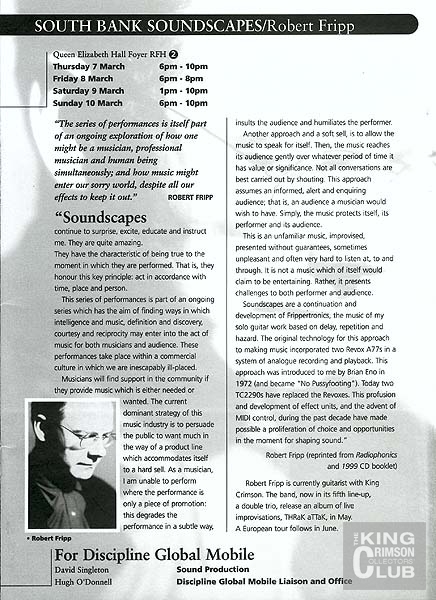
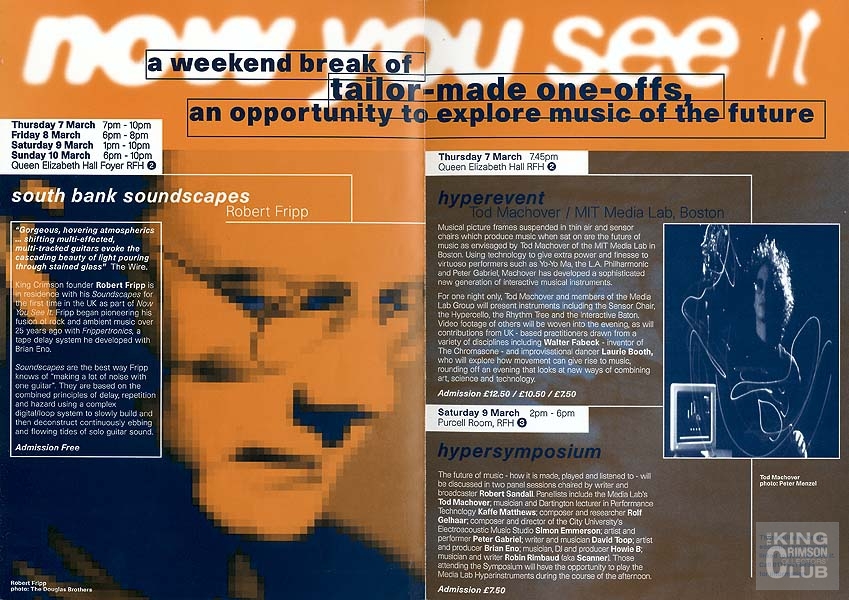
'Now You See It...':  Robert Fripp Soundscapes, 10th March 1996 (programme)

‘Now You See It…’: Robert Fripp Soundscapes, 10th March 1996 (programme)

But then perhaps once the music slips beyond the control of his fretting fingers, flexing feet and console-fondling fingers, it ceases to be his responsibility anyway. The nature of Soundscapes is such that Fripp’s very presence can become little more than a trigger. Turn away at the wrong time and you’ll turn back to find the guitar leaned against the stool and Fripp gone, sipping at a cup of coffee over by the mixing desk as the music wreathes onwards without him, or wandering out through the audience to check a corner of the sound. It’s a little disturbing when, conversing quietly and walking around the circuit of speakers to experience the different sounds, one comes within six inches of Fripp padding lightly in the opposite direction, close enough for you to sense the implacability of his will, pushing at the realms of the possible like a smooth arrowhead.

The element of hazard plays its role too. Sometimes, amongst the layers of harmonic tissue that Fripp is laying down, a mismatch occurs. Or a part decays too soon, or a speaker refuses to cooperate with the vision, and the musical organism is deformed, loses balance, develops cancer. At such times Fripp shrugs in frustration and looks over to Singleton, or out to the audience in the only acknowledgement he ever gives them, lets go of the guitar with palms turned upwards in the universal gesture of helplessness. The music thins out and he begins to build his organism again.

This continues for four hours: time to get several drinks, chat quietly in the background, arrange assignations with other musicians and writers, even formulate whole arguments about what we’re seeing (in other words, make our own contributions to the Soundscape ambience), and still not miss out on the crystallising veils of sound that drift around the foyer, perplexing this evening’s Mozart concertgoers, putting thoughtful expressions on the faces of the cloakroom attendants as it numbs their resistance. At the end, Fripp puts the guitar down, as he’s done so many times before during the evening, and walks slowly away to vanish down the passageway leading to the dressing rooms. The applause that follows his retreating back is sincere, but oddly unfocussed, as if the audience is unsure whether they should be applauding him or the air that’s been buoying up the music and carrying it around like a whispered ritual, I catch the train home, as I usually do; things seem just a touch sharper than normal. Soundscapes don’t so much take you to another world as grant you a shimmering new lens to experience this one through.

Robert Fripp online:
Homepage Facebook Twitter MySpace Soundcloud Bandcamp Last FM Apple Music YouTube Vimeo Deezer Google Play Pandora Spotify Tidal Instagram Amazon Music
 

September 1995 – live reviews – B. J. Cole & The Transparent Music Ensemble + Billy Currie & Blaine L. Reininger @ Upstairs at the Garage, Highbury, London, 20th September (“a classical dissection of folk, like Irish airs meeting New York minimalism… / …a beautiful translucent sound”)

23 Sep

A definite whiff of conservatoire rock tonight. Viola player Billy Currie used to be in Ultravox,: nowadays he looks more like an Irish pub musician, but his music has taken a more interesting turn, as has his choice of collaborators. Former Tuxedomoon violinist and occasional singer Blaine L. Reininger – with his unnerving bespectacled stare, lugubrious ironic drawl, Zappa face-fuzz and impeccable suit – looks like a college professor whom you wouldn’t allow near the children, and draws most of the attention this evening.

This unlikely pair perform a set of serious brow-furrowed John Cale-y string duets with a flavour of compressed folk, using an endearingly cheap sequencer to expand the instrumentation: clave and sweep piano program on Bittersweet, digital string orchestra on Overcast. On The Reach of Memory, sparse piano clumps, drum program and synth bass kicks into Currie and Reininger’s apparent take on Appalachian mountain music. The Thin End of the Wedge sees Reininger on trashy art-rock guitar for a Velvet Underground feel.

Their music has a strange, detachedly astringent feel; a classical dissection of folk, like Irish airs meeting New York minimalism. A sense of towering expression repressed, amplified, by Reininger’s menacing suavity: the set highlight is The Green Door, in which Reininger sings words from a documentary on schizophrenia to a strong melody over sparse drum program and organ. Seems wholly appropriate. I’m impressed, but I feel a little queasy.

In contrast, pedal steel guitarist B.J. Cole is a ridiculously normal-looking guy with a peculiar past. Back in the ’70s he was the leader of Cochise (probably the only prog/psychedelic band based around pedal steel) and subsequently explored psychedelic country music in 1973 on his ‘New Hovering Dog’ album. Over the years since then, he’s been the ubiquitous sideman and sessioneer to everyone who wants an open-minded pedal steel approach, from The Orb to Björk to Procul Harum to Scott Walker, and in particular John Cale. Since 1989 he’s also been leading this occasional band; the Transparent Music Ensemble, an ambient-flavoured chamber music quintet also featuring keyboards, cello, percussion and violin prodigy Bobby Valentino, best known for his London country music stardom.

Cole’s Transparent Music is a sedate, relaxing experience, pleasantly beautiful and unfussy, far too laid-back to be pretentious. Reflective melodic strings tie in with his steel lines, keyboards support gently, percussion shades rather than impels. Some people point out Brian Eno as the inventor of ambient music: others such as Cole know that it goes back to the days of Satie and Debussy, both of whole expressed ambient intentions long before the days of synths and tape loops, wishing to create music that merged with the tinkle of cutlery. Works by both are played tonight, along with a version of Ennio Morricone’s Once Upon a Time in the West, a slow cloudy cover with Cole’s ringing pedal steel dreaming out the tune.

Transparent Music is unselfconsciously universal: if something fits in with that softly lustrous sound, Cole and co. play it and let someone else draw up the distinctions if they’ve got nothing better to do. The original pieces stream neatly into place alongside the classics: Indian Willow’s choppy subterranean strings, Promenade & Arabesque’s pizzicato accents. Throughout, Cole’s steel pines and slides gracefully. That is, when he hasn’t MIDI-processed it into another sound – sad film-noir saxophone on Adagio in Blue to contrast with Valentino’s passionate classical violin, or the fluting electronic sounds on Easter Cool counterpointing the piano and bass drum.

It isn’t exactly music to stir the blood. What it is is very accomplished classy atmosphere music, a beautiful translucent sound whose function is just to exist and to please. That may sound superficial, but if so it’s a refined and civilised pleasure of superficiality. Gentle classics stroked with electricity and with a sense of ambient context, reclaiming the sector where popular instrumental and classical cross, and with no hint of elevator music. Easy listening with a brain. Satie and Debussy would have approved.

B. J. Cole online:
Homepage Facebook MySpace Last FM Apple Music YouTube Deezer Spotify Tidal Amazon Music

Billy Currie online:
Homepage Facebook Twitter MySpace Last FM Apple Music YouTube Deezer Pandora Spotify Tidal Amazon Music

Blaine L. Reininger online:
Homepage Facebook Twitter MySpace Soundcloud Bandcamp Last FM Apple Music YouTube Vimeo Deezer Google Play Pandora Spotify Amazon Music
 

October 1994 – mini-album reviews – King Crimson’s ‘VROOOM’ (“like a gigantic work-worn machine developing a telling fault”)

31 Oct

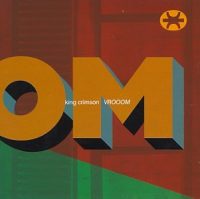
King Crimson: 'VROOOM'

King Crimson: ‘VROOOM’

The first new music from King Crimson in a whole decade rolls in with a yawn… or the sound of a hitman’s car tyres slithering quietly past your house. I don’t know. Whatever it is, it’s subliminal – a dark, stretching, barely audible ambient sound. Reverbed and resting right on the edge of the listener’s attention, it’s something which creeps in and cases the joint, maybe clears it of distractions. The last set of King Crimson albums, back in the ’80s, went straight in with clean, pealing, bell-like guitar patterns. Perhaps there’s a big clue to current Crimsonizing in that this one doesn’t.

Although the band’s known for its high turnover of disparate personnel and fresh starts, ‘VROOOM’ unexpectedly reunites that stable-against-the-odds 1980s Crimson lineup (Robert Fripp, Adrian Belew, Tony Levin and Bill Bruford) but augments them with two new members: Trey Gunn (a graduate of Fripp’s Guitar Craft course, doubling Levin’s 10-string Chapman Stick) and Pat Mastelotto (a jobbing, dextrous rock drummer best known for being part of American AOR act Mr Mister). Historically, when Crimson’s added members it’s been for as much for specific sonorities as much as personal approach. Perhaps a jazz or military saxophonist to break up a beat group, or a violinist to bring in classical textures. Maybe a Stick player to replace, fan out and reshape the bass chair; maybe, to upset the whole applecart and reboot the other players’ brains, an avant-garde improv percussionist with a thousand-yard stare and a junkyard armoury, or a master of cartoonish sound-effect guitar. Conversely, this is the first time Fripp’s apparently hired people mostly to thicken out the existing sound. This might be another clue.

What emerges – after that scouting roll – does and doesn’t sound like King Crimson. The New York brightnesses of the ’80s lineup (those circular Steve Reich and Talking Heads echoes which so thoroughly rebooted Crimson’s former Anglo-prog approach) have been banished. The title track is a descending, angry staircase of screech – simultaneously in synch and slightly ragged, like a gigantic work-worn machine developing a telling fault. If there’s a template for it, it’s the sound and structure of key ’70s Crimson track Red (the frowning, minimalist/totalitarian march which announced that Fripp had honed his once-florid instincts to a fine metallic economy).

The difference is that the big bare bones of this follow-up are fletched with additional details; disruptive flams and spurs, heavy digital processing resulting in analogue splurge, gears splintering but carrying on. A second huge instrumental track – THRaK – lurches forward in angry displacements, a blind giant hammering at a wall. In both tracks there are breathers which aren’t breathers – sighing passages where instruments fall back and Fripp’s misty ambient drones come in; or where a clambering bittersweet arpeggio makes a bed for a solo passage of wracked and pearly beauty before the hammers come down again. Throughout, there’s the sense of highly-stressed engineering precision just one slip away from disastrously throwing a rod, or a kind of hellish chamber music electrified to breaking point.

The band’s nervously sunny human face during the ’80s, Adrian Belew has been sucked backwards into this bigger, blurrier ensemble (predominantly providing a battery of guitar shrieks, leftfield lunges and rubbery solo lines). He still sings; is still the go-to song guy; but it’s clear that the songs have been almost entirely subverted by the new approach. On Sex Sleep Eat Drink Dream, King Crimson rattles through a bluesy lurch; Adrian sounding like an animatronic waiter covering John Lee Hooker, delivering sub-Dada wordplay in murmur-to-scream builds before the band explodes into barely contained passages of full-on percussive chaos.

A little of the ’80s Crimson is allowed into Cage, with Fripp’s cackling speed-arpeggios making it a close cousin to ‘Discipline’s breakneck Thela Hun Ginjeet. Like Thela, it’s a neurotic street cry, but what was once simply threatening has now turned actively murderous as Belew’s prissy paranoia is taken up to international level (“walking down the street, do you stare at your feet / and never do you let your eyes meet the freaks, / the deadbeat addicts, social fanatics, / they’re a dime a dozen and they carry guns. / Halloween every other day of the week… Holy smoke! somebody blew up the Pope!”) while didgeridoos yelp and Fripp provides a barrage of his most jarring, churning guitar disruptions.

 
A third instrumental – When I Say Stop, Continue – mingles both King Crimson’s old knack for doomy improvised sound-pictures and the band’s puckishly dry sense of humour. Over an ambient creeping horror of a Fripp Soundscape, the band knock, shrill, drill and build up a swelling industrial noiseuntil Belew yells “Ok, come to a dead stop. One, two, three, four!…” only for the band to wilfully drift on without him, trailing ghostly shrouds of presence, until the drummers slam and nail the doors shut.

 
Only with One Time do both King Crimson and Belew emerge from this deliberately uneasy fug. Here, the sextet drop delicately into perfect synch and sweet restraint, a softly-mutated post-bossa pulse and Levin’s springy bassline coaxing along Belew’s lapping reverse-rhythm guitar and gentle vocal melancholia. It’s a reminder that King Crimson also have a knack for the beautiful offbeat ballad alongside the harsh upheaval. This is no exception, grasping wistfully and tenderly after a fleeting sense of centredness, throwing what’s come before into a more human-scaled relief.

King Crimson: ‘VROOOM’
Discipline Global Mobile, DGM 0004 (5 028676 900016)
CD-only mini-album
Released:
31st October 1994
Get it from: (2020 update) some original copies still available from Burning Shed – also reissued, along with the material from its companion volume ‘The VROOOM Sessions’, as part of 2015’s 16-disc ‘THRAK BOX (King Crimson Live and Studio Recordings 1994-1997)’, also available from Burning Shed
King Crimson online:
Homepage Facebook Twitter MySpace Soundcloud Last FM Apple Music YouTube Vimeo Deezer Google Play Pandora Spotify Tidal Instagram Amazon Music
 

SWOONAGE

Swoon. /swo͞on/ A verb. To be emotionally affected by someone or something that one admires; become ecstatic. Here are some people and things that make me swoon. #swoon #swoonage

Post-Punk Monk

Searching for divinity in records from '78-'85 or so…

theartyassassin

...wandering through music...

Get In Her Ears

Promoting and Supporting Women in Music

Die or D.I.Y.?

...wandering through music...

Music Aficionado

Quality articles about the golden age of music

THE ACTIVE LISTENER

...wandering through music...

Planet Hugill

...wandering through music...

Listening to Ladies

...wandering through music...

ATTN:Magazine

Not from concentrate.

Xposed Club

improvised/experimental/music

The Quietus

...wandering through music...

I Quite Like Gigs

Music Reviews, music thoughts and musical wonderings

furia log

...wandering through music...

The Recoup

SINCE 2013: Books and books and books and books and occasionally other things

A jumped-up pantry boy

To say the least, oh truly disappointed

PROOF POSITIVE

A new semi-regular gig in London

Gapplegate Classical-Modern Music Review

...wandering through music...

When The Horn Blows

...wandering through music...

:::::::::::: Ekho :::::::::::: Women in Sonic Art

Celebrating the Work of Women within Sonic Art: an expanding archive promoting equality in the sonic field

Ned Raggett Ponders It All

Just another WordPress.com weblog

FLIPSIDE REVIEWS

...wandering through music...

Headphone Commute

honest words on honest music

The One-Liner Miner

...wandering through music...

Yeah I Know It Sucks

an absurdist review blog

Obat Kanker Payudara Ginseng RH 2

...wandering through music...

poplifer.wordpress.com/

Waiting for the gift of sound and vision

Good Music Speaks

A music blog written by Rich Brown

Do The Math

...wandering through music...

Archived Music Press

Scans from the Melody Maker and N.M.E. circa 1987-1996

The World's Worst Records

...wandering through music...

Soundscapes

...wandering through music...

OLD SCHOOL RECORD REVIEW

Where You Are Always Wrong

FRIDAY NIGHT BOYS

...wandering through music...

Fragile or Possibly Extinct

Life Outside the Womb

a closer listen

a home for instrumental and experimental music

...wandering through music...

Life Just Bounces

...wandering through music...

Lucid Culture

JAZZ, CLASSICAL MUSIC AND THE ARTS IN NEW YORK CITY

Aquarium Drunkard

...wandering through music...

eyesplinters

Just another WordPress.com site

NewFrontEars

...wandering through music...

FormerConformer

Striving for Difference