Archive | experimental music RSS feed for this section

February/March 2019 – upcoming British folk/experimental gigs – Bell Lungs on tour with Raiments (20th February to 2nd March, various) with appearances by Despicable Zee, Michael Clark, The Nature Centre, Halcyon Jane, Tara Clerkin Trio and various DJs. Plus sundry other Bell Lungs shows in March including a København evening with Hugh Tweedie and Tanja Vesterbye Jessen, a show with David Toop and Rashad Becker, a date with Gaze Is Ghost.

16 Feb

Working with a multi-instrumental, device-heavy palette which includes guitar, harmonium, Omnichord, electric violin, lyre, bouzouki, saz, voice and a host of effects pedals, avant-folk singer/writer/sometime promoter Ceylan Hay (a.k.a. Bell Lungs) sits at the middle of a host of possible routes. Her sound incorporates post-folk and drone, dream pop, noise and free improv, psychedelia and site-specific realisations, while her psychohistorian subject matter takes in the ancient, the near-ancient and the presently numinous: probing prehistoric spaces, the ghosts of the industrial age, day-to-day feelings and the slide into a new virtual existence space via online culture.

Reflecting these overlaid levels (and what might be, at different perspective points, either shockingly near or completely occluded), her vocal delivery steps between ornamental trad-folk crenellations, feathery ambient warbles and horrific screams. You can never quite tell whether she’s going to lull you or scare you, but you know she cares about what she’s ferrying across to you.

With a new EP, the wintry ‘Wolves Behind Us‘, to promote (apparently it’s a return to folk and landscapes after recent science fiction/site-specific digressions, and is “Joan Aiken’s ‘Wolves of Willoughby Chase’, Olaf Stapledon’s ‘Last and First Men’, caravan living in the Highlands and the ancient cosmology idea of dividing the year into two halves; the opening and closing of the wolf’s mouth”), Bell’s embarking on five weeks of touring (primarily alongside Raiments) through Scotland, England, Wales, followed up by other Raiments-less shows in Scotland, England and Denmark. (She’ll also be playing in Wales next month, but more on that later…)


Before taking a look at the tour, let’s take a look at her tourmates. Formed on the Berlin avant-garde scene, Raiments are fronted by sing-murmurer/left-field guitarist Mano Camatsos, and they sound like a soft-stepping muttering blend of Lou Reed and Momus fronting a band that mixes lurking dark-jazz styling (hardwood clarinet burr and groove-pattering trashdrums) with the DIY rattle of Pram and the dark throb of Morphine. Mano’s wildcard guitar is a clinking noisemaker and pulse generator taking note of hip hop, of avant-garde classical extended techniques and of mysterious instruments and methods gleaned from ethnological recordings. His songwriting voice is a oddball surreal instinct leading inexorably towards songs about ants or baffling seductions.


Tracing their upcoming footsteps on the tour is a joy, like following a plough which turns up small treasures as it reveals what’s in the earth. It’s partly the succession of intriguing off-the-beaten-path venues – squatty art-pubs, recovered eighteenth-century coal basins, pocket cinemas and art centres, diehard folk rooms and out-of-the-way sipperys – but also the revealing of similarly off-the-wall musical talents and enthusiasts they join up with en route.

In Edinburgh, Bell and Raiments are playing with Claquer – previously three-piece improvisers Claque until they spun off their American drummer an unspecified time ago. Now it’s just the Edinburgh contingent: free/experimental guitarist Jer Reid and viola player/speaker Lisa Fannen. They deal in lo-fi clangs, loopings and scrapes and spoken word: momentary moment-music.


In Newcastle, the main support comes from the soft melody murmurs and drowsy, cushioned keens of ambient/improv folk duo Halcyon Jane, a Tyneside/Humberside teamup. Upfront with the voice, guitar and devices is Newcastle performance art polymath Jayne Dent, better known via her own electronic/noisy folk project Me Lost Me, in which she buffers and buffets her singing with concertinas and samplers: when she played Hull back in December, support came from local ambient electronic beatsman Halcyon Neumann, who’s worked with The Body Farmers and with Sarah Shiels and who carries out sonic explorations of “the technological vs. the archaic/the spiritual vs. the scientific/the supernatural vs. the psychological.” Together they tease out a semi-improvised border music, part weird electro-folk and part post-shoegaze wisp.

Also playing is Michael Clark, providing slurred, wise, trepidatious and crepuscular folk music with fogrolls of noise behind an acoustic guitar. Despite being a Londoner, he sounds more like a moor-dweller; or like someone who lives in the kind of port city London used to be, one in which strange tales and intimation billow up the streets with the dock mist: this time out, his strange tales are backed up by a full band.

https://soundcloud.com/michaelclarkmusic/trails-of-ice-1
 
I’ve encountered The Nature Centre before. Headlining the Club Integral-hosted Birmingham show above Bell Lung and Raiments, they’re an affable rural/suburban pop quartet like a four-person one-man band, sprouting banjos and clarinets and found percussion alongside their drum kit and guitars. Drawn to playing at weirder gigs, they’ve shared bills with people like Bob Drake and have their own batchful of three-minute pop songs avidly reflecting the off-kilter visions of previous English songwriter eccentrics (the Syd Barretts, Robyn Hitchcocks and Tim Smiths). Handling the in-between-bands slot is someone new to me but not new to Brum’s vinyl-istas: Moseley Folk Festival’s house DJ and Moseley Record Fair co-organiser DJ Rome, promising his own selection of crate-dug oddities and inspirations.


In Bristol, the DJ backup comes from “bleary-eyed staggerer” Siegfried Translator of the Grey Area radio show (another haven for intriguingly weird music from all over the globe), but the gig predominantly features the Tara Clerkin Trio: the DIY musical brainchild of a ceramicist who also seems to have a yen for gamelan/minimalist-sounding pattern tinkling sprinkled with voiceloops, friendly saxophonic intrusions and other pitch-ins from whichever musical friends she can rope in for the occasion. (At other times, she creates her own slumberous take on experimental countrified pop.)

 
The Oxford show (promoted by Divine Schism) is primarily a launch event for the second EP by Zahra Haji Fath Ali Tehrani, a.k.a. Despicable Zee – a live-looper, improviser and conscious patterner of fifteen years standing, mixed Anglo/Irish/Iranian heritage, and a history of drumming in Oxford bands since her teens. Now the drums (plus loopstations and recordings) are used to create live solo tracks in which Zee employs a lo-fi, lo-technique approach to overlapping rhythm garlands and triggered conversations. As an artist (as well as an educator and mother), Zee’s increasingly conscious of the female lines she carries within her: the patched-in samples which wobble her current project along feature the voices of her mother and grandmother, mingling with Zee’s own sing-speak-raps as if they’ve dropped by for some kind of experimental music cross-cultural kaffee klatsch.


The London show (at Paper Dress Vintage) is an evening of music and spoken word put together by promoters Spilt Milk in order to raise money and awareness for North London Action for the Homeless. Shapeshifter experimental pop poet Alabaster dePlume comperes: also in the corner is Jenny Moore’s Mystic Business, who showed up in ‘Misfit City’ a little over a year ago.

Jenny’s another artist whose field extends from the visual and situational into action and music: the Mystic Business involves pulling together friends and strangers into a collective performance event that’s part communal clapalong choir, part percussion workshop and good-natured culture-jamming protest (with food). Guileless and charming, but nonetheless political and détournementational, it’s an attempt to get collective conscience back into the body, containing and encouraging a cheerful but insistent protest.


The Conventry and Brighton gigs appear to feature just Bell Lungs and Raiments on their own, but news just coming in re. the Liverpool date (at dockside art-pub Drop the Dumbulls) says that support there comes from Merseyside “synthwhisperer” and outsider synthpopper Claire Welles. She’s been rolling out her contrary songs for over a decade now, singing increasingly unsettling lyrics in a deep deadpan tone with a sarcastic medicated edge, while the backings deliquesce from elegant ageless Europop into something a little misshapen. It all becomes something like those conversations during which you wake up a third of the way in, not quite sure how you got into them, not quite believing that you’re stuck in there and will just have to ride it out.


* * * * * * * *

Following the Raiments tour, Bell heads off separately for other shows. A mid-March showing at Manchester’s Peer Hat is a solo gig, but there’s also an Argyll event (in the enchanting recording-studio-as-art-nook surroundings of St Marys Space) at which she’s supporting baroque poptronic project Gaze Is Ghost: itinerant Northern Irish singer/songwriter/post-classical composer Laura McGarrigle, noted for “spectral vocals and impressionist piano playing” as well as drifts into harmonium and ambient atmospherics. In recent years Laura’s let Zed Penguin drummer/artist Casey Miller into the project and (following a number of pre-Casey singles), Gaze Is Ghost are finally readying a debut album as a duo.

 
A return to Glasgow on 28th March sees Bell performing on a talk’n’play bill with musicologist and audio culturer David Toop and Berlin sonicist Rashad Becker (who, having polished over a thousand records by other people spanning noise to techno, has begun stepping out into music creation of his own with the resonant faux-ethnological synthwork of ‘Traditional Music of Notional Species, Vol. I’).

On the 30th she’s back in Edinburgh to support another experimental folker, looper and performance artist: David Thomas Broughton, whose brilliantly wayward path has included looping his own heckles, blurring the line between song performance and experimental theatre. Along the way he’s released eight albums of accessible, tremulous, oddly haunting alt.folk delivered in an arresting genderless vocal tone a little reminiscent of Anthony/Anohni, and won the respect and collaborative contributions of (among others) Beth Orton, Sam Amidon, and Aidan Moffat. David will be in the early stages of his own tour, which I really should cover on its own.


Before any of these, though, she’s crossing the North Sea to perform at an experimental folk event in København. Part of the city’s Fanø Free Folk Festival, it’s hosted by local label Dendron Records, specializers in “small runs of abstract electronics, ghostly folk songs and surprisingly hummable tunes.” The concert will also feature two København-based British emigres Hugh Tweedie and Tanja Vesterbye Jessen. Hugh’s been operating for years under various names including The Weave And The Weft and Taiga Taiga, creating shadowy understated mostly-acoustic songs with a literary bent, and he regularly helps out with David Folkmann Drost’s homemade folk project Moongazing Hare. Previously known as a radical electric guitarist in Vinyl Dog Joy, Amstrong and Distortion Girls, Tanja recently struck out on her own with a solo debut, ‘Feeling Love’ in which she embraces and deconstructs pop songs, writing them acoustically before bringing assorted damaged amplification and effects-pedal interference to bear on them, resulting in songscapes covering a field from heavy-lidded noise-folk to cataclysmic “drone-metal disco”.


* * * * * * * *
Dates:

Bell Lungs & Raiments tour:

  • Henry’s Cellar Bar, 16A Morrison Street, Edinburgh EH3 8BJ – Wednesday 20th February 2019, 7.00pm (with Claquer) – information here
  • Cobalt Studios, 10-16 Boyd Street, Newcastle-upon-Tyne, NE2 1AP, England – Thursday 21st February 2019, 7.00pm(with Michael Clark + Halcyon Jane) – information here
  • The Edge, 79-81 Cheapside, Digbeth, Birmingham, B12 0QH, England – Friday 22nd February 2019, 8.00pm (with The Nature Centre + DJ Rome) – information here and here
  • Cube Cinema, Dove Street South (off top-left of King Square), Kingsdown, Bristol, BS2 8JD, England – Sunday 24th February 2019, 8.00pm(with Tara Clerkin Trio + The Grey Area DJs) – information here and here
  • Fusion Arts, 44b Princes Street, Cowley Road, Oxford, OX4 1DD, England – Monday 25th February 2019, 7.30pm(with Despicable Zee) – information here
  • Paper Dress Vintage Bar & Boutique, 352a Mare Street, Hackney, London, E8 1HR, England – Tuesday 26th February 2019. 7.30pm (with Jenny Moore’s Mystic Business + Alabaster dePlume) – information here and here
  • The Rose Hill Tavern, 70-71 Rose Hill Terrace, Brighton, West Sussex, BN1 4JL, England – Thursday 28th February 2019, 7.00pm – information here
  • The Tin @ The Coal Vaults, Unit 1-4 Coventry Canal Basin, St. Nicholas Street, Coventry, CV1 4LY, England – Friday 1st March 2019, 8.00pm – information here and here
  • Drop the Dumbulls @ The Bull, 2 Dublin Street, Liverpool, L3 7DT, England – Saturday 2nd March 2019, 7.00pm (with Claire Welles) – information here

Bell Lungs standalone dates with various others (tbc):

  • Fanø Free Folk Festival @ Alice, Norre Alle 7, DK-2200 København N, Norway – Monday 4th March 2019, 7.00pm(with Hugh Tweedie + Tanja Vesterbye Jessen) – information here
  • St Marys Space, Fasnacloich, Argyll, Scotland, PA38 4BJ – Saturday 9th March 2019, 7.00pm(supporting Gaze Is Ghost) – information here
  • The Peer Hat, 14-16 Faraday Street, Manchester M1 1BE – Thursday 14th March 2019, 7.00pm – information here and here
  • Stereo/The Old Hairdressers, 20-28 Renfield Lane, Glasgow, G2 5AR, Scotland – Thursday 28th March 2019, 7.00pm (with David Toop + Rashad Becker) – information here and here
  • The Waverley, 3-5 St. Mary’s Street, Edinburgh, EH1 1TA, Scotland – Saturday 30th March 2019, 9.00pm (supporting David Thomas Broughton) – information here
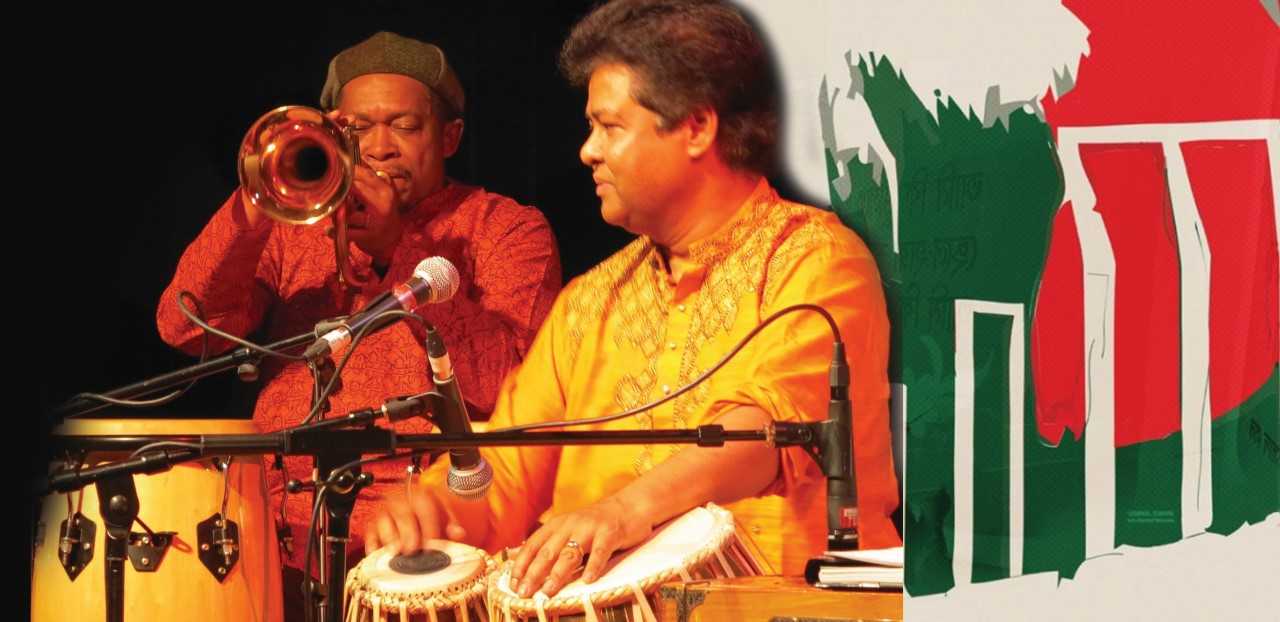
February 2019 – upcoming London eclectic/multicultural gigs at Poplar Union – Grand Union Orchestra (22nd February); Mishti Dance (23rd February) with Conspirators of Pleasure, The Tuts, Kapil Seshasayee and Soundar Ananda

15 Feb

I don’t go down to Poplar that often, but despite its more confusing aspects – the hurtling convergence of the eastern motorway routes out of London; that strange dislocated/disassociated/dispossessed neighbour’s relationship which it has with the glittering towers of Docklands to the south – the place has always felt welcoming; from the wry hardiness of its shopkeepers to the gentle courtesy of the djellaba-clad pair of Muslim brothers (one twentysomething lad, one eight-year-old kid) who spotted me wandering (a lost, bald, bearded middle-aged white bloke) all nonplussed by the Limehouse Cut, and were kind enough to redirect me to Poplar Union.

PU still feels like a beacon for the area’s future – enthusiastically aspirational in its bright, clean, modern bookishness but also happily embedded in the area’s colourful swirl of cultures; decidedly unshabby but also entirely inclusive. Here are another couple of gigs coming up there this coming week.

* * * * * * * *

Grand Union Orchestra, 22nd February 2019

Sporting a thirty-plus roster of musicians from all across the world, Grand Union Orchestra have spent two decades playing and personifying an ethic of joyous multicultural cooperation onstage. With a tradition of creative diasporan work, and with an additional set of roots in left-wing community theatre, they’re a living rebuttal to British insularity. Usually there’s about eighteen of them on stage, drawn from a flexible roster of around thirty top-flight musicians from a variety of cultures and generations. You’ll see Bangladeshi, Chinese, English, Turkish, Caribbean, Roma, Bulgarian, Mozambiquian people and more, from striplings to grandmothers, all playing together, long accustomed to assembling rolling caravans of sound into which assorted musics – Carnatic and Bangladeshi classical, salsa, jazz – can be folded.


You can pick out the various components (even a quick dip will turn up players like Jazz Warriors trumpet veteran Claude Deppa, Carnatic violin virtuoso Claude Deppa, Roma accordionist Ionel Mandache, guzheng star Zhu Xiao Meng and a poly-hued battery of singers with backgrounds including fado, jazz, opera and Bengali classical) but you’re better off just enjoying the sweeping palette. Just looking at their gig flyers reminds me of the happy, souped-up neighbourly multiculture festivals in and around my primary school. It makes me want to bare my teeth against the chilly white monocultural wind that’s blowing from the future, from Brexit and from the surly side of Englishness; or – if I can’t do anything else – to at least turn up my collar, turn my angry back against the freeze and head for the lights, the warmth and the rhythms.

GUO’s current, workshop-driven project – ‘Bengal, Bhangra and the Blues’ – is helmed by tabla ace Yousuf Ali Khan: it leans back towards the music of the Asian sub-continent with classical ragas, Bengali songs and the aforementioned bhangra at the heart of it. Various young participants, having already enjoyed the previous week’s free instrumental youth workshops incorporated into the project programme, will be joining the main band for the concert.

* * * * * * * *

Mishti Dance featuring Conspirators of Pleasure + The Tuts + Kapil Seshasayee + Soundar Ananda, 23rd February 2019

I know Grand Union Orchestra, but I’m less familiar with PU’s Mishti Dance evenings and their Asian club/dance initiative. The idea strikes a fond chord of memories stemming from the Talvin Singh Anokha nights I’d occasionally attend in the mid-‘90s, in which all of the sounds I’d been vaguely aware of during an upbringing in multicultural Haringey suddenly seemed to grow up and stream together. Anokha, though, had its road laid down for it by the bhangra grooves and post-rave dance culture of the times, and while you could skulk up to the chillout room to listen to Shakti if you wanted to, it was predominantly about immersing yourself in sub-bass, remix chops and tabla frenzy.

Mishi, however, looks like a much looser bag: admittedly hung on the same British Asian peg but more tenuously, with room for just about anything and anyone with a Asian connection and in particular those who are following their own path out of the immediate cultural confines and bringing their innate cultural qualities to question, alter and enrich other spaces. The closest Anokha-type dance exemplar in this month’s gig looks as if it’s DJ Soundar Ananda of Indigenous Resistance, a French-Asian “conscious beats” deliverer, promoter and compilation curator working with “cutting-edge, futuristic, nu-skool, Eastern electronic music influenced by dub, dubstep, d’n’b, breakbeat, jungle, reggae.”

 
The Tuts, on the other hand, are a long way from Anohka beat culture, although I think Talvin and co would have appreciated their ethic. A fiesty, witty, self-propelled female throw-forward from the all-too-brief days of ’70s post-punk inclusivity, they’re a young DIY pop-punk trio of “proud Caribbean, English and Indian/Pakistani origin” and an immediate, salty working-class attitude of immediate self-assertion and street wit. Full of chop-and-change musical sharpness and girl-group zest (they’ve happily covered Wannabe, though there’s as much Fuzzbox or Slits to their vigour as there is Spice Girlhood), they’ll be inspiring girl moshers and wallflowers alike from Wolverhampton to Leicester, with little for old white gits like me to do but gently get out of the way, smiling as we do so. Bluntly inspirational.


The remaining two acts take us into delightfully eclectic and weird experimental pop and noise terrain. Bringing the majority of the weird noises are headliners Conspirators Of Pleasure: multi-media artists Poulomi Desai (who’s been in here before a few times over the year, toting her polydisciplinary stage shows and their festoonings of gizmos and collated contradictory content) and onetime Pop Group/Pigbag post-punk/funk/dub bassist Simon Underwood (once compared by Dennis Bovell to a white Robbie Shakespeare). Their adventures together have included helping to set Joyce’s ‘Finnegan’s Wake’ to music, and touring with Stewart Lee and other restless upsetters in the ‘Usurp Chance Tour’. Using repurposed tools of the cultural trade (Poulumi’s context-yanked sitar played with everything from an axe to a massage vibrator, Simon’s prepared bass guitar) plus assorted noisemakers, drone-sources, toys, stylophones and radios and a battery of makeshift audio-visual, they’ll spend their time onstage forking over textures and flotsam, touching on the industrial, on dance culture, on noisy improvised chaos and on the voices and ideas which emerge from this conflation.


Glaswegian-Asian singer-songwriter Kapil Seshasayee has parked himself on a junction where a variety of different ideas and approaches are coerced into meeting. He takes his beats from hardcore machine punk and Arca-ian experimental electropop; his guitar choices from a superimposition of Carnatic traditions and skinny-wire Hendrixian note-bending, crashes and hammer-on blues; his song structures from the kind of improvisational bardic rock which itself is drawing from griots or the ecstatic traditions which bubble away in various cultures despite having been vainly tarmac-ed over by Western rationalism.

His voice… well, I’m not entirely sure where that comes from. A beautiful Western/Indian rock clarion with hints of boy angel, Quwalli pronouncer and open-ended Beefheartian abstractioneer, it barrels up out of a position of assured strength only to lyrically splatter itself across parts of the landscape you’d not even noticed before. I could wave in Tim Buckley, Thom Yorke, Nick Harper and Van Morrison as whiter comparisons; I could point to some of the fiery ecstastic pitches and timbres of Nusrat Fateh Ali Khan, or toward youthful bluesmen with an axe to sharpen; but I still wouldn’t get it across to you or do it the right kind of justice.

Bald and impressively bearded (beating me on both counts, in fact), Kalil additionally decorates his wrenched-cable music with electronic fizz and spookings plus the eldritch acoustic wails he can scratch out of a waterphone. As for his songs, whether they’re upended experimental blues or club-leaning avant-pop abstractions (and often they’re both), they sound like distracted revelations in train marshalling yards, Kapil as a spasming, pointing Blakean figure continually spotting and sweeping the hidden numinous into his narratives and fracturing them into cracked landscapes. Somewhere inside Kalil there’s a bloke who wants to sing straightforward young-man songs about love gone wrong. Fortunately, his own brain continually waylays him in between impulse and expression.


* * * * * * * *

Dates:

Grand Union Orchestra: Bengal, Bhangra and the Blues
Poplar Union, 2 Cotall Street, Poplar, London, E14 6TL, England
Friday 22nd February 2019, 7.30pm
– information here and here

Mishti Dance presents:
Conspirators of Pleasure + The Tuts + Kapil Seshasayee + Soundar Ananda
Poplar Union, 2 Cotall Street, Poplar, London, E14 6TL, England
Saturday 23rd February 2019, 7.00pm
– information here and here
 

February 2019 – upcoming London jazz gigs – LUME return for a Sloth Racket/Entropi double header (13th February); Jazz HerStory with Rosie Turton (21st February)

11 Feb

After a year away working on other things, the jazzwomen behind LUME are bringing it back to life. Hopping on board the fast-moving train of Kings Place’s ‘Venus Unwrapped‘ series (which I’ve really got to take a closer look at shortly), they’re presenting a double bill of two LUME spearhead acts: each led by one of the two LUME directors.

Baritone saxophonist Cath Roberts heads up and composes for Sloth Racket a scorching, heavy London-and-Manchester free jazz quintet in which she jousts and converses with Sam Andreae’s alto over a rhythm section of guitarist Anton Hunter, drummer Johnny Hunter and double bassist Seth Bennett (who aren’t actually that much bound by straight rhythm). Incorporating cells of conventionally-written material as well as graphic notation, Sloth Racket music is an aggregation of explosive rips, broken-up hums, forcefully lyrical micro-interjections and tense silences. They’re up to their third self-released album, ‘A Glorious Monster’.

 
Alto saxophonist Dee Byrne runs Entropi, in which she’s joined by trumpeter Andre Canniere, keyboardist Rebecca Nash, drummer Matt Fisher and bassist Olie Brice. Their music is built on discombobulated, mutually superimposed grooves and deconstructive/reconstructive melodic parts and harmonies, continually walking a wiggly line between falling apart and dancing together. Dee keeps everyone involved on supple, elastic musical leashes, letting them roam to the limits before gently reeling them back in.


* * * * * * * *

In a couple of weeks, the Jazz HerStory season out east at Poplar Union continues with a gig from Nerija trombonist Rosie Turton, now bandleading in her own right and with an EP, ‘Rosie’s 5ive’ out this year on Jazz Re:freshed Records. Following in the footsteps of two of Rosie’s biggest inspirations, Alice Coltrane and Pharoah Sanders, her 5ive band (in which she’s joined by Johanna Burnheart on violin, Maria Chiara Argirò on piano, Twm Dylan on bass and Jake Long on drums) works around a sensually airy intertwining of Indian violin, trombone and electric piano, in which adventurous tunes effloresce and sway around light-on-their-feet rhythm grooves: a clever, flowing, flowery architecture.
.


* * * * * * * *

Dates:

Venus Unwrapped: Entropi + Sloth Racket
Hall Two @ Kings Place, 90 York Way, Kings Cross, London, N1 9AG, England
Wednesday 13th March 2019, 8.00pm
– information here and here

Jazz HerStory presents:
Rosie Turton
Poplar Union, 2 Cotall Street, Poplar, London, E14 6TL, England
Thursday 21st February 2019, 7.30pm
– information here and here
 

February 2019 – upcoming English folk-rock-but-not-just-folk-rock gigs – My Octopus Mind on tour (13th, 16th, 21st, 22nd February) with Jakabol, The Display Team, Lapis Lazuli and Malika Collective; Hexvessel and Arktau Eos in London (22nd February)

10 Feb

Flexible Bristol almost-acoustic trio My Octopus Mind occupy a pleasing position, settled in their own web of connections between a number of different influences but reliant upon none of them. There’s a jazzy rattle, predominantly via the gloriously noisy effected double bass of Izy Ellis (a growling, punchy, conversational art-box; upfront timber and raw electronic treatments). The whole band’s informed by post-Radiohead/Mars Volta art rock and by the mating of contrasts implicit in assorted culture collisions (such the Hindustani-classical meets New-York-loft-music teaming achieved in one particular favourite, Philip Glass and Ravi Shankar’s ‘Passages’). Frontman singer and guitarist Liam O’Connell cites the sonic and psychological crescendos of Jeff Buckley and Josh Homme’s mix of heaviness and irony, but also the restraint of Jose Gonzales. Ex-Lambhorneer Oliver Cocup adds refreshed drum bounce, and racing through the whole thing is a rivulet – or, more accurately, an unstoppable jet – of skittish Balkan folk.


With a debut album, ‘Maladyne Cave’, nearing release, My Octopus Mind are out on a brief English tour wriggle this month, taking in Manchester, Canterbury, London and their hometown. In part, it’s to celebrate the recent release of their debut single Elska, with its increasingly disturbing Coppelian dance video (in which a man wheels an impassive doll-woman around in a suitcase, engaging in secret and increasingly frustrated trysts with her).

While Manchester is an evening for the band on their own, various temporary tourmates slot in elsewhere – in London, it’ll be the accomplished Afro-Latin groove band Malika Collective. The Canterbury show sports an eclectic psychedelic edge with local jam band and “maximalist psych-prog heroes” Lapis Lazuli plus the convoluted Zappa-brass meets London-urchin-pop of The Display Team (see passim) and psych/prog/punk funk/soul/dub/afro combination DJ interludes from Professor Appleblossom. The Bristol tour launch show, meanwhile, also features Jakabol, a warm Bristolian instrumental band in which violin, harp, guitar and drums leap and lurch tunefully around a set pitched midway between post-rock gutter and country hoedown (perhaps a further extension of the rural post-rocking I’ve been hearing from Rumour Cubes and Apricot Rail).


https://soundcloud.com/jakabolbristol/goram-and-vincent
 
* * * * * * * *

Linkings between folk music and heavy rock go back pretty much all of the way to the start of the latter, especially in Europe. In plain sight, Led Zeppelin regularly immersed themselves in Welsh border hillsides and Janschian jangle; a little later, Jethro Tull brought in the jigs, liltings and mandolins while allying them to Ian Anderson’s witty, sardonic absolutely-in-the-moment songwriting voice (which swept in the eclectic interests and erudition of a restless, randy, contemporary urban boulevardier who could’ve make the idea of a leprechaun in your sitting room sound like something contemporary, adult and immediate rather than twee). In the ‘90s a swell of Celtic/Nordic folk metal and Gothic paganism via bands such as Skyclad led to a revival of mythic musical drama; in the Noughties, there was the feeling that the likes of Opeth were peering over their successive ramparts of black metal and prog in search of something offering more air and antiquity. Nowadays, you can hardly move for this sort of thing sprouting up from Ireland to Israel: driving a guitar through a hefty amp seems like one of the most effective ways to kick off an interest in your own folk history.

In many respects, latterday Anglo-Irish-Finnish heavy-folk-rockers Hexvessel hanker back to Tull – some of the lilts and jangles are there, as are the banging barn-door blurts of chunky electric guitar work – but they also trade in some of the dramatic minor keys and broody, nonconforming, subculture-meets-antiquity feel of Skyclad. Of course, this is probably incidental: it would be more constructive to reconsidering the swirling body of interests and philosophy surrounding singer and prime mover Mat McNerney. Despite Mat’s former black metal links (as “Kvohst”, he cavorted across stages with bands like Dødheimsgard and Code), Hexvessel avoid certain predictable pitfalls – no ludicrous demonic posturing; no arid hating; no polluted white-is-right old-Europe nationalism. This is primarily because under the corpse paint Kvohst always seems to have been a thoughtful and sensible chap with a well-calibrated bullshit detector, sorting the nourishing myths from the toxic ones.


Instead, Hexvessel explore a range of thinking stimuli – post-/pre-Catholic pagan magick; the connecting threads connecting contemporary Finnish woodland psych with the brooding kosmische stews of Amon Duul and the chatty verbal maximalism of early ‘70s British psych folk; comic book legendariums; and respectful pro-feminist reintegrations of women back into musical forms that have often wandered too far down macho paths. Later this month, they’re setting up camp at St Johns Bethnal Green; playing a London show as part of the European tour in support of brand new album ‘All Tree’, in which they’ve endeavoured to blend Mat’s memories of old ghost stories and other transmissions of folk culture with their own dramatic Samhain vibes and symbolic forest-folk musical experiments (including playing tree boughs with violin bows). Mat sees it as a way of connecting to Samhain’s liminal side; a time when ancestors, as spirits and memories, are that much closer.

Hexvessel’s tree-bowing was captured out by the band’s resident field recording/sound conjuring wizard Antti Haapapuro. In another incarnation – as half of sacking-masked ritual ambient/oneiric duo Arktau Eos – he and fellow Eosian Antti Litmanen open the show, rubbing the psychic gateways open with their primeval sounding drones, swells and invocation of significant spaces – simultaneously post-industrial and prehistoric, thrumming out of a green church, resonating nook or ancient gravehole like a stone-tape playback of ancient, dignified rites.

Steeped in hermetic philosophy and Apophatic theology, Arktau Eos come across as thoughtful ceremonial scholars in interviews such as this one in the ‘This Is Darkness’ ezine. Eloquent and courteous if you care to track them down for a respectful conversation, but unswayed by distractions from their business of the mining of the “ur-currents” of religious faith; the pull of site-specific mysteries, apprehending experience without attempting to stare it in the face or pin it down with sentences. In a similar spirit, I think I should just leave the descriptions there, as they stand. Essentially, it’s all in the sound and the placement, and the ceremonial use of the available moment. Understand them that way.


* * * * * * * *
Dates:

My Octopus Mind:

  • The Crofters Rights, 117-119 Stokes Croft, Bristol, BS1 3RW, England – Wednesday 13th February 2019, 7.30pm (with Jakabol) – information here and here
  • The Old Abbey Taphouse, Guildhall Close, Manchester, M15 6SY, England – Saturday 16th February 2019, 7.30pm – information here
  • UCA Bar Canterbury, New Dover Road, Canterbury, Kent, CT1 3AN, England – Thursday 21st February 2019, 7.30pm (with The Display Team + Lapis Lazuli) – information here

  • The Magic Garden, 231 Battersea Park Road, Battersea, London, SW11 4LG, England – Friday 22nd February 2019, 7.00pm (with Malika Collective) – information here and here

Old Empire proudly presents:
Hexvessel + Arktau Eos
St John on Bethnal Green, 200 Cambridge Heath Road, Bethnal Green, London, E2 9PA, England
Friday 22nd February 2019, 7.00pm
– information here and here
 

February 2019 – upcoming London jazz gigs – Gemini Trio (12th, 21st, 23rd, 28th February); Adam Ben Ezra with Joseph Tawadros plus Uniting Of Opposites (22nd February); Nick Walters & The Paradox Ensemble (22nd February)

3 Feb

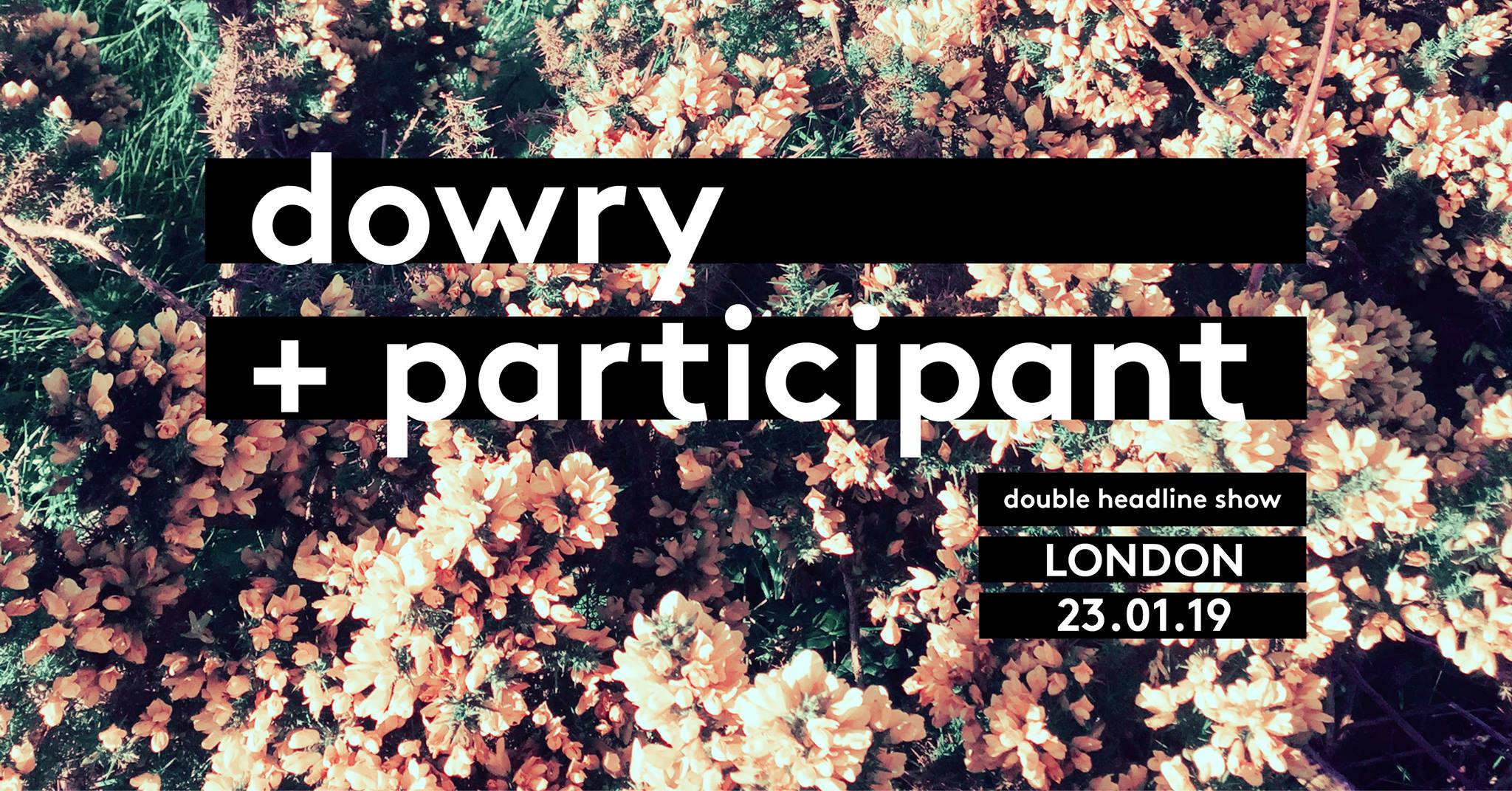
Having taken some first steps in public at the Putney Half Moon and Folklore Hoxton over the last few months, London-based Italian jazz-rockers Gemini Trio will be embarking on a five-gig journey around London from mid-February (with more to follow in March and April).

Formed at BIMM by three young Milanese players (guitarist Adriano Balducci Moncada, bass guitarist Edoardo Marcarini and drummer Alessandro Iannicelli, they’re a mellow, airy, accessible alliance. In terms of their jazz and rock roots, they cite some fairly predictable roots (John Coltrane and Pat Metheny at one end, Radiohead, Tool and Led Zeppelin at the other) but they also apparently harbour inspirations from African music and from progressive and indie rock and which they’re less specific about (bar a friendly name-drop for Milanese Zappa torch-bearers Elio e Le Storie Tese). It’ll probably unfold over time: it’s early days for them yet, and their stew’s still in the early stages of brewing.

Right now they’re fluent, agreeable flashboys with a likeable lightness of touch and a debut single called Vivacissimo. With a title like that you’d expect a helping of ELO or disco cheese to be stirred into their music, but instead they seem happy to win you over with something breezy and sunny to overcome English winter gloom… and here it is. I’m enjoying putting it on loop, perhaps because I still miss What?!


* * * * * * * *

Surfing a substantial career wave at the moment (partly thanks to his canny understanding of the entertainment potential of YouTube clips) is Israeli solo double bassist and master showman Adam Ben Ezra, who’s back headlining the Jazz Café on the 22nd. Bold, humorous and technically dazzling, Adam covers a spectrum of music from serious swing to percussive melodious modern jazz tunes to flurrying flamencoid spasms to popcorn pop-culture gags (he’s enticed in a lot of jazz-wary fans thanks to the bait of his virtuosic, web-viral renditions of TV themes).

Although he’s cited Eddie Gomez and fellow performance monster Jaco Pastorius as main bass influences, Adam’s forceful flexibility, punchy tone, swinging rhythmicality and wit also happily channels the ghost of Bob Haggart. His knack for live-looping tricks’n’textures and electronic media savvy, meanwhile, echo Steve Lawson; and his tendency to temporarily set aside his bass and burst out with other instruments over the course of an evening or an album recall another heavy-acoustic virtuoso, Michael Hedges.


Adam’s guest for the show will be progressive cross-genre oud player Joseph Tawadros. An adopted Aussie with Egyptian Coptic roots (though he’s also been a Londoner for a couple of years now), Joseph has released sixteen albums over fourteen years of career. Musically, he’s a friendly rebel and natural showman who (like Khyam Allami) pulls oud music out of its Middle Eastern classical niche and introduces it to jazz, Western classical and any other cross-pollination he can get hold of.

He’s also a scarily talented bastard who took on fifty-two different instruments on a recent album. While I’ve heard that that was more spur-of-the-moment one-man-band than fully-polished ensemble, his oud playing is internationally reknowned and has won him collaborations with Béla Fleck, John Abercrombie, The Academy of Ancient Music and plenty more.


Getting things moving are show openers Uniting Of Opposites, a cross-generational contemporary Indo-jazz project allied to and releasing on Brighton label Tru Thoughts. With a past as UK dance DJ/producer Tim Deluxe, (and for 2002 house hit It Just Won’t Do) Tim Liken had long since supplemented his original career with an expanding self-education on jazz piano by the time he hooked up with the existing duo of Ben Hazleton and Clem Allford. Sitarist Clem was already a musical veteran (with five decades of work behind him including a sitar toting pilgrimage to India in order to learn from the source, plus film and session work and membership of pioneering early ‘70s Indo-psyche folkers Magic Carpet. Double bassist Ben was a former Young Jazz Musician of the Year who’d notched up time with Jonathan Gee and Tony Kofi.

To expand the music, they’ve added drummer Eddie Hick (who’s been all over ‘Misfit City’ recently thanks to gigs with Steam Down and Ruby Rushton), tabla player Manjeet Singh Rasiya, clarinettist Idris Rahman, and singer/F’ire Collective graduate Marcina Arnold. Last summer’s debut album ‘Ancient Lights‘ (arriving with a twist of psychedelic sonic illumination and dance-culture bliss, plus a pinch of surrealist flavour) reveals a band whose propulsive energy, enthusiasm, agelessness and hopefulness look set to give Adam a run for his money.


* * * * * * * *

Playing on the same day as Adam, Joseph and Uniting of Opposites is Nick Walters, known in British jazz circles as a trumpeter’s trumpeter, and on this occasion leading his thirteen-piece Paradox Ensemble big band – a thirteentet? – through a set of part-composed, part-improvised pieces mingling Mingus with Western Africa, and Woody Shaw with Eastern mysticism.

Like Eddie Hick, Nick’s known for his playing with Ruby Rushton, and at least two RR compadres show up in this group – saxophonist/flautist Tenderlonious and keyboard player Aidan Shepherd on synth and accordion. The group’s four-track mini-album ‘Awakening’ showed up at the end of last month, featuring music which runs from assured playing-around with Togo rhythms to tributes to cricket commentator Henry Blofeld (as well as employing less common jazz instrumentation such as sousaphone and harp).


Paradox Ensemble are playing as guests of the Church of Sound promotional project, which brings brings beautiful music to holy places – mostly, as in this case, the Victorian church of St James the Great in Lower Clapton, which has already seen them host shows by Kokoroko, Mansur Brown, Nubya Garcia and many others.

* * * * * * * *

Dates:

Gemini Trio:

  • Babel Café 86 Stoke Newington High Street, Stoke Newington, London N16 7PA, England – Tuesday 12th February 2019, 8.00pm – information here
  • Grow, 98c Main Yard, Wallis Road, Hackney Wick, London, E9 5LN, England – Thursday 21st February 2019, 8:00 PM – free event – information here and here
  • Bar Lorca, 175 Stoke Newington High Street, Stoke Newington, London, N16 0LH, England – Thursday 21st February 2019, 11:59 pm – information here
  • MAP Studio Café, 46 Grafton Road, Kentish Town, London, NW5 3DU, England – Saturday 23rd February 2019, 5.00pm – information here and here
  • Karamel Restaurant, The Chocolate Factory 2, 4 Coburg Road, Wood Green, London, N22 6UJ, England – Thursday 28th February 2019, 8.00pm – information here

Adam Ben Ezra (with Joseph Tawadros) + Uniting Of Opposites
The Jazz Café, 5 Parkway, Camden Town, London, NW1 7PG, England
Friday 22nd February 2019, 7.00pm
– information here, here and here

Church of Sound presents:
Nick Walters & The Paradox Ensemble: Blowing Gold
St James the Great, 188 Lower Clapton Road, Clapton, London, E5 8EG, England
Friday 22nd February 2019, 7.30pm
– information here and here
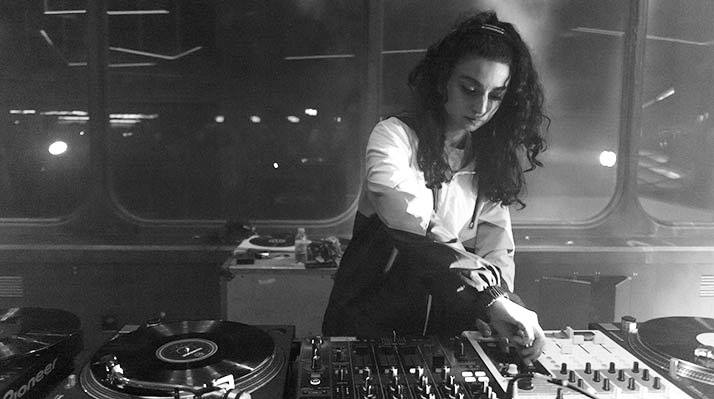
 

February 2019 – upcoming experimental gigs – Kammer Klang: Taylor Le Melle’s Afrodiasporic spectrum with Venus Ex Machina, Morgan Craft and Shenece Oretha (5th February)

31 Jan

Bah. I’ve got a swelling head cold and am consequently as thick as a cement omelette. Not the best time to try to preview a complicated experimental evening. Sorry for the vagueness in this post… even more than usual, this is hidden music to be sought out and learned from.

Kammer Klang: Venus Ex Machina + Morgan Craft + Shenece Oretha, 5th February 2019

The first Kammer Klang of the year unites various sonic experimentalists from the African diaspora under the curatorship of Taylor Le Melle. That’s probably the best way of putting it: the lack of a portentous event title means it’s not pinned down to any more specific narrative. Though predominantly a writer, Taylor spends a lot of time as a creative enabler (co-running independent publisher PSS and artist/workers’ audio-visual cooperative not/nowhere, and facilitating debate), and this isn’t her first Oto event. I’m assuming that it’s going to throw up ideas from across a broad spectrum of ideas and identities, some of which are outlined here.

Venus Ex Machina (a.k.a. Zimbabwean emigre Nontokozo F. Sihwa) is one of an ever-more visible number of interdisciplinary artists and computer coders eliding non-binary gender ideas into the worlds of music, games and visuals. Interested in “mythical and borderless” radio communication, she’ll be performing her own ‘Anno Lucis’ piece from 2018.

I’ve no idea whether this other Venus piece, ‘Paraquat’, is any reflection of what’s to be performed on the night; but here it is for illumination (with its mixture of Geiger counter industrial twists, ringing friction noise apparently siphoned from the bearings holding up the music of the spheres, and arrestingly vocal synth parts summoning up both heavenly European chapel choirs and complex African alarm whoops).

https://soundcloud.com/venusexmachina/paraquat
 
Attempting to place solo electric guitarist and sonic mystic/realist Morgan Craft involves multiple questions about geography, roots and discovery. A Minnesota-born African-American, he’s an escapee from the New York experimental scene of twenty years ago; but rather than questing directly into Africa he sought refreshment and new paths in the Tuscan mountains of Italy for over a decade (before settling in Amsterdam, where he works with Giulia “Mutamassik” Loli on the Circle of Light label and the Rough Americana project. Now he’s an “Afro-American Viking futurist”, whatever that means. Drawing on the classical legends and contemporary politics of African, European and American cultures alike, his essays sift and fold his multi-positional overview: an expatriate American black man querying his background, a critiquer of capitalist and street culture, a person with one eye on a new dawn due to rise over the muck.

Morgan’s textural guitar pieces are expansive and questioning personal monologues, abstracting manifold concerns into detailed shades. He will be performing his 2018 piece ‘Godel’: here are several earlier pieces from a big releasing burst in 2016.


Montserrat-born Shenece Oretha mostly concerns herself with polyvocality and immediate listening – as she puts it, “choreograph(ing) layers of music, voice, recordings and noise to shape moments of communion and ceremony.” Land-tilling metaphors of potential and nurturing pervade her definition of herself – “hypothetical gardener, future farmer, speculative horticulturalist.” Her sound work, or at least, that of it which I’ve heard so far, is much less pastoral; simultaneously dicing up and unifying strands of black experience from the wounded and fierce to the ecstatic and congregational, from the lone voice ululating to the whumphing in-your-face assertions of co-opted technology.

 
In addition to Oretha’s Fresh Klang performance – a piece called ‘to plot together, to breathe together’ – Testing Grounds (her “installation with multiple openings”) makes a temporary home at Oto for three days in advance of the show. With spaces for invited guests available (to “accompany the sound and participate in the sounding out”), it’s a live-performed sonic stew “present(ing) and incorporate(ing) her ongoing research project, black whole…, orchestrat(ing) a series of interruptions/interventions ‘in the breaks’.”

 
Kammer Klang presents:
Kammer Klang: Venus Ex Machina + Morgan Craft + Shenece Oretha
Café Oto, 18-22 Ashwin Street, Dalston, London, E8 3DL, England
Tuesday 5th February 2019, 7.30pm
– information here, here and here
(‘Testing Grounds’ – Saturday 2nd to Monday 4th February 2019, 5-9pm)
 

February 2019 – upcoming London experimental gigs – drone evenings – NYX & Iona Fortune plus Flora Yin-Wong (3rd February); Matthew Shaw, Anji Cheung and English Heretic (7th February)

29 Jan

A couple of evenings of drone and weird noise for you, here in the Smoke.

* * * * * * * *

 
Electronic drone choir NYX and Glaswegian electro-acoustic drone instrumentalist Iona Fortune join forces in Bethnal Green during the coming weekend, for what they’re calling “a liminal ceremony” based on an exploration of the I Ching. The latter’s a particular interest of Iona’s – she’s already released the first of a planned octet of releases on the subject. Live, she blends instrumental performance work on the gamelan percussion set and guzheng zither with vintage electronic textures generated by the EMS Synthi AKS (the same early-’70s suitcase synth that’s responsible for early Pink Floyd sequencing, mid-period radiophonics and various Enossifications), via a composition technique which “involves inner cultivation”. For their part, NYX (eight veiled women singing together from behind two tables strewn with vocal sound processors) stress “mindful experiences, psycho-acoustics and sound healing through an immersive exploration of ambient, noise and electronic music”. Expect a mixture of avant-garde eeriness and ancient intimations, then, mixed with a fat emollient smear of New Age healer atmospherics: something silkily psychoactive.

The focus on I Ching divinations might be Iona’s choice, but the sonic method is NYX’s, who are leading a series of similar concerts (this is the third of four, it seems) in which they coax a collaborator to let go of some of their own battery of electronics and/or field recordings and allow NYX to replace it with their own poly-chorused vocal blocks and twinings. A recent ‘If Only’ interview with NYX’s Sian O’Gorman has plenty of talk about mother principles and the like, but it does make them sound genuine: intrigued by the interaction of specific voices with specific bits of electronic kit, and well aware of different vocal practises delved into across hundreds of years and thousands of miles.

They’re also determined – and proud – to promote the female voice, skills and mindset. All performers in the concert series have been women: unsettling folktronica performance artist Gazelle Twin following operatic chanter Hatis Noit, with layering classical/noise minimalist Alicia Jane Turner scheduled for the next event.

Meanwhile here’s a little of Iona working on her own, plus a snippet of NYX working with Gazelle Twin. Chop, edit and remix in your mind’s eye as appropriate.

https://soundcloud.com/ionafortune/xu-5

 
As a kind of counterbalance to the concert’s Orientalist leanings (for all the sincerity, with this amount of New Agery it can feel as if it’s an act of looking in rather than belonging), the support slot goes to an actual Asian diasporan musician: electronicist Flora Yin-Wong, Chinese-Malaysian by roots but London-born. With an outright interest in club culture and dissonance, Flora seems to be more futurist than tourist but touches on the evening’s mystical tone via her use of field recordings from south-East Asian temples, re-brewed and teased within electronic processing and contemporary beat frameworks. Some of what she does twinkles, but other parts form arresting fields of explosive ritual noise right from the first note – see below.

https://soundcloud.com/floraytw/dispel-michael-speers-edit
 
* * * * * * * *

The following Thursday, up in Manor House, New River Studios plays host to the London launch event for Matthew Shaw‘s “debut” album ‘Among The Never Setting Stars’.

Calling it a debut is a little disingenous, since Matthew’s been putting out music for two decades now. At the turn of the century he sat somewhere between Bark Psychosis, Mojave 3 and a sedated Mike Oldfield, releasing soft-edged, deeply rural dream pop as Tex La Homa. At the start it was murmured acoustic-indie guitar folk – equal parts Drake and Velvets – expanded by synth rills, echo and field recordings; but gradually the singing diminished and the backing tracks became more interesting, the sounds took over and the local Dorset landscape (both physical and psychic, stone circles and solstices) impressed itself ever more deeply on the music. Though Matthew was also spending time helping to add sonic depth and audio subtext to folktronic pop band Sancho, in his own work the pop structures were dissolving away to allow the other ingredients to billow forwards.

By the middle of the decade Matthew was carrying out duo work: bizarre electrophonic ritual music with Nick Grey as 230 Divisadero and theosophical dronery with Andrew Paine as The Blue Tree. Since 2010, he’s run the limited-edition experimental label Apollolaan Recordings and issued a couple of Cornish/antiquarian-slanted location music releases in collaboration with Brian Lavelle as Fougou. Suggesting that he’s only officially going solo now is also a little disingenous – there have been releases under the Matthew Shaw name since he started Apollolaan, with a host of them still on Bandcamp. They’ve explored the usual territories of the recurring mystic tradition – alchemy and magick, psychogeography, cosmic astrology – but without the pomposity that’s usually bundled into the package.

Generally speaking, Matthew comes across as a listener rather than an imposer; travelling from temporary cottage to temporary cottage and from site to site with his guitars, sampler, KAOSS pad and electronics as an itinerant tinker would carry his tools. His work often sounds like an attempt to fuse an English pastoral tradition with spiritual/kosmische protractions and with occult/avant-garde post-punk aesthetics, blending in a folk-inspired interest in the cycles of seasons and life plus the rituals one makes to mark them. Typically New Weird Britain, then – and ‘Among The Never Setting Stars’, true to form, is apparently based around field recordings of “occult landscapes”. I would have expected the resulting pieces to have been more alarming, or at least more disorientating in the standard dark-ambient style (in which thunderheads mass like war in heaven and nature is overwhelmed by random electricity and ferociously foraging ants). On this occasion, however, Matthew seems to have been brought to a pitch of innocent (if slightly eerie) pastoral serenity – his source material buried to the point of absolute dilution or effective erasure beneath a gentle edgeless electrophonic skirl, like a cloud-organ recital in a roofless, open green church.


Also on board for the New River concert are the harsher drone-and-sample-scapes of Anji Cheung. Sometimes these are unnerving, frowning amplifier buzzes rolling over the listener like a gigantic clumsy wheel, with dramatically chopped/distorted/otherwise incomprehensible vocals implying pirate-radio-eavesdropping on a covert ritual. Sometimes they’re car-boot clatter under a lowering sky; sometimes they’re beautiful lost female murmur-melodies stalked by drainage-ditch fuzz. If Matthew’s work remains rural (and white), Anji’s is another aspect of NWB: ambiguously multicultural and urban, mixing and obscuring London and Chinese references, but sounding mostly as if it stems from a place where jerry-built tower blocks break up old fields around the city’s tired periphery and where unknown syncretic practises are carried out (perhaps only half-understood even by the people involved).


Playing hosts are English Heretic, the multimedia collective who for fifteen years have been self-appointed English psycho-historical curators, magickal Situationists and NWB forerunners. They’ve always carried their enthusiastic immersion in all things Britannic, eldritch and peculiar with warmth and wit, embracing the absurd without turning it into a cheap laugh; and putting a more inclusive and welcoming face onto the uncanny, sometimes belying the depth of their work. If I ever need an exorcism (or, more likely, some kind of psychic mediator) I’ll probably give them a call.

Plenty of music can be fed into the English Heretic stewpot – they’ve cited “psychedelic folk, ritual ethnographic recordings, electronica” as part of their fuel, and they’re very happy to drop into thrumming cusp-of-the-’70s psych rock at any opportunity, but in many respect the music’s secondary to the tales and the texts, the visual images and the intimations. Head Heritageur Andy Sharp has mentioned, in ‘The Quietus’, his tendency to extrapolate scraps and findings into something bardic and numimous – “reading around, something will catch your attention, and then I treat it in a magical context: taking the view that restless spirits or troubled souls inhabit the environment.” Sparks from hidden resonances (including those which are actually in plain sight and hearing) permeate the work.

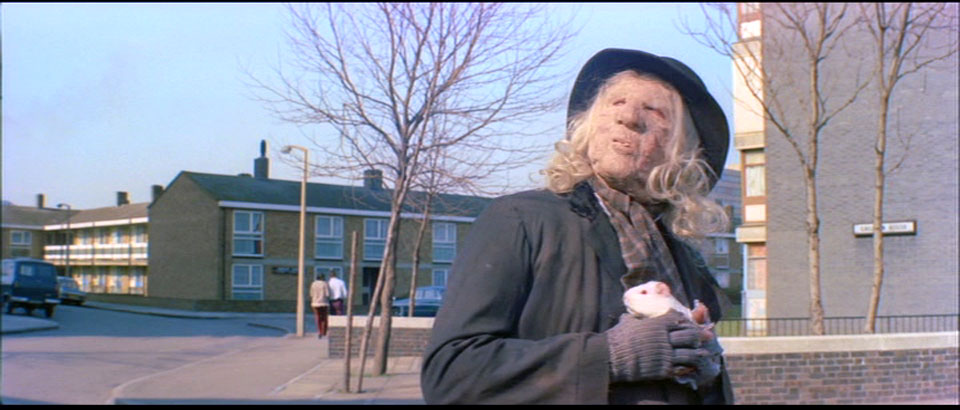
For this particular concert, English Heritage is airing part of the ongoing audio-visual project ‘London’s Imagined Dead: Cinematic Deaths in London’. The section they’ve picked takes its cues from the Brit-horror era of the late ‘60s and early ‘70s: the era which spawned ‘The Wicker Man’ and ‘The Blood on Satan’s Claw’, although they’re focussing on a lesser-known Hammer offering, ‘The Asphyx’. A 1972 tale of horribly botched Victorian research into the transmigration of souls, the film’s final sequence features the cadaverous, wandering-Jew meanderings of the story’s main character, still alive in the 1970s and condemned to a hateful, decrepit, guilt-ridden immortality. That last sequence was filmed at Battersea’s Winstanley Estate, later briefly notorious (in UK garage circles and in tabloid-land) as the home turf of So Solid Crew.

The finale of 'The Asphyx'. (Well, it was the early '70s and they'd run out of budget. Just concentrate on the concept...)

The finale of ‘The Asphyx’. (Well, it was the early ’70s and they’d run out of budget. Just concentrate on the concept…)

Visiting the present-day location, EH have taken note of the estate’s mysterious-looking murals (actually reliefs, carved into the Winstanley’s concrete walls) and have drawn from them to create new visual scores. Full of primal symbols and strange abstracted geometries, the carvings have an ancient air to them; but actually they’re early ‘60s commissions from William Mitchell Design Consultants, formally put up as part of the refurbishment during the estate’s post-war rebuild, and not even a decade old when ‘The Asphyx’ was filmed. English Heretic know this, of course, but are well aware that the ideas which places, objects and initial associations trigger off are at least as important as the actual truth. In this case, they’ve intersected film and building fabric to inspire literal musique concrète. Their pun, not mine. Not that I’m sulking about having been beaten to the punch…

* * * * * * * *

Dates:

comm-une presents:
NYX with Iona Fortune
The Pickle Factory, 13-14 The Oval, Bethnal Green, London, E2 9DT, England
Sunday 3rd February 2019, 6.30pm
– information here and here

English Heretic presents:
Matthew Shaw + Anji Cheung + English Heretic
New River Studios, Ground Floor Unit E, 199 Eade Road, Manor House, London, N4 1DN, England
Thursday 7th February 2019, 8.00pm
– information here
 

February 2019 – upcoming jazz gigs in London and Cambridge – Seed Ensemble (1st February); Warmer Than Blood (2nd February); Irreversible Entanglements and Matana Roberts (2nd February)

28 Jan

Cassie Kinoshi & SEED Ensemble, 1st February 2019

Perhaps there’s not a great deal that I need to say about Cassie Kinoshi. The most visible of the current generation of jazzwomen from the Tomorrow’s Warriors Female Collective, she’s clearly on the ascendant, working extensively across the jazz, classical, dance and drama worlds, and with her two-year-old SEED Ensemble now getting high-profile gigs. One of these is at Kings Place this Friday, in which SEED unveil their debut album ‘Driftglass’, showing off the end product of the multicultural London influences which inspire them: groove-based British jazz with strong flavour of West African and Caribbean diasporan music.

If that sounds a bit cuddly, then check out the title – and the combative, sarcastic thump – of the second of the two clips below. It’s a parodic, pointed Mingus-worthy musical representation of white people’s fear-driven misconceptions about black people, drawing on the wildness, grief and defiance of New Orleans funeral music and underpinned by the double-low-end honk-n’razz attack of Theon Cross’ tuba and Rio Kai’s double bass.


* * * * * * * *

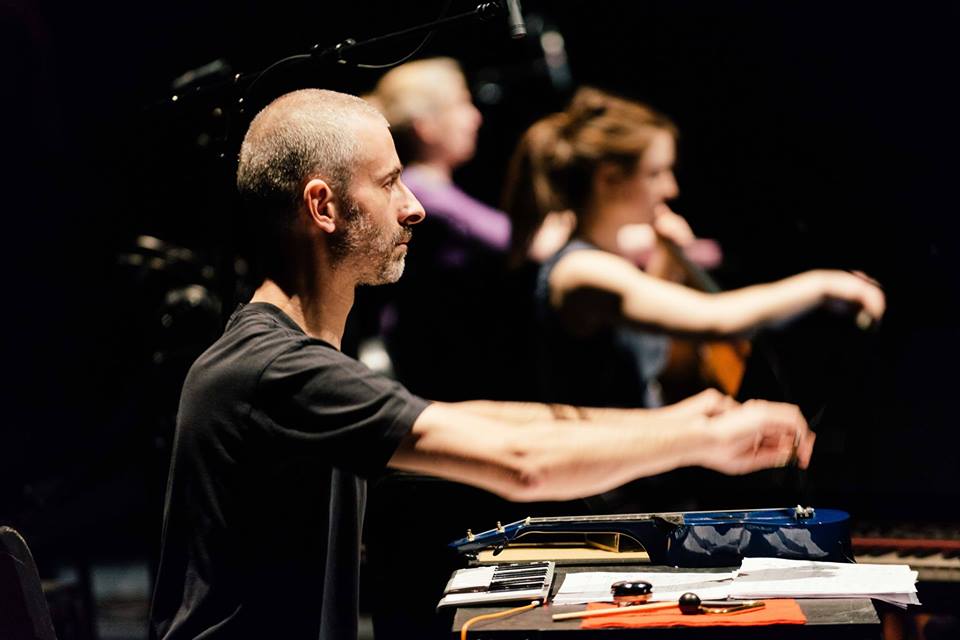
Up in Cambridge the following day, guitarist/composer Chris Montague (previously seen in here via his work with Alex Roth and Chris Sharkey in Future Currents) reveals his new project Warmer Than Blood. It’s a trio in which he combines with pianist Kit Downes (Troyka, F-IRE Collective) and bass guitarist Ruth Goller, whose pedigree takes in a host of projects from Acoustic Ladyland to Sephardim ballad revivers Sephiroth plus (amongst others) the manouche of Kamao Quintet, the punk jazz of Let Spin and rough-edged North African-influenced Melt Yourself Down, the Latin folk of Oriole and the up-in-the-air experimental indie-rock of Bug Prentice.

Warmer Than Blood, 2nd February 2019

All three are longtime friends and collaborators, seeking yet another new approach. They seem to have found it with Chris’ newest batch of compositions and improvisation-seeding situations, which he suggests consist of “intricate textures, dark pools of harmony, layered melodies, kinetic group improvisation and percussive prepared piano… fractious composed passages can inhabit the same sonic space as spare, ambient melodies, often described as melancholic and uplifting at the same time.”

Warmer Than Blood are a couple of months away from properly recording a debut album, but two live tracks on their homepage point the way in which they’re going. Introverted and ominous, their name-track’s a quiet etiolated piano exploration over a minimal pulsing guitar-chord cycle and locked-in bass rumble. The excerpt from a longer piece, FTM, is a gradual evolver in which Chris hovers in menacing sustain/volume-swell textural clouds and momentary dust-devils over ghost-Latin clicks and bass piano thuds (Kit muting the piano at both ends) before the trio expand into what’s partly a kind of haunted country music (like a Bill Frisell ensemble scoured to the bone by plains wind), and partly like a salsa band coming to terminal grief in a badlands dustbowl.

* * * * * * * *

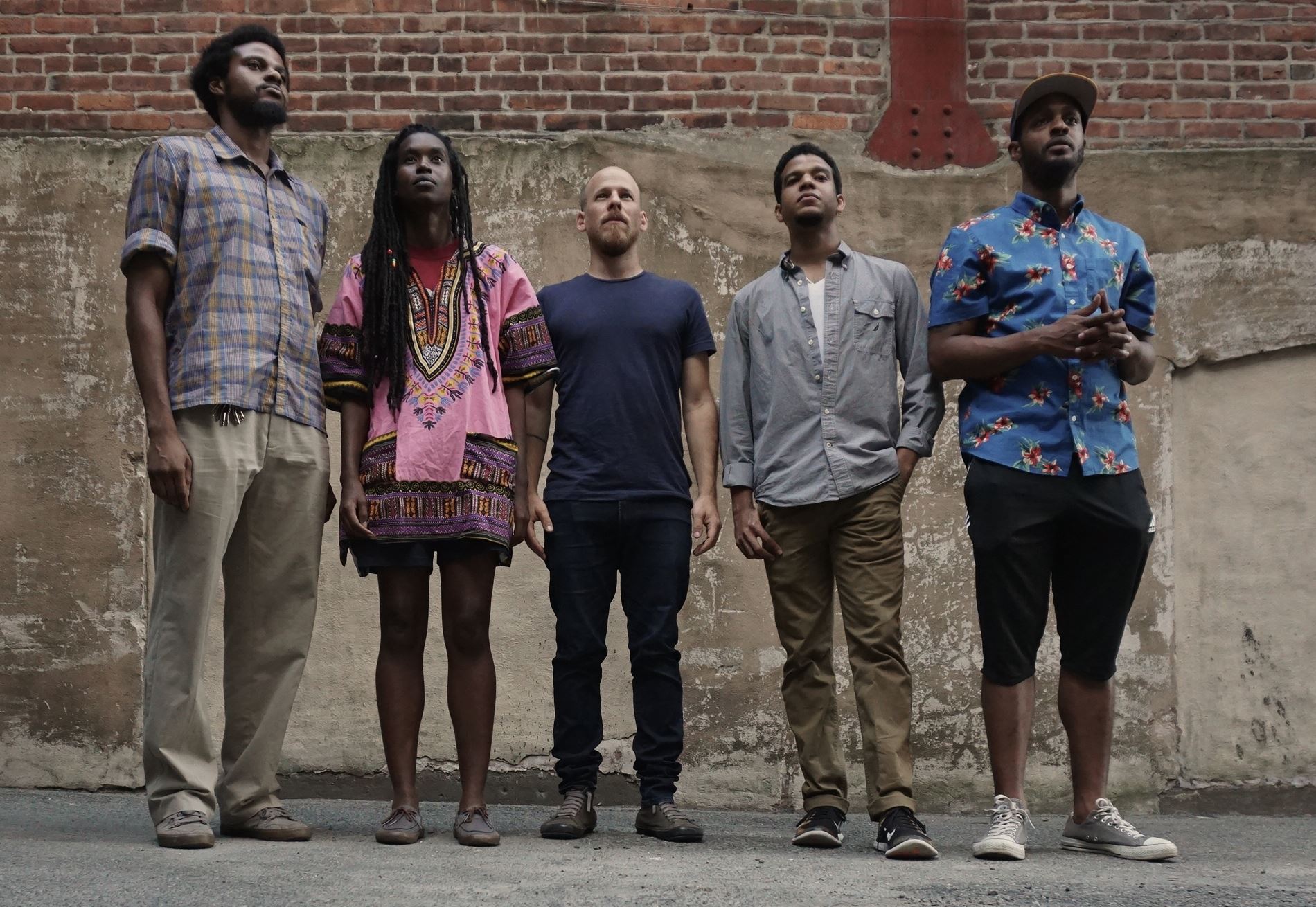
Back in London, and also on the Saturday, the Barbican’s Milton Court hosts Brooklyn-based “liberation-minded free jazz collective” Irreversible Entanglements. If you’re after a jazz band to represent and reflect these increasingly ugly, stormy, oppressive times from the bottom up, you couldn’t find a better one – but be careful what you wish for. They aren’t an easy listen, and they’ve got no intention of being so.

Irreversible Entanglements, 2nd February 2019

Free jazz (especially, though not always, when it becomes a hand-me-down in the hands of white musicians) can often be a fussy, elitist abstraction. Irreversible Entanglements uncompromisingly return it to its roots in black radicalism and to an absolute connection to the injustices of society. In doing that, they’re stepping into the first-generation protest-jazz shoes of Archie Shepp, Joseph Jarman, Max Roach, Albert Ayler.

If you’ve been reading ‘Misfit City’ over the last couple of months, you may remember Elaine Mitchener reviving this tradition with her Vocal Classics Of The Black Avant Garde project last month. While operating in a similar field, Irreversible Entanglements have no interest in curating those impetus and protests as museum pieces. Instead, they create their own protest. It should go without saying that they’re tied deeply into the #BlackLivesMatter initiative. Originally forming the band four years ago to play at a Musicians Against Police Brutality event, saxophonist Keir Neuringer, bassist Luke Stewart and poet/proclaimer Camae Ayewa subsequently added trumpeter Aquiles Navarro and drummer Tcheser Holmes for more rhythm and flammability.

The resulting quintet sounds far bigger, far angrier and far more righteous than seems possible, jetting out sheets of rattling, scouring brass over gargantuan shifting rhythms like wrenched building piles. Key to it all is the fierce female voice at the core. Camae’s better known for her Moor Mother solo project, in which she declaims jarring, terrifying accounts of personal and cultural pain over a barrage of hip-hop/slamtronic sound. I’ve written previously about the way in which her deep drilling of psychic scar-tissue within the African-American experience turns her into time-traveller, authorative witness-bearer and angry documentarian. With Irreversible Entanglements, she taps into another heady well of black American cultural memory, this one passed down via saxophones, bop and overblown sheets of sound. It’s not the first time that a jazz band has been centred on a woman’s voice, but you’ll rarely, if ever, have heard it done this way, in which the texts and the delivery not only match the hurricane of music, but simultaneously drive and ride them. This is serious schooling.


In support at Milton Court is Chicago-born, New York-based saxophonist and sound experimentalist Matana Roberts. While it’s not unusual for a jazz player to appear on a record on post-rock spearhead label Constellation, it is unusual for one to be signed to the label. Matana, however, is not a standard jazzer (she prefers the term “sound adventurer”, considering herself to be a hybrid connected to multiple sonic approaches), and she was probably signed more because of her general experimental tendencies than because of her past collaborations with Silver Mt. Zion and with Tortoise members.

An orchestral clarinettist with a politicized background, Matana journeyed through punk, Riot Grrl and avant-garde music to where she is now. Though she seems quite capable of punching out Chicago post-bop/free sax on the stand, she doesn’t restrict herself to standard (though demanding) jazz forms. Instead, she treats music as a prime artistic unifier crossing over into dance, theatre, poetry…. not in itself unusual, but rather than just strapping standard music tropes onto other forms she allows those forms to wash in, dissolving and reforming her approach to her music.

Matana’s best known for her ongoing ‘Coin, Coin’ series, a projected twelve-album project started in 2005 and still in its relatively early stages (it’s about a third done). In this, whether working on her own or with others, she utilises a technique she originally dubbed “panoramic sound quilting”, joining together blocks of noise and scoring from a variety of sources but with an assemblage idea borrowed from rag-bag folk art. In particular when she’s recording alone, her pieces feature multiple Matanas – some rolling out saxophone lines, but many engaged in vocal chants or drones, or layered swatches of conversation. Some sing or scream, or hurtle along the arresting bloodied ribbon that separates the two: like Moor Mother, Matana takes pride in black history and resistance while establishing that it has to be represented via a certain sound of historical pain. The rawness there goes beyond filters of culture and into filters of humanness.”

Unsurprisingly, her performances have a reputation for being immersive experiences. Sounds like she’ll make the perfect gigmate for Irreversible Entanglements.


* * * * * * * *

Dates:

Jazz re:freshed present:
SEED Ensemble
Kings Place, 90 York Way, Kings Cross, London, N1 9AG, England
Friday 1st February 2019, 8.00pm
– information here and here
Listen! presents
Warmer Than Blood
Unitarian Church, 5 Emmanuel Road, Cambridge, CB1 1JW, England
Saturday 2nd February 2019, 7.30pm
– information here and here

Irreversible Entanglements + Matana Roberts
Milton Court Concert Hall @ Guildhall School of Music & Drama, Silk Street, Barbican, London, EC2Y 8DT, England
Saturday 2nd February 2019, 7.30pm
– information here and here
 

January 2019 – upcoming London experimental gigs – Armed With Bow & Portia van de Braam, Devon Loch and DJ Francesco Fusaro (30th January); UnicaZürn and Howlround (1st February)

27 Jan

Armed With Bow & Portia van de Braam + Devon Loch + Francesco Fusaro, 30th January 2019

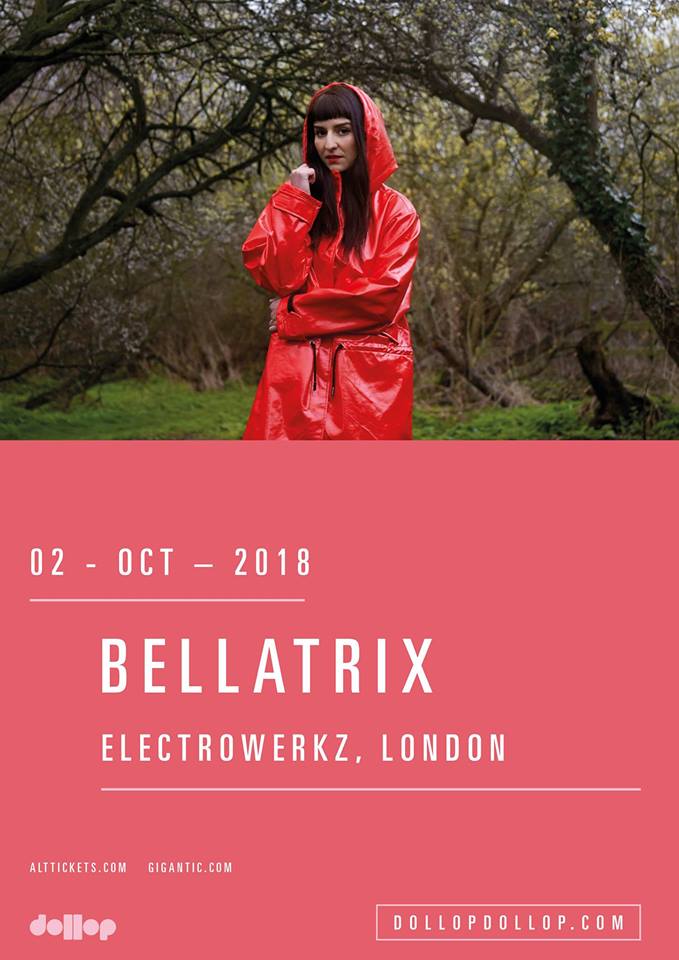
As Armed With Bow, cellist and synth operator Will Langstone creates layered post-classical loop music with a psychedelic Moog-prog twist, exercising his fascination with cosmic planetarium visions, space voyaging and the like. The show he’s headlining at 93 Feet East this Wednesday will present his ‘First Encounter’ piece: a “four-part space odyssey conjured through cello, synthesizer, and four analog tape emulators” and a collaboration with dancer-choreographer Portia van de Braam.

 
Under his Devon Loch alias, Richard Greenan (founder of exotic miscellania label Kit Records) will play a set of his own. It’s touted as a “hybrid live/DJ performance, combining manipulated classical, field recordings and live electronics.” Presumably, it also draws on the sweetly warped ambience of his recorded work, with its protracted porcelain-tinkling post-Cluster synths, its Satie-citing frosted parlour-piano knots, its unexpected moments of gentle folk guitar and its subtle, surrealist-radio-inspired electronic disruptions.

 
On formal DJ duties, there’s Francesco Fusaro – journalist, broadcaster and co-curator of smart/knowingly bizarre Anglo-Italian mutant dance/post-classical label MFZ and the 19’40” “anti-classical” recording series and, as “Froz”, occasional trap techno-musician (something which he approaches with the same thoughtful dedication and whimsical wit as his other work).

* * * * * * * *

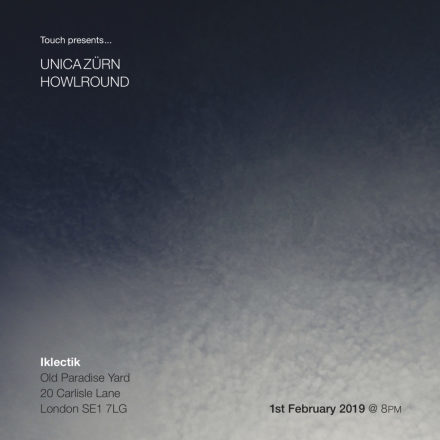
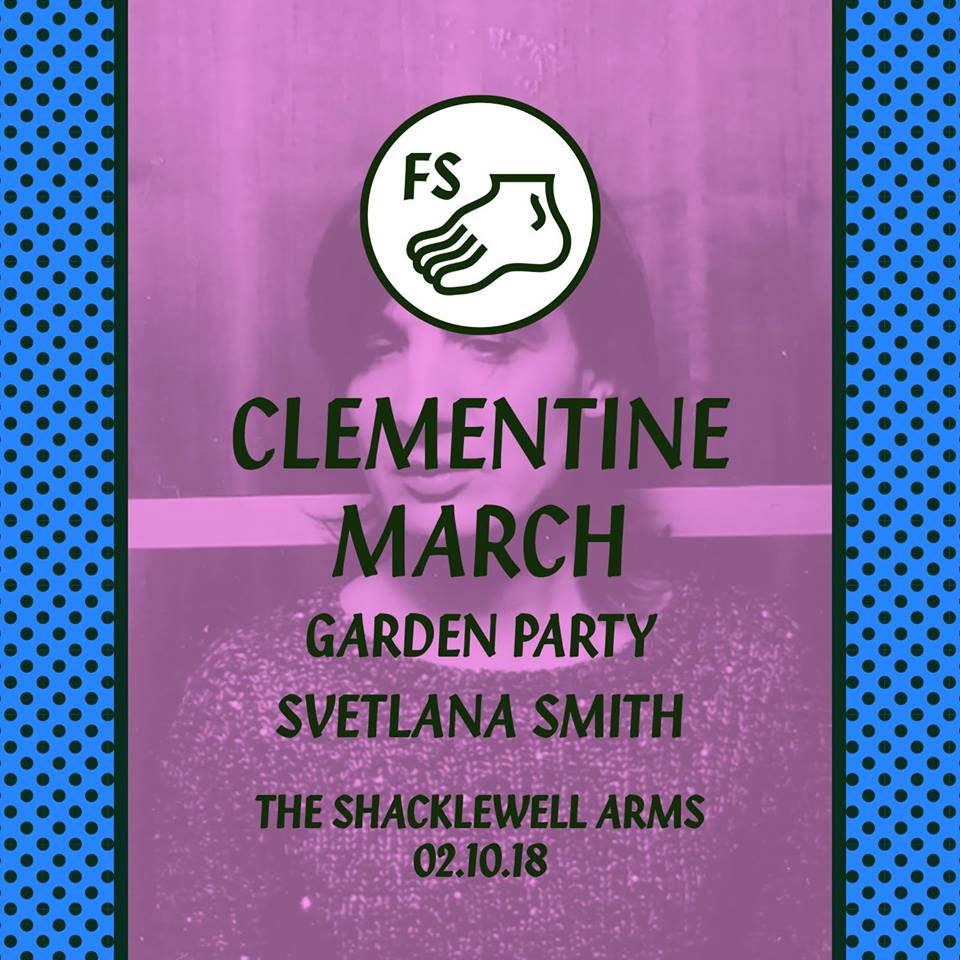
UnicaZürn + Howlround, 1st February 2019A couple of days later at IKLECTIK, UnicaZürn (the longstanding team-up between Arkkon/Shock Headed Peters guitarist David Knight and Coil/Cyclobe’s keyboards-and-reeds player Stephen Thrower) resurface to play music from their new album accompanied by one of their regular friends, Guapo percussionist Dave Smith.

There aren’t too many details, but I’m guessing that it continues the scenic but chilly slow-evolving boil of waterside atmospherics and psychedelic sound-painting which they’ve displayed on their previous albums ‘Transpandorem’, ‘Temporal Bends’ and ‘Dark Earth Distillery’: a lapping tidal cascade of heavily treated guitars and saxophones, stratified synth textures and ringing light patterns. It’s the sound that emerges when you’re charmed and transfixed by the water-and-light textures and presences of the sea and river scapes you live beside, but keep having them disrupted and transformed by feed-in from the third eye perspective you’ve also maintained.


Fellow Touch label artists Howlround (named after splurging patterns of electronic audio-visual feedback and centred on itinerant sound designers Robin “The Fog” Warren and Chris Weaver) are also performing. They’re happy to retrofit not just from old BBC Radiophonic Workshop concepts, but from a fair amount of the original technology. I can’t vouch for where all of their gear comes from (though they reject artificial reverb and computer processing), but they’re usually to be found manipulating a quartet of old reel-to-reel tape machines, to the extent that it’s a creative and performance trademark. Frequently, they produce site-specific sounds, on-the-spot film soundtracks and made-to-measure musique concrete.


Much of Howlround’s output sounds like studio offcuts – bleedthroughs and bloopings, bits of strange reverb, amplifier grumbles, signal chain malfunctions swept up from the floor. What’s surprising is how these elements are cleverly recombined into new pieces – not novelty cut-ups, as you might expect, but a pleasingly spooky chamber music which also sometimes shows off their ability to twine surprisingly sweet melodies into the noise. Both Simon Reynolds and ‘The Quietus’ reckon that they’re hauntological. If so, the haunts in question are beloved rooms where the ghosts of technicians and visionary tinkerers linger, prolonging the memories of three decades of sonic experimentation and the summoning of peculiar, arresting, inspiring aural landscapes.

(Re that last little flight of fancy – I think it’s worth mentioning that Robin actually did do something like this back in 2011 – prowling the corridors of onetime BBC World Service home Bush House, and first capturing and then reworking the ambience before the Beeb moved out for good.)


* * * * * * * *
Dates:

Distroed presents:
Armed With Bow & Portia van de Braam + Devon Loch + Francesco Fusaro
93 Feet East, 150 Brick Lane, Shoreditch, London, E1 6QL, England
Wednesday 30th January 2019, 7.30pm
– information here, here

Touch presents…
UnicaZürn + Howlround
IKLECTIK, Old Paradise Yard, 20 Carlisle Lane, Waterloo, London, SE1 7LG, England
Friday 1st February 2019, 7.30pm
– information here, here and here
 

January/February 2019 – upcoming London classical gigs – two premieres – BBC Symphony Orchestra delivers Richard Causton’s ‘Ik zeg: NU’ alongside Brahms and Schumann (23rd January); Peter Eötvös conducts his own ‘Multiversum’ for the Philharmonia alongside Bartók, Stravinsky and Stockhausen (7th February)

20 Jan

Quick news on two classical premieres coming up…

On 23rd January, Richard Causton’s new orchestral piece ‘Ik zeg: NU’ (‘I Say: NOW’) receives its debut performance courtesy of the BBC Symphony Orchestra. It’s in good company; sitting alongside a double bill of Brahms’s Third Symphony and Schumann’s heart-on-sleeve Cello Concerto, conceived to “celebrate the friendship and musical kinship between the two composers”, conducted by Sakari Oramo and with Stephen Isserlis doing the cello honours for the Schumann.

Richard Causton

Richard Causton

But let’s focus on the Causton piece. A pleasantly humble, persistently thoughtful composer, he’s consistently delivered the goods for over twenty years now, coming up with carefully-conceived and intuitively shaped compositions. Rather too many contemporary composers hide behind their lofty concepts and allow the verbal summaries to make up for shortfalls in musical communication or audience connection. This isn’t the case here – Richard specialises not in the kind of pieces which provide concertgoer kudos without any particular joy and enlightenment, but the kind which gently, kindly set the intelligence humming. Regardless of your level of classical cultivation, you tend to leave a performance of a Causton piece feeling cleverer and more enthused than you did when you went in. It’s a rare gift, whether you’re talking about something wielded or something given.

In a recent interview with ‘Final Note’ magazine, Richard sheds some light on the new work, which is inspired by family history and the sudden sense of being set against larger, more confusing/difficult-to-process events, while also drawing comparisons between life and music. “…It’s always slipping through your fingers and if you’re lucky enough you might have some wonderful time, but you can never keep it… Music can do things with time that no other art form can… (it) can have a complex and oblique relationship with clock time; it can intensify or stretch it…. There’s a lot of fast music, which is also quite static; it’s like when you walk past a school playground you can hear so many different games, voices and conversations, and with all that going on it can still seem static – but at the same time playful and too rapid to grasp properly. We can stand back and listen to it as one big landscape. There are other parts of my piece that are extremely slow, but transform gradually over time, which can force us into a very slow place of listening. In the collision of these two kinds of music the ear is pulled in different directions.”

On 7th February, veteran Hungarian composer Peter Eötvös conducts his own new piece ‘Multiversum’ for the Philharmonia Orchestra. Written for orchestra, pipe organ (played by Iveta Apkalna) and – unusually – a Hammond organ to be played by László Fassang (and chosen as an instrument for its timbral ability to “continuously change colours” ), it’s a reiteration of space-age wonder which arrives at a time when awareness of space exploration and research is on the upturn.

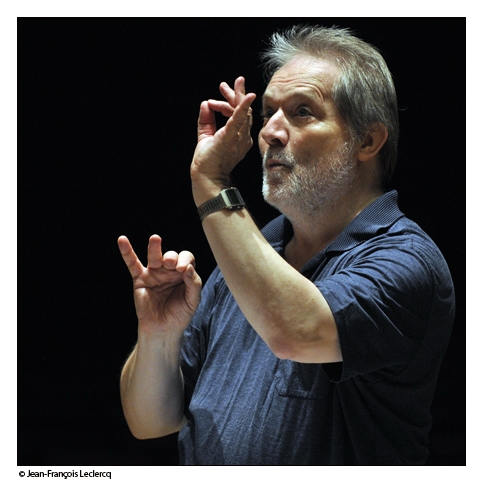
Peter Eötvös (photo © Jean-Francois Leclercq)

Peter Eötvös (photo © Jean-Francois Leclercq)

It’s also an exploration of deep-level physics: Peter, who has previous form for experimenting with amplified instrument technology (not least during a lengthy spell as Stockhausen’s engineer, copyist, conductor and general utility man) and for investigating cosmically-slanted compositions, comments that “since Yuri Gagarin´s journey into space in 1961, technological advancements have caused us to marvel at the miracle of the cosmos. Research like Witten´s theory of the eleven dimensions and string theory has astounded us with its speculation on the nature of outer space, and has spurred me on in my compositional fantasy.”

In an interview this month on ‘Bachtrack’, Peter confesses that he’s been fascinated with the idea of creating a giant ambient cosmic sound since he was a teenager, and throws some more light on the conception and arrangement of the piece, including the unusual but carefully-considered positioning of the musicians onstage to provide the right kind of sonic wraparound.

‘Multiversum’ comprises the second half of a performance which also includes Schoenberg’s ‘Accompaniment to an Imaginary Film Scene’, Bartók’s ‘Dance Suite’ and Stravinsky’s ‘Symphony in Three Movements’, all chosen for their rhythmic charge and twitching nervous orchestral energy.

Obviously there are no advance clips for listening to, but here are a couple of previous Causton and Eötvös works for the curious…


* * * * * * * *

Dates:

BBC Symphony Orchestra/Sakari Oramo/Steven Isserlis: ‘Richard Causton, Schumann and Brahms’
Barbican Hall @ Barbican Arts Centre, Silk Street, Barbican, London, EC2Y 8DS, England
Wednesday 23rd January 2019, 7.30pm
– information here

Philharmonia Orchestra/Peter Eötvös/Iveta Apkalna/László Fassang: ‘Bartók, Stravinsky & Eötvös’
Royal Festival Hall, Southbank Centre, Belvedere Road, Waterloo, London, SE1 8XX, England
Thursday 7th February 2019, 7.30pm
– information here

January/February 2019 – upcoming classical gigs around Britain and Ireland – Nonclassical’s Battle of the Bands (23rd January); Scordatura’s Clara Schumann evening (3rd February); Gyða Valtýsdóttir’s ‘Epicycle’ tour (29th January to 3rd February)

18 Jan

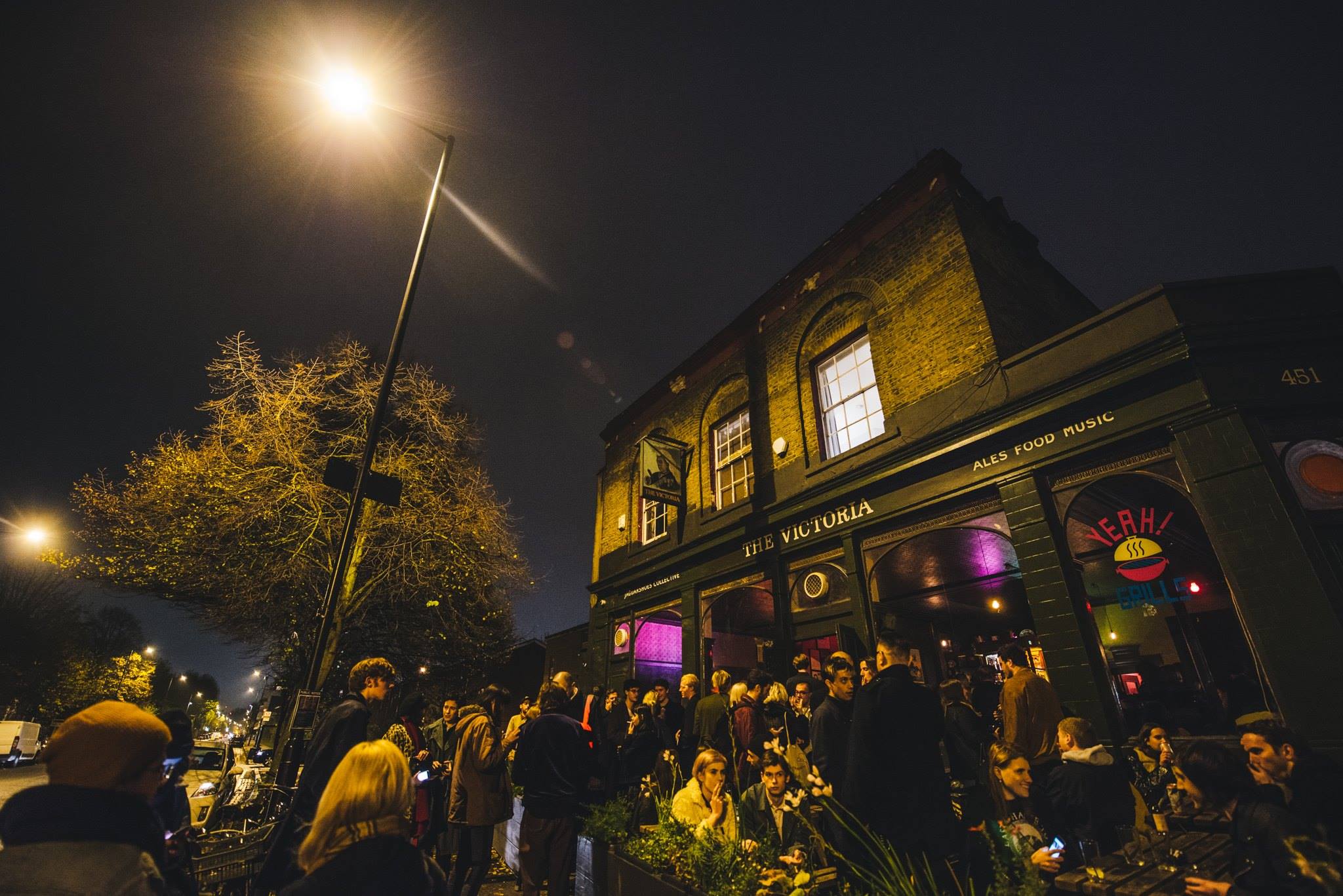
Nonclassical open their year with their annual Battle of the Bands at their live homebase in Hackney’s Victoria performance pub. Six competitors will be duking it out for industry attention and more Nonclassical gig opportunities. As usual, they’ve been chosen from the permeable space where contemporary classical touches on other musical forms, on other arts and on current concerns.

Nonclassical: Battle of the Bands, 23rd January 2019

There will be two solo performers. Woodwind specialist James Hurst will be swapping between alto saxophone and alto recorder to perform his own ‘The Descent of Ishtar To The Underworld’, a guided, Bronze Age-inspired improvisation. Reylon Yount, a San Franciscan Chinese-American yangqin player and member of Yo-Yo Ma’s Silk Road Ensemble, will be performing the diasporan-influenced sound exploration ‘Rituals and Resonances for Solo Yangqin’ by Chinese-British composer Alex Ho, which “attempts to engage with the paradoxical sense of nostalgia one may feel for a place one did not grow up in” via “an exploration of the relationship between sound and its resonance.”


Three collectives are also competing. Chamber ensemble Scordatura Women’s Music Collective champion and perform the work of female composers, both living and dead: on this occasion, they’ll be performing ‘Las Sombras de los Apus’ by Gabriela Lena Frank, a cello quartet in which each instrument plays in a different tuning. The recently-formed New Music group 4|12 Collective will be playing James Saunders’ Instruments with Recordings (with a lineup of viola player Toby Cook, flautist Epsie Thompson, accordionist Giancarlo Palena, bassoonist Olivia Palmer-Baker, trombonist Benny Vernon and tuba player Stuart Beard).

Rita Says & The Jerico Orchestra (performing Paragraph 7 of ‘The Great Learning’ by Cornelius Cardew) have been around a little longer: over the past decade, they’ve been working at “defin(ing) a connection between fine art performance practise and the history of contemporary music”, exploring a spontaneous blend of physical action and visual interaction to create and conduct pieces.


Finally, there’s composer/performer and Filthy Lucre co-founder Joe Bates, who pitches his camp on the faultline between contemporary classical music and avant-rock, hip hop and electronics; and whose artistic interests include “desire at a remove” and “the decline of classical music’s social prestige and the possibilities for its future.” His music blends contemporary classical structures and instrumentation options with “intense, still, driven riffs” and harmonies from rock and other pop forms. On this occasion, he’ll be playing pieces from his microtonal synthesiser suite/EP ‘Flim Flam’.

https://soundcloud.com/joseph_bates/6-furl-1?in=joseph_bates/sets/flim-flam-ep
 
* * * * * * * *

If you’re sympathetic to Scordatura’s role as feminist music historians and curators, you might like to know that they’re popping up again in Abingdon, Oxfordshire in early February – as part of the Abbey Chamber Concerts series.

Scordatura, 3rd February 2019

Their 3rd February gig, titled as “Celebrating Clara” (and utilising a shifting duo/trio/quartet formation of clarinettist Poppy Beddoe, violinist Claudia Fuller, cellist Rachel Watson and pianist Thomas Ang) ostensibly showcases Clara Schumann, the similarly talented but undervalued composer-pianist married to Robert Schumann. They’ll be playing one Schumann piece – the Piano Trio in G minor – and possibly some of her clarinet work, but the remaining programme slots are given over to the work of other female composers. Contemporary composer Cecilia McDowall’s chamber piece ‘Cavatina at Midnight’ is followed by the Victorian ‘Piano Suite in E major’ by Clara Schumann’s contemporary Ethel Smyth.

The last piece is by Fanny Hensel ( ‘Fantasia for Cello and Piano’) a.ka. Fanny Mendelssohn, whose life was a sometimes-uncomfortable reiterating mirror of Clara’s. Both were similarly talented intimates of established composers (one a wife, the other a sister); both had surprisingly encouraging husbands; both were also tutored and driven by demanding fathers who established excellence in them. Both, too, were ultimately constrained as composers by the discouragements and domestic responsibilities forced upon women of their times, with the men in their families often acting with a frustrating mixture of systematic positive pressure and patriarchal forbiddings. (Felix Mendelssohn, for instance, was a devoted, championing brother who found that he drew the line at Fanny entering the canon of published composers.)

* * * * * * * *

Gyða Valtýsdóttir 'Epicycle' tour (Britain/Ireland), January/February 2019Overlapping these two concerts is a British/Irish mini-tour by Gyða Valtýsdóttir – still known as the former cellist for Iceland experimental pop band Múm even though she only played on two of their albums and has been out of the band for sixteen years.

Having immediately returned, post-Múm, to her classical roots (formally studying, graduating and applying herself to classical cello) Gyða’s spent the time since then in the genre-stepping world of the modern post-classical musician. Outside of the classical gigs, rent-paying but artistically respectable engagements adding stringwork to records or tours by Sigur Ros’ Jónsi, Damien Rice and Colin Stetson have alternated with assorted film, dance, theatre and installation music around the world, as well as bouts of free improvisation gigs. Allied with her twin sister and ex-Múm bandmate Kristín Anna, Gyða also added a “reciprocal twin” component to Aaron and Bryce Dessner’s 2015 song cycle ‘Forever Love’, conceived and delivered with performance artists Ragnar Kjartansson.

Although Gyða’s latest personal release (last year’s ‘Evolution’) features her own compositions and a return to her Múm-era multi-instrumentalism – and although some of those songs will get an airing – this tour focusses mostly on her 2017 solo debut ‘Epicycle‘, a two-millennia-spanning exercise in musical commonality and reconfiguration originally intended as “a gift for friends” on which Schubert, Schumann and Messiaen rub shoulders with Harry Partsch, George Crumb, Hildegard von Bingen and the nineteen-hundred year old Seikilos Epitaph. The album was an Icelandic smash hit and a talking point elsewhere: a classical debut recorded with the immediacy of a jazz record and with a broad-minded disregard for purity, bringing in upfront studio processing techniques and stylings/instrumental responses from other traditions from jazz to ancient folk to experimental post-rock.

On tour, she’s performing with her Epicycle trio, also featuring multi-instrumentalist Shahzad Ismaily (on guitar, synthesizer, percussion and anything else which needs playing) and drummer Julian Sartorius, both of whom played on the record.


* * * * * * * *

Dates:

Nonclassical presents:
Nonclassical: Battle of the Bands
The Victoria, 451 Queensbridge Road, E8 3AS London, United Kingdom
Wednesday 23rd January 2019, 8.00pm
– information here, here and here

Abbey Chamber Concerts present:
Scordatura: Women’s Music Collective: ‘Celebrating Clara’
St Nicolas’ Church, Market Place, Abingdon-on-Thames, Oxfordshire OX14 3HF
Sunday 3rd February 2019, 3.00pm
– information here, here and here

Gyða Valtýsdóttir – ‘Epicycle’ tour:

  • Norwich Arts Centre, 51 St. Benedicts Street, Norwich, NR2 4PG, England, Tuesday 29th January 2019, 8.00pm – information here, here and here
  • Kings Place, 90 York Way, Kings Cross, London, N1 9AG, England, Wednesday 30th January 2019, 7.30pm – information here and here
  • The Metropolitan Arts Centre, 10 Exchange St West, Belfast, BT1 2NJ, Northern Ireland, Thursday 31st January 2019 – no further information
  • Dublin Unitarian Church, 112 Saint Stephen’s Green, Dublin, D02 YP23, Ireland, Friday 1st February 2019, 8.00pm – information here and here
  • Summerhall, 1 Summerhall, Edinburgh, EH9 1PL, Scotland, Sunday 3rd February 2019, 8.00pm – information here and here


January 2019 – upcoming jazz gigs – Alex Roth/Wacław Zimpel/Hubert Zemler in Kraków and London (19th and 26th January); Ruby Rushton and Emma-Jean Thackray at the Supreme Standards launch in London (31st January)

15 Jan

Since relocating to his ancestral Warsaw last summer, in search of greater connection with his Polish-Jewish roots, English jazz-plus guitarist Alex Roth has been busying himself with musical conceptual work around the concepts of “migration, identity and connection”. As you’d expect, it’s implicitly connected with his own personal mindset, as he lays out in his latest news update. “My great-great-grandfather Herschel Roth came to the UK around 1890 from Kalisz, an ancient town now in central Poland but then under Russian rule. Fleeing the pogroms against Jews that were sweeping across the region, Herschel ended up in London’s East End, adopting the Anglicised name Harris. Over a century later, I’m retracing a migratory path that he and many other Jewish families took; the difference (other than the direction of travel) is that they made the journey out of desperation and fear, whereas I came to Poland filled with curiosity and hope.”

Back home (if “home” really is England anymore) Alex is known for multiple projects. Perhaps the primary one is Blue-Eyed Hawk (the latterday Mancunian jazz quartet in which he rubs shoulders with Corrie Dick, Lauren Kinsella and Dinosaur leader Laura Jurd), but there’s also been his Future Currents avant-electric guitar trio (with Chris-es Montague and Sharkey) and the twenty-piece Chaos Orchestra supergroup (a kiln-and-delivery method for large-ensemble compositions from rising young British jazz composers). As a guitarist, he leans a little towards the methodology of Bill Frisell or David Torn, with a hint of John Scofield: he might be a master of general jazz technique and knowledge, but his personal musical voice pushes determinedly and painterly towards an urgent, individual electric sound (telling sustain-bolstered swellchime phrases, tearing minimal interjections or focussings on the single note or note-cluster considered, stretched and transformed by non-Western/non-Gentile perceptions of pitch and of meaning).

Roth/Zimpel/Zemler, 19th & 26th January 2019Having been steeping himself in Polish-Jewish life – both remembered and current – via personal research and a residency at Kraków’s Żydowskie Muzeum Galicja, Alex is about to reveal the fruits of his first efforts via imminent Kraków and London gigs for his new trio with two Polish avant-garde/experimental jazzers – clarinettist Wacław Zimpel and percussionist Hubert Zemler (both of whom have previously worked together in Wacław’s long-form improvising trio LAM, which covers broad terrain between drifting, ever-so-slightly apprehensive cloudwork to triumphal, pumping, upbeat locomotion).

In terms of musical breadth, Alex is more than matched by Wacław, a musician of lambent yet sturdily angelic tone who’s recently made a debut splash or two on the London experimental scene (via visits for gigs at the Rocket Recordings Twenty concert and at Café Oto) as half of Zimpel/Ziołek, in which he and singing guitarist Kuba Ziołek explore electronically-augmented folk-jazz and psychedelia. Folding American minimalism, jazz, contemporary classical and Indian music plus loop-pedal playing into his sheaf of influences, Wacław also has a Hildegard of Bingen project running, has worked as a fifth of Euro-Carnatic quintet Saagara, and has mastered a cross-continental array of reed instruments drawn from Laos and Latvia to Turkey and northern India. As for Hubert, beside the delicacy of his LAM work he’s drummed for prankish Polish alt/jazz/country rockers Mitch & Mitch (and their merry psychedelic/country/Krautrock spinoff Slalom). He’s established himself as one of Poland’s finest improvising percussionists, coming up with anything from precise avant-rock kit-hitting to shifting, galactic free playing with vibraphonists, harpsichordists and more.

Going on past work, this new trio should bundle together a promising mixture of ideas. It’s impossible to predict exactly what they’ll be doing, but it’s tempting to try anyway; evanescence and strength, diasporan motifs, attenuated notes and incidental discoveries along the way, a pick-up-and-make-work method reflecting the wanderings and resilence of Europe’s Jews. It’s not the first time Alex has worked with Jewish themes – they’ve always permeated his work, from the magical Sephardic folk-jazz ensemble Sefiroth (one of multiple Roth collaborations with Alice Zawadzski) to the Otriad project, which is in some ways a direct precursor to Alex’s current work (inspired, as it is, by three Jewish partisan brothers in World War 2 Poland). This is, however, perhaps the first time he’s gone so evidently to geographical source; to places of vivid historical memory.

There’s a scatter of previous, separate work’s below to provide pointers, or perhaps mistaken clues. Also attached is one of Alex’s “słucham” field recordings of Warsaw sounds: not in itself Jewish, but an indication of other possible shapers of the project.


* * * * * * * *
Slicker and groovier – though no less impressive – music is to be heard in London the following week at the Supreme Standards debut evening at Ghost Notes in Peckham (the first in a monthly small-venue extension of the Love Supreme concert initiative).

Ruby Rushton + Emma-Jean Thackray, 31st January 2019

Led by saxophonist and flautist Edward “Tenderlonious” Cawthorne (the king in an already-winning pack containing keyboard player Aidan Shepherd, trumpeter Nick Walters, slinky bassist Fergus Ireland and the percussion duo of Eddie Hick and Joseph Deenmamode), Ruby Rushton are quiet-storming exemplars of taut but low-key jazz-funk grooves and spacious wind playing. Underneath the flowing, airy melodies, the sextet flick and phase between rhythms and style as if jumping between cousins. You’ll be looking for the gaps and joins, and finding none – Tenderlonious and co. not only make it sound natural, they make their grand plans simultaneously obvious and invisible.


As a group leader and composer, trumpeter and multi-instrumentalist Emma-Jean Thackray has specialised in cheeky, rollicking, lightly disruptive band-writing which doesn’t interfere with her knack for grooves, which seem mostly to be inspired by galumphing aquatic mammals. Her music’s wonky club-music feel – that shimmying, slightly drunken marching-band wobble – disguises the sly precision of the mapping mind behind it. She couldn’t cover it up forever, though. More recently she’s been working solo, with last year’s ‘Ley Lines’ EP revealed as a full solo effort – every composition or bit of production, every instrument, every vocal track, indeed every note handled by Emma herself. (It helps when you’re literally ambidextrous, although possessing huge strategic talent is clearly another bonus).

For her next trick, she’s going to deliver the thing live and alone: presumably a high-wire loop and tape act supplemented by her own remarkable skills. Hints below:


* * * * * * * *

Dates:

  • Alex Roth/Wacław Zimpel/Hubert Zemler – Żydowskie Muzeum Galicja, ul. Dajwór 18, 31-052 Kraków, Poland, Saturday 19th January 2019, 9.00pm – information here and here
  • Alex Roth/Wacław Zimpel/Hubert Zemler – Jazz Café POSK, 238-246 King Street, Hammersmith, London, W6 0RF, England, Saturday 26th January 2019, 7.30pm – information here and here
  • Supreme Standards: Ruby Rushton + Emma-Jean Thackray – Ghost Notes, 95a Rye Lane, Peckham, London, SE15 4ST, England, Thursday 31st January 2019, 7.30pm – information here, here and here


January 2019 – upcoming London classical gigs – Marin Allsop and the LPO bring a batch of premieres to ‘Here and Now’ (16th January); Philip Thomas, Richard Craig and Damien Harron perform Morton Feldman’s ‘Crippled Symmetry’ (22nd January); Phaedra Ensemble and friends play Meredith Monk, Caroline Shaw, Jamie Hamilton and Fred Thomas (29th January)

11 Jan
Marin Allsop, 2018

Marin Allsop, 2018

As well as interlocking with the Southbank’s SoundState festival, next Thursday’s ‘Here and Now’ concert, performed by the London Philharmonic Orchestra and conducted by Marin Allsop, is part of the orchestra’s year-long ‘Isle of Noises’ series featuring three hundred and thirty years worth of “landmark classics inspired by the British Isles.”

While other concerts in the series are likely to feature Handel, Purcell, Vaughan Williams and other longstanding canon composers influenced (in some cases) by their migration to the islands or (in others) by their responses to its landscapes, this early-stages concert is packed with – read, entirely composed of – premieres of brand new pieces. On offer are the world premieres of Arne Gieshoff’s ‘Burr’, Helen Grime’s ‘Percussion Concerto’ (with Colin Currie as soloist) and Anders Hillborg’s new twenty-minute concerto-for-orchestra ‘Sound Atlas’ (also including a battery of percussion, from the more familiar timpani and tubular bells to Chinese opera gong, vibraslap and paint tin).

In addition, there’s the British premiere of Estonian composer Erkki-Sven Tüür’s ‘Solastalgia for piccolo and orchestra’ (featuring piccoloist Stewart McIlwham). There’s also the European premiere of Louis Andriessen’s ‘Agamemnon’, a kind of actorless, wordless instrumental opera composed by Andriessen for his own 80th birthday celebration concerts in New York last autumn, and described by him as “a war-like piece, full of fast music and nervous terror” constructed (as mythology usually is) by a babble of competing voices. Here’s a little snatch of it from the New York rehearsals…


Earlier in the evening, Marin Allsop will provide a free “Behind the Baton” discussion on the evening’s music and on her thoughts on classical music’s future.

Isle Of Noises, 2019

* * * * * * * *

Over the next couple of weeks, there are two interesting free concerts in the City, University of London Concert Series at the City campus in Finsbury.

Morton Feldman

Morton Feldman

The first, on the evening of the 22nd, is a performance of Morton Feldman’s ‘Crippled Symmetry’ by percussionist Damien Harron, flautist Richard Craig and Philip Thomas on piano and celesta. One of the composer’s late works (from 1983), it’s “a haunting exploration of stillness, tonal and temporal ambiguities, and musical patterning.” As presented to players, it’s a slightly disassociated triple-part score: each individual part fully notated but deliberately not synchronized with the others (leading to fascinating opportunities for uncertainty and chance).

As with many Feldman pieces, ‘Crippled Symmetry’ is also a long, attenuated listening challenge, lasting an entire hour-and-a-half. Here’s the 1991 version recorded by Eberhard Blum, Jan Williams and Nils Vigeland from Feldman’s original ensemble:


The second concert – a week later on the 29th – features string-quartet-plus-collaborators Phaedra Ensemble. In this case, they’re performing a programme of New York- or London-composed string-based pieces inspired by the human voice.

Phaedra Ensemble, 29th January 2019

From the American side, Roomful Of Teeth member, composer-violinist and sometime hip hop collaborator Caroline Shaw provides 2011’s ‘Entr’acte’: in part, a humorous deconstruction and reconstruction of Haydn in which his sublime classical-era tone shifts struggle to place and reassert themselves within the unruliness of twenty-first century music.

In parallel, NYC loft music veteran and intuitive voice music doyen Meredith Monk contributes her 2005 piece String Songs. Originally premiered in London by the Kronos Quartet almost exactly thirteen years ago, it’s the piece which she transposed and translated her idiosyncratic and individual vocal ideas into string quartet context for the first time. Examples below:


The first of the pieces from the British side – the crinkling, conversational ‘Taking a nap, I pound the rice’ (with its quinpartite nods to the compositions and thoughts of composers from the aforementioned Feldman and John Cage to Anton Webern and Thelonious Monk, and of transformative British nature writer/‘Peregrine’ author J.A. Baker – comes from Fred Thomas, one of F-IRE Collective’s multi-instrumentalist composers. Fred himself joins Phaedra for the piece on prepared piano, accompanied by percussionist Maurizio Ravalico. As with the previous performance of the piece – listen below – narration is provided on tape by rising black British actress Ronke Adekoleujo.

 
The last piece, ‘Remainder for vocalising string quartet’ is a world premiere from composer/mixed-media artist/Phaedra co-director Jamie Hamilton. It explores “the many techniques that were developed with him incorporating speech, singing and vocalisations with instrumental playing” and continues to pursue his interest in how humans use sound as a measuring medium.

* * * * * * * *

Dates:

London Philharmonic Orchestra presents:
London Philharmonic Orchestra/Marin Alsop: ‘Here and Now: Isle of Noises’
Royal Festival Hall, Southbank Centre, Belvedere Road, Waterloo, London, SE1 8XX, England
Wednesday 16th January 2019, 7.30pm
– information here (‘Behind the Baton’ talk info here)

City, University of London Concert Series presents:
Philip Thomas + Richard Craig + Damien Harron perform Morton Feldman: Crippled Symmetry
Performance Space @ City, University of London, College Building, St John Street, Finsbury, London, EC1V 4PB, England
Tuesday 22nd January 2018, 7.00pm
– information here and here

City, University of London Concert Series presents:
Phaedra Ensemble: Monk, Shaw, Hamilton, Thomas
Performance Space @ City, University of London, College Building, St John Street, Finsbury, London, EC1V 4PB, England
Tuesday 29th January 2018, 7.00pm
– information here and here
 

January 2019 – upcoming London eclectic gigs – Chlöe Herington curates ‘Overlaps’ with members of Knifeworld, Prescott, Two Pale Boys etc (15th January); No One’s Watching #4 featuring Ale Hop, Jylda, flies+flies and Famous Eno (19th January); a side-date with Dowry and Participant (23rd January)

9 Jan

While she’s been active for much of the past two decades as an ubiquitous reed-blowing sidewoman, 2018 was something of a breakout year for Chlöe Herington in that she became more ubiquitous in her own right. Last year, her V A L V E project seemed to be popping up everywhere. Originally a solo effort (in which she worked her bassoons and saxophones around peculiar avant-garde musical concepts, and orchestrated by building Heath Robinson-meets-Hugh-Davies instruments out of tobacco tins, transistors and bits of shelving), it’s now an all-female singing/multi-instrumental trio with a post-punk/immediate-music ethos. Sporting concert harps, bass guitars and microsynths, it happily dances up what initially look like musical cul-de-sacs only to raucously redecorate them.

'Overlaps', 15th January 2019

On top of that there’s been the regular work – helping to keep Lindsay Cooper’s music alive and performed; adding horn and woodwind razz (and a touch of glamour) to Knifeworld; and (most recently) joining brass-dappled techno outfit Hirvikolari to fatten up the hornwork. Meanwhile, Chlöe’s also been working behind the scenes as promoter and realiser for Westking Music, setting up assorted concerts and musical outlets at the Harrison in Kings Cross covering avant-pop, folk and more. The latest burst of the latter comes in the shape of the new ‘Overlaps’ evening she’s put together for the 17th this month with fellow Westminster Kingsway tutor and current Pere Ubu/Prescott guitarist Keith Moliné (whose own music sounds like a restless cross between a swamp musician, a distant train horn and a 1960s telephone exchange, when it’s not running off into morphing MIDI).

Apparently inspired by a circle of chairs they noticed in the Harrison one college lunchtime, ‘Overlaps’ is intended to be a dedicated experimental tag-team workout involving six different musicians joining up for improvisation, collaboration and the overlapping of work. For the first of these sessions, Chlöe and Keith themselves will be taking part.

 
Of the other players signed up for the launch gig, art-improv drummer Frank Byng usually works with Snorkel (both the band and the recording studio) and plays with Keith in Prescott. For two decades he’s driven, adjusted, pounced around and subverted the beat behind a host of playing projects from This Is Not This Heat to Crackle. Chlöe’s Knifeworld bandmate Kavus Torabi has spent the same two decades overturning rock applecarts as guitarist with Knifeworld, Guapo, Cardiacs and others. Depending on mood, he can sound like Fred Frith throwing it all up one illuminated lysergic evening to go hillbilly, or like a coffin-dragging psych-folk Django staggering home under a black sun.


The remaining two contributors are less well-known. Singer/ranter/sound manipulator/explorer Merlin Nova came into music-making via spoken word and radio soundcaping. Last year’s ‘Protect Your Flame’ EP is a happily unsettled beast which sees her travelling between batsqueak acapella songs, fractured megaphone poetics, experimental pop-bounce and strange devotional noise abstractions. Earlier work is a mixture of unsettling sonics and persona-shifting performance art.

Even less is known about the sixth musician, Farz, other than that he’s another shadowy figure from the Westgate Kingsway staff who released a debut EP on drum-and-bass label Peer Pressure last September. Whoever’s lurking behind the mononym, his music’s a dankly ornamental take on the d&b idea. In some ways, it’s reminiscent of the oft-overlooked ventures into art-dance by ex-Japan refugees Jansen Barbieri Karn from the tail end of the ’90s – deracinated from its direct origins (and losing a little of the context and directness), but gaining other context from its expansion elsewhere; carefully textured; occasionally yarping into digressions of curving, cirrus-tailed jazz-fusion synths.


https://soundcloud.com/user-615512661/live-subcity-sessions-291115


If this evening works out then it’ll apparently develop into a gig series with a constantly shifting roster of players. I hope so.

* * * * * * * * *

 
'No-One's Watching #4', 19th January 2019The people behind another semi-experimental music evening, No-One’s Watching, have already managed to get to their fourth night before I got around to noticing them. Par for the course with me, unfortunately, but I think I’ll be keeping an eye on them in future. Tagging their latest event on 19th January as “three wonderfully surreal live acts topped off with a serious session of leftfield dancehall heaters”, they’re aiming for some kind of umami spot between basic pop appeal, beat impulse and avant-garde perspectives, happily seizing on the backdrop of new-ish Dalston art house SET with its mingled milieu of “the Twin Peaks Red Lodge (sic) and a northern working man’s club.”

Despite a name which reads like a Sussex pub folk session, headliner Ale Hop is Peruvian, currently working in Berlin after a spell in New York. Her early work was a strange wedding of discombobulated synthpop, psychedelic guitar sludge and vocal murmurs clinging together in fall-apart structures: sprawling, untethered songs moving sluggishly in drugged amber. Since then she’s been moving even further from formal areas, mostly using her effects-mangled guitar and voice as sonic sources. The results have a strange, off-the-wall drama to them: subterranean tunnelscape walkarounds in which ringing tones, distant treated guitars and scratchy rat-choir vocals are heard around corners and in which surprises lurk (synth-organ steamclouds, club kickdrums, computer register bleeps and sudden bursts of beat program). Her cover of the old black spiritual Sinnerman incarcerates it in a confounding, refracting trapfold of echoing guitar and voice (given additional heft by Caroline Araoz’ huge shofar-ish saxophone parts which rage in the background like natural disasters).


The other two live acts are gentle in comparison, but have their own charm and ambition. A recent transferee from Berlin to London, Gianna Gehlhar – or Jylda – strays along the line between a fairly conventional dreamy pop trip and more avant-garde distractions. Not much has been recorded/released beyond The Body, a slightly slurred, distractedly eroticised slice of distraction, with a narcotised drag weaving itself into a gloriously woozy climax of glockenspiel rainfall and synth tingles. Apparently the live show is where it’s at, with Jylda giving full reign to her vocals “constantly drift(ing) between extremes, from sounding high and soft, sometimes operatic and siren-like on the one hand, and keen and metallic on the other.” She won over a Paper Dress Vintage audience a while back, and now it’s Dalston’s turn.


No-One’s Watching house band Flies + Flies create their own unsettling pop that hovers that crucial two or three degrees of the normal. Admittedly it’s taken them a while to get there. Early material was bogged down in lead-footedness, but over four years though, they’ve evolved to the point where the interaction of Dan Griffis’ mellifluous vocal and Pet Rok’s subtly tussling instrumentation sounds like Jeff Buckley taking a wrong turn into a Mute-flavoured analogue-electrophonic dystopia. Chilly electronic skybuzzes and analogue bass, along with the clicks and clacks of old school drumboxes, frame a vocal sounding like a balladeer wrenched out of romantic simplicities and forced to navigate stranger dream-logic terrains. There’s a welcome hint of Robert Smith here too, albeit a Smith shorn of The Cure’s rolling, roiling rock traditions and given a tent, an incomplete map and some more interesting books.

 
Bringing some DJ culture to the night, Pet Rok will also be showing up on the decks in tandem with DJ PLS in order to play “weird bangers from across the globe”; while Swing Ting label DJ/producer Famous Eno brings a set of his own, touching on his work in grime, bashment, Afro-house and a host of other overlapping dance genres.


* * * * * * * * *

On the 23rd, Éna Brennan is quietly slipping away from the ongoing Bell X-1 tour, on which she’s providing the Irish indie-rockers with violin parts at the helm of her Dowry Strings quartet, and spending an evening simply as Dowry. As part of this, she’s hooking up again with Stephen Tiernan, a.k.a pop soloist Participant, with whom she went out on a successful double-header tour in Ireland last year. This month, London gets its own taste of this down in the basement at Servant Jazz Quarters, now well established as one of the best rough’n’ready showcase venues in town.

Dowry + Participant, 23rd January 2019

Dowry is Éna’s loop-fiddle project. While drawing on her experience as multi-instrumentalist, broadcaster and composer, it sits off on its own as a
kind of unification of Terry Riley systems music with the oft-sidelined traditions of Irish classical (generally overshadowed by the more readily exportable folk tradition, but offering its own Eirean essence of rainsoaked strings and staunch intransigent romance). In a typical piece, overlaid violin parts will pile up like slowing lava flows, increasingly hallucinatory and vertiginous. They’re like a growing conflation of idiosyncratic conversational voices; mutters both gentle and harsh, running increasingly out-of-sync and punctuated by actual subvocalisations and breath punctuations from Éna as she plays.

https://soundcloud.com/dowrymusic/is-it-because
 
In comparison to Dowry’s heady confusions, Participant could hardly be clearer or sharper. A Dubliner, Stephen Tiernan’s been releasing assorted singles and EPs for four years now. A gawkily handsome presence, he’s an unlikely baby-voiced literalist who rides his intricately-worked-out songs from folk-cellar plucking to enormous, romantic Disney orchestral arrangements. Presumably he’s brought his arrangement dynamics along with him in a black box: otherwise, expect an unplugged hearthside show with trace-elements of other Irish songwriters in there (I can hear the ghostly solo work of Martin Furey, as well as a touch of Damien Rice) but Stephen’s understated precision is all his own.


* * * * * * * * *

Dates:

‘Overlaps’ (featuring Chlöe Herington + Keith Moliné + Frank Byng + Kavus Torabi + Merlin Nova + Farz)
The Harrison, 28 Harrison Street, Kings Cross, London, WC1H 8JF, England
Tuesday 15th January 2019, 7.30pm
– information here

No One’s Watching presents:
No One’s Watching #4: Ale Hop + Jylda + flies+flies + Famous Eno
SET (Dalston Lane), 27a Dalston Lane, Dalston, London, E8 3DF, England
Saturday 19th January 2019, 9.00pm
– information here and here

Dowry + Participant
Servant Jazz Quarters, 10a Bradbury Street, Dalston, London, N16 8JN, England
Wednesday 23rd January 2019, 8.00pm
– information here, here and here
 

January 2019 – upcoming London experimental gigs – Marianne Schuppe’s ‘slow songs, nosongs’ (9th January)

5 Jan

I’ve got to admit, I like a complicated song. Blame all of that prog I grew up listening to; blame my interest in Sondheim and Flanders & Swann; or my time in choirs singing extended classical pieces… but whether it’s a case of stretching the lyrical format with streams of words or internal rhymes or of massing the music with variations, countermelodies or sundry intrusions, I like songs which develop quickly and boldly into something more extensive than a couple of riffs, a chorus and a bit of moon-in-june.

Marianne Schuppe, 2018

Marianne Schuppe, 2018

Encountering the kind of song which works at the other extreme, though, can be a real head-turner… and if it’s done right, it takes my breath away. The Swiss singer-composer Marianne Schuppe has been making a name for herself with this kind of song, this kind of singing, for about two decades now. It’s not the only thing she does (she’s a member of the Wandelweiser group of avant-garde composers, contributing instrumental and noise work, and she improvises with a variety of other musicians including Alfred Zimmerlin), but this particular aspect of her work stands out in its uncluttered boldness, its Zenlike simplicity and focus on only the necessary elements.

If you’re approaching this from a pop or avant-pop context, you could draw some comparisons with the more hovering, trepidatious interludes in modern-day Scott Walker, with Nico’s work on ‘The Marble Index’, or with the song whispers of Anja Garbarek’s ‘Smiling & Waving’. Aficionados of classical music could probably pick closer analogies – I could cite some aspects of Eleanor Armer‘s songcraft, for example – and a significant part of Marianne’s reputation comes from her dips into the indeterminate end of contemporary classical, making interpretations of the elusive, protracted song-murmurs of Morton Feldman and Giacinto Scelsi (with their minimal pitching, silences and opportunity to make every pared phrase count).

Yet for the most part Marianne’s own songs seem to bud out of the air spontaneously, any motivations or influences hidden within the moment. She’s stated that her prime interest as a composer-performer is “the voice’s ability to move between pure sound and words”; and while for many experimental vocalisers this is an excuse for splurging, showy explosions of babbling glossolalia, for her it’s an opportunity to slow liminal skating, shading almost imperceptibly between a lone, literally meaningful word and a lacuna of non-literal meaningful noise-tone, all within a low, minimal enclosure of soprano range like a deliquescing icicle. Marianne accompanies herself by placing an acoustic lute flat on a table top (a la Keith Rowe) and extracting notes from it via “uber-bows” – homemade bastard cousins of EBows, those hand-held electro-magnetic note inducers which add those sustained whooping tones to certain spacier rock songs (from Fade Away And Radiate, The Unforgettable Fire and Don’t Fear The Reaper to… oh, yes, R.E.M.’s Ebow The Letter) or the bookending humming halos to John Cage’s harp work ‘Postcard From Heaven’.

The sparse tonal wellings which result sound nothing like string plucks, and nothing like the accompaniments to a John Dowland lute lay. They’re amorphous bodies of tone, forced up like the first emergence of spring-waters, or the work of sine-tone generators. It’s a peculiar, unexpected use of an instrument with such an extensive body of associated work and history: like a kind of musical exorcism or automatic writing exercise, dipping below the surface of how the instrument functions in order to access a different expectation-disrupting voice. As for the songwords, they’re strange passes at impressions and impulses which might, if looked at too closely, disappear under the weight of logic. As text, they’re almost white-on-white – fragments of stories and encounters involving sunhats and deer, or studies of fingers – minimal anchors to latch onto slivers of ideas which Marianne can follow uninterrupted and undistracted, and let go whenever she sees fit.

 
Marianne’s slot next week at Café Oto showcases – or, more accurately, liberates – songs of these kind from two of her recent albums: 2015’s ‘slow songs’ and its 2018 cousin ‘nosongs’. In terms of vision and artistic platforming it ought to be very much an Oto show, although perhaps the venue’s friendly, expansive, post-industrial intellectual feel isn’t the perfect match. Ideally, these songs belong in the smallest, quietest space possible. A welcoming cellar somewhere, accessed by a winding symbolic stair; and with a silent, attentive, deep-listening audience hand-cupping songs and singer in a cell of absolute attention.

Marianne Schuppe: ‘slow songs, nosongs’
Café Oto, 18-22 Ashwin Street, Dalston, London, E8 3DL, England
Wednesday 9 January 2019, 7.30pm
– information here
 

January 2019 – upcoming London classical gigs – baroque, folk and present-day music intertwine at the second Baroque At The Edge festival (4th to 6th January)

2 Jan

Baroque At The Edge festivalAs regards classical music, this month appears to be opening with London’s second annual Baroque At The Edge festival across the 4th, 5th and 6th January. Dividing its time between the Clerkenwell classical-church venues of LSO St Lukes and St James Clerkenwell, it starts from a baroque basis but roughly postulates (as it did last year) along the genre-blurring lines of “imagine if Bach was a jazzman, Purcell a folk-fiddler, and Monteverdi a minimalist…”

Following on from 2018’s debut festival, there’ll be a return engagement with concert dramatist Clare Norburn. Having tackled the murderous guilt and glory of Carlo Gesualdo last time around, Clare’s new work ‘Burying The Dead’ (premiered in the West Country last May) is another deathbed dream drama: this time set in 1695 and focusing on the final protracted thoughts and hallucinations of Henry Purcell as “dream-like memories of the Plague, the Fire of London, family life and the vibrant Restoration stage merge seamlessly with his exquisite vocal and instrumental music.” Said music will be provided by London-based baroque ensemble Ceruleo, who commissioned the play, while actor Niall Ashdown features as Purcell.


There’s more Purcell-related goings-on via Cecil Sharp House choir director and Wing-It Singer leader Sally Davies, who with her chorally-minded pianist daughter Holly Cullen Davies is running an open-to-all English folksong workshop, focussing on the songs Purcell would have known and referred to. In a similar spirit, the festival’s closing concert features a team-up of Dipper Malkin (John Dipper on fourteen-string viola d’amore, Dave Malkin on guitar and vocals) and singing storyteller Nick Hennessy – all three keen folk-steeped reinventors, on this occasion exploring how “the sophistication of Purcell meets the soul of English folk.”


Several more cross-disciplinary players are taking part. Violist Liam Byrne promises a concert in which you can “expect anything, anyhow, from (Marin) Marais to (Nico) Muhly, although he’s keeping schtum on whether he’s playing pure and acoustic or with the electronics or conceptual tricks which make up the other side of his playing. Path-forging post-classical singer Nora Fischer, accompanied by theorbo lutenist Mike Fentross, will delve into the world of seventeenth century song with “intimate and exquisite re-imaginings of works by Purcell, Peri, Monteverdi and others.”


Elsewhere in the festival, vigorous violinist Elicia Silverstein will join the dots between Bach and Biber (representing the baroque) and Luciano Berio and Salvatore Sciarrino (representing the contemporary), as demonstrated on her 2018 debut recording ‘The Dreams And Fables I Fashion’. Replacing a planned baroque piano concert from Gabriela Montero (after she had to drop out following surgery), her fellow pianist David Greilsammer provides his ‘Scarlatti:Cage:Sonatas’ dual keyboard programme which constantly interlaces the music of Domenico Scarlatti with the twentieth-century prepared piano compositions of John Cage (hardware, wood and rubber resonating and burring between the strings).


Less compressed information, plus full dates and ticket info, can be found at the festival’s homepage and Facebook page.

‘Baroque At The Edge’
LSO St Luke’s, 161 Old Street, St Lukes, London, EC1V 9NG, England
St James Clerkenwell, Clerkenwell Close, Clerkenwell, London, EC1R 0EA, England
Friday 4th January to Saturday 6th January 2019 (various times)
– information here and here
 

December 2018 – upcoming London rock gigs – Terry Bickers guests with ZOFFF at a psychedelic extravaganza also featuring Knifeworld, Spratleys Japs, assorted Cardiacs and Mike Vennart (21st December)

4 Dec

Spratleys Japs + Knifeworld + ZOFFF. 21st December 2018Just before Christmas, Terry Bickers (evergreen cult guitarist with The House of Love, and one of a slim pantheon of late ’80s/early ’90s Brit-indie guitar heroes alongside Johnny Marr, John Squire, Nick McCabe and a handful of others) is playing a London guest slot with Brightonian psych-rockers ZOFFF. This isn’t the first time he’s done it. A similar collision and happy entanglement is recorded and celebrated on ZOFF’s brand new live album ‘IV’, capturing the September 2017 set in Brighton in which Terry first joined them on stage.

It’s a reconciliation as much as a guesting – after his first spectacular falling-out with The House Of Love, back in 1989, Terry spent four years fronting post-punk psychmonsters Levitation, interweaving his cetacean-contrail guitars with those of former Cardiac Bic Hayes. It’s a period of his career that’s played down now, in the usual, conservative prodigal-son narrative which implies that he was a one-band indie hero who went astray, fiddled about with nothing much, finally saw sense and came back. But while Levitation lasted they were pretty inspirational: a hell-for-leather band of roaring textures and high anxiety which lasted until a depression-fuelled spat saw Terry falling out with the entire band and very publically ejecting himself.


It took a long time – and a long course of growing up – for rapprochement to happen, but happen it did. Bic now strums, wails and noises for ZOFFF (alongside Brighton go-to drummer Damo Waters, modular audio-visual synth maverick Richard Gorbutt and Crayola Lectern duo Chris Anderson and Al Strachan) creating a massive brass-laden textural throb of psychedelic sleet. As part of the renewed friendship, Terry’s increasingly been invited along to ZOFFF shows by Bic to resume their mutually supportive, strange-bedfellow guitar duello. By all accounts, he fits right in. Here’s a preview of all of them, including Terry, raising consciousness and the roof down at the ‘IV’ gig in Brighton last autumn (plus a brief phone clip of Terry in action and in the moment)…


ZOFFF are playing as part of a pre-Christmas bill which maintains a much-missed tradition. Until they were brought to a crashing halt a decade ago, Cardiacs hosted an annual gathering of their diverse fantribe (usually at the London Astoria) at which they’d play their exuberant, noisy, cryptid pop songs (transmissions from some imaginary Atlantic plateau where no musical forms either died out or became incompatible) and, like kind eccentric uncles, fostered support slots for the likes of Oceansize, Goddamn Whores, The Monsoon Bassoon, Sidi Bou Said, Johnny 4 and other acts from off the beaten track. It was one of the most warm and exciting nights in the alt.rock, or alt.universe, pop calendar, and since Cardiacs’ enforced retirement in 2008 (when leader Tim Smith got very sick indeed – see plenty of past posts), it’s been down to people from those bands, and others, to keep the tradition going. Which they have, building up to this biggest-yet post-Cardiacs event.


Nominally headlining are Spratleys Japs – at one time, an obscure Cardiacs/Tim Smith spinoff. In recent years they’ve been resurrected by their co-vocalist Jo Spratley to celebrate this studio-bound hedge-rock corner of Tim’s work: a kind of wild forest variant on Cardiacs (like a series of strange tome pages, faulty language primer scraps and tufts of Syd Barrett’s pubes ritually scattered and hung from briars throughout Mythago Wood). Now, they’re advancing along the neglected but still-open pathways it set up. Joined by her son Jesse on bass, plus ZOFF’s Damo Waters and psychedelic French escapees the Rodes brothers, Jo’s reinvigorated the original knotty/peculiar Japs songs and (over the past year) built some more of them from scratch, much to Tim’s delight. (“You get wisped away round some corner of God knows wot. You knew it was gonna be good, but not this good…”)

A few of these new songs will be made available at the show as the band launch a boutique vinyl single – the usual deal: limited edition, double-yer-action a-side, hand-carved by trained mice, signatures and so forth. For a longer, more fleshed-out story, try here. For a taste of Spratleys old and new, see below.


Also at the party are ever-rising post-Cardiacs crew Knifeworld, led by the irrepressible Kavus Torabi. His ever-broadening string of exploits have included fronting the current Gong and the long-lost Monsoon Bassoon, guitarring for Guapo and the late-lineup Cardiacs, gabbling nonsense in between records on DJ dates with snooker ace-turned-weird-rock patron Steve Davis, and adding a little extra weirdness to the interim-Pogues music of Spider Stacy. Over the course of a decade and four records, his Knifeworld work has spiralled up from a solo project to become a honkingly powerful brass-and-reed-laden all-star octet; interlacing prog, indie rock, psych, experimental tones and cycling minimalism into an exuberant package of lysergic babble and quadruple-ended hookery.


Everything’s being lit by south coast psychedelic illuminators Innerstrings; and for bonuses, Bic’s contributing a DJ set, as are Kavus and Steve Davies. Plus, there’s going to be a jamboree set of Cardiacs covers and reinterpretations. This will feature a pile-on scratch band featuring Spratleys Japs bolstered by members of all three of the night’s other bands, plus yet another former Cardiacs guitarist (wildcard and Wildheart Jon Poole) and former Oceansize frontman Mike Vennart (currently stretching ears and punishing stages with his post-Oceansize projects Vennart and British Theatre, as well as putting big-league time in as a hired-hand guitar ace for Biffy Clyro).

As a low-key taster for what this might be like, here’s Kavus guesting with Spratleys Japs for a couple of Cardiacs numbers in Brighton last year. This month’s full show is likely to be a friendly cyclone full of flying twigs and bright colours. If you want to find out what all the fuss is about, get on down there.


Spratleys Japs + Knifeworld + ZOFFF
The Garage, 20-22 Highbury Corner, Highbury, London, N5 1RD, England
Friday 21st December 2018, 6.00pm
– information here, here and here

December 2018 – upcoming London classical gigs – Shiva Feshareki’s turntablist ‘Firebird’ (6th December); a celebration of female choral composers for Christmas in Muswell Hill (8th December); Keith Burstein’s chamber music (14th December); Plus Minus play Armstrong, Franzson, Miller and Rodgers (18th December)

1 Dec

Some December classical manifestations of various kinds…

* * * * * * * *

'Shiva Feshareki: Late-Night Firebird', 6th December 2018

As part of the ongoing Spitalfields Music Festival, composer and turntablist Shiva Feshareki will be performing her own vinyl-manipulation rebuild of Stravinsky’s ‘Firebird’ in Bethnal Green on the 6th December- as “a live turntable composition that she forms in the moment. Using her trademark turntabling techniques, she deconstructs Stravinsky into new forms and perspectives, using nothing other than the original composition on vinyl. Expect sonic manipulations that bend time and play with space and perspective, transforming The Firebird into new shapes that reveal its sculptural depths.”

Here’s the woman at work on various projects over the last two years: there’s a clip from her saxophones, ensemble and turntables concerto about four minutes in…


* * * * * * * *

Fortismere Community Choir: 'Composed By Women & Christmas Carols', 8th December 2018

Fortismere Community Choir: ‘Composed By Women & Christmas Carols’, 8th December 2018

On the same night, in north London, Fortismere Community Choir will be performing a concert mingling standard Christmas carols with music composed by assorted female composers. Alongside the tunes about mangers and heralding angels, you can expect to hear a programme of music stretching (in varied leaps) across a thousand years, from the mediaeval carnal/spiritual chant of Hildegard von Bingen‘s ‘O quam mirabilis est’, the Romantic grace of Clara Schumann‘s ‘Abendfeier in Venedig’ and Ethel Smyth’s 1920s suffrage anthem ‘March of the Women’.

There are also latterday works – the reinvented English chorale influences of Cecilia McDowall‘s ‘Ave Maris Stella’; the fusion of African-American spirituals, American art songs and German/Italian choral music tradition in Rosephanye Powell‘s ‘Glory Hallelujah’; and the world premiere of ‘Women’s Rights’, a new composition by an emergent young British contemporary composer, Phoebe McFarlane.

Examples of most of the programme below:


* * * * * * * *

'Keith Burstein. Chamber Music. The Beauty Power.' Friday 14th December 2018On the 14th, composer Keith Burstein returns to Waterloo’s 1901 Club for another lunchtime concert featuring an hour’s worth of Burstein piano and chamber music.

Some new pieces will be making their debut, with the trio lineup of cellist Corinne Morris, clarinettist Peter Cigleris and Keith himself on piano joined by mezzo-soprano Sarah Denbee on the sarcastically-titled Northern Irish Backstop March, and Keith also presenting the live premieres of his piano preludes ‘The Beauty Power’, ‘Sonata’ and ‘Moto Perpetuo’. In addition, there’ll be the piano/clarinet/cello trio ‘Memories of Lithuania’, the ‘Wiosna’ cello sonata and a fourth piano prelude (‘The Ferryman’) while the concert will open with Keith and Sarah performing four songs for mezzo soprano and piano (‘Longing’ and ‘Heaven Riven’, both originally from the ‘Songs of Love and Solitude’ cycle, plus ‘Futility’ and ‘Atonement’).

This summer’s performances of Keith’s latest opera ‘The Prometheus Revolution’ seems to be contributing to pulling him out of the relative critical cold he’s often labored under. He’s now being hailed for the “sheer fertility” of his melodic instinct by ‘Planet Hugill’, and received approving notes from venerable critic Meiron Bowen regarding his revitalization of “the virtues of pre-twelve-tone music and all the techniques that have been explored since.” You can choose whether or not you buy into his vigorous philosophy of “super-tonalism” (within which Keith reasserts the tonal idiom which he considers to have been steamrollered out of credibility by the more cultish aspects of serialism and atonalism, while also aiming to blend in other musical lessons learned throughout the twentieth century). What isn’t in question is his connection to direct expression, and to creating music with an accessible human connection, as is evident from the pieces below. (You can read a longer summary of Burstein music in my preview of last year’s 1901 December chamber concert here.)


* * * * * * * *

Plus Minus: 'Armstrong, Franzson, Miller, Rodgers', 18th December 2018

On the 18th, the Plus Minus ensemble returns to its regular concert berth at City University for an evening of instrumental music with electronics by “four of the most refined and distinctive voices in contemporary music”, in a more straightforward form than their recent, more performative tour. Ensemble member Newton Armstrong provides two pieces (‘thread—surface’ and ‘the way to go out’), while his former student Georgia Rodgers provides one (‘St. Andrew’s Lyddington’). The remaining two pieces are ‘Traveller Song‘ by Cassandra Miller (whose compositional sense was described by ‘Musicworks’ as “the wryness of Samuel Beckett in combination with the whimsy of Italo Calvino”) and a new, as-yet-unrevealed work by New York-based Icelandic composer Davíð Brynjar Franzson (whose compositions are characterised by “an installation character, transporting the listener into some sort of temporal limbo, where a sense of the static is layered with delicate inner quickening…. exquisite tangible tension.”).

According to the programme notes, “each of these composers is concerned, albeit in different ways, with the fundaments of the compositional act and the manner in which sonic materials can be contextualised, processed, layered and transcribed. Plus Minus aims to present an evening of music that is strikingly contemporary without recourse to outside references, current technologies or multimedia. it is a focussed program that seeks to sonically take stock of where we are in new music today by stripping back the layers so that only the sound remains.” This is a free event with limited capacity, so book for it soon.

 
* * * * * * * *

Dates, times, places and links:

  • Shiva Feshareki: ‘Late-Night Firebird’ – St John on Bethnal Green, 200 Cambridge Heath Road, Bethnal Green, London, E2 9PA, England, Thursday 6th December 2018, 9.30pm – information here
  • Fortismere Community Choir: ‘Composed By Women & Christmas Carols’ – St Andrews Church, Church Crescent, Muswell Hill, London, N10 2DD, England, Saturday 8th December 2018, 7.30pm – information here and here
  • Keith Burstein/Corinne Morris/Peter Cigleris: ‘Keith Burstein. Chamber Music. The Beauty Power.’ – 1901 Club, 7 Exton Street, Waterloo, London, SE1 8UE, England, Friday 14th December 2018, 12.00pm – information here and here
  • Plus Minus: ‘Armstrong, Franzson, Miller, Rodgers’ – Performance Space, College Building @ City, University of London, St John Street, London, EC1V 4PB, England, Tuesday 18th December 2018, 7.00pm – information here and here

October 2018 – more Daylight Music sessions in London – Caoilfhionn Rose, Tomorrow’s Warriors StringTing and Abimaro (6th October); Terry Edwards, Seamus Beaghen, Douglas Dare and Deerful for ‘Organ Reframed’ (13th October)

1 Oct

Daylight Music‘s autumn season of free family-friendly Saturday lunchtime gigs continues with organ music, singer-songwriters, brass, jazz strings and synthpop…

* * * * * * * *

Daylight Music 290: Caoilfhionn Rose + Tomorrow's Warriors StringTing + Abimaro - Saturday 6th October 2018The 6th October show features Caoilfhionn Rose, Tomorrow’s Warriors StringTing and Abimaro.

Caoilfhionn Rose has an eclectic range of influences, including the Mummers, Polly Paulusma, Broadcast, Rachel Sermanni and Peter Broderick. She featured on The Durutti Column’s 2014 album ‘Chronicle LX:XL.’ She is currently recording her debut album with Matthew Halsall of Gondwana Records.


Tomorrow’s Warriors StringTing is a flagship ensemble from Tomorrow’s Warriors, the celebrated hothouse for young jazz talent in the UK, led by violinist Rhiannon Dimond. Blazing a wide trail for women and strings in jazz, their musicians are core players in Tomorrow’s Warriors’ acclaimed Nu Civilisation Orchestra and are ones to watch as they begin to make an indelible mark on the London jazz scene.


Abimaro is a singer and songwriter from London who is inspired by life, faith and stories. Having previously lent her vocals to bands such as Zero 7, Cinematic Orchestra and The Free, Abimaro released her debut solo EP in July 2017. Abimaro is also a Music Facilitator, regularly leading projects for organisations including The Roundhouse, Spitalfields Music and the Southbank Centre.”


* * * * * * * *

The 13th October show is another in the Union Chapel’s ‘Organ Reframed‘ series, in which a variety of musicians play, interact with or are accompanied by the Chapel’s resident Willis pipe organ. In Daylight Music’s case, a variety of singer-songwriters from different disciplines are involved. On this occasion, the performers are Terry Edwards (with Seamus Beaghen), Douglas Dare and Deerful.

Daylight Music 291: 'Organ Reframed' - Terry Edwards (with Seamus Beaghen) + Douglas Dare + Deerful - Saturday 13th October 2018

“Jazz and rock multi-instrumentalist Terry Edwards has performed and released records both as a solo artist and in collaboration with artists such as Madness, PJ Harvey, Spiritualised, Nick Cave and Tindersticks. For this special performance, he will be joined by composer Seamus Beaghen on Union Chapel’s Henry Willis organ. Seamus has played with Iggy Pop, Death in Vegas, Madness and Morrissey, to name but a few. The performance is going to be semi-improvised in four interlocking sections. A multi-genre musical offering, wind-based without electronics – the improvised giddy sound of pipes, trumpet and saxes (occasionally two at once!).


Douglas Dare is a London-based singer-songwriter, originally from the coastal town of Bridport, South West England. His live sound combines acoustic instrumentation including piano and percussion with glitchy electronic elements. Inspired by the likes of Portishead, Elliott Smith and James Blake, Douglas combines a rich and haunting vocal with lyrics crafted from his own poems and short prose. For this performance he aims to play the organ as sensitively as he can, reworking some of his older material and introducing some new as he explores the organ’s sonorities in the chapel, singing tenderly with this powerful machine for the first time.


Deerful is Emma Winston, a keyboard player, singer and producer based in London. She writes lush, sad, romantic electropop about feelings on synthesisers small enough to use on the bus. For this performance, Emma will combine the chapel’s Henry Willis organ with electronics.”


Daylight add “to get you in the mood for this show, we did an organ playlist from previous years and other related shows. It took a lot of organ-ising so we hope you’ll pull out the stops to make time to listen…ahem…”


* * * * * * * *

All gigs are at the usual place – Union Chapel, 19b Compton Terrace, Islington, London, N1 2UN, England – with a suggested donation of five pounds (go on, it’s worth it…) Dates below:

  • Daylight Music 290: Caoilfhionn Rose + Tomorrow’s Warriors StringTing + Abimaro – Saturday 6th October 2018, 12:00pminformation
  • Daylight Music 291: ‘Organ Reframed’ – Terry Edwards (with Seamus Beaghen) + Douglas Dare + Deerful – Saturday 13th October 2018, 12:00pminformation

Details on November Daylight concerts to follow in due course…

October 2018 – upcoming rock/experimental/dance gigs in England – The Evil Usses on tour in Liverpool, Salford and Derby (4th, 6th, 7th October) with shows also featuring Unstoppable Sweeties Show, The Age Of Glass, Mal, Night Stage, Shunya and Unicursal

30 Sep

This coming week, The Evil Usses take their witty, post-Beefheart/No Wave skronk-rock out of Bristol to travel in a brief arc across the Midlands and the North.


* * * * * * * * *

In Liverpool, they’ll be playing a saxophone-heavy Postmusic night with three Merseyside acts.

Jazz-punk absurdists Unstoppable Sweeties Show will be celebrating the release of their second album “Bring Kath her Breamcatcher [the musical]”. Styling themselves as “post-pronk” or as “passive-aggressive progressive prog” they come across as prime nonsensical Scouse upsetters: singer Yashaswi Sharma sounds like a young PJ Harvey yelping nonsequiturs, drug babble and occasional obscenities against an omnidirectional springy racket of guitars, saxophone and drums (while a bassline rushes across the gaps like a spider on a slender bridge, under fire). Incorporating “free improvisation, spoken word, avant-garde, noise, and comedy” as blunt objects in their armoury, USS are part of the scattered North-West English rock weirdness which includes a.P.a.t.t., White Blacula and Poisoned Electrick Head. (They’ve got members of the first two on board, plus people from the LAZE and from Elmo & The Styx, making them something of a Mersey anti-supergroup).


Rounding out the Liverpool bill, Mal provide ritualistic occult-industrial ambient noise (employing synth pads and doubled saxophones for “brutal sermons” and “chilling sideways sweeps at things”), while Unicursal bring cut-up acoustic noise via guitar and tape loop.

* * * * * * * * *

For Salford’s Space Cassette night, Evil Usses will be playing with delightfully spindly Manchester band The Age Of Glass, who employ skinny acoustic guitar skank, rolling jazz bass and crisp percussion to create their own yelping electronic dance/dub/funk combination.


Age Of Glass’ samplehead Alan Keary will also be performing as his own multi-instrumental, multi-genre project Shunya, using his mastery of guitar, programming, jazz double bass and other strings to create a rattled, skittish combination of post-classical, jazz and electronic dance ideas. Firing live beats across live instrumentation that can vary from duo performances to a twelve-piece band, he’s already made a name for himself by remixing the work of latterday choral composer Eric Whitacre, and drawn collaborative interest from members of GoGo Penguin: his future’s looking bright and intriguing.


In addition, Talos 4000 (specialist in “acid rave/cosmic dross”) and Burnibus (curator of eclectic electronica show Non Dualism Podcast) will be providing the DJ sets. Here’s an example of some previous Space Cassette-ing…

https://soundcloud.com/user-678898931/space-cassette
 
* * * * * * * * *

In Derby, Evil Usses’ support comes from Night Stages: the brainchild of Dubrek Studio owner and Derby music stalwart Jay, who’s put together his own “psychedelic noise-rock super group” featuring members of assorted Derby strivers Them Are They, Twinkie and YouNoGoDie. They’re still so underground and emergent that they’ve got no web presence yet, so all we’ve got to go on is an account from Derby arts-blog ‘Storge’, from a previous Dubrek all-dayer – “they are loud, shimmering sludge, and at one point the rhythm section sounds like pure, glorious metal. The guitar sounds Jay provides at times sound like shattering glass and if he hits that red pedal of doom you know it means trouble for your hearing.”

* * * * * * * * *

Full dates:

  • Postmusic @ DROP The Dumbulls Gallery, Dublin Street, Liverpool, L3 7DT, England, Thursday 4th October 2018, 7.30pm (with Unstoppable Sweeties Show + Mal + Unicursal) – information here
  • Space Cassette @ Siren Asylum, 24 Missouri Avenue, Salford, M50 2NP, England, Saturday 6th October 2018, 10.00pm (with The Age of Glass + Shunya) – information here and here
  • Dubrek Studio, 6 Becket Street, Derby, Derbyshire, DE1 1HT, England, Sunday 7th October 2018, 6.30pm (with Night Stages) – information here and here


October 2018 – upcoming London pop gigs – Bellatrix and Amy León; Clémentine March, Garden Party and Svetlana Smith (both 2nd October)

29 Sep

Bellatrix + Amy León, 2nd October 2018Polydisciplinary pop-charmer Belle Ehresman – better known as Bellatrix – pops up at Elektrowerx at the start of October. She’s been on the up for a couple of years now: the former leader of The Boxettes and a onetime UK beatboxing champion (as well as someone who’s chalked up a parallel musical life as a jazz double bassist), she’s recently subsumed all of these skills into a freeform pop approach.

I caught her a couple of years ago at Rich Mix, just her on her own. Citing influences from Bjork, Ravel, Nina Simone and Sun Ra, to Mingus, Fleetwood Mac and The Pharcyde, she was nothing if not eclectic. For half an hour the venue was her sketchpad as she flung out work-in-progress – a set of unclenched, openhanded musicality in which she finger-painted in assured fashion on mini-synth, loop station and double bass; unfurling songs, meditations and mouth-driven beatscapes in jazz, experimental pop and the loosest of hip hop tones; floating dreamily a little way above the earth.

Since then, Belle’s put together a band, spat out a couple of quirky EPs and stormed the big streaming services, bypassing Bandcamp and Soundcloud to go straight with the Tidals, the Deezers and the Spotifys. For all the boho trappings and the whimsicality (her first EP was called ‘Real Stuffed Owls’), there’s clearly quite a bit of faith and funding behind her. While her former freeformery has settled into more accessible attention-gripping songcraft, I’m hoping that her wholesome world will mesh enough with the demands of that level of glaring attention sharky commercial demands: dropping into one of her sessions should feel like visiting an enchanted workshop, not like chasing a YouTuber.


In support is New York singer, songwriter and slam-poet Amy León. Once part of the Nuyorican Slam Team, she now rolls solo: a powerful, joyous, positive-political performer with her work rooted in specific experiences (blackness, womanhood, social inequality) and fusing them all into a compulsive stew of hip-hop spoken-word and sung R&B. Amy’s subject matter’s stirred by rage and outrage, the surviving of brutality and broad sweeps of oppression. Her ethic is to overcome it (in time-honoured civil-rights-movement manner), via a celebration of love, bursting through shame and tears with defiance.

She can sing like battered, determined grass, giving with the gale; she can speak soft; she can wail with rage. Her hard-hitting grit will anchor Belle’s dextrous free-floating thistledown. It would be fascinating to see what they came up with together.

https://soundcloud.com/amyleon3/on-the-run-1
 
Bellatrix + Amy Leon
Electrowerkz, 7 Torrens Street, Islington, London, EC1V 1NQ, England
Tuesday 2nd October 2018, 7.00pm
– information here and here

* * * * * * * *

Clémentine March + Garden Party + Svetlana Smith, 2nd October 2018 On the same night, Friends Serene are putting on a show of their own. Headlining is former Water Babies member and current Snapped Ankles-er Clémentine March – French-born, Brazil-schooled, London-cradled. Solo, she mixes the pressing, noisy dynamic of ‘90s indie rock with the airy, summery liberation of French and Latin pop melodies. Clanging, precisely-tooled guitar parts (like little iron chandeliers) mesh gently with her sleepy Gallic coo, which in turn rises to indie-siren clarions as she rambles across three languages at will. She’s a sleepy intermittent whirlwind, variously flicking up the debris and festival decorations in Mediterranean towns, and sometimes swirling them into intent little vortices as the mood takes her.


In support, Garden Party are the duo of singer Yujin Jo and instrumentalist George Edmondson. They bring along bedsit-glamour trip hop sounds in a Portishead/Moloko tradition, reaching towards a skinny R&B feel. It sounds thin as tissue paper or thrift-shop bedsheets at points, and Yujin’s voice is a tiny Eartha-kitten laze. Still, Garden Party revel in the worn, recovered texture of their soundworld and – on recent track Real Tapes – sometimes reach out for something a little more ambitious; rattling their collection of instruments, oddments and samples to reach out through the radio towards a bigger world.

 
Russian-inspired “neurotic synthpop duo” Svetlana Smith complete the bill: they’ve had a debut EP out since July, which you can find on Spotify if you like. As with Bellatrix, they seem to have vaulted a promotional stage: and since I object to streaming services which rip their clients off, I avoid Spotify like the plague and have stayed pretty ignorant as to what SS sound like. However, both ‘Bittersweet Symphonies‘ and ‘From the Streets‘ caught them just under a year ago: the latter highlighted “innocent but empowering love songs, preaching about love for yourself not another, all bought together in an elegant package taped together by sickly sweet and catchy melodies” while the former reported back on something “cynical and sexy, sweet but deadly… synth-pop with bitter lyrics of heartbreak and disdain.”

That’s the way of it, I suppose: a person can show completely different faces to different people on the same occasion, and one man’s light ear candy is another’s compelling poison. At least they agreed on the initial sweet taste; while I’m left wondering whether Svetlana Smith is deliberately Janus-faced, a kind of emotional double agent or just some kind of cannily blank song-canvas. You’ll have to find out for yourself.

This is a free event, but the usual “book-your-slot-first-and-turn-up-early” business applies.

Friends Serene presents:
Clémentine March + Garden Party + Svetlana Smith
The Shacklewell Arms, 71 Shacklewell Lane, Shacklewell, London, E8 2EB, England
Tuesday 2nd October 2018, 7.30pm
– free event – information here, here and here
 

October 2018 – upcoming classical/experimental gigs in London, Manchester and Birmingham – Jack Sheen’s an Assembly tour performances of Louis D’Heudieres, Rowland Hill and Charlie Usher (1st, 2nd, 4th October); Kammer Klang returns with performances of Matthew Shlomowitz, Phill Niblock and Ryoko Akama by Lucy Railton, Evie Hilyer-Ziegler, Jessica Aszodi, Antoine Françoise and Patrick Stadler (2nd October)

28 Sep

At the start of October, Jack Sheen’s experimental music ensemble An assembly embark on a brief three-date English tour including the world premieres of two brand-new, specially commissioned pieces and the London premiere of a third.

An assembly on tour, October 2010

“An assembly are a group dedicated to contemporary and experimental music, installation and performance. Conceived as a large, open, and flexible group with no fixed line up, format or personnel, An assembly have appeared in many guises, tackling works from virtuosic ensemble scores to mass group readings, via text scores, graphic notation, long duration performances, one-on-one ASMR installations, physical performance, and wrestling. For this tour, An assembly presents an ambitious two-part programme of new works by emerging composers and artists.

“Field recordings and midi-instruments are internalised, vocalised and imitated by voices and instruments in Louis D’Heudieres‘ ‘Laughter Studies 6b’; four vocalists stand downstage from a small instrumental quintet, describing and imitating their own private soundtracks of synthesised tunes and field recordings, transmitted to them via earphones in a surreal and hysterical collision of subjectivities accompanied by angular melodies and midi-drum solos.

“Award-winning visual artist Rowland Hill continues this process of interpreting found material in a new film and performance commissioned by An assembly. Created as a response to Edwin Denby’s 1959 review of Stravinsky’s final ballet ‘Agon’, Hill uses Denby’s review and its relentless metaphors, references and precise visual shocks as a script for a new work, taking the linguistic articulation of a dance and returning it to a choreographed state through film, live performance and sound in a work which Jack Sheen irreverently describes as the “silliest piece I have ever commissioned.”

“The concert will culminate in the world premiere of ‘An assembly’ by Brussels-based composer Charlie Usher, a forty-five minute meditation on listening, hearing, and duration for large ensemble and audio. A constant wave of fourteen-second miniatures, ‘An assembly’ invites us to eavesdrop on real-time transcriptions of music Usher listened to while writing, and as the piece folds into itself, and unfolds away from us, we trace this vast new work into our evening.”

Dates below: note that the London concert is free, but you’ll need to book a space via a ticket system. Note also that there’s a more in-depth preview of this concert tour on Ben Harper’s ‘Boring Like A Drill‘ blog.

 
* * * * * * * *

In the same week, avant-classical/experimental chamber evening Kammer Klang returns to London to start its own autumn series.

Kammer Klang, 2nd October 2018The main draw for the October opener is the British premiere of Matthew Shlomowitz’s ‘Lecture About Listening to Music’, 2017 performed by two members of Ensemble Nikel (pianist Antoine Françoise – this time on synthesizer – and saxophonist Patrick Stadler) and by singer Jessica Aszodi. A well-known interdisciplinary singer, Jessica has mastered an unusually wide vocal range: on this occasion, however, she’ll just be talking, delivering the lecture component as Antoine and Patrick traverse a range of musical ideas including unsettling atmospherics and repetition, quotes from 1980s mainstream pop and cerebrally playful and jazzy concepts.

Post-modernism aside, this is an upfront and accessible piece. It’s literally, a talk on how we, with our information-age sweep of unconscious and studied influences, access and process music in the present day (but with Matthew providing lengthy, sympathetic musical illustrations as well as the lecture text). Here’s an earlier performance: also featuring Antoine and Patrick, and with Matthew himself in the role of lecturer.


Kammer Klang’s programmer Lucy Railton will be performing ‘Harm’ by New York minimalist/microtonalist drone composer Phill Niblock; a 2003 drone piece sourced from cello. Here’s an earlier version, with the source tones performed by cellist Arne Deforce, to give you an idea…


The October Fresh Klang piece (performed by violinist and recent Goldsmiths music graduate Evie Hilyer-Ziegler) is Ryoko Akama’s ‘Reaction, for a string instrument’, composed this year. Ryoko’s pieces, sometimes released via text scores and conceived as much as performances as they are compositions, are attempts to create “listening situations that magnify silence, time and space… offer(ing) quiet temporal/spatial experiences.” A performer herself, she works with “tiny aural and visual occurrences that embody “almost nothing” aesthetics“: small items from which miniscule sounds can be coaxed and made microscopically purposeful. A peek at Ryoko’s homepage reveals delicate assemblages (everyday lab equipment, ancient pedal sewing machines, tin cans, glass bottles, kitchenware, paper balloons, woolen gloves) waiting to be played. As regards Evie’s violin interpretation, I reckon it’s fair to expect some very small, quiet violin playing: perhaps a fitful breath on the strings…

Kammer Klang presents:
Jessica Aszodi/Antoine Françoise/Patrick Stadler perform Matthew Shlomowitz / Lucy Railton performs Phill Niblock / Evie Hilyer-Ziegler performs Ryoko Akama
Café Oto, 18-22 Ashwin Street, Dalston, London, E8 3DL, England
Tuesday 2nd October 2018, 7.30pm
– information here, here and here
 

September 2018 – upcoming London experimental gigs – eight for WITCiH’s ‘The State of Gender?’ festival (26th to 28th September) – Bishi, Chagall, Miri Kat, Di Mainstone, Lia Mice, Vicky O’Neon, Rebekah Ubuntu and Gazelle Twin

17 Sep


Music tech initiative WITCiH (positive, feminist, genderfluid, multicultural) returns to its regular canalside home at the end of the month, for its first work as a full commissioning platform. ‘The State of Gender?’ is a full festival following several standalone WITCiH concerts over the past few years. While open to all genders, skin tones and persuasions, the three nights of the festival present, foreground and celebrate WITCiH’s central preoccupations – women, technology and creativity. In additional, they continue to promote WITCiH’s extended interest in teasing out and broadening (and, where necessary, seizing) opportunities generally only offered to the male, the straight and the white, and sharing them out across a wider community.

If this sounds like a revolution, it’s a charming and positive one. The people in and around WITCiH are unafraid to critique and push against orthodoxy, and are equally unafraid of their own strength and potential; but this is primarily a celebration rather than a catharsis. Enthusiastic about its geekery, revelling in dressing up and performance, it seems to call into being a place and time in which the worst of patriarchal glowering and rigidity has been dispelled or dissolved; where the culture wars have been won from dance and crafting studios, and from workshops and sheds where electronic components are used to reel in the future. A place and time in which people are just free to get on with open-ended, humanitarian tech-play.

As regards how to get there, there’s a good interview here, at ‘Wyldemag’, in which WITCiH co-founder (and living, walking, proactive “giant culture clash”) Bishi points out her cultural-creative ethos, and that of WITCiH. “People are deciding – especially women and people of colour – that the simple answer is that you have to invest. I mean, it’s great that there’s more awareness and blah blah blah, but it’s really simple, with the minority groups in society, it’s not just about building awareness; it’s the sustained investment that comes with that. And, of course, all the social media and stuff is helpful, but living in a city is so expensive, and politically, everything is so rough and uneven and uncertain, and there’s something powerful about a collective of people coming together physically.”

On this occasion, it’s eight women (or, to be more precise, seven women plus a non-binary person with a female name) coming together. In amongst the music, three of them are going to be providing lectures – physical-pop explorer Chagall, “movician” Di Mainstone and conceptual wildcard Gazelle Twin.

Amsterdam-born but London-based, Chagall is an electronic music singer-songwriter, producer, and performer inspired by a wide-ranging collective-culture range of influences including “nature, Greek poetry, Bjork, James Blake, Beethoven, Nina Simone, Erykah Badu, Joni Mitchell & Miriam Makeba.”. Her particular musical approach embraces gestural and reactive technology: she was an early adopter of a key gestural synth controller, the Mi.Mu Gloves, and her performances involve choreography and triggered interactive visuals.


Chagall’s interest in body-gestural sound sourcing is shared – and then some – by “movician” Di Mainstone: artist-in-residence for Queen Mary College at the University of London, and one of the “new generation visionaries” of the international digital arts scene (according to the ‘New York Times’). Working with researchers from QMC’s Centre for Digital Music and Media Arts & Technology, Di creates musical instruments as wearable technology for dancers: electronic extensions of the human body, triggered by movement. These include the Human Harp (which she uses to play suspension bridges), the spring-based Whimsichord, the squeeze’n’jig Hydrochordion, the limb-like “choreophonic prosthetic” Serendipitichord and – outside of music – the Scorpions (a set of kinetic garments with a life of their own). Di also coined the “movician” term – a name for a player of her devices, “a hybrid artist who explores and composes sound through movement.”


Earlier on, I suggested that WITCiH was predominantly utopian. The work of Gazelle Twin provides a hellish counterpoint indicating that there’s still plenty of struggles to go through, whether it’s from sinister social forces or our own unacknowledged darknesses.

Beneath her alarming/exciting dual skins of latex costumery and processed sound, Gazelle Twin is Elizabeth Bernholz – composer, producer, incantationeer, framework-overturner and time-traveller. Via loops, sampling and processing, her work jams and transforms acoustic and Early Music sources (recorder, harpsichord, female chorus) against found sounds and electronic “shades of ‘90s house and the once-thriving rural rave scene, albeit recalled as a watery, second-hand memory.” The results buck and bray, ripple and snarl; delivering disturbing, liberating dreamscapes and warning fables with a violently physical component. In her videos, we see hissing ferocious folk devils battling it out; or blank-masked hooded figures capering and proliferating, barking and twitching like dysfunctional maenads. Much of it comes across as mingled summoning, exorcism and terrible warning. There’s rather a lot of teeth, and an underlying exploration of specific modern sicknesses via primeval mythology (redressed in manmade synthetics).

Elizabeth’s lecture promises to unpack and reveal the complex vision of one of Britain’s most unsettling and unexpectedly timely artists: it will cover the creation of the latest Gazelle Twin audio-visual project ‘Pastoral‘, including the influences and ideas behind this year’s Hobby Horse single and video (the aforementioned devilfest). En route, it will branch out into related fields exploring “fascism and horror in the English landscape past and present, (Elizabeth’s) own creative process from writing to recording/production, and her identity as a working artist and mother.”


Other musicians will be performing newly commissioned audio-visual music pieces. Bishi herself is performing in the middle of the bill on all three nights. There’s no specific clues as to what she’s doing, but on past form expect a melange of some or all of the following:

  • interlocking pop forms (from classic English to Eurosynth to Hindi filmi songs).
  • a headlong, full-on involvement with the intersection of grand costume and high fashion.
  • sitars, ukeleles, extended voice and Ableton synth controllers.
  • traditional folk material from the Balkans to Bengal; classical ideas from Hindustani tradition to contemporary opera.
  • vocal inspirations from Meredith Monk and Yoko Ono.
  • fervent and earnest positive politics (including song cycles about immigration, and a long-standing loyalty to queer club culture).
  • and finally, Bishi’s own strong and self-willed musical identity, which never rules out a willingness to interact or integrate with anyone from Sean Lennon to the London Symphony Orchestra (and with anything from interactive wind-harps to Christina Rosetti poems and giant floating holograms of Tony Benn).


By day, Miri Kat works as a Novation Music engineer, designing and finessing electronic musical instruments. She’s also a combined audio-visual artist and music producer, interested in algorithmic music, webtech and generative visuals, with further interests in hacking, live coding and immersive multimedia in general. Mainly composed with Max/MSP Supercollider (and with found sounds live-coded from open ecosystems with open-source tools), her productions provide “hyperactive textures (and) ephemeral collages, in turns frenetic and and lyrical, in a unique brand of glitchy grindcore for a post-Internet age.”


https://vimeo.com/159042254
 
Lia Mice‘s work covers multiple bases: live electronic artist, producer, DJ and instrument designer. Sometimes she’s to be found applying her live analog sampling skills across “high energy vinyl-hybrid” DJ sets of electro, Italo, tech noir, acid and “weird-pop”. At other times she applies them to live sets of original music alongside “self-hacked” instruments and Max/MSP, while her recordings can stir in eight-track tape mangling alongside influences from Laurie Anderson, BBC Radiophonics and electronica across forty years from German pioneers to American outliers. Live sets also feature both live voice sampling and Lia’s own custom-designed tactile-interface instruments – such as the Delia Derbyshire-inspired Reeltime sound manipulator (based on a broken reel-to-reel tape recorder) and the suspended tap’n’tilt/swing/spin ChandeLIA (designed to blend the organic bell-like sound of tapping on a metal chandelier with the sound of the electricity powering its lights).

A major WITCiH supporter, Lia also designs sonic sculptures, is a contributor to the Augmented Instruments Lab in the Centre for Digital Music and is “forever taking refuge in the mysteries of the sonic universe.” Her third solo album, ‘The Sampler As A Time Machine’, is a selection of “experimental dance x wave-y industrial x parallel-dimension pop tracks”. For the festival, she’ll be presenting a lecture based on the album and its studio experiments (themselves inspired by time travel writings by philosophers, physicists, neurologists and psychologists from Mark Fisher to Oliver Sacks to Stephen Hawking).


An explosively enthusiastic character (and WITCHiH regular), Vicky O’Neon performs in a dazzle of beats plus shocking day-glo costumery and makeup. Born Vicky Österberg in Finland, she was originally a class-topping, award-winning drummer and percussionist at the British Institute of Modern Music. She went on to work around the world as sessioneer and tour-band member for the likes of Pharell Williams, Johnny Marr, Hans Zimmer and assorted live-set DJs. Since summer 2017, she’s gone solo, buoyed up by the success and positivity of her parallel work in tech/instrumental teaching and in co-founding girl-promoting music initiatives Girls Rock London, Rock Donna and Racuma.

Vicky characterises herself as a “relentlessly optimistic Riot Grrrl multi-instrumentalist, with fluoro-glowing intentions to inspire the masses with harmony, laughter and love … on a mission from a higher plane of consciousness, devoted to the elevation of human vibration.” Her one-woman show involves her making a delightful proactive racket via drum pads, loopstations, acoustic percussion, body-worn percussion triggers and MicroKorg synth, plus her own “tongue-in-cheek lyrics and visuals”. As the founder of the Electric Vegetable Orchestra she also mixes tech with vegetable husbandry, carving new instruments from fruit, tubers and other root vegetables, then playing them through loops and effects to create “catchy tunes and singalongs with the audience.” However she chooses to entertain you at WITCiH, she’s certainly got plenty of options to choose from.


Vicky’s fellow BIMM graduate Rebekah Ubuntu is a multimedia performance artist, musician and culture scholar experimenting with “ideas of futurism, rebellion, and paradoxes” filtered through queer, non-binary, black and feminist perspectives. Their work spans synthwave, glitch music, techno and various forms of Afro-futurism (including reference to black poets and writers such as Audre Lorde and Octavia Butler, black rock and punk statement, and Afro-orientated pop/house/trap/beat forms) as well as electronic soundscapes and vocal manipulations.

As with most of the other participants, Rebecca’s got a strong allegiance to (and grounding in) club culture, and they’ve recently played sets at black pride, queer and general futurist events from Berlin to Norwich and Birmingham’s FLUID festival. Outside of clubwork, previous work has included last year’s ‘trans.mission.Q’ sonic installation project for Tate Britain (in which Rebecca posed as an extra-terrestrial DJ encouraging gallery visitors to “add your voice(s) to the live soundscape as we broadcast our earthly messages to the remotest regions of outer space”. They also recently guest-edited new music webzine ‘The Sampler’, interviewing five queer, trans & non-binary sound-and-music artists about the intersection of their identities with their music.

 
* * * * * * * *

Full dates:

  • WITCiH presents ‘The State of Gender?’, evening 1: Chagall (lecture) + Bishi + Miri Kat – Wednesday 26th September 2018
  • WITCiH presents ‘The State of Gender?’, evening 2: Di Mainstone (lecture) + Bishi + Lia Mice + Vicky O’Neon – Thursday 27th September 2018
  • WITCiH presents ‘The State of Gender?’, evening 3: Gazelle Twin (lecture) + Bishi + Rebekah Ubuntu – Friday 28th September 2018

All events are at The Barge House, 46a De Beauvoir Crescent, De Beauvoir Town, London, N1 5RY, England at 7.00pm. Further information is here, here and here.

Note that on the evening of the 27th – the day before her appearance at the festival – Gazelle Twin will also be making a live in-store appearance at Rough Trade East off Brick Lane, performing tracks from ‘Pastoral’.
 

September 2018 – upcoming London experimental gigs – Merlin Nova, Bell Lungs and Inchindown at the Horse Hospital (21st September)

15 Sep

There’s an interesting show coming up at the Horse Hospital in Bloomsbury next week. A wilder, more countercultural echo of the ICA, and clinging onto the fringes of the university district and the gentrification around the Brunswick Centre, the place mostly features transgressive films, performance art and sundry esoterica, but it’s always worth keeping an eye on their music schedule. This particular gig is musical fringework: weird and beautiful urban and rural atmospherics, vocal hauntings, transformations of places and times, acoustic folk and electronic noise.

Am hurrying off to do something else right now, but I’ll just give you the press release before I go…

* * * * * * * *

Merlin Nova + Bell Lungs + Inchindown, 21st September 2018

“The Horse Hospital presents a night of expanded musical performance spanning adventures in sound, pop theatrics and psychedelia with Merlin Nova, Bell Lungs and Inchindown.

Merlin Nova is sound, song and movement. Ecstatic energy blast. Clear-cut. Quick fix. Immediate. Set scene sound. Landscape, temperature and feeling. Here with you, together.

“Her debut EP, ‘Protect Your Flame’, celebrates determination and life, a vast and colourful human emotional landscape that explores sounds ability to excite visualisation. Each track is a scene to exist within. Vocal delivery, stripped back instrumentation and use of sound effects convey a state of being as efficient as possible. This way of making music evolved out of her weekly radio show Nova Waves, which broadcasted from Subcity Radio: on the show Merlin would create music, soundscapes and use sound effects to build imagined worlds. It was not until she was asked to DJ at Subcity’s 20th Birthday Exhibition, ‘pure radio sex’, that she chose to combine her own soundscapes, poetry and song – thus beginning the assemblage of this music.


https://soundcloud.com/user-615512661/slow-mo-travel
https://soundcloud.com/user-615512661/live-subcity-sessions-291115
 
Bell Lungs is a one-woman band from Scotland, where she’s been building an excellent live reputation and carving out her unique post-folk sound using layered vocals, electric violin, guitar, tuned percussion, field recordings and effects pedals since 2016. Her music is atmospheric; a shifting soundscape incorporating snippets of songs with field recordings to create inherently transcendental experiences, musing upon rural idylls, post-industrial heartlands and online culture infused with psychedelic, drone, improvisational, jazz, dream pop and folk elements.


Inchindown is a collaboration between Tim Garratt (Moon Zero) & Matthew Heywood (Bruised Skies), whose self-titled debut album Inchindown is released by Blank Editions. Their self-titled debut album portrays a powerfully mournful, but beautifully stark work. The soundtrack to walking through a storm of ash, only to realise that the city is on fire and viewing this incredible spectacle from afar. It is a dark, yet somehow hopeful record and a focussed collaboration that expands upon their ambient solo work. Although named after a small industrial town in Scotland, the record grounds itself to their hometown of Hackney. The three-part ‘Ridley Road’, with its waves of distorted bass, metallic synths and detuned vocals could be heard as a tone poem for the rapid gentrification that threatens to engulf the historic market street, before authentic field recordings remind us of what we stand to lose.”


Merlin Nova + Bell Lungs + Inchindown
The Horse Hospital, Colonnade, WC1N1 London, United Kingdom
Friday 21st September 2018, 7.00pm
– information here and here
 

SWOONAGE

Swoon. /swo͞on/ A verb. To be emotionally affected by someone or something that one admires; become ecstatic. Here are some people and things that make me swoon. #swoon #swoonage

Post-Punk Monk

Searching for divinity in records from '78-'85 or so…

theartyassassin

...wandering through music...

Get In Her Ears

Promoting and Supporting Women in Music

Die or D.I.Y.?

...wandering through music...

Music Aficionado

Quality articles about the golden age of music

THE ACTIVE LISTENER

...wandering through music...

Planet Hugill

...wandering through music...

Listening to Ladies

...wandering through music...

ATTN:Magazine

Not from concentrate.

Xposed Club

improvised/experimental/music

The Quietus

...wandering through music...

I Quite Like Gigs

Music Reviews, music thoughts and musical wonderings

furia log

...wandering through music...

The Recoup

SINCE 2013: Books and books and books and books and occasionally other things

A jumped-up pantry boy

To say the least, oh truly disappointed

PROOF POSITIVE

A new semi-regular gig in London

Gapplegate Classical-Modern Music Review

...wandering through music...

When The Horn Blows

...wandering through music...

:::::::::::: Ekho :::::::::::: Women in Sonic Art

Celebrating the Work of Women within Sonic Art: an expanding archive promoting equality in the sonic field

Ned Raggett Ponders It All

Just another WordPress.com weblog

FLIPSIDE REVIEWS

...wandering through music...

Headphone Commute

honest words on honest music

The One-Liner Miner

...wandering through music...

Yeah I Know It Sucks

an absurdist review blog

Obat Kanker Payudara Ginseng RH 2

...wandering through music...

poplifer.wordpress.com/

Waiting for the gift of sound and vision

Good Music Speaks

A music blog written by Rich Brown

Do The Math

...wandering through music...

Archived Music Press

Scans from the Melody Maker and N.M.E. circa 1987-1996

The World's Worst Records

...wandering through music...

Soundscapes

...wandering through music...

OLD SCHOOL RECORD REVIEW

Where You Are Always Wrong

FRIDAY NIGHT BOYS

...wandering through music...

Fragile or Possibly Extinct

Life Outside the Womb

a closer listen

a home for instrumental and experimental music

...wandering through music...

Life Just Bounces

...wandering through music...

Lucid Culture

JAZZ, CLASSICAL MUSIC AND THE ARTS IN NEW YORK CITY

Aquarium Drunkard

...wandering through music...

eyesplinters

Just another WordPress.com site

NewFrontEars

...wandering through music...

FormerConformer

Striving for Difference