Archive | experimental music RSS feed for this section

October 1999 – album reviews – Sneaker Pimps’ ‘Splinter’ (“half in love with the idea of beautiful corpses and wanton failures”)

29 Oct
Sneaker Pimps: 'Splinter'

Sneaker Pimps: ‘Splinter’

Smack.

Its presence ghosts off this record like chill off the sea. The more you listen, the more obvious it gets; the more appropriate it seems. Twelve songs about different levels of letdown – alienation and betrayal; shortfall and disgust, “high fives and corporate anthems” – but always, always possessing an ability to be lifted above it; to float in a strange and tragic euphoria in which pain and torment are overwhelmed. A rush of transcendent languorous bliss while the mind hovers above, intact and unmarked.

Even if Sneaker Pimps weren’t so candid about backstage recreation (or didn’t drop lyrical hints like “my aim’s so weak that I’d fail to get into my arm”), you can’t escape the fact that their second album is a heroin album par excellence. Admittedly, a smarter and more professional brand of smack music – no William Burroughs squalor, no Needle Park lowlife. The spike goes in beside a penthouse window, lying on a sleek leather couch; no dust on the floor. But then, as a pop group, Sneaker Pimps always seemed far too smart for the daytime shows and MTV gladhandings.

Well, some of them did. I saw an Sneaker Pimps interview in which Kelli Dayton – their original Goth pixie-ette singer – sat flirting and babbling on a sofa, flanked by Chris Corner and Liam Howe. When not answering their own questions, with a cool intelligence, they observed her with the bored and slightly amazed looks of gentleman experts faced with a posturing child. The hapless Kelli isn’t part of Sneaker Pimps any more. She’s been dropped out – as if via hidden trapdoor – or simply excised.

For ‘Splinter’, Chris Corner glides forward like Dracula to take over the mic. His slackly sensual looks (young Johnny Thunders and Ronnie Wood, with a wild crow’s nest of dyed-black hair) lounge all over the artwork of ‘Splinter’, much as his lisping, artfully-forlorn whisper floats ahead of the music’s tide. Perhaps it’s just extra clarity – with Kelli no longer an oblivious mouthpiece – but ‘Splinter’ feels like cresting a roller-coaster. A swelling build of dawning clarity, darker- toned, which sets you up for the plunge.

‘Splinter’ is also the most seductive pop record I’ve heard in a long time. Not coy winks or overblown soul-boy mating calls, not even on the acid-coated, Suede-stinging-Cameo-to-death stamp of ‘Ten to Twenty’. This is a more abstract seduction, the lure of rich fabric, sweet smoke or smouldering looks. It’s born not just from the unveiling of secrets but from Liam Howe’s shockingly opulent backdrop. Creamy, orchestrated synths and samplers traced with beautifully disturbing sound. Pianos echo, fretful in the cavernous dark. ‘Omen’ choirs or wailing-wall chants lunge out at Chris, trying to lassoo him. Small slivers of Oriental melody glitter in the fabric, and beyond the luscious trip-hop grooves eerie Bernard Hermann strings are trembling, bursting, warning. Female singers, disturbingly blank, shadow Chris’ pinched tones.

The whole album’s in a state of sensual motion, like restless waters or billowing tapestries. As for mood and motif, it’s always ominous – always half in love with the idea of beautiful corpses and wanton failures; with sultry sicknesses and the bloody romance of despair. Kelli or no Kelli, there’s always been a Goth undercurrent to Sneaker Pimps (and not just because the industrial-tinged, reverberant rock of Superbug also has a distinct tang of The Mission). When Chris sings “strike me down, give me everything you’ve got. / Strike me down, I’ll be everything I’m not,” on ‘Lightning Field’, he sounds bright-eyed, waiting for the lash.

On ‘Half Life’, accompanied by the liquid, trembling swirl of pianos and ghost orchestras, Chris muses at the syringe or at the lover he’s failing with – “half life wastes before it goes – / it’s funny how your bee-sting touch never leaves me whole. / It’s not enough to stay here, almost trying. / You kept your last laugh, watch this dying.” On the magnificently disdainful, disgusted ‘Low Five’ he delicately spits back corporate language and schmooze-talk with savage grace – “Kite-marked for true low standards / where more wants all and no less. / Just change with no real progress… / I’m a low five downsize no-one else. / Do you love yourself?”

Bad relationships. With the biz, with the needle or with girlfriends – all three bleed together in Sneaker Pimps’ crafted disaffection. Only on ‘Cute Sushi Lunches’ does this seem brattish, as Chris sneers “nineteen steps out from under your feet. / Can’t eat, won’t eat… / Hate like a child hates his hair cut,” and the instruments obstruct each other, stubbornly refusing to gel… but not quite enough to derail the song.

It’s a suspect confessional, a cunning blind to absorb attack while Sneaker Pimps slip the rest of the album past your resistance. The worm-turning cruelty of ‘Curl’, popping with funk under its lustrous ballad verses, stung by zithers and pulsating psychedelic grind – “I curl to break consent… / and I curl now to help me find you out.” And the little thrusts and revelations like “never compromise – you’re just always weak”; “it takes too much to please me – / attached but no real feeling,”; and (most killingly) “failure was on me, / but your ideals bore me.” All of it wrapped in that dark and dreamy music.

Beyond the sensual overkill – that luxuriant death-by-soundtrack – the rich nightlife sounds are sometimes folded away in favour of small rooms dominated by Chris’ spider-legged acoustic guitar. ‘Flowers and Silence’ is the most explicit trip to the shooting gallery. Skeletal slow jazz waltzing among the radar blips somewhere between Scott Walker and John Lydon, moth-wing vibrations of synth, and a dry-mouthed Chris murmuring “she’s nowhere, she mainlines, / helps me out – now I can speak… / So nothing’s free. / Ghost-drunk, out of reach.”

Behind the dogged strum and distant alarms of ‘Destroying Angel’, strings slither down – blood trickling across a window – while Chris turns in the most sinister performance on the record. “The stones beneath the water that you walk on to be taller, / the hands you stuck together ‘cos you prayed you’d wait forever,”, he whispers, picking apart a dying affair full of desperate power games and scams, and ruthlessly stripping it away from himself, right down to the tattoos (“the words beneath my skin / the ink that you put in, / destroying all the things you left around.”). There’s torch music on ‘Empathy Low’ – as well as a rich sleazy purr of double bass – but if so it’s torch reduced to clammy ashes, as Chris stares into the recesses of his soul and finds them disturbingly bare. “Proves herself to be closer, / but not me forever, not me… / My memory’s so / empathy low.”

And there’s ‘Splinter’ itself, the guitar zinging and slapping while things prowl in the shadows – growling, creaking double bass, moaning and scraping; boiling, ghostly noises from Liam Howe’s black boxes. Then there’s Chris, flint-eyed and flint- voiced – “Does it take the fireworks to make you look in wonder? / Would you give reaction to the cause I’m under? / So coloured by you, but your monkey messed it up – / surrounded by you, your monkey’s long-while had enough.” If David Sylvian had stayed in London, corrupted by the smoke and cynicism, he might have ended up this sleekly poisonous: enveloped in beautiful, cultured ambient sound and existential melancholy, but honing a small silvery sleeve-dagger for the right moment.

The final song – ‘Wife by Two Thousand’ – could be a subway busk, with one of Chris’ faceless women singing back at him from further down the tunnel. A draught sucks at it, pulling Liam’s subliminal buzzes and celesta clinks away into the oblivious sounds of a crowd. While Chris strings phrases from ‘I Can Sing a Rainbow’ into the chorus (as if trying to get back to childhood assurance), the song’s an attempted seduction, in spite of everything that’s gone before. Chris is playing the vulnerable card this time, with a cynical, pleading desperation. “Never so complete, just failing on its feet… / I think that I need working on, so work on me / I feel that nothing’s getting though, so get to me.”

But the last we hear of him is a nonchalant nothing-can- hurt-me whistle. He’s disappearing into the city with his bag of secrets closed up again, leaving you to make your guesses. The kind of doomed, fascinating bastard whom your eyes still follow, and whom your hands reach out to in spite of yourself. Damn.

Trust a junkie? Never. But they can be as compelling as their habits.

Sneaker Pimps: ‘Splinter’
Clean Up Records Ltd., CUP 040CD (5029271004024)
CD/download album
Released: 29th October 1999

Buy it from:
Available from most sources.

Sneaker Pimps online:
Homepage FacebookMySpace Last FM

October 1999 – album reviews – Cipher’s ‘No Ordinary Man’ (“its own burning chill, changing the air around it”)

10 Oct
Cipher: 'No Ordinary Man'

Cipher: ‘No Ordinary Man’

Coldness and the lack of feeling – an odd association to make, if you can remember the feel of a fragment of ice held in the intimacy of your mouth or your hand. Something not lacking but, rather, almost too intense; shocking the flesh so that you can only touch it by degrees. Something that slowly changes as it becomes closer to what you are, and is consumed by the process.

By these standards, as well as by immediate impressions, Cipher’s ‘No Ordinary Man’ is a very cold album – it’s something intimate, but in an unusual way. Unquestionably this is beautiful music, but it’s the kind of music which would play in your mind while you lay immobilized on an Arctic snowbank, watching, with a hypnotized joy, the glow of the Northern Lights even as you slipped deeper and deeper into exposure and a chilly coma. Cipher’s music is unadorned, passive, slow and sparse in resolution (if it ever resolves at all) and it’s quiet: but it also has its own burning chill, changing the air around it. Former Jade Warrior Dave Sturt’s minimal, expressive forays on fretless bass float upfront or squash deep valleys into the music. Theo Travis‘ pale and lovely lines on soprano sax and flute hang like solitary albatrosses, beyond the programmed loops and sounds which both men come up with together.

There’s a lot of Nordic-style ECM clarity and mournfulness here: Jan Garbarek is certainly a constant touchstone for listeners, if not necessarily for the players. The slow, measured bleeding-in of Theo’s psychedelic influences (along with Dave’s leaning towards both electronic ambience and Celtic airs) means that there’s more to Cipher’s music than you could find from simply haunting Garbarek’s footsteps from fjord to fjord. However, these additional elements end up tinting the music rather than colouring it. It retains its own arresting static integrity while remaining entirely open to the outside; so that even when such superbly individual guest texturalists as Steven Wilson and Richard Barbieri are linked to the Cipher core they blend in perfectly, adding another layer of ever-so-slightly disturbing atmosphere.

Cipher’s particular skill is to balance lightly and enigmatically on the cusp between that obvious ECM-flavoured tastefulness and the more psychoactive disturbances of dark electronica. As such they constantly, subtly, put the listener on the wrong foot with a delightful unease. Given that it’s a contemporary soundtrack not just to an early Jack the Ripper film but to one by the young Alfred Hitchcock, The Lodger is appropriately creepy. Theo haunts the upper air past the smokily building, menacing wind patterns: Dave offers glassy, melodic spindles of rotating bass.

A Far Cry deliberately undermines associations. The trapped gaiety of a looped-and-buried fairground calliope contradicts the sad, syncopated stagger of backwards tones that makes up the body of the track and underlays Dave and Theo’s unusually intense, bloodshot calling. Dank electronic drips and shades from Richard Barbieri form the environment of Canyon, beneath the dreamy electronic ripples and the drifts of sax and bass. The foreboding swells of Dusk suggest a disturbance just out of memory range, probed in shifting tones.

It’s the panorama of landscapes, both material and psychological, which predominates. Listening to Bodhidharma, with its little glitters of distant guitar, is like watching vapour ascend slowly out of a crater; while it shares something with Robert Fripp’s diaphanous Soundscapes, it’s also the point where unconnected post-rock bands like Labradford and Bark Psychosis suddenly meet, blink away tears and touch. Desert Song, in contrast, dips more obviously towards New Age. In its flamboyance, it recalls the underrated mystic-Mexicana of Alquimia with its extended slow-motion boom of synth and its garnish of throat-singing samples: however, the passionate tug of Rabbi Gaddy Zerbib’s devotional Hebrew vocals pulls it forcefully back into the real world. White Cloud, Blue Sky sees Theo playing bleakly over disintegrating tones somewhere between disturbed wind-chime and the expansive empty-gallery guitar Bill Frisell uses to paint his pictures of America.

The Waiting, though, is pure dreamscape. A simple shaker and cymbal rhythm is joined by Theo’s moody searching sax gliding in the sky. Dave’s tingling gulp of bass swallows at the ground, and a growing textural bristle of ringing tones and alien electronics builds in some blurry area between birdcall and gauze. Eventually all is submerged in a hallucinatory backwards dissolve.

It’s left to the title track (the straightest piece on the album, and also the finale) to bridge the ever-shifting gap between Cipher’s abstraction and their empathy. Essentially a free-floating blue-haze trio of bass, piano and ravishing alto flute, it hearkens back to a clutch of comparisons: Bill Evans, Miroslav Vitous, the spacey world-jazz of Dizrhythmia and – finally – Rain Tree Crow’s pattering, mysterious finale, Cries And Whispers (enclosed as it is both in sensous brushes of electronic air and a distant-walled cavern echo of Eastern-sounding percussion). Far from ordinary, and far from freeze-dried. Cold fingers can stimulate too.

Cipher: ‘No Ordinary Man’
Voiceprint/Hidden Art (HI-ART 5, 60438845732)
CD/download album
Released: 1st October 1999

Buy it from:
Burning Shed

Cipher online:
Homepage MySpace YouTube

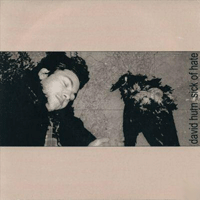
REVIEW – David Hurn: ‘Sick Of Hate’ single, 1999 (“drained of energy but not of humanity”)

26 Sep
David Hurn: 'Sick Of Hate'

David Hurn: ‘Sick Of Hate’

For better or worse, former Ever-Opening Flower frontman David Hurn left behind a lot when he quit that band’s deep-blue, textured shades and unusual blend of Rain Tree Crow, Rush and Morrissey. It wasn’t just the rock-band muscle and ghostly electronics that Ever-Opening Flower offered, but the aggressiveness of the detail; the assertion and meaty impersonality offered by a pushing bass, rock drumming and high amplification… the way it can obstruct and drown any soft brush of associations which you might want to imply rather than state outright. Pros and cons.

Left to his own devices, Hurn’s songs are hushed, internalized, almost entirely acoustic; and none of them rises much above a whisper. His guitar and the wistfully resigned tones of his low-tenor voice are joined by droplets of detached, forgetful piano and the sorrowful whistle of detuned radios. Sick Of Hate is a spare, isolated, note-picking thing; drained of energy but not of humanity. It’s the soft, tired noise left behind after the London bustle has passed and the frantic energy has ebbed. “I’m sick and tired of hate, / Of rain on the streets./ You and me are far too small to make a difference…” If it fights back, it fights back like the grass – bent back by hostile forces but refusing to be shaped by them.

There are some shades of Red House Painters (and the perennial Nike Drake) in there. It’s the sighing gloom, the mouse-like quiet; the way you have to focus yourself in on the story, to have to want to care before you can get anything out of it. You’re eavesdropping on the final deterioration of a love affair, the lack of conclusion after the arguments become meaningless. David murmurs “The mess that we made needs cleaning up for the last time. / Are you feeling weak and poor, or just tired?” In some ways Sick Of Hate also looks back towards Hurn’s old debt to David Sylvian; but where Sylvian wraps himself in impenetrable mystical robes and perfects the shamanic droop of his eyelids, the other David still cares about the realities ruling the strained existences of everyday people. “The value of our lives, that we would both die for – / but something’s telling me the truth matters more…”

The B-side – (For Missguided) – is Hurn at the ambient guitar sketchpad. He improvises with sombre, spinily picked chords on his acoustic and with moaning soundscapes of experimental string noise: pings, knocks and microtonal whale whispers. It’s like the spookier moments of Pink Floyd’s ‘Meddle’, or like Bill Nelson locked in with Bert Jansch during a rain-swept dusk. In its way, it continues Sick Of Hate’s autumnal atmosphere of regret, inertia and (with its empathic sense of resignation) even a touch of grace. While the bittersweet fog of sadcore usually blows, trapped, around the happysad streets of San Francisco (or wherever Will Oldham or Bill Callaghan might be hanging their battered hats), David Hurn, a prince of rueful shrugs, is establishing a bridgehead for it over here in the tired old brickwork of the Smoke.

David Hurn: ‘Sick Of Hate’
day Release Records Ltd., DR105
7-inch vinyl single
Released: 1999

Buy it from:
original vinyl single was a limited edition of 1,000 copies – buy it secondhand, or download from Bandcamp.

David Hurn online:
Homepage Facebook TwitterMySpaceSoundcloud Bandcamp Last FM

September 1999 – album reviews – John Ellis’ ‘Spic’n’Span’ (“a minor treasury of passing ideas”)

24 Sep
John Ellis: 'Spic'N'Span'

John Ellis: ‘Spic’N’Span’

The lifespans of pop musicians are usually measured in five-year units – generally just one each before they’re inserted into the “where are they now?” file. But for every ten who went into hostelry, college lecturing or millinery, one adapted and carried on the journey as best they could and perhaps saw how their talents and ideas could fit into the next stage.

As guitarist, songwriter and sound-shaper John Ellis is hardly a household name, but his work and adaptability have both been consistent. He’s already discreetly chameleoned his way through three decades of music. A founder member of The Vibrators during the punk era, he went on to play an integral role in the Peter Hammill and Peter Gabriel bands over the cusp of the ’70s and ’80s. Links with Jean-Jacques Burnel eventually led him (along with Paul Roberts) into the post-Hugh-Cornwell Stranglers line-up; he developed an electronica sideline via his digressions into gallery music, There’s even a touch of prog beyond Gabriel and Hammill: John also plays guitar for Judge Smith’s ongoing “song-story” projects.

John’s journeyman credentials are unquestionable, and to each position he’s brought his own supporting voice and particular marks. However, always being the lieutenant means some of your ideas bounce off the boss (or the inflexibility of circumstances) and get stashed away. ‘Spic’N’Span’ corralls together unheard odds’n’sods from John’s curvy journey through music, and consequently it’s a musical scrapbook rather than an album.

A third of the tunes are the kind of thing that many working musicians knock out for TV music library discs – bright jingles and “we’re going somewhere” music, executed on cupboard synth orchestras. The synthetic Euro-funk/perky testcard tunes of Wild Talent and Tune-O-Matic fall into this category; as do the flying-over- mountains melody of Early Riding Daddy, the New Age-y pop march of The Needs Of The Soul and the rather more ambitious baroque-jazz stylings of Running Through The Trees. Still… behind many of these you can hear little pop chicks trying to hatch out of the multi-track demos, hoping to drop into the collective lap of an ’80s boy band, to do that five-year round; and to then cheat death by popping up in a nostalgia DJs record box, taking a ride on a revival. It might not have actually happened, but then the business of selling songs has always been a bit of a lottery.

Another third of ‘Spic’N’Span’ is a set of genuine ’80s pop songs. All of these are produced in the squeaky-clean studio fashion of the time; but all are executed with the restraint, intelligence and puritanical zeal of post-punk. The pin-sharp shimmy of John’s guitar is the linking factor – wailing away on E-bow sustain, sparking off claw-hand finger-picking, or adroitly yanked from note to note.

Three of these songs are sung by Alex Legg – his spooky vocal resemblance to Peter Gabriel shows us how things might have been had Gabriel and Ellis joined forces and run off together into the showy pop territory eventually colonised by Tears For Fears instead. The Space Between Us (a soulful, regretful R’n’B lament of hostility, injustice and enmity) could easily have fitted onto an album like ‘So’. Similarly, Joe Jackson would have been proud to have written the pumping Monopoly (the biting list song of an abusive marriage, a woman’s increasingly desperate attempts to escape it, and the grim consequences). Off on its own, the John Greaves-ish piano song Mumble Jumble (pointing up the Ellis art-school/art-rock background) ponders the confusions and blocks of language.

Two more songs are sung by John himself. Giving Up The Ghost, with its airbrushed console-blues sound and phantom horn section, strives after the authenticity of roots Americana only to arrive as a Eurythmics B-side instead. But the glinty, polished Elevator Man (which sounds more like Steve Harley doing J-pop) works better, capturing the arch giddiness of stardom from a slight but crucial degree of separation. “I went from rags to riches, from riches to rags. / I was an overnight sensation.”

Then there’s a third section: a couple of tunes which seem to be trying for the early ’80s link between electro, hip-hop, and primitive British synth pop. Such is the buzz and piping of Stutter Gun with its earnest, uptight vocal samples and its synaesthesic theme: “it’s beautiful… the colours will flash… the sounds will embrace you.” Jimi Jam studs its gurgling electro with little sampled Hendrix asides – “Hey, what’s happening?… Oh no, I think I’m out of tune.” Discreetly decorated with wobbling wails of clean sustained feedback, it’s so cheerfully plastic when compared to Hendrix’s controlled brinksmanship that it has to be a piss-take.

There are also a couple of genuine, delightful misfit chunks in the stew. The panoramic zither chug of One Way Street walks in step with Trans-Global Underground in its mess of world beats, the spine-shivering harmonies of crowd hums from old Lomax recordings, and the Republic serial dialogue snippets (“All the streets are one way!”; “What better way to commemorate the dead?”). John performs a solo joke on The Best Part Of The Cabbage: woozy slide guitar and sleepy voice shambling out a ramshackle joke-blues on cannibalism. (“Looking at you, I lick my lips…”) The sensuous laziness of the tune offsets the wonderfully appalling humour: “If you ain’t got a fridge yet, there’s not much on a midget – / a mouthful, or two.”

A minor treasury of passing ideas, ‘Spic’N’Span’ will never be more than a curio, but one that remains open and friendly throughout.

John Ellis: ‘Spic’N’Span’
Furious Productions (no catalogue number or barcode)
CD-only album
Released: September 1999

Get it from:
Best obtained second-hand: this was released as a very-limited-edition run of 50 copies, so it’s extremely rare.

John Ellis online:
Homepage Facebook MySpace Soundcloud

The Nazgul: ‘Plujectories/Habitually’ single (“ugly things going about their business”)

18 Sep
The Nazgul: 'Plujectories/Habitually'

The Nazgul: ‘Plujectories/Habitually’

The Nazgul – shadowy figures from the most obscure Krautrock fringes of the ’70s – are back. And lurking in full public view.  They’ve been occasional housemates of Tom Waits, and probably got the chance to have a gnaw on his bone machine. They’ve been studio ghouls scratching atmospheres out of trash and implements down in the Turkish quarter of Cologne in the mid-’70s, and they’ve been people who don’t just seem to coax sound out of the most unlikely sources, but draw it out via seance. The rumour is that they’ve even developed a way of recording ghost voices from over-amplifying the signals impinging on bare wires. And these two tracks – crouching malignantly on a new slice of black vinyl – were recorded using only voice, twenty-foot drainpipe and 270 feet of microphone cable. Oh, plus an accordion, for that homely folk edge. As if.

Forget the motorik aspects of Krautrock; forget the shapes it scratches and growls, whatever its texture. The Nazgul have taken it to a point where there’s almost nothing but texture: a rhythmless, frighteningly impure cloud of sound shot through with disturbing noises. Plujectories is a thick worm of static hiss, whirring compressor grind and bass-bin hum, scratching through your ears like a fibreglass cotton swab. Lunging ghostlike through the centre are flattened steam-whistle screeches, the shrill treble songs of nerve-fibres being burnt through, sometimes a barely-recognisable voice stretched in a submerged roar. It’s the sort of sound you’re scared to imagine a microphone collecting, because of what that implies about the world it’s listening to. You close your eyes, and imagine the solar flares burning through your house.

Habitually is more accessible. Hmmm. As if that mattered at this stage of the game. Although as soon as it’s let you in, you feel as if something dark has closed in behind you and cut you off. It’s an experience, a sound picture of an unsteady walk along a polluted foreshore. The crunching and crackling noises that slide around you could be the sand crumbling beneath your feet and dissolving under the dirty water, could be the stone and mortar of the old dock wall disintegrating like perished rubber; could even be the air frying and corroding under the malignant fumes emanating from that squat, broad, frightening factory over the estuary. Distant boats slither past on the sullen greying surface of the water, no faces showing on deck. Occasionally harsh dark chords and dischords blow out, looming up to enormous foghorn dimensions – something to flinch at. There are slammings, as of giant train doors: and, always around, the barely-there voices. Whistling, rustling, wheezing and gasping, part of the architecture of this corner of nowhere good.

But The Nazgul somehow seem to make all of this sound like… just another dark day, ugly things going about their business as the world slowly chokes on the last polluted shreds of its poisoned lifetime. One of the scariest things to consider is the fact that people can get used to anything. The Nazgul are up on the harbour wall watching you as you come to realise this, while you’re knee-deep and imperceptibly sinking in the dull sand. And they’re wraithed in smiles.


The Nazgul: ‘Plujectories/Habitually’
day Release Records Ltd., DR103
12-inch vinyl-only single
Released: July 1999

Buy it from:
Best looked for second-hand.

The Nazgul online:
No dedicated websites available.

September 1999 – album reissue reviews – King Crimson’s ‘In the Court of the Crimson King’ & ‘In the Wake of Poseidon’ 30th anniversary reissues (“an indisputable classic, but one which sits uncomfortably in the role: forever pulling at the seamless stylistic joins that hold it together, as if to test them to destruction”)

17 Sep

What can one say about a legendary record? Well, just have a look at the magazine racks in any record store and you’ll find that everyone’s got something to say about ‘Astral Weeks’, ‘Sergeant Pepper’, ‘Marquee Moon’, ‘Innervisions’… Dealing with the legend of King Crimson‘s debut is different, though. Partly because its impact is perpetually obscured by the revisionism of punk and current Americana; and partly because overtly literary qualities of legend are already there, squatting in the barbs of the flamboyant lyrics and present in every razz of saxophone.

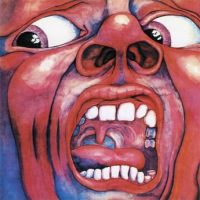
King Crimson: 'In the Court of the Crimson King'

King Crimson: ‘In the Court of the Crimson King’

There are various legends about the making of ‘In the Court of the Crimson King’. Collapsing producers. Good fairies with a taste for evil-sounding music, marching out of the astral plane to guide the compositions and performances. Even painter Barry Godber’s sudden death shortly after creating the distorted face that yells, horrified, from the cover. But then, few albums have engaged so flagrantly with the mythic straight from the first moment.

For better or for worse, ‘…Court…’ is the prog wellspring, responsible for all the dark castles, capering grotesques and mediaeval garments that’ve festooned its followers ever since. Whatever your expectations, you’ll find that it still sounds amazing. Remastering gives more savour to the feast, of course, but ‘…Court…’ has always been a record that jumps out and grabs you by the scruff of the ears.

No surprise here: that feverish pitch of attention has just been made a few inches larger all round, a bigger take on a picture that was big to begin with. It took, as its frame, a strongly European perspective – mediaeval-to-modern cities rubbed in the blood, flags and dirt of history and repeating cruelties, in which all that Tennysonian mooning around sundials and gardens is an integral, complementary part of that world. Later proggies fell in love with the idyll alone. Few besides Crimson had the capacity to engage with the violence that maintained that idyll, to relate it to modern-day realities so effectively, or to represent in music the confusing threads of history that made up that picture.

In the band’s sound you can hear the haughty, ghostly artificiality of Mellotron orchestras, the angry saxophone protest of Civil Rights jazz, and the squall of avant-garde chaos. However, it draws equally on hotel dance-bands from the wilderness of ’50s England and from the stormy wildness of Stravinsky, Bartok and the troubled classicism of the Eastern Frontier, with all the elements bound together by the expansive rock sensibility ruling the revolutionary roost at the time. And although Peter Sinfield‘s words are chock-a-block with excessively mannered Gothic metaphor and allusion, at their best they evoke plenty of the monstrosities that hung over the late ’60s. Spectres of Vietnam war trauma, twisted agriculture, political manipulation and malignant science all dance alongside his tarot-card shuffles of yellow jesters and purple pipers.

Although it’s guitar strategist Robert Fripp who’s forever seen as the boss of King Crimson, it was Ian McDonald who was the major player at this point. He’s the only musician listed on every single song credit, and he who left the band within a year because he felt (amongst other things) that Fripp was butchering his music. Standing between classical formality and jazz passion, he could leap readily into either with the intelligence to know just what to use. His fiery saxophones, elegant flutes and assured keyboards shaped King Crimson into the full-soundtrack monster they were, even now putting the lie to the idea that prog’s ornamentations were a flabby irrelevance. Michael Giles’s jazzy drumming is a masterclass in compressed percussive thinking: and as for Fripp, even this early glimpse of his playing displays a unique balance between cerebral focus and emotional demands – at least as intent as it is intense, from the humming wail of his electric solos to the spidery precision of his hooded acoustics.


The music itself has sustained pretty well across the album and across history. Perhaps its claws seem fussily manicured compared to the raw filth’n’fury The Stooges would unleash a few years later, and which would ultimately leave a stronger mark on today’s underground. But then again, the Stooges never flung their ideas as wide as Crimson did. 21st Century Schizoid Man remains among the most accurate and nasty rock pieces ever laid down on tape, as ferocious as any punk body-blow. McDonald’s brass-knuckled horn attack and the ugly strands of distortion add a raucous streetfighter’s edge, Sinfield contributes a tearing sketch of distress and conflict, and the entire band roar off across a delicious violent staccato charge like a murderous hunt closing in on the prey.

In contrast, Epitaph is a theatrical, lushly orchestrated anthem of doubt and foreboding – mannered by the standards of the bombast that’s followed (from Yes to Oasis), but universal enough for any era of coming trouble. Mellotron strings and kettle drums lumber into the darkness like the Flying Dutchman. While the young Greg Lake’s impeccably enunciated singing (still a year or two away from his ringmaster swagger with Emerson, Lake & Palmer) might’ve always been too formal, too educated to make him a real rock’n’roller, the apprehensive angst of his delivery here is perfect – “If we make it we can all sit back and laugh / But I fear tomorrow I’ll be crying…”


Perhaps it was inevitable that ‘…Court…’ would be touched by the flower-strewn, Anglo-Celtic folk impressions that were also sweeping through pop music at the time – and this is possibly the album’s Achilles’ heel. I Talk to the Wind (midway between McCartney and Donovan, dominated by McDonald’s dusky flutes) ultimately proved universal enough to be reinvented for the ’90s dance crowd by Opus III, and the original still sounds as lovely today, a more melancholy existential take on Fool On The Hill. But Moonchild risks sending new Crimson initiates away snarling. Only Fripp’s eldritch vacuum-draining howl of guitar raises any question of a world outside this bubble of mediaeval English hippydom, winsomely sucking in its cheeks and playing at courtly love; its talk of silver wands and milk-white gowns only a whisker away from a simper.


And the excessively muted free improv that follows – broken whispers, pings and shuffles between guitar, drums and vibraphone – is guaranteed to piss off anyone who was fired up by Schizoid Man’s driven nerve or Epitaph’s towering romantic majesty. If you listen hard, though, the remaster reveals in full the telepathy of the Fripp/Giles/McDonald interplay, allowing you almost to hear the thoughts that kick out each nimble, abbreviated scurry of sub-audible notes… But you’ll need to listen. Even then, King Crimson could be uncompromising about the value of all of their music; and however much perspective thirty-odd years may have given us on their intentions, the consequent imbalances on their debut remain as frustrating to the floating musical voter as they ever did.


The title track of ‘In the Court of the Crimson King’ – also the finale – sets the seal on the album. For good or ill, it leaves us with another slab of McDonald/Sinfield orchestral folk balladry, closing the record with a mediaeval flavour (tootling pipe organs, choirs of monks, thunderheads of Early Music strings) and without a hint of the alchemical rock momentum to counterweight Sinfield’s Gothic metaphors of palaces and fire-witches.


‘In the Court of the Crimson King’ is an indisputable classic, but one which sits uncomfortably in the role: forever pulling at the seamless stylistic joins that hold it together, as if to test them to destruction. It’s one that forever splits the voters. As they watch the music pounce from peak to dissimilar peak, many realise that it suffers from the way it never entirely resolves the band’s magnificent talents for more than nine minutes at any one time.

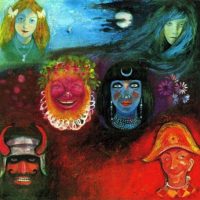
King Crimson: 'In the Wake of Poseidon'

King Crimson: ‘In the Wake of Poseidon’

It’s odd to find that King Crimson’s second album ‘In The Wake Of Poseidon’ – recorded with a depleted band and a floating pool of guests, and usually seen as the debut’s feebler brother – should solve many of these problems. But solve them it does. Remastering, like the cleaning of an oil painting, has restored plenty of the innate presence of an album which always seemed to suffer from the whispers in between the shouts. It’s subdued compared to the brazen ambition of ‘…Court…’, with the recurring acoustic Peace theme sounding apologetic compared to former roarings.


There is, admittedly, a sense of people arranging things tidily before they leave. Ian McDonald – then seen as King Crimson’s heart – had already vanished by that point, off to fashion a lighter, more summery pastoral prog elsewhere. Mike Giles would shortly be off to join him, but – drumming on ‘…Poseidon…’ as a goodbye favour – he turns in a tremendously sympathetic farewell performance of subtlety and fire, far outshining his work on ‘…Court…’. Greg Lake, too, has his own hand on the doorknob, waiting to depart to the ‘Top Gun’ frolics of ELP (meaning that Gordon Haskell‘s soft bumblebee tones take over lead vocals for ‘Cadence And Cascade’). Only Fripp and Sinfield – guitar and lyrics’n’lights respectively – would still be travelling in Crimson once the tape reels stopped moving.

 
Whatever the weaknesses of a splitting band, though, they are countered by the strengths of the guest players. Peter Giles (the remaining part of the pre-Crimson Giles, Giles & Fripp trio) provides rich, intuitive bass playing. Mel Collins‘ saxophones and flutes are bold and assured in interpretation; and while most of the expansive ensemble keyboards on ‘…Court…’ departed with McDonald, the inspired British jazz pianist Keith Tippett provides perfect contributions wherever needed (with Fripp picking gamely up on Mellotron and celeste).

Ironically, King Crimson as enforced studio project recorded more convincingly on album than King Crimson as gigging band. The textures are fuller, the dynamics subtler and more secretive (check out Fripp’s near-inaudible fretboard sighs on the midsection of Pictures of a City). And although McDonald’s absence is felt, and his musical imprint haunts ‘…Poseidon…’ from beginning to end, King Crimson were learning more about consistent balance.


They were also learning about how to reconcile their taste for baroque fantasy with a closer reflection of reality. Pictures of a City, rejoicing in a delectably nasty jazz-horn vamp and razor-wire Fripp guitar, reinvents New York as an overground circle of Dante’s Inferno in which Sinfield runs wild with information overload (“bright light, scream, beam, brake and squeal / Red, white, green, white, neon wheel”). Cadence and Cascade’s sleepy song of groupie courtship sees Tippett and Fripp trading glimmers of piano and celeste beyond an atypically gentle acoustic guitar, anticipating Nick Drake’s riverside reveries by several years. And even if the huge title song’s laden with yet more layers of Mellotron and Edgar Allen Poe imagery (harlequins, hags, midnight queens, chains and madmen all jostled together), Greg Lake – in a last burst of empathy – cuts right through to the heart of Sinfield’s overwrought symbolism, and delivers it as a magnificently poignant galactic swan song.


The first half of ‘…Poseidon…’ might mirror that of the previous album (matching the violent/pastoral/symphonic alternation of Schizoid Man, I Talk to the Wind and Epitaph) but the second half is a very different story. There’s Cat Food, for instance – one of the few Crimson singles, and as tuneful and as cheeky as anything on ‘The White Album’. This pulls out all the stops so far left untouched. In one lateral-thinker’s spring, Tippett advances from sensitive accompanist to aggressive frontline collaborator, hammering out explosive scrambles of piano notes and barrelhouse staccato. Lake hollers an absurdist Sinfield supermarket tale, Fripp toots and yelps jazzily and the Giles brothers jump in and out of each others’ syncopated footprints. It winds down in an animated mixture of excited jazz stutter and beautiful Debussian piano flourish, having blown apart King Crimson’s po-faced reputation for a few minutes. At the same time, it’s given them access to pop’s wonderful holy-fool zone, where playful silliness cracks open a reservoir of sheer joyous inspiration.

 
Matters turn far more serious when Fripp – whose musical responsibilities were doubled and weighed heavy on him after McDonald’s departure – takes over the remainder of the album. For The Devil’s Triangle he’s left pretty much to his own devices, putting his guitar aside to lean heavily on occult Mellotron and keyboard textures. Although the initial results draw heavily on Crimson’s infamous live interpretation of Gustav Holst’s ‘Mars’, they go far beyond it and into the dark shadows of avant-garde sound-sculpting and musique concrète.

Dark, trapped minor-key harmonies hover on the edge of terrifying dissonance, a constantly pitched battle march is suddenly hideously yanked up in pitch as Fripp assaults the tape speed, and found sounds (bits of orchestra, samples from the previous album) glint in the fog. Tippett contributes butcher’s piano, like a sledgehammer through glassware. At one point, hot wind scours the studio of all other sounds save that of an interrupted metronome. The full band return for an unresolved finale, surrounded by shrieks, whistles and a baroque circus melody on a tinny keyboard playing scratchily over the top of them, before Mel Collins’ cloud of flutes cast down the tension and bring it to a close as the Peace theme returns for a hushed (if ultimately unresolved) finale.


If the mark of a classic is tight conceptual continuity, then ‘In the Wake of Poseidon’ fares little better than ‘In the Court of the Crimson King’. But in a quieter way, it achieves its ambitions with greater consistency, taking on King Crimson’s multi-levelled world view and presenting it with less arriviste flash and a more mature grip on its latent chaos – something which Fripp and Sinfield would pursue further on the next album.

Beyond that, both albums still remain as another high-water mark (flaws notwithstanding) in rock’s assimilation of other musical forms. Held together, they’re a fascinating (if frequently stiff) European counterpart to the multi-media explorations of The Velvet Underground or Miles Davis’ polychromatic meltdown music on ‘Bitches’ Brew’. This music still sounds mythic, enrobed, and somehow atavistic; as if it was made for Old English giants to knock down the world’s cities to.

King Crimson: ‘In the Court of the Crimson King”
Virgin Records Ltd., CDVKCX1 (7243 8 48099 2 8)
King Crimson: ‘In the Wake of Poseidon”
Virgin Records Ltd., CDVKCX2 (7243 8 48948 2 5)
CD-only reissue albums
Released:
14th September 1999
Get them from: (2020 update) Both records have now been superseded by 40th Anniversary Editions with new remastering and additional tracks. Current or former versions can be obtained from the King Crimson stores at Burning Shed and the Schizoid Shop.
King Crimson online:
Homepage Facebook Twitter MySpace Soundcloud Tumblr Last FM Apple Music YouTube Vimeo Deezer Google Play Pandora Spotify Tidal Instagram Amazon Music
 

LOOKBACKS – album reviews – Cindytalk’s ‘Wappinschaw’, 1994 (“one of 1994’s most intense, perverse and unusual lost albums”)

30 Aug

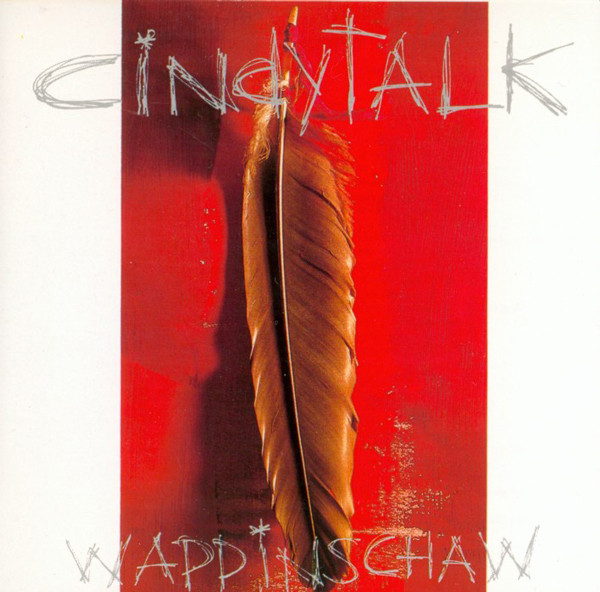
Cindytalk: 'Wappinschaw'

Cindytalk: ‘Wappinschaw’

For almost fourteen years now, Cindytalk have been forging a lonely path through the ever-changing styles of modern music. Despite the soft pink flush of their name, Cindytalk’s music has always been so out-there, so much a music of violent extremes, that they have (more or less by default – how much could you change when you touch both ends of the spectrum?) stayed the same – no bad thing – while refining their sound on each album.

Gordon Sharp, the mainstay of Cindytalk’s many line-ups, is perhaps best known as the voice of three haunting tracks on the first album by 4AD art-collective This Mortal Coil, which also spawned Elizabeth Fraser’s honey-drenched version of Tim Buckley’s Song To The Siren in 1983. Yet 4AD-ethereal was never really Sharp’s bag. Cindytalk operate in the same dark areas that Michael Gira and Swans did before they transformed into doom-laden acoustic hippies (no more titles like Raping A Slave, then, Michael? cheers, love!), or The Birthday Party before Nick Cave mellowed out into Satan’s crooner.

They’ve wilfully, awkwardly, pursued music of extremes. Their first album, ‘Camouflage Heart’, must rank somewhere alongside Lou Reed’s ‘Metal Machine Music’ for sheer unlistenable music for (dis)pleasure, that has to be owned simply to piss people off. And the mammoth ‘In This World’ was a double album of contradictions – one record of near-industrial rock with razor-sharp guitar sounds (varying between tooth- extraction by electric power drill or sheet-metal white noise), and one record of near-ambient instrumentals and songs, mostly played on very soft piano like Erik Satie on Mogadon.

But it’s been a long time since any new Cindytalk material; perhaps because of artistic reclusiveness, perhaps through being a true cult act. Having already had a protracted recording between 1990 and 1992, this album took a further two years to emerge on a record label in 1994. A lone concert aside, we’ve heard nothing from them since (that’s what y-o-u think.. – ED.). Hence this five-years-after-the-event review: cults can always do with getting bigger while they wait for the resurrection.

So, ‘Wappinschaw’; one of 1994’s most intense, perverse and unusual lost albums…


It opens deceptively simply, with an a-capella reworking of Ewan MacColl’s The First Time Ever I Saw Your Face, reflecting Gordon Sharp’s interest in folk idioms (especially his own native Scots). He’s singing solo, without echo or reverb, up close, right there in your darkened room. His voice – one of the most expressive at conveying rage, pain, fear – displays power here yet, somehow, also insecurity. A Song Of Changes is leaden-paced at first, but David Ros’ guitars are more blurry and hazed than previous industrial strength Cindytalk noise. Suddenly the guitars hit an almost bright riff around which Sharp fluctuates and soars. A song of changes, indeed – light is breaking into Cindytalk’s dark world: “Within the heart of everything, there is you…”


It doesn’t last, though. Return To Pain (hah!) lurches in on a mix of barely-scrubbed electric and slide guitars, creating an empty and menacing atmosphere as Sharp emotes through wordless high vocals. It’s nightmare swamp music, midnight in the Mississippi plains accompanied by the scariest of companions, before the tension explodes into a barrage of noise. Drums, shotgun guitars, and Sharp wailing that “everybody is Christ.” Y-e-e-es; whatever you say, Gordon.


Whichever expectations are set for them, Cindytalk trump them on this record. Wheesht is introduced by a tape of Alisdair Gray reading an extract from his mammoth Scottish psycho-epic ‘Lanark’: a story of a young boy dreaming about what lies beyond the clouds. Recorded over the sound of a ticking clock and a ghostly musical box, this exercise in unsettling atmospherics chills the spine and sets us up for Wheesht itself: a brutally short, non- musical violent collage of bass drones, sonic interferences, sampled voices, blood-curdling screams and other genuinely unnerving sounds.


To the looping, echoed scrapings of a low-tuned violin, Snowkiss restores some sense of calm with more of Cindytalk’s music for winter nights – Gordon’s vocals imploding out of their rage into delicate lines and wordless harmonies sung over the gentlest of chiming, raindrop pianos. The lyrics of Disappear evoke a painfully trapped life: “You’re in heaven now, / Inside your head. / No thoughts of flight, / Your wings are clipped…”, while a strongly martial beat provides the tracks only propulsion as guitars and sampled interference compete with each other in a swirling eddy of sound. The lively, echoing trumpet on Traumlose Nacht, mingled with delicate piano and evocative waves of rolling drums, provide some relief and a different sonic vocabulary – it sounds like incidental music for the dark magic and oppressive heat of ‘Angel Heart’.


The final track, Hush, starts as an guitar-and-solo-vocal acoustic lament (back to the folk singing of the opening track) but then gives way to influential voices from the heavens (including samples of Orson Welles and Joseph Beuys) before everything fades to leave a long passage of bagpipe music that is, after the tumult of Cindytalk in action, strangely beguiling and soothing… but wait. After a long pause, a final hidden track, Muster. An incendiary, veritably Napalm-Death’s- worth battery of hideous thrash-noise, over which Sharp’s passionate ragged voice issues forth evocations to notable spirits: “The Wappinschaw is an invocation of the spirits of Shiva: Rise, William Wallace, rise! Rise, Arthur Rimbaud, rise!” He goes on to summon the spirits of Pasolini, Sitting Bull, Che Guevara and Ho Chi Minh, amongst others. So unearthly does Sharp sound, so compelling, that I have no doubt that the spirits responded. Quite the most disturbing sound heard on CD for some time.


I wouldn’t like to hazard too close a guess at what kind of emotional traumas Gordon Sharp purges from himself to make this music; all razor blades, blizzards and crow feathers. It’s enough to say that, after fourteen years on the extremes, Cindytalk demand your rapt attention, your horrified fascination…

(review by Col Ainsley)

Cindytalk: ‘Wappinschaw’
Touched Recordings, TOUCH 1 (5 021958 432021)
CD-only album
Released: 1994

Get it from:
(2018 update) best obtained second-hand

Cindytalk online:
Homepage Homepage Facebook Twitter MySpace Soundcloud Bandcamp Last FM

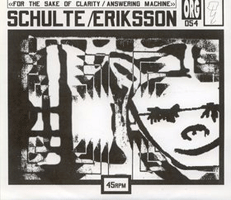
August 1999 – EP reviews – Schulte/Eriksson’s ‘For the Sake of Clarity/Answering Machine’ (“a loose cluster of stoned bees”)

24 Aug
Schulte/Eriksson: 'For The Sake Of Clarity'

Schulte/Eriksson: ‘For The Sake Of Clarity’

It’s an inviting idea. Anna Schulte and Lisa Eriksson sit around in a room in Liverpool with a couple of detuned guitars and some basic looping gear (plus a pair of rhythm-section men borrowed from Mersey psychedelics The Living Brain) to see what happens. They hum out songs and snatches of conversation in a way that’s always on the verge of crumbling to bits, but still holds together, like the immortality of crudded-up cobwebs – lots of interesting little fragments bound up in a tenuous snaggle.

Listening to the bits and pieces of lo-fi invention which they’ve kept on tape shows that Schulte/Eriksson have something in their music like the wobbly stagger of Captain Beefheart’s bloodshot jamming. Or like the scratchier bits of German science-rock that get played at you during music parties (the ones where the competitive art-freak boys are trying to uber-weird each other). But Anna and Lisa seem totally unconcerned with any of these fixations on pointers and signifiers. They’re an offbeat double act, sounding simultaneously bizarre and totally natural. It’s not just their German and Swedish accents as they bounce off English ears. When one of them asks the other “if I say the word ‘sexuality?’ to you, what do you think about that?” she’s met with an incredulous giggle (as if she’d asked “what sound does bread make?”) and neither of them come up with anything.

There’s something warm and alien about these women. Likeable but unreachable – like the futile task of trying to make a cat explain itself, trying to get beyond that affectionate and satisfied manner that displays nothing you can recognise and use for leverage. Interviews have (so far) revealed a pair of women totally detached from earnestness, preciousness or any other self-conscious qualities, and with a simple and unconcerned desire to just let music come.

The music, scribbling and swerving across the grooves of their single like a loose cluster of stoned bees, seems happy to oblige. The straightest that Schulte/Eriksson ever get is the bizarre jazz-train lurch of For The Sake Of Clarity. Their guitar (tuned with a kind of hummingbird logic) hop and pump ahead of the beat; their voices play up and down in stretchy harmonies. “Henry Kaiser playing a samba” is one possible description. I’m also wondering whether Sonic Youth might have produced something shaped like this, in the sweet muzziness after a Brazilian bender.

In Answering Machine the blokes from the Brain bash and stumble away manfully to give the song a bone structure, but in vain. All of the attention goes to the way Lisa and Anna’s voices tug up at their dismal otherworldly sag of guitar chords and take it to somewhere else. For the queasy First Ear Reset/Schaller/Riff, they sound like they’ve turned their guitars upside down: more perturbing jazz-punk chords and steam-whistle tweets yanked off the strings. A violent riff smashes in from another tape and shuts everything down. Their serene smiles probably didn’t drop a notch. But they were obviously laughing when they stuck a phony dance-pop title onto Bassline Loop/No. 1 Hit – it’s about a minute of drunken, tarry slide guitar and murmuring voices which are suddenly exposed as the instruments fall silent and intersect in lovely arcs like a tiny choir of mediaeval nuns… just as the tape runs out.

Scratching cheerfully at the join of subconscious and curiosity, Schulte/Eriksson might use a disorienting private language to run the dig – but you still feel invited to perch nearby. If you’ve ever felt like sitting in on the beginnings of music, here’s a chance to do it.

Schulte/Eriksson: ‘For the Sake of Clarity/Answering Machine’
Org Records, ORG 054
7-inch vinyl-only single
Released: 1999

Buy it from:
Org Records, or look for it second-hand.

Schulte/Eriksson online:
MySpace

July 1999 – album reviews – Tony Harn’s ‘Lifebox’ (“settle into the music’s bright and rapid embrace”)

24 Jul
Tony Harn: 'Lifebox'

Tony Harn: ‘Lifebox’

Since striking out on his own with ‘From The Inside‘ in 1997, Warringtonian guitarist Tony Harn has gone from strength to strength. It’s not that ‘Lifebox’ is all that different from its predecessor. It’s the same recipe of glittering, admirably economical rock guitar arrangements backed up by simple keyboard sounds and lightly-cymballed percussion programming – the sort of thing that would have made Harn a hero of British instrumental rock in the 1970s, or even the ’80s. In the late ’90s, it makes him more of a finely-tuned curio. A guilty pleasure.

Still, being out-of-step with the times has little to do with your innate value; and Tony Harn’s got plenty of that. His concept of melodic rock moving towards a jazz vocabulary has had to pass through a Manchester filter first. There’s a lot of meticulousness and post-industrial reserve here, an underlying balance of sounds and patterns that’s got more to do with Factory-style Futurism than feet-on-monitors and flailing hair. Not that Harn’s cover photo – the purposefully-shaven skull and meaningful gaze – shows hair to flail anyway.

In a nutshell, Tony Harn is what Joe Satriani might have been if he’d had Durutti Column’s sensibilities. His full-blooded melody-metal tone, his tunefulness and his sweet tooth for rock romanticism is reined in by Northern English economies on gesture and gush. Except for a solitary Van Halen moment – a short-lived explosion of devil fingers called Reaction:Release (In One Motion) – all is controlled and thoughtful. Layers of staccato echoed phrasing and delicate flat-picked motifs interplay with tuneful, assured lead lines. Harn’s guitars can chatter and circle busily, or pine away in expressive overdriven wails, all without letting the music lose its well-suspended balance. It can be as dignified as fine civic architecture, or it can roll like a landscape of green English hills. Pastoral, but never pastel; surprisingly serene, but not soporific with it.

And (if all of this isn’t starting to sound too cute) proggy without being boggy. Since the sometimes-perfunctory tunes of ‘From The Inside’, Harn’s developed a well-deserved confidence in taking on longer-form compositions. The fifteen-minute, multi-phase Reaction:Repeat (In Six Motions) bubbles with understated invention – it’s a drawn-out, trance-y rockscape of shifting heroic tunes and dance pulses, bouncing off the same constellations as Porcupine Tree did on ‘Voyage 34’. Split The Sketch jumps from sleepy church music (cavernous swells, sweet-dream melody and the chink and whisper of string noise) into the sort of split-metred riffing and racing arpeggios that Steve Hackett would’ve been happy to set his name to. Blue Blazes doesn’t go for length, but for shimmering detail, weaving tiny repetitive phrases into sky-written spirals around an airborne ripple of synth.

Even if his silvery jazz-inflected chording doesn’t quite qualify these efforts as fusion, Harn’s push towards jazz is becoming easier to distinguish. You can hear him trying out conversations with the themes in Eve Of Obligation; and if you listen beyond the diamante guitars on Pseudotalk, you’ll hear a pretty, melting tune that wants to sit down with a jazz quintet and make friends. But if Harn does move into that world, it shouldn’t be at the expense of the straightforward and joyful way he expresses his melodies – the folkiness of Last Town, the wedding bell tumble of Twelve Years, or how his romantic heart sits self-evidently on his sleeve for Forgotten Summer as his guitars and bass court each other. It shouldn’t be at the expense of digressions into haunting soundscaping such as Dark Age; in which, through organ drift and dreaming guitar sculptures, a girl’s guilt-stricken voice murmurs “I never used to think about it before.”

This, after all, is that rare breed of rock guitar album – one which you play not to worship at the Church of Guitar but to settle into the music’s bright and rapid embrace, and to lean back into it. ‘Lifebox’. A good name for such an unassuming package, spilling out such fertile enthusiasm.

Tony Harn: ‘Lifebox’
Tony Harn, THCD2 (no barcode)
CD-only album
Released: 1999

Buy it from:
Limited availability – contact Tony Harn for information.

Tony Harn online:
Facebook MySpace YouTube

July 1999 – album reviews – Darkroom’s ‘Seethrough’ (“dropping casual, vinegar-dry references while somehow maintaining a ghostly mystique”)

22 Jul
Darkroom: 'Seethrough'

Darkroom: ‘Seethrough’

Transparent neither in style nor intent, Darkroom’s second album is demanding, mysterious; trickily opaque. This is not an unfamiliar position for this most obscure, obscured and inexplicable of ambient/illbient groups. The billowing instrumentals of Darkroom’s first album, ‘Daylight‘, made their points obliquely through a spray of trip-hop grace, thick detail and industrial derangement. About half of ‘Seethrough’ follows a similar path – baleful/beautiful semi-improvised noisescapes of layered electronics, angrily-stewing loop guitar and naked caress-through-to-howl vocals.

Resident synth necromancer Os fires off ratlike background rattles and spectral drum’n’bass rhythm triggers on the glutinous and dubbed-up Galaxy Craze, a threatening arrhythmic undulation in which Tim Bowness’ minimal, wraith-like subway singing is menaced by a fretless bass guitar part which probes like a giant animal’s tongue. On Charisma Carpenter, old-school ’80s synthpop riffs underpin the dense aviary heat of Michael Bearpark’s textured guitar. These OMD-styled tinklings make an unexpectedly cheerful counterpart to Tim’s lustrous and vaporous vocal chanting, which remains the most bizarre aspect of Darkroom’s music. Singing mere tumbling vowels, or sounds on the edge of becoming words, Tim delivers them with an eerily precise and chilly diction: like droplets of love-song which freeze to alien sleet as soon as they leave his mouth.

In spite of the textural invention and intelligence at work, only Kaylenz hints at the shocking intensity of Darkroom at full, live, improvising intensity. It takes up fourteen sprawling, disorientating minutes of the album, during which the tension between the celestial and the pestilential growing ever more violent. Electronica loops shade upwards into alarm, distorted hospital bells shrill. Mike’s country-toned guitar tang gives way to sharp buzz-edged swarming, while Tim’s vocals travel from weary, loving sorrow to a hysterical pitch of recriminations and a dash of lyrical perversity. Just before Kaylenz steps up – or breaks down – into a chaotic torrent of frighteningly emotional randomness, we hear Tim singing in a lost corner of the studio: a bored, beautiful, detached whisper of “you again, you again – / who’s to blame, if it’s all the same?”


This brings us to the wild card of ‘Seethrough’ – the presentation of Darkroom’s songwriting side, in which they sketch withering surreal portraits of disenchantment and alienation helped along by spacey glissandos of electric slide guitar. They’ve dabbled in words before (on the drum’n’bass/Fripp & Eno soundclash of the Carpetworld single) but here it’s more leisurely, more controlled; more disturbing. In some ways it’s an extension of Tim’s work on the cryptic dark-city musings of No-Man’s ‘Wild Opera’. In others it reflects the burnt-out, amoral contemplations of Tricky’s surreal, spliff-fuelled ‘Maxinquaye’.

If so, this is Tricky as played by Alec Guinness, dropping casual, vinegar-dry references to both Def Leppard and Janet Frame while somehow maintaining a ghostly mystique unhindered by the flapping of library cards. On the bobbing Morricone-meets-Orb dub of King Of The Cowboy Singers, Tim’s guarded, musical speaking voice recites both nonsense and significance to the beat – “trying to find a new life in an old boot, / walking to the new place in your old suit – / the king of the cowboy singers, / the toast of the Old School dinners…” The roiling, improvised star-stuff that usually pools out of Darkroom’s speakers is swapped for Dada-tinged narratives of shifting identities and habits; of introverted, stiffly English insanity and implosions of a starchy order.

Having said that, although Darkroom no longer quite sound as if they’re playing live from the surface of the sun, they’ve only retreated as far as a ski-lodge on Mercury. The glimpses of sky are always a bright merciless glare, the ground always dry dust; the scenery just a few steps away from white-out. Surly and blinded, Bludgeon Riffola surfaces through a swimming of harness bells as a filthy punk-blues fed through post-rock processing and glowing tracer-paths of needling synth-noise, Tim’s petulant vocals rope-swung and curdled with distortion.

The album’s masterpiece – the ten-minute stretch of Bottleneck – is blindingly white and exposed; a sinister mixture of Aphex Twin and Bill Frisell. Sparse, desolate slide guitar is chewed at by Os’ echoing dead-sea-surf static and smeared brass textures. Tim’s lonesome vocal (once it finally arrives) rides a stately dance of plucked orchestra strings, drawing out the shapes of a puzzle of betrayal and disgust. The charges are clear – “You never really loved your wife… / you never really knew your boys… / you never even liked the girl you said had claimed your heart – restart, restart.” But the story’s obscured: gaps between snapshots swallow it up. The figure of a man is reduced to a hat, a cigarette; an unfinished meal; an absence.

Then again, Darkroom aren’t here to provide clarity. Seethrough itself seals the album in a light and feverish running pulse, frosted by far-off gilded sprays of reserved prog-rock guitar. It’s tremulously sweet and frantic – trance-techno that’s neurotic rather than narcotic – and with a blurred, vocoder-ed vocal that queries the giddy transcendence of the music. “Too much misunderstanding; too much, too little love. / Too much to keep your hand in, too much to float above.” Dancing lightly on its feet, it moves with the crowd only to slip away quietly as the dreams evaporate. “Too much deliberation, too much you want to be. / Too much anticipation, too much you’ll never see – see through, seethrough.”

Blink, and it’s gone. Darkroom tease us with clarity, but lead us to a vanishing in the end.

Darkroom: ‘Seethrough’
Peoplesound, ART 4249-CD01
CD-only album
Released: 1999

Buy it from:
Original release deleted. 2003 remastered CD-R version available from Burning Shed; download version from Bandcamp.

Darkroom online:
Homepage Facebook Twitter MySpace BandcampLastFM

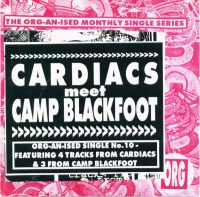
July 1999 – EP reviews – Cardiacs/Camp Blackfoot’s ‘Cardiacs Meet Camp Blackfoot’ EP (“an explosion in a fairground repair shop… a belting mixture of howling-for-vengeance free-jazz saxes, prog-from-hell and hardcore trash-blues”)

12 Jul
Cardiacs/Camp Blackfoot: 'Cardiacs Meet Camp Blackfoot' EP

Cardiacs/Camp Blackfoot: ‘Cardiacs Meet Camp Blackfoot’ EP

You already know Cardiacs, or you ought to. They’re that gang of besuited gentlemen from Chessington, Kingston and Milton Keynes – upsetters of pop rules known for busting out of tight waistcoats, with a sound like an explosion in a fairground repair shop. And who specialise in hatefully brilliant singles midway between masochism and ecstacy, as pleasurable as scratching a really luxurious, pestilential itch.

‘Sleep All Eyes Open’ doesn’t let that line of guilty pleasures down, tying knots in Super Furry Animals and The Glitter Band to make a glammy mess of noisy guitars and monkey-gland logic. Here’s something that really enjoys how gloriously dumb-to-the-max it is – listen to those handclaps, and that dum-dum riff bouncing its knuckles along the ground. Yet it evolves fast, ideas yomping around, running off into ever-more crowded angles and arguments while Tim Smith yelps like a circusful of trampolining dogs. Cardiacs always cram their songs to bursting point but never lose any of it to blind alleys or prog meandering. And if I still haven’t a clue what they’re singing about, I think there’s something in the back of my head which does, whooping and waving a flag whenever I hear them let something like this out of the box.

The five-year-old bonus tracks (from the mind-boggling ‘Sing to God’ album) haven’t worn badly either. ‘Dirty Boy’ hammers and claws through seven minutes of huge black-metal guitars and ends up flailing against the wall in an ecstatic stuck groove of wailing choir and electric-shock organ. Foundling is a mediaeval creak of sleep, death and aching men’s feet, worthy of Robert Wyatt. Finally, there’s a celebratory, singalongaTim instrumental mix of ‘Insect Hooves on Lassie’ – and that’s so tuneful it could get a corpse up and idiot-dancing within seconds. These guys are old enough to be Blur’s granddads, for God’s sake – how come they still make almost any other British rock group sound half-hearted and half-asleep?


Camp Blackfoot, hanging onto the other half of this EP, grab the challenge with both hands and a ravening mouthful of teeth. It says here that they’ve chewed their way out of the corpse of Thirteen Ghosts (Oxford’s finest in thrash-improv… hmmm), and they don’t bother with all that business of the dichotomy between social discipline and chaotic emotions. They just hit the record button and scream. A belting mixture of howling-for-vengeance free-jazz saxes, prog-from- hell and hardcore trash-blues comes tumbling out onto the carpet and burns a huge hole in it. Somewhere, Lester Bangs is laughing his head off.

If you wanted to hear serious avant-garde psychobilly locked into a no-holds-barred deathmatch with art-noise, you’ve come to the right place. Ruins forcibly manhandling the Blues Explosion into a blender wouldn’t even come close to the shredding monster-movie music of ‘The Blue Hood’; while ‘The Other Giaconda’ is what might’ve happened had King Crimson ever really exploded onstage in squalling Stooges style, neurotic precision blowing the safety valve a foot deep into the ceiling. And ‘The Red Mist’ tops the lot- squiggly Morricone noises that burst into enormous barbed- wire riffing and an epically hallucinating murder song, a weird doomed narrative which sees a desperate man’s mutter rising to a horrified scream: “The street melts under my feet… I’m drowning in a boiling sea of salt,/ faces are ugly / I – Mother of God!”


Songs to crash your car to, and the soundtrack to strutting away from the blaze looking cooler than ever. Not really something that works with Coldplay, I think.

Cardiacs/Camp Blackfoot: ‘Cardiacs Meet Camp Blackfoot’
Org Records, ORG 056CD (5 028151 010568)
CD-only EP
Released: 12th July 1999

Get it from: (2020 update) Limited edition of 1,000 – best obtained second-hand.
Cardiacs online:
Homepage Facebook MySpace Soundcloud Bandcamp Last FM Apple Music YouTube Google Play Pandora Amazon Music
Camp Blackfoot online:
Homepage MySpace Last FM YouTube Amazon Music

July 1999 – mini-album reviews – Philip Sheppard’s ‘The Glass Cathedral’ (“a whole chamber of cellos swimming off in a new direction”)

7 Jul
Philip Sheppard: 'The Glass Cathedral'

Philip Sheppard: ‘The Glass Cathedral’

Reluctantly, as the music finally dissipates into quiet, I surface for facts – and here they are.

Philip Sheppard is cellist with the Composers’ Ensemble and with The Smith Quartet (a London answer to New Music ensembles like Kronos Quartet). He’s taken on the knotty work of Michael Tippett and Oliver Knussen: his list of close collaborators outside the classical world have included Abdullah Ibrahim and Jeff Buckley. Freed from the demands of repertoire and support roles, his own music for solo cello leads into meditative, overlapping multi-tracked soundscapes.

That’s the definition, the bare bones of it. A modern-classical musician, as composer-performer, looping or patterning processed sounds in the path followed by Terry Riley, Steve Reich and Gavin Bryars, and by Robert Fripp and Brian Eno.

This doesn’t convey how far beyond the plain facts of the process Philip Sheppard gets – how he’s boiled down the structure of classical expression to small and beautiful hints in a sustained electrophonic atmosphere. The captivating and wonderfully played music on ‘The Glass Cathedral’ is close, in its way, to the devotional reachings of Fripp’s ‘A Blessing of Tears’: but it’s more abstract, a music of suggestions and amnesia. Philip manages to suggest vistas of embracing vastness with simple and delicately executed elements gradually mixed into an ever-expanding palette of cello textures, running from a discordant plumbing-scrape to an overwhelming snatch of piercing, striving melody. There are only two pieces on here, both vastly different, both extraordinary.

‘Harrison’s Chronometer’ uses Philip’s electric cello – a custom-built five-string cyborg which readily sinks itself into an evanescent minor-chord drone, gradually resolving and passing through moods; a Mahler trance in multi-track. The name’s taken from the 18th century timepiece designed to revolutionise navigation and safety at sea; providing a fixed, reliable timekeeping process, aiding judgement of distance, mapping and location. Inspired by this, the music sounds like a steady, resolute voyage through half- known climes, as Philip fills the air with the sounds of beasts and uncertainties. String snarls slide and slink away, high harmonics keen and shiver. Low, rumbling deep sea monsters scrape away in the bass registers.

Living but impersonal detail builds up, as gorgeously and inhumanly hostile as a crystal jungle; and into this comes tentative tracings of order. There’s a high pulse; a sawing Greek riff of chorused cellos; snap-and-lock ostinatos in the bass recalling the clipped Mediterranean funk of Mick Karn. A melody materialises in the alto range, cleanly distorted – to the point where it finds a rough perfection – but it tails out. Nothing is resolved; eventually the music fades away into the dark, although its recognisable touches are still isolated within the surrounding chaos. Expressive to the last, they sit like lonely markers; or like humans in a small, fragile boat on brutally indifferent seas that have hardly even begun to yield their perilous secrets.

Compared to ‘Harrison’s Chronometer’, the title track of The Glass Cathedral is sublimely peaceful: though in its own way it’s just as deliquescent, just as much part of that territory where post- classical meets post-rock and where both begin to blend with the subtle dissolutional anarchy that is drift. It’s played on a vintage cello with a history implied rather than certain: a mid- 8th century instrument possessed of a rich verdant tone and traced back to an anonymous London craftsman. Whether its ambiguous story is true or false, I’d like to think it informs the piece, which has hints of more intimate John Taverner compositions but links back to the past via a quote from Monteverdi’s ‘Orfeo’ which coalesces and dissolves throughout the composition.

Here, the music seems to wake itself in sensual, melodic stretches of cello, in exquisite glass-harmonica deviations of sound. It is like drowsing inside a translucent sacred building, allowing a whole day to become a time-exposure. Overdubbed drones and harmonies acting like light beams, branching off at odd angles, allowing the corners of the church to be lit gently and briefly before the source slides off somewhere else. A solo cello establishes itself in centre with a contemplative, yearning changing theme. It gives dominance over to the light angles and the Monteverdi fragment… then, as if shot through a prism, a whole chamber of cellos are swimming off in a new direction, embarking on a related theme, only to dissolve out gently in loosely woven trios.

I’d say more, but I’m already spewing too many abstractions. It’s enough to say that if it’s true that architecture is frozen music, then this is (just as equally) a beautiful, dissolving architecture.

Philip Sheppard: ‘The Glass Cathedral’
Blue Snow, BSNCD1 (no barcode)
CD/download mini-album
Released: 5th July 1999

Get it from:
CD version best obtained second-hand: download available via Bandcamp.

Philip Sheppard online:
Homepage Homepage Twitter Bandcamp

May 1999 – mini-album reviews – Rudy Simone’s ‘Personal Cloud’ (“contradictory shards and half-formed knots of feeling”)

14 May

Rudy Simone: 'Personal Cloud'

Rudy Simone: ‘Personal Cloud’

“I wrap my lips around a cigarette / instead of you,” mourns Rudy Simone on the title track of ‘Personal Cloud’. Her voice pipes and teeters on a precipice of reproach. It’s gently, perpetually, pulled back by beautiful harp-like guitars and throaty bass synth. Here’s a lullaby for the betrayed, somewhere between the sweet hyper-conscious dissolve of a Jane Siberry ballad and a Rose Royce disco symphony. Clasping heartbreak to itself, like an addict in recovery, and gently rocking to soothe; while allowing all of the contradictory shards and half-formed knots of feeling to swim free for a moment, a float of voices and words knocking against each other.

“I thought I was drowning, it was only rain./ Thought I felt fire, it was only smoke. / Never leave me… / Oh, will this world take you from me? / I tried, I tried to leave it alone…”

‘Personal Cloud’ is all about this kind of mixed, eddying feeling. Intensities and unravellings. Throwing vitriol and clinging to loyalty. The need to stab the same person you might be begging to pick you up off the floor two hours later. And if it wavers dramatically – both in its musicality and in its consistency – that’s only in keeping with what it’s about, as Rudy explores her emotional devastation using various forms of music. Club elements invade baggily-hanging acoustic confessionals. Wobbly jazz singing gatecrashes trance-dance. Free association yanks a tune bloodily from its roots. Throughout, moods swing like road-signs in a gale, confusing direction.

 “I swear sometimes I wish an alien will take you from this planet / then I turn around, y’know, / I never meant it,” frets Rudy on Velvet, an all-over-the place straggle of guitar, cello and drums where jealousy, need and pride disrupt each other. At one moment, she’s showing the lover her boot and the door  (“Go on out / take your place and find the one who does it all for you,”). At the next, she’s turned the full blowtorch of greedy sexuality onto him to melt him back down again (“It don’t fit into your plans to be so selfish / when all that velvet is waiting for your kiss…”).

Puppet strings yank themselves; kissing lips bruise on gritted teeth. A foot slides, caressing, up a lover’s calf. The same foot turns and hammers a heel, hard, into his instep.

This kind of tense no-man’s land is a stressful place to be. Sometimes there’s a wordless protest, as expressed in Galactica – cosmic trance-techno, where the lonely cry of a star-burned keening synth is cheered up by a flamboyant crash of bells and bucked up by a roguish, tarry bubble of club bassline. Alternatively, Stronger Than You Know meanders along on its skinny guitar and string synths, changing its shape, like a girl dancing drunkenly across treacherous ground, knowing where to put her feet but lurching dangerously close to disaster. It seems fey, but only because it’s discovered a different kind of resistance, dissolving again to escape damage – “Oh, you’re kicking light, / you’re punching air.”

The militaristic Bjork-ish beat of Glimmer Of Hope, the tension of guitar and listing punchdrunk voice, belies its positivity – “I see a glimmer of hope in the clouds / and it’s all I need to see my way out of this.”  On Feel Like I Belong, the club electronics bang and bubble under one of Rudy’s sweetest bluesiest sighs, and bloody experience is weighed up – “memories can drown if you let them – / just because you can it doesn’t mean that you should.” Only the drunken brooding of surly fuzz-guitar suggests there’s something wrong behind this particular attempt at finding peace.

record-rudysimone-ktcocFar more satisfying (in terms of comfort, anyway) is the spooky guitar and spiralling trip-hop of the haunted single Kill The Cult Of Cool – remarkable in any context, particularly moving here, it sounds like a night’s spiritual battle committed to tape. On the single cover Rudy, visibly haunted, stared down fear out of a circle of tall, slender flames, and the song’s occult, speaking-in-tongues feel is still immediate. Over Gothic movie keyboards, Rudy delivers a Buffy-esque putdown in a cool, girl-with-a-mission voice – “I’ve got nothing but derision for your apocalyptic vision. / Anti-amorous, not glamorous. / Time to kill the cult of cool,” – before rolling off into a weird, syncopated mixture of American indie, sampledelia and trip-hop in which everything seems to slide gracefully in and out of time. Ruminative, sandpapery hip-hop beats do the slippery shuffle-and-collapse in the basement. Frail raga-trance vocal melodies drape themselves in irregular folds over the roof. White noise, static radio fizz and heart-monitor bleeps struggle in and out of the mix: a dreamy staircase of guitars (including a spaghetti-Western dobro) twangs at the heart of the chorus.

The rest is a weave of lost-girl chant and coos, a multiplicity of voices flipping backwards and forwards, a narcotic nuzzle towards solace. “Help up, I shall bless,” keens one line. “Ooh yes, honour – there’s no-one there…” murmurs another. Rudy duels weightlessly with other wounded voices (“I was the quiet one in school, never made any trouble…”) and absentee gods before declaring with quiet assurance, “I don’t care what you say, I’m not crazy.” The fact that this happens at the beginning of ‘Personal Cloud’ – and not as a tidy resolution at the end – suggests that this isn’t the first time she’s had to take up arms against her own crowded inner sea of troubles.

Uneven, unsettling, and mixing awkward un-coordination with gliding grace, ‘Personal Cloud’ reveals the wayward talent of a potential cult heroine – unafraid to grasp at the chaos and trash of the battered heart.

Rudy Simone: ‘Personal Cloud’
Phat Lady Records (no catalogue number or barcode)
CD-R-only mini-album
Released: 1999

Buy it from:
Extremely rare – best found second-hand.

Rudy Simone online:
Homepage Facebook Twitter Bandcamp Last FM YouTube

April 1999 – album reviews – Michael Bearpark/Peter Chilvers’ ‘Thin Air’ (“scraping waves and langorous tides”)

10 Apr
Michael Bearpark/Peter Chilvers: 'Thin Air'

Michael Bearpark/Peter Chilvers: ‘Thin Air’

I could take the easy route first and say that if you’ve heard ‘No Pussyfooting’, you’ve more or less heard ‘Thin Air’. But that’d be a weaselling statement: technically correct but still untrue, and also of neither use nor value to you. As if I said that the most important defining characteristic of an apple was that it was round and green, and thought that that was all there was to it.

Yes – it is true that the Bearpark/Chilvers album is very Fripp & Eno (or a close musical cousin to Richard Pinhas). Its five tracks (titled, without fuss, One to Five) make up a little under an hour of droning, buzzing, looped Les Paul guitar textures and minimal synth. It comes in scraping waves and langorous tides, sometimes broken by a tightly-controlled welling of overdriven melody. The Frippertronics comparison is more than appropriate: it’s exact. Here is the same methodology, and similar equipment – although Peter Chilvers’ digital keyboards and hard-drive recording are far removed from Eno’s primitive VCS3 and Revoxes back in 1972.

But with that said, we can move on to the distinctions. It’s the same methodology, yes – but with a different intent. Fripp & Eno were taking a vacation from disciplined, cunningly constructed early ’70s art-rock when they made ‘No Pussyfooting’. While they’ll have absorbed the same influences second-hand (not least through Fripp and Eno themselves), Bearpark and Chilvers’ active roots lie in the lusher ambient fields of the ’80s, the small home thoughts of the ’90s, and elsewhere. For feeding grounds there’s been the avant-garde songwriter croon of Samuel Smiles (of which, together, they make up half the line); the ethereal, tranquillised nu-folk of Chilver’s Alias Grace project; and the remarkable extended electrophonic improvising of Darkroom in which Michael coaxes and abuses guitar, and in which Peter occasionally guests on subliminal bass noises.

Consequently, ‘Thin Air’ simply doesn’t have the same flavour as ‘No Pussyfooting’ – although there’s a case to be made for its relationship with the subsequent ‘Evening Star’ centerpiece Wind On Water, or indeed with David Sylvian’s Fripp-starring Gone To Earth. The music here is more accepting of meditative flows and of fallings-into-place than Fripp & Eno’s passive-aggressive merger of science and chance, where the tones bristled like affronted scholars even as they delivered their assertions. New Age it’s not, though; finding a rich and revealing depth as it surrenders to the floating moment. As One progresses, Peter’s keyboards become more predominant as well as more sacramental in tone; swelling in sermon-ish washes or setting out tiny, meditative piano lines like an English Roedelius. Three sees him levitate a celestial synth in a bathe of high, light sounds over a sawing, working guitar loop, ending in what feels oddly like a High Church benediction.

Michael Bearpark – though he’s a Fripp-ish soundpainter for sure – has a very different musical personality. Dirtier, more repressed and seething than Fripp’s near-religious passion and pilgrim’s drive to grace, his slow-hand playing is actually more bloody-handed; sometimes leaning on notes as if he was trying to crush them, or to push their heads underwater and drown them. And there’s a strong element of filtered, chemically refined blues welling through the music; an ultra-distilled moan of frustration and clenched force, adding an extra human bite to the industrial friction sounds that gnaw gently in the background. All of the above makes his ultimate surrender to the trance more affecting.

What’s most revealing is what the two musicians give to each other in this context. Michael’s drawn-out, demanding focus draws Peter away from his tendencies to sober prettiness. In turn, Peter’s thoughtful but assertive calm (the pastor to the guitarist’s restless congregation) helps Michael to allay his own wayward illbient tendencies. And fortunately the result’s a compound of the two, rather than a dilution. If Two has the tightest discipline (a deep comforting growl of a bass loop, a starlit synth chord journeying from space to space in the stretched weave of guitar patterns), Four is a fall-apart – a dissolving narcosis of disintegrating guitar arpeggios over the looping waft of a nearly-was organ. Five is an absent farewell, looped up and down like a slow-motion roller coaster at midnight. The attention is elsewhere, but it’s gently captivating.

Yes, in terms of equipment lists and step-by-step instructions, this is something you’ve heard before. But one thing Michael Bearpark and Peter Chilvers prove on ‘Thin Air’ is that, whatever the gear and gizmos, this kind of process music is formed first and foremost by personalities – not by equations, function maps or manuals.

Michael Bearpark/Peter Chilvers: ‘Thin Air’
PeopleSound, 270370 (no barcode)
CD-R-only album
Released: 1999

Get it from:
The original PeopleSound CD-R is now long-deleted and best obtained second-hand. The album has been reissued as a CD-R by Burning Shed.

Michael Bearpark online:
Homepage Facebook Last FM

Peter Chilvers online:
Homepage Facebook Soundcloud Last FM YouTube

December 1998 – album reviews – Porcupine Tree’s ‘Metanoia’ (“the possibilities which the band’s music has while it’s still at the point of wide-eyed, newborn naivety”)

27 Dec

Porcupine Tree: 'Metanoia'

Porcupine Tree: ‘Metanoia’

As Porcupine Tree straighten out their more obviously exploratory aspects and firm up into a more solid rock configuration, Steven Wilson seems concerned to show us that although his psychedelic prog band is solidifying, it’s not becoming rigid. After last year’s live album ‘Coma Divine‘, here’s ‘Metanoia’: a collector’s set of band improvisations from the rehearsal studio during the making of ‘Signify’.

Obviously intended to illustrate the possibilities which the band’s music has while it’s still at the point of wide-eyed, newborn naivety, it’s also a window into the band’s uncensored enjoyment of music-making. At the beginning of Mesmer III you can hear drummer Chris Maitland enthusing like a schoolboy – “Brilliant, Richard… That’s really evil!” – while Richard Barbieri unwraps a particularly ominous electronic texture from his mysterious lash-up of analogue synths. Compared to the carefully-honed concert expansions of ‘Coma Divine’ (allowing the band to play out loud without ever getting too self-indulgent), ‘Metanoia’ takes Porcupine Tree’s live freedom off in a different direction, where the only limitations (or necessary brakes) are the musicians’ awareness of those specific moments in time.

Mesmer II is the most confident (and consequently least yielding) of the improvs. It begins as a Frippish guitar fanfare over Prince-style boom-bat drums; it gradually psyches itself up into more familar Porcupine Tree planetarium music, with orrery twinkles and rolls from Barbieri. But it’s an exploration in which the influences seem to have blended naturally into the moment – a good sign.


Of most obvious interest to regular Porcupine Tree followers will be the Metanoia I/Intermediate Jesus medley, featuring a first draft of the Intermediate Jesus instrumental from ‘Signify’. This version emerges out of a typical raw Porkies atmospheric. Dreamy, swampy psych-rock fragments flicker in and out of a quiet power-station ambience: Colin Edwin‘s small, arching bass hook becomes the keel over which Wilson decorates the distance with echo-guitar details. The music eventually settles down into a dark-tinged, broody, space-psych flavour with a backwash of drowsy sonic fabric: reminiscent of the beautiful golden haze which U2’s Eno-assisted ‘Unforgettable Fire’ revelled in, in between the rock hits. At this point, still uncertain of itself, the music of Porcupine Tree has an uncontrived innocence to it; something that’s rare anywhere in the current prog canon, let alone in their own history.


Mesmer I builds from minimal, grudging soundscapes of cymbal tones, electrosculpture and flanged guitar effects. Eventually, it’s been shaped into a disjointed groove (a gawkier, rockier take on ‘In A Silent Way’, maybe) up to the point where it’s hit U2 funk and a dance-groove recalling Porcupine Tree’s own ‘Voyage 34’. Here, Barbieri’s inventiveness plays foil to the brasher edge of Wilson’s stadium-rock guitar flourishes, brushing in and out of the mix with scratchily tender gusts of electronics like the wet coronas around streetlights. Metanoia II, like its predecessor, is anchored by a little Edwin bass hook around which Maitland lays haphazardly tremorous drumming, Wilson a fragmentary glissando, and Barbieri abuses his wibbling VCS3 in full On the Run tradition. This piece will subsequently (a) blossom lyrically and (b) accelerate into a kind of soft-edged speed-metal, with the same sort of instinctive flow as Porcupine Tree’s own ‘Moonloop’.


It’s Mesmer III/Coma Divine, though, that allows Porcupine Tree to insinuate themselves into the improvising tradition. “Do something completely different” suggests a restless Wilson. Time out for meditation – and already Steven is bored… Someone fiddles with a shortwave radio but, ending up with dull afternoon cut-ups, abandons it. Behind tiny touches from a dormant rhythm section, the band start to induce shifting planes of sound. A Barbieri noise (an orchestra haunting a train tunnel) ebbing in and out; hardly there, like kettle steam. A suspicion of an introverted ’70s jazz-rock, melted down in ’90s solvent, draining out in a Barbieri wing-flutter. A section which has the lonely looping meander of Bark Psychosis‘ Bloodrush. At last, a return to a very soft take on the band’s psych-rock drift, Wilson’s guitar trailing over rocking-chair drum and bass, transparent synth swathing a shroud of narcosis around it. A band usually lumped in with Marillion and Gong has just paid visits to the post-rock haunts of Tortoise, Labradford and beyond, without contrivance, drawing up natural sound from the source. When they finish, it’s like the shift in reality at the end of a sleepwalk.


As an afterthought, there’s Milan – Porcupine Tree out of the studio and captured in conversation during one of those bleached, interminable spare moments on tour. They’re uncomfortable, travel-blurred, in unfamiliar suits and ineptly trying to organise their Italian meal. In the “gastronomic capital of the world… known for its joi-de-vivre,” they’re ill-at-ease, messed around, trying to cope, teasing each other. “I just feel stupid,” is the final aggrieved statement of the album – a moment of Spinal Tap bathos to counter the explorations elsewhere. Displaced from normal patterns, they’re forced to improvise again, in the way we all have to. They’re surviving.

Porcupine Tree: ‘Metanoia’
Delerium Records/Chromatic Records, CHRM 003 (no barcode)
10-inch vinyl-only double album
Released:
December 1998
Get it from: (2020 update) Original vinyl version best obtained second-hand; album was later reissued on CD.
Porcupine Tree online:
Homepage Facebook Twitter MySpace Soundcloud Bandcamp Last FM Apple Music YouTube Vimeo Deezer Google Play Pandora Spotify Tidal Instagram Amazon Music
 

November 1998 – album reviews – Cloud Chamber’s ‘Dark Matter’ (“unsettling beauty with an element of wild and joyous fear”)

20 Nov
Cloud Chamber: 'Dark Matter'

Cloud Chamber: ‘Dark Matter’

A cloud chamber is a device for measuring the existence of the intangible. Physicists use them – mapping out the paths that subatomic particles trace through a vapour, studying nuclear reactions and inferring the presence of other particles. There’s something about that last bit I particularly like: inferring the existence of something. Something you can only detect, or believe in, by seeing how it affects something else.

Cloud Chamber (with the capitals) is an improvising group allowing the convergence of several other exotic particles – these being guitarist Barry Cleveland, space-age bass guitarist Michael Manring, cellist Dan Reiter, percussionist Joe Venegoni and Michael Masley, who coaxes sounds out of a more esoteric set of instruments (panpipes, gobek, gobeon and the cymbalom dulcimer). Having come together as part of the Lodge improv evenings in Oakland, California following stints with employers as diverse as Michael Hedges, the Oakland Symphony Orchestra, Ry Cooder and Garbage (plus exploits in journalism and dance theater), Cloud Chamber’s collective past suggests that what they’re likely to condense together will be suckling blissfully on an inspiration of mind and music, devoid of barriers.

More accurately, outside of barriers. When listening to improvised music you’re all too often shoved back on your arse by the force of several musicians protesting their individuality as forcefully as possible, and playing off each other with all the subtlety of dodgem cars. Cloud Chamber, on the other hand, have nothing to do with ego. The fivesome’s music emerges like the interplay of ocean currents; a process of continual organic movement to which the musicians respond as if they’re no more than implements of a guiding force.

And that’s how it needs to be – the compound music that Cloud Chamber produce is as precarious and demanding as improv demands, but to release the life in that music it’s necessary for the musicians to let it play through them. Manring (a driving and devastatingly gifted bassist, as his solo records and work with Sadhappy testifies) keeps any hero-glitter under a bushel of humility here. He takes a step back, becoming just one of many element in the condensate: no more dominant then Reiter’s troubled, graceful cello or Venegoni’s poised rattlebag. Cleveland lurks in the background with his chameleonic guitar (playing a skeletal pattern of notes, a swarm of bees, a steel-shack sound, or an unknown language). Masley strokes and strikes gorgeously glassy shard-notes out of his cymbalom with his bowhammers and thumb-picks.

Patterns and presences take shape out of nothingness, drift around on the edge of perception, then suddenly and deeply solidify, impressing themselves on you as if they’ve been there for years. Half-familiar fragments of music (bits of Eastern European string quartet, Chinese and Asian music, a riff from King Crimson’s The Talking Drum) reveal themselves with an enigmatic smile while they’re well on the way to becoming something new.

This is also very beautiful music: though it’s a strung-out, unsettling beauty with an element of wild, joyous fear. The exquisite Blue Mass manifests itself like light twisting through a stained-glass prism, anchored on Reiter’s perplexing, precariously emotional cello calls above which the group fashion a soft, high night-sky of singing steel sounds. Radiant Curves is all looping contrails.

On Solar Nexus, singing bass guitar and cello interweave as Masley plucks and bows his cymbalom overhead: Cleveland’s guitar flies in out of left-field over popping, sliding, shadowy bass shapes, and everything ends in glittering, mirror-surfaced screams. As a listener, you become increasingly spooked and enchanted at the presences these sounds suggest. It feels like being stalked by the Easter Island statues in a swirling fog; or like hearing the sudden ring of an unknown voice in the haunted wind that cuts through high-tension wires overhead.

This disquietude doesn’t come from conflict. These musicians don’t battle each other. The thoughtful interview they provide in the booklet, and the watchful grace they exhibit in their interaction, amply proves the opposite. But something in the music that comes out of their alliance seems to suggest a rapt, fearful awe at the size and diversity of the cosmos; and that’s not just in the astronomer’s titles which the pieces sport.

Some music changes the way you see the world, and this is a full hour’s helping. Not so much a Big Music as a small music, something retreating into the details and filaments of unconfirmed suspicions. This could be in the rhythmic imperative of the baleful four-note Pink Floyd-ian riff in The Call, worried at by the rat-scurrying strings, space-gypsy fiddling and Manring’s anxious Jaco-in-retreat fingerwork. Or it could be in the cat’s-cradle of scrapes and rockets on cello, mingling with cymbalom mantras, on Full of Stars. Here, a tangle of miscellaneous alien squawks is surrounded by collapsing glassy percussion, fractured-tree bass noises and Cleveland’s guitar-talk, finally washing up on the shores of Chinese classical music.

The most obvious Cloud Chamber ever get is on the sketchy world-funk of Dithyramb. This is like an exploded version of the fake ethnography crafted by Byrne and Eno on ‘My Life in the Bush of Ghosts’, or by Rain Tree Crow, and passes into a high, stretched-out passage of cello and bass sustain. Travelling alongside, Cleveland’s mounting guitar journeys from sketching out cirrus cloud to lovely Vini Reilly-esque pointwork. But this is a rare moment of innocence and cheer. Much more characteristic is the air-on-a-G-string improv that bedrocks Ursa Minor, setting up tensions between pluck and sustain, between the percussive cello and phased, rapping bass; between the ominous restlessness of free open passages and the querulous, demanding blue notes of the cello solo.

The final (and untitled) experiment leaves no tone resolved – winding cello, seagull distortions and an irregular, antsy wash of noise. You’re left feeling that Cloud Chamber have dismantled the scenery between us and the infinite, leaving us losing track of time, of solidity. Falling through the world. Suddenly turning around to find the whole colossal starry wonder of the universe at your back, and thrilling with a terrible flinch of delight.
Somehow Cloud Chamber are picking up on something that most of us miss: revealing something unseen by reacting to it. Hearing ‘Dark Matter’, you feel as if you’ve been allowed to watch the ambiguous wonder of something changing, and changing decisively – a presence inferred – and that you’ve been allowed to be part of it.

Science, or magic? Doesn’t matter. Live within it.

Cloud Chamber: ‘Dark Matter’
Supersaturated Records, SUPERSATURATED 001
CD/download album
Released: 11th November 1998

Get it from:
CD Baby or iTunes.

Cloud Chamber (Barry Cleveland) online:
Homepage Facebook Twitter MySpace

October 1998 – EP reviews – Dark Star’s ‘Graceadelica’ (“a fistful of brilliant flares criss-crossed with human fragility”)

28 Oct

Dark Star: 'Graceadelica' EP

Dark Star: ‘Graceadelica’ EP

Hallelujah. David Francolini, Laurence O’Keefe and Christian “Bic” Hayes – refugees from the indie/prog/psych collision of Levitation – have quietly regrouped as Dark Star. Listening to their superb debut EP somehow makes the whole painful Levitation saga (all those spats, frustrations and blown hopes) worthwhile. But while Levitation ran, jumped, shook rooms, dazzled, and finally shattered, Dark Star – a power’n’glory trio that’ll rip off your head and return it to you all lit up and twice the size – take every bit of that energy, aim it, and channel it on course.

So what would happen if someone took British underground psych-rock as a foundation, then scanned the heights of British ’90s indie for what it had to offer? If they took Primal Scream’s panoramic hallucinatory peak, the funky drummer grace of The Stone Roses on ‘Fool’s Gold’, Radiohead’s lacerating skill and intensity, Spiritualized‘s on-off blinks of revelation, the waves of transporting guitar frenzy The Verve dealt in when Ashcroft cut out the rock-god schtick, and then fused it all together? And – unbelievably – got it right? They’d get this.

‘Graceadelica’ itself storms right out at you full-tilt, laced with detail, power and adrenalin quakes. Bic’s ghostly guitars are everywhere – chittering in the midground, weaving sensuous smoky patterns and Cocteaus star-clusters beyond, sketching spare cascading melodies upfront, then suddenly exploding into your ear in a storm of shocked echo over Francolini’s immaculate power-funk drumming. And it’s about memory barbed and refracted by mystery: someone stalking the city with a incredible secret to recover. “I must have hit the floor, / some dark uncertain hours before /…Those half familiar streets / were swimming underneath my cobwebbed feet. / My aching bones were dry, / a skeleton beneath the lead-grey sky. / Yeah, it’s all coming back to me now… maybe too late.” Pounding the pavement, finding a pathway to the key. “Feels like I’m walking over water, / subhuman urban messiah. / Slow-bound for church of the neon, / my resurrection’s in a glass on the bar…”


The title track carries off the prize for grace and scope, but the whole EP is a fistful of brilliant flares criss-crossed with human fragility. The heavy-metal bullet of ‘Crow Song’ – like PJ Harvey fucking Ted Hughes on Metallica’s drum riser – is haunted, a hapless killer’s nightmare. O’Keefe’s supple, astonishing basswork oozes power, but the song itself is flinching from guilt (“Hope you don’t mind, but if I let you in – no-one must know, no-one must know”) and the unfolding of terrible rituals: “You see, he speaks to me in sleep: and I don’t like what he says. And when I wake I find another feather, just next to me on the pillow…”

On ‘New Model Worker’, Bic’s voice is both tannoy-sneer and humble plea, the guitars a cataclysmic swing between grinding industrial filth and tiny, tender, praying filaments. “Season’s cycle’s turning overtime, and I’m a new model worker with too much on the mind. / There’s nothing to decide, there’s nowhere here to hide. / And just to breath in; the future becomes what’s left behind.” ‘Solitude Song’, hovering over a huge depressive plunge, refuses to deny anything – “There’s nothing wrong with you / (“I’m sorry, Doctor”) / You’re acting like a fool (“Well, someone’s got to…”) “. Instead, it’s braved out, and they jerk your tears out while they howl for strength “until the cloud’s gone, and we’re through… / Laugh when it’s over.”

Dark Star have only just started, and already they’re way better than Levitation ever were. Unless they blow out that revealing light again. Like Levitation, Dark Star are possessed of such power that they could as easily shake the world or tear the muscles off their own bones. Top marks for effort and promise, lads, but don’t let the frenzy buck you off this time. ‘Gracedelica’, at least, is an object lesson in how to ride the bastard over the horizon and back.

Dark Star: ‘Gracedelica’
EMI Records Ltd/Harvest Records, CDEM523/10EM523 (724388615822)
CD/vinyl EP
Released: 26th October 1998
Get it from:
(2020 update – best obtained second-hand)
Dark Star online:
Facebook MySpace Last FM Apple Music YouTube Deezer Spotify Amazon Music
 

October 1998 – EP reviews – The Isolationist’s ‘Hydrogen Slush’ (“this bleak, rolling, night-time piece of vinyl”)

27 Oct

The Isolationist: 'Hydrogen Slush'

The Isolationist: ‘Hydrogen Slush’

Beats go postal these days. Released by a small British label, The Isolationist is a project uniting American rappers (New York’s elusive Anti Pop Consortium) with producers from London (DJ Primecuts) and London-via-Russia (DJ Vadim); a company of strangers rather than a posse. Perhaps this explains why, by hip-hop standards, it carries a strange chill with it. The rappers fire off into clear, chiming, deathly voids as if they’re carving out the insides of giant floating ice-cubes with the warmth of their breath and the crackle of their thoughts.

There isn’t a comforting funk loop to be found anywhere on this bleak, rolling, night-time piece of vinyl: just the thinnest iciest slivers of the coolest, most spartan jazz, the sidewalk-pounding beats, and the feel of sound slipping back off chrome and concrete. The nod to electronica’s near-autistic Isolationism movement ain’t a hollow one, either. The DJs scratch in their snatches of old-school records and kung-fu soundtracks with the efficiency and flair of unsmiling master butchers. Their beats are audibly frosted; their backdrops are an unfriendly cliff of minimal tonal touches that seems to gaze down at the rappers as if to say “Show me…”. Collaboration may be challenge, but this one’s more of a staring match.


Held up against R’n’B’s e-e-easiness or the violent tag-team dynamics of Wu-Tang-style hardcore, The Isolationist’s modus operandi strikes an intriguingly perverse note – an implied, introverted refusal of cooperation, of support or brotherhood; an alliance of denial. Set against this is the feverishly lyrical excellence of the Anti Pop Consortium: criminally absent from hip-hop’s compilation industry, and perhaps best known in Britain for linkups with Vernon Reid, with Moa and with Attica Blues.

We only get two of them here – Beans and Priest (M. Sayid’s opted to sit this round out) – but for guys spirited out of the city that never sleeps and into Vadim’s glacial dream-darkness, they’re coping well; reeling out cunning, multi-levelled raps like levitating, metaphysical Last Poets on fast-forward, lit by flashes of black science and prophecy, and more likely to namedrop Stephen Hawking than Stagger Lee. And they make their position in hip-hop culture clear, boasting “bombs like voluptuous brown big breasts” and chucking their word-games of empowerment and enlightenment into the silence at the gangsta rap funerals, apparently in the hopes of shaking up a lasting, blooming, conscious golden age.


Pitted against cultural sickness, the A.P.C. are powerful antibodies. On B-side Timeless Void, Priest scorns the inadequacy of “MCs’ band-aids for bullet-holes / under an umbrella for nuclear fallout from toxic water-balloons… / Your flatness and one-dimensional portrayal / is a betrayal / of my legacy” Urging us to “feel free to escape your entrapment: rapwards! / Over your head, hard to catch, like a bouquet made of thorns on a course for the laws of sentiment” he hits prophetic highs with “build and destroy again, restart civilisation from an amoeba / firm believer in perceiving extra-sensory signals, / my insignia the inscription in the clouds at dusk / – the fall of man…”


For Hydrogen Slush itself, Beans slams down the gauntlet with a staggering set of rhymes to scatter light across the wounds on black America’s soul. Some are metaphysical (“your ears are my punching-bag”); some earthy (“a hustla turned horsemeat / befitted the amoeba in a spit-puddle”). Some are poetically ominous – “sunbathing without an ozone layer / the sense you’re burning ants under glass. / UV suffering – no reason to go on, a desire to be by the beating wings but their arms are tired” – and some are consumed by a rage against the breakdown of the spirit: “these things sink deep into the flesh of the tormented: / unity of the ego is shattered, / indiscriminate sensibility debilitated by the winners of impending emptiness”. His words land righteous hyper-literate blows on the nihilistic greed of playa-culture. As cultural champions, they obviously feel there’s more to success than just buying it. Behind them, though, the cold cityscape rolls on.

This EP is like a graffiti artist rolling up his sleeves in front of a cold, stark-white wall, and launching an explosive artistic assault with a bagful of sharp colours. Motormouth MCs versus stonewaller DJs; quick tongues versus clenched teeth; involved dialogue up against cold silences The Isolationist is a bizarre marriage which looks like it’ll lead to some compelling arguments. You’ll find me next door, eavesdropping.


The Isolationist: ‘Hydrogen Slush’
Jazz Fudge Recordings, JFR012 (5030433001263)
10-inch vinyl-only EP
Released:
26th October 1998
Get it from: (2020 update) original vinyl EP best obtained second-hand. Some tracks are downloadable or streamable from Bandcamp and Spotify
The Isolationist online:
MySpace Bandcamp Last FM YouTube Spotify Amazon Music

Anti Pop Consortium online:
Facebook Twitter MySpace Soundcloud Last FM Apple Music YouTube Vimeo Deezer Google Play Pandora Spotify Amazon Music

DJ Vadim online:
Homepage Facebook Twitter MySpace Soundcloud Bandcamp Last FM Apple Music YouTube Vimeo Deezer Google Play Pandora Spotify Tidal Instagram Amazon Music

DJ Primecuts online:
Facebook MySpace Soundcloud Last FM YouTube Deezer Pandora Spotify Instagram Amazon Music
 

October 1998 – album reviews – Michael Manring’s ‘The Book of Flame’ (“to get on the good foot while booting great clusters of noise about with the other”)

15 Oct

Michael Manring: 'The Book of Flame'

Michael Manring: ‘The Book of Flame’

If you’re already at the top of the tree, technique-wise – as Michael Manring is – you risk losing yourself in the skill, reheating old ideas with the energy you should be using to take yourself somewhere new. Thankfully, Manring’s smarter than that.

The meticulous, mellifluous bass guitarist who flowed his way through graceful jazz/New Age composites a decade ago has evolved into a much broader musician. His central playing style (a clean blend of Jaco Pastorius’ near-vocal virtuosity and the late Michael Hedges’ percussive contrapuntal bounce) remains intact, as do his harmonically dense tapping skills and fondness for stretching things out with the EBow sustainer. But having evolved a wider arsenal of bass noises – giant distorted trunks of feedback, fretboard noise, infinite-sustain drones, occasional On-U-Sound-a-like dub effects – he’s put them to compositional use, pushing out the envelope that way.

‘The Book of Flame’ continues the process begun on 1994’s ‘Thonk’: despite its good points, essentially a reaction record jumping vigorously into noisy heavy-metal fusion to ensure Manring wasn’t tagged with the “dextrous-wimp” label. Subsequent band work – dystopian prog-funk with Sadhappy, jazz-metal with Attention Deficit, more spacious experimental improv with Cloud Chamber – has seen Manring developing the side of his playing that looks towards “why” rather than “how”.

Though ‘The Book of Flame’ uses familiar colleagues (Michael Masley; Tim Alexander; Oregon reedsman Paul McCandless) as well as a few unfamiliar ones, it’s emphatically a solo album, with two-thirds of the tracks exclusively Manring-performed. And it’s his timeliest album to date, the one best attuned to its contemporary contexts. Although he hasn’t abandoned playing for computers and pure beat-science, Manring has discovered samplers, dance methodology and loop-culture with a vengeance, and battened onto them ravenously.


Having said that, there are enough real-time bass solos to satisfy technique-junkies: as usual with Manring, extending the instrument’s parameters. The Fire Sermon – executed on Manring’s ten-string bass, each string individually tuned – sounds like a squad of Terminators tap-dancing down a Busby Berkeley stairway, red eyes twinkling, chromium top hats waggling aloft. La Sagrada Familia hangs slippery fretless shapes in tuneful, trapeze-act harmonics patterns; and blurs from sustained notes to clusters of aggressive tapping (similar to Red Right Returning from 1992’s ‘Drastic Measures’). And there’s an echo of Stanley Clarke’s pluck’n’pop on No Wontons for Elvis, mingling athletic bluesiness with impossible tangles of contrapuntal squeaks.

Best of all is The Book of Living and Dying, a beautiful memorial and tribute to the late Hedges in the shape of a mournful lilting tune which shoots off to Hedges’ aspirant, meteor-popping celestial heights but then pulls itself back with a lump in its throat. But these are pretty much a sideline to the real business of ‘The Book of Flame’, which is to get on the good foot while booting great clusters of noise about with the other.


While there’s a lot of sonic experimentation on hand, this is also Manring’s most danceable record yet, with a set of busy tunes that shake their booties over cheeky, compressed, Prince-flavoured funk grooves with that tight, offhanded boom-blat rhythm. Adult Content/Brief Nudity has that, when it’s not breaking step into narcotic stumble-shuffling trip-hop ambience. Manring’s gang of basses converse with each other and McCandless’s bass clarinet, which explores and comments like Johnny Hodges taking the air in Paisley Park. Theseus in the Rains never entirely loses its hand-clappy purple groove-chat, even when Manring brings in skirling EBowed whines, percussive string bangs like abused filing-cabinets, and an assemblage of scrapes, pops and whines like an ailing flying saucer.


The approach goes furthest on Your Ad Here, which sets out like Adhan from ‘Thonk’ (high and low EBow drones like pipes and ney-flutes), but soon develops the legs of a tinny hip-hop beat. Manring exchanges singing Prince-y riffettes (descending from high plucked bass) and sharp, contrasting beat-science breakdowns – earthquake-wobbles, psychedelic space-echoes, drum shadows and computer noise. Closer to Tackhead than to Stu Hamm, anyhow, and with a similar dystopian flavour to its irresistible dance impulses.


‘The Book of Flame’ also sees Manring’s compositional and arranging diversity at its peak. Most misleading track award goes to The Adamski Photographs, both straight and twisted. Dave Tweedie’s violent heavy-Cobham drumming and the belligerent Allan Holdsworth-ish choruses could’ve tied it down to mainstream fusion, but Manring’s bass attacks (sputtering, clattering, playing a solo like someone molding tarmac) and the jarring groove (centred on Barry Gurley’s lurching, Thelonious Monk piano) ensure otherwise. In contrast, Ephemeris is a clean, almost inhumanly perfect two-minute phase of cyclical process music. A duo of basses playing in rolling, cascading minimalist harmony: each moving in and out, in-step, in a build-and-fade composition like a jazzed-up take on Philip Glass.


Booming swells of sustained cosmos-bass open The Book of Lies: an undulating atmospheric weave of drillbit melodies, tight clusters of clipped Jaco harmonics and thrumming prayer-like vocal groans before Alexander’s thunderous upfront drumming drags in Manring’s distorted heavy-metal lead bass, spluttering into all kinds of squealing feedback. And eventually it falls to Dromedary to bridge all the previous directions together: a framework of heavy funk and kitchen-sink-contents percussion regularly kicked in by distorted noisecore riffs and outer-space sample weirdness, around which Manring darts bubbling, talkative solo lines.


Accessible, yet challenging – and far too open-ended/minded to settle into the role of self-conscious masterpiece – ‘The Book of Flame’ is the best evidence yet of Michael Manring’s importance. Juggling high art and down-to-earth fun, he’s evolved from a rarified treasure into a broader pleasure, and seems set on the road to continue that way for a long time.

Michael Manring: ‘The Book of Flame’
Alchemy Records Ltd., ALCD 1015 (607387101520)
CD-only album
Released:
13th October 1998
Get it from: (2020 update) CD best obtained from large online dealers or second-hand.
Michael Manring online:
Homepage Facebook Twitter MySpace Bandcamp Last FM Apple Music YouTube Vimeo Deezer Google Play Pandora Spotify Instagram Amazon Music
 

October 1998 – live reviews – ‘The Sound Of Satellite’ (featuring Sand, Lucha Libre, Yossarian, Karamazov, Heavy Q) @ Notre Dame Hall, London, Friday 9th October (“The Young Gods meet ‘Rugrats’…”)

13 Oct

This time, I’ve done it.

For once, I’ve arrived on time… and Notre Dame Hall is so empty that I reckon I’m going to be outnumbered by the bands. Above me, a glitterball spins very, very slowly. Off to stage-right, a slide is projected onto the wall back-to-front. Smoke drifts across from the other side of the stage, as if one of the boxes of gear has quietly caught fire. Horace Andy plays over the sound system. I’ve never noticed that squirmy edge to the sweetness of his voice; or how well it suits embarrassment.

No. It doesn’t go on like that. In fact, and independently of tonight’s acts, it ends up as one of the friendliest concerts I’ve been to in ages. But that first half-hour – of me as the lone non-label person in the house – gives me an idea of the risk which labels like Satellite take on whenever they put a night like this together. If you’re a mainstream label with a nice little crop of pushable guitar pop bands, and you want to hire out some dedicated pub for a concert party: well, fine, you’re probably onto a winner. If, alternatively, you’re a small label best known for fringe electronica such as Fridge, Rothko, and Add N To X (one of whom is DJ-ing tonight) and you’re hiring this big cinematic ballroom… then you must be trying not to sneak nervous, sidelong glances into the looming face of failure.

When I befriend Pete, the Satellite house photographer, he tells me that as soon as tonight is finished they’re taking the whole thing – lock, stock and barrel – over to Paris, to repeat the concert. Within the day. Gluttons for punishment. Or people who believe in what they have to offer.

* * * * * * * *

What they offer (or unleash) first is Heavy Q, whom I know from a single truly bizarre piece of experimental vinyl. He/she/it/they?… He. One Japanese guy, Lee Young Sin, in a glitterscaled wrestlers mask, hunched over a pair of samplers as if preparing to split them in half by sheer willpower (one of them, appropriately, is labelled “Quasimidi”). We’ll see him later as part of Lucha Libre, the other members of whom are tracing his every move with Handycams.

What he’s up to right now is squeezing out slice’n’dice anti-dance music as the hall begins to fill up; a scary dead-funk cyborg strop interspersed with cut-ups of Japanese telly chatter and cheering. At one point a sampled announcer burbles a bit of plain English – “breaking the earth for us tonight” – with the cheesy enthusiasm of someone who knows the next bit of hype which they can stick in their arm will be along in another few minutes. That same hysterically enthusiastic announcer will be weaving in and out of Lee’s music like a persistent hiccup; a glassy, untrustable ringmaster to his sonic circus.

Heavy Q’s second piece is a randomised assault of backbreaking drum sounds; drum’n’bass minus the calming balance of the bass. His third is a children’s chant, slapped up against a deathly brutal industrial tom rattle. As he moves over to rummage on his table of electronic debris, the sound runs on without him, mutating into Bollywood singsong, strangled by tortured electronics. By the end of it, Lee has turned himself into a vast, vulgar techno-god statue on top of the table. Arching back and moaning a deep thick bass vocal into his microphone, he’s almost at one with his sampler. He drinks from a sparkle ray-gun; he adjusts his electronics like he’s tying his shoelaces. Throwing a sarcastic cock-rock pose, he waves a theremin aerial around at phallus height.

Is this the answer to the problem of the personality void in electronica? Living up to the gigantic sonics by taking onto yourself the aspects of a monster movie?

* * * * * * * *

Talking of the personality void… things are working out contrary to expectations. At any given unpretentious, good-time indie gig, I’ll be out in the cold, a blip on the doorlist among self-satisfied strangers. Here, on a night that ought to smack of exclusive club, a night which you’d expect to exclude, I’m making ceaseless cheerful conversation. Buoyed by camaraderie, I and my new friends agree that, in contrast to Heavy Q’s theatrics, Karamasov have the slightly bored, stiff look of too many art-scene bands.

Perhaps it’s that old cliche of Teutonic cool: half of the band is genuinely German (guitarist/cellist Johannes von Weizsacker and stately blonde percussionist Berit Immig), while the London half (bassist Harry Rambaut and synth player Adam Stewart) aren’t exactly Essex ravers. Certainly their music’s lodged in European post-rock cool rather than Pacific rim commercial frenzy, their set opener wheeling along on Harry’s sproingy pre-jazz bass, Jonathan’s phased guitar scrub, and a lonely, farting-Dalek riff on Moogbass. They look at each other as if they’re setting up lab equipment; or preparing John Cage’s piano, like good little acolytes. Their second piece is something from the chillier end of Stereolab‘s science school, albeit with a few sniffs of quiet humanity appended. Echo-slapping cello effects, and skinny Moog squirts something like Philly soul strings, sketched and autopsied. The cello scrapes like a worn wheel; Berit’s oddly heavy-metal drumming is rookie-tense, but snaps tight regardless. On the beady-eyed Roadsnack, she switches to spiky organ against Jonathan’s piano-ping guitar.

Out on the floor, meanwhile, we’re waiting for them to enjoy themselves. I know, I know; there’s a certain credibility to that kind of icily unmoved, Euro-scientific music creation. But… Karamasov come across so much better when they drop it, hang out, and just play. It’s probably not intentional, but Uneven Surface sounds something like Genesis’ Watcher Of The Skies filtered through Faust. Hmmm. ‘The Wire’ would have a fit; but the bass stabs and drum riffs are received with joy by the Satellite audience. Happy Hour ain’t the Housemartins (which would’ve been interesting, come to think of it), but sounds more like Neu! reinventing lounge music, as Berit tinkles out melodies on the vibraphone. Most welcome of all is a piece I didn’t catch the name of, in which the increasingly impressive Berit sings in a detached Nico murmur (not unlike Elizabeth K.’s interjections for Eyeless In Gaza) over a tune not unlike a relaxed cross between Levitation and A.R. Kane (with a bit of the brisk arty hoppiness of a warmer German band, F.S.K).

During the next interval, the DJ plays Egg and Soft Machine rather than some fearsome tranche of blunt improv. A definite feeling of thaw is in the air.

* * * * * * * *

Yossarian turns out to be both a band (two keyboardists out of a ’50s B-movie and a drummer) and a bald mad-scientist character, looking not unlike Alan McGee. This is Tim London – Yossarian’s prime human body. In a previous life, he was the slightly warped pop brains behind Soho (if you remember the Smiths-sampling ‘Hippychick’, not that there was much else).
These days he’s wrapping his cortex round far artier pop shapes. One piece – all drones, cymballine drums and organ – sounds like Mark Hollis knitting together Labradford and Spiritualized; a chorus of “I will call, and you will come” and an unexpected blaze of harmonica. Other pieces sound like late ‘60s Scott Walker sitting down hard on late ‘80s Pet Shop Boys, and others…

Vocoders, yet! Those pained machine voices are back, along with Air-style pretty melodies served with an avant-garde hiss and a cheesy Bontempi beat under the flagrant detail. What is this nut trying to morph into and sell to us now? E.L.P.? The Glitter Band? By the time I’ve decided that it’s a sort of electronica ‘Parklife’ with car-crash keyboards, he’s exploring bleak Bowie ‘Low’-ies and hitching them up onto Prodigy-style wall-of-fire beatoramas like an erupting Las Vegas volcano.

All of a sudden, I see Tim London revealed as electronic art’s own John Shuttleworth, and relax a bit. It’s an impression carried in his archness, in his taste for a classically creaky lounge-pop tune, his self- conscious anti-cool (“I’ve never played in that time signature before”, he drawls), his total deadpan approach to the ridiculous or to any intimations of hubris, and most of all in the way that, having thrown electronics at us all evening, he encores by – get this – playing the spoons. Respect is due. My old man’s a Cyberman an’ all that.

* * * * * * * *

Osakan noisefreak-fusioneers Lucha Libre have bigger hats than anyone else. They also have bigger presence, taking the stage like EMF used to do. They possess a double-brass frontline – one capering trombonist leader (Teruhiko Heima) in a Kiss ‘Destroyer’ T-shirt; one surreally dignified sax player (Akifumi Minamimoto). There’s also a transplanted heavy metal core in the shape of Takashi Sakuma, a sampler-wielding guitarist with long tartan shorts, a serious Van Halen fixation, and one of those hilariously literal Japanese sweatshirts. This one reads “Pretty Tough Sport”. Finally, they have a digital heart on frantic overdrive – everyone except drummer Jun Tsutusui seems to be doubling on synth.

By their seventh number their bassist (Lee Young Sin, back in a different guise) is walking on his hands and playing the synth with his head amidst a hurricane of Coltrane-meets-Black-Sabbath saxophone. Before that, we’ve been privy to a Donington’s-worth of heavy-metal axe abuse; a swelter of industrial goofing and salsa horns; and a stage act best described as The Young Gods meet ‘Rugrats’. We’ve also, as a responsible audience, totally turned around received notions about arty label nights by absolutely loving it to bits and yelling for more, as the twit from ‘Melody Maker’ shakes his head and frets about missing ‘Friends’. Lucha Libre continue their delightful murder of cool regardless.

Now they sound like ships coming into a drunken docking on Mars – big trombone blurts, the rattle and squiggle of electronic timepieces, and phenomenal yowls and divebombs from the metal kid. Now they’re on a big, spacious, tricky funk beat: Akifumi an oasis of reedy calm as a funky harpsichord riff pops up from keyboardist Soichi Murota and the band head into the slabby, tottering, Theremin-ized jazz-funk of the ‘We Have No Our Groove’ single. Next, they pull out in order to plait Led Zeppelin into the ‘Mission Impossible’ theme.

By the encore, Teruhiko is hammering out a torn tom tattoo on a commandeered chunk of Jun’s drumkit. Stuck horn drones giggle at him; the sax thrashes – squalling and wailing – in a cauldron of frenzied bop, and Takahashi fires Heavy Q’s abandoned raygun into his guitar pickups. It’s like seeing a particularly extrovert software virus trash your screen, in blazes of grinning colour. As they settle into a long final lope, razzing trombone carrying the melody over the clipped sax and Durutti guitar picking, the air inexplicably fills with a powdery scent of flowers. This is some sort of Lucha Libre Japanese magic, I guess: the sort of thing which that passionately confused nation throws up so well.

* * * * * * * *

With a massive wall of dry-ice fog and a sound like Satan belching (it’s some sort of conch, in fact), Sand prepare to close the evening. A massive mound of frizzy dreadlocks hoves into view and starts growling Andean death-metal at us. Crops wither within a three-mile radius.

This thing is – to stretch the Trades Description Act a little – Sand’s singer. Whether it’s possible to declare a force of nature part of your band is a matter for Sand and their lawyers. They used to be called Germ, which is an understatement and a half. They should have been Epidemic. To put Sand into perspective, they are something of a return to normality after Lucha Libre’s mad playground display, even if they do both feature upfront trombone. Sand are also, by far, the most assured band on tonight – elastic harmonic bass from John Edwards, the precise touches on Rowan Oliver’s looping drums, the wash of ravishing electro-gale off Tim Wright’s keyboards: a bit like Rain Tree Crow with a trombone, but only if they’d been fronted by David Sylvian’s monster-from-the-Id. This is something which the Sonic Youth-style drumsticked drone guitar and the ‘Bitches Brew’ mute on Hilary Jeffery’s trombone only accentuates.

The monster on vocals – whose name is, apparently, George – evidently knows harmonic overtone chanting. His reverberating rasp blends in with the trombone’s blare, the slipping geological sample and the Bruford threes which Rowan is now shooting off the top of his kit. The mike slips deeper into that mane of dreads. From the unseen mouth the Devil pukes noise, sprawling and rolling: echoes of Diamanda Galas, balled’n’bassed up, or of Magma. If many of the smooth dream-rock tones of Sand suggest a vigorous muscle-flexing tone-up, that voice feels like being rolled hard in the gravel afterwards. Among other things, Sand offer a crushing world-music for the ever-so-slightly masochistic.

“You can dance to the next one,” comments band spokesman Hilary, draining the spit from his trombone as John brings on a double bass to play… well, some salsa from hell; the guitar and keyboard filling up the spaces in the music with an inspired patina of drone-trash. As another Sand piece forms (a reedy melodica, skullclick percussion, a lost wail from Mr Mountain as the band traverses a flat, disturning plain of atonal movement) you wonder whether this band would ever really make you want to dance. Why should you want them to, when instead you can suffer the perverse enjoyment of feeling Sand twitch the crust of the earth from under your feet?

* * * * * * * *

I don’t care. The liberating, socialising force of dance was the one aspect of electronic music that was ignored tonight; possibly because it was redundant. In between writing my notes I’ve filled my ears, had a doughnut, leafed through vinyl stalls, and spent an evening in the belly of the art-beast, chatting away to some of the nicest people I’ve met in ten years of making up gig numbers.

I finally let my tired eyelids swell, and turn my weary ankles homewards. Satellite are packing up, engrimed with cigarette smoke and fired up on the warmth of the evening, making ready to ship it all across the Channel to the City of Light.

This time, I don’t fear for them.

Sand online:
Homepage

Lucha Libre online:
Homepage

Yossarian online:
Homepage

Karamazov online:
Homepage

Heavy Q Connection online:
Homepage

Satellite Records online:
Homepage

(2018 update – after twenty years, it’s no surprise that most of those bands and projects have long since ended. Post-2001, Satellite Records was mostly reabsorbed into its ongoing parent label, Soul Jazz; and the Satellite, Yossarian, Lucha Libre and Heavy Q links above connect only to discographies. Yossarian’s Tim London (a.k.a. Tim Brinkhurst) now works as a film-maker, as a music lecturer at the British & Irish Modern Music Institute in Birmingham, and as producer, most notably with Young Fathers. The members of Karamazov are still friends and collaborators, working together in various combinations in The Chap and Omo. Sand also continues in various forms and names, generally helmed by Tim Wright and Hilary Jeffery. It’s unclear what’s become of the members of Lucha Libre, although saxophonist Akifumi Minamimoto did also put some time in with “jazz/R.I.O. progsters” Djamra. Meanwhile, Notre Dame Hall ended four decades of musical history covering beat pop to punk to avant-gardery in 2001, when it became first the Venue theatre and then the Leicester Square Theatre.

Oh – and sorry about the lack of pictures. When I got friendly with Satellite’s photographer, it clearly didn’t include me blagging post-concert photos out of him.)

September 1998 – EP reviews – Blowholy’s ‘Psalm 666’ (“a very young Trent Reznor chasing Tony Iommi down an endless cobbled alley”)

11 Sep
Blowholy: 'Psalm 666'

Blowholy: ‘Psalm 666’

For all the wild promo bluff (foaming descriptions of “’70s hell-riffing axe-gods having lo-fi nervous breakdowns whilst being sodomised by Satan’s own sampler under a layer of time-warped filth and modulated interference waves”) it’s easy to pin this one down. It was only a matter of time before someone copped on to the possibilities of fusing the rhythmical extremity of drum’n’bass junglism with the punch and theatrical flair of heavy metal. Strangely Brown (Blowholy’s one-man noise army) aims to be at the front of the queue to mate two musics more obsessed than most with extremity and big bangs.

If you can imagine a very young Trent Reznor chasing Tony Iommi down a narrow, endless cobbled alley, you’re halfway to imagining Blowholy. Knife-life guitar-riffs – pure Deep Purple and Black Sabbath, cored from their early ’70s pomp – ride on glittering junglist axles with a witchy, wiry vocal wound over the top. Electro-rattle meets bludgeon riffola – simple as that. Ministry did something similar with industrial techno at the start of the ’90s, and it’s fair to say that Blowholy owe them something. However, much of this EP springs from a distinctly British brand of humour and resentment.

Some of this is pulled from punk, some from the anarchic spirit of resistance in the free festivals, and some from the brutal rained-on sarcasm of the English cynic. Riding way back in the mix, crushed and distorted to a thin buzz, Strangely’s tones have a lip-smacking relish to them. He’s a rebellious and gleefully smart-arsed underdog, spitting out slap after slap to familiar targets, but with a engaging vigour. On the titular Psalm 666, he tears straight into consumerism (“Just buy what you’re told, / you are what you own. / Just do what you’re told and you’ll never be alone,”) and its pernicious work at frightening individuals into conformism. As with the metallic riffing, the song’s righteous punk disdain is tinged with Sabbath-style heavy-metal demonics (“Strip away the inane and just one voice remains. / It’s so subliminal, the devil’s own marching call: / ‘Come on, come on, come on, come on now, / fit in, fit in, fit in with the crowd’…”).

While Do As You’re Done By initially sounds more like personal revenge (“God, it gets me high to see the realisation dawn. / At last you’re facing someone you should really not have scorned!”) it’s more of a general roasting of the brainwashed – “I’ve had you here a year but you just never seem to learn. / So now it’s time to find out just what makes your flywheel turn. / If I open up your head I’ll see your tiny poisoned mind / I’m not expecting much, but I will see what I can find.” Beneath the occasional dungeon lyrics, it isn’t schoolboy sadism that drives Strangely: it’s ire at the smug, or the sheeplike, or the pretentious. ‘Dig Your Own’ (which mixes in some Mike Patton-style brat-rapping and a fistful of psychotically wiggling sax samples from Naked City) rips enthusiastic holes in some swell’s ballooning ego. “Claiming to bring the ultimate coup, / only to say what we already knew. / You’re going on so fast that you bring your own disaster. / En route from god to bastard, / so big; could not be vaster. / You’re going on so fast that it could never, ever last you…”

Scene & Herd charges back to the big unison Black Sabbath riffs, taking a sniff at speed-garage while it’s there. The dance elements are better integrated, wrapped in a grinning, glistening embrace with the guitars. This time, Strangely takes his knife to bandwagon-jumpers whose opportunism outstrips their knowledge or sincerity. “In all you do, it’s only you that you want to please… / There is no credence to the so-called words of wisdom that you sell. / But who can tell?” With great pleasure, he pronounces sentence: “It’s your fate to emulate / the world you think you have escaped / but merely aped.”

All well and good, but once the trick of drum’n’bass/metal fusion has become familiar, you do start hankering after some new tricks. Luckily, there’s Iconoplastic (Tzawai), in which Blowholy take a step on from the initial hybrid and produce something much more interesting. The power-riffing electric guitars are gone this time (occasionally replaced by scrabbles across a dislocated acoustic) and the stripes of waiting vacuum and rushing, balefully-textured noise stretched across the shuddering beat are more along the unrelenting sampledelic lines of Moonshake, Muslimgauze or The Young Gods than anything that finds its natural home in ‘Kerrang!’. The ominous Arabic samples (courtesy of Chalf Hassan) merge with the lo-fi percussive impulse, a jihad strike-force speeding across the sands. Meanwhile, the sardonic word-dancing has reached new levels of acidity. “Here we go again, with your self-important jive / about how you made a difference filling empty lives… / Well, it’s such a bed of roses with your collection of pet psychoses. / So tormented, like you meant it. / Oh, such a sensitive man!”

Blowholy are halfway there – they’re on the right track, but if they’re to become as musically interesting as the Naked City and Mr Bungle tracks they sample, they need the courage to consistently extend their own envelope. In other words, more Iconoplastics. But at least the drum’n’bass/metal crossover floodgates have been thrown open. That shaggy, long-in-the tooth rock monster has grown itself a new skeleton and is about to road-test it.

Blowholy: ‘Psalm 666’
Ketamine Leper Music, KETCDS 01 (no barcode)
CD-only EP
Released: 1998

Buy it from:
Best looked for second-hand, although CD versions will be extremely rare. Some tracks can be downloaded from Soundcloud as part of the ‘Church Bizarre’ album.

Blowholy online:
Homepage Facebook Soundcloud

August 1998 – EP reviews – No-Man’s ‘Carolina Skeletons’ (“loaded with meaning, swollen thick with suppressed tears”)

29 Aug

They claim it as “a totally new approach” for the band, but thankfully, this time they’re wrong. After the diverse experimentation of the ‘Wild Opera’ and ‘Dry Cleaning Ray’ albums, it’s more of a look back to their roots in the deceptively simple, poignant flush of ambiguous romance. No-Man are going home. And as they do, this falls – as if from a worn-out pocket – into our hands.

Carolina Skeletons could just be the finest single No-Man have ever released. A rhythm track like a weary hubcap rolling its way home; Steve Wilson’s lovelorn, restrained piano and sleepy, teary guitar touches. A simple, unchanging dynamic evoking both a state of grace and a state of stagnation. A set of chords that fall, question and resolve – heartbreakingly – around Tim Bowness’ quietly yearning vocal. A distant almost inaudible organ, hovering like a night scent. And a short glimpse of a few moments of a trapped life.

It’s a snapshot of a lonely woman paralysed by inertia, watching as time “strips the tinsel from her hair” and the mingled forces of gravity and grief tug her down. It has the same sketch-like quality of American Music Club or The Blue Nile – a few lines loaded with meaning, swollen thick with the suppressed tears – and breathes out, with its eyes closed, the same ineffably bruised air as Mark Hollis’ melancholy reveries. You get a feeling that for its solitary anti-heroine, Cowboy Kate, time is slowing but history has already halted.

So much for the lead track. But the whole EP shivers with an underlying, understated tension; the sort of slight ache that nags and means that at best only a flawed and brittle peace is possible. Caught up in the acoustic guitar webbing of Something Falls, Tim’s words are entangled and shivering in the anticipation of a shock to come: “You’re far too near it to feel it… / You’re far too near it to fear it…”

In Close Your Eyes (a swoonier, more grace-inspired take on their old Desert Heart epic) Mellotron strings hover near or retreat over rolling slot-drums: elegant stalkers on the uppers of their nerves. Twinkles and illuminations come and go like soft offshore lights – halfway through a guitar screams alone in the middle distance. Caressed, Tim sings a beatific, burnished chorus while the verses hint at love, violence and dependency: “His hands were hard, your face was soft. / He kissed your heavy head – and then you lost your strength…” It ends on a poised and prolonged outbreath, with Tim wailing passionately into the void up ahead: “You break, you swim alone, like a child…”

To close – a reverberant, distant, Budd-like reprise of the Carolina piano line in all of its beautiful worn-down dignity. The dust blows forward and the dust blows back. Sometimes all there is to do is to carry on, face set to the wind and tears stroked back towards where you’ve come from. Beautiful.

No-Man: ‘Carolina Skeletons’
3rd Stone Ltd., STONE037CD (5023693003757)
CD-only EP
Released: August 1998

Get it from: (2022 update) Original CD EP best obtained second-hand. The title track (and a different version of ‘Close Your Eyes’) ended up on No-Man’s ‘Returning Jesus’ album in 2001: all of the EP tracks were reissued on the triple-vinyl release of ‘Returning Jesus (The Complete Sessions)’ in 2006.

No-Man online:
Homepage, Facebook, Twitter, Soundcloud, Last.fm, YouTube, Instagram, online store, Apple Music, Deezer, Spotify, Amazon Music

August 1998 – album reviews – Darkroom’s ‘Daylight’ (“subtly distressed electronica”)

14 Aug

Darkroom: 'Daylight'

Darkroom: ‘Daylight’

To work out where Darkroom are coming from, you could do worse than take a look at ‘Daylight’s arresting cover. It’s a study of sturdy, corroded old industrial tanks, encircled by metal stairways and surrounded by a devil’s playground of battered, abandoned plastic drums. The drums are marked with hazard labels but yawn open, suggesting that their toxic contents have long since leached out into the environment.

Behind the towering tanks is a radiant blue sky and a slanting blanket of pure white fluffy cloud, against which they rear up like Reims Cathedral. It’s beautiful, in a warped way – the wreckage and castoffs of a once-bright new industry that, nonetheless, continue to assert themselves. Yet in this toxic paradise there’s not a person in sight.

No, this isn’t suggesting that Darkroom are the sort of electronica trio who revel in futurism, and who excise humanity from their orderly sequenced and oscillating musical vision of the world. The opposite is true. Darkroom’s music (in which Os’ sequences and textures are balanced by Michael Bearpark’s mutated post-industrial guitars and Tim Bowness’ naked swoony vocal wail) has humanity in spades. The live instrumentation and vocalising unites with the programmed sound and beats in a way that’s rare in over-purified electronic music, but in the music that emerges – one in which the technology provides uncertainty rather than comfortable form, and in which the threat of chaos and upset looms constantly in the background – the main note sounded is one of loss. One of the main qualities of daylight, after all, is its impermanence.

Via a previous EP, we’ve already heard the discontented seethe of Carpetworld: roof-skittering drum’n’bass with guttering snarls of wounded guitar and Tim’s voice reined in to a hooded whisper of acidic verbiage – the only lyrics on the record, and they’re about bad sex, looting and dodgy discos. We’ve also heard the beautiful flush of ‘Daylight’s title track: a tumbling chant (mournful but blissful) against a slow wallow of bass, the singing notes of Mike’s Frippertronical guitar, and Os’ dawn chorus of flickering sound. Darkroom can do in-yer-face, and they can do strokin’-yer-cheek. They do each of these in roughly equal amounts. Often they do both together, in an elusive blur of ambiguous emotion – the sort that makes you keep one eye on them and the other, anxiously, on the door; but which keeps you held in place, unable to resist the desire to see for yourself what comes next.

Ambiguity is in fact the keyword for this music. Brash, defined techno structures are missing, their place taken by sketchy outlines which the trio fill up with evolving, chaotic detail. The beats are light-footed: slow breaks languidly pacing the background, or pattering techno pulses like rats’ paws. The electronics hum like supercharged fridges close to bursting flamewards, or keen out lovely auroral shivers in the sky and in the shadowed spaces. Tim’s full-voiced mixture of blurred word-shapes and sub-verbal whoops are sometimes Buckley-ish in their tortured flamboyance, sometimes more like Liz Fraser’s outraged brother. Melodies drift, loop and contort: massy and queasily mutable, cloudscapes tortured out of their natural forms by the force of some cruel idiot god.

Sometimes Darkroom’s music sounds like Underworld (though tumbled from their throne and reeling with the impact of a massive nervous breakdown) or like Fripp and Eno sailing their boat into much more malevolent waters. Sprawl growls its overcast way past complex shifting slapping beats, squelched bass, crushed radio-talk and vocal frailties; a baleful camera scanning a wasteland. The opener, Crashed, is strung out, lovely but disfocussed, with a streak of elegant suffering running through it. The guitars rattle like motoring moon-buggies, the voice oppresses like a summer shower, and somewhere in the background, behind the throaty tick of percussion, a lone voice of optimism: a marimba chinking out its own little Steve Reich wavelet.

There are episodes of naked grace on board, beside the pollution, but ‘Daylight’ is still one of the most subtly distressed records to wriggle out of late ‘90s electronica. This is most obvious in the wrenching, frozen agony of Vladimir; but Died Inside seems to sob in anticipation for a collapse waiting to happen but never quite arriving. Looped calls, lilting gasps are answered across a chill and echoing gulf by the icy fuzz of a guarded guitar, prowling and snarling in its own isolation. Once, Tim’s voice reaches a rare degree of intelligibility – a panicked, unanswered plea of “d’you feel the same?”

The wonder that comes close in hand with this fear is laid out explicitly in No History. A soft hip-hop beat holds down the sky-stretchingly rapt vocal and the beautiful subterranean guitar moans: a soundtrack to the forever-flavoured moment when you lie stricken at the bottom of that fatal crevasse, watching the last and most brilliant stars of your lifetime pierce the beckoning void overhead. Like a fleeting memory of softer times, a snippet of (Sittin’ On The) Dock Of The Bay slips in. The amplifier buzz at the end is a benediction.

If there’s a time when there’s resolution, it’s when those two questioning background voices reach out across the comforting pulse of Estragon – Michael’s guitar like a high, bowed bell, Tim toned down to a florid whisper. Still, as it sails on towards its hushed conclusion, the key feeling of ‘Daylight’ remains one of loss. A lament for something unknown, but something voiceable. Something long gone past but reaching out for you again, as the day goes down and fades off into the poisonous beauty of a industrial sunset haunted by old unquiet ghosts.

Darkroom: ‘Daylight’
3rd Stone Ltd./The Halloween Society, HAL 8002 CD (5 023693 800226)
CD-only album
Released: 7th August 1998

Buy it from:
Burning Shed or Bandcamp

Darkroom online:
Homepage Facebook Twitter MySpace BandcampLastFM

July 1998 – album reviews – G.P. Hall’s ‘Marks on the Air’ (“a rough’n’ready homemade ethos”)

20 Jul

G.P. Hall: 'Marks On The Air'

G.P. Hall: ‘Marks On The Air’


On ‘Marks On The Air’ (an album of live recordings from concerts in London and Wiltshire), the eccentricity and affections of British experimental guitarist G.P. Hall is presented wide open and unashamed.

To make the record, Hall teamed up with binaural recording whiz Mike Skeet. It’s Skeet’s voice you can hear bookending the concert – running up stairs and heading down in lifts, describing his surroundings with the nattering enthusiasm of a ‘Playschool’ presenter, and popping any remaining hopes of arty detachment. Still, it somehow adds to the warmth of the atmosphere which Hall’s live playing induces. Apart for the oddly truncated applause and the removal of Hall’s shy, uncontrived audience chat, it’s as close to one of his concerts as you’re going to get without leaving your home. Skeet’s superb recording techniques (his binaural miking technology directly mimicking the listening experience of ears on a human head) presents this music in the enveloping, directly tactile environment it requires.

Compared to the more assured sonic constructions you’ll find on a Hall album, ‘Marks On The Air’ is less sophisticated and more risky, but it’s equally ambitious. Skeet’s interjections aside, this is a one-man show. It relies entirely on how much Hall can get out of his hands and his immediate music loops while still keeping an audience entertained. With four separate speaker stacks, an assorted collection of guitars and effects pedals, and the armoury of unorthodox guitar-abusing sundries which he uses as playing implements (bows and battery fans, crocodile clips and Velcro, toy cars and electric razors), Hall is at least well-armed to do that, Even the clean, dated, digital rattle-and-thunk of his 1980s rhythm box lends the enterprise an endearing extra dimension of naivety.

Hall’s pictorial – even painterly – approach to music is consistent throughout. New England Woods is cut from the same lambent aural cloth which Hall made his own with Spirit Sky Montana – swelling curtains of sounds midway between country steel guitar and cello parts strolling and dallying in a soft adagio. Docklands attempts to recreate the brazenly lively colourfulness of a polluted industrial sunset – the shambling drums falling lopsided, the whooshing saw-sounds and lemon-sharp guitar echoes pressing out the shape of the skyline.

Live, however, Hall can be tempted away from his more elegant pastoral confections and into heavier statements. The impressionistic heavy metal of City Signals and Uncharted Territory both offer searing and swaggering chromium-blue lead lines, plenty of echoed backings and slow rolling pummels of drum-sound. Rippling, prolonged ambient humming and field recordings of indistinct conversation fill the gaps, like smog pouring into a heat-haze. For the tremendous scrunch of Flying Ants, Hall turns to his six-string bass and his flamenco knowledge. The result sounds like an over-scaled Gypsy guitar played with helicopter blades for fingernails. A delightfully yobbish take on the form, it flicks between tremendous chocolate-y gurgles of sound and (when Hall kicks in the distortion pedal) impenetrable hedges of distorted overload.

Much of this music is punctuated by clipped and plunking programmed synth-bass lines. Outside of mid-’80s chart hits, these ought to sound cheap and unpleasant. Instead, they fit surprisingly well into Hall’s musical sketches of the grubbier side of cities. They can be as brash and tacky as scattered burger boxes at your feet; as the failing neon signs and fly-by-night minicab firms gummed onto and into frowning old brickwork. On Flying Ants, they’re just appealingly cyborg. On Figments Of Imagination – where they’re working alongside metallic wails, hand-pumped stutters of echo and the rattle of crocodile clips – they add to the rough’n’ready homemade ethos of the music.

The hypnotic On Every Life (A Little Rain Must Fall) goes further into the wilderness. Nodding to Native American rhythm patterns, it calls up the feel of a parched Arizonan desert view. The delicate whine and rush of the guitar patterns swap between impressions of the dry, red heat and dust and of the shocking whiteness and colours of the tasselled fragments of cloud. Notes call and repeat, tranced out. Towards the end there’s a moment when it all stops. All but a faint swirling echo, as if the whole desert was looking upwards; and then the mass of sound crams back in again, like a cloudburst.

Best of all, perhaps, is the build- up of The Lonely Road, coalescing sustained, sorrowful coats of sound and small factory noises. Tinges of ambient-blues embrace a tired old worker’s knotted muscles at the end of the day. Part of the human focus comes in via the twanging, Frisell pluck’n’pang of Hall’s guitar. It’s capped, however, by the endearingly rough burst of busker’s harmonica which he wafts over the floating sorrow. Brave and defiant, it’s answered in kind by the elephant-trumpet of a rotary-saw sound.

Despite the odd bit of bluster, ‘Marks On The Air’ goes further towards expressing Hall’s gently appealing emotional nakedness as player and creator. What he sometimes loses in the grace stakes, he gains back in honesty and sympathy. There are a couple of unselfconscious, winning little cameos of “tiny music” which could have come from a children’s theatre. Drum sounds pop and clatter against the clipped melody and zither-blues intonation of Chinese Firecrackers. Suvi’s Little Crickets is built out of simple yet exquisite acoustic child-song patterns, which regularly rests while Hall circles a boxful of mechanical insects, chirping peacefully, around his microphone. Further hints into the private man are suggested by the deep pulsing chant of Alcharinga (in which guitars are abandoned altogether, in favour of throat-singing through an old answering machine mike). Marks On The Air itself is a long, mournful study on classical guitar – swept back and forth in eddies of echo, resigning itself beautifully to its own impermanence.

G.P. Hall manages to be many things. The garage player amongst the avant-garde; the warm-hearted soft touch among the arthouse players. The naive wonderstruck kid in the crowd of post-adolescent posers, the transfigurer of the straight, and the benevolent ghost in the machinery. Not a bad set of credentials, at that.

G.P. Hall: ‘Marks On The Air’
Future Music Records, FMR CD46-V0997 (7 86497 26442 1)
CD-only album
Released: 15th July 1998

Buy it from:
G.P. Hall homepage or Future Music Records

G.P. Hall online:
Homepage Facebook Twitter MySpace Bandcamp YouTube

July 1998 – EP reviews – Darkroom’s ‘Carpetworld’ (“swathed in contradiction… one long, haunting slab of sonic terrorism”)

15 Jul

Darkroom: 'Carpetworld' EP

Darkroom: ‘Carpetworld’ EP

Darkroom come swathed in contradiction: daytime shoppers on the sleeve, savage nightlife in the music. And no credits, though apparently it’s another one of those confounded No-Man offshoots ‑ don’t these bloody people ever sleep or anything? Evidently not, if the tracks on this single serve as an example of the sounds pulsating through their brains.

Carpetworld itself breaks all the rules ‑ the rules that say you can’t put vocals and lyrics recalling Soft Cell‑era Marc Almond over churning, vicious Frippish guitar ambience and hard‑as‑nails mechanoid beats falling somewhere between jungle and hardcore techno. A knife in the side of the rave generation’s blissout, it’s elegant in its brutality (“taking a twirl with your best friend’s girl, while the rest of the gang torch Carpetworld”), hovering in tatty clubs and observing the rituals of nihilism unfold as the backwash of bad E and the not-so-gentle ’90s poison the clubbers’ dreams.

Dance darkhorse it might be (it doesn’t run with any obvious scene, and fuck knows which playlist it’ll fit on in the increasingly segregated world of dance radio) but this is still cutting‑edge contemporary, with absolutely no fluffiness and Tim Bowness spitting out lyrics the likes of which we’ve never heard fall from his previously poetic mouth ‑ “Have useless sex with your ugly ex… / You velvet‑sneakered chancer, you broken-fist romancer…” as the beats flutter like a death’s head moth trapped in the throat. I’ll stay well out of the disturbing urban nightmare Darkroom are living in, but I’ll happily live it vicariously through their warped imaginings. Dante’s disco inferno.

After that, the Carpetwarehouse reworking does lacks a certain spontaneity. The original sounds like it’s literally fallen together in a paranoid improv session after a thoroughly unpleasant experience: This – apart from simply not being different enough – simply sounds like Darkroom have tried too hard at the atmospherics. OK, the beats are even more frenetic and Bowness achieves something he’s previously never managed in previous recordings: i.e., sounding fucking terrifying as his distorted voice rasps out the repeated mantra “I’m coming after you!” If you ever thought, from listening to No-Man’s work, that you could have that Bowness chap in a fight ‑ think again… Nonetheless, one does yearn for a battering, bloody remix from the diseased mind of Jim ‘Foetus’ Thirlwell, or Aphex Twin.

But, hell, Darkroom’s maverick genius still encompasses enough space for much more roaming, ambient trips. Daylight, in particular. Tim Bowness (like Martyn Bates) has always had one of those voices that are perfect to use as an instrument integral to a piece such as this, weaving magical wordless nothings in and around underwater tones and splashes of electronica. Anchoring this thoughtful pause from drifting off into inconsequentiality, a beautifully melodic bass riff and eerily clattering percussion ‑ like the echoing sound of camera shutters ‑ keep proceedings somewhere near planet Earth.

Ardri, though (nonsensical title ‑ always a bad sign), reeks too much of late ’70s/early ’80s ambient ‑ the kind of stuff the BBC would choose to soundtrack beautiful nature footage. Look, it’s a personal thing ‑ until someone out there finds even a slightly new direction with ambient (and I would certainly not rule Darkroom out of this), then the only sounds that interest me are the ones that either completely chill me out, or those that make the hairs on the back of my neck rise. This final track (like too much else in the field) gets my mind wandering after the first minute and thinking “So? What’s next?”

So, a downbeat end to a marvellous debut from Darkroom. Buy it for the title track and (whatever my gripes) for the remix, and just treat them as one long, haunting slab of sonic terrorism. Brilliant.

(review by Col Ainsley)

Darkroom: ‘Carpetworld’
3rd Stone Ltd./The Halloween Society, HAL 8001CD (5023693800158)
CD-only EP
Released: 6th July 1998

Buy it from:
(2018 update) This is now one of the rarest Darkroom releases – best obtained second-hand or from iTunes.

Darkroom online:
Homepage Facebook Twitter MySpace Soundcloud BandcampLastFM

SWOONAGE

Swoon. /swo͞on/ A verb. To be emotionally affected by someone or something that one admires; become ecstatic. Here are some people and things that make me swoon. #swoon #swoonage

Post-Punk Monk

Searching for divinity in records from '78-'85 or so…

theartyassassin

...wandering through music...

Get In Her Ears

Promoting and Supporting Women in Music

Die or D.I.Y.?

...wandering through music...

Music Aficionado

Quality articles about the golden age of music

THE ACTIVE LISTENER

...wandering through music...

Planet Hugill

...wandering through music...

Listening to Ladies

...wandering through music...

ATTN:Magazine

Not from concentrate.

Xposed Club

improvised/experimental/music

The Quietus

...wandering through music...

I Quite Like Gigs

Music Reviews, music thoughts and musical wonderings

furia log

...wandering through music...

The Recoup

SINCE 2013: Books and books and books and books and occasionally other things

A jumped-up pantry boy

To say the least, oh truly disappointed

PROOF POSITIVE

A new semi-regular gig in London

Gapplegate Classical-Modern Music Review

...wandering through music...

When The Horn Blows

...wandering through music...

:::::::::::: Ekho :::::::::::: Women in Sonic Art

Celebrating the Work of Women within Sonic Art: an expanding archive promoting equality in the sonic field

Ned Raggett Ponders It All

Just another WordPress.com weblog

FLIPSIDE REVIEWS

...wandering through music...

Headphone Commute

honest words on honest music

The One-Liner Miner

...wandering through music...

Yeah I Know It Sucks

an absurdist review blog

Obat Kanker Payudara Ginseng RH 2

...wandering through music...

poplifer.wordpress.com/

Waiting for the gift of sound and vision

Good Music Speaks

A music blog written by Rich Brown

Do The Math

...wandering through music...

Archived Music Press

Scans from the Melody Maker and N.M.E. circa 1987-1996

The World's Worst Records

...wandering through music...

Soundscapes

...wandering through music...

OLD SCHOOL RECORD REVIEW

Where You Are Always Wrong

FRIDAY NIGHT BOYS

...wandering through music...

Fragile or Possibly Extinct

Life Outside the Womb

a closer listen

a home for instrumental and experimental music

...wandering through music...

Life Just Bounces

...wandering through music...

Lucid Culture

JAZZ, CLASSICAL MUSIC AND THE ARTS IN NEW YORK CITY

Aquarium Drunkard

...wandering through music...

eyesplinters

Just another WordPress.com site

NewFrontEars

...wandering through music...

FormerConformer

Striving for Difference