Archive | loop music RSS feed for this section

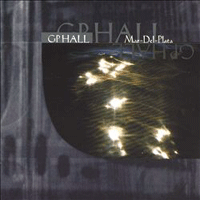
August 1997 – album reviews – G.P. Hall’s ‘Mar-Del-Plata’ (“ranges with restless compassion across a wide field”)

10 Aug
G.P. Hall: 'Mar-Del-Plata'

G.P. Hall: ‘Mar-Del-Plata’

Still clearing out the accumulated tapes of an inexplicably neglected career, Graham Peter Hall is continuing to come up with the goods. He’s been through thirty years of uneasy development on that rocky, unrewarding terrain between the simple sureties of the rock and roots instrumentalist and the often complacent indulgences of the full-on avant-garde blower. Marginalisation and bad luck might have ensured that he’s received little financial reward – nor has he gained the kind of brittle, precious reputation that marks out the darlings of the art-music intelligentsia – but it has resulted in a stock of lovely, emotive music in its own right.

Certainly Hall has managed to remain one of Britain’s most individual and complete guitarists over that time. Mastering a variety of styles from flamenco to rock to folk and blues, he’s also immersed himself in experimentation via technology – multiple speakers and pedal processors; vast, slow delay loops. Additionally, he draws on a repertoire of bizarre playing techniques and plectrum substitutes (involving battery fans, tiny psaltery bows, electric razors, toy cars and velcro, among others) which reflects the reinvention of guitar function explored by Fred Frith or Keith Rowe. With these methods in place, he’s explored sound through the textural suggestions of his “industrial sound sculptures”. Light industry, that is – Hall’s mimicry is closer to handsaws and governor motors rather than, say, Trent Reznor’s car-crushers and stamping presses.

Yet in amongst this, Hall has somehow never lost the ability to embrace expressive tunes; or to weave a handrail of familiarity into his sonic constructions. Perhaps that’s why ‘Wire’ types don’t seem to go for him; why he doesn’t have the kudos that the likes of Rowe, Frith, Eugene Chadbourne or Glenn Branca enjoy. He can get in your face – or wander off the usual path – with the best of them, but it’s generally in order to touch your sympathies. Ironically, in choosing to express his conservative and traditional side as equally important to (and entwined with) his avant-garde side, he’s gone too far for some.

‘Mar-Del-Plata’ is by far the most accessible and diverse of the compiled albums which Hall has been assembling this decade from deleted vinyl and assorted unreleased tapes. It’s a tour across a loose, but affecting, composing and performing imagination which ranges with restless compassion across a wide field. Sometimes you’re listening to a skittering, wilful flamenco performance. Sometimes it sounds like Cocteau Twins doing home improvements in the Mediterranean. Sometimes it’s the sort of individual, humanistic free improv/New Music result which you’d expect from Frith at his more lighthearted and relaxed, or from Simon H. Fell.

But though the record is full of experimentalism, Hall’s sense of melody is at the forefront – and the predominant voice on ‘Mar-Del-Plata’ is his masterfully expressive Spanish guitar playing. This can usually be found angling over long aching stretches of choral electronic humming, plangent violin and eerie ambient sounds called up from the industrial processors. In some ways it’s like a semi-unplugged take on a Robert Fripp Soundscape, in which guitar textures span out into infinity.

At other times, it takes on the simple directness of a folk tune: a dance of sparkling acoustic lights on Ionian Water, or the staccato accented Latin melodies of Mar-Del-Plata itself, underpinned by a geological murmur of bass. On the final hot gusting of Sierra Morena Dust Storm, the gut strings spit and scatter in rich melody, reaching new heights of sinewy passion. Here, Hall also bows some winnowing textures in his electric guitar accompaniment, using serrated steel bars from his box of implements.

Where technology plays a more direct role, Hall’s humanity doesn’t falter or go under. The hymnal swells of billowing electric warmth on Spirit Sky Montana (somewhere between Bill Frisell’s cinematic romance and David Torn’s eccentric string-warps) are the most beautiful and enveloping sound on the record, tapping deeply into church music and Romantic classical composing. The trickle of wind chimes, langorous piano, and enveloping sighs of Humidity Despair provide a gusting, luxurious impression of a sultry night: it’s lush enough to lean right back into.

Some tracks, fleshed out by Hall’s sound-loops and D.I.Y. treatments, are detailed, impressionistic oil-paintings in music and tone. Deep Blue sounds like someone chainsawing up a frozen Alpine lake, its jangling piano chords and thumping bass a mass of irregularities. The smear of bright spring-loaded colourflow on Charmouth Beach rings beautiful alarm bells. The menacing bass growl of Enigmatic is like a cave-bear thumping around in your dreams: squeaks and rattles from fingerboard and autoharp move around in slow disquiet, enclosed by knocking metal.

Plutonium Alert (in which Hall abandons guitar altogether in favour of soprano sax and the ring of auto-harps) treads similar territory to the ominous King Crimson improvisations from the mid-’70s. It goes for an all-out sensory mix of apocalyptic aftertones: angular bell-sounds and aggressive Grappelli violins entangling themselves with a spasmodically awkward funk rhythm. Weirdest (and most satisfying) of all is Fahrenheit 451 – juddering guitar, saw sounds, the shriek of a whistling kettle, and treble scratching all mix like toxic vapours under heavy pressure, pushing your head back against your rising hackles. Horribly enjoyable.

The scattered effects of the attempt to capture all of Hall’s ideas across a single CD does mean that ‘Mar-Del- Plata’ misses out on the cohesion which would render it excellent, but it’s a close-run thing. The centrepiece – a long-form creation called The Estates – pulls all the elements of the album together. A version of a 1975 long-form composition, it blends the chiming, restless clatter of its improv ensemble with Hall’s own quiveringly angry solo acoustic guitar. The brooding theme of The Estates is the crappiness and autocracy of post-war British urban programming. In thrall to modernism without being able to master it, its utopian vision (heartily botched and compromised) laid down a blight on communities, their architecture and their cohesion wrecked by the same tower blocks and support links designed to improve them.

Hall and co. express the disillusion and neurosis which resulted, with pulses of frustration and alienation hurl themselves against the confines of the music. Dulcimers, clarinets, and a huge array of percussion all seethe and pant over twenty-five minutes of desperate musical invocation; all overhung by the forbidding scrapes and alarm-clangs of two adapted metal piano frames (played like harps with assorted chains, wires, and implements). Hall’s panic-stricken guitar playing conjures the nightmare of a new, fatally-flawed sprawl of roads and buildings: swarming locust-like, unchecked and unconsidered, over beloved landscapes.

Incidentally, in the sleevenotes Hall gives a blood’n’guts description of the struggle it took to assemble and perform The Estates. Apparently, some of the manufactured instruments continue to drift through the art world with a life of their own. The piano frames – still counter-invading the architecture – were last seen as part of a “fire sculpture”. Meanwhile, the piece itself has an additional afterlife as a reflection on Hall’s own love/hate relationship with modernism; his own playing and arrangements echoing and championing the sounds of the traditional past even as they break them up in performance and execution.

As a body of work ‘Mar-Del-Plata’ has its faults – yet judged on its parts (and at its undisciplined best), it’s a touching, passionate and diverse album. Throughout, we get the sort of peek at Hall’s open heart (warts, gooey patches and all) which most experimental musicians, hard-wired into intellectual dryness, would never risk expressing.

G.P. Hall: ‘Mar-Del-Plata’
Future Music Records, FMR CD46-V0997 (7 86497 26442 1)
CD-only album
Released: 12 April 1997

Buy it from:
G.P. Hall homepage or Future Music Records

G.P. Hall online:
Homepage Facebook Twitter MySpace Bandcamp YouTube

March 1997 – album reviews – Jocelyn Pook’s ‘Deluge’ (“a suite of stunning invention and sheer beauty”)

1 Mar

Jocelyn Pook: 'Deluge'

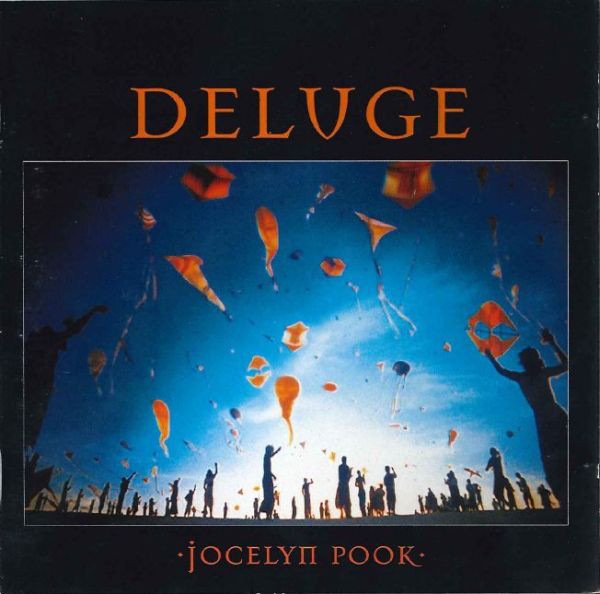
Jocelyn Pook: ‘Deluge’

The elegant grace of tragedy is often linked with the splat of farce. This album’s major selling point (on some copies of the CD, it’s trumpeted by a sticker ‑ I kid you not) is that it features the music from last year’s TV ads for Orange mobile phones, namely Jocelyn Pook’s setting of “Blow The Wind Southerly” sung by Kathleen Ferrier.

Sigh. It’s sad but true that increasingly weird and wonderful music is getting picked up and co‑opted by advertising agencies for their campaigns. Your average ‘Coronation Street’ ad‑break may currently play to a soundtrack of Michael Nyman, Gavin Bryars, Aphex Twin, U‑Ziq, Cocteau Twins… and Pook. They’re selling their souls for the filthy lucre from red‑braced ad execs. Of course they are: rampant fucking capitalism is bringing us the best that post‑modern music has to offer. It’s art selling out!

But… Mr or Ms Normal Music Fan are going into Our Price and humming this music over the counter to Shop Assistant. Consequently, they’re getting turned on to (at least relatively) experimental music, er, man… And as Jocelyn Pook joins the hideous capitalist gravy train (look, I’m not being cruel: my tongue is in my cheek) from obscurity to the CD racks, the musos among us will smugly tell that Pook is widely known as the leader of the Electra Strings (along with Caroline Lavelle, Sonia Slaney and others), who have no doubt been rushed off their feet in the past couple of years as every British pop act decided they must show their serious side by having at least one strings‑based track in their repertoire (I think we call it “hiring in a touch of class”).

But here ‑ ably backed by the Electras, knife‑edged art‑scene soprano Melanie Pappenheim and a pocketful of exotic musicians and sounds ‑ Jocelyn Pook shows herself as being beyond simply a viola player. She’s a composer of emotion and invention and, in the best traditions of post‑modernism, introduces classical and traditional musics to the brave new world of samples and electronics. OK, so it has to be admitted that Dead Can Dance are an immediate and convenient comparison, but ‘Deluge’ is warmer, more emotional: less monumentally impressive, perhaps, but also nowhere near as harsh and Wagnerian.


The twelve tracks of ‘Deluge’ (germinating from a clutch of “post‑modern hymns” written for a Canadian dance‑theatre project) are best appreciated as one pre‑millennial suite with recurring themes (the emotions drawn from the year 1000, the methodology from 2000). Requiem Aeternam, like many elements of the other tracks, opens the album with solo and multitracked singing of a traditional requiem over one sustained root note. Post‑modern chamber plainsong, in other words, founded upon a sense of inevitability that’s unchanged by the impact of technology.


Technology, in fact, might even be hastening that grand inevitable. Oppenheimer is undoubtedly one of the central parts of ‘Deluge’. It opens with a disturbing sample of Robert Oppenheimer talking (he seems heavy with emotion, a man with the weight of his discovery of nuclear destruction bearing down upon him) surrounded by a foreboding nuclear wind: this merges into the poignant but more hopeful sound of the Jewish call to prayer and a dawn chorus of birds. As the central sung theme from the first track returns with a supporting string section, a haunting, heartbreaking elegy is created.

For Oppenheimer himself, this could be the emotions created by his dread and foresight at what he had created. More powerfully, however, this piece stands as a requiem for a world forever changed by the knowledge of possible nuclear annihilation. A post‑Cold War planet we may now be, but his music took me right back to the nervousness of the mid‑’80s and its accompanying, tangible dread of nuclear war.


Lightening the mood and returning to the music, Blow The Wind (subtitled Pie Jesu) does indeed feature that Orange ad music again. Heard without those connotations, however, this is a brilliant interweaving of samples and live sound, as Kathleen Ferrier’s familiar rendition of the traditional vocal is interspersed with Pappenheim and Pook’s plangent vocal counterpoint, the echoing sounds of children playing, and more soaring strings. As in hip‑hop, the form that originally used sampling to such great effect and historic importance, the sample of Ferrier is used as a basis to build other musical sequences, instrumentation and vocals. It’s humble, beautiful, and ends far too soon.


The lessons in the new technology of music Jocelyn Pook has gained will undoubtedly further influence the writing and performance of her music for her own instrument ‑ strings. The penultimate piece, La Blanche Traversée, appears to be a fairly standard chamber‑piece setting of words by Racine, but more remarkable is the subtle instrumental backing. Pook and the Electra Strings play a slightly off‑rhythm pattern of oscillating notes that, to any DJ or mixer who knows his decks, would be regarded as a loop. I feel that it is safe to assume that the original hip‑hop DJs never had this development in mind when they crafted scratching and looping. ‘Deluge’ is a long way from being electronica, but the ’90s cross‑pollination continues.


While music has broken all the boundaries of genre in the ’90s, the end products have resulted in albums of naked emotion or sonic inventiveness. But rarely both together. ‘Deluge’ is a suite of stunning invention and sheer beauty in its music, but with all the necessary emotion of a requiem for the post‑nuclear age. The wind blows cold, with the sound of ravens on the air, but it tugs your whole life right to the surface of your skin.

Never mind the politics of how you got to hear of Jocelyn Pook or ‘Deluge’. Open your mind to it.

(review by Vaughan Simons)

Jocelyn Pook: ‘Deluge’
Virgin Records, CDVE 933 7243 (7 24384 29632 2)
CD-only album
Released: 24th February 1997

Get it from:
(2018 update) long out-of-print, so best picked up second-hand. Most of the tracks on ‘Deluge’ were remixed and reissued on the ‘Flood’ album in 1999.

Jocelyn Pook online:
Homepage Facebook Twitter MySpace Soundcloud Tumblr Last FM YouTube Vimeo

October 1996 – album reviews – Moonshake’s ‘Dirty and Divine’ (“like ghost trains – whistling and rattling across the room”)

10 Oct
Moonshake: 'Dirty And Divine'

Moonshake: ‘Dirty And Divine’

Even as a small chunk of mid-’90s London rediscovered how to swing and posed for Time Magazine, life carried on as usual for most of the rest of us. The weeks of quiet desperation, the litter in the corners, the urges and the grinds that don’t match up. While the Britpop scene whooped it up in the happening neighbourhoods, Moonshake were sitting up late with whitened knuckles in rented high-rise rooms, or prowling the mean streets spitting out stories.

Moonshake’s intensely visual songwriting and soundcraft always seemed born of hard-boiled cinematic overload. On 1994’s stunning ‘The Sound Your Eyes Can Follow’, lead ‘Shake Dave Callahan rubbed the unsparing urban soul-mining of The The up against The Young Gods’ overpowering walls of sampled sound, and beat both of them for sheer grit and presence. Determinedly guitar-free, taking their cornered-rat savagery from Callahan’s paint-stripping sneer and Raymond Dickaty’s ferocious arsenal of treated saxes and flutes, Moonshake’s harrowing street-literature songs were heavily sample-textured: but they travelled light and fast, drawing on tooth-rattling, uptight, Can-inflected dub grooves. They were twenty-first-century urban blues, as tough and unyielding as steel wire. Most importantly, sound was everywhere: cramming into the ears, surrounding the head with a blurred, terrifying out-of-scale world.

For some, the methodology of post-rock has served as an excuse to get lost, to unshackle yourself from precision, swallow your own guitar, womb yourself up in universal sonic tissue and drop out of language altogether. For Moonshake, it goes the other way. Callahan’s bitter, precise, dramatic language – shading his harsh sorties into hard-times lives with a poetic flair reminiscent of a punk Dickens, or of Brecht and Weill – is central. It’s just that rock instrumentation is too imprecise, too blunt to do it justice. Post-rock possibilities, and the overwhelming landscapes regurgitated by samplers is the only sensible framework for the way this band captures the world. Moonshake songs are like ghost trains – whistling and rattling across the room on forbidding, chilling loops of warped and mangled sampled sound, whirling you through a clatter of noise; dropping you into the thick of things; fucking with your sense of placement and angles, and thrusting gritty reality into your face.

‘Dirty And Divine’ is – at first hearing, anyway – more modest in its scope than ‘The Sound Your Eyes Can Follow’, That album lunged out of the speakers and went for your throat, both the epic stinking script and score for a vast, hideous film about the downside of the London experience. In comparison, ‘Dirty And Divine’ is more Mike Leigh to its predecessor’s Terry Gilliam. The ram-raided orchestra samples are pared back in favour of metallic whooshes and industrial-sump bubbling; Dickaty’s been given a free rein to mutate himself into an ensemble of mangled brass and breath. Centrally, Callahan’s songwriting emphasis has narrowed down. The clank and snap of Cranes sets the agenda, capturing the ebb and flow of a locked-down, clock-watching workforce in widescreen: “the builders are earning their daily bread / and they make sure they eat it every day at one o’clock… / The housewife’s dreams evaporate / as her husband’s nightshift ends at eight.”

Yet ‘Dirty And Divine’ also provides the backdrop for rebellions against the timeclock and the grind. Most of the album homes in on the stories of individuals. Where previous songs were a pageant of strain, entrapment and stagnation (a whore and her regulars, a protracted divorce) this record deals with what happens when frustration breaks out and escalates into quests for further, greater stimulation. The chance-addict of Gambler’s Blues gropes for a chance to be empowered, to face a challenge he can respect (“sometimes I pluck order out of the form – / I slack for a moment, the moment is gone”) but pays the price anyway: “I’m a gambler, and sometimes I lose, / but the kick’s in the playing, not paying the dues. / Always an offer I cannot refuse, / always a time-bomb I cannot defuse.”

In Exotic Siren Song, a young man hits the wide world for a perilous life of opium-dens, brothels and high stakes, keeping company with gun-runners and fraudsters, dodging pirates and police. Initially rejoicing at the chance to live by his wits, he ends up jaded, complaining “nothing now is really new.” The adrenalin-hooked petty crook on Up For Anything lives by his instincts and his appetites – “I’ll balance on the balcony, twenty-one floors high, / swinging from the vapour trails, ropes in the sky… / I can’t count the conquests and I can’t tell the time.” The buzz is still strong enough for him to dismiss the damage that will come, when “in ten year’s time I’ll be the boy with the mashed potato body. / All this champagne living on beer money, / out among the bumper-car people who never say sorry.” His counterpart, the elusive criminal in House On Fire (think Nine Inch Nails meets ‘Badlands’) has perfected the art of living on the edge. His wife may break under police questioning, his invisibility may evaporate and the law pounce on him, but he’s already working on plans for manipulating his fellow jailbirds.


He’s the exception – in most songs the downslide is never far away. Throughout the album, speed and appetite are portrayed as a drive that becomes a monkey on the back. Yet while it lasts it’s a hell of a ride. Another of Callahan’s savage stress-head characters snarls: “You’re too open, and you’re too easy. / When I’m out, I do as I damn well pleasey… / The only light I need sweeps through the window… / Keeping a monster comes in handy. / Hard candy…” To stop and think in this rolling, callous world is to invite despair.

To do him credit, Callahan unflinchingly represents this as well, offering up a couple of his most intimate songs. The make-or-break musings of Nothing But Time ponder the next step (“now I come to a fork in the road”) and weigh up possibilities: “Shall I cause some destruction that none shall understand, / undyke my finger and flood the whole land?… / I let you go and then you come back. / Shall I pick at your nature until you react?” Ultimately, plans are left perpetually hanging in weary, lonely resignation (“I’ve got my own design for something quite grand… / You can appreciate even if you don’t understand,”) all wrapped in rolling Arabian horns and the gonging sound of empty vessels.

Too late. The Taboo (swathed in flugelhorn and rippling harpstrings) surfaces at the end of the album: the last moment of awful drunken clarity before the final fall. It’s a lament for the loss of honesty – for the lost ability to be vulnerable and unveil the tender truth of yourself. Cards should be on the table, but no-one will make the move. “If I were to be really careful, / and take pride in everything I do, / I would show you what ‘really’ is – / and I can’t, ‘cos it’s taboo.” The seasick backing music swirls: vision flattens. The loved one recedes across the table, behind a wall of well- worn gambling chips and smeared shot-glasses. “If I were to show you how I feel, / would you call me blue? / If we could reach out and touch each other? / But we can’t, ‘cos it’s taboo.” Almost touching, but out of sight. House wins.

This album is a brutally compassionate mausoleum to burnout, made from raw words and cracked sinews. Lay those dusty dreams to rest.

Moonshake: ‘Dirty And Divine’
C/Z Records/World Domination Records, WDOM028CD (5032059002822)
CD-only album
Released: 4th October 1996

Buy it from:
Various suppliers, or second-hand.

Moonshake online:
Facebook MySpace Last FM

September 1996 – album reviews – No-Man’s ‘Wild Opera’ (“fraying the edges of beauty to reveal a poignant discontent”)

11 Sep
No-Man: 'Wild Opera'

No-Man: ‘Wild Opera’

Late hours. Some velvety-dark bar in a city somewhere. Black décor, with sweeps of curved white delineating the spaces between floor and ceiling. Nearly deserted but for the last human fixtures, fixed to their bar stools, sunk in their own little drunken universes. Forefront: an ex-couple in an alcove, locked in mutual antipathy; maybe a month past the sharp, splintering anger of the break-up, yet now attempting to divine the reason why. He’s trying to explain.

“We talked for such a long time / That it seemed to mean a lot. / I was yours, and you were mine…”

Pause, just long enough for him to light a cigarette. The lighter clicks like a cocked pistol. Unyielding eyes meet again.

“Then the feeling stopped.”

No-Man aren’t singing about heaven and sunsets any more. Not that they ever did, exactly. For all of the limpid, luminescent, swooning beauty of past albums, there was always something rather darker going on under there. 1994’s rhapsodic, magnificent ‘Flowermouth’ (graced and expanded by chamber jazz, by majestic Robert Fripp guest solos by and creamy violins) concealed tales of anguished stagnation and defeat, the sharp edges of lovers’ memories, the simple and inescapable pain of being left behind. And No-Man have always chosen to orbit at the point where an absolute beauty intersects with a resonant pain. On ‘Wild Opera’ (their first album for 3rd Stone since the lingering death of their relationship with One Little Indian), these feelings have never been closer to the surface. Here are a procession of characters in extremis glimpsed for a moment through our veils of indifference, illuminated briefly by No Man’s peculiar mixture of compassion and alienation.

They make an odd couple, do the No Man pair. Steven Wilson is the technological wunderkind, crafting all round evolutionary pop wonder with fluent guitars and samples, sensuous beats and expansive sonic backgrounds. Tim Bowness is the baleful and reluctant dark star on the horizon breathing a chilly, beautiful wind of song across the people enmeshed in the gorgeous, sad eyed arches of songs that No Man put together. Between them they’re putting together some of today’s finest art pop, poised somewhere between Tricky, The Blue Nile, Robert Wyatt, Portishead’s ‘Dummy’ crossed with Scott Walker’s alarmingly skewed ‘Tilt’.

With ‘Wild Opera’ you pretty much get the lot. The ghostly, reflective atmospheres and introspection of trip hop. A sound as deep, lonely and full of frightening possibilities as 3a.m on a city backstreet. Jazz noise (pings of death knell Rhodes, hovering cymbals) mixing it up with blasting or whispering rock, and sliding up to sampleadelic dance impetus. Classy yet eloquently, exquisitely understated songwriter pop which never strays into mawkishnessness or worthy stodge. Violent, abrasive industrial dance, as on the bellowing rush of Radiant City or the jagged confusions of Infant Phenomenon. Delayed by a couple of years, in many respects ‘Wild Opera’ is closer to the sleekly disruptive post-rock efforts of Laika, Moonshake or Disco Inferno than it is to the elegantly-mannered theatrical art pop of No-Man’s beginnings or to the luxuriant high-end dance-pop of their One Little Indian years. And with the continued involvement of Fripp plus Richard Barbieri and Mel Collins (frequently via sampler cut-ups), you get the exploratory edge of the best progressive/evolutionary rock.

And all of this is fraying the edges of beauty to reveal a poignant discontent. Though Taste My Dream is a nod to familiar, naked No Man love balladry (a curve of soft tears and piano chords), such simple and direct love is rare on “Wild Opera” compared to its more dangerous flipsides. Pretty Genius is a trip-hop sigh of desire merging with a sense of disaster, its object (“you could lose your little mind, / never knowing what to find… / Don’t hide beneath the covers / don’t sit around…”) as likely to disintegrate as inspire.

To a background of ghostly Badalamenti swing and haunted vibes, Sheeploop sketches a portrait of a calculating, defensive, free floating swinger (“this loving is easy, this loving is free, this loving demands no part of me”), while laying bare the losses sustained with withdrawal from commitments (“you never know how people grow, become a part of something…”). Housewives Hooked On Heroin – the unlikely-titled single – is like a sliver of glass through the heart, a backhanded slap in the face of contentment which few others could pull off (excepting Andrew Eldritch, perhaps). It’s not about drugged out drudges, but millionaires growing listless in their air conditioned capsules; aging artists selling empty platitudes to complicit audiences; and a seething, jaded resentment turning towards perversity.

Rooting around too deeply in this shadowy, suspicious world throws up disturbing questions. Libertine Libretto (imagine Trent Reznor masterminding a jazz rock quartet while Tim’s clenched vocal scatters a string of broken, filmic images in the foreground) spews out a slew of fragmented, desperate Hollywood stories (“Arthur sheds his pheromones in fifteen thousand mobile homes / In the grip of grand emotion, Julia drowns in tanning lotion”). On Sinister Jazz, Tim pounds the streets alone chased by a swarm of disconnected, dysfunctional, fatal memories: “Wendy got it in the throat, Linda died in Alan’s coat, you read it all in Brian’s note… Robert lost the plot in Greece, the Jesus Army stole your niece, but all you ever do is eat.” The past is a foreign country – vivid, shocking, and now impossible to touch (“You’re never going home.”).

On Time Travel in Texas, horror-struck mellotron strings and flutes drift through a desert wind over a bone-scraping dub beat and scourging divebombing guitar. A soprano flutters tattered amnesiac rags of sound: Tim is either murmuring dazed recollections, grubbing thoughts out of the void (“all I can remember, that noise in my ear / and then there was silence / and then there was fear”) or bellowing a terrified lament in the background. You never know exactly what’s going on, but you know something’s coming to the surface, and that it will wreak havoc when it emerges. The last sounds on the track are a wail, a crash of bass piano, a string of hysterical sobs…

If all of this sounds like dead-end miserablism, think again. Like Radiohead, No-Man have a fascination for looking into the void. Like Radiohead, they save us from utter despondency by redemptively beautiful melodies and a passionate, irresistable concern for the state of the human being. In the end, they suggest that any choices leading us to disaster are ours alone, rather than mewling about the burden laid on us by a malicious world. On ‘Wild Opera’, it’s self deception that bites the hardest – as Wilson’s guitars belch and roil acidicly, My Rival Trevor lays bare the vacuum residing in the hometown stud, the masterly lady-fucker whose bedroom assurance is just so much short-term gymnastics as he “bids for beauty unknown, kills the seeds he has sown, always ends up alone.”. On Dry Cleaning Ray (musically, Massive Attack playing catch with a nifty organ sample from Dave Stewart’s Egg), the subject’s a wannabe who hasn’t yet realised that he’s aged into a never was, a working stiff whose dreams have become shopworn routines. “It’s the same old thing / it’s the same old shit. / Thirty years without a hit.”

Notably, No-Man are not above asking themselves similar questions. Once tagged as “conceivably the most important British group since The Smiths”… “Maybe there’s more to life than just writing songs. / Maybe not,” Tim muses on My Revenge On Seattle (which swims along on an exquisite shimmer and strum of acoustic guitar, a sleepy chatter of blushing Reichian keyboard pulse). Steamrollered by the grunge boom of the early ’90s and by brutal record industry politics, their reaction is one of hope: “My revenge on Seattle / I retreat from the battle. / Won’t you stay?”. A response that manages to be dignified, witty and touching all in one, and with a ravishing melody to clinch it.

No fat lady sings. Things change, things continue, some things disappear. Deep into the late hours, No Man continue to shine a captivating light on it all.

No-Man: ‘Wild Opera’
3rd Stone Ltd, STONE 027CD (5023693002729)
CD-only album
Released:
9th September 1996

Get it from: (2020 update) Original album best obtained second-hand or from Burning Shed; ‘Wild Opera’ was reissued as a deluxe expanded edition in 2010, also available from Burning Shed.

No-Man online:
Homepage, Facebook, Twitter, Soundcloud, Last.fm, YouTube, Instagram, online store, Apple Music, Deezer, Spotify, Amazon Music

May 1996 – EP reviews – No-Man’s ‘Housewives Hooked on Heroin’ (“turning away from the light to embroil themselves in a polluted twilight”)

30 May
No-Man: 'Housewives Hooked on Heroin' EP

No-Man: ‘Housewives Hooked on Heroin’ EP

Mumsy cover art, titillating tabloid title and five tracks of wilful wrongfooting? For their first new material in two years, No-Man are not relying on the comforts of familiarity. Compared to the ornate, orchestrated silkiness of their first three albums, the No-Man sound of ’96 is much more confrontational. Bigger, noisier, dirtier; a swamp rather than a garden; these aesthetes are turning away from the light to embroil themselves in a polluted twilight.

‘Housewives Hooked on Heroin’ is the baleful first single from the forthcoming ‘Wild Opera‘ album – downbeat, low-key, opening on a bed of twangy guitar and suffocated electric piano chimes like a smog-ridden dawn over Las Vegas. A disaffected gasp of vocal pans over a landscape of weathered, weary icons – ageing pop starts, Howard Hughes – before enormous sour guitars slide in and drag it into a rolling chorus with the deathly beat-driven wallop of Sisters of Mercy. “Not even housewives hooked on heroin / could match my appetite for sin…”

No-Man come on like a flattened, ever-so-slightly Gothic Bowie, full of the empty hunger which you get on those evenings when there’s nothing you want to do, the heat’s pressing down and the light of day is stained by a sodium glow. Fittingly, Scanner’s Housewives Hooked on Methadone remix recasts the song in a fuzzy cloud of radio static, sirens and dusky synths hovering over a dry, frenetic junglist beat. I do miss his usual trademark dialogue samples, though, snatched illicitly from hidden conversations on mobile phones. Perhaps the housewives were on hold that evening.

If you’re already missing the thought of that departed beauty, No-Man do allow a nod to their more recent past with Where I’m Calling From, another fragile, obscure No-Man ballad connecting the stagnation of the earthbound and isolated with the loneliness of the stars. Tingling Robert Fripp Soundscapes meld with a limpid Steven Wilson Stars Die melody and the bitter, uncertain comment of Ian Carr’s reedy trumpet. Tim Bowness sings as if encapsulated in a phone box, wheeling through the outskirts of the Milky Way, making one final disaffected farewell call. “Where I’m calling from, you wouldn’t want to know…/ Where I’m calling from, you wouldn’t want to go.” A dog barks suddenly in the middle of all of this – it’s like the real world trying to get a last foothold in this dangerous reverie.

But that’s about as familiar as it gets. The spidery twitch of Hit the Ceiling (written and recorded, from start to finish, in one hour) hurls the spontaneous risks of current No-Man working strategies straight into our faces. Breakneck rattling drum track, skeletal guitar and the reverberating coloratura of a disembodied diva – Halloween in the attic of the Paris Opera. Urban Disco deepens their dance content with a dystopian shadowy blur of suffocating beats and whispering, glancing lyrical swipes at the self-satisfaction of hedonism, leaving the solipsis of previous No-Man behind in order to flit like a malevolent ghost around the cigarette-ends of the high life.

The ‘Wild Opera’ overture has been played. People seduced by the warm caresses of ‘Flowermouth’ and ‘Heaven Taste’ look set to be in for a rude awakening, but an interesting trip.

No-Man: ‘Housewives Hooked on Heroin’
3rd Stone Ltd, STONE 026CD (5023693002651)
CD-only EP
Released:
28th May 1996

Get it from: (2020 update) Original EP best obtained second-hand or from Burning Shed; Housewives Hooked on Heroin appears on No-Man’s ‘Wild Opera’ album, while Urban Disco reappeared on the ‘Dry Cleaning Ray’ mini-album. All of the EP tracks bar Housewives Hooked on Methadone were included on the 2010 double CD remaster of ‘Wild Opera’.

No-Man online:
Homepage, Facebook, Twitter, Soundcloud, Last.fm, YouTube, Instagram, online store, Apple Music, Deezer, Spotify, Amazon Music

March 1996 – album reviews – Nicola Alesini & Pier Luigi Andreoni’s ‘Marco Polo’ (“like diving into a tapestry”)

24 Mar

Nicola Alesini & Pier Paulo Andreoni: 'Marco Polo'

Nicola Alesini & Pier Paulo Andreoni: ‘Marco Polo’

Listening to this album is like diving into a tapestry. Well, I guess a lot of prog and ambient-related music is, given its emphasis on the visual qualities of music and the proggy tendency (in particular) to fixate on the past; and that counts for even more at the crossover point. Nicola Alesini and Pier Luigi Andreoni, though, do it that much better. ‘Marco Polo’ – based loosely on the adventures of said merchant, explorer and diplomatic in the mediaeval Cathay of Kublai Khan – is a journey on the silkiest of roads, one on which you could really lose yourself in the billowing, drifting shapes which reality assumes.


Even while rising in the world of Italian jazz, saxophonist Alesini has also frequently been drawn into the world of art rock, kosmische music and ambient electronica. Andreoni’s already had a two-decade history as a multi-instrumentalist – starting out with Piacenzan comedy rockers La Pattona in the mid-’70s and passing through New Wave, experimental folk and minimalist synthing via The Doubling Riders and A.T.R.O.X. during the ’80s. Most recently, he’s been making a showing in the experimental ambient Andreolina duo during the ’90s. Much of the latter (with the exception of the comedy) leaves its mark on ‘Marco Polo’, although arguably the defining musical voice is Alesini’s upfront, intimate soprano sax – breathy, sweet and fragile, yet possessing a white-flame passion.


Andreoni, meanwhile, reveals himself to be a master of ambient keyboarding following the Brian Eno and Richard Barbieri path, using his instruments as subtle invisible chisels for sculpting electrons and the air into a colossal romantic spectrum of sound. Between the two of them they craft a set of compositions that phase slowly across the face of the world, colouring their own instrumental textures with the careful deployment of harmoniums and bouzoukis, cello and atmosphere guitar. This is an album of travelling, of seeing heartstopping landscapes for the first time, of releasing those feelings that the wanderer knows, of attempting to paint all of this in music.


This they do in glowing detail; the snake-charmer sax of Sumatra, the warped radio-chat and disassociated sway of Buchara, the metallophone Chinese chiming and fluting reeds of Quinsai, La Citta’del Cielo. With this type of thought being brought to bear on it, ‘Marco Polo’ is very much a deep-shaded ambient dreamscape album of the David Sylvian school, filled with sweeps of electronic space and shade, and immeasurably elevated when other musicians drift into the mix to stir up Alesini and Andreoni’s immaculate studies. David Torn‘s contribution of guitars, for instance, which bellow like yaks or hover like the promise of avalanches in Yangchow or M. Polo; or when Harold Budd places his sparse Himalayan points of piano into Samarca or The Valley of Pamir.


Roger Eno is on board as well, his less polished keyboard approach adding a wonderfully naïve human touch to the lambent, warmly aloof perfection (in particular on the aquamarine piano study of Il Libro dell’Incessante Accordo con Il Cielo). The pale vulnerable tones of his voice carry reedily through the twinkling spectral travel-songs of M. Polo and Samarca. Arturo Stalteri (the New Age keyboardist who originally made his name in progressive Italian folk duo Pierrot Lunaire) adds harmonium to the former, buried deep in the mix somewhere. The best moments come, though, when David Sylvian himself is brought in to sing on three tracks; his luminous baritone wreathing through the misty dawn-music of Come Morning (Stalteri’s bouzouki adding a glimmering coda), fluttering above the vague rattling sketches of Maya, or brooding (over cello, sax and a rippling ghost of electronic percussion) on dreamy images of god-games on The Golden Way.


And yet, in spite of all of the talent squeezed onto the album, somehow ‘Marco Polo’ doesn’t completely satisfy. It’s a little too remote, too self-contained and preoccupied with its own panoramic reveries. Behind the rich melodies and atmospheres, there’s only the vaguest engagement with the historical Marco Polo and Cathay; there’s not quite enough substance behind the shimmering surface of the album’s undeniable loveliness. Maybe it’s best viewed from the other end of a room, from a distance where the threads in the tapestry blue together into a captivating portrait which defies laws of time and space, where it can give such a convincingly four-dimensional performance that its audience can forget its two-dimensional thinness. But if you can live with that, ‘Marco Polo’ makes a wonderful tapestry.


Nicola Alesini & Pier Luigi Andreoni: ‘Marco Polo’
Materiali Sonori, MASO CD 90069 (8012957006921)
CD-only album
Released:
22nd March 1996
Get it from: (2020 update) Get CD from Materiali Sonori, or second-hand; stream from last.fm, Apple Music, Google Play or Spotify.
Nicola Alesini & Pier Luigi Andreoni online:
Last FM YouTube Google Play Amazon Music
Nicola Alesini online:
Facebook Last FM Apple Music Vimeo Deezer Amazon Music
Pier Luigi Andreoni online:
Homepage Facebook Last FM Apple Music YouTube Vimeo Deezer Google Play Spotify Amazon Music
 

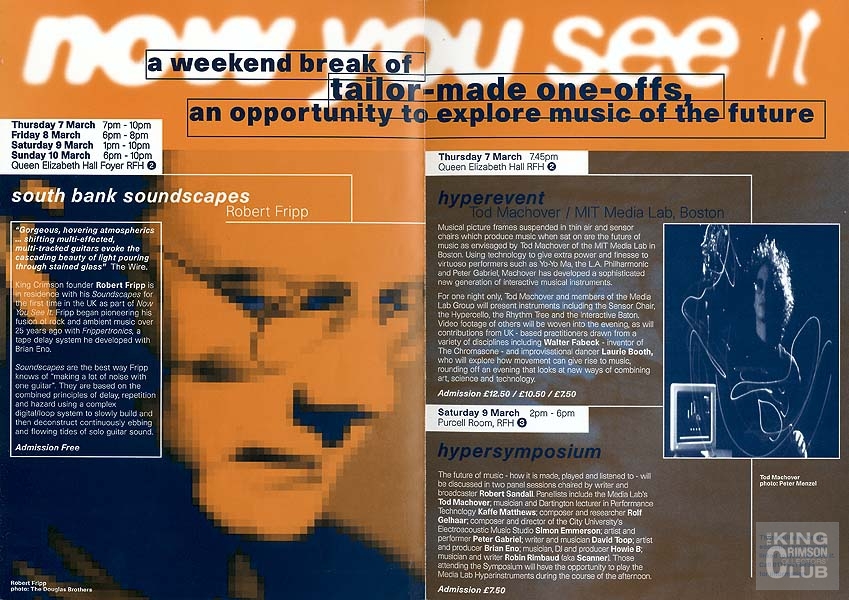
March 1996 – live reviews – Robert Fripp’s South Bank Soundscapes @ Queen Elizabeth Hall foyer, South Bank, London, 10th March (“more challenging abstractions than Fripp’s ever attempted before”)

12 Mar

'Now You See It...':  Robert Fripp Soundscapes, 10th March 1996

‘Now You See It…’: Robert Fripp Soundscapes, 10th March 1996

Tucked against a curving concrete wall, under a sweep of plate-glass windows, there’s the familiar stool with a beautiful rock-fetishist’s dream of a Les Paul guitar, flanked by rack-mounted gizmos like a gaggle of worshipful Artoo Detoos and a flat henge of volume pedals and multi-purpose stomp-boxes. Over to the right, David Singleton sits at the mixing desk, quite the portrait of the calm fixer for the artist’s determined leaps. Arranged in a long staggered curve in front of the opposite wall, lining the long walk between the entrance and the Purcell Room, are at least eight tall speaker cabinets. Occasionally in residence is the sleek, compact form of Wimborne’s most formidable musical son.

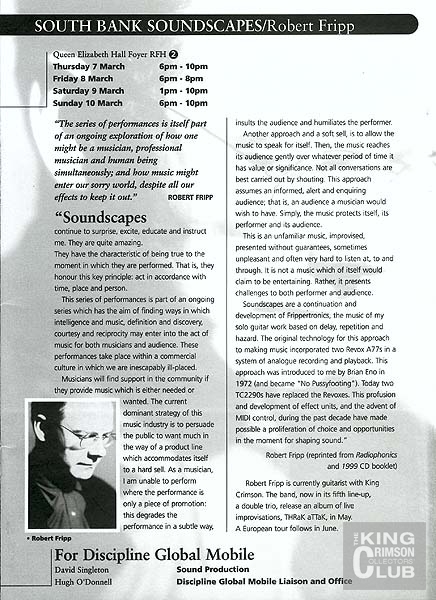
These Soundscapes are part of the ‘Now You See It…’ season of contemporary performance art, sharing the building with the Hypermusic Symposium (in which Peter Gabriel, Brian Eno, David Toop and others debate the future of music, and people nervously finger such unorthodox instruments as literally musical chairs and picture frames or the Interactive Baton) while avant-garde dance groups hijack the Purcell Room and stick the audience on the stage, and (less happily) over at the Lyric Theatre in Hammersmith an appallingly pretentious bunch of Euro-thespians do a vandalistic mixed-media Schubert performance.

In these surroundings, Robert Fripp‘s increasingly out-there journeys in solo sound fit in surprisingly well, both physically and intellectually. When a squadron of incredibly young women in bare feet and little black dresses trot busily past (every quarter of an hour, on the dot) to meet their cues in a back-to-front theatre piece next door, it seems inexplicably appropriate. Tonight – Sunday 10th – is the fourth of Fripp’s residencies, a mere four-hour performance compared to the rear-numbing six- and even ten-hour marathons he’s performed earlier in the week. Some people have returned, regardless. Within that length of time, anything could happen: the music that Fripp claims to channel rather than compose could lead him anywhere.

Soundscapes, the successor to the layered sound-loops of Frippertronics, is a major leap forwards, sideways, anyways from its progenitor: the digital technology stores his patterns and transforms his tones to the point where there isn’t a single recognisable Crimsonic guitar sound to be heard all evening. In effect, Fripp and Singleton are playing a wholly new collective instrument, a community of speakers, desk, guitar and digital cyberspace. The end results are a swathe of overlapping, opposing electrophonic voices, sometimes beautiful and sometimes disturbing – polytextural hums; a sound like a seventy-foot high piece of glass being torn like cloth; wailing, spectral swells like American freight trains blowing a blue whistle into a desert of ghosts; aquatic, gem-faceted calls of a Loch Ness Monster; tingling pianistic or xylophonic ringing; squiggling crystal-bat chitters. It emerges as a sound that’s on the brink of being recognisable, somewhere deep down in the soul… but not quite.

As it rolls on, evolving like strata, burying what’s come before like the march of ages, you may find it impossible to concentrate on (four hours is a long time) but it saturates your mind regardless: you’ll sure as hell be thinking differently. While I’m here, I meet somebody who ascribes near-mystical powers to the first Soundscapes album, ‘A Blessing of Tears’ – “any pain you have, any problem, it will heal it…” Even on the basis of what I’m personally experiencing in the music tonight (the rollers, breakers, capricious tides and immense flickering lulls of an alien sea under a midnight-blue sky, occasionally rent by sheets of violet lightning and mile-wide twists in the current… I think I’m in for a night on the ocean wave) I can believe him. This isn’t New Age pretty-stuff.

And so the Soundscapes are installed, piece by lambent unsettling piece, more challenging abstractions than Fripp’s ever attempted before. But most of the people here seem to have missed the point – sitting deferentially in the arc of chairs facing Robert and his little cliffs of winking lights, watching him silently manipulate his gold-top Les Paul or peer into his effects racks, they pay a silent tribute. This isn’t how to do it. When Fripp calls what he does “Soundscapes”, he means it literally. There’s a fifth element in that communal instrumentation: three-dimensional space. Each of the eight speakers arranged in an arc behind the audience is fed by a slightly different sound source. Walking slowly back and forth across the foyer, one passes in and out of phase with the sounds: a different listening angle provides a different piece, an ability and opportunity to concentrate on a different section of the Fripp orchestra. Music to literally explore.

I feel a bit of a fool, though, pacing up and down the floor to curious glances from the audience; it’s not quite the same as hanging around, in gig-approved fashion, with a drink in your hand and lunging up and down gently to your favourite song. Mind you, the rest of the audience are behaving exactly in the way you’d expect at a Fripp-related gig or an art installation. Here are a couple snogging vigorously, French-kissing amidst the unsettling washes of the music; three rows in from the front, a man appears to have passed out, lolling over the back of his chair with his wide-open mouth pointing wetly at the ceiling. Music to intoxicate? Perhaps: it ignores standard musical dimensions in a way that one only otherwise hears in the most deliriously spaced-out Lee Perry dubscapes, although the notoriously drug-free Fripp looks more composed than I’ve even seen him before.

'Now You See It...':  Robert Fripp Soundscapes, 10th March 1996 (programme)

‘Now You See It…’: Robert Fripp Soundscapes, 10th March 1996 (programme)

But then perhaps once the music slips beyond the control of his fretting fingers, flexing feet and console-fondling fingers, it ceases to be his responsibility anyway. The nature of Soundscapes is such that Fripp’s very presence can become little more than a trigger. Turn away at the wrong time and you’ll turn back to find the guitar leaned against the stool and Fripp gone, sipping at a cup of coffee over by the mixing desk as the music wreathes onwards without him, or wandering out through the audience to check a corner of the sound. It’s a little disturbing when, conversing quietly and walking around the circuit of speakers to experience the different sounds, one comes within six inches of Fripp padding lightly in the opposite direction, close enough for you to sense the implacability of his will, pushing at the realms of the possible like a smooth arrowhead.

The element of hazard plays its role too. Sometimes, amongst the layers of harmonic tissue that Fripp is laying down, a mismatch occurs. Or a part decays too soon, or a speaker refuses to cooperate with the vision, and the musical organism is deformed, loses balance, develops cancer. At such times Fripp shrugs in frustration and looks over to Singleton, or out to the audience in the only acknowledgement he ever gives them, lets go of the guitar with palms turned upwards in the universal gesture of helplessness. The music thins out and he begins to build his organism again.

This continues for four hours: time to get several drinks, chat quietly in the background, arrange assignations with other musicians and writers, even formulate whole arguments about what we’re seeing (in other words, make our own contributions to the Soundscape ambience), and still not miss out on the crystallising veils of sound that drift around the foyer, perplexing this evening’s Mozart concertgoers, putting thoughtful expressions on the faces of the cloakroom attendants as it numbs their resistance. At the end, Fripp puts the guitar down, as he’s done so many times before during the evening, and walks slowly away to vanish down the passageway leading to the dressing rooms. The applause that follows his retreating back is sincere, but oddly unfocussed, as if the audience is unsure whether they should be applauding him or the air that’s been buoying up the music and carrying it around like a whispered ritual, I catch the train home, as I usually do; things seem just a touch sharper than normal. Soundscapes don’t so much take you to another world as grant you a shimmering new lens to experience this one through.

Robert Fripp online:
Homepage Facebook Twitter MySpace Soundcloud Bandcamp Last FM Apple Music YouTube Vimeo Deezer Google Play Pandora Spotify Tidal Instagram Amazon Music
 

September 1995 – album reviews – No-Man’s ‘Heaven Taste’ (“indefinable sensations of love, conflict and suppressed (yet dizzy and overwhelming) sensuality”)

19 Sep
No-Man: 'Heaven Taste'

No-Man: ‘Heaven Taste’

B-sides are usually one of two things, Either they’re extra padding for a single release, using old material and pointless alternate versions; or they’re an artist’s playground, a place to have fun, to try out whims, to work out the ideas forbidden by the commercial and aesthetic demands of an album.

No-Man‘s B-sides and off-cuts tend to follow the latter path, and on ‘Heaven Taste’ some of them have been salvaged from an unwarranted obscurity. Those turned off by the dance-bolstered poppier leanings of No-Man albums may find this release a more palatable prospect. Dating from points between the ‘Lovesighs’ era of late 1991 and the ‘Flowermouth’ sessions of mid-’93, the five tracks on ‘Heaven Taste’ document No-Man’s dreamy, atmospherically lush side: a step on from the bedroom experiments on the band’s obscure might-have-been-debut (‘Speak: 1988-89’), they illustrate in greater – if hazier – detail No-Man’s position as thoughtful straddlers of the popular and the avant-garde, of art and heart. They explore further possibilities in Steven Wilson‘s instrumentation and sound worlds; touch the traces of feelings never completed clarified; and swim in the familiar No-Man territory of vague and indefinable sensations of love, conflict and suppressed (yet dizzy and overwhelming) sensuality.

‘Long Day Fall’ opens proceedings in ravishing style with the sound of playing children and Ben Coleman‘s impossibly lush violin cadenzas. Wilson builds up pointillistic, ringing instrumentation on synth, piano and echoing guitar as the violin ducks, soars, dives and cries around Tim Bowness‘ sensuous vocal reverie. Lyrics call up a languorous summer dusk, chants and the glow of wine in a long luxurious moment of sustained beauty. It’s one of those definitive No-Man pieces: avant-garde undercurrents, pop-balladry romance, electric synthesis and classical wood all meshing together, one of the original trio’s finest moments.

The following ‘Babyship Blue’ (originally spotted as an instrumental on the original ‘Flowermix’ cassette) offers a somewhat less mannered emotional landscape. A muted, shattering computerised dub groove pounds under the paired, other-worldly voices of Wilson’s seagull guitar and the calling wah-wah tones of Coleman’s electric violin. Bowness sings a lost romantic fragment of lyrics before breaking into a distorted, aching chant of “it’s all I can do not to scream for you…” Wind-chimes tickle, synths waft, and we’re left with the faint taste of a distant yearning; another No-Man hunger that’s just out of reach.

The knotted tension of ‘Bleed’ (originally a swishing and threatening violin-heavy B-side on the ‘Sweetheart Raw’ EP) makes its new remodelled appearance in a much more densely orchestrated form. The violin is banished in favour of a cyclone of circling synths and atmospheres; a slow-motion hurricane around the dry rattlesnake hiss of percussion. Bowness’ shadowy lyrics dissect the slow burn of an argument (“tell the truth, and tell it ‘til it makes me bleed. / Stretch your mouth and let your words fall over me… / Talk to me – I’ll bleed a little more for you. / Take the chance to watch red rise / from the white of my / wild, wild eyes”), shuddering through a chorus of desperate, confused denial (“No fight, no blame,. / No dream, no gain. / No try, no fame. / Blame, / blame, / blame…”) before the piece pulls itself up short only to charge full tilt into a ferocious industrial techno throb. Under the battering drums, undulating analogue-synth bass and muscular barks, Bowness’ distorted voice chants out destructive litanies – “I want you near me, / I want to feel free / to forget my history, / to destroy my memory…” The helpless fury of a passionate relationship writ large in dizzying music.

Sitting like an oasis in the middle of the record is a delicate reading of Nick Drake’s ‘Road’, opened out into a soft, caressing walk-rhythm. Stepping outside of his own hazy portraits for once, Bowness sings sweet, deep and velvety while Wilson accompanies on delicate piano, little ornamentations of guitar and the constant pattering loops of a frame drum: it all fades out over caressing lullaby “hey”s. After the dark dream passions of the previous songs, the elegant passivity of ‘Road’ comes as a luxurious respite: No-Man reduced to a simplicity in which their own sensitivity carries the song into dream territory far more effectively than any studio bombast would.

Finally, there’s ‘Heaven Taste’ itself; a 1992 instrumental from the ‘Painting Paradise’ EP on which Wilson’s ambient tendencies are given full reign. Bowness (credited on the original release with “saintly restraint” as well as the title) steps out of the picture to let Wilson and Coleman link up with Steve Jansen, Richard Barbieri and Mick Karn for twenty-one minutes of gentle celestial groove – part Steve Reich, part David Cross, part Westminster Abbey at dusk. Over Jansen’s steady meshwork of percussion, Wilson and Barbieri’s keyboards and samplers shine like distant lights, sing quiet little piano arpeggios and submarine melodies, summon up little muted choirs and envelop the piece in wintery, intimate chords.

Karn slides in two-thirds of the way through, first to add breathy whispers of treated saxophone and then to elasticate matters with stretchy fretless bass and querulous reedy lines on dida. Coleman, meanwhile, bows elongated calling melodies on electric violin. It’s as remote and comforting as the blanket of stars across the night sky, and about as unchanging: quite beautiful, and reassuringly unepic. The music gently goes where it pleases, riding upon the subtlest of grooves, winding down and fading out to the softest of twinkling finales.

So there you are: a No-Man record to dream to. ‘Heaven Taste’ offer a revisiting of softer, gorgeously luminescent scenery from No-Man’s more quietly beautiful territories, building up a lambent impression which the band are likely to rudely shatter with their next album, the wilfully experimental and unsettling ‘Wild Opera‘. But then, that’s No-Man for you. Poised coolly but uneasily between conflicting planes of commerce and innovation, between chartbound hummability and artistic credibility, and unwilling to nail their colours to any single mast. And we’re all the luckier for it.

No-Man: ‘Heaven Taste’
3rd Stone Ltd, STONE 027CD (5023693002729)
CD-only album
Released:
18th September 1995

Get it from: (2020 update) Original album best obtained second-hand; ‘Heaven Taste’ was also remastered and reissued in 2002.

No-Man online:
Homepage, Facebook, Twitter, Soundcloud, Last.fm, YouTube, Instagram, online store, Apple Music, Deezer, Spotify, Amazon Music

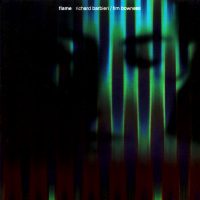
August 1994 – album reviews – Richard Barbieri/Tim Bowness’ ‘Flame’ (“the internal landscapes of the restless emotional mind… the indistinct visions of dreams and the hallucinatory moments of being in love”)

31 Aug

Richard Barbieri/Tim Bowness: 'Flame'

Richard Barbieri/Tim Bowness: ‘Flame’

There’s a common misconception going around which says that in order to be “experimental” you have to be noisy (viz. the many grinding guitar-noise bands clogging up many a Camden basement or American college-kid bar) – or, conversely, that you have to be utterly ambient, all empty space filled with electronic pulses, “ironic” hoover noises and nothing so anti-deconstructionist as the hint of a song. Theoretically a great idea, but in the end it produces little more than a big heap of CDs which you only play once plus another big heap of empty pseud criticism.

Alternatively, you could join that group of musicians whom Tim Bowness calls “the radical conservatives”; those people who take a long, wise look at both what’s going on and what’s worth retaining from the past, and then combine it with their own particular art of the possible, in the process creating memorable, lasting and demanding records (if not always incredibly famous ones – but so it goes, eh?) These people are also collaborators par excellence, linking up with a free-floating pool of like-minded musical allies to produce something greater.


In this context, the teaming of Bowness (the outspoken, intellectual No-Man singer) and synthesist Richard Barbieri (the quiet one in Japan) makes perfect sense. Both are associated with progressive synth-pop groups that stretch yearningly towards art and sensation; both fairly drip with musical and contextual knowledge; they’ve worked closely together in the past; and now they’ve produced an album as a duo which draws on considerable collaborative talent, including regular mates (fellow ex-Japan-ers Steve Jansen and Mick Karn, No-Man instrumental maverick Steven Wilson) and highly individual guns-for-hire (double bassist Danny Thompson, world-jazz drummer Gavin Harrison, textural guitarist Michael Bearpark). ‘Flame’ has emerged out of a mutual desire to create what Bowness calls “ambient torch songs”; moody late-night music with words summoning up the memories of love and heartwreck, sheathed in drapes and washes of unearthly sound. (There are, of course, precedents: Scott Walker, The Blue Nile, Julee Cruise and both men’s respective groups – Japan’s Ghosts being a particular blueprint.)


This objective is best realised on standout song Brightest Blue – Chris Maitland‘s delicate pattering drums wander around Danny Thompson’s deep woody jazz bass and Barbieri’s gentle piano chordings as Bowness unfolds the beautifully rapt love song of someone so engrossed in another person that they are virtually oblivious to the war going on outside their very windows. Distant swathes of Frippian textural guitar and blankets of electronic sound from Barbieri’s keyboards that settle on the listener like banks of soft snow add to the withdrawn, dreamlike theme of the song: a theme which becomes dominant over the course of an album which deals with the internal landscapes of the restless emotional mind, with the indistinct visions of dreams and the hallucinatory moments of being in love.


Bowness’ words touch on images of dying light and candles, sleeping and waking, hunger and falling, vegetation and rivers; and above all on memory, vision and communication obscured, whether this is beneficial or otherwise. Brightest Blue urges “forget the facts… I have to trust my own truth”; Song of Love and Everything cuts through its vague atmosphere of betrayal with “jump in the water / …swim in the dark to keep myself alive / …to shake myself awake”; the closing Feel rages quietly “I don’t know what it means / I try to surrender / I only know what I feel.”


This murky emotional obscurity means that ‘Flame’ tends to drift away from its initial premise into a hinterland of dimly-lit emotional set-pieces. Songs like A Night in Heaven and Trash Talk come across as expressionistic heart-sketches; their rains and rivers, their words of betrayal, stagnation and disaffection mingling to put across a particular mood. As such, ‘Flame’ fails as an ambient torch album. The title song is one of the few that emerges from the mists of imagination, with its portrait of a suffocating lover (“I will hear your calls, I will break your falls / …build your walls / because our love is strong / …I will share your life, / I will blind your sight…/ I will cover you / I will smother you”) and Bowness often seems to be providing tantalising clues rather than telling a story. (Unfortunately, the ambient-torch label is better applied to the work of David Sylvian, Barbieri’s former bandmate, whose own highly literate take on the form will be inevitably and somewhat unfairly compared to this album.)


Where ‘Flame’ does succeed, however, is as a marvellous dream album. A lot of this is down to Barbieri’s magnificent settings. Always a sculptor in sound rather than a keyboardist per se, he envelopes Bowness’ hallowed, reverent croon and enigmatic word-clues in delicate electronics – scouring sounds, breathy walls of soft noise, alien cellos and Chinese chimes, resonant aquatic flutters and twitters. On the solitary instrumental track, Torch Dance, he wraps undulating didgeridoo sounds with waves of flanged burbles and an unearthly guitar.

Throughout ‘Flame’, Barbieri creates an ocean of sound, always beautiful, never inflated by the self-important pomp that can sink keyboard-based albums. Other musicians float and mesh their own contributions into this sweet tapestry – Jansen’s featherlight percussive touch, Karn’s elastic bass and smears of treated sax, Steven Wilson’s guitars charting a course between psychedelia and spaghetti-western in contrast to Michael Bearpark’s distant blocks of Howe-cum-Frippian textures… all anchor the music to further dimensions of dreaming and organic emotion.


All of which adds up to a rich, seductive experience. Yes, ‘Flame’ can err too much on the side of obscurity a little too often, but it does so with such a consummate shadowy beauty that this becomes a positive virtue. Gorgeous, lazy, flowing melodies; a ghostly hint of melancholia; a rattle at the spirit cage… this is one flicker in the darkness that is well worth tracking down. Come catch the fire.

Richard Barbieri/Tim Bowness: ‘Flame’
One Little Indian Records, TPLP58CD (5 016958 023720)
CD/cassette album
Released:
29th August 1994
Get it from: (2020 update) Best obtained second-hand.
Richard Barbieri online:
Homepage Facebook Twitter MySpace Soundcloud Bandcamp Last FM Apple Music YouTube Deezer Google Play Pandora Spotify Tidal Amazon Music
Tim Bowness online:
Homepage Facebook Twitter Soundcloud Bandcamp Last FM Apple Music YouTube Vimeo Deezer Google Play Pandora Spotify Tidal Amazon Music
 

SWOONAGE

Swoon. /swo͞on/ A verb. To be emotionally affected by someone or something that one admires; become ecstatic. Here are some people and things that make me swoon. #swoon #swoonage

Post-Punk Monk

Searching for divinity in records from '78-'85 or so…

theartyassassin

...wandering through music...

Get In Her Ears

Promoting and Supporting Women in Music

Die or D.I.Y.?

...wandering through music...

Music Aficionado

Quality articles about the golden age of music

THE ACTIVE LISTENER

...wandering through music...

Planet Hugill

...wandering through music...

Listening to Ladies

...wandering through music...

ATTN:Magazine

Not from concentrate.

Xposed Club

improvised/experimental/music

The Quietus

...wandering through music...

I Quite Like Gigs

Music Reviews, music thoughts and musical wonderings

furia log

...wandering through music...

The Recoup

SINCE 2013: Books and books and books and books and occasionally other things

A jumped-up pantry boy

To say the least, oh truly disappointed

PROOF POSITIVE

A new semi-regular gig in London

Gapplegate Classical-Modern Music Review

...wandering through music...

When The Horn Blows

...wandering through music...

:::::::::::: Ekho :::::::::::: Women in Sonic Art

Celebrating the Work of Women within Sonic Art: an expanding archive promoting equality in the sonic field

Ned Raggett Ponders It All

Just another WordPress.com weblog

FLIPSIDE REVIEWS

...wandering through music...

Headphone Commute

honest words on honest music

The One-Liner Miner

...wandering through music...

Yeah I Know It Sucks

an absurdist review blog

Obat Kanker Payudara Ginseng RH 2

...wandering through music...

poplifer.wordpress.com/

Waiting for the gift of sound and vision

Good Music Speaks

A music blog written by Rich Brown

Do The Math

...wandering through music...

Archived Music Press

Scans from the Melody Maker and N.M.E. circa 1987-1996

The World's Worst Records

...wandering through music...

Soundscapes

...wandering through music...

OLD SCHOOL RECORD REVIEW

Where You Are Always Wrong

FRIDAY NIGHT BOYS

...wandering through music...

Fragile or Possibly Extinct

Life Outside the Womb

a closer listen

a home for instrumental and experimental music

...wandering through music...

Life Just Bounces

...wandering through music...

Lucid Culture

JAZZ, CLASSICAL MUSIC AND THE ARTS IN NEW YORK CITY

Aquarium Drunkard

...wandering through music...

eyesplinters

Just another WordPress.com site

NewFrontEars

...wandering through music...

FormerConformer

Striving for Difference