Having only just played at the last-for-now Tuesdays Post concert this past Sunday, loop duo Darkroom are performing at two more London gigs this month, both of them at typically interesting events.
Hubbub @ The Hub, The Wellcome Collection, 183 Euston Road, London NW1 2BE, UK, Thursday 11th June (time t.b.c.)
The Hubbub group (based at the Wellcome Trust) is a project with a brief to explore work, rest and play; past, present and future. The two members of Darkroom will be participating in a closed session, being “wired up and investigated” as part of the research. Details are still a little unclear (although I do know that the work will be live-streamed) so keep an eye on the Darkroom Twitter account. For an early taste of the project, here’s psychologist, writer and Hubbub investigator Charles Fernyhough guesting on a half-hour long Darkroom track, a late-night atmospheric piece recorded in The Hub earlier this year.
And on the upcoming Sunday, there’s this:
Listening Club @ The Peckham Pelican, 92 Peckham Road, London, SE15 5PY, UK – 4.00pm to 9.00pm – free entry
This is an events series in association with St John Sessions ( showcasing new experimental music. In addition to Darkroom, the gig also features sound artists Kostis Kilymis (from Thessaloniki via London), Franz Rosati (from Rome) and Memorial Bench (from London, I think). More chat about this over on Twitter.
Shortly after I posted news on voicelooper Georgina Brett’s Tuesdays Post concert on Sunday (which, incidentally, will be the last one for a while) she got in touch with news of two more gigs she’s playing tomorrow and on Saturday, so here’s the information on those (more or less in her own words).
Chant Live! featuring Dave Barbarossa/Youth/Georgina Brett/Regina Martin/Dan Morrell/Jon Moss/Tom Nettlemouth/Jamie Grashion & very special guests, (Unit 5, Mirage Centre, First Way, Wembley, London, HA9 0J, Friday 5th June, 7.30pm)
The return of the legendary open source band! A showcase gig in a hidden private club venue in Wembley, ten minutes walk from Wembley Park tube – a bit of magic brought to the perimeter of the stadium itself. On stage will be myself, Dave Barbarossa (Adam & the Ants, Bow, Wow, Wow), Youth (Killing Joke, The Orb), Jon Moss (Culture Club) and Cosmic Trigger(Jamie Grashion and Tom Nettlemouth). There’s also pre gig talks about all things cosmic, the fractal universe and drumming with Gina Martin and the Queenswood Drummers. Great club sound system. An adventure!! Two drum kits, two bass guitars, djembe drum circle. Give voice, give hands, be the band: bring a drum or a shaker, percussion, chants, on-the-fly recordings, loops, mixes, mashes. Free event – for more info, call Guy on 07947 061257.
Silencio Sessions, 6th June 2015
Silencio presents ‘Surfing On Sine Waves’ featuring Georgina Brett/Cos Chapman/James Conway/Tom Fox (LP Cafe, 173 The Parade, Watford, Hertfordshire WD17, Saturday 6th June, 6.30pm)
A night of looping, experimental and electronic improvised music. As well as me there’s:
Cos Chapman, former oceanographer turned solo improvised electronics performer and member of both I Am Meat and Rude Mechanicals (there will be a fascinating video of how he creates his instruments from recycled materials).
James Conway, a Brighton based musician usually seen with electronic outfit Not These Tones: this time it’s an eclectic solo show on mixer, sampler and synth duties. No two performances by James are the same; it’s method in the moment, thrill in the risk.
Tom Fox, an experimental instrument builder who focuses on using reclaimed materials to create new and unique sounds and textures from common items, and will be presenting a film on his methods.
Also just in, news on this weekend’s Daylight Music event…
Daylight Music 191: School of Noise + Sarah Angliss + Astra Forward (Union Chapel, Compton Terrace, Islington, London, N1 2UN – Saturday 6th June, 12pm to 2pm)
School of Noise are a collective of artists who run workshops for children, enabling them to make their own weird and wonderful instruments and experiment with sound art. They’re appearing live on stage for the first time performing their own pieces of experimental and electronic music. The group, made up of children ages 7-13, met at the School of Noise workshops where they explored a variety of approaches to creating, sculpting and listening to sound. The project, started by London musician Dan Mayfield, has been influenced by the works of Brian Dennis who ran the Shoreditch Experimental Music School in the late 1960’s.
Sarah Angliss is an award winning composer and performer whose music reflects her fascination with European folklore, faded variety acts and long-forgotten machines. Sarah is known for her highly unusual stage set which mixes theremin, saw and ancient instruments with the ensemble of musical robots she’s designed and built to work with her on stage.
Astra Forward is a Brighton based singer-songwriter and multi-instrumentalist. A raw vocal talent, she combines acapella, synth organ drones, ethereal harmonies and alternate guitar tunings into her performances. As a singer and keyboardist in The Robot Heart and Diagrams, Astra has toured throughout Europe and the U.K, supporting the likes of Gomez, Ben Ottewell, Athlete and St. Vincent. At this concert, she will play a solo set of her intricate and beautifully vulnerable electronica.
Alex Hall/Elephant returns to create an improvised guitar soundscape in between acts this week.
Free entry, but donations are (as ever) encouraged.
Some more early June gig previews for London – these would have been in the previous post if I’d picked up on them earlier.
Firstly, a Facemelter promotion (from the experimental rock/post-hardcore wing of the Chaos Theory organisation whose jazz gigs I’ve also enjoyed)…
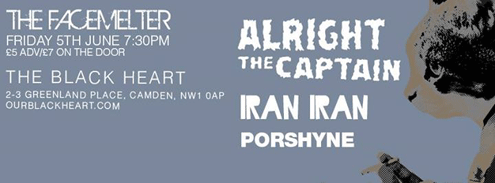
Alright The Captain + Iran Iran + Porshyne @ The Facemelter (The Black Heart, 2-3 Greenland Place, Camden, London, NW1 0AP, Friday 5th June , 7.30pm
Three heroes of math rock, alternative and post-rock travel from different corners of the UK to unite and form this amazing lineup.
Derby-based trio Alright The Captain masterfully combine virtuosic instrumentalism with unabashed musical experimentation and have effortlessly established themselves as a sonic force to be reckoned with, thanks to their increasingly inimitable, uniquely imaginative brand of math-rock. Their sprawling and varied career has seen them sharing stages with post-rock luminaries including Mono, toe, 65daysofstatic, Pelican, Tera Melos, ASIWYFA, Maybeshewill, Adebisi Shank (RIP), This Will Destroy You, ZU and many more. Their new album ‘Contact Fix’ (which ‘Musical Mathematics’ describes as “div(ing) in and out of math rock, prog and post rock – but, at its heart, it’s different”) has gone down a storm.
Iran Iran are another supremely talented bunch of musicians who stunned and impressed all who saw them at ArcTanGent last year. With insanely complex rhythms and thunderously heavy riffs, the four-piece from Bristol have evolved since their excellent first EP ‘Crystal Math’ and are packing a punch. They’ve played with Future Of The Left, Cleft, Alright The Captain, This Town Needs Guns, You Slut!, Alpha Male Tea Party, Death Pedals and many others. Fans of complex musical wizardry or heavy riffs will love their new EP ‘Milk Time For Spiders’.
Brightoners Porshyne dance between ambient intervals and melodic vocals to intensely intricate, fantastically crunchy prog rock riffs. With just a few single releases and a session filmed by Small Pond Recordings, they already sold out their first headline show in Brighton. This is your chance to catch the band before their career takes off.
More info here and here, and tickets here (£5.00 advance, £7.00 on the door).
At the end of the same week, Georgina Brett’s Tuesdays Post event returns to Stoke Newington with another evening of ambient/progressive live music, including ‘Misfit City’ favourites Darkroom…
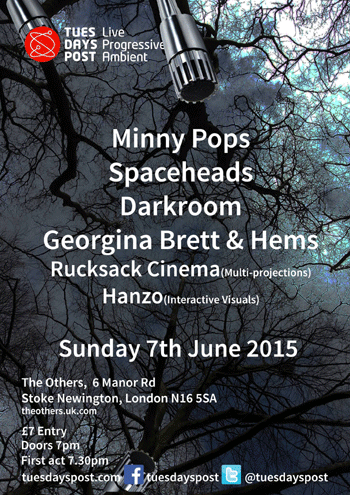
Minny Pops/Spaceheads/Darkroom/Georgina Brett & Hems @ Tuesdays Post, (The Others, 6 Manor Rd, London, N16 5SA, Friday 7th June, 7.00pm)
Formed by vocalist/band leader Wally van Middendorp in Amsterdam in 1978, Dutch electro pioneers Minny Pops took their name from a primitive Korg drum machine. The band released several singles and a debut album, Drastic Measures, Drastic Movement, on independent Dutch label Plurex before joining the legendary Manchester label Factory Records in 1980 (which resulted in them being produced by Martin Hannett, touring with both Joy Division and New Order, and becoming the first Dutch group to record a Peel Session). Singles including Dolphin’s Spurt, Secret Story and Time were followed by the acclaimed album ‘Sparks In A Dark Room’ in 1982. The band released two further albums (‘Poste Restante’ and ‘Fourth Floor’) before splitting in 1985. In 2012, the band reunited for a series of gigs in the UK, the Netherlands and Belgium and recorded a 7-inch single for Tim Burgess’ O Genesis label. After a pause to draw breath, 2014 has seen Minny Pops performing live once again.
Spaceheads are a cosmic duo of trumpet electronics and drums. Formed in 1990, they have developed a blend of electronics and sunshine fanfares over the course of ten albums, three EPs and much touring across Europe and the USA. Andy Diagram (also of James) plays trumpet with a mobile phone stuck to the top with a fish slice and Richard Harrison plays drums with big bendy metal sheets stuck to the top. They create live looped layers of brass driven by flurries of free flowing funky drums. Andy and Richard have achieved an intuition of what each is about to do next which makes their semi-improvised gigs a joy to behold. They release their first studio album in ten years – ‘A Short Ride On The Arrow of Time’ – this Autumn.
Darkroom – the UK-based duo of Michael Bearpark (guitars) and Andrew Ostler (synths)- expertly ride the line between luscious, old-school progressive rock and modern ambient electronics. At times reminiscent of early Tangerine Dream with hints of Fripp and Eno, they create clouds of sequenced synths, chewy grooves, and looped phrases to support a variety of acoustic and electric guitar melodies that twist and turn in surprising, occasionally aggressive, ways.
Hems Aka Henrique Matias will be playing live with Georgina Brett. Henrique is a multi-talented composer, programmer and DJ. He specialises in Multimedia programming (from internet things to Max/MSP and similars), although not all his live music and performances sounds like computer music (sometimes he takes his drum machines and crazy things out of the house). Georgina Brett’s music is created using her voice and effects pedals, creating instant choirs of sound, often in an hypnotic style. The point of this music is not only to captivate with extraordinary timing and melodic style but also to help the listener to relax in our ever-increasingly fast world.
Interactive visuals and multimedia projections are by Hanzo and Rucksack Cinema.
More information here – tickets £7.00 on the door.
By all accounts The Forge (in Camden Town) has spent the last few years becoming one of north London’s most interesting small venues for mixed music. I’ve yet to go there and see for myself: but in its full June calendar (also featuring funk, jazz, classical and Cuban music as well as assorted poetry) the following four concerts caught my interest:
Notus Winds & Eliza McCarthy (Wednesday 3nd June, 7.30pm)
Part of the classical monthly series Wednesdays at The Forge, this time featuring award-winning chamber ensemble Notus Winds and solo pianist Eliza McCarthy with a program of contemporary compositions (more information here). Tickets £10.00 to £12.00.
Programme:
Harrison Birtwistle – 5 Distances
György Ligeti – Ten Pieces
Arvo Pärt – Quintettino
Anders Hillborg – Six Pieces for Wind Quintet
Fenella Humphreys: Bach to the Future Part 1 (Tuesday 9th June, 7.30pm)
The first of three concerts presented by violinist Fenella Humphreys, featuring commissions of six new works by six of Britain’s leading composers to accompany Bach’s glorious 6 Sonatas and Partitas for unaccompanied violin. This first concert includes new works by Cheryl Frances-Hoad and Gordon Crosse alongside extraordinary music by Bach, Scott, Westhoff, Hindemith. Tickets £10.00 to £12.00.
Programme:
Cyril Scott – Bumble-Bees (1928)
Johann Paul von Westhoff – Suite no. 5 in D minor (1682)
Gordon Crosse – Orkney Dreaming (2014)
Fritz Kreisler – Recitativo and Scherzo-Caprice op. 6 (1911)
Paul Hindemith – Sonata op. 31 no. 2 ‘Es ist so schönes Wetter draussen’ (1924)
Johann Sebastian Bach – Partita no. 3 in E major BWV 1006 (c. 1720)
Cheryl Frances-Hoad – Suite no. 1 (2014)
Eugene Ysaye – 2nd Sonata op. 27 (1923)
Reciprocity: a new work by Daniel Patrick Cohen (Wednesday 10th June, 7.00pm)
Reciprocity is a 28 minute work for voice, taped narration, eight celli, piano, and percussion. The piece was composed by Daniel Patrick Cohen from six poems by the late Darya Farha, a Canadian poet, therapist, filmmaker and clothing designer. Darya was an extraordinary woman whose sharp intelligence, dry wit, distaste for orthodoxies and boundless empathy fuelled restless journey through her unfinished life. Darya died of breast cancer in 2011 when she was 46, and Reciprocity was commissioned by her sister Juliana Farha, who lives in London. Reciprocity is not about cancer, however. Instead, its human and universal themes of joy, pleasure, fear and anger, along with its intriguing instrumentation are sure to engage a broad audience. You can read more on the project here, and here. Tickets £6.00.
She’Koyokh & Veda Slovena Bulgarian Choir (Thursday 11th June, 8.00pm)
In a unique collaboration, She’Koyokh & Veda Slovena Bulgarian Choir combine the fiery panache of klezmer and Balkan music with the timeless beauty of Bulgarian voices, weaving Jewish, Turkish and Balkan music into the rich tapestry of the Bulgarian choral tradition. Read She’Koyokh’s piece on their Veda Slovena collaboration here. Tickets £10.00 to £12.00.
(All events taking place at The Forge, 3-7 Delancey Street, London, NW1 7NL)
Having pursued his studies from his native Chile to Denmark and then to the UK (he currently teaches at the University of Lancaster), electro-acoustic musician Felipe Otondo has already made himself a world traveler. The cosmopolitan sourcing of his music ensures that he travels even further afield, even while sitting at his computer. The four pieces on his debut album ‘Tutuguri’ draw on concepts, patterns, sounds and language from India, Java and Mexico as well as from European and American sound-labs.
This reminds me that, like bats, human beings use sound to find where we are. We often remain unaware of this, or even dismiss it. In cities, for example, we tend to think in terms of filtering out the extraneous noise – the rumbling press of traffic, the too-close babble of our neighbours on public transport or through the thin walls of apartment blocks; the persistent layering of unwanted music as ambient features for shopping or working. In spite of this, we’ll still use sounds to judge our way and to establish our place in a shifting world. Recurring sounds in the subway tell us that the service is regular, or when we need to change direction. Changing accents in voices and even birdsong rachet our subliminal paranoia up or down. Subtle switches in the quality of sound moving through the air tell us about weather, and about the places we move through. Some newly-blind people even report developing an echo-location sense, measuring the presence of oncoming pedestrians, lamp-posts and corners by the minute changes in echo and sound positioning.
Most importantly, we associate the places we know with an arrangement of sound. Wind will be shaped around a building in a particular way, the patterns of dialogue and intonation spoken in and around particular shops and café. Traffic lights and contraflows generate their own rhythms and exchanges. Blindfolded, I’d still be able to recognise the back-street where I currently live from its specific sound patterns: cars nudging the speed-bumps with a particular speed and duration, the toss and bend of the trees in the wind paths, the pitches of children’s voices in the school half-way along, the frequency of slow buses creeping to the nearby bus garage. These recognitions surprise us, often in ways which we don’t even consider until the connections occur to us.
To me (being less of a traveler than many) Felipe’s sound sources are more exotic, initially implying spatial journeys or international visits. The complex and beautifully-packaged CD sleeve for ‘Tutuguri’ enhances this, opening up like an origami flower (or like the jaws of a concealed alligator). The four intent and deceptively challenging pieces within the album are designed to shuffle the consciousness rather than soothe it. They divert the listener along other paths: associative, temporal, historical; hallucinatory or sacramental. When Felipe cites them as being “meditative”, he doesn’t mean relaxing, or lazy. Listening care is required. At a distance – at a point of detachment or reduction to background – Felipe’s pieces will sound like a fluttery wallpaper of treated sound effects. Up close, turned up, or simply heard on headphones, the craft is evident: Felipe’s years studying spatial sound and timbral perception have been well spent. He’ll set you down in the middle of a set of beautifully recorded instruments or noises – or as an offset, slightly distanced observer – and then gradually alter that sound-world in increments, or in sudden dartings.
The oldest piece on offer here, Ciguri, takes Native Mexican bell and gong sounds and cuts them loose from root time. This isn’t as straightforwardly surgical, or as uninvolved, as it might read. Felipe is open about the inspiration he’s drawn from the Mexican peyote ceremony (and from Antonin Artaud’s writings on it). In particular, he’s interested in the time-distortion effect experienced when ingesting mescaline (which he recreates here via digital editing). On the way, he also explores inharmonicity – the additional non-harmonic tones created within a sound, via variations in the source material’s state of rigidity and elasticity. Strictly speaking, this is a physical exploration, but if you’re talking ritual – if you’re talking metaphysics – the same idea might be extended to the participants in the ceremony. As in any sacrament, each of their experiences will be shaped by their willingness, and by how their own histories and attitudes impact on how their brain works and how their world is conceived.
On Ciguri, Felipe doesn’t make matters quite that explicit, but he does his very best to remind us of how subjective an experience this can be. Sound-wise, he places us in the heart of a slow heat of hanging metals, and we listen (over nine minutes) as they alter. During this time, different parts of the surrounding structure take turns to transmute while others remain still. Gently struck tones blur from a simple ping to a fluttering hummingbird drill: the substance of the metals themselves seem to move restlessly between solid resonant bronze, a whispering foil, or a mere shining hiss of elements. The reasons behind this may be all in the math, but it doesn’t feel that way. As the numbers race through their patterns, the world around us changes and we’re hypnotized by what feels like the universe breathing.
Another piece, Irama, draws directly on Javanese gamelan orchestra music (using manipulated recordings of the Sekar Petak ensemble at the University of York). Irama’s title comes from a flexible gamelan term – one that can be used to define the time between two notes, or the time between two actions; or the rhythmic relationships between parts of the composition; or tempo in general. Drawing all of these meanings together under one conceptual net suggests a substantial and integral connection between all of them, much as each of the Indonesian gongs, flutes, pots and zithers in a specific gamelan orchestra is honed and tuned to fit only with instruments from the same orchestra. Of course, digital electro-acoustic processing means that any relationship between notes, pitches or rhythms which didn’t already exist can be first conceived and then molded into shape: and Felipe flexes and reshapes the gamelan sounds according to his own design.
Irama’s gong sounds range from the familiar bronze boom to the kind of light dry patterings and tight-hide raps which you’d expect to hear bounding from frame drums. Over a particularly deep gong sound, a metallophone texture is stretched into a soft drone: when the broader percussion section returns, it’s joined by soft struck pings and an oceanic flutter. At crucial points, particular gong chimes cut through to suggest changes of intent and mood. Apart from these, all of the sounds which lope through Irama reinforce themselves, subtly adding to an arrangement which becomes denser and denser, shifting to a jazzier pulses before (nearly four minutes in) rising to flood-rate and then dispelling into nothing. A second section begins – sterilized pings and rings, more German laboratory than Javanese ritual. Drilling echoes are buried inside it, ringing edge-tones place themselves above it. At six minutes, the frame-drums return; at seven, the pulse has multiplied again to the point of flooding; at eight, softened rings are the dominant sound as the piece diminishes into calmness. As with Ciguri, there seems to be more than the mathematics at work here; but beyond the calculations, all of Irama could itself be an illustration of time as human experience – its repetitions, its bewildering multiplicity of voices; its moments of collective intensity and its sudden rapid lulls.
As a listener, attempting to put narratives (however clumsy) onto more elusive or abstract pieces of music is a common strategy. Thankfully, the mixed instrumental/vocal piece Teocalli already comes with a narrative. It’s based on ‘The Night Face Up’, a short story by the Argentine writer Julio Cortázar, whose surreal-modernist approach (creatively disrupting his plots and chances of resolution via a shifting, subjective consciousness and by the restless straw-shuffling of jazz) is well suited to the cut/paste/reshuffle of Felipe’s compositional tools.
The original tale is about an injured, hospitalized motorcyclist: delirious, and dreaming that he’s a man hunted by the ancient Aztecs and targeted for sacrifice. Location and context come adrift in the dreamer’s mind, but are carefully deployed by the writer – here, Felipe steps carefully into the latter role, guiding his strips and layers of sound into place. Hunters’ drums roll in the background, sometimes scooping up in an enormous glottal curl of extreme echo, swooped by fierce panning and sound-fielding. At times, they run backwards, creating great ominous bowls of sound-space. In a recurring cut-up, a little choir of men sing what sounds like a Mexican popular tune. This moves in and out of Teocalli like a radio which can’t stay fixed on the station, just as the injured man in the story can’t stay fixed within his own time or his own experience. Watchful silences bead within the piece, within the drum-slides; filled with tiny arrested hangs of reverberation.
Through these silences (but also often in the midst of great surging wrenches of drums, as they wrestle for our attention) women’s voices speak. Zapotec women, from a pre-Spanish civilization that lives alongside and intertwined with modern Mexico. They converse and chat, presumably about ordinary human matters – these are interview snippets, not field recordings. But as these women are separated from listeners like us by their language (and by our own crude knowledge, and cruder guesses, about their culture), they innocently become part of the sinister hallucinatory sound environment which Felipe creates. As drums sweep and skirl around our heads, so too does a whole jungle of suggestions – brief clusters of crickets, digitally squeezed and timeslid; bird calls, as of hunters hidden in the undergrowth. When one of the women speaks again, her unconcerned and easy voice is shaded into callousness. When, at one point, she suddenly laughs, easy and confident, the dense paranoia and wilderness swirling around her conspires to render her cruel.
There’s no final outcome to Teocalli – no cathartic slaughter, no rescue. Eventually Felipe’s piece just blows away into the shadows, like the memory of ugly wings pressed around you. The fever dream is over. With the passing sweat those eerie vicious terrors go with them. The deep-rooted fear (part-humble, part-racist) of an ancient, incipient otherness. The fear of comfort and security crumpling and allowing the past to pluck you away; a raw, helpless morsel.
In its way, the final ‘Tutuguri’ piece – Sarnath – is as ritualistic as the others, yet it doesn’t rely so much on recreating states of mind. Instead, it attempts to sculpt suggestions of place, history and connections. It’s based on Francis Booth’s Indian location recordings of places associated with the story of the Buddah (and is named after the deer park in which Buddhist Dharma was first taught). In a sense, Sarnath is both site-specific and displaced, bringing the noises of Buddah-touched locations to wherever its soundfiles are played. Concert venue. Boom box. Perhaps even a trekker’s smartphone, being carried on a pilgrimage of its own.
As Felipe switches between recordings (clicking up one-by-one the sonic capturess of different geographical stops on the Buddah journey), Sarnath itself seems to be moving from place to place in search of something. Literally, a footprint? Literally, an echo? Felipe toys with the field recordings: folding them on themselves, stretching them over time. A bell might sound, swell hugely, then drop away. Chants may be heard. On a half-distant road, a procession of ecstatically banging drums may wind its way to a shrine. Behind these, birds and animals twitter. Away from the devotions, there are the soft chips and scrapes of human work being carried on regardless. Here, Felipe’s notes most obviously cite the intense, subtle states of mind connected with meditation: here, with whispers of Buddha making their presence felt, it’s a traditional part of the tale. Here, too, are the tiny sounds to focus meditation; the small sonic flakes of the natural world around which attention can be wound.
‘Tutuguri’ is four pieces; four stories. None of them conclusive; and despite the sleevenotes and the substantial clues, at least part of the stories I’ve recounted here have been dreamed up by me. The solo listener – the sound moulded by careful hands around my ears, yes; some of the intimations perhaps patted into place. But in other cases this music is just process doing what process does: forming channels for their own sake, numbers making shapes and illusions as part of the pattern comes into view, and only part of that’s actually recognized. Much of the purely technical side of Felipe Otondo’s music escapes me: instead, I experience much of it as the psychological backwash, like the vapour trails after the plane has passed. Still, if I’m creating my own ideas for what Felipe’s music might entail or might intimate, there’s clearly enough extra substance there for me to build on. That’s what humans do: we use sound to find out where we are. Finding places we know: judging our way through what’s being presented to us; sometimes, the recognitions surprise us.
Working blind, but guided by sound, I travel too.
Felipe Otondo: ‘Tutuguri’ Sargasso Records, SCD28070 (5065001338700)
CD/download album
Released: 25th March 2013
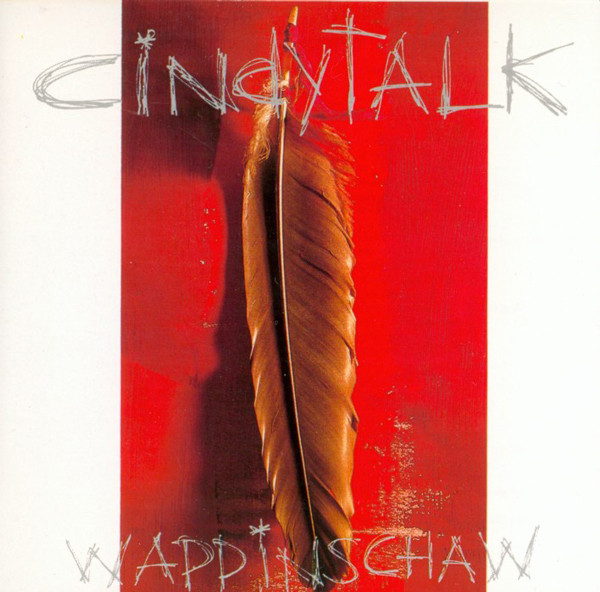
For almost fourteen years now, Cindytalk have been forging a lonely path through the ever-changing styles of modern music. Despite the soft pink flush of their name, Cindytalk’s music has always been so out-there, so much a music of violent extremes, that they have (more or less by default – how much could you change when you touch both ends of the spectrum?) stayed the same – no bad thing – while refining their sound on each album.
Gordon Sharp, the mainstay of Cindytalk’s many line-ups, is perhaps best known as the voice of three haunting tracks on the first album by 4AD art-collective This Mortal Coil, which also spawned Elizabeth Fraser’s honey-drenched version of Tim Buckley’s Song To The Siren in 1983. Yet 4AD-ethereal was never really Sharp’s bag. Cindytalk operate in the same dark areas that Michael Gira and Swans did before they transformed into doom-laden acoustic hippies (no more titles like Raping A Slave, then, Michael? cheers, love!), or The Birthday Party before Nick Cave mellowed out into Satan’s crooner.
They’ve wilfully, awkwardly, pursued music of extremes. Their first album, ‘Camouflage Heart’, must rank somewhere alongside Lou Reed’s ‘Metal Machine Music’ for sheer unlistenable music for (dis)pleasure, that has to be owned simply to piss people off. And the mammoth ‘In This World’ was a double album of contradictions – one record of near-industrial rock with razor-sharp guitar sounds (varying between tooth- extraction by electric power drill or sheet-metal white noise), and one record of near-ambient instrumentals and songs, mostly played on very soft piano like Erik Satie on Mogadon.
But it’s been a long time since any new Cindytalk material; perhaps because of artistic reclusiveness, perhaps through being a true cult act. Having already had a protracted recording between 1990 and 1992, this album took a further two years to emerge on a record label in 1994. A lone concert aside, we’ve heard nothing from them since (that’s what y-o-u think.. – ED.). Hence this five-years-after-the-event review: cults can always do with getting bigger while they wait for the resurrection.
So, ‘Wappinschaw’; one of 1994’s most intense, perverse and unusual lost albums…
It opens deceptively simply, with an a-capella reworking of Ewan MacColl’s The First Time Ever I Saw Your Face, reflecting Gordon Sharp’s interest in folk idioms (especially his own native Scots). He’s singing solo, without echo or reverb, up close, right there in your darkened room. His voice – one of the most expressive at conveying rage, pain, fear – displays power here yet, somehow, also insecurity. A Song Of Changes is leaden-paced at first, but David Ros’ guitars are more blurry and hazed than previous industrial strength Cindytalk noise. Suddenly the guitars hit an almost bright riff around which Sharp fluctuates and soars. A song of changes, indeed – light is breaking into Cindytalk’s dark world: “Within the heart of everything, there is you…”
It doesn’t last, though. Return To Pain (hah!) lurches in on a mix of barely-scrubbed electric and slide guitars, creating an empty and menacing atmosphere as Sharp emotes through wordless high vocals. It’s nightmare swamp music, midnight in the Mississippi plains accompanied by the scariest of companions, before the tension explodes into a barrage of noise. Drums, shotgun guitars, and Sharp wailing that “everybody is Christ.” Y-e-e-es; whatever you say, Gordon.
Whichever expectations are set for them, Cindytalk trump them on this record. Wheesht is introduced by a tape of Alisdair Gray reading an extract from his mammoth Scottish psycho-epic ‘Lanark’: a story of a young boy dreaming about what lies beyond the clouds. Recorded over the sound of a ticking clock and a ghostly musical box, this exercise in unsettling atmospherics chills the spine and sets us up for Wheesht itself: a brutally short, non- musical violent collage of bass drones, sonic interferences, sampled voices, blood-curdling screams and other genuinely unnerving sounds.
To the looping, echoed scrapings of a low-tuned violin, Snowkiss restores some sense of calm with more of Cindytalk’s music for winter nights – Gordon’s vocals imploding out of their rage into delicate lines and wordless harmonies sung over the gentlest of chiming, raindrop pianos. The lyrics of Disappear evoke a painfully trapped life: “You’re in heaven now, / Inside your head. / No thoughts of flight, / Your wings are clipped…”, while a strongly martial beat provides the tracks only propulsion as guitars and sampled interference compete with each other in a swirling eddy of sound. The lively, echoing trumpet on Traumlose Nacht, mingled with delicate piano and evocative waves of rolling drums, provide some relief and a different sonic vocabulary – it sounds like incidental music for the dark magic and oppressive heat of ‘Angel Heart’.
The final track, Hush, starts as an guitar-and-solo-vocal acoustic lament (back to the folk singing of the opening track) but then gives way to influential voices from the heavens (including samples of Orson Welles and Joseph Beuys) before everything fades to leave a long passage of bagpipe music that is, after the tumult of Cindytalk in action, strangely beguiling and soothing… but wait. After a long pause, a final hidden track, Muster. An incendiary, veritably Napalm-Death’s- worth battery of hideous thrash-noise, over which Sharp’s passionate ragged voice issues forth evocations to notable spirits: “The Wappinschaw is an invocation of the spirits of Shiva: Rise, William Wallace, rise! Rise, Arthur Rimbaud, rise!” He goes on to summon the spirits of Pasolini, Sitting Bull, Che Guevara and Ho Chi Minh, amongst others. So unearthly does Sharp sound, so compelling, that I have no doubt that the spirits responded. Quite the most disturbing sound heard on CD for some time.
I wouldn’t like to hazard too close a guess at what kind of emotional traumas Gordon Sharp purges from himself to make this music; all razor blades, blizzards and crow feathers. It’s enough to say that, after fourteen years on the extremes, Cindytalk demand your rapt attention, your horrified fascination…
The potential for making noise, making our own personalised sound via brain, limb or breath, has always been with us. In the sampler age – where you can trap any sound in a digital jar and then play musical Darwin with it – the option range has hurtled up several levels in the space of half a generation, and the serious sound addict can now personalise any noise no matter who or what the source.
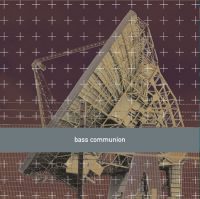
Which brings us to Bass Communion, the latest brainchild of studio wizard Steven Wilson. As if he weren’t busy enough psych-rocking with Porcupine Tree, cult- popping with No-Man, or working out his Kraut/post-rock urges with The Incredible Expanding Mindfuck. Let’s face it, few people are better qualified as a sound-addict.
Bass Communion (no thumpin’, pumpin’ house-music project, despite the suspicious name) is Wilson’s most direct attempt to date at riding this addiction. It’s also his most cryptic and esoteric, in which he rejects his usual battery of synthesizers in favour of the use of sounds “sampled, looped, transposed, layered, filtered, and processed into infinity” via electronic circuitry and sampler exploration. Wilson permits himself occasional real instruments (such as the skinny, echoing Bark Psychosis-style guitar on Drugged), but they sort of stand off to one side, like nervous uncles at parties. This isn’t really their show. For those who only skim the surface of Steven Wilson via the odd No-Man phuture-pop single, or hear the odd Porkies guitar blowout and maybe damn him as a wannabe Dave Gilmour, Bass Communion will come as a beautifully disorientating shock. This music shares secluded room-space with the work of Aphex Twin, Muslimgauze, Oval or Paul Schutze.
It might be a logical extension of Porcupine Tree’s ambient atmospherics or No-Man’s avant-garde leanings, but it’s also a giant leap of pure faith. There are no tunes, cheesy or otherwise. At all. And no attempts to please – there’s no equivalent to Aphex’s Come to Daddy on ‘Bass Communion’. Melodies, if they happen, seem to evolve almost by accident. Harmony is something that occurs occasionally when patterns coincide, rather than something that’s held to. Things flirt round the edges of familiarity, repeat and loop, but don’t so much hold the attention as massage it. When in doubt, it stays quiet. Actually, it’s always in doubt and always quiet, but never entirely at a loss about where to go. Bass Communion is profoundly experimental, but Wilson’s sharp, pop-attuned ear ensures that at least it never paints itself into a corner.
Shopping, the opener, deflects digital coldness from the off via its crackle and fluff of sampled vinyl noise: quiet, but almost drowning out the amnesiac wafts of melody which float, with disassociated loveliness, off to one side of the listening ear. They come in, they go; a wobbly snatch of Bach jumps out at you, trips over, cuts out. From then on, you’re on your own in Bass Communion’s subtly surreal electronic world.
Orphan Coal sounds like night in an abandoned telephone exchange. A clattering can drum pulses its elliptical way around and around. Echoing blips of voice trail after it – a hiccup in the system – and tones flicker irregularly like monitoring lights, going from ice to feather-stroke in seconds. Sheens of sound arch in ghostly fashion overhead: at peace, but disturbing yours. You almost expect HAL 9000 to be keeping a watchful red eye on it all. In which case the slow flood of Sleep Etc. is the digital limbo after the plugs are pulled and the lobotomy comes down, sending tides of electronic fluid trickling across the speakers, rising and implying a slow suffocation. Leafy rustles and long low scraping whale-like groans overlap deep subterranean booms and lost dizzy ringing sounds. Somewhere back in there there are hints of double basses, Rhodes pianos, and Mexican percussion – it could, conceivably, have started off as Wilson chopping up something like Weather Report and reducing it to sonic pulp for a new recipe. Whatever the source, now it sounds like icebergs having prolonged nightmares.
With all the experimentation going on, it’s almost a shame to admit that it’s the two versions of Drugged – apparently the first parts of an evolving sound series – that hit the spot best. How to define them? As “not-duets”, probably. Collaborations with live musicians that aren’t live, aren’t jams, weren’t composed, yet still sound like immediate and co-operative performances even though they’re manipulated and mutated bits of taped sound sent through Wilson’s cloud chamber. The effect is eerie: you feel that if you lent Steven Wilson your soul, he’d hand it back to you within days polished, cleaned and reconditioned, and with a few welcome surprises in the pockets.
On the first Drugged, Theo Travis‘ plaintive soprano saxophone replicates and proliferates, dozens of birdsinging reeds fluttering and fading over the warm upholstery of reverently pastoral organ chords. His playing is the most directly human and emotive on the record, yet here he sounds as if his personality is being melted down even as he makes his mark. There’s somehow something of the swan-song to what he’s doing, as if he and Wilson were carrying out a voluntary, luxuriant suicide pact.
The second Drugged, featuring the celestial guitar Soundscapes of Robert Fripp, is an especially inspired bit of audio piracy: a close cousin to the similar and marvellous Born Simple from No-Man’s ‘Flowermix’. Seven seconds of Fripp lifted from an old No-Man source tape, then refracted through Wilsonian concepts and gizmos for twenty-five minutes of protracted, blissful imagination. Frippophiles might notice that it equals about any genuine Soundscape they care to name: everyone else will be up with Steve ‘n’ Bob, nuzzling the starry skies.
A deep-down indulgence well worth sharing. Filter me another one, bass-boy.
Bass Communion: ‘Bass Communion’ (‘Bass Communion I’) 3rd Stone Ltd., STONE 036CD (Barcode)
CD-only album
Released: April 1998 Get it from:(2020 update)Bandcamp, Burning Shed or Amazon Bass Communion:
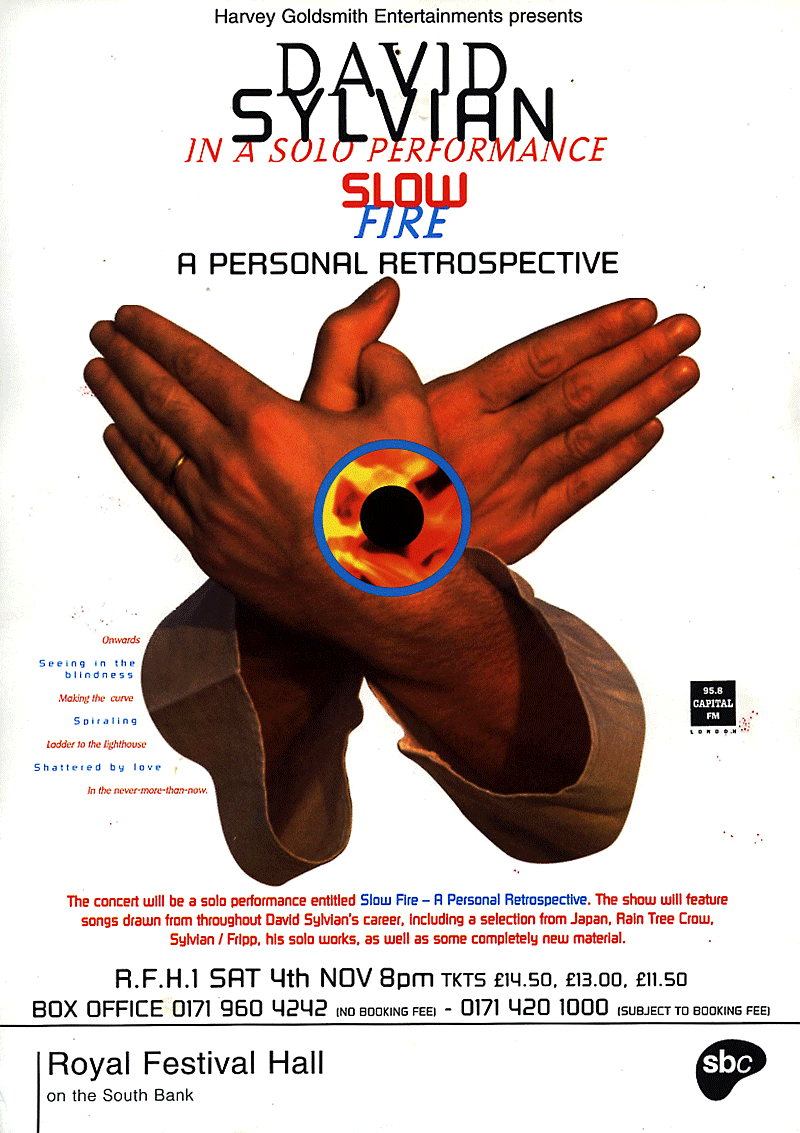
David Sylvian: ‘Slow Fire – A Personal Retrospective’ 4th November 1995
With former Japan leader David Sylvian, a show or an album is rarely as simple as being just a show or an album. Since 1983 he’s swum in and out of focus on a collection of artistic cross-fertilisations (sombrely beautiful songs albums, collaborative ambient vaguenesses, art installations): a shadowed, near-invisible chameleon with an enigmatic past ranging from over-exposed greasepaint-and-trash glamour to composer-effacing sound-sculpture. Tonight’s show – given extra weight by its ponderous title of ‘Slow Fire’ – is billed as a solo retrospective plus work in progress. Given Sylvian’s occasional tendency to enmire himself in inconsequential sound-tapestries, this could be grim. But the reality of ‘Slow Fire’ is more straightforward. Since we last saw him, touring with Robert Fripp, David Sylvian (like so many progressive artists) has decided to re-examine himself, unplugged.
With any contemporary electric musician, this is a risk: for Sylvian, much more so. The man now best known, post-Japan, for wall-to-wall electronic shrouding spends most of tonight perched on a stool behind a classical guitar. It’s the old rebirth scenario: once a travelling encrypter of decadent European and subtle Oriental sensibilities, Sylvian’s currently settled down into domestic bliss in America with a new wife (Prince protégé Ingrid Chavez), a new accent (decidedly transatlantic) and – judging by the credits on the appallingly pretentious programme – a guru. This would explain the brilliant white kaftan (has Jon Anderson missed any clothes recently?) and the four-cornered bowing as he takes the stage.
Though he’s dropped a few clues about an acoustic direction on recent recordings (on the Sylvian/Fripp B-side Endgame, for example), accepting Sylvian as an acoustic musician is not so easy. That marvellous voice, deep and rich as fortified honey, is still there, but over the years he’s made so much mileage out of his electrophonic atmospheres that his actual songs have been able to camouflage any flaws within the soundcraft.
The often disappointing collaboration with Fripp laid bare the aridity that Sylvian songs can often shrink into – tonight, Jean the Birdman is tricky and interesting but (even with a ludicrous attempt at scat singing) ultimately uninvolving, and there’s nothing like an acoustic performance for exposing juicelessness. Unsurprisingly, material from Sylvian’s song-centric 1987 album ‘Secrets of the Beehive’ fare well (the lilting menace in the folk-premonitions of The Boy with the Gun, a magnificent Orpheus and a hushed Waterfront) as do the few treasured songs from the Rain Tree Crow project: a reverberant Every Colour You Are, and a version of Blackwater which releases the song’s submerged country elements.
There are even one or two surprises during the guitar set, such as a rich rendition of Before the Bullfight and the shocking reinvention of keystone Japan hit Ghosts. From the beatless, icy original, Sylvian turns it into a wry Latin pop-inflected shrug of acknowledged doubt, Gilberto Gil meets Scott Walker. Even more shockingly, it works. But material from the schizophrenic ‘Brilliant Trees’ era has a tougher time making the jump to simple gut strings. Twitchy artiness such as Red Guitar and a limp Pulling Punches stumble out as embarrassing feynesses. Weathered Wall becomes a dull drone when denied the support of Jon Hassell‘s vaporous trumpet. With his shamanic atmospheric arrangements missing, too much of Sylvian’s once-epochal material is revealed as mere spectral verbiage, irresistibly crooned but superficially moodist. “Words with the charlatan,” mutters someone next to me, sarcastically.
It’s when he’s at the keyboard, with renewed access to a broader range of textures, that Sylvian delivers real magic – the rueful piano balladry in September and Earthbound Starblind, or the swathes of synth around the frozen pain and stone tears of Damage. When he allows himself the luxury of backing tapes, the dream deepens. A medley of Maria and Rain Tree Crow sees him keening over a wafting mist of chilling ambience punctuated by a ghostly chuckle. The First Day (graced with a wisp of taped Fripp skysaw) is as lushly majestic as ever. The deep dark indigo melancholy of Let the Happiness In acquires a meditative drum loop along with the shadowy orchestras of synth: it becomes hymnal, filling the great yearning emptiness at its heart with a sense of renewal, of return and redemption. It’s at moments like these that faith returns, and we can remember the subtle yet profound impact that Sylvian’s music has made in the past.
The trouble is that that was the past; and that the present is looking decidedly lumpen. The keyboard is also where Sylvian unveils his new material. For work in progress, it seems suspiciously complete… and already possesses a distinct form. A piano version of Tim Hardin’s It’ll Never Happen Again is the touchstone, with the interminable Ingrid’s Wheels and the rambling I Do Nothing (the latter most notable for its repeated, listless “alleluia”s) sketching Sylvian’s way forwards. Dusky, Americanised ballads with a strong element of that empty piano-bar pomposity that’s invariably damned with the kiss-of-death tag “quality songwriting”. Superficial sheen generating superficial applause. It’s difficult to escape the thought that David Sylvian’s self-effacing chameleonics have finally led him into a trap, a territory where he can no longer find his own face, where he will blur into a line of indistinguishable piano-song hacks whose albums will receive polite plaudits and gather dust on the lower shelves, where the fire will slow to a flicker.
The old Japan acolytes queue up tonight to touch the hem of King David’s gown. He smiles and bows like a bashful messiah. I can appreciate his showman’s smoothness… but I’ve lost my faith. I have a horrible suspicion that despite the handful of wonderful moments held to the light this evening, the shaman has swapped his books and his wisdom for a Cadillac, and the tin drum which once sounded out a musical challenge has just stopped beating.
David Sylvian online: Additional notes: While there’s no footage available for the London ‘Slow Fire’ show, you can get an approximation of it from footage of the Bari show from the same tour, in Italy, which is compiled here.
Swoon. /swo͞on/ A verb. To be emotionally affected by someone or something that one admires; become ecstatic. Here are some people and things that make me swoon. #swoon #swoonage










 Misfit City