Although there are still some September gigs to flag up, here’s advance notice of four interesting concerts in early October for those of you who are interested in the amorphous terrain between jazz, balladry, art pop and ambient electronica. (Just straight press release stuff – the analysis will have to wait for another time, although I’ve also stuck a few review links in where I’ve covered these musicians before…)
Two of the world’s leading solo bass guitarists together on one stage.
Crossing musical boundaries and blowing listeners’ minds for over thirty years, Jonas Hellborg is one of the great innovators of the bass guitar. From the pyrotechnic flamboyance of his early solo electric albums, to his unique exploration of the richness and depth of the acoustic bass guitar, Jonas has changed the way people think about – and play – the bass. Whether as a solo artist, or collaborating with many of the most respected names in music, from John McLaughlin to PiL, Ginger Baker to Shawn Lane, Jonas’ signature sound and uncompromising creative philosophy have produced an unparalleled body of work, mostly on his own Bardo label. Lauded by press and public alike, this is a rare opportunity to hear Jonas up close in the UK.
Steve Lawson is one of the most celebrated solo bassists in British music history – early in his career, he opened for Level 42 on their first Greatest Hits comeback tour, placing his unique take on melodic looping-based live performance in front of tens of thousands of bass aficionados. Fifteen years of regular gigging across the UK, Europe and the US have solidified his place as a leading exponent of solo bass. Steve’s sound-world borrows liberally from electronica, jazz, pop, rock, ambient and experimental music, to form a sonic fingerprint as compelling as it is unique. Following on from two years of wide-ranging collaboration, playing alongside musicians as diverse as Reeves Gabrels and Beardyman, Andy Gangadeen and Divinity, (and with the imminent release of his twelfth and thirteenth all-solo albums – on the same day!) Steve is back with fresh explorations pushing the notion of what the bass can be in the twenty-first century. (Here are a couple of ‘Misfit City’ reviews of earlier Steve Lawson records for those who’ve not read/heard them -‘Not Dancing For Chicken‘ and ‘Conversations‘).
Full dates, details and links:
Tower of Song, 107 Pershore Rd South, Cotteridge, Birmingham, B30 3EL, UK, Sunday 4th October 2015 – £10.00, tickets here.
The Vortex Jazz Bar, 11 Gillett Street, Dalston, London, N16 8AZ, UK, Monday 5th October 2015 – price t.b.c. – contact venue for tickets.
Left Bank Leeds, The former St Margaret of Antioch Church, Cardigan Road, Hyde Park, Leeds, LS6 1LJ, UK, Tuesday 6th October 2015 – £10.00, tickets here.
* * * * * * * *
Tim Bowness/Peter Chilvers/David Rhodes/Theo Travis (Chapter in association with Burning Shed @ Chapter, Market Road, Canton, Cardiff, Wales, CF5 1QE, UK, Saturday 3rd October 2015, 7.00pm) – £15.00
A unique combination of atmospheric music and songs performed by the following four British art-pop, jazz and textural music mainstays:
Tim Bowness is vocalist/co-writer with the band no-man, a long-running collaboration with Steven Wilson. He has also worked with Richard Barbieri (Porcupine Tree, Japan), Peter Hammill, Judy Dyble (ex-Fairport Convention), Roxy Music’s Phil Manzanera and others. He has released three solo albums – ‘My Hotel Year’ (2004), ‘Abandoned Dancehall Dreams’ (2014) and ‘Stupid Things That Mean The World‘ (2015).
Peter Chilvers is a frequent collaborator with Brian Eno (including co-creating the hugely successful app Bloom), Underworld’s Karl Hyde and Tim Bowness, Chilvers has become known for his innovative work with generative apps and imaginative use of electronic textures. (Here’s a review of ‘Thin Air‘, an album Peter did with Michael Bearpark many years ago).
David Rhodes is one of the world’s most respected and inventive guitarists, having worked extensively with Peter Gabriel as well as with Kate Bush, Talk Talk, Scott Walker, Japan, New Order, Paul McCartney and Blancmange, amongst many others. David has also released two solo albums (2010’s ‘Bittersweet’ and 2014’s ‘The David Rhodes Band’) and was a founding member of the influential post-punk band Random Hold.
Saxophonist and flautist Theo Travis (making his Chapter return after performing with the cinematic/musical crossover project Cipher) has an international reputation as one of the stars of the contemporary UK jazz scene. Travis has more recently emerged as a key figure in the progressive and art rock sphere, working with David Gilmour, Robert Fripp, David Sylvian, Porcupine Tree, Steven Wilson, Bill Nelson, Gong, Soft Machine Legacy, Bill Bruford, Harold Budd and more. He has recently released his ninth solo album ‘Transgression’ (and here’s a review of an earlier one).
The evening is presented by Burning Shed, the online label and store founded by Bowness and Chilvers with Pete Morgan that has become a global specialist in progressive, ambient/electronica and art rock music. As well as releasing works on its own imprint, amongst others, Burning Shed hosts the official online stores for Panegyric (King Crimson, Yes), Ape (Andy Partridge, XTC, The Milk & Honey Band), Jethro Tull, Kscope (Porcupine Tree, Sweet Billy Pilgrim), Thomas Dolby, All Saints (Brian Eno), Medium Productions (Jansen, Barbieri and Karn), Gentle Giant and Roxy Music’s Phil Manzanera. The label has recently expanded into book publishing, and at this concert musician and author Anthony Reynolds (perhaps best known as the former frontman of Jack) will be signing copies of his Burning Shed Publishing book, ‘Japan – A Foreign Place (The Biography 1974-1984)’.
More information here, and tickets available here.
Here’s the second of two previews for the first week of September, this one covering the weekend which has just arrived. Four gigs on Saturday (from post-classical to garage rock, from Afrobeat and kosmiche-influenced art pop to Canterbury-inspired lo-fi, from witty post-prog to Southern rock) and a chamber jazz gig on Sunday.
* * * * * * * *
After ten years of putting on post-classical club nights in east London, some way outside the heart of the British classical establishment, the Nonclassical organisation gets to play in the centre – a festival role, a high-profile corporate sponsorship, ads on the Tube and all. Come and judge whether they’re changing the game or being absorbed (beneficially or otherwise) into the belly of the beast. Whichever way this is going, the concert itself looks fascinating.
Nonclassical Club Night (Deloitte Ignite Festival @ Paul Hamlyn Hall, Royal Opera House, Covent Garden, London, WC2E 9DD, UK, Saturday 5th September 2015, 8.00pm) – £10.00
Nonclassical label leader Gabriel Prokofiev (a polystylist composer with a background in electroacoustic work whose works include a Concerto for Turntables & Orchestra, an “orchestral remix” of Beethoven’s Ninth and production work on hip hop, grime, and electro records) will be performing at the event, as will five-string-electric-cellist/composer/technologist Peter Gregson (whose adventures in sound include film soundtracking, multiple premieres of newly composed work plus three albums of original compositions, and a “data sonification” of Twitter).
Also performing will be the amplified prepared-piano artist Klavikon (a.k.a. Leon Michener, who uses various pickups, real time analogue processing and playing-mechanism inventions including a robot dog to fuse aleatoric ideas from Stockhausen and Cage with electronic dancefloor work including “cascading batteries of percussion, sub-basses and abstract soundscapes”); the “post-a-cappella” group Juice Vocal Ensemble (whose voicework encompasses everything from classical sources to hip hop, Irish folk, close-harmony vocal jazz and the experimental approaches of Meredith Monk and of Björk’s ‘Medúlla’), and Gabriel’s DJ collaborator Mr Switch.
There will also be a collaboration between classical soprano Sarah Dacey and the “Tendons” music theatre project initiated earlier this year by Holly Lowe and Nwando Ebizie. Based around harp, spoken word, performance art and electronics while mingling repertoire work with improvisation, this draws on and expands two modern classical pieces (Salvatore Sciarrino’s ‘L’addio a Trachis’ and John Cage’s ‘Dream’) plus the ‘Siciliano’ from Bach’s ‘Sonata in E flat’ and was premiered in June at the Nonclassical Downtown Loft Concert at The Russet in Shacklewell – one of the label’s ongoing attempts to encourage a London equivalent of the New York loft-music scene of the ‘70s and ‘80s.
* * * * * * * *
If you prefer to have your brain tickled by other means, Group Therapy are presenting what they call a night of “good ol’-fashioned noise rock” down at an east London art-rock stronghold.
Trojan Horse + Thumpermonkey + Godzilla Black (Group Therapy@ The Sebright Arms,33-35 Coate Street, London, E2 9AG, United Kingdom, Saturday 5th September 2015, 8.00pm) Entry £7 otd £5.50 advance
What this actually seems to be is a night mixing a sharp-minded self-aware take on post-progressive rock and a rollicking contemporary version of what my local library used to call “popular instrumental”, and would stick in a rack alongside James Last and The Shadows (from which, long ago, in the early days of my musical education, I’d pull out the likes of Mike Oldfield, Sky and Vangelis’ ‘Heaven and Hell’, and later the raging electric jazz raga of David Torn’s ‘Cloud About Mercury‘ – ten years later, I’d might been using it to catch the Deodato lounge revival). But if my comment makes the gig sound as if it’s in any way mild or lounge-friendly or mild, think again. This is very much a rock evening and it’s explicitly clear that this night’s crop of bands have soaked up Boredoms, Swans, Big Black, Sonic Youth and The Melvins alongside any Genesis or King Crimson which they might have imbibed. It’s just that it’s refreshing to be able to go along to one of those gigs, with that label, and not encounter yet another bunch of predictable art-punks posing with their distortion pedals and their feedback zones while reheating old daydreams about free jazz and No Wave…
I’m bitching. I don’t like doing that. Let’s have a look at the bands on the bill.
Manchester’s Trojan Horse are post-prog omnivores with tuneful hearts and a refreshing lack of shame. While their records pillage, digest and absorb a wide diet from Pink Floyd to James Brown to The Kinks to the 13th Floor Elevators, they also use their appetites to build their own muscle and identity – one through which they filter a broad, contemplative awareness of British and Mancunian history and how it soaks through into the lives of present-day people (although you don’t need to analyse that in order to enjoy one of their rambunctious gigs).
Simultaneously theatrical and punk-lean, Thumpermonkey can stake a claim to being one of the smartest British bands this side of Everything Everything (with whom they share a geeky brainiac quality driven home by vigorous, tuneful force). Couched in a crunching but colourful hard-rock vein with big pinches of post-hardcore and prog, their dramatic convoluted stalk-and-punch compositions are playful but melodious and rewarding. You can bang your head to a Thumpermonkey song, but you can also think to it. In Michael Woodman (a man like a knowing fusion of Peter Hammill, Nick Cave and Peter Blegvad) they’ve also got a frontman who’s one of the best singers and cleverest current lyricists in rock, delivering allusive and elusive barrages of sly wordplay in a resonant rock-operatic voice.
Finally, the big, bold, brazen sound of Godzilla Black lands precisely midway between No Wave and pin-sharp easy-listening film themes, or between James Black and the John Barry Seven, with rollicking drums, tight stunt brass (and yes, all right, distortion and computer sleet). They also play at a blistering, speaker-pummelling volume, so maybe there’s something in that noise rock description).
Headlining, Nottingham’s Canteloupe offer an omnivorous mix of pop, Krautrock, Afrobeat and disco. London’s Barringtone (featuring former Clor frontman Barry Dobbin) continue to pursue their motoric English art pop in the wake of the ‘Fever Head’ single. From Bradford, Gurglez blend what their neighbours Jumbo Records call “the power of prog, the drama of opera and the AOR grooves of the 70’s… poetic moments à la Terry Durham and free-jazz à la Nice” and “(turn) them on their head with a kind of left of field madness that Zappa would be proud of” (which, to these ears. also makes them sound more than a little like Sleepy People…) There should also be one more act to be added, which you can find out about in due course with the other gig information here and here.
* * * * * * * *
If you’d prefer something a little looser (or, as a clincher, something that was free to get into) for Saturday night, there’s this literally free-for-all concert taking place in the middle of Hackney and hosted by Sound Events Solutions, who have also provided the summary…
The Little Things + Alkatraz + Picturebox + Marianne Hyatt + Pit Ponies (Sound Events Solutions @ Bohemia Hackney, Unit 2, Bohemia Place, Mare Street, Hackney, London, E8 1DU, United Kingdom, Saturday 5th September 2015, 7.45pm) – free
With The Little Things it’s funk, and then it’s 70s New York new wave alt-rock, and then it’s pop, but it’s all seamless and it’s funky and cool as fuck – an uncanny indie-ish dance party band that just never suck no matter how much they flirt with mass appeal.
Alkatraz provide the psychotic reactions and spontaneous psychedelic combustions of trippin’ psychedelic garage rock.
Picturebox (centred around home-recordist Robert Halcrow) are leading lights (and probably the main constituents) of Canterbury Lo-Fi, a new clandestine pop movement encapsulating all the charm but none of the noodling of the legendary old Canterbury Scene. When Halcrow sings a song like Ruth Bakes A Cake, he is neither being ironic nor twee nor coquettishly kitchen-sink. There is a light-hearted, profoundly uncynical love for humanity running through his lyrics that can sometimes remind you of the way Syd Barrett used to sing about the lost idea of simple kindness. Special things don’t always hit you over the head with a mallet, and neither will Picturebox. But you just never know, sometimes a movement can start with an instrumental named in allusion to a little hi-fi shop next to a supermarket car-park in Canterbury, some heartfelt tributes to pop stars, and lots of tea and cake.
Frontwoman of (variously) Dragstripper, Temple of Sound, Anarchistwood and Country Dirt, MarianneHyatt is a London-based deep southern songstress from Austin Texas. She’s equal parts Patsy Cline, Janis Joplin and Jim Morrison, has sung with The Frogs at ATP, with Bill Callahan at Meltdown Festival and played a late-night pickup in Richard Linklater’s ‘Slacker’. She writes and plays platonic lovesongs to sexworkers, country reggae odes to schizophrenic madames and protest tunes to natural disasters… a walking triumph of lost causes and no-longer living legends.
Pit Ponies are renegades from Naughties rockney/post-punk/knees-up beer boys Corporal Machine & The Bombers, fusing ‘90s indie with pissed pub fights and ‘70s pub-rock. (In spite of this preamble, they’ll actually be playing an acoustic set.)
After all of this, on Sunday, there’s jazz via the return of the LUME evenings via the Vortex. Blurb for the first evening is below.
Mark Pringle’s A Moveable Feast & Rebecca Nash (LUME @ The Vortex Jazz Club, 11 Gillett Square, Dalston, London, N16 8AZ, UK, Sunday 6th September 2015, 7.30pm – £10.00
A Moveable Feast is a group led by jazz pianist Mark Pringle (a Peter Whittingham Award winner for the year 2015, following in the footsteps of previous recipients Gwilym Simcock, Trish Clowes and Elliot Galvin). Heavily inspired by time spent studying in Paris in 2013, the music draws on multiple cultural influences, containing themes of nature, wildlife, literature, the chaos of cities, the lives of people who inhabit them, woodland creatures and strange beasts… This autumn sees the group undertaking a national tour to promote the release of their album, ‘A Moveable Feast’, on Stoney Lane Records.
Featuring a twelvetet line up of strings, horns and rhythm section, the group explore Mark’s music with great freedom of approach, resulting in music that is eclectic, adventurous and highly unique. The band are Mark Pringle (piano), Percy Pursglove (trumpet), Chris Young (alto saxophone), Dan Searjeant (tenor and alto saxophones, flute), Alicia Gardener-Trejo (bass clarinet, baritone saxophone, alto flute), Ben Lee (electric guitar), James Banner (double bass) and Euan Palmer (drums), plus a string quartet of Christine Cornwell, Sarah Farmer, Megan Jowett and Lucy French.
Rebecca Nash‘s music, written with the intention of creating a new cohesive sound, blends together all the things she loves about music. Most important is a sense of purpose, identity and beauty. It is inspired by many musical influences which primarily include jazz musicians such as Pat Metheny and Wayne Shorter but also other styles too, such as electronica and folk music. Rebecca’s own style, rooted in the contemporary jazz genre, blends acoustic and electronic elements with strong melodies, underpinned by dense harmonies and unusual grooves with the aim of creating one overall soundscape.
This latest project is Rebecca’s first as a bandleader, and all of the music performed is original material from her forthcoming album, due to be recorded later this year. Tonight she leads a small group with herself on piano, Percy Pursglove on trumpet, Matt Fisher on drums, and Chris Mapp on bass guitar.
More information on the event is here, with tickets available here.
Just quickly plugging this event, as I unintentionally left it off the early-September preview from Tuesday. While I was initially drawn to it by the musical involvement of textural loop duo )and longtime ‘Misfit City’ favourites) Darkroom, there’s plenty here to interest anyone with curiosity about the workings of the mind. It’s free, although the scheduled talks and some larger activities are ticketed (you’ll need to get tickets for those from the Wellcome Collection on the night, from 6.30pm onwards).
Hubbub Late Spectacular @ The Hub, The Wellcome Collection, 183 Euston Road, London NW1 2BE, UK, Friday 4th September 2015, 7.00pm) – free entry
A night to explore rest… and its opposites. What does “rest” mean to you? Join the Hubbub team to investigate rest and its opposites: from daydreaming and doodling, to fidgeting and lullabies. Catch a talk on the latest discoveries about what your brain’s up to when you’re doing nothing, or experience a live stream of sound from around Heathrow airport. From a documentary about an ape retirement home, to a workshop where you can try out historical relaxation techniques, this is an evening that will transform how you understand rest.
Activities – hear contemporary lullabies and add to a collaborative collection; learn about mapping alertness and environment through self-tracking; experience variations of relaxation and cacophony with a brand new audio piece from radio collective In The Dark; put rest to the test as you investigate some of the methods used by scientists to measure rest and its opposites; join the debate on “what’s wrong with work?”
Talks – “Fantasy and Fiction” with social scientist Felicity Callard and poet James Wilkes; “Free Time and Mindwandering” with psychologists and authors Claudia Hammond and Charles Fernyhough; “Mapping Rest” with neuroscientist Daniel Margulies and anthropologist Josh Berson.
Some comments from Hubbub investigator Charles Ferneyhough (the whole blog post is here):
The research project in Hubbub is investigating topics such the relation between the shifting periodicities of ambient music and the changing rhythms of conscious experience, and how and in what contexts these can have restful and restorative effects. We plan to extend these investigations into studies of neural connectivity in the “resting state”: the dynamic, fearsomely complex and increasingly well-studied patterns of activation shown by a brain that is not performing any specific task. We are employing new methodologies for assessing these nuances of subjective experience (both for audience and performers) in a scientifically rigorous manner, as well as exploring implications for clinical interventions… Darkroom are interrupting a tour promoting their new album ‘The Rest is Noise’ to perform with me in a sequence of three extended sets at the Hubbub Late Spectacular. Come and hear the sounds of improvised ambient music, and get a chance to give your feedback on the psychological and emotional effects of listening to this kind of music.
…plus some from Darkroom themselves:
Darkroom will play three sets, with unpredictably different shades and contrasts. It’s a free event (apart from the drinks) at this spectacular venue, and there’s an opportunity to take part in the experiment, as well as take in other talks and exhibitions on the night, and meet some of the other investigators and our collaborators.
Reposted here is a Soundcloud recording of Darkroom and Charles Fernyhough collaborating on a half-hour long track recorded at The Hub earlier this year.
Here’s a quick signal booster (or, perhaps more accurately, noise booster) for the debut Mutations festival coming up in Brighton at the end of November. (The press release just came in from Stereo Sanctity today). Note that tickets go on sale in the middle of this week, and that there’s only a thousand tickets. I’ve just seen a Facebook counter suggesting that 330 people have already committed themselves to tickets. Move fast.
Mutations is a new multi-venue inner city festival in Brighton, England, born out of last years acclaimed DRILL:BRIGHTON. With Wire’s touring project moving onto the next urban sonic assault, co-curators One Inch Badge decided the time was right for a forward thinking, annual, artist-lead festival that would be static to Brighton on the last weekend of November
Spanning two days and nights on the 28th and 29th November with an incredibly intimate capacity of just 1,000, Mutations is a music-lover’s event. Alongside the music you can also expect pop-up record fairs, poster art exhibitions, photography and more.
Mutations is a creative mass of genre hybrids and expression, delivering some of the most inspiring, creative and interesting music the world has to offer; a host of other national and international acts including genuinely alternative rock, aggressive noise, experimental house, singer-songwriters, doom metal, electronica, drone, experimental folk and various other experimental sounds.
More quick London gig news – art rock, post-rock, electronica, and a dash of classic New York downtown.
Rumour Cubes + Dresda + kontakte @ The Facemelter (The Black Heart, 2-3 Greenland Place, Camden, London, NW1 0AP, UK, Friday 7th August, 7.30pm – £8.00/£6.00)
Sumptuous instrumental and electronic post-rock from ex-Glastonbury and ArcTanGent Festival performers, plus a UK debut.
Post-rock veterans Rumour Cubes have been spreading tentacles of ambient, soaring soundscapes across the globe, catching people’s attention with their classical and electronic nuances, attention to the finest details and unassuming political statements embedded in their writing. Their work with poets and film-makers has allowed them to create a multi-media experience and has propelled them to performances at Glastonbury, ArcTanGent and a support slot for Sólstafir; while their albums ‘The Narrow State’ (2012) and ‘Appearances Of Collections’ (2014) received wide critical acclaim.
Celebrating their tenth anniversary this year, Dresda hail from Genova, Italy, and will be driving over to make their UK debut. Their music is intricate, dense and introspective yet gloriously cinematic. They have several well-received releases under their belts, including soundtracks for critically acclaimed Italian independent movie ‘The Krolevsky Case’, and the short movie ‘La lingua del disordine’. In 2009, they were featured on the Italian DVD edition of the Canadian documentary ‘RIP! A remix manifesto’, distributed by Feltrinelli Real Cinema nationwide.
Conceived in 2005 from a string of old 4-track demos and further realized via a labyrinth of digital workstations and computer software, kontakte blend organic instrumentation within an electronic and hypnotic framework of programmed beats and pulsing synths. Pooling influences such as Godspeed You! Black Emperor, Mogwai together with Brian Eno, krautrock and shogaze sounds, this duo manages to perfectly blend shimmering electronics and ethereal melodies. They have too many releases to name and have been remixed by many visionaries including Tim Holmes of Death In Vegas, Chris Olley of Six By Seven and Russell. M. Harmon.
There might also be tickets remaining for the performance of Arthur Russell’s Instrumentals early in the following week. This is a repeat visit of a show that’s been on and off the road at various points around the world since 2012 and which last visited London via Cecil Sharp House earlier this year… so if you missed it before, now’s your chance.
Visions presents: Arthur Russell’s Instrumentals, directed by Peter Gordon @ Visions Festival (Oval Space, 29-32 The Oval London, Bethnal Green, London, E2 9DT, UK, Monday 10th August, 7.30pm – £21.50 plus booking fee)
For those of you who don’t know about Arthur Russell’s turbulent, productive (and sadly curtailed) life, he was a vigorous participant within the downtown New York music scene between the mid-1970s and early 1990s. Having studied as an avant-garde cellist and composer, he rebelled into Manhattan nightlife, vigorous cross-fertilization and event curation. Russell rubbed up against Fluxus, disco, avant-garde theatre, New Wave and no-wave, making the most of the breadth of the prolonged New York creative ferment of the times, feeding his assorted roots and collisions into music of his own.
During the last decade of his life Russell wrote and performed voice-and-cello songs – predominantly solo but employing loops, echo and sundry effects. In these, he synthesized all that he’d learned into what were perhaps his most personal and accessible works. These are probably what he’s best known for now, thanks to the more prominent releases of albums such as ‘World Of Echo’ and ‘Another Thought’, but they’re only one aspect of his work
A notorious perfectionist reknowned for agonised work gestations (and who left hundreds of pieces uncompleted at his death) Russell nonetheless completed what was, at the time a remarkably bold, broad and modern array of work from orchestral pieces and theatre music to forays into electro-pop and dance music under project names including Dinosaur (for ‘Kiss Me Again’) and Loose Joints (‘Tell You Today’). Today this kind of equivalence and eclecticism is more commonplace in the orchestral or ensemble work of composers such as John Zorn, Django Bates, Anna Meredith or Tansy Davies. In the 1970s, though, Russell was a pioneer, notoriously shocking the staider elements of his avant-garde classical audience with ‘24-24 Music’ (a contemporary classical piece equating the pulses and disciplines of New York minimalism with those of disco music).
Coming from the zone of Russell’s talent which drew most on his contemporary classical roots, ‘Instrumentals’ is an example of his chamber music, Dating from the late ‘70s, it was initially conceived as a forty-eight hour piece, its duration far exceeding even the infamously massy protracted works of Morton Feldman. Versions of the work were performed over the years, and a selection of excerpts appeared on a Disques du Crepuscule release in the mid-‘80s.
The piece as it stands owes much to Russell’s friend Peter Gordon, a fellow eclectician from the 1970s downtown scene and Russell’s bandmate in The Flying Hearts and Gordon’s own ongoing Love Of Life Orchestra. Gordon worked closely on the original performed version, assisting on keyboards, arrangement and notation. Two decades after Russell’s death in 1992, Gordon brought a new version of ‘Instrumentals’ back to The Kitchen (Russell’s old home venue in Manhattan. Following the initial sold-out performance in March 2012, Gordon has periodically revived and toured the new arrangement. The performance at Oval Space will feature several members of Russell’s original ensemble, and will also feature photographs by Yuko Nonomura which were projected during the original 1975/78 Manhattan performances of ‘Instrumentals’.
One of the reasons that I’ve been posting so many concert previews recently is simply that (being mostly homebound at the moment) I miss going to gigs. Looking at the lineup and scope of the 2015 Manchester Jazz Festival (which starts today and runs rampant for ten days through until 9th August) reminds me that not only do I regret not attending the wealth of music that takes place here in London, but that I miss more freewheeling days of music elsewhere. Discovering unexpected, treasurable bands at random while on holiday in Brugge, for instance; or immersing myself in a week of concerts and more in Edinburgh or Leeds (such as the one I reviewed here, over a decade ago.)
We know that, as a British pop and dance city, Manchester punches well above its weight. Despite a bubbling undercurrent of improvised music, its reputation as a jazz town is hazier…. or, more probably, I’m just ignorant. The Festival’s been going for twenty years, long enough to gain enough gravity to generate its own traditions. (One such is ‘Surroundings’, a longer-form ensemble piece by Salford composer Neil Yates. Commissioned for the festival in 2010, it seems to have become the event’s unofficial signature – this year, it’s being revisited as a quartet performance in the Central Library Reading Room.)
Even a quick sift through this year’s programme reveals a jazz party that any city would be proud of – diverse, inclusive, inviting and multi-levelled, an exciting noise ranging from the stately to the vividly scraggled and all the better for it. With many tickets going at only four pounds, (with a ten-pound all-events daily ticket and free-entry deals if you stump up as a low-level event sponsor), they could hardly have made it any more inviting to the casual walker-upper. Excuse me for a moment while I strip-mine press releases and YouTube, and check Soundcloud pages and Bandcamp links.
Starting with the higher-end, bigger name events… Acclaimed Blue Note pianist Robert Glasper slips away from his experimentations with latterday R’n’B to get back to basics with an acoustic trio; John Surman re-teams with the Trans4mation String Quartet to revive the thoughtful, tidally-deep music from his ‘Coruscating’ and ‘The Spaces in Between’ albums. Norma Winstone, Klaus Gesing and Glauco Venier bring along their trans-European project Distances. Partisansbring their transatlantic swing storm; Christine Tobin her ‘Thousand Kisses Deep’ jazzification of Leonard Cohen songs. French Jazz Musician of the Year Airelle Besson makes an appearance with her Quartet for a set of “gently experimental songs animated by heartfelt lyrics, plaintive melodies and rolling harmonies.” backed with pinballing rhythms and punchy countersyncopations.
There are heavyweight two-headed summit performances by acclaimed British jazz talents – one by frequent quartet buddies Mike Walker andGwilym Simcock, another by the more recent pairing of Tori Freestoneand Alcyona Mick. Two further British scene fast risers – Stuart McCallum and Alice Zawadzki – bring string-enhanced performances of ongoing projects (the former offering contemporary soul jazz and bass-heavy electronica with surprise guest singers, the latter a fantastical Mancunian song cycle influenced by various shades of love and fairytale).
There are also several of those gentler, more literate projects which seem to blossom best in a festival atmosphere away from a hot core of gutsy brass. Andrew Woodhead and Holly Thomas’ Snapdragontrio specialize in chilled, ethereal song-settings of literature and poetry (Larkin and Bukowski-inspired) and bursts of vocalese. Mark Pringle‘s A Moveable Feast mates orchestral strings with a bold horn and rhythm section to explore “themes of wildlife, literature and city chaos.” The “fractured Anglicana” of Hugh Nankivell’s multi-instrumental/four-part vocal quartet Natural Causes means that they perform “curious compositions with improbable but poignant texts” including “psychedelic lullabies, pinprick-precise ballads, unpredictable group improvisation and brotherly harmony across the board”, and music which draws on classic and contemporary art pop (Robert Wyatt, XTC and Björk) as much as it does on jazz sources.
Elsewhere, much of the polyglot diversity of jazz today is celebrated. The Cuban tradition is represented by the Pepe Rivero Trio and Orquesta Timbala; the Congolese by Eddy Tshepe Tshepela‘s Afrika Jazz. Central and South American ideas are brought along byAgua Pasa (who, with Dudley Nesbit’s steel pan project Pan Jumby, also touch on the Caribbean). The Quarry Hillbillies (a teaming ofUlrich Elbracht, Ed Jones, Jamil Sheriff) from European contemporary jazz, while the frenetic whirl of Eastern European folk elements are covered by Makanitza. The Gorka Benítez Trio move between Basque-flavoured small group jazz and compelling free-form impressionism. David Austin Grey’s Hansu-Tori ensemble is inspired by natural, elemental and cinematic” ideas, as well as a fascination with Eastern world culture. Percussionist Felix Higginbottom’s Hans Prya provides genre-hopping jazz-dance and Jim Molyneux’s Glowrogues favour funk and hip-hop flavoured pieces. Trumpeter Lily Carassik‘s fusion group Yesa Sikyitake ideas from the ’50s and blend them with popular standards and soul arrangements; while The Stretch Trio include glossier elements from ’70s jazz rock, progressive rock and ’80s pop along with sinuous gusts of wind synth.
Those who prefer classic jazz – more traditional by-the-book American styles – might prefer Russell Henderson and Jamie Taylor’s Ellington-and-Strayhorn tribute ‘The Intimacy Of The Blues’, or the Dan Whieldon Trio‘s salute to Gershwin. The Dave Kane Quartet take inspiration from the knottier ambitions of Charles Mingus, John Zorn and Eric Dolphy. Two groups of students from the Royal Northern College of Music provide live celebrations of the history which they’ve been learning – the James Girling Quintet spans jazz, blues and funk from New Orleans roots through to the 1960s, while the Nick Conn Octet (a self-described “trombone choir”) interweaves re-arranged jazz classics with original material.
Fans of New Orleans jazz can check out genuine New Orleaners The Session (who offer a past-present take on their hometown’s music), or look out for the street sounds of the New York Brass Band (actually from old York, the cheeky buggers) or see how the Riot Jazz Brass Band dust up old New Orleans sounds with dancefloor, dubstep and drum-and-bass incursions. Hot jazz/Gypsy/jazz manouche aficionados can go for the loving recreations of 52 Skidoo (who promise you prohibition speakeasies, rent parties and Tin Pan Alley) or for Gypsies Of Bohemia, who manouche-ify latterday pop songs such as Heart Of Glass, Toxic and Hot In Herre. (Being Mancunian, they also do This Charming Man – I’ll bet that that high-life opening riff translates pretty well).
Of course, much of the fun of a jazz festival involves catching a lesser-known, or even unknown, band carving away at the edge, furiously discovering – and there are plenty of those here. Since they drew me into covering the festival in the first place, I’m going to put a particular word in for Jon Thorne’s Sunshine Brothers (playing at Matt & Phreds on 4th August) in which the double bass/laptop-wielding Jon teams up with drummer Rob Turner (of Blue Note-signed breakbeat jazz electronicists GoGo Penguin) and looping poly-genre bass guitarist Steve Lawson (a ‘Misfit City’ regular) for “a cutting-edge trio of genre-defying musicians mixing jazz, improvisation, electronic and filmic soundscapes to euphoric effect, evoking sounds far removed from their bass origins.”
However, you could just as easily catch a full performance by GoGo Penguin themselves; or by Lauren Kinsella’s Blue-Eyed Hawk, who offer “art-rock, jazz and electronic soundworlds: imaginative and emotive, from pindrop to powerhouse.” The Madwort Saxophone Quartet play intricate four-part math-jazz. “Power-jazz commando team”Taupe (a triple-city trio from Manchester, Newcastle and Edinburgh) punch around themes from jazz, hip hop and heavy metal. Craig Scott’s Lobotomy seem determined to take the cake for upfront experimental exhilaration this time around, delivering shout-outs to John Cage, Captain Beefheart and Frank Zappa, proclaiming a performance in which “experimental jazz rubs shoulders with electronica and DIY alternative rock in a bubbling cauldron of live and recorded sounds” and promising to sample and reconstruction their own improvisations live on stage. There’ll also be a improvised summit involving bands associated with Manchester’s Efpi Records and Paris’ Onze Heures Onze collective.
One way into discovery is to take advantage of the free showcases for emerging bands. Care of the BBC’s ‘Jazz On 3’, London offers three bands – Nérija ( the all-female creative septet from the Tomorrow’s Warriors jazz school), the award-winning piano jazz of the Ashley Henry Trio and the decidedly psychedelic Phaze Theory (a quartet of drums, tuba, voice and guitar dedicated to “exploring the vastness of the musical cosmos”).
But perhaps it’s Jazz North’s Northern Line series that you should be checking out, showcasing bands from the north and the Midlands. Manchester offers the Iain Dixon/Les Chisnall Duo (whose repertoire of self-defined standards stretches from Messaien to Gracie Fields) and the John Bailey Quintet (guitar-led, and similarly inspired by twentieth century classical music). Newcastle provides barrel-house blues and ballads from The Lindsay Hannon Plus and the tricky free jazz/folk/rock/dancefloor entwinings of the Graeme Wilson Quartet. Lancaster and Liverpool provide one act apiece – Andrew Grew’s “total improvisers”The Grew Quartet and the “gothic bebop” of Blind Monk Trio, who claim to fuse the spirit of Thelonius Monk with Persian traditional music and the heavy-rock attitude of Led Zeppelin and Nirvana’s heavy-rock attitude.
However, it’s Leeds (still underrated as a musical powerhouse despite the world-class output of its music college and the vigorous inventiveness of its bands) which dominates the Northern Line. As well as providing the previously-mentioned Pan Jumby, Leeds brings the Portuguese/African/Latin and Indian song-fusions of Manjula, the Django Reinhardt swing of the Matt Holborn Quartet, Cameron Vale‘s ferociously energetic melange of jazz, metal, electronica, Afrobeat and Klezmer and the semi-electric “extreme, eerie to comic” improvisations of Tipping Point (featuring perpetual bad-boy pianist Matthew Bourne). Friendly rivalry aside, there’s also co-operation: Leeds, Manchester and Liverpool all join forces in The Bugalu Foundation for a Latin barrio take on northern soul.
Around all of this jazz there’s the usual happy agglomeration of related music – not quite jazz in itself, but possibly sharing a drink or a roll-up somewhere along the way. The festival covers various popular outcropping such as soul (in assorted Northern, jazz and diva forms courtesy of The Juggernaut Love Band, Terry Shaltiel & The Soultroopers, Charlie Cooper & The CCs) but also ’60s/‘70s funk (Buffalo Brothers), ’70s Afrobeat and Ethiopian pop (Kalakuta), ska (Baked à la Ska) and mbalax (Mamadou & The Super Libidor Band). There’s even an alt-country act (Stevie Williams & The Most Wanted Band) sneaking in at the back door. As for rock’n’roll/folk/reggae/swing scavengers The Flat Cap 3… well, for starters, there’s only two of them, so you can be dubious about anything else you might read, but don’t let that put you off.
Three female songwriters are also bringing their bands, coming from a folk or world music zone and overlapping into jazz. Kirsty McGeeleads her Hobopop Collective through a “joyful, dirty” sound drawing from gospel, blues and a collection of found instruments (including musical saw, waterphone, Humber hubcaps and metal buckets). The constantly shifting song landscapes of the Zoe Kyoti Trio draw from their leader’s Armenian and Greek heritage (as well as Cajun, European and Indian ideas). Saluting home-brewed British polyculture, Shama Rahman‘s ensemble explore her London home, her Bangladeshi roots, and her childhood memories of Middle Eastern desert landscapes in a “sitar,stories and song” melange of jazz-inspired improvisation, classically-inspired melodies and folk-inspired storytelling accompanied by energetic rhythms of swing, funk, hip hop, bossa nova and drum’n’bass.
For parents of very young children, needing to balance a jazz fix with family responsibilities, there are a couple of fully interactive kids’ events with activities, storytelling and improvisations. The Living Story Music Ensemble and illustrator Ann Gilligan collaborate on ‘I Have A Duck Who Can Roar’; the blues-and-roots-tingedHillary Step Quartet work with storyteller Ursula Holden Gill and dancers from The Dalcroze Societyfor ‘How Monkey Found His Swing’. Once the kids are attended to, there are still interactive events for the grown-ups, whether you’re talking about the all-in jazz vinyl night, the mixed-genre dj sets by Mr Scruff, Franny Eubanks‘ open-door blues jam or (for the more technologically inquisitive) Rodrigo Constanzo‘s showcasing of his dfscore software. The latter’s a creative music tool, cueing improvisers via graphical, visual and written clues: on this occasion, anyone with an instrument and a connectible smartphone/tablet/pad should be able to roll up and join in with the roar, joining some leading improvisers in performing music in tandem with the system.
For those remaining soundclips which I’ve not already snatched and pasted, visit the MJF Soundcloud page here … but better yet, if you’re anywhere near Manchester over the next few weeks, drop in at the festival (it’s hard to miss, considering that it’s not just hiding behind club doors but has effectively taken over the town’s main square for a fortnight). Seeing something this impressive light up and roll on fills me with delight – even if on this occasion I’m also filled with rue at not being able to go myself. But never mind me…
More upcoming London gigs this week. Firstly, various kinds of jazz on Thursday…
Nick Costley-White & Bleep Test (LUME @ Long White Cloud, 151 Hackney Road, Hoxton, London, E2 8JL, UK, Thursday 16th July, 8.00pm
This week at LUME… original and improvised music. We’ve got a tasty double bill for you this Thursday with solo guitar explorations and an exciting new electronic jazz ensemble mixing beats and tunes. Should be a great evening of cutting edge new sounds. Entry is one Bank of England note of your choice. (£5, £10, £20… £50???!)
Bleep Test (Fraser Smith – tenor sax/effects; Joe Webb – synths; Lloyd Haines – drums; Matthew Read – bass) combine house, breaks, drum & bass and jazz. Analog synths, electric drums and a screaming saxophone tie this band to the growing scene of exciting, genre defying music groups emerging from London’s creative underground. Fiery grooves and memorable melodies push these musicians out of the traditional jazz improvisation realm and into another soundscape that hits hard.
Nick Costley-White is fast becoming one of the most in demand young guitarists in the London jazz scene. With a developed sound and individual voice on his instrument, Nick has had the opportunity to perform professionally with some of the country’s finest musicians including Stan Sulzmann, Jeff Williams, Gareth Lockrane, Tom Challenger, Martin Speake, Ivo Neame, Tommy Andrews, Jon Scott, Dave Hamblet and Josh Arcoleo.
Nick studied jazz and classical guitar at the Guildhall School of Music and Drama with Phil Robson, Colin Oxley and John Parricelli, graduating with first class honours and awarded the 2011 Yamaha Jazz Scholarship for Outstanding Musicians.
See you there!
On Saturday, there’s the last Daylight Music concert of the season, with definite sacred and classical tinges to it…
Daylight Music 197: The UCC Handbell Ringers + Ryan Teague + Ellie Lovegrove (Union Chapel, Compton Terrace, Islington, London, N1 2UN – Saturday 18th July, 12pm to 2pm)
A Bells and Bronze afternoon will ring out this season of Daylight in style.
The UCC Handbell Ringers are a select group of nineteen young people, ages fourteen to eighteen, from the University Christian Church in Fort Worth, Texas. This Church is situated across the street from the Texas Christian University School of Music and since its founding in 1873, the music ministry has been an integral part in the life of the church. The UCC Ringers ring one of the church’s two five-octave sets of English handbells cast by the Whitechapel Bell Foundry in London. The bell choirs have a long tradition of musical excellence and have been an integral part of the life of the church for many years. They have toured regularly. In addition to being the first bell choir to perform at Westminster Abbey, they have played in worship services and in concert at the Royal Festival Hall, York Minster, St. Mary Redcliffe Church in Bristol and the Collegiate Church of St. Mary in Warwick; and at Exeter, Bristol, Gloucester, Canterbury, Winchester, Salisbury, Christ Church Oxford and Coventry Cathedrals.
Ryan Teague is a composer, producer and multi-instrumentalist based in Bristol. His music combines acoustic instrumentation and arrangements with electronic and processed material, the results of which incorporate minimalist, ambient and electro-acoustic music. Ryan has released numerous albums and EPs on labels including Village Green, Sonic Pieces and Type Records. He also produces music and sound design for various film & TV productions and has spent an extended period of time in Indonesia studying Javanese gamelan music. This afternoon’s music will also feature a new and exclusive composition premiere ‘Storm Or Tempest May Stop Play’ by Ryan Teague with Gamelan Ensemble.
From a musical family in Ware, Hertfordshire, Ellie Lovegrove began learning the trumpet at school aged seven. She later played principal trumpet with the Hertfordshire County Youth Orchestra, joined the National Youth Orchestra at the Proms, and went on to study at the Royal College of Music, London. Here she received tuition from Paul Beniston, Neil Brough and Michael Laird, winning the Brass Ensemble Prize and the Brass Concerto Competition. Ellie continued her studies with Kristian Steenstrup and Mark David. Professionally, Ellie enjoys a varied freelance career. Her work as an orchestral player includes concerts and broadcasts with the BBC National Orchestra of Wales, BBC Scottish Symphony Orchestra, Orchestra of the Age of Enlightenment, RTÉ Concert Orchestra, Royal Ballet Sinfonia and the Britten Sinfonia. She has also deputised for the the Royal Shakespeare Company as the onstage trumpeter in their production of ‘The Roaring Girl’ and in their recent production of ‘Henry IV’ at the Barbican. As a chamber musician, Ellie has performed at The London Handel Festival on period instruments, and has enjoyed working with Chaconne Brass, including a commercial recording of a new work by Bob Chilcott with Wells Cathedral Choir. Her trumpet and organ duo Illumina have performed recitals at St Paul’s Cathedral, Fairfield Halls and Alexandra Palace, and have recently commissioned a new work from composer Paul Burke.
If that wasn’t enough magic then Angèle David-Guillou will plays some chiming melodies on the piano. Angèle is best known for a brace of critically acclaimed electro-acoustic dream-pop albums under the alias Klima, for her signature contributions to cult Anglo-French ensemble Piano Magic and for cameos on albums by the likes of The Go! Team, Peter Astor and Ginger Ale. In contrast to much of her oeuvre to date, Angèle’s debut album under her given name is a largely, if not exclusively, instrumental work, predominantly consisting of melodically opulent, emotionally compelling compositions for the grand piano (and, on three songs, a Wurlitzer electric piano), many of them emblazoned with vivid arrangements for strings, woodwind, musical saw and percussion.
Free entry, but donations are (as ever) encouraged.
Daylight Music 195: Lucy Claire & Imogen Bland + HART + Thomas Stone, with Laish (Union Chapel, Compton Terrace, Islington, London, N1 2UN – Saturday 27th June, 12pm to 2pm)
A Daylight Music exclusive, with the premier performance of musician Lucy Claire and dancer/choreographer Imogen Bland’s ‘Moon/Yew‘. The pair present a stark and beautiful music-and-movement exploration of Sylvia Plath’s ‘The Moon and the Yew Tree’. The music is a mix of classical ambience, field recordings and glitchy electronics. An ethereal atmospheric sound, warm and comforting yet strange and haunting with choreography telling a tale of isolation, ritualistic acts and unclear paths ahead. It’s the first time that Daylight has welcomed a dancer to the stage, making this an even more special occasion.*
HART is the ethereal shoe-gazing dream-pop/folk project of singer/songwriter Daniel Pattison. His debut EP is out in May 2015 and features string arrangements from the acclaimed American composer Nico Muhly.
Thomas Stone creates his immersive music using contrabassoon, samplers and activated percussion, exploring themes of ritual and presence while blurring the boundaries of electronic and acoustic sound production. An enforced simplicity runs throughout the compositions – long tones underpinning slowly evolving motifs punctuated by cyclic rhythms, and gentle dissonances breaking to moments of fragile beauty.
In between the main performances this week will be shorter ones from Daniel Green, a.k.a. Laish. A member of Brighton-based acoustic revivalists The Willkommen Collective, he’s made a name for himself as a writer and deliverer of captivating stories in song: on this occasion, however, he’ll be treating us to improvised guitar sets.
* Actually, it’s not the first time – they had a flamenco dancer onstage last year with Ida y Vuelta. It says a lot about just how much happens at Daylight Music that they can actually forget things like that while writing their own blurb.
******
In spite of fairly frequent visits to Daylight Music, so far I’ve not made it down the road to visit the affiliated Hangover Lounge (part distant cousin, part slightly-more-rumpled neighbour). If they’re going to put on more free bills like the one on this Sunday, I’ll have to make more of an effort.
David Callahan + The Left Outsides (The Hangover Lounge @ The Lexington, 96-98 Pentonville Road, London, N1 9JB, Sunday 28th June 2015, 3.00pm – free)
David Callahan is best known as the frontman – or co-frontman – of two bands. The first of these, The Wolfhounds, was a mid-’80s post-punk band associated (for good or ill) with NME’s infamous C86 cassette to which they contributed alongside The Wedding Present, a young Primal Scream, The Pastels and others. While C86 set up and juxtaposed what were to become British indie archetypes (on the one side a parochial pop of jangling guitars and under-achievement, on the other an abrasive noisiness and surreal tendencies), The Wolfhounds were always a cut above, aided by a jagged garage-noisy way with a melody and their broader conceptual focus, plus David’ smart pointed way with a lyric and his arresting vocal (a precise, razoring punk sneer a few shades away from bitter blues – imagine a less theatrical Matt Johnson, if that helps). ‘If You Know What I Mean’ has described them as “the Stooges tempered by Big Star poetics” – read some more about that here.
Much of this carried over into David’s next project, Moonshake: one of a number of diverse but loosely-affiliated East London post-rock and indietronica bands (also including Stereolab, Disco Inferno, Bark Psychosis and A.R. Kane) who, for a few years, vigorously stripped out and rebooted pop and rock forms with experimental techniques. For the first few Moonshake albums (an exciting mangle of dub bass, guitar-noise and sample barrages owing equal amounts to hip hop and musique concrete), David worked in an exciting, two-headed arrangement with an equally distinctive singer-songwriter, Margaret Fiedler. When this ended in acrimony (and after Margaret wheeled away with half of the band to form Laika), David led Moonshake on his own for two further albums, adopting an increasingly cinematic and introspective approach (I’ve got a review of the last one here).
Since reuniting with a reinvigorated Wolfhounds in 2005 (a belated reunion album, ‘Middle Aged Freaks’, arrived nine years later), David has reverted to a more guitar-based sound but continued to write and record, with his broad and trenchant perspective intact. This Sunday’s solo appearance looks as if it’s going to be a rare acoustic set from him – featuring “all-new songs, sometimes in funny tunings” – but as he recently dug out his old Moonshake sampler for work with Manyfingers, he might surprise us with something a little more torrential and noisy.
I know less about the opening act, The Left Outsides, so the following is stolen straight from their Facebook page:
The Left Outsides are Mark Nicholas and Alison Cotton, a duo from Walthamstow, London who have been playing together since the winter of 2003. Both are former members of The Eighteenth Day of May and Mark is a former member of acid expressionists Of Arrowe Hill. Alison’s considerable viola skills have been put to good use in numerous bands including Saloon and Mathew Sawyer & The Ghosts. Their debut EP ‘Leaving The Frozen Butterflies Behind’ was released on the I Wish I Was Unpopular label in January 2006 and their album (titled ‘And Colours In Between’) was released in May 2007 on Transistor Records. A live album titled ‘Live At The Drop Out’ was self-released in January 2008. A 7″ single ‘The Third Light’ was released on the Hi-Beat Records label in July 2008. The Left Outsides are currently awaiting the release of their most recent album.
Up-to-date information on the Hangover Lounge gig is here.
Gregarious loop bassist Steve Lawson has announced (at pretty short notice) three gigs in England over the coming week. As ever, they’ll be a tuneful/melodic/noisy hybrid of jazz, pop, electronic and ambient influences squeezed through Steve’s battery of sound treatments, and salted by the usual mixture of stand-up comedy, general gabby friendliness and opinionation; the last of which isn’t a word, but is a pretty good definition of what Steve does when he’s not playing, and sometimes when he is playing. At a Lawson gig you get the whole brand, and then some. You can take your family; you can take your friends; you can take a donkey whose legs are in need of a bit of honing…
Steve Lawson + Echo Engine + others (SoundCellar @ The Blue Boar, 29 Market Close, Poole, Dorset, BH15 1NE, UK, Thursday June 25th – 8.30pm, £8.50 )
This is the one which counts as a full gig – a solo Steve Lawson set, after which he’ll be joined by the Echo Engine trio (Daniel Biro on keyboards, ) plus ex Bjork/D’Influence drummer Pascal Consoli and the ECM-inspired saxophonist Jon Lloyd. Up-to-date info is here and here, and you can reserve your ticket via email here.
Scott Pellegrom + Andy Edwards + Adam Gammage (Birmingham Dream Cymbals Day @ Glee Club, Birmingham, B5 4TD, UK – Sunday June 28th, 6.00pm – £10.00/£15.00)
This is actually a drum clinic appearance, at which Steve will be playing with drummer and regular collaborator Andy Edwards. Up-to-date info is here and tickets are here. Also performing are Adam Gammage (Baxter Dury band) and Scott Pellegrom.
Ian Smith’s 50th Birthday Event @ The Vortex Jazz Club, 11 Gillett Square, London, N16 8AZ, UK, Monday June 29th, 6.00pm – £13.20
Steve will be performing at this expansive celebratory gig for London Improvisers Orchestra founder Ian Smith – an event so substantial that it needs its own section further down this post. Steve will be playing in the 10pm slot alongside drummer Jason Cooper and guitarist Reeves Gabrels (both currently members of The Cure). Tickets here: more on the event in a moment.
As usual, Steve has plenty of other things going on, not least an appearance at The One Dayer: Independent Music, Money & Tech conference at Cecil Sharp House in London on July 1st, where (as a longstanding advocate of independent artist-run music careers) he’ll be one of the speakers. He’s also planning further collaborations with loop vocalist/beatboxer Beardyman (having previously played with him in a “dream team” improvising quartet alongside drummer Andy Gangadeen and guitar journeyman Gary Lucas), with fellow bass guitarists Divinity Roxx and Jonas Hellborg (the latter for an October tour) and with Jon Thorne’s semi-experimental Sunshine Brothers trio (for an August appearance at the Manchester Jazz Festival. If you want to read about what he did earlier in his career, here are links to the ‘Misfit City’ archive reviews of ‘And Nothing But The Bass‘, ‘Not Dancing For Chicken‘, ‘Conversations‘ and the first in the ‘Lessons Learned From An Ancient Feline‘ series, early steps on a path of explorations and musical hook-ups.
*****
And now, some more on the Ian Smith birthday event at the Vortex at the end of the month, which sees a remarkable lineup of British jazz players and other improvisers swarm into Dalston to pay tribute to one of their own living heroes. (Hopefully the timings I’ve cited here are right, as the layouts in the original postings are a little confusing…)
Ian Smith’s 50th Birthday Event @ The Vortex Jazz Club, 11 Gillett Square, London, N16 8AZ, UK, Monday June 29th, 6.00pm – £13.20
Ian MacGowan (aka Smith) arrived in London in 1990 from Dublin with two phone numbers in his hand: John Stevens and Derek Bailey. Those were the only two numbers he wanted at the time, but as the months went on he got to know and play with many amazing musicians – he founded The Gathering with Maggie Nichols, and the London Improvisers Orchestra with Steve Beresford and Evan Parker. He ended up playing and recording with John and Derek, and plays with anybody who wants to start from nothing. Most of tonight’s cast are old friends; some new; all are beautifully personal voices. He’ll be playing with most of them.
Another week and another free/pay-what-you-want Daylight Music event in London, to flesh out your Saturday.
Daylight Music 194: Field Harmonics + Component#4 + Benjamin Thomas Holton, with Seamajesty (Union Chapel, Compton Terrace, Islington, London, N1 2UN – Saturday 20th June, 12pm to 2pm)
The second label showcase of the season, this time for Staffordshire-based Wayside and Woodland Recordings, bringing Field Harmonics, Benjamin Thomas Holton and Component#4 to the Union Chapel’s stage.
Following 2013’s critically acclaimed debut album ‘Walls’, Midlands electropop favourites Field Harmonics spring into 2015 with an even more accomplished and confident sound and vision, bolstered by the addition of new frontwoman Bryony Williams. Eighteen-year-old multi-instrumentalist Williams joins musician/producer Rob Glover (of ambient pastoralists epic45) for Phase II of Field Harmonics, bringing with her an assured swagger far beyond her years and an iconic vocal style that perfectly complements Glover’s crisp production.
Benjamin Thomas Holton has been creating and releasing music for nearly 20 years, whether as part of ambient pastoralists epic45, with the folk tinged song and sound experiments of My Autumn Empire or under various other shadowy pseudonyms. For this exclusive solo performance, Benjamin will be performing stripped down versions of songs from the forthcoming My Autumn Empire album ‘Dreams Of Death And Other Favourites’, as well as a handful of songs from previous releases.
Component#4 is Mike Rowley. Born and raised in the postindustrial, post-Thatcher remnants of the Black Country, Rowley’s music draws on the decaying factories, vandalized bus shelters and litter-strewn canals which formed the landscape of his childhood. Live, Rowley is joined by Andy Langford on drums and will perform versions of tracks from the 12″ EP ‘Barbed Wire Sunday’ and the recently released Component#4 debut album ‘Into Memory’.
The afternoon will also feature short laptop-based sets by Seamajesty (a.k.a. James Yates) using material he has recently built up under the project of ‘Tea and Biscuits’. Previously the drummer for such bands as The Pattern Theory and epic45, or session percussionist for German metal bands WFAHM or The Ocean, James’ current work as an engineer has helped him home in on certain directions he knew he wanted to pursue. To this end he built a studio in his garage, and started experimenting, recording to analog wherever possible and using several car-boot-found reel-to-reel and cassette tape machines to shape the recordings, adding a much loved lo-fi grit.
Free entry, but donations are (as ever) encouraged.
As an additional bonus, since this is an early afternoon event it still leaves you free to go to that inaugural Baltic Music Society concert in the evening. Not that I’m putting pressure on you…
A few options for London gig-going this coming Thursday night.
Birdeatsbaby + Gabby Young + Death In Texas, (The Black Heart, 2-3 Greenland Place, London NW1 0AP, UK, Thursday 18th June, 8.00pm)
There’s an invasion of Brightonian theatrics (with some honorary Londoners on board) at the Black Heart in Camden as the ambitious orchestral rockers/dark-cabaret pop stars Birdeatsbaby launch their new single – a cover of Muse’s Muscle Museum. The band promise “an unmissable launch party featuring some amazing live musicians, visuals and videos, new costumes and special guests!” Support comes from another showstopper – Gabby Young of Gabby Young & Other Animals fame (described by ‘The Guardian’ as “a gloriously cheerful live performer with an entertaining jumble of styles that match her flamboyant image. She has the power, clarity and precision of an opera diva but also an impressive jazz singer (with) thoughtful, sophisticated songs that continually switch direction,”) – and from the London-based Death In Texas, a dark and dreamy keyboards-and-drums drama-pop duo (whom we’ve encountered before). Tickets available here – priced £8.00. For a potential taste of the evening, have a look at the three videos below.
Alternatively, if you fancy something a little more interactive, there’s this:
The Jammin Society (The Others, 6-8 Manor Road, Stoke Newington, London, N16 5SA, UK, Thursday 18th June, 7.00pm) – free event
This is billed as “an alternative weekly vox, MC, muso, artist, dancer, poet, DJ, performer jam night. Bring your voice, your instrument or just your ears and get involved with the creation/appreciation of a unique sonic soundscape: KAOSS pads, Space Echoes, phasers, creative compression and homemade reverbs all have a role to play! All the gear provided: kit, amps, mics, conga, keys, lights, projectors, decks, dancefloor, bar, comfy sofas…” There’s a different house band providing the core of the music each week – I think that this week it’s Vibe Machine, but the Society season will also feature No Jam, Mana Wax and Playpen Playboys. More details here.
Here are the details on this weekend’s Daylight Music event in London…
Daylight Music 193: Jo Mango + The Great Albatross + Circle Meets Dot (Union Chapel, Compton Terrace, Islington, London, N1 2UN – Saturday 13th June, 12pm to 2pm)
Glasgow-based multi-instrumentalist Jo Mango’s second album ‘Murmuration’ was released in 2012 to great acclaim. This wonderfully wistful album combined unique selections from Jo’s eclectic musical instrument collection, with inspiration from her adventures: travelling the world as a member of Vashti Bunyan’s band; her experiences completing a Doctorate in Musicology; her collaborations with David Byrne, Devendra Banhart, Coco Rosie, Teenage Fanclub and Admiral Fallow amongst others.
The Great Albatross is the indie music project of singer/songwriter A. Wesley Chung (formerly of Boris Smile). The project was formed in Glasgow, Scotland in 2011 and consists of an expansive, international list of contributors and collaborators. The project has performed both in the US and UK, including both days of the 2013 Count Your Lucky Stars/Topshelf Records SXSW showcase in Austin, TX. The Great Albatross have performed alongside the likes of Into It. Over It., Admiral Fallow, Miaoux Miaoux, Jo Mango, Owen, Joan of Arc, Empire! Empire! (I was a lonely estate), Joie de Vivre, and Football, Etc.
Sparking with the energy of a brand new meeting of minds, Circle Meets Dot is an emerging collaboration between Wesley Chung of The Great Albatross and Jo Mango. Soaring summer melodies steeped in California sunshine meet cloudy-day Scottish literary lyricism
Ed Dowie will be providing some light bird music in between the acts today/on Saturday. Using his mouth, his keyboard, some Max/MSP twiddlings and a whole host of bird recordings, he hopes to soundtrack the audience’s toilet and coffee breaks, as well as providing a backdrop to some cardboard bird spotting around James Cubitt’s beautiful building. Ed has been making music since the late 1990s, firstly as one third of Parlophone’s Brothers in Sound, then later a solo act under the name Redarthur. After a 5-year hiatus which he spent living in University libraries & music technology labs making strange bleeps, he returned to the music industry to join The Paper Cinema, a puppetry/animation/theatre/music hybrid (that tours both internationally & in Hackney).
Free entry, but donations are (as ever) encouraged.
Or if you’re in Rome, looping guitarist Matt Stevens is playing a house concert in the Batteria Nomentana district in the evening. As it’s a private gig, public information is scarce, but tickets and details are available here. For an earlier account of Matt in action, here’s a live review of his appearance at Roastfest from a few years ago. Matt will be performing again in the UK shortly with The Fierce & The Dead – more details on that soon.
Having only just played at the last-for-now Tuesdays Post concert this past Sunday, loop duo Darkroom are performing at two more London gigs this month, both of them at typically interesting events.
Hubbub @ The Hub, The Wellcome Collection, 183 Euston Road, London NW1 2BE, UK, Thursday 11th June (time t.b.c.)
The Hubbub group (based at the Wellcome Trust) is a project with a brief to explore work, rest and play; past, present and future. The two members of Darkroom will be participating in a closed session, being “wired up and investigated” as part of the research. Details are still a little unclear (although I do know that the work will be live-streamed) so keep an eye on the Darkroom Twitter account. For an early taste of the project, here’s psychologist, writer and Hubbub investigator Charles Fernyhough guesting on a half-hour long Darkroom track, a late-night atmospheric piece recorded in The Hub earlier this year.
And on the upcoming Sunday, there’s this:
Listening Club @ The Peckham Pelican, 92 Peckham Road, London, SE15 5PY, UK – 4.00pm to 9.00pm – free entry
This is an events series in association with St John Sessions ( showcasing new experimental music. In addition to Darkroom, the gig also features sound artists Kostis Kilymis (from Thessaloniki via London), Franz Rosati (from Rome) and Memorial Bench (from London, I think). More chat about this over on Twitter.
Shortly after I posted news on voicelooper Georgina Brett’s Tuesdays Post concert on Sunday (which, incidentally, will be the last one for a while) she got in touch with news of two more gigs she’s playing tomorrow and on Saturday, so here’s the information on those (more or less in her own words).
Chant Live! featuring Dave Barbarossa/Youth/Georgina Brett/Regina Martin/Dan Morrell/Jon Moss/Tom Nettlemouth/Jamie Grashion & very special guests, (Unit 5, Mirage Centre, First Way, Wembley, London, HA9 0J, Friday 5th June, 7.30pm)
The return of the legendary open source band! A showcase gig in a hidden private club venue in Wembley, ten minutes walk from Wembley Park tube – a bit of magic brought to the perimeter of the stadium itself. On stage will be myself, Dave Barbarossa (Adam & the Ants, Bow, Wow, Wow), Youth (Killing Joke, The Orb), Jon Moss (Culture Club) and Cosmic Trigger(Jamie Grashion and Tom Nettlemouth). There’s also pre gig talks about all things cosmic, the fractal universe and drumming with Gina Martin and the Queenswood Drummers. Great club sound system. An adventure!! Two drum kits, two bass guitars, djembe drum circle. Give voice, give hands, be the band: bring a drum or a shaker, percussion, chants, on-the-fly recordings, loops, mixes, mashes. Free event – for more info, call Guy on 07947 061257.
Silencio Sessions, 6th June 2015
Silencio presents ‘Surfing On Sine Waves’ featuring Georgina Brett/Cos Chapman/James Conway/Tom Fox (LP Cafe, 173 The Parade, Watford, Hertfordshire WD17, Saturday 6th June, 6.30pm)
A night of looping, experimental and electronic improvised music. As well as me there’s:
Cos Chapman, former oceanographer turned solo improvised electronics performer and member of both I Am Meat and Rude Mechanicals (there will be a fascinating video of how he creates his instruments from recycled materials).
James Conway, a Brighton based musician usually seen with electronic outfit Not These Tones: this time it’s an eclectic solo show on mixer, sampler and synth duties. No two performances by James are the same; it’s method in the moment, thrill in the risk.
Tom Fox, an experimental instrument builder who focuses on using reclaimed materials to create new and unique sounds and textures from common items, and will be presenting a film on his methods.
Also just in, news on this weekend’s Daylight Music event…
Daylight Music 191: School of Noise + Sarah Angliss + Astra Forward (Union Chapel, Compton Terrace, Islington, London, N1 2UN – Saturday 6th June, 12pm to 2pm)
School of Noise are a collective of artists who run workshops for children, enabling them to make their own weird and wonderful instruments and experiment with sound art. They’re appearing live on stage for the first time performing their own pieces of experimental and electronic music. The group, made up of children ages 7-13, met at the School of Noise workshops where they explored a variety of approaches to creating, sculpting and listening to sound. The project, started by London musician Dan Mayfield, has been influenced by the works of Brian Dennis who ran the Shoreditch Experimental Music School in the late 1960’s.
Sarah Angliss is an award winning composer and performer whose music reflects her fascination with European folklore, faded variety acts and long-forgotten machines. Sarah is known for her highly unusual stage set which mixes theremin, saw and ancient instruments with the ensemble of musical robots she’s designed and built to work with her on stage.
Astra Forward is a Brighton based singer-songwriter and multi-instrumentalist. A raw vocal talent, she combines acapella, synth organ drones, ethereal harmonies and alternate guitar tunings into her performances. As a singer and keyboardist in The Robot Heart and Diagrams, Astra has toured throughout Europe and the U.K, supporting the likes of Gomez, Ben Ottewell, Athlete and St. Vincent. At this concert, she will play a solo set of her intricate and beautifully vulnerable electronica.
Alex Hall/Elephant returns to create an improvised guitar soundscape in between acts this week.
Free entry, but donations are (as ever) encouraged.
Some more early June gig previews for London – these would have been in the previous post if I’d picked up on them earlier.
Firstly, a Facemelter promotion (from the experimental rock/post-hardcore wing of the Chaos Theory organisation whose jazz gigs I’ve also enjoyed)…
Alright The Captain + Iran Iran + Porshyne @ The Facemelter (The Black Heart, 2-3 Greenland Place, Camden, London, NW1 0AP, Friday 5th June , 7.30pm
Three heroes of math rock, alternative and post-rock travel from different corners of the UK to unite and form this amazing lineup.
Derby-based trio Alright The Captain masterfully combine virtuosic instrumentalism with unabashed musical experimentation and have effortlessly established themselves as a sonic force to be reckoned with, thanks to their increasingly inimitable, uniquely imaginative brand of math-rock. Their sprawling and varied career has seen them sharing stages with post-rock luminaries including Mono, toe, 65daysofstatic, Pelican, Tera Melos, ASIWYFA, Maybeshewill, Adebisi Shank (RIP), This Will Destroy You, ZU and many more. Their new album ‘Contact Fix’ (which ‘Musical Mathematics’ describes as “div(ing) in and out of math rock, prog and post rock – but, at its heart, it’s different”) has gone down a storm.
Iran Iran are another supremely talented bunch of musicians who stunned and impressed all who saw them at ArcTanGent last year. With insanely complex rhythms and thunderously heavy riffs, the four-piece from Bristol have evolved since their excellent first EP ‘Crystal Math’ and are packing a punch. They’ve played with Future Of The Left, Cleft, Alright The Captain, This Town Needs Guns, You Slut!, Alpha Male Tea Party, Death Pedals and many others. Fans of complex musical wizardry or heavy riffs will love their new EP ‘Milk Time For Spiders’.
Brightoners Porshyne dance between ambient intervals and melodic vocals to intensely intricate, fantastically crunchy prog rock riffs. With just a few single releases and a session filmed by Small Pond Recordings, they already sold out their first headline show in Brighton. This is your chance to catch the band before their career takes off.
More info here and here, and tickets here (£5.00 advance, £7.00 on the door).
At the end of the same week, Georgina Brett’s Tuesdays Post event returns to Stoke Newington with another evening of ambient/progressive live music, including ‘Misfit City’ favourites Darkroom…
Minny Pops/Spaceheads/Darkroom/Georgina Brett & Hems @ Tuesdays Post, (The Others, 6 Manor Rd, London, N16 5SA, Friday 7th June, 7.00pm)
Formed by vocalist/band leader Wally van Middendorp in Amsterdam in 1978, Dutch electro pioneers Minny Pops took their name from a primitive Korg drum machine. The band released several singles and a debut album, Drastic Measures, Drastic Movement, on independent Dutch label Plurex before joining the legendary Manchester label Factory Records in 1980 (which resulted in them being produced by Martin Hannett, touring with both Joy Division and New Order, and becoming the first Dutch group to record a Peel Session). Singles including Dolphin’s Spurt, Secret Story and Time were followed by the acclaimed album ‘Sparks In A Dark Room’ in 1982. The band released two further albums (‘Poste Restante’ and ‘Fourth Floor’) before splitting in 1985. In 2012, the band reunited for a series of gigs in the UK, the Netherlands and Belgium and recorded a 7-inch single for Tim Burgess’ O Genesis label. After a pause to draw breath, 2014 has seen Minny Pops performing live once again.
Spaceheads are a cosmic duo of trumpet electronics and drums. Formed in 1990, they have developed a blend of electronics and sunshine fanfares over the course of ten albums, three EPs and much touring across Europe and the USA. Andy Diagram (also of James) plays trumpet with a mobile phone stuck to the top with a fish slice and Richard Harrison plays drums with big bendy metal sheets stuck to the top. They create live looped layers of brass driven by flurries of free flowing funky drums. Andy and Richard have achieved an intuition of what each is about to do next which makes their semi-improvised gigs a joy to behold. They release their first studio album in ten years – ‘A Short Ride On The Arrow of Time’ – this Autumn.
Darkroom – the UK-based duo of Michael Bearpark (guitars) and Andrew Ostler (synths)- expertly ride the line between luscious, old-school progressive rock and modern ambient electronics. At times reminiscent of early Tangerine Dream with hints of Fripp and Eno, they create clouds of sequenced synths, chewy grooves, and looped phrases to support a variety of acoustic and electric guitar melodies that twist and turn in surprising, occasionally aggressive, ways.
Hems Aka Henrique Matias will be playing live with Georgina Brett. Henrique is a multi-talented composer, programmer and DJ. He specialises in Multimedia programming (from internet things to Max/MSP and similars), although not all his live music and performances sounds like computer music (sometimes he takes his drum machines and crazy things out of the house). Georgina Brett’s music is created using her voice and effects pedals, creating instant choirs of sound, often in an hypnotic style. The point of this music is not only to captivate with extraordinary timing and melodic style but also to help the listener to relax in our ever-increasingly fast world.
Interactive visuals and multimedia projections are by Hanzo and Rucksack Cinema.
More information here – tickets £7.00 on the door.
By all accounts The Forge (in Camden Town) has spent the last few years becoming one of north London’s most interesting small venues for mixed music. I’ve yet to go there and see for myself: but in its full June calendar (also featuring funk, jazz, classical and Cuban music as well as assorted poetry) the following four concerts caught my interest:
Notus Winds & Eliza McCarthy (Wednesday 3nd June, 7.30pm)
Part of the classical monthly series Wednesdays at The Forge, this time featuring award-winning chamber ensemble Notus Winds and solo pianist Eliza McCarthy with a program of contemporary compositions (more information here). Tickets £10.00 to £12.00.
Programme:
Harrison Birtwistle – 5 Distances
György Ligeti – Ten Pieces
Arvo Pärt – Quintettino
Anders Hillborg – Six Pieces for Wind Quintet
Fenella Humphreys: Bach to the Future Part 1 (Tuesday 9th June, 7.30pm)
The first of three concerts presented by violinist Fenella Humphreys, featuring commissions of six new works by six of Britain’s leading composers to accompany Bach’s glorious 6 Sonatas and Partitas for unaccompanied violin. This first concert includes new works by Cheryl Frances-Hoad and Gordon Crosse alongside extraordinary music by Bach, Scott, Westhoff, Hindemith. Tickets £10.00 to £12.00.
Programme:
Cyril Scott – Bumble-Bees (1928)
Johann Paul von Westhoff – Suite no. 5 in D minor (1682)
Gordon Crosse – Orkney Dreaming (2014)
Fritz Kreisler – Recitativo and Scherzo-Caprice op. 6 (1911)
Paul Hindemith – Sonata op. 31 no. 2 ‘Es ist so schönes Wetter draussen’ (1924)
Johann Sebastian Bach – Partita no. 3 in E major BWV 1006 (c. 1720)
Cheryl Frances-Hoad – Suite no. 1 (2014)
Eugene Ysaye – 2nd Sonata op. 27 (1923)
Reciprocity: a new work by Daniel Patrick Cohen (Wednesday 10th June, 7.00pm)
Reciprocity is a 28 minute work for voice, taped narration, eight celli, piano, and percussion. The piece was composed by Daniel Patrick Cohen from six poems by the late Darya Farha, a Canadian poet, therapist, filmmaker and clothing designer. Darya was an extraordinary woman whose sharp intelligence, dry wit, distaste for orthodoxies and boundless empathy fuelled restless journey through her unfinished life. Darya died of breast cancer in 2011 when she was 46, and Reciprocity was commissioned by her sister Juliana Farha, who lives in London. Reciprocity is not about cancer, however. Instead, its human and universal themes of joy, pleasure, fear and anger, along with its intriguing instrumentation are sure to engage a broad audience. You can read more on the project here, and here. Tickets £6.00.
She’Koyokh & Veda Slovena Bulgarian Choir (Thursday 11th June, 8.00pm)
In a unique collaboration, She’Koyokh & Veda Slovena Bulgarian Choir combine the fiery panache of klezmer and Balkan music with the timeless beauty of Bulgarian voices, weaving Jewish, Turkish and Balkan music into the rich tapestry of the Bulgarian choral tradition. Read She’Koyokh’s piece on their Veda Slovena collaboration here. Tickets £10.00 to £12.00.
(All events taking place at The Forge, 3-7 Delancey Street, London, NW1 7NL)
Even while he’s working on bright young Los Angeles neo-soul with Idesia, or dipping into African fusion pop with Izinde, bass playing producer Daniel Oldham carries around a pocketful of other projects. When he’s nurturing his dance svengali side, he’s danny0, with a debut single pursuing a darker, more twisted side… or so he says. It’s co-written and sung (with poise and operatic smoulder) by Anna Delaria of Anna & The Static, who – like Daniel – seems to be looking for the diva-frowns and broody depths that her day band doesn’t seem to offer.
It’s almost a pity that ‘Fire’ is so cute – a slinky haunch of electronic R’n’B hanging from a fingersnap and great stomping blocks of fuzzy synthesizer. There are probably too many songs with that particular title (a magnet for posturing and duff lyrics). True to form, some of the words here wobble as Daniel and Anna toy with images of flames, menace and insouciance, some of which slip through their fingers. Anna, however, never loses her step. Strutting and ducking through the keyboard slams, she sells the song like a haughty Liza Minnelli.
Daniel’s production seals the deal. He seems eager to confess a debt to Rich Costey and Kimbra, but in truth this is his own beast, full of glowing slithering detail, ghost-orchestra arabesques and some subtle rug-pulling. Like the massive pixellated orange explosions in old video games, two-dimensional blossoms of blurred expansive sound belly out in great fan-dancing puffs, covering up a few shortcoming as they go. ‘Fire’ isn’t perfect, but as Anna rides it around the dance floor on its fat hairy tentacles, trailing a veil of flickering embers, you could easily forget that it isn’t.
* * * *
I finished with a sex rap last time, and I’m picking up with another one now, although the rich fantastical swirl which Appalachian crew Hypenkrünk indulge on ‘Clitmatist’ lies far over the mountains from Ardamus’ down-to-earth D.C.-based romantic farces. Forty years in, one of the joys of hip hop’s current universality is that anyone can wallow in its rich sea of roleplay. In this case, stocky thirtysomething white guys from Tennessee who look like pro wrestlers get to pose as love gods. “Keeping it real” was always a wobbly concept for hip-hop: let’s just go with the dance of masks for a moment.
We’ve had dirty South for a while. This is mountain-man smut, with a swirl of German oscillators. For much of the ‘Clitmatist’ video, rapper Realtree (pallid stony-faced expression, magician’s robe, and whiskers that are part kung-fu-villain and part backwoods outlaw) lovingly serenades an only-just-offscreen vulva. He’s armed with ouija board, hypnotist’s watch, and a lubriciously loaded tongue. Explicit promises roll off the latter in a drench of hip hop wordplay (“Stow that hidden treasure packed away upon a shelf / You could never reach it – I think that I can help… / I would have brought some flowers but I’m here to smell yours,”) and down-home Southern innuendo. The words crawl over a billowing duvet of mongrelised electronica: some whining G-funk synth, Hawkwind gizmo dabbles and an undulating mattress of Berlin School sequencer. A discreet psychedelic guitar glints and swells as part of the ensemble. While nobody’s looking it sneaks out a sitar impression, as if furnishing a ‘70s-themed shag-pad.
In between glimpses of Realtree’s cartoon crib, stoned shots of trees claw the sky. A second Hypenkrünker shows up as a Charon figure. As fat, bald and impassive as a Turkish masseur in a peep-show (and poling his punt down a misty vagina-pink Styx), he’s a living “man-in-the-boat” gag who, at one point, shares a raunchy topless man-massage with Realtree. The Hypenkrünk PR promises essay on duality, alternate worlds, evolved consciousness and animal nature, and the lyrics drop references to stargazing and meditating as well as mystic rides; but right now our potential guru (when not rhyming “Kundalini” with “bikini”) seems more concerned with urging his date to “spread it like a flying squirrel.”
OK, you’re probably snorting your drink out of your nose by now. All of this is a joke, at least on one level. The players are moonshiners and moonlighters, coming in from assorted east Tennessee electronica, prog and psychedelic projects as well as from hip hop; while both in and out of the video, there’s a tinge of good-natured, low-budget, storytelling porn (tacky costumes, audience complicity, and all). But even as they rip the piss out of slutty-Romeo raps, whacking-material traditions and cosmic posturing in sound and vision alike, (“I am the saviour / of your l-l-labia – / I’m gonna see you on your worst behaviour, freaky neighbour,”) there’s an authentic tang to both Hypenkrünk’s trippy vapours and their juicier ends. As a self-styled master of sex Realtree’s clearly devoted to the task – from end to end, the song’s entirely and exclusively about serving female pleasure – and as musicians Hypenkrünk sink themselves deeply, devotedly into every genre they love and pillage. Filthy, sweaty, trippy, and even tender… at least, this time round.
* * * *
Conversely, it’s the last time around for Derbyshire alt.pop brothers Low Low Low La La La Love Love Love, but on their final single they’re speaking up for the bemused and frightened beast in people. Initially, ‘Burrow’ comes across like The Walker Brothers heard through a static storm, or like Phil Spector hauling My Bloody Valentine back into the ‘60s. Drums boom like warehouse crates, tubular bells are smacked: a cavernous crooning blur of backing vocals rides the swagger and swells like a sailor’s choir, while guitars shrug off a gluey sonic trail and a slow low-tide lick of quiet frying noise. Kelly Dyson’s vocals are nasal and poppy, while the words they’re singing are pitched between nightmare and compassion – “The weight of fears above the burrow, / of teeth and fur and blood / I clear my throat at a circle of sky / from the back of the hole I dug.”
It’s a singalong rabbit siege; a fatalistic, cowering gnash back at life’s terrors, a last burst of resistance before fate takes shape and takes hold. (“Maybe I’ll bolt out into the snare / from the back of the hole I dug. / And feel the cold metal wire tear / at the fur and skin and sinew around my throat.”) You can’t help thinking that the latterday Scott Walker, looking back over his own post-crooner gnarls of cruelties and complications, would tip his baseball cap in approval at the Low Low efforts, as well as the way they interweave animal behaviour and human anxieties. “I’ll lay and watch the long migrations / and envy the southward bound formations. /All the world performs the same motions / as I choke and wretch and spit and curse at my complications.” After the recording sessions were over, one of the Dysons immediately quit the band and Derbyshire, and lit out for London. Presumably he ducked the snare. Let’s hope he escapes the city predators.
The B-side, ‘Stop Spinning the Birdcage’ drops the fuzz drapes and the timpani booms for a brace of acoustic guitars and syrupy West Coast harmonies. Until banjo, bass and noisy lead guitar (all squeak and corrosion) work their way in (gradually sickening and splintering the song into disorientation) it sounds like an unplugged Byrds on the cusp of psychedelia, with the voices keeping their candy throughout. From the start, though, sunny, stoned-love-song intentions are hijacked by morbid distractions – “butterflies all around her eyes / I wonder when she makes up her eyes / if she draws blood?” – and its lazy and blissful carnality ends up hopelessly confused (“My eyes are carnivores / I’m thinking which bit of her face I should have first. / Little mouth or little nose? / I wonder, should I kiss it / or should I eat it whole?”).
Yet there’s no malice, no self-conscious weirdness to it: While a songwriter like Momus would have had a detailed and literate field day with this kind of polymorphous perversity, the Dysons are content to leave it as a passing blip. A sprained acid hiccup on a day for canoodling, a momentary surfacing of something more animal. A good, ever-so-slightly provocative note to go out on.
danny0: ‘Fire’ (featuring Anna Dellaria)
danny0 (no catalogue number or barcode)
Stream-only single (released 27th January 2015)
Hypenkrünk: ‘Clitmatist’
El Deth Recordings (no catalogue number or barcode)
Stream-only single (released 28th January 2015)
Low Low Low La La La Love Love Love: ‘Burrow’
Audio Antihero/Other Electricities (no catalogue number or barcode)
Download-only pay-what-you-like single (released 26th January 2015)
Get them from:
danny0: ‘Fire’ (featuring Anna Dellaria) – stream-only via Soundcloud.
Hypenkrünk: ‘Clitmatist’ – stream from Bandcamp or YouTube, or download from Bandcamp, iTunes or Amazon as part of ‘Lords of Rap, Volume 1: Just Da Tip’ album.
Low Low Low La La La Love Love Love: ‘Burrow’ – Bandcamp.
There are no peculiar moments (or quivering perspectives) with Grayhound O.C.D., despite their goofy name. They play straight modern rock throughout: the U2 root-note pulse in the bass, the sugar-frosted piano picking its way lightly through the chords, the choral synths. The guitars have that caressing thresh we know from Coldplay – gauze-wrapped shoegaze thunder, honed down from trance-inducer to aural duvet. Frontman Gray calls his girlfriend a “shining star” and – in the video – loiters theatrically at the tops of castles and by the side of lakes, staring meaningfully at imaginary horizons like a Thor-bearded Bono-in-waiting. He seems oblivious to the fact that the weather has seriously let him down (staying resolutely nice and clear when it could have had the decency to whip up a quick squall or dramatic cloud) or that maybe there’s another tour party waiting to squeeze past on the battlements.
In other words, everything’s in place but the actual drama, underlining how contrived and calculated the band are. I’m happy to let bands off their own contrivances, if there’s some wit involved. I’m less inclined to do the same for a band apparently poised to snatch up any tour or festival gaps left by touring Anglophone acts. Yet for three minutes they almost have me. Maybe Gray wins his day pass simply because it makes a change to hear an inflated arena-rock package with a soft-sung German accent rather than a simpering high-volume falsetto. Maybe it’s the superb, sensual production that buffs everything up to the glossy, summer-storm sheen of mid-‘80s Simple Minds (a sound I’ve always loved, even when the mighty winds curdle to warmed-over gassiness). Perhaps its the simple pleasure to be had by hearing assured musicians hit their mark and keep the rhythm bounding – a perpetual mid-air freeze-frame.
I also suspect that none of my skepticism is going to stop boys from Hamburg to Vienna snogging their girlfriends to this one from now till early summer. They’ll probably also be breaking up and making up to the B-side, Alone – its dark-toned modal guitar figure offering a bit more of the meat and sours. Still, it’s not long before Gray is pledging to plunge into deepest seas and climb highest mountains. Pass, pal.
* * * *
Even on her singles, Ellen Sunde (a.k.a. Sea Change) doesn’t showboat or swagger. Instead, she deliquesces. The blooping bedroom-pop of ‘Squares’ is both epic and introverted – a small constellation of freezing glows and vapours and the impatient blat of cheap drum programmes, with her small, sighing sob of a voice nestled at the heart of it, a warm breath on ice slurs.
In some respects Ellen resembles her fellow Norwegian, Anja Garbarek, working within a modest, birdlike sound and a haunted sketchbook, grappling with ghostly nervy ideas. In other respects, she’s whittled down the ideas of Kate Bush’s jarring, demonic ‘Get Out Of My House’ from primal screams to a flinching dodge. You could call it dream pop if it wasn’t so wide awake and bug-eyed. Far from heavy-lidded narcosis, this is dream-sharpened wakefulness and sometimes it hurts.
‘Squares’ is neurotic, fearful and ultimately brave. At times it sounds like an existential crisis wrapped in fairy lights (“just go inside, oh just go inside me / There’s no-one here”), but it’s mostly a crisis of confidence (“If I go there with you I will not be safe / All that lives inside me, all that you can see./ If you knew what I was – a frozen me, / what grows inside me – / then you’d let it go.”) Batting aside help, Ellen’s her own haunted house, her own jailor. Also, it seems, she’s her own salvation, instinctive and unpredictable, ready to burst shackles and flee without plans. “So don’t look back, don’t look back. / Out of this place, out of this house – / ‘cos if I don’t go there, / oh then my feet run, my feet will bring me there / My feet will run all they can.”
Trying to grasp at the song seems to melt it – it won’t keep a solid shape, it won’t provide a firm conclusion. Is this about self-hatred or about fervid, elusive independence? Resolving one’s own terrors, or bolting from them by panic and chance? “Save yourself first,” advises Ellen, towards the end of the song. She could be addressing a loved one, or herself: it could be nobility, or a covert brush-off. Sea Change offers transformation of circumstance and state, but also a fluttering ambiguity. Nothing is mapped out. I’m alarmed. I’m fascinated.
* * * *
Sex raps are integral to hip hop: another part of that expressing-yourself-over-a-beat ethos, and a good way to keep a live and restless audience onside. Unless you’ve got a broad sense of humour, they can be touchy areas – too louche, or (at their worst) channels for power-posturing, misogyny and spite. Happily, Ardamus might bitch a bit – and might even settle a few minor scores on the side – but he doesn’t really hold grudges. ‘At Least I Got Laid’ could have been so damn nasty – a wheedler’s boast. Instead, it’s a shrug and a counting-of-blessings from a late-30s Washington rapper, thumbing through his temporary dating and mating memories for a piece that’s not so much bump-and-grind as bump-and-fall-off-the-couch.
Most of the endearing low-budget video (earthily-mimed rom-com looking like it’s been shot on the flickering, selective colour stock of memory) actually takes place on a couch, but what we see isn’t really love action. It’s the bits in between. The getting-to-know you exercises, the different books and the telling eye-rolls. The separate laptop and TV watching; the bumbling between what two different people want. The sulks and the missed tell-tales; the irritating or opportunistic friends. Eventually and inevitably, it’s the get-outs, fall-outs or peter-outs. (Heh. No pun intended). Yes, it’s a bloke’s record and a man’s-eye view. There’s annoyance and relief (“the divorce and the wedding would have been shotgun”; “if you want headaches then, shit, you can have her”) and Ardamus does delivers a superb low blow in the battle of the sexes when he complains about how “a tampon now becomes puppet strings.”
Still, it seems that Ardamus’ concerns aren’t about who stays on top, but how things are played out (“you can’t play games like that / and not expect to get called on it”). Rather than being coldly profane, he’s endearingly filthy – there’s some marriage-proposal wordplay which is well worth a spin or two. (Hint: it’s all about going down. And exactly where you put the ring. Veil optional.) When he’s not going for double-takes and horse-laughs, he’s also pretty good at pinpointing the sorry farce of how things go wrong (“the small talk that you want to step over: / pushed away at the table – you a leftover,”) and the mutual clinging (“getting mouldy, make-believe it / you need each other, so now trade diseases.”) He knows how two can screw up. The summery light of Soulful’s production textures – bass Rhodes figures and wobbly wipes of soul voice samples, like a cuddlier Wu-Tang sprawling back on a picnic rug – draws out any venom. Whatever had been said and done – if you’d been Ardamus’ girlfriend, I think at least he’d shake your hand at the end of it.
Grayhound O.C.D.: “And I Love You”
Khb Music/Timezone Records (no catalogue number or barcode)
CD/download single (released 16th January 2015)
Sea Changes: ‘Squares’
Sea Changes (no catalogue number or barcode)
Stream-only single (released 20th??? January 2015)
Ardamus: ‘At Least I Got Laid’
Ardamus (no barcode or catalogue number)
Stream-only single (released 13th January 2015)
Get them from:
Grayhound O.C.D.: ‘And I Love You’ – iTunes or Amazon.
Sea Change: ‘Squares’ – stream-only via Soundcloud.
Looking for a little authority? I have as little as anyone.
However, in a year in which I personally failed to keep up with many things – developments, any number of fast-flying cutting edges, review promises – I can still offer a set of personal snapshots. I can’t tell you what was best, in terms of music – but I can tell you what I heard and saw, and how it affected me.
Embarrassingly, few of the recordings and events covered below actually made it into the blog on time as reviews. Many of them haven’t even made it in now. You can expect to see me working proper 2014 reviews into the blog during 2015, adding some belated tassels to the kite’s tail. For now, though, I hope that these retrospective mentions make up for my lack of effectiveness at the time; and there are so many playable tracks and videos embedded down there that it looks like a Tumblr account, or a drunken quilt. Enjoy.
* * * *
So… my 2014 as listener and attender, then…
Time-poor and money-poor in London, with heavy family commitments, I had to watch gig after gig slip by. In many respects the year has been defined by what I didn’t get to see. I missed Prince’s secret gig at the Electric Ballroom; I missed Steven Wilson, St Vincent, the Loose Tubes reunion and The Wolfhounds; I missed Henry Fool, Imogen Heap‘s Reverb, the Crimson ProjeKCt and the London Jazz Festival. I missed that shaky, defiant Henry Cow reunion at the Lyndsey Cooper memorial concert in November. I missed all of the TuesdaysPost gigs and the Drill Festival in Brighton. I missed #TORYCORE’s visceral jazz-doom-metal rage assault on the cruelties of government policy, a short bus ride away at the Camden People’s Theatre. Perhaps mostly painfully, I missed all of Kate Bush‘s ‘Before the Dawn’ shows. I missed the bands that I should have seen, and I probably missed the bands that you caught; and who knows how many classical concerts I didn’t even know about?
When I did have the money for a concert, it was generally one which was off at the sides, but disproportionately rewarding. For instance – in a side room at the glossied-up Roundhouse, sandwiched in between Stars in Battledress and Arch Garrison (more on whom later), I saw Prescott. An unholy and hugely enjoyable alliance of Rhodri Marsden (currently with Scritti Politti, previously everywhere), onetime Stump bassist Kev Hopper and South London experimental drummer Frank Byng, they played a rolling, feinting game of improv-rock handball, like a post-punk take on Miles Davis groove gumbo.
On another evening I hung out underground in Dalston down at the Servant Jazz Quarters, dodging stuffed weasels. Slicked in purple light, I watched cuddly misanthrope Benjamin Shaw lay into Prince George, his girlfriend, his job, himself and most of the world, and then – from out of his cloud of slaggings – give his chuckling audience the doe-eyes to make sure that we still loved him. Also on the bill, Jack Hayter and son whittled us keen, humane songs out of musical driftwood, and the Superman Revenge Squad turned detailed geek-angst into pin-sharp bedsit art.
In October, I had reason to thank the five-quid standing ticket tradition at the Proms. Having joining a shuffling ticket queue that snaked from the Albert Hall past the Royal College of Music and practically to Queen’s Gate, I got into the concert by the skin of my teeth (the very last ticket) in time to see the Leipzig Gewandhaus Orchestra deliver a performance of Beethoven’s Ninth which was so good that it made people in the audience literally scream with joy. Getting to hear Friedrich Cerha’s ‘Paraphrase’ (an eerie and nebulous deconstruction of the Ninth’s opening) as a companion piece was a delightfully sour cherry on the cake.
Out of sheer necessity, most of my journeys out into live music were via free gigs – generally, Ben Eshmade’s Daylight Music concerts at the Union Chapel on Saturday afternoons. This was a lifeline which I often shared with my wife and my three-year-old son Oscar, who continues to make his way into any resulting reviews as companion, unintentional critic and occasional disruptor (You’ll probably be hearing more from, or at least about, Oscar during 2015 – assuming that he gets over his current hatred of live music before I disown him). Yet I shouldn’t complain too much about being stuck with Daylight Music as a default destination. Every one of their gigs featured at least one act which traipsed out of Ben’s address book and won me over.
As a result, I have plenty of Daylight memories. It was a good place to see instrumentalists (such as Dean McPhee and his smoky Yorkshire-via-Morocco loop guitar) and if you wanted to see a harp mixing it with a laptop or a percussionist moving from steel drum to typewriter – but still expected a tune – it was the gig to go to. The Ida Y Vuelta Ensemble offered explosive London flamenco and brought on a live, quick-changing dancer whose heels hammered hell out of a tabletop. The immaculately arty odd-couple duo Bitch ‘n’ Monk came with Yoko Ono’s endorsement, sang soprano, screamed flute, and offered us a melange of Colombian punk-jazz and beatboxing. Cross-cultural, mixed-instrumental families Flux and Digitonal took assorted cinematic, acoustic and electronic elements and blew them up into glowing paper lanterns, or drowned them five enchanted fathoms deep.
Daylight was also a great place for songwriters – Clémence Freschard, keeping a chapelful of fans happy with a still, small, studiously cool performance; Daniel Marcus Clark telling us song-stories, muffing up a third of the verses, corpsing with rue and being warmly forgiven; Rachael Dadd skipping and clapping her band onstage and then capering from instrument to instrument to play her skittery folk. Via a soft-breathing, barely-there chamber-pop vision of strings and tantalisingly unfinished stories, Emily Scott unrolled her introspective vistas and promenades of solitude and reflection, like a James Joyce belle with a ukelele. Johnny Lynch of The Pictish Trail shed his lo-fi blip-boxes and courted us with a chalk-and-cheese mix of stand-up comedy and terrifying folk songs. Anchored by deep Pentangle-esque double bass, the Vespers trio offered three separate songwriter’s takes on the perils of loving.
Louis Barrabas plays Santa…
And there was more… Robert Glover from epic45 turned up with his Field Harmonics side project, drowning pop songs in a bushy welter of chiming electronica. The Middle Ones travelled from separate ends of the country to gush, clang guitar, giggle, squeeze an accordion and deliver smart, unorthodox kitchen-sink songs of commitments, bicycles, romantic flutters and the interweaving of different generations. Franky & The Jacks charmed with smart suits, great barbering and a hot-jazz/Southern balladeer take on rockabilly; and while Crayola Lectern weren’t new to me (their debut album was a humble highlight of 2013), it was here that I first got to hear their waterlogged, beautiful Edwardian-esque melancholy in the flesh for the first time, complete with cornets, whispers and gentle lysergia.
Still, my attendance record was nowhere near perfect. I missed Bird to Beast‘s acid folk, Richard James, the classical triple-whammy of Oliver Coates, James McVinnie and Liam Byrne (complete with viol da gamba), Showman’s Wagon, and I’m sure that my old ‘Misfit City’ mate Vaughan Simons will be disappointed that I missed Louis Barabbas’ Christmas show – although I’ve now seen Louis’ Santa photos, and reckon that Oscar will probably thank me for not dragging him along to that one.
Back in the world of pick-up, plug-in-and-play music, I paid little attention to mainstream releases, but occasionally some things did get through to me. With ‘Unrepentant Geraldines’, Tori Amos left behind much of the heraldic esoterica that’s swarmed in of her work in recent years and turned out her most intimate and engaging collection of songs for ages. Back at the tail end of 1991, she’d made me cry, gasp, yearn and fall over myself when I first heard Silent All These Years: in 2014, she did the same thing with Invisible Boy. Another album which I’d looked forward to inexplicably failed to connect. Usually, Elbow’s Guy Garvey can sing about middle-aged men strolling through Manchester suburbs and make it sound numinous and heartfilling. Fuelled by the foundering of a long-term romance and by Guy’s inspirational sojourn in New York, ‘The Take Off and Landing of Everything’ took Elbow to the top of the British charts. Yet even as Guy sang about the magic of Manhattan, and invited us into dark metaphorical dreams of a coracle-frail love swallowed up in the Atlantic, all I could think about was how flat and grey these grand emotions sounded – and how Elbow’s gift for illustrating the extraordinary wonder of ordinary sights (and driving them up into the hearts and singing voices of arena crowds) seemed to have deserted them.
This was odd, considering the fact that quite a number of the albums which did touch me also mirrored my own greying state and the sometimes unsettling rollout of new perspectives that comes with it. Building workable compromises with age – or simply fucking it all off and being as honest as possible in what’s no longer, in truth, just a young man’s game – clearly had its own dignity, even its own triumphs. With ‘Double Chorus’, Michigan punk-poppers Kenny & The Swordfish delivered a semi-autobiographical record from hard giggers turned to compromised family men. Still holding to their noisy guitars and ska chops (like a two-man fusion of Fishbone and The Clash) they raged against the loss of youth’s freedom, shivered with the chill of fading targets and opportunities, and struck uneasy bargains with the new state of affairs, but never gave up.
A little extra gristle and grizzle also suited The Scaramanga Six and their ‘Scenes of Mild Peril’ DVD. Banged out rough and filmed live in a Brixton studio and in a commandeered Bridlington golf lodge, their cartoon-limned, carefully overblown tales of brooding everyday fury, murderous emotion and self-inflicted bruises were stripped of the elaborate visual wit of the band’s promo videos. Instead, they were gifted with an extra, claustrophobic grain; and as ever, the band kept up their reputation as the other kind of Yorkshire Gothic.
On a similar tip, as well as nursing a reissue of 1987’s ‘Unseen Ripples From a Pebble’ reformed C86 post-punk survivors The Wolfhounds slung out their first new album in twenty-four years called (with a sour, proud prod and a wink) ‘Middle Aged Freaks’. If I’m going to listen to clanging, sneering garage rock, I’m going to listen to some that’s been made by weathered old dogs like these: men with plenty of miles on their clocks, a bloody-minded attention to texture and the world’s complications, and a collective bellyful of acid-dipped wit whether they’re turning out disturbing precises of current day morality, mocking their own deluded shadow-selves (“you’re a tough old tenderised piece of meat / and your sage advice is on repeat… / A line of charlie while the kid’s asleep. / A chopped hog Harley with a baby seat,”) or soothing the frustrations with sympathy and stoicism. (“Sometimes in each life we all must fail – / but those weren’t the words of your father. / And into each life must fall some hail. / You know – like rain, but harder.”) Amongst the harsh punchy guitars, a whisper of samples even recalled front Wolfhound David Callahan’s other old band, Moonshake (another of my ‘90s favourites).
Moving into his fifties and making the best of an enforced band hiatus, no-man singer Tim Bowness pulled together some of the project’s stalled work as well as sundry other personal musings and ideas and come up with ‘Abandoned Dancehall Dreams, an album of brilliantly-lit and beautifully played art-pop spanning muscular to delicate and dealing with personal histories, mid-life stock taking and the choices and chokes which go to form people’s lives. Many of the songs (while not quite Morrissey-esque tirades) had an underlying seethe of north-west English non-conformance and grit: a quality which perhaps had lain a little too softly on his previous work, and which now finally put the lie to the recurring (and unfair) Bowness reputation as a solipsistic crooner. Beyond these more plangent stabs, there was space for moments of peerless spiralling romance and even a spot of Northern classical-fusion collaboration with Andrew Keeling.
‘Abandoned Dancehall Dreams’ also spawned a brace of animated videos, including this one for rattling lead-in track The Warm-Up Man Forever. (For me, it suggests that in later life that skinny little candy-striped computer-graphic guy from Dire Straits’ old Money for Nothing video thickened into an embittered and flat-capped folkie; his polygons bloated, and Pixar never returning his calls. See what you think…)
I might have ignored – or simply missed – the pop music which most people were listening to this year but I found in other places. Bailey Cremeans – a teenaged keyboard balladeer from Missouri – offered me rapturously sad songs on ‘Celestial City’. On ‘Two Magpies’, hyperventilating clink-and-murmur Londoners Quimper burrowed into the toybox and assembled a manic play of fairy-tale shadows, fuzzy-felt and sexual menace. Stretched between America’s East and West Coasts, New York roots-polystylist Mama Crow and Ecuadorian player-producer Daniel Lofredo Rota teamed up as Liminal Digs – arriving with the playful and slightly scary ‘Dragonfly’ EP, which flitted between Latina acoustic acid-folk and electronica with wantonness, a wandering and salty female wit, and an occasional flash of teeth.
Two bands from Brooklyn, in particular, caught and held my enthusiasm. With a song called High Time, from their debut EP, Legs earwormed their way into my affections. It wasn’t that they were particularly new-sounding. That celebratory-sounding disco-pop – packed full of skatting, singable keyboard hooks – was pure ‘80s; part Prince, part Talking Heads, partly smooth Donald Fagen awkwardness (circa ‘The Nightfly’). So too, was their preppy shirt-and-tie look. But their songs were adorably infectious and cleverly layered, with lead singer Tito Ramsey sketching out a picture of a New York party scene raddled by insecurities, uptight resentful dancing, panic attacks, and unstable summer romances eaten away by drug habits.
Elsewhere in the borough, Trevor Wilson maintained his rickety, compelling psych-folk Vocal Ensemble by transforming them into a partnership of equals called Anawan although it was still his startling, deer-nervy songs that propelled them. If the renamed and, slightly repurposed band lost a little of their eerie incantatory fall-apart quality, they made up for it by strengthening their West Coast-inspired harmonies and sun-spattered glint. Imagine Syd Barrett directing The Mamas & The Papas and you’re partway there, though Anawan’s joyous mewl and trip-triggering song swerves are entirely their own.
One strand of music that I particularly enjoyed in 2014 was the sound of women, looping. There was Howlet, illustrating grand and dreamy obsessions on ‘Afraidarck’ by draping cavernous recording space with layered but minimal spider-silk vocal lines and the barest of beats. There was Georgina Brett, working with voice only to improvise spiralling spring-paths of call, response and return or detailed masses of counterpoint on-the-fly. Yasmyn Hendrix pursued the same method to decorate and festoon a capella pop songs, whether she was creating her own or working out a clever, rainy-day cover of Massive Attack’s ‘Teardrop’.
Possibly the most outstanding for me was the spellbinding singer-songwriter-cellist Laura Moody, equally skilled at daredevil string playing and pyrotechnic performance-art vocal. She didn’t actually make use of looping technology; but her meticulous wreathing patterning, embedded minimalism and elastic poise suggested that it had had a strong impact on her anyway. Surprisingly, Laura’s ‘Acrobats’ album (released quietly in November) didn’t go for the same witty, barnstorming élan as her earlier work, condensing and reining in those extraordinary performance skills in favour of elliptical nu-folk songs: innerspatial and introspective, no less compelling.
In Seattle, the remarkable Kye Alfred Hillig pumped out two albums for free (‘Real Snow’ and ‘The Buddhist’), adding to an ever-growing catalogue coursing from genre to genre (this year it was synth-pop, alt.country and bare-bones sadcore). Unlike many of his sloppily prolific contemporaries, all of his work emerged diamond-clear, fully-formed and packed with striking, pungently-emotional songs. A better blogger than me would have been yelling about him all year: I suppose that I’d better be that better blogger in 2015.
On another tack, it was good to see one of 2013’s lesser-known losses (that of promising Belgian art-punk Floky Pevée) commemorated and soothed by the multi-artist album ‘Ceci N’Est Pas Un Disque’. Here, the five songs which Floky recorded with his band Kabul Golf Club were restored and then revisited, turned inside out by eight different bands and a host of different treatments: indie-country, hardcore, electropunk, sludge metal, funk and post-rock. There was humour, but no cheap laughs; there was craft, but no sanctimonious genre purity. Instead, everyone involved did their best to show how far Floky might have gone, and just how much diverse potential already existed in the songs beyond the pummel and screams. It was the best of tombstones.
As has often been the case with ‘Misfit City’, much inspiration came from English psychedelic rock. Not in the shallow, easily-hyped mould of TOY or Temples (with their skinny young limbs, cloaking haircuts and by-the-book cribs of The Stooges, Hawkwind and Can) but in the high-and-low, the sidelines under the radar, the semi-secret pockets. Often, it came from men and women who’d already done several decades of growing-up away from the general public.
With little more than a nylon-strung guitar, a pair of archaic-sounding keyboards and a soft cracked voice, Arch Garrison’s ‘ I Will Be A Pilgrim’ delved into folk-baroque and folkways simultaneously. With equal amounts of airy beauty it unearthed and merged ancient English journey-ritual and personal soul-searching, its warm psychogeographic songcraft leaving the listener with nourished heart and aching feet.
Arch Garrison’s rarely-spotted cousins, Stars in Battledress, also broke cover; emerging under their own name for the first time in over a decade. With ‘In Droplet Form’ they provided an engaging, sometimes sombre record of pre-weathered, fully committed Englishiana, knitted together from the sound of antique wireless songs, bell-rounds, the water-dampened mustiness of old institutions, and eerie garden-shed-drones. Richard Larcombe’s cunning and tragicomic lyrics were the weft in the weave – feinting, bleeding, mystifying, bitingly literate and frequently hilarious.
Descending from the same psychedelic cloud, Knifeworld’s ‘The Unravelling’ delivered flagrant horn-drenched excitements of guitars, tingling Rhodes and double-jointed rock punch, but was also drenched in hauntings and mournings which stayed with you long after the fadeout. One of Knifeworld’s members, Emmett Elvin (already a journeyman for innumerable other projects including Chrome Hoof) went on to build on the triumph of ‘The Unravelling’ with his own audacious ‘Bloody Marvels’ album, in which his own dazzling compositions built monkey-ladders to the stars and back. No less ambitious was Trojan Horse‘s ‘World Turned Upside Down’, in which four musically ravenous young Salfordians baked themselves a gigantic layer-cake of prog, psychedelia, hi-concept funk and Northern rock, laced it with history and hallucinogens, shared it around and then ate the rest, all with noisy gusto and generosity.
If after all that you really and truly just wanted the motorik, you could always opt for the big, bluff, quaking noise of ZOFFF (a late-in-the-year Brightonian supergroup of grizzled sprites and younger heads with assorted Crayola Lectern/Dark Star/Electric Soft Parade connections). And having seen him spend much of the previous year creating an exciting, crabbed and roaring punk-prog with The Fierce & The Dead, it was still good to see that irrepressible loop-strummer Matt Stevens back in the solo saddle with ‘Lucid’, maintaining his upward progress with a set of instrumentals peppered by multiple looped-and-lashed guitars and with guest stars and influences drawing from black metal, prog and jazz. With ‘Curious Yellow’, airy Bristolians Hi Fiction Science delivered a near-perfect Krautrock-blended approximation of West Coast acid rock and English acid folk (not to mention being a big hit with Oscar, who’s dubbed the entire band ‘Ladyhorse’ on the strength of their cover artwork). From Rome, still pegging away at his winning fusion of light-touch prog and fuzzy Britpop, Sterbus offered a little in-between-albums grab-bag in the shape of ‘A Wonderful Distrust’. From Florida, Scott Miller and Anjie Skaya sent over ‘Liquid Days’, a spontaneous song-album of cracked, wonder-struck voice, wandering guitar and Russian violin which (in its own humble, crumpled-loons way) evoked the Incredible String Band, Van Morrison and The Bathers. A compulsive scattershot releaser of albums, Scott reckoned that he was onto something better with this one; and he was right.
Two revenant records from another psychedelic hero loomed in the background. Six years gone from music, and still an invalid, Tim Smith continues to command a tremendous love from the surprising number of musicians who continue to claim him as a key influence. His presence haunted several of my favourite albums of this year; those by Knifeworld and Arch Garrison in particular. Two opportunities to listen back to the fatherlode came with a reissue of ‘Extra Special Oceanland World’ (Tim’s lone, wounded-sounding solo project from the early ‘90s) and with a grand double vinyl reissue of Cardiacs’ multiple-personality magnum opus ‘Sing To God’ (in all of its kaleidoscopic, childish inspiration).
Apart from my encounter with Beethoven and Cerha at the Proms, my dips into classical music were few and far between. However, they were often pretty memorable. They began with Keith Burstein‘s evening at the Lithuanian Embassy on January 29th, at which the stubborn, stalwart neo-tonal iconoclast (veteran of numerous spats with both the musical establishment and the press) played and discussed the new Naxos recording of his ‘Elixir’ symphony and ‘Songs of Love & Solitude’ cycle. Despite ‘Elixir’s initial roots as a lambently romantic London concerto, Keith eventually had to make a long train journey to Lithuania and an appointment with the Kaunus City Symphony Orchestra in order to get the two works performed and recorded in full. He was rewarded for it. The KCSO’s velvety sound brought out fresh depth in the symphony’s lush nerviness (a nostalgic Brahms-in-Vienna majesty undercut and expanded by more contemporary slithering tonal planes and disruptive rhythmic upheavals) and the lingering, opulent reveries of the song-cycle (for the latter, see below). Keith Burstein’s life and work tend to be filled with metaphysical rumblings, whether sought out and attracted. This Lithuanian voyage, too, was suffused with both wonder and shadows as Keith reconnected with his own Baltic Jewish family history while stepping carefully around the last vestigial snags of Stalinism which once engulfed Lithuania, still haunt some of its old guard, and may have added to the darker tones in the recording.
More metaphysics were stirred up in May when Olga Stezhko released her ‘Eta Carinae’ album. The Belarusian pianist’s performance of idiosyncratic early-twentieth-century works by Alexander Scriabin and Ferruccio Busoni wasn’t just a set of vigorous and individual interpretation: it was a philosophical exercise, and a multi-layered education in itself. Olga’s programmatic intent (and her intriguing sleevenote essay) mapped the pieces onto the explosion of knowledge at the time of their composition, from mysticism to astrophysics, from the development of human reason to the first pryings into the heart of the atom.
Another marriage of the scientific and the numinous arrived in June, when Markus Reuter (best known as an art-rocker who makes evanescent experiments on electric touch guitar) asserted his own entry into orchestral composing. ‘Todmorden 513’ (performed by the Colorado Chamber Orchestra) was at root a cycling, shifting, algorhythmic curtain of mathematical haunts and oblique manipulations. Emerging into the concert hall, it transformed into something greater; far more moving and psychologically suggestive than this dry, blackboard summary I’m offering here.
It was also wonderful to see a long-overdue release compiling music by Richard Causton, whose underrated, thoughtful and mercurial composer’s catalogue remains treasurable to a growing number of music directors but still mostly secret to the public. It deserves more. On the NMC release of ‘Millennium Scenes’, some of this imbalance was redressed. The Hallé Orchestra and the Birmingham Contemporary Music Group provided stunning interpretations of selected Causton works – the queasy alarm and anger of the title piece (which offered a stern critique of millennial triumphalism even as it set the cat amongst the party pigeons), the dense vigour of the Chamber Symphony, the nightscapes of Notturno, the suspended fever-dream of The Persistence Of Memory and the bright-flickering septet colourings of Kingfishers Catch Fire. It was an overdue reminder that (especially when set against the sleight-of-hand of much modern classical composition) Richard Causton’s vivid, surprising compositions have both a rare accessibility and a rare integrity.
On an even more personal note as regards classical music… in October I was best man at the Anglo-Irish-Japanese wedding of Michael O’Callaghan and Yukiko Kondo, which sprawled happily across north London between Islington, Holloway and Highgate. On its own, this would have been an ambitious and inclusive event. The reception made it even more of a remarkable occasion, becoming a loose-limbed, semi-spontaneous classical concert (with various incursions from pop, ukulele cabaret and jazz). Assorted guests, most of them members of The Learning Orchestra, stepped up and played – taking turns to deliver assorted solos, duets and trios by composers including Borodin, Elgar, Mozart, Puccini, Fred Godfrey and Swedish traditional sources. It was a welcome jolt – a reminder to me (so often the lone, semi-detached listener) that music is not just something which we purchase, drip-feed into our ears by speaker or bud or sit in front of; but something that lives and lifts in our own hands, a natural expression of community. Part soiree and part shebeen, the evening’s final coda was a nifty and playful French horn solo by Jim Rattigan in which he fused Charlie Parker, Wagner and Miles Davis, with Donna Lee merging into the Siegfried Horn Call.
Jim Rattigan’s own gigs (with variously-sized ensembles) were apparently one of the joys of London jazz life over the past year. Sadly, I played far too little attention to jazz in 2014. I was delighted to hear about the return of Loose Tubes (reconvening to blow up a juicy brass noise for the first time since 1990) but that was yet another one of the gigs I missed. A particular highlight on record was Billy Bottle & The Multiple‘s ‘Unrecorded Beam’ – a sumptuous, slightly Canterbury-flavoured extrapolation from Henry David Thoreau poems which drew on an inspired, solid-yet-shifting ensemble including Kate Westbrook, Mike Outram and Roz Harding (Producer-engineer Lee Fletcher added a stunning extra dimension to the album, weaving and whirling the listener’s perspective into and around the band, as if he’d fitted his microphones to a darting bee). Other than that, my encounters with jazz were fitful. There were downloaded dates with the cinematic torchy musings of Slowly Rolling Camera, and with the bouncing vocalese and spilling piano salad of the Lauren Lee Jazz Project‘s ‘Makebeliever’, but otherwise it was all about old records, or appreciated stolen licks appearing in other genres. I should have done better.
I prefer hip hop when it questions, weaves and converses rather than just constantly retreading a set of brags. With the megalomania and Renaissance man posturings of the main players reaching delirous levels this year (and consequently leaving me cold), my hip hop experience was sidelined. In spite of that, I had my favourites here as well. I enjoyed Ice Cold Sophist; and El-P and Killer Mike’s second album as their continuing Run the Jewels team-up, in which their occasional lyrical brutality was counterbalanced by their quick-shifting skill and invention. Animator and DJ JayMcQ‘s ‘Tales From My Parent’s Spare Bedroom’ was another hit for me: a cheeky turntable mash-up from behind a Philadelphian white-picket fence.
Surprisingly, assorted efforts by Christian rap collective Humble Beast also rode high. Speaking as an atheist (however gentle) if anyone had told me that one of my favourite rap albums of 2014 would be Propaganda’s ‘Crimson Cord’ I’d never have believed them. Still, there it was: a wise, profound, slam-poetic album in which Propaganda’s religious faith never snagged his flow, articulacy or questioning mind but proved to be an integral part of his compassion, positivity, social responsibility and outspokenness. Beautiful Oddity’s lively, omnivorous production style (from shimmering respiring ambience to rock-guitar-edged corner-slams) proved to be the perfect frame.
Overall, however, I didn’t pay enough attention to hip hop. Similarly, although the density and discursive potential of contemporary R&B genuinely appeals to me I heard little that I actually liked this year. As with jazz, I heard a few things bubbling away in assorted underground strata, a world away from perfume-deal hyper-commerciality or from the constipated melismae being squeezed out on TV talent shows… but all those songs were from before 2014. I’m clearly not listening in the right places yet. I must do better this year.
In contrast to shortfalls in my hip hop and R&B listening, I did get to hear and engage with plenty of noise music, ambient material and post-rock. Although I’m not convinced that ‘Misfit City’’s avant-garde credentials are that predominant, I did receive a lot of music submitted from those areas, containing its fair share of gems. From Trondheim, there was the ferocious cosmic mood-rock of SVK’s ‘Avernus’; from Helsinki, the jazz-noise duo-roar of Good Romans’ ‘Open This Door, Never Look Back’. The far-flung Sontag Shogun collective made a virtue of each of its members being footloose on different continents; on ‘Tale’, they offered an aural world trek piecing together field recordings and accompaniments into a collection of pieces which pursued their playful “lullanoise” concept and also offered an essay on listening.
From New York, Sufjan Stevens revisited 2001 and reissued his extraordinarily diverse album of poached’n’tossed electronica, ‘Enjoy Your Rabbit’. Back in Britain, Darkroom steered their flowing, beautifully etiolated landscapes of eerie guitar and airflecking synths into film soundtracking, via ‘Rhombus’.
If you were after purer noise experimentation, you could look to the overwhelming nuclear blatter and power electronics of Cthulhu Detonator ’s ‘Sucking The Blood Of Celestial Bodies’, the fuzz, breath, dazed piano and radiophonic space echoes of Con Rit‘s ‘Drawing Down Of The Moon’. One slice of noisiness which particularly appealed to me was the Herhalen label’s triple-artist cassette ‘Bourgeois Kerb Stomp’, which was split between the bouncing distortions, little mechanisms and samples of Splashy the Blame-Shifter, the torrential drum-machines-and-feedback onslaught of Lenina, and the downbeat Salford dole-life sound-paintings of Ship Canal (one of which was a lo-fi, dirty-Proustian ramble through the artist’s old takeaway food bills).
The enthusiasm and productivity of certain labels was inspiring. The longstanding wing-and-a-prayer avant-gardeners Silber Media were heroically popping out a little gallery of albums every month, of which ‘Absolut Gehör’ (Origami Arktika’s collection of scutter-and-drone Norwegian psych-folk) was a standout. So too was the gigantic ‘QRD – The Guitarists’ four-hour virtual box set, with no less than fifty-five tracks of experimental cross-genre players buzzing, strumming, droning, looping and mashing their instruments, accompanied by nearly two thousand four hundred pages of interview. (Talk about writing the book on something.)
Fluttery Records bombarded me with assorted post-rock promos during the year, including the expansive Anglo-Scandinavian sonic portraiture of Row Boat‘s ‘In Between’ and the mongrelised techno-rock of AL_X’s ‘Shunt’. Hidden Shoal continued to stake their claim to be releasers of some of the broadest, most accessible art-pop and avant-garde recordings. Some of my favorites were Markus Mehr’s ‘Binary Rooms’ (assorted interferences floating over majestic found sound) and Chloë March’s ‘Nights Bright Days’ (an art-pop songwriter cycle with a Eurydice twist).
The label-less and the isolated continued to prove themselves at least as good as the feted and celebrated. From deep in Sussex, Coriaplex offered an ice-dewed trip into space-rock with ‘One Way To Forever’. Perpetually unappreciated outside of certain small arty enclaves in Poland, David Hurn continued to prove himself much more than a London sadcore murmurer. His ‘Museum of You’ EP might not have contained a single syllable of his disillusioned and waspishly compassionate songwriting, but its eerie spacious chamber instrumentals impressed in other ways. Dank with air-driven keyboards, rattles, distant cellos and musique concrete samples, they rumbled like late Talk Talk or Bark Psychosis struck voiceless. Maybe it’s a coincidence that David lives in the East London regions, north of the Thames and east of the Lea, that spawned some of the best British post-rock in the late ‘80s and early ‘90s; or maybe something’s rubbing off.
Another graduate of those particular times and places (former Redbridgian Ian Crause, once the creative force behind Disco Inferno) turned out one of the most outstanding experimental records of the year. Inexplicably snubbed by indie labels and small art endeavours alike, battling indifference and occasional homelessness, he gritted his teeth and completed ‘The Song of Phaethon’. We’d heard an early version of this piece back in 2012, but 2014 saw the whole uncompromising vision flood out as an EP. Like Chloë March, Ian drew on Greek myth, but in a far more immersive way. Using the legend of Apollo’s bastard son (whose sense of entitlement saw him wresting control of the sun-god’s chariot and carelessly scorching the earth before a thunderbolt brought him down) he wove it into a scathing metaphorical critique of neo-liberalism and the Iraq war. His “picturesound” technique melded a trudging bardic chant with a flooding rush of illustrative samples, the biting lyrical fable illustrated and orchestrated by the sound of screaming jets, whinnying horses, munitions, news broadcasts, snatches of other musics from Greece and the Gulf. The artful,vicious coda (Phaethon, lying prone and dying in the wreckage he’d created, still blithely justifying himself) was spiced with samples of Blair bluster. Slap. (Incidentally, right at the end of the year, and just when he seemed to have burnt himself out for a long time, Ian unexpectedly resurfaced with a couple of bright-sounding muttery pop singles, one of them in Spanish…)
* * * *
I seem to have started my look back across the year with a sense of shrunkenness and frustration. Getting to the end of it, I find that even in my own small subjective sliver of 2014 there’s a remarkable richness – and that’s comforting. All things considered, it was a surprisingly good year for music. Frequently, the only thing that really seemed to be missing was me. But more about that next time…
In the sensual slo-mo video for ‘Bottle Rocket Butterfly’ a long-limbed, model-glossy woman rotates on a rope swing, or inside a net. Circus glamour, catwalk slink, passive heat – Nocturne Blue is clearly aiming for all of these things. The musical sideline of video artist Dutch Rail, it curves and strokes its own well-toned musical hips, a perfect solipsistic pearl. I don’t know whether to admire its sheen or to stay quiet and watch it stalk – slap-bang – straight into a doorframe.
Though it’s honed for club play, there’s a strong affinity for the more polished, aloof side of art-pop here – and despite Nocturne Blues’ Los Angeles origins, the project rapidly settles into a European home. All is textural – there’s a sultry, light-stepping beat; there’s bass rumble, silk-vapours and distant, tearing fuzz. Left to themselves, parts build and crystallise. A lone, calculated antique synth pyrographs a wheeling electronic line – a ‘70s nod to psychedelic German sequencing, or to Pink Floyd’s ‘On The Run’. There’s a little echo of centrozoon’s evasive, bumpy pop phase in here: appropriate, as Markus Reuter guests on stacked layers of touch guitar, building himself a stepped, dissolving tower of bluesy bass growls, ambient hums and looped Europop trills. There’s a pinch of Summer-and-Moroder disco trance, as well as a dash of Bowie’s Berlin.
‘Bottle Rocket Butterfly’ also bears a passing, slowed-down resemblance to ‘Only Baby’, no-man‘s criminally-ignored dance-floor symphony from 1993. Yet where no-man blazed with an urgent sexual heat beneath their violins-and-cream sophistication, Dutch prefers to sit alone crushing grapes against his palate and murmuring rapturously to us about the taste. Both songs sing about breath and imply transcendence; both involve a shadowy other around which to wrap emotion (in one of his purpler patches, Dutch asserts “the sweetest flowers bloom late at night / but you and I were born to break free into the light..”). Ultimately, however, the Nocturne Blue trail is a solo journey, with Dutch dreaming of an explosive transformation while describing slow, langorous circles around his own stalled obsession. “My eyes may never see the sun / Paper-thin, don’t know where I’ve been / Sleepwalking circles into what I might become,”, he murmurs.“My darkest deeds, my secret needs / A thousand fingers feeling every possibility. / I was crawling down, digging around, / diving deep to dreams within my dreams.” But he emotes so softly, with so much of an immaculate and poised façade, that he makes any dirt and frustration feel as smooth as patent leather.
* * * *
Doldrums are equally club-bound, but far more ostentatiously fucked-up. Their sound is twentieth-century pre-millennial angst of the kind that just won’t go away and get smoothed down – a Montreal hybrid of dirty warehouse techno, KAOSS pad tangents and the spattering, visual-art-inspired synth-pop of Grimes and co. ‘Hotfoot’ is a knocking bit of electronic rabble-rousing, filled with splurging ripped-speaker synth-bass, sundry distortions and barking vocals. A couple of tussling rhythm tracks battle it out in stop-time. The main riff sounds like a plastic bottle, tuned to baritone, being kicked around in an elevator. Rather than an elevating rush, the breakdown is a numbing blurt of hooting overload. In its dull, hopeless tyranny, it could be the klaxon announcing that another reactor has just hit meltdown.
Meanwhile, tousle-topped frontman/turntablist/sound-smearer Airick Woodhead drawls on about “keeping up an unnatural pace”, “sleeping in, in the age of unrest,” and “vampires who can’t compete.” Watch your back. While ‘Hotfoot’ does send you careening around the room in a wild spurt of dance energy, flailing your elbows and heels, it’s also manic and asocial. “If I can’t pull myself back up, I’m gonna go deeper down in the mud,” warns Airick, scribbling himself notes which he immediately shreds and tosses. “Hey problem, spin around. / Don’t stop smiling ’til you hit the ground.”
It’s not just his punky sneer which gives the song its edge. It’s the death-disco sentiments: a party gone sour, nihilistic, borderline cannibalistic as Airick spits “my best friends all see me drown / my best friends all – c’mon – talk about it.” Halfway through, he’ll implore “Lady, won’t you come and swallow me?”, as if he’s courting Death for a final blowjob. Certainly he seems resigned to the fatal gravity well he’s worked himself into. “Guess I can’t pull myself back up, / I couldn’t grow deeper down any further / Fit right in, make some friends…/ fall asleep in the deep end.” He’s going to go down dancing, or nodding, or with some kind of hopeless swagger.
* * * *
After that, it’s something of a relief to change gears with some elegant Manchester progressive rock, courtesy of We Are Kin. Though it’s easier to be prog now than it used to be, those bad old off-the-peg snarkings about adolescent hang-ups on fairies and hobbits still sometimes hang around like a bad smell. I’d argue that what prog (especially British prog) actually tends to get hung up on is Victoriana. Shuddering flamboyantly on the cusp of romanticism and modernism, it often lolls back into the former, taking comfort in or shape from the trappings of an industrious imperial world in which even the mass-produced now seems to have to hearkened back to hand-craftsmanship, and in which running your hand over an antique street railing in the here-and-now triggers a kind of time-travel.
We Are Kin seem to fit into the same latterday Britprog school as Big Big Train – nostalgic for a history drawn from dips into books and museums and bits of folk history while quietly assembling its meaning on their own; building flesh around paper skeletons and guide pamphlets and tales handed down from elderly relatives. This isn’t as immediately credible as rattling history’s cage with upfront arguments about the present, but although it’s a gentler approach it’s not automatically naïve. Emblems and preoccupations of Victorian times still wash back and forth through the Western psyche in slicks of gold leaf or grime – empires of one kind or another, ideas about the deserving or unworthy poor, innovations and the turnover of new elites.
Prog musicians, like novelists, sometime lie on the wash of this wave and see where it takes them. ‘Home Sweet Home’ seems to be an overture to just this kind of journey. We Are Kin’s superstructure might be 1970s antique (a stately, tuneful Genesis sway of velvet-curtain Mellotrons, small bridges of jazz chording, the bowed and angular interplay of shifting time signatures and guitar escapements) but their intent might not be. Over three brief, lilting verses, singer Hannah Cotterill and lyricist Dan Zambas are describe three settlements – plains village, sea town, valley city – each with its own character and rhythm, its own buildings and way of life. In another sense, they might be describing the same place, or at least the same culture, swelling as history passes. Its buildings grow larger, casting greedy looming shadows. The ease of sustainable trade metastasises into a grotesque over-stimulated scrabble.
All right, the language is, ever-so-slightly, fairytale Gothic – but fairytales and fables work because they pare down the vital into simple, memorable lines. Through the fountains and courtyards (and the stone houses, with their “dwellers”) you can still see us, you can still see now, rocked by the same currents and the same shocks. If twenty-first century austerity really is 1930s repression revisited, and we’re sleepwalking back into repeating old history, prog’s retrofitted antiquarian stylings might have a place in telling the old stories and delivering the new warnings. If this is a taste of a longer tale, I’d like to hear more of it.
Nocturne Blue: ‘Bottle Rocket Butterfly’
Nocturne Blue (no barcode or catalogue number)
Stream-only single (released 12th January 2015)
Doldrums: ‘Hotfoot’
Sub Pop Records (no barcode or catalogue number)
Download/stream single (released 13th January 2015)
We Are Kin: ‘Home Sweet Home’
Bad Elephant Music (no catalogue number or barcode)
Download-only single (released 12th January 2015)
Get them from:
Nocturne Blue: ‘Bottle Rocket Butterfly’ – Bandcamp or iTunes.
Doldrums: ‘Hotfoot’ – Bandcamp; stream-only audio at Soundcloud, stream-only video at YouTube; or order from Sub Pop as part of ‘The Air Conditioned Nightmare’ album.
We Are Kin: ‘Home Sweet Home’ – Bandcamp (pay-what-you-like download).
Swim Mountain: ‘Love On Top’ – stream-only at Soundcloud.
Despite the underlying wildness of her songwriting, Marika Hackman appreciates and makes use of the power of restraint. Previous songs such as Bath Is Black and Itchy Teeth have revealed a compelling songwriter with a cool fascination for messy play, for psychological dirt and guilt and the wracked physicality of the uneasy soul. That she doesn’t scream these things out adds to her power. Her cool, polished folk tones deliver her surreal, slithering insights and her deft, subtle analyses with the same thoughtful poise, whether she’s chiding or sharing, empathizing or emphasizing.
Underneath the spooky Latinesque folktronica groove of ‘Animal Fear’ (full of Shankar-ish string wails and spaghetti western gunshots) a menstrual werewolf subtext is swirling. Part ‘Ginger Snaps’ and part ‘Being Human’, it embraces blood and feminity, bandages, and the helpless stink of male terror. “I’ve been weeping silent like a wound. / Would you stitch me up or let the blood soak through, / watching my world turn from white to blue?” She sings as if she might be dying; she sings as if to a lover or a brother; but she’s never really pleading, never wholly dependent. She sits inside her transforming body and watches the changes come; watches the fumblings of her companion with the same half-resigned curiosity. “Look into my eyes and convince us both that I’ll last through the night; / I could land on my feet if I tried. / I’ve never jumped a chasm so wide / and made it to the opposite side. / Even now as we’re standing here, / I can see the doubt in your eyes, / I can smell the animal fear.”
The song is a tender, chiding mixture of vulnerability and disappointment, but its observations are shot through with self-awareness. “I was not a heavenly child,” admits Marika, “savage, with a temperament wild.” As the song travels through the changes, it blends into acceptance, a new understanding bleeding through in flashes (“oh, my body trembling… / and teeth… / I won’t bite.. / Sweet too soon, treacherous night.”) We don’t get to find out how this ends, but even as Marika (now more initiate than invalid) murmurs “she calls my name” you’re left with her finely-honed sense of self. Under the fur and nipples, under the wracking pain, an image emerges of a woman who may wander but will never be truly lost.
* * * *
Tanya Tagaq – a Canadian Inuit throat singer – also seems to have some empathy with this kind of lycanthropic humanity. She’s recently delivered a forthright cover of Pixies’ ‘Caribou’ like a tundra bolero with violins and horns, picking up on its occult hints and dreams of a changed, more animal life outside the city and slinging it back with an Inuit twist and the bloody-minded wit of a hard-bitten outdoorswoman. Tanya first came to broader attention a decade ago (thanks to her four-song turn on Björk’s ‘Medúlla’), and has continued to work her way into Western musical awareness via work with the Kronos Quartet and Mike Patton. This kind of collaborator choice suggests a determination to broaden and involve her music rather than dilute it. With last year’s award-winning Canadian success for her ‘Animism’ album, she’s pitched to continue making breakthroughs on her own terms.
‘Uja’ confirms this. A trailer single for a broader overseas release of ‘Animism’, it has something in common with previous deeply-involved folktronic endeavours such as or Foxout! and Mouth Music. It might mate and merge with electronic beats in longstanding worldbeat fashion, but rather than pandering to easy tastes it’s a stirring textural affair, deliberately pitched between ritual and pounding. It feels like an Arctic club night with all of the technology freezing round the edges and only kept functional by fierce body-warmth.
Log-clock ticks, harsh electronic reverb, and a ragged fabric of synth-noise and incisive drumming make up a base and a blanket. Over, under and around this Tanya works in multiple layers of percussive hum-grunts, drawls, gasps, seal barks and harmonic growls. Occasional shamanic interjections in Inuit (sliding in over the top like a wake-up call filtering through sleep) might be terse warnings, defiant fuck-you statements or camouflaged jokes at the expense of Anglo monolinguals. With Tanya being an assertively political artists and performer, they could be any or all. If I’m the butt of the joke, though, I can take it this time. ‘Uja’ made the blood jump in my feet and in my temples.
* * * *
London/Angeleno good-time band Swim Mountain retrofits, but in an easier, breezier way. They cover Beyoncé’s ‘Love On Top’ like someone flirting under a blanket, musical lines and instrumental parts wriggling under the surface like coy, excited limbs. As he showed on the debut Swim Mountain EP last autumn, head Swimmer Tom Skyrme is very good at disguising fairly limitd resources under a swelling, lucid-dream production style. He claims to have put this one together on a whim, belatedly falling in love with the song’s bravura modulations and ‘80s-inspired peppiness.
Personally, the Beyoncé diva-juggernaut leaves me cold. Despite her well-honed skills and precision vocals, much of what I see is branded, sub-Madonna acquisition and media powder-puffing (if she is the twenty-first century Madonna, we’ve all gone beige) so it’s interesting to hear the song outside her wind-tunnel of glamour. Tom’s lightly buttered, lysergic popcorn-soul take makes no attempt to match the ceiling-bumping, helium balloon assertiveness of the original. The pace is agreeable ‘70s midtempo; the wah-guitar plays peekaboo; the boinking bass comes sheathed in a tight reverb. The phaser button adds a gentle, sexy yawn; Tom’s warm nasal drawl (just on the likeable side of bland) dawdles amiably on the swooping paths Beyoncé cut, making no attempt to match her commanding calisthenics. A cloudy puff of keyboards fills the gaps, like a lazy pink smoke-bomb.
Previous Swim Mountain stylings have mostly recalled the stoned, sleeting Byrds guitar of ‘Five Miles High’: this one sounds like what Arnold Layne might have become if Syd Barrett had drunk deep on Memphis soul before he rolled another one, or like a more nappy-headed tie-dyed version of the Clarke/Duke Project. It’s all a little throwaway (despite the unexpected ending, which scrambles down an unexpected dip and clunks like a plastic lyre) but it’s lovingly crafted throwaway; a sugar basket which takes less time to eat than it does to admire. Plus I do like the way that Tom’s mix rolls out individual delicate moments for our attention, as if his faders were the sliding drawers in a jeweller’s desk.
Marika Hackman: ‘Animal Fear’
Dirty Hit Records (no barcode or catalogue number)
Download-only single (released 9th January 2015)
Tanya Tagaq: ‘Uja’
Six Shooter Records (no barcode or catalogue number
Stream-only single (released 6th January 2015)
Swim Mountain: ‘Love On Top’
Swim Mountain (no barcode or catalogue number)
Stream-only single (released 7th January 2015)
Both as year and as song, ‘2015’ is another fitful emergence for Enfield polymath Glen Byford – poet, photographer, digital trinketer, small-time maker and on-off DJ. In the past, he’s put out his original music (anxious water-tank electronica, skinny-wistful glitch tunes, poppy plunderphonics and disillusioned spoken-word bedsit blurts) under the cover names of Hunchbakk or Giles Babel. As of this year, all projects seem to have merged under the Babel label and shrunk down to their most skeletal: or perhaps that’s just how it feels under a January hangover.
Peeling off and discarding his usual quilt of samples, the perpetually uncomfortable Glen distractedly slung this one together on an iPad app while reading and watching television – as if he was working behind his own back and didn’t want to catch himself at it. It’s downbeat, clipped and telegrammatic – budget-tronica pows and zips; a knocking and near-undanceable beat; minimal decoration. Rather than opting for best hopes and public drive, he chooses to sit back and take the poison pill – “Another new year, and another January of good intentions. / Another January of new perceptions, misconceptions that things could change.”
The music, though, seems to disagree – glitching and flipping into a rumble of double-time, or shoving the voice to the back of the drawer like an unwanted sock. Meanwhile, Glen fidgets between hope and cynicism (“This year will be my year – / yeah, just like last year, / and just like every year,”)and represents that year with a brief collage of Playstation chip music, pings and trills, mutters, and incongrous hip hop samples of block party shouts and cheering crowds (“we have a party, right?… I tell you what we do…” Uncertain inspirations reign. Glen pads, tentative and barefoot, around his room.
* * * *
Shot of Hornets: ‘Elvis is Dead?’
In the time that Glen would take to roll over twice and go back to sleep, Shot of Hornets would have squeezed five quick changes into a song. Apparently not much older than 2014’s Christmas wrapping-paper, this band’s blocky, power-oozing pounce-and-trap tones suggests a much longer-established band: they mingle math-metal’s block-feints with hot funk spaces, thrash riffs with anthemic grunge righteousness, but never entirely pin themselves to anything. When he’s not bursting into hardcore screams, the soulful wreck of singing drummer Conor Celahane’s vocals are reminiscent of gospel-tinged hard-rock heroes King’s X (as are the clotted, meaty guitar wails of his brother Dan), but there’s just as much of Megadeth’s grand irritation in the stew as well.
Elvis is Dead? is a shape-changing dust-off about nothing more specific than uncertainty, vague disappointment and finding the pieces to pick up. The King himself only shows up in a desultory moan about Spotify (so I’m guessing that there’s something being said about the commodification and shrinkage of cultural heroes here), but generally the song sees the band gathering together their compass-bearings and firing off the odd sarcastic broadside. “So here we are now, / no better and no worse off, / in the same world as everyone else,” notes Conor, going on to confess “I have a number of doubts.”
The music is sinewy and jumpy beneath the roaring guitar, and every couple of minutes, there’s a change – a glide of softer melody, a shift into death growls, a barrage of bouncing swipes and screams. “The first prize for gift of the gab / goes straight to you / how d’you feel about that?” Conor yells before the song turns anthemic, finding both the funk and its final feet. (“Turning my back on ignorance, turning my back on selfish people, turning my back on ignorance and lies.”) In a final riff-bout, the rhythm hurtles and rebounds like an evil-minded squash ball. Promising. Let’s see what they do when their concentration settles.
* * * *
Even compared to the other prog juggernauts of the ’70s, King Crimson aren’t given much credit for contributing to the classic songbook. Given the various song-gems lurking in their back catalogue, this is unfair. It probably owes more to Robert Fripp’s unfortunate (and somewhat unfair) reputation as a lofty demon headmaster, verbally withering casual listeners from his lectern before immolating them with sprays of burning guitar sludge – an image which does his Bowie collaborations no harm, but which drags his main band down like a concrete overcoat. The fact remains that outside of slavish interpretations from neo-prog bands, as far as Crimson cover versions go there’s been little more than a speckling.
In the past few years, though, this has changed significantly. In 2011, The Unthanks transformed Crimson’s Starless into a haunting Northumbrian chorale. The year before, Symbolyc One ripped 21st Century Schizoid Man to ominous ribbons and recombined them for Kanye West’s ‘Power’. A year before that, Maynard James Keenan of Tool snarled his way through a pure Schizoid Man cover for The Human Experimente (It was impressive, in an art-metal way, although personally I’m keener on Johnny G’s lo-fi delta-blues version from 1982).
I Talk to the Wind, however, is probably the closest King Crimson has to a standard. A ghostly, semi-existential folk song from their first album, it’s already attracted several reinterpretations. Italian new-wavers Violet Eves did a respectfully mournful and elegant cover in 1985; Camper Van Beethoven and Eugene Chadbourne tore up a hilarious country-punk version in 1987. Probably the most famous version is Opus III’s techno-house take from 1992 (complete with New Romantic Gilliam-cum-Dali fantasy video, mashing up ‘Dune’, ‘Logopolis’ and ‘The Man Who Fell to Earth’ as Kirsty Hawkshaw’s androgynous glam-waif stalks, slinks and smoulders her way around a desert lodge).
For their own version, Heylel have chosen to recapture some of the original Crimson’s sumptuousness. Serving as a coda to the Red Giant sequence on the epic prog/folk/metal of their ‘Nebulae’ album, their take on I Talk To The Wind is solemn and sealed. The ceremonial pace, the full-scale orchestral tremble, the fathoms of shoegaze-guitar shudder and the solemn, Gilmourian guitar solo render it inter-generationally grand: touching on the string-swoons of Craig Armstrong or Sinatra’s orchestras, the stadium turbulence of ‘The Wall’ and the mournful psychedelic drones of Spiritualized or Slowdive. The video suggests that they’re heading up the live sessions in the Black Lodge from ‘Twin Peaks’.
Yet the original song is a small, lonesome beast – lyrical flute, a gentle fug of guitar, a pre-ELP Greg Lake singing the melancholy words with a vulnerable humility that he’d never show again. Heylel singer Ana Batista keeps this in mind. Her vocal might be full of assured, implicit soul-pop power, but she’s never tempted to let rip, never loses sight of that original restraint: and, restored to a waking dream, the song’s allowed to settle over us once again.
Giles Babel: ‘2015’
Hunchbakk (no catalogue number or barcode)
Download-only single (released 1st January 2015)
Shot of Hornets: ‘Elvis is Dead’
Shot of Hornets (no catalogue number or barcode)
Download-only single (released 1st January 2015)
Heylel: ‘I Talk To The Wind’
Heylel (no catalogue number or barcode)
Download/streaming single (released 7th January 2015)
Get them from:
Giles Babel: ‘2015’ – Bandcamp (pay-what-you-want)
Shot of Hornets: ‘Elvis is Dead’ – Bandcamp (pay-what-you-want)
Heylel: ‘I Talk To The Wind’ – Bandcamp or iTunes (as part of ‘Nebulae’ album)
Assuming that you’ve not heard about this yet (I still have the sneaking suspicion that the majority of my readers are ahead of me as regards news)…
…that prolific, poly-instrumental singer-songwriter/critical darling Sufjan Stevens is reissuing one of his earliest and oddest albums. Originally released by Asthmatic Kitty back in 2001, ‘Enjoy Your Rabbit’ was reissued a couple of days ago (June 24th) on limited-edition deluxe vinyl and as a download.
On initial hearing, ‘Enjoy Your Rabbit’ doesn’t sound much like the work with which Sufjan later made his name. Despite the man’s reputation for assured eclectism, it seems out-of-place and unexpected – very different from the concept albums in which he codified his life and thoughts into the hopes, dreams and terrains of American states; or from his baroque-ified folk-Americana (in which you were as likely to hear a cor anglais as a banjo or harmonium); or from his combining of original film and symphony music for ‘The BQE’; or even his battery of Christmas albums.
Recorded during Sufjan’s first stint in New York, it’s almost entirely electronic – a fizzing post-modern cut-up built from digital work station noises, samples and tweaks of live sounds (including stray guitars, organs, the brassy lather of Tom Eaton’s trumpet and prelingual vocals from Liz Janes and Sufjan himself). There’s a running theme via the Chinese zodiac and its twelve-year cycle, each year of which lends its name to a track (Year Of The Dragon, Year Of The Rat and so on), although Sufjan muddies the waters with two extra pieces – the title track and The Year Of Our Lord. (Given his professed Christianity, the latter is as likely to be sincere as it is to be a tongue-in-cheek gag: given the nature of the album, it’s probably both.)
Over to his label, Asthmatic Kitty, for a fuller explanation (as Asthmatic Kitty appears to have a staff of two, one of whom is Sufjan, you can be pretty sure that this is a definitive statement):
“Departing from the singer-songwriter format of his first Asthmatic Kitty album, ‘A Sun Came’, this collection of fourteen colourful instrumental compositions combines Sufjan’s noted gift for melody with electronic sounds to create an unusually playful and human – not to mention humane – electronic experience. First released in 2001 on CD, 2014 — the Year of the Horse — brings the original recording back as a double-LP set, the first disc clear and the other left to fortune. And no one can foresee who will receive one of two very special boxes of fortune cookies, containing fortunes penned especially for this occasion by Sufjan himself.
‘Enjoy Your Rabbit’ is the most underrated and overlooked album in Sufjan’s discography. It contains in capsule form what he would later unpack into more palatable music. There are flashes of ‘Michigan’ and ‘Illinois’ in Year Of Our Lord, Year Of The Ox and Year Of The Dog, and shadows of ‘Age Of Adz’ in the darkest moments of Year Of The Boar, Year Of The Snake or Year Of The Dragon. ‘Enjoy Your Rabbit’ is a harbinger. A precursor. A wink in the eye before the slight. You should have listened in the first place. We’ll forgive you though, because when an album is only available in wasteful jewel-case CD, how cool can it be? Jewel-cases are so 1998. But now that it’s in multi-colored limited-edition gimmick-ridden vinyl, you have no excuse. ‘Enjoy Your Rabbit’, which Sufjan wrote and recorded in the innocence of a pre-9/11 2001, is Sufjan’s best work because it is Sufjan at his least self-aware.
In an alternate reality, Sufjan never made ‘Michigan’ or ‘Seven Swans’ or ‘Illinois’; he kept making electronic freakout albums like ‘Enjoy Your Rabbit’ in obscurity, until perhaps he just gave up and stayed in graphic design and some pitying barely-afloat label re-released ‘Enjoy Your Rabbit’ and sold a few dozen copies to a few scattered part-time record store employees. But here we are in this reality, where ‘Michigan’ is slated for an energy drink commercial, ‘Illinois’ is a backdrop to a pensive montage in a kickstarted blockbuster movie, and ‘Enjoy Your Rabbit’ is relegated to a drunken purchase at Amazon.com.
Here at Asthmatic Kitty, where we often ignore reality as it’s presented, ‘Enjoy Your Rabbit’ is one of our most played records. We find ourselves in the small company of ballet choreographers, quartets, and occasional internet reviewers, but there should be more of us. So, as if we were in that alternate universe where “Sufjan” is more likely the name of a ‘Game of Thrones’ character than an indie star, we hope you’ll give this record a chance now that it’s available as vinyl. It is just as genius as anything Sufjan has released since. Everything’s been downhill since.”
To my own cranky ears, ‘Enjoy Your Rabbit’ is a fascinating, skillful blip in Sufjan’s career – a rare chance to see his singular talent from a specific angle. It’s a little similar to your first encounter with Frank Zappa’s cascading Synclavier cut-ups if all you’d previously heard was his catalogue of hairy, horse-laugh rock cabaret numbers about groupie misdemeanours and middle-America caught napping and dribbling. Another comparison is Adrian Belew’s 1986 one-off ‘Desire Caught By The Tail‘ – a snarling, abstract career swerve from a musician who’d previously satisfied his avant-garde leaning by blowing spacey textures and barnyard/traffic sound effects through art-rock songs, but was now sitting down with a crude guitar synth (plus a jumble of pedals and assorted things to hit with a stick) in order to create uncompromising Picasso-Hendrix shapes at heavy-metal volume. Did someone say ‘Metal Machine Music’? Not quite, although there are moments of crushing noise on ‘Enjoy Your Rabbit’ which recall Lou Reed’s own Marmite effort.
One thing which can be said for certain is that ‘Enjoy Your Rabbit’ is a breathtakingly playful record which nonetheless exhibits Sufjan’s extraordinary breadth of influences and compositional skills. If you listen closely, his subsequent ways of building a song are all already present and correct. Though they’re sheathed and blurred within the blip-glitching video-Pong noises, Tibetan bells and drunken brass band textures of Year Of The Monkey, they’re definitely there: it’s a song, voiced with all the oddness of a Charles Ives let loose on a sampler.
Speaking of Zappa, some prime bogus pomp shows up on Year Of The Snake and Year Of The Boar. Amongst the larking bass-harmonium reed drone and the razzing fizz of Sufjan’s electronics, some weighty blimpery waddles and patters. I could have sworn that Year Of The Boar even quotes ‘The Phantom Of The Opera’ at one point. Sufjan’s certainly not slow to drop in a ‘Mission Impossible’ quote on the album’s title track, which is otherwise the odd song out – an angular, dissonant line of Rock-In-Opposition guitar fuzz joined by a cavalcade of pushy racket and chiptune burble.
As for the Chinese component, it’s not clear whether this is a gimmick (like Sufjan’s subsequent tall tales of a “50 States” concept project) or another little metajoke which he’s balled up and sent sailing over our heads. Scattered sparingly across the record, Mannar Wong adds some genuine spoken Chinese. In and around certain pieces, trilled Chinese melodies bump up against European string quartet tunes or (as on Year of the Tiger) flute around cabaret vocalese and bells over thudding shadow-tones. But at least as much is drawn through and worked in from other sources: Sufjan’s first years in the thick of New York’s cosmopolitanism must have been a greedy feast for his ears. Steam-organ and No Wave whomp, carefully orchestrated, collide with early-Genesis prog flourishes. Sewer-pulsations meet Bontempi organs and sample-heavy vocal murmurs, folded into Latin pop melodies. Silvery Krautrock turns into dinky, glitch-mauled castle music on Year Of The Rat. For Year of the Sheep, Sufjan turns the music into a battle between pulp and celestial. Against the birth-of-the-world vocalise which he and Liz Janes knit together, animal sounds yawp and rampage – angry pregnant elephants, excited pterodactyls.
Rat
The thirteen-minute Year Of The Horse – the piece on which Sufjan could really have come unstuck – instead shows him in full control: sustaining and mutating schools of ideas at greater length, like a post-techno Mike Oldfield. Despite its mongrel elements and its sense of hazard sources, over the course of its journey (minimalist piano figure in trio with vibrating mechanical sounds and out-of-focus kettledrums; panpipe-riffles marshalling around industrial squashing-tones; a finale of glitched/phased/near-atonal signal twitches), it’s not so dissimilar to those carefully-structured stretches of ‘Tubular Bells’ or ‘Ommadawn’ back in the 1970s. Not that Sufjan would necessarily agree: his time at New York’s New School (which he was attending while he wrote this album) would have exposed him to any number of inspirations from chance heroes to masters of structure. What’s clear is that under the capering and restless sonics, great swathes of ‘Enjoy Your Rabbit’ display Sufjan’s bedrock talent and the solidity of his musical placings. It’s a cliché that a single work by one artist can hold as many ideas as another artist’s entire career, but this is one of those cases where the old saw is true. I’ve heard plenty of electrophonic records eking out a single concept or a sparse few, albeit successfully. ‘Enjoy Your Rabbit’ makes most of them sound like lazy sketches.
You should judge for yourselves, though – this wasn’t supposed to be a review. You can get your copy of the album from Asthmatic Kitty or Bandcamp (both fixed-price vinyl or download) or from Noisetrade (pay-what-you-like download-only). For the possibility of fortune cookies, I’m guessing that you should pester Asthmatic Kitty directly. If you want the additional option of ordering a vinyl twosome of ‘Enjoy Your Rabbit’ and Osso String Quartet’s ‘Run Rabbit Run’ as a thirty-dollar special offer… well, that’s another thing to talk to Asthmatic Kitty about.
Lucy Claire, dishing it out (photo courtesy of This Is It Forever Records)
Lucy Claire Thornton – currently better known as “Lucy Claire” – is a contemporary classical/ambient electronic crossover composer who counts Erik Satie, Peter Broderick and Bjork as influences, and whose work has been hailed as “brilliant, delicately-wrought sketches” by ‘The Quietus‘ and as “immersive and slightly disorienting” by New Music webcast station ‘Amazing Radio‘. She’s releasing her newest release ‘Collaborations EP No 1’ on This Is It Forever Records on June 15th: the same week features a launch concert in London promoted by Chaos Theory (the inspired crew who put on that Sweet Niche/Macchiana del Tiempo/What?! triple bill of fusion jazz which I reviewed last summer). Here’s what they have to say about this gig:
“(We are) excited to host this launch party for the first in a series of collaborations EPs from Lucy Claire, along with many guest performers. ‘Collaborations EP No 1’ will be available with unique handmade packaging at a reduced price at this event only, along with two download codes for remixes by worriedaboutsatan and Message To Bears…. This evening we will see Lucy perform works from ‘Collaborations No 1’, featuring (contributions from German singer/songwriter/producer) Alev Lenz and producer Bruised Skies.
Support will come from electronic classical composers Leah Kardos and Jim Perkins. Almost three years after we worked with Leah on the launch of her debut album ‘Feather Hammer’, we’re delighted to be back together. Tonight we will see bigo & twigetti label-mates Leah and Jim performing new collaborative material… as well as selected works from Leah’s second album ‘Machines’, a concept album with lyrics made up from cut up spam emails, which will feature singer Laura Wolk-Lewanowicz. We will also hear them perform new material by Jim (which will be released later in the year on bigo & twigetti) and re-workings of material from ‘Feather Hammer’.”
All three acts will be basing their performance around piano, electronics, and string quartet. The concert takes place on Thursday 19th June at 7.30pm, at Servant Jazz Quarters in Dalston, and advance tickets can be bought here for under a tenner. For various frustrating reasons, I suspect that I won’t be able to attend this gig myself. Perhaps someone who’s reading this could go, and then tell me what it was like? (Not that I want to make you feel like interns…)
* * *
Considering that he’s still cruelly immobilised by the after-effects of the strokes that felled him six years ago (see ‘Misfit City’ posts passim, here and here), the voice of Tim Smith has rarely been heard in the land so loudly. The profile of his band Cardiacs has been stealthily growing (albeit through YouTube and nostalgic webchat rather than their much-missed live shows) and we’ve recently had or will have new or imminent releases from self-confessed Smith acolytes Arch Garrison, Knifeworld and Stars In Battledress.
Tim Smith: ‘Tim Smith’s Extra Special OceanLandWorld’
Meanwhile, the core Smith-eries just keep on coming – this year’s already seen reissues of relatively rare Smithwork (Mr & Mrs Smith & Mr Drake or Spratleys Japs) and a deluxe double vinyl reissue of key Cardiacs album ‘Sing To God’ is due for July). At the end of last month, Tim’s mysterious label The Alphabet Business Concern also sneaked out a CD re-release of his obscure 1995 solo album ‘Tim Smith’s Extra-Special OceanLand World’. A typically arch and sinister ABC press release reveals all (well, not really… and all capitals are deliberate, or at least deliberately annoying):
“AN ANNOUNCEMENT! PLUCKY? PERHAPS. GIFTED? PERHAPS NOT. Nonetheless Tim Smith, in an unforeseen spat of hubris, took it upon himself to exclude his so-called friends (acquaintances at best) to perform a collection of songs in isolation. Foolhardily believeing it may raise enough capital to barter his way from the labyrinthine clutches of obligation to which HE had previously agreed and to which, thankfully, he is bound to this day, in 1995 this solo album was release. Circumstance , of both design and fate have since rendered this ‘offering’ unavailable. UNTIL NOW. As if to mock his feeble attempt at emancipation THE ALPHABET BUSINESS CONCERN once again make available ‘OceanLandWorld’ with the proviso that the covenant can never be broken.”
Ducking under Alphabet’s theatre-of-cruelty bombast, the following actual facts can be dug up. The OceanLandWorld album was recorded by Tim on his own between 1989 and 1990, during a time of upheaval in the entangled world of Cardiacs. Three of the band’s key instrumentalists – Sarah Smith, William D. Drake and Tim Quy – had all either left or were about to leave, and at the same time Tim’s marriage to Sarah had ended. Next to nothing’s been said about this last event, and the other departures have always been described in a matter-of-fact way. In the long term, it seems that the baggy, unlikely, familial mass of Cardiacs-people (with their collective love of music and their sense of common adversity and purpose) managed to accommodate and contain the various splits and departures without lasting bitterness.
Still, although the suggestion in the sleeve-notes that Tim recorded and performed the ‘OceanLandWorld’ songs alone “by way of a penance” is a typically Alphabettian joke, there’s a certain rue to the tone of the album (not least when, behind a bouncy pop march, Tim sings cryptically about tears and about worms chewing on wooden people). Previously wrung happily through the efforts of other people, Tim’s songs are now being filtered through machines: check out those cascading sequencers and springy synth-bass whacks behind his reedy squawk and bustling guitars. Hardly surprisingly, there’s a slight pre-fab feel to the album. If previous Cardiacs albums sometimes felt like the scruffy, well-lived-in old houses in the band’s south-west London suburbs, then ‘OceanLandWorld’ feels like a race around a new satellite town: thin slivers of post-war history, new bricks and formica, a Toytown street plan.
That sense of uneasy rootlessness plays a part in this picture. Tim stutters out an album of faux-jaunty pop songs, without his musical family to push against and to be held by (even if Sarah does briefly return on one song for a gracing of saxophone). The familiar staggering, stumbling embrace of Cardiacs songs is replaced by a Scalextric skid. It’s to Tim’s credit that he somehow turns this into an asset: to these ears, ‘OceanlandWorld’ captures the giddy weightless of post-traumatic sensation, the impression that everything you are has been tossed up into the air like streamers and comes down spread-out and thinned-out, but still recognisably you. In the same way, familiar Cardiacs tics and inspirations work their way through the fabric of the album, with epic punky chorales and proggy vistas opening up like a junkyard requiem.
The album also features one of Tim’s most breathtakingly beautiful songs, Swimming With The Snake. The man rarely, if ever, even starts to explain what his songs are about, but this particular song communicates mysterious undercurrents of pain, loss and love with a rare and stunning magic.
If what you’ve seen, heard, and read here intrigues you, you can order the reissued ‘OceanLandWorld’ from here.
Skittering through electronic dance music like a grinning cartoon centipede, Julian Michal Zembrowski (a.k.a. Dead Hippie Squadron) has remained tongue-in-cheek so far. He’s dabbled with pranky plunderphonics (as in the George Bush Jr.-baiting Skull And Bones). He’s teased and celebrated dance culture’s mongrelised New Age aesthetics via tracks like Dubsteppenwolf and Interstellar Transhuman Psyche (and via 2013’s ‘Black Magic’ album, a skimming sample-heavy techno grimoire). Most of his artwork consists of spooky, crudely-Photoshopped snapshots of his dog; or of himself posing next to pet-food displays, wearing a kitten mask.
However much he pisses about with themes and imagery, his music has been seriously solid: a more successful mongrelisation. No matter how flighty or parodic their names might be, DHS tracks are filled with cunning, tickling complexity and multiple levels. Power-dive pitch-shifts, plenty of real instrumentation (including throaty ping-bass and glitched-up piano studies), an argumentative bricolage of vocal samples and Julian’s own mumbling lo-fi intrusions. Spliced references abound – a Club Dog take on the Bomb Squad, silly Zappa voices, minglings of Art Of Noise mischief with Meat Beat Manifesto drive, spooked ambient drift and IDM clatter.
Though it’s a good deal breezier than what’s gone before, Chilling Spree is as much of a witty DHS mash-up as ever. I’m guessing that Julian had his radio on and was both cocking his ear to and thumbing his nose at the chillout stations when this one rolled off his mind. Downtempo and smoothly textured, it shimmers around on ever-so-slightly theatrical accordion musings (like an airy Joe Zawinul jazz track at a long-ago summer festival) before rising up to a silvery, tinselly synth-pop crest. The drums sound mostly Lebanese: those jazzy, ahead-of-the-beat Stewart Copeland rattles, the furry rills. Humming in the background, Joe makes his best approximations of a Bollywood chorus.
A lot of those little citizen-of-the-world, coffee shop boxes seem to be being ticked… but the boxes are collapsing under the pen-strokes. That occasional blurting stutter of bass drum stupidity is straight out of electro; the tunefulness is cunningly crumpled. Meanwhile, we’re hearing part of an argument in the next apartment. “I want you to get mad,” burbles a man’s voice – aggressive in a slightly fruity way, and convinced of its own righteousness. “All I know is that first you’ve got to get mad.” Someone’s not really getting along with the chillout programme – there will be splintered knick-knacks soon. Over in his corner, Julian takes a long cool sip of a dark-amber drink with a complicated name and a couple of ditzy umbrellas, and treats himself to a long, low chuckle.
Dead Hippie Squadron: ‘Chilling Spree’
Dead Hippie Squadron (self-released, no catalogue number or barcode)
Download-only single
Released: 30th April 2014
“Well, I know, I know the story – / the fall of the sun and the vengeance of glory revoked. / So well, I know how the seas turned to dust, / and how the known earth choked. / So well, I know, I know the ending: / the carriage from its zenith bending, / a comet slung through ashen skies / and burst against the banks.”
Cinematic. Epic. These are words which have been whored out far too often, especially when it comes to describing and defining music. Froth and PR corrode their meanings, reducing them to fancy synonyms for nothing more than crude scale, and we forget that other qualities are wrapped into them. These words shouldn’t just be cheap and glittery tags for charlatans – the kind who steep their tunes in giant vats of reverb, or who substitute eye-watering grandiosity for sincerity. There are more crucial meanings. There’s storytelling, and the churn of history. There’s the play of images, the triggering of senses. Eventually, there should be some kind of understanding.
Ian Crause knows all of this. Back in the 1990s – when he was barely out of his teens, and the driving force behind the startling expressionist pop band Disco Inferno – he was struggling with it himself. Even then, though, he wasn’t stumbling to understand: he was striving to perfect. Disco Inferno had come from limited beginnings but grown fast. Originally a dour post-punk power trio, they’d seized the opportunities presented by technology and imagination and transformed themselves into a whole-world window. Hot-wiring their way into the disruptions and illuminations of found-sound and musique concrète, they plugged guitar, bass and drums into digital samplers and grew themselves an ever-expanding sheath of noises: a startling collage of jarring sound effects, layered into composition and twisted into context.
Disco Inferno’s swarm of noise was never there simply to overwhelm. Instead, it refracted and illuminated the poignant dissatisfied pop songwriting which stood, steadfast, at the band’s core. They were doggedly political, but owed nothing to dogma. Caught within ominous social currents and inside treacherous personal eddies, their songs bore witness to cruelties, both intended and impersonal. Those tearing rivulets of sound-montage were flashes of further illumination, put there to side-swipe and snag the attention, and to up-end complacency. The fragments of birdsong and clattering glassware; the careful punctuation of trains and screams and distant firework-pops; the sound of feet jogging grimly away through a numbing snowfall – all of it bore witness to the swerving cacophony of the world, smearing past our ears and battering our psyche, carrying its deeper meanings and significances into us via a pummeling swirl.
At the heart of this unsettling barrage were Ian’s lyrics, which were wise, stark and bleak beyond his years. He sang about the crumbling of vulnerable individuals; about the fraying of the social contract and distortion of social forces. He sang about the stifling, stunting pressures callously imposed from above. He sang about all of this in a still, small, stubborn voice which sounded like the next-to-last exhalation; as if he was a few crucial steps and dogged heel-digs away from giving up and bleeding out. He sounded brave, bitter and doomed – snarling his scorn at the boot-tread even as it rolled over him. For a while, it was a self-fulfilling prophecy. Bands who refuse to comfort us (or refuse to stroke our sundry petty vanities) rarely get rewarded, and Disco Inferno were no exception – the strains of dealing with commercial indifference and inner despair finally tore them to bits in 1997. A couple of barely-noticed Ian Crause solo EPs hiccupped out in the band’s wake over the next few years, and then he too seemed to drop out of the story.
In fact, he’d only dropped out of the cheaper kind of mythology. That’s the one in which ducking out of music becomes death or disappearance by another name. His own story – the real story – moved on regardless. There were years of growing up and grim jobs to come, and years of being chewed over by the same callous forces he once sang about. In amongst the drudgery, there were other factors. There was fatherhood, and family. Surprisingly (for a lyricist already so accomplished and intelligent) Ian made his first adult engagement with literacy. Curiosity, plus a determination to pursue the roots of song and storytelling, led him to the themes and voices of classical literature. His developing interest in the telling parallels with contemporary society kept him immersed in it. Crucially, Ian discovered the works of Ovid – Roman epic poet and exile – via dedicated translations by Ted Hughes and David R. Slavitt.
Like Ovid, Ian would eventually become an exile himself (a self-determined one, abandoning Britain for Bolivia) and enter into a new swell of creativity. Via his ‘Metamorphoses’, Ovid eventually inspired The Song Of Phaethon – Ian Crause’s formal return to music, transformed and developed. It might not be the first new note he’s delivered after eleven years of radio silence. That would be More Earthly Concerns, which welled out via Mixcloud and blogclick in March 2012, and which I’ll talk about elsewhere. But (as Ian begins to dole out his work, in handfuls, onto Bandcamp) The Song Of Phaethon is the first of Ian’s songs to be let out into the marketplace. It’s also probably more crucial in understanding his evolution since his Disco Inferno days.
The protagonist, Phaethon, is and was one of those half-divine children who pepper Greek mythology – he’s the bastard of the sun god Apollo Helios, a malcontent boy strutting up to his sun-father’s palace to claim his ancestry and birthright before he has the wisdom to use it. Greeted, given the acknowledgment he craves, and granted the gift of driving the sun’s chariot for a day, Phaethon is warned of the terrible risks involved. Swallowed up by his grand moment, and too conceited to listen, he takes all of his opportunities to their ruinous conclusions. Losing control of the chariot, he transforms a triumphal fly-past into a joyride and then into a catastrophe. Before the high god Zeus restores order by striking him down, Phaethon scorches a gigantic swathe across the world and casts the seasons into chaos.
Like most figures woven into the complex psychological map of Greek myth, Phaethon still has his role to play. He’s a metaphor for arrogance and a sense of entitlement; he also stands for the destructive potential which both of these follies possess. It’s deep literary currency, and maybe not the first thing which you’d think of as a match for the Crause songcrafting method – so direct and personal in Disco Inferno days. Yet Ian’s battering splay of noises and disaffection opens itself up readily to the mythology, which sinks in grain-for-grain. Explosive futurism meets stern and ancient legend, and both are renewed.
Some of Disco Inferno’s post-punk grit remains at the spine of the music (listen to those dogged dot-trails of frowning bass, or to the occasional flares of wire-wool guitar), but the song falls far away from rock into something older. Myths lend themselves to being channeled into new courses by any means available – Phaethon, for instance, worked his way into a Patricia Barber jazz epic six years previously. Ian rises to his own challenge superbly. In any worthwhile sense, what he comes up for The Song Of Phaethon is a new take on a bardic chant. Its melody is minimal and hypnotic; its rhythms walking, changing pulses constantly driven by the restless words. With vivid artistic appetite, Ian also mines the story’s depths for any resonances which he can transmogrify and feed into his own samples-as-narrative approach.
In this he’s served well – the mythic structure and detail inspire and transform his lyrics, which in turn take on the layered build of classical imagery. Various whispers of fateful moira and foreshadowing rise up to nourish the sounds. From early on, Phaethon’s life is marked by the celestial – right down to the transformation of his familiar landscapes by the passage of the sun and moon each day, continual reminders of his thwarted birthright. Ian reflects this in the woven detail of the narrative: “Every day their shadows ran / down Asia like a lyre, strumming / past his village, swinging down at perihelion / to touch upon his mother’s house / then over dark and quiet woods – / their distant hawks and watching deer / oblivious in bending shade – / descending into seacloud mist, / and down towards the gull-cloud cliffs / to pour their jewels and precious metals / out along the sea.”
Just as he did with Disco Inferno, Ian juxtaposes sound effects with the lyrics to create telling sonic scenery. Though he generally wields these with the skills of a master ironist, he slam them into place with forthright punk brutality whenever he needs to. Throughout, the Greek horns and lyres are a pointed racket: ritual blares, ancient continuo lines. Signatures of antiquity and origin stand solid against the thrumming synths and Ian’s tidal electrophonic swirl of throbbing samples. In prophetic flashes, the clip-clop of horse’s hooves and the slam of violent collisions clatter and blur in and out of the mix, while Phaethon’s more innocent youth is illustrated by the clank of herd bells and goats. In time, his dogged journey through Asia and towards Apollo is dappled and smeared by a souksworth of Asian instruments and chatter, careering past the listener in a flickering travelogue: “Levantine cities raised themselves, then hazed away in dreams of sand, where sand subsumes / the earth itself and still ahead his path led on. But falling always out of reach, the rising sun. / Into the dawn, alone he walked.”).
The effect is of a kind of illuminated text – a cinematic compression of time and location into a vivid illustrative story. That story remains paramount: even while we, as listeners, are being drawn inside those blood-in-the-head thunders and are surrounded by a glorious noise, as if we’ve been trapped under the encircling lip of a vast bronze bell. Beyond the story, though, other dimensions to the tale are coming into play. The song is also a loose parable of another gatecrashing of grand power. “He knew, he knew – / his place was beyond.”
Superimposed – a ghostly transparency – over Phaethon’s story is the tale of Tony Blair’s entry into the Second Gulf War. As this emerges through the song, it’s clear that Ian sees this as another disastrous snatch at high significance and public destiny. Something which flew high and upwards towards glory, only to destroy any achievement of its own, wreaking havoc on the ground and people below. Cunningly, occasional Blairisms are woven both into the narrative and into Phaethon’s thoughts and speech. At one point, he even blathers, Blair-like, “look, you know,” before sliding into advocate pomp and hubristic heroics. For a moment, the pleading voices of the two men overlap within Ian’s narration, making a contradictory cats-cradle out of public morality, power-grabs and a preening Promethean sense of mission. “It was not just God but also man / who clearly needs some representing – / A case I’ll take for free… / Evidentially it takes / a half-divinity to raise / the flag of man aloft for man…”
It follows – with a harsh and unforgiving logic – that the noises of modern warfare should persistently break through the song’s tapestry of ancient sounds. As Ian goes beyond everyday sound effects and begins to violently splice present-day horrors into the textures of the mythical plot and signifiers, the song is slashed up into a jittery palimpsest. Almost from the start, those bleating goats on the ancient Greek hillsides are blindsided by gunshots and by the crash of heavy munitions. With booms, crunches and clatters the shattered, warped shards of twenty-first century concrete and metal scrape and shoulder their own way into the past.
Even specific events from the myth draw across, from recent times, their own crooked parallels. The bursting, clattering crowd-sound of Phaethon’s entry into Apollo’s hall is lifted and twisted from the peak of Blair’s 2003 address to the US Congress. It becomes a Dionysiac smear of fanatical applause and whistles: something turned into a nightmare puppet show, or a rainstorm ripped horribly out of kilter. At the coda, Phaethon is poised unwitting on the brink of disaster. The ascension of the Sun’s chariot merges, indistinguishably, into the noise of a jet fighter launch. Backed by the white-hot screech of the afterburners, the lyrics weave both tales, both times and a set of terrible implications – “the steeds were armed: a blinding shock; / a ferrous scream; a rubber stamp; / and up,” – into final, irrevocable process.
By anyone’s standard, The Song Of Phaethon is a major achievement – a jump-up into fiercely intelligent, confident high art, it stakes new claims and transfigures old ground. It even manages to both stay true to and transcend the moral and political commitments Ian held with Disco Inferno. And yet… it raises a tremulous question of what might have happened to the other side of Ian Crause. Between the immersion in classical tradition (and the dense time-folding focus of the samplers) what’s left of the fervent young New Order fan who always saw himself as fronting a pop band? What, in other words, became of Crause the unlikely pop singer?
Ian Crause: ‘Suns May Rise’
For the answer, look to Suns May Rise, released three months after The Song Of Phaethon. Ian’s mining of Greek mythology is still in place (as are his detailed tapestries of sound-effect) but they’re now wrapped around an out-and-out pop song and a lustrous, dancing melody that Bernard Sumner would give his eye-teeth for. Those Greek lyres and zithers are back, as are the layers of sound effects (sea-spray and thunderous surf crash billow through Suns May Rise from start to finish); but they’re bolstered by massed stadium synth and guttering pop guitar; by angelic powder-puffs of fake-choir; and by warbling rococo flourishes of electronics. Even Ian’s voice – usually so dry, and pointed – is flushed with the balmy blue of a Mediterranean summer. Scritti Politti and Cocteau Twins, each at their flounciest, could find common ground with this song’s feverish, chattering opulence. So, come to that, could latterday Marillion.
I suspect that all of this ’80 ornamentation is deliberate. After all, it skips hand-in-hand with other ’80s excesses, and that’s not too far from where Ian’s caustic, righteous attention is focused. Beneath this gleeful and gorgeous bluster, he’s unraveling a story from the Odyssey: a warning bell for avaricious times. As the story has it, Odysseus (while returning from the Trojan Wars) visited the generous Keeper of the Winds, who gave him a bag of sea-gales to ensure that the sails of his ships would be filled and his voyage home would be swift. En route, Odysseus slept; and his friends sneaked up to rifle the bag, in search of treasure which they were sure he’d hidden from them. All they succeeded in doing was to unleash the winds, which blew the ships hither and yon and – eventually – blew them back to where they had started. Reckless avarice, bringing down calamity, provides the keystone of the song. “There will always be some fool / to pull the strings apart. /And suns may set and moons may wax, / and moons may wane and suns may rise – / the gold within his eyes will weigh / Man down a stumbling fool.”
When Ian starts singing about this, though, it’s from the point of view of that corrupted, consensual chorus of friends – the “brothers bound in bronze.” Their coy, self-congratulatory rapaciousness soak his tones like a stain on the teeth. Flushed and greedy with loot already, all they can see is the chance to grab some more. From his own place at the reins of the narrative, Ian reveals their mythic echo in today’s freebooting boy-club of bankers and stockbrokers. Men of unfettered appetite goad each other on. People who simply don’t know when to stop – and who wouldn’t want to even after being handed a sobering, sickening lesson – would still pick perilous holes in opportunity. “You had enjoyed a peace of sorts / The winds had been re-tamed and so / of course the bag was bursting fat: / It fell to men to see to that. / Again so sure the bag would hold / either wine or gold, / Necessity appeared, demanding ‘Open this’.”
It’s here (with a careering inflative screech on “bursting fat”) that Ian himself deliberately unleashes the hidden forces within Suns May Rise, to overwhelm it. From here on in, sounds rise and cyclone – seaspray, radio chatter and winnowing churns of air; a lash of strained rope which morphs from background effect to edgy kick-drum. Amongst all of this the thread of pop song holds fast, stretched taut over an ever-burgeoning epic. In a parading weave of rapid soundbites, assorted newscasters and pundits and politicians roll past in a potted history of the last generation of monetarism. At its tail-end, George W. Bush (waving through a banker’s rescue programme of the kind he’d never have brooked for any other group of people) chokes, gargles and drowns amongst the becalmed wreckage of Odysseus’ ships. Throughout, that teasing pop melody ensures that we’ll remember what happened this time around.
So… the forces eventually sink the meddlers, but there always seem to be more of the latter. Ian conjures up further mythic winds, more specters bringing in ruin from the other far-flung breeding grounds of a destructive capitalist carnival. “Through solids, countries, paper bonds; / The world again reveals itself / in entrails; in open wounds. / The priests and seers shed tears of glee / and privately amuse on how / it still can be that after so long… / there will always be some chance / to pull the threads apart.” Again, the bones of legend rear up inside the flesh of current affairs. Again, this unlikely sample-punk turned foley-bard turns up to show us where those bones are poking through – his words a layered and subtle scourge; even an education. For Ian Crause, it’s been a long and often stony road from transformative teenage angst to his current role of reveal-and-illuminate, but it’s also been a journey of integrity and hard-won vision. The results are even a story in themselves.
Ian Crause: ‘The Song Of Phaethon’ & ‘Suns May Rise’
Ian Crause (self-released, no catalogue number or barcode)
Download-only singles
Released: 20th November 2012 (‘The Song of Phaethon’), 18th February 2013 (‘Suns May Rise’)
Buy it from:
‘The Song Of Phaethon’ – Bandcamp(the original version reviewed here has now been replaced by this mini-album)
‘Suns May Rise’ – Bandcamp(the single version reviewed here has now been replaced by this version from ‘The Vertical Axis’ album)
Swoon. /swo͞on/ A verb. To be emotionally affected by someone or something that one admires; become ecstatic. Here are some people and things that make me swoon. #swoon #swoonage




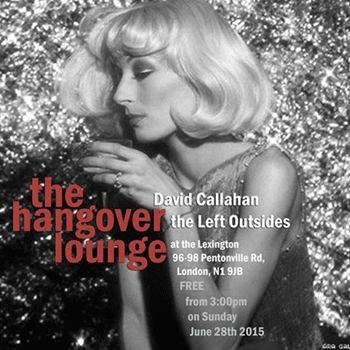


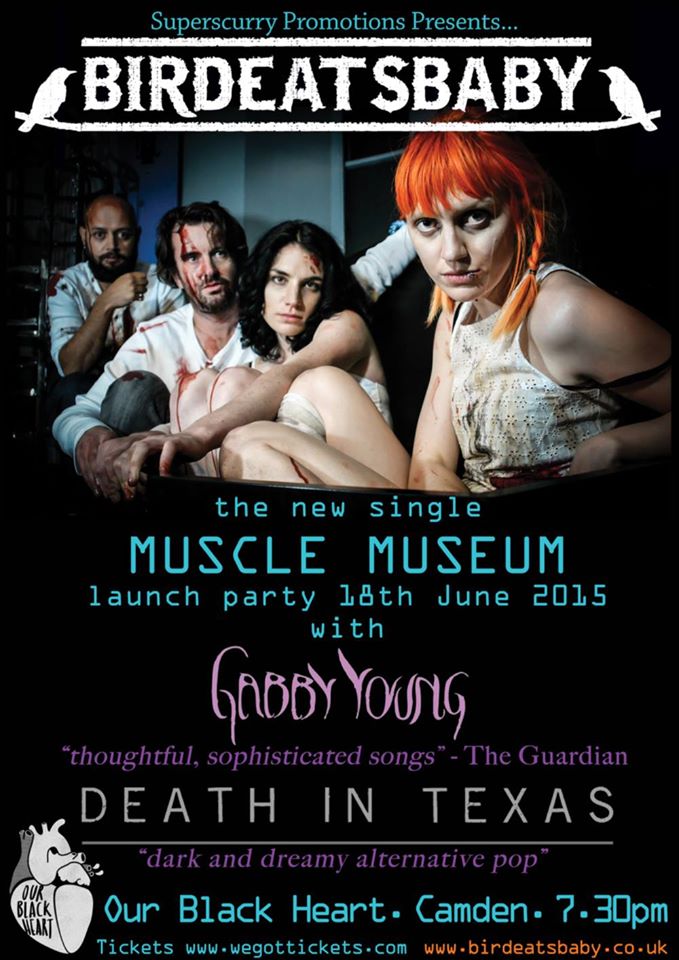


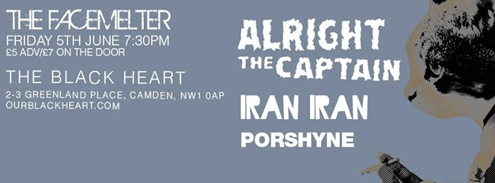
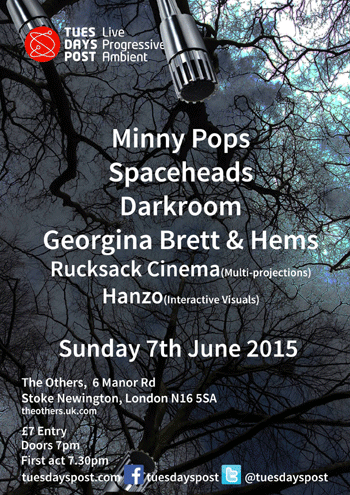



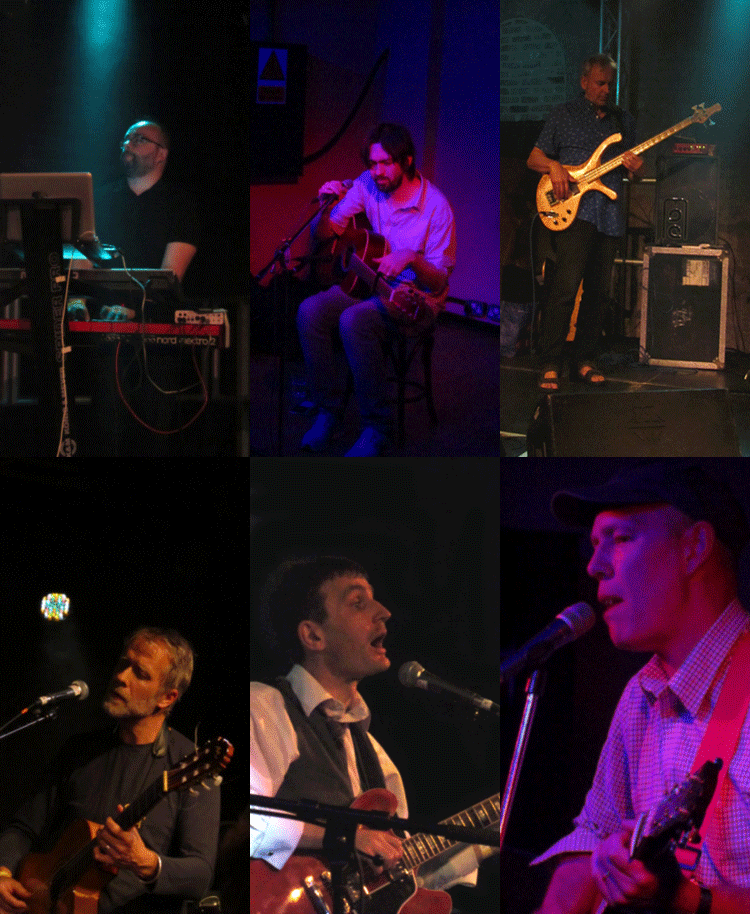

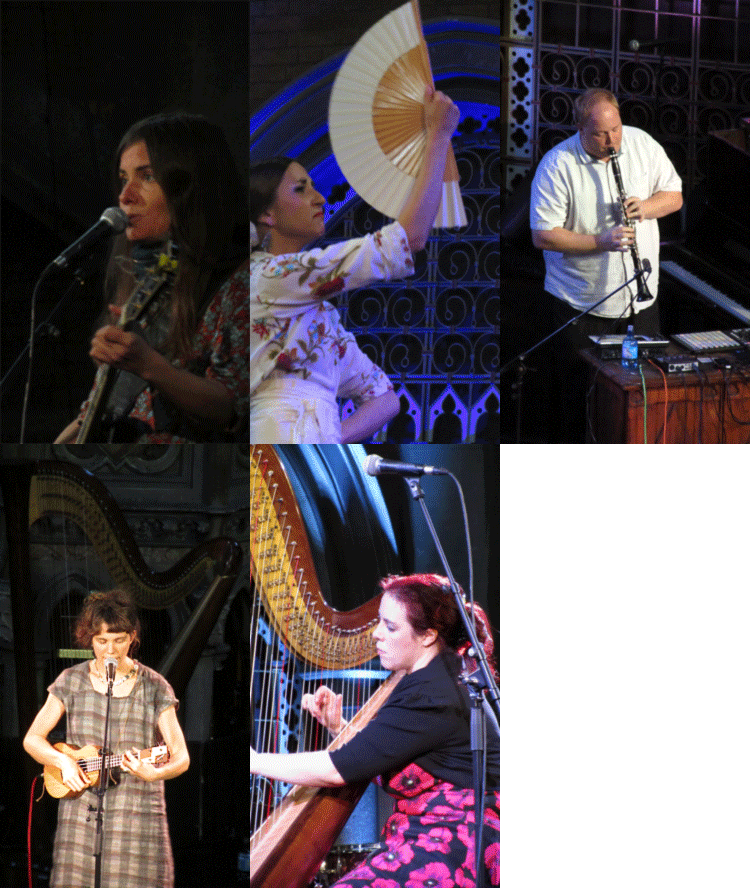
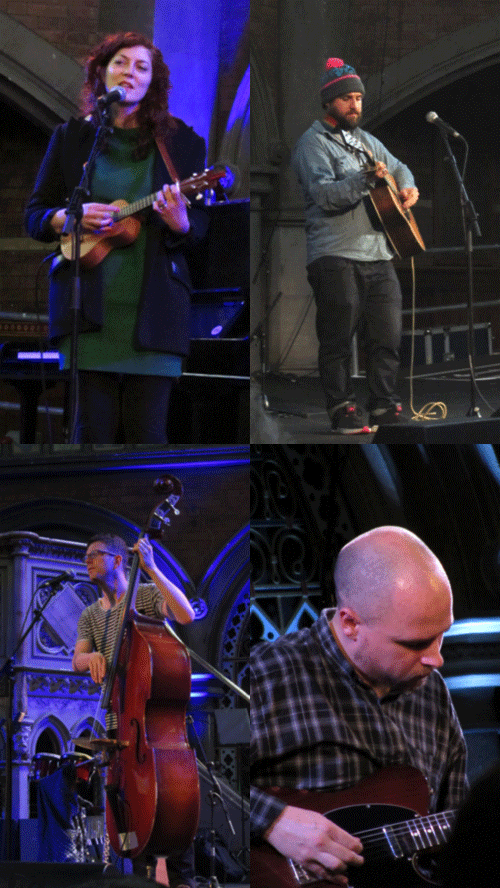
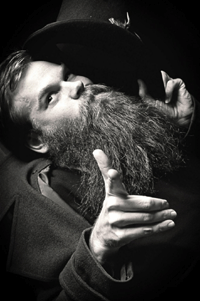



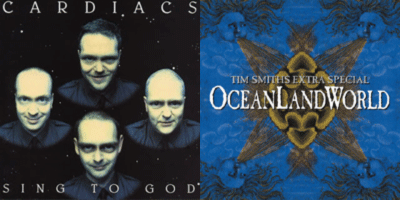
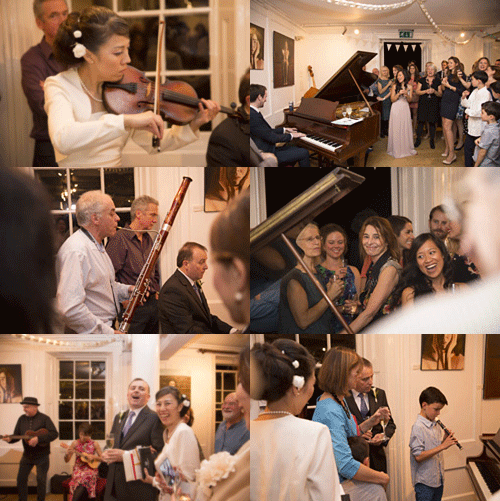
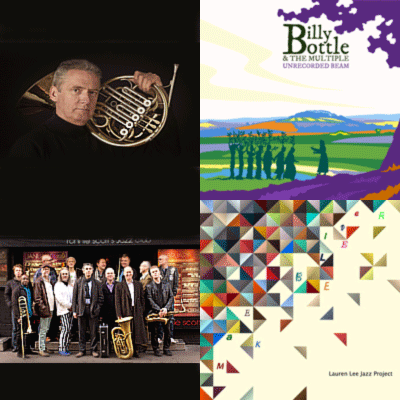




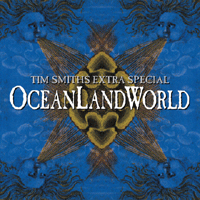


 Misfit City