I’ve been seasoning my trips to and from my dayjob by dipping into the essays of H.L. Mencken. Written over a fifty-year period in the first half of last century, this stuff’s quite old but still packs a whipcrack. Even now, and even still set in antique type, the man’s razor wit and formidable erudition glints at you down the years. He could be a contrary, offensive bastard (some of his views certainly rile me) but he was always, always worth reading and he still is.
Anticipating character journalism, Mencken wrote on anything that took his fancy, and on occasion he wrote about music. Here’s a series of little simile sketches which he came up with in 1912 – over a hundred years ago! – to describe a number of classical composers. Part squib, part haiku, always on the money. He was from a different age, with a different and wider education and with some of the particular prejudices of his time; but even with all that in mind most contemporary music journalists now would kill to get their zingers this right.
Wagner – The rape of the Sabines… a kommers in Olympus.
Beethoven – The glory that was Greece… the grandeur that was Rome… a laugh.
Haydn – A seidel on the table… a girl on your knee… another and different girl in your heart.
Chopin – Two embalmers at work on a minor poet… the scent of tuberoses… Autumn rain.
Assuming that you’ve not heard about this yet (I still have the sneaking suspicion that the majority of my readers are ahead of me as regards news)…
…that prolific, poly-instrumental singer-songwriter/critical darling Sufjan Stevens is reissuing one of his earliest and oddest albums. Originally released by Asthmatic Kitty back in 2001, ‘Enjoy Your Rabbit’ was reissued a couple of days ago (June 24th) on limited-edition deluxe vinyl and as a download.
On initial hearing, ‘Enjoy Your Rabbit’ doesn’t sound much like the work with which Sufjan later made his name. Despite the man’s reputation for assured eclectism, it seems out-of-place and unexpected – very different from the concept albums in which he codified his life and thoughts into the hopes, dreams and terrains of American states; or from his baroque-ified folk-Americana (in which you were as likely to hear a cor anglais as a banjo or harmonium); or from his combining of original film and symphony music for ‘The BQE’; or even his battery of Christmas albums.
Recorded during Sufjan’s first stint in New York, it’s almost entirely electronic – a fizzing post-modern cut-up built from digital work station noises, samples and tweaks of live sounds (including stray guitars, organs, the brassy lather of Tom Eaton’s trumpet and prelingual vocals from Liz Janes and Sufjan himself). There’s a running theme via the Chinese zodiac and its twelve-year cycle, each year of which lends its name to a track (Year Of The Dragon, Year Of The Rat and so on), although Sufjan muddies the waters with two extra pieces – the title track and The Year Of Our Lord. (Given his professed Christianity, the latter is as likely to be sincere as it is to be a tongue-in-cheek gag: given the nature of the album, it’s probably both.)
Over to his label, Asthmatic Kitty, for a fuller explanation (as Asthmatic Kitty appears to have a staff of two, one of whom is Sufjan, you can be pretty sure that this is a definitive statement):
“Departing from the singer-songwriter format of his first Asthmatic Kitty album, ‘A Sun Came’, this collection of fourteen colourful instrumental compositions combines Sufjan’s noted gift for melody with electronic sounds to create an unusually playful and human – not to mention humane – electronic experience. First released in 2001 on CD, 2014 — the Year of the Horse — brings the original recording back as a double-LP set, the first disc clear and the other left to fortune. And no one can foresee who will receive one of two very special boxes of fortune cookies, containing fortunes penned especially for this occasion by Sufjan himself.
‘Enjoy Your Rabbit’ is the most underrated and overlooked album in Sufjan’s discography. It contains in capsule form what he would later unpack into more palatable music. There are flashes of ‘Michigan’ and ‘Illinois’ in Year Of Our Lord, Year Of The Ox and Year Of The Dog, and shadows of ‘Age Of Adz’ in the darkest moments of Year Of The Boar, Year Of The Snake or Year Of The Dragon. ‘Enjoy Your Rabbit’ is a harbinger. A precursor. A wink in the eye before the slight. You should have listened in the first place. We’ll forgive you though, because when an album is only available in wasteful jewel-case CD, how cool can it be? Jewel-cases are so 1998. But now that it’s in multi-colored limited-edition gimmick-ridden vinyl, you have no excuse. ‘Enjoy Your Rabbit’, which Sufjan wrote and recorded in the innocence of a pre-9/11 2001, is Sufjan’s best work because it is Sufjan at his least self-aware.
In an alternate reality, Sufjan never made ‘Michigan’ or ‘Seven Swans’ or ‘Illinois’; he kept making electronic freakout albums like ‘Enjoy Your Rabbit’ in obscurity, until perhaps he just gave up and stayed in graphic design and some pitying barely-afloat label re-released ‘Enjoy Your Rabbit’ and sold a few dozen copies to a few scattered part-time record store employees. But here we are in this reality, where ‘Michigan’ is slated for an energy drink commercial, ‘Illinois’ is a backdrop to a pensive montage in a kickstarted blockbuster movie, and ‘Enjoy Your Rabbit’ is relegated to a drunken purchase at Amazon.com.
Here at Asthmatic Kitty, where we often ignore reality as it’s presented, ‘Enjoy Your Rabbit’ is one of our most played records. We find ourselves in the small company of ballet choreographers, quartets, and occasional internet reviewers, but there should be more of us. So, as if we were in that alternate universe where “Sufjan” is more likely the name of a ‘Game of Thrones’ character than an indie star, we hope you’ll give this record a chance now that it’s available as vinyl. It is just as genius as anything Sufjan has released since. Everything’s been downhill since.”
To my own cranky ears, ‘Enjoy Your Rabbit’ is a fascinating, skillful blip in Sufjan’s career – a rare chance to see his singular talent from a specific angle. It’s a little similar to your first encounter with Frank Zappa’s cascading Synclavier cut-ups if all you’d previously heard was his catalogue of hairy, horse-laugh rock cabaret numbers about groupie misdemeanours and middle-America caught napping and dribbling. Another comparison is Adrian Belew’s 1986 one-off ‘Desire Caught By The Tail‘ – a snarling, abstract career swerve from a musician who’d previously satisfied his avant-garde leaning by blowing spacey textures and barnyard/traffic sound effects through art-rock songs, but was now sitting down with a crude guitar synth (plus a jumble of pedals and assorted things to hit with a stick) in order to create uncompromising Picasso-Hendrix shapes at heavy-metal volume. Did someone say ‘Metal Machine Music’? Not quite, although there are moments of crushing noise on ‘Enjoy Your Rabbit’ which recall Lou Reed’s own Marmite effort.
One thing which can be said for certain is that ‘Enjoy Your Rabbit’ is a breathtakingly playful record which nonetheless exhibits Sufjan’s extraordinary breadth of influences and compositional skills. If you listen closely, his subsequent ways of building a song are all already present and correct. Though they’re sheathed and blurred within the blip-glitching video-Pong noises, Tibetan bells and drunken brass band textures of Year Of The Monkey, they’re definitely there: it’s a song, voiced with all the oddness of a Charles Ives let loose on a sampler.
Speaking of Zappa, some prime bogus pomp shows up on Year Of The Snake and Year Of The Boar. Amongst the larking bass-harmonium reed drone and the razzing fizz of Sufjan’s electronics, some weighty blimpery waddles and patters. I could have sworn that Year Of The Boar even quotes ‘The Phantom Of The Opera’ at one point. Sufjan’s certainly not slow to drop in a ‘Mission Impossible’ quote on the album’s title track, which is otherwise the odd song out – an angular, dissonant line of Rock-In-Opposition guitar fuzz joined by a cavalcade of pushy racket and chiptune burble.
As for the Chinese component, it’s not clear whether this is a gimmick (like Sufjan’s subsequent tall tales of a “50 States” concept project) or another little metajoke which he’s balled up and sent sailing over our heads. Scattered sparingly across the record, Mannar Wong adds some genuine spoken Chinese. In and around certain pieces, trilled Chinese melodies bump up against European string quartet tunes or (as on Year of the Tiger) flute around cabaret vocalese and bells over thudding shadow-tones. But at least as much is drawn through and worked in from other sources: Sufjan’s first years in the thick of New York’s cosmopolitanism must have been a greedy feast for his ears. Steam-organ and No Wave whomp, carefully orchestrated, collide with early-Genesis prog flourishes. Sewer-pulsations meet Bontempi organs and sample-heavy vocal murmurs, folded into Latin pop melodies. Silvery Krautrock turns into dinky, glitch-mauled castle music on Year Of The Rat. For Year of the Sheep, Sufjan turns the music into a battle between pulp and celestial. Against the birth-of-the-world vocalise which he and Liz Janes knit together, animal sounds yawp and rampage – angry pregnant elephants, excited pterodactyls.
Rat
The thirteen-minute Year Of The Horse – the piece on which Sufjan could really have come unstuck – instead shows him in full control: sustaining and mutating schools of ideas at greater length, like a post-techno Mike Oldfield. Despite its mongrel elements and its sense of hazard sources, over the course of its journey (minimalist piano figure in trio with vibrating mechanical sounds and out-of-focus kettledrums; panpipe-riffles marshalling around industrial squashing-tones; a finale of glitched/phased/near-atonal signal twitches), it’s not so dissimilar to those carefully-structured stretches of ‘Tubular Bells’ or ‘Ommadawn’ back in the 1970s. Not that Sufjan would necessarily agree: his time at New York’s New School (which he was attending while he wrote this album) would have exposed him to any number of inspirations from chance heroes to masters of structure. What’s clear is that under the capering and restless sonics, great swathes of ‘Enjoy Your Rabbit’ display Sufjan’s bedrock talent and the solidity of his musical placings. It’s a cliché that a single work by one artist can hold as many ideas as another artist’s entire career, but this is one of those cases where the old saw is true. I’ve heard plenty of electrophonic records eking out a single concept or a sparse few, albeit successfully. ‘Enjoy Your Rabbit’ makes most of them sound like lazy sketches.
You should judge for yourselves, though – this wasn’t supposed to be a review. You can get your copy of the album from Asthmatic Kitty or Bandcamp (both fixed-price vinyl or download) or from Noisetrade (pay-what-you-like download-only). For the possibility of fortune cookies, I’m guessing that you should pester Asthmatic Kitty directly. If you want the additional option of ordering a vinyl twosome of ‘Enjoy Your Rabbit’ and Osso String Quartet’s ‘Run Rabbit Run’ as a thirty-dollar special offer… well, that’s another thing to talk to Asthmatic Kitty about.
Lucy Claire, dishing it out (photo courtesy of This Is It Forever Records)
Lucy Claire Thornton – currently better known as “Lucy Claire” – is a contemporary classical/ambient electronic crossover composer who counts Erik Satie, Peter Broderick and Bjork as influences, and whose work has been hailed as “brilliant, delicately-wrought sketches” by ‘The Quietus‘ and as “immersive and slightly disorienting” by New Music webcast station ‘Amazing Radio‘. She’s releasing her newest release ‘Collaborations EP No 1’ on This Is It Forever Records on June 15th: the same week features a launch concert in London promoted by Chaos Theory (the inspired crew who put on that Sweet Niche/Macchiana del Tiempo/What?! triple bill of fusion jazz which I reviewed last summer). Here’s what they have to say about this gig:
“(We are) excited to host this launch party for the first in a series of collaborations EPs from Lucy Claire, along with many guest performers. ‘Collaborations EP No 1’ will be available with unique handmade packaging at a reduced price at this event only, along with two download codes for remixes by worriedaboutsatan and Message To Bears…. This evening we will see Lucy perform works from ‘Collaborations No 1’, featuring (contributions from German singer/songwriter/producer) Alev Lenz and producer Bruised Skies.
Support will come from electronic classical composers Leah Kardos and Jim Perkins. Almost three years after we worked with Leah on the launch of her debut album ‘Feather Hammer’, we’re delighted to be back together. Tonight we will see bigo & twigetti label-mates Leah and Jim performing new collaborative material… as well as selected works from Leah’s second album ‘Machines’, a concept album with lyrics made up from cut up spam emails, which will feature singer Laura Wolk-Lewanowicz. We will also hear them perform new material by Jim (which will be released later in the year on bigo & twigetti) and re-workings of material from ‘Feather Hammer’.”
All three acts will be basing their performance around piano, electronics, and string quartet. The concert takes place on Thursday 19th June at 7.30pm, at Servant Jazz Quarters in Dalston, and advance tickets can be bought here for under a tenner. For various frustrating reasons, I suspect that I won’t be able to attend this gig myself. Perhaps someone who’s reading this could go, and then tell me what it was like? (Not that I want to make you feel like interns…)
* * *
Considering that he’s still cruelly immobilised by the after-effects of the strokes that felled him six years ago (see ‘Misfit City’ posts passim, here and here), the voice of Tim Smith has rarely been heard in the land so loudly. The profile of his band Cardiacs has been stealthily growing (albeit through YouTube and nostalgic webchat rather than their much-missed live shows) and we’ve recently had or will have new or imminent releases from self-confessed Smith acolytes Arch Garrison, Knifeworld and Stars In Battledress.
Tim Smith: ‘Tim Smith’s Extra Special OceanLandWorld’
Meanwhile, the core Smith-eries just keep on coming – this year’s already seen reissues of relatively rare Smithwork (Mr & Mrs Smith & Mr Drake or Spratleys Japs) and a deluxe double vinyl reissue of key Cardiacs album ‘Sing To God’ is due for July). At the end of last month, Tim’s mysterious label The Alphabet Business Concern also sneaked out a CD re-release of his obscure 1995 solo album ‘Tim Smith’s Extra-Special OceanLand World’. A typically arch and sinister ABC press release reveals all (well, not really… and all capitals are deliberate, or at least deliberately annoying):
“AN ANNOUNCEMENT! PLUCKY? PERHAPS. GIFTED? PERHAPS NOT. Nonetheless Tim Smith, in an unforeseen spat of hubris, took it upon himself to exclude his so-called friends (acquaintances at best) to perform a collection of songs in isolation. Foolhardily believeing it may raise enough capital to barter his way from the labyrinthine clutches of obligation to which HE had previously agreed and to which, thankfully, he is bound to this day, in 1995 this solo album was release. Circumstance , of both design and fate have since rendered this ‘offering’ unavailable. UNTIL NOW. As if to mock his feeble attempt at emancipation THE ALPHABET BUSINESS CONCERN once again make available ‘OceanLandWorld’ with the proviso that the covenant can never be broken.”
Ducking under Alphabet’s theatre-of-cruelty bombast, the following actual facts can be dug up. The OceanLandWorld album was recorded by Tim on his own between 1989 and 1990, during a time of upheaval in the entangled world of Cardiacs. Three of the band’s key instrumentalists – Sarah Smith, William D. Drake and Tim Quy – had all either left or were about to leave, and at the same time Tim’s marriage to Sarah had ended. Next to nothing’s been said about this last event, and the other departures have always been described in a matter-of-fact way. In the long term, it seems that the baggy, unlikely, familial mass of Cardiacs-people (with their collective love of music and their sense of common adversity and purpose) managed to accommodate and contain the various splits and departures without lasting bitterness.
Still, although the suggestion in the sleeve-notes that Tim recorded and performed the ‘OceanLandWorld’ songs alone “by way of a penance” is a typically Alphabettian joke, there’s a certain rue to the tone of the album (not least when, behind a bouncy pop march, Tim sings cryptically about tears and about worms chewing on wooden people). Previously wrung happily through the efforts of other people, Tim’s songs are now being filtered through machines: check out those cascading sequencers and springy synth-bass whacks behind his reedy squawk and bustling guitars. Hardly surprisingly, there’s a slight pre-fab feel to the album. If previous Cardiacs albums sometimes felt like the scruffy, well-lived-in old houses in the band’s south-west London suburbs, then ‘OceanLandWorld’ feels like a race around a new satellite town: thin slivers of post-war history, new bricks and formica, a Toytown street plan.
That sense of uneasy rootlessness plays a part in this picture. Tim stutters out an album of faux-jaunty pop songs, without his musical family to push against and to be held by (even if Sarah does briefly return on one song for a gracing of saxophone). The familiar staggering, stumbling embrace of Cardiacs songs is replaced by a Scalextric skid. It’s to Tim’s credit that he somehow turns this into an asset: to these ears, ‘OceanlandWorld’ captures the giddy weightless of post-traumatic sensation, the impression that everything you are has been tossed up into the air like streamers and comes down spread-out and thinned-out, but still recognisably you. In the same way, familiar Cardiacs tics and inspirations work their way through the fabric of the album, with epic punky chorales and proggy vistas opening up like a junkyard requiem.
The album also features one of Tim’s most breathtakingly beautiful songs, Swimming With The Snake. The man rarely, if ever, even starts to explain what his songs are about, but this particular song communicates mysterious undercurrents of pain, loss and love with a rare and stunning magic.
If what you’ve seen, heard, and read here intrigues you, you can order the reissued ‘OceanLandWorld’ from here.
Fresh from his successful European spring tour with The Crimson ProjeKct (in which three veteran members of the 1990s King Crimson teamed up with three younger musicians in order to revisit and revitalise Crimson music of the ’80s and ’90s in concert mode), Markus Reuter has released an album called ‘Sultry Kissing Lounge’. This is a selection of the opening live improvisations/ instant compositions which Markus performed as curtain-raisers on the TCP tour.
Markus was filling some particularly big shoes for that particular tour. In King Crimson terms alone, he was taking on, developing, reinventing and re-personalising the live role once taken by the band’s prime mover/form-dictator Robert Fripp. In doing so, he played a key role in providing a window onto an alternative King Crimson – one minus Fripp’s key presence. By all accounts that I’ve heard, the results were no less potent than the original band was. (Sadly I had to miss the shows, so can’t bear witness myself).
Markus Reuter, 2014 (photo by Danil Golovkin)
Among other things, Markus was responsible for replacing those droning, skirling, semi-abstract soundscapes (sometimes celestial, sometimes nightmarish) which Fripp used to deepen Crimson textures, to uproot rigid Crimson structures and to express the band’s contradictory undercurrents of formal futurism, chance risks and frustrated romanticism. Historically, soundscapes have often been used as intros to Crimson concerts, gelling a mood and a context out of simple but deepening ingredients. Markus continued this tradition, playing his U8 Touch Guitar through extensive laptop processing and looping, and it’s this particular work that you’ll be listening to here. These pieces set the tone for each concert, and provided a launch-pad for TCP drummers Pat Mastellotto and Tobias Ralph to begin their own regular opening duet.
Markus brought his own tones and personality to the role. For those who are familiar with King Crimson, it’s interesting to contrast his soundscapes to those of Fripp. To my ears, Markus’ soundscapes tend to be more oblique: simultaneously more rational and more abstract than Fripp’s. They ask different questions, and in many respects give less away, seemingly more interested in opening up the audience’s minds rather than jogging their hearts or jogging their complacency. A Reuterscape demands a little more audience involvement, presenting a different vista in which to think rather than performing Fripp’s process of reeling in the listener by expressing wonder and those more tender, contradictory sensibilities that his more aggressive straight guitar playing didn’t allow. I may be wrong. Judge for yourselves – here are two of Markus’ soundscapes, recorded in the Czech Republic and in Switzerland respectively, and each named after a different woman (no doubt Markus can explain why.)
If these tempt you, ‘Sultry Kissing Lounge’ is available as a CD or download (featuring artwork by another TCP band-mate, bass guitarist Julie Slick) and can be ordered from here.
* * *
Later this month, Markus releases another long-cherished project – the full orchestral recording of his generative concerto ‘Todmorden 513’. I’ve touched on this in a previous bit of crowdfunder news. Originally a electro-acoustic ensemble work based mostly around Markus’ own touch guitar tracks, the composition has already been compared to those of Messiaen, Feldman and Debussy. It was re-arranged for full orchestra by Thomas A. Blomster (who, long ago, was half of Pale Boy) and then debuted and recorded by the Colorado Chamber Orchestra, conducted by Thomas.
Markus Reuter: ‘Todmorden 513 (Concerto for Orchestra)’
The documentary ‘Breaking 513‘ provides more information on how the project was conceived and developed. Here’s some interim compositional notes for those interested, taken from combined sources (including the original electro-acoustic version liner notes by Henry Warwick, plus comments by Joshua Meggitt of Cyclic Defrost):
“A continuous movement and sequence of five hundred and thirteen harmonies and triads generated by a combinatorial compositional technique of Reuter’s own design. The notes of each harmony or triad is then fed back into the same algorithm, resulting in a progression of chords and note clusters of highly varied density, ranging from simple two note harmonies to dense twelve note chords spread across several octaves. Starting on an A flat, the sequences of pitches form a kind of melodic or thematic line throughout… Each of the 50 string, woodwind, brass, and percussion musicians performing an individual solo part. These solo parts are in turn each a part of a trio or quartet, all joining together to form the orchestra… The rhythms (were) derived from the chord sequences themselves, which were looped across the whole piece, mapped to the notes of each chord, then mixed together. From there it was split into three or four independent voices respectively. The result is a shifting set of harmonic densities… Instruments mesh together, in ensembles of varying size, creating a kind of gauzy web through which development takes place.”
If you want to know what that might sound like (or if you’re just baffled by the description), there’s a video excerpt below:
The recording of the CCO performance is being released on 17 June 2014 on the 7D Media label, as a CD/DVD double pack with both stereo and surround sound mixes, plus an alternate 2.0 stereo mix by ambient music pioneer Robert Rich (see the embedded stream below). More info is here and the album can be pre-ordered from here.
* * *
Meanwhile, husband-and-wife team Ruth and Kane Powers – better known as virtuosic drama-pop duo Death In Texas – have also gotten in touch. Since the pair moved from New Zealand and started tearing up small venues in London five years ago, their self-confessed “grandiose, over the top and cinematic” music and performances – full of guts and gear-changes – has seen them compared to Lana Del Rey, The Dresden Dolls, Tori Amos and ‘The Phantom Of The Opera’ (I’d suggest that they’ve also got a judicious dash of Emerson, Lake & Palmer in gleeful entertainer mode and perhaps a hint of Suzi Quatro). More recently they’ve been in flux, solidifying recent changes in tone, personnel and approach and preparing to get it all recorded. Over to them:
“Last time we wrote it was for the release of (the video for) Sonic Switchblade, so much has happened since then behind the scenes. We have been crazily writing songs, then rewriting them, arranging and recording them in our home studio and trying to make a good guide for what will eventually be our debut full-length record. We have been listening to a whole lot of new music, taking in new influences and have shaped a new sound for Death In Texas which we are excited to show you. In July we will be heading into the studio to begin recording an album we’ve spent the last seven months preparing for. This is the best music we’ve made yet; it’s ethereal, powerful and more refined. We’ll be excited to share it with you once it’s ripened.”
Death In Texas: ‘Pluck’ EP
To fund the album, Ruth and Kane set up a crowdfunding deal a short time ago. As it happens, they’re already hit their target (and sold out of the initial run of the forthcoming DiT album) but in order to clear space and merchandise and to ensure that there’s enough in the album fund to cover eventualities, they’re currently offering an additional deal for T-shirts plus a free download of last year’s ‘Pluck‘ EP. If you’re interested, click here.
If you’re curious as to what you’d be getting, there are videos for two ‘Pluck tracks below, the music for which was recorded back when Death In Texas was a piano/ bass/drums trio. Assuming that they’ve built on their music for the forthcoming album, rather than utterly reformatting themselves, expect to hear more of Ruth’s arresting vocal and piano and of Kane’s dense-but-nimble drumming.
* * *
Finally – here’s a quick word about the London folk trio Vespers. I only really discovered them yesterday when I saw them play at Daylight Music (although they’ve been nice enough to follow the ‘Misfit City’ Twitter feed for a while). This definitely won’t be the last time I write about them – their generous blend of voices, their acoustic delicacy and their combined songwriting skills promise plenty, and their approach wells with compassion.
So far as I know, they have no album ready, and are still working to finesse a new demo which they’re happy with, but they do have three tracks up on Soundcloud in the meantime. I’ll save more comments for the live review later. Have a listen for yourselves.
I keep a regular eye on the ‘Organ’ blog. In the good old, grim old days of print, paste, photocopy and crude HTML, ‘Organ’ was a big inspiration for ‘Misfit City’. While there’s been a lot of turbulent water under the bridge since then, and though Sean Worrall – he who is ‘Organ’ – claims his days of animated gonzo reviewing are long past, the current blog is still a great source of news and rapid-fire information/reaction regarding music, the London art scene, occasional politics and whatever other related thoughts are passing through Sean’s head. Some time (when I’m feeling even more solipsistic than usual) I might write some more about ‘Organ’ and ‘Misfit City’ and the 1990s, although I suspect that few people can pronounce better on Sean and his singular range of experiences than he can himself. (I’m hoping that he writes a proper memoir one of these days.)
Right now, here’s something I picked up from ‘Organ’ late last week and am sharing now: it triggers a different kind of nostalgia.
Johnny Parry Orchestra: ‘An Anthology Of All Things’
Today, the Johnny Parry Orchestra release their second album ‘An Anthology Of All Things’. I first became aware of Johnny in 2002 when, as a solo act, he sent his debut album ‘Break Your Little Heart’ to the original incarnation of ‘Misfit City’. At the time ‘Misfit City’ was going down with all hands (ie, me) and so despite all best intentions and protestations, the album just sat on my shelf. I think it’s still there. I owe it to Johnny to revisit it properly sometime.
Fortunately (for my conscience, anyway), being neglected by me hasn’t hurt Johnny in the slightest. In the intervening twelve years he’s continued to work on and release music from his base in Bedford, steadily building himself up from solo dream-popster to trio leader, then becoming a small-ensemble boss and eventually expanding to the role of orchestral maestro. Now moving with assurance within the world of substantial arts grants, community music and event concerts, the latter-day Johnny Parry composes, arranges and conducts on a large scale and has worked with musical names as diverse as Talvin Singh, Michael Nyman, Seb Rochford and Beth Orton as well as Turner Prize-winning artist Martin Creed. Not bad for someone whom in 2002 was wandering Toronto amidst the wreckage of a record contract, seeking solace and inspiration from the city’s buskers. If life handed him a lemon, he certainly went on to grow lemon groves.
‘An Anthology Of All Things’ is Johnny’s second orchestral/choral album – funded by Bedford Creative Arts, it features (in addition to the JPO) the Bedford Arts Choir and soprano Donna Lennard. Already gaining comparisons to Benjamin Britten – albeit a Britten with a strong pop leaning – it’s very much community-shaped, with Johnny drawing his settable texts from lyrics donated (consciously or otherwise) by the Bedford public. The video excerpts below should demonstrate how this works. The first of these (for the sixth movement) is the result of Johnny soliciting and assembling original romantic testaments from friends, including couples, about their own feelings:
The second video is for the fifth movement, which gleans its text from the dedications on park benches in and around Bedford:
Some of the remaining movements are inspired by reflections on Bedford historical figures and childhood heroes, plus the town’s memories of the Second World War: others draw on more general or abstracted themes such as the human body, the elements of narrative, the components of travel and “youthful boundary defiance”. Here are a few more snippings from the press release:
“A captivating small town experience that has a far wider resonance… magnificent, masterful and sweepingly heart-warming, and performs a velvety emotional cut and paste approach. It dares to be huge and expansive but retains a deeply personal core which carries the intimate, often evocative thoughts and statements that are at times uncomfortable, innocent, whimsical and on occasions playfully risqué.”
The album can be ordered directly from here (though you’ll need to use PayPal)
While I’m beating myself up a little for not keeping up with obligations, here’s something from someone else whose work I need to keep up with more regularly. Matt Stevens is no stranger to ‘Misfit City’ – see this review of him threshing up a lively storm at Roastfest a few years ago with just an acoustic guitar, loops, a pedalboard and plenty of bearish enthusiasm. Likewise, there are a couple of reviews of his early work with the collaborative band The Fierce & The Dead (here and here), an outfit which has grown from a trio of interesting polystylistic rock dabblers into a roaring garage-prog quartet with a shaggy, behemoth sound to it.
Matt Stevens: ‘Lucid’
First and foremost, though, Matt is a ceaselessly enthusiastic solo artist, and in March he released his fourth solo album ‘Lucid’. Compared to his earlier solo work, it’s more of a band record, predominantly based around Matt’s friends and contemporaries in British art-rock (Stuart Marshall from The Fierce & The Dead and Charlie Cawood from Knifeworld are the rhythm section for most of the record, while sundry other Fiercies, Knifeworlders, Trojan Horses, Guapo-sians and Chrome Hoofers also make a showing – hello Emmett Elvin, Nick Duke and Kev Feazey). However, it also draws from latterday prog via Jem Godfrey (of Frost*), dark ambience from Helicopter Quartet‘s violinist Chrissie Caulfield, and cosmic jazz in the shape of Lorenzo Feliciati of Naked Truth, who may or may not be responsible for the presence on the album of his NT bandmate Pat Mastelloto, the increasingly ubiquitous and inventive King Crimson drummer who’s become something of a touchstone for art-rock crossovers. (Mysterious vibraphone player Jon Hart is also on board but, as always, wherever he’s coming from is anyone’s guess.)
Matt himself describes ‘Lucid’ as:
“a significant step up from the previous albums. It’s inspired by a bit of a dark time, but hopefully it’s an uplifting record… all the players really were outstanding. It’s a record that reflects my love of Jesu and Celtic Frost as much as the Mahavishnu Orchestra and King Crimson or even Peter Gabriel and I’m really proud of it. If you’re not going to take risks and try and do something interesting what’s the point?”
The preview video below (which has been out for a few months now) should give you some idea of what Matt’s aiming for. If you like what you hear, the album’s out on Esoteric Antenna Records and you can get it either from Burning Shed or Cherry Red.
A fortnight on from our last visit to Daylight Music, my family and I are back again. Blame the warmth of the welcome, blame the homemade cake; blame my little son Oscar’s hopes of grabbing a set of hand-bells again. Blame a rare opportunity for us all to like the same kind of thing, but I think we’re hooked. If not hooked, we’re already used to that Daylight Music atmosphere: the occasional sound of a baby’s coo echoing through the cavernous vault of the Union Chapel, the slightly sleepy post-lunchtime ambience, the arts’n’crafts feel to proceedings; that gentle, polite undercurrent of London community ambience that’s getting more and more difficult to find in this time of mounting rents and bugger-my-neighbour.
Daylight family matters – Caitlin and Ben.
A full-family, free-or-whatever event at a major London junction, Daylight remains something to treasure. Things do change here, of course. The autumn wears on and there’s less and less sun to slip in and kiss the Gothic brickwork, less physical warmth to rouge the stone. The lowering October light dims the room rather than illuminates it, so that everyone onstage seems to be performing inside an unrestored oil painting, beneath a filmy pall of soot and years – but the Daylight mixture of low-key quirk and put-you-at-yer-ease continues to work its magic. Compering the event with his usual pin-point fuzziness, Ben Eshmade seems more and more like a gentle young cousin slowly evolving into a beloved uncle. Caitlin Hogan (Daylight’s beaming, leggy factotum-and-mascot) not only plays the church organ but frisks cheerfully around at the interval with an usherette’s tray. We’re warmed – and when we aren’t, we just pull our clothes around ourselves a little tighter and wait to see who’s come to the show this time.
A short time ago, New York singer-songwriter Annie Dressner crossed the Atlantic to England, swapping the brashness of her hometown for the more reticent self-assurance of Cambridge. As part of the deal, gridlocks were traded for grass commons, skyscrapers for Gothic spires, the swarming of yellow cabs for the purr of passing bicycles. New York isn’t entirely left behind, though: Annie’s very first song today is called Brooklyn. Her soft strum sketches out an altogether quieter place than the ever-rising hipster centre we’d expect: more sideslip Bohemian ’50s than rattling, overcrowded Noughties. The art-life, though, remains at the core of the story in the passing images of painter’s hats and “whiskey in a broken glass”, in the sketch of flawed new lives, the talk of friends, the passing spectre of discouragement.
Annie Dresser – softness is deceptive.
Annie herself seems winsome, demure, even folk-soprano cute at the start (Oscar, who’s something of a two-year-old ladykiller, is certainly intrigued). Her dialogue, as she chats to us in between songs, is a halting soft-voiced take on that scatting New York curl of rapid ideas and the slipping between subjects. She claims not to be used to holding a crowd on her own (“Usually my husband plays with me. He tells jokes about cheese,”) but she gives it her best shot: giving us North London travel advice, or revealing which of her songs is her grandmother’s favourite. I’m not sure that she’s quite as much the shy ingénue as she implies. For all her easy-going, soft-cheeked charm, and for all the hushed and humble tones to her singing, she’s got a subtle self-assurance as she stands up there: for all the world like a Modigliani model who got the joke.
I’m not sure how much difference Annie’s Cambridge relocation is likely to make to her songwriting. Her songs don’t need backdrops of big cities or the hungers of creativity in order to work or to find focus: they can work anywhere. In fact, her quiet songs seem better suited to quieter rooms in quieter towns, or just to moments in which people’s reactions are contained in reflection – delicately muted regrets, a steady and accepting love.
Annie seems to write songs like other people read books – pulling in her attention, quietening; becoming stiller, gently illuminated. She’s mastered small, telling, understated images and the knack of placing them, lightly, in the best passing places. Something innocuous like a picture of a turtle becomes tinted with significance, as if caught by a stray beam of light at just the right moment.
Dressner in detail.
Rather than being dramas, Annie’s songs are filled, unobtrusively, with little details of life’s motions. When the blows fall, as they must, they fall softly but decisively, like the moment in Lost In A Car where she sings “the wind was high / and your candle blew out.” When she sings about death, she sings about it in a series of aftershocks or in that slow repetitive rub of mingled grief, guilt and simple wishes that silently burnishes the pain: “if I had come / out in the cold dark night… / I can’t forget, even if I tried: / I can’t forget the night you died… / If I had come a minute sooner…”
Heartbreaker (which, like Lost In A Car, is from this year’s spring EP, ‘East Twenties’) picks over the memory of love lost by running over domestic details, slowly working around and creating the sketch of a man (“your father was a painter and your mother was a teacher – I remember all the things in your house”) but never obsessing over the man himself. Instead the song becomes a gentle, telling rebuke: the testament of someone who cared enough to notice all of the small building blocks of a loved one’s life; the account of someone who cared enough to remember. Annie doesn’t wreak obvious and horrible revenges in song. She’ll just tack you to the scene of your crime – once, with one expertly- and regretfully-placed pin – and what’s worse, she’ll stay sympathetic.
A band of Buriers.
For the most part, this kind of subtlety is the sort of things Buriers just trip over – or more likely, stride over – while their eyes stay fixed on a savage, lowering horizon full of stormclouds and junk. A thunder-tommed, string-heavy vehicle for the splintered, semi-apocalyptic ramblings of poet-songwriter James P. Honey, superficially they seem to be snapping at the heels of Godspeed! You Black Emperor; intent on seizing the title of house-band for the Grand Collapse. Despite eschewing electric instruments (this time out, at least), they’ve certainly got most of the necessary ingredients. Cello and viola, droning menacingly or carving the air with dark, bitten post-romantic melodies; a smoggy aura of passive-aggressive ferocity with a hint of tragic, tender despair leaching through; war-drum rumbles and a close relationship with the dystopian spoken word.
Their first piece sets the scene and nails it – an unsettled English almost-rap layering slashes of scene over lowering, growling string drones. Hollow wood, full of heavy weather. Looking beyond those easy Godspeed comparisons, though, Buriers have a voice of their own – one with a distinct purple tint. Post–rock parsimonies be damned: chivvied on by James’ welter of words, Buriers continually thump up against their disciplined constraints in search of something which sprawls or potentially brawls. They smudge and crumple the lines between booze-spattered vignettes of romance (emerging wearily from behind nicotine stains and inertia) and violent Ginsbergdelaireian flowerings of collaged, surreal imagery.
Laura Mallows of Buriers strings us along.
On Slides By, for instance, James and the band spin out loose-jointed low-rent vignettes. Passion that accumulates itself from tawdry scraps and spontaneous moments of visual poetry, hungrily seized upon. “Glass of bourbon, a poorly rolled smoke, / then it’s time to go home. / Spend my whole night chasing your eyes – two flakes of burning coal… / And so I say to you, I swear / nowhere could ever seem so dreary. / Within your palm a lock of hair is smouldering and rising up, oh so lightly. / Snaking upwards, coiling along the ceiling. / Rebuild our cynicism there, / abreast to all my mighty, misty, misplaced feelings.”
On Stuffing A Chest (led by Jamie Romain’s ominous cello figure) James blurts out a kaleidoscope chant of cut-up impressions and intimations – “A skin like flung paint on a window… / Head on to the edge of the night / residing in a western crockery plantation… / Material plenitude, / seraphim skin, / sexually potent media and humour hanged and left silhouetted through a dazzling stained-glass window to wither.” As his portents pile up, the song seems no more than a few loose images away from disemboweling itself. The anchoring string growl of Jamie (and of violinist Laura Mallon) holds it together, like coarse sail-thread.
It’s a shame to deny the atmospheric power of the Buriers ensemble as a whole, but the attention is constantly caught and held by the febrile James. No slouch as a guitarist (he contributes a beautiful, rippled nylon-string finger-picking part to Dim Half Light, and intermittently wrings delicate sprawls out of a ukelele) it’s as voice and emoter that he shines; or, rather, smoulders with a dark discomfort. His vocal is crisp and doomy, brooding and fastidious. He doesn’t mince his words: he snaps them off, shifting agitatedly between politics and abstractions (a snarled “well-heeled” is rapidly rhymed with a distracted “old film reel”), but snipping each phrase clean.
By nature James sounds fey, even effete, but voice and song are transformed by the ferocity of his words and convictions as they slide over each other. In attitude, if not in tone, his performance carries with it a labyrinth of echoes – Cohen, Reed and Patti Smith among them – but there’s a stubborn Englishness in there as well. Not just in the way that his verbal flashes of fang, whisker and dissent recall modern English songs’ own crepuscular, compelling rank of anti-heroes (Curtis, Hammill, Mark E. Smith). There’s also that porcelain gnash of thwarted, inward-turned privilege that hangs around him. Sometimes he could be a harried, half-deranged young schoolmaster, trapped in a staid public school while dreaming of freedom in the slums; one binge of words and absinthe away from fomenting revolt.
James P. Honey in flow and frenzy…
Then there’s his physical presence. Trapped in position by his microphone, James squirms and chafes against the necessity like a bug stuck on a pin, while haranguing us with hellfire intensity. His head rocks and bobs; his eyes and teeth lock; his feet sway and twitch in tiny shuffles and anxious hops. When not constrained by guitar or uke his elbows flail, as his forearms move in frantic twists and swivels. While he declaims his words, his hands accent them in frantic conduction, clasp in desperate spasms, or pluck savagely at his T-shirt as if trying to scrape their way through to his vitals.
Set against his rolling, literary imagery and precise, mannered diction, James’ tortured physicality almost looks comical – less Cave or Iggy than a Rowan Atkinson vicar possessed by the spirit of a rabid weasel. What sells it to us is his naked fervour. Maybe it’s a willing possession: James’ surrender to his bursts of words suggest that poetic discipline will always be less important to him than channeling (or reviving) an epileptic torrent of meaning.
Not everyone is sold on this (including the scattering of toddlers in the Daylight audience – Oscar toddles determinedly off to the colouring-in table during Buriers’ set, and stays there) but there’s no denying the commitment onstage and the band’s sustained grind of shimmering intensity. By the time Lynch Mob Hero rolls around, facing off against a time “when the city kills off the poets”), James is increasingly wracked; stumbling to the front of the drum-kit to hammer at the cymbals with a pair of beaters. Wriggling in a fury of words, he lets them shake him out as they will. On Buriers’ final song, he pleads for a kind of mercy – “God be kind – my ship is small.”
* * *
A change of act and a change of mood. I retrieve Oscar from the crayons and felt tips. There’s another short break. Let’s go back a bit…
In November 1973 (when I was barely three years old, and missing most of the significance at the time), Mike Oldfield’s ‘Tubular Bells’ was nowhere near as ubiquitous as it is today. While there was a growing buzz about its fusion of rock technology, ’60s conservatoire minimalism and folk textures, its all-conquering grip on record players, planetaria, whistling hippy milkmen and (by degrees) pop culture in general was still some way off. Nonetheless, at that point it had enough momentum for a reluctant Oldfield to be cajoled into playing a version on television. To reproduce what had previously been a mass of overdubs, Oldfield was joined by an diverse dream-team.
For those who are interested, here’s that original telly performance (courtesy of YouTube). A sizeable chunk of Oldfield’s broadcast band came from Henry Cow, touchstone avant-rockers inspired by Mao, blues, free-jazz, performance poetry and fearsome contemporary composition, who’d been organising their own cross-genre Explorers’ Club events. (The Cow’s work is worth a whole article in itself: their questioning collective spirit led them to challenges which still lurk in the musical undergrowth to this day, still challenging any halfway-political art musician prepared to kick at the wheels of the applecart). With remaining spaces to fill, Oldfield pulled in musicians drawn from a wide but sympathetic spectrum – from Gong; from Soft Machine; from The Rolling Stones; from folk and classical woodwind-playing.
To put it mildly, it was a crowded podium that evening, pregnant with cross-genre possibilities and implicit predictions. Karl Jenkins blew oboe – a Soft Machine member at the time, it was twenty-two long years before he himself would grow grand on his own wave of chart-storming cross-genre malarkey, via ‘Adiemus’. A few years before that one of the Gongsters – Steve Hillage – would stage his own later-life transformation, returning with System 7’s ambient techno to woo and wow a 1990s generation of dance freaks. Even the most obscure contributor, Ted Speight, was a musical journeyman: his own career would map from Lol Coxhill’s avant-garde fusion jazz to the artful punkified pub-rock of Kilburn & The High Road (at the side of Ian Dury) and, by the millennium, back again to London jazz.
That one-off broadcast wasn’t the end of the story, either. By the following year David Bedford (Oldfield’s friend, and a burgeoning crossover composer) had written up an orchestral version of Tubular Bells to perform and record with the Royal Philharmonic Orchestra. In doing so he joined further significant British culture dots to the puzzle. The Royal Albert Hall – where the concert was recorded, and where high art meets broad public a stone’s throw from London’s royal palaces. Thomas Beecham, the RPO’s belligerent founder, conductor and impresario – eight years dead by the time his orchestra was playing Oldfield, but with his own legacy of revitalising English concert music still very much intact. Lastly, Worcester Cathedral, where Oldfield eventually re-recorded some of his Tubular Bells guitar parts under the soar and shadow of five hundred years worth of evolving English architecture.
The reason that I’m bringing all of these things up is that the Tubular Bells events were, in their way, high-water marks in post-war British music. In terms of that era’s art-music fusion they might have been at the easy-listening end, but their tunefulness and canny textural appeal allowed them to poke their heads right up into the mainstream. For a brief moment, they trespassed over those stubborn cultural divides which separated music into sullen and defensive camps muttering stale arguments about high versus low, fossilized versus spontaneous, conservative versus radical. It wasn’t a moment which lasted. With a few honourable exceptions (most obviously in jazz, such as Mike Gibbs and Keith Tippett) few musicians maintained those crossing points.
Many British musicians (Henry Cow among them) ultimately had to look to Europe or America if they wanted to cross-fertilise, at that level or a higher one. Back at home, most of the genres subsided back into their cramped little stockades to percolate and evolve separately. It was as if, as a musical nation, the British had given up on inclusiveness in favour of more miserly joys. They swapped the possibilities of crosstalk for more limited experiences of belonging – being in on an exclusive clique, the petty rivalries of defining your own group against another; the footie-fan logic and competing crunch of pop tribes. A proud Mod might argue that this was a good thing; another reviewer might argue that the friction between scenes and identities provided sparks of its own, and they’d have a point. For me, though, disappointments came with the choice. It’s not that all the opportunities vanished, but for a long time it was as if many of us had gone into our houses and shut the doors.
We Are Children (We Make Sound).
This is turning into a rant. Let’s get back to 2013, to the considered, warm inclusivity of Daylight Music, and to where a ten-to-fifteen strong We Are Children (We Make Sound) are onstage, picking their way through a note-perfect version of Tubular Bells, revelling gently in their own tender, communal sound; and gently blowing away not just the years, but the resistances. I can’t call them revolutionary, especially in the light of what I’ve just written about memories of early-’70s icebreaking. I can’t even claim that they’re the only barrier-crossing ensemble around. But it’s great to be able to peg them as an indicator of how Western music culture – and, narrowing the scope, British music culture – has softened its adolescent stiffness, relaxed its intolerant bark.
Born from after-hours jams between students and staff from the Institute of Contemporary Music Performance, over in Kilburn, We Are Children come from a fresh generation of musicians (most, but by no means all of them, are still in their twenties). Within the lineup, I spot some half-familiar faces from various London gigs and cellar-jams. Here’s the sensual feline pout and mussed-blond curls of Chinese Missy rocker Richard Bond, today dividing his time between guitar and clarinet. Here’s dreadlocked guitarist Niels Bax from groove-players What?!. Here are singer Gyongyi Salla and flautist Abi Murray, both of whom hover around the capital as songwriters (Ziaflow and ABI, respectively). As individuals, as part of smaller groups, as gigging and communicating musicians, these and other We Are Children members continually work and learn across a wide range of music throughout London, and they don’t thinking twice about doing so. That genre permeability which was ground-breaking in 1973 (and which was subsequently scorned as a betrayal of the tribe) is reestabished within a broader perspective; a healthy, heterogeneous fabric taken for granted, and casually encouraged.
Assorted Children…
Having said all that, We Are Children are playing a little bit safe today, perhaps in friendly deference to Daylight’s sleepy early-afternoon babies. Happy to work with both driving rock pulses and dance-and-dubstep mixology experiments, they bring neither to this afternoon’s live party. While they’re nominally a composing and arranging collective, this afternoon’s showcase is a little more conservative, focussing on a couple of familiar classics of melodious minimalism plus a solid pair of pieces from the leadership. For now, though, this gentler, more doctrinal taste is fine. The ensemble sets up a cool October glow, breathing a loving life back into the familiar and working up some new tunes of their own. As they carefully, unfussily work their way around what were once crusted old encampments, We Are Children have a tender communal feel to them. Nominal leaders Dan Gaylard and Alastair Beveridge both look as if butter wouldn’t melt in their mouths. Meanwhile, Audrey Riley – the veteran strings sessioneer and the band’s tutor-cum-guiding-light – oversees proceedings and provides some silent backbone. She glares protectively from behind her cello, a determined mother-hen with a steely glint.
Audrey might provide the anchor, but it’s Alistair who’s responsible for today’s Tubular Bells treatment, leading from the grand piano and providing a remarkably faithful arrangement for We Have Children’s smaller forces (centred predominantly round a quintet of clean electric guitars, bass and a string duo of Audrey and violinist Richard Jones). Imperceptibly, and with great skill, he shaves down Oldfield’s ringing repetitions and multiple layers to fit a ten-minute piece and a thirteen-person ensemble (the core bolstered by glockenspiel, by Abi’s flute and by the voices of both Gyongyi and fellow London songwriter Jo Kelsey. The piano anchors with that familiar dancing, pulse, and somehow all of the missing textures are masked. If anything, the original piece emerges refreshed, especially after two decades of intermittent and questionable reworking by Oldfield himself. Earlier on, a somewhat reshuffled We Are Children (flute, glock and voices out; drumkit and a second bass guitar in) have already taken us on an immaculate trip through Steve Reich’s Electric Counterpoint – less trippy-disciplined than the original, with the opened-up instrumentation and acoustic-electric sound bringing out intimations of both folk-round and disco pulse. The music is replete with examples of the mutual sympathy and interaction which We Are Children have built up over three years of jamming and unlikely pub gigs – violin and flute blend for a second, then cycle smoothly apart: guitars ravel into a delicate thirty-string mechanism.
Cell-out…
The ensemble’s original material fits in seamlessly with the regroomed, revitalised Reich and Oldfield warhorses. Circles (written by Alistair) slims down We Are Children to the string duo, a quartet of guitars and a single bass. It manages to be many things – a neo-minimalist declaration, smooth and detailed. Riding on a Satie-esque continuo, the melody line passes in a ripple through the players: an oscillated hocketed sway with a tingling, conversational counterpoint. A fourth piece (for which I don’t catch the name) has a murkier quality. They’ve shuffled the lineup again – the electric guitar quartet against the string duo; a return of bass, piano, drums and female voices; a returning flute this time joined by clarinet. What emerges from this configuration journeys through a set of moods, interlocked like a meshwork of paper rings. A Scottish/English border folk air filters through string duo and piano, dissolving into string noise. Drums and piano pick up and point a beat in three-time. A dawdling sensual theme passes from violin to clarinet; as flute is worked in, the drums become jazzier, stretching and moulding the rhythm around the weaving melody instruments.
Viewed as a whole, We Are Children’s pieces (whether adopted or originated) build up a utopian sound-picture, part rural and part urban – they’re both verdant woodlands and immaculate ductwork; warm sunsets on glass; the patter and pulse of working cities overlaid with their parks, borders and spaces to dream. Sitting on my lap, Oscar listens quietly and thoughtfully, his attention held. I was ten before I first heard ‘Tubular Bells’; sixteen before I heard Reich. In this band’s inclusive space- itself enveloped by Daylight Music’s easy welcome – my son’s getting an earlier and much more natural introduction than I did, untroubled by tribal antipathies. When Ben Eshmade first brought We Are Children into Daylight Music – much earlier in their concert series – he described them as “what I imagined a Daylight band might sound like.” He’s righter than he knows, and it’s a credit to both ensemble and event.
Partly for the sake of broadening ‘Misfit City’s music coverage – and partly because it makes me feel a little more involved in music – I’ve decided to start covering music crowdfunding campaigns which interest me. As I’m generally short of ready cash, I was late to the music pledge phenomenon as it grew, although I found it potentially fascinating when I did encounter it (see my wide-eyed response to some of Kickstarter’s more cultish implications in the middle of this review). Increasingly it’s a vision of the future – or at the very least, the future of the honest hustle – as the music industry continues to crumble and narrow down to a point where more and more of the interesting music is forced to turn self-propelled and troubadour, travelling hopefully to an unknown audience whom it’ll eventually all but know by name.
Before I get too lost in the theory, though, here are two campaigns which currently interest me:
The first is the Kickstarter campaign for the ‘Look, Stranger’ project by Utter:Jazz Collective, set up by Jazzberries singer Ruthie Culver. This is a ferment of Benjamin Britten’s music, W.H. Auden’s verse, the voices of Ruthie and several of Britain’s greatest stage actors, and the transformative flood of twenty-first century jazz. Sounds risky (the options for falling into camp or cuteness are legion) but the caliber of the people involved suggests that they’ll pull it off with flair. Ruthie’s a singer whose explorations have taken her from opera to chanson, Sondheim to cabaret, poetry to swing. Between them the Utter:Jazz instrumentalists – double bassist Jonny Gee, reeds player Mick Foster, pianist/trombonist Dan Hewson and drummer Andrea Trillo – have covered jazz, baroque music, contemporary classical music, opera, tango, pop and salsa; have worked with a swathe of bandleaders and situation-starters including Herbie Hancock, Ravi Shankar, Nigel Kennedy and Jarvis Cocker, and have tried everything from classical stand-up and serious education to writing their own string quartets.
Utter:Jazz: ‘Look, Stranger’
At time of posting Utter:Jazz are four days into their five-week campaign, and are 3% of the way towards their £8,000 goal. Here’s what Ruthie has to say about the project:
“Over the past year, my band and I have been through through a mind-boggling process of musical experimentation and harmonic analysis with twelve songs by Benjamin Britten, re-interpreting them through all the technicolour grooves and vibrant influences of 21st century jazz, including swing, samba, funk and blues… We chose Britten (whose centenary is this year) because his harmonies and melodies are delicious – something to get your teeth into – modern and beautiful. The song lyrics are satirical, romantic and witty, and all written by WH Auden (who wrote ‘Stop all the Clocks’, made famous in Four Weddings and a Funeral).
“I invited a few actors we’ve met over the years to read some Auden between the songs when we tour the project – they all said yes! Simon Russell Beale, Samuel West, Roger Lloyd Pack or Sir Derek Jacobi (one per gig) will be joining me and my brilliant quartet of world-class musicians. We have 18 performances lined up (details below) between July & November 2013, at festivals and theatres up and down the country including Northumberland, Devon, Yorkshire, Cumbria, Sussex, Suffolk, Hampshire, Herefordshire and London.”
The second crowdfunder I’m going to mention is the PledgeMusic campaign for the orchestral version of Todmorden 513, a long-form piece composed by Markus Reuter. Markus is best known for his work with centrozoon and his contributions to various King Crimson spinoffs (The Crimson ProjeKCt, Stick Men) but his work ranges beyond art-rock and explores a spectrum of ambient music, pop, systems work and contemporary classical composition.
Originally a recording for treated touch guitar and small ensemble, Todmorden 513 has now been arranged for full orchestra by Thomas Blomster who, once upon a time, was half of Pale Boy (and was responsible for the superb arrangements on their only album) but now runs the Youth Orchestra of the Rockies. The piece has recently been performed and recorded by the Colorado Chamber Orchestra, with Thomas as conductor.
Here’s a little more on the piece:
“Todmorden 513 is a unique contemporary composition of an hours duration for orchestra. It is 513 measures long and is a Concerto for Orchestra, with each of the 50 string, woodwind, brass, and percussion musicians performing an individual solo part. These solo parts are in turn each a part of a trio or quartet, all joining together to form the orchestra. The Colorado Chamber Orchestra is very excited to present this enigmatic, mysterious, genre-bending music.”
And here’s some more background on the original Todmorden 513 in its small ensemble form:
“Employing violins, viola, cello, guitars, organ, glockenspiel, synthesisers and electronics, these instruments mesh together, in ensembles of varying size, creating a kind of gauzy web through which development takes place. Texturally its often like those wispy moments in the orchestral music of Debussy or Messiaen, combined with the tolling crawl of Feldman’s Coptic Light, but proceeding to its own rules. This is a truly stunning piece of music.” – Joshua Meggitt, Cyclic Defrost
“Markus Reuter’s Todmorden 513 is a complex work of algorithmic composition of an hour’s duration. Given Reuter’s linguistic background, one might think that the title is an exercise in existential dread in German as “Tod” means “death” and “morden” means “to murder” – forming a truly grim portmanteau. However, the title’s sourcing is actually of a small town in northern England, northeast of Manchester. 513 refers to its construction: it is a continuous movement and sequence of five hundred and thirteen harmonies and triads generated by a combinatorial compositional technique of Reuter’s own design. The notes of each harmony or triad is then fed back into the same algorithm, resulting in a progression of chords and note clusters of highly varied density, ranging from simple two note harmonies to dense twelve note chords spread across several octaves. Starting on an A flat, the sequences of pitches form a kind of melodic or thematic line throughout. The rhythms of the performing instrumental trios and quartets were derived from the chord sequences themselves, which were looped across the whole piece, mapped to the notes of each chord, then mixed together. From there it was split into three or four independent voices respectively. The result is a shifting set of harmonic densities — at times quite spare — ranging from a harmony of two instruments to other moments of thick and lush instrumentation.” – Henry Warwick (original liner notes for ensemble recording)
The difference between this and the Utter: Jazz campaign is that Markus’ project is technically complete – orchestrated, recorded, mastered and now moving towards release. However, that’s not the end of the story and any further pledging and involvement will help it move further into the next (and arguably more tortuous) phase of promotion and outreach to people who want to hear it (even if they don’t know it yet). Another incentive for involvement is that 5 % over goal will be donated to the Youth Orchestra of the Rockies. It’s a little late in the day, but there’s still an opportunity to get involved in this.
There’ll be more crowdfunders along as I find them…
I guess that any full-on free improvising band that makes it through to their third album must have become something of a fixture. Rolling and roiling within the Brooklyn branch of the New York improv scene, The JazzFakers probably also qualify via assorted free-music spillages (Brooklyn’s Experimental Music Meet-Ups, the Experi-MENTAL Festival) since their 2008 inception. Their humming, grappling music still suggests nothing particularly fixed.
Two of the four ‘Fakers, David Tamura and Robert L. Pepper, are certainly well-established promiscuous players and upsetters. Lynchpins of the Brooklyn multimedia collective PAS, they’ve placed themselves firmly into a matrix of oppositional noise, construction and deconstruction. All of their multi-instrumental noise-cramming in The JazzFakers has been nourished by multiple collaborations with a long train of musicians (soundtrack layerist Philippe Pettit, improv veterans Kidd Jordan and Charles K. Noyes, the spontaneous composers Ron Anderson and Grady Gerbracht). The other two ‘Fakers are maybe less ubiquitous – and less space-filling – but they certainly bring their own vitality. The anxious rubbery bass lines of Raphael Zwyer add a restless, nervy sproing. Drummer Steve Orbach has turned up bright and eager to the sessions, his sticks a-quiver like bug antennae, ready to prod and feel their way into the music.
The album name, ‘Here Is Now’ suggests fresh, bright immediacy – improvisation without worry. The individual track names (a set of successive anagrams, all worked out from the album title) suggest playfulness and an enjoyment of structure games. The dirty kerb, torn binbags and scattered garbage – tied-off shirts, food fragments – of the cover shot tell a different story, and a more truthful one. JazzFakers are about debris and disparity, not consonance. There’s little about them that suggests structure apart from the swarming, disturbing liveliness of their intent.
Instead, their music accumulates itself out of loose particles of imagination; like a rogue dust-bunny. Or, more accurately, like a gigantic hairball – something rolling restlessly around the band members’ Brooklyn rooms and lofts, accreting a body from discarded bits of living and usefulness. Any given JazzFakers piece is a cannibal mass, crammed with china plate-shards, snapped pencils, and the sparking remnants of semi-dismantled technology; given extra lift by rolled-in springy fibres and by jazz-honk air-pockets. Runaway guitars, violins and reeds tussle with sundry distortions and tangled-up masses of electronic blips, and with a collection of synth voices which range from the raw to the deliberately corny.
While David Tamura is responsible for plenty of overdriven splintery electric guitar lines (rolling around furiously on the floors of the compositions, like injured scorpions), he’s also the band’s saxophone player. Unusually, this also means he’s often the band’s main link to more conventional structures. Certainly it’s him that provides the powdery, blues-rich tenor melody that boards the loose-boned march of Oh Rise New, adding a recognizable jazz voice to the restless buzz-keyboard swirls and mosquito-drill guitar, the rambling bass tune and the childlike organ which hangs and fidgets on a single disruptive chord. On Horse Wine, it’s his smartly turned-out tenor sax that moves in to converse calmly with Robert’s chorused violin saws and Raphael’s panicky bass, trembling and muttering on the upper harmonics. Steve’s subtle drumming adds some calming authority to the occasion, a taste of West African skintalk to offset the balloon-scraping sense of fear elsewhere.
On the other hand, David’s not to be relied on to provide anchors and grip all the time. Weise Horn, rising out of a wobble of shortwave synth whines, sees him let rip on free tenor: Robert responds with scrapescapes of violin, Raphael with a bass performance like a surprised bear. More than any other on the album, the piece becomes a free blow, but one struggling with a sense of being trapped. Led by David’s frantically wiggling sax, it’s claustrophobic, filled with screeches and frantic prison drumming in background sounding like someone drumming up a riot on a cooking-oil can.
There’s more free-sax contortions on Her Woe Sin (this time on alto) while a trepidatious, intense organ harmonic squeezes the band into a single trapped pitch cluster. Here, it feels as if they’re all being forced out through the neck of a bottle. As they reach a peak of compression, the piece becomes a revolving oscillation of guitar rub and smudged noises; trapped on a machine wheel, while Steve keeps a slow walking drum time at the rear.
Like David’s easy slips into conversational sax, that walking rhythm is another old-school jazz touch that comes rising up to reassure us through various JazzFakers confusions. There’s a brief, loose touch of it at the end of Nowhere Is – David and Steve bobbing along together in a moment of drums and sax companionship. Earlier it’s been a game of tack-blows, with Raphael’s rubber-mallet bass rebounding off curving chunks of organ, water-bottle tocks and flits of synth. As this moves into a more abrasive grind of free noise, David’s bluesy touch on sax makes a return, holding the band together with a stitch of melody. Ever-so-slightly wild, it sits in with the pugnacious racket like an old guy bantering with youths, laughing as his own wiles are tickled by their random energy.
Whine Rose reminds us that New York (like other cosmopolitan homes of music) isn’t just full of its own stylings, but also winds immigrant memories into its fabric. This piece sounds like an impression of the docks in Istanbul. Robert’s violin lines toy with a flaring, challenging Turkish-trumpet attack. Raphael’s bass strings scrape and creak like cargo cables: Steve drums like a longshoreman slinging and bumping crates across a quay. Every so often a long scraping drone in a reverberant arch will overwhelm the chatter and noise, push through the dirt and air-flashes from the band’s electronics and come in to rest, like a giant ship harbouring. At the end another jazz walk falls into place, free and swaggering, but trying to get back into comradely step. For a moment, the ‘Fakers sound like a cluster of dockers going off-shift, strutting out of the yard in search of a bar and perhaps a bit of trouble to bond the team together.
But while hints of jazz tradition, diasporan memory and other bits of cultural consonance may surface briefly through the matted fabric of their musical hairball, the JazzFakers are always predominantly about shredding sound – grabbing and shaking it into rag and rampage. Bar a brief breather in the middle (an interlude of silence, broken by gentle koto plucks), Where’s Ion gathers up raw hanks of sound to stretch and shear. Morse-blipping electronics and flinders of keyboard fight their way through a seesawing murky gale of playing. Robert’s abrasive, distorted violin wrenches back and forth, overdriven to the point where its melody fissures and cracks; time pulled and flexed too far out of shape to cling to. The second part entirely and willingly overwhelms itself: a shitstorm onslaught of scribbling guitar and a mass of excited electronic buzzing and whooping meets Steve’s drums and percussion head on, as they rattle like an upended ship’s galley.
The cheerful Whee Irons has its share of noisy Tamura guitar tangles and collapsing Pepper electronics, but also seems to be toying with broken bits of 1980s pop (trying on the hairstyles and waving around some of the sonic tropes). A bouncing, pulsing vocoder patch promises some kind of hook before becoming just something to squish and pulp against a jittering music box. Raphael (briefly in the spotlight) visits the upending, cunning-stunt territory of Tony Levin or Mick Karn. His bass jolts out high squeets, tap-and-hold skids, talkative burbles; on one occasion, a game-changing downward slide before slipping comfortably back into freestyle wandering for the second stretch. More elements tossed hopefully into the mix include some double-speed Zappa saxophone rushes and some corny, choral angel-voice keyboard, mocking at the huffing, bellowing drums and the drilling lead guitar.
At the end, with the twelve minutes of Hero We Sin, the band don’t so much tie up the record as relax the tangles. While free, it’s less furious. There’s less jostling and more listening, from the fake sci-fi theremin intro (echoing over lightly-struck and watchful cymbals) to the final saxophone-argues-with-egg-slicer fadeout. Along the way, the quartet shuffles a handful of musical cards: the edge-stalking Miles Davis fusion of 1971 (both invoked and undermined by little stings of toy piano); the undulant glissando guitar-wave of Syd Barrett; even a hint of the Sugar Plum Fairy. Clearer solos emerge. An aggressively awake guitar (swelling large over grinding distorted drum crunches like rusty clockwork being forcibly wound); cloudy, floating high toms and cymbals over a gastric electronic splatter; a vibraphone over a phased electronic phase buzz, deep pitches, sanding noises and high birdlike twitters, which in turn give way to a cradling bulk-photocopier slide and clunk.
Towards the close, while electronic percussion boils and rattles like popcorn at the side, Robert’s scratch violin is caught in debate with David’s saxophone – the one complaining and cramping, the other remonstrating and stretching. The work’s ending. Time for sense. Time to flex the remaining knots out.
The JazzFakers: ‘Here Is Now’ Alrealon Musique, ALRN043
CD/download album
Released: 25th March 2013
What a wonderful mind for composition Liam Singer has. Four albums into his career, he’s coming up with ever-more-detailed songs which only fit the pop label due to their presentation and singability. In all other respects, he’s a classical songwriter, building a song from cellar to roof, all parts in parallel: a detailed patterner with each idea serving the larger one.
A very small number of songwriters take the trouble to think like this. Brian Wilson and Prince, obviously. Jeff Lynne, Sufjan Stephens and Stephen Merritt, perhaps. Tim Smith, definitely – the interplay of vocal parts on Stranger I Know particularly recalls Smith’s pastoral work with Sea Nymphs or the more delicate moments on Cardiacs records as worked out with William D. Drake (another comparison that can be thrown into the circle). At work in his current hideaway in Queens, Liam Singer belongs to this world of the total song-composers: the ones for whom genre barriers are predominantly bubbles of resistance, and for whom form and content are inseparable.
Stranger I Know sounds like many things. Its links to American minimalism are clear in its collection of elegant cycles (from oompah bass to arching cello; shakers and flute; a mathematical glockenspiel climb) as they move against each other, interplaying in uplifting counter-rhythms. Beyond that, Liam’s omnivorous musical diet is made clear in the breadth of arrangement and intonation, stretching from romantic piano to staccato gamelan pot-clunk. Each instrument comes sheathed in its own immediate mood and pace, hanging onto its place in the dance by a skilful fingertip: just enough to snag a little tension and independence; just enough to flirt.
Shadowed and overflown (as ever) by the spectral caroling of soprano voices, Liam sings in a tone of wonder – and of determination. It’s all a little archaic: a spiritual love ballad with swaying time, an elusive subject and a courtly seriousness which ultimately fails to mask its fervour. “Stranger I know / thy face / from a dream. / All night I’ve yearned to hear that song. / – Once, it sang me.” There are hints of transformation and liberation here – “What was / before me / is now / behind me. / Strings fall / off of / a body,” – but devotion and freedom end up so closely wound together that there’s nothing between them. Liam finally stands set loose on the verge of… something. It’s unclear, it’s unsure, it could even be an end; but it’s welcomed, and while Liam’s left some things behind, he’s not alone. “Saw God’s / features – they / can keep ’em all. / There is no / voice to follow / now. / And as the / noise / takes over, you / just hold your / breath, I’ll hold / mine too.”
Stranger I Know is also a little exercise in time-travel, working a gentle auger down through several generations of American tune and peeping through the hole. Liam’s previous songs have been beautifully arranged, evoking a classical ambience. This one – balancing a subtle, minimal complexity with fleeting kisses at its reference points – ups the game. In its shifting and its overlaying, you can hear migration at work. A little dose of romantic Europe dapples a line of American mountains: the breathless chorus (its rhythm offset from the dreamy verse) steps in like an old-country village dance setting up against the pistons and presses of a little factory in the hills. Behind the tinkling delicacy, that bass drum which comes in for the bridge hint at a barn-dance stomp: Shaker Loops to hometown hoedown.
All of this activity is encapsulated within less than three minutes. In, out, open. A little wonder.
Liam Singer: ‘Stranger I Know’
Hidden Shoal Recordings (no catalogue number or barcode)
Download-only single
Released: 6th March 2013
What becomes evident while listening to ‘Koursk’ is the kernel of oblique, detached anger which beads at its heart. The abrasive vigour of noise music – its refusal to comply to melody, to conventional narratives and aesthetics of order, even to most standards of beauty – can give it a predictable free pass into total self-indulgence. It’s good to hear something in this musical vein which hints at a moral core, at least for a while.
Recorded over a five-year period, Érick d’Orion’s baleful album mingles a stern, clinical brutality with unexpected gaps for breathing. A veteran of avant-garde noisemaking since the mid-’90s (via Napalm Jazz, morceaux_de_machines and entanglements with Otomo Yoshihide, Evan Parker and the like) Érick has based the core of his album on “the fatality of a place, or concept.” In effect, he’s created a kind of philosophical haunting.
Erick’s ground-zero meme is Koursk, out of which he plots and illustrates two fateful iterations. For those who don’t know their eastern European history, Koursk (or Kursk) is an ancient, iron-rich city and region of mid-Russia. During World War II, it saw the biggest and bloodiest tank battle in history, sprawling over a month’s duration as the Red Army ground itself to Pyrrhic shards and mince against the Wehrmacht. Under the spades of the defending Russians, the Kursk hills were gouged by thousands of miles of trenches and tank-crippling ditches, while Soviet air-raids pelted the Panzer supply lines. The Soviets triumphed and the Germans were halted, but at the cost of enormous losses of Russian men and machines – all thrown relentlessly into the meat-grinder by Marshal Zhukov and his colleagues in order to defend the motherland.
Fifty-seven years later (and nine years post-Soviet, in 2000) a second Koursk hit the worldwide news – a flagship Russian Federation nuclear submarine, named after the original grim victory. Following explosions in its torpedo chamber, the ‘Koursk’ plunged helplessly to the bottom of the sea. While the crew’s relatives panicked, the Russian authorities rejected international rescue assistance (on the grounds of military secrecy), covered up the disaster, bungled four successive days of rescue attempts and finally accepted help too late. Everyone on board the submarine was long dead by then. Initially, the Russian Admiralty claimed that the crew of the ‘Koursk’ had all perished within minutes of the disaster. It emerged later that many of them had stayed alive and conscious long enough to see the air run out and the water rush in, and that some of them had even had time to write farewell notes for their loved ones. The cause of the explosion was finally traced to a faulty, antiquated torpedo, retained for budget reasons. No one was ever punished or prosecuted – instead, the government spent most of its efforts on condemning the Russian media for negative coverage of the disaster.
Far away from these painful events, it’s easy to moon vacuously about the curse of Koursk, or to make similarly dimwitted puns. It’s also easy to discern a more accurate pattern – a coincidental collage of Russian bloody-mindedness, or of that contradictory mixture of material ruthlessness, fatalism and (in its conspicuous burn-up of lives and resources) jaw-dropping pseudo-potlatch that often characterised Stalinism and Warsaw Pact history. However much personal tragedy was involved, Zhukov and his comrades considered those thousands of burnt-out tanks and crisped bodies littered over the hills of Koursk Oblast in the summer of 1943 to be the necessary dues to be paid for protecting the nation. Given the attritional nature of Hitler and Stalin’s struggle for Russia, perhaps the generals had a point; even if the sheer scale of the death and appalls us in more parsimonious, less blindly patriotic days. It’s less easy to defend the fate of the submarine – first wrecked by institutional incompetence, then clumsily (and unsuccessfully) sacrificed to the public image of Putin’s Russian Federation.
With all of that considered, Erick doesn’t deliver explicit or directly moral judgements on either event nor on any continuum which they might share. Instead (bar that striking cover image of a half-submerged submarine in a welter of blood-streaked water), the details are in the sounds he shapes. Becquerels, for example, is a humming shroud: bassy drones hiccupping, a persistent drizzle of midrange noise. The noise drips and dribbles in, backed by distant grinds and rumbles, circular mechanical gnaws. There are implications here of badly-tuned mechanisms, of radiation slopping into compartments where it doesn’t belong. Chop-ins of explosive industrial drumkit noise become venting spurts; the engine-sounds periodically burst out in short-lived, ominous overruns. The last section is a beautiful warble, smashed into by bursting cogs. There’s no joy in the viciousness on display. There’s just a sense of carelessness being observed and documented, as Erick etches an acidic sonic portrait of breakdown which crowds out and overwhelms personal space, erasing people.
If Becquerels is a bitter salute to the submarine, the nine-plus minutes of Kursk Assault presumably pays tribute to the battle. A square wave tank growl, throbbing its way over random rises and dips and flats, becomes a wash of indiscrimate information leveled out to a crammed, rumpled buzz. Barely distinguishable behind this (in effect, crushed and obscured by the charging machinery) is a folk tune on droning pipes, possibly a Russian volynka. Throughout, scattered vocal syllables are chopped in like broken radio conversation. At the end, a tight cycle of looped pipes and data grind stutters round and round, like something trapped on a wheel.
As with Bequerels, there seems to be a moral edge to the noises here. It’s nothing to do with structured condemnation, nor with redemption. Instead Erick offers a baleful account in sound of the misery of people forced into combat, inside machines that they can’t trust to keep them safe, relying on other people who will let them down or spend them like poker chips. There’s an undercurrent of cramped and sweaty fear in these tones – men crammed into claustrophobic cockpits, waiting for the shells to burst through; men trapped in a crippled steel bottle, fathoms down, listening to the hull shear and the water gush in. The blattering sound also cocks a bitter snook at parade ground pomp. Here, war (and the Cold War) is just an impersonal, perilous sludge.
However, having registered his abstracted judgements, Erick retreats from his implicit moralism to explore different implications. The glitchy thud and staccato arpeggios of Steam And Speed suggest techno, as if Érick was building an impressionist, impasto sketch of a nightclub out of a mulchy bucket of cast-off industrial noises. The namesake being nodded to in the eleven-minute György is presumably György Ligeti, as vocal organum pitches move around behind radio whines and whoops and pell-mell machinery clashes, with disruptive cuts in the piece marked by static spits. After five minutes Érick folds a small choir into the mix, a sampled motet: after that, a man’s voice singing soft and deep and casual. The Ligeti references sift in as the piece moves on – the violent pitch shifts applied to the choir, mimicking Ligeti’s own unsettling choral runs: the deep-buried cosmic skitters buried deep in the mix in the final minutes, beneath the deep and pitchless drone.
Two remaining tracks reference a pair of lurid and controversial art-house films, both of which engaged in studies of morality and nihilism; but if Erick was intending to carry the studies over he’s done so in forms too obscure to plumb. The brief interlude of Man Bites Dog – a flat drone, a squeal and squiggle of static, a hint of hyper-compressed conversation – is straightforward but cryptic (or possibly encrypted). The ugly sibilant shiver of Bad Lieutenant – the album’s longest piece – is a dirty judder of mosquito hiss, behind which slow passes of electrophonica swell like slowed vox-humana organ stops slowed. A gentle pink noise churn runs through the piece, implying slow floods and propellers revolving; there’s a passage of steam-sound, tinny distorted vocal murmurs and dub echoes; an unsettling sweep of what sounds like electrified mice scrabbling and twittering. Later, birdsong echoes over a propeller churn like a shipwreck survivor’s memory – ordnance bangs and mechanical scurf play us out.
The last of this could be a recapitulatory visit to the ‘Koursk’s watery grave, or it might not. Bad Lieutenant has spawned a number of remixes that fail to illuminate a moral dimension: ignoring the context, they simply play with the noises. Martin Tétreault’s mix trims the piece down to a three-minute commodity , gaming it with a tattoo beat of drum-static. Of the two bonus remixes on the download version, Nicholas Bernier’s ten-minute effort retains more of the length but screebles everything with a silvery download skitter and needling, proggy synth cascades like a vintage Galaxians invasion. Robin Fox’s shorter five-minute mix concentrates on adding the missing rhythmatic elements: there’s a faint hip-hop influence in the thudding bass drum and the cut-up bursts of dynamic sound which feed its cat-walking impetus.
What these latter tracks and their reinventions don’t offer are any human conclusions. For a while, listening to this album opened up a window (a questioning and undermining of brute and impersonal power, itself expressed in brute power) which ultimately closed too soon. The noise artistry is impeccable, but I’m left feeling pulled up short: drawn in by a buzzing lasso to ponder a message which fades away too early under the racket.
Érick d’Orion: ‘Koursk’
Érick d’Orion (self-released, DOR 2013, no barcode)
Download-only album
Released: 21st January 2013
That’s a repulsive title for a single. Then again, Dutch Uncles have always been something of an irritant. I mean that in a good way, as it happens. Some of my favourite bands are irritants. Too many bands just want to be stimulants – crude and obvious, they roar in with a snort and a thump, hammering hard on the most obvious buttons. After a while, you just need more and more of it to elicit even a small buzz, and you end up bored and bloated.
An irritant, on the other hand – that does its job of stirring up a reaction in a different way. You can’t ignore it. It focuses the attention, often by making you aware of sensitivities that you didn’t even know you had. Dutch Uncles have always been happy to spike the necessary nerve and keep feeding a pulse into it. If you’re familiar with those dancing, sidestepping cycles of guitar riff which festooned and hiccuped all over their earlier singles (Fragrant, The Ink, Face In) then Fester will sound halfway familiar. If you persuaded Steve Reich to write around eleven Disco Phases, then stacked them up on top of each other, you’d have the basic bones already. It rotates like a carousel full of drunk mathematicians, with Duncan Wallis’ warm alto hoot (still a butter-toffee in a world of cheap smokes) muttering and musing atop the pile.
What’s new for Dutch Uncles is a delightful infusion of art-rock colourings – that bass guitar which thunks like a piano; that bony clink of marimba hook; the guitar which blows and bloozes like a sleepy horn solo. There’s a delicious feeling of confusion and clothes-swapping wrapped into the song: it’s reminiscent of early Roxy Music and their upsetting of texture, of the otherworldly kink of Associates. With Duncan’s tone of repressed and airy hysteria, there’s also got something of the closeted wildness of Sparks (albeit in one of their mellower moods). Dutch Uncles have that nervy theatrical cleverness to them, as if they’re delicately stepping along a rail with ideas dropping out of their pockets and with tell-tales twitching at the corners of their eyes.
I mentioned a song, didn’t I? It’s built into the jittery mosaic of instruments; and it’s a protest, of sorts. “There’s a time to hide everything – the way that you are; where you’ve been. / And the feeling I’ve tried to fight, / pieces I’m left in inside.” In a genteel way, Duncan’s pissed off; chanting “takes me to the bone” as he swats, distractedly, at a lingering pain. Fractured syntax dribbling in his wake, he argues his position and tells his story like a hungover man struggling with a jigsaw. “And the times you cry at everything / for reasons we don’t mean anything. / And the times I hide behind a smile / that says you were right, you were always right.” By the end of his efforts, he’s trying to strip-mine his way into sense by plunging headlong into tongue-twisters (“The worst is hardly, hardly known, / I trust the worst is hard to know. / The worst is hardly, hardly known, / I know the worst is hard to know,”) as the band pound delicately around him. Irritation confuses, scatters against structure: but few things are better at making you feel.
Dutch Uncles: ‘Fester’ Memphis Industries, MI0250D/MI0250S vinyl 7″/download single released: 20th September (download) & 12th November (vinyl) 2012
While some of her work has been set to music, Ursula LeGuin is best known for her reconfigurations of science fiction, fantasy and myth. The narratives of her stories sheathe cunning, detailed challenges to race, to gender and to the ways in which one can tell a story. More recently her tales have shaded into a kind of conceptual ethnography in order to build stories almost entirely out of explorations of culture.
Less well known, LeGuin’s poetry initially seems like a different beast. Close examination sees the same preoccupations written in microcosm. Sparse and spare, the words in her poems are the tips of long quills of implied experience; to be drawn out and savoured. In these mid-’80s recordings, Californian composer Elinor Armer has taken five disparate Ursula LeGuin poems and (working in a stark, economical style as hardened and hollowed-out as driftwood sculpture) whittled a musical housing for them.
Assuming that it’s a song-cycle at all, ‘Lockerbones/Airbones’ is a loose one. The poems are taken from three separate volumes spanning thirteen years, and the interconnections in LeGuin’s text are tenuous. There are fleeting references to bodies of water. A falcon links two songs; extending this, references to birds link a full three. Unspecified protagonists (all of them apparently female) are observed via brief passing notes and at various ages, generally in relation to a loaded past or a fervently desired future. The obscure bones of the title transform and recur in the shape of crustacean shells or as feathers or teeth; possibly even in the irreducible state of the lean phrases making up the poems.
Armer, in turn, faithfully honours LeGuin’s verbal economy. Her music stops, starts and leaves prolonged expectant spaces as she delicately feathers the text. For ‘Lockerbones/Airbones’ she uses a quintet: flute, violin, piano and percussion set plus Wendy Hillhouse’s stooping mezzo-soprano. Armer keeps her own compositional liveliness on a tight leash. Nonetheless, she brings her particular yen for musical illustration to the table (as well as leavening touches of humour and compassion). Initially building up from a reserved, near-atonal sketchpad, Armer still works in tinges of modern America, ancient Greece and traditional Japan. Direct musical themes are hidden in favour of attentive, close-bound responses to the emotional charges of the poems. Ultimately, it’s this that provides the cycle’s unifying factor.
In the first piece, The Anger, a young woman’s frustrations burst out. She’s trapped between worlds of experience – one outgrown and chafing, the other filled with promise but sealed away). Rira Watanabe’s chivvying violin and Keisuke Nakagoshi’s piano accents usher in a flare of rage, with the first line sung against tolling, breaking percussion: “Unlock, unlock! / So long a silence / needs shouting / and latches smashed / and the damned hinges broken…” In airier drifts, the middle section dreams welcome and ceremony – “open air, the wine / poured out, the hands / empty: and slowly, / grave, straight, smiling, / to step across the threshold.” It feeds the eventual conclusion, in which that earlier impotent frustration becomes a clear, confident command.
The Child on the Shore is made up of a split dialogue between a daughter and her dead mother. Neither address each other directly: in the poem, their communications are carried by intermediaries of the natural world, by song, by death itself. The entire piece is a bleached landscape of bereavement rituals. Esther Landau’s lyrical flute-playing embodies the elements into which propitiatory gifts are flung – a ring into the sea, a feather into the wind.
In turn, Hillhouse gives voice to two exhausted threnodies, one for each woman. The child’s voice is angry with grief, demanding return of both tokens and parent. The mother’s is windblown and accepting; a thank-you for the gifts, a desire to soothe. Yet there is no confirmation that this message of comfort has been heard. The intermediaries themselves remain silent throughout. Armer divides the two voices with a bleak, unyielding curve of violin melody. Behind them, abrupt traces of marimba and piano stray and hit like bruising raindrops.
Footnote briefly enters the thoughts of a solitary woman. It’s unclear whether she’s an exile or a recluse, whether she’s young or old. Her hints at an aristocratic background could be no more than whim, or the last vestige of hauteur. Regardless of this, she finds kinship with nature in all of its wrack, decay and continuance – not just through the heraldic glamour of the falcons, but via the cast-up seaweed, the scavengers, the passing insects and the weather.
Armer treats this cultivated loneliness (and acceptance of the world) in kind. Still, slow and minimal in nature, the music is pierced and enlivened by visitants. After a drifting reflective start, a shift to a dissonant emphasis and Erica Johnson’s rattling wood percussion greets the naming of “crabs / prancing in the shadow / of fierce, stranded seaweed” while the appearance of bats is accompanied by violin and flute.
In Hard Words, Armer abandons melody altogether and goes for a plosive, theatrical hayashi approach. Hillhouse speaks and swoops LeGuin’s words like a Noh theatre chanter, springing the rhythms in the poetry, which itself abandons all but the most essential nuggets of phrase in an oblique look at the failings of human language. “Hard words / lockerbones / this is sour ground / dust to ashes / sounds soft / hard in the mouth / as stones / as teeth / Earth speaks birds / airbones / diphthongs.” The instrumentalists respond with zings of percussion; with tongued flutes, piano fragments and instrumental noises (including a short resigned squall of violin like the last gasp of a fax machine). On the final word, a lacuna of mingled flute and gong ends in a sub-audible skirl of breath. Relief and release.
The songs conclude with the wounded, optimistic For Katya. A muted and slender melody – seasoned by anger – fleshes out LeGuin’s words, which reinterprets the struggles for control between men and women in the form of a stark fairytale built from halting, frustrated syntax. “They always shut us up in towers / ever since once upon a…” Comfort arrives in the same mythic form, as a transformation of both sentence and outlook: “So we learn alone there / arts of unlocking / Till the old terrors / shed wolfskin and stand brothers…”
It’s an exhausted comfort: yet it’s indomitable, a long parched resistance holding out for a sane outcome. As Hillhouse sounds out the last word, a capella, its pitch hangs unresolved; waiting for the future to catch up with the hope.
There’s a fairly well-known story about Charlie Parker bringing his band to Paris, and spotting Igor Stravinsky in the audience. Like many of his jazz peers (and despite his headlong, self-destructive reputation), Parker was a keen and well-informed follower of classical music. As he played the bebop standard Salt Peanuts he added an impromptu tribute into his solo, blowing in a quote from Stravinsky’s Rite of Spring in the same conversational way that he’d have sung back another jazzman’s phrase through his horn. Stravinsky – no less a jazz fan himself – was so delighted that he spilled his drink.
If only all meetings of the classical conservatoire and the jazz stand were as happy as that one: but for every genuine Parker/Stravinsky-style love-in, there’s a daffy piece of fusion or a classical piece which colonizes without comprehending. I’ve learned to be suspicious when reading program notes in which a classical composer claims to love jazz and engage with its ideas. Too often, that jazz component becomes another post-modern ingredient to be used and ploughed under, just another dead rattling tongue in the composer’s vocabulary. It’s ugly to see a living form become a dried-up skin, its rhythms pinned under the steamroller of European art music as the latter rumbles on, convinced of its own innate superiority and its right to merely mimic and exploit where it should be sharing.
Richard Causton’s ‘Non mi comporto male’ is a welcome exception to these disappointments. Nominally, it’s a close-clustered set of solo piano variations on that cheerful Fats Waller evergreen, Ain’t Misbehavin’. Even the title is a tongue-in-cheek classical translation. In fact, being all of a piece (and having been built particularly freely out of the melodies and chord progressions), it’s closer to being a contrafact: an adaptive and inventive form which in modern times has found a happier home in jazz than it did in classical. Additionally, ‘Non mi comporto male’ builds backwards in a kind of reverse deconstruction. Coalescing over seven minutes from multiple, deliberately scattered fragments of tone and rhythm, it returns to the re-integrated original piece like an explosion filmed and played back in reverse. piwhT. moobaK.
So far, so tricky; and on spec alone this could have been a bloodless game. As a composer Causton’s cerebral skill is evident, and he echoes some of Harrison Birtwistle’s ideas of presenting multiple views of a musical theme from differing angles (and through different gaps in the musical bulk) and John Cage’s chance rearrangements of Erik Satie in ‘Cheap Imitation’. Yet rather than attempting to overwhelm Waller with architecture and indeterminacy, Causton chooses to honour him instead – first installing him invisibly at the heart of the piece and then gradually revealing him in small touches. Starting with what seems to be a tranquillized muddle of straying notes, and moving into fitful chromatic squiggles akin to bursting bebop saxophone lines, Causton slowly lets his key parts fall into place. A flurrying treble line may zig-zag away, only to lose its momentum and be gently pulled back in like a puppy on a leash. The entrance of a familiar bass chord brings gravity to a whirl of chromatic flechettes; emerging as if from nowhere, a true melody note is carefully positioned on a hinted moment of swing.
Pianist Stephen Wolff plays a major role in making this work. His impressive technical skill is well suited to interpreting Causton’s long-game of structure and projection; but he also displays a humble and affectionate understanding of jazz, making the eventual recovery of the original tune entirely convincing. By the sixth minute, Ain’t Misbehavin’ has emerged in full, softly and freely played, taking its final steps back into shape while surrounded by jags of high notes. Until just before the very end, a few stray extrapolated plinks still glint around the melody, like the dust left by hand-tooling: the last traces of Causton’s unexpected loving touch. You can imagine Fats himself – tipsy and happy, with whisky-glass in hand – chuckling away at it.
Richard Causton: ‘Non mi comporto male (for solo piano)’ (performed by Stephen Wolff)
unreleased recording (private collection)
composed and performed 1993
Thinking drummers are to be treasured. Not just the sparky virtuosi cast up by jazz and progressive rock – clear and plain equals to anyone whom they share a stage with. Nor even just those examples of drummer-plus such as Levon Helm or Gary Husband, for whom drumming is just a part of their all-round musicianship, and hence nourishes (and is nourished by) everything else they strum, press, blow or sing.
Here and now, I’m talking about the drummers who get so involved with the idea of pure sound in itself that they down sticks (in some cases permanently), and sail away to pursue it. Mick Harris, for example, who quit Napalm Death and thrash metal in order to explore deep industrial noise and beatless drones with Scorn and Lull. Drummers’ projects in this vein don’t seem to have the half-hearted taint of similar work by guitarists or keyboard players. Maybe the physical immediacy of drumming, from big bangs to stroked whispers, breed a special restraint and particular listening skills – a sensitivity to how air moves and responds to touch.
Within Houston’s underground music scene, Lance Higdon is best known for driving various math rock, improvisation, noisecore and psychedelic projects via superb kit-work. With Soaring on Their Pinions, his musical imagination moves him away from the drums – though probably not permanently. As Harris did in his ‘Murder Ballads’ collaboration with Martyn Bates, Higdon has turned to reworking traditional folk and liturgical songs via beatless ambient electronics. Where his method differs is that his electronics are, in effect, inaudible. Unlike the dark, low wind-noise of Harris’ machines, Higdon’s can only be detected by the imprints and embossing which they leave in other sounds. Specifically, he’s sifting and sampling the unaccompanied singing voices of women, getting deep into the grain in search of textures and fragments which he can then build back to the song. In some ways, it’s a nod back to the 1950s and the electro-acoustic methods of musique concrete, but it has a particular purity. No other sound sources – just the singing and what can be teased out of it.
At the heart of this debut single is the first of his guests-cum-raw-material – Atlantan mezzo-soprano Whitney Drury. She sings the Advent hymn ‘O Come, O Come, Emmanuel’. The original Latin title is kept, but the sung words are English. Drury’s delivery is sung straight and beautifully, with a lone candle-flame clarity. It’s also thoroughly American, with a creamy Southern curve to her “r”s. and “o”s. Is that relevant? Perhaps – if you consider that Soaring on Their Pinions is about layering, and that even before Higdon begins his own work on this particular song he is dealing with a long tradition of accretion.
As a song, ‘O Come, O Come, Emmanuel’ can look back over a thousand years of travel: from Hebrew and Latin antiphon through Franciscan hymn to the muscular piety of Victorian Anglicans. Anyone taking it on is joining a lengthy queue of interpretations. A Christian favourite, the song has almost become a cliché, with everyone getting in on the act: robed Episcopalians, clean-shaven New Agers with check shirts and acoustic guitars, even Whitney Houston (who gospelled up a version with Take 6 in 2003). It’s hardly less popular to secular ears, sparking (or surviving) multiple interpretations even recently (by Enya, North Sea Radio Orchestra and even metalcore heroes August Burns Red).
Perhaps mindful of this, Higdon’s treatment doesn’t make any attempt to dig into or smooth over tradition. Instead he rediscovers the song from the base level of Drury’s vocal. The latter may start off clean and polished and contemporary (like air-conditioning and throat-care capsules). Yet as Higdon shaves, clones and reattaches fragments from it, he shapes and reveals something more ancient: something which could have wafted from a lonely hermit’s cell. He buoys the vocal up on cellular flutters of transposed echo – first arresting it, later turning it into a kind of slipped, arrested madrigal. He enshrines it in a subtle crypt of reverb. He steals and multiplies Drury’s sibilants, feeding them back past her in fuzzy air-serpents of susurration. Later on, distorted shreds of voice, crushed beyond recognition, waft through the song like smuts: while higher shreds tap out a shattered, stuttering Morse.
Yet ultimately Higdon’s a gatherer, not a harrower – respecting the song and the singer even as he refracts it. Such is the serene melodic beauty of the original that it’s easy to miss that it’s actually a desperate prayer for deliverance: a call for a Messiah to revitalise law, to destroy tyranny and captivity, to open up Heaven. In other words, it’s a spiritual protest song… or just a spiritual. Higdon’s treatment returns it to that level, while rendering it vulnerable to collapse or corruption. His sound-sculpting surrounds that beauty with loneliness, threat and uncertainty (via loop hazard and eeriness) while retaining its core of beleaguered faith.
Soaring on Their Pinions (featuring Whitney Drury): ‘Veni, Veni, Emmanuel’
self-released (no catalogue number or barcode)
Download-only single
Released: 20th December 2010
Various Artists: ‘Leader Of The Starry Skies – A Tribute To Tim Smith – Songbook 1’
Listen. They’re singing at his bedside.
In June 2008, en route back from a My Bloody Valentine concert, the world fell in for Tim Smith. A sudden heart attack (and in immediate cruel succession, a pair of devastating strokes) failed to kill him, but only just. Now he’s in long-term recuperation, condemned to that long wait in the margins. With his damaged body now his enemy, his brain’s left to flick over the days until something – anything – gets better and his luck turns. This is a sad story. Even sadder, given that many similar stories must shuffle out of hospitals every month.
There’s an extra layer of pain here in that for over four decades Tim Smith was a dedicated, compulsive fount and facilitator of music. As the singer, composer and main player of some of the most eerily intense, unique and cryptic songs ever recorded, he sat at an unmapped musical crossroads where apparently incompatible musics met. In turn, his songs were hymnal, punky and part-classical; shot through with crashing guitars, keyboard trills and mediaeval reeds; festooned with swings and changes. They were sometimes choral, or full of martial pomp or playground squabble. They were sometimes ghostly. They were a damned ecstatic racket, or a parched and meditative whisper. With what’s now become a brutal irony they also frequently fluttered, quizzically, across the distinctions of life and death; sometimes seeing little separation between the two states, sometimes hovering somewhere in between; sometimes seeing as much meaning in the wingbeat of a stray insect as in the scrambling for human significance.
Tim’s rich and puzzled perspective on life and the weave of the world travelled out to a fervent cult following via a sprouting tree of projects – the quaking mind-mash rock of Cardiacs; the psychedelic folk of Sea Nymphs, the tumbledown explorations of Oceanland World or Spratleys Japs. In addition (and belying the manic, infantile mood-swings of his onstage persona) the man was generous of himself. Via sound production, video art or simple encouragement, his influence and peculiar energy spread from feisty indie rock bands right across to New Music performers and bedroom-studio zealots. It spread far wider than his nominally marginal status would suggest. For all of this, Smith never received adequate reward or overground recognition for these years of effort – another sting in the situation (though, having always been a stubborn goat, he’s probably dismissed it).
Yet if he’s been slender of pocket, he’s proved to be rich in love. His praises may not have been sung by the loudest of voices, but they are sung by a scrappy and vigorous mongrel choir, scattered around the houses. The Smith influence haunts cramped edit suites and backwater studios. It lingers in the scuffed shells of old ballrooms, and in the intimate acoustics of a handful of cramped Wren churches in London: it’s soaked into the battered ash-and-beer-stained sound desks of rock pubs. Most particularly, it lives in the memories of thirty years of backroom gigs where people baffled at, laughed at and finally yelled along with the giddy psychological pantomime of a Cardiacs concert; and where they lost their self-consciousness and finally stumbled away with their armour discarded.
And now, all silenced?
No.
In many cases, these same people who yelled and sang from the audience (or, onstage, from beside Tim) would go on to form bands which demonstrated that three chords and a crude truth was far too blunt a brush with which to paint a picture of the world. All of this outgoing wave of energy comes rolling back with a vengeance on ‘Leader Of The Starry Skies’. Put together by Bic Hayes (best known for galactic guitar in Levitation and Dark Star, but in his time a Cardiac) and Jo Spratley (Tim’s former foil in Spratleys Japs), it’s an album of Smith cover versions in which every penny of profit going back to raise money for Tim’s care. In effect, it’s swept up many of those people who sang along with Tim Smith over the years (all grown up now, and numbering characters as diverse as The Magic Numbers, Julianne Regan and Max Tundra) and brought them back for visiting hours.
And they sang outside his window, and they sang in the corridors; and from the ponds and rivers, from the windows of tower blocks and from lonely cottages…
Given Tim Smith’s own eclecticism, it’s hardly surprising that ‘Leader Of The Starry Skies’ is one of the most diverse tribute albums imaginable. Despite the familial feel, the musical treatments on here vary enormously. Lost broadcasts, festooned in unsettling noise, rub up against stately electric folk. Psychedelic grunge balances out colourful playschool techno. Unaccompanied Early Music recreations drift one way, while centipedal Rock-in-Opposition shapes charge off in another. None of this would work if Tim’s songs – seemingly so resistant – didn’t readily adapt. Anyone can get around the shape of a Neil Young song, a Paul McCartney song or even a Morrissey song for a tribute: but these rampant compositions with their peculiar twists are of a different, wilder order. However, every contributor has managed to embrace not only the unorthodox Smith way with a Jacob’s Ladder tumble of chords but also his dense lyrical babble, which grafts nonsense onto insight and the ancient onto the baby-raw. Everyone involved has striven to gently (or vigorously) tease the songs out of cult corner and bring them to light.
Take, for instance, what The Magic Numbers have done with A Little Man and a House. This anguished Cardiacs ode to the 9-to-5 misfit has never seemed quite so universal, slowly pulling out from one man’s chafing frustration for a panoramic view of a worldful of human cogs. (“And there’s voices inside me, they’re screaming and telling me ‘that’s the way we all go.’ / There’s thousands of people just like me all over, but that’s the way we all go.”) The original’s pained South London squawk and huffing machinery noises are replaced by Romeo Stodart’s soft American lilt, while massed weeping clouds of piano and drums summon up an exhausted twilight in the Monday suburbs. Likewise, when Steven Wilson (stepping out of Porcupine Tree for a moment) sighs his way through a marvelously intuitive and wounded solo version of Stoneage Dinosaurs, he takes Tim’s hazy memories of childhood fairgrounds and incipient loss and makes them glisten like rain on a car mirror while sounding like the saddest thing in the world. Even with Wilson’s own formidable reputation behind him, this is immediately one of the finest things he’s ever done – an eerie ripple through innocence; a sudden, stricken look of grief flitting for a moment across a child’s face.
Three of the covers have added poignancy from being connected to ends, to new beginnings, or to particular paybacks. When Oceansize abruptly split up at the peak of their powers, their final word as a band turned out to be Fear (this album’s loving cover of an obscure Spratleys Japs track). Rather than their usual muscular and careening psychedelic brain-metal, they render this song as a soft-hued exit, a fuzzed-up tangle of fairy lights which wanders hopefully down pathways as they gently peter out. Conversely, glammy Britpop anti-heroes Ultrasound set an acrimonious decade-old split behind them and reformed especially to record for this project. Their whirling clockwork version of the Cardiacs anthem Big Ship is all boxed-in and wide-eyed. It bobs along like a toy theatre while the band fire off first pain (“the tool, the tool, forever falling down / planes against the grain of the wood / for the box, for my soul / and my aching heart,”) and ultimately burst into the kind of incoherent, hymnal inclusiveness which was always a Cardiacs trademark – “All of the noise / takes me to the outside where there’s all /creations, joining in / celebrating happiness and joy; /all around the world, / on land and in the sea.” It seems to have worked for them – they sound truly renewed.
Some of Tim Smith’s songs have a strangely mediaeval tone or texture to them, and some have a twist of eerie folk music. These attract different interpretations. Foundling was once a particularly bereft and fragile Cardiacs moment: an orphaned, seasick love-song trawled up onto the beach. Accompanied by elegant touches of piano and guitar, the genteel art-rockers Stars in Battledress transform it into a heartfelt, change-ringing English bell-round. North Sea Radio Orchestra travel even further down this particular line – their bright tinkling chamber music sweeps up the hammering rock parade of March and turns it into a sprightly, blossoming cortege. Packing the tune with bells, bassoon and string quartet, they dab it with minimalism and a flourishing Purcell verve: Sharron Fortnam’s frank and childlike soprano clambers over the darker lyrics and spins them round the maypole.
Deeper into folk, Katherine Blake (of Mediaeval Baebes) and Julianne Regan (the shape-shifting frontwoman for All About Eve and Mice) each take an eerie acoustic Sea Nymphs fragment and rework it on their own. Julianne’s version of the children’s dam-building song Shaping the River adds rattling tambourine, drowsy slide guitar and a warm murmur of voice: it’s as if the faded lines of the song had washed up like a dead leaf at her feet, ready to be reconstructed at folk club. (“Pile some sticks and pile some mud and some sand. / Leave the ends wide, / three against the side, / plug the heart of flow.”) Katherine’s narcotic a-cappella version of Up in Annie’s Room might have shown up at the same concert. A world away from the pealing cathedral organ of the original, it slips away into empty space in between its gusts of eerie deadened harmonizing and Tim’s sleepy, suggestive cats-cradle of words (“Fleets catch your hair on fire. / The fleet’s all lit up – flags, flame on fire…”)
Max Tundra, in contrast, sounds very much alive and fizzing. His pranktronica version of the brutal Will Bleed Amen re-invents it as delightfully warm and loopy Zappa-tinted techno. Its abrupt air-pocketed melody opens out like a sped-up clown car: when a convoluted cone of lyrics punches his voice up and sticks it helpless to the ceiling, former Monsooon Bassoon-er Sarah Measures is on hand to provide a cool clear vocal balance, as well as to build a little open cage of woodwind at the heart of the rush. It’s a terrific reinvention, but perhaps not the album’s oddest turnaround. That would be courtesy of Rose Kemp and Rarg – one a striving indie-rock singer and blood-heir to the Steeleye Span legacy, the other the laptop-abusing keyboard player with Smokehand. Rose is a Cardiacs interpreter with previous form: this time she’s fronting a forbidding glitch-electronica version of Wind And Rains Is Cold with all of the cute reggae bounce and innocence pummeled out of it. While Rarg flattens and moves the scenery around in baleful planes, Rose delivers the nursery-rhyme lyric with a mixture of English folk stridency and icy Germanic hauteur, uncorking its elliptical menace as she does – “Now you remember, children, how blessed are the pure in heart – / want me to take ’em up and wash ’em good?… / Hide your hair, it’s waving all lazy and soft, / like meadow grass under the flood.”
While most of the musicians on ‘Leader…’ could cite Tim Smith as an influence, Andy Partridge was a influence on Tim himself, way back in his XTC days. Three-and-a-half decades later he repays the appreciation by guesting on the dusky autumnal spin which The Milk & Honey Band‘s Robert White gives to a Sea Nymphs song, Lilly White’s Party. Redolent with regret (for more innocent times, before a fall), it covers its eyes and turns away from the shadows falling across the hillside. Partridge’s deep backing vocals add an extra thrum of sympathy: “Let’s not reinvent the wheel, let’s not open that can of worms, / Let’s not say what we did, and play by ear. / Back to square one…”
The backbone of ‘Leader Of The Starry Skies’ however, comes from the contributions of former Cardiacs players reconnecting with the family songbook. As with any family over time, they’re scattered. One of the earliest members, Pete Tagg, now drums for The Trudy, who take the bucketing psychedelic charge of Day is Gone and offer a more down-to-earth spin on it for the indie disco, keeping that heady chromatic slide of chorus but adding a suspiciously blues-rock guitar solo and Melissa Jo Heathcote’s honeyed vocals. One of the more recent Cardiacs additions, Kavus Torabi, brings his band Knifeworld to the party. He hauls a particularly involved and proggy Cardiacs epic – The Stench of Honey – back through a 1970s Henry Cow filter of humpbacked rhythms, woodwind honks, baby squeaks and rattletrap percussion. Double-strength art rock, it could have been a precious step too far. Instead, it’s triumphant, its skeletal circular chamber music salad-tossed by stomping bursts and twitches of joy.
Onetime Cardiacs keyboard player William D. Drake offers a gentler, kinder tribute, taking the shanty-rhythms of Savour and spinning them out into soft Edwardiana with harmonium, ukulele and a gently bobbing piano finale. Drake’s predecessor Mark Cawthra brings an eerie sense of pain to his own cover version: back in the earliest days, he was Tim Smith’s main foil, playing lively keyboards and drums as well as sharing the bumper-car vocals. Now he sounds like the head mourner, taking on the heavy tread of Let Alone My Plastic Doll and sousing it with Vanilla Fudge-slow organ, doubled guitar solos and sigh-to-wail vocals. The twitchy, baby-logic lyrics are slowly overwhelmed by an undercurrent of grief, but the kind of grief that can only come from a older, wiser man.
Under his Mikrokosmos alias, Bic Hayes takes on Cardiacs’ biggest near-hit (Is This The Life) and subjects it to startling psychedelic noise-storms and industrial drum twirling. In the process, he shakes out and enhances its original pathos. Blown splay-limbed into a corner by a tornado of white noise, plug-in spatters and buzzing malfunctions, Bic’s voice is nasal, lost and forlorn. It sings of split and rootless identity against a wall of forbidding harmonium: “Looking so hard for a cause, and it don’t care what it is; / and never really ever seeing eye to eye / though it doesn’t really mind. / Perhaps that’s why / it never really saw.” Although Jo Spratley coos reassurance under ululations of alto feedback, Bic still ends up cowering like a damaged crane-fly under showers of distorted harpsichords and Gothic synths. Bewitchingly damaged.
The last word goes to The Scaramanga Six, the swaggering Yorkshire theatricalists who were the main beneficiaries of Smith production work before the accident. By their usual meaty standards, the Six’s take on The Alphabet Business Concern (Cardiacs’ tongue-in-cheek corporate anthem, packed to the gunwales with flowery salutes) initially seems cowed, as if flattened by dismay and sympathy at Tim’s misfortune. But it doesn’t end there. Starting tremulous and hushed, with nothing but the embers of faith to keep it up, it builds gradually from tentative acoustic guitars and hiding vocals up through a gradual build of electric instruments, feeding in and gaining strength: “and now the night of weeping shall be / the morn of song…” Over the course of the anthem the Six go from crumpled to straightened to proud cheat-beating life. By the end, the recording can hardly contain their vigorous Peter Hammill bellows, as they sweep out in a grand procession with rolling guitars, pianos and extended Cardiacs choirs. It’s a stirring, defiant finale to an album that’s done everything it could to blow away the ghosts of helplessness and to charge up not just an armful of Smith songs but, in its way, a vivid sense of Smith. He might have taken a bad, bad fall; but the humming and rustling vitality of the music, the way that it’s become a spray of vivid lively tendrils reaching far and wide, is an enormous reassurance.
Listen. He’s alive. He’s alive.
Various Artists: ‘Leader Of The Starry Skies – A Tribute To Tim Smith – Songbook 1’ Believer’s Roast, BR003 (5060243820372)
CD/vinyl/download album
Released: 13th December 2010
History can catch at things and mess them around. Take the theremin – a serious instrument, reduced to a circus trick, with a story that reads like a map of twentieth-century aspirations and follies. Early days were heady: born from Russian security research, Léon Theremin’s electronic instrument was quickly diverted to more high-minded classical music uses: mostly summoning up the sounds of the ethereal spheres for mystically-minded intellectuals. Now? The gimmick tray. Its “woo-woo” glissandi are used to evoke gimcrack spookiness, or as a quick and flashy shorthand for psychedelic derangement.
Worse – on half of those occasions when you’re assured that you’re actually hearing a theremin (Good Vibrations, the original ‘Star Trek’ theme, early Portishead) what you’re actually hearing is a forgery. Based on motion detectors and on hands that aren’t allowed to touch anything, the genuine instrument is tougher to play than a greased fiddle. Hence (for those who want a quick route to the theremin sound without the sweat, physicality and sheer involvement of playing one) the slew of knock-off devices and plug-ins available for faking the flitter.
It’s all a little sad. Despite the efforts of a distinguished handful of composers (not least Shostakovich and Miklós Rózsa) the theremin passed quickly from being the sound-of-the-future to becoming a sonic trinket and a source of freaky icing – all via pop culture, counterfeitery and the Cold War. You could scarcely blame Léon Theremin if he were spinning in his grave (sounding a heavenly wavering burble of rage as he did so). Hearing a theremin played in a way that’s even slightly close to the original intent is something of a rarity these days. While he’s not exactly a purist, Cihan Gülbudak (better known as Meczûp) clearly takes his own theremin seriously enough to steer it back to roots-level.
On ‘Hanging From The Purgatory’s Pendulum’, Meczûp’s theremin is accompanied only by its own looped signals, and sometimes by a gauzy, delicate brushing of fuzz-noise shrouding the pure tone in a gentle, finely-milled distortion. Mostly, though, Meczûp suspends the instrument in wide space, sending its sliding, sustained tones out as a majestic keen. His control is exemplary, mastering the air-shaping swoops and pinches necessary to pull away from plain electronic tone and towards intimations of strings, pipes and carefully torn air. Where a little more flex is required there’s a whammy-pedal available, heaving the pitches up and down in tidal zooms, and giving the music the apocalyptic boom of a Messaien organ-blast.
Besides the skill of Meczûp’s fingertips, the other key ingredient in his work is locale. Based in Istanbul, he sits at the historic conceptual crossroads of East and West. Seemingly setting aside contemporary blendings of globalization and cyberculture, his music taps into older frictions and fertilizations. There’s an old-fashioned sense of discovery here. Geographies slide across each other and voices strain to mingle, from the earnestly mangled English of the song titles to the cross-sifting of the musical impulses. Throughout the album, echoes of the classical European yearn-to-order meet intimations of Eastern devotional. Despite Meczûp’s classic theremin technique his musical lines don’t have the chilly ethereality of the original approach. They sound more like ney flutes, duduks or zurnas – Middle Eastern wind instruments with their own connection to Sufi, shamanism and oral histories; to the angelic and diabolic aspects of spiritual experience; or the difficult memories of the region’s blood-mottled sway between the heights of civilization and the depths of brutality and pain. There are notes of beauty and agony here, calling up more than a few old ghosts.
Meczûp: ‘Hanging From The Purgatory’s Pendulum’ (previous cover)
At its most basic, Meczûp’s music sounds predominantly Eastern (the brief Arabic piping of Shadow: A Parable) but the musical crossings-over are far more interesting. Beneath the long whining melodies that cap and guide A Tale For Lancinant Screws, a kind of slender and abbreviated suggestion of Renaissance counterpoint emerges. It’s less an outright structure than a kind of haunting, like the image of a face flattened out across an endless carpet. A similar device haunts The Ribald Genie, ghosting underneath a lonely melody which gradually alters from pure keen to distorted scream and finally to a melancholy sarangi moan. For the brief but wide-ranging Garoun A, more of these suggestions blur into whalesong glissandi: a succession of theremin voices from teetering soprano to slithering sub-bass chase each other before tailing off into echoes.
Meczûp’s sharp appreciation of lines of beauty dominates the record, although at points this is deliberately overstretch to the point of breakdown. On Puriest Morning of All Times, baroque intimation destroys its own bounds: a vaulting lead melody (first soprano, then alto) strides downwards into echo-space before more parts build into a looping, uneasy fugue. As it moves on, the theremin sound begins to rip and degrade, eventually becoming a mass of gargling sharp-edged rattles like a rockslide or a Geiger counter. Blossoming in Cemetery sits between Bach liturgy and Armenian lament, maintaining an ache and yearn for six minutes before the theremin’s translucent cloak of distortion cracks and dissolves, and the melody starts to reiterate as a scabrous insect buzz.
In spite of his austere tendencies, Meczûp allows a little fantasy into the mix for a couple of pieces, drawing on and transforming pinches of popular culture. The first of these is Kwaidan, rooted in Japanese ghost tales via Lafcadio Hearn and cinema. Relinquishing the counterpoint which informs the rest of the record, it brings out more of the Eastern melodies while walls of looped theremin churn in the background, fluttering and stuttering on a grand scale.
The second is The Bridge of Khazad-dûm – an etiolated isolationist drone which becomes perhaps the most powerful work on an album already full of grand-scale intimations. It takes its inspiration from Tolkien: specifically, that chasm-spanning subterranean stone bridge which (at a key point in ‘Lord of the Rings’) becomes a locus for death, despair and ruin. Meczûp interprets another aspect, capturing something of Tolkien usually drowned under torrents of merchandising: his valedictory quality, the way his stories shuffle and re-deal the racked old bones of history, romance and inevitable decay for one final mournful hurrah. Meczûp’s vision of the bridge is of an ancient, significant place deserted. Plangent teary layers of theremin fuse together, cold spaces emerge in the music, and entwined senses of antiquity and abandonment are caught in broad view.
In fact, this sense of stricken grandeur applies equally to the rest of the album. Meczûp’s eerie, assertive picking-over and teasing-out of elements within of his music feels like a week spent immersed in history. It has the same tasting of triumphs and fleeting beauty; the same dawning feeling that one somehow fits into something so much broader and complicated. Through it all, the theremin rises triumphant. Survival and vindication.
Meczûp: ‘Hanging From The Purgatory’s Pendulum’ BFW Recordings, BFW038 (no barcode)
Download-only album
Released: 1st March 2010
Matthieu Jacquot – a Parisian classical guitarist and lutenist – is not yet an established name. On the basic of this EP he’s not only worth a listen, but worth some serious consideration.
‘Plucked String Instrument Recital’ may have been recorded, primarily, as a pitch for performance work. However, its unromantic (and borderline deconstructed) name and its discreet pushes at performance form reveals not just a skilled player but a thoughtful, analytical performer. Four different repertoire pieces, each by a different composer and arranged in chronological order (two Baroque, two on the cusp of Romanticism and modernism) allow Matthieu not to demonstrate his instrumental mastery of various eras, but also to investigate or imply connections between them.
The first of these, John Dowland’s Preludium (for Renaissance lute but performed here on archlute), is played straight. As a solo lutenist, Matthieu is graceful and expressive, but he’s also played blues, and some of that elastic stretch of time and expression seems to have made it into his classical playing style too, mingling with his sense of rubato. Tackling a second and subsequent Baroque piece (Gaspar Sanz’s Folias, one of the first iterations of one of the most lasting chord progressions of classical music), Matthieu swaps his archlute for classical guitar. Recorded a little more intimately – close enough to hear Matthieu’s breathing – it balances folky earnestness and a strong unhurried classical technique, with fine switches between fingerpicking and rasgueado strums,
It’s during the second half that things stay beautiful, but become a little more interesting. Take – as Matthieu has – Erik Satie’s Gymnopédie #1. Initially composed as a rebellion against Romanticism, it’s been transformed over the years (partially due to the curse of its pretty tune) into a mild-mannered and amiable carthorse. Innumerable interpretations bob across relaxation records. There are pop – or pop-tinged – covers by Sky, Blood Sweat & Tears and Gary Numan. It’s even become a concert apéritif for performances of the Romantic works it was supposed to be kicking against. Matthieu’s own version is ambivalent, but refreshing.
Classical guitar arrangements of the Gymnopédie are commonplace, but Matthieu has avoided standardisation by scoring it as a subtly overdubbed quartet version for himself – a bassline played on one guitar, melody on another, two more to handle the arcs of arpeggio and a second pass at the melody in deft harmonics. He also has no fear of stressing the incipient awkwardness which hovers behind the precise rhythms. In this version, you can hear the work of playing involved, without that taking anything away from his skill. In other hands, the additional swells of overdubbed gong he’s added would be a joke: a superficial New Age attempt to link Satie’s elegant economy of notes to a spurious Oriental tranquility. To be honest, Matthieu may have had a similar idea. However, he uses the gong as part of the ensemble: a piece of punctuation linked to the structuring of the music, a marker of key points. Instead of scenery, it links process and rituals: the musician’s shaping of phrases, the precise physical routines of Asian exercise and centering.
The last piece is the most ambitious. Le Gibet is the second of three demanding narrative pieces Maurice Ravel wrote as a suite for solo piano and called ‘Gaspard de la nuit’. In its original form, it’s bookended by two demanding and vigorous pieces of musical storytelling (both supernaturally themed, both cascading with notes and rhythms. By comparison, Le Gibet is a slice of static narrative, more of an illustration in music, complete with implications. The original scene, as set out by Ravel, is a desert view, a distant gallows in centre view, an equally distant city with the sound of a tolling bell rising from over the walls (the latter carried by an ominous pedal point ostinato).
Matthieu has arranged this as a duet between two guitars, making the most of both the music and the interplay between loss and gain due to the shift in instrumentation. Certainly, something is lost – the effects of the soft felt and pedal dynamics of the piano (so vital in adding the different colours, timbres and volume shifts of Romantic music) can’t be replicated on guitar, and some details fade. Instead, Matthieu’s approach dessicates the music into an additional desert toughness. The creaks of string noise and of shifting posture, the dry attack of the guitars and Matthieu’s plentiful use of harmonics – all of this takes away Ravel’s detailed coloration and turns his narrative into a sharp, leathery etching; a musical concentrate of the scene. It’s like someone reshooting a film along less forgiving, more minimal lines; or curing Ravel’s desert fantasy down to biltong.
Throughout, Matthieu draws implicit connections via his playing style; his sparse economy drawing a line between Satie’s proto-minimalism, Downland’s perfect miniature, the precise structure of the Folias and the concentration of his own arrangement of Ravel. Among the plucking, some enquiring tweaks.
Matthieu Jacquot: ‘Plucked String Instrument Recital’
Matthieu Jacquot (self-released)
Download-only EP
Released: 21st August 2009
John P. Hastings with New Century Players & Ensemble 303: ‘Chamber Music’
As well as being a composer, John P. Hastings is a curator. Actually… no. Separating the two terms suggest that there’s a gap between them: some kind of change in philosophy or mental state. It’s true that when he’s not composing, Hastings involves himself in arranging and hosting music events and sonic installations in his adopted home of Brooklyn, New York (via the ‘Sound Series’ at Presents Gallery) as well as co-running ‘The Experimental Music Yearbook’. However, it seems clear that these other activities might not involve much of a conceptual shift. I’ll come back to this later.
Starting off in Washington and Virginia, Hastings was at one time a late-’90s college rocker, playing guitar and writing songs for the post-grunge band Utris. After that he moved his base to CalArts and moved his musical allegiance – with a vengeance – to New Music via avant-garde process work and sonic art. While Utris occasionally dabbled in hard-rocking drones, Hastings’ subsequent music (be it orchestral, laptop-based or both) has quietly and methodically embraced many of the scientific components of late-twentieth-century conservatoire culture. His work sometimes shades carefully and soberly into the post-modern (via technology, found sound, chance methods and a fascination for the minutiae of microtones and the harmonic series) but his primary commitment has been to formalism and to music which establishes, as he defines it, “a logical and rationally satisfying whole.” His early chamber music pieces are rooted at the sternest end of late modernism, asserting a profound minimalism and blending it with clear process-based choices.
This debut collection reflects this position in all of its stark rectitude and detachment. All three of the minimal yet sonorous pieces here were performed either by the New Century Players (CalArts’ ensemble of “emerging musical language” musicians) or by Ensemble 303 (the experimental music group co-led by Hastings and Casey Thomas Anderson). Similarly, they were recorded in guarded heart-zones of the Californian avant-garde – two pieces in Roy O. Disney Hall at CalArts, and one in The Wulf gallery in downtown Los Angeles. These rooms seem to enclose and encourage the music in its deliberately slender and depthless form; its impassiveness; its focus on insidious pared-down number structures beneath the apparent form and textures. The musical notes themselves are explicitly passive components in a sparse mathematical schema, although this doesn’t stop them from often being beautiful.
Hastings makes his allegiance to science and mathematics plain from the off: the large-ensemble piece ‘telluric currents’ (performed by the New Century Players) is named after subterranean electric fields. Less scientifically, Hastings also describes in terms somewhere between angels’ trumpets and astro-metaphysics – “the music of the spheres, sounded with a low B-flat.” Translated, this means a single-note composition, though Hastings also states that it’s actually “one note, two curves.” The latter would appear to mean a gradual rise in pitch and an arc across the differing ranges of orchestral instruments. As for the former, every component note of the piece is a B-flat: precise timbre, octave and duration vary, but the pitch class doesn’t. The result is a kind of a chameleonic sound-curtain made up of nothing but octave variations on the same note.
In the opening moments, a low string drone is gradually joined by a low brass drone: after a minute and a half, the mid-range strings are backing up the low ones. Soon afterwards, the first of a set of horn soundings begin, adding to an enveloping hum. With no more than a single stacked set of octave intervals available to him, Hastings induces a surprisingly full sound, overlaying different instruments in different timbres and within different octaves to cover a broader spectrum of sound. The New Century Players seamlessly slot in replacement instruments as others fall out. It’s a little like a Risset scale trick reversed: instead of producing a continuous cyclic illusion of rising, the process camouflages a genuine rise. Those final sustained high B-flats (carried on stratospheric harmonics once all lower-pitched instruments have fallen away) come almost as a surprise. While this renders ‘telluric currents’ as more of an acoustic demonstration than a composition, Hastings’ arrangement of pitches and the ensemble’s dedication ensure that the listener walks away feeling that they’ve received much more musical information than they have.
‘Sonic Spiral’ (recorded by Ensemble 303 at the Wulf) is billed as “music and math in direct correlation” and as “a sound equivalent of the Fibonacci series.” It’s not the first time that the latter has been employed in structuring music. Building up from a start-point of zero and one, successive Fibonacci numbers sum the previous two, resulting in rapid and increasing jumps in magnitude as the sequence progresses. Spirals based on a linear and increasing Fibonacci sequence closely resemble “perfect” spirals based on the golden ratio, tying them in with idealised human architecture. Their appeal in guiding a compositional approach is obvious – allegedly, Bartók used them to compute part of the structure for ‘Music For Strings, Percussion And Celesta’.
Hastings’ own seventeen-minute Fibonacci piece is written for 11 unspecified tunable instruments. On the Wulf recording, I think I can hear low brass, standard and bass clarinets, violin and viola, saxophone… but what I predominantly hear is sustain, and the long harmonics which it allows to play against each other. Hasting winds the piece up with a little silver key of mathematics and simply lets it unfurl. Over seventeen minutes, the development is glacially slow. More accurately, it’s indifferent to human priorities of time and gratification; obeying rules of harmonic motion or aggrandisement set by the Fibonacci sequence.
Sitting on its locked tonal centre, the piece seems static, a softly growing hum within a gentle dynamic range. It’s actually an ever-growing and increasingly complex chord, moving subliminally up a spectrum of pitch into which new notes are eased and out of which silvery harmonic whistles sprout according to acoustic interference. Around eight minutes and forty-five seconds a lone violin seems to emerge from the stack, dipping over its own sustain and briefly leading the ensemble. It’s an illusion: the instrumentation is less dense at that point, revealing the mechanical workings of one briefly exposed instrument. The tiny dips and recoveries in pitch between continuous bowstrokes, the human flutter and inevitable tiny flaws of the working player, seem momentarily to impose a new idea on the piece: but the grand plan has always been dictated by the numbers. Just as the piece was wound up, so it winds back down.
Unlike the other two pieces, ‘desertum’ lacks a stated mathematical context. Instead, following Hastings’ habit of bringing in arcane or mythological references, it’s touted as “the dark shadow of an Earthly paradise.” Apparently performances of ‘desertum’ can be between fourteen and twenty-one minutes long. Perhaps I’ve missed some obscure rule-of-seven which Hastings hasn’t mentioned. This particular recording is eighteen minutes and twenty-two seconds long – or one thousand, one hundred and two seconds. Neither of which fit the sevens. Maybe maths isn’t dictating the process this time, although I suspect that its hidden rational hand still guides the way: perhaps the clues are elsewhere.
Despite the instrumental billing – brass quintet and percussion quartet – the main instrumentation on ‘desertum’ is an uncredited sub-bass tone. Pure, continuous and borderline subliminal, it runs throughout at a single unchanging pitch. Too textureless for an actual drone, it acts as a flattened-out level ground for the other instruments to perch on: utterly unyielding, it renders everything they do impermanent. Periodically, the brass instruments engage in a kind of minimal fanfare, each playing a single elongated note as part of a staggered, overlapping arpeggio.
The resulting sound resembles a diagonal chord, changing component notes slightly on each widely-spaced repetition. The hierarchy of pitches changes too, sometimes with the higher notes sounding first, sometimes the lower or midrange. They stack up like wobbling columns of stones, or like the same ruins viewed from different angles. During the lengthy pauses between these chord-piles, assorted percussion winds quietly across that monotone floor – wary rattlesnakes sneaking past. There may well be a long game of determined structure here: a slow-motion play through a specialised harmonic sequence played out at an inhumanly attenuated, Morton Feldman-esque pace. Perhaps, without the score, I lack the patience or the ear to determine it.
Instead (listening with more abstract, literary ears) what I hear in ‘desertum’ is a generalised sense of place – a parched and uncaring environment in which any human scratch or sculpting remains solitary and ignored, however vividly it stands up against the dry horizon. Hastings’ chords stand unrewarded and unresolved, isolated between ground and sky. Any message or change which they might carry is reduced to a molecular level. Wherever the idea of an earthly paradise fits in is an open guess. Perhaps the brass instrumentation was chosen for its association with angels, and the broken contortions of chords and desolate lack of movement imply the failure of Eden and the bitter aridity of Exodus. Perhaps Hastings’ rationalism discourages too much of a literary or Biblical interpretation, and ‘desertum’ is simply an existential communication about us – placed in hostile and impartial landscapes, struggling against the odds to make our lives and establish our significance.
Rooms and spaces which encourage. Landscapes that reject… All right, these are classic pathetic fallacies of the kind which Hastings’ more rational side might reject. But on the other hand, I think that this more emotive idea of placings, of placement, does have a relevance. Bar the utterly aleatoric or the free improvisers, almost all working composers ensure that each note and harmony used has a place in the scheme. The utter minimalism provided by these works (with their mathematical maps, their formal constraints, their refusal to allow any kind of horizontal development other than that permitted for duration and equation) works differently.
In these pieces, Hastings comes across less as a composer and more as a kind of… curator of notes. Rather than putting those notes to work, he maps them, provides them with a decreed academic location, gives them their single fixed point in his sonic display and keeps them safe there. He can and will demonstrate where they come from and how they fit in, but it’s as if his artistic work as curator of events has overlapped and merged with his compositional creativity to the extent that it’s now difficult to tell them apart. Similarly (and with the possible exception of the stonily suggestive ‘desertum’) its hard to imagine these three pieces existing and living outside the shelter of the Wulf, the Disney Hall or their equivalent art-labs dotted around the world. It’s where music like this is safe: is understood and identified; ultimately, is pinned down.
To be honest, sometimes it’s as much about the chamber as it is about the music.
John P. Hastings with New Century Players & Ensemble 303: ‘Chamber Music’ Bandcamp
Download-only album
Released: 21st April 2009
We’re all consenting adults tonight, in for an evening of potential torment at the hands of four extremely accomplished Dutch experts. As we wait, we’re eyeing an ominous device. Rearing up from the floor, it initially resembles a homemade shower cabinet, adapted to work as an electrocution chamber.
Any second thoughts?
The towering gizmo is the Octachord. It’s a nine-foot sound-sculpture (to be precise, an electrophonic harp) doing double duty as accompaniment for Mondriaan Kwartet – but that’s for later. Right now, its main role is to focus our attention. Eight metal extrusions like park-fence railings (actually tubes holding the Octachord’s strings and movable bridges) jut up from a chipboard sound-box, sitting on a set of squat castors. Hugged by a tracery of control wires and delicate devices, the tubes ascend to a cross-brace like an oversized hash sign.
Like many sound-sculptures, the Formica surfaces of the Octachord and its festoonings of light-industrial debris give it a frail, domesticated Heath Robinson structural logic, offsetting its intimations of menace and tortured electricity. You could imagine it sitting in the corner of your spare room, exchanging polite machine-conversation with the boiler. But you wouldn’t want to imagine it roaming the house in the dead of night: looming towards the bedroom door, exuding fat blue sparks…
I was mentioning torment? That’ll be courtesy of John Zorn. For as long as he’s been blowing frenetically over jazz and hardcore art-rock, this viciously intelligent post-modern saxophone maven has doubled as a modern classical composer. His waspish chamber music dominates the Mondriaan’s repertoire tonight – and when I say “torment”, I mean it literally.
By Zorn’s own admission, the splintered suite music of ‘The Dead Man’ is a detailed representation of a sadomasochism session in progress. Violins, viola and cello conjure the impact of blows and the rests of anticipation; the distortion of twists and cruel stretches; the shocks and the sensuality. If this sounds like sensationalism or game-playing, then bear in mind that Zorn apparently practices what he’s preaching here. If he’s setting up as an ambassador for the joys of S&M he makes a compelling job of it, by writing music that’s as eerily seductive as it is violent.
As for the performers, Mondriaan Kwartet are a New Music string quartet par excellence – an effortless collective embodiment of Dutch cool and elegance – but they’re clearly brimming over with the enjoyment of physical and audience challenge. They dive passionately into Zorn’s music with its hornet squeals; its sudden pops of ordnance; its super-pianissimo glass-pane skitterings of bow on strings. The Dead Man itself sounds like nothing so much as music for duelling crabs – perilous music, with its structure continually threatened by tensile collapse. The concerted classical discipline and harmonies are beset by savage scrapes, and by drifting descending tones and atmospheres that alter the air like eerie lighting effects. When they’re not slithering their bows over the strings, the players rattle them against the fingerboards; or swat at the air with them, making muted whip swooshes. Over the top of her viola, Annette Bergman’s eyes flick from colleague to colleague for cues. On the execution of a particularly tricky Zornism, a broad grin flashes across her face – guileless, yet mischievous.
Setting Zorn for a while, the Mondriaan move to ‘Stringtones for String Quartet’ by Dutch composer Toek Numan. Reflecting his work in dance theatre and film soundtracks, Numan’s piece is presented in highly visual terms – performed in near-darkness accompanied by film projections, a rotor of light passing across gelid red tiles and flickering and fractionating into restless patterns. The music itself is a shudder of anticipation, broken by staccato plucks before it’s allowed to go far in sustaining itself: a drone undermined by quick strikes and harmonies, eroding backbone even as they provide an intriguing sour extension. Revealed in parallel, Numan’s work embodies and illustrates a dividing line between continuity and the disturbances arising in its wake.Throughout, its value seems to lie in the challenge of balance which it sets its players.
There’s a problem with this at first, as it seems that (beyond the admiration we can offer to the Mondriaan’s brinksmanship and precision) there’s little for us to grip out here in the audience. But then there are the flashes of small reward. A shared line of falling/rising harmonic keen from the violins. There’s a brief, bright glimpse of harmony as the Mondriaan power through a sudden and unexpected mosaic of notes (like The Kronos Quartet on full Manhattan throttle), only for it to disappear just as rapidly. These moments materialize more and more frequently as the piece progresses and finally ‘Stringtones…’ is revealed for what it is : a modernist’s veil dance – thoroughly orchestrated, but with its component parts almost always left entirely masked, or extracted and scattered across its length.
Throughout all of this, the Octachord broods onstage like a threatening science fiction prop. Appropriately, it’s finally brought into play for John de Simone‘s ‘Deus ex Machina’ – a compositional nod to the primal thrills of science fiction B-movies, in which the Octachord plays the Alien Menace to the string quartet’s Earthlings. At the Octachord’s controls, its creator Robert Pravda gets to play the obligatory mad scientist, but only up to a point. Unshaven, and sporting long warrior’s hair, he provides an air both of frizzy chaos and of gentle politeness. This sets off the Mondriaan’s collective neatness and precision before a single note is played.
The Mondriaan go to work around Pravda in a sawn-up staccato, one violin off on a gull-flight glissando above the dense, intense, angrily compressed structure. As bows swoop up and down to precise point on instrument necks, Pravda totes a seven-foot button-studded control stick with an air of mild trepidation. Finally, cued in by a two-note violin ostinato, the Octachord activates with a brutal transformer hum before swelling out to a factory bray like a clutch of singing drill-bits. Under Pravda’s gaze, flashing green lights crawl up and down the rods like slow abseilers, riding the bridges as they set the pitch. The sound is terrific – vast, oppressive and urgent harmonic waves.
Unfortunately, it’s immediately a fatal distraction from the quartet music. This vanishes into indifference as the Octachord rides balefully along within its own entirely separate space. Given a long solo passage, with many of its dancing lights alight, it renders us a wonderful unearthly noise like a glass harmonica being ravished by ravenous microscopic metal worms. Watching it chunter along like a psychedelic cathedral clock (or a captivating ‘Doctor Who’ relic), we forget all about the strings, and the composer.
With ‘Deus Ex Machina’ over and the interval in progress, I sidle up to the Octachord (alongside other nosy audients) and sneak a peek at Pravda’s copy of the score. Our explosive giggles prove that curiosity has finally cracked up the cat. The instructions from de Simone are simply to turn the Octachord on, to let the Mondriaan phase in with the string drones and come to a halt; and to then “do your thing for 2-3 minutes, or until audience is bored…” It’s a good joke. Still, it’s not enough to make up for the feeling that a marvellous sound-sculpture roar has been wasted – that it’s been bolted onto a halfway-interesting chunk of aggressive minimalism in a cavalier and casual fashion, only for both to fall flat. Yoked together, to death.
Another new work – the two-part ‘No.38 for String Quartet’ by Cornish composer Richard Ayres – begins with bouzouki-style picking. Armed with plectra, the Mondriaan members claw gently at the strings of cello, viola and violin for Part 1. Jan Erik van Regteren Altena’s first violin, is the exception: ejecting a thin strand of stressed melody, hurtling helplessly off the side of the instrument. Part 2 has the full quartet engaged in a hopping dance full of skidding harmonics. Dispatched with zest and vigour, it sounds like children’s skipping songs being enticed into a motorcycle formation, and then run violently off the road. Later on, other vivacious dances are sliced and diced in Ayres’ conceptual grinder. It seems that John Zorn doesn’t claim the monopoly on cheerful sadism.
However, Zorn does claim composer’s laurels for the evening, as the Mondriaan close the concert with his ‘Cat O Nine Tails’ – a masterfully disruptive witty soundtrack to an imaginary cartoon. Ripe with cunning flirtations with chaos – and peppered with a wealth of Americana – it offers the Mondriaan another opportunity to stretch out and relish. Scourging turbulence and shimmers cross over with jaws and saws; fragments of hoedown reels start up and are swallowed by silence, jump-cut with passages of rich serenity or sly threat. Inside its parade of styles and suggestions, Eduard van Regteren Altena gets to quote jazz bass on his cello, and Zorn also throws in a brief shuffled history of the fiddle’s musical journey across Europe and America via kletzmer, Appalachia and Hollywood. Certainly, there are gimmicks a-plenty – but here, as in cartoons, the architecture of gag and message combine, part of a bigger picture.
Mondriaan Kwartet online:
John Zorn online:
Toek Numan online:
John de Simone online:
Richard Ayres online:
Robert Pravda & the Octachord online: and also this article.
Once you’ve found it (tucked away in the cramped, confusing whorls of buildings and alleyways near the Monument) the diminutive Christopher Wren church of St Clement Eastcheap is like an old-fashioned kid’s treasure-box, hidden in a chest-of-drawers. Small but perfectly-formed (and bearing the decorous marks of its mid-Victorian refurbishment), it perches pertly between two well-known architectural schools – “enchanting” and “cute”. Tidy pillars spring up hopefully at the sides of its nave. That creamy yellow tint in the immaculate plasterwork of the walls sets off the lovingly-worn mahogany of choir stalls, pews and the massive pulpit. It’s tiny enough for a smallish art-rock audience to squeeze into and feel cosy: and there’s a nursery-rhyme connection too, if you know your oranges and your lemons.
Really, the North Sea Radio Orchestra couldn’t have picked a more appropriate venue. For the music of this retrofitted, romantic-progressive chamber ensemble, St Clements fits like a glove. It shares those hints of modestly-mingled English eras of scaled-down splendour, the atmosphere of nostalgic time travel and aan affectionate polish of traditional heritage. Once you’re inside, both of them also tempt you to blissfully engulf yourself in a luxurious dream of old England – open fields, spinneys, bright stars, sunlight and green thoughts – while all around you the ruthlessness, frenetic urban pace and concrete encroachment looms and sprawls. This may all be an imaginary, selective stance. On a superficial level, you could also get suspicious of well-spoken contemporary white musicians in London warding off angst by cooking up a hand-crafted pre-industrial daydream. But this does the NSRO a disservice. You could accuse them of forcing their innocence – and maybe yours as well – but whatever else they’re doing here is done entirely without malice.
Twenty people settle onstage and get a grip on their violas, cellos, trombones, bass clarinets or whatever. Familiar London art-rock faces abound. Conductor-composer Craig Fortnam and the ensemble’s soprano singer Sharron Saddington used to bob up and down on the fringes of the Cardiacs scene, first in the psychedelic tea-party of William D. Drake’s short-lived Lake Of Puppies and then in the bumptiously charming folk-pronk of The Shrubbies. James Larcombe (Stars In Battledress’ elegantly-tailored smoothie of a keyboard player) is soberly fingering a chamber organ. His brother and bandmate Richard is boosting the numbers in the eight-strong choir, right next to the wild Persian afro of onetime Monsoon Bassoon-er (and current Cardiac) Kavus Torabi. Out in the audience, the aforementioned Mr Drake sits next to Tim Smith, his old friend and former boss in Cardiacs. Across from them, there are various Foes and Ursas and Sidi Bou Saids. There’s a sense of occasion. We get a beautifully designed arts-and-crafts-styled programme to take home. It’s a long way from Camden pub gigs.
This isn’t solely because of the surroundings. North Sea Radio Orchestra might carry their assorted historical splinters of psychedelic rock, folk, and even punk along with them, but they are unabashedly classical in intent. Even the twistiest and most abrasive of the art-rockers in the lineup are sporting the sober concentration of churchgoers, and Sharron has traded her former outfit of cosy specs and jumpers (though not her artlessly warm smile) for a modest diva gown. Craig, his back turned, conscientiously conducts the ensemble. When he sits aside to strum a little polite guitar, he has to crane his neck round anxiously, making sure that the music is still running smoothly.
He needn’t worry. Despite the shades of complex tonality which inform the NSRO’s compositions (Frank Zappa, Benjamin Britten and Tim Smith have all left their mark on Craig’s inspiration), the music flows readily. Sometimes it’s a simple organ drone as a base for Dan Hewson’s trombone expositions. At the other end of the measure, there’s the rollicking Occasional Tables: a dancing interplay between clarinets with a gloriously drunken, attention-switching Frank Zappa/Henry Cow approach. With its mediaeval echoes, and an additional infusion of the peculiar darkness of post-Morton Feldman Californian conservatoire music, it’s given an edge by the astringent, atonal vibraphone shiver (and by Craig’s strict, almost military turn on bongos).
Intriguing as these are, it’s the NSRO’s orchestration of poems which connect deepest with the audience. Mostly these are Tennyson settings (with a sprinkling of Thomas Hardy and other contemporaries) but even Daniel Dundas Maitland’s modern Sonnet looks back to ornate Victoriana. So does Craig’s music, swirling its Early Music and contemporary classical influences together to meet halfway in a polished Victorian never-never land of intricate miniatures and toymaker’s details. Sharron’s vocals – sometimes piping, sometimes emoting in keen, theatrical wails – make for exquisitely brittle sugar-sculpture shapes, while rivulets of strings and woodwind launch themselves from the melody.
The heavenly sway of Move Eastward Happy Earth sets Sharron’s winsome soprano against the lazy, streaming clarinet of Nick Hayes and against Ben Davies’ slow waltz of trimmed-down piano. The choir (with a hearty, clever enthusiasm that reminds me of nothing so much as Gentle Giant) leaps in for stepped, skipping choruses and glorious vocal resolutions. For The Flower, drifts of strings slip from the vocal line and weave busily like something out of Schubert’s Trout Quintet. Onstage, everyone who isn’t smiling looks happily dazed, as if drunk on the sunny harmonies.
And so it continues, with parts of the NSRO dropping in and out to suit the music. For Thumb Piano, Craig trims it down to a revolving arpeggio of guitar harmonics in trio with the blues-tinged fluting of Hayes’ sweet’n’wild clarinet and Katja Mervola’s pizzicato viola. Harry Escott provides a cello improvisation, impressively-voiced chordal melodies sliding on top of a slithering bass drone. James Larcombe sketches out a collage of beady, kaleidoscopic chord progressions in his studious organ solo. The chorus, for their part, sing lustily in a London melting-pot of diverse accents. For the canon setting of Yeats’ He Wishes For The Cloths Of Heaven, the whole orchestra sings its way through Craig’s pop-folk melodies.
When the whole ensemble is running at full strength, St Clement brightens with music. Shelley’s Skylark, in particular, is profoundly ambitious – semi-connected cello lines swing like foghorns, thick Michael Byron-ish string parts disgorge dominant melodies, and the chorus is a rich blur of voices, pumping resolution into Hardy’s words. But best of all is a generous Fortnam orchestration of a piece by his former bandleader William D. Drake – a setting of William Johnson Cory’s Mimnermus In Church. With Richard Larcombe stepping out from the chorus to duet with Sharron, and the North Sea Radio Orchestra performing at its fullest stretch, the results are captivating. The voices of Sharron and Richard move around each other in dusty, reedy, yearning harmonies (he floating up to countertenor) while strings, piano, clarinets and brass open out like a delicate night-bloomer, fragrantly illustrating Cory’s salute to flawed and transient life in the face of a perfect yet chilly heaven. “All beauteous things for which we live by laws of time and space decay. / But O, the very reason why I clasp them is because they die.”
Yes, in pop culture terms it is music for an ivory tower, or for a detached oasis where you can secrete yourself away from the world. Only a mile or two to the west, I’m sure that electric guitars are roaring out rock, garage clubs are spinning off beats and bling, and someone’s delivering tonight’s definitive urban hymn. But emerging into the City of London – all higgledy-piggledy with glass skyscrapers, Renaissance guildhalls and mediaeval street names, a ragbag of congealed history in parallels – I couldn’t care less.
Like the best musicians, North Sea Radio Orchestra tap into timeless things (beauty, transient joys, the shift of seasons). But like the stubbornest, they also know the colours and shades of the times which they’ll want to employ, finding a way to make them mean something whenever and wherever they’re played. And though an antique church and a Victorian altar cloth made a beautiful frame tonight, this music – at its peak – would’ve sounded good even if the whole ensemble had been balanced atop a Docklands trash-heap.
North Sea Radio Orchestra: ‘North Sea Radio Orchestra’ demo EP
Though it isn’t a patch on their ornately gilded live performances, there’s still much on the North Sea Radio Orchestra’s debut recording to give you an idea of their fledgling fragility and freshness.
Making strikingly pretty voyages into English chamber music, the NSRO are a vehicle for the Frank-Zappa-meets-Benjamin-Britten compositions of the former Shrubbies/Lake Of Puppies guitarist Craig Fortnam. They feature a cross section of classical musicians and serious moonlighters from latter-day London art-rock bands like Cardiacs and Stars In Battledress; and they mingle a palpable innocence of intent with a taste for engagingly convoluted melodic decoration. All this plus eminent Victorian poetry too. At this rate, Craig will wake up one day to find out that the National Trust has staked him out.
He could use some backup, to tell the truth. This time, budget constraints mean that the NSRO’s flexible little company of clarinets, piano, violin, organ, cello and harmonium (plus Craig’s own nylon-strung electric guitar) gets squeezed into a recording vessel too small to give them justice. It’s a measure of the music’s innate charm that it transcends these cramped conditions, aided in part by the loving assistance of head Cardiac Tim Smith at the console.
Music For Two Clarinets And Piano, in particular, strides out in delicious pulsating ripples as it evolves from a folky plainness to an increasingly brinksman-like disconnection. The clarinets hang off the frame of the music like stunt-riders, chuckling and babbling cheerfully at each other, held up by bubbling piano. The keyboard trio of Nest Of Tables also overcomes the plinking tones of the necessarily-synthesized vibraphone and harp to embark on a long, waltzing journey over a stack of tricky chords: leaning on the piano, the benevolent spectres of Tim Smith and Kerry Minnear nod approval in the background like a pair of proud godfathers. Organ Miniature No. 1 (written and delivered by Stars In Battledress’ James Larcombe) manages to find a convincing meeting point for relaxed Messiaen, strict chapel and the better-groomed end of Zappa.
For many it’ll be the three Alfred Lord Tennyson settings which encapsulate the heart of the North Sea Radio Orchestra’s appeal. Featuring the soprano vocals of Sharron Saddington (Craig’s longtime musical and romantic partner), they’re as tart and sweet as freshly pressed apple juice. Somehow they manage to dress the poems up in artful, beautifully-arranged chamber flounces and frills without swamping them in too much chintz. It’s a fine line, which the NSRO tread by matching Tennyson’s blend of mellifluous personal introspection and cosmological scenery with similarly perfumed and illuminated music. Soft but increasingly detailed puffs of chamber organ gently rock Sharron’s summertime lament on The Lintwhite, from where it’s cradled in its bed of harmonium. Perhaps it’s no coincidence that Craig chooses to orchestrate The Flower (a fable of beauty, nurture and prejudice which conceals a sharp judgmental barb) with a muted brass arrangement reminiscent of another sharp musical fabulist, Kurt Weill.
The crowning glory is Move Eastward Happy Earth, where Sharron sings a hymnal wedding waltz over joyfully welling piano. Refusing to sing in either classical bel canto or pure pop, Sharron comes up with her own tones in a full sweep of approaches between urchin, candyfloss and diva: here, she carols in a kind of beautifully-mannered choirboy ecstasy. She’s backed up by an exuberant miniature chamber choir who sweep between yo-ho-ho-ing madrigal accompaniment and full-throated burst festive celebration via a set of boldly harmonised canons. It’s a little trek through the bluffness and friendly beauty of English music – all clotted cream and cider.
Perhaps that last idea is as fancifully romantic of me as is Tennyson’s own image of the spinning planet, racing him on towards his marriage day. Or perhaps underneath it all I’m being as phoney as John Major, last decade, waxing corny about a vintage Albion of cycling spinsters and cricket whites on the village green. Dreams of English innocence and cleanliness can end up trailing their roots through some pretty murky places unless you’re careful. Nonetheless, for three-and-a-half minutes North Sea Radio Orchestra could restore your faith in its well-meaningness – all without a trace of embarrassment, or recourse to snobbery. They earn their right to their genuine dreamy innocence, and (for all of their blatant nostalgia) to their sincerity too.
Shoebox recording or not, here’s a little piece of wood-panelled chamber magic for you.
North Sea Radio Orchestra: ‘North Sea Radio Orchestra’ demo EP
North Sea Radio Orchestra (no catalogue number or barcode)
CD-only EP
Released: late November 2002
Buy it from: (Updated, 2016) Best obtained second-hand – although it’s as rare as hen’s teeth.
Outside it’s a dark and rainy night in Highgate. Random and forceful, the wind lashes a miserable drizzle against the Highgate Lit and Sci’s bright white rational walls and skylighted roof. Sometimes, nature just cues you in.
Initially it seems perverse for the Bochmann Quartet to sandwich Keith Burstein’s new composition between two gems of classical string assurance (Mozart’s Quartet In G, K387 and Beethoven’s Quartet In F Opus 18 No. 1). As a latterday composer, surely Burstein’s work belongs with the moderns… whoever they are in these days of “post”s and “quasi”s.
But maybe not. Burstein’s “post-atonal” compositions are far from the deconstructed chance/hazard/subjective strategy of the varied Cage and Stockhausen traditions, from the shocking trills and tangles of Peter Maxwell Davies and Harrison Birtwistle (one British compositional generation up) or even from the complex, angry clash of his near-contemporary Mark-Anthony Turnage. Also, his passionate defense of a renewed respect for traditional tonality suggests he’s spinning back towards the arms of classical music, where the breadth of human emotion can be represented in harmonious, resolvable tone colours; and where every piece contains all the pointers to a final flourish, a final satisfying closure of emotion before the dignified applause.
Well… not quite. The actual separation is made explicit by the Bochmanns’ assured navigation of Mozart’s enlightened equations beforehand, and by their stately walkthrough of Beethoven’s forest moods afterwards: each of them eminently satisfying. It’s not just the qualities of musicianship from all four players – committed and graceful throughout. It’s the way that those familiar pieces, rich in harmony and involvement, leave a pure satisfaction in their wake. In the face of jagged modernist upheaval and playful post-modernist scatter, our educated, structured culture still prizes its rationality: the patterns of classical music run through this, reassuring us that whatever emotions we go through, all will pass to resolution. Of all compositions, string quartets (as Bochmann cellist Peter Adams reminds us) were once considered the pinnacle of composed music – that which implies an ideal for living, for feeling.
Burstein’s String Quartet No. 1 (which sports, with an antique and near-mediaeval directness, the subtitle of “Dance Of Death/Dream Of Love”) reflects this particular ideal and its associated duty far more than does the dissonance and overt chaos of modernity and post-modernity. Yet as a composer Burstein remains too honest to simply copy the balance of classical music’s ideals. Marked by different times (when ideals are less easy to envisage, let alone achieve) this string quartet is rooted in an earlier Burstein composition – ‘This Year’s Midnight”, a choral meditation on the Holocaust. It draws on the bitter nourishment of bereavement; and of the splintered confusion when the rudder of faith snaps and incomprehensible chaos seems to have moved in for good. Contained in a shell of formal behaviour and formal tonality, it illustrates disturbance with diffident, insinuating elegance.
Movement 1 (Farewell) builds out of gently interleaving, swelling tonal planes – each instrument alternating through slow arcs of intensity, circulating restlessly. An elegy, for certain, but one in which decorum and dissension mix like the conflicting undercurrents of grief at a death. Complex emotions are hauled up skittering into the open; a disagreeing family protesting mutely and piecemeal at the funeral speeches, their disagreement only in betrayed by the shifting of tense shoulders and the blur of lips. Similar in its morbid beauty to the disturbed vigil-music of Billy Strayhorn’s Blood Count, Farewell is tolled to silence by Adams’ tense cello before Burstein conjures an aspirant, wounded passage with a translucent John Taverner frugality. Launched achingly upwards, it’s kept airborne by the Bochmann Quartet’s gritted bowing: both composition and performance feeling like the heroic efforts of straining birds’ wings.
As a counterweight – a celebration of ongoing lives and commitments in the face of loss – Movement 2 (Paradiso) is a wedding dedication. Filled with serenity, lofted on a bluesy cello arpeggio, its aspirational qualities are still shaded by rich, dissenting harmonies. Here, Burstein seems to have captured the discolorations of love. He illustrates its small perversities, the need for steering, the impossibility of a pure love in a troubled world, but the sheer necessity of striving towards it.
The third movement, Animato Nervosa, seems to show the alternative – or what happens if loss and fear are allowed to overshadow life. Distracted and lonely, it suggests a neurotic correctness forever threatened by worry. The vivid spectre of collapse tugs constantly at its order and structure, the disturbance led by Adams’ increasingly aggressive cello lines. More brittle than the preceding movements, it’s also more obvious in its violence. The title is as much medical as musical – the dissension hovering in Farewell is ingrained here. It’s more personal, more destructive in the fierce shying of the melodies; and it’s here that the Bochmann Quartet show a darker mettle in the broken, conflicting string lines. As Adams delivers a final growling, twisted stab, there’s a tense pause; then Helen Roberts replies – and seals the movement – with a vicious snap of viola strings.
The fourth and final movement (Totentanz/Liebestraum) sees Burstein draw more sharply on the Jewish music in his background and on the collective bereavement which informed The Year’s Midnight. The nervous jazzy energy and cartoonish structures of Kletzmer folk music simultaneously energize the piece and seem to set it up for wreckage. In the rush of the dance, Michael Bochmann and Mark Messenger deliver bold violin strokes which grow gradually more and more frantic, almost leaping backwards onto each other’s toes. All is suddenly cut off, leaving all four musicians rocking precariously on the brink of a void. From here, the Quartet seem to be picking up pieces of music and attempting fearfully to rethread them on a sobre spine of cello. At last, love’s dream melody arrives – but as comforting as it is, it’s also shot through with trauma (not least by the return of the tolling cello from the first movement).
Burstein’s work is more tuneful and more polite than much of what we’re accustomed to from today’s abrasive, bullishly challenging concert-hall premieres. But in its mannered English way, it’s just as confrontational about the fears that beset us.
Often it’s as simple as this – for true treasure, let go of the precious.
Michael Jon Fink (operating within New Music but sidestepping much of its systematic, lab-dulled pretensions) proves it on this album of close-up and subtle music, aided by remarkably sympathetic collaborators – textural guitarist Rick Cox, percussionist Dan Morris, Bryan Pezzone on piano and celesta, and bass clarinetist Marty Walker. There’s something of Gavin Bryars’ evanescent emotional skill to Fink’s music; something of the soft spatial blur of the Evanses (both Bill and Gil); but little of the chart-plotting dryness of a composer after cleverness points. Although Fink’s composing seems to be romantic at heart, he’s well aware of what modernism lets him draw by implication. ‘I Hear It In The Rain’ has feeling in plenty, but doesn’t lay out its secrets that easily.
During Five Pieces For Piano, Bryan Pezzone’s soft playing presses oh-so-gently on our ears. Fink’s music emerges from Pezzone’s piano so delicately that it hardly disturbs the air, as silent as night-travelling stealth ships, yet it sets reactions moving. The musical voicings are widely spaced, just dissonant enough for a shadow of doubt. The melodies are simple – songs from a sleepy child on the road – and it’s Pezzone’s exquisite touch on both keys and pedals that brings out Fink’s intentions.
The sparse sketch of Passing sounds like Debussy, but also like worksong. Its tentative descending melodies touch down in firm but unsettled chords – displaced, jazz-shadowed. Constrained by its skeletal melodic discipline, Mode uses space instead to ask its wordless questions, which remain unanswered by the rising minor-key bass arpeggio of Fragment and the two-note treble alternation which rings on and on – absently, a long-ignored alarm that’s forgotten both urgency and reason and instead beats out its worn, relaxing ritual. For Echo, two cycles of elegantly picked-out notes overlap each other, engaging not like machine parts but like two people caught unwittingly in a loose parallel. The fifth and final piece, Epitaph, draws the harmony together. The sustained, rising rumble of each decaying bass note holds the attention, while a melody in the mid-range takes up the implications of a death song.
This is not about feelings being directly manipulated. Fink’s music induces them, drawing into the gaps and implications between the notes. A lot of it is timing: the attuned sensibilities of a performer and a composer both inspired by the subtle, near-telepathic interreactions of small-group jazz. More of the slender, yet involving, same can be found within Two Preludes For Piano. The first of these, Image, keeps that same poise between amnesia and raptness as the Five Pieces do, tiny details slipping past the pared-back structure of Fink’s notes. The second, Wordless, heads further into the tundra of forgetfulness: the tenor- and soprano-range parts thoughtful and reassuring, but set just far enough apart from each other for disturbance, fading unresolved into the deep evening.
When Fink and Pezzone leave the piano’s subtle, powerful dynamism, they favour the celesta – an instrument which demands (and produces) an exquisite clarity, but with soap-bubble fragility. While the instrument is chillier and less robust than the timbrally similar Rhodes piano (the jazzer’s usual choice for the otherworldly), Fink turns this into a virtue. Initially, For Celesta seems as physically ephemeral as a frost-painting – bright points glimmering on a window – but grows by degrees as Pezzone brings out the full resonance of the instrument’s range. A beautifully sleepy melody grows, reflection by reflection. It’s precise, yet weighted oddly by its slow ebb and return of acceleration; and by the sudden unexpected welling-up of emotional and physical volume midway through, before returning to its soft contemplation.
Elsewhere, Fink’s moods are less compressed and matter-of-fact titles are left behind for more poetic names. On Living To Be Hunted By The Moon (which could be a nod to Gurdijieff’s mythology of soul-eating moons, or to even older fears) Fink builds a landscape of powerful but distant sampler drones. These slant across the sky like angled, endless, featureless walls, each one eerily bisecting the former with a disquieting geometry. Underneath this beautiful and subtly oppressive canopy the marvellously expressive Marty Walker purrs and throbs all-but-subliminal lines on his bass clarinet. It comes across as a supernatural play of light represented in sound, but once again Fink’s near-narcotic sense of subtle disassociation comes into play. His soundscapes hover overhead like a deferred threat, or like a beautiful, cruel and thoughtless god – something to be crept past; something of predatory attentions, carefully evaded.
No such emotional deferral happens on the album’s title track, which is also it’s haunting and lovely finale. Everything that has been promised (or hidden) elsewhere on the album settles home like final snow, or final tears. Where all else has been sparse and minimal, I Hear It In The Rain is luxuriant and gently cathartic. Dreamily slow, founded on Fink’s pedal-point of bass guitar and the gentle rocking motion of his bell-like keyboards, it’s shot through with fluttering orchestra-sized samples of tremulous cellos, blending with the soft rushes of Morris’ gongs and bell trees. Rick Cox’s electric guitars (teased into hallucinatory smears by sponge or glass implements) buoy up the spectral and blissfully desolate melodies, dissolving the emotional suspense in one long resolution; dissolving you too and easing you out through your opening window up into another warm and solitary Los Angeles night.
Words aplenty… I could go on and on to you about the restraint and wisdom in Michael Jon Fink’s work, but what gets me every time is its sheer and honest beauty. There’s a disciplined mind at work here: it’s also one which is in touch with such universality of feelings that praising his deft economy and musical grammar seems reductive. I could pin him down further for you, but what matters might be beyond by reach – though, even as I finish this, it’s come filtering through the air to reach back to me again. Simple. Special. Indispensable.
Michael Jon Fink: ‘I Hear It In The Rain’ Cold Blue Music, CB0004 (800413000426)
CD/download album
Released: 18th June 2001
Buy it from: Cold Blue Music (CD) – various downloads available from Amazon and similar.
Of course, no American musicians ever bear grudges about the demand for fake country bands to fill America’s bars. Nor about the rules of economics and averages, which mean that most professional rock or jazz musicians have to spend a significant part of their career biting their lips while propelling a Formica hoe-down tune towards a beer-splattered dance floor.
William Maxwell’s composition, Bass-ically Country, has nothing to do with this. Nope. It must be a coincidence: the way he keeps pulling his multi-tracked bass guitar out from the cage of those diddly riffs and hilariously plodding walking-blues lines and firing it up into more interesting concepts (a snappy little Stanley Clarke line; a crashing feedback-drenched heavy-metal solo; a dawnlit ambient moment) only to have it yanked back into line and back into the walk.
For about four tongue-in-cheek minutes, you’re getting a portrait of Dreamy Bassist with Ideas locked in combat with Insensitive Band, losing most of the battles but not giving up on the war. Maxwell (generally found playing bass for pan-European/Celtic proggies Tempest) has obviously been there and done that, and is able to laugh at it. Inevitably, Bass-ically Country brings back memories of the late-’80s bass showman Stuart Hamm and his rollicking banjo-slap pisstakes. Some of the aforementioned Dreamy Bassist’s little lines are quite silly, after all, though the naiveté is charming.
In reality, Maxwell’s a much more thoughtful musician than this jokey sketch of bassline frustration suggests. As for dreaming… Well, while the sonic ambitions of his ‘Cardinal Points’ album are sometimes held back by budget (and by too much reliance on predictable synth presets), they’re still very much audible. Deploying his armoury of four-, five-, six- and eight-stringed basses (and backing himself up with some cosy keyboards and percussion), William sets out to explore a typically Western American breadth of music. Melodic electric jazz, New Age, funk-rock, Celtic and light prog influences all gel together. Even the dreaded country music is welcomed into the stew.
Though Maxwell shares Hamm’s taste for transposing classical music onto electric bass, he has a far greater understanding of his source material. His version of Scarlatti’s Sonata In D – baroque harpsichord music arranged for a choir of multi-tracked basses – is particularly impressive. It demonstrates a real understanding of both Scarlatti’s ecstatic mathematics and of that fussy enthusiasm that’s part of the harpsichord sound; while cunningly adding a smidgen of American swing (straight out of Chet Atkins’ Classical Gas). The gently blossoming study of Sweet Dreams (drawing on his early classical guitar training) sees Maxwell pluck a six-string bass with a delicacy and poise John Williams would admire.
Still, technique is a secondary matter on ‘Cardinal Points’. Despite Maxwell’s dexterity, he isn’t offering us a player’s album. He’s as happy when playing a child’s melody or chord wash on synth as he is executing twiddly turnarounds on bass. His true interest is in composition and arranging – his basses are dragooned into illustrating his musical ideas, not flying along on top of them. Rather than pursuing The Great Solo, he spends his time on constructing latticeworks of harmonic chimes, or on an agreeable rumble of conversing fretless and fretted instruments.
The Gold Rush is one of the only moments where Maxwell gives in to any boy-racer super-soloist desires. Fortunately, he does this with jollity instead of arrogance; building himself a piece of music full of skipping strums and curvy chromed planes of distorted EBow sustain, which bounces like an off-road vehicle. Rich Bradley injects a shot of serious jazz, providing a burst of antsy soprano sax (Dave Liebman style) to explode over Maxwell’s heavy popcorn slap. More frequently, ‘Cardinal Points’ sits happily in that comfortably idealised pastoral-prog idiom inspired by bands like Happy The Man or Montreux. Although Carol From An Irish Cabin (its watercolour synths dampening a politely romantic fretless bass) is a step too far towards Windham Hill wallpaper, both The Big Bird and Early Morning Rising follow the path more fruitfully; working in folk melodies and pinches of fuzzy overdriven jazz-fusion to their relaxed, innocent arrangements.
It’s sweet, but not as interesting as the experiments in sparseness, space and counterpoint elsewhere. On Not Tonight I Have A Headache, delicate layers of bass harmonics, thumb pianos and gongs inter-balance each other in a chime of mechanisms; while more basses brew up a blurred but rather beautiful dialogue of growls and stoned-cat noises to rise up behind it. Every Time takes the same kind of chiming bell effects and applies it to a gentrified jazz ballad (with an elastically expressive fretless melody to the fore).
Best of all, there’s the stately (and ever-so-slightly-psychedelic) jazz-rock march of Cardinal Points itself, demonstrating just how much Maxwell prioritizes composing and realizing music over spotlight hogging. Few bass soloists would share their best piece with another top-drawer bassist, let alone two (Harmony Grisman’s sidekick Tami Pallington and the increasingly legendary Michael Manring). Even fewer would make the piece dependent on the subtle collective interaction of all three musicians, rather than on lick-trading.
But that’s exactly what happens here. Pallington builds a silvery canopy of deftly clanging harmonics over Maxwell’s rich twilight orchestration, clarinet-style EBow lines and trick-stepping rhythm. Manring’s own response to Maxwell’s musical hospitality is to turn out one of his finest ever signature melodies – a musing solo slithering luxuriously around the fretboard like a stretching cat in a sunbeam, extending notes into passionate vapour trails via his own EBow. A generous response, it’s one of the high points of a generous album.
William Maxwell: ‘Cardinal Points’
Maxtrix (no catalogue number or barcode)
CD-R only album
Released: 2001
Buy it from:
Best obtained second-hand, or enquire via William Maxwell homepage.
Blowing thick darkness, cheery reed-chatter and diva moans with equal facility, Marty Walker has earned himself a New Music name as a leading light in bass clarinet. Over eighty pieces by diverse composers have been written specifically for his particular gifts, and he’s effectively the in-house reedsman for many of the “California school” cadre of composers. For ‘Dancing On Water’ – his first release under his own name on Cold Blue Music – the California school returns the favours. Works from five of its members – the blissful voice-music of Daniel Lentz, the plotted-out ellipses of Michael Byron, Jim Fox’s expansive impressionism, Michael Jon Fink’s lonely, romantic grace-of-few-words and Peter Garland’s percussion-slanted Native American leanings – all juxtapose in different ways with different aspects of Marty’s interpretative approach.
On several of these pieces, Marty gets to stow away his bass clarinet (along with all of its invites to the New Music party) and bring his B-flat clarinet out from under its cousin’s shadow. The close-up duets of Peter Garland’s two-part Dancing On Water sets Walker down next to William Winant and David Johnson’s four-handed marimba. The music neatly folds Mexican folk melodies into minimalist discipline: the marimba clinks with sharp solemnity, both childlike and gamelan-esque. It’s a wily dance of toys, slicing the simple cadences up with unpredictable yet precise spaces. While the clarinet traces similar curves up through the arpeggios, Marty invests it with warmth plus infinitesmal bluesy slides and fades from small-group jazz: a wink in the midst of discipline. Moonlight is the meditation afterwards – a tremolo marimba twinkling like water underneath a much sleepier, dreamier clarinet, Marty coaxing utter expressiveness out of Garland’s clipped material.
On Daniel Lentz’s efflorescent Song(s) Of The Sirens, Marty’s ten overdubbed clarinets are matched by ten overdubbed pianos (played by Bryan Pezzone, another Cold Blue loyalist). But rather than being slaved to a rigid percussive regimentation, all twenty instruments are worked into Lentz’s familiar fascination with overlaid, overlapping vocal fragments. A sensuous undulation of slightly disfocussed pitches are linked by Pezzone’s summery, waterfalling spirals of virtuoso piano; a squadron of tiny icicles falling on the ear.
Amy Knoles’ sighing, narcotised voice (doppelgangered and folded into blurry harmonies and elisions, stacked like sated bodies) provides the siren’s role. This reaches us as a meandering stream of single spoken words – “lips”, “let”, “love”, “air”, “sweet”; “to”, “our”, “listen”, “touch”, “voices”, “you” – all of which are lifted and displaced from their sentences, suggesting an erotic, subliminal hypnosis. As digital manipulation slowly brings the intent into focus, full sentences and melodies coalesce from the haze. Marty’s role here, though, is simply as one (or ten) of the ensemble dreamers, voicing Lenz’s drowsy vision via the clarinet’s sleepy yawning tones. By the time of the stirring, ecstatic finale of piano rolls rumbling out of the trance, he’s not even there anymore.
In the end, it remains the bass clarinet that provides the best bridge between Marty Walker and the composers who seek him out. It’s on that instrument that his expressiveness achieves its most fascinating levels. Certainly it’s fascinated Michael Byron, whose composition Elegant Detours has the most obsessive interest in Marty’s abilities. Byron, however, seems more interested in Marty Walker as a performance mechanism rather than as an emoter. Trapped inside an implied run up a three-octave whole-tone scale, Elegant Detours scurries in super-compressed bursts to explore the possible patterns available. A workout of bass clarinet extremes (from tiny puffs of air to sweeps across its whole range) it ends in lung-bustingly sustained wails knifing the attention to the wall, almost physically painful to listen to. Marty rises superbly to the technical challenge, but it’s frantically clinical. The music seems to feast on itself; like competitive weightlifting, or like laying bets on the frantic mice attempting to escape from a lab maze.
Using far fewer games of structure, Jim Fox demonstrates that he understands the empathy in Marty’s playing. Fox usually works with quiet, beautifully ominous nightscapes and slow-creeping tonalities, and his piece – Among Simple Shadows – is no exception. Trumpeter Wadada Leo Smith blows a transparent and hushed last-post of a tune, which Marty shadows like the last hum resonating from the throat of a gospel bass. Bryan Pezzone’s piano flaps weightlessly in the wind, and casts anxious repeating clots of melody after the mingled brass and woodwind as they move through a dark-blue spectrum of emotions from quiet grief to undefinable hope.
Of all the composers, Rick Cox might have the most fellow feeling for Marty Walker. After all, throughout On Tuesday that’s his own contra-alto clarinet playing in counterpoint to Marty’s bass model. This chokingly slow four-movement duet has more than a tinge of swamp-blues to it – like the last notes restlessly clinging onto the grass tussocks after the funeral procession is long gone and the coffin rests in its mausoleum, floating above the bayou. With both instruments burring and smearing towards the bottom of their ranges, there’s a sense of exhaustion. As with much to do with the blues, there’s also a feeling of unfinished business.
David Johnson (on vibraphone this time) returns to help Marty tackle Michael Jon Fink’s micro-concerto As Is Thought/Aurora. This time, they make a trio with orchestral harpist Susan Allen. A tense set of precise unison arpeggios, venturing warily out into space, are connected and soothed by Marty, whose jazz-inflected way with the shaping of his bridging phrases counters the music-box abruptness of the other instruments. As the piece’s initial trepidation melts, like the dissolution of fear, Allen’s harp comes more to the fore. Each instrument softens, progressively handing the others a tiny cadence of notes to repeat – a canon which clambers on like hands swapping grip-space on a rope, continuing to move outwards.
Overall, ‘Dancing On Water’ reaffirms Marty Walker’s excellence as an interpretative musician, providing a set of multiple masques – or masks – for him to excel in. Still, I’m left uncomfortably whetted and slightly unsatisfied. His generous illumination of the music of others draws me into hankering after other aspects of his musicality – the creator, the improviser; the Marty Walker who’s drawn on his own music to provide that illumination. Hints of this are dotted all over ‘Dancing On Water’ in every cunningly bent note, in every hint of intelligence drawn from outside – even in the times when he steps back into the ensemble, upstaged on his own record.
There’s power in a name. Perhaps Marty Walker’s name, and his musical identity, has become too powerful to let him play second fiddle on his recordings. ‘Dancing On Water’ certainly showcases his talents, but in comparison to other Cold Blue albums – each firmly stamped with a composer’s identity – it feels like a picture of a man grown just a bit too big to comfortably wear other people’s handed-over suits in his own house.
Marty Walker: ‘Dancing On Water’
Cold Blue Music, CB0005 (800413000525)
CD-only album
Released: 5th June 2001
Swoon. /swo͞on/ A verb. To be emotionally affected by someone or something that one admires; become ecstatic. Here are some people and things that make me swoon. #swoon #swoonage



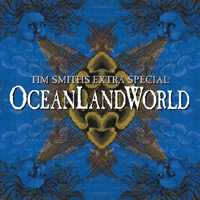


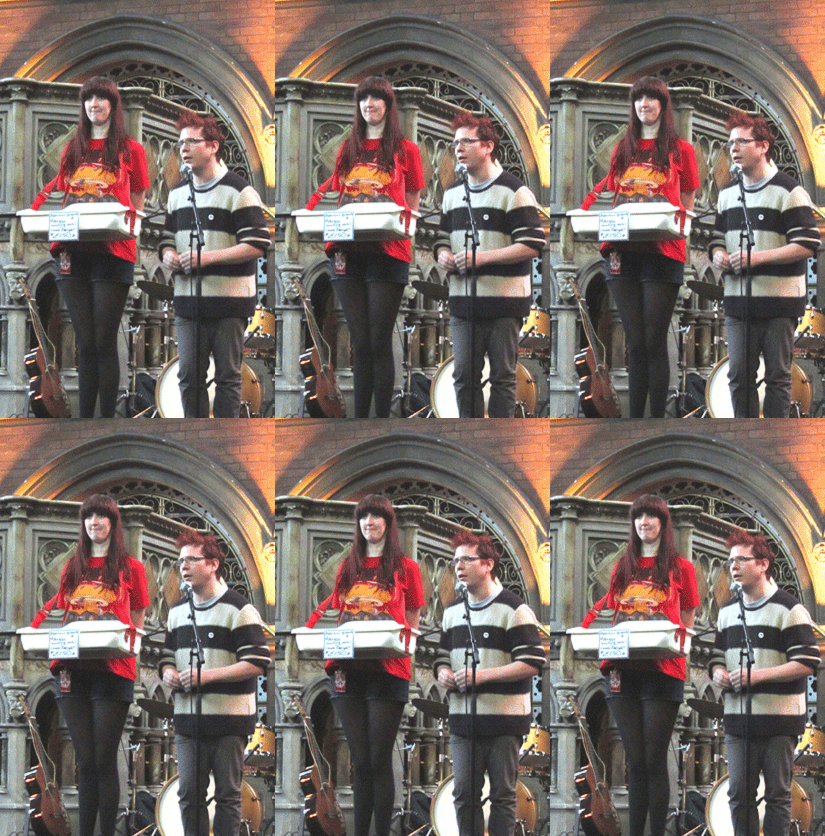


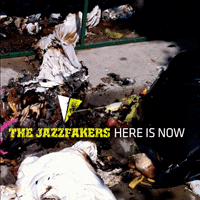
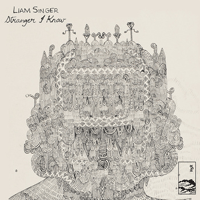

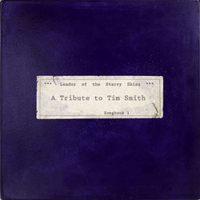




 Misfit City