There are a series of concerts coming up featuring East Anglian musician Laura Cannell. Playing a variety of instruments (predominantly straight or overbowed fiddle and double recorders, but also percussion and “other rarified wind instruments”, Laura fuses early and mediaeval music with a mixed ancient-and-modern approach to improvisation and to transcendent musical ceremony, taking fragments or inspirations from earlier sounds and melodies as the basis for exploration, illustration and linkages.
Laura will be playing up and down the country over the next few months at a variety of different events and locations, Each one has different musicians on the bill – Brooklyn-based Dutch lutenist and composer Josef van Wissem, who’s bringing the baroque lute out towards the worlds of experimental rock, folk and film; Liverpudlian tape-loop composer In Atoms whose “blissful and evocative” soundscapes and tones mix heath music and throbbing clubby sub-bass with the industrial and reveal him straddling Anglo-pastoralism and the European electronic grandeur of the Schultzes and Jarres; and two Yorkshire singers, Stephanie Hladowski (whose work stretches from reggae to traditional folk) and Magpahi (a.k.a. Todmorden based multi-instrumentalist Alison Cooper, who assembles a collage of folk song, fairy tale, Elizabethan poetry and dreamworld sonics from a variety of instruments and is inspired by “sepia stories, stray animals and recurring dreams of migration”).
Here’s the gig list, and something from each of Laura’s gigmates (including something quite rare from Magpani via the Was Is Das clubnight and promotions):
Laura has further gigs coming up later in the year, which I’ll also be posting about in due course.
* * * * * * * *
Born in Nagoya, (but now based in Bristol with his wife and collaborator, alt.folk singer Rachael Dadd) Ichi is paying London another visit with his truckload of invented instruments and mind-snagging riffs, digging a dayglo-lined tunnel between the avant-garde and a children’s playroom.
Ichi (The Harrison, 28 Harrison Street, London, WC1H 8JF, UK, Saturday 23rd January 2016, 8.00pm) – £11.00 – information – tickets
From the Harrison’s blurb:
Ichi takes the notion of a one-man band to new limits, combining his quirky handmade instrument inventions (stilt-bass, kalilaphone, balloon-pipes, hatbox-pedal-drum, tapumpet, percussion-shoes & hat-trick-hat) with steel-drum, ping-pong balls, toys & everyday objects all in the space of one short set. Somehow there’s an ancient, ritualistic feel to his performances – he’s like the misplaced leader of a tribe. To see Ichi live is to witness something so playful and unusual you know that you’re experiencing something entirely new. It`s fun, it`s danceable, it`s exciting…. Also a practicing and exhibiting artist and film-maker, Ichi is usually seen with a cine camera in his hand, or his hands rooting through Bristol skips for materials for his musical and sculptural inventions, or his hands in the earth making human sized interactive earth xylophones as he did at Bristol`s Forage Festival.
And where words fail, there’s always the video to Ichi’s recent single Go Gagambo, “a song about mistaken identity (gagambo is an insect unfortunate enough to be mistaken as a big mosquito, resulting in probable death by angry clapping hands)”.
* * * * * * * *
I’d been hoping to bring you news of London acoustic steampunk-prog hero Tom Slatter playing Britain’s first actual steampunk bar (the recently opened Yellow Book, which is squirreled away in the Lanes of Brighton and claims to have been founded by time-travelling Victorians). Sadly not. Message just in – “This gig has been postponed. Don’t go there expecting to see me on the 23rd! Do go there if you want to see the venue, which is lovely. I will be playing at the Yellow Book in the near future. Watch this space.”
* * * * * * * *
More gig news next time, including shows by Of Arrowe Hill and Earl Zinger with the Emanative & Collocutor Duo; plus an appearance by Sealionwoman.
Born in Oldham, currently Saddleworth-based, but occupying a wayward and exciting multi-instrumental/multi-genre orbit (which takes in, among many others, Todd Rundgren, spangled electronica, Dirty Projectors, Van Morrison and Nancy Chodorow) teenage wunderkind turned twenty-year-old psych-pop pioneer Kiran Leonard embarks on a quick British tour this coming week. For a sampling of what’s on offer, have a listen to Kiran’s most recent single, which examines the panicked, unwilling misogyny of pubescent boys and uses it as a launchpad for sixteen minutes of charging, spontaneous-sounding twist-and-turn musical quest. Spattered with snippets of radio, cut’n’paste ADHD changes and lo-fi turnarounds, it sounds like Lou Reed and Jim O’Rourke grappling over the steering wheel of a gawky teenage Yes.
For the tour, Kiran’s four-piece band features three other flexible Manchester music luminaries. Guitarist Dan Bridgewood Hill also plays as dbh and with NASDAQ, Irma Vep Band and Seatoller), bass player Dave Rowe is from Plank and Andrew Cheetham drums with acts including Desmadrados Soldados De Ventura, Easter, Butcher The Bar, the Birchall/Cheetham Duo and experimental rock duo Yerba Mansa. Support across the dates comes, variously, from Yerba Mansa, introverted Manchester singer-songwriter Tom Settle, Marc Rooney (taking a solo break from his usual band, Glaswegian “past post-modern bug-eyed beatniks”Pronto Mama), Edinburgh rock juveniles Redolent and inventive Sussex girl duo Let’s Eat Grandma.
The Victoria, 451 Queensbridge Road, Hackney, London, E8 3AS, England, Monday 11th January 2016, 7.30pm – £8.50 – information – tickets
The Prince Albert, 48 Trafalgar Street, Brighton, BN1 4ED, England, Tuesday 12th January 2016, 7.30pm (with Let’s Eat Grandma)- £8.80 – information – tickets
The Eagle Inn, 18 Collier Street, Salford, M3 7DW, England, Wednesday 13th January 2016, (with Tom Settle & Friends + Yerba Mansa) – information – tickets
Something of what to expect from the support bands is below:
This gig info was added to the top of this post at the last minute, and these gigs are selling out fast, so move quickly.
* * * * * * * *
The past week’s death of Pierre Boulez cast an overwhelming shadow over the classical and avant-garde worlds. Under that pall, it’s easy to forget that breed of composers that the post-war work of Boulez and his acolytes sometimes eclipsed – working at a humbler altitude, often inclined to traditional tonalism and craftsmanship and generally writing for the vast and undersung body of working musicians and small regional music groups, their work’s left out of the big conversations. It may break fewer boundaries, or no boundaries at all, but (to my mind, at least) it doesn’t necessarily have a lesser value. Not only does it often demonstrate an empathy for the musician over the concept, it demonstrates music’s quality of constant giving, showing that the older schemes which a younger and more intemperate Boulez once dismissed as being played out are anything but: revealing an ever-renewing, ever-fertile grain to be worked with and against even in well-mined territories.
To my ears, the work of Julian Dawes fits into this category. Five decades of his composing has produced chamber and keyboard music, theatre compositions, youth pieces, assorted works on Jewish themes (including Kaddish songs, Exodus cantatas and Holocaust pieces) plus an acclaimed mandolin concerto. All of it displays a lambent, empathetic feel for subject, performer and musician; and this coming Wednesday sees some of it compiled for a dedicated concert in London.
A Concert of Commemorative Music by Julian Dawes (The Forge, 3-7 Delancey Street, Camden Town, London, NW1 7NL, England, Wednesday 13th January 2016, 7.30pm) – £9.00 to £12.00 – information & tickets
This is an evening of music which Julian has written to celebrate people and events. The night is also in memory of Emma Daly, and the proceeds of the concert will go to the Rosewood Chemo Ward at the Darenth Valley Hospital.
Programme:
Love Life and Lyric (for soprano and piano)
Reflection on Psalm 43 (for piano) – first concert performance
Homage (for string quartet)
Wedding Song (Louisa) (for soprano, violin & piano) – world premiere
Piano Sonata – world premiere
Bagatelle for a Wedding (for string quartet)
Songs from ‘The Song of Solomon’ (for mezzo soprano, tenor & piano)
String Quartet (slow movement)
Sonata for Violin and Piano
Soundclips of Julian Dawes’ music on the web are few and far between, but I’ve managed to dredge up these two videos – one of Cantor Jason Green performing one of Julian’s vocal pieces, and a low-key one of Julian talking about his work (on behalf of the publishing service Tutti). You can also listen to soundclips of some of his work at the page for Omnibus Classics’ release of his ‘Chamber Music’ CD.
Julian’s most recently completed project is ‘Pesach Cantata’ with a libretto by Roderick Young telling the story of Passover. This will be premiered at the New London Synagogue in April 2016: I’ll post about that closer to the time.
* * * * * * * *
Lastly, there are a couple of New York gigs (this week and towards the end of the month) by a ‘Misfit City’ favourite of recent years, Brooklyn-based groove-pop band Legs, who mix irresistible New Wave dance grooves with twitchy emotional neurosis and a verbose, occasional waspish Steely Dan-esque approach to songcraft under the double-keyboard licks.
Legs + SKP (Hypnocraft @ The Manhattan Inn, 632 Manhattan Ave, Brooklyn, New York 11222, USA, Monday 11th January 2016, 8.30pm) – free event (suggested $5.00-$10.00- information
This pay-what-you-like gig is a Legs headliner, at which they’re supported by SKP – a.k.a. Sarah Kyle, frontwoman of Brooklyn psychedelic pop band Lip Talk. Sarah is also a member of recent Interpol tourmates Cosmicide, which features most of Lip Talk plus ex-Secret Machines leader Brandon Curtis.
Blank Paper + Tropic Of Pisces + Legs (Rough Trade NYC, 64 N 9th Street, Brooklyn, New York, NY 11249, USA, Friday 22nd January 2016, 8.00pm) – information here and here – tickets
This latter one’s a bottom-of-the-bill show for Legs. Swings and roundabouts, but they can play on both. At least they get to perform at Rough Trade (should be a natural audience booster) and they also get to act as warm-up and gig primer for two other stylish and eminently compatible Brooklyn acts. Keytar-wielding Blank Paper mix up classic hip hop rhythms, distant glimmering-city synthpop tones and vocals with just the right degree of hauteur for detached explorations of love and obsession sheathed in immaculate tunes. Tropic of Pisces is the new project from Mon Khmer/Oberhofer sideman Mathew Scheiner – his geeky white-boy solo funk seems to be inspired equally by glam, hip hop and South African township jive, though he himself describes it as “a warm, magical place that you must be special enough to have found.” Judge for yourselves below via the videos, with their ninja noir and tinfoil chic.
Well, actually this is the first of the next-to-last gigs post of the year (I’ve still got to do the second round of Christmas parties). Apologies for terseness and excessive recycling of press-release blurb, but there’s a lot to pack in both here and elsewhere this month.
About half of these gigs are seriously avant-garde concerts for the London Contemporary Music Festival, with even more of a blizzard of links and odd video clips than usual. I’m also starting with a couple of full-on jazz or electronic improvising gigs.
Walthamstow’s newest (and only?) regular night of experimental/noisy/generally interesting music, returns with sets of bracing electronic experimentation from Phantom Chips and MXLX(the amazingly prolific Matt Loveridge, aka Fairhorns, Team Brick, and one third of BEAK>, among others), as well as the MNFN DJs playing ’til late.
* * * * * * * *
The Hat Speaks (LUME @ Hundred Years Gallery, 13 Pearson Street, Hoxton, London, E2 8JD, England, Thursday 17th December 2015, 7.30pm) – pay-what-you-want (£5.00 minimum) – information – tickets on the door
For our last gig of 2015 we return to Hundred Years Gallery in Hoxton, for the second edition of our dice-and-hat improvised music night. We held the first one in July to celebrate our second birthday, and it was so much fun we decided to do it again. As before, a nebulous ensemble of UK improvisers will gather to make spontaneous music together. This time the list looks like this:
Taking inspiration from long-running Manchester night The Noise Upstairs (founded by Anton Hunter and Tullis Rennie, no less), we will put all the players’ names into a hat, throw the dice to determine how many musicians will play, and then draw out the names. The result is lots of mini- sets from often completely new combinations of people! (Some groups from last time have decided to carry on playing together too: Tom Ward and Adam Fairhall are now collaborating on a new quartet for 2016 after their hat encounter in the summer).
Do join us for this last gig of the year – it’s been a blast, so let’s see it off in style! Entry, as usual, is one Bank of England note of your choice.
* * * * * * * *
And to close, here’s that run-down through the remaining London Contemporary Music Festival concerts.
We present the world premiere of a monumental new work by sound artist and recordist Chris Watson. Drawing on extensive underwater recordings gathered by the artist from oceans around the world, ‘Okeanos’ – a multi-channel sound installation that will play in complete darkness – celebrates the songs, rhythms and music of the oceanic depths.
In an attempt to shift our perception of what opera can do and be, we present a second instalment of ‘To A New Definition of Opera’, in which performance, video art and neglected modernist opera rub shoulders. Alongside a new commission from British performance artist Sue Tompkins, the night will include composer Tim Parkinson’s apocalyptic anti-opera ‘Time With People’ (performed by the University of Huddersfield’s edges ensemble) and Los Angeles-based artist Ryan Trecartin‘s dystopian film ‘CENTER JENNY’.
The centrepiece of the evening will be the UK premiere of Karlheinz Stockhausen’s celebrated ‘Pieta’ from ‘Dienstag aus Licht’, with the voice of Lore Lixenberg and flugelhorn of Marco Blaauw. Interlaced throughout the evening will be an extremely rare performance of excerpts from Ezra Pound’s troubadour opera about medieval ne’er-do-wells, ‘Le Testament de Villon‘, which critic Richard Taruskin called “a modernist triumph.”
Programme:
Ezra Pound – excerpts from ‘Le Testament de Villon’ 1926 version (UK premiere) – performed by Lore Lixenberg (voice), Aisha Orazbayeva (violin), Lucy Railton (cello), Ian Sankey (trombone), Serge Vuille (percussion) Christopher Stark (conductor)
Karlheinz Stockhausen – Pieta from ‘Dienstag aus Licht'(UK premiere) – performed by Marco Blaauw (flugelhorn) and Lore Lixenberg (voice)
Ryan Trecartin – CENTER JENNY
Tim Parkinson – Opus 1, 2, 3 and 4 from ‘Time With People’ – performed by edges ensemble: John Aulich, Mira Benjamin, Jorge Boehringer, Eleanor Cully, Beavan Flanagan, Stephen Harvey, Dorothy Lee, Asher Leverton, David Pocknee and James Woods
Sue Tompkins – Like Sake (world premiere, LCMF commission) – performed by Sue Tompkins
‘A Martian Sends A Postcard Home’ takes its name from a poem by Craig Raine that sought to re-see the world through bold acts of defamiliarisation. This night celebrates the Martianist turn in music, with an exploration of composers who have made the familiar fresh.
The night will include the European premiere of Norwegian composer Øyvind Torvund‘s lawless chamber work ‘Untitled School/Mud Jam/Campfire Tunes’, performed by the Plus Minus Ensemble, and Andrew Hamilton‘s electrifying ‘music for people who like art’. In ‘Mezcal No. 8’ Swedish composer/performer Hanna Hartman transforms a copse of steel rods and washers into a sounding presence.
We honour two standard bearers of “making strange” in composition: Helmut Lachenmann and Dieter Schnebel. Aisha Orazbayevaperforms Lachenmann’s ‘Toccatina’ alongside a recital of Russian poems by Mayakovsky and Yesenin that live and breathe the idea of estrangement or ostranenie. Meanwhile, composer and musician Christian Kesten presents Schnebel’s celebrated ‘Maulwerke’ where vocal technique is pulled apart into its constituent parts, alongside his own ‘Zunge Lösen’ that seeks to stage the tongues of three performers.
Artist Tino Sehgal takes on the body, intellectual property and materiality itself. ‘Instead of allowing some thing to rise up to your face dancing bruce and dan and other things’ is his earliest “livework”. It sees performer Louise Höjer transformed into, in the words of ‘Frieze Magazine’, a “hydraulic android”.
The night ends with a visit from Cairo’s E.E.K. Under the fingers of Islam Chipsy (accompanied by drummers Khaled Mando and Islam Tata), a digital keyboard is wrenched into explosive new sonic territory, articulating the sound of post-Tahrir electro-chaabi.
Programme:
Tino Sehgal – Instead of allowing some thing to rise up to your face dancing bruce and dan and other things – performed by Louise Höjer
Selected poems by Vladimir Mayakovsky and Sergei Yesenin – performed by Aisha Orazbayeva (voice)
Helmut Lachenmann – Toccatina – performed by Aisha Orazbayeva (violin)
Christian Kesten – Zunge Lösen (Releasing the Tongue) – performed by Christian Kesten (voice)
Andrew Hamilton – music for people who like art – performed by Becca Carson (piccolo), Ausiàs Garrigos Mórant (bass clarinet), Ian Sankey (trombone), Sam Wilson (percussion), Jack Ross (electric guitar), Siwan Rhys (piano), Joanne Evans (voice), Eloisa Fleur-Thom (violin), Valerie Albrecht (viola), Oliver Coates (cello), Martin Ludenbach (bass guitar), James Weeks (conductor)
Dieter Schnebel – Maulwerke (2015 solo version) – performed by Christian Kesten
Hanna Hartman – Mezcal No. 8 (UK premiere) – performed by Hanna Hartman
Øyvind Torvund – Untitled School/Mud Jam/Campfire Tunes (European premiere) – performed by Plus Minus Ensemble: Mark Knoop (piano), Roderick Chadwick (piano), Serge Vuille (percussion), Elsa Bradley (percussion
Islam Chipsy & EEK – live set
Some call it post-internet art: others “the New Aesthetic”. Whatever the name, there’s no doubt that the internet has scrambled the way we think, see and listen. Yet if art has placed this new paradigm at its heart, we are only now beginning to distil what it means for musical composition.
One pioneer of musical attempts to understand how things are changing in the digital shadow is Jennifer Walshe. The final night of LCMF 2015 will see the UK premiere of her latest, major one-woman work ‘Total Mountain’. Two further UK premieres arrive from Germany. Berlin-based Neele Hülcker investigates (as does Claire Tolan) the online phenomenon of autonomous sensory meridian response – or ASMR – in her work ‘Copy!’, while Brigitta Muntendorf explores the YouTubed bedroom in ‘Public Privacy No 2’.
The flight from reality captured by this post-internet music is not new. Serialist trailblazers like Milton Babbitt got there first with works such as ‘Reflections for piano & synthesized tape’. The hyperactive, networked aesthetic of Walshe and others, meanwhile, was foreshadowed by Jacob TV in ‘Grab It! Both are performed tonight.
As an occasional collaborator with London-based collective PC Music, Felicita‘s music is one in which the tropes of pop’s most commercial statements are accelerated, amplified and brought riotously together into a language that, if satirical, is also wildly inventive in its own right.
We conclude and project into the future with the long-awaited UK return of James Ferraro, whose 2011 album ‘Far Side Virtual’ is an essential post-internet text. For his forthcoming release ‘Skid Row’, Ferraro turns his attention to contemporary Los Angeles, a kind of “hyper-America” where violent realities are obsessively mediated and reproduced.
Programme:
Milton Babbitt – Reflections – performed by Mark Knoop (piano) with original tape recording
Jacob TV – Grab It! – performed by Nick Goodwin (electric guitar)
Brigitta Muntendorf – Public Privacy #2 (UK premiere) – performed by Brigitta Muntendorf with Mark Knoop (piano)
Neele Hülcker – Copy! (UK premiere) – performed by Neele Hülcker
Jennifer Walshe – Total Mountain (UK premiere) – performed by Jennifer Walshe
Felicita – live set
James Ferraro – new work
The end of the month, and the year, is nigh – so what are we looking forward to this week?
Mark Mulholland, Craig Ward, Yacouba Sissoko & Hannes D’Hoine (Ford Village Hall, Ford, Argyll, Scotland, Tuesday 8th December 2015, 7.30pm) – £5.00 minimum – information – tickets on the door
Back in 2012, two wandering Scottish singer-songwriter-guitarists – Mark Mulholland (ex-Two Dollar Bash) and onetime dEUS member Craig Ward – quietly released one of the finest records of the year. A compelling murmur of acoustic guitar folk, ‘Waiting for the Storm’ was soaked in the Scottish and British folk-baroque of Davey Graham, Pentangle and John Martyn but, in its settings of moist heat, tin roofs, typhoons and dark forces, it was also informed by the Haitian setting of Port-au-Prince, Mark’s home for the previous two years. Some of you may remember that I liked it.
With Mark now relocated to Mali and Craig settled in the little Argyll village of Ford, the duo are collaborating on a follow-up (provisionally called ‘The Darkness Between the Leaves’) on which they’ll be joined by Flemish double bass player Hannes D’Hoine – who played the Danny Thompson anchor-cable role on ‘Waiting for the Storm’ – and by Mark’s newest collaborator, the Malian djely and multi-instrumentalist Yacouba Sissoko, a master kora and ngoni player. The quartet have been preparing and recording in a number of different countries, and the end of the Scottish sessions will be marked by a Ford performance both taking place in and raising funds for Ford Village Hall, with prices set on a pay-what-you-like basis starting from five pounds.
In its quiet way this should be one of the gigs of the year, so if you’re in western Scotland and have a free Tuesday evening, consider heading over to Ford (at the south-western end of Loch Awe, north-west of Glasgow, with the nearest substantial town being Kilmartin.) If you miss this one, they’re playing again in Glasgow at 7.00pm on Wednesday 9th; a low-key gig at the Hidden Lane Gallery in Finnieston.
* * * * * * * *
After that – for me – the week doesn’t pick up until a very busy Friday and weekend. Too subjective, probably. Here we go, anyway.
Serafina Steer & Bas Jan (Hall Two @ (Kings Place, 90 York Way, Kings Cross, London, N1 9AG, England, Friday 11th December 2015, 8.00pm) – £9.50-£12.50 – information & tickets
The hitherto independent worlds of contemporary harp music and experimental kraut-pop will collide – or at least bump each other – in this concert of two halves by harpist/songwriter Serafina Steer and her new band Bas Jan.
After a few years of mainly only using the harp for her own writings, Serafina went on a roadtrip around Eastern Europe busking, discovering and rediscovering pieces along the way. The result of this experience will form the first half of the programme, which will feature compositions by Richard Barratt (‘tendril’), Benjamin Britten (‘Suite for Harp’), Stephen Dodgson (‘Fantasy’), Rhodri Davies (‘Aqcua Alta’) and Serafina’s own father Michael Maxwell Steer (‘Grovelly Wood’)
The second half of the show will be a performance by Bas Jan, Serafina’s latest collaborative project in which she plays bass guitar and keyboards and writes minimally arranged songs about the Essex coast, the Anglo-Saxons, sex, part-time work and love; with sound artist Sarah Anderson playing violin and OP1 mini-synthesizer and performance visual artist Jenny Moore playing drums (all three women also sing). Bas Jan’s first gig was to six thousand people at Brixton Academy and since then they have gone on – via support slots for Xylouris White and The Decemberists – to entertain smaller and smaller audiences.
On the same night, one of ‘Misfit City’s favourite classical musicians is spreading her own particular musical gospel up in Staffordshire:
Olga Stezhko (Abbotsholme Arts Society @ Abbotsholme School Chapel, Rocester, Uttoxeter, Staffordshire, ST14 5BS, England, Friday 11th December 2015, 8.00pm) – information – limited number of tickets available, phone 01543 263 304 for details
Following up her recent debut performances at both the Wigmore and Bridgewater Halls (at which she performed full or partial versions of her ‘Lucid Dreams‘ assemblage, a programme of music exploring people’s changing perception of reality from childhood through to adulthood), classical pianist and multi-disciplinary thinker Olga Stezhko is bringing her sophisticated, metaphysical perspective and repertoire to the audience at Abbotsholme.
On this occasion, her choice of music is a little more conventional (leaning on well-established favourites by Mozart, Bach and Prokofiev rather then stretching to the Sophia Gubaidulina pieces she was playing last month). However, there’s still room in the programme for work by one of her compositional touchstones, Alexandr Scriabin; and you can be assured that whichever pieces Olga plays will have been carefully thought out and put into context as part of a programme intended to inspire thought and broader conceptual connections as well as straightforward musical enjoyment.
Programme:
Wolfgang Amadeus Mozart – Sonata in B flat major, K.570
Johannes Brahms – Six Pieces, Op.118
Alexandr Scriabin – Two Dances Op.73; Five Preludes Op.74; Vers la flamme Op.72,
John Adams – China Gates
Sergei Prokofiev – Sonata no.4 in C minor, Op.29
* * * * * * * *
Back in London, meanwhile, there’s cabaret afoot, plus breathless press releases.
The Bohemianauts + Bad Fractals (Bohemiocracy @ The Others, 6-8 Manor Road, Stoke Newington, London, N16 5SA, England, Friday 11th December 2015, 8.00pm) – £8.00-£10.00 – information & tickets here and here
An epic face-off between two amazing, unique and bizarre bands.
Bad Fractals are shaman gangsters shooting bullets of love, tearing their way through acid punk, malevolent music hall and trailer-trash blues in a world gone mad. Join us at the crossroads, in a theatre of the absurd: hear story and song shift with the wild wonder of fractals! Watch psychedelic punks get drunk with clown kings! Glare at artificial angels dancing with deadbeat demons! Gasp as astral travellers gather in galactic taverns!
The Bohemianauts are decadent divas of demi-monde carnivalism, playing weird waltzes, pithy polkas and rollicking rhumbas: they will take you on a theatrical musical journey through strange landscapes with absurd humour, exquisite noise and songs of unrequited dread. Tonight they will unleash their female alter-egos, as they parade in their geezer-bird finery, performing for your pleasure as the rarely-seen Bohemianauts – Drag-ed on Stage. (Trigger warning: Bearded Drag.)
PLUS – Visuals and projections from Jaime Rory Lucy‘s Rucksack Cinema and half-time performance interventions from Oleg the Mystic.
Increasingly, Sunday night in these listings seems to be the night for jazz – or near-jazz. Something accessible’s going on in Crouch End, just down the road from ‘Misfit City’; something spikier’s in preparation at the Vortex over in Dalston; and a thousand miles away in Warsaw, an old favourite’s taking a new step.
In order of proximity, then..
The Chris Laurence Quartet with guest Henry Lowther (Sunday Night Jazz @ The Supper Room, Hornsey Town Hall Arts Centre, The Broadway, Crouch End, London, N8 9JJ, UK, Sunday 6th December 2015, 8.00pm) – £11.00 – information – tickets
For several decades, Chris Laurence has skilfully straddled the worlds of British jazz, British classical and British popular music without compromising his artistry in any of them. He’s played double bass on tracks by Elton John, Sting or David Gilmour and spent many years as principal double bassist with the Academy of St. Martin in the Fields and the London Bach Orchestra; but the prime outlet for his melodic, propulsive playing has always been jazz, whether he’s been working in controlled explosions with free-jazz drummer Tony Oxley or in more measured compositional jazz space with Kenny Wheeler, John Taylor or John Surman.
His own Chris Laurence Quartet has been active since the mid-2000s, with the other three members being vibraphonist Frank Ricotti (a longtime Laurence collaborator and bandleader in his own right, as well as being a British percussion-session legend) and past/present Loose Tubes players John Parricelli (guitar) and Martin France (drums). Their lone album to date – 2007’s ‘New View’ – includes Laurencian takes on compositions by Wheeler, Surman, Taylor, Stan Sulzmann, Joni Mitchell and Andy Laverne. As well as featuring guest appearances from Norma Winstone, it also showcases the interplay of Chris’ vigorous bass playing and the subtle implicatory musicianship of his cohorts.
For this particular concert, Henry Lowther (whose five-decades-plus career of playing has seen him grace work by Mike Westerbrook, Gil Evans, Talk Talk, John Dankworth and many others including various jazz orchestras) will be guesting on trumpet. The Quartet is playing as part of a brief Three Sundays of Inspirational Music season at Hornsey Town Hall, which concludes on the 6th and features various jazz, baroque and classical performances.
Deemer + Survival Skills (LUME @ The Vortex Jazz Club, 11 Gillett Square, Dalston, London, N16 8AZ, UK, Sunday 6th December 2015, 7.30pm) – £11.00 – information – tickets
The next concert’s billed as “a special evening of improvised music with electronics” and hangs onto whatever jazziness it has by its fingertips alone: but if you’re interested in creative spontaneous music, don’t let that put you off in the slightest.
Deemer is the brain-child of Merijn Royaards and Dee Byrne. Deemer started life in 2006 as a weekly improvisation/electronics session in a warehouse in Hackney Wick. The project has since evolved into an installation/performance based electro-acoustic two-piece orchestra, whose aural narratives are created within fluid frameworks that map a trajectory in time, but leave the sonic textures and compositions entirely free and undetermined. Deemer employ, among other things, alto saxophone, analogue electronics, tape, transducer microphones/speakers to instantly compose, activate space, and blur the boundaries between free jazz and sound installation. They are releasing their debut album ‘Interference Patterns’ on Monday 7th December on the new LUME record label, Luminous.
Survival Skills is the solo project of Chris Sharkey (trioVD, Acoustic Ladyland, Shiver). It has no fixed instrumentation but the music is often comprised of various processed layers created in real time by hardware including synths, sequencers, cassette recordings, vocals and guitar – the results have been described as “a lo-fi vision of mangled techno, where beats cluster and stumble in their fight for dominance; a highly intriguing piece of noise art…” (‘Data Transmission‘).
Noise of Wings (Staromiejski Dom Kultury, Rynek Starego Miasta 2, 00-272 Warsaw, Poland, Sunday 6th December 2015, 7.00pm) – 20 zł – information – tickets on the door, one hour before concert
Saxophonist Ray Dickaty has travelled a long way in twenty-odd years – both geographically (Liverpool and London, via assorted world tours, to Warsaw) and musically (British avant/alt-rock with Spiritualized, Moonshake and Gallon Drunk, then the brutal jazzpunk of Solar Fire Trio, and his current work as an improviser). Now embedded deep in experimental jazz (plus a host of projects around the Warszawa Improvisers Orchestra) he’s stepping out as a frontline composer. For Noise Of Wings, Ray twins his tenor sax with that of Maciej Rodakowski, adding avant-garde double bass player Wojtek Traczyk and polygenre drummer Hubert Zemler to form a quartet playing “inside and outside” Ray’s own written pieces.
Though the project’s influences and ingredients come from Terry Riley, Ornette Coleman, “mediaeval darkness”, drone culture and Albert Ayler free-forming, Ray claims that the final results“are not free jazz blowout music; this is a carefully considered sonic palette… It may be considered dark ambient jazz, with a hint of contemporary classical: melodic and yet full of interesting twists and turns… The saxes are pushed to their limits sonically and all the time the volume is kept down.” The project is still too young for me to be able to provide any sonic evidence, but this December gig at Warsaw’s Staromiejski Dom Kultury is being pitched as “a very special concert in a very special sounding room” and will be recorded live for rapid release.
* * * * * * * *
Bringing up that last Warsaw gig reminds me that I’ve been trying to look further afield than London for news on interesting concerts, in attempts to escape the complacent gravity of the capital and my own complacence as a born-and-bred Londoner. The results can be rewarding, and although I don’t want to spend all my time as a gig-advertising service, there’s definitely some satisfaction involved in supporting people’s efforts to foster and promote interesting music away from the biggest cities and media hubs. The flipside, though, is an occasional feeling that I’ve started doing this too late.
Take this Was Ist Das? concert, for instance – the latest effort by an enthusiastic promoter and instigator of rare noise in West Yorkshire, but also the final effort. The story might not have quite such a sad ending – this thing’s coming to an end not due to disillusionment but because of the promoter emigrating – but it’s still a shame to see a gig series wink out of existence in a place where it will be missed. All the more reason to catch this particular concert before the end…
Skullflower + Tor Invocation Band (Was Ist Das? @ Inkfolk @ Machpelah Mill, Station Road, Hebden Bridge, HX7 8AU, UK, Sunday 6th December 2015, 8.00pm) – price t.b.c – information – tickets on the door
The final Was Ist Das? gig before I emigrate to America and there’s only one way to go out….with a bang.
Formed in 1987, Skullflower emerged from the Broken Flag noise scene but with a sound far more guitar-driven than most of their peers. Their intense sonic assaults have been influential on such bands as Bardo Pond and Godflesh. Band leader Matthew Bower has worked with many of the leading lights of the UK underground such as Vibracathedral Orchestra, Richard Youngs, Ramleh and Colin Potter.
Tor Invocation Band is a nebulous, international unit of seasoned improvisers. As given to the light as to the dark, their exploration of space, sound, noise and sacred spaces. The exact line-up is yet to be completely confirmed but if it is what I hear it is… Well, don’t turn up late. It seems like the perfect way to end it all, with our ears ringing!
Further information – this gig’s part of the Inkfolk December gathering, sprawling from 3rd 6th December. I think that the Tor Invocation Band may have something to do with the group of improvising musicians associated with Tor Press (who run various psychedelic.drone.folk.metal.noise Tor Bookings events in Todmorden Unitarian Church a few miles from Hebden Bridge, but I can’t be sure. Meanwhile, Skullflower have the following comment on the whole affair – “On the Sixth of December we will descend on Hebden Bridge to evoke the Dakshini Force and build altars of Set/Guedhe in the Werewolf Universe with that shadow stuff that their bible calls ‘the Darkness of Aegypt’. Driving over the moors to the Calder Valley, I have seen, the world cloaked in mist below me, and only a few plateaus, like islands, left, as if the world were drowned, cleansed.” With the minimum of tweaking, that’s the band’s Christmas card written too.
Glib jokes apart, publicizing this last gig has made me feel both sad and inspired. I’m increasingly feeling that this kind of concert (not in terms of genre, but in terms of hope and pluck – small and hopeful endeavours) is what I should be plugging more. So – best of luck to the mysterious Was Is Das person as he sets up again in America, and an open and obvious invitation to everyone else: if any of you are reading this and trying to run small, committed gigs of interesting music somewhere, please get in touch.
There were too many gigs this week to fit into the last post – go back there for details on assorted chamber music, folk, sample pop and the Anawan gigs in New York (one of which spills over into the weekend). For my usual erratic pick of what’s on over this coming weekend, keep reading.
* * * * * * * *
Daylight Music 209 – James McVinnie, Mara Carlyle, Liam Byrne + HART (Union Chapel, Compton Terrace, Islington, London, N1 2UN, UK,12.00pm) – free (suggested donation £5.00) – information
World famous organist James McVinnie makes the perfect partner for the Union Chapel’s 200-year-old Henry Willis organ. In the spirit of Christmas, James has invited his closest musical chums to share the stage with him: Mara Carlyle, Liam Byrne and HART. Together, they’ll be presenting some of their own music and doing arrangements of hidden gems and forgotten carols.
Organist James McVinnie was Assistant Organist at Westminster Abbey between 2008 and 2011 (playing for both regular and special services as well as directing the Abbey’s world-famous choir) and has held similar positions at St Paul’s and St Albans Cathedral. He appears on numerous recordings of vocal and choral music and, as a continuo player, he has appeared at most European early music festivals. In parallel to this, he is internationally renowned both as a soloist and a collaborator in new music whose boundless approach to music has lead him to collaborations with some of the world’s leading composers and performers. David Lang (winner of the 2008 Pulitzer Prize in music), Martin Creed (winner of the 2001 Turner Prize), Richard Reed Parry (Arcade Fire), Shara Worden (My Brightest Diamond), Pee Wee Ellis, Max de Wardener, Mara Carlyle and Bryce Dessner (The National) have all written works for him. He is a member of Bedroom Community, the Icelandic record label and close-knit collective comprising like-minded, yet diverse musicians from different corners of the globe. ‘Cycles’, his debut release of music written for him by Nico Muhly was released on this label in 2013 to widespread critical acclaim. 2016 will see releases of music for organ by J S Bach and Philip Glass.
Originally from Shropshire and now living in London, Mara Carlyle is a singer-songwriter, an arranger and electronic orchestrator, and a player of both ukelele and musical saw. The child of musical parents (with whom she played in assorted folk projects from childhood) and the product of classical training, she’s also the possessor of an eclectic taste as much enthused by A-Ha and Amerie as by Henry Purcell.Initially known as a guest singer on a succession of Plaid albums between 1997 and 2001, she released her first solo album in 2004. Mara’s own work blends her operatic voice with classical structures, torch jazz and electronic flourishes. In addition to her own original material, she specialises in interpretations and adaptations from the classical, baroque, Romantic and modern-classical canon including works by Handel, Purcell (Dido’s Lament), Robert Schumann (whose Ich Grolle Nicht was the basis of her single I Blame You Not), Walford Davies and Jacques Offenbach. Since 2014 she’s been part of the presenting team on Late Junction. Mara is currently in the process of recording her third album.
Liam Byrne divides his time between playing very old and very new music on the viol. With the firm belief that baroque music can be vibrant and expressive on its own terms, Liam’s solo work regularly explores lesser known corners of the 16th and 17th century repertoire. For several years he was a member of Fretwork, and has also toured and recorded with the Dunedin Consort, The Sixteen, Le Concert d’Astrée, i Fagiolini, Concerto Caledonia, and the viol consorts Phantasm and Concordia, among many others. Liam’s interpretative curiosity has also led him to work increasingly with living composers, and he has had new solo works written for him by Edmund Finnis, Nico Muhly, Valgeir Sigurðsson and others. Beyond the realm of classical music, he has worked with a wide variety of artists including Nils Frahm, Matthew Herbert, Martin Parker and The Hidden Cameras. He has played a significant musical role in the creation of several large-scale operatic works: Damon Albarn’s ‘Dr Dee’, Shara Worden’s ‘You Us We All’ , and Valgeir Sigurðsson’s ‘Wide Slumber’ . In 2015 he will undertake a new project with Belgian ensemble Baroque Orchestration X and Icelandic musician Mugison. Liam plays a 7-string bass viol by John Pringle, a 6-string bass by Marc Soubeyran, and a treble viol by Dietrich Kessler, which is graciously on loan from Marc Soubeyran.
Described as possessing “one of the most noteworthy male voices of the last twenty years,” (‘For Folk’s Sake‘), singer/songwriter Daniel Pattison trades under the project name of HART. Featuring elements of dream-pop, folk, avant-garde psychedelic rock, electronica and contemporary classical songcraft, his debut EP ‘Songs Of The Summer’ (featuring string arrangements from Nico Muhly) was released in October this year).
Playing in-between on this weeks festive edition will be singer songwriter Harry Strange, a singer-songwriter from London currently working on his first EP.
If all of that sounds too genteel, the same evening brings this triple-legend concert of experimental and industrial music heroes (also in a church). Putting this one on is a real point of pride for the organisers, who describe it as “a dream line up for us as we are all very heavily influenced by each of these artists. It will be an amazing show and the last one of 2015 from us.” I’ve just seen that tickets for the concert are selling out even as I post this – so move fast.
Roadmaking equipment onstage, self-invented instruments, performers who refuse to conform even to standard roles of getting onstage and playing…if any or all of this sounds familiar (or even the kind of thing that’s mentioned in ‘Misfit City’ every other week) it’s because Faust set the blueprints at the start of the 1970s, or at least brought them into the world of popular music. An inspiration for innumerable questioning music-makers for over forty years, the band (or, more accurately, the collective event which calls itself Faust) have maintained the same sense of spontaneity, constructive pranking, rude assertion and open-ended possibilities throughout an erratic and frequently interrupted existence.
Initially assembled and pitched (by record producer/journalist-philosopher Uwe Nettelbeck) as a counter-cultural boy band for the lucrative but conservative German record market in 1970 – as if they were a Hamburg take on The Monkees – Faust showed their true avant-garde colours immediately and deliberately. Only a rock band in the very loosest sense of the word (perhaps only their electric instrumentation, amplification, time of emergence and love of rough immediacy really plugs them into the genre), their music has combined free improvisation, garage-band jamming, a pre-punk inspiration-over-technique aesthetic and a distinctly Dada perspective. Stories about perverse, inspired experimentation and behaviour in the face of an increasingly bewildered and irritated music industry have passed into legend: rebellions which seem, for once, to have been essential and genuinely inseparable from the band’s music creation (even from their very existence). Today’s Faust may be mining a tradition rather than breaking new ground, but even as the original members pass through their sixties and into their seventies they retain their commitment to the methodology they unearthed.
To be honest with you, I’ve got only the faintest idea about which of the parallel current incarnations of Faust (each featuring various different original members) is playing in London this coming week, although the evidence is pointing towards a grouping of Zappi W. Diermaier/Jean Herve Péron/Maxime Manac’h/Uwe Bastiansen). The members themselves seem particularly unconcerned: Péron has never much concerned himself with rules and (in an eminently readable interview with ‘The Quietus’) founding organist/noise-marshaller Hans Joachim Irmler from the other main faction has confessed “our idea was that all six original members could be Faust but there should never be two Fausts at the same time. It was an agreement but the version of Faust based around Diermaier, Péron and [Amaury] Cambuzat broke the rules, in a way. It took a little while for me to get used to it but now I think… ‘Why not?!'” If they don’t mind, maybe we shouldn’t either. Increasingly, Faust is of more an idea than a band, per se – or perhaps it’s best to call them a travelling opportunity, an open mind; a self-contained performance space.
For three decades and over fifty releases, sonic collage project and “purveyor of sinister whim to the wretched” Nurse With Wound (predominantly the work of Steven Stapleton) has been drawing directly on nearly every musical genre imaginable, mixing them up via tape loops, samples and whichever methods work to illustrate Stapleton’s curiosity and sense of humour, itself influenced by surrealism, Dada and absurdism (which explains why John Cage, filched easy-listening and snatches of kosmiche could be rubbing shoulders on any given NWW track). The project’s music is also informed by Stapleton’s keen visual and fine-art sensibilities, reflecting his other work as painter and sculptor.
Originally the key figure in transgressive 1980s power electronics band Whitehouse, William Bennett has been exploring “Afro-noise” under the Cut Hands moniker since 2008. The project is heavily inspired by William’s fascination with Haitian vaudou, deploying Central African percussion in radical new ways and generating an intense sound unrivalled in its physical and emotional intensity. In a recent interview with ‘Self Titled‘, William has commented “with Cut Hands, one of the original intents was to try and achieve the same kinds of emotional transformation through polyrhythmic percussion where once words were used… I confess there is a bit of a crazy, beardy New Age composer trying desperately to break free.”
* * * * * * * *
If you’re in Winchester that night, rather than in London, and you fancy a bit of budget-imaginarium fun, I can point you towards this…
Tom Slatter (Heart Of Saturday Night @ The Art Café, 2 De Lunn Buildings, Jewry Street, Winchester, Hampshire, SO23 8SA, UK, Saturday 5th December 2015, 7.30pm) – free (donations encouraged) – information
This is Tom’s last gig of the year (although he’s got a few lined up for both London and Brighton in early 2016) and it’s free entry, though a hat might be passed around at some point for donations – possibly the topper which Tom is famous for wearing while he delivers his Victoriana prog songs.
I might as well requote my quick description of Tom from a few months ago, since he’s cheerfully seized on at least part of it for himself – “Tom describes his work as “the sort of music you’d get if Genesis started writing songs with Nick Cave after watching too much ‘Doctor Who'”, while one of his occasional collaborators, Jordan Brown of airy London prog-poppers The Rube Goldberg Machine, calls him “a sci-fi storyteller with a penchant for odd time signatures and soundscapes.” Both descriptions ring true but fail to pinpoint the cheerfully pulpy weird-fiction exuberance of Tom’s work as a one-man band. He’s a man not just happily out of his time, but making a virtue of it – a latter-day Victorian street-theatre barker with a guitar promising tales of mystery, imagination, ‘orrible murders and bloody great waving tentacles.”
For a second opinion, try this from ‘The Progressive Aspect‘ – “Tom is an engaging singer with a resonant voice and an unorthodox songwriter whose songs push the boundaries of what can be expected from the solo acoustic guitar troubadour, straying into the darkest of corners. There is a strange mind at work here but one that makes for a compelling and fascinating listen.”
Recorded and live tasters below…
* * * * * * * *
Meanwhile, over in Brighton, there’s something for the psychedelic crew:
The Real Music Club is delighted to present an intimate night of highly eclectic music.
Within Inspiral Trio, three current members of Gong explore their harmonious musical synergy. Dave Sturt (bass guitarist and composer) has worked with Gong, Bill Nelson, Steve Hillage, Jade Warrior and Cipher. His solo album ‘Dreams & Absurdities’ will be released on Esoteric Antenna on October 30th. Ian East (sax/woodwinds player and composer) has worked in multiple genres, from Gong to Balkanatics. Ian is currently producing a solo album to be released in 2016. Kavus Torabi (guitarist, singer and composer) has worked with Cardiacs, Gong, Knifeworld, Guapo and Mediavel Baebes – much of his work can be found on his own label, Believers Roast. Solo sets from each man (with Kavus promising some acoustic renditions of tunes from the forthcoming Knifeworld album in his one) will be followed by an improvised set from all three players together. Come and enjoy a tasteful melange of solo and triadic creations from these unique musicians.
The Fibroid Nebulae was formed by Damned/Sumerian Kyngs keyboardist Monty Oxymoron after opening the Real Music Club’s ‘Drones4Daevid’ gig in February 2015. The band consists of Monty (keyboards and vocals), Francesca Burrow (vocals, sax, clarinet and keyboards), Dave Berk (of Jonny Moped) on drums and vocals, Andy Power (Sumerian Kyngs) on bass and the Real Music Club’s own Gregg McKella (Paradise 9/Glissando Guitar Orchestra/Peyote Guru/Gregg & Kev) on synthy bits, vocals, guitar and glissando guitar. The Fibroid Nebulae play offbeat tracks and fuse their own styles and quirks with some lo-fi groove psychedelia, ambient sounds and Krautrock – taking in Soft Machine, Gong, Neu! and Pink Floyd along the way!
‘Ghosts At Our Shoulders – The Tradition Unfolds’ featuring Chris Wood + Alasdair Roberts + Kirsty Potts + Stick in the Wheel + Martin Carthy + The Devil’s Interval (Kings Place, 90 York Way, Kings Cross, London, N1 9AG, UK, Thursday 3rd to Saturday 5th December 2015, various times) – various prices (£9.50-£22.50) – information & tickets
“The men have withdrawn and left me alone in a roomful of relics / But they gave me the song, so I carry the song that all men inherit.” – Alasdair Roberts
A series of songwriters and song interpreters inspired by tradition. The rich folk song tradition in these isles is a never-ending well of ideas and sensibilities as well as source material. The traditional canon is often attributed to ‘Anon.’ – a ghost perched on the shoulders of contemporary performers, who carry tradition forward and forge their own paths inspired by that legacy. This series of concerts features some of the most thoughtful and creative interpreters of song, whose unifying focus is the telling of the song. Voices close to the source, acting as a link from the then to the now.
With his work sometimes compared to that of Richard Thompson (though he cites his major influence as ‘Anon.’), Chris Wood is an uncompromising singer, multi-instrumentalist and songwriter whose music reveals his love for the un-official history of the English-speaking peoples, weaving his own contemporary parables into the tradition. His lateral take on the modern world follows an ideological thread from the likes of John Clare and William Blake, and as well as humble hymns and wry observations of the small things in life, his songs have included Hollow Point (a chilling ballad of the shooting of Jean Charles Menezez).
The twenty-year, eleven-album career of Scottish singer-songwriter and guitarist Alasdair Roberts has taken him from the early alt.folk of his Appendix Out project via mingled traditional and self-penned work to his latest, self-titled solo recording, featuring a span of Glaswegian folk talent. He performs songs which are “elliptical and gnomic, direct and personal, romantic and tender” and which have moved from an early economical style (partially inspired by the sparse aesthetic of indie rock) to the complex, esoteric and spiritual work of more recent albums. An enthusiastic and generous collaborator, he’ll be sharing the stage with Kirsty Potts, a singer of traditional Scottish folk for thirty years. Having recorded six albums with the famous folk duo of Alison McMorland (Kirsty’s mother) and Geordie McIntrye, she’s recently released her own long-delayed debut solo album ‘The Seeds of Life’.
Raw and uncompromising London folk quintet Stick in the Wheel record to the sound of sirens and birdsong in their long-rented East End front rooms. Brought up in the thriving culture of working class London and cutting their teeth in its diverse musical landscape, they now bring those influences and attitudes to their traditional music. Across three EPs, multiple festivals and award nominations and the release of their debut album in September this year, their music is as authentic as it comes, capturing a culture that is rapidly disappearing, and is at times brutally honest and grabbing.
Over five decades of a varied career (with Waterson Carthy, Steeleye Span, solo and beyond), Martin Carthy has been one of folk music’s greatest innovators, one of its best loved, most enthusiastic and, at times, most quietly controversial of figures. He’s a ballad singer, a ground-breaking acoustic and electric-guitarist and an authoritative interpreter of newly composed material; always preferring to follow an insatiable musical curiosity rather than cash in on his unrivalled position.
Playing in support of Martin are some of his regular tourmates: recently-reunited vocal group The Devil’s Interval (the teaming of singers Jim Causley, Emily Portman and Lauren McCormick, each of them solo artists in their own right). The group are well-loved for their spell-binding harmonies and passion for captivating story-telling through the medium of traditional song: their three distinctive voices blend beautifully, bringing new life to some of the old jewels of the folk-song canon.
Here’s something for readers in New York who like their art pop. Trevor Wilson of Anawan has been in touch with a welcoming Christmas message as cute, rambling, perky and openhearted as his band is. See below.
Anawan – ‘Having Fun’ show (Briscoe Music Space, 3 Sackett Street, Red Hook, Brooklyn, New York, New York State, USA, Friday 4th and Saturday 5th December 2015, 8.00pm) – $5.00-$15.00 (pay-what-you-want) – information and tickets
“We are doing a huge show on two nights, December 4th and 5th, at our music space in Red Hook, Brooklyn! At the intersection of danger and confidence comes, perhaps, one of the most important reasons for being alive. Sometimes ‘having fun’ is outwardly bold and courageous- motosports – skydiving. Sometimes just going out on a limb and making a joke is the boldest thing you can do in a day- just cracking a smile can take years for some! Love is more bold than any physical challenge- hearts are huge, sometimes mountains, with hiking trails to be lost in, make plans, need more, need less- as my friend Ethan Woods says, “love takes time”. But also, man, love is the funnest thing of all… what’s around the corner? You don’t know!
“The “sound” of fun is loose and electric, sometimes passionate, sometimes flippant. The songs for this very special show include new songs inspired by fun – but don’t expect them to all sound like it… that would be too easy, and what’s the fun in that? In addition to working with my dear historical Anawan members, we’re working with some new folks and doing things in a new way, and that in and of itself is the most palpably fun element of this whole production. It’s going to be a huge ten-piece ensemble playing songs old and new; a rhythm section, string trio, electronics, and the usual Anawan gang. We’ll round the show off with some Anawan standbys as well as a supremely fun song from wa-a-ay back when. I really hope to see you there! I leave NYC at the end of the year to live elsewhere! This is it, guys! Let’s do it! I’m not gonna say it again!
“Tickets are donation based- we won’t turn anyone away- but this will go towards paying the performers and keeping the space warm. Make sure to come by 8.00pm so you do not miss anything. This could make a huge difference in your life! Or it may go on the same as always! See you there!”
Straight into December, then (I’m ignoring the last day of November – it’s done me no favours this year) and before the splurge of upcoming musical Christmas parties, here are some assorted one-off gigs in London. Classical, post-classical and tango nuevo chamber concerts; and a man battering experimental songs out of a piece of beef. That’ll do. Most of these are at the Forge in Camden Town, with one Hackney exception.
* * * * * * * *
The Arensky Chamber Orchestra presents ‘Surround Sound II’ (The Forge, 3-7 Delancey Street, Camden Town, London, NW1 7NL, UK, Tuesday 1st December 2015, 8.00pm) – £12.00 – information & tickets
Since its debut in 2009, The Arensky Chamber Orchestra has established itself as one of London’s most exciting young ensembles, dedicated to revitalising the concert experience with theatrical and brilliant productions of classical music. Led by international prize-winning conductor William Kunhardt, the orchestra’s performances fuse electric performance with lighting design, ‘live’ programme notes delivered from the stage and unusual venue use. The ACO also regularly combine their performances with specially created food and drink menus and commissioned work from other artists, including video DJs, artists, actors and dancers. This will be the Forge’s second immersive ‘in the round’ performance from the Arensky Chamber Orchestra’s brilliant principal players; and on the menu are performances of two of the great string quintets.
Luigi Boccherini’s String Quintet in E major is one of the most famous quintets in the classical repertoire. The timeless melody of its third movement, ‘The Celebrated Minuet’, is woven into popular culture (appearing in ‘The Blues Brothers’ and ‘This is Spinal Tap’ as well as many other contexts). Tonight’s performance is in the original configuration (a conventional string quartet of two violins, viola and cello, plus a second cello as the fifth instrument) but over the years the piece has been rescored for a startling breadth of instruments including organ, mandolin duo, accordion and saxophone.
Franz Schubert’s String Quintet in C was the composer’s last instrumental work (composed during the final weeks of his life) and possibly his greatest accomplishment. It’s most iconic movement is the Adagio – a piece of such sublime tranquility that time seems to stand still throughout. Yet every other movement lives up to this extraordinary standard as well – from the expanse of the opening Allegro to the dazzling scherzo, it is a work of endless invention, radiant and rich sound-worlds and infinite varieties of texture and colour.
* * * * * * * *
The Deco Ensemble (The Forge, 3-7 Delancey Street, Camden Town, London, NW1 7NL, UK, Wednesday 2nd December 2015, 7.30pm) – £10.00 – information & tickets here and here
Established in 2013, The Deco Ensemble performs an eclectic and colourful combination of classical masterpieces, little-known gems and new avant-garde works. Rich in poignant harmonies, bold rhythms and elaborate ornamentations, their exuberant and glamorous repertoire includes works by Gustavo Beytelmann, Yannis Constantinidis, Frédéric Devreese, Ramiro Gallo, Graham Lynch, Astor Piazzolla, Sergei Prokofiev, Maurice Ravel and Anibal Troilo. A quintet of Sabina Rakcheyeva (violin), Bartosz Glowacki (accordion), Ricardo Gosalbo (piano), Rob Luft (electric guitar) and Elena Marigómez (double bass), they also collaborate with many of the world’s most promising and intriguing composers and performers, and write their own arrangements.
The ensemble’s adventurous approach and spirit of fearless exploration has its origins in the music of Piazzolla, re-imagining the Tango Nuevo Quintet which the composer formed during the 1960s in order to lay down the foundations of modern tango writing and to combine classical, jazz and traditional influences. Already the veterans of extensive European touring, Deco Ensemble have performed sellout concerts across Britain and across the breadth of Europe from west to east. Their critically-acclaimed debut album ‘Encuentro’ was released in July 2015.
Programme:
Ramiro Gallo – El último kurdo
Gustavo Beytelmann – Travesía
Astor Piazzolla – Muerte del ángel
Astor Piazzolla – Milonga del ángel
Astor Piazzolla – Tango del diablo
Frédéric Devreese – Passage à 5
Frédéric Devreese – Dream & Tango
Gustavo Beytelmann – Encuentro
Astor Piazzolla – Triunfal
Astor Piazzolla – Oblivion
Ramiro Gallo – Las malenas
* * * * * * * *
Cosmo Sheldrake (Rockfeedback Concerts @ The Forge, 3-7 Delancey Street, Camden Town, London, NW1 7NL, UK, Thursday 3rd December 2015, 7.30pm) – £11.00 – information & tickets
A multi-instrumentalist, an improvising sampler/looper and the crafter of sweet unorthodox earworms, Cosmo Sheldrake has been described as “a relentlessly experimental artist taking organic samples from the world and turning them into dreamy songs.” Certainly his best-known single, ‘Rich’, is a case in point. Its tripping, sunny melodies – apparently moulded from stray chunks of both English folk and contemporary R&B – bob over a rhythm made by tearing meat from a cow carcass.
This kind of experimentation and juxtaposition (the cute tunes and the occasionally slightly-sinister underpinning; the initiation of whimsical but multi-layered musical questions; the rough-and-ready play across a huge musical vocabulary) seems to lie at the heart of what Cosmo does. He’s certainly steeped in music – aside from the wide-spanning instrumentalism (beginning with early days on piano at age four, building upwards and outwards and somehow never stopping), he’s been a founder member of nine-piece polygenre band Gentle Mystics since 2007, and also runs assorted instrumental and beatboxing workshops, plus a choir, in his Brighton hometown. He’s also known for performances in unusual locations including boats, farmyards, laundrettes and public swimming pools; and takes inspiration from the world around him with unfiltered, undifferentiated spontaneity; being as likely to turn out a song about pelicans as he is one about humans.
This week’s show promises to be mostly improvised, intimate and has a pretty small number of tickets, so move fast if you’re interested.
* * * * * * * *
Project Instrumental + Tpongle + Zach Walker + DJ Jesse Bescoby present ‘Built On Bass’ (Hackney Attic, 2170 Mare Street, Hackney, London, E8 1HE, UK, Friday 4th December 2015, 7:30pm) – £6.00 – information here and here – tickets
Project Instrumental bring thrilling performances to unbounded audiences. Bold, imaginative and boundary defying, this virtuosic ensemble strips back the peripherals with their straightforward contemporary approach to create not just concerts, but experiences. For ‘Built On Bass’, they bring together a composer, a sound artist and a visual artist to create a multi-sensory musical environment using sound, electronics and cymatics. Taking a four-hundred year-old form defined by variations against a bass motif, they connect a passacaglia-inspired programme of music written within the last fifty years and create a twenty-first century experience, responding to the written repertoire through live collaborations that explore the physical sensation of sound and auditory-visual interactions.
The world premiere of a commission from composer Robert Fokkens features in an irresistible confluence of timelessness, change, cycles and variance alongside Arvo Pärt’s mesmeric Passacaglia in its version for 2 violins and Dmitri Shostakovich’s powerful Chamber Symphony op.118a. Inspired by and sampling the programmed repertoire, sound artist, producer and DJ Tpongle creates a ‘passacaglia for the present’, weaving a bass thread through the night, culminating in a live electronic set. Zack Walker‘s striking projections will extend the sound experience in space using his live liquid cymatics sculpture, original film content and analog feedback projections to respond to the live musical performance. Ace Hotel Guest DJ Jesse Bescoby rounds the night off with a set exploring the gap between contemporary classical and experimental, independent music. All can be taken with locally produced craft beers and food available to order throughout the evening.
Programme:
Arvo Pärt – Passacaglia
Robert Fokkens – New Commission World Premiere
Dmitri Shostakovich – Chamber Symphony op.118a
Tpongle – Live electronic set
Zach Walker – Live cymatics sculpture
For a glimpse of Zach’s cymatic sculpture work, see below.
* * * * * * * *
Coming up in the next post – Brooklyn art-pop, and a small but significant London folk festival; Over the coming weekend – a man in a top hat sings songs of Victorian-Edwardian never-weres, wild noise in Hackney and Yorkshire, and a couple of spells of jazz… but more on that later.
As promised, here’s the second rundown of people playing Crouch End’s The End Festival here in London this month (in fact, this week). It’s serving as my self-imposed penance for having been stupid enough to have missed the festival’s existence for so many years, especially as it’s been only a fairly short walk from where I live.
In case you’re interested at who’s already played this year, last week’s rundown is here (from math-rock heroes to underground pop hopefuls to assorted folk noises), but here’s who’s performing from tomorrow until the end of next Sunday…
* * * * * * *
The Mae Trio + Patch & The Giant + Elephants & Castles (Downstairs @ The Kings Head,2 Crouch End Hill, Crouch End, London, N8 8AA, UK, Monday 16th November 2015, 7.00pm) – £10.75 – information
Much-garlanded Melbourne chamber-folksters The Mae Trio are a great example of can-do Australian vivacity – three women who juggle multiple instruments (banjo, ukulele, guitar, marimba, violin, cello and bass). While delivering spring-fresh, sparkling three-part harmonies and witty stage banter, they also volley songs at us which merge the whip-smart compassionate edge of Indigo Girls, and the dizzy chatter of The Bush The Tree And Me. Londoners aim plenty of jokes at Aussie visitors, but if they will keep on coming here and showing us up like this… Well, the city’s home-grown alt.folk scene is at least holding its own, since it can produce bands like Patch & The Giant, another gang of multi-instrumentalists (throwing cello, accordion, flugelhorn and violin in with the usual mix) who come up with a ‘Fisherman’s Blues’-era Waterboys mingling of Irish, Balkan and American country influences plus New Orleans funeral-band razz, rolling off heady spirit-in-the-everyday songs for a potential singalong everywhere they go.
The second of the two London bands, Elephants & Castles, might not share the direct folkiness of the rest of the night’s bill (being more of a brash and perky power-pop idea at root, with fat synth and chatty peals of electric guitar) but the band does have an acoustic side (which they might be bringing along on this occasion). Also, a closer look at their songs reveals a strand of outrightly folky protest and character witness, with songs about gentrification, the lot of manufacturing workers and the ordeals and victimhood of Justin Fashanu showing up in their setlist.
* * * * * * *
Howe Gelb (The Crypt Studio,145a Crouch Hill, Crouch End, London, N8 9QH, UK, Monday 16th & Tuesday 17th November 2015, 7.00pm) – £22.00 – information
Tireless alt.country legend and multi-project workaholic Howe Gelb (the frontman for Giant Sand, Sno Angel and Arizon Amp & Alternator) takes in two dates in Crouch End as part of his ongoing tour. The first of Howe’s dates will be solo, but Nadine Khouri (fresh from her Hornsey Town Hall megagig appearance on the preceding Saturday) will be playing support on the 16th, with an extra surprise guest promised at some point in the proceedings.
Romeo Stodart (half of the frontline for familial, Mercury-nominated, cuddly-bear band The Magic Numbers) has been taking time out from his main group to write and sing with Salford soul-pop singer Ren Harvieu as R N R. This performance gives both singers a chance to show us what they’ve come up with. Expect a full-potential set: reinterpretations of both Ren songs and Magic Numbers numbers, reworkings of standards (as defined and chosen by the duo) and the full song fruits of their new partnership. One or two examples of the latter have sneaked out into the public eye previously, so here’s a taste – via YouTube – of what’s on offer.
* * * * * * *
Before the Goldrush presents Green Diesel + Tom Hyatt + Horatio James (The Haberdashery, 22 Middle Lane, Crouch End, London, N8 8PL, UK, Friday 20th November 2015, 8.00pm) – £5.00 – information
Kentish folk-rock sextet Green Diesel happily embrace a spiritual descent from an earlier ‘70s wave of English folk-rockers – Fairport Convention, Mr Fox, The Albion Band, Steeleye Span). As those bands did, they conflate dazzling electric guitar, a mass of acoustic folk instrumentation and a sheaf of traditional tunes mixed in with new songs (“old-fashioned, new-fangled”). In the same spirit, they’re enthusiasts and honourers of the old forms, but are never shy of splicing in others (“a reggae twist into an old sea shanty… spicing up a jig with a touch of jazz funk”) in order to communicate the songs to a fresher and perhaps less reverent audience during one of the frenetic and joyous live gigs which they’re becoming increasingly famous for.
If you’re a bunch of Londoners going for that country-flavoured Neil Young lonesomeness, then you’ll need the conviction, you need a certain selflessness and freedom from posing, and you’ll need the songs. Horatio James have all of this, carrying it off without slipping either into pastiche or into a faux-Laurel Canyon slickness, offering “songs of estrangement, heartbreak and malevolence” floating like dust off a pair of snakeskin boots. A cut-down version of the band charmed me at a Smile Acoustic live session in Shoreditch: the full band ought to be even better.
Tom Hyatt tends to work solo, delivering his clarion tenor voice and songs from behind a propulsive, percussive acoustic guitar or from the stool of a fluid, contemplative piano. There are strains of Tim Buckley and John Martyn in what he does, perhaps a little of the young Van Morrison (and, judging by his taste in covers, a dash of ABBA as well) but with their boozy, visionary slurs and blurs replaced by a clear-headed, clear-witted take on matters. Some might reckon that this was missing the point: if you don’t, Tom – heart and mind engaged – is certainly your man:. At this gig, he’ll be playing with a regular collaborator, cellist Maya McCourt (also of Euro-American folk collision Various Guises and bluegrass belle Dana Immanuel’s Stolen Band).
* * * * * * *
The Apple Of My Eye + Michael Garrett + The August List(SoftlySoftly @ Kiss The Sky, 18-20 Park Road, Crouch End, London, N8 8TD, UK, Sunday 22nd November 2015, 3.00pm) – £4.40/£5.00 – information
Of course SoftlySoftly – who present regular unplugged folky gigs in Crouch End – fit perfectly into the festival, and present one of their acoustic afternoons (which are adults only, for reasons of booze rather than scabrousness) with barely a blip in their stride Offering “folk music for the drunk, the drowned and the lost at sea”, Bristolian-via-London sextet Apple Of My Eye write thoughtful, contemplative alt.folk songs tinged with country harmonies and displacement (mellow but slightly homesick, in the manner of the itinerant and accepting). Michael Garrett is another rising star on the London acoustic scene, usually performing with a backing band of Chums to back up his voice and guitar with viola, cello and cajon although this occasion looks as if it may well be a solo gig. There’s not much of Michael’s open, unaffected songcraft online, although I did find a video of him taking on Paul Simon’s Still Crazy After All These Years, as well as a brief homemade clip of one of his own songs. Husband-and-wife duo The August List belt out a take on Carter-classic stripped country with honey-and-bitter-molasses vocals, shading into occasional rock clangour and odd instrumentation stylophones – hardbitten songs of hardbitten ordinary folk, sometimes driven into cruel situations.
* * * * * * * *
The Feast of St Cecilia: The Memory Band + The Lords Of Thyme + Elliott Morris + The Mae Trio + You Are Wolf + Collectress + Spectral Chorus + DJ Jeanette Leech (Earl Haig Hall, 18 Elder Avenue, Crouch End, London, N8 9TH, UK, Sunday 22nd November 2015, 1.00pm) – £11.00 – information
The second and last of The End’s big gigs is also the festival closer. Apart from The Mae Trio (making a mid-bill return after their Monday performance) it’s a once-only grouping of End talent – “a fitting folk finale, a weird folk all dayer” with a wealth of bands tapping into or springing out of folk forms across the spectrum, plus DJ-ing by Jeanette Leech (scene authority and writer of ‘The Seasons They Change – The Story of Acid and Psychedelic Folk’).
The Memory Band is a folktronica project with a difference. Rather than clothing old or new folk songs in electronic textures, Stephen Cracknell builds new folk pieces up from scratch, assembling them via computer and a virtual “imaginary band” succession of guest players, Instead of smoothing the gaps, though, he makes the most of the eerie collage effect of digital sampling and patchwork. Some Memory Band pieces are familiar guitar and slap hollers with a folk baroque smoky swirl – hard-drive recordings with a trad air. Others are tapescape instrumentals, like an English-folk translation of Bomb Squad hip hop techniques: old-sounding folk airs carried on acoustic instruments against drones and percussion snippets like jingling reins, while backing tracks are made entirely out of ancient tune snatches and Sussex field recordings (hedgerow birds and bleating sheep, tractors, skyborne seagulls, landscape echoes; the tracery of air, wind and sky over downs). The live arrangements may lean more towards the acoustic and traditional style, but if they capture any of the vivid reimaginings of the recorded efforts they’ll still be well worth seeing.
The Lords Of Thyme are what you get when musicians from the wild psychedelic folk cyclone of Circulus decide that they want to slow down a little but go deeper. Joe Woolley, Tali Trow and Pat Kenneally (three Circulus players, former or current – it’s always hard to tell which) bonded with singer Michelle Griffiths over shared musical loves and have gone on to play and record songs which draw and build on the quartet’s steepings in both psychedelic esoterica and better known touchstones: Wizz Jones and Nick Drake, Sandy Denny’s Fotheringay, Nico, Davy Graham, early ’70s prog (Soft Machine and Yes) and even New York post-punk (Television). The results are a shimmering but solid acid-folk songbook, perfect for recapturing the tail-end of a half-imagined, cider-golden summer in these dank November days.
Celtic Connections award-winner Elliott Morris is the kind of young folk musician who makes both his peers and older musicians wince ruefully into their beers. Not only does he play fingerstyle guitar with the dazzling, percussive, ping-pong-match-in-a-belfry attack of Michael Hedges, Antonio Forcione or Jon Gomm, but he simultaneously sings with the controlled passion of a teenaged Martin Furey and writes like a youthful John Martyn. There’s something quite magical here.
Like The Memory Band, Kerry Andrew – who works as You Are Wolf – is a folk reinventor, taking ideas from current technology, leftfield pop, contemporary classical music and spoken word recording and then applying them to folk music. Her current album, ‘Hawk To The Hunting Gone’ is an invigorating cut-up of melodies and Kerry’s extensive vocal and production techniques, sounding like lost ethnology tapes of Anglo-American folk strands from a parallel history.
To call Collectress an alternative string quartet sells them too short – it suggests that the London-Brighton foursome can be summarised as an English take on Kronos. Aside from the fact that that any such position has already been taken (and reinvented, flipped and superseded) by the Smith and Elysian Quartets, Collectress just don’t play the same pattern as regards repertoire or instruments. They’re more of a quartet-plus, with musical saw, keyboards, woodwind, guitar, software, field recordings and singing as much in their armoury as their strings. Citing the Necks, Rachels, Bach and John Adams in their puzzlebox of influences, the group offer four very individual women musicians, a knack for full improvisation, and a sense of narrative that imbues everything from their songs to their suggestive spontaneous pieces.
Finally, Merseyside trio Spectral Chorus seem to have emerged from a post-dole background of disintegration, drifting and life lived one long ominous step away from the black. Their tale of sharing one hovel and a single bed as they honed their craft, living off pawn money from putting their instruments in and out of hock, and of nourishing themselves solely with spare hotel breakfasts from one member’s work as a caterer sounds like a grim joke: in these unsparing days, of course, it could well be true. Now homed at Skeleton Key Records (the Liverpool-based label-of-love set up by The Coral), they’re releasing their spooky semi-hymnal urban folk songs – part Shack and part Brendan Perry – to a waiting world, and there’s evidently enough in the kitty for live appearances too.
* * * * * * * *
And that’s it. More on the End Festival next year, when I’ll know what to expect.
Some more concert dates for the current week. If you’re thinking that these have a definite female slant to them, you’re right. I’m indulging my latent X as well as stretching my perspective.
Holly Herndon expanded A/V show (featuring Mat Dryhurst and Colin Self)+ Jam City + Claire Tolan (Barbican & Rockfeedback present Illuminations @ Oval Space,29-32 The Oval, Bethnal Green, London, E2 9DT, UK, Wednesday 4th November 2015, 7:30pm) – £15.00
Having already made a showing at Liverpool and Bristol during October, peripatetic techno-pop/IDM composer Holly Herndon brings her expanded show to London. This is a full multi-media experience including the usual music, visuals and dance elements but with an interactive component that goes far beyond Holly’s onstage collaborations with programmer/life partner Mat Dryhurst and with interpretative dancer/additional singer Colin Self. In particular, Mat’s adaptive and conceptual SAGA software reaches out beyond the stage to work – consensually – with the audience members’ own browser histories and Facebook content; mixing it all into the visuals (and, potentially, the sounds) as a communal mashup, both representational and communicatory.
Intriguing as this factor is, it’s an adjunct to Holly’s music; which remains the core material of the show. Continually glitched, tweaked and deconstructed, her compositions are a cool, complex, thoughtful and exhilarating mixture. They’re informed by post-classical forms, dance techno, and anthemic synth pop; they utilize experimental textures and broad vocal stylings (from standard singing to semi-voluntary sounds) and they bury philosophical queries deep within their tunes. Holly’s soundwork is as immersive as her stagings, full of implied questions and reflections regarding our access to and immersion in technology and how this affects the way in which we think and express ourselves, leaving comet-trails of information, interaction and yearnings.
All of these additional subtexts and pointers are there if you want them, but Holly is first and foremost a communicating musician, and her pieces are as melodious and accessible as they are multi-layered. Drawing on her ongoing music studies (doctorate level at Stanford) , her time as a precocious and enquiring teenager steeped in the heat and fun of the Berlin club scene, and her work with everything from choirs to customised laptop software, they sometimes sound like particularly complicated pop songs, stuttering their way through myriad changes of attention and focus. Sometimes they sound like accelerated dream-state dances; sometimes like madrigals sung during earthquakes (see Unequal, below). At other times, they’re like the chatter of path-switching in a circuit; or like carefully-directed cultural channel-surfings which quick-step deftly back and forth across a breadth of urban art and experience (from grand opera house to downloads in cramped bedsits). Brain food which encourages you to wander.
Also on the bill are Jam City and Claire Tolan, both of whom share Holly’s interest in interactions and in the results of our being embedded within a dense informational culture, although each has their own way of approaching the situation.
Jam City is the alias of dance-electronica producer and deconstructionist Jack Latham. Though Jack’s background in fashion and “corporate espionage” sounds almost too good to be true, as if it’s been dream-tailored for counter-cultural media discussions and for high-end elitist posing, he doesn’t use it that way. As a musician, he’s evolved from collaging various dubstep tropes towards using his work to develop and express questioning, outright political critiques of neoliberal capitalism (such as the Unhappy single, which explores the dulled angst of online porn consumers while juxtaposing it with riot footage). In the process, Jack’s also developed as a performer – backgrounding the laptops and the passive role of the standard electronica performer in order to retake the stage as guitarist and singer, and delivering a new phase of material described as sounding like “a Prince record constructed from cold, chunky industrial sounds”.
Claire Tolan is an artist, programmer, sampler, writer and soundscaper specializing in autonomous sensory meridian r – a psychological process in which carefully-arranged sound and speech – usually a blend of themed, targeted whispers and quiet diegetic noises (scratches, scuffs, intimate room sounds) – triggers euphoric physical and mental reactions in the listener. With sharp wit, Claire links all of this to new developments in programming and acoustic surveillance technologies, exploring the question of how it might be applied: from simple mood enhancements and healing systems through to neurolinguistics and perception and to the potential manipulation and control of people. Her recent Holly Herndon collaboration Lonely At The Top (see below) might give some clues as to her concert performance. A cosseting monologue, coffee-pot dribbles and the close-up noises of small rooms are interspersed with the rubs and slaps of massage, fingernails ticking on keyboards and screens, and increasingly intimate sounds of hand and mouth: the language, desires and end results of relaxation tapes, executive relief, socially-reinforced senses of entitlement and prostitution blend and overlap to sardonic, disturbing effect.
Information and tickets for the concert are here while the Facebook event page is here. At the end of the month, Holly will also be appearing at All Tomorrow’s Parties at Prestatyn.
* * * * * * * *
There are some similarities between Holly Herndon and Laura Moody – not least an overlap with classical music and a sense of being on the outcrops of songcraft, delving up malleable truths and questions. Yet whereas Holly’s a post-classical theoretician (reconciling her education with her human instincts, and with life outside the college bubble) and works primarily on computer, Laura comes from older and more familiar traditions, and is almost exclusively an acoustic performer. Possessing outstanding talent both as a singer and as a cellist – and able to cover both fields simultaneously, as well as beatboxing and cello-drumming – she pounces into her own music with the terrifying, exhilarating technical skills of a top-drawer classical soloist.
Laura’s songwriting instinct, meanwhile, seem to come from multiple directions at once. Tense twentieth-century string figures (from her earlier years playing avant-garde pieces with the Meredith Monk Ensemble, and her current work with the Elysian Quartet); ancient, eerie folk airs; expressionist opera; P.J. Harvey’s cleaver intensity; the clever, idiosyncratic and individual art pop of a Kate Bush, a Tom Waits or a Bjork. Everything that she delivers sounds immediate, whether it’s the savagely equivocal hormonal take-down of an older man on Creeping Alopecia, the raindrop attenuations of Call This Time Love, or the stormy dissections of love-gone-wrong and betrayal on Turn Away and We Are Waiting.
The live gigs are enthralling wonders: supple switchings between Laura’s own welcoming personality and the performance persona which handles the songs, blurring the line of physicality which separates woman and cello. She’s out on a brief tour now, playing outside London for a few events. Go see for yourselves.
Laura Moody:
The Four Bars, 15 Castle Street, Cardiff, CF10 1BS Wales, UK, Friday 6th November 2015, 8.30pm) – £5.50 –information – tickets
99 Mary Street, Hawk Works, 99 Mary Street, Sheffield, England, UK, Saturday 7th November 2015, 7.30pm) – £4.00-£6.00 – information – tickets
* * * * * * * *
For many female pop musicians, an increasingly outright or explicit public sexuality is both a marketing point and the prime hook. To an extent, this is also true of Jenny Hval. Many people will have initially heard about her thanks to what seemed to be a head-turningly saucy lyric:“I arrived in town with an electric toothbrush pressed against my clitoris.” Curious (and possibly a little numbed by Rihanna, plus memories of lubricious Prince party-funk), many of us will have followed this expecting a licentious slow jam, only to find something very different – the opening line of a mirror-calm songscape of hovering bells, limpid murmurs and breathed-on acoustic guitars which dealt with the secret worlds of strangers within cities and, in particular, their self-reliance.
A polymath whose methods blur as artfully as her perspectives, Jenny doesn’t write songs so much as drop carefully-charged texts and pointers, and then explore and adorn these recitatives with chantlike melodies and poised minimal instrumental textures, pulling them apart and working in and out of the word-rhythms. Her guitars, keyboards and samplers (as well as her heavy-lashed, light-tongued vocals) work like soft-edged sculpting tools. Her lyrics are the lines of resistance.
For both new listeners and previous converts, sexuality remains a prime Hval hook. It’s what we expect to hear from her, although we’ve quickly learnt to appreciate that she turns the expected approaches on their heads and back-to-front. She revels in the unfixed: in the course of a single song, lovers will pass fluidly from mysterious passion to friendship to absence, and between gender, ages, species or state. Even when singing of cupping her own cunt (while cupping the blunt, unadorned and troublesome word itself, delivered throughout her songbook without a hint of shame, taboo or aggression and with a succinct matter-of-fact poise) she’ll let the action lead her somewhere that doesn’t fit the usual expectations and commodities – appreciating its centrality at her body’s core; being inspired to cup in turn a lover’s “soft dick… accepting restlessness, accepting no direction, accepting this fearful wanting that isn’t desire… can we just lie here being?”; or imagining a world of peaceful masturbators (“a million bedrooms with hands softly lulling… without telling anyone, a million ships come alone out on the calmest seas”) while asking, with a sense of disquiet “are we loving ourselves now? Are we mothering ourselves?”
Also running through Jenny’s work (whether entwined with or separate from the sexual themes), are ambiguous accounts of bodily disintegration. Opening her second album ‘Innocence Is Kinky’ with an account of watching online porn, she moves from commodified enervation into an eerie and exultant dream of escape, relinquishing her own body and its passive needs, and finally symbolically destroying the eyes with which she consumes the images. Yet this song and its sisters aren’t quite nightmares. Sometimes they’re triumphs – disassociative fantasies of freedom in which the wrack and ruin seem to be the natural rites of passage of a cool mind walking free, unconcerned, its passions become processes.
Jenny’s writing casts a wide net – violent upsets echoing classic French surrealism; deep-running strands of myth both classical and original (from the “Oslo Oedipus” of Innocence Is Kinky to the dark, quasi-pagan tree-figure in Amphibious, Androgynous that stands as lover, doppelganger and the next phase of self); and musings on the ambiguous trap of language (“the tongue is upon for the restless /An indecipherable alphabet / Each word an island less… And we speak in tongues from part to parts, broke all to parts / From invisible state, to invisible state…”). Most recently, on her latest album ‘Apocalypse, Girl’ the political subtexts have broken cover to become direct challenges (“You say I’m free now, that battle is over, / and feminism is over and socialism’s over. / Yeah, I say, I can consume what I want now..”). So too have preoccupations with ageing and survival (in the breathless narrative of Heaven, surrounded by loops and fractures of cemeteries and childhood choirs, Jenny wrestles with the pull of memory and the drag of mortality) and a increasingly solid approach to identity. “What is it to take care of yourself? Getting paid? Getting laid? Getting married? Getting pregnant? Fighting for visibility in your market? Realizing your potential? Being healthy, being clean, not making a fool of yourself, not hurting yourself? Shaving in all the right places?”
All of the above – the obliqueness and the rapier hits – makes listening to Jenny’s records akin to haunting her apartment at 2am (or some similar time when manners and manneredness come unstuck and the shapes of other truths come walking). I’ve not been fortunate enough to see what her music is like live – though I know that past concert showings have seen her play bolstered with guests or simply alone, surrounded by laptops, devices and ideas. On the five quick dates of her current UK tour, you’ll be able to see for yourselves.
On the Glasgow, Manchester and Bristol dates, Jenny will be joined by her on-off tourmate Briana Marela, a singer-songwriter from the Pacific North-West who’s currently working a string of European tour dates in support of her second album ‘All Around Us’. As you might expect from something recorded in Iceland and co-produced with Sigur Rós associate Alex Somers, ‘All Around Us’ is ghosted and garnished with touches of Hopelandic enchantment (with beautiful smeared, paper-thin sounds intruding on the edge of the mix, like lost amnesiac ghosts or distant pipes), but it’s very much Briana’s inspiration – a luminous, thoughtful work blending layered melodic sample-patches and banking her petal-delicate vocals into choirs and a capella counterpoint.
Though Briana cites Björk, Laura Veirs, Vashti Bunyan and Meredith Monk as influences (she has something in common with Laura Moody, then), I can also hear the same kind of all-round sound-mastery that’s on display and working away in the songs of Imogen Heap; deep-level sonic exploration and sound curation tied to the urge to tell you a story and sing you a straight earworm. In the album’s lead single Surrender I can even hear something of the pure pop of ABBA, while the midnight lushness of the follow-up, Dani, recalls a Julee Cruise ‘Twin Peaks’ ballad.
Though Briana’s voice is soft, it’s never wispy – never insubstantial. If there’s a hint of girl-next-door to what she does, she’s the quiet, observant girl full of thoughts, going her own way but ready to let you walk alongside. Like Jenny, though less explicitly, she explores possibilities of intimacy. Her songs hover carefully on the borderline between selfhood and loneliness, a delicate staking out of possible togetherness, subtly resisting the pressures to put out or submit, to be deformed by needs and expectations (“What does love mean in this day and age? / To me it’s a moment where we resonate at two frequencies close in phase… / It’s not a competition / Everyone has music within them.” ). Meanwhile, the perfectly-pitched American-visionary tone of the album (its hallucinatory fairy-tale sonics, leaflike piano falls and misty country swells) suggests that there’s common ground between Briana’s dream pop and the ostensibly cleaner work of breakthrough CCM-pop singers like Lexi Elisha, which in turn suggests that there’ll be a lot of people who’ll end up liking this.
* * * * * * * *
In between dates with Jenny Hval, Briana Marela will also be joining the bill at another Illuminations concert in London, this one a stew of assorted flavours which also includes the battered Americana of Lift To Experience frontman Josh T. Pearsonand the skewed Tyneside noise-troubadour work of Richard Dawson.
Probably because of the female orientation of this particular post, I’ve got to admit that I’m more intrigued by the youngest act on the bill, and the only other female one. It’s difficult to work out just how tongue-in-cheek the “psychedelic rag-doll sludge-pop” duo Let’s Eat Grandma are, assuming that they’re joking at all. Eyes down, singing from beneath and behind tumbling pre-Raphaelite locks, and tucked into stolen Stevie Nicks dresses, Rosa and Jenny rummage with various instruments like toybox-divers and play songs as if it’s only occurred to them to do so. Two Norwich teenagers who’ve known each other since childhood, they’ve sustained, into near adulthood, that mysterious blankness of two little girls who are ignoring your interruptions to their game. The songs themselves are tangled musical fairy stories, or (as with ‘Eat Shiitake Mushrooms Into Chocolate Sludge Cake’) extended wooden-legged instrumental mantras owing more to Faust or Beefheart: spontaneous-seeming, utterly absorbed in themselves. The band feels like a musical chrysalis twitching what might become an astounding breadth of wing. It’s all to discover.
A few posts ago, I covered Nonclassical and their various post-classical mashups. I’ve just cottoned on to the fact that they’re back with another one.
Inspired by Martinů (Czech Centre London + Nonclassical @ The Forge , 3-7 Delancey Street, Camden Town, London, NW1 7NL, UK, Wednesday 21st October 2015, 7.30pm) – £10.00/£12.00
‘Inspired by Martinů’ juxtaposes selected parts of the oeuvre of 20th century Czech composer Bohuslav Martinů (whose 125th birth anniversary we’ll celebrate in December this year), with London’s contemporary classical scene as represented by artists around the acclaimed Nonclassical label.
For this concert, Nonclassical founder, composer and DJ Gabriel Prokofiev (on laptop) will be joined onstage by piano virtuoso Lada Valešová, violin wunderkind Tereza Anna Přívratská (of Jubilee Quartet) and vibrant mezzo-soprano Lucie Špičková. They will be carrying out a unique attempt to reimagine Martinů’s most influential chamber pieces by creating real-time improvised soundtracks, avant-garde audiovisual installations and once-in-a-lifetime musical reworks.
Full details on and tickets for the event are here, with the Facebook page here. Nonclassical have been kind enough to point us towards a Martinů cheat sheet. I’ve probably plugged this a little too late for anybody else to enter the Martinů remix competition, but here’s the information on that if you’re interested. Here too is a video clip in which Nonclassical’s Eleanor Ward explaining some of the ideas behind both Nonclassical itself and the remix project.
As a fuller taste of Martinů, here are clips of part of one of his violin sonatas and a live performance of his Fantasie for theremin, oboe, string quartet and piano.
* * * * * * * *
Meanwhile, Daylight Music are setting aside the acoustic rock’n’folk songwriters for a week in order to take one of their occasional forays into contemporary classical fusion. Read on…
The Iskra String Quartet (their name meaning “a spark” – to ignite) is a London-based collaborative group of string players who enjoy making music together regardless of genre. The quartet has had a particularly strong relationship with Icelandic composer Johann Johannsson, whose music they’ve toured extensively across Europe: a particular highlight being a set of performances of Johannsson’s ‘The Miners’ Hymns’ in collaboration with American artist film maker Bill Morrison.
As sometime pop performers, Iskra has worked closely with pianist/composer Olafur Arnalds, with The xx (on the ‘Coexist’ album and on Jamie xx ‘s score for the ‘Tree Of Codes’ ballet) and with Radiohead (creating a string quartet remix of The Reckoner from ‘In Rainbows’) as well as with Vampire Weekend, Sufjan Stevens, Benjamin Francis Leftwich, Katie Melua, Duke Special and My Brightest Diamond. Recently they performed as a trio alongside The Lone Bellow on ‘Later…with Jools Holland’. Within the world of film and theatre soundtracks, Iskra have collaborated with composers Dustin O’Halloran, David Julyan (with whom they performed for the 177th Daylight Music concert in November 2014) and Alex Baranowski (on the twice-BAFTA- nominated film ‘McCullin’ and for Sir Nicholas Hytner’s National Theatre production of ‘Hamlet’ starring Rory Kinnear).
Iskra’s first release was the three-track ‘Discoveries & Inventions’ EP in 2010. Their forthcoming album, ‘Iskra’ (1613 Recordings, October 2015) celebrates their tenth anniversary and features contributions from composers previously linked with the group (Johann Johannsson, Olafur Arnalds, Alex Baranowski, David Julyan) as well as new composer collaborators (Peter Gregson, Luke Anthony, Paul Frith and Isobel Waller-Bridge).
Working as Minotaur Shock, Bristol-based David Edwards first made a name for himself nearly fifteen years ago via albums and EPs of wide-screen pastoral folk-tinged electronica incorporating field recordings and other instances of nature-love (he once released an EP with a title that might have been lifted from a birdwatching manual.) Of his five albums since 2001, the most recent is 2012’s ‘Orchard’ for which he returned to his original record label Melodic following a two-album stint with 4AD. ‘Orchard’ also saw him returning to the use of acoustic instrumentation (strings, flutes, clarinets) in addition to his own electronics, drums and “weedy acoustic guitar”. He has a previous connection with Iskra – his 2008 composition ‘Accelerated Footage At Night’ (originally released on the ‘Amateur Dramatics’ album) was rearranged and performed by the quartet on ‘Discoveries & Inventions’.
As a composer,Isobel Waller-Bridgehas worked primarily in television and theatre and film (she won the Best Composer award at 2014’s Underwire Film Festival for her score for Claire Oakley’s film ‘James’, and has scored multiple plays performed in venues across the UK). Her work spans a wide range from large scale orchestral music to experimental to folk, and has been performed in concert halls across Europe, USA and the UK (sometimes by a mixed ensemble of her own combining acoustic strings with piano, minimal sounds and electronics).
Her ‘Music For Strings‘ album, featuring six symphonic works for large string orchestra (including Untouched By A Storm, during which the orchestra divides into twenty separate string parts), was released in April this year. Isobel has recently been commissioned to write a ten-minute “cosmological” work to score projection-mapping of the story of the universe onto Durham Cathedral as part of the Lumiere Festival in November.
A special additional guest, Angus Macrae, will be playing piano at points during the afternoon. These will be in a similar vein to the pieces found on ‘Awake’, the debut EP released by Angus this year, which featured intimate piano improvisations with a backdrop of spiralling tape delays, distant voices and deep analog synthesisers.
Like Isobel, Angus is a composer-musician best known for his soundtrack and theatre work, having composed for a wide range of productions at venues in London and Edinburgh; for short films including this year’s ‘Interlude’ (winner of the 2015 Sci-Fi London 48 hour film challenge), ‘The Listener’, ‘Way Out’ and the documentary ‘On Guardian Mountain’; and for dance works including Wayne Parsons’ ‘Meeting’ and Tamsin Fitzgerald’s ‘Lucid Grounds’ (the latter in collaboration with Alex Baranowski.) A follow up to ‘Awake’ is currently in development with a planned release in late 2015.
Up-to-date info on this particular Daylight Music afternoon is here.
* * * * * * * *
I first saw Pierre Bensusan many years ago at the Union Chapel. Although he was supporting fellow guitarist Antonio Forcione (who’s a master not only in terms of staggering technique but also in terms of showmanship), he more than held his own against the headliner’s prowess. Bensunan didn’t and doesn’t play with that hand-spinning percussive flash that’s in vogue with many acoustic fingerstyle guitarists, then and now (including Forcione and Jon Gomm, above). He didn’t need to. Instead he offered a deep, communicatory and involved playing style with a depth and complexity all of its own, drawing from his own French-Algerian-Sephardic background and broad listening, interweaving a host of simultaneous techniques from traditional to jazz to neo-acoustic, and spinning out polyphonic melodies as sun-warmed and vivid as a Mediterranean afternoon. He was a pleasure to hear.. and he’s back in London for three dates this coming week.
Pierre Bensusan (The Half Moon, 93 Lower Richmond Rd, Putney, London SW15 1EU, London, UK, Sunday 25th to Tuesday 27th October 2015, 8.00pm) – £10.00/£12.00
Here’s the tour blurb…
The “Mozart of Guitar” is back in the UK. Over the past forty years, fingerstyle acoustic guitar virtuoso Pierre Bensusan has taken his unique blend of world, Celtic, jazz and folk inspired music to all corners of the globe. Winner of the 2014 Independent Music Award in the Live Performance Album category for his triple live album ‘Ecore’ Pierre is recognized as one of the great guitar players of the 21st century. Described as a “genius” by the likes of Jon Gomm and ‘Melody Maker’, immortalised by the tune ‘Bensusan’ written in tribute by the late Michael Hedges, and referenced as an important inspiration to many other great musicians, Pierre Bensusan is a one-of-a-kind artist whose music transcends genre and time.
“How the guitar would want to sound if it could play itself” … in Pierre’s music there is an uninhibited sense of musical freedom and expression, a sense of something both playful and serious, otherworldly yet right here right now. His “manner” of playing defies classification – crossing world, classical, jazz, traditional, folk and more. None can be isolated as simply “world music”, “Celtic”, “Arabic” or “French”; rather, they represent our world in its current state, a world sharing itself, fusing cultures together in ways we have never experienced. Not to be missed!
* * * * * * * *
The final October gig previews are coming up shortly, plus the first November ones…
During the middle of next week, there’s a set of new or rare contemporary classical pieces being performed in Camden Town.
Picking Up The Pieces: Darragh Morgan & Mary Dullea (The Forge, 3-7 Delancey Street, Camden Town, London, NW1 7NL, UK, Wednesday 14th October 2015, 7.30pm) – £10.00/£12.00
Here’s what the Forge has to say about it:
Described by BBC Music Magazine as ‘agile, incisive and impassioned’ violinist Darragh Morgan and pianist Mary Dullea are renowned soloists of new music as well as members of The Fidelio Trio, one of the UK’s leading chamber ensembles. ‘Picking up the Pieces’ explores new and recent repertoire, much of it written for this duo, by a diverse selection of composers. Among the program items, Richard Causton’s ‘Seven States of Rain’ (dedicated to Mary and Darragh) won the first ever British Composers’ Award; while Gerald Barry’s ‘Midday’ receives its world premiere alongside other London premieres from Camden Reeves and Benedict Schlepper-Connolly.
Here’s the original premiere recording of Darragh and Mary playing ‘Seven States of Rain’.
Tickets and up-to-date information are here. This concert is being recorded by BBC Radio for future transmission on Hear & Now.
* * * * * * * *
On the Saturday following, there’s a triple bill of Bills at Daylight Music. Now that’s cute, even for them. Here are the words, direct from the top…
Daylight Music 203: William D. Drake + Bill Pritchard + Bill Botting (Union Chapel, Compton Terrace, Islington, London, N1 2UN, UK – Saturday 17th October 2015, 12.00pm-2.00pm) – free entry, suggested donation £5.00
For his fifth solo excursion, former Cardiacs keysmith William D Drake takes us on a serpentine path through the inner regions of ‘Revere Reach’, a part-imagined landscape composed of memory and fantasy. At once heart-felt, hearty and absurd, its heady reveries blend ancient-seeming modal folk melody with an obliquely-slanted rock thrust.
Bill Pritchard is a beloved cult British-born singer/songwriter. You may remember. You may not. He started writing songs for various bands at school but it wasn’t until he spent time in Bordeaux as part of a college degree that his style flourished. He did a weekly show with two friends on the radio station La Vie au Grand Hertz (part of the burgeoning ‘radio libre’ movement) and was introduced to a lot of French artists from Antoine to Taxi Girl. In 2014 Bill released – Trip to the Coast (Tapeste Records). He’s recently resurfaced with a cracking new album, the songs of which are classic Bill Pritchard. Guitar pop, hooky chorus’, melodic ballads and personal everyday lyrics about love, loss, and Stoke-On-Trent.
Our final Bill is Bill Botting – best known as the bass player from Allo Darlin with the encouraging face, or as one half of indie electro wierdos Moustache of Insanity. Bill returned to playing his own music sometime in 2014. What started as a solo act has now grown into a complete band featuring members of Owl and Mouse, Allo Darlin and The Wave Pictures. A 7-inch single out later in the year on the wiaiwya label has a country slant but an indie heart.
Up-to-date info on this particular Daylight Music afternoon is here.
* * * * * * * *
Laura Moody’s captivating cello-and-voice songcraft (which edges along the boundary lines of avant-garde classical, art pop and heart-on-sleeve folk music, while demonstrating a daunting mastery of both vocal and instrument) has been a favourite of mine for a while. On this particular week, she’s performing as part of the Match&Fuse Festival in London on 17th October, which I’d have made more of a noise about had I cottoned on to it earlier. She’ll be following up her London show with a date on 20th October at Leeds College of Music: unfortunately, this concert (which also features a talk) is only for LCM students/staff, but if you happen to be attending the college, grab the chance to go along.
There’ll be more on Laura shortly, as she’s embarking on a brief British tour next month which dovetails quite neatly with some other brief tours I’d like to tie together in a post. Watch this space.
Meanwhile, I might as well provide a quick rundown of the Match&Fuse events. This will be a short and scrappy cut’n’paste’n’link, since I’m honouring my own last-minute pickup (and, to be honest, because I exhausted myself listing out all the details of the Manchester Jazz Festival events earlier in the year).
By the sound of it, though, the festival deserves more attention than I’m providing. Even just on spec, it’s a delightful bursting suitcase of British and European music; much of which consists of various forms of jazz and improvisation, but which also takes in electronica, math rock, accordion-driven Tyrolean folk-rap, vocalese, glam punk, the aforementioned Ms. Moody and what appears to be a huge scratch ensemble closing the events each night. It’s spread over three days including a wild triple event on the Saturday. Tickets are starting to sell out; so if you want to attend, be quick.
Committed to the composers and bands who propel, compel and challenge, Match&Fuse turns it on and ignites the 4th London festival in October. Dissolving barriers between genres and countries, it’s a rare chance to hear a spectrum of sounds from underground European and UK artists. On Saturday 17th October our popular wristband event will give you access to three Dalston venues and about thirteen artists and bands. Strike a match…
The Vortex Jazz Club, 11 Gillett Square, London, N16 8AZ, UK, Thursday 15th October 2015, 7.30pm – £9.90
Midnight – The Eirik Tofte Match&Fuse Orchestra (Europe)
00.30am – Soccer 96 (UK) party – stripped-down, amped-up analogue synth vs. live drum assault
Full details of Match&Fuse London 2015 are here and here, with tickets (including wristbands) available here. There’s also a playlist available – see below.
* * * * * * * *
More October gig previews coming up shortly, plus some more for November…
More upcoming September gigs, from tomorrow through to Saturday 19th…
a.P.A.t.T. + Tom O.C. Wilson Ensemble + 4tRECk + Some of My Best Friends (The Windmill, 22 Blenheim Gardens, Brixton, London, SW2 5BZ, UK, Thursday 9th September 2015, 8.00pm) – £6.00/£7.00
a.P.A.t.T. , 2015
A Brixton evening of skewed and experimental pop, shading off into other directions including R’n’B, improvised instrumentals and assorted prankery. (Age restriction – 18 years minimum)
The a.P.A.t.T. of today take a skilled yet cheeky approach to playing progressive pop that owes as much to Kurt Schwitters and the Chapman Brothers as it does to ABBA and Zappa. In touring new album ‘Fun With Music’, a.P.A.t.T. have condensed their vision-quest into forty-five minutes of hooky, style-busting live band material, evading capture at every turn. This is the band that swaps instruments live mid-track and has even run its own small country for an evening: it’s a restless and relentless take on 21st century music and performance through a lens of knowing, winking, quintessentially British humour.
The Tom O.C Wilson Ensemble offers forward thinking pop music that combines classic songwriting values with boundless musical curiosity. Wilson describes himself as “a composer and performer driven by the desire to create music that doesn’t exist but should”, and his work (ranging from experimental pop albums to concert pieces for amateur orchestras) has won praise from Field Music, Michael Finnissy and Devendra Banhart among others.
The USSB of Hamburg-based Some Of My Best Friends is a Unit of Science, Socialism and Booty. Some Of My Best Friends use tunes and words. Some Of My Best Friends don’t approve of unnecessary effort. Some Of My Best Friends never travel with more than one case. Think psycho dub, garage soul, trap, and Karl Marx’s booty in sequin overalls.
In existence for years and years, Sam Callow’s 4tRECk project makes music based around spontaneous improvisation, chance, using various instruments (piano, guitar, violin, accordion, home-made stringed instruments, percussion, voice) the “wrong” way, ideas, and detailed composition. The results are broad, with a melancholic side.
Friday 11th sees the launch of a “new regular night, bringing you new sounds and non-traditional world music, folk, contemporary classical, trip hop and downtempo music. We start with some truly breathtaking bands…” This kind of blarney could be an attempt to heat up some very thin and bland material indeed, but the people behind Whispers & Hurricanes are Chaos Theory, who already sweat bullets to bring interesting jazz, post-prog, metal and post-hardcore into and out of London, so I think we can trust them. Here’s the bill:
Seven-piece band Mishaped Pearls are at the forefront of a very exciting new wave of UK folk. Their adventurous song combination of the ancient and the new finds an echo in their musical make up – banjo, saz baglama, bodhran, violin and mandolin mix with acoustic guitar, keyboards, electric bass and drums, all led by the mezzo-soprano voice of Manuela Schuette. Their music’s roots in tradition expand into progressive folk and rock, eastern modal music and shows elements of contemporary classical influence. Their most recent album ‘Thamesis’ has received outstanding reviews across the media.
Consisting of multi-instrumentalist and composer Caroline Jago and drummer Lesley Malone (both also of Sol Invictus) plus singing violinist Éilish McCracken, Seventh Harmonic are a neoclassical darkwave ensemble creating sensual euphoric epics that draw on a great diversity of influences. The music blends an intoxicating kaleidoscope of rhythmic intensity and soaring vocals with ethno-symphonic overtures, defying categorisation yet always beating with a dark romantic heart.
Forged amongst the hustle and bustle of North London’s folk scene, TEYR (“3” in the Cornish language) are a trio of formidable musicians who showcase the many sounds of the British Isles. With roots running from Ireland to Wales to Cornwall, James Gavin (guitar and fiddle), Dominic Henderson (uilleann pipes and whistles) and Tommie Black-Roff (accordion), the players thrive on close interplay and pushing the possibilities of acoustic music. Having met on the traditional music scene through late night sessions, each performer holds an intuitive sense of folk music, evident in their deft arrangements and compositions. The trio draws influence from neo-folk groups such as Lau, Kan and Lúnasa, whilst harnessing an innovative combination of strings, reeds and voices. With this distinct mix, TEYR strike an enigmatic path through the current folk wave.
Tickets from here – note that this is another 18-and-over event.
* * * * * * * *
Admittedly the following is late rather than early September, but if you look forward to Saturday 19th you can anticipate spending from noon until early afternoon admiring architecture to a soundtrack of chamber classical, contemporary folk and experimental pop, and then head into the fringes of south-west London for something a little scruffier and garage-friendly.
In conjunction with the Open House London Weekend (which takes in their home venue of the Union Chapel as well as a wealth of other fantastic London architecture – check it out), Daylight Music are doing a special double-length all-ages Saturday session. Details below…
Daylight Music 199: Sean O’Hagan, Ellie Lovegrove/Illumina, Pip Mountjoy + Elephant (Union Chapel, Compton Terrace, Islington, London, N1 2UN, UK – Saturday 19th September 2015, 10.00am-2.00pm) – free entry, suggested donation £3.50
Sean O’Hagan is a legend of the indie scene, initially from his work in Microdisney and latterly from his time in The High Llamas who have been following their own lights for the past eighteen years, making records and essentially occupying their own genre in doing so. Their music is timeless; elements of retro and modern share the space, creating a unique time and place that is outside the lines of history as we experience it. Today Sean will be providing a solo performance.
Consisting of Ellie Lovegrove (trumpets) and Richard Moore (church organ), classical chamber music duo Illumina were formed in 2012 for a bespoke private recital and enjoy performing a wide variety of music, including works by Handel, Bach, Purcell, Stanley, Elgar, Damase, Takemitzu, and Eben.
Up-and-coming singer-songwriter Pip Mountjoy has been championed by BBC Introducing. She has toured the UK extensively, supporting the likes of Ryan Adams, John Smith, Slow Club, playing festivals such as Glastonbury, Isle of Wight and Cambridge Folk, and leaving audiences “simultaneously entertained, depressed, amused, bemused and delighted.”
Elephant is an intriguing creature hand reared by Lymington-based Alex Hall. Armed with a laptop and a modest collection of instruments, he set forth in piecing together and recording a collection of material inspired by his love of experimental indie, ’60s surf pop and more contemporary lo-fi electronic music. This is the result.
Approximate timings:
10.00am Doors
10.30am Elephant
11.30am Illumina
12.30pm Pip Mountgrove
1.30pm Sean O’Hagan
In between, there are musical interludes by unsigned indie-folk duo Swallow & The Wolf (about whom there’s an ever-growing buzz) and by Jack Hayter (the multi-instrumentalist perhaps best known for work with Darren Hayman and Hefner, and on this occasion providing pedal steel improvisations similar to his Dollboy work plus “the odd jazz standard” though his solo performances of his own engagingly battered folk songs are also well worth seeing).
In the evening, in Kingston-upon-Thames, there’s a benefit gig: another in the ongoing series of support fundraisers for the cruelly-stricken Tim Smith of Cardiacs. Even if Cardiacs in the raw, uncompromising original isn’t quite your thing, if you’ve got any interest in slightly complicated, roughened pop and garage-band grit, go along anyway. These are among the warmest of gigs…
From The Pond: a benefit for Tim Smith featuring Redbus Noface + 7shades + Sterbus + t.b.c. (The Fighting Cocks, 56 Old London Road, Kingston-upon-Thames, London, KT2 6QA, UK, Saturday 19th September 2015, 7.00pm) – £10.00
“A multi-faceted psychedelic pop-punk benefit gig… four extraordinary bands (all Cardiacs-y), beautiful and exclusive merchandise… every penny raised goes to Tim.”
Redbus Noface is the band project from latterday recording engineer and long-ago Cardiac Mark Cawthra. The first Redbus Noface album, ‘#1 If It Fights The Hammer, It Will Fight The Knife’, was released in 2011 and represents many years of Cawthra songwriting and musical ideas – a sturdy, beautifully crafted art-pop gem in the tradition of assorted English mavericks such as XTC.
Led by Neil Spragg, 7shades are a musical project which “pays tribute to the music of Tim Smith and Cardiacs – but with all original music” – a sometimes-nine-piece band delivering vigorously convoluted pop and blurts of punky, proggy, psychedelic noise, all equipped with a fantastical and humorous edge and no fear of either looking or sounding ridiculous.
Sterbus is from Rome, but his musical heart is in the shaggier, dreamier end of 1990s Britpop and American indie rock (Blur and Cardiacs, Elliott Smith and Nirvana, Supergrass and Pavement) and also delves happily into prime prog (with King Crimson, Zappa, Porcupine Tree and the fuzzier rockier chunks of the Canterbury scene). Self-releasing – and working mainly solo – he’s mixed this menu into a series of albums of warm double-jointed oddpop. Returning to the Fighting Cocks for his second Smith benefit gig, he’s performing in duet with his regular band foil Dominique D’Avanzo (him on guitar, her on clarinet, recorder and mouth harp, and both of them singing) for what he describes as “something very Sea Nymph-y and full of chords that Tim would love.”
Sadly, one of the scheduled bands has had to pull out… but if you’re still interested in the garage-rocker sounds of The Spencers (who “make noises. Loud noises. Noises that make you all happy and sad and angry… and sometimes, all at the same time” via a grime of guitars, low-budget organs and rock-siren vocals, plus distinctly Cardiacs twists of wandering harmonies and attention-deficit mood‘n’pace changes) here’s a taste of them anyway.
The event will be compered by writer and comedian Robin Ince (he of ‘The Infinite Monkey Cage‘) who’s apparently “bringing a friend. And may be doing a little music.” There will also be visuals by South Coast animator Cyriak Harris, whose hilarious, playful and slightly disturbing videos have been a YouTube staple ever since he delivered a monster-movie ‘EastEnders’ tribute to the BBC nearly a decade ago…
Ongoing news regarding From The Pond (including any last-minute substitutes for The Spencers) is here and tickets are here.
More September gigs shortly, plus a look at October and further on.
Here’s the second of two previews for the first week of September, this one covering the weekend which has just arrived. Four gigs on Saturday (from post-classical to garage rock, from Afrobeat and kosmiche-influenced art pop to Canterbury-inspired lo-fi, from witty post-prog to Southern rock) and a chamber jazz gig on Sunday.
* * * * * * * *
After ten years of putting on post-classical club nights in east London, some way outside the heart of the British classical establishment, the Nonclassical organisation gets to play in the centre – a festival role, a high-profile corporate sponsorship, ads on the Tube and all. Come and judge whether they’re changing the game or being absorbed (beneficially or otherwise) into the belly of the beast. Whichever way this is going, the concert itself looks fascinating.
Nonclassical Club Night (Deloitte Ignite Festival @ Paul Hamlyn Hall, Royal Opera House, Covent Garden, London, WC2E 9DD, UK, Saturday 5th September 2015, 8.00pm) – £10.00
Nonclassical label leader Gabriel Prokofiev (a polystylist composer with a background in electroacoustic work whose works include a Concerto for Turntables & Orchestra, an “orchestral remix” of Beethoven’s Ninth and production work on hip hop, grime, and electro records) will be performing at the event, as will five-string-electric-cellist/composer/technologist Peter Gregson (whose adventures in sound include film soundtracking, multiple premieres of newly composed work plus three albums of original compositions, and a “data sonification” of Twitter).
Also performing will be the amplified prepared-piano artist Klavikon (a.k.a. Leon Michener, who uses various pickups, real time analogue processing and playing-mechanism inventions including a robot dog to fuse aleatoric ideas from Stockhausen and Cage with electronic dancefloor work including “cascading batteries of percussion, sub-basses and abstract soundscapes”); the “post-a-cappella” group Juice Vocal Ensemble (whose voicework encompasses everything from classical sources to hip hop, Irish folk, close-harmony vocal jazz and the experimental approaches of Meredith Monk and of Björk’s ‘Medúlla’), and Gabriel’s DJ collaborator Mr Switch.
There will also be a collaboration between classical soprano Sarah Dacey and the “Tendons” music theatre project initiated earlier this year by Holly Lowe and Nwando Ebizie. Based around harp, spoken word, performance art and electronics while mingling repertoire work with improvisation, this draws on and expands two modern classical pieces (Salvatore Sciarrino’s ‘L’addio a Trachis’ and John Cage’s ‘Dream’) plus the ‘Siciliano’ from Bach’s ‘Sonata in E flat’ and was premiered in June at the Nonclassical Downtown Loft Concert at The Russet in Shacklewell – one of the label’s ongoing attempts to encourage a London equivalent of the New York loft-music scene of the ‘70s and ‘80s.
* * * * * * * *
If you prefer to have your brain tickled by other means, Group Therapy are presenting what they call a night of “good ol’-fashioned noise rock” down at an east London art-rock stronghold.
Trojan Horse + Thumpermonkey + Godzilla Black (Group Therapy@ The Sebright Arms,33-35 Coate Street, London, E2 9AG, United Kingdom, Saturday 5th September 2015, 8.00pm) Entry £7 otd £5.50 advance
What this actually seems to be is a night mixing a sharp-minded self-aware take on post-progressive rock and a rollicking contemporary version of what my local library used to call “popular instrumental”, and would stick in a rack alongside James Last and The Shadows (from which, long ago, in the early days of my musical education, I’d pull out the likes of Mike Oldfield, Sky and Vangelis’ ‘Heaven and Hell’, and later the raging electric jazz raga of David Torn’s ‘Cloud About Mercury‘ – ten years later, I’d might been using it to catch the Deodato lounge revival). But if my comment makes the gig sound as if it’s in any way mild or lounge-friendly or mild, think again. This is very much a rock evening and it’s explicitly clear that this night’s crop of bands have soaked up Boredoms, Swans, Big Black, Sonic Youth and The Melvins alongside any Genesis or King Crimson which they might have imbibed. It’s just that it’s refreshing to be able to go along to one of those gigs, with that label, and not encounter yet another bunch of predictable art-punks posing with their distortion pedals and their feedback zones while reheating old daydreams about free jazz and No Wave…
I’m bitching. I don’t like doing that. Let’s have a look at the bands on the bill.
Manchester’s Trojan Horse are post-prog omnivores with tuneful hearts and a refreshing lack of shame. While their records pillage, digest and absorb a wide diet from Pink Floyd to James Brown to The Kinks to the 13th Floor Elevators, they also use their appetites to build their own muscle and identity – one through which they filter a broad, contemplative awareness of British and Mancunian history and how it soaks through into the lives of present-day people (although you don’t need to analyse that in order to enjoy one of their rambunctious gigs).
Simultaneously theatrical and punk-lean, Thumpermonkey can stake a claim to being one of the smartest British bands this side of Everything Everything (with whom they share a geeky brainiac quality driven home by vigorous, tuneful force). Couched in a crunching but colourful hard-rock vein with big pinches of post-hardcore and prog, their dramatic convoluted stalk-and-punch compositions are playful but melodious and rewarding. You can bang your head to a Thumpermonkey song, but you can also think to it. In Michael Woodman (a man like a knowing fusion of Peter Hammill, Nick Cave and Peter Blegvad) they’ve also got a frontman who’s one of the best singers and cleverest current lyricists in rock, delivering allusive and elusive barrages of sly wordplay in a resonant rock-operatic voice.
Finally, the big, bold, brazen sound of Godzilla Black lands precisely midway between No Wave and pin-sharp easy-listening film themes, or between James Black and the John Barry Seven, with rollicking drums, tight stunt brass (and yes, all right, distortion and computer sleet). They also play at a blistering, speaker-pummelling volume, so maybe there’s something in that noise rock description).
Headlining, Nottingham’s Canteloupe offer an omnivorous mix of pop, Krautrock, Afrobeat and disco. London’s Barringtone (featuring former Clor frontman Barry Dobbin) continue to pursue their motoric English art pop in the wake of the ‘Fever Head’ single. From Bradford, Gurglez blend what their neighbours Jumbo Records call “the power of prog, the drama of opera and the AOR grooves of the 70’s… poetic moments à la Terry Durham and free-jazz à la Nice” and “(turn) them on their head with a kind of left of field madness that Zappa would be proud of” (which, to these ears. also makes them sound more than a little like Sleepy People…) There should also be one more act to be added, which you can find out about in due course with the other gig information here and here.
* * * * * * * *
If you’d prefer something a little looser (or, as a clincher, something that was free to get into) for Saturday night, there’s this literally free-for-all concert taking place in the middle of Hackney and hosted by Sound Events Solutions, who have also provided the summary…
The Little Things + Alkatraz + Picturebox + Marianne Hyatt + Pit Ponies (Sound Events Solutions @ Bohemia Hackney, Unit 2, Bohemia Place, Mare Street, Hackney, London, E8 1DU, United Kingdom, Saturday 5th September 2015, 7.45pm) – free
With The Little Things it’s funk, and then it’s 70s New York new wave alt-rock, and then it’s pop, but it’s all seamless and it’s funky and cool as fuck – an uncanny indie-ish dance party band that just never suck no matter how much they flirt with mass appeal.
Alkatraz provide the psychotic reactions and spontaneous psychedelic combustions of trippin’ psychedelic garage rock.
Picturebox (centred around home-recordist Robert Halcrow) are leading lights (and probably the main constituents) of Canterbury Lo-Fi, a new clandestine pop movement encapsulating all the charm but none of the noodling of the legendary old Canterbury Scene. When Halcrow sings a song like Ruth Bakes A Cake, he is neither being ironic nor twee nor coquettishly kitchen-sink. There is a light-hearted, profoundly uncynical love for humanity running through his lyrics that can sometimes remind you of the way Syd Barrett used to sing about the lost idea of simple kindness. Special things don’t always hit you over the head with a mallet, and neither will Picturebox. But you just never know, sometimes a movement can start with an instrumental named in allusion to a little hi-fi shop next to a supermarket car-park in Canterbury, some heartfelt tributes to pop stars, and lots of tea and cake.
Frontwoman of (variously) Dragstripper, Temple of Sound, Anarchistwood and Country Dirt, MarianneHyatt is a London-based deep southern songstress from Austin Texas. She’s equal parts Patsy Cline, Janis Joplin and Jim Morrison, has sung with The Frogs at ATP, with Bill Callahan at Meltdown Festival and played a late-night pickup in Richard Linklater’s ‘Slacker’. She writes and plays platonic lovesongs to sexworkers, country reggae odes to schizophrenic madames and protest tunes to natural disasters… a walking triumph of lost causes and no-longer living legends.
Pit Ponies are renegades from Naughties rockney/post-punk/knees-up beer boys Corporal Machine & The Bombers, fusing ‘90s indie with pissed pub fights and ‘70s pub-rock. (In spite of this preamble, they’ll actually be playing an acoustic set.)
After all of this, on Sunday, there’s jazz via the return of the LUME evenings via the Vortex. Blurb for the first evening is below.
Mark Pringle’s A Moveable Feast & Rebecca Nash (LUME @ The Vortex Jazz Club, 11 Gillett Square, Dalston, London, N16 8AZ, UK, Sunday 6th September 2015, 7.30pm – £10.00
A Moveable Feast is a group led by jazz pianist Mark Pringle (a Peter Whittingham Award winner for the year 2015, following in the footsteps of previous recipients Gwilym Simcock, Trish Clowes and Elliot Galvin). Heavily inspired by time spent studying in Paris in 2013, the music draws on multiple cultural influences, containing themes of nature, wildlife, literature, the chaos of cities, the lives of people who inhabit them, woodland creatures and strange beasts… This autumn sees the group undertaking a national tour to promote the release of their album, ‘A Moveable Feast’, on Stoney Lane Records.
Featuring a twelvetet line up of strings, horns and rhythm section, the group explore Mark’s music with great freedom of approach, resulting in music that is eclectic, adventurous and highly unique. The band are Mark Pringle (piano), Percy Pursglove (trumpet), Chris Young (alto saxophone), Dan Searjeant (tenor and alto saxophones, flute), Alicia Gardener-Trejo (bass clarinet, baritone saxophone, alto flute), Ben Lee (electric guitar), James Banner (double bass) and Euan Palmer (drums), plus a string quartet of Christine Cornwell, Sarah Farmer, Megan Jowett and Lucy French.
Rebecca Nash‘s music, written with the intention of creating a new cohesive sound, blends together all the things she loves about music. Most important is a sense of purpose, identity and beauty. It is inspired by many musical influences which primarily include jazz musicians such as Pat Metheny and Wayne Shorter but also other styles too, such as electronica and folk music. Rebecca’s own style, rooted in the contemporary jazz genre, blends acoustic and electronic elements with strong melodies, underpinned by dense harmonies and unusual grooves with the aim of creating one overall soundscape.
This latest project is Rebecca’s first as a bandleader, and all of the music performed is original material from her forthcoming album, due to be recorded later this year. Tonight she leads a small group with herself on piano, Percy Pursglove on trumpet, Matt Fisher on drums, and Chris Mapp on bass guitar.
More information on the event is here, with tickets available here.
There’s a wealth of new gigs coming up in London in the first week of September – here’s the first of a couple of whistle-stop preview for some of the ones which caught my interest. I’ve missed Monday and Tuesday. Starting with some relative softness on Wednesday…
Ralegh Long + The Left Outsides (Parallel Lines @ St Pancras Old Church, Pancras Road, Kings Cross, London, NW1 1UL, UK, Wednesday 2nd September 2015, 7.30pm) – £8.25
A piano balladeer with soft rich baroque pop tendencies, Ralegh Long’s been compared to Alex Chilton, Todd Rundgren, Laura Nyro and Nick Drake… and not without cause. His debut album ‘Hoverance’ was released earlier this year, and at this concert he’ll be joined not only by his usual band but by the strings, horns and whatnot of A Little Orchestra. In support, there’s the acid-folk duo The Left Outsides, affiliated to both The Eighteenth Day Of May and Of Arrowe Hill. To find out what both acts sound like, see below.
* * * * * * * *
On Thursday, things are louder…
Guapo + Hirvikolari (The Quietus @ The Lexington, 96-98 Pentonville Road, London, N1 9JB, UK, Thursday 3rd September 2015, 7.00pm) £8.00
Over a twenty-year career experimental rockers Guapo have explored their own open-ended, constantly-altering takes on noise/jazz/psychedelic rock, Magma-esque Zeuhl and Rock In Opposition (via several roiling and transformative line-up changes attracting, turn by turn, some of the most talented London players). The latest version of the band – perennial Guapo drummer Dave Smith, guitarist Kavus Torabi and keyboard player Emmett Elvin (both also of Knifeworld) and new bass guitarist Sam Warren (also of Thumpermonkey, more of whom tomorrow) – will be launching and performing an extended version of their new album ‘Obscure Knowledge’. On this occasion Guapo will be augmented to a quartet by guest woodwind player Michael York.
Playing support are trumpet-and-modular-synth duo Hirvikolari, a spinoff project from psychedelic rockers Teeth Of The Sea featuring Sam Barton and Mike Bourne. They were recently hailed by Luke Turner (of event promoters/multi-media…. ‘The Quietus’) as “a gorgeous, transportive wander across a luminous veldt, taking in grubby techno and hinting at Coil’s ‘Musick To Play In The Dark’ via a tripping colliery band, falling down an unguarded shaft after being led astray by Jon Hassell.”
Up-to-date gig information is here, and some soundclips are below – also courtesy of ‘The Quietus’ is the Hirvikolari set recording, taken from their summer appearance at the Raw Power festival in Tufnell Park earlier this year.
* * * * * * * *
On Friday, Facemelter are presenting a triple-feature heavy evening in Camden, while progressive rock veterans Curved Air are playing a special gig in Fulham.
Tacoma Narrows Bridge Disaster + Opensight + Sumer, (The Facemelter @ The Black Heart, 2-3 Greenland Place, Camden, London, NW1 0AP, United Kingdom, Friday 4th September, 7.30pm) – £6.00 advance, £8.00 on the door
Tacoma Narrows Bridge Disaster are a brilliant atmospheric post-metal band who’ve risen early in the UK’s underground scene and with an audience spanning the edges of metal, prog and post-rock. Now back with the original lineup that won them their international audience (and fresh from performing at ArcTanGent) they launch their third album ‘Wires/Dream\Wires’, three years after releasing the hugely acclaimed ‘Exegesis’. Originally from Colombia,Opensight are an ambitious band fusing metal with the vintage, grainy feel of 70s prog. Their launch of their new EP ‘Ulterior Motives’ will appeal to fans of all genres. Gig openers Sumer are a self-styled post-prog band with interesting riffs, soaring vocal melodies and catchy hooks. They have risen with seemingly unstoppable force and with every reason, as anyone who attended the packed launch of their album ‘The Animal You Are’ last September will remember.
All of the above is a slightly-tweaked Facemelter summary: some album tasters are below, and tickets are available here.
Curved Air (Under The Bridge, Stamford Bridge, Fulham Road, Chelsea, London, SW6 1HS, UK, 4th September 2015, 7.00pm) – £18.00
Though they’re best known for a single classic rock radio staple – Back Street Luv, which might suggest to the casual listener that they were briefly a British Jefferson Airplane – Curved Air began life as a genuinely innovative band. While the presence and tone of singer Sonja Kristina (the band’s only constant member) has always tied the band in with folk music and the rock siren tradition, founder members and key composers Darryl Way and Francis Monkman were classically-trained enthusiasts of psychedelia and the ecstatic minimalism of Terry Riley – hence the cascading Hendrix-and-microtones violin roar of Vivaldi on the band’s first album ‘Air Conditioning’.
Despite a remarkable start, differences of opinion, susceptibility to fluctuating musical styles and plain bad luck meant that Curved Air subsequently staggered from lineup to lineup and from image to image. With Way slipping in and out of the band over the years, and Monkman a relatively early casualty of disagreements (though a frequent if brief returnee), many the original ideas were lost in transit. Nonetheless, versions of the band have existed on and off ever since, with Curved Air currently anchored by Kristina, original drummer Florian Pilkington-Miksa and guitarist Kirby Gregory (from the second main lineup).
For this particular gig, Darryl Way will be making an appearance on violin and the band will – for the first time ever – be playing early masterpiece ‘Air Conditioning’ in its entirety, although they’ve also promised to perform from their entire repertoire up until the present day. The concert will be recorded and filmed for a commemorative DVD release. Tickets available here.
* * * * * * * *
Tomorrow, more on Saturday’s stretch of gigs, from garage bands to chamber jazz to art-pop to post-classical…
Here are a couple of gigs this week in London and Cambridge, if you’re in the mood for either joyous jazz or experimental pop chorale. Inner Space Music,LUME @ Long White Cloud, 151 Hackney Road, Hoxton, London, E2 8JL, UK, Thursday 23rd July, 8.00pm
For our last gig of the season we welcome trumpeter and composer Loz Speyer and his group Inner Space Music. In the footsteps of the likes of Duke Ellington, Charles Mingus and Ornette Coleman, Inner Space Music takes improvisation into new territory, and frames it within a set of strongly melodic tunes with references going back into jazz history. Compositions such as Rocket Science and From A To B To Infinity play around with a combination of fast, slow and free time, as a flexible framework for improvising, exploring the fine line between structure and freedom that is a central theme in the jazz tradition. The band is Loz Speyer (trumpet, flugelhorn), Chris Biscoe (alto saxophone, alto clarinet), Rachel Musson (tenor/soprano saxophone), Olie Brice (double bass) and Gary Willcox (drums). Here’s a video clip of them playing at the Vortex a few years ago. http://www.youtube.com/watch?v=fJ5nzeM5Wqw Entry is one Bank of England note of your choice (£5, £10, £20… £50???!). See you there!
On Saturday, open choral and instrumental ensemble The Dowsing Sound Collective (who interpret anything from soaring club anthems and indie hits back to plainsong and early polyphony, and who’ve collaborated with Basement Jaxx and Dirty Freud) are playing a double gig in Cambridge. http://www.youtube.com/watch?v=cIYIZyezDtkThe Dowsing Sound Collective: The Quench Gig (St John’s College Chapel, St John’s Street, Cambridge, CB2 1TP, UK – Saturday 25th July, 5.30pm or 8.00pm) – £16.50 to £7.00
We’re playing two gigs in one night in the gorgeous, lush acoustic of St John’s College Chapel, Cambridge. Gig venues don’t come more exquisite than this and we can’t wait. We’re going all native with a mostly unplugged line-up, returning to the raw, stripped back approach of our acclaimed ‘Love. Light. Intimate. Unplugged‘ gig on Valentine’s Day last year. We’ll be unfurling tracks by artists as diverse as Alabama Shakes, Vampire Weekend, Ane Brun, The Polyphonic Spree and Guillemots with our trademark layered, exploratory sound (a hundred voices and between five and twenty instrumentalists). This is one not to be missed. Tickets are on sale now for the 5.30pm and 8.00pm shows – a percentage of gig profits support The DoSoCo Foundation (funding music therapy, music access, music education and the innovative use of sound and music for social good). We’re expecting to sell out, so get them quick. And get there in good time on the night – the seats are unreserved, so the early bird catches…
More upcoming London gigs this week. Firstly, various kinds of jazz on Thursday…
Nick Costley-White & Bleep Test (LUME @ Long White Cloud, 151 Hackney Road, Hoxton, London, E2 8JL, UK, Thursday 16th July, 8.00pm
This week at LUME… original and improvised music. We’ve got a tasty double bill for you this Thursday with solo guitar explorations and an exciting new electronic jazz ensemble mixing beats and tunes. Should be a great evening of cutting edge new sounds. Entry is one Bank of England note of your choice. (£5, £10, £20… £50???!)
Bleep Test (Fraser Smith – tenor sax/effects; Joe Webb – synths; Lloyd Haines – drums; Matthew Read – bass) combine house, breaks, drum & bass and jazz. Analog synths, electric drums and a screaming saxophone tie this band to the growing scene of exciting, genre defying music groups emerging from London’s creative underground. Fiery grooves and memorable melodies push these musicians out of the traditional jazz improvisation realm and into another soundscape that hits hard.
Nick Costley-White is fast becoming one of the most in demand young guitarists in the London jazz scene. With a developed sound and individual voice on his instrument, Nick has had the opportunity to perform professionally with some of the country’s finest musicians including Stan Sulzmann, Jeff Williams, Gareth Lockrane, Tom Challenger, Martin Speake, Ivo Neame, Tommy Andrews, Jon Scott, Dave Hamblet and Josh Arcoleo.
Nick studied jazz and classical guitar at the Guildhall School of Music and Drama with Phil Robson, Colin Oxley and John Parricelli, graduating with first class honours and awarded the 2011 Yamaha Jazz Scholarship for Outstanding Musicians.
See you there!
On Saturday, there’s the last Daylight Music concert of the season, with definite sacred and classical tinges to it…
Daylight Music 197: The UCC Handbell Ringers + Ryan Teague + Ellie Lovegrove (Union Chapel, Compton Terrace, Islington, London, N1 2UN – Saturday 18th July, 12pm to 2pm)
A Bells and Bronze afternoon will ring out this season of Daylight in style.
The UCC Handbell Ringers are a select group of nineteen young people, ages fourteen to eighteen, from the University Christian Church in Fort Worth, Texas. This Church is situated across the street from the Texas Christian University School of Music and since its founding in 1873, the music ministry has been an integral part in the life of the church. The UCC Ringers ring one of the church’s two five-octave sets of English handbells cast by the Whitechapel Bell Foundry in London. The bell choirs have a long tradition of musical excellence and have been an integral part of the life of the church for many years. They have toured regularly. In addition to being the first bell choir to perform at Westminster Abbey, they have played in worship services and in concert at the Royal Festival Hall, York Minster, St. Mary Redcliffe Church in Bristol and the Collegiate Church of St. Mary in Warwick; and at Exeter, Bristol, Gloucester, Canterbury, Winchester, Salisbury, Christ Church Oxford and Coventry Cathedrals.
Ryan Teague is a composer, producer and multi-instrumentalist based in Bristol. His music combines acoustic instrumentation and arrangements with electronic and processed material, the results of which incorporate minimalist, ambient and electro-acoustic music. Ryan has released numerous albums and EPs on labels including Village Green, Sonic Pieces and Type Records. He also produces music and sound design for various film & TV productions and has spent an extended period of time in Indonesia studying Javanese gamelan music. This afternoon’s music will also feature a new and exclusive composition premiere ‘Storm Or Tempest May Stop Play’ by Ryan Teague with Gamelan Ensemble.
From a musical family in Ware, Hertfordshire, Ellie Lovegrove began learning the trumpet at school aged seven. She later played principal trumpet with the Hertfordshire County Youth Orchestra, joined the National Youth Orchestra at the Proms, and went on to study at the Royal College of Music, London. Here she received tuition from Paul Beniston, Neil Brough and Michael Laird, winning the Brass Ensemble Prize and the Brass Concerto Competition. Ellie continued her studies with Kristian Steenstrup and Mark David. Professionally, Ellie enjoys a varied freelance career. Her work as an orchestral player includes concerts and broadcasts with the BBC National Orchestra of Wales, BBC Scottish Symphony Orchestra, Orchestra of the Age of Enlightenment, RTÉ Concert Orchestra, Royal Ballet Sinfonia and the Britten Sinfonia. She has also deputised for the the Royal Shakespeare Company as the onstage trumpeter in their production of ‘The Roaring Girl’ and in their recent production of ‘Henry IV’ at the Barbican. As a chamber musician, Ellie has performed at The London Handel Festival on period instruments, and has enjoyed working with Chaconne Brass, including a commercial recording of a new work by Bob Chilcott with Wells Cathedral Choir. Her trumpet and organ duo Illumina have performed recitals at St Paul’s Cathedral, Fairfield Halls and Alexandra Palace, and have recently commissioned a new work from composer Paul Burke.
If that wasn’t enough magic then Angèle David-Guillou will plays some chiming melodies on the piano. Angèle is best known for a brace of critically acclaimed electro-acoustic dream-pop albums under the alias Klima, for her signature contributions to cult Anglo-French ensemble Piano Magic and for cameos on albums by the likes of The Go! Team, Peter Astor and Ginger Ale. In contrast to much of her oeuvre to date, Angèle’s debut album under her given name is a largely, if not exclusively, instrumental work, predominantly consisting of melodically opulent, emotionally compelling compositions for the grand piano (and, on three songs, a Wurlitzer electric piano), many of them emblazoned with vivid arrangements for strings, woodwind, musical saw and percussion.
Free entry, but donations are (as ever) encouraged.
This weekend you could choose some unorthodox transplanted Americana, or some equally unorthodox English nooks and crannies. Or (as long as you were somewhere around London or Brighton) you could feasibly enjoy both of them, given that you’ve got more than twenty-four hours to cover the fifty miles between the options. (It’s bright. It’s hot. Enjoy the weekend out. Go on…)
First, the Saturday show in London…
Daylight Music 196: Piney Gir + Rodney Branigan + Player Piano, with Gemma Champ (Union Chapel, Compton Terrace, Islington, London, N1 2UN – Saturday 4th July, 12pm to 2pm)
Blurb follows…
July brings an American Independence day special to Daylight Music.
Piney Gir hails from the American Midwest, home of wide-open plains with sunflowers that go on as far as the Earth curves. The “you’re not in Kansas anymore” jokes never wear thin, because Piney embraces her heritage bringing it with her to the UK, where she’s lived in London for over a decade now (yes, she does have a sparkly red shoe collection and yes, she wears a lot of gingham). She is celebrating the recent launch of her sixth album ‘mR hYDE’S wILD rIDE’, released on Damaged Goods Records on June 8th.
Texan guitar virtuoso Rodney Branigan is a multi-intrumentalist who learned to play in Austin, perform in Los Angeles, craft songs in Nashville and put it all together in London. His current album ‘Sketches.’ (written on the road in China, India, Europe, the US and the UK) reflects this diversity, combining laid-back blues and acoustic folk with undertones of rock, flamenco, classical, bluegrass and jazz. His lyrics have an abundance of imaginative substance to them that eclipse many of his songwriting peers. With vocals compared to Jeff Buckley and playing compared to Rodrigo Y Gabriela, the album has been written, arranged and recorded around his renowned ambidextrous live performance.
Player Piano is the musical vessel of Jeremy Radway, a refugee from Indianapolis, USA (home of Kurt Vonnegut, Jr., after whose first published book the group was named). On his previous EP ‘Into The Dark’ (released on the Fife-based Fence Records label), there was a mix of rich strings and glam-pop pomp, inspiring the ‘Sunday Times’ to write “evoking solo-Lennon string arrangements, the unfettered creativity of early Bowie and the Walker Brothers, and the vocal plangency of Chris Martin and Rufus Wainwright, it tugs at the heartstrings and ensnares you with the scope of its ambition.” Radway continues to explore new sounds and forms, trading strings for synths and moving in a more upbeat progressive direction, still staying grounded in melody and harmony. He’ll be releasing his new album ‘Radio Love’ this summer on State51 Records (home to gUiLLeMoTs and Psapp),
In between, Gemma Champ will play melodies jammed full of stars and stripes; and yes, there will be cookies!
Free entry, but donations are (as ever) encouraged.
********
On Sunday, down in Brighton, there’s this…
William D. Drake/Crayola Lectern/Heavy Lamb (Komedia Studio Bar, 44-47 Gardner Street, Brighton, BN1 1UN, UK, Sunday 5th July 2015, 7.30pm – £7.00)
Bill Drake (the onetime Cardiacs keyboard player turned baroque-solo singer-songwriter) celebrates the mid-June release of his new album ‘Revere Reach’ with what promises to be a typically joyous concert, unfolding new/old sounding original songs both complex and sweet, rampant keyboarding, hurdy-gurdys and assorted friends. A couple of examples are below.
In support is Crayola Lectern – Chris Anderson’s songwriting project which sweeps from solemn cellar melancholia to a flickering psychedelic noon via piano, trumpet and shimmering electronics. See these…
Also playing support are Heavy Lamb, a self-styled “loud demented pop” band. See below for a demo track and for a video of them playing a joyfully received Spratleys Japs cover at the Alphabet Business Convention earlier this year.
Daylight Music 195: Lucy Claire & Imogen Bland + HART + Thomas Stone, with Laish (Union Chapel, Compton Terrace, Islington, London, N1 2UN – Saturday 27th June, 12pm to 2pm)
A Daylight Music exclusive, with the premier performance of musician Lucy Claire and dancer/choreographer Imogen Bland’s ‘Moon/Yew‘. The pair present a stark and beautiful music-and-movement exploration of Sylvia Plath’s ‘The Moon and the Yew Tree’. The music is a mix of classical ambience, field recordings and glitchy electronics. An ethereal atmospheric sound, warm and comforting yet strange and haunting with choreography telling a tale of isolation, ritualistic acts and unclear paths ahead. It’s the first time that Daylight has welcomed a dancer to the stage, making this an even more special occasion.*
HART is the ethereal shoe-gazing dream-pop/folk project of singer/songwriter Daniel Pattison. His debut EP is out in May 2015 and features string arrangements from the acclaimed American composer Nico Muhly.
Thomas Stone creates his immersive music using contrabassoon, samplers and activated percussion, exploring themes of ritual and presence while blurring the boundaries of electronic and acoustic sound production. An enforced simplicity runs throughout the compositions – long tones underpinning slowly evolving motifs punctuated by cyclic rhythms, and gentle dissonances breaking to moments of fragile beauty.
In between the main performances this week will be shorter ones from Daniel Green, a.k.a. Laish. A member of Brighton-based acoustic revivalists The Willkommen Collective, he’s made a name for himself as a writer and deliverer of captivating stories in song: on this occasion, however, he’ll be treating us to improvised guitar sets.
* Actually, it’s not the first time – they had a flamenco dancer onstage last year with Ida y Vuelta. It says a lot about just how much happens at Daylight Music that they can actually forget things like that while writing their own blurb.
******
In spite of fairly frequent visits to Daylight Music, so far I’ve not made it down the road to visit the affiliated Hangover Lounge (part distant cousin, part slightly-more-rumpled neighbour). If they’re going to put on more free bills like the one on this Sunday, I’ll have to make more of an effort.
David Callahan + The Left Outsides (The Hangover Lounge @ The Lexington, 96-98 Pentonville Road, London, N1 9JB, Sunday 28th June 2015, 3.00pm – free)
David Callahan is best known as the frontman – or co-frontman – of two bands. The first of these, The Wolfhounds, was a mid-’80s post-punk band associated (for good or ill) with NME’s infamous C86 cassette to which they contributed alongside The Wedding Present, a young Primal Scream, The Pastels and others. While C86 set up and juxtaposed what were to become British indie archetypes (on the one side a parochial pop of jangling guitars and under-achievement, on the other an abrasive noisiness and surreal tendencies), The Wolfhounds were always a cut above, aided by a jagged garage-noisy way with a melody and their broader conceptual focus, plus David’ smart pointed way with a lyric and his arresting vocal (a precise, razoring punk sneer a few shades away from bitter blues – imagine a less theatrical Matt Johnson, if that helps). ‘If You Know What I Mean’ has described them as “the Stooges tempered by Big Star poetics” – read some more about that here.
Much of this carried over into David’s next project, Moonshake: one of a number of diverse but loosely-affiliated East London post-rock and indietronica bands (also including Stereolab, Disco Inferno, Bark Psychosis and A.R. Kane) who, for a few years, vigorously stripped out and rebooted pop and rock forms with experimental techniques. For the first few Moonshake albums (an exciting mangle of dub bass, guitar-noise and sample barrages owing equal amounts to hip hop and musique concrete), David worked in an exciting, two-headed arrangement with an equally distinctive singer-songwriter, Margaret Fiedler. When this ended in acrimony (and after Margaret wheeled away with half of the band to form Laika), David led Moonshake on his own for two further albums, adopting an increasingly cinematic and introspective approach (I’ve got a review of the last one here).
Since reuniting with a reinvigorated Wolfhounds in 2005 (a belated reunion album, ‘Middle Aged Freaks’, arrived nine years later), David has reverted to a more guitar-based sound but continued to write and record, with his broad and trenchant perspective intact. This Sunday’s solo appearance looks as if it’s going to be a rare acoustic set from him – featuring “all-new songs, sometimes in funny tunings” – but as he recently dug out his old Moonshake sampler for work with Manyfingers, he might surprise us with something a little more torrential and noisy.
I know less about the opening act, The Left Outsides, so the following is stolen straight from their Facebook page:
The Left Outsides are Mark Nicholas and Alison Cotton, a duo from Walthamstow, London who have been playing together since the winter of 2003. Both are former members of The Eighteenth Day of May and Mark is a former member of acid expressionists Of Arrowe Hill. Alison’s considerable viola skills have been put to good use in numerous bands including Saloon and Mathew Sawyer & The Ghosts. Their debut EP ‘Leaving The Frozen Butterflies Behind’ was released on the I Wish I Was Unpopular label in January 2006 and their album (titled ‘And Colours In Between’) was released in May 2007 on Transistor Records. A live album titled ‘Live At The Drop Out’ was self-released in January 2008. A 7″ single ‘The Third Light’ was released on the Hi-Beat Records label in July 2008. The Left Outsides are currently awaiting the release of their most recent album.
Up-to-date information on the Hangover Lounge gig is here.
If you’re free and easy in London tonight – and fancy an evening of intriguing piano music – try this. In spite of some of the more ominous language used in the Subba-Cultcha review, Bill’s music is as full of light, flight and green-leafed freshness as it is of strange chords and left-field turns. Fans of post-modernist dissonance, polystylism and mongrel English romanticism will all be well satisfied. As a bonus, you get extra listening pleasure via James Larcombe (of Stars In Battledress and Arch Garrison) fingering one of his collection of tuneful antiques.
Looking for a little authority? I have as little as anyone.
However, in a year in which I personally failed to keep up with many things – developments, any number of fast-flying cutting edges, review promises – I can still offer a set of personal snapshots. I can’t tell you what was best, in terms of music – but I can tell you what I heard and saw, and how it affected me.
Embarrassingly, few of the recordings and events covered below actually made it into the blog on time as reviews. Many of them haven’t even made it in now. You can expect to see me working proper 2014 reviews into the blog during 2015, adding some belated tassels to the kite’s tail. For now, though, I hope that these retrospective mentions make up for my lack of effectiveness at the time; and there are so many playable tracks and videos embedded down there that it looks like a Tumblr account, or a drunken quilt. Enjoy.
* * * *
So… my 2014 as listener and attender, then…
Time-poor and money-poor in London, with heavy family commitments, I had to watch gig after gig slip by. In many respects the year has been defined by what I didn’t get to see. I missed Prince’s secret gig at the Electric Ballroom; I missed Steven Wilson, St Vincent, the Loose Tubes reunion and The Wolfhounds; I missed Henry Fool, Imogen Heap‘s Reverb, the Crimson ProjeKCt and the London Jazz Festival. I missed that shaky, defiant Henry Cow reunion at the Lyndsey Cooper memorial concert in November. I missed all of the TuesdaysPost gigs and the Drill Festival in Brighton. I missed #TORYCORE’s visceral jazz-doom-metal rage assault on the cruelties of government policy, a short bus ride away at the Camden People’s Theatre. Perhaps mostly painfully, I missed all of Kate Bush‘s ‘Before the Dawn’ shows. I missed the bands that I should have seen, and I probably missed the bands that you caught; and who knows how many classical concerts I didn’t even know about?
When I did have the money for a concert, it was generally one which was off at the sides, but disproportionately rewarding. For instance – in a side room at the glossied-up Roundhouse, sandwiched in between Stars in Battledress and Arch Garrison (more on whom later), I saw Prescott. An unholy and hugely enjoyable alliance of Rhodri Marsden (currently with Scritti Politti, previously everywhere), onetime Stump bassist Kev Hopper and South London experimental drummer Frank Byng, they played a rolling, feinting game of improv-rock handball, like a post-punk take on Miles Davis groove gumbo.
On another evening I hung out underground in Dalston down at the Servant Jazz Quarters, dodging stuffed weasels. Slicked in purple light, I watched cuddly misanthrope Benjamin Shaw lay into Prince George, his girlfriend, his job, himself and most of the world, and then – from out of his cloud of slaggings – give his chuckling audience the doe-eyes to make sure that we still loved him. Also on the bill, Jack Hayter and son whittled us keen, humane songs out of musical driftwood, and the Superman Revenge Squad turned detailed geek-angst into pin-sharp bedsit art.
In October, I had reason to thank the five-quid standing ticket tradition at the Proms. Having joining a shuffling ticket queue that snaked from the Albert Hall past the Royal College of Music and practically to Queen’s Gate, I got into the concert by the skin of my teeth (the very last ticket) in time to see the Leipzig Gewandhaus Orchestra deliver a performance of Beethoven’s Ninth which was so good that it made people in the audience literally scream with joy. Getting to hear Friedrich Cerha’s ‘Paraphrase’ (an eerie and nebulous deconstruction of the Ninth’s opening) as a companion piece was a delightfully sour cherry on the cake.
Out of sheer necessity, most of my journeys out into live music were via free gigs – generally, Ben Eshmade’s Daylight Music concerts at the Union Chapel on Saturday afternoons. This was a lifeline which I often shared with my wife and my three-year-old son Oscar, who continues to make his way into any resulting reviews as companion, unintentional critic and occasional disruptor (You’ll probably be hearing more from, or at least about, Oscar during 2015 – assuming that he gets over his current hatred of live music before I disown him). Yet I shouldn’t complain too much about being stuck with Daylight Music as a default destination. Every one of their gigs featured at least one act which traipsed out of Ben’s address book and won me over.
As a result, I have plenty of Daylight memories. It was a good place to see instrumentalists (such as Dean McPhee and his smoky Yorkshire-via-Morocco loop guitar) and if you wanted to see a harp mixing it with a laptop or a percussionist moving from steel drum to typewriter – but still expected a tune – it was the gig to go to. The Ida Y Vuelta Ensemble offered explosive London flamenco and brought on a live, quick-changing dancer whose heels hammered hell out of a tabletop. The immaculately arty odd-couple duo Bitch ‘n’ Monk came with Yoko Ono’s endorsement, sang soprano, screamed flute, and offered us a melange of Colombian punk-jazz and beatboxing. Cross-cultural, mixed-instrumental families Flux and Digitonal took assorted cinematic, acoustic and electronic elements and blew them up into glowing paper lanterns, or drowned them five enchanted fathoms deep.
Daylight was also a great place for songwriters – Clémence Freschard, keeping a chapelful of fans happy with a still, small, studiously cool performance; Daniel Marcus Clark telling us song-stories, muffing up a third of the verses, corpsing with rue and being warmly forgiven; Rachael Dadd skipping and clapping her band onstage and then capering from instrument to instrument to play her skittery folk. Via a soft-breathing, barely-there chamber-pop vision of strings and tantalisingly unfinished stories, Emily Scott unrolled her introspective vistas and promenades of solitude and reflection, like a James Joyce belle with a ukelele. Johnny Lynch of The Pictish Trail shed his lo-fi blip-boxes and courted us with a chalk-and-cheese mix of stand-up comedy and terrifying folk songs. Anchored by deep Pentangle-esque double bass, the Vespers trio offered three separate songwriter’s takes on the perils of loving.
Louis Barrabas plays Santa…
And there was more… Robert Glover from epic45 turned up with his Field Harmonics side project, drowning pop songs in a bushy welter of chiming electronica. The Middle Ones travelled from separate ends of the country to gush, clang guitar, giggle, squeeze an accordion and deliver smart, unorthodox kitchen-sink songs of commitments, bicycles, romantic flutters and the interweaving of different generations. Franky & The Jacks charmed with smart suits, great barbering and a hot-jazz/Southern balladeer take on rockabilly; and while Crayola Lectern weren’t new to me (their debut album was a humble highlight of 2013), it was here that I first got to hear their waterlogged, beautiful Edwardian-esque melancholy in the flesh for the first time, complete with cornets, whispers and gentle lysergia.
Still, my attendance record was nowhere near perfect. I missed Bird to Beast‘s acid folk, Richard James, the classical triple-whammy of Oliver Coates, James McVinnie and Liam Byrne (complete with viol da gamba), Showman’s Wagon, and I’m sure that my old ‘Misfit City’ mate Vaughan Simons will be disappointed that I missed Louis Barabbas’ Christmas show – although I’ve now seen Louis’ Santa photos, and reckon that Oscar will probably thank me for not dragging him along to that one.
Back in the world of pick-up, plug-in-and-play music, I paid little attention to mainstream releases, but occasionally some things did get through to me. With ‘Unrepentant Geraldines’, Tori Amos left behind much of the heraldic esoterica that’s swarmed in of her work in recent years and turned out her most intimate and engaging collection of songs for ages. Back at the tail end of 1991, she’d made me cry, gasp, yearn and fall over myself when I first heard Silent All These Years: in 2014, she did the same thing with Invisible Boy. Another album which I’d looked forward to inexplicably failed to connect. Usually, Elbow’s Guy Garvey can sing about middle-aged men strolling through Manchester suburbs and make it sound numinous and heartfilling. Fuelled by the foundering of a long-term romance and by Guy’s inspirational sojourn in New York, ‘The Take Off and Landing of Everything’ took Elbow to the top of the British charts. Yet even as Guy sang about the magic of Manhattan, and invited us into dark metaphorical dreams of a coracle-frail love swallowed up in the Atlantic, all I could think about was how flat and grey these grand emotions sounded – and how Elbow’s gift for illustrating the extraordinary wonder of ordinary sights (and driving them up into the hearts and singing voices of arena crowds) seemed to have deserted them.
This was odd, considering the fact that quite a number of the albums which did touch me also mirrored my own greying state and the sometimes unsettling rollout of new perspectives that comes with it. Building workable compromises with age – or simply fucking it all off and being as honest as possible in what’s no longer, in truth, just a young man’s game – clearly had its own dignity, even its own triumphs. With ‘Double Chorus’, Michigan punk-poppers Kenny & The Swordfish delivered a semi-autobiographical record from hard giggers turned to compromised family men. Still holding to their noisy guitars and ska chops (like a two-man fusion of Fishbone and The Clash) they raged against the loss of youth’s freedom, shivered with the chill of fading targets and opportunities, and struck uneasy bargains with the new state of affairs, but never gave up.
A little extra gristle and grizzle also suited The Scaramanga Six and their ‘Scenes of Mild Peril’ DVD. Banged out rough and filmed live in a Brixton studio and in a commandeered Bridlington golf lodge, their cartoon-limned, carefully overblown tales of brooding everyday fury, murderous emotion and self-inflicted bruises were stripped of the elaborate visual wit of the band’s promo videos. Instead, they were gifted with an extra, claustrophobic grain; and as ever, the band kept up their reputation as the other kind of Yorkshire Gothic.
On a similar tip, as well as nursing a reissue of 1987’s ‘Unseen Ripples From a Pebble’ reformed C86 post-punk survivors The Wolfhounds slung out their first new album in twenty-four years called (with a sour, proud prod and a wink) ‘Middle Aged Freaks’. If I’m going to listen to clanging, sneering garage rock, I’m going to listen to some that’s been made by weathered old dogs like these: men with plenty of miles on their clocks, a bloody-minded attention to texture and the world’s complications, and a collective bellyful of acid-dipped wit whether they’re turning out disturbing precises of current day morality, mocking their own deluded shadow-selves (“you’re a tough old tenderised piece of meat / and your sage advice is on repeat… / A line of charlie while the kid’s asleep. / A chopped hog Harley with a baby seat,”) or soothing the frustrations with sympathy and stoicism. (“Sometimes in each life we all must fail – / but those weren’t the words of your father. / And into each life must fall some hail. / You know – like rain, but harder.”) Amongst the harsh punchy guitars, a whisper of samples even recalled front Wolfhound David Callahan’s other old band, Moonshake (another of my ‘90s favourites).
Moving into his fifties and making the best of an enforced band hiatus, no-man singer Tim Bowness pulled together some of the project’s stalled work as well as sundry other personal musings and ideas and come up with ‘Abandoned Dancehall Dreams, an album of brilliantly-lit and beautifully played art-pop spanning muscular to delicate and dealing with personal histories, mid-life stock taking and the choices and chokes which go to form people’s lives. Many of the songs (while not quite Morrissey-esque tirades) had an underlying seethe of north-west English non-conformance and grit: a quality which perhaps had lain a little too softly on his previous work, and which now finally put the lie to the recurring (and unfair) Bowness reputation as a solipsistic crooner. Beyond these more plangent stabs, there was space for moments of peerless spiralling romance and even a spot of Northern classical-fusion collaboration with Andrew Keeling.
‘Abandoned Dancehall Dreams’ also spawned a brace of animated videos, including this one for rattling lead-in track The Warm-Up Man Forever. (For me, it suggests that in later life that skinny little candy-striped computer-graphic guy from Dire Straits’ old Money for Nothing video thickened into an embittered and flat-capped folkie; his polygons bloated, and Pixar never returning his calls. See what you think…)
I might have ignored – or simply missed – the pop music which most people were listening to this year but I found in other places. Bailey Cremeans – a teenaged keyboard balladeer from Missouri – offered me rapturously sad songs on ‘Celestial City’. On ‘Two Magpies’, hyperventilating clink-and-murmur Londoners Quimper burrowed into the toybox and assembled a manic play of fairy-tale shadows, fuzzy-felt and sexual menace. Stretched between America’s East and West Coasts, New York roots-polystylist Mama Crow and Ecuadorian player-producer Daniel Lofredo Rota teamed up as Liminal Digs – arriving with the playful and slightly scary ‘Dragonfly’ EP, which flitted between Latina acoustic acid-folk and electronica with wantonness, a wandering and salty female wit, and an occasional flash of teeth.
Two bands from Brooklyn, in particular, caught and held my enthusiasm. With a song called High Time, from their debut EP, Legs earwormed their way into my affections. It wasn’t that they were particularly new-sounding. That celebratory-sounding disco-pop – packed full of skatting, singable keyboard hooks – was pure ‘80s; part Prince, part Talking Heads, partly smooth Donald Fagen awkwardness (circa ‘The Nightfly’). So too, was their preppy shirt-and-tie look. But their songs were adorably infectious and cleverly layered, with lead singer Tito Ramsey sketching out a picture of a New York party scene raddled by insecurities, uptight resentful dancing, panic attacks, and unstable summer romances eaten away by drug habits.
Elsewhere in the borough, Trevor Wilson maintained his rickety, compelling psych-folk Vocal Ensemble by transforming them into a partnership of equals called Anawan although it was still his startling, deer-nervy songs that propelled them. If the renamed and, slightly repurposed band lost a little of their eerie incantatory fall-apart quality, they made up for it by strengthening their West Coast-inspired harmonies and sun-spattered glint. Imagine Syd Barrett directing The Mamas & The Papas and you’re partway there, though Anawan’s joyous mewl and trip-triggering song swerves are entirely their own.
One strand of music that I particularly enjoyed in 2014 was the sound of women, looping. There was Howlet, illustrating grand and dreamy obsessions on ‘Afraidarck’ by draping cavernous recording space with layered but minimal spider-silk vocal lines and the barest of beats. There was Georgina Brett, working with voice only to improvise spiralling spring-paths of call, response and return or detailed masses of counterpoint on-the-fly. Yasmyn Hendrix pursued the same method to decorate and festoon a capella pop songs, whether she was creating her own or working out a clever, rainy-day cover of Massive Attack’s ‘Teardrop’.
Possibly the most outstanding for me was the spellbinding singer-songwriter-cellist Laura Moody, equally skilled at daredevil string playing and pyrotechnic performance-art vocal. She didn’t actually make use of looping technology; but her meticulous wreathing patterning, embedded minimalism and elastic poise suggested that it had had a strong impact on her anyway. Surprisingly, Laura’s ‘Acrobats’ album (released quietly in November) didn’t go for the same witty, barnstorming élan as her earlier work, condensing and reining in those extraordinary performance skills in favour of elliptical nu-folk songs: innerspatial and introspective, no less compelling.
In Seattle, the remarkable Kye Alfred Hillig pumped out two albums for free (‘Real Snow’ and ‘The Buddhist’), adding to an ever-growing catalogue coursing from genre to genre (this year it was synth-pop, alt.country and bare-bones sadcore). Unlike many of his sloppily prolific contemporaries, all of his work emerged diamond-clear, fully-formed and packed with striking, pungently-emotional songs. A better blogger than me would have been yelling about him all year: I suppose that I’d better be that better blogger in 2015.
On another tack, it was good to see one of 2013’s lesser-known losses (that of promising Belgian art-punk Floky Pevée) commemorated and soothed by the multi-artist album ‘Ceci N’Est Pas Un Disque’. Here, the five songs which Floky recorded with his band Kabul Golf Club were restored and then revisited, turned inside out by eight different bands and a host of different treatments: indie-country, hardcore, electropunk, sludge metal, funk and post-rock. There was humour, but no cheap laughs; there was craft, but no sanctimonious genre purity. Instead, everyone involved did their best to show how far Floky might have gone, and just how much diverse potential already existed in the songs beyond the pummel and screams. It was the best of tombstones.
As has often been the case with ‘Misfit City’, much inspiration came from English psychedelic rock. Not in the shallow, easily-hyped mould of TOY or Temples (with their skinny young limbs, cloaking haircuts and by-the-book cribs of The Stooges, Hawkwind and Can) but in the high-and-low, the sidelines under the radar, the semi-secret pockets. Often, it came from men and women who’d already done several decades of growing-up away from the general public.
With little more than a nylon-strung guitar, a pair of archaic-sounding keyboards and a soft cracked voice, Arch Garrison’s ‘ I Will Be A Pilgrim’ delved into folk-baroque and folkways simultaneously. With equal amounts of airy beauty it unearthed and merged ancient English journey-ritual and personal soul-searching, its warm psychogeographic songcraft leaving the listener with nourished heart and aching feet.
Arch Garrison’s rarely-spotted cousins, Stars in Battledress, also broke cover; emerging under their own name for the first time in over a decade. With ‘In Droplet Form’ they provided an engaging, sometimes sombre record of pre-weathered, fully committed Englishiana, knitted together from the sound of antique wireless songs, bell-rounds, the water-dampened mustiness of old institutions, and eerie garden-shed-drones. Richard Larcombe’s cunning and tragicomic lyrics were the weft in the weave – feinting, bleeding, mystifying, bitingly literate and frequently hilarious.
Descending from the same psychedelic cloud, Knifeworld’s ‘The Unravelling’ delivered flagrant horn-drenched excitements of guitars, tingling Rhodes and double-jointed rock punch, but was also drenched in hauntings and mournings which stayed with you long after the fadeout. One of Knifeworld’s members, Emmett Elvin (already a journeyman for innumerable other projects including Chrome Hoof) went on to build on the triumph of ‘The Unravelling’ with his own audacious ‘Bloody Marvels’ album, in which his own dazzling compositions built monkey-ladders to the stars and back. No less ambitious was Trojan Horse‘s ‘World Turned Upside Down’, in which four musically ravenous young Salfordians baked themselves a gigantic layer-cake of prog, psychedelia, hi-concept funk and Northern rock, laced it with history and hallucinogens, shared it around and then ate the rest, all with noisy gusto and generosity.
If after all that you really and truly just wanted the motorik, you could always opt for the big, bluff, quaking noise of ZOFFF (a late-in-the-year Brightonian supergroup of grizzled sprites and younger heads with assorted Crayola Lectern/Dark Star/Electric Soft Parade connections). And having seen him spend much of the previous year creating an exciting, crabbed and roaring punk-prog with The Fierce & The Dead, it was still good to see that irrepressible loop-strummer Matt Stevens back in the solo saddle with ‘Lucid’, maintaining his upward progress with a set of instrumentals peppered by multiple looped-and-lashed guitars and with guest stars and influences drawing from black metal, prog and jazz. With ‘Curious Yellow’, airy Bristolians Hi Fiction Science delivered a near-perfect Krautrock-blended approximation of West Coast acid rock and English acid folk (not to mention being a big hit with Oscar, who’s dubbed the entire band ‘Ladyhorse’ on the strength of their cover artwork). From Rome, still pegging away at his winning fusion of light-touch prog and fuzzy Britpop, Sterbus offered a little in-between-albums grab-bag in the shape of ‘A Wonderful Distrust’. From Florida, Scott Miller and Anjie Skaya sent over ‘Liquid Days’, a spontaneous song-album of cracked, wonder-struck voice, wandering guitar and Russian violin which (in its own humble, crumpled-loons way) evoked the Incredible String Band, Van Morrison and The Bathers. A compulsive scattershot releaser of albums, Scott reckoned that he was onto something better with this one; and he was right.
Two revenant records from another psychedelic hero loomed in the background. Six years gone from music, and still an invalid, Tim Smith continues to command a tremendous love from the surprising number of musicians who continue to claim him as a key influence. His presence haunted several of my favourite albums of this year; those by Knifeworld and Arch Garrison in particular. Two opportunities to listen back to the fatherlode came with a reissue of ‘Extra Special Oceanland World’ (Tim’s lone, wounded-sounding solo project from the early ‘90s) and with a grand double vinyl reissue of Cardiacs’ multiple-personality magnum opus ‘Sing To God’ (in all of its kaleidoscopic, childish inspiration).
Apart from my encounter with Beethoven and Cerha at the Proms, my dips into classical music were few and far between. However, they were often pretty memorable. They began with Keith Burstein‘s evening at the Lithuanian Embassy on January 29th, at which the stubborn, stalwart neo-tonal iconoclast (veteran of numerous spats with both the musical establishment and the press) played and discussed the new Naxos recording of his ‘Elixir’ symphony and ‘Songs of Love & Solitude’ cycle. Despite ‘Elixir’s initial roots as a lambently romantic London concerto, Keith eventually had to make a long train journey to Lithuania and an appointment with the Kaunus City Symphony Orchestra in order to get the two works performed and recorded in full. He was rewarded for it. The KCSO’s velvety sound brought out fresh depth in the symphony’s lush nerviness (a nostalgic Brahms-in-Vienna majesty undercut and expanded by more contemporary slithering tonal planes and disruptive rhythmic upheavals) and the lingering, opulent reveries of the song-cycle (for the latter, see below). Keith Burstein’s life and work tend to be filled with metaphysical rumblings, whether sought out and attracted. This Lithuanian voyage, too, was suffused with both wonder and shadows as Keith reconnected with his own Baltic Jewish family history while stepping carefully around the last vestigial snags of Stalinism which once engulfed Lithuania, still haunt some of its old guard, and may have added to the darker tones in the recording.
More metaphysics were stirred up in May when Olga Stezhko released her ‘Eta Carinae’ album. The Belarusian pianist’s performance of idiosyncratic early-twentieth-century works by Alexander Scriabin and Ferruccio Busoni wasn’t just a set of vigorous and individual interpretation: it was a philosophical exercise, and a multi-layered education in itself. Olga’s programmatic intent (and her intriguing sleevenote essay) mapped the pieces onto the explosion of knowledge at the time of their composition, from mysticism to astrophysics, from the development of human reason to the first pryings into the heart of the atom.
Another marriage of the scientific and the numinous arrived in June, when Markus Reuter (best known as an art-rocker who makes evanescent experiments on electric touch guitar) asserted his own entry into orchestral composing. ‘Todmorden 513’ (performed by the Colorado Chamber Orchestra) was at root a cycling, shifting, algorhythmic curtain of mathematical haunts and oblique manipulations. Emerging into the concert hall, it transformed into something greater; far more moving and psychologically suggestive than this dry, blackboard summary I’m offering here.
It was also wonderful to see a long-overdue release compiling music by Richard Causton, whose underrated, thoughtful and mercurial composer’s catalogue remains treasurable to a growing number of music directors but still mostly secret to the public. It deserves more. On the NMC release of ‘Millennium Scenes’, some of this imbalance was redressed. The Hallé Orchestra and the Birmingham Contemporary Music Group provided stunning interpretations of selected Causton works – the queasy alarm and anger of the title piece (which offered a stern critique of millennial triumphalism even as it set the cat amongst the party pigeons), the dense vigour of the Chamber Symphony, the nightscapes of Notturno, the suspended fever-dream of The Persistence Of Memory and the bright-flickering septet colourings of Kingfishers Catch Fire. It was an overdue reminder that (especially when set against the sleight-of-hand of much modern classical composition) Richard Causton’s vivid, surprising compositions have both a rare accessibility and a rare integrity.
On an even more personal note as regards classical music… in October I was best man at the Anglo-Irish-Japanese wedding of Michael O’Callaghan and Yukiko Kondo, which sprawled happily across north London between Islington, Holloway and Highgate. On its own, this would have been an ambitious and inclusive event. The reception made it even more of a remarkable occasion, becoming a loose-limbed, semi-spontaneous classical concert (with various incursions from pop, ukulele cabaret and jazz). Assorted guests, most of them members of The Learning Orchestra, stepped up and played – taking turns to deliver assorted solos, duets and trios by composers including Borodin, Elgar, Mozart, Puccini, Fred Godfrey and Swedish traditional sources. It was a welcome jolt – a reminder to me (so often the lone, semi-detached listener) that music is not just something which we purchase, drip-feed into our ears by speaker or bud or sit in front of; but something that lives and lifts in our own hands, a natural expression of community. Part soiree and part shebeen, the evening’s final coda was a nifty and playful French horn solo by Jim Rattigan in which he fused Charlie Parker, Wagner and Miles Davis, with Donna Lee merging into the Siegfried Horn Call.
Jim Rattigan’s own gigs (with variously-sized ensembles) were apparently one of the joys of London jazz life over the past year. Sadly, I played far too little attention to jazz in 2014. I was delighted to hear about the return of Loose Tubes (reconvening to blow up a juicy brass noise for the first time since 1990) but that was yet another one of the gigs I missed. A particular highlight on record was Billy Bottle & The Multiple‘s ‘Unrecorded Beam’ – a sumptuous, slightly Canterbury-flavoured extrapolation from Henry David Thoreau poems which drew on an inspired, solid-yet-shifting ensemble including Kate Westbrook, Mike Outram and Roz Harding (Producer-engineer Lee Fletcher added a stunning extra dimension to the album, weaving and whirling the listener’s perspective into and around the band, as if he’d fitted his microphones to a darting bee). Other than that, my encounters with jazz were fitful. There were downloaded dates with the cinematic torchy musings of Slowly Rolling Camera, and with the bouncing vocalese and spilling piano salad of the Lauren Lee Jazz Project‘s ‘Makebeliever’, but otherwise it was all about old records, or appreciated stolen licks appearing in other genres. I should have done better.
I prefer hip hop when it questions, weaves and converses rather than just constantly retreading a set of brags. With the megalomania and Renaissance man posturings of the main players reaching delirous levels this year (and consequently leaving me cold), my hip hop experience was sidelined. In spite of that, I had my favourites here as well. I enjoyed Ice Cold Sophist; and El-P and Killer Mike’s second album as their continuing Run the Jewels team-up, in which their occasional lyrical brutality was counterbalanced by their quick-shifting skill and invention. Animator and DJ JayMcQ‘s ‘Tales From My Parent’s Spare Bedroom’ was another hit for me: a cheeky turntable mash-up from behind a Philadelphian white-picket fence.
Surprisingly, assorted efforts by Christian rap collective Humble Beast also rode high. Speaking as an atheist (however gentle) if anyone had told me that one of my favourite rap albums of 2014 would be Propaganda’s ‘Crimson Cord’ I’d never have believed them. Still, there it was: a wise, profound, slam-poetic album in which Propaganda’s religious faith never snagged his flow, articulacy or questioning mind but proved to be an integral part of his compassion, positivity, social responsibility and outspokenness. Beautiful Oddity’s lively, omnivorous production style (from shimmering respiring ambience to rock-guitar-edged corner-slams) proved to be the perfect frame.
Overall, however, I didn’t pay enough attention to hip hop. Similarly, although the density and discursive potential of contemporary R&B genuinely appeals to me I heard little that I actually liked this year. As with jazz, I heard a few things bubbling away in assorted underground strata, a world away from perfume-deal hyper-commerciality or from the constipated melismae being squeezed out on TV talent shows… but all those songs were from before 2014. I’m clearly not listening in the right places yet. I must do better this year.
In contrast to shortfalls in my hip hop and R&B listening, I did get to hear and engage with plenty of noise music, ambient material and post-rock. Although I’m not convinced that ‘Misfit City’’s avant-garde credentials are that predominant, I did receive a lot of music submitted from those areas, containing its fair share of gems. From Trondheim, there was the ferocious cosmic mood-rock of SVK’s ‘Avernus’; from Helsinki, the jazz-noise duo-roar of Good Romans’ ‘Open This Door, Never Look Back’. The far-flung Sontag Shogun collective made a virtue of each of its members being footloose on different continents; on ‘Tale’, they offered an aural world trek piecing together field recordings and accompaniments into a collection of pieces which pursued their playful “lullanoise” concept and also offered an essay on listening.
From New York, Sufjan Stevens revisited 2001 and reissued his extraordinarily diverse album of poached’n’tossed electronica, ‘Enjoy Your Rabbit’. Back in Britain, Darkroom steered their flowing, beautifully etiolated landscapes of eerie guitar and airflecking synths into film soundtracking, via ‘Rhombus’.
If you were after purer noise experimentation, you could look to the overwhelming nuclear blatter and power electronics of Cthulhu Detonator ’s ‘Sucking The Blood Of Celestial Bodies’, the fuzz, breath, dazed piano and radiophonic space echoes of Con Rit‘s ‘Drawing Down Of The Moon’. One slice of noisiness which particularly appealed to me was the Herhalen label’s triple-artist cassette ‘Bourgeois Kerb Stomp’, which was split between the bouncing distortions, little mechanisms and samples of Splashy the Blame-Shifter, the torrential drum-machines-and-feedback onslaught of Lenina, and the downbeat Salford dole-life sound-paintings of Ship Canal (one of which was a lo-fi, dirty-Proustian ramble through the artist’s old takeaway food bills).
The enthusiasm and productivity of certain labels was inspiring. The longstanding wing-and-a-prayer avant-gardeners Silber Media were heroically popping out a little gallery of albums every month, of which ‘Absolut Gehör’ (Origami Arktika’s collection of scutter-and-drone Norwegian psych-folk) was a standout. So too was the gigantic ‘QRD – The Guitarists’ four-hour virtual box set, with no less than fifty-five tracks of experimental cross-genre players buzzing, strumming, droning, looping and mashing their instruments, accompanied by nearly two thousand four hundred pages of interview. (Talk about writing the book on something.)
Fluttery Records bombarded me with assorted post-rock promos during the year, including the expansive Anglo-Scandinavian sonic portraiture of Row Boat‘s ‘In Between’ and the mongrelised techno-rock of AL_X’s ‘Shunt’. Hidden Shoal continued to stake their claim to be releasers of some of the broadest, most accessible art-pop and avant-garde recordings. Some of my favorites were Markus Mehr’s ‘Binary Rooms’ (assorted interferences floating over majestic found sound) and Chloë March’s ‘Nights Bright Days’ (an art-pop songwriter cycle with a Eurydice twist).
The label-less and the isolated continued to prove themselves at least as good as the feted and celebrated. From deep in Sussex, Coriaplex offered an ice-dewed trip into space-rock with ‘One Way To Forever’. Perpetually unappreciated outside of certain small arty enclaves in Poland, David Hurn continued to prove himself much more than a London sadcore murmurer. His ‘Museum of You’ EP might not have contained a single syllable of his disillusioned and waspishly compassionate songwriting, but its eerie spacious chamber instrumentals impressed in other ways. Dank with air-driven keyboards, rattles, distant cellos and musique concrete samples, they rumbled like late Talk Talk or Bark Psychosis struck voiceless. Maybe it’s a coincidence that David lives in the East London regions, north of the Thames and east of the Lea, that spawned some of the best British post-rock in the late ‘80s and early ‘90s; or maybe something’s rubbing off.
Another graduate of those particular times and places (former Redbridgian Ian Crause, once the creative force behind Disco Inferno) turned out one of the most outstanding experimental records of the year. Inexplicably snubbed by indie labels and small art endeavours alike, battling indifference and occasional homelessness, he gritted his teeth and completed ‘The Song of Phaethon’. We’d heard an early version of this piece back in 2012, but 2014 saw the whole uncompromising vision flood out as an EP. Like Chloë March, Ian drew on Greek myth, but in a far more immersive way. Using the legend of Apollo’s bastard son (whose sense of entitlement saw him wresting control of the sun-god’s chariot and carelessly scorching the earth before a thunderbolt brought him down) he wove it into a scathing metaphorical critique of neo-liberalism and the Iraq war. His “picturesound” technique melded a trudging bardic chant with a flooding rush of illustrative samples, the biting lyrical fable illustrated and orchestrated by the sound of screaming jets, whinnying horses, munitions, news broadcasts, snatches of other musics from Greece and the Gulf. The artful,vicious coda (Phaethon, lying prone and dying in the wreckage he’d created, still blithely justifying himself) was spiced with samples of Blair bluster. Slap. (Incidentally, right at the end of the year, and just when he seemed to have burnt himself out for a long time, Ian unexpectedly resurfaced with a couple of bright-sounding muttery pop singles, one of them in Spanish…)
* * * *
I seem to have started my look back across the year with a sense of shrunkenness and frustration. Getting to the end of it, I find that even in my own small subjective sliver of 2014 there’s a remarkable richness – and that’s comforting. All things considered, it was a surprisingly good year for music. Frequently, the only thing that really seemed to be missing was me. But more about that next time…
Assuming that you’ve not heard about this yet (I still have the sneaking suspicion that the majority of my readers are ahead of me as regards news)…
…that prolific, poly-instrumental singer-songwriter/critical darling Sufjan Stevens is reissuing one of his earliest and oddest albums. Originally released by Asthmatic Kitty back in 2001, ‘Enjoy Your Rabbit’ was reissued a couple of days ago (June 24th) on limited-edition deluxe vinyl and as a download.
On initial hearing, ‘Enjoy Your Rabbit’ doesn’t sound much like the work with which Sufjan later made his name. Despite the man’s reputation for assured eclectism, it seems out-of-place and unexpected – very different from the concept albums in which he codified his life and thoughts into the hopes, dreams and terrains of American states; or from his baroque-ified folk-Americana (in which you were as likely to hear a cor anglais as a banjo or harmonium); or from his combining of original film and symphony music for ‘The BQE’; or even his battery of Christmas albums.
Recorded during Sufjan’s first stint in New York, it’s almost entirely electronic – a fizzing post-modern cut-up built from digital work station noises, samples and tweaks of live sounds (including stray guitars, organs, the brassy lather of Tom Eaton’s trumpet and prelingual vocals from Liz Janes and Sufjan himself). There’s a running theme via the Chinese zodiac and its twelve-year cycle, each year of which lends its name to a track (Year Of The Dragon, Year Of The Rat and so on), although Sufjan muddies the waters with two extra pieces – the title track and The Year Of Our Lord. (Given his professed Christianity, the latter is as likely to be sincere as it is to be a tongue-in-cheek gag: given the nature of the album, it’s probably both.)
Over to his label, Asthmatic Kitty, for a fuller explanation (as Asthmatic Kitty appears to have a staff of two, one of whom is Sufjan, you can be pretty sure that this is a definitive statement):
“Departing from the singer-songwriter format of his first Asthmatic Kitty album, ‘A Sun Came’, this collection of fourteen colourful instrumental compositions combines Sufjan’s noted gift for melody with electronic sounds to create an unusually playful and human – not to mention humane – electronic experience. First released in 2001 on CD, 2014 — the Year of the Horse — brings the original recording back as a double-LP set, the first disc clear and the other left to fortune. And no one can foresee who will receive one of two very special boxes of fortune cookies, containing fortunes penned especially for this occasion by Sufjan himself.
‘Enjoy Your Rabbit’ is the most underrated and overlooked album in Sufjan’s discography. It contains in capsule form what he would later unpack into more palatable music. There are flashes of ‘Michigan’ and ‘Illinois’ in Year Of Our Lord, Year Of The Ox and Year Of The Dog, and shadows of ‘Age Of Adz’ in the darkest moments of Year Of The Boar, Year Of The Snake or Year Of The Dragon. ‘Enjoy Your Rabbit’ is a harbinger. A precursor. A wink in the eye before the slight. You should have listened in the first place. We’ll forgive you though, because when an album is only available in wasteful jewel-case CD, how cool can it be? Jewel-cases are so 1998. But now that it’s in multi-colored limited-edition gimmick-ridden vinyl, you have no excuse. ‘Enjoy Your Rabbit’, which Sufjan wrote and recorded in the innocence of a pre-9/11 2001, is Sufjan’s best work because it is Sufjan at his least self-aware.
In an alternate reality, Sufjan never made ‘Michigan’ or ‘Seven Swans’ or ‘Illinois’; he kept making electronic freakout albums like ‘Enjoy Your Rabbit’ in obscurity, until perhaps he just gave up and stayed in graphic design and some pitying barely-afloat label re-released ‘Enjoy Your Rabbit’ and sold a few dozen copies to a few scattered part-time record store employees. But here we are in this reality, where ‘Michigan’ is slated for an energy drink commercial, ‘Illinois’ is a backdrop to a pensive montage in a kickstarted blockbuster movie, and ‘Enjoy Your Rabbit’ is relegated to a drunken purchase at Amazon.com.
Here at Asthmatic Kitty, where we often ignore reality as it’s presented, ‘Enjoy Your Rabbit’ is one of our most played records. We find ourselves in the small company of ballet choreographers, quartets, and occasional internet reviewers, but there should be more of us. So, as if we were in that alternate universe where “Sufjan” is more likely the name of a ‘Game of Thrones’ character than an indie star, we hope you’ll give this record a chance now that it’s available as vinyl. It is just as genius as anything Sufjan has released since. Everything’s been downhill since.”
To my own cranky ears, ‘Enjoy Your Rabbit’ is a fascinating, skillful blip in Sufjan’s career – a rare chance to see his singular talent from a specific angle. It’s a little similar to your first encounter with Frank Zappa’s cascading Synclavier cut-ups if all you’d previously heard was his catalogue of hairy, horse-laugh rock cabaret numbers about groupie misdemeanours and middle-America caught napping and dribbling. Another comparison is Adrian Belew’s 1986 one-off ‘Desire Caught By The Tail‘ – a snarling, abstract career swerve from a musician who’d previously satisfied his avant-garde leaning by blowing spacey textures and barnyard/traffic sound effects through art-rock songs, but was now sitting down with a crude guitar synth (plus a jumble of pedals and assorted things to hit with a stick) in order to create uncompromising Picasso-Hendrix shapes at heavy-metal volume. Did someone say ‘Metal Machine Music’? Not quite, although there are moments of crushing noise on ‘Enjoy Your Rabbit’ which recall Lou Reed’s own Marmite effort.
One thing which can be said for certain is that ‘Enjoy Your Rabbit’ is a breathtakingly playful record which nonetheless exhibits Sufjan’s extraordinary breadth of influences and compositional skills. If you listen closely, his subsequent ways of building a song are all already present and correct. Though they’re sheathed and blurred within the blip-glitching video-Pong noises, Tibetan bells and drunken brass band textures of Year Of The Monkey, they’re definitely there: it’s a song, voiced with all the oddness of a Charles Ives let loose on a sampler.
Speaking of Zappa, some prime bogus pomp shows up on Year Of The Snake and Year Of The Boar. Amongst the larking bass-harmonium reed drone and the razzing fizz of Sufjan’s electronics, some weighty blimpery waddles and patters. I could have sworn that Year Of The Boar even quotes ‘The Phantom Of The Opera’ at one point. Sufjan’s certainly not slow to drop in a ‘Mission Impossible’ quote on the album’s title track, which is otherwise the odd song out – an angular, dissonant line of Rock-In-Opposition guitar fuzz joined by a cavalcade of pushy racket and chiptune burble.
As for the Chinese component, it’s not clear whether this is a gimmick (like Sufjan’s subsequent tall tales of a “50 States” concept project) or another little metajoke which he’s balled up and sent sailing over our heads. Scattered sparingly across the record, Mannar Wong adds some genuine spoken Chinese. In and around certain pieces, trilled Chinese melodies bump up against European string quartet tunes or (as on Year of the Tiger) flute around cabaret vocalese and bells over thudding shadow-tones. But at least as much is drawn through and worked in from other sources: Sufjan’s first years in the thick of New York’s cosmopolitanism must have been a greedy feast for his ears. Steam-organ and No Wave whomp, carefully orchestrated, collide with early-Genesis prog flourishes. Sewer-pulsations meet Bontempi organs and sample-heavy vocal murmurs, folded into Latin pop melodies. Silvery Krautrock turns into dinky, glitch-mauled castle music on Year Of The Rat. For Year of the Sheep, Sufjan turns the music into a battle between pulp and celestial. Against the birth-of-the-world vocalise which he and Liz Janes knit together, animal sounds yawp and rampage – angry pregnant elephants, excited pterodactyls.
Rat
The thirteen-minute Year Of The Horse – the piece on which Sufjan could really have come unstuck – instead shows him in full control: sustaining and mutating schools of ideas at greater length, like a post-techno Mike Oldfield. Despite its mongrel elements and its sense of hazard sources, over the course of its journey (minimalist piano figure in trio with vibrating mechanical sounds and out-of-focus kettledrums; panpipe-riffles marshalling around industrial squashing-tones; a finale of glitched/phased/near-atonal signal twitches), it’s not so dissimilar to those carefully-structured stretches of ‘Tubular Bells’ or ‘Ommadawn’ back in the 1970s. Not that Sufjan would necessarily agree: his time at New York’s New School (which he was attending while he wrote this album) would have exposed him to any number of inspirations from chance heroes to masters of structure. What’s clear is that under the capering and restless sonics, great swathes of ‘Enjoy Your Rabbit’ display Sufjan’s bedrock talent and the solidity of his musical placings. It’s a cliché that a single work by one artist can hold as many ideas as another artist’s entire career, but this is one of those cases where the old saw is true. I’ve heard plenty of electrophonic records eking out a single concept or a sparse few, albeit successfully. ‘Enjoy Your Rabbit’ makes most of them sound like lazy sketches.
You should judge for yourselves, though – this wasn’t supposed to be a review. You can get your copy of the album from Asthmatic Kitty or Bandcamp (both fixed-price vinyl or download) or from Noisetrade (pay-what-you-like download-only). For the possibility of fortune cookies, I’m guessing that you should pester Asthmatic Kitty directly. If you want the additional option of ordering a vinyl twosome of ‘Enjoy Your Rabbit’ and Osso String Quartet’s ‘Run Rabbit Run’ as a thirty-dollar special offer… well, that’s another thing to talk to Asthmatic Kitty about.
Lucy Claire, dishing it out (photo courtesy of This Is It Forever Records)
Lucy Claire Thornton – currently better known as “Lucy Claire” – is a contemporary classical/ambient electronic crossover composer who counts Erik Satie, Peter Broderick and Bjork as influences, and whose work has been hailed as “brilliant, delicately-wrought sketches” by ‘The Quietus‘ and as “immersive and slightly disorienting” by New Music webcast station ‘Amazing Radio‘. She’s releasing her newest release ‘Collaborations EP No 1’ on This Is It Forever Records on June 15th: the same week features a launch concert in London promoted by Chaos Theory (the inspired crew who put on that Sweet Niche/Macchiana del Tiempo/What?! triple bill of fusion jazz which I reviewed last summer). Here’s what they have to say about this gig:
“(We are) excited to host this launch party for the first in a series of collaborations EPs from Lucy Claire, along with many guest performers. ‘Collaborations EP No 1’ will be available with unique handmade packaging at a reduced price at this event only, along with two download codes for remixes by worriedaboutsatan and Message To Bears…. This evening we will see Lucy perform works from ‘Collaborations No 1’, featuring (contributions from German singer/songwriter/producer) Alev Lenz and producer Bruised Skies.
Support will come from electronic classical composers Leah Kardos and Jim Perkins. Almost three years after we worked with Leah on the launch of her debut album ‘Feather Hammer’, we’re delighted to be back together. Tonight we will see bigo & twigetti label-mates Leah and Jim performing new collaborative material… as well as selected works from Leah’s second album ‘Machines’, a concept album with lyrics made up from cut up spam emails, which will feature singer Laura Wolk-Lewanowicz. We will also hear them perform new material by Jim (which will be released later in the year on bigo & twigetti) and re-workings of material from ‘Feather Hammer’.”
All three acts will be basing their performance around piano, electronics, and string quartet. The concert takes place on Thursday 19th June at 7.30pm, at Servant Jazz Quarters in Dalston, and advance tickets can be bought here for under a tenner. For various frustrating reasons, I suspect that I won’t be able to attend this gig myself. Perhaps someone who’s reading this could go, and then tell me what it was like? (Not that I want to make you feel like interns…)
* * *
Considering that he’s still cruelly immobilised by the after-effects of the strokes that felled him six years ago (see ‘Misfit City’ posts passim, here and here), the voice of Tim Smith has rarely been heard in the land so loudly. The profile of his band Cardiacs has been stealthily growing (albeit through YouTube and nostalgic webchat rather than their much-missed live shows) and we’ve recently had or will have new or imminent releases from self-confessed Smith acolytes Arch Garrison, Knifeworld and Stars In Battledress.
Tim Smith: ‘Tim Smith’s Extra Special OceanLandWorld’
Meanwhile, the core Smith-eries just keep on coming – this year’s already seen reissues of relatively rare Smithwork (Mr & Mrs Smith & Mr Drake or Spratleys Japs) and a deluxe double vinyl reissue of key Cardiacs album ‘Sing To God’ is due for July). At the end of last month, Tim’s mysterious label The Alphabet Business Concern also sneaked out a CD re-release of his obscure 1995 solo album ‘Tim Smith’s Extra-Special OceanLand World’. A typically arch and sinister ABC press release reveals all (well, not really… and all capitals are deliberate, or at least deliberately annoying):
“AN ANNOUNCEMENT! PLUCKY? PERHAPS. GIFTED? PERHAPS NOT. Nonetheless Tim Smith, in an unforeseen spat of hubris, took it upon himself to exclude his so-called friends (acquaintances at best) to perform a collection of songs in isolation. Foolhardily believeing it may raise enough capital to barter his way from the labyrinthine clutches of obligation to which HE had previously agreed and to which, thankfully, he is bound to this day, in 1995 this solo album was release. Circumstance , of both design and fate have since rendered this ‘offering’ unavailable. UNTIL NOW. As if to mock his feeble attempt at emancipation THE ALPHABET BUSINESS CONCERN once again make available ‘OceanLandWorld’ with the proviso that the covenant can never be broken.”
Ducking under Alphabet’s theatre-of-cruelty bombast, the following actual facts can be dug up. The OceanLandWorld album was recorded by Tim on his own between 1989 and 1990, during a time of upheaval in the entangled world of Cardiacs. Three of the band’s key instrumentalists – Sarah Smith, William D. Drake and Tim Quy – had all either left or were about to leave, and at the same time Tim’s marriage to Sarah had ended. Next to nothing’s been said about this last event, and the other departures have always been described in a matter-of-fact way. In the long term, it seems that the baggy, unlikely, familial mass of Cardiacs-people (with their collective love of music and their sense of common adversity and purpose) managed to accommodate and contain the various splits and departures without lasting bitterness.
Still, although the suggestion in the sleeve-notes that Tim recorded and performed the ‘OceanLandWorld’ songs alone “by way of a penance” is a typically Alphabettian joke, there’s a certain rue to the tone of the album (not least when, behind a bouncy pop march, Tim sings cryptically about tears and about worms chewing on wooden people). Previously wrung happily through the efforts of other people, Tim’s songs are now being filtered through machines: check out those cascading sequencers and springy synth-bass whacks behind his reedy squawk and bustling guitars. Hardly surprisingly, there’s a slight pre-fab feel to the album. If previous Cardiacs albums sometimes felt like the scruffy, well-lived-in old houses in the band’s south-west London suburbs, then ‘OceanLandWorld’ feels like a race around a new satellite town: thin slivers of post-war history, new bricks and formica, a Toytown street plan.
That sense of uneasy rootlessness plays a part in this picture. Tim stutters out an album of faux-jaunty pop songs, without his musical family to push against and to be held by (even if Sarah does briefly return on one song for a gracing of saxophone). The familiar staggering, stumbling embrace of Cardiacs songs is replaced by a Scalextric skid. It’s to Tim’s credit that he somehow turns this into an asset: to these ears, ‘OceanlandWorld’ captures the giddy weightless of post-traumatic sensation, the impression that everything you are has been tossed up into the air like streamers and comes down spread-out and thinned-out, but still recognisably you. In the same way, familiar Cardiacs tics and inspirations work their way through the fabric of the album, with epic punky chorales and proggy vistas opening up like a junkyard requiem.
The album also features one of Tim’s most breathtakingly beautiful songs, Swimming With The Snake. The man rarely, if ever, even starts to explain what his songs are about, but this particular song communicates mysterious undercurrents of pain, loss and love with a rare and stunning magic.
If what you’ve seen, heard, and read here intrigues you, you can order the reissued ‘OceanLandWorld’ from here.
I keep a regular eye on the ‘Organ’ blog. In the good old, grim old days of print, paste, photocopy and crude HTML, ‘Organ’ was a big inspiration for ‘Misfit City’. While there’s been a lot of turbulent water under the bridge since then, and though Sean Worrall – he who is ‘Organ’ – claims his days of animated gonzo reviewing are long past, the current blog is still a great source of news and rapid-fire information/reaction regarding music, the London art scene, occasional politics and whatever other related thoughts are passing through Sean’s head. Some time (when I’m feeling even more solipsistic than usual) I might write some more about ‘Organ’ and ‘Misfit City’ and the 1990s, although I suspect that few people can pronounce better on Sean and his singular range of experiences than he can himself. (I’m hoping that he writes a proper memoir one of these days.)
Right now, here’s something I picked up from ‘Organ’ late last week and am sharing now: it triggers a different kind of nostalgia.
Johnny Parry Orchestra: ‘An Anthology Of All Things’
Today, the Johnny Parry Orchestra release their second album ‘An Anthology Of All Things’. I first became aware of Johnny in 2002 when, as a solo act, he sent his debut album ‘Break Your Little Heart’ to the original incarnation of ‘Misfit City’. At the time ‘Misfit City’ was going down with all hands (ie, me) and so despite all best intentions and protestations, the album just sat on my shelf. I think it’s still there. I owe it to Johnny to revisit it properly sometime.
Fortunately (for my conscience, anyway), being neglected by me hasn’t hurt Johnny in the slightest. In the intervening twelve years he’s continued to work on and release music from his base in Bedford, steadily building himself up from solo dream-popster to trio leader, then becoming a small-ensemble boss and eventually expanding to the role of orchestral maestro. Now moving with assurance within the world of substantial arts grants, community music and event concerts, the latter-day Johnny Parry composes, arranges and conducts on a large scale and has worked with musical names as diverse as Talvin Singh, Michael Nyman, Seb Rochford and Beth Orton as well as Turner Prize-winning artist Martin Creed. Not bad for someone whom in 2002 was wandering Toronto amidst the wreckage of a record contract, seeking solace and inspiration from the city’s buskers. If life handed him a lemon, he certainly went on to grow lemon groves.
‘An Anthology Of All Things’ is Johnny’s second orchestral/choral album – funded by Bedford Creative Arts, it features (in addition to the JPO) the Bedford Arts Choir and soprano Donna Lennard. Already gaining comparisons to Benjamin Britten – albeit a Britten with a strong pop leaning – it’s very much community-shaped, with Johnny drawing his settable texts from lyrics donated (consciously or otherwise) by the Bedford public. The video excerpts below should demonstrate how this works. The first of these (for the sixth movement) is the result of Johnny soliciting and assembling original romantic testaments from friends, including couples, about their own feelings:
The second video is for the fifth movement, which gleans its text from the dedications on park benches in and around Bedford:
Some of the remaining movements are inspired by reflections on Bedford historical figures and childhood heroes, plus the town’s memories of the Second World War: others draw on more general or abstracted themes such as the human body, the elements of narrative, the components of travel and “youthful boundary defiance”. Here are a few more snippings from the press release:
“A captivating small town experience that has a far wider resonance… magnificent, masterful and sweepingly heart-warming, and performs a velvety emotional cut and paste approach. It dares to be huge and expansive but retains a deeply personal core which carries the intimate, often evocative thoughts and statements that are at times uncomfortable, innocent, whimsical and on occasions playfully risqué.”
The album can be ordered directly from here (though you’ll need to use PayPal)
While I’m beating myself up a little for not keeping up with obligations, here’s something from someone else whose work I need to keep up with more regularly. Matt Stevens is no stranger to ‘Misfit City’ – see this review of him threshing up a lively storm at Roastfest a few years ago with just an acoustic guitar, loops, a pedalboard and plenty of bearish enthusiasm. Likewise, there are a couple of reviews of his early work with the collaborative band The Fierce & The Dead (here and here), an outfit which has grown from a trio of interesting polystylistic rock dabblers into a roaring garage-prog quartet with a shaggy, behemoth sound to it.
Matt Stevens: ‘Lucid’
First and foremost, though, Matt is a ceaselessly enthusiastic solo artist, and in March he released his fourth solo album ‘Lucid’. Compared to his earlier solo work, it’s more of a band record, predominantly based around Matt’s friends and contemporaries in British art-rock (Stuart Marshall from The Fierce & The Dead and Charlie Cawood from Knifeworld are the rhythm section for most of the record, while sundry other Fiercies, Knifeworlders, Trojan Horses, Guapo-sians and Chrome Hoofers also make a showing – hello Emmett Elvin, Nick Duke and Kev Feazey). However, it also draws from latterday prog via Jem Godfrey (of Frost*), dark ambience from Helicopter Quartet‘s violinist Chrissie Caulfield, and cosmic jazz in the shape of Lorenzo Feliciati of Naked Truth, who may or may not be responsible for the presence on the album of his NT bandmate Pat Mastelloto, the increasingly ubiquitous and inventive King Crimson drummer who’s become something of a touchstone for art-rock crossovers. (Mysterious vibraphone player Jon Hart is also on board but, as always, wherever he’s coming from is anyone’s guess.)
Matt himself describes ‘Lucid’ as:
“a significant step up from the previous albums. It’s inspired by a bit of a dark time, but hopefully it’s an uplifting record… all the players really were outstanding. It’s a record that reflects my love of Jesu and Celtic Frost as much as the Mahavishnu Orchestra and King Crimson or even Peter Gabriel and I’m really proud of it. If you’re not going to take risks and try and do something interesting what’s the point?”
The preview video below (which has been out for a few months now) should give you some idea of what Matt’s aiming for. If you like what you hear, the album’s out on Esoteric Antenna Records and you can get it either from Burning Shed or Cherry Red.
A fortnight on from our last visit to Daylight Music, my family and I are back again. Blame the warmth of the welcome, blame the homemade cake; blame my little son Oscar’s hopes of grabbing a set of hand-bells again. Blame a rare opportunity for us all to like the same kind of thing, but I think we’re hooked. If not hooked, we’re already used to that Daylight Music atmosphere: the occasional sound of a baby’s coo echoing through the cavernous vault of the Union Chapel, the slightly sleepy post-lunchtime ambience, the arts’n’crafts feel to proceedings; that gentle, polite undercurrent of London community ambience that’s getting more and more difficult to find in this time of mounting rents and bugger-my-neighbour.
Daylight family matters – Caitlin and Ben.
A full-family, free-or-whatever event at a major London junction, Daylight remains something to treasure. Things do change here, of course. The autumn wears on and there’s less and less sun to slip in and kiss the Gothic brickwork, less physical warmth to rouge the stone. The lowering October light dims the room rather than illuminates it, so that everyone onstage seems to be performing inside an unrestored oil painting, beneath a filmy pall of soot and years – but the Daylight mixture of low-key quirk and put-you-at-yer-ease continues to work its magic. Compering the event with his usual pin-point fuzziness, Ben Eshmade seems more and more like a gentle young cousin slowly evolving into a beloved uncle. Caitlin Hogan (Daylight’s beaming, leggy factotum-and-mascot) not only plays the church organ but frisks cheerfully around at the interval with an usherette’s tray. We’re warmed – and when we aren’t, we just pull our clothes around ourselves a little tighter and wait to see who’s come to the show this time.
A short time ago, New York singer-songwriter Annie Dressner crossed the Atlantic to England, swapping the brashness of her hometown for the more reticent self-assurance of Cambridge. As part of the deal, gridlocks were traded for grass commons, skyscrapers for Gothic spires, the swarming of yellow cabs for the purr of passing bicycles. New York isn’t entirely left behind, though: Annie’s very first song today is called Brooklyn. Her soft strum sketches out an altogether quieter place than the ever-rising hipster centre we’d expect: more sideslip Bohemian ’50s than rattling, overcrowded Noughties. The art-life, though, remains at the core of the story in the passing images of painter’s hats and “whiskey in a broken glass”, in the sketch of flawed new lives, the talk of friends, the passing spectre of discouragement.
Annie Dresser – softness is deceptive.
Annie herself seems winsome, demure, even folk-soprano cute at the start (Oscar, who’s something of a two-year-old ladykiller, is certainly intrigued). Her dialogue, as she chats to us in between songs, is a halting soft-voiced take on that scatting New York curl of rapid ideas and the slipping between subjects. She claims not to be used to holding a crowd on her own (“Usually my husband plays with me. He tells jokes about cheese,”) but she gives it her best shot: giving us North London travel advice, or revealing which of her songs is her grandmother’s favourite. I’m not sure that she’s quite as much the shy ingénue as she implies. For all her easy-going, soft-cheeked charm, and for all the hushed and humble tones to her singing, she’s got a subtle self-assurance as she stands up there: for all the world like a Modigliani model who got the joke.
I’m not sure how much difference Annie’s Cambridge relocation is likely to make to her songwriting. Her songs don’t need backdrops of big cities or the hungers of creativity in order to work or to find focus: they can work anywhere. In fact, her quiet songs seem better suited to quieter rooms in quieter towns, or just to moments in which people’s reactions are contained in reflection – delicately muted regrets, a steady and accepting love.
Annie seems to write songs like other people read books – pulling in her attention, quietening; becoming stiller, gently illuminated. She’s mastered small, telling, understated images and the knack of placing them, lightly, in the best passing places. Something innocuous like a picture of a turtle becomes tinted with significance, as if caught by a stray beam of light at just the right moment.
Dressner in detail.
Rather than being dramas, Annie’s songs are filled, unobtrusively, with little details of life’s motions. When the blows fall, as they must, they fall softly but decisively, like the moment in Lost In A Car where she sings “the wind was high / and your candle blew out.” When she sings about death, she sings about it in a series of aftershocks or in that slow repetitive rub of mingled grief, guilt and simple wishes that silently burnishes the pain: “if I had come / out in the cold dark night… / I can’t forget, even if I tried: / I can’t forget the night you died… / If I had come a minute sooner…”
Heartbreaker (which, like Lost In A Car, is from this year’s spring EP, ‘East Twenties’) picks over the memory of love lost by running over domestic details, slowly working around and creating the sketch of a man (“your father was a painter and your mother was a teacher – I remember all the things in your house”) but never obsessing over the man himself. Instead the song becomes a gentle, telling rebuke: the testament of someone who cared enough to notice all of the small building blocks of a loved one’s life; the account of someone who cared enough to remember. Annie doesn’t wreak obvious and horrible revenges in song. She’ll just tack you to the scene of your crime – once, with one expertly- and regretfully-placed pin – and what’s worse, she’ll stay sympathetic.
A band of Buriers.
For the most part, this kind of subtlety is the sort of things Buriers just trip over – or more likely, stride over – while their eyes stay fixed on a savage, lowering horizon full of stormclouds and junk. A thunder-tommed, string-heavy vehicle for the splintered, semi-apocalyptic ramblings of poet-songwriter James P. Honey, superficially they seem to be snapping at the heels of Godspeed! You Black Emperor; intent on seizing the title of house-band for the Grand Collapse. Despite eschewing electric instruments (this time out, at least), they’ve certainly got most of the necessary ingredients. Cello and viola, droning menacingly or carving the air with dark, bitten post-romantic melodies; a smoggy aura of passive-aggressive ferocity with a hint of tragic, tender despair leaching through; war-drum rumbles and a close relationship with the dystopian spoken word.
Their first piece sets the scene and nails it – an unsettled English almost-rap layering slashes of scene over lowering, growling string drones. Hollow wood, full of heavy weather. Looking beyond those easy Godspeed comparisons, though, Buriers have a voice of their own – one with a distinct purple tint. Post–rock parsimonies be damned: chivvied on by James’ welter of words, Buriers continually thump up against their disciplined constraints in search of something which sprawls or potentially brawls. They smudge and crumple the lines between booze-spattered vignettes of romance (emerging wearily from behind nicotine stains and inertia) and violent Ginsbergdelaireian flowerings of collaged, surreal imagery.
Laura Mallows of Buriers strings us along.
On Slides By, for instance, James and the band spin out loose-jointed low-rent vignettes. Passion that accumulates itself from tawdry scraps and spontaneous moments of visual poetry, hungrily seized upon. “Glass of bourbon, a poorly rolled smoke, / then it’s time to go home. / Spend my whole night chasing your eyes – two flakes of burning coal… / And so I say to you, I swear / nowhere could ever seem so dreary. / Within your palm a lock of hair is smouldering and rising up, oh so lightly. / Snaking upwards, coiling along the ceiling. / Rebuild our cynicism there, / abreast to all my mighty, misty, misplaced feelings.”
On Stuffing A Chest (led by Jamie Romain’s ominous cello figure) James blurts out a kaleidoscope chant of cut-up impressions and intimations – “A skin like flung paint on a window… / Head on to the edge of the night / residing in a western crockery plantation… / Material plenitude, / seraphim skin, / sexually potent media and humour hanged and left silhouetted through a dazzling stained-glass window to wither.” As his portents pile up, the song seems no more than a few loose images away from disemboweling itself. The anchoring string growl of Jamie (and of violinist Laura Mallon) holds it together, like coarse sail-thread.
It’s a shame to deny the atmospheric power of the Buriers ensemble as a whole, but the attention is constantly caught and held by the febrile James. No slouch as a guitarist (he contributes a beautiful, rippled nylon-string finger-picking part to Dim Half Light, and intermittently wrings delicate sprawls out of a ukelele) it’s as voice and emoter that he shines; or, rather, smoulders with a dark discomfort. His vocal is crisp and doomy, brooding and fastidious. He doesn’t mince his words: he snaps them off, shifting agitatedly between politics and abstractions (a snarled “well-heeled” is rapidly rhymed with a distracted “old film reel”), but snipping each phrase clean.
By nature James sounds fey, even effete, but voice and song are transformed by the ferocity of his words and convictions as they slide over each other. In attitude, if not in tone, his performance carries with it a labyrinth of echoes – Cohen, Reed and Patti Smith among them – but there’s a stubborn Englishness in there as well. Not just in the way that his verbal flashes of fang, whisker and dissent recall modern English songs’ own crepuscular, compelling rank of anti-heroes (Curtis, Hammill, Mark E. Smith). There’s also that porcelain gnash of thwarted, inward-turned privilege that hangs around him. Sometimes he could be a harried, half-deranged young schoolmaster, trapped in a staid public school while dreaming of freedom in the slums; one binge of words and absinthe away from fomenting revolt.
James P. Honey in flow and frenzy…
Then there’s his physical presence. Trapped in position by his microphone, James squirms and chafes against the necessity like a bug stuck on a pin, while haranguing us with hellfire intensity. His head rocks and bobs; his eyes and teeth lock; his feet sway and twitch in tiny shuffles and anxious hops. When not constrained by guitar or uke his elbows flail, as his forearms move in frantic twists and swivels. While he declaims his words, his hands accent them in frantic conduction, clasp in desperate spasms, or pluck savagely at his T-shirt as if trying to scrape their way through to his vitals.
Set against his rolling, literary imagery and precise, mannered diction, James’ tortured physicality almost looks comical – less Cave or Iggy than a Rowan Atkinson vicar possessed by the spirit of a rabid weasel. What sells it to us is his naked fervour. Maybe it’s a willing possession: James’ surrender to his bursts of words suggest that poetic discipline will always be less important to him than channeling (or reviving) an epileptic torrent of meaning.
Not everyone is sold on this (including the scattering of toddlers in the Daylight audience – Oscar toddles determinedly off to the colouring-in table during Buriers’ set, and stays there) but there’s no denying the commitment onstage and the band’s sustained grind of shimmering intensity. By the time Lynch Mob Hero rolls around, facing off against a time “when the city kills off the poets”), James is increasingly wracked; stumbling to the front of the drum-kit to hammer at the cymbals with a pair of beaters. Wriggling in a fury of words, he lets them shake him out as they will. On Buriers’ final song, he pleads for a kind of mercy – “God be kind – my ship is small.”
* * *
A change of act and a change of mood. I retrieve Oscar from the crayons and felt tips. There’s another short break. Let’s go back a bit…
In November 1973 (when I was barely three years old, and missing most of the significance at the time), Mike Oldfield’s ‘Tubular Bells’ was nowhere near as ubiquitous as it is today. While there was a growing buzz about its fusion of rock technology, ’60s conservatoire minimalism and folk textures, its all-conquering grip on record players, planetaria, whistling hippy milkmen and (by degrees) pop culture in general was still some way off. Nonetheless, at that point it had enough momentum for a reluctant Oldfield to be cajoled into playing a version on television. To reproduce what had previously been a mass of overdubs, Oldfield was joined by an diverse dream-team.
For those who are interested, here’s that original telly performance (courtesy of YouTube). A sizeable chunk of Oldfield’s broadcast band came from Henry Cow, touchstone avant-rockers inspired by Mao, blues, free-jazz, performance poetry and fearsome contemporary composition, who’d been organising their own cross-genre Explorers’ Club events. (The Cow’s work is worth a whole article in itself: their questioning collective spirit led them to challenges which still lurk in the musical undergrowth to this day, still challenging any halfway-political art musician prepared to kick at the wheels of the applecart). With remaining spaces to fill, Oldfield pulled in musicians drawn from a wide but sympathetic spectrum – from Gong; from Soft Machine; from The Rolling Stones; from folk and classical woodwind-playing.
To put it mildly, it was a crowded podium that evening, pregnant with cross-genre possibilities and implicit predictions. Karl Jenkins blew oboe – a Soft Machine member at the time, it was twenty-two long years before he himself would grow grand on his own wave of chart-storming cross-genre malarkey, via ‘Adiemus’. A few years before that one of the Gongsters – Steve Hillage – would stage his own later-life transformation, returning with System 7’s ambient techno to woo and wow a 1990s generation of dance freaks. Even the most obscure contributor, Ted Speight, was a musical journeyman: his own career would map from Lol Coxhill’s avant-garde fusion jazz to the artful punkified pub-rock of Kilburn & The High Road (at the side of Ian Dury) and, by the millennium, back again to London jazz.
That one-off broadcast wasn’t the end of the story, either. By the following year David Bedford (Oldfield’s friend, and a burgeoning crossover composer) had written up an orchestral version of Tubular Bells to perform and record with the Royal Philharmonic Orchestra. In doing so he joined further significant British culture dots to the puzzle. The Royal Albert Hall – where the concert was recorded, and where high art meets broad public a stone’s throw from London’s royal palaces. Thomas Beecham, the RPO’s belligerent founder, conductor and impresario – eight years dead by the time his orchestra was playing Oldfield, but with his own legacy of revitalising English concert music still very much intact. Lastly, Worcester Cathedral, where Oldfield eventually re-recorded some of his Tubular Bells guitar parts under the soar and shadow of five hundred years worth of evolving English architecture.
The reason that I’m bringing all of these things up is that the Tubular Bells events were, in their way, high-water marks in post-war British music. In terms of that era’s art-music fusion they might have been at the easy-listening end, but their tunefulness and canny textural appeal allowed them to poke their heads right up into the mainstream. For a brief moment, they trespassed over those stubborn cultural divides which separated music into sullen and defensive camps muttering stale arguments about high versus low, fossilized versus spontaneous, conservative versus radical. It wasn’t a moment which lasted. With a few honourable exceptions (most obviously in jazz, such as Mike Gibbs and Keith Tippett) few musicians maintained those crossing points.
Many British musicians (Henry Cow among them) ultimately had to look to Europe or America if they wanted to cross-fertilise, at that level or a higher one. Back at home, most of the genres subsided back into their cramped little stockades to percolate and evolve separately. It was as if, as a musical nation, the British had given up on inclusiveness in favour of more miserly joys. They swapped the possibilities of crosstalk for more limited experiences of belonging – being in on an exclusive clique, the petty rivalries of defining your own group against another; the footie-fan logic and competing crunch of pop tribes. A proud Mod might argue that this was a good thing; another reviewer might argue that the friction between scenes and identities provided sparks of its own, and they’d have a point. For me, though, disappointments came with the choice. It’s not that all the opportunities vanished, but for a long time it was as if many of us had gone into our houses and shut the doors.
We Are Children (We Make Sound).
This is turning into a rant. Let’s get back to 2013, to the considered, warm inclusivity of Daylight Music, and to where a ten-to-fifteen strong We Are Children (We Make Sound) are onstage, picking their way through a note-perfect version of Tubular Bells, revelling gently in their own tender, communal sound; and gently blowing away not just the years, but the resistances. I can’t call them revolutionary, especially in the light of what I’ve just written about memories of early-’70s icebreaking. I can’t even claim that they’re the only barrier-crossing ensemble around. But it’s great to be able to peg them as an indicator of how Western music culture – and, narrowing the scope, British music culture – has softened its adolescent stiffness, relaxed its intolerant bark.
Born from after-hours jams between students and staff from the Institute of Contemporary Music Performance, over in Kilburn, We Are Children come from a fresh generation of musicians (most, but by no means all of them, are still in their twenties). Within the lineup, I spot some half-familiar faces from various London gigs and cellar-jams. Here’s the sensual feline pout and mussed-blond curls of Chinese Missy rocker Richard Bond, today dividing his time between guitar and clarinet. Here’s dreadlocked guitarist Niels Bax from groove-players What?!. Here are singer Gyongyi Salla and flautist Abi Murray, both of whom hover around the capital as songwriters (Ziaflow and ABI, respectively). As individuals, as part of smaller groups, as gigging and communicating musicians, these and other We Are Children members continually work and learn across a wide range of music throughout London, and they don’t thinking twice about doing so. That genre permeability which was ground-breaking in 1973 (and which was subsequently scorned as a betrayal of the tribe) is reestabished within a broader perspective; a healthy, heterogeneous fabric taken for granted, and casually encouraged.
Assorted Children…
Having said all that, We Are Children are playing a little bit safe today, perhaps in friendly deference to Daylight’s sleepy early-afternoon babies. Happy to work with both driving rock pulses and dance-and-dubstep mixology experiments, they bring neither to this afternoon’s live party. While they’re nominally a composing and arranging collective, this afternoon’s showcase is a little more conservative, focussing on a couple of familiar classics of melodious minimalism plus a solid pair of pieces from the leadership. For now, though, this gentler, more doctrinal taste is fine. The ensemble sets up a cool October glow, breathing a loving life back into the familiar and working up some new tunes of their own. As they carefully, unfussily work their way around what were once crusted old encampments, We Are Children have a tender communal feel to them. Nominal leaders Dan Gaylard and Alastair Beveridge both look as if butter wouldn’t melt in their mouths. Meanwhile, Audrey Riley – the veteran strings sessioneer and the band’s tutor-cum-guiding-light – oversees proceedings and provides some silent backbone. She glares protectively from behind her cello, a determined mother-hen with a steely glint.
Audrey might provide the anchor, but it’s Alistair who’s responsible for today’s Tubular Bells treatment, leading from the grand piano and providing a remarkably faithful arrangement for We Have Children’s smaller forces (centred predominantly round a quintet of clean electric guitars, bass and a string duo of Audrey and violinist Richard Jones). Imperceptibly, and with great skill, he shaves down Oldfield’s ringing repetitions and multiple layers to fit a ten-minute piece and a thirteen-person ensemble (the core bolstered by glockenspiel, by Abi’s flute and by the voices of both Gyongyi and fellow London songwriter Jo Kelsey. The piano anchors with that familiar dancing, pulse, and somehow all of the missing textures are masked. If anything, the original piece emerges refreshed, especially after two decades of intermittent and questionable reworking by Oldfield himself. Earlier on, a somewhat reshuffled We Are Children (flute, glock and voices out; drumkit and a second bass guitar in) have already taken us on an immaculate trip through Steve Reich’s Electric Counterpoint – less trippy-disciplined than the original, with the opened-up instrumentation and acoustic-electric sound bringing out intimations of both folk-round and disco pulse. The music is replete with examples of the mutual sympathy and interaction which We Are Children have built up over three years of jamming and unlikely pub gigs – violin and flute blend for a second, then cycle smoothly apart: guitars ravel into a delicate thirty-string mechanism.
Cell-out…
The ensemble’s original material fits in seamlessly with the regroomed, revitalised Reich and Oldfield warhorses. Circles (written by Alistair) slims down We Are Children to the string duo, a quartet of guitars and a single bass. It manages to be many things – a neo-minimalist declaration, smooth and detailed. Riding on a Satie-esque continuo, the melody line passes in a ripple through the players: an oscillated hocketed sway with a tingling, conversational counterpoint. A fourth piece (for which I don’t catch the name) has a murkier quality. They’ve shuffled the lineup again – the electric guitar quartet against the string duo; a return of bass, piano, drums and female voices; a returning flute this time joined by clarinet. What emerges from this configuration journeys through a set of moods, interlocked like a meshwork of paper rings. A Scottish/English border folk air filters through string duo and piano, dissolving into string noise. Drums and piano pick up and point a beat in three-time. A dawdling sensual theme passes from violin to clarinet; as flute is worked in, the drums become jazzier, stretching and moulding the rhythm around the weaving melody instruments.
Viewed as a whole, We Are Children’s pieces (whether adopted or originated) build up a utopian sound-picture, part rural and part urban – they’re both verdant woodlands and immaculate ductwork; warm sunsets on glass; the patter and pulse of working cities overlaid with their parks, borders and spaces to dream. Sitting on my lap, Oscar listens quietly and thoughtfully, his attention held. I was ten before I first heard ‘Tubular Bells’; sixteen before I heard Reich. In this band’s inclusive space- itself enveloped by Daylight Music’s easy welcome – my son’s getting an earlier and much more natural introduction than I did, untroubled by tribal antipathies. When Ben Eshmade first brought We Are Children into Daylight Music – much earlier in their concert series – he described them as “what I imagined a Daylight band might sound like.” He’s righter than he knows, and it’s a credit to both ensemble and event.
Swoon. /swo͞on/ A verb. To be emotionally affected by someone or something that one admires; become ecstatic. Here are some people and things that make me swoon. #swoon #swoonage



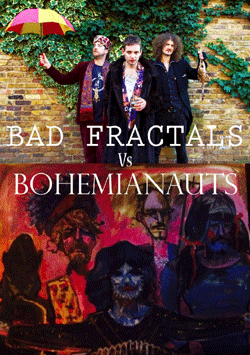
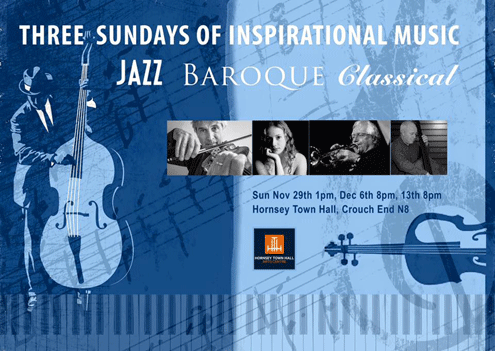


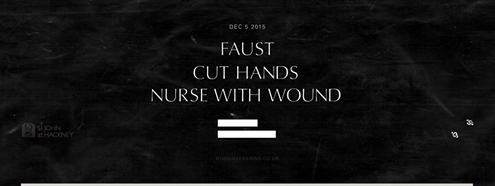


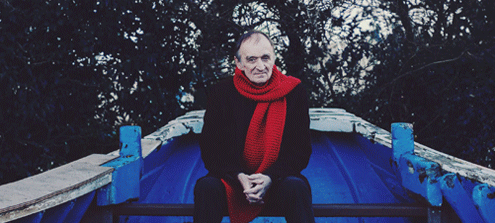


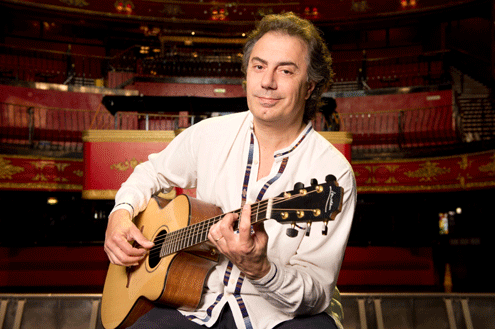


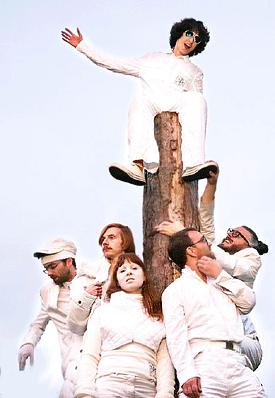


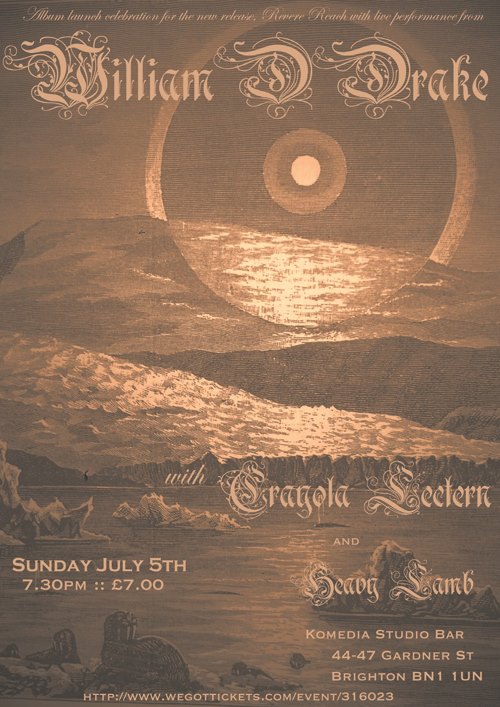
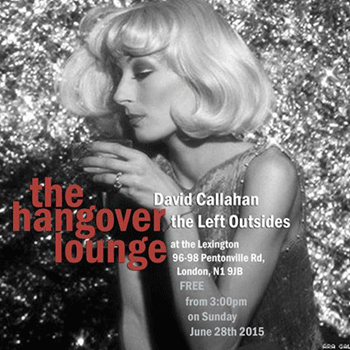

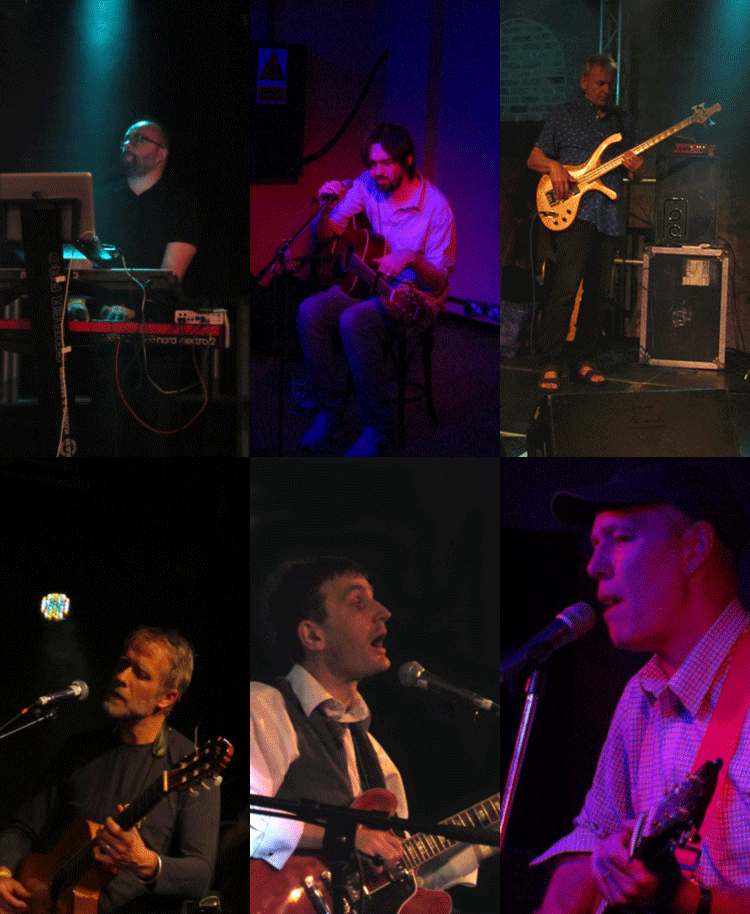
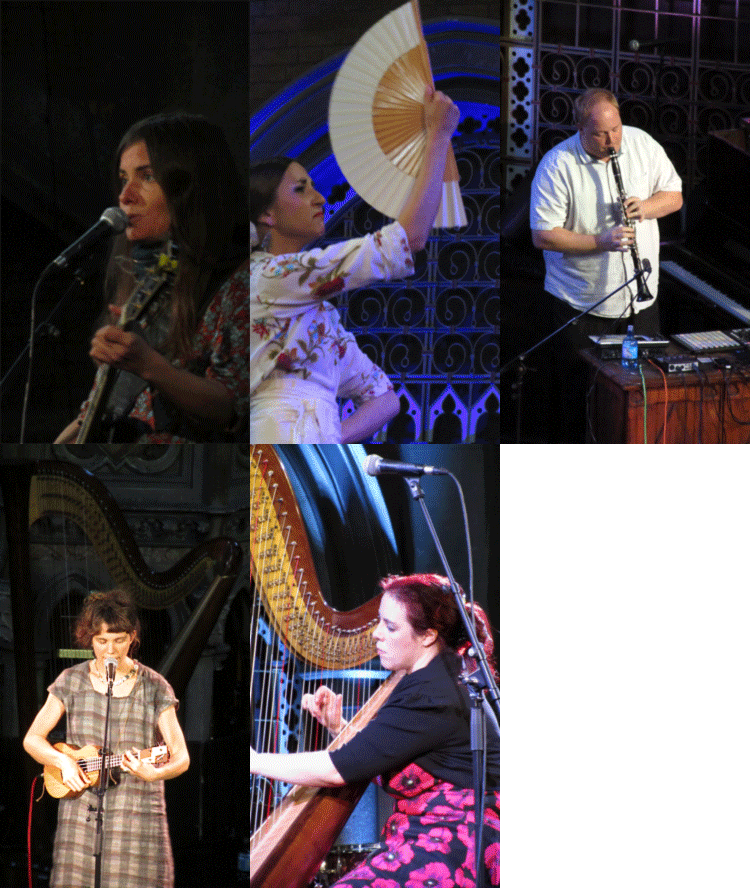
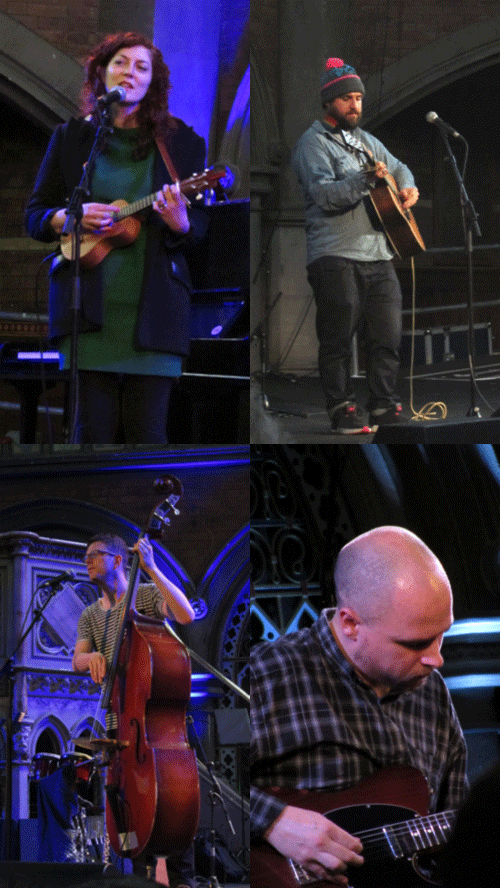
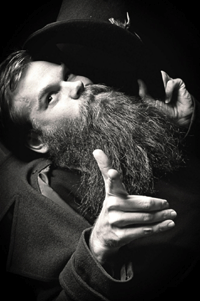


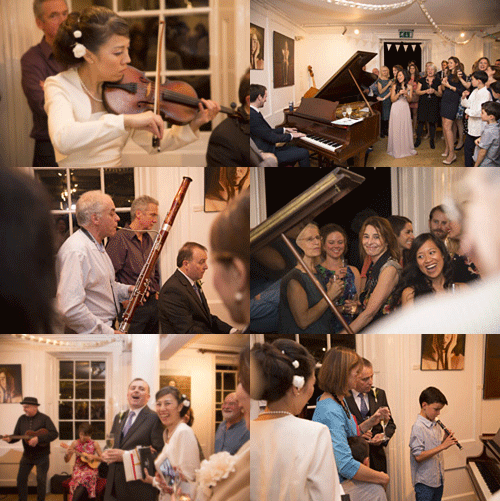
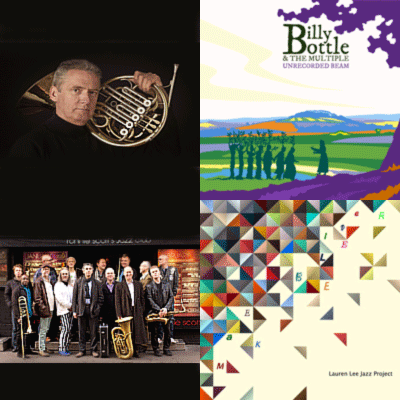


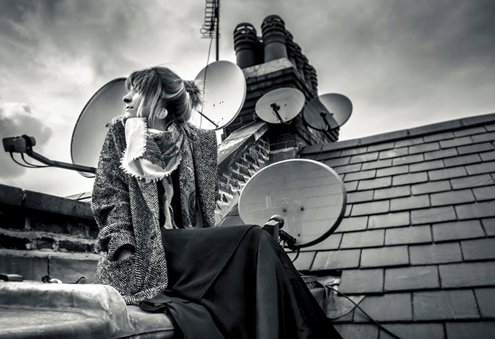




 Misfit City