I’ve got to admit, I like a complicated song. Blame all of that prog I grew up listening to; blame my interest in Sondheim and Flanders & Swann; or my time in choirs singing extended classical pieces… but whether it’s a case of stretching the lyrical format with streams of words or internal rhymes or of massing the music with variations, countermelodies or sundry intrusions, I like songs which develop quickly and boldly into something more extensive than a couple of riffs, a chorus and a bit of moon-in-june.
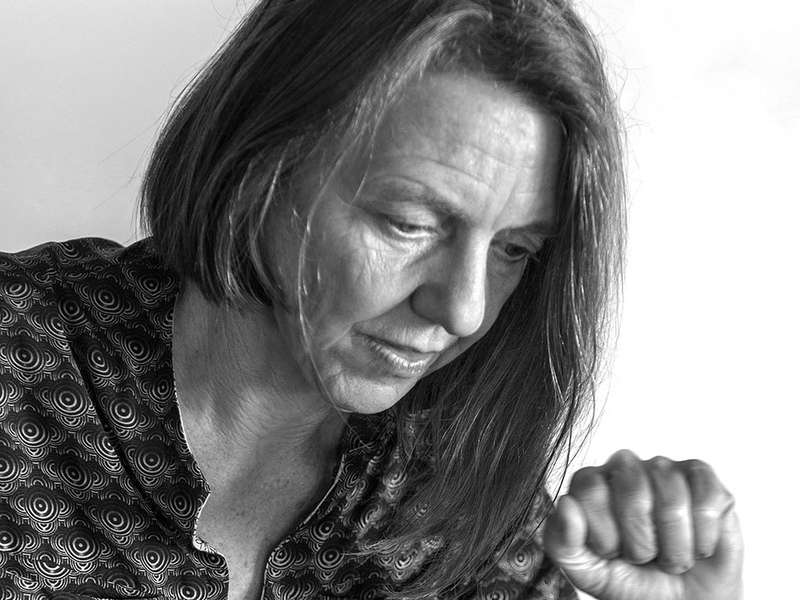
Marianne Schuppe, 2018
Encountering the kind of song which works at the other extreme, though, can be a real head-turner… and if it’s done right, it takes my breath away. The Swiss singer-composer Marianne Schuppe has been making a name for herself with this kind of song, this kind of singing, for about two decades now. It’s not the only thing she does (she’s a member of the Wandelweiser group of avant-garde composers, contributing instrumental and noise work, and she improvises with a variety of other musicians including Alfred Zimmerlin), but this particular aspect of her work stands out in its uncluttered boldness, its Zenlike simplicity and focus on only the necessary elements.
If you’re approaching this from a pop or avant-pop context, you could draw some comparisons with the more hovering, trepidatious interludes in modern-day Scott Walker, with Nico’s work on ‘The Marble Index’, or with the song whispers of Anja Garbarek’s ‘Smiling & Waving’. Aficionados of classical music could probably pick closer analogies – I could cite some aspects of Eleanor Armer‘s songcraft, for example – and a significant part of Marianne’s reputation comes from her dips into the indeterminate end of contemporary classical, making interpretations of the elusive, protracted song-murmurs of Morton Feldman and Giacinto Scelsi (with their minimal pitching, silences and opportunity to make every pared phrase count).
Yet for the most part Marianne’s own songs seem to bud out of the air spontaneously, any motivations or influences hidden within the moment. She’s stated that her prime interest as a composer-performer is “the voice’s ability to move between pure sound and words”; and while for many experimental vocalisers this is an excuse for splurging, showy explosions of babbling glossolalia, for her it’s an opportunity to slow liminal skating, shading almost imperceptibly between a lone, literally meaningful word and a lacuna of non-literal meaningful noise-tone, all within a low, minimal enclosure of soprano range like a deliquescing icicle. Marianne accompanies herself by placing an acoustic lute flat on a table top (a la Keith Rowe) and extracting notes from it via “uber-bows” – homemade bastard cousins of EBows, those hand-held electro-magnetic note inducers which add those sustained whooping tones to certain spacier rock songs (from Fade Away And Radiate, The Unforgettable Fire and Don’t Fear The Reaper to… oh, yes, R.E.M.’s Ebow The Letter) or the bookending humming halos to John Cage’s harp work ‘Postcard From Heaven’.
The sparse tonal wellings which result sound nothing like string plucks, and nothing like the accompaniments to a John Dowland lute lay. They’re amorphous bodies of tone, forced up like the first emergence of spring-waters, or the work of sine-tone generators. It’s a peculiar, unexpected use of an instrument with such an extensive body of associated work and history: like a kind of musical exorcism or automatic writing exercise, dipping below the surface of how the instrument functions in order to access a different expectation-disrupting voice. As for the songwords, they’re strange passes at impressions and impulses which might, if looked at too closely, disappear under the weight of logic. As text, they’re almost white-on-white – fragments of stories and encounters involving sunhats and deer, or studies of fingers – minimal anchors to latch onto slivers of ideas which Marianne can follow uninterrupted and undistracted, and let go whenever she sees fit.
Marianne’s slot next week at Café Oto showcases – or, more accurately, liberates – songs of these kind from two of her recent albums: 2015’s ‘slow songs’ and its 2018 cousin ‘nosongs’. In terms of vision and artistic platforming it ought to be very much an Oto show, although perhaps the venue’s friendly, expansive, post-industrial intellectual feel isn’t the perfect match. Ideally, these songs belong in the smallest, quietest space possible. A welcoming cellar somewhere, accessed by a winding symbolic stair; and with a silent, attentive, deep-listening audience hand-cupping songs and singer in a cell of absolute attention.
Marianne Schuppe: ‘slow songs, nosongs’ Café Oto, 18-22 Ashwin Street, Dalston, London, E8 3DL, England
Wednesday 9 January 2019, 7.30pm – information here
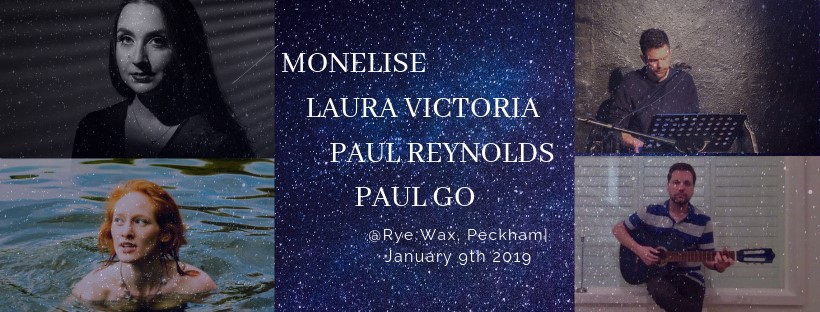
A free gig down in Peckham showcases four independent songwriters, with recent Goldsmiths graduate Monelise at the head of the bill. Positioning herself in the dreamy, arty end of pop, she tosses leading comparisons and tells around like chiffon scarves – David Lynch, Kate Bush, her own synaesthesia – and the talk-up seems to be working so far, with her videos being played in Topshop and a Pledgemusic campaign working hard at getting her debut EP completed (and her live shows up and running across a Mediterranean living-room tour and an Edinburgh Fringe fixture). She’s clearly as much a visual artist as a musical one, with her final degree show at the Deptford Albany last December already featuring screens, visuals and drifting snatches of 1920s opera shellac as well as a four-piece band.
I admire the ambition and industry, even if I’m not yet sold on the output. The influences Monelise is citing have the ability to reach down into your deep dreams and jar you. In comparison, she herself still seems content to drift along on the surface of a dusk dream, sounding pretty and basking in moonlight. I can only go by what I’m seeing. It’s possible that Monelise’s keeping her cards close to her chest as regards what she’s put out so far, and perhaps the live show’s the only current way of appreciating her in full. Available evidence shows two versions of her – the managed one (who releases slick spiritual-couture videos and tracks which blend contemporary pop and trip hop into seamless, depthless musings), and the far more interesting and unpolished live Monelise (who strives and juggles simultaneous singing, keyboards and theremin, and who might be shakier and more erratic at the moment but who also offers possibilities of growing, learning and interacting which her hermetically-sealed recorded persona currently doesn’t).
There are no such abstractions or evasions in the music of Laura Victoria. A onetime scion of Tyneside youth folk ensemble FolkESTRA North, she belts out punchy songs of life and love drawing from English folk, acoustic pop and Americana, accompanying herself on cello and leading a three-piece band featuring drummer Josh Wolfsohn and fiddler/banjoist Jo Cooper. Now up to her third album, and having been a regular presence on folk scene gigs up and down the country for twelve years, she’s confident and fully formed: what you see is what you get. I see sunniness, vigour and empathy in equal measure. In addition, she runs folk singing classes at Morley College and IKLECTIK, and has done at least one sprightly, ramshackle Joan Jett cover, if anyone’s interested…
Paul Go is another transplanted Northumbrian folkie, although of a very different order and style to Laura. His only available song so far is soft, shy and sweet – a gentle, momentary folk-pop sketch with brush drums, donkey-ride fingerpicking and fiddle contrasting awkward human reclusiveness with the unconscious confident grace of animals. Of the other two tracks he’s released, one’s a skittish, part-broken guitar improvisation designed to make use of the acoustic space of Ealing’s Vestry Hall. The other shows an unexpected interest in Chinese music, featuring the slithering sigh of an erhu fiddle, chimes and a guest narrative in Mandarin. Hopefully some of these other sides of Paul will bleed through in the concert: soft suburban musing and amiability are fine, but extra dimensions are better.
That’s something which already holds true for Paul Reynolds. Sometimes part of triple-threat modern folk trio Vespers, he plays bass for his own projects and for various other people, but graduates to piano for his own solo songs and for spacious, introverted instrumental improvisations (sometimes artfully jarred by odd tunings and by interspersed sound effects and electronics). I’m guessing that the songs will take preeminence this time around. Evidence so far suggests that they’re in the classic vein of chamber-folk touched with elements of classical and chanson, and thrumming behind a patina of English reserve: a mixture of craft and of carefully harboured emotion. Paul’s also got a sideline in little sonic experimental dramas such as The Brading Experience, suggesting a quietly uncontainable musician and aural imagination behind the meticulous skill.
All right – in advance of her spoken word/musical set at the Poetry Cafe, here’s Amy Balog‘s opening statement:
“The hungry vulture of feminism is circling in the grey sky above the dying Femme Fatale. She’s being tortured to death by girls who don’t understand her power, thinking it somehow makes them weaker. Her admirers are collecting her sweet, priceless blood in vintage crystal flasks, trying to preserve at least this one colour still left in a humourless and passionless world. But she’s still breathing, and it’s not too late to save her from a cruel demise…”
I’m not sure quite what to make of Amy yet. She’s a Hungarian Londoner infused with Gothic prose and horror erotica; a refugee from science journalism who carried out a moonlight flit into the world of speculative fiction and dream psychology. Having reinvented herself as a novelist and poet, she’s now (at the age of twenty-seven) standing up in front of audiences to deliver a performance-poetry manifesto exploring “the nature of femininity and feminine power from a perspective critical of contemporary feminism… other themes include political correctness, identity politics, religion and mental illness.” As part of the process, she’s struck up an alliance with jazz-psych guitarist Carlos Ferrao, who brings a splintery musical soundscape to her recitations – hollowbody chugs, echoes and grumbles, deliquescing now-you-see-them-now-you-don’t riffs.
Heh. I’ve never much trusted anyone who scorns and decries “political correctness” and uses that ire as a rallying call. Having watched or suffered losses and setbacks related to mental illness, I’m suspicious of anything which politicises or potentially celebrates madness; and the fact remains that if you’re a woman arguing against feminism, you’re basically aiming an axe at your own ankles. That said, there’s more to Amy than flashy reactionary advertising or self-indulgent apologism. By her own admission, there’s plenty of Camille Paglia in her work, plenty of Jung, Nietzsche, Poe and the Comte du Lautréamont – the bloodwork of surrealism, expressionism, contrarian thought, like a kind of Goth take on Lydia Lunch.
Don’t expect measured, objective consideration here. Amy’s interested in transformative apocalypses, irrational dream quests and night journeys, the truth implicit in the fluid and contradictory power balance between artist and muse, or about the flip side of objectification. Her female narrators may be thwarted or humiliated or imperilled, but they’re also resistant and strangely bulletproof, with a core of self-will: heroic archetypes determined to establish their own concept of femaleness. Core to this is Amy’s own perception of beauty as a force in its own right – it threads through her words, and her Gothic redhead looks and sensual witchy Tori Amos presence are an integral part of her work; the vessel for the wine.
Perhaps it’s best to allow for the fact that feminism, by its very nature, is a broad church with room for multiple perspectives and considerations; that there are many pathways to female assertion and that none of them should be readily shouted down; and that Amy’s still in the early stages of her night journey. Despite her determined stance, at the moment there are more questions and challenges in place than answers. It may be interesting to see where she goes.
* * * * * * * *
A heavier, more masculine psychedelia gets an airing up at the Black Heart, where record label Old Empire are putting on a night of darker and/or harder sounds, headed up by occult post-punk/progressive metal metallers The Osiris Club.
Originally formed with the intent of fusing horror film soundtracks with instrumental avant-metal, the OC has now swollen to a full-on song septet. The changes seem to be resulting in accessible, gloomily elegant tritone epics of tingling guitar and droning indie vocal; as if The House of Love had thrown their hands up in the air and confessed to having been fantasy comics fans all along (while various members of Fantômas grinned and egg them on in the background). That said, for epics such as A Winter’s Night On Sentinel Hill the Club pull out all of the Hawkwind oscillators and Van Der Graaf/Iron Maiden declamations, unveiling a Lovecraft-prog grandeur in full glorious/ghastly melodrama.
No such code-switching games for ANTA – described by Chaos Theory as the purveyors of “velvetine cosmic textures delivered as a hammer blow to the soul”, they open the show with their own enthusiastically convoluted, heavy-prog brain-tangling rock swing. Sandwiched in the middle is Kavus Torabi. Having recently exploded the Garage at the helm of his psychedelic prog octet Knifeworld, he returns to the sullen, trepidatious, post-nova ember-glow of his solo work; trawling through shimmering webs of harmonium, effected drones and knell-clangs of acoustic guitar, exploring a forbidding hinterland of vulnerability and permeable spirit-space.
* * * * * * * *
Dates:
Monelise + Laura Victoria + Paul Reynolds + Paul Go Rye Wax, 133 Rye Lane, Peckham, London, SE15 4ST, England
Wednesday, 9 January 2019, 7.30pm – information here
The Poetry Society presents:
Amy Balog: ‘The Dying Femme Fatale – An Evening of Poetry and Music’ The Poetry Cafe, 22 Betterton Street, Covent Garden, London, WC2H 9BX, England
Wednesday 9th January 2019, 7.00pm – information here and here
Old Empire presents:
The Osiris Club + Kavus Torabi + Anta The Black Heart, 2-3 Greenland Place, Camden Town, London, NW1 0AP, England
Wednesday 9th January 2019, 7.00pm – information here, here and here
This month, there are two very different opportunities to immerse yourself in historical music stemming from black resistance and the American civil rights struggle; the conflation of brutual oppression, storms, suffering and self-assertion which inform today’s #BlackLivesMatter movement.
One of these events is an edgy art-scream of vintage fighting classics, happening inside a rough-walled underground music stronghold. The other features music that’s barely seven years old, takes place in a lofty varnished orchestral concert hall at the heart of the British classical music world, comes varnished by a couple of Grammy nominations and represents the other end of the struggle: more well-spoken, staunchly dignified, talking back at the oppressor in something closer to his own language on his own terrain.
Would each of these efforts give the other house room? I’d like to think that they would.
* * * * * * * *
Tireless vocal/physical-movement improviser and conceptual explorer Elaine Mitchener returns to Café Oto with a revival of her ‘Vocal Classics of the Black Avant Garde’ project (originally compiled and performed for the London Festival of Contemporary Music at the end of 2017). Re-examining 1960s and 1970s works composed by Eric Dolphy, Archie Shepp, Joseph Jarman and Jeanne Lee, it studies and recreates “the overflow of experiment that occurred within improvised music, often springing directly from lived experiences of racial injustice… combin(ing) vocals and text with experimental jazz forms.”
Musical direction for the evening will come from reknowned saxophonist Jason Yarde – an improviser-composer who steps confidently between jazz and conservatoire culture. He’ll be at the head of a band consisting of pianist Dominic Canning, Elaine’s regular bassist Neil Charles, trumpeter and flautist Byron Wallen and the consistently staggering drummer/percussionist Mark Sanders. It’s a little unclear as to whether Elaine’s regular sparring partner Alexander Hawkins will be joining in on keyboards this time, but expat American poet Dante Micheaux is down to join Elaine on spoken/sung word.
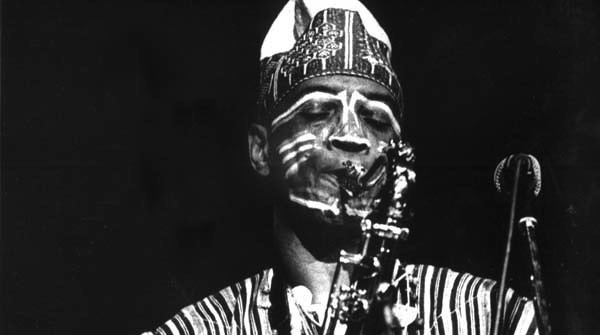
Joseph Jarman
It’s safe to say that while this music’s around fifty years old now, the content’s not going to be cosy. Expect some old wounds, some revolutionaries’ pride and some old fire to be raked over and rekindled. As Elaine writes, “these works illuminate an occluded moment in American cultural history, when the avant-garde aesthetics of new jazz doubled as a metaphor for the imminent politics of civil rights.
“Composed in very specific response to the perilous condition of black people in America, the works’ synthesis of experimental sensibilities, radical political sentiment, and gutbucket expression cuts across boundaries of time and space to resonate universally in the here and now. In the era of #BlackLivesMatter, these works speak powerfully of the need for resistance and resilience, sound stark and original, their hypermodernism firmly rooted in vernacular tradition.”
It doesn’t seem that anything of the previous show’s been recorded (or if it has been, it’s not been released), so here’s a little from one of Elaine’s previous projects as an indicator; plus a little Shepp, Lee and Jarman.
* * * * * * * *
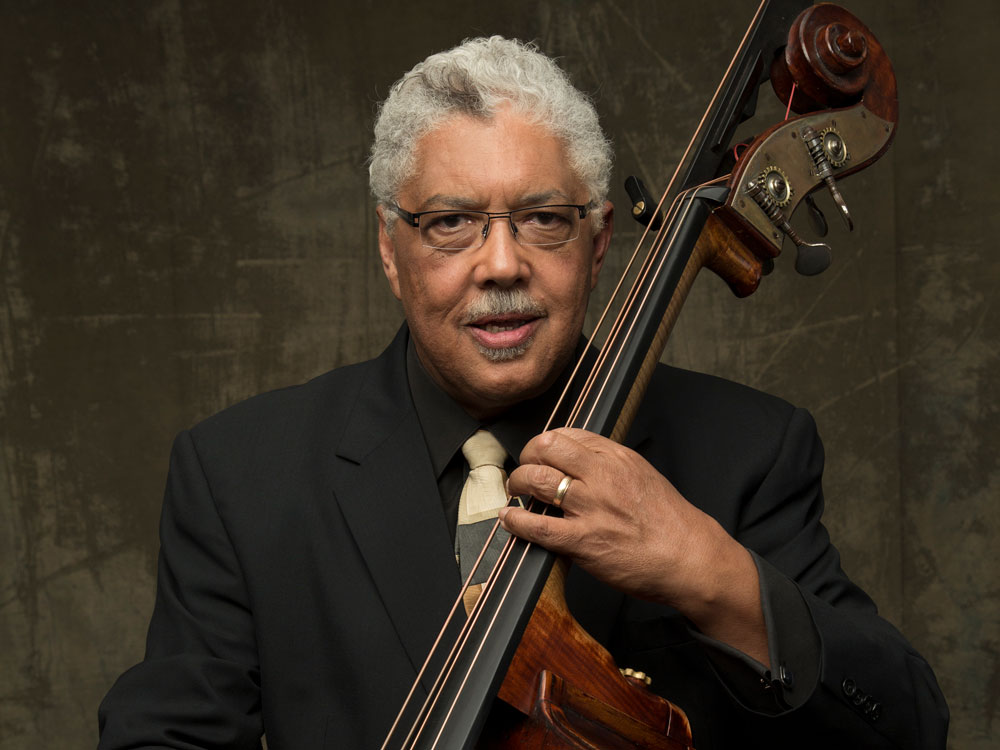
Reminding us that the politics of dignity and survival (and the business of conveying an urgent message) comes in many different forms and tones, African-American double bassist Rufus Reid is reviving his 2012 jazz orchestra suite ‘Quiet Pride’ in London later in January. A limber, elegant musician and composer with profound roots in classical trumpet and bass, Rufus (like Jason Yarde) also straddles the worlds of jazz and music education with equal enthusiasm, grace and fervour. He has been playing in both small and sizeable jazz groups since the late ‘60s and composing for about the same length of time, moving into the world of large-scale compositions in 2011 with his symphonic orchestral work ‘Mass Transit’.
‘Quiet Pride’ was written to honour and illustrate the work of late African–American sculptor and printmaker Elizabeth Catlett, and Rufus has taken it around the universities and culture halls of the USA whenever possible. This particular performance of the suite will be rendered by the Guildhall Jazz Orchestra under the direction of London jazz composer and educator Scott Stroman (with, I think, Rufus as conductor). While Rufus prefers to play alongside or surrounded by actual Catlett prints and sculptures for honour, reflection and continuity, there aren’t any to hand at the Guildhall and so the performance will be accompanied by projected Catlett images.
Set against the Oto show, it could be tempting to decry this as bourgeois slickness, a birch-and-beech art gallery indulgence co-opting jazz into the spaces of white power structures or celebrating some kind of house-Negro ethic. That would be unfair, shallow and revolting. To dispel that kind of wretched political preciousness, consider Elizabeth Catlett’s actual life; the source of her art and the ultimate inspiration for Rufus’ humming, quick-footed, assertive music in which (according to ‘All About Jazz’s Dan Bilawsky) “chamber-esque civility can give way to a feeling of uncertainty which, in turn, can morph into swing. Focus shifts from the textural to the rhythmic, the background to the foreground, and the subtle to the obvious. The music is mutable and multifaceted but that’s not really surprising; sculptures can take on different meaning when viewed from different angles so the music should certainly do the same.”
A pioneering presence as both a black and a female sculptor in America (at a time when few of either were to be found – or, more pertinently, allowed) Elizabeth perpetually fused art and activism, mostly through effort and moral choices. Flat-out rejected as a scholar by the Carnegie Institute of Technology due to her skin colour; struggling against direct, demoralising racist university policies while studying for a Masters in Iowa (and, later on, being stripped of her American citizenship as a result of her Communist associations and her gestures of solidarity with striking Mexican railway workers), hers is a story of personal industry, profound ethical responsibility, and effort against the odds.
Her time in Mexico (where she settled for much of her life, first learning and subsequently teaching) was also the catalyst for the crystallizing of her artistic vision, uniting her early influences of Henry Moore, Diego Rivera and pre-Columbian American sculpture with a commitment to combining aspirational concepts of strength and fierce dignity with representative figure forms. “I learned how you use your art for the service of people, struggling people, to whom only realism is meaningful” she’d assert, later. “I have always wanted my art to service my people — to reflect us, to relate to us, to stimulate us, to make us aware of our potential.”
Elizabeth’s figures and prints survive her and bear witness to her particular vision. Emblematic of black dignity, of powerful maternal femininity, of a refusal to be chained down by prejudices and programmes, they cradle their children; staunchly assert their curves; stand straight-backed, defiant and admirable; reveal the hidden or overlooked complexities of the black mind and sense of self; or punch the air as a simple, stark and meaningful mark of resistance. They’re already, in their way, as direct and as intricate as jazz: something which Rufus clearly understood from the start and has strived himself to bring across in music.
Dates:
Elaine Mitchener Projects presents:
Vocal Classics of the Black Avant Garde: Jason Yarde + Elaine Mitchener + Mark Sanders + Neil Charles + Dante Micheaux + Byron Wallen + Alexander Hawkins Café Oto, 18-22 Ashwin Street, Dalston, London, E8 3DL, England
Monday 7th January 2019, 7.30pm – information here and here
Guildhall Jazz Orchestra/Rufus Reid/Scott Stroman: ‘Quiet Pride – The Elizabeth Catlett Project’
Milton Court Concert Hall @ Guildhall School of Music & Drama, Silk Street, Barbican, London, EC2Y 8DT, England
Tuesday 29th January 2019, 7.30pm – information here, here and here
As regards classical music, this month appears to be opening with London’s second annual Baroque At The Edge festival across the 4th, 5th and 6th January. Dividing its time between the Clerkenwell classical-church venues of LSO St Lukes and St James Clerkenwell, it starts from a baroque basis but roughly postulates (as it did last year) along the genre-blurring lines of “imagine if Bach was a jazzman, Purcell a folk-fiddler, and Monteverdi a minimalist…”
Following on from 2018’s debut festival, there’ll be a return engagement with concert dramatist Clare Norburn. Having tackled the murderous guilt and glory of Carlo Gesualdo last time around, Clare’s new work ‘Burying The Dead’ (premiered in the West Country last May) is another deathbed dream drama: this time set in 1695 and focusing on the final protracted thoughts and hallucinations of Henry Purcell as “dream-like memories of the Plague, the Fire of London, family life and the vibrant Restoration stage merge seamlessly with his exquisite vocal and instrumental music.” Said music will be provided by London-based baroque ensemble Ceruleo, who commissioned the play, while actor Niall Ashdown features as Purcell.
There’s more Purcell-related goings-on via Cecil Sharp House choir director and Wing-It Singer leader Sally Davies, who with her chorally-minded pianist daughter Holly Cullen Davies is running an open-to-all English folksong workshop, focussing on the songs Purcell would have known and referred to. In a similar spirit, the festival’s closing concert features a team-up of Dipper Malkin (John Dipper on fourteen-string viola d’amore, Dave Malkin on guitar and vocals) and singing storyteller Nick Hennessy – all three keen folk-steeped reinventors, on this occasion exploring how “the sophistication of Purcell meets the soul of English folk.”
Several more cross-disciplinary players are taking part. Violist Liam Byrne promises a concert in which you can “expect anything, anyhow, from (Marin) Marais to (Nico) Muhly”, although he’s keeping schtum on whether he’s playing pure and acoustic or with the electronics or conceptual tricks which make up the other side of his playing. Path-forging post-classical singer Nora Fischer, accompanied by theorbo lutenist Mike Fentross, will delve into the world of seventeenth century song with “intimate and exquisite re-imaginings of works by Purcell, Peri, Monteverdi and others.”
Elsewhere in the festival, vigorous violinist Elicia Silverstein will join the dots between Bach and Biber (representing the baroque) and Luciano Berio and Salvatore Sciarrino (representing the contemporary), as demonstrated on her 2018 debut recording ‘The Dreams And Fables I Fashion’. Replacing a planned baroque piano concert from Gabriela Montero (after she had to drop out following surgery), her fellow pianist David Greilsammer provides his ‘Scarlatti:Cage:Sonatas’ dual keyboard programme which constantly interlaces the music of Domenico Scarlatti with the twentieth-century prepared piano compositions of John Cage (hardware, wood and rubber resonating and burring between the strings).
Less compressed information, plus full dates and ticket info, can be found at the festival’s homepage and Facebook page.
‘Baroque At The Edge’ LSO St Luke’s, 161 Old Street, St Lukes, London, EC1V 9NG, England St James Clerkenwell, Clerkenwell Close, Clerkenwell, London, EC1R 0EA, England
Friday 4th January to Saturday 6th January 2019 (various times) – information here and here
Premiering last month’s new album ‘Rasti’, heady world-folkers Laboratorium Pieśni make one of their regular returns to London at the start of the month, playing the grand octagonal space of the Union Chapel. Entering their sixth acclaimed year as a band, they’re an all-female seven-piece of polyphonic harmony singers and multi-instrumentalists from the Tri-City district of northern Poland, cooking up a stew of song with traditional material (initially from the Ukraine, but with a songbook now swollen to incorporate music from Poland, Belarus, Bulgaria and Turkey among others).
In keeping with the group’s identity as a “song laboratory” – as well as with their connection to instinctive responses and to healing processes – the songs which Laboratorium Pieśni play are festooned with flutes, violins, rebabs, shruti box drones and a web of tuned and untuned percussion (from chimes, gongs and rattles to shamanic drums), adding a mystical cosmic-feminine shimmer to the music’s existing roots. You can listen to an interview with the Laboratorium women (conducted by Canadian television station TVNR) here.
* * * * * * * *
Closer to home and further forward in time, propulsive electro-acoustic folk-pop trio Sincere Deceivers (with roots in Yorkshire but now resident in London) return to action via a new semi-live EP of original songs – their first in half a decade. ‘Hot Handed’ is the lead-off track – a yearning, Martin Furey-esque song of romantic obsession, full of chiming guitar and swirling cello.
For their Sebright Arms gig, Sincere Deceivers will be joined by another Yorkshire friend: emergent singer-songwriter Amy May Ellis. She’s touting last autumn’s debut EP ‘Weathered By Waves’: five dreamy ukelele-driven, water-fixated, altered-state song musings on youthful restlessness and the dislocation of emotion (orchestrated with shruti drones, harps and the soft echoing ghosts of guitar strings).
* * * * * * * *
A cornerstone figure of living English folk music is appearing at the Roundhouse at the end of the month, as part of the venue’s extensive In The Round concert season. Back in the mid-’60s Shirley Collins was one of the main exponents of the English folk revival: in her case, a revival drawing on a childhood fascination with the old folk songs which emerged from underneath the blanket of popular culture at times of stress or memory, as well as spells learning and researching alongside voracious American folk curator Alan Lomax and reconstructive British rule-setter Ewan MacColl (both of whom, to put it mildly, didn’t always credit or respect her for her own work, intelligence or contributions).
Beginning her career at the cusp of the ’50s and ’60s by taking Pete Seeger’s vocal-and-banjo American revival model of old and new work (and transmuting it into a more transatlantic mode), Shirley gradually worked her way deeper back into English forms. Along the way, she recorded the benchmark guitar-and-vocal album ‘Folk Routes, New Routes’ (with folk baroque guitarist Davy Graham) and a number of albums featuring the startling arrangements of her own keyboard-playing sister Dolly, plus foundational ’70s folk rock and Morris revival records with the Albion Country Band, the Morris On project and others.
Over the years she has inspired plenty of other musicians, be they the crop of folk-rockers who sprang up in her wake at the time, or more latterday disciples including alt.folk and alt.country explorers (such as Angel Olson and Josephine Foster), square-peg rock musicians with broad listening habits (such as Blur’s Graham Coxon and Radiohead’s Jonny Greenwood), off-beat songwriters who delightedly snag themselves onto folk ideas (such as Richard Larcombe of Lost Crowns and Stars In Battledress) or folk-tinged textural experimentalists like Current 93’s David Tibet and eclecti-ambient duo Cyclobe (the former of whom coaxed her back into musical work in 2006, and the latter of whom produced her 2016 comeback album ‘Lodestar’). Most recently, she’s been embraced by various exponents of the New Weird Britain musical movement, drawn to her songs by their archaeological texture and their frequent accounts of dark psychological swells, stark menace and human injustice.
Yet Shirley’s spiritual legacy resides most purely in anyone (particularly, any woman) who picks up the thread of folk archetypes, winnows out any temptations towards twee fluffery and glib romantic posturing, and returns to the unadorned human grain of the music. Her own personal commitment and connection to the work, and to living the work honestly, is absolute (for good or ill – assailed by a traumatic late ’70s divorce from the Albion Band’s Ashley Hutchings, the impact of which slipped in under her staunch guard, she was physically unable to sing for the best part of thirty years). Shorn of the halo of veneration, her recordings are sparse and matter-of-fact, her voice that of a neighbourhood teller of tales (many of them harsh) rather than some fluting bel canto feelgood exercise. The natural habitat and venue for her work would seem to be some stone-flagged kitchen or ancient pub space rather than a concert hall: perhaps the focussing-lens effect of the Roundhouse’s setting and seating will meet that need halfway.
* * * * * * * *
Dates as follows:
Laboratorium Pieśni Union Chapel, 19b Compton Terrace, Islington, London, N1 2UN, England
Saturday 5th January 2019, 8.00pm – information here and here
The Folkroom presents:
Sincere Deceivers + Amy May Ellis The Sebright Arms, 33-35 Coate Street, Bethnal Green, London, E2 9AG, England
Friday, 18 January 2019, 7.00pm – information here and here
Shirley Collins The Roundhouse, Chalk Farm Road, Camden Town, London, NW1 8EH, England
Thursday 31st January 2019, 7.00pm – information here and here
Swoon. /swo͞on/ A verb. To be emotionally affected by someone or something that one admires; become ecstatic. Here are some people and things that make me swoon. #swoon #swoonage






 Misfit City