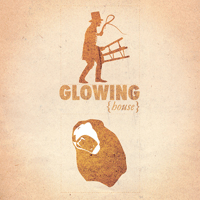
Out at the helm of Glowing House, Steve Varney is raw, ruffled, hollering and sounds born to run. This is just as well. Trouble is hot on his tail. “I don’t think there is a gauge that will save me – / somehow they overpower gunpowder, like it’s easy…”
The head-up single for the second Glowing House album, Taming Lions is all about the incipient, savage disaster that’s just about to crash down on Steve’s head. The band’s fall-apart folky acoustic noise catches the feeling perfectly. They sound like the kind of band which survives credit crunches, small nuclear wars and the collapse of most of the functional parts of civilization. You can see yawing flashes of light straight through the gaps in the barefoot, wind-tossed rhythms.
Besides the cluck and clunk of Steve’s banjo, the song’s a superb stomping wobble of school piano, Salvation Army brass, foggy rasps of accordion and dirty cello, and someone beating time on a tumbledown shack with a handful of big sticks. (I checked back on this – it’s actually a third of the band playing on church pews. Talk about muscular Christianity…) At the top of his carrying, celebratory bruise of a voice, Steve’s making it quite clear that he’s stuck in a rigged and increasingly dangerous game. “They gave me a ten-minute head start, and they started counting. / I need a top-notch hiding spot I can hide out in. / Don’t be fooled they’ll give you space in the chase for a reason – / they wait for the perfect minute to stop the healing.”
Off he hurtles; firing a cartoon blunderbuss for cover, and to no great effect. They keep coming. As the song bounces on, there are more than a few suggestions that what Steve’s actually fleeing are his own demons, bouncing after him like a tin can tied to his ankle. Not much hope in escaping that way. But the sheer vigor of the band – of the song itself – suggests that they’re people who thrive on this kind of peril and the energy it kicks up. This is enormous fun. Keeping one step ahead of disaster rarely sounded so lively.
Glowing House: ‘Taming Lions’
Bandcamp
download-only single
released: 8th May 2012
This profusion of rock power duos – it must be viral. Surgically-reduced, punked-down, jazzed-up, math-rocking or swampy… they seem to be filling plenty of gaps. Pick one of them out, and it’s usually a drum-and-guitar pairing minus the bass, or otherwise a guitarless bass-and-drum coupling. What’s triggering this? The window-rattling scrunch championed by Death From Above 1979? The teasing-twosome model set up years ago by The White Stripes? Basic economics? The old Robert Fripp idea of smaller, mobile, more intelligent units, which in more austere times may exert more of a pull?
Anyway…
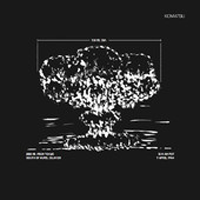
Komatu fit – very loosely and fiercely – the last of these options. A drums-and-guitar duo of Finnish rock improvisers, they’ve set themselves up to be as expansive as possible. They seem to use their lack of a bass guitar as a kind of invisible fulcrum: an absence which they can both pull away from and can curve back to compensate for. Having a bass would just pin them down, render them linear; when what they actually want to do is stretch themselves over every possible angle of orbit. In the absence of those root notes – those stolid map-pins of rhythms and root – both and neither of the two musician strive to offer something else, containing their wildness only by a teasing instinct for where the brinksmanship stops.
Komatsu are also unsentimental about naming their music. Most of the time, number placements will do instead, and you can bring your own interpretations to the party. Neither of the duo themselves are inclined to give away much in the way of meaning. The music itself, however, is anything but dispassionate. Even on those occasions when it turns mathematical, the numbers swarm like killer bees, waiting to plunge into brief resolutions and then dance away again.
Unusually, much of the time the lead instrument is Jussi Miettola’s drumkit. Hinting at and ducking around rhythms more often than simply holding them, his distinctive playing is busy, expansive and never less than exciting. It’s almost – but not quite – free jazz. It’s heavy on the sonic possibilities of the top kit with its dryness and its imperative rattle, sometimes bursting into vigorous splatters of bass drum and cymbal; coursing easily between Art Blakey, thrash metal and points in between.
Guitarist Juha-Pekka Linna plunges his guitar into a mass of loops, mechanisms and pulverizing crystallised distortion. The results run a broad gamut between a taut dry rattle (like spasming rockabilly) and a screeching cyclonic blizzard of rotating noise. In spite of this whipped-to-chaos approach, it’s often him who ends up holding Komatsu’s pieces in shape. His loops become binders – circumscribing the duo’s wilder flights, defining their narrow tones and furiously tight patterns.
On the Intro, fractured jazz chords on guitar wrestle with snare-scrabbling free drumming; an initial spideriness which is gradually bolstered and transformed by smudges of trippy, expectant backwards guitar. This in turn suddenly inflates and hunches up in a blur of warm overwhelming fuzz into jubilant, wing-whirring psychedelic noise. As Komatsu move directly on into First, it’s all swapped for a fold-over of psychedelic guitar echo; chattering in the teeth of an imagined gale, billowing itself out of shape. An expert roaming roll around Jussi’s toms adds another dimension of tension.
As Jussi and Juha-Pekka work away at the piece, it escalates into a panning tornado-swirl of layered guitars and rattling drums, brittle and yet overwhelming in its pent-up force. You imagine a man swinging rocks round and round in a bucket, waiting for that instinctive moment when he can open his grip and let everything fly. This never quite arrives, but Komatsu’s cats-cradle of skittering percussion, controlled screech and speeding draglines keeps you hanging in anticipation until that imaginary gale finally, rapidly, falters and dies.
For Second, Komatsu tone down the surge. A West African-inspired walking rhythm, played out on guttural post-punk guitar, tramps on against increasingly furious stick-and-tom rattles burst from the drums: Jussi’s decisive and pointed breaks make a one-sided musical conversation. There’s nearly two-and-a-half minutes of this dynamic sparseness, and then the faintest whisper of sound creeps in and gradually rears up in a veil-sweep of celestial noise guitar. As this grows and billows to hang above the tune, like a grand valance or a deathly Mellotron chord, the mood grows grimmer. Inexorably, the African stroll is overwhelmed by ever-increasing bass smudges. That Mellotronic chord eventually drives the music towards a waiting cliff. They have a certain taste for threat, then.
While much of hard improvisation sounds like a wrestling match (with cascades and grapples of angry notes) Komatsu’s version is more like a stalking, or an illustration of danger. Places once safe begin to flood. Confusing shadows blight the landscape. Situations turn uncomfortable.
Nothing For Money (the only Komatsu song with a name) broods like a dark Western, Juha-Pekka initially restricting himself to giant Morricone-esque guitar pluckings over Jussi’s uncharacteristically miserly, mathematical pick-out of drum parts. A second Jussi, jazzier and looser, plays against himself in the background, filtering dustily through a radio speaker like a memory of easier times. This, too, is gradually overwhelmed. The guitar begins to shucks out backward swells again. The drumming becomes more counterpointed, more belligerent.
With its uncomfortable, weirdly perpendicular funk-clank full of disassociated fragments (drum points, spacebar chinks), Third sounds like hip-hop might have sounded had it been invented and played by Can. It has an alienating quality: a kind of stern party music, pushing you into painful shapes. Juha-Pekka’s main guitar part is squashed flatter than wallpaper. Another of his lines drags a jangling siren motif up and down. With this spiraling in the foreground, a distant heavy-metal grind (colossal, but given quietness by distance) moves into place, by which time the drum parts have turned metallic too. The finale is an unexpected drop-away into fifteen gurgling seconds of distress call.
Fourth is split into two different and distinct parts. The first part draws on avant-garde ideas from contemporary classical ideas – vicious thunks of the lowest possible piano notes; groans and distracted orchestral growls from the guitar processes. These in turn are bled into chance noises: an airy temple-bell dings and chimes, and there’s the clear close-up sound of someone rolling coins or ball bearings around the studio. Some reflective menace is added by baleful post-rock guitar tinges and ear-filling fog-banks of sub-bass.
Suddenly, Jussi explodes into the second part with a tight lash of cymbals and a stream of West Coast power-punk drumming. There’s a scourge of rapid-strum guitar, at thrash-metal intensity, but without the rhythmic restlessness. Bar by bar, it rises up the chromatic scale while subliminal keyboard figures sketch moving arpeggios behind it, before the whole thing finally hits a crash-barrier of static.
On the final track (which, with typical Komatsu insouciance, is just called Last) the boys let their hair down. A skating buzz of static synthesizer serves as a continuo; Juha-Pekka’s wet and warbling science-guitar figures provide something like a melody. Halfway through, the emphasis shifts and the music morphs woozily elsewhere. The synth buzz become a deep bass drone; the guitar patterns become drips in the background, while the melodic role is taken by whooping varispeed notes.
From brood to fun-ride, sometimes two is all you need. There’s certainly not much missing from this fierce bout of inventiveness.
Komatsu: ‘Komatsu’
Komatsu (self released, no catalogue number or barcode)
CD/download album
Released: 24th April 2012
Be wary of barristas, especially in airy little cafés in quiet back-streets. They feed you your coffee, they bring you your cake and cookies – in return, you ignore them and any of their own dreams. While you’re unwinding with the brew, relaxing or kvetching, gossiping or confessing, they’re stuck there with the crunch of the grinder, at a loose end. On quiet days, you’re probably the entertainment. If they happen to be writers of some kind, one day one of your stories might come bubbling back up.
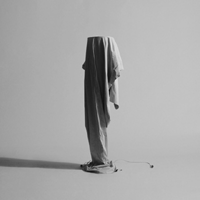
As it happens, two members of StillWife still put in time as coffee-shucking barristas back in the band’s Melbourne hometown. Have any washed-up conversations washed up into their songs? I’m just saying. Or is it the coffee talking?…
There’s little that’s caffeinated about StillWife’s debut EP. Apart from those moments when one of the guitarists drives in a power-chord, a pointed solo or a burst of white noise (generally with the reluctance of a man drilling a necessary hole in the porch) it’s primarily about detailed acoustic fingerpicking and sleepy man-and-woman harmonies. There’s a soft, dusty touch of country music here. There’s something of Grandpappy in those guileless dollops of antique synth tone, like bubbles in the sun. There’s a little of Low in the semi-hush, as if they’d recorded it all on a distant Australian veranda. The drums are played by someone who’s so good, so subtle and egoless, he becomes the invisible springs that hold in place the band’s buoyant way with disillusionment.
Of the two primary singers, Dylan has the stoic country clarity of a youthful Willie Nelson while Moat’s she-panther tones capture the langourous, wounded and incurably passionate feel of both Stevie Nicks and Briana Corrigan. As for the songs, they’re about awkwardnesses and aches rather than grand passions. Their stock-in-trade is the ambiguities you don’t grow out of; the kind that make you mumble (as StillWife do in Olympia) “I know it’s wrong but I can’t bring myself to say I’m sorry. / You’re all I want, but I can’t say that I’m not feeling worried.” Both Moat and Dylan sound as if they’re in love with the slow, subtly adult pains that they sing about. Each of their voices comes twined around with the murmuring sounds of various bandmates singing along: as close as lovers, and sounding like straying echoes.
The EP’s centrepiece, Out To Sea, begins life as a duet of unraveling and entwining love and goes somewhere more apocalyptic. Moat sings cryptically about fire, about names and letting go, while from the second verse, Dylan’s muttering a grim counterpoint – “searching for the meaning in closing fires – / I’m calling on awful writers – / I’m taking pleasure in my own undoing.” As the song winds on, Moat launches meaningful non-sequiturs to wash up on the beach (“The youngest child, it don’t feel right, / it never will – he’s lost his light,”) while Dylan circles in despair (“and there is no me and there is no you; / and if there is no us, then there is no love; / and if there is no love then there’s nothing that’s true.”) The longer it continues, the more hallucinatory it becomes: even as they sing of separation, the two singers drift closer together. By the end, they’re not so much duetting as singing different parts of the same mind, chanting out “it’s in the way that winter’s coming around; / it’s in the snow-like stain, blood on the ground; / it’s in the wave descending, pulling me out to sea…”
Olympia – simpler – could just be about being too shy to ask someone out, its hotel setting a place of missed connections and missed handshakes. Or it could be about a failure of nerve in general – not having the pluck or energy to ask for what you want, even if it’s just a question of knocking on a door and speaking. In comparison, Haven’t You Heard is fairly lightweight: but perhaps its whimsy and gentler touch is needed to counterbalance the deeper aches elsewhere. Slung in a hammock of wry country picking, Dylan muses on unthinking aggression and ambition (“When I was a kid I had a lot to prove, / I was young and angry, with an overactive muse”), and touches – ever-so-lightly – on human cruelty. When not singing about warning off unwary aliens, he gently salutes the time when he finally “opened up my eyes and saw the view. / Saw the world for what it was – unfolding and askew.” A wonky electric solo ambles in like a sheepish grin. A second one opens out into a concluding cobweb of pulsating guitar noise, like a countrified version of Heroes.
With its Bo Diddley beats and stutters, its sudden embrace of dirty noise and its chopped-up minimal lyrics, So Sued turns StillWife’s usual working methods on their heads. Yet it still ties in with the band’s exploration of heartbreaks and awkwardnesses. A barbed kiss-off from girl-left-behind to boy-off-to-find-himself, it’s sung by Moat in a sardonic hiccup like a raised eyebrow. “You’re going solo, into the night… / You’re going solo / so get it right.” she jabs, before mocking with a chorus of “On the road, uh-huh; / on the road, ah-hah; / on the road, eh-heh… / We get it.” It’s bitter honey, powering on into pileups of screeching guitar as Moat wails – blue and biting – like a sarcastic banshee.
Creatures, though, might be the key to it all – the kind of beautifully wracked, subtle-heartbreak song that any lovelorn person needs to hear at least once. Licked around by misty synthesizers like weeping foghorns, it offers more of a Blue Nile approach to heartbreak – an intangible moment or event which nonetheless means everything, stretched in time as it soaks into the soul. Across a room, a soft-singing Dylan watches his lover dance; and at that moment realizes that it’s over, that what they’ve had has somehow been lost. “Through the crowd I see your face – content and undirected gaze. / Barefooted you begin to sway; I dance under the twilight’s haze, / and though it hurts I hold my tongue – some things can never be undone.”
Exactly what’s gone wrong, or what’s happened, is never revealed. An unthinking betrayal; or maybe simply the moment when common cause slips away, leaving just two separate bodies moving in an ever-growing space. There’s a tremendously sad dignity to this song, but that’s not all. A desperate hope-against-hope breaks through in a final pleading chorus: a sudden flare of forgiveness stretched out like a shaking hand – “Tell me you make mistakes – mistakes can always be unmade. / Tell me I’ve faith and I will pray – / just don’t leave me here this way…”
Utter quality. More of this, please.
StillWife: ‘StillWife EP’, 2012 Bandcamp
Download-only EP
Released: 8th March 2012
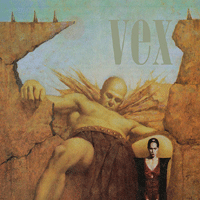
Punk helps you cut loose from your roots. Where you land is your own business. Take lo-fi riser Vex Ruffin, who turns his back on the Californian sunshine of his Chino Hills hometown and dreams himself over the Atlantic to Blighty, to a soggy Stockport or a drizzled Haywards Heath. Once there, he’ll while away the time throwing some deliberately awkward shapes and kicking the bleached ghost of Martin Hannett round a multi-storey car-park.
Back in his real home, Vex is fertile soil with a growing reputation – a onetime Cure fan with a parallel taste for Ruff Riders hip-hop, an anti-technique approach to guitar, and a wide-open yen for discovery and striking scratch-video. Potentially, it’s an interesting combination for creative confusion; especially as he doesn’t appear to be the fringe-dwelling white geek you’d expect, but a bandana-rocking American Asian with a penchant for moody or macabre photocalls (ruling alone on a bench with an intimidating glower, or playing shot-to-death up against a wall). Despite the gangster trimmings, Vex is also an artistic loner, playing with anyone but following no-one, and vocally eschewing scenes.
Strange then, that ‘Eulogy’ should so precisely capture the dank anti-achievement atmosphere of a single scene; English post-punk from the dying days of the 1970s. It’s all there – the rat-scuttle drum-machine sounds and tin-tube vocals; the primitive synth-blipping (from early Mute singles); the street-sweeping snarl-up of half-buried guitar. Even the jittery sheathes of reverb and echo, recalling Hannett’s work with the Invisible Girls and John Cooper Clarke.
Distant and detached, Vex’s voice funnels into the mix as if it’s been blown in with the leaves. The baleful alienation feels like Public Image Ltd. – on Eulogy itself, Vex even declares “I don’t wanna be seen, and isolate myself with your scene… I don’t want it” in a gruff Jah Wobble growl. But Vex simultaneously goes both further and not so far, archly clipping his thoughts and lyrics down to a bare, bored minimum. On Perfect Congestion he just chants “I don’t want to hear it, I don’t want to hear it.” Even the drumbox blip and cheap synth tang of Secret Weapon (with its hopeful refrain of “You’ll stand, you’ll see”, halfway to a classic cyber-single) sounds like a marching call bleached down nearly to nothing; like five-year-old graffiti traces.
It’s a freebie EP, so perhaps it’s best not to expect the cream. Yet this is bland coming from someone who recently made his name with postcard singles and fired up his restlessness with I’m Creative. OK, the sounds were similar, but this time Vex succumbs to a drizzling disaffection. In Tunnel Vision, Vex toys with a tale of inspiration (“it was late afternoon when I felt the brilliance, and it was truly original,”) but delivers it in a robotic monotone, ending up in a blind-alley moan over a slew of guitar fuzz. For Space Out , he flaunts his Cure fandom in a shambles of punk psychedelia and stair-tumbling drum loops, intoning “I can barely breathe, I need to clear my head, I need to get inspired” in a Peter Sellers joke voice.
I suspect that he’s taking the piss on a grand scale (why call anything ‘Eulogy’ when you sound so fucking bored with it all?) but the joke’s a pretty thin one. There’s something in the tone of this which suggests a smart guy deliberately turning his back. While this leaves a disappointing taste, it’s not quite enough to justify me returning the favour and turning my own: Vex has more in him, but it’s time to start taking some risks.
Vex Ruffin: ‘Eulogy’ EP Stone’s Throw Recordings (no cat. number) Free download EP Released: 9th March 2012
It really tickles me to see how Retribution Gospel Choir works, and how Alan Sparhawk is making up for his years of restraint. Although they’re a couple of albums into their existence now, it still seems hilarious that Low’s soft-singing frontman is also strutting around – hips aswagger – in a high-powered denim’n’leather rock trio, to which he’s also recruited all of the rest of Low bar Mimi Parker. Even his other sideline (reinventing the blues with Black Eyed Snakes) wasn’t so funny purely on spec. It does make a good joke: but close examination also reveals that it also makes perfect sense.
On the surface (and just by the sound of their crunching riffs, cowbells and stadium-size drumming) RGC is eternal boy-man stuff. Bollock-crushingly tight jeans, the roar of hot-rod chrome, huge dollops of garage grease. Underneath, though, there’s a series of smash-and-grab raids on assorted archetypes, delivered by Alan and co. with relish. It also turns out that RGC takes Low’s logic of song minimalism, and their gift for the simple telling phrase, and transferred it wholesale to 1970s hard rock. The songs on this EP just punch past two or three minutes each, and seem shorter: they deliver their message, then snap out the light. As for those archetypes, they could hardly be more American – rock music, family, (obliquely Christian) faith and revolution – and, in their way, more conservative. Yet even within a couple of minutes or a couple of lines, Alan’s both turning over and living their contradictions. The setting’s gloriously dumb; the thinking is less so. If Bad Company had written haikus…
On Feel It, Superior, Alan plunges into temptation, risk, delight and inspiration over a Motown-savouring rock thump – handclaps and chopped-off chunks of guitar, a chassis of Hammond organ. Conflating the Beatles with the Fall of Man (“I remember the day / we fell for the apple…”) says everything about America’s protracted, near-religious teenage love affair with rock: all of the sin, all of the potential for growth. Throughout the EP, rock-gospel shout-outs demands that we “shake up the stage”, “drop in the echo”, or “turn it up / and ring the speaker like a bell”. At the same time, Alan bats around seeds of revelation and despair. The Stone (Revolution) asserts “The stone buried deep within the earth, / it doesn’t know, it doesn’t know it’s own worth”: elsewhere, Alan confesses “deep in my heart I feel your pain / I know the dark, / I know the darkness like a shame.”
The butch, confident sound might be ‘70s but the mindset is more ‘60s. Values in question, reactions in spate. Alan seems happy to straddle this. I’m A Man is full of masculine exhortations, muscle-flexing riffs, hero drumming and assurances that “I understand.” Yet it’s the briefest song on offer and, after the initial rush, quickly falls silent: a clumsy, sheepish giant. Maharisha slings both ire and sympathy at errant teens sleepwalking in search of belief. Over an assured and chunky stomp, (part-Cars, part-All Right Now) Alan casts himself as scolding parent: “You said you’d be right back, / you nearly gave me a heart attack!” Even when curling his lip at the attractions of dodgy philosophies (“The Maharisha is blind, you’re… wasting your time”) he still dredges up some rough kindness (“You’ve got to figure it out, it’s like you’ve got the amnesia”).
If it wasn’t for his lifetime of committed Mormonism, I could have sworn he was telling off his own wandering teenage self and ruffling its hair at the same time. Maybe he is. Despite all of the muscle and fervency, this band readily understands and accepts human weakness.
Retribution Gospel Choir: ‘The Revolution’ EP Sub Pop Records, SP993 7” vinyl/download EP Released: 29th February 2012
All rock bands potentially contain storms. Oceansize were one of the few who genuinely sounded as if they did. For twelve years and four albums, the Manchester quintet careened along just at the underside of a breakthrough. They crafted a complex, roaring and passionate music, which took no prisoners but captured plenty of imagination. While they were around, they barrelled the psychedelic back into heavy metal, the dirt back into prog and the starscapes back into grunge. Perhaps it’s not such a surprise that in 2011 they finally (violently, and without explanation) blew themselves out – like a blazing oil-rig, suddenly snuffed.
Maybe we shouldn’t shed too many tears for Oceansize, even though it was a shame to lose them. Sometimes a situation just comes to an end. Sometimes all of that volatile fuel just runs out, and you’re left with dead, falling machinery. Everyone involved has maintained a taut, wounded silence since the split: but now there’s British Theatre, made up of two former Oceansizers: Richard “Gambler” Ingrams and the band’s battered cherub of a frontman, Mike Vennart. Once wrapped inside a romantic name that made you think of heavy mechanisms or naked storms, they’re now hiding behind a monicker that spins off only confusing signals. A rarified, slightly stuffy textbook? A drawing-room comedy? Kitchen-sink bitterness?
More important is what the music contains, and what the changes have churned up. There are strong strands joining British Theatre’s music to what came before with Oceansize. There’s the crooning bawl of Mike’s voice, for one – a perpetually skinned innocence rising to a pitch of blasted, despairing resistance. Having a tormented side comes as standard for the children of grunge: and British Theatre have carried Oceansize’s moody habits along with them. There’s also the flexible guitars (a mass of tones and liquescent washes) and the interest in long, shape-shifting song structures and their connection to expressiveness. The EP’s closing instrumental – Little Death #3 (6th Gen Degrade) – isn’t far off the wordless romantic-industrial pieces which used to complete Oceansize EPs: winding like a bashed-up river though the remains of a factory district. If Manchester were ever pummelled into the ground, this is what the aftermath might sound like – the sound swallowed up in a cocoon, gentle noises of sifting rubble and Mike’s crumpled guitar nosing in on the breeze, delivering misshapen bluesy asides.
What’s changed is working method. Even before Oceansize fissioned, Gambler had been making a separate name for himself as a solo keyboard player and electronica artist. With Mike now also an enthusiastic convert (both men play “everything” in the new band), British Theatre take on a far more electronic approach, abandoning the metallic live-band contortions of Oceansize to take tips from laptop culture and dubstep, pasting and transparentizing layers of shaped instrumentation and sound effects, plunging deeper into the post-rock melt.
ID Parade On Ice sets up what’s different now. Overlapping electronic polyrhythms, twinkling synth patterns, ghostly floating twinkles of piano flown in from distant rooms. Draughty guitar hums smudge into ominous yellow-wallpaper textures. Lopsided creaking sounds stalk through the music (part untended door, part straining hull) as do bony typewriter clacks and clinks of wire: the harp-trembling of guitar harmonics recall John Fahey. The brutal disaffection of the song, however, is pure Oceansize; as is Mike’s yearning scar of vocal and the bursting choruses.
This may be a fresh start but some old pains linger, whether Mike’s still licking wounds from the split, acting out a teeth-baring Vennart snarl at paymasters or even taking a swipe at the controlling appetite of an audience: “Sit down, be the tormenter – make all of us dance / to songs cynical in tone… / Insist this is a cold magisterial charade, / a pornographic paid display… / Well, I’m glad to fake it for our sake.” Certainly the dark undercurrent of violence, desperation and disgust that seeped through Oceansize songs is still present, as Mike mutters “our engine’s thriving on ketamine and mogadon, / cut ear to ear, cut ear to ear. / Our engine’s thriving on violence and bleeding tongues – / let’s bite away, let’s bite our way out,” while riding a winding snare of melody across a landscape of shifting keyboard smears and stretched beats.
While with Oceansize, Mike and Gambler often seemed to be merging the beefiness of Pearl Jam with the ambitious structures and songwriting of new-prog. With British Theatre, they’re as likely to sound like a grunged-up Talk Talk with pattering dance-loops and restless, frowning tattoos. Gold Bruise, a broodingly lovely ballad with ghostly siren sustain, mouthpiece buzz and Rhodes piano touches floating above a subtle dubstep pulse, shows how far they’ve travelled. It echoes the weightless cocooned take on urban melancholia which Bark Psychosis mined in the mid-’90s for ‘Hex’; but the lovely folk melody threading through it (sung by Mike in a heartbreaking murmur) recalls something far older.
So does the subject matter – archetypal flaming youth and violent life, wound down to its fatal conclusion, only seen and mourned from the outside. Mike’s sung words, spacey and elusive, wreath the story in flashes and outcrops, transforming grit into mythology: “The boy that shot the bullet, decked in yellow gold; / pulled out of the river, angel’s hair for rope.” Despite the beautiful flares of lyrical colour, there’s little doubt that this is a mourning: in fact, for all of Mike’s gentle flow, a stricken raging against a waste and a path gone desperately wrong. “All the stranger’s battle cries / are back to front, wrong to right. / Nothing cradles you through all your crimes…. / You should be calling time / and bursting bubbles / but after all this time you couldn’t care less.” This is an aching, stirring return: the staging and the muscle have changed, but there are still deep storms here.
British Theatre: ‘EP’ Bandcamp
Download-only EP
Released: 25th February 2012
This certainly is compelling… but why is it so compelling?
Ever since 2009 and their ‘Callsigns’ EP, North Atlantic Oscillation have been ploughing up a reputation as the new thing in rock, the sound of the future. Here, it seems that what they offer isn’t all that new, once you capture and dissect it. That engulfing hedge of pins-and-needles guitar noise – great writhing blocks of it surrounding and overwhelming the vocal, like windings of toxic insect-ridden gauze – harks back to the psychedelic revival of the late ’80s and the shoegazing bands who sprang up out of a plain of distortion, disorientation and nauseous bliss. That rambunctious bang of snare drum and tom (pimp-rolling forcefully through the music like a garbage man turned one-man-marching band) is ultimately drawn from Bonham and ‘Kashmir’. Sam Healy’s voice, pale and waving above the monstrous swell of sound from his guitars, always on the verge of drowning in it… again, that’s psychedelia returning on a comet-swing, tied to Syd Barrett on Astronomy Domine, Kevin Shields on You Made Me Realise, or Wayne Coyne on most things.
For all that, Savage With Barometer is pretty marvellous. It’s certainly full-bodied: the attention to detail from Healy and cohorts’ is streets ahead of most of their predecessors and contemporaries. It’s got a pell-mell momentum, albeit via an inexorable slow motion rather than a tremendous rush. But why does it sound new, and how does it carry that shock of emergence along with it?
I think there are two answers here. One is a matter of architecture. Beyond those towering gnarls of scratch-and-howl, the melody that’s clasped by the all-but-buried vocals refuses to be reduced to a simple narcotic mumble. Instead it’s flat-out aspirational. It builds up and out and up again: a precarious scaffolding of pitches, clinging to a hope of reaching somewhere above the roar. Even when it dips or lowers, this is merely a kind of dogged feint – a way around an obstacle. A few people have cut out similar pathways and hauled us along it with them (Brian Wilson and Tim Smith, to name but two) but North Atlantic Oscillation bring their own spooked wonder and weight.
The second answer is to do with ritual, and with belief. Healy has gone on record as saying that his band is, in effect, less post-rock than post-faith. They create music for a world in which established religion has fallen away, leaving a yawning vacuum. Into this, a confusion of signals and noise roars in a torrent, and new rituals form.
Savage With Barometer is, in fact, a trucker’s anthem. Yes, you read that right. It’s also a bitter psalm, a work-song… a portrait of how thinking can be formed by tasks. Take away the plastic Jesus on the dashboard. Substitute a dread which is now invested in the readings of forecasts, and of gauges, and on the turn of storms both physical and fiscal. Now imagine a loose squadron of men caught up in it together, and listen to those high wind-blown words again. “I want fair weather, so I will pray to Mercury / Alone and in lockstep… / We need cargo, / we need news from wretched outposts. / Show us, we can’t see.”
You can rise up and kill your first god – maybe someone else will kill him for you, whether you want them to or not. You’re actually no freer in the brave new material world into which you emerge. You’re still at the mercy of forces beyond your power to wrestle with; still walking under somebody’s bloated shadow, begging them to grant you some kind of harvest, or to provide those answers you need in order to shape and save your fumbling life. For a trucker, orders and benedictions come over the airwaves from the depot. Supply-and-demand carves necessary shapes onto their wanderings. A brief tick or plummet on a financial graph can spark a schism, spilling lives and plans and blasted hopes in its wake.
In turn, a working man’s grumble – speed-addled and resentful, stupefied by an imposed servitude – turns into a plaint, a prayer and a resentful surrender. “I want fair weather, I want white pills. / One-state anthill / – the great operation brings us all under your thumb.” Compressed by work, by the noise of labour piling up, it becomes a new and bitter creed. Perhaps what we’re talking about here isn’t the shock of the new, but of the exposed. Emerging from beneath the bellies of the old gods, we find the new vistas surprisingly familiar, if not worse. Fooled again?
North Atlantic Oscillation: ‘Savage With Barometer’
K-Scope/Bandcamp (no cat. number or barcode)
Download-only promo single
released 15 February 2012
A self-styled “pretty young Belgian band” with a penchant for wearing carnival heads, Kabul Golf Club aren’t quite your standard hardcore punk outfit. It’s not just the occasional headgear – even on their debut EP, they butt against the limitations of the form, just as any free-thinking punk should, but not enough do. With Shellac in their lineage of long term influences (and with Lightning Bolt and Blood Brothers in the more recent set) we should expect no less.
Admittedly, they’re not reinventing everything. Singer Floky is still restricted to three degrees of the same top-of-the-lungs hardcore screech. To give him credit, he does manage to inject a little more character into it than most: mastering a tinge of despairing vertigo or the horrified yell of a man falling off the sun. But in many respects his voice is just another rhythmic instrument, its verbal interjections of frustration, resistance and bellowing introspection functioning like an additional cymbal hit or another blind-corner snarl of snaggy bass. The rhythm section of Mattes and Sweeckhoorn pin down the rest of the hardcore content – the jumps and sallies of rhythm, the brutal flying bricks of riffage.
This leaves Floky and the band’s other guitarist, Jeandana, free to charge into a wallowing thresh of disjointed, expressive guitars. It’s here that Kabul Golf Club excel, flinging around a series of wails, roars and hardware noises reminiscent of a lusty scuffle between Hendrix and Tom Morello (or between Sonic Youth and Adrian Belew). While bass and drums hold the band together, the guitars stretch it like taffy, and it’s this that provides the interest. Over the machine-gun riff and buzz-bass of Bits of Freedom they squeal and nose into places they shouldn’t go, shaking the song ever more feverishly as the pace becomes more and more frenetic.
Fast Moving Consumer Goods is a King Crimson-ish march along an atonal scale, minimal in conception, maximal in juddering aggression. Occasionally a Floky vocal becomes intelligible – “just let it go… rats on a sinking ship… wasteground… love has left, love has left.” Beyond his jerky codes the whole story is in the guitars as they scream and fold, balanced precariously on the jouncing riff like surfers in an earthquake. Floky may screech “no sense of urgency” in Minus 45; but everything in the song belies this, from the precision bounce of the ever-changing, ever-dodging rhythms to the warping screeches of the instrumental lines. Somewhere in the middle there’s even a robotic burst of Autotune, before the final collapse into chaos: a grumbling sagging bass drone, plus jingles and swerves of broken-down guitar. Even after the song’s tumbled off its own pulse to lie twisted and sprawled on the ground, an inventive fury continues to twitch the corpse.
If anything, the music gets even more frantic as the EP progresses. 5 Minutes 2 Midnight sprains its own time count, loses itself in a grinding, spasming bounce and inflammatory sprays of noise. By the time we arrive at Demon Days, it’s as if the guitars are sprawling in sheer resistance: Jeandana and Floky yank them violently off-pitch to hit the mood. The resulting trapped riff screams across the soundfield like a gutted tin can, wrapped around the ear.
Assuming that you can take noise rock, ‘Le Bal Du Rat Mort’ is full of rewarding, jagged surprises, and becomes more and more intriguing every time you replay it.
Kabul Golf Club: ‘Le Bal Du Rat Mort’ Uproar for Veneration, UVF007 (5419999105439)
CD/download EP
Released: 10th February 2012
If you want to keep doom in your pop, you need a trade-off. For every reverberating song of blasted hopes, naked disaster and dramatic plummets into death, there must be a moment when the naked emotion cuts loose: beyond taste, beyond the little voice of reason and logic, and straight into the sweet spot. It’s the same emotional pornography that you’ll find in an overcooked opera, and it works like a charm. If you’re writing deep in the vein of Southern Gothic (in itself, a kind of blue-collar grand opera), this can be the only trick which makes that long black coat billow like it should.
For Never, this point comes about halfway in. Up until then, Kev Craig has been riding a majestic groundswell of piano, bass and anticipatory gushes of cymbal. He’s been singing, obliquely, of love’s fears; of chances lost under blushes, of words becoming “wingless birds.” The guitars and drums have been biding their time, creeping in and out, hinting at heart-crashes.
Now, as all but the piano slips away, here comes the payoff – an invisible gusher, with only Kev’s voice here to ride it. What, up until now, has been a fruity Johnny Cash-cum-Nick Cave impression summons up an even deeper Americana accent, rears high and (as Kev’s lover takes his hand) joyfully bursts its banks: “You told me this truth – / that lovers, unafraid, should open up their graves / and just jump in…”
It’s a tremendous spit in the face of futility; twisting off the sting of death while accepting that it will, one day, be back for its dues. The celebratory boom of instruments that follows could be Arcade Fire or the Waterboys. The blanketing, poisoned romanticism recalls Australia’s great lost desolation band, The Triffids. The weight – ultimately, the whole towering and fruity triumph – is all Last Harbour’s. From here on, the rest of the song is a view down the mountain, but no less grand for that.
There’s more hand-holding on The Heath. This time Kev is sunk deep in a fug of baritone foreboding, with a lone chamber organ looming through the murk to keep him company. There’s a pallid sun, and a gunshot. All else is blurs of detail: coldness, a sense of struggling and drowning, a need for escape. Sometimes the game tilts the other way. Sometimes the view just doesn’t come clear. Sometimes the long black coat just hangs – just like that, just fine.
Last Harbour: ‘Never’ Little Red Rabbit Records, LRR030 CD/download single released: 30th January 2012
“There are no constants, / even if we want them.” Perhaps it’s the shift of moving around, splitting apart. Chicago chamber pop duo T & The Wonder are Chicago-based no longer. Now based on separate sides of the States (singer Tavis Balkin is on the West Coast, multi-instrumentalist Patrick McCormack in Vermont) they remain a duo by an effort of will, affinity and determination. Sometimes long-distance relationships do work out…
I digress. Perhaps it’s the shift of moving around, splitting apart, but this post-move single (recorded in snatched December sessions around other practical commitments) sees T & The Wonder swapping between hope and despondency as if soberly walking a coin over their knuckles. The live drums and strings which they used to use might have been surrendered to budgeting and lack of opportunity (swapped for synthetic equivalents); but their bookish, light-touch ascerbity remains. Corsage is, in more ways than one, a withering bouquet of sympathy. Over ticking guitar, and a trapped tinkle of piano Tavis addresses a woman’s disappointment as she ages – lonely, stifled and perpetually stranded. “Is the corsage dried out? / the one that was packed away / with the empathetic gestures / and the tired old clichés?”
As to where Tavis himself stands, that’s not so clear. Sometimes he’s attuned to the pain of the woman he’s addressing – “Does the future disturb you / now that all you have left is the sound / of a lot of empty talking / and the legs that keep walking?” At other times, a growing frustration renders him cruel. “Can you depend on people, or are you just a misanthrope? / When all your lost love makes it impossible to cope,” he sings, softly, like wet leaves massing up heartlessly in the driveway. “You are a shell of a person, / a portrait of depression.” Patrick’s surge of guitar solo – a fuzzy taillight – pulls up a little swirl of blackening anger; but it hangs in the air, as if unsure of whom to fall on.
It sometimes feels as if Tavis’ own involvement in the story can be called into question. Is that a hint of guilt in his ashy, passive whisper, as if he himself might take some blame for this disaffection? “You write me, I call you, / what more can I say?” he murmurs, a little lamely. “These goddamn words only fill space.” He waxes and wanes, cold and kind, over the course of the song, without ever settling anywhere. Maybe it’s difficult to leave the scene of the accident. Maybe he doesn’t want to. Old debts, never paid? Old wishes that never resolved, but still ache on a chilly day?
The b-side, Vespa, flips the situation here – youth yearnings rather than fading middle-age, and this time it’s Tavis sitting in the role of the person about to slide down the lip of disappointment. The song itself sounds gently rapturous, both motorik and rain-dappled: a blurry cushioned wobble of electric piano, a plastic drum splat and a subliminal driving pulse. Just for the moment the daydream is blooming and Tavis can bask in it. “If I had a Vespa I would drive up to your house, / and I could kiss you on the cheek, / and we’d then hang out for the weekend – / but I don’t.” The road throws up its first little jolt, but Tavis is already smothering himself in the romance. “I can feel your hands, your hands around my waist / Your hair, your hair – it’s all across your face.”
You could get caught up in the fervent dreaminess, until you realise how evasive it is. “We could talk about how I had / changed my life direction / and just moved out of the city to a / place where things are pretty. / I don’t know…” Then you notice that as American road-movie songs go, it’s a pretty soft-edged one. Patrick’s fey touches of fluting synth and Kraftwerk buzzes: mimsy soft drinks; staying well under the speed limit. It’s not that Vespa lacks grand passion. It’s just that it’s been filtered down and compacted, firing up that diffident teetering hope with quiet fire and aching to make it real. “Living in the moment we would forge a life together – / and we’d send our loved ones letters, / every day a little better than before.” But the letdown is coming a little closer all the time, and that haunts the song. Weaving through the chorus is a second, nagging vocal line. “When I think it’s not a possibility / I want to leave, I want to leave.” Then you start wondering whether it’s less of a grand passion, and more of a grand, shy, unspoken crush. An entire world bubble-blown from a single fancy.
Two songs of apartness. Two men divided by most of a continent; linked by an ongoing sympathy, writing subtle bruised-petal songs about how the world often lacks such mutual feeling. There’s probably something more to draw out of that, but I’m not going to try. I have the feeling that if I try to describe it any more it will burst, softly, under my fingers.
T & The Wonder: ‘Corsage’
T & The Wonder (no catalogue number or barcode)
Download-only single
Released: 28th January 2012
Ever-conscientious, Noise Research’s Ian Simpson goes out of his way to admit the traditional approach of this album-length EP, with its use of tape-loop and musique-concrete methods. It’s not a confession that matters. Plenty of atmosphere musicians draw on those techniques; just as plenty draw on the traditions of 1970s kosmische music and Germanic space-drones, or nod to the eerie smudge-cascades of spectralism.
It’s a rarer achievement to not only conjure up those astronomical Krautrock noises (and those visions of spaceships with sports-car contours) but also to recreate the feeling of otherness impinging on your comfortable, oblivious life; of gigantic impersonal forces tapping on the outside of the bubble. Each of the four pieces on ‘Space Stones’ sends me spinning back to my eight-year-old self, and the sense of awe that I felt each time I saw the silhouette of the antique Zeiss projector that squatted, like a giant querulous bug, at the heart of the old London Planetarium.
With all but one piece being over nine minutes in length, each has plenty of time to unfold as an event in sound. Simultaneous chilliness and warmth pervade Cosmic Stones, in which a ringing organ overtone sits serenely under chilly breathlike rushes of a galactic string section. Over time (and almost at whim) the home pitch slides mercurially into a new position, a new anchor for thinking at the heart of a gradually expanding pool of reverb. Sun Stones sounds like the solar wind made audible: deep tenor flute-edge sounds bending and straining themselves around invisible objects, with an open-pipe high tenor drone loudening behind them.
A single organ cluster-tone sits suspended in place for Earth Stones – a bullet-time slice of instrumental captured and magnified from the middle of a stabbed, jarring chord. Around this, overtones change with geological slowness. Buried inside them, intimations of voices and trumpets come and go, as if the sounds and those who eavesdrop on them are in parallel times – unmatched, and unmatching.
Most suggestive is Space Stones itself, in which Noise Research’s sounds imply a slow, relentless poisoning at a molecular level. Aluminium oscillations dominate the sound, like radiation wavefronts hitting the metal skin of a space capsule. In the background, single-chord clusters roll like a muted brass-band section; by a third of the way through they’ve faded, giving way to slow swells of barely-there unease. By then, the pulsed sounds are echoing more rapidly, penetrating the capsule and bouncing off the inside. Two-thirds of the way in we’re looking at a dead scene: sonic suggestions of bars of unheeded light rotate eerily and unheeded across cabin space as the music drifts onwards. All that’s left is the paralysed fascination as we float on.
Noise Research: ‘Space Stones’ EP Electronic Musik, EM162 Free download-only EP Released: 2nd January 2012
Swoon. /swo͞on/ A verb. To be emotionally affected by someone or something that one admires; become ecstatic. Here are some people and things that make me swoon. #swoon #swoonage









 Misfit City