Archive | May, 2013

May 2013 – live reviews – Chaos Theory presents ‘Jazz Market’ @ The Luxe, Spitalfields, London, 29th May 2013 (featuring A Sweet Niche, Macchina del Tempo, What?! – with guests Yasmyn Hendrix, Moo Clef, Chloe Herington) (“tunes and stutters and babels”)

30 May

Walking into the Luxe, I feel even shabbier than usual. I fear those spotless white napkins and wooden counters; I look sidelong at the pricey menu; I sidle off to the side door as soon as possible. Like most of the rest of Spitalfields, this place has gone upmarket and left me behind. Until about a decade ago, it was the Spitz – another restaurant, another bar, another venue. Much loved, and more boho-genteel: I’d come here for electronica, for rock of the post- and mathy variety, and for the occasional off-centre songwriter.

Occasionally I’d come for jazz – something which, as a language, still sits oddly in London’s mouth. It’s not that the city spurns jazz – enough London musicians, venues and festivals give the lie to that. But I feel that sometime it seems a little deracinated here, even in a town where more recent arrivals like reggae and salsa now seem like part of tradition. Supper jazz might be healthy, foyer spaces still welcoming, but outside of grants or outright corporate sponsorship, it’s mostly a tribute to the tenacity and dedication of London’s jazzers that the music keeps its personal, inventive foothold here. The old Spitz was a place which welcomed jazz in plenty of its diverse strands and split-tongued digressions. When you were at a Spitz jazz event, you could feel the music striving, feel its life; and when all of that ended London jazz was diminished.

This picture’s a little too gloomy. There were – and are – other venues, and for those who still want it, the displaced spirit of the Spitz lives on elsewhere as a jazz collective. But it’s heartening that Chaos Theory Promotions (that mobile feast of wide-spanning musical interest, springing from place to place across London) seem to be paying a little homage to old times when they drop their Jazz Market night into the Luxe. Some things stay changed, sadly. I’ve not been here in years, but in Spitz days the music owned the top floor (and a Shoreditch panorama, such as it was). Now it’s down in the basement bar, sharing with the comedy and competing with the toilets: sidelined. Never mind. The Chaos brokers themselves are brimful of enthusiasm, and three jazz trios have come to chat.

What?! sway and chop through something (photo by Magda Wrzeszcz @ http://magdawrzeszcz.com)

What?! sway and chop through something (photo by Magda Wrzeszcz @ http://magdawrzeszcz.com)

If jazz is a language, What?! keep it as handfuls of sentences plunged into a deep baggy pocket, mixed up with anything else they’ve found during the week. Everything in the pocket is regularly hauled up for inspection, to be chucked and scattered casually across a table, just to see how it will fall. The boys certainly aren’t purists, although their taste for locating comfortable licks and riffs in whichever genre they’re toying with does keep you guessing as to how much of what they do is serious. In keeping with this, they’re acting as class clowns tonight. In fetching scarlet dressing-gown and shades, his white-man dreads spilling from a Rasta cap, guitarist Niels Bakx is part-Trustafarian and part-trannie. Bass guitarist Ago Collura, his back turned to the audience, is Reverse Man – a white mask strapped to the back of his head beneath his Tyrolean stovepipe hat, a collar and tie sprouting from the nape of his neck. Having apparently lost a bet, sparky drummer Raphael Lanthaler performs stripped to the waist and down to his underpants (though he’s been allowed to keep his hatful of bright rainbow-dyed feathers as well as his delighted grin).

On record, What?! strut and step like a cool-jazz function band about to be warmed-up and overcome by a sly sense of mischief. Both of their recent singles make a showing tonight – the Brubeck reggae of Tikka Masala (now with extra curlicues from Ago’s bass and curves of wah on the rhythm guitar); a spiked-up, rockier version of Schwaffelen, passing a swaying cats-cradle of jazz and ska touches over and over the tune. This kind of music is what they’re most at home with. It’s not, however, what they’re most drawn to doing. What?! like to stray – prancing into diced-up, chequered rock patterns dominated by the thwack of Raphael’s tom; laying out a sun-stroked Caribbean hiccup for a minute; or suddenly picking up and pelting through some driving motorbike music. Still very young (at an age where anything and everything can be hysterically funny), and still drunk on the musical options that surround them as busy session players and broad listeners, What?! can certainly groove: but they won’t settle.

What?! - unexpectedly naked drummer... (photo by Magda Wrzeszcz @ http://magdawrzeszcz.com)

What?! – unexpectedly naked drummer… (photo by Magda Wrzeszcz @ http://magdawrzeszcz.com)

It’s unclear how many of the band’s disruptions, false halts and oblique quotes are written rather than improvised, but their sense of fun constantly overpowers their artfulness, and every so often their humour dips towards novelty territory. When they slip into a quick strum through Happy Birthday for a friend, it’s warm but a touch too crowd-pleasing. I doubt that What?! wouldn’t care if anyone told them that. An easy-going and sociable band, they’ve invited buddies up to play and clearly thrive on it.

Like a dayglo Tom Waits in his checkered-tablecloth bowler and green tints, the jazz-prankster Moo Clef sits in for a couple of songs. One he plays straight, blowing a fiesta trumpet over a reggae section, fluent and cool-fired. For the other, he adds various sung, rapped and chanted interjections that he tweaks and filters into cartoon oddities via effects pedals. At one point, a chipmunk-voiced cover of Smells Like Teen Spirit takes over, the band smoothly slipping into light-touch Nirvana riffage. The joke wobbles somewhere between Battles and Zappa: disarming romp, or sarcastic cheese. (Or lounge act. Ha.)

It’s a different story when Yasmyn Hendrix and her flower-child headscarf step up to front the trio for Stay With Me. Usually she’s found in unlikely venues, crafting herself castles out of her own vocal loops. Here she plays it straight and soulful, her light but bluesy vocals lounging and skittering over What?!’s skein of tango-funk and Come Together dub-shimmer. For a while, the band sit back and enjoy playing as accompanists. For a while, they stay rooted. They’re good at it. Those quick-cut style shifts and the metafoolery are just part of their choices, not their only option.

Still, in between clear individual pieces the band improvise loosely, and as much with genre as with anything else. They’ll roll out a strolling lunar echo (Raphael sighing and gusting on the drums with near-silent brushstrokes while Niels caresses out wide chords), or crawl through a fragmented, broken-backed jazz ballad that they’ve deconstructed to the point of disintegration. Once they spit out a talking-blues bossa (with Niels on vivid slide guitar), only to refit it midway and produce a tumbling complex skeleton of arpeggiated notes, traveling from Elmore James to Gilberto to Robert Fripp’s League of Gentlemen in a matter of minutes. Towards the end, they throw in a grunge-rock climb complete with punk screaming. Raphael (tonight’s head joker) continually tosses in triggers: false stops and starts, or stalking who-blinks-first contests with Ago.

Again, how much of this is quick coin whipped out of a trick-bag is unclear. What is clear is What?!’s breadth of reference, be it a midsection of shoegazing-summer guitar-echo, a little reggae chip or a mass-less bridging passage of math-rock brewing like a disappearing wreath of mercury fumes. Sometimes their work is a puzzle; sometimes it’s cut-and-shunt. Sometimes, though, it seems as if they’ve scattered themselves out a bit too far, becoming a set of waggling jazz-hands where they should be a breathing, scatting jazz lung. They could do with a little time to breathe in and rethink, maybe.

On first sighting, Macchina del Tempo are raw-boned, hard-faced men. They look like the kind of band that shows up at remote and friendless small-town gigs, purely to prey on other bands. You could imagine them cornering some other, more hapless group in order to swipe and swig their beer in front of them, shake them down for their gig money and then steal their van, all without cracking those stony expressions.

Stocky guitarist Walter Fazio, glowering above his inverted Slayer goatee, looks particularly fearsome, purposeful and frowning – the kind of man who’d grunt one word and unleash hell. Then you see him play. As he smiles, broad and unguarded, while one of his liquid runs of notes hits the spot, then you understand what Macchina del Tempo are really about. Jazz Market regulars, this fusion trio made common cause a few years ago. Two Brits and an Italian, forged in and scarred by the grim working heat of innumerable cover bands, they made a leap to somewhere they could flower.

Macchina del Tempo heading towards fusion temperature (photo by Magda Wrzeszcz @ http://magdawrzeszcz.com)

Macchina del Tempo heading towards fusion temperature (photo by Magda Wrzeszcz @ http://magdawrzeszcz.com)

What Macchina del Tempo provide tonight is a strong contrast to What?!’s permanent state of playful. Effortlessly inventive but tightly-drilled, they roll out four long and muscular pieces of driving jazz-rock ,each with a gritty core which suggests that there might be something to that initial hard-man appearance. If you’re imagining the kind of shrill sterile tech-wank that afflicted jazz-fusion when it gulped down the wrong bits of synthpop and heavy metal at the end of the ‘70s, think again – and think further back. There’s certainly plenty of rock in here, but from the organic end, in which sweat and texture add body and warmth as well as disrupting any shop-fresh sheen.

Certainly Macchina are as much Motorhead as they are Mahavishnu or Metheny (and, given the choice, they appear to be more Rush than Yellowjackets). One of their offerings blends a long-throw fusion funk with creamy jazz metal, a tight seethe of musicality with a laddering, gibbon swing to it. Another starts as a swinging Jimmy Page-meets-Sonny Sharrock hydra – tremendously fluent, ribbed with dissonant slashes but full of tight prog-rock pounces of unison guitar and bass, with a strong rumbling taste of Ace Of Spades (and a final united scurry like La Villa Strangiato).

However, Walter’s persistently inventive guitar playing ensures that the band’s music never boils dry. There might be a bit of Hendrix in his floating horn-wail of lead line, continually playing a push, stroke’n’stretch game with its envelope. There’s probably a pinch of Allan Holdsworth ripple, some dirty Mike Stern blues or Foley McCrearey whumph, an occasional trilling coil of fretboard tapping… whatever there is, it’s subsumed into Walter’s own voice. For the forty minutes he’s onstage, he’s playing almost continually and never once puts a foot wrong. For the full set, he wraps you in the ins and outs of his conversation, his pauses for thought, his gently brooding reflections, frowns and unspoken implications. Guitarists this compelling and fertile are rare – and they’re a pleasure to encounter.

Macchina del Tempo - Jamie McKenzie nails a scale (photo by Magda Wrzeszcz @ http://magdawrzeszcz.com)

Macchina del Tempo – Jamie McKenzie nails a scale (photo by Magda Wrzeszcz @ http://magdawrzeszcz.com)

From the start, it’s also been clear that Macchina have an utter mastery of the flexible groove. While drummer Mick Claridge can certainly swing, it’s only part of his vocabulary as the band drive and chivvy through their smooth shifts of time and tempo. On bass guitar, Jamie McKenzie plays neither the great soloist nor the staid, conservative backliner. Instead he firmly unzips the chords in all their glory, then fingers his way around and across the scales in a continous springy roam. A dextrous fretted fingerstylist, he knows where every note needs to go. His playing creates a webbing of involved, swung-baroque bass-line, over which Walter’s guitar can flicker like a sly chameleon whenever it needs to. Mick subtly supports the arc; swirls under it, drums cruising and lifting like a river-rise.

A prolix music blogger lurks in the shadows... (photo by Magda Wrzeszcz @ http://magdawrzeszcz.com)

A prolix music blogger lurks in the shadows… (photo by Magda Wrzeszcz @ http://magdawrzeszcz.com)


They’re certainly making an impact – around me, bodies rapidly lose their reluctance, peeling up from the Luxe’s dark faux-leather sofas to sway and wave to the Macchina percolations. A third piece, though it starts with a crabby rock sidle strangely similar to You Really Got Me, soon turns into electric-chicken jazz funk. Mick slides greasy rhythms from hand to hand even as he pins the piece to the floor, a human nail-gun. For the last in their foursome of amplified groove, the band’s funk turns a little Mahavishnu: full of tensing stops, bullish balance and hot scraps sliding unregarding from that smouldering guitar. Even now, deep into their set, the three Macchina men seem transformed by their playing. Seeing those tough faces softened and gentled into something resembling reverence – it does the heart good.

What?! have the playful end of things covered tonight. Macchina del Tempo have so convincingly laid claim to solidity and substance that they’d be tough to follow with something similar. It falls to A Sweet Niche, then, to stagger splay-armed along the edge; to rake their nails down the rough wall of art and shout the appropriate odds.

A Sweet Niche drive forward (photo by Magda Wrzeszcz @ http://magdawrzeszcz.com)

A Sweet Niche drive forward (photo by Magda Wrzeszcz @ http://magdawrzeszcz.com)

Ben Handysides drums with dainty motions but powerful strikes. He looks like a handsome public-school rugger star who’s thinking about becoming a poet; he can play jazz, folk, progressive rock, kletzmer and sundry permutations of all of those and more. This makes him a shoo-in for A Sweet Niche when they play live. While they’ve already got an established drummer for composing and recording, he lives, rather disobligingly, far off in Cornwall (where he can presumably maintain the freshness required for their studio sessions). Everyone else in the band besides Ben seems to have intense sidelines in film, or theatre, or the spiky world of contemporary classical. Perhaps this explains the open-marriage, flyaway feel of the band; and why Ben currently seems like a blond bridge linking the two remaining poles of A Sweet Niche together.

A Sweet Niche - Oliver Sellwood's baritone lecture (photo by Magda Wrzeszcz @ http://magdawrzeszcz.com)

A Sweet Niche – Oliver Sellwood’s baritone lecture (photo by Magda Wrzeszcz @ http://magdawrzeszcz.com)

One of these two poles is Oliver Sellwood, on baritone sax. He’s a fluid rippling player (with plenty of bassy skronk in him whenever he needs it) and he’s as well turned out as his playing: neat haircut, neat glasses, unflappable demeanour. He can blow like a demon, but he delivers these storms coolly and professorial, as if chatting from a podium. The other pole is on the other side of Ben and looks as if he’ll rattle himself to bits at any moment. In his agony-scarlet sweat top, Keir Cooper is spindly and driven; bristle-bearded, and playing a guitar as if someone will nail him to it at set’s end. Everything about him screams “art lifer”. He’s the filmmaker. He probably sleeps once or twice every five years, if someone else talks him into it.

A Sweet Niche cast off with a clutch of snaking instrumental wiggles. Oliver’s baritone sax tattoo soon settles into a blaring drone, around which Ben casts up a ticking construction set before the band blaze up into distortion. Keir is clearly going to be the splinter in the jam – his face crumples into walnut creases as he drives shattered howls out of his guitar. Ben looks loose in comparison, his drumsticks dangling like plucked lilies. Oliver disregards them both, ripping off a sax solo as if he was wrenching a seam from a jacket: it’s a little Arabian in tone, a reproving and arrogant ripple of grace above the chaos, of which there’s plenty more to come.
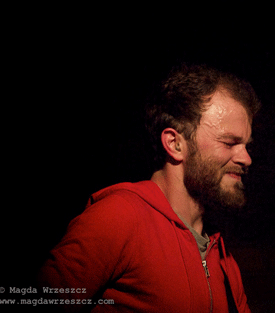
A Sweet Niche - Keir Cooper, about to bounce off another wall (photo by Magda Wrzeszcz @ http://magdawrzeszcz.com)

A Sweet Niche – Keir Cooper, about to bounce off another wall (photo by Magda Wrzeszcz @ http://magdawrzeszcz.com)

Their second salvo, Eye Music II is crash noise from the off. Their third begins as a kind of minimalist ska, then becomes Yaketty-Yak re-imagined for math-rockers. After Ben delivers a burst of horse-clopping rimshots, they break for another swirl of Arabian saxophone, heavy on the romance, before heading back towards the ska armed with hammer-swipes of noise. To top it off, the coda is a lullaby pop tune.

As a band – or, perhaps, as a spasm – A Sweet Niche seem to crouch somewhere between John Zorn (in his more impish Naked City moods) and the wracked, Maoist judders of English free jazz. Moments where a passage of brittle swing mutates into a kind of thrash samba could be put down to dark humour, but it’s difficult to calculate the shape of the band’s intent when a cheerful passage of saxophone sleaze is overtaken by screeching guitar alarm and then a taut, distant game of musical tag as Keir and Oliver dot each other with single notes and with silence.

It’s tricky to pin down whether what they do is political, or disruptive for its own sake, or just a natural expression of brain hiccups; or whether all of these options are equally valued or dismissed. Besides their wary body language – which could be a deceptive feint anyway – they give little away personally. There are no arcane jokes at the microphone, and few wacky titles (although the choppy ta-ta-ta and carousel echos of Bananagirl inspire even more confusion, as if Bagpuss had joined Slayer).
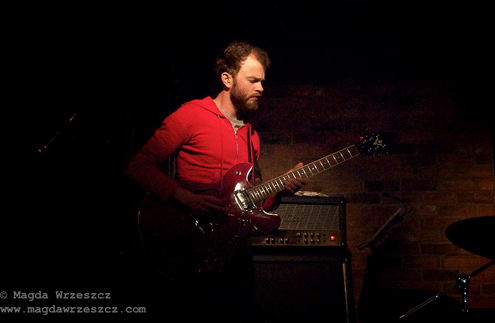
A Sweet Niche - Keir Cooper plays another agonizing chord (photo by Magda Wrzeszcz @ http://magdawrzeszcz.com)

A Sweet Niche – Keir Cooper plays another agonizing chord (photo by Magda Wrzeszcz @ http://magdawrzeszcz.com)

Ultimately A Sweet Niche’s aim seems to be to blow their education out of their minds, like a bolus of brain-snot. Chunks of structure regularly whiz past our ears (Oliver, in particular, has a knack for hurling fervent and compressed musical dialogue) while Keir is ceaseless in shaking off his thoughts as an urgent, committed racket. At one point, following a particularly intense bit of guitar wringing, he blinks with astonishment. For a few seconds, he looks relieved, with a surprised smile and the hint of shy laughter fluttering round his chops, and a “where did that come from?” shrug lifting his arms. As they head towards the end of their set, though, their disruptive peace-destroying turns into a dotted bounce. Bit by bit, they’re turning to a dance even if at the next song they’ll be trying to squash us against the wall with ripped slices of metallic thrash-hop.

They end with a thunderous, purging blast through Duodecimal. Then, bizarrely, they’re back for an encore, augmented by Chloe Herington (the unflappable reedswoman from Chrome Hoof, VALVE and Knifeworld) who suddenly pops up to moonlight and to add a new factor to the band’s unruly chemistry. There’s plenty of muttering, subtle stares and subliminal eyebrow gestures before they get started. It’s unclear whether they’re cueing each other, playing chicken or attempting some kind of disguised wink-murder.

A Sweet Niche with a pensive Chloe Herington (photo by Magda Wrzeszcz @ http://magdawrzeszcz.com)

A Sweet Niche with a pensive Chloe Herington (photo by Magda Wrzeszcz @ http://magdawrzeszcz.com)

Just as I’m losing interest, they reel out a tremendous length of jazz-thrash-turned-sludge-metal. Her alto sax hovering, Chloe stays silent for most of it before jerking into place right at the pell-mell coda. She blows ten or fifteen seconds of twisting Coltrane overblowing over the roar, and then everything crashes to a halt. The night’s over, and so is A Sweet Niche’s psychological shell game. The strains and strange focusses slough away like last month’s bandages: with the instruments down, they’re suddenly warm with each other.

Chloe Herington waits for a cue which only she knows about (photo by Magda Wrzeszcz @ http://magdawrzeszcz.com)

Chloe Herington waits for a cue which only she knows about (photo by Magda Wrzeszcz @ http://magdawrzeszcz.com)

Ten minutes later, sleepy and stumbling, I’m making my way south-west of Spitalfields and I’m ever so slightly lost. Trying to find the tube, I’m wandering past the cluster of City skyscrapers by Bishopsgate – pushy assertions, half-formed nubbins and works-in-progress, garlanded by lights: and the finished statements, shoved heavenwards. Appropriate really.

Around my midnight bleariness (and as I’m passing the arrested concrete stump of the Pinnacle building, humiliated and frozen by market forces) I’m thinking dimly about language again, about tunes and stutters and babels and temporary silences. I don’t come to a conclusion, but as the last echoes of the gig swirl away in my mind I’m feeling glad that this part of town’s got some of its more unusual dialogues back.

What?! online:
FacebookTwitter Bandcamp SoundcloudYouTube

Macchina del Tempo online:
Facebook MySpace Soundcloud Last FM

A Sweet Niche online:
Homepage Facebook MySpace

Chaos Theory Promotions online:
Homepage FacebookTwitter Soundcloud

REVIEW – Kiran Leonard: ‘Dear Lincoln’ single, 2013 (“a joyride through the Day of the Dead”)

18 May

Kiran Leonard: 'Dear Lincoln'

Kiran Leonard: ‘Dear Lincoln’

Now here’s something.

Kiran Leonard’s already an established teenage wunderkind – a bedroom-industry frenzy act who’s rapidly gummed together a string of homemade albums and slung them out, via Soundcloud and Bandcamp, to a surprised and unsuspecting world. When he’s not doing that, he’s charging round his family’s Oldham house waving a caiman head, or shooting his own scratch videos on a budget of tuppence. He plays most of the instruments he needs, wrestling tunes out of pianos, drums and guitars; ukuleles, laptops, screwdrivers and radiators. While his music’s just about ramshackle -raw enough to avoid trouble with the indie-rock police, his ambitions and application have leaned closer to prog and to a grandiose psychedelia. In 2012, for instance, he cooked up a rambling, apocalyptic single about the Mayan doomsday prophecy. It topped out at around 24 minutes long and tied together the wilder bits of ‘Cloud Atlas’ and the paranoid, grinding Pink Floyd of 1977.

It’ll still be three years before Kiran turns twenty. I could wonder what he’s going to do when he grows up, but I almost hope that he doesn’t.

Dear Lincoln is something different for Kiran – much lighter and more immediate. Traveling backwards as he goes forwards, Kiran seems to have suddenly discovered pop in all of its concise hooks, blind momentum and smart throwaway logic. Actually, he’s rediscovered it – Dear Lincoln was written some time ago, while he was a ripe 14 – but now seems to be the perfect time to unveil it. Its a bust-out. It sounds like a joyride through the Day of the Dead. Kiran, hammering away at a tack piano and squawking like a glammed-up crow, drives the gauges into the red and embraces Bolan swagger, a swaying Robyn Hitchcock playfulness, some of the wild euphoria of Guillemots and even a needling tinge of Kevin Coyne. Earlier in 2013, there was the ‘Oakland Highball’ EP, which showed that he was getting interested in snappier, noisier forms. Dear Lincoln nails it. If we could work out what he was singing, it’d even be singalong.

What’s it about? God knows. The words are a babbling wodge of mondegreens-in-waiting about suit-crevices and moonlight, thrown out at us as Kiran carries out his lyrical handbrake turns. “Murderous plain,” he protests, in passing, but it certainly isn’t. Not unless he’s talking about death again. The song could be about gunned-down Presidents, it could just be about missing the family cat, but one thing Dear Lincoln does do is blur the lines between the living and the dead – a rollicking Halloween dance, or a resurrection day stomp. Even that long-croaked, ranting old herald of the Übermensch, Friedrich Nietzche, has a ghostly cameo; prowling the English parishes as a witness before succumbing to anxiety, melting away and vanishing. In the chopped froth of the lyrics, Kiran playfully juggles around ideas of resurrection, rousing, and where he’ll be standing when it all comes to pass; but constantly swats away any navel-gazing with onomatopoeic streams of Little Richard-isms. “Praying for the bodies to assemble and wake… / Come back today, bou-la-ray / oh, ta-hoo-lay.”

Don’t get the idea that this is all a casual throw-together. Anyone keeping half an eye on how Kiran thinks will know that he’s meticulous; that he worries like crazy about getting things right. But Dear Lincoln’s explosive delivery – its immediacy, its ability to swing round the story without stopping to count the words – suggest that he’s finally able to harness his particular genius and to let it live in the moment. This is by no means the first we’ve seen of Kiran Leonard, but it feels like the start of him.

Kiran Leonard: ‘Dear Lincoln’
Hand of Glory Records (catalogue number & barcode t.b.c.)
Vinyl/streamed single
Released: 16th May 2013 (streamed), 2nd September 2013 (vinyl)

Get it from:
Hand of Glory store (vinyl), or Soundcloud (stream)

Kiran Leonard online:
Homepage Facebook Soundcloud Bandcamp Last FM YouTube

May 2013 – album reviews – Terry Gomes’ ‘Shh.’ (“the kind of gentle musical wit that’s been out of fashion for too long”)

18 May

Terry Gomes: 'Shh.'

Terry Gomes: ‘Shh.’

There are no shocks on ‘Shh.’ In certain respects, it could hardly be cosier – Canadian guitarist and arranger Terry Gomes isn’t the spikiest of artists. Three previous self-released albums of countrified folk-pop, with a clean and amiable early-’60s sonic sensibility, have seen him develop into a promising singer-songwriter. Yet even though 2009’s ‘Loose Ends’ (with subtler reflections on loss and orphanhood starting to ripple his songcraft) saw Terry beginning to sound something like a junior Richard Hawley, he’s always risked a headlong disappearance into the kind of consummate professionalism that swallows musicians without a trace.

While it’s a dumb, lazy rock canard that you’re automatically more genuine the more sprawling and trashy you are, it’s still true that the kind of sober musical strengths Terry favours could dip him straight into into the polished, preppy and staid. The clean-cut approach and old-school session-player clarity; the background of university studies, music teaching and classical guitar; the history of working dues paid at the modest end of rock bands and chamber ensembles. Then again, Terry’s also a Zappa fan with a taste for tongue-in-cheek, and a man who entertains himself by playing Dick Dale-flavoured prog-rock tributes to Toronto hockey teams on a pink-paisley Telecaster. There’s straight, and there’s not-so-straight.

Changing tack for his fourth album, Terry has set aside lyrics, singing and songwriting for the moment in order to reinvent himself through a different vintage lens. For ‘Shh.’, he’s exploring his skills as an instrumental jazz guitarist, albeit one who keeps his pop knack close to hand. Don’t expect much in the way of wild exploration or improvised threshing – Terry’s fluent, trim playing stays hand-in-glove with his upfront melodies, and most of the music sits nicely somewhere between 1950s-inflected cool jazz territory and clipped slap-back pop. Harkening after the bright tunefulness of Wes Montgomery and Kenny Burrell, it also keeps that Ventures/Shadows mix of twang and tune-dotting, while easing off into a relaxed George Benson accessibility.

There’s enough heart in the music to pull in some top Ottowan musical talent, all of whom play with warmth. Sharing drum duties with Jeff Asselin, Ouzo Power’s Ross Murray also co-produces. Jazz festival mainstay John Geggie provides most of the bass, while his fellow jazz veterans Dave Renaud and Peter Hum (plus Pulse Mondiale guitarist René Gely) make passing drop-ins as Terry’s front-line foils. Show-band stalwart Gino Scaffidi bolsters the rhythm guitar on half of the tracks, and there are further contributions from Afro-pop players Stu Watkins and Rob Graves, from Back-Talk Organ Trio’s Don Cumming and from classical percussionist Jonathan Wade. All of this gives ‘Shh.’ a diverse but easygoing small-group sound, an ability for quick shifts in style and the feeling of a happy gathering.

Terry’s prime concern, though, seems to be with keeping a friendly eye on the audience. In West Coast tradition, composition consistently trumps improvisation. Rather than brooding and brewing over a standard, Terry presents original engaging pieces of his own with clear straightforward hooks to hum along with and meticulous, perky arrangements. The album fires off short, tidy bursts of tunefulness like a musical espresso machine, all craft and polish. Every lick and fill is nicely honed, with the scope, rhythms and harmonic sophistication of jazz predominantly used as tools to gently buff and expand the melodies.

At its simplest, this emerges as breezy affectionate pastiche. On a couple of straightforward walking-jazz pieces, Terry strolls in loping step with Dave Renaud (who offers soft cartoonish clarinet on If It Walks Like A Duck and airy alto sax on Velvet Wings), and the two strut like two old buddies kidding each other over memories of smooth moves. Left to front the band by himself on Cool Cats, Terry switches between crisp finger-snapping swing and mellow reflection in an eyeblink, before blasting out a brief big-band roar via his fuzz pedal. Closing the record, Shake Shop Shenanigans abandons jazz altogether for snappy surf-rock, in which Terry’s early-’60s outlaw tone is offset both by its own fairground vigour and by Don Cummings’ background swipes of vaporous ghost-train organ.

Other pieces are less obvious, but stay unruffled. The ticking, steady pop instrumental Forever in a Day (on which Peter Hum offers an understated piano counterpart to Terry’s distorted, honeyed lead) breezes easily through its gentle, rhapsodic tune and its Latin undercurrents. René Gely adds nylon-string counterpoint to BG Bound’s driving song, conversing with Terry’s sleepy electric tones over the undulating bossa feel and the bobbing rhythms of Rob Graves’ congas and vibraslap. The three work together again on the velvety, Frisell-icana-styled duet of Gone; René adding occasional dreamy furls of steel guitar as well as nylon-string as Terry paints a happy lonesome sound full of gentle swells and breathy changes of mood.

No shocks, then – but that doesn’t mean that ‘Shh.’ is devoid of pleasing surprises. It’s easy to tag Terry for paying tribute to West Coast comfort and rock’n’roll twang, not to mention hopscotching gently in the footsteps of Hoagy Carmichael. But I suspect that, like Zappa, he’s well aware of the pastiche element. He’s open about ‘Shh.’ being influenced more by television and film soundtracks than by pure tradition, and he clearly loves the pop currency that he’s reshuffling in his own tunes. If he occasionally slinks along the cheese margin, he’s doing it deliberately and with enjoyment.

I’m also guessing that as well as the subliminal Zappa in Terry’s musical DNA, there’s a tiny touch of Spike Jones. ‘Shh.’ has no outright parody, no screams or gargling noises, but its good humour regularly spills over into outright winks and friendly stunts. Some of these are more vigorous than others (the fleeting music-hall flourishes of old-style melodrama, Queen-style) while others are inclusive chuckles embedded in the tunes themselves. Da Bug’s brush-drum shuffle toys with sly little shifts of metre, and with droll rolls and clucks of guitar picking. The tootling swing of Welcome cheerfully indulges a classical guitar-inspired section with bowed bass before nipping happily back into jazz (sparking some neat unison lines between Terry and Gino Scaffadi as it does).

All of this is too lighthearted, too integrated to be particularly postmodern or self-consciously stylised. It’s more the kind of gentle musical wit that’s been out of fashion for too long. At its broadest, it offers They Went That-a-Way, a theme for an imaginary helter-skelter Western that’s one-third ‘Bonanza’, one-third Eight Miles High and one-third Chuck Jones. Stuffed with galloping melodies and sudden switches in direction, this leads the band hither and yon in a hall-of mirrors scuttle; bursting in and out of cowboy orchestration, runaway fretboard zips and Jonathan Wade’s trick-bag rattle of orchestral percussion.

At the other end of the scale from the horse-laughs is The Skater. With the illustrative flair of a silent movie, a trio of Terrys etch out a musical impression of a day on the ice: a little cloudy, a little classical, it takes a Satie-via-Carmichael journey of long lines and pointed details. Beginning with initial lazy strokes across the rink, it builds through ambitious strumming to straining arabesques, only to career downwards in a windmilling slither of muted flamencoid chords as the skater heads out of control; finally picking up and reviving that cruising, swanlike dignity. There’s an art to this kind of light entertainment. Part of Terry’s own subtle artistry is to make it seem lighter than it really is.

Terry Gomes: ‘Shh.’
Bleeding Heart Recordings, BH01
CD/download album
Released: 15th May 2013

Get it from:
Terry Gomes’ online store, CDBaby or Amazon.

Terry Gomes online:
Homepage YouTube

REVIEW – What?!: ‘Schwaffelen’ single, 2013 (“it’s still not clear when they’re going to stop fencing and start carving”)

9 May
What?!: 'Schwaffelen'

What?!: ‘Schwaffelen’

All right, they suckered me. I thought that What?! were starting a gimmick tradition of rolling out cute singles named after foodstuffs. A natural suspicion – their debut single had the crowd-pleasing title of Tikka Masala. Actually, it turns out that “schwaffelen” is Dutch slang, and refers to a man repeatedly bouncing his semi-erect penis off assorted objects (ranging from someone else’s cheekbone to the side of the Taj Mahal). Handy phrase – consider me educated. I’ve been saved some embarrassment the next time I’m snacking in Amsterdam, but have been left with a delightful image of waffles-and-cream that I now need to bleach from my mind. Thanks for that.

What?! remain the kind of supple instrumental trio that gives slick a good name – guitar, bass guitar, drums and a thorough versing in everything out there which grooves. They also own a not-so-secret knowledge of plenty of things which don’t groove but which do lurk, puzzle over things and then jump out at you. But they’ve yet to really show their other teeth: those rougher, odder inspirations they claim to get from Zappa, Dub Trio and Mr Bungle. So far, they’ve been more about delicate sunlit jazzy chords and walks, clean deft swing, and plenty of space. You get the feeling that they could do anything with their material – as soon as they wanted to – and that they’re fencing with expectations. It’s just that it’s still not clear when they’re going to stop fencing and start carving.

As much as you might want them to get nastier, Schwaffelen doesn’t show What?! chucking away any of their finesse in favour of skronk or sludge. If they’re stepping towards a spikier direction, they’re starting subtle – taking some sour art-rock patterns and passing them back and forth through the smooth-jazz filter. As with Tikka Masala, there’s a hint of Take 5 in the gently precise stops and feints as a bossa nova is displaced and reshuffled into math-rock spikes. But the truth is that, in spite of the cock-bouncing title, What?! keep their all-things-to-all-men decorum throughout – even when hitting the distortion pedals.

If you’re hoping for some upheaval – something like the obsessive rhythmic knotting of Battles, say, or the disruptive slice-and-dice of Naked City – you’re in the wrong place. Schwaffelen’s flexing sections do include a flawless switch into driving rock as guitarist Niels Bakx starts blasting away and Agostino Collura’s nimble bass drops its funky slither and locks down into root-note pummeling. But this is more an exercise in clever distraction. Even as Raphael Lanthaler drums along at motorway-punk velocity, the whole band are keeping an eye on the little loping twists of the original rhythm: as it ghosts on underneath, they’ll lock seamlessly back into it whenever they choose. Even the texture phase (in which Niels seems to be channeling the sparse echo-spangled touch of Andy Summers) adds some extra breadth but no questioning depth or disruption.

Perhaps it doesn’t matter – whatever else they might or might not do, What?! remain supremely elegant puzzlers. But it still feels as if there’s much more to them. The Key Ness remix of Schwaffelen is barely half the length of the original, but during its stay it chops, rewinds and pans the original riffs around a gastric roller-coaster of sub-bass and boiling P-Funk synth. Along the way, it twirls past Alice Coltrane harp cascades, brief bursts of classical soul orchestras, wind-tossed shouts from hip-hop MCs and gutsy flowerings of Spanish guitar. It sounds more like what must go on in the trio’s heads – what they must listen to on iPods, gulp down from session to session, or coast by on the bus.

One last thing, going back to the original track… As it snaps to a halt and telescopes away, with a quick twist-and-growl, those push-pulling rhythms leave you in a state of expectation. There’s a moment of hover. Then there’s several messy, prolonged seconds of the most horrendous splurging musical spoff-noise you can imagine. Maybe it’s a surprise, a pancaked blast-beat hurled out by Raphael to be crushed flat in the mix. Whatever it is, it’s a Zappa-style kiss-off. Perhaps I’ve been unfair to What?!. They did finally deliver that dirty splatter.

What?!: ‘Schwaffelen’
What?! (self-released) (no catalogue number or barcode)
Download-only single
Released: 1st April 2013

Get it from:
Bandcamp.

What?! online:
FacebookTwitter Bandcamp SoundcloudYouTube

May 2013 – album reviews – John Ellis’ ‘Sly Guitar’ (“a playful magpie interest”)

8 May

John Ellis: 'Sly Guitar'

John Ellis: ‘Sly Guitar’

A skilled and flexible working guitarist since the early 1970s (travelling through punk, post-punk, pub rock, rhythm-and-blues and progressive rock in no particular order), John Ellis has never curdled as a musician. What he’s avoided doing up to now is making a player’s album. Generally he’s been content to tweak a song’s architecture as a team member (in The Vibrators and the mark two Stranglers) or as a flexible, innovative sideman (delivering fanged electric churn for Peters Hammill and Gabriel, or airship noises and roaring-Twenties fanfares for Judge Smith). Even when left to his own devices, he’s stayed away from guitar heroics – often, away from the guitar itself. He’s fermented semi-ambient hubbub for art galleries, filtered Victorian Japonisms through electronica, and taken strides into multimedia, but left the protracted strutting and soloing alone.

On ‘Sly Guitar’, however he returns to (and lays into) his main instrument with a sharp-clawed and swaggering stylishness. It’s the kind of performance that suggests he’s ripped the tail-fin off a 1950s Cadillac and carved a new guitar from it. Things are different this time. In some respects, the key to appreciating ‘Sly Guitar’ is knowing about John’s participation in a 2007 art prank, when he helped to fake a lost Hendrix rendition of the Welsh national anthem. While this particular stunt got his playing onto ‘Newsnight‘ – and was originally a joke about co-opting celebrities into random causes – viewed from here, it’s as much about the puckish and gleeful enjoyment which John gets out of playing guitar. Aspects of Ellis wit might show up on the records he’s worked on (qv. the intuitive bite of those Hammill albums, his thoughtful tricks with Smith, or the raw horse-laughs in his own rare solo songs), but a sense of liberated fun doesn’t always make it across. On ‘Sly Guitar’ it does.

I said “player’s album” – I’m also suggesting that this is the record on which John Ellis finally lets it all hang out. That’s a little misleading. Discreetly virtuosic yet always understated, John’s technique is marked out by the lean, sharp economy he’s learned from years of punk and art-rock. There are also plenty of examples of his taste for bouncing around inside delay units, and for the blocky synthwork and drum loops explored on 2008’s ‘Map of Limbo’. The music’s also liberally slathered with John’s beloved EBow sustainer, transforming notes into assorted hoots and stuttering violin chugs, or pulling them out into taffee-lengths.

These in turn blend in with ideas from all over the place. Fun notwithstanding, John’s art-school training consistently underlies his current approach (one track, with all irony intact, is called I Remember Futurism). He picks up odds-and-ends from the fashions and fads he’s seen pass by and reinterprets them with a playful magpie interest. The results blend an edgy and brittle flair with fastidious design, offset with a mischievous, practical form of musical adapt-and-reclaim.

Many of the tunes on ‘Sly Guitar’ have much in common with old pop-instrumental albums. There are tinges of Joe Meek and of perky surf-guitar capsules from the ’60s; and of those meticulous prog-tinged jingles from the ’70s. But this is just part of an overall collage effect which plucks inspiration from Hendrix, Hank Marvin and John Williams, from Robert Fripp and John Martyn; even from the likes of Fred Frith and Henry Kaiser. It also suggests that over the years John has copped a listen to everything from ‘No Pussyfooting’ and ‘Temple Head’ to On-U Sound and Moby. At the least, he’s caught their echoes as they’ve seeped through airwaves or were circulated alongside technology.

Certainly John’s thinking hard about latterday pop and accessibility; insistent club beats and nods to old crowd-pleasers drive much of the album. Pieces like Levitation and the eleven-minute title track sit on funk grooves with sleek flicks of rhythm guitar and curved, humming chromium lead lines. Snappily and space-ily rendered, the latter are recorded close enough to hear the speaker cones jumping and flattening while wellings of EBow sustain stack up behind like a pile of moonlit clouds. In the chop’n’chat of Farud Gets Electricity, John mixes a Latin loop and a dash of Stray Cats rockabilly into the recipe. Futuro’s leisurely boom-bat, wood-clack beat and clipped industrial framing recall a slimline version of Tackhead’s industrial hip-hop. Making the most of the album’s pop-up digital production sheen, it’s fleshed out by jawharp synth boings and fake horn stabs; its smoulder-point guitar lines hanging in the middle distance like burning ropes.

The beats may be familiar, but the tweaked and ruffled electrophonic timbres which John uses to build up the tunes are less so. Pedalo is as rhythmic as anything else on the record (gliding atop a cavernous trip-hop loop and cracking dub snare) but its body is made up of a mongrel set of slotted-in guitar voices – fanfare tones of firefly and conch; power-growls of distorted fuzz; a pitch-shifted shrill of parade melody teetering on top. All of these come together in spite of themselves, an ill-matched platoon who’ve learned to march in step. Under a skywriting blast of EBow sustain, I Remember Futurism interweaves a rippling set of arpeggios, passing them between a calm sky-blue organ and a guitar which sounds like a harp made of iron girders.

Embedded deep in the mix of the latter are the tinkling, caught-up accents of Brazilian cymbals and bells, and other pieces probe even deeper into worldbeat. Walking in the footsteps of Jon Hassell’s Fourth World Music, and of Transglobal Underground, John brews up vividly staged polycultural blends in which the frowning lines between ethnology and fraudulence, sympathy and exploitation might perhaps blur into irrelevance. His cyborg guitar tones counterpoint the eerie ornamented leaps of the Middle Eastern music he sources, undercutting its spiritual passion with impressionist sound-builds recalling insect swarms, oppressive heat, or the spine-crawling sense of secret surveillance. Hollowing out a Nile processional (on Don’t Be Misled By Your Eyes), he repacks it with drilling mosquito sounds, duetting Arabian slide lines and choral synths. The leisurely Levantine trip-hop of Flies elevates a souk-call vocal sample like a dreamy kite, but then subtly pollutes it with hovering swarms of static guitar buzz.

These last are much like the withering drones employed by Robert Fripp on ‘Exposure’ back in 1979, painting threatening sonic portraits of decaying industrial landscapes. You could only speculate as to whether John’s applying these same ominous atmospherics to the torn cities of the Arab spring; the idea hangs heavy. Initially The Bowl Maker of Lhasa (framed by temple bells and further baleful Frippish insect buzzes and pitch-collapses) sounds as if it’s going to do something similarly politicized for Tibet. However, it rapidly returns to clear hip-hop and funk sources – the sleek dancing duel between stinging clean guitar and EBow whistle, the playful way it lifts and reshapes a sly quote from ‘Freddie’s Dead’ in the middle of its drum-machine swing. While there are a few left-field touches (such as a timbral shift which refracts the familiar street beats into something with a twist of copper and stained glass), perhaps it’s better just to enjoy the imaginative, enthusiastic sound-painting; and not to over-freight the pieces with too much extra meaning.

The remaining tracks, though, bypass the club beats for a deeper exploration of John’s textural art-rock side. The brief roundabout of Echoplexing presents a bone-and-wood clatter of choppily-strummed flamenco guitar: echoing off to the sides of the soundfield, it joins stinging treble guitar lines and zipping insect sounds, stitched together by a child-chant organ part. The loop-and-splay Infanta shows John at his purest both as player and as music processor. Dialling up a sparkling silvery electric guitar tone, he begins the tune with Spanish classical inflections nestled in a sharp snappy reverb before abruptly leaving them to pulse and circle inside a loop-hang while he gets on with other business. He goes on to juggle a section of Hendrix jinks and transfigured rock’n’roll quotes; a countrified oud tone; elegant touches of shading, slurring and EBow elisions; a razor buzz bouncing in the background.

Elsewhere, March Of The Kitchen Taps floats a cluster of hovering, uneasy guitar parts (floats, wails and squeals) against swishing electronics like ventilation fan-blades, and against massed samples of metallic taps and bangs which flutter, slice and nail the pulse down. Cue jokes about everything-and-the-kitchen-sink: Crow On A Dying Dog eggs these on further, blending even more twiddling kitchen metals with a bagful of plastic electronics – bass twangs, burbling random-pitched vocalise, synthesized big-band swing and blaring horn-guitar parts. As a flight of sampled rooks flap past, it sounds like a weird and wilful collision between suitcase synth-pop and bleak mediaeval soundtracks.

It’s these particular pieces, in fact, that seal both the fate and triumph of ‘Sly Guitar’. Forks and taps aside, it is a kitchen-sink album: one which flea-jumps enthusiastically between slick beats and toy noises, easy funk and experimental chop-suey, clippable music and idiosyncratic personal sketches. John may have finally turned in his “player’s” album, but even this far along in the game he refuses to play it straight. Dipping in and out of formalism and fooling around, coursing around plug-ins and unravellings, he’s turned in an album which celebrates and fans out his plurality as a musician. Having mastered a humble, low-key chameleonic wilfulness – in which the appropriate art and the immediate idea directly shapes the method – he’s let it become part of him, even when he’s flexing free.

John Ellis: ‘Sly Guitar’
Chanoyu Records, CHA002
CD/download album
Released: 6th May 2013

Get it from:
Chanoyu Records.

John Ellis online:
Homepage Facebook Twitter MySpace Soundcloud

SWOONAGE

Swoon. /swo͞on/ A verb. To be emotionally affected by someone or something that one admires; become ecstatic. Here are some people and things that make me swoon. #swoon #swoonage

Post-Punk Monk

Searching for divinity in records from '78-'85 or so…

theartyassassin

...wandering through music...

Get In Her Ears

Promoting and Supporting Women in Music

Die or D.I.Y.?

...wandering through music...

The Music Aficionado

Quality articles about the golden age of music

THE ACTIVE LISTENER

...wandering through music...

Planet Hugill

...wandering through music...

Listening to Ladies

...wandering through music...

ATTN:Magazine

Not from concentrate.

Xposed Club

improvised/experimental/music

The Quietus

...wandering through music...

I Quite Like Gigs

Music Reviews, music thoughts and musical wonderings

furia log

...wandering through music...

The Recoup

SINCE 2013: Books and books and books and books and occasionally other things

A jumped-up pantry boy

To say the least, oh truly disappointed

PROOF POSITIVE

A new semi-regular gig in London

Gapplegate Classical-Modern Music Review

...wandering through music...

When The Horn Blows

...wandering through music...

:::::::::::: Ekho :::::::::::: Women in Sonic Art

Celebrating the Work of Women within Sonic Art: an expanding archive promoting equality in the sonic field

Ned Raggett Ponders It All

Just another WordPress.com weblog

FLIPSIDE REVIEWS

...wandering through music...

Headphone Commute

honest words on honest music

The One-Liner Miner

...wandering through music...

Yeah I Know It Sucks

an absurdist review blog

Obat Kanker Payudara Ginseng RH 2

...wandering through music...

poplifer.wordpress.com/

Waiting for the gift of sound and vision

Good Music Speaks

A music blog written by Rich Brown

Do The Math

...wandering through music...

Archived Music Press

Scans from the Melody Maker and N.M.E. circa 1987-1996

The World's Worst Records

...wandering through music...

Soundscapes

...wandering through music...

OLD SCHOOL RECORD REVIEW

Where You Are Always Wrong

FRIDAY NIGHT BOYS

...wandering through music...

Fragile or Possibly Extinct

Life Outside the Womb

a closer listen

a home for instrumental and experimental music

Bird is the Worm

New Jazz: We Search. We Recommend. You Listen.

...wandering through music...

Life Just Bounces

...wandering through music...

Lucid Culture

JAZZ, CLASSICAL MUSIC AND THE ARTS IN NEW YORK CITY

Aquarium Drunkard

...wandering through music...

eyesplinters

Just another WordPress.com site

NewFrontEars

...wandering through music...

FormerConformer

Striving for Difference