Archive | March, 2004

March 2004 – album reviews – Edwige’s ‘Rise and Sing’ (“while she’s not yet citing chapter and verse, the sacred aspect is clearer now”)

22 Mar
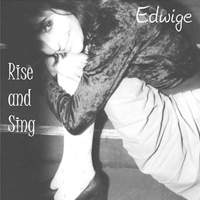
Edwige: 'Rise And Sing'

Edwige: ‘Rise And Sing’

Having made her initial mark with a couple of quirky, tricky-to-pigeonhole folk-pop albums, Edwige has made one on which she intends to celebrate “God’s beautiful gift of singing.” This could mean a lot of things. Perhaps she’s taking that unorthodox, archly beautiful voice of hers on an exploration of experimental a-capella songs, or a pure set of vocal rounds. Perhaps she’s made an album of devotional folk; or an unexpected gospel record.

As it happens, none of these are exactly the case. Edwige’s embrace of the joy of singing may be heartfelt, but it’s also comfortable. The key tone of ‘Rise and Sing’ is relaxation, and of Edwige’s assurance in her own work and her own methods. In many respects, it remains a familiar Edwige album. Many familiar tastes certainly remain intact. She still favours upfront lyrical messages, and continues to steer a course placing her somewhere between cabaret entertainer (especially on the oompah-pop of Bad Hair Day) and announcing angel.

She’s also continuing to develop her tendencies towards baroque pop arrangements. I Just Can’t Resist That Love is given lift by a suspended chorus of trilling voices and sunny passages of oboe; Into View is threaded with reeds, harpsichord, and tuba; while a harp adds sparkle to the simple, open love song After The Rain. The perky swing of New Mexico – with its elasticated guitars and psychedelic pedal-steel keyboards in tow – shows another side of her tastes, this time a dash of country music for the road.

The most surprising aspect of ‘Rise And Sing’ is a new affection for noisy guitar pop. Edwige’s latest producer (former Homer/Robyn Hitchcock sideman Andrew Claridge) sploshes some crashing electric guitars around several songs here, beefing up the acoustic strumming with touches of indie-pop, swamp-rock and grunge. The unplugged directness of previous Edwige albums, with their ornate bursts of cuteness and their denser musical surprises, sounded as if they’d come from odd-shaped rooms in an apartment piled high with spiritual books and knick-knacks. This album suggests that Edwige has recently knocked through a wall or two, and built a nice scruffy garage to play in. Her voice, as ever, is peppered with odd pitch-swoops, vibrato and declamatory theatrical inflections, and is still French-accented even after years of living in London. It’s an odd match for this bristly rock clanging – yet she thrives on the cruder energy that the extra noise provides.

With her perpetual good humour intact, Edwige uses the extra force to help her to drive home a few righteous stilettos. Straddling a catchy swaggering hook on Ears On Fire, she takes dry pot-shots at questionable cults with unreliable gurus – “I heard he was unfaithful to his wife, / I promptly took his words, and boiled them with my rice.” On Elegy For You, she skewers another bad-news, would-be Mephistopheles, decorating her lines with layered falsetto shimmers of vocalese while using the main lyric to sketch his cunning in song – “You’re so good at enchanting – / you lure with hopes and dreams / held through your spindly fingers, / and have them crushed like a crumply paper ball.” She also draws on this energy on Time For The Glorious: switching between midvoice and falsetto, rising serenely over the fuzzy rock backing to declaim “the leaf wouldn’t be but for the tree, / the wave wouldn’t roll but for the sea, / your heart wouldn’t be / but for a love much greater than one can ever conceive.”

Ah, yes. There are God-songs on ‘Rise and Sing’. Previously Edwige has only alluded to her personal, devotional brand of Christianity through cryptic clues, but now she’s beginning to become more direct. While she’s not yet citing chapter and verse, or names, the sacred aspect is clearer now, and this in turn reveals the true nature of many of her previous songs. As for the new ones, I Just Can’t Resist That Love pulls off the old soul-music trick of blurring across the boundaries of love song and devotional hymn. Opting for generosity rather than hectoring, Edwige’s revealed evangelism takes a variety of forms over a broad range of experience and musical method.

We get our gospel song after all – I May Have, in which Edwige testifies doubts and faith over a soft bed of electric chapel organ and little electric guitar agreements. Behind the pretty arrangement, Into View reveals itself as a waltzing tale of a Damascene conversion. For the jazz-tinged acoustica of Tea Light Sympathy Edwige turns teacher, with a gentle (but stern) offer to share her path. On Fusion, she becomes an ecstatic celebrant, kicking off a startling, delirious cocktail of techno pulse, hard-rocking fuzzpunk and hoedown. Choppy cello and guitars meet up with a stomping dance-floor beat and speaker-trashing bassline, and are in turn covered in festoons of Edwige as she chants, lets rip again with the vocalese and sends up fireworks of singing.

The thing about devotion, though, is that it involves letting go. Edwige is such a determined performer – so enthralled with the message, the observations, the little dialogues of life – that little of this (bar the rampaging delight of Fusion) rips through into the ecstatic. The message is always already decided, never discovered, and so the sense of actual revelation is lost. That’s a shame – for believer and unbeliever alike, observing or sharing a revelation of faith is often a fuse for crucial sympathy, and on her songs Edwige seems to miss out on this transformatory moment.

There’s one significant exception, in which Edwige’s wayward journey takes her up into a place she’s never visited before in song. Do I is that music-of-the-moment that’s missing elsewhere. An unexpected (and welcome) bit of psychedelic noise-folk, it’s set on Nico organ drones and on a cloudy screech of guitars so overdriven that they sound like English brass bands scattered by gales. The lyric is the simplest of declarations – no angles, no patter, just a naked, assured statement of devotion. “Do I come? – I do. / Will I follow? – I will. / In the light or darkness, pray for strength, / ah my love, … / Give me the warmth of your love. / Safe with you forever, ever, ever, ever.” Stepping up from the chapel drone, rising above this massing, crashing confusion of tangled feedback, Edwige is making her leap of faith for us; all cabaret cuteness falling away.

It’s the kind of inspiring moment which that unearthly voice was made for. I wish she’d do more like this.

Edwige: ‘Keep The Change’
Quasar Music, EDW3CD
CD album
Released: 2004

Buy it from:
Quasar Music or CD Baby.

Edwige online:
Homepage YouTube

March 2004 – live reviews – Mondriaan Kwartet @ Fuse Leeds 04 festival (performing John Zorn/Toek Numan/John de Simone/Richard Ayres) @ The Venue, Leeds College of Music, Quarry Hill, Leeds, UK, 4th March (“brimming over with the enjoyment of physical and audience challenge”)

12 Mar

We’re all consenting adults tonight, in for an evening of potential torment at the hands of four extremely accomplished Dutch experts. As we wait, we’re eyeing an ominous device. Rearing up from the floor, it initially resembles a homemade shower cabinet, adapted to work as an electrocution chamber.

Any second thoughts?

The towering gizmo is the Octachord. It’s a nine-foot sound-sculpture (to be precise, an electrophonic harp) doing double duty as accompaniment for Mondriaan Kwartet –  but that’s for later. Right now, its main role is to focus our attention. Eight metal extrusions like park-fence railings (actually tubes holding the Octachord’s strings and movable bridges) jut up from a chipboard sound-box, sitting on a set of squat castors. Hugged by a tracery of control wires and delicate devices, the tubes ascend to a cross-brace like an oversized hash sign.

Like many sound-sculptures, the Formica surfaces of the Octachord and its festoonings of light-industrial debris give it a frail, domesticated Heath Robinson structural logic, offsetting its intimations of menace and tortured electricity. You could imagine it sitting in the corner of your spare room, exchanging polite machine-conversation with the boiler. But you wouldn’t want to imagine it roaming the house in the dead of night: looming towards the bedroom door, exuding fat blue sparks…

I was mentioning torment? That’ll be courtesy of John Zorn. For as long as he’s been blowing frenetically over jazz and hardcore art-rock, this viciously intelligent post-modern saxophone maven has doubled as a modern classical composer. His waspish chamber music dominates the Mondriaan’s repertoire tonight – and when I say “torment”, I mean it literally.

By Zorn’s own admission, the splintered suite music of ‘The Dead Man’ is a detailed representation of a sadomasochism session in progress. Violins, viola and cello conjure the impact of blows and the rests of anticipation; the distortion of twists and cruel stretches; the shocks and the sensuality. If this sounds like sensationalism or game-playing, then bear in mind that Zorn apparently practices what he’s preaching here. If he’s setting up as an ambassador for the joys of S&M he makes a compelling job of it, by writing music that’s as eerily seductive as it is violent.

As for the performers, Mondriaan Kwartet are a New Music string quartet par excellence – an effortless collective embodiment of Dutch cool and elegance – but they’re clearly brimming over with the enjoyment of physical and audience challenge. They dive passionately into Zorn’s music with its hornet squeals; its sudden pops of ordnance; its super-pianissimo glass-pane skitterings of bow on strings. The Dead Man itself sounds like nothing so much as music for duelling crabs – perilous music, with its structure continually threatened by tensile collapse. The concerted classical discipline and harmonies are beset by savage scrapes, and by drifting descending tones and atmospheres that alter the air like eerie lighting effects. When they’re not slithering their bows over the strings, the players rattle them against the fingerboards; or swat at the air with them, making muted whip swooshes. Over the top of her viola, Annette Bergman’s eyes flick from colleague to colleague for cues. On the execution of a particularly tricky Zornism, a broad grin flashes across her face – guileless, yet mischievous.

Setting Zorn for a while, the Mondriaan move to ‘Stringtones for String Quartet’ by Dutch composer Toek Numan. Reflecting his work in dance theatre and film soundtracks, Numan’s piece is presented in highly visual terms – performed in near-darkness accompanied by film projections, a rotor of light passing across gelid red tiles and flickering and fractionating into restless patterns. The music itself is a shudder of anticipation, broken by staccato plucks before it’s allowed to go far in sustaining itself: a drone undermined by quick strikes and harmonies, eroding backbone even as they provide an intriguing sour extension. Revealed in parallel, Numan’s work embodies and illustrates a dividing line between continuity and the disturbances arising in its wake.Throughout, its value seems to lie in the challenge of balance which it sets its players.

There’s a problem with this at first, as it seems that (beyond the admiration we can offer to the Mondriaan’s brinksmanship and precision) there’s little for us to grip out here in the audience. But then there are the flashes of small reward. A shared line of falling/rising harmonic keen from the violins. There’s a brief, bright glimpse of harmony as the Mondriaan power through a sudden and unexpected mosaic of notes (like The Kronos Quartet on full Manhattan throttle), only for it to disappear just as rapidly. These moments materialize more and more frequently as the piece progresses and finally ‘Stringtones…’ is revealed for what it is : a modernist’s veil dance – thoroughly orchestrated, but with its component parts almost always left entirely masked, or extracted and scattered across its length.

Throughout all of this, the Octachord broods onstage like a threatening science fiction prop. Appropriately, it’s finally brought into play for John de Simone‘s ‘Deus ex Machina’ – a compositional nod to the primal thrills of science fiction B-movies, in which the Octachord plays the Alien Menace to the string quartet’s Earthlings. At the Octachord’s controls, its creator Robert Pravda gets to play the obligatory mad scientist, but only up to a point. Unshaven, and sporting long warrior’s hair, he provides an air both of frizzy chaos and of gentle politeness. This sets off the Mondriaan’s collective neatness and precision before a single note is played.

The Mondriaan go to work around Pravda in a sawn-up staccato, one violin off on a gull-flight glissando above the dense, intense, angrily compressed structure. As bows swoop up and down to precise point on instrument necks, Pravda totes a seven-foot button-studded control stick with an air of mild trepidation. Finally, cued in by a two-note violin ostinato, the Octachord activates with a brutal transformer hum before swelling out to a factory bray like a clutch of singing drill-bits. Under Pravda’s gaze, flashing green lights crawl up and down the rods like slow abseilers, riding the bridges as they set the pitch. The sound is terrific – vast, oppressive and urgent harmonic waves.

Unfortunately, it’s immediately a fatal distraction from the quartet music. This vanishes into indifference as the Octachord rides balefully along within its own entirely separate space. Given a long solo passage, with many of its dancing lights alight, it renders us a wonderful unearthly noise like a glass harmonica being ravished by ravenous microscopic metal worms. Watching it chunter along like a psychedelic cathedral clock (or a captivating ‘Doctor Who’ relic), we forget all about the strings, and the composer.

With ‘Deus Ex Machina’ over and the interval in progress, I sidle up to the Octachord (alongside other nosy audients) and sneak a peek at Pravda’s copy of the score. Our explosive giggles prove that curiosity has finally cracked up the cat. The instructions from de Simone are simply to turn the Octachord on, to let the Mondriaan phase in with the string drones and come to a halt; and to then “do your thing for 2-3 minutes, or until audience is bored…” It’s a good joke. Still, it’s not enough to make up for the feeling that a marvellous sound-sculpture roar has been wasted –  that it’s been bolted onto a halfway-interesting chunk of aggressive minimalism in a cavalier and casual fashion, only for both to fall flat. Yoked together, to death.

Another new work – the two-part ‘No.38 for String Quartet’ by Cornish composer Richard Ayres – begins with bouzouki-style picking. Armed with plectra, the Mondriaan members claw gently at the strings of cello, viola and violin for Part 1. Jan Erik van Regteren Altena’s first violin, is the exception: ejecting a thin strand of stressed melody, hurtling helplessly off the side of the instrument. Part 2 has the full quartet engaged in a hopping dance full of skidding harmonics. Dispatched with zest and vigour, it sounds like children’s skipping songs being enticed into a motorcycle formation, and then run violently off the road. Later on, other vivacious dances are sliced and diced in Ayres’ conceptual grinder. It seems that John Zorn doesn’t claim the monopoly on cheerful sadism.

However, Zorn does claim composer’s laurels for the evening, as the Mondriaan close the concert with his ‘Cat O Nine Tails’ – a masterfully disruptive witty soundtrack to an imaginary cartoon. Ripe with cunning flirtations with chaos – and peppered with a wealth of Americana – it offers the Mondriaan another opportunity to stretch out and relish. Scourging turbulence and shimmers cross over with jaws and saws; fragments of hoedown reels start up and are swallowed by silence, jump-cut with passages of rich serenity or sly threat. Inside its parade of styles and suggestions, Eduard van Regteren Altena gets to quote jazz bass on his cello, and Zorn also throws in a brief shuffled history of the fiddle’s musical journey across Europe and America via kletzmer, Appalachia and Hollywood. Certainly, there are gimmicks a-plenty – but here, as in cartoons, the architecture of gag and message combine, part of a bigger picture.

Mondriaan Kwartet online:
Homepage

John Zorn online:
Homepage MySpace LastFM

Toek Numan online:
Homepage Homepage - blog LastFM

John de Simone online:
MySpace

Richard Ayres online:
Homepage MySpace

Robert Pravda & the Octachord  online:
Homepage Facebook and also this article.

The Venue (Leeds College of Music) online:
Homepage

SWOONAGE

Swoon. /swo͞on/ A verb. To be emotionally affected by someone or something that one admires; become ecstatic. Here are some people and things that make me swoon. #swoon #swoonage

Post-Punk Monk

Searching for divinity in records from '78-'85 or so…

theartyassassin

...wandering through music...

Get In Her Ears

Promoting and Supporting Women in Music

Die or D.I.Y.?

...wandering through music...

Music Aficionado

Quality articles about the golden age of music

THE ACTIVE LISTENER

...wandering through music...

Planet Hugill

...wandering through music...

Listening to Ladies

...wandering through music...

ATTN:Magazine

Not from concentrate.

Xposed Club

improvised/experimental/music

The Quietus

...wandering through music...

I Quite Like Gigs

Music Reviews, music thoughts and musical wonderings

furia log

...wandering through music...

The Recoup

SINCE 2013: Books and books and books and books and occasionally other things

A jumped-up pantry boy

To say the least, oh truly disappointed

PROOF POSITIVE

A new semi-regular gig in London

Gapplegate Classical-Modern Music Review

...wandering through music...

When The Horn Blows

...wandering through music...

:::::::::::: Ekho :::::::::::: Women in Sonic Art

Celebrating the Work of Women within Sonic Art: an expanding archive promoting equality in the sonic field

Ned Raggett Ponders It All

Just another WordPress.com weblog

FLIPSIDE REVIEWS

...wandering through music...

Headphone Commute

honest words on honest music

The One-Liner Miner

...wandering through music...

Yeah I Know It Sucks

an absurdist review blog

Obat Kanker Payudara Ginseng RH 2

...wandering through music...

poplifer.wordpress.com/

Waiting for the gift of sound and vision

Good Music Speaks

A music blog written by Rich Brown

Do The Math

...wandering through music...

Archived Music Press

Scans from the Melody Maker and N.M.E. circa 1987-1996

The World's Worst Records

...wandering through music...

Soundscapes

...wandering through music...

OLD SCHOOL RECORD REVIEW

Where You Are Always Wrong

FRIDAY NIGHT BOYS

...wandering through music...

Fragile or Possibly Extinct

Life Outside the Womb

a closer listen

a home for instrumental and experimental music

...wandering through music...

Life Just Bounces

...wandering through music...

Lucid Culture

JAZZ, CLASSICAL MUSIC AND THE ARTS IN NEW YORK CITY

Aquarium Drunkard

...wandering through music...

eyesplinters

Just another WordPress.com site

NewFrontEars

...wandering through music...

FormerConformer

Striving for Difference