There are some musicians who claim to consider themselves aerials, with their feet lightly arched off the ground and their heads inclined into some kind of ether, through which they conduct the music and songs which are looking for a means to get to earth. Robert Fripp is one of these claimants, but whether his occasional disciples centrozoon think the same way is questionable.
centrozoon’s touch-guitarist Markus Reuter is a graduate of Fripp’s school of Guitar Craft, and previously played with the Craft-inspired Europa String Choir, but an enquiring look at the Centrozoon website reveals little in the way of earnest, wintry Frippian mystique (though much in the way of dry German humour). If centrozoon (of whom the other half is synth-and-beats man Bernhard Wöstheinrich) are channelling music, it’s of a much more liberating and less clotted variety than Fripp has been downloading into King Crimson over the past few years.
There’s certainly a latter-day Crimsonic element to their work – the rich swathes of Soundscapes-style ambient tone colour, the wild electronic percussion, and the brassy or droning sounds that Markus employs while soloing on his Warr Guitar. But there’s less of the tightness that makes and sometimes mars King Crimson’s music; and a more thoroughly integrated use of the clubland elements of trance, techno and garage that have recently been informing Crimsonic offshoots like BPM&M and ProjeKCts Three and X.
Thúsgg (Skinny and Crazed Mix) possesses that analogue-synth gastric twist that regularly seeps up into club music. Bernhard launches a rapid, broken-beat squirt-funk-and-dripping-water cave ambience, through which Markus flies big wheeling paths of Frippian improvisation in unearthly arpeggios. But barely halfway through, most of the beats quietly fall away: Markus’s chilly howl of overdriven Warr briefly rises, saxophone-like, into free-time jazz questioning, before both centrozooners dissolve into a duet of shifting ambient lambency.
The sixteen-minute extract from ‘The Cult of: Bibiboo’ shows an even broader example of centrozoon’s fusion of club culture and evolutionary rock textures. The duo engage in a kind of relay race across trance territory, whipping up a tautly disciplined psychedelic frenzy. It flowers from auroral ambience through thunder-drum percussion and what sounds like nods to the ‘X-Files’ theme, to warm and constellatory ambient drifts, cut by flares of harmonised Warr and quizzical harmonies.
Five-and-a-half minutes in, it’s become a glittering chillout zone covered in singing glassy loops. By nine minutes, Markus’s weaving Soundscapes are rubbing up against clipped artillery shell boom-beats, and by eleven minutes he’s razoring the starry sky with saw-toothed shapes and snarls. By the thirteen-minute marker Bernhard’s thundering distorted beats have forced Markus back into the angelic role, and they finally coast onto a home stretch of firework bangs and prismatic orchestration.
Tagging all this rich invention as “Fripp on Ecstasy” seems cheap, but it’ll do for now as we start to tune in to the powerful, thrilling hybrid music centrozoon have to offer.
centrozoon: ‘The Divine Beast’
self-released, CZCD01 (no barcode)
CD-only EP
Released: September 2001 Get it from: download from Bandcamp or Amazon Music centrozoon online:
Having followed a series of assured, wide-spanning loops passing through jazz, art-rock, prog, ambient electronics and Gong’s fertile psychedelic universe, perhaps it’s time for Theo Travis to come home. Or, perhaps, to build a home.
One of Britain’s finest (yet least precious) saxophonists, Travis has paid tribute to the post-bop traditions of Coltrane and Tyner, blown full improv and racing fusion, played balladeer and pop romanticist, and breathed frost over ambient darkness. ‘Heart Of The Sun’ summarises this breadth on a single album, unifying itself around his compositional variety and the flexible determination of his playing voice. It’s remarkable for the humility and warmth of its approach – partly from Steven Wilson’s beautifully atmospheric mixing (an object lesson in letting jazz studio performances breathe as naturally as live gigs), but more significantly from Travis’ uncomplicated attitude towards allowing music to happen.
A sometimes-unguarded, sometimes-studious musician – who gives his all either way – Travis is also someone who doesn’t need to throw a leader’s weight around. Subtly poised and authoritative, he stands back from the obvious limelight throughout ‘Heart Of The Sun’, allowing his guests (in particular, pearly-toned trumpet veteran Palle Mikkelborg) to illuminate the music, and then gracefully reflecting that light back himself. Grinding no axes, ‘Heart Of The Sun’ sits itself down at the accessible end of jazz, with Travis discreetly polishing his musical breadth to a smooth evanescent ‘Kind Of Blue’ consistency.
His standard quartet members – David Gordon on piano and organ, Andy Hamill on double bass and Marc Parnell on drums – are the album’s backbone (with occasional rhythm section substitutions from Stefan Weeke and Björn Lücker). Theo’s partnerships with these players allow him to exercise some more straightahead jazz moves, via a tenor sax tone blending the polished New York bite of Michael Brecker and Dave Liebman with the earthier strengths of British bluesman Dick Heckstall-Smith: as demonstrated on the velvet-smokey blues of All I Know. On the other hand, the standard crew also raise the stakes on Fast Life, in which Andy Hammill makes the most of his experiences backing contemporary drum’n’bass luminaries like 4 Hero and LTJ Bukem. It’s a nimble, daring demonstration of how clubland’s drum’n’bass beatscapes are both nourished by jazz and able to feed back into it. Hammill, Parnell and Gordon slip and slide through a succession of sleek, exciting, ever-morphing junglist pulses, like Red Snapper in black ties. Travis and Mikkelborg travel cheek to cheek over these flexing surges, quoting mischievously from mariachi and Mission Impossible, Mikkelborg occasionally rinsing the beats in a wash of wah-wah’ed electric trumpet.
It’s also the standard quartet who are behind the very different approach of Northern Lights – texturally, a close cousin to Travis’ dark-ambient work as half of the electronica duo Cipher. His soprano sax (making its only appearance) stands poised in a lonely, bowed-head intro, redolent with melancholia, over Eno-esque dark-water atmospherics. Mikkelborg responds with a silvery, fantastically tender muted melody – comforting and passionate – that comes and goes like caught breaths and compassionate advice above the carpet of Gordon’s Hammond organ, slowly warming and soothing that initial exposed chill.
The quartet – this time augmented by Mystics guitarist Mark Wood, a companion from Travis’ nights in the improv lab – turn in a relaxed yet magnificent performance on Barking Dogs And Caravans. A musical picture of childhood holidays and British holiday camps, it provides Travis’ best melodic solo of the album. But with its friendly air of disarmed tongue-in-cheek pomp, the barrel-organ Hammond figures and Wood’s Frisell-ish lacing of bell-like guitar, it’s also an opportunity for Travis to explore the more unselfconsciously affectionate corners of the British jazz impulse. Here, you can hear the same mingling of warm, pubby matey-ness and superbly expressive playing as found in the Loose Tubes school of Django Bates and Iain Ballamy: particularly when Travis cuts loose with some celebratory, laughing tenor wails.
Elsewhere, British improv-scene tendencies get a look in on That Old Smile: initially a deceptive, straight sounding blues strut driven by Parnell’s haughty cymbal. Wood – using a solid-yet-limber blowtorching tone – moves outward from a supporting position via a series of iridescent bubbles of sound, allying themselves with Gordon’s increasingly shardlike organ, The piece’s impatiently accelerating choruses (and its nods to the excitability of prog) moves to a point where the playing melts, with a dropping silence, into a heated atonal Bitches Brew jam. Inflamed by hissing cymbal work, Wood’s Sonny Sharrock-ish car-crusher guitar explorations utterly displace the saxophone as the heart of an aggressive whirl of mutinous invention.
More extra-curricular activities are represented by Gong guru Daevid Allen. His infamous glissando guitar (a gentle, thrilling shiver of sound, like sheets of luminous rain stroked by fingers of wind) adds an unearthly, spine-prickling element to offset the familiarity in the album’s lone cover – Van Heusen and Burke’s Here’s That Rainy Day. The returning Mikkelborg (on serenely confident flugelhorn) and Travis (in luxuriant, purring ballad mode) handle the traditional melodics, while the subtle icicle colorations of Gordon’s piano and Björn Lücker’s steady click of rimshot mingle with Allen’s eerie distortions of the atmosphere.
More outright subversion of tradition comes with the surreal Last Flight From Twinwood – an impressionistic, pulse-free, last-days-of-Glenn-Miller tribute in which a spectral big-band sound is provided care of multi-tracked Travis flutes and the one-man clarinet ensemble of Stewart Curtis (moonlighting from Kletzmer Groove). Mikkelborg’s delicately wah-ed electric trumpet haunts the music’s open spaces; Travis’ sometimes anguished tenor cuts across them. But the trump card comes in the unrepentant, disincorporated screech and spring-noise of Mark Wood’s distant guitar, a harbinger of failing aircraft machinery…
The sixteen-minute trail of Bass Rock is a final piece of Travis landscape portraiture, tracing a fluent and understated post-bop slide. Its freedom is defined by Stefan Weeke’s beautifully-timed, gliding elisions on double bass and the casually intent whisper of Lücker’s brush-drumming. And also by its cessations into near-silence but for oscillating ambient loops. Here, Gordon’s flickering touches of piano are sometimes the only foil to Travis’ sax – liberated now from discretion or restraint, to cry with a kind of baffled joy into the night. An open-ended homecoming.
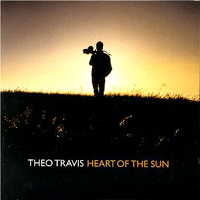
Theo Travis: ‘Heart Of The Sun’ 33 Jazz Records, 33JAZZ063 (5020883330631)
CD/download album
Released: 3rd September 2001
Little has changed in Tony Harn’s approach, but the Warrington fusion-rock guitarist has never sounded happier. His lyrical, tightly-controlled hard-rock drive is still set off against tumbling, multi-faceted art-rock arpeggios, plus enquiring shapes and vocalised textures drawn in from the world of modern jazz guitar. But the lightness of touch on ‘Moving Moons’ – and its renewed breadth of expression – makes it his most assured work to date.
This third album seems to be about simply enjoying the flow. Its gently sparkling mood is that of a well-pleased man, leaning sensually into his work. As ever, Harn (playing or programming all the instruments) blends his music without cynicism or self-consciousness about his comfortable sound. The bright, guileless weave of cyclic minimalism, gleaming Factory Records economy and judiciously-employed jazz-prog flamboyance retains Harn in a small, well-kept territory of his own.
You can trace a Pat Metheny legacy in some of those friendly guitar percolations, and that of Vini Reilly in the glittering, spindly-but-intricate echo-box patterns. But the overdriven keens of his lead lines have the affable, comfy edge of a ’70s geezer rocker – good-natured, puppy-rough and serenely blissful. At root, ‘Headstart’ is a Satriani-style rocker, growling from the pit of its sulky, dirty wah-rhythm and attempting to swagger. Yet Harn focuses and soothes it, opening the music outwards and festooning it with reflective pointillistic arpeggios; finally leading it towards inclusiveness and away from posturing.
Compared to the pastoral English flavour of Harn’s previous album ‘Lifebox‘, ‘Moving Moons’ is built on a summery Mediterranean warmth – hot nights of brilliant stars, or energising washes of daylight and bright stucco walls. Although Harn sometimes lets his airy keyboards dominate (especially on the pocket-funk throb of Pulsecode, synth riffs chuckling like contented babies), the pervading sound of the album is acoustic, or near-acoustic. Despite of the squadron of stratospheric rock wails and the sheath of Andy Summers textural swells, what really informs Jackal is Spanish guitar, all tangy attack and tremolo. Anger And Empathy provides a dynamic demonstration of Harn’s experimental side – a slow-motion volcano-burst of bent whammy-bar swells, scrapes and tortured violin-bow noises, all fed through outer-space distortions and echoes. But this too flows forward into another Spanish-styled guitar progression, clean and sweet: and ‘Safe Again’ is full of perky acoustic strumming as Harn takes flight, deliciously chasing his own echo.
Although this strays closer to driving music for the Algarve than it does to Paco Peña, Harn invariably saves the day with his ear for tunes, his knack for beautifully refracted arrangements, or his mastery of unabashed constructive naivety. The marriage of technology and innocence – a rare quality in guitarists – is Harn’s ace card, and a surprisingly effective one.
Moving Moons itself is a fragrant nightscape – tootling synths kissing up to arpeggio guitar and the sound of floats bobbing in reflective water. Sweet meteor trails of guitar-wail arc across the air for a rendezvous with moving cross-rhythms; and more spare, sweet paths of feedback show up on the deliciously lazy study of Standing In The Doorway To Your World. Here, they play over the gently assured structures built up by Harn’s synths and organs, or ease breathlessly across a classical-minimal duo of Reilly-esque clean guitars. Lake Song has Harn orchestrating a duet of twinkling post-punk guitar and hooting ’70s overdrive, the drumbox teased by reggae-tinted bass beneath those double-stopped minimalist patterns.
Generally avoiding the temptation to rampage incessantly across his fretboard, Harn’s drawn instead towards finding and sitting on pretty patterns. Sometimes this gets dangerously close to cuteness – the breezy Bubbleburst, for example, like a chance meeting between Alphonso Johnson and Brian May in the kids’ end of the jazz-rock pool. User One (Moon Two) also lives in the bright-eyed zone, bouncing its swirly jangle of notes against the night sky, keeping them up and moving via its pumping, lightly-whipped funk bass-line.
As a counterweight, Harn addresses his jazz leanings more substantially in a couple of loose fusion ballads. Time For Answers merges swing rhythms, prog assertions and a Django Reinhardt gypsy wriggle, leading them all through to a celebratory duet of guitar and tootling synth. Sixlowdown aims at the jazz pocket through the gaps of another reggae-styled bassline: a bubbling, tripping sway like a mid-’80s Miles Davis ballad, emphasized by the growl of bluesy distortion Harn employs for terse comments from the sidelines, flexing a few John McLaughlin sensibilities.
‘Moving Moons’ sometimes seems a little becalmed within its coasting motions – a touch too happy in its light’n’easy beauty – but with such lovely scenery to glide through, it’s little wonder that Harn’s opting to cruise easily. Ultimately, this time he’s offering beautiful liquid-gold guitar with its shoes kicked off, and whether you choose to join him on the sundeck is your own affair. But he couldn’t be any more welcoming if he tried.
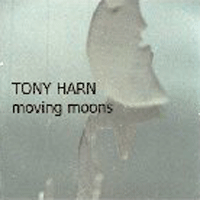
Tony Harn: ‘Moving Moons’
Tony Harn, THCD2 (no barcode)
CD-only album
Released: 2001
Swoon. /swo͞on/ A verb. To be emotionally affected by someone or something that one admires; become ecstatic. Here are some people and things that make me swoon. #swoon #swoonage


 Misfit City