Archive | July, 2000

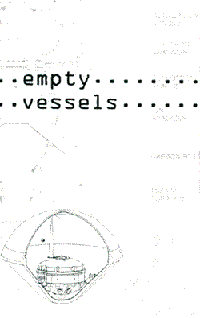
2000 – EP reviews – Empty Vessels’ ‘Empty Vessels’ EP (“uptight urban fuck-up music”)

14 Jul

Empty Vessels: 'Empty Vessels' (demo cassette, 2000)

Empty Vessels: ‘Empty Vessels’ (demo cassette, 2000)

Perhaps I was spoilt by the absolute flamboyance of David Devant And His Spirit Wife (a band of music-hall performance artists in Britpop camouflage, fronted by another Vessel) but I initially found Empty Vessels a bit underwhelming. Billing themselves as a “breakbeat/guitar soundclash”, I was expecting to be walloped around the head with seething snare cracks, to have my arse booted by kick-drum hits and my ears burned by electric wailings (all in a comfortable metaphorical way, mind). I was expecting festival style-ee-ee expansiveness. A sort of Asian Dub Foundation that had been gutted and stripped out, but were still rustling defiantly.

But Empty Vessels are less of a soundclash than a crowded minibus jammed with noises. They sound as if they do their recording in one of those tiny closets in Islington that estate agents try to flog to people as homes… or maybe in the cupboard of one of those closets. The usual claustrophobia of sped-up drum’n’bass-style breakbeats could only be amplified by these cramped, super lo-fi recordings; all skinny and vertical, never laying out when they can tense up. The sort of music inspired by hunching up and listening to hoarded CDs rather than by losing oneself on a sweaty, body-heavy dancefloor. Beat-science with a home chemistry set…

Nicotine is an unfortunate starter: neurotically trapped rushes of synth bass, shrill Killing An Arab-style guitar licks through budget fuzztones, and some pug-dog yelping courtesy of a bloke who sounds like Steve Harley forcibly bundled into a filing cabinet. Skip it for Chew-Up, a smarter shot in which all the beats are turned up and a careening sub-bass runs away with the foundations. Here the fuzzy shoulderings of guitar are a relief from the needling drums. The voice runs like a mumbling rat, complaining but flicking from rhythm to rhythm, and you find yourself wanting to catch on to what it’s ranting about. Empathising too much with your own sampler, it seems. “Chewing up experience, and chewing up experience… / It’s mine! It’s mine! / I acquire.”

Empty Vessels sound best when they don’t sound in control, when they’re running after their technology like it’s the last bus out of town. Sneering Face is one of those intriguing accidents that happen when you have white guys playing gladiatorial black dance music, desperately and unsuccessfully trying to get around their own whiteness, and ending up somewhere else entirely when they fail, sounding pretty liberated for it. While it starts as a wayward attempt at speed rapping (invaded by psychedelic space guitar echo), Empty Vessels have decided to fuck it all off about two-thirds of the way in and go for the ridiculous. Creaky vocal interjections that belong in Jim Henson’s Creature Workshop (“I – ought to teach them a leh-sson!”), seasick bloots of guitar, falsetto operatics wobbling in the background. The sort of vandalism that suggests they meant to do it from the start.

Uptight urban fuck-up music. Tower-block friendly. Angry summer sounds for days when none of your clothes seem to fit. I can’t say I like this, but it’s successfully sneaked into my curiosity field.

Empty Vessels: ‘Empty Vessels’ demo cassette
self-released (no catalogue number or barcode)
Cassette-only demo
Released: 11th June 2012

Buy it from:
The original cassette is long gone, although it was possibly reissued as a Peoplesound CD single which might be available second-hand. These three tracks have since been resurrected on ‘Empty Vessels 1‘, available from Bandcamp

Empty Vessels online:
Homepage BandcampYouTube

July 2000 – EP reviews – The Judas Factor’s ‘Kiss Suicide’ (“a cracked bleed of compassion”)

14 Jul

The Judas Factor: 'Kiss Suicide'

The Judas Factor: ‘Kiss Suicide’

This sticks with me. Unusual. Hardcore punk’s generally a thing of the moment; bringing you alive in the feverish moshpit (or while you’re skulking at the back, trying to listen through to whatever the core of the ‘core is). All that power, that typhoon of ire, just goes through you in a one-dimensional spasm. But under the volume, The Judas Factor (various refugees from Resurrection, Floorpunch, and Indecision) write about souls tender as eyeballs, bared hearts turned to stricken leather, and the struggle for emotional truth within a world drugging and veiling itself into brutal indifference.

 
When Robert Fish – the remarkable split-hearted voice of the band – isn’t roaring his lyrics flat against the ceiling, he murmurs in a cracked bleed of compassion, full of winded pain and the anger that wings across despair. Or he’ll burn up in a cathartic gesture, the distress flare bringing the message home. “Tongue-tied purist, rich in regret, sometimes it’s all I have… / kiss suicide, that look has found life in my eyes… / sad songs never felt so real / tears never felt so good” – although the descending metal storm of Kiss Suicide itself roots Robert’s identity in pure pain, he’s streets ahead of most punk noise-sulkers.

 
He could’ve chosen to stew in self-obsessed frustration. Instead, he’ll take things further, picking over the hope that sets us up (“we all want to be victims of happiness”). Or throwing himself unflinchingly into the loser’s diary of One Fine Day, where the job’s finally done by the bluntest possible tool. “Gun in hand, purpose, clear intentions… / All I ever wanted was control… / Now it’s in my hand… / Never should be, but for one sad second I felt control.” In Safety Net he’s sign-painting, putting up warnings for Bukowski’s camp-followers with the ruefulness of someone who’s been there already. “Human wrecks seem so romantic. / Play out that fall from grace one more time… / all we wanted was to find comfort with each other… / comfort for ourselves.”

 
The rest of The Judas Factor respond with music that fills rooms with rage and loss, led by a thrumming, thunderous bass hanging like a helicopter gunship while guitars paint alarms around it in every shade. And though they can do utterly bone-crushing, heart-wringing power – from the weird grandeur of the mourning thrash that clusters Music Without Person, from foreboding whisper right through to all-too-late nuclear alert – they can still play quiet like a child’s breath. And blend in little glowing samples; little graces of trumpet and heavenly pings swimming up out of nowhere, tiny opalescent Bark Psychosis moments before the mood breaks and jackhammers the heart open again. Even though Robert’s words are torn up in the screaming, clamouring emo-core peaks of anguish, it’s spellbinding.

 
What genuinely makes ‘Kiss Suicide’ a thing of wonder, though, is November 20, 1999, where everything about The Judas Factor falls into perfect place; from the frantic, muted, blizzarding rub of the instruments to Robert’s trembling delivery. A spoken story of lesbian awakening, aching with empathy and foreboding, it takes you (word by passionate word) to the delicious shock at the centre of that long-awaited first love. The one that draws you out of loneliness. And then, standing horrified, we see it forbidden: shattered in a sudden rush of violent bigotry. “You heard their footsteps and you told her to run. You turned around for the fight of your life. You never stood a chance in the world… In our names another life is taken. All because she loved another woman.” Up until then Robert’s kept his compassionate, anguished fury leashed, but finally it lashes out in a woodsplitting scream – “It’s not just words when we speak the same language / It’s not just words when some live life in fear” – as the band roar down like God’s gavel. Indelible force of heart.

 
The Judas Factor: ‘Kiss Suicide’
Revelation Records , REVELATION 92 (098796009222)
CD/vinyl EP
Released:
13th July 2000
Get it from: buy from Revelation Records store or Amazon; download from Google Play; stream via Deezer, Apple Music or Spotify
The Judas Factor online:
Facebook MySpace Last FM Apple Music YouTube Deezer Google Play Spotify Amazon Music
 

July 2000 – album reviews – Peggy Green’s ‘Songs of Naka Peida’ (“defiantly post-RSI pedal steel guitar music”)

6 Jul

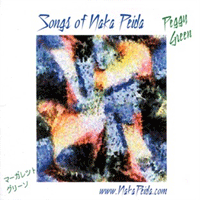
Peggy Green: 'Songs Of Naka Peida'

Peggy Green: ‘Songs Of Naka Peida’

Imagine working at something for the best part of twenty years. Perfecting it to your best ability, gaining a reputation and respect; making a decent living as well as finding a way to make it speak for you, give you another voice to communicate with. And then, all at once, having it taken away from you.

This is what happened to Peggy Green. Up until the point when repetitive strain injury gripped her working hands in 1990, she was one of the most respected pedal steel guitarists in New England; not to mention also crafting her way in private as a six-string player and songwriter. Subsequent neuromuscular complications during the ’90s robbed her, at various times, of the ability to use the blocking and rapid picking techniques which are the staple of pedal steel playing; to work the crucial left pedal of her instrument; to walk anything further than short distances without crippling swelling of the hands; or even to play for more than ten seconds. It’s the kind of situation which unites musicians – via both the heart and the pocket – in a cold sweat. The cut-off, seemingly irrevocable.

No, there isn’t a glitzy TV movie outcome. Peggy has recovered partially since then, but not completely. These days, you won’t find her duelling onstage with Buddy Emmons and Bruce Kaphan; or burning up Nashville pedal steel playoffs with a revitalised, zippier technique; or wearing Dolly Parton hats while having her hand shaken by the President. Life often doesn’t let us wallow in such easy tears and such feel-good endings. But what life can be is dignified.

Constrained by the cold facts of injury, Peggy could have retreated into honourable retirement, taking another job and accepting her loss as some kind of act of God. What she’s done instead does involve acceptance. But humble defeat? Not so. ‘Songs Of Naka Peida’ is a defiantly post-RSI album of pedal steel guitar music, played on a couple of custom built acoustic instruments built by legendary pedal steel maker Paul Franklin Sr. Dubbed “ped-a-bro”s, they merge the penetrating “jump-at’cha” sound of dobro resonator guitars with the flexible bends and glides of conventional steels.

As you can imagine, these are naked instruments – the kind which won’t hide a players errors behind a comforting wall of amplified smoothing. They’d be a challenge for a player in prime fitness, let alone one with hand problems, but Peggy’s chosen to make her way on them. Having accepted the limitations imposed by RSI, she’s dispensed with the flash and trickiness she could previously deploy for showboating country musicianship. Now she’s concentrating on a slow, considered, delicately melodic way of playing – clipped in approach; tailored to avoid the spasms, locks and numbness of the condition: a way in which she can, as she puts it “achieve that old connection between my soul and my hands.” She’s also elected to record in a way which makes every creak of the ped-a-bro mechanism and every shift of the player’s stool discreetly audible, so that you can hear her at work.

It works wonderfully. Peggy offers sparse, slowhand, bluesy playing nourished by lonesome American roots; at the same time she offers short, shallowly-picked notes with an exquisite attention to placement that’s associated more with East Asian music (with the yang ch’ins of China, the kotos of Japan and the assorted zithers of Carnatic music). These precise patterns can – at the right moment – be lifted off the map and up into the air, with just a push on a pedal. All of this is achieved with a patient grace and melodicism, the kind which wouldn’t shame Bill Frisell or Martin Taylor. Not that there isn’t some therapeutic wrestling with demons here. Titles like Achin’ Deep Down In My Bones and Fair Affliction assure us of that. But most of ‘Songs Of Naka Peida’ is – while never transcendently happy – remarkable in its serenity.

There’s also a background concept here. The album has a speculative yarn attached: a self-referential creation with strong flavours of Ursula K. LeGuin. In the stricken, disaster-oppressed Continuum society of the future, Naka Peida is the name of a character – the Continuum’s Chief Archivist. Each song on the album is linked to a story of the rediscovery of Peggy’s music, and its connection and implications to both Naka Peida and the Continuum. Evidently Peggy’s not interested solely in her own healing.

The music travels on, learning from places as it goes. There’s the graceful glissandi of Koroen; the tart, sparkling Indian cascades of Love’s Last Chance; the welcoming Japanese formality of Nakahama (named after the location where most of the album was both written and recorded) or the curving Hawaiian warmth of The Pedalist or Wrong Stop Blue. If the music doesn’t necessarily draw from a sense of place, it can draw from time instead. One of the approaches Peggy uses is to place herself in a particular moment. Goodbye To The Twentieth Century was recorded in Osaka on Millennium Eve, and comes out as the most hopeful piece on the entire album. Affected by its Japanese setting, it also revels in its vertiginous, playfully lovely slides and swoops, in the celebratory birdsong harmonics. For a moment, Peggy even lets the ped-a-bro sing with the jazzy bends of Billie Holiday.

The three-part Improvisations In The Moonlit Dawn (billed by Peggy as being “the closest you can come to sitting with me while musical ideas are being born and tried out”) comes from a February morning, closer to home in New York. It’s more sober (Five Note Blues is positively respectful) and more American (you could even expect Robert Johnson to be moaning over Evening Turns). Finally, it’s brasher when the punchy, multiple stop-and-slide slowhanding of Make Way For Dawn makes its presence felt. Assertive, muscular and far more assured than you’d have expected, it still loses none of the delicate melodicism of the rest of the album.

“My struggle against the adversity of my injury makes me the player I am today,” notes Peggy. Whatever she may have been before the axe fell, she’s a pretty remarkable player now. Without much of a big sound, without banner-waving, this album is quietly inspiring and humbling: even profoundly moving.

Peggy Green: ‘Songs Of Naka Peida’
Peggy Green (self-released),  MHG737 (no barcode)
CD/download album
Released: 27th June 2000

Buy it from:
CDBaby, CD Universe or iTunes or Amazon MP3 Store.

Peggy Green online:
Homepage

SWOONAGE

Swoon. /swo͞on/ A verb. To be emotionally affected by someone or something that one admires; become ecstatic. Here are some people and things that make me swoon. #swoon #swoonage

Post-Punk Monk

Searching for divinity in records from '78-'85 or so…

theartyassassin

...wandering through music...

Get In Her Ears

Promoting and Supporting Women in Music

Die or D.I.Y.?

...wandering through music...

Music Aficionado

Quality articles about the golden age of music

THE ACTIVE LISTENER

...wandering through music...

Planet Hugill

...wandering through music...

Listening to Ladies

...wandering through music...

ATTN:Magazine

Not from concentrate.

Xposed Club

improvised/experimental/music

The Quietus

...wandering through music...

I Quite Like Gigs

Music Reviews, music thoughts and musical wonderings

furia log

...wandering through music...

The Recoup

SINCE 2013: Books and books and books and books and occasionally other things

A jumped-up pantry boy

To say the least, oh truly disappointed

PROOF POSITIVE

A new semi-regular gig in London

Gapplegate Classical-Modern Music Review

...wandering through music...

When The Horn Blows

...wandering through music...

:::::::::::: Ekho :::::::::::: Women in Sonic Art

Celebrating the Work of Women within Sonic Art: an expanding archive promoting equality in the sonic field

Ned Raggett Ponders It All

Just another WordPress.com weblog

FLIPSIDE REVIEWS

...wandering through music...

Headphone Commute

honest words on honest music

The One-Liner Miner

...wandering through music...

Yeah I Know It Sucks

an absurdist review blog

Obat Kanker Payudara Ginseng RH 2

...wandering through music...

poplifer.wordpress.com/

Waiting for the gift of sound and vision

Good Music Speaks

A music blog written by Rich Brown

Do The Math

...wandering through music...

Archived Music Press

Scans from the Melody Maker and N.M.E. circa 1987-1996

The World's Worst Records

...wandering through music...

Soundscapes

...wandering through music...

OLD SCHOOL RECORD REVIEW

Where You Are Always Wrong

FRIDAY NIGHT BOYS

...wandering through music...

Fragile or Possibly Extinct

Life Outside the Womb

a closer listen

a home for instrumental and experimental music

Bird is the Worm

New Jazz: We Search. We Recommend. You Listen.

...wandering through music...

Life Just Bounces

...wandering through music...

Lucid Culture

JAZZ, CLASSICAL MUSIC AND THE ARTS IN NEW YORK CITY

Aquarium Drunkard

...wandering through music...

eyesplinters

Just another WordPress.com site

NewFrontEars

...wandering through music...

FormerConformer

Striving for Difference