Archive | July, 1999

July 1999 – album reviews – Tony Harn’s ‘Lifebox’ (“settle into the music’s bright and rapid embrace”)

24 Jul
Tony Harn: 'Lifebox'

Tony Harn: ‘Lifebox’

Since striking out on his own with ‘From The Inside‘ in 1997, Warringtonian guitarist Tony Harn has gone from strength to strength. It’s not that ‘Lifebox’ is all that different from its predecessor. It’s the same recipe of glittering, admirably economical rock guitar arrangements backed up by simple keyboard sounds and lightly-cymballed percussion programming – the sort of thing that would have made Harn a hero of British instrumental rock in the 1970s, or even the ’80s. In the late ’90s, it makes him more of a finely-tuned curio. A guilty pleasure.

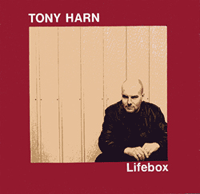
Still, being out-of-step with the times has little to do with your innate value; and Tony Harn’s got plenty of that. His concept of melodic rock moving towards a jazz vocabulary has had to pass through a Manchester filter first. There’s a lot of meticulousness and post-industrial reserve here, an underlying balance of sounds and patterns that’s got more to do with Factory-style Futurism than feet-on-monitors and flailing hair. Not that Harn’s cover photo – the purposefully-shaven skull and meaningful gaze – shows hair to flail anyway.

In a nutshell, Tony Harn is what Joe Satriani might have been if he’d had Durutti Column’s sensibilities. His full-blooded melody-metal tone, his tunefulness and his sweet tooth for rock romanticism is reined in by Northern English economies on gesture and gush. Except for a solitary Van Halen moment – a short-lived explosion of devil fingers called Reaction:Release (In One Motion) – all is controlled and thoughtful. Layers of staccato echoed phrasing and delicate flat-picked motifs interplay with tuneful, assured lead lines. Harn’s guitars can chatter and circle busily, or pine away in expressive overdriven wails, all without letting the music lose its well-suspended balance. It can be as dignified as fine civic architecture, or it can roll like a landscape of green English hills. Pastoral, but never pastel; surprisingly serene, but not soporific with it.

And (if all of this isn’t starting to sound too cute) proggy without being boggy. Since the sometimes-perfunctory tunes of ‘From The Inside’, Harn’s developed a well-deserved confidence in taking on longer-form compositions. The fifteen-minute, multi-phase Reaction:Repeat (In Six Motions) bubbles with understated invention – it’s a drawn-out, trance-y rockscape of shifting heroic tunes and dance pulses, bouncing off the same constellations as Porcupine Tree did on ‘Voyage 34’. Split The Sketch jumps from sleepy church music (cavernous swells, sweet-dream melody and the chink and whisper of string noise) into the sort of split-metred riffing and racing arpeggios that Steve Hackett would’ve been happy to set his name to. Blue Blazes doesn’t go for length, but for shimmering detail, weaving tiny repetitive phrases into sky-written spirals around an airborne ripple of synth.

Even if his silvery jazz-inflected chording doesn’t quite qualify these efforts as fusion, Harn’s push towards jazz is becoming easier to distinguish. You can hear him trying out conversations with the themes in Eve Of Obligation; and if you listen beyond the diamante guitars on Pseudotalk, you’ll hear a pretty, melting tune that wants to sit down with a jazz quintet and make friends. But if Harn does move into that world, it shouldn’t be at the expense of the straightforward and joyful way he expresses his melodies – the folkiness of Last Town, the wedding bell tumble of Twelve Years, or how his romantic heart sits self-evidently on his sleeve for Forgotten Summer as his guitars and bass court each other. It shouldn’t be at the expense of digressions into haunting soundscaping such as Dark Age; in which, through organ drift and dreaming guitar sculptures, a girl’s guilt-stricken voice murmurs “I never used to think about it before.”

This, after all, is that rare breed of rock guitar album – one which you play not to worship at the Church of Guitar but to settle into the music’s bright and rapid embrace, and to lean back into it. ‘Lifebox’. A good name for such an unassuming package, spilling out such fertile enthusiasm.

Tony Harn: ‘Lifebox’
Tony Harn, THCD2 (no barcode)
CD-only album
Released: 1999

Buy it from:
Limited availability – contact Tony Harn for information.

Tony Harn online:
Facebook MySpace YouTube

July 1999 – album reviews – Darkroom’s ‘Seethrough’ (“dropping casual, vinegar-dry references while somehow maintaining a ghostly mystique”)

22 Jul
Darkroom: 'Seethrough'

Darkroom: ‘Seethrough’

Transparent neither in style nor intent, Darkroom’s second album is demanding, mysterious; trickily opaque. This is not an unfamiliar position for this most obscure, obscured and inexplicable of ambient/illbient groups. The billowing instrumentals of Darkroom’s first album, ‘Daylight‘, made their points obliquely through a spray of trip-hop grace, thick detail and industrial derangement. About half of ‘Seethrough’ follows a similar path – baleful/beautiful semi-improvised noisescapes of layered electronics, angrily-stewing loop guitar and naked caress-through-to-howl vocals.

Resident synth necromancer Os fires off ratlike background rattles and spectral drum’n’bass rhythm triggers on the glutinous and dubbed-up Galaxy Craze, a threatening arrhythmic undulation in which Tim Bowness’ minimal, wraith-like subway singing is menaced by a fretless bass guitar part which probes like a giant animal’s tongue. On Charisma Carpenter, old-school ’80s synthpop riffs underpin the dense aviary heat of Michael Bearpark’s textured guitar. These OMD-styled tinklings make an unexpectedly cheerful counterpart to Tim’s lustrous and vaporous vocal chanting, which remains the most bizarre aspect of Darkroom’s music. Singing mere tumbling vowels, or sounds on the edge of becoming words, Tim delivers them with an eerily precise and chilly diction: like droplets of love-song which freeze to alien sleet as soon as they leave his mouth.

In spite of the textural invention and intelligence at work, only Kaylenz hints at the shocking intensity of Darkroom at full, live, improvising intensity. It takes up fourteen sprawling, disorientating minutes of the album, during which the tension between the celestial and the pestilential growing ever more violent. Electronica loops shade upwards into alarm, distorted hospital bells shrill. Mike’s country-toned guitar tang gives way to sharp buzz-edged swarming, while Tim’s vocals travel from weary, loving sorrow to a hysterical pitch of recriminations and a dash of lyrical perversity. Just before Kaylenz steps up – or breaks down – into a chaotic torrent of frighteningly emotional randomness, we hear Tim singing in a lost corner of the studio: a bored, beautiful, detached whisper of “you again, you again – / who’s to blame, if it’s all the same?”


This brings us to the wild card of ‘Seethrough’ – the presentation of Darkroom’s songwriting side, in which they sketch withering surreal portraits of disenchantment and alienation helped along by spacey glissandos of electric slide guitar. They’ve dabbled in words before (on the drum’n’bass/Fripp & Eno soundclash of the Carpetworld single) but here it’s more leisurely, more controlled; more disturbing. In some ways it’s an extension of Tim’s work on the cryptic dark-city musings of No-Man’s ‘Wild Opera’. In others it reflects the burnt-out, amoral contemplations of Tricky’s surreal, spliff-fuelled ‘Maxinquaye’.

If so, this is Tricky as played by Alec Guinness, dropping casual, vinegar-dry references to both Def Leppard and Janet Frame while somehow maintaining a ghostly mystique unhindered by the flapping of library cards. On the bobbing Morricone-meets-Orb dub of King Of The Cowboy Singers, Tim’s guarded, musical speaking voice recites both nonsense and significance to the beat – “trying to find a new life in an old boot, / walking to the new place in your old suit – / the king of the cowboy singers, / the toast of the Old School dinners…” The roiling, improvised star-stuff that usually pools out of Darkroom’s speakers is swapped for Dada-tinged narratives of shifting identities and habits; of introverted, stiffly English insanity and implosions of a starchy order.

Having said that, although Darkroom no longer quite sound as if they’re playing live from the surface of the sun, they’ve only retreated as far as a ski-lodge on Mercury. The glimpses of sky are always a bright merciless glare, the ground always dry dust; the scenery just a few steps away from white-out. Surly and blinded, Bludgeon Riffola surfaces through a swimming of harness bells as a filthy punk-blues fed through post-rock processing and glowing tracer-paths of needling synth-noise, Tim’s petulant vocals rope-swung and curdled with distortion.

The album’s masterpiece – the ten-minute stretch of Bottleneck – is blindingly white and exposed; a sinister mixture of Aphex Twin and Bill Frisell. Sparse, desolate slide guitar is chewed at by Os’ echoing dead-sea-surf static and smeared brass textures. Tim’s lonesome vocal (once it finally arrives) rides a stately dance of plucked orchestra strings, drawing out the shapes of a puzzle of betrayal and disgust. The charges are clear – “You never really loved your wife… / you never really knew your boys… / you never even liked the girl you said had claimed your heart – restart, restart.” But the story’s obscured: gaps between snapshots swallow it up. The figure of a man is reduced to a hat, a cigarette; an unfinished meal; an absence.

Then again, Darkroom aren’t here to provide clarity. Seethrough itself seals the album in a light and feverish running pulse, frosted by far-off gilded sprays of reserved prog-rock guitar. It’s tremulously sweet and frantic – trance-techno that’s neurotic rather than narcotic – and with a blurred, vocoder-ed vocal that queries the giddy transcendence of the music. “Too much misunderstanding; too much, too little love. / Too much to keep your hand in, too much to float above.” Dancing lightly on its feet, it moves with the crowd only to slip away quietly as the dreams evaporate. “Too much deliberation, too much you want to be. / Too much anticipation, too much you’ll never see – see through, seethrough.”

Blink, and it’s gone. Darkroom tease us with clarity, but lead us to a vanishing in the end.

Darkroom: ‘Seethrough’
Peoplesound, ART 4249-CD01
CD-only album
Released: 1999

Buy it from:
Original release deleted. 2003 remastered CD-R version available from Burning Shed; download version from Bandcamp.

Darkroom online:
Homepage Facebook Twitter MySpace BandcampLastFM

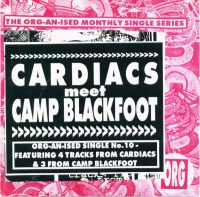
July 1999 – EP reviews – Cardiacs/Camp Blackfoot’s ‘Cardiacs Meet Camp Blackfoot’ EP (“an explosion in a fairground repair shop… a belting mixture of howling-for-vengeance free-jazz saxes, prog-from-hell and hardcore trash-blues”)

12 Jul
Cardiacs/Camp Blackfoot: 'Cardiacs Meet Camp Blackfoot' EP

Cardiacs/Camp Blackfoot: ‘Cardiacs Meet Camp Blackfoot’ EP

You already know Cardiacs, or you ought to. They’re that gang of besuited gentlemen from Chessington, Kingston and Milton Keynes – upsetters of pop rules known for busting out of tight waistcoats, with a sound like an explosion in a fairground repair shop. And who specialise in hatefully brilliant singles midway between masochism and ecstacy, as pleasurable as scratching a really luxurious, pestilential itch.

‘Sleep All Eyes Open’ doesn’t let that line of guilty pleasures down, tying knots in Super Furry Animals and The Glitter Band to make a glammy mess of noisy guitars and monkey-gland logic. Here’s something that really enjoys how gloriously dumb-to-the-max it is – listen to those handclaps, and that dum-dum riff bouncing its knuckles along the ground. Yet it evolves fast, ideas yomping around, running off into ever-more crowded angles and arguments while Tim Smith yelps like a circusful of trampolining dogs. Cardiacs always cram their songs to bursting point but never lose any of it to blind alleys or prog meandering. And if I still haven’t a clue what they’re singing about, I think there’s something in the back of my head which does, whooping and waving a flag whenever I hear them let something like this out of the box.

The five-year-old bonus tracks (from the mind-boggling ‘Sing to God’ album) haven’t worn badly either. ‘Dirty Boy’ hammers and claws through seven minutes of huge black-metal guitars and ends up flailing against the wall in an ecstatic stuck groove of wailing choir and electric-shock organ. Foundling is a mediaeval creak of sleep, death and aching men’s feet, worthy of Robert Wyatt. Finally, there’s a celebratory, singalongaTim instrumental mix of ‘Insect Hooves on Lassie’ – and that’s so tuneful it could get a corpse up and idiot-dancing within seconds. These guys are old enough to be Blur’s granddads, for God’s sake – how come they still make almost any other British rock group sound half-hearted and half-asleep?

Camp Blackfoot, hanging onto the other half of this EP, grab the challenge with both hands and a ravening mouthful of teeth. It says here that they’ve chewed their way out of the corpse of Thirteen Ghosts (Oxford’s finest in thrash-improv… hmmm), and they don’t bother with all that business of the dichotomy between social discipline and chaotic emotions. They just hit the record button and scream. A belting mixture of howling-for-vengeance free-jazz saxes, prog-from- hell and hardcore trash-blues comes tumbling out onto the carpet and burns a huge hole in it. Somewhere, Lester Bangs is laughing his head off.

If you wanted to hear serious avant-garde psychobilly locked into a no-holds-barred deathmatch with art-noise, you’ve come to the right place. Ruins forcibly manhandling the Blues Explosion into a blender wouldn’t even come close to the shredding monster-movie music of ‘The Blue Hood’; while ‘The Other Giaconda’ is what might’ve happened had King Crimson ever really exploded onstage in squalling Stooges style, neurotic precision blowing the safety valve a foot deep into the ceiling. And ‘The Red Mist’ tops the lot- squiggly Morricone noises that burst into enormous barbed- wire riffing and an epically hallucinating murder song, a weird doomed narrative which sees a desperate man’s mutter rising to a horrified scream: “The street melts under my feet… I’m drowning in a boiling sea of salt,/ faces are ugly / I – Mother of God!”

Songs to crash your car to, and the soundtrack to strutting away from the blaze looking cooler than ever. Not really something that works with Coldplay, I think.

Cardiacs/Camp Blackfoot: ‘Cardiacs Meet Camp Blackfoot’
Org Records, ORG 056CD (5 028151 010568)
CD-only EP
Released: 12th July 1999

Get it from: (2020 update) Limited edition of 1,000 – best obtained second-hand.
Cardiacs online:
Homepage Facebook MySpace Soundcloud Bandcamp Last FM Apple Music YouTube Google Play Pandora Amazon Music
Camp Blackfoot online:
Homepage MySpace Last FM YouTube Amazon Music

July 1999 – mini-album reviews – Philip Sheppard’s ‘The Glass Cathedral’ (“a whole chamber of cellos swimming off in a new direction”)

7 Jul
Philip Sheppard: 'The Glass Cathedral'

Philip Sheppard: ‘The Glass Cathedral’

Reluctantly, as the music finally dissipates into quiet, I surface for facts – and here they are.

Philip Sheppard is cellist with the Composers’ Ensemble and with The Smith Quartet (a London answer to New Music ensembles like Kronos Quartet). He’s taken on the knotty work of Michael Tippett and Oliver Knussen: his list of close collaborators outside the classical world have included Abdullah Ibrahim and Jeff Buckley. Freed from the demands of repertoire and support roles, his own music for solo cello leads into meditative, overlapping multi-tracked soundscapes.

That’s the definition, the bare bones of it. A modern-classical musician, as composer-performer, looping or patterning processed sounds in the path followed by Terry Riley, Steve Reich and Gavin Bryars, and by Robert Fripp and Brian Eno.

This doesn’t convey how far beyond the plain facts of the process Philip Sheppard gets – how he’s boiled down the structure of classical expression to small and beautiful hints in a sustained electrophonic atmosphere. The captivating and wonderfully played music on ‘The Glass Cathedral’ is close, in its way, to the devotional reachings of Fripp’s ‘A Blessing of Tears’: but it’s more abstract, a music of suggestions and amnesia. Philip manages to suggest vistas of embracing vastness with simple and delicately executed elements gradually mixed into an ever-expanding palette of cello textures, running from a discordant plumbing-scrape to an overwhelming snatch of piercing, striving melody. There are only two pieces on here, both vastly different, both extraordinary.

‘Harrison’s Chronometer’ uses Philip’s electric cello – a custom-built five-string cyborg which readily sinks itself into an evanescent minor-chord drone, gradually resolving and passing through moods; a Mahler trance in multi-track. The name’s taken from the 18th century timepiece designed to revolutionise navigation and safety at sea; providing a fixed, reliable timekeeping process, aiding judgement of distance, mapping and location. Inspired by this, the music sounds like a steady, resolute voyage through half- known climes, as Philip fills the air with the sounds of beasts and uncertainties. String snarls slide and slink away, high harmonics keen and shiver. Low, rumbling deep sea monsters scrape away in the bass registers.

Living but impersonal detail builds up, as gorgeously and inhumanly hostile as a crystal jungle; and into this comes tentative tracings of order. There’s a high pulse; a sawing Greek riff of chorused cellos; snap-and-lock ostinatos in the bass recalling the clipped Mediterranean funk of Mick Karn. A melody materialises in the alto range, cleanly distorted – to the point where it finds a rough perfection – but it tails out. Nothing is resolved; eventually the music fades away into the dark, although its recognisable touches are still isolated within the surrounding chaos. Expressive to the last, they sit like lonely markers; or like humans in a small, fragile boat on brutally indifferent seas that have hardly even begun to yield their perilous secrets.

Compared to ‘Harrison’s Chronometer’, the title track of The Glass Cathedral is sublimely peaceful: though in its own way it’s just as deliquescent, just as much part of that territory where post- classical meets post-rock and where both begin to blend with the subtle dissolutional anarchy that is drift. It’s played on a vintage cello with a history implied rather than certain: a mid- 8th century instrument possessed of a rich verdant tone and traced back to an anonymous London craftsman. Whether its ambiguous story is true or false, I’d like to think it informs the piece, which has hints of more intimate John Taverner compositions but links back to the past via a quote from Monteverdi’s ‘Orfeo’ which coalesces and dissolves throughout the composition.

Here, the music seems to wake itself in sensual, melodic stretches of cello, in exquisite glass-harmonica deviations of sound. It is like drowsing inside a translucent sacred building, allowing a whole day to become a time-exposure. Overdubbed drones and harmonies acting like light beams, branching off at odd angles, allowing the corners of the church to be lit gently and briefly before the source slides off somewhere else. A solo cello establishes itself in centre with a contemplative, yearning changing theme. It gives dominance over to the light angles and the Monteverdi fragment… then, as if shot through a prism, a whole chamber of cellos are swimming off in a new direction, embarking on a related theme, only to dissolve out gently in loosely woven trios.

I’d say more, but I’m already spewing too many abstractions. It’s enough to say that if it’s true that architecture is frozen music, then this is (just as equally) a beautiful, dissolving architecture.

Philip Sheppard: ‘The Glass Cathedral’
Blue Snow, BSNCD1 (no barcode)
CD/download mini-album
Released: 5th July 1999

Get it from:
CD version best obtained second-hand: download available via Bandcamp.

Philip Sheppard online:
Homepage Homepage Twitter Bandcamp

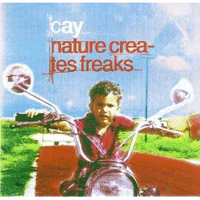
July 1999 – album reviews – Cay’s ‘Nature Creates Freaks’ (“red-hot gravelly tones”)

6 Jul
Cay: 'Nature Creates Freaks'

Cay: ‘Nature Creates Freaks’

On a quick listen you might be tempted to put Cay straight into the femme-noise box, however much you thrill to them. There’s the loose-wired slangy racket of the two guitars, the American-styled punk roars of instruments and voice, the general “let-off-the-leash”-ness of this album. Not least, there’s the striking vocal and visual presence of Anet Mook up front; defiantly anti-glam but compelling the attention anyway, ripping the frets out of her guitar and scorching her vocal chords with her flammable yell.

There’s also the album’s clutch of rackety singles. The mixture of pattering, jangling drag-racer suspension and blazing gasoline riffola in ‘Better Than Myself’; the pure punk venom of ‘Princes and Princesses’ which all but drags a friend out of the comfort of collusion, spitting and chiding (“perverted decent little thing, I hate your guts cos they don’t exist”) prior to burning away with her down the road as if trying to rewrite ‘Thelma & Louise’ as guitar flare. The violence of ‘Neurons Like Brandy’, which feeds off a familiar Nirvana-ish alternation of quiet and loud, but sped up to a unnerving back’n’forth flick between stroke and punch; all to display the swerving of a love shot through with pills and booze, bonds and walls, focus and absence… of contradictions that won’t hold, but won’t break easily enough.

Not that the album tracks give much away to the singles, either. ‘Reasonable Ease in Chilled Out Conditions’ leaps around its cage with enough aggression to punch out my speakers, and possibly my lights too. Cay attack the song as if they’re trying to singlehandedly relaunch punk in a shower of crunching bass and Uzi drum slams. Here, Anet sings like a suave skinning knife: her harsh, vicious slurs crack like a whip, and she chews words like gum. “And all the snow will melt away, / another week’ll come to stay, / to help you pull your little scam… / ‘Cos in the end you’re leaving like a sound! To be honest, I don’t know what the fuck she’s on about (cocaine madness, perhaps) but when Cay can fire it fifty miles up into the air via ten million volts of guitar I don’t particularly care.

There’s enough unleashed rage here to satisfy the grrlpunk board, though the fact that the other three Caypeople are men might brand them, to anyone drawing up the passports, as more Blondie than Bikini Kill. Yet… there sounds as if there’s more to Cay than just a femme-fronted burst of punk power which’ll burn itself out in a sorry gulp of lost fuel in a year or two. The truly compulsive thing about Anet’s voice isn’t the anger; it’s the permanent note of astonishment that cuts through those red-hot gravelly tones. It’s a yelp of instant reaction to anything (whether it’s introspection or copping an insult). It makes her someone who’s always on, always with the nerve to jump back or jump in.

In counterpart, there’s the detail work performed by Nicky Oloffson, Cay’s deceptively quiet-mannered guitarist and lateral thinker. He brings the odd noises, the jazz-chords that slip questions in; the art-textures that clink and keen in the mix, the sweet strums and battered song-sighs that break up the heat-blasts. Cay might have more of a chance of a commercial breakthrough than most – there’s an arresting hookiness balancing their controlled chaos – but there’s clearly an art-rock band evolving inside this tight, powerful metalcore package.

As well as the usual punky suspects, Cay’s love-list includes the evolving, protean King Crimson. This is a good sign, and explains how they can pull off such a wondrous effort as the album’s title track – a beautiful mix of punk power-chords, an ecstatically bruised and revelatory vocal from Anet, and a long moment when the rock rolls aside to reveal a heartfelt swathe of inner-space guitar melodies. On the rougher end, it also explains the parade of tempo-chopping riffs on Senseless – skirting points from ‘Purple Haze’ and ‘Larks Tongues in Aspic’ through to Nomeansno and fully enraged hardcore punk, with a slam of alarm bells.

And then there are Anet’s lyrics, which dodge gesture politics or party rhetoric (of either kind). Most of the time they’re both simple and opaque. There’s some ragged individualism, some slippage between connections and independence. More often, though, they’re a discombobulated and shifting matrix of ideas, truths and motivations (with a hefty sprinkling of drug talk and quarrelling). They show life as it tends to appear to the over-curious – suspect; tenuously woven together. Something blurred by the changing loyalties and dependencies of unsettled lives where there are more questions and rejections than there are answers.

On the country-ish billow and scrub of ‘Come Out’, Anet is certainly questioning, though she’s questioning no-one in particular unless she’s trying to put a face onto the forces of chance. Cay seem to accept the unreliability and conflict in human flux… and unusually, they even accept their own. In the middle of the colossally aggressive guitar screams and sardonic vocal squalls in ‘Reasonable Ease in Chilled Out Conditions’, Cay slip gently into a embracing strum while Anet sighs “when we both come down, when we’re both worn out, / that’s where we should meet…”

A moment of unlikely grace, but then Cay are a band with unexpected depths.

Cay: ‘Nature Creates Freaks’
EastWest Records, 3984277462 / 3984277461
CD/vinyl album
Released: 5th July 1999

Get it from:
Bandcamp (CD or vinyl best obtained second-hand)

Cay online:
Facebook Bandcamp Last FM

SWOONAGE

Swoon. /swo͞on/ A verb. To be emotionally affected by someone or something that one admires; become ecstatic. Here are some people and things that make me swoon. #swoon #swoonage

Post-Punk Monk

Searching for divinity in records from '78-'85 or so…

theartyassassin

...wandering through music...

Get In Her Ears

Promoting and Supporting Women in Music

Die or D.I.Y.?

...wandering through music...

Music Aficionado

Quality articles about the golden age of music

THE ACTIVE LISTENER

...wandering through music...

Planet Hugill

...wandering through music...

Listening to Ladies

...wandering through music...

ATTN:Magazine

Not from concentrate.

Xposed Club

improvised/experimental/music

The Quietus

...wandering through music...

I Quite Like Gigs

Music Reviews, music thoughts and musical wonderings

furia log

...wandering through music...

The Recoup

SINCE 2013: Books and books and books and books and occasionally other things

A jumped-up pantry boy

To say the least, oh truly disappointed

PROOF POSITIVE

A new semi-regular gig in London

Gapplegate Classical-Modern Music Review

...wandering through music...

When The Horn Blows

...wandering through music...

:::::::::::: Ekho :::::::::::: Women in Sonic Art

Celebrating the Work of Women within Sonic Art: an expanding archive promoting equality in the sonic field

Ned Raggett Ponders It All

Just another WordPress.com weblog

FLIPSIDE REVIEWS

...wandering through music...

Headphone Commute

honest words on honest music

The One-Liner Miner

...wandering through music...

Yeah I Know It Sucks

an absurdist review blog

Obat Kanker Payudara Ginseng RH 2

...wandering through music...

poplifer.wordpress.com/

Waiting for the gift of sound and vision

Good Music Speaks

A music blog written by Rich Brown

Do The Math

...wandering through music...

Archived Music Press

Scans from the Melody Maker and N.M.E. circa 1987-1996

The World's Worst Records

...wandering through music...

Soundscapes

...wandering through music...

OLD SCHOOL RECORD REVIEW

Where You Are Always Wrong

FRIDAY NIGHT BOYS

...wandering through music...

Fragile or Possibly Extinct

Life Outside the Womb

a closer listen

a home for instrumental and experimental music

Bird is the Worm

New Jazz: We Search. We Recommend. You Listen.

...wandering through music...

Life Just Bounces

...wandering through music...

Lucid Culture

JAZZ, CLASSICAL MUSIC AND THE ARTS IN NEW YORK CITY

Aquarium Drunkard

...wandering through music...

eyesplinters

Just another WordPress.com site

NewFrontEars

...wandering through music...

FormerConformer

Striving for Difference