Archive | August, 1998

August 1998 – EP reviews – No-Man’s ‘Carolina Skeletons’ (“loaded with meaning, swollen thick with suppressed tears”)

29 Aug

They claim it as “a totally new approach” for the band, but thankfully, this time they’re wrong. After the diverse experimentation of the ‘Wild Opera’ and ‘Dry Cleaning Ray’ albums, it’s more of a look back to their roots in the deceptively simple, poignant flush of ambiguous romance. No-Man are going home. And as they do, this falls – as if from a worn-out pocket – into our hands.

Carolina Skeletons could just be the finest single No-Man have ever released. A rhythm track like a weary hubcap rolling its way home; Steve Wilson’s lovelorn, restrained piano and sleepy, teary guitar touches. A simple, unchanging dynamic evoking both a state of grace and a state of stagnation. A set of chords that fall, question and resolve – heartbreakingly – around Tim Bowness’ quietly yearning vocal. A distant almost inaudible organ, hovering like a night scent. And a short glimpse of a few moments of a trapped life.

It’s a snapshot of a lonely woman paralysed by inertia, watching as time “strips the tinsel from her hair” and the mingled forces of gravity and grief tug her down. It has the same sketch-like quality of American Music Club or The Blue Nile – a few lines loaded with meaning, swollen thick with the suppressed tears – and breathes out, with its eyes closed, the same ineffably bruised air as Mark Hollis’ melancholy reveries. You get a feeling that for its solitary anti-heroine, Cowboy Kate, time is slowing but history has already halted.

So much for the lead track. But the whole EP shivers with an underlying, understated tension; the sort of slight ache that nags and means that at best only a flawed and brittle peace is possible. Caught up in the acoustic guitar webbing of Something Falls, Tim’s words are entangled and shivering in the anticipation of a shock to come: “You’re far too near it to feel it… / You’re far too near it to fear it…”

In Close Your Eyes (a swoonier, more grace-inspired take on their old Desert Heart epic) Mellotron strings hover near or retreat over rolling slot-drums: elegant stalkers on the uppers of their nerves. Twinkles and illuminations come and go like soft offshore lights – halfway through a guitar screams alone in the middle distance. Caressed, Tim sings a beatific, burnished chorus while the verses hint at love, violence and dependency: “His hands were hard, your face was soft. / He kissed your heavy head – and then you lost your strength…” It ends on a poised and prolonged outbreath, with Tim wailing passionately into the void up ahead: “You break, you swim alone, like a child…”

To close – a reverberant, distant, Budd-like reprise of the Carolina piano line in all of its beautiful worn-down dignity. The dust blows forward and the dust blows back. Sometimes all there is to do is to carry on, face set to the wind and tears stroked back towards where you’ve come from. Beautiful.

No-Man: ‘Carolina Skeletons’
3rd Stone Ltd., STONE037CD (5023693003757)
CD-only EP
Released: August 1998

Get it from: (2022 update) Original CD EP best obtained second-hand. The title track (and a different version of ‘Close Your Eyes’) ended up on No-Man’s ‘Returning Jesus’ album in 2001: all of the EP tracks were reissued on the triple-vinyl release of ‘Returning Jesus (The Complete Sessions)’ in 2006.

No-Man online:
Homepage, Facebook, Twitter, Soundcloud, Last.fm, YouTube, Instagram, online store, Apple Music, Deezer, Spotify, Amazon Music

August 1998 – EP reviews – Magnilda’s ‘Clocks Are Like People’ demo EP (“slightly more mad cow-ards than Noel Cowards”)

20 Aug

Magnilda: 'Clocks Are Like People' EP

Magnilda: ‘Clocks Are Like People’ EP

Sing ho! for British beef!

This pops into my head because (a) Magnilda are so proudly chunky, beefy and muscular, especially Connon MacRae’s assured and dextrous lead guitar; and because (b) they’re ever-so-slightly deranged, weaving together pop that merges the wistful and the sly, the romantic and the easily distracted via a series of songs which build up like houses of cards, complex and always teetering on the edge of a tumble. Which leads us to (c) – the fact that their nutty drawing-room demeanour warrants a suitably Olde English exclamation. As with The Divine Comedy, these are songs best listened to while wearing a monocle and attempting to playfully clobber someone with a croquet mallet. In the library. With Miss Scarlet to hold your gloves for you.

Magnilda’s music has a particularly British ancestry. A strong flavour of XTC’s mischievous kaleidoscopic power-pop. Some of Blur’s Britpop-era mix of cheeriness over melancholy. More than a smidgin of Cardiacs’ preoccupation with Victorian and Edwardian imagery, plus their taste for an itchy riff. A love of metaphysical metaphors. And, perhaps somewhere, a bit of Freddie Mercury’s taste for cabaret pop? Or perhaps not: although Richard Larcombe’s amused, mellow drawl certainly suggests smoking jackets, cigarette holders and launching shafts of wit like paper darts across panelled rooms. But this is getting far too Merchant Ivory. Time to stop and take a look at the three songs ‘Clocks Are Like People’ offers us.

There’s She’s The Queen. A love song that’s Squeeze through finishing school, constantly undermining itself with sly bathos: rocketing guitars, handclaps, and a Poet Laureate lyrical approach that’s more ‘Blackadder II’ than Clapham bedsit. “And so, my Camden monarch, my defender / in true ultramarine. / Your manner and your aromatic splendour / live in me now, my Queen.” More and more courtly compliments slip over the top. It’s like being assaulted by garlands. Yet with all the playfulness there’s a pointed seducer’s agenda, however politely turned. “Your Highness, I stand humbled at your beauty. / Admit me, if you please.”

But at the other end of the flirtation you’ll find Loving The Way, in which Magnilda’s cleverness crumbles before their genuine pangs of heartache. However sophisticated Larcombe’s narrator is (“I’m posh, discreet, / I hate to compete. / Such stuff offends me greatly”), he’s still snagged on love’s rich, hard-to-swallow leftovers. And he spends the whole song trying to come to terms with that, without success. “To kiss her neck, her hands, / and stand where she stands: / I can’t see how it’s stealing…” Smart enough to be wise to himself – “Although the passion was strong, there, / I didn’t belong there,” – he’s only smart enough to be wise after the event, and is only capable now that it’s impossible to be so. “I’d have to die to forget her: I know when I met her / I was much too young, and I wasted her. / And now I can’t stop, can’t stop loving the way we were…” It dawdles reluctantly along, with a sour burr to MacRae’s guitars; hoping to delay the imploding, anticlimactic inevitable two years too late. The eccentric, well-dressed smoothie’s already showing crumples and the odd tearstain.

Somewhere in between, What’ll We Do In The Winter? fidgets with anticipation, halfway through the affair and already dreading the challenges to come. “Late September / finds me living with a reason. / But tell me, / will your eyes not be my guide / as we move into another season?” Panicky choruses struggle with angular guitars and paranoia over the fact that even nature seems to be dropping heavy hints that it’s all over: “Now I’m curtain-drawing early, / the light is fading fast, / my spirit fading too / The lamps have started burning / – they’re not the only ones. / I can’t live without you.” By the end it’s become the John Donne hit parade; metaphysics, quaint metaphors and all, as they carol “Oh, leaves are falling.. / the ladybird to her grave crawling. / Oh, tell me what’ll we do in the winter?”

Magnilda are dark horses: slightly more mad cow-ards than Noel Cowards, but only slightly. However much Richard Larcombe delivers his elegant lyrics off a frayed cuff with an arch wink, there’s something compulsively wrong here, something tragically composed and brittle in Magnilda’s poise. Like the guy with immaculate clothes and quips, living out of the unloved flat filled with dust and old tins. Why does Larcombe reckon clocks are like people? Too much studied marking of time, without ever being able to claim it, to live it?

For all the easy jokes, the recent history of British beef has been a tragedy inextricably mingled with pungent, helpless farce. Magnilda – rolling their eyes with exaggerated abandon – would probably appreciate that better than most.

Magnilda: ‘Clocks Are Like People’
Magnilda (no catalogue number or barcode)
Cassette-only demo EP
Released: summer 1998

Magnilda online:
(2018 update – there never was a Magnilda web presence, but visit the following links for ongoing Richard Larcombe projects)

Lost Crowns online:
Facebook Bandcamp

Stars In Battledress online:
Homepage Facebook Twitter MySpace Bandcamp LastFM

August 1998 – album reviews – Darkroom’s ‘Daylight’ (“subtly distressed electronica”)

14 Aug

Darkroom: 'Daylight'

Darkroom: ‘Daylight’

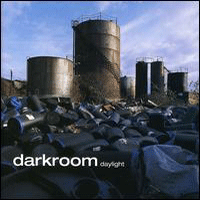
To work out where Darkroom are coming from, you could do worse than take a look at ‘Daylight’s arresting cover. It’s a study of sturdy, corroded old industrial tanks, encircled by metal stairways and surrounded by a devil’s playground of battered, abandoned plastic drums. The drums are marked with hazard labels but yawn open, suggesting that their toxic contents have long since leached out into the environment.

Behind the towering tanks is a radiant blue sky and a slanting blanket of pure white fluffy cloud, against which they rear up like Reims Cathedral. It’s beautiful, in a warped way – the wreckage and castoffs of a once-bright new industry that, nonetheless, continue to assert themselves. Yet in this toxic paradise there’s not a person in sight.

No, this isn’t suggesting that Darkroom are the sort of electronica trio who revel in futurism, and who excise humanity from their orderly sequenced and oscillating musical vision of the world. The opposite is true. Darkroom’s music (in which Os’ sequences and textures are balanced by Michael Bearpark’s mutated post-industrial guitars and Tim Bowness’ naked swoony vocal wail) has humanity in spades. The live instrumentation and vocalising unites with the programmed sound and beats in a way that’s rare in over-purified electronic music, but in the music that emerges – one in which the technology provides uncertainty rather than comfortable form, and in which the threat of chaos and upset looms constantly in the background – the main note sounded is one of loss. One of the main qualities of daylight, after all, is its impermanence.

Via a previous EP, we’ve already heard the discontented seethe of Carpetworld: roof-skittering drum’n’bass with guttering snarls of wounded guitar and Tim’s voice reined in to a hooded whisper of acidic verbiage – the only lyrics on the record, and they’re about bad sex, looting and dodgy discos. We’ve also heard the beautiful flush of ‘Daylight’s title track: a tumbling chant (mournful but blissful) against a slow wallow of bass, the singing notes of Mike’s Frippertronical guitar, and Os’ dawn chorus of flickering sound. Darkroom can do in-yer-face, and they can do strokin’-yer-cheek. They do each of these in roughly equal amounts. Often they do both together, in an elusive blur of ambiguous emotion – the sort that makes you keep one eye on them and the other, anxiously, on the door; but which keeps you held in place, unable to resist the desire to see for yourself what comes next.

Ambiguity is in fact the keyword for this music. Brash, defined techno structures are missing, their place taken by sketchy outlines which the trio fill up with evolving, chaotic detail. The beats are light-footed: slow breaks languidly pacing the background, or pattering techno pulses like rats’ paws. The electronics hum like supercharged fridges close to bursting flamewards, or keen out lovely auroral shivers in the sky and in the shadowed spaces. Tim’s full-voiced mixture of blurred word-shapes and sub-verbal whoops are sometimes Buckley-ish in their tortured flamboyance, sometimes more like Liz Fraser’s outraged brother. Melodies drift, loop and contort: massy and queasily mutable, cloudscapes tortured out of their natural forms by the force of some cruel idiot god.

Sometimes Darkroom’s music sounds like Underworld (though tumbled from their throne and reeling with the impact of a massive nervous breakdown) or like Fripp and Eno sailing their boat into much more malevolent waters. Sprawl growls its overcast way past complex shifting slapping beats, squelched bass, crushed radio-talk and vocal frailties; a baleful camera scanning a wasteland. The opener, Crashed, is strung out, lovely but disfocussed, with a streak of elegant suffering running through it. The guitars rattle like motoring moon-buggies, the voice oppresses like a summer shower, and somewhere in the background, behind the throaty tick of percussion, a lone voice of optimism: a marimba chinking out its own little Steve Reich wavelet.

There are episodes of naked grace on board, beside the pollution, but ‘Daylight’ is still one of the most subtly distressed records to wriggle out of late ‘90s electronica. This is most obvious in the wrenching, frozen agony of Vladimir; but Died Inside seems to sob in anticipation for a collapse waiting to happen but never quite arriving. Looped calls, lilting gasps are answered across a chill and echoing gulf by the icy fuzz of a guarded guitar, prowling and snarling in its own isolation. Once, Tim’s voice reaches a rare degree of intelligibility – a panicked, unanswered plea of “d’you feel the same?”

The wonder that comes close in hand with this fear is laid out explicitly in No History. A soft hip-hop beat holds down the sky-stretchingly rapt vocal and the beautiful subterranean guitar moans: a soundtrack to the forever-flavoured moment when you lie stricken at the bottom of that fatal crevasse, watching the last and most brilliant stars of your lifetime pierce the beckoning void overhead. Like a fleeting memory of softer times, a snippet of (Sittin’ On The) Dock Of The Bay slips in. The amplifier buzz at the end is a benediction.

If there’s a time when there’s resolution, it’s when those two questioning background voices reach out across the comforting pulse of Estragon – Michael’s guitar like a high, bowed bell, Tim toned down to a florid whisper. Still, as it sails on towards its hushed conclusion, the key feeling of ‘Daylight’ remains one of loss. A lament for something unknown, but something voiceable. Something long gone past but reaching out for you again, as the day goes down and fades off into the poisonous beauty of a industrial sunset haunted by old unquiet ghosts.

Darkroom: ‘Daylight’
3rd Stone Ltd./The Halloween Society, HAL 8002 CD (5 023693 800226)
CD-only album
Released: 7th August 1998

Buy it from:
Burning Shed or Bandcamp

Darkroom online:
Homepage Facebook Twitter MySpace BandcampLastFM

SWOONAGE

Swoon. /swo͞on/ A verb. To be emotionally affected by someone or something that one admires; become ecstatic. Here are some people and things that make me swoon. #swoon #swoonage

Post-Punk Monk

Searching for divinity in records from '78-'85 or so…

theartyassassin

...wandering through music...

Get In Her Ears

Promoting and Supporting Women in Music

Die or D.I.Y.?

...wandering through music...

Music Aficionado

Quality articles about the golden age of music

THE ACTIVE LISTENER

...wandering through music...

Planet Hugill

...wandering through music...

Listening to Ladies

...wandering through music...

ATTN:Magazine

Not from concentrate.

Xposed Club

improvised/experimental/music

The Quietus

...wandering through music...

I Quite Like Gigs

Music Reviews, music thoughts and musical wonderings

furia log

...wandering through music...

The Recoup

SINCE 2013: Books and books and books and books and occasionally other things

A jumped-up pantry boy

To say the least, oh truly disappointed

PROOF POSITIVE

A new semi-regular gig in London

Gapplegate Classical-Modern Music Review

...wandering through music...

When The Horn Blows

...wandering through music...

:::::::::::: Ekho :::::::::::: Women in Sonic Art

Celebrating the Work of Women within Sonic Art: an expanding archive promoting equality in the sonic field

Ned Raggett Ponders It All

Just another WordPress.com weblog

FLIPSIDE REVIEWS

...wandering through music...

Headphone Commute

honest words on honest music

The One-Liner Miner

...wandering through music...

Yeah I Know It Sucks

an absurdist review blog

Obat Kanker Payudara Ginseng RH 2

...wandering through music...

poplifer.wordpress.com/

Waiting for the gift of sound and vision

Good Music Speaks

A music blog written by Rich Brown

Do The Math

...wandering through music...

Archived Music Press

Scans from the Melody Maker and N.M.E. circa 1987-1996

The World's Worst Records

...wandering through music...

Soundscapes

...wandering through music...

OLD SCHOOL RECORD REVIEW

Where You Are Always Wrong

FRIDAY NIGHT BOYS

...wandering through music...

Fragile or Possibly Extinct

Life Outside the Womb

a closer listen

a home for instrumental and experimental music

...wandering through music...

Life Just Bounces

...wandering through music...

Lucid Culture

JAZZ, CLASSICAL MUSIC AND THE ARTS IN NEW YORK CITY

Aquarium Drunkard

...wandering through music...

eyesplinters

Just another WordPress.com site

NewFrontEars

...wandering through music...

FormerConformer

Striving for Difference