Tag Archives: piano music

June 2014 – through the feed – Lucy Claire ‘Collaborations No 1’ EP and London launch gig, plus ‘Tim Smith’s Extra-Special OceanLand World’ reissue

3 Jun

Lucy Claire, dishing it out (photo courtesy of This Is It Forever Records)

Lucy Claire, dishing it out
(photo courtesy of This Is It Forever Records)

Lucy Claire Thornton – currently better known as “Lucy Claire” – is a contemporary classical/ambient electronic crossover composer who counts Erik Satie, Peter Broderick and Bjork as influences, and whose work has been hailed as “brilliant, delicately-wrought sketches” by ‘The Quietus‘ and as “immersive and slightly disorienting” by New Music webcast station ‘Amazing Radio‘. She’s releasing her newest release ‘Collaborations EP No 1’ on This Is It Forever Records on June 15th: the same week features a launch concert in London promoted by Chaos Theory (the inspired crew who put on that Sweet Niche/Macchiana del Tiempo/What?! triple bill of fusion jazz which I reviewed last summer). Here’s what they have to say about this gig:

“(We are) excited to host this launch party for the first in a series of collaborations EPs from Lucy Claire, along with many guest performers. ‘Collaborations EP No 1’ will be available with unique handmade packaging at a reduced price at this event only, along with two download codes for remixes by worriedaboutsatan and Message To Bears…. This evening we will see Lucy perform works from ‘Collaborations No 1’, featuring (contributions from German singer/songwriter/producer) Alev Lenz and producer Bruised Skies.

Support will come from electronic classical composers Leah Kardos and Jim Perkins. Almost three years after we worked with Leah on the launch of her debut album ‘Feather Hammer’, we’re delighted to be back together. Tonight we will see bigo & twigetti label-mates Leah and Jim performing new collaborative material… as well as selected works from Leah’s second album ‘Machines’, a concept album with lyrics made up from cut up spam emails, which will feature singer Laura Wolk-Lewanowicz. We will also hear them perform new material by Jim (which will be released later in the year on bigo & twigetti) and re-workings of material from ‘Feather Hammer’.”

All three acts will be basing their performance around piano, electronics, and string quartet. The concert takes place on Thursday 19th June at 7.30pm, at Servant Jazz Quarters in Dalston, and advance tickets can be bought here for under a tenner. For various frustrating reasons, I suspect that I won’t be able to attend this gig myself. Perhaps someone who’s reading this could go, and then tell me what it was like? (Not that I want to make you feel like interns…)

* * *

Considering that he’s still cruelly immobilised by the after-effects of the strokes that felled him six years ago (see ‘Misfit City’ posts passim, here and here), the voice of Tim Smith has rarely been heard in the land so loudly. The profile of his band Cardiacs has been stealthily growing (albeit through YouTube and nostalgic webchat rather than their much-missed live shows) and we’ve recently had or will have new or imminent releases from self-confessed Smith acolytes Arch Garrison, Knifeworld and Stars In Battledress.
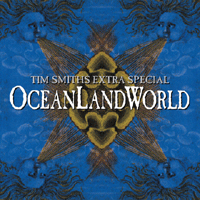
Tim Smith: 'Tim Smith's Extra Special OceanLandWorld'

Tim Smith: ‘Tim Smith’s Extra Special OceanLandWorld’

Meanwhile, the core Smith-eries just keep on coming – this year’s already seen reissues of relatively rare Smithwork (Mr & Mrs Smith & Mr Drake or Spratleys Japs) and a deluxe double vinyl reissue of key Cardiacs album ‘Sing To God’ is due for July). At the end of last month, Tim’s mysterious label The Alphabet Business Concern also sneaked out a CD re-release of his obscure 1995 solo album ‘Tim Smith’s Extra-Special OceanLand World’. A typically arch and sinister ABC press release reveals all (well, not really… and all capitals are deliberate, or at least deliberately annoying):

“AN ANNOUNCEMENT! PLUCKY? PERHAPS. GIFTED? PERHAPS NOT. Nonetheless Tim Smith, in an unforeseen spat of hubris, took it upon himself to exclude his so-called friends (acquaintances at best) to perform a collection of songs in isolation. Foolhardily believeing it may raise enough capital to barter his way from the labyrinthine clutches of obligation to which HE had previously agreed and to which, thankfully, he is bound to this day, in 1995 this solo album was release. Circumstance , of both design and fate have since rendered this ‘offering’ unavailable. UNTIL NOW. As if to mock his feeble attempt at emancipation THE ALPHABET BUSINESS CONCERN once again make available ‘OceanLandWorld’ with the proviso that the covenant can never be broken.”

Ducking under Alphabet’s theatre-of-cruelty bombast, the following actual facts can be dug up. The OceanLandWorld album was recorded by Tim on his own between 1989 and 1990, during a time of upheaval in the entangled world of Cardiacs. Three of the band’s key instrumentalists – Sarah Smith, William D. Drake and Tim Quy – had all either left or were about to leave, and at the same time Tim’s marriage to Sarah had ended. Next to nothing’s been said about this last event, and the other departures have always been described in a matter-of-fact way. In the long term, it seems that the baggy, unlikely, familial mass of Cardiacs-people (with their collective love of music and their sense of common adversity and purpose) managed to accommodate and contain the various splits and departures without lasting bitterness.

Still, although the suggestion in the sleeve-notes that Tim recorded and performed the ‘OceanLandWorld’ songs alone “by way of a penance” is a typically Alphabettian joke, there’s a certain rue to the tone of the album (not least when, behind a bouncy pop march, Tim sings cryptically about tears and about worms chewing on wooden people). Previously wrung happily through the efforts of other people, Tim’s songs are now being filtered through machines: check out those cascading sequencers and springy synth-bass whacks behind his reedy squawk and bustling guitars. Hardly surprisingly, there’s a slight pre-fab feel to the album. If previous Cardiacs albums sometimes felt like the scruffy, well-lived-in old houses in the band’s south-west London suburbs, then ‘OceanLandWorld’ feels like a race around a new satellite town: thin slivers of post-war history, new bricks and formica, a Toytown street plan.

That sense of uneasy rootlessness plays a part in this picture. Tim stutters out an album of faux-jaunty pop songs, without his musical family to push against and to be held by (even if Sarah does briefly return on one song for a gracing of saxophone). The familiar staggering, stumbling embrace of Cardiacs songs is replaced by a Scalextric skid. It’s to Tim’s credit that he somehow turns this into an asset: to these ears, ‘OceanlandWorld’ captures the giddy weightless of post-traumatic sensation, the impression that everything you are has been tossed up into the air like streamers and comes down spread-out and thinned-out, but still recognisably you. In the same way, familiar Cardiacs tics and inspirations work their way through the fabric of the album, with epic punky chorales and proggy vistas opening up like a junkyard requiem.

The album also features one of Tim’s most breathtakingly beautiful songs, Swimming With The Snake. The man rarely, if ever, even starts to explain what his songs are about, but this particular song communicates mysterious undercurrents of pain, loss and love with a rare and stunning magic.

If what you’ve seen, heard, and read here intrigues you, you can order the reissued ‘OceanLandWorld’ from here.

Lucy Claire online:
Homepage Facebook Twitter Soundcloud Bandcamp Vimeo

Tim Smith online:
Facebook

Leah Kardos online:
Homepage Facebook Twitter Soundcloud Bandcamp YouTube

Jim Perkins online:
Homepage Facebook Twitter Last FM

Alev Lenz online:
Homepage Facebook Twitter Soundcloud Tumblr YouTube

Chaos Theory Promotions online:
Homepage FacebookTwitter Soundcloud

May 2014 – through the feed – Sontag Shogun debut album

12 May

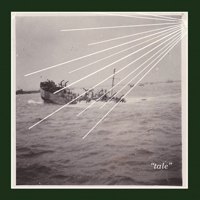
Sontag Shogun: 'Tale'

Sontag Shogun: ‘Tale’

Multi-disciplinary New York trio Sontag Shogun (including Jeremy Young, whom I reviewed playing live in London last year as Foxout!’s guitarist) sent me some news about the recent release of their debut album ‘Tale’. Ostensibly post-rockers, Sontag Shogun don’t conform much to the genre’s more insular tendencies, being made up of three restless multi-media artists moving from craft to craft and from continent to continent. Jeremy, for instance, also co-runs the band’s not-just-a-record-label Palaver Press, which unifies sound publication with assorted texts and fine-art bookbinding.

‘Tale’ was recorded in carefully-hoarded scraps created around the world while Jeremy (sound sources and contact miking) was studying in London, Jesse Perlstein (laptop, tweaked voice and kleptomaniac microphone) was traveling in Korea, and Ian Temple (the grand piano) was back at home in Brooklyn. Field recordings were gleaned from diverse adventures including “a trek through a Columbian jungle, a piano tuner testing the ivory at the Southbank Centre and a South Korean traditional singer hitting a buk (or leather folk drum).” Back in New York, the results were looped, layered and mixed with planned performance (both final takes and rehearsal scrapings) to create a tender collage and a trans-genre which Sontag Shogun call “lullanoise”.

For a taste of what this sounds like, here’s the simple and beautiful but implicatory video for one of the album’s piano-led tracks, The Musk Ox (directed by Isabel Nao):

and here’s a video of Sontag Shogun performing another album track, Let The Flies In, live in France in 2013:

‘Tale’ is available as either CD and download and can be ordered from here.

Sontag Shogun online:
Homepage Facebook Soundcloud Tumblr Bandcamp Last FM

LOOKBACKS – Richard Causton (perf. by Stephen Wolff): ‘Non mi comporto male’, 1993 (“rather than attempting to overwhelm Waller, Causton chooses to honour him”)

31 May
Richard Causton

Richard Causton

There’s a fairly well-known story about Charlie Parker bringing his band to Paris, and spotting Igor Stravinsky in the audience. Like many of his jazz peers (and despite his headlong, self-destructive reputation), Parker was a keen and well-informed follower of classical music. As he played the bebop standard Salt Peanuts he added an impromptu tribute into his solo, blowing in a quote from Stravinsky’s Rite of Spring in the same conversational way that he’d have sung back another jazzman’s phrase through his horn. Stravinsky – no less a jazz fan himself – was so delighted that he spilled his drink.

If only all meetings of the classical conservatoire and the jazz stand were as happy as that one: but for every genuine Parker/Stravinsky-style love-in, there’s a daffy piece of fusion or a classical piece which colonizes without comprehending. I’ve learned to be suspicious when reading program notes in which a classical composer claims to love jazz and engage with its ideas. Too often, that jazz component becomes another post-modern ingredient to be used and ploughed under, just another dead rattling tongue in the composer’s vocabulary. It’s ugly to see a living form become a dried-up skin, its rhythms pinned under the steamroller of European art music as the latter rumbles on, convinced of its own innate superiority and its right to merely mimic and exploit where it should be sharing.

Richard Causton’s ‘Non mi comporto male’ is a welcome exception to these disappointments. Nominally, it’s a close-clustered set of solo piano variations on that cheerful Fats Waller evergreen, Ain’t Misbehavin’. Even the title is a tongue-in-cheek classical translation. In fact, being all of a piece (and having been built particularly freely out of the melodies and chord progressions), it’s closer to being a contrafact: an adaptive and inventive form which in modern times has found a happier home in jazz than it did in classical. Additionally, ‘Non mi comporto male’ builds backwards in a kind of reverse deconstruction. Coalescing over seven minutes from multiple, deliberately scattered fragments of tone and rhythm, it returns to the re-integrated original piece like an explosion filmed and played back in reverse. piwhT. moobaK.

So far, so tricky; and on spec alone this could have been a bloodless game. As a composer Causton’s cerebral skill is evident, and he echoes some of Harrison Birtwistle’s ideas of presenting multiple views of a musical theme from differing angles (and through different gaps in the musical bulk) and John Cage’s chance rearrangements of Erik Satie in ‘Cheap Imitation’. Yet rather than attempting to overwhelm Waller with architecture and indeterminacy, Causton chooses to honour him instead – first installing him invisibly at the heart of the piece and then gradually revealing him in small touches. Starting with what seems to be a tranquillized muddle of straying notes, and moving into fitful chromatic squiggles akin to bursting bebop saxophone lines, Causton slowly lets his key parts fall into place. A flurrying treble line may zig-zag away, only to lose its momentum and be gently pulled back in like a puppy on a leash. The entrance of a familiar bass chord brings gravity to a whirl of chromatic flechettes; emerging as if from nowhere, a true melody note is carefully positioned on a hinted moment of swing.

Pianist Stephen Wolff plays a major role in making this work. His impressive technical skill is well suited to interpreting Causton’s long-game of structure and projection; but he also displays a humble and affectionate understanding of jazz, making the eventual recovery of the original tune entirely convincing. By the sixth minute, Ain’t Misbehavin’ has emerged in full, softly and freely played, taking its final steps back into shape while surrounded by jags of high notes. Until just before the very end, a few stray extrapolated plinks still glint around the melody, like the dust left by hand-tooling: the last traces of Causton’s unexpected loving touch. You can imagine Fats himself – tipsy and happy, with whisky-glass in hand – chuckling away at it.

Richard Causton: ‘Non mi comporto male (for solo piano)’
(performed by Stephen Wolff)
unreleased recording (private collection)
composed and performed 1993

Buy it from:
This piece is not commercially available – email Richard Causton to enquire about access to recordings. The score is available from Oxford University Press.

Richard Causton online:
Homepage

January 2002 – album reviews – Steve Lawson/Jez Carr’s ‘Conversations’ album, 2002 (“easy, generous grace”)

14 Jan
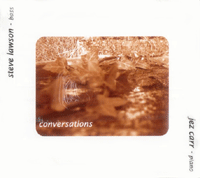
Steve Lawson/Jez Carr: 'Conversations'

Steve Lawson/Jez Carr: ‘Conversations’

Talk’s cheap, and so am I… at least, when writing intros. I was going to pursue the “conversation” theme by squeezing in comments of my own about eavesdropping on musicians, or about the Troggs tape, or the language of notes. Then I put all of my smart-arse lines down, and just listened.

There are some records about which it’s difficult to say anything. Much. They crop up when you want to get expansive and to show off: and then you find that you just can’t use them as launch-pads for spectacular rants about the state of music, or the permeability of the soul. They bob beyond clutching fingertips and wagging tongue, deflecting the last-ditch wafts of hype with which you try to lassoo them. They’re critic-killers. And the funniest thing is that you love them for it – for the best reasons (nothing to do with clenched teeth, uptight craftsmanship or sweating in front of paying audiences). ‘Conversations’ is one of those records. Go and buy it. Feel good.

Alternatively, accept that I’ve got to try to explain it anyway: so please humour me for seven hundred more words or so…

Basics, then. ‘Conversations’ is a set of immediate, improvised duets between two British musicians – Steve Lawson (fretless bass guitar, loops) and Jez Carr (piano, small antelope statuettes) – from one of the tasteful/tuneful intersections of jazz and the avant-garde underground. Two sprawling self-penned essays on the CD sleeve reveal a cheerfully anti-heroic approach to improv and to music in general. Lawson and Carr name-check Schoenberg and Yehudi Menuhin, note that “people think that free means ‘out’, when free just means free”, but steer clear of portentousness. Oft-revived improv traits – stoniness, pomposity, randomness, irritating mysticism – are ignored in favour of an earnest, open approach.

The music reflects this. Clean and quietly inspired, it resounds through comfortable air, sharing subtle humour. It makes you think of a friendly hand on your shoulder; not a scuffle in an alley, or six days at the foot of a grouchy guru. If it sent postcards home, they’d be of green hills in ECM-land, or soft-focus shots of Bill Evans’ study. A few pictures of Carla Bley and Steve Swallow’s backyard might be in there too: but from the quiet time, somewhen in late spring, a lull in the heavy blowing season. This sounds pretty, and it is. Ultimately ‘Conversations’ is soft-edged, as relaxed as winding English rivers. It never works up a head of steam when a delicate flow will do instead.

Despite Carr’s Romantic leanings (he owes as much to Chopin as to Evans or Dollar Brand), he doesn’t waste notes, or drown the music in florid chords: and although ‘Conversations’ is built on slick musical technology, it’s not hijacked by it. Lawson (usually a solo performer, with a warped melodic looper’s approach) has all of his digital gizmos and luscious overlaid textures to hand; but he never once swamps Carr with them. For his part, Carr draws as much warmth from a digital piano as others could from a concert grand or from a well-worn-in jazz-club upright (covered in cigarette burns, whisky spills and four-generations-worth of jazzmen’s fingerprints).

Each piece is double-titled, reflecting each players’ viewpoint. Although Carr’s serious-sounding Migration manages to also be Lawson’s flippant Whateverwhatever, the duo maintain remarkable accord as they play. As Lawson and Carr settle readily into light-footed slow-motion melodies or feathery grooves, rich smudges of bass tone or rapt curving anchors of sound are left revolving in the loop pedal waiting for counterpoint with quick, relaxed piano touches. There are plenty of opportunities for hearing the expansive, delicately embracing tones of Lawson’s solo melodies: but for most of the record he provides a low-volume dub menagerie of playful but expressive noises. These sit alongside Carr’s crisp, ever-fresh improvising like an inspired combination of Percy Jones and a New Age Squarepusher.

On Sweet’N’Spiky/Shades Of Creation, Carr outlines ideas of rapt melodic phrases over Lawson’s bedrock riff, leaving our imaginations to fill in the gaps. At his leisure, Lawson fills in gaps we hadn’t actually thought of – via distant scrunches, data streams, balloon pings, gargling clicks and spinbacks, all sitting in the pockets of the tune. Walking rhythms interplay for Whateverwhatever/Migration: Carr’s brittle and determined piano mileposts the journey while Lawson offers squeaky wheels, footsteps and theremin wobbles of bass loop. For 1, 2, 3, 4…/Broken Lead, the bassist offers a fragmentary free-funk undertow, further softened by layers of unorthodox spindly chords and gurgling harmonics as Carr provides bright spins of softly-fingered notes.

Destination Unknown @ Point Of Departure/Drifting Dreaming makes the most of a grand vista of musical space, but does it by filling up as little of the view as possible. Carr plants brave speckles of light on unseen crags while a variety of subtle Lawson noises low like distant cattle, or write backward circles in fizzing firefly textures. Signing off with Closing Statement/At First Sight, Carr opens up into ringing blue ripples of controlled delight. Lawson builds up from E-Bowed foghorning soundscapes, progressing to wah-wobbled groove pulses and shimmering echoed treble tremors. Two-thirds of the way in, the music finally slides gracefully into a straightforward duet. Lawson’s yawning fretless notes cradle an ever-sleepier Carr – though unusual tinges of chording promise colourful dreams. It’s a beautiful closer to an album on which nothing has got in the way of the music. Neither embarrassment, nor aggression, nor flash.

What is truly remarkable about ‘Conversations’ is its easy, generous grace: unobscured by its gadgets, the skills of its players, even the hints implicit in genre and background. Waylaid by catches and self-consciousness, few records of “open” music are truly open. This is one that is.

Steve Lawson/Jez Carr: ‘Conversations’
Pillow Mountain Records/Bandcamp, PMR 0012 (no barcode)
CD/download album
Released: 1st January 2002

Buy it from:
Download from Jez Carr’s Bandcamp page; CD best looked for second-hand.

Steve Lawson online:
Homepage Facebook Twitter Bandcamp Soundcloud

Jez Carr online:
Homepage Facebook Twitter MySpace Bandcamp Last FM

August 2001 – album reviews – Michael Jon Fink’s ‘I Hear It in the Rain’ (“into the tundra of forgetfulness”)

25 Aug
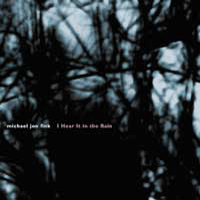
Michael Jon Fink: 'I Hear It In The Rain'

Michael Jon Fink: ‘I Hear It In The Rain’

Often it’s as simple as this – for true treasure, let go of the precious.

Michael Jon Fink (operating within New Music but sidestepping much of its systematic, lab-dulled pretensions) proves it on this album of close-up and subtle music, aided by remarkably sympathetic collaborators – textural guitarist Rick Cox, percussionist Dan Morris, Bryan Pezzone on piano and celesta, and bass clarinetist Marty Walker. There’s something of Gavin Bryars’ evanescent emotional skill to Fink’s music; something of the soft spatial blur of the Evanses (both Bill and Gil); but little of the chart-plotting dryness of a composer after cleverness points. Although Fink’s composing seems to be romantic at heart, he’s well aware of what modernism lets him draw by implication. ‘I Hear It In The Rain’ has feeling in plenty, but doesn’t lay out its secrets that easily.

During Five Pieces For Piano, Bryan Pezzone’s soft playing presses oh-so-gently on our ears. Fink’s music emerges from Pezzone’s piano so delicately that it hardly disturbs the air, as silent as night-travelling stealth ships, yet it sets reactions moving. The musical voicings are widely spaced, just dissonant enough for a shadow of doubt. The melodies are simple – songs from a sleepy child on the road – and it’s Pezzone’s exquisite touch on both keys and pedals that brings out Fink’s intentions.

 
The sparse sketch of Passing sounds like Debussy, but also like worksong. Its tentative descending melodies touch down in firm but unsettled chords – displaced, jazz-shadowed. Constrained by its skeletal melodic discipline, Mode uses space instead to ask its wordless questions, which remain unanswered by the rising minor-key bass arpeggio of Fragment and the two-note treble alternation which rings on and on – absently, a long-ignored alarm that’s forgotten both urgency and reason and instead beats out its worn, relaxing ritual. For Echo, two cycles of elegantly picked-out notes overlap each other, engaging not like machine parts but like two people caught unwittingly in a loose parallel. The fifth and final piece, Epitaph, draws the harmony together. The sustained, rising rumble of each decaying bass note holds the attention, while a melody in the mid-range takes up the implications of a death song.

 
This is not about feelings being directly manipulated. Fink’s music induces them, drawing into the gaps and implications between the notes. A lot of it is timing: the attuned sensibilities of a performer and a composer both inspired by the subtle, near-telepathic interreactions of small-group jazz. More of the slender, yet involving, same can be found within Two Preludes For Piano. The first of these, Image, keeps that same poise between amnesia and raptness as the Five Pieces do, tiny details slipping past the pared-back structure of Fink’s notes. The second, Wordless, heads further into the tundra of forgetfulness: the tenor- and soprano-range parts thoughtful and reassuring, but set just far enough apart from each other for disturbance, fading unresolved into the deep evening.

When Fink and Pezzone leave the piano’s subtle, powerful dynamism, they favour the celesta – an instrument which demands (and produces) an exquisite clarity, but with soap-bubble fragility. While the instrument is chillier and less robust than the timbrally similar Rhodes piano (the jazzer’s usual choice for the otherworldly), Fink turns this into a virtue. Initially, For Celesta seems as physically ephemeral as a frost-painting – bright points glimmering on a window – but grows by degrees as Pezzone brings out the full resonance of the instrument’s range. A beautifully sleepy melody grows, reflection by reflection. It’s precise, yet weighted oddly by its slow ebb and return of acceleration; and by the sudden unexpected welling-up of emotional and physical volume midway through, before returning to its soft contemplation.

 
Elsewhere, Fink’s moods are less compressed and matter-of-fact titles are left behind for more poetic names. On Living To Be Hunted By The Moon (which could be a nod to Gurdijieff’s mythology of soul-eating moons, or to even older fears) Fink builds a landscape of powerful but distant sampler drones. These slant across the sky like angled, endless, featureless walls, each one eerily bisecting the former with a disquieting geometry. Underneath this beautiful and subtly oppressive canopy the marvellously expressive Marty Walker purrs and throbs all-but-subliminal lines on his bass clarinet. It comes across as a supernatural play of light represented in sound, but once again Fink’s near-narcotic sense of subtle disassociation comes into play. His soundscapes hover overhead like a deferred threat, or like a beautiful, cruel and thoughtless god – something to be crept past; something of predatory attentions, carefully evaded.

 
No such emotional deferral happens on the album’s title track, which is also it’s haunting and lovely finale. Everything that has been promised (or hidden) elsewhere on the album settles home like final snow, or final tears. Where all else has been sparse and minimal, I Hear It In The Rain is luxuriant and gently cathartic. Dreamily slow, founded on Fink’s pedal-point of bass guitar and the gentle rocking motion of his bell-like keyboards, it’s shot through with fluttering orchestra-sized samples of tremulous cellos, blending with the soft rushes of Morris’ gongs and bell trees. Rick Cox’s electric guitars (teased into hallucinatory smears by sponge or glass implements) buoy up the spectral and blissfully desolate melodies, dissolving the emotional suspense in one long resolution; dissolving you too and easing you out through your opening window up into another warm and solitary Los Angeles night.

 
Words aplenty… I could go on and on to you about the restraint and wisdom in Michael Jon Fink’s work, but what gets me every time is its sheer and honest beauty. There’s a disciplined mind at work here: it’s also one which is in touch with such universality of feelings that praising his deft economy and musical grammar seems reductive. I could pin him down further for you, but what matters might be beyond by reach – though, even as I finish this, it’s come filtering through the air to reach back to me again. Simple. Special. Indispensable.

Michael Jon Fink: ‘I Hear It In The Rain’
Cold Blue Music, CB0004 (800413000426)
CD/download album
Released: 18th June 2001

Buy it from:
Cold Blue Music (CD) – various downloads available from Amazon and similar.

Michael Jon Fink online:
HomepageLast FM iTunes

September 1997 – album reviews – John Law’s ‘The Hours’ (“a vision of a musician dissecting an act of faith for its structure alone”)

29 Sep

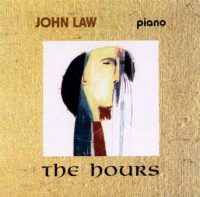
John Law: 'The Hours'

John Law: ‘The Hours’

“This music is dedicated to the spirit that moved the first humans to speak the unspeakable, and thus to sing”. Thus spake John Law, improvising pianist and British free-scene eminence gris. And the audience did open their ears, with a subtle flip of their hopeful hearts, and did prepare to receive his wisdom.

As Law explains in the liner notes, this is the third of a trio of recordings for which he’s written piano music in the form of plainchant. On this occasion, inspired by the ‘Liber Usualis’ devotional prayer-chants of Benedictine monks, he’s adapted and extrapolated a set of vocal melodies to correspond with the eight hours of prayer the monks observe. So, in effect, he’s set himself the task of portraying a whole community’s profoundest expression in music. Moreover, a community who’ve secluded themselves from the world specifically to perform that expression. Tall order.

‘The Hours’ is split into two eight-section parts. Firstly, an exposition of eight “chants”, all but one under a minute in length, each a single melody line or parallel harmony with minimal chordal support. Secondly, ‘The Hours’ proper: eight extrapolations of the preceding chants in which Law’s freed up to add his own interpretations and textures. So for the first half, we get a lone piano in the middle distance playing (with heavy use of the muting pedal) dutifully uninflected melodies with all the emotion of a canning plant: the beauty of the lines frosted over, clean as an abandoned cloister. For the second, the piano’s intended to take on a life of its own, expounding off the original melodies.

In the first of the improvising pieces, Matins/Vigilae, this doesn’t amount to much more besides the odd syncopated jazz twitch, surprisingly crass after the sterile beauty of the naked themes. For the superior Lauds it’s the decoration of the theme of Chant II by a sprinkle of high treble notes from the top of the piano, a subtly emotive sea-swell of tenor phrasing from below. For Prime, a Keith Jarrett-y stroll during which Law transmutes Chant III into a whirling spiral of shifting arpeggios that tumble somewhere between György Ligeti and Allan Holdsworth. Terce (one of the most successful pieces) staggers echoes of Chant IV – vibraphone-like – with occasional flashes of beauty when Law lets his guard down: then moves into peculiar John Cage mutes as he interferes with the strings in the piano frame, letting buzzes and flutters distort with the fluttering trills.

The problems really start to arise after this, when Sext’s boogie-woogie serialism (which moves into more of those acrobatic arpeggios) sounds a little too comical to take seriously, and the stomp of Nones has taken the feel so far from the original source that you’ll have forgotten you began this recording ostensibly listening to chants in an abbey. Vespers turns its own source, inexplicably, into stammered staccato pseudo-stride piano with spurts of hammering, constrained exploration. None of which would matter were it not for Law’s efforts in the liner notes to link his music to the devotional, whereas what he’s actually done is link it to the architectural. Like it or not, plainchant ain’t gospel, and its beauty doesn’t survive the transition into jazz unless – as Jan Garbarek proved with the Hilliard Ensemble on ‘Officium’ – you allow the jazz to meet it on its own territory and terms.

Compline makes some belated amends by being a gentle Bill Evans-style study of the final chant, but it’s the necessary little coming far too late. ‘The Hours’ is just too academic, too dryly sophisticated, too damn measured in its intent to take to heart. Law’s sophisticated, he avoids corniness, he has discipline. Oh God, does he have discipline. That, in itself, is what sinks this fine but soulless recording. Finally, for all the concentration, seriousness and cleverness of ‘The Hours’ it leaves you with no vision of God, no vision even of devotion; just a vision of a musician dissecting an act of faith for its structure alone. What it also leave you with is the impression that John Law – rather like the monks he’s allegedly saluting with this music – should really get out more often.

John Law: ‘The Hours’
Future Music Records, FMR CD41-V0697 (7 86497 26352 3)
CD-only album
Released:
September 1997
Get it from: (2020 update) Cornucopia Recordings.
John Law online:
Homepage Facebook MySpace Last FM Apple Music YouTube Vimeo Deezer Google Play Spotify Amazon Music
 

March 1996 – live reviews – Tori Amos @ Royal Albert Hall, Knightsbridge, London, 9th March (“the Raisin Girl is not communicating”)

11 Mar

It shouldn’t be like this. Call Tori Amos kooky, pretentious, over-precious, almost anything you like – but don’t call her boring. Not possible. A woman whose mouth and piano strive to out-motor each other, a torrent of perverse creativity, a handful of sharp pins in satin – Tori is riveting even when she’s being irritating.

So why am I spending so much time – up here in the balcony seats – bored? Why the itching urge to check my watch, when on previous tours I’ve been hanging on the edge of my seat?

The reason is that tonight the Raisin Girl is not communicating. Webbed up in the twinkling Santa’s-grotto lights of her stage set, leaning hungrily into her piano or capering over the keys of her harpsichord, Tori is playing resolutely inwards. Hips raked backwards, fingers thundering out melody, head and neck curved to the hovering mike, her face is turned out to us with that familiar elfin, ever-so-slightly ruthless expression. Despite the thrumming love emanating out to her from the capacity crowd, despite the on-stage company of Steve Caton and the soft, sly voices of his textural guitar, she’s never seemed so alone.

For someone who’s opened herself up to us as much as Tori has, this is sad. It’s particularly sad when you consider that she’s playing in Britain, the country that cradled her when she was the unknown émigré and winced as it took the charged barbs of ‘Little Earthquakes’ to its heart. At certain gigs you can feel the heart of the audience, as if it were one huge collective animal. Here, as at all of the Tori Amos gigs I’ve been to, it feels like the love borne for someone you know intimately, quietly, unreservedly.

Tori, though, is having none of it. We sit patiently through some of her recent interminable doodlings (Little Amsterdam is not longer slinky, just tedious; Not The Red Baron is beauty in search of obscurity) and specks of nonsense (the pointless verbal confetti of Space Dog). She plays on. This year, she’s not responding.

No, it’s not blandness that she’s offering us. The fury in her songbook is served well: a scorching rampage through Precious Things with a carnal girl-growl, a twitchy Crucify. The demanding sarcasm of Leather and the tingling, surfing buzz of Cornflake Girl (in which Caton kicks up a silvery storm of rhythm guitar) kick in with that familiar strength. But the sharing that used to set Tori apart from the herd… gone. That grueling romantic break-up with her engineer and onetime confidante Eric Rosse; the red-tinged and ruthless period which spawned the ‘Boys For Pele’ album; both seem to have left her wired and defensive. There have been too many considered steps back from the poised-tenterhook tenderness of Silent All These Years (which, significantly, she doesn’t play tonight.

Maybe this is why Bells For Her – previously a trembling inward coil of twisted, conflicting love played out on a treated piano – has somehow changed into a horrifying banshee curse now that she’s conjuring it out of her harpsichord. Maybe this is why few songs tonight sound as flat-out relished as the vicious, vampiric Blood Roses; why the more restrained snarl of Doughnut Song falls flat; why her infamous, languorous cover of Smells Like Teen Spirit (still missing that essential final verse, but this time with a capricious insert from ‘South Pacific’) seems like a letter abandoned too soon. Oh denial, oh denial.

Tori can still touch and be touched, though. We’re reminded of this in a mutually terrifying moment, one that we’d rather have avoided. Her first-person rape account, Me And A Gun, brings an absolute silence down into this huge hall – and a sense of stretched, time-slowing horror. Suddenly, about four-fifths of the way through, she stops. Dead. Her hand moves to her face in a movement that seems to take forever. A century passes – a terrifying gap into which our attention tumbles. Then she pulls herself together, finishes the song. Swallows the last word, stumbles offstage into darkness and tears.

At a time when she’s professing the most arrogant creative strength, Tori actually seems to be – more than ever before – walking wounded. Despite an assured China, the encores fail to restore confidence. Putting The Damage On trembles and falters; the love-regrets in Baker Baker now seem as detached as a pallid watercolour. Sweet Dreams breaks off as she drums out the rhythm on the lid of the harpsichord and the words slump out of her memory. A harmonium finale of Hey Jupiter is broken-backed, limping off-pitch, beaten down beyond the point of hope. She may have claimed to grab the perverse power of the volcano goddess – from here, it looks as if it’s burning her up from within.

But… so much love filling that enormous Victorian barn. If only she could have brought herself to reach out and accept it.

Tori Amos online:
Homepage Facebook Twitter MySpace LastFM

The Royal Albert Hall online:
Homepage Facebook Twitter

SWOONAGE

Swoon. /swo͞on/ A verb. To be emotionally affected by someone or something that one admires; become ecstatic. Here are some people and things that make me swoon. #swoon #swoonage

Post-Punk Monk

Searching for divinity in records from '78-'85 or so…

theartyassassin

...wandering through music...

Get In Her Ears

Promoting and Supporting Women in Music

Die or D.I.Y.?

...wandering through music...

Music Aficionado

Quality articles about the golden age of music

THE ACTIVE LISTENER

...wandering through music...

Planet Hugill

...wandering through music...

Listening to Ladies

...wandering through music...

ATTN:Magazine

Not from concentrate.

Xposed Club

improvised/experimental/music

The Quietus

...wandering through music...

I Quite Like Gigs

Music Reviews, music thoughts and musical wonderings

furia log

...wandering through music...

The Recoup

SINCE 2013: Books and books and books and books and occasionally other things

A jumped-up pantry boy

To say the least, oh truly disappointed

PROOF POSITIVE

A new semi-regular gig in London

Gapplegate Classical-Modern Music Review

...wandering through music...

When The Horn Blows

...wandering through music...

:::::::::::: Ekho :::::::::::: Women in Sonic Art

Celebrating the Work of Women within Sonic Art: an expanding archive promoting equality in the sonic field

Ned Raggett Ponders It All

Just another WordPress.com weblog

FLIPSIDE REVIEWS

...wandering through music...

Headphone Commute

honest words on honest music

The One-Liner Miner

...wandering through music...

Yeah I Know It Sucks

an absurdist review blog

Obat Kanker Payudara Ginseng RH 2

...wandering through music...

poplifer.wordpress.com/

Waiting for the gift of sound and vision

Good Music Speaks

A music blog written by Rich Brown

Do The Math

...wandering through music...

Archived Music Press

Scans from the Melody Maker and N.M.E. circa 1987-1996

The World's Worst Records

...wandering through music...

Soundscapes

...wandering through music...

OLD SCHOOL RECORD REVIEW

Where You Are Always Wrong

FRIDAY NIGHT BOYS

...wandering through music...

Fragile or Possibly Extinct

Life Outside the Womb

a closer listen

a home for instrumental and experimental music

Bird is the Worm

New Jazz: We Search. We Recommend. You Listen.

...wandering through music...

Life Just Bounces

...wandering through music...

Lucid Culture

JAZZ, CLASSICAL MUSIC AND THE ARTS IN NEW YORK CITY

Aquarium Drunkard

...wandering through music...

eyesplinters

Just another WordPress.com site

NewFrontEars

...wandering through music...

FormerConformer

Striving for Difference