Tag Archives: glorious twitch

December 1998 – live reviews – The Sea Nymphs @ The Falcon, Camden Town, London, 13th December (“a long curving wave of sea-songs, swimming keyboards, children’s play-rhymes”)

18 Dec

In reality, the music room at The Falcon is a tumbledown concrete box shoved out onto a bit of waste ground. Right now, though, we could easily imagine it transformed by our collective warmth, enwebbed with flowered arbors and the hum of big lovable insects.

This is good. The air’s alive with a warm, fireside excitement and the sound of a zillion Christmas triangles. Up on stage, Tim Smith has just flicked us one of his weird little opening-envelope smiles. Bill Drake – goateed and woolly-hatted, somewhere between pharoah and trainspotter – settles in behind his keyboards, half-in and out of the parallel universe he normally inhabits. Someone bleats like a sheep. Everyone laughs. Sarah Smith – unreservedly sexy and wholesome, like a fairytale milkmaid – readies her saxophone, smiles mischievously.

As they make a showing for the first time in years, The Sea Nymphs bring us the same sense of unguarded wonder that we’d get from watching some obscure and exquisite little beast uncurl itself from hibernation or hatch out of a chrysalis. There’s that, and there’s their uncanny ability to awaken the sort of love that I haven’t felt sweep through a concert for ages. We’re crammed in shoulder-to-shoulder – on any other day, we’d be the usual indie-rock cattle, and we’d feel it. This time, it feels more like being a step away from holding hands.

It’s as if we’re all buoyed up on a long curving wave of sea-songs, swimming keyboards, children’s play-rhymes; of twinkle-fingered piano, folk fragments, and pale running saxophones; plus Edward Lear, Edward Gorey, and all the other unguarded wistful subconscious flickers that may (or may not) inform The Sea Nymphs’ music. Somehow, they’re managing to remove the tarnish that’s caked onto the joy that we’ve almost forgotten: that straightforward joy at being alive. Because this is music that disarms and rebuilds somehow – it’s ducking aside from the panicky hurtle of London neurosis that’s going on outside, and taking us with it.

This may seem a woolly cop-out; as if I’m just burbling. The truth is that The Sea Nymphs, in work and in performance, seem to be offering a mystery of creation that doesn’t bear too much thinking about. Too much breakdown won’t break the spell – it will just ease you out of it, painlessly, like a splinter; into the cold again. And that’s something which you don’t want to happen. Within Sea-Nymphs-space, we’ve all found a place in which we very much want to be. We want to rest in the anchoring embrace of Tim’s warm and rounded basslines, to cotton on to how the querying melody-hop of Little Creations sounds like a baby making its very first connections. We want to enjoy the unselfconscious way Sarah rejoices in striking a gong, as if she was dusting a clock.

As the tipsy near-waltzes sway around the air, as Tim, Sarah and Bill’s voices twine and alternate (from naked and frayed harmonies to scratchy yelps, to impossibly sweet helium coos) we’re given the opportunity to pig out on a different kind of instinct than that triggered off by the standard lash of rebellious rock noise. There’s something baptismal in that sound – the little lilts of Shaping The River, the cries of “sponge me clean again” vaulting over a chunky acoustic strum. Maybe it’s something to do with a natural, maternal comfort. The key line of Blind In Gaiety And Leafy In Love is “she smells just like you and she smells just like me”, while Appealing To Venus stretches out a begging hand to an absent goddess, pleading “dwell among the people. / Come back to us, we need you.”

Maybe – behind the celebratory music and those rosettes of voice and exhilarated sax, lofting toward the ceiling – the vulnerable flutter at the heart of it all is the fears. Fears at the treacherous terrain of potential fuck-ups and traps, opening up like a dirty promise before newborns as they begin their blundering pilgrimages onward from birth through a childhood and adulthood of busts and confusions. “Back to square one… / large as life and twice as natural… / Let’s not reinvent the wheel; open that can of worms…”

Still. Here and now Sea Nymphs restore our openness – our willingness to ride our curiosity. For a brief time, at least, it becomes our strength again; and when, in Mr Drake’s Big Heart, the band tell us “something’s going to happen today”, we all feel as if we’re a part of it. After tonight, at the very least, we’ll have been able to say that we were together for a while, and it was good.

The Sea Nymphs online:
Homepage MySpace

The Falcon, Camden online:
Homepage

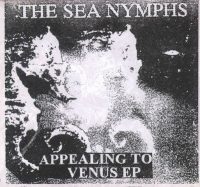
June 1998 – EP reviews – The Sea Nymphs’ ‘Appealing to Venus’ (“quivering, shipwrecked dreams and prayers”)

3 Jun
The Sea Nymphs: 'Appealing to Venus' EP

The Sea Nymphs: ‘Appealing to Venus’ EP

There’s something about the ‘Appealing to Venus’ EP which sounds incredibly ancient. Not dated, as such – for all its leanings towards progginess, it’s nothing passe or stilted, and any awkwardness is an integral part of the charm. No, it’s the murky timelessness and pre-tech fragility of the songs. It’s music in the trembling, bewildered nude; emerging from its shell of strength to blink in the light. To voice, in a halting manner, its own concerns, as the bright lights and brash neon of the pop scene whirl around it, uncomprehending.

Not that it’s come from nowhere. The Sea Nymphs are an (almost) acoustic alter-ego for the manically electric and intense Cardiacs: a mass of scrawny acoustic guitars, ‘Rock Bottom’ harmoniums, mellotrons and melodicas, baroque Black Death keyboards, crumhorn saxes and touchingly scratchy singing. Cardiacs’ convoluted songs have always had threads of Early Music woven into them. With The Sea Nymphs, we get to wind back along those threads and see where they lead.

 
These four tracks (salvaged from the Nymphs’ criminally ignored debut album) exorcise, or exercise, Cardiacs’ curiosity about pre-pop. You can hear old folk melodies seeping into Low Church music, shreds of sea-shanties and work-song, ramshackle European fragments existing independently of the blues or classical traditions… the bits that pop forgot, in other words. Though compared to, say, Dead Can Dance’s lordly, haughty take on Early Music, The Sea Nymphs sound as if they’ve crawled their ungainly way out of a Vincent Ward peasant odyssey of quivering, shipwrecked dreams and prayers.

 
Listening to the reedy, march-y slog of careening organs, plodding piano and parping synth on the title track, you hear a heartbreakingly wistful devotion. In the giant cathedral boom of Up in Annie’s Room, string synths smear the shuddering air around Tim’s cracked, lost, voice, swallowing it up in a churchy swamp of sound. He sounds as if he’s trying to outshout a God who’s cold and indifference to his vulnerable defiance. The mediaeval shawm-sneeze of God’s Box – fifty people on comb, paper and bells – seems lighter, The Sea Nymphs – flotsam and jetsam but its skipping ward against evil (“God’s good, the Devil is bad – he always gives me money,”) sounds ambiguous in Sarah’s blank, gauzy, little-girl vocals. “Never Setting Things on Fire, / never bad,” she sings, as if considering her options.

 
It’s left to the exquisite Shaping the River (in which a lilting falsetto choir sways, shanty-like, behind watery spangles of piano) to bring us something to warm our bared hearts. A work-song, something shared; a relationship with nature even as you alter it: “River in the middle of / Nowhere / Three of us suck on its heart, / and its head. / …Plant the heart, all from the heart / … only in the heart.”

 
The skeletal bonus tracks – lifted from even older tapes by Mr & Mrs Smith & Mr Drake (the prototype Nymphs) – pull us further into blurry pasts. There’s Bill’s gentle, bemused Camouflage, a twelve-tone sprig on Syd Barrett’s nursery-rhyme legacy. The meandering but intensely purposeful tone poem Little Creations clambers like a drunken squirrel from branch to branch, complete with manuscript rustling and equipment fumbling. Hymn rounds everything off; a live bootleg of Tim blinking over an austere organ sound, a pagan taking his first faltering steps into the chapel. These songs, too, have that unnervingly ancient-but-ageless quality; the same indefinable, painful, yet suspect innocence that haunts the songs of Robert Wyatt or Elizabeth Fraser.

 
Which all means that The Sea Nymphs are both as frail and damp as a newborn, and as old as the hills. Just listening to them pulls you back that much closer to the original greenwood, little shoots cracking their way out of your hidden memories.

The Sea Nymphs: ‘Appealing to Venus’
Org Records Ltd., ORGAN 044CD (5 028151 010445)
CD-only EP
Released:
1st June 1998
Get it from: (2020 update) Original EP best obtained second-hand. Appealing to Venus, God’s Box, Up in Annie’sRoom and Shaping the River all appear on the eponymous debut album by The Sea Nymphs (available as a download from The Alphabet Business Concern), while Little Creations and Camouflage appear on the lone eponymous album by Mr & Mrs Smith and Mr Drake. Hymn is in fact a Cardiacs song used as an early 1980s set closer: the version here was recorded at the 1984 Stonehenge Free Festival and appears nowhere else apart from on bootlegs.
The Sea Nymphs (Cardiacs) online:
Homepage Facebook MySpace Soundcloud Bandcamp Last FM Apple Music YouTube Amazon Music
 

October 1997 – live reviews – Django Bates’ Human Chain @ The Vortex Jazz Bar, Stoke Newington, London, sometime in 1997 (“joyous, brilliantly constructed bacchanalia”)

13 Oct

Next time I’ll bring my platforms. As per usual with Django Bates gigs, the Vortex is packed out and it’s standing room only. To enable the bar staff to make the perilous weaving journey between the crowded tables, the only place I can park myself and my aching feet is up against a wall, craning my neck to peer over the obligatory taller person in front. Plenty of other people are in the same boat. No one complains.

Well… apart from the couple I speak to afterwards, with their heads full of Parisian Latin Quarter memories and a taste for acid-jazz, looking in to see what a Jazzpar Prize winner plays like. They’ve decided that they hate Django Bates. Can’t stand him, can’t see what the fuss is about, can’t see the point. In their eyes, something’s wrong with the whole thing.

While I completely disagree with them, I can see their point. If you’re coming from an established jazz perspective (certain moves, a certain closet full of set patterns, a certain desire to be pleased in a traditional way), then what do you make of Django Bates? A man of many hats, most of them odd-shaped (tonight’s being a reasonably modest ski-hat which doesn’t even get to make it onstage). A man who’s wearing a faded T-shirt marked “Nobody Knows I’m A Lesbian”. Someone who reinvents the sacred New York, New York as a volley of bloody-minded bop, assault and battery (via vicious drums and sound effects – fire-engines, road drills and machine guns). Who then insults the memory of Sinatra by singing as if he’s in the shower; and finally throws in a rapturous applause sample during which the entire band punch the air like Motley Crue?

Or how about Hyphen’s forthright Coltrane-isms scratched into a hypermanic bass walk? Django yelps a string of “yeah!”s in parodic hammy Americanese; yet he later delivers a sprightly piano solo as the piece’s main moment of reflection. It’s peculiar but assured – like Victor Borges hosting the Jazz Club on ‘The Fast Show’. It’s not so much Duke Ellington as Frank Zappa hitting the lounge wall. Hard.

“N.Y., N.Y. – nice, yet nihilistic, yobs. That’s us,” says Django, faux-innocently. “Respect.”

It’s this sort of English ridiculousness that puts the originality and oomph into Bates’ muse, yet simultaneously blights his career. However much people are drawn to the joyous, brilliantly constructed bacchanalia of his music, many of them still struggle to accept the humour.  In another life, Django would have been an eccentric Oxford don setting his callow students another brainteaser. But jazz aristocrats are supposed to be enigmatic, not possessed of an absurdist schoolboy imagination. For all of his enthusiastic following, Bates’ refusal to wear a legend’s weighty clothes (or to deny his own genuinely playful nature), has tended to place him out in the cold within the jazz world, as opposed to in at the heart of the cool.

For this reason alone, it’s good to see that he finally seems to be growing up a bit. There’s a feeling of “less is more” tonight. The once-astronomical note count is down, and some of the exuberance has been pared off to let the expression come through more easily. The Human Chain four-piece has always been the purest conduit for Bates music, anyway. Django’s three lieutenants spar dextrously with his carnival of keyboards and the loopy bonhomie of his peck horn. Michael Mondesir expands his crabbed, funk-impossible groove approach on bass guitar, in partnership with Martin France’s ever-fresh polylingual drumming. Iain Ballamy serves as the moral centre and hidden authority for the group, his frowning bulldog visage set firm as he navigates his saxophones through the convoluted maps of Batesworld.

There’s a lot to find along the way, here in Human Chain’s haphazardly hilly country between Weather Report, Mingus, Naked City and Ivor Cutler. For instance,  the intriguingly sprained prog-rock samba of Three Architects Called Gabrielle; or And A Golden Pear’s long mixture of rhetorical questioning and querulous demand (this time given a Carlos Jobim calypso lilt). On Powder Room Collapse, France and Mondesir smack and swat away at the hidden angles of the rhythm. Bates expounds on his wah-wah’ed horn or squeezes electrified duck calls out of the keyboards. Underfelt slips from mode to mode, like a trapeze artiste on an endless series of loop stunts.

Keeping a single mood – other than an amused giddy elation – is next to impossible, especially while Django is continuing to toy with traditions. “We’d like to change the mood now,” he muses, and pauses a second. “And now we’d like to change it back again.” This continual deflation of expectations has got to be deliberate, a way of disarming and confounding our prejudices, freeing us up so that we can react naturally to the great and mischievous “perhaps” of jazz that Bates spends so much of his life illustrating. Thus, Food For Plankton – always an especially joyful party hop, working around a melody of delirious happiness and zipping soprano sax. Tonight it clicks its shoes to exceptionally pointed accents. It gives way,  during Potato Pickers, to a long and glorious slow flood of horn over wintery electronics.

The same players that sing, straight-faced, a frivolous primer for tea-making called The Importance of Boiling Water will also melt into the detached loneliness of Is There Anyone Up There?, Bates chiming the hours beneath Ballamy’s frayed alto saxophone thread. With incredible delicacy, his piano spills into the solo, becoming tiny notes afloat on a cymbal’s breath, so quiet that you can hear the measured hum of the fridge behind the bar as easily as you can Martin France’s brushes. Backed by the comforting yawn of Ballamy’s alto, Bates croons and mumbles bits of melody into the mike, narrates a story of a young man starved to death by TV, before France breaks it up with a colossal bang on the drums, triggering the final electronic runaway.

Best of all, the band can handle the frail beauty of Further Away with a compressed excitement. While focussing on Ballamy’s powdery-soft, open-hearted melody (echoing over itself), you only just notice how the band have sustained the spartan expectant atmosphere while simultaneously playing the hell out of it; whispering and yelling, dogs on the leash around Ballamy’s delicately determined oasis.

But perhaps, in the end, you genuinely just don’t get it. What the hell… your loss. No pork pie hats; showbiz that’s more ‘Call My Bluff’ than ‘The Cotton Club’. Respect, but not submission, to the black saints; a tendency to move the ground instead of the hips. Perhaps none of the above is your idea of jazz. But whatever you think, Django Bates is continuing to blow the dust off jazz’s spirit of adventure and letting it out to run. Whatever the humour here, there’s absolutely no joke in that.

Django Bates online:
Homepage, Facebook, Twitter, MySpace, Bandcamp, Last.fm, Apple Music, YouTube, Vimeo, Deezer, Spotify, Tidal, Amazon Music

The Vortex Jazz Bar online:
Homepage, Facebook, Twitter

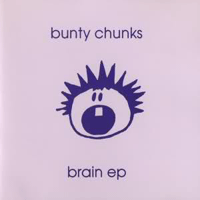
November 1996 – mini-album reviews – Bunty Chunks’ ‘Brain Ep’ (“violent eccentricity and an atmosphere of coded warning”)

16 Nov
Bunty Chunks: 'Brain Ep'

Bunty Chunks: ‘Brain Ep’

A bizarre, triple-jointed noise, ‘Brain Ep’ is twenty-two minutes worth of sixteen razor-honed two-minute songs. Any band of indie stoners could copy this note for note, slow it down by two-thirds and still end up with enough music for three years of releases. Bunty Chunks slam it all out at once. They’re probably one of the only groups who could deliver you a full concept album using only a split 7-inch with Napalm Death. And the Ep is short for Epilepsy.

So what kind of band would name themselves after a dismembered issue of a long-defunct girl’s comic? Well, theirs is a sound of seriously intense stunt guitar, twitchy hardcore tub-bashing and voice-of-doom Valkyrie vocals from Lisa Bailey. It’s as if Steve Vai (during his Zappa tenure, not his metal stardom) had skidded on the soap during bathtime, crashed through the window dripping and naked as a newborn, and finally fallen splat through next door’s roof, straigh into the middle of a women-only workshop of opera lessons. (Yeah, well, things like that happen to me most weeks…) I could also suggest L7 doing a jigsaw with Wire, Slapp Happy being forced to speak after being shut away and mainlining espresso for a solid month, or a Public Image Ltd. lineup with a Zappa complexity fetish. Otherwise there don’t seem to be many precedents for Bunty Chunks’ music. Which is a shame, because then life would be a lot more interesting than it actually is.

‘Brain Ep’ delivers a fruit salad stunt-punk, where the guitar weaves ridiculously complicated loops as Lisa vomits up hairball blasts of surrealist rhetoric. These in turn are decorated with scattered ad-slogans, one-liners and dismembered moments of sharp poetry. Seemingly taking as much influence from random cartoons and Rorschach blots as from real life, Bunty Chunks lean heavily into a disturbed world of childlike imagination and often topple into ludicrous playroom weirdness. Songs sport titles like Dog Made of Foam, Kojak Ring of Confidence or Fly Away Sausage Boy. Lisa’s lyrics are full of sinister, comical transformations: feet turn into chickens, stirrup pumps hurl abuse, and even Pavarotti reveals a hideous alter-ego. Yet there are stories in there too (embedded in the word-rashes) even if they do seem to have been tied in knots by a Turkish masseur and forced through a shattered kaleidoscope.

Lisa’s unstoppable voice – iron-hard and utterly committed, with a car-alarm urgency – is key to this. Taking what could otherwise be colourful whimsy, she pushes it out sounding like no-nonsense observation. She can navigate the paranoid mutterings and memories of a vagrant (in Hobo) or hurl out chattering expressions of rage at the demands of scrounging friends and partners (in Pay Up Ape). Similarly, she can also handle the put-upon fretting that sizzles in The Cat Tooth; the feverish dreams of mortality and aging in We Grow Up With Bones; and all of the bizarre characters that these songs suggest are marching in and out of her memory and life like a plague of amorphous, opportunistic aliens. (“Years later I would say I realise then, the only thing you can sell and still own… he was not a cripple, but he could pretend to be like no other.”)

While there’s little variety in her arresting, confrontational tone, its sheer conviction nails Bunty Chunks’ apparent flights of fancy down hard to the tarmac, rendering them as gritty as life in a rotting tower block. Despite the hallucinatory feel of the band’s songs, her edge gives them a visionary clarity. Lisa’s simultaneously the person who urgently buttonholes you for attention in the wasteland, and the woman who’s guarding and watching at the door, keeping a hard eye on the inside and the outside. Balanced between violent eccentricity and an atmosphere of coded warning, ‘Brain Ep’ comes across like a lifetime of very tricky parallel-dimension social work, carried out in a city of grotesques.

Considering that they’re the ones who got us into this, Bunty Chunks make pretty good guides to get us through. This in spite of the fact that they’ve junked verse-chorus-verse, and you’d better come in strapped up for a relentless (sometimes irritating) barrage of storm-tossed notes. But it’s worth the visit. At the very least you get to see Lisa and the other ‘Chunks playing with giddy intent: within sight of a million tunes yet never settling on any particular one, with eyes and ears stretched far too wide open to settle for anything as simple as boy-meets-girl. “Brain ep convulsions.” You said it, Lisa. Fits for a queen. So where’s the sixty-minute triple album, then?

Bunty Chunks: ‘Brain Ep’
Noiseburger Records, NB5 (5019148710073)
CD-only mini-album
Released: 1996

Buy it from:
Long deleted – look for this second-hand.

Bunty Chunks online:
LastFM

May 1994 – live reviews – Django Bates’ Delightful Precipice at London Jazz Festival @ The Bloomsbury Theatre, Bloomsbury, London, 17th May 1994 (“behind the whimsy lies the mind of a genius, or a sadist. Probably both.”)

19 May

Time to open your eyes a little wider, ‘cos something strange is stirring in the home counties…

Those of you familiar with Bill Bruford’s Earthworks will be aware of the contribution made by one Django Bates on keyboards, tenor horn and compositional skills. If you’ve done your homework, you’ll also know that he and Earthworks’ brilliant saxophonist Iain Ballamy originally worked together in the anarchic and thoroughly enjoyable Loose Tubes, a jazz big band who sounded like a joyous drunken party in a brass instrument factory.

If you’re really keeping up with Bates’ freewheeling progress, you might also know that he has his own big band in the form of the seventeen-piece Delightful Precipice, featuring Ballamy and several other Loose Tubes-ers such as flautist Eddie Parker, clarinettist Dai Pritchard, saxophonists Julian Arguelles and Steve Buckley… well, a large chunk of the current British jazz scene, when it comes down to it. Certainly half of the musical population of London, clutching various brass and woodwind implements, seems to have ambled amiably onstage along with the flamboyant Bates. While this lot might not have the profiles of the Courtney Pines of this world, they’re probably doing more to extend the boundaries of innovative music. With Earthworks, Bates breaks new ground and moves the landscape around; with Delightful Precipice, he teeters teasingly on a thrilling new brink (as suggested by the title of tonight’s opener, ‘Tightrope’).

It’s certainly brinksmanship of a high order. From the first notes, I’m transfixed by the music Bates and co. are producing: all of you who speak knowledgeably of the complexities of prog bands should lend an ear to Delightful Precipice, and get an earful of Django Bates’ muse. It’s a rich, densely textured experience; this is music so complex and ferociously intelligent that I feel as if it’s forcing entry to my skull. Pressed back in my seat as the music powers on, rushing through my mind like irresistible floodwaters, I’m firstly overwhelmed by the sheer substance of it. Later, as it shows no sign of letting up, I feel my reluctant slow little brain being gently forced into activity; it’s like slowly being woken up, given a massage and a pep talk. This is music so cerebral that it even brings your mind up to speed.

‘Tightrope’ opens the show in slamming clusters of notes like being punched to death by brass, before the band gently finger-snap their way into ‘Armchair March’, a melancholy Bates-y stomp with long peals of English brass band sound (a Loose Tubes trademark). The following ‘Fox Across the Road’ is a menacing, darkly harmonic undulation, sliced up by samples of screeching car brakes, speech, beeps and horn toots, and savaged by Mike Mondesir’s slap-bass breaks.

Bates cuts an eccentric figure onstage – curly-headed, immaculately stylish and handsome, spinning around behind his keyboard or pulling out a hunting horn for a quick blast. His ironic smile, plus the reams of music manuscript spilling over the keyboard and the musing, other-worldly humour of his between-song comments give him the air of some elegantly mad professor, a Lewis Carroll of the jazz scene. He dedicates the handclappy lunacy of ‘Ice is Slippery’ to his sporting heroine, Tonya Harding. ‘The Loneliness of Being Right’ features a lengthy chunk of free-association gibberish (“Bud Freeman Hardy Willis… do not forsake me, oh my Darjeeling tea…”)

But don’t be fooled. Behind the whimsy lies the mind of a genius, or a sadist. Probably both. His music manages to balance both an astounding inventiveness and enough humour to keep us listening to it. There is the considerable problem that a poor sound mix renders his keyboard all but inaudible, but the guy still seems to be everywhere – dancing and conducting his ferociously complicated arrangements, playing behind his back, waltzing through ‘Queen of Puddings’, generally having a good time.

The second half of the show is more accessible than the dense and demanding first, opening with Eddie Parker’s breezy big-band rush ‘Exeter – King of Cities’, a carefree musical evocation of the Devon summer. We also get ‘Glad Afrika’, a revamp of Bates’ Loose Tubes standard ‘Sad Afrika’ translated into “happy stylee” in celebration of the end of apartheid. It’s a glorious burst of happy-sad brass, a cartwheeling piece rolling through chorale to cacophony and ending up in a great soft resolution.

Almost impossible to top; but Bates manages it when he straps on his tenor horn and walks out from behind his keyboard to deliver a reading of Earthworks’ ‘Candles Still Flicker in Romania’s Dark’ which reduces the original to a pale, ineffectual shadow. His horn playing is phenomenal, sputtering and spiralling, clutching at heaven and breaking hearts, devastatingly sad and angry. The band – as previously noted, a sterling group of musicians and no mere wallpaper backing – also excel themselves in their sudden subtlety on the wispy pulses of the chordal background.

For closers we get the hyper-percussive artillery of ‘Martin France at Seven-and-Three-Quarters’ (with the aforementioned drummer going to town on his rig electronics) and the wry musing on disappointment, ‘You Can’t Have Everything’, in which Bates and his horn break up the glumness by invading the audience. Plus, as an encore, there’s another of Bates’ grabs at incorporating different musical forms into his art – this time, it’s the noble English football chant, fused alongside some heavy rock wallop into the raucous ‘Discovering Metal’. I’m treating to the spectacle of the arty Bloomsbury audience gleefully yelling along to “woah-oh, oh oh oh!” like a bunch of benevolent hooligans.

Bates comments, as he shuffles the music for ‘You Can’t Have Everything’, that the fate of the modern British jazzer is to be famous for two weeks and then to be dropped by the record company. “Only joking,” he goes on. “The fact is that there is a British jazz scene, as long as we all make it happen.” Well, Delightful Precipice can provide us with a whole evening’s worth of reasons why we should.; and I’d urge you to become familiar with their arguments. Wit, technique, complexity and another jump forward in the universe of jazz. To think that this is happening in England!

Django Bates online:
Homepage, Facebook, Twitter, MySpace, Bandcamp, Last.fm, Apple Music, YouTube, Vimeo, Deezer, Spotify, Tidal, Amazon Music

The Bloomsbury Theatre online:
Homepage, Facebook, Twitter

SWOONAGE

Swoon. /swo͞on/ A verb. To be emotionally affected by someone or something that one admires; become ecstatic. Here are some people and things that make me swoon. #swoon #swoonage

Post-Punk Monk

Searching for divinity in records from '78-'85 or so…

theartyassassin

...wandering through music...

Get In Her Ears

Promoting and Supporting Women in Music

Die or D.I.Y.?

...wandering through music...

Music Aficionado

Quality articles about the golden age of music

THE ACTIVE LISTENER

...wandering through music...

Planet Hugill

...wandering through music...

Listening to Ladies

...wandering through music...

ATTN:Magazine

Not from concentrate.

Xposed Club

improvised/experimental/music

The Quietus

...wandering through music...

I Quite Like Gigs

Music Reviews, music thoughts and musical wonderings

furia log

...wandering through music...

The Recoup

SINCE 2013: Books and books and books and books and occasionally other things

A jumped-up pantry boy

To say the least, oh truly disappointed

PROOF POSITIVE

A new semi-regular gig in London

Gapplegate Classical-Modern Music Review

...wandering through music...

When The Horn Blows

...wandering through music...

:::::::::::: Ekho :::::::::::: Women in Sonic Art

Celebrating the Work of Women within Sonic Art: an expanding archive promoting equality in the sonic field

Ned Raggett Ponders It All

Just another WordPress.com weblog

FLIPSIDE REVIEWS

...wandering through music...

Headphone Commute

honest words on honest music

The One-Liner Miner

...wandering through music...

Yeah I Know It Sucks

an absurdist review blog

Obat Kanker Payudara Ginseng RH 2

...wandering through music...

poplifer.wordpress.com/

Waiting for the gift of sound and vision

Good Music Speaks

A music blog written by Rich Brown

Do The Math

...wandering through music...

Archived Music Press

Scans from the Melody Maker and N.M.E. circa 1987-1996

The World's Worst Records

...wandering through music...

Soundscapes

...wandering through music...

OLD SCHOOL RECORD REVIEW

Where You Are Always Wrong

FRIDAY NIGHT BOYS

...wandering through music...

Fragile or Possibly Extinct

Life Outside the Womb

a closer listen

a home for instrumental and experimental music

Bird is the Worm

New Jazz: We Search. We Recommend. You Listen.

...wandering through music...

Life Just Bounces

...wandering through music...

Lucid Culture

JAZZ, CLASSICAL MUSIC AND THE ARTS IN NEW YORK CITY

Aquarium Drunkard

...wandering through music...

eyesplinters

Just another WordPress.com site

NewFrontEars

...wandering through music...

FormerConformer

Striving for Difference