Archive | hard rock RSS feed for this section

December 2015 – upcoming gigs, London & elsewhere – a Lost Map afternoon at Daylight Music with The Pictish Trail, Seamus Fogarty, Tuff Love and Kid Canaveral; Thumpermonkey, The Mayors of Miyazaki and Lolita Laytex hit The Albany in Deptford; and Rocket from the Tombs in London and Leeds

7 Dec

On Saturday this week, there’s what looks like a particularly engaging Daylight Music afternoon, with the return of a familiar face…
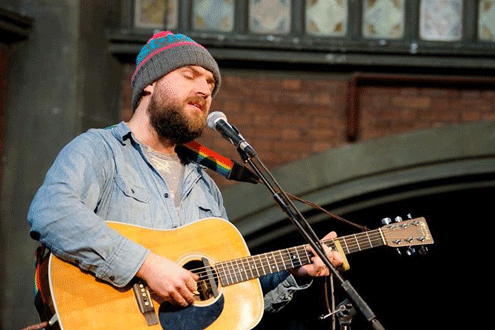
The Pictish Trail & other Lost Map artists at Daylight Music, 12th December 2015

Daylight Music 210 – The Pictish Trail + artists from the Lost Map label: Seamus Fogarty + Tuff Love + Kid Canaveral (Union Chapel, Saturday 12th November 2015, 12.00pm) – free (suggested donation £5.00) – information

Wrapping up this season of Daylight Music are Lost Map; a loose-knit DIY label/collective from the Hebrides founded by alt-folk troubadour, Johnny Lynch, a.k.a. The Pictish Trail. For this special Christmas show, Johnny will be ice-skating back to the mainland, bringing a selection box of pals from his Lost Map roster, for a cosy festive afternoon of stripped back acoustic merriment, frost-bitten Casio hymns, and mulled-tea fuelled carols.

While The Pictish Trail often comes across on record as an eerie digifolk creation (like a Scottish oil-town-and-fishing-port David Lynch, with that surreal supernatural undertow suffused by Gaelic angst rather than Americana), anyone who’s caught one of the live acoustic shows will know that Johnny has an altogether more joyous side as unplugged strummer. Many of his tales may be based on shyness, grief and confusion, but I’ve seen few people who take such unalloyed pleasure in warming up and including an audience the way he does. For a reminder of this, have a read of my review of his last Daylight Music appearance back in January… and see below.

Mayo-born but London-based, Seamus Fogarty plays and sings his own soulful version of contemporary Irish folk, dabbled with electronic found sound. His output’s been described as “songs about mountains that steal T-shirts, women who look like dinosaurs and various other unfortunate incidents” and as “summoning all manner of odd noises and audio ghosts”. Taken from his current album ‘God Damn You Mountain’, here’s Rita Jack’s Lament, which showcases all of his various tendencies to the maximum.


Glaswegian fuzzy-pop duo Tuff Love represent Lost Map’s more-out-and-out indie rock side, although their cottage-industry approach (recording and producing everything at home themselves rather than chasing studios and jaded professional engineers) reflects the label’s d-i-y philosophy. Julie Eisenstein and Suse Bear (augmented for concerts by Phantom Band drummer Iain Stewart deliver “dazzling, sun-streaked guitar pop songs with mesmerising lyrics, heart-wrenching vocals and dreamy melodies like the sound of pure summer.” Over a scant few years of existence, they’ve already supported Paulo Nutini and Ride and played several overflowing handfuls of rock festivals.

‘Resort’ – a not-quite-debut album pulling together the three EPs that Tuff Love have put out so far – is out in January, but meanwhile here’s what will either be a reminder of their existing delights or an introduction to their world: somewhat shoegaze-y but with mischievous glimpses up through the eyelashes.

Edinburgh four-piece Kid Canaveral (whom Lost Map described as “ADHD pop splendour”) met at university in St Andrews and have been playing together ever since. Imaginative alternative pop, they manage to recall the early-‘80s cleverness of Postcard Records pop or the ramshackle poignancy of Belle & Sebastian without actually sounding much like either. It’s more a matter of spirit, a discreet but inclusive sophistication which reaches out, brushes your arm and invites you along. Two albums in, with a third in preparation, they’re a delightful discovery whenever you happen to encounter them. Their clever videos are a treat, too – here are a couple of tastes below, the first of which had my four-year-old son continually tapping the replay button.

(For anyone who wants a more substantial dose of Kid Canaveral, note that they’re playing a full set at the Shacklewell Arms on the evening of the same day.)

* * * * * * * *

On the Saturday evening, you’ve got your pick of twisty London art-rock and revived mid-Western proto-punk…Thumpermonkey @ The Islington, 30th July 2015
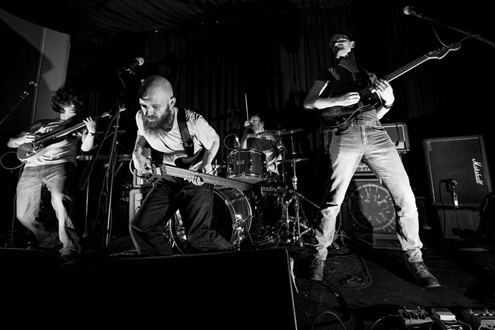
Thumpermonkey + Mayors Of Miyazaki + Lolita Laytex (Something’s Gonna Happen @ The AlbanyDouglas Way, Deptford, London, SE8 4AG, England, Saturday 12th December 2015, 7.30pm) – £3.00-£5.00 – information – tickets on the door

Welcome back everybody: and once again we have two superb outfits centre stage, Thumpermonkey (heavy progressive music) and Mayors of Miyazaki (DIY three-piece based in south London, guaranteed to spit and sweat on us at close quarters). The lovely Lolita Laytex will be joining us to add the flavour of burlesque. Yes, people of the universe, with all those ingredients in store, you know the score: £3.00 concessions and a fiver on the door. Bring ya skin!

I’ve said quite a bit about Thumpermonkey over the course of the year. Grand, clever and atmospheric, they also have enough sly, self-aware wit and humour to undercut all of the previous. They’re also tricky to pigeonhole – a band who create intricate catastrophe epics (part Radiohead, part Van der Graff Generator) but also trill the occasional Mastodon cover in the style of early Kate Bush; a prog band with a singer who sounds like an old-time theatrical knight, but also a noise band who happen to wrap their wildness into tightly-composed structures; geeky popcorn information omnivores drawing from Alejandro Jodorowsky to H. P. Lovecraft to William Gibson, but salting it with Noam Chomsky and science magazines before whipping it up into artful tornados of song. This little sample here is both characteristic and unique within what Thumpermonkey do, which in itself probably tells you all you need to know.


I don’t think Mayors of Miyazaki have been in here before, but they should have been. In their way, their music’s as grand and complex as that of Thumpermonkey and even more enthused by its options. It’s punk with all the chains blown off, joyriding math-rock, de-Ritalined bratprog. A typical song sounds like both chase sequence and protracted explosion: spiky, switch-and-swap assemblages of guitar parts doubling back through alleys and charging halfway up walls, over which sibling team Gareth and Claire Thomas declaim a punky boy-girl barkathon, a speaky-drawl of sparking thoughts. Fugazi and The Fall both might be in there, though you could also pull Bis and long-lost ‘90s psych tanglers The Monsoon Bassoon out of the root cluster.


I don’t know much about Lolita Laytex except that she’s a fetish model as well as an alternative burlesque performer and fetish model. Not much information about a third-stream digression into music: so perhaps you should expect something sensual and mobile, which squeaks a little when it flexes. (UPDATE, 10th December – Well, that’s that laboured gag wasted. Lolita’s off the bill, replaced by Deptford punk-poppers The Kill Raimi’s. Some video evidence below…

* * * * * * * *

Rocket from the Tombs + Luminous Bodies (Baba Yaga’s Hut @ The Brewhouse, @ London Fields Brewery, 369-370 Helmsley Place, South Hackney, London, E8 3SB, England, Saturday 12th December 2015, 8.00pm) – £19.25 – informationtickets

Rocket from the Tombs (Brudenell Social Club, 17 Brudenell Road, Leeds, LS6 1HA, England, Sunday 13th December 2015, 8.00pm) – £17.60 – informationtickets

In their initial lifetime Rocket from the Tombs never got past a series of scorching mid-‘70s gigs in their Cleveland hometown, plus a handful of demos and radio sessions; yet they have long been counted as proto-punk ancestors, kicking up a frumious Velvets-and-Stooges racket long before every other garage band was doing it.
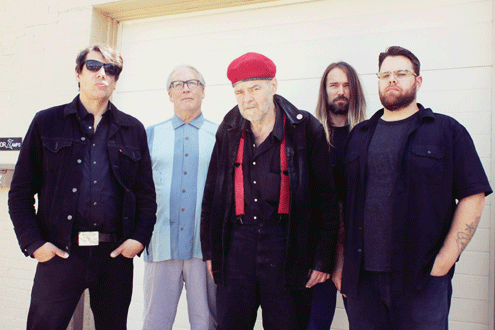
Rocket From The Tombs, 2015

These days, onstage rock rage is quotidian; when Rocket from the Tombs brought it to the gig, it was a revelation. Following a headstrong and punchy split, they even spawned several other key bands. Main ranter David Thomas, doomed-and-driven guitarist Peter Laughner and soundman-turned-bass-player Tim Wright would create the first lineup of Pere Ubu. Second guitarist Cheetah Chrome and drummer Johnny Blitz hooked up with Stiv Bators and others to form the hardcore punk pioneers Dead Boys. The rest was bootlegs and rumbling mythology. Rocket from the Tombs became one of the ur-bands; a surviving impression holding its ghostly mark but pushing onwards, providing inspiration above and beyond its initial ideals.
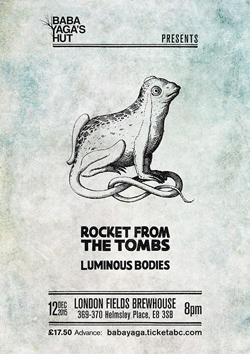
Rocket From The Tombs/Luminous Bodies @ Baba Yaga's Hut, December 2015By the accounts of the ex-members, being in the band was a short, brutal and vivid experience; but it seems that there may also have been an unspoken, slow-burning sense of unfinished business. Twenty-eight years later, in their grizzled early fifties, and with plenty of other experience clocked up, most of the surviving band members (minus the retired Blitz and the long-dead Laughner) reunited for piss-and-vinegar-fuelled gigs, a long-delayed debut album and an actual afterlife. Although Laughner’s initial replacement (ex-Television guitar star Richard Lloyd), left in 2011 and a tour-burned Cheetah Chrome is now opting to sit out the live gigs, Rocket from the Tombs are still going – very much the garage end of Cleveland’s infamous avant-garage, making the most of this ornery self-driven second shot while bleeding in lessons learned from Pere Ubu and elsewhere.

The band have never played in Britain before, something which is being remedied with these two gigs in Leeds and London. In an interview with ‘The Guardian’ earlier this year, a currently chair-bound David Thomas growled “I’m approaching the end of my life, I’ve got my foot to the floor and I’m going to be going full speed ahead when I hit the wall.” It’s probably worth your while coming to one of these shows to check out his main accelerant.

There’ll be no support band at the Leeds gig, but in London things will be warmed up by Luminous Bodies, a “knuckle-dragging rock & roll” supergroup stealing members from Part Chimp, Terminal Cheesecake, Ikara Colt and others. See below.

* * * * * * * *

More coming shortly with the remaining December gigs and the seasonal parties… keep warm…

November 2015 – upcoming London gigs – Raf & O, Arhai and Lucy Claire at Whispers & Hurricanes; Guitar Journey Duet at Songs from the Cellar in Highgate; Lo Recordings bring Grasscut, Astronauts and Lilith Ai to Daylight Music

16 Nov

A few months ago, I briefly covered folk/classical/pop fusion night Whispers & Hurricanes (the latest arm of the Chaos Theory Promotions mini-empire) and they’re back this week.

Whispers & Hurricanes @ The Sebright Arms, 20th November 2015

Raf & O + ArHai + Lucy Claire + guests (Whispers & Hurricanes @ The Sebright Arms, 33-35 Coate Street, Bethnal Green London, E2 9AG, UK, Friday November 20th 2015, 7:30pm) – £6.00 – informationtickets

After a wonderful launch in September, our newest night is back with inspired musicians who fuse traditional sounds with groundbreaking techniques in an evening of mesmeric triphop, folktronica, avant pop and contemporary classical electronics. Fans of Portishead, Bowie, Lamb, Bjork and Eric Satie will enjoy.

Raf & O are a duo from south-east London who are garnering widespread acclaim in the UK and Europe, creating a buzz via exciting performances of their uniquely detailed avant-pop and its vortex of live electronics, acoustic instruments and fragile, magnetic, strange lullabies. After supporting artists such as Faust and Little Annie Bandez, they were special guests in Richard Strange’s production for William S. Burroughs’ centenary at Queen Elizabeth Hall, and recently composed for the theatre play ‘That Woman’s Voice’ (a tribute to Jean Cocteau). Raf and O’s second album ‘Time Machine’ was named as one of ‘FACT Magazine’s Top 10 albums of 2014, with their “avant-bizarre” interpretation of David Bowie’s Lady Grinning Soul pricking the ear of Bowie’s pianist, Mike Garson (who praised their minimalist approach) and leading to appearances at two Memory Of A Free Festival concerts (re-stagings of the legendary Beckenham Free Festival organised by David Bowie and The Beckenham Arts Lab back in 1969). Tonight we’ll hear them perform music from their first two albums, as well as unheard music from their upcoming third album.

ArHai is an electronic Balkan folk duo, consisting of Serbian-born composer and singer Jovana Backovic and British multi-instrumentalist Adrian Lever. Their music is a fusion of electronic music and folk with medieval influences from both the Gaelic and Balkan traditions. Underlined with breathtaking visuals, Arhai breathes new life into the sounds of the Bulgarian 8-string tambura lute and hammered dulcimer (played by Adrian), blending them with Jovana’s ethereal vocals and electronic production. Their previous album ‘Eastern Roads’ is a must have. Tonight’s show celebrates the launch of their new website and the upcoming release of their single.

We also welcome back the brilliant composer Lucy Claire, who launched her beautiful ‘Collaborations’ EP with us last year. A soundscape artist and a contemporary classical composer with influences from the likes of Satie, Peter Broderick and Björk, Lucy composes music with a very organic heart to it and in a style so unique and diverse that it has resulted in her performing to classical, electronic, acoustic and post-rock audiences, as well as live performances on BBC London’s breakfast show and BBC6 Music. Her sound initially seems soft and ambient, but reveals a defiant spirit and gentle force breaking its way through. This evening we will see her perform new collaborative works with some special guests, some of whom you may know already.

* * * * * * * *

It’s always nice to hail a new music night, especially one that’s only a short stroll from your own front door. In the Archway cutting, just up the road from the current Misfit City HQ, Songs from the Cellar have begun to fill a café basement with sound: next week it’s an investigation of antique popular songs, but this week it’s guitar instrumentals…

Guitar Journey Duet (Songs from fhe Cellar @ Zelas Cafe, 216 Archway Road, London, N6 5AX, UK, Friday 20th November 2015, 8.00pm) – £8.00 – information – tickets on the door

Songs From The Cellar, 20th November 2015Guitar Journey Duet is a team-up between two leading London cross-disciplinary guitarists – British player Jonny Phillips (a member of Oriole and F-ire Collective) and Sardinian-born Giorgio Serci (whose twenty years of recordings, collaborations and performance has included work with Antonio Forcione, Eduardo Niebla, Denys Baptiste and Shirley Bassey).

Between them Jonny and Giorgio cover jazz, classical, flamenco, samba, art rock, British folk and African jazz. They might be off to play Verdi at the Albert Hall barely a week after this concert, but what they get up to in this small Highgate basement might well be something completely different. The only clue as to what they’re playing is that they’re favouring Spanish guitars tonight, as they are in the video below.

http://www.youtube.com/watch?v=ZGQtrFH2gVg

* * * * * * * *

The last gig I’m listing for the week is another Daylight Music effort, bridging the acoustic and the electronic, the pastoral and the urban.

Daylight Music 207, 21st November 2015
Daylight Music 207 – 20 Years Of Lo Recordings: Grasscut + Astronauts + Lilith Ai (Union Chapel, Saturday 21st November 2015, 12.00pm–2.00pm) – free (£3.50 donation suggested) – information

Renowned for quality esoteric music, Shoreditch’s Lo Recordings has released music by Thurston Moore, Four Tet, Aphex Twin and others. Now the label is celebrating its 20th birthday with a special showcase at Daylight Music featuring label artists Grasscut, Astronauts and Lilith Ai.

Many accolades have been heaped on Grasscut, the teaming of Andrew Phillips (voice, keyboards, guitar) and Marcus O’Dair (keyboards, double bass) in a wide-thinking Brighton-based duo which encompasses electronica, classical minimalism and multi-media, and which draws inspiration from landscapes and history. Andrew, who writes and produces all Grasscut music, is also known for his soundtrack work for HBO, BBC Films and Channel 4: he has been nominated for an Emmy and shortlisted for an Ivor Novello. Marcus (who manages the band in addition to his instrumental contributions) also occupies himself with journalism for the Guardian and Financial, lecturing in Popular Music at Middlesex University and work as a broadcaster in particular on Stuart Maconie’s ‘Freakzone’: he is also the author of ‘Different Every Time: The Authorised Biography Of Robert Wyatt’. At this concert Grasscut will be playing music from their new album (and first for Lo Recordings), ‘Everyone Was A Bird’.

Astronauts is the solo project from Dan Carney (formerly of Dark Captain). Described by Sputnik Music as “often bleak and highly contemplative indie-folk”, according to Facebook, the project is mainly in the business of creating “ham-fisted bleep-folk neoliberal takedowns”. As with Grasscut, Dan’s interests and influences extend beyond making music: he is a qualified developmental psychologist with an interest in short-term memory development and in Williams and Down’s syndromes.

Lilith Ai is a new signing to Lo Recordings. A member of the Fight Like a Girl collective, she performs poignant tales of modern city living. Drawing from blues, folk and acoustic R’n’B, and dusted by subtle electronic shades and beats, Lilith’s songs show urban life through a clear lens which does not hesitate to reveal her own dark life experience.

https://www.youtube.com/watch?v=G-7ZHSJbX-E

November 2015 – upcoming London gigs – Baba Yaga’s Hut brings Josefin Öhrn & The Liberation, The Wharves and Mr Silla to the Shacklewell Arms; The Magic Band play Captain Beefheart at Under the Bridge; Annette Peacock plays Café Oto

15 Nov

I’ve not got quite as many gigs to cover this time, but bear in mind that The End Festival is still happily raging in Crouch End this week (if it were a standalone concert, The End’s Feast of St Cecilia weird-folk afternoon would be taking pride of place here), as is the London Jazz Festival. As I’m also a little more squeezed for time than usual this week, there’ll be less personal reflection and much more press-release in the coverage of the gigs in this post. Sorry about that. I’ll opinionate a little more next time.

* * * * * * * *

First up, a Baba Yaga mid-week gig: the debut British show for Josefin Öhrn, who’s rapidly becoming a darling of the urban psychedelic crowd. With her band The Liberation, she creates a beautifully spacious, light touch sound: some Krautrock motorik, enough rock’n’roll minimalism to slip smoothly into the sweet spot between hypnotic and monotonous, a strident skullbone rattle-and-drone where it’s needed, and a repertoire of subtle sonic finessing (shimmer, backwards reverb, rises, rainbow tone curves, all of the ingredients precisely and skilfully placed). To cap it, there’s Josefin’s voice – as perfectly-judged as the rest of the instrumentation and as cool as a drink of iced milk on a parched day, floating in the ever-present thought-space between the band’s chassis and roof.

event-20151118-josefineohrn

Josefin Öhrn & The Liberation (Baba Yaga’s Hut @ The Shacklewell Arms, 71 Shacklewell Lane, Shacklewell, London, E8 2EB, UK, Wednesday 18th November 2015, 8.00pm) – £7.00 – informationtickets

In an era in which “psychedelia” can often mean merely a grab-bag of influences from which wah-wah pedals and two-note riffs are dispensed as signifiers and signposts into a realm of easy accessibility as opposed to gateways to another dimension, it can be a rarity to come across a band who are genuinely fixated on creating alternate realities for the listener. Yet this is exactly how Stockholm’s Josefin Öhrn + The Liberation view their incandescent art, and it’s this sensibility that’s led to the kaleidoscopic splendour of their debut full-length for Rocket Recordings, ‘Horse Dance’. “It’s a continuum that flows beyond here and now, and psychedelic music seems to be a really powerful way to unveil those deeper oceans of being that are our true home,” reflects Josefin, who forms half the core of the band with Fredrik Joelson. The last twelve months have seem a dramatic rise to prominence for The Liberation (who take their band name from the Tibetan Book Of The Dead) with their EP ‘Diamond Waves’ leading to shows in their homeland with Goat and Les Big Byrd, a nomination for a Swedish Grammy as best newcomer, and rapturously received appearances at festivals like Roskilde.

These adventures have set the stage for a spectacular movement into the unknown from their earlier work. ‘Horse Dance’ is a razor-sharp collection of ditties that marry dreamlike radiance with hypnotic rhythmic drive, set alight by a prismatic experimental glow. It inhabits a realm in which a propulsive ’60s-tinged pop song like ‘Sunny Afternoon’ can be elevated skyward with krautrock-tinged repetition, dub echo and analogue curlicues alike, and one in which a Broadcast-style mantra like You Have Arrived can tap into a psychic lineage that stretches all the way from The United States Of America to Portishead’s ‘Third’. Yet whilst ghosts of the like of Laika, Cat’s Eyes and The Creatures may lurk in the darker recesses of these songs, this is a band paying no homage to bygone glories.

The Liberation cite a myriad influences in both their philosophical stance and their aesthetic, from 12th century iconoclasts like Milarepa to 20th century sonic voyagers like Catherine Ribeiro, and from Kandinsky’s abstract expressions of synaesthesia to the avant-jazz of Moondog. Yet at all times their transcendental extrapolations are married to icy and enticing melodic flourishes, making for a revitalising clash between the chic and the transcendental, and a sound as biting as it is beatific. “I definitely think that the human need for altered states – to see oneself from a bigger perspective – is a deep fundamental need,” Josefin elaborates. “We’ve been deprived of access to our full nature by a restrictive system where altered states may be the ultimate taboo.” With ‘Horse Dance’, Josefin Öhrn + The Liberation step into a world where all such restrictions and taboos are null and void, and this journey is already proving quite the spectacle to behold.

Dunes

Support comes from all-female rock trio The Wharves (whose resonant clear-voiced indie sound, with a stack of folk-pop harmony and a sheen of blurred fluidity, sometimes sounds like a raindrop on the verge of collapsing) and from Mr. Silla (the solo project from former múm member Sigurlaug Gísladóttir, who’s joined live by guitarist Tyler Ludwick of Princess Music). There will also be DJ-ing from Daun of Swedish space-rockers Flowers Must Die.

* * * * * * * *

To be honest, I’m expecting half of the committed freaks in town to be at this next gig; and to have bought their tickets months ago…

The Magic Band @ Under The Bridge, London, 20th November 2015

The Magic Band (Under the Bridge, Stamford Bridge, Fulham Road, Fulham, London, SW6 1HS, UK, Friday 20th November 2015, 7.00pm) – £20.70 – information here and heretickets

After a sold out Under The Bridge gig in 2013, The Magic Band are back! Sharing the vision of celebrating the music of the late Don Van Vliet – aka Captain Beefheart – the band re-visits the classic Beefheart tunes with renewed fervour.Fans of the Captain won’t, wouldn’t and couldn’t miss this! Avant-garde blues at its finest and most rambunctious!

Speaking for myself, the enjoyment of Beefheart’s particular, perverse genius is always marred by the appalling stories of how he maltreated his colleagues. In many respects the man’s life was in tune with mischievous American folk-hero mythology. Those stories of microphone-busting vocals and of teaching his musicians all of their skills from scratch fit happily into the grand tradition of the American liar, the itinerant teller of tall tales and outright whoppers. Still, as the years have gone by, and as the other stories have bled through (about Beefheart’s take-the-money-and-lie attitude, his theft of credit for all of his players’ skills and work, and especially the brutally entitled sadism and psychological warfare meted out to his musical serfs as the band wrung out the tunes) the shine and mystique has well and truly worn off the man. What’s left, as ever, is the music: that tangle of bloodshot rolling blare and skew-whiff insight, the stubborn blues limp and the wrong-angle harmony attacks, the unorthodox barbed hooks that have kept generations of musicians and listeners transfixed.

With the Captain himself dead and gone for five years, reduced to a baleful honk of memory in a speaker, it’s been down to those who played alongside him in the various Magic Bands – and who, in the long run, finally survived him – to regularly blow on the embers and revive the noise. Since the Magic Band’s first reformation in 2006, some of the original members have, for various reasons passed out of the lineup again (first Robert Williams and Gary Lucas; most recently, Denny Walley) but the group still features singer and multi-instrumentalist John “Drumbo” French and bass player Mark “Rockette Morton” Boston. For this gig they’re joined by their current roster of sympatico recruits: guitarist Eric Klerks, drummer Andrew Niven and the newest recruit, Walley’s replacement Max Kutner (a multi-instrumentalist known for his work with Mike Keneally and Oingo Boingo and with Zappa tributeers Grandmothers of Invention, as well as his own projects such as Evil Genius and The Royal US).

By all accounts, in spite of time and circumstance whittling away at the roster of original players, the band retains their magic (judge for yourselves from the clip below). For me what clinches it is that at least some of the right guys are finally being paid, both in cash on the nail and in the credit they’ve damn well earned.

(All right – I did find time and room for some opinionating…)

* * * * * * * *

On Friday (and on the following Monday), Annette Peacock – a great undersung pioneer of various strains of songwriting, jazz experiments and electronics, as well as being an anticipator of many of the intriguing trends in female-led art music of today – is playing a couple of shows at Café Oto.

Annette Peacock @ Café Oto, 20th & 23rd November 2015

Annette Peacock (Café Oto, 18-22 Ashwin Street, London, E8 3DL,UK, Friday November 20th & Monday November 23rd 2015, 8:00 PM) – £22.00-£30.00informationtickets for Fridaytickets for Monday

“We’re very excited to host the first OTO appearance – and first show in London for quite some time – from visionary composer and songwriter, Annette Peacock. Always ahead of her time, Peacock has influenced a huge array or genres whilst never letting herself be pinned down by one, resulting in a music that is as captivating as it is unique. This should be very special indeed.” – Café Oto press release

“Annette Peacock’s wondrous, immersive trailblaze across recorded music’s rich history has marveled the likes of David Bowie, Brian Eno and one-time collaborator Salvador Dalí. Peacock once jokingly told The Quietus she has been fighting her way back to reality ever since taking LSD at Timothy Leary’s Millbrook estate in the early 1960s. Her plunge into otherworldly sonic wellsprings made her one of the first artists to synthesize her own vocals, pioneering the realms of minimalism, free jazz, rap, classical music and psychedelic funk along the way. After Robert Moog gifted Peacock one of his elusive prototype-synthesizers, she started implementing the makeshift device into her already individualistic, free-form lingo of songwriting and composing. To hear music skip so radically across exotic new touchstones, who needs reality, right?” – ‘Le Guess Who’

“Annette Peacock is a stone cold original – an innovator, an outlier, authentically sui generis.” – John Doran, ‘The Quietus’

“Nothing prepares you for the howl of her searingly high notes spiralling up out of spooky organ chords and soul-brass riffs.” – John Fordham, ‘The Guardian’

“A pioneer of rap, live electronic music and synth-pop, Annette Peacock’s achievements are monumental.” – ‘Scarufi’

November 2015 – upcoming London gigs – Vôdûn rocks out Afro-psych-metal at Westminster Kingsway; Dub Trio and Thumpermonkey mix it up at The Underworld

8 Nov

Another couple of London rock gigs show up midweek and at the end of the week. Summaries below:

Vôdûn + support t.b.c. (WestkingMusic Live @ Westminster Kingsway College Theatre, 211 Grays Inn Rd, Kings Cross, London, WC1X 8RA, UK, Thursday 12th November 2015, 6.30pm) – £2.00-£5.00 – information

Emerging out of a cloud of voodoo-scented bombast (in the centre of which you’ll find former Do Me Bad /Chrome Hoof singer Chantal Brown) Afro-psych/doom metal band Vôdûn bring a welcome taste of old-school Black Rock Coalition determination back to the party along with their artfulness. A churning bass-less power trio – multi-racial, two-thirds women, and taking on the names of loa spirits – they set wall-of-noise guitar against galloping drums and full-throated soul-power vocal melisma.

The band make much of West African spirit power, possession and cosmology: but from what initially seems like a stew of schtick brewed from heavy metal and voodoo swagger, various Afrocentric and feminist images bubble up (not least in the assertive vigour of the female players, and in the way they remind us of the passionate feminine component in the rituals and worldview of the original vodun culture). The current Vôdûn single Mino’s Army is a tribute to the fearsome all-female musket regiment which (by the nineteenth century) made up a third of the Dahomeyan army, played a leading role in the nation’s military policy, and honed female ferocity into a powerful fighting force which dismayed and won the admiration of male opponents (including the French, whom the Mino repeatedly mashed in early stages of the colonial wars). The blood-and-fire video pays tribute to this, and to the acres of severed heads which the victorious Mino left behind them, though perhaps not to the fact that the Mino came to strive against slavery in their own nation as well as the slavery fostered by the Europeans.

Inevitably, Vôdûn are going to be inspiring questions and challenges about the African traditions they’re playing with, and perhaps a deeper approach to storytelling doesn’t currently fit the spontaneous and immediate nature of the band as it stands. But in spite of this, and behind the surface theatrics, the signs are promising. One to watch…

Thumpermonkey, 2015

Dub Trio + Thumpermonkey (Nightshift/Rock-A-Rolla @ The Underworld, 174 Camden High Street, Camden Town, London, NW1 0NE, Sunday 15th November 2015) – price – information – tickets

On the following Sunday,  Dub Trio return to London, bringing their live dub/rock skills and their interdependent mutually-looping interactions back to the stage of the Underworld. Here’s a long clip of a full, relatively recent show to get you in the mood.

In support are London’s Thumpermonkey (another bunch of ‘Misfit City’ regulars) whose intricately-constructed heavy post-progressive sound is in some ways the antithesis of Dub Trio’s semi-spontaneous instrumental tightrope act. I’d argue that that was the joy of a well-arranged rock gig – in this case, the contrast between two equally deft, clever and complementary bands keeps one’s brain fizzing away happily, and you leave the gig feeling smarter and more alive than you did when you arrived. Certainly Thumpermonkey’s crammed and ingenious musical constructions, topped off with Michael Woodman’s theatrical songlines and multi-layered lyrics, remain one of the current underrated treasures of British rock.

* * * * * * *

If ‘ve got a moment over the next few days, I’ll post up something on the London Jazz Festival and on The End – failing that, more November gig news to follow.

November 2015 – upcoming gigs – a London rocktronica double from Baba Yaga’s Hut (Tropic of Cancer, Shift Work and Telefon Tel Aviv down south; Teeth of the Sea and Charles Hayward’s Anonymous Bash out east)

7 Nov

On the 12th November, Baba Yaga’s Hut are presenting a double event in London: simultaneous gigs in the east and the south, each blending rock and electronica in different ways and at different intensities.

event-20151109-tropicofcancTropic of Cancer + Shift Work + Telefon Tel Aviv (DJ) (Baba Yaga’s Hut @ Corsica Studios, 4-5 Elephant Road, London, SE17 1LB, UK, Thursday 12th November 2015, 8.00pm) – £10.00 – informationtickets

Gauzy, morbid-romantic LA dream pop project Tropic of Cancer (comprising murmurer and instrumentalist Camella Lobo plus collaborators) return to London for another set of blurred lyrics and slow-burner Gothic psychedelic-tinged tunes. Expect lapping echoes, grey-draped music and a numbed atmosphere with concealed drama: self-confessed romantic and “hyperbolic dramatist” Camella admits that the driving concept behind most of her songs is “a love so supernatural it lasts beyond death, but also a love that is sometimes not strong enough to conquer human weakness in the living.” 

The live Tropic of Cancer band now includes Joshua Eustis of Telefon Tel Aviv (and also Sons of Magdalene, Puscifer and the Nine Inch Nails tour band) who’ll apparently be playing a DJ set under his TTA moniker.  Further support comes from London dance-electronica minimalists Shift Work.

event-20151112-teethoftheseTeeth of the Sea + Anonymous Bash (Baba Yaga’s Hut @ The Brewhouse, London Fields Brewery, 369-370 Helmsley Place, South Hackney, London, E8 3SB, UK, Thursday 12th November 2015, 8.00pm) – £9.00 – informationtickets

At this gig, the increasingly acclaimed Teeth of the Sea launch their fourth album – the subtly-titled ‘Highly Deadly Black Tarantula’.

The London band’s assured and stormy concoction of spacey psychedelic guitar rock  dramatics, heavily-processed Fourth World trumpet, counter-culture festival techno,  electronica and drone music – plus their assured-to-arrogant stage presence and mastery of performance – has been winning them a wide range of fans from across the board. The clips below should give you an idea of what to expect both on record and onstage.

Support comes from Anonymous Bash, featuring veteran experimental drummer Charles Hayward (of This Heat, Camberwell Now, Massacre and the myriad collaborations of Accidents + Emergencies). Based on the music springing from last year’s four-week Hayward residency at Salford’s Islington Mill (during which Charles collaborated with over twenty musicians from the Manchester regions), the project features a taut, dubby experimental sound centred around the sonic marriage of his own percussion, melodica and vocals with shifting, abrasive rock aspects brought in by his collaborators.  The Salford-based Gnod ensemble (a mixture of  kosmiche and cult-spoofery) played a substantial role in the Anonymous Bash album, and join Charles in the ongoing live line-up.

August/November 2015 – upcoming gigs – Lite, Knifeworld and Axes in London, August 19th; Vennart in Leicester and Colchester, August 19th & 20th; Vennart, Knifeworld and Cleft UK tour in November

13 Aug

My part of London’s being gradually gentrified. I’m noting the warning signs – the launderettes being replaced by redundant fresh-fruit emporiums, estate agents proliferating even as the street drinkers melt away; the rough-and-ready Irish pub that’s suddenly been boarded up and now waits to became a sandwich outlet. Even the looming black tower block which dominates the district and which once housed the capital’s most brutal social security offices (leading to it being roundly cursed in song by New Model Army) is being stripped down to white bone and built up into luxury homes, yesterday’s painful memories now smothered under today’s property bubble.

Waiting for the next rent rise – the one which might well bump me out of the neighbourhood in search of new roots – I guess that I can console myself with what seems to be a coincidental side effect. The neighbourhood’s also hosting more interesting gigs, with an influx of art rock, post-progressive and psychedelic evenings nudging aside the garage bands. If this is gentrification, I can at least live with that side of it: Tim Bowness playing down the road at the end of the month, and fresh bursts of tone-colour lighting up Tufnell Park junction on a regular basis. Which leads me to the following…

Lite (& Knifeworld) @ The Boston Music Rooms, London, 19th August 2015


LITE + Knifeworld + Axes (Pink Mist @ The Dome, 2a Dartmouth Park Hill, Tufnell Park, London, NW5 1HL UK, Wednesday 19th August 2015, 7.00pm) – £12.00

On August 19th Tokyo instrumental math heroes LITE return to London for a special one-off show at The Dome. A mainstay in the Japanese charts and something of an institution in their homeland, LITE released ‘Approaches 4‘ – six new live recordings including a new track called Balloon – for free download on May 19th. They’ll be joined by shape-shifting psych impresarios Knifeworld. Led by former Monsoon Bassoon/Cardiacs man Kavus Torabi, the London based octet have been hailed by everyone from ‘The Guardian’ to ‘Rock Sound’ to ‘The Line Of Best Fit’ to ‘Drowned In Sound’ and back again. And then there’s Axes, who in ‘Glory’ released one of the best math rock records of the last ten years. All three bands are on the same bill, for £12, which is pretty damned amazing.


Please note that there are age restrictions on this gig – there’s a lower age limit of fourteen, and under-sixteens must be accompanied by an adult, so trainee adolescent psychonauts should take note (or take a fake ID). Up-to-date information on the gig is available here, while tickets are available here.

(UPDATE – whoops. I only posted this twelve hours ago, and suddenly the whole gig has been transferred to The Lexington instead – up-to-date and ongoing details here – though hopefully not because some moneyed flashmob’s now opening a craft brewery on the site of the luckless Dome…)

Mike Vennart, 2015

More British psychedelic/post-progressive rock is out on the road at the same time, since former Oceansize and current British Theatre frontman Mike Vennart (also known for putting extra guitar flail into the live lineup of Biffy Clyro) is playing a couple of warm-up gigs for his appearance at the ArcTanGent Festival with music from his solo album ‘The Demon Joke’. ArcTangent has nearly sold out now (though you might still be able to grab one of the last tickets if you head over to the website now) but I’m plugging the other gigs now for the benefit of anyone within running distance.

The Vennart live band features two other former Oceansizers (Richard “Gambler” Ingram and Steve DuRose) plus drummer Denzel Pearson. Support comes, variously, from Mike and Gambler themselves (as British Theatre, who’ve just released their first new music in three years – a free download single called ‘Cross The Swords‘ which I’ll be reviewing shortly), Colchester alt.rock songwriter Christie Isaac and assorted last-minute Leicestrians (ask the promoter).

Vennart + British Theatre + guests (Robot Needs Home @ Firebug Bar, 25 Millstone Lane, Leicester, UK, Wednesday 19th August 2015 – 7:00pm) £10 – info and tickets here.

Vennart + Christie Isaac (Colchester Arts Centre, Church Street, Colchester, Essex, CO1 1NF, UK, Thursday 20th August 2015 – 7.30pm) £11 – info and tickets here.

You could also set aside some time in the autumn to catch Vennart’s week-long British tour in November, apparently the last of their gigs for some time (after this, Mike and Gambler will immerse themselves in recording a full album as British Theatre). Knifeworld will return as support on this tour, with the third act on the bill being Mancunian “turbo-prog” duo Cleft who encourage you to think of them as “a machine that compresses fourteen minute songs down to three minutes.”

  • Bodega Social Club, 23 Pelham Street, Nottingham. NG1 2ED, UK, Monday 23rd November 2015
  • Bush Hall, 310 Uxbridge Rd, London, W12 7LJ, UK, Tuesday 24th November 2015
  • The Deaf Institute, 135 Grosvenor Street, Manchester, M1 7HE, Wednesday 25th November 2015
  • King Tut’s, 272a St Vincent St, Glasgow G2 5RL, UK, Thursday 26th November 2015
  • The Hop, 19 Bank Street, Wakefield, West Yorkshire WF1 1EH, UK, Friday 27th November 2015

A couple of tastes of Knifeworld and Cleft follow. If I’m going to be fiddling while Rome burns, I can’t imagine better company.

July/August 2015 – upcoming gigs – Thumpermonkey/The Earls Of Mars/Ham Legion in London; Holly Penfield’s Judy Garland show hits the Hippodrome; The Luck Of Eden Hall tour the UK

25 Jul

Next week sees the first gig (for some time) for one of the most interesting of current British rock bands; some high-gloss cabaret; and the start of a psychedelic pop roadshow travelling around the UK. Read on…

Thumpermonkey @ The Islington, 30th July 2015

Thumpermonkey + The Earls Of Mars + Ham Legion (Guided Missile Special People Club, The Islington, 1 Tolpuddle Street, N1 0XT, London, UK, Thursday 30th July, 8.00pm) – £7.00/£6.00

Thumpermonkey don’t get as much attention as they deserve. It’s possible that this is because they don’t seem to take things seriously, addressing almost everything with a skewed and multi-levelled sense of cryptic grand-baroque geek humour. Just to illustrate this – a current work-in-progress Thumpermonkey song is “something which we’re calling Giraffes, which includes some vague narrative about doing a conga during an asteroid-based extinction-level event.” One of their older albums is called ‘Chap With The Wings, Five Rounds Rapid’ – a wry kill-the-monsters line filched from ‘Doctor Who”s laconic and unflappable Brigadier. In the same spirit as that reference, I’d suggest that while they are serious about what they do, they’re not necessarily serious about the way they do it – like many of my favourite things.

If what I’ve written so far leads you to expect strained, fey, sub-Zappa wackiness, then think again. Both in the flesh and on record, Thumpermonkey are a brooding and atmospheric proposition – seriously musical, travelling from blitzingly heavy quasi-metal riffs to spidery post-rock, from threshing post-hardcore to theatrical mane-tossing prog at a moment’s notice while Michael Woodman’s grand edgy vocals and complex multi-levelled lyrics ride on top like an arcane mahout with an arched eyebrow. They’ve been called “a sustained victory for intuitive cross-pollination” by ‘Prog’ magazine and every gig they play confirms this particular accolade. Here they are playing 419 (a song which at first appears to be one of their more delicate offerings, revealing its intensities later).

The other two bands on the bill are less well known to me, but aren’t short of blurb:

The Earls Of Mars are probably the most original thing you’ll hear all year. At their heart, the band are a ’70s-influenced rock band bringing together jazz, prog, space rock, doom and blues and forming it into a barking mad noise that you’ll either get or you won’t. If you don’t get it then close the door on your way out of the spaceship, as those of us who want to stay are off on a fantastical journey to who-knows-where, with The Earls Of Mars steering the ship. Enjoy the trip, ladies and gentlemen, as it’s going to be a fun ride.

Ham Legion‘s noisy lo-fi pop is punctuated with proggy outbursts, psychedelic breakdowns and passages of cod-metal joy. Tangy and tart guitar, egg noddle bass lines and light crispy drums are smothered in gooey boy/girl harmonies. Eat in or take away. For fans of Cardiacs, Deerhoof, They Might Be Giants, Split Enz, Heavy Vegetable.

Judge for yourselves – here are the videos for the Earls’ ‘Astronomer Pig’ single from last year, followed by some footage of a Ham Legion gig in Brighton a couple of years ago. As for tickets, they’re available here.

http://www.youtube.com/watch?v=Qx6qFZ_V8d4


* * * * *

The day after the Thumpermonkey gig, Holly Penfield plays one of her biggest gigs of the year…

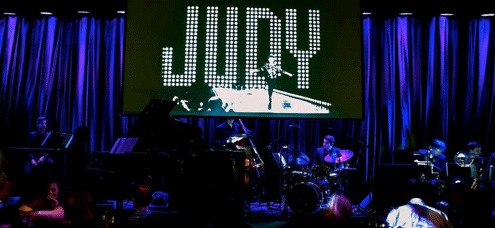
Holly Penfield as Judy Garland

Holly Penfield sings Judy Garland, The Hippodrome Casino, Cranbourn Street, Leicester Square, London, WC2H 7JH, UK, Friday 31st July 2015, 8.00pm) – £15.00 and upwards

Following a triumphant debut last year, Holly returns to the London Hippodrome, singing the songs of the legendary Judy Garland in her own inimitable style. Holly will be joined by her musical director Sam Watts and his magnificent seven-piece band. An unmissable evening for Holly and Judy fans alike, set in the glorious Matcham Room, located inside the Hippodrome Casino – formerly known as The Talk Of The Town, this is the venue of legends and home to Judy’s final London concerts.

Longer-term readers will know that I got to know Holly years ago via her own original ‘Fragile Human Monster Show‘ and the ‘Parts Of My Privacy’ album (which I wrote about ages ago – that review’s due a revamp and remount, I think). Both of those, though original songwriter pop, had their own theatrical and psychodynamic aspects which pointed towards Holly’s current work in vivid cabaret (and, latterly, as half of swing revivalists The Cricklewood Cats). As for Holly’s interpretations, she can and does cover cute showbiz camp and heart-tugging pathos within the same performance – you can see a couple of examples below.

Up-to-date information on the Judy concert is here and here, while tickets are available here. A mischievous part of me fancies swapping the audience from Holly’s show with the one from the Thumpermonkey/Earls/Ham Legion gig, and vice versa. I suspect that they all might enjoy it more than they’d expect to…

* * * * *

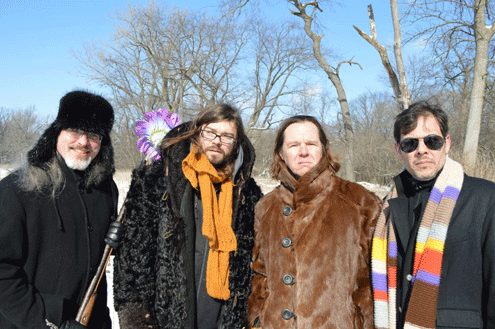
The Luck Of Eden Hall, 2015

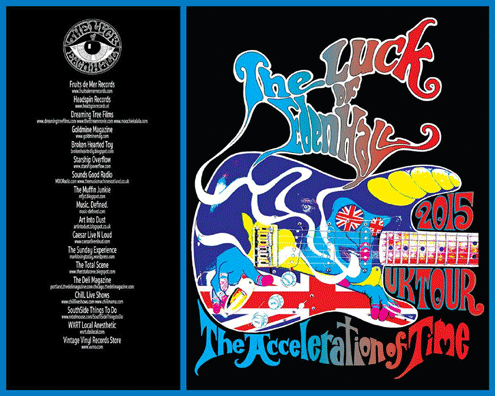
On the same night that Thumpermonkey and co. play, The Luck Of Eden Hall are over from Chicago to play the first of two London gigs, launching a Kickstarter-funded UK tour which will take them to a wide array of venues and mini-festivals around England, Scotland and Wales, accompanied by a shifting cast of local psych heroes, left-field blues artists and quirky alt.pop shoegazers.

As for the headliners, you can expect clear-voiced, well-made classic pop beset by sudden gusts of psychedelic blizzarding. The Luck Of Eden Hall remind me of the drawn-out trucker-and-motorist tussle in ‘Duel’ – they come across like a more sombre Neil Finn or Andy Sturmer being stalked, dogged and sideswiped by Hawkwind, Ride or ‘Saucerful’-era Pink Floyd. Here’s a little evidence:


Full tour dates below:

The Luck Of Eden Hall UK tour


April 2013 – mini-album reviews – Alex’s Hand’s ‘This Cat is a Genius (A B-Sides Compilation)’ (“mostly tarry, and it sticks to things”)

17 Apr
Alex's Hand: 'This Cat Is A Genius'

Alex’s Hand: ‘This Cat Is A Genius’

Sometimes barrel scrapings are as much part of the meal as anything else from the barrel. In the brewing industry, that’s how you get sludgy yeast spreads like Marmite. Yum. Or not.

Meanwhile… we’ve met Alex’s Hand before. They’re yomping Seattle-ites from the scruffiest, carney-est end of American Gothic; something like a junior Primus, Zappa and Residents rolled into one, abruptly zombified, and crammed into the fustiest old suit in Abraham Lincoln’s trunk of hand-me-downs. This EP of B-sides (so they call them – they’ve only ever put out one EP) certainly seems like barrel scrapings. It’s mostly tarry, and it sticks to things. It’s shapeless, it’s distinctly umami, and you might not like it.

That, of course, is the point. Alex’s Hand tend to revel in everything they do, both their moments of genuine artistry and their dumbest chunks of musical blubber. ‘This Cat Is A Genius’ is a pre-release teaser of off-cuts from their debut album (‘Albatross Around The Neck’). It shows off (if that’s the right word) their sludgier leanings; their most precipitous rants; their Melvins side. It sounds as if while the goofy fuckers were messing around in rehearsal, some vicious bastard poisoned their coffee – but they enjoyed it so much that they sent out for more and left the tape running.

What the band’s actually doing is dealing with the departure of Slurrp, their ontime lead guitarist and horn-razzler. Drummer Nic Barnes and bass-bothering microphone pest Kellen Mills drop their stage-names, pick up the pieces and tumble onwards; various buddies help Kellen out with the guitar parts; but it’s clearly been a blow. You can all but hear Alex’s Hand bouncing off the ropes. However, they’re not ones to miss out on a dark chortle, even at their own expense. Nor are they scared of turning a setback into a challenge. If they have to have a period of floundering, they’re damn well going to get something out of it, even if they have to milk it ’til it bleeds. Rolling away from a relatively tight rock stance towards something doomier (or at least more rubbery), they’re taking the opportunity to map the underside of their development as they go.

One of the last two tracks from Slurrp’s last stand – ConserveNow! – is six-and-a-half near-atonal minutes of Melvins-style strain: a lurch-along instrumental of fuzzed grunge bass and wobbly guitar, like a sick freight train careening along a lost stretch of railway. The other, Ants, is a collapsing shack-load of wreckage-guitar and free-form word association. While Slurrp sifts through sluggish, raging clumps of feedback in the background, Kellen’s schizophrenic basslines jump and ebb between laid-back mooch and irritated attack. He also mutters beady-eyed, half-cut stuff into your ear – mostly about giants and UFOs, although at one point he does complain “words are stale, empty – they lack a certain sensuality.” Much of the ‘This Cat Is A Genius’ shares this playful pissed-off stance – a complaining laughter; clever-dumb; slumming in drunken despondency and enjoying a grump. Kellen plays the role of educated-and-unravelling to the hilt, offering flashes of self-mockery through the filter of booze vapours and the pinch of bad shoes.

Dear Me’s clench of lumbering punk disgruntlement mingles King Crimson feedback skitters with a collapsing, anti-play perversity. Inside itself, the song’s at war – halfway through, Kellen grabs a guitar and launches doggedly down a different tunnel and into a different tune. On the headache blunder of Train, he’s scouting for empty bars in order to avoid conversation, moping about insincerity like a touchy teenager: “wish I was happy listening to people with nothing to say. / Lying assholes with so much money / really are dead inside – / they pick my brains as they lie.” Longtime ally Ben Reece (of Step Daddy) drops in again to add wracked, protesting electric guitar and some needling ‘Marquee Moon’ edge as Kellen’s drunken soliloquy heads ever further downhill and then kinks back up shit creek, screaming about “blackest diamonds” and falling into the sea.

While the odd glancing zinger falls out of this kind of lyrical mess, Kellen’s verbal squalls and cracked mumbling are generally just another bit of colour. What he says is less important than how he says it; or just how the words hit the wall. Impression (featuring another temporary guitarist, Shadough Williams) sounds like a lobotomized David Byrne tripping over Black Sabbath. Nic drums on bottles while the music flinches between runaway bursts of samba and foot-dragging sludge-metal. Kellen dismisses another waster in smudges of sardonic detail: “he smokes his cigarettes, douses them with side-effects… / Stand to deliver, his parents used to say – / started out rich and pissed it all away.”

On Penticide, the band paddle around in a splatter of sprained, detuned instruments – piano, melodicas, glockenspiels – while Kellen’s rambling narration casts a cockeyed look downtown. Scribbling a vicious political cartoon of a “crack-whore free-market” full of hapless fools pushing “shit-stained zombie shopping carts”, he also rips himself and his peers ragged. “Welcome to the half-baked bistro… / conspiracy countdown coffee-shop collective,” he husks, before tagging himself as “a dying maverick with a bad attitude… / like Merce Cunningham took a shit in a wine glass.” Mocking his trashed, anti-heroic slide from high culture to garbage, the band break into sarcastic applause.

Confounding all this sarcasm, the final moments come close to delicacy. Sad Little Skeletons is slender, thoughtful and melancholy; initially, it’s not much more than distant birdsong and overheard chat, accompanied by lonely bass melody and shavings of rhythm guitar. For once, Kellen sings gently, setting aside the drunken howls and the scatter-shot smartarsery. Clarity renders his conclusions even bleaker. “Thoughts will come / then fly away. / These emotions are so thick, / like this life just makes me sick. / These piddly little humans, driving their cars / on the freeway… / Sad little skeletons; broken, but don’t realize they’re lost.” The rise towards a tangled noisy fanfare and the drowning of the words in yell and distortion initially comes as a relief. Then you go back and listen to it again, hearing the weary breathing and the tiredness that smacks of reality.

Part-broken, smeared, and devilled by little gouts of waspishness, this isn’t the easiest collection of songs and slurs to get along with. But there’s plenty to scoop out anyway, especially if you like hearing the wilful awkwardness of a band who enjoy stretching themselves out of shape and balance, and who can fit that in with the big boots and barfly lunges. If you enjoy feeling as if you’ve been dipped in an uncomfortable goo, that’s a bonus.

Alex’s Hand: ‘This Cat Is A Genius’
Alex’s Hand (no catalogue number or barcode)
Download-only mini-album
Released: 15th April 2013

Get it from:
Bandcamp.

Alex’s Hand online:
Facebook Twitter Bandcamp LastFM

March 2012 – EP reviews – Retribution Gospel Choir’s ‘The Revolution’ (“if Bad Company had written haikus”)

5 Mar
Retribution Gospel Choir: 'The Revolution' EP

Retribution Gospel Choir: ‘The Revolution’ EP

It really tickles me to see how Retribution Gospel Choir works, and how Alan Sparhawk is making up for his years of restraint. Although they’re a couple of albums into their existence now, it still seems hilarious that Low’s soft-singing frontman is also strutting around – hips aswagger – in a high-powered denim’n’leather rock trio, to which he’s also recruited all of the rest of Low bar Mimi Parker. Even his other sideline (reinventing the blues with Black Eyed Snakes) wasn’t so funny purely on spec. It does make a good joke: but close examination also reveals that it also makes perfect sense.

On the surface (and just by the sound of their crunching riffs, cowbells and stadium-size drumming) RGC is eternal boy-man stuff. Bollock-crushingly tight jeans, the roar of hot-rod chrome, huge dollops of garage grease. Underneath, though, there’s a series of smash-and-grab raids on assorted archetypes, delivered by Alan and co. with relish. It also turns out that RGC takes Low’s logic of song minimalism, and their gift for the simple telling phrase, and  transferred it wholesale to 1970s hard rock. The songs on this EP just punch past two or three minutes each, and seem shorter: they deliver their message, then snap out the light. As for those archetypes, they could hardly be more American – rock music, family, (obliquely Christian) faith and revolution – and, in their way, more conservative. Yet even within a couple of minutes or a couple of lines, Alan’s both turning over and living their contradictions. The setting’s gloriously dumb; the thinking is less so. If Bad Company had written haikus…

On Feel It, Superior, Alan plunges into temptation, risk, delight and inspiration over a Motown-savouring rock thump – handclaps and chopped-off chunks of guitar, a chassis of Hammond organ. Conflating the Beatles with the Fall of Man (“I remember the day / we fell for the apple…”) says everything about America’s protracted, near-religious teenage love affair with rock: all of the sin, all of the potential for growth. Throughout the EP, rock-gospel shout-outs demands that we “shake up the stage”, “drop in the echo”, or “turn it up / and ring the speaker like a bell”. At the same time, Alan bats around seeds of revelation and despair. The Stone (Revolution) asserts “The stone buried deep within the earth, / it doesn’t know, it doesn’t know it’s own worth”: elsewhere, Alan confesses “deep in my heart I feel your pain / I know the dark, / I know the darkness like a shame.”

The butch, confident sound might be ‘70s but the mindset is more ‘60s. Values in question, reactions in spate. Alan seems happy to straddle this. I’m A Man is full of masculine exhortations, muscle-flexing riffs, hero drumming and assurances that “I understand.” Yet it’s the briefest song on offer and, after the initial rush, quickly falls silent: a clumsy, sheepish giant. Maharisha slings both ire and sympathy at errant teens sleepwalking in search of belief. Over an assured and chunky stomp, (part-Cars, part-All Right Now) Alan casts himself as scolding parent: “You said you’d be right back, / you nearly gave me a heart attack!” Even when curling his lip at the attractions of dodgy philosophies (“The Maharisha is blind, you’re… wasting your time”) he still dredges up some rough kindness (“You’ve got to figure it out, it’s like you’ve got the amnesia”).

If it wasn’t for his lifetime of committed Mormonism, I could have sworn he was telling off his own wandering teenage self and ruffling its hair at the same time. Maybe he is. Despite all of the muscle and fervency, this band readily understands and accepts human weakness.

Retribution Gospel Choir: ‘The Revolution’ EP
Sub Pop Records, SP993
7” vinyl/download EP
Released: 29th February 2012

Get it from:
Free download from band homepage;  vinyl EP from Sub Pop.

Retribution Gospel Choir online:
Homepage Facebook Twitter MySpace

July 2003 – album reviews – Show-Yen’s ‘Show-Yen’ (“the precision roar of a squad of slick hand-tooled motorcycles”)

30 Jul

An instrumental power trio from Kyoto, Show-Yen attempt a twenty-first century take on complex fusion rock. Balancing earnestly between early ’90s metal heroics and formal ideas drawn from ’70s art-rock and the stiffer end of jazz-rock, Yasuhiro Nishio and his bandmates encounter mixed results in trying to reconcile them. Yasuhiro, the bandleader, leans towards ersatz Joe Satriani guitar skills and facility in his own melodic, theatrical playing. The band as a whole cup the juggernaut blues-metal legacy of Cream in one hand and embrace the stern compressed minimalism of King Crimson’s ‘Red’ with the other, with digressions into classical guitar and Hendrixian sustain. All accomplished; all, still, a little too over-familiar.

In too many respects the album ends up as a classic rock guitarist’s solo project in all but name, with all of the posturing highs and lows of its kind. Drummer Masanobu Tonomura is a cheerful accompanist, and Hiroaki Fujii provides solid fretless bass, often erupting into the kind of chorused slithering which suggests he’s plotting an escape into full-blown jazz-fusion. Yet neither do more than underpin Yasuhiro’s music. The album sinks, swims, but more often flounders over the guitarist’s wavering levels of inspiration and originality.

This is a shame, as Yasuhiro is a fluent and accomplished musician. When he’s on form, he’s several cuts above the clumsy cut’n’paste standards of neo-prog: his blending of sources is smooth and instinctive. Several core Show-Yen pieces will press the buttons of staunch classic rockers. Much of the album offers the precision roar of a squad of slick hand-tooled motorcycles, but some of the other tones and textures involved suggest that someone’s slipped a little acid and a handful of smart-pills into the petrol tank. On the cruising riff of Network Broken, the entire band sounds groovy and assured, with Yasuhiro even inspired to add a little disruption via Frippish yells of burning guitar. Reallusion’s chugging, businesslike metal riff is cut with haughty descending decorations of Crimsonic phrasing; there are breaks for classical arpeggios; and Yasuhiro pulls off a neat compositional trick of cross-cutting into full-blown Gary Moore blues descends crammed with articulate wah-wah wails.

Yet on the other hand pieces like Move Up or the flashy, jolly Ran sound like little more than ambling, melodic instrumental metal cast-offs. Parade, with its neo-classical tones and cute clarion fanfare, might aim to unite Rush flourishes and latterday math-rock precision: the final result sounds more like a listless chew through the pops-orchestra end of classical rock. While Yasuhiro can readily summon a breezy classical-rock style for these moments (not far off what the perpetually underrated Kevin Peek aimed for with Sky) this sits badly with the hard-rock bristle elsewhere.

Attempts at carrying off something weightier – via the five-part piece Asels – results in sixteen minutes of strolling through some over-familiar galleries. In predictable succession Show-Yen offer up an electro-classical guitar study, some Curved Air toccata-rock (with uninspired rhythm parts slogging under distorted lead guitar breaks and flanged bass responses) and a mid-paced trudge through Crimsonic metal. The final destination is a kind of Hoagy Carmichael dinner-jazz, highlighting melodic bass lines and clean, sleepy guitar. Part-way through, Yasuhiro tosses in a solo slice of twirling, gut-strung hammer-ons (echoing Van Halen’s Spanish Fly). The ultimate result is that of a bitty, end-of-term music showcase: not the seamless gelling of unlikely elements that marks the best prog.

Show-Yen’s problem is that whenever they aim for committed musical context, they always end up in a historical echo-chamber. Bouncing around inside prog-fusion consensus, they’re voluble and skilled in their instrumental focus; yet those stylistic limitations they work within so earnestly also render them voiceless. Tellingly, the band pass this debut album off as some kind of conceptual work, yet refuse to provide story, background or even a suggested listening order. They claim that listeners can create their own sequence and story, then immediately contradict themselves by stating that instrumental music renders any narrative composition irrelevant.

A sense of pointless backtracking, of feet being fallen over and ideas imploding under the weight of inverted rock pretensions, is overwhelming. If it is all an oblique joke, it’s particularly annoying given that Show-Yen can obviously think and do more. When they let their inner hairy beast break through the schooling and the canonical salutes – and when they properly churn (rather than simply milk) their technical skills – everything works better.

Driving jazz inflections and visible thinking are all on display in Fu-Ga with its appealing back-and-forth march of mirrored chords. On Ominous Footsteps II, Show-Yen take a tip from the flattened fifth. Their dark flashy rock explorations now not just a showcase for technique but the generator of a pleasing structural puzzle: it’s built on short menacing low-register pulses, from which Hiroaki’s bass guitar gradually escapes as the piece progresses. Lucifer’s Child shows them grabbing their mid-’70s Crimson fetish whole-heartedly, but letting it fire them up. Yasuhiro leads in and out with endpieces of complex Frippish picking (hitting a feverishly cramped pitch), but ultimately slams the band headlong into a crushing, sticky stoner wah-wah riff over which his car-bumping lead phrases crash down. This is where the band really starts to work – where the method meets the moment.

Show-Yen, then. Deserving of being taken seriously, so long as they start taking themselves seriously. How often do you get to say that about a rock band and genuinely mean it?

Show-Yen’:’Show-Yen’
Musea, FGBG 4406.AR
CD/download album
Released: 22nd July 2003

Buy it from:
Musea.

Show-Yen:
Homepage MySpace LastFM

February 2003 – live reviews – House of Stairs label launch concert (evening 2) featuring William D. Drake, Cheval de Frise, Stars in Battledress and Miss Helsinki @ The Arts Cafe, Toynbee Hall, Aldgate, London; plus Delicate AWOL @ 93 Feet East, Shoreditch, London, both 17th February 2003 (“East End might mean left-field tonight…”)

19 Feb

Less than a week ago, the House of Stairs label put on their Camden launch gig at the Underworld: Max Tundra DJ-ed, filling the gaps with a spicy and witty mix of art-rock, prank techno and pop buzz. But tonight we’re out east in the pizza, pine and paintings environment of the Arts Café for the second, “quiet” gig – and Richard Larcombe is de-facto man-on-the-muzak, even as he bustles about setting up for his turns in two of tonight’s bands. Eerie shapes and twists of music waft through the busy air: the chatter at the bar is underscored by the filtering eeriness of Messiaen and the swooping rattling studio gulps of Boulez. East End might mean left-field tonight.

Miss Helsinki, bless them, display more pop bones in their body. Popping up from the wreck of the much-lamented Monsoon Bassoon, they feature both of the Bassoon’s singing guitarists (Dan Chudley and Kavus Torabi) plus the increasingly ubiquitous Larcombe on bass and harmonies. But they’ve lost both a drummer and Kavus’s keyboard-playing brother Bobak in the last month: and so it’s a stripped-down-and-unplugged Helsinki trio playing for us tonight, both aided and hindered by a backing tape. It’s only their third live appearance.

Frustratingly, they’re still lolling like a tall layer cake whipped out of the oven too soon. There’s something to be said for a bit of engaging pop roughness; and for Torabi’s endearing habit of boggling like Tom Baker at the end of a tricky lick. But although Miss Helsinki’s ambitions are clear, they’re still struggling to reach them. They have a tough act to follow, of course. One of the few bands to unite the approval of both London proggies and the NME, The Monsoon Bassoon wrapped a broad spectrum of ingredients (including Naked City, King Crimson and Shudder to Think) into their explosive, racing psychedelic rock.

Though Miss Helsinki retain some of those flavours, they’ve pastoralised them: the bursts of unusual chording and rampant arpeggiating are still there, but the thrashing intensity has been replaced by a sunny warmth and they’ve obviously settled on Andy Partridge as their guardian angel. But Helsinki music is a good deal more complex and demanding than XTC’s, straining the abilities of Chudley and Torabi’s affable, unvirtuosic boy-next-door voices as they hop over the cheerfully convoluted melodies like tap-dancing cats on a hot tin roof.

Despite this – and despite the fluffed notes and stumbles over the over-detailed backing tapes – ‘I Felt Your Arms Around Me’ is a bright little gem of spiky-haired art-pop, powered by the same giddy celebration of the best Monsoon Bassoon songs. Kavus (air-punching and doing triumphant kicks from his guitar stool) obviously knows it. ‘Surf’s Up’ – featuring a repeated chant of “silhouettes you know from fire” – takes them to places last touched by the psychedelic folk-science of Gastr del Sol; and the romping cowboy-pop of ‘Rodeo’ (“the world seems drunk, with a stetson in place”) ensures that they finish on a note of charm and enthusiasm. Miss Helsinki are a long way from filling the Bassoon’s busy shoes, but the signs are good.

With Miss Helsinki, Richard Larcombe is a deft, understated bass player. With his own band Defeat the Young – backed up by brother James – he steps up to become a witty, elegant frontman with tales of social absurdity and romantic scrapes. But tonight, for Stars in Battledress (an equal-partnership duo of both Larcombe brothers), he takes a step sideways. Up onstage, he cuts a quieter, more sober figure than he does with Defeat the Young. His sophisticated social-jester persona is mostly absent. His ready wit is intact, but here it’s diffused – more musing in its nature, leaning on subtle insinuations and surreal impressions rather than crackling wordplay. It’s also tinted with a peculiar, guarded English melancholy, and there’s an unsettling sense of loss and submission behind Richard’s refined and aristocratic drawl. “Blessed are all with vision unswerving. / Don’t watch me weep – go back to sleep…”

On Richard’s guitar – round about where people usually paste their dude-rock logos or political slogans – there’s a beautifully executed painting of a mallard duck, apparently snipped from a spotter’s guide. It’s appropriate. Stars in Battledress’ drifting tapestries of songscape take place in a watery never-land England of ponds and rivers and thin blue children, posh academies and school gymnasiums, the rituals of government offices and the embarrassments of public speaking; Cambridge water-meadows distorted by a lysergic autumnal haze. Someone in the audience mutters that Stars in Battledress are the best argument he’s ever witnessed against a public school education. I think he’s failing to press past the immaculate antique sheen of their surface. Theirs is a ghostly watercolour world of ruefully suppressed emotions with a tidal tendency to seep back up. Part Evelyn Waugh, part Syd Barrett and part Sea Nymphs.

James – strumming and fondling snowfall arpeggios from his piano and contributing apple-bright harmonies – provides most of Stars in Battledress’ colours, picking up on his brother’s words and extending them outwards in rippling classically-inspired musical inventions. Richard plays some understated, skeletal guitar and trundles a harmonium through the queasy distress signal of ‘Haunted Hotel’, but mostly he stays out at the front, clasping the mike stand like a sad, dapper figurehead. There’s a break from this in the roaring-’40s guitar-waltz of ‘Hollywood Says So’, as Richard delves hilariously into ludicrous showbiz gaudiness (“drive fast cars, play guitars, win prizes / – girls in every port, in all five sizes”) but ends up spat out in a wad of comic bitterness. (“I’ve been over-directed, I’ve been cut in one take. / I’m a dated two-reeler that no-one will make.”) Their cryptic finale – the hummed, valedictory ‘Women from the Ministry’ – hovers in the mind like the flicker of antique cinema light, images of lost houses, withered photographs.

Cheval de Frise are… plain remarkable. Bare to the waist and sporting Trotsky glasses, Vincent Beysselance studies his drumkit with a jazz warrior’s eye, his lean expression and sculpted moustachios lending him the air of a razor-sharp beatnik. Guitarist Thomas Bonvalent looks as if the Taliban have booted him out for excessive zeal. Sporting an enormous bushy chest-length beard, battered clothes and an expression of sincerely crazed intensity, he’s twitching visibly even before he plays a note. His nylon-string acoustic guitar has been modified – or de-modified, with both the sound-hole and the pre-amp controls crudely and defiantly smothered with duct tape. As he plays, biting on a pick, his face seethes beneath his beard.

“Pastoral acoustic mathcore” was what someone wrote on the Cheval de Frise packet. Ah ha, ha, ha – I don’t think so. Pastoral acoustic mathcore would be very nice – perhaps a Guitar Craft picking exercise, pared down by post-punk minimalism and softened by visions of green fields. Are Cheval de Frise like that? No. For the first seven minutes or so, Cheval de Frise seem absolutely demented. After that – and once the broken seizures of drumming and the intricate splatterwork of guitar has had time to get to work on your brain and your reflexes – you start to understand. Although your body will make the connection before your mind does.

Right from the off, Bonvalent’s playing is disturbingly wild; slamming down obsessively on a single note or isolated interval, or spasming music up, down or across the neck of the guitar. Beysselance’s drumming is a boiling whirl of ideas and instincts, acted out with a brinksman’s forcefulness, with enough breakneck substance both to keep the duo’s momentum and to craze it with brilliant stress fractures. People cram to the edge of the Arts Café’s tiny stage, swaying like a wheatfield in a whirlwind, and yelping approval.

Behind the apparent free-scene chaos, Cheval de Frise have serious intentions. The drums have their melodies as well as their upheavals, and although Bonvalent’s open-mouthed drooling visage suggests a man in terminal acid psychosis, he frequently rips into hyperspeed, hypertonal spirals of intense picking which John McLaughlin would be proud of. Every now and again, in the midst of a free section, the two Friseurs exchange a quick cue-ing glance and then slam into perfect alignment, calling a rigorous Zappa-style composed music module up out of memory. Bonvalent’s playing might often parallels the spewing, disjointed clicking noises of the post-Derek Bailey improv school, but the musician he’s really closest to is the iconoclastic lo-fi jazz rebel Billy Jenkins. Deliberately or not, Cheval de Frise ‘s music is a hyperactive flamencoid strain of Jenkins’ “spass” approach – a slew of intense musicality in which ugly sounds, wrong notes, anti-technique and smash-ups in timing and phrasing are as part of the great spontaneous inspiration as skill, structure, complex ambition or the beautiful moment.

It is, also, an intensely devotional music, as burningly thrilling as Nusrat Fateh Ali Khan’s qu’waali shriek, a gospel choir tearing the roof off the sucker, or the closer-to-God whirling of a Sufi dervish. Bonvalent’s physical abandonment (at points close to ecstatic convulsions) is religious in its intensity. As pieces skid to a halt, he bobs his head thankfully to the audience, smiling and almost moved to tears. If it’s like that onstage, it’s not that much less intense down here. Being up close to music this inspirationally driven raises the hairs on the back of the neck. When Cheval de Frise finally peel off their instruments and stumble into the crowd, the feel of the audience unclipping themselves from their joyful tenterhooks is like a dam bursting.

I don’t envy William D. Drake – a onetime Cardiac songwriter with a joyous genteel-gone-berserk keyboard style – for having to follow that. But I’m going to have to leave him to it, as I’m double-booked for gigs this evening; and so I have to slip out of the Arts Café to stride the Spitalfields half-mile or so over to 93 Feet East, to see Delicate AWOL on a rare London visit. I’ll just have to promise to catch up with the Drakey magic next time he plays… I will, really…

93 Feet East turns out to be an over-pleased-with-itself Brick Lane bar, milking the wobbly momentum of trendy Shoreditch Twattery while it still lasts. It also has the rudest security staff I’ve ever met. Not five minutes after the music stops, they’re in your face; all but digging their chins into your shoulders, dangling heavy barrier chains in one hand with the bored and arrogant stance of animal stockmen, yelling at you to move out. Regular punters must really want to come back to this place.

It’s a sorry way to end an evening, especially after Delicate AWOL have been exercising their luminous charm on you. Walking in on the band mid-flow, the first thing I see is Caroline Ross joyfully bouncing tiny beaters off the keys of her little glockenspiel. Its fairy tingles resound in the air as the rest of the band keep up a stiff-swung groove behind her. Delicate AWOL have been drawing connections between Latinate ’70s fusion and limpid Tortoise-school indie art-rock for a few years now. These days – extended from a guitar-rock indie four-piece to a more ambitious sextet featuring Ben Page’s swishing textural synths, Jo Wright’s Chet Baker-ish trumpet commentary and Ross’ own multi-instrumental enthusiasm – they’re in a much better position to cook up their jazzified stew.

Inevitably, the enchantingly gamine Ross is the focus, smiling beatifically from beneath her shaggy russet bob and swapping between percussion, flute and thoughtful slide guitar. There’s also her soft spring-thaw of a voice: a gentle but commanding stroke to soothe the ruffling from the craggier guitar of husband Jim Version and the dogged Can-ish rhythm-section circling of Michael Donelly and Tom Page. Rising above the hum and the wind-rattle of ‘That Terminal’s Down’, brushing against the reedy melancholia of a melodica, drawling through a sleepy-lidded chant of “your breath goes slow”, she’s hypnotic, bringing a hint of Scottish lullaby into Delicate AWOL’s sleepy mix. Alongside the Pram-like tinkles and kitchen-table craftsmanship, the woozy instrumental Americana of ‘The China-Green Prairie Tribunal’, the southern-border dance-steps of ‘Broken Window in a Mexican Bank’ and the doughnut-bulging space-groove they hop into for ‘The Rolling Year’.

One of Delicate AWOL’s greatest strengths is their ability to wander open-armed between these varied inspirations without ever inducing the suspicion that they’re simply trying to fill their basket with crowd-pleasing nuggets. Their intelligence is of the gentle kind – simply enjoying their explorations rather than ticking them off on a list and practising their traveller’s poses afterwards. Surprising, this takes them further than a ruthless musical ambition would – as does the way they flit disarmingly between other-worldliness and neighbourly charm, most evident in Version’s professorial enthusiasm and Ross’ affectionate, amused handling of fans and hecklers alike.

Even in the grubby concrete shell of an average indie-circuit venue, Delicate AWOL can get a campfire atmosphere going. A rewarding thing on a cold February night, especially with the impatient rattle of a chain behind you. If I ended up being treated like cattle, at least I got to spend half-an-hour home on the range beforehand.

Cheval de Frise online:
Homepage, Facebook, Soundcloud, online store, Last.fm, Apple Music, YouTube, Deezer, Spotify, Amazon Music

Stars in Battledress online:
Homepage, Facebook, Twitter, MySpace, Soundcloud, Bandcamp, Last.fm, Apple Music, YouTube, Deezer, Tidal, Spotify, Amazon Music

Miss Helsinki online:
(2022 update – no links available. See Kavus Torabi and Daniel Chudley Le Corre)

Delicate AWOL online:
MySpace,Last.fm, YouTube, Spotify, Amazon Music, Wikipedia entry

House of Stairs online:
(2022 update – there are no longer any web pages for the House of Stairs label, although there is a discogs.com page)

February 2003 – live reviews – House of Stairs label launch concert (evening 1) featuring Nøught, Foe and Defeat the Young, The Underworld, Camden Town, London, 12th February 2003 (“the Underworld fills with familiar London pronk and math-rock faces”)

13 Feb

Well-worn jokes about “first steps” line up at my door, to be kicked aside. Let’s not goof about. As the House of Stairs label throws its musical launch party, the Underworld fills with familiar London pronk and math-rock faces, fans and musicians grinning at each other as if it was the first day of a school trip. The still-friendly fragments of The Monsoon Bassoon, the occasional Cardiac, plus those particular paying punters who materialise like the genie of the lamp at the faintest hint of a twitchy rhythm or a whole-tone scale blasted out of a loud guitar.

For once, the records being played between the bands nudge and tickle the audience’s mind rather than simply provide aural cud to chew in the interval. When you’re lucky enough to have avant-prog, lo-fi techno wunderkind Max Tundra on hand to do your DJ-ing for you, you get more than the usual jukebox package – Peter Gabriel songs mingle with prank cut-ups of Tony Blair speeches, hilarious jungle-electronica renditions of ’80s pop hits, and ear-opening art-rock oddities whipped from rare vinyl. Priceless from any perspective.

Defeat the Young are the most literate – or literary – members of the House of Stairs stable by a country mile. They’re also the most demanding listen. Richard Larcombe‘s wit is complex and arch; his melodies are crenellated and mediaevalesque, pumped out of harmoniums, sharp-fingered guitars and hurdy-gurdies. Also, while there’s a distinctly proggy kink to his music (like Kevin Ayers cuddling up with Gentle Giant or William D. Drake), he’s drawn more to Havelock Ellis and Groucho Marx than to Tolkien or Carlos Castenada. Thank God for that. A faux-Edwardian English Zappa with highbrow kinks might not be to everyone’s taste. But it’s infinitely better than being subjected to another charlatan wrapped in suspect mysticism and stale denim.

Like a skilful card-trick, Larcombe’s wicked sense of humour also works best up close. In the cavernous rock cellar of The Underworld, he seems out of place – squinting against dim lighting in a venue more accustomed to thrash-metal and ska-punk than to his own rampantly sophisticated English stylings. I always seem to come up with flower metaphors whenever I try reviewing Defeat the Young. Tonight, the phrase is “hothouse flowers”. With two nouveau-metal bands roaring up from behind them, I’m worrying over whether the rarified and sophisticated humour in DTY’s music will wilt in this blunter setting. But they try hard, displaying a determined refusal to compromise. A long, scene-setting introduction (involving virtually the entire plot of The Marx Brothers’ ‘Duck Soup’) sprinkles conceptual theatrics back into the agenda, while (at the other end of preciousness) Jodie Scott’s feedback-heavy guitar adds some belligerent beef to the sound.

Still, it’s not until ‘Nothing from Something’ that things really get moving, as Larcombe gets to grips with his maze-y rake’s progress, bringing some deceptively drawling wit to bear. By ‘Natural Cash’ he’s in ebullient form, punching the air while his feet cycle his pedal harmonium and his lime-tinted vocal quicksteps adroitly through the tricky pitches. Propelled by his perverse and wayward imagination, he guides us through a risque world of sepia photos, elegant penmanship, social theorising and sexual quirks, all couched in a shower of beautiful golden language. Tonight wasn’t really quite his night, but Richard Larcombe is undoubtedly a major talent. He’s already way out there in that field where the erudite spectre of Oscar Wilde grabs the twisty bones of art-rock for a feverish waltz (and for a good snog, if it’s lucky).

The gap between Defeat the Young and the harder-rocking shapes of the rest of the evening should have been bridged by the violent, mordantly comical dada-metal of Lapsus Linguae, but for reasons unknown, they’ve had to stay in Glasgow. The evil smirks and the transmogrified Iron Maiden t-shirts remain north of the border tonight, to infest the queasy nightmares of pub-rockers who’d rather be dreaming of Joe Elliott. So it’s straight on to Foe – whose drummer Paul Westwood hardly gets a break from his turn on the drums and hammer dulcimer for Defeat the Young before he’s clambering back behind the kit for his main band.

If a change really is as good as a rest, he doesn’t need the break – the light percussive touch he uses for Defeat the Young has no place in Foe. Pop-eyed, Westwood lashes his way through this set like an escaped convict desperately hurdling fences. Jason Carty and Crawford Blair thread the gaps in his drumming with rapid intricacies of guitar and bass – a constantly shifting and jerking formation, pouncing in multiple directions. They’re not so much a power trio as a pared-down swarm. One part Don Caballero, one part double-duo King Crimson, and one part higher mathematics, Foe’s music sounds as if it’s been threshed out in cold areas of the brain until it finally lost its temper and exploded. Yet – Westwood’s controlled, wide-eyed intensity aside – Foe themselves are calm, observing their music and keeping it ticking busily until the time comes to dive in with all six feet for a burst of sudden violence.

Sounds familiar? Consciously or otherwise, the all-instrumental Foe parallel the current Crimson’s cerebral-metal approach, apart from refusing to sweeten it with the occasional pop tune. Blair’s grinding bass is as brutal and pitiless as a giant clock ticking, but also carries their complex whole-tone melodies up and down the scale and across the contorting tempi. Carty’s metallic creative/disruptive guitar acts as dissector and illustrator – raiding the harmony and timing of each piece and asking the tricky questions before rocking out into triumphant predatory riffs, pulling the whole band into line with it. Sometimes Foe hurtle like speed-metal Rock in Opposition; sometimes they spend a couple of seconds pinging and pulsing like free-jazzers; sometimes they slam into unyielding hardcore for a few bars.

“How do I play this again?”, yells a mock-baffled Carty, during a break in the action. He’s chuckling – he does remember it, but it’d be easy to get lost in the wanton folds and traps of this music. It’s a real lark’s tongue-twister; more Cuneiform than uniform. In spite of that, there’s a woman dancing in the front row. Incredibly, she’s performing a delighted bump and grind to Foe’s music – her pelvis and body twirls and undulates in perfect time to their constantly altering rhythms. So much for this being brain-only music.

She turns out to be the girlfriend of Nøught‘s drummer. Which explains a lot. Nøught themselves emerge onstage shadowed by conflicting reputations. They’re not actually a House of Stairs band at the moment, but they could be so easily. For evolutionary rockers, grumbling hopefully over their CD players, Nøught are a beacon band – assimilating the instrumental ideas of King Crimson, John McLaughlin and R.I.O., then marrying them to the urgency and directness of punk, grunge and hardcore. But their constant line-up and instrumentation changes (perhaps driven by James Sedwards’ need to bring a variety of tools and voices to his music) have tended to scupper the band and dip it into inactivity rather then renew its energy. Today’s Nøught are a conventional rock power trio plus keyboards, dispending with the second guitarists or Theremins of past live outings. They could be an octet with triangles, euphoniums and bagpipes next week and it wouldn’t surprise me too much. I’d just be happy so long as they kept playing, and stopped disappearing.

Sedwards himself is surrounded by guitars. Two of them are impeccably-finished Les Pauls mounted on flat racks, their strings prepared with objects and blocks (as if John Cage had infiltrated Yes ‘ road crew.) But his guitar of choice is the trashy, rhomboid Fender Jaguar: a Kurt Cobain favourite. It tells you a lot about his approach. Yes, Nøught do like to make a lot of noise. Sedwards’ reticent, un-rocking look (like a young Rowan Atkinson) belie his talents as a fierce, assertive guitarist. And then some. Nøught’s music leaps out of his guitar in a series of bucketing, challenging jumps: a boggling harmonic steeplechase, leaving few notes untouched. Imagine quickfire origami, performed with steel sheets, and you get some idea of how Nøught work.

Their raciness also brings to mind King Crimson’s ‘Red’ gone mutant mariachi. There’s constructive dissonance a-plenty – Sedwards revels in throwing flamboyant, startling chords into his majestic grand designs, catching us off guard. On record, Sedwards revels in the use of choppy strings and blazing big-band brass, and though there’s nothing of that here, there’s been a renaissance in the keyboards department. That muscular undercurrent of organ (triumphant chords supporting the widening paths of guitar and wiry, driven bass) brings an unexpected rhythm’n’blues feel back to the music. Touches of Hendrix or Muddy Waters roots to blend in with the Fripp roars, the John McLaughlin jumps and the Sonic Youth smashes, bringing a different grittiness to Nøught’s aggressive playing. The band has never sounded so human, so assured – and it’s a good balance to those industrial moments when Sedwards assaults his flat-mounted guitars with drumsticks or runs the screams of whirling power-drill chucks through the pickups. Whatever else Nøught’s downtime has provided, it’s brought them a sense of roots and placement that was so lacking in the wall-of-noise incarnation that rattled the walls of venues a year or so ago.

This is an undersung gig, to be sure – a half-full (though comfortable) Underworld suggests that half of the art-rock community in London haven’t even heard about the concert – but there’s a definite sense of homecoming heroes to this one. Good foundations for a strong new house of deserving players, I hope.

Nøught online:
Homepage, Facebook, MySpace, Soundcloud, Last.fm, Apple Music, YouTube, Deezer, Qobuz, Tidal, Spotify, Amazon Music

Foe online:
MySpace, Bandcamp, Last.fm, Amazon Music

Defeat the Young online:
(2022 update – no links available. See Lost Crowns.)

Max Tundra online:
Homepage, Facebook, Twitter, Soundcloud, Instagram, Mixcloud, Bandcamp, Last.fm, Apple Music, YouTube, Deezer, Tidal, Spotify, Amazon Music

House of Stairs online:
(2022 update – there are no longer any web pages for the House of Stairs label, although there is a discogs.com page)

December 2002 – album reviews – Various Artists: ‘House of Stairs Volume 1: Useless in Bed’ compilation (“happily balanced on the rougher brinks and fringes”)

4 Dec

Various Artists: 'House of Stairs Vol. 1 - Useless in Bed'

Various Artists: ‘House of Stairs Vol. 1 – Useless in Bed’

Placing yourself on faultlines, rather than easily marketable turf, brings risks but inspiration – ask a San Franciscan. That the three London art-rock bands who originally set up the House of Stairs label (The Monsoon Bassoon, Geiger Counter, and Ursa) have all now split or mutated into something else is perhaps proof of both.

Regardless, ‘Useless In Bed’ – the first House of Stairs release – is a declaration of brotherhood. Compiling the work of musicians dwelling on various faultlines (though still mostly centred on London art-rock, it also takes in music from Chicago, Atlanta and Bordeaux), it both defines the edges of prog, jazz, art-rock, hardcore, electronica, folk, improv and noise rock, or encourages people to spill across them.

 
Hard-rocking math-proggers Foe – sprung from the wreckage of Geiger Counter – offer the most urgent track. ‘Triangulator’ is full of furious refracting guitar lines over Crawford Blair’s piano-growl of bass. For six minutes it swings, chops, drops down trapdoors, executes perverse King Crimson leaps between mordantly grim chords, and savages minor keys like The 5uu’s on far too much coffee. Geiger Counter’s posthumous statement is ‘Drink Your Milk’ – less obviously wired than ‘Triangulator’, it still carves up its grunge-y math riffs with heavy enthusiasm, embracing sweeter interludes of short-lived luminous peace as it does so. Nouveau Metal is spreading…

The Monsoon Bassoon‘s own posthumous offering is a explosive and complicated song from when their mingling of Henry Cow and gamelan-Crimson art-rock ran full tilt into their love of American alt.rockers like Shudder To Think. The psychedelic squeal of guitars on ‘Stag’ marches from plateau to jagged plateau in a skirl of trippy flute and meshing riffs, held together by the band’s tight discipline.

 
These days various Bassooners have regrouped in Miss Helsinki, who deliver a sparkling piece of progressive pop called ‘I Felt Your Arms Around Me’. Less surreal than most Bassoon confections, it’s still an acid-flavoured love song whose rattling good XTC jangle and tootling clarinets don’t stop it hurtling delightedly into a complex, storm-tossed middle section in which they see just how much you can rock the train without slinging it off the rails.

 
If you’d prefer to stick with the Bassoon’s skronkier legacy, Chicago’s Sweep the Leg Johnny are still juggling that torch. With the superb ‘Only in a Rerun’, they’re obviously on a roll – it’s a rich mixture of harsh Schizoid Man tones and flamboyant jazz-metal attack from the raw husky wail of Steve Sostak’s alto sax and Chris Daly’s bloodthirsty roar of guitar, tossing Sostak’s airy vocal like a bull tossing a skinny matador. Slewing between dEUS busyness and violent post-Slint minimalism, this is a rough bareback ride to put a wicked smile on your face.

 
Manic Glaswegian pranksters Lapsus Linguae provide ‘Olestra (There’s Only One Drinking Fountain in Heaven)’. A stab of theatrical art-metal somewhere between Faith No More and Beck (with a Resident eyeballing it from the director’s chair) it has all you need to storm the castle of pomp. There’s a man called Penelope Collegefriend singing in a rampant bellow like a punk Freddie Mercury; there’s an inexplicable strings break and a rolling piano line continually chopped off with guillotine precision; there are namechecks for Hermann Hesse and Charlton Heston, and choicely bizarre lyrics like “More I eat, the hungrier I feel – / I lick menus, ignore the meals.”

 
Holding up the genteel-er proggie end are the whimsical and witty projects of the Larcombe brothers. With ‘Sand (Blowing About)’, Stars in Battledress provide a beautiful dance of fluent piano and autoharp: but beyond the divertimento prettiness, James Larcombe leads the duo through eddies of suggestive Debussyan chords.

Richard Larcombe goes on to turn in a conceptual tease on Defeat the Young‘s wonderful ‘I’m Ruining Something’ – an absurdist essay on the corruptions of power which blends Gentle Giant with Lewis Carroll and Stravinsky. Larcombe greets his ensemble of actors, trombone, and full-blown operatic chorus as a lounge-lizard lord of misrule, sighing a manifesto of playful destruction in his arch, refined tones. “I’m recognised as your one sovereign Lord Protector / Trust me – I’ve learned of your country by tape and slide projector. / Each day I’ll go out of my way to spoil, deface and tarnish, / like he who ruins carpentry by swapping glue for varnish.” Oboe, piano and hammer dulcimer float in a dreamy arrangement like an August haze. Apparently there’s a whole album’s worth of this story in the Larcombe shed – ‘The Golden Spike’ – and it’s only one of their dastardly plans.

Both of House Of Stairs’ lo-fi electronica boffins seem to grab inspiration from bargain-bucket electrical goods. Desmotabs create an appealing Stylophone fanfare buzz on ‘Gaseous Exchange at the Alveoli’, let their drum machine go nuts and assault a heart monitor, and squiggle some demented Mini-Moog solos before the entire track melts like a Dali model. Max Tundra (the Frank Zappa of the techno world) continues his marvellous and bizarre mission to fuse hardcore dance music with prog rock. ‘Life in a Lift Shaft’ equals Desmotabs buzz-for-buzz while festooning tough and hilariously uptight Tundra beats with jittery robot piano and fat sub-bass from the tar-pits. Alarm-clocks fly past on tiny wings trying to take bites out of the zany, sunny tune.

The free-er bands – as usual – have a harder time. Gnarly bass-and-drums duo Guapo can be the missing link between ‘Red’ and Ruins when they want to be. However, their grinding ‘Pharoah’ – despite Dave Smith’s excellent Brufordian snarework – is mostly as subtle as a flying breezeblock. Dragging large chunks of pyramid across the desert and insisting that you appreciate each tortuous step, they occasionally snap, shoot off the flywheel and go ape with some fearsome tattoo riffs. Hardcore acoustic fusioneers Cheval de Frise hop up and down with impatience on ‘Chiendents’, banging their heads against their own lo-fi envelope, manically coiling up tighter and tighter acoustic guitar scrabbles against the tussling drums. Compression to destruction, breaking out in wild slashes.

 
And finally there’s the hardcore department, with the recently defunct Ursa demonstrating why they’ll be a sad loss to the British heavy scene. Avoiding hardcore’s usual fixed, deafening riffage and reductive howling, ‘The Blooding’ begins with a studied ponderousness and heaviness which gives way to an inspiring controlled demolition. Galloping punked-up Iron Maiden guitar runs charge under giant toppling riffs, the band dodging falling masonry via nifty turn-on-a-dime spins while losing none of their brute power. American Heritage, likewise, execute proggie timeswitches with rapid and brutal thrash flair, their sound a bleak, bare cliff of thick guitar noise. It’s anyone’s guess as to why they’ve called their track ‘Phil Collins’ – it’s an unlikely tribute, whether it’s aimed square at the Genesis drumstool or at the white-soul crowdpleaser.

 
Anyhow… here’s a house of many doors, happily balanced on the rougher brinks and fringes and demonstrating the breadth of personalities camped out in even one small part of today’s art-rock community. Admirable.

Various Artists: ‘House of Stairs Volume 1: Useless in Bed’
House of Stairs, HOS001 (5030094077829)
CD-only compilation album
Released: 2nd December 2002
Get it from:
(2020 update) best obtained second-hand
 

August 2002 – live reviews – Prong + Needleye + Foe @ The Underworld, London, 22nd August 2002 (“pin-sharp vintage thrash, bridge-girder hardcore tunes and even a couple of sandpaper-throated singalongs”)

24 Aug

Watching from a sparsely attended moshpit, it strikes me that Foe are an uncommonly serene rock band, especially for a metalfest like this one. It’s partly the demeanour. Stage right, Jason Carty with guitar, looking like a slightly-built Viking who’s opted for books and meditation instead of battleaxe. Stage left, the looming ox-powerful figure of bassist Crawford Blair, with the blank, heavy-lidded poise of the expert craftsman at work on his five-hundredth perfect replica. Only Paul Westwood – lashing at the drums with pop-eyed concentration – seems to have read the metal-frenzy rulebook, expressing enough frantic urgency to cover for all of his bandmates’ apparent dispassion.

To be fair, it’s a dispassion that’s illusory. Foe care profoundly about what they do, sending long clean jags of rippling twelve-tone math-metal out into the air. Each Foe piece seems to have been built out of a spasming DNA helix, infallibly convulsing and tearing off in a new direction every fifteen seconds. Time signatures and pitches leap about like fleas. In half a minute alone, King Crimson, Naked City, Henry Cow and Dillinger Escape Plan appear in the music, tip a hat, and disappear again. The overall impression, though, is of the passionate serenity (that word again) and protracted seriousness of a Frank Zappa guitar solo, mapped out on graph paper and rearranged for post-punk power-metal trio. Crawford reluctantly delivers comments between songs, as if his arm’s being lightly twisted by an offstage manager. One song’s apparently called Pick On God for a Good Laugh.

Dolled up to the nines, the London metal crowd line the Underground’s upper terrace and look on. Black clothing which creaks; carefully-selected offensive t-shirts. Cleavage and translucence for the girls, studs and sculptured hair for almost everyone; black-and-white goth paint here and there. Puzzled looks almost everywhere, as Foe continue their intricate, tone-carving wranglings. All of the metal regalia, though, is outshone by a single Foe fan in a homemade melange of furry lite-pastel artificial fabrics, a choker made of luminous toys, trousers made from railwaymen’s safety vests, and (the crowning glory) a Hello Kitty rucksack. It’s as boldly twisted as any of Foe’s shape-shattering melodies. A couple of new converts scuttle into the moshpit, as the numbers click into place and joyful grins break across faces. It’s tough getting this kind of rocket science across to an audience.. but there are always more free agents to pick up.

Click. Next.

“All right, fuckers, we’re Needleye!” bawls a hefty bloke with mascara, a shoulder-length sweep of black Silkience hair and a mysteriously off-white jutting broom of Catweazle beard. Unlike Foe, Needleye have no intention of letting the music do all the talking. Four stretched-out men do their best to look roof-scrapingly tall while decked out in swarms of tattoos, PVC, scalplocks, leather and the kind of satanic Pharoah beards you suspect they’ve swiped from Slayer’s make-up cupboard. Plus there’s one wraith-thin possible-ladyboy in black-metal corset, pancake and black lippy, scowling down at a stack of technology while jabbing and tweaking it with the sadistic, nipping fingers of a bully at a girl’s school.

The boxes respond with a counter-barrage of ripping samples, clamorous plane-crash textures, and Uzi drumbeats. There’s no actual drummer. Drummers just aren’t lean and scary enough any more. There are some green “alien” lights, though. And some angular guitars that have to be played with a convulsive whole-body flick, like grain bending in the wind while in the throes of an epileptic fit.

The music? Fear Factory-style cyber-thrash, if you hadn’t guessed already. Head Needler Duncan Wilkinson vomits up phlegm-wads of incomprehensible words from his pancreas, presumably before Cannibal Corpse can go in after them with their nice new bonesaw. Two guitarists make noises like sheet-metal presses on nasty speed, while a space station goes berserk in the background. There is much lunging up and down.

The next half-hour is filled by relentless music that hogs the air like a swarm of flies. As yet another identical piece lifts off from the stage and barrel-rolls over the bouncing audience, I suddenly realise what’s been nagging me about the unvarying tempos, the constant machine-gun beat spray, the static web of guitar thunder. Those frozen and unyielding dynamics, the way nothing whatsoever changes throughout Needleye’s set… For all of the tortured rage and costume drama being acted out in the electro-terrorism onstage, this is actually about reassurance. This is ambient music for headbangers.

(At some point during Needleye’s ranting, I get introduced to a woman who makes sculptures of toilets out of chocolate. Somehow this makes sense. It’s that kind of an evening.)

After the theatrics, watching returning metal veterans Prong is almost like watching B.B. King. Actually, that’s not too far off. Underneath their muscular, knowing thrash assault is more healthy hot space than you’d expect. I keep having R’n’B flashbacks: like Aerosmith before them, Prong have a healthy sprinkling of the other black music to them. There’s swing and swagger behind their raucous noise (more than a few moments are closer to Cameo than to Metallica), which leaves some healthy breathing room in the music between their crushing riffs.

And compared to Needleye’s painstaking obsession with image, this band pay no more than basic-black, sufficiently shaggy attention to the metal uniform. With sixteen years of changes behind him, singer/guitarist Tommy Victor is the only remaining original Prong member: and with the band’s links to darker musicians like Killing Joke and Swans now consigned to the past (guitarist Monte Pittman’s most recent gig was with Madonna), they’re able to bathe a little more in mainstream American metal. If it rocks, don’t glitz it.

If there’s a little more compromise to Prong’s music than there was back in the days when they were thrash-metal spearheads, it’s a compromise made entirely with their fans and no-one else. As the atmosphere of the now-packed Underworld begins to build up to New-Year’s-Party level, Tommy makes no attempt to conceal how much he’s enjoying himself. He’s the first man I’ve ever seen deliver those crypt-rattling hardcore/death metal vocals with a broad grin (instead of gurning in agony as if undergoing brutal rectal surgery), and he revels in bringing his Cockneyfied punk singing-accent back to its hometown.

Sweeping through a long set that draws on pin-sharp vintage thrash, bridge-girder hardcore tunes and even a couple of sandpaper-throated singalongs, Prong are as comfortable as they are tight. A band with enough history, and enough of a grasp of history, to relax into the flow and enjoy their snug place in the pulse of tradition. There’s more than one route to serenity.

Prong online:
Homepage Facebook Twitter MySpace Soundcloud Bandcamp Last FM Apple Music YouTube Deezer Google Play Spotify Tidal Instagram Amazon Music

Needleye online:
Homepage MySpace Soundcloud Last FM Spotify

Foe online:
Facebook MySpace Bandcamp Last FM Amazon Music
 

January 2002 – EP reviews – The Scaramanga Six’s ‘The Continuing Saga of The Scaramanga Six’ (“full walking-heart-attack mode”)

27 Jan

The Scaramanga Six: 'The Continuing Saga of The Scaramanga Six'

The Scaramanga Six: ‘The Continuing Saga of The Scaramanga Six’

“Horsepower – horseplay!” As The Scaramanga Six plunge down into Pressure Cage with a ferocious blurt of punched-out amplifiers, they show they’ve evolved into a much more direct band than the psychedelic gangland chroniclers they’ve been before. Now less haunted by intimations – and more stirred by actual events – their Birthday Party/Six By Seven dirty-rock assault is more bloodshot eyes than shifty gazes.

Pressure Cage, in particular, is a blazing reaction to all manner of stress – fantastically blunt and brutal. In a mottled fury, Paul Morricone seethes against ram-raiders, bad business deals and the nine-to-five in full walking-heart-attack mode, as the guitars vent gallons of spleen in a whirl of booze-induced bludgeoning. “I love being a suit-and-tie, / my face is red and I’m gonna die. / Don’t force me or you’ll tip the scales – / I’m just a workhorse in your pressure cage.”

 
The frightening violence of small men oozes across this EP: Scaramanga territory, for sure. While Pressure Cage’s narrator restricts his own petty tyrannies to domestic violence and to intimidating waitresses, the protagonist of Big in a Small Town haunts the scenes of past humilations and (to a backing clang of pulsating guitars and death-metal screeches) ferments savage bile as fuel. “This was a schoolyard: / the boys, they used to play hard. / I swore revenge at the things they would do – / I’d make them eat the shit from my shoes!”. He may or may not be the hard-nut and big-shot he claims to be (“round these parts, know my voice – / know my roles, know my Royce!”) but he’s obviously bonded himself to his hometown with vicious sentiment – “ring me up and I’ll show you round…/ This is the place I was born – / I swore I would take it, I swore I’d do more,” – and with a kind of predatory benevolence (“they are good people, / I know they’re grateful.”)


But Scaramanga songs are ultimately less about power than they are about damage. Steve Morricone delivers The Stupidest Man in the World in hollow, flinty, brittle tones (like Nick Cave with a punctured lung) while drums, guitars and whining Moog fold up melodramatically around him like a collapsing shack. “His path is paved with such bitter regrets / as he ponders on the sweet lips, all the work he did neglect… / You kids, with your hearts so young and so free, / take some advice from this broken man you see.”

 
The stunning Singer of Songs staggers from the horror of burnout and loss, and of seeing your own swollen hands break what’s precious. “I don’t know my strength – did I brush you away / when all I wanted to was keep you in place?” laments Paul over seasick organ. Still there’s that helpless clutching after vindication, after control (“I’m the singer, the singer of songs / I can’t help but speak the truth and do no wrong,”) even though the song ends in a roar of sirens, churning guitars and a confessional howl of “I can’t help myself… I mean it…”

 
And as for the hope of breaking old habits… well, resignation drenches the final song alongside the weary old cinema organ. “Is there a chapter where the man loses heart?” Paul ponders aloud. “Is this the beginning of a new avenue? / Will your replacement just repeat after you?” Having broken the scabs on the psychic wounds of the dark Yorkshire streets their songs inhabit, The Scaramanga Six don’t bring any balm. What they do bring, though, is a devastating observation of the cycles of violence and desperation that breed there. This band gets ever more powerful, ever more essential.

 
The Scaramanga Six: ‘The Continuing Saga of The Scaramanga Six’
Wrath Records, WRATHCD02 (Barcode)
CD-only EP
Released:
January 2002
Get it from: (2020 update) buy CD from The Scaramanga Six Shop; download from Google Play; stream via Deezer, Apple Music or Spotify
The Scaramanga Six online:
Homepage Facebook Twitter MySpace Soundcloud Bandcamp Last FM Apple Music YouTube Vimeo Deezer Google Play Spotify Amazon Music
 

April 2001 – EP reviews – The Scaramanga Six’s ‘Are You One of the Family?’ (“shrouded in threatening, paranoid twilight or caught in the jaws of mean streets”)

27 Apr

The Scaramanga Six: 'Are You One of the Family?'

The Scaramanga Six: ‘Are You One of the Family?’

Sidle into the world of The Scaramanga Six carefully. When it’s not simmering in darkness or in the threat of chucking-out time aggro, it’s shrouded in threatening, paranoid twilight or caught in the jaws of mean streets. There’s a jagged, brutally slashing organ; guitars that bludgeon and swipe; heavy beat-downs of choruses; and voices that crack and fray nastily with the surge of the music. This is hard-centred pop music, made by five tough-looking guys in suit-and-ties and a woman who looks like the gang boss’ daughter, taking her own team out to batter the husbands of her schoolday rivals.

Or maybe it’s in the mind. Though the Scaramangas seem steeped in a very English, Godfathers-style violence of petty brawls, drink-fuelled action (“give me some courage, and make it Dutch”) and frustration penned-up in hometown limits, they aren’t numbed by it. Instead, they use it as the spur for a fierce, dramatic rock with the fierce intensity of Pixies, Cardiacs or – most precisely – Six By Seven. There’s an explosive force to Paul and Steve Morricone’s band that equals that of Nottingham’s hard poets of anti-glamour. And if they’re not as sophisticated as Pulp (another ready comparison) they’ve got bigger claws.

 
The jerking brutality of Are You One of the Family, in which Paul’s grim vocal balances on shards of gasping organ, sets up this EP’s general atmosphere of dirty surrealism. It’s a nightmare of social claustrophobia in which “everything is family – / the cars that pass, the crazy gas that’s surrounding me” and where “everything you see and do / comes back to someone who you are related to.” A place in which there’s no escape from surveillance: “a man will stop and ask my name / I needn’t answer – our names are the same. / I have cousins in the trees; / and, in the bushes, uncles watching over me.”

 
Ladies and Gentlemen is also family business – ostensibly, it’s a sentimental song, but Paul sings it with a battleship-grey clang which suggests that someone at the party will be going home in a box. “We are gathered here today, in a room sitting comfortably. / Let me shake your hands. / You want to be entertained, you want to be out for fun / and there is someone amongst us here / who I can never forget.” Beyond the funereal organ and the leaden-weight crash of guitars, nothing actually happens… but the Yorkshire Mafiosi atmosphere soaks the air.

Relief from this tension is briefly found in the pop-eyed psychobilly of Grasp the Candle, in which Steve Morricone is let off the leash to trade screams with guitarist Julia Arnez, going for the debaser vote in a shambles of scuzzy drums, Birthday Party crashes and throbbing veins. “I’ve been sharing my bed with the drones from the hive, / I think I’d rather be buried alive… I hear you moaning and groaning – / my love is ripe for the dethroning.”

 
For Disenchanted Melody, the tension is back – although this time it’s in the even-more implicit shape of a hushed, mantric Slint-meets-Velvets thrum; a hauntingly sour psychedelic vocal drone, filled with foreboding. A guitar sets up a ceaseless metallic shiver behind the murmuring, harshly lovely harmonies and the gathering darkness of the words. “Night collapses suddenly… disenchanted melody / gently washes over me – / the sound is there, / the sound of air…” Even before the final burst of clanging guitar racket and hellish chorale, the air’s been sucked away around the song, whipped off down the streets where the family prowls.

 
This is a dark and powerful band, who hang around like a threatening cloud even after the music stops.

The Scaramanga Six: ‘Are You One of the Family?’
Wrath Records, WRATHCD01 (barcode unavailable)
CD-only EP
Released:
April 2001
Get it from: (2020 update) buy CD from The Scaramanga Six Shop; download from Google Play; stream via Deezer, Apple Music or Spotify
The Scaramanga Six online:
Homepage Facebook Twitter MySpace Soundcloud Bandcamp Last FM Apple Music YouTube Vimeo Deezer Google Play Spotify Amazon Music
 

July 1999 – album reviews – Cay’s ‘Nature Creates Freaks’ (“red-hot gravelly tones”)

6 Jul
Cay: 'Nature Creates Freaks'

Cay: ‘Nature Creates Freaks’

On a quick listen you might be tempted to put Cay straight into the femme-noise box, however much you thrill to them. There’s the loose-wired slangy racket of the two guitars, the American-styled punk roars of instruments and voice, the general “let-off-the-leash”-ness of this album. Not least, there’s the striking vocal and visual presence of Anet Mook up front; defiantly anti-glam but compelling the attention anyway, ripping the frets out of her guitar and scorching her vocal chords with her flammable yell.

There’s also the album’s clutch of rackety singles. The mixture of pattering, jangling drag-racer suspension and blazing gasoline riffola in ‘Better Than Myself’; the pure punk venom of ‘Princes and Princesses’ which all but drags a friend out of the comfort of collusion, spitting and chiding (“perverted decent little thing, I hate your guts cos they don’t exist”) prior to burning away with her down the road as if trying to rewrite ‘Thelma & Louise’ as guitar flare. The violence of ‘Neurons Like Brandy’, which feeds off a familiar Nirvana-ish alternation of quiet and loud, but sped up to a unnerving back’n’forth flick between stroke and punch; all to display the swerving of a love shot through with pills and booze, bonds and walls, focus and absence… of contradictions that won’t hold, but won’t break easily enough.

Not that the album tracks give much away to the singles, either. ‘Reasonable Ease in Chilled Out Conditions’ leaps around its cage with enough aggression to punch out my speakers, and possibly my lights too. Cay attack the song as if they’re trying to singlehandedly relaunch punk in a shower of crunching bass and Uzi drum slams. Here, Anet sings like a suave skinning knife: her harsh, vicious slurs crack like a whip, and she chews words like gum. “And all the snow will melt away, / another week’ll come to stay, / to help you pull your little scam… / ‘Cos in the end you’re leaving like a sound! To be honest, I don’t know what the fuck she’s on about (cocaine madness, perhaps) but when Cay can fire it fifty miles up into the air via ten million volts of guitar I don’t particularly care.

There’s enough unleashed rage here to satisfy the grrlpunk board, though the fact that the other three Caypeople are men might brand them, to anyone drawing up the passports, as more Blondie than Bikini Kill. Yet… there sounds as if there’s more to Cay than just a femme-fronted burst of punk power which’ll burn itself out in a sorry gulp of lost fuel in a year or two. The truly compulsive thing about Anet’s voice isn’t the anger; it’s the permanent note of astonishment that cuts through those red-hot gravelly tones. It’s a yelp of instant reaction to anything (whether it’s introspection or copping an insult). It makes her someone who’s always on, always with the nerve to jump back or jump in.

In counterpart, there’s the detail work performed by Nicky Oloffson, Cay’s deceptively quiet-mannered guitarist and lateral thinker. He brings the odd noises, the jazz-chords that slip questions in; the art-textures that clink and keen in the mix, the sweet strums and battered song-sighs that break up the heat-blasts. Cay might have more of a chance of a commercial breakthrough than most – there’s an arresting hookiness balancing their controlled chaos – but there’s clearly an art-rock band evolving inside this tight, powerful metalcore package.

As well as the usual punky suspects, Cay’s love-list includes the evolving, protean King Crimson. This is a good sign, and explains how they can pull off such a wondrous effort as the album’s title track – a beautiful mix of punk power-chords, an ecstatically bruised and revelatory vocal from Anet, and a long moment when the rock rolls aside to reveal a heartfelt swathe of inner-space guitar melodies. On the rougher end, it also explains the parade of tempo-chopping riffs on Senseless – skirting points from ‘Purple Haze’ and ‘Larks Tongues in Aspic’ through to Nomeansno and fully enraged hardcore punk, with a slam of alarm bells.

And then there are Anet’s lyrics, which dodge gesture politics or party rhetoric (of either kind). Most of the time they’re both simple and opaque. There’s some ragged individualism, some slippage between connections and independence. More often, though, they’re a discombobulated and shifting matrix of ideas, truths and motivations (with a hefty sprinkling of drug talk and quarrelling). They show life as it tends to appear to the over-curious – suspect; tenuously woven together. Something blurred by the changing loyalties and dependencies of unsettled lives where there are more questions and rejections than there are answers.

On the country-ish billow and scrub of ‘Come Out’, Anet is certainly questioning, though she’s questioning no-one in particular unless she’s trying to put a face onto the forces of chance. Cay seem to accept the unreliability and conflict in human flux… and unusually, they even accept their own. In the middle of the colossally aggressive guitar screams and sardonic vocal squalls in ‘Reasonable Ease in Chilled Out Conditions’, Cay slip gently into a embracing strum while Anet sighs “when we both come down, when we’re both worn out, / that’s where we should meet…”

A moment of unlikely grace, but then Cay are a band with unexpected depths.

Cay: ‘Nature Creates Freaks’
EastWest Records, 3984277462 / 3984277461
CD/vinyl album
Released: 5th July 1999

Get it from:
Bandcamp (CD or vinyl best obtained second-hand)

Cay online:
Facebook Bandcamp Last FM

October 1998 – EP reviews – Dark Star’s ‘Graceadelica’ (“a fistful of brilliant flares criss-crossed with human fragility”)

28 Oct

Dark Star: 'Graceadelica' EP

Dark Star: ‘Graceadelica’ EP

Hallelujah. David Francolini, Laurence O’Keefe and Christian “Bic” Hayes – refugees from the indie/prog/psych collision of Levitation – have quietly regrouped as Dark Star. Listening to their superb debut EP somehow makes the whole painful Levitation saga (all those spats, frustrations and blown hopes) worthwhile. But while Levitation ran, jumped, shook rooms, dazzled, and finally shattered, Dark Star – a power’n’glory trio that’ll rip off your head and return it to you all lit up and twice the size – take every bit of that energy, aim it, and channel it on course.

So what would happen if someone took British underground psych-rock as a foundation, then scanned the heights of British ’90s indie for what it had to offer? If they took Primal Scream’s panoramic hallucinatory peak, the funky drummer grace of The Stone Roses on ‘Fool’s Gold’, Radiohead’s lacerating skill and intensity, Spiritualized‘s on-off blinks of revelation, the waves of transporting guitar frenzy The Verve dealt in when Ashcroft cut out the rock-god schtick, and then fused it all together? And – unbelievably – got it right? They’d get this.

‘Graceadelica’ itself storms right out at you full-tilt, laced with detail, power and adrenalin quakes. Bic’s ghostly guitars are everywhere – chittering in the midground, weaving sensuous smoky patterns and Cocteaus star-clusters beyond, sketching spare cascading melodies upfront, then suddenly exploding into your ear in a storm of shocked echo over Francolini’s immaculate power-funk drumming. And it’s about memory barbed and refracted by mystery: someone stalking the city with a incredible secret to recover. “I must have hit the floor, / some dark uncertain hours before /…Those half familiar streets / were swimming underneath my cobwebbed feet. / My aching bones were dry, / a skeleton beneath the lead-grey sky. / Yeah, it’s all coming back to me now… maybe too late.” Pounding the pavement, finding a pathway to the key. “Feels like I’m walking over water, / subhuman urban messiah. / Slow-bound for church of the neon, / my resurrection’s in a glass on the bar…”

 
The title track carries off the prize for grace and scope, but the whole EP is a fistful of brilliant flares criss-crossed with human fragility. The heavy-metal bullet of ‘Crow Song’ – like PJ Harvey fucking Ted Hughes on Metallica’s drum riser – is haunted, a hapless killer’s nightmare. O’Keefe’s supple, astonishing basswork oozes power, but the song itself is flinching from guilt (“Hope you don’t mind, but if I let you in – no-one must know, no-one must know”) and the unfolding of terrible rituals: “You see, he speaks to me in sleep: and I don’t like what he says. And when I wake I find another feather, just next to me on the pillow…”

On ‘New Model Worker’, Bic’s voice is both tannoy-sneer and humble plea, the guitars a cataclysmic swing between grinding industrial filth and tiny, tender, praying filaments. “Season’s cycle’s turning overtime, and I’m a new model worker with too much on the mind. / There’s nothing to decide, there’s nowhere here to hide. / And just to breath in; the future becomes what’s left behind.” ‘Solitude Song’, hovering over a huge depressive plunge, refuses to deny anything – “There’s nothing wrong with you / (“I’m sorry, Doctor”) / You’re acting like a fool (“Well, someone’s got to…”) “. Instead, it’s braved out, and they jerk your tears out while they howl for strength “until the cloud’s gone, and we’re through… / Laugh when it’s over.”

Dark Star have only just started, and already they’re way better than Levitation ever were. Unless they blow out that revealing light again. Like Levitation, Dark Star are possessed of such power that they could as easily shake the world or tear the muscles off their own bones. Top marks for effort and promise, lads, but don’t let the frenzy buck you off this time. ‘Gracedelica’, at least, is an object lesson in how to ride the bastard over the horizon and back.

Dark Star: ‘Gracedelica’
EMI Records Ltd/Harvest Records, CDEM523/10EM523 (724388615822)
CD/vinyl EP
Released: 26th October 1998
Get it from:
(2020 update – best obtained second-hand)
Dark Star online:
Facebook MySpace Last FM Apple Music YouTube Deezer Spotify Amazon Music
 

October 1995 – live reviews – Organ presents Poisoned Electrick Head + Sleepy People @ The Monarch, Chalk Farm, London, 17th October (“another little banquet of progressive strangeness”)

20 Oct

Another little banquet of progressive strangeness is being laid on for us by those fine people at ‘Organ’ – unusual nourishment, as usual.

Newcastle’s Sleepy People are another from the expanding pool of bands under the giddy influence of Cardiacs. Those beloved warning signs are present: bizarre stares, a manic focus on the sort of music that ransacks your brain while it entertains you, frantic stop-start rhythms, and an obsessive love of cramming: cramming enough melodics for forty songs into the space of one, squeezing a whole orchestra’s-worth of sound into the kitchen-sinker of a rock band’s line-up. They don’t exactly look like your average clutch of prog-rockers, either. Two sane-looking people handling the rhythm section, some unholy cross between Bernard Cribbins and Sparks’ Ron Mael on synth, two impassive women doubling-up flutes and backing vocals, a singer who looks like the monster under Suede’s bed and a dead ringer for Uncle Fester Addams chopping away on guitar. More tea, Vicar?

The music itself starts out as Hammer Horror prog-punk and veers off to uncharted places: foggy treated flutes, yelping digressions, hallucinated carousel tunes, folk-classical suites composed by crazed cartoonists. I try and fail to write down coherent descriptions. The closest analogy to Sleepy People’s music is the glorious noise which you get when you knock over the music cupboard and everything falls out. If you can imagine that full-tilt chaos with intent and lunatic melodies, you’re halfway there. They announce songs with cheery, cosy titles like Home is Where Your Telly Is and Mr Marconi and His Unusual Theory, and they could write about paint drying and make it sound like the most fantastically surreal thing in the world. A band to cure the terminally bored.

We’re not out of Hammer Horror territory yet. Accompanied by hymnal keyboard invocations, a trio of fearsome skeletal masks take the stage and grin out at us. Poisoned Electrick Head have materialised. The singer (whom, for reasons best known to himself, chooses to travel under the name of Pee) comes skipping up through the audience in a devil mask, a sprightly little Old Scratch in a business suit. But although the masks may be other-worldly, the music is less so.

In contrast to Sleepy People’s cut’n’paste barrage of demented chops, Poisoned Electrick Head stick to a more familiar recipe of chunky geometric hard rock (not too far from prog metal, but light on the flashy virtuoso posing and stronger on the roughneck oil and grime), flavoured with a spicing of Hawkwind space rock and topped off with the kind of hooky, brassy keyboard spurts favoured by Devo (or by Asia, if they’d ever had a sense of humour). It’s diesel-powered music, sometimes close to biker territory, but always with wild colour and imagination spinning it clear of grease-pit stodgery and into far more delightful zones. The odd thrash-cello sound, thundering piano ostinato or blazing Marillion-style keyboard lick doesn’t hurt, either.

Just ask the people romping away down at the front. Poisoned Electrick Head are sturdily and definitely rock: but they’re also marvellously, bewilderingly poppy and absurdly danceable. Pee’s manic, acrobatic presence and cunning, theatrical vocals are a major part of the appeal. Even with the devil mask off, he may look a little Satanic; but this is a sly friendly off-duty Mephistopheles, here to give us a conspiratorial wink in a bar after working hours, and to tell us exactly how much we’ll be swindled in the end when we sell our souls.

Some such diabolical bargain might have gotten PEH their excellent songbook, though; packed with raucous intelligent liveliness and sardonic strangeness. Angular stalks through Amsterdam nightlife, songs about doublespeak or the infiltrations of technology. Crowd hysteria is reserved for the scathing Snobs, an urban class-driven savaging of privilege and pretention along the cartwheeling lines of Marillion’s Garden Party, complete with an assortment of silly noises of the patent Zappa kind.

As a genre, contemporary prog can get so humourless sometimes that it’s a rare delight to discover a band that can be funny, smart, sexy and a bit prog. If Poisoned Electrick Head were a motorbike, they’d be one of those sinister James Bond practical joke-machines – faster, brighter and gleamier than the competition, yet full of all sorts of deadly surprises; capable of dealing out mayhem with impeccable comic timing. Unmissable stuff.

Poisoned Electrick Head online:
Homepage Facebook MySpace Soundcloud Last FM YouTube Vimeo Spotify Amazon Music

Sleepy People online:
Facebook Bandcamp Last FM YouTube Amazon Music
 

July 1995 – album reviews – Mark Tschanz’s ‘Blue Dog’ (“vast expressionistic tableaus”)

10 Jul
Mark Tschanz: 'Blue Dog'

Mark Tschanz: ‘Blue Dog’

It starts well: a dark slow maelstrom of synth choir nailed down by a harsh hammering drum, then synth double bass adding a steely spring over a tickle of menacing percussion. Pagan synth-brass blares force their way in: finally a brandy-soaked voice like the High Priest of the Temple of Dark Desires roars “this is the life!” and in come slamming techno beats and snarling, snorting metal guitars.

Vangelis jams with Nine Inch Nails? Well, there’s a few perceptions busted.

I first heard about Mark Tschanz from a chance encounter on a train, when someone described him to me as a Swiss Peter Gabriel. This was a little misleading. Mark Tschanz is in fact a Swiss Elvis Presley as orchestrated by Carl Orff and directed by Cecil B. De Mille, with words by Jim Morrison and spiritual guidance by Mephistopheles on mescalin. And while Gabriel mostly writes intimate and vulnerable psychological dramas, Tschanz always opts for vast expressionistic tableaus: angels, typhoons, and circuses casting stark shadows against deserts and discoloured skies.

His music is correspondingly epic – symphonic synthesized Euro-pomp and harsh Prokofiev pitches melded with steamy drum loops and biting guitars, and topped off with the stony intensity of the itinerant, isolated lone bluesman. He also has an ear for uncanny lyrics – unless it’s just the tricks of translation – with imagery ranging from the sharply poetic (“the white clown who blows great big bubbles full of screams”) to the plain bizarre (“I’ll be the heat inside your dog”). And he’s blessed with the kind of dark, monolithic baritone voice that sounds like the pronouncements of a huge pagan idol. It gives his brooding forays into colossitude an edge that rescues them from the “big-music” cliches they skirt.

Like his obvious antecedents – Dead Can Dance, for one – Mark Tschanz has enough sheer presence to justify the scale of his musical canvas. And it is on a huge scale: his dark meditations on the human spirit are swollen to Wagnerian proportions. ‘The Immortals’ broods thunderously on stagnation – “I am the church upon the hill, and I am full of infidels / As they are all trying to kill what of me still wants to rebel.” Both ‘Happy’ and ‘Rattlesnake’ charge off into darkly orchestrated funk-metal, sizzling dance loops wound around with metallic sheets of funk-wah guitar and scraping, rasping ba-a-a-d vocals – “the world takes us like a whirling wind, and it would be so good not to be wondering… / Something in you knows, baby, / whatever makes you happy is what will set you free.”

The stark loneliness in ‘Time’ is illustrated with an epically mournful rush of thunderously weeping cellos and guitars, as Tschanz ties himself together with starving dogs, swollen rivers and weeping women in a net of timeless patience and pain. And the apocalyptic forebodings of ‘Storm’ are medieval ones – the world, in half-conscious anticipation, slowing to a halt, angels and demons preparing for battle in the skies, and earthbound horses huddling close to fences in nameless dread and desire for human warmth. Tschanz hovers above all this with the sardonic air of someone who knows what sort of bill has to be paid: “one day you will turn around, / maybe only for a second, / and there will be no-one to call, / and there will be nothing at all.”

Yes. All right. At its worst it’s pumped-up goth pomp; and one might question why everything has to be so gigantic. Incubus, in particular, sounds like a cathedral hosting a black mass in full swing: screeching metal guitar, menacing choral stabs and deep belling synths as Tschanz roars and broods on the seductions of immortality (“Look at history unfold. / Are you sure time can’t grow old? / I’ve got something on my mind / that wants you to live forever.”), acknow,edging that such desires are rarely pure – “I hear it howling!”. Mr Crowley, they’re playing your tune.

Still, many of these songs somehow knit the existential dreads of Robert Johnson’s blues to the blood-soaked threads of Eastern European history that thrum through the music of Gorecki or Orff; as in Time, the blurred carnival blues of ‘Love Song’, or the tear-smudged ‘Rain’ which takes the striving and drama of human achievements, of wars good or bad, of systems that swallow and actions significant, and reduces them all to washed-away impermanence. And Tschanz knows when to skewer the pomp with humour: as ‘The Life’ peaks, he snarls “I drink to fiction and monsters and paradise, / I drink to the light, the out of sight – I drink a lot!”

The threatening, showy grandeur of ‘Blue Dog’ might not be for everyone, but if big-bastard stadium paganism is your bag then it’ll stalk you, grab you by the ankle and won’t let go. And if his musical world doesn’t implode under the weight of its own epicness, we can expect great things from Mark Tschanz’s savagely baroque imagination. The Wicker Man probably has this playing on his wicker headphones.

Mark Tschanz: ‘Blue Dog’
Warner Music UK, 0630-10606- 2
CD-only album
Released:
10th July 1995
Get it from: (2020 update) Best obtained second-hand.
Mark Tschanz online:
Homepage Facebook Twitter Last FM Spotify Amazon Music

February 1995 – album reviews – Laundry’s ‘Blacktongue’ (“a scuffed, brooding black-iron hybrid”)

20 Feb
Laundry: 'Blacktongue'

Laundry: ‘Blacktongue’

Pity the aging hardcore punk purists. They’ll talk about the punk wars they fought in order to kill off prog rock, but they forgot that little pockets on each side of a war have a tendency to learn each others’ languages and swap cigarettes during lulls in the battle. Or that invaders tend to crossbreed with the invaded. In Britain at the beginning of the ’80s, the likes of Magazine and Cardiacs drew prog rock ambition back into punk energy. Over in the States in the ’90s, the second coming of punk was spearheaded by Kurt Cobain – a Robert Fripp fan. You can shout and proclaim your Year Zeroes all you like, but you can’t kill knowledge or the desire to grow.

Hence, in the here and now, the appearance of bands such as Laundry. Like the lunatic punk/prog/funk/freak metal band Primus (with whom they share their astonishing drummer Herb Alexander), they hail from the fertile Bay Area scene in northern California and have roots in art punk bands Grotus and Sordid Humor. But they’ll just as readily admit to drawing from European prog and art rock such as Can and King Crimson as from the usual suspects; the terrifying electro negativism of the likes of Nine Inch Nails, plus strange post-punk/psych experimentalists like Butthole Surfers. Laundry’s deep black, forbidding music (using similar instrumentation to the later, stripped down versions of King Crimson) plants itself in that dark and hellish area in which “alternative” and “prog” seem must suited to meet and surprise each other.

Musically at least, it’s an unselfconscious blend – a scuffed, brooding black-iron hybrid of ‘Discipline’ rock gamelan, gruff Nomeansno hardcore force, and Pearl Jam histrionics. The latter comes courtesy of former Sordid Humor drummer Toby Hawkins’ snarling Vedder esque baritone, while guitarist Tom Butler chops out minimal metal riffs or a Fripp-like mixture of metallic rending noises and compellingly ugly solos. The real strength, though, is in the rhythm section: Herb swaggering around his drums like a funkier, fluider Bill Bruford and the remarkable Ian Varriale playing phenomenally dirty, polyphonically funky basslines on the Chapman Stick (which has so long been considered an instrument for jazz technicians and art rock eggheads that it’s a revelation to hear it sounding as raw as it does here).

Despite the strong musicality of the players, this is far from an airy prog trip. This Laundry seems to be where the darkest, dirtiest stains on the soul are scoured out, or are wrung out by the mangle. The oppressed, threatening, dissatisfied feel of grunge, which forced a seething dysfunctional contemporary rage into the mainstream, still casts a long shadow over contemporary American rock; and Laundry are very much part of that.

And how. Toby Hawkins (although he seems to have escaped Trent Reznor’s pathological need to actively shock or destroy the sensibilities of his audience) is consumed by the sort of fuck-up negativity that even the most confrontational of hardcore bellowers or the darkest of grungers would find difficult to relate to. Recurrent images of disgust, physical and mental sickness pervade ‘Blacktongue’: Alice in Chains were a barrel of laughs by comparison. The harsh, paranoid sexual fable of the title track and the grinding depression/sedation rant of ‘Misery Alarm’ are just two examples: the fantastical psychosis of ‘Monarch Man’ (prefaced by colossal distorted cat purring) lays colourful musings of twisted beauty over a tortuously funked up Crimson-ic march, while the angel messenger in ‘Skin’ brings only word of freezing, disease, and sexual loathing.

Not light-hearted stuff by any means, and the unremitting bleakness of the album does tell against it. While the music draws on fury and darkness to swell its compulsive strength, the lyrical content – reading like notes from an agonised, hopeless therapy session – displays an unrelenting despair, misery and withdrawal from human life, without the leavening of humour and compassion that make such thoughts palatable. Consequently, many a ferocious burst of taut musical excitement is dragged down by the millstone of Hawkins’ suicidal roar.

There are some moments of relief, however. If you’re into the pattern side of Laundry’s music, there’s the disconnected Stick geometries of ‘Monkey’s Wrench’. If you’re looking for redemption in song, there’s ‘Canvas’, in which Hawkins (backed by Butler’s lilting arpeggios) breaks out of his doomy caterwauling to discover the possibilities of art therapy and achieve a measure of peace. “Try to make sense of your shadow, paint a picture of the way it should be, colours arranged carefully…/ Inside the frame on the wall, paint your heart under a waterfall / paint your world the way it should be, so you can understand what you see.”

Generally, though, Laundry are more interested in dysfunction than healing. And despite Hawkins’ self-flagellating attempts to build significance out of the topic, it takes the wit of a guest to really get things moving. “I can’t stand it for anyone to be more awkward, self hateful, stupid, or inappropriate than I am” crackles the sardonic, telephone relayed voice of Bay Area artist Don Bajema on ’19’. Over a marvellous brooding thudding riff (a slower, darker ‘Thela Hun Ginjeet’), Bajema unwinds his cynical but concerned ideas: deliberate awkwardness, withdrawal and self humiliation may be his only logical response to and defence against a sick and ridiculous world, but it’s simultaneously an unwanted mask against those he truly loves, “the last people I would want to see me like this…” A disturbing confession, but one that rings so true that it’s easily the moment that makes the album.

Will Laundry clean up? Dubious – even deep-dyed grungers will have trouble with their uncompromising grimness and suspicion of anything approaching a tune; and Toby Hawkins’s obsession with depression and psychosis comes across all too often as self-indulgent droning and ranting, without the redemptive melodies of Nirvana or Pearl Jam. What draws the band out of this trough of misery is their brutal power, their brooding energy and the masterly rhythmatism of Varriale and Herb: the powerful spine of the music which tugs them towards the darker, unforgiving end of progressive rock, towards Hammill-esque heart-crushing and 21st century schizophrenia. Flawed and muddied by defeatism it might be, but ‘Blacktongue’ is still a potent (if still no more than potential) statement from a band in waiting.

Laundry: ‘Blacktongue’
Mammoth Records/Prawn Song Records, MR0098 2 (35498009822)
CD-only album
Released:
20th February 1995
Get it from: (2020 update) Best obtained second-hand.
Laundry online:
MySpace Last FM YouTube Spotify Amazon Music

SWOONAGE

Swoon. /swo͞on/ A verb. To be emotionally affected by someone or something that one admires; become ecstatic. Here are some people and things that make me swoon. #swoon #swoonage

Post-Punk Monk

Searching for divinity in records from '78-'85 or so…

theartyassassin

...wandering through music...

Get In Her Ears

Promoting and Supporting Women in Music

Die or D.I.Y.?

...wandering through music...

Music Aficionado

Quality articles about the golden age of music

THE ACTIVE LISTENER

...wandering through music...

Planet Hugill

...wandering through music...

Listening to Ladies

...wandering through music...

ATTN:Magazine

Not from concentrate.

Xposed Club

improvised/experimental/music

The Quietus

...wandering through music...

I Quite Like Gigs

Music Reviews, music thoughts and musical wonderings

furia log

...wandering through music...

The Recoup

SINCE 2013: Books and books and books and books and occasionally other things

A jumped-up pantry boy

To say the least, oh truly disappointed

PROOF POSITIVE

A new semi-regular gig in London

Gapplegate Classical-Modern Music Review

...wandering through music...

When The Horn Blows

...wandering through music...

:::::::::::: Ekho :::::::::::: Women in Sonic Art

Celebrating the Work of Women within Sonic Art: an expanding archive promoting equality in the sonic field

Ned Raggett Ponders It All

Just another WordPress.com weblog

FLIPSIDE REVIEWS

...wandering through music...

Headphone Commute

honest words on honest music

The One-Liner Miner

...wandering through music...

Yeah I Know It Sucks

an absurdist review blog

Obat Kanker Payudara Ginseng RH 2

...wandering through music...

poplifer.wordpress.com/

Waiting for the gift of sound and vision

Good Music Speaks

A music blog written by Rich Brown

Do The Math

...wandering through music...

Archived Music Press

Scans from the Melody Maker and N.M.E. circa 1987-1996

The World's Worst Records

...wandering through music...

Soundscapes

...wandering through music...

OLD SCHOOL RECORD REVIEW

Where You Are Always Wrong

FRIDAY NIGHT BOYS

...wandering through music...

Fragile or Possibly Extinct

Life Outside the Womb

a closer listen

a home for instrumental and experimental music

Bird is the Worm

New Jazz: We Search. We Recommend. You Listen.

...wandering through music...

Life Just Bounces

...wandering through music...

Lucid Culture

JAZZ, CLASSICAL MUSIC AND THE ARTS IN NEW YORK CITY

Aquarium Drunkard

...wandering through music...

eyesplinters

Just another WordPress.com site

NewFrontEars

...wandering through music...

FormerConformer

Striving for Difference