More upcoming London gigs this week. Firstly, various kinds of jazz on Thursday…
Nick Costley-White & Bleep Test (LUME @ Long White Cloud, 151 Hackney Road, Hoxton, London, E2 8JL, UK, Thursday 16th July, 8.00pm
This week at LUME… original and improvised music. We’ve got a tasty double bill for you this Thursday with solo guitar explorations and an exciting new electronic jazz ensemble mixing beats and tunes. Should be a great evening of cutting edge new sounds. Entry is one Bank of England note of your choice. (£5, £10, £20… £50???!)
Bleep Test (Fraser Smith – tenor sax/effects; Joe Webb – synths; Lloyd Haines – drums; Matthew Read – bass) combine house, breaks, drum & bass and jazz. Analog synths, electric drums and a screaming saxophone tie this band to the growing scene of exciting, genre defying music groups emerging from London’s creative underground. Fiery grooves and memorable melodies push these musicians out of the traditional jazz improvisation realm and into another soundscape that hits hard.
Nick Costley-White is fast becoming one of the most in demand young guitarists in the London jazz scene. With a developed sound and individual voice on his instrument, Nick has had the opportunity to perform professionally with some of the country’s finest musicians including Stan Sulzmann, Jeff Williams, Gareth Lockrane, Tom Challenger, Martin Speake, Ivo Neame, Tommy Andrews, Jon Scott, Dave Hamblet and Josh Arcoleo.
Nick studied jazz and classical guitar at the Guildhall School of Music and Drama with Phil Robson, Colin Oxley and John Parricelli, graduating with first class honours and awarded the 2011 Yamaha Jazz Scholarship for Outstanding Musicians.
See you there!
On Saturday, there’s the last Daylight Music concert of the season, with definite sacred and classical tinges to it…
Daylight Music 197: The UCC Handbell Ringers + Ryan Teague + Ellie Lovegrove (Union Chapel, Compton Terrace, Islington, London, N1 2UN – Saturday 18th July, 12pm to 2pm)
A Bells and Bronze afternoon will ring out this season of Daylight in style.
The UCC Handbell Ringers are a select group of nineteen young people, ages fourteen to eighteen, from the University Christian Church in Fort Worth, Texas. This Church is situated across the street from the Texas Christian University School of Music and since its founding in 1873, the music ministry has been an integral part in the life of the church. The UCC Ringers ring one of the church’s two five-octave sets of English handbells cast by the Whitechapel Bell Foundry in London. The bell choirs have a long tradition of musical excellence and have been an integral part of the life of the church for many years. They have toured regularly. In addition to being the first bell choir to perform at Westminster Abbey, they have played in worship services and in concert at the Royal Festival Hall, York Minster, St. Mary Redcliffe Church in Bristol and the Collegiate Church of St. Mary in Warwick; and at Exeter, Bristol, Gloucester, Canterbury, Winchester, Salisbury, Christ Church Oxford and Coventry Cathedrals.
Ryan Teague is a composer, producer and multi-instrumentalist based in Bristol. His music combines acoustic instrumentation and arrangements with electronic and processed material, the results of which incorporate minimalist, ambient and electro-acoustic music. Ryan has released numerous albums and EPs on labels including Village Green, Sonic Pieces and Type Records. He also produces music and sound design for various film & TV productions and has spent an extended period of time in Indonesia studying Javanese gamelan music. This afternoon’s music will also feature a new and exclusive composition premiere ‘Storm Or Tempest May Stop Play’ by Ryan Teague with Gamelan Ensemble.
From a musical family in Ware, Hertfordshire, Ellie Lovegrove began learning the trumpet at school aged seven. She later played principal trumpet with the Hertfordshire County Youth Orchestra, joined the National Youth Orchestra at the Proms, and went on to study at the Royal College of Music, London. Here she received tuition from Paul Beniston, Neil Brough and Michael Laird, winning the Brass Ensemble Prize and the Brass Concerto Competition. Ellie continued her studies with Kristian Steenstrup and Mark David. Professionally, Ellie enjoys a varied freelance career. Her work as an orchestral player includes concerts and broadcasts with the BBC National Orchestra of Wales, BBC Scottish Symphony Orchestra, Orchestra of the Age of Enlightenment, RTÉ Concert Orchestra, Royal Ballet Sinfonia and the Britten Sinfonia. She has also deputised for the the Royal Shakespeare Company as the onstage trumpeter in their production of ‘The Roaring Girl’ and in their recent production of ‘Henry IV’ at the Barbican. As a chamber musician, Ellie has performed at The London Handel Festival on period instruments, and has enjoyed working with Chaconne Brass, including a commercial recording of a new work by Bob Chilcott with Wells Cathedral Choir. Her trumpet and organ duo Illumina have performed recitals at St Paul’s Cathedral, Fairfield Halls and Alexandra Palace, and have recently commissioned a new work from composer Paul Burke.
If that wasn’t enough magic then Angèle David-Guillou will plays some chiming melodies on the piano. Angèle is best known for a brace of critically acclaimed electro-acoustic dream-pop albums under the alias Klima, for her signature contributions to cult Anglo-French ensemble Piano Magic and for cameos on albums by the likes of The Go! Team, Peter Astor and Ginger Ale. In contrast to much of her oeuvre to date, Angèle’s debut album under her given name is a largely, if not exclusively, instrumental work, predominantly consisting of melodically opulent, emotionally compelling compositions for the grand piano (and, on three songs, a Wurlitzer electric piano), many of them emblazoned with vivid arrangements for strings, woodwind, musical saw and percussion.
Free entry, but donations are (as ever) encouraged.
Shiver, The Fierce And The Dead, Alex’s Hand @ The Facemelter (The Black Heart, 2-3 Greenland Place, Camden, London, NW1 0AP, UK, Friday 3rd July, 7.30pm – £8.00/£6.00)
A night of insane math rock, prog, jazzcore and experimental riffs from some of Europe’s finest.
Shiver are the latest group from Acoustic Ladyland and TrioVD guitarist and producer Chris Sharkey. The trio have been challenging audiences perceptions of music for just over a year, sitting as comfortably at EFG London Jazz Festival as they have when headlining the PX3 stage at ArcTanGent Festival. Stretching the span of instrumentation and the imagination, this trio flits between solid, head-nodding riffs, ambient spaces and frantic electronic cacophony. Tonight they will be playing new material from their recently released third album.
The Fierce & The Dead are a hugely respected and critically acclaimed noisy pronk four-piece from London. Their precise musicianship and schizophrenic, immensely complex, yet catchy music has earned them headline slots all over the UK. Featuring internationally renowned guitarist, loop artist, blogger and all-round independent music guru Matt Stevens, TFATD have shared the stage with bands including PHILM, Knifeworld, Thumpermonkey, Anathema, Cleft and Lost in the Riots. Tonight they will premiere unheard material from their upcoming EP.
Formed in Seattle a few short years ago, experimental four-piece Alex’s Hand subsequently relocated to Berlin and have been wreaking havoc on Europe’s DIY noise, post-punk and garage ever since. They’ve shared the stage with MoRkObOt, which must have been a bizarre evening. As at home on stage as they are playing avant garde installations (such as 24 hour festival Avant Garden) in a punk squat in Berlin, this will be their first venture to the UK.
I should put in a particular word for Alex’s Hand here, having watched them grow and sprawl over the past few years along a meandering but inspiring path from arch art-pop parodists to noisy song-brawlers and most recently to a kind of spontaneous noise-prog ensemble. There are a few ‘Misfit City’ reviews of their earlier material – one for ‘Madame Psychosis‘ and one for ‘This Cat Is A Genius‘. Although I’ve not covered Shiver yet, I do also have reviews of early Fierce & The Dead material (here and here), as well as a look at the band’s Matt Stevens playing a solo slot.
******
If you’d rather spend a free evening with Uncle Frank, The Spiders of Destiny are playing another London gig of Zappa music on the same day. As ever, expect some of London’s most accomplished art-rockers to work their way back and forth through the Zappa catalogue. The Deptford venue they’re playing this time has plenty of history, whether under its current name, its old monicker of The Oxford Arms or any other title it’s enjoyed over several hundred years. If you don’t spot Frank’s ghost leaning on the sound desk and having an appreciative smoke, you could try looking out for the ghosts of Dire Straits or Christopher Marlowe instead… Up-to-date details here or here, with two-as-yet unnamed bands to be added to the bill.
The Spiders of Destiny (The Birds Nest, 32 Deptford Church Street, London, SE8 4RZ, Friday 3rd July 2015 – 7.30pm, free)
********
Looking further ahead, Tim Bowness is out on a very brief tour in August, playing a handful of dates in England and Poland to promote his imminent album ‘Stupid Things That Mean The World’ as mentioned last month. His band features his usual cohorts of Andrew Booker (drums – also of Sanguine Hum), Michael Bearpark (guitar – Darkroom, Henry Fool), Stephen Bennett (keyboards – Henry Fool) and the more recent recruit Colin Edwin (bass guitar – Porcupine Tree).
The Lousiana, Wapping Road, Bathurst Terrace, Bristol, BS1 6UA, UK, Tuesday 25th August, 7.00pm – tickets here and here.
The Boston Music Room, 178 Junction Road, London, N19 5QQ, UK, Wednesday 26th August, 7.00pm – £17.00 – tickets here and here.
Ino Rock Festival, Theatre Letni, Inoclaw, Poland, Saturday 29th August – 35.94 euros – tickets here (other acts at the festival are Fish, Motorpsycho, State Urge and Millenium).
Playing support at the Bristol and London gigs will be Improvizone, the flexible live-ambient improvising collective led by Bowness band drummer Andrew Booker. The rest of the Improvizone lineup looks as if it will be drawn from the current Bowness band (Michael Bearpark is a frequent Improvizoner) so perhaps you should expect the same band playing in two very different configurations. Up-to-date news will be here.
*****
Levitation: ‘Meanwhile Gardens’ (2015 issue)
Another follow-up from last month – there’s now a release date from Flashback Records for the lost Levitation album ‘Meanwhile Gardens’. Mark Burgess of Flashback posted the following on the Facebook fan page for the band’s lost recordings yesterday:
There is at last a provisional release date for ‘Meanwhile Gardens’. 23rd October 2015! Pre-orders will be available in due course from the Bandcamp site and elsewhere. The album is now with the pressing plant, but the lead time on the vinyl is long (pressing plants are straining under the pressure of so much vinyl at the moment, hence the provisional nature of the release date). You should all give yourselves a pat on the back and raise a toast to this group because without this page it might never have happened. Thank you all for your enthusiastic support!
Gregarious loop bassist Steve Lawson has announced (at pretty short notice) three gigs in England over the coming week. As ever, they’ll be a tuneful/melodic/noisy hybrid of jazz, pop, electronic and ambient influences squeezed through Steve’s battery of sound treatments, and salted by the usual mixture of stand-up comedy, general gabby friendliness and opinionation; the last of which isn’t a word, but is a pretty good definition of what Steve does when he’s not playing, and sometimes when he is playing. At a Lawson gig you get the whole brand, and then some. You can take your family; you can take your friends; you can take a donkey whose legs are in need of a bit of honing…
Steve Lawson + Echo Engine + others (SoundCellar @ The Blue Boar, 29 Market Close, Poole, Dorset, BH15 1NE, UK, Thursday June 25th – 8.30pm, £8.50 )
This is the one which counts as a full gig – a solo Steve Lawson set, after which he’ll be joined by the Echo Engine trio (Daniel Biro on keyboards, ) plus ex Bjork/D’Influence drummer Pascal Consoli and the ECM-inspired saxophonist Jon Lloyd. Up-to-date info is here and here, and you can reserve your ticket via email here.
Scott Pellegrom + Andy Edwards + Adam Gammage (Birmingham Dream Cymbals Day @ Glee Club, Birmingham, B5 4TD, UK – Sunday June 28th, 6.00pm – £10.00/£15.00)
This is actually a drum clinic appearance, at which Steve will be playing with drummer and regular collaborator Andy Edwards. Up-to-date info is here and tickets are here. Also performing are Adam Gammage (Baxter Dury band) and Scott Pellegrom.
Ian Smith’s 50th Birthday Event @ The Vortex Jazz Club, 11 Gillett Square, London, N16 8AZ, UK, Monday June 29th, 6.00pm – £13.20
Steve will be performing at this expansive celebratory gig for London Improvisers Orchestra founder Ian Smith – an event so substantial that it needs its own section further down this post. Steve will be playing in the 10pm slot alongside drummer Jason Cooper and guitarist Reeves Gabrels (both currently members of The Cure). Tickets here: more on the event in a moment.
As usual, Steve has plenty of other things going on, not least an appearance at The One Dayer: Independent Music, Money & Tech conference at Cecil Sharp House in London on July 1st, where (as a longstanding advocate of independent artist-run music careers) he’ll be one of the speakers. He’s also planning further collaborations with loop vocalist/beatboxer Beardyman (having previously played with him in a “dream team” improvising quartet alongside drummer Andy Gangadeen and guitar journeyman Gary Lucas), with fellow bass guitarists Divinity Roxx and Jonas Hellborg (the latter for an October tour) and with Jon Thorne’s semi-experimental Sunshine Brothers trio (for an August appearance at the Manchester Jazz Festival. If you want to read about what he did earlier in his career, here are links to the ‘Misfit City’ archive reviews of ‘And Nothing But The Bass‘, ‘Not Dancing For Chicken‘, ‘Conversations‘ and the first in the ‘Lessons Learned From An Ancient Feline‘ series, early steps on a path of explorations and musical hook-ups.
*****
And now, some more on the Ian Smith birthday event at the Vortex at the end of the month, which sees a remarkable lineup of British jazz players and other improvisers swarm into Dalston to pay tribute to one of their own living heroes. (Hopefully the timings I’ve cited here are right, as the layouts in the original postings are a little confusing…)
Ian Smith’s 50th Birthday Event @ The Vortex Jazz Club, 11 Gillett Square, London, N16 8AZ, UK, Monday June 29th, 6.00pm – £13.20
Ian MacGowan (aka Smith) arrived in London in 1990 from Dublin with two phone numbers in his hand: John Stevens and Derek Bailey. Those were the only two numbers he wanted at the time, but as the months went on he got to know and play with many amazing musicians – he founded The Gathering with Maggie Nichols, and the London Improvisers Orchestra with Steve Beresford and Evan Parker. He ended up playing and recording with John and Derek, and plays with anybody who wants to start from nothing. Most of tonight’s cast are old friends; some new; all are beautifully personal voices. He’ll be playing with most of them.
A quick note, since this is at very short notice. Jim Lampi, singer-songwriter and arguably the world’s best Chapman Stick player, is surfacing for two rare gigs in London this month… one of them tonight. The Chapman Stick is often known as a technician’s instrument – studied polyphony, smooth jazz, fingertapping extravaganzas. While Jim’s more than capable of all that there’s also a rootsy joy to his musicality, born from curiosity, a subtle musical restlessness and a diverse if low-key career. He’s played with people as diverse as Michael Manring, Courtney Pine and in particular the late John Martyn, for whom he was an occasional bandmember. The latter looms large in Jim’s own recent songwriting, which is full of dreamy slurs and elastic timing and sung in a weathered voice that’s part Martyn and part Leon Redbone. Watching him play, even in short bursts, is a joyous experience.
Live @ The Bedford, The Bedford, 77 Bedford Hill, Balham, SW12 9HD – Monday 15th June – 8.00pm, free event.
Walking into the Luxe, I feel even shabbier than usual. I fear those spotless white napkins and wooden counters; I look sidelong at the pricey menu; I sidle off to the side door as soon as possible. Like most of the rest of Spitalfields, this place has gone upmarket and left me behind. Until about a decade ago, it was the Spitz – another restaurant, another bar, another venue. Much loved, and more boho-genteel: I’d come here for electronica, for rock of the post- and mathy variety, and for the occasional off-centre songwriter.
Occasionally I’d come for jazz – something which, as a language, still sits oddly in London’s mouth. It’s not that the city spurns jazz – enough London musicians, venues and festivals give the lie to that. But I feel that sometime it seems a little deracinated here, even in a town where more recent arrivals like reggae and salsa now seem like part of tradition. Supper jazz might be healthy, foyer spaces still welcoming, but outside of grants or outright corporate sponsorship, it’s mostly a tribute to the tenacity and dedication of London’s jazzers that the music keeps its personal, inventive foothold here. The old Spitz was a place which welcomed jazz in plenty of its diverse strands and split-tongued digressions. When you were at a Spitz jazz event, you could feel the music striving, feel its life; and when all of that ended London jazz was diminished.
This picture’s a little too gloomy. There were – and are – other venues, and for those who still want it, the displaced spirit of the Spitz lives on elsewhere as a jazz collective. But it’s heartening that Chaos Theory Promotions (that mobile feast of wide-spanning musical interest, springing from place to place across London) seem to be paying a little homage to old times when they drop their Jazz Market night into the Luxe. Some things stay changed, sadly. I’ve not been here in years, but in Spitz days the music owned the top floor (and a Shoreditch panorama, such as it was). Now it’s down in the basement bar, sharing with the comedy and competing with the toilets: sidelined. Never mind. The Chaos brokers themselves are brimful of enthusiasm, and three jazz trios have come to chat.
If jazz is a language, What?! keep it as handfuls of sentences plunged into a deep baggy pocket, mixed up with anything else they’ve found during the week. Everything in the pocket is regularly hauled up for inspection, to be chucked and scattered casually across a table, just to see how it will fall. The boys certainly aren’t purists, although their taste for locating comfortable licks and riffs in whichever genre they’re toying with does keep you guessing as to how much of what they do is serious. In keeping with this, they’re acting as class clowns tonight. In fetching scarlet dressing-gown and shades, his white-man dreads spilling from a Rasta cap, guitarist Niels Bakx is part-Trustafarian and part-trannie. Bass guitarist Ago Collura, his back turned to the audience, is Reverse Man – a white mask strapped to the back of his head beneath his Tyrolean stovepipe hat, a collar and tie sprouting from the nape of his neck. Having apparently lost a bet, sparky drummer Raphael Lanthaler performs stripped to the waist and down to his underpants (though he’s been allowed to keep his hatful of bright rainbow-dyed feathers as well as his delighted grin).
On record, What?! strut and step like a cool-jazz function band about to be warmed-up and overcome by a sly sense of mischief. Both of their recent singles make a showing tonight – the Brubeck reggae of Tikka Masala (now with extra curlicues from Ago’s bass and curves of wah on the rhythm guitar); a spiked-up, rockier version of Schwaffelen, passing a swaying cats-cradle of jazz and ska touches over and over the tune. This kind of music is what they’re most at home with. It’s not, however, what they’re most drawn to doing. What?! like to stray – prancing into diced-up, chequered rock patterns dominated by the thwack of Raphael’s tom; laying out a sun-stroked Caribbean hiccup for a minute; or suddenly picking up and pelting through some driving motorbike music. Still very young (at an age where anything and everything can be hysterically funny), and still drunk on the musical options that surround them as busy session players and broad listeners, What?! can certainly groove: but they won’t settle.
It’s unclear how many of the band’s disruptions, false halts and oblique quotes are written rather than improvised, but their sense of fun constantly overpowers their artfulness, and every so often their humour dips towards novelty territory. When they slip into a quick strum through Happy Birthday for a friend, it’s warm but a touch too crowd-pleasing. I doubt that What?! wouldn’t care if anyone told them that. An easy-going and sociable band, they’ve invited buddies up to play and clearly thrive on it.
Like a dayglo Tom Waits in his checkered-tablecloth bowler and green tints, the jazz-prankster Moo Clef sits in for a couple of songs. One he plays straight, blowing a fiesta trumpet over a reggae section, fluent and cool-fired. For the other, he adds various sung, rapped and chanted interjections that he tweaks and filters into cartoon oddities via effects pedals. At one point, a chipmunk-voiced cover of Smells Like Teen Spirit takes over, the band smoothly slipping into light-touch Nirvana riffage. The joke wobbles somewhere between Battles and Zappa: disarming romp, or sarcastic cheese. (Or lounge act. Ha.)
It’s a different story when Yasmyn Hendrix and her flower-child headscarf step up to front the trio for Stay With Me. Usually she’s found in unlikely venues, crafting herself castles out of her own vocal loops. Here she plays it straight and soulful, her light but bluesy vocals lounging and skittering over What?!’s skein of tango-funk and Come Together dub-shimmer. For a while, the band sit back and enjoy playing as accompanists. For a while, they stay rooted. They’re good at it. Those quick-cut style shifts and the metafoolery are just part of their choices, not their only option.
Still, in between clear individual pieces the band improvise loosely, and as much with genre as with anything else. They’ll roll out a strolling lunar echo (Raphael sighing and gusting on the drums with near-silent brushstrokes while Niels caresses out wide chords), or crawl through a fragmented, broken-backed jazz ballad that they’ve deconstructed to the point of disintegration. Once they spit out a talking-blues bossa (with Niels on vivid slide guitar), only to refit it midway and produce a tumbling complex skeleton of arpeggiated notes, traveling from Elmore James to Gilberto to Robert Fripp’s League of Gentlemen in a matter of minutes. Towards the end, they throw in a grunge-rock climb complete with punk screaming. Raphael (tonight’s head joker) continually tosses in triggers: false stops and starts, or stalking who-blinks-first contests with Ago.
Again, how much of this is quick coin whipped out of a trick-bag is unclear. What is clear is What?!’s breadth of reference, be it a midsection of shoegazing-summer guitar-echo, a little reggae chip or a mass-less bridging passage of math-rock brewing like a disappearing wreath of mercury fumes. Sometimes their work is a puzzle; sometimes it’s cut-and-shunt. Sometimes, though, it seems as if they’ve scattered themselves out a bit too far, becoming a set of waggling jazz-hands where they should be a breathing, scatting jazz lung. They could do with a little time to breathe in and rethink, maybe.
On first sighting, Macchina del Tempo are raw-boned, hard-faced men. They look like the kind of band that shows up at remote and friendless small-town gigs, purely to prey on other bands. You could imagine them cornering some other, more hapless group in order to swipe and swig their beer in front of them, shake them down for their gig money and then steal their van, all without cracking those stony expressions.
Stocky guitarist Walter Fazio, glowering above his inverted Slayer goatee, looks particularly fearsome, purposeful and frowning – the kind of man who’d grunt one word and unleash hell. Then you see him play. As he smiles, broad and unguarded, while one of his liquid runs of notes hits the spot, then you understand what Macchina del Tempo are really about. Jazz Market regulars, this fusion trio made common cause a few years ago. Two Brits and an Italian, forged in and scarred by the grim working heat of innumerable cover bands, they made a leap to somewhere they could flower.
Macchina del Tempo heading towards fusion temperature (photo by Magda Wrzeszcz @ http://magdawrzeszcz.com)
What Macchina del Tempo provide tonight is a strong contrast to What?!’s permanent state of playful. Effortlessly inventive but tightly-drilled, they roll out four long and muscular pieces of driving jazz-rock ,each with a gritty core which suggests that there might be something to that initial hard-man appearance. If you’re imagining the kind of shrill sterile tech-wank that afflicted jazz-fusion when it gulped down the wrong bits of synthpop and heavy metal at the end of the ‘70s, think again – and think further back. There’s certainly plenty of rock in here, but from the organic end, in which sweat and texture add body and warmth as well as disrupting any shop-fresh sheen.
Certainly Macchina are as much Motorhead as they are Mahavishnu or Metheny (and, given the choice, they appear to be more Rush than Yellowjackets). One of their offerings blends a long-throw fusion funk with creamy jazz metal, a tight seethe of musicality with a laddering, gibbon swing to it. Another starts as a swinging Jimmy Page-meets-Sonny Sharrock hydra – tremendously fluent, ribbed with dissonant slashes but full of tight prog-rock pounces of unison guitar and bass, with a strong rumbling taste of Ace Of Spades (and a final united scurry like La Villa Strangiato).
However, Walter’s persistently inventive guitar playing ensures that the band’s music never boils dry. There might be a bit of Hendrix in his floating horn-wail of lead line, continually playing a push, stroke’n’stretch game with its envelope. There’s probably a pinch of Allan Holdsworth ripple, some dirty Mike Stern blues or Foley McCrearey whumph, an occasional trilling coil of fretboard tapping… whatever there is, it’s subsumed into Walter’s own voice. For the forty minutes he’s onstage, he’s playing almost continually and never once puts a foot wrong. For the full set, he wraps you in the ins and outs of his conversation, his pauses for thought, his gently brooding reflections, frowns and unspoken implications. Guitarists this compelling and fertile are rare – and they’re a pleasure to encounter.
Macchina del Tempo – Jamie McKenzie nails a scale (photo by Magda Wrzeszcz @ http://magdawrzeszcz.com)
From the start, it’s also been clear that Macchina have an utter mastery of the flexible groove. While drummer Mick Claridge can certainly swing, it’s only part of his vocabulary as the band drive and chivvy through their smooth shifts of time and tempo. On bass guitar, Jamie McKenzie plays neither the great soloist nor the staid, conservative backliner. Instead he firmly unzips the chords in all their glory, then fingers his way around and across the scales in a continous springy roam. A dextrous fretted fingerstylist, he knows where every note needs to go. His playing creates a webbing of involved, swung-baroque bass-line, over which Walter’s guitar can flicker like a sly chameleon whenever it needs to. Mick subtly supports the arc; swirls under it, drums cruising and lifting like a river-rise.
A prolix music blogger lurks in the shadows… (photo by Magda Wrzeszcz @ http://magdawrzeszcz.com)
They’re certainly making an impact – around me, bodies rapidly lose their reluctance, peeling up from the Luxe’s dark faux-leather sofas to sway and wave to the Macchina percolations. A third piece, though it starts with a crabby rock sidle strangely similar to You Really Got Me, soon turns into electric-chicken jazz funk. Mick slides greasy rhythms from hand to hand even as he pins the piece to the floor, a human nail-gun. For the last in their foursome of amplified groove, the band’s funk turns a little Mahavishnu: full of tensing stops, bullish balance and hot scraps sliding unregarding from that smouldering guitar. Even now, deep into their set, the three Macchina men seem transformed by their playing. Seeing those tough faces softened and gentled into something resembling reverence – it does the heart good.
What?! have the playful end of things covered tonight. Macchina del Tempo have so convincingly laid claim to solidity and substance that they’d be tough to follow with something similar. It falls to A Sweet Niche, then, to stagger splay-armed along the edge; to rake their nails down the rough wall of art and shout the appropriate odds.
Ben Handysides drums with dainty motions but powerful strikes. He looks like a handsome public-school rugger star who’s thinking about becoming a poet; he can play jazz, folk, progressive rock, kletzmer and sundry permutations of all of those and more. This makes him a shoo-in for A Sweet Niche when they play live. While they’ve already got an established drummer for composing and recording, he lives, rather disobligingly, far off in Cornwall (where he can presumably maintain the freshness required for their studio sessions). Everyone else in the band besides Ben seems to have intense sidelines in film, or theatre, or the spiky world of contemporary classical. Perhaps this explains the open-marriage, flyaway feel of the band; and why Ben currently seems like a blond bridge linking the two remaining poles of A Sweet Niche together.
A Sweet Niche – Oliver Sellwood’s baritone lecture (photo by Magda Wrzeszcz @ http://magdawrzeszcz.com)
One of these two poles is Oliver Sellwood, on baritone sax. He’s a fluid rippling player (with plenty of bassy skronk in him whenever he needs it) and he’s as well turned out as his playing: neat haircut, neat glasses, unflappable demeanour. He can blow like a demon, but he delivers these storms coolly and professorial, as if chatting from a podium. The other pole is on the other side of Ben and looks as if he’ll rattle himself to bits at any moment. In his agony-scarlet sweat top, Keir Cooper is spindly and driven; bristle-bearded, and playing a guitar as if someone will nail him to it at set’s end. Everything about him screams “art lifer”. He’s the filmmaker. He probably sleeps once or twice every five years, if someone else talks him into it.
A Sweet Niche cast off with a clutch of snaking instrumental wiggles. Oliver’s baritone sax tattoo soon settles into a blaring drone, around which Ben casts up a ticking construction set before the band blaze up into distortion. Keir is clearly going to be the splinter in the jam – his face crumples into walnut creases as he drives shattered howls out of his guitar. Ben looks loose in comparison, his drumsticks dangling like plucked lilies. Oliver disregards them both, ripping off a sax solo as if he was wrenching a seam from a jacket: it’s a little Arabian in tone, a reproving and arrogant ripple of grace above the chaos, of which there’s plenty more to come.
A Sweet Niche – Keir Cooper, about to bounce off another wall (photo by Magda Wrzeszcz @ http://magdawrzeszcz.com)
Their second salvo, Eye Music II is crash noise from the off. Their third begins as a kind of minimalist ska, then becomes Yaketty-Yak re-imagined for math-rockers. After Ben delivers a burst of horse-clopping rimshots, they break for another swirl of Arabian saxophone, heavy on the romance, before heading back towards the ska armed with hammer-swipes of noise. To top it off, the coda is a lullaby pop tune.
As a band – or, perhaps, as a spasm – A Sweet Niche seem to crouch somewhere between John Zorn (in his more impish Naked City moods) and the wracked, Maoist judders of English free jazz. Moments where a passage of brittle swing mutates into a kind of thrash samba could be put down to dark humour, but it’s difficult to calculate the shape of the band’s intent when a cheerful passage of saxophone sleaze is overtaken by screeching guitar alarm and then a taut, distant game of musical tag as Keir and Oliver dot each other with single notes and with silence.
It’s tricky to pin down whether what they do is political, or disruptive for its own sake, or just a natural expression of brain hiccups; or whether all of these options are equally valued or dismissed. Besides their wary body language – which could be a deceptive feint anyway – they give little away personally. There are no arcane jokes at the microphone, and few wacky titles (although the choppy ta-ta-ta and carousel echos of Bananagirl inspire even more confusion, as if Bagpuss had joined Slayer).
A Sweet Niche – Keir Cooper plays another agonizing chord (photo by Magda Wrzeszcz @ http://magdawrzeszcz.com)
Ultimately A Sweet Niche’s aim seems to be to blow their education out of their minds, like a bolus of brain-snot. Chunks of structure regularly whiz past our ears (Oliver, in particular, has a knack for hurling fervent and compressed musical dialogue) while Keir is ceaseless in shaking off his thoughts as an urgent, committed racket. At one point, following a particularly intense bit of guitar wringing, he blinks with astonishment. For a few seconds, he looks relieved, with a surprised smile and the hint of shy laughter fluttering round his chops, and a “where did that come from?” shrug lifting his arms. As they head towards the end of their set, though, their disruptive peace-destroying turns into a dotted bounce. Bit by bit, they’re turning to a dance even if at the next song they’ll be trying to squash us against the wall with ripped slices of metallic thrash-hop.
They end with a thunderous, purging blast through Duodecimal. Then, bizarrely, they’re back for an encore, augmented by Chloe Herington (the unflappable reedswoman from Chrome Hoof, VALVE and Knifeworld) who suddenly pops up to moonlight and to add a new factor to the band’s unruly chemistry. There’s plenty of muttering, subtle stares and subliminal eyebrow gestures before they get started. It’s unclear whether they’re cueing each other, playing chicken or attempting some kind of disguised wink-murder.
A Sweet Niche with a pensive Chloe Herington (photo by Magda Wrzeszcz @ http://magdawrzeszcz.com)
Just as I’m losing interest, they reel out a tremendous length of jazz-thrash-turned-sludge-metal. Her alto sax hovering, Chloe stays silent for most of it before jerking into place right at the pell-mell coda. She blows ten or fifteen seconds of twisting Coltrane overblowing over the roar, and then everything crashes to a halt. The night’s over, and so is A Sweet Niche’s psychological shell game. The strains and strange focusses slough away like last month’s bandages: with the instruments down, they’re suddenly warm with each other.
Chloe Herington waits for a cue which only she knows about (photo by Magda Wrzeszcz @ http://magdawrzeszcz.com)
Ten minutes later, sleepy and stumbling, I’m making my way south-west of Spitalfields and I’m ever so slightly lost. Trying to find the tube, I’m wandering past the cluster of City skyscrapers by Bishopsgate – pushy assertions, half-formed nubbins and works-in-progress, garlanded by lights: and the finished statements, shoved heavenwards. Appropriate really.
Around my midnight bleariness (and as I’m passing the arrested concrete stump of the Pinnacle building, humiliated and frozen by market forces) I’m thinking dimly about language again, about tunes and stutters and babels and temporary silences. I don’t come to a conclusion, but as the last echoes of the gig swirl away in my mind I’m feeling glad that this part of town’s got some of its more unusual dialogues back.
Something old, something new, something borrowed, something blue; and all in one package. Henry Fool (resurgent with the ‘Men Singing‘ album after over a decade of woodshedding) are offering a free look at what they do and what they’ve done. A four-minute edit of a rolling juggernaut from the new album; an exclusive, keyboard-led instrumental; two tracks lifted from the band’s 2001 debut album.
While the older tracks (touted via their expansive Steven Wilson mix) might pull in some attention, Henry Fool offer plenty on their own account. Like a number of their contemporaries (such as Sanguine Hum, with whom they currently share drummer Andrew Booker) the band pick carefully through the detailed instrumental weaves of progressive rock left behind by the likes of Soft Machine and Genesis during the early ’70s. Admittedly, they’ve also got the odd thing in common with the sometimes inspired, sometimes benighted neo-proggers of the 1980s. Keyboard whiz Stephen Bennett was one; while guitar puzzler and sometime singer Tim Bowness (better known for no-man) had his own mid-’80s brush with the genre via a bellowing one-night stand with Hertfordshire pompsters Gothique. However, the Fool’s music is churned and tinted by connections and cross-talk with jazz, Brian Eno, Cambridge, avant-garde texture loops and post-rock, making it a subtler and more diverse stew.
For the most part Henry Fool are reappraising that old-school prog fabric, re-cutting it via thinking shaped by four more decades of musical developments, step-backs and parallels. At no point does it feel that they’re simply replicating the old vintage – still less watering it down. It’s more as if they’re inhabiting it; as if they’d moved into an old house, given the interiors a fresh coat of paint, and are now at the stage where they’re hanging bright new pictures and squinting at them, trying to see if they fit with the lines of the beams. Plucked from ‘Men Singing’, the four-minute edit of Everyone In Sweden (trimmed down from its original fourteen) keeps much of its vigour and its cunning ancestry: slow-motion Soft Machine keyboard cascades married to the rapid aggressive wobble of a 1976 Genesis groove, layered with scribbling synth lines which scurry over the structure like a gang of weasels. While clipped, wrangling guitars (part-post-punk, part-post-rock) hack against the smoothness, the edit brings out aspects less evident in the long version – the chippy funk in Peter Chilvers’ fretless bass, or the ghost-train lean of the chords.
As you might expect from the punning title, the Bennett-led A Canterbury Scene (exclusive to the EP) reveals more Soft Machine elements. Centred around the brittle tones of electric piano – wah-ed and echoed in the style of late ’60s Miles Davis bands – it gradually shifts to more Egg-like territories collided with grand Yes string parts. Lurking in the shadows of pomp, it edges its way around the outside, never setting a foot in the brasher spotlight. Written in a dicey 25/8, Poppy Q (its counterpart from those 2001 tracks) is a careful pick-through of electric piano, like a tiptoe through a prog minefield. One minimal keyboard figure arches over odd chords and a faux-Mellotron counterpoint, before the whole band step up into a stately twitching rhythm, keyboards interplaying with a bass part which pulls its shape from the original piano line.
Heartattack (also from the 2001 album) is the only track on which Tim Bowness unleashes his whispered, impeccably English spring-water croon. It’s also the song that best shows how Henry Fool differ from the standard prog approaches. While so many bands in the genre expand everything from ballad to suite into a mass of crammed lyrics and grand significance, Tim opts for a quick peep-show look into a life more ordinary, with a jolt of inner panic. “Stone-in-love and lost again, / you’re walking through the fields. / Summer fresh, your life’s a mess, / you’re wearing down your heels. / Don’t look back, / you’ll have a heart attack.” Thirty-five syllables of narrative, and that’s it. The rest is your own guess, to be worked out against a backdrop of clover-burst keyboard chords, discreet-but-urgent guitar peals and clenching rhythms. Prog balladry from the leanest side, in which the musical scenery is as much the story as the words are, but in which the delicacy asserts a refusal to hammer home the meaning.
Henry Fool: ‘The Free Henry Fool Download EP’
Burning Shed (no catalogue number or barcode)
Download-only EP
Released: 8th March 2013
Perhaps it’s his own fault for perpetually playing the faded-lily crooner, the songwriter victim of ever-blasted hopes, the sigher in lonely cafes. At any rate, Tim Bowness doesn’t get nearly enough credit for his mischievous sense of humour. For instance: in his understated and perfectly burnished way, he’s one of the most stylish and distinctive vocalists in British rock, whether he’s refining and wrangling art-pop with Steven Wilson in no-man or lending his silky melancholy tenor to assorted projects from OSI to centrozoon, Rajna to White Willow. Yet for the whole of this second Henry Fool record – for which the involvement of him and his voice might have been the biggest selling points – he shuts up altogether and plays guitar instead. Inevitably, the album’s called ‘Men Singing’.
Tim also contributes the track titles – enigmatic, silly, sometimes both simultaneously – and, I’m guessing, the sleevenotes. In the latter, his Henry Fool partner-in-chief Stephen Bennett is credited with impressions of Miles Davis and Terry Riley, but also with an impression of Mavis Riley from ‘Coronation Street’. It’s an intriguing glance into their working relationship. Presumably, this means Tim gets to be Rita Tanner. Not inconceivable. Following a phase of relatively sober hairstyles, he is looking more bouffant these days.
Of course, Henry Fool have a history of not quite doing what’s expected of them. While they’re nominally a progressive rock band, you might better describe them as highly-accomplished prog fans on a weekend trip to their influences, who get bored with the direct route and carry out chance diversions to their other interests as they go. Their 2001 debut album certainly drew echoes and ripples from Soft Machine, from mid-’70s Genesis or Pink Floyd, or the more ruminative moments of King Crimson. Yet there were post-punk spikes in the road, stopping the music from becoming grand and flowery; and stubborn, counter-intuitive post-rock kinks (reminiscent of Slint, Fridge or Tortoise) that reigned in or derailed the pastoral draperies.
In addition, rather than grand drama or ill-advised theories-of-everything, Tim’s songwriting (sparse and bloodsqueezed, honed for understatement) offered flashes of human fragility, thumbnail sketches of love and loneliness, and brief twilight peeks into inconclusive lives. It made for an uneasy listen, and maybe the prog world as a while wasn’t ready for a band more Raymond Carver than William Gibson or Siddharta. Henry Fool made a couple of slightly disjointed festival appearances and then went to sleep for a decade under a haystack of perfectionism, studio wrangling and sundry distractions.
Cue, much later, this re-emergence – in which the entire band sounds utterly invigorated. There might be no words this time, (and the music’s smooth flow belies its long gestation) but the intent is clear.
As of the moment, Henry Fool’s a seven-piece collective: part-time players and guest players (many from the no-man orbit) fluttering in and out of place to pulse out fluent streams of music, like happy quasars. Most of the original collaborators are back – multi-instrumental Eno collaborator Peter Chilvers returns on fretless bass, Cambridge jazz veteran Myke Clifford provides reeds and woodwind, and Michael Bearpark continues to commit a variety of guitar solos and interferences from skittering textural glissandi to raw, probing melodies. Of the newer recruits, Andrew Booker (from the no-man live band and, more recently, Sanguine Hum) draws, drives and hauls the drum patterns. The latest player to be pulled into the talent pool is I Monster’s Jarrod Gosling, who brings further prog- and post-rock ingredients along with him as well as sounds from the world of organic electronica – mixing, Mellotrons, a touch of Moog bass and a tinkling glockenspiel.
Most of the out-and-out proggery still comes courtesy of Stephen Bennett, whose keyboard skills and theatrical instincts (thanks to some solid neo-prog history via his 1980s band LaHost) adds most of the harmony and decoration to the project. The Tim Bowness stamp on the project is in the ideas and the overall compass. Never an instrumental virtuoso himself, he leaves the spotlight to others and provides the music’s spine rather than its face – sitting in the background, he rolls out a variety of low-key but crucial guitar lines. These generate the music’s understated art-rock elements of challenge and upset; and it’s still the friendly grapple between Stephen’s wide-eyed fluency and Tim’s beady, quizzical interference that brings the music to life.
The four lengthy, semi-improvised tracks on ‘Men Singing’ manage to be steeped in English prog and psychedelic reference points without becoming waterlogged by any of them. Even the guest appearance of a genuine ’70s art-rock guest star – Phil Manzanera, invited in to channel Quiet Sun on two tracks – fails to upset the balance. Instead, he slots smoothly into the work, engaging in an equal-terms quadrille of unorthodox lead and rhythmic noises with Michael Bearpark. It’s due to the band’s thinking patterns. Rather than going for an unfolding narrative or for linear doodling, Henry Fool works as a kind of coasting, vertical jam; with layer upon layer of subtle music thoughts playing out and exploring over their rolling instrumentals. Throughout, Peter Chilvers restrains himself to spare, crunching, authoritative rumbles and wahs on bass, like a giant turning over in bed – pinning and shaping each long measure with the minimum of showmanship.
The fourteen minutes of Everyone In Sweden are those which most strongly suggest mid-’70s British jazz-rock, carried as they are on upfront and ever-fluid Booker drumming, and woven through by high-buzzing analogue synths. At points it could sound like Soft Machine taking a crack at Los Endos, although a variety of knotty guitar approaches from Manzanera, Bearpark and Bowness and the airy punch of Myke Clifford’s soprano sax spin the music through further territories and changes. At half the length, Man Singing sounds like a lost jam between Miles Davis and the journeying Pink Floyd of ‘Ummagumma’ – elusive funk with bursts of Herbie Mann-ish flute from Myke Clifford, irritated-elephant interjections from Manzanera, and juicy elusive funk-slurs and pings from Chilvers. Bowness, meanwhile, hovers on a tremulous Bark Psychosis guitar; glimpsed occasionally through gaps in the rest of the music, and keeping the questions raised.
The lumbering two-note fuzz bass anchoring and stippling My Favourite Zombie Dream suggests something less gracious. On this one the band plays cruder even as it holds and manipulates tension. Toms bob uneasily, synthesizers string out warped buzzes and trumpeting tonal tumbles. A backdrop of Mellotron gauzes, crash-spring guitar and wrenched organ tones add further disruptive edges. Increasing layers of Stephen Bennett parts pay tribute to a variety of keyboard players from prog to Krautrock – all simultaneously.
Thirteen-and-a-half minutes of Chic Hippo round everything off. This one’s a game of two halves. The first is a leisurely, arena-friendly stroll – the boom-bat drums and the pecking bass, the brace of real violins (courtesy of Steve Bingham) flying alongside the pop-up musings of the Mellotron. There are trumpet lines, moving in jabbing boxer shuffles; and melting electric piano dreams. There are flown-in swerves of parachute-collapse guitar distortion, or bulges like the revving of temperamental guitars. For the second half, a steamy mid-tempo pulse decorated with stern doubled saxophone honks and Wurlitzer piano arpeggios picks everything else up and runs with it. Guitars hang off the sides of the tune, peeling in strips: Bowness offers serene minor arpeggios, Bearpark a scything fuzzed slide line.
Yet while the album is drenched in detail and in finely-worked passing salutes to the creative hum of the early ’70s, that’s not what’s important about it. What matters is the lifting and the liberation; those layers of floated space stacked up above the rhythms and the tickalongs, and the way in which they’re filled. Henry Fool’s biggest achievement is the way in which they’ve freed themselves. It could be a decade of clever editing – something given back from those years of doubt and wrangling – but that doesn’t explain the spirit of fluency here.
While the band have kept some of that beady edge and economy which set them apart on their original arrival, every second of this album is packed with the kind of music that seems to have arrived without agenda or awkwardness. In between the shifts in tone, the mood colourings and the instrumental dialogs, Henry Fool have found a way to travel in a state of easy grace. From the opening cymbal twists to the final harmonious thin-out, every single sound on here (collectively hovering in position like an immaculate air display) feels like the sound of a musician playing through their instruments in the right voice for the right moment… and that’s a rare achievement anywhere. For nearly forty sustained minutes, everyone’s attuned; all in chorus.
Men singing. What do you know? – perhaps it wasn’t a joke after all.
Henry Fool: ‘Men Singing’
KScope Music, KSCOPE244 / 802644824420 or KSCOPE836 / 802644583617
CD/vinyl/download album
Released: 11th March 2013
Until fairly recently, Jorge Arana played guitar and hit keys in Pixel Panda; a precocious, musically omnivorous bunch of Kansas City skronk-punkers. Local heroes, hotly-tipped for the best part of a decade, they quietly called it a day in 2011 but wasted little time in moving on. Jorge’s bass-playing brother Luis stepped up a commercial notch via rising alt.rockers Beautiful Bodies, while other former Pandas can be found mingling psychedelia and hip-hop in Spidermums. As for Jorge, he’s pulled in the final Pandas drummer, Josh Enyart, added bass guitarist Jason Nash to make up a brotherhood of “J”s and stepped over into jazz. Someone in the band had to do it. This is Kansas City, after all – they’ve been shipping jazzmen out and up the river for nearly a century.
Punk roots or not, the Jorge Arana Trio’s serious jazz intent stretches beyond leaving behind quirky band names. Not that this apparent sobriety is absolute. Their debut album title, ‘Mapache’, is Spanish for raccoon, suggesting that the Trio see themselves as determined and adaptable omnivores, thriving on trash where necessary, and prepared to spread mischief around the suburbs if they have to. Some of the immigrant-son, take-no-prisoners fierceness of Pixel Panda has made its way into the new band. The glam racket might have disappeared, but not the stop-start emphasis or the punky crunch. Lester Bangs would have been proud of them.
That said, despite the band’s fierce electric energy there’s less outright skronk here than you might have expected. In fact, there’s less than there was in the Pandas. Instead, the Trio lead a lean, strutting pirouette along a jagged line between lean discipline and a scrawl of energised chaos. If there’s any self-indulgence here, it’s the kind you’d find in freerunning; a rebellious athletic liveliness, bodies pitted against the push-back from concrete mass and city obstacles.
There’s also something of the static, wound-up aura of the very early jazz-fusion bands, huddling among the fragments of busted rules as the ’70s arrived. Free like knife-fighters, trying to save their energies and moments for the right move at the right time but seething with excitement over the open field of opportunities. This latter is mainly in terms of musical tension. Skilled as the Trio are, they retain (for the most part) a clipped-back tyro technique closer to bullish avant-rock playing than to the broader subtler dynamic of jazz. However, their taste for driving syncopations and their bodily hunger for explosions of rhythm make it plain where their musical hearts lie now. Occasional bursts of wordless vocalising – combative, gladiatorial, almost like gang chants – break up or complement the instrumentals. Most of their pieces are short, interrupted, to the point – a quick flare of ideas followed by a watchful silence.
The places which the Trio explore are generally shaped by Jorge’s choice of instrument. Working with Jason’s cement-mixer bass churn and Joshua’s vigorous, spattering drumming, he alternates between electric guitar and electric piano (occasionally swapping mid-tune). Those pieces driven by his hardened, stony chimes of electric piano are more staccato, more turreted. On Bitter Era, Jason devises a ferocious distracted wrap of bass around Jorge – in broken unisons, the Trio thrash out a harsh and excited tattoo around the keyboard clunk. In contrast, I’m An Omnivore could almost be lounge jazz, tootling along happily even as all three musicians wrong-foot us. Each follows a slightly different rhythm, de-synchronising with each other and buckling the sidewalk under the strut.
When the compositions are driven by Jorge’s snaggled-up guitar, the trio work in a looser style: more elasticity, more smudging. Ether gradually whittles a brain-damaged marching riff out of Jorge’s demented squiggles. Peanut Butter works around a tight loop-and-discharge impetus, finally tottering into a wounded wind-down, bleeding off its abandoned velocity as if it were dumping fuel. Thieves Among Us sounds like the aftermath of a car chase. Stuttering away, the band could be clambering out of a canyon, away from the burning wreck of a car, to the accompaniment of headache pulses, dissonant auto-spring sounds and abrupt scrabbles as dazed opponents grab at their feet.
Some of the best moments come when Jorge is juggling instruments. Short & Evil, for example, in which he begins by spotting out ringing, sullen shapes on piano while the bass prowls: later, he’ll rub in crashing cascades of guitar like dislocated banjo-frails. Similarly, Baptize Your Dinner (by some distance the softest song on the record) begins as a passing, minimal sketch on piano, a pail of air and autumnal chordings. Purring like a forest, the drums work around this and transform it to a tolling crescendo, as Jorge steps back in with dabbing slides of tongue-like guitar.
Josh Enyart’s contribution to the Trio shouldn’t be undervalued. While his bandmates’ repertoire of rumble, scramble and tone-slur provide plenty of vocabulary, it’s his drums that give the Trio the fullness of its jazz spirit. He paces the brushes around his snare; adds brief powerful steam-hisses of concerted cymbal; hides polyrhythms in air-pockets for when they’ll be needed, and keeps one hand on the clutch for those quick surges of collective intensity. On Death Mask, he even leads the band: while the bass circles in locked math-rock arpeggios, and the guitar wanders off to dab at colouring chords, Josh’s drums talk in an insistent, assertive jazz language, eventually pulling the other instruments along with them.
Echoes of earlier bands flit distractedly through the music. There are hints of Prime Time and Naked City (in the blaring spirit, at least) while on Nightly Stroll, it’s the junior John McLaughlin of ‘Extrapolation’ (thanks to the dense fierceness of Jorge’s splinter-rough guitar chording and the rock-tattoo drumming, while Jason’s bass slithers after the guitar in search of unisons to stamp down on). Confrontation! briefly offers something of the discomfiting volcanic grooves of the electric Miles Davis band, when Chick Corea ring-modulated his Rhodes piano into dissonant smudges. For Snake In The Grass or Catching Bullets With Your Teeth, it’s the Teutonic jazz-rock of Magma as the trio roar out harsh choral parts over the swinging shifts and over the stuck, angry riffs of the instruments.
In the end, though, the Jorge Arana Trio are very much themselves: tightly wound but loose enough to splatter, viewing their hometown’s jazz through punkish eyes and casting a cartoon mottling across it.
Jorge Arana Trio: ‘Mapache’
Jorge Arana Trio (self-released, no catalogue number or barcode)
Cassette/download album
Released: 26th October 2012
Still in his early thirties, Joe De Vita’s musical passport is worn and battered, with plenty of stamps and double-backs on it. Previously, this was nothing unusual for a jazz musician, but these days many of them seem to travel smoothly from college to first hire, and then band by band through the swing machine.
Joe’s route-map suggests a more uneven history: checking into and dropping out of music schools across America; mysterious flits from assorted cities; travels through various non-jazz settings (singer-songwriter backup gigs, grindcore bands) en route. Whether he’s releasing music as Shuttlecock or under his own name, Joe’s recordings tend to find him all alone with his guitars, his Casio keyboards and his electronic sound-kit. Is this down to a reluctance to settle into a long-term slot, or perhaps deeper trouble? Time was when this kind of thing was a hallmark of particularly creative jazz musicians: but as Joe’s happy to make the most of it in his own bio, embracing a misfit jazz-punk status, it could just as easily be spin. (Although any musician who’s irreverent enough to release consecutive albums called ‘Reflect’ and ‘Punk Rock Abs’ is worth checking out).
Ancestral Language – a promo single from Joe’s third album ‘Evolution’ – isn’t providing an answer. In itself, it’s pretty accessible – it looks back around forty years to the impressionistic, anticipatory grooves of the late ’60s and early ’70s when Miles Davis, Teo Macero and Weather Report were pushing aside bebop and cool jazz in order to open out a kind of multicultural cosmic funk. Kicking off with a twang of berimbau, it layers up: the patter and slap of frame drums and shakers, the sidelong clunk of a jazz bass, holding its anchor-and-push carefully in reserve; the glint and jags of electric keyboard, restlessly shifting its grip and shifting the chords. If there’s a real band in here, then Joe’s less of the uncomfortable lone gunman than he suggests. If there isn’t, and it’s all software trickery, then at least he has a knack for knowing where all the parts ought to go – at the very least, there’s a full live feel here.
From initial swells of wall-hanging chords, Joe’s guitar eventually takes the lead while staying back. Lurking deep in the mix, distant and bluesy, it has that saxophone-in-a-subway sound: not subdued, but a little cagey. As the tune moves on, more punctuation is worked into the structure – tonks of ever-steadier electric piano, keystroke clinks looped as a digital-age percussion touch. Two-thirds of the way in, Joe begins to wrench gently at his own melodic line, with a promise of further squalls in the evening, but (teasingly) Ancestral Language fades out before we can get that far. A passing curlicue, sprayed onto the wall. Promising.
Joe De Vita: ‘Ancestral Language’ Daddy Tank Records (no catalogue number or barcode)
Download-only single
Released: 25th June 2012
Buy it from:
Free download from Soundcloud. The parent album ‘Evolution’ is available from Daddy Tank Records (CD, limited edition of 100) or Amazon (download)
This profusion of rock power duos – it must be viral. Surgically-reduced, punked-down, jazzed-up, math-rocking or swampy… they seem to be filling plenty of gaps. Pick one of them out, and it’s usually a drum-and-guitar pairing minus the bass, or otherwise a guitarless bass-and-drum coupling. What’s triggering this? The window-rattling scrunch championed by Death From Above 1979? The teasing-twosome model set up years ago by The White Stripes? Basic economics? The old Robert Fripp idea of smaller, mobile, more intelligent units, which in more austere times may exert more of a pull?
Anyway…
Komatu fit – very loosely and fiercely – the last of these options. A drums-and-guitar duo of Finnish rock improvisers, they’ve set themselves up to be as expansive as possible. They seem to use their lack of a bass guitar as a kind of invisible fulcrum: an absence which they can both pull away from and can curve back to compensate for. Having a bass would just pin them down, render them linear; when what they actually want to do is stretch themselves over every possible angle of orbit. In the absence of those root notes – those stolid map-pins of rhythms and root – both and neither of the two musician strive to offer something else, containing their wildness only by a teasing instinct for where the brinksmanship stops.
Komatsu are also unsentimental about naming their music. Most of the time, number placements will do instead, and you can bring your own interpretations to the party. Neither of the duo themselves are inclined to give away much in the way of meaning. The music itself, however, is anything but dispassionate. Even on those occasions when it turns mathematical, the numbers swarm like killer bees, waiting to plunge into brief resolutions and then dance away again.
Unusually, much of the time the lead instrument is Jussi Miettola’s drumkit. Hinting at and ducking around rhythms more often than simply holding them, his distinctive playing is busy, expansive and never less than exciting. It’s almost – but not quite – free jazz. It’s heavy on the sonic possibilities of the top kit with its dryness and its imperative rattle, sometimes bursting into vigorous splatters of bass drum and cymbal; coursing easily between Art Blakey, thrash metal and points in between.
Guitarist Juha-Pekka Linna plunges his guitar into a mass of loops, mechanisms and pulverizing crystallised distortion. The results run a broad gamut between a taut dry rattle (like spasming rockabilly) and a screeching cyclonic blizzard of rotating noise. In spite of this whipped-to-chaos approach, it’s often him who ends up holding Komatsu’s pieces in shape. His loops become binders – circumscribing the duo’s wilder flights, defining their narrow tones and furiously tight patterns.
On the Intro, fractured jazz chords on guitar wrestle with snare-scrabbling free drumming; an initial spideriness which is gradually bolstered and transformed by smudges of trippy, expectant backwards guitar. This in turn suddenly inflates and hunches up in a blur of warm overwhelming fuzz into jubilant, wing-whirring psychedelic noise. As Komatsu move directly on into First, it’s all swapped for a fold-over of psychedelic guitar echo; chattering in the teeth of an imagined gale, billowing itself out of shape. An expert roaming roll around Jussi’s toms adds another dimension of tension.
As Jussi and Juha-Pekka work away at the piece, it escalates into a panning tornado-swirl of layered guitars and rattling drums, brittle and yet overwhelming in its pent-up force. You imagine a man swinging rocks round and round in a bucket, waiting for that instinctive moment when he can open his grip and let everything fly. This never quite arrives, but Komatsu’s cats-cradle of skittering percussion, controlled screech and speeding draglines keeps you hanging in anticipation until that imaginary gale finally, rapidly, falters and dies.
For Second, Komatsu tone down the surge. A West African-inspired walking rhythm, played out on guttural post-punk guitar, tramps on against increasingly furious stick-and-tom rattles burst from the drums: Jussi’s decisive and pointed breaks make a one-sided musical conversation. There’s nearly two-and-a-half minutes of this dynamic sparseness, and then the faintest whisper of sound creeps in and gradually rears up in a veil-sweep of celestial noise guitar. As this grows and billows to hang above the tune, like a grand valance or a deathly Mellotron chord, the mood grows grimmer. Inexorably, the African stroll is overwhelmed by ever-increasing bass smudges. That Mellotronic chord eventually drives the music towards a waiting cliff. They have a certain taste for threat, then.
While much of hard improvisation sounds like a wrestling match (with cascades and grapples of angry notes) Komatsu’s version is more like a stalking, or an illustration of danger. Places once safe begin to flood. Confusing shadows blight the landscape. Situations turn uncomfortable.
Nothing For Money (the only Komatsu song with a name) broods like a dark Western, Juha-Pekka initially restricting himself to giant Morricone-esque guitar pluckings over Jussi’s uncharacteristically miserly, mathematical pick-out of drum parts. A second Jussi, jazzier and looser, plays against himself in the background, filtering dustily through a radio speaker like a memory of easier times. This, too, is gradually overwhelmed. The guitar begins to shucks out backward swells again. The drumming becomes more counterpointed, more belligerent.
With its uncomfortable, weirdly perpendicular funk-clank full of disassociated fragments (drum points, spacebar chinks), Third sounds like hip-hop might have sounded had it been invented and played by Can. It has an alienating quality: a kind of stern party music, pushing you into painful shapes. Juha-Pekka’s main guitar part is squashed flatter than wallpaper. Another of his lines drags a jangling siren motif up and down. With this spiraling in the foreground, a distant heavy-metal grind (colossal, but given quietness by distance) moves into place, by which time the drum parts have turned metallic too. The finale is an unexpected drop-away into fifteen gurgling seconds of distress call.
Fourth is split into two different and distinct parts. The first part draws on avant-garde ideas from contemporary classical ideas – vicious thunks of the lowest possible piano notes; groans and distracted orchestral growls from the guitar processes. These in turn are bled into chance noises: an airy temple-bell dings and chimes, and there’s the clear close-up sound of someone rolling coins or ball bearings around the studio. Some reflective menace is added by baleful post-rock guitar tinges and ear-filling fog-banks of sub-bass.
Suddenly, Jussi explodes into the second part with a tight lash of cymbals and a stream of West Coast power-punk drumming. There’s a scourge of rapid-strum guitar, at thrash-metal intensity, but without the rhythmic restlessness. Bar by bar, it rises up the chromatic scale while subliminal keyboard figures sketch moving arpeggios behind it, before the whole thing finally hits a crash-barrier of static.
On the final track (which, with typical Komatsu insouciance, is just called Last) the boys let their hair down. A skating buzz of static synthesizer serves as a continuo; Juha-Pekka’s wet and warbling science-guitar figures provide something like a melody. Halfway through, the emphasis shifts and the music morphs woozily elsewhere. The synth buzz become a deep bass drone; the guitar patterns become drips in the background, while the melodic role is taken by whooping varispeed notes.
From brood to fun-ride, sometimes two is all you need. There’s certainly not much missing from this fierce bout of inventiveness.
Komatsu: ‘Komatsu’
Komatsu (self released, no catalogue number or barcode)
CD/download album
Released: 24th April 2012
Having followed a series of assured, wide-spanning loops passing through jazz, art-rock, prog, ambient electronics and Gong’s fertile psychedelic universe, perhaps it’s time for Theo Travis to come home. Or, perhaps, to build a home.
One of Britain’s finest (yet least precious) saxophonists, Travis has paid tribute to the post-bop traditions of Coltrane and Tyner, blown full improv and racing fusion, played balladeer and pop romanticist, and breathed frost over ambient darkness. ‘Heart Of The Sun’ summarises this breadth on a single album, unifying itself around his compositional variety and the flexible determination of his playing voice. It’s remarkable for the humility and warmth of its approach – partly from Steven Wilson’s beautifully atmospheric mixing (an object lesson in letting jazz studio performances breathe as naturally as live gigs), but more significantly from Travis’ uncomplicated attitude towards allowing music to happen.
A sometimes-unguarded, sometimes-studious musician – who gives his all either way – Travis is also someone who doesn’t need to throw a leader’s weight around. Subtly poised and authoritative, he stands back from the obvious limelight throughout ‘Heart Of The Sun’, allowing his guests (in particular, pearly-toned trumpet veteran Palle Mikkelborg) to illuminate the music, and then gracefully reflecting that light back himself. Grinding no axes, ‘Heart Of The Sun’ sits itself down at the accessible end of jazz, with Travis discreetly polishing his musical breadth to a smooth evanescent ‘Kind Of Blue’ consistency.
His standard quartet members – David Gordon on piano and organ, Andy Hamill on double bass and Marc Parnell on drums – are the album’s backbone (with occasional rhythm section substitutions from Stefan Weeke and Björn Lücker). Theo’s partnerships with these players allow him to exercise some more straightahead jazz moves, via a tenor sax tone blending the polished New York bite of Michael Brecker and Dave Liebman with the earthier strengths of British bluesman Dick Heckstall-Smith: as demonstrated on the velvet-smokey blues of All I Know. On the other hand, the standard crew also raise the stakes on Fast Life, in which Andy Hammill makes the most of his experiences backing contemporary drum’n’bass luminaries like 4 Hero and LTJ Bukem. It’s a nimble, daring demonstration of how clubland’s drum’n’bass beatscapes are both nourished by jazz and able to feed back into it. Hammill, Parnell and Gordon slip and slide through a succession of sleek, exciting, ever-morphing junglist pulses, like Red Snapper in black ties. Travis and Mikkelborg travel cheek to cheek over these flexing surges, quoting mischievously from mariachi and Mission Impossible, Mikkelborg occasionally rinsing the beats in a wash of wah-wah’ed electric trumpet.
It’s also the standard quartet who are behind the very different approach of Northern Lights – texturally, a close cousin to Travis’ dark-ambient work as half of the electronica duo Cipher. His soprano sax (making its only appearance) stands poised in a lonely, bowed-head intro, redolent with melancholia, over Eno-esque dark-water atmospherics. Mikkelborg responds with a silvery, fantastically tender muted melody – comforting and passionate – that comes and goes like caught breaths and compassionate advice above the carpet of Gordon’s Hammond organ, slowly warming and soothing that initial exposed chill.
The quartet – this time augmented by Mystics guitarist Mark Wood, a companion from Travis’ nights in the improv lab – turn in a relaxed yet magnificent performance on Barking Dogs And Caravans. A musical picture of childhood holidays and British holiday camps, it provides Travis’ best melodic solo of the album. But with its friendly air of disarmed tongue-in-cheek pomp, the barrel-organ Hammond figures and Wood’s Frisell-ish lacing of bell-like guitar, it’s also an opportunity for Travis to explore the more unselfconsciously affectionate corners of the British jazz impulse. Here, you can hear the same mingling of warm, pubby matey-ness and superbly expressive playing as found in the Loose Tubes school of Django Bates and Iain Ballamy: particularly when Travis cuts loose with some celebratory, laughing tenor wails.
Elsewhere, British improv-scene tendencies get a look in on That Old Smile: initially a deceptive, straight sounding blues strut driven by Parnell’s haughty cymbal. Wood – using a solid-yet-limber blowtorching tone – moves outward from a supporting position via a series of iridescent bubbles of sound, allying themselves with Gordon’s increasingly shardlike organ, The piece’s impatiently accelerating choruses (and its nods to the excitability of prog) moves to a point where the playing melts, with a dropping silence, into a heated atonal Bitches Brew jam. Inflamed by hissing cymbal work, Wood’s Sonny Sharrock-ish car-crusher guitar explorations utterly displace the saxophone as the heart of an aggressive whirl of mutinous invention.
More extra-curricular activities are represented by Gong guru Daevid Allen. His infamous glissando guitar (a gentle, thrilling shiver of sound, like sheets of luminous rain stroked by fingers of wind) adds an unearthly, spine-prickling element to offset the familiarity in the album’s lone cover – Van Heusen and Burke’s Here’s That Rainy Day. The returning Mikkelborg (on serenely confident flugelhorn) and Travis (in luxuriant, purring ballad mode) handle the traditional melodics, while the subtle icicle colorations of Gordon’s piano and Björn Lücker’s steady click of rimshot mingle with Allen’s eerie distortions of the atmosphere.
More outright subversion of tradition comes with the surreal Last Flight From Twinwood – an impressionistic, pulse-free, last-days-of-Glenn-Miller tribute in which a spectral big-band sound is provided care of multi-tracked Travis flutes and the one-man clarinet ensemble of Stewart Curtis (moonlighting from Kletzmer Groove). Mikkelborg’s delicately wah-ed electric trumpet haunts the music’s open spaces; Travis’ sometimes anguished tenor cuts across them. But the trump card comes in the unrepentant, disincorporated screech and spring-noise of Mark Wood’s distant guitar, a harbinger of failing aircraft machinery…
The sixteen-minute trail of Bass Rock is a final piece of Travis landscape portraiture, tracing a fluent and understated post-bop slide. Its freedom is defined by Stefan Weeke’s beautifully-timed, gliding elisions on double bass and the casually intent whisper of Lücker’s brush-drumming. And also by its cessations into near-silence but for oscillating ambient loops. Here, Gordon’s flickering touches of piano are sometimes the only foil to Travis’ sax – liberated now from discretion or restraint, to cry with a kind of baffled joy into the night. An open-ended homecoming.
Theo Travis: ‘Heart Of The Sun’ 33 Jazz Records, 33JAZZ063 (5020883330631)
CD/download album
Released: 3rd September 2001
Little has changed in Tony Harn’s approach, but the Warrington fusion-rock guitarist has never sounded happier. His lyrical, tightly-controlled hard-rock drive is still set off against tumbling, multi-faceted art-rock arpeggios, plus enquiring shapes and vocalised textures drawn in from the world of modern jazz guitar. But the lightness of touch on ‘Moving Moons’ – and its renewed breadth of expression – makes it his most assured work to date.
This third album seems to be about simply enjoying the flow. Its gently sparkling mood is that of a well-pleased man, leaning sensually into his work. As ever, Harn (playing or programming all the instruments) blends his music without cynicism or self-consciousness about his comfortable sound. The bright, guileless weave of cyclic minimalism, gleaming Factory Records economy and judiciously-employed jazz-prog flamboyance retains Harn in a small, well-kept territory of his own.
You can trace a Pat Metheny legacy in some of those friendly guitar percolations, and that of Vini Reilly in the glittering, spindly-but-intricate echo-box patterns. But the overdriven keens of his lead lines have the affable, comfy edge of a ’70s geezer rocker – good-natured, puppy-rough and serenely blissful. At root, ‘Headstart’ is a Satriani-style rocker, growling from the pit of its sulky, dirty wah-rhythm and attempting to swagger. Yet Harn focuses and soothes it, opening the music outwards and festooning it with reflective pointillistic arpeggios; finally leading it towards inclusiveness and away from posturing.
Compared to the pastoral English flavour of Harn’s previous album ‘Lifebox‘, ‘Moving Moons’ is built on a summery Mediterranean warmth – hot nights of brilliant stars, or energising washes of daylight and bright stucco walls. Although Harn sometimes lets his airy keyboards dominate (especially on the pocket-funk throb of Pulsecode, synth riffs chuckling like contented babies), the pervading sound of the album is acoustic, or near-acoustic. Despite of the squadron of stratospheric rock wails and the sheath of Andy Summers textural swells, what really informs Jackal is Spanish guitar, all tangy attack and tremolo. Anger And Empathy provides a dynamic demonstration of Harn’s experimental side – a slow-motion volcano-burst of bent whammy-bar swells, scrapes and tortured violin-bow noises, all fed through outer-space distortions and echoes. But this too flows forward into another Spanish-styled guitar progression, clean and sweet: and ‘Safe Again’ is full of perky acoustic strumming as Harn takes flight, deliciously chasing his own echo.
Although this strays closer to driving music for the Algarve than it does to Paco Peña, Harn invariably saves the day with his ear for tunes, his knack for beautifully refracted arrangements, or his mastery of unabashed constructive naivety. The marriage of technology and innocence – a rare quality in guitarists – is Harn’s ace card, and a surprisingly effective one.
Moving Moons itself is a fragrant nightscape – tootling synths kissing up to arpeggio guitar and the sound of floats bobbing in reflective water. Sweet meteor trails of guitar-wail arc across the air for a rendezvous with moving cross-rhythms; and more spare, sweet paths of feedback show up on the deliciously lazy study of Standing In The Doorway To Your World. Here, they play over the gently assured structures built up by Harn’s synths and organs, or ease breathlessly across a classical-minimal duo of Reilly-esque clean guitars. Lake Song has Harn orchestrating a duet of twinkling post-punk guitar and hooting ’70s overdrive, the drumbox teased by reggae-tinted bass beneath those double-stopped minimalist patterns.
Generally avoiding the temptation to rampage incessantly across his fretboard, Harn’s drawn instead towards finding and sitting on pretty patterns. Sometimes this gets dangerously close to cuteness – the breezy Bubbleburst, for example, like a chance meeting between Alphonso Johnson and Brian May in the kids’ end of the jazz-rock pool. User One (Moon Two) also lives in the bright-eyed zone, bouncing its swirly jangle of notes against the night sky, keeping them up and moving via its pumping, lightly-whipped funk bass-line.
As a counterweight, Harn addresses his jazz leanings more substantially in a couple of loose fusion ballads. Time For Answers merges swing rhythms, prog assertions and a Django Reinhardt gypsy wriggle, leading them all through to a celebratory duet of guitar and tootling synth. Sixlowdown aims at the jazz pocket through the gaps of another reggae-styled bassline: a bubbling, tripping sway like a mid-’80s Miles Davis ballad, emphasized by the growl of bluesy distortion Harn employs for terse comments from the sidelines, flexing a few John McLaughlin sensibilities.
‘Moving Moons’ sometimes seems a little becalmed within its coasting motions – a touch too happy in its light’n’easy beauty – but with such lovely scenery to glide through, it’s little wonder that Harn’s opting to cruise easily. Ultimately, this time he’s offering beautiful liquid-gold guitar with its shoes kicked off, and whether you choose to join him on the sundeck is your own affair. But he couldn’t be any more welcoming if he tried.
Tony Harn: ‘Moving Moons’
Tony Harn, THCD2 (no barcode)
CD-only album
Released: 2001
Of course, no American musicians ever bear grudges about the demand for fake country bands to fill America’s bars. Nor about the rules of economics and averages, which mean that most professional rock or jazz musicians have to spend a significant part of their career biting their lips while propelling a Formica hoe-down tune towards a beer-splattered dance floor.
William Maxwell’s composition, Bass-ically Country, has nothing to do with this. Nope. It must be a coincidence: the way he keeps pulling his multi-tracked bass guitar out from the cage of those diddly riffs and hilariously plodding walking-blues lines and firing it up into more interesting concepts (a snappy little Stanley Clarke line; a crashing feedback-drenched heavy-metal solo; a dawnlit ambient moment) only to have it yanked back into line and back into the walk.
For about four tongue-in-cheek minutes, you’re getting a portrait of Dreamy Bassist with Ideas locked in combat with Insensitive Band, losing most of the battles but not giving up on the war. Maxwell (generally found playing bass for pan-European/Celtic proggies Tempest) has obviously been there and done that, and is able to laugh at it. Inevitably, Bass-ically Country brings back memories of the late-’80s bass showman Stuart Hamm and his rollicking banjo-slap pisstakes. Some of the aforementioned Dreamy Bassist’s little lines are quite silly, after all, though the naiveté is charming.
In reality, Maxwell’s a much more thoughtful musician than this jokey sketch of bassline frustration suggests. As for dreaming… Well, while the sonic ambitions of his ‘Cardinal Points’ album are sometimes held back by budget (and by too much reliance on predictable synth presets), they’re still very much audible. Deploying his armoury of four-, five-, six- and eight-stringed basses (and backing himself up with some cosy keyboards and percussion), William sets out to explore a typically Western American breadth of music. Melodic electric jazz, New Age, funk-rock, Celtic and light prog influences all gel together. Even the dreaded country music is welcomed into the stew.
Though Maxwell shares Hamm’s taste for transposing classical music onto electric bass, he has a far greater understanding of his source material. His version of Scarlatti’s Sonata In D – baroque harpsichord music arranged for a choir of multi-tracked basses – is particularly impressive. It demonstrates a real understanding of both Scarlatti’s ecstatic mathematics and of that fussy enthusiasm that’s part of the harpsichord sound; while cunningly adding a smidgen of American swing (straight out of Chet Atkins’ Classical Gas). The gently blossoming study of Sweet Dreams (drawing on his early classical guitar training) sees Maxwell pluck a six-string bass with a delicacy and poise John Williams would admire.
Still, technique is a secondary matter on ‘Cardinal Points’. Despite Maxwell’s dexterity, he isn’t offering us a player’s album. He’s as happy when playing a child’s melody or chord wash on synth as he is executing twiddly turnarounds on bass. His true interest is in composition and arranging – his basses are dragooned into illustrating his musical ideas, not flying along on top of them. Rather than pursuing The Great Solo, he spends his time on constructing latticeworks of harmonic chimes, or on an agreeable rumble of conversing fretless and fretted instruments.
The Gold Rush is one of the only moments where Maxwell gives in to any boy-racer super-soloist desires. Fortunately, he does this with jollity instead of arrogance; building himself a piece of music full of skipping strums and curvy chromed planes of distorted EBow sustain, which bounces like an off-road vehicle. Rich Bradley injects a shot of serious jazz, providing a burst of antsy soprano sax (Dave Liebman style) to explode over Maxwell’s heavy popcorn slap. More frequently, ‘Cardinal Points’ sits happily in that comfortably idealised pastoral-prog idiom inspired by bands like Happy The Man or Montreux. Although Carol From An Irish Cabin (its watercolour synths dampening a politely romantic fretless bass) is a step too far towards Windham Hill wallpaper, both The Big Bird and Early Morning Rising follow the path more fruitfully; working in folk melodies and pinches of fuzzy overdriven jazz-fusion to their relaxed, innocent arrangements.
It’s sweet, but not as interesting as the experiments in sparseness, space and counterpoint elsewhere. On Not Tonight I Have A Headache, delicate layers of bass harmonics, thumb pianos and gongs inter-balance each other in a chime of mechanisms; while more basses brew up a blurred but rather beautiful dialogue of growls and stoned-cat noises to rise up behind it. Every Time takes the same kind of chiming bell effects and applies it to a gentrified jazz ballad (with an elastically expressive fretless melody to the fore).
Best of all, there’s the stately (and ever-so-slightly-psychedelic) jazz-rock march of Cardinal Points itself, demonstrating just how much Maxwell prioritizes composing and realizing music over spotlight hogging. Few bass soloists would share their best piece with another top-drawer bassist, let alone two (Harmony Grisman’s sidekick Tami Pallington and the increasingly legendary Michael Manring). Even fewer would make the piece dependent on the subtle collective interaction of all three musicians, rather than on lick-trading.
But that’s exactly what happens here. Pallington builds a silvery canopy of deftly clanging harmonics over Maxwell’s rich twilight orchestration, clarinet-style EBow lines and trick-stepping rhythm. Manring’s own response to Maxwell’s musical hospitality is to turn out one of his finest ever signature melodies – a musing solo slithering luxuriously around the fretboard like a stretching cat in a sunbeam, extending notes into passionate vapour trails via his own EBow. A generous response, it’s one of the high points of a generous album.
William Maxwell: ‘Cardinal Points’
Maxtrix (no catalogue number or barcode)
CD-R only album
Released: 2001
Buy it from:
Best obtained second-hand, or enquire via William Maxwell homepage.
Since striking out on his own with ‘From The Inside‘ in 1997, Warringtonian guitarist Tony Harn has gone from strength to strength. It’s not that ‘Lifebox’ is all that different from its predecessor. It’s the same recipe of glittering, admirably economical rock guitar arrangements backed up by simple keyboard sounds and lightly-cymballed percussion programming – the sort of thing that would have made Harn a hero of British instrumental rock in the 1970s, or even the ’80s. In the late ’90s, it makes him more of a finely-tuned curio. A guilty pleasure.
Still, being out-of-step with the times has little to do with your innate value; and Tony Harn’s got plenty of that. His concept of melodic rock moving towards a jazz vocabulary has had to pass through a Manchester filter first. There’s a lot of meticulousness and post-industrial reserve here, an underlying balance of sounds and patterns that’s got more to do with Factory-style Futurism than feet-on-monitors and flailing hair. Not that Harn’s cover photo – the purposefully-shaven skull and meaningful gaze – shows hair to flail anyway.
In a nutshell, Tony Harn is what Joe Satriani might have been if he’d had Durutti Column’s sensibilities. His full-blooded melody-metal tone, his tunefulness and his sweet tooth for rock romanticism is reined in by Northern English economies on gesture and gush. Except for a solitary Van Halen moment – a short-lived explosion of devil fingers called Reaction:Release (In One Motion) – all is controlled and thoughtful. Layers of staccato echoed phrasing and delicate flat-picked motifs interplay with tuneful, assured lead lines. Harn’s guitars can chatter and circle busily, or pine away in expressive overdriven wails, all without letting the music lose its well-suspended balance. It can be as dignified as fine civic architecture, or it can roll like a landscape of green English hills. Pastoral, but never pastel; surprisingly serene, but not soporific with it.
And (if all of this isn’t starting to sound too cute) proggy without being boggy. Since the sometimes-perfunctory tunes of ‘From The Inside’, Harn’s developed a well-deserved confidence in taking on longer-form compositions. The fifteen-minute, multi-phase Reaction:Repeat (In Six Motions) bubbles with understated invention – it’s a drawn-out, trance-y rockscape of shifting heroic tunes and dance pulses, bouncing off the same constellations as Porcupine Tree did on ‘Voyage 34’. Split The Sketch jumps from sleepy church music (cavernous swells, sweet-dream melody and the chink and whisper of string noise) into the sort of split-metred riffing and racing arpeggios that Steve Hackett would’ve been happy to set his name to. Blue Blazes doesn’t go for length, but for shimmering detail, weaving tiny repetitive phrases into sky-written spirals around an airborne ripple of synth.
Even if his silvery jazz-inflected chording doesn’t quite qualify these efforts as fusion, Harn’s push towards jazz is becoming easier to distinguish. You can hear him trying out conversations with the themes in Eve Of Obligation; and if you listen beyond the diamante guitars on Pseudotalk, you’ll hear a pretty, melting tune that wants to sit down with a jazz quintet and make friends. But if Harn does move into that world, it shouldn’t be at the expense of the straightforward and joyful way he expresses his melodies – the folkiness of Last Town, the wedding bell tumble of Twelve Years, or how his romantic heart sits self-evidently on his sleeve for Forgotten Summer as his guitars and bass court each other. It shouldn’t be at the expense of digressions into haunting soundscaping such as Dark Age; in which, through organ drift and dreaming guitar sculptures, a girl’s guilt-stricken voice murmurs “I never used to think about it before.”
This, after all, is that rare breed of rock guitar album – one which you play not to worship at the Church of Guitar but to settle into the music’s bright and rapid embrace, and to lean back into it. ‘Lifebox’. A good name for such an unassuming package, spilling out such fertile enthusiasm.
Tony Harn: ‘Lifebox’
Tony Harn, THCD2 (no barcode)
CD-only album
Released: 1999
Buy it from:
Limited availability – contact Tony Harn for information.
Cardiacs/Camp Blackfoot: ‘Cardiacs Meet Camp Blackfoot’ EP
You already know Cardiacs, or you ought to. They’re that gang of besuited gentlemen from Chessington, Kingston and Milton Keynes – upsetters of pop rules known for busting out of tight waistcoats, with a sound like an explosion in a fairground repair shop. And who specialise in hatefully brilliant singles midway between masochism and ecstacy, as pleasurable as scratching a really luxurious, pestilential itch.
‘Sleep All Eyes Open’ doesn’t let that line of guilty pleasures down, tying knots in Super Furry Animals and The Glitter Band to make a glammy mess of noisy guitars and monkey-gland logic. Here’s something that really enjoys how gloriously dumb-to-the-max it is – listen to those handclaps, and that dum-dum riff bouncing its knuckles along the ground. Yet it evolves fast, ideas yomping around, running off into ever-more crowded angles and arguments while Tim Smith yelps like a circusful of trampolining dogs. Cardiacs always cram their songs to bursting point but never lose any of it to blind alleys or prog meandering. And if I still haven’t a clue what they’re singing about, I think there’s something in the back of my head which does, whooping and waving a flag whenever I hear them let something like this out of the box.
The five-year-old bonus tracks (from the mind-boggling ‘Sing to God’ album) haven’t worn badly either. ‘Dirty Boy’ hammers and claws through seven minutes of huge black-metal guitars and ends up flailing against the wall in an ecstatic stuck groove of wailing choir and electric-shock organ. Foundling is a mediaeval creak of sleep, death and aching men’s feet, worthy of Robert Wyatt. Finally, there’s a celebratory, singalongaTim instrumental mix of ‘Insect Hooves on Lassie’ – and that’s so tuneful it could get a corpse up and idiot-dancing within seconds. These guys are old enough to be Blur’s granddads, for God’s sake – how come they still make almost any other British rock group sound half-hearted and half-asleep?
Camp Blackfoot, hanging onto the other half of this EP, grab the challenge with both hands and a ravening mouthful of teeth. It says here that they’ve chewed their way out of the corpse of Thirteen Ghosts (Oxford’s finest in thrash-improv… hmmm), and they don’t bother with all that business of the dichotomy between social discipline and chaotic emotions. They just hit the record button and scream. A belting mixture of howling-for-vengeance free-jazz saxes, prog-from- hell and hardcore trash-blues comes tumbling out onto the carpet and burns a huge hole in it. Somewhere, Lester Bangs is laughing his head off.
If you wanted to hear serious avant-garde psychobilly locked into a no-holds-barred deathmatch with art-noise, you’ve come to the right place. Ruins forcibly manhandling the Blues Explosion into a blender wouldn’t even come close to the shredding monster-movie music of ‘The Blue Hood’; while ‘The Other Giaconda’ is what might’ve happened had King Crimson ever really exploded onstage in squalling Stooges style, neurotic precision blowing the safety valve a foot deep into the ceiling. And ‘The Red Mist’ tops the lot- squiggly Morricone noises that burst into enormous barbed- wire riffing and an epically hallucinating murder song, a weird doomed narrative which sees a desperate man’s mutter rising to a horrified scream: “The street melts under my feet… I’m drowning in a boiling sea of salt,/ faces are ugly / I – Mother of God!”
Songs to crash your car to, and the soundtrack to strutting away from the blaze looking cooler than ever. Not really something that works with Coldplay, I think.
Cardiacs/Camp Blackfoot: ‘Cardiacs Meet Camp Blackfoot’
Org Records, ORG 056CD (5 028151 010568)
CD-only EP
Released: 12th July 1999 Get it from:(2020 update) Limited edition of 1,000 – best obtained second-hand. Cardiacs online: Camp Blackfoot online:
If you’re already at the top of the tree, technique-wise – as Michael Manring is – you risk losing yourself in the skill, reheating old ideas with the energy you should be using to take yourself somewhere new. Thankfully, Manring’s smarter than that.
The meticulous, mellifluous bass guitarist who flowed his way through graceful jazz/New Age composites a decade ago has evolved into a much broader musician. His central playing style (a clean blend of Jaco Pastorius’ near-vocal virtuosity and the late Michael Hedges’ percussive contrapuntal bounce) remains intact, as do his harmonically dense tapping skills and fondness for stretching things out with the EBow sustainer. But having evolved a wider arsenal of bass noises – giant distorted trunks of feedback, fretboard noise, infinite-sustain drones, occasional On-U-Sound-a-like dub effects – he’s put them to compositional use, pushing out the envelope that way.
‘The Book of Flame’ continues the process begun on 1994’s ‘Thonk’: despite its good points, essentially a reaction record jumping vigorously into noisy heavy-metal fusion to ensure Manring wasn’t tagged with the “dextrous-wimp” label. Subsequent band work – dystopian prog-funk with Sadhappy, jazz-metal with Attention Deficit, more spacious experimental improv with Cloud Chamber – has seen Manring developing the side of his playing that looks towards “why” rather than “how”.
Though ‘The Book of Flame’ uses familiar colleagues (Michael Masley; Tim Alexander; Oregon reedsman Paul McCandless) as well as a few unfamiliar ones, it’s emphatically a solo album, with two-thirds of the tracks exclusively Manring-performed. And it’s his timeliest album to date, the one best attuned to its contemporary contexts. Although he hasn’t abandoned playing for computers and pure beat-science, Manring has discovered samplers, dance methodology and loop-culture with a vengeance, and battened onto them ravenously.
Having said that, there are enough real-time bass solos to satisfy technique-junkies: as usual with Manring, extending the instrument’s parameters. The Fire Sermon – executed on Manring’s ten-string bass, each string individually tuned – sounds like a squad of Terminators tap-dancing down a Busby Berkeley stairway, red eyes twinkling, chromium top hats waggling aloft. La Sagrada Familia hangs slippery fretless shapes in tuneful, trapeze-act harmonics patterns; and blurs from sustained notes to clusters of aggressive tapping (similar to Red Right Returning from 1992’s ‘Drastic Measures’). And there’s an echo of Stanley Clarke’s pluck’n’pop on No Wontons for Elvis, mingling athletic bluesiness with impossible tangles of contrapuntal squeaks.
Best of all is The Book of Living and Dying, a beautiful memorial and tribute to the late Hedges in the shape of a mournful lilting tune which shoots off to Hedges’ aspirant, meteor-popping celestial heights but then pulls itself back with a lump in its throat. But these are pretty much a sideline to the real business of ‘The Book of Flame’, which is to get on the good foot while booting great clusters of noise about with the other.
While there’s a lot of sonic experimentation on hand, this is also Manring’s most danceable record yet, with a set of busy tunes that shake their booties over cheeky, compressed, Prince-flavoured funk grooves with that tight, offhanded boom-blat rhythm. Adult Content/Brief Nudity has that, when it’s not breaking step into narcotic stumble-shuffling trip-hop ambience. Manring’s gang of basses converse with each other and McCandless’s bass clarinet, which explores and comments like Johnny Hodges taking the air in Paisley Park. Theseus in the Rains never entirely loses its hand-clappy purple groove-chat, even when Manring brings in skirling EBowed whines, percussive string bangs like abused filing-cabinets, and an assemblage of scrapes, pops and whines like an ailing flying saucer.
The approach goes furthest on Your Ad Here, which sets out like Adhan from ‘Thonk’ (high and low EBow drones like pipes and ney-flutes), but soon develops the legs of a tinny hip-hop beat. Manring exchanges singing Prince-y riffettes (descending from high plucked bass) and sharp, contrasting beat-science breakdowns – earthquake-wobbles, psychedelic space-echoes, drum shadows and computer noise. Closer to Tackhead than to Stu Hamm, anyhow, and with a similar dystopian flavour to its irresistible dance impulses.
‘The Book of Flame’ also sees Manring’s compositional and arranging diversity at its peak. Most misleading track award goes to The Adamski Photographs, both straight and twisted. Dave Tweedie’s violent heavy-Cobham drumming and the belligerent Allan Holdsworth-ish choruses could’ve tied it down to mainstream fusion, but Manring’s bass attacks (sputtering, clattering, playing a solo like someone molding tarmac) and the jarring groove (centred on Barry Gurley’s lurching, Thelonious Monk piano) ensure otherwise. In contrast, Ephemeris is a clean, almost inhumanly perfect two-minute phase of cyclical process music. A duo of basses playing in rolling, cascading minimalist harmony: each moving in and out, in-step, in a build-and-fade composition like a jazzed-up take on Philip Glass.
Booming swells of sustained cosmos-bass open The Book of Lies: an undulating atmospheric weave of drillbit melodies, tight clusters of clipped Jaco harmonics and thrumming prayer-like vocal groans before Alexander’s thunderous upfront drumming drags in Manring’s distorted heavy-metal lead bass, spluttering into all kinds of squealing feedback. And eventually it falls to Dromedary to bridge all the previous directions together: a framework of heavy funk and kitchen-sink-contents percussion regularly kicked in by distorted noisecore riffs and outer-space sample weirdness, around which Manring darts bubbling, talkative solo lines.
Accessible, yet challenging – and far too open-ended/minded to settle into the role of self-conscious masterpiece – ‘The Book of Flame’ is the best evidence yet of Michael Manring’s importance. Juggling high art and down-to-earth fun, he’s evolved from a rarified treasure into a broader pleasure, and seems set on the road to continue that way for a long time.
Michael Manring: ‘The Book of Flame’ Alchemy Records Ltd., ALCD 1015 (607387101520)
CD-only album
Released: 13th October 1998 Get it from:(2020 update) CD best obtained from large online dealers or second-hand. Michael Manring online:
In jazz, things move on, and Blowpipe are no exception to this. Father-and-son brass-and-reed players Robin and Andrew Blick joined forces last year, making a mark for themselves last year at the point between hips and heads for their own spin on jazz-meets-clubland, sliding in alongside acid jazz with something a little more sophisticated and challenging.
The enthralling ‘First Circle‘ was the outcome: a rich and rewarding chill-out-and-expand intertwining of busily-bubbling electronica with old-school jazz conversation. Alongside guitarist Paul Reeson and the remarkable electronic sound-weaver Stephen Watkins, the Blicks set up a heartfelt and fertile union of jazz expression and latter-day dance-floor pulse, a tapestry of burbling intelligent techno, deft horn dialogue and fluent electro-acoustic textures. It was a joy to listen to, and its success has been recognised in one direction, at least.
‘Pendulum’ (a hot-on-the-heels follow up to ‘First Circle’) comes after Blowpipe’s deeper welcome into the ongoing club revolution – they’ve played on the new album by drum’n’bass pioneer Grooverider – and a big line-up shake-up. Whether burnt, inquisitive or disillusioned, the Blicks have opted to change the band’s instrumental chemistry. Blowpipe’s armoury of blowables (which already featured the Blicks’ trumpets, saxes, assorted horns and abused pipework) has been expanded by the addition of Nick Reynolds’ harmonica; they’ve also added a steady bass player in Tom Harrison; and there are frequent guest appearances (and stronger links to the jazz world) from saxophonist/flautist John Burgess of the Harry Beckett band and the Tom Bancroft Orchestra. But most crucially, both Reeson and Watkins are now out of the picture (apparently, halfway through recording). Consequently, while half of ‘Pendulum’ is given over to Blowpipe’s previous acoustic/ambient/electronica grace, the other half is shaped by a new and more aggressive club attack.
Of the old school stuff, Airport Woman is the most graceful: a mass of beat-free, blurring big spaces: back-and-forth cello loops, rainy-night muted trumpets, glows of soprano sax and a brief return from Paul Reeson. The Spell is Broken is wrapped in a backwards bassy ostinato (padded up by Tycho Andrews’ wah-guitar) like an orchestra in a North Sea fog, thick hazy air through which Andrew Blick’s trumpet clarion cuts like a lone lighthouse beam. Muting down and vague-ening in the heavy atmosphere, it gently illuminates (above the clanking guitar rhythm and the creak-crunching sonics).
However, this album’s signature is definitely made by the harder breed of Blowpipe pieces, by the post-Grooverider drum’n’bass influences. This could have been a good thing, given that music’s ferociously intelligent, toppy rhythmic attack: the bebop of the club scene. But in practice? Um… maybe not.
The main problem is a loss of that crucial Blowpipe balance. Neither of Stephen Watkins’ on/off successors (Patrick Mosley and Mike Servent) possess any of his subtlety, meaning that the detailed electronic textures of ‘Full Circle’ have been overturned in favour of synth washes and more blatant beats. And while the Blicks remain as eloquent as ever, Nick Reynolds’ harmonica virtuosity is of the tinny, bullying breed: a soulless Mark Feltham cop. Sometimes the new marriage is a happy one, as on Avanti’s drowsy harmonica patina and cloudy brass blankets, mixing it up with breakbeats, Harrison’s Bootsy bass, and Andrew’s cold trumpet motif. But when it’s at its worst, the Blicks seem sidelined within their own project, locked down in the cages of snare drum.
The analogue gut gurgles and video games blippery of Usurper work quite well, as Reynolds’ sharp harmonica riffs mingle with fluent fluttering sax and muted trumpet. But Unravel’s tight fast rattle and saurian bass quakes are overcome by the belting raucous harmonica and brass. Robin Blick’s soprano scribbles too frantically, Andrew’s echoed trumpet sounds busy and sour. The raw power of Scorched Earth’s distorted breakbeat and Harrison Wobble-y bassline can’t make up for the yammering, overbearing harmonica overkill: Reynolds blowing flatulently all over the Blicks’ bitty chips of sax and trumpet and Katherine Blake’s skidding tremolo violin. And School Disco (working title or what?) is just clodhopping: a flatfooted stomp which sounds like it was recorded in an underpass. John Burgess’ guesting flute fights to keep grace going against the dirty swathes of distorted harmonica.
When Reynolds is kept on a tighter leash, things work out much better. On the climactic Phoenix, for example, where Burgess’ bass clarinet and Andrew’s dawning trumpet lines repeatedly criss-cross each other over didgeridoo droning and Robin’s sax hangings. Or on Pendulum itself, which uses power without clumsiness. Rising off a big Bonham-y stomp with overdriven trumpet and giant floppy bass, Robin laces in some ascending saxes and curtains of brass. There’s a guest tenor scrawl from John Burgess: then, amid the whale-song trumpets, an incongruous Scott Walker sample pops up to breathe in bluer air. “The little clocks stop ticking now…” Everything does stop ticking. Everything kicks off again. Marvellously perverse, and a particular highlight on an album which sometimes fails to live up to Blowpipe’s initial promise, reminding us of how good they can be once they’re back in focus.
Blowpipe: ‘Pendulum’
Robot Records, ROB 001 (5019148617297)
CD-only album
Released: 15th May 1998 Get it from:(2020 update) Best obtained second-hand, or streamed. Blowpipe online: Additional notes: Robin Blick now leads Blick Trio; Andrew Blick leads Gyratory System.
When the most wilful, please-yourselves mavericks start winning awards, it ensures that – whether they like it or not – they can never again be quite the young turks they started out as. Whether you dismiss them or embrace them, awards ceremony transmute. They can chuck a bucket of seriousness over the winners, which can either damp them down or inflame them further. Smooth or savage, they’re plucked out of their milieu and put in a position where the loose and buoyant expectations which can hang on an artist will suddenly crystallise and weigh hard.
Django Bates won the Jazzpar Prize – jazz’s Nobel – in 1997. In some ways, dealing with that has been one of his biggest challenges. Bates’ career so far has been notable for his avoidance – mostly – of the company of international names. Instead he’s worked unhindered with his own London-based gang of congenial lunatics.
‘Like Life’ (documenting his Jazzpar performances) is different, placing his inquisitive, loopy and flamboyantly complex music in the hands of relative strangers. Though Bates’ usual quartet Human Chain travelled over with him (forming the core of the Jazzpar version of his Delightful Precipice big band) the remaining personnel were committed Danish jazzers. Fine players, but not in on the joke, if you know what I mean. At the height of Bates’ triumph he could’ve been sunk, had his music proved not to be the sort that can travel outside its own circle.
Happily, it works fairly well. This is most evidently when Bates is working with the fatter, more cohesive sound of the Danish Radio Jazz Orchestra, who’ve toured Gil Evans’ repertoire and lead with a muscular frontline of brash trumpets and an armoury of trombones. The DRJO get to debut most of the new material, displaying a flourishing cabaret flair on the big-Bates favourite Nights At the Circus. They also generally ensure that the album has a more jolly and easygoing tinge to it than was heard on previous Bates bouts.
The aggressive drive that stalks behind the affable cartoonish facade of Bates’ mutant jazz seems to have been mellowed by the experience. By the time he’s leading the big band in convivial pubby chants about tea (on The Importance of Boiling Water), he sounds as if he’s befriended the lot of them personally. This is at its most valuable when he allows his more meditative side to emerge on the reflective, restrained theme of Misplaced Swans. Slow and gawky brass figures emerge in a delightfully vulnerable indigo mood, as a quiet panic attack on guitar sets Bates’ own lyrical, chipped piano solo into sharper focus.
However, that quirky inclusive mischief continues to rule the roost. Once a Penguin, Always a Penguin is a rollicking big-band march, full of the blurp of tubas and invigorating yells of high brass egging them on, laced together by Bates’ gurgling fairground organ. It sounds like Charles Mingus laughing his head off on a helium overdose. The joyous, waltzing Like Life itself is equally enjoyable. It’s a cheerful Ellingtonian argument at the peak of a party, which also draws in Bates’ perennial affection for the pride, pomp and community humour of English pit-brass bands.
Topping the lot is The Strange Voyage of Donald Crowhurst, a twelve-minute Bates epic that pulses along and doubles back like Weather Report fighting over a squid. The real-life Crowhurst faked a round-the-world yacht journey, radio broadcasts and all. Bates was obviously tickled enough by the story to put his own fantastical spin on it. It’s busy and anxious music with a beautifully illustrated edge of self-importance and suppressed hysterical guilt, capturing the grabby energy and sheer panicky hard work that goes into forging. In some respects, it’s an ironic salute from one artist to another; and one which seems appropriate coming from the oddly rootless Bates. Morse-code synths fight the surf; seagulls fly past in chorus; and samples of excited press cameras chop up the earspace.
The Danish version of Delightful Precipice have the tougher job on ‘Like Life’. Shriller, emphasising reeds, flute and more of Bates’ subversive synth attack than their British counterpart, they’re dealing with established Bates repertoire and memories, warts-and-all. Although the pragmatic poise of the band is a novelty in Batesworld, their assured race through Tightrope’s tenterhook cascades (swoops, crowds, stops and quivering tensions) suggests they’re up to the job, but they do have a lot to keep under control.
At one extreme there’s the manic, beaming Irish jig of Peculiar Terms of Intimacy (recovered from the surrealist theatre score for ‘The Third Policeman’). At the other, there’s The Loneliness of Being Right; one of Bates’ most maddening tunes and dedicated to politicians with closed minds. In the latter, a rising, recurrent, hysterical phrase (buried in a thicket of strident and contradictory pointers) runs around like a rat trying to escape from an ever-shrinking maze of mirrors; and it never resolves except if it’s into yet another trap. Mid-way through, Iain Ballamy‘s soprano sax grapples with the unforgiving music, there’s a noise like a chicken being slaughtered, and you start to question the artistic value of irritation.
A warm journey through Armchair March (that catchy riffing tune that makes a virtue out of never getting properly started, but goes to any number of places around the starting blocks) settles things down after the indigestible. But there’s also a run through Bates’ infamously abrasive take on New York, New York. Memories of Sinatra are mugged and buried under an onslaught of cut-up expressionist jazz, hopscotching between melody and cacophony; laden with screaming twisted brass, cartoon sonics, jokes and Bates’ own musing bloke-in-the-shower vocal.
And it’s here that there’s a sudden flash of “what am I doing here?” in Bates’ invention: in the midst of the furious playing and the hard-handed humour, he suddenly sounds sheepish, as if he’s realised it’s time to leave this sort of thing behind. Rampant iconoclast and wag he may be, but winning the the Jazzpar sounds as if it has both changed and proved things for him. Perhaps it’s just the impact of the award, or perhaps the passage of time, but ‘Like Life’ sounds like some kind of turning-point for this brilliant jazz hooligan.
Tony Harn used to be in Spacematic, a Warrington duo who – had they survived – might’ve carved out a niche for themselves as music history’s only cross between Morrissey and Jeff Beck. Their 1996 demo was an odd and edgy marriage between Dave Harrison’s bleak bedsit lyrics and mournful vocals and Harn’s fluently melodic guitars (which mingled hard-rock directness with intricate layering). Imagine what their gigs might have been like. Two guys onstage in the throes of song and lost to the world – oblivious to the panicky expressions on the faces of their audience, as the tribal reps for the indie depressives and the rock hogs were forced to eye each other nervously across the clubroom floor, clutching their snakebites and beers for support. Ah, social awkwardness rattles its cage. Fine times. And – if they ever existed – gone times.
Parted from Harrison, Harn spent a year left to his own devices and ‘From The Inside’ is the result – an self-released instrumental guitar album which allows him to explore spaces of playing and composing which Spacematic could never have accommodated. Usually, rock guitar solo records are unparalleled opportunities for musical showing-off. While Harn’s got the necessary technical skill (and enough classic rock in his playing) to go for total guitar-hero blowout, ‘From The Inside’ is remarkably modest, and its musicality is expressed with unusual restraint. For instance, the title track’s Brian May explosion of passionate electric pomp and romance, lasts barely over a minute and fades out in a subdued loop of Vini Reilly arpeggios. Harn’s experiments in five- and seven-time are lilting, accessible and lovingly melodic: his lead lines are concise, memorable and authoritative. Acting as his own support musician, his crisp drum programming and sturdy work on bass and keyboards (as integrated as his guitar playing) lend the album a homely sound.
One of the best things about Harn’s playing is that, for all the skill of his fingers, not one note is superfluous or wasted. He’s more likely to sit comfortably on top of a bold tune than to play stuntman; he knows when to let exploration stop, and when to let silence stand. In a musical zone stuffed with supremely accomplished fret-wankers suffering from fingerboard diarrhoea, that’s a rare and cherishable talent. As far as obvious influences go, the above-mentioned Jeff Beck gets a look in (something in the attack, the indisputably British rock stylings); there’s a little of the ’80s Alex Lifeson in the hard-rock digital jangle; and sweet lyrical solos like Mike Oldfield or even Prince. Harn also has a strong touch of Joe Satriani’s out-and-out lyrical tone and way with a melody (most obviously on the sunny rush of Playsafe and Pseudoseven, or the echoing Room One which recalls Satriani’s Circles).
But what ‘From The Inside’ reminds me of most is the pair of albums Andy Summers and Robert Fripp recorded in the mid-80s – ‘I Advance Masked’ and ‘Bewitched’. Harn’s playing has neither Fripp’s intensity nor his academic sternness. Nor does it have Summers’ taste for textures on the guitar synth. But his fondness for the spangly echoes of the delay pedal, his exuberantly climbing note patterns and ear for counter-arranged, bell-toned rhythm-picking lines comes directly from their legacy. In Turning Time, guitars dodge and somersault cheerfully over the rising drones and evolving multiple rhythms. The cycling riff in Pseudopool recalls Talking Heads and I Zimbra: its long sweet smudge of a solo hearken back to Fripp’s New York years.
‘From The Inside’ does have its flaws, the most obvious one being that it carries the predictable symptoms of a guitarist’s showcase. Some pieces show this more blatantly than others (Beat The Bad, for example – a pretty superfluous bit of guitar-rock reggae style). You could also quibble about some slightly cheesy keyboard tones and parts, which pull some compositions a little too far towards travel-show soundtracks. Yet at least they err on the side of cuteness rather than flabbiness, and are essentially there to support the guitar work. Harn can be forgiven these lapses given that plenty of rock guitar soloists choose sixteen minutes of assorted widdly-widdly as a showcase, while his own offering is a well-worked-out album of tunes and interplaying.
In spite of Harn’s knack for those solid tuneful elements, many of the high points of the album come when he slows down and makes shapes. The eerie scrapings and siren wails which set the scene for the title track, for instance. Or Coloursound, in which ringing slow-swelling chords mingle gorgeously with the whispered sample on the voiceover: “Particularly at night, I have this incredible feeling of intense blackness… I mean, I’ve never experienced such darkness…” It could’ve sat comfortably on David Sylvian’s ‘Gone To Earth’, as could its drowsy vapour-trail of a melody.
I’d really love to hear Tony Harn working in a fuller band situation, or with collaborators who’d really bring out the best in him – but this’ll do for now. One of Britain’s finest undiscovered rock guitarists has left his calling-card, and I’d advise you to get in touch.
Tony Harn: ‘From The Inside’
Tony Harn, THCD1 (no barcode)
CD-only album
Released: 1997
Buy it from:
Limited availability – contact Tony Harn for information.
When they’re performing, flute players always look as if they’ve got a small, mysterious smile on their lips. Perhaps it just comes with the technique, but it’s an expression which seems to sit more appropriately on the faces of certain flautists than on others.
On the face of Eddie Parker, for instance: one of Django Bates‘ circle of contemporary British jazzers, and therefore an affable, witty maverick able to call on the services of a whole gang of other affable, witty mavericks. He’s spent time with Bates in the gloriously rowdy Loose Tubes (where he first made his mark as a writer) and in Delightful Precipice, contributing to a wealth of exuberant, contortionistic musical moments. Outside of the Loose Tubes alumni circle he’s blown away hardened New York jazz execs as the secret weapon on Bheki Mseleku’s ‘Celebration’, and has notched up work with Jazz Umbrella and with John Stevens’ Freebop along the way.
His 1994 solo debut, ‘Transformations of the Lamp’, brought his effervescent writing skills and bandleader’s warmth to the fore in a group partnering him with a couple of animated yet unsung heroes of the British new jazz crowd (journeyman pianist Pete Saberton and Perfect Houseplants drummer Mike Pickering) and two of his fellow Loose Tubes (saxophonist Julian Nicholas and double bassist Steve Watts). This follow-up – adding guitarist John Parricelli, a third ex-Tube – takes the celebratory warmth and involvement of Parker’s music even further.
If there’s one image that an Eddie Parker tune (usually blending Latin-American liveliness and township jazz celebration with a gently mischievous, cheeky British disrespectfulness) tends to bring to mind, it’s a picture of the Thames Valley suffused by bright Brazilian light and carnival energy. As perfectly illustrated on Mystery in Three: an opening of swimming, dreamy ringing melting with a airborne swish into Saberton’s animated, bunny-hopping piano and Parricelli’s sliding Larry Carlton guitar swells, while Parker and Nicholas trade off sprightly, interlocking, chatty dialogues of flute and soprano sax.
But with Parker’s background, you can’t expect even music this breezy to stay altogether straight, and part of the group’s skill is to mix up the virtuoso complexity of the tunes with a reckless, teasing sense of ridiculous good humour. Wonky Chorino – an animated, loose limbed Brazilian frolic, ambling back and forth like a seven legged donkey loose in the town square – lurches teasingly towards parody while always, laughingly, pulling itself back on the lifeline of its own breezy wit. It’s paired with Twerp, a bouncing bop disguised as light elevator funk continually landing on the wrong foot: sunny, carefree, fool on the hill flute leads, an alto sax nattering cheerfully to itself, and Parricelli’s soft interjections on wah-wah guitar. Lovably bewildered, like one of those endearingly clumsy guys who survive life by means of their unconscious, innocent charm.
But beyond this bubbling vivacity there’s a new quality to Parker’s work. Much of his previous writing seems to have rushed along with a crowded yet joyful clarity, but half of ‘Everything You Do to Me’ slips off sideways into a much less sturdy, unstable region fraught with deadfalls, pits, tricky space. While the warmth of Parker’s compositional personality remains consistent, here the group is cat-stepping through traps, delighting in their own agility, yet disorientated by the vanishing of landmarks.
Brocken Spectre emerges from a spiky snaggled mass of intersecting bebop melody ettes; mountaineering via long, leaping polyangular flute runs, taking the lead over staggered piano and ride cymbal and Parricelli’s distractedly comping guitar. It’s named after a high-altitude illusion, and sounds like it, with the music breaking down into instrumental doppelganging piano ornaments, crash cymbal swells, eerie flickery unisons of flute, tenor sax and guitar; a battle between abstract spikiness and propulsive swing. A tumble of sax leads to a crash, and then silence. Finally, a bass flute breathing fractured, forgetful waltz patterns, lilting back and forward in mirror images over spurts of confused piano.
It gets odder. Variable Geometry is a perilous quicksand of shifting rhythms, accents and tempos, Parker’s flute cautiously peeping out into a landscape of terse guitar blares and edgy piano. Mike Pickering (an excellent yet strangely self effacing presence throughout the album) works and manipulates the band with subtly sadistic tricks of timing and rogue beats as the band flit between free jazz games of chicken and acerbic electric keyboard workouts (like a cut-up Headhunters or Stevie Wonder in one of his occasional bouts of synth rage).
Auster, named after the Greek god of the south west wind, moves like fresh green leaves in a swirl of gently disturbed, randomised air. A free time feel, a cryptic ‘I Sing the Body Electric’ bass clarinet; Frisell-style yawns of guitar, disconnected piano; Parker drawing out high, shut eye musings over the top. Gradually it gets more involved and intense, finally clenching down to Derek Bailey guitar clicks and high tom skitters.
At last the flirtation with confusion becomes a full-blown affair on Delirium, which you can trace as you listen to it. The initial dazed Wayne Shorter pronouncements of Nicholas’ sax, sitting at the centre of the music, while flutes and arpeggiated guitar reel dizzily around it. The entry of the piano, displacing the drums: Parricelli’s guitar working away with the disorientated determination of John McLaughlin staggering away from a whirling carousel. The tripping melody establishing itself on the wind instruments as piano and guitar take up the reeling duties. A few moments of unified group arpeggios. Then a halt, then delirium transforming into vision as Parker gently soars lark like over Saberton’s floridly romantic piano, eventually joined by Nicholas’ sober tenor, resting from its delirium. A return to the melody, this time led by a forthright, exuberantly overdriven Parricelli. Finally a triumphant and conclusive unified chord, as the haze clears and resolution’s achieved.
After these journeys through chaotic freedom there’s a return to security, solidity, and faith, handled with as much sensitivity and control as all of Parker’s previous brinkmanship. Everything You Do to Me’s title track is a soft, wondering expression of utter love; a John Coltrane ballad refracted through Django Bates at his most delicate, up there with A Remark You Made as a modern classic. The sleepy, post-coital embrace of Parricelli’s guitar and the tender, barely-there burr of Nicholas’ tenor mingle with Parker’s gently lyrical piano lines, like a feathery caress of the fingertips along the back of a sleeping lover.
Music that embraces you, yes… but look out for that small enigmatic smile on its lips.
Eddie Parker Group: ‘Everything You Do to Me’ Future Music Records, FMR CD29 E0496 (7 86497 18202 2)
CD-only album
Released: 1st October 1996 Get it from:(2020 update) CD best obtained second-hand. Eddie Parker online:
San Francisco’s Bay Area still seems to be a hotbed for particularly off-the-wall musical artistry. The headquarters of hippydom in the ’60s is now the place where players’ players (Joe Satriani, Fred Frith, Michael Manring) make their homes, and bands like Primus and Faith No More forged their scrambled mongrel funk/punk/metal in the same neighbourhoods. It’s also the place from which a secrecy-shrouded band called The Residents sent out a series of sharply clever and mischievous recordings during the ’70s, analysing, deconstructing and parodying popular music in all of its manifestations. One of these was a concept album called ‘Eskimo’, a fanciful reconstruction of Inuit life and lifestyles. Even now, no-one’s absolutely sure whether it was a joke or not.
You’d guess that a band taking their name from that Residents album is gonna be just as difficult to pin down. Apparently Eskimo did start off as a joke band, set up by a collection of shaggy undergraduates from UC Berkeley with a penchant for party dresses. They’d hang out on campus corners busking frenetic, eccentric acoustic sets – stabs at TV theme tunes; Springsteen parodies; Who medleys. To an extent, you could say that they’ve never really grown out of those days of unbridled silliness. Eskimo still have wacky and zany written all over them in giant red fifty-foot letters, and anyone who finds the absurdist lunacy of the current Californian freak-muso scene unbearable would be advised to steer well clear.
Those not put off by that rubbery sense of humour will probably have a field day. Adding Tom Yoder’s trombone and David Cooper’s marimba and vibraphone to the standard guitar, bass and drums, Eskimo have a lounge-jazz element to their sound that’s got a lot in common with that other late, great, wise Californian eccentric Frank Zappa. A lot of ‘…Der Shrimpkin’ could have come from the same barn as Montana and One Size Fits All. That said, there’s at least as much of Primus slap-bass Muppet silliness in Eskimo as there is of the Mother of Freaks.
But like both Zappa and Les Claypool, the band have a love of American popular culture with all of its attendant and hugely enjoyable junk music. Their masterful playing (switching styles, moods, and tempos at the drop of a dime, and as happy with modal jazz charts as with playtime funk) is offset by their complete lack of concern about serious subject matter or, indeed, sense. With most of the twenty-four tracks on ‘…Der Shrimpkin’ clocking in at under two minutes, the album’s a tossed salad of circus music, playground chants, nursery rhymes, gibberish gospel, scuzz-metal and drunken jazz trombone exuberance, all mixed up in a freak-rock pudding. A sort of comedic musical lucky dip.
It could all be unbridled silliness but for the fact that ‘…Der Shrimpkin’ never quite loses the aura of anarchic menace that hangs around each of its ingredients. One of the few remaining covers on here – a faithful version of Snakefinger’s Residents collaboration ‘Kill the Great Raven’ – is (despite its kiddie vocals and campy haunted-house bellowing) a bloody ceremony of ritual murder and resurrection. ‘Babykins’ flavours a police siege with infantile fears. ‘The You’re So Slender’ is a Disney cartoon from Dali-Hell, while the jolly slap-funking ‘Bughead’ (sung in musing tones by guitarist John Shiurba) babbles about the sadistic rituals kids develop for the playground. ‘Oops’ (once you can decipher it) seems to be about the divine right of extermination; and ‘Ribbit’ sounds like Mark Twain taking on the princess-and-frog legends, complete with yelling hick farmer and squirming vocals.
What with many of the other tracks being short snippets of surreally twisty, dark-toned vibe-jazz (the sort that accompanies swaying cameras creeping around the Bates Motel) Eskimo may initially come across as a comedy band, but they re definitely no joke. A child’s nightmare with a big red pasted-on grin, perhaps. Coco the Clown fingering a cleaver. A set of practical jokes for the damned.
Eskimo seem intent on nailing jokey voices and songs onto the menacing shadows of the subconscious, as they do in the exuberant nonsense words of ‘Dado Peru’s hop-skip-and-jumping Dada/Beefheart-jazz, or in the restaurant full of freaks in ‘Electric Acid Pancake House’, all happily hallucinating about Elvis’ return as a serial killer. What with that, plus a cheerful stab at Duke Ellington’s ‘Blue Pepper’ and the odd spiritual song about tacos, they re probably perfect for the enjoyably warped. Give Eskimo a try next time you re having one of those gratuitously loony, twisted days… but watch out for the backwards messages.
Eskimo: ‘The Further Adventures of Der Shrimpkin’
Mammoth Records/Prawn Song Records, MR0102-2 (0 35498-0102-2 4)
CD/download album)
Released: 21st March 1995 Get it from:(2020 update) Original CD best obtained second-hand; or download album from Bandcamp. Eskimo online:
Swoon. /swo͞on/ A verb. To be emotionally affected by someone or something that one admires; become ecstatic. Here are some people and things that make me swoon. #swoon #swoonage


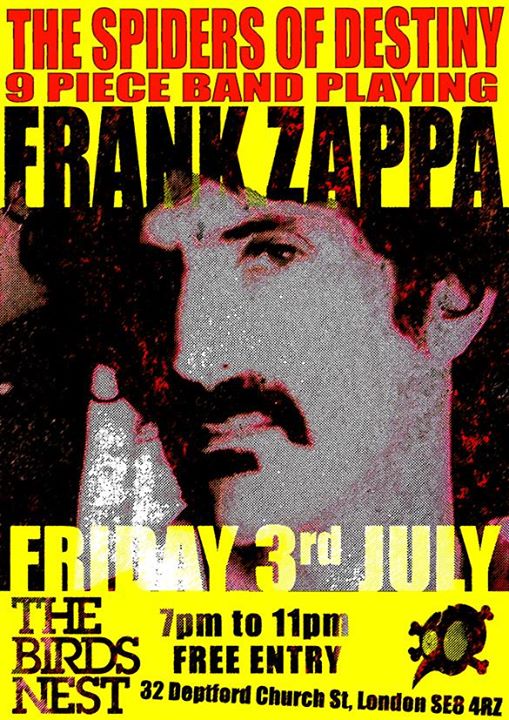
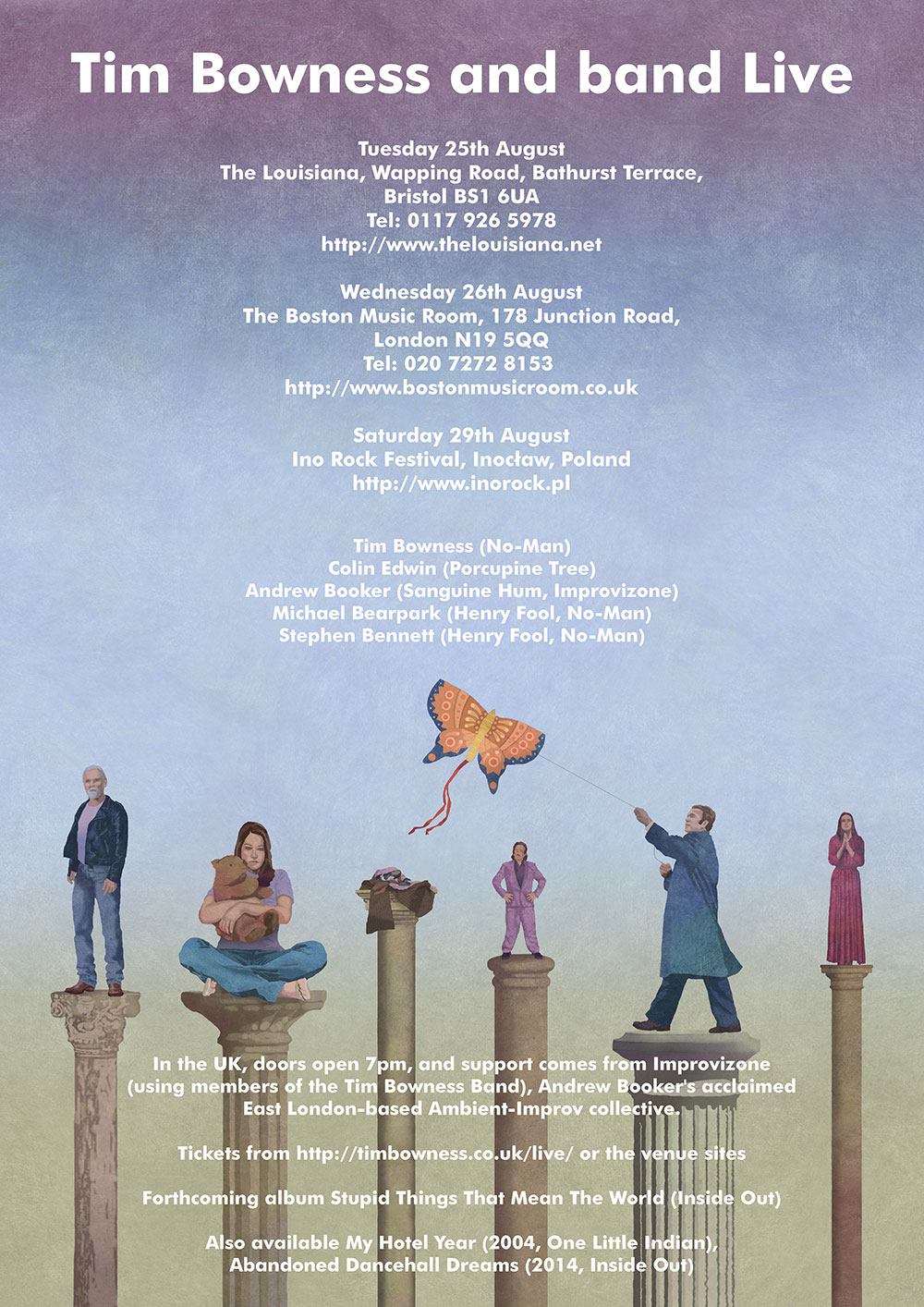



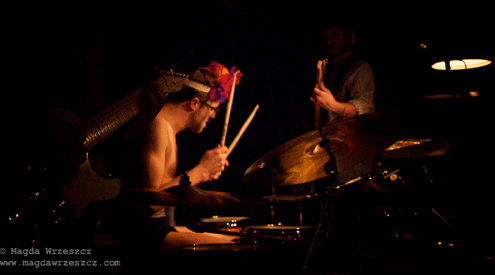


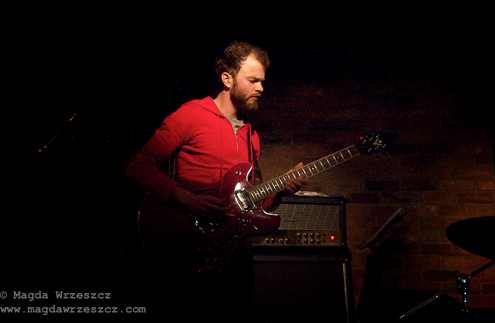


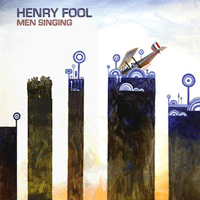
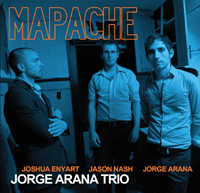

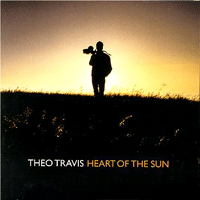





 Misfit City