Archive | November, 1995

Sometime in 1995 – album reviews – Dayna Kurtz’s ‘Footprints’ (“venturing into the faultlines between lovers which lurk in the most private places”)

30 Nov
Dayna Kurtz: 'Footprints'

Dayna Kurtz: ‘Footprints’

I’m not a stranger to heartbreak (either my own or that of others), but in all my experience of it, there are many things I haven’t done. I’ve never sat nursing a coffee in an all-night cafe as the dawn breaks, rearranging the cracked facets of my bitter smile. I’ve never composed the ultimate understanding kiss-off, writing the shapes and sentences to slide into a failed lover’s heart, to pat on the shoulder and slap upside the head with the same motion. I’ve never climbed the stairs of a Manhattan walk-up, trying to listen hard enough to trace the voices of memory infiltrating the walls and carrying memories of bitter love affairs, and of angry hearts temporarily exorcised at 3 a.m. But ‘Footprints’ – a collection of songs from Dayna Kurtz, whom I first saw breathing a blue glow of melody in front of a transfixed DreamHouse audience at the Water Rats – gives me an idea of what it might have felt like if I had.

Dayna explores the long deep pain of thwarted love with the same sort of delicious tension between voice and guitar as you get with Tuck & Patti or Jose Feliciano, but more raw, more direct, less decorated. Her voice is an aching, defiant, yearning thing, sharing breath with both Billie Holiday and Joni Mitchell. Her guitar is terse, bluesy, jazzy, but with a stubborn bluntness that refuses to flow smooth and to comfort; choosing instead to smack the hooks of wounded desire further into the heart, to bleed out the regret and anguish or to force the protective badges of scars and knowledge into being. Her songs clap and fold about you like a Coltrane solo bouncing jaggedly off the walls of a tiny club; or slip into you like short stories that sink to the depths of the heart, then rise like surfacing mines, meaning expanding in soft slow explosions.

Pick almost any song on here and you’re drawn into a story of bitter tangles; of embracing arms that end in helplessly clenched fists; of awkward, looming personal baggage that blocks the way into shared rooms. Perhaps the brittle R&B, funk and electricity that amplify the two full-band songs on ‘Footprints’ (‘The Road You’re On’, the title track) blunt the impact of Dayna’s writing. But catch her solo and you’re let in on something personal, painful, profound and beautifully defiant: “I threw my thoughts around, just for you to trip on.” She’s no fool: she’ll see through sentiment to the truth of the immediate (“once in a lifetime, this time – that’s what they sold me. / I don’t believe that, but it’s holy, holy,”) and she’s wise to vainglorious bullshit (“I got your picture at home: / you’re looking kinda cocky, with this wistful undertone, / like some cover has almost blown.”). Still, she seems ultimately to gravitate towards tension and friction in love.

In ‘Lay Me Down’ a relationship starts in a healing calm – “help me remember my liquid heart, and the open mouth of painful parting… / I’m moved, I confess, by a heart that seems calmer than mine.” Yet it swallows its own tail, hung up on the suspicions that both lovers have brought to the bed. “I hover above some something you said, / ’til I can’t feel you at all.”

In ‘Something/Nothing’ she attempts to immerse herself in a clasping at protection: “lost in the dark outside, I took your room to breathe, / and then I sealed all the cracks in me / then choked off my heart so cold and quick / and thought ‘it’s better this way’.” This, too, ends up in an indefinable and unexpected loss. “I lost my faith in something that I couldn’t name. / I thought you left with nothing… but I’m not the same.”

Dayna’s great songwriter’s gift – raising her above the usual horde of self-important dirty-linen washers – is the strength she brings to the table. A sense not of victimhood or self-righteousness, but of a strong woman of heart and mind, venturing into the faultlines between lovers which lurk in the most private places, and reporting back with full, proud honesty. “In my most helpless of hearts, I’ve been tearing up pictures of you,” she flares on Nowhere, made bloody-minded by another partner’s calculating shallowness and cowardice. “I gave my heart, an ocean; / showed you my soul to see. / And you just skimmed along the surface – but you’d swear you’d drowned in me… / When we’re good, we’re very good; / but when we’re bad, you’re nowhere.” On ‘This Side of Eve’ (a live duet with South African singer Tsidii Le Loka, whose shivering, passionate vocals coil round Dayna’s like smoke trails on a winter’s night) she’s set her face forward, to move on: “This place doesn’t know me, so there’s nothing to leave.”

Yet, appropriately, it’s the broken, free-time lick and gentle licking of old wounds on ‘Touchstone’ which I keep coming back to. A lonely, solo memory song (“I think of you, I think of you,”) surging and ebbing with the questions and longings that come too late (“Remember me? / I curve like a question mark. / And I’m lying home alone, / and I can almost hear you calling / like a saxophone…”). All the disappointments, yet couched in tenderness (“Remember me? / I came to you washed clean / and soft as a peach. / I said ‘let’s climb’, / but all you did was reach for me,”) and the frail wisps of old hopes, still held and treasured long after the hope has winked out of them – “I knew you’d be my touchstone, / I could see us getting old.”

Some old ghosts are now sitting with me. I think we’ll wait together, silently, until the sun comes up.

Dayna Kurtz: ‘Footprints’
self-released (no catalogue number or barcode)
Cassette-only album
Released:
1995
Get it from: (2020 update) Best obtained second-hand; this album is never likely to be reissued (since Dayna considers it to be juvenilia, or at the very least material recorded before she’d found her songwriting identity). There’s a live version of ‘Touchstone’ on Dayna’s ‘Otherwise Luscious Life‘ album.
Dayna Kurtz online:
Homepage Twitter MySpace Bandcamp Last FM YouTube Spotify Amazon Music

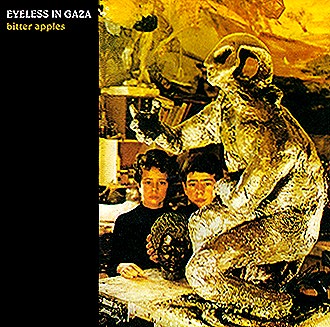
November 1995 – album reviews – Eyeless In Gaza’s ‘Bitter Apples’ (“an autumnal album in the most inspiring way”)

30 Nov

Eyeless In Gaza: 'Bitter Apples'

Eyeless In Gaza: ‘Bitter Apples’

After seventeen years on the wildest, furthest reaches of contemporary music, Eyeless In Gaza’s time may finally have come. With the British music scene proclaiming itself as boundary-free, cross-pollination of styles is the name of the game. Experimentation is the byword. Ears are open to new sounds.

Eyeless, of course, have been doing it for ages – from industrial electronics through early-80’s sparse electronic punk, bedsit acoustic folk, a stab at a big pop sound and experiments with mechanistic ambience. Then a seven-year abeyance followed by a shock return with the modern dance-pop of ‘Fabulous Library’ and by ‘Saw You In Reminding Pictures’ (an album of improvised, cinematic, ambient songs and atmospheres). Yet all, thanks to Martyn Bates’ distinctive, expressive voice and Peter Becker’s endlessly inventive musical collages, recognisably Eyeless In Gaza.

Much of Europe has been in on their greatness for years. Now that they have returned it is time that Britain listened in; particularly as, since Eyeless reformed, their career has been no nostalgic re-run of past styles, but a body of work that has engaged with the best of them in the camp marked “pre-millennial boundary-breaking zeitgeist experimentation”. Or something.

https://youtu.be/Bt7INcgK02c
 
Following the head-expanding soundscape world of ‘Saw You In Reminding Pictures’, ‘Bitter Apples’ comes announced as a return to song structures and a live folk feel (acoustic guitars, bass, drums). The matured Eyeless In Gaza are now reinventing the brand of avant-folk song first heard on their Drumming The Beating Heart album over a decade ago. Lyrics such as those on Bushes And Briars immediately announce the folk influence – “through bushes and through briars / I lately made my way / all for to hear the young birds sing / and the lambs to skip and play.”

But any hint of preciousness about such a style is dispelled by the ghostly a-capella treatment of Bates’ voice, treated with vocal effects that make him sound like a possessed changeling, wrapped in his own tingling harmonies. Martyn Bates’ voice is unique – expressive in hushing to a sense of menace, or delicate and weary, or surging with the power to hit the rafters. He occasionally retains a slight rasp, an edge, to his voice from the first punk-inflected vocals of early Eyeless. A comparison? Impossible.

 
Year Dot demonstrates how Eyeless In Gaza can produce powerfully rhythmic, surging music from the basis of harsh acoustic riffs, Martyn letting his voice roam over the melodies with unfettered power. But technology is not anathema to such natural surroundings, though – the track closes in a sharp crescendo of electronic interference. Contemporary experimentation mixes it further with avant-folk on Jump To Glory Jane – zither passages are built upon bursts of white noise, klaxons, and improvised wordless vocal harmonies as just another instrument in the delicate construction. It’s a perfect demonstration of the duo’s implicit feel for building such atmospheres, and sets the tone for much of the rest of the album.

Perhaps the central track, though, is To Listen Across The Sands: powerful and urgent, built upon a crashing electronic drum pattern remorselessly pushing the rhythm forward and echoing the lyrical theme of listening to “all the mad, crashing waves.” The song would seem to be an allegory for a journey through a stormy life – “listen across the sands / to the waves drifting where you stand / and all their voices swallowing your life.” A theme that is returned to, lyrically and musically, on the title track. To an up-tempo soundtrack of syncopated guitar and percussion (plus a star appearance from a keyboard relic in Peter Becker’s armoury of sounds – the Wasp), nature’s imagery is once again summoned to describe the unpleasant aspects of life we sometimes have to wade through. “Such a bitter harvest, such a windfall falling that I can’t move… / all that I taste wastes me away – all that I’m succoured by and living on… / bitter apples…”

This is an autumnal album in the most inspiring way – new invigorating cooler winds provoking the falling leaves and scudding clouds. And Eyeless in Gaza are long-overdue for rediscovery, yet still ripe. Pluck.

(review by Vaughan Simons)

Eyeless In Gaza: ‘Bitter Apples’
Ambivalent Scale Recording, A‑SCALE 020 (5021958453026)
CD‑only album
Released: autumn 1995

Get it from:
(2018 update) original CD best obtained second-hand. There was a 2011 reissue on Hand/Eye Records which might be easier to find.

Eyeless In Gaza online:
Homepage Facebook MySpace Soundcloud Tumblr Last FM

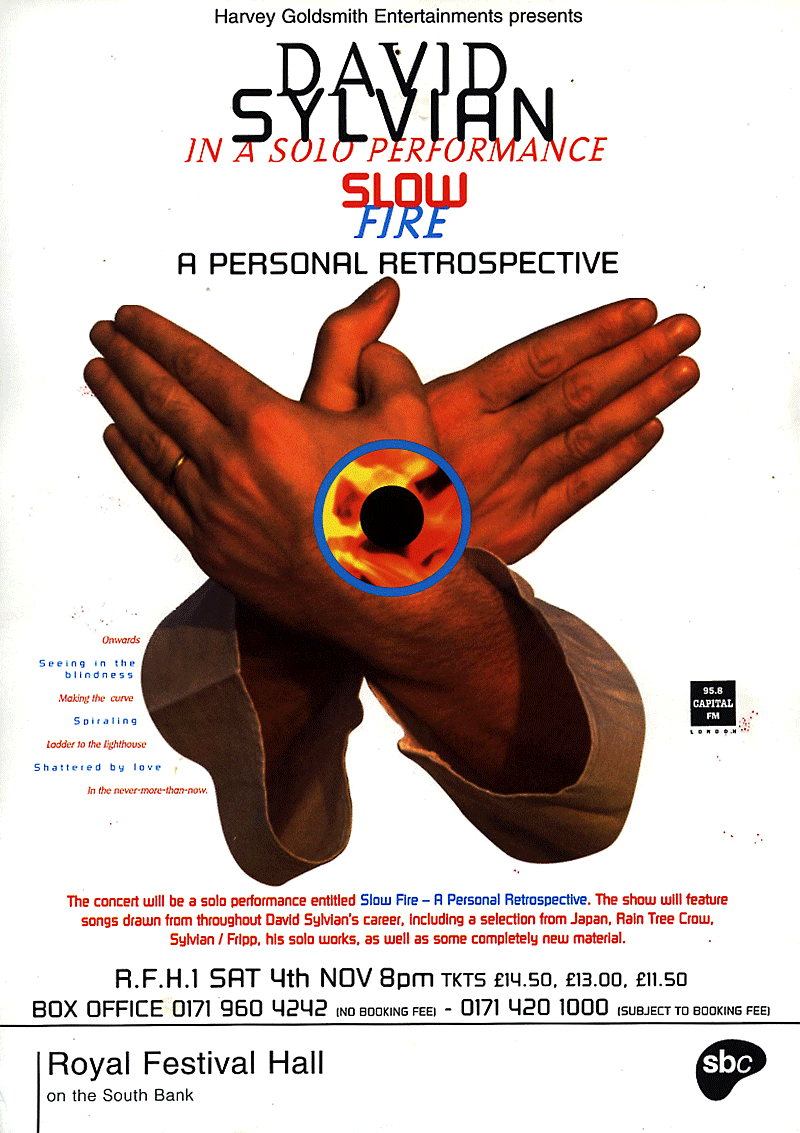
November 1995 – live reviews – David Sylvian’s ‘Slow Fire – A Personal Retrospective’ @ Royal Festival Hall, Southbank, London, 4th November (“self-effacing chameleonics”)

6 Nov

David Sylvian: 'Slow Fire - A Personal Retrospective' 4th November 1995

David Sylvian: ‘Slow Fire – A Personal Retrospective’ 4th November 1995

With former Japan leader David Sylvian, a show or an album is rarely as simple as being just a show or an album. Since 1983 he’s swum in and out of focus on a collection of artistic cross-fertilisations (sombrely beautiful songs albums, collaborative ambient vaguenesses, art installations): a shadowed, near-invisible chameleon with an enigmatic past ranging from over-exposed greasepaint-and-trash glamour to composer-effacing sound-sculpture. Tonight’s show – given extra weight by its ponderous title of ‘Slow Fire’ – is billed as a solo retrospective plus work in progress. Given Sylvian’s occasional tendency to enmire himself in inconsequential sound-tapestries, this could be grim. But the reality of ‘Slow Fire’ is more straightforward. Since we last saw him, touring with Robert Fripp, David Sylvian (like so many progressive artists) has decided to re-examine himself, unplugged.

With any contemporary electric musician, this is a risk: for Sylvian, much more so. The man now best known, post-Japan, for wall-to-wall electronic shrouding spends most of tonight perched on a stool behind a classical guitar. It’s the old rebirth scenario: once a travelling encrypter of decadent European and subtle Oriental sensibilities, Sylvian’s currently settled down into domestic bliss in America with a new wife (Prince protégé Ingrid Chavez), a new accent (decidedly transatlantic) and – judging by the credits on the appallingly pretentious programme – a guru. This would explain the brilliant white kaftan (has Jon Anderson missed any clothes recently?) and the four-cornered bowing as he takes the stage.

Though he’s dropped a few clues about an acoustic direction on recent recordings (on the Sylvian/Fripp B-side Endgame, for example), accepting Sylvian as an acoustic musician is not so easy. That marvellous voice, deep and rich as fortified honey, is still there, but over the years he’s made so much mileage out of his electrophonic atmospheres that his actual songs have been able to camouflage any flaws within the soundcraft.

The often disappointing collaboration with Fripp laid bare the aridity that Sylvian songs can often shrink into – tonight, Jean the Birdman is tricky and interesting but (even with a ludicrous attempt at scat singing) ultimately uninvolving, and there’s nothing like an acoustic performance for exposing juicelessness. Unsurprisingly, material from Sylvian’s song-centric 1987 album ‘Secrets of the Beehive’ fare well (the lilting menace in the folk-premonitions of The Boy with the Gun, a magnificent Orpheus and a hushed Waterfront) as do the few treasured songs from the Rain Tree Crow project: a reverberant Every Colour You Are, and a version of Blackwater which releases the song’s submerged country elements.

There are even one or two surprises during the guitar set, such as a rich rendition of Before the Bullfight and the shocking reinvention of keystone Japan hit Ghosts. From the beatless, icy original, Sylvian turns it into a wry Latin pop-inflected shrug of acknowledged doubt, Gilberto Gil meets Scott Walker. Even more shockingly, it works. But material from the schizophrenic ‘Brilliant Trees’ era has a tougher time making the jump to simple gut strings. Twitchy artiness such as Red Guitar and a limp Pulling Punches stumble out as embarrassing feynesses. Weathered Wall becomes a dull drone when denied the support of Jon Hassell‘s vaporous trumpet. With his shamanic atmospheric arrangements missing, too much of Sylvian’s once-epochal material is revealed as mere spectral verbiage, irresistibly crooned but superficially moodist. “Words with the charlatan,” mutters someone next to me, sarcastically.

It’s when he’s at the keyboard, with renewed access to a broader range of textures, that Sylvian delivers real magic – the rueful piano balladry in September and Earthbound Starblind, or the swathes of synth around the frozen pain and stone tears of Damage. When he allows himself the luxury of backing tapes, the dream deepens. A medley of Maria and Rain Tree Crow sees him keening over a wafting mist of chilling ambience punctuated by a ghostly chuckle. The First Day (graced with a wisp of taped Fripp skysaw) is as lushly majestic as ever. The deep dark indigo melancholy of Let the Happiness In acquires a meditative drum loop along with the shadowy orchestras of synth: it becomes hymnal, filling the great yearning emptiness at its heart with a sense of renewal, of return and redemption. It’s at moments like these that faith returns, and we can remember the subtle yet profound impact that Sylvian’s music has made in the past.

The trouble is that that was the past; and that the present is looking decidedly lumpen. The keyboard is also where Sylvian unveils his new material. For work in progress, it seems suspiciously complete… and already possesses a distinct form. A piano version of Tim Hardin’s It’ll Never Happen Again is the touchstone, with the interminable Ingrid’s Wheels and the rambling I Do Nothing (the latter most notable for its repeated, listless “alleluia”s) sketching Sylvian’s way forwards. Dusky, Americanised ballads with a strong element of that empty piano-bar pomposity that’s invariably damned with the kiss-of-death tag “quality songwriting”. Superficial sheen generating superficial applause. It’s difficult to escape the thought that David Sylvian’s self-effacing chameleonics have finally led him into a trap, a territory where he can no longer find his own face, where he will blur into a line of indistinguishable piano-song hacks whose albums will receive polite plaudits and gather dust on the lower shelves, where the fire will slow to a flicker.

The old Japan acolytes queue up tonight to touch the hem of King David’s gown. He smiles and bows like a bashful messiah. I can appreciate his showman’s smoothness… but I’ve lost my faith. I have a horrible suspicion that despite the handful of wonderful moments held to the light this evening, the shaman has swapped his books and his wisdom for a Cadillac, and the tin drum which once sounded out a musical challenge has just stopped beating.

David Sylvian online:
Homepage Facebook Twitter Soundcloud Last FM Apple Music YouTube Vimeo Deezer Google Play Pandora Spotify Tidal Amazon Music
Additional notes: While there’s no footage available for the London ‘Slow Fire’ show, you can get an approximation of it from footage of the Bari show from the same tour, in Italy, which is compiled here.
 

SWOONAGE

Swoon. /swo͞on/ A verb. To be emotionally affected by someone or something that one admires; become ecstatic. Here are some people and things that make me swoon. #swoon #swoonage

Post-Punk Monk

Searching for divinity in records from '78-'85 or so…

theartyassassin

...wandering through music...

Get In Her Ears

Promoting and Supporting Women in Music

Die or D.I.Y.?

...wandering through music...

Music Aficionado

Quality articles about the golden age of music

THE ACTIVE LISTENER

...wandering through music...

Planet Hugill

...wandering through music...

Listening to Ladies

...wandering through music...

ATTN:Magazine

Not from concentrate.

Xposed Club

improvised/experimental/music

The Quietus

...wandering through music...

I Quite Like Gigs

Music Reviews, music thoughts and musical wonderings

furia log

...wandering through music...

The Recoup

SINCE 2013: Books and books and books and books and occasionally other things

A jumped-up pantry boy

To say the least, oh truly disappointed

PROOF POSITIVE

A new semi-regular gig in London

Gapplegate Classical-Modern Music Review

...wandering through music...

When The Horn Blows

...wandering through music...

:::::::::::: Ekho :::::::::::: Women in Sonic Art

Celebrating the Work of Women within Sonic Art: an expanding archive promoting equality in the sonic field

Ned Raggett Ponders It All

Just another WordPress.com weblog

FLIPSIDE REVIEWS

...wandering through music...

Headphone Commute

honest words on honest music

The One-Liner Miner

...wandering through music...

Yeah I Know It Sucks

an absurdist review blog

Obat Kanker Payudara Ginseng RH 2

...wandering through music...

poplifer.wordpress.com/

Waiting for the gift of sound and vision

Good Music Speaks

A music blog written by Rich Brown

Do The Math

...wandering through music...

Archived Music Press

Scans from the Melody Maker and N.M.E. circa 1987-1996

The World's Worst Records

...wandering through music...

Soundscapes

...wandering through music...

OLD SCHOOL RECORD REVIEW

Where You Are Always Wrong

FRIDAY NIGHT BOYS

...wandering through music...

Fragile or Possibly Extinct

Life Outside the Womb

a closer listen

a home for instrumental and experimental music

Bird is the Worm

New Jazz: We Search. We Recommend. You Listen.

...wandering through music...

Life Just Bounces

...wandering through music...

Lucid Culture

JAZZ, CLASSICAL MUSIC AND THE ARTS IN NEW YORK CITY

Aquarium Drunkard

...wandering through music...

eyesplinters

Just another WordPress.com site

NewFrontEars

...wandering through music...

FormerConformer

Striving for Difference